
.jpg/250px-UGC_1810_and_UGC_1813_in_Arp_273_(captured_by_the_Hubble_Space_Telescope).jpg)


.jpg/1973px-UGC_1810_and_UGC_1813_in_Arp_273_(captured_by_the_Hubble_Space_Telescope).jpg)
Community hub
Recent from talks
Contribute something
Nothing was collected or created yet.
Gravity
View on Wikipedia
.jpg)
| Part of a series on |
| Classical mechanics |
|---|


In physics, gravity (from Latin gravitas 'weight'[1]), also known as gravitation or a gravitational interaction,[2] is a fundamental interaction, which may be described as the effect of a field that is generated by a gravitational source such as mass.
The gravitational attraction between clouds of primordial hydrogen and clumps of dark matter in the early universe caused the hydrogen gas to coalesce, eventually condensing and fusing to form stars. At larger scales this resulted in galaxies and clusters, so gravity is a primary driver for the large-scale structures in the universe. Gravity has an infinite range, although its effects become weaker as objects get farther away.
Gravity is described by the general theory of relativity, proposed by Albert Einstein in 1915, which describes gravity in terms of the curvature of spacetime, caused by the uneven distribution of mass. The most extreme example of this curvature of spacetime is a black hole, from which nothing—not even light—can escape once past the black hole's event horizon.[3] However, for most applications, gravity is sufficiently well approximated by Newton's law of universal gravitation, which describes gravity as an attractive force between any two bodies that is proportional to the product of their masses and inversely proportional to the square of the distance between them.
Scientists are looking for a theory that describes gravity in the framework of quantum mechanics (quantum gravity),[4] which would unify gravity and the other known fundamental interactions of physics in a single mathematical framework (a theory of everything).[5]
On the surface of a planetary body such as on Earth, this leads to gravitational acceleration of all objects towards the body, modified by the centrifugal effects arising from the rotation of the body.[6] In this context, gravity gives weight to physical objects and is essential to understanding the mechanisms that are responsible for surface water waves, lunar tides and substantially contributes to weather patterns. Gravitational weight also has many important biological functions, helping to guide the growth of plants through the process of gravitropism and influencing the circulation of fluids in multicellular organisms.
Characterization
[edit]Gravity is the word used to describe a physical law, a fundamental physical interaction that derives primarily from mass, and the observed consequences of that interaction on objects. Gravity is the law that every object with mass attracts every other object in the universe in proportion to each mass and inversely proportional to the square of the distance between them. The force of gravity, F is written using the gravitational constant, G, as[7] for two masses, m, and m′ separated by a distance r.

Gravity is considered to be one of four fundamental interactions. The electromagnetic force law is similar to the force law for gravity: both depend upon the square of the inverse distance between objects in typical interactions. The ratio of gravitational attraction of two electrons to their electrical repulsion is 1 to 4.17×1042.[7] As a result, gravity can generally be neglected at the level of subatomic particles.[8] Gravity becomes the most significant interaction between objects at the scale of astronomical bodies, and it determines the motion of satellites, planets, stars, galaxies, and even light. Gravity is also fundamental in another sense: the inertial mass that appears in Newton's second law is the same as the gravitational mass. This equivalence principle is a scientific hypothesis that has been tested experimentally to more than one part in a trillion.[9]
History
[edit]Ancient world
[edit]The nature and mechanism of gravity were explored by a wide range of ancient scholars. In Greece, Aristotle believed that objects fell towards the Earth because the Earth was the center of the Universe and attracted all of the mass in the Universe towards it. He also thought that the speed of a falling object should increase with its weight, a conclusion that was later shown to be false.[10] While Aristotle's view was widely accepted throughout Ancient Greece, there were other thinkers such as Plutarch who correctly predicted that the attraction of gravity was not unique to the Earth.[11]
Although he did not understand gravity as a force, the ancient Greek philosopher Archimedes discovered the center of gravity of a triangle.[12] He postulated that if two equal weights did not have the same center of gravity, the center of gravity of the two weights together would be in the middle of the line that joins their centers of gravity.[13] Two centuries later, the Roman engineer and architect Vitruvius contended in his De architectura that gravity is not dependent on a substance's weight but rather on its "nature".[14] In the 6th century CE, the Byzantine Alexandrian scholar John Philoponus proposed the theory of impetus, which modifies Aristotle's theory that "continuation of motion depends on continued action of a force" by incorporating a causative force that diminishes over time.[15]
In 628 CE, the Indian mathematician and astronomer Brahmagupta proposed the idea that gravity is an attractive force that draws objects to the Earth and used the term gurutvākarṣaṇ to describe it.[16]: 105 [17][18]
In the ancient Middle East, gravity was a topic of fierce debate. The Persian intellectual Al-Biruni believed that the force of gravity was not unique to the Earth, and he correctly assumed that other heavenly bodies should exert a gravitational attraction as well.[19] In contrast, Al-Khazini held the same position as Aristotle that all matter in the Universe is attracted to the center of the Earth.[20]

Scientific Revolution
[edit]In the mid-16th century, various European scientists experimentally disproved the Aristotelian notion that heavier objects fall at a faster rate.[21] In particular, the Spanish Dominican priest Domingo de Soto wrote in 1551 that bodies in free fall uniformly accelerate.[21] De Soto may have been influenced by earlier experiments conducted by other Dominican priests in Italy, including those by Benedetto Varchi, Francesco Beato, Luca Ghini, and Giovan Bellaso which contradicted Aristotle's teachings on the fall of bodies.[21]
The mid-16th century Italian physicist Giambattista Benedetti published papers claiming that, due to specific gravity, objects made of the same material but with different masses would fall at the same speed.[22] With the 1586 Delft tower experiment, the Flemish physicist Simon Stevin observed that two cannonballs of differing sizes and weights fell at the same rate when dropped from a tower.[23]
In the late 16th century, Galileo Galilei's careful measurements of balls rolling down inclines allowed him to firmly establish that gravitational acceleration is the same for all objects.[24][25]: 334 Galileo postulated that air resistance is the reason that objects with a low density and high surface area fall more slowly in an atmosphere. In his 1638 work Two New Sciences, Galileo proved that the distance traveled by a falling object is proportional to the square of the time elapsed. His method was a form of graphical numerical integration since concepts of algebra and calculus were unknown at the time.[26]: 4 This was later confirmed by Italian scientists Jesuits Grimaldi and Riccioli between 1640 and 1650. They also calculated the magnitude of the Earth's gravity by measuring the oscillations of a pendulum.[27]
Galileo also broke with incorrect ideas of Aristotelian philosophy by regarding inertia as persistence of motion, not a tendency to come to rest. By considering that the laws of physics appear identical on a moving ship to those on land, Galileo developed the concepts of reference frame and the principle of relativity.[28]: 5 These concepts would become central to Newton's mechanics, only to be transformed in Einstein's theory of gravity, the general theory of relativity.[29]: 17
In last quarter of the 16th century Tycho Brahe created accurate tools for astrometry, providing careful observations of the planets. His assistant and successor, Johannes Kepler analyzed these data into three empirical laws of planetary motion. These laws were central to the development of a theory of gravity a hundred years later.[30] In his 1609 book Astronomia nova Kepler described gravity as a mutual attraction, claiming that if the Earth and Moon were not held apart by some force they would come together. He recognized that mechanical forces cause action, creating a kind of celestial machine. On the other hand Kepler viewed the force of the Sun on the planets as magnetic and acting tangential to their orbits and he assumed with Aristotle that inertia meant objects tend to come to rest.[31][32]: 846
In 1666, Giovanni Alfonso Borelli avoided the key problems that limited Kepler. By Borelli's time the concept of inertia had its modern meaning as the tendency of objects to remain in uniform motion and he viewed the Sun as just another heavenly body. Borelli developed the idea of mechanical equilibrium, a balance between inertia and gravity. Newton cited Borelli's influence on his theory.[32]: 848
In 1657, Robert Hooke published his Micrographia, in which he hypothesized that the Moon must have its own gravity.[33]: 57 In a communication to the Royal Society in 1666 and his 1674 Gresham lecture, An Attempt to prove the Annual Motion of the Earth, Hooke took the important step of combining related hypothesis and then forming predictions based on the hypothesis.[34] He wrote:
I will explain a system of the world very different from any yet received. It is founded on the following positions. 1. That all the heavenly bodies have not only a gravitation of their parts to their own proper centre, but that they also mutually attract each other within their spheres of action. 2. That all bodies having a simple motion, will continue to move in a straight line, unless continually deflected from it by some extraneous force, causing them to describe a circle, an ellipse, or some other curve. 3. That this attraction is so much the greater as the bodies are nearer. As to the proportion in which those forces diminish by an increase of distance, I own I have not discovered it....[35][36]
Hooke was an important communicator who helped reformulate the scientific enterprise.[37] He was one of the first professional scientists and worked as the then-new Royal Society's curator of experiments for 40 years.[38] However his valuable insights remained hypotheses and some of these were incorrect.[39] He was unable develop a mathematical theory of gravity and work out the consequences.[32]: 853 For this he turned to Newton, writing him a letter in 1679, outlining a model of planetary motion in a void or vacuum due to attractive action at a distance. This letter likely turned Newton's thinking in a new direction leading to his revolutionary work on gravity.[37] When Newton reported his results in 1686, Hooke claimed the inverse square law portion was his "notion".
Newton's theory of gravitation
[edit]
Before 1684, scientists including Christopher Wren, Robert Hooke and Edmund Halley determined that Kepler's third law, relating to planetary orbital periods, would prove the inverse square law if the orbits were circles. However the orbits were known to be ellipses. At Halley's suggestion, Newton tackled the problem and was able to prove that ellipses also proved the inverse square relation from Kepler's observations.[29]: 13 In 1684, Isaac Newton sent a manuscript to Edmond Halley titled De motu corporum in gyrum ('On the motion of bodies in an orbit'), which provided a physical justification for Kepler's laws of planetary motion.[40] Halley was impressed by the manuscript and urged Newton to expand on it, and a few years later Newton published a groundbreaking book called Philosophiæ Naturalis Principia Mathematica (Mathematical Principles of Natural Philosophy).
The revolutionary aspect of Newton's theory of gravity was the unification of Earth-bound observations of acceleration with celestial mechanics.[41]: 4 In his book, Newton described gravitation as a universal force, and claimed that it operated on objects "according to the quantity of solid matter which they contain and propagates on all sides to immense distances always at the inverse square of the distances".[42]: 546 This formulation had two important parts. First was equating inertial mass and gravitational mass. Newton's 2nd law defines force via for inertial mass, his law of gravitational force uses the same mass. Newton did experiments with pendulums to verify this concept as best he could.[29]: 11

The second aspect of Newton's formulation was the inverse square of distance. This aspect was not new: the astronomer Ismaël Bullialdus proposed it around 1640. Seeking proof, Newton made quantitative analysis around 1665, considering the period and distance of the Moon's orbit and considering the timing of objects falling on Earth. Newton did not publish these results at the time because he could not prove that the Earth's gravity acts as if all its mass were concentrated at its center. That proof took him twenty years.[29]: 13
Newton's Principia was well received by the scientific community, and his law of gravitation quickly spread across the European world.[43] More than a century later, in 1821, his theory of gravitation rose to even greater prominence when it was used to predict the existence of Neptune. In that year, the French astronomer Alexis Bouvard used this theory to create a table modeling the orbit of Uranus, which was shown to differ significantly from the planet's actual trajectory. In order to explain this discrepancy, many astronomers speculated that there might be a large object beyond the orbit of Uranus which was disrupting its orbit. In 1846, the astronomers John Couch Adams and Urbain Le Verrier independently used Newton's law to predict Neptune's location in the night sky, and the planet was discovered there within a day.[44][45]
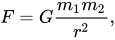
Newton's formulation was later condensed into the inverse-square law:where F is the force, m1 and m2 are the masses of the objects interacting, r is the distance between the centers of the masses and G is the gravitational constant 6.674×10⁻¹¹ m3⋅kg−1⋅s−2.[46] While G is also called Newton's constant, Newton did not use this constant or formula, he only discussed proportionality. But this allowed him to come to an astounding conclusion we take for granted today: the gravity of the Earth on the Moon is the same as the gravity of the Earth on an apple:Using the values known at the time, Newton was able to verify this form of his law. The value of G was eventually measured by Henry Cavendish in 1797.[47]: 31

Einstein's general relativity
[edit]| General relativity |
|---|
 |

Eventually, astronomers noticed an eccentricity in the orbit of the planet Mercury which could not be explained by Newton's theory: the perihelion of the orbit was increasing by about 42.98 arcseconds per century. The most obvious explanation for this discrepancy was an as-yet-undiscovered celestial body, such as a planet orbiting the Sun even closer than Mercury, but all efforts to find such a body turned out to be fruitless. In 1915, Albert Einstein developed a theory of general relativity which was able to accurately model Mercury's orbit.[48]
Einstein's theory brought two other ideas with independent histories into the physical theories of gravity: the principle of relativity and non-Euclidean geometry.
The principle of relativity, introduced by Galileo and used as a foundational principle by Newton, led to a long and fruitless search for a luminiferous aether after Maxwell's equations demonstrated that light propagated at a fixed speed independent of reference frame. In Newton's mechanics, velocities add: a cannon ball shot from a moving ship would travel with a trajectory which included the motion of the ship. Since light speed was fixed, it was assumed to travel in a fixed, absolute medium. Many experiments sought to reveal this medium but failed and in 1905 Einstein's special relativity theory showed the aether was not needed. Special relativity proposed that mechanics be reformulated to use the Lorentz transformation already applicable to light rather than the Galilean transformation adopted by Newton. Special relativity, as in special case, specifically did not cover gravity.[29]: 4
While relativity was associated with mechanics and thus gravity, the idea of altering geometry only joined the story of gravity once mechanics required the Lorentz transformations. Geometry was an ancient science that gradually broke free of Euclidean limitations when Carl Gauss discovered in the 1800s that surfaces in any number of dimensions could be characterized by a metric, a distance measurement along the shortest path between two points that reduces to Euclidean distance at infinitesimal separation. Gauss' student Bernhard Riemann developed this into a complete geometry by 1854. These geometries are locally flat but have global curvature.[29]: 4
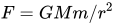
In 1907, Einstein took his first step by using special relativity to create a new form of the equivalence principle. The equivalence of inertial mass and gravitational mass was a known empirical law. The m in Newton's first law, , has the same value as the m in Newton's law of gravity on Earth, . In what he later described as "the happiest thought of my life" Einstein realized this meant that in free-fall, an accelerated coordinate system exists with no local gravitational field.[49] Every description of gravity in any other coordinate system must transform to give no field in the free-fall case, a powerful invariance constraint on all theories of gravity.[29]: 20
Einstein's description of gravity was accepted by the majority of physicists for two reasons. First, by 1910 his special relativity was accepted in German physics and was spreading to other countries. Second, his theory explained experimental results like the perihelion of Mercury and the bending of light around the Sun better than Newton's theory.[50]
In 1919, the British astrophysicist Arthur Eddington was able to confirm the predicted deflection of light during that year's solar eclipse.[51][52] Eddington measured starlight deflections twice those predicted by Newtonian corpuscular theory, in accordance with the predictions of general relativity. Although Eddington's analysis was later disputed, this experiment made Einstein famous almost overnight and caused general relativity to become widely accepted in the scientific community.[53]
In 1959, American physicists Robert Pound and Glen Rebka performed an experiment in which they used gamma rays to confirm the prediction of gravitational time dilation. By sending the rays down a 74-foot tower and measuring their frequency at the bottom, the scientists confirmed that light is Doppler shifted as it moves towards a source of gravity. The observed shift also supports the idea that time runs more slowly in the presence of a gravitational field (many more wave crests pass in a given interval). If light moves outward from a strong source of gravity it will be observed with a redshift.[54] The time delay of light passing close to a massive object was first identified by Irwin I. Shapiro in 1964 in interplanetary spacecraft signals.[55]
In 1971, scientists discovered the first-ever black hole in the galaxy Cygnus. The black hole was detected because it was emitting bursts of x-rays as it consumed a smaller star, and it came to be known as Cygnus X-1.[56] This discovery confirmed yet another prediction of general relativity, because Einstein's equations implied that light could not escape from a sufficiently large and compact object.[57]
Frame dragging, the idea that a rotating massive object should twist spacetime around it, was confirmed by Gravity Probe B results in 2011.[58][59] In 2015, the LIGO observatory detected faint gravitational waves, the existence of which had been predicted by general relativity. Scientists believe that the waves emanated from a black hole merger that occurred 1.5 billion light-years away.[60]
On Earth
[edit]
Every planetary body (including the Earth) is surrounded by its own gravitational field, which can be conceptualized with Newtonian physics as exerting an attractive force on all objects. Assuming a spherically symmetrical planet, the strength of this field at any given point above the surface is proportional to the planetary body's mass and inversely proportional to the square of the distance from the center of the body.

The strength of the gravitational field is numerically equal to the acceleration of objects under its influence.[61] The rate of acceleration of falling objects near the Earth's surface varies very slightly depending on latitude, surface features such as mountains and ridges, and perhaps unusually high or low sub-surface densities.[62] For purposes of weights and measures, a standard gravity value is defined by the International Bureau of Weights and Measures, under the International System of Units (SI).
The force of gravity experienced by objects on Earth's surface is the vector sum of two forces:[6] (a) The gravitational attraction in accordance with Newton's universal law of gravitation, and (b) the centrifugal force, which results from the choice of an earthbound, rotating frame of reference. The force of gravity is weakest at the equator because of the centrifugal force caused by the Earth's rotation and because points on the equator are farthest from the center of the Earth. The force of gravity varies with latitude, and the resultant acceleration increases from about 9.780 m/s2 at the Equator to about 9.832 m/s2 at the poles.[63][64]
Gravity wave
[edit]Waves on oceans, lakes, and other bodies of water occur when the gravitational equilibrium at the surface of the water is disturbed by for example wind.[65] Similar effects occur in the atmosphere where equilibrium is disturbed by thermal weather fronts or mountain ranges.[66]
Orbits
[edit]Planets orbit the Sun in an ellipse as a consequence of the law of gravity. Similarly the Moon and artificial satellites orbit the Earth. Conceptually two objects in orbit are both falling off of the curve they would travel in if the force of gravity were not pulling them together. Since the force of gravity is universal, all planets attract each other with the most massive and closest pair have the most mutual affect. This means orbits are more complex than simple ellipses.[7]
Astrophysics
[edit]Stars and black holes
[edit]During star formation, gravitational attraction in a cloud of hydrogen gas competes with thermal gas pressure. As the gas density increases, the temperature rises, then the gas radiates energy, allowing additional gravitational condensation. If the mass of gas in the region is low, the process continues until a brown dwarf or gas-giant planet is produced. If more mass is available, the additional gravitational energy allows the central region to reach pressures sufficient for nuclear fusion, forming a star. In a star, again the gravitational attraction competes, with thermal and radiation pressure in hydrostatic equilibrium until the star's atomic fuel runs out. The next phase depends upon the total mass of the star. Very low mass stars slowly cool as white dwarf stars with a small core balancing gravitational attraction with electron degeneracy pressure. Stars with masses similar to the Sun go through a red giant phase before becoming white dwarf stars. Higher mass stars have complex core structures that burn helium and high atomic number elements ultimately producing an iron core. As their fuel runs out, these stars become unstable producing a supernova. The result can be a neutron star where gravitational attraction balances neutron degeneracy pressure or, for even higher masses, a black hole where gravity operates alone with such intensity that even light cannot escape.[67]: 121
Gravitational radiation
[edit]
General relativity predicts that energy can be transported out of a system through gravitational radiation also known as gravitational waves. The first indirect evidence for gravitational radiation was through measurements of the Hulse–Taylor binary in 1973. This system consists of a pulsar and neutron star in orbit around one another. Its orbital period has decreased since its initial discovery due to a loss of energy, which is consistent for the amount of energy loss due to gravitational radiation. This research was awarded the Nobel Prize in Physics in 1993.[68]
The first direct evidence for gravitational radiation was measured on 14 September 2015 by the LIGO detectors. The gravitational waves emitted during the collision of two black holes 1.3 billion light years from Earth were measured.[69][70] This observation confirms the theoretical predictions of Einstein and others that such waves exist. It also opens the way for practical observation and understanding of the nature of gravity and events in the Universe including the Big Bang.[71] Neutron star and black hole formation also create detectable amounts of gravitational radiation.[72] This research was awarded the Nobel Prize in Physics in 2017.[73]
Dark matter
[edit]At the cosmological scale, gravity is a dominant player. About 5/6 of the total mass in the universe consists of dark matter which interacts through gravity but not through electromagnetic interactions. The gravitation of clumps of dark matter known as dark matter halos attract hydrogen gas leading to stars and galaxies.[74]
Gravitational lensing
[edit]
Gravity acts on light and matter equally, meaning that a sufficiently massive object could warp light around it and create a gravitational lens. This phenomenon was first confirmed by observation in 1979 using the 2.1 meter telescope at Kitt Peak National Observatory in Arizona, which saw two mirror images of the same quasar whose light had been bent around the galaxy YGKOW G1.[75][76] Many subsequent observations of gravitational lensing provide additional evidence for substantial amounts of dark matter around galaxies. Gravitational lenses do not focus like eyeglass lenses, but rather lead to annular shapes called Einstein rings.[47]: 370
Speed of gravity
[edit]In October 2017, the LIGO and Virgo interferometer detectors received gravitational wave signals 2 seconds before gamma ray satellites and optical telescopes seeing signals from the same direction, from a source about 130 million light-years away. This confirmed that the speed of gravitational waves was the same as the speed of light.[77]
Anomalies and discrepancies
[edit]There are some observations that are not adequately accounted for, which may point to the need for better theories of gravity or perhaps be explained in other ways.

- Galaxy rotation curves: Stars in galaxies follow a distribution of velocities where stars on the outskirts are moving faster than they should according to the observed distributions of luminous matter. Galaxies within galaxy clusters show a similar pattern. The pattern is considered strong evidence for dark matter, which would interact through gravitation but not electromagnetically; various modifications to Newtonian dynamics have also been proposed.[78]
- Accelerated expansion: The expansion of the universe seems to be accelerating.[79] Dark energy has been proposed to explain this.[80]
- Flyby anomaly: Various spacecraft have experienced greater acceleration than expected during gravity assist maneuvers.[81] The Pioneer anomaly has been shown to be explained by thermal recoil due to the distant sun radiation on one side of the space craft.[82][83]
Models
[edit]The physical models of gravity, like all physical models, are expressed mathematically. Physicists use several different models, depending on the problem to be solved or for the purpose of gaining physical intuition.[84]: 44
Newtonian action-at-a-distance
[edit]Newton's inverse square law models gravity as a force F between two objects proportional to their mass, m: This gravitational force causes the objects to accelerate towards each other unless balanced by other forces. The force is "nonlocal": it depends on the mass of an object at a distance.[84]: 44 Scientists from Newton onwards recognized that this action at a distance does not explain the root cause of the force, but nevertheless the model explains a vast number of physical effects including cannon ball trajectories, tidal motion and planetary orbits.[84]: 4 However, combining the concept of relativity with gravity is enormously complex using this Newtonian model.[84]: 48

Gravitational field
[edit]A second equivalent approach to model gravity uses fields.[84]: 44 In physics, a field represents a physical phenomenon using a mathematical entity associated with each point in a space. Different field theories use different entities and concepts of space. For classical field theories of gravity, the entities can be vectors associated with points in a 3-dimensional space. Each vector gives the force experienced by an insignificantly small test mass at that point in space. The force vector at each point can be computed as the direction of the highest rate of change in the gravitational potential, a single number at each point in space. The three-dimensional map of the potential or of the gravitational field provides a visual representation of the effect of the gravitational effect of all surrounding objects.[dubious – discuss] Field models are local: the field values on a sphere completely determine the effects of gravity with the sphere.[84]: 45
Fields are also used in general relativity, but rather than vectors over Euclidean space, the entities are tensors over spacetime. The Einstein field equations relate the 10 independent values in the tensors to the distribution of mass and energy in space.[dubious – discuss]
Action principles
[edit]A third completely different way to derive a model of gravity is based on action principles. This formulation represents the effects of gravity on a system in a mathematically abstract way. The state of the system, for example the position and velocity of every particle, is expressed as a single mathematical entity. Each state has an associated energy property called the Lagrangian; the physically allowed changes to the state of the system minimize the value of this property. The path of the state is not a path in physical space, but rather in a high-dimensional state space: each point along the path corresponds to a different position and or velocity collectively for all particles in the system. This formulation does not express the forces or fields of the individual particles.[84]: 46 Modern theories of physics rely on these action principles.[85]: 396 The Einstein field equation for gravitation can be derived from the Einstein–Hilbert action.[85]: 388
General relativity
[edit]In modern physics, general relativity is considered the most successful theory of gravitation.[86] Physicists continue to work to find solutions to the Einstein field equations that form the basis of general relativity and continue to test the theory, finding excellent agreement in all cases.[87][88][89]: p.9
Constraints
[edit]Any theory of gravity must conform to the requirements of special relativity and experimental observations. Newton's theory of gravity assumes action at a distance and therefore cannot be reconciled with special relativity. The simplest generalization of Newton's approach would be a scalar field theory with the gravitational potential represented by a single number in a 4-dimensional spacetime. However, this type of theory fails to predict gravitational redshift or the deviation of light by matter and gives values for the precession of Mercury which are incorrect. A vector field theory predicts negative energy gravitational waves so it also fails. Furthermore, no theory without curvature in spacetime can be consistent with special relativity. The simplest theory consistent with special relativity and the well-studied observations is general relativity.[90]
General characteristics
[edit]Unlike Newton's formula with one parameter, G, force in general relativity is terms of 10 numbers formed in to a metric tensor.[29]: 70 In general relativity the effects of gravitation are described in different ways in different frames of reference. In a free-falling or co-moving coordinate system, an object travels in a straight line. In other coordinate systems, the object accelerates and thus is seen to move under a force. The path in spacetime (not 3D space) taken by a free-falling object is called a geodesic and the length of that path as measured by time in the objects frame is the shortest (or rarely the longest) one. Consequently the effect of gravity can be described as curving spacetime. In a weak stationary gravitational field, general relativity reduces to Newton's equations. The corrections introduced by general relativity on Earth are on the order of 1 part in a billion.[29]: 77
Einstein field equations
[edit]The Einstein field equations are a system of 10 partial differential equations which describe how matter affects the curvature of spacetime. The system is may be expressed in the form where Gμν is the Einstein tensor, gμν is the metric tensor, Tμν is the stress–energy tensor, Λ is the cosmological constant, is the Newtonian constant of gravitation and is the speed of light.[91] The constant is referred to as the Einstein gravitational constant.[92]



Solutions
[edit]The non-linear second-order Einstein field equations are extremely complex and have been solved in only a few special cases.[93] These cases however have been transformational in our understanding of the cosmos. Several solutions are the basis for understanding black holes and for our modern model of the evolution of the universe since the Big Bang.[41]: 227
Tests of general relativity
[edit]
Testing the predictions of general relativity has historically been difficult, because they are almost identical to the predictions of Newtonian gravity for small energies and masses.[94] A wide range of experiments provided support of general relativity.[89]: 1–9 [95][96][97][98] Today, Einstein's theory of relativity is used for all gravitational calculations where absolute precision is desired, although Newton's inverse-square law is accurate enough for virtually all ordinary calculations.[89]: 79 [99]
Gravity and quantum mechanics
[edit]Despite its success in predicting the effects of gravity at large scales, general relativity is ultimately incompatible with quantum mechanics. This is because general relativity describes gravity as a smooth, continuous distortion of spacetime, while quantum mechanics holds that all forces arise from the exchange of discrete particles known as quanta. This contradiction is especially vexing to physicists because the other three fundamental forces (strong force, weak force and electromagnetism) were reconciled with a quantum framework decades ago.[100] As a result, researchers have begun to search for a theory that could unite both gravity and quantum mechanics under a more general framework.[101]
One path is to describe gravity in the framework of quantum field theory (QFT), which has been successful to accurately describe the other fundamental interactions. The electromagnetic force arises from an exchange of virtual photons, where the QFT description of gravity is that there is an exchange of virtual gravitons.[102][103] This description reproduces general relativity in the classical limit. However, this approach fails at short distances of the order of the Planck length,[104] where a more complete theory of quantum gravity (or a new approach to quantum mechanics) is required.
Alternative theories
[edit]General relativity has withstood many tests over a large range of mass and size scales.[105][106] When applied to interpret astronomical observations, cosmological models based on general relativity introduce two components to the universe,[107] dark matter[108] and dark energy,[109] the nature of which is currently an unsolved problem in physics. The many successful, high precision predictions of the standard model of cosmology has led astrophysicists to conclude it and thus general relativity will be the basis for future progress.[110][111] However, dark matter is not supported by the Standard Model of particle physics, physical models for dark energy do not match cosmological data, and some cosmological observations are inconsistent.[111] These issues have led to the study of alternative theories of gravity.[112]
See also
[edit]- Anti-gravity – Idea of creating a place or object that is free from the force of gravity
- Artificial gravity – Use of circular rotational force to mimic gravity
- Equations for a falling body – Mathematical description of a body in free fall
- Escape velocity – Concept in celestial mechanics
- Atmospheric escape – Loss of planetary atmospheric gases to outer space
- Gauss's law for gravity – Restatement of Newton's law of universal gravitation
- Gravitational potential – Fundamental study of potential theory
- Gravitational biology – Effect of gravity on living organisms
- Newton's laws of motion – Laws in physics about force and motion
- Standard gravitational parameter – Concept in celestial mechanics
- Weightlessness – Zero apparent weight, microgravity
References
[edit]- ^ "dict.cc dictionary :: gravitas :: English-Latin translation". Archived from the original on 13 August 2021. Retrieved 11 September 2018.
- ^ Braibant, Sylvie; Giacomelli, Giorgio; Spurio, Maurizio (2011). Particles and Fundamental Interactions: An Introduction to Particle Physics (illustrated ed.). Springer Science & Business Media. p. 109. ISBN 978-94-007-2463-1. Extract of page 109
- ^ "HubbleSite: Black Holes: Gravity's Relentless Pull". hubblesite.org. Archived from the original on 26 December 2018. Retrieved 7 October 2016.
- ^ Overbye, Dennis (10 October 2022). "Black Holes May Hide a Mind-Bending Secret About Our Universe – Take gravity, add quantum mechanics, stir. What do you get? Just maybe, a holographic cosmos". The New York Times. Archived from the original on 16 November 2022. Retrieved 10 October 2022.
- ^ Cartwright, Jon (17 May 2025). "Defying gravity". New Scientist. pp. 30–33.
- ^ a b Hofmann-Wellenhof, B.; Moritz, H. (2006). Physical Geodesy (2nd ed.). Springer. ISBN 978-3-211-33544-4.
§ 2.1: "The total force acting on a body at rest on the earth's surface is the resultant of gravitational force and the centrifugal force of the earth's rotation and is called gravity.
- ^ a b c Feynman, Richard P.; Leighton, Robert B.; Sands, Matthew L. (2006). "The Theory of Gravitation". The Feynman lectures on physics (Definitive ed.). San Francisco, Calif.: Pearson Addison Wesley. ISBN 978-0-8053-9045-2.
- ^ Krebs, Robert E. (1999). Scientific Development and Misconceptions Through the Ages: A Reference Guide (illustrated ed.). Greenwood Publishing Group. p. 133. ISBN 978-0-313-30226-8.
- ^ S. Navas et al. (Particle Data Group), Phys. Rev. D 110, 030001 (2024) 21. Experimental Tests of Gravitational Theory
- ^ Cappi, Alberto. "The concept of gravity before Newton" (PDF). Culture and Cosmos. Archived (PDF) from the original on 9 October 2022.
- ^ Bakker, Frederik; Palmerino, Carla Rita (1 June 2020). "Motion to the Center or Motion to the Whole? Plutarch's Views on Gravity and Their Influence on Galileo". Isis. 111 (2): 217–238. doi:10.1086/709138. hdl:2066/219256. ISSN 0021-1753. S2CID 219925047. Archived from the original on 2 May 2022. Retrieved 2 May 2022.
- ^ Neitz, Reviel; Noel, William (13 October 2011). The Archimedes Codex: Revealing The Secrets of the World's Greatest Palimpsest. Hachette UK. p. 125. ISBN 978-1-78022-198-4. Archived from the original on 7 January 2020. Retrieved 10 April 2019.
- ^ Tuplin, CJ; Wolpert, Lewis (2002). Science and Mathematics in Ancient Greek Culture. Hachette UK. p. xi. ISBN 978-0-19-815248-4. Archived from the original on 17 January 2020. Retrieved 10 April 2019.
- ^ Vitruvius, Marcus Pollio (1914). "7". In Alfred A. Howard (ed.). De Architectura libri decem [Ten Books on Architecture]. Herbert Langford Warren, Nelson Robinson (illus), Morris Hicky Morgan. Harvard University, Cambridge: Harvard University Press. p. 215. Archived from the original on 13 October 2016. Retrieved 10 April 2019.
- ^ Philoponus' term for impetus is "ἑνέργεια ἀσώματος κινητική" ("incorporeal motive enérgeia"); see CAG XVII, Ioannis Philoponi in Aristotelis Physicorum Libros Quinque Posteriores Commentaria Archived 22 December 2023 at the Wayback Machine, Walter de Gruyter, 1888, p. 642: "λέγω δὴ ὅτι ἑνέργειά τις ἀσώματος κινητικὴ ἑνδίδοται ὑπὸ τοῦ ῥιπτοῦντος τῷ ῥιπτουμένῳ [I say that impetus (incorporeal motive energy) is transferred from the thrower to the thrown]."
- ^ Pickover, Clifford (16 April 2008). Archimedes to Hawking: Laws of Science and the Great Minds Behind Them. Oxford University Press. ISBN 978-0-19-979268-9. Archived from the original on 18 January 2017. Retrieved 29 August 2017.
- ^ Bose, Mainak Kumar (1988). Late classical India. A. Mukherjee & Co. Archived from the original on 13 August 2021. Retrieved 28 July 2021.
- ^ Sen, Amartya (2005). The Argumentative Indian. Allen Lane. p. 29. ISBN 978-0-7139-9687-6.
- ^ Starr, S. Frederick (2015). Lost Enlightenment: Central Asia's Golden Age from the Arab Conquest to Tamerlane. Princeton University Press. p. 260. ISBN 978-0-691-16585-1.
- ^ Rozhanskaya, Mariam; Levinova, I. S. (1996). "Statics". In Rushdī, Rāshid (ed.). Encyclopedia of the History of Arabic Science. Vol. 2. Psychology Press. pp. 614–642. ISBN 978-0-415-12411-9.
- ^ a b c Wallace, William A. (2018) [2004]. Domingo de Soto and the Early Galileo: Essays on Intellectual History. Abingdon, UK: Routledge. pp. 119, 121–22. ISBN 978-1-351-15959-3. Archived from the original on 16 June 2021. Retrieved 4 August 2021.
- ^ Drabkin, I. E. (1963). "Two Versions of G. B. Benedetti's Demonstratio Proportionum Motuum Localium". Isis. 54 (2): 259–262. doi:10.1086/349706. ISSN 0021-1753. JSTOR 228543. S2CID 144883728.
- ^ Schilling, Govert (31 July 2017). Ripples in Spacetime: Einstein, Gravitational Waves, and the Future of Astronomy. Harvard University Press. p. 26. ISBN 978-0-674-97166-0. Archived from the original on 16 December 2021. Retrieved 16 December 2021.
- ^ Galileo (1638), Two New Sciences, First Day Salviati speaks: "If this were what Aristotle meant you would burden him with another error which would amount to a falsehood; because, since there is no such sheer height available on earth, it is clear that Aristotle could not have made the experiment; yet he wishes to give us the impression of his having performed it when he speaks of such an effect as one which we see."
- ^ Sobel, Dava (1993). Galileo's daughter: a historical memoir of science, faith, and love. New York: Walker. ISBN 978-0-8027-1343-8.
- ^ Gillispie, Charles Coulston (1960). The Edge of Objectivity: An Essay in the History of Scientific Ideas. Princeton University Press. pp. 3–6. ISBN 0-691-02350-6.
{{cite book}}: ISBN / Date incompatibility (help) - ^ J. L. Heilbron, Electricity in the 17th and 18th Centuries: A Study of Early Modern Physics (Berkeley, California: University of California Press, 1979), p. 180.
- ^ Ferraro, Rafael (2007). Einstein's space-time: an introduction to special and general relativity. New York: Springer. ISBN 978-0-387-69946-2. OCLC 141385334.
- ^ a b c d e f g h i Weinberg, Steven (1972). Gravitation and cosmology. John Wiley & Sons. ISBN 978-0-471-92567-5.
- ^ Høg, Erik (August 2009). "400 years of astrometry: from Tycho Brahe to Hipparcos". Experimental Astronomy. 25 (1–3): 225–240. Bibcode:2009ExA....25..225H. doi:10.1007/s10686-009-9156-7. ISSN 0922-6435.
- ^ Holton, Gerald (1 May 1956). "Johannes Kepler's Universe: Its Physics and Metaphysics". American Journal of Physics. 24 (5): 340–351. Bibcode:1956AmJPh..24..340H. doi:10.1119/1.1934225. ISSN 0002-9505.
- ^ a b c Dijksterhuis, E. J. (1954). History of Gravity and Attraction before Newton. Cahiers d'Histoire Mondiale. Journal of World History. Cuadernos de Historia Mundial, 1(4), 839.
- ^ Gribbin, John; Gribbin, Mary (2017). Out of the shadow of a giant: Hooke, Halley and the birth of British science. London: William Collins. ISBN 978-0-00-822059-4. OCLC 966239842.
- ^ Stewart, Dugald (1816). Elements of the Philosophy of the Human Mind. Vol. 2. Edinburgh; London: Constable & Co; Cadell & Davies. p. 434.
- ^ Hooke, Robert (1679). Lectiones Cutlerianae, or A collection of lectures, physical, mechanical, geographical & astronomical : made before the Royal Society on several occasions at Gresham Colledge [i.e. College]: to which are added divers miscellaneous discourses.
- ^ Hooke (1679), An Attempt to prove the Annual Motion of the Earth, page 2, 3.
- ^ a b Guicciardini, Niccolò (1 January 2020). "On the invisibility and impact of Robert Hooke's theory of gravitation". Open Philosophy. 3 (1): 266–282. doi:10.1515/opphil-2020-0131. hdl:2434/746528. ISSN 2543-8875.
- ^ Purrington, Robert D. (2009). The first professional scientist: Robert Hooke and the Royal Society of London. Science networks. Historical studies. Basel, Switzerland Boston: Birkhäuser. ISBN 978-3-0346-0037-8.
- ^ Hecht, Eugene (July 2021). "The true story of Newtonian gravity". American Journal of Physics. 89 (7): 683–692. doi:10.1119/10.0003535. ISSN 0002-9505.
- ^ Sagan, Carl & Druyan, Ann (1997). Comet. New York: Random House. pp. 52–58. ISBN 978-0-3078-0105-0. Archived from the original on 15 June 2021. Retrieved 5 August 2021.
- ^ a b Longair, Malcolm S. (2008). Galaxy Formation. Astronomy and Astrophysics Library. Berlin, Heidelberg: Springer Berlin Heidelberg. doi:10.1007/978-3-540-73478-9. ISBN 978-3-540-73477-2.
- ^ Newton, Isaac (1999). The Principia, The Mathematical Principles of Natural Philosophy. Translated by Cohen, I.B.; Whitman, A. Los Angeles: University of California Press.
- ^ "The Reception of Newton's Principia" (PDF). Archived (PDF) from the original on 9 October 2022. Retrieved 6 May 2022.
- ^ "This Month in Physics History". www.aps.org. Archived from the original on 6 May 2022. Retrieved 6 May 2022.
- ^ McCrea, W. H. (1976). "The Royal Observatory and the Study of Gravitation". Notes and Records of the Royal Society of London. 30 (2): 133–140. doi:10.1098/rsnr.1976.0010. ISSN 0035-9149. JSTOR 531749.
- ^ "2022 CODATA Value: Newtonian constant of gravitation". The NIST Reference on Constants, Units, and Uncertainty. NIST. May 2024. Retrieved 18 May 2024.
- ^ a b Zee, Anthony (2013). Einstein Gravity in a Nutshell. In a Nutshell Series (1 ed.). Princeton: Princeton University Press. ISBN 978-0-691-14558-7.
- ^ Nobil, Anna M. (March 1986). "The real value of Mercury's perihelion advance". Nature. 320 (6057): 39–41. Bibcode:1986Natur.320...39N. doi:10.1038/320039a0. ISSN 0028-0836. S2CID 4325839.
- ^ Webb, Joh; Dougan, Darren (23 November 2015). "Without Einstein it would have taken decades longer to understand gravity". Archived from the original on 21 May 2022. Retrieved 21 May 2022.
- ^ Brush, S. G. (1 January 1999). "Why was Relativity Accepted?". Physics in Perspective. 1 (2): 184–214. Bibcode:1999PhP.....1..184B. doi:10.1007/s000160050015. ISSN 1422-6944. S2CID 51825180. Archived from the original on 8 April 2023. Retrieved 22 May 2022.
- ^ Dyson, F. W.; Eddington, A. S.; Davidson, C. R. (1920). "A Determination of the Deflection of Light by the Sun's Gravitational Field, from Observations Made at the Total Eclipse of May 29, 1919". Phil. Trans. Roy. Soc. A. 220 (571–581): 291–333. Bibcode:1920RSPTA.220..291D. doi:10.1098/rsta.1920.0009. Archived from the original on 15 May 2020. Retrieved 1 July 2019.. Quote, p. 332: "Thus the results of the expeditions to Sobral and Principe can leave little doubt that a deflection of light takes place in the neighbourhood of the sun and that it is of the amount demanded by Einstein's generalised theory of relativity, as attributable to the sun's gravitational field."
- ^ Weinberg, Steven (1972). Gravitation and cosmology. John Wiley & Sons. ISBN 978-0-471-92567-5.. Quote, p. 192: "About a dozen stars in all were studied, and yielded values 1.98 ± 0.11" and 1.61 ± 0.31", in substantial agreement with Einstein's prediction θ☉ = 1.75"."
- ^ Gilmore, Gerard; Tausch-Pebody, Gudrun (20 March 2022). "The 1919 eclipse results that verified general relativity and their later detractors: a story re-told". Notes and Records: The Royal Society Journal of the History of Science. 76 (1): 155–180. arXiv:2010.13744. doi:10.1098/rsnr.2020.0040. S2CID 225075861.
- ^ "General Astronomy Addendum 10: Graviational Redshift and time dilation". homepage.physics.uiowa.edu. Archived from the original on 14 May 2022. Retrieved 29 May 2022.
- ^ Asada, Hideki (20 March 2008). "Gravitational time delay of light for various models of modified gravity". Physics Letters B. 661 (2–3): 78–81. arXiv:0710.0477. Bibcode:2008PhLB..661...78A. doi:10.1016/j.physletb.2008.02.006. S2CID 118365884. Archived from the original on 29 May 2022. Retrieved 29 May 2022.
- ^ "The Fate of the First Black Hole". www.science.org. Archived from the original on 31 May 2022. Retrieved 30 May 2022.
- ^ "Black Holes Science Mission Directorate". webarchive.library.unt.edu. Archived from the original on 8 April 2023. Retrieved 30 May 2022.
- ^ "NASA's Gravity Probe B Confirms Two Einstein Space-Time Theories". Nasa.gov. Archived from the original on 22 May 2013. Retrieved 23 July 2013.
- ^ ""Frame-Dragging" in Local Spacetime" (PDF). Stanford University. Archived (PDF) from the original on 9 October 2022.
- ^ "Gravitational Waves Detected 100 Years After Einstein's Prediction". Ligo Lab | Caltech. Archived from the original on 27 May 2019. Retrieved 30 May 2022.
- ^ Cantor, G.N.; Christie, J.R.R.; Hodge, M.J.S.; Olby, R.C. (2006). Companion to the History of Modern Science. Routledge. p. 448. ISBN 978-1-134-97751-2. Archived from the original on 17 January 2020. Retrieved 22 October 2017.
- ^ Nemiroff, R.; Bonnell, J., eds. (15 December 2014). "The Potsdam Gravity Potato". Astronomy Picture of the Day. NASA.
- ^ Boynton, Richard (2001). "Precise Measurement of Mass" (PDF). Sawe Paper No. 3147. Arlington, Texas: S.A.W.E., Inc. Archived from the original (PDF) on 27 February 2007. Retrieved 22 December 2023.
- ^ "Curious About Astronomy?". Cornell University. Archived from the original on 28 July 2013. Retrieved 22 December 2023.
- ^ Young, I. R. (1999). Wind generated ocean waves. Elsevier ocean engineering book series (1st ed.). Amsterdam ; New York: Elsevier. ISBN 978-0-08-043317-2.
- ^ Fritts, David C.; Alexander, M. Joan (March 2003). "Gravity wave dynamics and effects in the middle atmosphere". Reviews of Geophysics. 41 (1): 1003. Bibcode:2003RvGeo..41.1003F. doi:10.1029/2001RG000106. ISSN 8755-1209.
- ^ Demtröder, Wolfgang (2024). "Birth, Lifetime and Death of Stars". Astrophysics. Undergraduate Lecture Notes in Physics. Springer Nature Switzerland. pp. 121–175. doi:10.1007/978-3-031-22135-4_5. ISBN 978-3-031-22133-0. Retrieved 4 May 2025.
- ^ "The Nobel Prize in Physics 1993". Nobel Foundation. 13 October 1993. Archived from the original on 10 August 2018. Retrieved 22 December 2023.
for the discovery of a new type of pulsar, a discovery that has opened up new possibilities for the study of gravitation
- ^ Clark, Stuart (11 February 2016). "Gravitational waves: scientists announce 'we did it!' – live". the Guardian. Archived from the original on 22 June 2018. Retrieved 11 February 2016.
- ^ Castelvecchi, Davide; Witze, Witze (11 February 2016). "Einstein's gravitational waves found at last". Nature News. doi:10.1038/nature.2016.19361. S2CID 182916902. Archived from the original on 12 February 2016. Retrieved 11 February 2016.
- ^ "WHAT ARE GRAVITATIONAL WAVES AND WHY DO THEY MATTER?". popsci.com. 13 January 2016. Archived from the original on 3 February 2016. Retrieved 12 February 2016.
- ^ Abbott, B. P.; et al. (LIGO Scientific Collaboration & Virgo Collaboration) (October 2017). "GW170817: Observation of Gravitational Waves from a Binary Neutron Star Inspiral" (PDF). Physical Review Letters. 119 (16) 161101. arXiv:1710.05832. Bibcode:2017PhRvL.119p1101A. doi:10.1103/PhysRevLett.119.161101. PMID 29099225. Archived (PDF) from the original on 8 August 2018. Retrieved 28 September 2019.
- ^ Devlin, Hanna (3 October 2017). "Nobel prize in physics awarded for discovery of gravitational waves". the Guardian. Archived from the original on 3 October 2017. Retrieved 3 October 2017.
- ^ Wechsler, Risa H.; Tinker, Jeremy L. (14 September 2018). "The Connection Between Galaxies and Their Dark Matter Halos". Annual Review of Astronomy and Astrophysics. 56 (1): 435–487. arXiv:1804.03097. doi:10.1146/annurev-astro-081817-051756. ISSN 0066-4146.
- ^ Kar, Subal (2022). Physics and Astrophysics: Glimpses of the Progress (illustrated ed.). CRC Press. p. 106. ISBN 978-1-000-55926-2. Extract of page 106.
- ^ "Hubble, Hubble, Seeing Double!". NASA. 24 January 2014. Archived from the original on 25 May 2022. Retrieved 31 May 2022.
- ^ "GW170817 Press Release". LIGO Lab – Caltech. Archived from the original on 17 October 2017. Retrieved 24 October 2017.
- ^ Sofue, Yoshiaki; Rubin, Vera (1 September 2001). "Rotation Curves of Spiral Galaxies". Annual Review of Astronomy and Astrophysics. 39: 137–174. arXiv:astro-ph/0010594. Bibcode:2001ARA&A..39..137S. doi:10.1146/annurev.astro.39.1.137. ISSN 0066-4146.
- ^ "The Nobel Prize in Physics 2011: Adam G. Riess Facts". NobelPrize.org. Archived from the original on 28 May 2020. Retrieved 19 March 2024.
- ^ "What is Dark Energy? Inside our accelerating, expanding Universe". science.nasa.gov. 5 February 2024. Archived from the original on 19 March 2024. Retrieved 19 March 2024.
- ^ Anderson, John D.; Campbell, James K.; Ekelund, John E.; Ellis, Jordan; Jordan, James F. (3 March 2008). "Anomalous Orbital-Energy Changes Observed during Spacecraft Flybys of Earth". Physical Review Letters. 100 (9) 091102. Bibcode:2008PhRvL.100i1102A. doi:10.1103/PhysRevLett.100.091102. ISSN 0031-9007. PMID 18352689.
- ^ Turyshev, Slava G.; Toth, Viktor T.; Kinsella, Gary; Lee, Siu-Chun; Lok, Shing M.; Ellis, Jordan (12 June 2012). "Support for the Thermal Origin of the Pioneer Anomaly". Physical Review Letters. 108 (24) 241101. arXiv:1204.2507. Bibcode:2012PhRvL.108x1101T. doi:10.1103/PhysRevLett.108.241101. PMID 23004253.
- ^ Iorio, Lorenzo (May 2015). "Gravitational anomalies in the solar system?". International Journal of Modern Physics D. 24 (6): 1530015–1530343. arXiv:1412.7673. Bibcode:2015IJMPD..2430015I. doi:10.1142/S0218271815300153. ISSN 0218-2718.
- ^ a b c d e f g Feynman, Richard P. (1990). The character of physical law (16. pr ed.). Cambridge, Mass.: MIT Press. ISBN 978-0-262-56003-0.
- ^ a b Zee, Anthony (2013). Einstein Gravity in a Nutshell. In a Nutshell Series (1st ed.). Princeton: Princeton University Press. ISBN 978-0-691-14558-7.
- ^ Stephani, Hans (2003). Exact Solutions to Einstein's Field Equations. Cambridge University Press. p. 1. ISBN 978-0-521-46136-8.
- ^ "Einstein's general relativity theory is questioned but still stands for now". Science News. Science Daily. 25 July 2019. Retrieved 11 August 2024.
- ^ Lea, Robert (15 September 2022). "Einstein's greatest theory just passed its most rigorous test yet". Scientific American. Springer Nature America, Inc. Retrieved 11 August 2024.
- ^ a b c Will, Clifford M. (2018). Theory and Experiment in Gravitational Physics. Cambridge Univ. Press. ISBN 978-1-107-11744-0.
- ^ Debono, Ivan; Smoot, George (28 September 2016). "General Relativity and Cosmology: Unsolved Questions and Future Directions". Universe. 2 (4): 23. arXiv:1609.09781. Bibcode:2016Univ....2...23D. doi:10.3390/universe2040023. ISSN 2218-1997.
- ^ "Einstein Field Equations (General Relativity)". University of Warwick. Archived from the original on 25 May 2022. Retrieved 24 May 2022.
- ^ "How to understand Einstein's equation for general relativity". Big Think. 15 September 2021. Archived from the original on 26 May 2022. Retrieved 24 May 2022.
- ^ Siegel, Ethan. "This Is Why Scientists Will Never Exactly Solve General Relativity". Forbes. Archived from the original on 27 May 2022. Retrieved 27 May 2022.
- ^ "Testing General Relativity". NASA Blueshift. Archived from the original on 16 May 2022. Retrieved 29 May 2022.
- ^ Lindley, David (12 July 2005). "The Weight of Light". Physics. 16. Archived from the original on 25 May 2022. Retrieved 22 May 2022.
- ^ "Hafele-Keating Experiment". hyperphysics.phy-astr.gsu.edu. Archived from the original on 18 April 2017. Retrieved 22 May 2022.
- ^ "How the 1919 Solar Eclipse Made Einstein the World's Most Famous Scientist". Discover Magazine. Archived from the original on 22 May 2022. Retrieved 22 May 2022.
- ^ "At Long Last, Gravity Probe B Satellite Proves Einstein Right". www.science.org. Archived from the original on 22 May 2022. Retrieved 22 May 2022.
- ^ Hassani, Sadri (2010). From Atoms to Galaxies: A conceptual physics approach to scientific awareness. CRC Press. p. 131. ISBN 978-1-4398-0850-4.
- ^ "Gravity Probe B – Special & General Relativity Questions and Answers". einstein.stanford.edu. Archived from the original on 6 June 2022. Retrieved 1 August 2022.
- ^ Huggett, Nick; Matsubara, Keizo; Wüthrich, Christian (2020). Beyond Spacetime: The Foundations of Quantum Gravity. Cambridge University Press. p. 6. ISBN 978-1-108-65570-5.
- ^ Feynman, R. P.; Morinigo, F. B.; Wagner, W. G.; Hatfield, B. (1995). Feynman lectures on gravitation. Addison-Wesley. ISBN 978-0-201-62734-3.
- ^ Zee, A. (2003). Quantum Field Theory in a Nutshell. Princeton University Press. ISBN 978-0-691-01019-9.
- ^ Randall, Lisa (2005). Warped Passages: Unraveling the Universe's Hidden Dimensions. Ecco. ISBN 978-0-06-053108-9.
- ^ Will, Clifford M. (1 December 2014). "The Confrontation between General Relativity and Experiment". Living Reviews in Relativity. 17 (1) 4. arXiv:1403.7377. Bibcode:2014LRR....17....4W. doi:10.12942/lrr-2014-4. ISSN 2367-3613. PMC 5255900. PMID 28179848.
- ^ Asmodelle, E. (2017). "Tests of General Relativity: A Review". arXiv:1705.04397v1 [physics.class-ph].
- ^ Ryden, Barbara Sue (2017). Introduction to cosmology. Cambridge: Cambridge University Press. ISBN 978-1-316-65108-7.
- ^ Garrett, Katherine; Duda, Gintaras (2011). "Dark Matter: A Primer". Advances in Astronomy. 2011: 1–22. arXiv:1006.2483. Bibcode:2011AdAst2011E...8G. doi:10.1155/2011/968283. ISSN 1687-7969.
- ^ Li, Miao; Li, Xiao-Dong; Wang, Shuang; Wang, Yi (2013). "Dark energy: A brief review". Frontiers of Physics. 8 (6): 828–846. arXiv:1209.0922. Bibcode:2013FrPhy...8..828L. doi:10.1007/s11467-013-0300-5. ISSN 2095-0462.
- ^ Turner, Michael S. (26 September 2022). "The Road to Precision Cosmology". Annual Review of Nuclear and Particle Science. 72 (2022): 1–35. arXiv:2201.04741. Bibcode:2022ARNPS..72....1T. doi:10.1146/annurev-nucl-111119-041046. ISSN 0163-8998.
- ^ a b Abdalla, Elcio; Abellán, Guillermo Franco; Aboubrahim, Amin; Agnello, Adriano; Akarsu, Özgür; Akrami, Yashar; Alestas, George; Aloni, Daniel; Amendola, Luca; Anchordoqui, Luis A.; Anderson, Richard I.; Arendse, Nikki; Asgari, Marika; Ballardini, Mario; Barger, Vernon (1 June 2022). "Cosmology intertwined: A review of the particle physics, astrophysics, and cosmology associated with the cosmological tensions and anomalies". Journal of High Energy Astrophysics. 34: 49–211. arXiv:2203.06142. Bibcode:2022JHEAp..34...49A. doi:10.1016/j.jheap.2022.04.002. ISSN 2214-4048.
- ^ Cooper, Keith (6 February 2024). "Cosmic combat: delving into the battle between dark matter and modified gravity". physicsworld.
Further reading
[edit]- Halliday, David; Resnick, Robert; Krane, Kenneth S. (2001). Physics v. 1. New York: John Wiley & Sons. ISBN 978-0-471-32057-9.
- Serway, Raymond A.; Jewett, John W. (2004). Physics for Scientists and Engineers (6th ed.). Brooks/Cole. ISBN 978-0-534-40842-8.
- Tipler, Paul (2004). Physics for Scientists and Engineers: Mechanics, Oscillations and Waves, Thermodynamics (5th ed.). W.H. Freeman. ISBN 978-0-7167-0809-4.
- Thorne, Kip S.; Misner, Charles W.; Wheeler, John Archibald (1973). Gravitation. W.H. Freeman. ISBN 978-0-7167-0344-0.
External links
[edit] Definitions from Wiktionary
 Media from Commons
 Quotations from Wikiquote
 Texts from Wikisource
 Textbooks from Wikibooks
 Resources from Wikiversity
 Data from Wikidata


- "Gravitation", Encyclopedia of Mathematics, EMS Press, 2001 [1994]
- "Gravitation, theory of", Encyclopedia of Mathematics, EMS Press, 2001 [1994]


Gravity
View on GrokipediaCharacterization
Definition and Fundamental Role
Gravity is one of the four fundamental interactions in nature, alongside electromagnetism, the strong nuclear force, and the weak nuclear force.[1][13] It acts as an attractive force between any two objects that possess mass or energy, with no repulsive counterpart observed in this interaction.[1][14] In contrast to electromagnetism, which can be either attractive or repulsive depending on charges, gravity consistently draws masses toward each other.[14] This force manifests in everyday phenomena, such as causing objects to fall toward Earth's surface, and on cosmic scales, it maintains the stability of planetary orbits around stars by counterbalancing centrifugal tendencies.[2][15] Gravity also plays a pivotal role in shaping the large-scale structure of the universe, clumping matter into galaxies, clusters, and vast filaments through its cumulative pull on distributed masses.[16][17] Gravity possesses an infinite range, extending across the observable universe without diminishment by distance in principle, though its effects weaken with separation.[1][13] It is the weakest of the fundamental forces by many orders of magnitude, yet it dominates on astronomical scales because the other forces tend to cancel out—such as electromagnetism in neutral cosmic plasmas—while gravity accumulates additively over vast assemblies of matter.[1][18] In daily life, the sensation of weight represents the gravitational attraction exerted by Earth on an object's mass, pulling it downward toward the planet's center.[19][3]Strength and Universal Constant
The gravitational constant, denoted as , is a fundamental physical constant that quantifies the strength of the gravitational attraction between two masses in Newton's law of universal gravitation, , where it serves as the proportionality factor scaling the force inversely with the square of the distance between the masses and . Its currently accepted value, as recommended by the Committee on Data for Science and Technology (CODATA) in 2022, is , with a relative standard uncertainty of 22 parts per million. This value enables the calculation of gravitational forces across scales, from planetary orbits to galactic structures, by incorporating the masses involved.[20] Gravity is the weakest of the four fundamental forces, approximately times weaker than the strong nuclear force when compared via their dimensionless coupling constants at typical interaction scales. The strong nuclear force, which binds quarks into protons and neutrons and holds atomic nuclei together, has a coupling constant near 1, while gravity's effective coupling is around , rendering it negligible in subatomic interactions. This disparity arises because gravity couples universally to mass-energy but with an exceedingly small constant, whereas the strong force operates over short ranges (about m) with immense intensity.[21] The influence of gravity exhibits strong scale dependence: at atomic and subatomic levels, where particle masses are on the order of kg or less and distances are femtometers, the gravitational force between particles is overwhelmed by electromagnetic and nuclear forces, becoming effectively undetectable and thus having no noticeable effect on subatomic particles or processes. Conversely, at planetary and galactic scales, where masses aggregate to kg or more and distances span kilometers to light-years, gravity dominates due to its infinite range and cumulative nature, dictating the motion of celestial bodies and the large-scale structure of the universe. This scale hierarchy explains why gravity shapes cosmic evolution while playing no role in chemical bonds or nuclear reactions.[21] Measuring has historically posed significant challenges owing to the minuscule forces involved, requiring exquisite sensitivity to detect deflections on the order of microradians. The first successful determination came from Henry Cavendish's 1797–1798 torsion balance experiment, in which he suspended a light rod with small lead spheres (0.73 kg each) from a thin wire and observed its torsional oscillation induced by attraction to larger stationary lead spheres (158 kg each), placed alternately on opposite sides; by measuring the equilibrium deflection and wire's torsion constant, Cavendish inferred the Earth's density, from which was later calculated as approximately . Modern measurements continue to rely on refined torsion balances, achieving precisions of 10–20 ppm by minimizing environmental noise through cryogenic cooling and vacuum isolation, though discrepancies among results persist at the 50 ppm level. Complementary approaches, such as atom interferometry, use laser-cooled atoms (e.g., cesium) in free fall to detect phase shifts from gravitational gradients, yielding values like with uncertainties around 0.5%, and offer potential for further improvements by suppressing systematic errors in quantum regimes. These efforts highlight ongoing refinements in isolating the pure Newtonian interaction.[22][23][24]Historical Development
Ancient and Pre-Scientific Views
In ancient Greek philosophy, particularly in the work of Aristotle, the phenomenon now known as gravity was understood through the lens of natural motion and the four elements theory. Aristotle posited that the universe consists of four sublunary elements—earth, water, air, and fire—each with a specific natural place toward which it tends to move. Heavy elements like earth and water naturally move downward toward the center of the Earth, their natural place, while light elements like air and fire move upward.[25] This downward tendency of heavy bodies was not viewed as a universal attractive force but as an intrinsic property driven by the elements' natures, with motion ceasing once the natural place is reached.[26] Aristotle's framework, detailed in works like Physics and On the Heavens, dominated Western thought for centuries, explaining everyday observations such as falling objects without invoking quantitative laws.[25] Ancient observations of falling bodies and celestial motions further shaped these views, integrating them into geocentric models. Everyday experiences of objects dropping to the ground reinforced the idea of a natural downward pull limited to the sublunary realm, while heavenly bodies were seen as composed of a fifth element, ether, moving eternally in perfect circles around the Earth.[27] Ptolemy's geocentric system, developed in the 2nd century CE in his Almagest, formalized these observations by placing Earth at the universe's center, with planets and stars affixed to nested crystalline spheres that rotated uniformly.[28] Although Ptolemy focused on astronomical predictions rather than sublunary motion, his model upheld Aristotelian distinctions, treating celestial spheres as immune to the downward tendencies observed on Earth.[29] Cultural perspectives beyond the Greco-Roman tradition offered parallel qualitative understandings. Similarly, Islamic scholars like Ibn Sina (Avicenna, 980–1037 CE) elaborated on Aristotelian heaviness in his Kitab al-Shifa (The Book of Healing), attributing the downward motion of heavy bodies to an inherent gravitational tendency while distinguishing it from celestial rotations driven by a separate motive force.[30] Ibn Sina emphasized that this heaviness accelerates as bodies approach their natural place, influencing medieval Islamic natural philosophy.[31] Medieval European developments began to refine these ideas through impetus theory and graphical representations. Jean Buridan (c. 1300–1361), a French philosopher, introduced the concept of impetus—an impressed motive force imparted to projectiles—to explain sustained motion without continuous external agents, challenging Aristotle's reliance on surrounding media like air.[32] Buridan extended this to falling bodies, suggesting that gravity imparts successive increments of impetus, causing acceleration toward the natural place.[32] Building on this, Nicole Oresme (c. 1320–1382) pioneered graphical methods in his Tractatus de configurationibus qualitatum et motuum, using coordinate-like diagrams to visualize motion intensities over time, such as plotting velocity against duration to depict uniform acceleration as triangular areas.[33] These innovations provided qualitative tools for analyzing motion, paving the way for later quantitative approaches. A central misconception in these pre-scientific views was that gravity represented a tendency solely toward a "natural place" rather than a universal force acting between all masses. This elemental and teleological perspective, rooted in Aristotle, portrayed downward motion as purposeful and realm-specific, contrasting with the eventual recognition of it as an omnipresent attraction.[30] Such ideas persisted until the transition to experimental methods in the late 16th century.Newtonian Revolution
In 1687, Isaac Newton published Philosophiæ Naturalis Principia Mathematica, a seminal work that synthesized Johannes Kepler's empirical laws of planetary motion with Galileo's principle of inertia, establishing a unified framework for understanding both terrestrial and celestial mechanics.[34] This synthesis demonstrated that the same physical laws govern the fall of objects on Earth and the orbits of planets around the Sun, marking a profound shift toward a mathematical description of nature.[35] Newton's approach integrated these ideas through rigorous geometric proofs, resolving longstanding questions about motion under a single set of principles.[36] A popular anecdote, first recounted by Voltaire in 1727 based on accounts from Newton's niece, describes Newton observing an apple falling from a tree at Woolsthorpe Manor around 1666, prompting him to ponder why it fell straight down rather than sideways or upward. This led to a thought experiment comparing the apple's descent to the Moon's orbit: if the same force causing the apple to accelerate toward Earth acted continuously on the Moon, it could explain the curvature of its path around Earth instead of a straight line into space.[37] These reflections, developed during Newton's isolation due to the Great Plague, formed the conceptual foundation for his later formalization of gravitational attraction.[38] Newton's theory of universal gravitation posited that every particle of matter in the universe attracts every other particle with a force proportional to their masses and inversely related to the square of the distance between them, providing a comprehensive explanation for diverse phenomena including ocean tides, the trajectories of comets, and the regular motions of planets.[39] This principle unified disparate observations, showing tides as resulting from differential gravitational pulls of the Moon and Sun on Earth's oceans, comets as bodies following elliptical orbits under solar attraction, and planetary paths as ellipses determined by the same inverse-square force.[34] The development of these ideas was influenced by contemporaries such as Robert Hooke, who in 1679 suggested an inverse-square law for gravity in correspondence with Newton, and Edmond Halley, whose 1684 query about planetary orbits spurred Newton to revisit his calculations.[40] Priority disputes arose, particularly with Hooke, who claimed precedence for the inverse-square concept; Newton acknowledged Hooke's role in early drafts but minimized it in later editions amid acrimonious exchanges.[34] Halley, however, played a pivotal supportive role by funding the Principia's publication and verifying its predictions.[41] One immediate application of Newton's theory was Halley's prediction of comet returns using gravitational orbits; analyzing historical sightings, he calculated that the bright comet of 1682 would reappear around 1758, a forecast confirmed when the comet—now known as Halley's Comet—was observed on December 25, 1758, validating the periodic nature of cometary motion under universal gravitation.[42] This success, achieved posthumously for Halley, demonstrated the predictive power of Newton's framework and extended its reach beyond planets to transient celestial objects.[43]Relativistic and Modern Advances
By the late 19th century, Newtonian gravity encountered significant anomalies that highlighted its limitations. Astronomers observed an unexplained precession in Mercury's perihelion, amounting to approximately 43 arcseconds per century beyond what planetary perturbations could account for; this discrepancy was first quantified by Urbain Le Verrier in 1859 through analysis of historical observations.[44] Concurrently, the prevailing view that light propagated through a stationary luminiferous ether—a hypothetical medium filling space—faced null results from the Michelson-Morley experiment in 1887, which sought to detect Earth's orbital motion relative to this ether but found no variation in light speed.[45] These unresolved issues spurred theoretical innovations, culminating in Albert Einstein's presentation of general relativity in November 1915 to the Prussian Academy of Sciences, where he reconceptualized gravity as the curvature of four-dimensional spacetime induced by mass and energy.[46] Early experimental validations bolstered general relativity's credibility. During the total solar eclipse of May 29, 1919, expeditions led by Arthur Eddington in Príncipe and Andrew Crommelin in Sobral, Brazil, measured the apparent deflection of starlight passing near the Sun, confirming Einstein's predicted value of 1.75 arcseconds to within observational error.[47] Decades later, the Pound-Rebka experiment at Harvard in 1959 provided direct evidence for gravitational redshift by detecting a fractional frequency shift of about 2.5 × 10^{-15} in Mössbauer gamma rays traversing a 22.5-meter height in Earth's gravity, aligning with general relativity's prediction to 10-15% precision.[48] These tests, along with Mercury's precession now fully explained by relativistic effects, established general relativity as the superior framework over Newtonian mechanics. In the post-1950 era, general relativity transformed cosmology by underpinning models of an expanding universe, as Edwin Hubble's 1929 observations of galactic redshifts were interpreted through Friedmann-Lemaître-Robertson-Walker metrics derived from Einstein's equations, leading to the Big Bang theory's widespread acceptance after the 1965 discovery of the cosmic microwave background by Arno Penzias and Robert Wilson.[49] A landmark direct confirmation came on September 14, 2015, when the LIGO observatories detected gravitational waves—ripples in spacetime—from the merger of two black holes 1.3 billion light-years away, matching general relativity's waveform predictions and opening multimessenger astronomy; this achievement earned the 2017 Nobel Prize in Physics for Rainer Weiss, Barry Barish, and Kip Thorne.[50] Modern advances continue to probe general relativity's predictions at extreme scales. The Event Horizon Telescope collaboration released the first image of a black hole's shadow in the galaxy M87 on April 10, 2019, revealing a dark central region encircled by a luminous ring consistent with spacetime curvature around a 6.5-billion-solar-mass object, as forecasted by general relativity.[51] This was followed by the May 2022 image of Sagittarius A*, the supermassive black hole at the Milky Way's center with 4 million solar masses, further validating the theory's description of event horizons despite the target's rapid variability. In June 2023, the North American Nanohertz Observatory for Gravitational Waves (NANOGrav) reported evidence for a stochastic gravitational-wave background at nanohertz frequencies, detected via correlated timing residuals in signals from 67 pulsars over 15 years, likely arising from a cosmic population of supermassive black hole binaries and affirming general relativity's applicability to low-frequency regimes.[52] More recent detections in late 2024 of twin black hole collisions further tested general relativity in highly dynamic environments, with waveforms aligning closely with theoretical predictions.[53]Effects on Earth
Surface Gravity and Measurement
Surface gravity on Earth is the local manifestation of gravitational acceleration, denoted as g, which pulls objects toward the planet's center. The standard value adopted for sea-level conditions is g₀ = 9.80665 m/s², representing the conventional acceleration used in various scientific and engineering standards.[54] This value varies with latitude due to Earth's oblate spheroidal shape and rotational effects; at the equator, g is approximately 9.78 m/s², while at the poles it reaches about 9.83 m/s², a difference of roughly 0.05 m/s² or 6 milligals (mgal).[55][56] Early measurements of surface gravity relied on pendulum experiments, pioneered by Christiaan Huygens in the 17th century. Huygens developed the cycloidal pendulum clock and used its period to derive a precise estimate of g at Paris, achieving an accuracy of about 9.81 m/s² through the relation between pendulum length and free-fall time.[57] Modern gravimeters have advanced this precision significantly. Relative gravimeters, such as spring-based instruments, measure changes in g by detecting deflections in a mass suspended on a sensitive spring, offering portability for field surveys with resolutions down to 0.01 mgal.[58] Absolute gravimeters, like falling-corner types, determine g directly by tracking the free fall of a corner-cube reflector using laser interferometry in a vacuum, providing standalone measurements accurate to 0.002 mgal over short drops of about 0.2 m.[59] Local variations in surface gravity arise from several factors. Altitude affects g through the inverse-square law and reduced mass attraction; the free-air correction is approximately -0.3086 mgal per meter of elevation, leading to a decrease of about 0.03 m/s² at 10 km height.[56] Earth's rotation introduces a centrifugal effect that reduces effective g most at the equator, where it subtracts up to 0.034 m/s² (about 0.3% of total g), directed outward perpendicular to the axis.[60] Geological features cause anomalies from density contrasts; mountains exhibit negative Bouguer anomalies (e.g., -50 to -100 mgal over the Himalayas) due to low-density crustal roots, while ocean trenches show uncompensated negative free-air anomalies up to -9 mgal from mass deficits.[56][61] In microgravity environments, where effective g approaches zero, biological systems experience profound changes. On the International Space Station (ISS), astronauts encounter continuous free fall, leading to fluid shifts causing facial puffiness and reduced leg volume, as well as accelerated bone loss (1-2% per month) and muscle atrophy due to lack of load-bearing stress.[62] Free-fall simulations on Earth, such as parabolic aircraft flights or drop towers, replicate these conditions for short durations (20-30 seconds), enabling studies of cellular responses like altered protein expression and 3D tissue formation without sedimentation interference.[63] Gravity measurements play a key role in geophysics for resource exploration and hazard assessment. High-resolution gravimetry maps subsurface density variations to delineate ore bodies, such as massive sulfides in mining districts, by identifying anomalies from 1-10 mgal associated with mineral deposits.[64] In earthquake prediction efforts, microgravity surveys detect precursory changes in crustal strain, with temporal variations of 10-100 μgal signaling potential fault movements before seismic events.[65]| Factor | Approximate Effect on g | Example Location/Value |
|---|---|---|
| Latitude (Equator to Poles) | +0.05 m/s² | Equator: 9.78 m/s²; Poles: 9.83 m/s²[55] |
| Altitude (per km) | -0.003 m/s² | 10 km: ~0.03 m/s² decrease[56] |
| Centrifugal (Equator) | -0.034 m/s² | Reduces effective g by 0.3%[60] |
| Geological (Mountains) | -50 to -100 mgal | Himalayas: negative Bouguer anomaly[56] |
| Geological (Trenches) | several mgal (free-air) | Mariana Trench: -9 mgal uncompensated[61] |
Tidal Forces and Variations
Tidal forces arise from the differential gravitational attraction exerted by celestial bodies such as the Moon and Sun across the extent of Earth, leading to stretching and compression of the planet's oceans, crust, and atmosphere. Unlike the uniform gravitational pull that governs overall orbital motion, these forces create gradients that cause one side of Earth to experience stronger attraction than the opposite side, resulting in two opposing bulges. The Moon's proximity makes it the dominant contributor, producing tidal bulges on the near and far sides of Earth, with the oceans rising to form high tides at these locations twice daily as Earth rotates. The Sun contributes a smaller but significant effect, about 46% of the Moon's tidal influence, due to its greater mass offset by its distance.[66][67] When the Moon and Sun align during new and full moons, their gravitational pulls reinforce to produce spring tides, characterized by higher high tides and lower low tides, increasing the tidal range by approximately 20%. Conversely, during first and third quarter moons, their pulls act at right angles, partially canceling to form neap tides with reduced range, also by about 20%. These cycles repeat twice per synodic lunar month of 29.53 days, influencing global ocean levels and coastal ecosystems.[66] The mathematical basis for tidal acceleration stems from the variation in gravitational force over Earth's radius. While the direct gravitational attraction follows an inverse-square law, the differential tidal force—responsible for the bulges—varies inversely with the cube of the distance between the attracting body and Earth's center. This arises because the tidal effect is proportional to the gradient of the gravitational field, yielding an acceleration approximately given by where is the gravitational constant, is the mass of the Moon or Sun, is Earth's radius, and is the distance to the attracting body; the Moon's closer proximity ( km) amplifies its effect over the Sun's ( km).[66][68] On Earth, these forces manifest as diurnal tides (one high and one low per lunar day, common in the Gulf of Mexico) or semidiurnal tides (two highs and two lows of similar height per lunar day, prevalent along the U.S. East Coast). Mixed semidiurnal patterns, with unequal highs and lows, dominate the West Coast. Coastal regions experience amplified effects, including erosion from strong tidal currents, flooding during high tides that exacerbates storm surges, and navigational challenges in shallow waters where tides can exceed 10 meters in range, as in the Bay of Fundy.[69][70] Tidal interactions have also led to the Moon's tidal locking, where its rotational period synchronizes with its orbital period around Earth (both approximately 27.3 days), ensuring the same hemisphere always faces Earth. This synchronization resulted from gravitational torques dissipating rotational energy as heat over billions of years, a process that continues to subtly slow Earth's rotation by about 2.3 milliseconds per century.[71] Beyond oceans, tidal forces deform the solid Earth by up to 30 cm vertically, causing measurable crustal flexing known as solid Earth tides, which influence seismicity and groundwater flow. Atmospheric tides, driven by solar heating and lunar gravity, produce global pressure waves with diurnal (24-hour) and semidiurnal (12-hour) components, affecting upper atmospheric winds and ionospheric electron densities up to altitudes of 100 km.[72][73] Isaac Newton first outlined the gravitational basis of tides in his 1687 Philosophiæ Naturalis Principia Mathematica, attributing oceanic bulges to the Moon's and Sun's attractions, though his equilibrium model overlooked dynamic ocean responses. Pierre-Simon Laplace refined this in the late 18th century through his Mécanique Céleste, incorporating hydrodynamic equations and global basin effects to better predict tidal variations, establishing the foundation for harmonic analysis. Modern predictions rely on satellite altimetry from missions such as TOPEX/Poseidon (1992–2006) and the ongoing Sentinel-6 series (as of 2025), which map global ocean tides with centimeter accuracy, enabling precise models of tidal dissipation and circulation that improve forecasting for coastal management.[74][75][76]Orbital and Celestial Mechanics
Keplerian Orbits
Keplerian orbits represent the idealized motion of a smaller body, such as a planet or satellite, around a much more massive central body under the influence of Newtonian gravity, where the force follows an inverse-square law. This framework assumes a two-body problem, reducing the relative motion to a conic section—typically an ellipse for bound orbits—with the primary body at one focus. These orbits provide the foundational model for understanding planetary and artificial satellite paths in celestial mechanics.[77] Johannes Kepler derived three empirical laws of planetary motion from meticulous observations of Mars made by Tycho Brahe. The first law, published in Astronomia Nova in 1609, states that a planet's orbit is an ellipse with the Sun at one of the two foci, replacing earlier circular models with a more accurate geometric description. The second law, also from 1609, asserts that a line joining the planet to the Sun sweeps out equal areas in equal intervals of time, implying that the orbital speed varies such that the planet moves faster near perihelion and slower near aphelion. The third law, announced in Harmonices Mundi in 1619, relates the orbital period to the semi-major axis of the ellipse via , applicable to all planets around the Sun. Isaac Newton later demonstrated in his Principia (1687) that these laws arise naturally from a central gravitational force proportional to , unifying Kepler's empirical findings with a theoretical basis.[78][79] The vis-viva equation encapsulates the speed in a Keplerian orbit, derived from conservation of energy in the two-body problem under Newtonian gravity. For a body of reduced mass orbiting a central mass with gravitational parameter , the specific orbital energy is constant, leading to the relation between velocity , radial distance , and semi-major axis : This equation follows by combining the total mechanical energy (constant for elliptical orbits) and solving for , highlighting how speed depends on position and orbit size without needing angular momentum details. It applies to elliptical, parabolic, and hyperbolic trajectories, with negative for unbound cases. A Keplerian orbit is fully specified by six independent orbital elements, which describe its size, shape, orientation, and the body's position within it. These include the semi-major axis (defining the orbit's scale), eccentricity (measuring deviation from a circle, where for ellipses), inclination (angle between the orbital plane and a reference plane, such as the ecliptic), longitude of the ascending node (orientation of the orbital plane), argument of periapsis (angle from the ascending node to the periapsis), and true anomaly (angle from periapsis to the current position). These elements enable precise prediction of positions for applications like satellite tracking.[77][80] Keplerian orbits underpin practical engineering in space missions, such as calculating trajectories for satellite launches to achieve desired altitudes and inclinations using rocket burns timed via the vis-viva equation. In the Global Positioning System (GPS), satellite orbits are modeled as Keplerian ellipses with semi-major axes around 26,560 km, but relativistic effects from general relativity require corrections of about 45 microseconds per day to maintain positional accuracy within meters. The two-body approximation yields exact, closed-form solutions for bound orbits, ensuring long-term stability in isolation, though real-world perturbations—such as from Earth's oblateness or atmospheric drag—must be accounted for using numerical methods to refine predictions over time.[81][82][83]Gravitational Binding in Systems
In multi-body gravitational systems, binding arises from the negative gravitational potential energy that counteracts the positive kinetic energy of the components, maintaining overall stability. For a simple two-body system consisting of masses and separated by distance , the binding energy is the gravitational potential energy required to separate them to infinity, given by where is the gravitational constant.[84] This negative value indicates the energy released upon formation and the work needed for disassembly. For stable, self-gravitating systems such as star clusters, the virial theorem provides a key relation between average kinetic energy and potential energy . In Newtonian gravity, where forces scale as , the theorem states for systems in equilibrium with no net change in moment of inertia over long timescales, such as orbital periods.[85] This balance implies that the total energy is negative, confirming bound states, with kinetic energy roughly half the magnitude of the potential energy. In solar system dynamics, gravitational binding extends to three-body interactions, where stable configurations emerge at Lagrange points—equilibrium positions in the restricted three-body problem dominated by two massive bodies like the Sun and a planet. These points, particularly the stable L4 and L5 triangular locations ahead and behind the secondary body, host Trojan asteroids in the Sun-Jupiter system, illustrating how binding enables long-term co-orbital stability through balanced gravitational and centrifugal forces.[86] However, the three-body problem introduces chaos, as small perturbations in initial conditions lead to exponentially diverging trajectories; in the inner solar system, resonant interactions like the 2:1 Earth-Mars resonance drive chaotic zones with maximum Lyapunov exponents around , limiting long-term predictability despite overall binding.[87] A related concept is escape velocity, the minimum speed needed for a particle to escape a body's gravitational binding to infinity without further propulsion. For a spherical mass at radius , conservation of energy yields This formula highlights the scale of binding, as velocities below it result in bound orbits. In extreme cases, it analogizes to black hole event horizons, where the radius (Schwarzschild radius) makes , the speed of light, rendering escape impossible for massive objects.[88] On larger scales, gravitational binding ensures cluster stability in systems like globular clusters, which are dense, spheroidal collections of to stars held by mutual gravity. Binaries within these clusters enhance binding by ejecting energy via close encounters, stabilizing against core collapse per Heggie's law, with observed X-ray sources from such dynamics confirming the role of binding in maintaining equilibrium phases.[89] In galaxy formation, initial density perturbations collapse under gravity, forming bound halos where binding energy dominates over expansion, leading to hierarchical merging of substructures into stable galaxies as modeled in cold dark matter scenarios.[90] Tidal effects can disrupt binding near the Roche limit, the critical distance where a satellite's self-gravity fails against the primary's differential pull, approximated as for fluid bodies, with and the primary's radius and density, and the satellite's. For Saturn's rings, composed of icy particles, this limit explains their confinement within about 2.4 Saturn radii, likely formed by tidal disruption of a migrating progenitor satellite, dispersing material into a bound disk while the core survives.[91]Astrophysical Applications
Stellar Evolution and Black Holes
In stars, gravitational forces drive the inward contraction of stellar material, which is counterbalanced by outward pressure gradients to maintain hydrostatic equilibrium. This balance is described by the equation of hydrostatic equilibrium, where the pressure gradient , with as pressure, as density, as mass enclosed within radius , and as the gravitational constant.[92] For main-sequence stars, nuclear fusion in the core generates thermal pressure that supports this equilibrium against gravity, and the resulting structure leads to the mass-luminosity relation, where stellar luminosity scales approximately as for stars with masses up to about 20 solar masses (), as higher-mass stars require greater fusion rates to counteract stronger gravitational compression. This relation arises from the interplay of gravitational binding energy release and radiative transport within the star.[93] For massive stars exceeding roughly 8 , the life cycle culminates in core collapse when nuclear fusion ceases, as gravity overwhelms thermal pressure. The iron core, unable to sustain further fusion, contracts rapidly, leading to a core-collapse supernova if the core mass falls between approximately 1.4 and 3 , where electron degeneracy pressure initially resists but ultimately fails under gravitational forces.[94] In cases where the progenitor mass exceeds about 20-25 , the collapse proceeds beyond neutron degeneracy pressure—provided by the Pauli exclusion principle for neutrons—resulting in the formation of a neutron star if the remnant core is around 1.4-2 , or further collapse to a black hole if exceeding the Tolman-Oppenheimer-Volkoff limit of roughly 2-3 . These supernovae release enormous energy, with the outer layers ejected at speeds up to 10% of the speed of light, driven by the rebound of the infalling material against the compact core.[95] Black holes form when gravitational collapse is unstoppable, compressing matter within its Schwarzschild radius, defined as , where is the speed of light; for a solar-mass black hole, this radius is about 3 km.[96] The event horizon at marks the boundary beyond which escape velocity exceeds , trapping all matter and radiation. According to the no-hair theorem, stationary black holes in general relativity are fully characterized by only three parameters—mass , angular momentum , and electric charge —with no other distinguishing features, implying that all information about the infalling matter is lost to external observers. Around black holes, infalling gas forms an accretion disk due to angular momentum conservation, where gravitational potential energy is converted to heat via viscous friction, emitting X-rays as temperatures reach millions of Kelvin; magnetic fields in the disk can launch relativistic jets perpendicular to the plane, collimating plasma outflows at near-light speeds to shed excess angular momentum.[97] Observational evidence for stellar-mass black holes includes Cygnus X-1, identified in the 1970s as a ~15 black hole in a binary system through X-ray emissions from its accretion disk and radial velocity measurements of the companion star, confirming a compact object too massive to be a neutron star. For supermassive black holes, the Event Horizon Telescope imaged the shadow of Sagittarius A* (Sgr A*) in 2019, revealing a ring of emission from the surrounding accretion flow around a 4 million black hole at the Milky Way's center, with the dark central region consistent with the predicted event horizon size. Binary black hole mergers provide further evidence, as gravitational attraction causes orbits to decay via energy loss, culminating in coalescence; the first detected event, GW150914, involved two ~30 black holes merging into a ~62 remnant, observed through the resulting spacetime ripple.[98]Gravitational Lensing and Waves
Gravitational lensing is a phenomenon predicted by general relativity in which the gravitational field of a massive object bends the path of light from a more distant background source, distorting and magnifying its image. This effect arises because massive bodies curve spacetime, causing photons to follow geodesics that deviate from straight lines in flat space. For light passing near a point mass in the weak-field limit, the deflection angle is given by where is the gravitational constant, is the mass of the lensing object, is the speed of light, and is the impact parameter of the light ray.[99] When the source, lens, and observer are nearly aligned, this can produce symmetric distortions known as Einstein rings, where the light forms a complete circular image around the lens.[100] In galaxy clusters, gravitational lensing often manifests as extended arcs or multiple images of background galaxies due to the distributed mass. A prominent example is the galaxy cluster Abell 1689, located about 2.2 billion light-years away, where Hubble Space Telescope observations reveal a network of bright arcs formed by the lensing of light from distant galaxies behind the cluster's core.[101] These arcs provide insights into the cluster's total mass distribution, including dark matter contributions, by mapping how light paths are warped. On smaller scales, microlensing occurs when a foreground star or stellar-mass object passes in front of a background star, briefly amplifying its brightness as the lens's gravity focuses the light. The Optical Gravitational Lensing Experiment (OGLE) survey has utilized microlensing to detect exoplanets, identifying over 40 such worlds orbiting other stars through temporary brightness spikes in monitored fields toward the galactic bulge.[102] Gravitational waves, another consequence of general relativity, are transverse ripples in spacetime propagating at the speed of light, generated by the acceleration of asymmetric mass distributions. Unlike electromagnetic waves, they originate from the second time derivative of the mass quadrupole moment, as symmetric motions like simple linear acceleration do not produce net radiation.[103] The dimensionless strain induced by these waves on a detector, which measures the fractional change in spacetime intervals, scales as where is the second time derivative of the quadrupole moment and is the distance to the source; the factor underscores the waves' extreme weakness.[104] The first direct detection of gravitational waves came from the Advanced LIGO and Virgo observatories, which observed the signal GW150914 on September 14, 2015, from the inspiral and merger of two black holes about 1.3 billion light-years away.[98] This event marked the onset of gravitational-wave astronomy, with subsequent detections confirming the waves' quadrupole nature and enabling tests of general relativity in strong fields. A landmark advancement occurred with GW170817 on August 17, 2017, the merger of two neutron stars at about 140 million light-years distance, which was observed not only in gravitational waves but also across the electromagnetic spectrum, ushering in multimessenger astronomy.[105] The near-simultaneous arrival of the gravitational-wave signal and the associated gamma-ray burst—separated by just 1.7 seconds after traveling 140 million light-years—confirmed that gravitational waves propagate at the speed of light to within 1 part in .[106]Dark Matter Influences
Observations of galactic rotation curves in the 1970s provided early evidence for dark matter through gravitational influences that could not be explained by visible mass alone. Vera Rubin and colleagues measured the rotational velocities of stars and gas in spiral galaxies like Andromeda (M31), finding that velocities remain roughly constant at large radii rather than declining as predicted by Newtonian gravity for luminous matter distributions.[107] These flat rotation curves imply the presence of an unseen mass component exerting additional gravitational pull to maintain orbital speeds, with the inferred dark matter halo extending far beyond the visible disk.[108] On larger scales, gravitational potential wells in galaxy clusters further highlight dark matter's role in dynamics. In colliding clusters, such as the Bullet Cluster (1E 0657-558), weak gravitational lensing maps reveal mass concentrations offset from the hot intracluster gas detected in X-rays, indicating that collisionless dark matter passes through unimpeded while baryonic matter interacts electromagnetically.[109] This separation, observed in 2006, provides direct empirical evidence for dark matter's gravitational dominance in cluster-scale potentials, independent of baryonic contributions.[110] In cosmological models, these gravitational discrepancies are incorporated into the Lambda cold dark matter (ΛCDM) framework, where dark matter constitutes approximately 27% of the universe's total energy density. Planck satellite measurements of cosmic microwave background (CMB) anisotropies in 2018 constrained the cold dark matter density parameter to Ω_c h² = 0.120 ± 0.001, supporting ΛCDM's success in predicting large-scale structure formation through gravitational instability.[111] This model posits that dark matter's gravity seeds the growth of cosmic structures, with its density evolution influencing the universe's expansion history. Alternative theories, such as Modified Newtonian Dynamics (MOND), propose modifying gravity at low accelerations to explain rotation curves without unseen mass, as introduced by Mordehai Milgrom in 1983.[112] However, MOND faces tensions with CMB data; Planck 2018 results show discrepancies in the power spectrum and lensing potential that favor ΛCDM over MOND-like modifications.[111] Recent advancements from the Dark Energy Spectroscopic Instrument (DESI) survey, using baryon acoustic oscillations (BAO) in its 2025 Data Release 2, have tightened constraints on dark matter parameters. Analyzing over 14 million galaxies and quasars, DESI DR2 BAO measurements yield improved precision on the matter density, reinforcing ΛCDM while probing potential deviations in dark matter's gravitational influence on cosmic scales.[113]Theoretical Frameworks
Newtonian Formulation
The Newtonian formulation of gravity, introduced by Isaac Newton in his Philosophiæ Naturalis Principia Mathematica, posits that every particle in the universe attracts every other particle with a force that is directly proportional to the product of their masses and inversely proportional to the square of the distance between their centers. This force law is expressed in vector form as where is the gravitational constant, and are the masses, is the distance between them, and is the unit vector pointing from to .[114][115] The negative sign indicates that the force is attractive, directing each mass toward the other. This inverse-square dependence unifies terrestrial gravity with celestial motions, treating gravity as a universal phenomenon acting along the line joining the masses.[116] Newton derived this law by linking it to Johannes Kepler's third law of planetary motion, which states that the square of a planet's orbital period is proportional to the cube of its semi-major axis , or . For a circular orbit, the centripetal acceleration required to maintain the motion is , where is the orbital speed and is the radius. Equating this to the gravitational acceleration (with as the central mass, such as the Sun), yields , or . Since , substituting gives , which matches Kepler's law when the constant of proportionality is identified as . This derivation demonstrates how the inverse-square force law explains elliptical orbits as conic sections under central acceleration.[116] In the Newtonian framework, gravity is also described through a scalar gravitational potential , defined such that the gravitational field and the force on a mass is . For a point mass , the potential outside the mass is . For a continuous mass distribution with density , the potential satisfies Poisson's equation, which relates the Laplacian of the potential to the mass density, allowing the computation of from the source distribution via integration. This equation arises from applying Gauss's theorem to the gravitational flux, analogous to electrostatics.[117][118] Newton's theory relies on action at a distance, where the gravitational influence propagates instantaneously across any separation, without an intervening medium or finite speed. This concept faced philosophical critique for implying non-local, occult-like interactions, prompting later thinkers like Pierre-Simon Laplace to reformulate gravity in terms of a field permeating space, where the potential mediates the force locally.[119][120] However, the instantaneous propagation contradicts the finite speed of light, and the formulation breaks down in regimes of high velocities approaching the speed of light or strong gravitational fields near compact masses, where relativistic effects become significant.[115][121]General Relativistic Description
In general relativity, the equivalence principle asserts the local indistinguishability of gravitational fields from acceleration, implying that inertial mass and gravitational mass are identical for all bodies. This principle, first articulated by Einstein, underpins the theory by equating the effects of gravity to the curvature of spacetime experienced uniformly in a small region.[122] Spacetime in general relativity is modeled as a four-dimensional pseudo-Riemannian manifold equipped with a metric tensor , which encodes the geometry and distances between events. The motion of freely falling test particles, un influenced by non-gravitational forces, follows geodesics— the extremal paths defined by the metric, generalizing straight lines to curved geometry. These geodesics satisfy the equation where are the Christoffel symbols derived from , and is proper time. The dynamics of spacetime curvature are governed by the Einstein field equations, where is the Einstein tensor (with the Ricci tensor and the scalar curvature), and is the stress-energy tensor representing the distribution of matter, energy, and momentum. These equations, finalized in their covariant form in late 1915, relate the local geometry to the sources of gravity.[123] Exact solutions to these equations illustrate key applications. The Schwarzschild metric describes the spacetime around a non-rotating, spherically symmetric mass in vacuum, serving as the foundation for modeling static black holes. Independently developed shortly after the field equations, it takes the form where is the metric on the unit sphere. For cosmology, the Friedmann-Lemaître-Robertson-Walker (FLRW) metric captures homogeneous and isotropic expanding universes, given by with scale factor and curvature parameter ; it originated from solutions assuming spatial uniformity.[96] General relativity incorporates causality through light cones, which delineate the boundaries of possible influence between events: timelike paths lie inside the cone (slower than light), null paths on the cone (light signals), and spacelike paths outside (faster than light, forbidden for causal propagation). This structure ensures that information and matter cannot exceed the speed of light, preserving the theory's consistency with special relativity. Energy conditions impose restrictions on to reflect physical reasonableness, such as the weak energy condition requiring non-negative energy density for all observers ( for timelike ) and the strong energy condition ensuring attractive gravity (). These conditions underpin theorems about spacetime behavior, like the focusing of geodesics. Singularities arise in solutions where spacetime curvature diverges, such as at black hole centers or the Big Bang, indicating breakdowns in the classical description under extreme concentrations of energy.[124][125]Quantum Gravity Challenges
One of the primary challenges in developing a quantum theory of gravity arises from the non-renormalizability of general relativity when treated as a quantum field theory. In perturbative approaches, attempts to quantize gravity lead to infinities at higher loop orders that cannot be systematically absorbed by renormalization procedures, rendering the theory unpredictable at high energies. This issue was first demonstrated at one-loop level in pure gravity by 't Hooft and Veltman in 1974, who showed that while some divergences can be absorbed into field renormalizations, the theory requires an infinite number of counterterms beyond that order. Subsequent work confirmed non-renormalizability at two loops, solidifying the need for non-perturbative methods or fundamental modifications to the theory. Prominent approaches to quantum gravity include string theory, which posits that fundamental constituents are one-dimensional strings vibrating in a higher-dimensional spacetime, typically 10 or 11 dimensions, with the graviton emerging as a massless spin-2 mode in the string spectrum. This framework resolves the non-renormalizability by providing a finite perturbative expansion and incorporates gravity naturally alongside other forces. Another major candidate is loop quantum gravity, a background-independent quantization of general relativity that discretizes spacetime into a network of spin-foam states, where geometric quantities like area and volume acquire discrete spectra at the Planck scale, avoiding singularities through polymer-like quantization. A key puzzle in quantum gravity is the black hole information paradox, first articulated by Hawking in 1974, which arises from the apparent conflict between quantum unitarity and the thermal nature of Hawking radiation: information falling into a black hole seems lost as the black hole evaporates, violating the principle that quantum evolution preserves information. This led to debates over resolutions, including the controversial firewall hypothesis proposed by Almheiri et al. in 2013, which suggests that the horizon of an old black hole becomes a high-energy "firewall" to preserve quantum monogamy, potentially violating the equivalence principle. The holographic principle offers a profound insight into these challenges, proposing that the information content of a volume of space can be encoded on its boundary, as exemplified by the AdS/CFT correspondence discovered by Maldacena in 1997, where a gravitational theory in anti-de Sitter space is dual to a conformal field theory without gravity. This duality has provided tools to study black hole evaporation and the information paradox non-perturbatively, suggesting that quantum gravity may be fundamentally holographic. As of 2025, no complete, experimentally verified theory of quantum gravity exists, with ongoing efforts in string theory, loop quantum gravity, and other frameworks like asymptotic safety continuing to face unresolved issues such as the lack of a low-energy limit matching general relativity or direct empirical tests. Experimental progress includes analog simulations using quantum optics to mimic black hole horizons and Hawking radiation, such as those employing optical fibers or Bose-Einstein condensates to observe analogue effects like stimulated emission near event horizons. In 2025, notable advances included a new gauge theory of gravity from Aalto University that unifies it with the Standard Model of particle physics, a revival of quadratic gravity (an early renormalizable approach with "ghost" particles) potentially resolving hierarchy and inflation issues, and theoretical work showing classical gravity can induce quantum entanglement via virtual matter propagators, which complicates distinguishing quantum gravity effects in entanglement-based experiments; additionally, techniques like MIT's method for amplifying gravity's influence on light polarization aim to probe its quantum nature directly.[126][127][128][129]Experimental Tests and Anomalies
Classical Confirmations
The first laboratory confirmation of Newtonian gravity came from Henry Cavendish's 1798 torsion balance experiment, which measured the gravitational attraction between lead spheres to determine the Earth's density. Using an apparatus with a 6-foot horizontal rod suspended by a thin wire and small lead balls attracted to larger fixed ones, Cavendish obtained a value of 5.48 for the Earth's mean density relative to water, implying the first estimate of the gravitational constant (modern recalibration).[22] This result verified the inverse-square law at short ranges, with the torsional deflection providing direct evidence of weak gravitational forces without relying on astronomical observations.[130] Modern consistency checks of in Newtonian gravity utilize lunar laser ranging (LLR), where lasers fired from Earth to retroreflectors on the Moon measure round-trip times to millimeter precision. LLR data from observatories like Apache Point constrain temporal variations in to , showing no evidence of drift over decades and affirming the constancy of the gravitational constant in solar-system dynamics.[131] General relativity's predictions were first confirmed in the solar system through the anomalous precession of Mercury's perihelion, observed since the 19th century but unexplained by Newtonian mechanics. Einstein's 1915 field equations predicted an additional advance of 43 arcseconds per century beyond Newtonian contributions from planetary perturbations, matching Urbain Le Verrier's 1859 discrepancy value refined by Simon Newcomb in 1895. Radar ranging and orbital data since the 1960s have verified this to within 0.1%, with no deviations from the relativistic rate.[132] Another early relativistic test involved the Shapiro time delay, where radar signals passing near the Sun experience a gravitational redshift and path lengthening. In 1964, Irwin Shapiro used radio echoes from Venus and Mercury to measure this delay, confirming general relativity's prediction of up to 200 microseconds extra travel time when signals graze the solar limb, with observations agreeing to within 5-10%. Subsequent Viking lander (1976) and Cassini (2002) missions refined this to 0.1% precision, further validating the effect. Frame-dragging, or the Lense-Thirring effect, was directly tested by NASA's Gravity Probe B mission (2004-2011), which used superconducting gyroscopes in polar Earth orbit to detect spacetime twisting by the planet's rotation. The experiment measured a frame-dragging precession of milliarcseconds per year, aligning with general relativity's prediction of milliarcseconds per year to 19% accuracy, isolated from geodetic effects via differential analysis.[133] Tests of the weak equivalence principle, foundational to both Newtonian and relativistic gravity, began with Loránd Eötvös's torsion balance experiments (1885-1908), comparing inertial and gravitational accelerations of different materials like platinum and aluminum. Eötvös achieved a precision of about , finding no differential acceleration beyond experimental error, as refined in posthumous 1922 analyses by collaborators.[134] The MICROSCOPE satellite (launched 2016) extended this to space-based measurements, testing titanium and platinum test masses in microgravity and constraining violations to at 1σ, surpassing ground-based limits by orders of magnitude.[135] Across solar-system scales, from planetary orbits to lunar motion, general relativity and Newtonian gravity show no violations, with parameterized post-Newtonian analyses of radar, ranging, and Doppler data yielding consistency parameters like the Eddington γ to 10^{-5} precision.[136] These controlled tests affirm gravitational universality without anomalies, bridging laboratory to astronomical regimes.Modern Observations and Discrepancies
Modern observations of gravity on cosmological scales have revealed significant tensions in the standard Lambda-CDM model, particularly in measurements of the universe's expansion rate known as the Hubble constant (H_0). The SH0ES collaboration, using Cepheid-calibrated supernovae, reports H_0 ≈ 73 km/s/Mpc, while the Planck satellite's cosmic microwave background (CMB) analysis yields H_0 ≈ 67 km/s/Mpc, creating a discrepancy exceeding 5σ that persists into 2025 and has escalated to a "crisis" status among cosmologists.[137][138] Recent joint analyses of non-Planck CMB data with DESI baryon acoustic oscillations (BAO) still show 3.4–3.8σ tension with SH0ES, underscoring the unresolved nature of this puzzle.[139] The James Webb Space Telescope (JWST), operational since 2022, has intensified these cosmological challenges by detecting unexpectedly numerous and massive galaxies in the early universe (z > 10), appearing just 300–500 million years after the Big Bang. These "impossible early galaxies" suggest faster structure formation than predicted by general relativity (GR) within Lambda-CDM, prompting debates over potential revisions to galaxy formation models or gravity itself.[140] By 2025, refined analyses indicate these galaxies may be less massive than initially thought due to bursty star formation, partially alleviating but not fully resolving the tension with CMB constraints.[141] In galaxy clusters, discrepancies arise between mass estimates from stellar velocity dispersions and gravitational lensing, with dynamical methods often yielding higher masses by factors of ~2 in relaxed clusters. These offsets, attributed to subclustering or misalignments between X-ray gas centers and gravitational potentials, highlight limitations in assuming hydrostatic equilibrium under GR.[142][143] Such inconsistencies persist in modern surveys, complicating dark matter halo modeling without invoking modified gravity effects at cluster scales. The Pioneer anomaly, an apparent deceleration of Pioneer 10 and 11 spacecraft by ~8 × 10^{-10} m/s² beyond predicted GR trajectories, was resolved in 2012 as arising from anisotropic thermal recoil from radioisotope thermoelectric generators (RTGs). Detailed modeling of spacecraft telemetry showed the thermal radiation pressure matched the anomalous acceleration with high precision (RMS error <1 W), eliminating the need for new physics.[144] In contrast, flyby anomalies—unexpected Doppler shifts during Earth or other planetary flybys of spacecraft like Galileo and NEAR—remain unresolved as of 2025, with no consensus explanation despite proposed gravitational or plasma models.[145] Efforts to distinguish dark energy from modified gravity include quintessence models, where a dynamic scalar field drives accelerated expansion, contrasting with the cosmological constant in GR. The Euclid mission, launched in 2023, previews indicate it will map billions of galaxies to z ~ 2, testing these alternatives via weak lensing and galaxy clustering with unprecedented precision.[146][147] Early 2025 data releases, featuring 26 million galaxies, already constrain quintessence parameters and highlight tensions with Lambda-CDM on large scales.[148] By 2025, gravitational wave astronomy advances include LISA Pathfinder's enduring legacy from its 2015–2017 flight, which exceeded noise requirements by orders of magnitude, paving the way for the full LISA mission's construction starting that year.[149][150] The LIGO-Virgo-KAGRA O4 run, ongoing until November 2025, has detected more than 200 events, including a record-clear January 2025 black hole merger (GW250114) confirming Hawking's area theorem and hinting at second-generation black holes from prior mergers.[151][152] These detections refine GR tests but reveal no major discrepancies, though potential multimessenger events could probe cosmic-scale gravity further.References
- https://phys.org/news/2025-10-gravitational-events-hint-generation-black.html