


Community hub
Recent from talks
Contribute something
Nothing was collected or created yet.
Presidency of John F. Kennedy
View on Wikipedia
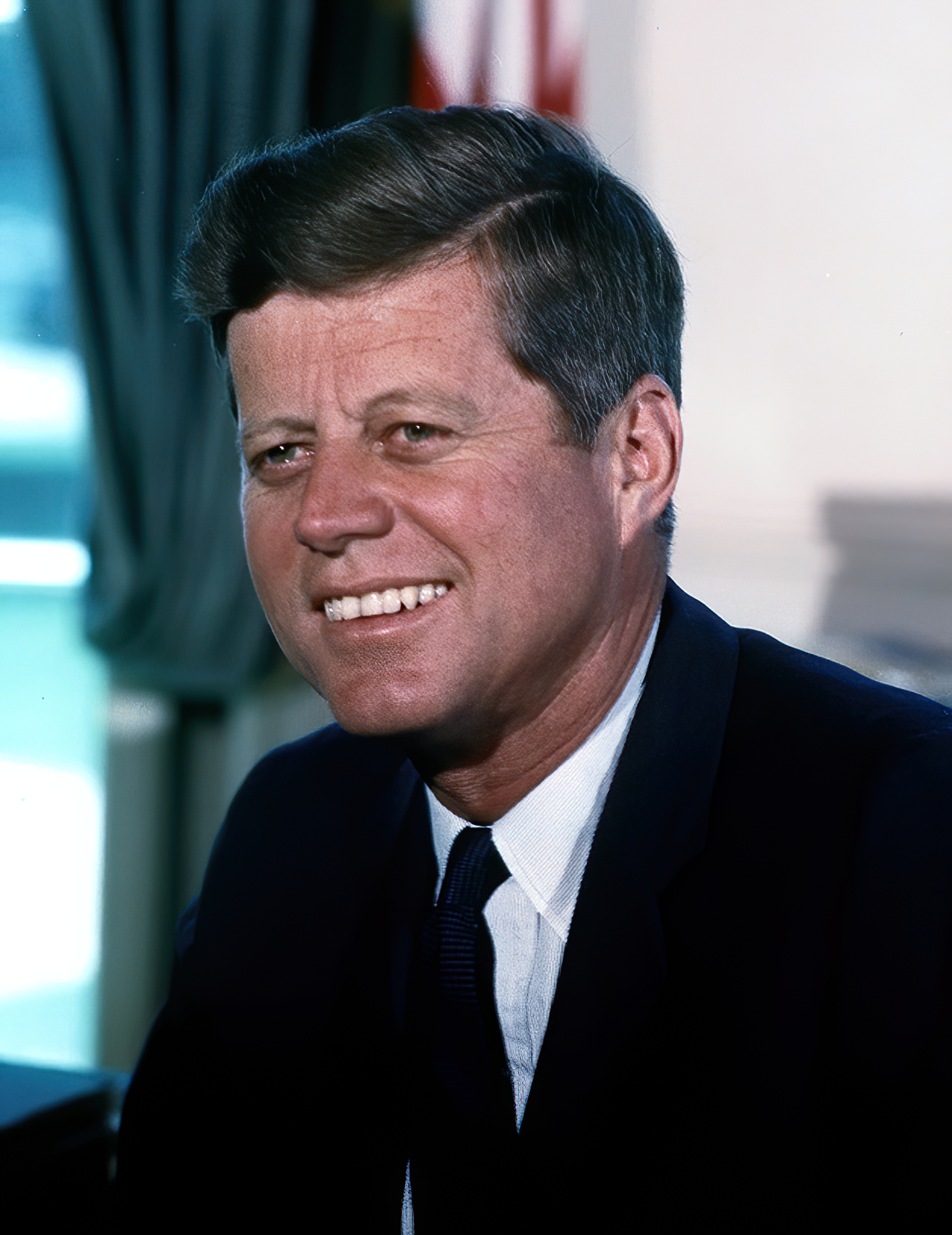
 Oval Office portrait, 1963 | |
| Presidency of John F. Kennedy January 20, 1961 – November 22, 1963 (Assassination) | |
Vice President | |
|---|---|
| Cabinet | See list |
| Party | Democratic |
| Election | 1960 |
| Seat | White House |
|
| |
| Library website | |

| ||
|---|---|---|
|
Personal 35th President of the United States Tenure Appointments Legacy   |
||
.jpg)
John F. Kennedy's tenure as the 35th president of the United States began with his inauguration on January 20, 1961, and ended with his assassination on November 22, 1963. Kennedy, a Democrat from Massachusetts, took office following his narrow victory over Republican incumbent vice president Richard Nixon in the 1960 presidential election. He was succeeded by Vice President Lyndon B. Johnson.
Kennedy's time in office was marked by Cold War tensions with the Soviet Union and Cuba. In Cuba, a failed attempt was made in April 1961 at the Bay of Pigs to overthrow the government of Fidel Castro. In October 1962, the Kennedy administration learned that Soviet ballistic missiles had been deployed in Cuba; the resulting Cuban Missile Crisis carried a risk of nuclear war, but ended in a compromise with the Soviets publicly withdrawing their missiles from Cuba and the U.S. secretly withdrawing some missiles based in Italy and Turkey. To contain Communist expansion in Asia, Kennedy increased the number of American military advisers in South Vietnam by a factor of 18; a further escalation of the American role in the Vietnam War would take place after Kennedy's death. In Latin America, Kennedy's Alliance for Progress aimed to promote human rights and foster economic development.
In domestic politics, Kennedy had made bold proposals in his New Frontier agenda, but many of his initiatives were blocked by the conservative coalition of Northern Republicans and Southern Democrats. The failed initiatives include federal aid to education, medical care for the aged, and aid to economically depressed areas. Though initially reluctant to pursue civil rights legislation, in 1963 Kennedy proposed a major civil rights bill that ultimately became the Civil Rights Act of 1964. The economy experienced steady growth, low inflation and a drop in unemployment rates during Kennedy's tenure. Kennedy adopted Keynesian economics and proposed a tax cut bill that was passed into law as the Revenue Act of 1964. Kennedy also established the Peace Corps and promised to land an American on the Moon and return him safely to Earth, thereby intensifying the Space Race with the Soviet Union.
Kennedy was assassinated on November 22, 1963, while visiting Dallas, Texas. The Warren Commission concluded that Lee Harvey Oswald acted alone in assassinating Kennedy, but the assassination gave rise to a wide array of conspiracy theories. Kennedy was the first Roman Catholic elected president, as well as the youngest candidate ever to win a U.S. presidential election. Historians and political scientists tend to rank Kennedy as an above-average president.
1960 election
[edit]Kennedy, who represented Massachusetts in the United States Senate from 1953 to 1960, had finished second on the vice presidential ballot of the 1956 Democratic National Convention. After Republican President Dwight D. Eisenhower was reelected over Adlai Stevenson in the 1956 presidential election, Kennedy began to prepare a bid for the presidency in the 1960 election.[1] In January 1960, Kennedy formally announced his candidacy in that year's presidential election. Senator Hubert Humphrey of Minnesota emerged as Kennedy's primary challenger in the 1960 Democratic primaries,[2] but Kennedy's victory in the heavily-Protestant state of West Virginia prompted Humphrey's withdrawal from the race.[3] At the 1960 Democratic National Convention, Kennedy fended off challenges from Stevenson and Senator Lyndon B. Johnson of Texas to win the presidential nomination on the first ballot of the convention.[2] Kennedy chose Johnson to be his vice-presidential running mate, despite opposition from many liberal delegates and Kennedy's own staff, including his brother Robert F. Kennedy.[4] Kennedy believed that Johnson's presence on the ticket would appeal to Southern voters, and he thought that Johnson could serve as a valuable liaison to the Senate.[2]
Incumbent Vice President Richard Nixon easily won the 1960 Republican Party presidential primaries. Nixon chose Henry Cabot Lodge Jr., the chief U.S. delegate to the United Nations, as his running mate.[3] Both presidential nominees traveled extensively during the course of the campaign. Not wanting to concede any state as "unwinnable," Nixon undertook a fifty-state strategy, while Kennedy focused the states with the most electoral votes.[3] Major issues in the campaign included the economy, Kennedy's Catholicism, Cuba, and whether the Soviet space and missile programs had surpassed those of the U.S.[5]

On November 8, 1960, Kennedy defeated Nixon in one of the closest presidential elections in American history.[6] Kennedy won the popular vote by a narrow margin of 120,000 votes out of a record 68.8 million ballots cast.[3] He won the electoral vote by a wider margin, receiving 303 votes to Nixon's 219. 14 unpledged electors[a] from two states—Alabama and Mississippi—voted for Senator Harry F. Byrd of Virginia, as did one faithless elector[b] in Oklahoma.[6] In the concurrent congressional elections, Democrats retained wide majorities in both the House of Representatives and the Senate.[9] Nevertheless, 29 House Democrats were displaced, each of whom was a Kennedy progressive. According to one study, "For the first time in a century a party taking over the Presidency failed to gain in the Congress."[10] Kennedy was the first person born in the 20th century to be elected president,[11] and, at age 43, the youngest person elected to the office.[12][c] He was also the first Roman Catholic elected to the presidency.[14]
Transition
[edit]_AND_PRESIDENT-ELECT_KENNEDY-AR6180-C.jpg)
Kennedy placed Clark Clifford in charge of his transition effort.[15]
Inauguration
[edit]
Kennedy was inaugurated as the nation's 35th president on January 20, 1961, on the East Portico of the United States Capitol. Chief Justice Earl Warren administered the oath of office.[16] In his inaugural address, Kennedy spoke of the need for all Americans to be active citizens, famously saying: "Ask not what your country can do for you; ask what you can do for your country." He also invited the nations of the world to join to fight what he called the "common enemies of man: tyranny, poverty, disease, and war itself."[17] To these admonitions he added:
All this will not be finished in the first one hundred days. Nor will it be finished in the first one thousand days, nor in the life of this Administration, nor even perhaps in our lifetime on this planet. But let us begin." In closing, he expanded on his desire for greater internationalism: "Finally, whether you are citizens of America or citizens of the world, ask of us here the same high standards of strength and sacrifice which we ask of you.[17]
The address reflected Kennedy's confidence that his administration would chart a historically significant course in both domestic policy and foreign affairs. The contrast between this optimistic vision and the pressures of managing daily political realities at home and abroad would be one of the main tensions running through the early years of his administration.[18] Full text 
Administration
[edit]| Kennedy cabinet | ||
|---|---|---|
| Office | Name | Term |
| President | John F. Kennedy | 1961–1963 |
| Vice President | Lyndon B. Johnson | 1961–1963 |
| Secretary of State | Dean Rusk | 1961–1963 |
| Secretary of the Treasury | C. Douglas Dillon | 1961–1963 |
| Secretary of Defense | Robert McNamara | 1961–1963 |
| Attorney General | Robert F. Kennedy | 1961–1963 |
| Postmaster General | J. Edward Day | 1961–1963 |
| John A. Gronouski | 1963 | |
| Secretary of the Interior | Stewart Udall | 1961–1963 |
| Secretary of Agriculture | Orville Freeman | 1961–1963 |
| Secretary of Commerce | Luther H. Hodges | 1961–1963 |
| Secretary of Labor | Arthur Goldberg | 1961–1962 |
| W. Willard Wirtz | 1962–1963 | |
| Secretary of Health, Education, and Welfare | Abraham Ribicoff | 1961–1962 |
| Anthony J. Celebrezze | 1962–1963 | |
| Ambassador to the United Nations | Adlai Stevenson II | 1961–1963 |
Kennedy spent the eight weeks following his election choosing his cabinet, staff and top officials.[19] He retained J. Edgar Hoover as Director of the Federal Bureau of Investigation and Allen Dulles as Director of Central Intelligence. C. Douglas Dillon, a business-oriented Republican who had served as Eisenhower's Undersecretary of State, was selected as Secretary of the Treasury. Kennedy balanced the appointment of the relatively conservative Dillon by selecting liberal Democrats to hold two other important economic advisory posts; David E. Bell became the Director of the Bureau of the Budget, while Walter Heller served as the Chairman of the Council of Economic Advisers.[20]
Robert McNamara, who was well known as one of Ford Motor Company's "Whiz Kids", was appointed Secretary of Defense. Rejecting liberal pressure to choose Stevenson as Secretary of State, Kennedy instead turned to Dean Rusk, a restrained former Truman official, to lead the Department of State. Stevenson accepted a non-policy role as the ambassador to the United Nations.[20] In spite of concerns over nepotism, Kennedy's father insisted that Robert F. Kennedy become Attorney General, and the younger Kennedy became the "assistant president" who advised on all major issues.[21] McNamara and Dillon also emerged as important advisers from the cabinet.[22]

Kennedy scrapped the decision-making structure of Eisenhower,[23] preferring an organizational structure of a wheel with all the spokes leading to the president; he was ready and willing to make the increased number of quick decisions required in such an environment.[24] Though the cabinet remained an important body, Kennedy generally relied more on his staffers within the Executive Office of the President. Unlike Eisenhower, Kennedy did not have a chief of staff, but instead relied on a small number of senior aides, including appointments secretary Kenneth O'Donnell.[25] National Security Advisor McGeorge Bundy was the most important adviser on foreign policy, eclipsing Secretary of State Rusk.[26][27] Ted Sorensen was a key advisor on domestic issues who also wrote many of Kennedy's speeches.[28] Other important advisers and staffers included Larry O'Brien, Arthur M. Schlesinger Jr., press secretary Pierre Salinger, General Maxwell D. Taylor, and W. Averell Harriman.[29][30] Kennedy maintained cordial relations with Vice President Johnson, who was involved in issues like civil rights and space policy, but Johnson did not emerge as an especially influential vice president.[31]
William Willard Wirtz Jr. was the last surviving member of Kennedy's cabinet, and died on April 24, 2010.
Judicial appointments
[edit]Kennedy made two appointments to the United States Supreme Court. After the resignation of Charles Evans Whittaker in early 1962, President Kennedy assigned Attorney General Kennedy to conduct a search of potential successors, and the attorney general compiled a list consisting of Deputy Attorney General Byron White, Secretary of Labor Arthur Goldberg, federal appellate judge William H. Hastie, legal professor Paul A. Freund, and two state supreme court justices. Kennedy narrowed his choice down to Goldberg and White, and he ultimately chose the latter, who was quickly confirmed by the Senate. A second vacancy arose later in 1962 due to the retirement of Felix Frankfurter. Kennedy quickly appointed Goldberg, who easily won confirmation by the Senate. Goldberg resigned from the court in 1965 to accept appointment as ambassador to the United Nations, but White remained on the court until 1993, often serving as a key swing vote between liberal and conservative justices.[32]
The president handled Supreme Court appointments. Other judges were selected by Attorney General Robert Kennedy. Including new federal judgeships created in 1961, 130 individuals were appointed to the federal courts. Among them was Thurgood Marshall, who later joined the Supreme Court. Ivy League undergraduate colleges were attended by 9% of the appointees; 19% attended Ivy League law schools. In terms of religion, 61% were Catholics, 38% were Protestant, and 11% were Jewish. Almost all (91%) were Democrats, but few had extensive experience in electoral politics.[33][34]
Foreign affairs
[edit]Peace Corps
[edit]

An agency to enable Americans to volunteer in developing countries appealed to Kennedy because it fit in with his campaign themes of self-sacrifice and volunteerism, while also providing a way to redefine American relations with the Third World.[35] His use of war rhetoric for peaceful ends made his appeal for the new idea compelling to public opinion.[36]
On March 1, 1961, Kennedy signed Executive Order 10924 that officially started the Peace Corps. He appointed his brother-in-law, Sargent Shriver, to serve the agency's first director. Due in large part to Shriver's effective lobbying efforts, Congress approved the permanent establishment of the Peace Corps program on September 22, 1961. Tanganyika (present-day Tanzania) and Ghana were the first countries to participate in the program.[37] Kennedy took great pride in the Peace Corps, and he ensured that it remained free of CIA influence, but he largely left its administration to Shriver. Kennedy also saw the program as a means of countering the stereotype of the "Ugly American" and "Yankee imperialism," especially in the emerging nations of post-colonial Africa and Asia.[38] In the first twenty-five years, more than 100,000 Americans served in 44 countries as part of the program. Most Peace Corps volunteers taught English in schools, but many became involved in activities like construction and food delivery.[39]
The Cold War and flexible response
[edit]Kennedy's foreign policy was dominated by American confrontations with the Soviet Union, manifested by proxy contests in the global state of tension known as the Cold War. Like his predecessors, Kennedy adopted the policy of containment, which sought to stop the spread of communism.[40] President Eisenhower's New Look policy had emphasized the use of nuclear weapons to deter the threat of Soviet aggression. By 1960, however, public opinion was turning against New Look because it was not effective in stemming communist-inspired Third World revolutions.[41] Fearful of the possibility of a global nuclear war, Kennedy implemented a new strategy known as flexible response. This strategy relied on conventional arms to achieve limited goals. As part of this policy, Kennedy expanded the United States special operations forces, elite military units that could fight unconventionally in various conflicts. Kennedy hoped that the flexible response strategy would allow the U.S. to counter Soviet influence without resorting to war.[42] At the same time, he ordered a massive build-up of the nuclear arsenal to establish superiority over the Soviet Union.[40]
In pursuing this military build-up, Kennedy shifted away from Eisenhower's deep concern for budget deficits caused by military spending.[43] In contrast to Eisenhower's warning about the perils of the military-industrial complex, Kennedy focused on rearmament. From 1961 to 1964 the number of nuclear weapons increased by 50 percent, as did the number of B-52 bombers to deliver them. The new ICBM force grew from 63 intercontinental ballistic missiles to 424. He authorized 23 new Polaris submarines, each of which carried 16 nuclear missiles. Meanwhile, he called on cities to prepare fallout shelters for nuclear war.[44]
In January 1961, Soviet Premier Nikita Khrushchev declared his support for wars of national liberation. Kennedy interpreted this step as a direct threat to the "free world."[45][46]
Decolonization and developing countries
[edit].jpg)
Between 1960 and 1963, twenty-four countries gained independence as the process of decolonization continued. Many of these nations sought to avoid close alignment with either the United States or the Soviet Union, and in 1961, the leaders of India, Yugoslavia, Indonesia, Egypt, and Ghana created the Non-Aligned Movement. Kennedy set out to woo the leaders and people of the Third World, expanding economic aid and appointing knowledgeable ambassadors.[47] His administration established the Food for Peace program and the Peace Corps to provide aid to developing countries in various ways. The Food for Peace program became a central element in American foreign policy, and eventually helped many countries to develop their economies and become commercial import customers.[48]
During his presidency, Kennedy sought closer relations with Indian Prime Minister Jawaharlal Nehru through increased economic aid and a tilt away from Pakistan, but made little progress in bringing India closer to the United States.[49] Kennedy hoped to minimize Soviet influence in Egypt through good relations with President Gamal Abdel Nasser, but Nasser's hostility towards Saudi Arabia and Jordan closed off the possibility of closer relations.[50] In Southeast Asia, Kennedy helped mediate the West New Guinea dispute, convincing Indonesia and the Netherlands to agree to a plebiscite to determine the status of Dutch New Guinea.[51]
Congo Crisis
[edit]_(cropped).jpg)
Having chaired a subcommittee on Africa of the U.S. Senate's Foreign Relations Committee, Kennedy had developed a special interest in Africa. During the election campaign, Kennedy managed to mention Africa nearly 500 times, often attacking the Eisenhower administration for losing ground on that continent,[52] and stressed that the U.S. should be on the side of anti-colonialism and self-determination.[53]
Kennedy considered the Congo Crisis to be one of the most important foreign policy issues facing his presidency.[54] The Republic of the Congo was given its independence from Belgian colonial rule on June 30, 1960, and was almost immediately torn apart by what President Kennedy described as "civil strife, political unrest and public disorder."[53] Former Prime Minister Patrice Lumumba had been murdered early in 1961 despite the presence of a United Nations peacekeeping force (supported by Kennedy);[54] Moïse Tshombe, leader of State of Katanga, declared its independence from the Congo and the Soviet Union responded by sending weapons and technicians to underwrite their struggle. The crisis, exacerbated by Cold War tensions, continued well into the 1960s.[53]
Kennedy and his incoming advisers were apparently unaware of the CIA's involvement in Lumumba's death.[55] In fact, Kennedy wasn't even aware Lumumba had been killed until February 13, 1961.[56] On October 2, 1962, Kennedy signed United Nations bond issue bill to ensure U.S. assistance in financing United Nations peacekeeping operations in the Congo and elsewhere. Around this time, the Kennedy administration was making private attempts to convince Tshombe to reunite the breakaway Katanga that he led with the Congo, in advance of UN intervention.[57]
Cuba and the Soviet Union
[edit]Bay of Pigs Invasion
[edit]
Fulgencio Batista, a Cuban dictator friendly towards the United States, had been forced out office in 1959 by the Cuban Revolution. Many in the United States, including Kennedy himself, had initially hoped that Batista's successor, Fidel Castro would preside over democratic reforms. Dashing those hopes, by the end of 1960 Castro had embraced Marxism, confiscated American property, and accepted Soviet aid.[58] The Eisenhower administration had created a plan to overthrow Castro's regime though an invasion of Cuba by a counter-revolutionary insurgency composed of U.S.-trained, anti-Castro Cuban exiles[59][60] led by CIA paramilitary officers.[61] Kennedy had campaigned on a hardline stance against Castro, and when presented with the plan that had been developed under the Eisenhower administration, he enthusiastically adopted it regardless of the risk of inflaming tensions with the Soviet Union.[62] Some advisors, including Schlesinger, Under Secretary of State Chester Bowles, and former Secretary of State Dean Acheson, opposed the operation, but Bundy and McNamara both favored it, as did the Joint Chiefs of Staff, despite serious reservations.[63] Kennedy approved the final invasion plan on April 4, 1961.[64]
On April 15, 1961, eight CIA-supplied B-26 bombers left Nicaragua to bomb Cuban airfields. The bombers missed many of their targets and left most of Castro's air force intact.[65] On April 17, the 1,500 U.S.-trained Cuban exile invasion force, known as Brigade 2506, landed on the beach at Playa Girón in the Bay of Pigs and immediately came under heavy fire.[66] The goal was to spark a widespread popular uprising against Castro, but no such uprising occurred.[67] Although the Eisenhower administration plan had called for an American airstrike to hold back the Cuban counterattack until the invaders were established, Kennedy rejected the strike because it would emphasize the American sponsorship of the invasion.[68] CIA director Allen Dulles later stated that they thought the president would authorize any action required for success once the troops were on the ground.[66] The invading force was defeated within two days by the Cuban Revolutionary Armed Forces;[69] 114 were killed and over 1,100 were taken prisoner.[70][71] Kennedy was forced to negotiate for the release of the 1,189 survivors. After twenty months, Cuba released the captured exiles in exchange for a ransom of $53 million worth of food and medicine.[72]
Despite the lack of direct U.S. military involvement, the Soviet Union, Cuba, and the international community all recognized that the U.S. had backed the invasion.[68] Kennedy focused primarily on the political repercussions of the plan rather than military considerations.[73] In the aftermath, he took full responsibility for the failure, saying: "We got a big kick in the leg and we deserved it. But maybe we'll learn something from it."[74] Kennedy's approval ratings climbed afterwards, helped in part by the vocal support given to him by Nixon and Eisenhower.[75] Outside the United States, however, the operation undermined Kennedy's reputation as a world leader, and raised tensions with the Soviet Union.[76] A secret review conducted by Lyman Kirkpatrick of the CIA concluded that the failure of the invasion resulted less from a decision against airstrikes and had more to do with the fact that Cuba had a much larger defending force and that the operation suffered from "poor planning, organization, staffing and management".[77] The Kennedy administration banned all Cuban imports and convinced the Organization of American States to expel Cuba.[78] Kennedy dismissed Dulles as director of the CIA and increasingly relied on close advisers like Sorensen, Bundy, and Robert Kennedy as opposed to the Joint Chiefs of Staff, the CIA, and the State Department.[79]
Operation Mongoose
[edit]In late-1961, the White House formed the Special Group (Augmented), headed by Robert Kennedy and including Edward Lansdale, Secretary Robert McNamara, and others. The group's objective—to overthrow Castro via espionage, sabotage, and other covert tactics—was never pursued.[80] In November 1961, he authorized Operation Mongoose (also known as the Cuban Project).[81] In March 1962, Kennedy rejected Operation Northwoods, proposals for false flag attacks against American military and civilian targets,[82] and blaming them on the Cuban government in order to gain approval for a war against Cuba. However, the administration continued to plan for an invasion of Cuba in the summer of 1962.[81]
Vienna Summit
[edit]
In the aftermath of the Bay of Pigs invasion, Kennedy announced that he would meet with Soviet Premier Nikita Khrushchev at the June 1961 Vienna summit. The summit would cover several topics, but both leaders knew that the most contentious issue would be that of Berlin, which had been divided into two cities with the start of the Cold War. The enclave of West Berlin lay within Soviet-allied East Germany, but was supported by the U.S. and other Western powers. The Soviets wanted to reunify Berlin under the control of East Germany, partly due to the large number of East Germans who had fled to West Berlin.[83] Khrushchev had clashed with Eisenhower over the issue but had tabled it after the 1960 U-2 incident; with the inauguration of a new U.S. president, Khrushchev was once again determined to bring the status of West Berlin to the fore. Kennedy's handling of the Bay of Pigs crisis convinced him that Kennedy would wither under pressure. Kennedy, meanwhile, wanted to meet with Khrushchev as soon as possible in order to reduce tensions and minimize the risk of nuclear war. Prior to the summit, Harriman advised Kennedy, "[Khrushchev's] style will be to attack you and see if he can get away with it. Laugh about it, don't get into a fight. Rise above it. Have some fun."[84]
On the way to the summit, Kennedy stopped in Paris to meet French President Charles de Gaulle, who advised him to ignore Khrushchev's abrasive style. The French president feared the United States' presumed influence in Europe. Nevertheless, de Gaulle was quite impressed with the young president and his family. Kennedy picked up on this in his speech in Paris, saying that he would be remembered as "the man who accompanied Jackie Kennedy to Paris."[85]
On June 4, 1961, the president met with Khrushchev in Vienna, where he made it clear that any treaty between East Berlin and the Soviet Union that interfered with U.S. access rights in West Berlin would be regarded as an act of war.[86] The two leaders also discussed the situation in Laos, the Congo Crisis, China's fledgling nuclear program, a potential nuclear test ban treaty, and other issues.[87] Shortly after Kennedy returned home, the Soviet Union announced its intention to sign a treaty with East Berlin that would threaten Western access to West Berlin. Kennedy, depressed and angry, assumed that his only option was to prepare the country for nuclear war, which he personally thought had a one-in-five chance of occurring.[86]
Berlin
[edit]
President Kennedy called Berlin "the great testing place of Western courage and will."[88] In the weeks immediately after the Vienna summit, more than 20,000 people fled from East Berlin to the western sector in reaction to statements from the Soviet Union. Kennedy began intensive meetings on the Berlin issue, where Dean Acheson took the lead in recommending a military buildup alongside NATO allies.[89] In a July 1961 speech, Kennedy announced his decision to add $3.25 billion to the defense budget, along with over 200,000 additional troops, stating that an attack on West Berlin would be taken as an attack on the U.S.[90] On August 13, 1961, the Soviet Union and East Berlin began blocking further passage of East Berliners into West Berlin and erected barbed wire fences across the city, which were quickly upgraded to the Berlin Wall.[91] Kennedy acquiesced to the wall, though he sent Vice President Johnson to West Berlin to reaffirm U.S. commitment to the enclave's defense. In the following months, in a sign of rising Cold War tensions, both the U.S. and the Soviet Union ended a moratorium on nuclear weapon testing.[92] A brief stand-off between U.S. and Soviet tanks occurred at Checkpoint Charlie in October following a dispute over free movement of Allied personnel. The crisis was defused largely through a backchannel communication the Kennedy administration had set up with Soviet spy Georgi Bolshakov.[93]
In 1963, French President Charles de Gaulle was trying to build a Franco-West German counterweight to the American and Soviet spheres of influence.[94][95][96] To Kennedy's eyes, this Franco-German cooperation seemed directed against NATO's influence in Europe.[97] To reinforce the U.S. alliance with West Germany, Kennedy travelled to West Germany in June 1963. On June 26, Kennedy toured West Berlin, culminating in his famous "Ich bin ein Berliner" ("I am a Berliner") speech in front of hundreds of thousands of enthusiastic Berliners. Kennedy used the construction of the Berlin Wall as an example of the failures of communism: "Freedom has many difficulties, and democracy is not perfect. But we have never had to put a wall up to keep our people in, to prevent them from leaving us." In remarks to his aides on the Berlin Wall, Kennedy noted that "it's not a very nice solution, but a wall is a hell of a lot better than a war."[88]
Cuban Missile Crisis
[edit]In the aftermath of the Bay of Pigs invasion, Cuban and Soviet leaders feared that the United States was planning another invasion of Cuba, and Khrushchev increased economic and military assistance to the island.[98] The Soviet Union planned to allocate in Cuba 49 medium-range ballistic missiles, 32 intermediate-range ballistic missiles, 49 light Il-28 bombers and about 100 tactical nuclear weapons.[99] The Kennedy administration viewed the growing Cuba-Soviet alliance with alarm, fearing that it could eventually pose a threat to the United States.[100] Kennedy did not believe that the Soviet Union would risk placing nuclear weapons in Cuba, but he dispatched CIA U-2 spy planes to determine the extent of the Soviet military build-up.[100] On October 14, 1962, the spy planes took photographs of intermediate-range ballistic missile sites being built in Cuba by the Soviets. The photos were shown to Kennedy on October 16, and a consensus was reached that the missiles were offensive in nature.[101]
Following the Vienna Summit, Khrushchev came to believe that Kennedy would not respond effectively to provocations. He saw the deployment of the missiles in Cuba as a way to close the "missile gap" and provide for the defense of Cuba. By late 1962, both the United States and the Soviet Union possessed intercontinental ballistic missiles (ICBMs) capable of delivering nuclear payloads, but the U.S. maintained well over 100 ICBMs, as well as over 100 submarine-launched ballistic missile (SLBMs). By contrast, the Soviet Union did not possess SLBMs, and had less than 25 ICBMs. The placement of missiles in Cuba thus threatened to significantly enhance the Soviet Union's first strike capability and even the nuclear imbalance.[102] Kennedy himself did not believe that the deployment of missiles to Cuba fundamentally altered the strategic balance of the nuclear forces; more significant for him was the political and psychological implications of allowing the Soviet Union to maintain nuclear weapons in Cuba.[103]

Kennedy faced a dilemma: if the U.S. attacked the sites, it might lead to nuclear war with the U.S.S.R., but if the U.S. did nothing, it would be faced with the increased threat from close-range nuclear weapons (positioned approximately 90 mi (140 km) away from the Florida coast). The U.S. would also appear to the world as less committed to the defense of the Western Hemisphere. On a personal level, Kennedy needed to show resolve in reaction to Khrushchev, especially after the Vienna summit.[104] To deal with the crisis, he formed an ad hoc body of key advisers, later known as EXCOMM, that met secretly between October 16 and 28.[105] The members of EXCOMM agreed that the missiles must be removed from Cuba, but differed as to the best method. Some favored an airstrike, possibly followed by an invasion of Cuba, but Robert Kennedy and others argued that a surprise airstrike would be immoral and would invite Soviet reprisals.[106] The other major option that emerged was a naval blockade, designed to prevent further arms shipments to Cuba. Though he had initially favored an immediate air strike, the president quickly came to favor the naval blockade the first method of response, while retaining the option of an airstrike at a later date.[107] EXCOMM voted 11-to-6 in favor of the naval blockade, which was also supported by British ambassador David Ormsby-Gore and Eisenhower, both of whom were consulted privately.[108] On October 22, after privately informing the cabinet and leading members of Congress about the situation, Kennedy announced on national television that the U.S. had discovered evidence of the Soviet deployment of missiles to Cuba. He called for the immediate withdrawal of the missiles, as well as the convening of the United Nations Security Council and the Organization of American States (OAS). Finally, he announced that the U.S. would begin a naval blockade of Cuba in order to intercept arms shipments.[109]
On October 23, in a unanimous vote, the OAS approved a resolution that endorsed the blockade and called for the removal of the Soviet nuclear weapons from Cuba. That same day, Adlai Stevenson presented the U.S. case to the UN Security Council, though the Soviet Union's veto power precluded the possibility of passing a Security Council resolution.[110] On the morning of October 24, over 150 U.S. ships were deployed to enforce the blockade against Cuba. Several Soviet ships approached the blockade line, but they stopped or reversed course to avoid the blockade.[111] On October 25, Khrushchev offered to remove the missiles if the U.S. promised not to invade Cuba. The next day, he sent a second message in which he also demanded the removal of PGM-19 Jupiter missiles from Turkey.[112] EXCOMM settled on what has been termed the "Trollope ploy;" the U.S. would respond to the Khrushchev's first message and ignore the second. Kennedy managed to preserve restraint when a Soviet missile unauthorizedly downed a U.S. Lockheed U-2 reconnaissance aircraft over Cuba, killing the pilot Rudolf Anderson.[113][114] On October 27, Kennedy sent a letter to Khrushchev calling for the removal of the Cuban missiles in return for an end to the blockade and an American promise to refrain from invading Cuba. At the president's direction, Robert Kennedy privately informed Soviet Ambassador Anatoly Dobrynin that the U.S. would remove the Jupiter missiles from Turkey "within a short time after this crisis was over."[115] Few members of EXCOMM expected Khrushchev to agree to the offer, but on October 28 Khrushchev publicly announced that he would withdraw the missiles from Cuba.[115] Negotiations over the details of the withdrawal continued, but the U.S. ended the naval blockade on November 20, and most Soviet soldiers left Cuba by early 1963.[116]

The U.S. publicly promised never to invade Cuba and privately agreed to remove its missiles in Italy and Turkey; the missiles were by then obsolete and had been supplanted by submarines equipped with UGM-27 Polaris missiles.[117] In the aftermath of the crisis, a Moscow–Washington hotline was established to ensure clear communications between the leaders of the two countries.[118] The Cuban Missile Crisis brought the world closer to nuclear war than at any point before or since. In the end, "the humanity" of the two men prevailed.[119] The crisis improved the image of American willpower and the president's credibility. Kennedy's approval rating increased from 66% to 77% immediately thereafter.[120] Kennedy's handling of the Cuban Missile Crisis has received wide praise from many scholars, although some critics fault the Kennedy administration for precipitating the crisis with its efforts to remove Castro.[121][122] Khrushchev, meanwhile, was widely mocked for his performance, and was removed from power in October 1964.[123] According to Anatoly Dobrynin, the top Soviet leadership took the Cuban outcome as "a blow to its prestige bordering on humiliation."[124]
Nuclear Test Ban Treaty
[edit]
Troubled by the long-term dangers of radioactive contamination and nuclear weapons proliferation, Kennedy and Khrushchev agreed to negotiate a nuclear test ban treaty, originally conceived in Adlai Stevenson's 1956 presidential campaign.[125] In their Vienna summit meeting in June 1961, Khrushchev and Kennedy had reached an informal understanding against nuclear testing, but further negotiations were derailed by the resumption of nuclear testing.[126] In his address to the United Nations on September 25, 1961, Kennedy challenged the Soviet Union "not to an arms race, but to a peace race." Unsuccessful in his efforts to reach a diplomatic agreement, Kennedy reluctantly announced the resumption of atmospheric testing on April 25, 1962.[127] Soviet-American relations improved after the resolution of the Cuban Missile Crisis, and the powers resumed negotiations over a test ban treaty.[128] Negotiations were facilitated by the Vatican and by the shuttle diplomacy of editor Norman Cousins.[129][130]
On June 10, 1963, Kennedy delivered a commencement address at the American University in Washington, D.C. Also known as "A Strategy of Peace", not only did Kennedy outline a plan to curb nuclear arms, but he also "laid out a hopeful, yet realistic route for world peace at a time when the U.S. and Soviet Union faced the potential for an escalating nuclear arms race."[131] Kennedy also made two announcements: 1.) that the Soviets had expressed a desire to negotiate a nuclear test ban treaty, and 2.) that the U.S. had postponed planned atmospheric tests.[132] "If we cannot end our differences," he said, "at least we can help make the world a safe place for diversity." The Soviet government broadcast a translation of the entire speech and allowed it to be reprinted in the controlled Soviet press.[127]
The following month, Kennedy sent W. Averell Harriman to Moscow to negotiate a test-ban treaty with the Soviets.[133] Each party sought a comprehensive test ban treaty, but a dispute over the number of on-site inspections allowed in each year prevented a total ban on testing.[128] Ultimately, the United States, the United Kingdom, and the Soviet Union agreed to a limited treaty that prohibited atomic testing on the ground, in the atmosphere, or underwater, but not underground.[134] The Limited Nuclear Test Ban treaty was signed in Moscow on August 5, 1963, by U.S. Secretary Dean Rusk, Soviet Foreign Minister Andrei Gromyko, and British Foreign Secretary Alec Douglas-Home. The U.S. Senate approved the treaty on September 23, 1963, by an 80–19 margin. Kennedy signed the ratified treaty on October 7, 1963.[127] The treaty represented an important deescalation of Cold War tensions, but both countries continued to build their respective nuclear stockpiles.[135] The U.S. and the Soviet Union also reached an agreement whereby the U.S. sold millions of bushels of wheat to the Soviet Union.[136]
Southeast Asia
[edit]
Laos
[edit]When briefing Kennedy, Eisenhower emphasized that the communist threat in Southeast Asia required priority. Eisenhower considered Laos to be "the cork in the bottle;" if it fell to communism, Eisenhower believed other Southeast Asian countries would as well.[137] The Joint Chiefs proposed sending 60,000 American soldiers to uphold the friendly government, but Kennedy rejected this strategy in the aftermath of the failed Bay of Pigs invasion. He instead sought a negotiated solution between the government and the left-wing insurgents, who were backed by North Vietnam and the Soviet Union.[138] Kennedy was unwilling to send more than a token force to neighboring Thailand, a key American ally. By the end of the year, Harriman had helped arrange the International Agreement on the Neutrality of Laos, which temporarily brought an end to the crisis, but the Laotian Civil War continued.[139] Though he was unwilling to commit U.S. forces to a major military intervention in Laos, Kennedy did approve CIA activities in Laos designed to defeat communist insurgents through bombing raids and the recruitment of the Hmong people.[140]
Vietnam
[edit]As a U.S. congressman in 1951, Kennedy became fascinated with Vietnam after visiting the area as part of a fact-finding mission to Asia and the Middle East, even stressing in a subsequent radio address that he strongly favored "check[ing] the southern drive of communism."[141] As a U.S. senator in 1956, Kennedy publicly advocated for greater U.S. involvement in Vietnam.[142][143] During his presidency, Kennedy continued policies that provided political, economic, and military support to the South Vietnamese government.[144]

The Viet Cong began assuming a predominant presence in late 1961, initially seizing the provincial capital of Phuoc Vinh.[145] After a mission to Vietnam in October, presidential adviser General Maxwell D. Taylor and Deputy National Security Adviser Walt Rostow recommended the deployment of 6,000 to 8,000 U.S. combat troops to Vietnam.[146] Kennedy increased the number of military advisers and special forces in the area, from 11,000 in 1962 to 16,000 by late 1963, but he was reluctant to order a full-scale deployment of troops.[147][148] However, Kennedy, who was wary about the region's successful war of independence against France, was also eager to not give the impression to the Vietnamese people that the United States was acting as the region's new colonizer, even stating in his journal at one point that the United States was "more and more becoming colonists in the minds of the people."[149]
In late 1961, Kennedy sent Roger Hilsman, then director of the State Department's Bureau of Intelligence and Research (INR), to assess the situation in Vietnam. There, Hilsman met Sir Robert Grainger Ker Thompson, head of the British Advisory Mission to South Vietnam, and the Strategic Hamlet Program was formed. It was approved by Kennedy and South Vietnam President Ngo Dinh Diem. It was implemented in early 1962 and involved some forced relocation, village internment, and segregation of rural South Vietnamese into new communities where the peasantry would be isolated from communist insurgents. It was hoped that these new communities would provide security for the peasants and strengthen the tie between them and the central government. By November 1963, the program waned and officially ended in 1964.[150]
On January 18, 1962, Kennedy formally authorized escalated involvement when he signed the National Security Action Memorandum (NSAM) – "Subversive Insurgency (War of Liberation)".[151] "Operation Ranch Hand", a large-scale aerial defoliation effort, began on the roadsides of South Vietnam initiating the use of the herbicide Agent Orange on foliage and to combat guerrilla defendants.[152][153] Initially under consideration as to whether or not the use of the chemical would violate the Geneva Convention, Secretary of State Dean Rusk argued to Kennedy that "[t]he use of defoliant does not violate any rule of international law concerning the conduct of chemical warfare and is an accepted tactic of war. Precedent has been established by the British during the emergency in Malaya in their use of aircraft for destroying crops by chemical spraying."[154]
In August 1963, Henry Cabot Lodge Jr. replaced Frederick Nolting as the U.S. ambassador to South Vietnam. Days after Lodge's arrival in South Vietnam, Diem and his brother Ngo Dinh Nhu ordered South Vietnam forces, funded and trained by the CIA, to quell Buddhist demonstrations. The crackdowns heightened expectations of a coup d'état to remove Diem with (or perhaps by) his brother, Nhu.[155] Lodge was instructed to try getting Diem and Nhu to step down and leave the country. Diem would not listen to Lodge.[156] Cable 243 (DEPTEL 243) followed, dated August 24, declaring that Washington would no longer tolerate Nhu's actions, and Lodge was ordered to pressure Diem to remove Nhu.[157] Lodge concluded that the only option was to get the South Vietnamese generals to overthrow Diem and Nhu.[158] At week's end, orders were sent to Saigon and throughout Washington to "destroy all coup cables".[159] At the same time, the first formal anti-Vietnam war sentiment was expressed by U.S. clergy from the Ministers' Vietnam Committee.[160]
A White House meeting in September was indicative of the different ongoing appraisals; Kennedy received updated assessments after personal inspections on the ground by the Departments of Defense (General Victor Krulak) and State (Joseph Mendenhall). Krulak said that the military fight against the communists was progressing and being won, while Mendenhall stated that the country was civilly being lost to any U.S. influence. Kennedy reacted, asking, "Did you two gentlemen visit the same country?" Kennedy was unaware that both men were so much at odds that they did not speak to each other on the return flight.[161]

In October 1963, Kennedy appointed Defense Secretary McNamara and General Maxwell D. Taylor to a Vietnamese mission in another effort to synchronize the information and formulation of policy. The objective of the McNamara–Taylor mission "emphasized the importance of getting to the bottom of the differences in reporting from U.S. representatives in Vietnam."[162] In meetings with McNamara, Taylor, and Lodge, Diem again refused to agree to governing measures, helping to dispel McNamara's previous optimism about Diem.[163] Taylor and McNamara were enlightened by Vietnam's vice president, Nguyen Ngoc Tho (choice of many to succeed Diem), who in detailed terms obliterated Taylor's information that the military was succeeding in the countryside.[164] At Kennedy's insistence, the mission report contained a recommended schedule for troop withdrawals: 1,000 by year's end and complete withdrawal in 1965, something the NSC considered to be a "strategic fantasy."[165] In late-October, intelligence wires again reported that a coup against the Diem government was afoot. The source, Vietnamese General Duong Van Minh (also known as "Big Minh"), wanted to know the U.S. position. Kennedy instructed Lodge to offer covert assistance to the coup, excluding assassination.[166] On November 1, 1963, South Vietnamese generals, led by "Big Minh", overthrew the Diem government, arresting and then killing Diem and Nhu. Kennedy was shocked by the deaths.[167]
Historians disagree on whether the Vietnam War would have escalated if Kennedy had not been assassinated and had won re-election in 1964.[168] Fueling the debate were statements made by Secretary of Defense McNamara in the 2003 documentary film The Fog of War that Kennedy was strongly considering pulling the United States out of Vietnam after the 1964 election.[169] The film also contains a tape recording of Lyndon Johnson stating that Kennedy was planning to withdraw, a position with which Johnson disagreed.[170] Conversely, in 2008, Kennedy administration White House Counsel and speechwriter Ted Sorensen wrote, "I would like to believe that Kennedy would have found a way to withdraw all American instructors and advisors [from Vietnam]. But even someone who knew JFK as well as I did can't be certain, because I do not believe he knew in his last weeks what he was going to do." Sorensen added that, in his opinion, Vietnam "was the only foreign policy problem handed off by JFK to his successor in no better, and possibly worse, shape than it was when he inherited it."[171]
At the time of Kennedy's death, no final policy decision was made with respect to Vietnam.[172] By November 1963, there were 16,000 American military personnel in South Vietnam, up from Eisenhower's 900 advisors.[173] More than one hundred Americans had been killed in action.[174][175] In the aftermath of the aborted coup in September 1963, the Kennedy administration reevaluated its policies in South Vietnam. Kennedy rejected both the full-scale deployment of ground soldiers, but also rejected the total withdrawal of U.S. forces from the country.[176] On October 11, Kennedy signed NSAM 263 ordering the withdrawal of 1,000 military personnel by year's end following the third recommendation of the McNamara–Taylor mission report, which concluded that the training program for the South Vietnamese military had sufficiently progressed to justify the withdrawal.[177][178][179] However, NSAM 263 also approved the first recommendation of the report to continue providing support to South Vietnam to prevent the spread of communism and until the Viet Cong was suppressed, while the third recommendation suggested that even if the majority of the U.S. military objective was completed by the end of 1965 that continued presence of U.S. training personnel in more limited numbers could be necessary if the insurgency was not suppressed.[180][181][179]
Latin America
[edit]Kennedy sought to contain the threat of communism in Latin America by establishing the Alliance for Progress, which sent aid to some countries and sought greater human rights standards in the region.[182] The Alliance for Progress drew from the Good Neighbor Policy in its peaceful engagement with Latin America, and from the Marshall Plan in its expansion of aid and economic relationships. Kennedy also emphasized close personal relations with Latin American leaders, frequently hosting them in the White House.[183] The U.S. Information Agency was given an important role of reaching out to Latin Americans in Spanish, Portuguese, and French media.[184] The goals of the Alliance for Progress included long-term permanent improvement in living conditions through the advancement of industrialization, the improvement of communications systems, the reduction of trade barriers, and an increase in the number and diversity of exports from Latin America. At a theoretical level, Kennedy's planners hoped to reverse the under-development of the region and its dependency on North America. Part of the administration's motivation was the fear that Castro's Cuba would introduce anti-American political and economic changes if development did not take place.[185][186] In response to Kennedy's plea, Congress voted for an initial grant of $500 million in May 1961.[187][188]

The Alliance for Progress supported the construction of housing, schools, airports, hospitals, clinics and water-purification projects as well as the distribution of free textbooks to students.[189] However, the program did not meet many of its goals. Massive land reform was not achieved; populations more than kept pace with gains in health and welfare; and according to one study, only 2 percent of economic growth in 1960s Latin America directly benefited the poor.[190][191] In addition, American business interests continued to be more concerned about the safety of their private investments in Latin America and far less troubled about promoting social and political reform.[189]
U.S. presidents after the Kennedy administration were less supportive of the program and by the early 1970s, the Alliance was considered a failure. In 1973, the permanent committee established to implement the Alliance was disbanded by the Organization of American States.[189]
The administration had no role in the assassination of Rafael Trujillo in the Dominican Republic. It supported the government of Trujillo's successor, Juan Bosch.[192] The CIA launched a covert intervention in British Guiana to deny the left-wing leader Cheddi Jagan power in an independent Guyana, and forced a reluctant Britain to participate.[193] The CIA also engaged in operations in Brazil and Chile against left-wing leaders.[194]
Middle East
[edit]Iraq
[edit]
Relations between the United States and Iraq became strained following the overthrow of the Iraqi monarchy on July 14, 1958, which resulted in the declaration of a republican government led by Brigadier Abd al-Karim Qasim.[195] On June 25, 1961, Qasim mobilized troops along the border between Iraq and Kuwait, declaring the latter nation "an indivisible part of Iraq" and causing a short-lived "Kuwait Crisis". The United Kingdom—which had just granted Kuwait independence on June 19, and whose economy was heavily dependent on Kuwaiti oil—responded on July 1 by dispatching 5,000 troops to the country to deter an Iraqi invasion. At the same time, Kennedy dispatched a U.S. Navy task force to Bahrain, and the U.K. (at the urging of the Kennedy administration) brought the dispute to United Nations Security Council, where the proposed resolution was vetoed by the Soviet Union. The situation was resolved in October, when the British troops were withdrawn and replaced by a 4,000-strong Arab League force.[196]
In December 1961, Qasim's government passed Public Law 80, which restricted the British- and American-owned Iraq Petroleum Company (IPC)'s concessionary holding to those areas in which oil was actually being produced, effectively expropriating 99.5% of the IPC concession. U.S. officials were alarmed by the expropriation as well as the recent Soviet veto of an Egyptian-sponsored UN resolution requesting the admittance of Kuwait as UN member state, which they believed to be connected. Senior National Security Council adviser Robert Komer worried that if the IPC ceased production in response, Qasim might "grab Kuwait" (thus achieving a "stranglehold" on Middle Eastern oil production), or "throw himself into Russian arms." Komer also made note of widespread rumors that a nationalist coup against Qasim could be imminent, and had the potential to "get Iraq back on [a] more neutral keel."[197]
The anti-imperialist and anti-communist Iraqi Ba'ath Party overthrew and executed Qasim in a violent coup on February 8, 1963. While there have been persistent rumors that the CIA orchestrated the coup, declassified documents and the testimony of former CIA officers indicate that there was no direct American involvement, although the CIA was actively seeking a suitable replacement for Qasim within the Iraqi military and had been informed of an earlier Ba'athist coup plot.[198] The Kennedy administration was pleased with the outcome and ultimately approved a $55 million arms deal for Iraq.[199]
Israel
[edit]
In 1960, Kennedy stated, "Israel will endure and flourish. It is the child of hope and the home of the brave. It can neither be broken by adversity nor demoralized by success. It carries the shield of democracy and it honors the sword of freedom."[200]
President Kennedy ended the arms embargo that the Truman and Eisenhower administrations had enforced on Israel in favor of increased security ties, becoming the founder of the U.S.-Israeli military alliance, which would be continued under subsequent presidents. Describing the protection of Israel as a moral and national commitment, he was the first to introduce the concept of a 'special relationship' (as he described it to Golda Meir) between the U.S. and Israel.[201] In 1962, the Kennedy administration sold Israel a major weapon system, the Hawk antiaircraft missile. Historians differ as to whether Kennedy pursued security ties with Israel primarily to shore up support with Jewish-American voters, or because of his admiration of the Jewish state.[202]
Kennedy warned the Israeli government against the production of nuclear materials in Dimona, which he believed could instigate a nuclear arms-race in the Middle East. After the existence of a nuclear plant was initially denied by the Israeli government, David Ben-Gurion stated in a speech to the Israeli Knesset on December 21, 1960, that the purpose of the nuclear plant at Beersheba was for "research in problems of arid zones and desert flora and fauna."[203] When Ben-Gurion met with Kennedy in New York, he claimed that Dimona was being developed to provide nuclear power for desalinization and other peaceful purposes "for the time being."[203] In 1962, the U.S. and Israeli governments agreed to an annual inspection regime.[204] Despite these inspections, Rodger Davies, the director of the State Department's Office of Near Eastern Affairs, concluded in March 1965 that Israel was developing nuclear weapons. He reported that Israel's target date for achieving nuclear capability was 1968–1969.[205]
Ireland
[edit]
During his four-day visit to his ancestral home of Ireland beginning on June 26, 1963,[206] Kennedy accepted a grant of armorial bearings from the Chief Herald of Ireland, received honorary degrees from the National University of Ireland and Trinity College Dublin, attended a State Dinner in Dublin, and was conferred with the freedom of the towns and cities of Wexford, Cork, Dublin, Galway, and Limerick.[207][208] He visited the cottage at Dunganstown, near New Ross, County Wexford, where his ancestors had lived before emigrating to America.[209]
Kennedy was the first foreign leader to address the Houses of the Oireachtas, the Irish parliament.[208][210][211] Kennedy later told aides that the trip was the best four days of his life.[212]
List of international trips
[edit]
| # | Dates | Country | Locations | Key highlights |
|---|---|---|---|---|
| 1 | May 16–18, 1961 |  Canada Canada
|
Ottawa | State visit. Met with Governor General Georges Vanier and Prime Minister John Diefenbaker. Addressed parliament. |
| 2 | May 31 – June 3, 1961 |  France France
|
Paris | State visit. Addressed North Atlantic Council. Met with President Charles de Gaulle. |
| June 3–4, 1961 |  Austria Austria
|
Vienna | Met with President Adolf Schärf. Held talks with Soviet Premier Nikita Khrushchev. | |
| June 4–5, 1961 |  United Kingdom United Kingdom
|
London | Private visit. Met with Queen Elizabeth II and Prime Minister Harold Macmillan. | |
| 3 | December 16–17, 1961 |  Venezuela Venezuela
|
Caracas | Met with President Rómulo Betancourt. |
| December 17, 1961 |  Colombia Colombia
|
Bogotá | Met with President Alberto Lleras Camargo. | |
| 4 | December 21–22, 1961 |  Bermuda Bermuda
|
Hamilton | Met with Prime Minister Harold Macmillan. |
| 5 | June 29 – July 1, 1962 |  Mexico Mexico
|
Mexico, D.F. | State visit. Met with President Adolfo López Mateos. |
| 6 | December 18–21, 1962 |  The Bahamas The Bahamas
|
Nassau | Conferred with Prime Minister Harold Macmillan. Concluded Nassau Agreement on nuclear defense systems. |
| 7 | March 18–20, 1963 |  Costa Rica Costa Rica
|
San José | Attended Conference of Presidents of the Central American Republics. |
| 8 | June 23–25, 1963 |  West Germany West Germany
|
Bonn, Cologne, Frankfurt, Wiesbaden |
Met with Chancellor Konrad Adenauer and other officials. |
| June 26, 1963 | West Germany
|
West Berlin | Delivered several public addresses, including "Ich bin ein Berliner" speech. | |
| June 26–29, 1963 |  Ireland Ireland
|
Dublin, Wexford, Cork, Galway, Limerick |
Addressed Oireachtas (parliament). Visited ancestral home.[214] | |
| June 29–30, 1963 | United Kingdom
|
Birch Grove | Informal visit with Prime Minister Harold Macmillan at his home. | |
| July 1–2, 1963 |  Italy Italy
|
Rome, Naples |
Met with President Antonio Segni, Italian and NATO officials. | |
| July 2, 1963 |  Vatican City Vatican City
|
Apostolic Palace | Audience with the newly elected Pope Paul VI. |
Domestic affairs
[edit]New Frontier
[edit]
Kennedy called his domestic proposals the "New Frontier"; he included initiatives such as medical care for the elderly, federal aid to education, and the creation of a department of housing and urban development.[215] His New Frontier program can be traced back to the unsuccessful proposals of Franklin D. Roosevelt's 1944 "Second Bill of Rights" address, as well as Harry Truman's Fair Deal.[216] Kennedy pleased conservatives by calling for a large tax cut as an economic stimulus measure. However, nearly all of his programs were blocked by the conservative coalition of Republicans and Southern Democrats.[215] The conservative coalition, which controlled key congressional committees and made up a majority of both houses of Congress during Kennedy's presidency, had prevented the implementation of progressive reforms since the late 1930s.[217][218] Kennedy's small margin of victory in the 1960 election, his lack of deep connections to influential members of Congress, and his administration's focus on foreign policy also hindered the passage of New Frontier policies.[219] Passage of the New Frontier was made even more difficult after the death of Speaker of the House Sam Rayburn; new Speaker John William McCormack and Senate Majority Leader Mike Mansfield both lacked the influence of their predecessors and struggled to exercise effective leadership over committee chairs.[220]
In 1961, Kennedy prioritized passing five bills: federal assistance for education, medical insurance for the elderly, housing legislation, federal aid to struggling areas, and an increase in the federal minimum wage.[221] Kennedy's bill to increase the federal minimum wage to $1.25 an hour passed in early 1961, but an amendment inserted by conservative leader from Georgia, Carl Vinson, exempted hundreds of thousands of laundry workers from the law.[222] Kennedy also won passage of the Area Redevelopment Act and the Housing Act of 1961. The Area Redevelopment Act, a $394 million program, provided federal funding to economically struggling regions of the country, primarily in Appalachia. It also authorized $4.5 million annually over four years for vocational training programs.[223][224] Meanwhile, the Housing Act of 1961 allocated federal aid for urban renewal and public housing, and authorized federal mortgage loans to those who did not qualify for public housing. The act also provided funds for the development of mass transportation and for open-space land in the cities.[223] Kennedy proposed a bill providing for $2.3 billion in federal educational aid to the states, with more money going to states with lower per capita income. Though the Senate passed the education bill, it was defeated in the House by a coalition of Republicans, Southern Democrats, and Catholics.[225] Kennedy's health insurance bill, which would have paid for hospitalization and nursing costs for the elderly, failed to pass either house of Congress.[226] A bill that would have established the Department of Urban Affairs and Housing was also defeated because Southern Democrats thought Kennedy would appoint Robert C. Weaver, an African American, as its first secretary.[227][228]
In 1962, Kennedy won approval of the Manpower Development and Training Act, a three-year program aimed at retraining workers displaced by new technology. The bill did not exclude employed workers from benefiting and it authorized a training allowance for unemployed participants.[229] Its impact on structural unemployment, however, was minimal.[223] In 1963, Kennedy began to focus more on the issue of poverty, and some of the ideas developed during his presidency would later influence President Johnson's War on Poverty.[230]
At the urging of Eunice Kennedy Shriver, President Kennedy made intellectual disabilities a priority for his new administration. The Kennedy family had a personal connection to the issue; the president's sister Rosemary was born with intellectual disabilities. The Community Mental Health Act of 1963 providing funding to local mental health community centers and research facilities.[231] The act proved to be a mixed success. Only half of the proposed centers were ever built; none was fully funded, and the legislation didn't provide money to operate them long-term. Deinstitutionalization accelerated after the adoption of Medicaid in 1965.[232]
Trade policy included both domestic and foreign policy. Here Kennedy had more success, for the conservative coalition was not active in foreign policy. The 1962 Trade Expansion Act passed Congress by wide majorities. It authorized the president to negotiate tariff reductions on a reciprocal basis of up to 50 percent with the European Common Market.[233] The legislation paved the way for the Kennedy Round of General Agreement on Tariffs and Trade (GATT) negotiations, concluding on June 30, 1967, the last day before expiration of the Act.[234]
Economy
[edit]| Fiscal Year |
Receipts | Outlays | Surplus/ Deficit |
GDP | Debt as a % of GDP[236] |
|---|---|---|---|---|---|
| 1961 | 94.4 | 97.7 | −3.3 | 546.6 | 43.6 |
| 1962 | 99.7 | 106.8 | −7.1 | 585.7 | 42.3 |
| 1963 | 106.6 | 111.3 | −4.8 | 618.2 | 41.1 |
| 1964 | 112.6 | 118.5 | −5.9 | 661.7 | 38.8 |
| Ref. | [237] | [238] | [239] | ||
The economy, which had been through two recessions in three years, and was in one when Kennedy took office, accelerated notably during his presidency. Despite low inflation and interest rates, GDP had grown by an average of only 2.2% per annum during the Eisenhower presidency (scarcely more than population growth at the time), and had declined by 1% during Eisenhower's last twelve months in office.[240] GDP expanded by an average of 5.5% from early 1961 to late 1963,[240] inflation remained steady at around 1%,[241] and unemployment dropped from nearly 7 percent in January 1961 to 5.5 percent in December 1963.[242] Industrial production rose by 15% and motor vehicle sales rose by 40%.[243] This sustained rate of growth in GDP and industry continued until around 1969.[240] Kennedy was the first president to fully endorse Keynesian economics, which emphasized the importance of economic growth as opposed to inflation or deficits.[244][245] He ended a period of tight fiscal policies, loosening monetary policy to keep interest rates down and to encourage growth of the economy.[246] He presided over the first government budget to top the $100 billion mark, in 1962, and his first budget in 1961 led to the country's first non-war, non-recession deficit.[247]
U.S. Steel
[edit]In 1962, as the economy continued to grow, Kennedy became concerned with the issue of inflation. He asked companies and unions to work together to keep prices low, and met initial success.[248] He implemented guideposts developed by the Council of Economic Advisers that were designed to avoid wage-price spirals in key industries such as steel and automobiles. Kennedy was proud that his Labor Department helped keep wages steady in the steel industry, but was outraged in April 1962 when Roger Blough, the president of U.S. Steel, quietly informed Kennedy that his company would raise prices.[249] In response, Attorney General Robert Kennedy began a price-fixing investigation against U.S. Steel, and President Kennedy convinced other steel companies to rescind their price increases until finally even U.S. Steel, isolated and in danger of being undersold, agreed to rescind its own price increase.[250][251] Aside from his conflict with U.S. Steel, Kennedy generally maintained good relations with corporate leaders compared to his Democratic predecessors Truman and FDR, and his administration did not escalate the enforcement of antitrust law.[252] His administration also implemented new tax policies designed to encourage business investment.[253]

Taxes and the Treasury
[edit]Walter Heller, who served as the chairman of the CEA, advocated for a Keynesian-style tax cut designed to help spur economic growth, and Kennedy adopted this policy.[254] The idea was that a tax cut would stimulate consumer demand, which in turn would lead to higher economic growth, lower unemployment, and increased federal revenues.[255] To the disappointment of liberals like John Kenneth Galbraith, Kennedy's embrace of the tax cut also shifted his administration's focus away from the proposed old-age health insurance program and other domestic expenditures.[256] In January 1963, Kennedy proposed a tax cut that would reduce the top marginal tax rate from 91 percent to 65 percent, and lower the corporate tax rate from 52 percent to 47 percent. The predictions according to the Keynesian model indicated the cuts would decrease income taxes by about $10 billion and corporate taxes by about $3.5 billion. The plan also included reforms designed to reduce the impact of itemized deductions, as well as provisions to help the elderly and handicapped. Republicans and many Southern Democrats opposed the bill, calling for simultaneous reductions in expenditures, but debate continued throughout 1963.[257] Three months after Kennedy died, Johnson pushed the plan through Congress. The Revenue Act of 1964 lowered the top individual rate to 70 percent, and the top corporate rate to 48 percent.[258]
In 1961, Kennedy, appointed Republican banker C. Douglas Dillon Treasury Secretary. Dillon remained Treasury Secretary under President Lyndon B. Johnson until 1965. According to Richard Dean Burns and Joseph M. Siracusa, Dillon's leadership of the economic policy team, exerted significant conservative influence on the overall direction of the administration. He effectively convinced the president that the nation's main economic challenge was the balance of payments deficit, leading to the adoption of a moderate approach and the dismissal of more radical liberal solutions to domestic issues. President Kennedy's choice of Dillon as Secretary of the Treasury reflected a deep concern about the balance of payments deficit and the resulting "gold drain." By choosing Dillon, a Wall Street figure with strong Republican connections and a reputation for advocating sound monetary policies, Kennedy aimed to reassure the financial community, which was apprehensive about the potential loose monetary policies of the incoming Democratic administration. According to Theodore Sorensen, the president's choice was primarily influenced by the need to maintain global confidence in the dollar and prevent a massive conversion of dollars into gold. Kennedy shared Dillon's moderately conservative economic perspectives at the time of his appointment, and Dillon enjoyed close access to the president throughout his presidency. He was one of the few political associates who socialized with Kennedy as well. The emphasis placed by Kennedy and Dillon on addressing the balance of payments issue had a substantial impact on the administration's overall economic policy, steering it toward conservatism. The growing annual deficits in dollar payments had led to a significant accumulation of dollars in the hands of foreign banks and governments. The recurring loss of confidence in the value of the dollar prompted foreign holders to exchange their dollars for American gold, which had a fixed value relative to the dollar. This "gold drain" raised concerns within the financial community and remained a prominent issue during both the Kennedy and Johnson administrations. In an effort to stabilize the status of the dollar and halt the outflow of gold, the Kennedy administration avoided economic measures that could potentially increase inflation and undermine foreign confidence in the dollar. During the initial years of Kennedy's presidency, Dillon's success in prioritizing the payments deficit prevented more aggressive fiscal and monetary interventions in the economy or increased spending on social programs.[259]

On tariff policy, Dillon proposed the fifth round of tariff negotiations under the General Agreement on Tariffs and Trade (GATT), conducted in Geneva 1960–1962; it came to be called the "Dillon Round" and led to substantial tariff reduction. Dillon was important in securing presidential power for reciprocal tariff reductions under the Trade Expansion Act of 1962. He also played a role in crafting the Revenue Act of 1962, which established a 7 percent investment credit to spur industrial growth. He supervised revision of depreciation rules to benefit corporate investment.
Dillon supervised the development of a reform package. He made a case before Congress to withhold taxes on interest and dividend income. The goal was to combat widespread tax evasion. Additionally, he advocated for the closure of loopholes utilized by foreign "tax haven" corporations and businessmen who deducted entertainment expenses. Although Congress rejected most of the administration's reform program during the summer of 1962, Dillon nevertheless endorsed the final package because it included a 7 percent investment tax credit.[261]
Civil rights
[edit]Early presidency
[edit]
The turbulent end of state-sanctioned racial discrimination was one of the most pressing domestic issues of the 1960s. Jim Crow segregation had been established law in the Deep South for much of the 20th century,[262] but the Supreme Court of the United States had ruled in 1954 in Brown v. Board of Education that racial segregation in public schools was unconstitutional. Many schools, especially in southern states, did not obey the Supreme Court's decision. Kennedy favored desegregation and other civil rights causes, but he generally did not place a high priority on civil rights, especially before 1963.[263] Recognizing that conservative Southern Democrats could block legislation, Kennedy did not introduce civil rights legislation upon taking office.[264] He needed their support to pass his economic and foreign policy agendas, and to support his reelection in 1964.[265] Kennedy did appoint many blacks to office, including civil rights attorney Thurgood Marshall to the U.S. Court of Appeals.[266] and Abraham Bolden, the first black Secret Service agent.[267]
Kennedy believed the grassroots movement for civil rights would anger many Southern whites and make it more difficult to pass civil rights laws in Congress, and he distanced himself from it.[268] As articulated by his brother Robert Kennedy, the administration's early priority was to "keep the president out of this civil rights mess."[266] Historian David Halberstam wrote that the race question was for a long time a minor ethnic political issue in Massachusetts where the Kennedy brothers came from, and had they been from another part of the country, "they might have been more immediately sensitive to the complexities and depth of black feelings."[269] Civil rights movement participants, mainly those on the front line in the South, viewed Kennedy as lukewarm,[266] especially concerning the Freedom Riders. In May 1961, the Congress of Racial Equality (CORE), led by James Farmer, organized integrated Freedom Rides to test a Supreme Court case ruling that declared segregation on interstate transportation illegal.[270] The Riders were repeatedly met with white mob violence, including by law enforcement officers, both federal and state.[266] Robert Kennedy, speaking for the president, urged the Freedom Riders to "get off the buses and leave the matter to peaceful settlement in the courts."[271] Kennedy assigned federal marshals to protect the Freedom Riders rather than using federal troops or uncooperative FBI agents.[266] Kennedy feared sending federal troops would stir up "hated memories of Reconstruction" among conservative Southern whites.[266] The Justice Department then petitioned the Interstate Commerce Commission (ICC) to adhere to federal law. By September 1961, the ICC ruled in favor of the petition.[272]

On March 6, 1961, Kennedy signed Executive Order 10925, which required government contractors to "take affirmative action to ensure that applicants are employed and that employees are treated during employment without regard to their race, creed, color, or national origin."[273] It established the President's Committee on Equal Employment Opportunity to investigate employment discrimination and expanded the Justice Department's involvement in voting rights cases.[263] Displeased with Kennedy's pace addressing the issue of segregation, Martin Luther King Jr. and his associates produced a document in 1962 calling on the president to follow in the footsteps of Abraham Lincoln and use an executive order to deliver a blow for civil rights as a kind of "Second Emancipation Proclamation."[274]
In September 1962, James Meredith enrolled at the all-white University of Mississippi but was prevented from entering. Attorney General Robert Kennedy responded by sending 400 federal marshals, while President Kennedy reluctantly sent 3,000 troops after the situation on campus turned violent.[275] The Ole Miss riot of 1962 left two dead and dozens injured, but Meredith did finally enroll in his first class. Kennedy regretted not sending in troops earlier and he began to doubt whether the "evils of Reconstruction" he had been taught or believed were true.[266] On November 20, 1962, Kennedy signed Executive Order 11063, prohibiting racial discrimination in federally supported housing or "related facilities."[276]
Abolition of the poll tax
[edit]
Sensitive to criticisms of the administration's commitment to protecting the constitutional rights of minorities at the ballot box, Attorney General Robert Kennedy, early in 1962, urged the president to press Congress to take action. Rather than proposing comprehensive legislation, President Kennedy put his support behind a proposed constitutional amendment that would prohibit states from conditioning the right to vote in federal elections on payment of a poll tax or other types of tax. He considered the constitutional amendment the best way to avoid a filibuster, as the claim that federal abolition of the poll tax was unconstitutional would be moot. Still, some liberals opposed Kennedy's action, feeling that an amendment would be too slow compared to legislation.[277] The poll tax was one of several laws that had been enacted by states across the South to disenfranchise and marginalize black citizens from politics so far as practicable without undeniably violating the Fifteenth Amendment.[278] Several civil rights groups[d] opposed the proposed amendment on the grounds that it "would provide an immutable precedent for shunting all further civil rights legislation to the amendment procedure."[279] The amendment was passed by both houses of Congress in August 1962, and sent to the states for ratification. It was ratified on January 23, 1964, by the requisite number of states (38), becoming the Twenty-fourth Amendment to the United States Constitution.[280]
1963
[edit]
Disturbed by the violent reaction to the civil rights campaign in Birmingham, and eager to prevent further violence or damage to U.S. foreign relations, Kennedy took a more active stance on civil rights in 1963.[281] On June 11, 1963, President Kennedy intervened when Alabama Governor George Wallace blocked the doorway to the University of Alabama to stop two African American students, Vivian Malone and James Hood, from attending. Wallace moved aside only after being confronted by Deputy Attorney General Nicholas Katzenbach and the Alabama National Guard, which had just been federalized by order of the president. That evening, Kennedy delivered a major address on civil rights on national television and radio. In it, he launched his initiative for civil rights legislation that would guarantee equal access to public schools and other facilities, the equal administration of justice, and also provide greater protection of voting rights.[282][283] Kennedy's embrace of civil rights causes would cost him in the South; Gallup polls taken in September 1963 showed his approval rating at 44 percent in the South, compared to a national approval rating of 62 percent.[284] House Majority leader Carl Albert called to advise him that his effort to extend the Area Redevelopment Act had been defeated, primarily by the votes of Southern Democrats and Republicans.[285]

A crowd of over 250,000, predominantly African Americans, gathered in Washington for the civil rights March on Washington for Jobs and Freedom on August 28, 1963. Kennedy initially opposed the march, fearing it would have a negative effect on the prospects for the civil rights bills pending in Congress. These fears were heightened just prior to the march when FBI Director J. Edgar Hoover presented Kennedy with reports that some of civil rights leader Martin Luther King Jr.'s close advisers, specifically Jack O'Dell and Stanley Levison, were communists.[286] When King ignored the administration's warning, Robert Kennedy issued a directive authorizing the FBI to wiretap King and other leaders of the Southern Christian Leadership Conference (SCLC).[287] Although Kennedy only gave written approval for limited wiretapping of King's phones "on a trial basis, for a month or so",[288] Hoover extended the clearance so his men were "unshackled" to look for evidence in any areas of King's life they deemed worthy.[289] The wiretapping continued through June 1966 and was revealed in 1968.[290]
The task of coordinating the federal government's involvement in the March on Washington on August 28 was given to the Department of Justice, which channeled several hundred thousand dollars to the six sponsors of the March, including the NAACP and the SCLC.[291] To ensure a peaceful demonstration, the organizers and the president personally edited speeches that were inflammatory and collaborated on all aspects related to times and venues. Thousands of troops were placed on standby. Kennedy watched King's speech on TV and was very impressed. The March was considered a "triumph of managed protest", and not one arrest relating to the demonstration occurred. Afterwards, the March leaders accepted an invitation to the White House to meet with Kennedy and photos were taken. Kennedy felt that the March was a victory for him as well and bolstered the chances for his civil rights bill.[291]
Notwithstanding the success of the March, the larger struggle was far from over. Three weeks later, a bomb exploded on Sunday, September 15 at the 16th Street Baptist Church in Birmingham; by the end of the day, four African American children had died in the explosion, and two other children shot to death in the aftermath.[292] Due to this resurgent violence, the civil rights legislation underwent some drastic amendments that critically endangered any prospects for its passage. An outraged president called congressional leaders to the White House and by the following day the original bill, without the additions, had enough votes to get it out of the House committee.[293] Gaining Republican support, Senator Everett Dirksen promised the legislation would be brought to a vote, preventing a Senate filibuster.[294] The following summer, on July 2, the guarantees Kennedy proposed in his June 1963 speech became federal law, when President Johnson signed the Civil Rights Act of 1964.[294]
Space policy
[edit]
The Apollo program was conceived early in 1960, during the Eisenhower administration, as a follow-up to Project Mercury, to be used as a shuttle to an Earth-orbital space station, flights around the Moon, or landing on it. While NASA went ahead with planning for Apollo, funding for the program was far from certain, given Eisenhower's ambivalent attitude to crewed spaceflight.[295] As a U.S. senator, Kennedy had been opposed to the space program and wanted to terminate it.[296]
In constructing his presidential administration, Kennedy elected to retain Eisenhower's last science advisor Jerome Wiesner as head of the President's Science Advisory Committee. Wiesner was strongly opposed to crewed space exploration,[297] having issued a report highly critical of Project Mercury.[298][299] Kennedy was turned down by seventeen candidates for NASA administrator before the post was accepted by James E. Webb, an experienced Washington insider who served President Truman as budget director and undersecretary of state. Webb proved to be adept at obtaining the support of Congress, the President, and the American people.[300] Kennedy also persuaded Congress to amend the National Aeronautics and Space Act of 1958 to allow him to delegate his chairmanship of the National Aeronautics and Space Council to the Vice President, [300][301] both because of the knowledge of the space program Johnson gained in the Senate working for the creation of NASA, and to help keep the politically savvy Johnson occupied.[300]

In Kennedy's State of the Union address in 1961, he suggested international cooperation in space. Khrushchev declined, as the Soviets did not wish to reveal the status of their rocketry and space capabilities.[302] Early in his presidency, Kennedy was poised to dismantle the crewed space program but postponed any decision out of deference to Johnson, who had been a strong supporter of the space program in the Senate.[296]
This quickly changed on April 12, 1961, when Soviet cosmonaut Yuri Gagarin became the first person to fly in space, reinforcing American fears about being left behind in a technological competition with the Soviet Union.[303] Kennedy now became eager for the U.S. to take the lead in the Space Race, for reasons of national security and prestige. On April 20, he sent a memo to Johnson, asking him to look into the status of America's space program, and into programs that could offer NASA the opportunity to catch up.[304][305] After consulting with Wernher von Braun, Johnson responded approximately one week later, concluding that "we are neither making maximum effort nor achieving results necessary if this country is to reach a position of leadership".[306][307] His memo concluded that a crewed Moon landing was far enough in the future that it was likely the United States would achieve it first.[306] Kennedy's advisor Ted Sorensen advised him to support the Moon landing, and on May 25, Kennedy announced the goal in a speech titled "Special Message to the Congress on Urgent National Needs":
... I believe that this nation should commit itself to achieving the goal, before this decade is out, of landing a man on the Moon and returning him safely to the Earth. No single space project in this period will be more impressive to mankind, or more important for the long-range exploration of space; and none will be so difficult or expensive to accomplish.[308] Full text
After Congress authorized the funding, Webb began reorganizing NASA, increasing its staffing level, and building two new centers: a Launch Operations Center for the large Moon rocket northwest of Cape Canaveral Air Force Station, and a Manned Spacecraft Center on land donated through Rice University in Houston. Kennedy took the latter occasion as an opportunity to deliver another speech at Rice to promote the space effort on September 12, 1962, in which he said:
No nation which expects to be the leader of other nations can expect to stay behind in this race for space. ... We choose to go to the Moon in this decade and do the other things, not because they are easy, but because they are hard.[309] Full text
On November 21, 1962, in a cabinet meeting with NASA administrator Webb and other officials, Kennedy explained that the Moon shot was important for reasons of international prestige, and that the expense was justified.[310] Johnson assured him that lessons learned from the space program had military value as well. Costs for the Apollo program were expected to reach $40 billion (equivalent to $415.8 billion in 2024).[311]
In a September 1963 speech before the United Nations, Kennedy urged cooperation between the Soviets and Americans in space, specifically recommending that Apollo be switched to "a joint expedition to the Moon".[312] Khrushchev again declined, and the Soviets did not commit to a crewed Moon mission until 1964.[313] On July 20, 1969, almost six years after Kennedy's death, Apollo 11 landed the first crewed spacecraft on the Moon.
Status of women
[edit]During the 1960 presidential campaign, Kennedy endorsed the concept of equal pay for equal work, as well as the adoption of an Equal Rights Amendment (ERA).[314] His key appointee on women's issues was Esther Peterson, the Director of the United States Women's Bureau, who focused on improving the economic status of women.[315] In December 1961, Kennedy signed an executive order creating the Presidential Commission on the Status of Women to advise him on issues concerning the status of women.[316] Former First Lady Eleanor Roosevelt led the commission until her death in 1962; she was opposed to the Equal Rights Amendment because it would end special protections for women workers. The commission's final report, entitled "American Women", was issued in October 1963. The report documented the legal and cultural discrimination women in America faced and made several policy recommendations to bring about change.[317] The creation of this commission, as well its prominent public profile, prompted Congress to begin considering various bills related to women's status. Among them was the Equal Pay Act of 1963, an amendment to the Fair Labor Standards Act, aimed at abolishing wage disparity based on sex (see gender pay gap); Kennedy signed it into law on June 10, 1963.[318]
Crime
[edit]
Organized crime
[edit]The issue of organized crime had gained national attention during the 1950s due in part to the investigations of the McClellan Committee. Both Robert Kennedy and John F. Kennedy had played a role on that committee, and in 1960 Robert Kennedy published the book The Enemy Within, which focused on the influence of organized crime within businesses and organized labor.[319] Under the leadership of the attorney general, the Kennedy administration shifted the focus of the Justice Department, the FBI, and the Internal Revenue Service to organized crime. Kennedy also won congressional approval for five bills (i.e., Federal Wire Act of 1961) designed to crack down on interstate racketeering, gambling, and the transportation of firearms.[320][321] The federal government targeted prominent Mafia leaders like Carlos Marcello and Joey Aiuppa; Marcello was deported to Guatemala, while Aiuppa was convicted of violating of the Migratory Bird Treaty Act of 1918.[322] The attorney general's top target was Jimmy Hoffa, the head of the Teamsters Union. The Justice Department's "Get Hoffa Squad" ultimately secured the conviction of over 100 Teamsters, including Hoffa, who was convicted of jury tampering and pension fund fraud.[323][324]
Juvenile Delinquency
[edit]On May 11, 1961, President Kennedy signed Executive Order 10940, establishing the President's Committee on Juvenile Delinquency and Youth Crime (PCJD). Attorney General Robert Kennedy was named chairman, and on September 22, 1961, the Juvenile Delinquency and Youth Offenses Control Act was signed into law. This program aimed to prevent youth from committing delinquent acts.[325]
Federal and military death penalty
[edit]As president, Kennedy oversaw the last federal execution prior to Furman v. Georgia, a 1972 case that led to a moratorium on federal executions.[326] Victor Feguer was sentenced to death by a federal court in Iowa and was executed on March 15, 1963.[327] Kennedy commuted a death sentence imposed by a military court on seaman Jimmie Henderson on February 12, 1962, changing the penalty to life in prison.[328] On March 22, 1962, Kennedy signed into law HR5143 (PL87-423), abolishing the mandatory death penalty for first degree murder in the District of Columbia, the only remaining jurisdiction in the United States with such a penalty.[329]
Other issues
[edit]Physical Fitness
[edit]
As president-elect, Kennedy wrote an article for Sports Illustrated on December 26, 1960, called "The Soft American" which warned that Americans were becoming unfit in a changing world where automation and increased leisure time replaced the benefits of exercise and hard work.[330] As president, Kennedy addressed the issue of physical fitness frequently in his public pronouncements, and assigned new projects to the President's Council on Physical Fitness and Sports, an organization established by Kennedy's predecessor, President Dwight D. Eisenhower, on July 16, 1956. The idea of a 50-mile hike developed from Kennedy's discovery in late 1962 of an executive order from Theodore Roosevelt, which challenged U.S. Marine officers to finish 50 miles (80 km) in twenty hours, spread out over a maximum of three days.[331][332] Kennedy passed the document on to his own Marine commandant, General David M. Shoup, and suggested that Shoup bring it up to him as his own discovery, with the proposal that modern day Marines should duplicate this feat. But the real impact of the 50-mile hike was with the public at large. Many Americans took the hike as a challenge from their president. The Kennedy council capitalized on this enthusiasm with a national publicity campaign on physical fitness.[333]
Native American relations
[edit]Construction of the Kinzua Dam flooded 10,000 acres (4,047 ha) of Seneca nation land that they had occupied under the Treaty of Canandaigua in 1794, and forced 600 Seneca to relocate to Salamanca, New York. Kennedy was asked by the American Civil Liberties Union (ACLU) to intervene and to halt the project, but he declined, citing a critical need for flood control. He expressed concern about the plight of the Seneca, and directed government agencies to assist in obtaining more land, damages, and assistance to help mitigate their displacement.[334][335]
Agriculture
[edit]Kennedy had relatively little interest in agricultural issues, but he sought to remedy the issue of overproduction, boost the income of farmers, and lower federal expenditures on agriculture. Under the direction of Secretary of Agriculture Orville Freeman, the administration sought to limit the production of farmers, but these proposals were generally defeated in Congress. To increase demand for domestic agricultural products and help the impoverished, Kennedy launched a pilot Food Stamp program and expanded the federal school lunch program.[336]
Assassination
[edit]President Kennedy was assassinated in Dallas, Texas, at 12:30 pm Central Standard Time on November 22, 1963, while on a political trip to Texas to smooth over frictions in the Democratic Party between liberals Ralph Yarborough and Don Yarborough and conservative John Connally.[337] Traveling in a presidential motorcade through downtown Dallas with Jackie Kennedy, Connally, and Connally's wife, Nelly, Kennedy was shot in the head and neck. He was taken to Parkland Hospital for emergency medical treatment, but was pronounced dead at 1:00 pm.[338]

Hours after the assassination, Lee Harvey Oswald, an order filler at the Texas School Book Depository, was arrested for the murder of police officer J. D. Tippit, and was subsequently charged with Kennedy's assassination. Oswald denied the charges, but was killed by strip-club owner Jack Ruby on November 24. Ruby claimed to have killed Oswald due to his own grief over Kennedy's death, but the assassination of Kennedy and the death of Oswald gave rise to enormous speculation that Kennedy had been the victim of a conspiracy.[339] Kennedy was succeeded as president by Lyndon Johnson, who stated on November 27 that "no memorial or oration or eulogy could more eloquently honor President Kennedy's memory than the earliest possible passage of a civil rights bill for which he fought so long."[340]
President Johnson created the Warren Commission—chaired by Chief Justice Earl Warren—to investigate the assassination. The Warren Commission concluded that Oswald acted alone in killing Kennedy, and that Oswald was not part of any conspiracy.[341] The results of this investigation are disputed by many.[342] Various theories place the blame for the assassination on Cuba, the Soviet Union, the Mafia, the CIA, the FBI, top military leaders, or Johnson himself.[343] A 2004 Fox News poll found that 66% of Americans thought there had been a conspiracy to kill President Kennedy, while 74% thought that there had been a cover-up.[344] A Gallup Poll in mid-November 2013, showed 61% believed in a conspiracy, and only 30% thought that Oswald did it alone.[345] In 1979, the United States House Select Committee on Assassinations concluded that Oswald shot Kennedy, and that neither a foreign government nor a U.S. governmental institution had been involved in the shooting. However, the committee also found that there was a "high probability" that a second shooter, possibly with connections to the Mafia, had fired at Kennedy.[346]
The assassination had an enormous impact on the American public and contributed to a growing distrust of governmental institutions.[347] Giglio writes that Kennedy's assassination "invoked immeasurable grief," adding, "[t]o many Americans, John Kennedy's death ended an age of excellence, innocence, hope, and optimism."[348] In 2002, historian Carl M. Brauer concluded that the public's "fascination with the assassination may indicate a psychological denial of Kennedy's death, a mass wish...to undo it."[341]
Historical reputation
[edit]
Assassinated in the prime of life, Kennedy remains a powerful and popular symbol of both inspiration and tragedy.[349]
Camelot
[edit]The term "Camelot" is often used to describe his presidency, reflecting both the mythic grandeur accorded Kennedy in death, and the powerful nostalgia that many feel for that era of American history.[350] According to Richard Dean Burns and Joseph M. Siracusa, the most popular theme surrounding Kennedy's legacy is its replay of the legend of King Arthur and Camelot. In the days after JFK's death, his widow Jacqueline Bouvier Kennedy, who herself would play a central role in the myth, approached journalist Theodore H. White. Mrs. Kennedy emphasized an image that would shape the adoring memory of JFK and his administration, highlighting the president's love for the popular Broadway musical "Camelot". She emphasized how her husband loved the music of Alan Jay Lerner, a former classmate. Mrs. Kennedy claimed that JFK admired heroes like King Arthur, presenting him as an idealist, although White knew this to be untrue. In her attempt to convey a positive message during a tragic event, she quoted her husband as repeating the end of the "Camelot" show: said, "There will be great presidents again, but there will never be another Camelot." White's influential essay, which included the Camelot story, was published in a special commemorative issue of Life magazine on December 3, 1963, reaching over 30 million people. To the grieving public, this uplifting message seemed logical. After all, JFK, the youngest person to enter the White House, displayed intelligence, articulation, and humor. Furthermore, his young, beautiful wife, who was revered internationally, along with his famous family, made it easy to associate Kennedy with the legend of King Arthur. Later, White expressed regret for his role in popularizing the Camelot myth. Over the years, critics, especially historians, have mocked the Camelot myth as a distortion of JFK's actions, beliefs, and policies. However, in the public memory, the years of Kennedy's presidency are still seen as a brief, brilliant, and shining moment.[351][352][353]
The public and the experts
[edit]
In public opinion Kennedy is idolized like Abraham Lincoln and Franklin D. Roosevelt; Gallup Poll surveys consistently show his public approval rating to be around 80 percent.[349] Kennedy's legacy strongly influenced a generation of liberal Democratic leaders, including Bill Clinton, Al Gore, Michael Dukakis, and Gary Hart.[354]
Historians and political scientists tend to rank Kennedy as an above-average president, and he is usually the highest-ranking president who served less than one full term.[355] Assessments of his policies are mixed. The early part of his administration carried missteps highlighted by the failed Bay of Pigs invasion and the 1961 Vienna summit.[356][350] The second half of his presidency was filled with several notable successes, for which he receives acclaim. He skillfully handled the Cuban Missile Crisis, as he avoided nuclear war and set the stage for a less tense era of U.S.–Soviet relations.[356][350] On the other hand, his escalation of the U.S. presence in Vietnam has been criticized.[356] Kennedy's effectiveness in domestic affairs has also been the subject of debate. Giglio notes that many of Kennedy's proposals were adopted by Congress, but his most important programs, including health insurance for the elderly, federal aid to education, and tax reform, were blocked during his presidency. [357] Many of Kennedy's proposals were passed after his death, during the Johnson administration, and Kennedy's death gave those proposals a powerful moral component.[349]
A 2014 Washington Post survey of 162 members of the American Political Science Association's Presidents and Executive Politics section ranked Kennedy 14th highest overall among the 43 persons who have been president, including then-president Barack Obama. Then among the "modern presidents", the thirteen from Franklin Roosevelt through Obama, he places in the middle of the pack. The survey also found Kennedy to be the most overrated U.S. president.[358] A 2017 C-SPAN survey has Kennedy ranked among the top ten presidents of all time. The survey asked 91 presidential historians to rank the 43 former presidents (including then-president Barack Obama) in various categories to come up with a composite score, resulting in an overall ranking. Kennedy was ranked 8th among all former presidents (down from 6th in 2009). His rankings in the various categories of this most recent poll were as follows: public persuasion (6), crisis leadership (7), economic management (7), moral authority (15), international relations (14), administrative skills (15), relations with congress (12), vision/setting an agenda (9), pursued equal justice for all (7), performance with context of times (9).[359] A 2018 poll of the American Political Science Association's Presidents and Executive Politics section ranked Kennedy as the 16th best president.[360]
Worst mistake
[edit]A 2006 poll of historians ranked Kennedy's decision to authorize the Bay of Pigs invasion as the eighth-worst mistake made by any American president.[361]
U.S. Special Forces
[edit]The U.S. Special Forces had a special bond with Kennedy. "It was President Kennedy who was responsible for the rebuilding of the Special Forces and giving us back our Green Beret," said Forrest Lindley, a writer for the U.S. military newspaper Stars and Stripes who served with Special Forces in Vietnam.[e] This bond was shown at Kennedy's funeral. At the commemoration of the 25th anniversary of Kennedy's death, General Michael D. Healy, the last commander of Special Forces in Vietnam, spoke at Arlington National Cemetery. Later, a wreath in the form of the Green Beret would be placed on the grave, continuing a tradition that began the day of his funeral when a sergeant in charge of a detail of Special Forces men guarding the grave placed his beret on the coffin.[362] Kennedy was the first of six presidents to have served in the U.S. Navy,[363] and one of the enduring legacies of his administration was the creation in 1961 of another special forces command, the Navy SEALs,[364] which Kennedy enthusiastically supported.[365]
Notes
[edit]- ^ Southern Democrats in several states who were opposed to the national Democratic Party's support for civil rights and voting rights for African Americans living in the South, attempted to block Kennedy's election by denying him the necessary number of electoral votes (269 of 537) for victory.[7][6]
- ^ Henry D. Irwin, who had been pledged to vote for Nixon.[8]
- ^ Theodore Roosevelt was nine months younger when he first assumed the presidency on September 14, 1901, but he was not elected to the office until 1904, when he was 46.[13]
- ^ The groups were: American Jewish Congress, American Veterans Committee, Americans for Democratic Action, Anti-Defamation League of B'Nai B'rith, International Union of Electrical Workers (AFL-CIO), National Assn. for the Advancement of Colored People, and United Automobile Workers (AFL-CIO).
- ^ Kennedy reversed the Defense Department rulings that prohibited the Special Forces wearing of the Green Beret. Reeves 1993, p. 116.
References
[edit]- ^ Giglio 2006, pp. 12–13.
- ^ a b c Giglio 2006, pp. 16–17.
- ^ a b c d "John F. Kennedy: Campaigns and Elections". Miller Center of Public Affairs, University of Virginia. October 4, 2016. Retrieved February 19, 2017.
- ^ Caro, Robert A. (2012). The Passage of Power. New York: Alfred A. Knopf. pp. 121–135. ISBN 978-0-679-40507-8.
- ^ Reeves 1993, p. 15.
- ^ a b c Dudley & Shiraev 2008, p. 83.
- ^ "See No Electoral College Block". Chicago Tribune. Chicago, Illinois. November 28, 1960. Retrieved April 26, 2017.
- ^ Edwards, George C. (2011) [2004]. Why the Electoral College Is Bad for America (2nd ed.). Yale University Press. pp. 22–23. ISBN 978-0-300-16649-1.
- ^ Patterson 1996, p. 441.
- ^ Sorensen, Theodore C. Kennedy P.375
- ^ Carroll, Wallace (January 21, 1961). "A Time of Change Facing Kennedy; Themes of Inaugural Note Future of Nation Under Challenge of New Era". The New York Times. p. 9.
- ^ Reeves 1993, p. 21.
- ^ Hoberek, Andrew, ed. (2015). The Cambridge Companion to John F. Kennedy. Cambridge Companions to American Studies. New York: Cambridge University Press. p. 1. ISBN 978-1-107-66316-9.
- ^ "FAQ". The Pulitzer Prizes. Columbia University. Archived from the original on August 1, 2016. Retrieved February 23, 2012.
- ^ Rosenbaum, David E. (December 9, 1980). "Reagan Transition Costs Will Exceed $2 Million". Newspapers.com. The Times Argus. Times News Service. Retrieved February 4, 2021.
- ^ "The 44th Presidential Inauguration: January 20, 1961". Joint Congressional Committee on Inaugural Ceremonies. Archived from the original on August 8, 2020. Retrieved April 4, 2017.
- ^ a b Kennedy, John F. (January 20, 1961). "Inaugural Address". John F. Kennedy Presidential Library. Archived from the original on January 11, 2012. Retrieved February 22, 2012.
- ^ Kempe 2011, p. 52.
- ^ Robert Dallek, Camelot's Court: Inside the Kennedy (2013)
- ^ a b Giglio 2006, pp. 20–21.
- ^ "Bobby Kennedy: Is He the 'Assistant President'?". U.S. News & World Report. February 19, 1962. Retrieved August 31, 2016.
- ^ Giglio 2006, p. 37.
- ^ Reeves 1993, p. 22.
- ^ Reeves 1993, pp. 23, 25.
- ^ Giglio 2006, pp. 31–32, 35.
- ^ Andrew Preston, "The Little State Department: McGeorge Bundy and the National Security Council Staff, 1961‐65." Presidential Studies Quarterly 31.4 (2001): 635–659. Online Archived December 31, 2019, at the Wayback Machine
- ^ Giglio 2006, pp. 35–37.
- ^ Brinkley 2012, p. 55.
- ^ Patterson 1996, p. 459.
- ^ Giglio 2006, pp. 32–33, 64, 69.
- ^ Giglio 2006, pp. 41–43.
- ^ Abraham, Henry Julian (2008). Justices, Presidents, and Senators: A History of the U.S. Supreme Court Appointments from Washington to Bush II. Rowman & Littlefield. pp. 217–221. ISBN 9780742558953.
- ^ Giglio 2006, pp. 44–45.
- ^ Sheldon Goldman, "Characteristics of Eisenhower and Kennedy appointees to the lower federal courts." Western Political Quarterly 18.4 (1965): 755–762 JSTOR 445882.
- ^ Bernstein 1991, pp. 259–79.
- ^ Leroy G. Dorsey, "The myth of war and peace in presidential discourse: John Kennedy's 'new frontier' myth and the peace corps." Southern Journal of Communication 62.1 (1996): 42–55.
- ^ "Peace Corps". John F. Kennedy Presidential Library & Museum. November 7, 2024.
- ^ "Executive Order 10924: Establishment of the Peace Corps. (1961)". National Archives. September 29, 2021.
- ^ Giglio 2006, pp. 155–159.
- ^ a b Herring 2008, pp. 704–705.
- ^ "Flexible Response". Encyclopedia Britannica.
- ^ Brinkley 2012, pp. 76–77.
- ^ Patterson 1996, pp. 489–490.
- ^ Stephen G Rabe, "John F. Kennedy" in Timothy J Lynch, ed., The Oxford Encyclopedia of American Military and Diplomatic History ( 2013) 1:610–615.
- ^ Larres, Klaus; Ann Lane (2001). The Cold War: the essential readings. Wiley-Blackwell. p. 103. ISBN 978-0-631-20706-1.
- ^ Schlight, John. "A War Too Long: The USAF in Southeast Asia 1961-1975" (PDF). U.S. Department of Defense. Archived from the original (PDF) on January 27, 2024. Retrieved January 27, 2024.
- ^ Herring 2008, pp. 711–712.
- ^ Robert G. Lewis, "What Food Crisis?: Global Hunger and Farmers' Woes." World Policy Journal 25.1 (2008): 29–35. JSTOR 40210191
- ^ Herring 2008, pp. 712–713.
- ^ Herring 2008, pp. 713–714.
- ^ Giglio 2006, pp. 254–255.
- ^ Michael O'Brien, John F. Kennedy: A biography (2005) pp. 867–68.
- ^ a b c "John F. Kennedy and African Independence". John F. Kennedy Presidential Library & Museum. March 6, 2019.
 This article incorporates text from this source, which is in the public domain.
- ^ a b Giglio 2006, pp. 239–242.
- ^ Ashton 2002, p. 116
- ^ Douglass 2010, p. 212
- ^ Schlesinger, Arthur (2007). Journals: 1952–2000. The Penguin Press. pp. 181. ISBN 978-1-59420-142-4.
- ^ Giglio 2006, pp. 50–51.
- ^ Schlesinger 2002, pp. 233, 238.
- ^ Gleijeses, Piero (February 1995). "Ships in the Night: The CIA, the White House and the Bay of Pigs". Journal of Latin American Studies. 27 (1): 1–42. doi:10.1017/S0022216X00010154. ISSN 0022-216X. S2CID 146390097.
- ^ Reeves 1993, pp. 69–73.
- ^ "50 Years Later: Learning From The Bay Of Pigs". NPR. April 17, 2011. Retrieved September 1, 2016.
- ^ Giglio 2006, pp. 52–55.
- ^ Quesada, Alejandro de (2009). The Bay of Pigs: Cuba 1961. Elite series #166. Illustrated by Stephen Walsh. Osprey Publishing. p. 17.
- ^ "The Bay of Pigs". John F. Kennedy Presidential Library & Museum. November 7, 2024. This article incorporates text from this source, which is in the public domain.
- ^ a b Reeves 1993, pp. 71, 673.
- ^ Brinkley 2012, pp. 68–69.
- ^ a b Patterson 1996, pp. 493–495.
- ^ "The Bay of Pigs Invasion and its Aftermath, April 1961–October 1962". U.S. Department of State.
- ^ "In Echo Park Many Local Cubans Celebrate Death Of Former President Fidel Castro". CBS News. November 26, 2016.
- ^ "Bay of Pigs Invasion". History.com. November 9, 2022.
- ^ Schlesinger 2002, pp. 268–294, 838–839.
- ^ Reeves 1993, pp. 95–97.
- ^ Schlesinger 2002, pp. 290, 295.
- ^ Dallek 2003, pp. 370–371.
- ^ Brinkley 2012, pp. 70–71.
- ^ Dallek 2003, pp. 363–366.
- ^ Herring 2008, pp. 707–708.
- ^ Giglio 2006, pp. 64–65, 68.
- ^ Reeves 1993, p. 264.
- ^ a b "U.S. planned massive Cuba invasion force, the kidnapping of Cuban officials". USA Today. October 30, 2017. Retrieved April 15, 2019.
- ^ "1962 US Joint Chiefs Of Staff Operation Northwoods Unclassified Document Bolsheviks NWO". Internet Archive. 1962.
- ^ Brinkley 2012, pp. 74, 77–78.
- ^ Giglio 2006, pp. 72–73, 76.
- ^ Reeves 1993, p. 145.
- ^ a b Reeves 1993, pp. 161–175.
- ^ Giglio 2006, pp. 78–79.
- ^ a b Updegrove, Mark K. (2022). Incomparable Grace: JFK in the Presidency. Penguin Publishing Group. p. 118.
- ^ Reeves 1993, p. 185.
- ^ Reeves 1993, p. 201.
- ^ Reeves 1993, p. 213.
- ^ Giglio 2006, pp. 85–86.
- ^ Kempe 2011, pp. 478–479.
- ^ Gehler, Michael; Kaiser, Professor of European Studies Wolfram; Kaiser, Wolfram (2004). Christian Democracy in Europe Since 19455. Routledge. ISBN 978-1-135-75385-6.
- ^ Geis, Anna; Müller, Harald; Schörnig, Niklas (2013). The Militant Face of Democracy. Cambridge University Press. ISBN 978-1-107-03740-3.
- ^ Kulski, W. W (1966). De Gaulle and the World. Syracuse University Press. p. 29.
de gaulle and germany european counterweight.
- ^ Ninkovich, Frank (1994). Modernity and Power. University of Chicago Press. ISBN 978-0-226-58650-2.
- ^ Giglio 2006, pp. 203–205.
- ^ Giglio, James; Stephen G. Rabe (2003). Debating the Kennedy presidency. Rowman & Littlefield. p. 39. ISBN 978-0-7425-0834-7.
- ^ a b Brinkley 2012, pp. 113–114.
- ^ Reeves 1993, p. 345.
- ^ Giglio 2006, pp. 205–208.
- ^ Giglio 2006, p. 211.
- ^ Reeves 1993, p. 245.
- ^ Giglio 2006, pp. 207–208.
- ^ Giglio 2006, pp. 211–212.
- ^ Giglio 2006, pp. 210, 212–213.
- ^ Giglio 2006, pp. 215–217.
- ^ Giglio 2006, pp. 217–218.
- ^ Giglio 2006, p. 219.
- ^ Giglio 2006, p. 220.
- ^ Herring 2008, pp. 721–722.
- ^ "The World on the Brink: John F. Kennedy and the Cuban Missile Crisis". John F. Kennedy Presidential Library & Museum.
- ^ Klein, Christopher (October 13, 2023). "How the Death of a U.S. Air Force Pilot Prevented a Nuclear War". History.com.
- ^ a b Giglio 2006, pp. 225–226.
- ^ Giglio 2006, p. 228.
- ^ Kenney 2000, pp. 184–186.
- ^ Herring 2008, p. 723.
- ^ Kenney 2000, p. 189.
- ^ Reeves 1993, p. 425.
- ^ Brinkley 2012, pp. 124–126.
- ^ Herring 2008, pp. 722–723.
- ^ Patterson 1996, p. 506.
- ^ Jeffery D. Shields (March 7, 2016). "The Malin Notes: Glimpses Inside the Kremlin during the Cuban Missile Crisis" (PDF). Woodrow Wilson International Center for Scholars.
- ^ Reeves 1993, p. 552.
- ^ Reeves 1993, p. 227.
- ^ a b c "Nuclear Test Ban Treaty". John F. Kennedy Presidential Library & Museum. November 7, 2024. This article incorporates text from this source, which is in the public domain.
- ^ a b Giglio 2006, pp. 230–231.
- ^ Cousins, Norman (1972). The Improbable Triumvirate: John F. Kennedy, Pope John, Nikita Khrushchev. New York City: W. W. Norton. ISBN 9780393053968.
- ^ Lacroix, Patrick (2021). John F. Kennedy and the Politics of Faith. Lawrence: University Press of Kansas. pp. 93–102.
- ^ Wang, Joy Y. (August 4, 2015). "Obama to follow in John F. Kennedy's historic footsteps". MSNBC. Archived from the original on August 3, 2016. Retrieved August 6, 2015.
- ^ Reeves 1993, p. 514.
- ^ Reeves 1993, p. 542.
- ^ Reeves 1993, p. 550.
- ^ Giglio 2006, pp. 232–234.
- ^ Giglio 2006, p. 230.
- ^ Parmet 1983, pp. 133–37.
- ^ Herring 2008, p. 708.
- ^ Giglio 2006, pp. 96–98.
- ^ Patterson 1996, p. 498.
- ^ "JFK in the Senate by John T. Shaw:Books in Review". Vietnam Veterans of America. Retrieved October 8, 2020.
- ^ ""America's Stake in Vietnam" Speech by U.S. Senator John F. Kennedy, June 1, 1956". State Historical Society of Iowa. January 25, 2019. Archived from the original on January 1, 2020. Retrieved November 22, 2019.
- ^ "'America's Stake In Vietnam' Speech, 1 June 1956". JFK Library. Retrieved November 22, 2019.
- ^ Dunnigan & Nofi 1999, p. 257.
- ^ Reeves 1993, p. 240.
- ^ Halberstam, David (1992). The Best and the Brightest. New York: Ballantine Books. pp. 169–172. ISBN 0-449-90870-4.
- ^ Reeves 1993, p. 242.
- ^ "Brief Overview of Vietnam War". Swarthmore College Peace Collection. Archived from the original on August 3, 2016. Retrieved August 2, 2016.
- ^ "Vietnam War Allied Troop Levels 1960–73". The American War Library. Archived from the original on August 2, 2016. Retrieved August 2, 2016.
- ^ Tucker 2011, p. 1070.
- ^ Reeves 1993, p. 281.
- ^ Reeves 1993, p. 259.
- ^ Dunst, Charles (July 20, 2019). "The U.S.'s Toxic Agent Orange Legacy". The Atlantic. Retrieved May 13, 2023.
- ^ Glass, Andrew (January 18, 2019). "U.S. launches spraying of Agent Orange, Jan. 18, 1962". Politico. Retrieved May 13, 2023.
- ^ Reeves 1993, p. 558.
- ^ Reeves 1993, p. 559.
- ^ Reeves 1993, pp. 562–563.
- ^ Reeves 1993, p. 573.
- ^ Reeves 1993, p. 577.
- ^ Reeves 1993, p. 560.
- ^ Reeves 1993, p. 595.
- ^ Reeves 1993, p. 602.
- ^ Reeves 1993, p. 609.
- ^ Reeves 1993, p. 610.
- ^ Reeves 1993, p. 613.
- ^ Reeves 1993, p. 617.
- ^ Reeves 1993, p. 650.
- ^ Ellis, Joseph J. (2000). "Making Vietnam History". Reviews in American History. 28 (4): 625–629. doi:10.1353/rah.2000.0068. S2CID 144881388.
- ^ Talbot, David (June 21, 2007). "Warrior For Peace". Time Magazine. Archived from the original on June 28, 2007. Retrieved March 1, 2012.
- ^ Blight & Lang 2005, p. 276.
- ^ Sorensen, Ted (2008). Counselor: A Life at the Edge of History. New York: HarperCollins. p. 359. ISBN 978-0060798710.
- ^ Matthews 2011, pp. 393, 394.
- ^ "Vietnam War". Swarthmore College Peace Collection. Archived from the original on August 3, 2016.
- ^ "Vietnam War U.S. Military Fatal Casualty Statistics". National Archives. August 15, 2016.
- ^ "Track the rapid escalation of the Vietnam War under Pres. John F. Kennedy's administration". Encyclopedia Britannica. Retrieved January 30, 2024.
- ^ Giglio 2006, pp. 265–266.
- ^ Bundy, McGeorge (October 11, 1963). "National Security Action Memorandum # 263". JFK Lancer. Archived from the original on August 3, 2016. Retrieved February 19, 2012.
- ^ Dallek 2003, p. 680.
- ^ a b MCNAMARA-TAYLOR REPORT ON VIETNAM (PDF). cia.gov (Report). Retrieved May 6, 2024.
- ^ Logevall, Frederick (1998), "Vietnam and the Question of What Might Have Been," in Mark J. White, ed. Kennedy: The New Frontier Revisited, New York: New York University Press, pp. 25, 27, 34-53
- ^ National Security Action Memoranda [NSAM]: NSAM 263, South Vietnam (Report). John F. Kennedy Presidential Library and Museum. Retrieved May 6, 2024.
- ^ Schlesinger 2002, pp. 788, 789.
- ^ Herring 2008, pp. 716–717.
- ^ Matthew D. Jacobs, "Reformists, Revolutionaries, and Kennedy Administration Public Diplomacy in Colombia and Venezuela." Diplomatic History 42.5 (2018): 859–885.
- ^ Michael Dunne, "Kennedy's Alliance for Progress: countering revolution in Latin America. Part I: From the White House to the Charter of Punta del Este." International Affairs 89#.6 (2013): 1389–1409.
- ^ Michael Dunne,"Kennedy's Alliance for Progress: countering revolution in Latin America Part II: the historiographical record." International Affairs 92#.2 (2016): 435–452. Online
- ^ Glass, Andrew (March 13, 2019). "JFK proposes an Alliance for Progress for Latin America, March 13, 1961". Politico.
- ^ "President Kennedy proposes Alliance for Progress". History.com. November 13, 2009.
- ^ a b c "Alliance for Progress". John F. Kennedy Presidential Library & Museum. December 15, 2021. This article incorporates text from this source, which is in the public domain.
- ^ "Alliance for Progress". Encyclopedia Britannica.
- ^ "Alliance for Progress and Peace Corps, 1961–1969". United States Department of State.
- ^ Marcin Fatalski, "The United States and the Fall of the Trujillo Regime." Ad Americam. Journal of American Studies 14 (2013): 7–18.
- ^ Rabe, Stephen G. (2005). U.S. Intervention in British Guiana: A Cold War Story. Chapel Hill: University of North Carolina Press. p. 103. ISBN 0-8078-5639-8.
- ^ Herring 2008, pp. 717–718.
- ^ Gibson 2015, pp. 3–5.
- ^ Gibson 2015, pp. 36.
- ^ Gibson 2015, pp. 37, 40–42.
- ^ Gibson 2015, pp. 45, 57–58.
- ^ Gibson 2015, pp. 60–61, 80.
- ^ John F. Kennedy: "Speech by Senator John F. Kennedy, Zionists of America Convention, Statler Hilton Hotel, New York, NY," August 26, 1960
- ^ Shannon, Vaughn P. (2003). Balancing Act: US Foreign Policy and the Arab-Israeli Conflict. Aldershot: Ashgate Publishing. p. 55. ISBN 0754635910.
- ^ Zachary K. Goldman, "Ties that bind: John F. Kennedy and the foundations of the American–Israeli alliance: The Cold War and Israel." Cold War History 9.1 (2009): 23–58, quoting Ben-Zvi on p 25.
- ^ a b Salt 2008, p. 201.
- ^ Salt 2008, p. 202.
- ^ Salt 2008, p. 203.
- ^ "President John F. Kennedy on His Historic Trip to Ireland". Shapell Manuscript Collection. Shapell Manuscript Foundation. Archived from the original on May 17, 2020. Retrieved November 13, 2013.
- ^ Sorensen 1966, p. 656.
- ^ a b "Timeline". JFKhomecoming. 2013.
- ^ "1963: Warm welcome for JFK in Ireland". BBC News. June 27, 1963. Archived from the original on August 3, 2016. Retrieved February 23, 2012.
- ^ "Address Before the Irish Parliament in Dublin, June 28, 1963 (Text and audio)". John F. Kennedy Presidential Library and Museum. June 28, 1963.
- ^ "President Kennedy in Ireland (Text and video)". RTÉ Archives. Retrieved July 3, 2013.
- ^ Ryan, Ray (June 21, 2013). "The best four days of JFK's life". Irish Examiner. Cork. ISSN 1393-9564. Retrieved February 6, 2022.
- ^ "Travels of President John F. Kennedy". U.S. Department of State Office of the Historian.
- ^ "1963: Warm welcome for JFK in Ireland". BBC. June 27, 1963. Archived from the original on August 3, 2016. Retrieved February 23, 2012.
- ^ a b Brinkley 2012, pp. 63–65.
- ^ Giglio 2006, p. 97.
- ^ Mack C. Shelley, "Presidents and the Conservative Coalition in the U.S. Congress." Legislative Studies Quarterly (1983): 79–96 JSTOR 439472.
- ^ Giglio 2006, p. 39.
- ^ Giglio 2006, pp. 40–41, 100.
- ^ Giglio 2006, pp. 100–101.
- ^ Giglio 2006, p. 99.
- ^ Giglio 2006, pp. 102–103.
- ^ a b c Giglio 2006, pp. 105–106.
- ^ Richard Dean Burns and Joseph M. Siracusa, Historical Dictionary of the Kennedy-Johnson Era (Rowman & Littlefield, 2015) p. 38.
- ^ Giglio 2006, pp. 103–104.
- ^ Giglio 2006, pp. 104–105.
- ^ Giglio 2006, pp. 106–107.
- ^ Selverstone, Marc J. (October 4, 2016). "John F. Kennedy: Domestic Affairs". Miller Center of Public Affairs.
- ^ Richard Dean Burns and Joseph M. Siracusa, Historical Dictionary of the Kennedy-Johnson Era (Rowman & Littlefield, 2015) p. 241.
- ^ Giglio 2006, pp. 119–122.
- ^ "John F. Kennedy and People with Intellectual Disabilities". John F. Kennedy Presidential Library & Museum. December 15, 2021. This article incorporates text from this source, which is in the public domain.
- ^ Smith, Michelle R. (October 20, 2013). "50 years later, Kennedy's vision for mental health not realized". The Seattle Times. The Associated Press. Archived from the original on October 23, 2013.
- ^ Giglio 2006, pp. 107–109.
- ^ Rehm, John B. (April 1968). "Developments in the law and institutions of international economic relations: the Kennedy Round of Trade Negotiations". The American Journal of International Law. 62 (2). American Society of International Law: 403–434. doi:10.2307/2196880. JSTOR 2196880.
- ^ All figures, except for debt percentage, are presented in billions of dollars. The receipt, outlay, deficit, GDP, and debt figures are calculated for the fiscal year, which ended on June 30 prior to 1976.
- ^ Represents the national debt held by the public as a percentage of GDP
- ^ "Historical Tables". White House. Office of Management and Budget. Table 1.1. Retrieved March 4, 2021.
- ^ "Historical Tables". White House. Office of Management and Budget. Table 1.2. Retrieved March 4, 2021.
- ^ "Historical Tables". White House. Office of Management and Budget. Table 7.1. Retrieved March 4, 2021.
- ^ a b c "BEA: Quarterly GDP figures by sector, 1953–1964". United States Department of Commerce, Bureau of Economic Analysis. Archived from the original on March 6, 2012. Retrieved February 23, 2012.
- ^ "Consumer and Gross Domestic Price Indices: 1913 to 2002" (PDF). U.S. Census Bureau. 2003. Archived from the original (PDF) on May 11, 2005. Retrieved February 23, 2012.
- ^ Giglio 2006, pp. 127, 141.
- ^ "Statistical Abstract of the United States, 1964" (PDF). U.S. Department of Commerce. July 1964. Retrieved March 28, 2010.
- ^ Herbert Stein, "Tax cut in Camelot." Trans-action (1969) 6: 38–44. https://doi.org/10.1007/BF02806371Society excerpt
- ^ Herbert Stein, The fiscal revolution in America (1969) pp 372–84 Online free to borrow
- ^ Frum 2000, p. 293.
- ^ Frum 2000, p. 324.
- ^ Brinkley 2012, pp. 15–17.
- ^ Parmet 1983, p. 238.
- ^ Giglio 2006, pp. 130–134.
- ^ Denise M. Bostdorff and Daniel J. O'Rourke, "The presidency and the promotion of domestic crisis: John Kennedy's management of the 1962 steel crisis." Presidential Studies Quarterly 27.2 (1997): 343–361.
- ^ Giglio 2006, pp. 135–136.
- ^ Nicholas F. Jacobs and James D. Savage. "Kennedy's Keynesian Budgetary Politics and the 1962 Public Works Acceleration Act." Journal of Policy History 30.3 (2018): 522–551.
- ^ Patterson 1996, pp. 464–465.
- ^ Giglio 2006, p. 125.
- ^ Giglio 2006, pp. 136–137.
- ^ Giglio 2006, pp. 139–141.
- ^ Ippolito, Dennis (2004). Why Budgets Matter: Budget Policy and American Politics. Penn State Press. pp. 173–175. ISBN 0-271-02260-4.
- ^ Richard Dean Burns and Joseph M. Siracusa, Historical Dictionary of the Kennedy-Johnson Era ( Rowman & Littlefield, 2015) pp. 118–119.
- ^ Rabe, Stephen G. (1999). The Most Dangerous Area in the World: John F. Kennedy Confronts Communist Revolution in Latin America. Chapel Hill: University of North Carolina press. pp. 30–32. ISBN 080784764X.
- ^ Burns and Siracusa, Historical Dictionary of the Kennedy-Johnson Era (2015) pp. 118–119.
- ^ Grantham (1988), The Life and Death of the Solid South: A Political History, p. 156
- ^ a b Patterson 1996, pp. 473–475.
- ^ Brauer 2002, p. 487.
- ^ "The Kennedys and the Civil Rights Movement". National Park Service.
- ^ a b c d e f g Brauer 2002, p. 490.
- ^ "Abraham Bolden: Ex-Secret Service agent pardoned by Biden". BBC. April 26, 2022.
- ^ Bryant 2006, pp. 60, 66.
- ^ Halberstam, David (1968). The Unfinished Odyssey of Robert Kennedy. Random House. p. 142.
- ^ "The Modern Civil Rights Movement and The Kennedy Administration". John F. Kennedy Presidential Library & Museum. February 28, 2022. This article incorporates text from this source, which is in the public domain.
- ^ Reeves 1993, pp. 123–126.
- ^ Hilty, James (2000). Robert Kennedy: Brother Protector. Temple University Press. p. 329.
- ^ wikisource – Executive Order No. 10925
- ^ "Martin Luther King, Jr. and the Global Freedom Struggle". Stanford University. April 26, 2017.
- ^ Bryant 2006, p. 71.
- ^ Dallek 2003, p. 580.
- ^ Lawson, Steven F. (1999) [Originally published in 1976 by Columbia University Press]. Black Ballots: Voting Rights in the South, 1944–1969. Lanham, Maryland: Lexington Books. pp. 290–317. ISBN 0-7391-0087-4.
- ^ Ogden, Frederic D. (1958). The Poll Tax in the South. Tuscaloosa, Alabama: University of Alabama Press. pp. 4–13, 170–231.
- ^ "Congress Recommends Poll Tax Ban" In CQ Almanac 1962, 18th ed., 07-404-07-406. Washington, DC: Congressional Quarterly, 1963. Retrieved July 7, 2017.
- ^ Archer, Deborah N.; Muller, Derek T. "The Twenty-fourth Amendment". The Interactive Constitution. Philadelphia, Pennsylvania: National Constitution Center. Retrieved July 7, 2017.
- ^ Patterson 1996, pp. 480–481.
- ^ Reeves 1993, pp. 521–523.
- ^ Kennedy, John F. "Civil Rights Address". AmericanRhetoric.com. Retrieved September 20, 2007.
- ^ Giglio 2006, p. 201.
- ^ Reeves 1993, p. 524.
- ^ Garrow, David J. "The FBI and Martin Luther King". The Atlantic. Retrieved April 25, 2017.
- ^ "Federal Bureau of Investigation (FBI)". Stanford University. May 2, 2017. Retrieved December 3, 2019.
- ^ Herst 2007, p. 372.
- ^ Herst 2007, pp. 372–374.
- ^ Garrow, David J. (July 8, 2002). "The FBI and Martin Luther King". The Atlantic Monthly.
- ^ a b Reeves 1993, pp. 580–584.
- ^ Reeves 1993, pp. 599–600.
- ^ Reeves 1993, pp. 628–631.
- ^ a b Brauer 2002, p. 492.
- ^ Murray and Cox, Apollo, p. 60.
- ^ a b Reeves 1993, p. 138.
- ^ Nelson 2009, p. 145.
- ^ Levine, Future of the US Space Program, p. 71.
- ^ Levine, Anold S. (1982). Managing NASA in the Apollo Era, chapter 27, "The Lunar Landing Decision and Its Aftermath". NASA SP-4102.
- ^ a b c Nelson 2009, p. 146.
- ^ Kenney 2000, pp. 115–116.
- ^ Dallek 2003, p. 502.
- ^ Dallek 2003, p. 393.
- ^ Kennedy, John F. (April 20, 1961). "Memorandum for Vice President". The White House (Memorandum). Boston: John F. Kennedy Presidential Library and Museum. Archived from the original on July 21, 2016. Retrieved August 1, 2013.
- ^ Launius, Roger D. (July 1994). "President John F. Kennedy Memo for Vice President, 20 April 1961" (PDF). Apollo: A Retrospective Analysis (PDF). Monographs in Aerospace History Number 3. Washington, D.C.: NASA. OCLC 31825096. Archived from the original (PDF) on October 9, 2022. Retrieved August 1, 2013. Key Apollo Source Documents Archived November 8, 2020, at the Wayback Machine.
- ^ a b Johnson, Lyndon B. (April 28, 1961). "Memorandum for the President". Office of the Vice President (Memorandum). Boston: John F. Kennedy Presidential Library and Museum. Archived from the original on July 1, 2016. Retrieved August 1, 2013.
- ^ Launius, Roger D. (July 1994). "Lyndon B. Johnson, Vice President, Memo for the President, 'Evaluation of Space Program,' 28 April 1961" (PDF). Apollo: A Retrospective Analysis (PDF). Monographs in Aerospace History Number 3. Washington, D.C.: NASA. OCLC 31825096. Archived from the original (PDF) on October 9, 2022. Retrieved August 1, 2013. Key Apollo Source Documents Archived November 8, 2020, at the Wayback Machine.
- ^ Kennedy, John F. (1961). "Apollo Expeditions to the Moon: Chapter 2". history.nasa.gov. Retrieved February 26, 2012.
- ^ Kennedy, John F. (September 12, 1962). "President John F. Kennedy: The Space Effort". Rice University. Archived from the original on July 8, 2006.
- ^ Selverstone, Marc. "JFK and the Space Race". White House Tapes–Presidential Recordings Program, Miller Center of Public Affairs, University of Virginia. Archived from the original on March 5, 2012. Retrieved February 26, 2012.
- ^ Dallek 2003, p. 652–653.
- ^ Wikisource: John F. Kennedy's Address Before the 18th General Assembly of the United Nations
- ^ Dallek 2003, p. 654.
- ^ Giglio 2006, p. 142.
- ^ Giglio 2006, p. 143.
- ^ Kennedy, John F. (December 14, 1961). "Executive Order 10980—Establishing the President's Commission on the Status of Women". Online by Gerhard Peters and John T. Woolley, The American Presidency Project. Retrieved January 25, 2011.
- ^ Reeves 1993, p. 433.
- ^ "The Equal Pay Act Turns 40". Archive.eeoc.gov. Archived from the original on June 26, 2012. Retrieved March 26, 2011.
- ^ Giglio 2006, pp. 145–146.
- ^ Schwartz, David (September 2010). "Not Undertaking the Almost-Impossible Task: The 1961 Wire Act's Development, Initial Applications, and Ultimate Purpose". Gaming Law Review and Economics. 14 (7): 533–540. doi:10.1089/glre.2010.14708.
- ^ Rothchild, John A. (2016). Research Handbook on Electronic Commerce Law. Edward Elgar Publishing Limited. p. 453. ISBN 9781783479924.
- ^ Giglio 2006, pp. 146–148.
- ^ Giglio 2006, pp. 148–149.
- ^ James Neff, Vendetta: Bobby Kennedy Versus Jimmy Hoffa (2016) excerpt
- ^ Shesol, Jeff (1998). Mutual Contempt: Lyndon Johnson, Robert Kennedy, and the Feud that Defined a Decade. W. W. Norton. p. 167.
- ^ "Executions 1790 to 1963". April 13, 2003. Archived from the original on April 13, 2003. Retrieved February 23, 2012.
- ^ Goldberg, Carey (May 6, 2001). "Federal Executions Have Been Rare but May Increase". The New York Times. Retrieved February 23, 2012.
- ^ Riechmann, Deb (July 29, 2008). "Bush: Former Army cook's crimes warrant execution". ABC News. Associated Press. Archived from the original on July 31, 2008. Retrieved February 23, 2012.
- ^ "Legislative Summary: District of Columbia". John F. Kennedy Presidential Library. Retrieved June 8, 2015.
- ^ "The Soft(er) American: From JFK's 1960 Article to Today's Reality". Tom Nikkola. December 29, 2021. Retrieved July 26, 2023.
- ^ Penman, Maggie. "Walking Enthusiasts To Retrace Steps Of 1963 Kennedy March". NPR. Retrieved July 26, 2023.
- ^ McCabe, Neil W. (February 18, 2021). "Army Reserve officers march 50 miles to honor Teddy Roosevelt, JFK for Presidents Day". U.S. Army. Retrieved July 26, 2023.
- ^ "The Federal Government takes on Physical Fitness". John F. Kennedy Presidential Library & Museum. December 15, 2021.
- ^ Bilharz 2002, p. 55.
- ^ Kennedy, John F. (August 11, 1961). "320—Letter to the President of the Seneca Nation of Indians Concerning the Kinzua Dam on the Allegheny River". The American Presidency Project. Retrieved February 25, 2012.
- ^ Giglio 2006, pp. 109–118.
- ^ Russ. "26, 2009#P12844 Life in Legacy". Lifeinlegacy.com. Archived from the original on May 12, 2011. Retrieved March 28, 2010.
- ^ Patterson 1996, p. 518.
- ^ Patterson 1996, pp. 518–519.
- ^ Patterson 1996, pp. 524–525.
- ^ a b Brauer 2002, p. 497.
- ^ Gus Russo and Stephen Molton "Did Castro OK the Kennedy Assassination?," American Heritage, Winter 2009.
- ^ Patterson 1996, pp. 520–521.
- ^ Dana Blanton (June 18, 2004). "Poll: Most Believe 'Cover-Up' of JFK Assassination Facts". Fox News.
- ^ "Majority in U.S. Still Believe JFK Killed in a Conspiracy: Mafia, federal government top list of potential conspirators". Gallup, Inc. November 15, 2013. Archived from the original on August 1, 2016.
- ^ Patterson 1996, p. 521.
- ^ Patterson 1996, pp. 521–522.
- ^ Giglio 2006, p. 303.
- ^ a b c Gillman, Todd J. (November 16, 2013). "JFK's legacy: Kennedy fell short of greatness, yet inspired a generation". Dallas Morning News. Retrieved April 28, 2017.[permanent dead link]
- ^ a b c Brinkley, Alan. "The Legacy of John F. Kennedy". The Atlantic. Retrieved September 1, 2016.
- ^ Richard Dean Burns and Joseph M. Siracusa, Historical Dictionary of the Kennedy-Johnson Era (Rowman & Littlefield, 2015) pp. 75–76.
- ^ Linda Czuba Brigance, "For One Brief Shining Moment: Choosing to Remember Camelot." Studies in Popular Culture 25.3 (2003): 1–12 JSTOR 23414940
- ^ Jon Goodman, et al., The Kennedy Mystique: Creating Camelot (National Geographic Books, 2006).
- ^ Giglio 2006, p. 304.
- ^ Giglio 2006, pp. 308–309.
- ^ a b c "John F. Kennedy: Impact and Legacy". Miller Center of Public Affairs, University of Virginia. October 4, 2016. Retrieved April 28, 2017.
- ^ Giglio 2006, pp. 122–123.
- ^ Rottinghaus, Brandon; Vaughn, Justin (February 16, 2015). "New ranking of U.S. presidents puts Lincoln at No. 1, Obama at 18; Kennedy judged most overrated". Monkey Cage. Washington Post. Retrieved April 28, 2017.
- ^ "Historians Survey Results: John F. Kennedy". Presidential Historians Survey 2017. National Cable Satellite Corporation. 2017. Retrieved April 28, 2017.
- ^ Rottinghaus, Brandon; Vaughn, Justin S. (February 19, 2018). "How Does Trump Stack Up Against the Best — and Worst — Presidents?". The New York Times. Retrieved January 22, 2024.
- ^ "Scholars rate 10 worst blunders by American presidents". Deseret News. AP. February 19, 2006. Retrieved September 22, 2025.
- ^ "JFK's personal connection to Army's Green Berets". CBS Interactive Inc. November 25, 2013. Retrieved August 3, 2016.
- ^ "Navy SEALs Were Launched in the JFK 'Man on the Moon' Speech". 11 Facts About Navy SEALs. Retrieved May 12, 2011.[dead link]
- ^ Salinger, Pierre (1997). John F. Kennedy: Commander in Chief: A Profile in Leadership. New York: Penguin Studio. p. 97. ISBN 978-0-670-86310-5. Retrieved February 22, 2012.

Works cited
[edit]- Ashton, N. (2002). Kennedy, Macmillan and the Cold War: The Irony of Interdependence (illustrated ed.). Springer. ISBN 9780230800014.
- Bilharz, Joy Ann (2002) [1998]. The Allegany Senecas and Kinzua Dam: Forced Relocation Through Two Generations. Lincoln: University of Nebraska Press. ISBN 978-0-8032-1282-4.
- Bernstein, Irving (1991). Promises Kept: John F. Kennedy's New Frontier. Oxford UP. ISBN 978-0-19-504641-0.
- Blight, James G.; Lang, Janet M. (2005). The Fog of War: Eleven Lessons from the Life of Robert S. McNamara. Lanham, Md.: Rowman & Littlefield. ISBN 978-0-7425-4221-1.
- Brauer, Carl M. (2002). "John F. Kennedy". In Graff, Henry (ed.). The Presidents: A Reference History (2nd ed.). Macmillan Library Reference USA. pp. 481–498. ISBN 0-684-80551-0.
- Brinkley, Alan (2012). John F. Kennedy. Times Books. ISBN 978-0-8050-8349-1.
- Bryant, Nick (Autumn 2006). "Black Man Who Was Crazy Enough to Apply to Ole Miss". The Journal of Blacks in Higher Education (53).
- Burns, Richard Dean, and Joseph M. Siracusa. (2015) Historical Dictionary of the Kennedy-Johnson Era (Rowman & Littlefield, 2015)
- Dallek, Robert (2003). An Unfinished Life: John F. Kennedy, 1917–1963. Boston, MA: Little, Brown and Co. ISBN 978-0-316-17238-7.
- Dallek, Robert. Camelot's Court: Inside the Kennedy White House (2013)
- Douglass, James W. (2010). JFK and the Unspeakable: Why He Died and Why It Matters (reprint ed.). Simon and Schuster. ISBN 9781439193884.
- Dudley, Robert L.; Shiraev, Eric (2008). Counting Every Vote: The Most Contentious Elections in American History. Dulles, Virginia: Potomac Books. ISBN 978-1-59797-224-6.
- Dunnigan, James; Nofi, Albert (1999). Dirty Little Secrets of the Vietnam War. St. Martin's. ISBN 978-0-312-19857-2.
- Frum, David (2000). How We Got Here: The '70s. Basic Books. ISBN 978-0-465-04196-1.
- Gibson, Bryan R. (2015). Sold Out? US Foreign Policy, Iraq, the Kurds, and the Cold War. Palgrave Macmillan. ISBN 978-1-137-48711-7.
- Giglio, James N. (2006). The Presidency of John F. Kennedy (2nd ed.). University Press of Kansas.
- Herst, Burton (2007). Bobby and J. Edgar: The Historic Face-Off Between the Kennedys and J. Edgar Hoover That Transformed America. Basic Books. ISBN 978-0-7867-1982-2.
- Herring, George C. (2008). From Colony to Superpower; U.S. Foreign Relations Since 1776. Oxford University Press. ISBN 978-0-19-507822-0.
- Johnson, C. Donald (2018). The Wealth of Nations: A History of Trade Politics in America. Oxford University Press. ISBN 9780190865917.
- Karnow, Stanley (1991). Vietnam: A History (2nd ed.). Penguin books. ISBN 9780140145335.
- Kempe, Frederick (2011). Berlin 1961. New York: G.P. Putnam's Sons. ISBN 978-0-399-15729-5.
- Kenney, Charles (2000). John F. Kennedy: The Presidential Portfolio. PublicAffairs. ISBN 978-1-891620-36-2.
- Lacroix, Patrick (2021). John F. Kennedy and the Politics of Faith. Lawrence, KS: University Press of Kansas. ISBN 978-0-7006-3049-3.
- Matthews, Chris (2011). Jack Kennedy: Elusive Hero. Simon & Schuster. ISBN 978-1-4516-3508-9.
- McNamara, Robert S. (2000). Argument Without End: In Search of Answers to the Vietnam Tragedy. PublicAffairs. ISBN 9781891620225.
- Nelson, Craig (2009). Rocket Men: The Epic Story of the First Men on the Moon. New York, New York: John Murray. ISBN 978-0-670-02103-1.
- O'Brien, Michael (2005). John F. Kennedy: A Biography. Thomas Dunne. ISBN 978-0-312-28129-8.
- Parmet, Herbert S. (1983). JFK: The Presidency of John F. Kennedy. New York: Dial Press. ISBN 978-0-140-07054-5.
- Patterson, James (1996). Grand Expectations: The United States 19451974. Oxford University Press. ISBN 978-0195117974.
- Reeves, Richard (1993). President Kennedy: Profile of Power. New York: Simon & Schuster. ISBN 978-0-671-64879-4.
- Salt, Jeremey (2008). The Unmaking of the Middle East: A History of Western Disorder in Arab lands. Berkeley, CA: University of California Press. ISBN 978-0-520-25551-7.
- Schlesinger, Arthur M. Jr (2002) [1965]. A Thousand Days: John F. Kennedy in the White House. Boston: Houghton Mifflin. ISBN 978-0-618-21927-8.
- Sorensen, Theodore (1966) [1965]. Kennedy (paperback). New York: Bantam. OCLC 2746832.
- Tucker, Spencer (2011) [1998]. The Encyclopedia of the Vietnam War: A Political, Social, and Military History. ABC-CLIO. ISBN 978-1851099603.
Further reading
[edit]- Aldous, Richard. (2023) The Dillon Era: Douglas Dillon in the Eisenhower, Kennedy, and Johnson Administrations (McGill-Queen's University Press, 2023).
- Brauer, Carl. J (1977). John F. Kennedy and the Second Reconstruction. Columbia UP. ISBN 9780231083676., on civil rights
- Brinkley, Douglas. Silent Spring Revolution: John F. Kennedy, Rachel Carson, Lyndon Johnson, Richard Nixon, and the Great Environmental Awakening (2022) excerpt
- Burner, David (1988). John F. Kennedy and a New Generation. Pearson Longman. ISBN 9780205603459.
- Casey, Shaun. The Making of a Catholic President: Kennedy vs. Nixon 1960 (2009, ISBN 978-0195374483)
- Daynes, Byron W. and Glen Sussman, White House Politics and the Environment: Franklin D. Roosevelt to George W. Bush (2010) pp 46–56.
- Harris, Seymour E. The Economics of the Political Parties, with Special Attention to Presidents Eisenhower and Kennedy (1962)
- Hart, John. "Kennedy, Congress and Civil Rights." Journal of American Studies 13.2 (1979): 165–178.
- Heath, Jim F. Decade of Disillusionment: The Kennedy–Johnson Years (1976, ISBN 978-0253316707)
- Hodgson, Godfrey. JFK and LBJ: The Last Two Great Presidents (Yale UP, 2015) excerpt
- Holzer, Harold. The Presidents Vs. the Press: The Endless Battle Between the White House and the Media—from the Founding Fathers to Fake News (Dutton, 2020) pp. 193–221. online
- Jacobs, Nicholas F., and James D. Savage. "Kennedy's Keynesian Budgetary Politics and the 1962 Public Works Acceleration Act." Journal of Policy History 30.3 (2018): 522–551.
- Murphy, John M. John F. Kennedy and the Liberal Persuasion (MSU Press, 2019), examines his speeches
- Smith, Thomas G. "John Kennedy, Stewart Udall, and new frontier conservation." Pacific Historical Review 64.3 (1995): 329-362 online
- Stern, Mark. "John F. Kennedy and civil rights: From Congress to the presidency." Presidential Studies Quarterly 19.4 (1989): 797–823.
- Sundquist, James L. Politics and Policy; the Eisenhower, Kennedy, and Johnson Years (1968) online free to borrow
Foreign policy
[edit]- Andrew, Christopher. For the President's Eyes Only: Secret Intelligence and the American Presidency from Washington to Bush (1995), pp 257–306.
- Beschloss, Michael R. The Crisis Years: Kennedy and Khrushchev, 1960–1963 (1991)
- Brinkley, Douglas, and Richard T. Griffiths, eds. John F. Kennedy and Europe (1999) essays by experts.
- Dean, Robert D. "Masculinity as ideology: John F. Kennedy and the domestic politics of foreign policy." Diplomatic History 22.1 (1998): 29–62.
- Duncan, Jason K. John F. Kennedy: The Spirit of Cold War Liberalism (Routledge, 2013).
- Dunne, Michael. "Kennedy's Alliance for Progress: Countering Revolution in Latin America Part II: The Historiographical Record." International Affairs 92.2 (2016): 435–452.
- Freedman, Lawrence. Kennedy's Wars: Berlin, Cuba, Laos and Vietnam (2000)
- Field, Thomas C. From Development to Dictatorship: Bolivia and the Alliance for Progress in the Kennedy Era (2014)
- Fursenko, Aleksandr and Timothy Naftali. One Hell of a Gamble: Khrushchev, Castro and Kennedy, 1958–1964 (1997)
- Gavin, Francis J. Gold, Dollars, and Power: The Politics of International Monetary Relations, 1958–1971 (2007)
- Gioe, David, Len Scott, and Christopher Andrew, eds. An International History of the Cuban Missile Crisis (2014), essays by scholars.
- Herring, George C. From Colony to Superpower: U.S. Foreign Relations since 1776 (2009) pp. 702–29.
- Hilsman, Roger. To Move a Nation; The Politics of Foreign Policy in the Administration of John F. Kennedy (1967).
- Jones, Howard. The Bay of Pigs (2008).
- Kaufman, Burton I. "John F. Kennedy as world leader: A perspective on the literature." Diplomatic History 17.3 (1993): 447–470.
- Kempe, Frederick. Berlin 1961: Kennedy, Khrushchev, and the most dangerous place on earth (2011).
- Kunz, Diane B. ed. The Diplomacy of the Crucial Decade: American American foreign relations during the 1960s (1994)
- Newman, John M. JFK and Vietnam: Deception, Intrigue, and the Struggle for Power (1992)
- Paterson, Thomas G., ed. Kennedy's Quest for Victory: American Foreign Policy, 1961–1963 (1989) online
- Powaski, Ronald E. "John F. Kennedy, the Hawks, the Doves, and the Cuban Missile Crisis, 1962." in Powaski, American Presidential Statecraft (2017) pp. 11–65.
- Rabe, Stephen G. John F. Kennedy: World Leader (Potomac Books, 2010) 189 pages
- Rakove, Robert B. Kennedy, Johnson and the Nonaligned World (2013)
- Selverstone, Marc J., ed. A Companion to John F. Kennedy (2014) ch 11–25. excerpt
- Sergunin, Alexander. "John F. Kennedy's Decision-Making on the Berlin Crisis of 1961." Review of History and Political Science 2.1 (2014): 1–27. online
- Taffet, Jeffrey J. Foreign Aid as Foreign Policy: The Alliance for Progress in Latin America (2007)
- Tucker, Spencer. The Encyclopedia of the Vietnam War: A Political, Social, and Military History (1998)
- Walton, Richard J. Cold War and Counter-Revolution: The Foreign Policy of John F. Kennedy(1972).
Historiography
[edit]- Abramson, Jill. "Kennedy, the Elusive President" New York Times Book Review October 22, 2013, popular books pro and con
- Beck, Kent M. "The Kennedy Image: Politics, Camelot, and Vietnam." Wisconsin Magazine of History (1974) 58#1: 45–55. JSTOR 4634927
- Bordino, Alex W. "Found Footage, False Archives, and Historiography in Oliver Stone's JFK." Journal of American Culture 42.2 (2019): 112–120.
- Brown, Thomas. JFK: History of an Image (1988).
- Catsam, Derek. "The civil rights movement and the Presidency in the hot years of the Cold War: A historical and historiographical assessment." History Compass 6.1 (2008): 314–344. online[dead link]
- Craig, Campbell. "Kennedy's international legacy, fifty years on." International affairs 89.6 (2013): 1367–1378. JSTOR 24538446
- Dennett, Bruce. "A conversation about JFK in history and memory." Teaching History 53.1 (2019): 20–26.
- Dunne, Michael. "Kennedy's Alliance for Progress: countering revolution in Latin America Part II: the historiographical record." International Affairs 92.2 (2016): 435–452. online
- Giglio, James N. "John F. Kennedy as Domestic Leader: A Perspective on the Literature." in Kennedy: The New Frontier Revisited (Palgrave Macmillan, London, 1998). 222–255.
- Kaufman, Burton I. "John F. Kennedy as world leader: A perspective on the literature." Diplomatic History 17.3 (1993): 447–470. JSTOR 24912245
- Kazin, Michael. "An Idol and Once a President: John F. Kennedy at 100." Journal of American History 104.3 (Dec 2017): 707–726. Comprehensive coverage of political scholarship, https://doi.org/10.1093/jahist/jax315
- Knott, Stephen F. Coming to Terms with John F. Kennedy (2022) excerpt
- Leuchtenburg, William E. "John F. Kennedy: Twenty Years Later." American Heritage 35 (1983): 51–59.
- Selverstone, Marc J. "Eternal Flaming: The Historiography of Kennedy Foreign Policy," Passport: The Newsletter of the SHAFR (April 2015), Vol. 46 Issue 1, pp. 22–29.
- Selverstone, Marc J. ed. A Companion to John F. Kennedy (2014) chapters 11–25 pp 207–496
- White, Mark J. "New Scholarship on the Cuban Missile Crisis." Diplomatic History 26.1 (2002): 147–153.
Primary sources
[edit]- Documentary History of the John F. Kennedy Presidency (18 vol. University Publications of America, 1996)
External links
[edit]- Miller Center on the Presidency at U of Virginia, brief articles on Kennedy and his presidency


| Presidents and presidencies |
|
|---|---|
| Presidency timelines | |

Presidency of John F. Kennedy
View on GrokipediaElection, Transition, and Inauguration
1960 Presidential Election
The 1960 Democratic presidential primaries were contested in a limited number of states, with Senator John F. Kennedy of Massachusetts emerging as the frontrunner after key victories. Kennedy announced his candidacy on January 2, 1960, and secured the New Hampshire primary unopposed on March 8, followed by a decisive win in the West Virginia primary on May 10, where he defeated Senator Hubert Humphrey of Minnesota by 60.2% to 39.8%, overcoming concerns about his Catholic faith among Protestant voters.[11] Humphrey withdrew after this loss, clearing the path for Kennedy, though he faced minimal primary opposition thereafter.[2] At the Democratic National Convention in Los Angeles from July 11 to 15, 1960, Kennedy secured the presidential nomination on the first ballot on July 13, receiving 806 delegate votes against 409 for Senator Lyndon B. Johnson of Texas, his closest rival. To balance the ticket geographically and appeal to Southern voters, Kennedy selected Johnson as his vice presidential running mate on July 14, a choice that surprised many given their primary competition.[2] The Republican National Convention in Chicago from July 25 to 28 nominated Vice President Richard Nixon for president and Senator Henry Cabot Lodge Jr. of Massachusetts for vice president, with Nixon unopposed after winning key primaries and caucuses. The general election campaign focused on Cold War tensions, economic growth under the Eisenhower administration, and domestic issues like civil rights and poverty. Kennedy campaigned on a "New Frontier" platform promising vigorous leadership and innovation, contrasting with Nixon's emphasis on experience and continuity.[2] Four televised debates between Kennedy and Nixon, the first in U.S. presidential history, drew massive audiences and influenced public perception; the initial debate on September 26, 1960, in Chicago favored Kennedy visually due to his composed appearance and Nixon's haggard look from illness and refusal of heavy makeup.[12] Subsequent debates on October 7, 13, and 21 covered foreign policy and domestic affairs, with polls showing Kennedy gaining ground among undecided voters.[2] On November 8, 1960, Kennedy defeated Nixon, securing 303 electoral votes to Nixon's 219, with the outcome hinging on narrow margins in states like Illinois and Texas.[4] In the popular vote, Kennedy received 34,220,984 votes (49.72%) to Nixon's 34,108,157 (49.55%), a difference of about 112,827 votes, marking one of the closest elections in U.S. history.[13] Kennedy's victories in large urban centers, bolstered by labor union support and mobilization of Catholic and African American voters, proved decisive.[14] The election results sparked Republican allegations of voter fraud, particularly in Illinois, where Kennedy won by 8,858 votes amid documented irregularities in Chicago's Democratic machine under Mayor Richard Daley, including reports of inflated voter rolls and ballot stuffing.[15] Similar claims arose in Texas, won by Kennedy by 46,257 votes, with accusations of procedural violations facilitated by Johnson's local influence.[16] Nixon requested recounts in some states but declined broader legal challenges, citing national interest in a smooth transition over prolonged dispute, though some analyses suggest flipping Illinois would have denied Kennedy an electoral majority.[17] Investigations, including by the FBI, confirmed instances of misconduct but lacked conclusive proof that fraud altered the national outcome, amid an era of lax election oversight in urban areas.[18]Presidential Transition
 Following John F. Kennedy's victory in the 1960 presidential election on November 8, Kennedy initiated preparations for assuming office, appointing Clark Clifford, a former special counsel to President Truman, to oversee the transition process.[19] Clifford, leveraging his experience, delivered a single memorandum to Kennedy the day after the election outlining key priorities, timelines for personnel selection, and initial actions, marking a relatively streamlined approach compared to more elaborate later transitions.[20] This planning emphasized coordination with the outgoing Eisenhower administration through liaison Wilton B. Persons, assistant to Eisenhower, to facilitate briefings and information transfer.[21] The transition featured several high-level meetings between Kennedy and President Dwight D. Eisenhower. On December 6, 1960, the two met at the White House for approximately three hours, discussing foreign policy, defense matters, and organizational issues such as the Organization for Economic Cooperation and Development (OECD), with memoranda prepared in advance for Kennedy's briefing.[22] Additional sessions followed, including a December 19 meeting where Eisenhower offered logistical support like aircraft access, and briefings on specific topics such as missiles and CIA operations.[23] Culminating preparations occurred on January 19, 1961, when Eisenhower and Kennedy convened first privately from 9:00 to 9:45 a.m., then jointly with their Secretaries of State—Christian Herter and Dean Rusk—and Secretaries of Defense—Thomas Gates and Robert McNamara—until 11:10 a.m., addressing ongoing foreign policy challenges including the Laos crisis and Soviet relations.[24] These interactions ensured continuity in national security affairs, with Eisenhower providing insights from his administration's experiences, while Kennedy's team focused on assembling personnel and formulating early policy directions without major disruptions.[23] The process highlighted Clifford's role as an impartial advisor, prioritizing substantive preparation over expansive staffing.[20]Inauguration and Inaugural Address
The inauguration of John F. Kennedy as the 35th President of the United States took place on January 20, 1961, at the East Portico of the United States Capitol in Washington, D.C.[25] A nor'easter on January 19 had deposited up to eight inches of snow across the region, paralyzing the city, but cleanup efforts by the U.S. Army Corps of Engineers ensured the parade route and Capitol grounds were cleared by morning.[26] [27] Nearly one million spectators attended despite subfreezing conditions, with the temperature at noon reaching 22°F amid northwest winds of 19 mph, producing a wind chill of 7°F.[25] [28] The ceremony commenced at approximately 12:23 p.m. following the singing of "The Star-Spangled Banner" by Marian Anderson.[28] Robert Frost became the first poet to participate in a presidential inauguration, intending to deliver his newly composed "Dedication" but reciting "The Gift Outright" from memory instead, as bright sunlight glaring off the snow prevented him from reading the prepared text.[29] Chief Justice Earl Warren then administered the oath of office to Vice President Lyndon B. Johnson inside the Capitol and to Kennedy outdoors, marking the formal transfer of executive power from President Dwight D. Eisenhower.[25] Kennedy's inaugural address, clocking in at 1,355 words and lasting about 14 minutes, outlined a vision for American leadership amid Cold War tensions.[30] It pledged unwavering defense of liberty, stating, "Let every nation know, whether it wishes us well or ill, that we shall pay any price, bear any burden, meet any hardship, support any friend, oppose any foe to assure the survival and the success of liberty."[31] The speech called for global cooperation against shared threats including "tyranny, poverty, disease, and war itself," while extending olive branches to allies, adversaries, and newly independent nations.[31] Its most enduring line urged civic responsibility: "And so, my fellow Americans: ask not what your country can do for you—ask what you can do for your country."[31] [25] The address resonated widely, with polls showing nearly 75 percent public approval of Kennedy immediately afterward, and it framed his administration's emphasis on national service and international engagement.[32] Delivered by the youngest elected president at age 43, it symbolized a generational shift, invoking themes of sacrifice and renewal in contrast to the preceding era's stability.[30]Administration and Governance
Cabinet and Key Appointments
Kennedy nominated his cabinet shortly after his election victory, with most members sworn in on January 21, 1961, the day following his inauguration. The selections emphasized competence in foreign policy, economics, and management, drawing from Democratic loyalists, academics, and even Republicans to broaden appeal and expertise. This included retaining some continuity from the Eisenhower administration while prioritizing innovators for defense and domestic roles.[33] The cabinet during Kennedy's presidency is detailed below:| Position | Initial Appointee | Term Start | Term End (under JFK or later) |
|---|---|---|---|
| Secretary of State | Dean Rusk | Jan 21, 1961 | Jan 20, 1969 |
| Secretary of the Treasury | C. Douglas Dillon | Jan 21, 1961 | Apr 1, 1965 |
| Secretary of Defense | Robert S. McNamara | Jan 21, 1961 | Feb 29, 1968 |
| Attorney General | Robert F. Kennedy | Jan 21, 1961 | Sep 3, 1964 |
| Secretary of the Interior | Stewart L. Udall | Jan 21, 1961 | Jan 20, 1969 |
| Secretary of Agriculture | Orville L. Freeman | Jan 21, 1961 | Jan 20, 1969 |
| Secretary of Commerce | Luther H. Hodges | Jan 21, 1961 | Jan 15, 1965 |
| Secretary of Labor | Arthur J. Goldberg | Jan 21, 1961 | Sep 20, 1962 |
| Secretary of Health, Education, and Welfare | Abraham A. Ribicoff | Jan 21, 1961 | Jul 13, 1962 |
| Postmaster General | J. Edward Day | Jan 21, 1961 | Aug 9, 1963 |
Judicial Appointments
During his presidency from January 20, 1961, to November 22, 1963, John F. Kennedy nominated 126 individuals to Article III federal judgeships, comprising 2 to the Supreme Court of the United States, 21 to the United States Courts of Appeals, 101 to the United States District Courts, and 2 to the United States Court of Customs and Patent Appeals.[38] Of these, the Senate confirmed 125 nominees, reflecting a confirmation rate of approximately 99 percent, with minimal partisan opposition typical of the era.[38] Kennedy's selections emphasized experienced lawyers, often with ties to Democratic politics or his administration, prioritizing competence in legal practice over ideological litmus tests, though critics noted a lack of diversity in race and gender, with all appointees being white males.[39] Kennedy made two appointments to the Supreme Court. His first nominee was Byron R. White, a former Deputy Attorney General and Rhodes Scholar known for his prosecutorial work and athletic background, selected to replace Associate Justice Charles E. Whittaker, who resigned effective March 1962 citing health issues. White, a moderate with a reputation for rigorous analysis, faced no significant opposition and was confirmed swiftly.| Nominee | Seat | Nominated Date | Confirmation Date | Replacing |
|---|---|---|---|---|
| Byron R. White | Associate Justice | April 3, 1962 | April 11, 1962 (voice vote) | Charles E. Whittaker |
| Arthur J. Goldberg | Associate Justice | August 31, 1962 | September 25, 1962 (voice vote, 71–27) | Felix Frankfurter |
Administrative Style and Secrecy Issues
Kennedy's administrative style emphasized informal decision-making processes, relying on a small circle of trusted advisors rather than rigid bureaucratic structures. He frequently convened ad hoc meetings in the Oval Office or Cabinet Room, bypassing formal channels like the National Security Council to maintain flexibility and speed. This approach allowed for direct input from key figures such as Secretary of Defense Robert McNamara and National Security Advisor McGeorge Bundy, but it often excluded broader interagency perspectives, contributing to siloed information flows.[43][44] A hallmark of the administration was its heavy reliance on secrecy and compartmentalization, particularly in national security matters. Kennedy installed a secret taping system in the White House in July 1962, capturing over 250 hours of conversations to preserve unfiltered records of deliberations, which were unknown to most participants at the time. This culture extended to operations like the Bay of Pigs invasion, where need-to-know restrictions limited debate and concealed planning deficiencies from full scrutiny, exacerbating errors in execution. Declassified documents reveal Kennedy's cagey personal style, sharing candid assessments primarily within his family and inner circle, fostering an environment where critical information was tightly controlled.[45][46][47] Secrecy issues manifested acutely during the April 1961 Bay of Pigs operation, a CIA-planned invasion of Cuba using 1,400 exiles, which Kennedy approved under conditions of plausible deniability to avoid overt U.S. involvement. The administration's insistence on covert parameters prevented adequate air support and led to the rapid defeat of the invaders within 72 hours, with over 100 killed and 1,200 captured, damaging Kennedy's credibility and highlighting how compartmentalization stifled dissenting views and accurate risk assessment. Critics, including later analyses, attribute the fiasco partly to groupthink enabled by the insular advisory process, prompting Kennedy to later reform his methods by encouraging devil's advocacy in crises like the Cuban Missile Crisis. Despite a public speech on April 27, 1961, decrying excessive secrecy as repugnant to open society, the administration's practices often prioritized operational security over transparency, straining relations with the press and Congress.[48][49][50][51]Foreign Policy
Cold War Doctrine and Flexible Response
The Kennedy administration, upon taking office in January 1961, rejected the Eisenhower doctrine of massive retaliation—which centered on the threat of all-out nuclear response to deter Soviet aggression—as overly rigid and ill-suited to countering limited conventional conflicts, insurgencies, and "wars of national liberation" promoted by communist powers.[52][53] Instead, President Kennedy directed a pivot to flexible response, a strategy emphasizing graduated deterrence through a broad array of conventional, unconventional, and selective nuclear options to match the scale of threats without automatic escalation to total war.[54] This approach, heavily shaped by Secretary of Defense Robert McNamara, sought to restore U.S. credibility by addressing perceived gaps in non-nuclear capabilities, where Soviet-backed forces held advantages in proxy engagements.[55] Flexible response was operationalized through National Security Action Memoranda (NSAMs) and budgetary reforms starting in 1961. NSAM 109, issued in late 1961, guided the fiscal year 1962 defense budget toward bolstering general-purpose forces, including an increase from 14 to 16 Army divisions and enhanced airlift and sealift capacities for rapid deployment.[53] McNamara's oversight extended to counterinsurgency emphasis via NSAM 182 in August 1962, which established a Special Group (Counter-Insurgency) to coordinate civilian-military efforts against guerrilla warfare, drawing on experiences like the failed Bay of Pigs operation to prioritize elite units such as the Army's Special Forces (Green Berets), whose authorization tripled to over 10,000 personnel by 1962.[56] Defense expenditures rose from $47.2 billion in fiscal year 1961 to $52.1 billion in 1962, funding these expansions while maintaining nuclear triad modernization to ensure second-strike assurance.[54] The doctrine's implementation reflected first-principles adaptation to empirical realities of the Cold War, including Soviet conventional buildups in Europe and Asia, but it also introduced risks of overextension by lowering the threshold for U.S. intervention in peripheral conflicts. McNamara articulated this in NATO ministerial addresses, advocating "controlled and flexible nuclear response" options for alliance defense, yet domestic critics, including some military leaders, contended it diluted deterrence by signaling hesitancy in nuclear commitment.[57] By mid-decade, flexible response had restructured the Army into Reorganization Objective Army Divisions (ROAD) for versatile brigade deployments, yet its emphasis on limited war options arguably facilitated deeper U.S. entanglement in Vietnam, where conventional escalations tested the strategy's limits without invoking full nuclear threats.[58]Peace Corps and Aid to Developing Nations
The concept for the Peace Corps emerged from an impromptu speech by then-Senator John F. Kennedy on October 14, 1960, at approximately 2:00 a.m. on the steps of the Michigan Union at the University of Michigan, where he addressed a crowd of about 10,000 students and challenged them to dedicate part of their lives to serving in developing countries for peaceful purposes.[59][60] Kennedy signed Executive Order 10924 on March 1, 1961, establishing the Peace Corps as an independent agency within the Department of State to promote world peace and friendship through voluntary service by Americans in overseas technical assistance programs.[61] Congress passed enabling legislation on September 22, 1961, authorizing up to $102 million in funding for fiscal year 1964.[61] In its first year, the Peace Corps deployed around 500 volunteers to eight countries, expanding to approximately 7,000 volunteers serving in 45 countries by the end of Kennedy's presidency in 1963.[62] Volunteers focused on areas such as education, agriculture, and health, providing technical skills to local communities while fostering mutual understanding between Americans and host nations, with the underlying strategic aim of countering Soviet influence in the developing world during the Cold War.[59] Kennedy's administration also emphasized bilateral and multilateral aid to developing nations as part of a broader strategy to support economic growth and democratic reforms against communist expansion. The Alliance for Progress, announced on March 13, 1961, committed the United States to provide $20 billion over 10 years in loans and grants primarily to Latin American countries, channeled through the Agency for International Development (AID), to fund infrastructure, land reform, education, and health initiatives while requiring recipient governments to enact progressive social and economic policies.[63][64] Complementing this, the Food for Peace program under Public Law 480 was revitalized in 1961 to redirect agricultural surpluses toward long-term development rather than mere disposal, delivering food aid to combat hunger and support economic stability in Asia, Africa, and Latin America.[65] Overall foreign aid requests reached $4.5 billion in 1963, reflecting Kennedy's prioritization of development assistance as a tool for alliance-building and ideological competition.[66]Cuban Engagements
Upon taking office in January 1961, President Kennedy inherited a Central Intelligence Agency (CIA) plan developed under President Dwight D. Eisenhower to train and deploy Cuban exiles against Fidel Castro's regime.[48] The operation, codenamed Zapata, aimed to spark an uprising by landing approximately 1,400 exiles at the Bay of Pigs on Cuba's southern coast.[67] Kennedy, briefed by CIA Director Allen Dulles, approved the invasion but scaled back elements including overt U.S. air support to maintain plausible deniability and avoid direct superpower confrontation.[48] The invasion commenced on April 17, 1961, when Brigade 2506, composed of CIA-trained Cuban exiles, landed at Playa Girón and Playa Larga.[68] Initial airstrikes on April 15 failed to neutralize Castro's air force due to incomplete execution and Castro's rapid mobilization of reserves.[68] Ground forces encountered stiff resistance from 20,000 Cuban troops, compounded by the exiles' lack of promised close air cover after Kennedy withheld further U.S. Navy strikes to prevent escalation.[67] Poor intelligence underestimated Castro's popular support and military readiness, while logistical issues and the failure to secure beachheads led to rapid defeat.[69] By April 19, the brigade was overwhelmed; over 100 exiles were killed, and 1,200 captured, marking a significant U.S. foreign policy embarrassment.[48] Kennedy publicly accepted responsibility on April 21, stating, "Victory has a thousand fathers, but defeat is an orphan."[67] In the invasion's aftermath, Kennedy authorized Operation Mongoose on November 30, 1961, a covert program to destabilize and overthrow Castro through sabotage, economic disruption, propaganda, and paramilitary actions.[70] Chaired by Attorney General Robert F. Kennedy and led by CIA operative Edward Lansdale, Mongoose involved interagency efforts including exploding cigars, contaminated sugar shipments, and guerrilla raids from Florida, with a target revolt by October 1962.[71] Despite allocating significant resources—over $50 million and 500 personnel—the operation yielded limited success, hampered by Castro's security apparatus and Kennedy's reluctance for overt military action amid Cold War tensions.[67] Declassified documents reveal Mongoose's frenetic but ineffective tactics, which escalated U.S.-Soviet friction without dislodging Castro.[70] The program persisted until the Cuban Missile Crisis in October 1962, after which Kennedy shifted toward détente, though covert pressures on Cuba continued.[67]
Berlin Crisis and Vienna Summit
The Vienna Summit occurred on June 3–4, 1961, in Vienna, Austria, where President John F. Kennedy met Soviet Premier Nikita Khrushchev to discuss bilateral issues, including the status of Berlin. [72] Khrushchev reiterated his November 1958 ultimatum, demanding that the Western Allies withdraw their forces from West Berlin within six months or face consequences, while insisting on recognition of the German Democratic Republic's sovereignty over access routes. [72] [73] No agreement was reached, and Kennedy later described the encounter as confirming his view of Khrushchev as a "cold-blooded" adversary committed to communist expansion. [74] The summit's failure intensified the Berlin Crisis, which stemmed from the post-World War II division of Berlin into Allied and Soviet sectors amid ongoing Cold War tensions over Germany. [72] In response to perceived U.S. weakness following the Bay of Pigs invasion and the summit, Khrushchev authorized East German authorities to seal the border on August 13, 1961, initiating construction of the Berlin Wall to halt the exodus of over 2.5 million East Germans to the West since 1949. [72] [75] Kennedy, advised that direct intervention risked nuclear war, opted against military action to halt the barrier's erection, viewing it as an internal Soviet bloc measure rather than a blockade of Western access to West Berlin. [76] On July 25, 1961, prior to the wall's construction, Kennedy addressed the nation via radio and television, announcing a request for $3.25 billion in additional defense spending and the activation of 150,000 reservists to bolster U.S. readiness amid the crisis. [77] [72] He reaffirmed America's commitment to West Berlin's freedom, stating that any attack on the city would be regarded as an assault on the entire NATO alliance. [77] Following the wall's erection, Kennedy dispatched Vice President Lyndon B. Johnson and General Lucius D. Clay to Berlin on August 19–20, 1961, to demonstrate resolve, while increasing U.S. troop levels and authorizing a convoy test of access routes. [75] [78] Tensions peaked in October 1961 during the Checkpoint Charlie standoff, when U.S. and Soviet tanks faced off after a dispute over Allied diplomat access to East Berlin, resolved only after direct communications between Washington and Moscow led to mutual tank withdrawals on October 28. [75] Kennedy regarded the wall's construction as a "hell of a lot better than a war," prioritizing avoidance of direct confrontation over preventing the barrier, which ultimately stabilized the immediate crisis but symbolized communist oppression. [78] The U.S. maintained its garrisons in West Berlin, reinforcing deterrence without escalation to armed conflict. [72]Cuban Missile Crisis
On October 14, 1962, a U.S. U-2 reconnaissance aircraft captured photographic evidence of Soviet medium-range and intermediate-range ballistic missile sites under construction in Cuba, approximately 90 miles from Florida.[79][80] The intelligence, analyzed by the National Photographic Interpretation Center, confirmed the presence of SS-4 and SS-5 missiles capable of delivering nuclear warheads to much of the continental United States.[81] President Kennedy was briefed on October 16 and convened the Executive Committee of the National Security Council (EXCOMM), comprising key advisors including Secretary of State Dean Rusk, Secretary of Defense Robert McNamara, and Joint Chiefs of Staff representatives, to deliberate options ranging from diplomatic pressure and naval quarantine to airstrikes and invasion.[82] Initial EXCOMM discussions revealed divisions, with military leaders favoring preemptive strikes to destroy the sites, while civilians like McNamara advocated a blockade to avoid direct escalation toward nuclear war.[83] Kennedy rejected immediate military action, citing the risk of incomplete destruction of missiles and potential Soviet retaliation against Berlin or U.S. assets.[84] On October 22, Kennedy addressed the nation, revealing the missile deployments and announcing a naval "quarantine" to interdict further offensive weapons shipments to Cuba, effective October 24, while demanding the dismantling and removal of existing missiles under UN supervision.[81] He signed Proclamation 3504 on October 23, authorizing U.S. Navy forces to enforce the quarantine, which legally distinguished it from a wartime blockade.[85] Soviet ships approaching the quarantine line turned back, averting immediate confrontation, though tensions escalated with increased U.S. military alerts and Soviet deployments of tactical nuclear weapons in Cuba.[82] Negotiations intensified via backchannels and public letters; on October 26, Premier Nikita Khrushchev proposed removing Soviet missiles in exchange for a U.S. pledge not to invade Cuba.[86] A subsequent message on October 27 demanded U.S. withdrawal of Jupiter missiles from Turkey, prompting Kennedy to ignore the addendum and accept the initial terms publicly while authorizing Attorney General Robert Kennedy to secretly assure Soviet Ambassador Dobrynin of eventual Jupiter removal—obsolete IRBMs installed in 1961 without Turkish consent.[87][81] On October 28, Khrushchev announced the dismantling of offensive weapons in Cuba, verified by subsequent U.S. overflights, leading Kennedy to lift the quarantine on November 20 after confirming compliance.[82] The crisis, lasting 13 days, highlighted mutual deterrence's fragility, with declassified records later revealing near-misses such as a Soviet submarine nearly launching a nuclear torpedo against U.S. ships due to miscommunication.[84] The Soviet decision to withdraw stemmed from the quarantine's pressure, U.S. resolve, and Khrushchev's assessment of nuclear risks outweighing strategic gains, though it weakened his domestic position and contributed to his 1964 ouster.[81] The episode prompted both superpowers to establish the Moscow-Washington hotline in 1963 for direct crisis communication and influenced Kennedy's push for the Partial Nuclear Test Ban Treaty, signed the following year, as a step toward arms control amid recognition of brinkmanship's perils.[88] U.S. intelligence failures pre-crisis, including underestimation of Soviet intentions post-Bay of Pigs, underscored the deployments' aim to shield Castro's regime and counter perceived U.S. encirclement via missiles in Europe.[89]Nuclear Test Ban Treaty
The Limited Test Ban Treaty, signed on August 5, 1963, in Moscow by the United States, the United Kingdom, and the Soviet Union, prohibited nuclear weapons tests in the atmosphere, outer space, and underwater while permitting underground testing.[90] This partial ban emerged from renewed negotiations following the Cuban Missile Crisis, amid growing concerns over radioactive fallout from atmospheric tests, which had conducted over 500 explosions since 1945 by the three signatories.[91] President Kennedy advanced the initiative through his June 10, 1963, commencement address at American University, where he outlined a "strategy of peace" and announced a unilateral U.S. moratorium on nuclear tests in the atmosphere to facilitate talks.[92] Negotiations, building on stalled Geneva talks from the Eisenhower era, accelerated in 1963 with U.S. negotiator Averell Harriman leading efforts in Moscow; the treaty was initialed on July 25 and formally signed ten days later.[93] Kennedy submitted the treaty to the Senate on August 8, emphasizing its role in curbing the arms race without compromising verification through national technical means.[94] Despite opposition from figures like Senator Bourke Hickenlooper, who argued it risked U.S. superiority due to unverifiable Soviet underground tests, the Senate Foreign Relations Committee approved it 16-1 on September 3, followed by full Senate ratification on September 24 by a 80-19 vote.[95] [96] Kennedy signed the ratified treaty on October 7, 1963, after which it entered into force on October 10 upon instrument exchanges by the signatories.[95] In a July 26 televised address, he defended the accord as enhancing security by reducing fallout health risks and signaling mutual restraint, though critics noted exclusions for underground tests allowed continued advancements, with the U.S. conducting 799 such tests post-treaty until 1992.[97] The treaty marked an early détente milestone but faced non-participation from France and China, who persisted with atmospheric testing into the 1970s and 1980s, respectively.[90] Over time, 123 additional states acceded, though its partial nature spurred later pushes for a comprehensive ban.[95]Southeast Asia Interventions
Kennedy's administration addressed escalating conflicts in Laos amid a civil war involving neutralist, royalist, and Pathet Lao communist forces, inheriting instability from the 1954 Geneva Accords that had aimed to neutralize the country but failed to prevent foreign interventions. In early 1961, facing Pathet Lao advances supported by North Vietnam, Kennedy authorized covert CIA operations and increased military aid to royalist forces while deploying U.S. troops to Thailand in May 1962 as a deterrent signal, numbering around 5,000 personnel to pressure negotiations without direct combat in Laos. [98] [99] This coercive diplomacy culminated in the July 23, 1962, Geneva Accords on Laos, signed by 14 nations including the U.S., establishing a neutral coalition government under Prince Souvanna Phouma that incorporated Pathet Lao elements, with all foreign military forces required to withdraw. [98] The agreement reflected Kennedy's preference for diplomatic containment over overt escalation, though U.S. officials remained skeptical of its enforcement given ongoing North Vietnamese supply lines through Laos. [98] In Vietnam, Kennedy inherited approximately 900 U.S. military advisors from the Eisenhower administration, bound informally by the 1954 Geneva Accords' limit of 888 but already exceeded in practice. [100] Responding to deteriorating conditions under President Ngo Dinh Diem, including Viet Cong gains controlling rural areas by late 1961, Kennedy approved significant expansions: initial increases to about 3,200 by mid-1961, followed by National Security Action Memorandum (NSAM) directives authorizing counterinsurgency support, helicopter units, and economic aid. [101] [100] By November 1961, after the McNamara-Taylor mission, advisor numbers surged toward 16,000 by late 1963, with many engaging in combat advisory roles alongside South Vietnamese forces, though Kennedy resisted committing conventional U.S. ground troops. [102] [101] This buildup, including over $1 billion in aid by 1963, aimed to bolster Diem's regime against communist insurgency but strained U.S.-South Vietnamese relations, contributing to Diem's overthrow in November 1963 with tacit U.S. approval. [101] Kennedy's Vietnam policy balanced escalation with contingency planning for phased withdrawal, as outlined in NSAM 263 on October 11, 1963, which directed the withdrawal of 1,000 U.S. military personnel by the end of that year contingent on progress in training South Vietnamese forces. [103] [102] This memorandum, stemming from the McNamara-Taylor report, envisioned a gradual U.S. disengagement by 1965 if conditions allowed, reflecting Kennedy's aversion to indefinite commitment amid domestic pressures and doubts about Diem's effectiveness. [103] However, the directive's implementation remained tied to battlefield improvements that did not materialize, underscoring the causal linkage between deepened advisory involvement—effectively militarizing U.S. support—and the risks of entrapment in a protracted conflict driven by North Vietnamese determination and South Vietnamese internal frailties. [102] [101]Decolonization Efforts
The Kennedy administration pursued decolonization efforts primarily through diplomatic recognition, economic aid, and strategic alliances aimed at countering Soviet influence in newly independent states, particularly in Africa where rapid decolonization created political vacuums. During his 1960 campaign, Kennedy criticized the Eisenhower administration for insufficient engagement with African aspirations, promising increased support for self-determination upon taking office in January 1961.[104] His pre-presidential advocacy, including a July 2, 1957, Senate speech denouncing French colonialism in Algeria and urging U.S. backing for its independence, established his reputation as sympathetic to anti-colonial movements, though tempered by alliance politics.[105] In office, Kennedy appointed capable ambassadors to emerging African nations and hosted over two dozen African leaders at the White House, signaling commitment to their sovereignty while fostering Western-oriented partnerships.[104] In sub-Saharan Africa, U.S. policy emphasized stabilization and development to prevent communist footholds amid the wave of independences from 1960 to 1963. The administration expanded diplomatic presence and technical assistance, with Kennedy personally meeting leaders such as Ghana's Kwame Nkrumah and Guinea's Ahmed Sékou Touré to discuss mutual interests.[104] Economic aid to the region increased from less than 5 percent of total U.S. technical assistance prior to 1961, reflecting a shift toward prioritizing African development in foreign aid allocations.[106] These efforts aligned with broader Cold War objectives, providing resources to moderate regimes while viewing decolonization as an arena for ideological competition rather than unqualified endorsement of all nationalist movements. The Congo crisis exemplified the pragmatic limits of Kennedy's approach, where post-independence chaos following Belgium's withdrawal on June 30, 1960, invited Soviet intervention. Upon assuming office, Kennedy endorsed United Nations Operation in the Congo (ONUC), established in July 1960, to restore order and oust foreign troops, while continuing support for the removal of Patrice Lumumba due to his pro-Soviet leanings—Lumumba was assassinated on January 17, 1961.[107] The administration backed Prime Minister Cyrille Adoula's government, signing bilateral military agreements to bolster Congolese forces against instability, and provided direct funding, including to Joseph Mobutu during his May 31, 1963, White House visit, to secure loyalty amid secessionist threats in Katanga.[107] This intervention prioritized anti-communist stability over pure non-interference, illustrating how decolonization's causal disruptions necessitated U.S. action to avert Soviet dominance. Regarding Algeria, Kennedy's presidential policy diverged from his earlier senatorial criticism of French rule, as independence was achieved on July 3, 1962, via referendum amid ongoing Franco-U.S. alliance strains under Charles de Gaulle. While maintaining NATO commitments, the administration avoided direct opposition to France, focusing instead on post-independence engagement to influence the National Liberation Front government away from neutralism.[108] Such cases underscored a realist framework: rhetorical support for decolonization served to appeal to emerging nations, but actions were constrained by geopolitical necessities, including preserving European alliances and containing radical leftist elements.[107]Middle East and Latin America Policies
Kennedy's Latin American policy centered on the Alliance for Progress, a ten-year program announced on March 13, 1961, under which the United States pledged approximately $20 billion in loans and grants to stimulate economic growth, social reforms, and democratic institutions as a bulwark against communism.[63] The initiative, modeled on the Marshall Plan, required Latin American nations to invest $80 billion collectively, emphasizing land redistribution, education, housing, and infrastructure to address poverty and inequality.[63] At the 1961 Punta del Este conference, 22 Latin American countries endorsed the charter, committing to 2.5% annual per capita income growth and 100,000 new housing units yearly, though implementation varied widely.[64] Despite initial enthusiasm, the Alliance yielded mixed results, with U.S. aid totaling over $20 billion by the mid-1960s but only about 2% of the decade's economic expansion reaching the poorest populations, and institutional reforms proving elusive amid persistent authoritarianism and inequality.[63] The program faced setbacks from events like the Bay of Pigs invasion, which eroded trust, and failed to prevent leftist insurgencies or fully integrate economies, contributing to deteriorating U.S.-Latin American ties by the late 1960s.[64] Kennedy supplemented economic efforts with military assistance to allied regimes and diplomatic initiatives to stabilize post-dictatorship transitions, such as in the Dominican Republic after Rafael Trujillo's 1961 assassination, where the U.S. backed anti-communist governments to avert upheaval.[109] In the Middle East, Kennedy adopted a pragmatic approach to balance support for Israel with outreach to Arab states, pledging assistance to nations resisting external aggression and pursuing independent development, as articulated in his May 11, 1961, letter to Egyptian President Gamal Abdel Nasser.[110] The administration extended economic aid to Egypt, including Food for Peace wheat shipments valued at hundreds of millions and $10 million for Nubian monument preservation, aiming to foster goodwill and counter Soviet inroads among nationalists.[110] Exchanges of letters between Kennedy and Nasser highlighted mutual interest in cooperation despite differences, with the U.S. recognizing Egyptian advances in industrialization while urging restraint in regional conflicts.[110] The 1962 outbreak of Yemen's civil war tested this policy, as Nasser-backed republicans overthrew the monarchy, prompting Egyptian intervention and Saudi support for royalists; Kennedy recognized the republican regime on December 19, 1962, withheld backing for the Saudi position, and pursued UN mediation to contain escalation into a proxy war.[111] Toward Israel, the administration boosted economic and military aid to historic highs but pressed for verification of the Dimona reactor's peaceful purpose, with Kennedy's May 18, 1963, letter to David Ben-Gurion demanding semi-annual U.S. inspections; Ben-Gurion assured non-weaponization but resisted routine access, and successor Levi Eshkol faced similar insistence in July, straining relations amid proliferation fears.[112] Kennedy also supported UN efforts on Palestinian refugees and water disputes, seeking an "honorable peace" without endorsing specific borders.[110]International Trips
John F. Kennedy conducted eight international trips during his presidency, focusing on bolstering Western alliances amid Cold War tensions, promoting the Alliance for Progress in Latin America, and addressing decolonization pressures in Europe and beyond. These journeys emphasized personal diplomacy to counter Soviet influence, though outcomes varied, with some reinforcing U.S. commitments and others exposing diplomatic frictions, such as the assertive Soviet stance at Vienna.[113][114] The following table summarizes Kennedy's presidential international travels:| Dates | Countries and Cities | Key Purposes and Activities |
|---|---|---|
| May 16–18, 1961 | Canada (Ottawa) | Informal working visit; discussions with Prime Minister John Diefenbaker on defense cooperation and economic ties, including NORAD enhancements.[113] |
| May 31–June 3, 1961 | France (Paris) | State visit; meetings with President Charles de Gaulle on NATO relations, Berlin, and nuclear issues; addressed North Atlantic Council to affirm U.S. commitment to European security amid French reservations on integrated command.[113] |
| June 3–4, 1961 | Austria (Vienna) | Summit with Soviet Premier Nikita Khrushchev; focused on Berlin crisis and nuclear testing, yielding no concessions as Khrushchev reiterated demands for a free city status, escalating U.S.-Soviet confrontation.[113][5] |
| December 16–17, 1961 | Venezuela (Caracas) | Official visit; met President Rómulo Betancourt to support democratic stability and Alliance for Progress economic aid, countering Cuban revolutionary influence in the region.[113][114] |
| December 17, 1961 | Colombia (Bogotá) | Official visit; engaged President Alberto Lleras Camargo on Alliance for Progress initiatives, including agrarian reform and anti-communist measures following Venezuela leg.[113][114] |
| June 23–26, 1963 | West Germany (Bonn, Frankfurt, West Berlin, Cologne) | State visit; commemorated Brandenburg Academy anniversary; met Chancellor Konrad Adenauer and Berlin Mayor Willy Brandt; delivered "Ich bin ein Berliner" speech in West Berlin to symbolize U.S. resolve against Soviet pressure.[113] |
| June 26–29, 1963 | Ireland (Dublin, Cork) | Informal ancestral visit; addressed Irish Parliament on U.S.-Irish ties and addressed European unity; included personal stops at Kennedy family sites, blending diplomacy with heritage.[113] |
| June 29–July 2, 1963 | Italy (Naples, Rome); United Kingdom (London, brief) | State visit to Italy; addressed Parliament on transatlantic alliance; en route stops in UK; aimed to reinforce Mediterranean and European support for U.S. policies post-Berlin Wall.[113][115] |
Domestic Policy
New Frontier Initiative
The New Frontier represented President John F. Kennedy's domestic policy agenda, articulated as a call to address unfinished challenges in American society through innovation, economic expansion, and federal action. Kennedy first invoked the phrase in his July 15, 1960, acceptance speech at the Democratic National Convention, portraying it as an extension of the pioneering spirit that settled the continental United States, now applied to modern issues like poverty, unemployment, education deficits, and healthcare access. The program emphasized stimulating private sector growth via tax incentives and infrastructure, while expanding social welfare to mitigate recessionary effects from the 1950s and technological displacement.[116] Central to the New Frontier were initiatives targeting economic distress and workforce retraining. On May 1, 1961, Kennedy signed the Area Redevelopment Act (Public Law 87-27), allocating approximately $394 million over four years for loans, grants, and technical assistance to depressed rural and urban areas, marking the first major federal effort to combat regional unemployment through targeted redevelopment. The Manpower Development and Training Act of 1962 further supported this by funding vocational programs for displaced workers, though implementation was constrained by funding shortfalls.[117] Social welfare expansions included the Social Security Amendments of 1961, signed June 30, which raised average benefits by 7 percent for over 14 million recipients, introduced early retirement at age 62 for men, and increased minimum benefits, financed partly by payroll tax hikes.[118] That same day, Kennedy signed the Housing Act of 1961 (Public Law 87-70), authorizing $5 billion for urban renewal, low-income housing, and college facilities to address slum clearance and middle-class affordability. Additional measures focused on labor standards and youth issues. The Fair Labor Standards Amendments of 1961, signed May 5, raised the federal minimum wage from $1.00 to $1.15 per hour effective September 1961 and to $1.25 by September 1963, while extending coverage to 3.6 million previously exempt workers in retail and services.[117] On September 22, 1961, the Juvenile Delinquency and Youth Offenses Control Act (Public Law 87-274) was enacted, providing $10 million annually for state and local prevention programs amid rising urban crime rates linked to poverty. Efforts in education yielded partial gains, such as extensions to the National Defense Education Act for loans and fellowships, but broad federal aid proposals were diluted by congressional amendments restricting religious school involvement.[116] The New Frontier encountered significant resistance from a bipartisan conservative coalition in Congress, comprising Republicans and Southern Democrats wary of expanded federal spending and intrusion into states' rights. Kennedy's slim 1960 victory margins—fewer than 120,000 votes in key states—weakened his leverage, prompting a pragmatic strategy that prioritized foreign policy crises over aggressive domestic lobbying.[119] Major proposals, including Medicare for the elderly and a $13.5 billion tax cut to spur growth, stalled until after his death, with critics like Martin Luther King Jr. faulting the administration for insufficient boldness on poverty and civil rights integration.[120] Overall, while the program fostered incremental reforms and economic recovery—with GDP growth averaging 5.3 percent annually from 1961 to 1963—its legislative footprint remained modest, reflecting structural barriers rather than lack of ambition.[116]Economic Management and Steel Crisis
Upon assuming office on January 20, 1961, Kennedy inherited an economy emerging from a mild recession, with unemployment at 6.7 percent in January and real GDP growth averaging 2.6 percent for the year.[121] The administration, advised by Council of Economic Advisers chair Walter Heller, adopted a Keynesian framework emphasizing demand stimulation through fiscal measures, including accelerated public works spending and investment tax credits enacted in 1962 to encourage business expansion.[122] Despite initial rhetoric favoring budget balance, Kennedy pursued modest deficits to boost aggregate demand, contributing to recovery as real GDP accelerated to 6.1 percent in 1962 and unemployment declined to an annual average of 5.5 percent by that year.[123] Kennedy's fiscal strategy culminated in his 1962 proposal for broad income tax rate reductions—from a top marginal rate of 91 percent to 65 percent and corporate rates from 52 percent to 47 percent—aimed at incentivizing investment and consumption rather than mere cyclical relief, though these were not enacted until 1964 under President Johnson.[124] Critics, including some contemporary economists, argued the approach overrelied on government intervention and underestimated structural factors like labor market rigidities, yet empirical recovery metrics—sustained growth without sharp inflation—supported its short-term efficacy amid loose Federal Reserve monetary policy.[125] The administration also navigated balance-of-payments deficits through voluntary capital controls and gold outflows, reflecting causal pressures from military spending abroad rather than domestic mismanagement alone.[126] The steel crisis of April 1962 exemplified Kennedy's interventionist stance on price controls. Following labor negotiations in March where the United Steelworkers accepted a wage freeze in exchange for no price increases to aid economic stability, U.S. Steel and other major producers announced a $6-per-ton price hike on April 10, prompting identical actions across the industry.[127] Kennedy publicly condemned the move on April 11 as "a wholly unjustifiable and irresponsible defiance of the public interest," warning it would raise costs for automobiles, homes, and machinery, fueling inflation amid recovery.[128] Administration pressure—encompassing Justice Department antitrust probes, FBI investigations into executive communications, and IRS audits of company officials—escalated tensions, with Kennedy invoking national security implications tied to defense contracts.[10] By April 14, after stock market declines and internal industry discord, U.S. Steel rescinded the increase, followed by competitors, averting an estimated 0.5 percentage point rise in consumer prices.[129] While the rollback preserved purchasing power and supported growth without immediate inflationary spiral, it drew criticism for coercive tactics that eroded business confidence; steel capacity utilization fell from 70 percent in April to 55 percent by July, correlating with accelerated foreign competition from Japan and long-term U.S. industry contraction.[130] Kennedy later reflected that the episode fostered perceptions of anti-business hostility, potentially deterring investment despite overall expansion.[131]Tax Cuts and Fiscal Policy
Kennedy proposed significant tax reductions in 1962 amid concerns over economic stagnation following a mild recession in 1960-1961, arguing that high marginal rates discouraged investment and work incentives.[132] In a special message to Congress on January 24, 1963, he outlined a reform plan to lower individual income tax rates from a range of 20-91 percent to 14-65 percent, while reducing the corporate rate from 52 percent to 47 percent, alongside measures to close loopholes and broaden the tax base.[133] These cuts aimed to boost aggregate demand and supply-side incentives, with Kennedy emphasizing that "a rising tide lifts all boats" in a December 14, 1962, speech to the Economic Club of New York, challenging traditional fiscal conservatism by accepting short-term deficits for long-term growth.[132] The proposal faced resistance from congressional Democrats wary of exacerbating federal deficits, as well as from some advisors influenced by Keynesian orthodoxy prioritizing balanced budgets during non-recessionary periods.[134] Kennedy's administration projected a modest $500 million surplus for fiscal year 1963 in his January budget message, but mid-year revisions amid sluggish growth forecasted a $9 billion deficit, reflecting increased spending on defense and social programs that outpaced revenues.[135] Actual fiscal year 1963 outcomes showed expenditures at $87.7 billion against revenues falling $700 million short of estimates, contributing to deficits averaging around 0.8 percent of GDP under Kennedy, a departure from Eisenhower-era surpluses but mild compared to later decades.[136] Kennedy defended deficit spending as a tool for full employment and price stability in his August 28, 1962, budget message, prioritizing economic expansion over immediate balance.[137] The Revenue Act of 1964, embodying much of Kennedy's blueprint, passed the House in September 1963 but stalled in the Senate Finance Committee before his assassination; President Johnson signed it into law on February 26, 1964, reducing the top marginal individual rate to 70 percent and corporate rate to 48 percent, with effective cuts stimulating investment and consumption.[134] Post-enactment, the U.S. economy expanded robustly, with real GDP growth averaging 5.3 percent annually from 1964-1969 and unemployment falling from 5.7 percent in 1963 to 3.5 percent by 1969, though causal attribution to the tax cuts is debated amid concurrent factors like population growth and monetary policy easing.[138] Revenues ultimately rose from $94 billion in 1961 to $153 billion by 1968, defying predictions of fiscal collapse and supporting Kennedy's view that lower rates could enhance collections via broader economic activity.[139] Critics, including some contemporary economists, argued the cuts contributed to later inflationary pressures by 1968, when deficits reached 2.8 percent of GDP, though Kennedy's tenure predated that escalation.[140]Civil Rights Actions
Kennedy's administration initially approached civil rights enforcement cautiously, prioritizing political alliances with Southern Democrats in Congress over aggressive federal intervention, though it responded to court-ordered desegregation amid escalating violence. In May 1961, following attacks on Freedom Riders challenging segregated interstate transportation, Attorney General Robert F. Kennedy dispatched over 400 federal marshals to protect participants and pressured the Interstate Commerce Commission to issue regulations ending segregation in bus terminals and facilities by September 1961.[9] On March 6, 1961, Kennedy issued Executive Order 10925, establishing the President's Committee on Equal Employment Opportunity to prohibit discrimination based on race, creed, color, or national origin among federal contractors and subcontractors, while mandating affirmative hiring goals.[141] Early directives also increased Black employment in the federal government, with cabinet secretaries instructed to expand hiring quotas shortly after inauguration.[142] Federal intervention intensified in response to judicial mandates for university desegregation. In September 1962, to enforce a court order admitting Black Air Force veteran James Meredith to the University of Mississippi, Kennedy federalized the Mississippi National Guard via Executive Order 11053 and deployed over 30,000 troops after riots erupted on October 1, resulting in two deaths—including French journalist Paul Guihard—and 160 wounded U.S. marshals.[143][144] Meredith enrolled successfully on October 1, marking the first integration of the institution. Similarly, on June 11, 1963, Kennedy federalized the Alabama National Guard under Executive Order 11111 to override Governor George Wallace's "Stand in the Schoolhouse Door" at the University of Alabama, enabling Black students Vivian Malone and James Hood to register without violence.[145] These actions upheld federal supremacy over state resistance but highlighted the administration's reactive stance, as Kennedy had previously negotiated privately with segregationist governors like Ross Barnett to avoid confrontation.[146] Escalating crises, including Birmingham's violent police response to protests in spring 1963, prompted Kennedy to shift toward legislative advocacy. In a nationally televised address on June 11, 1963—the same day as the Alabama integration—Kennedy declared civil rights "a moral issue" rather than solely legal, proposing comprehensive legislation to Congress guaranteeing equal access to public accommodations, voting rights, education, and employment, while prohibiting discrimination in federally assisted programs.[147] The bill, introduced June 19, 1963, faced Southern filibusters and stalled in committee by Kennedy's death, though it formed the basis for the Civil Rights Act of 1964 signed by Lyndon B. Johnson.[148] Critics, including some civil rights leaders, noted the administration's initial reluctance to prioritize the bill earlier, attributing delays to electoral calculations amid the 1962 midterms and Cold War distractions.[149] Despite these limitations, Justice Department lawsuits under Robert Kennedy doubled school desegregation suits from the Eisenhower era, enforcing Brown v. Board of Education incrementally.[9]Space Exploration Program
Kennedy escalated the United States' space efforts in response to Soviet milestones, including the launch of Sputnik in 1957 and Yuri Gagarin's orbital flight on April 12, 1961, which highlighted American technological lag in human spaceflight.[150] In his address to a joint session of Congress on May 25, 1961, Kennedy proposed a national commitment "before this decade is out, of landing a man on the moon and returning him safely to the earth," framing it as essential for restoring U.S. prestige amid Cold War competition.[151] This goal necessitated a shift from defensive reactions to offensive leadership, with Kennedy requesting an immediate $531 million increase in NASA's funding for fiscal year 1962 to accelerate manned programs.[152] The administration prioritized Project Mercury, NASA's initial manned program, which achieved suborbital flight with Alan Shepard on May 5, 1961, and orbital success with John Glenn on February 20, 1962, validating human endurance in space for durations up to about five hours.[153] To bridge Mercury's single-seat limitations to lunar missions, Kennedy endorsed Project Gemini in December 1961, designed for two astronauts, extended spacewalks, and rendezvous maneuvers critical for Apollo docking procedures; though no Gemini flights occurred before his death, its development under his tenure laid groundwork for testing these techniques in 1965-1966.[150] The Apollo program, formally approved in 1961, aimed at lunar orbit and landing using the Saturn rocket family, with initial contracts awarded to contractors like North American Aviation for the command module.[154] NASA's budget surged under Kennedy, rising from $964 million in fiscal year 1961 to approximately $1.8 billion in fiscal year 1962 and $3.7 billion in fiscal year 1963, representing about 2-4% of the federal budget and enabling facility expansions like the Manned Spacecraft Center in Houston.[155] Kennedy reinforced the lunar commitment in his September 12, 1962, speech at Rice University, stating, "We choose to go to the moon in this decade and do the other things, not because they are easy, but because they are hard, because that goal will serve to organize and measure the best of our energies and skills."[156] This rationale emphasized competitive necessity over intrinsic scientific value, as Kennedy viewed space achievements as symbolic victories demonstrating U.S. resolve and engineering prowess against Soviet advances.[155] Critics, including some congressional Republicans, questioned the program's escalating costs—projected at $20-40 billion total—and argued it diverted resources from earthly priorities like poverty or defense, with Kennedy privately expressing doubts in 1962-1963 recordings about its non-military utility post-Soviet defeat in space.[154] Nonetheless, the policy succeeded in mobilizing industrial and scientific resources, fostering innovations in propulsion and computing that extended beyond space, though its primary driver remained geopolitical prestige rather than pure exploration; empirical outcomes under Kennedy included three Mercury missions and foundational Apollo hardware, setting the trajectory for the 1969 landing.[155] Congress approved most funding requests but trimmed 1963 allocations by about 10%, reflecting fiscal scrutiny amid the program's rapid expansion.[155]Social Issues: Women, Crime, and Health
President Kennedy established the President's Commission on the Status of Women via Executive Order 10980 on December 14, 1961, tasking it with examining employment practices, civil and political rights, education, health, and federal laws affecting women.[157] Chaired by Eleanor Roosevelt until her death in November 1962, the bipartisan commission included 26 members and produced the report American Women in October 1963, documenting barriers such as wage disparities—women earned 59 cents for every dollar men earned in comparable roles—and recommending equal pay, expanded child care, and protections against discrimination.[158] The commission's findings influenced state-level citizen advisory councils and laid groundwork for subsequent federal actions, though Kennedy's administration viewed it partly as a response to electoral pressures from women's groups without committing to sweeping legislative overhauls.[159] Building on the commission's advocacy for pay equity, Kennedy signed the Equal Pay Act on June 10, 1963, prohibiting wage discrimination based on sex for equal work on jobs requiring equal skill, effort, and responsibility, though enforcement mechanisms remained limited and exemptions for seniority or merit systems diluted its immediate impact.[159] Kennedy also appointed women to high-level posts, including Frances Perkins as a consultant and several to federal commissions, but female representation in his administration hovered below 10% of executive roles, reflecting persistent cultural and institutional barriers rather than transformative policy shifts.[160] Under Attorney General Robert F. Kennedy, the administration intensified federal efforts against organized crime, securing an 800% increase in prosecutions and convictions compared to the prior administration through expanded use of the Travel Act and wiretaps targeting interstate racketeering.[161] RFK's Justice Department pursued high-profile cases against figures like Teamsters leader Jimmy Hoffa and Mafia bosses, emphasizing juvenile delinquency prevention via community programs, though broader street crime rates remained relatively stable, with homicide rates around 4.6 per 100,000 in 1961-1963 per FBI data, predating the sharp national uptick in the late 1960s.[131] Legislative proposals to amend the Fugitive Felon Act for easier pursuit of interstate criminals stalled in Congress, limiting systemic reforms during the short tenure.[162] Kennedy's health agenda focused on elderly care and mental disabilities, proposing in 1961 to finance hospital insurance for those over 65 through Social Security payroll taxes, a plan blocked by opposition from the American Medical Association and conservative lawmakers who argued it expanded federal overreach without addressing underlying cost drivers.[163] In February 1963, he delivered the first presidential message to Congress on mental illness and retardation, advocating community-based centers over institutionalization and securing passage of the Maternal and Child Health and Mental Retardation Planning Bill, which allocated $110 million for research and facilities, though full implementation occurred post-assassination.[163] These initiatives reflected Kennedy's personal experience with his sister Rosemary's condition but yielded incremental gains amid fiscal priorities and legislative gridlock, with no major enactments like universal coverage achieved by November 1963.[163]Other Domestic Matters
Kennedy signed the Fair Labor Standards Amendments of 1961 on May 5, which increased the federal minimum wage from $1.00 to $1.15 per hour effective for two years and then to $1.25 per hour, while extending coverage to approximately 3.6 million additional workers in retail, restaurants, and other sectors previously exempt.[164][165] He also signed the Manpower Development and Training Act on March 15, 1962, allocating $435 million over four years to retrain displaced workers through vocational programs amid automation and economic shifts.[116][166] In housing policy, Kennedy enacted the Housing Act of 1961 on June 30, authorizing $500 million for urban renewal projects, public housing construction, and low-rent housing for moderate-income families, elderly individuals, and the poor, marking the most comprehensive federal housing legislation since the 1949 Housing Act.[167] This complemented the Area Redevelopment Act of 1961, signed May 1, which provided $394 million over four years for economic development in distressed areas through loans, grants, and job training.[168] Efforts to expand federal aid to education encountered significant resistance. Kennedy proposed a $2.3 billion bill in 1961 for elementary and secondary schools, focusing on teacher salaries and facilities in impoverished districts, but it failed in Congress due to disputes over aid to parochial schools and fears of federal overreach.[169] Limited successes included the Higher Education Facilities Act of 1963, which funded college construction, and the Vocational Education Act of 1963, expanding training programs.[166] Kennedy addressed juvenile delinquency through the Juvenile Delinquency and Youth Offenses Control Act, signed September 22, 1961, which appropriated $10 million annually for demonstration projects to prevent youth crime via community programs and research.[170] Complementing this, he established the President's Committee on Juvenile Delinquency and Youth Crime via executive order on May 11, 1961.[171] In environmental policy, Kennedy signed amendments to the Clean Air Act on December 17, 1963, enhancing federal research and state grants for air pollution control, reflecting growing awareness of industrial emissions.[166] These measures, while incremental, faced congressional hurdles from fiscal conservatives, limiting broader New Frontier ambitions in domestic reform.[116]Assassination
Events of November 22, 1963
On November 22, 1963, President John F. Kennedy arrived at Dallas Love Field aboard Air Force One at 11:40 a.m. Central Standard Time, following a brief stop in Fort Worth earlier that morning.[3] The presidential party, including First Lady Jacqueline Kennedy, Vice President Lyndon B. Johnson, and Texas Governor John Connally, proceeded by motorcade to the Dallas Trade Mart for a scheduled luncheon, departing the airport at 11:50 a.m.[3] The open-top Lincoln Continental limousine carrying Kennedy and his wife followed a planned route through downtown Dallas, passing the Texas School Book Depository building at the corner of Elm and Houston Streets in Dealey Plaza around 12:30 p.m.[172] At precisely 12:30 p.m., three shots rang out from the direction of the Depository's sixth floor, with Kennedy sustaining wounds to the neck and head, and Connally injured in the back, chest, wrist, and thigh.[3] Secret Service Agent Clint Hill climbed onto the limousine's rear, and the vehicle accelerated toward Parkland Memorial Hospital, arriving at the emergency entrance at 12:36 p.m.[173] Medical personnel, including Doctors Malcolm Perry and Charles Carrico, performed emergency procedures in Trauma Room One, but Kennedy showed no vital signs upon examination; he was officially pronounced dead at 1:00 p.m. by Dr. George Burkley, the president's physician.[173][174] In the immediate aftermath, Lee Harvey Oswald, a 24-year-old employee at the Texas School Book Depository who had been seen on the sixth floor shortly before the shooting, left the building around 12:33 p.m. and took a bus toward his rooming house in the Oak Cliff neighborhood.[3] At approximately 1:15 p.m., Oswald fatally shot Dallas Police Officer J.D. Tippit with a revolver during a street encounter, after Tippit stopped him for questioning based on a description matching the assassination suspect.[175] Oswald then entered the nearby Texas Theatre without paying, prompting a tip from the shoe store manager; police arrested him inside the theater at 1:45 p.m. after a brief struggle during which he resisted and wounded Officer M.N. McDonald in the hand.[3] Vice President Johnson, who had been in a separate vehicle during the motorcade, was evacuated to Parkland for security and then to Air Force One at Love Field, where he was sworn in as president at 2:38 p.m. by U.S. District Judge Sarah T. Hughes aboard the plane, with Jacqueline Kennedy in attendance.[173] The president's body was removed from Parkland at 2:00 p.m. against initial protests from hospital staff, transported to Air Force One, and flown to Andrews Air Force Base outside Washington, D.C., arriving at 5:58 p.m. Eastern Standard Time.[3] Oswald was interrogated by Dallas police throughout the afternoon and charged with both the Tippit murder and the assassination of Kennedy by 7:10 p.m.[3]Immediate Aftermath and Investigations
Following the assassination of President Kennedy on November 22, 1963, Vice President Lyndon B. Johnson was sworn in as the 36th President aboard Air Force One at Dallas Love Field approximately two hours later, at 2:38 p.m. CST, by U.S. District Judge Sarah T. Hughes, with Jacqueline Kennedy present in the cabin.[176] The presidential party then departed for Washington, D.C., where Kennedy's body arrived at Andrews Air Force Base that evening, and Johnson addressed the nation from the White House, urging continuity of government and national unity.[3] Lee Harvey Oswald, a former U.S. Marine and defector to the Soviet Union, was arrested later that afternoon around 1:40 p.m. CST at the Texas Theatre in Dallas for the murder of Dallas Police Officer J.D. Tippit, whom Oswald had shot minutes earlier while fleeing the Texas School Book Depository; Oswald was quickly linked to the presidential shooting via ballistic evidence and witness identifications.[177] On November 24, as Oswald was being transferred from Dallas police headquarters, nightclub owner Jack Ruby fatally shot him at 11:21 a.m. CST in the basement garage, an event captured live on television and intensifying public suspicions of conspiracy despite Ruby's stated motive of sparing Jacqueline Kennedy a trial.[177] Oswald's death prevented a full trial, leaving unresolved questions about his motives and potential accomplices, though initial FBI investigations pointed to him as a lone actor with a history of pro-Castro activities and personal instability.[177] The immediate public response involved widespread mourning, with Johnson proclaiming November 25 a national day of mourning, closing federal offices and urging Americans to honor Kennedy's memory through service.[178] Kennedy's casket lay in repose at the White House on November 23 before being moved to the Capitol Rotunda for public viewing, where over 250,000 people paid respects amid an estimated three million lining the streets.[179] The state funeral on November 25 featured a horse-drawn caisson procession from the Capitol to Arlington National Cemetery, attended by representatives from over 100 countries, including French President Charles de Gaulle and Ethiopian Emperor Haile Selassie, with millions watching televised coverage that evoked comparisons to Abraham Lincoln's rites.[3][179] To address the assassination, Johnson established the President's Commission on the Assassination of President Kennedy on November 29, 1963, via Executive Order 11130, chaired by Chief Justice Earl Warren and including members like Senator Richard Russell and future President Gerald Ford, tasked with examining all facts and circumstances. The commission, supported by FBI and Secret Service investigations, interviewed over 550 witnesses and analyzed forensic evidence, concluding in its September 24, 1964, report that Oswald acted alone, firing three shots from the sixth-floor window of the Book Depository, with no evidence of conspiracy involving domestic or foreign entities. Critics, including some commission members like Hale Boggs, later questioned aspects such as the "single bullet theory" and autopsy handling, but the report's findings formed the official U.S. government position, attributing the event to Oswald's individual actions amid Cold War tensions. Subsequent inquiries, like the 1979 House Select Committee on Assassinations, revisited acoustic evidence suggesting a possible fourth shot but reaffirmed Oswald as the shooter while noting potential conspiracy without identifying perpetrators.[10]Historical Reputation and Legacy
The Camelot Narrative
The "Camelot" narrative emerged immediately following John F. Kennedy's assassination on November 22, 1963, when his widow, Jacqueline Kennedy, sought to shape public memory of his presidency. On November 29, 1963, she invited journalist Theodore H. White to the Kennedy family compound in Hyannis Port, Massachusetts, where she evoked the Arthurian legend by describing the Kennedy White House as akin to Camelot from the 1960 Broadway musical by Alan Jay Lerner and Frederick Loewe.[180][181] She told White that the administration's ethos was captured in the musical's line about "one brief shining moment" of idealism, culture, and grace, emphasizing evenings spent listening to show tunes rather than policy debates.[182] White incorporated this metaphor into his epilogue article, "For President Kennedy: An Epilogue," published in Life magazine on December 6, 1963, framing the presidency as a fleeting era of youth, vitality, and enlightenment that had abruptly ended.[180][183] This portrayal idealized the Kennedy years (1961–1963) as a golden age of glamour and intellectual ferment, contrasting sharply with the preceding Eisenhower administration's perceived staidness. Central elements included the youthful vigor of the 43-year-old president and his administration—many aides under 40—the infusion of arts and celebrities into White House life (e.g., performances by Pablo Casals and André Segovia, dinners with Nobel laureates), and Jacqueline Kennedy's restoration of the White House as a symbol of elegance.[184] The narrative positioned Kennedy as a modern King Arthur, his wife as Guinevere, and their inner circle as Knights of the Round Table, fostering an image of moral purpose amid Cold War tensions, exemplified by initiatives like the Peace Corps and Alliance for Progress.[184] It gained traction through media amplification, including Arthur Schlesinger Jr.'s hagiographic A Thousand Days (1965), which reinforced the myth despite Schlesinger's role as a Kennedy aide.[185] Historians and critics have since scrutinized the Camelot construct as a retrospective fabrication that prioritized style over substantive achievements or failures. Jacqueline Kennedy herself later expressed regret to White, viewing it as an oversimplification that reduced complex governance to romantic folklore, distracting from policy realities like the Bay of Pigs fiasco (April 1961) and Vietnam escalation.[182][186] Empirical assessments reveal discrepancies: Kennedy's economic growth averaged 5.3% annually but was marred by the 1962 steel price crisis; civil rights progress was rhetorical rather than legislative until after his death; and personal scandals—chronic health issues including Addison's disease managed with steroids and painkillers, plus extramarital affairs—were concealed, undermining claims of unblemished idealism.[185][187] The narrative's endurance reflects media deference to the Kennedy family, with outlets like Life prioritizing emotional appeal over scrutiny, a pattern critiqued for fostering hagiography that later clashed with declassified records showing pragmatic, often ruthless decision-making.[185] While it elevated Kennedy's cultural legacy, such as inspiring space ambitions, it has been faulted for obscuring causal links to unresolved crises inherited by Lyndon B. Johnson, including deepening U.S. involvement in Vietnam.[186]Public Opinion Polls and Rankings
John F. Kennedy's job approval ratings, as measured by Gallup polls, averaged 70% over his approximately 1,000 days in office, the highest average for any post-World War II president.[188][189] His initial rating stood at 72% in February 1961, rising to a peak of 83% in late April to early May 1961 following his first 100 days.[190][191] The lowest point came in September 1963 at 56%, amid ongoing economic concerns and foreign policy challenges.[191] Ratings fluctuated with events, dipping to around 61% after the Bay of Pigs invasion in April 1961 before recovering, and surging to 74% during the Cuban Missile Crisis in October 1962.[190]| Period/Event | Approval Rating (%) | Source |
|---|---|---|
| February 1961 (Inauguration) | 72 | Gallup[190] |
| April-May 1961 (Peak/100 Days) | 83 | Gallup[191] |
| Post-Bay of Pigs (April 1961) | ~61 | Gallup[190] |
| Cuban Missile Crisis (October 1962) | 74 | Gallup[190] |
| September 1963 (Low) | 56 | Gallup[191] |
| November 1963 (Pre-Assassination Average) | 58-70 | Gallup/American Presidency Project[192] |