



Community hub
Shirt
View on Wikipedia
 | |
| Type | Clothing |
|---|---|
| Material | |
| Place of origin | Egypt |
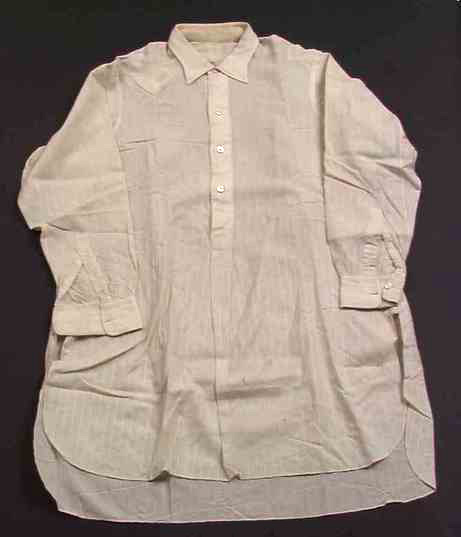
A shirt is a cloth garment for the upper body (from the neck to the waist).
Originally an undergarment worn exclusively by men, it has become, in American English, a catch-all term for a broad variety of upper-body garments and undergarments. In British English, a shirt is more specifically a garment with a collar, sleeves with cuffs, and a full vertical opening with buttons or snaps (North Americans would call that a "dress shirt", a specific type of collared shirt). A shirt can also be worn with a necktie under the shirt collar.
History
[edit]The world's oldest preserved garment, discovered by Flinders Petrie, is a "highly sophisticated" linen shirt from a First Dynasty Egyptian tomb at Tarkan, dated to c. 3000 BC: "the shoulders and sleeves have been finely pleated to give form-fitting trimness while allowing the wearer room to move. The small fringe formed during weaving along one edge of the cloth has been placed by the designer to decorate the neck opening and side seam."[1]
The shirt was an item of clothing that only men could wear as underwear, until the twentieth century.[2] Although the women's chemise was a closely related garment to the men's, it is the men's garment that became the modern shirt.[3] In the Middle Ages, it was a plain, undyed garment worn next to the skin and under regular garments. In medieval artworks, the shirt is only visible (uncovered) on humble characters, such as shepherds, prisoners, and penitents.[4] In the seventeenth century, men's shirts were allowed to show, with much the same erotic import as visible underwear today.[5] In the eighteenth century, instead of underpants, men "relied on the long tails of shirts ... to serve the function of drawers.[6] Eighteenth-century costume historian Joseph Strutt believed that men who did not wear shirts to bed were indecent.[7] Even as late as 1879, a visible shirt with nothing over it was considered improper.[2]
The shirt sometimes had frills at the neck or cuffs. In the sixteenth century, men's shirts often had embroidery, and sometimes frills or lace at the neck and cuffs and through the eighteenth-century long neck frills, or jabots, were fashionable.[8][9] Coloured shirts began to appear in the early nineteenth century, as can be seen in the paintings of George Caleb Bingham. They were considered casual wear, for lower-class workers only, until the twentieth century. For a gentleman, "to wear a sky-blue shirt was unthinkable in 1860, but had become standard by 1920 and, in 1980, constituted the most commonplace event."[10]
European and American women began wearing shirts in 1860, when the Garibaldi shirt, a red shirt as worn by the freedom fighters under Giuseppe Garibaldi, was popularized by Empress Eugénie of France.[11][12] At the end of the nineteenth century, the Century Dictionary described an ordinary shirt as "of cotton, with linen bosom, wristbands and cuffs prepared for stiffening with starch, the collar and wristbands being usually separate and adjustable".
The first documented appearance of the expression "To give the shirt off one's back", happened in 1771 as an idiom that indicates extreme desperation or generosity and is still in common usage. In 1827 Hannah Montague, a housewife in upstate New York, invents the detachable collar. Tired of constantly washing her husband's entire shirt when only the collar needed it, she cut off his collars and devised a way of attaching them to the neckband after washing. It was not until the 1930s that collar stays became popular, although these early accessories resembled tie clips more than the small collar stiffeners available today. They connected the collar points to the necktie, keeping them in place.[13][better source needed]
Types
[edit]
- Aloha shirt
- Camp shirt – a loose, straight-cut, short sleeved shirt or blouse with a simple placket front-opening and a "camp collar".
- Dress shirt – shirt with a formal (somewhat stiff) collar, a full-length opening at the front from the collar to the hem (usually buttoned), and sleeves with cuffs
- White shirt – usually dress shirt which is white in colour
- Dinner shirt – a shirt specifically made to be worn with male evening wear, e.g. a black tie or white tie.
- Guayabera – an embroidered dress shirt with four pockets.
- Poet shirt – a loose-fitting shirt or blouse with full bishop sleeves, usually with large frills on the front and on the cuffs.
- T-shirt – also "tee shirt", a casual shirt without a collar or buttons, made of a stretchy, finely knit fabric, usually cotton, and usually short-sleeved. Originally worn under other shirts, it is now a common shirt for everyday wear in some countries.[14]
- Long-sleeved T-shirt – a T-shirt with long sleeves that extend to cover the arms.
- Ringer T-shirt – tee with a separate piece of fabric sewn onto the collar and sleeve hems.
- Raglan T-shirt – a T-shirt with a raglan sleeve; a sleeve that extends in one piece fully to the collar, leaving a diagonal seam from underarm to collarbone.
- Halfshirt – a high-hemmed T-shirt, typically falling between the bottom of the sternum and navel.
- Sleeveless shirt – a shirt manufactured without sleeves, or one whose sleeves have been cut off, also called a tank top
- A-shirt or vest or singlet (in British English) – essentially a sleeveless shirt with large armholes and a large neck hole, often worn by labourers or athletes for increased movability.
- Camisole – woman's undershirt with narrow straps, or a similar garment worn alone (often with bra). Also referred to as a cami, shelf top, spaghetti straps or strappy top
- Polo shirt (also tennis shirt or golf shirt) – a pullover soft collar short-sleeved shirt with an abbreviated button placket at the neck and a longer back than front (the "tennis tail").
- Rugby shirt – a long-sleeved polo shirt, traditionally of rugged construction in thick cotton or wool, but often softer today
- Henley shirt – a collarless polo shirt
- Baseball shirt (jersey) – usually distinguished by a three-quarters sleeve, team insignia, and flat waist seam
- Sweatshirt – long-sleeved athletic shirt of heavier material, with or without hood
- Tunic – primitive shirt, distinguished by two-piece construction. Initially a men's garment, is normally seen in modern times being worn by women
- Shirtwaist – historically (circa. 1890–1920) a woman's tailored shirt (also called a "tailored waist") cut like a man's dress shirt;[15] in contemporary usage, a woman's dress cut like a men's dress shirt to the waist, then extended into dress length at the bottom
- Nightshirt – often oversized, ruined or inexpensive light cloth undergarment shirt for sleeping.
- Halter top – a shoulderless, sleeveless garment for women. It is mechanically analogous to an apron with a string around the back of the neck and across the lower back holding it in place.
- Top shirt – a long-sleeved collarless polo shirt
- Heavy shirt – a shirt made with heavier fabric (typically more than 6 oz./yd.², often ranging from 6 oz. to 9 oz.+, or 180 to 220 GSM)[16][17]
- Onesie or diaper shirt – a shirt for infants which is buttoned in the front between the legs
- Tube top (in American English) or boob tube (in British English) – a shoulderless, sleeveless "tube" that wraps the torso not reaching higher than the armpit, staying in place by elasticity or by a single strap that is attached to the front of the tube
- Overshirt- a heavier type of shirt that can be worn over the shirt as a jacket.
- Thousand-miler shirt - historically (until circa 1960s) a light brown colored shirt worn predominantly by American travelling salesmen in first half of 20th century and known as a thousand-miler because it did not show dirt from long business trips on the road.[18] Also a dark shirt or one made of heavy serviceable fabric as worn by sailors or railway workers especially during the steam age.
- Punishment shirts were special shirts made for the condemned, either those cursed supernaturally, such as the poisoned shirt that killed Creusa (daughter of Creon), the Shirt of Nessus used to kill Hercules, those used to execute people in ancient Rome, such as the Tunica molesta, and those used in church heresy trials such as the Sanbenito
Parts of shirt
[edit]Many terms are used to describe and differentiate types of shirts (and upper-body garments in general) and their construction. The smallest differences may have significance to a cultural or occupational group. Recently, (late twentieth century, into the twenty-first century) it has become common to use tops as a form of advertisement. Many of these distinctions apply to other upper-body garments, such as coats and sweaters.
Shoulders and arms
[edit]Sleeves
[edit]Shirts may:
- have no covering of the shoulders or arms – a tube top (not reaching higher than the armpits, staying in place by elasticity)
- have only shoulder straps, such as spaghetti straps
- cover the shoulders, but without sleeves
- have shoulderless sleeves, short or long, with or without shoulder straps, that expose the shoulders, but cover the rest of the arm from the biceps and triceps down to at least the elbow
- have short sleeves, varying from cap sleeves (covering only the shoulder and not extending below the armpit) to half sleeves (elbow length), with some having quarter-length sleeves (reaching to a point that covers half of the biceps and triceps area)
- have three-quarter-length sleeves (reaching to a point between the elbow and the wrist)
- have long sleeves (reaching a point to the wrist to a little beyond wrist)
Cuffs
[edit]Shirts with long sleeves may further be distinguished by the cuffs:
- no buttons – a closed placket cuff
- buttons (or analogous fasteners such as snaps) – single or multiple. A single button or pair aligned parallel with the cuff hem is considered a button cuff. Multiple buttons aligned perpendicular to the cuff hem, or parallel to the placket constitute a barrel cuff.
- buttonholes designed for cufflinks
- a French cuff, where the end half of the cuff is folded over the cuff itself and fastened with a cufflink. This type of cuff has four buttons and a short placket.
- more formally, a link cuff – fastened like a French cuff, except is not folded over, but instead hemmed, at the edge of the sleeve.
- asymmetrical designs, such as one-shoulder, one-sleeve or with sleeves of different lengths.
Lower hem
[edit]- hanging to the waist
- leaving the belly button area bare (much more common for women than for men). See halfshirt.
- covering the crotch
- covering part of the legs (essentially this is a dress; however, a piece of clothing is perceived either as a shirt (worn with trousers) or as a dress (in Western culture mainly worn by women)).
- going to the floor (as a pajama shirt)
Body
[edit]- vertical opening on the front side, all the way down, with buttons or zipper. When fastened with buttons, this opening is often called the placket front.
- similar opening, but in back.
- left and right front side not separable, put on over the head; with regard to upper front side opening:
- V-shaped permanent opening on the top of the front side
- no opening at the upper front side
- vertical opening on the upper front side with buttons or zipper
- men's shirts are usually buttoned on the right whereas women's are usually buttoned on the left.[19]
Neck
[edit]- with polo-neck
- with "scoop" neck
- with v-neck but no collar
- with plunging neck
- with open or tassel neck
- with collar
- windsor collar or spread collar – a dressier collar designed with a wide distance between points (the spread) to accommodate the windsor knot tie. The standard business collar.
- tab collar – a collar with two small fabric tabs that fasten together behind a tie to maintain collar spread.
- wing collar – best suited for the bow tie, often only worn for very formal occasions.
- straight collar – or point collar, a version of the windsor collar that is distinguished by a narrower spread to better accommodate the four-in-hand knot, pratt knot, and the half-windsor knot. A moderate dress collar.
- button-down collar – A collar with buttons that fasten the points or tips to a shirt. The most casual of collars worn with a tie.
- band collar – essentially the lower part of a normal collar, first used as the original collar to which a separate collarpiece was attached. Rarely seen in modern fashion. Also casual.
- turtle neck collar – A collar that covers most of the throat.
- without collar
- V-neck no collar – The neckline protrudes down the chest and to a point, creating a "V"-looking neckline.
Other features
[edit]- pockets – how many (if any), where, and with regard to closure: not closable, just a flap, or with a button or zipper.
- with or without hood
Some combinations are not applicable, e.g. a tube top cannot have a collar.
Measures and sizes
[edit]The main measures for a jacket are:
- Shoulders
- Bust
- Waist
- Hip
- Sleeve
- Length, from the neck to the waist or hip.
Sizes
[edit]- Asia Size M = US/EU Size XS.
- Asia Size L = US/EU Size S.
- Asia Size XL = US/EU Size M.
- Asia Size XXL = US/EU Size L.
- Asia Size XXXL = US/EU Size XL.
- Asia Size XXXXL = US/EU Size XXL.
Types of fabric
[edit]There are two main categories of fibres used: natural fibre and man-made fibre (synthetics or petroleum based). Some natural fibres are linen, the first used historically, hemp, cotton, the most used, ramie, wool, silk and more recently bamboo or soya. Some synthetic fibres are polyester, tencel, viscose, etc. Polyester mixed with cotton (poly-cotton) is often used. Fabrics for shirts are called shirtings. The four main weaves for shirtings are plain weave, oxford, twill and satin. Broadcloth, poplin and end-on-end are variations of the plain weave. After weaving, finishing can be applied to the fabric.
Shirts and politics
[edit]In the 1920s and 1930s, fascists wore different coloured shirts:
- Black shirts were used by the Italian fascists, and in Britain, Finland and Germany and Croatia.
- Brownshirts were worn by German Nazis of the SA.
- The Blueshirts was a fascist movement in Ireland and Canada, and the colour of the Portuguese Nacional Sindicalistas, the Spanish Falange Española, the French Solidarité Française, and the Chinese Blue Shirts Society.
- Green shirts were used in Hungary, Ireland, Romania, Brazil and Portugal.
- Camisas Doradas (golden shirts) were used in Mexico.
- Red shirts were worn by the racist and antisemitic Bulgarian Ratniks.
- Silver Shirts were worn in the United States of America.
- Grey shirts were worn by members of the Fatherland League in Norway.
In addition, red shirts have been used to symbolize a variety of different political groups, including Garibaldi's Italian revolutionaries, nineteenth-century American street gangs, and socialist militias in Spain and Mexico during the 1930s.
Different colored shirts signified the major opposing sides that featured prominently in the 2008 Thai political crisis, with red having been worn by the supporters of the populist People's Power Party (PPP), and yellow being worn by the supporters of the royalist and anti-Thaksin Shinawatra movement the People's Alliance for Democracy (PAD). Each side is commonly referred to as the 'red shirts' and 'yellow shirts' respectively, though the later opponents of the later Thaksin supporting groups have largely ceased wearing yellow shirts to protest rallies.
In the UK, the Social Credit movement of the thirties wore green shirts.
The party leaders of Dravidar Kazhagam in India wear only black shirts to symbolise atheism.
Whatever its color, the shirt itself means a certain wealth and social status. In Spain in the 19th century, then in Argentina during the time of Juan Perón, the word descamisados ("shirtless") means the masses of the poor.
Industrial production
[edit]-
 Shirt production line
 -
 Factory sewing
 -
 Shirts on a conveyor
 -
 Shirts awaiting finishing
 -
 Kids shirts for quality checking
 -
 Manufacturer and buyer reviewing product
 -
 Dress shirt


See also
[edit]- Cardigan (sweater)
- Descamisado
- Jermyn Street, home of the oldest English shirtmakers
References
[edit]- ^ Barber, Elizabeth Wayland (1994). Women's Work. The first 20,000 Years, p.135. Norton & Company, New York. ISBN 0-393-31348-4
- ^ a b William L. Brown III, "Some Thoughts on Men's Shirts in America, 1750-1900", Thomas Publications, Gettysburg, PA 1999. ISBN 1-57747-048-6, p. 7
- ^ Dorothy K. Burnham, "Cut My Cote", Royal Ontario Museum, Toronto, Ontario 1973. ISBN 0-88854-046-9, p. 14
- ^ C. Willett Cunnington and Phillis Cunnington, The History of Underclothes, Dover Publications Inc., New York 1992. ISBN 0-486-27124-2 pp. 23–25
- ^ C. Willett and Phillis Cunnington, The History of Underclothes, Dover Publications Inc., New York 1992. ISBN 0-486-27124-2 pp. 54
- ^ Linda Baumgarten, "What Clothes Reveal: The Language of Clothing in Colonial and Federal America", The Colonial Williamsburg Foundation, Williamsburg, Virginia, in association with the Yale University Press, New Haven, Connecticut 2002, ISBN 0-300-09580-5, p. 27
- ^ Linda Baumgarten, "What Clothes Reveal: The Language of Clothing in Colonial and Federal America", The Colonial Williamsburg Foundation, Williamsburg, Virginia, in association with the Yale University Press, New Haven, Connecticut 2002, ISBN 0-300-09580-5, pp. 20-22
- ^ C. Willet and Phillis Cunnington, "The History of Underclothes", Dover Publications Inc., New York 1992. ISBN 0-486-27124-2 pp. 36–39
- ^ C. Willet and Phillis Cunnington, "The History of Underclothes", Dover Publications Inc., New York 1992. ISBN 0-486-27124-2 pp. 73
- ^ Michel Pastoureau and Jody Gladding (translator), "The Devil's Cloth: A History of Stripes", Columbia University Press, New York 2001 ISBN 0-7434-5326-3, p. 65
- ^ Anne Buck, "Victorian Costume", Ruth Bean Publishers, Carlton, Bedford, England 1984. ISBN 0-903585-17-0
- ^ Young, Julia Ditto, "The Rise of the Shirt Waist", Good Housekeeping, May 1902, pp. 354–357
- ^ "History of the Shirt :: Shirt Guide". Gant US. Retrieved 2016-09-29.
- ^ "KYKU". kykuclothing.com.
- ^ For example, see Laura I. Baldt, A.M., Clothing for Women: Selection, Design and Construction, J.B. Lippincott Company, Philadelphia, PA 1924 (second edition), p. 312
- ^ "Heavyweight vs Lightweight T-Shirts: What's the Difference? Which is Better?".
- ^ "Heavyweight vs Oversized T-Shirts: What's the Difference?". 18 July 2024.
- ^ Steinbeck, John. (1947) The Wayward Bus, Viking Press, NYC, Book Club hardback ed. p. 513
- ^ Lewis, Danny (November 23, 2015). "Here's Why Men's and Women's Clothes Button on Opposite Sides". Smithsonian magazine. Retrieved December 6, 2021.
External links
[edit]

- "Introduction to 18th-century fashion". Fashion, Jewellery & Accessories. Victoria and Albert Museum. 25 January 2011.
- "Introduction to 19th-century fashion". Fashion, Jewellery & Accessories. Victoria and Albert Museum. 25 January 2011.
| Headwear | |||||||||
|---|---|---|---|---|---|---|---|---|---|
| Neckwear | |||||||||
| Underwear and lingerie |
| ||||||||
| Tops | |||||||||
| Bottoms |
| ||||||||
| Full-Body Wear |
| ||||||||
| Coats and outerwear |
| ||||||||
| Nightwear | |||||||||
| Swimwear | |||||||||
| Legwear | |||||||||
| Footwear | |||||||||
| Accessories |
| ||||||||
| Dress codes |
| ||||||||
| Related | |||||||||

Shirt
View on GrokipediaHistory
Origins in Ancient Civilizations
In ancient Egypt, the earliest known sewn garment resembling a shirt—a linen tunic—was discovered in the Tarkhan cemetery south of Cairo, dating to approximately 3480–3100 BCE during the Predynastic or early First Dynasty period.[9] This V-necked, pleated linen piece, unearthed in 1913, represents one of the oldest preserved examples of tailored upper-body clothing, crafted from flax fibers abundant in the Nile Valley and valued for their breathability in the subtropical climate.[10] Egyptian men and women commonly wore such schenti-like kilts or simple tunics as primary attire, often supplemented by draped shawls, with linen production techniques evidenced from as early as 5000 BCE through flax cultivation and hand-spinning.[11] In Mesopotamia, particularly among Sumerians from around 3500 BCE, upper-body coverings were typically unsown woolen or linen wraps draped over the shoulders or girded at the waist, rather than fitted shirts, reflecting nomadic pastoral influences and the use of fringed kaunakes fabric for status display.[12] Archaeological finds from Ur and other sites show these shawls or cloaks as precursors to later tunics, but without the seaming seen in Egyptian examples, prioritizing functionality for herding and urban labor in the Fertile Crescent's variable climate.[13] The Indus Valley Civilization (c. 3300–1300 BCE) yielded evidence of cotton textile production from sites like Mohenjo-Daro, including twisted threads dated to around 2500 BCE, but surviving depictions on seals suggest draped or wrapped garments rather than distinct shirts, possibly influenced by early cotton weaving innovations absent in contemporaneous Near Eastern cultures.[14] These regional variations highlight how environmental factors—flax in Egypt, wool in Mesopotamia, cotton in the Indus—drove initial garment forms, with Egypt's sewn linen tunics providing the closest antecedent to the shirt's structured silhouette.[15]Medieval and Renaissance Developments
In medieval Europe, the shirt served as an essential undergarment for men, crafted primarily from linen to absorb perspiration and oils, thereby protecting costlier outer woolen garments and enabling regular laundering. This material choice stemmed from linen's breathability and availability, contrasting with wool's insulating but less hygienic properties for base layers. Archaeological preservation is rare due to the garment's frequent washing and organic decay, but the Viborg shirt, unearthed in Denmark and dated circa 1018–1100 AD via dendrochronology and associated ceramics, provides direct evidence of construction: a slim-fit poncho-style form in medium-quality Z/Z-spun linen tabby weave (20 threads/cm warp, 12 weft), with no shoulder seams, open side slits for mobility, a neckline secured by tying ribbons, and long sleeves joined via backstitch, whipstitch, and overcasting on folded edges or selvedges.[16][17] Typical medieval shirts employed efficient patterns from narrow loom widths (45–90 cm), using rectangular body panels augmented by underarm gussets and gores for fit and arm movement, often extending to knee length for coverage during physical labor or sleep. These features prioritized functionality over ornamentation, as shirts remained concealed beneath tunics or pourpoints, with variations in quality—coarser weaves for peasants, finer for nobility—reflecting social stratification without altering basic form. Evidence from art and sparse finds indicates minimal tailoring until late medieval shifts toward fitted silhouettes influenced outer layers more than undergarments.[18] By the Renaissance, particularly in early 16th-century Italy and northern Europe, the men's shirt (termed camicia) transitioned toward partial visibility and elaboration, with high standing collars featuring narrow frills emerging around 1520–1529 as precursors to the ruff, crafted from fine linen and adorned with blackwork, gold, or gray embroidery. Cuffs mirrored this with frilled extensions, exposed through slashes or boat-neck cuts in doublets and jerkins, signaling wealth via the pristine white fabric's display of laundering resources and artisanal skill. Construction refined to include precise pleating at neck and wrists, hand-sewn seams, and integrated collars from T-shaped or gores-based bodies, while retaining the hygienic underlayer role; mid-century examples confirm household production by women using horizontal looms. This evolution aligned with broader tailoring advances and Spanish-influenced modesty, elevating the shirt from utilitarian obscurity to a subtle status marker.[19][20]Industrial Era Transformations
The Industrial Revolution, spanning roughly from the late 18th to the late 19th century, fundamentally altered shirt production by transitioning it from labor-intensive hand-sewing in homes or small workshops to mechanized factory systems, enabling mass output and affordability. Prior to widespread mechanization, shirts—typically constructed from linen or cotton—required skilled artisans to cut, sew, and finish each garment manually, a process that could take several days per item due to the precision needed for seams, collars, and buttonholes.[21] Textile innovations like James Hargreaves' spinning jenny in 1764 and Richard Arkwright's water frame in 1769 first boosted yarn and fabric production, supplying cheaper cotton cloth essential for shirts, but garment assembly remained a bottleneck until sewing technology advanced.[22] The lockstitch sewing machine, patented by Elias Howe in 1846, represented a breakthrough by employing a double-thread mechanism for durable, uniform seams that surpassed hand-stitching's strength and speed.[23] Isaac Singer refined this design in 1851 with a vertical needle, presser foot, and treadle operation, making it practical for factory use and home adoption through affordable installment sales, which proliferated machines to over 100,000 units sold by Singer alone by 1860.[24] These machines reduced shirt assembly time from days to hours, as operators could stitch straight seams at rates up to 500 per minute, facilitating the shift to centralized factories where divisions of labor assigned workers to specific tasks like collar attachment or cuff hemming.[25] This mechanization spurred the ready-to-wear shirt market, particularly for men, whose simpler, looser silhouettes in the mid-19th century—featuring straight cuts and minimal tailoring—lent themselves to standardized production without custom fittings.[26] Factories in urban centers like New York and Philadelphia began outputting thousands of shirts annually by the 1850s, initially for laborers and military needs, with the American Civil War (1861–1865) accelerating sizing standardization through uniform contracts that measured soldiers' chests and lengths for off-the-rack garments.[27] Prices plummeted; a hand-made linen shirt costing equivalent to several days' wages in the early 1800s dropped to under a day's pay by the 1870s, broadening access beyond elites to working classes and even enslaved populations supplied via bulk orders.[27] However, this efficiency came at social costs, including exploitative factory conditions with 12–14 hour shifts for low-paid seamstresses, often women and immigrants.[28] By the late 19th century, shirt designs incorporated industrial efficiencies, such as detachable collars and cuffs introduced around 1860 for easier laundering in mass-produced cotton poplin or broadcloth, further streamlining manufacturing and consumer maintenance.[24] These transformations not only democratized clothing but also laid groundwork for global supply chains, as U.S. and British factories exported patterns and machines, influencing apparel elsewhere.[29]20th-Century Standardization and Casualization
The advent of mass production techniques in the early 20th century standardized shirt manufacturing, shifting from bespoke tailoring to ready-to-wear garments produced in factories with uniform sizing and interchangeable components. This was facilitated by sewing machine advancements and pattern grading systems, which allowed for scalable output; by the 1920s, U.S. apparel production had expanded dramatically, with shirt factories employing standardized cuts for collars, cuffs, and bodies to meet rising consumer demand.[27][30] Dress shirts saw key refinements, including the permanent attachment of collars—previously detachable for laundering—which became standard by the 1910s, alongside the spread of the button-down collar style originating in polo sportswear and adopted widely in menswear. Soft-fold collars replaced starched detachables, reflecting practical needs for durability in daily use, while fabrics like cotton broadcloth were mass-dyed in colors beyond white, making shirts more accessible for middle-class wardrobes.[31][32] Casualization accelerated post-World War I, driven by leisure culture and wartime utility; the T-shirt, introduced as a lightweight undershirt by the U.S. Navy in 1913, evolved into an outer garment during World War II when issued to troops for its breathability in tropical climates. In the Pacific theater, U.S. soldiers and Marines routinely ditched long-sleeve undershirts for short-sleeve t-shirts or went shirtless during rest, heavy work, or non-combat periods due to extreme heat and humidity exceeding 90°F (32°C), often without field jackets as they were seldom worn in tropical islands like Guadalcanal, Tarawa, and Okinawa; troops favored lightweight herringbone twill (HBT) utilities or camouflage patterns despite sunburn risks.[33][34] By the 1950s, synthetic innovations like nylon shirts (introduced around 1939) and permanent-press finishes reduced ironing needs, enabling relaxed, low-maintenance styles such as short-sleeved sport shirts and open-collar designs.[35] Societal shifts, including suburbanization and media portrayals of informal attire, further promoted casual shirts with features like chest pockets for utility, diminishing the dominance of formal dress shirts outside professional settings. This trend aligned with broader 20th-century changes in labor and lifestyle, where workwear influenced leisure garments, though formal variants persisted in business contexts.[36][37]Recent Innovations (Post-2000)
Advancements in performance fabrics have enhanced shirt functionality, particularly through moisture-wicking technologies that transport sweat away from the skin to the fabric surface for rapid evaporation, improving comfort during physical activity. These innovations, building on synthetic fiber developments, became widespread in casual and athletic shirts in the early 2000s, with companies like Under Armour expanding moisture-management lines such as HeatGear by 2002, using polyester blends engineered for capillary action.[38] Antimicrobial treatments integrated into shirt fabrics post-2000 further reduce odor-causing bacteria; for instance, SILVADUR™ silver-based technology, applied in moisture-wicking shirts, inhibits microbial growth by up to 99% while maintaining breathability, as verified in fabric testing standards.[39] Smart textiles represent a major post-2000 shift, embedding sensors and conductive elements directly into shirt structures for real-time data collection. Conductive yarns, knitted or woven into fabrics since the mid-2000s, enable shirts to monitor physiological parameters like heart rate, respiration, and posture without rigid electronics; a 2021 review details second-generation e-textiles using such yarns for wearable sensors in garments, with applications in healthcare monitoring approved in clinical trials by 2010.[40][41] Examples include the Hexoskin biometric shirt, launched in 2013, which incorporates electrocardiogram and accelerometer sensors into a form-fitting base layer for accurate vital sign tracking during exercise or medical use.[41] Sustainability-driven innovations have focused on reducing the environmental footprint of shirt production, amid a doubling of global fiber output from 58 million tonnes in 2000 to over 100 million by 2020. Recycled polyester shirts, derived from plastic bottles, gained traction post-2010, with brands like Patagonia producing performance shirts from 100% recycled materials by 2016, cutting virgin petroleum use by up to 50% per garment. Bio-based alternatives, such as shirts from lyocell or hemp fibers, offer comparable durability to cotton while requiring 50% less water in cultivation, as demonstrated in life-cycle assessments of textile supply chains.[42][43] Seamless knitting technologies, advanced in the 2010s, allow for shirts constructed without side seams, minimizing chafing and waste; whole-garment knitting machines, commercialized around 2005 by Shima Seiki, produce tubular shirt bodies in one piece, reducing labor by 30% and fabric scraps in manufacturing. These methods, combined with digital printing for custom patterns, enable on-demand production, addressing overproduction issues in fast fashion where annual garment output exceeded 100 billion items by 2014.[44][42]Anatomy and Components
Collar and Neckline Variations
The collar of a shirt, which encircles the neck and typically folds over, serves both functional and aesthetic purposes, such as framing the face, securing a necktie, and providing structure. Variations in collar design influence the shirt's formality, compatibility with ties, and suitability for different face shapes and occasions; for instance, wider spreads accommodate larger tie knots while narrower points offer a sleeker profile.[45][46] Collar styles originated from detachable linen bands in the 19th century, evolving to attached designs by the early 20th century for practicality in mass production.[45] Common formal collar variations include the point collar, featuring straight edges meeting at a moderate angle of about 60-75 degrees, which suits most ties and provides a versatile, traditional look originating in the mid-20th century standardization of dress shirts.[47][45] The spread collar, with points separated by 90-120 degrees, allows for fuller Windsor knots and gained popularity in the 1930s as a modern alternative to narrower styles, often stiffened with interfacing for crispness.[46][47] A more extreme form, the cutaway collar, spreads points beyond 120 degrees, creating an open, dramatic appearance best for broader faces and formal events, though it requires precise tailoring to avoid gaping.[45][47] Casual variations emphasize functionality over tie compatibility. The button-down collar, secured by small buttons at the points, emerged in the 1910s from polo shirts to prevent flapping during activity, offering a soft roll and informal vibe suitable for chinos or jeans without a tie.[45][48] Specialty styles like the tab collar, with a fabric tab fastening under the tie for lift, peaked in mid-20th-century Ivy League fashion but remains niche for added height illusion.[47][45] The wing collar, with upturned points resembling wings, is reserved for black-tie tuxedo shirts, dating to the late 19th century and providing a stark frame for bow ties in evening wear.[46][45] Neckline variations without protruding collars appear in both casual and some ethnic shirts. The band collar or mandarin collar, a standing band without folds, traces to 19th-century military uniforms and suits collarless casual shirts or formal alternatives like the Nehru jacket, offering minimalism and no tie option.[47][45] In casual knit shirts like t-shirts, the crew neck forms a close-fitting round band, standardized post-World War II for underwear and sportswear, while the V-neck dips into a V-shape for ventilation and a slimmer neckline appearance, both prioritizing comfort over structure.[49][50] These necklines, unlike collared ones, rely on ribbed knitting for elasticity, with crew necks dominating everyday apparel due to their universality across body types.[51] Selection often depends on empirical fit: narrower collars elongate narrow faces, while spreads balance wider ones, as confirmed by menswear tailoring standards.[45][47]Sleeve and Cuff Structures
In shirts, sleeves are primarily constructed as set-in types, sewn separately from the body and attached along the curved armhole seam known as the armscye. This design features a sleeve cap—a rounded portion at the top—that is eased with small pleats or gathers to conform to the shoulder's contour, ensuring mobility and a fitted appearance without excess fabric.[52][53] The sleeve itself forms a tapered tube, narrower at the wrist than the bicep, typically reinforced with interlining in formal shirts for shape retention during wear and laundering.[54] Sleeve plackets, often gauntlet-style slits extending from the cuff upward for 2-4 inches, provide access for hand insertion and accommodate cuff fastening; these are reinforced with fused fabric or stitching to prevent fraying under repeated use.[55] Short sleeves, common in casual shirts, terminate in a simple hem or fused edge rather than a cuff, while long sleeves incorporate additional seam allowances for cuff integration, with construction seams usually felled or French-seamed for durability and a clean finish.[56] Cuffs represent the terminal structure of long sleeves, consisting of a folded band of fabric, typically 1-2 inches wide, that encircles the wrist for protection and adjustability. Barrel cuffs, the standard in most shirts, feature a single layer of fabric folded once with buttonholes on one side and one or two buttons on the other, allowing slight size variation; edges may be straight, rounded, or mitered at the corners for aesthetic refinement.[57][58] French cuffs, used in formal contexts, are double-length (about 4 inches unfolded) and fold back upon themselves to form four layers, secured by cufflinks through aligned holes, which permits greater adjustability and ornamental display but requires precise sizing to avoid gaping.[59][60] Both types often include stiffening via interfacing or fusing to maintain shape, with the placket extension facilitating closure alignment.[61]Body Construction and Yoke
The shirt body consists of the front and back panels that form the torso, typically cut from rectangular or slightly curved fabric pieces and joined at the side seams and shoulders to create a fitted or relaxed silhouette.[53] Side seams are often curved inward below the armpits to contour the waist, with seam allowances of 0.5 to 1 inch standard in tailored shirts for durability and alteration potential.[62] In dress shirts, the front panel includes a placket for buttoning but lacks inherent shaping like bust darts, relying instead on overall cut for a flat chest fit, while the back panel attaches to the yoke for shoulder support.[53] The yoke is the horizontal fabric panel spanning the upper back and shoulders, serving to reinforce the shoulder line, distribute stress from arm movement, and connect the back body to the sleeves.[53] Constructed from a single layer or doubled for stiffness, it typically measures 4 to 6 inches in depth and is sewn to the back body along a seam that may incorporate pleats or tucks for added room across the shoulders and upper back.[63] Common configurations include the one-piece yoke, cut from a single fabric segment for simplicity and minimal seams, versus the split yoke, formed by two panels joined at the center spine to enable better pattern matching, improved drape over sloped shoulders, and enhanced tailoring precision.[64][62] The split yoke, originating in bespoke tailoring, allows independent angling of the shoulder and front pieces, reducing pull across the back during wear.[62] For body shaping, the back panel at the yoke seam often features box pleats—two outward folds creating a central rectangle—or inverted pleats for controlled fullness, providing 1 to 2 inches of ease for mobility without excess bulk, as opposed to darts, which taper fabric triangularly for a slimmer, contoured fit suited to athletic builds.[53][65] Pleats predominate in formal shirts for tradition and breathability, while darts appear in modern slim cuts to minimize fabric bunching, though they can restrict movement if over-tightened.[53] These elements ensure the body's construction balances structure with comfort, with yoke seams pressed flat or taped for longevity in high-wear areas.[63]Hem, Placket, and Lower Edges
The hem of a shirt constitutes the finished lower edge of the body and sleeves, formed by folding the fabric inward and securing it with stitching to inhibit fraying and maintain structural integrity. In dress shirts, hems are typically double-folded and machine-stitched for durability, with a width of approximately 1-2 inches depending on the garment's style; curved hems, which dip lower at the sides, facilitate untucked wear by allowing better drape over the hips, while straight or square hems suit tucked configurations for a crisp appearance.[56][66] Hand-stitched or faced hems, using additional fabric strips like bias tape, provide reinforced finishing on higher-end shirts to enhance longevity under repeated laundering.[67][68] The placket refers to the reinforced vertical strip along the shirt's front opening or sleeve ends, designed to accommodate fastenings like buttons while distributing stress from opening and closing. Common types include the standard front placket, featuring visible edges with stitched buttonholes; the fly front or covered placket, which conceals buttons beneath an overlapping flap for a streamlined look in formal attire; and the box placket, characterized by a rectangular reinforcement with edge stitching for added rigidity.[69][70] Interlining, often fusible material sewn between layers, stiffens plackets to prevent gaping and ensure alignment, a technique standard in quality construction since the mid-20th century.[71] Sleeve plackets, similarly split and reinforced, extend from the cuff upward to ease arm insertion and allow cuff adjustments.[54] Lower edges of shirts often incorporate side vents or slits, typically 2-4 inches long at the seam junctions near the hem, to enhance mobility and prevent fabric bunching during movement. These vents, reinforced with bar tacks at their apex, originated in equestrian and military garments for riding ease but persist in modern shirts to accommodate hip width and reduce constriction when seated or bending, particularly with curved hems.[56][72] In casual styles, vents may be omitted for simplicity, whereas utility shirts retain them for functional range of motion.[73]Fastenings, Buttons, and Embellishments
The front placket of a shirt serves as the primary fastening mechanism, consisting of a reinforced strip of fabric along the center front where buttons and buttonholes are aligned to secure the garment. This design evolved from earlier half-plackets in tailored shirts, with the first full button-down placket registered by Brown, Davis & Co. in 1871, enabling a more secure and symmetrical closure suitable for fitted bodies.[74] Plackets vary by construction: the American placket features stitched edges for durability in casual shirts; the French placket uses folded fabric without visible seams for a refined appearance in dress shirts; and concealed plackets hide the buttons entirely for a sleek, formal aesthetic.[75] Buttons, the standard closure for shirts since the 19th century, are typically shank-style for dress shirts to allow space between fabric layers, or flat sew-through for casual variants, with materials ranging from inexpensive plastic—dominant post-World War II—to natural options like mother-of-pearl shell, which provides luster and durability but is prone to cracking under heat.[76] Metal buttons, often brass or pewter, emerged in the 16th century and remain common for work shirts due to corrosion resistance, while horn buttons offer a matte, organic texture favored in high-end tailoring.[77] Buttonholes are reinforced with stitching, traditionally hand-worked in bespoke shirts for flexibility and strength, contrasting machine-stitched versions in mass production. Alternative fastenings like snaps appear in children's or utility shirts for ease of use, but zippers are uncommon in traditional shirts, reserved for sportswear hybrids due to bulk and aesthetics.[78] Embellishments on shirts extend beyond function, incorporating decorative elements such as embroidered monograms—initials stitched in script or block fonts on cuffs, plackets, or chest pockets—for personalization, a practice traceable to Renaissance nobility using precious threads.[79] Studs, removable metal or jeweled fasteners, replace buttons in formal tuxedo shirts, inserted through buttonholes for a clean front, originating in 19th-century eveningwear to accommodate stiff fronts.[80] Ornamental buttons inlaid with enamel or fabric covering add flair to casual shirts, while subtle embroidery motifs like contrast stitching on plackets enhance visual interest without compromising utility. These features prioritize aesthetic enhancement, with material choices reflecting era-specific innovations, such as Bakelite buttons in the early 20th century for affordable luxury.[76]Types and Styles
Formal and Dress Shirts
Formal shirts represent the most structured variant of dress attire, typically reserved for black-tie or white-tie events, featuring wing collars that fold downward horizontally and often a pleated bib front secured with studs rather than buttons for a sleek appearance.[81] These shirts prioritize a crisp, non-textured white cotton fabric to complement formal tuxedos, with no pockets or embellishments to maintain minimalism.[82] Dress shirts, suitable for business professional environments, differ by employing collars such as point, spread, or cutaway styles that accommodate neckties, paired with barrel cuffs for buttons or French cuffs for cufflinks in higher formality.[81] They emphasize fitted construction with long tails designed to remain tucked under suits, avoiding bunching during movement, and typically exclude chest pockets to preserve a streamlined silhouette.[83] Preferred fabrics include tightly woven cotton broadcloth or poplin for a smooth, matte finish that resists wrinkling under jackets, often in white, light blue, or subtle stripes for versatility with conservative suiting.[84] Higher-quality examples use long-staple cottons like Egyptian or Supima, which offer superior durability and a finer hand due to longer fibers that yield smoother yarns.[85] Distinctions in formality arise from construction details: formal shirts favor sewn or fused collars and cuffs for rigidity, while dress shirts may incorporate removable collar stays to enhance stiffness without permanent creasing.[86] Both types adhere to tailoring principles ensuring the collar allows two fingers' space between neck and fabric for tie comfort, sleeves terminate at the wrist bone when arms extend, and the body contours without excess fabric pulling across the torso.[87] Patterns remain subdued—solids or micro-checks—to avoid clashing with patterned ties or suits, aligning with empirical observations of professional attire efficacy in structured settings.[88]Casual and Everyday Shirts
Casual shirts serve as versatile garments for informal daily activities, distinguishing themselves from formal dress shirts through relaxed construction, textured fabrics, and styling suited to untucked wear with rolled sleeves. Unlike the crisp, smooth finishes of dress shirts made from poplin or broadcloth, casual shirts prioritize comfort and durability, often featuring basketweave oxford cloth or twill weaves that resist wrinkling and allow breathability in non-office settings.[89] [90] This shift reflects practical adaptations for everyday mobility, where fitted tailoring yields to looser silhouettes that accommodate varied body movements without constriction.[91] Prominent styles include the Oxford cloth button-down, introduced by Brooks Brothers in 1896 inspired by English polo players' need to secure collars during play, which combines a soft collar with a durable cotton weave for smart-casual versatility. Chambray utility shirts, resembling lightweight denim but in finer yarns, offer a workwear heritage adapted for urban leisure, while flannel plaids provide insulation for transitional seasons through brushed cotton fibers that trap warmth without bulk. Denim shirts, constructed from sturdy twill, emerged as rugged alternatives in the mid-20th century, favored for layering over t-shirts in casual ensembles.[92] [93] [90] The evolution of casual shirts traces to early 20th-century lifestyle changes, accelerating post-World War II as mass production democratized softer, less structured options amid rising leisure culture; by the 1950s, icons like James Dean popularized untucked, patterned variants that challenged rigid formal norms. Contemporary everyday variants extend to henleys with buttoned neck plackets for subtle layering and Cuban collar shirts evoking mid-century tropical aesthetics, often in linen-cotton blends for humidity resistance. These designs emphasize darker hues, checks, or stripes over solid whites, as bolder patterns inherently signal informality by drawing less attention to precision.[94] [95] [96] Fabrics like 100% cotton oxford or chambray dominate for their natural absorbency and machine-washability, with linen variants gaining traction for summer due to high moisture-wicking properties—up to 20% more than cotton—though prone to creasing without blends. Synthetic additions in modern casual shirts, such as polyester-cotton mixes, enhance wrinkle resistance but can reduce breathability in prolonged wear, underscoring cotton's empirical superiority for all-day comfort in empirical wear tests.[90] [97][84]Workwear and Utility Shirts
Workwear and utility shirts are garments designed primarily for manual labor and occupational tasks, prioritizing durability, functionality, and resistance to wear over aesthetic appeal. Emerging in the late 19th century amid industrialization, these shirts addressed the need for robust clothing among workers in agriculture, construction, and manufacturing, where everyday fabrics failed under repeated stress and exposure to elements.[98] Early designs, patented around 1886-1930, featured simple button-front closures and straight cuts to allow unrestricted movement.[98] Fabrics for these shirts emphasize tensile strength and abrasion resistance, with heavy cotton duck or twill providing breathability while withstanding tears; for instance, twill weaves interlace yarns diagonally to distribute stress and prevent raveling.[99] Denim and chambray, originating from 19th-century mills, offer similar longevity, with chambray's plain weave and colored warp yarns yielding a fabric that endures laundering and friction without rapid degradation.[100] Empirical tests on work fabrics confirm cotton-based materials like these achieve higher tear strength—often exceeding 20 pounds in standard ASTM D1424 assays—compared to lighter shirting cottons, due to denser yarn counts (e.g., 10-14 oz/yd²).[101] Key structural elements include reinforced seams with double-needle stitching to bear loads up to 50% greater than standard single stitching, multiple utility pockets for tools (e.g., chest flap pockets on carpenter shirts), and button-down collars to secure against snags.[102] Snap or pearl buttons, rather than fragile plastics, facilitate quick fastening in cold or gloved conditions.[103] These adaptations stem from practical necessities, as evidenced by historical patents for triple-stitched yokes in 1920s designs to prevent shoulder tears from heavy loads.[104] Specific types include the Western work shirt, with curved yokes for riding stability, and the engineer's chambray shirt, featuring pencil loops and extended tails for tucking into trousers during shifts.[105] In fishing or outdoor trades, utility variants incorporate moisture-wicking treatments on cotton blends to manage perspiration, though pure cottons remain preferred for their natural evaporative cooling, reducing heat stress by up to 15% in humid environments per fabric permeability studies.[106] While modern iterations blend synthetics for added stretch, core workwear retains natural fibers for verified long-term abrasion resistance, outlasting synthetics in field trials by 20-30% under cyclic wear.[107]Specialized and Adaptive Shirts
Specialized shirts incorporate functional modifications tailored to occupational hazards or performance requirements. Flame-resistant (FR) shirts, constructed from inherently non-flammable fibers such as modacrylic or treated cotton, are mandated in high-risk industries including oil and gas extraction, electrical utilities, and welding, where exposure to flash fires or electric arcs poses burn threats. These garments must meet standards like NFPA 2112, which specifies design criteria for limiting flame propagation and afterburn, ensuring second-degree burn coverage remains below 50% of the body in simulated thermal exposures.[108][109] Moisture-wicking shirts, prevalent in athletic and outdoor activities, utilize polyester or nylon fabrics engineered via capillary action to transport sweat from the skin to the outer surface for rapid evaporation, thereby reducing skin temperature and chafing during exertion.[110][111] Adaptive shirts prioritize accessibility for individuals with physical impairments, such as arthritis, limited dexterity, or post-surgical recovery, by replacing traditional buttons with magnetic closures that align and secure effortlessly with minimal force. Products like those from MagnaReady embed neodymium magnets within fabric-covered buttons, enabling independent dressing for users with tremors or weak grip strength while maintaining a conventional aesthetic.[112] Additional adaptations include Velcro fasteners, side-zip openings, or open-back designs that accommodate seated postures or toileting needs, as offered by brands like Buck & Buck, reducing caregiver assistance time by up to 50% in clinical settings.[113] These features stem from ergonomic principles, addressing biomechanical limitations without altering core shirt anatomy, and comply with accessibility guidelines from organizations like the Adaptive Clothing Design Competition standards.[114]Fabrics and Materials
Natural Fibers: Properties and Uses
Cotton, derived from the Gossypium plant, dominates natural fiber use in shirt production, comprising approximately 33% of global textile fibers as of 2017 data from environmental analyses.[115] Its cellulose-based structure provides high absorbency, capable of holding up to 27 times its weight in water, which facilitates moisture management in apparel.[116] This property, combined with excellent breathability allowing air circulation to evaporate sweat, makes cotton ideal for everyday and formal shirts worn in moderate climates, where it wicks moisture away from the skin to reduce discomfort.[117] Cotton's durability stems from its twisted, ribbon-like fibers, offering tensile strength that withstands repeated laundering, though it wrinkles easily without treatments.[118] Linen, extracted from flax stems, excels in hot, humid conditions due to its superior cooling effect and breathability, surpassing cotton by allowing rapid heat dissipation and quick drying.[119] The fiber's hollow structure enhances moisture absorption—up to 20% of its weight—while its rigidity provides strength two to three times that of cotton, supporting lightweight summer shirts that prioritize ventilation over smoothness.[120] However, linen's low elasticity leads to pronounced wrinkling, a natural trait from its crystalline cellulose arrangement, which suits casual, relaxed shirt styles but limits its use in formal attire without blending.[121] Silk, produced by silkworms, offers exceptional smoothness from its triangular prism-shaped protein filaments, which reflect light for a natural luster and minimize friction against skin, making it suitable for high-end dress shirts requiring drape and elegance.[122] As the strongest natural fiber by weight, silk exhibits tensile strength up to 45% greater than steel equivalents, enabling fine weaves that resist tearing while providing moderate thermoregulation through insulation in cooler settings.[123] Its low absorbency—around 11%—prevents heavy saturation but can feel clammy in high humidity, restricting silk shirts to formal or evening uses where aesthetics outweigh practicality.[124] Merino wool, from fine-fleeced sheep, provides thermoregulation for transitional-weather shirts via its crimped fibers that trap air for insulation yet allow vapor transmission, maintaining body temperature across 0–40°C ranges as verified in performance studies.[125] This moisture-wicking—absorbing up to 35% of its weight without feeling wet—combined with natural odor resistance from lanolin, suits lightweight base-layer or casual shirts for active or variable conditions, though its higher cost and potential shrinkage limit widespread adoption compared to cotton.[126] Wool's softness in merino variants avoids itchiness, deriving from fiber diameters under 19 microns.[127]Synthetic Fibers: Advantages and Drawbacks
Synthetic fibers, primarily polyester (polyethylene terephthalate, or PET), nylon, and acrylic, constitute a significant portion of modern shirt production, often comprising 50-100% of the fabric in budget dress and casual shirts due to their engineered polymer structures derived from petrochemicals.[128] These materials offer uniform molecular chains that enhance mechanical properties but limit natural porosity, contrasting with the irregular microstructures of fibers like cotton.[129] Key advantages include exceptional durability, with polyester exhibiting tensile strength up to 5-8 g/denier, surpassing cotton's 3-5 g/denier, enabling shirts to withstand repeated laundering (up to 50-100 cycles) without significant degradation.[130] Wrinkle resistance arises from low moisture absorption (typically <0.4% for polyester versus 8-10% for cotton), reducing creasing during wear and minimizing ironing needs, which supports their prevalence in non-iron dress shirts.[131] Cost-effectiveness stems from scalable petroleum-based synthesis, making polyester shirts 20-50% cheaper to produce than equivalent natural fiber garments, facilitating mass-market accessibility.[132] Additionally, moisture-wicking variants, achieved through chemical modifications or microfiber extrusion, transport sweat away from the skin 2-4 times faster than untreated cotton in active scenarios, though this is less effective in passive wear like office shirts.[133]| Aspect | Advantages | Drawbacks |
|---|---|---|
| Breathability and Comfort | Engineered wicking in performance blends evaporates moisture rapidly under motion.[134] | Inherently low vapor permeability (e.g., polyester at 10-20 g/m²/day vs. cotton's 100-200 g/m²/day) traps humidity, increasing perceived heat and discomfort in static, warm conditions.[135][136] |
| Maintenance | Quick-drying (2-4 hours vs. 8-12 for naturals) and shape retention post-wash.[137] | Prone to static cling and odor retention from bacterial proliferation on non-absorbent surfaces, requiring frequent washing with detergents.[138][139] |
| Durability and Longevity | High abrasion resistance (e.g., nylon outperforming wool by 2-3x in Martindale tests) resists pilling and tearing.[130] | While mechanically strong, ultraviolet degradation shortens outdoor lifespan to 1-2 years versus naturals' variable resilience.[128] |
| Environmental Impact | Recyclable PET variants reduce virgin oil use by up to 50% in closed-loop systems.[140] | Non-biodegradable, shedding microplastics (up to 0.5-1.5% mass loss per wash) that persist in ecosystems, with global production emitting 1.4 billion tons of CO₂ equivalents annually from petrochemical feedstocks.[140][128] |
Blends, Treatments, and Emerging Materials
Cotton-polyester blends dominate shirt production due to their balanced properties, with common ratios such as 50/50, 60/40, and 65/35 combining cotton's breathability and softness with polyester's strength and wrinkle resistance.[142][143] These blends exhibit superior durability, shrinking less than pure cotton—typically under 3% after repeated washes—and drying faster, making them suitable for everyday and work shirts.[144][145] Peer-reviewed analysis of 60/40 and 80/20 cotton-polyester fabrics confirms enhanced thermal comfort through improved moisture absorption and heat transfer compared to higher polyester contents, though excessive polyester can reduce overall breathability.[146] Other blends, such as cotton-modal or wool-modal, further optimize comfort and durability; for instance, wool-modal mixtures in varying ratios (e.g., 50/50) yield fabrics with high tensile strength—up to 20% greater than pure wool—and better pilling resistance, as measured in tensile and abrasion tests.[147] These combinations reduce environmental impact by leveraging modal's semi-synthetic origin from beech trees, which requires less water than cotton cultivation. Wrinkle-resistant treatments for shirts often involve chemical finishes like durable press resins applied during manufacturing, which cross-link fabric fibers to maintain flatness; studies on treated cotton and cotton-blend shirting show crease recovery angles exceeding 250 degrees, versus 150 degrees for untreated cotton.[148][149] Stain-repellent coatings, such as fluoropolymer-based barriers (e.g., Nanotex), create hydrophobic surfaces that repel liquids like water and oil, with lab tests demonstrating over 90% stain resistance on treated cotton-polyester shirts before washing.[150][151] However, repeated laundering can diminish efficacy, dropping repellency by 20-30% after 10 cycles, and some treatments raise health concerns due to volatile compounds like formaldehyde.[148] Emerging materials emphasize sustainability and functionality; lyocell (Tencel) blends with recycled polyester reduce water use by up to 50% compared to virgin synthetics, offering shirts with moisture-wicking rates 20% higher than traditional cotton.[152][153] Bio-engineered options like synthetic spider silk (e.g., Qmonos) provide tensile strength rivaling steel—over 1 GPa—while being biodegradable, enabling lightweight, durable shirts with minimal environmental footprint.[153] Smart textiles integrate conductive fibers for thermoregulation, with prototypes harvesting body heat to power embedded sensors, projecting market growth to $20 billion by 2029 as apparel adopts passive-active systems for real-time comfort monitoring.[154][155] The sustainable fabrics sector, including these innovations, is forecasted to expand by USD 28.9 billion from 2025 to 2029, driven by demand for low-impact dyes and lab-grown alternatives.[156]Sizing and Fit
Measurement Standards and Systems
Shirt sizing standards are established through anthropometric surveys that define body dimensions essential for garment fit, including neck circumference, chest girth, overarm shoulder length, sleeve length, and waist circumference. The International Organization for Standardization (ISO) oversees these via ISO/TC 133, which standardizes size designations derived from body measurements to create consistent sizing systems across clothing types, though adherence varies by manufacturer.[157] ISO 8559-1:2017 specifically outlines methods for generating size and shape profiles using these measurements, enabling the classification of body types for apparel design.[158] In the United States, the American Society for Testing and Materials (ASTM) provides body measurement tables, such as ASTM D6240 for adult men, which list reference dimensions like chest circumferences ranging from 34 to 52 inches across sizes, informing shirt sizing but not mandating exact garment tolerances.[159] Dress shirts typically employ a numerical system combining collar size (neck circumference in inches, e.g., 14.5 to 18) with sleeve length (measured from the back neck center to wrist, e.g., 30 to 38 inches), denoted as "15-32" for a 15-inch collar and 32-inch sleeve; this allows for precise fit adjustments based on torso and arm proportions.[160] Casual shirts often use alphanumeric designations (XS to XXL), correlated to chest measurements: XS (32-34 inches), S (34-36 inches), M (38-40 inches), L (42-44 inches), XL (46-48 inches), and larger increments thereafter.[160] European standards, under EN 13402, prioritize chest circumference in centimeters for size labeling (e.g., size 46 corresponds to 94-97 cm chest), promoting a three-part system of basic measurements, size designation, and interval tolerances to reduce variability.[159] This contrasts with U.S. practices, where European sizes run smaller; for instance, a U.S. medium (chest 38-40 inches) approximates EU 48-50.[161] International conversions lack full harmonization, as Japanese and other Asian systems emphasize slimmer fits with numerical labels based on chest in centimeters (e.g., size 3 for 96 cm chest), while UK sizing mirrors U.S. numerical collars but adjusts for imperial-to-metric discrepancies.[162]| Region/System | Key Measurement Basis | Example Sizes and Equivalents |
|---|---|---|
| U.S. Dress (Numerical) | Neck (inches) + Sleeve (inches) | 15-32 (neck 15", chest ~34-36"); equivalent to EU 39-40[161] |
| U.S./UK Casual (Alpha) | Chest (inches) | M: 38-40"; L: 42-44"[160] |
| EU (EN 13402 Numerical) | Chest girth (cm) | 46: 94-97 cm chest; equivalent to U.S. S/M[159] |
| Japan/Asia (Numerical) | Chest (cm) | 3: 96 cm; slimmer than U.S. M[163] |