Hubbry Logo
logo
Vector calculus
Community hub

Vector calculus

logo
0 subscribers
Read side by side
from Wikipedia

Vector calculus or vector analysis is a branch of mathematics concerned with the differentiation and integration of vector fields, primarily in three-dimensional Euclidean space, [1] The term vector calculus is sometimes used as a synonym for the broader subject of multivariable calculus, which spans vector calculus as well as partial differentiation and multiple integration. Vector calculus plays an important role in differential geometry and in the study of partial differential equations. It is used extensively in physics and engineering, especially in the description of electromagnetic fields, gravitational fields, and fluid flow.

Vector calculus was developed from the theory of quaternions by J. Willard Gibbs and Oliver Heaviside near the end of the 19th century, and most of the notation and terminology was established by Gibbs and Edwin Bidwell Wilson in their 1901 book, Vector Analysis, though earlier mathematicians such as Isaac Newton pioneered the field.[2] In its standard form using the cross product, vector calculus does not generalize to higher dimensions, but the alternative approach of geometric algebra, which uses the exterior product, does (see § Generalizations below for more).

Basic objects

[edit]

Scalar fields

[edit]

A scalar field associates a scalar value to every point in a space. The scalar is a mathematical number representing a physical quantity. Examples of scalar fields in applications include the temperature distribution throughout space, the pressure distribution in a fluid, and spin-zero quantum fields (known as scalar bosons), such as the Higgs field. These fields are the subject of scalar field theory.

Vector fields

[edit]

A vector field is an assignment of a vector to each point in a space.[3] A vector field in the plane, for instance, can be visualized as a collection of arrows with a given magnitude and direction each attached to a point in the plane. Vector fields are often used to model, for example, the speed and direction of a moving fluid throughout space, or the strength and direction of some force, such as the magnetic or gravitational force, as it changes from point to point. This can be used, for example, to calculate work done over a line.

Vectors and pseudovectors

[edit]

In more advanced treatments, one further distinguishes pseudovector fields and pseudoscalar fields, which are identical to vector fields and scalar fields, except that they change sign under an orientation-reversing map: for example, the curl of a vector field is a pseudovector field, and if one reflects a vector field, the curl points in the opposite direction. This distinction is clarified and elaborated in geometric algebra, as described below.

Vector algebra

[edit]

The algebraic (non-differential) operations in vector calculus are referred to as vector algebra, being defined for a vector space and then applied pointwise to a vector field. The basic algebraic operations consist of:

Notations in vector calculus
Operation Notation Description
Vector addition Addition of two vectors, yielding a vector.
Scalar multiplication Multiplication of a scalar and a vector, yielding a vector.
Dot product Multiplication of two vectors, yielding a scalar.
Cross product Multiplication of two vectors in , yielding a (pseudo)vector.

Also commonly used are the two triple products:

Vector calculus triple products
Operation Notation Description
Scalar triple product The dot product of the cross product of two vectors.
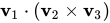
Vector triple product The cross product of the cross product of two vectors.

Operators and theorems

[edit]

Differential operators

[edit]

Vector calculus studies various differential operators defined on scalar or vector fields, which are typically expressed in terms of the del operator (), also known as "nabla". The three basic vector operators are:[4]

Differential operators in vector calculus
Operation Notation Description Notational
analogy
Domain/Range
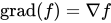
Gradient Measures the rate and direction of change in a scalar field. Scalar multiplication Maps scalar fields to vector fields.
Divergence Measures the scalar of a source or sink at a given point in a vector field. Dot product Maps vector fields to scalar fields.
Curl Measures the tendency to rotate about a point in a vector field in . Cross product Maps vector fields to (pseudo)vector fields.
f denotes a scalar field and F denotes a vector field

Also commonly used are the two Laplace operators:

Laplace operators in vector calculus
Operation Notation Description Domain/Range
Laplacian Measures the difference between the value of the scalar field with its average on infinitesimal balls. Maps between scalar fields.
Vector Laplacian Measures the difference between the value of the vector field with its average on infinitesimal balls. Maps between vector fields.
f denotes a scalar field and F denotes a vector field

A quantity called the Jacobian matrix is useful for studying functions when both the domain and range of the function are multivariable, such as a change of variables during integration.

Integral theorems

[edit]

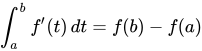
The three basic vector operators have corresponding theorems which generalize the fundamental theorem of calculus to higher dimensions:

Integral theorems of vector calculus
Theorem Statement Description
Gradient theorem The line integral of the gradient of a scalar field over a curve L is equal to the change in the scalar field between the endpoints p and q of the curve.
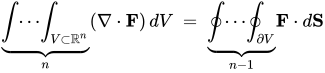
Divergence theorem The integral of the divergence of a vector field over an n-dimensional solid V is equal to the flux of the vector field through the (n−1)-dimensional closed boundary surface of the solid.
Curl (Kelvin–Stokes) theorem The integral of the curl of a vector field over a surface Σ in is equal to the circulation of the vector field around the closed curve bounding the surface.
denotes a scalar field and F denotes a vector field

In two dimensions, the divergence and curl theorems reduce to the Green's theorem:

Green's theorem of vector calculus
Theorem Statement Description
Green's theorem The integral of the divergence (or curl) of a vector field over some region A in equals the flux (or circulation) of the vector field over the closed curve bounding the region.
For divergence, F = (M, −L). For curl, F = (L, M, 0). L and M are functions of (x, y).

Applications

[edit]

Linear approximations

[edit]

Linear approximations are used to replace complicated functions with linear functions that are almost the same. Given a differentiable function f(x, y) with real values, one can approximate f(x, y) for (x, y) close to (a, b) by the formula

The right-hand side is the equation of the plane tangent to the graph of z = f(x, y) at (a, b).

Optimization

[edit]

For a continuously differentiable function of several real variables, a point P (that is, a set of values for the input variables, which is viewed as a point in Rn) is critical if all of the partial derivatives of the function are zero at P, or, equivalently, if its gradient is zero. The critical values are the values of the function at the critical points.

If the function is smooth, or, at least twice continuously differentiable, a critical point may be either a local maximum, a local minimum or a saddle point. The different cases may be distinguished by considering the eigenvalues of the Hessian matrix of second derivatives.

By Fermat's theorem, all local maxima and minima of a differentiable function occur at critical points. Therefore, to find the local maxima and minima, it suffices, theoretically, to compute the zeros of the gradient and the eigenvalues of the Hessian matrix at these zeros.

Generalizations

[edit]

Vector calculus can also be generalized to other 3-manifolds and higher-dimensional spaces.

Different 3-manifolds

[edit]

Vector calculus is initially defined for Euclidean 3-space, which has additional structure beyond simply being a 3-dimensional real vector space, namely: a norm (giving a notion of length) defined via an inner product (the dot product), which in turn gives a notion of angle, and an orientation, which gives a notion of left-handed and right-handed. These structures give rise to a volume form, and also the cross product, which is used pervasively in vector calculus.

The gradient and divergence require only the inner product, while the curl and the cross product also requires the handedness of the coordinate system to be taken into account.

Vector calculus can be defined on other 3-dimensional real vector spaces if they have an inner product (or more generally a symmetric nondegenerate form) and an orientation; this is less data than an isomorphism to Euclidean space, as it does not require a set of coordinates (a frame of reference), which reflects the fact that vector calculus is invariant under rotations (the special orthogonal group SO(3)).

More generally, vector calculus can be defined on any 3-dimensional oriented Riemannian manifold, or more generally pseudo-Riemannian manifold. This structure simply means that the tangent space at each point has an inner product (more generally, a symmetric nondegenerate form) and an orientation, or more globally that there is a symmetric nondegenerate metric tensor and an orientation, and works because vector calculus is defined in terms of tangent vectors at each point.

Other dimensions

[edit]

Most of the analytic results are easily understood, in a more general form, using the machinery of differential geometry, of which vector calculus forms a subset. Grad and div generalize immediately to other dimensions, as do the gradient theorem, divergence theorem, and Laplacian (yielding harmonic analysis), while curl and cross product do not generalize as directly.

From a general point of view, the various fields in (3-dimensional) vector calculus are uniformly seen as being k-vector fields: scalar fields are 0-vector fields, vector fields are 1-vector fields, pseudovector fields are 2-vector fields, and pseudoscalar fields are 3-vector fields. In higher dimensions there are additional types of fields (scalar, vector, pseudovector or pseudoscalar corresponding to 0, 1, n − 1 or n dimensions, which is exhaustive in dimension 3), so one cannot only work with (pseudo)scalars and (pseudo)vectors.

In any dimension, assuming a nondegenerate form, grad of a scalar function is a vector field, and div of a vector field is a scalar function, but only in dimension 3 or 7[5] (and, trivially, in dimension 0 or 1) is the curl of a vector field a vector field, and only in 3 or 7 dimensions can a cross product be defined (generalizations in other dimensionalities either require vectors to yield 1 vector, or are alternative Lie algebras, which are more general antisymmetric bilinear products). The generalization of grad and div, and how curl may be generalized is elaborated at Curl § Generalizations; in brief, the curl of a vector field is a bivector field, which may be interpreted as the special orthogonal Lie algebra of infinitesimal rotations; however, this cannot be identified with a vector field because the dimensions differ – there are 3 dimensions of rotations in 3 dimensions, but 6 dimensions of rotations in 4 dimensions (and more generally dimensions of rotations in n dimensions).

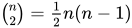
There are two important alternative generalizations of vector calculus. The first, geometric algebra, uses k-vector fields instead of vector fields (in 3 or fewer dimensions, every k-vector field can be identified with a scalar function or vector field, but this is not true in higher dimensions). This replaces the cross product, which is specific to 3 dimensions, taking in two vector fields and giving as output a vector field, with the exterior product, which exists in all dimensions and takes in two vector fields, giving as output a bivector (2-vector) field. This product yields Clifford algebras as the algebraic structure on vector spaces (with an orientation and nondegenerate form). Geometric algebra is mostly used in generalizations of physics and other applied fields to higher dimensions.

The second generalization uses differential forms (k-covector fields) instead of vector fields or k-vector fields, and is widely used in mathematics, particularly in differential geometry, geometric topology, and harmonic analysis, in particular yielding Hodge theory on oriented pseudo-Riemannian manifolds. From this point of view, grad, curl, and div correspond to the exterior derivative of 0-forms, 1-forms, and 2-forms, respectively, and the key theorems of vector calculus are all special cases of the general form of Stokes' theorem.

From the point of view of both of these generalizations, vector calculus implicitly identifies mathematically distinct objects, which makes the presentation simpler but the underlying mathematical structure and generalizations less clear. From the point of view of geometric algebra, vector calculus implicitly identifies k-vector fields with vector fields or scalar functions: 0-vectors and 3-vectors with scalars, 1-vectors and 2-vectors with vectors. From the point of view of differential forms, vector calculus implicitly identifies k-forms with scalar fields or vector fields: 0-forms and 3-forms with scalar fields, 1-forms and 2-forms with vector fields. Thus for example the curl naturally takes as input a vector field or 1-form, but naturally has as output a 2-vector field or 2-form (hence pseudovector field), which is then interpreted as a vector field, rather than directly taking a vector field to a vector field; this is reflected in the curl of a vector field in higher dimensions not having as output a vector field.

See also

[edit]

References

[edit]
[edit]
Revisions and contributorsEdit on WikipediaRead on Wikipedia
from Grokipedia
Vector calculus is a branch of mathematics that extends the methods of calculus to functions of several variables, particularly focusing on vector fields, their derivatives, and integrals in two or three dimensions.[1] It provides tools for analyzing quantities with both magnitude and direction, such as velocity fields in fluid dynamics or force fields in electromagnetism.[2] Central to vector calculus are the differential operators: the gradient, which measures the direction and rate of steepest ascent of a scalar field; the divergence, which quantifies the net flow out of a point in a vector field; and the curl, which describes the rotation or circulation around a point.[2] These operators enable the study of how vector fields behave locally, with applications in deriving physical laws like Gauss's law for electricity.[3] Integration in vector calculus includes line integrals along curves, surface integrals over oriented surfaces, and volume integrals, which compute work, flux, and other path-dependent or area-dependent quantities.[4] The subject is unified by four fundamental theorems that relate these integrals and derivatives across different dimensions: the gradient theorem, which equates a line integral of a gradient to endpoint differences; Green's theorem, linking line integrals to area integrals in the plane; Stokes' theorem, connecting line integrals over boundaries to surface integrals of curl; and the divergence theorem, relating surface integrals to volume integrals of divergence.[5] These theorems, often generalized under the Kelvin-Stokes theorem framework, form the cornerstone for solving partial differential equations in physics.[5] Historically, vector calculus emerged in the late 19th century, building on earlier work with quaternions by William Rowan Hamilton and synthetic geometry by Hermann Grassmann, but it was Josiah Willard Gibbs and Oliver Heaviside who systematized it into its modern form for practical use in physics.[6] Today, it underpins diverse fields including electromagnetism—via Maxwell's equations—fluid mechanics for modeling incompressible flows, and engineering for stress analysis in materials.[3][7]

Basic Concepts

Scalar Fields

A scalar field is a function f:RnRf: \mathbb{R}^n \to \mathbb{R} that assigns a real number, or scalar, to each point in an nn-dimensional Euclidean space, providing a foundational concept in multivariable calculus and vector analysis.[8] Common physical examples include the temperature distribution T(x,y,z)T(x, y, z) in a region, which varies continuously with position, and the gravitational potential ϕ(r)\phi(\mathbf{r}), which describes the potential energy per unit mass at a point r\mathbf{r} due to a mass distribution.[8][9] These fields model scalar quantities that depend on spatial coordinates, enabling the analysis of phenomena where magnitude alone suffices without direction. Key properties of scalar fields include continuity and differentiability, which ensure well-behaved behavior across the domain. A scalar field ff is continuous at a point xSRn\mathbf{x} \in S \subseteq \mathbb{R}^n if, for every ϵ>0\epsilon > 0, there exists δ>0\delta > 0 such that f(x)f(y)<ϵ|f(\mathbf{x}) - f(\mathbf{y})| < \epsilon whenever xy<δ\|\mathbf{x} - \mathbf{y}\| < \delta and yS\mathbf{y} \in S.[10] Differentiability requires the existence of partial derivatives, defined as the limit
fxi(a)=limh0f(a1,,ai+h,,an)f(a)h, \frac{\partial f}{\partial x_i}(\mathbf{a}) = \lim_{h \to 0} \frac{f(a_1, \dots, a_i + h, \dots, a_n) - f(\mathbf{a})}{h},
where other variables are held constant, confirming the field's smoothness for further analysis.[11] Level sets, or isosurfaces, are the loci where f(r)=kf(\mathbf{r}) = k for constant kk, forming curves in 2D (e.g., circles for f(x,y)=x2+y2=kf(x,y) = x^2 + y^2 = k) or surfaces in 3D (e.g., spheres for f(x,y,z)=x2+y2+z2=kf(x,y,z) = x^2 + y^2 + z^2 = k).[12] Visualization of scalar fields aids conceptual understanding, with contour plots depicting level curves in 2D to show variations like elevation on a map, and isosurfaces rendering constant-value surfaces in 3D for volumetric data such as potential fields.[8][12] These representations highlight regions of rapid change and uniformity. Scalar fields build directly on multivariable calculus prerequisites, where partial derivatives quantify rates of change along coordinate axes, essential for extending to vector-valued functions.[11]

Vector Fields

A vector field on a domain in Euclidean space Rn\mathbb{R}^n is a function F:RnRn\mathbf{F}: \mathbb{R}^n \to \mathbb{R}^n that assigns to each point x\mathbf{x} a vector F(x)\mathbf{F}(\mathbf{x}).[13] In three dimensions, it is typically expressed in components as F(x,y,z)=P(x,y,z)i+Q(x,y,z)j+R(x,y,z)k\mathbf{F}(x, y, z) = P(x, y, z) \mathbf{i} + Q(x, y, z) \mathbf{j} + R(x, y, z) \mathbf{k}, where PP, QQ, and RR are scalar functions.[14] This assignment describes directional quantities at every point, such as forces or flows, distinguishing vector fields from scalar fields, which assign only magnitudes and can serve as a basis for constructing vector fields through operations like the gradient.[15] Common examples include the velocity field of a fluid, v(r,t)\mathbf{v}(\mathbf{r}, t), which indicates the direction and speed of motion at each position r\mathbf{r} and time tt, and the gravitational field near a point mass, g(r)=GMrr3\mathbf{g}(\mathbf{r}) = -\frac{GM \mathbf{r}}{|\mathbf{r}|^3}, representing the acceleration due to gravity at distance r\mathbf{r} from the mass MM.[14] These fields model physical phenomena like fluid dynamics or celestial mechanics, where the vector at each point conveys both magnitude and orientation.[15] Vector fields exhibit key properties that characterize their behavior. A conservative vector field is one that can be expressed as the gradient of a scalar potential function, F=f\mathbf{F} = \nabla f, implying path-independent line integrals along any curve connecting two points.[14] In contrast, non-conservative fields, such as those involving friction or circulation, do not admit such a potential. A solenoidal vector field satisfies F=0\nabla \cdot \mathbf{F} = 0, meaning it is divergence-free and represents incompressible flows, like certain magnetic fields.[16] Visualization aids understanding of vector fields. Field lines trace the integral curves tangent to the field at each point, illustrating flow paths, while quiver plots display arrows proportional to the vector magnitude and direction at discrete grid points.[17] For local analysis, the Jacobian matrix of F\mathbf{F}, given by
JF(x)=(PxPyPzQxQyQzRxRyRz), J_{\mathbf{F}}(\mathbf{x}) = \begin{pmatrix} \frac{\partial P}{\partial x} & \frac{\partial P}{\partial y} & \frac{\partial P}{\partial z} \\ \frac{\partial Q}{\partial x} & \frac{\partial Q}{\partial y} & \frac{\partial Q}{\partial z} \\ \frac{\partial R}{\partial x} & \frac{\partial R}{\partial y} & \frac{\partial R}{\partial z} \end{pmatrix},
provides a linear approximation of the field's variation near x\mathbf{x}, capturing how nearby vectors transform under small displacements.[18]

Vectors and Pseudovectors

In vector calculus, vectors are classified into polar vectors and pseudovectors (also known as axial vectors) based on their behavior under coordinate transformations, particularly parity inversion or improper rotations. Polar vectors, such as displacement or velocity, reverse their direction under spatial inversion (parity transformation), where each coordinate changes sign (x → -x, y → -y, z → -z). In contrast, pseudovectors remain unchanged in direction under the same transformation, acquiring an extra sign factor that distinguishes them from true vectors.[19][20] This distinction arises because pseudovectors are inherently tied to oriented quantities or handedness in space. For example, the position vector r is a polar vector, transforming as r → -r under parity. The angular momentum L = r × p, where p is linear momentum (another polar vector), behaves as a pseudovector because the cross product introduces an orientation dependence that is invariant under inversion. Similarly, the magnetic field B is a pseudovector, reflecting its origin in circulating currents or rotations that preserve sense under mirroring.[21][22] Under improper rotations, which include reflections and spatial inversions (determinant of the transformation matrix = -1), polar vectors acquire an additional minus sign compared to their behavior under proper rotations (determinant = +1), while pseudovectors transform like polar vectors under proper rotations but without the sign change under improper ones. This transformation property ensures consistency in physical laws, as improper rotations reverse the handedness of space.[19][23] The conceptual framework for distinguishing these vector types emerged in the late 19th century during the development of vector analysis from William Rowan Hamilton's quaternions by Josiah Willard Gibbs and Oliver Heaviside, who adapted quaternion components to separate scalar and vector-like behaviors, laying groundwork for recognizing orientation-dependent quantities. The specific terms "polar vector" and "axial vector" were later formalized by Woldemar Voigt in 1896 to describe their differing responses to reflections in crystal physics.[23][23] A key implication in vector calculus is that the cross product of two polar vectors yields a pseudovector, as the operation encodes a right-hand rule orientation that is preserved under parity inversion, unlike the inputs. This property underscores why quantities like torque or magnetic moment, derived via cross products, are pseudovectors. In the context of vector fields, these are assignments of polar or axial vectors to points in space, influencing operations like curl.[21][22]

Vector Operations

Dot Product

The dot product, also known as the scalar product or inner product, of two vectors a\mathbf{a} and b\mathbf{b} in Euclidean space is defined algebraically in Cartesian coordinates as ab=i=1naibi\mathbf{a} \cdot \mathbf{b} = \sum_{i=1}^n a_i b_i, where aia_i and bib_i are the components of the vectors.[24] Geometrically, it is expressed as ab=abcosθ\mathbf{a} \cdot \mathbf{b} = \|\mathbf{a}\| \|\mathbf{b}\| \cos \theta, where a\|\mathbf{a}\| and b\|\mathbf{b}\| are the magnitudes of the vectors, and θ\theta is the angle between them (with 0θπ0 \leq \theta \leq \pi).[24] This formulation highlights the dot product's role in measuring the alignment of vectors based on their directions and lengths.[25] The geometric interpretation of the dot product emphasizes projection: it equals the magnitude of one vector times the scalar projection of the other onto it, providing a measure of how much one vector extends in the direction of the other.[24] If ab=0\mathbf{a} \cdot \mathbf{b} = 0 and neither vector is zero, the vectors are orthogonal, as cosθ=0\cos \theta = 0 implies θ=90\theta = 90^\circ.[25] In physics, the dot product quantifies work done by a constant force F\mathbf{F} over a displacement d\mathbf{d} as W=Fd=FdcosθW = \mathbf{F} \cdot \mathbf{d} = \|\mathbf{F}\| \|\mathbf{d}\| \cos \theta, capturing only the component of force parallel to the displacement.[25] The dot product satisfies key properties that mirror those of scalar multiplication: it is commutative (ab=ba\mathbf{a} \cdot \mathbf{b} = \mathbf{b} \cdot \mathbf{a}) and distributive (a(b+c)=ab+ac\mathbf{a} \cdot (\mathbf{b} + \mathbf{c}) = \mathbf{a} \cdot \mathbf{b} + \mathbf{a} \cdot \mathbf{c}).[24] It is also linear in each argument and positive definite, with aa=a2>0\mathbf{a} \cdot \mathbf{a} = \|\mathbf{a}\|^2 > 0 for a0\mathbf{a} \neq \mathbf{0}.[25] For vector fields, the dot product extends to line integrals along a path CC parameterized by r(t)\mathbf{r}(t), defined as CFdr=abF(r(t))r(t)dt\int_C \mathbf{F} \cdot d\mathbf{r} = \int_a^b \mathbf{F}(\mathbf{r}(t)) \cdot \mathbf{r}'(t) \, dt, which represents the total work done by the field F\mathbf{F} along CC.[26] In a coordinate-independent manner, the dot product in Euclidean space arises from the metric tensor gijg_{ij}, which for the standard orthonormal basis is the Kronecker delta δij\delta_{ij} (identity matrix), yielding ab=gijaibj=iaibi\mathbf{a} \cdot \mathbf{b} = g_{ij} a^i b^j = \sum_i a_i b_i.[27] This formulation ensures the dot product is invariant under rotations and translations in Euclidean space.[27]

Cross Product

The cross product of two vectors a\mathbf{a} and b\mathbf{b} in three-dimensional Euclidean space is a vector a×b\mathbf{a} \times \mathbf{b} that is perpendicular to both a\mathbf{a} and b\mathbf{b}, with magnitude equal to the area of the parallelogram they span, given by a×b=absinθ|\mathbf{a} \times \mathbf{b}| = |\mathbf{a}| \, |\mathbf{b}| \, \sin \theta, where θ\theta is the angle between a\mathbf{a} and b\mathbf{b}, and direction determined by the right-hand rule: pointing in the direction of the thumb when the fingers curl from a\mathbf{a} to b\mathbf{b}.[28][29] If a\mathbf{a} and b\mathbf{b} are parallel, a×b=0\mathbf{a} \times \mathbf{b} = \mathbf{0}, as sinθ=0\sin \theta = 0.[28] Algebraically, for a=a1,a2,a3\mathbf{a} = \langle a_1, a_2, a_3 \rangle and b=b1,b2,b3\mathbf{b} = \langle b_1, b_2, b_3 \rangle, the cross product is computed via the determinant of the matrix formed by the standard basis vectors i,j,k\mathbf{i}, \mathbf{j}, \mathbf{k} and the components of a\mathbf{a} and b\mathbf{b}:
a×b=ijka1a2a3b1b2b3=a2b3a3b2,a3b1a1b3,a1b2a2b1. \mathbf{a} \times \mathbf{b} = \begin{vmatrix} \mathbf{i} & \mathbf{j} & \mathbf{k} \\ a_1 & a_2 & a_3 \\ b_1 & b_2 & b_3 \end{vmatrix} = \langle a_2 b_3 - a_3 b_2, \, a_3 b_1 - a_1 b_3, \, a_1 b_2 - a_2 b_1 \rangle.
This yields a vector orthogonal to both inputs, satisfying a(a×b)=0\mathbf{a} \cdot (\mathbf{a} \times \mathbf{b}) = 0 and b(a×b)=0\mathbf{b} \cdot (\mathbf{a} \times \mathbf{b}) = 0.[28][30] Key properties include anti-commutativity, a×b=(b×a)\mathbf{a} \times \mathbf{b} = -(\mathbf{b} \times \mathbf{a}), which reverses direction upon swapping inputs, and distributivity over vector addition, u×(v+w)=u×v+u×w\mathbf{u} \times (\mathbf{v} + \mathbf{w}) = \mathbf{u} \times \mathbf{v} + \mathbf{u} \times \mathbf{w}, along with compatibility with scalar multiplication.[28][29] The magnitude interpretation as parallelogram area underscores its geometric utility, such as computing surface elements in applications like torque, where τ=r×F\boldsymbol{\tau} = \mathbf{r} \times \mathbf{F}.[28] The cross product produces a pseudovector (or axial vector), which transforms differently under improper rotations like reflections: unlike polar vectors, it remains unchanged under parity inversion, as the cross of two reflected vectors yields the original direction due to the double sign flip.[31] This pseudovector behavior arises from its dependence on the oriented volume in 3D space.[31] The operation is unique to three-dimensional Euclidean space, as the perpendicular direction to two vectors requires exactly three dimensions to define unambiguously via the right-hand rule; in higher or lower dimensions, no such bilinear, antisymmetric map to a vector exists with these properties.[32] In vector fields, the cross product features prominently in the curl operator, ×F\boldsymbol{\nabla} \times \mathbf{F}, which quantifies local rotation by measuring the circulation per unit area around a point, with the cross product form capturing the infinitesimal looping tendency of the field.[33]

Triple Products

In vector calculus, the scalar triple product of three vectors a, b, and c in three-dimensional Euclidean space is defined as the dot product of one vector with the cross product of the other two, yielding a scalar value: [a, b, c] = a · (b × c). This expression is cyclic, meaning it remains unchanged under even permutations of the vectors, such as [a, b, c] = b · (c × a) = c · (a × b), but changes sign under odd permutations, like [a, c, b] = -[a, b, c]. Geometrically, the absolute value of the scalar triple product represents the signed volume of the parallelepiped formed by the three vectors, where the sign indicates the orientation relative to a right-handed coordinate system.[34][35] The scalar triple product can also be expressed as the determinant of the matrix whose columns (or rows) are the components of the vectors: [a, b, c] = det([a b c]), where the matrix is formed by placing a, b, and c as columns. This determinant form highlights its role in assessing linear independence: if [a, b, c] = 0, the vectors are coplanar and linearly dependent, spanning at most a two-dimensional subspace; otherwise, they form a basis for three-dimensional space. Due to its transformation properties under parity inversion—where it changes sign while true scalars do not—the scalar triple product is classified as a pseudoscalar, distinguishing it from invariant scalars in physics applications like torque or magnetic fields.[34][36][37] The vector triple product, in contrast, involves the cross product of one vector with the cross product of two others, resulting in a vector: a × (b × c). This simplifies via the BAC-CAB identity to a × (b × c) = b(a · c) - c(a · b), which lies in the plane spanned by b and c and is perpendicular to a. The identity facilitates expansions in vector identities and derivations in mechanics, such as angular momentum calculations, without requiring component-wise computation. Properties include antisymmetry under interchange of the first and the inner pair, and it vanishes if a is parallel to b × c.[38][39]

Differential Operators

Gradient

In vector calculus, the gradient of a scalar field f(x,y,z)f(x, y, z), denoted f\nabla f, is a vector field that points in the direction of the steepest ascent of ff and whose magnitude is the rate of that ascent.[40] Formally, in Cartesian coordinates, it is given by
f=(fx,fy,fz). \nabla f = \left( \frac{\partial f}{\partial x}, \frac{\partial f}{\partial y}, \frac{\partial f}{\partial z} \right).
This operator transforms the scalar field into a vector field whose components are the partial derivatives of ff.[40] The gradient vector is perpendicular to the level surfaces of the scalar field, where f(x,y,z)=cf(x, y, z) = c for constant cc, meaning it serves as a normal vector to these surfaces at any point.[40] Additionally, the magnitude f|\nabla f| quantifies the maximum rate of change of ff per unit distance in the direction of steepest increase.[40] A vector field F\mathbf{F} is conservative if it is the gradient of some scalar potential function ff, i.e., F=f\mathbf{F} = \nabla f; in this case, the line integral of F\mathbf{F} along any path is path-independent and equals the difference in the potential ff between the endpoints.[41] An example is the gravitational field g\mathbf{g}, which is the negative gradient of the gravitational potential ϕ\phi, so g=ϕ\mathbf{g} = -\nabla \phi; this reflects the conservative nature of gravity, where work done is independent of path.[42] In curvilinear coordinates (u1,u2,u3)(u_1, u_2, u_3) with scale factors hi=ruih_i = \left| \frac{\partial \mathbf{r}}{\partial u_i} \right| and orthogonal unit vectors u^i=1hirui\hat{u}_i = \frac{1}{h_i} \frac{\partial \mathbf{r}}{\partial u_i}, the gradient is set up via the chain rule as
f=i=131hifuiu^i, \nabla f = \sum_{i=1}^3 \frac{1}{h_i} \frac{\partial f}{\partial u_i} \hat{u}_i,
where the partials follow from transforming the Cartesian derivatives.[43]

Divergence

In vector calculus, the divergence of a vector field F=Pi+Qj+Rk\mathbf{F} = P\mathbf{i} + Q\mathbf{j} + R\mathbf{k}, where PP, QQ, and RR are scalar functions of position, is defined as the scalar field F=Px+Qy+Rz\nabla \cdot \mathbf{F} = \frac{\partial P}{\partial x} + \frac{\partial Q}{\partial y} + \frac{\partial R}{\partial z}.[44] This operation, also denoted divF\operatorname{div} \mathbf{F}, quantifies the local expansion or contraction of the vector field at a point by summing the partial derivatives of its components along the coordinate axes.[45] Geometrically, the divergence measures the net flux of the vector field outward through the boundary of an infinitesimal volume surrounding the point, divided by that volume; a positive value indicates a net outflow (source), while a negative value indicates a net inflow (sink).[46] A key property of the divergence arises in the context of fluid flows, where a vector field v\mathbf{v} representing velocity is solenoidal—and thus divergence-free, v=0\nabla \cdot \mathbf{v} = 0—if the flow is incompressible, meaning the fluid neither expands nor contracts locally and volume is conserved along streamlines.[44] This condition ensures that the flux into any small region balances the flux out, reflecting the absence of sources or sinks within the fluid. In physical applications, such as fluid dynamics, the divergence appears in the continuity equation for mass conservation: ρt+(ρv)=0\frac{\partial \rho}{\partial t} + \nabla \cdot (\rho \mathbf{v}) = 0, where ρ\rho is the fluid density; this equation states that the rate of density change at a point plus the divergence of the mass flux ρv\rho \mathbf{v} equals zero, capturing how mass accumulates or depletes due to flow.[47] Regarding physical units, the divergence operator introduces a factor of inverse length due to the partial derivatives with respect to spatial coordinates, so if the vector field F\mathbf{F} has components with dimensions [F][F] (e.g., velocity in m/s), then [F]=[F]/L[\nabla \cdot \mathbf{F}] = [F]/L, where LL is length (e.g., s1^{-1} for velocity fields).[48] This scaling ensures that divergence provides a rate-like measure per unit volume, consistent with its flux interpretation; for instance, under uniform scaling of coordinates by a factor λ\lambda, the divergence transforms inversely with λ\lambda, emphasizing its dependence on spatial resolution.[45]

Curl

In vector calculus, the curl of a vector field F=Pi+Qj+Rk\mathbf{F} = P \mathbf{i} + Q \mathbf{j} + R \mathbf{k} is a vector operator that measures the rotation or swirling tendency of the field at a point, defined as ×F\nabla \times \mathbf{F}.[44] This operation is analogous to the cross product, where the del operator \nabla acts on F\mathbf{F}.[44] In Cartesian coordinates, the components of the curl are given by
×F=(RyQz)i+(PzRx)j+(QxPy)k. \nabla \times \mathbf{F} = \left( \frac{\partial R}{\partial y} - \frac{\partial Q}{\partial z} \right) \mathbf{i} + \left( \frac{\partial P}{\partial z} - \frac{\partial R}{\partial x} \right) \mathbf{j} + \left( \frac{\partial Q}{\partial x} - \frac{\partial P}{\partial y} \right) \mathbf{k}.
The magnitude of ×F\nabla \times \mathbf{F} quantifies the circulation per unit area around an infinitesimal closed loop in the field, while the direction follows the right-hand rule: curling the fingers of the right hand in the direction of the circulation points the thumb along the axis of rotation.[49] This interpretation arises from the limit of the line integral of F\mathbf{F} around a small loop divided by the enclosed area, capturing local rotational behavior.[49] A key property is that the curl of the gradient of any scalar function ff with continuous second partial derivatives vanishes: ×(f)=0\nabla \times (\nabla f) = \mathbf{0}.[44] Consequently, a vector field is irrotational—exhibiting no net rotation—if its curl is zero everywhere, ×F=0\nabla \times \mathbf{F} = \mathbf{0}, which holds for conservative fields like gravitational or electrostatic forces.[44] In fluid dynamics, the curl finds a prominent application as vorticity ω\boldsymbol{\omega}, defined as the curl of the velocity field v\mathbf{v}, ω=×v\boldsymbol{\omega} = \nabla \times \mathbf{v}, representing twice the local angular velocity of fluid elements and quantifying rotational flow structures like eddies or vortices.[50]

Laplacian

The Laplacian, denoted by Δ\Delta or 2\nabla^2, is a second-order differential operator that arises as the divergence of the gradient for scalar fields. For a scalar function f:RnRf: \mathbb{R}^n \to \mathbb{R} that is twice continuously differentiable, the Laplacian is defined as Δf=(f)=i=1n2fxi2\Delta f = \nabla \cdot (\nabla f) = \sum_{i=1}^n \frac{\partial^2 f}{\partial x_i^2}.[51] In Cartesian coordinates, this takes the explicit form Δf=2fx2+2fy2+2fz2\Delta f = \frac{\partial^2 f}{\partial x^2} + \frac{\partial^2 f}{\partial y^2} + \frac{\partial^2 f}{\partial z^2} in three dimensions.[45] For vector fields F:R3R3\mathbf{F}: \mathbb{R}^3 \to \mathbb{R}^3, the vector Laplacian ΔF\Delta \mathbf{F} is defined by the identity ΔF=(F)×(×F)\Delta \mathbf{F} = \nabla (\nabla \cdot \mathbf{F}) - \nabla \times (\nabla \times \mathbf{F}). In Cartesian coordinates, it acts componentwise as ΔF=(ΔFx,ΔFy,ΔFz)\Delta \mathbf{F} = (\Delta F_x, \Delta F_y, \Delta F_z), where each component follows the scalar definition. This operator captures second-order effects such as diffusion in vector quantities. A key property of the Laplacian concerns harmonic functions, which are scalar functions ff satisfying Δf=0\Delta f = 0, known as Laplace's equation.[52] Harmonic functions exhibit the mean value property: for any ball Br(x0)B_r(\mathbf{x}_0) of radius r>0r > 0 centered at x0\mathbf{x}_0 in the domain, the value at the center equals the average over the ball, f(x0)=1Br(x0)Br(x0)f(x)dxf(\mathbf{x}_0) = \frac{1}{|B_r(\mathbf{x}_0)|} \int_{B_r(\mathbf{x}_0)} f(\mathbf{x}) \, d\mathbf{x}, or equivalently over the sphere boundary.[53] This property implies that harmonic functions are smooth and achieve maxima or minima only on boundaries. The Laplacian appears in fundamental partial differential equations modeling physical diffusion and equilibrium. In electrostatics, Poisson's equation Δϕ=ρ/ε0\Delta \phi = -\rho / \varepsilon_0 relates the electric potential ϕ\phi to charge density ρ\rho, where ε0\varepsilon_0 is the vacuum permittivity; the homogeneous case Δϕ=0\Delta \phi = 0 describes charge-free regions.[54] In heat conduction, the heat equation u/t=κΔu\partial u / \partial t = \kappa \Delta u governs temperature u(x,t)u(\mathbf{x}, t), with κ>0\kappa > 0 as the thermal diffusivity, describing diffusive spread from hotter to cooler regions.[55] The vector Laplacian connects to other differential operators via the vector identity ×(×F)=(F)ΔF\nabla \times (\nabla \times \mathbf{F}) = \nabla (\nabla \cdot \mathbf{F}) - \Delta \mathbf{F}, which decomposes rotational effects into divergence and Laplacian terms.[56] This relation is essential for deriving wave and diffusion equations in electromagnetism and fluid dynamics.

Integral Theorems

Line and Surface Integrals

Line integrals provide a means to compute the accumulation of a vector field along a curve in space, often interpreting physical quantities such as work done by a force field. For a vector field F\mathbf{F} along a smooth curve CC parameterized by r(t)\mathbf{r}(t) for t[a,b]t \in [a, b], the line integral is defined as CFdr=abF(r(t))r(t)dt\int_C \mathbf{F} \cdot d\mathbf{r} = \int_a^b \mathbf{F}(\mathbf{r}(t)) \cdot \mathbf{r}'(t) \, dt.[26] This form arises from the dot product of F\mathbf{F} with the infinitesimal displacement dr=r(t)dtd\mathbf{r} = \mathbf{r}'(t) \, dt, measuring the component of the field tangent to the path. An equivalent scalar form is CFTds\int_C \mathbf{F} \cdot \mathbf{T} \, ds, where T\mathbf{T} is the unit tangent vector and ds=r(t)dtds = \|\mathbf{r}'(t)\| \, dt is the arc length element, emphasizing the field's projection along the curve's direction.[26] In applications, this integral represents the work done by F\mathbf{F} along CC, as the dot product captures the aligned component of force with motion. For instance, consider the vector field F=8x2yzi+5zj4xyk\mathbf{F} = 8x^2 y z \, \mathbf{i} + 5z \, \mathbf{j} - 4x y \, \mathbf{k} along the curve r(t)=ti+t2j+t3k\mathbf{r}(t) = t \, \mathbf{i} + t^2 \, \mathbf{j} + t^3 \, \mathbf{k} for 0t10 \leq t \leq 1; the line integral evaluates to 01(8t712t5+10t4)dt=1\int_0^1 (8t^7 - 12t^5 + 10t^4) \, dt = 1.[26] For closed curves, the integral CFdr\oint_C \mathbf{F} \cdot d\mathbf{r} quantifies circulation, such as fluid flow around a loop. If F\mathbf{F} is conservative—meaning F=f\mathbf{F} = \nabla f for some scalar potential ff, or equivalently Py=Qx\frac{\partial P}{\partial y} = \frac{\partial Q}{\partial x} (and analogous for 3D) on a simply connected domain—the integral is path-independent, equaling f(b)f(a)f(\mathbf{b}) - f(\mathbf{a}) between endpoints a\mathbf{a} and b\mathbf{b}.[57] This independence holds because the field's curl vanishes, ensuring no net rotation along any path.[57] Surface integrals extend this concept to accumulate quantities over two-dimensional surfaces in three-dimensional space. The scalar surface integral of a function ff over an oriented surface SS is SfdS=Df(r(u,v))ru×rvdudv\iint_S f \, dS = \iint_D f(\mathbf{r}(u,v)) \|\mathbf{r}_u \times \mathbf{r}_v\| \, du \, dv, where SS is parameterized by r(u,v)\mathbf{r}(u,v) over a region DD in the uvuv-plane, and ru×rv\|\mathbf{r}_u \times \mathbf{r}_v\| gives the magnitude of the area element derived from the parameterization's partial derivatives.[58] This pullback metric ru×rvdudv\|\mathbf{r}_u \times \mathbf{r}_v\| \, du \, dv accounts for the surface's geometry, transforming the integral to the parameter domain. For vector fields, the surface integral SFdS\iint_S \mathbf{F} \cdot d\mathbf{S} computes flux, the flow through SS, with dS=(ru×rv)dudvd\mathbf{S} = (\mathbf{r}_u \times \mathbf{r}_v) \, du \, dv incorporating the surface's normal orientation.[59] Parameterization is essential for evaluation; for example, the sphere x2+y2+z2=30x^2 + y^2 + z^2 = 30 uses r(θ,φ)=30(sinφcosθi+sinφsinθj+cosφk)\mathbf{r}(\theta, \varphi) = \sqrt{30} (\sin\varphi \cos\theta \, \mathbf{i} + \sin\varphi \sin\theta \, \mathbf{j} + \cos\varphi \, \mathbf{k}), where the cross product rθ×rφ\mathbf{r}_\theta \times \mathbf{r}_\varphi yields the area element.[60] A representative flux example is the vector field F=yjzk\mathbf{F} = y \, \mathbf{j} - z \, \mathbf{k} through the paraboloid y=x2+z2y = x^2 + z^2 for 0y10 \leq y \leq 1, capped by the disk x2+z21x^2 + z^2 \leq 1 at y=1y=1; parameterizing the paraboloid as r(x,z)=xi+(x2+z2)j+zk\mathbf{r}(x,z) = x \, \mathbf{i} + (x^2 + z^2) \, \mathbf{j} + z \, \mathbf{k} gives a flux of π/2\pi/2 across the combined surface.[59] Such integrals model phenomena like fluid flux through a membrane, where the normal component determines net flow.[59]

Green's Theorem

Green's theorem establishes a relationship between a line integral around a simple closed curve CC and a double integral over the plane region DD bounded by CC.[61] Specifically, if P(x,y)P(x, y) and Q(x,y)Q(x, y) are functions with continuous first partial derivatives on an open region containing DD, then
C(Pdx+Qdy)=D(QxPy)dA. \oint_C (P \, dx + Q \, dy) = \iint_D \left( \frac{\partial Q}{\partial x} - \frac{\partial P}{\partial y} \right) \, dA.
[61] This theorem was first stated by George Green in his 1828 essay on electricity and magnetism.[62] The curve CC must be positively oriented, meaning traversed counterclockwise so that the region DD lies to the left, and piecewise smooth, consisting of finitely many smooth segments.[61] The region DD is typically assumed to be simply connected with no holes, though extensions exist for regions with holes by considering multiple boundaries with appropriate orientations.[63] In vector form, for a vector field F(x,y)=P(x,y)i+Q(x,y)j\mathbf{F}(x, y) = P(x, y) \mathbf{i} + Q(x, y) \mathbf{j}, the theorem becomes
CFdr=D(×F)kdA, \oint_C \mathbf{F} \cdot d\mathbf{r} = \iint_D (\nabla \times \mathbf{F}) \cdot \mathbf{k} \, dA,
where ×F=(QxPy)k\nabla \times \mathbf{F} = \left( \frac{\partial Q}{\partial x} - \frac{\partial P}{\partial y} \right) \mathbf{k}.[62] This equates the circulation of F\mathbf{F} around CC to the flux of the curl through DD. A proof sketch proceeds by considering regions of type I (vertically simple) and type II (horizontally simple), then combining for general bounded regions.[63] For the PP term in a type I region D={(x,y)axb,g1(x)yg2(x)}D = \{(x, y) \mid a \leq x \leq b, g_1(x) \leq y \leq g_2(x)\}, the double integral DPydA=abg1(x)g2(x)Pydydx\iint_D -\frac{\partial P}{\partial y} \, dA = \int_a^b \int_{g_1(x)}^{g_2(x)} -\frac{\partial P}{\partial y} \, dy \, dx. The inner integral applies the fundamental theorem of calculus: g1(x)g2(x)Pydy=[P(x,g2(x))P(x,g1(x))]\int_{g_1(x)}^{g_2(x)} -\frac{\partial P}{\partial y} \, dy = -[P(x, g_2(x)) - P(x, g_1(x))], yielding ab[P(x,g1(x))P(x,g2(x))]dx\int_a^b [P(x, g_1(x)) - P(x, g_2(x))] dx. This matches the line integral CPdx\oint_C P \, dx over the boundary segments, with vertical sides contributing zero since dx=0dx = 0, and orientations ensuring the sign.[63] A similar argument using the fundamental theorem applies to the QQ term for type II regions, completing the proof for general cases by decomposition.[64] Applications include computing areas of regions bounded by CC. The area AA of DD is given by
A=12C(ydx+xdy), A = \frac{1}{2} \oint_C (-y \, dx + x \, dy),
corresponding to F=yi+xj\mathbf{F} = -y \mathbf{i} + x \mathbf{j}, whose curl is 2.[61] Another use is verifying conservative vector fields: if QxPy=0\frac{\partial Q}{\partial x} - \frac{\partial P}{\partial y} = 0 on DD, then CFdr=0\oint_C \mathbf{F} \cdot d\mathbf{r} = 0 for any simple closed CC in DD, implying F\mathbf{F} is conservative (the line integral is path-independent) in simply connected domains.[65]

Stokes' Theorem

Stokes' theorem is a fundamental result in vector calculus that establishes a relationship between the surface integral of the curl of a vector field over an oriented surface and the line integral of the vector field around the boundary of that surface. For a piecewise smooth, oriented surface $ S $ with boundary curve $ \partial S $, and a vector field $ \mathbf{F} $ that is continuously differentiable on an open set containing $ S $, the theorem states:
S(×F)dS=SFdr. \iint_S (\nabla \times \mathbf{F}) \cdot d\mathbf{S} = \oint_{\partial S} \mathbf{F} \cdot d\mathbf{r}.
[66]/16%3A_Vector_Calculus/16.07%3A_Stokes_Theorem)
This equality implies that the flux of the curl through the surface depends only on the circulation around the boundary, independent of the specific surface chosen as long as it shares the same boundary.[67] It serves as a three-dimensional analogue to Green's theorem, which applies to planar regions./16%3A_Vector_Calculus/16.07%3A_Stokes_Theorem) The proof of Stokes' theorem typically begins by considering a special case where the surface is the graph of a function over a plane region, reducing to Green's theorem via a change of variables. For a general orientable surface, it proceeds by projecting the surface onto the $ xy $-plane and dividing it into small patches, each approximated as flat; on each patch, Green's theorem equates the local line integral to the curl flux, and as the patches refine, internal contributions cancel, leaving the boundary integral./16%3A_Vector_Calculus/16.07%3A_Stokes_Theorem)[67] Proper orientation is essential for the theorem to hold, ensuring consistency between the surface and its boundary. The surface $ S $ is equipped with an orientation via a unit normal vector field $ \mathbf{n} $, often chosen as $ \mathbf{n} = \frac{\mathbf{r}_u \times \mathbf{r}_v}{|\mathbf{r}_u \times \mathbf{r}_v|} $ for a parametrization $ \mathbf{r}(u,v) $. The boundary curve $ \partial S $ must then be oriented positively with respect to this normal using the right-hand rule: if the fingers of the right hand curl in the direction of traversal along $ \partial S $, the thumb points in the direction of $ \mathbf{n} $.[68][69] A key application arises in electromagnetism, where Stokes' theorem derives the integral form of Ampère's law from its differential version. For the magnetic field $ \mathbf{B} $, the law states $ \nabla \times \mathbf{B} = \mu_0 \mathbf{J} $ (in the steady-state case without displacement current), so applying the theorem yields:
SBdl=μ0SJdS=μ0Ienc, \oint_{\partial S} \mathbf{B} \cdot d\mathbf{l} = \mu_0 \iint_S \mathbf{J} \cdot d\mathbf{S} = \mu_0 I_{\text{enc}},
where $ I_{\text{enc}} $ is the total current threading the surface $ S $; this equates the circulation of $ \mathbf{B} $ around a loop to the enclosed current./22%3A_Source_of_Magnetic_Field/22.03%3A_Amperes_Law) In more advanced settings, Stokes' theorem generalizes to oriented manifolds using differential forms, where for a compact oriented $ (n-1) $-manifold with boundary $ \partial M $ and an $ (n-1) $-form $ \omega $, it becomes $ \int_M d\omega = \int_{\partial M} \omega $; this unifies vector calculus identities on curved spaces and higher dimensions./07%3A_Appendix/7.03%3A_C-_Differential_Forms_and_Stokes_Theorem)[70]

Divergence Theorem

The divergence theorem states that if F\mathbf{F} is a vector field with continuous first-order partial derivatives in a bounded region VV of R3\mathbb{R}^3 whose boundary V=S\partial V = S is a piecewise smooth closed orientable surface, then the flux of F\mathbf{F} across SS, taken in the outward direction, equals the volume integral over VV of the divergence of F\mathbf{F}:
SFdS=V(F)dV. \iint_S \mathbf{F} \cdot d\mathbf{S} = \iiint_V (\nabla \cdot \mathbf{F}) \, dV.
The surface SS must be closed, enclosing the volume VV without boundary holes, and the orientation uses the outward-pointing unit normal vector n\mathbf{n} on SS, so dS=ndSd\mathbf{S} = \mathbf{n} \, dS. This theorem relates the surface integral, which measures the net flow out of the region, to the internal sources or sinks captured by the divergence.[71] A standard proof proceeds by verifying the theorem separately for each component of F=(F1,F2,F3)\mathbf{F} = (F_1, F_2, F_3) and summing the results. For the first component, apply the fundamental theorem of calculus in one dimension to slices of VV: integrate F1x\frac{\partial F_1}{\partial x} over VV using Fubini's theorem, yielding VF1xdV=SF1n1dS\iiint_V \frac{\partial F_1}{\partial x} \, dV = \iint_S F_1 n_1 \, dS, where n1n_1 is the x-component of the outward normal; analogous steps hold for the y- and z-components, and adding them gives the full flux integral equaling VFdV\iiint_V \nabla \cdot \mathbf{F} \, dV. In electrostatics, the theorem provides the foundation for Gauss's law, which asserts that the outward flux of the electric field E\mathbf{E} through any closed surface SS enclosing a volume VV with total charge QencQ_\text{enc} is SEdS=Qenc/ϵ0\iint_S \mathbf{E} \cdot d\mathbf{S} = Q_\text{enc}/\epsilon_0, where ϵ0\epsilon_0 is the vacuum permittivity; applying the divergence theorem yields VEdV=Vρ/ϵ0dV\iiint_V \nabla \cdot \mathbf{E} \, dV = \iiint_V \rho/\epsilon_0 \, dV, implying the differential form E=ρ/ϵ0\nabla \cdot \mathbf{E} = \rho/\epsilon_0 for charge density ρ\rho. Another application arises in computing the total mass M=VρdVM = \iiint_V \rho \, dV from a mass density ρ\rho over VV, where the theorem facilitates relating this volume integral to boundary fluxes in scenarios like steady fluid flow without sources, ensuring MM remains constant if the net mass flux vanishes.[72] More broadly, the theorem expresses conservation laws in integral form, such as the continuity equation for mass density ρ\rho and velocity v\mathbf{v}, ρt+(ρv)=0\frac{\partial \rho}{\partial t} + \nabla \cdot (\rho \mathbf{v}) = 0; integrating over VV and applying the theorem shows that the rate of change of total mass in VV equals the negative of the mass flux SρvdS\iint_S \rho \mathbf{v} \cdot d\mathbf{S} across SS, embodying local conservation without internal creation or destruction.[71]

Applications

Linear Approximations

In vector calculus, linear approximations provide a way to locally linearize multivariable functions using their differentials, enabling estimates of small changes in function values. For a scalar-valued function f:RnRf: \mathbb{R}^n \to \mathbb{R} that is differentiable at a point x\mathbf{x}, the total differential dfdf at x\mathbf{x} is given by
df=f(x)dr, df = \nabla f(\mathbf{x}) \cdot d\mathbf{r},
where f(x)\nabla f(\mathbf{x}) is the gradient vector and drd\mathbf{r} is the differential vector representing infinitesimal changes in the input variables.[73] This expression approximates the change in ff as Δff(x)Δx\Delta f \approx \nabla f(\mathbf{x}) \cdot \Delta \mathbf{x} for small Δx\Delta \mathbf{x}, serving as the first-order Taylor expansion around x\mathbf{x}. For vector-valued functions f:RnRm\mathbf{f}: \mathbb{R}^n \to \mathbb{R}^m, the linear approximation is captured by the Jacobian matrix Df(x)D\mathbf{f}(\mathbf{x}), defined as the m×nm \times n matrix whose entries are the partial derivatives:
Df(x)=(f1x1f1xnfmx1fmxn), D\mathbf{f}(\mathbf{x}) = \begin{pmatrix} \frac{\partial f_1}{\partial x_1} & \cdots & \frac{\partial f_1}{\partial x_n} \\ \vdots & \ddots & \vdots \\ \frac{\partial f_m}{\partial x_1} & \cdots & \frac{\partial f_m}{\partial x_n} \end{pmatrix},
evaluated at x\mathbf{x}. The total differential is then df=Df(x)drd\mathbf{f} = D\mathbf{f}(\mathbf{x}) \, d\mathbf{r}, approximating ΔfDf(x)Δx\Delta \mathbf{f} \approx D\mathbf{f}(\mathbf{x}) \, \Delta \mathbf{x}.[74] This matrix generalizes the gradient, providing the best linear map for small perturbations in the domain. In the context of surfaces defined by z=f(x,y)z = f(x, y), the linear approximation manifests as the equation of the tangent plane at a point (a,b,f(a,b))(a, b, f(a, b)):
zf(a,b)+f(a,b)(xa,yb)=f(a,b)+fx(a,b)(xa)+fy(a,b)(yb). z \approx f(a, b) + \nabla f(a, b) \cdot (x - a, y - b) = f(a, b) + f_x(a, b)(x - a) + f_y(a, b)(y - b).
This plane represents the first-order approximation to the surface near the point of tangency.[75] The gradient f\nabla f here acts as the normal vector to the plane, scaled appropriately, and the approximation improves as the distance from (a,b)(a, b) decreases. The accuracy of these linear approximations is limited by higher-order terms, quantified by the Taylor remainder. For a twice-differentiable scalar function ff, the remainder after the first-order approximation is
R1(x,Δx)=f(x+Δx)[f(x)+f(x)Δx]=12ΔxTHf(x+θΔx)Δx R_1(\mathbf{x}, \Delta \mathbf{x}) = f(\mathbf{x} + \Delta \mathbf{x}) - [f(\mathbf{x}) + \nabla f(\mathbf{x}) \cdot \Delta \mathbf{x}] = \frac{1}{2} \Delta \mathbf{x}^T H_f(\mathbf{x} + \theta \Delta \mathbf{x}) \Delta \mathbf{x}
for some θ(0,1)\theta \in (0, 1), where HfH_f is the Hessian matrix of second partial derivatives; this term is O(Δx2)O(\|\Delta \mathbf{x}\|^2) for small Δx\Delta \mathbf{x}.[76] Similar remainder forms apply to vector-valued functions via componentwise expansion. These approximations find application in assessing errors from local linearizations, such as in map projections where the differential of the projection function estimates scale distortions on small regions of the Earth's surface, with higher-order terms accounting for global inaccuracies like area or angle preservation failures.[77] In numerical methods, linear approximations via differentials bound truncation errors in finite difference schemes for solving partial differential equations, where the remainder term helps analyze convergence rates.[78]

Optimization

In vector calculus, optimization involves identifying and classifying extrema of multivariable functions using vector derivatives such as the gradient and Hessian matrix. The gradient points in the direction of steepest ascent, so its vanishing indicates potential extrema where the function's value may be maximized, minimized, or exhibit a saddle point. This framework extends single-variable calculus to higher dimensions, enabling the analysis of functions like those modeling economic costs or mechanical potentials.[79] Critical points occur where the gradient of the function $ f: \mathbb{R}^n \to \mathbb{R} $ is the zero vector, i.e., $ \nabla f(\mathbf{x}) = \mathbf{0} $. At such points, the tangent hyperplane to the level surface is horizontal, analogous to horizontal tangents in one dimension. These points are candidates for local maxima, minima, or saddle points, though the gradient alone does not distinguish between them. To locate critical points, one solves the system of equations given by the partial derivatives set to zero.[80] Classification of critical points relies on the Hessian matrix $ H(\mathbf{x}) $, whose entries are the second partial derivatives $ H_{ij} = \frac{\partial^2 f}{\partial x_i \partial x_j} $. The Hessian captures the local curvature; if positive definite at a critical point (all eigenvalues positive), it indicates a local minimum, while negative definite (all eigenvalues negative) signals a local maximum. For the second derivative test in two variables, if $ \det H > 0 $ and $ \trace H > 0 $ (or the leading minor $ f_{xx} > 0 $), the point is a local minimum; if $ \det H > 0 $ and $ \trace H < 0 $, it is a local maximum; and if $ \det H < 0 $, it is a saddle point. If $ \det H = 0 $, the test is inconclusive. This test generalizes to higher dimensions via eigenvalue analysis of the Hessian.[81][82] For constrained optimization, where extrema are sought subject to equality constraints $ g(\mathbf{x}) = c $, the method of Lagrange multipliers introduces a scalar $ \lambda $ such that $ \nabla f(\mathbf{x}) = \lambda \nabla g(\mathbf{x}) $ at the optimum, with $ g(\mathbf{x}) = c $. This condition equates the gradients up to scaling, meaning the level surfaces of $ f $ and $ g $ are tangent at the point. Solving involves the system of $ n+1 $ equations from the gradients and constraint. The Hessian of the Lagrangian can further classify these constrained critical points.[83] Examples include minimizing production costs subject to output constraints, where $ f $ represents total cost and $ g $ fixed production level, solved via Lagrange multipliers to find optimal input allocations. In mechanics, equilibrium positions minimize potential energy $ f $ under geometric constraints $ g $, such as a particle on a surface, yielding stable points where forces balance.[83][84] Gradient descent provides an iterative method to approximate minima by updating $ \mathbf{x}_{k+1} = \mathbf{x}_k - \alpha \nabla f(\mathbf{x}_k) $, where $ \alpha > 0 $ is the step size. For convex, Lipschitz-smooth functions, this converges to a global minimum at a rate of $ O(1/k) $ iterations. Proper choice of $ \alpha $ ensures descent, with smaller values promoting stability but slower convergence. Linear approximations via Taylor expansion can initialize or analyze behavior near critical points.[85]

Physics and Engineering

Vector calculus plays a pivotal role in physics and engineering by providing the mathematical framework to describe field behaviors and forces in continuous media. In electromagnetism, Maxwell's equations form the cornerstone, expressing the relationships between electric and magnetic fields through differential operators. These equations are:
E=ρϵ0 \nabla \cdot \mathbf{E} = \frac{\rho}{\epsilon_0}
B=0 \nabla \cdot \mathbf{B} = 0
×E=Bt \nabla \times \mathbf{E} = -\frac{\partial \mathbf{B}}{\partial t}
×B=μ0J+μ0ϵ0Et \nabla \times \mathbf{B} = \mu_0 \mathbf{J} + \mu_0 \epsilon_0 \frac{\partial \mathbf{E}}{\partial t}
where E\mathbf{E} is the electric field, B\mathbf{B} is the magnetic field, ρ\rho is charge density, J\mathbf{J} is current density, ϵ0\epsilon_0 is vacuum permittivity, and μ0\mu_0 is vacuum permeability.[86] The divergence terms enforce conservation laws for charge and magnetic flux, while the curl terms capture rotational behaviors induced by time-varying fields or currents.[87] In fluid dynamics, vector calculus governs the motion of viscous fluids through the Navier-Stokes equations, which combine momentum conservation with viscous effects:
vt+(v)v=pρ+νΔv \frac{\partial \mathbf{v}}{\partial t} + (\mathbf{v} \cdot \nabla) \mathbf{v} = -\frac{\nabla p}{\rho} + \nu \Delta \mathbf{v}
alongside the continuity equation for mass conservation:
(ρv)=0 \nabla \cdot (\rho \mathbf{v}) = 0
where v\mathbf{v} is velocity, pp is pressure, ρ\rho is density, and ν\nu is kinematic viscosity.[88][89] The convective term (v)v(\mathbf{v} \cdot \nabla) \mathbf{v} represents nonlinear advection, while the Laplacian Δv\Delta \mathbf{v} accounts for diffusion of momentum due to viscosity. Engineering applications leverage these operators for structural analysis and electrical systems. In continuum mechanics, the divergence of the stress tensor σ\boldsymbol{\sigma} determines the net force on a material element, appearing in the Cauchy momentum equation as σ+ρb=ρDvDt\nabla \cdot \boldsymbol{\sigma} + \rho \mathbf{b} = \rho \frac{D\mathbf{v}}{Dt}, where b\mathbf{b} denotes body forces.[90][91] For circuit analysis in electromagnetism, scalar ϕ\phi and vector A\mathbf{A} potentials simplify computations, with E=ϕAt\mathbf{E} = -\nabla \phi - \frac{\partial \mathbf{A}}{\partial t} and B=×A\mathbf{B} = \nabla \times \mathbf{A}, enabling quasi-static approximations that bridge field theory to lumped circuit elements.[92] Vector calculus distinguishes conservative systems, where fields derive from potentials (e.g., irrotational ×E=0\nabla \times \mathbf{E} = 0 in electrostatics), from dissipative ones involving energy loss, as in the full Ampère-Maxwell law ×B=μ0J+μ0ϵ0Et\nabla \times \mathbf{B} = \mu_0 \mathbf{J} + \mu_0 \epsilon_0 \frac{\partial \mathbf{E}}{\partial t}, where currents J\mathbf{J} introduce dissipation.[93][94] In numerical simulations of these phenomena, finite difference methods approximate operators like the gradient, divergence, and curl on discrete grids; for instance, the central difference for divergence is uui+1,jui1,j2Δx+vi,j+1vi,j12Δy\nabla \cdot \mathbf{u} \approx \frac{u_{i+1,j} - u_{i-1,j}}{2\Delta x} + \frac{v_{i,j+1} - v_{i,j-1}}{2\Delta y}, facilitating solutions to partial differential equations in engineering software.[95][96]

Generalizations

Curvilinear Coordinates

In vector calculus, curvilinear coordinates provide a framework for expressing vector fields and differential operators in systems that align with the geometry of the problem, such as cylindrical or spherical coordinates, rather than the standard Cartesian system. These coordinates are particularly useful in physics and engineering for problems involving symmetry, like those in electromagnetism or fluid dynamics. For orthogonal curvilinear coordinate systems, defined by coordinates (u,v,w)(u, v, w) with mutually perpendicular unit vectors eu,ev,ew\mathbf{e}_u, \mathbf{e}_v, \mathbf{e}_w, the geometry is captured by scale factors hu,hv,hwh_u, h_v, h_w, which relate infinitesimal displacements to coordinate differentials: hu=ruh_u = \left| \frac{\partial \mathbf{r}}{\partial u} \right|, and similarly for the others, where r\mathbf{r} is the position vector.[97] The line element in such coordinates is given by
ds2=hu2du2+hv2dv2+hw2dw2, ds^2 = h_u^2 \, du^2 + h_v^2 \, dv^2 + h_w^2 \, dw^2,
which describes the infinitesimal arc length along any direction. The volume element follows as dV=huhvhwdudvdwdV = h_u h_v h_w \, du \, dv \, dw, essential for integrating over regions in these coordinates. For example, in spherical coordinates (r,θ,ϕ)(r, \theta, \phi), the scale factors are hr=1h_r = 1, hθ=rh_\theta = r, and hϕ=rsinθh_\phi = r \sin \theta, yielding ds2=dr2+r2dθ2+r2sin2θdϕ2ds^2 = dr^2 + r^2 d\theta^2 + r^2 \sin^2 \theta \, d\phi^2 and dV=r2sinθdrdθdϕdV = r^2 \sin \theta \, dr \, d\theta \, d\phi. In cylindrical coordinates (ρ,ϕ,z)(\rho, \phi, z), they are hρ=1h_\rho = 1, hϕ=ρh_\phi = \rho, hz=1h_z = 1, so ds2=dρ2+ρ2dϕ2+dz2ds^2 = d\rho^2 + \rho^2 d\phi^2 + dz^2 and dV=ρdρdϕdzdV = \rho \, d\rho \, d\phi \, dz. These elements ensure that integrals, such as line or volume integrals, account for the varying "stretching" of the coordinate grid.[97][98] The gradient of a scalar function ff in orthogonal curvilinear coordinates is
f=1hufueu+1hvfvev+1hwfwew, \nabla f = \frac{1}{h_u} \frac{\partial f}{\partial u} \mathbf{e}_u + \frac{1}{h_v} \frac{\partial f}{\partial v} \mathbf{e}_v + \frac{1}{h_w} \frac{\partial f}{\partial w} \mathbf{e}_w,
which points in the direction of steepest ascent with magnitude adjusted by the local scale. In spherical coordinates, this becomes
f=frer+1rfθeθ+1rsinθfϕeϕ. \nabla f = \frac{\partial f}{\partial r} \mathbf{e}_r + \frac{1}{r} \frac{\partial f}{\partial \theta} \mathbf{e}_\theta + \frac{1}{r \sin \theta} \frac{\partial f}{\partial \phi} \mathbf{e}_\phi.
This form generalizes the Cartesian gradient f=(fx,fy,fz)\nabla f = \left( \frac{\partial f}{\partial x}, \frac{\partial f}{\partial y}, \frac{\partial f}{\partial z} \right), where all scale factors are unity.[97][98] The divergence of a vector field F=Fueu+Fvev+Fwew\mathbf{F} = F_u \mathbf{e}_u + F_v \mathbf{e}_v + F_w \mathbf{e}_w is
F=1huhvhw[u(hvhwFu)+v(huhwFv)+w(huhvFw)], \nabla \cdot \mathbf{F} = \frac{1}{h_u h_v h_w} \left[ \frac{\partial}{\partial u} (h_v h_w F_u) + \frac{\partial}{\partial v} (h_u h_w F_v) + \frac{\partial}{\partial w} (h_u h_v F_w) \right],
derived from the flux through an infinitesimal volume parallelepiped. For spherical coordinates, it simplifies to
F=1r2r(r2Fr)+1rsinθθ(Fθsinθ)+1rsinθFϕϕ. \nabla \cdot \mathbf{F} = \frac{1}{r^2} \frac{\partial}{\partial r} (r^2 F_r) + \frac{1}{r \sin \theta} \frac{\partial}{\partial \theta} (F_\theta \sin \theta) + \frac{1}{r \sin \theta} \frac{\partial F_\phi}{\partial \phi}.
This expression facilitates computations in symmetric fields, such as the divergence of the electric field in spherical symmetry.[97][98] The curl of F\mathbf{F} is more involved, given by the determinant
×F=1huhvhwhueuhvevhwewuvwhuFuhvFvhwFw, \nabla \times \mathbf{F} = \frac{1}{h_u h_v h_w} \begin{vmatrix} h_u \mathbf{e}_u & h_v \mathbf{e}_v & h_w \mathbf{e}_w \\ \frac{\partial}{\partial u} & \frac{\partial}{\partial v} & \frac{\partial}{\partial w} \\ h_u F_u & h_v F_v & h_w F_w \end{vmatrix},
which expands component-wise for computation. In spherical coordinates, the radial component is
(×F)r=1rsinθ[θ(Fϕsinθ)Fθϕ], (\nabla \times \mathbf{F})_r = \frac{1}{r \sin \theta} \left[ \frac{\partial}{\partial \theta} (F_\phi \sin \theta) - \frac{\partial F_\theta}{\partial \phi} \right],
with analogous forms for the θ\theta and ϕ\phi components; the full expression highlights the role of scale factors in circulation calculations.[97][99] The Laplacian of a scalar ff, defined as 2f=(f)\nabla^2 f = \nabla \cdot (\nabla f), in orthogonal curvilinear coordinates is
2f=1huhvhw[u(hvhwhufu)+v(huhwhvfv)+w(huhvhwfw)]. \nabla^2 f = \frac{1}{h_u h_v h_w} \left[ \frac{\partial}{\partial u} \left( \frac{h_v h_w}{h_u} \frac{\partial f}{\partial u} \right) + \frac{\partial}{\partial v} \left( \frac{h_u h_w}{h_v} \frac{\partial f}{\partial v} \right) + \frac{\partial}{\partial w} \left( \frac{h_u h_v}{h_w} \frac{\partial f}{\partial w} \right) \right].
For spherical coordinates, this yields the familiar
2f=1r2r(r2fr)+1r2sinθθ(sinθfθ)+1r2sin2θ2fϕ2, \nabla^2 f = \frac{1}{r^2} \frac{\partial}{\partial r} \left( r^2 \frac{\partial f}{\partial r} \right) + \frac{1}{r^2 \sin \theta} \frac{\partial}{\partial \theta} \left( \sin \theta \frac{\partial f}{\partial \theta} \right) + \frac{1}{r^2 \sin^2 \theta} \frac{\partial^2 f}{\partial \phi^2},
widely used in solving Poisson's or Laplace's equation for spherical potentials. In cylindrical coordinates, it is
2f=1ρρ(ρfρ)+1ρ22fϕ2+2fz2. \nabla^2 f = \frac{1}{\rho} \frac{\partial}{\partial \rho} \left( \rho \frac{\partial f}{\partial \rho} \right) + \frac{1}{\rho^2} \frac{\partial^2 f}{\partial \phi^2} + \frac{\partial^2 f}{\partial z^2}.
These adaptations preserve the physical meaning of the operators while accommodating curved geometries.[97][98]

Higher Dimensions

Vector calculus extends naturally to Euclidean space Rn\mathbb{R}^n for n1n \geq 1, where the fundamental operators are generalized to handle scalar and vector fields in higher dimensions. The gradient of a scalar function f:RnRf: \mathbb{R}^n \to \mathbb{R} is defined as the vector f=(fx1,,fxn)\nabla f = \left( \frac{\partial f}{\partial x_1}, \dots, \frac{\partial f}{\partial x_n} \right), which points in the direction of the steepest ascent of ff and has magnitude equal to the rate of that ascent.[100] This operator generalizes the 3D case, where it remains a vector in Rn\mathbb{R}^n, and is central to multivariable optimization and analysis.[74] The divergence of a vector field F=(F1,,Fn):RnRn\mathbf{F} = (F_1, \dots, F_n): \mathbb{R}^n \to \mathbb{R}^n is given by divF=i=1nFixi\operatorname{div} \mathbf{F} = \sum_{i=1}^n \frac{\partial F_i}{\partial x_i}, measuring the net flux out of an infinitesimal volume around a point, analogous to expansion or contraction of the field.[101] Unlike in 3D, there is no direct analog to the curl operator in higher dimensions due to the absence of a cross product structure; instead, concepts like rotation or vorticity are captured using exterior algebra on differential forms, where the exterior derivative generalizes both divergence and curl.[102] These operators satisfy product rules, such as div(fF)=fdivF+fF\operatorname{div}(f \mathbf{F}) = f \operatorname{div} \mathbf{F} + \nabla f \cdot \mathbf{F}, preserving key identities from lower dimensions.[101] The integral theorems also generalize, with the divergence theorem in nn dimensions stating that for a compact domain VRnV \subset \mathbb{R}^n with piecewise smooth boundary V\partial V and outward unit normal n\mathbf{n},
VFndS=VdivFdV, \int_{\partial V} \mathbf{F} \cdot \mathbf{n} \, dS = \int_V \operatorname{div} \mathbf{F} \, dV,
relating the flux through the boundary to the volume integral of the divergence; this holds under suitable smoothness assumptions on F\mathbf{F}.[101] More broadly, the generalized Stokes' theorem applies to kk-forms, but the divergence theorem captures the nn-dimensional flux-volume relation directly.[103] In three dimensions, this reduces to the classical divergence theorem, serving as a special case. An application arises in probability, where for a multivariate probability density ρ:RnR\rho: \mathbb{R}^n \to \mathbb{R} and smooth test function gg, integration by parts via the divergence theorem yields Rngdiv(ρv)dx=Rng(ρv)dx\int_{\mathbb{R}^n} g \operatorname{div}(\rho \mathbf{v}) \, d\mathbf{x} = -\int_{\mathbb{R}^n} \nabla g \cdot (\rho \mathbf{v}) \, d\mathbf{x} (assuming boundary terms vanish), facilitating computation of expectations in diffusion processes or Stein's method for multivariate distributions.[104][105] This highlights the theorem's role in higher-dimensional statistical analysis, though the uniqueness of the 3D curl limits direct vorticity interpretations beyond that dimension.[102]

Manifolds and Differential Forms

Differential forms provide a coordinate-free framework for extending vector calculus to smooth manifolds, allowing the formulation of integral theorems in a manner independent of local charts. On an oriented smooth manifold MM, a kk-form ω\omega is a smooth section of the exterior bundle ΛkTM\Lambda^k T^*M, which generalizes the notions of scalars (0-forms), line elements (1-forms), and oriented area/volume elements (higher forms) from Euclidean space.[106] The exterior derivative dd is the fundamental operator on differential forms, mapping a kk-form to a (k+1)(k+1)-form and satisfying d2=0d^2 = 0. For a 0-form ff (a smooth function), dfdf generalizes the gradient, as in Euclidean space where f=gradf\nabla f = \text{grad} f corresponds to the dual of dfdf. For a 1-form α\alpha, dαd\alpha captures the curl-like behavior, while for a (n1)(n-1)-form on an nn-manifold, dd relates to divergence via duality. These properties hold intrinsically on any manifold, enabling computations without embedding into Rn\mathbb{R}^n.[106] The generalized Stokes' theorem unifies the classical integral theorems of vector calculus into a single statement: for a compact oriented (k+1)(k+1)-manifold MM with boundary M\partial M and a kk-form ω\omega,
Mdω=Mω, \int_M d\omega = \int_{\partial M} \omega,
where the orientation on M\partial M is induced compatibly. This theorem recovers Green's, Stokes', and the divergence theorem as special cases when MR3M \subset \mathbb{R}^3 and forms are chosen to match vector fields via the Euclidean metric.[107] To connect differential forms back to vector fields on Riemannian manifolds, the Hodge star operator * maps kk-forms to (nk)(n-k)-forms using the metric and orientation, satisfying αβ=g(α,β)\vol\alpha \wedge *\beta = g(\alpha, \beta) \vol for the volume form \vol\vol. In Euclidean R3\mathbb{R}^3, * interchanges forms and vectors: for a vector field F\mathbf{F}, the corresponding 1-form F\mathbf{F}^\flat yields curlFdF\text{curl} \mathbf{F} \leftrightarrow *d\mathbf{F}^\flat and divFdF\text{div} \mathbf{F} \leftrightarrow *d*\mathbf{F}^\flat. On general manifolds, * facilitates such identifications while preserving the intrinsic nature of forms.[108] A key application arises in de Rham cohomology, which studies the topology of manifolds through the algebra of forms: the kk-th de Rham cohomology group HdRk(M)H^k_{dR}(M) is the quotient of closed kk-forms (where dω=0d\omega = 0) by exact ones (where ω=dη\omega = d\eta). This vector space encodes topological invariants, such as Betti numbers, and the generalized Stokes' theorem implies that integrals of closed forms over cycles depend only on cohomology classes. For example, on a manifold like the torus, non-trivial cohomology classes correspond to "holes" that prevent certain forms from being exact, linking analysis to geometry.[109] This formalism offers significant advantages over coordinate-based vector calculus: it is entirely intrinsic, avoiding chart-dependent expressions; it extends naturally to non-orientable manifolds by relaxing orientation assumptions where possible; and it unifies theorems across dimensions without ad hoc adjustments, providing a rigorous foundation for physics on curved spacetimes.[107]

References

User Avatar
No comments yet.