


Community hub
Recent from talks
Contribute something
Nothing was collected or created yet.
Rabbit
View on Wikipedia
| Rabbit | |
|---|---|

| |
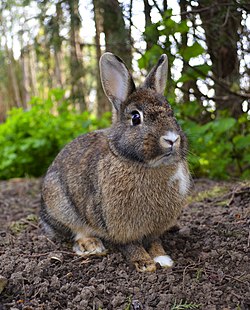
| European rabbit (Oryctolagus cuniculus) | |
Scientific classification
| |
| Kingdom: | Animalia |
| Phylum: | Chordata |
| Class: | Mammalia |
| Order: | Lagomorpha |
| Family: | Leporidae |
| Included genera | |
| Cladistically included but traditionally excluded taxa | |
Rabbits or bunnies are small mammals in the family Leporidae (which also includes the hares), which is in the order Lagomorpha (which also includes pikas). They are familiar throughout the world as a small herbivore, a prey animal, a domesticated form of livestock, and a pet, having a widespread effect on ecologies and cultures. The most widespread rabbit genera are Oryctolagus and Sylvilagus. The former, Oryctolagus, includes the European rabbit, Oryctolagus cuniculus, which is the ancestor of the hundreds of breeds of domestic rabbit and has been introduced on every continent except Antarctica. The latter, Sylvilagus, includes over 13 wild rabbit species, among them the cottontails and tapetis. Wild rabbits not included in Oryctolagus and Sylvilagus include several species of limited distribution, including the pygmy rabbit, volcano rabbit, and Sumatran striped rabbit.
Rabbits are a paraphyletic grouping, and do not constitute a clade, as hares (belonging to the genus Lepus) are nested within the Leporidae clade and are not described as rabbits. Although once considered rodents, lagomorphs diverged earlier and have a number of traits rodents lack, including two extra incisors. Similarities between rabbits and rodents were once attributed to convergent evolution, but studies in molecular biology have found a common ancestor between lagomorphs and rodents and place them in the clade Glires.
Rabbit physiology is suited to escaping predators and surviving in various habitats, living either alone or in groups in nests or burrows. As prey animals, rabbits are constantly aware of their surroundings, having a wide field of vision and ears with high surface area to detect potential predators. The ears of a rabbit are essential for thermoregulation and contain a high density of blood vessels. The bone structure of a rabbit's hind legs, which is longer than that of the fore legs, allows for quick hopping, which is beneficial for escaping predators and can provide powerful kicks if captured. Rabbits are typically nocturnal and often sleep with their eyes open. They reproduce quickly, having short pregnancies, large litters of four to twelve kits, and no particular mating season; however, the mortality rate of rabbit embryos is high, and there exist several widespread diseases that affect rabbits, such as rabbit hemorrhagic disease and myxomatosis. In some regions, especially Australia, rabbits have caused ecological problems and are regarded as a pest.
Humans have used rabbits as livestock since at least the first century BC in ancient Rome, raising them for their meat, fur and wool. The various breeds of the European rabbit have been developed to suit each of these products; the practice of raising and breeding rabbits as livestock is known as cuniculture. Rabbits are seen in human culture globally, appearing as a symbol of fertility, cunning, and innocence in major religions, historical and contemporary art.
Terminology and etymology
[edit]The word rabbit derives from the Middle English rabet ("young of the coney"), a borrowing from the Walloon robète, which was a diminutive of the French or Middle Dutch robbe ("rabbit"), a term of unknown origin.[1] The term coney is a term for an adult rabbit used until the 18th century; rabbit once referred only to the young animals.[2] More recently, the term kit or kitten has been used to refer to a young rabbit.[3][4] The endearing word bunny is attested by the 1680s as a diminutive of bun, a term used in Scotland to refer to rabbits and squirrels.[5]
Coney is derived from cuniculus,[2] a Latin term referring to rabbits which has been in use from at least the first century BC in Hispania. The word cuniculus may originate from a diminutive form of the word for "dog" in the Celtic languages.[6]
A group of rabbits is known as a colony,[7] nest, or warren,[8] though the latter term more commonly refers to where the rabbits live.[9] A group of baby rabbits produced from a single mating is referred to as a litter[10] and a group of domestic rabbits living together is sometimes called a herd.[8]
A male rabbit is called a buck, as are male goats and deer, derived from the Old English bucca or bucc, meaning "he-goat" or "male deer", respectively.[11] A female is called a doe, derived from the Old English dā, related to dēon ("to suck").[12]
Taxonomy and evolution
[edit]Rabbits and hares were formerly classified in the order Rodentia (rodents) until 1912, when they were moved into the order Lagomorpha (which also includes pikas). Since 1945, there has been support for the clade Glires that includes both rodents and lagomorphs,[13] though the two groups have always been closely associated in taxonomy; fossil,[14] DNA,[15] and retrotransposon[16] studies in the 2000s have solidified support for the clade. Studies in paleontology and molecular biology suggest that rodents and lagomorphs diverged at the start of the Tertiary.[17]
|
_(Sylvilagus_palustris).jpg)
.jpg)
.jpg)
The extant species of family Leporidae, of which there are more than 70, are contained within 11 genera, one of which is Lepus, the hares. There are 32 extant species within Lepus. The cladogram is from Matthee et al., 2004, based on nuclear and mitochondrial gene analysis.[18]
Classification
[edit]- Order Lagomorpha
- Genus Brachylagus
- Pygmy rabbit, Brachylagus idahoensis
- Genus Bunolagus
- Riverine rabbit, Bunolagus monticularis
- Genus Caprolagus
- Hispid hare, Caprolagus hispidus
- Genus Lepus[a]
- Genus Nesolagus
- Sumatran striped rabbit, Nesolagus netscheri
- Annamite striped rabbit, Nesolagus timminsi
- Genus Oryctolagus
- European rabbit, Oryctolagus cuniculus
- Genus Pentalagus
- Amami rabbit/Ryūkyū rabbit, Pentalagus furnessi
- Genus Poelagus
- Bunyoro rabbit, Poelagus marjorita
- Genus Pronolagus
- Natal red rock hare, Pronolagus crassicaudatus
- Jameson's red rock hare, Pronolagus randensis
- Smith's red rock hare, Pronolagus rupestris
- Hewitt's red rock hare, Pronolagus saundersiae
- Genus Romerolagus
- Volcano rabbit, Romerolagus diazi
- Genus Sylvilagus
- Andean tapeti, Sylvilagus andinus
- Swamp rabbit, Sylvilagus aquaticus
- Desert cottontail, Sylvilagus audubonii
- Brush rabbit, Sylvilagus bachmani
- Common tapeti, Sylvilagus brasiliensis
- Mexican cottontail, Sylvilagus cunicularis
- Dice's cottontail, Sylvilagus dicei
- Eastern cottontail, Sylvilagus floridanus
- Central American tapeti, Sylvilagus gabbi
- Tres Marias cottontail, Sylvilagus graysoni
- Robust cottontail, Sylvilagus holzneri
- Omilteme cottontail, Sylvilagus insonus
- Mountain cottontail, Sylvilagus nuttallii
- Appalachian cottontail, Sylvilagus obscurus
- Marsh rabbit, Sylvilagus palustris
- Santa Marta tapeti, Sylvilagus sanctaemartae
- Coastal tapeti, Sylvilagus tapetillus
- New England cottontail, Sylvilagus transitionalis
- Venezuelan lowland rabbit, Sylvilagus varynaensis
Differences from hares
[edit]

The term rabbit is typically used for all Leporidae species, excluding the genus Lepus. Members of that genus are known as hares[20] or jackrabbits.[21]
Lepus species are precocial, born relatively mature and mobile with hair and good vision out in the open air, while rabbit species are altricial, born hairless and blind in burrows and buried nests.[22] Hares are also generally larger than rabbits, and have longer pregnancies.[20] Hares and some rabbits live relatively solitary lives above the ground in open grassy areas,[23] interacting mainly during breeding season.[24][25] Some rabbit species group together to reduce their chance of being preyed upon,[26] and the European rabbit will form large social groups in burrows,[27] which are grouped together to form warrens.[28][29] Burrowing by hares varies by location, and is more prominent in younger members of the genus;[24] many rabbit species that do not dig their own burrows will use the burrows of other animals.[30][31]
Rabbits and hares have historically not occupied the same locations, and only became sympatric relatively recently; historic accounts describe antagonistic relationships between rabbits and hares, specifically between the European hare and European or cottontail rabbits, but scientific literature since 1956 has found no evidence of aggression or undue competition between rabbits and hares. When they appear in the same habitat, rabbits and hares can co-exist on similar diets.[32] Hares will notably force other hare species out of an area to control resources, but are not territorial.[33] When faced with predators, hares will escape by outrunning them, whereas rabbits, being smaller and less able to reach the high speeds of longer-legged hares, will try to seek cover.[26]
Descendants of the European rabbit are commonly bred as livestock and kept as pets, whereas no hares have been domesticated, though populations have been introduced to non-native habitats for use as a food source.[23] The breed known as the Belgian hare is actually a domestic rabbit which has been selectively bred to resemble a hare,[34] most likely from Flemish Giant stock originally.[35] Common names of hare and rabbit species may also be confused; "jackrabbits" refer to hares, and the hispid hare is a rabbit.[36]
Domestication
[edit]Rabbits, specifically the European rabbit (Oryctolagus cuniculus) species, have long been domesticated. The European rabbit has been widely kept as livestock, starting in ancient Rome from at least the first century BC. Selective breeding, which began in the Middle Ages, has generated a wide variety of rabbit breeds, of which many (since the early 19th century) are also kept as pets.[37] Some strains of European rabbit have been bred specifically as research subjects, such as the New Zealand white.[38]
As livestock, European rabbits are bred for their meat and fur. The earliest breeds were important sources of meat,[39][40] and so were bred to be larger than wild rabbits at younger ages,[41] but domestic rabbits in modern times range in size from dwarf to giant.[42][43] Rabbit fur, produced as a byproduct of meat production but occasionally selected for as in the case of the Rex rabbit,[44] can be found in a broad range of coat colors and patterns, some of which are produced via dyeing.[45] Some breeds are raised for their wool, such as the Angora rabbit breeds;[46] their fur is sheared, combed or plucked, and the fibers are spun into yarn.[47]
Biology
[edit].jpg)
Evolution
[edit]The earliest ancestor of rabbits and hares lived 55 million years ago in what is now Mongolia.[48] Because the rabbit's epiglottis is engaged over the soft palate except when swallowing, the rabbit is an obligate nasal breather.[49] As lagomorphs, rabbits have two sets of incisor teeth, one behind the other, a manner in which they differ from rodents, which only have one set of incisors.[20] Another difference is that for rabbits, all of their teeth continue to grow, whereas for most rodents, only their incisors continue to grow. Carl Linnaeus originally grouped rabbits and rodents under the class Glires; later, they were separated as the scientific consensus is that many of their similarities were a result of convergent evolution. DNA analysis and the discovery of a common ancestor have supported the view that they share a common lineage, so rabbits and rodents are now often grouped together in the clade or superorder Glires.[50][16]
Morphology
[edit]
Since speed and agility are a rabbit's main defenses against predators, rabbits have large hind leg bones and well-developed musculature. Though plantigrade at rest, rabbits are on their toes while running, assuming a more digitigrade posture.[51] Rabbits use their strong claws for digging and (along with their teeth) for defense.[52] Each front foot has four toes plus a dewclaw. Each hind foot has four toes (but no dewclaw).[53]
Most wild rabbits (especially compared to hares) have relatively full, egg-shaped bodies. The soft coat of the wild rabbit is agouti in coloration (or, rarely, melanistic), which aids in camouflage. The tail of the rabbit (with the exception of the cottontail species) is dark on top and white below. Cottontails have white on the top of their tails.[54]
As a result of the position of the eyes in its skull and the size of the cornea, the rabbit has a panoramic field of vision that encompasses nearly 360 degrees.[55] However, there is a blind spot at the bridge of the nose, and because of this, rabbits cannot see what is below their mouth and rely on their lips and whiskers to determine what they are eating. Blinking occurs 2 to 4 times an hour.[50]
Hind limb elements
[edit]
The anatomy of rabbits' hind limbs is structurally similar to that of other land mammals and contributes to their specialized form of locomotion. The bones of the hind limbs consist of long bones (the femur, tibia, fibula, and phalanges) as well as short bones (the tarsals). These bones are created through endochondral ossification during fetal development. Like most land mammals, the round head of the femur articulates with the acetabulum of the os coxae, the hip bone. The femur articulates with the tibia, but not the fibula, which is fused to the tibia. The tibia and fibula articulate with the tarsals of the pes, commonly called the foot. The hind limbs of the rabbit are longer than the front limbs. This allows them to produce their hopping form of locomotion. Longer hind limbs are more capable of producing faster speeds. Hares, which have longer legs than cottontail rabbits, are able to move considerably faster.[56] The hind feet have four long toes that allow for digitigrade movement, which are webbed to prevent them from spreading when hopping.[57] Rabbits do not have paw pads on their feet like most other animals that use digitigrade locomotion. Instead, they have coarse compressed hair that offers protection.[58]
Musculature
[edit]
Rabbits have muscled hind legs that allow for maximum force, maneuverability, and acceleration that is divided into three main parts: foot, thigh, and leg. The hind limbs of a rabbit are an exaggerated feature. They are much longer and can provide more force than the forelimbs,[59] which are structured like brakes to take the brunt of the landing after a leap.[60] The force put out by the hind limbs is contributed by both the structural anatomy of the fusion of the tibia and fibula, and by the muscular features.[59]
Bone formation and removal, from a cellular standpoint, is directly correlated to hind limb muscles. Action pressure from muscles creates force that is then distributed through the skeletal structures. Rabbits that generate less force, putting less stress on bones are more prone to osteoporosis due to bone rarefaction.[61] In rabbits, the more fibers in a muscle, the more resistant to fatigue. For example, hares have a greater resistance to fatigue than cottontails. The muscles of rabbit's hind limbs can be classified into four main categories: hamstrings, quadriceps, dorsiflexors, or plantar flexors. The quadriceps muscles are in charge of force production when jumping. Complementing these muscles are the hamstrings, which aid in short bursts of action. These muscles play off of one another in the same way as the plantar flexors and dorsiflexors, contributing to the generation and actions associated with force.[62]
Ears
[edit]
Within the order of lagomorphs, the ears are used to detect and avoid predators.[63] In the family Leporidae, the ears are typically longer than they are wide, and are in general relatively long compared to other mammals.[25][64]
According to Allen's rule, endothermic animals adapted to colder climates have shorter, thicker limbs and appendages than those of similar animals adapted to warm climates. The rule was originally derived by comparing the ear lengths of Lepus species across the various climates of North America.[65] Subsequent studies show that this rule remains true in the Leporidae for the ears specifically,[66] in that the surface area of rabbits' and hares' ears are enlarged in warm climates;[67] the ears are an important structure to aid thermoregulation[68] as well as in detecting predators due to the way the outer, middle, and inner ear muscles coordinate with one another. The ear muscles also aid in maintaining balance and movement when fleeing predators.[69]
The auricle, also known as the pinna, is a rabbit's outer ear.[70] The rabbit's pinnae represent a fair part of the body surface area. It is theorized that the ears aid in dispersion of heat at temperatures above 30 °C (86 °F), with rabbits in warmer climates having longer pinnae due to this. Another theory is that the ears function as shock absorbers that could aid and stabilize rabbits' vision when fleeing predators, but this has typically only been seen in hares.[50] The rest of the outer ear has bent canals that lead to the eardrum or tympanic membrane.[71]
The middle ear, separated by the outer eardrum in the back of the rabbit's skull, contains three bones: the hammer, anvil, and stirrup, collectively called ossicles, which act to decrease sound before it hits the inner ear; in general, the ossicles act as a barrier to the inner ear for sound energy.[71]
Inner ear fluid, called endolymph, receives the sound energy. After receiving the energy. The inner ear comprises two parts: the cochlea that uses sound waves from the ossicles, and the vestibular apparatus that manages the rabbit's position in regard to movement. Within the cochlea a basilar membrane contains sensory hair structures that send nerve signals to the brain, allowing it to recognize different sound frequencies. Within the vestibular apparatus three semicircular canals help detect angular motion.[71]
Thermoregulation
[edit].jpg)
The pinnae, which contain a vascular network and arteriovenous shunts, aid in thermoregulation.[50] In a rabbit, the optimal body temperature is around 38.5–40.0 °C (101.3–104.0 °F).[73] If their body temperature exceeds or does not meet this optimal temperature, the rabbit must make efforts to return to homeostasis. Homeostasis of body temperature is maintained by changing the amount of blood flow that passes through the highly vascularized ears,[68][74] as rabbits have few to no sweat glands.[75] Rabbits may also regulate their temperature by resting in depressions in the ground, known as forms.[76]
Respiratory system
[edit]
The rabbit's nasal cavity lies dorsal to the oral cavity, and the two compartments are separated by the hard and soft palate.[77] The nasal cavity itself is separated into a left and right side by a cartilage barrier, and it is covered in fine hairs that trap dust before it can enter the respiratory tract.[77][78] As the rabbit breathes, air flows in through the nostrils along the alar folds. From there, the air moves into the nasal cavity, also known as the nasopharynx, down through the trachea, through the larynx, and into the lungs.[79][80] The larynx functions as the rabbit's voice box, which enables it to produce a wide variety of sounds.[78] The trachea is a long tube embedded with cartilaginous rings that prevent the tube from collapsing as air moves in and out of the lungs. The trachea then splits into a left and right bronchus, which meet the lungs at a structure called the hilum. From there, the bronchi split into progressively more narrow and numerous branches. The bronchi branch into bronchioles, into respiratory bronchioles, and ultimately terminate at the alveolar ducts. The branching that is typically found in rabbit lungs is a clear example of monopodial branching, in which smaller branches divide out laterally from a larger central branch.[81]
The structure of the rabbit's nasal and oral cavities necessitates breathing through the nose. This is due to the fact that the epiglottis is fixed to the backmost portion of the soft palate.[80] Within the oral cavity, a layer of tissue sits over the opening of the glottis, which blocks airflow from the oral cavity to the trachea.[77] The epiglottis functions to prevent the rabbit from aspirating on its food. Further, the presence of a soft and hard palate allow the rabbit to breathe through its nose while it feeds.[79]

Rabbits' lungs are divided into four lobes: the cranial, middle, caudal, and accessory lobes. The right lung is made up of all four lobes, while the left lung only has two: the cranial and caudal lobes.[81] To provide space for the heart, the left cranial lobe of the lungs is significantly smaller than that of the right.[77] The diaphragm is a muscular structure that lies caudal to the lungs and contracts to facilitate respiration.[77][80]
Diet and digestion
[edit]Rabbits are strict herbivores[26][36] and are suited to a diet high in fiber, mostly in the form of cellulose. They will typically graze grass upon waking up and emerging from a burrow, and will move on to consume vegetation and other plants throughout the waking period; rabbits have been known to eat a wide variety of plants, including tree leaves and fruits, though consumption of fruit and lower fiber foods is common for pet rabbits where natural vegetation is scarce.[82]
Easily digestible food is processed in the gastrointestinal tract and expelled as regular feces. To get nutrients out of hard to digest fiber, rabbits ferment fiber in the cecum (part of the gastrointestinal tract) and then expel the contents as cecotropes, which are reingested (cecotrophy or refection). The cecotropes are then absorbed in the small intestine to use the nutrients.[83] Soft cecotropes are usually consumed during periods of rest in underground burrows.[82]
Rabbits cannot vomit;[84] and therefore if buildup occurs within the intestines (due often to a diet with insufficient fibre),[85] intestinal blockage can occur.[86]
Reproduction
[edit]
The adult male reproductive system forms the same as most mammals with the seminiferous tubular compartment containing the Sertoli cells and an adluminal compartment that contains the Leydig cells.[87] The Leydig cells produce testosterone, which maintains libido[87] and creates secondary sex characteristics such as the genital tubercle and penis. The Sertoli cells triggers the production of Anti-Müllerian duct hormone, which absorbs the Müllerian duct. In an adult male rabbit, the sheath of the penis is cylinder-like and can be extruded as early as two months of age.[88] The scrotal sacs lay lateral to the penis and contain epididymal fat pads which protect the testes. Between 10 and 14 weeks, the testes descend and are able to retract into the pelvic cavity to thermoregulate.[88] Furthermore, the secondary sex characteristics, such as the testes, are complex and secrete many compounds. These compounds include fructose, citric acid, minerals, and a uniquely high amount of catalase,[87] all of which affect the characteristics of rabbit semen; for instance, citric acid is positively correlated with agglutination,[89] and high amounts of catalase protect against premature capacitation.[90]

The adult female reproductive tract is bipartite, which prevents an embryo from translocating between uteri.[91] The female urethra and vagina open into a urogenital sinus with a single urogenital opening.[92] The two uterine horns communicate to two cervixes and forms one vaginal canal. Along with being bipartite, the female rabbit does not go through an estrus cycle, which causes mating induced ovulation.[88]
The average female rabbit becomes sexually mature at three to eight months of age and can conceive at any time of the year for the duration of her life. Egg and sperm production can begin to decline after three years,[87] with some species such as those in genus Oryctolagus completely stopping reproduction at 6 years of age.[93] During mating, the male rabbit will insert his penis into the female from behind, make rapid pelvic thrusts until ejaculation, and throw himself backward off the female. Copulation lasts only 20–40 seconds.[94]
The rabbit gestation period is short and ranges from 27 to 30 days.[26] A longer gestation period will generally yield a smaller litter while shorter gestation periods will give birth to a larger litter. The size of a single litter can range from 1 to 12 kits, depending on species.[95] After birth, the only role of males is to protect the young from other rabbits, and the mother will leave the young in the nest most of the day, returning to nurse them once every 24 hours.[26] The female can become pregnant again as early as the next day.[88]
After mating, the doe will begin to dig a burrow or prepare a nest before giving birth. Between three days and a few hours before giving birth another series of hormonal changes will cause her to prepare the nest structure. The doe will first gather grass for a structure, and an elevation in prolactin shortly before birth will cause her fur to shed that the doe will then use to line the nest, providing insulation for the newborn kits.[96]
The mortality rates of embryos are high in rabbits and can be due to infection, trauma, poor nutrition and environmental stress. A high fertility rate is necessary to counter this.[88] More than half of rabbit pregnancies are aborted, causing embryos to be resorbed into the mother's body;[93] vitamin deficiencies are a major cause of abortions in domestic rabbits.[97]
Sleep
[edit]Rabbits may appear to be crepuscular, but many species[26] are naturally inclined towards nocturnal activity.[98] In 2011, the average sleep time of a rabbit in captivity was calculated at 8.4 hours per day;[99] previous studies have estimated sleep periods as long as 11.4 hours on average, undergoing both slow-wave and rapid eye movement sleep.[100][101] Newborn rabbits will sleep for 22 hours a day before leaving the nest.[102] As with other prey animals, rabbits often sleep with their eyes open, so that sudden movements will awaken the rabbit to respond to potential danger.[103]
Diseases and immunity
[edit]In addition to being at risk of disease from common pathogens such as Bordetella bronchiseptica and Escherichia coli, rabbits can contract the virulent, species-specific viruses myxomatosis,[104] and a form of calicivirus which causes rabbit hemorrhagic disease.[105] Myxomatosis is more hazardous to pet rabbits, as wild rabbits often have some immunity.[106] Among the parasites that infect rabbits are tapeworms (such as Taenia serialis), external parasites (including fleas and mites), coccidia species, Encephalitozoon cuniculi,[107] and Toxoplasma gondii.[108][109] Domesticated rabbits with a diet lacking in high-fiber sources, such as hay and grass, are susceptible to potentially lethal gastrointestinal stasis.[110] Rabbits and hares are almost never found to be infected with rabies and have not been known to transmit rabies to humans.[111]
Rabbit hemorrhagic disease (RHD) is a highly infectious rabbit-specific disease caused by strains of rabbit hemorrhagic disease virus (RHDV), including type 2 (RHDV2).[112] The disease was first described in domestic Angora rabbits imported from Germany to Jiangsu, China in 1984, and quickly spread to Korea, Italy, and the rest of Europe. The disease spread to the Americas from 1988, first appearing in rabbits imported to Mexico, but subsequent outbreaks were infrequent, as RHDV only affected the European rabbit species.[113] RHDV2, a strain of RHD-causing virus that affects both domestic and wild lagomorphs, such as hares, was detected for the first time in France in 2010.[114] RHDV2 has since spread to the rest of Europe, Canada,[115] Australia,[116] and the United States.[117][112]
Ecology
[edit]
Rabbits are prey animals. In Mediterranean Europe, for example, rabbits are the main prey of red foxes, badgers, and Iberian lynxes.[118] To avoid predation and to navigate underground, rabbits have heightened senses (compared to humans) and are constantly aware of their surroundings. If confronted by a potential threat, a rabbit may freeze and observe, then warn others in the warren with powerful thumps on the ground from a hind foot. Rabbits have a remarkably wide field of vision, and a good deal of it is devoted to overhead scanning.[119] A rabbit eye has no fovea, but a "visual streak", a horizontal line in the middle of the retina where both rod and cone cell densities are the highest. This allows them to scan the horizon with little head turning.[120][121]
Rabbits survive predation by burrowing (in some species),[122] and hopping away[60] to dense cover.[26] Their strong teeth allow them to bite to escape a struggle.[123]
The longest-lived rabbit on record, a domesticated European rabbit living in Tasmania, died at age 18.[124] The lifespan of wild rabbits is much shorter; the average longevity of an eastern cottontail, for instance, is about one[125] to five years.[126] The various species of rabbit have been recorded as living from four[127][128] to 13 years in captivity.[129][130]
Habitat and range
[edit].jpg)
Rabbit habitats include forests, steppes, plateaus, deserts,[131] and swamps.[132] Some species, such as the volcano rabbit (Romerolagus diazi) have especially limited distribution due to their habitat needs.[133] Rabbits live in groups, or colonies, varying in behavior depending on species and often using the burrows of other animals or creating nests in holes.[122] The European rabbit notably lives in extensive burrow networks called warrens.[134]
Rabbits are native to North America, southwestern Europe, Southeast Asia, Sumatra, some islands of Japan, and parts of Africa and South America. They are not naturally found in most of Eurasia, where a number of species of hares are present.[135] A 2003 study on domestic rabbits in China found that "(so-called) Chinese rabbits were introduced from Europe", and that "genetic diversity in Chinese rabbits was very low".[136]
Rabbits first entered South America relatively recently, as part of the Great American Interchange.[135] Much of the continent was considered to have just one species of rabbit, the tapeti,[137][b] and most of South America's Southern Cone has had no rabbits until the introduction of the European rabbit, which has been introduced to many places around the world,[54] in the late 19th century.[138]
Rabbits have been launched into space orbit.[139]
Marking
[edit]Both sexes of rabbits often rub their chins on objects with their scent gland located under the chin. This is the rabbit's way of marking their territory or possessions for other rabbits to recognize by depositing scent gland secretions. Rabbits who have bonded will respect each other's smell, which indicates a territorial border.[140] Rabbits also have scent glands that produce a strong-smelling waxy substance near their anuses.[141] Territorial marking by scent glands has been documented among both domestic[142] and wild rabbit species.[26]
Environmental problems
[edit]
Rabbits, particularly the European rabbit,[26] have been a source of environmental problems when introduced into the wild by humans. As a result of their appetites, and the rate at which they breed, feral rabbit depredation can be problematic for agriculture. Gassing (fumigation of warrens),[143] barriers (fences),[144] shooting, snaring, and ferreting[145][146] have been used to control rabbit populations,[146] but the most effective measures are diseases such as myxomatosis and calicivirus.[147] In Europe, where domestic rabbits are farmed on a large scale, they can be protected against myxomatosis and calicivirus via vaccination.[148] Rabbits in Australia and New Zealand are considered to be such a pest that landowners are legally obliged to control them.[149][150]
Rabbits are known to be able to catch fire and spread wildfires, particularly in Chile, where the European rabbit is an invasive species,[151] but the efficiency and relevance of this mechanism has been doubted by forest experts who contend that a rabbit on fire could move some meters.[152][153] Knowledge on fire-spreading rabbits is based on anecdotes as there is no known scientific investigation on the subject.[153]
As food and clothing
[edit]
Humans have hunted rabbits for food since at least the onset of the Last Glacial Maximum,[154] and wild rabbits and hares are still hunted for their meat as game.[155] Hunting is accomplished with the aid of trained falcons,[156] ferrets,[157] or dogs (a common hunting breed being beagles),[158] as well as with snares,[159] rifles and other guns.[158] A caught rabbit may be dispatched with a sharp blow to the back of its head, a practice from which the term rabbit punch is derived.[1][160]
Wild leporids comprise a small portion of global rabbit-meat consumption. Domesticated descendants of the European rabbit (Oryctolagus cuniculus) that are bred and kept as livestock (a practice called cuniculture) account for the estimated 2 million tons of rabbit meat produced annually.[161] Approximately 1.2 billion rabbits are slaughtered each year for meat worldwide.[162] In 1994, the countries with the highest consumption per capita of rabbit meat were Malta with 8.89 kg (19.6 lb), Italy with 5.71 kg (12.6 lb), and Cyprus with 4.37 kg (9.6 lb). The largest producers of rabbit meat were China, Russia, Italy (specifically Veneto[104]), France, and Spain.[163] Rabbit meat was once a common commodity in Sydney, with European rabbits having been introduced intentionally to Australia for hunting purposes,[164] but declined after the myxomatosis virus was intentionally introduced to control the exploding population of feral rabbits in the area.[165]
In the United Kingdom, fresh rabbits are sold in butcher shops and markets, and some supermarkets sell frozen rabbit meat. It is sold in farmers markets there, including the Borough Market in London.[166] Rabbit meat is a feature of Moroccan cuisine, where it is cooked in a tajine with "raisins and grilled almonds added a few minutes before serving".[167] In China, rabbit meat is particularly popular in Sichuan cuisine, with its stewed rabbit, spicy diced rabbit, BBQ-style rabbit, and even spicy rabbit heads, which have been compared to spicy duck neck.[161] In the United States, rabbits sold as food are typically the domestic New Zealand, Belgian, and Chinese rabbits, or Scottish hares.[168]
An infectious disease associated with rabbits-as-food is tularemia (also known as rabbit fever), which may be contracted from an infected rabbit.[169] The disease can cause symptoms of fever, skin ulcers and enlarged lymph nodes, and can occasionally lead to pneumonia or throat infection.[170] Secondary vectors of tularemia include tick and fly bites, which may be present in the fur of a caught rabbit.[169] Inhaling the bacteria during the skinning process increases the risk of getting tularemia;[171] preventative measures against this include the use of gloves and face masks. Prior to the development of antibiotics, such as doxycycline and gentamicin, the death rate associated with tularemia infections was 60%, which has since decreased to less than 4%.[172]
In addition to their meat, domestic rabbits are used for their wool[47] and fur for clothing,[173] as well as their nitrogen-rich manure and their high-protein milk.[174] Production industries have developed domesticated rabbit breeds (such as the Angora rabbit) for the purpose of meeting these needs.[44] In 1986, the number of rabbit skins produced annually in France was as high as 70 million, compared to 25 million mink pelts produced at the same time. However, rabbit fur is on the whole a byproduct of rabbit meat production, whereas minks are bred primarily for fur production.[175]
In culture
[edit]
Rabbits are often posited by scholars as symbols of fertility,[176] sexuality and spring, though they have been variously interpreted throughout history.[177] Up until the end of the 18th century, it was widely believed that rabbits and hares were hermaphrodites, contributing to a possible view of rabbits as "sexually aberrant".[178] The Easter Bunny is a figure from German folklore that then spread to America and later other parts of the world and is similar to Santa Claus, albeit both with softened roles compared to earlier incarnations of the figures.[179]
The rabbits' role as a prey animal with few defenses evokes vulnerability and innocence in folklore and modern children's stories, and rabbits appear as sympathetic characters, able to connect easily with youth, though this particular symbolic depiction only became popular in the 1930s following the massive popularization of the pet rabbit decades before.[176] Additionally, they have not been limited to sympathetic depictions since then, as in literature such as Watership Down[180][181] and the works of Ariel Dorfman.[182] With its reputation as a prolific breeder, the rabbit juxtaposes sexuality with innocence, as in the Playboy Bunny.[183] The rabbit has also been used as a symbol of playfulness and endurance, as represented by the Energizer Bunny and the Duracell Bunny.[184]
Folklore and mythology
[edit]The rabbit often appears in folklore as the trickster archetype, as he uses his cunning to outwit his enemies. In Central Africa, the common hare (Kalulu) is described as a trickster figure,[185] and in Aztec mythology, a pantheon of four hundred rabbit gods known as Centzon Totochtin, led by Ometochtli or Two Rabbit, represented fertility, parties, and drunkenness.[186] Rabbits in the Americas varied in mythological symbolism: in Aztec mythology, they were also associated with the moon,[186] and in Anishinaabe traditional beliefs, held by the Ojibwe and some other Native American peoples, Nanabozho, or Great Rabbit,[187] is an important deity related to the creation of the world.[188] More broadly, a rabbit's foot may be carried as an amulet, believed to bring protection and good luck. This belief is found in many parts of the world, with the earliest use being recorded in Europe c. 600 BC.[189]
Rabbits also appear in Chinese, Vietnamese, Japanese and Korean mythology, though rabbits are a relatively new introduction to some of these regions. In Chinese folklore, rabbits accompany Chang'e on the Moon,[190] and the moon rabbit is a prominent symbol in the Mid-Autumn Festival.[191] In the Chinese New Year, the zodiacal rabbit or hare is one of the twelve celestial animals in the Chinese zodiac.[192] At the time of the zodiacal cycles becoming associated with animals in the Han dynasty,[193] only hares were native to China, with the currently extant breeds of rabbit in China being of European origin.[136] The Vietnamese zodiac includes a zodiacal cat in place of the rabbit. The most common explanation is that the ancient Vietnamese word for "rabbit" (mao) sounds like the Chinese word for "cat" (卯, mao).[194] In Japanese tradition, rabbits live on the Moon where they make mochi.[195] This comes from interpreting the pattern of dark patches on the moon as a rabbit standing on tiptoes on the left pounding on an usu, a Japanese mortar;[196] in some images, this rabbit is said to be creating a potion of immortality.[197] In Korean mythology, as in Japanese, rabbits live on the moon making rice cakes ("tteok" in Korean).[198]
Rabbits have also appeared in religious symbolism. Buddhism, Christianity, and Judaism have associations with an ancient circular motif called the three rabbits (or "three hares"). Its meaning ranges from "peace and tranquility"[199] to the Holy Trinity.[200] The tripartite symbol also appears in heraldry.[201] In Jewish folklore, rabbits are associated with cowardice, a usage still current in contemporary Israeli spoken Hebrew. The original Hebrew word (shfanim, שפנים) refers to the hyrax, but early translations to English interpreted the word to mean "rabbit", as no hyraxes were known to northern Europe.[202] In Greek and Roman mythology, rabbits were associated with the hunting goddesses Artemis and Diana. Ancient Greek hunters were instructed to not hunt newborn rabbits, and to leave them "for the goddess". The constellation Lepus is named for the rabbit, and was given its name by Ptolemy c. 150 CE.[197]
-
 Rabbit fools Elephant by showing the reflection of the moon. Illustration (from 1354) of the Panchatantra
 -

-
 Saint Jerome in the Desert, by Taddeo Crivelli (died about 1479)

.svg)
_-_Saint_Jerome_in_the_Desert_-_Google_Art_Project.jpg)
Modern times
[edit]
The rabbit as trickster is a part of American popular culture, as Br'er Rabbit (from African-American folktales[203] and, later, Disney animation[204]) and Bugs Bunny (the cartoon character from Warner Bros.[205]), for example.
Anthropomorphized rabbits have appeared in film and literature, in Alice's Adventures in Wonderland (the White Rabbit and the March Hare characters), in Watership Down (including the film and television adaptations), in Rabbit Hill (by Robert Lawson), and in the Peter Rabbit stories (by Beatrix Potter). In the 1920s, Oswald the Lucky Rabbit was a popular cartoon character.[206]
On the Isle of Portland in Dorset, UK, the rabbit is said to be unlucky, and speaking the creature's name can cause upset among older island residents. This is thought to date back to early times in the local quarrying industry, where, to save space, extracted stones that were not fit for sale were set aside in what became tall, unstable walls. The local rabbits' tendency to burrow there would weaken the walls, and their collapse would result in injuries or even death. In the local culture to this day, the rabbit (when he has to be referred to) may instead be called a "long ears" or "underground mutton" so as not to risk bringing a downfall upon oneself.[207]
In other parts of Britain and in North America, "Rabbit rabbit rabbit" is one variant of an apotropaic or talismanic superstition that involves saying or repeating the word "rabbit" (or "rabbits" or "white rabbits" or some combination thereof) out loud upon waking on the first day of each month, because doing so is believed to ensure good fortune for the duration of that month.[208]
The "rabbit test" is a term first used in 1949 for the Friedman test, an early diagnostic tool for detecting a pregnancy in humans. It is a common misconception (or perhaps an urban legend) that the test-rabbit would die if the woman was pregnant. This led to the phrase "the rabbit died" becoming a euphemism for a positive pregnancy test.[209]
Many modern children's stories and cartoons portray rabbits as particularly fond of eating carrots, largely due to the popularity of Bugs Bunny, whose carrot eating habit was modeled after Peter Warne, the character played by Clark Gable in the 1934 romantic comedy It Happened One Night.[210] This is misleading, as wild rabbits do not naturally prefer carrots over other plants. The misconception has led to some owners of domestic rabbits feeding them carrot-heavy diets.[211][212] Carrots are high in sugar, and excessive consumption can be unhealthy.[213]
See also
[edit]References
[edit]Notes
[edit]- ^ This genus is a hare, not a rabbit.
- ^ In addition to the common tapeti, several other species in genus Sylvilagus are known to inhabit South and Central America: the Andean tapeti, the Central American tapeti, the coastal tapeti, the Santa Marta tapeti, and the Venezuelan lowland rabbit.
Citations
[edit]- ^ a b Harper, Douglas. "rabbit". Online Etymology Dictionary. Retrieved 17 September 2024.
- ^ a b Harper, Douglas. "coney". Online Etymology Dictionary. Retrieved 17 September 2024.
- ^ Zapletal, D.; Švancarová, D.; Gálik, B. (2021). "Growth of suckled rabbit kits depending on litter size at birth". Acta Fytotechnica et Zootechnica. 24 (1): 55–59. doi:10.15414/afz.2021.24.01.55-59. ISSN 1335-258X.
- ^ Booth, J.L.; Peng, X.; Baccon, J.; Cooper, T.K. (2013). "Multiple complex congenital malformations in a rabbit kit (Oryctolagus cuniculi)". Comparative Medicine. 63 (4): 342–347. PMC 3750670. PMID 24209970.
- ^ Harper, Douglas. "bunny". Online Etymology Dictionary. Retrieved 21 October 2024.
- ^ Ballester, X.; Quinn, R. (2002). "Cuniculus 'Rabbit' — A Celtic Etymology" (PDF). World Rabbit Science. 10 (3).
- ^ Lipton, James (1 November 1993). An Exaltation of Larks: The Ultimate Edition. Penguin Books. ISBN 0-140-17096-0.
- ^ a b "Common Questions: What Do You Call a Group of...?". archived copy of Animal Congregations, or What Do You Call a Group of.....?. U.S. Geological Survey Northern Prairie Wildlife Research Center. Archived from the original on 20 March 2015. Retrieved 26 February 2018.
- ^ "Warren Definition & Meaning". Britannica Dictionary. 2024. Retrieved 7 October 2024.
- ^ McClure, Diane (August 2020). "Breeding and Reproduction of Rabbits". Merck Veterinary Manual. Archived from the original on 2 October 2024. Retrieved 7 October 2024.
- ^ "Buck". Dictionary.com Unabridged. Random House, Inc. 2023. Retrieved 6 October 2024.
- ^ "Doe". Dictionary.com. Retrieved 6 October 2024.
- ^ Korth, William W. (1994), "Classification of Rodents", The Tertiary Record of Rodents in North America, Topics in Geobiology, vol. 12, Boston, MA: Springer US, pp. 27–34, doi:10.1007/978-1-4899-1444-6_4, ISBN 978-1-4899-1444-6, retrieved 16 September 2024
- ^ Asher RJ, Meng J, Wible JR, et al. (February 2005). "Stem Lagomorpha and the antiquity of Glires". Science. 307 (5712): 1091–4. Bibcode:2005Sci...307.1091A. doi:10.1126/science.1107808. PMID 15718468. S2CID 42090505.
- ^
- Madsen O, Scally M, Douady CJ, et al. (February 2001). "Parallel adaptive radiations in two major clades of placental mammals". Nature. 409 (6820): 610–4. Bibcode:2001Natur.409..610M. doi:10.1038/35054544. PMID 11214318. S2CID 4398233.
- Murphy WJ, Eizirik E, Johnson WE, Zhang YP, Ryder OA, O'Brien SJ (February 2001). "Molecular phylogenetics and the origins of placental mammals". Nature. 409 (6820): 614–8. Bibcode:2001Natur.409..614M. doi:10.1038/35054550. PMID 11214319. S2CID 4373847.
- ^ a b Kriegs, JO; Churakov, G; Jurka, J; Brosius, J; Schmitz, J (April 2007). "Evolutionary history of 7SL RNA-derived SINEs in Supraprimates". Trends in Genetics. 23 (4): 158–61. doi:10.1016/j.tig.2007.02.002. PMID 17307271.
- ^ Huchon, Dorothée; Madsen, Ole; Sibbald, Mark J. J. B.; Ament, Kai; Stanhope, Michael J.; Catzeflis, François; de Jong, Wilfried W.; Douzery, Emmanuel J. P. (1 July 2002). "Rodent Phylogeny and a Timescale for the Evolution of Glires: Evidence from an Extensive Taxon Sampling Using Three Nuclear Genes". Molecular Biology and Evolution. 19 (7): 1053–1065. doi:10.1093/oxfordjournals.molbev.a004164. ISSN 1537-1719. PMID 12082125.
- ^ Matthee, Conrad A.; et al. (2004). "A Molecular Supermatrix of the Rabbits and Hares (Leporidae) Allows for the Identification of Five Intercontinental Exchanges During the Miocene". Systematic Biology. 53 (3): 433–477. doi:10.1080/10635150490445715. PMID 15503672.
- ^ Hoffmann, R.S.; Smith, A.T. (2005). "Order Lagomorpha". In Wilson, D.E.; Reeder, D.M (eds.). Mammal Species of the World: A Taxonomic and Geographic Reference (3rd ed.). Johns Hopkins University Press. pp. 194–211. ISBN 978-0-8018-8221-0. OCLC 62265494.
- ^ a b c Alves, Ferrand & Hackländer 2008, pp. 1–9.
- ^ Varga 2013, p. 3.
- ^ Nowak 1999, p. 1720.
- ^ a b Nowak 1999, pp. 1733–1738.
- ^ a b Angerbjörn & Schai-Braun 2023, pp. 205–206.
- ^ a b Scandura, Massimo; De Marinis, Anna Maria; Canu, Antonio (2023), Hackländer, Klaus; Alves, Paulo C. (eds.), "Cape Hare Lepus capensis Linnaeus, 1758", Primates and Lagomorpha, Cham: Springer International Publishing, pp. 79–98, doi:10.1007/978-3-030-34043-8_10, ISBN 978-3-030-34042-1, retrieved 16 September 2024
- ^ a b c d e f g h i Bell, Diana; Smith, Andrew T. (2006), "Rabbits and Hares", The Encyclopedia of Mammals, Oxford University Press, doi:10.1093/acref/9780199206087.001.0001, ISBN 978-0-19-920608-7, retrieved 9 October 2024
- ^ Rodríguez-Martínez, Luisa; Hudson, Robyn; Martínez-Gómez, Margarita; Bautista, Amando (January 2014). "Description of the nursery burrow of the Mexican cottontail rabbit Sylvilagus cunicularius under seminatural conditions". Acta Theriologica. 59 (1): 193–201. doi:10.1007/s13364-012-0125-6. ISSN 0001-7051.
- ^ Delibes-Mateos et al. 2023, pp. 44–45.
- ^ Varga 2013, pp. 3–4.
- ^ "Desert Cottontail (Sylvilagus audubonii)". Texas Parks & Wildlife. Archived from the original on 11 June 2017.
- ^ Chapman, Joseph (1990). Rabbits, hares, and pikas: status survey and conservation action plan. International Union for Conservation of Nature and Natural Resources. p. 99. ISBN 2-8317-0019-1.
- ^ Alves, Ferrand & Hackländer 2008, pp. 241–249.
- ^ Angerbjörn & Schai-Braun 2023, pp. 119–219.
- ^ Lyon, M. W. (1916). "Belgian Hare, A Misleading Misnomer". Science. 43 (1115): 686–687. doi:10.1126/science.43.1115.686.b. ISSN 0036-8075. JSTOR 1639908. PMID 17831801.
- ^ Whitman, Bob D. (October 2004). Domestic Rabbits & Their Histories: Breeds of the World. Leawood, KS: Leathers Publishing. pp. 74–95. ISBN 978-1-58597-275-3.
- ^ a b Toddes, Barbara (2022), "Lagomorpha Diet", in Vonk, Jennifer; Shackelford, Todd K. (eds.), Encyclopedia of Animal Cognition and Behavior, Cham: Springer International Publishing, pp. 3823–3826, doi:10.1007/978-3-319-55065-7_1209, ISBN 978-3-319-55064-0, retrieved 13 November 2024
- ^ Irving-Pease, Evan K.; Frantz, Laurent A.F.; Sykes, Naomi; Callou, Cécile; Larson, Greger (2018). "Rabbits and the Specious Origins of Domestication". Trends in Ecology & Evolution. 33 (3): 149–152. Bibcode:2018TEcoE..33..149I. doi:10.1016/j.tree.2017.12.009. ISSN 0169-5347. PMID 29454669. S2CID 3380288.
- ^ Mapara, M.; Thomas, B.; Bhat, K. (2012). "Rabbit as an animal model for experimental research". Dental Research Journal. 9 (1): 111–8. doi:10.4103/1735-3327.92960 (inactive 12 July 2025). PMC 3283968. PMID 22363373.
Amongst various strains, New Zealand white strains of rabbits are commonly being used for research activities. These strains are less aggressive in nature and have less health problems as compared with other breeds.
{{cite journal}}: CS1 maint: DOI inactive as of July 2025 (link) - ^ Julie Kimber; Phillip Deery; Warwick Eather; Drew Cottle; Michael Hamel-Green; Nic Maclelland; Doris LeRoy; Jeanette Debney-Joyce; Jonathan Strauss; David Faber (2014). Issues on War and Peace. Australian Society for the Study of Labour History/Leftbank Press. p. 10. ISBN 978-0-9803883-3-6.
- ^ Marco Cullere; Antonella Dalle Zotte (2018). "Rabbit meat production and consumption: State of knowledge and future perspectives". Meat Science. 143: 137–146. doi:10.1016/j.meatsci.2018.04.029. PMID 29751220.
- ^ "Meat Production", Rabbit Production (10 ed.), GB: CABI, pp. 274–277, 11 May 2022, doi:10.1079/9781789249811.0023, ISBN 978-1-78924-978-1, retrieved 23 May 2024
- ^ Tislerics, Ati. "Oryctolagus cuniculus". Animal Diversity Web. Retrieved 21 May 2024.
- ^ Fiorello, Christine V.; German, R.Z. (February 1997). "Heterochrony within species: craniofacial growth in giant, standard, and dwarf rabbits". Evolution. 51 (1): 250–261. doi:10.1111/j.1558-5646.1997.tb02406.x. PMID 28568789. S2CID 205780205.
- ^ a b "Rabbit Breeds", Rabbit Production (10 ed.), GB: CABI, pp. 23–28, 11 May 2022, doi:10.1079/9781789249811.0003, ISBN 978-1-78924-978-1, archived from the original on 14 May 2024, retrieved 14 May 2024
- ^ Davis, Susan (2003). Stories Rabbits Tell. Lantern Books. p. 268. ISBN 978-1-59056-044-0.
- ^ Campbell, Darlene (1995). Proper Care of Rabbits. TFH Publications, Incorporated. p. 206. ISBN 978-0-86622-196-2.
- ^ a b Samson, Leslie (11 May 2022), "Angora Wool Production", Rabbit Production (10 ed.), GB: CABI, pp. 292–302, doi:10.1079/9781789249811.0022, ISBN 978-1-78924-978-1, retrieved 26 May 2024
- ^ Asher, RJ; Meng, J; Wible, JR; McKenna, MC; Rougier, GW; Dashzeveg, D; Novacek, MJ (18 February 2005). "Stem Lagomorpha and the antiquity of Glires". Science. 307 (5712): 1091–4. Bibcode:2005Sci...307.1091A. doi:10.1126/science.1107808. PMID 15718468.
- ^ Johnson-Delaney, CA; Orosz, SE (May 2011). "Rabbit respiratory system: clinical anatomy, physiology and disease". Vet Clin North Am Exot Anim Pract. 14 (2): 257–66. doi:10.1016/j.cvex.2011.03.002. PMID 21601814.
- ^ a b c d Donnelly, Thomas M.; Vella, David (2020). "Basic Anatomy, Physiology, and Husbandry of Rabbits". In Quesenberry, Katherine; Orcutt, Connie J.; Mans, Christoph; Carpenter, James W. (eds.). Ferrets, Rabbits, and Rodents: Clinical Medicine and Surgery (4th ed.). pp. 131–149. doi:10.1016/B978-0-323-48435-0.00011-3. ISBN 978-0-323-48435-0.
- ^ Hall, Patrick; Stubbs, Caleb; Anderson, David E.; Greenacre, Cheryl; Crouch, Dustin L. (17 June 2022). "Rabbit hindlimb kinematics and ground contact kinetics during the stance phase of gait". PeerJ. 10 e13611. doi:10.7717/peerj.13611. ISSN 2167-8359. PMC 9208372. PMID 35734635.
- ^ d'Ovidio, Dario; Pierantoni, Ludovica; Noviello, Emilio; Pirrone, Federica (September 2016). "Sex differences in human-directed social behavior in pet rabbits". Journal of Veterinary Behavior. 15: 37–42. doi:10.1016/j.jveb.2016.08.072.
- ^ van Praag, Esther (2005). "Deformed claws in a rabbit, after traumatic fractures" (PDF). MediRabbit.
- ^ a b "rabbit". Encyclopædia Britannica (Standard ed.). Chicago: Encyclopædia Britannica, Inc. 2007.
- ^ Peiffer, Robert L.; Pohm-Thorsen, Laurie; Corcoran, Kelly (1994), "Models in Ophthalmology and Vision Research", The Biology of the Laboratory Rabbit, Elsevier: 409–433, doi:10.1016/b978-0-12-469235-0.50025-7, ISBN 978-0-12-469235-0, PMC 7149682
- ^ Bensley, Benjamin Arthur (1910). Practical anatomy of the rabbit. The University Press. p. 1.
rabbit skeletal anatomy.
- ^ "Description and Physical Characteristics of Rabbits – All Other Pets – Merck Veterinary Manual". Merck Veterinary Manual. Retrieved 11 May 2018.
- ^ D.A.B.V.P., Margaret A. Wissman, D.V.M. "Rabbit Anatomy". exoticpetvet.net. Retrieved 11 May 2018.
{{cite web}}: CS1 maint: multiple names: authors list (link) - ^ a b Lumpkin, Susan; Seidensticker, John (2011). Rabbits: the animal answer guide. Baltimore: Johns Hopkins University Press. ISBN 978-1-4214-0126-3. OCLC 794700391.
- ^ a b Khan, Madiha; Suh, Angela; Lee, Jenny; Granatosky, Michael C. (2021), "Lagomorpha Locomotion", in Vonk, Jennifer; Shackelford, Todd (eds.), Encyclopedia of Animal Cognition and Behavior, Cham: Springer International Publishing, pp. 1–6, doi:10.1007/978-3-319-47829-6_1199-1, ISBN 978-3-319-47829-6, retrieved 8 October 2024
- ^ Geiser, Max; Trueta, Joseph (May 1958). "Muscle action, bone rarefaction and bone formation". The Journal of Bone and Joint Surgery. British Volume. 40-B (2): 282–311. doi:10.1302/0301-620X.40B2.282. PMID 13539115.
- ^ Lieber, Richard L.; Blevins, Field T. (January 1989). "Skeletal muscle architecture of the rabbit hindlimb: Functional implications of muscle design". Journal of Morphology. 199 (1): 93–101. Bibcode:1989JMorp.199...93L. doi:10.1002/jmor.1051990108. PMID 2921772. S2CID 25344889.
- ^ Varga 2013, p. 62.
- ^ Bertolino, Sandro; Brown, David E.; Cerri, Jacopo; Koprowski, John L. (2023), Hackländer, Klaus; Alves, Paulo C. (eds.), "Eastern Cottontail Sylvilagus floridanus (J. A. Allen, 1890)", Primates and Lagomorpha, Cham: Springer International Publishing, pp. 67–78, doi:10.1007/978-3-030-34043-8_14, ISBN 978-3-030-34042-1, retrieved 16 September 2024
- ^ Allen, Joel Asaph (1877). "The influence of Physical conditions in the genesis of species". Radical Review. 1: 108–140.
- ^ Stevenson, Robert D. (1986). "Allen's Rule in North American Rabbits (Sylvilagus) and Hares (Lepus) Is an Exception, Not a Rule". Journal of Mammalogy. 67 (2): 312–316. doi:10.2307/1380884. ISSN 0022-2372. JSTOR 1380884.
- ^ "Black-tailed Jackrabbit - Lepus californicus". Montana Field Guide. Montana Natural Heritage Program and Montana Fish, Wildlife and Parks. Retrieved 24 September 2024.
- ^ a b Kluger, Matthew J.; Gonzalez, Richard R.; Mitchell, John W.; Hardy, James D. (1 August 1971). "The rabbit ear as a temperature sensor". Life Sciences. 10 (15): 895–899. doi:10.1016/0024-3205(71)90161-5. PMID 5566134.
- ^ Meyer, D. L. (1971). "Single Unit Responses of Rabbit Ear-Muscles to Postural and Accelerative Stimulation". Experimental Brain Research. 14 (2): 118–26. doi:10.1007/BF00234795. PMID 5016586. S2CID 6466476.
- ^ Capello, Vittorio (2006). "Lateral Ear Canal Resection and Ablation in Pet Rabbits" (PDF). The North American Veterinary Conference. 20: 1711–1713.
- ^ a b c Parsons, Paige K. (2018). "Rabbit Ears: A Structural Look: ...injury or disease, can send your rabbit into a spin". House Rabbit Society.
- ^ Hinds, David S. (31 August 1973). "Acclimatization of Thermoregulation in the Desert Cottontail, Sylvilagus audubonii". Journal of Mammalogy. 54 (3): 708–728. doi:10.2307/1378969. JSTOR 1378969. PMID 4744934.
- ^ Fayez, I; Marai, M; Alnaimy, A; Habeeb, M (1994). "Thermoregulation in rabbits". In Baselga, M; Marai, I.F.M. (eds.). Rabbit production in hot climates. Zaragoza: CIHEAM. pp. 33–41. Archived from the original on 4 April 2023. Retrieved 23 March 2019.
- ^ Varga 2013, p. 12.
- ^ Oladimeji, Abioja Monsuru; Johnson, Temitope Gloria; Metwally, Khaled; Farghly, Mohamed; Mahrose, Khalid Mohamed (January 2022). "Environmental heat stress in rabbits: implications and ameliorations". International Journal of Biometeorology. 66 (1): 1–11. doi:10.1007/s00484-021-02191-0. ISSN 0020-7128. PMID 34518931.
- ^ Milling, Charlotte R; Rachlow, Janet L; Johnson, Timothy R; Forbey, Jennifer S; Shipley, Lisa A (1 September 2017). "Seasonal variation in behavioral thermoregulation and predator avoidance in a small mammal". Behavioral Ecology. 28 (5): 1236–1247. doi:10.1093/beheco/arx084. ISSN 1045-2249.
- ^ a b c d e Johnson-Delaney, Cathy A.; Orosz, Susan E. (2011). "Rabbit Respiratory System: Clinical Anatomy, Physiology and Disease". Veterinary Clinics of North America: Exotic Animal Practice. 14 (2): 257–266. doi:10.1016/j.cvex.2011.03.002. PMID 21601814.
- ^ a b Smith & Schenk 2019, p. 73.
- ^ a b Smith & Schenk 2019, p. 76.
- ^ a b c Jekl, Vladimi (2012). "Approach to Rabbit Respiratory Disease". WSAVA/FECAVA/BSAVA World Congress.
As obligate nasal breathers, rabbits with upper airway disease will attempt to breathe through their mouths, which prevents feeding and drinking and could be quickly fatal.
- ^ a b Autifi, Mohamed Abdul Haye; El-Banna, Ahmed Kamal; Ebaid, Ashraf El- Sayed (2015). "Morphological Study of Rabbit Lung, Bronchial Tree, and Pulmonary Vessels Using Corrosion Cast Technique". Al-Azhar Assiut Medical Journal. 13 (3): 41–51.
- ^ a b Varga 2013, pp. 13–33.
- ^ Smith, Susan M. (2020). "Gastrointestinal Physiology and Nutrition of Rabbits". In Quesenberry, Katherine; Orcutt, Connie J.; Mans, Christoph; Carpenter, James W. (eds.). Ferrets, Rabbits, and Rodents: Clinical Medicine and Surgery (4th ed.). pp. 162–173. doi:10.1016/B978-0-323-48435-0.00013-7. ISBN 978-0-323-48435-0.
- ^ Bernard E. Rollin (13 March 1995). The Experimental Animal in Biomedical Research: Care, Husbandry, and Well-Being-An Overview by Species, Volume 2. CRC Press. p. 359. ISBN 978-0-8493-4982-9.
- ^ Karr-Lilienthal, Phd (University of Nebraska – Lincoln), Lisa (4 November 2011). "The Digestive System of the Rabbit". eXtension (a Part of the Cooperative Extension Service). Archived from the original on 6 January 2018. Retrieved 5 January 2018.
- ^ "Living with a House Rabbit". Archived from the original on 21 September 2017. Retrieved 21 September 2017.
- ^ a b c d Foote, Robert H; Carney, Edward W (2000). "The rabbit as a model for reproductive and developmental toxicity studies". Reproductive Toxicology. 14 (6): 477–493. Bibcode:2000RepTx..14..477F. doi:10.1016/s0890-6238(00)00101-5. ISSN 0890-6238. PMID 11099874.
- ^ a b c d e Pollock, C. (5 May 2014). "Rabbit Reproduction Basics". LafeberVet. Retrieved 18 September 2024.
- ^ Holtz, W.; Foote, R. H. (1 March 1978). "Composition of Rabbit Semen and the Origin of Several Constituents". Biology of Reproduction. 18 (2): 286–292. doi:10.1095/biolreprod18.2.286. ISSN 0006-3363. PMID 630026.
- ^ Foote, Robert H.; Hare, Elizabeth (10 September 2000). "High Catalase Content of Rabbit Semen Appears to be Inherited". Journal of Andrology. 21 (5): 664–668. doi:10.1002/j.1939-4640.2000.tb02134.x. ISSN 0196-3635. PMID 10975413.
- ^ Weisbroth, Steven H.; Flatt, Ronald E.; Kraus, Alan L. (1974). The Biology of the Laboratory Rabbit. doi:10.1016/c2013-0-11681-9. ISBN 978-0-12-742150-6.
- ^ Lukefahr, Steven D.; McNitt, James I.; Cheeke, Peter R.; Patton, Nephi M. (29 April 2022). Rabbit Production, 10th Edition. CABI. ISBN 978-1-78924-978-1.
- ^ a b Nowak 1999, p. 1730.
- ^ "Understanding the Mating Process for Breeding Rabbits". florida4h.org. Retrieved 12 April 2019.
- ^ Nowak 1999, pp. 1720–1732.
- ^ Benedek, I; Altbӓcker, V; Molnár, T (2021). "Stress reactivity near birth affects nest building timing and offspring number and survival in the European rabbit (Oryctolagus cuniculus)". PLOS ONE. 16 (1) e0246258. Bibcode:2021PLoSO..1646258B. doi:10.1371/journal.pone.0246258. PMC 7845978. PMID 33513198.
- ^ Varga 2013, pp. 34–38.
- ^ Jilge, B (1991). "The rabbit: a diurnal or a nocturnal animal?". Journal of Experimental Animal Science. 34 (5–6): 170–183. PMID 1814463.
- ^ Holland, Jennifer S. (July 2011). "40 Winks?". National Geographic. 220 (1).
- ^ Pivik, R.T.; Bylsma, F.W.; Cooper, P. (May 1986). "Sleep—wakefulness rhythms in the rabbit". Behavioral and Neural Biology. 45 (3): 275–286. doi:10.1016/S0163-1047(86)80016-4. PMID 3718392.
- ^ Aguilar-Roblero, R; González-Mariscal, G. (2020). "Behavioral, neuroendocrine and physiological indicators of the circadian biology of male and female rabbits". Eur J Neurosci. 51 (1): 429–453. doi:10.1111/ejn.14265. PMID 30408249.
- ^ Varga 2013, pp. 84–85.
- ^ Parsons, Paige K. "The Rabbit Eye: A Complete Guide". Rabbit.Org Foundation. Retrieved 17 September 2024.
- ^ a b Davidson, Alan (2014). Jaine, Tom (ed.). The Oxford Companion to Food (3rd ed.). Oxford University Press. pp. 1899–1901. doi:10.1093/acref/9780199677337.001.0001. ISBN 978-0-19-175627-6.
- ^ Cooke, Brian Douglas (2014). Australia's War Against Rabbits. CSIRO Publishing. ISBN 978-0-643-09612-7. Archived from the original on 7 June 2014.
- ^
- Meredith, A (2013). "Viral skin diseases of the rabbit". Veterinary Clinics of North America: Exotic Animal Practice. 16 (3): 705–714. doi:10.1016/j.cvex.2013.05.010. PMID 24018033.
- Kerr, P (2017). "Genomic and phenotypic characterization of myxoma virus from Great Britain reveals multiple evolutionary pathways distinct from those in Australia". PLOS Pathogens. 13 (3) e1006252. doi:10.1371/journal.ppat.1006252. PMC 5349684. PMID 28253375.
- ^ Latney, La'Toya (2014). "Encephalitozoon cuniculi in pet rabbits: diagnosis and optimal management". Veterinary Medicine: Research and Reports. 5: 169–180. doi:10.2147/VMRR.S49842. PMC 7337189. PMID 32670857.
- ^ Wood, Maggie. "Parasites of Rabbits". Chicago Exotics, PC. Archived from the original on 2 March 2013. Retrieved 8 April 2013.
- ^ Boschert, Ken. "Internal Parasites of Rabbits". Net Vet. Archived from the original on 2 April 2013. Retrieved 8 April 2013.
- ^ Krempels, Dana. "GastroIntestinal Stasis, The Silent Killer". Department of Biology at the University of Miami. Archived from the original on 19 June 2017. Retrieved 21 September 2017.
- ^ "Rabies: Other Wild Animals". Centers for Disease Control and Prevention. 15 November 2011. Archived from the original on 20 December 2010. Retrieved 20 December 2012.
- ^ a b "Rabbit hemorrhagic disease". American Veterinary Medical Association. Retrieved 7 August 2022.
- ^ Abrantes, Joana; van der Loo, Wessel; Le Pendu, Jacques; Esteves, Pedro J. (10 February 2012). "Rabbit haemorrhagic disease (RHD) and rabbit haemorrhagic disease virus (RHDV): a review". Veterinary Research. 43 (1): 12. doi:10.1186/1297-9716-43-12. ISSN 1297-9716. PMC 3331820. PMID 22325049.
- ^ Bárcena, Juan; Guerra, Beatriz; Angulo, Iván; González, Julia; Valcárcel, Félix; Mata, Carlos P.; Castón, José R.; Blanco, Esther; Alejo, Alí (24 September 2015). "Comparative analysis of rabbit hemorrhagic disease virus (RHDV) and new RHDV2 virus antigenicity, using specific virus-like particles". Veterinary Research. 46 (1): 106. doi:10.1186/s13567-015-0245-5. ISSN 1297-9716. PMC 4581117. PMID 26403184.
- ^ Ambagala, Aruna; Schwantje, Helen; Laurendeau, Sonja; Snyman, Heindrich; Joseph, Tomy; Pickering, Bradley; Hooper-McGrevy, Kathleen; Babiuk, Shawn; Moffat, Estella; Lamboo, Lindsey; Lung, Oliver; Goolia, Melissa; Pinette, Mathieu; Embury-Hyatt, Carissa (July 2021). "Incursions of rabbit haemorrhagic disease virus 2 in Canada—Clinical, molecular and epidemiological investigation". Transboundary and Emerging Diseases. 68 (4): 1711–1720. doi:10.1111/tbed.14128. ISSN 1865-1674. PMID 33915034.
- ^ Ramsey, David S.; Patel, Kandarp K.; Campbell, Susan; Hall, Robyn N.; Taggart, Patrick L.; Strive, Tanja (12 May 2023). "Sustained Impact of RHDV2 on Wild Rabbit Populations across Australia Eight Years after Its Initial Detection". Viruses. 15 (5): 1159. doi:10.3390/v15051159. ISSN 1999-4915. PMC 10223972. PMID 37243245.
- ^ "Deadly rabbit disease confirmed in Thurston County; vets urge vaccination". Washington State Department of Agriculture. 25 September 2020. Retrieved 7 August 2022.
- ^ Fedriani, J. M.; Palomares, F.; Delibes, M. (1999). "Niche relations among three sympatric Mediterranean carnivores" (PDF). Oecologia. 121 (1): 138–148. Bibcode:1999Oecol.121..138F. CiteSeerX 10.1.1.587.7215. doi:10.1007/s004420050915. hdl:10261/50735. JSTOR 4222449. PMID 28307883. S2CID 39202154. Archived (PDF) from the original on 4 March 2016.
- ^ Tynes, Valarie V. (2010). Behavior of Exotic Pets. Wiley Blackwell. pp. 70–73. ISBN 978-0-8138-0078-3. Archived from the original on 6 May 2016.
- ^ Bringmann, Andreas; Syrbe, Steffen; Görner, Katja; Kacza, Johannes; Francke, Mike; Wiedemann, Peter; Reichenbach, Andreas (1 September 2018). "The primate fovea: Structure, function and development". Progress in Retinal and Eye Research. 66: 49–84. doi:10.1016/j.preteyeres.2018.03.006. ISSN 1350-9462. PMID 29609042.
- ^ Lavaud, Arnold; Soukup, Petr; Martin, Louise; Hartnack, Sonja; Pot, Simon (23 April 2020). "Spectral Domain Optical Coherence Tomography in Awake Rabbits Allows Identification of the Visual Streak, a Comparison with Histology". Translational Vision Science & Technology. 9 (5): 13. doi:10.1167/tvst.9.5.13. ISSN 2164-2591. PMC 7401941. PMID 32821485.
- ^ a b Varga 2013, p. 3-4.
- ^ Davis, Susan E.; DeMello, Margo (2003). Stories Rabbits Tell: A Natural And Cultural History of A Misunderstood Creature. Lantern Books. p. 27. ISBN 978-1-59056-044-0. Archived from the original on 6 May 2016.
- ^ Glenday, Craig (2013). Guinness World Records 2014. Guinness World Records Limited. pp. 043. ISBN 978-1-908843-15-9.
- ^ "Cottontail rabbit". Indiana Department of Natural Resources. 29 January 2021. Archived from the original on 29 May 2024.
- ^ Carey, James R.; Judge, Debra S. (2000). Longevity Records. Monographs on Population Aging. Vol. 8. Odense University Press. ISBN 87-7838-539-3. ISSN 0909-119X.
- ^ "AnAge entry for Brachylagus idahoensis". AnAge: The Animal Ageing and Longevity Database. Human Ageing Genomic Resources. Retrieved 8 October 2024.
- ^ Weigl, Richard (2005). Longevity of Mammals in Captivity; from the Living Collections of the World. Stuttgart: Kleine Senckenberg-Reihe 48.
- ^ "AnAge entry for Oryctolagus cuniculus". AnAge: The Animal Ageing and Longevity Database. Human Ageing Genomic Resources. Retrieved 8 October 2024.
- ^ Péron, Guillaume; Lemaître, Jean-François; Ronget, Victor; Tidière, Morgane; Gaillard, Jean-Michel (13 September 2019). "Variation in actuarial senescence does not reflect life span variation across mammals". PLoS Biol. 17 (9) e3000432. doi:10.1371/journal.pbio.3000432. PMC 6760812. PMID 31518381.
- ^ Ge, Deyan; Wen, Zhixin; Xia, Lin; Zhang, Zhaoqun; Erbajeva, Margarita; Huang, Chengming; Yang, Qisen (3 April 2013). Evans, Alistair Robert (ed.). "Evolutionary History of Lagomorphs in Response to Global Environmental Change". PLOS ONE. 8 (4) e59668. Bibcode:2013PLoSO...859668G. doi:10.1371/journal.pone.0059668. ISSN 1932-6203. PMC 3616043. PMID 23573205.
- ^ Sylvilagus aquaticus (swamp rabbit) Archived 2013-05-27 at the Wayback Machine, Animal Diversity Web, University of Michigan Museum of Zoology.
- ^ Caravaggi, Anthony (2022), "Lagomorpha Life History", in Vonk, Jennifer; Shackelford, Todd K. (eds.), Encyclopedia of Animal Cognition and Behavior, Cham: Springer International Publishing, pp. 3826–3834, doi:10.1007/978-3-319-55065-7_1206, ISBN 978-3-319-55064-0, retrieved 13 November 2024
- ^ Southern, H. N. (November 1940). "The ecology and population dynamics of the wild rabbit (Oryctolagus cuniculus)". Annals of Applied Biology. 27 (4): 509–526. doi:10.1111/j.1744-7348.1940.tb07522.x.
- ^ a b Marshall, Larry G.; Webb, S. David; Sepkoski, J. John; Raup, David M. (1982). "Mammalian Evolution and the Great American Interchange". Science. 215 (4538): 1351–1357. Bibcode:1982Sci...215.1351M. doi:10.1126/science.215.4538.1351. ISSN 0036-8075. JSTOR 1688046. PMID 17753000.
- ^ a b Long, J.-R.; Qiu, X.-P.; Zeng, F.-T.; Tang, L.-M.; Zhang, Y.-P. (April 2003). "Origin of rabbit (Oryctolagus cuniculus) in China: evidence from mitochondrial DNA control region sequence analysis". Animal Genetics. 34 (2): 82–87. doi:10.1046/j.1365-2052.2003.00945.x. ISSN 0268-9146. PMID 12648090.
- ^ Emmons, Louise H.; Feer, Francois (1990). Neotropical Rainforest Mammals: A Field Guide. University of Chicago Press. pp. 227–228.
- ^ Cassini, Marcelo H.; Rivas, Luciano (August 2023). "Lack of evidence of significant impact of European rabbits on Patagonian forest regeneration". European Journal of Wildlife Research. 69 (4): 74. Bibcode:2023EJWR...69...74C. doi:10.1007/s10344-023-01710-1. ISSN 1612-4642.
- ^ Beischer, DE; Fregly, AR (1962). "Animals and man in space. A chronology and annotated bibliography through the year 1960". US Naval School of Aviation Medicine. ONR TR ACR-64 (AD0272581). Retrieved 10 September 2024.
- ^ Hoffman, Kurt L.; Hernández Decasa, D. M.; Beyer Ruiz, M. E.; González-Mariscal, Gabriela (5 March 2010). "Scent marking by the male domestic rabbit (Oryctolagus cuniculus) is stimulated by an object's novelty and its specific visual or tactile characteristics". Behavioural Brain Research. 207 (2): 360–367. doi:10.1016/j.bbr.2009.10.021. ISSN 0166-4328. PMID 19857527. S2CID 10827948.
- ^ "Scent glands". Rabbit Welfare Association & Fund (RWAF). Retrieved 10 September 2024.
- ^ Arteaga, Lourdes; Bautista, Amando; Martínez-Gómez, Margarita; Nicolás, Leticia; Hudson, Robyn (June 2008). "Scent marking, dominance and serum testosterone levels in male domestic rabbits". Physiology & Behavior. 94 (3): 510–515. doi:10.1016/j.physbeh.2008.03.005. PMID 18436270.
- ^ Department of Primary Industries and Regional Development; Agriculture and Food Division; Pest and Disease Information Service (PaDIS). "Rabbit control: fumigation". agric.wa.gov.au. Government of Western Australia. Archived from the original on 25 September 2021. Retrieved 25 September 2021.
- ^ Crawford, J S (1969). "History of the state vermin barrier fences, formerly known as rabbit proof fences". Research Reports. Retrieved 3 May 2023.
- ^ Cowan, D. P. (1 December 1984). "The use of ferrets (Mustela furo) in the study and management of the European wild rabbit (Oryctolagus cuniculus)". Journal of Zoology. 204 (4): 570–574. doi:10.1111/j.1469-7998.1984.tb02391.x. ISSN 1469-7998.
- ^ a b Williams, Kent; Parer, Ian; Coman, Brian; Burley, John; Braysher, Mike (1995). Managing Vertebrate Pests: Rabbits. Canberra: Australian Govt. Pub. Service. ISBN 978-0-644-29623-6. OCLC 153977337.
- ^ CSIRO. "Biological control of rabbits". www.csiro.au. Retrieved 9 October 2024.
- ^ Meredith, A (2013). "Viral skin diseases of the rabbit". Veterinary Clinics of North America: Exotic Animal Practice. 16 (3): 705–714. doi:10.1016/j.cvex.2013.05.010. PMID 24018033.
- ^ "Feral animals in Australia — Invasive species". Environment.gov.au. 1 February 2010. Archived from the original on 21 July 2010. Retrieved 30 August 2010.
- ^ "Rabbits — The role of government — Te Ara Encyclopedia of New Zealand". Teara.govt.nz. 1 March 2009. Archived from the original on 12 June 2011. Retrieved 30 August 2010.
- ^ Pablo, Camus; Sergio, Castro; Fabián, Jaksic (2008). "Europen rabbits in Chile: the history of a biological invasion". Historia. 4 (SE). ISSN 0717-7194. Archived from the original on 19 December 2024. Retrieved 22 February 2025.
- ^ Jerez, Sara (23 February 2023). ""Es cierto": Experto confirma que conejos y otros animales en llamas sí pueden propagar incendios". Radio Bío-Bío (in Spanish). Retrieved 23 February 2023.
- ^ a b del Mar Parra, Maria (23 February 2023). "Experto forestal: "Los conejos no son un agente significativo de propagación de incendios"". El Desconcierto (in Spanish). Retrieved 23 February 2023.
- ^ Seuru, S.; Perez, L.; Burke, A. (2023). "Why Were Rabbits Hunted in the Past? Insights from an Agent-Based Model of Human Diet Breadth in Iberia During the Last Glacial Maximum". In Seuru, S.; Albouy, B. (eds.). Modelling Human-Environment Interactions in and beyond Prehistoric Europe. Themes in Contemporary Archaeology. Cham: Springer International Publishing. doi:10.1007/978-3-031-34336-0_7. ISBN 978-3-031-34335-3.
- ^ Bender, David A. (2003). "game". A Dictionary of Food and Nutrition (2nd ed.). Oxford University Press. p. 2335. doi:10.1093/acref/9780199234875.001.0001. ISBN 978-0-19-923487-5.
- ^ Southam, Hazel (July 2012). "Natural Selection". Geographical. 84 (7). Geographical Magazine Ltd.: 40–43 – via EBSCOhost.
- ^ Linduska, J. P. (1947). "The Ferret as an Aid to Winter Rabbit Studies". The Journal of Wildlife Management. 11 (3): 252–255. doi:10.2307/3796283. ISSN 0022-541X. JSTOR 3796283.
- ^ a b McKean, Andrew (October 2008). "Fall's Forgotten Hunt". Outdoor Life. 215 (9): 58–62 – via EBSCOhost.
- ^ Nickens, T. Edward (June 2020). "Snare a Rabbit". Field & Stream. 125 (2): 53 – via EBSCOhost.
- ^ Room, Adrian (2010). Dictionary of Sports and Games Terminology. McFarland. p. 120. ISBN 978-0-7864-5757-1.
- ^ a b Olivia Geng, French Rabbit Heads: The Newest Delicacy in Chinese Cuisine Archived 14 July 2017 at the Wayback Machine. The Wall Street Journal Blog, 13 June 2014
- ^ "FAOSTAT". FAO. Retrieved 25 October 2019.
- ^ FAO – The Rabbit – Husbandry, health and production. Archived 23 April 2015 at the Wayback Machine
- ^ Alves, Joel M.; Carneiro, Miguel; Day, Jonathan P.; Welch, John J.; Duckworth, Janine A.; Cox, Tarnya E.; Letnic, Mike; Strive, Tanja; Ferrand, Nuno; Jiggins, Francis M. (30 August 2022). "A single introduction of wild rabbits triggered the biological invasion of Australia". Proceedings of the National Academy of Sciences of the United States of America. 119 (35) e2122734119. Bibcode:2022PNAS..11922734A. doi:10.1073/pnas.2122734119. ISSN 1091-6490. PMC 9436340. PMID 35994668.
- ^ Alyse Edwards (20 April 2014). "Rabbit meat disappearing from consumers' tables as farmers struggle with spiralling costs". Australian Broadcasting Corporation.
- ^ Smith, Ed (4 October 2018). The Borough Market Cookbook: Recipes and stories from a year at the market. Hodder & Stoughton. p. 55. ISBN 978-1-4736-7869-9.
- ^ 'Traditional Moroccan Cooking, Recipes from Fez', by Madame Guinadeau. (Serif, London, 2003). ISBN 1-897959-43-5.
- ^ "Rabbit: From Farm to Table". USDA Food Safety and Inspection Service. 12 January 2006. Archived from the original on 5 July 2008.
- ^ a b "Seasonal Incidence of Tularaemia and Sources of Infection". Public Health Reports. 42 (48): 2948–2951. 1927. ISSN 0094-6214. JSTOR 4578598.
- ^ "Signs and Symptoms of Tularemia". U.S. Centers for Disease Control and Prevention. 15 May 2023. Retrieved 21 August 2024.
- ^ "Tularemia (Rabbit fever)". Health.utah.gov. 16 June 2003. Archived from the original on 26 May 2010. Retrieved 30 August 2010.
- ^ Penn, R.L. (2014). Francisella tularensis (Tularemia) In J. E. Bennett, R. Dolin, & M. J. Blaser (Eds.), Mandell, Douglas, and Bennett's Principles and Practice of Infectious Diseases (8th ed.). Philadelphia, PA: Churchill Livingstone. pp. 2590–2602. ISBN 978-1-4557-4801-3.
- ^ Xian, Vivian (2007). "China, Where American Mink Gets Glamour". USDA Foreign Agricultural Service Global Agriculture Information Network. Archived from the original on 20 March 2024. Retrieved 20 March 2024.
- ^ Houdebine, Louis-Marie; Fan, Jianglin (1 June 2009). Rabbit Biotechnology: Rabbit Genomics, Transgenesis, Cloning and Models. Springer Science & Business Media. pp. 68–72. ISBN 978-90-481-2226-4. Archived from the original on 26 April 2014. Retrieved 26 February 2018.
- ^ Lebas, F.; Coudert, P.; Rouvier, R.; de Rochambeau, H. (1986). "Production of rabbit skins and angora wool". The rabbit husbandry, health and production. FAO Animal Production and Health. Rome, Italy: Food and Agriculture Organization of the United Nations. Retrieved 8 October 2024.
- ^ a b Stein, Sadie (31 March 2024). "Our Bunnies, Ourselves". The New York Times Book Review: 22 – via Gale General OneFile.
- ^ Windling, Terri (2005). "The Symbolism of Rabbits and Hares". Endicott Studio. Archived from the original on 3 May 2012.
- ^ Harley, Marta Powell (1985). "Rosalind, the Hare, and the Hyena In Shakespeare's "As You Like It"". Shakespeare Quarterly. 36 (3): 335–337. doi:10.2307/2869713. ISSN 0037-3222. JSTOR 2869713.
- ^ Cross, Gary (13 May 2004). "Holidays and New Rituals of Innocence". The Cute and the Cool. Oxford University Press. pp. 83–120. doi:10.1093/acprof:oso/9780195156669.003.0004. ISBN 978-0-19-515666-9.
- ^ "Watership Downs". Masterplots II: Juvenile and Young Adult Fiction Series. Vol. 4: Sev–Z, Indexes. Salem Press, Inc. 1991.
- ^ Lanes, Selma G. (30 June 1974). "Male Chauvinist Rabbits". The New York Times. Retrieved 10 July 2016.
- ^ Swier, Patricia L. (2013). "REBELLIOUS RABBITS: CHILDHOOD TRAUMA AND THE EMERGENCE OF THE UNCANNY IN TWO SOUTHERN CONE TEXTS". Chasqui (in Spanish). 42 (1): 166–80 – via EBSCOhost.
- ^ Kelly, John (5 April 2016). "The Erotic Rabbits of Easter". Slate. ISSN 1091-2339. Retrieved 25 September 2024.
- ^ Fowles, Jib (23 January 1996). Advertising and Popular Culture. SAGE. pp. 1–9. ISBN 978-0-8039-5483-0.
- ^ Brian Morris, The Power of Animals: An Ethnography, p. 177 (2000).
- ^ a b Miller, Mary; Karl Taube (1993). The Gods and Symbols of Ancient Mexico and the Maya: An Illustrated Dictionary of Mesoamerican Religion. London: Thames & Hudson. p. 142. ISBN 0-500-05068-6. OCLC 27667317.
- ^ "Nanabozho (Nanabush, Nanabosho, Wenebojo, Nanapush, Manabus)". www.native-languages.org. Archived from the original on 28 March 2013. Retrieved 24 September 2024.
- ^ White, James, ed. (1913). "Nanabozho and the Algonquin Story of the Creation of the World". Handbook of Indians of Canada. pp. 331–335.
- ^ Ellis, Bill (1 January 2004). Lucifer Ascending: The Occult in Folklore and Popular Culture. University Press of Kentucky. ISBN 978-0-8131-2289-2.
- ^ Lemei, Yang (2006). "China's Mid-Autumn Day". Journal of Folklore Research. 43 (3): 263–270. doi:10.2979/JFR.2006.43.3.263. ISSN 0737-7037. JSTOR 4640212.
- ^ Cammann, Schuyler (1953). "Ming Festival Symbols". Archives of the Chinese Art Society of America. 7: 66–70. ISSN 1945-2926. JSTOR 20066955.
- ^ Gao, Jinlin; Joh, Yoon-kyoung (30 April 2019). "Chinese Zodiac Culture and the Rhetorical Construction of A Shu B, C" (PDF). Lanaguage Research. 55 (1). Seoul National University: 2. doi:10.30961/lr.2019.55.1.55. Archived (PDF) from the original on 6 January 2024.
- ^ Ferlus, Michel (2013). The sexagesimal cycle, from China to Southeast Asia. 23rd Annual Conference of the Southeast Asian Linguistics Society, May 2013, Bangkok, Thailand.
- ^ "Year of the Cat OR Year of the Rabbit?". nwasianweekly.com. 3 February 2011. Retrieved 27 February 2018.
- ^ Ippo, Mori (30 January 2021). "Object Lesson: Rabbit Pounding the Elixir of Life Under the Moon". New Orleans Museum of Art.
- ^ Harley, Timothy (1885). "The Hare in the Moon". Moon Lore. S. Sonnenschein. pp. 60–68.
- ^ a b Lumpkin, Susan (2011). Rabbits: the animal answer guide. Internet Archive. Baltimore: Johns Hopkins University Press. pp. 196–199. ISBN 978-0-8018-9788-7.
- ^ "Here Comes a Rabbit". National Folk Museum of Korea. 19 December 2022. Retrieved 24 September 2024.
- ^ Chapman, Chris; Wei, Zhang; Rasmussen, Peter (August 2004). "The Three Rabbits in China". Adapted from a presentation at the International Conference on Grottoes Research. Dunhuang China. Retrieved 25 April 2012.
- ^ Evans, Edward Payson (1896). Animal Symbolism in Ecclesiastical Architecture. H. Holt. p. 239.
- ^ Fox-Davies, A.C. (1978) A Complete Guide to Heraldry (New York: Bonanza Books) p. 214. ISBN 1-60239-001-0; ISBN 978-1-60239-001-0.
- ^ Gilad, Elon (13 June 2013). "Word of the Day Shafan: Don't Turn Yourself Into a Hyrax!". Haaretz.
- ^ M'Baye, Babacar (2009). The Trickster Comes West: Pan-African Influence in Early Black Diasporan Narratives. Univ. Press of Mississippi. pp. 13–18. ISBN 978-1-60473-352-5.
- ^ Brasch, Walter M. (2000). Brer Rabbit, Uncle Remus, and the 'Cornfield Journalist': The Tale of Joel Chandler Harris. Mercer University Press. pp. 74, 275. ISBN 978-0-86554-696-7.
- ^ Adamson, Joe (1990). Bugs Bunny: 50 Years and Only One Grey Hare. Henry Holt. ISBN 0-8050-1855-7.
- ^ Susanin, Timothy S.; Miller, Diane Disney (7 April 2011). Walt Before Mickey: Disney's Early Years, 1919–1928. Univ. Press of Mississippi. ISBN 978-1-60473-960-2. Retrieved 4 September 2012.
- ^ "Wallace and Gromit spook island". BBC News. 7 October 2005. Retrieved 25 August 2022.
- ^ Mayntz, Melissa (26 April 2019). "On the 1st Of The Month Say "Rabbit Rabbit" for Good luck!". Farmers' Almanac – Plan Your Day. Grow Your Life. Retrieved 27 April 2023.
- ^ Friedman, Maurice (1 May 1939). "The Assay of Gonadotropic Extracts in the Post-Partum Rabbit11". Endocrinology. 24 (5): 617–625. doi:10.1210/endo-24-5-617.
- ^ George, Amber E.; Schatz, J.L., eds. (2016). "Chapter 5: Would Bugs Bunny Have Diabetes? The Realistic Consequences of Cartoons for Non-Human Animals". Screening the Nonhuman: Representations of Animal Others in the Media. Lexington Books. pp. 63–67. ISBN 978-1-4985-1375-3.
- ^ Rioja-Lang, Fiona; Bacon, Heather; Connor, Melanie; Dwyer, Cathy Mary (2019). "Rabbit welfare: determining priority welfare issues for pet rabbits using a modified Delphi method". Veterinary Record Open. 6 (1) e000363. doi:10.1136/vetreco-2019-000363. ISSN 2399-2050. PMC 6924855. PMID 31903189.
- ^ George, Amber E.; Schatz, J. L. (27 April 2016). Screening the Nonhuman: Representations of Animal Others in the Media. Lexington Books. ISBN 978-1-4985-1375-3.
- ^ Bittel, Jason (19 February 2022). "Think you know what bunnies and bears eat? Their diets may surprise you". Washington Post. ISSN 0190-8286. Retrieved 10 March 2024.
Sources used
[edit]- Alves, Paulo C.; Ferrand, Nuno; Hackländer, Klaus, eds. (2008). Lagomorph Biology. Berlin, Heidelberg: Springer Berlin Heidelberg. doi:10.1007/978-3-540-72446-9. ISBN 978-3-540-72445-2.
- Angerbjörn, Anders; Schai-Braun, Stéphanie Claire (2023). "Mountain Hare Lepus timidus Linnaeus, 1758". In Hackländer, Klaus; Alves, Paulo C. (eds.). Primates and Lagomorpha. Handbook of the Mammals of Europe. Cham: Springer International Publishing. doi:10.1007/978-3-030-34043-8_12. ISBN 978-3-030-34042-1.
- Delibes-Mateos, Miguel; Rödel, Heiko G.; Rouco, Carlos; Alves, Paulo C.; Carneiro, Miguel; Villafuerte, Rafael (2023). "European Rabbit Oryctolagus cuniculus (Linnaeus, 1758)". In Hackländer, Klaus; Alves, Paulo C. (eds.). Primates and Lagomorpha. Handbook of the Mammals of Europe. Cham: Springer International Publishing. doi:10.1007/978-3-030-34043-8_13. ISBN 978-3-030-34042-1.
- Nowak, Ronald M. (1999). Walker's mammals of the world. Vol. 2 (6th ed.). Baltimore: Johns Hopkins University Press. ISBN 978-0-8018-5789-8.
- Smith, David G.; Schenk, Michael P. (2019). A dissection guide & atlas to the rabbit. Morton. ISBN 978-1-61731-937-2. OCLC 1084742187.
- Varga, M. (2013). "Rabbit Basic Science". Textbook of Rabbit Medicine: 3–108. doi:10.1016/B978-0-7020-4979-8.00001-7. ISBN 978-0-7020-4979-8. PMC 7158370.
External links
[edit]


| Poultry |   | ||||
|---|---|---|---|---|---|
| Livestock | |||||
| Game | |||||
| Fish | |||||
| Shellfish and other seafood | |||||
| Insects | |||||
| Cuts and preparation |
| ||||
| List articles |
| ||||
| Ethics and psychology | |||||
| Alternatives | |||||
| Meat science | |||||
| Meat industry | |||||
| Related subjects | |||||


Game animals and shooting in North America | ||
|---|---|---|
| Game birds |  | |
| Waterfowl | ||
| Big game | ||
| Other quarry | ||
| See also | ||
| International | |
|---|---|
| National | |
| Other | |

Rabbit
View on GrokipediaTerminology and etymology
Definitions and nomenclature
Rabbits are small to medium-sized terrestrial herbivorous mammals belonging to the family Leporidae within the order Lagomorpha, distinguished from rodents by the presence of two pairs of upper incisors (one small peg-like pair behind the larger pair) and a double row of these teeth.[9] Unlike pikas (family Ochotonidae), the other lagomorph family, rabbits and hares in Leporidae lack a functional caecum for hindgut fermentation in pikas and instead exhibit adaptations for rapid digging and evasion, such as strong hind limbs.[10] In taxonomic nomenclature, "rabbits" generally refer to species in genera such as Oryctolagus (European rabbit, O. cuniculus) and Sylvilagus (cottontails), excluding hares of the genus Lepus, though the family Leporidae encompasses approximately 50 species of both.[11] The binomial name Oryctolagus cuniculus, established by Linnaeus in 1758, applies to the wild European rabbit and its domesticated descendants, with synonyms including Lepus cuniculus reflecting earlier classifications before the genus Oryctolagus was defined in 1874 to denote its burrowing habits (from Greek oryktos, "dug," and lagōs, "hare").[12] [13] Nomenclatureally, rabbits are differentiated from hares by reproductive and behavioral traits: rabbits produce altricial young (born blind, hairless, and helpless after 30-31 days gestation) in underground burrows, while hares bear precocial young (fur-covered with open eyes after 42 days) in above-ground forms.[14] [15] This distinction influences common usage, where "rabbit" often implies smaller body size (up to 40 cm length, 1.2-2 kg weight), shorter ears relative to body length, and colonial burrowing, contrasting hares' larger stature (up to 70 cm, longer black-tipped ears) and solitary habits.[16]Linguistic origins and regional variations
The English term "rabbit" first appeared in the late 14th century, borrowed from Walloon robète or a northern French dialect form, referring to the young of the burrowing lagomorph then known as the coney.[17] This replaced the older Norman French-derived coney (from Latin cuniculus, via Old French conin), which had entered Middle English around 1200 and denoted the adult animal; the shift occurred partly due to coney's pronunciation resembling "honey," leading to vulgar associations and lexical displacement by the 16th century.[18] The root of rabbit traces to dialectal Old French rabotte, likely a diminutive of Middle Dutch or West Flemish robbe (possibly meaning "robber" or "stripper," evoking the animal's burrowing habits, though the etymology remains conjectural without direct Germanic parallels for the r-b stem).[19] In regional English dialects, rabbit coexists with archaic or specialized terms: coney persists in biblical contexts (e.g., Leviticus 11:6, mistranslating hyrax as unclean "coney") and some rural British usages for the European rabbit (Oryctolagus cuniculus), while American English often distinguishes native cottontails (Sylvilagus spp.) as "rabbits" versus introduced European strains.[20] The affectionate diminutive bunny emerged in the late 17th century from dialectal English bun (possibly denoting a squirrel or rabbit's tail, with uncertain origins in Scottish or northern English speech), initially describing the scut before extending to young rabbits by the 19th century. There is no biological difference between "bunny rabbit" and "rabbit"; both refer to the same small mammals in the Leporidae family, with "rabbit" serving as the formal and scientific term while "bunny" (or "bunny rabbit") is a colloquial, affectionate, or diminutive term often used for young rabbits, baby rabbits, pets, or in cute/endearing contexts, and the terms are frequently used interchangeably.[20][21] In Australia, where European rabbits were introduced in 1788 and proliferated invasively, rabbit specifically denotes O. cuniculus, with no native lagomorphs, leading to unique colloquialisms like "bunny rabbit" in children's speech but strict regulatory use of rabbit in pest control contexts.[22] Cognates and borrowings reflect the European rabbit's Iberian origin and medieval spread: Romance languages retain Latin cuniculus derivatives, such as Spanish conejo (with possible pre-Roman Iberian roots) and French lapin (from Old French lapereau, a young hare term adapted post-13th century).[18] Germanic and Slavic languages adopted via trade or Norman influence, yielding Scandinavian kanin (from Middle Low German kanin, akin to rabbit) and Polish królik (a calque of Middle High German küniklîn, meaning "little coney").[17] In non-Indo-European contexts, like Nahuatl tochtli ("rabbit," linked to Aztec deities such as Macuiltochtli, "Five Rabbit"), the term underscores independent cultural naming tied to lunar or fertility symbolism, uninfluenced by Eurasian borrowings.[23] These variations highlight how linguistic divergence mirrors ecological introductions, with rabbit proper limited to Anglo-Norman lineages while hare terms (e.g., Proto-Germanic *hasô) dominate for native Lepus species in pre-introduction regions.[24]Taxonomy and evolution
Classification in Lagomorpha
The order Lagomorpha consists of herbivorous mammals characterized by the presence of a second pair of small peg-like incisors behind the large primary incisors in the upper jaw, a feature known as diphyodonty that distinguishes them from rodents.[2] This order includes approximately 110 extant species divided into two families: Ochotonidae, comprising a single genus Ochotona with about 29 species of pikas adapted to rocky or alpine environments, and Leporidae, which encompasses hares and rabbits with around 81 species.[25] Lagomorphs were historically grouped within Rodentia as the suborder Duplicidentata due to superficial similarities, but molecular and dental evidence established Lagomorpha as a distinct order within the superorder Glires, reflecting their divergence from rodents approximately 85–90 million years ago.[2][26] Within Leporidae, rabbits and hares are differentiated primarily by ecological and morphological traits rather than strict taxonomic boundaries at the subfamily level, though both share cursorial adaptations for speed and evasion. Hares belong exclusively to the genus Lepus, with 32–34 species that are typically born precocial, lack burrows, and inhabit open terrains.[25] Rabbits, in contrast, occupy 10 genera including Oryctolagus (European rabbit, 1 species), Sylvilagus (cottontails, ~17 species in the Americas), Nesolagus (striped rabbits, 3 species in Southeast Asia), Bunolagus (riverine rabbit, 1 endangered species in South Africa), Pentalagus (Amami rabbit, 1 species in Japan), Pronolagus (red rock hares, 3 species in Africa), Caprolagus (hispid hare, 1 species in South Asia), Romerolagus (volcano rabbit, 1 species in Mexico), Poelagus (bunny rabbit, 1 species in Africa), and Brachylagus (pygmy rabbit, 1 species in North America).[27] These rabbit genera generally feature altricial young, burrowing behaviors, and shorter ears relative to body size compared to hares.[28] Phylogenetic analyses using mitochondrial and nuclear DNA confirm the monophyly of Leporidae, with rabbits forming a paraphyletic group relative to hares, as some "rabbit" genera like Pronolagus and Pentalagus branch basal to Lepus.[28] This classification relies on integrated morphological (e.g., cranial and dental features) and genetic data, with ongoing refinements from whole-genome sequencing highlighting rapid radiations in leporid lineages during the Miocene.[26] Conservation assessments under frameworks like the IUCN Red List further underscore the taxonomic stability of these groupings, with many rabbit species facing threats from habitat loss rather than reclassification disputes.[25]Fossil record and phylogenetic history
The order Lagomorpha, encompassing rabbits, hares, and pikas, first appears in the fossil record during the early Eocene epoch, approximately 55 million years ago, with Gomphos elkema from Mongolia providing the oldest known complete lagomorph skeleton, featuring primitive rodent-like traits such as elongated limbs and basic hypsodont teeth adapted for herbivory.[29] Additional early Eocene evidence includes tiny foot bones from a 53-million-year-old rabbit ancestor in Asia, marking the earliest record of lagomorph-specific hopping adaptations and confirming their divergence from other euarchontoglires shortly after the Cretaceous-Paleogene extinction event.[30] These fossils indicate lagomorphs originated in Asia, with initial diversification tied to post-dinosaur ecological opportunities in forested environments, though their abrupt appearance in the record suggests potential earlier, unsampled ancestors.[31] The family Leporidae (rabbits and hares), a derived clade within Lagomorpha sister to the pika family Ochotonidae, emerged later, with the fossil record documenting greater past diversity—78 genera and 234 species spanning the Eocene to Pleistocene—than the approximately 70 extant species, reflecting ongoing lineage declines influenced by climatic shifts and competition from ungulates.[31] [32] Early leporid fossils, such as those from the Oligocene Palaeolagus, exhibit transitional features like improved cursorial limbs and more specialized ever-growing incisors, suggesting ancestry from North American stem lagomorphs during the Miocene.[33] Phylogenetic analyses integrate molecular, cytogenetic, and morphological data to resolve leporid relationships, revealing a North American origin for the crown group around 12.8 million years ago, from which lineages like Romerolagus, Lepus, and Sylvilagus diverged amid Miocene grassland expansions.[6] [34] Evolutionary radiations within Leporidae involved rapid speciation events, particularly in the Miocene-Pliocene, with dispersals to Eurasia and South America; for instance, molecular supermatrices support an initial North American diversification followed by intercontinental migrations via Beringia, though conflicting hypotheses arise from homoplasy in cranial traits adapted for high-speed locomotion.[35] [36] Fossil evidence from Mediterranean islands, including giant forms like Nuralagus rex from the Pliocene, demonstrates phenotypic plasticity in body size under insular conditions, contrasting with mainland cursorial specializations.[37] Overall, lagomorph phylogeny underscores a pattern of adaptive bursts in open habitats, with modern rabbits (Oryctolagus and allies) representing a subset of this history, originating in Europe around 5-6 million years ago from Asian Lepus-like ancestors.[25]Genetic divergence and speciation events
The genetic divergence of the Leporidae family, encompassing rabbits and hares, traces back to the Oligocene-Miocene transition following the split from pikas (Ochotonidae) approximately 25-35 million years ago, as calibrated by molecular clocks using fossil constraints and nuclear/mitochondrial sequences.[38] This basal Lagomorpha radiation set the stage for leporid speciation, with early Miocene dispersals across continents facilitating adaptive radiations in diverse habitats.[35] A pivotal speciation event within Leporidae involved the divergence between the cursorial hares (genus Lepus) and burrowing rabbits (genera including Oryctolagus and Sylvilagus), dated to around 11.8-12 million years ago via supermatrix analyses of multiple loci.[39] [35] This split coincided with Miocene climatic shifts and involved at least five intercontinental exchanges, enabling colonization of Eurasia, Africa, and North America, where ecological pressures like predation and vegetation drove morphological and behavioral speciation.[35] The Old World genus Oryctolagus, represented by the European rabbit (O. cuniculus), emerged via allopatric speciation roughly 10 million years ago in southern Europe or North Africa, with genetic markers indicating isolation from Asian leporid lineages.[38] New World cottontail rabbits (Sylvilagus spp.) underwent independent diversification starting about 6.5-9 million years ago after trans-Beringian or Atlantic dispersals, yielding over 15 species adapted to forested and arid environments through rapid cladogenesis.[38] These events are evidenced by cytochrome b phylogenies and MHC gene variation, revealing shallow but explosive radiations with incomplete lineage sorting.[35] Trans-species allelic polymorphisms at immune loci, such as IGHV, predate these genus-level divergences by up to 12 million years, maintained by balancing selection rather than neutral drift, as shown in comparative sequencing across Oryctolagus, Lepus, and Sylvilagus.[39] Fossil-calibrated clocks, however, sometimes yield younger estimates (e.g., 2.5-3.5 million years for Oryctolagus-Lepus based on craniodental morphology), highlighting tensions between molecular and paleontological data that underscore the role of incomplete fossil records in underestimating soft-tissue driven speciation.[39]Domestication and hybridization
Historical timeline of domestication
The exploitation of rabbits in Europe dates to the Epipaleolithic period, approximately 20,000 to 10,500 years ago, with archaeological evidence of hunted remains from sites in the Iberian Peninsula and southwestern France indicating regular consumption but no signs of captivity or selective breeding.[40] During the Roman era, from the 1st century BCE to the 5th century CE, the earliest documented practices of rabbit captivity emerged, including the use of walled enclosures known as leporaria for rearing animals intended for food and fur; Roman naturalist Pliny the Elder (23–79 CE) described methods of capturing and transporting young rabbits in hutches, facilitating their spread across the empire, such as to Britain around 55–78 CE.[41][33] A persistent but unsubstantiated narrative attributes initial domestication to French monks circa 600 CE, purportedly enabled by a papal dispensation classifying fetal rabbits (laurices) as non-meat for Lent observance; this claim originates from mid-20th-century misreadings of 6th-century texts by Gregory of Tours, which actually condemned rabbit consumption during fasts, and lacks supporting archaeological or genetic evidence, rendering it a specious origin story propagated without verification.[40][42] Medieval records from the 12th century onward document the construction of artificial warrens—earth mounds and burrows enclosed by ditches or paling fences, termed conygarths or pillow mounds—primarily in England following Norman introduction around 1066 CE, designed to contain and propagate rabbits for controlled harvesting of meat and pelts as a luxury commodity accessible to nobility; over 2,000 such sites are attested archaeologically in Britain alone, with similar systems in France and Iberia reflecting intensified management rather than full genetic isolation.[43][44] Genetic analyses of domestic breeds reveal close affinity to wild populations from southern France, with divergence estimates ranging from 12,200 to 17,700 years ago based on genomic comparisons, though these figures likely reflect ancient population splits rather than the onset of human-directed selection due to uncertainties in mutation rate assumptions; morphological changes indicative of domestication, such as reduced skeletal robusticity and altered body proportions, accumulated gradually over millennia of captivity, with no discrete founding event.[40][41] By the late Middle Ages and into the 16th century, rabbit husbandry had intensified, with textual accounts of bred strains for meat production appearing in European agronomy, marking a transition toward modern domestication; selective breeding for diverse traits, including size and coloration, accelerated in the 19th century, yielding over 300 recognized breeds today from this protracted process.[33]Genetic adaptations in domestic breeds
Domestic rabbits (Oryctolagus cuniculus domesticus), derived from the European wild rabbit (O. c. cuniculus), exhibit genetic adaptations primarily shaped by artificial selection for traits enhancing utility in meat production, fur, and companionship, beginning around 600 AD in monastic settings in southern France.[45] These adaptations involve shifts in allele frequencies across polygenic traits rather than fixation of single mutations, with domestic breeds showing reduced nucleotide diversity compared to wild populations due to founder effects and breeding bottlenecks.[46] Genome-wide scans reveal selection signatures on loci influencing body size, coat coloration, and reproductive output, often drawing from standing variation in wild ancestors that carried favorable polymorphisms.[47] [48] Tameness, a hallmark of domestication, correlates with altered gene expression in brain regions like the hypothalamus and amygdala, where domestic rabbits display hundreds of differentially expressed genes compared to wild counterparts, particularly in newborns.[49] Selection has favored variants in neural development pathways, reducing fear responses and aggression; for instance, genomic analyses identify enriched signals in genes linked to synaptic plasticity and neurotransmitter regulation, contributing to human tolerance without major structural brain changes.[50] [51] These shifts parallel the "domestication syndrome" observed in other species, involving pleiotropic effects on behavior and morphology, though rabbit-specific studies emphasize polygenic modulation over singular loci.[52] Morphological adaptations include expanded coat color diversity via selection on melanocortin pathway genes (e.g., MC1R and ASIP), enabling breeds like the Rex with guard-hair mutations or Angoras with elongated underfur from FGF5 variants.[53] Body mass increases in meat breeds, such as the New Zealand White, stem from selection on growth hormone and insulin-like factor genes, yielding adults 5-10 times heavier than wild rabbits (averaging 1-2 kg vs. 4-5 kg).[54] Fur structure modifications, including density and texture, trace to loci like KRT family keratin genes, prioritized in fancy breeds for aesthetic or textile purposes.[53] Reproductive enhancements feature elevated ovulation rates and litter sizes (up to 12 kits vs. 4-6 in wild rabbits), driven by selection on ovarian response genes such as FSHR and GDF9, with induced ovulation retained but fecundity amplified through artificial breeding.[53] Fertility traits show strong signals of positive selection in domestic lineages, correlating with economic value in commercial husbandry.[54] Overall, these adaptations reflect a single domestication origin with subsequent breed diversification, maintaining high linkage disequilibrium within breeds but low differentiation from wild stocks (F_ST ~0.1-0.2).[46] Feral populations often revert toward wild alleles under natural selection, purging domestication-favoring variants like those for docility due to predation pressures.[55]Feralization processes and morphological reversals
Feralization in rabbits refers to the process by which domesticated Oryctolagus cuniculus individuals or populations, upon escape or release into wild environments, undergo natural selection favoring traits suited to survival outside human management. This adaptation typically occurs over generations, with selection pressures eliminating deleterious domestic traits such as excessive body size, reduced vigilance, or dependency on provided food, while retaining or enhancing wild-like survival attributes like burrowing efficiency and predator evasion. In introduced ranges like Australia, where European rabbits were first released in 1859, feral populations expanded rapidly, reaching densities of over 600 million by the early 20th century before control measures, demonstrating rapid adaptation to arid conditions and herbivory niches.[56][57] Morphological reversals in feral rabbits do not constitute a complete reversion to ancestral wild phenotypes but instead produce intermediate or novel forms, as evidenced by a 2025 geometric morphometric analysis of 912 rabbit skulls from wild, domestic, and feral groups across Europe, Australia, and New Zealand. Domestic rabbits exhibit paedomorphic traits including shortened rostra, larger crania relative to body size, and varied pelage colors, driven by artificial selection over approximately 1,400 years since Roman-era domestication. Feral populations, often derived from mixed domestic breeds released in the 19th-20th centuries, show partial reversal: body sizes reduce toward wild averages (around 1.8-2.5 kg versus 4-10 kg in some domestic breeds), skull shapes elongate intermediately, and pelage shifts toward cryptic agouti patterns for camouflage, but with unpredictable deviations like retained domestic-derived robustness in mandibles or novel elongation in certain cranial modules.[58][59][60] These changes arise from a combination of genetic admixture—feral genomes blending wild Iberian ancestry with domestic alleles—and environment-specific selection, where introduced-range pressures like novel predators or climates drive divergence beyond simple reversal. For instance, Australian feral rabbits display skull proportions not aligning predictably with either wild European or domestic forms, suggesting de novo evolutionary trajectories leveraging leporid developmental plasticity. Genomic studies confirm that domestication-linked alleles for traits like coat color variation are purged in feral lines, while adaptive wild alleles for disease resistance (e.g., against myxomatosis) fix rapidly post-introduction of pathogens in 1950.[59][55][57] Overall, feralization yields morphologies optimized for feral ecologies rather than ancestral recapitulation, highlighting the non-reversible nature of domestication syndromes under natural selection.[58][56]Physical and anatomical features
Body structure and morphology
Rabbits display a compact, cylindrical body plan optimized for rapid evasion and subterranean habitation, comprising a distinct head, short neck, elongated trunk segmented into thoracic and abdominal regions, and a diminutive tail measuring approximately 5-8 cm in length.[61] The integument features thin, pliable skin overlaid with dense pelage, including insulating underfur and protective guard hairs that vary in coloration for cryptic adaptation to diverse environments.[62] Adult Oryctolagus cuniculus specimens typically attain a body length of 35-45 cm and mass of 1-2.25 kg, with males exhibiting marginally broader crania than females.[63] Skeletal morphology emphasizes cursorial efficiency, with the hindlimbs substantially elongated relative to forelimbs to enable explosive propulsion; the femur, tibia, and fibula form a robust lever system supporting leaps, while the pelvis articulates to accommodate powerful gluteal and quadriceps musculature.[64] Forelimbs, shorter and equipped with robust claws, facilitate excavation of burrows.[65] The skull manifests lagomorph-specific traits, including a pronounced diastema separating incisors from premolars and aradicular hypsodont dentition that erupts continuously, featuring enamel restricted to the labial surfaces of maxillary incisors for self-sharpening via asymmetric wear.[66] The dental formula is , comprising chisel-like upper incisors augmented by vestigial peg teeth behind them.[67] Pelvic limb osteology reveals adaptations for intermediate cursoriality, with elongated tarsals and metatarsals enhancing stride length and shock absorption during high-speed locomotion, distinguishing rabbits from less agile pikas and more specialized hares.[68] Dermal glands, including inguinal and anal sacs, secrete pheromones influencing social signaling, while the overall lightweight skeleton—constituting about 8-10% of body mass—minimizes energetic costs of agility.[69] These morphological attributes underpin the species' ecological niche as a prolific, prey-vulnerable herbivore reliant on vigilance and velocity for survival.[7]Sensory organs and adaptations
Rabbits possess laterally positioned eyes that provide a panoramic field of vision spanning nearly 360 degrees, enabling detection of predators from multiple directions without head movement; this adaptation is crucial for prey species, though it results in a small blind spot directly in front of the nose and limited binocular overlap of approximately 30 degrees for depth perception.[70][71] Their vision is dichromatic, sensitive primarily to blue and green wavelengths but insensitive to red, and they are farsighted, with optimal focus on objects 1-2 meters away, which suits scanning for distant threats over close-up detail.[72] The auditory system features large, pinnate ears capable of independent rotation up to 270 degrees, allowing precise localization of sounds; rabbits detect frequencies from approximately 96 Hz to 49 kHz, far exceeding the human range of 20 Hz to 20 kHz, with heightened sensitivity to high frequencies that signal approaching predators like foxes or birds of prey.[73][74] This extended hearing range facilitates early evasion responses, complementing their crepuscular activity patterns. Olfaction is highly developed, with around 100 million olfactory receptor cells—over 16 times the human count—enabling discrimination of food sources, territorial markers, and pheromones via a vomeronasal organ that detects chemical cues for social and reproductive behaviors.[75] Tactile senses rely on elongated vibrissae (whiskers) on the muzzle, which serve as mechanoreceptors for navigating burrows and foraging in low-light conditions, while sensitive lips and foot pads provide additional proprioceptive feedback during rapid locomotion.[76] These sensory adaptations collectively prioritize predator avoidance and environmental awareness over manipulative precision.Locomotor and skeletal specializations
Rabbits display saltatorial locomotion dominated by a bounding gait, wherein the hindlimbs extend synchronously to generate propulsive force, enabling rapid acceleration and evasion of predators. This gait involves hindlimbs pushing off together while forelimbs primarily handle landing and directional adjustments, with ground contact kinetics showing peak vertical forces reaching 44% of body weight during mid-stance phase.[77][65] Skeletal adaptations center on the hindlimbs, which are markedly elongated and slender, with the tibia and fibula comprising a substantial portion of limb length to afford leverage for high-speed jumps; the femur provides foundational support for weight-bearing and thrust initiation. The pelvis fuses seamlessly with the sacrum and connects to these hindlimbs, optimizing force transmission from the spine to the lower extremities for explosive movements. Forelimbs, by contrast, are shorter and lack a clavicle, promoting flexibility over rigidity to absorb impacts upon touchdown without hindering agility.[78][65] The entire skeleton totals 210 bones, lightweight at 7-8% of body mass, which reduces inertial resistance during sudden directional changes and bursts of speed; this delicacy, however, predisposes bones to fractures under improper handling or vertical stress. Spinal flexibility, especially in the lumbar vertebrae, facilitates tight turns and posture adjustments mid-leap, though it heightens vulnerability to shearing forces from erratic kicks or impacts. Lagomorph hindlimb bones further exhibit enhanced mechanical strength relative to cross-sectional area, correlating with cursorial demands for velocity rather than prolonged endurance running.[65][79][68] Digitigrade posture in the hind feet shifts contact toward the toes, maximizing plantar pressure (up to 21.7% body weight per cm²) for efficient energy storage and release via elastic tendons during toe-off. These features collectively prioritize short, high-intensity locomotor performance over sustained activity, aligning with ecological pressures from predation.[77]Physiology and life processes
Nutrition, digestion, and metabolism
Rabbits are strict herbivores adapted to a high-fiber diet consisting primarily of grasses, hay, and leafy greens, which comprise approximately 85-90% of their intake to support gastrointestinal motility and prevent stasis.[80][81] Selective feeding favors nutrient-dense plant parts, such as tender leaves and shoots, while fruits and high-carbohydrate foods are limited to avoid digestive upset and obesity.[82] Inadequate fiber leads to issues like gastrointestinal hypomotility, whereas excess protein or fats disrupts cecal flora balance.[83] Daily water consumption averages 120 mL per kg of body weight, roughly twice that of many mammals, reflecting their need to process fibrous ingesta.[82] Digestion in rabbits occurs via hindgut fermentation, with ingesta passing rapidly through the foregut (mouth, stomach, small intestine) for enzymatic breakdown of simple nutrients, followed by microbial action in the enlarged cecum.[84] In the cecum, bacteria such as Bacteroides spp. and protozoa ferment undigested fiber into volatile fatty acids, vitamins (B, C, K), and microbial proteins, enhancing energy yield from cellulose.[85] Colonic separation mechanisms produce two fecal types: hard, fiber-rich pellets excreted for waste elimination and soft cecotropes, which are nutrient-enriched and reingested directly from the anus in a process called cecotrophy or coprophagy.[86][87] This reingestion, occurring primarily at dawn and dusk, allows absorption of microbial products in the stomach and small intestine, compensating for inefficient foregut fiber digestion and providing up to 20-30% of nutritional needs in wild rabbits.[88][89] Disruption of cecotrophy, as in cecal dysbiosis, results in nutrient deficiencies and growth impairment.[90] Metabolically, rabbits exhibit a basal metabolic rate scaled to body size, approximated by the formula for total heat production h_total = 40W + 20, where W is body weight in kg, yielding lower-than-average values for small warm-blooded mammals at weights below 2 kg but aligning with norms at 5 kg.[91] This reflects adaptations for energy conservation amid high foraging demands, with hindgut fermentation providing efficient volatile fatty acid utilization for maintenance.[92] Energy expenditure varies little with diet or ambient temperature in controlled studies, though pregnancy and lactation elevate requirements via hormonal shifts in glucose and lipid metabolism.[93][94] Overfeeding prompts fat deposition and accelerated growth without proportional metabolic upregulation, underscoring dietary fiber's role in modulating intake and preventing excesses.[95]Reproductive strategies and lifecycle
Rabbits, particularly the European rabbit (Oryctolagus cuniculus), employ reproductive strategies characterized by induced ovulation and high fecundity to compensate for elevated mortality rates from predation and environmental hazards. Ovulation occurs 9-13 hours post-mating due to neural and hormonal stimuli from copulation, enabling rapid fertilization without a fixed estrous cycle.[96] Females exhibit post-partum estrus, often conceiving within hours of parturition, which supports overlapping litters and annual productivity of up to 23 young per doe under optimal conditions.[97] This r-selected strategy prioritizes quantity over individual investment, as wild rabbits face annual survival rates below 50% primarily due to predators.[98] Mating involves brief, vigorous pursuits by males, culminating in rapid mounting and intromission, with females receptive intermittently but ovulation strictly coitus-induced. Gestation lasts approximately 30 days, yielding litters of 4-8 kits on average, though sizes range from 1-12 depending on maternal condition and season.[99][100] Kits are born altricial—blind, sparsely furred, and dependent—in subterranean burrows, with mothers nursing once daily for 2-5 minutes to minimize predation risk.[98] Eyes open around day 10, weaning occurs at 4-5 weeks, and juveniles disperse shortly thereafter.[99] Sexual maturity arrives at 3-8 months for females and slightly later for males, varying by breed size in domestics and nutrition in wild populations; breeding peaks in spring and autumn in temperate zones.[7][101] The full lifecycle spans infancy (birth to weaning), juvenility (weaning to maturity), adulthood (reproductive phase), and senescence, with wild rabbits averaging 1-2 years due to extrinsic mortality, contrasted by 8-12 years in protected domestic settings where intrinsic factors like disease dominate.[102][103] Domestic breeds may produce 4-6 litters annually under managed conditions, amplifying population growth but straining maternal health if intervals are shortened below 42 days.[99]Sleep patterns and neural behaviors
Rabbits exhibit a crepuscular activity pattern, with peak alertness during twilight periods at dawn and dusk, while spending much of the daytime and nighttime in rest or sleep states.[104] This behavior aligns with predator avoidance in natural habitats, as reduced visibility during low-light hours minimizes detection risk.[105] Adult rabbits average 11.4 hours of sleep per 24-hour cycle, comprising approximately 25.9% drowsiness, 64.5% slow-wave sleep (SWS), and 9.6% paradoxical sleep (equivalent to REM sleep in other mammals).[106] Sleep duration shows diurnal variation, with longer consolidated episodes during daylight and fragmented rests at night, though total amounts remain stable across consecutive days under controlled conditions.[106] Electrophysiological recordings reveal distinct neural signatures across sleep stages in rabbits. During SWS, cortical EEG displays high-amplitude slow waves (delta power), which intensify following sleep deprivation, indicating homeostatic regulation similar to other mammals.[107] Paradoxical sleep features desynchronized EEG akin to wakefulness, accompanied by theta oscillations (4-7 Hz) in hippocampal and cortical regions that also amplify post-deprivation, supporting memory consolidation processes.[107] Single-neuron studies in hypothalamic and thalamic areas show modulated firing rates: reduced during SWS, irregular bursts in paradoxical sleep, and phasic activity tied to rapid eye movements, reflecting brainstem-mediated atonia and ponto-geniculo-occipital waves.[108] Brain temperature rises by 0.1-0.4°C specifically during paradoxical sleep, localized more in the brainstem than cortex, correlating with heightened metabolic neural activity.[109] Direct-current (DC) potential shifts in the cerebral cortex further delineate states: negative shifts during SWS indicate hyperpolarization and reduced excitability, while paradoxical sleep evokes positive potentials resembling arousal, underscoring the paradoxical nature of this stage with muscle atonia despite alert-like brain waves.[110] These patterns persist in unrestrained rabbits, with arousal thresholds lowest during deep SWS, as delta power does not uniformly predict behavioral responsiveness but tracks sleep pressure buildup.[111] Such neural dynamics suggest adaptive functions in sensory processing and vigilance restoration, though rabbits lack unihemispheric sleep observed in some aquatic mammals.[106]Disease susceptibility and immune responses
Rabbits, particularly the European species Oryctolagus cuniculus, demonstrate high susceptibility to specific viral pathogens, including myxoma virus causing myxomatosis and lagoviruses responsible for rabbit hemorrhagic disease (RHD). Myxomatosis, intentionally introduced in Australia in 1950 for population control, initially resulted in mortality exceeding 99% in infected wild rabbits, with transmission primarily via arthropod vectors such as mosquitoes and fleas during warmer months.[112][113] RHD, caused by rabbit hemorrhagic disease virus (RHDV) strains like RHDV2, exhibits mortality rates of 50-100% in susceptible adults over 2 months of age, sparing younger kits due to innate resistance linked to underdeveloped hepatic target tissues and maternal antibodies; the virus persists in the environment for weeks to months, facilitating outbreaks even in indoor pets.[114][115] These diseases underscore rabbits' vulnerability in dense populations, where epizootics can decimate numbers, as observed in global RHDV2 spread across Europe, North America, and Oceania by 2023.[116] Bacterial infections further highlight disease susceptibility, with Pasteurella multocida inducing pasteurellosis—a chronic condition prevalent in domestic rabbits, manifesting as upper respiratory tract disease ("snuffles"), abscesses, conjunctivitis, and otitis.[117] This gram-negative bacterium colonizes the nasopharynx asymptomatically in carriers, with clinical progression triggered by stress or immunosuppression, affecting up to nearly all pet rabbits over time due to ubiquitous exposure in colonies.[118][119] Other bacterial and parasitic agents, such as Encephalitozoon cuniculi, exploit similar weaknesses, though viral threats dominate population-level impacts.[120] Rabbit immune responses feature a sophisticated adaptive system, producing diverse antibodies via extensive V(D)J recombination and somatic hypermutation, with at least 10 functional IgA isotypes enabling broad mucosal protection—far exceeding the single isotype in mice.[121][122] Humoral immunity drives resistance to myxomatosis, where survivors mount virus-specific antibodies correlating with attenuated strains and host genetic selection for tolerance, as evidenced by Australian populations achieving 50-90% survival post-1950s introductions through heritable traits.[113] For RHDV, however, immunity remains strain-specific and short-term, with limited cross-protection and recurrent susceptibility post-recovery, compounded by viral evasion of innate interferon responses.[123][124] Innate defenses, including alveolar macrophages and complement, provide initial barriers against respiratory bacteria, yet fail to eradicate carriers, allowing persistent Pasteurella colonization despite antibiotic interventions.[125] Neonatal and juvenile rabbits exhibit immature immunity, with delayed IgG synthesis and reduced splenic lymphocyte proliferation, heightening early vulnerability to infections before full adaptive competence develops around 4-8 weeks.[126] Vaccination elicits protective antibodies against RHDV and myxomatosis in domestic breeds, reducing mortality to under 10% in immunized groups, though wild populations rely on evolved genetic resistance rather than acquired immunity.[115] Overall, rabbit immunology balances potent antibody diversity with gaps in long-term viral control, reflecting evolutionary trade-offs in high-density, burrow-dwelling lifestyles.[127]Ecology and distribution
Habitats, ranges, and migration patterns
Rabbits, as ground-dwelling lagomorphs, primarily occupy open or semi-open habitats that balance foraging access with protective cover, including grasslands, meadows, shrublands, forest edges, and agricultural fields. These environments typically feature short vegetation for grazing on grasses and herbs, alongside refuges such as burrows, dense brush, boulders, or hedgerows to evade predators. Species adaptations favor well-drained soils—sandy or loamy for burrowing—while avoiding dense forests or waterlogged areas that hinder mobility or excavation. Introduced populations have expanded into diverse settings like dunes, wetlands, and urban fringes where suitable conditions persist.[7][128][129] The European rabbit (Oryctolagus cuniculus), the only species in its genus, is native to the Iberian Peninsula and adjacent northwestern Africa, with historical ranges centered on coastal plains and inland plateaus up to elevations of approximately 2,000 meters. Preferred locales include arid to semi-arid zones with soft soils for warren construction, such as scrub-dominated grasslands and Mediterranean maquis, where warrens can extend over 150 meters with multiple entrances. Human-mediated introductions since the 12th century have established feral populations across Europe, Australia (where densities reached 600 million by the 1920s before control efforts), New Zealand, and parts of the Americas and South Africa, often exploiting similar open habitats but facing limitations from predators, diseases like myxomatosis, and habitat modification.[7][128][129] New World rabbits of the genus Sylvilagus, such as the eastern cottontail (S. floridanus), dominate North and South American ranges, extending from southern Canada through the central and eastern United States to northern South America, with over 13 species adapted to local conditions. Eastern cottontails favor edge habitats transitioning between open fields and woody cover, including orchards, farmlands, swamps, and brushy thickets, with home ranges averaging 4-25 hectares depending on resource availability and sex—males often larger. Other taxa, like the desert cottontail (S. audubonii), thrive in arid shrub-steppe and sagebrush deserts of the western U.S., while swamp rabbits (S. aquaticus) occupy floodplain forests and marshes in the southeastern U.S., illustrating genus-wide versatility across deserts, wetlands, and temperate zones.[130][131][132] Rabbits do not undertake true long-distance migrations akin to ungulates or birds; instead, they maintain sedentary lifestyles within defined home ranges, exhibiting high site fidelity except during juvenile dispersal or stress-induced shifts. Seasonal movements are minimal and localized, such as altitudinal adjustments in mountainous populations or foraging radius expansions in response to vegetation cycles, but populations remain non-migratory overall. Dispersal events, often peaking post-breeding in January-March for European rabbits, involve short vectors (under 1 km) driven by competition or inbreeding avoidance rather than environmental cues prompting mass relocation.[133][134][135]  form stable social groups centered around shared underground burrow systems known as warrens, typically comprising 1–3 adult males and 1–6 adult females, along with dependent young.[136] These groups maintain territorial boundaries, with dominant males defending core areas and exhibiting hierarchical behaviors through agonistic interactions such as chasing and boxing to establish reproductive access.[137] Females also display territoriality, particularly around breeding seasons, digging separate breeding stops within the warren for kit rearing, which enhances pup survival by providing predator-proof shelters.[138] Group cohesion is reinforced by affiliative behaviors like allogrooming and mutual vigilance during crepuscular foraging, where individuals alternate scanning for predators while feeding on grasses and herbs, thereby reducing individual risk through collective detection.[139] In contrast, New World rabbits such as cottontails (Sylvilagus spp.) are predominantly solitary, lacking the colonial warrens of their Old World counterparts and instead using shallow ground depressions called forms for resting and nesting.[140] Adults maintain individual home ranges with minimal overlap except during breeding, communicating primarily through thumping foot signals to warn of danger rather than sustained social interactions.[141] This asocial strategy aligns with their above-ground lifestyle in diverse habitats like grasslands and shrublands, where solitary foraging at dawn and dusk minimizes intraspecific competition for sparse vegetation while relying on individual crypsis and rapid flight for predator evasion.[142] Observations in confined settings reveal heightened aggression among grouped cottontails, underscoring their adaptation to isolation over cooperation.[143] Across lagomorph rabbits, social structures correlate with ecological pressures: warren-dwelling Europeans benefit from burrow engineering that buffers against temperature extremes and predation, fostering kin-based groups that improve juvenile recruitment rates up to 20–30% higher than in dispersed populations.[144] Solitary species like cottontails, however, thrive in fragmented landscapes where group formation incurs costs like increased disease transmission or resource depletion, as evidenced by lower densities in social enclosures.[145] Both strategies emphasize crepuscular activity to exploit low-light predator avoidance, with behavioral flexibility allowing opportunistic aggregation during high predation or food scarcity, though persistent grouping remains rare outside Oryctolagus.[146]Predators, prey dynamics, and population controls
Wild rabbits, primarily species in the genera Oryctolagus and Sylvilagus, face predation from a wide range of carnivores adapted to exploit their abundance and vulnerability. Common mammalian predators include red foxes (Vulpes vulpes), coyotes (Canis latrans), stoats (Mustela erminea), weasels (Mustela nivalis), and badgers (Meles meles), which target rabbits through stalking, digging into burrows, or ambushing at feeding sites.[147][148] Avian predators such as eagles (Aquila spp.), hawks (e.g., red-tailed hawk, Buteo jamaicensis), and owls (e.g., great horned owl, Bubo virginianus) frequently capture rabbits via aerial dives or nocturnal hunts, with juveniles comprising the majority of kills due to their limited mobility.[147][148] Reptilian predators like certain snakes (e.g., gopher snakes, Pituophis catenifer) also consume rabbits, particularly nestlings, in arid or grassland habitats.[147] These interactions drive classic predator-prey dynamics, where rabbit populations fluctuate in response to predation pressure, often modeled by frameworks like the Lotka-Volterra equations that predict oscillatory cycles between prey abundance and predator numbers. Rabbits counter high predation—frequently removing 50-80% of annual cohorts in unmanaged habitats—through behavioral adaptations such as thumping alarms, rapid flight (up to 15-20 km/h sustained), and habitat preferences for dense cover, alongside physiological traits like prolific breeding (up to 40-50 offspring per female annually in optimal conditions).[149][150] Predators, in turn, exhibit functional responses, increasing kill rates as rabbit densities rise, which can stabilize systems but often lags behind prey irruptions, leading to boom-bust cycles observed in European rabbit (Oryctolagus cuniculus) populations.[149][151] Population controls extend beyond predation, with empirical studies showing predators play a secondary role compared to abiotic and biotic factors. In native European ranges, rainfall variability and forage scarcity during droughts limit densities more than foxes or raptors, as reduced nutrition impairs reproduction and survival.[152][153] Diseases like rabbit hemorrhagic disease virus (RHDV), introduced in Spain in 1989 and spreading globally, cause epizootics reducing populations by 50-90% in affected areas, acting as density-dependent regulators absent strong predation.[154] In Australia, where European rabbits were introduced in 1859 without coevolved predators, populations exploded to over 600 million by 1920, devastating vegetation until myxomatosis (released 1950) and RHDV (1995) imposed viral controls, halving numbers in peaks but allowing rebounds without sustained predation.[155] Human interventions, including hunting and warren destruction, further modulate densities, though over-reliance on predator introductions (e.g., foxes) has paradoxically sustained rabbits by preying more on competitors like native small mammals.[151][152] Overall, multifactor regulation—integrating climate-driven food limits, pathogens, and opportunistic predation—prevents unchecked growth, with predation accelerating declines but rarely initiating them independently.[156][153]Recent demographic trends and conservation efforts
Wild populations of the European rabbit (Oryctolagus cuniculus), native to the Iberian Peninsula and parts of Western Europe, have experienced severe declines since the mid-20th century, primarily driven by introduced diseases. Myxomatosis, caused by the myxoma virus (MyxV), first devastated populations in the 1950s with mortality rates exceeding 90% in susceptible areas, though subsequent host and pathogen co-evolution has reduced average lethality to around 50-70% in resistant strains.[157] Rabbit hemorrhagic disease virus (RHDV), emerging in the 1980s-1990s, inflicted further crashes of 55-95% in affected regions, with recent variants like RHDV2 exacerbating losses by up to 70% in some European locales as of 2023.[158] [159] The species is now classified as Endangered on the IUCN Red List, reflecting ongoing habitat fragmentation, predation, and disease pressures that have halved densities in core ranges like Spain and Portugal over the past two decades.[160] In introduced ranges, trends diverge sharply. Australia's feral European rabbit population, peaking at over 600 million in the mid-20th century, stabilized at approximately 200 million by the 2010s across 5.3 million km², but recent data indicate resurgence amid lapses in biological controls like calicivirus releases, posing risks to agriculture and carbon sequestration efforts.[161] [162] North American cottontail species (Sylvilagus spp.) show mixed stability; the eastern cottontail (S. floridanus) maintains robust numbers with a 2024 spring index of 10.7 rabbits per 1,000 survey miles in Ohio, indicative of regional equilibrium despite habitat loss.[163] Conversely, the New England cottontail (S. transitionalis) has contracted 86% in range since 1960, with a 2023 estimate of 8,381 individuals, threatened by competition from the eastern cottontail and forest maturation.[164] [165] Conservation initiatives for native rabbits emphasize disease management and habitat restoration over broad hunting bans, as moderated harvesting can sustain populations without optimizing exploitation under current disease loads.[166] In Iberian ecosystems, efforts target warren enhancement and predator control to support keystone roles for species like the Iberian lynx, with techniques such as dune stabilization aiding recovery in localized areas.[167] [168] The IUCN Species Survival Commission Lagomorph Specialist Group prioritizes reassessments and monitoring for high-risk lagomorphs, including rabbits, amid 2023-2025 calls for integrated viral surveillance.[169] For invasive populations, coordinated controls like fencing, poisoning, and virus releases persist in Australia, though efficacy wanes without sustained integration with native species protection.[170] This dual status—endangered natively yet managed as pests abroad—highlights conservation paradoxes, with 2025 European assessments urging targeted protections despite invasive risks elsewhere.[171]Human exploitation and utility
Agricultural and culinary applications
Rabbits are farmed agriculturally primarily for meat production, leveraging their high reproductive rates—does can produce litters of 4–12 kits every 30–31 days—and efficient feed conversion, transforming forage into body weight more effectively than larger livestock. Rabbits require minimal space, with small-scale operations housing dozens in hutches or colony systems, and produce manure valuable as fertilizer due to its high nitrogen content and lack of odor when managed properly. Globally, rabbit farming yields sustainable protein with lower resource demands: they consume less water and land per kilogram of meat compared to poultry or pork, making them suitable for smallholder farmers in developing regions.[172][173][174] In 2021, approximately 570 million rabbits were slaughtered worldwide, generating around 860,000 tonnes of meat, though production has trended downward, declining 24.1% from 2010 to 2020 amid shifting consumer preferences and competition from cheaper meats. Leading producers include China (over 300,000 tonnes annually), followed by Egypt, Spain, and Italy, where integrated systems combine meat with byproducts like pelts. Farming practices vary: intensive cage systems maximize output but raise welfare concerns, while pasture-based or bicellular models emphasize sustainability, with economic analyses showing viability for family farms yielding 20–30 kg meat per doe yearly under optimal conditions.[175][176][177][178] Rabbit meat's culinary appeal stems from its mild flavor and tender texture when young, offering a lean alternative to poultry or veal, with 100 grams providing 147 calories, 21 grams of protein, and just 3 grams of fat, including low saturated fat levels. It excels in nutrient density, surpassing beef in iron (1.8 times higher) and containing significant B12, niacin, phosphorus, and potassium, supporting energy metabolism and red blood cell formation without excess cholesterol.[179][180][181] Historically consumed since ancient Mediterranean societies, where Romans farmed them in enclosures, rabbit features prominently in European cuisines: French gibelotte stews it in red wine with blood-thickened sauce; Italian coniglio alla ligure pairs it with olives, pine nuts, and white wine; and Spanish paella incorporates it with rice and saffron. In Asia, Chinese preparations braise it with ginger and soy, while Hungarian nyúlpaprikás simmers it in paprika-spiced broth. Consumption peaked in wartime economies like World War II America for its efficiency, but declined postwar due to cultural associations with pets, though revival efforts highlight its low environmental footprint.[182][183][184][185]Fur production and textile uses
Rabbit fur production primarily involves farming domesticated breeds for pelts, which are harvested post-slaughter, while angora wool derives from specialized fiber-producing breeds sheared or plucked during their lifecycle.[186][187] Breeds such as Rex rabbits, valued for their dense, velvet-like guard hair and underfur that mimics higher-value furs, dominate pelt production due to their coat quality optimized for commercial tanning and dyeing.[188] Chinchilla varieties, including American and Giant Chinchilla, are also raised for dual-purpose meat and fur, yielding silver-gray pelts suitable for trimming and apparel.[189] New Zealand White and Californian rabbits provide uniform white pelts for broader textile applications, though their primary output remains meat.[190] Global rabbit pelt production lacks comprehensive recent statistics, as industry reporting emphasizes meat over fur, but China maintains dominance in rabbit farming overall, with integration of pelt harvesting in meat operations.[191] Harvesting pelts occurs optimally in winter for thicker coats, involving careful skinning from the hind legs upward to maximize intact hide size, followed by salting, drying, and chemical preservation to prevent degradation.[186] This process yields flexible leather for linings or, more commonly, fur-on pelts for garments like coats, collars, and gloves, though rabbit fur constitutes a minor share of the global market compared to mink or fox, amid broader declines in fur farming volumes.[192] Angora rabbits, distinct from pelt breeds, produce fine underwool (guard hair minimized through selective breeding) harvested via semi-annual shearing or hand-plucking during natural molts, yielding 250-500 grams per rabbit annually without necessitating slaughter.[187] China accounts for approximately 90% of global angora wool output, estimated at 10,000 metric tons yearly from around 50 million rabbits, far exceeding production in Europe or other regions where farms have contracted.[193] This fiber, prized for its warmth (seven times that of wool per weight) and halo effect, blends with sheep wool or cashmere for textiles.[194] Textile applications of rabbit products include felting pelts into durable hats and fabrics—historically prominent in 19th-century hatmaking—or processing angora into lofty yarns for sweaters, scarves, mittens, and suit linings.[195] Angora's loft enables lightweight insulation, while pelt fur dyes well for faux-mink imitations, though both face market constraints from synthetic alternatives and animal welfare scrutiny in consumer-facing reports.[196][197]Biomedical research and experimental roles
Rabbits (Oryctolagus cuniculus) have served as a key model organism in biomedical research since the 19th century, valued for their physiological similarities to humans in areas such as lipoprotein metabolism, immune responses, and ocular anatomy, as well as their relatively large size for surgical procedures compared to rodents.[198] Their use spans immunology, cardiovascular studies, toxicology, and infectious disease modeling, though numbers have declined with the rise of alternatives like cell cultures and computational methods due to ethical and cost considerations.[199] In the United States, approximately 200,000 rabbits were used in research in 2022, primarily for safety testing and disease modeling.[200] In immunology, rabbits have been instrumental in antibody production and vaccine development. They produce high-affinity polyclonal antibodies, making them a preferred host for generating antisera with broad utility in diagnostics and research; for instance, immunization of 2-10 New Zealand White rabbits per project yields high-titer antibodies via interactions between antigens and B cells.[201] [122] Historically, Louis Pasteur developed the rabies vaccine in 1881 using rabbits to propagate and attenuate the virus, establishing their role in early virology.[121] Rabbit monoclonal antibodies, derived from plasma cell isolation and hybridoma-like techniques, offer advantages over mouse equivalents in sensitivity for detecting low-abundance targets.[202] Cardiovascular research highlights rabbits as the first effective model for atherosclerosis, induced by cholesterol-enriched diets that replicate human plaque formation with foam cells and lipid accumulation within 6-10 weeks.[203] Studies in the late 1970s using Watanabe heritable hyperlipidemic (WHHL) rabbits, which spontaneously develop hypercholesterolemia due to LDL receptor defects, elucidated mechanisms leading to statin development for cholesterol management.[204] These models have informed pathogenesis insights, including arterial stiffening from homocysteine or B-vitamin deficiencies, even without hyperlipidemia.[205] In toxicology, rabbits are the standard non-rodent species for reproductive and developmental toxicity testing, assessing effects on fertility, embryogenesis, and semen quality under OECD guidelines.[206] Their sensitive corneas and skin make them ideal for ocular and dermal irritation assays, such as Draize tests, though these have faced criticism for over-predicting human reactions and are increasingly replaced by in vitro methods.[207] Rabbits also model prenatal developmental hazards, with protocols evaluating neurodevelopmental alterations from toxicants.[208] Ophthalmology and infectious disease research further leverage rabbit models for corneal transplants, cataract surgeries, and intraocular lens testing due to anatomical parallels with human eyes, including the relatively large size of rabbit eyes and the structural similarity of their corneas to human corneas.[209][210] In infectious diseases, rabbits replicate human pathologies like syphilis (via Treponema pallidum inoculation, as in Paul Ehrlich's 1909 arsenic compound trials that identified Salvarsan after testing 605 variants) and serve as surrogates for HIV, Ebola, and other pathogens.[211][212] Orthopedic studies use rabbits to evaluate bone healing and implant effects, capitalizing on their rapid growth and manageable size.[213] Transgenic rabbits, engineered via gene editing since the 1980s, enhance disease modeling for genetic disorders and human-like conditions.[214]Companion animals and husbandry practices
Domestic rabbits, derived primarily from the European rabbit (Oryctolagus cuniculus), are kept as companion animals in many households, ranking as the third most popular pet in the United States after dogs and cats, with approximately 1% of households owning at least one.[215] According to the American Veterinary Medical Association, rabbits constitute 0.9% of pet ownership among small mammals.[216] Popular breeds for companionship include the Holland Lop, Mini Lop, Netherland Dwarf, Lionhead, Dutch, and Rex, selected for their compact size, docile temperaments, and distinctive features such as lop ears or plush coats.[217] [218] These breeds typically weigh 2-10 pounds as adults, making them suitable for indoor living, though larger breeds like French Lops may require more space. Husbandry practices emphasize spacious, enriched environments to accommodate rabbits' active, exploratory nature. Indoor housing is recommended over outdoor hutches to mitigate predation, temperature extremes, and disease risks, with enclosures providing at least 2 feet by 2 feet by 4 feet per rabbit, though supervised free-roaming in rabbit-proofed rooms is ideal for exercise and mental stimulation.[219] [220] Cages alone are insufficient, as confinement without daily access to larger areas contributes to obesity, muscle atrophy, and behavioral issues like bar-gnawing.[220] Enclosures should include hiding spots, chew toys, and litter boxes, as rabbits are naturally litter-trainable using their instinct to defecate in specific areas.[221] Social housing in compatible pairs or groups reduces stress, as solitary rabbits exhibit signs of depression, though introductions must be gradual to prevent aggression.[222] Diet forms the foundation of health, comprising 80-90% unlimited grass hay such as Timothy or orchard to promote dental wear and gastrointestinal motility, with 10% fresh leafy greens like romaine or cilantro, limited pellets (1/8 cup per 2 pounds body weight daily), and minimal fruits as treats to avoid obesity and digestive upset.[80] [223] Alfalfa hay suits juveniles under six months for calcium needs, but adults require lower-calcium varieties to prevent urinary stones.[224] Fresh water must be available via sipper bottles or heavy bowls, refreshed daily. Health maintenance involves annual veterinary check-ups by exotic animal specialists, spaying or neutering to curb reproductive cancers (affecting up to 80% of unspayed females) and aggression, and monitoring for common ailments like gastrointestinal stasis, dental malocclusion from insufficient hay abrasion, and myxomatosis in unvaccinated populations where endemic.[225] Indoor pet rabbits achieve lifespans of 8-12 years on average, exceeding the 4.3-year median reported in some surveys due to suboptimal care, with smaller breeds often outliving larger ones.[226] [227] Grooming prevents wool block in long-haired breeds via regular brushing and nail trims, while exercise—equivalent to several hours daily—supports cardiovascular health and prevents pododermatitis from wire flooring.[225] Owners must recognize subtle illness signs like reduced appetite, as rabbits mask pain to avoid predation.[228]Invasive impacts and management
Global introductions and establishment
![Rabbit-proof fence in Cobar, Australia, October 1905, erected to control invasive rabbit populations]float-right The European rabbit (Oryctolagus cuniculus), native to the Iberian Peninsula and northwest Africa, has been intentionally introduced to numerous regions worldwide since antiquity, primarily for food, sport hunting, and fur production.[229] These introductions often originated from domesticated or wild stock transported by European colonizers and settlers, leading to the establishment of self-sustaining feral populations in suitable habitats characterized by open grasslands and mild climates.[230] Establishment success varied, driven by the species' high reproductive capacity—females capable of producing up to five litters annually with 4–12 offspring each—and colonial burrowing behavior, which facilitated rapid range expansion in predator-scarce environments.[7] Within Europe, rabbits spread beyond their native range through human-mediated translocations, with Romans likely facilitating early dispersals and Normans introducing them to England following the 1066 conquest.[229] By the Middle Ages, populations were established across much of Western and Central Europe, supported by warrens managed for hunting and meat.[229] In the British Isles, initial releases were confined but expanded with agricultural changes, achieving widespread feral establishment by the 19th century despite myxomatosis outbreaks in the 1950s that temporarily reduced numbers.[231] In Australia, domesticated rabbits arrived with the First Fleet in 1788, establishing small feral groups in Tasmania by 1827, but mainland populations exploded after Thomas Austin released 24 wild English rabbits on his Victoria property on December 25, 1859, for sport hunting.[232] [233] Lacking natural predators and benefiting from favorable conditions, these rabbits dispersed at rates up to 100 km per year, covering nearly the entire continent by 1907 and reaching densities of hundreds per hectare in some areas.[155] Genetic analyses confirm this single 1859 introduction as the progenitor of Australia's invasive populations.[233] New Zealand saw initial rabbit introductions in the 1830s, with broader liberations by settlers in the 1840s and 1860s for food and recreation, leading to rapid establishment across both main islands.[234] By the late 19th century, populations had proliferated in grassland habitats, exacerbating erosion and competing with native fauna, though biological controls like myxomatosis in 1950s moderated growth.[235] In the Americas, introductions date to the 15th century with Spanish and Portuguese colonizers, but feral establishment remained patchy until later efforts; for instance, four rabbits were released in Chilean Tierra del Fuego in 1936, resulting in severe infestations by the 1950s.[236] In Argentina, ongoing invasions have expanded since early 20th-century releases, with dispersal rates documented up to several kilometers annually in Patagonian steppes.[237] North American attempts, such as in Washington State around 1875, yielded limited success due to competition and predation.[238] Globally, rabbits have colonized over 800 islands, often via maritime transport, establishing in places like the Falklands and Hawaii with ecological consequences.[239]Biodiversity and ecosystem disruptions
Introduced populations of the European rabbit (Oryctolagus cuniculus), primarily in Australia and New Zealand, exert severe pressure on native biodiversity through mechanisms including overgrazing, soil destabilization, and indirect facilitation of predation. Overgrazing selectively depletes palatable native vegetation, reducing plant species diversity and shifting community composition toward less palatable or invasive species, while diminishing ground cover exposes soils to erosion.[162] [240] Burrowing compounds this by creating extensive warrens that loosen topsoil, accelerating runoff and gully formation, particularly on slopes and in arid regions where recovery is slow.[241] [242] In Australia, these processes have degraded over 1 million hectares of arid shrubland since the 19th century, with rabbits implicated in the endangerment of more than 300 native plant and animal taxa.[243] [155] Cascading effects extend to native herbivores and pollinators, as forage scarcity intensifies competition; for instance, rabbits outcompete Australian macropods like bettongs and potoroos, contributing to localized extinctions in overgrazed habitats.[240] [244] By sustaining elevated densities of introduced predators—such as red foxes (Vulpes vulpes) and feral cats (Felis catus)—rabbits enable year-round predation on natives, amplifying extinction risks during rabbit population crashes when predators shift targets.[245] In Australia, rabbits threaten 322 listed endangered or vulnerable species, exceeding the combined impacts of cats and foxes.[243] Altered fire dynamics further disrupt ecosystems, as reduced fuel loads from grazing suppress natural regeneration, favoring fire-intolerant invasives over fire-adapted natives.[162] In New Zealand, rabbits have transformed tussock grasslands in regions like Central Otago and Southland, where densities exceeding 20 per hectare in plagues have eroded soils and browsed out native shrubs, undermining habitats for ground-nesting birds such as the endangered takahe (Porphyrio hochstetteri).[246] [247] Their persistent presence supports stoat (Mustela erminea) and possum (Trichosurus vulpecula) populations, indirectly driving declines in invertebrate and lizard communities reliant on intact vegetation.[246] Similar disruptions occur on sub-Antarctic islands like Macquarie, where rabbits have halved seabird populations by destroying burrows and vegetation since establishment in 1879.[240] These patterns highlight rabbits' role as ecosystem engineers whose activities favor generalist invasives over specialized natives, with recovery contingent on sustained population suppression.[162]Eradication strategies and efficacy debates
Eradication efforts against invasive European rabbits (Oryctolagus cuniculus) primarily target mainland populations in Australia and New Zealand, where complete removal proves challenging due to expansive habitats and rapid reproduction, though island eradications have succeeded in 22 Australian cases using combined biological and chemical methods.[248] Strategies emphasize integrated pest management, sequencing knockdown (population reduction via shooting or poisoning), knockout (biological agents), and mop-up (targeted removal) to exploit seasonal vulnerabilities like breeding peaks.[249] Conventional techniques include burrow fumigation with carbon monoxide or phosphine, baiting with anticoagulants like brodifacoum or sodium fluoroacetate (1080), and mechanical barriers such as fences, which historically spanned thousands of kilometers in Australia but often failed due to breaches and maintenance costs.[250] Biological controls dominate long-term suppression, with myxomatosis virus released in Australia in 1950, initially killing over 99% of infected rabbits and yielding economic benefits estimated at AUD 2.9 billion from 1950 to 2011 through reduced agricultural damage.[251] [252] Rabbit haemorrhagic disease virus (RHDV), introduced in Australia in 1995 and New Zealand in 1997 after an illegal release, further reduced densities by 40-90% in initial outbreaks, transmitted via fleas, flies, and direct contact.[253] In New Zealand, government programs have invested heavily in these viruses alongside trapping and gassing, yet rabbits persist in high-density areas.[246] Efficacy debates center on resistance evolution undermining biological agents; Australian rabbits developed genetic tolerance to myxoma virus within years, stabilizing mortality at 50-70%, while RHDV strains show waning impact as immunity spreads, prompting warnings of resurgent plagues without new viral variants.[254] [255] Studies indicate suboptimal release timing—such as during breeding seasons—accelerates non-lethal immunity buildup, reducing overall control by up to 74% in affected sites, advocating instead for winter deployments to maximize lethality before reproduction.[256] Critics argue integrated programs achieve only temporary suppression on continents, with eradication infeasible absent sustained funding and novel tools like organoid-based virus testing to minimize animal trials, while proponents highlight island successes and call for national action plans embedding control in drought policies.[257] [258] Non-target effects, including secondary poisoning of native wildlife, fuel contention over chemical reliance, though evidence supports judicious use in sequenced approaches for net biodiversity gains.[259]Economic costs and policy responses
Invasive European rabbits (Oryctolagus cuniculus) generate substantial economic costs in introduced regions, predominantly via agricultural damage and control measures. In Australia, these costs reach up to $197 million annually for the agricultural sector, including losses from forage consumption, crop destruction, and expenditures on suppression efforts.[260] Rabbits exacerbate soil erosion and reduce pasture productivity, indirectly amplifying livestock feed costs and land rehabilitation needs, with private forestry control alone costing up to $80 per hectare during vulnerable growth phases.[162] Globally, invasive mammals like rabbits contribute to broader invasion costs exceeding $462 billion from 1960 to 2021, though rabbit-specific attributions remain concentrated in Oceania due to Australia's scale of infestation.[261] In Europe, aggregate invasive alien species damages, including rabbits, escalated to $139.56 billion by recent estimates, with agricultural sectors bearing the brunt through similar grazing pressures.[262] Policy responses prioritize integrated management to curb these impacts. Australia employs biological agents such as myxomatosis, introduced in 1950, which initially halved populations, and rabbit haemorrhagic disease virus (RHDV) variants released in 1995 and 2017, offering cost-effective reductions when combined with conventional methods.[155] Mechanical and chemical controls, including warren destruction, baiting with sodium fluoroacetate (1080), and extensive fencing like the early 20th-century rabbit-proof barriers, form core strategies, though resistance and incomplete eradication fuel ongoing investments.[250] National frameworks, such as Australia's coordinated biosecurity programs, allocate resources for monitoring and novel interventions like genetic biocontrols, aiming to offset the hundreds of millions in yearly damages while addressing efficacy gaps from viral attenuation.[263] In regions like New Zealand and parts of Europe, similar multi-pronged approaches emphasize early detection and localized culling to prevent escalation, underscoring the challenge of sustained suppression against rabbits' high reproductive rates.[234]Cultural and symbolic roles
Folklore, myths, and religious motifs
Rabbits and hares feature prominently in global folklore as symbols of fertility, owing to their rapid reproduction rates observed in natural populations, with females capable of producing multiple litters annually containing 4-12 offspring each.[264] This attribute linked them to lunar cycles in various cultures, as hares' nocturnal activity and the perceived "hare in the moon" pattern reinforced mystical associations with the moon's phases.[265] In Asian traditions, particularly Chinese and Japanese folklore, the moon rabbit legend depicts a rabbit pounding elixir or rice cakes on the lunar surface, a motif originating from Buddhist Jataka tales where a self-sacrificing rabbit offers its body to feed a starving traveler, earning eternal placement in the moon.[266] European pagan myths tied hares to spring fertility rites, associating them with the Anglo-Saxon goddess Eostre, whose symbols included hares and eggs, influencing the Easter hare tradition that evolved into the modern Easter Bunny by the 17th century in German Lutheran communities.[264] In Celtic lore, hares were sacred messengers of the goddess, embodying rebirth and lunar mysticism, with taboos against harming them during certain rituals; folklore also portrayed them as witches' familiars or shape-shifted forms, reflecting beliefs in their elusive, twilight-active nature. Greco-Roman traditions revered hares as sacred to Aphrodite and Eros, symbolizing love, lust, and swiftness, often depicted in art pursuing or as offerings in fertility contexts.[267] The three hares motif, a circular design of three animals sharing three ears, appears in sacred architecture across China, the Middle East, and medieval European churches and synagogues, dating back to at least the 6th century in Buddhist caves and symbolizing interconnectedness, eternity, or the Trinity in Christian interpretations, though its precise meaning varies by region.[268] In Aztec mythology, the rabbit constellation or lunar figure connected to the god Metztli represented abundance and intoxication from pulque, a fermented agave drink.[269] Christian art occasionally linked rabbits to the Virgin Mary, based on erroneous medieval beliefs in their parthenogenetic reproduction, paralleling virgin birth, as seen in Renaissance paintings like Titian's works.[270] These motifs underscore rabbits' cross-cultural role as emblems of proliferation, lunar mystery, and spiritual transition, grounded in observable behaviors like burrowing and crepuscular habits rather than anthropomorphic projections alone.[271]Representations in art, literature, and media
Rabbits appear frequently in historical art, often symbolizing fertility, rebirth, and lunar associations due to their rapid reproduction and nocturnal habits. In Renaissance European art, white rabbits specifically denoted virginal fertility and purity, as seen in depictions linking them to the Virgin Mary. Medieval manuscripts occasionally feature subversive marginal illustrations of rabbits hunting humans or wielding weapons, inverting the typical predator-prey dynamic to highlight themes of vulnerability and retribution. The three-rabbits motif, circulating in Eurasian art from the 12th century, depicts interlocked rabbits sharing ears in a trefoil pattern, interpreted variably as emblems of the Christian Trinity or eternal cycles. In literature, rabbits embody traits ranging from mischief to resilience. Beatrix Potter's The Tale of Peter Rabbit, first self-published in 1901, portrays a disobedient young rabbit evading capture in a vegetable garden, drawing from observed behaviors of wild rabbits near her home. Lewis Carroll's Alice's Adventures in Wonderland (1865) introduces the White Rabbit as a hurried, anthropomorphic figure whose pocket watch prompts Alice's descent into a fantastical realm. Richard Adams's Watership Down (1972) presents rabbits as protagonists in an epic migration narrative, informed by the author's studies of rabbit social structures and mythology. Modern media representations emphasize rabbits' cunning and comedic potential. Warner Bros.' Bugs Bunny, debuting in the 1940 short A Wild Hare, exemplifies a wisecracking trickster outsmarting adversaries like Elmer Fudd, with over 160 shorts produced by 1964. Disney's Thumper from Bambi (1942) serves as a playful, lesson-teaching fawn companion, highlighting rabbits' energetic bounding. In live-action hybrids, Robert Zemeckis's Who Framed Roger Rabbit (1988) features the zany, toon rabbit Roger alongside human detective Eddie Valiant, blending noir with animation in a box-office hit grossing $351 million worldwide. Television adaptations, such as the 2012–2016 Peter Rabbit series based on Potter's works, modernize the character for young audiences with adventurous escapades.Modern symbolism and societal perceptions
In commercial branding, the rabbit frequently symbolizes speed, energy, and allure. The Energizer Bunny, introduced in a 1989 television advertisement, depicts a drumming pink rabbit powered by Energizer batteries, embodying relentless endurance with the tagline "keeps going and going," which has permeated popular idiom for persistence.[272] Similarly, the Playboy Bunny emblem, debuted with the opening of Playboy Clubs in 1960, represents playful sensuality and feminine sexuality in its stylized form, evolving from a trademarked uniform into a broader cultural motif for eroticism and empowerment, though critiqued for objectification.[273][274] The Leaping Bunny logo, standardized by the Coalition for Consumer Information on Cosmetics in the 1990s, certifies personal care and household products as free from new animal testing, signaling ethical production to consumers and distinguishing verified claims from unverified "cruelty-free" labels.[275] This usage leverages the rabbit's association with gentleness to advocate against its exploitation in toxicity testing, reflecting animal welfare priorities in modern consumerism.[276] Societal perceptions of rabbits vary regionally and contextually, often juxtaposing endearment with pragmatism. In urban Western settings, rabbits are embraced as pets, with ownership trends amplified by social media depictions of their quiet companionship; however, a 2020 survey of 1,516 owners found widespread underestimation of their need for social interaction and spacious environments, correlating with higher stress indicators.[277][278] In contrast, invasive European rabbits (Oryctolagus cuniculus) evoke strong negativity in ecosystems like Australia, where they are deemed one of the 100 worst alien invasives, blamed for eroding soil, displacing native species, and incurring annual agricultural losses exceeding AUD 200 million, fostering public support for culling despite ethical debates.[279][280] Culturally, the rabbit retains positive connotations of prosperity and intuition, as in the 2023 Chinese Year of the Rabbit, when brands invoked its zodiac traits of longevity and mercy for marketing campaigns emphasizing harmony.[281] Yet, utilitarian views persist, with rabbits perceived dually as endearing wildlife or research subjects, highlighting a "rabbit paradox" in U.S. attitudes where aesthetic appeal coexists with acceptance of their use in meat production or labs.[280][282]References
- https://en.wiktionary.org/wiki/rabbit