
.jpg/250px-Chapssal_(glutinous_rice).jpg)


.jpg)
Community hub
Recent from talks
Contribute something
Nothing was collected or created yet.
Glutinous rice
View on Wikipedia | This article should specify the language of its non-English content using {{lang}} or {{langx}}, {{transliteration}} for transliterated languages, and {{IPA}} for phonetic transcriptions, with an appropriate ISO 639 code. Wikipedia's multilingual support templates may also be used. (June 2024) |
.jpg)


Glutinous rice (Oryza sativa var. glutinosa; also called sticky rice, sweet rice or waxy rice) is a type of rice grown mainly in Southeast Asia and the northeastern regions of South Asia, which has opaque grains and very low amylose content and is especially sticky when cooked. It is widely consumed across Asia.
It is called glutinous (Latin: glūtinōsus)[1] in the sense of being glue-like or sticky, and not in the sense of containing gluten (which, like all rice, it does not). While often called sticky rice, it differs from non-glutinous strains of japonica rice, which also becomes sticky to some degree when cooked. There are numerous cultivars of glutinous rice, which include japonica, indica and tropical japonica strains.
History
[edit]The origin of glutinous rice is difficult to ascertain because of its long-standing cultural importance across a wide geographical region in Asia.
A 2002 genetic study discovered that the waxy mutation that disrupted amylose synthesis likely has a single origin. This is supported by the fact that all glutinous rice accessions in the study contain the same mutation. From comparisons of subsequent mutations in the different accessions in the study, it was found that the progenitor haplotype is highest among Southeast Asian glutinous rice cultivars, indicating strongly that the waxy mutation first arose in Southeast Asia, likely in the upland regions of Mainland Southeast Asia, before spreading to the rest of Asia.[2]
The waxy mutation is also known to have first arisen in temperate japonica rice, where it is far more common, before spreading to tropical japonica rice (javanica) and indica cultivars via gene flow.[2][3]
Cultivation
[edit]Glutinous rice is cultivated in countries across Asia, Southeast Asia, South Asia, and East Asia, including Laos, Thailand, Cambodia, Vietnam, Malaysia, Indonesia, Myanmar, Nepal, Bangladesh, Bhutan, Northeast India, China, Japan, Korea, Taiwan, Sri Lanka, and the Philippines. In Laos, it is estimated that 85% of the rice produced is glutinous rice.
As of 2013, the International Rice Genebank (IRGC) has preserved approximately 6,530 varieties of glutinous rice from five continents—Asia, South America, North America, Europe, and Africa. The International Rice Research Institute (IRRI) has referred to Laos as a "collector's paradise" for its remarkable diversity of glutinous rice. IRRI-trained collectors have gathered over 13,500 samples and 3,200 distinct varieties from Laos alone, making it home to the largest known biodiversity of sticky rice in the world.
Composition
[edit]Glutinous rice is distinguished from other types of rice by having no (or negligible amounts of) amylose and high amounts of amylopectin (the two components of starch). Amylopectin is responsible for the sticky quality of glutinous rice. The difference has been traced to a single mutation that farmers selected.[2][4]
Like all types of rice, glutinous rice does not contain dietary gluten (i.e. does not contain glutenin and gliadin) and should be safe for gluten-free diets.[5]
Glutinous rice can be consumed milled or unmilled (that is, with the bran removed or not removed). Milled glutinous rice is white and fully opaque (unlike non-glutinous rice varieties, which are somewhat translucent when raw), whereas the bran can give unmilled glutinous rice a purple or black colour.[6] Black and purple glutinous rice are distinct strains of white glutinous rice. In developing Asia, there is little regulation, and some governments have issued advisories about toxic dyes being added to colour-adulterated rice. Both black and white glutinous rice can be cooked as discrete grains or ground into flour and cooked as a paste or gel.
Use in foods
[edit] | This section needs additional citations for verification. (July 2021) |
Glutinous rice is used in a wide variety of traditional dishes in different countries. They include the following:
Bangladesh
[edit]Especially in the eastern regions (Chittagong, Cox's Bazar, Sylhet areas) of Bangladesh, glutinous rice is known as binni chal (Bangla: বিন্নি চাল) or binni sôil (বিন্নি চইল) in Chittagong, both meaning "husked sticky rice" in Bangla. Both white and pink varieties are cultivated at many homestead farms. Unhusked sticky rice is called binni dhan. Boiled or steamed binni chal is referred to as binni bhat. Served with a curry of fish or meat, binni bhat is a popular breakfast. Sometimes, it is eaten simply with a splash of date palm sugar or jaggery, salt, and shredded coconut. Binni dhan is also used to make khoi (popped rice similar to popcorn) and chida (flattened, beaten rice).
Many other sweet items, or types of pitha, made with binni chal are also popular in the region.
One such pitha is atikka pitha. It is made with a mixture of cubed or thinly sliced coconut, white or brown sugar (specifically date palm sugar), ripe bananas, milk, and binni chal, all wrapped in banana leaves and steamed.[7] A similar dessert is enjoyed throughout Southeast Asia, where it is known as khao tom mat in Thai, num ansom in Khmer, lepet in Indonesian, suman in Filipino, bánh tét and bánh chưng in Vietnamese, and khao tom in Lao.
Another sweet dish is binni chaler patishapta pitha, a rolled rice crepe made using coarsely ground, hydrated glutinous rice flour. The rice flour is spread in a thin circular layer over a hot pan and filled with a mixture of grated coconut, palm sugar, and occasionally milk powder, then rolled into shape.[8]
A kind of rice porridge made from binni chal is known as modhu bhat, which literally means "honey rice". It is prepared by cooking binni chal in water for a prolonged period until soft, slightly blending it for a creamy consistency, and then topping it with shredded coconut. Sweeteners such as date palm sugar and honey are also added. Modhu bhat is a well-known traditional delicacy of the Chittagong area, often consumed during cooler months or as part of rural celebrations.[9]
Cambodia
[edit]
Glutinous rice is known as bay damnaeb (Khmer: បាយដំណើប) in Khmer.
In Cambodian cuisine, glutinous rice is primarily used for desserts[10] and is an essential ingredient for most sweet dishes, such as ansom chek, kralan, and num ple aiy.[11]
China
[edit]
In Chinese, glutinous rice is known as nuòmǐ (糯米) or chu̍t-bí (秫米) in Hokkien.
Glutinous rice is also often ground to make glutinous rice flour. This flour is made into niangao and sweet-filled dumplings tangyuan, both of which are commonly eaten at Chinese New Year. It is also used as a thickener and for baking.
Glutinous rice or glutinous rice flour are both used in many Chinese bakery products and in many varieties of dim sum. They produce a flexible, resilient dough, which can take on the flavours of other ingredients added to it. Cooking usually consists of steaming or boiling, sometimes followed by pan-frying or deep-frying. Sweet glutinous rice is sometimes eaten with red bean paste.
Nuòmǐfàn (simplified Chinese: 糯米饭; traditional Chinese: 糯米飯) is steamed glutinous rice usually cooked with Chinese sausage, chopped mushrooms, chopped barbecued pork, and optionally dried shrimp or scallop, depending on the preference.
Zòngzi (simplified Chinese: 粽子; traditional Chinese: 糭子/糉子) is a dumpling consisting of glutinous rice and sweet or savoury fillings wrapped in large flat leaves (usually bamboo), which is then boiled or steamed. It is most eaten during the Dragon Boat Festival but may be eaten at any time of the year. It is popular as an easily transported snack, or a meal to consume while travelling. It is a common food among Chinese in Hong Kong, Singapore and Malaysia.
Zīfàn'gāo (simplified Chinese: 粢饭糕; traditional Chinese: 簢飯糕) is a popular breakfast food originating in Eastern China consisting of cooked glutinous rice compressed into squares or rectangles, and then deep-fried.[12] Additional seasoning and ingredients such as beans, zha cai, and sesame seeds may be added to the rice for added flavour. It has a similar appearance and external texture to hash browns.
Cífàntuán (simplified Chinese: 糍饭团; traditional Chinese: 糍飯糰) is another breakfast food consisting of a piece of youtiao tightly wrapped in cooked glutinous rice, sometimes with additional seasoning ingredients. Japanese onigiri resembles this Chinese food.
Lo mai gai (simplified Chinese: 糯米鸡; traditional Chinese: 糯米雞) is a dim sum dish, most served in Hong Kong, Singapore, and Malaysia, consisting of steamed glutinous rice with chicken in a lotus-leaf wrap.
Bābǎofàn (simplified Chinese: 八宝饭; traditional Chinese: 八寶飯; lit. 'eight treasure rice'), is a dessert made from glutinous rice, steamed and mixed with lard, sugar, and eight kinds of fruits or nuts.
A distinctive feature of the cuisine of the Hakka people of Southern China is its variety of steamed snack-type buns, dumplings, and patties made with a dough of coarsely ground rice, or ban , collectively known as "rice snacks". Some are filled with various salty or sweet ingredients.
Common examples of rice snacks made with ban from glutinous or sticky rice and non-glutinous rice[further explanation needed] include aiban (mugwort patty), caibao (yam bean bun), ziba (sticky rice balls) and bantiao (mianpaban or flat rice noodles).
Aiban encompasses several varieties of steamed patties and dumplings of various shapes and sizes, consisting of an outer layer made of glutinous ban dough filled with salty or sweet ingredients. It gets its name from the aromatic ai grass (mugwort), which, after being dried, powdered, and mixed with the ban, gives the dough a green colour and tea-like taste. Typical salty fillings include ground pork, mushrooms, and shredded white turnips. The most common sweet filling is made with red beans.
Caibao is a generic term for all types of steamed buns with various sorts of filling. Hakka-style caibao are distinctive in that the enclosing skin is made with glutinous rice dough in place of wheat flour dough. Besides ground pork, mushrooms, and shredded turnips, fillings may include ingredients such as dried shrimp and dry fried-shallot flakes.
Ziba is glutinous rice dough that, after steaming in a large container, is mashed into a sticky, putty-like mass from which small patties are formed. After that, it is left in a dry place to dry. When ready to eat, it is commonly fried, boiled or grilled. Then, it is usually coated with a layer of Chinese brown sugar syrup with sugary peanut or soybean powder. It has no filling.
- Chinese glutinous rice dishes
-
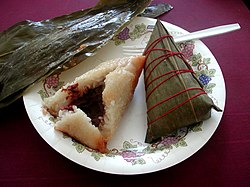 Zongzi rice dumplings, without and with bamboo leaf wrapping
 -
 Glutinous rice ball dessert, filled with sesame paste
 -
 Deep-fried glutinous rice ball dumplings
 -
 Fried slices of Shanghai nian cake
 -
 Chinese glutinous rice pancake or "Chinese pizza"
 -
 Ba bao fan


Indonesia
[edit]Glutinous rice is known as beras ketan or simply ketan in Java and most of Indonesia, and pulut in Sumatra. It is widely used as an ingredient for a wide variety of sweet, savoury, or fermented snacks. Glutinous rice is used as either hulled grains or milled into flour. It is usually mixed with santan, meaning coconut milk in Indonesian, along with a bit of salt to add some taste. Glutinous rice is rarely eaten as a staple. One example is lemang, which is glutinous rice and coconut milk cooked in bamboo stems lined by banana leaves. Glutinous rice is also sometimes used in a mix with normal rice in rice dishes such as nasi tumpeng or nasi tim. It is widely used during the Lebaran seasons as traditional food. It is also used in the production of alcoholic beverages such as tuak and brem bali.
Savoury snacks
[edit]- Ketan – traditionally refers to the glutinous rice itself as well as sticky rice delicacy in its simplest form. The handful mounds of glutinous rice are rounded and sprinkled with grated coconut, either fresh or sauteed as serundeng.
- Ketupat – square-shaped crafts made from the same local leaves as palas, but it is usually filled with regular rice grains instead of pulut, though it depends on the maker.
- Gandos – a snack made from ground glutinous rice mixed with grated coconut, and fried.
- Lemang – wrapped in banana leaves and inside a bamboo, and left to be barbecued/grilled on an open fire, to make the taste and texture tender and unique
- Lemper – cooked glutinous rice with shredded meat inside and wrapped in banana leaves, popular in Java
- Nasi kuning – either common rice or glutinous rice can be made into ketan kuning, yellow rice coloured with turmeric
- Songkolo or Sokko – steamed black glutinous rice serves with serundeng, anchovies, and sambal. It was very popular in Makassar
- Tumpeng – glutinous rice can be made into tumpeng nasi kuning, yellow rice coloured by turmeric, and shaped into a cone.
Sweet snacks
[edit]- Variety of kue – glutinous rice flour is also used in certain traditional local desserts, known as kue, such as kue lapis.
- Bubur ketan hitam – black glutinous rice porridge with coconut milk and palm sugar syrup
- Cendil – glutinous rice flour cake with sugar and grated coconut
- Dodol – traditional sweets made of glutinous rice flour and coconut sugar. Similar variants include wajik (or wajit).
- Gemblong – white glutinous rice flour balls smeared with palm sugar caramel. In East Java, it was known as getas, except it uses black glutinous rice flour as the main ingredient.
- Jipang – popped glutinous rice held together by caramelized sugar
- Klepon – glutinous rice flour balls filled with palm sugar and coated with grated coconut
- Lupis – glutinous rice wrapped in individual triangles using banana leaves and left to boil for a few hours. The rice pieces are then tossed with grated coconut all over and served with palm sugar syrup.
- Onde-onde – glutinous rice flour balls filled with sweetened mung bean paste and coated with sesame similar to Jin deui
- Wingko babat – baked glutinous rice flour with coconut
Fermented snacks
[edit]- Brem – solid cake from the dehydrated juice of pressed fermented glutinous rice
- Tapai ketan – cooked glutinous rice fermented with yeast, wrapped in banana or roseapple leaves. Usually eaten as it is or in a mixed cold dessert
Crackers
[edit]- Rengginang – traditional rice crackers related to kerupuk
In addition, glutinous rice dishes adapted from other cultures are just as easily available. Examples include kue moci (mochi, Japanese) and bacang (zongzi, Chinese).
- Indonesian glutinous rice dishes
-
 Lemper, glutinous rice filled with chicken wrapped in banana leaves
 -
 Dodol made from coconut sugar and ground glutinous rice
 -

-

-
 Ketan served with durian sauce
 -
 Uli bakar or grilled glutinous rice cube
 -
 Cendil a Javanese cake made of glutinous rice flour, sugar, and grated coconut
 -

-
 Kue lapis - Indonesian cake made mainly of glutinous rice
 -
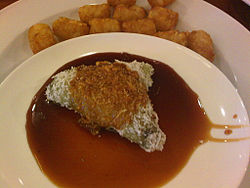 Kue lupis - Glutinous rice cake with grated coconut and liquid palm sugar
 -
 Tapai ketan (right) served with uli (glutinous rice cooked with grated coconut, and mashed; left)


Japan
[edit]- Japanese glutinous rice dishes
-
 Preparation of mochi in Japan
 -
 Okowa (おこわ), sticky glutinous rice mixed with all kinds of vegetables or meat and steamed
 -


In Japan, glutinous rice is known as mochigome (Japanese: もち米). It is used in traditional dishes such as sekihan also known as Red bean rice, okowa, and ohagi. It may also be ground into mochiko (もち粉), a rice flour, used to make mochi (もち), a kind of sweet rice cake. Mochi is traditionally prepared for the Japanese New Year, but can also be eaten year-round. Many different types of mochi exist from different regions, and they are normally flavoured with traditional ingredients such as red beans, water chestnuts, green tea, and pickled cherry flowers. See also Japanese rice.
Korea
[edit]In Korea, glutinous rice is called chapssal (Korean: 찹쌀), and its characteristic stickiness is called chalgi (찰기). Cooked rice made of glutinous rice is called chalbap (찰밥) and rice cakes (떡; ddeok) are called chalddeok or chapssalddeok (찰떡; 찹쌀떡). Chalbap is used as stuffing in samgyetang (삼계탕).
Laos
[edit]

Along the Greater Mekong Sub-region, the Lao have been cultivating glutinous rice for approximately 4000 – 6000 years.[13] Glutinous rice is the national dish of Laos.[14] In Laos, a tiny landlocked nation with a population of approximately 7 million, per-capita sticky rice consumption is the highest on earth at 171 kg or 377 pounds per year.[15][16] Sticky rice is deeply ingrained in the culture, religious tradition, and national identity of Laos (see Lao cuisine). Sticky rice is considered the essence of what it means to be Lao. It has been said that no matter where they are in the world, sticky rice will always be the glue that holds the Lao communities together, connecting them to their culture and to Laos.[17] Lao people often identify themselves as the "children of sticky rice"[18] and if they did not eat sticky rice, they would not be Lao.[19][20]
Sticky rice is known as khao niao (Lao:ເຂົ້າໜຽວ): khao means rice, and niao means sticky. It is cooked by soaking for several hours and then steaming in a bamboo basket or houat (Lao: ຫວດ). After that, it should be turned out on a clean surface and kneaded with a wooden paddle to release the steam; this results in rice balls that will stick to themselves but not to fingers. The large rice ball is kept in a small basket made of bamboo or thip khao (Lao:ຕິບເຂົ້າ). The rice is sticky but dry, rather than wet and gummy-like non-glutinous varieties. Laotians consume glutinous rice as part of their main diet; they also use toasted glutinous rice khao khoua (Lao:ເຂົ້າຄົ່ວ) to add a nut-like flavour to many dishes. A popular Lao meal is a combination of larb (Lao:ລາບ), Lao grilled chicken ping gai (Lao:ປີ້ງໄກ່), spicy green papaya salad dish known as tam mak hoong (Lao:ຕຳໝາກຫູ່ງ), and sticky rice (khao niao).
- Khao lam (Lao:ເຂົ້າຫລາມ): sticky rice is mixed with coconut milk, red or black bean, or taro, and is filled in a bamboo tube. The tube is roasted until all the ingredients are cooked and blended together to give a sweet aromatic treat. Khao Lam is such a popular food for Laotians and is sold on the streets.
- Nam Khao (Lao:ແໝມເຂົ້າ): sticky rice has also been used for preparing a popular dish from Laos called Nam Khao (or Laotian crispy rice salad). It is made with a deep-fried mixture of sticky rice and jasmine rice balls, chunks of Lao-style fermented pork sausage called som moo, chopped peanuts, grated coconut, sliced scallions or shallots, mint, cilantro, lime juice, fish sauce, and other ingredients.
- Khao Khua (Lao:ເຂົ້າຂົ້ວ): sticky rice are toasted and crushed. Khao Khua is a necessary ingredient for preparing a national Laotian dish called Larb (Lao:ລາບ) and Nam Tok (Lao:ນ້ຳຕົກ) that are popular for ethnic Lao people living in both Laos and in the Northeastern region of Thailand called Isan.
- Khao tom (Lao:ເຂົ້າຕົ້ມ): a steamed mixture of khao niao with sliced fruits and coconut milk wrapped in banana leaf.
- Khao jee: Lao sticky rice pancakes with egg coating, an ancient Laotian cooking method of grilling glutinous rice or sticky rice over an open fire.
- Sai Krok (Lao:ໄສ້ກອກ): Lao sausage made from coarsely chopped fatty pork seasoned with lemongrass, galangal, kaffir lime leaves, shallots, cilantro, chillies, garlic, salt, and sticky rice.
- Or lam (Lao:ເອາະຫຼາມ): a mildly spicy and tongue-numbing stew originating from Luang Prabang, Laos.
- Lao-Lao (Lao:ເຫລົ້າລາວ): Laotian rice whisky produced in Laos.
Khao niao is also used as an ingredient in desserts. Khao niao mixed with coconut milk can be served with ripened mango or durian.
Malaysia
[edit]- Malaysian glutinous rice dishes
-

-
-


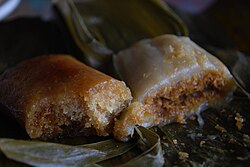
In Malaysia, glutinous rice is known as pulut. It is usually mixed with santan (coconut milk) along with a bit of salt to add some taste. It is widely used during the Raya festive seasons as traditional food which is shared with certain parts of Indonesia, such as:
- Dodol – traditional sweets made of glutinous rice flour and coconut sugar. Similar variants are wajik (or wajit).
- Inang-inang – glutinous rice cracker. Popular in Melaka.
- Kelupis – a type of glutinous rice kuih in East Malaysia.
- Ketupat – square-shaped crafts made from the same local leaves as palas, but it is usually filled with regular rice grains instead of pulut, though it depends on the maker.
- Kochi – Malay-Peranakan sweet and sticky kuih.
- Lamban – another type of glutinous rice dessert in East Malaysia.
- Lemang – wrapped in banana leaves and inside a bamboo, and left to be barbecued/grilled on an open fire, to make the taste and texture tender and unique.
- Pulut inti – wrapped in banana leaf in the shape of a pyramid, this kuih consists of glutinous rice with a covering of grated coconut candied with palm sugar.
- Pulut panggang – glutinous rice parcels stuffed with a spiced filling, then wrapped in banana leaves and char-grilled. Depending on the regional tradition, the spiced filling may include pulverised dried prawns, caramelised coconut paste or beef floss. In the state of Sarawak, the local pulut panggang contains no fillings and is wrapped in pandan leaves instead.
- Tapai – cooked glutinous rice fermented with yeast, wrapped in banana, rubber tree or roseapple leaves.
Myanmar
[edit]Glutinous rice, called kao hnyin (ကောက်ညှင်း), is very popular in Myanmar (also known as Burma).
- Kao hnyin baung (ကောက်ညှင်းပေါင်း) is a breakfast dish with boiled peas (pèbyouk) or with a variety of fritters, such as urad dal (baya gyaw), served on a banana leaf. It may be cooked wrapped in a banana leaf, often with peas, and served with a sprinkle of salted toasted sesame seeds and often grated coconut.
- The purple variety, known as kao hynin ngacheik (ကောင်းညှင်းငချိမ့်), is equally popular cooked as ngacheik paung.
- They may both be cooked and pounded into cakes with sesame called hkaw bouk, another favourite version in the north among the Shan and the Kachin, and served grilled or fried.
- The Htamanè pwè festival (ထမနဲပွဲ) takes place on the full moon of Dabodwè(တပို့တွဲ) (February), when htamanè (ထမနဲ) is cooked in a huge wok. Two men, each with a wooden spoon the size of an oar, and a third man coordinate the action of folding and stirring the contents, which include kao hnyin, ngacheik, coconut shavings, peanuts, sesame and ginger in peanut oil.
- Si htamin (ဆီထမင်း) is glutinous rice cooked with turmeric and onions in peanut oil, and served with toasted sesame and crisp-fried onions; it is a popular breakfast like kao hnyin baung and ngacheik paung.
- Paung din (ပေါင်းတင်) or "Kao hyin kyi tauk" (ကောင်းညှင်းကျည်တောက်) is another ready-to-eat portable form cooked in a segment of bamboo. When the bamboo is peeled off, a thin skin remains around the rice and also gives off a distinctive aroma.
- Mont let kauk (မုန့်လက်ကောက်) is made from glutinous rice flour; it is donut-shaped and fried like baya gyaw, but eaten with a dip of jaggery or palm sugar syrup.
- Nga pyaw douk (ငပျောထုပ်) or "Kao hynin htope" (ကောင်းညှင်းထုပ်), banana in glutinous rice, wrapped in banana leaf and steamed and served with grated coconut – another favourite snack, like kao hnyin baung and mont let kauk, sold by street hawkers.
- Mont lone yay baw (မုန့်လုံးရေပေါ်) are glutinous rice balls with jaggery inside, thrown into boiling water in a huge wok, and ready to serve as soon as they resurface. Their preparation is a tradition during Thingyan, the Burmese New Year festival.
- Htoe mont (ထိုးမုန့်), glutinous rice cake with raisins, cashews and coconut shavings, is a traditional dessert for special occasions. It is appreciated as a gift item from Mandalay.
- Burmese glutinous rice dishes
-
 Ngacheik paung with pèbyouk (boiled peas) and salted toasted sesame
 -
 Hkaw bouk – dried cakes of ngacheik glutinous rice with Bombay duck, both fried
 -
 Htamanè – glutinous rice with fried coconut, roasted peanuts, sesame and ginger
 -
 The traditional way of making special glutinous rice htamanè is still practiced
 -
 Si htamin – glutinous rice cooked in oil with turmeric and served with boiled peas and crushed salted sesame
 -
 Mont lone yei baw – glutinous rice balls filled with jaggery, covered with shredded coconut – a New Year treat
 -
 Paung din – glutinous rice, both purple and white varieties, cooked in bamboo tubes
 -
 Paung din (ngacheik) with to hpu (Burmese tofu), mashed potato and black gram fritters


Nepal
[edit]In Nepal, Latte/Chamre is a popular dish made from glutinous rice during Teej festival, the greatest festival of Nepalese women.
Northeastern India
[edit]Sticky rice called bora saul is the core component of indigenous Assamese sweets, snacks, and breakfast. This rice is widely used in the traditional sweets of Assam, which are very different from the traditional sweets of India whose basic component is milk.
Such traditional sweets in Assam are Pitha (Narikolor pitha, Til pitha, Ghila pitha, Tel pitha, Keteli pitha, Sunga pitha, Sunga saul etc.). Also, its powder form is used as breakfast or other light meals directly with milk. They are called Pitha guri (if the powder was done without frying the rice, by just crushing it after soaking) or Handoh guri (if rice is dry fried first, and then crushed).
The soaked rice is also cooked with no added water inside a special kind of bamboo (called sunga saul bnaah). This meal is called sunga saul.
During religious ceremonies, indigenous Assamese communities make Mithoi (Kesa mithoi and Poka mithoi) using Gnud with it. Sometimes Bhog, Payokh are also made from it using milk and sugar with it.
Different indigenous Assamese communities make rice beer from sticky rice, preferring it over other varieties of rice for the sweeter and more alcoholic result. This rice beer is also offered to their gods and ancestors. Rice cooked with it is also taken directly as lunch or dinner on rare occasions. Similarly, other indigenous communities from NE India use sticky rice in various forms similar to the native Assamese style in their cuisine.[further explanation needed]
Philippines
[edit]In the Philippines, glutinous rice is known as malagkit in Tagalog or pilit in Visayan, among other names such as diket in Ilocano. Both mean "sticky". The most common way glutinous rice is prepared in the Philippines is by soaking uncooked glutinous rice in water or coconut milk (usually overnight) and then grinding it into a thick paste (traditionally with stone mills). This produces a rich and smooth viscous rice dough known as galapóng, which is the basis for numerous rice cakes in the Philippines. However, in modern preparation methods, galapong is sometimes made directly from dry glutinous rice flour (or from commercial Japanese mochiko), with poorer-quality results.[21]
Galapong was traditionally allowed to ferment, which is still required for certain dishes. A small amount of starter culture of microorganisms (tapay or bubod) or palm wine (tubâ) may be traditionally added to rice being soaked to hasten the fermentation. These can be substituted with yeast or baking soda in modern versions.[22][21] Other versions of galapong may also be treated with wood ash lye.
Aside from the numerous white and red glutinous rice cultivars, the most widely used glutinous rice heirloom cultivars in the Philippines are tapol rice, which is milky white in colour, and pirurutong rice, which ranges in colour from black to purple to reddish brown.[23] However both varieties are expensive and becoming increasingly rare, thus some Filipino recipes nowadays substitute it with dyed regular glutinous rice or infuse purple yam (ube) to achieve the same colouration.[23][24][25]
Dessert delicacies in the Philippines are known as kakanin (from kanin, "prepared rice"). These were originally made primarily from rice, but in recent centuries, the term has come to encompass dishes made from other types of flour, including corn flour (masa), cassava, wheat, and so on. Glutinous rice figures prominently in two main subtypes of kakanin: the puto (steamed rice cakes), and the bibingka (baked rice cakes). Both largely utilize glutinous rice galapong. A notable variant of puto is puto bumbong, which is made with pirurutong.
Other kakanin that use glutinous rice include suman, biko, and sapin-sapin among others. There is also a special class of boiled galapong dishes like palitaw, moche, mache, and masi. Fried galapong is also used to make various types of buchi, which are the local Chinese-Filipino versions of jian dui. They are also used to make puso, which are boiled rice cakes in woven leaf pouches.
Aside from kakanin, glutinous rice is also used in traditional Filipino rice gruels or porridges known as lugaw. They include both savory versions like arroz caldo or goto which are similar to Chinese-style congee; and dessert versions like champorado, binignit, and ginataang mais.
- Filipino glutinous rice dishes
-
 Puto, steamed rice cakes made with fermented galapong
 -
 Bibingka, made from baked galapong with coconut milk
 -
 Puto bumbong, steamed rice cakes made with purple glutinous rice, steamed in bamboo tubes
 -

-
 Tupig, made from ground glutinous rice, coconut strips, coconut milk, sugar, and wrapped in banana leaves
 -
 Champorado, dessert lugaw made from glutinous rice and chocolate
 -
 Suman sa ibus, a type of suman, steamed glutinous rice packaged in tagbak leaves
 -

-
 Bibingkoy, grilled glutinous rice dumpling filled with sweetened mung bean paste
 -

-

-
 Patupat or Sinambong, made from glutinous rice, cooked in woven buri leaves and sugarcane juice
 -
 Moche, boiled glutinous rice filled with bean paste
 -

-
 Sapin-sapin, a colourful dessert made with multiple layers of glutinous rice, each with a different flavour and texture
 -
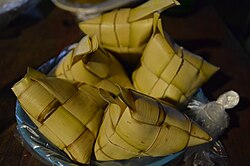 Pusô, made from glutinous rice cooked in pouches of woven coconut leaves
 -
 Puto maya made with pirurutong rice
 -
 Palitaw, made from galapong, grated coconut, mix of sugar and toasted sesame seeds


.jpg)


.jpg)


_05.jpg)

_01.jpg)

Thailand
[edit]In Thailand, glutinous rice is known as khao niao (Thai: ข้าวเหนียว; lit. 'sticky rice') in central Thailand and Isan, and as khao nueng (Thai: ข้าวนึ่ง; lit. 'steamed rice') in northern Thailand.[26] Sticky rice at the table is typically served individually in a small woven basket (Thai: กระติบข้าว, RTGS: kratip khao).
- Steamed glutinous rice is one of the main ingredients in making the sour-fermented pork skinless sausage called naem, or its northern Thai equivalent chin som, which can be made from pork, beef, or water buffalo meat. It is also essential for the fermentation process in the northeastern Thai sausage called sai krok Isan. This latter sausage is made, in contrast to the first two, with a sausage casing.[27][28][29]
- Sweets and desserts: Famous among tourists in Thailand is khao niao mamuang (Thai: ข้าวเหนียวมะม่วง): sweet coconut sticky rice with mango, while khao niao tat, sweet sticky rice with coconut cream and black beans,[30] Khao niao na krachik (Thai: ข้าวเหนียวหน้ากระฉีก), sweet sticky rice topped with caramelized roasted grated coconut,[31] khao niao kaeo, sticky rice cooked in coconut milk and sugar and khao tom hua ngok, sticky rice steamed with banana with grated coconut and sugar, are traditional popular desserts.[32]
- Khao lam (Thai: ข้าวหลาม) is sticky rice with sugar and coconut cream cooked in specially prepared bamboo sections of different diameters and lengths. It can be prepared with white or dark purple (khao niao dam) varieties of glutinous rice. Sometimes a few beans or nuts are added and mixed in. Thick khao lam containers may have a custard-like filling in the centre made with coconut cream, egg and sugar.
- Khao chi (Thai: ข้าวจี่) are cakes of sticky rice having the size and shape of a patty and a crunchy crust. In order to prepare them, the glutinous rice is laced with salt, often also lightly coated with beaten egg, and grilled over a charcoal fire. They were traditionally made with leftover rice and given in the early morning to the children, or to passing monks as an offering.[33]
- Khao niew tua dum is a sticky with sugar, thickened coconut milk and black beans.
- Khao pong (Thai: ข้าวโป่ง) is a crunchy preparation made of leftover steamed glutinous rice that is pounded and pressed into thin sheets before being grilled.
- Khao tom mat (Thai: ข้าวต้มมัด), cooked sticky rice mixed with banana and wrapped in banana leaf,[34] khao ho, sticky rice moulded and wrapped in a conical shape, khao pradap din, kraya sat and khao thip are preparations based on glutinous rice used as offerings in religious festivals and ceremonies for merit-making or warding off evil spirits.
- Khao niao ping (Thai: ข้าวเหนียวปิ้ง), sticky rice mixed with coconut milk and taro (khao niao ping pheuak), banana (khao niao ping kluai) or black beans (khao niao ping tua), wrapped in banana leaf and grilled slowly over a charcoal fire.[35] Glutinous rice is traditionally eaten using the right hand[36][37]
- Khao khua (Thai: ข้าวคั่ว), roasted ground glutinous rice, is indispensable for making the northeastern Thai dishes larb, nam tok, and nam chim chaeo. Some recipes also ask for khao khua in certain northern Thai curries.[38] It imparts a nutty flavour to the dishes in which it is used.[39]
- Naem khluk (Thai: ยำแหนม) or yam naem khao thot is a salad made from crumbled deep-fried, curried-rice croquettes, and naem sausage[40]
- Chin som mok is a northern Thai speciality made with grilled, banana leaf-wrapped pork skin that has been fermented with glutinous rice
- Sai krok Isan: grilled, fermented pork sausages, a speciality of northeastern Thailand
- Glutinous rice is also used as the basis for the brewing of sato (Thai: สาโท), an alcoholic beverage also known as "Thai rice wine".
- Thai glutinous rice dishes
-
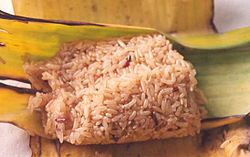 A packet of glutinous rice in a traditional Isan banana-leaf wrapper
 -
 Kin khao niao
 -
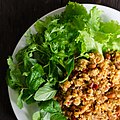 Naem khluk or yam naem khao thot
 -
 Khao tom mat, sticky rice and banana steamed inside a banana leaf
 -

-
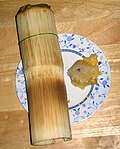 Khao lam in a section of bamboo
 -
 Yam naem, a salad with naem sausage made from raw pork fermented with glutinous rice
 -
 Kratip (Thai: กระติบ) are used by northern and northeastern Thais as containers for sticky rice
 -
 Chin som mok, northern Thai speciality, grilled pork skin fermented with glutinous rice
 -
 Sai krok Isan specialty of northeastern Thailand


Vietnam
[edit] |
Glutinous rice is called gạo nếp in Vietnamese. The term for the cooked rice is called xôi. Dishes made from glutinous rice in Vietnam are typically served as desserts or side dishes, but some can be served as main dishes. There is a wide array of glutinous rice dishes in Vietnamese cuisine, the majority of them can be categorized as follows:
- Bánh, the most diverse category, refers to a wide variety of sweet or savoury, distinct cakes, buns, pastries, sandwiches, and food items from Vietnamese cuisine, which may be cooked by steaming, baking, frying, deep-frying, or boiling. Some, but not all bánh are made from glutinous rice. They can also be made from ordinary rice flour, cassava flour, taro flour, or tapioca starch. The word "bánh" is also used to refer to certain varieties of noodles in Vietnam, and absolutely not to be confused with glutinous rice dishes. Some bánh dishes that are made from glutinous rice include:
- Bánh chưng: a square-shaped, boiled glutinous rice dumpling filled with pork and mung bean paste, wrapped in a dong leaf, usually eaten in Vietnamese New Year.
- Bánh giầy: white, flat, round glutinous rice cake with a tough, chewy texture filled with mung bean or served with Vietnamese sausage (chả), usually eaten during Vietnamese New Year with bánh chưng.
- Bánh dừa: glutinous rice mixed with black bean paste cooked in coconut juice, wrapped in a coconut leaf. The filling can be mung bean stir-fried in coconut juice or banana.
- Bánh rán: a northern Vietnamese dish of deep-fried glutinous rice balls covered with sesame, scented with a jasmine flower essence, filled with either sweetened mung bean paste (the sweet version) or chopped meat and mushrooms (the savoury version).
- Bánh cam: a southern Vietnamese version of bánh rán. Unlike bánh rán, bánh cam is coated with a layer of sugary liquid and has no jasmine essence.
- Bánh trôi: made from glutinous rice mixed with a small portion of ordinary rice flour (the ratio of glutinous rice flour to ordinary rice flour is typically 9:1 or 8:2) filled with sugarcane rock candy.
- Bánh gai: made from the leaves of the "gai" tree (Boehmeria nivea) dried, boiled, ground into small pieces, then mixed with glutinous rice, wrapped in banana leaf. The filling is made from a mixture of coconut, mung bean, peanuts, winter melon, sesame, and lotus seeds.
- Bánh cốm: the cake is made from young glutinous rice seeds. The seeds are put into a water pot, stirred on fire, and juice extracted from the pomelo flower is added. The filling is made from steamed mung bean, scraped coconut, sweetened pumpkin, and sweetened lotus seeds.
- Other bánh made from glutinous rice are bánh tro, bánh tét, bánh ú, bánh măng, bánh ít, bánh khúc, bánh tổ, bánh in, bánh dẻo, bánh su sê, bánh nổ...
- Xôi are sweet or savoury dishes made from steamed glutinous rice and other ingredients. Sweet xôi are typically eaten as breakfast. Savoury xôi can be eaten as lunch. Xôi dishes made from glutinous rice include:
- Xôi lá cẩm: made from the magenta plant.
- Xôi lá dứa: made from pandan leaf extract for the green colour and a distinctive pandan flavour.
- Xôi gấc: made from gấc fruit for the red colour.
- Xôi nếp than: made from black rice.
- Xôi ngũ sắc: five colours xôi, is the traditional food of the Thái, Dao and Tày people.
- Xôi chiên phồng: deep-fried glutinous rice patty
- Xôi gà: made with coconut juice and pandan leaf served with fried or roasted chicken and sausage.
- Xôi thập cẩm: made with dried shrimp, chicken, Chinese sausage, Vietnamese sausage (chả), peanuts, coconut, onion, fried garlic, and potentially other ingredients.
- Other xôi dishes made from glutinous rice include xôi lạc, xôi bắp, xôi đậu xanh, xôi vò, xôi sắn, xôi sầu riêng, xôi khúc, xôi xéo, and xôi vị.
- Chè refers to any traditional Vietnamese sweetened soup or porridge. Though chè can be made using a wide variety of ingredients, some chè dishes made from glutinous rice include:
- Chè đậu trắng: made from glutinous rice and black-eyed peas.
- Chè con ong: made from glutinous rice, ginger root, honey, and molasses.
- Chè cốm: made from young glutinous rice seeds, kudzu flour, and juice from the pomelo flower.
- Chè xôi nước: balls made from mung bean paste in a shell made of glutinous rice flour; served in a thick clear or brown liquid made of water, sugar, and grated ginger root.
- Cơm nếp: glutinous rice that is cooked in the same way as ordinary rice, except that the water used is flavoured by adding salts or by using coconut juice, or soups from chicken broth or pork broth.
- Cơm rượu: Glutinous rice balls cooked and mixed with yeast, served in a small amount of rice wine.
- Cơm lam: Glutinous rice cooked in a tube of bamboo of the genus Neohouzeaua and often served with grilled pork or chicken.
Glutinous rice can also be fermented to make Vietnamese alcoholic beverages, such as rượu nếp, rượu cần and rượu đế.
- Vietnamese glutinous rice dishes
-
 Cơm lam, rice cooked in a bamboo tube
 -
 Xôi gấc, glutinous rice cooked with Gac fruit
 -
 Xôi gà or chicken xôi
 -
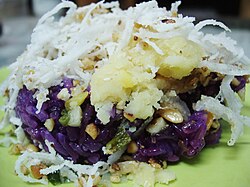 Xôi lá cẩm, sticky rice coloured with magenta leaves and shredded coconut
 -
 Bánh giầy, pounded rice cake
 -
 Bánh chưng a savoury rice cake with mung beans and pork fillings, usually consumed during Tết
 -
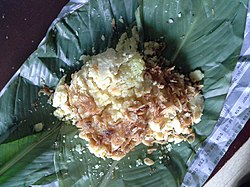 Xôi xéo, glutinous rice with mung beans and fried shallots
 -

-
 Bánh cốm, made from young glutinous rice paste
 -
 Cơm rượu, fermented glutinous rice as dessert
 -
 Chè đậu trắng, glutinous rice and black-eyed peas
 -
 Bánh gai, made with the paste of boehmeria nivea plant
 -
 Bánh tro made by glutinous rice soaked overnight in lye
 -
 Bánh rán, deep-fried glutinous ball


.JPG)


Beverages
[edit]Non-food uses
[edit]In construction, glutinous rice is a component of sticky rice mortar for use in masonry. Chemical tests have confirmed that this is true for the Great Wall of China and the city walls of Xi'an.[41][42] In Assam also, this rice was used for building palaces during Ahom rule.[citation needed]
Glutinous rice starch may also be used to create wheatpaste, an adhesive material.[43]
In Vietnam, glutinous rice is made into flour and used to make To he, a figurine.
See also
[edit]References
[edit]- ^ "glutinous, a." Oxford English Dictionary, Second Edition. 1989. Online edition. Retrieved 20 February 2008.
- ^ a b c Olsen, Kenneth M; Purugganan, Michael D (1 October 2002). "Molecular Evidence on the Origin and Evolution of Glutinous Rice". Genetics. 162 (2): 941–950. doi:10.1093/genetics/162.2.941. PMC 1462305. PMID 12399401.
- ^ Yamanaka, Shinsuke; Nakamura, Ikuo; Watanabe, Kazuo N.; Sato, Yo-Ichiro (May 2004). "Identification of SNPs in the waxy gene among glutinous rice cultivars and their evolutionary significance during the domestication process of rice". Theoretical and Applied Genetics. 108 (7): 1200–1204. doi:10.1007/s00122-003-1564-x. PMID 14740088. S2CID 5681108.
- ^ Kenneth M. Olsen and Michael D. Purugganan (1 October 2002). "Molecular evidence on the origin and evolution of glutinous rice". Genetics. 162 (2): 941–950. doi:10.1093/genetics/162.2.941. PMC 1462305. PMID 12399401. Archived from the original on 14 May 2010. Retrieved 11 October 2006.
- ^ Nguyễn, Xuân Hiʾên (2001). Glutinous-Rice-Eating Tradition in Vietnam and Elsewhere. Bangkok: White Lotus Press. p. 13. ISBN 9789747534238.
- ^ Kenneth F. Kiple, Kriemhild Coneè Ornelas. The Cambridge World History of Food. p. 143.
- ^ https://coxsbazarlife.com/banana-leaf-wrapped-atikka-pitha-a-traditional-delicacy/ [bare URL]
- ^ https://www.banglarrannaghor.com/post/binni-chaler-pitha [bare URL]
- ^ "Binni".
- ^ Edelstein, Sari (2010). Food, Cuisine, And Cultural Competency For Culinary, Hospitality, And Nutrition Professionals. Jones & Bartlett Learning. p. 247. ISBN 978-0-763-75965-0.
- ^ "The Sweet Tastes of Cambodia". Asia Life Magazine. 3 May 2013. Archived from the original on 20 April 2021. Retrieved 26 May 2013.
- ^ 粢饭糕
- ^ Sattaka, Patcha (27 December 2016). "Geographical Distribution of Glutinous Rice in the Greater Mekong Sub-region". Journal of Mekong Societies. 12 (3): 27–48. ISSN 2697-6056. Archived from the original on 8 November 2021. Retrieved 10 June 2021.
- ^ "A Taste of Sticky Rice, Laos' National Dish". Smithsonian Magazine. Archived from the original on 5 October 2021. Retrieved 10 June 2021.
- ^ "Rice Landscape Analysis – Feasibility of and opportunities for rice fortification in the Lao People's Democratic Republic | World Food Programme". www.wfp.org. January 2017. Archived from the original on 7 November 2021. Retrieved 10 June 2021.
- ^ Bestari, Njoman George (1 September 2006). Lao PDR: An Evaluation Synthesis On Rice. ADB Independent Evaluation Department. Archived from the original on 10 June 2021. Retrieved 10 June 2021.
- ^ "Laos at the crossroads". grain.org. Archived from the original on 7 November 2021. Retrieved 10 June 2021.
- ^ Gibbs, JC (18 May 2018). "FORKLIFE: Children of Sticky Rice". Smithsonian Center for Folklife and Cultural Heritage. Archived from the original on 8 November 2021. Retrieved 10 June 2021.
- ^ M, J.M Schiller M.B Chanphengxay B Linquist S Appo Rao Stuart-Fox (1 January 2006). Population diversity and rice in Laos. International Rice Research Institute. OCLC 828756582.
- ^ "Asia brief: Filling the rice basket in Lao PDR, partnership results – OD Mekong Datahub". data.opendevelopmentmekong.net. Archived from the original on 10 June 2021. Retrieved 10 June 2021.
- ^ a b Amy Besa & Romy Dorotan (2014). Memories of Philippine Kitchens. Abrams. ISBN 9781613128084.
- ^ Nocheseda, Elmer. "The Invention of Happiness". Manila Speak. Archived from the original on 8 August 2020. Retrieved 8 December 2018.
- ^ a b "Pirurutong at Tapol / Purple and White Glutinous Rice". Market Manila. 27 November 2007. Archived from the original on 30 April 2021. Retrieved 6 July 2021.
- ^ "Purple, Red and White Malagkit / Sticky Rice". Market Manila. 3 May 2005. Archived from the original on 29 April 2021. Retrieved 11 February 2019.
- ^ "Misa de Gallo and Puto Bumbong Pre-amble..." Market Manila. 15 December 2007. Archived from the original on 29 April 2021. Retrieved 11 February 2019.
- ^ "Khao nueng – Lanna Food | Northern Thai Information Center, Chiang Mai University Library". Archived from the original on 16 June 2020. Retrieved 3 October 2014.
- ^ "Tutorial – How to Make Fermented Thai Pork Sausage (แหนมหมู; naem moo)". Thaifoodmaster. 24 February 2010. Archived from the original on 31 December 2015.
- ^ "Chin som – Lanna Food | Northern Thai Information Center, Chiang Mai University Library". Archived from the original on 26 March 2016. Retrieved 3 October 2014.
- ^ "Thai Fermented Sausages from the Northeast (Sai Krok Isan ไส้กรอกอีสาน) – SheSimmers". Archived from the original on 13 September 2014. Retrieved 26 June 2024.
- ^ "Sweet Sticky Rice with Coconut Cream and Black Beans*(khao niao tat)". Board.palungjit.com. Archived from the original on 29 March 2012. Retrieved 31 May 2013.
- ^ "ข้าวเหนียวหน้ากระฉีก". The-than.com. Archived from the original on 5 February 2019. Retrieved 31 May 2013.
- ^ "Thai food". Thailand.prd.go.th. Archived from the original on 24 April 2013. Retrieved 31 May 2013.
- ^ "Khao chi preparation". Webboard.sanook.com. Archived from the original on 2 May 2021. Retrieved 31 May 2013.
- ^ "Sticky Rice with Bananas". Thai-blogs.com. 29 September 2005. Archived from the original on 3 June 2013. Retrieved 31 May 2013.
- ^ "Desserts in Thailand – Thai Grilled Sticky Rice – Banana or Taro (Khao Niao Ping)". Archived from the original on 12 May 2015. Retrieved 26 June 2024.
- ^ "Madam Mam Articles". Madammam.com. Archived from the original on 20 May 2013. Retrieved 31 May 2013.
- ^ "Sticky Rice Ball". Library.cmu.ac.th. Archived from the original on 16 July 2020. Retrieved 31 May 2013.
- ^ "Kaeng Khae Hoi (snail curry)". Library.cmu.ac.th. Archived from the original on 16 June 2020. Retrieved 31 May 2013.
- ^ "Toasted Rice Powder for Thai Cooking – Khao Khua (ข้าวคั่ว)". 25 April 2009. Archived from the original on 12 May 2023. Retrieved 26 June 2024.
- ^ "Naem Khao Tod (แหนมข้าวทอด) by Spoon Thai Restaurant, Chicago". 26 September 2011. Archived from the original on 9 May 2023. Retrieved 26 June 2024.
- ^ Boissoneault, Lorraine (16 February 2017). "Sticky Rice Mortar, the View From Space, and More Fun Facts About China's Great Wall". Smithsonian. Archived from the original on 1 December 2021. Retrieved 20 November 2021.
- ^ Xinhua News Agency (27 February 2005). "Sticky porridge used to cement ancient walls". Archived from the original on 18 November 2007.
- ^ 黃瀞儀 (7 February 2019). "年紀大才看過這瓶 網淚:以前還能吃!". China Times (in Chinese (Taiwan)). Archived from the original on 20 November 2021. Retrieved 20 November 2021.
External links
[edit]

| Shushoku |
| ||||||||
|---|---|---|---|---|---|---|---|---|---|
| Okazu | |||||||||
| Soup (shirumono) | |||||||||
| Set menu | |||||||||
| Beverages |
| ||||||||
| Snacks, sweets, and wagashi | |||||||||
| Fruit | |||||||||
| Ingredients and condiments | |||||||||
| Utensils | |||||||||
| Lists | |||||||||
| Related | |||||||||

Glutinous rice
View on GrokipediaBackground
Etymology and nomenclature
The term "glutinous" in glutinous rice derives from the Latin word gluten, meaning "glue," reflecting the rice's sticky, glue-like texture when cooked, rather than the presence of gluten protein.[5][6] This nomenclature entered Middle English from Latin glutinosus, emphasizing the adhesive quality of the cooked grains.[5] Despite the name, glutinous rice is entirely gluten-free, as it belongs to the genus Oryza and contains no wheat-derived proteins; the term solely describes its physical stickiness caused by high amylopectin content.[3] In English, glutinous rice is commonly known as sticky rice, waxy rice, or sweet rice, though the latter does not indicate higher sugar levels but rather its use in sweet dishes.[7] These synonyms highlight its cohesive properties, distinguishing it from non-sticky long-grain varieties.[8] Regionally, glutinous rice has diverse names reflecting local languages and culinary traditions. In Japan, it is called mochigome, the short-grain rice used for mochi.[9] In Thailand, it is known as khao niao or khao niew, a staple in northeastern cuisine.[7] In China, the term nuòmǐ denotes this variety, essential for dishes like zongzi.[10] In the Philippines, it is referred to as malagkit, featured in kakanin desserts.[11] Botanically, glutinous rice is classified as a subspecies of cultivated rice, Oryza sativa var. glutinosa, setting it apart from standard Oryza sativa varieties that lack the recessive waxy gene mutation responsible for its stickiness.[3] This distinction underscores its unique varietal status within the Oryza genus.[12]History
The origins of glutinous rice trace back to the domestication of Oryza sativa in the Yangtze River basin of ancient China, where rice cultivation began around 8,000 years ago, providing the foundation for varietal developments like the glutinous type through a mutation in the Waxy gene that reduces amylose content. Archaeological evidence indicates early forms of temperate japonica rice in northern China by 3900–3800 BC during the Early Yangshao phase, with the full glutinous phenotype likely emerging later around the Shang era (ca. 1500 BC), as suggested by genetic studies showing a single evolutionary origin and reduced variation at the Waxy locus consistent with post-domestication selection, with genetic studies indicating a single evolutionary origin in East Asia and subsequent spread. While direct archaeological confirmation remains limited, written records differentiate sticky rice by the 1st century AD, implying its established cultivation by then.[13][4] In ancient Chinese dynasties, glutinous rice held significant cultural and ritual importance, often used in offerings and festivals to honor ancestors and deities. During later periods like the Spring and Autumn (770–476 BC) and Warring States era (475–221 BC), it featured in ceremonial foods such as zongzi—glutinous rice dumplings wrapped in leaves—symbolizing protection and reunion, as seen in traditions commemorating the poet Qu Yuan during the Dragon Boat Festival. These practices underscored its role in social cohesion and spiritual rites, extending into beverages like rice wine (li) brewed since the Eastern Zhou Dynasty (770–256 BC).[4][14] The spread of glutinous rice to Southeast Asia occurred gradually, with initial dispersal southward from China around 5,000–4,000 years ago, but its widespread adoption as a dietary staple intensified between 500 and 1000 AD through migrations of Tai-speaking peoples, who integrated it into local cuisines in regions like Laos, Thailand, and Vietnam, fostering dishes central to festivals and daily meals. Glutinous rice reached Japan via Korean intermediaries around 3000 years ago, becoming established during the Yayoi period; by the 8th century during the Nara period, it was essential for mochi production in rituals and celebrations. By around 1000 AD, trade routes along the Indian Ocean and overland paths introduced glutinous varieties to India, particularly the northeast, influencing tribal cuisines and ceremonial uses among indigenous groups.[4][15] In the 20th century, global exports of glutinous rice surged due to the Asian diaspora, as emigrants from China, Thailand, and Vietnam established communities in North America, Europe, and Australia, driving demand for traditional foods like congee and dumplings; Thailand emerged as a key exporter, supplying around 100,000–150,000 metric tons of glutinous rice annually by the late 1900s to meet this ethnic market growth.[16][17][18]Cultivation and Varieties
Botanical classification
Glutinous rice, scientifically known as Oryza sativa L. var. glutinosa, is a variant of the cultivated rice species Oryza sativa L., belonging to the family Poaceae. It is primarily classified under the subspecies Oryza sativa subsp. japonica, though glutinous types also occur within Oryza sativa subsp. indica. This classification reflects its position as a domesticated grass in the genus Oryza, distinguished by its unique starch composition that imparts stickiness upon cooking.[19] The plant exhibits a short-grain morphology, with grains that are typically opaque, round, and averaging 5-6 mm in length. These characteristics arise from the endosperm's high amylopectin content, giving the grains a chalky, white appearance distinct from non-glutinous varieties. As an annual grass, glutinous rice displays a tillering growth habit, producing multiple stems from the base of the plant, and reaches a mature height of 1-1.5 meters under typical cultivation conditions.[20][21] At the genetic level, the glutinous trait is governed by a mutation in the Waxy (Wx) gene, which encodes granule-bound starch synthase I and is responsible for amylose synthesis. This recessive mutation, often involving deletions or insertions in the Wx locus, results in near-zero amylose content and dominance of amylopectin in the starch, leading to the sticky texture. Glutinous rice originated through selective breeding from wild ancestors, specifically Oryza rufipogon, with the Wx mutation emerging as a selected trait during the domestication of rice in Asia, likely several thousand years ago in Southeast Asia.[22][3][23]Cultivation practices
Glutinous rice thrives in tropical and subtropical climates with high humidity levels, optimal temperatures ranging from 20 to 35°C during the growing season, and annual rainfall between 2000 and 2500 mm to support paddy flooding.[24][25] These conditions facilitate the crop's water-intensive growth, particularly in rainfed or irrigated lowland systems common across Southeast Asia. Excessive drought or temperatures above 35°C can reduce yields, while adequate humidity minimizes water stress on developing panicles.[26] The crop prefers well-drained loamy soils with a pH of 5.5 to 7.0, which provide good aeration and nutrient retention while allowing tolerance to periodic flooding in paddy fields.[27][28] Soils with high organic matter content enhance fertility, but heavy clay or sandy types may require amendments to prevent waterlogging or nutrient leaching. In flooded systems, the soil's capacity to retain water without becoming anaerobic supports root development and suppresses weeds.[29] Cultivation typically involves sowing seeds in nurseries for 20 to 30 days to produce sturdy seedlings, followed by transplanting to prepared fields at a spacing of 20-25 cm between rows. Harvesting occurs 110 to 120 days after transplanting, when grains reach physiological maturity with 20-25% moisture content, often using manual sickles or mechanical combines in larger operations. This transplanted method maximizes tillering and yield potential compared to direct seeding, though it demands labor for uniform spacing.[30] Major producing countries include Thailand, the world's leading exporter of glutinous rice, along with China, Vietnam, Laos, Indonesia, and Myanmar, where the crop supports both food security and cultural traditions. Thailand produced approximately 6 million tons in 2022/23, with Vietnam and Laos contributing about 3.5 million and 3.2 million tons, respectively; these three countries account for around 12 million tons collectively.[31][32][33] Key challenges in cultivation include susceptibility to pests and diseases, notably rice blast caused by Magnaporthe oryzae, which can devastate yields in humid conditions without resistant varieties.[34][35] Traditional breeding has relied on selecting local landraces for adaptation, but modern hybrid breeding programs increasingly incorporate genes for blast resistance and higher yields, such as through CRISPR/Cas9 editing of starch biosynthesis pathways.[36][37] These hybrids offer 20-30% yield advantages over conventional varieties while maintaining glutinous traits.[38]Varieties
Glutinous rice, also known as sticky rice, encompasses a range of cultivars primarily selected for their high amylopectin content, which imparts a characteristic adhesiveness when cooked. These varieties are predominantly short-grain types belonging to Oryza sativa, with both indica and japonica subspecies represented across Asia.[3] White glutinous rice forms the standard variety, featuring translucent grains that become soft and cohesive upon steaming. In Thailand, Khao Niao is a prominent short-grain cultivar widely cultivated in the northern and northeastern regions for its reliable stickiness and mild flavor.[39] Similarly, in China, Nuomi refers to common glutinous rice strains, often japonica-based, prized for their plump texture in traditional preparations.[40] Black and purple glutinous rice varieties derive their pigmentation from natural compounds, offering a nuttier taste and firmer chew compared to white types. Thai Black Sticky Rice, known locally as Khao Niao Dam, is a deep-hued cultivar harvested in upland areas, noted for its robust aroma and resilience in diverse soils.[41] In the Philippines, Pirurutong is a brownish-violet glutinous rice that cooks to an aromatic, sticky consistency, traditionally grown in wetter lowlands.[42] Notable specific cultivars highlight regional specializations. Japanese Mochigome, a short-grain japonica variety, is bred specifically for mochi production due to its exceptional elasticity and glue-like binding properties after pounding.[9] Laotian Khao Niao Dam serves as a black glutinous staple in highland farming systems, valued for its adaptability to rainfed conditions.[43] In India, Bora Saul from Assam is an indigenous glutinous rice with a soft, oval grain that maintains stickiness even after cooling, integral to local festivals.[44] The breeding history of glutinous rice traces to a single genetic mutation in the Waxy (Wx) gene's splice donor site, likely originating in Southeast Asia, which farmers selectively propagated for enhanced stickiness by reducing amylose synthesis.[3] This selection is evidenced by lowered nucleotide diversity at the Wx locus compared to non-glutinous counterparts, indicating strong artificial pressure.[3] Modern breeding efforts focus on hybrids that retain this trait while improving yield and disease resistance; for instance, near-isogenic lines of Thai RD6 glutinous rice exhibit stable high yields and resistance to blast fungus without compromising texture.[20] Techniques like CRISPR/Cas9 mutagenesis have enabled the creation of new glutinous varieties from elite non-sticky parents, boosting agronomic performance.[22] Regional adaptations underscore glutinous rice's versatility in challenging environments. In Northeast India, drought-tolerant strains such as certain Assam landraces, including Bora Saul variants, have evolved through farmer selection to thrive in rainfed, hilly terrains with erratic monsoons, maintaining productivity under water stress.[45] These adaptations often involve deeper root systems and efficient water use, derived from diverse indigenous germplasm.[46]Composition
Chemical structure
Glutinous rice starch is predominantly composed of amylopectin, a branched polymer of glucose, with nearly 100% amylopectin and less than 1% amylose, the linear counterpart.[47] This composition arises because the recessive waxy (wx) allele of the Wx gene, which encodes granule-bound starch synthase I, suppresses amylose biosynthesis, resulting in the characteristic glutinous phenotype.[48] In addition to starch, which constitutes about 80-85% of the dry weight, glutinous rice contains 7-8% protein, 0.5-1% lipids, 1-2% dietary fiber, and minimal free sugars (typically <0.1%).[49][50] The opaque appearance of the endosperm in glutinous rice grains stems from air pockets or small cavities formed within the amylopectin matrix between starch granules and inside the granules themselves, which scatter light and reduce translucency.[51] Amylopectin in glutinous rice follows the general structure of this polysaccharide, represented as , where glucose units are linked primarily by -1,4-glycosidic bonds in linear chains, with branches occurring via -1,6-glycosidic bonds approximately every 24-30 glucose units.[52]Physical characteristics
Glutinous rice grains are typically short and plump, with an average length of approximately 6.2 mm, width of 1.7 mm, and thickness of 1.4 mm for white varieties.[53] At harvest, the grains exhibit a moisture content of around 21-22%, which is gradually reduced to 12-14% for safe storage to prevent spoilage.[54] The raw grains appear opaque and milky-white in standard cultivars, though colored varieties such as purple or black types display dark bran layers that impart hues ranging from deep violet to inky black.[55] When cooked, glutinous rice develops a distinctive cohesive and adhesive texture, where the grains cling together without separating, primarily due to the gelatinization of its high amylopectin content.[56] This stickiness provides a soft, chewy mouthfeel that contrasts with the fluffier consistency of non-glutinous rice.[57] The uncooked grains possess a mild aroma, while the cooked product exhibits a subtle sweetness derived from natural soluble sugars such as sucrose and glucose.[58] Colored varieties, like black glutinous rice, often contribute nutty undertones to the flavor profile upon cooking.[59] Like other rice varieties, glutinous rice is susceptible to infestation by rice weevils during storage, which can damage grains by laying eggs inside kernels and causing heating or mold.[60] Optimal storage conditions involve keeping the rice in airtight containers at cool temperatures (below 25°C) and low humidity, with moisture content maintained under 13% to inhibit pest development and microbial growth.[61] During milling, the process removes 5-15% of the grain's weight, primarily the outer bran layer, which enhances the whiteness of the resulting polished rice from an initial brownish tone to a bright, uniform appearance.[62] This degree of milling improves visual appeal while preserving the grain's structural integrity for culinary applications.[63]Nutritional Value
Macronutrients and micronutrients
Glutinous rice, when cooked, provides a modest energy source primarily from carbohydrates. Per 100 grams of cooked glutinous rice, it contains approximately 97 kilocalories, with 21 grams of carbohydrates (including 20 grams of net carbohydrates after subtracting 1 gram of dietary fiber), 2 grams of protein, 0.2 grams of fat, and 1 gram of fiber.[64] The water content in cooked glutinous rice is about 77%, which contributes to its lower calorie density compared to drier grains and influences portion sizes in dietary intake. Values are approximate for unenriched white glutinous rice; pigmented varieties may have higher antioxidant content. Micronutrient levels in cooked glutinous rice are generally low. It provides 5 milligrams of sodium, trace amounts of iron at 0.14 milligrams, manganese at 0.26 milligrams, and selenium at 5.5 micrograms per 100 grams. Vitamin content is minimal, with low levels of B-vitamins such as thiamin at 0.02 milligrams; there is no significant vitamin E in the polished grain unless the bran is retained.[64]| Nutrient | Amount per 100g Cooked |
|---|---|
| Energy | 97 kcal |
| Carbohydrates | 21 g |
| Net carbohydrates | 20 g |
| Protein | 2 g |
| Fat | 0.2 g |
| Fiber | 1 g |
| Water | 77 g |
| Sodium | 5 mg |
| Iron | 0.14 mg |
| Manganese | 0.26 mg |
| Selenium | 5.5 μg |
| Thiamin | 0.02 mg |