Hubbry Logo
Group 7 elementGroup 7 elementMain
Open search
Group 7 element
Community hub
Group 7 element
logo
8 pages, 0 posts
0 subscribers
Be the first to start a discussion here.
Contribute something
Group 7 element
Group 7 element
from Wikipedia
Group 7 in the periodic table
Hydrogen Helium
Lithium Beryllium Boron Carbon Nitrogen Oxygen Fluorine Neon
Sodium Magnesium Aluminium Silicon Phosphorus Sulfur Chlorine Argon
Potassium Calcium Scandium Titanium Vanadium Chromium Manganese Iron Cobalt Nickel Copper Zinc Gallium Germanium Arsenic Selenium Bromine Krypton
Rubidium Strontium Yttrium Zirconium Niobium Molybdenum Technetium Ruthenium Rhodium Palladium Silver Cadmium Indium Tin Antimony Tellurium Iodine Xenon
Caesium Barium Lanthanum Cerium Praseodymium Neodymium Promethium Samarium Europium Gadolinium Terbium Dysprosium Holmium Erbium Thulium Ytterbium Lutetium Hafnium Tantalum Tungsten Rhenium Osmium Iridium Platinum Gold Mercury (element) Thallium Lead Bismuth Polonium Astatine Radon
Francium Radium Actinium Thorium Protactinium Uranium Neptunium Plutonium Americium Curium Berkelium Californium Einsteinium Fermium Mendelevium Nobelium Lawrencium Rutherfordium Dubnium Seaborgium Bohrium Hassium Meitnerium Darmstadtium Roentgenium Copernicium Nihonium Flerovium Moscovium Livermorium Tennessine Oganesson
group 6  group 8
IUPAC group number 7
Name by element manganese group
CAS group number
(US, pattern A-B-A)
VIIB
old IUPAC number
(Europe, pattern A-B)
VIIA
↓ Period
4
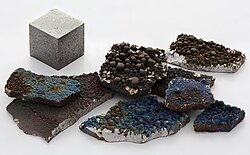
Image: Manganese
Manganese (Mn)
25 Transition metal
5
Image: Technetium
Technetium (Tc)
43 Transition metal
6
Image: Rhenium bar
Rhenium (Re)
75 Transition metal
7 Bohrium (Bh)
107 Transition metal

Legend

primordial element
element by radioactive decay
synthetic element

Group 7, numbered by IUPAC nomenclature, is a group of elements in the periodic table. It contains manganese (Mn), technetium (Tc), rhenium (Re) and bohrium (Bh). This group lies in the d-block of the periodic table, and are hence transition metals. This group is sometimes called the manganese group or manganese family after its lightest member; however, the group itself has not acquired a trivial name because it belongs to the broader grouping of the transition metals.

The group 7 elements tend to have a major group oxidation state (+7), although this trend is markedly less coherent than the previous groups. Like other groups, the members of this family show patterns in their electron configurations, especially the outermost shells resulting in trends in chemical behavior. In nature, manganese is a fairly common element, whereas rhenium is rare, technetium only occurs in trace quantities, and bohrium is entirely synthetic.

Physical properties

[edit]

The trends in group 7 follow, although less noticeably, those of the other early d-block groups and reflect the addition of a filled f-shell into the core in passing from the fifth to the sixth period. All group 7 elements crystallize in the hexagonal close packed (hcp) structure except manganese, which crystallizes in the body centered cubic (bcc) structure. Bohrium is also expected to crystallize in the hcp structure.[1]

The table below is a summary of the key physical properties of the group 7 elements. The question-marked value is predicted.[2]

Properties of the group 7 elements
Name Mn, manganese Tc, technetium Re, rhenium Bh, bohrium
Melting point 1519 K (1246 °C) 2430 K (2157 °C) 3459 K (3186 °C) Unknown
Boiling point 2334 K (2061 °C) 4538 K (4265 °C) 5903 K (5630 °C) Unknown
Density 7.21 g·cm−3 11 g·cm−3 21.02 g·cm−3 26-27 g·cm−3?[3][4]
Appearance silvery metallic silvery-gray silvery-gray Unknown
Atomic radius 127 pm 136 pm 137 pm 128 pm?[2]

Chemical properties

[edit]

Like other groups, the members of this family show patterns in its electron configuration, especially the outermost shells:

Z Element Electrons per shell
25 manganese 2, 8, 13, 2
43 technetium 2, 8, 18, 13, 2
75 rhenium 2, 8, 18, 32, 13, 2
107 bohrium 2, 8, 18, 32, 32, 13, 2

All the members of the group readily portray their group oxidation state of +7 and the state becomes more stable as the group is descended. Technetium also shows a stable +4 state whilst rhenium exhibits stable +4 and +3 states.

Bohrium may therefore also show these lower states as well. The higher +7 oxidation state is more likely to exist in oxyanions, such as perbohrate, BhO4, analogous to the lighter permanganate, pertechnetate, and perrhenate. Nevertheless, bohrium(VII) is likely to be unstable in aqueous solution, and would probably be easily reduced to the more stable bohrium(IV).[5]

Compounds

[edit]

Oxides

[edit]

Manganese

[edit]
Manganese(IV) oxide

Manganese forms a variety of oxides: MnO, Mn3O4, Mn2O3, MnO2, MnO3 and Mn2O7. Manganese(II) oxide is an inorganic compound that forms green crystals. Like many monoxides, MnO adopts the rock salt structure, where cations and anions are both octahedrally coordinated. Also like many oxides, manganese(II) oxide is often nonstoichiometric: its composition can vary from MnO to MnO1.045.[6] Manganese(II,III) oxide is formed when any manganese oxide is heated in air above 1000 °C.[6] Considerable research has centred on producing nanocrystalline Mn3O4 and various syntheses that involve oxidation of MnII or reduction of MnVI.[7][8][9] Manganese(III) oxide is unlike many other transition metal oxides in that it does not adopt the corundum (Al2O3) structure.[6] Two forms are generally recognized, α-Mn2O3 and γ-Mn2O3,[10] although a high pressure form with the CaIrO3 structure has been reported too.[11] Manganese(IV) oxide is a blackish or brown solid occurs naturally as the mineral pyrolusite, which is the main ore of manganese and a component of manganese nodules. The principal use for MnO2 is for dry-cell batteries, such as the alkaline battery and the zinc–carbon battery.[6] Manganese(VII) oxide is dark green in its crystalline form. The liquid is green by reflected light and red by transmitted light.[12] It is soluble in carbon tetrachloride, and decomposes when in contact with water.

Technetium

[edit]
Technetium(IV) oxide

Technetium's main oxides are technetium(IV) oxide and technetium(VII) oxide. Technetium(IV) oxide was first produced in 1949 by electrolyzing a solution of ammonium pertechnetate under ammonium hydroxide. It has often been used to separate technetium from molybdenum and rhenium.[13][14][15] More efficient ways are the reduction of ammonium pertechnetate by zinc metal and hydrochloric acid, stannous chloride, hydrazine, hydroxylamine, ascorbic acid,[14] by the hydrolysis of potassium hexachlorotechnetate[16] or by the decomposition of ammonium pertechnetate at 700 °C under an inert atmosphere.[13][17][18] It reacts with oxygen to produce technetium(VII) oxide at 450 °C.

Technetium(VII) oxide can be prepared directly by the oxidation of technetium at 450-500 °C.[19] It is a rare example of a molecular binary metal oxide. Other examples are ruthenium(VIII) oxide and osmium(VIII) oxide. It adopts a centrosymmetric corner-shared bi-tetrahedral structure in which the terminal and bridging Tc−O bonds are 167pm and 184 pm respectively and the Tc−O−Tc angle is 180°.[20]

Rhenium

[edit]

Rhenium's main oxides are rhenium(IV) oxide and rhenium(VII) oxide. Rhenium(IV) oxide is a gray to black crystalline solid that can be formed by comproportionation.[21] At high temperatures it undergoes disproportionation. It is a laboratory reagent that can be used as a catalyst. It adopts the rutile structure. It forms perrhenates with alkaline hydrogen peroxide and oxidizing acids.[22] In molten sodium hydroxide it forms sodium rhenate:[23]

2 NaOH + ReO2 → Na2ReO3 + H2O

Rhenium(VII) oxide can be formed when rhenium or its oxides or sulfides are oxidized a 500-700 °C in air.[24] It dissolves in water to give perrhenic acid. Heating Re2O7 gives rhenium(IV) oxide, signalled by the appearance of the dark blue coloration.[25] In its solid form, Re2O7 consists of alternating octahedral and tetrahedral Re centres. It is the raw material for all rhenium compounds, being the volatile fraction obtained upon roasting the host ore.[26]

Rhenium, in addition to the +4 and +7 oxidation states, also forms a trioxide. It can be formed by reducing rhenium(VII) oxide with carbon monoxide at 200 C or elemental rhenium at 4000 C.[27] It can also be reduced with dioxane.[28] It is a red solid with a metallic lustre that resembles copper in appearance, and is the only stable trioxide of the group 7 elements.

Halides

[edit]

Manganese

[edit]

Manganese can form compounds in the +2, +3 and +4 oxidation states. The manganese(II) compounds are often light pink solids. Like some other metal difluorides, MnF2 crystallizes in the rutile structure, which features octahedral Mn centers.[29] and it is used in the manufacture of special kinds of glass and lasers.[30] Scacchite is the natural, anhydrous form of manganese(II) chloride.[31] The only other currently known mineral systematized as manganese chloride is kempite - a representative of the atacamite group, a group of hydroxide-chlorides.[32] It can be used in place of palladium in the Stille reaction, which couples two carbon atoms using an organotin compound.[33] It can be used as a pink pigment or as a source of the manganese ion or iodide ion. It is often used in the lighting industry.[33]

Technetium

[edit]

The following binary (containing only two elements) technetium halides are known: TcF6, TcF5, TcCl4, TcBr4, TcBr3, α-TcCl3, β-TcCl3, TcI3, α-TcCl2, and β-TcCl2. The oxidation states range from Tc(VI) to Tc(II). Technetium halides exhibit different structure types, such as molecular octahedral complexes, extended chains, layered sheets, and metal clusters arranged in a three-dimensional network.[34][35] These compounds are produced by combining the metal and halogen or by less direct reactions.

TcCl4 is obtained by chlorination of Tc metal or Tc2O7 Upon heating, TcCl4 gives the corresponding Tc(III) and Tc(II) chlorides.[35]

TcCl4 → α-TcCl3 + 1/2 Cl2
TcCl3 → β-TcCl2 + 1/2 Cl2

The structure of TcCl4 is composed of infinite zigzag chains of edge-sharing TcCl6 octahedra. It is isomorphous to transition metal tetrachlorides of zirconium, hafnium, and platinum.[35]

Chloro-containing coordination complexes of technetium (Tc-99) in various oxidation states: Tc(III), Tc(IV), Tc(V), and Tc(VI) represented.

Two polymorphs of technetium trichloride exist, α- and β-TcCl3. The α polymorph is also denoted as Tc3Cl9. It adopts a confacial bioctahedral structure.[36] It is prepared by treating the chloro-acetate Tc2(O2CCH3)4Cl2 with HCl. Like Re3Cl9, the structure of the α-polymorph consists of triangles with short M-M distances. β-TcCl3 features octahedral Tc centers, which are organized in pairs, as seen also for molybdenum trichloride. TcBr3 does not adopt the structure of either trichloride phase. Instead it has the structure of molybdenum tribromide, consisting of chains of confacial octahedra with alternating short and long Tc—Tc contacts. TcI3 has the same structure as the high temperature phase of TiI3, featuring chains of confacial octahedra with equal Tc—Tc contacts.[35]

Several anionic technetium halides are known. The binary tetrahalides can be converted to the hexahalides [TcX6]2− (X = F, Cl, Br, I), which adopt octahedral molecular geometry.[37] More reduced halides form anionic clusters with Tc–Tc bonds. The situation is similar for the related elements of Mo, W, Re. These clusters have the nuclearity Tc4, Tc6, Tc8, and Tc13. The more stable Tc6 and Tc8 clusters have prism shapes where vertical pairs of Tc atoms are connected by triple bonds and the planar atoms by single bonds. Every technetium atom makes six bonds, and the remaining valence electrons can be saturated by one axial and two bridging ligand halogen atoms such as chlorine or bromine.[38]

Rhenium

[edit]

The most common rhenium chlorides are ReCl6, ReCl5, ReCl4, and ReCl3.[6] The structures of these compounds often feature extensive Re-Re bonding, which is characteristic of this metal in oxidation states lower than VII. Salts of [Re2Cl8]2− feature a quadruple metal-metal bond. Although the highest rhenium chloride features Re(VI), fluorine gives the d0 Re(VII) derivative rhenium heptafluoride. Bromides and iodides of rhenium are also well known.

Like tungsten and molybdenum, with which it shares chemical similarities, rhenium forms a variety of oxyhalides. The oxychlorides are most common, and include ReOCl4, ReOCl3.

Organometallic compounds

[edit]

Manganese

[edit]

Organomanganese compounds were first reported in 1937 by Gilman and Bailee who described the reaction of phenyllithium and manganese(II) iodide to form phenylmanganese iodide (PhMnI) and diphenylmanganese (Ph2Mn).[39]

Following this precedent, other organomanganese halides can be obtained by alkylation of manganese(II) chloride, manganese(II) bromide, and manganese(II) iodide. Manganese iodide is attractive because the anhydrous compound can be prepared in situ from manganese and iodine in ether. Typical alkylating agents are organolithium or organomagnesium compounds.

The chemistry of organometallic compounds of Mn(II) are unusual among the transition metals due to the high ionic character of the Mn(II)-C bond.[40] The reactivity of organomanganese compounds can be compared to that of organomagnesium and organozinc compounds. The electronegativity of Mn (1.55) is comparable to that of Mg (1.31) and Zn (1.65), making the carbon atom (EN = 2.55) nucleophilic. The reduction potential of Mn is also intermediate between Mg and Zn.

Technetium

[edit]
Technetium (99mTc) sestamibi ("Cardiolite") is widely used for imaging of the heart.

Technetium forms a variety of coordination complexes with organic ligands. Many have been well-investigated because of their relevance to nuclear medicine.[41]

Technetium forms a variety of compounds with Tc–C bonds, i.e. organotechnetium complexes. Prominent members of this class are complexes with CO, arene, and cyclopentadienyl ligands.[42] The binary carbonyl Tc2(CO)10 is a white volatile solid.[43] In this molecule, two technetium atoms are bound to each other; each atom is surrounded by octahedra of five carbonyl ligands. The bond length between technetium atoms, 303 pm,[44][45] is significantly larger than the distance between two atoms in metallic technetium (272 pm). Similar carbonyls are formed by technetium's congeners, manganese and rhenium.[46] Interest in organotechnetium compounds has also been motivated by applications in nuclear medicine.[42] Unusual for other metal carbonyls, Tc forms aquo-carbonyl complexes, prominent being [Tc(CO)3(H2O)3]+.[42]

Rhenium

[edit]

Dirhenium decacarbonyl is the most common entry to organorhenium chemistry. Its reduction with sodium amalgam gives Na[Re(CO)5] with rhenium in the formal oxidation state −1.[47] Dirhenium decacarbonyl can be oxidised with bromine to bromopentacarbonylrhenium(I):[48]

Re2(CO)10 + Br2 → 2 Re(CO)5Br

Reduction of this pentacarbonyl with zinc and acetic acid gives pentacarbonylhydridorhenium:[49]

Re(CO)5Br + Zn + HOAc → Re(CO)5H + ZnBr(OAc)

Methylrhenium trioxide ("MTO"), CH3ReO3 is a volatile, colourless solid has been used as a catalyst in some laboratory experiments. It can be prepared by many routes, a typical method is the reaction of Re2O7 and tetramethyltin:

Re2O7 + (CH3)4Sn → CH3ReO3 + (CH3)3SnOReO3

Analogous alkyl and aryl derivatives are known. MTO catalyses for the oxidations with hydrogen peroxide. Terminal alkynes yield the corresponding acid or ester, internal alkynes yield diketones, and alkenes give epoxides. MTO also catalyses the conversion of aldehydes and diazoalkanes into an alkene.[50]

Polyoxometalates

[edit]

The polyoxotechnetate (polyoxometalate of technetium) contains both Tc(V) and Tc(VII) in ratio 4: 16 and is obtained as the hydronium salt [H7O3]4[Tc20O68]·4H2O by concentrating an HTcO4 solution.[51] The first empirically isolated polyoxorhenate was the white [Re4O15]2− and contained Re(VII) in both octahedral and tetrahedral coordination.[52]

History

[edit]

Manganese

[edit]

Manganese dioxide, which is abundant in nature, has long been used as a pigment. The cave paintings in Gargas that are 30,000 to 24,000 years old are made from the mineral form of MnO2 pigments.[53] Manganese compounds were used by Egyptian and Roman glassmakers, either to add to, or remove, color from glass.[54] Use as "glassmakers soap" continued through the Middle Ages until modern times and is evident in 14th-century glass from Venice.[55]

Technetium and rhenium

[edit]

Rhenium (Latin: Rhenus meaning: "Rhine")[56] was the last-discovered of the elements that have a stable isotope (other new elements discovered in nature since then, such as francium, are radioactive).[57] The existence of a yet-undiscovered element at this position in the periodic table had been first predicted by Dmitri Mendeleev. Other calculated information was obtained by Henry Moseley in 1914.[58] In 1908, Japanese chemist Masataka Ogawa announced that he had discovered the 43rd element and named it nipponium (Np) after Japan (Nippon in Japanese). In fact, what he had was rhenium (element 75), not technetium.[59][60] The symbol Np was later used for the element neptunium, and the name "nihonium", also named after Japan, along with symbol Nh, was later used for element 113. Element 113 was also discovered by a team of Japanese scientists and was named in respectful homage to Ogawa's work.[61]

Rhenium was rediscovered by Walter Noddack, Ida Noddack, and Otto Berg in Germany. In 1925 they reported that they had detected the element in platinum ore and in the mineral columbite. They also found rhenium in gadolinite and molybdenite.[62] In 1928 they were able to extract 1 g of the element by processing 660 kg of molybdenite.[63] It was estimated in 1968 that 75% of the rhenium metal in the United States was used for research and the development of refractory metal alloys. It took several years from that point before the superalloys became widely used.[64][65]

The discovery of element 43 was finally confirmed in a 1937 experiment at the University of Palermo in Sicily by Carlo Perrier and Emilio Segrè.[66] In mid-1936, Segrè visited the United States, first Columbia University in New York and then the Lawrence Berkeley National Laboratory in California. He persuaded cyclotron inventor Ernest Lawrence to let him take back some discarded cyclotron parts that had become radioactive. Lawrence mailed him a molybdenum foil that had been part of the deflector in the cyclotron.[67]

Bohrium

[edit]

Two groups claimed discovery of the element bohrium. Evidence of bohrium was first reported in 1976 by a Soviet research team led by Yuri Oganessian, in which targets of bismuth-209 and lead-208 were bombarded with accelerated nuclei of chromium-54 and manganese-55 respectively.[68] Two activities, one with a half-life of one to two milliseconds, and the other with an approximately five-second half-life, were seen. Since the ratio of the intensities of these two activities was constant throughout the experiment, it was proposed that the first was from the isotope bohrium-261 and that the second was from its daughter dubnium-257. Later, the dubnium isotope was corrected to dubnium-258, which indeed has a five-second half-life (dubnium-257 has a one-second half-life); however, the half-life observed for its parent is much shorter than the half-lives later observed in the definitive discovery of bohrium at Darmstadt in 1981. The IUPAC/IUPAP Transfermium Working Group (TWG) concluded that while dubnium-258 was probably seen in this experiment, the evidence for the production of its parent bohrium-262 was not convincing enough.[69]

In 1981, a German research team led by Peter Armbruster and Gottfried Münzenberg at the GSI Helmholtz Centre for Heavy Ion Research (GSI Helmholtzzentrum für Schwerionenforschung) in Darmstadt bombarded a target of bismuth-209 with accelerated nuclei of chromium-54 to produce five atoms of the isotope bohrium-262:[70]

209
83
Bi
+ 54
24
Cr
262
107
Bh
+ n

This discovery was further substantiated by their detailed measurements of the alpha decay chain of the produced bohrium atoms to previously known isotopes of fermium and californium. The IUPAC/IUPAP Transfermium Working Group (TWG) recognised the GSI collaboration as official discoverers in their 1992 report.[69]

Occurrence and production

[edit]

Manganese

[edit]

Manganese comprises about 1000 ppm (0.1%) of the Earth's crust and is the 12th most abundant element.[71] Soil contains 7–9000 ppm of manganese with an average of 440 ppm.[71] The atmosphere contains 0.01 μg/m3.[71] Manganese occurs principally as pyrolusite (MnO2), braunite (Mn2+Mn3+6)(SiO12),[72] psilomelane (Ba,H2O)2Mn5O10, and to a lesser extent as rhodochrosite (MnCO3).

Percentage of manganese output in 2006 by countries[73]

The most important manganese ore is pyrolusite (MnO2). Other economically important manganese ores usually show a close spatial relation to the iron ores, such as sphalerite.[74][75] Land-based resources are large but irregularly distributed. About 80% of the known world manganese resources are in South Africa; other important manganese deposits are in Ukraine, Australia, India, China, Gabon and Brazil.[73] According to 1978 estimate, the ocean floor has 500 billion tons of manganese nodules.[76] Attempts to find economically viable methods of harvesting manganese nodules were abandoned in the 1970s.[77]

In South Africa, most identified deposits are located near Hotazel in the Northern Cape Province, with a 2011 estimate of 15 billion tons. In 2011 South Africa produced 3.4 million tons, topping all other nations.[78]

Manganese is mainly mined in South Africa, Australia, China, Gabon, Brazil, India, Kazakhstan, Ghana, Ukraine and Malaysia.[79]

For the production of ferromanganese, the manganese ore is mixed with iron ore and carbon, and then reduced either in a blast furnace or in an electric arc furnace.[80] The resulting ferromanganese has a manganese content of 30 to 80%.[74] Pure manganese used for the production of iron-free alloys is produced by leaching manganese ore with sulfuric acid and a subsequent electrowinning process.[81]

Contains reactions and temperatures, as well as showing advanced processes such as the heat exchanger and milling process.
Process flow diagram for a manganese refining circuit.

A more progressive extraction process involves directly reducing (a low grade) manganese ore in a heap leach. This is done by percolating natural gas through the bottom of the heap; the natural gas provides the heat (needs to be at least 850 °C) and the reducing agent (carbon monoxide). This reduces all of the manganese ore to manganese oxide (MnO), which is a leachable form. The ore then travels through a grinding circuit to reduce the particle size of the ore to between 150 and 250 μm, increasing the surface area to aid leaching. The ore is then added to a leach tank of sulfuric acid and ferrous iron (Fe2+) in a 1.6:1 ratio. The iron reacts with the manganese dioxide (MnO2) to form iron(III) oxide-hydroxide (FeO(OH)) and elemental manganese (Mn):

This process yields approximately 92% recovery of the manganese. For further purification, the manganese can then be sent to an electrowinning facility.[82]

In 1972 the CIA's Project Azorian, through billionaire Howard Hughes, commissioned the ship Hughes Glomar Explorer with the cover story of harvesting manganese nodules from the sea floor.[83] That triggered a rush of activity to collect manganese nodules, which was not actually practical. The real mission of Hughes Glomar Explorer was to raise a sunken Soviet submarine, the K-129, with the goal of retrieving Soviet code books.[84]

An abundant resource of manganese in the form of Mn nodules found on the ocean floor.[85][86] These nodules, which are composed of 29% manganese,[87] are located along the ocean floor and the potential impact of mining these nodules is being researched. Physical, chemical, and biological environmental impacts can occur due to this nodule mining disturbing the seafloor and causing sediment plumes to form. This suspension includes metals and inorganic nutrients, which can lead to contamination of the near-bottom waters from dissolved toxic compounds. Mn nodules are also the grazing grounds, living space, and protection for endo- and epifaunal systems. When theses nodules are removed, these systems are directly affected. Overall, this can cause species to leave the area or completely die off.[88] Prior to the commencement of the mining itself, research is being conducted by United Nations affiliated bodies and state-sponsored companies in an attempt to fully understand environmental impacts in the hopes of mitigating these impacts.[89]

Technetium

[edit]

Technetium was created by bombarding molybdenum atoms with deuterons that had been accelerated by a device called a cyclotron. Technetium occurs naturally in the Earth's crust in minute concentrations of about 0.003 parts per trillion. Technetium is so rare because the half-lives of 97Tc and 98Tc are only 4.2 million years. More than a thousand of such periods have passed since the formation of the Earth, so the probability of survival of even one atom of primordial technetium is effectively zero. However, small amounts exist as spontaneous fission products in uranium ores. A kilogram of uranium contains an estimated 1 nanogram (10−9 g) equivalent to ten trillion atoms of technetium.[90][91][92] Some red giant stars with the spectral types S-, M-, and N contain a spectral absorption line indicating the presence of technetium.[93][94] These red giants are known informally as technetium stars.

Rhenium

[edit]
Molybdenite

Rhenium is one of the rarest elements in Earth's crust with an average concentration of 1 ppb;[6][95] other sources quote the number of 0.5 ppb making it the 77th most abundant element in Earth's crust.[96] Rhenium is probably not found free in nature (its possible natural occurrence is uncertain), but occurs in amounts up to 0.2%[6] in the mineral molybdenite (which is primarily molybdenum disulfide), the major commercial source, although single molybdenite samples with up to 1.88% have been found.[97] Chile has the world's largest rhenium reserves, part of the copper ore deposits, and was the leading producer as of 2005.[98] It was only recently that the first rhenium mineral was found and described (in 1994), a rhenium sulfide mineral (ReS2) condensing from a fumarole on Kudriavy volcano, Iturup island, in the Kuril Islands.[99] Kudriavy discharges up to 20–60 kg rhenium per year mostly in the form of rhenium disulfide.[100][101] Named rheniite, this rare mineral commands high prices among collectors.[102]

Ammonium perrhenate

Most of the rhenium extracted comes from porphyry molybdenum deposits.[103] These ores typically contain 0.001% to 0.2% rhenium.[6] Roasting the ore volatilizes rhenium oxides.[97] Rhenium(VII) oxide and perrhenic acid readily dissolve in water; they are leached from flue dusts and gasses and extracted by precipitating with potassium or ammonium chloride as the perrhenate salts, and purified by recrystallization.[6] Total world production is between 40 and 50 tons/year; the main producers are in Chile, the United States, Peru, and Poland.[104] Recycling of used Pt-Re catalyst and special alloys allow the recovery of another 10 tons per year. Prices for the metal rose rapidly in early 2008, from $1000–$2000 per kg in 2003–2006 to over $10,000 in February 2008.[105][106] The metal form is prepared by reducing ammonium perrhenate with hydrogen at high temperatures:[25]

2 NH4ReO4 + 7 H2 → 2 Re + 8 H2O + 2 NH3
There are technologies for the associated extraction of rhenium from productive solutions of underground leaching of uranium ores.[107]

Bohrium

[edit]

Bohrium is a synthetic element that does not occur in nature. Very few atoms have been synthesized, and also due to its radioactivity, only limited research has been conducted. Bohrium is only produced in nuclear reactors and has never been isolated in pure form.

Applications

[edit]
Structure of the facial isomer of M(R-bpy)(CO)3X where M = Mn, Re; X = Cl, Br; R-bpy = 4,4'-disubstituted-2,2'-bipyridine

The facial isomer of both rhenium and manganese 2,2'-bipyridyl tricarbonyl halide complexes have been extensively researched as catalysts for electrochemical carbon dioxide reduction due to their high selectivity and stability. They are commonly abbreviated as M(R-bpy)(CO)3X where M = Mn, Re; R-bpy = 4,4'-disubstituted 2,2'-bipyridine; and X = Cl, Br.

Manganese

[edit]

The rarity of rhenium has shifted research toward the manganese version of these catalysts as a more sustainable alternative.[108] The first reports of catalytic activity of Mn(R-bpy)(CO)3Br towards CO2 reduction came from Chardon-Noblat and coworkers in 2011.[109] Compared to Re analogs, Mn(R-bpy)(CO)3Br shows catalytic activity at lower overpotentials.[110]

The catalytic mechanism for Mn(R-bpy)(CO)3X is complex and depends on the steric profile of the bipyridine ligand. When R is not bulky, the catalyst dimerizes to form [Mn(R-bpy)(CO)3]2 before forming the active species. When R is bulky, however, the complex forms the active species without dimerizing, reducing the overpotential of CO2 reduction by 200-300 mV. Unlike Re(R-bpy)(CO)3X, Mn(R-bpy)(CO)3X only reduces CO2 in the presence of an acid.[110]

Technetium

[edit]
Upper image: two drop-like features merged at their bottoms; they have a yellow centre and a red rim on a black background. Caption: Graves' Disease Tc-Uptake 16%. Lower image: red dots on black background. Caption: 250 Gy (30mCi) + Prednison.
Technetium scintigraphy of a neck of Graves' disease patient

Technetium-99m ("m" indicates that this is a metastable nuclear isomer) is used in radioactive isotope medical tests. For example, Technetium-99m is a radioactive tracer that medical imaging equipment tracks in the human body.[90][111][112] It is well suited to the role because it emits readily detectable 140 keV gamma rays, and its half-life is 6.01 hours (meaning that about 94% of it decays to technetium-99 in 24 hours).[113] The chemistry of technetium allows it to be bound to a variety of biochemical compounds, each of which determines how it is metabolized and deposited in the body, and this single isotope can be used for a multitude of diagnostic tests. More than 50 common radiopharmaceuticals are based on technetium-99m for imaging and functional studies of the brain, heart muscle, thyroid, lungs, liver, gall bladder, kidneys, skeleton, blood, and tumors.[114] Technetium-99m is also used in radioimaging.[115]

The longer-lived isotope, technetium-95m with a half-life of 61 days, is used as a radioactive tracer to study the movement of technetium in the environment and in plant and animal systems.[116]

Technetium-99 decays almost entirely by beta decay, emitting beta particles with consistent low energies and no accompanying gamma rays. Moreover, its long half-life means that this emission decreases very slowly with time. It can also be extracted to a high chemical and isotopic purity from radioactive waste. For these reasons, it is a National Institute of Standards and Technology (NIST) standard beta emitter, and is used for equipment calibration.[117] Technetium-99 has also been proposed for optoelectronic devices and nanoscale nuclear batteries.[118]

Like rhenium and palladium, technetium can serve as a catalyst. In processes such as the dehydrogenation of isopropyl alcohol, it is a far more effective catalyst than either rhenium or palladium. However, its radioactivity is a major problem in safe catalytic applications.[119]

When steel is immersed in water, adding a small concentration (55 ppm) of potassium pertechnetate(VII) to the water protects the steel from corrosion, even if the temperature is raised to 250 °C (523 K).[120] For this reason, pertechnetate has been used as an anodic corrosion inhibitor for steel, although technetium's radioactivity poses problems that limit this application to self-contained systems.[121] While (for example) CrO2−
4
can also inhibit corrosion, it requires a concentration ten times as high. In one experiment, a specimen of carbon steel was kept in an aqueous solution of pertechnetate for 20 years and was still uncorroded.[120] The mechanism by which pertechnetate prevents corrosion is not well understood, but seems to involve the reversible formation of a thin surface layer (passivation). One theory holds that the pertechnetate reacts with the steel surface to form a layer of technetium dioxide which prevents further corrosion; the same effect explains how iron powder can be used to remove pertechnetate from water. The effect disappears rapidly if the concentration of pertechnetate falls below the minimum concentration or if too high a concentration of other ions is added.[122]

As noted, the radioactive nature of technetium (3 MBq/L at the concentrations required) makes this corrosion protection impractical in almost all situations. Nevertheless, corrosion protection by pertechnetate ions was proposed (but never adopted) for use in boiling water reactors.[122]

Rhenium

[edit]

The catalytic activity of Re(bpy)(CO)3Cl for carbon dioxide reduction was first studied by Lehn et al.[123] and Meyer et al.[124] in 1984 and 1985, respectively. Re(R-bpy)(CO)3X complexes exclusively produce CO from CO2 reduction with Faradaic efficiencies of close to 100% even in solutions with high concentrations of water or Brønsted acids.[108]

The catalytic mechanism of Re(R-bpy)(CO)3X involves reduction of the complex twice and loss of the X ligand to generate a five-coordinate active species which binds CO2. These complexes will reduce CO2 both with and without an additional acid present; however, the presence of an acid increases catalytic activity.[108] The high selectivity of these complexes to CO2 reduction over the competing hydrogen evolution reaction has been shown by density functional theory studies to be related to the faster kinetics of CO2 binding compared to H+ binding.[110]

Bohrium

[edit]

Bohrium is a synthetic element and is too radioactive to be used in anything.

Toxicity and precautions

[edit]

Manganese compounds are less toxic than those of other widespread metals, such as nickel and copper.[125] However, exposure to manganese dusts and fumes should not exceed the ceiling value of 5 mg/m3 even for short periods because of its toxicity level.[126] Manganese poisoning has been linked to impaired motor skills and cognitive disorders.[127]

Technetium has low chemical toxicity. For example, no significant change in blood formula, body and organ weights, and food consumption could be detected for rats which ingested up to 15 μg of technetium-99 per gram of food for several weeks.[128] In the body, technetium quickly gets converted to the stable TcO
4
ion, which is highly water-soluble and quickly excreted. The radiological toxicity of technetium (per unit of mass) is a function of compound, type of radiation for the isotope in question, and the isotope's half-life.[129] However, it is radioactive, so all isotopes must be handled carefully. The primary hazard when working with technetium is inhalation of dust; such radioactive contamination in the lungs can pose a significant cancer risk. For most work, careful handling in a fume hood is sufficient, and a glove box is not needed.[130]

Very little is known about the toxicity of rhenium and its compounds because they are used in very small amounts. Soluble salts, such as the rhenium halides or perrhenates, could be hazardous due to elements other than rhenium or due to rhenium itself.[131] Only a few compounds of rhenium have been tested for their acute toxicity; two examples are potassium perrhenate and rhenium trichloride, which were injected as a solution into rats. The perrhenate had an LD50 value of 2800 mg/kg after seven days (this is very low toxicity, similar to that of table salt) and the rhenium trichloride showed LD50 of 280 mg/kg.[132]

Biological role

[edit]

Of the group 7 elements, only manganese has a role in the human body. It is an essential trace nutrient, with the body containing approximately 10 milligrams at any given time. It is present as a coenzyme in biological processes that include macronutrient metabolism, bone formation, and free radical defense systems. It is a critical component in dozens of proteins and enzymes.[133] The manganese in the human body is mainly concentrated in the bones, and the soft tissue remainder is concentrated in the liver and kidneys.[134] In the human brain, the manganese is bound to manganese metalloproteins, most notably glutamine synthetase in astrocytes.[135] Technetium, rhenium, and bohrium have no known biological roles. Technetium is, however, used in radioimaging.

References

[edit]
Revisions and contributorsEdit on WikipediaRead on Wikipedia
from Grokipedia
Group 7 of the periodic table, numbered according to IUPAC nomenclature, comprises the transition metals (atomic number 25), (43), (75), and (107). These elements occupy consecutive periods from 4 to 7 in the d-block and share an outer of ns²(n-1)d⁵, which imparts similar chemical behaviors including variable oxidation states up to +7 and a tendency to form complex ions. The physical properties of Group 7 elements exhibit a trend typical of transition metals, with increasing , , and points down the group due to stronger from additional electron shielding and relativistic effects in heavier members. has a of 7.3 g/cm³, a of 1246°C, and a of 2061°C, while is denser at 11 g/cm³ with higher (2157°C) and (4262°C) points; is notably dense (20.8 g/cm³) with an exceptionally high of 3185°C and of 5590°C, making it one of the most . Bohrium's physical properties remain experimentally undetermined, though theoretical predictions suggest it behaves as a typical Group 7 metal with similar trends. Chemically, these elements are reactive metals that readily form compounds across a range of oxidation states, from +2 to +7, with +7 being the highest for all due to the availability of seven valence electrons. and display catalytic properties in oxidation reactions, while 's limits its reactivity studies but confirms its placement in the group through and formation analogous to and . , synthesized in particle accelerators, has been observed to form volatile bromides, supporting its predicted Group 7 chemistry. In terms of occurrence, is relatively abundant in (about 0.1%) and found primarily in minerals like pyrolusite, whereas is the lightest element with no stable isotopes and occurs only in trace amounts from fission. is one of the rarest stable elements (about 1 ppb in crust), extracted as a of , and is entirely artificial, produced in laboratories since 1981 with only a handful of atoms ever synthesized. Applications of Group 7 elements leverage their unique properties: is essential in production for and alloying (over 90% of global use), and vital in biological enzymes like . is widely used in due to its gamma emission and short . enhances high-temperature alloys for jet engines and superalloys, while serves solely in scientific research to probe behavior. None have significant known biological roles beyond 's essential trace nutrient status.

Characteristics

Physical properties

The Group 7 elements exhibit trends in physical properties influenced by increasing atomic number and the lanthanide contraction, leading to denser packing and stronger metallic bonding down the group. Manganese, technetium, rhenium, and the superheavy bohrium display atomic radii that increase slightly from manganese to technetium, then decrease from technetium to rhenium and bohrium due to lanthanide and actinide contractions and relativistic effects. The covalent atomic radius of manganese is 139 pm (low spin), technetium 147 pm, and rhenium 151 pm, with bohrium predicted at approximately 141 pm. Thermodynamic properties show a marked increase in stability and high-temperature behavior from manganese to rhenium. Manganese has the lowest melting point at 1246 °C and boiling point at 2061 °C, while technetium melts at 2157 °C and boils at 4262 °C, and rhenium exhibits one of the highest melting points among elements at 3185 °C and boiling point at 5590 °C. Bohrium's melting point is predicted to be around 1800 °C, reflecting continued strengthening of metallic bonds despite relativistic destabilization. Densities also rise significantly: manganese at 7.3 g/cm³, technetium at 11 g/cm³, rhenium at 20.8 g/cm³, and bohrium estimated at 26–27 g/cm³ due to enhanced electron density near the nucleus. First ionization energies remain relatively consistent, indicative of similar electron configurations across the group. Manganese requires 717 kJ/mol, 702 kJ/mol, 760 kJ/mol, and is predicted at about 743 kJ/mol, with a slight increase attributed to higher nuclear charge. Electrical and thermal conductivities increase down the group, from 's lower values—thermal conductivity of 7.8 W/(m·K) and electrical conductivity of approximately 6.9 × 10^5 S/m—to higher figures for (thermal 50.6 W/(m·K), electrical about 5 × 10^6 S/m) and (thermal 48 W/(m·K), electrical 5.6 × 10^6 S/m), reflecting more delocalized electrons and simpler structures in the heavier metals despite increasing density.
PropertyManganeseTechnetiumRheniumBohrium (predicted)
Melting point (°C)124621573185~1800
Boiling point (°C)206142625590Unknown
Density (g/cm³)7.31120.826–27
Thermal conductivity (W/(m·K))7.850.648Unknown
First ionization energy (kJ/mol)717702760~743
Structural properties vary, with manganese displaying complex allotropy due to its electronic instability. Manganese has at least five allotropes, including the room-temperature α-phase (complex cubic structure with 58 atoms per unit cell, space group I-43m), β-phase (tetragonal, stable 727–1100 °C), γ-phase (face-centered cubic, 1100–1138 °C), δ-phase (body-centered cubic, 1138–1246 °C), and ε-phase (hexagonal close-packed, under pressure). Technetium and rhenium adopt simpler hexagonal close-packed structures, with no stable allotropes observed under normal conditions; technetium's β-phase is theoretically predicted but not confirmed. Bohrium is expected to follow the hexagonal close-packed arrangement similar to technetium and rhenium.

Chemical properties

The group 7 elements— (Mn), (Tc), (Re), and (Bh)—share a common outer of ns2(n1)d5ns^2 (n-1)d^5, where nn is the principal of the valence shell, leading to similar chemical behaviors influenced by the half-filled d subshell. For Mn, the configuration is [\ceAr]3d54s2[\ce{Ar}] 3d^5 4s^2; for Tc, [\ceKr]4d55s2[\ce{Kr}] 4d^5 5s^2; for Re, [\ceXe]4f145d56s2[\ce{Xe}] 4f^{14} 5d^5 6s^2; and for Bh, [\ceRn]5f146d57s2[\ce{Rn}] 5f^{14} 6d^5 7s^2. These elements display a range of oxidation states from +2 to +7, with the +7 state corresponding to the group oxidation number and involving the formal loss of both s and d electrons. The +2 state is most for Mn, as seen in its common aqueous ions like \ceMn2+\ce{Mn^2+}, while higher states such as +7 in \ceMnO4\ce{MnO4-} () are strongly oxidizing and thermodynamically unstable in neutral or basic conditions. In contrast, the +7 state becomes increasingly stable down the group: pertechnetate (\ceTcO4\ce{TcO4-}) and perrhenate (\ceReO4\ce{ReO4-}) ions are notably more than , with Tc and Re exhibiting common +4, +5, and +7 states in aqueous solutions. For Bh, relativistic effects are predicted to further stabilize the +7 state relative to lower ones like +3, enhancing its similarity to lighter homologs despite its superheavy nature. Reactivity decreases down the group, reflecting increasing metallic character and . Manganese is highly reactive, tarnishing rapidly in moist air to form a surface layer such as \ceMnO2\ce{MnO2} and igniting when finely divided to produce \ceMn3O4\ce{Mn3O4}. and are less reactive; Tc tarnishes slowly in humid air without significant formation under ambient conditions, while Re develops a thin protective coating that passivates the metal against further oxidation. In aqueous environments, \ceMn2+\ce{Mn^2+} is stable and non-oxidizing, whereas Tc and Re favor higher oxidation states, with \ceTcO4\ce{TcO4-} and \ceReO4\ce{ReO4-} persisting in solution due to their resistance to reduction. The oxides of group 7 elements generally exhibit amphoteric behavior, dissolving in both acids and bases, though the tendency shifts toward greater basicity down the group for comparable oxidation states. For instance, \ceMnO\ce{MnO} is primarily basic, reacting with acids to form salts, while \ceMnO2\ce{MnO2} shows amphoterism by dissolving in strong acids to yield \ceMn2+\ce{Mn^2+} and in fused alkalies to form manganates; higher oxides like \ceMn2O7\ce{Mn2O7} are acidic. Rhenium oxides follow a similar pattern but with enhanced stability in higher states, where \ceReO3\ce{ReO3} displays amphoteric properties and \ceRe2O7\ce{Re2O7} is acidic, yet lower Re oxides exhibit more pronounced basic character than their Mn analogs. Redox behavior underscores these trends, with standard reduction potentials decreasing down the group, indicating progressively weaker oxidizing power for the +7 states. The \ceMnO4/Mn2+\ce{MnO4- / Mn^2+} couple has E=+1.51E^\circ = +1.51 V in acidic media, enabling \ceMnO4\ce{MnO4-} to oxidize water and decompose, whereas the corresponding \ceReO4/Re3+\ce{ReO4- / Re^3+} potential is approximately +1.0 V, reflecting greater stability of perrhenate. Pertechnetate lies between these, with its reduction to lower states (e.g., \ceTcO4/TcO2\ce{TcO4- / TcO2}) at about +0.74 V, consistent with intermediate reactivity.

Compounds

Oxides and oxoacids

Group 7 elements form a variety of oxides reflecting their multiple oxidation states, primarily +2 to +7, with the higher states becoming more stable down the group due to increasing atomic size and better accommodation of covalent in oxo species. exhibits the widest range, including MnO (+2 oxidation state), a green solid with a rock-salt structure that behaves as a , reacting with acids to form salts but not with bases. Mn₂O₃ (+3 state) is a red-brown solid often formed as an intermediate in oxidation processes. MnO₂ (+4 state), a black powder with rutile-type structure, is amphoteric, dissolving in strong acids to form or ions and in bases to form manganate(VI); it is widely used as a material in alkaline batteries due to its electrochemical stability and capacity for reversible reactions. The +7 oxide Mn₂O₇ is a dark brown, oily liquid that is highly explosive upon shock or heating, decomposing to MnO₂ and O₂, and it serves as the anhydride of . Technetium oxides are less common due to its radioactivity, but TcO₂ (+4 state) is a stable black solid with a rutile-type structure, resistant to further oxidation under ambient conditions. Tc₂O₇ (+7 state) is a yellow, volatile crystalline solid that sublimes readily and reacts with water to form pertechnetate ions (TcO₄⁻), which are stable in aqueous solution and exhibit weak oxidizing properties compared to permanganate. Rhenium forms ReO₃ (+6 state), a blue solid with a perovskite structure that displays metallic conductivity due to partially filled conduction bands, making it of interest for electroceramic applications. Re₂O₇ (+7 state) is the most stable rhenium oxide, appearing as yellow crystals that are highly hygroscopic and dissolve in water to yield perrhenate ions (ReO₄⁻), which are colorless and form stable salts used in catalysis. Like TcO₂, ReO₂ adopts a rutile-type structure, contributing to its stability. For the superheavy element bohrium, no pure oxides have been synthesized experimentally. Theoretical predictions suggest bohrium forms oxides in higher oxidation states analogous to . The only known compound of bohrium is the volatile oxychloride BhO₃Cl, formed in gas-phase experiments and exhibiting adsorption behavior consistent with group 7 chemistry. The corresponding oxoacids derive from the +7 oxides. (HMnO₄) is unstable in isolation, existing only in dilute purple solutions that decompose to MnO₂, O₂, and H₂O, catalyzed by the manganese dioxide product; it acts as a strong, one-electron oxidant. Pertechnic acid (HTcO₄) forms colorless solutions from Tc₂O₇ hydration and behaves as a monoprotic acid with pertechnetate ions showing moderate stability and oxidizing power. Perrhenic acid (HReO₄), in contrast, is a stable, colorless liquid obtained by dissolving Re₂O₇ in water, serving as a strong acid and precursor to perrhenate salts that are non-oxidizing under neutral conditions. A key trend in Group 7 is the increasing stability of the +7 oxidation state from Mn to Re, driven by stronger metal-oxygen bonds and reduced electron repulsion in larger orbitals, allowing higher oxides like M₂O₇ to persist without decomposition. Additionally, the MO₂ oxides for Tc and Re adopt the structure, reflecting their ionic-covalent character and thermal stability.

Halides

Group 7 elements form binary halides in oxidation states ranging from +2 to +7, with structures influenced by the metal's size, differences with the , and the tendency toward in higher oxidation states. Fluorides are generally more stable and volatile than the corresponding chlorides, bromides, and iodides due to stronger metal-fluorine bonds and lower lattice energies. tendencies vary, with lower valent halides like MnCl₂ being highly soluble in , while higher valent fluorides such as ReF₇ react vigorously. Manganese halides predominantly feature +2 and +3 oxidation states, with higher states like +4 limited to fluorides. Manganese(II) fluoride, MnF₂, adopts a rutile-type tetragonal structure (space group P4₂/mnm) and exhibits high-spin d⁵ configuration with S = 5/2, as confirmed by neutron scattering studies showing antiferromagnetic ordering below 67 K. Manganese(II) chloride, MnCl₂, is a high-spin d⁵ compound with a layered CdCl₂-type structure (rhombohedral, R-3m), highly soluble in water forming hydrated complexes. Higher oxidation state compounds include MnF₃, synthesized by oxidation of MnF₂ with F₂ in anhydrous HF at room temperature, which has a triclinic structure and is paramagnetic. MnF₄, obtained via photochemical oxidation of MnF₂ with F₂ under UV light in HF, crystallizes in a rhombohedral structure (R3c) and sublimes readily, highlighting the increased volatility of manganese fluorides compared to chlorides. Technetium halides show greater stability in +4 and +6 states. , TcF₆, is synthesized by direct fluorination of technetium metal at 400 °C and features an octahedral molecular structure, with body-centered cubic packing at (a = 6.16 ); it disproportionates in NaOH to TcO₂ and TcO₄⁻ and reacts with NO derivatives. TcCl₅ is not a binary compound, but related pentavalent species are rare; instead, TcCl₄ forms infinite zigzag chains of edge-sharing TcCl₆ octahedra (orthorhombic, Pbca) via chlorination of Tc metal at 450 °C and hydrolyzes to TcO₂ in . TcBr₄, prepared similarly with Br₂ at 400 °C, is isostructural to TcCl₄ with edge-sharing TcBr₆ octahedra and decomposes to TcBr₃ upon heating. TcI₄ is predicted to be polymeric but remains unsynthesized experimentally. Rhenium halides stabilize higher oxidation states, up to +7. Rhenium(VII) fluoride, ReF₇, unique among binary halides, is synthesized by fluorination of Re₂O₇ and adopts a pentagonal bipyramidal structure (monoclinic at low ), highly reactive with and volatile (sublimes at 250 °C). ReCl₅ exists as a dimer Re₂Cl₁₀ with two terminal and eight bridging chlorides, formed by chlorination of at 300–500 °C, and is paramagnetic with reactivity toward reduction to lower chlorides. The dirhenium(III) octachloride anion, [Re₂Cl₈]²⁻, features a Re-Re (2.24 ) in an eclipsed configuration, synthesized from ReCl₅ reduction, exemplifying strong metal-metal bonding in lower valent halides. For (Bh, element 107), no binary halides have been synthesized due to its short . Theoretical predictions suggest bohrium halides would be analogous to those of , with higher s stabilized by relativistic effects. The only known compound of bohrium is the volatile oxychloride BhO₃Cl. Across the group, higher halides become more stable from Mn to Re, with fluorides showing greater covalent bonding and volatility; increases with and fluorine content, as seen in the solubility of MnCl₂ versus the rapid reaction of ReF₇ with .

Organometallic compounds

Organometallic compounds of the group 7 elements (, , , and ) feature metal-carbon sigma bonds, often stabilized by pi-backbonding from d-orbitals to pi* orbitals, and commonly adhere to the for stability. These compounds, particularly metal carbonyls, exhibit increasing metal-metal bond strengths down the group due to enhanced orbital overlap and relativistic stabilization in heavier congeners. For , , Mn₂(CO)₁₀, consists of two square-pyramidal Mn(CO)₅ units linked by a direct Mn-Mn bond in a staggered D₄d conformation, with each Mn atom satisfying the via ten electrons from five CO ligands, seven from the d⁷ configuration, and one from the metal-metal interaction. This compound serves as a versatile precursor for other manganese carbonyl derivatives. Another notable manganese organometallic is methylcyclopentadienylmanganese tricarbonyl, (η⁵-CH₃C₅H₄)Mn(CO)₃, which obeys the and functions as an antiknock additive in unleaded to enhance . Technetium organometallics are relatively scarce owing to the element's , limiting synthetic exploration, yet ditechnetium decacarbonyl, Tc₂(CO)₁₀, mirrors the structure of its and analogues with a staggered Tc-Tc bond and adherence to the . Mononuclear pentacarbonyltechnetium iodide, Tc(CO)₅I, features a trigonal bipyramidal around Tc(I) and has been synthesized under ambient conditions as a halide-substituted carbonyl. In radiopharmaceutical applications, facial tricarbonyltechnetium complexes of the type fac-[Tc(CO)₃(L)₃] (where L represents bidentate or monodentate ligands) provide stable, bioorthogonal scaffolds for targeted imaging agents due to the robust Tc-C bonds and 18-electron saturation. Rhenium forms more thermally stable organometallics than its lighter homologues, exemplified by dirhenium decacarbonyl, Re₂(CO)₁₀, which displays a staggered Re-Re bond with greater strength than the Mn-Mn or Tc-Tc bonds (bond dissociation energy ~39 kcal/mol versus ~28 kcal/mol for Mn), again following the . Methyltrioxorhenium, CH₃ReO₃, a high-valent organorhenium , activates upon immobilization on acidic supports to catalyze , enabling efficient redistribution under mild conditions. Bohrium organometallics remain entirely theoretical, with no compounds synthesized. Relativistic quantum chemical predictions suggest volatile carbonyl complexes, potentially cationic species analogous to lighter group 7 elements but influenced by relativistic effects.

Coordination and cluster compounds

Coordination compounds of span a wide range of oxidation states, with the +2 state commonly forming octahedral complexes such as [Mn(H₂O)₆]²⁺, which adopts a high-spin d⁵ configuration with five unpaired electrons and a consistent with S = 5/2. Low-spin isomers of Mn(II) are rare and typically require strong-field ligands like CN⁻, but the aqua complex remains high-spin due to the weak-field nature of ligands. Polyoxomanganates represent an important class of polynuclear clusters, exemplified by the [Mn₄O₄]⁶⁺ core, which features a mixed-valence Mn(III)₃Mn(IV) arrangement with antiferromagnetic coupling between the metal centers, leading to single-molecule magnet behavior in certain derivatives. This structure mimics the in and assembles spontaneously from mononuclear precursors in the presence of oxo bridges. Technetium coordination chemistry is dominated by higher oxidation states due to its radioactivity limiting extensive studies, with Tc(III) favoring hexacoordinate geometries in phosphonite or ligands, forming stable octahedral complexes like [Tc(PEtPh₂O)₆]³⁺. Dimeric , such as the μ-oxo-bridged [Tc₂(μ-O)O₂L₄]²⁺ (where L is an aminocarboxylate ligand), exhibit Tc(V) centers with short Tc-O-Tc bridges and electronic delocalization, though no extensive polyoxotechnetates have been isolated owing to synthetic challenges and instability. Rhenium forms robust cluster compounds, including the triangular Re₃Cl₉ unit with a Re₃ core featuring multiple Re-Re bonds (average 2.47 ) and a delocalized nine-electron system, which serves as a precursor for substitution reactions while maintaining cluster integrity. Polyoxorhenates are less common than those of earlier groups but include rare Keggin-type structures like [ReW₁₁O₄₀]⁵⁻, where high-valent Re(VII) integrates into the framework, exhibiting electrochemical stability and potential catalytic applications despite limited examples. For bohrium, experimental data is scarce, but gas-phase studies of suggest volatility trends aligning with group 7 homologs, predicting stable +3 and +4 states in aqueous media. Theoretical predictions indicate simple aqua ions like [Bh(H₂O)₆]³⁺ with octahedral coordination, and potential halide clusters analogous to Re₃X₉, though relativistic effects may enhance ionic character and stability of lower oxidation states. The only known compound is the oxychloride . Across group 7, cluster stability increases from to , with Mn clusters prone to disassembly under changes while Re clusters exhibit stronger metal-metal bonding due to better orbital overlap in 5d metals. Manganese polyoxo clusters often display complex magnetic properties, including spin frustration and slow relaxation characteristic of single-molecule magnets, contrasting with the diamagnetic or weakly paramagnetic behavior in Tc and Re analogs.

History

Manganese

Manganese compounds have been used since prehistoric times, with evidence of (pyrolusite) employed as a pigment in cave paintings dating back around 30,000 years in sites like , . Ancient civilizations, including the and Romans, utilized to decolorize and produce purple pigments, while early steelmakers in and around 2000 BCE incorporated manganese-rich ores to improve metal quality, though without recognizing it as a distinct element. The element was first isolated in 1774 by Swedish chemist Johan Gottlieb Gahn, who reduced pyrolusite with carbon in the presence of iron, producing metallic . This followed proposals by in the same year identifying manganese as an element distinct from iron. By the early , manganese's role in production was understood, leading to industrial-scale extraction from pyrolusite and other ores, with significant developments in ferromanganese alloys during the era in the 1850s.

Technetium and rhenium

In 1871, Dmitri Mendeleev predicted the existence of an element he termed eka-manganese, positioned below manganese in the periodic table with an estimated atomic mass of around 100, based on observed gaps in his arrangement of elements by atomic weight and properties. This prediction highlighted the anticipated chemical similarities to manganese, such as forming analogous oxides and salts, though eka-manganese remained undetected in nature due to its expected instability and scarcity. Technetium, the element fulfilling this prediction as atomic number 43, became the first predominantly synthetic element, underscoring the nuclear era's role in filling periodic table voids through artificial production rather than natural occurrence. Rhenium, atomic number 75, was discovered earlier in 1925 by Walter Noddack, Ida Tacke (later Noddack), and Otto Berg through spectroscopic analysis of and minerals, where they detected spectral lines corresponding to the elusive element predicted by Mendeleev as dvi-manganese. Their isolation involved chemical separation from platinum-group ores, confirming 's rarity at about 1 part per billion in , far scarcer than most metals. In contrast, technetium's discovery occurred in 1937 by Carlo Perrier and at the , who produced it by bombarding a foil—used as a cyclotron deflector—with deuterons, yielding radioactive isotopes identifiable by their and spectral properties. Named from the Greek word technetos meaning "artificial," technetium's synthesis marked a milestone in , as all its isotopes are radioactive with no stable form, emphasizing its absence from primordial matter due to rapid decay. The isolation of advanced during the 1940s , where it was separated from fission products in nuclear reactors, leveraging its formation as a byproduct in yields of about 6% per fission event, allowing gram-scale production for the first time despite its ultratrace natural presence from or . 's practical isolation, meanwhile, relied on electrolytic methods from concentrates, involving roasting to volatilize as followed by electrodeposition, capitalizing on its association with in porphyry deposits. A key event in 's history was the 1938 identification of its metastable isotope by Glenn Seaborg and , produced via neutron irradiation of , which decays to with a 6-hour ideal for nuclear studies. Controversies surrounded early claims for these elements, particularly Ida Noddack's 1925 assertion of detecting element 43 (dubbed masurium) alongside using on , which was dismissed due to insufficient chemical separation and reproducibility until Perrier and Segrè's unequivocal synthesis in 1937. 's discovery faced initial over authenticity but gained acceptance by the late through independent confirmations, though debates persisted into the regarding priority credits amid reevaluations of Noddack's contributions. No major discoveries of new or production methods for or have occurred post-2020, but ongoing isotope studies continue, focusing on astrophysical origins and decay chains in nuclear .

Bohrium

Bohrium, element 107, was first synthesized in 1976 by a team led by at the (JINR) in , (now ), through the fusion reaction ^{209}Bi + ^{54}Cr → ^{262}Bh + 3n, producing the isotope ^{262}Bh with a half-life of about 0.1 seconds. This initial claim was not immediately confirmed due to limited data, but in 1981, a German team at the Gesellschaft für Schwerionenforschung (GSI) in , led by Peter Armbruster and Gottfried Münzenberg, independently produced ^{262}Bh using the same reaction, providing definitive evidence and securing official recognition. The element was initially referred to as unnilseptium (element 107) under systematic nomenclature. Naming controversies arose in the 1990s amid debates over crediting the or teams, but in 1997, the International Union of Pure and Applied Chemistry (IUPAC) approved the name (Bh) in honor of Danish , reflecting its placement in group 7 and Bohr's contributions to atomic theory. Subsequent experiments at GSI and JINR have synthesized additional isotopes, such as ^{270}Bh (half-life ~61 seconds, the longest known as of 2025), advancing understanding of stability and relativistic effects.

Occurrence and production

Manganese

Manganese is the 12th most abundant element in , with an average concentration of approximately 0.1% (1,000 ppm). It occurs primarily in and carbonate minerals, with pyrolusite (β-MnO₂) being the most economically important ore, often found in sedimentary deposits. Other significant minerals include (MnCO₃), psilomelane ((Ba,H₂O)₂Mn₅O₁₀), and braunite (Mn²⁺Mn³⁺₆O₈). Manganese is also present in deep-sea nodules on ocean floors, though these are not yet commercially exploited on a large scale. Global manganese production is dominated by mining of oxide ores, followed by beneficiation through crushing, washing, and separation to produce concentrates. These are then smelted in furnaces to yield ferromanganese or silicomanganese alloys, or processed electrolytically for high-purity metal. As of 2024, world mine production of manganese ore reached approximately 20 million metric tons, with (7.2 million tons), , , and as the leading producers, accounting for over 80% of output. Reserves are estimated at 1.8 billion tons, primarily in , , and . Production has shown steady growth, driven by demand in and batteries.

Technetium

Technetium does not occur naturally in significant quantities due to the absence of stable isotopes; it is the lightest element with no stable nuclides. Trace amounts (on the order of parts per trillion) are found in uranium ores as a product of , primarily as ( 211,000 years), resulting from the decay of and thorium-232. It is also present in and reactor waste from uranium fission, where it constitutes about 6% of fission products. Technetium is produced artificially for practical use, mainly as via the decay of molybdenum-99 ( 66 hours), which is generated by bombardment of molybdenum-98 in nuclear reactors or, increasingly, by proton bombardment of molybdenum-100 in cyclotrons. Molybdenum-99 is adsorbed onto alumina columns in generators, from which is eluted as pertechnetate (TcO₄⁻) for medical applications. Annual global production of supports over 40 million procedures, with no bulk elemental production due to its . quantities of other isotopes are synthesized in particle accelerators.

Rhenium

Rhenium is one of the rarest elements in , with an estimated abundance of 0.001 to 1 part per billion (ppb). It occurs almost exclusively as a trace component in molybdenum minerals, particularly (MoS₂), where it substitutes for at concentrations up to 0.2%. Minor occurrences are in porphyry copper deposits and some uranium ores, but commercial sources are limited to molybdenum byproducts. No primary rhenium minerals are known. Rhenium is extracted as a byproduct during the roasting of concentrates in production, where it volatilizes as heptaoxide (Re₂O₇) and is captured from gases using soda ash or . The oxide is then reduced with hydrogen to metallic powder, or further processed into perrhenate for alloys. As of , global production was approximately 62 metric tons, primarily from (over 50%), the , , and . Identified reserves total about 3,500 tons, concentrated in and the . Production has remained stable, with from superalloys contributing 20-30% of supply.

Bohrium

Bohrium is a with no natural occurrence, as all its isotopes are highly radioactive and unstable. It does not exist in the environment or cosmic sources in detectable amounts. Bohrium is produced in laboratories via reactions in particle accelerators, such as the GSI Helmholtz Centre in or the in . The primary method is "," bombarding with chromium-54 ions: ²⁰⁹Bi + ⁵⁴Cr → ²⁶²Bh + n. Other isotopes (masses 260–272) are synthesized similarly or observed in decay chains of heavier elements. Only a few atoms (typically 1–10 per experiment) are produced, with the most stable isotope, ²⁷⁰Bh, having a of about 2.4 minutes. Production occurs exclusively for scientific research, with no scalable or practical output. As of 2025, no new production facilities or methods have been reported beyond existing accelerators.

Applications

Manganese

Manganese finds its primary industrial application in , where it accounts for approximately 90% of global consumption. As a deoxidizer and desulfurizer, it removes impurities during production, improving 's strength, toughness, and wear resistance. Ferromanganese, comprising about 70% of manganese alloys used in , and silicomanganese, at 15-20%, are the key forms employed, with typical usage ranging from 10 to 14 kg of manganese per metric ton of produced. In the energy sector, (MnO₂) serves as a material in alkaline and zinc-carbon batteries, which remain a significant portion of the market for portable devices. manganese oxide (LiMn₂O₄) cathodes are also utilized in lithium-ion batteries, offering high and cost-effectiveness for applications in s and . Post-2020, for battery-grade has surged due to the expansion of electric vehicle production, with projections estimating global consumption reaching around 1.2 million metric tons annually by 2030, driven by adoption in nickel-manganese-cobalt and chemistries. Chemical applications include (KMnO₄), widely used as an in water and for disinfection and odor control, and (MnSO₄), a key additive to correct deficiencies and enhance crop yields. Global production of these and other manganese chemicals totals several hundred thousand metric tons per year, supporting and industrial processes. Additionally, manganese compounds act as nutritional supplements in to promote growth and metabolism, accounting for 6-10% of non-metallurgical use, and as colorants in and to achieve shades like purple and brown.

Technetium

Technetium's applications are predominantly in , where its radioisotope (Tc-99m) serves as a key diagnostic agent due to its ideal physical properties, including a 140 keV gamma emission suitable for imaging and a 6-hour that minimizes patient . Tc-99m accounts for approximately 80% of all procedures worldwide, enabling over 40 million diagnostic scans annually for conditions such as cancer, , and bone disorders. In (SPECT) imaging, Tc-99m's versatility stems from its ability to form stable complexes with various ligands, facilitating targeted delivery to specific tissues; for instance, methylene diphosphonate (Tc-99m MDP) is widely used in bone scans to detect metastases and fractures by binding to in areas of increased bone turnover. Tc-99m is produced on-site via from molybdenum-99 (Mo-99) generators, where the parent isotope Mo-99 ( 66 hours) decays to Tc-99m, which is then separated using an alumina column to yield doses typically ranging from 10 to 100 millicuries (mCi) per , sufficient for multiple patient administrations depending on the generator size. This decentralized production chain allows hospitals and imaging centers to generate fresh Tc-99m as needed, with elutions performed up to four times daily to maximize yield while adhering to regulatory limits on Mo-99 breakthrough (no more than 0.15 μCi Mo-99 per mCi Tc-99m). Beyond medicine, has niche industrial roles, such as in inhibition and tracing. Minute additions of (as low as five parts per million) enhance the resistance of carbon steels in closed systems by forming protective layers, though its limits widespread adoption. Similarly, Tc-99 serves as a tracer in to monitor rates and in pipelines and equipment, providing non-destructive insights into material degradation. Since 2020, efforts to mitigate global shortages of reactor-produced Mo-99 have included expanded cyclotron-based production of Tc-99m, such as using IBA accelerators (including models like the Cyclone 11) to bombard enriched Mo-100 targets, yielding up to 12 GBq per run and enabling regional manufacturing to bypass vulnerabilities. By 2025, no significant new applications for have emerged, with focus remaining on optimizing existing diagnostic protocols amid ongoing supply stability. The short of Tc-99m poses logistical challenges, necessitating just-in-time production and rapid distribution from generators or cyclotrons, often within hours of to avoid decay losses exceeding 50% daily, which can lead to procedure delays or cancellations during supply disruptions. This requires robust cold-chain transport and on-site expertise, contributing to higher costs in remote areas.

Rhenium

Rhenium's applications leverage its exceptional high-temperature stability, corrosion resistance, and catalytic properties, making it indispensable in demanding industrial sectors such as and . Approximately 80% of global rhenium consumption occurs in superalloys, with the remainder primarily in catalysts for . In high-performance alloys, is alloyed into nickel-based superalloys at concentrations of 3–6 wt%, comprising up to 60% of the element's total use in blades for jet engines. This addition partitions preferentially into the γ matrix phase, enhancing creep resistance by slowing motion and rafting of γ′ precipitates, thereby extending component life by 50–100% under extreme temperatures exceeding 1000°C. Rhenium-based catalysts play a key role in , particularly in and . Platinum-rhenium (Pt-Re) catalysts are widely used in petroleum refining to improve ratings through dehydrogenation and . Additionally, methyltrioxorhenium (CH₃ReO₃), often grafted onto alumina, serves as a highly active, room-temperature initiator for , enabling efficient production of linear α-olefins for and other polymers. These catalysts operate via Lewis acid sites that facilitate formation and alkyl transfer, with CH₃ReO₃ showing superior selectivity over homogeneous analogs. The element's third-highest among metals (3180°C) enables its use in tungsten-rhenium filaments for vacuum tubes and ion gauges, where it withstands evaporative loss in high- environments. In Type C thermocouples, consisting of W-5%Re versus W-26%Re wires, extends operational limits to 2315°C in inert or atmospheres, providing accurate measurements for furnace and testing. Rhenium also appears in electrical contacts, where its plating offers superior arc resistance and conductivity compared to silver, reducing wear in switches and relays. In , rhenium deposits form hard, tarnish-resistant coatings on base metals, enhancing durability for and electronic components. Since 2020, demand has surged due to expanding production, with importing over 26 tonnes in 2023 alone and both and leveraging their substantial rhenium resources—estimated at thousands of tonnes in deposits—to meet global needs. Recycling advancements, including hydrometallurgical leaching from scrap and catalysts, have boosted recovery rates to 25–50%, elevating recycled supply to nearly 30% of total availability from 22% pre-2020.

Bohrium

Bohrium has no known practical applications owing to its extreme radioactivity and the tiny quantities in which it is produced, typically just a few atoms per experiment, equivalent to picograms or less. The shortest half-lives among known isotopes range from milliseconds to about 61 seconds for the most stable, ^{270}Bh, rendering isolation or utilization impossible. Research on bohrium serves purely scientific aims, focusing on verifying group 7 periodic trends and probing relativistic effects that alter electron behavior in superheavy atoms. Gas-phase chromatography experiments have examined its volatility, such as in the formation of less volatile bohrium oxychloride compared to lighter group 7 homologs, providing evidence for these relativistic influences. Should longer-lived isotopes beyond the current maximum of about 61 seconds be synthesized—which remains unlikely given ongoing challenges as of 2025—bohrium could enable expanded tests of chemistry. Production costs exceed $10^9 per , confining studies to specialized accelerator facilities.

Health and biological aspects

Biological role

is an essential in humans and other organisms, with the body containing approximately 10–20 mg, primarily distributed in , liver, , , and . It functions as a cofactor for several enzymes critical to and defense, including manganese (Mn-SOD), which protects mitochondria from oxidative damage; arginase, involved in and ; and pyruvate , essential for and . The recommended adequate intake for adults is 2–5 mg per day, typically met through dietary sources such as nuts, whole grains, and leafy vegetables. Manganese deficiency is rare in humans due to its ubiquitous presence in but can occur in cases of inadequate absorption or excessive , leading to symptoms such as skeletal abnormalities, impaired growth, and abnormal glucose tolerance. In biological systems, bioavailability is regulated by specific transporters; the divalent form Mn²⁺ is absorbed in the intestine primarily via the divalent metal transporter 1 (DMT1), while homeostasis is maintained through export by SLC30A10 in hepatocytes and enterocytes to prevent accumulation. Technetium, rhenium, and bohrium have no known biological roles in living organisms. can accumulate in the thyroid gland due to its chemical similarity to , mimicking uptake via the , but it is non-essential and primarily encountered through anthropogenic sources. Traces of have been detected in certain macroalgae and other organisms, yet no physiological function has been identified. , being a synthetic and highly radioactive element, exhibits no biological utility or interaction in natural systems.

Toxicity and precautions

Group 7 elements exhibit varying degrees of toxicity, primarily influenced by their chemical properties and, in the case of radioactive isotopes, their radiological hazards. Precautions for handling these elements focus on minimizing exposure through , , and adherence to regulatory limits. , the most abundant and industrially relevant member, poses significant neurotoxic risks, while and present primarily radiological concerns, and shows mild irritant effects with limited toxicological data. Manganese toxicity arises mainly from chronic inhalation exposure in occupational settings, leading to , a characterized by symptoms resembling , including bradykinesia, rigidity, and . This condition results from accumulation in the , particularly in the , facilitated by the , which exacerbates dopaminergic neuron damage. To mitigate risks, the (OSHA) enforces a (PEL) of 5 mg/m³ as a value for manganese compounds and fumes. Environmental exposure to is regulated, with the U.S. Environmental Protection Agency (EPA) setting a secondary maximum contaminant level of 0.05 mg/L in to prevent aesthetic issues like staining, though health advisories address neurodevelopmental risks at higher levels. Recent post-2020 studies highlight leaching from waste during processes, potentially increasing environmental contamination if not properly managed. Technetium demonstrates low chemical , akin to other transition metals, but its primary stems from , particularly for the long-lived isotope (Tc-99), a pure beta-emitter with a maximum beta energy of approximately 0.3 MeV and a of 211,000 years. The annual limit on intake (ALI) for Tc-99 via (Class D, fast clearance) is 7.4 × 10^8 (20,000 μCi) for occupational exposure, reflecting its low and distributed dose over time. In medical applications involving higher-activity sources, is handled in hot cells or shielded glove boxes to prevent beta , which can cause skin or deeper tissue damage at high doses, with precautions including remote manipulation and contamination monitoring. Rhenium exhibits mild toxicity, acting as an irritant to skin, eyes, and upon exposure, with limited comprehensive toxicological data available due to its rarity. heptoxide (Re₂O₇) is notably corrosive and hygroscopic, capable of causing chemical burns upon contact with moisture or skin. Oral LD50 values for metal exceed 2000 mg/kg in rats, indicating low , and precautions mirror those for , including ventilation, gloves, and eye protection during handling to avoid dust inhalation or spills. Bohrium, a synthetic superheavy element, has no studied chemical toxicity due to its production in trace quantities and extremely short half-lives (e.g., 61 seconds for ^{270}Bh), rendering biological effects irrelevant compared to its intense radioactivity. It undergoes alpha and beta decay, necessitating extreme shielding, such as lead or concrete enclosures, and remote handling in vacuum-sealed apparatuses during experiments to prevent radiation exposure, which could deliver lethal doses in seconds without protection.

References

Add your contribution
Related Hubs
Contribute something
User Avatar
No comments yet.