


Community hub
Recent from talks
Contribute something
Nothing was collected or created yet.
Second Italo-Ethiopian War
View on Wikipedia
| Second Italo-Ethiopian War | |||||||||
|---|---|---|---|---|---|---|---|---|---|
| Part of the interwar period | |||||||||
| |||||||||
| Belligerents | |||||||||
 Ethiopia Ethiopia |
 Italy Italy | ||||||||
| Commanders and leaders | |||||||||
| Strength | |||||||||
| Casualties and losses | |||||||||
| ~70,000 killed | |||||||||


The Second Italo-Ethiopian War, also referred to as the Second Italo-Abyssinian War, was a war of aggression waged by Italy against Ethiopia, which lasted from October 1935 to February 1937. In Ethiopia it is often referred to simply as the Italian Invasion (Amharic: ጣልያን ወረራ, romanized: Ṭalyan warära; Oromo: Weerara Xaaliyaanii), and in Italy as the Ethiopian War (Italian: Guerra d'Etiopia). It is seen as an example of the expansionist policy that characterized the Axis powers and the ineffectiveness of the League of Nations before the outbreak of World War II.
On 3 October 1935, two hundred thousand soldiers of the Italian Army commanded by Marshal Emilio De Bono attacked from Eritrea (then an Italian colonial possession) without prior declaration of war.[13] At the same time a minor force under General Rodolfo Graziani attacked from Italian Somalia. On 6 October, Adwa was conquered, a symbolic place for the Italian army because of the defeat at the Battle of Adwa by the Ethiopian army during the First Italo-Ethiopian War. On 15 October, Italian troops seized Aksum, and an obelisk adorning the city was torn from its site and sent to Rome to be placed symbolically in front of the building of the Ministry of Colonies.
Exasperated by De Bono's slow and cautious progress, Italian prime minister Benito Mussolini replaced him with General Pietro Badoglio. Ethiopian forces attacked the newly arrived invading army and launched a counterattack in December 1935, but their poorly armed forces could not resist for long against the modern weapons of the Italians. Even the communications service of the Ethiopian forces depended on foot messengers, as they did not have radio. It was enough for the Italians to impose a narrow fence on Ethiopian detachments to leave them unaware of the movements of their own army. Nazi Germany sent arms and munitions to Ethiopia because it was frustrated over Italian objections to its attempts to integrate Austria.[14] This prolonged the war and sapped Italian resources. It would soon lead to Italy's greater economic dependence on Germany and less interventionist policy on Austria, clearing the path for Adolf Hitler's Anschluss.[15]
The Ethiopian counteroffensive managed to stop the Italian advance for a few weeks, but the superiority of the Italians' weapons (particularly heavy artillery and airstrikes with bombs and chemical weapons) prevented the Ethiopians from taking advantage of their initial successes. The Italians resumed the offensive in early March. On 29 March 1936, Graziani bombed the city of Harar and two days later the Italians won a decisive victory in the Battle of Maychew, which nullified any possible organized resistance of the Ethiopians. Emperor Haile Selassie was forced to escape into exile on 2 May, and Badoglio's forces arrived in the capital Addis Ababa on 5 May. Italy announced the annexation of the territory of Ethiopia on 7 May and Italian King Victor Emmanuel III was proclaimed emperor on 9 May. The provinces of Eritrea, Italian Somaliland and Abyssinia (Ethiopia) were united to form the Italian province of East Africa. Fighting between Italian and Ethiopian troops persisted until 19 February 1937.[16] On the same day, an attempted assassination of Graziani led to the reprisal Yekatit 12 massacre in Addis Ababa, in which between 1,400 and 30,000 civilians were killed.[17][18][19] Italian forces continued to suppress rebel activity by the Arbegnoch until 1939.[20]
Italian troops used mustard gas in aerial bombardments (in violation of the Geneva Protocol and Geneva Conventions) against combatants and civilians in an attempt to discourage the Ethiopian people from supporting the resistance.[21][22] Deliberate Italian attacks against ambulances and hospitals of the Red Cross were reported.[23] By all estimates, hundreds of thousands of Ethiopian civilians died as a result of the Italian invasion, which have been described by some historians as constituting genocide.[24] Crimes by Ethiopian troops included the use of dumdum bullets (in violation of the Hague Conventions), the killing of civilian workmen (including during the Gondrand massacre) and the mutilation of captured Eritrean Ascari and Italians (often with castration), beginning in the first weeks of war.[25][26]
Background
[edit]State of East Africa
[edit]
The Kingdom of Italy began its attempts to establish colonies in the Horn of Africa in the 1880s. The first phase of the colonial expansion concluded with the disastrous First Italo-Ethiopian War and the defeat of the Italian forces in the Battle of Adwa, on 1 March 1896, inflicted by the Ethiopian Army of Negus Menelik II.[27] In the following years, Italy abandoned its expansionist plans in the area and limited itself to administering the small possessions that it retained in the area: the colony of Italian Eritrea and the protectorate (later colony) of Italian Somaliland. For the next few decades, Italian-Ethiopian economic and diplomatic relations remained relatively stable.[28]
On 14 December 1925, Italy's fascist government signed a secret pact with Britain aimed at reinforcing Italian dominance in the region. London recognised that the area was of Italian interest and agreed to the Italian request to build a railway connecting Somalia and Eritrea. Although the signatories had wished to maintain the secrecy of the agreement, the plan soon leaked and caused indignation by the French and Ethiopian governments. The latter denounced it as a betrayal of a country that had been for all intents and purposes a member of the League of Nations.[29]
As fascist rule in Italy continued to radicalise, its colonial governors in the Horn of Africa began pushing outward the margins of their imperial foothold. The governor of Italian Eritrea, Jacopo Gasparini, focused on the exploitation of Teseney in an attempt to win over the leaders of the Tigre people against Ethiopia. The governor of Italian Somaliland, Cesare Maria de Vecchi, began a policy of repression that led to the occupation of the fertile Jubaland, and the cessation in 1928 of collaboration between the settlers and the traditional Somali chiefs.
Walwal Incident
[edit]The Italo-Ethiopian Treaty of 1928 stated that the border between Italian Somaliland and Ethiopia was 21 leagues parallel to the Benadir coast (approximately 118.3 kilometres [73.5 miles]). In 1930, Italy built a fort at the Welwel oasis (also Walwal, Italian: Ual-Ual) in the Ogaden and garrisoned it with Somali dubats (irregular frontier troops commanded by Italian officers). The fort at Welwel was well beyond the 21-league limit and inside Ethiopian territory. On 23 November 1934, an Anglo–Ethiopian boundary commission studying grazing grounds to find a definitive border between British Somaliland and Ethiopia arrived at Welwel.[30]
The party contained Ethiopian and British technicians and an escort of around 600 Ethiopian soldiers. Both sides knew that the Italians had installed a military post at Welwel and were not surprised to see an Italian flag at the wells. The Ethiopian government had notified the Italian authorities in Italian Somaliland that the commission was active in the Ogaden and requested the Italians to co-operate. When the British commissioner Lieutenant-Colonel Esmond Clifford, asked the Italians for permission to camp nearby, the Italian commander, Captain Roberto Cimmaruta, rebuffed the request.[30]
Fitorari Shiferra, the commander of the Ethiopian escort, took no notice of the 150 Italian and Somali troops and made camp. To avoid being caught in an Italian–Ethiopian incident, Clifford withdrew the British contingent to Ado, about 20 mi (32 km) to the north-east, and Italian aircraft began to fly over Welwel. The Ethiopian commissioners retired with the British, but the escort remained. For ten days both sides exchanged menaces, sometimes no more than 2 m apart. Reinforcements increased the Ethiopian contingent to about 1,500 men and the Italians to about 500, and on 5 December 1934, shots were fired. The Italians were supported by an armoured car and bomber aircraft. The bombs missed, but machine gunfire from the car caused about 110 Ethiopian casualties.[31] 30 to 50 Italians and Somalis were killed. The incident led to the Abyssinia Crisis at the League of Nations.[32] On 4 September 1935, the League of Nations exonerated both parties for the incident.[33]
Ethiopian isolation
[edit]Britain and France, preferring Italy as an ally against Germany, did not take strong steps to discourage an Italian military buildup on the borders of Italian Eritrea and Italian Somaliland. Because of the German Question, Mussolini needed to deter Hitler from annexing Austria while much of the Italian Army was being deployed to the Horn of Africa, which led him to draw closer to France to provide the necessary deterrent.[34] King Victor Emmanuel III shared the traditional Italian respect for British sea power and insisted to Mussolini that Italy must not antagonise Britain before he assented to the war.[34] In that regard, British diplomacy in the first half of 1935 greatly assisted Mussolini's efforts to win Victor Emmanuel's support for the invasion.[34]
On 7 January 1935, a Franco-Italian Agreement was made that gave Italy essentially a free hand in Africa in return for Italian co-operation in Europe.[35] Pierre Laval told Mussolini that he wanted a Franco-Italian alliance against Nazi Germany and that Italy had a "free hand" in Ethiopia.[34] In April, Italy was further emboldened by participation in the Stresa Front, an agreement to curb further German violations of the Treaty of Versailles.[36] The first draft of the communique at Stresa Summit spoke of upholding stability all over the world, but British Foreign Secretary, Sir John Simon, insisted for the final draft to declare that Britain, France and Italy were committed to upholding stability "in Europe", which Mussolini took for British acceptance of an invasion of Ethiopia.[34]
In June, non-interference was further assured by a political rift, which had developed between the United Kingdom and France, because of the Anglo-German Naval Agreement.[37] As 300,000 Italian soldiers were transferred to Eritrea and Italian Somaliland over the spring and the summer of 1935, the world's media was abuzz with speculation that Italy would soon be invading Ethiopia.[34] In June 1935, Anthony Eden arrived in Rome with the message that Britain opposed an invasion and had a compromise plan for Italy to be given a corridor in Ethiopia to link the two Italian colonies in the Horn of Africa, which Mussolini rejected outright.[34] As the Italians had broken the British naval codes, Mussolini knew of the problems in the British Mediterranean Fleet, which led him to believe that the British opposition to the invasion, which had come as an unwelcome surprise to him, was not serious and that Britain would never go to war over Ethiopia.[38]
The prospect that an Italian invasion of Ethiopia would cause a crisis in Anglo-Italian relations was seen as an opportunity in Berlin. Although Hitler did not want to see Haile Selassie win, Germany provided some weapons to Ethiopia out of fear of quick victory for Italy.[39] The German perspective was that if Italy was bogged down in a long war in Ethiopia, that would probably lead to Britain pushing the League of Nations to impose sanctions on Italy, which the French would almost certainly not veto out of fear of destroying relations with Britain; that would cause a crisis in Anglo-Italian relations and allow Germany to offer its "good services" to Italy.[39] In that way, Hitler hoped to win Mussolini as an ally and to destroy the Stresa Front.[39]
A final possible foreign ally of Ethiopia was Japan, which had served as a model to some Ethiopian intellectuals. After the Welwel incident, several right-wing Japanese groups, including the Great Asianism Association and the Black Dragon Society, attempted to raise money for the Ethiopian cause. The Japanese ambassador to Italy, Dr. Sugimura Yotaro, on 16 July assured Mussolini that Japan held no political interests in Ethiopia and would stay neutral in the coming war. His comments stirred up a furor inside Japan, where there had been popular affinity for the fellow nonwhite empire in Africa,[40] which was reciprocated with similar anger in Italy towards Japan combined with praise for Mussolini and his firm stance against the "gialli di Tokyo" ("Tokyo Yellows").[40] Despite popular opinion, when the Ethiopians approached Japan for help on 2 August, they were refused, and even a modest request for the Japanese government for an official statement of its support for Ethiopia during the coming conflict was denied.[41]
Armies
[edit]Ethiopian forces
[edit]
With war appearing inevitable, the Ethiopian Emperor Haile Selassie ordered a general mobilisation of the Army of the Ethiopian Empire:
All men and boys able to carry a spear go to Addis Ababa. Every married man will bring his wife to cook and wash for him. Every unmarried man will bring any unmarried woman he can find to cook and wash for him. Women with babies, the blind, and those too aged and infirm to carry a spear are excused. Anyone found at home after receiving this order will be hanged.[42][43]
Selassie's army consisted of around 500,000 men, some of whom were armed with spears and bows. Other soldiers carried more modern weapons including rifles, but many of them were equipment from before 1900 and so were obsolete.[3] According to Italian estimates, on the eve of hostilities, the Ethiopians had an army of 350,000–760,000 men. Only about 25% of the army had any military training, and the men were armed with a motley collection of 400,000 rifles of every type and in every condition.[5] The Ethiopian Army had about 234 antiquated pieces of artillery mounted on rigid gun carriages as well as a dozen 3.7 cm PaK 35/36 anti-tank guns.[44]
The army had about 800 light Colt and Hotchkiss machine-guns and 250 heavy Vickers and Hotchkiss machine guns, about 100 .303-inch Vickers guns on AA mounts, 48 20 mm Oerlikon S anti-aircraft guns and some recently purchased Canon de 75 CA modèle 1917 Schneider 75 mm field guns. The arms embargo imposed on the belligerents by France and Britain disproportionately affected Ethiopia, which lacked the manufacturing industry to produce its own weapons.[44] The Ethiopian army had some 300 trucks, seven Ford A-based armoured cars and four World War I era Fiat 3000 tanks.[5]
The best Ethiopian units were the emperor's "Kebur Zabagna" (Imperial Guard), which were well-trained and better equipped than the other Ethiopian troops. The Imperial Guard wore a distinctive greenish-khaki uniform of the Belgian Army, which stood out from the white cotton cloak (shamma), which was worn by most Ethiopian fighters and proved to be an excellent target.[5] The skills of the Rases, the Ethiopian generals armies, were reported to rate from relatively good to incompetent. After Italian objections to the Anschluss, the German annexation of Austria, Germany sent three aeroplanes, 10,000 Mauser rifles and 10 million rounds of ammunition to the Ethiopians.[44]
The serviceable portion of the Ethiopian Air Force was commanded by a Frenchman, André Maillet, and included three obsolete Potez 25 biplanes.[45] A few transport aircraft had been acquired between 1934 and 1935 for ambulance work, but the Air Force had 13 aircraft and four pilots at the outbreak of the war.[7] Airspeed in England had a surplus Viceroy racing plane, and its director, Neville Shute, was delighted with a good offer for the "white elephant" in August 1935. The agent said that it was to fly cinema films around Europe. When the client wanted bomb racks to carry the (flammable) films, Shute agreed to fit lugs under the wings to which they could attach "anything they liked". He was told that the plane was to be used to bomb the Italian oil storage tanks at Massawa, and when the CID enquired about the alien (ex-German) pilot practices in it Shute got the impression that the Foreign Office did not object. However, fuel, bombs and bomb racks from Finland could not reach Ethiopia in time, and the paid-for Viceroy stayed at its works. The emperor of Ethiopia had £16,000 to spend on modern aircraft to resist the Italians and planned to spend £5000 on the Viceroy and the rest on three Gloster Gladiator fighters.[46]
There were 50 foreign mercenaries who joined the Ethiopian forces, including French pilots like Pierre Corriger, American pilot John Robinson (aviator), the Trinidadian pilot Hubert Julian, an official Swedish military mission under Captain Viking Tamm, the White Russian Feodor Konovalov and the Czechoslovak writer Adolf Parlesak. Several Austrian Nazis, a team of Belgian fascists, and the Cuban mercenary Alejandro del Valle also fought for Haile Selassie.[47] Many of the individuals were military advisers, pilots, doctors or supporters of the Ethiopian cause; 50 mercenaries fought in the Ethiopian army and another 50 people were active in the Ethiopian Red Cross or nonmilitary activities.[48] The Italians later attributed most of the relative success achieved by the Ethiopians to foreigners, or ferenghi.[49] (The Italian propaganda machine magnified the number to thousands to explain away the Ethiopian Christmas Offensive in late 1935.)[50]
A former Ottoman general named Wehib Pasha also served as a military advisor with the Ethiopian army during the war, notably designing a defensive line for Ethiopian troops known as the "Hindenburg Wall", which was broken through by Italian troops during the Battle of the Ogaden in 1936.
-
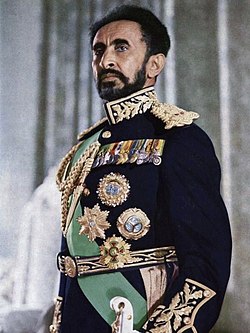
-

-
 Ras Desta Damtew
 -

.jpg)


Italian forces
[edit]
There were 400,000 Italian soldiers in Eritrea and 285,000 in Italian Somaliland with 3,300 machine guns, 275 artillery pieces, 200 tankettes and 205 aircraft. In April 1935, the reinforcement of the Royal Italian Army (Regio Esercito) and the Regia Aeronautica (Royal Air Force) in East Africa (Africa Orientale) accelerated. Eight regular, mountain and blackshirt militia infantry divisions arrived in Eritrea, and four regular infantry divisions arrived in Italian Somaliland, about 685,000 soldiers and a great number of logistical and support units; the Italians included 200 journalists.[51] The Italians had 6,000 machine guns, 2,000 pieces of artillery, 599 tanks and 390 aircraft. The Regia Marina (Royal Navy) carried tons of ammunition, food and other supplies, with the motor vehicles to move them, but the Ethiopians had only horse-drawn carts.[8]
The Italians placed considerable reliance on their Corps of Colonial Troops (Regio Corpo Truppe Coloniali, RCTC) of indigenous regiments recruited from the Italian colonies of Eritrea, Somalia and Libya. The most effective of the Italian commanded units were the Eritrean native infantry (Ascari), which was often used as advanced troops. The Eritreans also provided cavalry and artillery units; the "Falcon Feathers" (Penne di Falco) was one prestigious and colourful Eritrean cavalry unit. Other RCTC units during the invasion of Ethiopia were irregular Somali frontier troops (dubats), regular Arab-Somali infantry and artillery and infantry from Libya.[52]
The Italians had a variety of local semi-independent "allies" in the north, and the Azebu Galla were among several groups induced to fight for the Italians. In the south, the Somali sultan Olol Dinle commanded a personal army, which advanced into the northern Ogaden with the forces of Colonel Luigi Frusci. The sultan was motivated by his desire to take back lands that the Ethiopians had taken from him. The Italian colonial forces even included men from Yemen, across the Gulf of Aden.[53]
The Italians were reinforced by volunteers from the so-called Italiani all'estero, members of the Italian diaspora from Argentina, Uruguay and Brazil; they formed the 221st Legion in the Divisione Tevere, which a special Legione Parini fought under Frusci near Dire Dawa.[54] On 28 March 1935, General Emilio De Bono was named the commander-in-chief of all Italian armed forces in East Africa.[55] De Bono was also the commander-in-chief of the forces invading from Eritrea on the northern front. De Bono commanded nine divisions in the Italian I Corps, the Italian II Corps and the Eritrean Corps. General Rodolfo Graziani was commander-in-chief of forces invading from Italian Somaliland on the southern front.[56]
Initially, he had two divisions and a variety of smaller units under his command: a mixture of Italians, Somalis, Eritreans, Libyans and others. De Bono regarded Italian Somaliland as a secondary theatre, whose primary need was to defend itself, but it could aid the main front with offensive thrusts if the enemy forces were not too large there.[56] Most foreigners accompanied the Ethiopians, but Herbert Matthews, a reporter and historian who wrote Eyewitness in Abyssinia: With Marshal Bodoglio's forces to Addis Ababa (1937), and Pedro del Valle, an observer for US Marine Corps, accompanied the Italian forces.[57]


Hostilities
[edit]Italian invasion
[edit]_it.svg)
_it.svg)

At 5:00 am on 3 October 1935, De Bono crossed the Mareb River and advanced into Ethiopia from Eritrea without a declaration of war.[58] Aircraft of the Regia Aeronautica scattered leaflets asking the population to rebel against Haile Selassie and support the "true Emperor Iyasu V". Forty-year-old Iyasu had been deposed many years earlier but was still in custody. In response to the Italian invasion, Ethiopia declared war on Italy.[59]
At this point in the campaign, the lack of roads represented a serious hindrance for the Italians as they crossed into Ethiopia. On the Eritrean side, roads had been constructed right up to the border. On the Ethiopian side, these roads often transitioned into vaguely defined paths,[58] and the Italian army used aerial photography[60] to plan its advance, as well as mustard gas attacks.
On 5 October the Italian I Corps took Adigrat, and by 6 October, Adwa (Adowa) was captured by the Italian II Corps. Haile Selassie had ordered Duke (Ras) Seyoum Mangasha, the Commander of the Ethiopian Army of Tigre, to withdraw a day's march away from the Mareb River. Later, the Emperor ordered his son-in-law and Commander of the Gate (Dejazmach) Haile Selassie Gugsa, also in the area, to move back 89 and 56 km (55 and 35 mi) from the border.[58]
On 11 October, Gugsa surrendered with 1,200 followers at the Italian outpost at Adagamos. Italian propagandists lavishly publicised the surrender but fewer than a tenth of Gugsa's men defected with him.[61] On 14 October, De Bono proclaimed the end of slavery in Ethiopia but this liberated the former slave owners from the obligation to feed their former slaves, in the unsettled conditions caused by the war.[b] Much of the livestock in the area had been moved to the south to feed the Ethiopian army and many of the emancipated people had no choice but to appeal to the Italian authorities for food.[61]
By 15 October, De Bono's forces had advanced from Adwa and occupied the holy capital of Axum. De Bono entered the city riding on a white horse and then looted the Obelisk of Axum.[63] To Mussolini's dismay, the advance was methodical and on 8 November, the I Corps and the Eritrean Corps captured Makale. The Italian advance had added 56 mi (90 km) to the line of supply and De Bono wanted to build a road from Adigrat before continuing.[64][65] On 16 November, De Bono was promoted to the rank of Marshal of Italy (Maresciallo d'Italia) and in December was replaced by Badoglio to speed up the invasion.[66]
Hoare–Laval Pact
[edit]On 14 November 1935, the National government in Britain, led by Prime Minister Stanley Baldwin, won a general election on a platform of upholding collective security and support for the League of Nations, which at least implied that Britain would support Ethiopia.[67] However, the British service chiefs, led by the First Sea Lord, Admiral Sir Earle Chatfield, all advised against going to war with Italy for the sake of Ethiopia, which carried much weight with the cabinet.[68] During the 1935 election, Baldwin and the rest of the cabinet had repeatedly promised that Britain was committed to upholding collective security in the belief of that being the best way to neutralise the Labour Party, which also ran on a platform emphasising collective security and support for the League of Nations.[69] To square the circle caused by its election promises and its desire to avoid offending Mussolini too much, the cabinet decided upon a plan to give most of Ethiopia to Italy, with the rest in the Italian sphere of influence, as the best way of ending the war.[67]
In early December 1935, the Hoare–Laval Pact was proposed by Britain and France. Italy would gain the best parts of Ogaden and Tigray and economic influence over all the south. Abyssinia would have a guaranteed corridor to the sea at the port of Assab; the corridor was a poor one and known as a "corridor for camels".[70] Mussolini was ready to play along with considering the Hoare-Laval Pact, rather than rejecting it outright, to avoid a complete break with Britain and France, but he kept demanding changes to the plan before he would accept it as a way to stall for more time to allow his army to conquer Ethiopia.[71] Mussolini was not prepared to abandon the goal of conquering Ethiopia, but the imposition of League of Nations sanctions on Italy caused much alarm in Rome.[72]
The war was wildly popular with the Italian people, who relished Mussolini's defiance of the League as an example of Italian greatness. Even if Mussolini had been willing to stop the war, the move would have been very unpopular in Italy.[71] Kallis wrote, "Especially after the imposition of sanctions in November 1935, the popularity of the Fascist regime reached unprecedented heights".[71] On 13 December, details of the pact were leaked by a French newspaper and denounced as a sellout of the Ethiopians. The British government disassociated itself from the pact and British Foreign Secretary Sir Samuel Hoare was forced to resign in disgrace.[73]
Ethiopian Christmas Offensive
[edit]
The Christmas Offensive was intended to split the Italian forces in the north with the Ethiopian centre, crushing the Italian left with the Ethiopian right and to invade Eritrea with the Ethiopian left. Ras Seyum Mangasha held the area around Abiy Addi with about 30,000 men. Selassie with about 40,000 men advanced from Gojjam toward Mai Timket to the left of Ras Seyoum. Ras Kassa Haile Darge with around 40,000 men advanced from Dessie to support Ras Seyoum in the centre in a push towards Warieu Pass. Ras Mulugeta Yeggazu, the Minister of War, advanced from Dessie with approximately 80,000 men to take positions on and around Amba Aradam to the right of Ras Seyoum. Amba Aradam was a steep sided, flat topped mountain directly in the way of an Italian advance on Addis Ababa.[74] The four commanders had approximately 190,000 men facing the Italians. Ras Imru and his Army of Shire were on the Ethiopian left. Ras Seyoum and his Army of Tigre and Ras Kassa and his Army of Beghemder were the Ethiopian centre. Ras Mulugeta and his "Army of the Center" (Mahel Sefari) were on the Ethiopian right.[74]
A force of 1,000 Ethiopians crossed the Tekeze river and advanced toward the Dembeguina Pass (Inda Aba Guna or Indabaguna pass). The Italian commander, Major Criniti, commanded a force of 1,000 Eritrean infantry supported by L3 tanks. When the Ethiopians attacked, the Italian force fell back to the pass, only to discover that 2,000 Ethiopian soldiers were already there and Criniti's force was encircled. In the first Ethiopian attack, two Italian officers were killed and Criniti was wounded.[75]
The Italians tried to break out using their L3 tanks but the rough terrain immobilised the vehicles. The Ethiopians killed the infantry, then rushed the tanks and killed their two-man crews. Italian forces organised a relief column made up of tanks and infantry to relieve Critini but it was ambushed en route. Ethiopians on the high ground rolled boulders in front of and behind several of the tanks, to immobilise them, picked off the Eritrean infantry and swarmed the tanks.[75]
The other tanks were immobilised by the terrain, unable to advance further and two were set on fire. Critini managed to break-out in a bayonet charge and half escaped. Italian casualties were 31 Italians and 370 Askari killed and five Italians taken prisoner; Ethiopian casualties were estimated by the Italians to be 500, which was probably greatly exaggerated.[75]
The news from the "northern front" was generally bad for Italy. However, foreign correspondents in Addis Ababa publicly took up knitting to mock their lack of access to the front. There was no way for them to verify reports that 4,700 Italians had been captured. The correspondents were told by the Ethiopians that Italian tanks had been stranded and abandoned and that Italian native troops were mutinying.[76] Later, a report was issued that Ethiopian warriors had captured eighteen tanks, thirty-three field guns, 175 machine guns, and 2,605 rifles. In addition, this report indicated that the Ethiopians had wiped out an entire legion of the 2nd CC.NN. Division "28 Ottobre" and that the Italians had lost at least 3,000 men. Rome denied these figures.[77]
The ambitious Ethiopian plan called for Ras Kassa and Ras Seyoum to split the Italian army in two and isolate the Italian I Corps and III Corps in Mekele. Ras Mulugeta would then descend from Amba Aradam and crush both corps. According to this plan, after Ras Imru retook Adwa, he was to invade Eritrea. In November, the League of Nations condemned Italy's aggression and imposed economic sanctions. This excluded oil, however, an indispensable raw material for the conduct of any modern military campaign, and this favoured Italy.[78]
The Ethiopian counteroffensive managed to stop the Italian advance for a few weeks, but the superiority of the Italian's weaponry (artillery and machine guns) as well as aerial bombardment with chemical weapons, at first with mustard gas prevented the Ethiopians from taking advantage of their initial successes. The Ethiopians in general were very poorly armed, with few machine guns, their troops mainly armed with swords and spears. Having spent a decade accumulating poison gas in East Africa, Mussolini gave Badoglio authority to resort to Schrecklichkeit (frightfulness), which included destroying villages and using gas (OC 23/06, 28 December 1935). Mussolini was even prepared to resort to bacteriological warfare as long as these methods could be kept quiet. Some Italians objected when they found out but the practices were kept secret, the government issuing denials or spurious stories blaming the Ethiopians.[79][c]
Second Italian advance
[edit]
As the progress of the Christmas Offensive slowed, Italian plans to renew the advance on the northern front began as Mussolini had given permission to use poison gas (but not mustard gas) and Badoglio received the Italian III Corps and the Italian IV Corps in Eritrea during early 1936. On 20 January, the Italians resumed their northern offensive at the First Battle of Tembien (20 to 24 January) in the broken terrain between the Warieu Pass and Makale. The forces of Ras Kassa were defeated, the Italians using phosgene gas and suffering 1,082 casualties against 8,000 Ethiopian casualties according to an Ethiopian wireless message intercepted by the Italians.[81]
[It]...was at the time when the operations for the encircling of Makale were taking place that the Italian command, fearing a rout, followed the procedure which it is now my duty to denounce to the world. Special sprayers were installed on board aircraft so that they could vaporize, over vast areas of territory, a fine, death-dealing rain. Groups of nine, fifteen, eighteen aircraft followed one another so that the fog issuing from them formed a continuous sheet. It was thus that, as from the end of January 1936, soldiers, women, children, cattle, rivers, lakes, and pastures were drenched continually with this deadly rain. To systematically kill all living creatures, to more surely poison waters and pastures, the Italian command made its aircraft pass over and over again. That was its chief method of warfare.
— Haile Selassie[82]
From 10 to 19 February, the Italians captured Amba Aradam and destroyed Ras Mulugeta's army in the Battle of Amba Aradam (Battle of Enderta). The Ethiopians suffered massive losses and poison gas destroyed a small part of Ras Mulugeta's army, according to the Ethiopians. During the slaughter following the attempted withdrawal of his army, both Ras Mulugeta and his son were killed. The Italians lost 800 killed and wounded while the Ethiopians lost 6,000 killed and 12,000 wounded. From 27 to 29 February, the armies of Ras Kassa and Ras Seyoum were destroyed at the Second Battle of Tembien. Ethiopians again argued that poison gas played a role in the destruction of the withdrawing armies.[83]
In early March, the army of Ras Imru was attacked, bombed and defeated in what was known as the Battle of Shire. In the battles of Amba Aradam, Tembien and Shire, the Italians suffered about 2,600 casualties and the Ethiopians about 15,000; Italian casualties at the Battle of Shire being 969 men. The Italian victories stripped the Ethiopian defences on the northern front, Tigré province had fallen most of the Ethiopian survivors returned home or took refuge in the countryside and only the army guarding Addis Ababa stood between the Italians and the rest of the country.[83]

On 31 March 1936 at the Battle of Maychew, the Italians defeated an Ethiopian counter-offensive by the main Ethiopian army commanded by Selassie. The Ethiopians launched near non-stop attacks on the Italian and Eritrean defenders but could not overcome the well-prepared Italian defences. When the exhausted Ethiopians withdrew, the Italians counter-attacked. The Regia Aeronautica attacked the survivors at Lake Ashangi with mustard gas. The Italian troops had 400 casualties, the Eritreans 874 and the Ethiopians suffered 8,900 casualties from 31,000 men present according to an Italian estimate.[84] On 4 April, Selassie looked with despair upon the horrific sight of the dead bodies of his army ringing the poisoned lake.[85]
Following the battle, Ethiopian soldiers began to employ guerrilla tactics against the Italians, initiating a trend of resistance that would transform into the Patriot/Arbegnoch movement.[86] They were joined by local residents who operated independently near their own homes. Early activities included capturing war materials, rolling boulders off cliffs at passing convoys, kidnapping messengers, cutting telephone lines, setting fire to administrative offices and fuel and ammunition dumps, and killing collaborators. As disruption increased, the Italians were forced to redeploy more troops to Tigre, away from the campaign further south.[87]
Southern front
[edit]
On 3 October 1935, Graziani implemented the Milan Plan to remove Ethiopian forces from various frontier posts and to test the reaction to a series of probes all along the southern front. While incessant rains worked to hinder the plan, within three weeks the Somali villages of Kelafo, Dagnerai, Gerlogubi and Gorahai in Ogaden were in Italian hands.[88] Late in the year, Ras Desta Damtu assembled up his army in the area around Negele Borana, to advance on Dolo and invade Italian Somaliland. Between 12 and 16 January 1936, the Italians defeated the Ethiopians at the Battle of Genale Doria. The Regia Aeronautica destroyed the army of Ras Desta, Ethiopians claiming that poison gas was used.[89]
After a lull in February 1936, the Italians in the south prepared an advance towards the city of Harar. On 22 March, the Regia Aeronautica bombed Harar and Jijiga, reducing them to ruins even though Harar had been declared an "open city".[90] On 14 April, Graziani launched his attack against Ras Nasibu Emmanual to defeat the last Ethiopian army in the field at the Battle of the Ogaden. The Ethiopians were drawn up behind a defensive line that was termed the "Hindenburg Wall", designed by the chief of staff of Ras Nasibu, and Wehib Pasha, a seasoned ex-Ottoman commander. After ten days, the last Ethiopian army had disintegrated; 2,000 Italian soldiers and 5,000 Ethiopian soldiers were killed or wounded.[91]
Fall of Addis Ababa
[edit]

On 26 April 1936, Badoglio began the "March of the Iron Will" from Dessie to Addis Ababa, an advance with a mechanised column against slight Ethiopian resistance.[92] The column experienced a more serious attack on 4 May when Ethiopian forces under Haile Mariam Mammo ambushed the formation in Chacha, near Debre Berhan, killing approximately 170 colonial troops.[93]
Meanwhile, Selassie conducted a disorganized retreat towards the capital. There, government officials operated without leadership, unable to contact the Emperor and unsure of his whereabouts.[94] Realizing that Addis Ababa would soon fall to the Italians, Ethiopian administrators met to discuss a possible evacuation of the government to the west. After several days, they decided that they should relocate to Gore, though actual preparations for their departure were postponed.[95] Addis Ababa became crowded with retreating soldiers from the front while its foreign residents sought refuge at various European legations.[96] Selassie reached the capital on 30 April. That day his Council of Ministers resolved that the city should be defended and a retreat to Gore conducted only as a last resort.[96]
The following day an ad hoc council of Ethiopian nobles convened to re-examine the decision, where Ras Aberra Kassa suggested that the Emperor should go to Geneva to appeal to the League of Nations for assistance before returning to lead resistance against the Italians. The view was subsequently adopted by Selassie and preparations were made for his departure.[97] On 2 May, Selassie boarded a train from Addis Ababa to Djibouti, with the gold of the Ethiopian Central Bank. From there he fled to the United Kingdom, with the tacit acquiescence of the Italians who could have bombed his train, into exile (Mussolini had refused a request from Graziani to mount such an attack.[98])
Before he departed, Selassie ordered that the government of Ethiopia be moved to Gore and directed the mayor of Addis Ababa to maintain order in the city until the Italians' arrival. Imru Haile Selassie was appointed Prince Regent during his absence. The city police, under Abebe Aregai and the remainder of the Imperial Guard did their utmost to restrain a growing crowd but rioters rampaged throughout the city, looting and setting fire to shops owned by Europeans. Most of the violence occurred between looters, fighting over the spoils and by 5 May, much of the city lay in ruins.[99] At 04:00 Badoglio drove into the city at the head of 1,600 lorries and patrols of Italian tanks, troops and Carabinieri were sent to occupy tactically valuable areas in the city, as the remaining inhabitants watched sullenly.[100]
Subsequent operations
[edit].jpg)
After the occupation of Addis Ababa, nearly half of Ethiopia was still unoccupied and the fighting continued for another three years until nearly 90% was "pacified" just before World War II, although censorship kept this from the Italian public.[1] Ethiopian commanders withdrew to nearby areas to regroup; Abebe Aregai went to Ankober, Balcha Safo to Gurage, Zewdu Asfaw to Mulo, Blatta Takale Wolde Hawariat to Limmu and the Kassa brothers—Aberra, Wondosson and Asfawossen—to Selale. Haile Mariam conducted hit-and-run attacks around the capital.[101] About 10,000 troops remaining under the command of Aberra Kassa had orders from Selassie to continue resistance.[101] On 10 May 1936, Italian troops from the northern front and from the southern front met at Dire Dawa.[102] The Italians found the recently released Ethiopian Ras, Hailu Tekle Haymanot, who boarded a train back to Addis Ababa and approached the Italian invaders in submission.[103] Imru Haile Selassie fell back to Gore in southern Ethiopia to reorganise and continue to resist the Italians. In early June, the Italian government promulgated a constitution for Africa Orientale Italiana (AOI, Italian East Africa) bringing Ethiopia, Eritrea and Italian Somaliland together into an administrative unit of six provinces. Badoglio became the first Viceroy and Governor General but on 11 June, he was replaced by Marshal Graziani.[104]
On 21 June Kassa held a meeting with Bishop Abune Petros and several other Patriot leaders at Debre Libanos, about 70 km (43 mi) north of Addis Ababa. Plans were made to storm parts of the capital but a lack of transport and radio equipment prevented a co-ordinated attack.[101] In July, Ethiopian forces attacked Addis Ababa and were routed. Numerous members of Ethiopian royalty were taken prisoner and others were executed soon after they surrendered.[104] The exiled government in Gore was never able to provide any meaningful leadership to the Patriots or remaining military formations but sporadic resistance by independent groups persisted around the capital.[101]

On the night 26 June, members of the Black Lions organization destroyed three Italian aircraft in Nekemte and killed twelve Italian officials, including Air Marshal Vincenzo Magliocco and aviator Antonio Locatelli, after the Italians had sent the party to parley with the local populace. Graziani ordered the town to be bombed in retaliation for the killings (Magliocco was his deputy). Local hostility forced out the Patriots and Desta Damtew, commander of the southern Patriots, withdrew his troops to Arbegona. Surrounded by Italian forces, they retreated to Butajira, where they were eventually defeated. An estimated 4,000 Patriots were reportedly killed in both engagements, 1,600 of whom—including Damtew—after being taken prisoner.[105] On 19 December, Wondosson Kassa was executed near Debre Zebit and on 21 December, Aberra Kassa and Asfawossen Kassa were executed in Fikke. In late 1936, after the Italians tracked him down in Gurage, Dejazmach Balcha Safo was killed in battle.[104] On 19 December, Ras Imru surrendered at the Gojeb river.[106]
After the end of the rainy season, an Italian column left Addis Ababa in September and occupied Gore a month later. The forces of Ras Imru were trapped between the Italians and the Sudan border and Imru surrendered on 19 December. Imru was flown to Italy and imprisoned on the Island of Ponza, while the rest of the Ethiopian prisoners taken in the war were dispersed in camps in East Africa and Italy. A second column went south-west to attack Ras Desta and the Dejasmatch Gabre Mariam who had assembled military forces in the Great Lakes district. The Ethiopians were defeated on 16 December and by January, the Italians had established a measure of control over the provinces of Jimma, Kafa and Arusi. After another two months, the remaining Ethiopians were surrounded and fought on, rather than surrender. Mariam was killed.[107] On 19 February 1937 the last battle of the war occurred when remnants of the Armies of Sidamo and Bale clashed with Italian forces at Gogetti, and were defeated.[2]
Addis Ababa massacre
[edit]That same date, 19 February 1937 – Yekatit 12 according to the Ge'ez calendar – saw the attempted assassination of Marshal Graziani by Eritrean rebels Abraham Deboch and Mogos Asgedom in Addis Ababa. The campaign of reprisals visited by the Italians upon the population of Addis Ababa has been described as the worst massacre in Ethiopian history.[108] Estimates vary on the number of people killed in the three days that followed the attempt on Graziani's life. Ethiopian sources estimated that 30,000 people were killed by the Italians, while Italian sources claimed that only a few hundred were killed. A 2017 history of the massacre estimated that 19,200 people were killed, 20 percent of the population of Addis Ababa.[17] Over the following week, numerous Ethiopians suspected of opposing Italian rule were rounded up and executed, including members of the Black Lions and other members of the aristocracy. Many more were imprisoned, even collaborators such as Ras Gebre Haywot, the son of Ras Mikael of Wollo, Brehane Markos, and Ayale Gebre, who had helped the Italians identify the two men who made the attempt on Graziani's life.[109]
According to Mockler, "Italian carabinieri had fired into the crowds of beggars and poor assembled for the distribution of alms; and it is said that the Federal Secretary, Guido Cortese, even fired his revolver into the group of Ethiopian dignitaries standing around him."[110] Hours later, Cortese gave the fatal order:
Comrades, today is the day when we should show our devotion to our Viceroy by reacting and destroying the Ethiopians for three days. For three days I give you ''carte blanche'' to destroy and kill and do what you want to the Ethiopians.[110]
Italians doused native houses with petrol and set them on fire. They broke into the homes of local Greeks and Armenians and lynched their servants. Some even posed on the corpses of their victims to have their photographs taken.[110] The first day of the massacre has been commemorated as "Yekatit 12" (19 February) by Ethiopians ever since. There is a Yekatit 12 monument in Addis Ababa in memory of these Ethiopian victims of Italian aggression.
Casualties
[edit]In 1968, Colonel A. J. Barker wrote that from 1 January 1935 to 31 May 1936, the Italian army and Blackshirt units lost 1,148 men killed, 125 men died of wounds and thirty-one missing; about 1,593 Eritrean troops and 453 civilian workmen were also killed, a total of 3,319 casualties.[18] In a 1978 publication, Alberto Sbacchi wrote that these official Italian casualty figures of about 3,000 were an underestimate.[111] Sbacchi wrote that the official total of Italian casualties was unreliable, because the regime desired to underestimate Italian losses.[112] Angelo Del Boca estimates the total Italian losses up to 31 December 1936 (including more than six months of guerrilla warfare after the end of the conflict) speak of 2,317 dead for the Italian army, 1,165 for the Blackshirts, 193 from the air force, 56 from the navy, 78 civilians in the Gondrand shipyard massacre, 453 factory workers and 88 merchant marines, for a total of 4,350 Italians killed.[9] To these figures must be added approximately 9,000 injured and 18,200 repatriated due to illness.[10] Estimates on the losses of the askaris, however very vague, he puts it at 4,500 killed.[9] From 1936 to 1940, there was an additional 9,555 men killed and 144,000 sick and wounded.[113] Total Italian casualties from 1935 to 1940 according to these calculations were about 208,000 killed or wounded. Based on 1,911 Italians killed in the first six months of 1940, Ministry of Africa figures for 6 May 1936 to 10 June 1940 are 8,284 men killed, which Sbacchi considered to be fairly accurate.[25]
There was a lack of reliable statistics because confusion during the invasion made it difficult to keep accurate records and the Statistical Bulletin had ceased to provide data on fatalities. Field hospital records had been destroyed, inventories dispersed, individual deaths were not reported and bodies were not repatriated to Italy. Unpublished reports listed 3,694 military and civilian fatalities among 44,000 casualties and from May 1936 to June 1940, there were another 12,248 military and civilian fatalities in 144,000 casualties.[114] The Italian estimation of Ethiopian losses are 50,000 men killed in the Northern front and 20,000 men killed in the Southern front for a total of 70,000 battle deaths. Conversely, in a memorandum submitted to the Paris conference in 1946, the Ethiopian government enumerated 275,000 men killed in action, 78,500 Patriots killed in hostilities during the occupation from 1936 to 1941, 17,800 women and children killed by bombing, 30,000 people killed in the massacre of February 1937, 35,000 people died in concentration camps, 24,000 Patriots killed in obedience to orders from summary courts, 300,000 people died after their villages had been destroyed, a total of 760,300 deaths.[115] However, Del Boca claims that these figures are unreliable and were likely exaggerated to extract more reparations. He asserts that the Italian estimation is more accurate.[9]
War crimes
[edit]
Use of chemical weapons
[edit]Italian military forces used between 300 and 500 tons of mustard gas to attack both military and civilian targets,[116] despite being a signatory to the 1925 Geneva Protocol banning the practice. This gas had been produced during World War I and subsequently transported to East Africa. J. F. C. Fuller, who was present in Ethiopia during the conflict, stated that mustard gas "was the decisive tactical factor in the war."[117] Historian Walter Laqueur estimates that up to one-third of Ethiopian casualties of the war were caused by chemical weapons.[118]
The Italians claimed that their use of gas was justified by the execution of Tito Minniti and his observer in Ogaden by Ethiopian forces.[119] However, the use of gas was authorized by Mussolini nearly two months before Minniti's death on 26 December 1935, as evidenced by the following order:
Rome, October 27, 1935. To His Excellency Graziani. The use of gas as an ultima ratio to overwhelm enemy resistance and in case of counter-attack is authorized. Mussolini.[22]
After Minniti's death, the order was expanded to use of gas "on a vast scale":
Rome, December 28, 1935. To His Excellency Badoglio. Given the enemy system I have authorized Your Excellency the use even on a vast scale of any gas and flamethrowers. Mussolini.[22]
Military and civilian targets were gas bombed and on 30 December, a Red Cross unit was bombed at Dolo and an Egyptian ambulance was attacked at Bulale; a few days later an Egyptian medical unit was bombed at Daggah Bur. There were more attacks in January and February, then on 4 March 1936, a British Red Cross camp near Quoram appeared to be subject to the most deliberate attack of all, when low-flying Italian aircraft crews could not have missed the big Red Cross signs.[57] Mustard gas was also sprayed from above on Ethiopian combatants and villages. The Italians tried to keep their resort to chemical warfare secret but were exposed by the International Red Cross and many foreign observers. The Italians claimed that at least 19 bombardments of Red Cross tents "posted in the areas of military encampment of the Ethiopian resistance", had been "erroneous".[citation needed]
The Italians delivered poison gas by gas shell and in bombs dropped by the Regia Aeronautica. Though poorly equipped, the Ethiopians had achieved some success against modern weaponry but had no defence against the "terrible rain that burned and killed".[120]
In general, historians concluded that the use of chemical weapons was effective and devastating to morale and manpower, though some disagree and argue that they had negligible effect in battle.[121] Historian Angelo Del Boca condemned the use of gas, but argued that it had only a minimal effect on Italian war aims.[122] An analysis by the Stockholm International Peace Research Institute argued that the use of chemical weapons shifted the war in favor of the Italians, and dealt a major blow to Ethiopian morale.[123]
American and British military analysis came to similar conclusions. The US military concluded that "Chemical weapons were devastating against the unprepared and unprotected Ethiopians."[124] British Major General J. F. C. Fuller, assigned to the Italian army, noted that "In place of the laborious process of picketing the heights, the heights sprayed with gas were rendered unoccupiable by the enemy, save at the gravest risk. It was an exceedingly cunning use of this chemical."[124]
Haile Selassie in his report to the League of Nations described it:
....Special sprayers were installed on board aircraft so they could vaporize over vast areas of territory a fine, death-dealing rain. Groups of 9, 15, or 18 aircraft followed one another so that the fog issuing from them formed a continuous sheet. It was thus that, as from the end of January 1936, soldiers, women, children, cattle, rivers, lakes, and pastures were drenched continually with this deadly rain. In order more surely to poison the waters and pastures, the Italian command made its aircraft pass over and over again. These fearful tactics succeeded. Men and animals succumbed. The deadly rain that fell from the aircraft made all those whom it touched fly shrieking with pain. All those who drank poisoned water or ate infected food also succumbed in dreadful suffering. In tens of thousands the victims of Italian mustard gas fell.
— Smart[124]
Dum-dum rounds and atrocities against prisoners of war
[edit]Ethiopian troops used dum-dum bullets, which had been banned by declaration IV, 3 of the Hague Convention (1899) and began mutilating captured Eritrean Askari (often with castration) beginning in the first weeks of war.[26] Some hundreds of colonial Eritrean Ascari and dozens of Italians suffered these amputations, often done before death as allegedly happened to 17 Italian workers emasculated in Gondrand in February 1936.[125]
During the first months of the invasion, Italian forces adopted an unofficial policy of "take no prisoners" and frequently executed surrendering enemy combatants, including their commanders. In May 1936, Mussolini issued an order to Graziani stating that “all rebels taken prisoner must be shot," which he followed up weeks later with further instructions to commit mass murder of "rebels" by saying “I repeat my authorization to Your Excellency to initiate and systematically conduct a policy of terror and extermination.”[126]
Public and international reaction
[edit].jpg)

Italy's military victory overshadowed concerns about the economy.[127][128] Mussolini was at the height of his popularity in May 1936 with the proclamation of the Italian empire.[71] His biographer, Renzo De Felice, called the war "Mussolini's masterpiece" as for a brief moment he had been able to create something resembling a national consensus both in favor of himself and his regime.[129] When Badoglio returned to Italy, he received a snub, as Mussolini made certain that the honours bestowed on Badoglio received fell short of those granted to an Italian "national hero", in order to present the victory as an achievement of the Fascist system rather than as an achievement of the traditional Italian elites, of which Badoglio was a member.[130] A sign of Mussolini's increased power and popularity after the war was his creation of a new military rank; First Marshal of the Italian Empire, to which he promoted both himself and King Victor Emmanuel III, thus putting the prime minister on a theoretical level of equality with the king.[130]

Haile Selassie sailed from Djibouti in the British cruiser HMS Enterprise. From Mandatory Palestine Selassie sailed to Gibraltar en route to Britain. While still in Jerusalem, Haile Selassie sent a telegram to the League of Nations:
We have decided to bring to an end the most unequal, most unjust, most barbarous war of our age, and have chosen the road to exile in order that our people will not be exterminated and in order to consecrate ourselves wholly and in peace to the preservation of our empire's independence... we now demand that the League of Nations should continue its efforts to secure respect for the covenant, and that it should decide not to recognize territorial extensions, or the exercise of an assumed sovereignty, resulting from the illegal recourse to armed force and to numerous other violations of international agreements.[131]
The Ethiopian Emperor's telegram caused several nations to temporarily defer recognition of the Italian conquest.[131]
On 30 June, Selassie spoke at the League of Nations and was introduced by the President of the Assembly as "His Imperial Majesty, the Emperor of Ethiopia" ("Sa Majesté Imperiale, l'Empereur d'Ethiopie"). A group of jeering Italian journalists began yelling insults and were expelled before he could speak. In response, the Romanian chairman, Nicolae Titulescu, jumped to his feet and shouted "Show the savages the door!" ("À la porte les sauvages!").[132] Selassie denounced Italian aggression and criticised the world community for standing by. At the conclusion of his speech, which appeared on newsreels throughout the world, he said "It is us today. It will be you tomorrow". France appeased Italy because it could not afford to risk an alliance between Italy and Germany; Britain decided that its military weakness meant that it had to follow France's lead.[133][134] Selassie's resolution to the League to deny recognition of the Italian conquest was defeated and he was denied a loan to finance a resistance movement.[135] On 4 July 1936, the League voted to end the sanctions imposed against Italy in November 1935. By 15 July, the sanctions were at an end.[136][d]
On 18 November 1936, the Italian Empire was recognised by the Empire of Japan and Italy recognised the Japanese occupation of Manchuria, marking the end of the Stresa Front.[138][139] Hitler had supplied the Ethiopians with 16,000 rifles and 600 machine guns in the hope that Italy would be weakened when he moved against Austria.[14] By contrast, France and Britain recognised Italian control over Ethiopia in 1938. Mexico was the only country to strongly condemn Italy's sovereignty over Ethiopia, respecting Ethiopian independence throughout. Including Mexico, only six nations in 1937 did not recognise the Italian occupation: China, New Zealand, the Soviet Union, Republican Spain and the United States.[140][141] Three years later, only the USSR officially recognised Selassie and the United States government considered recognising the Italian Empire with Ethiopia included.[142] The invasion of Ethiopia and its general condemnation by Western democracies isolated Mussolini and Fascist Italy until 1938. From 1936 to 1939, Mussolini and Hitler joined forces to support the fascist camp during the Spanish Civil War. In April 1939, Mussolini launched the Italian invasion of Albania. In May, Italy and Nazi Germany joined in the Pact of Steel. In September 1940, both nations signed the Tripartite Pact along with the Empire of Japan.[citation needed]
The conflict has been described by historian Brenda Plummer as triggering the first "great manifestation" of African American interest in foreign affairs, despite the financial limitations imposed by the Great Depression and the US government's interwar commitment to neutrality.[143][144] Largescale organised responses to Italy's attack on Ethiopia included a peaceful demonstration in New York City on 18 August 1935 and Chicago on 1 September.[144][145] Historian Jacquelyn Dowd Hall situates these developments in her chronology of a "long civil rights movement" in which she traces the emergence of a black popular front in the 1930s.[146]
Aftermath
[edit]1936–1940
[edit].svg)
On 10 May 1936, Italian troops from the northern front and from the southern front met at Dire Dawa.[102] The Italians found the recently released Ethiopian Ras, Hailu Tekle Haymanot, who boarded a train back to Addis Ababa and approached the Italian invaders in submission.[103] On 21 December 1937, Rome appointed Amedeo, 3rd Duke of Aosta, as the new Viceroy and Governor General of Italian East Africa with instructions to take a more conciliatory line.

Aosta instituted public works projects including 3,200 km (2,000 mi) of new paved roadways, 25 hospitals, 14 hotels, dozens of post offices, telephone exchanges, aqueducts, schools and shops. The Italians decreed miscegenation to be illegal.[147] Racial separation, including residential segregation, was enforced as thoroughly as possible and the Italians showed favouritism to non-Christian groups.
To isolate the dominant Amhara rulers of Ethiopia, who supported Selassie, the Italians granted the Oromos, the Somalis and other Muslims, many of whom had supported the invasion, autonomy and rights. The Italians also definitively abolished slavery and abrogated feudal laws that had been upheld by the Amharas. Early in 1938, a revolt broke out in Gojjam, led by the Committee of Unity and Collaboration, made up of some of the young, educated elite who had escaped reprisals after the assassination attempt on Graziani. The general oversaw another wave of reprisals and had all Ethiopians in administrative jobs murdered, some by being thrown from aircraft, after being taken on board under the pretext of visiting the King in Rome, leading to the saying "He went to Rome".[148]

The army of occupation had 150,000 men but was spread thinly; by 1941 the garrison had been increased to 250,000 soldiers, including 75,000 Italian civilians. The former police chief of Addis Ababa, Abebe Aregai, was the most successful leader of the Ethiopian guerrilla movement after 1937, using units of fifty men. On 11 December, the League of Nations voted to condemn Italy and Mussolini withdrew from the League.[149] Along with world condemnation, the occupation was expensive, the budget for AOI from 1936 to 1937 required 19,136 billion lire for infrastructure, when the annual revenue of Italy was only 18,581 billion lire.[150]
East African campaign, 1940–1941
[edit]
While in exile in the United Kingdom, Haile Selassie had sought the support of the Western democracies for his cause but had little success until the Second World War began. On 10 June 1940, Mussolini declared war on France and Britain and attacked British and Commonwealth forces in Egypt, Sudan, Kenya and British Somaliland. In August 1940, the Italian conquest of British Somaliland was completed. The British and Selassie incited Ethiopian and other local forces to join a campaign to dislodge the Italians from Ethiopia. Selassie went to Khartoum to establish closer liaison with the British and resistance forces within Ethiopia. On 18 January 1941, Selassie crossed the border into Ethiopia near the village of Um Iddla and two days later rendezvoused with Gideon Force. The Allied East Africa Command and Ethiopian patriots had largely succeeded in their operations by 6 April 1941, when Addis Ababa was occupied by Harry Wetherall, Dan Pienaar and Charles Christopher Fowkes, who received the surrender of the city; on 5 May, exactly five years after the fall of the capital, Selassie made a formal entry in Addis Ababa.[151] After the Italian defeat, the Italian guerrilla war in Ethiopia was carried out by remnants of Italian troops and their allies, which lasted until the Armistice between Italy and Allied armed forces in September 1943.[152]
Peace treaty, 1947
[edit]The treaty signed in Paris by the Italian Republic (Repubblica Italiana) and the victorious powers of World War II on 10 February 1947, included formal Italian recognition of Ethiopian independence and an agreement to pay $25,000,000 (equivalent to $352,049,000 in 2024) in reparations. Since the League of Nations and most of its members had never officially recognized Italian sovereignty over Ethiopia, Haile Selassie had been recognized as the restored emperor of Ethiopia following his formal entry into Addis Ababa in May 1941. Ethiopia presented a bill to the Economic Commission for Italy of £184,746,023 for damages inflicted during the course of the Italian occupation. The list included the destruction of 2,000 churches, 535,000 houses, the slaughter or theft of 5,000,000 cattle, 7,000,000 sheep and goats, 1,000,000 horses and mules and 700,000 camels.[18]
Use of chemical weapons
[edit]Ethiopian veterans are seeking an apology and compensation from Italy for war crimes committed during the Second Italo-Ethiopian War, particularly the use of chemical weapons like mustard gas.[153] While there is no record of a formal, official apology, Italy did acknowledge the use of chemical weapons in a 1996 statement.[154]
Ethiopian War Crimes Commission, 1946
[edit]On 20 May 1946, an Ethiopian War Crimes Commission was appointed to investigate and prosecute Italian war crimes committed during the Second Italo-Ethiopian War. The Ethiopian War Crimes Commission under President Ambaye Wolde Mariam began obtaining evidence to justify the trial of Marshal Badoglio and Marshal Graziani among other high ranking Italian officials.[155]
Ethiopia’s efforts to submit cases to the UN War Crimes Commission (UNWCC) raised a question of whether the Italo-Ethiopian conflict fell within its jurisdiction, as both Italian and British perspectives held that the war had effectively ended with Italy’s annexation by 1936—or at the latest before 1939—thereby framing any subsequent Italian violence as part of colonial administration rather than wartime conduct subject to UNWCC scrutiny.[156] Ethiopia’s Swedish legal adviser, Baron Erik Leijonhufvud, proposed a compromise in which an Ethiopian tribunal would include a majority of foreign judges and follow procedures and legal standards similar to those of the Nuremberg International Military Tribunal.[157][158]
Unlike in the Nuremberg Trials in post-Nazi Germany, few Italians were tried for war crimes after 1945. Critically, whatever the position taken by the UNWCC on individual cases, prosecution would require extradition of suspects, and Allied pressure on Italy to achieve this. Thus the Ethiopian War Crimes Commission limited itself to the prosecution of two persons, Badoglio and Graziani.[155] However, Badoglio was never formally tried for war crimes, as the British government, in particular, saw Badoglio as a valuable asset for maintaining order in Italy.[159] Graziani was tried for Nazi collaborationism at the Supreme Court in 1948, but his colonial conduct was left unquestioned.[160]
See also
[edit]Notes
[edit]- ^ Addis Ababa, the capital, was occupied on 5 May 1936 and Haile Selassie fled the country. Resistance movements continued for several years after the Italian victory at Addis Ababa of Ethiopia.[1] The date of the last battle between regular Italian and Ethiopian forces was 19 February 1937.[2]
- ^ Ethiopian emperors since Tewodros II had issued "superficial" proclamations to end slavery but these had made little difference.[62]
- ^ Years later, Badoglio admitted to using gas once and a former government minister said that three gas bombs had been dropped but these admissions came after copious amounts of records had been published showing that gas had been used to a much greater extent.[80]
- ^ In 1976, Baer wrote that Selassie's resolution requesting loans was defeated by a vote of 23 against, 25 abstentions and 1 vote for (from Ethiopia). In the sanctions vote, 44 delegates approved the ending of sanctions, 4 abstained and 1 (Ethiopian) delegate voted for retention.[137]
References
[edit]- ^ a b Mack Smith 1983, pp. 232–233.
- ^ a b Mockler 2003, pp. 172–173.
- ^ a b Pankhurst 1968, pp. 605–608.
- ^ a b c d e Stapleton 2018, The Italian invasion of Ethiopia (1935).
- ^ a b c d e Barker 1971, p. 29.
- ^ Storia dell'Aeronautica-l'aeronautica italiana, Hobby e Work 2001
- ^ a b Shinn & Ofcansky 2013, p. 19.
- ^ a b c d Barker 1971, p. 20.
- ^ a b c d Del Boca 2009, pp. 717–719.
- ^ a b c Rochat 2008, p. 128.
- ^ "Secondary Wars and Atrocities of the Twentieth Century". Necrometrics.
- ^ Sbacchi 1978, p. 33.
- ^ Leckie 1987, p. 645.
- ^ a b Leckie 1987, p. 64.
- ^ Nehru, Jawaharlal (1934). Glimpses Of World History.
- ^ Mockler 2003, pp. 172–73.
- ^ a b Campbell, Ian (2017). The Addis Ababa Massacre: Italy's National Shame. London: Hurst & Company. ISBN 978-1-84904-692-3. OCLC 999629248.
- ^ a b c Barker 1968, pp. 292–293.
- ^ Martel, Gordon (1999). The origins of the Second World War reconsidered: A. J. P. Taylor and the Historians (2nd ed.). London: Routledge. p. 188. ISBN 0-203-01024-8. OCLC 252806536.
- ^ Barker 1968, pp. 281, 300.
- ^ Belladonna, Simone (2015). Gas in Etiopia: I crimini rimossi dell'Italia coloniale (in Italian). Neri Pozza Editore. ISBN 978-8-85-451073-9.
- ^ a b c Mack Smith 1983, pp. 231, 417.
- ^ Rainer Baudendistel, Between bombs and good intentions: the Red Cross and the Italo-Ethiopian War, 1935–1936. Berghahn Books. 2006 pp. 131–132, 239
- ^ Labanca 2004, pp. 300–313.
- ^ a b Sbacchi 1978, p. 43.
- ^ a b Antonicelli 1975, p. 79.
- ^ Labanca 2004, pp. 28–66.
- ^ Dominioni 2008, p. 7.
- ^ Labanca 2004, pp. 146–148.
- ^ a b Barker 1968, pp. 1–6.
- ^ Barker 1968, pp. 6–7.
- ^ Mockler 2003, p. 46.
- ^ Shinn & Ofcansky 2013, p. 392.
- ^ a b c d e f g Kallis 2000, p. 126.
- ^ Stearns & Langer 2002, p. 677.
- ^ Crozier 2004, p. 108.
- ^ Stackelberg 2009, p. 164.
- ^ Kallis 2000, p. 127.
- ^ a b c Kallis 2000, p. 145.
- ^ a b Ishida, Ken (2002). "Racisms compared: Fascist Italy and ultranationalist Japan". Journal of Modern Italian Studies. 7 (3): 380–391. doi:10.1080/1354571021000026625. S2CID 143863579.
- ^ Calvitt Clarke 1999, pp. 9–20.
- ^ "Selassie's Guard Fights on UN Side". Eugene Register-Guard. 2 June 1951.
- ^ "Haile Selassie's Draft Order". The Afro American. 17 April 1948.[dead link]
- ^ a b c Stapleton 2013, p. 203.
- ^ Barker 1971, p. 57.
- ^ Norway, Neville Shute (1954). Slide Rule. London: William Heinemann. pp. 212–215.
- ^ Othen 2017, pp. 238–239.
- ^ Othen 2017, p. 238.
- ^ Nicolle 1997, p. 18.
- ^ Barker 1971, p. 47.
- ^ Baer 1976, p. 13.
- ^ Barker 1968, p. 318.
- ^ Nicolle 1997, p. 41.
- ^ Barker 1968, pp. 237, 267.
- ^ Gooch 2007, p. 301.
- ^ a b Gooch 2007, p. 299.
- ^ a b Barker 1968, p. 222.
- ^ a b c Barker 1971, p. 33.
- ^ Nicolle 1997, p. 11.
- ^ Nyssen, Jan; Petrie, Gordon; Mohamed, Sultan; Gebremeskel, Gezahegne; Seghers, Valérie; Debever, Martijn; Hadgu, Kiros Meles; Stal, Cornelis; Billi, Paolo; Demaeyer, Philippe; Haile, Mitiku; Frankl, Amaury (January–February 2016). "Recovery of the aerial photographs of Ethiopia in the 1930s". Journal of Cultural Heritage. 17: 170–178. doi:10.1016/j.culher.2015.07.010. hdl:1854/LU-7191070.
- ^ a b Barker 1971, p. 35.
- ^ Clarence-Smith 1989, p. 103.
- ^ Barker 1968, p. 157.
- ^ Barker 1968, p. 170.
- ^ Barker 1971, p. 36.
- ^ Nicolle 1997, p. 8.
- ^ a b Holt 2011, p. 1384.
- ^ Holt 2011, p. 1392.
- ^ Holt 2011, pp. 1394–1395.
- ^ Mockler 2003, p. 75.
- ^ a b c d Kallis 2000, p. 128.
- ^ Kallis 2000, pp. 127–128.
- ^ Barker 1968, pp. 187–210.
- ^ a b Barker 1971, p. 45.
- ^ a b c Barker 1968, p. 219.
- ^ Time, December 2, 1935.
- ^ Time, February 10, 1936.
- ^ Palla 2000, p. 104.
- ^ Mack Smith 1983, pp. 231–232.
- ^ Mack Smith 1983, p. 232.
- ^ Barker 1968, pp. 224–225.
- ^ Safire 1997, p. 318.
- ^ a b Barker 1968, pp. 237–238.
- ^ Barker 1968, pp. 247–256.
- ^ Barker 1971, p. 105.
- ^ Abbink, De Bruijn & Van Walraven 2003, p. 94.
- ^ Abbink, De Bruijn & Van Walraven 2003, p. 95.
- ^ Barker 1971, p. 70.
- ^ Barker 1971, p. 76.
- ^ Barker 1971, p. 112.
- ^ Barker 1971, pp. 121, 123.
- ^ Barker 1971, p. 109.
- ^ Akyeampong & Gates 2012, p. 543.
- ^ Spencer 2006, pp. 58–59.
- ^ Spencer 2006, p. 59.
- ^ a b Spencer 2006, p. 61.
- ^ Spencer 2006, p. 62.
- ^ Barker 1971, p. 126.
- ^ Barker 1971, p. 125.
- ^ Barker 1968, pp. 262–263.
- ^ a b c d Abbink, De Bruijn & Van Walraven 2003, p. 97.
- ^ a b Nicolle 1997, p. 12.
- ^ a b Barker 1971, p. 127.
- ^ a b c Marcus 1999, p. 32.
- ^ Abbink, De Bruijn & Van Walraven 2003, p. 102.
- ^ Mockler 2003, p. 168.
- ^ Barker 1968, p. 282.
- ^ "Italy and the Addis Ababa massacre". The Economist. ISSN 0013-0613. Retrieved 10 March 2020.
- ^ Sbacchi, Alberto (1977). "Italy and the Treatment of the Ethiopian Aristocracy, 1937–1940". The International Journal of African Historical Studies. 10 (2): 209–241. doi:10.2307/217347. ISSN 0361-7882. JSTOR 217347.
- ^ a b c Mockler, Anthony (2003) Haile Selassie's War, pp. 163–169
- ^ Sbacchi 1978, p. 37.
- ^ Sbacchi 1997, p. xxi.
- ^ Sbacchi 1978, pp. 36–38, 43.
- ^ Sbacchi 1997, pp. xxi–xxii.
- ^ Barker 1968, pp. 91.
- ^ Mack Smith 1983, p. 231.
- ^ Jeffrey Legro, Cooperation Under Fire: Anglo-German Restraint During World War II (Cornell University Press, 2005).
- ^ Walter Laqueur, The New Terrorism: Fanaticism and the Arms of Mass Destruction (Oxford University Press, 1999), p. 57.
- ^ Baudendistel 2006, p. 131.
- ^ Barker 1971, p. 56.
- ^ Clark 1959, p. 20.
- ^ Paolo Tripodi. "L'eredità coloniale in Somalia" Section: 'Adua vendicata'. St. Martin P. Inc., New York, 1999.
- ^ "The use of chemical weapons in the 1935–36 Italo-Ethiopian War" (PDF). Stockholm International Peace Research Institute. October 2009.
- ^ a b c Smart 1997, pp. 1–78.
- ^ Zamorani, Massimo. La strage della "Gondrand", in "Storia militare", XXI, nº 236, May 2013, pp. 37–39
- ^ Campbell, Ian L. (2 January 2022). "Italian Atrocities in Ethiopia: An Enquiry into the Violence of Fascism's First Military Invasion and Occupation". Journal of Genocide Research. 24 (1): 119–133. doi:10.1080/14623528.2021.1992927. ISSN 1462-3528. Retrieved 10 April 2025 – via Taylor and Francis Online.
- ^ Mack Smith 1983, p. 234.
- ^ Barker 1971, p. 131.
- ^ Kallis 2000, pp. 124, 197–198.
- ^ a b Kallis 2000, p. 74.
- ^ a b Barker 1971, pp. 131–132.
- ^ Barker 1971, p. 133.
- ^ Salerno 1997, pp. 66–104.
- ^ Holt 2011, pp. 1381–1401.
- ^ Barker 1971, p. 159.
- ^ Baer 1976, p. 299.
- ^ Baer 1976, p. 298.
- ^ Lowe & Marzari 2010, p. 307.
- ^ Marcus 1999, p. 20.
- ^ USSD 1943, pp. 28–32.
- ^ Marcus 1999, p. 22.
- ^ Lamb 1999, p. 214.
- ^ Plummer, Brenda Gayle, ed. (2010). Rising wind: Black Americans and U.S. foreign affairs, 1935-1960. Chapel Hill: University of North Carolina Press. ISBN 978-0-8078-2272-2.
- ^ a b Munro, John (2008). "Ethiopia Stretches Forth Across the Atlantic: African American Anticolonialism during the Interwar Period". Left History. 13 (2): 40 – via Free E- Journals.
- ^ Erhagbe, Edward O.; Ifidon, Ehimika A. (2008). "African Americans and the Italo-Ethiopian Crisis, 1935-1936: The Practical Dimension of Pan-Africanism". Aethiopica. 11 (1): 72–73 – via Free E- Journals.
- ^ Dowd Hall, Jacquelyn (2005). "The Long Civil Rights Movement and the Political Uses of the Past". The Journal of American History. 91 (4): 1233–1263. doi:10.2307/3660172. JSTOR 3660172 – via JSTOR.
- ^ Barrera, Giulia (2003). "Mussolini's colonial race laws and state-settler relations in Africa Orientale Italiana (1935–41)". Journal of Modern Italian Studies. 8 (3): 425–443. doi:10.1080/09585170320000113770. S2CID 145516332.
- ^ Barker 1968, p. 281.
- ^ Barker 1968, p. 272.
- ^ Cannistraro 1982, p. 5.
- ^ Barker 1971, p. 156.
- ^ Cernuschi 1994, p. 74.
- ^ "Ethiopia veterans want Italy apology, compensation". www.aa.com.tr. Retrieved 2 July 2025.
- ^ Bentrovato, Denise; Bentrovato, Silvia (2 January 2025). "From a "Glorious Reparation" to a "Wretched Adventure": The Second Italo-Ethiopian War in Italian History Textbooks (1936-2020)". Journal of Genocide Research. 27 (1): 49–70. doi:10.1080/14623528.2024.2319920. hdl:2263/102204. ISSN 1462-3528.
- ^ a b Pankhurst, Richard (1999). "Italian Fascist War Crimes in Ethiopia: A History of Their Discussion, from the League of Nations to the United Nations (1936-1949)". Northeast African Studies. 6 (1): 83–140. ISSN 1535-6574.
- ^ "Symposium on the UNWCC: Ethiopia, Italy and the Archives of Selective Justice". Opinio Juris. 5 May 2022. Retrieved 2 July 2025.
- ^ De Lorenzi, James (2018). "The Orientalist on Trial: Enrico Cerulli and the United Nations War Crimes Commission". Northeast African Studies. 18 (1): 165–200. ISSN 1535-6574.
- ^ Prosperi, Luigi (2016). "The Missed Italian Nuremberg: The History of an Internationally-Sponsored Amnesty". SSRN Electronic Journal. doi:10.2139/ssrn.2887267. ISSN 1556-5068.
- ^ Pankhurst, Richard (1999). "Italian Fascist War Crimes in Ethiopia: A History of Their Discussion, from the League of Nations to the United Nations (1936-1949)". Northeast African Studies. 6 (1): 83–140. ISSN 1535-6574.
- ^ Witkowski, Victoria (3 February 2025). "'Fascism on trial': Rodolfo Graziani and the manipulation of historical consciousness in postwar Italy". Modern Italy: 1–17. doi:10.1017/mit.2024.76. ISSN 1353-2944.
Sources
[edit]Books
[edit]- Abbink, Gerrit Jan; De Bruijn, Mirjam; Van Walraven, Klass, eds. (2003). Rethinking Resistance: Revolt and Violence in African History. African Dynamics. Vol. II (illus. ed.). Leiden, NL: Brill. ISBN 978-90-04-12624-4. Retrieved 8 October 2017.
- Akyeampong, Emmanuel Kwaku; Gates, Henry Louis, eds. (2012). Dictionary of African Biography. Vol. II. Oxford University Press USA. ISBN 9780195382075.
- Antonicelli, Franco (1975). Trent'anni di storia italiana: dall'antifascismo alla Resistenza (1915–1945) lezioni con testimonianze [Thirty Years of Italian History: From Antifascism to the Resistance (1915–1945) Lessons with Testimonials]. Reprints Einaudi (in Italian). Torino: Giulio Einaudi Editore. OCLC 878595757.
- Baer, George W. (1976). Test Case: Italy, Ethiopia, and the League of Nations. Stanford, California: Hoover Institute Press, Stanford University. ISBN 978-0-8179-6591-4.
- Barker, A. J. (1968). The Civilising Mission: The Italo-Ethiopian War 1935–6. London: Cassell. ISBN 978-0-304-93201-6.
- Barker, A. J. (1971). Rape of Ethiopia, 1936. New York: Ballantine Books. ISBN 978-0-345-02462-6.
- Baudendistel, Reiner (2006). Between Bombs and Good Intentions: The Red Cross and the Italo-Ethiopian War, 1935–1936. Human Rights in Context. Vol. I. Oxford: Berghahn. ISBN 978-1-84545-035-9.
- Candeloro, Giorgio (1981). Storia dell'Italia Moderna [History of Modern Italy] (in Italian) (10th ed.). Milano: Feltrinelli. OCLC 797807582.
- Cannistraro, Philip V. (1982). Historical Dictionary of Fascist Italy. Westport, Connecticut: Greenwood Press. ISBN 978-0-313-21317-5.
- Clarence-Smith, W. G. (1989). The Economics of the Indian Ocean Slave Trade in the Nineteenth Century. London: Frank Cass. ISBN 978-0-7146-3359-6.
- Clark, D. K. (1959). Effectiveness of Toxic Chemicals in the Italo–Ethiopian War. Bethesda, Maryland: Operations Research Office.
- Crozier, Andrew J. (2004). The Causes of the Second World War. Oxford: Blackwell. ISBN 978-0-631-18601-4.
- Del Boca, Angelo; Rochat, Giorgio (1996). I gas di Mussolini: il fascismo e la guerra d'Etiopia [Mussolini's Gas: Fascism and the Ethiopian War]. Primo piano (in Italian). Roma: Editori Riuniti. ISBN 978-88-359-4091-3.
- Del Boca, Angelo (2005). Italiani, brava gente? Un mito duro a morire [Italians, Good People? A Myth dies Hard]. I colibrì (in Italian). Vicenza: N. Pozza. ISBN 978-88-545-0013-6.
- Del Boca, Angelo (2009). Gli italiani in Africa Orientale – II. La conquista dell'Impero (in Italian). Milan: Mondadori. ISBN 978-88-04-46947-6.
- Dominioni, M. (2008). Lo sfascio dell'impero: gli italiani in Etiopia [The Collapse of the Empire: The Italians in Ethiopia]. Quadrante Laterza, 143 (in Italian). Roma: Laterza. ISBN 978-8-84-208533-1.
- Gooch, John (2007). Mussolini and His Generals. Cambridge: Cambridge University Press. ISBN 978-0-521-85602-7.
- Kallis, Aristotle (2000). Fascist Ideology Territory and Expansionism in Italy and Germany, 1922–1945. London: Routledge. ISBN 978-0-415-21612-8.
- Lamb, Richard (1999). Mussolini as Diplomat. New York: Fromm International. ISBN 978-0-88064-244-6.
- Leckie, Robert (1987). Delivered from Evil: The Saga of World War II. New York: Harper & Row. ISBN 978-0-06-015812-5.
- Lowe, Cedric James; Marzari, F. (2010) [1975]. Italian Foreign Policy 1870–1940. Foreign Policies of the Great Powers. Vol. VIII (online ed.). London: Routledge. ISBN 978-1-315-88880-4.
- Mack Smith, D. (1982). Mussolini: A Biography. New York: Alfred A. Knopf. ISBN 978-0-394-50694-4.
- Mack Smith, D. (1983) [1981]. Mussolini. London: Weidenfeld and Nicolson. ISBN 978-0-586-08444-1.
- Mallet, Robert (2015) [2015]. Mussolini in Ethiopia, 1919–1935. Cambridge: Cambridge University Press. ISBN 978-1107090439.
- Marcus, Harold, ed. (1999). Haile Selassie I: My Life and Ethiopia's Progress: The Autobiography of Emperor Haile Selassie I, King of Kings and Lord of Lords. Vol. II. Translated by Gebions, Ezekiel. Chicago: Research Associates School Times Publications. ISBN 978-0-948390-40-1.
- Mignemi, A., ed. (1982). Si e no padroni del mondo. Etiopia 1935–36. Immagine e consenso per un impero [Yes and no: Masters of the World. Ethiopia 1935–36. Image and Consensus for an Empire] (in Italian). Novara: Istituto Storico della Resistenza in Provincia Novara Piero Fornara. OCLC 878601977.
- Mockler, Anthony (2003). Haile Selassie's War. New York: Olive Branch Press. ISBN 978-1-56656-473-1.
- Nicolle, David (1997). The Italian Invasion of Abyssinia 1935–1936. Westminster, Maryland: Osprey. ISBN 978-1-85532-692-7.
- Othen, Christopher (2017). Lost Lions of Judah: Haile Selassie's Mongrel Foreign Legion. Amberley. ISBN 978-1-4456-5983-1.
- Palla, Marco (2000). Mussolini and Fascism. Interlink Illustrated Histories. New York: Interlink Books. ISBN 978-1-56656-340-6.
- Pankhurst, R. (1968). A Brief Note on the Economic History of Ethiopia from 1800 to 1935. Addis Ababa: Haile Selassie I University. OCLC 434191.
- Peace and War: United States Foreign Policy 1931–1941. Washington, DC: United States Department of State. 1983 [1943]. OCLC 506009610. Archived from the original on 4 March 2017. Retrieved 3 September 2017 – via Hyperwar Foundation.
- Rochat, Giorgio (2008). Le guerre italiane 1935–1943 (in Italian). Milano: Einaudi. ISBN 978-88-06-19168-9.
- Rhodes, A. (1973). The Vatican in the Age of the Dictators: 1922–1945. London: Hodder & Stoughton. ISBN 978-0-340-02394-5.
- Safire, William (1997). Lend Me Your Ears: Great Speeches in History (rev. expanded ed.). New York: norton. ISBN 978-0-393-04005-0.
- Sbacchi, A. (1997). Legacy of Bitterness: Ethiopia and Fascist Italy, 1935–1941. Lawrenceville, New Jersey: Red Sea Press. ISBN 978-0-932415-74-5.
- Shinn, D. H.; Ofcansky, T. P. (2013). Historical Dictionary of Ethiopia. Historical dictionaries of Africa (2nd ed.). Lanham: Scarecrow Press. ISBN 978-0-8108-7194-6.
- Smart, J. K. (1997). "History of Chemical and Biological Warfare: An American Perspective" (PDF). In Zajtchuk, Russ (ed.). Medical Aspects of Chemical and Biological Warfare. Textbook of Military Medicine: Warfare, Weaponry and the Casualty: Part I. Vol. III (online ed.). Bethesda, Maryland: Office of The Surgeon General Department of the Army, United States of America. OCLC 40153101. Archived from the original (PDF) on 3 February 2021. Retrieved 3 September 2017.
- Spencer, John H. (2006). Ethiopia at Bay: A Personal Account of the Haile Selassie Years. Hollywood, California: Tsehai Publishers. ISBN 978-1-59907-000-1.
- Stackelberg, R. (2009). Hitler's Germany: Origins, Interpretations, Legacies (2nd ed.). London: Routledge. ISBN 978-0-415-37331-9.
- Stapleton, Timothy J. (2013). A Military History of Africa: The Colonial Period: from the Scramble for Africa to the Algerian Independence War (ca. 1870–1963). Vol. II. Santa Barbara, California: ABC-CLIO. ISBN 978-0-313-39570-3.
- Stapleton, Timothy (2018). Africa: War and Conflict in the Twentieth Century. Abingdon-on-Thames: Routledge. ISBN 9781351104661.
- Stearns, Peter N.; Langer, William Leonard (2002). The Encyclopedia of World History: Ancient, Medieval and Modern (6th, online ed.). New York: Bartleby.com. OCLC 51671800.
- Sullivan, Barry (1999). "More than Meets the Eye: The Ethiopian War and the Origins of the Second World War". In Martel, G. (ed.). The Origins of the Second World War Reconsidered A. J. P. Taylor and the Historians (2nd ed.). Routledge. pp. 178–203. ISBN 978-0-415-16325-5.
Journals
[edit]- Cernuschi, Enrico (December 1994). "La resistenza sconosciuta in Africa Orientale" [The Unknown Resistance in East Africa]. Rivista Storica (in Italian). OCLC 30747124.
- Calvitt Clarke, J. (1999). "Japan and Italy squabble over Ethiopia: The Sugimura affair of July 1935". Selected Annual Proceedings of the Florida Conference of Historians: 9–20. ISSN 2373-9517. Archived from the original on 8 June 2010. Retrieved 8 June 2010.
- Holt, Andrew (2011). "No more Hoares to Paris': British Foreign Policymaking and the Abyssinian Crisis, 1935" (PDF). Review of International Studies. XXXVII (3): 1383–1401. doi:10.1017/S0260210510001646. ISSN 0260-2105.
- Labanca, Nicola (2004). "Colonial rule, colonial repression and war crimes in the Italian colonies". Journal of Modern Italian Studies. 9 (3): 300–313. doi:10.1080/1354571042000254737. S2CID 144498755.
- Sbacchi, Alberto (1978). Marcus, H. G. (ed.). "The Price of Empire: Towards an Enumeration of Italian Casualties in Ethiopia 1935–40". Ethiopianist Notes. II (2). ISSN 1063-2751.
- Salerno, Reynolds M. (1997). "The French Navy and the Appeasement of Italy, 1937–9". The English Historical Review. CXII (445): 66–104. doi:10.1093/ehr/cxii.445.66. ISSN 0013-8266.
Further reading
[edit]Books
[edit]- Burgwyn, H. J. (1997). Italian Foreign Policy in the Interwar Period, 1918–1940. Praeger Studies of Foreign Policies of the Great Powers. Westport, CT: Praeger. ISBN 978-0-275-94877-1.
- Crociani, P.; Viotti, A. (1980). Le Uniformi Dell' A.O.I., Somalia, 1889–1941 [Uniforms of Italian East Africa, Somalia, 1889–1941] (in Italian). Roma: La Roccia. OCLC 164959633.
- De Bono, E. (1937). La conquista dell' Impero. La preparazione e le prime operazioni [The Preparation and First Operations]. Vol. I (2nd ed.). Roma: Istituto Nazionale Fascista di Cultura. OCLC 46203391.
- Campbell, Ian (2023) [1st pub. 2021]. Holy War. The Untold Story of Catholic Italy's Crusade Against the Ethiopian Orthodox Church. London: C. Hurst & Co. ISBN 978-1787384774.
- Del Boca, A. (1965). La guerra d'Abissinia: 1935–1941 [The Ethiopian War 1935–1941] (in Italian). Milano: Feltrinelli. OCLC 799937693.
- Giannini, Filippo; Mussolini, Guido (1999). Benito Mussolini, l'uomo della pace: da Versailles al 10 giugno 1940 [Benito Mussolini, the Man of Peace: From Versailles to 10 June 1940]. Roma: Editoriale Greco e Greco. ISBN 978-88-7980-133-1.
- Graziani, R. (1938). Il fronte Sud [The South Front] (in Italian). Milano: A. Mondadori. OCLC 602590204.
- Kershaw, Ian (1999). Hitler: 1889–1936: Hubris. New York: W.W. Norton & Company. ISBN 978-0-393-04671-7.
- Matthews, Herbert Lionel (1937). Eyewitness in Abyssinia: With Marshal Bodoglio's forces to Addis Ababa. London: M. Secker & Warburg. OCLC 5315947.
- Overy, R.; Wheatcroft, A. (1999) [1989]. The Road to War (rev. enl. Penguin pbk. ed.). London: Macmillan London and BBC Books. ISBN 978-0-14-028530-7.
- Shinn, David Hamilton; Prouty, Chris; Ofcansky, Thomas P. (2004). Historical Dictionary of Ethiopia. Lanham, MD: Scarecrow Press. ISBN 978-0-8108-4910-5.
- Starace, A. (1937). La marcia su Gondar della colonna celere A.O. e le successive operazioni nella Etiopia Occidentale [The March on Gondar, the Expedited Column A.O. and Subsequent Operations in Western Ethiopia]. Milano: A. Mondadori. OCLC 799891187.
- Stephenson, Charles (2024). Mussolini, Mustard Gas and the Fascist Way of War: Ethiopia, 1935-1936. Barnsley: Pen & Sword Military. ISBN 978-1399051668.
- Walker, Ian W. (2003). Iron Hulls, Iron Hearts: Mussolini's elite Armoured Divisions in North Africa. Marlborough: Crowood. ISBN 978-1-86126-646-0.
- Willoughby, C. A. (1990) [1939]. "XI: The Italo-Ethiopian War" (PDF). Maneuver in War. FMRP 12, 13 (repr. online ed.). Washington, DC: Department of the Navy: Headquarters United States Marine Corps. pp. 230–285. OCLC 34869726. PCN 140 12130000. Retrieved 19 September 2017.
{{cite book}}: CS1 maint: publisher location (link)
Theses
[edit]- May, M. A. (2000). Fuelling Fascism: British and Italian Economic Relations in the 1930s, League Sanctions and the Abyssinian Crisis (PhD). London School of Economics and Political Science (University of London). OCLC 940362449. Docket uk.bl.ethos.482810. Archived from the original on 25 February 2021. Retrieved 19 September 2017.
External links
[edit]

- Speech to the League of Nations, June 1936 Archived 22 October 2015 at the Wayback Machine (full text)
- Encyclopædia Britannica: Italo-Ethiopian War
- British newsreel footage of Haile Selassie's address to the League of Nations
- Regio Esercito: La Campagna d'Etiopia Archived 22 August 2021 at the Wayback Machine
- Ethiopia 1935–36: mustard gas and attacks on the Red Cross (Full version in French Archived 19 July 2009 at the Wayback Machine) – Bernard Bridel, Le Temps
- The use of chemical weapons in the 1935–36 Italo-Ethiopian War – SIPRI Arms Control and Non-proliferation Programme, October 2009
- Mussolini's Invasion and the Italian Occupation
- Mussolini's Ethiopia Campaign
- OnWar: Second Italo–Abyssinian War 1935–1936
- The Day the Angel Cried Archived 8 November 2010 at the Wayback Machine
- The Emperor Leaves Ethiopia
- Ascari: I Leoni di Eritrea/Ascari: The Lions of Eritrea. Second Italo-Abyssinian war. Eritrea colonial history, Eritrean ascari pictures/photos galleries and videos, historical atlas...
- Ross, F. 1937. The Strategical Conduct of the Campaign and supply and Evacuation Programmes Archived 19 February 2017 at the Wayback Machine
- Italian videos of the Italian conquest of Ethiopia on YouTube (in Italian)
- Songs of 2nd Italo-Abyssinian War
Colonial conflicts in the Italian Empire | ||
|---|---|---|
| East Africa | ||
| North Africa | ||
| South America | ||
| Asia | ||
| Europe | ||
.svg)


Second Italo-Ethiopian War
View on GrokipediaHistorical Context
Regional Dynamics in East Africa
East Africa in the early 1930s featured a patchwork of European colonies surrounding independent Ethiopia, with Italy controlling Eritrea to the north and Italian Somaliland to the east, both established in the late 1880s as bases for expansion.[1] These territories created strategic encirclement, fostering Italian ambitions to link them through Ethiopian highlands for a contiguous empire, amid undefined borders stemming from the 1896 Ethiopian victory at Adwa.[3] Britain administered Kenya, Uganda, Tanganyika, Sudan, and British Somaliland, prioritizing stability for trade routes to India via the Suez Canal, while France held Djibouti as a key port rivaling Ethiopia's access to the sea.[3] Ethiopian assertions over border regions, including garrisons in the Somali-inhabited Ogaden during the 1920s, provoked clashes with Italian patrols, as Addis Ababa sought to consolidate control over pastoral frontiers ill-defined by prior treaties like the 1897 Anglo-Ethiopian Agreement.[3] Italian construction of forts, such as at Welwel in 1929-1930, and subsequent skirmishes from 1931 to 1934 highlighted these encroachments, with Italy viewing the Ogaden's Somali population as justification for claims against Ethiopian suzerainty.[3] Local dynamics amplified tensions, as Somali clans chafed under Ethiopian feudal exactions and slave-raiding legacies, while ethnic Tigrayans in northern Ethiopia eyed Italian Eritrea with irredentist sentiments.[3] British colonial policy emphasized neutrality to avoid provoking Mussolini, reducing frontier patrols in Kenya and Sudan amid appeasement toward Italy as a bulwark against Germany, despite League of Nations sanctions debates.[4] Administrators in Kenya managed Ethiopian refugee inflows—around 8,000 by 1937—and disarmed Italian deserters, while monitoring Turkana pastoralists' resource conflicts across borders.[3] France, via the January 7, 1935, Franco-Italian Agreement, tacitly endorsed Italian actions in exchange for colonial concessions elsewhere, reflecting broader European prioritization of continental security over African sovereignty.[3] These regional alignments underscored Ethiopia's isolation, with neighboring powers wary of its internal instability and expansionist pressures on tribal peripheries.[4]Italian Grievances and Imperial Ambitions
Benito Mussolini's fascist regime pursued imperial expansion as a core tenet of its ideology, viewing the conquest of Ethiopia as essential to restoring Italy's status as a great power and avenging the humiliating defeat at the Battle of Adwa in 1896 during the First Italo-Ethiopian War.[5] This ambition aligned with Mussolini's vision of a new Roman Empire, aiming to link Italian Eritrea and Italian Somaliland into a contiguous East African domain, thereby creating Italian East Africa and providing spazio vitale (vital space) for Italy's growing population of over 40 million and surplus agricultural production.[6] Economic imperatives included securing raw materials, markets, and settlement opportunities to alleviate domestic pressures, with Ethiopia's fertile highlands targeted for Italian colonists and infrastructure development.[7] Italy articulated specific grievances against Ethiopia, including repeated border encroachments and tribal raids from Ethiopian territory into Italian Somaliland and Eritrea, which disrupted colonial administration and trade routes.[8] These incidents, often linked to Ethiopian feudal lords' expansionist policies under Emperor Haile Selassie, exacerbated tensions, as Italy claimed Ethiopia violated undefined frontiers established by 19th-century treaties like the Treaty of Wuchale (1889), which had granted Italy influence but led to prior conflict.[9] Furthermore, Italian propaganda emphasized Ethiopia's persistence of slavery, estimating two million slaves in a semi-barbaric feudal system that fueled cross-border slave raids, positioning the invasion as a civilizing mission to eradicate this practice and impose modern governance.[10][11] While these grievances provided diplomatic pretexts, particularly in League of Nations appeals, historical analysis indicates they served primarily to justify premeditated aggression, with Mussolini's military preparations dating to 1932 and troop mobilizations exceeding 500,000 by invasion outset, underscoring expansionist priorities over defensive necessity.[12] Italian fascist rhetoric framed the war as fulfilling national destiny, boosting domestic support through promises of glory and resources, despite internal elite skepticism over costs versus benefits.[13]Ethiopian Internal Conditions and Expansionism
Under Emperor Haile Selassie, who ascended to the throne on November 2, 1930, Ethiopia operated within a feudal system where provincial nobles, known as ras, wielded significant autonomy, maintaining private armies, police forces, and administrative control over local affairs.[14] Selassie's centralization efforts aimed to curtail this nobility's power by consolidating authority in the imperial government, including through the 1931 constitution that established a bicameral parliament dominated by appointed Shoan elites loyal to the emperor, while integrating regional lords into a structured hierarchy to prevent rebellion.[15] These reforms encountered resistance from northern nobles and rural populations, exemplified by rebellions in areas like Gojjam and Tigray during the late 1920s and early 1930s, driven by opposition to taxation, land tenure impositions, and the erosion of traditional privileges under the gebbar system of hereditary peasant servitude.[16][17] Economically, Ethiopia remained predominantly agrarian and subsistence-based, with over 90% of the population engaged in farming or pastoralism amid chronic droughts, soil erosion, and minimal infrastructure—only about 1,000 kilometers of all-weather roads existed by 1935, limiting internal trade and military mobility.[18] Slavery and serfdom persisted despite nominal abolition of the slave trade in 1923 under League of Nations pressure, with raids, debt bondage, and hereditary status supplying labor for households, armies, and agriculture; estimates suggest hundreds of thousands remained enslaved, contributing to social fragmentation and ethnic tensions in peripheral regions.[19] Selassie's modernization initiatives, including limited banking reforms and education for elites, faced feudal barriers and resource scarcity, fostering internal instability that Italian propagandists later cited to portray Ethiopia as uncivilized, though these conditions reflected entrenched highland traditions rather than deliberate policy neglect.[20] Ethiopia's expansionism stemmed primarily from late-19th-century conquests under Emperor Menelik II, which incorporated diverse territories like the Ogaden and Sidamo through military campaigns, establishing borders via treaties such as the 1897 Anglo-Ethiopian agreement but leaving ambiguities exploited by colonial powers.[21] By the 1930s, these historical gains translated into defensive territorial assertions rather than aggressive pursuits, as seen in disputes over the undemarcated Ethiopia-Somaliland frontier and Ethiopian patrols in the Ogaden, where claims overlapped with Italian interests in Eritrea and Somalia; the 1934 Walwal incident, involving clashes between Ethiopian forces and Italian-Somali troops in a contested oasis, highlighted these frictions but arose from mutual encroachments rather than unilateral Ethiopian adventurism.[22] Selassie prioritized diplomatic access to the Red Sea over conquest, petitioning the League of Nations for arbitration, though internal divisions hampered unified border enforcement.[23]Belligerents and Military Forces
Ethiopian Armed Forces
The Ethiopian armed forces during the Second Italo-Ethiopian War were structured around a feudal levy system, where regional nobles known as ras commanded personal armies drawn from their domains and tribal allies, under the overall authority of Emperor Haile Selassie I as supreme commander.[24] This decentralized organization fostered loyalty to individual leaders rather than a unified national command, contributing to coordination challenges across fronts.[25] Key field commanders included Ras Seyum Mangasha in Tigre, Ras Imru Haile Selassie in the east, Ras Kassa Haile Darge, and Ras Desta Damtew in the south, each mobilizing tens of thousands of irregular troops.[26] Mobilization efforts raised an estimated 250,000 men by late 1935, with potential for up to 500,000 through tribal summons, though many lacked formal training and relied on traditional warrior traditions.[27] [25] The forces emphasized infantry and cavalry charges, leveraging numerical superiority and familiarity with rugged terrain for ambushes and defensive stands, but suffered from inadequate logistics, limited ammunition reserves, and vulnerability to modern firepower.[24] Armament was heterogeneous and outdated, comprising approximately 400,000 rifles of diverse origins—many obsolete models imported over decades—alongside spears, swords, and shields for melee combat.[28] Machine guns numbered in the low hundreds, often Hotchkiss or Vickers types, while artillery consisted of around 200-250 pieces, primarily First World War-era field guns with scarce shells.[28] The Imperial Ethiopian Air Force was negligible, operating just three Potez 25 biplanes for reconnaissance and a handful of transport aircraft, with only four trained pilots at the war's outset, rendering it ineffective against Italian aerial dominance.[29] These deficiencies stemmed from Ethiopia's pre-industrial economy and reliance on foreign arms purchases hampered by League of Nations embargoes, exacerbating the asymmetry against Italy's mechanized expeditionary force.[25] Despite high morale and instances of tactical success through sheer determination, the army's feudal structure and material shortages led to heavy casualties from Italian artillery, tanks, and chemical agents, culminating in collapse by May 1936.[24]Italian Expeditionary Forces
The Italian expeditionary forces deployed for the Second Italo-Ethiopian War consisted primarily of metropolitan Italian troops, fascist militia units, and colonial auxiliaries from Eritrea and Italian Somaliland, totaling over 500,000 personnel by the war's later stages, though initial invasion forces numbered around 200,000 under Marshal Emilio De Bono's command starting October 3, 1935.[30] De Bono was replaced on November 11, 1935, by Marshal Pietro Badoglio as overall commander of the northern front, while General Rodolfo Graziani led operations from the south.[31] These forces were organized into corps and divisions, emphasizing combined arms tactics with infantry supported by artillery, armor, and air power to overcome Ethiopia's terrain and numerically superior but poorly equipped opponents.[32] On the northern front, originating from Eritrea, the October 1935 order of battle included approximately 111,000 Italian soldiers and 53,000 local Eritrean askaris, equipped with 4,200 machine guns, 580 artillery pieces, 112 light tanks (primarily CV-33 tankettes), and over 3,500 vehicles, supplemented by 35,000 pack animals for logistics in rugged areas.[32] The Eritrean Corps, comprising indigenous askaris trained and led by Italian officers, formed two divisions that played a key role in initial advances, valued for their familiarity with local conditions despite being outnumbered by Ethiopian forces.[33] Italian units included elite Alpini mountain troops, Bersaglieri riflemen, and regular infantry divisions such as the 1st CCNN Division, drawn from fascist Blackshirt legions that provided voluntary shock troops motivated by ideological fervor but often lacking rigorous training compared to professional soldiers.[34] The southern front from Italian Somaliland, under Graziani, mobilized fewer resources initially, with around 85,000 troops including Somali dubats (irregular bands) and bande (tribal levies), who conducted raids and secured flanks but were less reliable in sustained combat.[35] Armament featured standard Carcano rifles, Fiat-Revelli and Breda machine guns, and field artillery like the 75/27 howitzer, enabling firepower superiority; aviation assets exceeded 400 aircraft, including Fiat CR.32 fighters and Savoia-Marchetti SM.81 bombers, which conducted reconnaissance, strafing, and later chemical attacks to break Ethiopian resistance.[36] Logistics relied on extensive road construction, such as the Asmara-Addis Ababa highway initiated under Badoglio, and motorized columns to sustain advances across 1,500 kilometers of difficult terrain.[37]| Component | Approximate Strength (October 1935, Northern Front) | Key Equipment |
|---|---|---|
| Italian Metropolitan Troops | 111,000 | Carcano rifles, Breda/Fiat machine guns |
| Eritrean Askaris | 53,000 | Mosin-Nagant rifles (captured or surplus), Italian-led |
| Artillery & Armor | N/A | 580 guns, 112 CV-33 tankettes |
| Aviation | ~200 aircraft (initial) | Fighters, bombers for support |