


Community hub
Recent from talks
Contribute something
Nothing was collected or created yet.
Azerbaijani language
View on Wikipedia
| Azerbaijani | |
|---|---|
| Azeri, Azerbaijani Turkish | |
| Azərbaycan dili, آذربایجان دیلی, Азәрбајҹан дили[note 1] | |
 Azerbaijani in Perso-Arabic Nastaliq (Iran), Latin (Azerbaijan), and Cyrillic (Russia). | |
| Pronunciation | [ɑːzæɾbɑjˈdʒɑn diˈli] |
| Native to |
|
| Region | Iranian Azerbaijan, South Caucasus |
| Ethnicity | Azerbaijanis |
Native speakers | 24 million (2022)[2] |
Turkic
| |
Early forms | |
Standard forms | |
| Dialects | |
| |
| Official status | |
Official language in | Azerbaijan Dagestan (Russia) Organization of Turkic States |
| Regulated by |
|
| Language codes | |
| ISO 639-1 | az |
| ISO 639-2 | aze |
| ISO 639-3 | aze – inclusive codeIndividual codes: azj – North Azerbaijaniazb – South Azerbaijani |
| Glottolog | azer1255 Central Oghuz |
| Linguasphere | part of 44-AAB-a |
 Areas that speak Azerbaijani The majority speaks Azerbaijani A sizable minority speaks Azerbaijani | |
| Part of a series on |
| Azerbaijanis |
|---|
 |
| Culture |
| Traditional areas of settlement |
| Diaspora |
| Religion |
| Language |
| Persecution |
Azerbaijani (/ˌæzərbaɪˈdʒæni, -ɑːn-/ AZ-ər-by-JA(H)N-ee; Azərbaycanca, آذربایجانجا, Азәрбајҹанҹа)[note 1] or Azeri (/æˈzɛəri, ɑːˈ-, əˈ-/ a(h)-ZAIR-ee, ə-), also referred to as Azerbaijani Turkic or Azerbaijani Turkish (Azərbaycan türkcəsi, آذربایجان تۆرکچهسی, Азәрбајҹан түркҹәси),[note 1] is a Turkic language from the Oghuz sub-branch. It is spoken primarily by the Azerbaijani people, who live mainly in the Republic of Azerbaijan, where the North Azerbaijani variety is spoken, while Iranian Azerbaijanis in the Azerbaijan region of Iran, speak the South Azerbaijani variety, but it is unclear whether these two varieties form one language, as the International Organization for Standardization (ISO) considers Northern and Southern Azerbaijani to be distinct languages.[6]
Azerbaijani is the only official language in the Republic of Azerbaijan and one of the 14 official languages of Dagestan (a federal subject of Russia), but it does not have official status in Iran, where the majority of Iranian Azerbaijani people live. Azerbaijani is also spoken to lesser varying degrees in Azerbaijani communities of Georgia and Turkey and by diaspora communities, primarily in Europe and North America.
Although there is a high degree of mutual intelligibility between both forms of Azerbaijani, there are significant differences in phonology, lexicon, morphology, syntax, and sources of loanwords. The standardized form of North Azerbaijani (spoken in the Republic of Azerbaijan and Russia) is based on the Shirvani dialect, while South Azerbaijani uses a variety of regional dialects. Since the Republic of Azerbaijan's independence from the Soviet Union in 1991, Northern Azerbaijani has used the Latin script. On the other hand, South Azerbaijani has always used and continues to use the Perso-Arabic script.
Azerbaijani is closely related to Turkmen, Turkish, Gagauz, and Qashqai, being mutually intelligible with each of these languages to varying degrees.
Etymology and background
[edit]Historically, the language was referred to by its native speakers as türk dili or türkcə,[7] meaning either "Turkish" or "Turkic". In the early years following the establishment of the Azerbaijan Soviet Socialist Republic, the language was still referred to as "Turkic" in official documents. However, in the 1930s, its name was officially changed to "Azerbaijani".[8][9] The language is often still referred to as Turki or Torki (Turkish or Turkic) in Iranian Azerbaijan.[10] The term "Azeri", generally interchangeable with "Azerbaijani", is from Turkish Azeri.[11] The 17th century Capuchin missionary Raphael du Mans used the expression "Turk Ajami" in relation to the Azerbaijani language. This term is used by many modern authors to designate the direct historical predecessor of the modern Azerbaijani language (see Middle Azerbaijani language).[12] The term is derived from earlier designations, such as lingua turcica agemica, or Turc Agemi, which was used in a grammar book composed by the French writer Capuchin Raphaël du Mans (died 1696) in 1684. Local texts simply called the language türkī.[13] During "the Isfahan phase of the Safavids", it was called ḳızılbaşī in contrast to rūmī (Ottoman) and çaġatā’ī (Chagatai), due to its close relation to dialects spoken by the Qizilbash.[14]
History and evolution
[edit]
Azerbaijani evolved from the Eastern branch of Oghuz Turkic ("Western Turkic")[15] which spread to the Caucasus in Eastern Europe[16][17] and northern Iran in West Asia during the medieval Turkic migrations.[18] Persian and Arabic influenced the language, but Arabic words were mainly transmitted through the intermediary of literary Persian.[19] Azerbaijani is, perhaps after Uzbek, the Turkic language upon which Persian and other Iranian languages have exerted the strongest impact—mainly in phonology, syntax, and vocabulary, less in morphology.[18]
During the period of the Qara Qoyunlu and Aq Qoyunlu states, Azerbaijani Turkic (in the sources of that period, "Turki") gradually began to emerge as a means of literary and poetic expression.[20]
During this period, writing in Turkic became fashionable in the court and among poets. The ruler of the Qara Qoyunlu, Jahanshah, was known by his pen name "Haqiqi", and the ruler of the Aq Qoyunlu, Sultan Yaqub, was known for writing poems in Turkic.[21]
The great Sufi poet Qasim-i Anvar also accepted Turkic as a literary language and presented highly poetic examples in this language.[22]
The Turkic language of Azerbaijan gradually supplanted the Iranian languages in what is now northwestern Iran, and a variety of languages of the Caucasus and Iranian languages spoken in the Caucasus, particularly Udi and Old Azeri. By the beginning of the 16th century, it had become the dominant language of the region. It was one of the spoken languages in the court of the Safavids and Qajars.
The historical development of Azerbaijani can be divided into two major periods: early (c. 14th to 18th century) and modern (18th century to present). Early Azerbaijani differs from its descendant in that it contained a much larger number of Persian and Arabic loanwords, phrases and syntactic elements. Early writings in Azerbaijani also demonstrate linguistic interchangeability between Oghuz and Kypchak elements in many aspects (such as pronouns, case endings, participles, etc.). As Azerbaijani gradually moved from being merely a language of epic and lyric poetry to being also a language of journalism and scientific research, its literary version has become more or less unified and simplified with the loss of many archaic Turkic elements, stilted Iranisms and Ottomanisms, and other words, expressions, and rules that failed to gain popularity among the Azerbaijani masses.
The Russian annexation of Iran's territories in the Caucasus through the Russo-Iranian wars of 1804–1813 and 1826–1828 split the language community across two states. Afterwards, the Tsarist administration encouraged the spread of Azerbaijani in eastern Transcaucasia as a replacement for Persian spoken by the upper classes, and as a measure against Persian influence in the region.[23][24]
Between c. 1900 and 1930, there were several competing approaches to the unification of the national language in what is now the Azerbaijan Republic, popularized by scholars such as Hasan bey Zardabi and Mammad agha Shahtakhtinski. Despite major differences, they all aimed primarily at making it easy for semi-literate masses to read and understand literature. They all criticized the overuse of Persian, Arabic, and European elements in both colloquial and literary language and called for a simpler and more popular style.
The Soviet Union promoted the development of the language but set it back considerably with two successive script changes[25] – from the Persian to Latin and then to the Cyrillic script – while Iranian Azerbaijanis continued to use the Persian script as they always had. Despite the wide use of Azerbaijani in the Azerbaijan Soviet Socialist Republic, it became the official language of Azerbaijan only in 1956.[26] After independence, the Republic of Azerbaijan decided to switch back to a modified Latin script.
Azerbaijani literature
[edit]
The development of Azerbaijani literature is closely associated with Anatolian Turkish, written in Perso-Arabic script. Examples of its detachment date to the 14th century or earlier.[27][28] Kadi Burhan al-Din, Hasanoghlu, and Imadaddin Nasimi helped to establish Azerbaiijani as a literary language in the 14th century through poetry and other works.[28] One ruler of the Qara Qoyunlu state, Jahanshah, wrote poems in Azerbaijani language with the nickname "Haqiqi".[29][30] Sultan Yaqub, a ruler of the Aq Qoyunlu state, wrote poems in the Azerbaijani language.[31] The ruler and poet Ismail I wrote under the pen name Khatā'ī (which means "sinner" in Persian) during the fifteenth century.[9][32] During the 16th century, the poet, writer and thinker Fuzûlî wrote mainly in Azerbaijani but also translated his poems into Arabic and Persian.[9]
Starting in the 1830s, several newspapers were published in Iran during the reign of the Qajar dynasty, but it is unknown whether any of these newspapers were written in Azerbaijani. In 1875, Akinchi (Əkinçi / اکينچی) ("The Ploughman") became the first Azerbaijani newspaper to be published in the Russian Empire. It was started by Hasan bey Zardabi, a journalist and education advocate.[28]
Mohammad-Hossein Shahriar is an important figure in Azerbaijani poetry. His most important work is Heydar Babaya Salam and it is considered to be a pinnacle of Azerbaijani literature and gained popularity in the Turkic-speaking world. It was translated into more than 30 languages.[33]
In the mid-19th century, Azerbaijani literature was taught at schools in Baku, Ganja, Shaki, Tbilisi, and Yerevan. Since 1845, it has also been taught in the Saint Petersburg State University in Russia. In 2018, Azerbaijani language and literature programs are offered in the United States at several universities, including Indiana University, UCLA, and University of Texas at Austin.[28] The vast majority, if not all Azerbaijani language courses teach North Azerbaijani written in the Latin script and not South Azerbaijani written in the Perso-Arabic script.
Modern literature in the Republic of Azerbaijan is primarily based on the Shirvani dialect, while in the Iranian Azerbaijan region (historic Azerbaijan) it is based on the Tabrizi one.
Lingua franca
[edit]An Azerbaijani koine served as a lingua franca throughout most parts of Transcaucasia except the Black Sea coast, in southern Dagestan,[34][35][36] and all over Iran[37] from the 16th to the early 20th centuries,[38][39] alongside cultural, administrative, court literature, and most importantly official language of all these regions, Persian.[40] From the early 16th century up to the course of the 19th century, these regions and territories were all ruled by the Safavids, Afsharids, Zands, and Qajars until the cession of Transcaucasia proper and Dagestan by Qajar Iran to the Russian Empire per the 1813 Treaty of Gulistan and the 1828 Treaty of Turkmenchay. Per the 1829 Caucasus School Statute, Azerbaijani (Tatar) was taught in all district schools of Ganja, Shusha, Nukha (present-day Shaki), Shamakhi, Quba, Baku, Derbent, Yerevan, Nakhchivan, Akhaltsikhe, and Lankaran.[41]
Dialects of Azerbaijani
[edit]
Azerbaijani is one of the Oghuz languages within the Turkic language family. Ethnologue lists North Azerbaijani (spoken mainly in the Republic of Azerbaijan and Russia) and South Azerbaijani (spoken in Iran, Iraq, and Syria) as two groups within the Azerbaijani macrolanguage with "significant differences in phonology, lexicon, morphology, syntax, and loanwords" between the two.[3] The International Organization for Standardization (ISO) considers Northern and Southern Azerbaijani to be distinct languages.[42] Linguists Mohammad Salehi and Aydin Neysani write that "there is a high degree of mutual intelligibility" between North and South Azerbaijani.[42]
Svante Cornell wrote in his 2001 book Small Nations and Great Powers that "it is certain that Russian and Iranian words (sic), respectively, have entered the vocabulary on either side of the Araxes river, but this has not occurred to an extent that it could pose difficulties for communication".[43] There are numerous dialects, with 21 North Azerbaijani dialects and 11 South Azerbaijani dialects identified by Ethnologue.[3][4]
Three varieties have been accorded ISO 639-3 language codes: North Azerbaijani, South Azerbaijani and Qashqai. The Glottolog 4.1 database classifies North Azerbaijani, with 20 dialects, and South Azerbaijani, with 13 dialects, under the Modern Azeric family, a branch of Central Oghuz.[44]
In the northern dialects of the Azerbaijani language, linguists find traces of the influence of the Khazar language.[45]
According to Encyclopedia Iranica:[9]
We may distinguish the following Azeri dialects: (1) eastern group: Derbent (Darband), Kuba, Shemakha (Šamāḵī), Baku, Salyani (Salyānī), and Lenkoran (Lankarān), (2) western group: Kazakh (not to be confounded with the Kipchak-Turkic language of the same name), the dialect of the Ayrïm (Āyrom) tribe (which, however, resembles Turkish), and the dialect spoken in the region of the Borchala river; (3) northern group: Zakataly, Nukha, and Kutkashen; (4) southern group: Yerevan (Īravān), Nakhichevan (Naḵjavān), and Ordubad (Ordūbād); (5) central group: Ganja (Kirovabad) and Shusha; (6) North Iraqi dialects; (7) Northwest Iranian dialects: Tabrīz, Reżāʾīya (Urmia), etc., extended east to about Qazvīn; (8) Southeast Caspian dialect (Galūgāh). Optionally, we may adjoin as Azeri (or "Azeroid") dialects: (9) East Anatolian, (10) Qašqāʾī, (11) Aynallū, (12) Sonqorī, (13) dialects south of Qom, (14) Kabul Afšārī.
North Azerbaijani
[edit]
North Azerbaijani,[3] or Northern Azerbaijani, is the official language of the Republic of Azerbaijan. It is closely related to modern-day Istanbul Turkish, the official language of Turkey. It is also spoken in southern Dagestan, along the Caspian coast in the southern Caucasus Mountains and in scattered regions throughout Central Asia. As of 2011[update], there are some 9.23 million speakers of North Azerbaijani including 4 million monolingual speakers (many North Azerbaijani speakers also speak Russian, as is common throughout former USSR countries).[3]
The Shirvan dialect as spoken in Baku is the basis of standard Azerbaijani. Since 1992, it has been officially written with a Latin script in the Republic of Azerbaijan, but the older Cyrillic script was still widely used in the late 1990s.[46]
Ethnologue lists 21 North Azerbaijani dialects: "Quba, Derbend, Baku, Shamakhi, Salyan, Lenkaran, Qazakh, Airym, Borcala, Terekeme, Qyzylbash, Nukha, Zaqatala (Mugaly), Qabala, Nakhchivan, Ordubad, Ganja, Shusha (Karabakh), Karapapak, Kutkashen, Kuba".[3]
South Azerbaijani
[edit]South Azerbaijani,[4] or Iranian Azerbaijani,[b] is widely spoken in Iranian Azerbaijan and, to a lesser extent, in neighboring regions of Turkey and Iraq, with smaller communities in Syria. In Iran, the Persian word for Azerbaijani is borrowed as Torki "Turkic".[4] In Iran, it is spoken mainly in East Azerbaijan, West Azerbaijan, Ardabil and Zanjan. It is also spoken in Tehran and across the Tehran Province, as Azerbaijanis form by far the largest minority in the city and the wider province,[48] comprising about 1⁄6[49][50] of its total population. The CIA World Factbook reports that in 2010, the percentage of Iranian Azerbaijani speakers was at around 16 percent of the Iranian population, or approximately 13 million people worldwide,[51] and ethnic Azeris form by far the second largest ethnic group of Iran, thus making the language also the second most spoken language in the nation. Ethnologue reports 10.9 million Azerbaijani-speakers in Iran in 2016 and 13,823,350 worldwide.[4]
Dialects of South Azerbaijani include:[4]
- Aynallu (often considered a separate language[52][53][54])
- Karapapakh (often considered a separate language.[55] The second edition of the Encyclopaedia of Islam mentions that it is close to both "Āzerī and the Turkish of Turkey".[55] The historian George Bournoutian only mentions that it is close to present-day Azeri-Türki.[56])
- Afshari (often considered a separate language[57][58])
- Shahsavani (sometimes considered its own dialect, distinct from other Turkic languages of northwestern Iran[59])
- Baharlu (Kamesh)
- Moqaddam
- Nafar
- Qaragozlu
- Pishagchi
- Bayat
- Qajar
- Tabriz
Comparison with other Turkic languages
[edit]Russian comparatist Oleg Mudrak calls the Turkmen language the closest relative of Azerbaijani.[60]
Azerbaijani and Turkish
[edit]
Speakers of Turkish and Azerbaijani can, to an extent, communicate with each other as both languages have substantial similarity. However, it is easier for many Azerbaijani speakers to understand Turkish than it is for Turkish speakers to understand Azerbaijani.[61] Turkish soap operas are very popular with Azeris in both Iran and Azerbaijan. Reza Shah Pahlavi of Iran (who spoke South Azerbaijani) met with Mustafa Kemal Atatürk of Turkey (who spoke Turkish) in 1934; the two were filmed speaking their respective languages to each other and communicated effectively.[62][63]
In a 2011 study, 30 Turkish participants were tested to determine how well they understood written and spoken Azerbaijani. It was found that even though Turkish and Azerbaijani are typologically similar languages, on the part of Turkish speakers the intelligibility is not as high as is estimated.[64] In a 2017 study, Iranian Azerbaijanis scored in average 56% of receptive intelligibility in spoken Turkish.[65]
Azerbaijani exhibits a similar stress pattern to Turkish but simpler in some respects. Azerbaijani is a strongly stressed and partially stress-timed language, unlike Turkish which is weakly stressed and syllable-timed.[citation needed]
Below are some cognates with different spelling in Azerbaijani and Turkish:
| Azerbaijani | Turkish | English |
|---|---|---|
| ayaqqabı | ayakkabı | shoes |
| ayaq | ayak | foot |
| kitab | kitap | book[66] |
| qan | kan | blood |
| qaz | kaz | goose |
| qaş | kaş | eyebrow |
| qar | kar | snow |
| daş | taş | stone |
Azerbaijani and Turkmen
[edit]The 1st person personal pronoun is mən in Azerbaijani just as men in Turkmen, whereas it is ben in Turkish. The same is true for demonstrative pronouns bu, where sound b is replaced with sound m. For example: bunun>munun/mının, muna/mına, munu/munı, munda/mında, mundan/mından.[67] This is observed in the Turkmen literary language as well, where the demonstrative pronoun bu undergoes some changes just as in: munuñ, munı, muña, munda, mundan, munça.[68] b>m replacement is encountered in many dialects of the Turkmen language and may be observed in such words as: boyun>moyın in Yomut – Gunbatar dialect, büdüremek>müdüremek in Ersari and Stavropol Turkmens' dialects, bol>mol in Karakalpak Turkmens' dialects, buzav>mizov in Kirac dialects.[69]
Here are some words from the Swadesh list to compare Azerbaijani with Turkmen:[70]
| Azerbaijani | Turkmen | English |
|---|---|---|
| mən | men | I, me |
| sən | sen | you |
| haçan | haçan | when |
| başqa | başga | other |
| it, köpək | it, köpek | dog |
| dəri | deri | skin, leather |
| yumurta | ýumurtga | egg |
| ürək | ýürek | heart |
| eşitmək | eşitmek | to hear |
Oghuric
[edit]Azerbaijani dialects share paradigms of verbs in some tenses with the Chuvash language,[45] on which linguists also rely in the study and reconstruction of the Khazar language.[45]
Phonology
[edit]Phonotactics
[edit]Azerbaijani phonotactics is similar to that of other Oghuz Turkic languages, except:
- Trimoraic syllables with long vowels are permissible.
- There is an ongoing metathesis of neighboring consonants in a word.[71] Speakers tend to reorder consonants in the order of decreasing sonority and back-to-front (for example, iləri becomes irəli, köprü becomes körpü, topraq becomes torpaq). Some of the metatheses are so common in the educated speech that they are reflected in orthography (all the above examples are like that). This phenomenon is more common in rural dialects but observed even in educated young urban speakers, but noticeably absent from some Southern dialects.
- Intramorpheme q /g/ becomes /x/.
Consonants
[edit]| Labial | Dental | Alveolar | Palato- alveolar |
Palatal | Velar | Glottal | ||||||||
|---|---|---|---|---|---|---|---|---|---|---|---|---|---|---|
| Nasal | m | n | (ŋ) | |||||||||||
| Stop/Affricate | p | b | t | d | t͡ʃ | d͡ʒ | c | ɟ | (k) | ɡ | ||||
| Fricative | f | v | s | z | ʃ | ʒ | x | ɣ | h | |||||
| Approximant | l | j | ||||||||||||
| Flap | ɾ | |||||||||||||
- Outside Iran, the sound [k] is used only in loanwords; the historical unpalatalized [k] became voiced to [ɡ], and was only preserved in Iran.
- /t͡ʃ/ and /d͡ʒ/ are realised as [t͡s] and [d͡z] respectively in the areas around Tabriz and to the west, south and southwest of Tabriz (including Kirkuk in Iraq); in the Nakhchivan and Ayrum dialects, in Cəbrayil and some Caspian coastal dialects;.[72]
- Sounds /t͡s/ and /d͡z/ may also be recognized as separate phonemic sounds in the Tabrizi and southern dialects.[73]
- In most dialects of Azerbaijani, /c/ is realized as [ç] when it is found in the syllabic coda or is preceded by a voiceless consonant (as in çörək [t͡ʃœˈɾæç] – "bread"; səksən [sæçˈsæn] – "eighty").
- /w/ exists in the Kirkuk dialect as an allophone of /v/ in Arabic loanwords.
- In colloquial speech, /x/ (but not intramorpheme [x] transformed from /g/) is usually pronounced as [χ]
Dialectal consonants
[edit]Works on Azerbaijani dialectology use the following notations for dialectal consonants:[74][75][76]
- Ⱪ ⱪ—[k]
- X' x'—[ç]
- Ŋ ŋ—[ŋ]
- Ц ц—[t͡s]
- Dz dz—[d͡z]
- Ž ž—[ð]
- W w—[w, ɥ]
Examples:
- [k]—ⱪış [kɯʃ]
- [ç]—üzüx' [ʔyzyç]
- [ŋ]—ataŋın [ʔɑt̪ɑŋɯn̪]
- [t͡s]—цay [t͡sɑj]
- [d͡z]—dzan [d͡zɑn̪]
- [ð]—əžəli [ʔæðæl̪ɪ]
- [w]—dowşan [d̪ɔːwʃɑn̪]
- [ɥ]—töwlə [t̪œːɥl̪æ]
Vowels
[edit]The vowels of the Azerbaijani are, in alphabetical order,[77] a /ɑ/, e /e/, ə /æ/, ı /ɯ/, i /i/, o /o/, ö /œ/, u /u/, ü /y/.[78][79][80]

| Front | Back | |||
|---|---|---|---|---|
| Unrounded | Rounded | Unrounded | Rounded | |
| Close | i | y | ɯ | u |
| Mid | e | œ | o | |
| Open | æ | ɑ | ||
![[icon]](https://en.wikipedia.org/wiki/File:Wiki_letter_w_cropped.svg) | This section needs expansion with: complete vowel allophonies. You can help by making an edit requestadding to it . (December 2018) |
The typical phonetic quality of South Azerbaijani vowels is as follows:
- /i, u, æ/ are close to cardinal [i, u, a].[81]
- The F1 and F2 formant frequencies overlap for /œ/ and /ɯ/. Their acoustic quality is more or less close-mid central [ɵ, ɘ]. The main role in the distinction of two vowels is played by the different F3 frequencies in audition,[82] and rounding in articulation. Phonologically, however, they are more distinct: /œ/ is phonologically a mid front rounded vowel, the front counterpart of /o/ and the rounded counterpart of /e/. /ɯ/ is phonologically a close back unrounded vowel, the back counterpart of /i/ and the unrounded counterpart of /u/.
- The other mid vowels /e, o/ are closer to close-mid [e, o] than open-mid [ɛ, ɔ].[81]
- /ɑ/ is phonetically near-open back [ɑ̝].[81]
Diphthongs
[edit]The modern Azerbaijani Latin alphabet contains the digraphs ov and öv to represent diphthongs present in the language, and the pronunciation of diphthongs is today accepted as the norm in the orthophony of Azerbaijani.[83] Despite this, the number and even the existence of diphthongs in Azerbaijani has been disputed, with some linguists, such as Abdulazal Damirchizade, arguing that they are non-phonemic. Damirchizade's view was challenged by others, such as Aghamusa Akhundov, who argued that Damirchizade was taking orthography as the basis of his judgement, rather than its phonetic value. According to Akhundov, Azerbaijani contains two diphthongs, /ou̯/ and /œy̯/,[85] represented by ov and öv in the alphabet, both of which are phonemic due to their contrast with /o/ and /œ/, represented by o and ö.[86] In some cases, a non-syllabic /v/ can also be pronounced after the aforementioned diphthongs, to form /ou̯v/ and /œy̯v/, the rules of which are as follows:[87]
- If the letter o precedes v and then u, forming ovu, it should be pronounced as /ou̯/, e.g. sovurmaq, pronounced [sou̯rˈmɑx].
- If the letter o precedes v and then any consonant, it should be pronounced as /ou̯(v)/, with the pronunciation of the v being optional, e.g. dovşan, pronounced [dou̯(v)ˈʃɑn].
- If the letter ö precedes v and then any unvoiced consonant, it should be pronounced as /œy̯/, e.g. cövhər, pronounced [d͡ʒœy̯ˈhær].
- If the letter ö precedes v and then any voiced consonant, it should be pronounced as /œy̯(v)/, with the pronunciation of the v being optional, e.g. tövbə, pronounced [tœy̯(v)ˈbæ].
Modern linguists who have examined Azerbaijani's vowel system almost unanimously have recognised that diphthongs are phonetically produced in speech.[88]
Writing systems
[edit]Before 1929, Azerbaijani was written only in the Perso-Arabic alphabet, an impure abjad that does not represent all vowels (without diacritical marks). In Iran, the process of standardization of orthography started with the publication of Azerbaijani magazines and newspapers such as Varlıq (وارلیق — Existence) from 1979. Azerbaijani-speaking scholars and literarians showed great interest in involvement in such ventures and in working towards the development of a standard writing system. These effort culminated in language seminars being held in Tehran, chaired by the founder of Varlıq, Javad Heyat, in 2001 where a document outlining the standard orthography and writing conventions were published for the public.[5] This standard of writing is today canonized by a Persian–Azeri Turkic dictionary in Iran titled Loghatnāme-ye Torki-ye Āzarbāyjāni.[89]
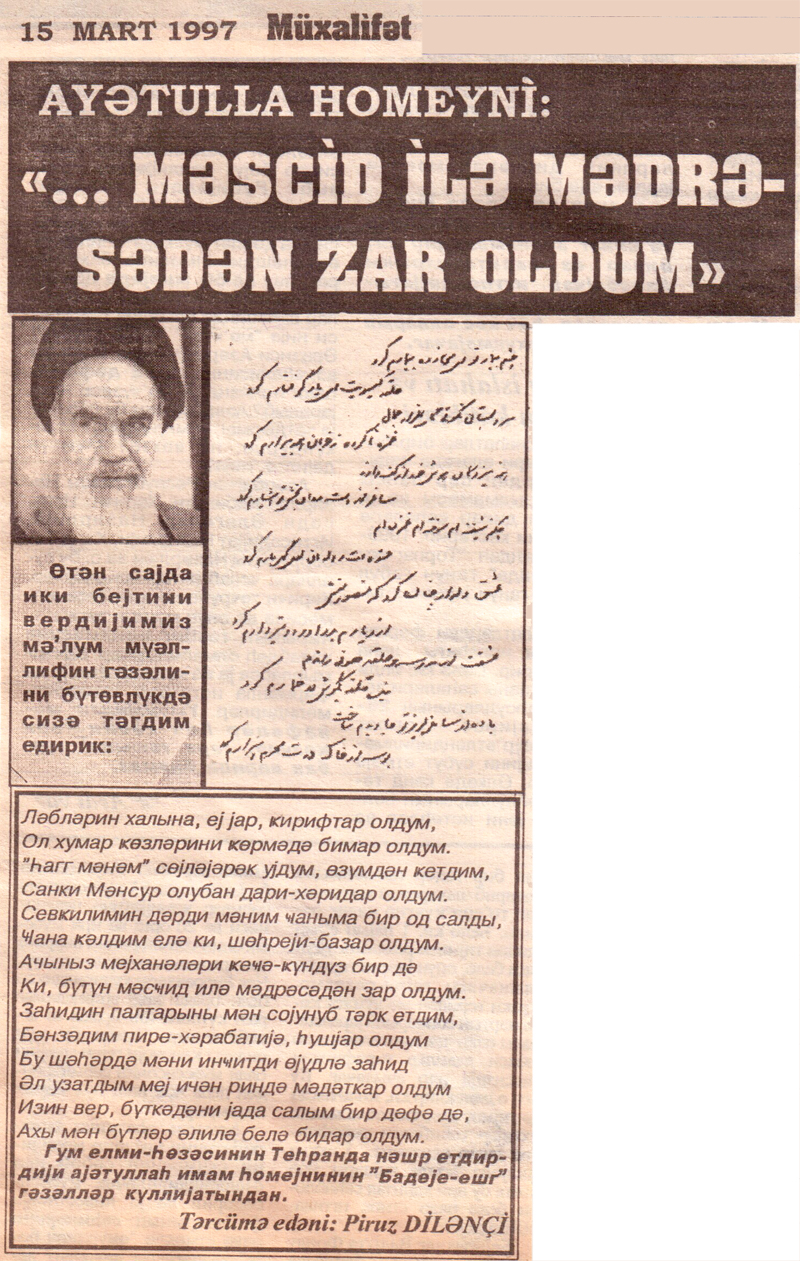
Between 1929 and 1938, a Latin alphabet was in use for North Azerbaijani, although it was different from the one used now. From 1938 to 1991, the Cyrillic script was used. Lastly, in 1991, the current Latin alphabet was introduced, although the transition to it has been rather slow.[90] For instance, until an Aliyev decree on the matter in 2001,[91] newspapers would routinely write headlines in the Latin script, leaving the stories in Cyrillic.[92] The transition has also resulted in some misrendering of İ as Ì.[93][94] In Dagestan, Azerbaijani is still written in Cyrillic script.
The Azerbaijani Latin alphabet is based on the Turkish Latin alphabet. In turn, the Turkish Latin alphabet was based on former Azerbaijani Latin alphabet because of their linguistic connections and mutual intelligibility. The letters Әə, Xx, and Qq are available only in Azerbaijani for sounds which do not exist as separate phonemes in Turkish.
| Old Latin (1929–1938 version; no longer in use; replaced by 1991 version) |
Official Latin (Azerbaijan since 1991) |
Cyrillic (1958 version, still official in Dagestan) |
Perso-Arabic (Iran; Azerbaijan until 1929) |
IPA |
|---|---|---|---|---|
| A a | А а | آ / ـا | /ɑ/ | |
| B в | B b | Б б | ب | /b/ |
| Ç ç | C c | Ҹ ҹ | ج | /dʒ/ |
| C c | Ç ç | Ч ч | چ | /tʃ/ |
| D d | Д д | د | /d/ | |
| E e | Е е | ئ | /e/ | |
| Ə ə | Ә ә | ا / َ / ە | /æ/ | |
| F f | Ф ф | ف | /f/ | |
| G g | Ҝ ҝ | گ | /ɟ/ | |
| Ƣ ƣ | Ğ ğ | Ғ ғ | غ | /ɣ/ |
| H h | Һ һ | ح / ه | /h/ | |
| X x | Х х | خ | /x/ | |
| Ь ь | I ı | Ы ы | ؽ | /ɯ/ |
| I i | İ i | И и | ی | /i/ |
| Ƶ ƶ | J j | Ж ж | ژ | /ʒ/ |
| K k | К к | ک | /k/, /c/ | |
| Q q | Г г | ق | /ɡ/ | |
| L l | Л л | ل | /l/ | |
| M m | М м | م | /m/ | |
| N n | Н н | ن | /n/ | |
| Ꞑ ꞑ[c] | – | – | ݣ / نگ | /ŋ/ |
| O o | О о | وْ | /o/ | |
| Ɵ ɵ | Ö ö | Ө ө | ؤ | /œ/ |
| P p | П п | پ | /p/ | |
| R r | Р р | ر | /r/ | |
| S s | С с | ث / س / ص | /s/ | |
| Ş ş | Ш ш | ش | /ʃ/ | |
| T t | Т т | ت / ط | /t/ | |
| U u | У у | ۇ | /u/ | |
| Y y | Ü ü | Ү ү | ۆ | /y/ |
| V v | В в | و | /v/ | |
| J j | Y y | Ј ј | ی | /j/ |
| Z z | З з | ذ / ز / ض / ظ | /z/ | |
| – | ʼ | ع | /ʔ/ | |
Northern Azerbaijani, unlike Turkish, respells foreign names to conform with Latin Azerbaijani spelling, e.g. Bush is spelled Buş and Schröder becomes Şröder. Hyphenation across lines directly corresponds to spoken syllables, except for geminated consonants which are hyphenated as two separate consonants as morphonology considers them two separate consonants back to back but enunciated in the onset of the latter syllable as a single long consonant, as in other Turkic languages.[citation needed]
Sample text
[edit]Article 1 of the Universal Declaration of Human Rights:
Arabic script (12th century–1926):
[edit]بُتون إنسانلَر لَیاقَت و حُقوقلَرینه گوره آزاد و بَرابَر طوغُلورلَر. اونلَرِݣ شعورلَری و وِجدانلَری وار و بِر بِرلَرینه مُناسِبَتده قَرداشلِق روحنده طاورانمهلیدِرلَر
Arabic script (1926–1928):
[edit]بۆتون اینسانلار لیاقت و حۆقوقلارینا گؤره آزاد و برابر دوْغولورلار. اوٓنلارین شۆعورلاری و ویجدانلاری وار و بیر-بیرلرینه مۆناسیبتده قارداشلیق روحوندا داورانمالیدیرلار
Latin script (1928–1933):
[edit]Butun insanlar ləjakət və hukykları̡na ƣɵrə azad və bərabər dogylyrlar. Onları̡ŋ зuyrları̡ və vicdanları̡ var və bir-birlərinə munasibətdə kardaзlı̡k ryhynda davranmalı̡dı̡rlar.
Bytyn insanlar ləjaqət və hyquqlarьna gɵrə azad və вəraвər doƣulurlar. Onlarьŋ şyurlarь və viçdanlarь var və вir-вirlərinə mynasiвətdə qardaşlьq ruhunda davranmalьdьrlar.
Cyrillic script (1940–1958):
[edit]Бүтүн инсанлар ләягәт вә һүгугларына ҝөрә азад вә бәрабәр доғулурлар. Онларын шүурлары вә виҹданлары вар вә бир-бирләринә мүнасибәтдә гардашлыг руһунда давранмалыдырлар.
Cyrillic script (1958–1991):
[edit]Бүтүн инсанлар ләјагәт вә һүгугларына ҝөрә азад вә бәрабәр доғулурлар. Онларын шүурлары вә виҹданлары вар вә бир-бирләринә мүнасибәтдә гардашлыг руһунда давранмалыдырлар.
Latin script (1991–1992):
[edit]Bütün insanlar läyaqät vä hüquqlarına görä azad vä bärabär doğulurlar. Onların şüurları vä vicdanları var vä bir-birlärinä münasibätdä qardaşlıq ruhunda davranmalıdırlar.
Latin script (1992–present):
[edit]Bütün insanlar ləyaqət və hüquqlarına görə azad və bərabər doğulurlar. Onların şüurları və vicdanları var və bir-birlərinə münasibətdə qardaşlıq ruhunda davranmalıdırlar.
International Phonetic Alphabet transcription:
[edit][byt̪yn̪ in̪s̪ɑ̝n̪:ɑ̝ɾ l̪æjɑ̝ːɢæt̪ væ hygukl̪ɑ̝ɾən̪ɑ̝ ɟœɾæ ʔɑ̞ːz̪ɑ̝t̪ væ bæɾɑ̝ːbæɾ d̪ɔʁuɫ̪ul̪:ˤɑ̝ɾ ɔn̪:ɑ̝ɾən̪ ɕyʔuɾ:ɑ̝ɾə væ vid͡ʑd̪ɑ̝n̪:ɑ̝ɾə vɑ̝ɾ væ biɾbiɾ:æɾin̪æ myn̪ɑ̝ːs̪ibæt̪̊d̪æ gɑ̝ɾd̪ɑ̝ʃd̪əx ɾuːhun̪d̪ɑ̝ d̪ɑ̝vɾɑ̝m:ɑ̝lˤəd̪əlɑ̝ɾ]
English translation:
[edit]All human beings are born free and equal in dignity and rights. They are endowed with reason and conscience and should act towards one another in a spirit of brotherhood.
Vocabulary
[edit]Interjections
[edit]Some samples include:
Secular:
- Of ("Ugh!")
- Tez Ol ("Be quick!")
Invoking deity:
- implicitly:
- Aman ("Mercy")
- Çox şükür ("Much thanks")
- explicitly:
- Allah Allah (pronounced as Allahallah) ("Goodness gracious")
- Hay Allah; Vallah "By God [I swear it]".
- Çox şükür allahım ("Much thanks my God")
Formal and informal
[edit] |
Azerbaijani has informal and formal ways of saying things. This is because there is a strong tu-vous distinction in Turkic languages like Azerbaijani and Turkish (as well as in many other languages). The informal "you" is used when talking to close friends, relatives, animals or children. The formal "you" is used when talking to someone who is older than the speaker or to show respect (to a professor, for example).
As in many Turkic languages, personal pronouns can be omitted, and they are only added for emphasis.
Since 1992, North Azerbaijani has used a phonetic writing system, so pronunciation is easy: most words are pronounced exactly as they are spelled. However, the combination qq in words is pronounced [kɡ], as the first voiced velar stop is devoiced when it is geminated, such as in çaqqal, pronounced [t͡ʃɑkɡɑl].[95][96]
| Category | English | North Azerbaijani (in Latin script) |
|---|---|---|
| Basic expressions | yes | hə /hæ/ (informal), bəli (formal) |
| no | yox /jox/ (informal), xeyr (formal) | |
| hello | salam /sɑlɑm/ | |
| goodbye | sağ ol /ˈsɑɣ ol/ | |
| sağ olun /ˈsɑɣ olun/ (formal) | ||
| good morning | sabahınız xeyir /sɑbɑhɯ(nɯ)z xejiɾ/ | |
| good afternoon | günortanız xeyir /ɟynoɾt(ɑn)ɯz xejiɾ/ | |
| good evening | axşamın xeyir /ɑxʃɑmɯn xejiɾ/ | |
| axşamınız xeyir /ɑxʃɑmɯ(nɯ)z xejiɾ/ | ||
| Colours | black | qara /ɡɑɾɑ/ |
| blue | göy /ɟœj/ | |
| brown | qəhvəyi / qonur | |
| grey | boz /boz/ | |
| green | yaşıl /jaʃɯl/ | |
| orange | narıncı /nɑɾɯnd͡ʒɯ/ | |
| pink | çəhrayı
/t͡ʃæhɾɑjɯ/ | |
| purple | bənövşəyi
/bænœy̑ʃæji/ | |
| red | qırmızı /ɡɯɾmɯzɯ/ | |
| white | ağ /ɑɣ/ | |
| yellow | sarı /sɑɾɯ/ | |
| golden | qızıl |
Numbers
[edit]| Number | Word |
|---|---|
| 0 | sıfır /ˈsɯfɯɾ/ |
| 1 | bir /biɾ/ |
| 2 | iki /ici/ |
| 3 | üç /yt͡ʃ/ |
| 4 | dörd /dœɾd/ |
| 5 | beş /beʃ/ |
| 6 | altı /ɑltɯ/ |
| 7 | yeddi /jeddi/ |
| 8 | səkkiz /sæcciz/ |
| 9 | doqquz /dokɡuz/ |
| 10 | on /on/ |
The numbers 11–19 are constructed as on bir and on iki, literally meaning "ten-one, ten-two" and so on up to on doqquz ("ten-nine").
| Number | Word |
|---|---|
| 20 | iyirmi /ijiɾmi/[d] |
| 30 | otuz /otuz/ |
| 40 | qırx /ɡɯɾx/ |
| 50 | əlli /ælli/ |
Greater numbers are constructed by combining in tens and thousands larger to smaller in the same way, without using a conjunction in between.
Notes
[edit]- ^ a b c Former Cyrillic spelling used in the Azerbaijan Soviet Socialist Republic.
- ^
- The written language of the Iraqi Turkmen is based on Istanbul Turkish using the modern Turkish alphabet.
- Professor Christiane Bulut has argued that publications from Azerbaijan often use expressions such as "Azerbaijani (dialects) of Iraq" or "South Azerbaijani" to describe Iraqi Turkmen dialects "with political implications"; however, in Turcological literature, closely related dialects in Turkey and Iraq are generally referred to as "eastern Anatolian" or "Iraq-Turkic/-Turkman" dialects, respectively.[1]
- ^ Since Azerbaijan's independence from the Soviet Union in 1991, northern Azerbaijani uses the Latin alphabet. Iranian Azerbaijani, on the other hand, has always used and continues to use Arabic script.[47]
- ^ Excluded from the alphabet in 1938
- ^ /iɾmi/ is also found in standard speech.
References
[edit]- ^ Bulut, Christiane (2018b). "The Turkic varieties of Iran". In Haig, Geoffrey; Khan, Geoffrey (eds.). The Languages and Linguistics of Western Asia: An Areal Perspective. Walter de Gruyter. p. 398. ISBN 978-3-11-042168-2.
- ^ Azerbaijani language at Ethnologue (25th ed., 2022)

- ^ a b c d e f g "Azerbaijani, North". Ethnologue. Archived from the original on 5 June 2019. Retrieved 2 February 2020.
- ^ a b c d e f "Azerbaijani, South". Ethnologue. Archived from the original on 5 June 2019. Retrieved 2 February 2020.
- ^ a b Azeri Arabic Turk standard of writing; authored by Javad Heyat; 2001 http://www.azeri.org/Azeri/az_arabic/azturk_standard.pdf
- ^ Salehi, Mohammad; Neysani, Aydin (2017). "Receptive intelligibility of Turkish to Iranian-Azerbaijani speakers". Cogent Education. 4 (1): 3. doi:10.1080/2331186X.2017.1326653. S2CID 121180361.
Northern and Southern Azerbaijani are considered distinct languages by the International Organization for Standardization (ISO) (...)
- ^ "Türk dili, yoxsa azərbaycan dili? (Turkish language or Azerbaijani language?)". BBC (in Azerbaijani). 9 August 2016. Retrieved 15 August 2016.
- ^ Goyushov, Altay (26 September 2018). "The Language of Azerbaijan: Turkish or Azerbaijani?". Baku Research Institute. Retrieved 23 August 2023.
However, in 1936–1937, the situation changed fundamentally. Even though there was no explicit mention of an enactment of state language in local Azerbaijani laws, the term "Turkish" was substituted by "Azerbaijani" in state and court documents. Later in 1956, "Azerbaijani" was given the status of the official state language of Soviet Azerbaijan. This was also mentioned in Soviet Azerbaijan's last Constitution adopted in 1978.
- ^ a b c d Doerfer, G. (2011). "Azerbaijan". In Yarshater, Ehsan (ed.). Encyclopædia Iranica. Vol. III/3: Azerbaijan IV–Bačča(-ye) Saqqā (Online ed.). Encyclopædia Iranica Foundation. § viii. Azeri Turkish, pp. 245–248.
- ^ Rahmati, Nemat (1998). Aserbaidschanisch Lehrbuch : unter Berücksichtigung des Nord- und Südaserbaidschanischen. Korkut M. Buğday. Wiesbaden: Harrassowitz. ISBN 978-3-447-03840-9. OCLC 40415729.
- ^ Stevenson, Angus (2010). Oxford dictionary of English. Oxford University Press. p. 113. ISBN 9780199571123.
- ^ Larry Clark, Turkmen Reference Grammar, P. 15
- ^ Stein, Heidi (2014). "Ajem-Turkic". In Fleet, Kate; Krämer, Gudrun; Matringe, Denis; Nawas, John; Rowson, Everett (eds.). Encyclopaedia of Islam (3rd ed.). Brill Online. ISSN 1873-9830.
- ^ In Honor of the Turkologist!: Essays Celebrating the 70th Birthday of Ekrem Čaušević. Zagreb: Faculty of Philosophy in Zagreb. 2022. pp. 103–105. ISBN 978-953-175-937-3.
- ^ "The Turkic Languages", Osman Fikri Sertkaya (2005) in Turks – A Journey of a Thousand Years, 600–1600, London ISBN 978-1-90397-356-1
- ^ Wright, Sue; Kelly, Helen (1998). Ethnicity in Eastern Europe: Questions of Migration, Language Rights and Education. Multilingual Matters Ltd. p. 49. ISBN 978-1-85359-243-0.
- ^ Bratt Paulston, Christina; Peckham, Donald (1 October 1998). Linguistic Minorities in Central and Eastern Europe. Multilingual Matters Ltd. pp. 98–115. ISBN 978-1-85359-416-8.
- ^ a b Johanson, Lars (2011). "Azerbaijan". In Yarshater, Ehsan (ed.). Encyclopædia Iranica. Vol. III/3: Azerbaijan IV–Bačča(-ye) Saqqā (Online ed.). Encyclopædia Iranica Foundation. § ix. Iranian Elements in Azeri Turkish, pp. 248–251.
- ^ John R. Perry, "Lexical Areas and Semantic Fields of Arabic" in Csató et al. (2005) Linguistic convergence and areal diffusion: case studies from Iranian, Semitic and Turkic, Routledge, p. 97: "It is generally understood that the bulk of the Arabic vocabulary in the central, contiguous Iranic, Turkic and Indic languages was originally borrowed into literary Persian between the ninth and thirteenth centuries CE..."
- ^ Claus Schönig, Turkic languages and literatures in the Timurid and post-Timurid period, in: The Cambridge History of Iran, Volume 6, Cambridge University Press, 1986. → s. 708–710
- ^ Mehmet Fuat Köprülü, Türk Edebiyatı Tarihi, İstanbul (Turkish): Türk Tarih Kurumu, 1926.s. 96–101
- ^ Gerhard Doerfer, Türkische und mongolische Elemente im Neupersischen, Bd. 2, Wiesbaden: Franz Steiner Verlag, 1963. s. 350–352
- ^ Tonoyan, Artyom (2019). "On the Caucasian Persian (Tat) Lexical Substratum in the Baku Dialect of Azerbaijani. Preliminary Notes". Zeitschrift der Deutschen Morgenländischen Gesellschaft. 169 (2): 368 (note 4). doi:10.13173/zeitdeutmorggese.169.2.0367. S2CID 211660063.
- ^ Karpat, K. (2001). The Politicization of Islam: Reconstructing Identity, State, Faith, and Community in the Late Ottoman State. Oxford University Press. p. 295.
- ^ "Alphabet Changes in Azerbaijan in the 20th Century". Azerbaijan International. Spring 2000. Retrieved 21 July 2013.
- ^ Language Commission Suggested to Be Established in National Assembly. Day.az. 25 January 2011.
- ^ Johanson, Lars (6 April 2010). Brown, Keith; Ogilvie, Sarah (eds.). Concise Encyclopedia of Languages of the World. Elsevier. pp. 110–113. ISBN 978-0-08-087775-4 – via Google Books.
- ^ a b c d Öztopcu, Kurtulus. "Azeri / Azerbaijani". American Association of Teachers of Turkic Languages. Archived from the original on 8 March 2021. Retrieved 5 February 2020.
- ^ Javadi, Hasan; Burrill, Kathleen (2012). "Azerbaijan". In Yarshater, Ehsan (ed.). Encyclopædia Iranica. Vol. III/3: Azerbaijan IV–Bačča(-ye) Saqqā (Online ed.). Encyclopædia Iranica Foundation. § x. Azeri Turkish Literature, pp. 251–255.
The 15th century saw the beginning of a more important period in the history of the Azeri Turkish literature. The position of the literary language was reinforced under the Qarāqoyunlu (r. 1400–68), who had their capital in Tabriz. Jahānšāh (r. 1438–68) himself wrote lyrical poems in Turkish using the pen name of 'Ḥaqiqi.'
- ^ V. Minorsky. Jihān-Shāh Qara-Qoyunlu and His Poetry (Turkmenica, 9). Bulletin of the School of Oriental and African Studies, University of London. — Published by: Cambridge University Press on behalf of School of Oriental and African Studies, 1954. — V.16, p . 272, 283: «It is somewhat astonishing that a sturdy Turkman like Jihan-shah should have been so restricted in his ways of expression. Altogether the language of the poems belongs to the group of the southern Turkman dialects which go by the name of Azarbayjan Turkish.»; «As yet nothing seems to have been published on the Br. Mus. manuscript Or. 9493, which contains the bilingual collection of poems of Haqiqi, i.e. of the Qara-qoyunlu sultan Jihan-shah (A.D. 1438—1467).»
- ^ Javadi, Hasan; Burrill, Kathleen (2012). "Azerbaijan". In Yarshater, Ehsan (ed.). Encyclopædia Iranica (Online ed.). Encyclopædia Iranica Foundation. § x. Azeri Turkish Literature.
He wrote a maṯnawi entitled Yusof wa Zoleyḵā, and dedicated it to the Aqqoyunlu Sultan Yaʿqub (r. 1478–90), who himself wrote poetry in Azeri Turkish.
Adapted from Javadi, Hasan; Burrill, Kathleen (1988). "Azerbaijan". In Yarshater, Ehsan (ed.). Encyclopædia Iranica. London and New York: Routledge & Kegan Paul. § x. Azeri literature.He wrote a maṯnawī entitled Yūsof wa Zoleyḵā, and dedicated it to the Āq Qoyunlū Sultan Yaʿqūb (r. 883-96/1478-90), who himself wrote poetry in Azeri.
- ^ Mark R.V. Southern. Mark R V Southern (2005) Contagious couplings: transmission of expressives in Yiddish echo phrases, Praeger, Westport, Conn. ISBN 978-0-31306-844-7
- ^ "Greetings to Heydar Baba". umich.edu. Archived from the original on 5 August 2018. Retrieved 8 September 2010.
- ^ Pieter Muysken, "Introduction: Conceptual and methodological issues in areal linguistics", in Pieter Muysken (2008) From Linguistic Areas to Areal Linguistics, p. 30-31 ISBN 978-90-272-3100-0 [1]
- ^ Viacheslav A. Chirikba, "The problem of the Caucasian Sprachbund" in Muysken, p. 74
- ^ Lenore A. Grenoble (2003) Language Policy in the Soviet Union, p. 131 ISBN 978-1-4020-1298-3 [2]
- ^ Keith Brown, Sarah Ogilvie. Concise encyclopedia of languages of the world. – Elsevier, 2009. – С. 110–113. – ISBN 978-0-08-087774-7. An Azerbaijanian koine´ functioned for centuries as a lingua franca, serving trade and intergroup communication all over Persia, in the Caucasus region and in southeastern Dagestan. Its transregional validity continued at least until the 18th century.
- ^ [3] Nikolai Trubetzkoy (2000) Nasledie Chingiskhana, p. 478 Agraf, Moscow ISBN 978-5-77840-082-5 (Russian)
- ^ J. N. Postgate (2007) Languages of Iraq, p. 164, British School of Archaeology in Iraq ISBN 978-0-903472-21-0
- ^ Homa Katouzian (2003) Iranian history and politics, Routledge, pg 128: "Indeed, since the formation of the Ghaznavids state in the tenth century until the fall of Qajars at the beginning of the twentieth century, most parts of the Iranian cultural regions were ruled by Turkic-speaking dynasties most of the time. At the same time, the official language was Persian, the court literature was in Persian, and most of the chancellors, ministers, and mandarins were Persian speakers of the highest learning and ability"
- ^ "Date of the Official Instruction of Oriental Languages in Russia" by N.I.Veselovsky. 1880. in W.W. Grigorieff ed. (1880) Proceedings of the Third Session of the International Congress of Orientalists, Saint Petersburg (Russian)
- ^ a b Salehi, Mohammad; Neysani, Aydin (2017). "Receptive intelligibility of Turkish to Iranian-Azerbaijani speakers". Cogent Education. 4 (1): 3. doi:10.1080/2331186X.2017.1326653. S2CID 121180361.
Northern and Southern Azerbaijani are considered distinct languages by the International Organization for Standardization (ISO) (...)
- ^ A study of Study of Ethnopolitical Conflict in the Caucasus, author Svante E.Cornell, 2001, page 22 (ISBN 978-0-203-98887-9)
- ^ Hammarström, Harald; Forkel, Robert; Haspelmath, Martin (2019). "Linguistics". In Hammarström, Harald; Forkel, Robert; Haspelmath, Martin (eds.). Modern Azeric. doi:10.5281/zenodo.3554959. Retrieved 5 February 2020 – via Glottolog 4.1.
- ^ a b c "Khazar language". Great Russian Encyclopedia (in Russian).
- ^ Schönig 1998, p. 248.
- ^ , Mokari & Werner 2017, p. 207.
- ^ "Azeris". World Directory of Minorities and Indigenous People. Retrieved 5 July 2013.
- ^ "Iran-Azeris". Library of Congress Country Studies. December 1987. Retrieved 13 August 2013.
- ^ Iran: Country Study Guide. International Business Publications. 2005. ISBN 978-0-7397-1476-8.
- ^ "The World Factbook". Cia.gov. Retrieved 13 July 2013.
- ^ "Äynallu". Turkic Database.
- ^ Knüppel, Michael (2010) [2000]. "Turkic languages of Persia: An overview". In Yarshater, Ehsan (ed.). Encyclopædia Iranica (Online ed.). Encyclopædia Iranica Foundation.
- ^ Doerfer, Gerhard, and Wolfram Hesche. 1989. Südoghusische Materialen aus Afghanistan und Iran. Wiesbaden: Otto Harrassowitz. ISBN 978-344702786.
- ^ a b Barthold & Wixman 1978, p. 627
- ^ Bournoutian 2017, p. 331 (note 28)
- ^ Knüppel, Michael (2010) [2000]. "Turkic languages of Persia: An overview". In Yarshater, Ehsan (ed.). Encyclopædia Iranica (Online ed.). Encyclopædia Iranica Foundation.
The Afšār language was once spoken in a wide area in western and southwestern Persia from Kermānšāh to the shores of the Persian Gulf.
- ^ Stöber, Georg (2010). "Afshār". In Fleet, Kate; Krämer, Gudrun; Matringe, Denis; Nawas, John; Rowson, Everett(eds.). Encyclopaedia of Islam (3rd ed.). Brill Online. ISSN 1873-9830. Linguistically, Afshārī is classified as a dialect belonging to the South Oghuz group of Turkic languages (southwestern branch of Turkic) (Johanson, History of Turkic, 82–3), or else as a dialect of South Azerbaijani (Azeri). As they were embedded in a Fārsī-speaking environment, however, in many cases Fārsī became the mother tongue of the Afshārs. Other groups became bilingual (as in Kirmān). Additionally, the contact between the different languages seems to have transformed the original dialect (cf. Johanson, Discoveries, 14–6). In 2009 a linguistic comparison of different Afshār groups remains outstanding.
- ^ Rezaei, Mehdi (29 August 2024). "On The Dialect of Shahsavan". Journal of Turkish Studies. 11 (11 4): 807–828. doi:10.7827/TurkishStudies.9295.
- ^ Mudrak, Oleg (30 April 2009). "Language in time. Classification of Turkic languages (in Russian)". centrasia.org (in Russian).
Распад туркменско-азербайджанского. Несмотря на все уверения, что азербайджанский является ближайшим родственником турецкого, это не так. Наиболее близким к нему (азербайджанскому) является туркменский. Распад этого единства попадает примерно на 1180-й год. Это удивительно. Потому что тогда как раз был конец Империи Великих Сельджуков. <...> Интересная дата – это распад огузской общности и выделение турецкого языка. Это примерно 1030-й год. Это самое начало 11-го века. Это очень интересно, потому что как раз в это время начинается миграция сельджуков. <...> Собственно сердце турецкого языка – это район Рума в Восточной Анатолии, где сидит тюркское население.
- ^ "Azerbaijani (Azeri)". UNESCO.
- ^ Yelda, Rami (2012). A Persian Odyssey: Iran Revisited. AuthorHouse. p. 33. ISBN 978-1-4772-0291-3.
- ^ Mafinezam, Alidad; Mehrabi, Aria (2008). Iran and Its Place Among Nations. Greenwood Publishing Group. p. 57. ISBN 978-0-275-99926-1.
- ^ Sağın-Şimşek, Çiğdem; König, Wolf (September 2012). "Receptive multilingualism and language understanding: Intelligibility of Azerbaijani to Turkish speakers". International Journal of Bilingualism. 16 (3): 315–331. doi:10.1177/1367006911426449. hdl:11511/38714. ISSN 1367-0069.
- ^ Salehi, Mohammad; Neysani, Aydin (2017). "Receptive intelligibility of Turkish to Iranian-Azerbaijani speakers". Cogent Education. 4 (1): 10. doi:10.1080/2331186X.2017.1326653. S2CID 121180361.
- ^ borrowing from a Semitic K-T-B
- ^ Shiraliyev M. Fundamentals of Azerbaijan dialectology. Baku, 2008. p.76
- ^ Kara M. Turkmen Grammar. Ankara, 2005. p.231
- ^ Berdiev R.; S. Kurenov; K. Shamuradov; S. Arazkuliyev (1970). Essay on the Dialects of the Turkmen Language. Ashgabat. p. 116.
{{cite book}}: CS1 maint: location missing publisher (link) - ^ "Swadesh list, compare the Azerbaijani language and the Turkmen language". Linguistics.
- ^ Kök 2016, pp. 406–30.
- ^ Persian Studies in North America by Mohammad Ali Jazayeri
- ^ Mokari & Werner (2017), p. 209.
- ^ Məmmədli Məhərrəm Əvəz oğlu. Azərbaycan dialektologiyası. Dərslik. Bakı: Zərdabi LTD, 2019, 352 s.
- ^ Mahirə Hüseynova. Mahmud Kaşğarinin “Divani lüğət-ittürk” əsərinin qrammatik xüsusiyyətləri.
- ^ Məmmədli Məhərrəm Əvəz oğlu. Azərbaycan dialektologiyası. Bakı, “Zərdabi Nəşr” MMC, 2019, 352 səh.
- ^ Householder and Lotfi. Basic Course in Azerbaijani. 1965.
- ^ Zaslansky, Matthew (7 October 2019). "The overabundance of the perfect and the restriction of evidentiality in Standard Azerbaijani: A diachronic study of -(y)Ib and -mIş". Proceedings of the Workshop on Turkic and Languages in Contact with Turkic. 4: 104–118. doi:10.3765/ptu.v4i1.4582. ISSN 2641-3485. S2CID 211661718 – via Linguistic Society of America.
The [Standard Azerbaijani Latin] orthography tends to correspond to IPA equivalents in broad transcription, except j = /ʒ/, ş = /ʃ/, ç = /tʃ/, c = /dʒ/, k = /c~k/, g = /ɟ/, q = /g/ (often spirantized as [x] in codas), ğ = /ɣ/, y = /j/, ə = /æ/, ö = /œ/, ü = /y/, ı = /ɯ/.
- ^ Mokari & Werner 2017, pp. 208–210.
- ^ Campbell, George L.; King, Gareth (1991). "Azerbaijani". Compendium of the World's Languages (3rd ed.). Routledge. pp. 153–157. ISBN 978-1-136-25846-6 – via Google Books.
There are nine vowels: i e æ y œ ɯ u o ɑ. (...) As in Turkish, c = /dʒ/, ç = /tʃ/, ş = /ʃ/, j = /ʒ/, ı = /ɯ/, ü = /y/, ö = /œ/; letters not used in Turkish are ə = /æ/, q = /ɡ/, x = /x/.
- ^ a b c Mokari & Werner (2016), p. 509.
- ^ Mokari & Werner 2016, p. 514.
- ^ Əlizadə 2020, pp. 10–12.
- ^ Səlimi 1976, pp. 49–51.
- ^ They are /oʋ/ and /œw/ in the dialect of Tabriz.[84]
- ^ Səlimi 1976, pp. 33–34, 44–51.
- ^ Əlizadə 2020, p. 12.
- ^ Səlimi 1976, pp. 89.
- ^ Ameli, Seyed Hassan (2021). لغتنامه ترکی آذربایجانی: حروف آ (جلد ۱ (in Persian and Azerbaijani). Mohaghegh Ardabili. ISBN 978-600-344-624-3.
- ^ Dooley, Ian (6 October 2017). "New Nation, New Alphabet: Azerbaijani Children's Books in the 1990s". Cotsen Children's Library (in English and Azerbaijani). Princeton University WordPress Service. Retrieved 13 December 2017.
Through the 1990s and early 2000s Cyrillic script was still in use for newspapers, shops, and restaurants. Only in 2001 did then president Heydar Aliyev declare "a mandatory shift from the Cyrillic to the Latin alphabet" ... The transition has progressed slowly.
- ^ Peuch, Jean-Christophe (1 August 2001). "Azerbaijan: Cyrillic Alphabet Replaced By Latin One". Radio Free Europe / Radio Liberty. Retrieved 13 December 2017.
- ^ Monakhov, Yola (31 July 2001). "Azerbaijan Changes Its Alphabet". Getty Images. Retrieved 13 December 2017.
- ^ Khomeini, Ruhollah (15 March 1997). "Ayətulla Homeynì: "... Məscìd ìlə mədrəsədən zar oldum"". Müxalifət (in Azerbaijani and Persian). Translated by Dilənçi, Piruz. Baku. Retrieved 13 December 2017.
- ^ Yahya, Harun. "Global Impact of the Works of Harun Yahya V2". Secret Beyond Matter. Archived from the original on 26 July 2020. Retrieved 23 April 2020.
- ^ Əlizadə 2020, p. 14.
- ^ Səlimi 1976, p. 38–39.

Bibliography
[edit]- Əlizadə, Solmaz (2020). "Diphthongization in Azerbaijani Language" (PDF). Topical Issues in the Humanities: Intercollegiate Collection of Scientific Papers of Young Scientists of Ivan Franko Drohobych State Pedagogical University. 2 (30). Ivan Franko National University of Lviv: 10–16. doi:10.24919/2308-4863.2/30.212274. S2CID 224941226.
- Barthold, W. & Wixman, R. (1978). "Ḳarapapak̲h̲". In van Donzel, E.; Lewis, B.; Pellat, Ch. & Bosworth, C. E. (eds.). The Encyclopaedia of Islam, Second Edition. Volume IV: Iran–Kha. Leiden: E. J. Brill. OCLC 758278456.
- Bournoutian, George (2017). "The Population of the South Caucasus according to the 1897 General Census of the Russian Empire". Iran and the Caucasus. 21 (3): 324–340. doi:10.1163/1573384X-20170307.
- Brown, Keith, ed. (24 November 2005). Encyclopedia of Language and Linguistics. Elsevier. ISBN 978-0-08-054784-8.
- Kök, Ali (2016). "Modern Oğuz Türkçesi Diyalektlerinde Göçüşme" [Migration in Modern Oghuz Turkish Dialects]. 21. Yüzyılda Eğitim ve Toplum Eğitim Bilimleri ve Sosyal Araştırmalar Dergisi (in Turkish). 5 (15). ISSN 2147-0928.[permanent dead link]
- Mokari, Payam Ghaffarvand; Werner, Stefan (2016). Dziubalska-Kolaczyk, Katarzyna (ed.). "An acoustic description of spectral and temporal characteristics of Azerbaijani vowels". Poznań Studies in Contemporary Linguistics. 52 (3). doi:10.1515/psicl-2016-0019. S2CID 151826061.
- Mokari, Payam Ghaffarvand; Werner, Stefan (2017). "Azerbaijani". Journal of the International Phonetic Association. 47 (2): 207. doi:10.1017/S0025100317000184. S2CID 232347049.
- Səlimi, Hüseynqulu (1976). A generative phonology of Azerbaijani (PhD). University of Florida. OCLC 1045615622. ARK 13960/t1tf4s495. OL 18319A.
- Sinor, Denis (1969). Inner Asia. History-Civilization-Languages. A syllabus. Bloomington. pp. 71–96. ISBN 978-0-87750-081-0.
- Schönig, Claus (1998). "Azerbaijanian". The Turkic Languages. London: Routledge: 248.
Further reading
[edit]- Mustafayev, Shahin (2013). "Ethnolinguistic Processes in the Turkic Milieu of Anatolia and Azerbaijan (14th–15th Centuries)". In Lascu, Stoica; Fetisleam, Melek (eds.). Contemporary Research in Turkology and Eurasian Studies: A Festschrift in Honor of Professor Tasin Gemil on the Occasion of His 70th Birthday. Cluj-Napoca: Cluj University Press. pp. 333–346. ISBN 978-973-595-622-6.
- “Language Shifts: ‘Gamburger’ Becomes Hamburger” Azerbaijan International, Vol. 8:1 (Spring 2000), p. 12.
External links
[edit]


- A blog on Azerbaijani language resources and translations
- (in Russian) A blog about the Azerbaijani language and lessons
- AZERI.org, Azerbaijani literature and English translations.
- Ismikhan Rahimov: In Defense of My Mother Tongue Azerbaijani (sentenced to the GULAG for eight years), AZER.com at Azerbaijan International, Vol. 12:4 (Winter 2004), p. 25.
- Online bidirectional Azerbaijani-English Dictionary [broken as of 2022]
- Learn Azerbaijani at learn101.org.
- Pre-Islamic roots
- Azerbaijan-Turkish language in Iran by Ahmad Kasravi.
- including sound file.
- Azerbaijani (Arabic script) – Persian Dictionary (2009) (by Mahmud Dast-Pisheh)
- Azerbaijani<>Turkish dictionary (Pamukkale University)
- Azerbaijan Language with Audio
- Azerbaijani thematic vocabulary
- AzConvert, an open source Azerbaijani transliteration program.
- Azerbaijani Alphabet and Language in Transition, the entire issue of Azerbaijan International, Vol. 8:1 (Spring 2000) at AZER.com.
- Editorial: Betty Blair, "Alphabet and Language in Transition"
- Chart: Four Alphabet Changes in Azerbaijan in the 20th century Azerbaijan International, Vol. 8:1 (Spring 2000), p. 13.
- Chart: Changes in the Azerbaijan Alphabet Sequence in the 20th century Azerbaijan International, Vol. 8:1 (Spring 2000), p. 15.
| Origin | |||||||||
|---|---|---|---|---|---|---|---|---|---|
| Development | |||||||||
| Alphabet |
| ||||||||
| Grammar | |||||||||
| Vocabulary | |||||||||
| Regulation and Promotion | |||||||||
| Legislation | |||||||||
| Dictionaries |
| ||||||||
| Researchers | |||||||||
| Literature | |||||||||
| Official status | |||||||||
| Native regions | |||||||||
| Commemoration | |||||||||
| Related topics | |||||||||


Azerbaijani language
View on GrokipediaOrigins and Historical Development
Etymology and Name
The designation "Azerbaijani" for the modern Turkic language spoken primarily in Azerbaijan derives from the regional toponym Azerbaijan, which traces its etymology to the ancient satrapy of Atropatene—known in Old Persian as Āturpātakān—named after Atropates, a Persian satrap under Alexander the Great in the 4th century BCE whose name means "protected by fire" or "fire guardian" in Old Iranian.[9] [10] Prior to the 11th-century influx of Oghuz Turks, the region hosted the Iranian language Āḏarī (Arabic al-āḏarīya), a northwestern Iranian tongue unrelated to the contemporary Azerbaijani language but lending historical resonance to the area's nomenclature.[11] In medieval and early modern contexts, including under Qajar Persian and Ottoman suzerainty, the emerging Oghuz Turkic vernacular was commonly termed Turkish (türkī or azərbaycan türkcəsi), reflecting its close affinity to Anatolian Turkish and classification within the Oghuz branch.[12] This persisted into the short-lived Azerbaijan Democratic Republic (1918–1920), where legislation in June 1918 enshrined "Turkish" as the state language to align with ethnic-linguistic realities and pan-Turkic aspirations.[13] Soviet policies, culminating in a 1930s directive attributed to Joseph Stalin, mandated renaming the language Azerbaijani (or Azeri) to differentiate it from Turkey's Turkish, thereby curtailing cross-border cultural ties and pan-Turkic unity amid efforts to consolidate Soviet control over ethnic identities.[14] This shift, enacted around 1936–1937 alongside Cyrillic script adoption, marked a departure from pre-Soviet usage and emphasized territorial nationalism over broader Turkic affiliation.[15] Post-1991 independence saw temporary reversions—such as brief official use of "Turkish" in 1992–1995—but the 1995 constitution reinstated "Azerbaijani" (Azərbaycan dili) as the standard term, prioritizing national distinction. Ongoing debates contrast "Azeri" as an informal abbreviation with the fuller "Azerbaijani," the latter favored domestically to avoid conflation with the extinct Āḏarī or dilution of sovereignty; pan-Turkic advocates, particularly in Iran where southern varieties predominate, prefer "South Azerbaijani Turkish" to highlight dialectal continuity with standard Turkish rather than separate status.[13][16]Pre-Turkic Substratum
Prior to the 11th-century migrations of Oghuz Turkic tribes into the Caucasus region, the territory of modern Azerbaijan was predominantly inhabited by speakers of Iranian languages, including the extinct Northwestern Iranian dialect known as Āḏarī (Old Azeri).[17] This linguistic layer, documented in medieval Arabic sources as al-āḏarīya, prevailed under Sassanid Persian rule (224–651 CE) and continued amid early Islamic conquests, reflecting a continuity of Iranian-speaking populations in the area.[17] Āḏarī, closely related to Median and Parthian branches, is attested in scattered toponyms and glosses but lacks extensive textual records, with its extinction linked to progressive Turkic demographic shifts rather than sudden replacement.[17] Substrate effects from Āḏarī and related Iranian varieties persist in modern Azerbaijani, manifesting in phonological adaptations such as disrupted vowel harmony (e.g., invariable suffixes like -max in bil-max "to know"), fronted vowels (e.g., a > ä in bäxt "happiness," contrasting Turkish baht), and palatalized consonants (e.g., [ćöć] for kök "root").[18] Vocabulary retains Iranian-derived terms, particularly in domains like flora and fauna (e.g., bar "fruit," payïz "autumn") and basic lexicon (e.g., asan "easy," küčä "street"), integrated during the substrate phase when pre-existing Iranian speakers adopted Turkic as a superstrate.[18] Toponyms further evidence this layer, with Iranian etymons underlying names across the region, as seen in the persistence of elements like those in Ātṛpātakāna (ancient precursor to Azerbaijan) and compounded forms in Turkish-speaking Iranian Azerbaijan, indicating incomplete linguistic erasure.[19][18] Archaeological and textual records from Sassanid inscriptions and medieval Persian-Arabic chronicles illustrate a gradual Turkicization process, characterized by prolonged Irano-Turkic symbiosis rather than conquest-driven linguistic overthrow, with Iranian substrate embedding deeply into incoming Oghuz varieties through bilingualism and population admixture over centuries.[18] This empirical pattern counters models of abrupt replacement, as hybrid forms in early Azeri texts (e.g., 14th–16th centuries) show layered Iranian syntax, such as Persian-influenced subordinative clauses (e.g., Görmüšäm ki, onlar xošbäxt olublar "I saw that they became happy").[18] Such traces underscore the causal role of substrate interference in shaping Azerbaijani's deviation from purer Oghuz norms.[18]Turkicization and Medieval Period
The influx of Oghuz Turkic tribes into the Caucasus region, particularly through the Seljuk migrations spanning the 11th to 13th centuries, initiated the primary phase of linguistic Turkicization in what is now Azerbaijan. Originating from Central Asian steppes, these nomadic groups, led by the Seljuk dynasty established around 1037 CE, advanced westward following their conversion to Sunni Islam circa 985 CE, conquering territories including Azerbaijan by the mid-11th century under leaders like Tughril Beg. This demographic expansion involved mass settlement of pastoralist tribes, which outnumbered and culturally assimilated indigenous Iranian-speaking populations, such as speakers of the extinct Old Azeri language, through mechanisms including elite dominance, intermarriage, and conversion incentives tied to land grants and military integration. Historical linguistics attests that by the late Seljuk era, Oghuz dialects had become predominant in urban centers and rural areas, supplanting prior Iranian substrates while retaining phonological and lexical traces, such as vowel shifts and substrate loanwords in agriculture and topography.[20][21][21] The adaptation of Oghuz Turkic into a distinct regional variety accelerated under subsequent multicultural empires, where it blended with local elements without yielding grammatical core to Iranian or Semitic structures. During Ilkhanid rule (1256–1335 CE), the Mongol successor state in Persia and the Caucasus fostered a multilingual environment, but Turkic served as a vehicular tongue among nomadic levies and administrators, incorporating Persian administrative terms and Arabic religious lexicon via calques rather than syntactic borrowing. This period saw the earliest attestations of written Oghuz in Arabic script, modified with diacritics for Turkic phonemes absent in Arabic, as evidenced in fragmentary administrative texts and oral-derived epics like the Kitab-i Dede Korkut, transcribed in the 15th century but rooted in 11th–12th-century Oghuz folklore reflecting Caucasian settings. Literary emergence crystallized in the 14th century with poets like Imadaddin Nasimi (d. ca. 1417 CE), whose ghazals and divan in vernacular Oghuz Turkic—alongside Persian and Arabic—explored Hurufi mysticism, marking a shift from Persian-dominated court poetry to native expression amid Timurid patronage.[21][22][23] In the Safavid era (1501–1736 CE), Azerbaijani Turkic solidified as a lingua franca within the empire's diverse domains, functioning as the primary idiom of the Qizilbash military elite—who traced descent from Oghuz tribes—and court bureaucracy under Shah Ismail I, himself a native speaker. This role stemmed from the Safavids' Turkic tribal origins, enabling Turkic to mediate between Persian chancery use and tribal vernaculars, though Persian retained prestige in historiography and diplomacy. Lexical enrichment from Persian (e.g., abstract nouns) and Arabic (e.g., Islamic terminology, often filtered through Persian) reached up to 30% in literary registers by the 16th century, yet agglutinative morphology, vowel harmony, and SOV syntax preserved Oghuz integrity, underscoring migration-driven causal dominance over substrate erosion. Such integration propelled Azerbaijani's utility in multicultural governance, from Tabriz to the Caucasus frontiers, without supplanting Persian's cultural hegemony.[22][21][21]Modern Standardization and Reforms
In the mid-19th century, Mirza Fatali Akhundov initiated linguistic reforms aimed at modernizing Azerbaijani written language, which had been a hybrid of Persian, Arabic, and Turkic elements, by advocating for phonetic principles and simplified orthography to enhance clarity and accessibility.[24] His 1857 proposals marked the onset of Enlightenment-era efforts to align the script more closely with spoken forms, influencing subsequent debates on standardization.[25] During the early Soviet period, Azerbaijan adopted a Latin-based alphabet in 1922, following commissions established to unify Turkic scripts and promote literacy, as part of broader latinization campaigns across Soviet Turkic republics.[26] This shift from Arabic script facilitated mass education but was reversed in 1939 when Joseph Stalin mandated Cyrillic imposition to sever ties with pan-Turkic movements and reinforce Soviet integration.[15][27] Following independence in 1991, Azerbaijan's parliament adopted a modified Latin script on December 25, restoring a version akin to the pre-1939 system to symbolize cultural reconnection with Turkic roots and reduce Russian linguistic influence.[28] Post-Soviet policies emphasized purism through state-supported initiatives to purge Russicisms from vocabulary and elevate Azerbaijani in education and administration, with multilingualism policies promoting the language alongside English and Russian in schools.[29] By 2023, Azerbaijan formalized transliteration rules for geographical names into English, aiding digital and international standardization as reported to the United Nations.[30] Recent analyses highlight challenges to language vitality, attributing potential degradation to globalization, migration, and dominance of major world languages, which erode lexical purity and usage among youth despite official safeguards.[31] These concerns underscore ongoing reforms to bolster native terminology in media and technology, countering external pressures while maintaining empirical focus on literacy rates exceeding 99% post-independence.[29]Linguistic Classification and Dialects
Affiliation with Turkic Languages
Azerbaijani is classified as a Turkic language within the Oghuz branch, specifically the southwestern subgroup, alongside Turkish and Turkmen.[32][6] This positioning is supported by shared typological features, including agglutinative morphology where suffixes denote grammatical relations, vowel harmony constraining vowel sequences within words, and a core vocabulary derived from Proto-Turkic roots such as ata for "father" and su for "water."[8] These elements align Azerbaijani with the Common Turkic lineage, distinct from the Oghuric branch exemplified by Chuvash, which retains archaic traits like initial stress and non-harmonizing vowels absent in Oghuz varieties.[33] Claims positing an Iranian origin for modern Azerbaijani are refuted by the dominance of Turkic grammatical structure and basic lexicon, which show systematic correspondences to other Turkic languages rather than Iranian patterns like ergativity or fusional morphology.[8] While Persian loanwords constitute 20-40% of the lexicon due to historical contact—e.g., ketab for "book" from Persian—such borrowings do not alter the underlying Turkic framework, as evidenced by comparative reconstructions tracing Azerbaijani's syntax and phonology to Oghuz ancestors rather than Iranian substrates.[6] Linguistic consensus, drawn from phonological and morphological analyses, confirms Azerbaijani's Turkic affiliation over alternative ethnolinguistic hypotheses.[32] Azerbaijani exhibits 65-90% mutual intelligibility with Turkish, varying by dialect and exposure, with higher lexical overlap but divergences in phonology (e.g., Azerbaijani's rounded front vowels) and vocabulary influenced by Russian or Persian.[34] This proximity fuels debate on its status: pan-Turkic perspectives, rooted in early 20th-century movements, often term it "Azerbaijani Turkish" to underscore shared heritage and agglutinative unity, promoting linguistic solidarity across Turkic states.[35] In contrast, the Azerbaijani government emphasizes its distinctiveness through standardized orthography and nomenclature since independence in 1991, framing it as a separate language to bolster national identity amid regional politics.[36] These views reflect not only linguistic realities but also ideological priorities, with empirical evidence favoring classification as a closely related but independent Oghuz language.[37]Dialect Continuum and Mutual Intelligibility
The Azerbaijani language constitutes a dialect continuum, characterized by gradual linguistic transitions across its geographic range from the Caspian littoral in northern Azerbaijan to the Tabriz plain in northwestern Iran, without discrete boundaries demarcating discrete dialects. Isoglosses—lines mapping the distribution of specific phonological, morphological, or lexical features—form bundles that outline regional subgroups, such as the separation between eastern and western varieties, rather than rigid divisions. This structure reflects historical migrations and settlement patterns of Oghuz Turkic speakers, overlaid on pre-existing substrata, resulting in a chain of mutually transitioning forms.[17] Mutual intelligibility prevails among adjacent varieties, with speakers typically comprehending one another at rates exceeding 90% in everyday discourse, diminishing progressively with geographic separation but remaining sufficient to preclude classification as separate languages. Empirical assessments of Oghuz Turkic varieties, including Azerbaijani, underscore this unity, as core grammatical structures and Turkic lexicon facilitate cross-variety understanding despite peripheral divergences. Lexical disparities arise primarily from external admixtures: northern forms incorporate Russian borrowings from Soviet-era administration (e.g., over 5% of modern vocabulary in some registers), while southern varieties integrate Persian and Arabic loans via cultural dominance in Iran, potentially reducing inter-variety comprehension by 10-20% in lexicon-heavy contexts.[37][34] No subdialect has achieved sufficient standardization or institutional separation to merit independent language status under ISO 639 criteria, as shared phonological harmony, agglutinative morphology, and SOV syntax dominate across the continuum. Linguistic surveys emphasize the primacy of this common Turkic substrate over areal variations, affirming Azerbaijani's coherence as a single macrolanguage encompassing northern and southern branches.[38]Northern Azerbaijani Varieties
Northern Azerbaijani varieties, spoken mainly in the Republic of Azerbaijan and southern Dagestan (Russia), form the basis of the standardized Azerbaijani language used officially in the country.[6] The standard form draws primarily from the urban dialect of Baku, incorporating northeastern and Shirvan regional features for pronunciation, vocabulary, and syntax.[32] This standardization occurred during the Soviet era and post-independence reforms, prioritizing intelligibility across urban centers while preserving core Oghuz Turkic traits.[39] Dialectal groups within Northern Azerbaijani include northeastern varieties (e.g., around Zakataly and Nukha/Sheki), western subgroups, and Shirvan-Karabakh clusters, distinguished by subtle lexical and phonetic shifts such as variations in vowel length and consonant assimilation.[40] These varieties exhibit mutual intelligibility with the standard, though rural speakers may retain archaic forms or local idioms less common in Baku-influenced speech. Phonetically, Northern varieties characteristically retain the uvular plosive /q/ (orthographically q), pronounced as or [ɢ] in initial and medial positions, distinguishing them from mergers in some other Oghuz languages.[39] Vocabulary in Northern Azerbaijani reflects historical Russian influence from the 19th-century tsarist period and Soviet administration (1920–1991), incorporating loanwords for technical, administrative, and everyday terms—examples include alqoritm (algorithm), eskalator (escalator), and repressiya (repression)—often adapted phonetically but retaining Slavic roots.[41] Post-independence efforts since 1991 have promoted purist alternatives, yet Russian-derived terms persist in informal and specialized registers.[7] As the official language, Northern Azerbaijani varieties underpin education, media, and government functions in Azerbaijan, with Baku-standard speech dominating broadcasting and textbooks since the 1990s Latin-script orthography reform.[42] Rural dialects, particularly in remote northeastern and western areas, experience minor pressure toward standardization due to urbanization, internal migration to Baku (population over 2.3 million as of 2023), and economic shifts favoring urban employment, potentially eroding hyper-local features among younger speakers.[40] No dialects are classified as endangered overall, given the language's institutional support and 9.2 million native speakers in Azerbaijan per 2023 estimates.[6]Southern Azerbaijani Varieties
Southern Azerbaijani varieties, also termed South Azerbaijani, encompass the dialects spoken predominantly in northwestern Iran, including regions around Tabriz, Urmia, and Ardabil, extending into parts of eastern Turkey and Iraq. These form the southern segment of the Azerbaijani dialect continuum, distinct from the northern varieties due to geographic separation and historical influences. The Tabriz dialect functions as the de facto prestige form and informal standard for Iranian speakers, reflecting its cultural and demographic prominence as the idiom of Iran's largest Azerbaijani-speaking urban center.[6][43] Phonologically, Southern varieties diverge from the Northern standard in consonant realizations and prosodic features; for instance, the Tabriz dialect features a 23-consonant inventory with four affricates—such as [t͡s] and [t͡ʃ]—which are less common in core Turkic systems, alongside stress typically falling on the final syllable in nouns and adjectives. Lexical differences arise from extended contact with Persian, resulting in substantial borrowing of content and function words across semantic domains, including administration, culture, and daily life, beyond the shared Turkic core. This Persian substrate contributes to autonomy from Northern norms, where Russian and Ottoman influences predominated historically.[44][45][46] In Iran, these varieties lack formal codification, with no state-sanctioned orthography, grammar, or dictionary imposing uniformity, leading to reliance on oral transmission and ad hoc Perso-Arabic script adaptations for writing. Literary expression persists through oral traditions like epic poetry recitation, though printed works remain limited and unregulated. Mutual intelligibility with Northern Azerbaijani remains substantial, enabling basic comprehension despite phonological and lexical variances, as affirmed by linguistic analyses emphasizing the continuum's unity. Some Iranian speakers and advocates designate it "Azeri Turkish" to underscore its Turkic affiliation and press for educational and media recognition, amid debates over linguistic identity.[43]Phonology
Consonant Inventory
The consonant phonemes of standard Azerbaijani, representative of the northern dialect spoken in Azerbaijan, number 23 in the core inventory, though some analyses count up to 25 when including marginal or dialectal segments like /h/ or /ŋ/ in onset positions.[6][47] The system features obstruent contrasts in voicing for stops (/p/–/b/, /t/–/d/, /k/–/g/), affricates (/t͡ʃ/–/d͡ʒ/), and most fricatives, with voiceless stops generally unaspirated word-initially but showing aspiratory release in other contexts; the uvular stop /q/ lacks a phonemic voiced counterpart, instead alternating with its fricative allophone [ɣ].[39][48]| Bilabial | Labio-dental | Dental/Alveolar | Post-alveolar | Palatal | Velar | Uvular | Glottal | |
|---|---|---|---|---|---|---|---|---|
| Nasal | m | n | ||||||
| Plosive | p b | t d | k ɡ | q | ||||
| Affricate | t͡ʃ d͡ʒ | |||||||
| Fricative | f v | s z | ʃ ʒ | χ ɣ | h | |||
| Approximant | j | |||||||
| Rhotic/Lateral | l ɾ |
Vowel System and Harmony
The Azerbaijani language features a nine-vowel system consisting of /ɑ, æ, e, ə, i, o, ø, u, y, ɯ/, with no phonemic vowel length distinction. These vowels are classified by height (high, mid, low), backness (front or back), and rounding (rounded or unrounded), forming a symmetrical inventory typical of Oghuz Turkic languages. The central vowel /ə/ is unique as a mid central unrounded schwa, primarily occurring in non-initial syllables. [6]| Vowel | IPA | Orthography | Description |
|---|---|---|---|
| a | /ɑ/ | a | Low back unrounded |
| e | /e/ | e | Mid front unrounded |
| ə | /ə/ | ə | Mid central unrounded |
| i | /i/ | i | High front unrounded |
| o | /o/ | o | Mid back rounded |
| ö | /ø/ | ö | Mid front rounded |
| u | /u/ | u | High back rounded |
| ü | /y/ | ü | High front rounded |
| ı | /ɯ/ | ı | High back unrounded |
Phonotactics and Prosody
The syllable structure of Azerbaijani adheres to a predominantly open pattern, favoring CV or CVC templates, with V and VC syllables also permitted, though onsets are common in native words.[6] Word-initial consonant clusters are absent, reflecting the language's Turkic heritage where onsets consist of single consonants.[52] Coda positions exhibit restrictions, such as the avoidance of affricates in some varieties, and permit up to two consonants in complex codas like CVCC, primarily in loanwords or through suffixation.[6] Gemination arises frequently via regressive assimilation, especially when identical consonants meet at morpheme boundaries, such as root-final stops followed by suffix-initial stops, resulting in doubled consonants like in səkkiz 'eight'.[47] Prosodically, Azerbaijani employs word-final stress as the default, with primary accent falling on the last syllable of content words unless overridden by morphological factors.[6] Exceptions occur in imperative forms and with negative suffixes like -mA, where stress shifts leftward to the suffix or initial syllable, altering rhythmic prominence.[47] Intonation contours feature falling pitch for declarative sentences and wh-questions, while polar questions exhibit rising intonation, a pattern intensified in southern varieties under Persian substrate influence.[6] The language maintains a syllabic rhythm, contrasting with stress-timed systems, though Persian loans introduce occasional vowel lengthening in conservative pronunciations, contributing to trimoraic effects in affected syllables.[6] Dialectal variations include minor vowel elision in rapid speech, particularly in northern forms, which can smooth prosodic flow without disrupting core syllable templates.[47]Grammar
Morphological Structure
Azerbaijani is an agglutinative language in which grammatical relations are primarily expressed through the sequential addition of suffixes to roots and stems, each suffix conveying a discrete morpheme with a single function such as case, possession, number, tense, or mood.[39][47] This process results in transparent morpheme boundaries without fusional elements, where multiple suffixes stack linearly on a base without altering the form or meaning of preceding affixes.[53] Affixes adhere to vowel harmony, matching the vowel features of the stem to maintain phonological consistency in derivation and inflection.[39] Nominal morphology follows a strict order: plurality (e.g., -lAr), followed by possessive suffixes (e.g., -ım for first-person singular, -ın for second-person singular, -ı for third-person singular), and then case markers (e.g., -ı accusative, -dA locative, -dAn ablative).[39][54] This yields forms like kitab-lar-ım-dA ("in my books"), where each suffix adds independent semantic content without overlap or irregularity. Verbal forms agglutinate tense-aspect markers (e.g., -ır- present, -dı- simple past), negation (-mA-), and person agreement (e.g., -am first-person singular), as in gel-ır-am ("I come").[47] The system exhibits low inflectional complexity, relying almost exclusively on postpositional suffixation rather than prefixation, suppletion, or stem alternations.[49] Unlike many Indo-European languages, Azerbaijani lacks grammatical gender, with no distinctions in noun classes, agreement, or pronominal forms based on masculine, feminine, or neuter categories; the third-person singular pronoun o neutrally refers to he, she, or it.[47] Certain verbal constructions encode evidentiality, distinguishing direct experience from indirect or reported evidence, particularly via the -mıs- perfect suffix in past contexts (e.g., gel-mıs-am "I apparently came" for hearsay), though its obligatoriness varies across dialects and has undergone standardization restrictions in modern usage.[55][56]Syntax and Word Order
Azerbaijani follows a basic subject-object-verb (SOV) word order, aligning with the typological patterns of Oghuz Turkic languages.[57][58] This canonical structure positions the verb at the end of declarative clauses, as in Mən kitab oxuyuram ("I book read-PRES-1SG," meaning "I read a book"). However, the language's agglutinative morphology and explicit case markers on nouns enable considerable flexibility in constituent order, permitting deviations such as object-verb-subject for pragmatic effects like focus or topicalization without altering core meanings.[42][59] Noun phrases exhibit head-final tendencies, with attributive elements including adjectives, possessives, and relative clauses preceding the head noun; for instance, gözəl ev ("beautiful house"). Postpositions, rather than prepositions, govern oblique relations and follow the noun phrase they modify, such as masanın üstündə ("on the table," with üstündə meaning "on" and incorporating locative case). Relative clauses are strictly prenominal and head-final, constructed via participial forms on the verb stem (e.g., -an or -ən), as in oxuyan kitab ("reading book," modifying the head kitab).[47][60] The syntax is topic-prominent, often structuring clauses around an initial topic followed by comment, which reinforces the flexibility in SOV deviations for discourse purposes. Question formation retains this adaptability: yes-no interrogatives add the clitic -mı or -mi (vowel-harmonic variant) to the verb, as in Oxuyursan-mı? ("Read-PRES-2SG-Q?"), while content questions incorporate interrogative words like nə ("what") or kim ("who") typically in canonical positions but movable for emphasis. In comparison to Turkish, Azerbaijani maintains equivalent SOV rigidity and case-driven flexibility, though contact with Persian has introduced minor options in relative clause positioning under specific influences.[61][45]Nominal and Verbal Inflection
Azerbaijani nouns inflect agglutinatively for case, number, and possession through suffixes added sequentially to the root, adhering to vowel harmony rules. The language features six cases: nominative (unmarked, for subjects and predicates), genitive (-ın/in/un/ün or variants, for possession or with certain postpositions), dative (-(y)a/(y)ə, for indirect objects and direction), accusative (-ı/i/u/ü for definite direct objects), locative (-da/də, for static location), and ablative (-dan/dən, for source or removal). Number is unmarked in the singular and marked by the plural suffix -lar/lər, which precedes case endings (e.g., kitablar "books," kitablara "to the books").[62] Possession is expressed via personal suffixes attached directly to the noun stem, identical in form to those in Turkish and varying by vowel harmony: 1st person singular -ım/im/um/üm (e.g., kitabım "my book"), 2nd singular -ın/in/un/ün (kitabın "your book"), 3rd singular -ı/i/u/ü (kitabı "his/her/its book"), 1st plural -ımız/imiz/umuz/ümüz (kitabımız "our book"), 2nd plural -ınız/iniz/unuz/ünüz (kitabınız "your [pl.] book"), and 3rd plural sharing the 3rd singular form (kitabı "their book"). These suffixes can combine with case markers (e.g., kitabımda "in my book").[62]| Case | Suffix Examples (vowel harmony variants) |
|---|---|
| Nominative | Ø (e.g., ev "house") |
| Genitive | -ın, -in, -un, -ün (e.g., evin "of the house") |
| Dative | -(y)a, -(y)ə, -(n)a, -(n)ə (e.g., evə "to the house") |
| Accusative | -ı, -i, -u, -ü (e.g., evi "the house [def. obj.]") |
| Locative | -da, -də (e.g., evdə "in/at the house") |
| Ablative | -dan, -dən (e.g., evdən "from the house") |
| Person | Present (gəl- "come") | Past (gəl-) |
|---|---|---|
| 1sg | gəlirəm | gəldim |
| 2sg | gəlirsən | gəldin |
| 3sg | gəlir | gəldi |
| 1pl | gəlirik | gəldik |
| 2pl | gəlirsiniz | gəldiniz |
| 3pl | gəlirlər | gəldilər |
Orthography and Writing Systems
Contemporary Latin Script
The contemporary Latin script for the Azerbaijani language was officially adopted by the Milli Majlis, Azerbaijan's parliament, on December 25, 1991, shortly after the country's declaration of independence from the Soviet Union.[28] [64] This script replaced the Cyrillic alphabet imposed during the Soviet era and draws heavily from the Turkish Latin alphabet, incorporating modifications to better represent Azerbaijani phonology.[15] The alphabet consists of 32 letters: the 26 standard Latin letters minus w, plus the diacritics and special characters ä, ç, ə, ğ, ı, ö, ş, ü, and y.[65] The schwa sound, central to Azerbaijani vowels, is uniquely represented by ə, distinguishing it from the Turkish e used for a similar but non-identical phoneme.[66] Standardization of the script's orthographic rules falls under the purview of the Azerbaijan National Academy of Sciences, which oversees linguistic norms to ensure consistency in spelling, grammar, and usage across official documents and education. Transliteration of pre-1991 texts from Cyrillic or earlier Arabic scripts presents ongoing challenges, particularly in preserving phonetic accuracy and handling dialectal variations during conversion to the Latin form, which can lead to ambiguities in historical and literary archives.[67] These issues are compounded in digital environments, where inconsistent mappings exacerbate searchability and data interoperability.[68] For digital adaptation, the script achieves full compliance with Unicode standards, enabling seamless rendering across platforms since the inclusion of characters like ə (U+018F) in early Unicode versions.[4] Standard keyboard layouts, such as the Azerbaijani Latin layout supported by Microsoft Windows, map these characters to accessible key combinations, though early post-adoption challenges arose with non-standard keys like ə on QWERTY keyboards.[69] Recent studies highlight integration into e-government platforms, where efforts focus on embedding Azerbaijani Latin text in public services to enhance accessibility, with conceptual models addressing ecosystem challenges like font support and multilingual interfaces as of 2025.[70] [71] These adaptations support broader ICT applications, mitigating prior limitations in software localization.[72]Historical Arabic and Cyrillic Scripts
The Azerbaijani language employed the Perso-Arabic script from the 7th century, following the Arab conquest of the region, until the Soviet era's reforms in the 1920s.[15] This right-to-left abjad system primarily represented consonants, with short vowels often omitted and inferred from context or optional diacritics, which posed challenges for unambiguous reading in a vowel-rich Turkic language.[73] Adaptations for Azerbaijani's phonology included repurposing Arabic letters with extra dots or strokes to denote Turkic-specific sounds, such as the velar fricatives /ɣ/ and /ʁ/, and distinguishing vowel harmony pairs like /e/ versus /a/; however, these modifications remained inconsistent and cumbersome, particularly for frequent vowel alternations central to Turkic morphology.[74][24] Pre-Soviet reform efforts, initiated by figures like Mirza Fatali Akhundzadeh in 1857, critiqued the script's hybrid Arabic-Persian-Turkic nature for hindering literacy and proposed simplifications, but widespread change occurred only after Azerbaijan's incorporation into the Soviet Union in 1920.[24] The shift to a Latin alphabet in 1929 served Soviet goals of eradicating religious associations tied to Arabic script while promoting phonetic transparency to accelerate mass literacy campaigns among the largely illiterate population.[27] This interim Latinization, modeled partly on Turkish reforms, facilitated Turkic unity but was short-lived. In 1939, Joseph Stalin mandated replacement of the Latin script with a Cyrillic alphabet of 32 characters, explicitly to sever linguistic and cultural links with Turkey—which had adopted Latin in 1928—and to align non-Slavic republics more closely with Russian orthographic norms, easing Russification through shared script access to Russian materials.[75][76] The Cyrillic variant incorporated digraphs and modified letters for Azerbaijani's agglutinative features and sounds like /ç/ and /ş/, but its imposition amid Stalinist purges prioritized political control over seamless adaptation, with transitional periods marked by dual-script publications until full enforcement by 1940.[77] These script upheavals, from Arabic to Latin and then Cyrillic by 1939, functioned as instruments of ideological reconfiguration, boosting functional literacy via Soviet education drives but fracturing intergenerational access to heritage texts and fostering cultural disconnection from pre-1920s literary traditions.[78][79] Analyses as recent as 2025 highlight how Cyrillic's role in isolating Azerbaijani speakers from pan-Turkic influences exacerbated a century-long detachment, with older generations unable to readily engage Arabic-script classics and younger cohorts viewing pre-Soviet works as linguistically alien.[80][74] While literacy rates climbed under mandatory schooling—reaching near-universal levels by the late Soviet period—the changes prioritized state assimilation over continuity, rendering vast corpora of medieval poetry and historiography effectively inaccessible without transliteration efforts.[64]Recent Reforms and Digital Adaptation
In response to lingering Soviet-era influences, Azerbaijan has pursued de-Russification policies in language use, including revisions to reduce Russian-language education in schools and promote Azerbaijani as the primary medium of instruction, with state support for mother-tongue curricula symbolizing a break from historical Russification.[81][82] These efforts extend to orthographic standardization, with minor updates to the Latin script in 2025 focusing on spelling adjustments rather than comprehensive reform, alongside ongoing development of automated transliteration rules using expert systems to handle foreign terms independently of Russian conventions.[83][84] Such changes aim to purify vocabulary by favoring Turkic roots over Russified loanwords in official nomenclature and media. Digital adaptation has addressed challenges in font support and computational processing, with specialized fonts now available for Azerbaijani's Latin script featuring unique characters like ə and ẛ, enabling broader web and software compatibility.[85] Recent initiatives include compiling large text corpora exceeding prior scales to train open foundation models for natural language processing tasks such as translation and generation, mitigating underrepresentation in AI systems.[86] In e-government, conceptual models propose ecosystem integration of Azerbaijani for user interfaces and services, emphasizing protection against digital marginalization through localized platforms amid the 2025 AI Strategy's push for algorithmic advancements.[70][72] Broader language policies balance internationalization with native promotion, as seen in the 2023 onward mass adoption of English-medium instruction (EMI) in universities to enhance global competitiveness, while maintaining Azerbaijani as the core language of primary and secondary education to preserve cultural continuity.[87] Complementing this, Azerbaijani Sign Language gained official recognition as a communication means for the hearing impaired via presidential decree in early 2025, establishing it in law to support accessibility in public services and education.[88]Lexicon
Core Turkic Vocabulary
The core vocabulary of Azerbaijani derives predominantly from inherited Proto-Turkic roots, forming the foundational layer of its lexicon and affirming its classification within the Oghuz subgroup of Turkic languages. These roots exhibit high stability, particularly in domains resistant to borrowing such as kinship terms and numerals, where retention rates approach near-universality across Turkic languages due to their centrality in everyday communication and cultural continuity. Comparative reconstruction from Old Turkic inscriptions and modern cognates reveals minimal semantic shifts in Azerbaijani relative to ancestral Oghuz forms, underscoring diachronic preservation over innovation.[89][47] In kinship terminology, Azerbaijani retains core Proto-Turkic designations with little alteration, as evidenced by terms for immediate family members that align closely with reconstructions from ancient runic texts. For instance, ana ("mother") traces to Proto-Turkic *ana or variant *ene, while ata ("father") directly continues *ata, both preserved without replacement in basic usage despite occasional Persian or Arabic overlays in formal registers. Sibling terms like qardaş ("sibling, brother") derive from Proto-Turkic *qarındaš, reflecting compound formations common in early Turkic for relational specificity. This retention highlights the semantic field's conservatism, where shifts are rare and typically involve affixation rather than lexical substitution.[89][90] Basic natural elements and actions similarly preserve Proto-Turkic etymons, such as su ("water") from *sub and od ("fire") from *ot, which maintain original meanings tied to environmental and physiological essentials. Verbal roots for fundamental activities, like get- ("to go") yielding getmək, exemplify agglutinative inheritance without divergence in core semantics. Numerals demonstrate even greater uniformity, with cardinals like bir ("one"), iki ("two"), and üç ("three") matching Proto-Turkic *bir, *iki, and *üč across Oghuz varieties, as ordinal forms simply suffix -ınçı to these bases. This stability in numerals and kin terms, corroborated by Swadesh-list comparisons, positions Azerbaijani's inherited stock as a reliable marker of Turkic genetic affiliation.[47][90]| English | Azerbaijani | Proto-Turkic Reconstruction |
|---|---|---|
| Mother | ana | *ana/*ene |
| Father | ata | *ata |
| Water | su | *sub |
| One | bir | *bir |
| Two | iki | *iki |
Loanwords and Influences
The Azerbaijani lexicon incorporates a substantial number of borrowings from Persian and Arabic, primarily resulting from prolonged historical contact through Islamic cultural diffusion, administrative practices under Persianate empires, and literary traditions. These loanwords predominantly occupy semantic fields related to religion, governance, and abstract concepts, such as xudahafiz ("good-bye," from Persian xodāhāfez) and güzəşt ("forgiveness," akin to Persian gozāšte). In southern varieties spoken in Iran, Persian influence remains more pronounced, extending to function words and even calques like xoş gəl ("welcome," mirroring Persian xoš āmadan), reflecting deeper integration in bilingual contexts where Persian serves as a prestige language. Arabic loans, often mediated through Persian, constitute a high proportion of religious and scholarly terminology, with direct borrowings comprising up to 76% of certain lexical subsets tied to Islamic contexts.[18][46] Russian loanwords entered the northern Azerbaijani lexicon (in the Republic of Azerbaijan) mainly from the 19th century onward, accelerating during the Soviet era (1920–1991) due to Russification policies that prioritized Russian in technical, scientific, and administrative domains. Examples include terms for infrastructure and agriculture, such as adaptations in fishing (naboynik for a net tool) and forestry, totaling over 50 identified russisms in specific dialects like those of Lankaran and Mugan. These borrowings enriched specialized vocabulary but have declined since independence in 1991, correlating with reduced Russian-speaking populations and de-Russification efforts, though remnants persist in Soviet-era technical registers.[41] In contemporary usage, English loanwords have proliferated via globalization, particularly in technology, business, and media, with direct phonetic adaptations like those for digital concepts entering urban speech. This influx prompts purist responses among linguists and language planners, who advocate coining neologisms from native Turkic roots to preserve lexical integrity, as seen in efforts to replace foreign terms in official discourse and education. Such initiatives echo broader Turkic language movements resisting external dominance, though English borrowings continue to integrate due to international economic ties.[91]Numerals, Interjections, and Registers
Azerbaijani employs a decimal numeral system for cardinal numbers, with the basic terms bir (one), iki (two), and üç (three) deriving from Proto-Turkic roots shared across Oghuz languages.[92] Numbers from eleven onward combine tens and units, as in on bir (eleven) and iyirmi bir (twenty-one), while ordinals prefix -inci or -uncu, yielding forms like birinci (first).[93] This structure aligns with positional compounding typical of Turkic languages, facilitating arithmetic expression without native vigesimal elements in standard usage.[94] Interjections in Azerbaijani function as closed-class particles conveying immediate emotional or pragmatic states, such as ay for pain, surprise, or distress; vay for lament or shock; and aman pleading for mercy or cessation. Other examples include ha signaling realization or irony, as in exclamatory sentences like Ha! Bilirdim! ("Ah! I knew it!"), and yazıq expressing pity or regret.[95] Formal-informal shifts appear through contextual suffixes or intensification, where polite variants incorporate honorifics like -dir in surrounding speech to modulate deference, though interjections themselves remain invariant.[96] Azerbaijani distinguishes registers primarily between colloquial speech, which varies regionally and incorporates dialectal phonology and lexicon, and literary norms standardized on the Baku dialect since the 19th-century reforms.[97] The literary register favors purified Turkic vocabulary over historical Persian or Arabic loans, while colloquial forms reflect everyday pragmatics without strict diglossia, enabling fluid code-switching with Russian in northern Azerbaijan due to Soviet-era bilingualism or Persian in southern varieties from cultural adjacency.[98] This stylistic variation supports pragmatic adaptation, such as elevating formality in official discourse via archaisms or reducing it in intimate settings through contractions.[99]Literature and Cultural Role
Classical and Medieval Literature
![Azerbaijani Turkish Ghazal Apardi Konlumu by Hasanoghlu][float-right] The earliest known written work in the Azerbaijani language is the ghazal "Apardı Könlümü" by the poet Izzeddin Hasanoghlu, preserved in a manuscript dated to 1391.[100] This 13th-14th century composition exemplifies the transition from oral traditions to written literature, adapting Persian ghazal forms to Oghuz Turkic vernacular while incorporating Sufi mystical themes of love and spiritual longing.[101] Hasanoghlu's diwan includes Azerbaijani and Persian ghazals, reflecting the synthesis of Turkic linguistic structure with Perso-Islamic poetic conventions prevalent in the region during the Ilkhanid period.[102] A pivotal figure in classical Azerbaijani literature is Imadaddin Nasimi (c. 1369–1417), a Hurufi mystic poet who composed a divan primarily in Azerbaijani Turkish, alongside Persian and Arabic.[103] Nasimi is credited with establishing the foundations of Azerbaijani classical aruz poetry and ghazal in Oghuz Turkic, emphasizing humanistic ideals, divine love, and philosophical inquiry that challenged orthodox religious boundaries.[104] His works, characterized by rich metaphorical language and rhythmic meter suited to agglutinative syntax, influenced subsequent Turkic literary traditions across Anatolia and the Caucasus, preserving elements of pre-Islamic shamanistic motifs blended with Sufi esotericism.[105] Parallel to written poetry, medieval Azerbaijani literature drew heavily from oral traditions, particularly the ashik bardic performances that combined improvised verse, epic narration, and saz accompaniment.[106] Emerging prominently in the 15th-16th centuries amid Safavid cultural patronage, ashik poetry captured folk dialects and themes of heroism, moral dilemmas, and mystical union, serving as a repository for pre-literate narratives in rural communities.[107] These bards facilitated the oral-to-written transition by committing dastan epics—heroic cycles like Koroghlu—to verse, which highlighted Oghuz tribal values of valor and justice within an agglutinative linguistic framework evident in preserved recitations.[108] Dastan epics formed the backbone of Azerbaijani oral literature, recounting legendary exploits of figures such as Koroghlu, a 16th-century folk hero symbolizing resistance against tyranny, transmitted through generations of ashiks until partial transcription in later manuscripts. These narratives, rooted in Oghuz Turkic heritage, demonstrate causal realism in their depiction of social hierarchies and interpersonal conflicts, with syntactic patterns reflecting the language's suffix-based agglutination for tense, possession, and causation.[109] The interplay of Persianate courtly refinement and indigenous Turkic vitality in these works underscores the medieval synthesis, where empirical motifs from nomadic life informed poetic realism devoid of later ideological overlays.[110]Soviet and Post-Independence Developments
During the Soviet period, Azerbaijani literature was shaped by socialist realism, which imposed ideological constraints while allowing limited expressions of national identity. Samad Vurgun (1906–1956), a prominent poet and playwright, exemplified this tension through works like the poem Azerbaijan (1941), epic poems Aygun and Mugan, and verse dramas Vagif and Insan, which blended praise for Soviet achievements with patriotic themes rooted in Azerbaijani heritage.[111] [112] Despite Russification efforts and repression of non-conforming writers, literature demonstrated resilience, with authors employing Aesopian techniques to subtly revive native motifs amid directives for ideological conformity.[111] [113] Critics have noted that Soviet-era works often prioritized depictions of collective progress and loyalty to the regime, limiting artistic freedom and leading to self-censorship, though national sentiments persisted strongly in poetry.[114] [115] Following Azerbaijan's independence in 1991, literature shifted toward explicit nationalism, emphasizing sovereignty, historical grievances, and cultural revival in prose and poetry. Trends included glorification of Azerbaijani ideology and explorations of post-Soviet identity, with writers addressing nation-building and the legacy of external domination.[116] [117] This period marked a departure from Soviet conformity, fostering works that reinforced ethnic cohesion without mandatory alignment to communist dogma. Digital advancements post-independence facilitated broader dissemination, including online archives and electronic publishing, enabling wider access to literary production amid rapid technological adoption in the region.[118] [119] Achievements encompassed renewed recognition of pre-Soviet classics alongside contemporary output, though some observers critique lingering influences of state patronage on thematic diversity.[116]Contemporary Usage and Media
In Azerbaijan, Azerbaijani serves as the primary language of television and radio broadcasting, with state-owned outlets like AzTV and Public Television dominating airwaves through news, dramas, and cultural programs conducted exclusively in the language.[120] Digital media consumption has surged among younger audiences, yet traditional broadcast media retains significant reach, supplemented by online platforms where Azerbaijani content prevails in local news and entertainment.[121] Azerbaijani cinema, produced by studios such as Azerbaijanfilm, continues to feature films in the language, with post-Soviet works like The Curtain (Pərdə, 2016) exploring family dynamics and contemporary social issues through dialogue rooted in everyday vernacular.[122] Contemporary literature in Azerbaijani includes popular genres such as detective novels by Chingiz Abdullayev, who has authored over 200 works since the 1980s, and romantic fiction by Elchin Safarli, whose books like Why Aqua Isn't Afraid of the Sea (2011) have achieved bestseller status domestically and been translated into multiple languages.[123] In Iran, where South Azerbaijani faces official restrictions on publication and Latin-script usage, writers often resort to underground printing or digital dissemination via self-published e-books and censored-avoiding online forums to distribute poetry and prose.[124][125] Azerbaijani-speaking diaspora communities, particularly in Turkey and Russia, contribute to media output through émigré literature chronicling migration and identity, often published via independent presses or online journals that maintain ties to homeland narratives.[126] Social media platforms and YouTube channels in Azerbaijani foster cross-border engagement between northern (Azerbaijan Republic) and southern (Iranian) speakers, enabling shared content creation that circumvents regional divides.[127] Linguists have critiqued the integration of English and Russian loanwords in modern media and literature as eroding lexical purity, though proponents argue that translations into global languages, such as Safarli's works into Russian and Turkish, broaden accessibility and cultural influence.[31]Sociolinguistics and Political Dimensions
Official Status in Azerbaijan
The Constitution of the Republic of Azerbaijan, adopted by referendum on November 12, 1995, establishes Azerbaijani as the sole official language in Article 21, mandating its use in state institutions and guaranteeing its development.[128][129] Within Azerbaijan, Azerbaijani is the native language of approximately 9.4 million people, comprising about 93 percent of the country's population of over 10 million as of recent estimates.[1] Azerbaijani functions as the primary language of instruction in primary and secondary education, where it is mandatory from the first grade onward, supplemented by second-language classes in English or Russian.[130] In higher education, while reforms since the early 2020s have expanded English-medium instruction (EMI) programs across public and private universities to enhance international competitiveness, Azerbaijani remains the core language for foundational curricula and national accreditation requirements.[87] State media outlets, including public television and radio, predominantly broadcast in Azerbaijani, reflecting its institutional primacy.[131] Internet content in Azerbaijani has grown significantly, with web corpora and digital media increasingly utilizing the language for domestic audiences.[132] Government initiatives fund linguistic standardization efforts, such as dictionary development and corpus monitoring projects under the Azerbaijan National Academy of Sciences.[133]Usage in Iran and Diaspora Communities
Azerbaijani, known as South Azerbaijani in Iran, is spoken by an estimated 10.9 to 23 million people, comprising 16-24% of Iran's population, primarily in the northwest provinces of East Azerbaijan, West Azerbaijan, Ardabil, and Zanjan, as well as in Tehran and other urban centers.[1] Despite its widespread use as a first language in daily communication, households, and informal settings, Azerbaijani lacks official status, with Persian mandated as the sole language of government, education, and public administration under Iran's constitution.[134] This policy enforces Persian-only instruction from primary school onward, resulting in limited literacy in Azerbaijani and contributing to language shift among younger generations in urban areas.[135][136] Restrictions on Azerbaijani extend to media and cultural expression, where broadcasting in the language is confined to limited state-controlled outlets, such as sporadic programs on IRIB channels, while private publications and teaching materials in Azerbaijani face censorship or bans.[137][138] Advocacy for mother-tongue education has sparked protests, including student movements in 2011 and 2022, met with arrests on charges of separatism, highlighting tensions between ethnic identity preservation and state-driven Persianization.[139] Literary figures like poet Mohammad-Hossein Shahriar (1906-1988) have sustained cultural vitality through works in Azerbaijani, such as Heydar Babaya Salam, which blend Turkic folklore with Persian influences, though publication often requires Persian translations for broader access.[140] In diaspora communities, Azerbaijani maintains vitality through expatriate networks, particularly among Iranian Azerbaijanis fleeing political repression, estimated at over eight million abroad as of 2024.[141] In Turkey, home to around 4.5 million Azerbaijanis including Iranian-origin migrants, the language thrives via cultural associations, weekend schools, and media like AzTV broadcasts, facilitated by linguistic proximity to Turkish.[142] European communities in Germany, Sweden, and the UK, numbering in the tens of thousands, support language retention through satellite TV, online platforms, and community events, though assimilation pressures erode fluency among second-generation speakers.[143] In North America, particularly the US and Canada with 50,000-60,000 Iranian Azerbaijanis, diaspora organizations promote Azerbaijani via heritage classes and festivals, countering language loss amid English dominance. These efforts underscore Azerbaijani's role in ethnic solidarity, often intersecting with pan-Turkic networks while navigating host-country integration.[144]Language Policy and Education Reforms
Following independence in 1991, Azerbaijan pursued de-Russification policies in education to reverse Soviet-era Russification, transitioning Azerbaijani to the primary language of instruction across curricula and purging Russian-dominant textbooks from schools.[82][145] The 1995 Constitution formalized Azerbaijani as the state language, mandating its dominance in public education while allowing minority languages in select contexts, with state-funded Russian-medium schools gradually revised amid concerns over their misalignment with national priorities and lower academic outcomes.[81][146] In 2024, the Ministry of Education introduced updated content standards emphasizing Azerbaijani proficiency in core subjects, aligning primary and secondary curricula with national identity goals while integrating multilingual elements like English for global competitiveness.[147][148] These reforms built on earlier efforts, such as increased instructional hours for Azerbaijani over Russian post-1991, contributing to a youth literacy rate of 100% and adult literacy of 99.8% by 2023.[149][150] Despite these advances, challenges include English's growing role in higher education and urban media, straining Azerbaijani vitality through competition for instructional time and exposure.[151] Standardization policies favoring the Baku dialect have marginalized regional variants, potentially eroding linguistic diversity without formal suppression mechanisms.[152] A 2025 study on language degradation in Azerbaijan attributes partial erosion of lexical purity and syntactic norms to media globalization and digital platforms, where English-influenced content dilutes traditional usage among youth, though institutional reforms mitigate broader vitality risks.[31][153] Empirical metrics show sustained high proficiency in formal domains, with de-Russification yielding net positive outcomes in monolingual Azerbaijani competence.[154]Debates on Identity and Pan-Turkism
In Azerbaijan, ongoing debates center on the nomenclature for the language, with the official term "Azerbaijani" preferred over "Azeri," the latter criticized by some nationalists as a diminutive or Soviet-imposed shorthand that undermines national distinctiveness.[155] [16] Pan-Turkic proponents, emphasizing ethnic and linguistic kinship, advocate designating it as "Azerbaijani Turkish" or even a dialect thereof to highlight mutual intelligibility with Turkish—estimated at 80-90% in spoken form—and foster broader Turkic unity.[156] [36] The Azerbaijani government, however, asserts the language's autonomy, rooted in a separate literary tradition dating to the 16th century under figures like Fuzuli, distinct from Ottoman Turkish developments.[155] Pan-Turkism, an ideology emerging in the 1880s among Turkic intellectuals in the Russian and Ottoman Empires as a counter to Pan-Slavism, seeks cultural, linguistic, and political cohesion among Turkic groups, often framing Azerbaijani as part of a Turkish dialect continuum rather than a standalone language.[157] [158] Turkish nationalists echo this by viewing Azerbaijani speakers as ethnically Turkish, promoting seamless integration through shared Oghuz heritage, while Azerbaijani state narratives prioritize a unique "Azerbaijanist" identity blending Turkic roots with local Caucasian influences.[156] In contemporary terms, Pan-Turkism has evolved toward pragmatic economic collaboration, exemplified by the Organization of Turkic States (established 2009, formalized 2021), which facilitates language standardization efforts without overt political unification.[159] Among Iranian Azerbaijanis, comprising about 15-20 million speakers in northwest Iran, Pan-Turkism evokes skepticism due to fears of separatism and irredentist claims on "South Azerbaijan," amid Tehran's policies limiting Turkic-language education to promote Persian assimilation.[160] [161] Iranian authorities perceive Baku's cultural outreach and alliances with Turkey as exacerbating ethnic tensions, with historical episodes like the 1945-1946 Azerbaijan People's Government illustrating past separatist risks tied to Turkic nationalism.[162] Despite this, some Iranian Azeris value Turkic cultural ties for prestige and resistance to central suppression, though loyalty to Iranian state identity often prevails over pan-Turkic appeals.[161][163]References
- https://en.wiktionary.org/wiki/%25E1%25BC%2588%25CF%2584%25CF%2581%25CE%25BF%25CF%2580%25CE%25B1%25CF%2584%25CE%25B7%25CE%25BD%25CE%25AE
- https://commons.wikimedia.org/wiki/File:Azerbaijani_Turkish_Ghazal_Apardi_Konlumu_by_Hasanoghlu.jpg