


Community hub
Recent from talks
Contribute something
Nothing was collected or created yet.
Palm wine
View on Wikipedia | This article has multiple issues. Please help improve it or discuss these issues on the talk page. (Learn how and when to remove these messages)
|

 Bottles and a glass of palm wine | |
| Type | Alcoholic drink |
|---|---|
| Origin | Africa and Asia |
| Introduced | Neolithic |
| Alcohol by volume | typically 4–8% |
| Proof (US) | 8–16° |
| Color | White |
| Ingredients | Fermented sap of palm trees |
| Related products | Ogogoro, coyol wine, Desi daru |
Palm wine, known by several local names, is an alcoholic beverage created from the sap of various species of palm trees such as the palmyra, date palms, and coconut palms.[1][2] It is known by various names in different regions and is common in various parts of Africa, the Caribbean, South America, South Asia, Southeast Asia, and Micronesia. Palm wine production by smallholders and individual farmers may promote conservation as palm trees become a source of regular household income that may economically be worth more than the value of timber sold.[citation needed]
Tapping
[edit]

The sap is extracted and collected by a tapper. Typically the sap is collected from the cut flower of the palm tree. A container is fastened to the flower stump to collect the sap. The white liquid that initially collects tends to be very sweet and non-alcoholic before it is fermented. An alternative method is the felling of the entire tree. Where this is practised, a fire is sometimes lit at the cut end to facilitate the collection of sap.
Palm sap begins fermenting immediately after collection, due to natural yeasts in the air (often spurred by residual yeast left in the collecting container). Within two hours, fermentation yields an aromatic wine of up to 4% alcohol content, mildly intoxicating and sweet. The wine may be allowed to ferment longer, up to a day, to yield a stronger, more sour, and acidic taste, which some people prefer. Longer fermentation produces vinegar instead of stronger wine.[3]
Distilled
[edit]Palm wine may be distilled to create a stronger drink, which goes by different names depending on the region (e.g., arrack, palm feni, sopi, village gin, charayam, and country whiskey).
In Nigeria, this is commonly called palm wine. In southwestern Nigeria and some parts of Cameroon, it is also known as Emu or Matango. In southeastern Nigeria, it is generally called Mmanya Ngwo or referred to colloquially as Tombo. In both Congos, it is called nsámbá. In parts of southern Ghana, distilled palm wine is called akpeteshi or burukutu. In Togo and Benin, it is called sodabe, while in Tunisia it is called lagmi. In coastal parts of Kenya, it is known as mnazi. In India, it is called toddy. In Ivory Coast, it is called koutoukou.
In the Philippines, the most common distilled palm liquor is lambanog which is made from aged tubâ. It has very high alcohol by volume, at 40 to 45% abv (80 to 90 proof).[4]
Consumption by region
[edit]Africa
[edit]
In Africa, the sap used to create palm wine is most often taken from wild date palms such as the silver date palm (Phoenix sylvestris), the palmyra, and the jaggery palm (Caryota urens), or oil palm such as the African Oil Palm (Elaeis guineense) or from Raffia palms, kithul palms, or nipa palms. In part of the central and western Democratic Republic of the Congo, palm wine is called malafu.

Palm wine plays an important role in many ceremonies in many tribes and nations of Nigeria such as among the Igbo and Yoruba peoples, and elsewhere in Central and Western Africa.[5] Guests at weddings, birth celebrations, funerals, and gatherings to observe important festivals and holidays are served in generous quantities. Palm wine is often infused with medicinal herbs to remedy a wide variety of physical complaints. As a token of respect to deceased ancestors, many drinking sessions begin with a small amount of palm wine spilled on the ground (Kulosa malafu in Kikongo ya Leta). Palm wine is enjoyed by men and women, although women usually drink it in less public venues.
In parts of southeastern Nigeria, namely Igboland, palm wine is locally referred to as "mmanya ocha" (literally, "white drink"), with "ngwo" and "nkwu" variants. It plays a very important role in traditional Igbo settings. In Urualla, for instance, and other "ideato" towns, it is the drink of choice for traditional weddings. A young man who is going for the first introduction at his in-laws' house is required to bring palm wine with him. There are varying gallons of palm wine required, depending on the customs of the different regions in Igboland. This culture can be observed similarly in the neighboring north-western regions of Cameroon. (North West Region).[6]
Poyo is a fermented drink made in Sierra Leone from various species of palm trees. In Sierra Leone, poyo plays an important role among the local people. According to the Limbas people, one of the oldest ethnic groups in Sierra Leone, he who brings poyo brings life. It is served at weddings, birth celebrations and funeral wakes.[7]
There are four types of palm wine in the central and southern Democratic Republic of the Congo. From the oil palm comes ngasi, dibondo comes from the raffia palm, cocoti from the coconut palm, and mahusu from a short palm that grows in the savannah areas of western Bandundu and Kasai provinces.
South Asia
[edit].jpg)
In South Asian countries such as Bangladesh, India, and Sri Lanka, coconut palms and Palmyra palms such as the Arecaceae and Borassus are preferred. It is mainly produced from the lala palm (Hyphaene coriacea) by cutting the stem and collecting the sap. In some areas of India, palm wine is evaporated to produce the unrefined sugar called jaggery.
.jpg)

In parts of India, the unfermented sap is called neera (patanīr in Tamil Nadu) and is refrigerated, stored, and distributed by semi-government agencies. A small amount of lime (calcium hydroxide) is added to the sap to prevent it from fermenting. Neera, similar to fruit juice products, is relatively rich in potassium.
In India, palm wine or toddy is served as either neera or patanīr (a sweet, non-alcoholic beverage derived from fresh sap) or kallu (a sour beverage made from fermented sap, but not as strong as wine).[8] Palm sap contains natural yeasts, which perform the fermentation of glucose to alcohol, as well as acetobacter, which subsequently converts the alcohol to acetic acid (vinegar). The optimal consumption time is one day after tapping when the vinegar content is minimal; beyond this time, it becomes increasingly sour. Some palm wine drinkers prefer their beverage more sour than usual, but fermenting for too long will result in vinegar rather than wine. Refrigeration extends beverage life, as do a variety of spices, which also contribute to flavor.
In India, palm wine is usually available at toddy shops (known as kallu śāp in Malayalam, kallu kaḍai in Tamil, kalita gaḍaṅg in Tulu, kallu dukānaṁ in Telugu, kallu aṅgaḍi in Kannada). In Tamil Nadu, this beverage is currently banned, though the legality fluctuates with politics. In the absence of legal toddy, moonshine distillers of arrack often sell methanol-contaminated alcohol, which can have lethal consequences. To discourage this practice, authorities have pushed for inexpensive "Indian Made Foreign Liquor" (IMFL).
In the states of Telangana, and Andhra Pradesh (India), toddy is a popular drink in rural parts that is frequently consumed at the end of the day after work.
There are two main types of toddy (kallu) in the states of Telangana and Andhra Pradesh, namely tāḍi kallu (Telugu: తాటికల్లు) (from Toddy Palmyra trees) and īta kallu (Telugu: ఈతకల్లు) (from silver date palms). Īta kallu is very sweet and less intoxicating, whereas tāḍi kallu is stronger (sweet in the morning, becoming sour to bitter-sour in the evening) and is highly intoxicating. People enjoy kallu right at the trees where it is brought down. They drink out of leaves by holding them to their mouths while the Goud pours the kallu from the biṅki (kallu pot). There are different types of toddy according to the season: poḍḍataḍu, parpuḍtaḍu, paṇḍuḍtaḍu. [citation needed].
In the Indian state of Kerala, toddy is used in leavening (as a substitute for yeast) a local form of hopper called the vellayappam. Toddy is mixed with rice dough and left overnight to aid in fermentation and expansion of the dough causing the dough to rise overnight, making the bread soft when prepared.
In Kerala, toddy is sold under a license issued by the excise department and it is an industry having more than 50,000 employees with a welfare board under the labor department. It is also used in the preparation of a soft variety of Sanna, which is famous in the parts of Karnataka and Goa in India.
Indonesia and Malaysia
[edit]
Tuak, which can refer to both palm wine and rice wine,[9] is imbibed in Sumatra, Sulawesi, Kalimantan, and Bali of Indonesia and parts of Malaysia such as Sabah and Sarawak in East Malaysia. The beverage is a popular drink among the Kadazan-Dusun, Ibans, and Dayaks during the Gawai and Kaamatan festivals, weddings, hosting of guests, and other special occasions. The Batak people of North Sumatra also consume palm wine,[10] with palm sap mixed with raru bark to make Tuak. The brew is served at stalls along with snacks.[1] The same word is used for other drinks in Indonesia, for example, those made using fermented rice.
Myanmar
[edit]Palm wine, called htan yay (ထန်းရည်) in Burmese, made from the fermented sap of the toddy palm, is traditionally consumed in rural parts of Upper Myanmar.[11] Toddy palm wine is traditionally produced in the country's Dry Zone.[12]
Singapore
[edit]Palm toddy was historically a popular working-class drink, particularly for the Indian community, since it was cheaper than beer. Sales were restricted to drinking on premises at government-run toddy shops, the last of which closed in 1979.[13] Legal sales resumed in 2022 when a first batch was imported from Malaysia.[13]
Mexico
[edit]
Mexican tuba made from coconut sap is common in western Mexico, especially in the states of Colima, Jalisco, Michoacán, and Guerrero. Coconuts are not native to the Americas. They were introduced to Mexico from the Philippines via the Manila Galleons to Acapulco, along with tuba manufacturing.[14][15][16] Mexican tuba is made in the same way as Filipino tubâ. The traditional sap collectors are known as tuberos (which also means "plumber" in both Mexico and the Philippines). It became so popular that in 1619, Captain Sebastian de Piñeda wrote to King Philip III of Spain complaining about the Filipino "Indio" settlers in Nueva España who were causing significant loss of profits to Iberian alcohol exporters due to tuba.[17][18]
Mexican tuba is also commonly sold as tuba fresca, a non-alcoholic version made from fresh coconut sap. It is traditionally sold by street vendors in large bottle gourds mixed with coconut milk, ice, and sugar. It is usually topped with peanuts and diced fruit.[19][20]
Philippines
[edit]
Palm wines are widely consumed in the Philippines and are part of the traditional palm vinegar industry. They are gathered mostly from coconuts, nipa palms, or kaong palms. Palm wines fermented for a few days to a few weeks are generally referred to as tubâ. There are two notable traditional derivations of tubâ with higher alcohol contents. The first is distilled liquor, generally known as lambanog (coconut) and laksoy (nipa palm). They are milky white to clear in colour. The second is the bahalina which is typically deep brown-orange due to the use of bark extracts from the mangrove Ceriops tagal.[4]
Other types of palm wines indigenous to the islands include subtypes of tubâ like tuhak or tubâ sa hidikup which is made from kaong palm sap, and tunggang which is made from fishtail palm sap.[4]
On the island of Leyte in the central Philippines, the red tubâ is aged with the tanbark for up to six months to two years, until it gets dark red, and tapping its glass container gives off a deep hollow sound. This type of tubâ is called bahal (for tubâ aged this way for up to six months) and bahalina (for tubâ aged thus for up to a year or more).
South America
[edit]Production of palm wine may have contributed to the endangered status of the Chilean wine palm (Jubaea chilensis).[21]
Other areas
[edit]In Tuvalu, the process of making toddy can be seen with tapped palm trees that line Funafuti International Airport. In Kiribati , it is called Karewe and freshly tapped sap from coconut spathe is used as a refreshing drink and the fermented sap is used as an alcoholic beverage. Karewe is boiled to reduce into a thick light brown liquid, called kamwaimwai, used as a sweetener and spread.
Consumption by animals
[edit]Some small pollinating mammals consume large amounts of fermented palm nectar as part of their diet, especially the Southeast Asian pen-tailed treeshrew. The inflorescences of the bertam palm contain populations of yeast that ferment the nectar in the flowers to up to 3.8% alcohol (average: 0.6%). The treeshrews metabolise the alcohol very efficiently and do not appear to become drunk from the fermented nectar.[22]
Megabats have been known to drink from containers of harvested palm sap and then urinate into the containers, leading to the transmission of the Nipah virus.
Names
[edit] | This section should specify the language of its non-English content using {{lang}} or {{langx}}, {{transliteration}} for transliterated languages, and {{IPA}} for phonetic transcriptions, with an appropriate ISO 639 code. Wikipedia's multilingual support templates may also be used. (January 2025) |
There are a variety of regional names for palm wine:
| State / Territory / Region | Name used |
|---|---|
| Algeria | لاقمي lāgmi |
| Bangladesh | তাড়ি taṛi, তাড়ু taṛu, tuak[23] |
| Benin | sodavi (distilled), sodabe, atan |
| Cambodia | tek tnaot chu [24] (ទឹកត្នោតជូរ) |
| Cameroon | mimbo,[25] matango, mbuh, palm wine, tumbu liquor, vin de palme, miluh |
| Central America | vino de coyol |
| People's Republic of China | 棕榈酒 zōng lǘ jiǔ[26] |
| Democratic Republic of the Congo | malafu ya ngasi (Kikongo), masanga ya mbila (Lingala), vin de palme (French) |
| East Timor | tuaka, tua mutin, brandy is called tua sabu |
| Equatorial Guinea | topé (most widespread name), also called bahú in the north and mahú in the south[27] |
| Gabon | toutou |
| Gambia | singer |
| Ghana | doka, nsafufuo, palm wine, yabra, dεha, tér daññ, Akpeteshi (when it is further distilled) |
| Guam | tuba (originated from the Philippines) |
| India |
Toddy in English |
| Indonesia | arak[23] or tuak. In Batak region, North Sumatra: lapo tuak. In South Sulawesi (especially in Tana Toraja): ballo. In North Sulawesi: saguer
Java Island : Lahang (from the sugar palm) and the alcoholic ꦠꦸꦄꦏ꧀ ꦭꦺꦒꦺꦤ꧀ Tuak Legen (from the palmyra palm) Bali Island : ᬢᬸᬅᬓ᭄ Tuak (from the palmyra palm) and stronger one is ᬅᬭᬓ᭄ ᬩᬮᬶ Arak Bali |
| Ivory Coast | bandji, koutoukou (when it is further distilled) |
| Kenya | mnazi (which means coconut palm in Mijikenda) |
| Kiribati | karewe |
| Libya | لاقبي lāgbi [ˈlaːɡbi] |
| Madagascar | soura |
| Malaysia | nira (Malay for fresh juice obtained from the blossom of the coconut, palm or sugar-palm, which can be made into sugar or the said palm wine, which is also known as tuak [23]), toddy (English), bahar (Kadazan/Dusun), goribon (Rungus), tuba (Borneo) |
| Maldives | ދޯރާ، ރުކުރާ، މީރާ (dōrā, rukurā, mīrā) |
| Mali | bandji, sibiji, chimichama |
| Marianas | tuba (originated from the Philippines) |
| Mexico | tuba (garnished with peanuts, originated from the Philippines) |
| Myanmar | ထန်းရည် htan yay |
| Namibia | omulunga, palm-wine |
| Nauru | demangi[28] |
| Nepal | tāri तारि |
| Nigeria | palm-wine, palmy, ukọt nsuñ, mmin efik, emu, oguro, tombo liquor, mmanya ngwo, nkwu enu, nkwu ocha |
| Papua New Guinea | segero, tuak |
| Philippines | tubâ (general term for fermented and unfermented palm sap), lambanóg (distilled coconut sap, also vino de coco, dalisay de coco), laksoy (distilled nipa palm sap, also dalisay de nipa, barik), bahalina or bahal (aged tubâ with mangrove bark extracts), tuhak or tubâ sa hidikup (sugar palm wine), tunggang (fishtail palm wine), dalisay (general term for distilled palm liquor) |
| Seychelles | kalou |
| Sierra Leone | poyo, mampama |
| South Africa | ubusulu, injemane |
| Sri Lanka | රා rā (Sinhala), கள்ளு kaḷḷu (Tamil), panam culloo[23] |
| Tanzania | pómbe (which means alcohol) or tembo[29] |
| Thailand | kache (กะแช่), namtanmao (น้ำตาลเมา) |
| Tunisia | لاقمي lāgmi |
| Tuvalu | kaleve (unfermented), kao (fermented), or in English, toddy (unfermented), sour toddy (fermented) |
| Vietnam | rượu dừa[23] |
Gallery
[edit]-
 Bowl for tuak drinking made from a gourd (late 19th century)
 -
 Tapping the sap of the immature flower flasks in "arènpalm" (Arenga pinnata), one of the palms used to make palm wine, in Ambon, Moluccas (1919). The wine was called toewak (Dutch), tuak or sagoweer (saguer). The fresh sap, "sugar water", was also so drunk.
 -
 Palm wine seller in Bali (1929)
 -
 Taken in Southern Leyte, Philippines where a tuba gatherer climbs a coconut tree to harvest some tuba
 -
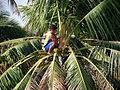 Sitting on the coconut palm while gathering tuba
 -
 A young toddy-picker climbing a palm tree to collect palm sap, Visakhapatnam, India
 -
 Palampore tapestry depicting toddy tappers, India, 1750 CE
 -
 Locally called "manananggot" for tuba gatherer
 -
 Gathering tuba from the coconut tree
 -
 Thiyyas, traditional toddy tappers of North Malabar region
 -
 Toddey tapper at work, India, c. 1862
 -
 Toddey trapper climbing palm tree with a hanging ladder, India
 -
 Coconut trees, and toddy gatherers of Southern India (1855)
 -
 Palmwine


_op_Bali_TMnr_10002905.jpg)


,_mid%E2%80%93late_18th_century_(CH_18467289-3).jpg)


In popular culture
[edit]The tapping and consumption of palm wine are recurrent motifs in the Chinua Achebe novel Things Fall Apart,[30] and in the Amos Tutuola novel The Palm-Wine Drinkard.[31] It is also mentioned in the 2006 movie Blood Diamond.
See also
[edit]- Arrack, an alcoholic beverage distilled from coconut palm wine in southeast Asia.
- Coyol wine
- Desi daru
- Madurai Veeran, a deity who consumes toddy.
- Ogogoro
- Palm-wine music, a West African musical genre.
- Pulque
- Sree Muthappan, another deity who consumes toddy.
- List of Indonesian beverages
References
[edit]Notes
- ^ a b "Enjoying 'tuak' in Batak country" by Wan Ulfa Nur Zuhra, 21 January 2013, The Jakarta Post.
- ^ Rundel, Philip W. (Fall 2002). "The Chilean Wine Palm". Mildred E. Mathias Botanical Garden Newsletter. 5 (4). Archived from the original on 4 January 2006. Retrieved 31 August 2008.
- ^ "Fermented and vegetables. A global perspective. Chapter 4". fao.org. Retrieved 5 February 2018.
- ^ a b c Sanchez, Priscilla C. (2008). Philippine Fermented Foods: Principles and Technology. UP Press. pp. 151–153. ISBN 9789715425544.
- ^ Ogunnaike, Ayodeji (Spring 2019). "The Tree That Centres The World: The Palm Tree As Yoruba Axis Mundi". Africana Studies Review. 6 (1). Southern University at New Orleans: 46, 49–50.
- ^ AfricaNews (17 December 2021). "Palm wine benefits economy in the Central African Republic". Africanews. Retrieved 15 March 2022.
- ^ Slow Food Foundation for Biodiversity (9 June 2024). "Palm Wine Ark of taste". Slow Food Foundation for Biodiversity. Retrieved 9 June 2024.
- ^ "WebHost4Life". indianwine.org. Archived from the original on 15 August 2012. Retrieved 5 February 2018.
- ^ "Tuak - the ancient culture in Borneo". 27 August 2013.
- ^ Putri, Edira (12 December 2017). "A Guide to Indonesia's Traditional Alcoholic Drinks". Culture Trip. Retrieved 25 July 2020.
- ^ "I toddy you so". The Myanmar Times. 25 May 2018. Archived from the original on 22 January 2021. Retrieved 16 January 2021.
- ^ "Making Myanmar's Palm Wine Global". Build Myanmar - Media. 19 February 2025. Retrieved 30 May 2025.
- ^ a b "One Man's Quest to Revive Toddy, the Booze That Built Singapore". 26 February 2025.
- ^ Astudillo-Melgar, Fernando; Ochoa-Leyva, Adrián; Utrilla, José; Huerta-Beristain, Gerardo (22 March 2019). "Bacterial Diversity and Population Dynamics During the Fermentation of Palm Wine From Guerrero Mexico". Frontiers in Microbiology. 10 531. doi:10.3389/fmicb.2019.00531. PMC 6440455. PMID 30967846.
- ^ Veneracion, Jaime (2008). "The Philippine-Mexico Connection". In Poddar, Prem; Patke, Rajeev S.; Jensen, Lars (eds.). Historical Companion to Postcolonial Literatures – Continental Europe and its Empires. Edinburgh University Press. p. 574. ISBN 9780748630271.
- ^ Mercene, Floro L. (2007). Manila Men in the New World: Filipino Migration to Mexico and the Americas from the Sixteenth Century. UP Press. p. 125. ISBN 9789715425292.
- ^ Gibbs, H.D.; Holmes, W.C. (1912). "The Alcohol Industry of the Philippine Islands Part II: Distilled Liquors; their Consumption and Manufacture". The Philippine Journal of Science: Section A. 7: 19–46.
- ^ "Culture of Colima". Explorando Mexico. Retrieved 5 May 2019.
- ^ Esparza, Bill (28 May 2015). "Beyond Aguas Frescas: Two Refreshing Mexican Coolers to Try This Summer". Los Angeles Magazine. Retrieved 5 May 2019.
- ^ "Talking Tuba". Vallarta Today. Archived from the original on 5 May 2019. Retrieved 5 May 2019.
- ^ C. Michael Hogan. 2008. Chilean Wine Palm: Jubaea chilensis, GlobalTwitcher.com, ed. N. Stromberg Archived 17 October 2012 at the Wayback Machine
- ^ Frank Wiens, Annette Zitzmann, Marc-André Lachance, Michel Yegles, Fritz Pragst, Friedrich M. Wurst, Dietrich von Holst, Saw Leng Guan, and Rainer Spanagel. Chronic intake of fermented floral nectar by wild treeshrews Proceedings of the National Academy of Sciences. Published online before print 28 July 2008. Retriev 25 August 2008
- ^ a b c d e Law, S.V.; et al. (2011). "MiniReview- Popular fermented foods and beverages in Southeast Asia" (PDF). International Food Research Journal (18). Retrieved 20 January 2012.
- ^ Jyoti Prakash Tamang, ed. (2016). "Ethnic Fermented Foods and Beverages of Cambodia". Ethnic Fermented Foods and Alcoholic Beverages of Asia. Springer Publishing. p. 257. ISBN 978-81-322-2798-4.
- ^ Anchimbe – Creating New Names for Common Things in Cameroon English (I-TESL-J)
- ^ "English-Chinese Translation of "palm wine"". Websaru Dictionary. Archived from the original on 12 May 2013. Retrieved 20 January 2012.
- ^ Novoa Ruiz, J. M. (1984). Guinea Ecuatorial: historia, costumbres y tradiciones (in Spanish). Expedición. p. 61. ISBN 9788439826019.
- ^ "Petit-Skinner's Nauruan English".
- ^ Rough Guides (2015). The Rough Guide to Tanzania. Rough Guides UK. ISBN 978-0-241-23749-6.
- ^ Achebe, Chinua. Things Fall Apart. UK: William Heinemann Ltd., 1958.
- ^ Tutuola, Amos. The Palm-Wine Drinkard. Grove Press, 1954.
External links
[edit] Media related to Palm wine at Wikimedia Commons
- Article on Philippine palm wine

| Animal products | |
|---|---|
| |
| Edible plants / [oots | |
| Mushrooms | |
| |
|
|
| Resins | |
| Sap / gum / etc. | |
| Other | |
| Related | |

| Individual dishes |
|
|---|---|
| Curries | |
| Salads | |
| Sauces, spices and flavourings | |
| Desserts, snacks and pastries | |
| Beverages | |
| Cambodian Chinese dishes | |

| Dishes |
| ||||||||||
|---|---|---|---|---|---|---|---|---|---|---|---|
| Side dishes | |||||||||||
| Snacks | |||||||||||
| Beverages | |||||||||||
| Sweets & desserts |
| ||||||||||
| Condiments | |||||||||||
| Ingredients | |||||||||||

Palm wine
View on GrokipediaProduction Methods
Sap Tapping Techniques
Sap tapping techniques for palm wine extraction target the sucrose-rich vascular tissues, primarily through inflorescence incision or trunk boring, exploiting the palm's internal hydraulic gradients to induce exudate flow. Inflorescence tapping, prevalent in species like coconut (Cocos nucifera) and date palm (Phoenix dactylifera), involves selecting immature male flower stalks, binding them to redirect sap, and making a V-shaped incision at the tip to access phloem flow directed toward reproductive structures.[8] Trunk tapping, more common in shorter palms such as oil palm (Elaeis guineensis) or raffia (Raphia hookeri), requires chiseling a cavity into the apical meristem or stem axis, often at a height of about 15 cm below the crown, to tap axial sap conduits.[9] [10] The physiological basis for sap yield stems from positive turgor pressure in the palm's phloem and root-driven xylem ascent, augmented by tapping-induced wound responses that temporarily elevate local hydrostatic gradients, with flow rates influenced by diurnal cycles and environmental factors like temperature and humidity.[11] In Elaeis guineensis, initial daily yields from trunk taps can reach 1-2 liters per site, diminishing over successive days due to vascular depletion and potential embolism formation in xylem vessels.[12] Traditional tools include sharpened knives or machetes for incisions, bamboo or gourd conduits to channel sap into collection vessels, and ropes or ladders for accessing heights up to 30 meters in tall species.[13] To optimize yield and sustain flow, tappers perform daily maintenance by shaving thin slices (1-2 mm) from the incision surface, removing coagulated latex and nascent bacterial biofilms that could occlude vessels, a practice corroborated by biochemical analyses showing reduced microbial proliferation with frequent renewal.[13] Tapping cycles typically span 3-7 days per site before relocating to adjacent inflorescences or allowing tree recovery, as prolonged extraction risks hydraulic failure from excessive tissue desiccation or infection ingress, with total durations varying from 7 to 60 days per palm depending on species vigor and tapper expertise.[14] Regional adaptations include scorching stalks pre-tapping to enhance flow via thermal stimulation of meristematic activity in African practices, or using counterweights for safer climbs in Southeast Asian contexts.[15] These methods balance short-term harvest efficiency against long-term tree health, with destructive trunk boring often limiting palm lifespan to the tapping period.[16]Fermentation Dynamics
The spontaneous fermentation of palm wine sap commences upon exposure to ambient microbes, primarily yeasts of the Saccharomyces genus, such as S. cerevisiae, which dominate the initial phase by metabolizing sucrose and other sugars into ethanol and carbon dioxide via glycolysis and alcoholic fermentation pathways. This yields an effervescent beverage with ethanol concentrations reaching 4-6% ABV within 2-24 hours, depending on microbial load and environmental conditions.[1][17][18] As ethanol accumulates, microbial succession shifts toward lactic acid bacteria (Lactobacillus spp.) and acetic acid bacteria (Acetobacter spp.), which convert residual sugars and ethanol into lactic and acetic acids, respectively, through homolactic fermentation and oxidative acetification. This progression, observed in metagenomic analyses, generates volatile compounds like esters and higher alcohols, contributing to the beverage's characteristic fruity-to-sour flavor profile, as detailed in metabolomic studies profiling over 100 metabolites including short-chain fatty acids and aldehydes. Over 24-48 hours, ethanol may peak before declining due to bacterial overgrowth, with total acidity rising and pH dropping from an initial 6.5-7.0 to 3.5-4.5, driven by proton release from organic acid dissociation.[19][3][20] Fermentation variability arises from temperature, with optimal yeast activity at 25-30°C promoting efficient ethanol production while suppressing excessive acetic shifts; higher temperatures (above 35°C) accelerate bacterial dominance and spoilage. Contamination risks, including from insects or unclean tapping tools, introduce opportunistic pathogens or spoilers, favoring vinegar-like acetification and reducing shelf life to 1-2 days post-tapping. Recent untargeted metabolomics confirm that uncontrolled succession leads to elevated acetic acid (up to 2-3% w/v) and off-volatiles, underscoring the biochemical instability inherent to this wild fermentation.[21][9][22]Preservation and Processing Challenges
Palm wine's inherent instability stems from its high sugar content and native microbial load, which initiate spontaneous alcoholic fermentation immediately after tapping, typically limiting palatable consumption to 1–2 days at ambient temperatures before secondary acidic fermentation renders it unpalatable.[1] Without intervention, ethanol levels peak around 4–6% within 24 hours, after which lactic acid bacteria and acetic acid bacteria proliferate, elevating acetic acid concentrations and producing off-flavors via oxidative metabolism.[17] In uncontrolled rural settings, this results in spoilage rates exceeding 80% within 48 hours, as ambient conditions favor unchecked microbial succession over desired yeast dominance.[23] Contamination exacerbates these issues, with acetic acid bacteria such as Acetobacter species becoming predominant in later stages, converting alcohols to vinegary acids at rates accelerated by oxygen exposure during storage.[3] Empirical analyses reveal diverse spoilage microbiota, including excessive growth of Lactobacillus and wild yeasts, which empirical studies attribute to inadequate hygiene in tapping vessels rather than inherent sap sterility.[19] Traditional preservation claims, such as herbal additives or calabash smoking, lack robust quantification and often fail to suppress acetic acid bacteria below thresholds for extended viability, as validated by controlled trials showing minimal impact compared to thermal methods.[24] Commercial processing faces scale-up hurdles, including sediment accumulation from precipitated proteins and yeasts, which necessitates filtration to clarify product and reduce microbial refugia, yet introduces yield losses of 10–20% in pilot operations.[25] Recent studies (2020–2024) highlight microbial diversity as a barrier, with inconsistent starter cultures leading to variable acidification profiles that undermine standardization for bottling.[21] Pasteurization at 72–85°C for short durations, often combined with sorbates or metabisulfites, extends shelf life to 14 days under refrigeration, but energy costs and flavor alterations limit adoption in small-scale tropical production.[26] These interventions, while empirically effective, reveal causal trade-offs: suppressed spoilage versus diminished effervescence from inhibited wild yeasts.[13]Types and Varieties
Undistilled Palm Wine
Undistilled palm wine consists of the spontaneously fermented sap harvested from palm inflorescences, yielding a low-alcohol beverage through partial microbial conversion of sugars before further souring occurs. This process, driven by naturally occurring yeasts and bacteria in the sap, produces ethanol levels typically ranging from 2% to 5% ABV within the initial 24 hours, with the effervescent quality stemming directly from CO2 byproduct formation during anaerobic sugar metabolism.[4][27] The resulting liquid appears milky-white due to suspended particles and microbial activity, exhibiting a sweet-sour flavor profile from unfermented residual sugars alongside early ethanol and organic acids.[1] Alcohol content escalates predictably over time as fermentation progresses: starting near 0% immediately post-tapping, it reaches approximately 3% by the end of the first day and climbs to 4-6% by 48 hours, after which acetic acid bacteria dominate, reducing palatability.[28][18] In regions like Nigeria, where it is commonly termed "palm toddy," consumption occurs soon after collection to capture this peak effervescence and mild intoxication, distinct from the unfermented precursor known as neera in India, which retains higher sugar content without alcohol development.[29] Sensory attributes include a fizzy texture from CO2 saturation, setting it apart from still grape wines, while palm-specific metabolites—such as unique fermentation byproducts from sap-derived compounds like sesartemin—contribute to its aromatic profile not replicated in viticultural ferments.[9][27]
| Fermentation Time | Approximate ABV | Key Changes |
|---|---|---|
| 0-2 hours | 0-4% | Initial sweetness, onset of effervescence from yeast activity[27] |
| 24 hours | 3-5% | Peak mild alcohol, balanced sweet-sour notes[28][4] |
| 48 hours | 5-6% | Increased sourness, diminishing CO2 as bacteria prevail[18] |
Distilled Palm Spirits
Distilled palm spirits result from the distillation of fermented palm sap, concentrating ethanol to produce beverages with alcohol by volume (ABV) levels typically ranging from 40% to 45%. The process begins with the fermentation of fresh sap, yielding palm wine at around 8% ABV due to wild yeast activity, followed by batch distillation in pot stills that retain flavor compounds but operate at lower efficiency compared to continuous column stills.[30] In pot still operations, the fermented wash is heated to separate alcohol vapors, often requiring multiple runs to achieve desired proofs, with single distillations common for artisanal products like Philippine lambanog from coconut sap.[31] Double distillation, as practiced for Sri Lankan arrack, further refines the spirit while preserving regional character.[30] Regional variants include ogogoro in Nigeria, distilled from raffia or oil palm sap using rudimentary pot stills, and Indonesian Bali arrack from coconut or sugar palm, both emphasizing traditional batch methods over industrial refinement.[32] [33] Lambanog production in the Philippines involves collecting sap into bamboo containers before fermentation and distillation, yielding a clear to milky spirit at 40-45% ABV after one pass, with potential for higher concentrations in subsequent distillations.[34] These methods prioritize flavor retention over high-volume output, as pot stills capture a broader spectrum of volatile compounds. The distinctive flavor profiles of these spirits arise from congeners such as fusel oils—higher alcohols like isoamyl and active amyl alcohol—which contribute pungent, fruity, and solvent-like notes when present in moderate amounts, though excess can impart harshness.[35] Distillation inefficiencies and incomplete separation heighten risks from methanol, a toxic byproduct formed during pectin breakdown in palm sap fermentation; 2024 analyses of lambanog highlight detection methods revealing potentially hazardous levels in unregulated batches, underscoring the need for precise cuts during distillation.[36] Distillation emerged as a practical adaptation for preservation and transport, enabling the shift from perishable fresh palm wine to stable spirits; in Sri Lanka, Dutch colonial efforts in the mid-1600s commercialized coconut arrack production for export, establishing it as a key trade commodity that persists today with modern distilleries maintaining traditional techniques.[37] This historical development allowed palm-derived alcohols to reach global markets without rapid spoilage, contrasting with the localized consumption of undistilled variants.[38]Variations by Palm Species
Palm wine derived from different palm species exhibits variations primarily due to differences in sap sugar profiles, pH levels, and inherent microbial susceptibility, which affect yield, fermentation speed, alcohol potential, and organoleptic qualities such as sweetness and acidity.[3] Higher sucrose concentrations generally correlate with greater ethanol yields upon fermentation, while lower pH values accelerate microbial activity, reducing shelf life but enhancing initial effervescence.[13] These botanical traits dictate the sap's biochemical baseline before tapping or processing interventions. Sap from the oil palm (Elaeis guineensis), prevalent in West and Central Africa, contains 9.59–10.59% (w/v) sucrose with glucose and fructose each below 1% (w/v), yielding robust volumes—up to several liters per tree daily—but prone to rapid fermentation due to a slightly acidic pH of approximately 4.16 and total soluble solids around 9.63° Brix.[39] [40] This composition results in a fuller-bodied wine with moderate sweetness that sours quickly, limiting unfermented storage to hours.[20] Raffia palm (Raphia spp.), used in Central African production, features sap with sucrose peaking at 9.5% early in tapping cycles, alongside glucose and fructose that diminish during natural fermentation, contributing to a sweeter initial profile compared to oil palm but similar yield constraints from microbial inversion of sugars.[41] [42] Coconut palm (Cocos nucifera) sap, thinner and more watery, holds 12–15% sucrose by weight with minimal reducing sugars, fostering faster fermentation rates that produce lighter, quicker-carbonating wines with heightened ethanol potential from the elevated sugar load, though lower density reduces per-tap yield relative to oil palm.[43] Date palm (Phoenix dactylifera) sap sustains 10–18% (w/v) total sugars, predominantly sucrose, but exhibits lower ethanol conversion efficiency due to variable reducing sugar emergence and a less fermentable matrix, yielding milder, less alcoholic variants like lagmi with subdued flavor intensity.[44] [45] Other species, such as palmyra (Borassus flabellifer) with sucrose up to 17.4%, enable sweeter, higher-yield saps suitable for prolonged tapping, while Arenga pinnata (sugar palm) maintains a neutral pH around 6.3 and 10–12% sugars, supporting slower initial fermentation for nuanced, mineral-rich profiles.[3] [46]| Palm Species | Sucrose Content (% w/v or by weight) | Approximate pH | Key Traits Influencing Variation |
|---|---|---|---|
| Oil palm (E. guineensis) | 9.59–10.59 | 4.16–6.0 | High yield, rapid souring due to low pH and balanced sugars[39][40] |
| Raffia (Raphia spp.) | Up to 9.5 | Not specified | Sweet early, sugar inversion limits longevity[41] |
| Coconut (C. nucifera) | 12–15 | 7.0–7.4 | Fast fermentation, lighter body from high sucrose[43][47] |
| Date (P. dactylifera) | 10–18 (total sugars) | Not specified | Lower alcohol yield, milder profile[44] |
| Palmyra (B. flabellifer) | 9.3–17.4 | Not specified | Elevated sweetness, extended tappability[3] |
| Sugar palm (A. pinnata) | 10–12 | ~6.3 | Neutral pH slows onset, mineral-enhanced flavor[46] |
Historical Development
Ancient Origins
The practice of producing palm wine through the tapping and natural fermentation of palm sap likely emerged independently across tropical regions during the Neolithic period, driven by the sap's inherent fermentability. Fresh palm sap contains 10-12% sugars, primarily sucrose, along with trace nutrients that support rapid microbial activity by ambient yeasts, leading to alcoholic fermentation within hours of collection.[48] This biochemical process, requiring no advanced technology beyond tree climbing and incision tools, aligns with early human exploitation of wild palms for food and fiber, predating organized agriculture in palm-rich ecosystems.[49] In West Africa, where the oil palm (Elaeis guineensis) is native, archaeological evidence indicates human utilization of palm fruits for oil extraction by approximately 3000 BCE, with semi-domestication processes inferred from residue analysis in ancient settlements. Sap tapping for wine, integral to these early interactions, is supported by ethnobotanical continuity and the palm's role in prehistoric diets, though direct residues are elusive due to the beverage's perishability.[50] Independent origins in this region tie to broader tropical foraging patterns, distinct from Eurasian grape-based viniculture.[51] Along the Nile, ancient Egyptians produced palm wine from date palm (Phoenix dactylifera) sap by around 3000 BCE, contemporaneous with predynastic grape wines, as evidenced by textual references and the integration of palms in early agroecosystems. Unlike grape residues preserved in tombs, palm sap fermentation left minimal archaeological traces, but its use complemented date harvesting and symbolized renewal in ritual contexts without overt mythic embellishment.[52] These parallel developments underscore palm wine's emergence as a convergent adaptation to local flora, unbound by diffusion from a single hearth.[1]Traditional Evolution and Global Dissemination
Palm wine production originated in tropical regions of Africa and Asia millennia ago, with archaeological evidence indicating its consumption across West, Central, and East Africa dating back thousands of years.[53] In pre-colonial Nigeria, among the Igbo people, palm wine held central ritual and social roles, featured in festivals like the New Yam celebration and traditional marriages as a symbol of hospitality and communal bonds.[54] Similarly, in Southeast Asia, sap from palms such as the palmyra and coconut was fermented into beverages integral to local customs, reflecting independent developments tied to abundant palm ecosystems rather than external influences.[55] European contact from the 16th century onward facilitated the dissemination of distillation techniques applied to palm sap, transforming fresh wine into higher-proof spirits like arrack. Portuguese traders in Goa encountered local coconut arrack production around 1510, adapting and exporting these methods through colonial networks.[56] In the Malay peninsula, 16th-century Portuguese observers documented widespread palm wine distillation, which Dutch East India Company operations later scaled for trade, linking Asian production to European and global markets via maritime routes.[57] This exchange, driven by demand for portable spirits in long voyages, spread palm-derived alcohols to regions like the Caribbean through slave trade migrations carrying African tapping knowledge.[2] During the 19th and early 20th centuries, colonial commercialization intensified in territories like Dutch Indonesia, where Batavia arrack—distilled from sugarcane and palm influences—became a key export commodity shipped to Europe and the Americas, supporting plantation economies and naval provisioning.[58] Production hubs in Java and Bali saw organized tapping guilds evolve into semi-industrial operations under colonial oversight, boosting volumes for international trade amid rising spirit demand.[59] Post-colonial adaptations from the mid-20th century propelled further global dissemination, with palm wine re-emerging in craft beverage trends. By 2024, the international palm wine market reached approximately USD 1.92 billion, fueled by diaspora communities, tourism, and interest in artisanal ferments, projecting growth to USD 3.28 billion by 2033 at a 6.1% CAGR.[60] This expansion traces causal links to earlier trade pathways, now amplified by modern logistics enabling exports from African and Asian origins to urban markets worldwide.[61]Cultural and Social Significance
Ceremonial and Ritual Roles
In Yoruba and Igbo communities of Nigeria, palm wine serves as a medium for libations during weddings, funerals, and naming ceremonies, where it is poured to invoke ancestral blessings and symbolize continuity with forebears, as documented in ethnographic accounts of these rituals.[62] In Igbo traditional marriages, the "wine-carrying" rite requires the bride to locate and present a calabash of palm wine to the groom among assembled guests, affirming mutual recognition and union without endorsing any supernatural efficacy.[63] During the annual New Yam Festival (Iri Ji) among the Igbo, palm wine is employed in initial libations to earth deities and shared communally to foster social cohesion and express gratitude for the harvest, with participants observing its role in marking seasonal transitions through repeated ceremonial distribution.[64][65] In patrilineal African societies, such as those in West Africa, palm wine tapping remains a task predominantly assigned to men due to the physical demands of climbing and accessing sap, reflecting division of labor aligned with gender norms rather than egalitarian ideals often projected in modern interpretations.[66][67] Across parts of South and Southeast Asia, coconut-derived toddy features in folk rituals among certain communities, including offerings during harvest festivals, though its use is more variably documented and often secondary to non-alcoholic coconut elements in formal Hindu temple practices.[68]Social and Economic Integration
In West African communities, palm wine tapping fosters specialized labor divisions, with tappers serving as a dedicated workforce whose skills are transmitted through apprenticeship systems lasting 2-3 years, enabling economic mobility via migration to urban or cross-border opportunities. These practitioners often form cooperatives or informal associations to pool resources, negotiate leases on palm groves, and enhance bargaining power in local markets, thereby securing informal income streams critical to rural stability. In southeastern Nigeria, for instance, tappers capture the largest share of oil palm-derived revenue, with six-year aggregate earnings exceeding those from kernels or fruits, funding community investments like properties and hospitality ventures.[69][70][71] Such economic roles underpin social hierarchies, as access to fresh palm wine—prized for its effervescence and immediate harvest—marks status among groups like the Igbo, who esteem oil palm variants over others for ceremonial prestige, while distilled spirits proliferate for everyday mass consumption due to their stability and potency. This distinction arises from the perishable nature of undiluted sap, confining elite enjoyment to proximate, high-value exchanges, whereas distillation democratizes access through preservation. Ethnographic accounts highlight how tappers' output thus reinforces communal barter-like reciprocity, trading wine for labor or goods in pre-monetary systems.[72] Contemporary shifts toward commercialization, including attempts to bottle fresh palm wine for urban export, erode tappers' localized monopolies on supply chains, as entrepreneurs seek to mitigate rapid fermentation via pasteurization or additives, though logistical hurdles persist. In Nigeria, rising competition from industrialized beers further pressures traditional incomes, prompting tappers to diversify or formalize cooperatives for sustainability.[73][74]Regional Consumption Patterns
Africa
In sub-Saharan Africa, palm wine constitutes the predominant traditional alcoholic beverage, with the region capturing about 54% of global production and consumption share as of 2024. Western African nations like Nigeria and Ghana rely heavily on the oil palm (Elaeis guineensis) for sap extraction, where smallholder rural economies center on its tapping for both fresh consumption and income generation. Approximately 11 million people across West Africa consume palm wine daily, underscoring its embedded role in local diets and livelihoods.[61][75][76] Sap yields from mature oil palm trees average less than 1 liter per day under typical conditions, though estimates range from 0.9 to 15 liters depending on tree maturity, tapping frequency, and environmental factors; tappers often service multiple trees to meet demand. Palm wine tappers are predominantly male—over 90% in surveyed African communities—and employ labor-intensive methods involving tree climbing without modern safety equipment, sustaining yields through daily collections from inflorescence stalks.[72][15][16] In Central Africa, raffia palms (Raphia spp.) prevail for palm wine production, offering potentially higher sap volumes per tree but constrained by seasonal flowering periods that limit year-round availability. Freshly tapped raffia sap ferments rapidly to 2-4% alcohol by volume if not consumed immediately, aligning with regional preferences for mildly alcoholic, effervescent drinks.[15][77] Across these areas, palm wine integrates deeply into social and ceremonial practices in Nigeria and Ghana, essential for rituals like libations, weddings, and communal gatherings where it symbolizes unity and tradition.[72]Asia
In India, palm wine, commonly termed toddy, derives primarily from the sap of coconut (Cocos nucifera) and palmyra (Borassus flabellifer) palms, with fresh extraction yielding neera—a sweet, non-alcoholic sap rich in potassium and other minerals—before spontaneous fermentation converts it to the alcoholic toddy within hours due to wild yeasts and bacteria.[78][79] Production is concentrated in southern states like Tamil Nadu, which accounts for about 60% of India's palmyra output, supporting traditional tapping by climbers who harvest sap from inflorescences.[79] Across Southeast Asia, diversity in palm species influences variants: in Indonesia, tuak emerges from sugar palms (Arenga pinnata), coconut, and other species, with tapping prevalent in Bali, Sumatra, and Sulawesi, where the sap ferments naturally into a mildly alcoholic beverage.[80] In the Philippines, coconut sap produces tuba, which is frequently distilled into lambanog, a potent spirit standardized at 40-45% ABV through single or double distillation of fermented toddy, originating mainly from Quezon province.[81][82] These regional differences stem from local palm availability and microbial ecosystems, as a 2023 study on Indian palm beverages documented dynamic shifts in bacterial and yeast populations—such as increasing Lactobacillus and Saccharomyces—that drive unique flavor compounds like esters and acids.[83] Consumption integrates into social and festive contexts, notably in Kerala during the Onam harvest festival, where toddy accompanies communal feasts and celebrations, contributing to seasonal surges in traditional alcohol intake amid the 10-day event marking King Mahabali's mythical return.[84] Distilled forms like Indonesian Batavia arrack, derived from coconut or sugar palm sap, have long been exported to Europe, tracing to Dutch colonial trade routes that popularized its use in punches and spirits.[85]
Latin America and Other Regions
In Latin America, palm wine traditions emerged through adaptations of tapping techniques to indigenous palm species, often influenced by transoceanic migrations during the colonial era. In Mexico, vino de coyol is derived from the fermented sap of the coyol palm (Acrocomia aculeata), a spiny native species whose inflorescences are incised to collect sap that spontaneously ferments into a beverage reaching up to 12.86% alcohol by volume.[86] This practice persists in rural areas despite limited commercial scale, reflecting cultural continuity rather than large-scale production. Similarly, in Brazil and other South American regions, palm wine extraction from local species like the Chilean wine palm (Jubaea chilensis) has historical roots tied to smallholder activities, though overexploitation contributed to the species' endangered status by the 20th century.[87] African enslaved laborers likely transferred knowledge of sap fermentation to compatible New World palms during the transatlantic trade, enabling low-volume, persistent production integrated into regional agroforestry.[88] Across Pacific islands, coconut palm (Cocos nucifera) dominates palm wine production, with sap collection yielding a mildly alcoholic drink fermenting to 4-6% alcohol within 6-8 hours of tapping. Hybrid practices blend indigenous methods with Austronesian influences, as seen in Micronesia where coconut toddy consumption marks rites of passage, though quantitative yield data remains sparse due to artisanal, non-monetized harvesting.[89] In Fiji and other archipelagos, similar tapping from palm flower stalks supports communal rituals, underscoring the beverage's role in localized, sustainable yet undocumented economies.[90] In Europe and North America, palm wine enters urban markets primarily through diaspora communities from West Africa and Southeast Asia, fostering niche demand for authentic variants amid challenges like rapid fermentation limiting shelf life.[73] This has spurred experimental commercialization, with global market projections estimating growth from $1.12 billion in 2024 to $2.03 billion by 2033, driven partly by expatriate preferences for culturally significant beverages in celebratory contexts.[60] Such imports remain marginal compared to traditional production hubs, prioritizing preservation of migratory culinary heritages over mass scalability.[91]Health and Nutritional Aspects
Compositional Profile
Fresh palm sap, the precursor to palm wine, is characterized by a high sugar content of 10-12% (w/v), primarily sucrose with lesser amounts of glucose and fructose.[48] [92] Total carbohydrates can reach 9.3-17.4% in saps from species like Borassus flabellifer, accompanied by soluble proteins, amino acids, and trace organic acids.[3] Minerals are abundant, including potassium at levels supporting electrolyte balance, alongside magnesium, phosphorus, zinc, calcium, and iron, though exact concentrations vary by palm species and soil conditions.[4] Vitamins such as thiamine and riboflavin are present in the sap, derived from plant metabolism.[3] During spontaneous fermentation, microbial activity rapidly alters the profile: sugars decline as yeasts convert them to ethanol, which accumulates to 4-6% (v/v) within 24-48 hours.[1] Acetic and lactic acids increase due to bacterial metabolism, lowering pH from 6-7 in fresh sap to 4-5 in early wine stages.[19] Protein content rises slightly to 0.5-1.5% with elevated free amino acids, while volatile compounds like esters and higher alcohols emerge as metabolites.[13] Microbial communities drive these shifts, with yeasts (e.g., Saccharomyces cerevisiae) dominating initial alcoholic fermentation, comprising up to 80% of early populations in metagenomic analyses.[93] Lactic acid bacteria (Lactobacillus spp.) and acetic acid bacteria (Acetobacter, Gluconobacter) proliferate later, reducing yeast ratios to below 50% by 24 hours and contributing organic acids.[94] A 2025 study on West African palm wine confirmed these dynamics, noting Saccharomyces predominance in sugar-rich phases transitioning to bacterial overgrowth in acidic conditions.[95]| Component | Fresh Sap (Typical Range) | 24-Hour Ferment (Typical Range) |
|---|---|---|
| Total Sugars (%) | 10-15 | 2-5 |
| Ethanol (% v/v) | <0.5 | 3-5 |
| pH | 6.0-7.0 | 4.0-5.0 |
| Potassium (mg/L) | 200-500 | 200-400 |