


Community hub
Recent from talks
Contribute something
Nothing was collected or created yet.
Diving rebreather
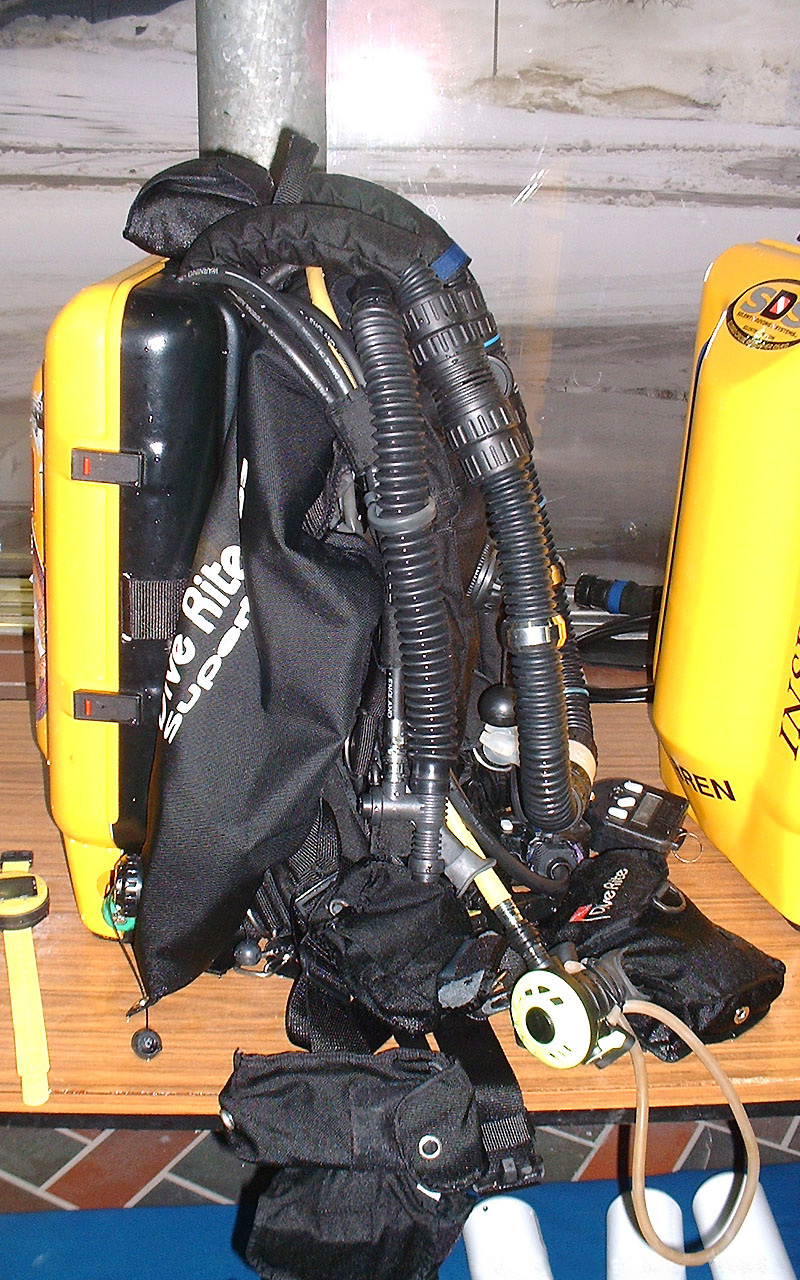
View on Wikipedia A fully closed circuit electronic rebreather (AP Diving Inspiration) | |
| Acronym | CCUBA (closed circuit underwater breathing apparatus); CCR (closed circuit rebreather), SCR (semi-closed rebreather) |
|---|---|
| Uses | Breathing set |
| Related items | Rebreather |
A diving rebreather is an underwater breathing apparatus that absorbs the carbon dioxide of a diver's exhaled breath to permit the rebreathing (recycling) of the substantially unused oxygen content, and unused inert content when present, of each breath. Oxygen is added to replenish the amount metabolised by the diver. This differs from open-circuit breathing apparatus, where the exhaled gas is discharged directly into the environment. The purpose is to extend the breathing endurance of a limited gas supply, and, for covert military use by frogmen or observation of underwater life, to eliminate the bubbles produced by an open circuit system.
A diving rebreather is generally understood to be a portable unit carried by the user, and is therefore a type of self-contained underwater breathing apparatus (scuba). A semi-closed rebreather carried by the diver may also be known as a gas extender. The same technology on a submersible, underwater habitat, or surface installation is more likely to be referred to as a life-support system.
Diving rebreather technology may be used where breathing gas supply is limited, or where the breathing gas is specially enriched or contains expensive components, such as helium diluent. Diving rebreathers have applications for primary and emergency gas supply. Similar technology is used in life-support systems in submarines, submersibles, underwater and surface saturation habitats, and in gas reclaim systems used to recover the large volumes of helium used in saturation diving. There are also use cases where the noise of open circuit systems is undesirable, such as certain wildlife photography.
The recycling of breathing gas comes at the cost of technological complexity and additional hazards, which depend on the specific application and type of rebreather used. Mass and bulk may be greater or less than equivalent open circuit scuba depending on circumstances. Electronically controlled diving rebreathers may automatically maintain a partial pressure of oxygen between programmable upper and lower limits, or set points, and be integrated with decompression computers to monitor the decompression status of the diver and record the dive profile.
Applications
[edit]Diving rebreathers are generally used for scuba applications, where the amount of breathing gas carried by the diver is limited, but are also occasionally used as gas extenders for surface-supplied diving and as bailout systems for scuba or surface-supplied diving.[1] Gas reclaim systems used for deep heliox diving use similar technology to rebreathers, as do saturation diving life support systems, but in these applications the gas recycling equipment is not carried by the diver.[2] Atmospheric diving suits also carry rebreather technology to recycle breathing gas as part of the life-support system.[3]
Rebreathers are usually more complex to use than open circuit scuba, and have more potential points of failure, so acceptably safe use requires a greater level of skill, attention and situational awareness, which is usually derived from understanding the systems, diligent maintenance and overlearning the practical skills of operation and fault recovery. Fault tolerant design can make a rebreather less likely to fail in a way that immediately endangers the user, and reduces the task loading on the diver which in turn may lower the risk of operator error.[4][5]
Semi-closed rebreather technology is also used in diver carried surface supplied gas extenders, mainly to reduce helium use. Some units also function as an emergency gas supply using on-board bailout cylinders: The US Navy MK29 rebreather can extend the duration of the Flyaway Mixed Gas System diving operations by five times while retaining the original mixed-gas storage footprint on the support ship.[6] The Soviet IDA-72 semi-closed rebreather has a scrubber endurance of 4 hours on surface supply, and bailout endurance at 200m of 40 minutes on on-board gas.[7] The US Navy Mark V Mod 1 heliox mixed gas helmet has a scrubber canister mounted on the back of the helmet and an inlet gas injection system which recirculates the breathing gas through the scrubber to remove carbon dioxide and thereby conserve helium.[8] The injector nozzle would blow 11 times the volume of the injected gas through the scrubber.[9]
Semi-closed rebreathers are also used as bailout sets for saturation divers diving from closed bells, as they are capable of longer endurance than open circuit bailout sets, and are constrained by the requirement of fitting through the bell lower hatch while on the diver. The DIVEX COBRA (Compact Bailout Rebreathing Apparatus) is an emergency rebreather system intended for use as a bailout set for saturation diving to a maximum of 450 msw. It is CE certified to NORSOK U101 (Diving Respiratory Equipment) and EN14143 (Self Contained Rebreathing Apparatus). Work of breathing is claimed to be low. The semi-closed rebreather is purely mechanical in operation, has an endurance of 45 minutes using self contained gas supplied from twin cylinders mounted in the casing, and is activated by a single turn of a control valve.[10]
History
[edit]The first attempts at making practical rebreathers were simple oxygen rebreathers, when advances in industrial metalworking made high-pressure gas storage cylinders possible. From 1878 on they were used for work in unbreathable atmospheres in industry and firefighting, at high altitude, for escape from submarines; and occasionally for swimming underwater; but the usual way to work underwater was in standard diving dress, breathing open circuit surface-supplied air.
(Draeger and Mark V Helium helmet)
The Italian Decima Flottiglia MAS, the first unit of combat frogmen, was founded in 1938 and went into action in 1940. WWII saw a great expansion of military-related use of rebreather diving. During and after WWII, needs arose in the armed forces to dive deeper than allowed by pure oxygen. That prompted, at least in Britain, design of simple constant-flow "mixture rebreather" variants of some of their diving oxygen rebreathers (= what is now called "nitrox"): SCMBA from the SCBA (Swimmer Canoeist's Breathing Apparatus), and CDMBA from the Siebe Gorman CDBA, by adding an extra gas supply cylinder. Before a dive with such a set, the diver had to know the maximum or working depth of his dive, and how fast his body used his oxygen supply, and from those to calculate what to set his rebreather's gas flow rate to.[citation needed]
During this long period before the modern age of automatic sport nitrox rebreathers, there were some sport oxygen diving clubs, mostly in the USA.[clarification needed][citation needed]
Eventually the Cold War ended and in 1989 the Communist Bloc collapsed, and as a result the perceived risk of sabotage attacks by combat divers dwindled, and Western armed forces had less reason to requisition civilian rebreather patents, and automatic and semi-automatic recreational diving rebreathers with ppO2 sensors started to appear.[citation needed]
![[icon]](https://en.wikipedia.org/wiki/File:Wiki_letter_w_cropped.svg) | This section needs expansion. You can help by adding to it. (October 2022) |
General concept
[edit]As a person breathes, the body consumes oxygen and produces carbon dioxide. Base metabolism requires about 0.25 L/min of oxygen from a breathing rate of about 6 L/min, and a fit person working hard may ventilate at a rate of 95 L/min but will only metabolise about 4 L/min of oxygen[11] The oxygen metabolised is generally about 4% to 5% of the inspired volume at normal atmospheric pressure, or about 20% of the available oxygen in the air at sea level. Exhaled air at sea level contains roughly 13.5% to 16% oxygen.[12]
The situation is even more wasteful of oxygen when the oxygen fraction of the breathing gas is higher, and in underwater diving, the compression of breathing gas due to depth makes the recirculation of exhaled gas even more desirable, as an even larger proportion of open circuit gas is wasted. Continued rebreathing of the same gas will deplete the oxygen to a level which will no longer support consciousness, and eventually life, so gas containing oxygen must be added to the recycled breathing gas to maintain the required concentration of oxygen.[13][14]
However, if this is done without removing the carbon dioxide, it will rapidly build up in the recycled gas, resulting almost immediately in mild respiratory distress, and rapidly developing into further stages of hypercapnia, or carbon dioxide toxicity. A high ventilation rate is usually necessary to eliminate the metabolic product carbon dioxide (CO2). The breathing reflex is triggered by carbon dioxide concentration in the blood, not by the oxygen concentration, so even a small buildup of carbon dioxide in the inhaled gas quickly becomes intolerable; if a person tries to directly rebreathe their exhaled breathing gas, they will soon feel an acute sense of suffocation, so rebreathers must chemically remove the carbon dioxide in a component known as a carbon dioxide scrubber.[13][14]
By adding sufficient oxygen to compensate for the metabolic usage, removing the carbon dioxide, and rebreathing the gas, most of the volume is conserved. There will still be minor losses when gas must be vented as it expands during ascent, and additional gas will be needed to make up volume as the gas is compressed during descent.[13]

| PO2 (bar) |
Application and effect |
|---|---|
| <0.08 | Coma ultimately leading to death |
| 0.08-0.10 | Unconsciousness in most people |
| 0.09-0.10 | Serious signs/symptoms of hypoxia |
| 0.14-0.16 | Initial signs/symptoms of hypoxia (normal environment oxygen in some very high altitude areas) |
| 0.21 | Normal environment oxygen (sea level air) |
| 0.35–0.40 | Normal saturation dive PO2 level |
| 0.50 | Threshold for whole-body effects; maximum saturation dive exposure |
| 1.0–1.20 | Common range for recreational closed circuit set point |
| 1.40 | Recommended limit for recreational open circuit bottom sector |
| 1.60 | NOAA limit for maximum exposure for a working diver Recreational/technical limit for decompression |
| 2.20 | Commercial/military "Sur-D" chamber surface decompression on 100% O2 at 12 msw |
| 2.40 | 40% O2 nitrox recompression treatment gas for use in the chamber at 50 msw (meters of sea water) |
| 2.80 | 100% O2 recompression treatment gas for use in the chamber at 18 msw |
| 3.00 | 50% O2 nitrox recompression treatment gas for use in the chamber at 50 msw |
Design constraints
[edit]The widest variety of rebreather types is used in diving, as the physical and physiological consequences of breathing under pressure complicate the requirements, and a large range of engineering options are available depending on the specific application and available budget. A diving rebreather is safety-critical life-support equipment – some modes of failure can kill the diver without warning, others can require immediate appropriate response for survival.
General operational requirements include:
- waterproof and corrosion resistant construction
- reasonably close to neutrally buoyant after ballasting
- acceptably streamlined, to minimize added swimming resistance
- low work of breathing in all diver attitudes and over the full operating depth range
- the unit should not adversely affect the diver's trim and balance
- easy and quick release of harness and unaided removal of the unit from the diver
- accessibility of control and adjustment components
- unambiguous feedback to the diver of critical information
- no critical single-point failure modes – The user should be able to deal with any single reasonably foreseeable failure without outside help
Special applications may also require:
- low noise signal
- low emission of bubbles/small bubbles
- low electromagnetic signature
- rugged construction
- light weight in air
- minimal additional task-loading for normal operation
Oxygen rebreathers
[edit]As pure oxygen is toxic when inhaled at pressure, recreational diver certification agencies limit oxygen decompression to a maximum depth of 6 metres (20 ft) and this restriction has been extended to oxygen rebreathers;[citation needed] In the past they have been used deeper (up to 20 metres (66 ft))[citation needed] but such dives were more risky than what is now considered acceptable. Oxygen rebreathers are also sometimes used when decompressing from a deep open-circuit dive,[citation needed] as breathing pure oxygen helps the nitrogen diffuse out of the body tissues more rapidly, and the use of a rebreather may be more convenient for long decompression stops.
US Navy restrictions on oxygen rebreather use:[16]
- Normal working limit 25 feet (7.6 m) for 240 minutes. (PO2 = 1.76 bar)
- Maximum working limit 50 feet (15 m) for 10 minutes. (PO2 = 2.5 bar)
Oxygen rebreathers are no longer commonly used in recreational diving because of the depth limit imposed by oxygen toxicity, but are extensively used for military attack swimmer applications where greater depth is not required, due to their simplicity, light weight and compact size.
Mixed gas rebreathers
[edit]Semi-closed circuit rebreathers (SCRs) used for diving may use active or passive gas addition, and the gas addition systems may be depth compensated. They use a mixed supply gas with a higher oxygen fraction than the steady state loop gas mixture. Usually only one gas mixture is used, but it is possible to switch gas mixtures during a dive to extend the available depth range of some SCRs.[14]
Operational scope and restrictions of SCRs:
- Non-depth compensated passive addition SCRs reduce the safe range of operating depths in inverse proportion to gas endurance extension. This can be compensated by gas switching, at the expense of complexity and increased number of potential failure points.
- Constant mass flow SCRs provide a gas mixture which is not consistent over variation in diver exertion. This also limits safe operating depth range unless gas composition is monitored, also at the expense of increased complexity and additional potential failure points.
- Demand controlled active gas addition provides reliable gas mixtures throughout the potential operating depth range, and do not require oxygen monitoring, but at the cost of more mechanical complexity.
- Depth compensated passive addition provides reliable gas mixture over the potential operating depth range, which is only slightly reduced from the open circuit operational range for the gas in use at the cost of more mechanical complexity.
Closed circuit diving rebreathers may be manually or electronically controlled, and use both pure oxygen and a breathable mixed gas diluent.[17]
Operational scope and restrictions of CCRs: Closed circuit rebreathers are mainly restricted by physiological limitations on the diver, such as maximum operating depth of the diluent mix while remaining breathable up to the surface, though this can be worked around by switching diluent. Work of breathing at depth can be a constraint, as there is a point where the breathing effort required to counter metabolic carbon dioxide production rate exceeds the work capacity of the diver, after which hypercapnia increases and distress followed by loss of consciousness and death is inevitable. Work of breathing is affected by gas density, so use of a low density helium rich diluent can increase depth range at acceptable work of breathing for a given configuration. WoB is also increased by turbulent flow, which is affected by flow velocity (Reynolds number). To some extent work of breathing can be reduced or limited by breathing circuit design, but there are physiological limits too, and the work of circulating the gas through the breathing loop and scrubber can be a large part of the total work of breathing.[18][19]
Recreational rebreathers
[edit]Some recreational diver certification agencies distinguish a class of rebreather which they deem suitable for recreational diving. These rebreathers are unsuitable for decompression diving, and when electronically controlled, will not allow the diver to do dives with obligatory decompression, thereby allowing an immediate ascent at any point of the planned dive without undue risk of developing symptomatic decompression sickness. This limitation reduces the necessity to carry offboard bailout gas, and the need for the skills to bail out with a staged decompression obligation. This class of rebreather diving provides an opportunity to sell training and certification which omits a large part of the more complex and difficult skills, and reduces the amount of equipment that the diver needs to carry. PADI criteria for "R" class rebreathers include electronic prompts for pre-dive checks, automatic setpoint control, status warnings, a heads up display for warnings, a bailout valve, pre-packed scrubber canisters and a system for estimating scrubber duration.[20][21][22] While these constraints do make the recreational class of rebreather inherently less hazardous, they do not reduce the risk to the same level as open circuit equipment for the same dive profile.[23]
Atmospheric diving suits
[edit]An atmospheric diving suit is a small one-man articulated submersible of roughly anthropomorphic form, with limb joints which allow articulation under external pressure while maintaining an internal pressure of one atmosphere. Breathing gas supply could be surface supplied by umbilical, but would then have to be exhausted back to the surface to maintain internal pressure below the external ambient pressure, which is possible but presents pressure-hull breach hazards if the umbilical hoses are damaged, or from a rebreather system built into the suit. As there is a similar problem in venting excess gas, the simple and efficient solution is to make up oxygen as it is consumed and scrub out the carbon dioxide, with no change to the inert gas component, which simply recirculates. In effect, a simple closed circuit oxygen rebreather arrangement used as a life-support system. Since there is usually an adequate power supply for other services, powered circulation through the scrubber should not normally be an issue for normal service, and is more comfortable for the operator, as it keeps the face area clear and facilitates voice communication. As the internal pressure is maintained at one atmosphere, there is no risk of acute oxygen toxicity. Endurance depends on the scrubber capacity and oxygen supply. Circulation through the scrubber could be powered by the diver's breathing, and this is an option for an emergency backup rebreather, which may also be fitted to the suit. A breathing driven system requires reduction of mechanical dead space by using a mouthpiece and counterlung to form a closed loop.
Architecture
[edit]

Essential components
[edit]Although there are several design variations of diving rebreather, all types have a gas-tight reservoir to contain the breathing gas at ambient pressure that the diver inhales from and exhales into. The breathing gas reservoir consists of several components connected together by water- and airtight joints. The diver breathes through a mouthpiece or a full-face diving mask with a shut-off valve, the dive/surface valve, which is closed when the diver is not breathing from the unit to prevent flooding if the set is in the water. This is connected to one or two breathing hoses ducting inhaled and exhaled gas between the diver and a counterlung or breathing bag, which expands to accommodate gas when it is not in the diver's lungs. The reservoir also includes a scrubber containing absorbent material to remove the carbon dioxide exhaled by the diver. There will also be at least one valve allowing addition of gas, such as oxygen, and often a diluent gas, from a gas storage container, into the reservoir.[17]
There may be valves allowing venting of gas, sensors to measure partial pressure of oxygen and possibly carbon dioxide, and a monitoring and control system. Critical components may be duplicated for engineering redundancy.[17]
Breathing gas passage configuration
[edit]There are two basic gas passage configurations: The loop and the pendulum.
The loop configuration uses a one directional circulation of the breathing gas which on exhalation leaves the mouthpiece, passes through a non-return valve into the exhalation hose, and then through the counterlung and scrubber, to return to the mouthpiece through the inhalation hose and another non-return valve when the diver inhales.[17]
The pendulum configuration uses a two-directional flow. Exhaled gas flows from the mouthpiece through a single hose to the scrubber, into the counterlung, and on inhalation the gas is drawn back through the scrubber and the same hose back to the mouthpiece. The pendulum system is structurally simpler, but inherently contains a larger dead space of unscrubbed gas in the combined exhalation and inhalation tube, which is rebreathed. There are conflicting requirements for minimising the volume of dead space while minimising the flow resistance of the breathing passages.
Counterlung configuration
[edit]A pendulum rebreather only has one counterlung, on the far side of the scrubber from the single breathing hose. The diver blows exhaled gas through the scrubber, then sucks it back during inhalation. Gas flow rate through the scrubber is forced by the breathing rate of the diver.
A single counterlung in a loop rebreather can be an exhalation or inhalation counterlung, or fitted between split scrubber canisters.[24] If it is an exhalation counterlung it is inflated on exhalation, but no gas flows through the scrubber until inhalation starts, at which point the diver sucks the gas through at a rate forced by inhalation rate. If it is an inhalation counterlung, the diver must blow gas through the scrubber during exhalation, but inhales from the full inhalation counterlung, with no further flow through the scrubber. If it is between split scrubbers the diver must blow the gas through the exhalation scrubber during exhalation, and suck it through the inhalation scrubber. In all these cases there is no buffer, and peak flow rates are relatively high, which means peak flow resistance is relatively high and may be in one half of the breathing cycle or split between both halves, analogous to the pendulum configuration, but without the large dead space.[24]
A twin counterlung rebreather has two breathing bags, so the exhaled gas inflates the exhalation counterlung while starting to pass through the scrubber and starting to inflate the inhalation counterlung. By the time the diver starts to inhale, the inhalation counterlung has built up a volume buffer, so there is less flow resistance as the gas continues to flow through the scrubber during inhalation at a slower rate than if there were only one counterlung. This decreases work of breathing, and also increases dwell time of the gas in the scrubber, as it flows through the scrubber during both exhalation and inhalation. Most mixed gas diving rebreathers use this arrangement.[21]
| This section needs expansion with: diagram of twin scrubber single counterlung arrangement from "A digital tour of the KISS Spirit and Sidewinder rebreathers". Divetech Grand Cayman·. 13 June 2020. Retrieved 31 May 2024 – via YouTube.. You can help by adding to it. (May 2024) |
General arrangement
[edit]Many rebreathers have their main components in a hard casing for support, protection and/or streamlining. This casing must be sufficiently vented and drained to let surrounding water or air in and out freely to allow for volume changes as the counterlung inflates and deflates, and to prevent trapping large volumes of buoyant air as the diver submerges, and of water as the diver emerges into air.[17]
The components may be mounted on a frame or inside a casing to hold them together. Sometimes the structure of the scrubber canister forms part of the framework, particularly in side-mount configuration. Position of most parts is not critical to function, but the counterlungs must be positioned so that their centroid of volume is at a similar depth to the centroid of the diver's lungs at most times while underwater, and the breathing tubes to the mouthpiece should not encumber the diver more than necessary, and allow free movement of the head as much as possible.[17]
Early oxygen rebreathers were often built without frame or casing, and relied on the harness and a strong counterlung to hold the components together.
The parts of a diving rebreather (counterlung, absorbent canister, gas cylinder(s), tubes and hoses linking them), can be arranged on the wearer's body in four basic ways, with the position of the counterlung having a major effect on work of breathing.
Back-mounted rebreathers
[edit]Back mount is common on the more bulky and heavier units. This is good for support of the weight out of the water, and keeps the front of the diver clear for working underwater. Back mount usually uses back or over the shoulder counterlungs, which have a centroid above the lung in most common orientations of the diver, resulting in slight negative pressure breathing.
Chest-mounted rebreathers
[edit]
Chest mount is fairly common for military oxygen rebreathers, which are usually relatively compact and light. It allows easy reach of the components underwater, and leaves the back free for other equipment for amphibious operations. The rebreather can be unclipped from a common harness without disturbing the load on the back. Front mounted counterlungs have a centroid which is generally slightly below the lung centroid, and result in slight positive pressure breathing for most common orientations of the diver.
Side-mounted rebreathers
[edit]
Sidemount allows a low profile to penetrate tight restrictions in cave and wreck diving, and is convenient for carrying a bailout rebreather. A sidemount rebreather as the main breathing apparatus can be mounted on one side of the diver's body and can be balanced weight-wise and hydrodynamically by a large bailout cylinder side mounted on the other side. Sidemount rebreathers are sensitive to diver orientation, which can change hydrostatic work of breathing over a larger range than for back or chest mount, and the resisistive work of breathing is also relatively large due to the long breathing hoses and multiple bends necessary to fit the components into a long narrow format. As of 2019, no sidemount rebreather had passed the CE test for work of breathing. Sidemount rebreathers may also be more susceptible to major loop flooding due to lack of a convenient exhalation counterlung position to form a water trap.[19]
Sidemount rebreathers usually use a form factor equivalent to a single sidemount open circuit cylinder, which mimics the streamlining of a sidemount cylinder, but has hydrostatic work of breathing variability issues if the unit isn't perfectly rigged and mounted. The work of breathing is only optimised when the diver is trimmed correctly.[24]
The KISS Sidewinder is a sidemount MCCR that reduces this problem by mounting the two relatively small scrubber canisters on both sides of the diver, connected by a single 8-litre counterlung across the diver's back, and worn with a regular sidemount harness. This configuration is claimed to provide good work of breathing in most diver orientations. A small butt-mounted transverse oxygen cylinder and standard sidemount diluent/bailout cylinders (usually two) are carried.[24]
System variants
[edit]Rebreathers can be primarily categorised as diving rebreathers, intended for hyperbaric use, and other rebreathers used at pressures from slightly more than normal atmospheric pressure at sea level to significantly lower ambient pressure at high altitudes and in space. Diving rebreathers must often deal with the complications of avoiding hyperbaric oxygen toxicity, while normobaric and hypobaric applications can use the relatively trivially simple oxygen rebreather technology, where there is no requirement to monitor oxygen partial pressure during use providing the ambient pressure is sufficient.
Mixed gas rebreathers
[edit]All rebreathers other than oxygen rebreathers may be considered mixed gas rebreathers. These can be divided into semi-closed circuit, where the supply gas is a breathable mixture containing oxygen and inert diluents, usually nitrogen and helium, and which is replenished by adding more of the mixture as the oxygen is used up, sufficient to maintain a breathable partial pressure of oxygen in the loop, and closed circuit rebreathers, where two parallel gas supplies are used: the diluent, to provide the bulk of the gas, and which is recycled, and oxygen, which is metabolically expended.[14]
Semi-closed circuit rebreathers
[edit]These are almost exclusively used for underwater diving, as they are bulkier, heavier, and more complex than closed circuit oxygen rebreathers. Military and recreational divers use these because they provide better underwater duration than open circuit, have a deeper maximum operating depth than oxygen rebreathers and can be fairly simple and cheap. They do not rely on electronics for control of gas composition, but may use electronic monitoring for improved safety and more efficient decompression. An alternative term for this technology is "gas extender".
Semi-closed circuit equipment generally supplies one breathing gas such as air, nitrox or trimix at a time. The gas is injected into the loop at a constant rate to replenish oxygen consumed from the loop by the diver. Excess gas must be constantly vented from the loop in small volumes to make space for fresh, oxygen-rich gas. As the oxygen in the vented gas cannot be separated from the inert gas, semi-closed circuit is wasteful of both oxygen and inert components.[25]
A gas mix which has a maximum operating depth that is safe for the depth of the dive being planned, and which will provide a breathable mixture at the surface must be used, or it will be necessary to change mixtures during the dive.[17]
As the amount of oxygen required by the diver increases with work rate, the gas injection rate must be carefully chosen and controlled to prevent unconsciousness in the diver due to hypoxia.[26] A higher gas addition rate reduces the likelihood of hypoxia but wastes more gas.
Passive addition semi-closed circuit
[edit]
- 1 Dive/surface valve with loop non-return valves
- 2 Exhalation hose
- 3 Counterlung fore-chamber
- 4 Non-return valve to discharge bellows
- 5 Discharge bellows
- 6 Overpressure valve
- 7 Main counterlung bellows
- 8 Addition valve
- 9 Scrubber (axial flow)
- 10 Inhalation hose
- 11 Breathing gas storage cylinder
- 12 Cylinder valve
- 13 Regulator first stage
- 14 Submersible pressure gauge
- 15 Bailout demand valve
This type of rebreather works on the principle of adding fresh gas to compensate for reduced volume in the breathing circuit. A portion of the respired gas is discharged that is in some way proportional to oxygen consumption. Generally it is a fixed volumetric fraction of the respiratory flow, but more complex systems have been developed which exhaust a close approximation of a ratio to the surface respiratory flow rate. These are described as depth compensated or partially depth compensated systems. Gas addition is triggered by low counterlung volume which activates a demand valve.
The simple case of a fixed ratio discharge can be achieved by concentric bellows counterlungs, where the exhaled gas expands both the counterlungs, and while the larger volume outer bellows discharges back to the loop when the diver inhales the next breath, the inner bellows discharges its contents to the surroundings, using non return valves to ensure a one-directional flow. The amount processed during each breath depends on the tidal volume of that breath.
Towards the end of inhalation the bellows bottoms out and activates an addition valve, in much the way that a regulator diaphragm activates the demand valve, to make up the gas discharged by the inner bellows. This type of rebreather therefore tends to operate at a minimal volume.
The fixed ratio systems usually discharge between 10% (1/10) and 25% (1/4) of the volume of each breath overboard. As a result, gas endurance is from 10 times to four times that of open circuit, and depends on breathing rate and depth in the same way as for open circuit. Oxygen fraction in the loop depends on the discharge ratio, and to a lesser extent on the breathing rate and work rate of the diver. As some gas is recycled after breathing, the oxygen fraction will always be lower than that of the make-up gas, but can closely approximate the make-up gas after a loop flush, so the gas is generally chosen to be breathable at maximum depth, which allows it to be used for open circuit bailout. The loop gas oxygen fraction will increase with depth, as the mass rate of metabolic oxygen use remains almost constant with a change in depth. This is the opposite tendency of what is done in a closed circuit rebreather, where the oxygen partial pressure is controlled to be more or less the same within limits throughout the dive. The fixed ratio system has been used in the DC55 and Halcyon RB80 rebreathers. Passive addition rebreathers with small discharge ratios may become hypoxic near the surface when moderate or low oxygen fraction supply gas is used, making it necessary to switch gases between deep and shallow diving.[27]
The depth compensating systems discharge a portion of the diver's tidal volume which varies in inverse proportion to the absolute pressure. At the surface they generally discharge between 20% (1/5) and 33% (1/3) of each breath, but that decreases with depth, to keep the oxygen fraction in the loop approximately constant and reduce gas consumption. A fully depth compensated system will discharge a volume of gas, inversely proportional to pressure, so that the volume discharged at 90m depth (10 bar absolute pressure) will be 10% of the surface discharge. This system will provide an approximately fixed oxygen fraction regardless of depth, when used with the same make-up gas, because the effective mass discharge remains constant.
Partially depth compensating systems are part way between the fixed ratio and the depth compensating systems. They provide a high discharge ratio near the surface, but the discharge ratio is not fixed either as a proportion of respired volume or mass. Gas oxygen fraction is more difficult to calculate, but will be somewhere between the limiting values for fixed ratio and fully compensated systems. The Halcyon PVR-BASC uses a variable volume inner bellows system to compensate for depth.
Active addition semi-closed circuit
[edit]
- 1 Dive/surface valve with loop non-return valves
- 2 Exhaust hose
- 3 Scrubber canister (axial flow)
- 4 Counterlung
- 5 Loop overpressure valve
- 6 Inhalation valve
- 7 Breathing gas supply cylinder
- 8 Cylinder valve
- 9 Absolute pressure regulator
- 10 Submersible pressure gauge
- 11 Automatic Diluent Valve
- 12 Constant Mass Flow metering orifice
- 13 Manual bypass valve
- 14 Bailout demand valve
An active addition system adds feed gas to the breathing circuit and excess gas is dumped to the environment. These rebreathers tend to operate near maximum volume.
Constant mass flow gas addition
[edit]The most common system of active addition of make-up gas in semi-closed rebreathers is by use of a constant mass flow injector, also known as choked flow. This is easily achieved by using a sonic orifice, as provided the pressure drop over the orifice is sufficient to ensure sonic flow, the mass flow for a specific gas will be independent of the downstream pressure.[28] The mass flow through a sonic orifice is a function of the upstream pressure and the gas mixture, so the upstream pressure must remain constant for the working depth range of the rebreather to provide a reliably predictable mixture in the breathing circuit, and a modified regulator is used which is not affected by changes in ambient pressure. Gas addition is independent of oxygen use, and the gas fraction in the loop is strongly dependent on exertion of the diver – it is possible to dangerously deplete the oxygen by excessive physical exertion.
Demand controlled gas addition
[edit]
- 1 Nitrox feed gas cylinder
- 2 Cylinder valve
- 3 Pressure gauge
- 4 Feed gas first stage regulator
- 5 Dosage chamber
- 6 Dosage mechanism with control linkage from bellows cover
- 7 Hinged bellows counterlung
- 8 Bellows weight
- 9 Exhaust valve with control linkage from bellows cover
- 10 Radial flow scrubber
- 11 Exhalation hose
- 12 Mouthpiece with dive/surface valve and loop non-return valves
- 13 Inhalation hose
- 14 Manual bypass valve
- 15 Low gas warning valve
Only one model using this gas mixture control principle has been marketed. This is the Interspiro DCSC. The principle of operation is to add a mass of oxygen that is proportional to the volume of each breath. This approach is based on the assumption that the volumetric breathing rate of a diver is directly proportional to metabolic oxygen consumption, which experimental evidence indicates is close enough to work.[29]
The fresh gas addition is made by controlling the pressure in a dosage chamber proportional to the counterlung bellows volume. The dosage chamber is filled with fresh gas to a pressure proportional to bellows volume, with the highest pressure when the bellows is in the empty position. When the bellows fills during exhalation, the gas is released from the dosage chamber into the breathing circuit, proportional to the volume in the bellows during exhalation, and is fully released when the bellows is full. Excess gas is dumped to the environment through the overpressure valve after the bellows is full.[29]
The result is the addition of a mass of gas proportional to ventilation volume, and the oxygen fraction is stable over the normal range of exertion.
The volume of the dosage chamber is matched to a specific supply gas mixture, and is changed when the gas is changed. The DCSC uses two standard mixtures of nitrox: 28% and 46%.[29]
Closed circuit rebreathers
[edit]
Oxygen rebreathers
[edit]
- 1 Dive/surface valve
- 2 Two way breathing hose
- 3 Scrubber (radial flow)
- 4 Counterlung
- 5 Automatic make-up valve
- 6 Manual bypass valve
- 7 Breathing gas storage cylinder
- 8 Cylinder valve
- 9 Regulator first stage
- 10 Submersible pressure gauge
- 11 Overpressure valve

- 1 Dive/surface valve with loop non return valves
- 2 Exhaust hose
- 3 Scrubber (axial flow)
- 4 Counterlung
- 5 Overpressure valve
- 6 Inhalation hose
- 7 Breathing gas storage cylinder
- 8 Cylinder valve
- 9 Regulator first stage
- 10 Submersible pressure gauge
- 11 Automatic make-up valve
- 12 Manual bypass valve
This is the earliest type of rebreather and was commonly used by navies and for mine rescue from the early twentieth century. Oxygen rebreathers can be remarkably simple designs, and they were invented before open-circuit scuba. They only supply oxygen, so there is no requirement to control the gas mixture other than purging before use and removing the carbon dioxide.[30]
Oxygen feed options
[edit]In some rebreathers, e.g. the Siebe Gorman Salvus, the oxygen cylinder has two oxygen supply mechanisms in parallel. One is constant flow, and the other is a manual on-off valve called a bypass valve. Both feed into the counterlung.[31] There is no necessity for a second stage and the gas can be turned on and off at the cylinder valve.
Others, such as the USN Mk25 UBA, are supplied automatically via a demand valve on the counterlung, which will add gas at any time that the counterlung is emptied and the diver continues to inhale. Oxygen can also be added manually by a button which activates the demand valve, equivalent to the purge button on an open-circuit demand valve.[16]
Some simple oxygen rebreathers had no automatic supply system, only the manual feed valve, and the diver had to operate the valve at intervals to refill the breathing bag as the volume of oxygen decreased below a comfortable level. This is task loading, but the diver cannot remain unaware of the need to top up. Control of the volume in the loop would also control buoyancy.
Closed circuit mixed gas rebreathers
[edit]
- 1 Dive/surface valve and loop non-return valves
- 2 Exhaust hose
- 3 Scrubber (axial flow)
- 4 Counterlung
- 5 Overpressure valve
- 6 Inhalation valve
- 7 Oxygen cylinder
- 8 Oxygen cylinder valve
- 9 Absolute pressure oxygen regulator
- 10 Oxygen submersible pressure gauge
- 11 Oxygen manual bypass valve
- 12 Oxygen constant mass flow metering orifice
- 13 Electronically controlled solenoid operated oxygen injection valve
- 14 Diluent cylinder
- 15 Diluent cylinder valve
- 16 Diluent regulator
- 17 Diluent submersible pressure gauge
- 18 Bailout demand valve
- 19 Manual diluent bypass valve
- 20 Automatic diluent valve
- 21 Oxygen sensor cells
- 22 Electronic control and monitoring circuits
- 23 Primary and secondary display units
Military, photographic, and recreational divers use closed circuit rebreathers because they allow long dives and produce no bubbles.[32] Closed circuit rebreathers supply two breathing gases to the loop: one is pure oxygen and the other is a diluent or diluting gas such as air, nitrox, heliox or trimix.[33]
A major function of the closed circuit rebreather is to control the oxygen partial pressure in the loop and to warn the diver if it becomes dangerously low or high. Too low a concentration of oxygen results in hypoxia leading to unconsciousness and ultimately death. Too high a concentration of oxygen results in hyperoxia, leading to oxygen toxicity, a condition causing convulsions which can make the diver lose the mouthpiece when they occur underwater, and can lead to drowning. The monitoring system uses oxygen-sensitive electro-galvanic fuel cells to measure the partial pressure of oxygen in the loop. The partial pressure of oxygen in the loop can generally be controlled within reasonable tolerance of a fixed value. This set point is chosen to provide an acceptable risk of both long-term and acute oxygen toxicity, while minimizing the decompression requirements for the planned dive profile.[33]
The gas mixture is controlled by the diver in manually controlled closed circuit rebreathers. The diver can manually control the mixture by adding diluent gas or oxygen. Adding diluent can prevent the loop gas mixture becoming too oxygen rich, and adding oxygen is done to increase oxygen concentration.
In fully automatic closed-circuit systems, an electronically controlled solenoid valve injects oxygen into the loop when the control system detects that the partial pressure of oxygen in the loop has fallen below the required level. Electronically controlled CCRs can be switched to manual control in the event of some control system failures.[33]
Addition of gas to compensate for compression during descent is usually done by an automatic diluent valve.[17]
Standard diving dress rebreathers
[edit]In 1912 the German firm Drägerwerk of Lübeck introduced a version of standard diving dress using a gas supply from an oxygen rebreather and no surface supply. The system used a copper diving helmet and standard heavy diving suit with a back-mounted set of cylinders and scrubber. The breathing gas was circulated by using an injector system in the loop powered by the added gas. This was developed further with the Modell 1915 "Bubikopf" helmet and the DM20 oxygen rebreather system for depths up to 20 m, and the DM40 mixed gas rebreather which used an oxygen cylinder and an air cylinder for the gas supply, producing a nitrox mixture, for depths up to 40 m.[34]
The US Navy developed a variant of the Mark V system for heliox diving. These were successfully used during the rescue of the crew and salvage of the USS Squalus in 1939. The US Navy Mark V Mod 1 heliox mixed gas helmet is based on the standard Mark V Helmet, with a scrubber canister mounted on the back of the helmet and an inlet gas injection system which recirculates the breathing gas through the scrubber to remove carbon dioxide and thereby conserve helium. The helium helmet uses the same breastplate as a standard Mark V except that the locking mechanism is relocated to the front, there is no spitcock, there is an additional electrical connection for heated underwear, and on later versions a two or three-stage exhaust valve was fitted to reduce the risk of flooding the scrubber.[8] The gas supply at the diver was controlled by two valves. The "Hoke valve" controlled flow through the injector to the "aspirator" which circulated gas from the helmet through the scrubber, and the main control valve used for bailout to open circuit, flushing the helmet, and for extra gas when working hard or descending. Flow rate of the injector nozzle was nominally 0.5 cubic foot per minute at 100 psi above ambient pressure, which would blow 11 times the volume of the injected gas through the scrubber.[9]
Both these systems were semi-closed and did not monitor partial pressures of oxygen. They both used an injector system to recirculate the breathing gas and did not increase work of breathing.
Rebreathers using an absorbent that releases oxygen
[edit]There have been a few rebreather designs (e.g. the Oxylite) which had an absorbent canister filled with potassium superoxide, which gives off oxygen as it absorbs carbon dioxide: 4KO2 + 2CO2 = 2K2CO3 + 3O2; it had a very small oxygen cylinder to fill the loop at the start of the dive.[35] This system is dangerous because of the explosively hot reaction that happens if water gets on the potassium superoxide. The Russian IDA71 military and naval rebreather was designed to be run in this mode or as an ordinary rebreather.
Tests on the IDA71 at the United States Navy Experimental Diving Unit in Panama City, Florida showed that the IDA71 could give significantly longer dive time with superoxide in one of the canisters than without.[35]
This technology may be applied to both oxygen and mixed gas rebreathers, and can be used for diving and other applications.
Rebreathers which use liquid oxygen
[edit]A liquid oxygen supply can be used for oxygen or mixed gas rebreathers. If used underwater, the liquid-oxygen container must be well insulated against heat transfer from the water. Industrial sets of this type may not be suitable for diving, and diving sets of this type may not be suitable for use out of water due to conflicting heat transfer requirements. The set's liquid oxygen tank must be filled immediately before use.
Cryogenic rebreather
[edit]A cryogenic rebreather removes the carbon dioxide by freezing it out in a "snow box" by the low temperature produced as liquid oxygen evaporates to replace the oxygen used.
A cryogenic rebreather prototype called the S-1000 was built by Sub-Marine Systems Corporation. It had a duration of 6 hours and a maximum dive depth of 200 metres (660 ft). Its ppO2 could be set to anything from 0.2 to 2 bars (3 to 30 psi) without electronics, by controlling the temperature of the liquid oxygen, thus controlling the equilibrium pressure of oxygen gas above the liquid. The diluent could be either nitrogen or helium depending on the depth of the dive. The partial pressure of oxygen was controlled by temperature, which was controlled by controlling the pressure at which liquid nitrogen was allowed to boil, which was controlled by an adjustable pressure relief valve. No control valves other than the nitrogen pressure relief valve were required. Low temperature was also used to freeze out up to 230 grams of carbon dioxide per hour from the loop, corresponding to an oxygen consumption of 2 litres per minute as carbon dioxide will freeze out of the gaseous state at -43.3 °C or below. If oxygen was consumed faster due to a high workload, a regular scrubber was needed. No electronics were needed as everything followed the setting of the nitrogen release pressure from the cooling unit, and the refrigeration by evaporation of liquid nitrogen maintained a steady temperature until the liquid nitrogen was exhausted. The loop gas flow was passed through a counterflow heat exchanger, which re-heated the gas returning to the diver by chilling the gas headed for the snow box (the cryogenic scrubber). The first prototype, the S-600G, was completed and shallow-water tested in October 1967. The S1000 was announced in 1969,[36][37] but the systems were never marketed.[38]
Cryogenic rebreathers were widely used in Soviet oceanography in the period 1980 to 1990.[38][39][40]
Components and subsystems
[edit]User respiratory interface
[edit]
The diver breathes from the rebreather circuit through a bite-grip mouthpiece or an oro-nasal mask which may be part of a full-face mask or diving helmet. The mouthpiece is connected to the rest of the rebreather by flexible breathing hoses. The mouthpiece of a diving rebreather will usually include a shutoff valve, and may incorporate a dive/surface valve or a bailout valve or both. On loop-configured rebreathers, the mouthpiece is usually the place where the non-return valves for the loop are fitted.[17]
Dive/surface valve
[edit]The dive/surface valve (DSV) is a valve on the mouthpiece which can switch between the loop and ambient surroundings. It is used to close the loop at the surface to allow the diver to breathe atmospheric air, and may also be used underwater to isolate the loop so that it will not flood if the mouthpiece is taken out of the mouth.[17]
Bailout valve
[edit]
A dive/surface valve which can be switched to close the loop and simultaneously open a connection to an open circuit demand valve is known as a bailout valve (BOV), as its function is to switch over to open circuit bailout without having to remove the mouthpiece. An important safety device when carbon dioxide poisoning occurs.[41]
Mouthpiece retaining strap
[edit]A mouthpiece retaining strap (MRS) is an item of safety equipment which is a mandatory design feature for rebreathers sold in the EU and UK, following European rebreather standard EN14143:2013. Mouthpiece retaining straps have been shown in navy experience over several years to be effective at protecting the airway in an unconscious rebreather diver as an alternative to a full-face mask. The arrangement is required to be adjustable or self adjusting, to hold the mouthpiece firmly and comfortably in the user's mouth, and to maintain a seal. The MRS also reduces stress on the jaw during the dive.[42]
Breathing hoses
[edit]
Flexible corrugated synthetic rubber hoses are used to connect the mouthpiece to the rest of the breathing circuit, as these allow free movement of the diver's head. These hoses are corrugated to allow greater flexibility while retaining a high resistance to collapse. The hoses are designed to provide low resistance to flow of the breathing gas. A single breathing hose is used for pendulum (push-pull) configuration, and two hoses for a one-way loop configuration.[17] Hose weights may be used to reduce excessive buoyancy.
Counterlungs
[edit]The counterlung is a part of the loop which is designed to change in volume by the same amount as the user's tidal volume when breathing. This lets the loop expand and contract when the user breathes, letting the total volume of gas in the lungs and the loop remain constant throughout the breathing cycle. The volume of the counterlung should allow for the maximum likely breath volume of a user, but does not generally need to match the vital capacity of all possible users.[43][17]
Underwater, the position of the counterlung – on the chest, over the shoulders, or on the back – has an effect on the hydrostatic work of breathing. This is due to the pressure difference between the counterlung and the diver's lung caused by the vertical distance between the two.[43]
Recreational, technical and many professional divers will spend most of their time underwater swimming face down and trimmed horizontally. Counterlungs should function well with low work of breathing in this position, and with the diver upright.
- Front mounted: When horizontal they are under greater hydrostatic pressure than the diver's lungs. Easier to inhale, harder to exhale.
- Back mounted: When horizontal they are under less hydrostatic pressure than the diver's lungs. The amount varies, as some are closer to the back than others. Harder to inhale, easier to exhale.[17]
- Over the shoulder: The hydrostatic pressure will vary depending on how much gas is in the counterlungs, and increases as the volume increases and the lowest part of the gas space moves downward. The resistive work of breathing often negates the gains of good positioning close to the lung centroid.[17]
The design of the counterlungs can also affect the swimming diver's streamlining due to location and shape of the counterlungs, if they are not in a casing.
A rebreather which uses rubber counterlungs which are not in an enclosed casing should be sheltered from sunlight when not in use, to prevent the rubber from perishing due to ultraviolet light.
Concentric bellows counterlungs
[edit]Most passive addition semi-closed diving rebreathers control the gas mixture by removing a fixed volumetric proportion of the exhaled gas, and replacing it with fresh feed gas from a demand valve, which is triggered by low volume of the counterlung.
This is done by using concentric bellows counterlungs – the counterlung is configured as a bellows with a rigid top and bottom, and has a flexible corrugated membrane forming the side walls. There is a second, smaller bellows inside, also connected to the rigid top and bottom surfaces of the counterlung, so that as the rigid surfaces move towards and away from each other, the volumes of the inner and outer bellows change in the same proportion.
The exhaled gas expands the counterlungs, and some of it flows into the inner bellows. On inhalation, the diver only breathes from the outer counterlung – return flow from the inner bellows is blocked by a non-return valve. The inner bellows also connects to another non-return valve opening to the outside environment, and thus the gas from the inner bellows is dumped from the circuit in a fixed proportion of the volume of the inhaled breath. If the counterlung volume is reduced sufficiently for the rigid cover to activate the feed gas demand valve, gas will be added until the diver finishes that inhalation.
Carbon dioxide scrubber
[edit]


The exhaled gases are directed through the chemical scrubber, a canister full of a suitable carbon dioxide absorbent such as a form of soda lime, which removes the carbon dioxide from the gas mixture and leaves the oxygen and other gases available for re-breathing.[44]
Some of the absorbent chemicals are produced in granular format for diving applications, such as Atrasorb Dive, Sofnolime, Dragersorb, or Sodasorb. Other systems use a prepackaged Reactive Plastic Curtain (RPC) based cartridge:[45] The term Reactive Plastic Curtain was originally used to describe Micropore's absorbent curtains for emergency submarine use by the US Navy, and more recently RPC has been used to refer to their Reactive Plastic Cartridges, which are claimed to provide better and more reliable performance than the same volume of granular absorbent material.[46]
The carbon dioxide passing through the scrubber absorbent is removed when it reacts with the absorbent in the canister; this chemical reaction is exothermic. Most of this reaction occurs along a "front" which is a region across the flow of gas through the soda-lime in the canister. This front moves through the scrubber canister, from the gas input end to the gas output end, as the reaction consumes the active ingredients. This front would be a zone with a thickness depending on the grain size, reactivity, and gas flow velocity because the carbon dioxide in the gas going through the canister needs time to reach the surface of a grain of absorbent, and then time to penetrate to the interior of each grain of absorbent as the outside of the grain becomes exhausted. Eventually gas with remaining carbon dioxide will reach the far end of the canister and "breakthrough" will occur. After this the carbon dioxide content of the scrubbed gas will tend to rise as the effectiveness of the scrubber falls until it becomes noticeable to the user, then unbreathable.[17]
In rebreather diving, the typical effective endurance of the scrubber will be half an hour to several hours of breathing, depending on the grain size distribution and composition of the absorbent, the ambient temperature, the size of the canister, the dwell time of the gas in the absorbent material, and the production of carbon dioxide by the diver.
Scrubber design and size
[edit]Scrubber design and size is a compromise between bulk, cost of consumables, and work of breathing. Bulk affects the size of the unit and the amount of ballast weight needed, which affect the logistics of the dive. Work of breathing can be safety critical at greater depths, where it can become a significant part of the available aerobic work capacity of the diver, and can be overwhelming when it exceeds the diver's limit.
Single or multiple scrubbers
[edit]The usual arrangement is a single scrubber, but configurations with two scrubbers have been used, such as the IDA71, which has the scrubbers mounted in parallel (for some applications one of them may be filled with a superoxide type absorbent, which generates oxygen to replace the carbon dioxide) and the KISS Sidewinder, which has the scrubbers in series, with a single back mounted counterlung between the scrubbers so that transverse buoyancy shifts do not occur during the breathing cycle.[47]
Axial or radial flow
[edit]The scrubber gas flow path may be axial, where the gas flows in at one end and out at the other, or radial, where the gas flows from the centre of the scrubber to the periphery (usually) or vice versa.[48] The flow path should be of consistent length to minimise early breakthrough of some parts of the scrubber, which constrains radial designs to circular cylinders of variable length to diameter ratio, and axial scrubbers to approximately constant sectional shape along the flow (length) axis.
| This section needs expansion with: Cross-flow scrubbers, as used in KISS Sidewinder 2. You can help by adding to it. (December 2024) |
Grain size and size distribution
[edit]The distribution of grain sizes of the sorb affects the porosity of the packed canister. a wider distribution of grain size gives a low porosity. Porosity ranges from about 32% for uniformly sized (well sorted) approximately spherical grains down to less than 12% for a poorly sorted grain sizes with a large standard deviation, where the smaller granules occupy much of the space between the larger granules. A low porosity requires higher flow velocity for the same volume flow rate in the same scrubber canister. High flow rate produces high frictional resistance and low residence time (dwell time). The high resistance causes high work of breathing, and the low residence time makes breakthrough of carbon dioxide from the far side of the sorb occur sooner, i.e; shorter canister duration.[48]
Effect of temperature on scrubber endurance
[edit]The scrubber absorbent (sorb) reaction rate is reduced at lower temperatures due to lower kinetic energy of gas molecules reducing the mean time before contact with the reactive material (Arrhenius equation). The sorb reaction releases heat, and cold water surroundings absorb heat through the canister walls, so the reaction front moves from the inlet end to outlet end, heating the sorb, and the heat is lost through the walls, which are around the sides in axial flow canisters. Carbon dioxide gets further through the colder parts of the sorb before it is absorbed, so tends to break through along the walls first. Breakthrough occurs in practice at about 50% of the theoretical canister endurance in 1.7 °C water. This effect can be reduced by insulating the canister walls where they are in contact with absorbent material[48]
Gas venting – Overpressure valve and diffuser
[edit]During ascent the gas in the breathing circuit will expand, and must have some way of escape before the pressure difference causes injury to the diver or damage to the loop. The simplest way to do this is for the diver to allow excess gas to escape around the mouthpiece or through the nose, but a simple overpressure valve is reliable and can be adjusted to control the permitted overpressure. The overpressure valve is typically mounted on the counterlung and in military diving rebreathers it may be fitted with a diffuser, which helps to conceal the diver's presence by masking the release of bubbles, by breaking them up to sizes which are less easily detected. A diffuser also reduces bubble noise.[49][43]
Loop drainage
[edit]Many rebreathers have "water traps" in the counterlungs or scrubber casing, to stop large volumes of water from entering the scrubber media if the diver removes the mouthpiece underwater without closing the valve, or if the diver's lips get slack and let water leak in.[43] Some rebreathers have manual pumps to remove water from the water traps, and a few of the passive addition SCRs automatically pump water out along with the gas during the exhaust stroke of the bellows counterlung.[29][50] Others use internal pressure to expel water through the manually overridden dump valve when it is in a low position.[51]
Gas sources
[edit]
A rebreather must have a source of oxygen to replenish that which is consumed by the diver. Depending on the rebreather design variant, the oxygen source will either be pure oxygen or a breathing gas mixture, which is almost always stored in a gas cylinder. In a few cases oxygen is supplied as liquid oxygen or from a chemical reaction.[17]
Diluent gas
[edit]Pure oxygen is not considered to be safe for recreational diving deeper than 6 meters, so closed circuit rebreathers for deeper use also have a cylinder of diluent gas. This diluent cylinder may be filled with compressed air or another diving gas mix such as nitrox, trimix, or heliox. The diluent reduces the percentage of oxygen breathed and increases the maximum operating depth of the rebreather. The diluent is not normally an oxygen-free gas, such as pure nitrogen or helium, and is breathable so it may be used in an emergency either to flush the loop with breathable gas of a known composition or as a bailout gas. Diluent gas is commonly referred to as diluent, dilutant, or just "dil" by divers.[17] Diluent gas composition also affects gas density, and thereby the work of breathing at depth.[18]
Gas addition valves
[edit]Gas must be added to the breathing loop if the volume gets too small or if it is necessary to change the gas composition.[17]
Automatic diluent valve (ADV)
[edit]
This has a similar function to an open circuit demand valve., and in many cases uses the mechanism from a commonly available open circuit demand valve. It adds gas to the circuit if the volume in the circuit is too low. The mechanism is either operated by a dedicated diaphragm like in a scuba second stage, or may be operated by the top of a bellows type counterlung reaching the bottom of its travel.[43]
Manual addition
[edit]Closed circuit rebreathers usually allow the diver to add gas manually. In oxygen rebreathers this is just oxygen, but mixed gas rebreathers usually have a separate manual addition valve for oxygen and diluent, as either might be required to correct the composition of the loop mixture, either as the standard operating method for manually controlled CCRs, or as a backup system on electronically controlled CCRs.[43] The manual diluent addition is sometimes by a purge button on the ADV.
Constant mass flow
[edit]Constant mass flow gas addition is used on active addition semi-closed rebreathers, where it is the normal method of addition at constant depth, and in many closed circuit rebreathers, where it is the primary method of oxygen addition, at a rate less than metabolically required by the diver at rest, and the rest is made up by the control system through a solenoid valve, or manually by the diver.
Constant mass flow is achieved by sonic flow through an orifice. The flow of a compressible fluid through an orifice is limited to the flow at sonic velocity in the orifice. This can be controlled by the upstream pressure and the orifice size and shape, but once the flow reached the speed of sound in the orifice, any further reduction of downstream pressure has no influence on the flow rate. This requires a gas source at a fixed pressure, and it only works at depths which have a low enough ambient pressure to provide sonic flow in the orifice.
Regulators which have their control components isolated from the ambient pressure are used to supply gas at a pressure independent of the depth.
Passive addition
[edit]In passive addition semi-closed rebreathers, gas is usually added by a demand type valve actuated by the bellows counterlung when the bellows is empty. This is the same actuation condition as the automatic diluent valve of any rebreather, but the actual trigger mechanism is slightly different. A passive addition rebreather of this type does not need a separate ADV as the passive addition valve already serves this function, though for engineering redundancy two such demand valves may be fitted, which operate simultaneously.[52][53]
Electronically controlled (solenoid valves)
[edit]Electronically controlled closed circuit mixed gas rebreathers may have part of the oxygen feed provided by a constant mass flow orifice, but the fine control of partial pressure is done by solenoid operated valves actuated by the control circuits. Timed opening of the solenoid valve will be triggered when the oxygen partial pressure in the loop mix drops below the lower set-point.
If the constant mass flow orifice is compromised and does not deliver the correct flow, the control circuit will compensate by firing the solenoid valve more often.
Off-board gas
[edit]
On some technical diving rebreathers it is possible to connect an alternative gas supply into the rebreather, usually using a wet quick-connect system. This is usually a feature of bailout rebreathers and other side-mounted rebreathers, where the rebreather unit is intentionally kept as compact as possible, and the gas supply may be slung on the other side of the diver for convenience and balance. This facility also allows all of the gas carried by a diver to be potentially supplied via a rebreather.[54]
Bailout gas
[edit]Bailout gas and bailout procedure are closely linked. The procedure must be appropriate for the gas supply configuration. Initial bailout to open circuit is often the first step, even when a bailout rebreather is carried, as it is simple and robust, and some time is needed to get the bailout rebreather ready for use.[55] Bailout gas supply must be sufficient for safe return to the surface from any point in the planned dive, including any required decompression, so it is not unusual for two bailout cylinders to be carried, and the diluent cylinder to be used as the first bailout to get to a depth where the other gas can be used. On a deep dive, or a long penetration, open circuit bailout can easily be heavier and more bulky than the rebreather, and for some dives a bailout rebreather is a more practical option.[56]
Control of the breathing gas mix
[edit]

The fundamental requirements for the control of the gas mixture in the breathing circuit for any rebreather application are that the carbon dioxide is removed, and kept at a tolerable level, and that the partial pressure of oxygen is kept within safe limits. For rebreathers which are used at normobaric or hypobaric pressures, this only requires that there is sufficient oxygen, which is easily achieved in an oxygen rebreather. Hyperbaric applications, as in diving, also require that the maximum partial pressure of oxygen is limited, to avoid oxygen toxicity, which is technically a more complex process, and may require dilution of the oxygen with metabolically inert gas.
If not enough oxygen is added, the concentration of oxygen in the loop may be too low to support life. In humans, the urge to breathe is normally caused by a build-up of carbon dioxide in the blood, rather than lack of oxygen. Hypoxia can cause blackout with little or no warning, followed by death.[17]
The method used for controlling the range of oxygen partial pressure in the breathing loop depends on the type of rebreather.
- In an oxygen rebreather, once the loop has been thoroughly flushed, the mixture is effectively static at 100% oxygen, and the partial pressure is a function only of ambient pressure.
- In a semi-closed rebreather the loop mix depends on a combination of factors:
- the type of gas addition system and its setting, combined with the gas mixture in use, which control the rate of oxygen added.
- work rate, and therefore the oxygen consumption rate, which controls the rate of oxygen depletion, and therefore the resulting oxygen fraction.
- ambient pressure, as partial pressure varies in proportion to ambient pressure and oxygen fraction.
- In manually controlled closed circuit rebreathers (MCCCR), also known as diver-controlled closed-circuit rebreathers (DCCCR), the diver monitors the loop mix using one or more oxygen sensors, and controls the gas mixture and volume in the loop by injecting the appropriate available gases to the loop and by venting the loop. In this application the diver needs to know the partial pressure of oxygen in the loop and correct it as it drifts away from the set point. A common method for increasing the time between corrections is to use a constant mass flow orifice set to the diver's relaxed diving metabolic oxygen consumption rate to add oxygen at a rate that is unlikely to increase the partial pressure at a constant depth.
- Most electronically controlled closed-circuit rebreathers (ECCCR) have electro-galvanic oxygen sensors and electronic control circuits, which monitor the ppO2, injecting more oxygen if necessary and issuing an audible, visual and/or vibratory warning to the diver if the ppO2 reaches dangerously high or low levels.[17]
The volume in the loop is usually controlled by a pressure or volume triggered automatic diluent valve, and an overpressure relief valve. The automatic diluent valve works on the same principle as a demand valve to add diluent when the pressure in the loop is reduced below ambient pressure, such as during descent or if gas is lost from the loop. The set may also have a manual addition valve, sometimes called a bypass. In some early oxygen rebreathers the user had to manually open and close the valve to the oxygen cylinder to refill the counterlung each time the volume got low.[17]
Rebreather control and monitor hardware
[edit]The functional requirements of an electronically controlled closed circuit rebreather are very similar to the functions and capacity of technical diving decompression computers for rebreather diving, and some rebreather manufacturers use dive computer hardware repackaged by dive computer manufacturers as rebreather control and monitoring units. The software may be modified to provide the display of multiple oxygen cell readings, warnings, alarms and voting logic, and the dive computer hardware may be hard-wired to the rebreather control hardware.[57]
Communications protocols
[edit]The communications system used by Shearwater Research for connectivity between dive computers and rebreathers is DiveCAN, which has a physical connectivity standard and a communication protocol based on a recognised, versatile, robust, and widely used industry standard CAN bus.[58]
| This section needs expansion with: details of what DiveCAN can do, who is using it etc,. You can help by adding to it. (September 2025) |
Instrumentation and displays
[edit]
Instrumentation may vary from the minimal depth, time and remaining gas pressure necessary for a closed circuit oxygen rebreather or semi-closed nitrox rebreather to redundant electronic controllers with multiple oxygen sensors, redundant integrated decompression computers, carbon dioxide monitoring sensors and a head-up display of warning and alarm lights with a sound and vibration alarm.
Alarms for malfunctions
[edit]Alarms may be provided for a few malfunctions. The alarms are electronically controlled and may rely on input from a sensor and processing by the control circuitry. These may include:[17]
- Failure of the control system.
- Failure of one or more sensors.
- Low partial pressure of oxygen in the loop.
- High partial pressure of oxygen in the loop.
- Gas other than pure oxygen in the oxygen supply system. (unusual)
- High carbon dioxide levels in the loop. (unusual)
- Impending scrubber breakthrough (unusual)
Alarm displays:[17]
- Visible (digital screen displays, flashing LEDs)
- Audible (buzzer or tone generator)
- Tactile (Vibrations)
- Control panel displays (usually with digital readout of the value and status of the measured parameter, often with blinking or flashing display)
- Head-up displays (usually a colour coded LED display, sometimes providing more information by the rate of flashing.)
If a rebreather alarm goes off there is a high probability that the gas mixture is deviating from the set mixture. There is a high risk that the gas in the rebreather loop will soon be unsuitable to support consciousness. A good general response is to add diluent gas to the loop as this is known to be breathable. This will also reduce carbon dioxide concentration if that is high.[17]
- Ascending while breathing off the loop without identifying the problem may increase risk of a hypoxia blackout.
- If the partial pressure of oxygen is not known the rebreather can not be trusted to be breathable, and the diver should immediately bailout to open circuit to reduce the risk of losing consciousness without warning[59]
Work of breathing
[edit]Work of breathing is the effort required to breathe. Part of the work of breathing is due to inherent physiological factors, part is due to the mechanics of the external breathing apparatus, and part is due to the characteristics of the breathing gas. A high work of breathing may result in carbon dioxide buildup in the diver, and reduces the diver's ability to produce useful physical effort. In extreme cases work of breathing may exceed the aerobic work capacity of the diver, with fatal consequences.[18]
Work of breathing of a rebreather has two main components: Resistive work of breathing is due to the flow restriction of the gas passages causing resistance to flow of the breathing gas, and exists in all applications where there is no externally powered ventilation. Hydrostatic work of breathing is only applicable to diving applications, and is due to difference in pressure between the lungs of the diver and the counterlungs of the rebreather. This pressure difference is generally due to a difference in hydrostatic pressure caused by a difference in depth between lung and counterlung, but can be modified by ballasting the moving side of a bellows counterlung.[29]
Resistive work of breathing is the sum of all the restrictions to flow due to bends, corrugations, changes of flow direction, valve cracking pressures, flow through scrubber media, etc., and the resistance to flow of the gas, due to inertia and viscosity, which are influenced by density, which is a function of molecular weight and pressure. Rebreather design can limit the mechanical aspects of flow resistance, particularly by the design of the scrubber, counterlungs and breathing hoses. Diving rebreathers are influenced by the variations of work of breathing due to gas mixture choice and depth. Helium content reduces work of breathing, and increased depth increases work of breathing. Work of breathing can also be increased by excessive wetness of the scrubber media, usually a consequence of a leak in the breathing loop, or by using a grain size of absorbent that is too small.[18]
The semi-closed rebreather systems developed by Drägerwerk in the early 20th century as a scuba gas supply for Standard diving dress, using oxygen or nitrox, and the US Navy Mark V Heliox helmet developed in the 1930s for deep diving, circulated the breathing gas through the helmet and scrubber by using an injector system where the added gas entrained the loop gas and produced a stream of scrubbed gas past the diver inside the helmet, which eliminated external dead space and resistive work of breathing, but was not suitable for high breathing rates.[60]
Safety
[edit]There are safety issues specific to rebreather equipment, and these tend to be more severe in diving rebreathers. Methods of addressing these issues can be categorised as engineering and operational approaches. Development of engineering solutions to these issues is ongoing and has been relatively rapid, but depends on the affordable availability of suitable technology, and some of the engineering problems, such as reliability of oxygen partial pressure measurement, have been relatively intractable.[61] Other problems, such as scrubber breakthrough monitoring and automated control of gas mixture have advanced considerably in the 21st century, but remain relatively expensive. Work of breathing is another issue that has room for improvement, and is a severe limitation on acceptable maximum depth of operation, as the circulation of gas through the scrubber is almost always powered by the lungs of the diver. Fault tolerant design can help with making failures survivable.[5]
Hazards
[edit]Some of the hazards are due to the way the equipment works, while others are related to the environment in which the equipment is used.
Hypoxia
[edit]Hypoxia can occur in any rebreather which contains enough inert gas to allow breathing without triggering automatic gas addition.
In an oxygen rebreather this can occur if the loop is not sufficiently purged at the start of use. Purging should be done while breathing off the unit so that the inert gas from the user's lungs is also removed from the system.
Hyperoxia
[edit]A dangerously high partial pressure of oxygen can occur in the breathing loop for several reasons:
- Descent below the maximum operating depth with an oxygen rebreather or a semi-closed rebreather.
- Failure to correctly maintain the loop mixture within tolerance of the set point. This may be due to:
- Oxygen sensor malfunction: If the cell fails current limited, it will register a partial pressure lower than reality, and the control system may attempt to correct by continuous injection of oxygen.
- Voting logic error Where there are three of more oxygen cells, in the system, the voting logic will assume that the two with most similar outputs are correct. This may not be the case – there have been cases where two cells with almost identical history have failed in the same way at the same time, and the voting logic has dismissed the one remaining correctly functioning cell, with fatal consequences.[56]
- Power supply malfunction
- Use of a diluent with too high oxygen fraction for the planned depth in a CCR. In this case a diluent flush will not produce a breathable gas in the loop.
| This section needs expansion. You can help by adding to it. (May 2021) |
Carbon dioxide buildup
[edit]Carbon dioxide buildup will occur if the scrubber medium is absent, badly packed, inadequate or exhausted. The normal human body is fairly sensitive to carbon dioxide partial pressure, and a buildup will be noticed by the user. However, there is not often much that can be done to rectify the problem except changing to another breathing gas supply until the scrubber can be repacked. Continued use of a rebreather with an ineffective scrubber is not possible for very long, as the levels will become toxic and the user will experience extreme respiratory distress, followed by loss of consciousness and death. The rate at which these problems develop depends on the volume of the circuit and the metabolic rate of the user.
Excessive work of breathing
[edit]Carbon dioxide buildup can also occur when a combination of exertion and work of breathing exceeds the capacity of the user. If this occurs where the user cannot reduce exertion sufficiently, it may be impossible to correct. In this case it is not the scrubber that fails to remove carbon dioxide, but the inability of the diver to circulate gas efficiently through the scrubber against the frictional resistance of the circuit causing the problem. This is more likely to occur with diving rebreathers at depths where the density of the breathing gas is severely elevated, or when water in the scrubber obstructs gas flow.[18]
Fire hazards of high concentration of oxygen
[edit]High partial pressures of oxygen greatly increase fire hazard, and many materials which are self-extinguishing in atmospheric air will burn continuously in a high oxygen concentration. This is more of a risk for terrestrial applications such as rescue and firefighting than for diving, where the ignition risk is relatively low.
Caustic cocktail
[edit]Loop flooding that reaches the scrubber can cause a "caustic cocktail" when the alkaline components of carbon dioxide absorbent materials are mixed with the water. This mixture is caustic and can cause chemical burns to the mucosa and skin. The mixture is generally a liquid or watery slurry with a chalky and bitter taste, which should prompt the diver to switch to an alternative source of breathing gas and immediately rinse their mouth out well with water. Some modern diving rebreather absorbents are designed not to produce "caustic cocktail" if they get wet.[citation needed]
Failure modes
[edit]Diving rebreathers are susceptible to some failure modes which cannot occur in other breathing apparatus.
Scrubber failure
[edit]The term "breakthrough" means the failure of the scrubber to continue removing sufficient carbon dioxide from the gas circulating in the loop. This will inevitably happen if the scrubber is used too long, but can happen prematurely in some circumstances. There are several ways that the scrubber may fail or become less efficient:
- Complete consumption of the active ingredient in a "general breakthrough". Depending on scrubber design and diver workload, this may be gradual, allowing the diver to become aware of the problem in time to make a controlled bailout to open circuit, or relatively sudden, triggering an urgent or emergency response.
- Bypassing the absorbent. The absorbent granules must be packed closely so that all exhaled gas comes into contact with the surface of soda lime and the canister is designed to avoid any spaces or gaps between the absorbent granules or between the granules and the canister walls that would let gas bypass contact with the absorbent. If any of the seals, such as O-rings, or spacers that prevent bypassing of the scrubber, are not present or not fitted properly, or if the scrubber canister has been incorrectly packed or fitted, it may allow the exhaled gas to bypass the absorbent, and the scrubber will be less effective. This failure mode is also called "tunneling" when absorbent settles to form void spaces inside the canister. Bypass will cause an unexpected early breakthrough.
- When the gas mix is under pressure at depth, the gas molecules are more densely packed, and the carbon dioxide molecules' mean path between collisions is shorter, so they are not so free to move around to reach the absorbent surface, and require a longer dwell time. Because of this effect, the scrubber must be bigger for deep diving than is needed for a shallow-water, industrial or high altitude rebreather.
- Carbon dioxide absorbent when mixed with water from a leak, can produce a caustic cocktail. The excessive wetting of the sorb also reduces the rate of carbon dioxide removal and can cause premature breakthrough even if no caustic liquid reaches the diver. Work of breathing may also increase. Many modern diving rebreather absorbents are designed not to produce this caustic fluid if they get wet.[clarification needed]
- In below-freezing surface conditions while preparing for diving, wet scrubber chemicals can freeze while there is a pause in the exothermic reaction of taking up the carbon dioxide, thus preventing carbon dioxide from reaching the scrubber material, and slowing the reaction when used again.
Flooding of the loop
[edit]Flooding of the breathing loop can occur due to a leak at a low point in the loop where internal gas pressure is less than the external water pressure. One of the more common ways this can happen is if the mouthpiece is dislodged or removed from the diver's mouth without first closing the dive/surface valve or switching to bailout. This can happen due to accidental impact or through momentary inattention. Depending on the layout of the loop and the attitude of the rebreather in the water, the amount of water ingress can vary, as can the distance it travels into the air passages of the breathing loop. In some models of rebreather a moderate amount of water will be trapped at a low point in a counterlung or the scrubber housing, and prevented from reaching the absorbent in the scrubber. Some rebreathers have a system to expel water trapped in this way, either automatically through the vent valve, such as in the Halcyon RB80 and the Interspiro DCSC,[29] or manually by using a small pump.
Gas leakage
[edit]There are several places on a rebreather where gas leakage can cause problems. Leakage can occur from the high and intermediate pressure components, and from the loop, at pressure slightly above ambient. The effects on system integrity depend on severity of the leak. If only small volumes of gas are lost the leak may be tolerable for the rest of the dive, but a leak may become more severe, depending on the cause, and may in some cases deteriorate catastrophically.
| This section needs expansion. You can help by adding to it. (May 2021) |
Oxygen monitoring failure
[edit]- Failure of electro-galvanic oxygen sensors.
- Failure of voting logic
- Failure of display
Oxygen monitoring failure can lead to incorrect partial pressure of oxygen in the breathing gas. The consequences can include hypoxia, hyperoxia, and incorrect decompression information, all three of which are potentially life-threatening.
| This section needs expansion. You can help by adding to it. (May 2021) |
Gas injection system failure
[edit]- Constant mass flow orifice blockage:– In a CCR, blockage of a CMF oxygen injection orifice will increase the frequency of manual or solenoid valve injection, which is an inconvenience rather than an emergency. In active addition SCRs the unnoticed failure of gas injection will lead to the mix becoming hypoxic. If there is instrumentation monitoring the partial pressure of oxygen in the loop, the diver can compensate by manual injection or forcing automatic injection via the ADV by dumping gas into the environment by exhaling through the nose.
- Injector control circuit malfunction:– If the control circuit for oxygen injection fails, the usual mode of failure results in the oxygen injection valves being closed. Unless action is taken, the breathing gas will become hypoxic with potentially fatal consequences. An alternative mode of failure is one in which the injection valves are kept open, resulting in an increasingly hyperoxic gas mix in the loop, which may pose the danger of oxygen toxicity. Two basic approaches for preventing loss of availability are possible. Either a redundant independent control system may be used, or the risk of the single system failing may be accepted, and the diver takes the responsibility for manual gas mixture control in the event of failure. Both methods depend on continued reliable oxygen monitoring. Most (possibly all) electronically controlled CCRs have manual injection override. If the electronic injection fails, the user can take manual control of the gas mixture provided that the oxygen monitoring is still reliably functioning. Alarms are usually provided to warn the diver of failure.
- Automatic diluent valve malfunction:– The ADV is the same technology as an open circuit demand valve, and as such is generally very reliable if maintained correctly. Two failure modes are possible, Free flow, where the valve sticks open, and the less likely failure of the valve to open. As diluent is usually chosen to be breathable at all or most depths of the planned dive, this is not usually immediately dangerous, but a free flow will use up the diluent rapidly and unless rectified soon the diver will have to abort the dive and bail out. There may be a manual diluent valve which the diver can use to add gas if the valve fails closed.
Scrubber monitoring
[edit]The methods available for monitoring the condition of the scrubber and predicting and identifying imminent breakthrough include:
- Dive planning and scheduled replacement. Divers are trained to monitor and plan the exposure time of the absorbent material in the scrubber and replace it within the recommended time limit. This method is necessarily very conservative, as actual carbon dioxide produced during a dive is not accurately predictable and is not measured. Manufacturers recommendations for replacement periods tend to allow for worst cases to reduce risk, and this is relatively uneconomical in absorbent usage.
- An indicator dye that changes colour when the active ingredient is consumed may be included in the absorbent. For example, a rebreather absorbent called "Protosorb" supplied by Siebe Gorman had a red indicator dye, which was said to go white when the absorbent was exhausted. With a transparent canister, this may show the position of the reaction front. This is useful where the canister is visible to the user, which is seldom possible on diving equipment, where the canister is often inside the counterlung or a back mounted casing. Colour indicating dye was removed from US Navy fleet use in 1996 when it was suspected of releasing chemicals into the circuit.[62]
- Temperature monitoring. As the reaction between carbon dioxide and soda lime is exothermic, temperature sensors along the length of the scrubber can be used to measure the position of the reaction front and therefore the estimated remaining life of the scrubber.[63][64]
- While carbon dioxide gas sensors exist, they are not useful as a tool for predicting remaining scrubber endurance as they measure the carbon dioxide in the scrubbed gas, and the onset of scrubber break through generally occurs quite rapidly. Such systems are fitted as a safety device to warn divers to bail off the loop immediately.[citation needed]
Fault tolerant design
[edit]Fault tolerance is the property that enables a system to continue operating properly in the event of the failure of some of its components. If its operating quality decreases at all, the decrease is proportional to the severity of the failure, as compared to a naively designed system, in which even a small failure can cause total breakdown. Fault tolerance is particularly important in high availability or safety-critical systems. The ability to maintain functionality when portions of a system break down is referred to as graceful degradation.[65]
The basic closed circuit oxygen rebreather is a very simple and mechanically reliable device, but it has severe operational limitations due to oxygen toxicity. The approaches to safely extending the depth range necessitate a variable breathing gas mixture. Semi-closed rebreathers tend to be inefficient for decompression, and not entirely predictable for gas composition in comparison with a precisely controlled closed circuit rebreather. Monitoring the gas composition in the breathing loop can only be done by electrical sensors, bringing the underwater reliability of the electronic sensing system into the safety critical component category.[5]
There are no formal statistics on underwater electronics failure rates, but it is likely that human error is more frequent than the error rate of electronic dive computers, which are the basic component of rebreather control electronics, which process information from multiple sources and have an algorithm for controlling the oxygen injection solenoid. The sealed dive computer package has been around for long enough for the better quality models to have become reliable and robust in design and construction.[5]
An electronically controlled rebreather is a complex system. The control unit receives input from several sensors, evaluates the data, calculates the appropriate next action or actions, updates the system status and displays, and performs the actions, in some cases using real-time feedback to adapt the control signal.[5] The inputs include signals from one or more of pressure, oxygen and temperature sensors, a clock, and possibly helium and carbon dioxide sensors. There is also a battery power source, and a user interface in the form of a visual display, user input interface in the form of button switches, and possibly audio and vibratory alarms.[5]
In a minimal eCCR the system is very vulnerable. A single critical fault can necessitate manual procedures for fault recovery or the need to bail out to an alternative breathing gas supply. Some faults may have fatal consequences if not noticed and managed very quickly. Critical failures include power supply, non-redundant oxygen sensor, solenoid valves or control unit.[5]
The purely mechanical components are relatively robust and reliable and tend to degrade non-catastrophically, and are bulky and heavy, so the electronic sensors and control systems have been the components where improved fault tolerance has generally been sought. Oxygen cell failures have been a particular problem, with predictably serious consequences, so the use of multiple redundancy in oxygen partial pressure monitoring has been an important area of development for improving reliability. A problem in this regard is the cost and relatively short lifespan of oxygen sensors, along with their relatively unpredictable time to failure, and sensitivity to the environment.[5]
To automatically detect and identify oxygen sensor malfunction, either the sensors must be calibrated with a known gas, which is very inconvenient at most times during a dive, but is possible as an occasional test when a fault is suspected, or several cells can be compared and the assumption made that cells with near identical output are functioning correctly. This voting logic requires a minimum of three cells, and reliability increases with number.[5] To combine cell redundancy with monitoring circuit, control circuit and display redundancy, the cell signals should all be available to all monitoring and control circuits in normal conditions. This can be done by sharing signals at the analog or digital stage – the cell output voltage can be supplied to the input of all monitoring units, or the voltages of some cells can be supplied to each monitor, and the processed digital signals shared. The sharing of digital signals may allow easier isolation of defective components if short circuits occur. The minimum number of cells in this architecture is two per monitoring unit, with two monitoring units for redundancy, which is more than the minimum three for basic voting logic capability.[5]
The three aspects of a fault tolerant rebreather are hardware redundancy, robust software and a fault detection system. The software is complex and comprises several modules with their own tasks, such as oxygen partial pressure measurement, ambient pressure measurement, Oxygen injection control, decompression status calculation and the user interface of status and information display and user inputs. It is possible to separate the user interface hardware from the control and monitoring unit, in a way that allows the control system to continue to operate if the relatively vulnerable user interface is compromised.[5]
Characteristics that would improve safety include:[4]
- Full automation of the control system would avoid a range of user errors, provided the control system is reliable and fault tolerant.
- A highly reliable oxygen sensor system would reduce the risk of hypoxia or hyperoxic breathing gas.
- An oxygen sensor system that can reliably detect sensor failures and identify the failure mode.
- Carbon dioxide sensors that can reliably detect the beginning of a scrubber failure.
- Low work of breathing.
Manufacturing and operation standards
[edit]Diving rebreathers must comply with EN 14143: Respiratory equipment - Self-contained re-breathing diving apparatus to be legally manufactured of marketed in the European Union. European Standard EN 14143 specifies performance requirements intended to ensure safe operation of a diving rebreather. Maximum depths are specified at 6m for oxygen rebreathers, 40m for nitrox rebreathers and 100m for rebreathers using helium based breathing gases. Water temperature range is from 4 °C to 34 °C unless the manufacturer specifies a wider range.[66]
Diving rebreathers fall under the European Personal Protective Equipment Directive, which requires certification of product quality assurance and tested product performance by a neutral accredited third party. This is a costly and time consuming process, which can inhibit innovation, but is also recognised as an important influence on product safety and manufacturer liability limitation.[67]
| This section needs expansion. You can help by adding to it. (December 2024) |
Operation
[edit]Rebreathers are more complex to use than open circuit scuba, and have more potential points of failure, so acceptably safe use requires a greater level of skill, attention and situational awareness, which is usually derived from understanding the systems, diligent maintenance and overlearning the practical skills of operation and fault recovery. Fault tolerant design can make a rebreather less likely to fail in a way that immediately endangers the user, and reduces the task loading on the diver which in turn may lower the risk of operator error.
Technological innovations
[edit]Rebreather technology has advanced considerably, often driven by the growing market in recreational diving equipment, particularly in underwater cave exploration. Innovations include:
- Bailout valves – a device in the mouthpiece of the loop which connects to a bailout demand valve and can be switched to provide gas from either the loop or the demand valve without the diver taking the mouthpiece from their mouth. An important safety device when carbon dioxide poisoning occurs.[41]
- Closed circuit bailout.[68]
- Active and passive oxygen sensor validation.[68]
- Hyperoxic linearity test.[68]
- Integrated decompression computers – input to a dive computer from the oxygen sensors of the rebreather allow divers to take advantage of the actual partial pressure of oxygen to generate an optimised schedule for decompression.[68]
- Gas integrated decompression computers – these allow divers to take advantage of the actual gas mixture, as measured by one or more oxygen cells in real time, to generate a schedule for decompression in real time.[68]
- Carbon dioxide scrubber life monitoring systems – temperature sensors monitor the progress of the reaction of the soda lime and provide an indication of when the scrubber will be exhausted.[63]
- Carbon dioxide level monitoring systems – Gas sensing cell and interpretive electronics which detect the concentration of carbon dioxide in the rebreather loop downstream from the scrubber.[68]
- Multiple set-points automatically selected by depth – Electronic rebreather control systems can be programmed to change set-point above and below selectable limiting depths to limit oxygen exposure during the working dive, but increase the limit during decompression above the limiting depth to accelerate decompression.[68]
- Automated pre-dive checklists and systems checks.[68]
- Head-up displays for status and alarms.[68]
- Data logging.[68]
- Sidemount rebreathers
Active and passive oxygen sensor validation
[edit]Accurate and reliable oxygen partial pressure measurement is one of the most problematic factors in rebreather diving safety. Control systems using this data have developed to the extent that they are robust and reliable, and the use of an independent backup improves the reliability to about as good as for any other component. The weakest point is the sensors, which are prone to several modes of failure, some of which are relatively insidious as the cell may pass a normobaric calibration and fail when the partial pressure is near the high end of the acceptable working range, which is also the range in which constant partial pressure diving has the maximum benefit. When it has been possible to infer the cause, the leading cause of rebreather fatalities is hypoxia, at approximately 17%, with hyperoxia assumed in an additional 4% of cases. If these trends extend into the range of indeterminate cases, it is possible that inappropriate oxygen content is involved in 30% of rebreather fatalities.[68]
The standard method for improving reliability of oxygen monitoring has been multiple redundancy – the use of 3 or more sensors – and using the multiple data inputs with a voting logic system to try to identify failure of a sensor in time to make a controlled and safe termination of the dive. Voting logic normally assumes that if one sensor produces a reading significantly differing from two or more others when exposed to the same environment, the outlier is faulty, and the input of the others is assumed accurate. Unfortunately this is not always the case, and there have been cases where the outlier sensor was most correct. It has been shown that the reliability of this system is lower than originally expected due to a lack of sufficient statistical independence of the three sensors, and that outcomes are not symmetrical – the effects of faulty low or high partial pressure readings are also depth dependent.[68]
If a sensor gives relatively static output with little response to variations in depth and temperature, and changes in gas composition due to use, gas addition, incomplete mixing or loop turbulence, it is likely that the sensor may not be responding correctly, and when two sensors follow a similar pattern of response this is a warning that both may be defective. Algorithms that track sensor output against expected output taking known changes into account can indicate reliability of the sensors. This method of monitoring sensors is known as passive sensor validation (PSV), can be used to improve reliability of sensor integrity assessment, and can be used in the control system to make more reliable decisions on which sensors are most likely to be giving trustworthy output in comparison with voting logic based only on calibration values for the sensors. PSV is an improvement on simple voting logic but is still susceptible to errors related to statistical independence of components.[68]
Early work on design of an automatic sensor validation system, in which the rebreather control system would periodically inject gas of known composition onto the oxygen sensors during the dive and use the output to determine the viability of the sensor response with greater precision and accuracy than a human diver, was started in 2002, and further developed to be used on the Poseidon/Cis-Lunar MK-VI rebreather. This "Active Sensor Validation" (ASV) system has been refined over thousands of hours of field test diving in varied conditions[68]
The ASV system has become more sophisticated than the manual implementation in the Cis-Lunar MK-5P. It involves more than comparing the measured PO2 value from the sensor with the calculated PO2 of the diluent at the current depth. In the implementation in the Poseidon rebreathers the computer automatically injects either diluent or oxygen directly onto a single primary oxygen sensor every five minutes during a dive. The algorithm takes into account current depth, FO2 of the injected gas, ambient temperature, duration of gas injection, and calibration values for the sensor for that dive to predict how the sensor should respond over the next few seconds after each gas injection, and compares that with the measured results to produce a confidence level for correct sensor performance.[68]
This type of sensor validation test can identify several modes of failure by the ways the measured values deviate from expected values with variations of calculated partial pressure of the test gas, and is capable of detecting failures due to incorrect temperature readings, incorrect input of the FO2 of the diluent condensation on the oxygen sensor, a defective oxygen sensor, validation gas supply failure and other reasons that would not be detected by voting logic.[68]
Hyperoxic linearity test
[edit]The oxygen sensors for most rebreathers are calibrated at the surface before the dive using air or 100% oxygen at normal atmospheric pressure. These are reliable calibration points but the range of operational partial pressures may extend beyond these calibration points, and if the sensors are calibrated for a linear response between these conditions and the response is extrapolated, for set points above 1 bar, which is standard practice, the control system must operate outside of the range for which response is known to be linear. One of the most common modes of failure is for a cell to become current-limited as it ages. The internal impedance changes as the anode is consumed by the reaction which produces the output current, and the response becomes non-linear at higher oxygen partial pressures. The signal may indicate a lower partial pressure and does not increase proportionately as oxygen is added, leading to a loop oxygen partial pressure that may increase to dangerous levels without warning. A way of validating the sensors at high partial pressures is to expose the sensor to higher PO2 than the upper set point by exposing it to pure oxygen at a depth of 6 m, for a PO2 of 1.6 bar during the dive, or at 1.6 bar or more in a calibration pressure pot. Both these methods are cumbersome and the in-water method may cause spiking of the PO2 during descent. A variation of the ASV system using oxygen, called a hyperoxic linearity test (HLT), uses oxygen as the flushing gas at 6 m, which can check that the sensor is linear to 1.6 bar PO2, and if it fails, the set point can be automatically reduced to within the linear range established during calibration. A single sensor with PSV and ASV has been shown to be more reliable than three sensors with conventional voting logic. The effectiveness of cell validation algorithms is expected to improve with the acquisition of more field data gathered by the rebreather control systems.[68]
Carbon dioxide monitoring
[edit]Hypercapnia has been identified as one of the most prevalent factors in rebreather diving fatalities. This is generally a consequence of scrubber failure to remove carbon dioxide as fast as it is produced, which may be caused by any one or a combination of spent, wet, or inadequately packed, absorbent material, incorrectly designed or assembled canisters, mismatch of absorbent and canister design, or absorbent used beyond its operational range. Higher carbon dioxide partial pressure in the loop leads to higher levels of carbon dioxide in the blood and tissue, which can have a range of symptoms including respiratory distress, increased susceptibility to CNS oxygen toxicity, disorientation, and loss of consciousness.[68]
Most rebreather designs have relied on very conservative time-based limits for absorbent duration based on experimental testing, using cold conditions and high workloads and high depth pressures. The usually unnecessarily high conservatism encourages divers to stretch the absorbent duration, which works well enough until it doesn't, often without warning, which can have serious consequences. A more sophisticated method is to base absorbent duration limits on metabolic oxygen consumption, as a proxy for metabolic carbon dioxide production, which is reasonably stable for most people most of the time, and can compensate fairly well for variations in exertion and base metabolism, but does not compensate reliably for depth and pressure effects on absorbent function.[68]
A more direct and empirical approach is to take advantage of the production of heat and rise in temperature of the active zone of the absorbent in the scrubber. More carbon dioxide is absorbed by the first zone of relatively unused absorbent that it reaches as the breathing gas passes through the scrubber, and this relatively active zone progresses through the canister as the zone first reached by the gas is exhausted, and more reaction occurs further along. This reaction front is at a higher temperature than the spent absorbent, and the absorbent not yet exposed to high carbon dioxide levels, and the front progresses along the scrubber until part of it reaches the end of the absorbent, and unscrubbed gas breaks through to the other side of the loop, after which there is a fairly constant and irreversible increase in inspired carbon dioxide.[68] Some rebreather manufacturers have developed linear temperature probes which identify the position of the reactive front, allowing the user to estimate the remaining duration of the canister.
None of these methods can detect canister bypass and they have little ability to identify completely spent absorbent, channeling, badly packed, or inappropriate absorbent material, but this can be done by a direct measurement of carbon dioxide partial pressure in the inhalation side of the loop.[68]
Research and development of carbon dioxide sensors goes back at least as far as the early 1990s when Teledyne Analytical Instruments and Cis-Lunar Development Laboratories worked on a sensor for the Cis-Lunar MK-III rebreather, which was accurate in laboratory conditions but in the field susceptible to high humidity and condensation causing unreliable readings, which was a recurring problem with real-time carbon dioxide measurement. High pressures also caused problems for depth compensation. In 2009 VR Technologies released a commercial CO2 sensor using hydrophobic membranes to keep the sensors dry without excessively reducing gas flow to the sensors.[68]
Since then other manufacturers have introduced their products to the market but they have not gained widespread use. They are relatively expensive, give unreliable readings in some circumstances, can only detect failure of the scrubber, and do not predict remaining duration. A combination of temperature measurement and post scrubber CO2 measurement can give both prediction and failure warning, for increased cost and complexity.[68]
Placement of the sensor in the loop can affect sensitivity to actual CO2 content of inspired gas. Measuring gas in the mouthpiece has problems due to dead space, and mounting in the inhalation hose near the mouthpiece makes the sensor sensitive to small leaks in the inhalation check valve, while also able to detect high CO2 due to major check valve leaks which would cause a big increase in dead space, which would not be detected if the sensor is further upstream in the loop.[68]
Furthermore, increased levels of CO2 in inspired gas is only one cause of hypercapnia. It is also affected by work of breathing, diver fitness, respiratory ventilation patterns, and other behavioural, physiological, and mechanical factors. A better option would be to measure both inhaled and exhaled CO2 levels, and this would require sensors that are fast and reliable in wet conditions, and reasonably inexpensive[68]
Automated pre-dive checklists
[edit]Following the strong endorsement by Rebreather Forum 3 of the use of written checklists to improve safety, Cis-Lunar Development Laboratories programmed an electronic pre-dive checklist into their MK-5P rebreather operating system, as a way to prevent the user from neglecting to carry out the recommended checks before use. This was considered successful and implemented on later generations in the Poseidon MK-VI and SE7EN rebreathers, and developed to include robust internal diagnostics for the core electronic components and software, and automatic calibration of the oxygen sensor cells at normobaric pressures. Failure to complete the full checklist results in a range of alarms if the user attempts to dive with the unit. While not entirely foolproof – Oxygen cells are not calibrated at hyperbaric working pressures – a number of safety critical errors will be picked up and the diver made aware of them. The software also logs the steps and data from the pre-dive check and this has been valuable for accident analysis. The pre-dive checks also take less time and require no paper or user logging effort. This system has been shown to reduce risk and has been adopted by several manufacturers.[68]
Head-up displays
[edit]The user interface of the rebreather control system is where information is exchanged between the diver and the electronic control system, and is an area with several possibilities for errors, both of user input and data interpretation, some of which could have serious or fatal consequences. The intrinsically higher risk of mechanical failure due to high complexity can be compensated by engineering redundancy, both of the control system and bailout gas supply, and appropriate training. The design of the human–machine interface (HMI) can be improved to reduce the risk of misunderstanding and error, and training can focus on correct interpretation of the information and appropriate response. The HMI usually has two main components, displays and alarms, and many of the alarms are associated with specific visual information.[68]
A challenge of designing effective alarms is to ensure that the diver is not distracted by irrelevant information and that they are not triggered too easily, which habituates the diver to paying less attention, and while possibly fulfilling legal requirements regarding warnings and alarms, may make the equipment functionally less safe to use. One strategy to avoid this problem is to target different senses – auditory, visual and tactile – sometimes based on a vibratory output to the mouthpiece.[68]
An effective display ensures that the user gets the information they need when they need it, and the information they want when they want it, in a form that is immediately recognised and unambiguously understood. When too much information is presented at a time of stress, the user may be confused or unable to distinguish the useful information in time to use it effectively. At other times more detailed information may be useful or necessary to make a correct decision. Multiple displays, or multiple views on the same display can help with this.[68]
A trend in rebreather displays that is predicted to become more widespread,[68] is the use of advanced head-up displays, which can provide a wider range of information by using an array of coloured lights or more complex graphical or alphanumeric displays that remain peripherally visible to the diver at all times, and only require eye movement to become fully readable.[68]
Closed circuit bailout
[edit]A major logistical problem for long and deep rebreather dives is the volume of bailout equipment that must be carried to allow a safe return to the surface from any point of the dive after irrecoverable failure of the primary system. The open circuit option can become extremely bulky and awkward to manage, and while more compact and efficient, the rebreather option has its own set of logistic challenges.[68]
One of the main design challenges in developing a closed circuit bailout system for rebreathers is to maintain the bailout set in a condition ready for use at all depths. This implies breathable gas for the depth, though not necessarily optimised, as the mix can be brought to set point quite rabidly after bailout, and a gas volume that does not vary excessively, so that buoyancy control is not unduly complicated. The bulk of the system must be manageable, and the bailout set mouthpiece must be easily accessible, but secure. Since bailout rebreathers are most likely to be used on dives with large decompression obligations, the switch to bailout must be accommodated by the decompression management system. If real-time monitoring of oxygen partial pressure is included in decompression computation, it must be possible to transfer this facility between units, without compromising their independence. Task-loading of the diver in managing the two loops must not be excessive, as the diver is recognised as the least reliable aspect of the operation, and may be under significant stress when bailout becomes necessary.[68]
Data logging
[edit]Data logged from rebreather dives is useful for accident analysis, testing and development of rebreathers, and for diver educational purposes. Dive profile logging by integrated decompression computers is also of value for research into effectiveness of decompression schedules. Aggregation of such data can provide insights into diving patterns across the population of users and help in analysing risk.[68]
The control systems of electronic rebreathers have continued to increase in processing and storage capacity, and in parallel, their capacity for capturing data at increased granularity and precision has increased. In 1994 the Cis-Lunar Mk-IV data logging system recorded data at several hundred points per hour of dive time, and by 1997 the Cis-Lunar Mk-5P was logging over a thousand points per hour. By 2007 the Poseidon MK-VI Discovery was logging between 15,000 and 25,000 points per hour, and in 2016 the Poseidon SE7EN recorded more than double that quantity, in alignment with the recommendations of Rebreather Forum 3, which states:[68]
The forum recommends that all rebreathers incorporate data-logging systems that record functional parameters relevant to the particular unit and dive data and that allow download of these data. Diagnostic reconstruction of dives with as many relevant parameters as possible is the goal of this initiative. An ideal goal would be to incorporate redundancy in data-logging systems and, as much as practical, to standardize the data to be collected[68]
Some of the logged data is specific to the rebreather model, and is not appropriate for general analysis, but some data is useful for external analysis of user population and diving practices which could improve understanding of behaviour and safety analysis.[68]
Manufacturers and models
[edit]Oxygen rebreather manufacturers
[edit]- Aqua Lung/La Spirotechnique – French company manufacturing breathing apparatus and diving equipment
- FROGS (Full Range Oxygen Gas System) – Closed circuit oxygen diving rebreather – a model of closed circuit oxygen rebreather for intensive shallow water work and clandestine special forces operations made by AquaLung, which has been used in France since October 2002.[69] The unit can be worn on the chest, or with an adaptor frame, on the back. The scrubber has an endurance of about 4 hours at 4 °C and respiratory minute volume of 40 litres per minute, and a 2.1 litre 207 bar cylinder. It is manufactured in non-magnetic and magnetic versions and can use either 2.6 kg of granular sorb or a moulded carbon dioxide absorbent insert.[70][71]
- Dräger – German manufacturer of breathing equipment
- Lambertsen Amphibious Respiratory Unit – Early closed circuit oxygen diving rebreather
- Porpoise – Australian scuba manufacturer
- Porpoise (rebreather) – Australian oxygen rebreather – Ted Eldred's oxygen rebreather.[72]
- Siebe Gorman – British manufacturer of diving equipment and salvage contractor
- Mark IV Amphibian – British military oxygen rebreather
- CDBA – Type of diving rebreather used by the Royal Navy
- Davis Submerged Escape Apparatus – Oxygen rebreather – One of the first rebreathers to be produced in quantity.[citation needed]
- Salvus – Industrial rescue and shallow water oxygen rebreather
- The "Universal" rebreather was a long-dive derivative of the Davis Submerged Escape Apparatus, intended to be used with the Sladen Suit.[citation needed]
- IDA71 – Russian military rebreather for underwater and high altitude use
- SDBA – Special duty oxygen breathing apparatus, a military rebreather. – A type of frogman's oxygen rebreather. It has a nitrox variant called ONBA.[citation needed]
Mixed gas rebreather manufacturers
[edit]- AP Diving – British manufacturer of underwater diving equipment
- Inspiration series – one of the first electronic closed circuit rebreathers to be mass produced for the recreational market.[73]
- Aqua Lung/La Spirotechnique – French company manufacturing breathing apparatus and diving equipment
- BioMarine – American manufacturer of diving rebreathers[74]
- BioMarine CCR 1000
- BioMarine Mk-15 military rebreather
- BioMarine Mk-16 military rebreather
- Carleton Life Support – Subsidiary of Cobham based in Davenport, Iowa
- Siva – Range of military rebreathers military rebreather, and
- Viper – Electronically-controlled closed circuit mixed gas military rebreather
- Viper E – made by Carleton and Juergensen Defense Corporation[citation needed]
- Carleton CDBA – Military rebreather by Cobham plc – Clearance Diver's Breathing Apparatus.
- Cis-Lunar – Manufacturer of electronically controlled closed-circuit rebreathers for scuba diving
- Divex – Scottish provider of diving equipment and related services
- Clearance Divers' Life Support Equipment (CDLSE) – An electronic closed circuit rebreather allowing diving to 60 metres (200 ft).[75][76]
- Dräger – German manufacturer of breathing equipment
- Dräger Dolphin – Semi-closed circuit recreational diving rebreather
- Dräger Ray – Semi-closed circuit diving rebreather
- Halcyon Dive Systems – American manufacturer of diving equipment[77]
- Halcyon PVR-BASC – Semi-closed circuit depth compensated passive addition diving rebreather
- Halcyon RB80 – Non-depth-compensated passive addition semi-closed circuit rebreather
- Halcyon Symbios chest mount eCCR[78]
- IDA71 – Russian military rebreather for underwater and high altitude use
- Interspiro DCSC – Military semi-closed circuit passive addition diving rebreather
- Jetsam Technologies – Manufacturer of manual closed circuit rebreathers – Manufacturer of KISS brand rebreathers
- KISS – Manufacturer of recreational/technical mixed gas rebreathers – line of manually operated closed circuit rebreathers originally designed by Gordon Smith .[79] and manufactured by Jetsam Technologies, which was later acquired by Darkwater Group (XDEEP and SEAL Drysuits)[78]
- KISS Classic – Back mount manually controlled closed circuit rebreather – Back mount mCCR[80]
- Kiss Spirit – Lightweight back mount manually controlled closed circuit rebreather – lightweight back mount mCCR[80]
- KISS Sidewinder – Symmetrical side mount manually controlled closed circuit rebreather – Lightweight sidemount mCCR[80]
- KISS Sidekick – Side mount manually controlled closed circuit or semi-closed circuit rebreather – Sidemount SCR/mCCR[80]
- KISS GEM – Back mount semi-closed circuit rebreather – Compact back mount SCR[80]
- KISS – Manufacturer of recreational/technical mixed gas rebreathers – line of manually operated closed circuit rebreathers originally designed by Gordon Smith .[79] and manufactured by Jetsam Technologies, which was later acquired by Darkwater Group (XDEEP and SEAL Drysuits)[78]
- JJ CCR – A technical diving rebreather built to allow mounting of large cylinders to enable carrying larger quantities of bailout gas on the rebreather frame.[citation needed]
- Divesoft Liberty rebreathers Back and sidemount mixed gas technical diving rebreathers.[19][81]
- Mark 29 Underwater Breathing Apparatus[6]
- Poseidon Diving Systems – Swedish manufacturer of diving equipment
- Poseidon MkVI – the world's first fully automatic closed circuit rebreather for recreational use,[citation needed] based on the Cis-Lunar MK5 design and further developed into,
- Poseidon SE7EN.[citation needed]
- Prism 2 – Notable for a radial scrubber and high-current oxygen cells from the Navy MK15 unit enabling an analogue gauge to read the oxygen levels.[citation needed]
- ScubaForce
- SF2 (rebreather) – Back or sidemount ECCR with bellows counterlung.[54]
- Siebe Gorman – British manufacturer of diving equipment and salvage contractor
- Siebe Gorman CDBA – Type of diving rebreather used by the Royal Navy – also CDMBA, SCBA, SCMBA, UBA
- A type introduced in 1999 in the British Navy, being an update of the BioMarine/Carleton MK16:[82]
- Some military rebreathers (for example the US Navy MK-25 and the MK-16 mixed-gas rebreather), and the Phibian CCS50 and CCS100 rebreathers, were developed by Oceanic.[citation needed]
- The current US Navy Mark 16 Mod 2 (Explosive Ordnance Disposal) and Mark 16 Mod 3 (Naval Special Warfare) units use the Juergensen Defense Corporation Mark V Control System.[citation needed]
- The Orca ECR is a CCR design that has both carbon dioxide and oxygen monitoring[83]
- The Megalodon[citation needed]
- The rEvo III[citation needed]
- The O2ptima CM[citation needed]
-
 IDA-71 with lid of casing opened showing interior
 -
 IDA-71 mask, DSV and breathing hoses
 -
 Inspiration with casing open showing interior
 -
 Liberty closed circuit rebreathers
 -
 rEvo rebreather back view, right side


See also
[edit]- Carbon dioxide scrubber – Device which absorbs carbon dioxide from circulated gas
- Escape breathing apparatus, also known as escape set – Self contained breathing apparatus providing gas to escape from a hazardous environment
- Primary life support system, also known as Portable Life Support System – Life support device for a space suit
- Rebreather – Portable apparatus to recycle breathing gas
- Rebreather diving – Underwater diving using self contained breathing gas recycling apparatus
- Self-contained breathing apparatus (SCBA) – Breathing gas supplied respirator carried by the user. (surface-only (industrial) breathing sets including rebreathers)
References
[edit]- ^ "JFD | COBRA (Compact bailout rebreathing apparatus)". www.jfdglobal.com. Retrieved 25 October 2022.
- ^ Crawford, J. (2016). "8.5.1 Helium recovery systems". Offshore Installation Practice (revised ed.). Butterworth-Heinemann. pp. 150–155. ISBN 9781483163192.
- ^ Thornton, Michael Albert (December 2000). A Survey and Engineering Design of Atmospheric Diving Suits (PDF) (Report). Texas A&M University. Archived (PDF) from the original on 2023-03-19. Retrieved 2023-09-15.
- ^ a b Sieber, Arne; Schuster, Andreas; Reif, Sebastian; Kessler, Michael; Lucyshyn, Thomas; Buzzacott, Peter; Enoksson, Peter (2013). "Compact Recreational Rebreather With Innovative Gas Sensing Concept and Low Work of Breathing Design". Marine Technology Society Journal. 47 (27): 27–41. doi:10.4031/MTSJ.47.6.5..
- ^ a b c d e f g h i j k Šimánek, Jakub (2 February 2021). "Building A Fault Tolerant Rebreather: Our Path to Simplicity". In Depth. Retrieved 12 February 2021.
- ^ a b "MK 29 Underwater Breathing Apparatus (UBA) Project Team extends Navy Mobile Diving and Salvage Capabilities" (PDF). www.secnav.navy.mil. Retrieved 25 October 2022.
- ^ "IDA-72 (ИДА-72)". www.therebreathersite.nl. J.W. Bech. Retrieved 25 October 2022.
- ^ a b "Commercial Dive Gear: Diving Helmets: DESCO 29019D Mark V Diving Helmet". Milwaukee, Wisconsin: DESCO Corporation. Retrieved 17 January 2019.
- ^ a b "12". US Navy Diving Manual Revision 1 Navsea-0994-LP001-9020 (PDF). Vol. 2. Washington DC: Navy Department. July 1981. Archived (PDF) from the original on July 2, 2019.
- ^ "COBRA (Compact Bailout Rebreather Apparatus)". www.jfdglobal.com. Retrieved 19 October 2025.
- ^ a b NOAA Diving Program (U.S.) (28 Feb 2001). Joiner, James T. (ed.). NOAA Diving Manual, Diving for Science and Technology (4th ed.). Silver Spring, Maryland: National Oceanic and Atmospheric Administration, Office of Oceanic and Atmospheric Research, National Undersea Research Program. ISBN 978-0-941332-70-5. CD-ROM prepared and distributed by the National Technical Information Service (NTIS)in partnership with NOAA and Best Publishing Company
- ^ P.S.Dhami; G.Chopra; H.N. Shrivastava (2015). A Textbook of Biology. Jalandhar, Punjab: Pradeep Publications. pp. V/101.
- ^ a b c d Walker, J R. III; Murphy-Lavoie, Heather M. (11 January 2021). "Diving Rebreathers". Treasure Island, FL: StatPearls Publishing. PMID 29494076. Retrieved 11 May 2021.
- ^ James W. Miller, ed. (1979). "Fig 2.4". NOAA Diving Manual (2nd ed.). Washington, DC.: US Dept of Commerce - National Oceanographic and Atmospheric Administration. pp. 2–7.
- ^ a b US Navy (2006). "Chapter 19: Closed-Circuit Oxygen UBA Diving". US Navy Diving Manual, 6th revision. United States: US Naval Sea Systems Command. pp. 19–9. Archived from the original on 2008-05-02. Retrieved 2008-06-15.
- ^ a b c d e f g h i j k l m n o p q r s t u v w x Parker, Martin (Nov 2012). "Rebreather user manual" (PDF). www.apdiving.com. Ambient Pressure Diving Ltd. Retrieved 11 May 2021.
- ^ a b c d e Mitchell, S.J.; Cronje, F.; Meintjies, W.A.J.; Britz, H.C. (2007). "Fatal respiratory failure during a technical rebreather dive at extreme pressure". Aviat Space Environ Med. 78 (2): 81–86. PMID 17310877.
- ^ a b c Heinerth, Jill (10 March 2019). "Diving Sidemount Rebreathers". www.youtube.com. Retrieved 24 October 2022.
- ^ "Rebreather Courses: PADI Type R and Type T Rebreathers: What is a PADI Type R Rebreather?". www.idcphuket.com. Retrieved 25 October 2022.
- ^ a b Odom, J. (August 1999). An Introduction to Semi-Closed Circuit Rebreathers: The Dräger Series of Recreational Rebreathers (PDF) (Revision 4a ed.). Technical Diving International, 1995. p. 14.
- ^ Menduno, Michael (8 January 2014). "Rise of the Recreational Rebreather". Diver. Retrieved 25 October 2022.
- ^ Douglas, Eric (31 March 2014). "Ask an Expert: Is the New Breed of Rebreathers Really Recreational?". Scuba Diving. Retrieved 25 October 2022.
- ^ a b c d "KISS Sidewinder". www.kissrebreathers.com. Retrieved 31 May 2024.
- ^ "What is a "Rebreather"?". bishopmuseum.org. Archived from the original on 2019-06-11.
- ^ Elliott, David (1997). "Some limitations of semi-closed rebreathers". South Pacific Underwater Medicine Society Journal. 27 (1). ISSN 0813-1988. OCLC 16986801.
- ^ a b Larsson, Åke (15 July 2002). "Le Spirotechnique DC55". Teknosofen.com. Retrieved 31 July 2013.
- ^ Daucherty, RL; Franzini, JB (1977). Fluid Mechanics with Engineering Applications (7th ed.). Kogakusha: McGraw-Hill. pp. 257–261. ISBN 0-07-085144-1.
- ^ a b c d e f Larsson, A. (2000). "The Interspiro DCSC". Retrieved 30 April 2013.
- ^ Older, P. (1969). "Theoretical Considerations in the Design of Closed Circuit Oxygen Rebreathing Equipment". $Royal Australian Navy, School of Underwater Medicine. RANSUM-4-69.
- ^ Davis, R.H. (1955). Deep Diving and Submarine Operations (6th ed.). Tolworth, Surbiton, Surrey: Siebe Gorman & Company Ltd. p. 693.
- ^ Shreeves, K; Richardson, D (2006). Lang, M.A.; Smith, N.E. (eds.). Mixed-Gas Closed-Circuit Rebreathers: An Overview of Use in Sport Diving and Application to Deep Scientific Diving. Proceedings of Advanced Scientific Diving Workshop (Report). Washington, DC: Smithsonian Institution. OCLC 70691158.
- ^ a b c "Rebreathers guide for beginners". www.apdiving.com. Retrieved 11 May 2021.
- ^ Dekker, David L. "Diving apparatus 'Modell 1912' Draegerwerk Lübeck, helmet with 'lock system'". Chronology of Diving in Holland: 1889. Draegerwerk Lübeck. www.divinghelmet.nl. Retrieved 17 September 2016.
- ^ a b Kelley, J.S.; Herron, J.M.; Dean, W.W.; Sundstrom, E.B. (1968). Mechanical and Operational Tests of a Russian 'Superoxide' Rebreather. US Navy Experimental Diving Unit Technical Report (Report). Vol. NEDU-Evaluation-11-68.
- ^ Fischel, H. (1970). "Closed circuit cryogenic SCUBA". Equipment for the Working Diver - 1970 Symposium. Washington, DC: Marine Technology Society: 229–244.
- ^ Cushman, L. (1979) [June 1969]. "Cryogenic Rebreather". Skin Diver Magazine: 29–31, 85–87 – via Aqua Corps magazine, N7, 28. Also available online via the Rebreather Site
- ^ a b Bech, JW. "S-600 G and SS100 cryogenic rebreather". therebreathersite.nl. Retrieved 28 May 2019.
- ^ "Popular mechanics (ru), №7(81) June 2009". Retrieved 2009-07-17.
- ^ "Sportsmen-podvodnik journal, 1977" (PDF). Retrieved 2008-07-17.
- ^ a b "OC – DSV – BOV – FFM page". www.therebreathersite.nl. 8 November 2010. Retrieved 2010-12-29.
- ^ Haynes, P; Menduno, M; Toomer, P (21 March 2023). "Rebreather Training Council. Mouthpiece Retraining Strap Safety Guidance Notice, Issue" (PDF). rebreathertrainingcouncil.org. Retrieved 3 April 2024.
- ^ a b c d e f "Back Mounted Counterlungs: User Instruction Manual Issue 5" (PDF). www.apdiving.com. Ambient Pressure Diving Ltd. Retrieved 6 May 2021.
- ^ Reynolds, Glen Harlan (December 2006). "Seeking New Depths". Popular Mechanics. 183 (12): 58.
- ^ Norfleet, W & Horn, W (2003). Carbon Dioxide Scrubbing Capabilities of Two New Non-Powered Technologies. US Naval Submarine Medical Research Center Technical Report (Report). Vol. NSMRL-TR-1228.
- ^ "Micropore Brochure". www.apollomilitary.com. Retrieved 6 May 2021.
- ^ Bulman, Jake; Coffield, Skanda (27 October 2022). "Keep It Simple Sidewinder". InDepth. Global Underwater Explorers. Retrieved 31 May 2024.
- ^ a b c Clarke, John (20–22 April 2023). Demystifying scrubbers. Rebreather Forum 4. Valletta, Malta. Retrieved 29 April 2024.
- ^ Chapple, JCB; Eaton, David J. "Development of the Canadian Underwater Mine Apparatus and the CUMA Mine Countermeasures dive system". Defence R&D Canada Technical Report (DCIEM 92–06). Defence R&D Canada. section 1.2.a
- ^ "Scuba Force Bellow Part Counterlung for SF2 Rebreather". www.divestock.com. Retrieved 6 May 2021.
- ^ "Counterlungs". flexccr.com. Retrieved 6 May 2021.
- ^ "Design Specifics". Halcyon Dive Systems. Retrieved 19 December 2016.
- ^ Rhea, David (2 February 2021). "The RB80 Semi-closed Rebreather: A Successful Exploration Tool". gue.com. In Depth. Retrieved 16 February 2021.
- ^ a b "Rubicon Shop – Choosing an SF2 Rebreather". rubicondiving.com. Retrieved 5 May 2021.
- ^ Šimánekk, Jakub (10 June 2020). "Using a Bailout Rebreather". www.tdisdi.com. Retrieved 7 February 2024.
- ^ a b Mitchell, Simon (April 2015). "Operational Aspects of Technical Diving". www.youtube.com. DAN Southern Africa. Event occurs at 48:00. Retrieved 28 September 2021.
- ^ "Fundamentals of Shearwater Rebreather Electronics". shearwater.com. 17 July 2025. Retrieved 6 September 2025.
- ^ Partridge, Bruce (22 March 2016). "What is DiveCAN® and why should I care?". shearwater.com. Reviewed in 2025. Retrieved 6 September 2025.
- ^ "Deep Life Design Team: databases and analysis of rebreather accident data". Deeplife.co.uk. Retrieved 31 July 2013.
- ^ "Going deep". divingheritage.com. Retrieved 2 July 2019.
- ^ Raymaekers, Paul (18 October 2010). "Understanding oxygen sensors and why NOT change them all at the same time" (PDF). www.revo-rebreathers.com. Retrieved 28 September 2021.
- ^ Lillo RS, Ruby A, Gummin DD, Porter WR, Caldwell JM (March 1996). "Chemical safety of U.S. Navy Fleet soda lime". Undersea and Hyperbaric Medicine Journal. 23 (1): 43–53. PMID 8653065.
- ^ a b Warkander, Dan E. (2007). "Development of a scrubber gauge for closed-circuit diving". Undersea and Hyperbaric Medicine Abstract. 34.
- ^ "Ambient Pressure Diving Ltd". apdiving.com. Archived from the original on 2013-11-06.
- ^ González, Oscar; Shrikumar, H.; Stankovic, John. A; Ramamritham, Krithi (1997). Adaptive Fault Tolerance and Graceful Degradation Under Dynamic Hard Real-Time Scheduling. Computer Science Department Faculty Publication Series. 188. (Report). University of Massachusetts - Amherst.
- ^ "EN 14143:2013(Main) Respiratory equipment - Self-contained re-breathing diving apparatus". standards.iteh.ai. 10 July 2013. Retrieved 17 December 2024.
- ^ Quirion, Florine (8 May 2023). "The Love-Hate Relationship Between CCR & CE Marking". indepthmag.com. InDEPTH Magazine. Retrieved 17 December 2024.
- ^ a b c d e f g h i j k l m n o p q r s t u v w x y z aa ab ac ad ae af ag ah ai aj ak Pyle, Richard L (2016). "Rebreather Evolution in the Foreseeable Future". In Pollock, N.W.; Sellers, S.H.; Godfrey, J.M. (eds.). Rebreathers and Scientific Diving (PDF). Proceedings of NPS/NOAA/DAN/AAUS Workshop, June 16–19, 2015. Durham, NC. pp. 40–65. ISBN 978-0-9800423-9-9.
- ^ Staff. "Equipements des Commandos Marine" (in French). Archived from the original on 26 May 2013. Retrieved 11 October 2013.
- ^ "Military Rebreathers". www.opstechnologies.com. Retrieved 4 May 2021.
- ^ "F.R.O.G.S. Rebreather" (PDF). www.ihchytech.com. Retrieved 4 May 2021.
- ^ Williams, Des. "Ted Eldred's Porpoise Oxygen Rebreather 1946". Historical Diving Times, No. 38 Winter 2006. Historical Diving Society. pp. 5–8. Retrieved 12 December 2016 – via www.therebreathersite.nl.
- ^ https://www.apdiving.com/shop/en_gb/rebreather.html Archived 2021-07-09 at the Wayback Machine AP Diving rebreathers
- ^ Juergensen, Kevin (16 Jul 1998). "The History of BioMarine" (PDF). www.therebreathersite.nl. Retrieved 27 July 2021.
- ^ Historical Diving Times #42 Summer 2007, p27
- ^ https://www.jfdglobal.com/products/defence-divers-equipment/underwater-life-support-systems/stealth-cdlse-mk2-ed/ images
- ^ "Halcyon Dive Systems". Retrieved 4 October 2024.
- ^ a b Menduno, Michael (13 February 2024). "Sneak Preview: Halcyon Symbios Chest Mount and KISS Sidewinder 2". indepthmag.com. InDepthh Magazine. Retrieved 17 December 2024.
- ^ "KISS Closed Circuit Rebreather". Archived from the original on 2008-09-19. Retrieved 2013-10-09.
- ^ a b c d e "KISS Rebreathers". www.kissrebreathers.com. Retrieved 18 December 2024.
- ^ "User manual, CCR Liberty, Manual version: 2.17 CU HW rev 1.0, HS HW rev 3.0, FW 2.17". www.divesoft.com. Retrieved 23 March 2024.
- ^ "BioMarine/Carleton MK16 and Royal Navy CDBA". www.cybermaps.co.uk. Archived from the original on 2008-02-19. Retrieved 19 February 2008.
- ^ "Carbon Dioxide Monitoring". Lungfish Dive Systems.
Works cited
[edit]- US Navy (1 December 2016). U.S. Navy Diving Manual Revision 7 SS521-AG-PRO-010 0910-LP-115-1921 (PDF). Washington, DC.: US Naval Sea Systems Command.
External links
[edit] Media related to Diving rebreathers at Wikimedia Commons
- Rebreather Resource Centre at Shearwater: a library of CCR articles and troubleshooting guides

| |||||||||||
| |||||||||||


Diving rebreather
View on GrokipediaHistory
Early inventions
The development of early diving rebreathers was preceded by advancements in surface-supplied diving systems during the 19th century, which laid the groundwork for self-contained breathing apparatus. In the 1830s, German-born engineer Augustus Siebe, working in London, improved upon earlier diving helmets by creating a closed diving suit integrated with a copper helmet and breastplate, supplied with compressed air from a surface pump via a flexible hose.[4] This "standard diving dress," patented in 1837, allowed divers greater mobility underwater compared to rudimentary diving bells—open-bottomed air-trapping chambers used since antiquity—but remained tethered to the surface, limiting range and inspiring later efforts toward portability.[5] The first practical self-contained rebreather emerged in 1878, invented by English engineer Henry Fleuss while employed at Siebe Gorman & Company. Fleuss's closed-circuit oxygen rebreather featured a rubber face mask connected to a breathing bag and a copper cylinder containing compressed pure oxygen at around 450 psi, eliminating the need for surface-supplied air hoses. To recycle exhaled breath, the device incorporated a scrubber canister filled with rope yarn soaked in a solution of caustic potash (potassium hydroxide), which chemically absorbed carbon dioxide produced by the diver.[6][7] This design marked a significant shift toward underwater independence, building directly on Siebe Gorman's expertise in diving equipment. Fleuss demonstrated his apparatus through rigorous testing beginning in 1879. In one initial trial, he submerged for one hour in a water tank at the Royal Aquarium in London, verifying the system's functionality without surfacing. A subsequent open-water test involved descending to approximately 18 feet in a creek bed, where Fleuss walked underwater but experienced complications, including unconsciousness, when the oxygen feed was inadvertently interrupted, highlighting early risks of gas management. The device's operational debut came in November 1880 during salvage work on the Severn Tunnel construction site, where diver Alexander Lambert used it to traverse a flooded shaft at about 60 feet depth, covering over 1,000 feet horizontally in roughly 90 minutes while closing a flood gate.[5][6][7] Despite these successes, early rebreathers like Fleuss's suffered from inherent limitations that constrained their practical use. The fixed supply of compressed oxygen restricted dive durations to about three hours at most, depending on the tank size and diver's exertion, as there was no mechanism for replenishing gas mid-dive. More critically, the absence of a diluent gas—such as nitrogen or air to mix with the oxygen—meant the breathing medium remained pure oxygen, which becomes toxic at partial pressures exceeding 1.6 bar, effectively limiting safe operations to shallow depths below 20-30 feet to avoid central nervous system oxygen poisoning, a hazard not fully understood until later research by Paul Bert.[5][6] These constraints positioned the invention as a pioneering but niche tool, primarily for short rescue or salvage tasks rather than extended exploration.World War developments
The Davis Submarine Escape Apparatus (DSEA), developed by Sir Robert Henry Davis, managing director of Siebe Gorman & Company, represented a pivotal advancement in rebreather technology during the early 20th century. Patented in 1910 and refined through the 1920s, the DSEA was an oxygen rebreather designed specifically for submarine crew escape from disabled vessels. It utilized a closed-circuit system where exhaled carbon dioxide was absorbed by soda lime in a canister, allowing the rebreathing of oxygen from a small supply tank, typically providing 30 to 60 minutes of breathable gas depending on depth and exertion. This apparatus was first successfully employed in naval operations in 1929 and became standard equipment in the British Royal Navy until the 1950s, emphasizing portability and simplicity for emergency ascents up to about 60 feet (18 meters).[8][9][10] During World War I, rebreathers saw initial military deployment for submarine escape and limited sabotage missions, driven by the vulnerabilities exposed in undersea warfare. The German Dräger lung, developed around 1910 by Drägerwerk, was an early closed-circuit oxygen device using an alkaline cartridge for CO2 absorption and providing up to 40 minutes of underwater mobility. It was used by German naval forces for submarine escape and sabotage operations during WWI.[11][12][13] In parallel, the British Siebe Gorman Salvus, introduced in the 1920s, served as a lightweight oxygen rebreather with soda lime canisters for CO2 scrubbing, offering 30 to 40 minutes of operation. Adopted for military purposes including mine rescue and tunneling during World War I, the Salvus was further utilized in World War II by Allied forces for industrial and sabotage tasks in confined spaces.[11][12][13] World War II accelerated the adoption of closed-circuit oxygen rebreathers for stealth operations, particularly sabotage against enemy shipping, as the absence of exhaust bubbles prevented detection. These systems, building on interwar designs, typically incorporated oxygen supplies lasting 2 to 3 hours at shallow depths (up to 30 feet or 9 meters) and CO2 canisters filled with 1 to 2 kilograms of soda lime to maintain gas purity during extended missions. British and U.S. forces employed variants for commando raids, while Italian naval units used similar apparatus for human torpedo attacks, prioritizing silent approach over open-circuit alternatives. Post-World War I refinements in the U.S. Navy included the 1928 Momsen lung, a closed-circuit oxygen rebreather with soda lime absorption, tested for shallow-water submarine escapes up to 300 feet (91 meters) and producing over 7,000 units by the 1930s for emergency buoyancy-assisted ascents.[14][15][16]Post-war advancements
Following World War II, the U.S. Navy advanced rebreather technology by introducing mixed-gas systems in the 1950s to enable deeper dives beyond the limitations of pure oxygen apparatus. Mixed-gas rebreathers, such as developments by Christian J. Lambertsen, utilized helium-oxygen mixtures to reduce nitrogen narcosis and oxygen toxicity risks at depths exceeding 100 meters. These closed-circuit systems featured a Baralyme CO2 absorbent canister, breathing bags, and an umbilical for gas supply, supporting extended operations in high-pressure environments.[17] In the 1960s and 1970s, rebreathers began transitioning from military exclusivity to commercialization for sport and technical diving, marking a shift toward civilian applications. The Electrolung, introduced in 1968 by marine biologists Walter Starck and John Kanwisher through Oceanic Equipment Company, represented one of the first mixed-gas electronic closed-circuit rebreathers available to sport divers, priced at approximately $2,500. Equipped with polarographic oxygen sensors for automated partial pressure control and a 6-hour Baralyme scrubber capacity, it allowed dives to 300 feet or more, as demonstrated in exploratory expeditions like Paul Tzimoulis's 1970 Bahamas dive. Production continued under Beckman Instruments, though safety incidents highlighted early reliability challenges.[18] A pivotal innovation in the late 1970s to early 1980s was the development of solenoid-controlled oxygen addition, pioneered by cave diver and engineer Bill Stone to enhance automation and safety in closed-circuit systems. Stone's Failsafe Redundant Electronic Dive (FRED) system, demonstrated in 1987 during the Wakulla Springs Project, incorporated redundant solenoids to precisely inject oxygen based on sensor feedback, minimizing manual intervention and hypoxia risks during long exposures. This laid essential groundwork for subsequent digital control integrations in rebreathers.[19] Rebreathers expanded significantly into cave diving during this era, where limited gas supply and navigation demands favored closed-circuit efficiency over open-circuit scuba. Advancements in CO2 absorbents, such as refined soda lime formulations replacing earlier caustic materials, extended scrubber durations to 4-6 hours under typical conditions, enabling penetration dives previously constrained by 1-2 hour limits. For instance, Stone's designs and similar units allowed cave explorers to conduct multi-hour bottom times in overhead environments, facilitating breakthroughs in systems like Wakulla Springs. These mechanical improvements prioritized reliability for technical users, focusing on absorbent efficiency and counterlung design to support durations aligned with decompression needs.[20][19]Modern era
The modern era of diving rebreathers, spanning the 1990s to 2025, has seen a surge in closed-circuit rebreathers (CCRs) tailored for recreational and technical diving, building on post-war mixed-gas foundations to enable longer, quieter dives with reduced gas consumption. In the 1990s, CCRs gained traction among sport divers, exemplified by the launch of the Inspiration by Ambient Pressure Diving Ltd. in 1997, the first production CCR designed specifically for recreational use and featuring electronic partial oxygen pressure (PO2) control via dual independent oxygen controllers.[21][22] This model introduced reliable automated oxygen addition, minimizing diver workload and enhancing safety during no-decompression dives.[22] The 2000s and 2010s emphasized regulatory standardization to address risks in expanding civilian applications, with the Inspiration achieving the world's first CE certification for a rebreather in 1997, establishing benchmarks for European product quality and safety under the Personal Protective Equipment Directive.[22] In the United States, the National Oceanic and Atmospheric Administration (NOAA) advanced guidelines through a 2015 workshop that formulated best practices for rebreather operations in scientific diving, covering physiology, equipment maintenance, and incident prevention.[23] These efforts coincided with the 2010s growth of technical diving communities, where rebreather certifications increased annually from about 3,500 to 5,200 between 2012 and 2021, driven by forums like Rebreather Forum 4 and improved training accessibility.[24] Advancements in the 2020s have focused on technological integration and sustainability, including seamless connectivity between rebreathers and dive computers, such as Shearwater Research's implementation of Controller Area Network (CAN) bus protocols for robust electronics monitoring and real-time PO2 display in models like the NERD 2.[25] Parallel developments in carbon dioxide absorbents have prioritized eco-friendly options, with research into regenerable materials like advanced soda lime variants that minimize waste and environmental impact during disposal.[26] In 2023, the International Organization for Standardization (ISO) released ISO 24806, updating requirements for rebreather diver training programs to depths of 60 meters, incorporating standards for electronic systems reliability, bailout procedures, and gas management to support safer operations. As of 2025, annual rebreather certifications have continued to grow, exceeding 5,000 globally, reflecting ongoing innovations in user-friendly electronics and training.[27][24]Applications
Recreational diving
Recreational diving with rebreathers offers hobbyists extended bottom times compared to traditional open-circuit scuba systems, often allowing dives lasting up to three hours on a single set of gas and scrubber material, depending on workload and configuration. This efficiency stems from the closed-circuit recycling of exhaled gas, minimizing waste and enabling longer immersion for leisurely exploration of reefs and marine environments. Additionally, the absence of continuous bubble streams reduces noise and disturbance, facilitating closer, more natural observations of marine life such as fish schools and shy species that might otherwise flee from open-circuit divers.[28] Typical setups for recreational rebreather diving feature compact, back-mounted closed-circuit rebreathers (CCRs) that can use air, nitrox, or trimix as diluents, certified for depths of 30 to 40 meters without mandatory decompression. These units, weighing around 15 to 20 kilograms when fully assembled, prioritize portability and ease of use for sport divers, with electronic controls automating oxygen addition to maintain safe partial pressures. Models like the Poseidon Se7en exemplify this design, offering automated safety features suitable for both novice and experienced recreational users while supporting progression to deeper profiles, at approximately 18 kg ready to dive.[29][30] Training for recreational rebreather diving emphasizes safety and proficiency, with organizations like PADI and TDI requiring candidates to hold advanced open-water certifications and a minimum of 25 logged dives prior to enrollment. Courses typically include classroom sessions, confined-water skill practice, and at least six open-water dives to depths not exceeding 30 meters, focusing on bailout procedures, loop management, and sensor calibration. The global adoption of rebreathers in recreational contexts has grown steadily since the early 2000s, driven by user-friendly innovations and market expansion valued at approximately USD 450 million as of 2024, including increased use in eco-tourism dives as of 2025, though they still represent a niche within overall sport diving.[31][32][33]Technical and cave diving
In technical and cave diving, closed-circuit rebreathers (CCRs) equipped with trimix or heliox diluents enable dives beyond 50 meters by mitigating nitrogen narcosis, which impairs cognitive function at depth, and optimizing gas efficiency for extended bottom times. Trimix, a blend of oxygen, nitrogen, and helium, reduces narcosis by approximately 50% at 40 meters compared to air, allowing clearer decision-making in high-risk overhead environments like deep wrecks and underwater caves. Heliox, replacing nitrogen entirely with helium and oxygen, further minimizes narcosis for dives exceeding 100 meters while facilitating more efficient decompression profiles through faster helium offgassing, potentially shortening total decompression obligations compared to air or nitrox in bounce dives.[34][35][36] CCRs enhance these benefits by recycling gas, reducing consumption by up to 90% versus open-circuit systems, which supports longer explorations without excessive helium costs.[37] A key technique in these environments is bailout integration, where redundant gas supplies or secondary rebreathers ensure survival in overhead restrictions where direct ascent is impossible. Bailout systems, often comprising open-circuit cylinders or a backup CCR, are worn for rapid transition if the primary unit fails, critical for navigation in silty, low-visibility caves. Pioneering examples include explorer Bill Stone's developments in the 1980s, such as the 1987 Wakulla Springs project, where he conducted a 24-hour underwater test using the dual CCR "Failsafe Rebreather for Exploration Diving" (FRED), integrating redundancy to eliminate traditional open-circuit bailout and extend mission duration. Stone's innovations, applied through the U.S. Deep Caving Team (USDCT) expeditions from the 1980s to the 2020s, emphasized bailout as a core safety layer in remote sumps, enabling pushes into uncharted territories without surface support.[19][38] Equipment adaptations like sidemount configurations are essential for navigating narrow passages, where back-mounted units risk snagging or restricting movement. In sidemount setups, the rebreather is positioned along the diver's side, with counterlungs and cylinders detachable for pushing through tight restrictions under 0.5 meters wide, maintaining a streamlined profile and allowing unclipping in emergencies. Examples include the Liberty SM or Halcyon RBK, which feature self-contained designs for cave systems like Florida's Eagle's Nest, where divers detach units to traverse silty crawls while carrying bailout trimix stages. This configuration enhances mobility and reduces drag compared to backmount, enhancing mobility in fractured limestone tunnels.[39][40] Case studies highlight rebreather efficacy in extreme cave diving, such as USDCT's ongoing Mexican expeditions led by Stone, where CCRs with bailout integration have facilitated explorations in Sistema Huautla since the 1990s, reaching sump depths over 100 meters in overhead networks. A notable recent effort, the 2013 PESH expedition in Sistema Huautla, utilized KISS rebreathers for record-setting dives contributing to the system's 1,545-meter depth, demonstrating CCRs' role in mapping deep sumps with minimal environmental disturbance. These applications underscore rebreathers' transformation of technical cave diving, enabling safer, longer penetrations into high-risk voids.[38][41][19]Professional and scientific use
Closed-circuit rebreathers are employed in professional diving for offshore oil rig inspections, where their bubble-free operation allows for precise structural assessments without disturbing sediment or marine life around platforms. In these environments, divers use rebreathers to conduct non-destructive testing and maintenance on subsea infrastructure, benefiting from the systems' extended gas efficiency during prolonged inspections at depths up to 100 meters. Similarly, in underwater archaeology, closed-circuit rebreathers enable minimal disturbance to delicate sites, such as ancient shipwrecks, by eliminating exhaled bubbles that could erode artifacts or scatter debris; for instance, surveys of historical vessels like the schooner Rouse Simmons in Lake Michigan utilized rebreathers to facilitate detailed mapping and artifact recovery without environmental impact.[42][43][44][45] In scientific applications, rebreathers support marine biology surveys by permitting silent approaches to sensitive ecosystems, reducing stress on wildlife and improving data accuracy in behavioral observations. The National Oceanic and Atmospheric Administration (NOAA) has integrated rebreathers into coral reef studies since the early 2000s, particularly for mesophotic zone explorations in the Hawaiian Islands and American Samoa, where divers document biodiversity in depths exceeding 60 meters; these systems have enabled the discovery of dozens of new species, including fish, and facilitated extended fish censuses with minimal noise interference. NOAA's Coral Reef Ecosystem Program conducts rebreather-assisted surveys using closed-circuit units to access twilight reefs, allowing for prolonged in-situ sampling of coral health and invertebrate populations without the disturbances associated with open-circuit scuba.[46][47][48][49] Rebreathers integrate effectively with remotely operated vehicles (ROVs) and saturation diving systems in professional operations, enhancing operational reach by combining human dexterity with robotic support for tasks like pipeline mapping and habitat monitoring. In saturation setups, divers using rebreathers as primary or bailout apparatus can achieve work shifts exceeding 8 hours at depths up to 300 meters, as the systems provide reliable gas recycling during extended exposures in pressurized habitats. This integration draws on military-derived durability standards for equipment reliability in harsh subsea conditions.[50][51][52] The economic advantages of rebreathers in these contexts include substantial reductions in gas consumption, with closed-circuit systems achieving up to 90-95% savings in helium compared to open-circuit mixed-gas diving, lowering costs for large-scale projects such as subsea pipeline surveys. For example, in offshore inspections, the decreased need for frequent gas resupply and shorter decompression times can cut operational expenses by optimizing dive profiles and minimizing support vessel requirements.[46][53][54]Military applications
Military rebreathers, particularly closed-circuit systems, have been essential for special operations forces due to their ability to eliminate bubbles, enabling stealthy underwater approaches without detection by sonar or visual means. The U.S. Navy SEALs adopted the Draeger LAR V closed-circuit oxygen rebreather in the 1970s for clandestine combat swimmer missions, allowing operators to conduct covert insertions and reconnaissance while minimizing acoustic signatures. This system recycles exhaled gas after carbon dioxide scrubbing, providing extended endurance for tactical operations.[55][56][57] In submarine lockout scenarios, rebreathers facilitate diver egress from submerged vessels for missions such as mine countermeasures or boarding actions. The UK Royal Navy integrated the Divex Stealth closed-circuit rebreather into service in the late 1990s, supporting operations to depths of up to 60 meters from submarine escape trunks. These systems are designed for rapid deployment in confined lockout chambers, where bubble-free operation prevents compromise of the host submarine's position.[58] Rebreathers are often paired with diver propulsion vehicles (DPVs) to enhance range and speed during covert insertions over long distances. U.S. Navy divers at the Naval Diving and Salvage Training Center employ rebreathers alongside Seacraft DPVs for extended underwater transits, allowing teams to cover greater distances silently while conserving physical energy. Such integrations support special operations like swimmer delivery from submarines, with oxygen supply durations reaching up to 6 hours depending on workload and scrubber capacity.[59][60] Recent advancements in the 2020s have focused on multi-gas capabilities and prolonged mission profiles. In 2025, JFD Global introduced the Stealth Multi-Role rebreather, a closed-circuit mixed-gas system offering up to 12 hours of endurance at depths to 120 meters, tailored for diverse military roles including explosive ordnance disposal and special forces insertions. This development incorporates advanced sensors and modular gas mixes to simulate varied operational environments, enhancing training analogs for high-pressure scenarios.[61][58]Principles of operation
Gas recycling fundamentals
A diving rebreather operates on the principle of gas recycling within a closed or semi-closed loop, capturing exhaled breath to reuse the majority of its volume rather than venting it as in open-circuit systems. The basic cycle begins with the diver inhaling a mixture of gases from the breathing loop. Upon exhalation, the gas enters the system where carbon dioxide (CO₂) is absorbed by a chemical scrubber, preventing toxic buildup. Oxygen (O₂) is then added to replenish what was metabolically consumed, and the purified gas is recirculated back to the mouthpiece for the next inhalation, maintaining a continuous loop flow.[62][63] In contrast to open-circuit scuba, where exhaled gas is expelled as bubbles and nearly all supplied gas is wasted after a single breath, rebreathers recycle 95-99% of the exhaled volume by removing CO₂ and replacing only the consumed O₂, which typically accounts for about 4-5% of the total gas volume at normal breathing rates. This efficiency minimizes gas consumption, reduces bubble exhaust for stealthier diving, and extends bottom time significantly—often 10 to 20 times longer than equivalent open-circuit dives—while requiring smaller gas supplies.[64][63][62] The recycling process relies on the physics of partial pressures, governed by Dalton's law, which states that the total pressure of a gas mixture equals the sum of the partial pressures of its components. At sea level, where ambient pressure is approximately 1 atmosphere absolute (ATA), the partial pressures approximate PO₂ ≈ 0.21 ATA, PN₂ ≈ 0.78 ATA, and PCO₂ ≈ 0.0003 ATA, with the remainder from trace gases. In the rebreather loop, these dynamics ensure that O₂ levels are maintained within safe limits (typically 0.50-1.30 ATA during bottom phases) while controlling inert gas partial pressures to mitigate decompression risks, all without exceeding the total loop pressure.[65][62] To prevent rebreathing of unscrubbed gas, which would create dead space and elevate CO₂ levels, rebreathers incorporate a one-way flow design using counterlungs, one-way valves, and hoses that direct exhaled gas through the scrubber before recirculation. This unidirectional loop maintains separation between inhalation and exhalation paths, ensuring efficient gas processing and consistent partial pressure stability throughout the dive.[63][62]Oxygen consumption and addition
In diving rebreathers, the human body consumes oxygen at a metabolic rate that typically ranges from 0.5 to 1.5 liters per minute (STPD) during rest to moderate exertion, influenced by factors such as physical workload, water temperature, and diver fitness.[66] This consumption rate increases with exertion—for instance, reaching up to 2.5 L/min during high-effort swimming at speeds of 1.2 knots—but remains fundamentally tied to metabolic demand rather than depth directly, though higher ambient pressures compress the gas volume inhaled.[67] Rebreathers must compensate for this ongoing depletion to prevent the partial pressure of oxygen (PPO₂) in the breathing loop from falling below safe thresholds, ensuring the diver maintains adequate oxygenation without excessive risk of toxicity. Oxygen addition systems in rebreathers are designed to replenish consumed O₂ while targeting a PPO₂ range of 0.4 to 1.6 bar, balancing hypoxia prevention and oxygen toxicity avoidance.[68] Manual systems, common in manually controlled closed-circuit rebreathers (mCCR), require the diver to periodically activate an "advance" button to inject pure oxygen or an oxygen-rich mix, while a "lean" function allows sampling ambient loop gas to monitor levels.[69] In contrast, electronic closed-circuit rebreathers (eCCR) employ solenoid valves that automatically meter oxygen addition based on real-time sensor feedback, maintaining precise control with minimal diver intervention.[1] The PPO₂ is determined by Dalton's law of partial pressures, where the oxygen partial pressure equals the product of the inspired oxygen fraction (FᵢO₂) and the total absolute pressure (P_total) of the gas mixture:To derive P_total at depth, start with the atmospheric pressure at sea level (P_atm ≈ 1 bar) plus the hydrostatic pressure from the water column. The hydrostatic pressure is given by ρ g h, where ρ is the water density (approximately 1000 kg/m³ for freshwater or 1025 kg/m³ for seawater), g is gravitational acceleration (9.81 m/s²), and h is depth in meters. This yields pressure in pascals (Pa); to convert to bar, divide by 10⁵ Pa/bar, resulting in an approximation of 0.1 bar per meter of depth. Thus,
(in bar, for h in meters).
Substituting yields
In rebreathers, FᵢO₂ is dynamically adjusted via oxygen addition to hold PPO₂ constant, unlike open-circuit systems where it varies with depth.[70] Under-addition of oxygen poses significant hypoxia risks, as PPO₂ below 0.16 bar can impair cognitive function and lead to unconsciousness without warning, particularly during descent or if sensors fail.[71] Standard operating setpoints mitigate this: typically 1.3 bar during bottom phases for sufficient oxygenation under workload, switching to 0.7 bar during ascent (below 6 m) to reduce overall oxygen exposure and solenoid activity.[72] This oxygen management process complements carbon dioxide removal by ensuring the breathing loop remains viable for extended dives.
Carbon dioxide removal process
In diving rebreathers, carbon dioxide removal is achieved through chemical absorption using soda lime, a granular mixture primarily composed of calcium hydroxide (Ca(OH)₂) and sodium hydroxide (NaOH). This absorbent reacts with exhaled CO₂ in the scrubber canister to prevent its accumulation, which could lead to hypercapnia. The overall reaction simplifies to CO₂ + Ca(OH)₂ → CaCO₃ + H₂O, where carbon dioxide combines with the hydroxides to form calcium carbonate and water, effectively scrubbing the gas of CO₂.[73][74] The process is exothermic, generating heat that can raise the temperature within the scrubber to up to 50°C, influenced by factors such as ambient water temperature and humidity levels. Soda lime typically absorbs approximately 20-25% of its weight in CO₂ before saturation, with practical capacities varying based on the specific formulation and conditions. Canister duration generally ranges from 1-3 hours under typical diving workloads, though this can extend or shorten depending on the diver's metabolic rate, depth, and environmental factors like higher humidity, which accelerates the reaction but risks moisture overload.[75][76] Efficiency of the absorption process is optimized by the granular size of the soda lime, commonly 4-8 mesh, which balances surface area for reaction with minimal resistance to gas flow. Diver CO₂ production rates, typically 0.5-2 L/min, determine the scrubber's workload, with higher flows accelerating breakthrough. As the reaction produces water as a byproduct, excessive moisture buildup can occur, potentially leading to channeling—where gas preferentially flows through paths of least resistance, reducing overall efficiency and allowing CO₂ to pass unabsorbed if not managed through proper canister design and packing.[77][78] This scrubbing step integrates briefly into the rebreather's gas recycling fundamentals by processing exhaled gas within the closed breathing loop before reoxygenation.[74]Work of breathing considerations
The work of breathing (WOB) in a diving rebreather refers to the mechanical effort required by the diver to inhale and exhale gas through the breathing loop, which can contribute to fatigue, especially during prolonged or strenuous dives. This effort arises primarily from resistive and hydrostatic components. Resistive WOB stems from friction and flow restrictions in the system, while hydrostatic WOB results from pressure imbalances due to the rebreather's configuration relative to the diver's body position in water. Minimizing these factors is critical for diver comfort and safety, as elevated WOB can lead to hypoventilation and increased carbon dioxide retention.[79] A key factor increasing resistive WOB is hose resistance, where pressure drop (ΔP) across the hoses depends on flow dynamics. For turbulent flow, common in higher breathing rates, the pressure drop can be approximated by the Darcy-Weisbach equation rearranged for volumetric flow: where is the friction factor, is hose length, is flow rate, is diameter, and is gas density (noting the constant adjustment for units).[80] For laminar flow at lower rates, the Hagen-Poiseuille equation applies: where is dynamic viscosity and is radius; this highlights the inverse fourth-power dependence on radius, emphasizing the benefit of larger-diameter hoses (typically 25-38 mm in rebreathers). These resistances result in typical pressure drops of 1-3 cmH₂O per breath in well-designed systems at moderate ventilation rates (e.g., 20-30 L/min), compared to approximately 0.5 cmH₂O in open-circuit regulators under similar conditions. The European standard EN 14143 limits total WOB to no more than 0.5 + 0.03 × RMV (in J/L, where RMV is respiratory minute volume from 15-75 L/min) to ensure acceptable breathing effort.[81][82][83] Counterlung volume, typically ranging from 2-6 L in recreational and technical rebreathers, influences both resistive and hydrostatic WOB. Smaller volumes (e.g., 4.5 L minimum per EN 14143) reduce the gas mass that must be moved, lowering effort, but must accommodate peak tidal volumes (up to 3 L) to avoid frequent gas addition. At depth, buoyancy effects exacerbate hydrostatic WOB: the counterlungs' position relative to the lungs' centroid creates pressure differentials (e.g., up to 10-20 cmH₂O vertically in back-mounted designs), increasing inhalation effort in horizontal or head-down orientations due to water column imbalances. This can add 20-50% more work compared to neutral positions, particularly in trimix or heliox mixes where gas density rises.[84][79][85] Ergonomic designs prioritize minimizing total loop volume to reduce anatomical dead space, ideally keeping it under 200 mL (including 50-80 mL from the mouthpiece) to prevent rebreathing of CO₂-rich gas and further elevate WOB. Over-the-shoulder or split counterlung configurations help balance hydrostatic loads across positions, while short, wide hoses and low-resistance valves (e.g., mushroom-style) further optimize flow. These features ensure WOB remains below thresholds that impair performance, as validated in standards testing at 30-40 m depth across orientations.[46][79]Types and classifications
Oxygen rebreathers
Oxygen rebreathers are closed-circuit breathing apparatuses that utilize a fixed supply of pure oxygen without any diluent gas, recycling exhaled breath after carbon dioxide removal to enable extended underwater operations in shallow environments. These systems maintain a breathing loop where oxygen is added on demand to compensate for metabolic consumption, typically via a constant-flow or demand valve from a dedicated cylinder, ensuring the partial pressure of oxygen (PPO2) remains suitable for human respiration. Due to the absence of inert gases, operational depths are strictly limited to approximately 6 meters of seawater (msw) to keep PPO2 below 1.6 bar and mitigate the risk of central nervous system (CNS) oxygen toxicity.[17][86] Carbon dioxide scrubbing in oxygen rebreathers relies on chemical absorbents such as soda lime or, in earlier designs, rope yarn packed into canisters within the breathing loop. Soda lime, a mixture primarily of calcium hydroxide and sodium hydroxide, chemically binds CO2 to form calcium carbonate and water, with typical canister capacities supporting 2 to 4 hours of absorbent life depending on diver workload, water temperature, and gas flow rates. Rope yarn, used in pioneering systems, functioned similarly by absorbing CO2 through surface reactions but was less efficient and largely superseded by granular soda lime for its higher capacity and lower dust generation. These absorbents are housed in axial or radial flow canisters to minimize breathing resistance while ensuring complete gas scrubbing.[17] A representative example is the Siebe Gorman Salvus, a lightweight oxygen rebreather developed in the early 20th century primarily for escape and industrial applications like mine rescue or shallow salvage, featuring a simple mechanical design with no electronics, a breathing bag, and an oxygen cylinder integrated into a backpack configuration. The Salvus provided 30 to 40 minutes of duration on a single filling, emphasizing portability and reliability in confined spaces without requiring complex controls. Such mechanical simplicity traces back to early innovations like Henry Fleuss's 1878 closed-circuit apparatus, marking the foundational evolution of oxygen rebreathers for underwater use.[17] The primary advantages of oxygen rebreathers include their low cost due to minimal components and no need for gas mixing, as well as reduced training requirements compared to more advanced systems, making them accessible for short-duration shallow dives in professional or emergency contexts. However, a key disadvantage is the heightened risk of CNS oxygen toxicity—manifesting as convulsions, visual disturbances, or nausea—particularly above 10 meters where PPO2 exceeds 2 bar, necessitating strict depth adherence and vigilant monitoring to prevent hyperoxic incidents.[17][87]Mixed gas rebreathers
Mixed gas rebreathers incorporate diluent gases such as air, nitrox (a mixture of oxygen and nitrogen), or trimix (a mixture of oxygen, helium, and nitrogen) to extend operational depths beyond the limitations of pure oxygen systems. These diluents dilute the oxygen concentration in the breathing loop, mitigating risks of nitrogen narcosis at moderate depths and central nervous system oxygen toxicity at greater depths. Nitrox is typically used for dives up to approximately 50 meters, while trimix enables safer exposure to depths exceeding 60 meters by replacing some nitrogen with helium, which has lower narcotic potential.[46][88] Partial pressure of oxygen (PO₂) in mixed gas rebreathers is maintained at a constant setpoint, often between 0.7 and 1.3 atmospheres absolute (ata), or varied with depth to optimize safety and efficiency; this requires automated or manual addition of diluent to counteract oxygen consumption and pressure changes during descent and ascent. Diluent addition ensures the loop gas remains breathable, with electronic controllers using oxygen sensors to regulate injections precisely. These systems support depths from 40 meters to over 100 meters, where helium in trimix reduces gas density, lowering the work of breathing and improving respiratory comfort compared to nitrogen-rich mixtures.[46][88][89] Some mixed gas rebreathers are derived from oxygen rebreather designs by incorporating diluent valves and cylinders, allowing hybrid operation where pure oxygen is flushed initially and then diluted for deeper profiles. For instance, systems like the Cis-Lunar MK series integrate diluent capabilities into closed-circuit architectures originally suited for shallow oxygen use, enabling transitions to mixed gas modes with minimal redesign. Semi-closed variants of mixed gas rebreathers can enhance gas efficiency by venting a portion of exhaled gas while adding diluent, though this increases overall consumption compared to fully closed systems.[46][88]Semi-closed circuit systems
Semi-closed circuit rebreathers (SCRs) operate by recycling a portion of the diver's exhaled breath after carbon dioxide removal, while continuously injecting fresh gas—typically oxygen or a mixed gas such as nitrox or helium-oxygen—and venting excess gas through one-way overpressure valves to maintain system balance. This process involves directing exhaled gas through a scrubber canister containing soda lime or similar absorbent to eliminate CO2, followed by the addition of fresh gas at a controlled rate to replenish oxygen and compensate for metabolic consumption. The excess mixture, including metabolized gases and any unabsorbed components, is then automatically vented, producing a stream or bursts of bubbles that are less disruptive than open-circuit systems but more noticeable than in fully closed circuits. Unlike closed-circuit rebreathers, which fully recirculate gas with no venting for near-silent operation, SCRs balance efficiency with relative simplicity by allowing partial gas waste.[17] SCRs are classified into passive and active types based on gas addition and venting mechanisms. Passive SCRs employ a fixed continuous flow of gas, independent of the diver's breathing rate, with venting occurring naturally through overpressure valves as the counterlung fills; this design relies on the diver's inhalation to draw in the mixture, resulting in partial pressure of oxygen (PO2) fluctuations typically within ±0.15 to 0.2 atmospheres absolute (ata), depending on depth and workload. Active SCRs, in contrast, use demand-based or electronically controlled injection synchronized with inhalation, often incorporating sensors to adjust flow and minimize venting, which helps stabilize PO2 but introduces more complexity; examples include systems like the MK 11 underwater breathing apparatus (UBA), which allows manual or mechanical regulation for varying metabolic demands. Both types maintain PO2 generally between 0.4 and 1.6 ata to mitigate risks of hypoxia or oxygen toxicity, though fluctuations require vigilant monitoring, especially during exertion or depth changes.[17][90] These systems provide notable advantages in gas conservation and operational flexibility, achieving 50-80% savings in gas consumption compared to open-circuit scuba by recycling the majority of exhaled breath, though efficiency drops with higher workloads due to increased venting. This partial recycling extends dive durations to 3-4 hours or more, depending on cylinder size, scrubber capacity, and environmental factors like water temperature, making SCRs suitable for extended missions without the full precision demands of closed circuits. Their design is more forgiving for less experienced users than fully closed systems, as the continuous venting reduces the risk of CO2 buildup if the scrubber is marginally compromised, and they exhibit lower dependency on perfect scrubber performance since excess gas expulsion helps dilute any residual CO2. Additionally, SCRs offer enhanced stealth through reduced bubble volume—ideal for military applications like explosive ordnance disposal—and portability, with minimal support needs for deployment.[17][91] Representative examples include the MK 6 UBA, a passive SCR developed for U.S. Navy use in the mid-20th century, which supports depths up to 200 feet of seawater (fsw) with approximately 3 hours of endurance using a fixed oxygen flow and manual diluent addition as needed. More modern variants, such as the DIVEX SLS MK-4, incorporate active elements for mixed-gas saturation diving up to 1,000 fsw, featuring a 10-minute emergency bailout and up to 98% gas reclamation in supported operations via systems like the Gasmizer. These examples highlight SCRs' role in balancing efficiency, safety, and practicality across professional contexts.[17]Closed circuit systems
Closed circuit systems in diving rebreathers feature a fully sealed breathing loop that recycles nearly all exhaled gas, directing it through a carbon dioxide scrubber and counterlungs in a bidirectional flow without routine venting, except for occasional overpressure relief during ascent. Exhaled gas enters the loop via the diver's mouthpiece, passes through one counterlung to the scrubber where carbon dioxide is chemically absorbed by materials like soda lime, and then flows to the opposite counterlung before being inhaled again, with oxygen or diluent added as needed to maintain a breathable mixture. This closed-loop design eliminates the continuous gas expulsion of open-circuit systems, minimizing bubble production and enabling stealthy operations in applications like underwater photography or military reconnaissance.[92][93] The efficiency of closed circuit systems stems from their high gas reuse rate, approaching 90-100% of the exhaled volume after carbon dioxide removal and oxygen replenishment, which dramatically extends dive durations compared to semi-closed alternatives that vent excess gas. With small gas cylinders—typically 2-3 liters for oxygen and diluent—a diver can achieve 3-6 hours of bottom time under moderate workloads, depending on metabolic rate, depth, and scrubber capacity, far surpassing the limitations of traditional scuba setups. This conservation allows for compact, lightweight configurations suitable for extended explorations in caves, wrecks, or deep water, where gas supply is a critical constraint.[92][93] Operating these systems demands precise control to manage partial pressures of oxygen (PO₂) and carbon dioxide (SCO₂), as imbalances can lead to hypoxia, hyperoxia, or hypercapnia with potentially fatal consequences. PO₂ must be maintained below 1.4 atmospheres absolute (ATA) at depths greater than 30 feet and below 1.6 ATA at shallower depths to prevent oxygen toxicity, while SCO₂ levels require vigilant scrubber performance to avoid toxic buildup; monitoring typically involves oxygen sensors calibrated in millivolts (e.g., C1, C2, C3 readings) and alerts for deviations, such as heads-up displays signaling low PO₂ under 0.4 ATA or high above 1.5 ATA. Divers must also account for sensor drift, bailout procedures to open-circuit modes, and environmental factors like temperature affecting scrubber efficiency.[92][93] Closed circuit systems are classified into electronic (eCCR) and manual (mCCR) variants, differing primarily in automation of gas addition. Electronic systems employ oxygen sensors, electronic controllers, and solenoids to automatically inject precise amounts of oxygen or diluent into the loop based on real-time PO₂ readings, reducing diver workload and enhancing safety during prolonged dives. In contrast, manual systems require the diver to periodically add gas via mechanical valves while personally monitoring gauges, offering simplicity and reliability in rugged conditions but demanding greater attention to prevent gas imbalances. Both variants share core components like the breathing loop and scrubber but integrate differently with counterlungs—often rear-mounted for balanced buoyancy—and may include bailout valves for emergency open-circuit switching.[92][93]Design and architecture
Essential components overview
A diving rebreather's essential components form a closed or semi-closed breathing loop that recycles exhaled gas while managing key physiological needs. The core elements include the breathing loop, comprising hoses and counterlungs for gas circulation; a carbon dioxide scrubber to remove metabolic byproducts; gas sources such as oxygen and diluent cylinders for replenishment; valves including one-way valves and addition mechanisms to direct flow and inject fresh gas; and sensors primarily for monitoring oxygen partial pressure.[1][63] These components are highly interdependent to maintain a safe breathing mixture and prevent system failure. The breathing loop must remain fully sealed to avoid dilution with ambient water or open-circuit gas, ensuring efficient recycling; any breach could compromise gas purity and lead to hypoxia or hypercapnia. The scrubber serves as the central hub for carbon dioxide management, processing all recirculated gas before it reaches the counterlungs, while gas addition valves and sensors work in tandem to automatically or manually adjust oxygen levels based on consumption, with diluent addition compensating for volume changes during descent.[1][63] Standardization efforts, such as the European Norm EN 14143:2013, establish minimum requirements for self-contained rebreathing apparatus, including component performance, compatibility for gas mixtures up to 100 meters depth, and safety features like over-pressure relief to ensure interoperability and reliability across units. As of 2025, EN 14143:2013 remains the prevailing standard, with recent models achieving certification under it.[94][95] Rebreathers have evolved from early mechanical designs reliant on manual gas addition and constant-flow orifices in the mid-20th century to integrated electronic units by the 2020s, featuring advanced controllers, redundant sensors, and solenoid valves for precise, automated partial pressure control, enhancing usability for recreational and technical divers.[96][97]Breathing loop configurations
Breathing loop configurations in diving rebreathers define the pathways for gas circulation, ensuring efficient recycling of exhaled breath while minimizing resistance to inhalation and exhalation. The predominant design is the one-way loop, which employs unidirectional gas flow through separate inhale and exhale hoses, facilitated by one-way mushroom valves at key junctions to prevent backflow and optimize work of breathing (WOB).[91] This configuration typically incorporates a dive/surface valve (DSV) at the mouthpiece, allowing the diver to toggle between open-circuit surface breathing and closed-loop diving, thereby maintaining loop integrity and reducing WOB by directing flow without recirculation of stale gas.[98] An alternative approach involves manual control systems, such as those using a manual addition valve (MAV) integrated into the loop for precise gas injection, contrasting with automatic diluent valves (ADV) in more advanced electronic units; this "advance-to-open" mechanism enables the diver to manually trigger gas addition on demand, suitable for simpler or oxygen-specific rebreathers where automation is absent.[99] In both types, the loop's flow dynamics accommodate typical diving tidal volumes of 1-2 liters per breath during moderate to heavy exertion, with breathing hoses sized at 1 to 1.5 inches (25-38 mm) in diameter to limit hydrodynamic resistance and sustain WOB values below 2.75 J/L to meet standards like EN 14143:2013 even at depth.[100][101][102][94] Most rebreather loops utilize parallel hose configurations, with distinct inhale and exhale paths running alongside each other to simplify routing and maintenance while supporting efficient gas exchange through the scrubber and counterlungs. Counterlungs play a supporting role by compensating for volume changes during tidal breathing, expanding on exhalation and contracting on inhalation to maintain stable loop pressure. Sealing in these configurations relies on O-rings at all hose connections, valves, and fittings, which must maintain integrity under pressure differentials to prevent seawater ingress that could flood the loop and compromise scrubber function or gas purity.[102][103]Counterlung arrangements
Counterlungs in diving rebreathers are variable-volume bags that serve as flexible reservoirs for buffering the breathing gas within the closed or semi-closed circuit, allowing the diver to inhale and exhale without excessive resistance.[1] Common designs include single counterlung arrangements, often positioned over the back for streamlined configuration, and dual counterlung setups with separate inhale and exhale bags to optimize gas flow and reduce work of breathing. Dual arrangements typically feature total capacities of at least 4.5 liters to comply with EN 14143:2013, often divided between the two lungs to accommodate varying tidal volumes while minimizing overall unit size.[94][104] These configurations integrate with the breathing loop to facilitate efficient gas recirculation, often using one-way valves to direct flow between the lungs, scrubber, and mouthpiece.[104] Counterlungs are constructed from flexible materials such as silicone or polyurethane to ensure compliance and low resistance during ventilation, with an outer shell of durable fabric like Cordura for protection.[98] They incorporate overpressure relief valves that activate at 10 to 20 cmH₂O to prevent excessive loop pressure buildup, which could otherwise increase breathing effort or risk structural failure.[98] Buoyancy compensation in counterlung arrangements occurs automatically through hydrostatic balance, where the lungs' position relative to the diver's lungs minimizes differential pressure changes with depth, maintaining neutral buoyancy without manual adjustments.[104] Back-mounted designs may require coordination with wing-style buoyancy compensators to avoid restriction, while front- or over-the-shoulder placements enhance this balance.[104] A notable variant is the concentric bellows counterlung, employed in compact chest-mounted units for military or specialized applications, where inner and outer bellows allow controlled gas addition and venting while preserving a low-profile form factor.[105]Physical mounting options
Rebreathers can be physically mounted on the diver's body in various configurations to optimize ergonomics, balance, and accessibility during dives. These mounting options influence the diver's trim, mobility, and overall comfort, particularly in demanding environments such as technical or cave diving. The back-mounted configuration is the standard for closed-circuit rebreathers (CCRs), where the unit is secured to a backpack-style harness with cylinders positioned horizontally across the lower back. This setup distributes weight evenly and allows for larger gas supplies, with typical dry weights ranging from 15 to 25 kg excluding full cylinders, depending on the model and materials like titanium or stainless steel frames. For instance, the Divesoft Liberty in its light backmount variant weighs 15.9 kg without cylinders, while the AP Diving Inspiration Evo is 20.2 kg in flight configuration.[106][107] Chest-mounted designs are favored for compact oxygen rebreathers suited to short-duration dives, offering a low-profile arrangement that minimizes bulk and facilitates quick donning. These units position the breathing loop and counterlungs across the chest, reducing the overall footprint for shallow operations. The historical Siebe Gorman Salvus, for example, is a lightweight oxygen set worn around the neck and strapped to the hip, providing 30 to 40 minutes of duration in depths up to 10 meters, ideal for industrial or emergency use. Modern equivalents like the chest-mounted O2ptima emphasize short hoses and integrated components for enhanced portability during brief missions.[108][109] Sidemount configurations involve attaching two independent rebreather units to the hips via a harness, which is particularly advantageous in cave diving for improved horizontal trim and maneuverability through restricted passages. This bilateral setup lowers the center of gravity compared to back-mounted systems, reducing drag and allowing tanks to be detached and maneuvered ahead into narrow spaces without disturbing silt. Organizations like Divers Alert Network highlight how sidemount enhances balance and access in overhead environments, making it a preferred choice for technical cave explorations.[110][40] A key consideration across mounting options is the shift in the diver's center of gravity as counterlungs inflate or deflate with breathing gas volume, which can affect trim and stability, especially during orientation changes. Back-mounted counterlungs, positioned above the lung centroid, may cause upward shifts upon inflation, potentially complicating head-down positions, while front- or over-the-shoulder designs aim to minimize such imbalances for consistent ergonomics. Divers must account for these dynamics to maintain neutral buoyancy and efficient propulsion.[104]Key components
Respiratory interfaces
Respiratory interfaces in diving rebreathers serve as the primary connection between the diver and the breathing loop, enabling the inhalation and exhalation of scrubbed gas while minimizing dead space and ensuring a secure seal. These interfaces typically include mouthpieces or full-face masks that attach to the overpressure valves and hoses of the rebreather system.[111] Orthodontically designed mouthpieces with bite wings are commonly used to accommodate the diver's dental structure and reduce strain during extended dives. These mouthpieces feature custom-moldable or ergonomic bite blocks that fit the upper palate and teeth, allowing a relaxed jaw position without constant biting to maintain the seal. For example, the SeaCURE mouthpiece, developed by an orthodontist, uses heat-moldable bite wings to conform to individual bites, promoting comfort over long immersion periods.[112][113] Full-face masks provide an alternative interface, particularly suited for cold-water environments, by enclosing the entire face and integrating the breathing apparatus directly. These masks, such as the Poseidon Atmosphere or Kirby Morgan MOD-1, incorporate a bite piece within the mask to connect to the rebreather loop, reducing CO2 buildup from dead space while offering thermal protection and communication capabilities. They are adaptable to rebreather systems through modular designs that allow gas switching without removing the interface.[114][115] Key features of these interfaces include the dive/surface valve (DSV), a mechanical switch that alternates between closed-circuit rebreather mode and open-circuit surface breathing to prevent loop flooding and facilitate emergency gas access. Retaining straps, often made of neoprene with swivel connectors, secure the mouthpiece or mask to the diver's head, preventing loss during high-effort activities or unconsciousness. Many DSVs integrate bailout ports, such as those in Divesoft or Hollis models, for rapid transition to an open-circuit supply without removing the interface from the mouth. Ergonomically, low-profile designs minimize bulk and jaw fatigue; for instance, the AP Diving safety mouthpiece uses a lip guard and adjustable strap to allow a loose bite, significantly extending comfortable dive times.[111][116][117] Performance standards for respiratory interfaces, especially in cold water, are governed by EN 250:2014, which specifies requirements for open-circuit self-contained compressed air breathing apparatus, including full-face masks, to ensure reliable operation in temperatures below 10°C without free-flow or icing. This standard mandates testing for breathing resistance, durability, and thermal performance, applicable to rebreather-compatible interfaces like the OTS Spectrum mask, which is certified to 50 meters depth. Compliance with EN 250 ensures these devices maintain functionality in harsh conditions, such as those encountered in technical or polar diving.[118][119]Breathing hoses and valves
Breathing hoses in diving rebreathers are flexible conduits that form part of the closed breathing loop, directing exhaled gas toward the carbon dioxide scrubber and returning scrubbed gas to the diver. These hoses are typically constructed from reinforced rubber or corrugated materials to provide durability, flexibility, and resistance to kinking while underwater. Common lengths range from 50 to 75 cm when extended, allowing sufficient mobility without excess slack that could lead to entanglement or flow restriction.[120][98] The internal diameter of breathing hoses is usually 25 to 38 mm, optimized to reduce pressure differential (ΔP) across the loop and thereby minimize the diver's work of breathing. Corrugated designs, such as those used in models like the AP Inspiration, enhance flow efficiency and flexibility, contributing to lower overall breathing resistance in the system. Hoses are routed over the shoulders in standard configurations to prevent kinking during movement, ensuring consistent gas flow from the counterlungs to the mouthpiece.[98][120][121] One-way valves, often mushroom or flap types, are integrated into the breathing loop at key points such as the mouthpiece and counterlung connections to direct unidirectional gas flow and prevent backflow, which could otherwise increase breathing resistance or cause rebreathing of unscrubbed gas. These valves are designed for low cracking pressure and minimal resistance, typically contributing less than 3 cm H₂O to the overall loop resistance at normal flow rates, allowing efficient inhalation and exhalation. Mushroom valves, in particular, are favored for their reliability and ability to seal against reverse flow without significant added work of breathing.[122][1][123] Proper maintenance of hoses and valves is critical, involving regular visual inspections for cracks, tears, or deformation in the hoses and checks for valve seating and flexibility to ensure no leaks or blockages. Failures in these components, such as hose ruptures or stuck valves, have been implicated in equipment-related incidents in rebreather diving.[124] In some designs, overpressure relief valves may be incorporated near scrubber interfaces to vent excess gas, but these are distinct from the primary one-way valves in the hoses.[125]Carbon dioxide scrubbers
Carbon dioxide scrubbers in diving rebreathers are canisters filled with chemical absorbents that remove exhaled CO2 from the breathing loop, preventing toxic buildup and enabling gas recycling. These scrubbers typically contain soda lime or similar granular materials that chemically react with CO2 to form calcium carbonate and water, ensuring the diver inhales scrubbed gas.[126][127] Scrubber designs vary by flow path: axial types direct gas flow along the canister's central axis in a straight path through the absorbent, promoting even exposure but potentially longer diffusion distances. Radial (or peripheral) designs route gas from the center outward or vice versa, shortening the flow path for potentially faster absorption and lower breathing resistance, though packing can be more complex. Canister sizes generally hold 1-5 kg of absorbent, balancing duration against portability; for example, recreational units often use 2-3 kg, while technical models may employ up to 5 kg for extended missions.[126][128][129] Absorbent life is finite and indicated by color-changing dyes in some formulations, such as white-to-violet in indicating Sofnolime, signaling exhaustion when CO2 capacity nears depletion—though divers should not rely solely on color for replacement timing due to variable conditions. Absorbent duration can be estimated as , where t is time in hours, m_abs is mass in kg, C is CO2 absorption capacity (approximately 110-150 L/kg for common soda limes), and V_CO2 rate is in L/min (typically 0.8-1.5 L/min for moderate to heavy workloads).[77][78] The CO2 absorption reaction is exothermic, generating heat that can cause "channeling"—where hot, CO2-rich gas creates low-resistance paths through unevenly packed absorbent, leading to premature breakthrough. Effective heat management involves canister insulation, such as neoprene sleeves or foam liners, to distribute thermal gradients evenly and minimize channeling risks, particularly in cold water where localized heating exacerbates uneven flow.[73][130] Disposal of spent absorbent raises environmental concerns due to caustic residues potentially harmful to marine ecosystems; it should be treated as hazardous waste and disposed of according to local regulations. Ongoing research examines its ecological effects. Scrubber performance, including absorbent status, is typically monitored via integrated sensors in the rebreather's instrumentation for real-time CO2 level alerts.[74][126]Gas addition and control systems
Gas addition and control systems in diving rebreathers are responsible for introducing oxygen and diluent gases into the breathing loop to maintain a safe partial pressure of oxygen (PO₂) while compensating for gas consumption and volume changes due to pressure variations. These systems vary between manual, electronic, and hybrid configurations, ensuring the recycled gas remains breathable by replenishing metabolized oxygen and replacing exhaled volume with diluent, typically air, nitrox, or trimix.[1][46] Valves for gas addition include manual push-button mechanisms and electronically controlled solenoids. Manual valves, often located on the exhalation counterlung, allow the diver to inject oxygen or diluent by depressing a button connected to a first-stage regulator via a Schrader valve or similar fitting, providing immediate control without electronic reliance. Solenoid valves, used in electronic closed-circuit rebreathers (eCCR), are normally closed electromagnetic devices that open in short, timed pulses to deliver precise amounts of gas, typically in the range of 0.1-1 mL per pulse, into the loop on the exhalation side to promote mixing.[131][132] These solenoids operate at low power, around 0.65 watts, and produce an audible click upon activation, confirming functionality.[131] Gas sources for addition systems consist of on-board cylinders pressurized to 200-300 bar (approximately 2900-4350 psi), with common capacities of 2-3 liters for oxygen and larger for diluent, providing hours of supply during typical dives. Oxygen is supplied as pure gas from dedicated cylinders, while diluent comes from separate tanks to avoid toxicity risks at depth. Off-board sources, such as high-pressure whips or stage cylinders connected via quick-disconnect fittings, extend capacity for extended or technical dives, often used for bailout or additional diluent. Pre-dive analysis with oxygen and helium analyzers verifies gas purity and fill pressures.[46][133] Control logic in electronic systems employs proportional-integral-derivative (PID) algorithms to regulate solenoid operation based on real-time PO₂ sensor data, achieving stability within ±0.05 bar of the setpoint, typically 0.7-1.3 bar depending on dive phase. The PID loop calculates adjustments using proportional response to current error, integral to accumulate past errors, and derivative to predict future trends, enabling precise oxygen injection over 1-3 breaths without overshoot. Manual systems rely on diver monitoring via heads-up displays for periodic additions every 10-15 minutes at rest.[131][134] Bailout integration features manual override capabilities, allowing direct addition of 100% oxygen via the push-button valve in emergencies, such as electronic failure or hypoxia, to rapidly elevate PO₂ without relying on automated solenoids. This provides a redundant pathway to the oxygen cylinder, ensuring access to pure gas for stabilization before switching to open-circuit bailout.[135][1]Instrumentation and monitoring
Instrumentation and monitoring in diving rebreathers encompass a suite of sensors, displays, and alarm systems essential for maintaining safe gas compositions within the breathing loop during dives. These components provide real-time data on critical parameters such as partial pressure of oxygen (PO₂) and carbon dioxide (P_CO₂), enabling divers to respond promptly to deviations that could lead to hypoxia, hyperoxia, or hypercapnia. Typically integrated into the rebreather's electronics housing, this instrumentation relies on redundant systems to enhance reliability in underwater environments.[131] Oxygen sensors in rebreathers predominantly utilize galvanic cells, which electrochemically measure PO₂ by generating a current proportional to the oxygen concentration in the breathing gas. These sensors offer high accuracy and linear response but have a finite lifespan of approximately 1 to 2 years, influenced by factors such as usage intensity, humidity exposure, and storage conditions; manufacturers recommend replacement every 12 months or after 450 hours of operation to prevent drift and ensure precision.[136] In advanced rebreather units, carbon dioxide sensors employ non-dispersive infrared (NDIR) technology, which detects CO₂ levels by measuring the absorption of infrared light at specific wavelengths, providing a robust alternative to traditional colorimetric methods despite challenges from high humidity in the loop.[137][138] Displays for monitoring are commonly configured as heads-up displays (HUDs) using light-emitting diodes (LEDs) positioned near the diver's field of view or as wrist-mounted units with liquid crystal displays (LCDs), both delivering key metrics including real-time PO₂, current depth, and elapsed dive time. HUDs, often mounted adjacent to the mouthpiece, use color-coded LEDs or alphanumeric readouts to convey PO₂ status without requiring the diver to look away from the task at hand, while wrist computers integrate additional data like battery status and decompression obligations for comprehensive oversight.[131][139] Alarms in rebreather systems include audible, visual, and vibratory alerts to notify divers of hazardous conditions, such as low PO₂ below 0.4 bar, which triggers warnings to prevent hypoxic events, or elevated P_CO₂ exceeding 0.005 bar, indicating potential scrubber breakthrough. These multimodal alarms—vibratory motors for tactile feedback in noisy underwater conditions, combined with beeps and flashing lights—facilitate immediate awareness and corrective action, with thresholds customizable based on dive profiles and regulatory standards.[140] Recent advancements as of 2025 incorporate artificial intelligence (AI) for predictive analytics in failure detection, analyzing sensor data patterns to forecast issues like sensor drift or scrubber exhaustion before they compromise safety. Some systems reference scrubber life indicators, such as temperature probes embedded in the absorbent bed, to estimate remaining capacity through thermal profiling.[141][139]Operation procedures
Operation procedures for diving rebreathers vary by type. This section details procedures for electronic closed-circuit rebreathers (CCRs) using mixed-gas diluents, the most advanced and commonly used modern systems. For oxygen rebreathers, which use pure oxygen without diluent and simpler manual or automatic oxygen addition, pre-dive focuses on scrubber and oxygen cylinder preparation without diluent checks, and in-water operation involves monitoring for oxygen levels manually if not electronic, with no diluent flushes.[1] Semi-closed circuit rebreathers (SCRs) use a single nitrox cylinder with constant gas flow via an orifice (e.g., 14-30 L/min), automatic venting of excess gas through one-way valves, and no closed-loop oxygen control; pre-dive includes verifying flow rate and mix, while in-water usage requires monitoring for adequate fresh gas supply and venting without electronic setpoints. Emergency procedures are similar across types but adapted to bailout options.[142][143]Pre-dive preparation
Pre-dive preparation for electronic mixed-gas closed-circuit rebreathers involves a systematic sequence of assembly, verification, and testing to ensure the closed-circuit breathing loop functions correctly and safely before entering the water. This process, typically lasting 30-60 minutes including bailout verification, follows manufacturer-specific guidelines and standardized checklists from training agencies to mitigate risks such as hypoxia or hypercapnia if steps are skipped.[144] The initial step is assembling the breathing loop, which includes installing the carbon dioxide scrubber canister, connecting breathing hoses to counterlungs and the mouthpiece, and attaching gas addition systems such as manual addition valves and the automatic diluent valve. For example, in units like the Inspiration rebreather, the scrubber basket is refilled with fresh absorbent if needed, lubricated o-rings are checked, and the canister is secured before hoses are connected to T-pieces and counterlungs are assembled. Cylinders for oxygen and diluent are then filled to appropriate pressures based on planned dive duration and depth—for instance, a 27-minute dive might require approximately 54 liters of oxygen at a consumption rate of 2 liters per minute—and installed after verifying secure fittings. Bailout cylinders, often filled with nitrox mixes like 32% oxygen, are prepared similarly to provide open-circuit emergency gas supply.[145][146] Gas analysis is conducted using handheld oxygen analyzers to confirm the purity of cylinder contents, with devices offering resolution to 0.1% oxygen and accuracy typically within ±1% of full scale when calibrated in air or 100% oxygen. Scrubber packing is verified by ensuring the absorbent material is fresh and properly layered to achieve at least the required duration for the dive, such as over 2 hours for extended bottom times, preventing CO2 breakthrough.[147][145] Sensors, particularly oxygen cells, are calibrated to verify linearity and response, often using a two-point calibration in ambient air (approximately 0.21 bar pO2) and 100% oxygen (1.0 bar pO2 at surface), with advanced tests ramping partial pressures from 0.2 to 1.5 bar to confirm consistent output across the operational range up to 1.6 bar to avoid non-linearity errors. Electronics are powered on, firmware updated if needed, and setpoints established, such as a descent value of 0.4 bar and a diving setpoint of 1.3 bar. A pre-breathe of at least 5 minutes follows to stabilize the loop and confirm pO2 readings.[148][149][146] Leak testing is critical and includes a negative pressure test, where the diver inhales through the mouthpiece to create a vacuum in the loop, holding it for 10-30 seconds to check for inward air leaks indicating breaches in hoses, valves, or seals. A positive pressure test follows by diluting the loop and submerging components to inspect for outward bubbles. Finally, bailout systems are verified by confirming regulator function and sufficient gas volume, ensuring accessibility during the dive. All steps are documented on a unit-specific checklist to confirm readiness.[145][125] For oxygen rebreathers, preparation omits diluent steps, focusing on oxygen cylinder fill (e.g., to 200 bar for 3-4 hours) and manual addition valve checks. SCR pre-dive emphasizes analyzing the single nitrox cylinder (e.g., 50% O₂ for shallow dives) and verifying constant mass flow orifice for appropriate rate (e.g., 20 L/min at surface).[1][122]In-water usage
Once in the water, the diver initiates normal operation of a closed-circuit rebreather (CCR) by switching to the breathing loop using the dive surface valve (DSV), which closes off the open-circuit bailout and allows recirculation of exhaled gas through the counterlungs, scrubber, and hoses.[148][125] This transition must be performed smoothly to maintain buoyancy and prevent water ingress, with the DSV fully opened to ensure efficient gas flow.[125] Throughout the dive, the diver continuously monitors oxygen partial pressure (ppO₂) setpoints via electronic displays and sensors, typically maintaining a low setpoint of 0.7 bar for shallow depths and switching to a higher setpoint (e.g., 1.3 bar) for deeper phases or ascent to optimize decompression while avoiding hypoxia or hyperoxia.[1][125] Setpoint adjustments are made electronically or manually, with checks every 30 seconds to 1 minute to confirm stability within the safe range of 0.16–2.0 bar.[125] For descent, manual diluent flushes are performed by injecting diluent gas (e.g., air or trimix) in short bursts via the automatic diluent valve (ADV) or hand inflator to compensate for compression of the breathing loop volume under increasing ambient pressure, ensuring comfortable breathing without excessive effort.[148][125] During depth changes, gas management focuses on maintaining appropriate ppO₂ and inert gas fractions; on ascent, the oxygen setpoint is advanced and manual oxygen additions or solenoid injections are used to counteract the drop in ambient pressure and prevent hyperoxia, while diluent (constant for trimix mixtures) is added sparingly to adjust volume without altering the mix significantly.[1][125] For trimix diluents, equivalent narcotic depth limits (e.g., max 30 m END at 70 m) guide additions to mitigate narcosis.[125] Workload variations require dynamic oxygen adjustments; during exertion, metabolic demand increases oxygen consumption from a baseline of about 0.5 L/min to up to 2 L/min, prompting manual or automatic additions via the oxygen inflator to sustain the setpoint and prevent hypoxia.[1][125] If minor flooding occurs in the loop from a brief DSV leak or splash, the diver clears it by positioning vertically, exhaling to shift water to the exhaust side, and performing a diluent flush via the button or inflator while venting excess via the dump valve, restoring loop integrity without interrupting the dive.[148][125] In cases of more severe issues, the diver may briefly reference bailout procedures to an open-circuit regulator.[1] For oxygen rebreathers, in-water operation involves manual oxygen additions as needed without diluent, relying on visual indicators or simple gauges. SCR usage features continuous gas introduction and automatic overpressure venting, with the diver monitoring cylinder pressure and ensuring no excessive venting or lean mix symptoms.[1][122]Emergency procedures
In rebreather diving, emergency procedures are critical for addressing acute failures such as hypoxia or loop flooding, where rapid recognition and response can prevent loss of consciousness or further complications. For hypoxia, which occurs when the partial pressure of oxygen (PO₂) in the breathing loop drops below 0.16 bar, divers must immediately perform an oxygen flush by manually injecting 100% oxygen into the loop to raise PO₂ levels, while monitoring sensors for confirmation.[125][150] If PO₂ remains below 0.16 bar after the flush or symptoms like confusion persist, the diver should bailout to open-circuit breathing without delay to restore safe oxygenation.[125][151] Flooding of the breathing loop, often due to mouthpiece mishandling or equipment puncture, requires swift purging to remove water and prevent CO₂ breakthrough or scrubber compromise. Divers initiate a purge by exhaling forcefully while injecting 100% oxygen via the manual addition valve (MAV) to displace water and dilute contaminants, ensuring the loop volume is maintained.[152][153] If the scrubber is suspected to be flooded or ineffective, as indicated by rising CO₂ levels or caustic odors, the diver must ascend immediately while switching to bailout to avoid hypercapnia.[154] Bailout procedures involve transitioning from the closed-circuit loop to an open-circuit source, such as a pony bottle or full bailout cylinder, to ensure a reliable gas supply during ascent. Pony bottles, typically 13-40 cubic feet in capacity, provide 10-30 minutes of emergency breathing gas depending on depth and respiratory minute volume, allowing controlled ascent to the surface or a safe decompression stop.[151][155] The diver deploys the bailout regulator, takes initial breaths to confirm flow, signals the buddy team, and maintains buoyancy control with a slow ascent rate of 9-18 meters per minute.[154] Training drills, such as the S-drill, are essential for building familiarity with valve isolation and bailout switching under stress. In the S-drill, divers practice shutting down isolated tank valves, switching to alternate regulators, and performing gas shares in buddy pairs to simulate failure scenarios, ensuring muscle memory for real emergencies.[156][157] These drills emphasize procedural efficiency, often repeated every dive to reinforce response times below 30 seconds.[156] For SCRs and oxygen rebreathers, emergencies focus on immediate bailout due to simpler loops; SCRs may involve shutting off gas flow to prevent waste, while oxygen types risk rapid hypoxia without diluent buffer.[143]Post-dive maintenance
Post-dive maintenance of a diving rebreather begins immediately after surfacing to prevent moisture-related damage and ensure equipment reliability for future use. Disassembly involves removing the dive surface valve (DSV), breathing hoses, counterlungs, scrubber end cap, and canister, followed by discarding the absorbent if it has reached its absorption capacity (typically 2-4 hours of use depending on workload) to avoid CO₂ retention risks, or replacing it after each dive for safety; partially used absorbent can be dried and stored for reuse if within manufacturer guidelines.[158][125][77] Components like hoses and counterlungs are then flushed with warm fresh water to clear residual moisture, saliva, and contaminants, with particular attention to the exhalation path where fluids accumulate.[158][125] Sterilization follows using approved solutions, such as a 1:100 dilution of BUDDY Clean for light soiling or Steramine for 1-20 minutes, after which all parts are thoroughly rinsed to remove chemical residues.[158][125] The breathing loop must be dried completely to inhibit bacterial and mold growth, typically by hanging hoses and counterlungs in a ventilated area, potentially aided by fans or desiccants for thorough evaporation inside corrugated sections.[91][159] Hoses are inspected for wear, cracks, delamination, or fluid traps, with any damage prompting immediate replacement to preserve gas-tight integrity and prevent leaks.[160][161] Dive data logs are downloaded from the controller via software like APD Communicator, enabling analysis of partial pressure of oxygen (PO2) profiles and scrubber CO2 (SCO2) indicators to optimize future absorbent loading and gas addition strategies.[125][162] For storage, the rebreather is kept in a dry, cool environment below 30°C and shielded from direct sunlight to protect electronics, sensors, and seals from degradation.[163][125] Manufacturers specify servicing intervals, such as annual replacement of oxygen sensors and full professional servicing every 1-2 years or 100 dives/200 hours depending on the model.[164][20] In the 2020s, guidelines have increasingly emphasized sustainable cleaning agents and proper disposal of caustic residues from spent absorbents—treated as hazardous waste containing sodium and calcium hydroxides—at designated facilities to reduce environmental contamination from improper dumping.[165][74] This upkeep process mirrors pre-dive preparation in reverse, confirming cleanliness before reassembly.[158] Maintenance for oxygen rebreathers and SCRs is similar but simpler, lacking electronic components; SCRs require checking the constant flow orifice for blockages periodically.[122]Safety and hazards
Physiological risks
Rebreather diving introduces specific physiological risks arising from imbalances in the breathing gas composition within the closed-loop system, which recycles exhaled breath after carbon dioxide removal. These hazards stem from the potential for deviations in partial pressures of oxygen (PO₂) and carbon dioxide (PCO₂), as well as interactions with absorbent materials, leading to conditions that can impair diver performance or cause unconsciousness underwater. Unlike open-circuit scuba, where gas is continuously supplied from a tank, rebreathers demand precise control to avoid silent failures that may not trigger immediate alarms.[1] Hypoxia, or insufficient oxygen availability, occurs when the PO₂ in the breathing loop falls below safe levels, often due to inadequate oxygen addition in closed-circuit rebreathers (CCRs). Symptoms include confusion, impaired judgment, and sudden blackout without warning, as the condition develops gradually while the diver consumes oxygen. This risk is heightened in CCRs, where hypoxia accounts for a significant portion of incidents; rebreather diving carries an estimated mortality rate approximately 10 times that of open-circuit scuba (based on 1998–2010 data), with more recent estimates (as of 2023) at 2–4 deaths per 100,000 dives and hypoxia as a leading cause.[166][124][1][167] In oxygen rebreathers, the absence of diluent gas can exacerbate vulnerability if manual controls fail.[166][124] Hyperoxia, resulting from excessive PO₂, poses a severe threat particularly in oxygen rebreathers that utilize pure oxygen without dilution. Exposure to PO₂ greater than 1.6 bar can induce central nervous system oxygen toxicity, manifesting as convulsions, nausea, or visual disturbances, which may lead to loss of airway control and drowning. This risk is amplified in shallow depths where ambient pressure combines with high oxygen concentrations to exceed toxicity thresholds more readily than in mixed-gas CCRs. Oxygen rebreathers, designed for shallower operations, demand vigilant depth management to prevent such events.[1][168][169] Hypercapnia arises from carbon dioxide accumulation in the loop, typically when the scrubber canister is exhausted or bypassed, leading to elevated PCO₂ levels. Early symptoms include headache, shortness of breath, and mental fog, progressing to respiratory acidosis, which disrupts pH balance and causes lethargy or panic. In rebreather use, this can limit dive duration and increase breathing effort, compounding fatigue; scrubber failure is a common trigger, underscoring the need for duration monitoring.[1][170][171] A caustic cocktail refers to the hazardous mixture formed when moisture activates the alkaline absorbent (such as soda lime containing sodium hydroxide) in the scrubber, creating a highly caustic solution with pH around 14. If the breathing loop floods—due to overpressure or valve issues—this liquid can be inhaled or ingested, causing severe burns to the mouth, throat, and lungs, potentially leading to airway edema or chemical pneumonitis. Immediate irrigation with fresh water and medical evaluation by a toxicologist or hyperbaric specialist are essential for management.[1][172] Training emphasizes recognition of these risks through simulation and monitoring protocols to enable early intervention.[173]Equipment failure modes
One common equipment failure mode in diving rebreathers is scrubber exhaustion, where the carbon dioxide absorbent material reaches the end of its capacity without detection, often due to channeling. Channeling occurs when gas flow paths through the absorbent become uneven, allowing pockets of exhaled CO2 to bypass absorption and breakthrough into the breathing loop undetected by standard temperature or humidity sensors.[174] This can result in partial failures that mask symptoms during pre-dive checks but lead to elevated CO2 levels during the dive, with studies showing breakthrough concentrations up to 6.3% in some scenarios, increasing hypercapnia risk.[175] Poor packing of the absorbent, such as 99% fill levels, can exacerbate channeling by reducing effective duration by up to 35%.[175] Sensor failure, particularly in oxygen (O2) cells, represents another critical breakdown, often manifesting as drift in partial pressure of oxygen (PPO2) readings. O2 cell drift typically arises from aging, environmental exposure, or improper calibration, with deviations exceeding 0.1 bar considered significant and capable of causing setpoint misses that result in hypoxia or hyperoxia.[176] Calibration errors during setup can propagate these inaccuracies, where even small input discrepancies (e.g., 0.05–0.2 bar range) lead to unreliable PPO2 control throughout the dive.[176] Common failure modes include mechanical damage or electrolyte leakage, which alter the sensor's electrical output and compromise the rebreather's ability to maintain a safe gas mixture.[176] Loop flooding is a mechanical failure triggered by seal breaches in the breathing loop, allowing ambient water to enter and dilute the gas mixture. This ingress can introduce saltwater, creating a caustic cocktail when mixed with CO2 absorbent (sodium or potassium hydroxide), which has a pH around 14 and poses severe risks of inhalation or ingestion leading to airway burns and respiratory distress.[1] Elevated salinity from even minor flooding (detectable above trace levels) exacerbates toxicity by accelerating corrosion of components and increasing the likelihood of caustic exposure, necessitating immediate bailout to open-circuit breathing.[1] Water traps in modern designs mitigate but do not eliminate this hazard, as breaches from worn O-rings or improper assembly remain prevalent.[1] Gas switch errors occur when the wrong cylinder is selected during operation, such as injecting diluent gas in place of pure O2, which disrupts the setpoint and risks creating a normoxic or hypoxic mix. This human-factor induced failure can stem from mislabeling, valve confusion, or rushed procedures, leading to insufficient O2 addition and PPO2 drops below safe thresholds, particularly during descent or high consumption phases.[177] Conversely, if pure O2 is erroneously used as diluent, it heightens hyperoxia potential, though the primary danger lies in the under-oxygenated loop causing rapid hypoxia.[177] Redundant labeling and pre-dive verification protocols are essential to prevent such switches, which have contributed to incidents where divers experienced physiological symptoms like confusion before bailout.[177]Mitigation strategies
Mitigation strategies for diving rebreathers emphasize redundancy, vigilant monitoring, adherence to international standards, and comprehensive training to minimize risks from equipment failure and physiological hazards. Redundancy is a core design principle, incorporating dual or multiple oxygen sensors to ensure accurate partial pressure of oxygen (PPO2) readings even if one fails, as implemented in systems like the O2ptima with four sensors and the rEvo with five connected to independent measuring systems.[178][179] Bailout systems are mandatory, providing an open-circuit gas supply with a minimum reserve often recommended as 50 bar to allow safe ascent in emergencies, a practice rooted in conventional gas planning guidelines for rebreather operations.[180] Monitoring protocols include real-time heads-up displays (HUDs) that deliver continuous PPO2 data directly to the diver's field of view, reducing cognitive load during dives, as seen in units like the AP Diving HUS and JJ-CCR independent digital HUDs.[181][182] Pre-breathe tests, conducted for at least 10 minutes at the surface, allow divers to detect potential issues such as hypercapnia from scrubber inefficiencies before descent.[183] International standards, such as those developed under CEN/TC 329 and harmonized as ISO 24804:2022, outline requirements for fault-tolerant rebreather builds and training programs that promote reliable operation up to 40 meters, with updates in 2022 enhancing competencies for equipment integrity. Training courses typically span 40 hours, incorporating failure simulations and emergency drills to build proficiency in handling malfunctions, as recommended in programs like the Dive Talk Go CCR course.[184] Specific innovations, such as automated pre-dive checks in modern controllers, further support these strategies by verifying system readiness.[185]Training and standards
Certification programs for diving rebreathers are offered by organizations such as Technical Diving International (TDI) and Scuba Diving International (SDI), which provide structured levels of training to ensure diver competency. TDI/SDI rebreather certifications are divided into three primary levels: Mod 1 (Air Diluent Closed Circuit Rebreather Diver), requiring a minimum of 20 logged open water dives and certification as a TDI Nitrox Diver or equivalent; Mod 2 (Decompression Procedures), necessitating at least 50 logged dives, Advanced Nitrox certification, and Decompression Procedures certification; and Mod 3 (Mixed Gas Closed Circuit Rebreather Diver), which demands a verified log of at least 50 rebreather hours distributed over 50 dives on the specific unit, along with prior Mod 2 certification.[186][187][188][189] Key standards guide safe rebreather operation, including decompression protocols and training requirements. The U.S. Navy Diving Manual, Revision 7 Change A (published April 2018), incorporates updated decompression tables tailored for rebreather diving, accounting for closed-circuit gas management and physiological considerations during extended bottom times. For recreational contexts, ISO 24801-3:2014 outlines competencies for Level 3 autonomous scuba divers, which can encompass rebreather use within no-decompression limits, emphasizing skills like gas management and emergency procedures.[190] Complementing this, ISO 24804:2022 specifies dedicated requirements for rebreather diver training in no-decompression scenarios up to 40 meters, focusing on scrubber function and loop integrity. In the European Union, the EN 14143 standard mandates rigorous testing for CO2 absorption and monitoring systems in rebreathers to achieve CE marking, ensuring units prevent hypercapnia risks.[126][191] Audit processes maintain ongoing proficiency, with agencies like TDI/SDI requiring annual recertification for instructors and periodic log reviews for divers advancing levels, verifying minimum dive hours and equipment maintenance to uphold certification validity.[192]Technological innovations
Sensor and monitoring advances
Since the pioneering use of electronic oxygen sensors in rebreathers during the 1960s, which relied on polarographic cells prone to poisoning and limited lifespan, significant advancements have occurred in the 2010s and beyond.[193] Polarographic sensors, as seen in early models like the Electrolung, measured oxygen partial pressure via the electrochemical current from oxygen reduction but suffered from degradation due to contaminants and required frequent replacement.[194] A key evolution in oxygen sensing involves the shift to optical sensors based on luminescent quenching technology, offering extended operational life exceeding 3,000 dive hours and resistance to poisoning.[193] These sensors, introduced by Poseidon Diving Systems in 2017 for models like the SE7EN, use fluorescence decay modulated by oxygen partial pressure, eliminating the electrochemical reactions that cause poisoning in traditional galvanic or polarographic types.[194] With lifetimes much longer than traditional sensors and factory-calibrated for stability under high pressure and humidity, optical sensors reduce maintenance needs and enhance reliability in recreational and military rebreathers, such as Avon's MCM100.[195][193] Parallel developments in carbon dioxide monitoring have introduced solid-state infrared sensors, which detect low CO2 concentrations in the 0.03% to 5% range typical for rebreather loops, with response times under 1 second for real-time feedback.[196] These non-dispersive infrared (NDIR) devices, like the CoZIR series adapted for diving since 2014, measure CO2 absorption at 4.2–4.4 micrometers and incorporate humidity compensation via desiccants and hydrophobic optics to prevent interference in moist breathing loops.[196] Manufacturers such as AP Diving have integrated these into units like the Vision rebreather since 2014, using drying cartridges to maintain accuracy on the inhale side and alert divers to scrubber breakthrough at levels as low as 0.025% partial pressure.[191] Sensor validation protocols have advanced to include both active and passive tests, ensuring performance across operating ranges. A prominent method is the hyperoxic linearity test, where sensors are exposed to pure oxygen at pressures up to 1.6 bar (or higher, such as 2.58 ATA in deep dives) to verify linear response and detect current limiting or drift.[46] This pre-dive or in-situ procedure, automated in systems like Poseidon's, compares readings against expected values and triggers failsafes if deviations exceed thresholds, thereby confirming sensor health without relying solely on multi-sensor voting.[46] Passive validation involves ambient air calibration, while active tests simulate dive conditions to mitigate risks from temperature or condensation effects.[176] Integration of multi-gas analyzers has further refined monitoring by combining O2, CO2, and sometimes helium sensors into single units, enhancing overall system diagnostics and reliability.[46] Devices like those from AP Diving and VR Technology support mixed-gas operations (e.g., nitrox or trimix in 71% of scientific dives), with validation algorithms providing real-time cross-checks to minimize erroneous readings from individual sensor failures.[46] This approach, as in active sensor validation systems, improves fault detection over traditional three-sensor setups, where common-mode failures could propagate undetected.[197]Automated systems
Automated systems in diving rebreathers refer to electronic and software-based features that enhance operational simplicity and safety by automating key functions traditionally managed manually. These systems primarily include electronic closed-circuit rebreathers (eCCR) that control gas addition, monitor vital parameters, and provide user interfaces for real-time feedback, reducing diver workload during dives.[122] A core feature is auto-setpoint switching, which automatically adjusts the oxygen partial pressure setpoint based on depth to maintain optimal gas mixtures without manual intervention. For instance, in the AP Vision rebreather, users can select auto or gradual setpoint modes to transition smoothly during descent and ascent phases, preventing hypoxic or hyperoxic conditions. Similarly, the Suunto EON Core dive computer supports configurable auto-setpoint switching for low and high setpoints in rebreather mode, defaulting to on for high setpoints to ensure safety during deeper portions of the dive.[125][198] Pre-dive checklists facilitated by mobile apps streamline equipment verification and preparation. The Divesoft app includes a detailed assembly checklist covering oxygen cell calibration and step-by-step rebreather setup, printable or digital for on-site use. Poseidon's Reef app further integrates dive planning with pre-dive logging, allowing users to confirm rebreather configuration and gas settings before immersion.[199][200] Closed-circuit bailout systems enable seamless transitions to open-circuit breathing in emergencies via automated valves. The Divesoft Bailout Valve (BOV) integrates closed- and open-circuit modes in a single mouthpiece, allowing quick toggling without removal from the mouth for immediate access to bailout gas. This design minimizes response time during failures like controller malfunctions.[111] Advanced algorithms predict scrubber end-of-life by analyzing factors such as breathing rate-derived CO2 production and temperature profiles. In the rEvo rebreather's rMS system, predictive models use biometric inputs like body weight and gender to estimate CO2 load, dynamically calculating remaining scrubber time with conservative assumptions for safety; these algorithms achieve high reliability when calibrated with pre-breathing data.[201] The rEvo III model, first released in 2009, exemplifies these integrations with its rMS monitoring suite, offering audible and visual alerts for system status, including scrubber warnings, alongside hybrid manual-automatic operation for versatile use. These automated features often interface with data logging outputs to record dive profiles for post-dive analysis.[202]Material and design improvements
Recent advancements in diving rebreather materials have focused on lightweight composites to enhance portability without compromising safety or performance. Carbon fiber cylinders, commonly integrated into rebreather systems, offer significant weight savings, being up to 30% lighter than equivalent steel cylinders while maintaining high pressure ratings for extended gas storage.[203] These cylinders reduce the overall burden on divers during transport and entry, particularly in remote or travel diving scenarios. Titanium housings have become a preferred choice for rebreather components exposed to seawater, providing superior corrosion resistance compared to traditional metals like stainless steel or aluminum.[204] This material's biocompatibility and durability ensure long-term reliability in harsh marine environments, minimizing maintenance needs and extending service intervals. For instance, titanium construction in rebreather bodies protects against saltwater degradation, supporting dives in corrosive conditions such as ocean wrecks or tropical reefs. Design innovations emphasize modularity to simplify assembly, disassembly, and servicing, allowing divers to customize configurations for specific missions. Modular units, such as those in the Poseidon SE7EN+ system, enable quick component swaps and contribute to weight reductions, with fully equipped setups weighing 10-15 kg including cylinders and scrubber.[205] This approach not only streamlines pre-dive preparation but also lowers the physical demands of carrying the equipment over extended periods. Ergonomic enhancements prioritize diver comfort through adjustable harness systems that distribute weight evenly and reduce fatigue during prolonged immersions. These harnesses, often integrated with over-the-shoulder counterlung designs, achieve low work-of-breathing (WOB) values below 2 cmH₂O, facilitating effortless gas flow and minimizing respiratory effort.[98] By optimizing fit and balance, such features support better trim control and sustained performance in varied dive postures.Data management features
Modern diving rebreathers incorporate onboard data logging capabilities using flash memory to capture essential parameters such as partial pressure of oxygen (PO₂), depth, and time during dives.[206] These systems typically record data at a resolution of 1 second (1 Hz), allowing for detailed post-dive reconstruction of dive profiles, though intervals can be adjusted to 10 seconds or 1 minute to optimize memory usage for longer logging capacity.[206] Post-dive analysis is facilitated by specialized software like Subsurface, an open-source dive logging program that supports rebreather data imports for decompression modeling and identification of anomalies such as irregular gas mixtures or ascent rate violations.[207] This software processes logged parameters to simulate decompression obligations and highlight potential issues in the dive profile, aiding divers in refining techniques and ensuring compliance with safety protocols.[207] Data transfer from rebreathers to analysis tools often occurs wirelessly via Bluetooth to mobile apps, enabling quick sharing and review of dive logs.[208] For instance, apps like Shearwater Cloud and Mares App support direct Bluetooth downloads from compatible rebreather controllers, with features designed to meet 2025 EU standards for GDPR compliance in handling personal dive data.[208][209][210] The primary benefits of these data management features include enhanced incident review through systematic analysis of logged events and corrective feedback.[207] This archival approach integrates briefly with pre-dive planning by allowing divers to review historical data for optimized gas configurations and risk assessment.[207]Manufacturers and models
Oxygen rebreather producers
Oxygen rebreathers, designed for shallow-water operations limited to depths of about 6 meters to avoid oxygen toxicity, have been produced by a select group of manufacturers, primarily for military, industrial, and training applications. Historical producers include the British firm Siebe Gorman, which manufactured the Salvus, a lightweight oxygen rebreather introduced in the 1920s for mining escape, firefighting, and shallow diving, offering 30-40 minutes of duration per oxygen fill; produced from the 1920s until around 1940 as demand shifted to more advanced systems.[108] Another key historical player was the French company La Spirotechnique (now part of Aqua Lung), which developed models like the OxyNG 2, a demand-regulated closed-circuit oxygen unit providing up to 3 hours of dive time, suitable for covert and training dives.[211] In contemporary production, approximately five companies globally specialize in oxygen rebreathers, focusing on rugged, bubble-free designs for special operations and emergency escape. Dräger, a German manufacturer, produces the LAR V, a military-grade closed-circuit oxygen rebreather used by navies worldwide for stealth diving up to 4 meters depth, with modular updates like the Mod 2B extending duration via a 1.9-liter oxygen cylinder.[56] Interspiro offers the Oxydive OX10, a silent closed-circuit system for covert operations, emphasizing long duration and minimal acoustic signature.[212] Aqua Lung's MODE LD is a 100% oxygen unit tailored for special operations forces, prioritizing compactness and reliability in clandestine scenarios.[213] Lombardi Undersea Research provides the RD1, a back-mounted oxygen rebreather kit for technical and scientific divers, featuring back-routed counterlungs for streamlined use.[214] The market for oxygen rebreathers remains highly niche, accounting for less than 10% of overall rebreather production, which itself represents a small fraction of the broader diving equipment sector; the closed-circuit oxygen rebreather market is valued at around USD 49.5 million in 2025.[215] Compared to mixed-gas counterparts, oxygen rebreathers are more affordable and lighter, typically costing between $2,000 and $5,000 and weighing 10-15 kg when ready to dive, making them accessible for entry-level closed-circuit training while transitioning users toward advanced mixed-gas units.[214][216]Mixed gas rebreather producers
Mixed gas rebreathers, designed for diluent-based operations such as air, nitrox, or trimix to enable deeper technical dives, are manufactured by a select group of specialized companies emphasizing reliability, modularity, and advanced gas management.[217] These units differ from pure oxygen rebreathers, which are limited to shallower depths and serve as a simpler subset for recreational use.[218] Prominent producers include Poseidon Diving Systems AB, a Swedish firm known for its electronic closed-circuit rebreathers like the SE7EN+, which features automated partial pressure of oxygen (PPO2) control, a compact axial scrubber, and capability for dives up to 100 meters when equipped with the Deep Smart Module.[219] The SE7EN+ typically costs between $8,000 and $13,000 depending on configuration, including options for counterlungs and controllers.[220] Another key European player is rEvo Rebreathers (Belgium, acquired by Mares in 2016), offering modular designs with customizable electronics, such as the rEvo III Expedition model supporting multi-sensor PPO2 monitoring and depths to 100 meters; prices start around €7,300 for advanced packages.[202][221] From Norway, JJ-CCR produces the JJ-CCR unit, a robust electronic rebreather optimized for trimix diluents with Shearwater Petrel integration for multi-gas decompression calculations, suitable for depths beyond 100 meters in trained hands.[182][222] New units retail in the $10,000–$12,000 range, reflecting its emphasis on versatility for technical and cave diving.[223] In the United States, KISS Rebreathers offers the Classic model, a manual closed-circuit unit favored for its simplicity, low weight (under 40 pounds ready-to-dive), and trimix compatibility up to 100 meters, with pricing around $8,000–$10,000.[224][225] The mixed gas rebreather market remains niche as of 2025, with around 24 producers worldwide as of 2023 catering primarily to technical divers, driven by demand for silent, efficient gas use in extended missions.[226] The rebreather market is valued at approximately USD 400 million as of 2023.[227] Prices generally span $8,000 to $15,000, influenced by electronic features, scrubber capacity, and accessories like bailout systems.[220][228] Comparisons between electronic and manual models highlight trade-offs in automation versus diver control; electronic units like the Poseidon SE7EN+ and JJ-CCR provide solenoid-driven gas addition for set-point PPO2 maintenance, reducing workload but introducing sensor dependencies, while manual designs such as the KISS Classic rely on diver-flushed additions for simplicity and fewer failure points.[229] Reliability assessments from Divers Alert Network (DAN) data, analyzed at Rebreather Forum 3, show no significant difference in fatality rates between electronic and manual rebreathers, with incidents often tied to human factors rather than unit type—approximately 4-5 deaths per 100,000 dives across both categories, 5-10 times higher than open-circuit scuba (0.4-0.5 per 100,000 dives).[230][231]Notable models and comparisons
Several notable closed-circuit rebreathers (CCRs) and mixed closed-circuit rebreathers (mCCRs) have become benchmarks in recreational and technical diving due to their reliability, modularity, and safety features. Models such as the AP Inspiration, AP Evolution, Poseidon Se7en, JJ-CCR, Divesoft Liberty, and rEvo are frequently cited for their performance in diverse environments, from shallow exploration to deep technical dives.[232][107][233] The table below summarizes key specifications for these models, focusing on type, ready-to-dive weight, maximum depth rating, approximate cost (in USD or equivalent as of 2025), and primary features. Data is drawn from manufacturer documentation and retailer listings, with costs varying by configuration and excluding accessories like cylinders or training.[107][234][220][235][236][233]| Model | Type | Weight (kg, ready-to-dive) | Depth Rating (m) | Approximate Cost (USD) | Key Features |
|---|---|---|---|---|---|
| AP Inspiration (EVP) | CCR | 28.2 | 100 | 9,889 | Dual redundant controllers, 3-hour scrubber capacity, integrated HUD for PO2 monitoring, plug-and-play electronics.[107][234][237] |
| AP Evolution | CCR | 24.5 | 100 | 9,500 (est.) | Compact design with 2-liter cylinders, 2-hour scrubber, advanced CO2 monitoring via optional sensor integration, suitable for travel.[107][238][237] |
| Poseidon Se7en | CCR | 18 (est. dry) | 100 | 7,999 (core) | Fully automated PO2 control, Bluetooth connectivity for diagnostics, integrated BCD with quick-release weights, user-friendly for beginners.[239][220][237] |
| JJ-CCR | CCR | 25 (est.) | 200 | 8,500 (est.) | Modular axial scrubber, DiveCAN bus for electronics, manual diluent addition, robust for technical dives.[182][235][240] |
| Divesoft Liberty | CCR | 33 (light config.) | 170 | 10,000 | Fault-tolerant redundancy with dual loops, air integration, Bluetooth/GPS logging, customizable backmount/sidemount.[241][236][242] |
| rEvo III | mCCR | 17.3 | 100 | 8,000 (est.) | Lightweight titanium chassis, manual gas addition, low work-of-breathing, configurable for expedition use.[233][218][237] |