Hubbry Logo
Triangular tradeTriangular tradeMain
Open search
Triangular trade
Community hub
Triangular trade
logo
8 pages, 0 posts
0 subscribers
Be the first to start a discussion here.
Triangular trade
Triangular trade
from Wikipedia
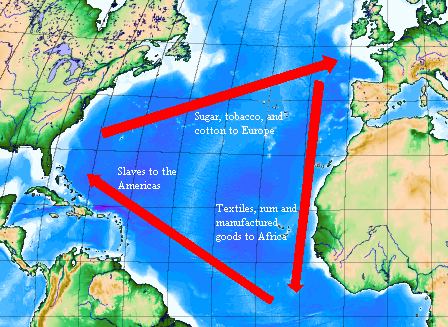
The classical model of the triangular trade
The triangular trade of slaves, sugar, and rum, with New England instead of Europe as the third corner

Triangular trade or triangle trade is trade between three ports or regions. Triangular trade usually evolves when a region has export commodities that are not required in the region from which its major imports come. Such trade has been used to offset trade imbalances between different regions.

The most commonly cited example of a triangular trade is the Atlantic slave trade, but other examples existed. These include the seventeenth-century carriage of manufactured goods from England to New England and Newfoundland, then the transport of dried cod from Newfoundland and New England to the Mediterranean and the Iberian peninsula, followed by cargoes of gold, silver, olive oil, tobacco, dried fruit, and "sacks" of wine back to England. Maritime carriers referred to this Atlantic trade as the "sack trade". A 19th-century example involved general cargo shipped from Britain to Australia, Australian coal to China, then tea and silk back to Britain.

The Atlantic slave trade used a system of three-way transatlantic exchanges – known historically as the triangular trade – which operated between Europe, Africa, and the Americas from the 16th to 19th centuries. European merchants outfitted slave ships, then shipped manufactured European goods owned by the trading companies[which?] to West Africa to get slaves, which they shipped to the Americas (in particular to Brazil and the Caribbean islands). First, in West Africa, merchants sold or bartered European manufactured goods to local slavers in exchange for slaves. Then crews transported the slaves and the remaining European manufactured goods to the Americas, where ship merchants sold the slaves and European manufactured goods to plantation-owners. Merchants then purchased sugar and molasses from the plantation-owners, and crews shipped them to North American colonies (such as the future states of the US), where the merchants sold the remaining supplies of European manufactured goods and slaves, as well as sugar and molasses from plantations to local buyers, and then purchased North American commodities - including tobacco, sugar, cotton, rum, rice, lumber, and animal pelts - to sell in Europe.

This trade, in trade volume, was primarily with South America, where most slaves were sold, but a classic example taught in 20th-century studies is the colonial molasses trade, which involved the circuitous trading of slaves, sugar (often in liquid form, as molasses), and rum between West Africa, the West Indies and the northern colonies of British North America in the 17th and 18th centuries.[1][2] In this triangular trade, slaves grew the sugar that was used to brew rum, which in turn was traded for more slaves. In this circuit the sea-lane west from Africa to the West Indies (and later, also to Brazil) was known as the Middle Passage; its cargo consisted of abducted or recently purchased African people.

During the Age of Sail, the particular routes were also shaped by the powerful influence of winds and currents. For example, from the main trading nations of Western Europe, it was much easier to sail westwards after first going south of 30° N latitude and reaching the belt of so-called "trade winds", thus arriving in the Caribbean rather than going straight west to the North American mainland. Returning from North America, it was easiest to follow the Gulf Stream in a northeasterly direction using the westerlies. (Even before the voyages of Christopher Columbus, the Portuguese had been using a similar triangle to sail to the Canary Islands and the Azores, and it was then expanded outwards.)

The countries that controlled the transatlantic slave-market until the 18th century in terms of the number of enslaved people shipped were Great Britain, Portugal, and France.

The Atlantic sack trade

[edit]

From 1620 to 1709, ships and additional maritime vessels embarked from Newfoundland and New England docks in a "sack trade."[3] Sailors from both regions carried salted cod into southern Europe, particularly from Boston and Ferryland into Mediterranean and Iberian peninsular seaports. Spanish and Portuguese Catholics welcomed these traders for manifold reasons, including church exemption of cod from the fasting and abstinence mandated for Lent, Advent, and myriad saint remembrance days. Newfoundland and New England ships then carried Iberian wine "sacks", olive oil, dried fruit, tobacco, and substantial volumes of Iberian specie, mined by indigenous captives in Cerro Rico and Cerro de Pasco, into England. After 1661, Parliament lifted a ban on bartering New England cod for Iberian material goods, as well as for bills of exchange. Oil, fruit, tobacco, New World gold and silver, "sacks" of wine, Iberian material culture, and then this paper currency were exchanged for manufactured products in England.[4] During the final leg, colonial carriers transshipped English metropolitan goods, and any "sacks" of surplus wine, across the Atlantic and back into their homeports.[5]

The "sack trade" dissolved after 1709 because of changes in cod curing processes and provincial demand for sugar as well as molasses. Atlantic demand for dried cod pushed New England and Newfoundland competency thresholds for angling into transatlantic barter and exchange economies. These shifting conceptions, and scope of, provincial competency resulted in New England and Newfoundland schooners searching for more and more fishing sites along northeastern banks. Fishermen remained offshore for extended periods of time as their vessels trawled North American waters. Peter Pope argues that women often worked shorecrews and as substitutes for men. [6]

In order to sustain catches within schooner holds during these protracted trips, fishermen began to "lightly salt" cod and stored the wet fish for air-drying, the latter after returning to points of departure. According to historian Christopher Magra, "invariably, the combination of a wet-salt cure and an air-dry cure produced a greater percentage of refuse-grade, dried cod." Increasing amounts of this "refuse" cod became unmarketable in southern Europe as expansion of the "sack trade" counterintuitively expedited contraction from within. But New England and Newfoundland fishermen tapped their own demand for sugar, molasses, and cheap, domestically-distilled rum, as a commercial avenue to alternate markets for "refuse" cod: sugarcane planters and their agents in Caribbean littorals. Sugarcane planters relied on cheap, low-grade fish to feed chattel slaves.[7]

The Atlantic triangular slave trade

[edit]

The most historically significant triangular trade was the transatlantic slave trade which operated among Europe, Africa, and the Americas from the 16th to 19th centuries. Slave ships would leave European ports (such as Bristol and Nantes) and sail to African ports loaded with goods manufactured in Europe. There, the slave traders would purchase enslaved Africans by exchanging the goods, then sail to the Americas via the Middle Passage to sell their enslaved cargo in European colonies. In what was referred to as a "golden triangle", the slave ship would sail back to Europe to begin the cycle again.[8] The enslaved Africans were primarily purchased for the purpose of working on plantations to work producing valuable cash crops (such as sugar, cotton, and tobacco) which were in high demand in Europe.[9][10][11][12][13] Slave traders from European colonies would occasionally travel to Africa themselves, eliminating the European portion of the voyage.[14][15]

The number of slaves embarked to America from 1450 until 1800 by country[citation needed]

A classic example is the colonial molasses trade. Merchants purchased raw sugar (often in its liquid form, molasses) from plantations in the Caribbean and shipped it to New England and Europe, where it was sold to distillery companies that produced rum. Merchant capitalists used cash from the sale of sugar to purchase rum, furs, and lumber in New England which their crews shipped to Europe.[16]

With the profits from the European sales, merchants purchased Europe's manufactured goods, including tools and weapons and on the next leg, shipped those manufactured goods, along with the American sugar and rum, to West Africa where they bartered the goods for slaves seized by local potentates. Crews then transported the slaves to the Caribbean and sold them to sugar plantation owners. The cash from the sale of slaves in Brazil, the Caribbean islands, and the American South was used to buy more raw materials, restarting the cycle. The full triangle trip took a calendar year on average, according to historian Clifford Shipton.[16]

The loss of the slave ship Luxborough Galley in 1727 ("I.C. 1760"), lost in the last leg of the triangular trade, between the Caribbean and Britain.
The North Atlantic Gyre

The first leg of the triangle was from a European port to one in West Africa (then known as the "Slave Coast"), in which ships carried supplies for sale and trade, such as copper, cloth, trinkets, slave beads, guns and ammunition.[17] When the ship arrived, its cargo would be sold or bartered for slaves. Ports that exported these enslaved people from Africa include Ouidah, Lagos, Aného (Little Popo), Grand-Popo, Agoué, Jakin, Porto-Novo, and Badagry.[18] These ports traded slaves who were supplied from African communities, tribes and kingdoms, including the Alladah and Ouidah, which were later taken over by the Dahomey kingdom.[19]

On the second leg, ships made the journey of the Middle Passage from Africa to the New World. Many slaves died of disease in the crowded holds of the slave ships. Once the ship reached the New World, enslaved survivors were sold in the Caribbean or the American colonies. The ships were then prepared to get them thoroughly cleaned, drained, and loaded with export goods for a return voyage, the third leg, to their home port,[20] from the West Indies the main export cargoes were sugar, rum, and molasses; from Virginia, tobacco and hemp. The ship then returned to Europe to complete the triangle.

The triangle route was not generally followed by individual ships. Slave ships were built to carry large numbers of people, rather than cargo, and variations in the duration of the Atlantic crossing meant that they often arrived in the Americas out-of-season. Slave ships thus often returned to their home port carrying whatever goods were readily available in the Americas but with a large part or all of their capacity with ballast.[21][22] Cash crops were transported mainly by a separate fleet which only sailed from Europe to the Americas and back.[23] In his books, Herbert S. Klein has argued that in many fields (cost of trade, ways of transport, mortality levels, earnings and benefits of trade for the Europeans and the "so-called triangular trade"), the non-scientific literature portrays a situation which the contemporary historiography refuted a long time ago.[24]

Finally, even if the "triangle trade" idea is essentially incorrect, the Atlantic slave trade was one of the more complex of international trades that existed in the modern period. (…) Thus, while an actual "triangle trade" may not have existed as a significant development for ships in the trade, the economic ties between Asia, Europe, Africa, and America clearly involved a web of relationships that spanned the globe.[25]

A 2017 study provides evidence for the hypothesis that the export of gunpowder to Africa increased the transatlantic slave trade: "A one percent increase in gunpowder set in motion a 5-year gun-slave cycle that increased slave exports by an average of 50%, and the impact continued to grow over time."[26]

New England

[edit]
The number of slaves imported from Africa from 1501 to 1866

New England also made rum from Caribbean sugar and molasses, which it shipped to Africa as well as within the New World.[27] Yet, the "triangle trade" as considered in relation to New England was a piecemeal operation. No New England traders are known to have completed a sequential circuit of the full triangle, which took a calendar year on average, according to historian Clifford Shipton.[16] The concept of the New England Triangular trade was first suggested, inconclusively, in an 1866 book by George H. Moore, was picked up in 1872 by historian George C. Mason, and reached full consideration from a lecture in 1887 by American businessman and historian William B. Weeden.[16]

In the context of an incohesive operation within a multipolar Second Atlantic System, expansive eastern seaboard "Farms" had, in earnest after 1690, not only sustained southern New England proprietorship, land banks, and currency, but also a territorial evolution of the Caribbean. This carrying trade contributed to the expansion of monocentric North American littoral zones for sugarcane cultivation into a polycentric West Indies basin and Southern Caribbean plantation complex. During the seventeenth century, colonial charters and royal commissioners precluded attempts to establish a New England carrying trade to by, for example, the Atherton Trading Company and John Hull. But proposals by Peleg Sanford provided implementation frameworks for eighteenth-century "Farms" and carriers. Historian Sean Kelley examines nineteenth-century "American slavers" because "the North American transatlantic slave trade before 1776 was, in essence, merely another branch of the carrying trade."[28][29]

In response to illegal carrying as well as Rhode Island General Assembly endorsement of Aquidneck as a haven for pirates, the Lords of Trade threatened to embargo Newport until enforcement of a resumption bill for the restoration of lawful mercantile commerce. Periodic trials and executions of notorious smugglers from abroad diverted their attentions away from local privateers, such as the Wanton brothers. Pirates began to disperse from Newport between Queen Anne's War and 1723 mass executions by royal magistrates, establishing the seaport as the dominant carrying hub, with Providence coming in a distant second. British carriers continued to provision plantations outside the boundaries of empire.[30][31]

Before 1780, wartime embargoes and the Atlantic hurricane season spurred carrier attempts to address deficits by circumventing mercantile restrictions, increasing New England trade with Dutch Suriname as well as the Danish, French, Spanish, and Luso Caribbean.[32] Between 1752 and 1758, southern New England carriers commissioned John Greenwood for a self-deprecating portrait as Sea Captains Carousing in Surinam. In 2012, historical archaeologists in Suriname came across two graves of eighteenth-century carriers from Connecticut (Michael Burnham and William Barbut) as well as two graves of Rhode Island carriers (Nathaniel Angel and William Gardner Wanton) interred during the same period.[33]

Wartime embargoes that reduced overseas trade precipitated speculative ventures, as well as land and estuary auctions of Narragansett tribal reserves, under legislature (public) jurisdiction, by private trusts, a specific type of fiduciary relationship for subsidizing expense accounts, purveying regular annuities, or both. Bidders at vendue were frequently interior "composite"[34] yeomen and fishermen,[35] who (according to certain historians) misconceived[36] of revenue derived from the carrying trade as income "competency." Bidders included competitive carriers in secondary seaports such as Providence as well.[37] Despite the antebellum rise of "Greater Northeast" industrial agriculture,[38] the southern New England "Farms" and the carrying trade[39] in Caribbean sugar, molasses, rice, coffee, indigo, mahogany, and pre-1740 "seasoned slaves",[40] began to dissipate by the Election of 1800[41] and largely collapsed into agrarian ruins by the War of 1812.[42]

Newport and Bristol, Rhode Island, were major ports involved in the colonial triangular slave trade.[43] Many significant Newport merchants and traders participated in the trade, working closely with merchants and traders in the Caribbean and Charleston, South Carolina.[44]

Statistics

[edit]

According to research provided by Emory University[45] as well as Henry Louis Gates Jr., an estimated 12.5 million slaves were transported from Africa to colonies in North and South America. The website Voyages: The Trans-Atlantic Slave Trade Database assembles data regarding past trafficking in slaves from Africa. It shows that the top four nations were Portugal, Great Britain, France, and Spain.

Flag of vessels carrying the slaves
Destination Portuguese British French Spanish Dutch American Danish Total
Portuguese Brazil 4,821,127 3,804 9,402 1,033 27,702 1,174 130 4,864,372
British Caribbean 7,919 2,208,296 22,920 5,795 6,996 64,836 1,489 2,318,251
French Caribbean 2,562 90,984 1,003,905 725 12,736 6,242 3,062 1,120,216
Spanish Americas 195,482 103,009 92,944 808,851 24,197 54,901 13,527 1,292,911
Dutch Americas 500 32,446 5,189 0 392,022 9,574 4,998 444,729
United States 382 264,910 8,877 1,851 1,212 110,532 983 388,747
Danish West Indies 0 25,594 7,782 277 5,161 2,799 67,385 108,998
Europe 2,636 3,438 664 0 2,004 119 0 8,861
Africa 69,206 841 13,282 66,391 3,210 2,476 162 155,568
did not arrive 748,452 526,121 216,439 176,601 79,096 52,673 19,304 1,818,686
Total 5,848,266 3,259,443 1,381,404 1,061,524 554,336 305,326 111,040 12,521,339

Other triangular trades

[edit]

The term "triangular trade" also refers to a variety of other trades.

  • A triangular trade is hypothesized to have taken place among ancient East Greece (and possibly Attica), Kommos, and Egypt.[46]
  • A new "sugar triangle" developed in the 1820s and 1830s whereby American ships took local produce to Cuba, then brought sugar or coffee from Cuba to the Baltic coast (Russian Empire and Sweden), then bar iron and hemp back to New England.[47]
  • Ships sailing from Britain to Australia in the last third of the 19th century found a shortage of cargoes to take back to Britain. Therefore they took New South Wales coal to China and then loaded tea and silk to carry back to Britain. The clipper Thermopylae was one of the ships that sailed this triangular route. When steamships became fuel-efficient enough to cover the distances involved, they could make two trips to Australia in a year, with one returning direct to Britain with Australian wool and the other going via China. This competed with the China and Japan Conference, a cartel of steamship owners who fiercely protected their trade and won a sequence of court cases in order to do so.[48]: 123–128 

See also

[edit]

Notes

[edit]
[edit]
Revisions and contributorsEdit on WikipediaRead on Wikipedia
from Grokipedia
The triangular trade encompassed a network of transatlantic commerce routes linking , , and the from the 16th to the 19th centuries, forming a cyclical exchange driven by European demand for labor-intensive commodities. In the initial leg, ships departed from ports in , such as or , laden with manufactured goods including textiles, ironware, firearms, and spirits, which were bartered along the West African coast for enslaved Africans procured through intertribal warfare, raids, or judicial sales. These human cargoes endured the —a grueling marked by , , and , with mortality rates estimated at 10 to 19 percent—before being auctioned in American ports like Charleston or to toil on sugar, , , or plantations. The final leg returned vessels to carrying raw materials and processed goods such as , , , and timber, yielding high profits that fueled mercantile expansion and colonial development. Over its duration, the system facilitated the forced embarkation of roughly 12 million Africans, with survivors comprising a foundational labor force that underpinned the economic growth of colonies and contributed to 's early industrialization through and market linkages. While economically rational under mercantilist doctrines that prioritized balanced trade and colonial self-sufficiency, the trade's reliance on coerced labor generated profound human costs, demographic disruptions in , and ethical debates that eventually spurred abolitionist movements culminating in its suppression by the mid-19th century.

Definition and Historical Context

Origins in Global Commerce

The integration of captives into broader commercial networks traces back to ancient Mediterranean and Afro-Eurasian systems, where multi-directional exchanges of goods and labor foreshadowed later triangular patterns. In the , spanning from the 1st century BCE to the 5th century CE, trade routes connected , , and the , incorporating slaves sourced from sub-Saharan regions via North African intermediaries alongside commodities like , , and metals; these flows supported economic expansion without a singular oceanic triangle but through iterative legs balancing supply deficits. Under Islamic expansion from the onward, trans-Saharan caravans established enduring multi-leg routes linking West African goldfields to North African salt mines and Mediterranean ports, with slaves—often war captives from interior kingdoms—transported northward in exchange for horses, cloth, and weapons, extending further via dhows to Arabian and Indian markets for spices and textiles. These systems, operational by the , prioritized arbitrage across ecological and resource gradients, integrating human labor as a to sustain imperial economies predating European oceanic ventures. European adaptations emerged in the 15th century amid the , a monetary crisis from circa 1450 caused by silver outflows to Asian spice markets exceeding local mining yields, prompting searches for alternative precious metal sources. Portuguese navigators, under , initiated coastal West African expeditions from , establishing trading posts like Arguim in 1445 to exchange European copper, cloth, and weapons for gold dust and from Akan and Wolof intermediaries, alleviating bullion constraints through direct access to sub-Saharan supplies. These early ventures evolved from bilateral coastal barters into proto-multi-leg frameworks by incorporating Atlantic island entrepôts, such as from 1420, where initial slave imports—numbering under 1,000 annually by 1460—supported nascent sugar cultivation demands, driven by European sweetener shortages rather than large-scale enslavement. Profit imperatives from resource scarcities thus adapted preexisting African exchange logics, prioritizing flows over territorial control and predating the intensified of subsequent centuries.

Distinction from Bilateral Trade

Bilateral trade, involving direct exchanges between two regions such as and , frequently resulted in ships returning partially empty or unloaded, as the demand for African commodities like or in was insufficient to fill holds on the return voyage, leading to high idle capacity and elevated per-unit shipping costs. This inefficiency was exacerbated by seasonal patterns and currents in the Atlantic, which favored southward and westward routes but made direct northern returns arduous and time-consuming, often requiring detours or prolonged waits for favorable conditions. In contrast, the triangular system mitigated these issues by structuring voyages to exploit prevailing and the , enabling continuous cargo loading across three legs and minimizing empty holds. The emergence of triangular trade thus addressed scalability limitations evident in earlier bilateral models, such as the direct with in the , which relied on low-volume returns and failed to expand without a third node providing high-demand outbound cargo (slaves) and high-volume inbound commodities (plantation products). By integrating the , the system optimized resource allocation, with specialized routes reducing overall transport costs through full utilization of ship capacity and diversified flows that buffered against disruptions in any single leg. Historical models indicate this configuration boosted equilibrium volumes, as British exports to triangular regions rose from negligible shares in 1700 to 60% by 1798, underscoring the economic rationale over point-to-point exchanges. Risk mitigation further distinguished triangular from , as the multi-leg structure spread exposure across regions and commodities, reducing vulnerability to localized shortages or market fluctuations— for instance, slave volumes peaked at around 55,000 annually from 1701 to 1810 without collapsing bilateral dependencies. This interdependence, while complex, enhanced resilience compared to bilateral routes prone to idle periods and mismatched seasonal availability, fostering sustained profitability in 18th-century Atlantic commerce.

The Atlantic Triangular Trade System

Outbound Leg: Europe to Africa

The outbound leg of the Atlantic triangular trade system commenced with vessels departing ports, laden with manufactured and processed goods destined for barter along the West African coast. explorers initiated systematic contacts in the 1440s, establishing early routes from to African shores initially motivated by quests for and spices but soon incorporating human captives. By the late , English participation intensified following the 1672 to the Company of Royal Adventurers Trading into (later the Royal African Company), which held a monopoly on British to and facilitated shipments from ports like . French ports such as similarly emerged as key departure points, dispatching vessels with comparable cargoes. Primary commodities included textiles, firearms, metalware (such as iron bars, knives, and brass items), and distilled spirits like , which European merchants exchanged for enslaved individuals supplied by coastal African intermediaries. These goods, often produced in or its colonies, served as in African markets, with items like guns enhancing the trade's profitability by fueling local conflicts that increased captive availability. Ship capacities typically ranged from 100 to 400 tons, allowing for bulk transport of these non-perishable items across the Atlantic, though voyages faced logistical challenges including variable winds and provisioning needs. Crew mortality on this leg was significant, driven primarily by infectious diseases such as fevers—likely —contracted upon nearing African waters, with over three-quarters of fatalities occurring in the initial weeks due to exposure and inadequate medical knowledge. Annual crew death rates could exceed those of subsequent passages, underscoring the environmental hazards of tropical coasts despite the absence of during outbound transit. This phase initiated the trade cycle by leveraging Europe's industrial output to acquire labor for American plantations, generating asymmetric value extraction through goods undervalued in origin but prized in destination markets.

Middle Passage: Africa to the Americas

The encompassed the transatlantic voyage of enslaved from embarkation points along the African coast, primarily spanning in the north to in the south, to principal destinations in the including the islands, , and mainland colonies. These routes leveraged and currents, such as the North Atlantic for northern departures and the for southern ones, with voyages originating from over 50 African ports documented in records of approximately 36,000 transatlantic slave ships. The crossing typically lasted just over two months on average across all African regions, though durations varied from one to six months depending on speed, and navigational decisions. Slave ships were increasingly purpose-built after to optimize for human cargo transport, featuring reinforced lower decks with platforms for tiered stowage and iron shackles to secure in or seated positions, thereby maximizing capacity in terms of "heads per " of ship . Prior to British regulatory efforts, packing densities often exceeded 2-3 slaves per , with vessels like the Brookes diagrammed to hold up to 454 individuals on a 267- ship under later limits, though actual pre-regulation loads were denser to boost profitability. The 1788 Dolben Act imposed British limits of 1.67 slaves per for ships under 207 tons burthen, reducing but not eliminating that facilitated disease transmission. Mortality during the averaged 12.1% across documented voyages, with rates ranging from 9% in less crowded regional trades to over 19% in high-risk areas, primarily due to , , and respiratory infections exacerbated by confinement, poor ventilation, and contaminated water supplies rather than deliberate violence alone. Overall, of the 12.5 million Africans embarked between 1501 and 1866, approximately 1.8 million perished en route, based on embarkation and disembarkation records. A notable case illustrating logistical pressures and property valuation occurred in 1781 aboard the Zong, a 110-ton British vessel that departed from with 440 enslaved Africans; due to a navigational error extending the voyage and depleting provisions, the crew jettisoned 132 individuals over 10-13 days to claim losses, treating the act as permissible disposal of under maritime law rather than , with owners prevailing in an initial court ruling on the insurance dispute.

Return Leg: Americas to Europe

Ships departing American and Caribbean ports on the return leg carried raw commodities extracted from slave-based plantations, including , , , , , and , which were shipped to for processing and sale. dominated exports from islands like and , where enslaved labor enabled large-scale production on estates averaging hundreds of acres. By 1750, almost 90 percent of consumed in Britain originated from these slave plantations, underscoring the efficiency of coerced labor in yielding high-volume cash crops for export. , grown primarily in and using similar plantation systems, constituted another key cargo, with over 145,000 enslaved workers supporting production by mid-century. Southern ports such as , facilitated exports of and from coastal , while Caribbean hubs like loaded and hogsheads. To counter outbound ballast shortages and maximize hold capacity, vessels from northern colonies incorporated timber for and furs, integrating North American resources into the circuit. These cargoes exploited efficiencies, where gang-based slave labor systems optimized output through relentless field work and minimal overhead, generating surpluses that closed the loop upon arrival in European ports like and .

Key Participants and Their Incentives

European Merchants and Nations

initiated systematic participation in the Atlantic slave trade in the late , establishing trading posts along the West African coast and transporting enslaved Africans to its colonies in and elsewhere, thereby laying the groundwork for the triangular system's European involvement. Britain entered the trade in the mid-16th century, with naval commander John Hawkins leading the first English voyages in 1562–1563, capturing or purchasing around 300 enslaved Africans off and selling them in Spanish Caribbean ports despite prohibitions under Spanish monopoly. Hawkins conducted two additional expeditions in 1564 and 1567–1568, profiting from direct sales to colonial settlers and establishing a model for English merchants. By the , Britain had become the dominant power, transporting approximately 3.1 million enslaved Africans between 1640 and 1807, accounting for over half of the trade's volume during that period alongside Portugal's earlier lead. also played a significant role, establishing colonies in the and mainland that relied on imported labor, with state-supported companies facilitating voyages under mercantilist frameworks. Key enterprises included Britain's , chartered in 1711 and awarded the in 1713 via the Treaty of Utrecht, granting it a 30-year monopoly to supply up to 4,800 enslaved Africans annually to Spanish American colonies, which it fulfilled by transporting over 75,000 individuals by mid-century. These nations pursued triangular trade through policies designed to maximize national wealth via accumulation, granting royal charters, monopolies, and subsidies to joint-stock companies that offset voyage risks and ensured returns from colonial raw materials like and exchanged for manufactured and slaves. Governments prioritized state-backed enterprises to control trade flows, directing profits from American commodities back to to bolster treasuries and fund naval expansion, with private merchants operating under licensed frameworks that aligned individual incentives with imperial goals.

African Suppliers and Political Structures

The Ashanti Empire, centered in present-day , actively participated in the transatlantic slave trade by conducting raids and wars against neighboring groups, capturing prisoners who were then sold to European traders at coastal forts like . These captives, primarily adult males and females taken in military conflicts, formed the bulk of exports from the Gold Coast region, with the empire's rulers using proceeds to consolidate power and expand territory from the late onward. Similarly, the Kingdom of Dahomey, under kings like (r. 1718–1740), waged targeted campaigns against inland polities such as the Mahi and Yoruba to procure war prisoners, who constituted the primary source of slaves funneled through ports like . A key dynamic sustaining these operations was the "guns-for-slaves" exchange, wherein European merchants traded firearms, , and other arms for , enabling supplier kingdoms to militarize further and intensify raids. By the , this cycle had escalated, with African polities importing thousands of guns annually—such as ratios rising from per slave in 1682 to 24–32 by 1718—which bolstered their coercive capacities and perpetuated endogenous conflict for human commodities. , this armament supported the kingdom's "annual customs," ritual executions of that demonstrated royal authority while reserving healthier prisoners for export, thereby intertwining internal political rituals with Atlantic commerce. Ouidah emerged as a pivotal hub under Dahomey's control after its conquest in 1727, serving as the kingdom's primary outlet for over one million slaves shipped to the , particularly , from the 17th to 19th centuries. African elites at these ports negotiated directly with European factors, prioritizing prime captives—often war prisoners over debtors or criminals—to maximize value in like iron bars and textiles. Political structures in these kingdoms incentivized continuity of the trade, with rulers deriving revenue and legitimacy from it; for instance, Dahomey's monarchy resisted British abolitionist pressures in the early 19th century, rejecting treaties that curtailed exports and instead petitioning for alternative commodities to sustain fiscal stability. Ashanti leaders similarly prioritized trade alliances with multiple European powers to evade suppression efforts, viewing the influx of slaves as essential to their hierarchical systems where captives underpinned labor, tribute, and military service. This endogenous profiteering, rooted in pre-existing warfare practices amplified by Atlantic demand, underscores how African polities adapted internal power dynamics to the global market rather than being passive suppliers.

American Planters and Colonial Economies

American planters in the colonial Americas, particularly in the and southern mainland regions, drove significant demand for enslaved African labor to sustain plantation-based economies centered on labor-intensive cash crops. production in the British, French, and islands required vast workforces for planting, harvesting, and processing, with high mortality rates—often resulting in life expectancies of 5 to 10 years for enslaved workers due to , , , and brutal conditions—necessitating continuous importation to replace losses. cultivation in similarly expanded reliance on enslaved labor as plantations grew after the mid-17th century, with the crop's labor demands shifting from initial indentured servants to lifelong chattel to meet rising export needs and maintain profitability. , under control, absorbed approximately 40% of all transatlantic enslaved Africans, primarily for and later plantations, underscoring the scale of demand in tropical export agriculture. The preference for enslaved African labor over European indentured servitude intensified after the 1680s, as indentured contracts typically lasted 4–7 years, after which servants gained freedom and land, leading to labor shortages and social tensions like Bacon's Rebellion in Virginia (1676), which heightened planters' fears of arming poor whites. Enslaved Africans provided perpetual, heritable labor at lower long-term costs, especially in disease-prone tropical environments where Europeans suffered higher mortality from malaria and yellow fever, rendering them less viable for sustained plantation work. This economic calculus was reinforced by the availability of slaves through the triangular trade, making African labor a more reliable input for high-yield crops like sugar, which demanded year-round gang labor systems unsuited to temporary servitude. Colonial legislatures formalized these incentives through that entrenched perpetual , denying basic rights and classifying enslaved people as property. The of 1661, the first comprehensive English colonial law on the matter, legalized lifelong enslavement for Africans and their descendants, prohibited without assembly approval, and authorized harsh punishments to suppress resistance, setting a model adopted in (1664) and other islands. These measures aligned planter interests with imperial trade networks, ensuring a stable labor supply for export-oriented economies while prioritizing crop output over worker welfare.

Economic Dynamics and Goods Exchanged

Commodities and Profit Mechanisms

European merchants exported commodities such as iron bars, firearms, textiles, and shells to West African ports, where these items served as goods for enslaved Africans. Iron bars, often termed "voyage iron," functioned as a standardized unit of , with historical records indicating that a single enslaved person might equate to approximately 85 bars in trade valuations during the . shells, sourced primarily from the via European intermediaries, became a in West African economies, facilitating the acquisition of by embodying portable and divisible value that local societies lacked in sufficient quantities. On the return leg from the to , ships carried plantation-produced staples including , , , , and increasingly , which generated profits through their transformation and resale in European markets. , a of refining in the , was shipped to distilleries for conversion into , a distilled spirit that fetched premium prices when re-exported to , creating a value-adding loop within the trade cycle. The of Eli Whitney's in 1793 mechanized seed removal, dramatically boosting yields and elevating it as a high-value return commodity; U.S. exports surged from about 1,500 bales in 1790 to over 4 million by 1860, amplifying trade volumes and margins on this leg. Profit mechanisms relied on barter asymmetries, where European goods held disproportionate value in African markets due to technological and scarcities—such as the for durable iron tools and exotic shells absent in local production—allowing traders to acquire human cargo at low relative cost before realizing multiples upon sale in the . instruments like bills of exchange further enabled profits by deferring payments; drawn on or other financial centers, these negotiable orders allowed American planters to settle slave purchases with promises backed by future commodity exports, reducing immediate capital outlays and mitigating transatlantic risks. Historical ledger analyses of British voyages estimate average net profits of around 17% per trip for ports like and in the late , driven by these commodity markups and financing efficiencies rather than uniform high returns across all ventures.

Labor Economics and Plantation Systems

In the plantation economies reliant on the triangular trade, enslaved African labor served as a capital investment yielding high returns through intensive cultivation of cash crops like cane, which demanded synchronized, year-round exertion unsuitable for seasonal free labor patterns. Prime field hands were purchased upon arrival in the for £20 to £50, reflecting costs that included transatlantic transport and initial outfitting, with recoupment achieved via output exceeding £200 in equivalent value over a typical working lifespan of 10-20 years, driven by coerced unburdened by negotiations. The gang labor system amplified these efficiencies by dividing plantation work into standardized tasks performed collectively under direct oversight, enabling large-scale operations to surpass the output of smaller free farms or indentured arrangements, where individual incentives fragmented effort and coordination. Comparative accounting in the antebellum period, applicable to earlier colonial precedents, indicated slave hire rates 35-75% below free labor equivalents when adjusted for subsistence and , with no convergence toward parity over time. Biological factors further tilted economics toward enslavement: African laborers' partial immunity to tropical maladies like malaria—conferred by genetic traits such as sickle-cell heterozygosity—minimized productivity losses from illness, contrasting with European free workers' vulnerability, which inflated effective labor costs through higher absenteeism and replacement needs in humid, mosquito-prevalent regions. Alexander Hamilton's 1791 Report on Manufactures implicitly acknowledged this entrenchment by advocating industrial diversification to supplant agrarian dependence, noting unproven viability of free-labor substitutes for sustaining plantation-scale yields in disease-prone staples without systemic restructuring.

Scale, Routes, and Quantitative Data

Estimated Volumes and Timelines

The transatlantic slave trade, the human cargo leg of the triangular trade, involved the forced embarkation of an estimated 12.5 million Africans from 1501 to 1866, with these figures derived from the Trans-Atlantic Slave Trade Database through compilation of voyage records and statistical imputation for undocumented voyages. The database, drawing on over 36,000 documented voyages covering 66–80% of the total, adjusts for underreporting via extrapolative methods to arrive at aggregate estimates, though some scholars note potential variances due to incomplete African-side records. Trade volumes remained modest in the initial phase, accelerating sharply in the amid expanding plantation demands in the . By century, embarkations totaled approximately 277,500 in the 16th (1501–1600), dominated by carriers supplying early Iberian colonies; 1.88 million in the 17th (1601–1700), with maintaining primacy alongside emerging Dutch (totaling around 500,000 over their active period, chiefly this century) and initial British participation; 6.49 million in the 18th (1701–1800), the peak era where British vessels accounted for over 3 million amid intensified competition from and the ; and 3.87 million in the 19th (1801–1866), sustained largely by /Brazilian and Spanish/Cuban operations despite abolitionist pressures in . /Brazilian flags overall transported about 5.85 million, underscoring their long-term dominance from the 16th through 19th centuries. These timelines reflect causal drivers like colonial expansion and commodity booms, with volumes calibrated against primary logs, port manifests, and planter import data.

Mortality Rates and Logistical Challenges

Mortality rates on the averaged 12 to 15 percent of embarked enslaved Africans, with rates exceeding 20 percent common under tight-packing practices that prioritized ship capacity over space allocation. These figures reflected logistical risks inherent to , where enslaved individuals were confined in holds with minimal air circulation and , fostering rapid spread of diseases like —often from contaminated and waste accumulation—rather than systematic killing for its own sake. Merchants treated such losses as calculable costs, factoring them into and to maintain profitability amid voyages averaging 40 to 60 days across variable Atlantic currents and weather. Across the trade's span from the 1500s to 1860s, approximately 1.8 million deaths occurred at sea out of 12.5 million embarked, excluding additional losses during overland marches to African ports (estimated at 10-15 percent) and post-arrival "" in the due to unfamiliar diseases and labor demands. Logistical hurdles included provisioning for extended routes, crew vulnerabilities to the same pathogens (with sailor mortality around 15-20 percent), and occasional shipwrecks or mutinies that amplified attrition. The 1788 Dolben Act for British ships addressed these issues by capping slaves at 1.67 per ton (up to 207 tons) and requiring onboard surgeons and ventilation gratings, yielding slight mortality reductions—from about 13 percent pre-act to under 10 percent in the —primarily through moderated crowding that curbed vectors, though overall trends also reflected improved ship design and experience.

Comparisons with Other Historical Slave Trades

Intra-African and Arab Slave Trades

The intra-African slave trade encompassed the internal capture, trade, and use of enslaved persons within African societies long before the advent of transatlantic commerce, with systems embedded in kingdoms such as , Songhai, and later Dahomey and Ashanti. These practices involved warfare, raids, and judicial punishments yielding captives for agricultural labor, military service, domestic work, and , often integrated into kinship-like structures but marked by hereditary bondage and sale across regions. Estimates suggest millions were enslaved internally over centuries, sustaining local economies without external export focus until later intensification. The , particularly via trans-Saharan routes from to and the Islamic world, operated from approximately 650 to 1900 CE, with historians estimating 7 to 9 million slaves transported northward, representing a significant pre-colonial system. African polities, including those in the , supplied captives through raids and tribute, while and Berber merchants facilitated caravans enduring harsh desert crossings with high mortality. Distinct features included the systematic of many male slaves to produce eunuchs for palace guards, administrators, and harems—often performed by non-Muslims to circumvent Islamic prohibitions—with survival rates as low as 10-20% due to the procedure's brutality; female slaves, conversely, were commonly destined for domestic service or . Continuity between intra-African and Arab trades is evident in shared mechanisms of supply from African kingdoms, which both utilized and profited from enslavement practices predating European involvement. Traveler , in his 1350s account of the , described bustling slave markets in towns like Walata and , where female slaves dominated sales of goods and millet, often appearing unveiled and integrated into daily commerce, underscoring the normalized presence of bondage in urban centers. These systems highlight endogenous African agency in slave procurement, with rulers like those of employing slaves in courts and armies while exporting others northward, fostering economic ties across the .

East African vs. Transatlantic Routes

The East African slave trade operated primarily across the Indian Ocean, sourcing captives from interior regions of present-day Tanzania, Mozambique, and Malawi, who were marched overland to coastal ports like Zanzibar, Bagamoyo, and Kilwa before shorter maritime voyages to destinations in the Arabian Peninsula, Persian Gulf, and western India. Zanzibar emerged as the central hub in the 19th century under Omani Arab control, following Sultan Seyyid Said's relocation of his capital there in 1840, facilitating exports driven by demand for domestic laborers, concubines, soldiers, and eunuchs rather than large-scale plantation agriculture. Scholarly estimates indicate 1.5 to 2.1 million slaves were exported through East African ports during the heightened 19th-century phase, with overall Indian Ocean volumes from eastern Africa totaling around four million captives from the 8th to 19th centuries, though net exports were lower due to pre-embarkation losses. In contrast to the transatlantic trade's long oceanic crossings from West and Central African coasts to the —spanning 5,000 to 6,000 miles with mortality of 10-15%—the East African routes featured grueling inland treks of 200-500 miles, where mortality approached 80% from exhaustion, , and before slaves reached the for . Sea voyages were comparatively brief (often under 1,000 miles to Arabia), reducing shipboard deaths but not compensating for terrestrial hardships exacerbated by desert crossings and chained marches. Economically, the East African trade emphasized diversified uses in urban households and harems, yielding higher female proportions (often 50-60% of exports), which elevated local male-to-female ratios in source regions, whereas the transatlantic trade prioritized male field labor, exporting two males per female and skewing demographics toward surplus women in . Omani Arabs dominated the 19th-century East African trade, expanding clove plantations on and Pemba that absorbed tens of thousands annually while exporting to Ottoman and Persian markets, a system less industrialized than European transatlantic operations reliant on fortified coastal factories and networks. The trade persisted empirically beyond transatlantic suppressions—British abolition in 1807 and U.S. bans in 1808—peaking in the mid-1800s with up to 50,000 exports yearly from , only waning after British naval interventions and the 1873 closure of the island's , with clandestine routes enduring until the 1890s under international pressure. This longevity reflected weaker enforcement in the compared to Atlantic patrols, underscoring geographic isolation and entrenched Arab commercial interests.

Consequences and Long-Term Effects

Economic Gains for Europe and the Americas

The triangular trade generated substantial profits for European merchants and shippers through the of manufactured goods to , the transport of enslaved Africans to the , and the return of plantation commodities like , , and to . In Britain, these activities particularly transformed port cities; , for instance, dispatched 217 slaving vessels between 1741 and 1750, comprising 43% of all British slave-trading ships during that decade, and by the 1790s dominated 80% of the British slave trade while handling over 40% of 's total. The port's commercial volume surged, with imports rising from 14,600 tons in 1709 to 450,000 tons by 1800, fueling urban expansion and infrastructure development tied directly to trade revenues. Overall, slave-based exports added under 2.5% to Britain's national at their late-18th-century peak, a share comparable to domestic but concentrated in key sectors like shipping and mercantile . Direct profits from slave trading itself averaged around 0.5% of GDP, though broader slavery-linked wealth from colonial produce amplified local impacts, raising and values in trade-adjacent regions. These returns were channeled into industrial advancements, including mills processing imported and improvements in shipping technologies that lowered costs and expanded capacity during the early . In the Americas, the trade's labor inputs underpinned export-driven plantation economies, creating wealth multipliers via high-yield cash crops that integrated colonies into global markets. Enslaved workers produced commodities accounting for roughly 12.6% of U.S. GDP on the eve of the Civil War, with —harvested almost exclusively by slaves—constituting over 50% of national exports by 1860 and driving Southern regional growth. Southern benefited from slave labor efficiencies, including and gang systems that boosted output per worker beyond many free-labor benchmarks, sustaining elite fortunes and in staples like and across and mainland holdings. This system generated reinvestable surpluses, funding local such as levees and warehouses that enhanced export and values.

Developmental Impacts on Africa

The transatlantic slave trade exported approximately 12 million from 1500 to 1866, with additional millions through other routes including the trans-Saharan and trades, leading to severe demographic disruptions in West and . This population drain, estimated at up to 20% in some regions during peak periods, reduced labor availability for and local production, fostering chronic insecurity as communities prioritized defense against raids over . Empirical analysis indicates that areas more intensely affected exhibited heightened ethnic fractionalization, as slave raids incentivized inter-group conflict and mistrust, undermining cooperative institutions essential for growth. Econometric studies link slave export intensity to persistent , with Nathan Nunn's 2008 research showing a robust negative between per-country slave exports and contemporary GDP , explaining roughly 72% of Africa's income shortfall relative to the global average absent the trades. The trade distorted incentives, diverting resources toward slave capture and warfare rather than or , while depopulating prime agricultural zones and perpetuating a that hindered and market integration. However, internal African dynamics, including pre-existing systems of enslavement and warfare among kingdoms, amplified these effects, as elites in states like Dahomey and Asante actively participated to acquire European goods. Some coastal polities experienced short-term gains from the trade, accumulating wealth through exports of slaves in exchange for firearms, textiles, and metals, which bolstered military capacity and territorial expansion. The "guns-for-slaves" exchange, documented from the onward, enabled kingdoms such as Oyo and Dahomey to dominate interior rivals, temporarily enriching ruling classes and fostering specialized port economies. Yet these benefits were uneven and fleeting; firearm proliferation escalated endemic warfare, further entrenching predatory governance over productive investment, with net developmental costs outweighing localized windfalls. Long-term stagnation in cannot be attributed solely to the slave trades, as biogeographic factors like the tsetse fly's inhibition of and draft power, alongside tropical disease burdens such as , constrained pre-colonial intensification of and networks independently. Rugged in some areas inadvertently shielded populations from raids, mitigating but not eliminating trade-induced harms, while geographic fragmentation limited scalable economic systems prior to European contact. Nonetheless, the unprecedented scale of external slave extraction exacerbated these vulnerabilities, entrenching mistrust and weak institutions that impeded post-trade recovery.

Human Costs to Enslaved Populations

The transatlantic slave trade inflicted profound physical and psychological suffering on enslaved Africans, beginning with the , where captives endured extreme overcrowding, inadequate food and water, rampant disease, and brutal discipline, leading to mortality rates of 10 to 15 percent across approximately 36,000 documented voyages from 1514 to 1866. Out of an estimated 12.5 million Africans embarked, roughly 1.8 million perished en route, with causes including , , and ; crew mortality was also high at over 20 percent in some periods due to similar hardships. Upon disembarkation, survivors faced a "" phase of acclimation to diseases and labor regimes, during which death rates remained elevated, compounded by malnutrition and exhaustion; combined with losses, approximately 2 million Africans died during transit or in the first year of enslavement. In sugar plantations, newly arrived enslaved adults typically survived only 7 to 10 years post-arrival owing to relentless field labor from dawn to dusk, exposure to tropical fevers like and , and deficient diets heavy in salted fish and but lacking protein. owners often replenished workforces via continuous imports rather than natural increase, as infant mortality exceeded 50 percent and birth rates lagged due to these stressors. Family units were systematically fractured, with captives captured and sold individually or in small groups, severing African kinship networks; auctions in the further dispersed spouses, parents, and children, as slaveholders prioritized economic utility over familial integrity, leaving many to form improvised bonds under perpetual threat of resale. This practice persisted across regions, though documentation from plantation records indicates it was near-universal in chattel systems treating humans as commodities. Enslaved Africans mounted resistance through flight and , including maroonage—escape to form autonomous communities in inaccessible terrains like Jamaican mountains or Brazilian hinterlands, where runaways sustained themselves via subsistence farming and raids while evading recapture. Collective revolts also occurred, exemplified by the uprising in starting August 1791, where tens of thousands of enslaved field workers burned plantations and clashed with colonial forces, escalating into a prolonged war that dismantled there by 1804. Such actions imposed tactical costs on enslavers, though most were suppressed with lethal force. Regional disparities moderated some human costs; in , which received nearly 40 percent of transatlantic arrivals, —formal freedom grants by owners or self-purchase—was more frequent than in British colonies, averaging 1-2 percent annually in urban centers like due to Portuguese legal traditions, Catholic incentives for manumitting the faithful, and enslaved access to cash from skilled labor or petty trading. This contrasted with islands, where isolation and Protestant doctrines yielded negligible manumissions, perpetuating total enslavement for generations.

Scholarly Debates and Controversies

Role in Capitalist Development

posited in Capitalism and Slavery (1944) that profits from the triangular trade, encompassing the export of manufactured goods to , the purchase of enslaved Africans, and the importation of plantation commodities like and to , generated surplus capital essential for Britain's , with reinvestments funding infrastructure such as canals and factories. Proponents of this view highlight specific institutional origins, noting that firms like emerged from insuring slave voyages in the late 17th century, while profits seeded early banks and joint-stock companies involved in Atlantic commerce, providing liquidity for mercantile expansion. These contributions extended to broader financial innovations, as slave traders' wealth supported credit mechanisms that facilitated domestic investment. Subsequent quantitative critiques have substantially qualified Williams' causal claims, demonstrating that direct slave trade profits represented only about 1-2% of Britain's total formation during the 18th century's peak, insufficient to drive systemic industrialization when compared to sectors like or textiles. Economic historians, including and David Richardson, have shown through customs data and profit reconstructions that the trade's net returns, after for high mortality and overheads, averaged under 0.5% of national income annually from 1760-1807, dwarfed by internal and enclosures. The Williams thesis has been further undermined by evidence of comparable growth in non-slave-dependent ports; for instance, Hull, focused on Baltic timber and agricultural exports, expanded its trade volume at rates rivaling Bristol's during the 1750s-1790s, while inland industrial hubs like and Birmingham thrived on domestic markets and non-Atlantic imports without direct triangular trade linkages. Recent scholarship in the 2020s reinforces that viable alternatives to slave trade capital existed, with analyses from databases indicating that domestic wool, , and sectors supplied comparable or greater flows for , rendering the triangular trade accelerative at best rather than foundational to capitalist structures. Platforms like EH.net highlight how pre-existing market institutions and technological spillovers from non-colonial trades—such as ironworking—sustained growth trajectories independent of Atlantic , countering exaggerated legacy attributions by emphasizing diversified revenue streams in Britain's mercantile economy. These findings underscore that while the trade enriched specific merchant classes, broader capitalist development relied on endogenous factors like property rights and incentives, not exogenous windfalls from .

Critiques of Exaggerated Legacy Claims

Scholars such as , James Robinson, and Simon Johnson argue that Africa's persistent underdevelopment cannot be causally attributed primarily to the transatlantic slave trade, as institutional quality—particularly the presence of inclusive versus extractive political and economic institutions—better explains cross-national differences in prosperity. Their analysis of former colonies indicates that geographic endowments and historical events like exert influence mainly through their effects on institutional persistence, with post-colonial failures amplifying any prior disruptions rather than the trade itself serving as a direct, enduring barrier to growth. This framework challenges deterministic narratives by highlighting how correlation between slave export intensity and modern GDP does not imply causation, as omitted variables like and account for more variance. Economic trajectories post-abolition further underscore multifaceted causation, with the —despite reliance on transatlantic —achieving industrialization and sustained growth after 1800, while lagged due to internal factors including continued intra-African enslavement and weak property rights. For instance, U.S. in the proceeded without acceleration from , as Southern underinvestment in and immigration aversion constrained broader development, yet overall hemispheric progress outstripped Africa's amid colonial extraction and post-independence mismanagement. Economists like note that while Atlantic exports disrupted West and from 1700 to 1870, continental systems persisted, concentrating elite wealth without fostering innovation, a pattern exacerbated by geography and conflict rather than legacies alone. Critiques also highlight how popular accounts overstate the trade's uniqueness, ignoring slavery's status as a near-universal pre-modern involving African rulers, traders, and Asian empires, which diminishes claims of singular Western . observes that African societies actively participated in capturing and selling slaves to Europeans, mirroring global norms where enslavement targeted out-groups irrespective of race, and that such practices predated and outlasted transatlantic routes without inducing equivalent guilt narratives elsewhere. Institutional biases in academia and media, often aligned with progressive ideologies, selectively amplify the trade's role to frame Western history as exceptionally culpable, sidelining evidence of comparable enslavement of 17 million Africans over centuries or Ottoman systems, thereby distorting causal realism in favor of ideological narratives.

Abolition and Transition to Other Trades

Factors Leading to Suppression

The suppression of the transatlantic slave trade was driven in part by economic pressures that eroded its profitability, including sharply rising slave prices at African ports due to intensified interception risks and reduced supply volumes following British abolition in 1807. Traders faced elevated costs from higher insurance premiums, faster but more expensive vessels to evade patrols, and disrupted coastal access, which collectively diminished returns on voyages even as demand persisted in and . In parallel, alternatives such as indentured labor from emerged as cheaper options for some economies post-suppression, further undercutting the economic rationale for continued illicit trafficking. British naval enforcement played a pivotal role, with the —operational from 1808 to the 1860s—patrolling approximately 3,000 miles of coastline and seizing over 1,600 slave ships, thereby freeing around 150,000 captives. These operations, supported by bases like , imposed direct financial burdens on Britain, costing up to 2% of national GDP at peak and straining resources through ship maintenance, personnel losses (over 1,500 sailors died, mostly from disease), and judicial proceedings for captured vessels. The colony of , established as a hub for liberated Africans and anti-slave-trade courts, incurred substantial ongoing expenses for settlement, defense, and administration, which compounded the fiscal incentives for Britain to prioritize suppression amid competing imperial demands. African suppliers and traders adapted through resistance tactics, such as relocating capture and points deeper inland via overland routes to circumvent coastal patrols, which temporarily sustained illegal flows but increased logistical costs and vulnerabilities to local conflicts. Nonetheless, these evasions proved insufficient against sustained naval pressure and bilateral treaties, as the cumulative economic disincentives—higher per-slave acquisition expenses and seizure probabilities—gradually outweighed potential profits, contributing to a net decline in transatlantic volumes by the mid-19th century.

Post-Abolition Economic Shifts

Following the abolition of the British slave trade in 1807 and emancipation in 1833, European powers, particularly Britain, promoted "legitimate commerce" in to replace slave exports with commodities such as and , aiming to sustain triangular trade patterns through exchanges of manufactured goods from for raw materials shipped back for industrial processing. exports from regions like the surged from negligible volumes before 1800 to over 30,000 tons annually by the 1840s, facilitating a cycle where British textiles and metalware were traded for oil used in , lubricants, and candles in and the . This shift, however, was gradual and incomplete; legitimate trade coexisted with , as African intermediaries often relied on enslaved labor for production, exporting both oil from and slaves until at least the 1850s. followed a similar logic, with British demand driving exports from coastal entrepôts like , where goods flowed inward and tusks outward, though volumes remained secondary to at around 10-15% of value until the 1870s. Despite legal bans, the illicit slave trade persisted in a modified triangular framework, with European and American vessels evading patrols to transport over 1.65 million Africans across the Atlantic to and between 1808 and 1867, sustaining economies in and . received the bulk, with imports peaking at approximately 250,000 slaves in the 1840s alone under Portuguese-flagged ships, before a British naval and 1850 prohibition law curtailed flows, though continued sporadically until full abolition in 1888. In , illegal landings escalated post-1820 bans, with 80 ships documented in 1835 carrying roughly 24,000 slaves under false flags, fueling a slave from 286,000 in 1827 to 370,000 by 1862 despite nominal Spanish suppression efforts. These clandestine operations mirrored pre-abolition routes, exchanging , textiles, and iron for human cargoes funneled to markets. Broader adaptations echoed triangular coercion in other coerced exchanges, such as the British opium trade forming an India-China-Britain cycle from the 1810s, where opium grown in was shipped to in exchange for tea and silver, reversing trade imbalances through addictive exports that generated £5-10 million annually by the 1830s and precipitated the (1839-1842 and 1856-1860). This pattern, while not directly substituting African slaves, maintained logics of unequal, forcibly imposed commodity flows post-abolition, with British monopolies enabling the triangle until legalization pressures in the 1840s. Such shifts underscored how abolition redirected but did not dismantle extractive trade architectures reliant on naval power and asymmetric dependencies.

Other Triangular Trade Patterns

Non-Atlantic Examples

In the region prior to 1500, pre-European trade networks operated in patterns analogous to triangular trade, involving the exchange of spices from and the , enslaved individuals captured from n interiors, and textiles manufactured in and Arabian ports. , Persian, and merchants typically shipped slaves northward from coastal entrepôts like Kilwa and to markets in the , , or , where they were bartered for Indian cotton textiles and spices such as pepper and cloves; these commodities were then redistributed southward or eastward, generating profits through in regional scarcities. Annual slave exports from East Africa during this era likely numbered in the low tens of thousands at peak, far below later Atlantic volumes, yet voyage mortality often reached 10-15% due to , , and on vessels. During the 17th century, the (VOC), established in 1602, developed intra-Asian trade circuits that mirrored triangular structures, routing ships between ports in for textiles, the Indonesian archipelago for spices like and cloves, and various Asian slave sources to supply labor for VOC settlements such as Batavia (modern ). Slaves, primarily from eastern (e.g., and Ambon), , and , were transported along these legs to Dutch factories, with total intra-Asiatic VOC slave movements estimated at 175,000 to 225,000 individuals over the company's lifespan; private traders supplemented official voyages, amplifying the scale while yielding comparable profit margins to commodity legs through low acquisition costs in source regions. Mortality rates on these shorter hauls averaged 10-20%, driven by similar factors of confinement and inadequate provisioning as in Atlantic crossings, though volumes remained dwarfed by transoceanic counterparts.

Modern Analogues in Global Commerce

Contemporary global commerce features triangular trade patterns characterized by the extraction of raw materials from resource-rich developing regions, their transformation through in intermediate economies, and final consumption in affluent markets, optimizing comparative advantages and . For instance, minerals like from the of Congo are exported to for processing into components for batteries, which are then shipped as finished products to the and . This structure mirrors historical efficiencies in minimizing return cargoes but operates within just-in-time supply chains that prioritize speed and cost reduction over fixed routes. In 2023, 's imports of critical raw materials from , including 64% of its oil needs from the continent, underscored this dynamic, fueling a trade volume exceeding $280 billion annually. Foreign direct investment (FDI) flows reinforce these patterns, with developed economies investing in hubs that source from primary producers. WTO analyses highlight triangular FDI linkages, such as investments from the and into East Asian , which draw inputs from and , enhancing but raising dependency concerns. A 2022 study on contemporary triangular trade emphasized how such cycles leverage comparative advantages, enabling developing nations to export unprocessed goods while gaining technology transfers, though often at the cost of value-added retention. Ethical sourcing debates parallel historical critiques of exploitation, focusing on labor conditions, , and revenue leakage in extraction zones, yet lack the coerced human element of past trades. Initiatives like the Dodd-Frank Act's conflict minerals reporting require firms to audit supply chains from to , addressing armed group financing without equivalent state monopolies. Reports from the Ethical Trading Initiative note persistent issues in factory wages and , prompting voluntary codes, but enforcement varies, with peer-reviewed analyses attributing improvements to market pressures rather than regulatory uniformity. These concerns drive certifications and transparency demands, contrasting with unregulated historical systems.

References

Add your contribution
Related Hubs
User Avatar
No comments yet.