Hubbry Logo
search
logo
1920s
1920s
current hub
2315377

1920s

logo
Community Hub0 Subscribers
Read side by side
from Wikipedia
Irish War of IndependenceProhibition in the United StatesWomen's suffrageBabe RuthSpirit of St. LouisChinese Civil WarMarch on Rome1929 stock market crash
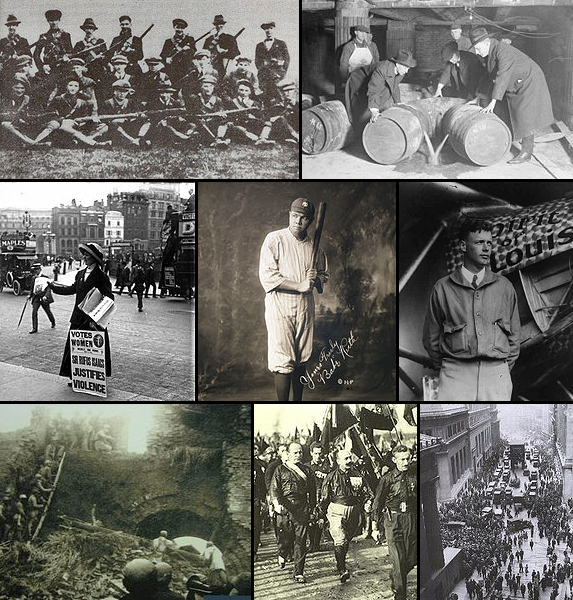
From left, clockwise: Third Tipperary Brigade Flying Column No. 2 under Seán Hogan during the Irish War of Independence, 1920; prohibition agents destroying barrels of alcohol, 1921, in accordance with the 18th amendment, which made alcoholic beverages illegal in the United States throughout the entire decade; in 1927, Charles Lindbergh embarks on the first solo nonstop flight from New York to Paris on the Spirit of St. Louis; a crowd gathering on Wall Street after the 1929 stock market crash, which led to the Great Depression; Benito Mussolini and fascist Blackshirts during the March on Rome in 1922; the People's Liberation Army attacking government defensive positions in Shandong, during the Chinese Civil War; the women's suffrage campaign leads to numerous countries granting women the right to vote and be elected; Babe Ruth becomes the most famous baseball player of the time.

The 1920s (pronounced "nineteen-twenties" often shortened to the "'20s" or the "Twenties") was a decade that began on January 1, 1920, and ended on December 31, 1929. Primarily known for the economic boom that occurred in the Western World following the end of World War I (1914–1918), the decade is frequently referred to as the "Roaring Twenties" or the "Jazz Age" in America and Western Europe, and the "Golden Twenties" in Germany, while French speakers refer to the period as the "Années folles" ('crazy years') to emphasize the decade's social, artistic, and cultural dynamism.[1]

The devastating Wall Street crash in October 1929 is generally viewed as a harbinger of the end of 1920s prosperity in North America and Europe. In the Soviet Union, the New Economic Policy was created by the Bolsheviks in 1921, to be replaced by the first five-year plan in 1928. The 1920s saw the rise of radical political movements, with the Red Army triumphing against White movement forces in the Russian Civil War, and the emergence of far-right political movements in Europe. In 1922, the fascist leader Benito Mussolini seized power in Italy. Other dictators that emerged included Józef Piłsudski in Poland, and Peter and Alexander Karađorđević in Yugoslavia. First-wave feminism made advances, with women gaining the right to vote in the United States (1920), Albania (1920), Ireland (1921), and with suffrage being expanded in Britain to all women over 21 years old (1928).

In Turkey, nationalist forces defeated Greece, France, Armenia, and Britain in the Turkish War of Independence, leading to the Treaty of Lausanne (1923), a treaty more favorable to Turkey than the earlier proposed Treaty of Sèvres. The war also led to the abolition of the Ottoman Caliphate. Nationalist revolts also occurred in Ireland (1919–1921) and Syria (1925–1927). Under Mussolini, Italy pursued a more aggressive domestic and foreign policy, leading to the nigh-eradication of the Sicilian Mafia and the Second Italo-Senussi War in Libya respectively. In 1927, China erupted into a civil war between the Kuomintang (KMT)-led government of the Republic of China (ROC) and forces of the Chinese Communist Party (CCP). Civil wars also occurred in Paraguay (1922–1923), Ireland (1922–1923), Honduras (1924), Nicaragua (1926–1927), and Afghanistan (1928–1929). Saudi forces conquered Jabal Shammar and subsequently, Hejaz.

A severe famine occurred in Russia (1921–1922) due to the combined effects of economic disturbance because of the Russian Revolution and the Russian Civil War, exacerbated by rail systems that could not distribute food efficiently, leading to 5 million deaths. Another severe famine occurred in China (1928–1930), leading to 6 million deaths. The Spanish flu pandemic (1918–1920) and Russian typhus epidemic (1918–1922), which had begun in the previous decade, caused 25–50 million and 2–3 million deaths respectively. Major natural disasters of this decade include the 1920 Haiyuan earthquake (258,707~273,407 deaths), 1922 Shantou typhoon (50,000–100,000 deaths), 1923 Great Kantō earthquake (105,385–142,800 deaths), and 1927 Gulang earthquake (40,912 deaths).

Silent films were popular in this decade, with the highest-grossing film of this decade being either the American silent epic adventure-drama film Ben-Hur: A Tale of the Christ or the American silent war drama film The Big Parade, depending on the metrics used. Sinclair Lewis was a popular author in the United States in the 1920s, with his books Main Street and Elmer Gantry becoming best-sellers. Best-selling books outside the US included the Czech book The Good Soldier Švejk, which sold 20 million copies. Songs of this decade included "Mack the Knife" and "Tiptoe Through the Tulips".

During the 1920s, the world population increased from 1.87 to 2.05 billion, with approximately 700 million births and 525 million deaths in total.

Social history

[edit]

The Roaring Twenties brought about several novel and highly visible social and cultural trends. These trends, made possible by sustained economic prosperity, were most visible in major cities like New York, Chicago, Paris, Berlin, and London. "Normalcy" returned to politics in the wake of hyper-emotional patriotism during World War I, jazz blossomed, and Art Deco peaked. For women, knee-length skirts and dresses became socially acceptable, as did bobbed hair with a finger wave or marcel wave. The women who pioneered these trends were frequently referred to as flappers.[2]

The era saw the large-scale adoption of automobiles, telephones, motion pictures, radio, and household electricity, as well as unprecedented industrial growth, accelerated consumer demand and aspirations, and significant changes in lifestyle and culture, mostly in the urbanized areas of the Western World. The media became increasingly more important and began to focus on celebrities like sports heroes and movie stars and began to include women. Some film historians call this distribution of images and invention a "frenzy of the visible.[3]" Large baseball stadiums were built in major US cities, in addition to palatial cinemas.

Many independent countries passed women's suffrage after 1918. Academics such as Arthur Marwick have argued that this occurred because countries wanted to reward the role women played on the home front.[4] However, some scholars like Ellen Dubois have argued that this perspective is incorrect, pointing out some belligerent countries like Italy did not grant suffrage. Meanwhile, some countries like the Netherlands which did not participate in the war did grant suffrage to women.[4]

Politics and wars

[edit]
Map of the world from 1920, two years after World War I

Wars

[edit]
Spanish troops in San Sebastián, prior to their departure to the Rif War

Internal conflicts

[edit]

Major political changes

[edit]
Adolf Hitler (standing) delivers a speech in February 1925.

Decolonization and independence

[edit]

Prominent political events

[edit]

Peace and disarmament

[edit]

Women's suffrage

[edit]
  • Women's suffrage movement continues to make gains as women obtain full voting rights in the United Kingdom in 1918 (women over 30) and in 1928 (full enfranchisement), in the United States in 1920. Also : full or partial gains in Uruguay 1917; Canada, 1917–1925 except Quebec (1940); Czechoslovakia 1920; Irish Free State, 1922; Burma, 1922; Italy, 1925 (partial); Ecuador 1929.[5]

United States

[edit]
Prohibition agents emptying barrels of alcohol

Europe

[edit]
The Union of Soviet Socialist Republics (Soviet Union) is created in 1922.
Benito Mussolini and Fascist Blackshirts during the March on Rome in 1922

Asia

[edit]

Africa

[edit]

Latin America

[edit]
  • Rural workers' strikes are put down by the Argentine Army, in the province of Santa Cruz, Argentina. Approximately 300–1,500 workers were shot and killed under the orders of president Hipólito Yrigoyen. This uprising is remembered as Patagonia Rebelde (Rebel Patagonia).
  • Argentina becomes the second country in the world (only after the USSR) to create a state-owned oil and gas exploration and production company, YPF.

Economics

[edit]
Crowd gathering after the Wall Street crash of 1929
Dow Jones Industrial, 1928–1930

Natural disasters

[edit]

Assassinations and attempts

[edit]

Prominent assassinations, targeted killings, and assassination attempts include:

Michael Collins (Irish leader)
Gabriel Narutowicz
Pancho Villa

Science and technology

[edit]

Technology

[edit]

Science

[edit]
[edit]

Film

[edit]
Ben-Hur: A Tale of the Christ (full movie displayed) was the highest-grossing movie of the 1920s by some metrics.

Silent films were popular in this decade, with the highest-grossing film of this decade being either 1925 American silent epic adventure-drama film Ben-Hur: A Tale of the Christ or the 1925 American silent war drama film The Big Parade, depending on the metrics used: Ben-Hur grossed more during its initial release, but The Big Parade ultimately grossed more via re-releases.

High-grossing films by year of release[16][17][18]
Year Title Worldwide gross Budget Reference(s)
1920 Way Down East $5,000,000R ($4,000,000)R $800,000 [# 1][# 2]
1921 The Four Horsemen of the Apocalypse $5,000,000R ($4,000,000)R $600,000800,000 [# 3]
1922 Douglas Fairbanks in Robin Hood $2,500,000R $930,042.78 [# 4][# 5]
1923 The Covered Wagon $5,000,000R $800,000 [# 6][# 7]
1924 The Sea Hawk $3,000,000R $700,000 [# 6]
1925 The Big Parade $18,000,00022,000,000R

($6,131,000)R

$382,000 [# 8][# 9][# 10]
Ben-Hur $10,738,000R ($9,386,000)R $3,967,000 [# 11][# 12]
1926 For Heaven's Sake $2,600,000R FH $150,000 [# 1][# 13]
1927 Wings $3,600,000R $2,000,000 [# 1][# 14][# 15]
1928 The Singing Fool $5,900,000R $388,000 [# 15][# 16]
1929 The Broadway Melody $4,400,0004,800,000R $379,000 [# 17][# 18]
Sunny Side Up $3,500,000*R SS $600,000 [# 19][# 20]

Fashion

[edit]
The most memorable fashion trend of the Roaring Twenties was undoubtedly "the flapper" look.

The 1920s is the decade in which fashion entered the modern era. It was the decade in which women first abandoned the more restricting fashions of past years and began to wear more comfortable clothes (such as short skirts or trousers). Men also abandoned highly formal daily attire and even began to wear athletic clothing for the first time. The suits men wear today are still based, for the most part, on those worn in the late 1920s. The 1920s are characterized by two distinct periods of fashion. In the early part of the decade, change was slow, as many were reluctant to adopt new styles. From 1925, the public passionately embraced the styles associated with the Roaring Twenties. These styles continued to characterize fashion until the worldwide depression worsened in 1931.

Music

[edit]
The period from the end of the First World War until the start of the Depression in 1929 is known as the "Jazz Age".

Radio

[edit]
  • First commercial radio stations in the U.S., 8MK (WWJ) in Detroit and (KDKA 1020 AM) in Pittsburgh, Pennsylvania, go on the air on August 27, 1920.
  • Both stations broadcast the election results between Harding and Cox in early November. The first station to receive a commercial license is WBZ, then in Springfield MA, in mid-September 1921. While there are only a few radio stations in 1920–21, by 1922 the radio craze is sweeping the country.
  • 1922: The BBC begins radio broadcasting in the United Kingdom as the British Broadcasting Company, a consortium between radio manufacturers and newspapers. It became a public broadcaster in 1926.
  • On August 27, 1920, regular wireless broadcasts for entertainment began in Argentina for the first time,[19] by a Buenos Aires group including Enrique Telémaco Susini. The station is soon called Radio Argentina (see Radio in Argentina).

Arts

[edit]

Literature

[edit]
2 out of 10 best-selling American books in the 1920s were written by Sinclair Lewis (1885–1951).

The best-selling books of every year in the United States were as follows:[20]

Architecture

[edit]
Palacio Barolo, designed by Mario Palanti.

Sports highlights

[edit]

1920

[edit]

1921

[edit]

1923

[edit]

1924

[edit]

1925

[edit]
  • May 28: French Open invites non-French tennis athletes for the first time
  • Germany and Belgium in first handball international tournament.

1926

[edit]

1927

[edit]

1928

[edit]

1929

[edit]
[edit]

People

[edit]

Science, Engineering and Technology

[edit]
Albert Einstein, 1921

Literature

[edit]
F. Scott Fitzgerald, 1929

Entertainers

[edit]
Charlie Chaplin during the 1920s
Buster Keaton in the 1922 short film The Frozen North

Musicians

[edit]
Irving Berlin (left) and Al Jolson, c. 1927

Film makers

[edit]
D. W. Griffith at a rolltop desk, c. 1925

Artists

[edit]
Georgia O'Keeffe in 1920, photographed by Alfred Stieglitz
George Grosz in 1921

Architects

[edit]
Frank Lloyd Wright, 1926

Sports figures

[edit]
Babe Ruth in 1920
Paavo Nurmi in 1924 Summer Olympics

See also

[edit]

Timeline

[edit]

The following articles contain brief timelines listing the most prominent events of the decade:

1920192119221923192419251926192719281929

Notes

[edit]

References

[edit]

Further reading

[edit]
Revisions and contributorsEdit on WikipediaRead on Wikipedia
from Grokipedia
The 1920s was the decade spanning January 1, 1920, to December 31, 1929, a period of post-World War I recovery characterized by economic expansion in industrialized nations, technological innovations, and shifting political landscapes amid unresolved wartime grievances.[1][2] In the United States, this era, dubbed the Roaring Twenties, featured robust GDP growth of approximately 42% from 1920 to 1929, fueled by mass production techniques like the assembly line, widespread adoption of consumer goods such as automobiles and household appliances, and accessible credit that boosted purchasing power but also encouraged speculative investments.[3][4] These dynamics reflected causal factors including pent-up postwar demand, electrification of industry, and favorable Republican policies emphasizing low taxes and reduced regulation, though prosperity masked inequalities and overleveraged sectors vulnerable to downturns.[3] Globally, the decade witnessed political realignments from the Treaty of Versailles, including the emergence of new states in Central and Eastern Europe, Irish independence via the Anglo-Irish Treaty of 1921, and the consolidation of Bolshevik power in Russia with the USSR's formation in 1922.[2][5] Authoritarian movements gained traction amid economic instability and social unrest, exemplified by Benito Mussolini's Fascist seizure of power in Italy through the 1922 March on Rome and ongoing civil strife in places like Germany and Spain.[2] Colonial empires, particularly British and French, retained vast territories but faced nascent independence stirrings, while Japan expanded militaristically in Asia.[2] Social and cultural transformations included the ratification of the 19th Amendment granting U.S. women suffrage in 1920, the Jazz Age's musical and artistic flourishing exemplified by flappers embracing shorter hair, dresses, smoking, and driving as symbols of newfound independence, and Prohibition's enactment via the 18th Amendment, which aimed to curb alcohol but spurred organized crime.[6] Scientific progress advanced with insulin's isolation in 1921 for diabetes treatment, Alexander Fleming's 1928 penicillin discovery laying groundwork for antibiotics, and theoretical physics milestones like Werner Heisenberg's uncertainty principle in 1927.[1] The decade's exuberance ended abruptly with the October 1929 Wall Street Crash, triggered by bursting speculative bubbles and exposing structural fragilities in credit-dependent growth.[4][3]

Political Developments

Post-World War I Realignments and Treaties

The Paris Peace Conference, held from January 1919 to January 1920, produced a series of treaties that dismantled the Central Powers' empires and redrew national borders in Europe and the Middle East.[7] These agreements, negotiated primarily by the Allied leaders—Woodrow Wilson of the United States, David Lloyd George of Britain, Georges Clemenceau of France, and Vittorio Orlando of Italy—aimed to establish lasting peace through self-determination, disarmament, and collective security, though implementation often favored Allied interests and left ethnic minorities in contested territories.[8] The Treaty of Versailles, signed on June 28, 1919, imposed stringent conditions on Germany, including the "war guilt clause" (Article 231) assigning responsibility for the conflict, territorial losses such as Alsace-Lorraine to France and the Polish Corridor granting Poland access to the sea, demilitarization of the Rhineland, reduction of the army to 100,000 men with prohibitions on conscription, submarines, aircraft, and tanks, and reparations initially estimated at 132 billion gold marks payable over decades.[9] The treaty's economic burdens and military restrictions fueled domestic opposition in Germany, where it was dubbed the Diktat for its perceived unfairness, though Allied records indicate compromises were made to avoid total collapse.[7] Complementing Versailles, the Treaty of Saint-Germain-en-Laye, signed September 10, 1919, with Austria, formally dissolved the Austro-Hungarian Empire, reducing Austria to a small republic of about 32,000 square miles, ceding South Tyrol to Italy, Galicia to Poland, and Bohemia-Moravia to Czechoslovakia, while prohibiting Anschluss with Germany and limiting the military to 30,000 troops.[10] The Treaty of Trianon, signed June 4, 1920, with Hungary, resulted in the loss of approximately two-thirds of its pre-war territory and population, with Transylvania awarded to Romania, Slovakia to Czechoslovakia, and Croatia-Slavonia to the Kingdom of Serbs, Croats, and Slovenes (later Yugoslavia), creating significant Hungarian irredentist sentiments due to the stranding of over three million ethnic Hungarians outside its borders.[11] [12] In the Ottoman sphere, the Treaty of Sèvres, signed August 10, 1920, envisioned partitioning the empire by granting independence or autonomy to Arab territories under British and French mandates, creating an Armenian state in eastern Anatolia, and internationalizing the Straits, but it was rejected by Turkish nationalists led by Mustafa Kemal Atatürk, who waged the Turkish War of Independence (1919–1923).[13] This culminated in the Treaty of Lausanne, signed July 24, 1923, which recognized the sovereignty of the Republic of Turkey over Anatolia and eastern Thrace, abolished the capitulations, renounced Allied claims to reparations, and facilitated a population exchange with Greece displacing about 1.5 million people, marking a rare post-war treaty that enhanced rather than diminished the defeated power's territory.[13] These treaties facilitated the emergence of new nation-states, including Poland (restored via Versailles provisions granting it Posen and parts of Silesia), Czechoslovakia, and Yugoslavia, while confirming Finland's independence from Russia and adjusting borders through plebiscites and arbitration, such as the Upper Silesia partition in 1921.[12] However, the redrawn frontiers often enclosed ethnic minorities—Poles in Germany, Germans in Poland and Czechoslovakia, Hungarians in Romania—sowing seeds of instability evident in interwar disputes. The Covenant of the League of Nations, embedded in the treaties and operational from January 10, 1920, sought to arbitrate such conflicts, but the United States rejected membership following Senate votes against Versailles in November 1919 and March 1920, undermining its enforcement capacity from inception.[14]

Rise of Authoritarian Regimes in Europe

The political fragmentation and economic turmoil in post-World War I Europe created fertile ground for authoritarian leaders to seize power, as fragile parliamentary democracies struggled with hyperinflation, mass unemployment, and fears of Bolshevik-style revolutions. In nations like Italy, Hungary, Spain, and Poland, elites and military figures intervened to restore order, often with monarchical or public acquiescence, prioritizing national unity and anti-communist stability over liberal institutions. These regimes typically curtailed parliamentary authority, suppressed leftist opposition, and pursued aggressive revisionism against the Versailles settlement, reflecting a broader rejection of Wilsonian ideals amid perceived failures of self-determination and democratic governance.[15] In Italy, Benito Mussolini's Fascist movement exploited widespread discontent with socialist strikes and governmental paralysis following the 1919-1920 Biennio Rosso unrest. On October 28-29, 1922, approximately 30,000 Blackshirts initiated the March on Rome, a coordinated advance on the capital from multiple directions, though actual combat was minimal as King Victor Emmanuel III refused to declare martial law against them. Mussolini, summoned from Milan, was appointed prime minister on October 30, 1922, initially heading a coalition government before consolidating dictatorial powers through the 1925-1926 crisis, including the murder of socialist deputy Giacomo Matteotti.[16][17] Hungary's Admiral Miklós Horthy assumed the regency of the Kingdom of Hungary on March 1, 1920, after anti-communist forces ousted Béla Kun's Soviet Republic in 1919, amid the Red Terror's estimated 5,000 executions. Elected by a provisional assembly rejecting Habsburg restoration, Horthy's regime enacted the Numerus Clausus law in 1920, limiting Jewish university enrollment to 6% proportional to population, and fostered a conservative authoritarian system focused on territorial revisionism against the 1920 Treaty of Trianon, which had reduced Hungary's territory by two-thirds.[18][19] Spain saw General Miguel Primo de Rivera, backed by King Alfonso XIII, proclaim a military dictatorship on September 13, 1923, dissolving the Cortes and censoring the press amid regionalist unrest in Catalonia and economic stagnation from postwar reconstruction failures. His regime, intended as temporary, lasted until January 1930, emphasizing public works like the Madrid-Barcelona highway and suppressing anarcho-syndicalist strikes, while maintaining nominal loyalty to the monarchy.[20] In Poland, Marshal Józef Piłsudski, hero of the 1920 Polish-Soviet War, launched the May Coup d'état on May 12, 1926, marching loyal troops into Warsaw against President Stanisław Wojciechowski's government, amid corruption scandals and economic woes with 20% unemployment. The three-day conflict killed 379, after which Piłsudski forced the president's resignation, assumed the premiership on October 2, 1926, and established the Sanation regime, sidelining parliamentary opposition while centralizing power under military influence until his death in 1935.[21][22] These ascents shared causal roots in the interwar crises: the Bolshevik threat prompted right-wing mobilizations, as seen in fascist squads combating strikes, while democratic gridlock—exemplified by Italy's 1919 proportional representation law fragmenting coalitions—eroded public faith, enabling coups with minimal resistance. Economic distress, including Germany's 1923 hyperinflation spilling into neighbors, amplified demands for decisive leadership, though regimes varied from Horthy's clerical conservatism to Mussolini's corporatist innovations.[23][24]

Republican Dominance and Isolationism in the United States

The Republican Party achieved electoral dominance in the United States following the 1918 midterm elections, regaining control of both houses of Congress, and solidified this position in the 1920 presidential election, where Warren G. Harding defeated Democrat James M. Cox with 60.3% of the popular vote and 404 electoral votes to Cox's 127.[25] Harding's campaign emphasized a "return to normalcy," appealing to war-weary voters disillusioned with Woodrow Wilson's internationalism and domestic progressivism.[26] Republicans maintained congressional majorities throughout the decade, enabling the passage of pro-business legislation such as the Fordney-McCumber Tariff of 1922, which raised duties on imports to protect domestic industries.[27] Harding's administration (1921–1923) prioritized fiscal retrenchment, reducing federal spending by approximately 50% from wartime peaks and cutting taxes through the Revenue Act of 1921, which lowered top marginal rates from 73% to 58%.[28] These measures, coupled with deregulation of wartime controls, facilitated economic recovery from the 1920–1921 depression, as gross national product rose 16% between 1921 and 1922, and unemployment fell to 2% by 1923.[29] Calvin Coolidge, who ascended to the presidency upon Harding's death on August 2, 1923, and won reelection in 1924 with 54% of the popular vote and 382 electoral votes, continued this approach, declaring in 1925 that "the chief business of the American people is business."[30] Under Treasury Secretary Andrew Mellon, Coolidge signed the Revenue Acts of 1924, 1926, and 1928, further slashing taxes and government expenditures while vetoing farm relief bills to avoid market distortions.[31] Herbert Hoover extended Republican control by winning the 1928 election decisively, securing 58.2% of the popular vote and 444 electoral votes against Al Smith, amid promises of continued prosperity through voluntary cooperation rather than federal intervention.[32] This domestic focus intertwined with isolationism in foreign policy, exemplified by the U.S. Senate's rejection of the Treaty of Versailles, which included the League of Nations covenant; the vote failed 38–53 on November 19, 1919, and again 49–35 on March 19, 1920, short of the required two-thirds majority.[33] The United States never joined the League, prioritizing sovereignty over collective security amid concerns that Article X would entangle the nation in European conflicts without congressional approval.[14] Harding pursued limited multilateralism through the Washington Naval Conference of 1921–1922, securing treaties among the U.S., Britain, Japan, France, and Italy to cap naval armaments at a 5:5:3 ratio for capital ships, but avoided binding alliances.[28] Coolidge maintained this stance, advocating trade expansion without political commitments, as in his 1923 message to Congress favoring isolation from European affairs.[34] Isolationist sentiments extended to immigration, with the Immigration Act of 1924—signed by Coolidge on May 26—imposing national origins quotas based on the 1890 census, capping annual entries at 150,000 (later 164,000) and excluding Asians entirely, reflecting nativist fears of cultural dilution post-World War I.[35] These policies underscored a broader retreat from global engagement, emphasizing hemispheric defense and domestic self-reliance over international obligations.[36]

Colonial Resistance and Nationalist Movements

In the 1920s, European colonial powers confronted escalating nationalist resistance across their empires, fueled by wartime promises of self-determination and disillusionment with imperial rule. Movements varied in strategy and outcome: some employed non-violent civil disobedience, others guerrilla warfare, reflecting local contexts and leaders' ideologies. Successes were partial, often yielding nominal independence while retaining economic or military dependencies, as colonial powers prioritized strategic interests over full withdrawal.[37] In British India, Mahatma Gandhi launched the Noncooperation Movement on September 4, 1920, urging Indians to withdraw support from British institutions, including boycotting government schools, courts, and foreign goods in favor of indigenous alternatives. Triggered by the 1919 Jallianwala Bagh massacre and the Rowlatt Acts, the campaign allied with the Khilafat Movement to protect the Ottoman caliphate, mobilizing millions through swadeshi (self-reliance) and hartals (strikes). Participation peaked with over 30,000 arrests by mid-1921, but violence at Chauri Chaura in February 1922, where protesters killed 22 policemen, prompted Gandhi to suspend the movement, highlighting tensions between non-violence and mass mobilization.[38] The Irish War of Independence (1919–1921), led by the Irish Republican Army (IRA) against British forces, intensified in the early 1920s with ambushes and reprisals, resulting in approximately 2,000 deaths. Guerrilla tactics, including the Flying Columns, disrupted British administration in southern Ireland, culminating in a truce on July 11, 1921, and the Anglo-Irish Treaty signed December 6, 1921. The treaty established the Irish Free State as a dominion over 26 counties, with partition leaving Northern Ireland under UK control, but sparked civil war (1922–1923) over the oath to the British Crown.[39] Turkey's War of Independence (1919–1923), spearheaded by Mustafa Kemal Atatürk, resisted Allied partition under the 1920 Treaty of Sèvres through irregular forces and regular armies, defeating Greek invaders at the Battle of Sakarya (August–September 1921) and in the Great Offensive (August 1922). Atatürk's nationalist congresses in 1919 established a provisional government in Ankara, rejecting the Ottoman sultan's capitulation, and led to the Treaty of Lausanne (July 24, 1923), recognizing Turkish sovereignty over Anatolia and Eastern Thrace, abolishing the sultanate in November 1922.[40] Egypt's 1919 Revolution, sparked by the exile of Wafd Party leader Saad Zaghloul, involved widespread protests, strikes, and women's marches demanding independence from British protectorate status imposed in 1914. Lasting until 1922, the uprising prompted Britain's unilateral declaration of Egyptian independence on February 28, 1922, establishing a constitutional monarchy under King Fuad I, though Britain reserved rights over the Suez Canal, defense, and Sudan.[41] In Spanish Morocco, the Rif War (1921–1926) saw Berber leader Abd el-Krim proclaim the Republic of the Rif in 1921, employing modern tactics like trenches and chemical weapons countermeasures against 13,000 Spanish troops annihilated at Annual (July 1921). Franco-Spanish forces, numbering over 400,000 by 1925, used poison gas and mass bombardment to subdue resistance, capturing Krim in May 1926 and dissolving the republic, reinforcing colonial control amid high casualties exceeding 50,000 on the Rif side.[37]

Disarmament Efforts and Their Limitations

The Washington Naval Conference, convened from November 12, 1921, to February 6, 1922, in the United States capital, represented the decade's most substantive multilateral disarmament initiative, primarily targeting naval armaments amid fears of a renewed Anglo-Japanese-American arms race in the Pacific.[42] Nine nations participated, including the United States, Britain, Japan, France, Italy, China, the Netherlands, Belgium, and Portugal.[42] The resulting Five-Power Naval Limitation Treaty, signed by the United States, Britain, Japan, France, and Italy, established tonnage ratios for capital ships—battleships and battlecruisers—at 5:5:3 for the United States, Britain, and Japan, respectively, with France and Italy each allocated 1.75, effectively capping total battleship tonnage at 525,000 for the U.S. and Britain, 315,000 for Japan, and lower for the others.[42][43] The treaty also mandated scrapping existing vessels exceeding limits and prohibited new construction exceeding 35,000 tons per ship, with a 10-year "holiday" on new battleship builds, though allowances were made for replacements after 1931.[42] Complementary agreements included the Four-Power Treaty, pledging mutual respect for Pacific insular possessions among the U.S., Britain, Japan, and France, and the Nine-Power Treaty affirming China's territorial integrity and the Open Door policy.[42] Subsequent efforts to broaden naval limitations faltered, as evidenced by the Geneva Naval Conference of June to August 1927, sponsored by the League of Nations and attended by the Washington powers plus others.[44] This gathering sought to extend restrictions to auxiliary vessels like cruisers, destroyers, and submarines, but collapsed due to irreconcilable demands: the United States prioritized cruiser parity with Britain, which resisted on grounds of imperial defense needs, while Japan pushed for enhanced ratios.[44] No agreements emerged, highlighting persistent strategic divergences.[44] Broader disarmament under the League of Nations, mandated by Article 8 of its 1919 Covenant to reduce national armaments proportionally to security needs, produced preparatory studies via the Temporary Mixed Commission on Armaments (1920–1924) but yielded no binding reductions in the 1920s, constrained by the absence of key powers like the United States and Soviet Union.[45] The Kellogg-Briand Pact, formally the General Treaty for Renunciation of War as an Instrument of National Policy, signed on August 27, 1928, in Paris by representatives from 15 nations including the United States and France, marked a symbolic peak in idealistic disarmament rhetoric.[46] Initiated by French Foreign Minister Aristide Briand and U.S. Secretary of State Frank B. Kellogg, it consisted of two articles: the first renouncing war as policy, the second committing signatories to resolve disputes peacefully.[46] Ratified by over 60 nations by 1930, it lacked provisions for enforcement, verification, or sanctions, rendering it hortatory rather than operational.[46] These initiatives' limitations stemmed fundamentally from structural weaknesses and geopolitical realities. Naval treaties omitted submarines and aircraft carriers initially—though the 1930 London Naval Treaty later addressed carriers—and provided no inspection regime, enabling covert circumvention; Japan, for instance, exploited ambiguities to modernize its fleet disproportionately.[42] The Washington ratios presupposed mutual trust in Pacific stability, yet Japan's imperial ambitions and Britain's divided imperial commitments eroded compliance incentives.[43] Kellogg-Briand's vagueness on self-defense exceptions permitted interpretations justifying aggression, as seen in subsequent Japanese incursions, while ignoring root causes like territorial grievances from Versailles, which unilaterally disarmed Germany without reciprocal reductions elsewhere, fostering revanchism.[46] U.S. non-participation in the League undermined collective security, and economic strains post-1929 incentivized rearmament over restraint, exposing the treaties' reliance on voluntary adherence amid rising authoritarian challenges in Italy and Japan.[44][45]

Economic Dynamics

Initial Postwar Depression and Rapid Recovery

Following the armistice of November 11, 1918, major economies experienced a sharp contraction known as the postwar depression of 1920–1921, marked by deflation, reduced output, and elevated unemployment as wartime production halted and millions of demobilized soldiers reentered civilian labor markets.[3][47] In the United States, the downturn began in January 1920, with industrial production declining by approximately 23 percent from peak to trough, wholesale prices falling by over 36 percent, and unemployment rising from 5.2 percent in 1919 to a peak of 11.7 percent in 1921.[3][48] Globally, similar patterns emerged, including in the United Kingdom and other Allied nations, where industrial employment dropped by up to 30 percent and prices fell by about one-third between 1920 and 1921, exacerbating challenges from war debts and disrupted trade.[49][50] The depression's causes stemmed primarily from the abrupt transition from wartime mobilization to peacetime conditions, compounded by monetary tightening. Wartime inflation, driven by government spending and supply disruptions, peaked in 1919, prompting the newly established Federal Reserve to raise discount rates from 4.5 percent to 7 percent between June 1920 and June 1921 to curb credit expansion and stabilize the dollar.[51][3] Federal spending contracted sharply from $18.5 billion in fiscal year 1919 to $5.1 billion in 1921, eliminating demand for war goods like munitions and aircraft, while agricultural surpluses flooded markets as European production resumed.[48] Labor market imbalances arose from wartime wage controls and union strength, leading to overemployment that corrected through layoffs and wage reductions averaging 20–30 percent in manufacturing.[51] Recovery proved swift and market-driven, with the U.S. economy expanding vigorously by late 1921 as deflation restored purchasing power and incentivized investment. Industrial production rebounded by 25.9 percent from 1921 to 1922, residential construction surged 57.9 percent, and unemployment fell to 6.7 percent by 1922, achieving near-full employment by 1923 without significant fiscal stimulus or central bank easing.[52][3] Price and wage flexibility allowed firms to liquidate excess inventories and malinvestments from the war boom, fostering productivity gains; for instance, manufacturing output per worker rose amid reduced union influence and the adoption of scientific management techniques.[53] Internationally, stabilization efforts varied, but the U.S. recovery's vigor—supported by gold inflows and export demand—contrasted with prolonged slumps in Europe, where reparations and reconstruction delayed full rebound until mid-decade.[3] This phase laid the groundwork for the decade's prosperity, though it masked emerging imbalances like agricultural distress and speculative credit growth.[54]

Causes of the Roaring Twenties Prosperity

The prosperity of the 1920s in the United States was characterized by rapid economic expansion, with real gross national product (GNP) growing at an average annual rate of 4.2 percent from 1920 to 1929.[3] This growth was underpinned by significant advances in labor productivity, particularly in manufacturing, where output per labor-hour increased by approximately 3.5 percent annually between 1919 and 1937, driven by organizational innovations such as the moving assembly line introduced by Henry Ford.[3] Per capita real GNP rose by 2.7 percent per year during the decade, reflecting efficient resource allocation and technological diffusion.[3] Technological innovations played a central role in boosting productivity and creating new markets. The widespread adoption of electricity in manufacturing reached about 70 percent of activity by 1929, enabling more efficient machinery and continuous production processes.[3] Sectors like automobiles, radios, and household appliances expanded rapidly; for instance, automobile production surged from 1.5 million units in 1921 to over 4.8 million by 1929, supported by mass production techniques that lowered costs and stimulated consumer demand.[3] These developments not only increased output but also shifted employment toward higher-productivity industries, with manufacturing factor productivity growing at an unprecedented 5.3 percent per year.[55] Government policies fostered an environment conducive to investment and production. Republican administrations under Presidents Harding and Coolidge implemented tax reductions, lowering the top marginal income tax rate from 73 percent in 1921 to 25 percent by 1925, which expanded federal revenues through broader economic activity and reduced the deficit by 25 percent relative to GNP from 1920 to 1930.[3] The Fordney-McCumber Tariff of 1922 raised average duties on imports by 15.2 percent initially and up to 36.3 percent by 1923, shielding domestic industries from foreign competition and encouraging industrial expansion, though it complicated European debt repayments to the U.S.[56][57] Monetary policy by the Federal Reserve contributed to stability following the sharp 1920-1921 recession. After raising discount rates to combat postwar inflation, the Fed eased policy through open-market purchases in 1924 and 1927, maintaining low interest rates around 4 percent in 1922 and supporting credit availability under the gold standard.[58] This framework facilitated steady growth with low inflation until late in the decade. Additionally, the expansion of consumer credit, including installment plans for automobiles and appliances, enabled broader access to goods, with total consumer debt rising to $7 billion by the mid-1920s and fueling demand in emerging consumer sectors.[3] Immigration restrictions under the 1924 Act tightened labor supply, raising real wages—for example, by 5.3 percent for skilled male workers from 1923 to 1929—and incentivizing capital-intensive methods.[3]

Sectoral Imbalances and Warning Signs

The agricultural sector exhibited profound imbalances throughout the 1920s, stemming from wartime expansion and subsequent overproduction. During World War I, U.S. farmers had increased acreage and mechanized operations to meet export demands, often financed by debt, but European agricultural recovery post-1918 reduced foreign demand, leading to surpluses and price collapses. Wheat prices, for instance, dropped from $2.16 per bushel in 1920 to $1.04 in 1921 and remained depressed, with farm commodity prices generally plummeting through the decade due to technological advances boosting yields amid stagnant consumption.[59][3] Farm income, which peaked at around $10 billion in 1919, halved by the mid-1920s, while debt burdens escalated as farmers borrowed for land and equipment that yielded insufficient returns, creating a cycle of foreclosures and rural distress.[60] This sectoral weakness manifested in over 5,000 rural bank failures by 1929, as agricultural loans defaulted en masse, signaling broader credit vulnerabilities.[3] Industrial sectors, particularly automobiles and consumer durables, displayed overcapacity and uneven growth, exacerbating demand shortfalls. Automobile production surged from 2.3 million units in 1920 to over 5 million by 1929, driven by assembly-line efficiencies, but market saturation emerged as registrations approached one vehicle per five Americans, leading to inventory accumulation and production cutbacks in the late decade.[61] Similar patterns afflicted housing and appliances, where initial booms fueled by credit gave way to mid-1920s slowdowns from declining consumer purchasing power and excess supply, with construction starts peaking in 1925 before contracting.[62] These imbalances reflected a mismatch between industrial output expansion—averaging 4.2% annual real GNP growth—and faltering end-user demand, as wage gains lagged productivity, prompting reliance on installment buying that masked underlying fragility.[3] Income distribution skewed sharply, concentrating prosperity among the affluent and constraining mass consumption. The top 1% of income earners captured about 24% of total U.S. income by 1928, while the richest 5% held shares rising from 24% in 1920 to peaks near 33% mid-decade, leaving lower quintiles with stagnant real wages despite overall economic expansion.[63][64] This disparity, rooted in uneven productivity gains across sectors and limited union influence, reduced broad-based demand for goods, funneling savings into speculative investments rather than productive consumption and amplifying vulnerability to shocks.[3] Financial markets provided stark warning signs through rampant speculation and leverage. Stock prices rose unsustainably, with the Dow Jones Industrial Average tripling from 1924 to 1929, fueled by margin buying where investors put down as little as 10% and borrowed the rest, ballooning brokers' loans from $3.5 billion in 1926 to $8.5 billion by October 1929.[65][66] Total margin debt exceeded $8 billion amid low reserve requirements, creating a bubble detached from fundamentals, as evidenced by price-to-earnings ratios exceeding 30 and widespread participation by non-professionals via investment trusts.[67] These excesses, combined with sectoral strains, foreshadowed contraction, as evidenced by episodic downturns like the 1926 midyear dip and rising short-selling volumes, yet Federal Reserve inaction on credit curbs prolonged the disequilibrium.[3]

International Trade, Debt, and Monetary Policies

The United States emerged from World War I as the world's leading creditor nation, with foreign debts owed to it totaling approximately $10 billion by 1920, while it held minimal external obligations. This creditor status fueled American exports, which reached $8.25 billion in 1920, surpassing pre-war peaks and establishing U.S. dominance in global trade. However, protective tariffs like the Fordney-McCumber Act of 1922 raised average duties to about 38.5 percent—some as high as 400 percent on agricultural goods—to shield domestic industries from European competition, thereby restricting foreign access to U.S. markets and complicating debtors' ability to generate dollar revenues for repayment.[56][68] These measures exacerbated trade imbalances, as European economies, burdened by reconstruction, struggled with overproduction in agriculture and limited export outlets, contributing to sluggish global trade growth that averaged only 1-2 percent annually in the early 1920s before a brief uptick mid-decade.[3] Inter-allied war debts intertwined with German reparations, creating a triangular repayment dilemma: European Allies owed the U.S. roughly $22 billion (including interest), while demanding reparations from Germany to offset their costs. The Treaty of Versailles initially imposed 132 billion gold marks (about $33 billion) on Germany, but payment shortfalls—exacerbated by the 1923 Ruhr occupation and hyperinflation—prompted renegotiation via the Dawes Plan in 1924, which scaled annual reparations starting at 1 billion marks and rising with economic performance, financed by $200 million in initial U.S. loans and oversight by a foreign-led reparations agent.[69] This influx of American capital stabilized the Reichsmark, ending hyperinflation and spurring German industrial recovery, with output surpassing 1913 levels by 1927, though it fostered dependency on short-term foreign borrowing that masked underlying vulnerabilities. The Young Plan of 1929 further reduced the total to 112 billion marks payable over 59 years, lowering annual burdens to around 2 billion marks, but implementation faltered amid the emerging Depression.[69] Monetary policies centered on restoring the gold standard, with the U.S. maintaining convertibility uninterrupted, underpinning dollar stability and facilitating its role as the era's reserve currency. Britain returned to gold in 1925 at the pre-war parity of $4.86 per pound—advised by the Cunliffe Committee but criticized for overvaluation—imposing deflationary pressures that raised unemployment to 11 percent by 1926 and constrained export competitiveness.[70] France followed in 1928 at a devalued rate, while other nations adopted gold-exchange variants, relying on dollar or sterling reserves rather than full bullion holdings, which amplified gold flows and exchange rate rigidities under the incomplete system. Central banks, including the Federal Reserve, pursued policies to defend parities, such as the Fed's 1928 rate hikes to stem gold outflows and speculation, inadvertently tightening credit globally and heightening fragility in debt-laden economies.[71] These efforts, while temporarily restoring confidence, prioritized nominal stability over real economic adjustment, sowing seeds for the 1929-1931 currency crises.[72]

Social Transformations

Urbanization, Immigration Restrictions, and Nativism

The United States experienced accelerated urbanization during the 1920s, with the 1920 census marking the first time the urban population exceeded 50 percent of the total, reaching 51.4 percent as defined by places with 2,500 or more inhabitants.[73] This shift was driven by industrial expansion, mechanization of agriculture displacing rural workers, and the Great Migration of African Americans from the South to northern and midwestern cities seeking employment in factories and better opportunities away from Jim Crow oppression.[74] Between 1910 and 1920, the Black population in cities like Chicago grew from 44,103 to 109,458, reflecting early momentum in this internal migration that continued into the decade, with over 800,000 African Americans relocating northward by 1930.[75] Urban growth strained housing and infrastructure, contributing to overcrowded tenements and the rise of suburbs among middle-class whites. Immigration restrictions intensified in response to postwar economic anxieties and fears of cultural dilution from the influx of over 8 million immigrants between 1900 and 1920, predominantly from southern and eastern Europe.[76] The Emergency Quota Act of May 19, 1921, imposed the first national quotas, limiting annual entries to 3 percent of each nationality's U.S. resident population as of the 1910 census, capping total immigration at about 350,000 and prioritizing northwestern Europeans.[35] This was followed by the Immigration Act of 1924, signed on May 26, which further reduced quotas to 2 percent based on the 1890 census—deliberately favoring older immigration patterns—and excluded most Asians entirely, slashing overall admissions to roughly 164,000 annually.[35] These laws effectively halted mass immigration, with entries dropping 80 percent from pre-1921 levels, as intended by proponents who argued they preserved American wages, institutions, and ethnic homogeneity against "inferior" groups.[77] Nativism, a preference for native-born Americans over immigrants, surged in the 1920s amid Red Scare paranoia, labor competition, and perceived threats from "unassimilable" Catholics, Jews, and radicals, fueling support for quota laws.[78] The revived Ku Klux Klan, reorganized in 1915 but exploding in membership to an estimated 4-5 million by 1925, expanded beyond anti-Black violence to target immigrants, promoting "100 percent Americanism" through parades, boycotts, and political lobbying in states like Indiana and Ohio.[79] High-profile cases like the 1920-1927 Sacco and Vanzetti trial, where two Italian anarchists were executed amid accusations of judicial bias against foreigners, exemplified nativist suspicions of immigrant disloyalty.[80] This backlash reflected empirical concerns over urban crime rates and welfare strains in immigrant-heavy cities, though exaggerated by fraternal orders and media, ultimately reinforcing isolationist policies until the laws' partial repeal in 1965.[81]

Women's Emancipation and Family Structure Changes

The ratification of the Nineteenth Amendment to the United States Constitution on August 18, 1920, granted women the right to vote nationwide, marking a pivotal advancement in political emancipation after decades of activism. This followed suffrage victories in several states and was influenced by women's contributions to World War I efforts, though full political equality remained limited as women encountered barriers in party structures and candidacy.[82] Globally, women's voting rights expanded unevenly; for instance, full equal franchise was achieved in the United Kingdom in 1928, while countries like France and Italy lagged until after World War II.[83] Cultural shifts symbolized by the flapper phenomenon challenged traditional gender norms, with young urban women adopting bobbed hair, shorter hemlines, and public behaviors like smoking and dancing to jazz, reflecting greater personal autonomy amid postwar prosperity. These changes were concentrated among middle- and upper-class white women in cities, often trivialized or opposed by conservatives who viewed them as moral decay rather than substantive emancipation.[84] However, such freedoms did not equate to economic independence for most; women's labor force participation hovered around 20-25% in the U.S., primarily single women in low-wage roles like clerical work, domestic service, or manufacturing, with married women facing social stigma and legal hurdles to employment.[85] Family structures underwent strain as divorce rates doubled from 4.5 to 7.7 per 1,000 residents between 1910 and 1920, continuing upward into the decade due to liberalized grounds in some states and women's increased financial leverage post-suffrage.[86] Birth rates declined sharply, from about 27 per 1,000 in 1910 to 18.9 by 1930 in the U.S., driven by urbanization, delayed marriages, and emerging contraceptive access despite legal restrictions like the Comstock laws.[87] These trends fostered smaller nuclear families and rising individualism, eroding extended kin networks, though traditional homemaker roles persisted for the majority, with fertility drops correlating more with economic pressures and education than deliberate emancipation policies.[88] Overall, while suffrage and cultural icons heralded progress, structural changes in family stability highlighted tensions between emerging female agency and enduring patriarchal norms.

Prohibition, Organized Crime, and Enforcement Failures

The Eighteenth Amendment to the United States Constitution, ratified on January 16, 1919, prohibited the manufacture, sale, and transportation of intoxicating liquors, taking effect on January 17, 1920.[89] The Volstead Act, passed by Congress on October 28, 1919, over President Woodrow Wilson's veto, provided the legal framework for enforcement by defining intoxicating liquor and establishing penalties.[90] Intended to reduce crime, poverty, and domestic violence associated with alcohol, the policy instead fostered widespread noncompliance, as alcohol consumption initially dropped to about one-third of pre-Prohibition levels but rebounded by the mid-1920s.[91] Enforcement proved severely inadequate due to chronic underfunding and limited personnel; the Prohibition Bureau operated with insufficient agents, often poorly paid and susceptible to bribery.[92] Corruption permeated law enforcement at federal, state, and local levels, with officials accepting payoffs from bootleggers to ignore violations, exacerbating the policy's ineffectiveness.[93] By the late 1920s, an estimated 32,000 speakeasies operated in New York City alone, serving illicit alcohol smuggled from Canada, produced in hidden stills, or derived from industrial sources, while the vast coastline and rural areas hindered interdiction efforts.[94] The ban created lucrative black markets that propelled the rise of organized crime syndicates, transforming disparate gangs into hierarchical enterprises controlling bootlegging, distribution, and protection rackets. In Chicago, the Outfit under Al Capone generated an estimated $100 million annually by the late 1920s through liquor trafficking, gambling, and extortion, employing thousands and corrupting city government.[95] Nationwide, homicide rates surged, reaching over 12,000 murders per year by 1926, with Prohibition-era gang conflicts contributing to a 12.7% increase in homicides from pre-ban levels.[96] [97] Iconic violence underscored enforcement breakdowns, such as the St. Valentine's Day Massacre on February 14, 1929, when seven members of the North Side Gang were executed in a garage by rivals linked to Capone, using Thompson submachine guns disguised by police uniforms.[98] This event, which shocked the public and highlighted unchecked gangster power, prompted federal calls for stronger action but revealed the impotence of existing measures against armed, bribe-fueled criminal networks.[99] Overall, Prohibition's failures stemmed from economic incentives for evasion, institutional corruption, and under-resourced policing, yielding higher crime rates—including a 24% overall increase—and poisoned alcohol deaths averaging 1,000 annually, rather than the anticipated societal benefits.[97][100]

Racial Tensions, Fundamentalism, and Cultural Backlash

The resurgence of the Ku Klux Klan in the early 1920s marked a peak in organized racial animosity, with membership swelling to an estimated 4 to 5 million by 1925, driven by opposition to Black civil rights gains, Catholic immigration, and perceived threats to white Protestant dominance. This second iteration of the Klan, revived after the 1915 film The Birth of a Nation, extended beyond the South into Northern and Midwestern states, influencing local politics and enforcing segregation through intimidation and violence. Racial clashes persisted amid the Great Migration of Black Americans to urban areas, culminating in events like the Tulsa Race Massacre from May 31 to June 1, 1921, when white mobs, aided by local authorities, burned and looted the affluent Black Greenwood district, killing between 100 and 300 people and displacing over 10,000 residents.[101] Such incidents reflected underlying economic competition and fears of Black autonomy, with federal investigations documenting over 20 race riots in 1919–1921 alone, though violence tapered mid-decade without systemic reforms.[102] Protestant fundamentalism emerged as a theological counter to scientific modernism and liberal theology, emphasizing literal biblical inerrancy and rejecting Darwinian evolution as incompatible with Genesis.[103] By the 1920s, fundamentalists, building on pre-war pamphlets like The Fundamentals (1910–1915), sought to purge modernist influences from denominations and public education, leading to anti-evolution legislation in states including Tennessee, Mississippi, and Arkansas.[103] The 1925 Butler Act in Tennessee banned teaching human evolution in public schools, prompting the arrest of high school teacher John T. Scopes on May 5, 1925, for discussing it during a biology class substitution. The ensuing trial in Dayton, Tennessee, from July 10 to 21, 1925, pitted defense attorney Clarence Darrow against prosecutor William Jennings Bryan, drawing national media attention; Scopes was convicted and fined $100, though the verdict was later overturned on appeal due to judicial error in jury instructions.[104] Fundamentalists achieved short-term legislative wins but lost broader denominational control by decade's end, retreating to independent networks amid urban secularization.[103] Cultural backlash intertwined with these tensions, manifesting as rural and traditionalist resistance to urban modernism, including jazz music, flapper styles, and shifting gender norms perceived as eroding moral order.[80] Organizations like the Klan and fundamentalist groups decried "immoral" influences from Black culture and European immigrants, fueling support for Prohibition enforcement and censorship efforts against literature like H.L. Mencken's critiques of provincialism.[80] This reaction, often termed the "Second Ku Klux Klan's" nativist phase, peaked with electoral influence—such as Klan-backed governors in states like Indiana—before scandals and economic shifts eroded its hold by 1928. Despite prosperity, these movements underscored a divide between cosmopolitan elites and heartland traditionalists, with empirical data from church attendance and voting patterns showing sustained rural adherence to pre-war values against accelerating cultural pluralism.[103]

Science and Technological Advances

Key Inventions and Industrial Innovations

The 1920s marked a period of rapid industrialization driven by advancements in manufacturing techniques and the widespread adoption of electricity, enabling mass production of consumer durables and transforming daily life. Automobiles exemplified this shift, with U.S. vehicle registrations surging from 6.7 million in 1919 to over 27 million by 1929, facilitated by refined assembly line methods pioneered earlier by Henry Ford and competitors like General Motors introducing installment financing.[105] This expansion not only stimulated steel, rubber, and petroleum industries but also spurred infrastructure development, including highways and service stations.[106] Commercial radio broadcasting emerged as a key innovation, with station KDKA in Pittsburgh airing the first scheduled program on November 2, 1920, covering the Harding-Cox presidential election results, which laid the foundation for a new mass media industry.[107] By the mid-decade, radio sets proliferated in households, fostering national advertising and entertainment networks that influenced consumer culture and information dissemination. In aviation, Charles Lindbergh's solo nonstop transatlantic flight from New York to Paris on May 20-21, 1927, aboard the Spirit of St. Louis demonstrated maturing aircraft design, including improved engines and navigation, catalyzing commercial air travel investments.[108] Electrification extended to households, with the percentage of electrified American homes rising from about 30% at the decade's start to nearly 70% by 1929, powering appliances like electric refrigerators (e.g., Kelvinator models introduced in 1925), vacuum cleaners, and washing machines that reduced domestic labor.[109] The first transatlantic telephone call on January 7, 1927, between AT&T's president in New York and counterparts in London via radiotelephone technology, advanced global communications infrastructure.[110] In rocketry, Robert H. Goddard's successful launch of the world's first liquid-fueled rocket on March 16, 1926, in Auburn, Massachusetts—using gasoline and liquid oxygen to achieve a 41-foot altitude—pioneered propulsion systems foundational to future space exploration.[111] Industrial chemistry saw innovations like Thomas Midgley's development of tetraethyl lead as an antiknock additive for gasoline in 1921, enabling higher engine efficiencies despite later environmental concerns, and supporting the automotive boom.[112] These developments collectively enhanced productivity, with U.S. manufacturing output nearly doubling, though unevenly distributed across sectors.[113]

Major Scientific Breakthroughs

The 1920s witnessed transformative advances in physics, particularly the founding of quantum mechanics, which resolved inconsistencies in classical theories by introducing probabilistic descriptions of subatomic phenomena. In 1925, Werner Heisenberg developed matrix mechanics, the first consistent quantum theory, using non-commuting operators to describe atomic spectra without relying on visualizable orbits. This framework was complemented in 1926 by Erwin Schrödinger's wave mechanics, which employed wave functions to predict probabilities of particle positions and energies, unifying with Heisenberg's approach via the equivalence proven by Max Born and Pascual Jordan. Heisenberg's uncertainty principle, articulated in 1927, further established that precise simultaneous measurements of position and momentum are impossible, fundamentally altering deterministic views of nature. In experimental physics, Arthur Compton's 1923 discovery of the Compton effect demonstrated the particle-like behavior of X-ray photons through wavelength shifts upon scattering off electrons, providing empirical support for quantum light quanta. Electron diffraction experiments by Clinton Davisson and Lester Germer in 1927 confirmed Louis de Broglie's 1924 wave-particle duality hypothesis for matter, showing electrons producing interference patterns akin to waves. Albert Einstein received the 1921 Nobel Prize for explaining the photoelectric effect, affirming light's quantized nature and laying groundwork for quantum theory, though general relativity's predictions, such as light bending during the 1919 solar eclipse, continued influencing gravitational understandings.[114] Medical science advanced markedly with the 1921 isolation of insulin by Frederick Banting, Charles Best, James Collip, and John Macleod at the University of Toronto, enabling effective treatment of type 1 diabetes by regulating blood glucose levels, a breakthrough awarded the 1923 Nobel Prize in Physiology or Medicine.[115] In 1928, Alexander Fleming observed that Penicillium mold secreted a substance inhibiting bacterial growth, identifying penicillin as the first antibiotic, though its purification and clinical use occurred later. Vitamin discoveries progressed, with vitamin D's role in rickets prevention clarified through Elmer McCollum's work and irradiation techniques by Harry Steenbock in 1924, reducing deficiency diseases via fortified foods. In cosmology, Edwin Hubble's 1929 observations at Mount Wilson Observatory showed spectra from distant galaxies exhibited redshift proportional to distance, implying recession velocities following Hubble's law (v = H₀ d, where H₀ ≈ 500 km/s/Mpc based on initial measurements; modern measurements refine this to approximately 70 km/s/Mpc), providing evidence for an expanding universe, overturning a static universe model, and laying groundwork for Big Bang cosmology. Georges Lemaître independently proposed in 1927 a primeval atom hypothesis, precursor to Big Bang theory, positing cosmic expansion from a singular origin based on general relativity and Hubble's data. These empirical and theoretical strides underscored the decade's shift toward modern scientific paradigms grounded in observation and mathematical rigor.[116]

Impact on Daily Life and Productivity

The widespread adoption of electricity in households and factories during the 1920s significantly enhanced productivity by powering machinery and appliances that reduced manual labor. In the United States, the percentage of electrified households rose from 35% in 1920 to approximately 68% by 1929, enabling the proliferation of devices such as electric washing machines, vacuum cleaners, and refrigerators.[117][118] These appliances, though initially adopted by only about one-third of households for items like washers and vacuums by the late decade, decreased the time required for domestic chores, allowing women greater participation in the workforce or leisure activities and contributing to overall efficiency gains.[119] In industry, the refinement and expansion of assembly-line techniques, building on Henry Ford's innovations, accelerated mechanization and led to rapid productivity growth in manufacturing sectors. Output per worker in U.S. manufacturing increased markedly, outpacing other economic areas due to electric motors replacing steam power and enabling continuous production processes.[3] This shift not only lowered production costs for goods like automobiles but also standardized tasks, boosting aggregate industrial efficiency despite initial worker resistance to repetitive motions.[120] Automobile ownership transformed personal and economic mobility, with U.S. registered vehicles expanding from about 7.5 million cars and trucks in 1920 to over 23 million drivers by 1929, facilitated by affordable models like the Ford Model T.[121][122] Mass production reduced car prices, enabling rural families to access markets and urban workers to commute farther, which spurred road construction and reduced isolation but also increased traffic-related disruptions to daily routines.[3] Advances in communication technologies, including radio broadcasting and telephone expansion, integrated information into daily life, enhancing coordination and entertainment. By the mid-1920s, radio sets proliferated in homes, delivering real-time news and programming that unified national discourse and reduced reliance on print media for immediacy.[123] Telephones, already common in businesses, extended to more households, streamlining personal and commercial interactions and supporting productivity in sales and management. These tools collectively shortened communication lags, fostering consumer culture and indirect productivity through better-informed decision-making.[124]

Conflicts and Violence

Interstate Wars and Border Disputes

The Polish–Soviet War (1919–1921) represented one of the decade's most significant interstate conflicts, arising from territorial ambitions in Eastern Europe following the collapse of empires after World War I. Soviet forces sought to export revolution westward, advancing toward Warsaw by mid-1920, while Polish armies, under Józef Piłsudski, counterattacked in the Battle of Warsaw (August 1920), repelling the invasion with approximately 123,000 Polish troops against 160,000 Soviets, aided by strategic feints and Ukrainian allies. The war concluded with the Treaty of Riga on March 18, 1921, establishing Poland's eastern border and incorporating about 200,000 square kilometers of territory, including parts of modern Belarus and Ukraine, though it left lasting ethnic tensions.[125][126] The Greco-Turkish War (1919–1922), intertwined with the Turkish War of Independence, involved Greek forces occupying Smyrna (Izmir) on May 15, 1919, under Allied mandate, advancing into Anatolia against Turkish nationalists led by Mustafa Kemal Atatürk. Greek offensives peaked in 1921 but faltered at the Battle of Sakarya (August–September 1921), where Turkish forces halted the advance after three weeks of fighting, inflicting heavy casualties (about 20,000 Greek dead or wounded). Turkish counteroffensives in 1922 expelled Greek armies from Anatolia, culminating in the Great Fire of Smyrna (September 1922) and the population exchange mandated by the Treaty of Lausanne (July 24, 1923), which displaced over 1.5 million people and redrew borders to recognize modern Turkey.[127][128] In North Africa, the Rif War (1921–1926) emerged as a colonial interstate conflict when Berber tribes under Abd el-Krim proclaimed the Republic of the Rif in September 1921, defeating Spanish forces at the Battle of Annual (July 22, 1921), where 13,000 Spanish troops suffered over 8,000 casualties against irregular Rif fighters armed with captured weapons. Spain deployed up to 140,000 troops by 1925, employing chemical weapons like mustard gas in aerial bombardments, while France joined with 200,000 soldiers in 1925, leading to Abd el-Krim's surrender on May 27, 1926; the war cost Spain approximately 50,000 lives and highlighted vulnerabilities in European colonial administrations.[37] Several border disputes arose from post-World War I treaties, often arbitrated by the League of Nations. The Upper Silesia plebiscite (March 1921) between Germany and Poland, covering 10,000 square kilometers with mixed populations, resulted in partition after clashes involving 60,000 troops, with Poland gaining 3,000 square kilometers rich in coal mines producing 80% of Europe's output at the time. The Vilna (Vilnius) dispute saw Polish forces seize the city from Lithuania on October 9, 1920, retaining control despite League mediation, as Lithuania claimed it based on ethnic majorities (over 60% Polish-speaking). The Åland Islands conflict (1921–1922) between Finland and Sweden was resolved by League decision in favor of Finnish sovereignty with Swedish-language protections, averting naval escalation. The Mosul dispute (1924–1926) between Turkey and the British Mandate of Iraq ended with League arbitration on December 16, 1925, awarding the oil-rich vilayet to Iraq, prompting Turkish acceptance via the Treaty of Ankara (June 5, 1926). These resolutions, while stabilizing borders, underscored the League's limited enforcement without U.S. participation.

Civil Unrest, Revolutions, and Coups

In March 1920, the Kapp Putsch represented an early challenge to the Weimar Republic's stability, as right-wing nationalists and Freikorps units under Wolfgang Kapp and Walther von Lüttwitz sought to overthrow the government in Berlin, protesting the demobilization of paramilitary forces and reparations enforcement.[129] The coup briefly seized control of the capital on March 13, but widespread general strikes organized by trade unions and socialist groups paralyzed the economy, forcing Kapp's resignation after four days and restoring republican authority without major bloodshed.[129] This event highlighted the fragility of democratic institutions amid economic distress and lingering militarism from World War I, though it ultimately strengthened civilian resistance mechanisms. The March on Rome in October 1922 marked Benito Mussolini's consolidation of power through fascist mobilization, as approximately 30,000 Blackshirts converged on the capital from October 28, threatening violence unless King Victor Emmanuel III appointed Mussolini prime minister amid fears of socialist resurgence following the Biennio Rosso.[130] Despite limited actual combat—fascist forces encountered minimal opposition from the regular army, which largely sympathized or remained neutral—the threat compelled the king to bypass parliamentary processes, installing Mussolini's coalition government on October 30 and initiating fascist dominance without a full-scale revolution.[130] This bloodless coup exploited Italy's post-war divisions, including agrarian unrest and labor strikes, positioning fascism as a counterforce to communism but eroding liberal governance. Adolf Hitler's Beer Hall Putsch on November 8-9, 1923, attempted to emulate Mussolini's success by launching an insurrection in Munich against the Bavarian government and, ultimately, the Weimar Republic, driven by hyperinflation and resentment over the Treaty of Versailles.[131] Hitler, alongside Erich Ludendorff and Nazi paramilitaries, disrupted a public meeting at the Bürgerbräukeller, declaring a national revolution and marching about 2,000 supporters toward the city center the next day, where police fired on the crowd, killing 16 Nazis and 4 officers.[132] The failed putsch led to Hitler's arrest, trial, and a five-year prison sentence (served minimally), during which he authored Mein Kampf; it boosted Nazi visibility despite the debacle, exposing the appeal of authoritarian solutions in economically chaotic conditions.[131] The Irish Civil War, erupting on June 28, 1922, stemmed from divisions over the Anglo-Irish Treaty of 1921, pitting pro-treaty forces under Michael Collins' Provisional Government against anti-treaty IRA elements rejecting partition and the oath to the British Crown.[133] Conventional battles, ambushes, and guerrilla tactics ensued until May 1923, resulting in roughly 1,500 deaths, including 637 National Army soldiers, over 400 IRA fighters, and 336 civilians, with anti-treaty side suffering higher losses due to inferior resources.[133] The pro-treaty victory secured the Irish Free State but at the cost of deep societal rifts, including Collins' assassination on August 22, 1922, underscoring how treaty compromises ignited intra-nationalist conflict over sovereignty. In Mexico, the Cristero War from 1926 to 1929 arose from Catholic resistance to President Plutarco Elías Calles' enforcement of 1917 Constitution articles mandating secular education, clerical restrictions, and church property seizures, prompting uprisings in central-western states like Jalisco and Michoacán under the cry "¡Viva Cristo Rey!".[134] Government forces, bolstered by U.S. arms embargoes lifted selectively, suppressed rebels through aerial bombings and executions, with total casualties estimated at 70,000 to 90,000, including combatants and noncombatants affected by famine and disease. The 1929 concordat mediated by U.S. diplomats eased tensions by moderating anticlerical measures, revealing tensions between revolutionary secularism and traditional religious adherence in post-revolutionary Mexico.[134]

Assassinations and Political Terror

The 1920s witnessed a surge in political assassinations and terror across Europe and beyond, fueled by the instability following World War I, economic turmoil, and ideological extremism. In Germany, right-wing paramilitary groups conducted numerous extrajudicial killings targeting democratic politicians perceived as responsible for the Treaty of Versailles. By the end of 1922, nearly 400 political assassinations had occurred, the vast majority attributable to rightist factions.[135] These acts, including the Feme murders by underground nationalist organizations, undermined the Weimar Republic's fragile institutions.[136] Prominent victims included Matthias Erzberger, a Centre Party politician and signatory to the 1918 armistice, who was shot on August 26, 1921, while hiking near Bad Griesbach by members of the right-wing Organisation Consul.[137] Erzberger's assassination stemmed from nationalist resentment over his role in ending the war and his advocacy for the treaty's acceptance. Similarly, Foreign Minister Walther Rathenau, a Jewish industrialist who negotiated the Treaty of Rapallo with Soviet Russia, was ambushed and killed on June 24, 1922, in Berlin by two Organisation Consul members using a car bomb and gunfire; the attack was motivated by antisemitic conspiracy theories portraying Rathenau as a Bolshevik agent.[138] These murders exemplified the systematic terror employed by far-right groups to eliminate perceived internal enemies, with perpetrators often receiving lenient sentences or evading justice due to sympathetic judicial elements in conservative regions.[139] In Poland, newly independent after 1918, political violence erupted amid ethnic and ideological tensions. President Gabriel Narutowicz, elected on December 9, 1922, as a compromise candidate supported by left-leaning and minority parties, was assassinated on December 16, 1922, just five days into his term. The killer, Eligiusz Niewiadomski, a right-wing nationalist painter, shot Narutowicz at the Zachęta art gallery in Warsaw, driven by opposition to the president's perceived favoritism toward ethnic minorities and socialists; Niewiadomski was executed shortly after.[140] The event highlighted deep divisions in interwar Poland, where nationalist fervor clashed with democratic pluralism. Elsewhere, assassinations reflected ongoing revolutionary strife. In Ireland, Michael Collins, commander of the Irish Free State army and architect of the 1921 Anglo-Irish Treaty, was killed on August 22, 1922, in an ambush at Béal na Bláth by anti-treaty IRA forces during the Irish Civil War; the attack arose from irreconcilable splits over partition and dominion status.[141] In Mexico, revolutionary leader Pancho Villa was gunned down on July 20, 1923, in Parral by a group of seven assailants in a convoy ambush, ending his intermittent rebellions against the post-revolutionary government; motives included revenge for past atrocities and political elimination by rivals like Plutarco Elías Calles. These killings prolonged instability in their respective nations. Italy saw escalating Fascist violence against opponents, culminating in the murder of Socialist deputy Giacomo Matteotti on June 10, 1924. Matteotti was abducted in Rome by a squad of Fascist militants, beaten, and killed, his body dumped near a forest; the crime, ordered in retaliation for his parliamentary denunciation of electoral fraud, triggered the Matteotti Crisis and accelerated Mussolini's consolidation of dictatorial power through emergency decrees.[142] Blackshirt squads conducted widespread intimidation, beatings, and murders of socialists, trade unionists, and liberals, creating an atmosphere of terror that suppressed opposition by 1925. Such patterns of targeted killings and paramilitary thuggery across the decade eroded democratic norms, paving pathways for authoritarian regimes in vulnerable states.[143]

Natural Disasters and Health Events

Major Catastrophic Events

The 1920 Haiyuan earthquake struck China's Gansu Province on December 16, with a magnitude of 8.5, causing massive surface ruptures along the Haiyuan fault and triggering landslides that buried entire villages; estimates of the death toll range from 230,000 to 273,400, making it one of the deadliest seismic events in recorded history.[144] [145] The quake's epicenter was near Haiyuan county, where poor construction in loess plateau regions exacerbated collapse and suffocation from dust clouds, while aftershocks and winter conditions hindered relief efforts in the remote, impoverished area. On September 1, 1923, the Great Kantō earthquake, magnitude 7.9, devastated the Tokyo-Yokohama region of Japan, with shaking lasting several minutes followed by widespread fires fueled by ruptured gas lines and wooden structures; the death toll exceeded 140,000, primarily from conflagrations that consumed over 44% of Tokyo's area.[146] The disaster displaced around 2 million people and destroyed Yokohama almost entirely, with economic losses equivalent to Japan's national budget, prompting rapid urban reconstruction under stricter building codes. In the United States, the Tri-State Tornado of March 18, 1925, carved a 219-mile path across Missouri, Illinois, and Indiana in under 3.5 hours, with winds estimated at 300 mph; it killed 695 people, injured over 2,000, and caused $16.5 million in damage (equivalent to about $280 million today), remaining the deadliest single tornado on record.[147] The F5 storm leveled communities like Murphysboro, Illinois (234 deaths), where it demolished 234 homes and schools, highlighting the era's lack of tornado forecasting and inadequate sheltering. The Great Mississippi Flood of April–August 1927 inundated 27,000 square miles across 10 states after levee failures along the river, displacing 700,000 people and causing an official death toll of 246, though some estimates reach 1,000 in the Mississippi Delta alone due to underreporting among sharecroppers.[148] [149] Peak crests exceeded 60 feet in places like Mound Landing, Mississippi, where a 1-mile-wide levee breach flooded farmlands; the event spurred federal intervention via the Flood Control Act of 1928 and exposed racial disparities in relief, with African American refugees often confined to labor camps. The Okeechobee hurricane, a Category 4 storm making landfall near West Palm Beach, Florida, on September 16, 1928, generated a 12-foot storm surge that breached the Lake Okeechobee dike, flooding the Everglades and killing between 1,800 and 3,000 people, mostly in rural areas south of the lake where earthen dikes failed under pressure.[150] The disaster, also known as the San Felipe Segundo hurricane after devastating Puerto Rico earlier (312 deaths there), prompted the construction of the Herbert Hoover Dike and shifted federal policy toward comprehensive flood control infrastructure.

Public Health Challenges and Responses

The 1920s witnessed several persistent infectious disease threats, including the ongoing epidemic of encephalitis lethargica, which peaked globally between 1920 and 1929 and affected an estimated one million people, manifesting as a form of "sleeping sickness" with symptoms ranging from profound lethargy to parkinsonism-like rigidity.[151] In the United States, cases surged from 1920 to 1924, often following flu-like illnesses, with no effective treatment available and mortality rates reaching up to one-third in acute phases.[152] Tuberculosis remained a leading cause of death worldwide, ranking among the top killers in 1920 mortality statistics, exacerbated by urbanization and poor living conditions in industrial cities.[153] Poliomyelitis outbreaks also intensified in Western countries, with notable epidemics in urban areas like New York in 1927, causing paralysis in thousands of children annually and heightening public fears of summer "infantile paralysis." Responses emphasized isolation, quarantine, and emerging medical interventions amid limited understanding of viral etiologies. Public health campaigns in Britain and the United States promoted hygiene, nutrition, and ventilation to combat tuberculosis and other respiratory infections, contributing to gradual declines in overall death rates from infectious diseases.[154] The discovery of insulin in 1921 by Frederick Banting and Charles Best at the University of Toronto marked a pivotal advancement; initial canine extractions were refined for human use by 1922, transforming type 1 diabetes from a fatal condition—previously killing children within months—into a manageable chronic illness, with survival rates improving dramatically post-treatment.[155] [156] Vitamin research advanced concurrently, with identifications of vitamin D (1920s rickets prevention via cod liver oil and sunlight exposure) and others aiding malnutrition efforts, though implementation lagged in resource-poor regions.[157] Institutional reforms bolstered maternal and child health, as seen in the U.S. Sheppard-Towner Maternity and Infancy Act of 1921, which funded state-level clinics for prenatal care and reduced infant mortality through education on sanitation and breastfeeding.[158] Internationally, the League of Nations established health committees in the early 1920s to coordinate epidemic surveillance and quarantine standards, precursors to modern global responses.[159] Alexander Fleming's 1928 observation of penicillin's antibacterial properties offered a glimpse of future antimicrobial potential, though mass production remained decades away.[160] These efforts, combined with pasteurization mandates and smallpox vaccination drives, halved communicable disease mortality in developed nations by decade's end, underscoring a shift toward preventive public health infrastructure despite economic disparities limiting access.[161]

Cultural and Intellectual Landscape

Literature, Arts, and Modernist Movements

The modernist movement in literature and arts during the 1920s represented a profound rupture from Victorian-era conventions, driven by the disillusionment following World War I, rapid industrialization, and Freudian psychological insights that emphasized fragmented human experience over linear narratives.[162] Writers and artists rejected realism in favor of experimentation, including stream-of-consciousness techniques, mythic allusions, and abstract forms, reflecting a belief that traditional structures could no longer capture the chaos of modern life.[163] This shift was evident across Europe and the United States, with Paris serving as a hub for expatriate artists influenced by figures like Ezra Pound and Gertrude Stein.[164] In literature, T.S. Eliot's The Waste Land (1922) epitomized modernist fragmentation, weaving allusions to mythology, religion, and urban decay into a polyphonic poem that captured post-war spiritual desolation, published in book form on September 12, 1922.[165] James Joyce's Ulysses, serialized from 1918 but fully published on February 2, 1922, employed interior monologue and episodic structure to depict a single day in Dublin, challenging censorship laws due to its explicit content and earning acclaim for innovating novelistic form.[166] Virginia Woolf's Mrs. Dalloway (1925) further advanced stream-of-consciousness, exploring class, mental health, and time through Clarissa Dalloway's perceptions on June 13, 1923.[167] American authors like F. Scott Fitzgerald critiqued the Jazz Age's hedonism in The Great Gatsby (April 10, 1925), portraying the moral emptiness of wealth through Jay Gatsby's futile pursuit of the American Dream.[166] Ernest Hemingway's sparse prose in In Our Time (1925) introduced iceberg theory, implying deeper meanings beneath surface simplicity, as seen in stories like "Big Two-Hearted River."[167] The Harlem Renaissance emerged as a parallel modernist force, fostering African American literary expression amid urban migration and cultural awakening, with Langston Hughes's poetry collections like The Weary Blues (1926) blending jazz rhythms and folk traditions to assert racial identity and critique segregation.[164] Zora Neale Hurston's folkloric novel Their Eyes Were Watching God (serialized 1936 but rooted in 1920s experiences) highlighted vernacular speech, though the movement's peak publications included Alain Locke's anthology The New Negro (1925), which promoted racial uplift through art.[168] In visual arts, Dada's anti-art provocations peaked early in the decade before evolving into Surrealism, with André Breton's Manifesto of Surrealism (1924) advocating automatic writing and dream imagery to access the subconscious, influencing artists like Salvador Dalí's early works.[169] Art Deco, emerging around 1925, emphasized geometric elegance and luxury materials, as in Tamara de Lempicka's portraits blending cubist facets with streamlined modernity, reflecting the era's fascination with machinery and speed.[170] The Bauhaus school, founded by Walter Gropius in 1919 and active through the 1920s, integrated functional design with modernist abstraction, training architects like Ludwig Mies van der Rohe in "form follows function" principles amid Weimar Germany's economic turmoil.[171] Expressionism persisted in Germany, with Otto Dix's war-themed etchings like The War (1924) distorting forms to convey trauma's horror, while Harlem Renaissance artists such as Aaron Douglas incorporated African motifs into modernist compositions for murals and illustrations.[170] These movements collectively prioritized innovation over imitation, substantiated by their lasting influence on subsequent avant-garde developments despite contemporary controversies over accessibility and perceived elitism.[172]

Music, Dance, and Entertainment Shifts

The 1920s marked the rise of jazz as a dominant musical form in the United States, originating from African American communities in New Orleans and spreading northward via the Great Migration to cities like Chicago and New York. This era, often termed the Jazz Age, saw jazz evolve from ragtime and blues influences into a syncopated, improvisational style that emphasized rhythm and collective expression, with early recordings capturing its vitality; for instance, in 1920, blues singer Bessie Smith sold one million records amid Prohibition's cultural shifts.[173] Jazz's growth was fueled by technological advances, including the first electrical recordings in the mid-1920s, which improved sound fidelity and broadened accessibility beyond live performances.[174] In Harlem, the Renaissance amplified jazz's cultural impact, with venues hosting innovators like Duke Ellington, whose orchestra gained prominence by 1923 at the Cotton Club, blending orchestral arrangements with blues and spirituals.[175] This period's music reflected post-World War I liberation, contrasting earlier formal genres, though it faced backlash; for example, in 1921, Zion, Illinois, banned jazz performances as "sinful."[176] Jazz's improvisational core, rooted in African rhythmic traditions, challenged European classical dominance, fostering a distinctly American sound that influenced global scenes, including Weimar Germany's adoption of jazz dances by 1919.[177] Dance forms synchronized with jazz's rhythms, epitomized by the Charleston, which debuted in the 1923 Broadway musical Runnin' Wild with music by James P. Johnson, featuring rapid footwork, kicks, and heel-toe syncopation derived from African American vernacular styles.[178] The foxtrot, refined in the 1920s with hops and skips akin to the Charleston, remained a ballroom staple, adaptable to jazz tempos, while other steps like the Black Bottom and Texas Tommy emerged in Harlem ballrooms, emphasizing partner improvisation and athleticism.[179] These dances, often performed in speakeasies—illicit bars proliferating after the 1920 Volstead Act—defied Prohibition's sobriety mandate, with venues competing via live jazz bands that drew crowds for both music and movement.[94] Entertainment landscapes shifted toward integrated experiences, with Broadway incorporating jazz syncopation by 1920, as seen in revues blending music, dance, and comedy to attract diverse audiences amid vaudeville's decline from cinematic competition.[180] Speakeasies, numbering in the thousands in New York alone by mid-decade, hosted vaudeville-style acts alongside jazz, sustaining live performance traditions in underground settings that evaded federal enforcement.[181] This fusion democratized entertainment, prioritizing energetic, participatory forms over passive spectatorship, though racial segregation persisted, confining many African American performers to Harlem while white audiences ventured uptown for novelty.[182]

Film, Radio, and Mass Media Emergence

The 1920s represented the zenith of silent cinema, with films dominating entertainment as Hollywood solidified its position as the epicenter of production. Silent movies, building on earlier vaudevillian influences, accounted for the bulk of output, featuring exaggerated gestures and intertitles for narrative.[183] Pioneering directors and actors, including Charlie Chaplin, whose tramp character embodied physical comedy, drew massive audiences and spawned the first true movie stars.[123] Weekly theater attendance surged to approximately 90 million by decade's end, reflecting cinema's role as affordable escapism amid urbanization.[123] A pivotal shift occurred in 1927 with the release of The Jazz Singer, the first feature-length film incorporating synchronized spoken dialogue and songs, though much of it retained silent techniques.[184] This Warner Bros. production, starring Al Jolson, accelerated the industry's transition to "talkies," prompting rapid investment in sound technology despite initial resistance from silent-era stalwarts concerned about expressive limitations.[185] The film's success underscored audience demand for auditory realism, hastening the decline of pure silent films by the early 1930s.[185] Radio broadcasting emerged concurrently, inaugurating electronic mass communication. On November 2, 1920, station KDKA in Pittsburgh aired the first scheduled commercial broadcast, relaying live results of the U.S. presidential election won by Warren G. Harding.[186] This Westinghouse-operated event marked the start of regular programming, initially focused on news, music, and speeches.[187] The first paid advertisement followed on August 28, 1922, via New York station WEAF, promoting real estate in Queensboro.[188] By the mid-1920s, radio sets proliferated in urban households, with roughly half of city families owning receivers, enabling simultaneous national experiences like sports events and orchestras.[189] Together, film and radio constituted the vanguard of mass media, democratizing information and culture beyond print's reach. Theaters and home receivers created unified audiences, amplifying consumerism through sponsored content and advertisements that bypassed geographic barriers.[190] This duo fostered a nascent shared public sphere, where entertainment intertwined with commerce, setting precedents for later electronic media dominance.[191] The 1920 Summer Olympics in Antwerp, Belgium, marked the first global athletic competition following World War I, featuring 2,626 athletes from 29 nations across 22 sports, including the debut of the Olympic flag, oath, and release of doves symbolizing peace. Italian fencer Nedo Nadi secured gold medals in five of six fencing events, while American swimmer Ethelda Bleibtrey won all three women's swimming golds.[192] The 1924 Paris Olympics highlighted Finnish distance runner Paavo Nurmi's dominance, as he claimed five gold medals, bringing his career total to eight, with a standout performance on July 10 covering 20 kilometers of cross-country running. American tennis player Helen Wills captured gold in singles and doubles, and track athlete William DeHart Hubbard became the first Black athlete to win an individual Olympic gold in the long jump.[193] [194] At the 1928 Amsterdam Games, Japanese triple jumper Mikio Oda earned his nation's first Olympic gold, and women's track and field events were introduced for the first time, expanding participation to 46 nations and 3,014 athletes.[195][196] In baseball, Babe Ruth revolutionized the sport with power hitting, amassing 467 home runs over the decade at a .355 batting average, including a single-season record of 54 in 1920 that shattered previous marks and drew record crowds to Yankee Stadium after its 1923 opening.[197][198] Boxing's heavyweight division was led by Jack Dempsey, who held the world title from 1919 to 1926 and generated the first million-dollar gate in 1921 against Georges Carpentier, attracting 90,000 spectators and boosting the sport's commercial appeal through aggressive promotion.[199] Tennis saw American Bill Tilden win Wimbledon in 1920 as the first U.S. man to claim the title, while Helen Wills secured 11 Grand Slam singles titles in the decade, reflecting growing international professionalism.[200] Leisure trends shifted toward mass entertainment amid rising wages and shorter workweeks, with automobile ownership reaching one in five American households by decade's end, facilitating road trips and suburban outings that expanded personal mobility.[201] Cinema attendance surged, with weekly U.S. viewership exceeding 50 million by 1929, driven by silent films and stars like Charlie Chaplin, while radio's proliferation enabled live sports broadcasts starting in 1921, fostering national audiences for events like baseball games.[123] Dance crazes such as the Charleston and foxtrot gained popularity in urban dance halls, often accompanied by jazz orchestras, as Prohibition-era speakeasies blended social drinking with rhythmic entertainment despite legal restrictions.[202]

Notable Figures

Political and Military Leaders

Benito Mussolini emerged as Italy's dominant political figure after organizing the March on Rome from October 28 to 29, 1922, when roughly 30,000 Blackshirts mobilized to pressure the government, leading King Victor Emmanuel III to appoint him prime minister on October 31.[203][204] By 1925, Mussolini had outlawed opposition parties, curtailed press freedoms, and established a fascist dictatorship, centralizing power through suppression of socialist and communist groups.[205] In the Soviet Union, Vladimir Lenin directed policy until incapacitated by strokes in 1922 and 1923, dying on January 21, 1924; his New Economic Policy, introduced in 1921, permitted limited private enterprise to recover from civil war devastation.[206] Joseph Stalin, appointed General Secretary of the Communist Party in April 1922, exploited bureaucratic control to sideline rivals, including Leon Trotsky, and by 1928 had consolidated authority, shifting toward forced collectivization.[207][208] Mustafa Kemal Atatürk founded the Republic of Turkey on October 29, 1923, following victory in the Turkish War of Independence; he abolished the sultanate in November 1922 and the caliphate in March 1924, enacting secular reforms such as adopting the Latin alphabet in 1928 and banning the fez in 1925 to align with Western standards.[209] United States presidents emphasized domestic recovery and limited government: Warren G. Harding (1921–1923) campaigned on a "return to normalcy," cutting taxes and reducing wartime controls, though marred by scandals like Teapot Dome.[210] Calvin Coolidge (1923–1929) continued pro-business policies, vetoing farm aid bills and signing the Revenue Acts of 1924, 1926, and 1928 to lower rates, contributing to economic expansion.[211] Herbert Hoover succeeded in March 1929, focusing on voluntary cooperation amid emerging downturn.[212] In Ireland, Michael Collins led Irish Republican Army operations during the War of Independence, concluding with the Anglo-Irish Treaty on December 6, 1921, but was assassinated on August 22, 1922, amid civil war. In Mexico, revolutionary leader Pancho Villa remained active in northern conflicts until his assassination on July 20, 1923.[213] Paul von Hindenburg, World War I German field marshal, was elected Reich president on April 26, 1925, influencing Weimar stability.[208] Military leadership globally shifted to peacetime roles, with figures like John J. Pershing retiring after commanding American Expeditionary Forces.[214]

Economists, Business Leaders, and Innovators

Henry Ford exemplified automotive innovation through his expansion of the moving assembly line, which by 1925 enabled Ford Motor Company to produce over 1 million vehicles annually, fundamentally lowering costs and making automobiles accessible to the middle class.[215] Ford's Model T, introduced earlier but peaking in the 1920s, sold 15,007,033 units by 1927, driving mass consumption and suburbanization trends.[216] His vertical integration, including steel mills and rubber plantations, minimized supply chain vulnerabilities and exemplified efficient capitalism.[217] Walter Chrysler, after acquiring the failing Maxwell-Chalmers firm in 1920, founded Chrysler Corporation in 1925, introducing the high-compression "Hemi" engine and models like the Plymouth, which captured 10% of U.S. auto sales by 1929 through engineering focus and dealer networks.[218] Pierre S. du Pont, leading General Motors from 1920, decentralized management into autonomous divisions, allowing brands like Chevrolet to outsell Ford by 1927 via installment financing and closed-body designs.[218] These strategies reflected a shift toward consumer-oriented production, with GM's market share rising to 40% by decade's end.[3] Andrew Mellon, serving as U.S. Treasury Secretary from March 4, 1921, to February 12, 1932, advocated tax reductions that slashed the top marginal rate from 73% in 1921 to 25% by 1926, alongside estate tax cuts, spurring investment and revenue growth from $719 million in 1921 to $1.16 billion in 1928 per Treasury data.[219] Mellon's policies, rooted in classical liberal principles, prioritized balanced budgets and debt reduction, halving the national debt from $25.9 billion to $16.9 billion by 1929.[3] Critics later attributed over-reliance on business cycles to these approaches, but empirical records show GNP growth averaging 4.2% annually.[3] Among economists, John Maynard Keynes influenced international discourse with his 1923 A Tract on Monetary Reform, advocating stable currencies over gold standard rigidity to avoid deflation, though U.S. policies under Mellon favored hard money post-1920-1921 contraction.[220] Irving Fisher, a Yale economist, promoted "quantitative analysis" in finance, warning of debt bubbles in 1929 testimony but earlier endorsing stock valuations based on dividend models.[3] Thorstein Veblen critiqued conspicuous consumption in works extending into the 1920s, analyzing leisure class behaviors amid rising consumerism. Innovators like Clarence Birdseye developed quick-freezing techniques in 1924, preserving food quality and enabling year-round distribution, which by 1929 supported Birds Eye Frosted Foods sales through retail chains.[216] A.P. Giannini expanded Bank of Italy (later Bank of America) via branch banking, serving immigrants and small businesses, growing deposits from $38 million in 1920 to over $1 billion by 1929 and democratizing credit.[218] These figures underscored the decade's emphasis on technological application to commerce, fostering productivity gains of 40% in manufacturing from 1920 to 1929.[3]

Scientists and Technologists

The 1920s witnessed transformative advancements in physics, particularly the maturation of quantum mechanics, challenging classical notions of determinism and particle behavior. Albert Einstein was awarded the Nobel Prize in Physics in 1921 for his theoretical explanation of the photoelectric effect, demonstrating that light consists of discrete quanta (photons) whose energy depends on frequency rather than intensity, providing empirical support for Max Planck's quantum hypothesis.[114] In 1926, Erwin Schrödinger published his wave equation, describing the quantum state of particles as wave functions and enabling probabilistic predictions of atomic behavior, which reconciled wave-particle duality in a mathematical framework.[221] The following year, Werner Heisenberg formulated the uncertainty principle, mathematically proving that the precise simultaneous measurement of a particle's position and momentum is inherently impossible, with the product of uncertainties bounded by Planck's constant divided by 4π.[222] These developments, building on Niels Bohr's atomic model, established quantum mechanics as the foundational theory for subatomic phenomena, verified through subsequent experiments like electron diffraction.[223] In astronomy, Edwin Hubble's observations culminated in 1929 with evidence of universal expansion: spectra from distant galaxies showed redshift proportional to distance, implying recession velocities following Hubble's law (v = H₀ d, where H₀ ≈ 500 km/s/Mpc based on initial measurements), overturning a static universe model and laying groundwork for Big Bang cosmology.[224] Robert Goddard advanced rocketry by launching the world's first liquid-fueled rocket on March 16, 1926, in Auburn, Massachusetts, using gasoline and liquid oxygen propellants to achieve a 12.5-second flight reaching 41 feet, demonstrating controlled thrust from chemical reactions for potential space travel.[111] Medical breakthroughs addressed chronic diseases through biochemical isolation. In summer 1921, Frederick Banting and Charles Best extracted insulin from canine pancreases at the University of Toronto, successfully treating diabetic dogs by injecting the hormone to regulate blood glucose, leading to human trials by 1922 and earning the 1923 Nobel Prize in Physiology or Medicine.[225] Alexander Fleming discovered penicillin in September 1928 at St. Mary's Hospital, London, when Penicillium notatum mold contaminated a Staphylococcus culture plate, producing a zone of bacterial inhibition; he identified the active substance as an antibacterial agent effective against gram-positive pathogens, though mass production awaited wartime efforts.[226] Technological innovation extended to communication: on September 7, 1927, Philo Farnsworth achieved the first fully electronic television transmission in San Francisco, using an image dissector tube to scan and broadcast a simple line image, patenting the system that year and enabling raster-based video without mechanical parts.[227] These contributions, grounded in experimental verification and mathematical rigor, propelled scientific paradigms toward probabilistic and expansive models of reality.

Cultural Icons and Entertainers

Charlie Chaplin emerged as a preeminent figure in silent cinema during the 1920s, embodying the era's comedic and humanistic themes through his iconic "Tramp" character. In 1921, he directed, wrote, produced, and starred in The Kid, which grossed over $1.5 million and showcased his blend of slapstick and sentimentality.[228] His 1925 film The Gold Rush, featuring the famous dance of rolls scene, became one of the highest-grossing silent films, earning approximately $5 million worldwide and solidifying his status as one of the decade's highest-paid entertainers.[228] By 1928, The Circus earned Chaplin his first Academy Award for writing, original story, highlighting his innovative storytelling amid personal and professional challenges.[229] Josephine Baker captivated European audiences with her exuberant performances, rising to international stardom in 1925 after joining the Revue Nègre in Paris, where her "Danse Sauvage" and scantily clad routines, including the infamous banana skirt, symbolized liberated Black artistry.[230] She starred as the first Black woman in a major motion picture, Siren of the Tropics (1927), which amplified her fame across France and beyond, though U.S. racial barriers limited her domestic success until later.[231] Baker's appeal lay in her athletic dance style and charisma, drawing crowds to venues like the Folies Bergère and influencing fashion and cultural perceptions of exoticism.[230] Duke Ellington's orchestra gained prominence in Harlem's jazz scene, securing a residency at the Cotton Club in 1927 that broadcast their performances nationwide via radio, introducing compositions like "East St. Louis Toodle-Oo" to broader audiences.[232] Louis Armstrong, through recordings with his Hot Five ensemble starting in 1925, revolutionized jazz trumpet improvisation and scat singing, as heard in tracks like "Heebie Jeebies," establishing him as a virtuoso whose influence extended from New Orleans roots to global stages.[233] These musicians, amid Prohibition-era speakeasies, propelled jazz from niche to mainstream, with Ellington's band expanding to 12 pieces by decade's end, laying groundwork for big band swing.[232] Louise Brooks epitomized the flapper aesthetic in films like Pandora's Box (1929), her bobbed hair and expressive acting making her a symbol of emancipated femininity, though her career peaked modestly with earnings under $1,000 weekly compared to Chaplin's millions.[234] Entertainers like Al Jolson bridged vaudeville and talkies with The Jazz Singer (1927), the first feature-length "talkie," which featured synchronized dialogue and songs, grossing $3.9 million and signaling cinema's technological shift.[235] These figures, through innovation and mass appeal, defined 1920s entertainment as a vehicle for escapism and social commentary.[236]

References

User Avatar
No comments yet.