


Community hub
Recent from talks
Contribute something
Nothing was collected or created yet.
Prehistory of France
View on Wikipedia
| History of France |
|---|
 |
| Timeline |
| Topics |
 France portal · France portal ·  History portal History portal |
Prehistoric France is the period in the human occupation (including early hominins) of the geographical area covered by present-day France which extended through prehistory and ended in the Iron Age with the Roman conquest, when the territory enters the domain of written history.
The Pleistocene is characterized by long glacial periods accompanied by marine regressions, interspersed at more or less regular intervals by milder but shorter interglacial stages. Human populations during this period consisted of nomadic hunter-gatherers. Several human species succeeded each other in the current territory of France until the arrival of modern humans in the Upper Palaeolithic .
The earliest known fossil man is Tautavel Man, dating from 570,000 years ago. Neanderthal Man is attested in France from about 335,000 years before present. Homo sapiens, modern humans, are attested since around 54,000 years ago in the Mandrin Cave.[1][2]
In the Neolithic, which begins in the south of France in the middle of the 6th millennium BC, the first farmers appeared. The first megaliths were erected in the early 5th millennium BC.
The Palaeolithic
[edit]Lower Palaeolithic
[edit]The Lower Paleolithic period began with the first human occupation of the region. Stone tools discovered at Lézignan-la-Cèbe indicate that early humans were present in France from least 1.2 million years ago.[3]
5 prehistoric sites in France are dated from between 1 and 1.2 million years ago:[4]
- the Bois-de-Riquet, in Lézignan-la-Cèbe, in the Hérault (1.2 Ma), discovered in 2008
- the Vallonnet cave, in Roquebrune-Cap-Martin, in the Alpes-Maritimes (1.15 Ma), discovered in 1958
- Terre-des-Sablons, in Lunery-Rosières, in Cher (1.15 Ma),
- Pont-de-Lavaud, at Éguzon-Chantôme, in Indre (1.05 Ma),
- Pont-de-la-Hulauderie, in Saint-Hilaire-la-Gravelle, in Loir-et-Cher (1 My).
None of these sites have thus far revealed any evidence of lithic industry which prevents identification of the human species responsible for them.[4]
France includes Olduwan (Abbevillian) and Acheulean sites from early or non-modern (transitional) Hominini species, most notably Homo erectus and Homo heidelbergensis. Tooth Arago 149 - 560,000 years. Tautavel Man (Homo erectus tautavelensis), is a proposed subspecies of the hominid Homo erectus, the 450,000-year-old fossil remains of whom were discovered in the Arago cave in Tautavel.
The Grotte du Vallonnet near Menton contained simple stone tools dating to 1 million to 1.05 million years BC.[5] Cave sites were exploited for habitation, but the hunter-gatherers of the Palaeolithic era also possibly built shelters such as those identified in connection with Acheulean tools at Grotte du Lazaret and Terra Amata near Nice in France. Excavations at Terra Amata found traces of the earliest known domestication of fire in Europe, from 400,000 BC.[5]
Middle Palaeolithic
[edit]The Neanderthals are thought to have arrived earlier than 300,000 BC,[a] but seem to have died out by about by 30,000 BC, presumably unable to compete with modern humans during a period of cold weather. Numerous Neanderthal, or "Mousterian", artifacts (named after the type site of Le Moustier, a rock shelter in the Dordogne region of France) have been found from this period, some using the "Levallois technique", a distinctive type of flint knapping developed by hominids during the Lower Palaeolithic but most commonly associated with the Neanderthal industries of the Middle Palaeolithic. Importantly, recent findings suggest that Neanderthals and modern humans may have interbred.[7]
Important Mousterian sites are found at:
- Fieux, in Lot-et-Garonne (340 ka) [8]
- Petit-Bost, in the Dordogne (325 ka)[9]
The first identified Neanderthal burials were discovered at La Chapelle-aux-Saints in 1908 (dating from 70 ka) then at La Ferrassie in 1909.[10] The identification of burial practices in Neanderthals at these sites led to new insights concerning the capacity of Neanderthals to develop spiritual or metaphysical beliefs,[11] extending understanding of the human species beyond what had been hitherto assumed.[12]
Upper Palaeolithic
[edit]
The earliest indication of Upper Palaeolithic early modern human (formerly referred to as Cro-Magnon) migration into France, and indeed in the whole of Europe, is a series of modern human teeth with Neronian industry stone tools found at Grotte Mandrin Cave, Malataverne in France, dated in 2022 to between 56,800 and 51,700 years ago. The Neronian is one of the many industries associated with modern humans classed as transitional between the Middle and Upper Palaeolithic.[13] When they arrived in Europe, they brought with them sculpture, engraving, painting, body ornamentation, music and the painstaking decoration of utilitarian objects. Some of the oldest works of art in the world, such as the cave paintings at Lascaux in southern France, are datable to shortly after this migration.[14]
European Palaeolithic cultures are divided into several chronological subgroups (the names are all based on French type sites, principally in the Dordogne region):[15]
- Aurignacian (c. 38,000 - 23,000 BP) – responsible for Venus figurines, cave paintings at the Chauvet Cave (continued during the Gravettian period).
- Périgordian (c. 35,000 - 20,000 BP) – use of this term is being debated (the term implies that the following subperiods represent a continuous tradition).
- Châtelperronian (c. 39,000 - 29,000 BP) – culture derived from the earlier, Neanderthal, Mousterian industry as it made use of Levallois cores and represents the period when Neanderthals and modern humans occupied Europe together.
- Gravettian (c. 28,000 - 22,000 BP) – responsible for Venus figurines, cave paintings at the Cosquer Cave.
- Solutrean (c. 22,000 - 17,000 BP)
- Magdalenian (c. 17,000 - 10,000 BP) – thought to be responsible for the cave paintings at Pech Merle (in the Lot in Languedoc, dating back to 16,000 BC), Lascaux (located near the village of Montignac, in the Dordogne, dating back to somewhere between 13,000 and 15,000 BC, and perhaps as far back as 25,000 BC), the Trois-Frères cave and the Rouffignac Cave also known as The Cave of the hundred mammoths. It possesses the most extensive cave system of the Périgord in France with more than 8 kilometers of underground passageways.
-
 Chauvet cave painting, Aurignacian culture
 -
 Venus of Brassempouy, Gravettian culture
 -
 Inscribed bones, Gravettian culture
 -
 Lascaux cave painting, Magdalenian culture
 -
 Lascaux cave painting, Magdalenian culture
 -
 Stone engraving, Magdalenian culture
 -
 Bone sculpture, Magdalenian culture
 -
 Large biface, Solutrean culture
 -
 Magdalenian tent, 12,000 BP
.jpg)


The Mesolithic
[edit]

From the Paleolithic to the Mesolithic, the Magdalenian culture evolved. The Early Mesolithic, or Azilian, began about 14,000 years ago, in the Franco-Cantabrian region of northern Spain and Southern France. This was ahead of other parts of Western Europe, where the Mesolithic began by 11,500 years ago at the beginning of the Holocene. It ended with the introduction of farming.[17]
The Azilian culture of the Late Glacial Maximum co-existed with similar early Mesolithic European cultures such as the Tjongerian of North-Western Europe, the Ahrensburgian of Northern Europe and the Swiderian of North-Eastern Europe, all succeeding the Federmesser complex. The Azilian culture was followed by the Sauveterrian in Southern France and Switzerland, the Tardenoisian in Northern France, the Maglemosian in Northern Europe.[18]
Archeologists are unsure whether Western Europe saw a Mesolithic immigration. Populations speaking non-Indo-European languages are obvious candidates for Mesolithic remnants. The Vascons (Basques) of the Pyrenees present the strongest case, since their language is related to none other in the world, and the Basque population has a distinct genetic profile.[19] The disappearance of Doggerland affected the surrounding territories and the hunter gatherers living there are believed to have migrated to northern France and as far as eastern Ireland to escape from the floods.[20]
The Neolithic
[edit]
The Neolithic period lasted in northern Europe for approximately 3,000 years (c. 5000 BC–2000 BC). It is characterised by the so-called Neolithic Revolution, a transitional period that included the adoption of agriculture, the development of tools and pottery (Cardium pottery, LBK), and the growth of larger, more complex settlements. There was an expansion of peoples from southwest Asia into Europe; this diffusion across Europe, from the Aegean to Britain, took about 2,500 years (6500 BC–4000 BC).[21] According to the leading Kurgan hypothesis, Indo-European languages were introduced to Europe later, during the succeeding Bronze Age, and Neolithic peoples in Europe are called "Pre-Indo-Europeans" or "Old Europe". Nevertheless, some archaeologists believe that the Neolithic expansion, and the eclipse of Mesolithic culture, coincided with the introduction of Indo-European speakers.[22] In what is known as the Anatolian hypothesis, it is postulated that Indo-European languages arrived in the early Neolithic. Old European hydronymy is taken by Hans Krahe to be the oldest reflection of the early presence of Indo-European languages in Europe.
Many European Neolithic groups share basic characteristics, such as living in small-scale family-based communities, subsisting on domestic plants and animals supplemented with the collection of wild plant foods and with hunting, and producing hand-made pottery (that is made without the potter's wheel).[citation needed] Archeological sites from the Neolithic in France include artifacts from the Linear Pottery culture (c. 5500 – c. 4500 BC), the Rössen culture (c. 4500—4000 BC), and the Chasséen culture (4,500 - 3,500 BC; named after Chassey-le-Camp in Saône-et-Loire), the name given to the late Neolithic pre-Beaker culture that spread throughout the plains and plateaux of France, including the Seine basin and the upper Loire valleys.[citation needed]
The 'Armorican' (Castellic culture) and Northern French Neolithic (Cerny culture) is based on traditions of the Linear Pottery culture or "Limburg pottery" in association with the La Hoguette/Cardial culture. The Armorican culture may also have origins in the Mesolithic tradition of Téviec and Hoedic in Brittany.[23]
It is most likely from the Neolithic that date the megalithic (large stone) monuments, such as the dolmens, menhirs, stone circles and chamber tombs, found throughout France, the largest selection of which are in the Brittany and Auvergne regions. The most famous of these are the Carnac stones (c. 3300 BC, but may date to as old as 4500 BC) and the stones at Saint-Sulpice-de-Faleyrens.[24]
-

-
 Cairn of Barnenez, Brittany, c. 4800 BC
 -
![Gavrinis passage grave, Brittany, c. 4200 BC.[25]](//upload.wikimedia.org/wikipedia/commons/thumb/a/a2/Gavrinis_2.jpg/120px-Gavrinis_2.jpg)
-
 Turquoise necklace, Carnac, 4500 BC
 -
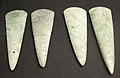 Polished jade axes, Carnac, c. 4500 BC
 -
 Polished jade rings, Carnac, c. 4500 BC
 -
![Stele, Chasséen culture, 4th millennium BC.[c]](//upload.wikimedia.org/wikipedia/commons/thumb/f/fc/Lauris_1.jpg/120px-Lauris_1.jpg) Stele, Chasséen culture, 4th millennium BC.[c]
Stele, Chasséen culture, 4th millennium BC.[c] -
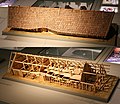 Linear Pottery culture longhouse, c. 5000 BC
 -

-
 Ceramics from Fontbouisse, c. 3000 BC
 -
 Gold diadem, jade axe and boar's tusk pectoral, Pauilhac, c. 3500 BC
 -
 Locmariaquer megaliths, c. 4500 BC
 -
 Champ Durand fortifications, c. 3400 BC
 -
 Tumulus of Bougon, c. 4700 BC
 -
 Table des Marchand, c. 4000 BC
 -
 Dolmen de Bagneux, c. 4000-3000 BC
_in_einem_Halbkreis_endend_Le_M%C3%A9nec,_Carnac,_Departement_Morbihan,_Bretagne_Steffen_Heilfort.jpg)

![Gavrinis passage grave, Brittany, c. 4200 BC.[25]](https://en.wikipedia.org/wiki/File:Gavrinis_2.jpg)


![Stele, Chasséen culture, 4th millennium BC.[c]](https://en.wikipedia.org/wiki/File:Lauris_1.jpg)


The Copper Age
[edit]
During the Chalcolithic or Copper Age, a transitional age from the Neolithic to the Bronze Age, France shows evidence of the Seine-Oise-Marne culture and the Beaker culture.
The Seine-Oise-Marne culture or "SOM culture" (c. 3100 to 2400 BC) is the name given by archaeologists to the final culture of the Neolithic in Northern France around the Oise River and Marne River. It is most famous for its gallery grave megalithic tombs which incorporate a port-hole slab separating the entrance from the main burial chamber. In the chalk valley of the Marne River rock-cut tombs were dug to a similar design. In the Southeast, several groups whose culture had evolved from Chasséen culture also built megaliths.[27]
Beginning about 2600 BC, the Artenacian culture, a part of the larger European Megalithic Culture, developed in Dordogne, possibly as a reaction to the advance of Danubian peoples (such as SOM) over Western France. Armed with typical arrows, they took over all Atlantic France and Belgium by 2400 BC, establishing a stable border with the Indo-Europeans (Corded Ware) near the Rhine that would remain stable for more than a millennium.[citation needed]
The Bell Beaker culture (c. 2800–1900 BC) was a widespread phenomenon that expanded over most of France, excluding the Massif Central, in the third and early second millennia BC.[citation needed]
-
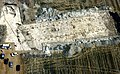 Remains of a large building at Challignac, Artenacian culture
 -
![Copper axe, Brittany, 3rd millennium BC[28]](//upload.wikimedia.org/wikipedia/commons/thumb/b/bc/Le_Faou%C3%ABt_hache_Kersoufflet.jpg/120px-Le_Faou%C3%ABt_hache_Kersoufflet.jpg) Copper axe, Brittany, 3rd millennium BC[28]
Copper axe, Brittany, 3rd millennium BC[28] -
 Bell Beaker, c. 2500 BC
 -
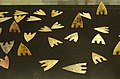 Flint arrowheads, Bell Beaker culture
 -
 Copper daggers, Bell Beaker culture
 -
 Gold lunulas, Brittany, Bell Beaker culture, c. 2400-2000 BC
 -
![The Bell Beaker culture had domesticated horses.[29]](//upload.wikimedia.org/wikipedia/commons/thumb/3/3f/Horses1.png/120px-Horses1.png) The Bell Beaker culture had domesticated horses.[29]
The Bell Beaker culture had domesticated horses.[29] -
 Burial mound, Brittany

![Copper axe, Brittany, 3rd millennium BC[28]](https://en.wikipedia.org/wiki/File:Le_Faou%C3%ABt_hache_Kersoufflet.jpg)


![The Bell Beaker culture had domesticated horses.[29]](https://en.wikipedia.org/wiki/File:Horses1.png)

The Bronze Age
[edit]
In the Kurgan Hypothesis, Indo-European languages spread to Europe in the Bronze Age. The culture of the Kurgans is also known as Yamnaya Culture and recent results from acheaogenetics have linked this culture with genetic ancestry components of the Western Steppe Herders, and it has been possible to reconstruct migrations of these people across Europe co-extensive with the arrival of the Yamnaya and Corded Ware cultures.[citation needed]
In France, the first studies on the Bronze Age date from the 19th century. The "Manuel d'archéologie préhistorique, celtique et gallo-romaine," (Manual of Prehistoric, Celtic and Gallo-Roman Archaeology), by Joseph Déchelette, published in 1910, was for a long time the reference for the study of this period.[30] In the 1950s, Jean-Jacques Hatt proposed a subdivision of the French Bronze Age, and in 1958 he published a tripartate division.[31] This model divided the Bronze Age into three parts, Early Bronze, Middle Bronze and Late Bronze Age and serves as a reference for the majority of subsequent studies on the Bronze Age in France.[32]
The Bronze Age archeological cultures in France include the transitional Beaker culture (c. 2800–1900 BC), the Early Bronze Age Rhône culture (c. 2300-1600 BC) and Armorican Tumulus culture (c. 2200 – c. 1400 BC), the Middle Bronze Age Tumulus culture (c. 1600-1200 BC), and the Late Bronze Age Atlantic Bronze Age (c. 1300 – c. 700 BC) and Urnfield culture (c. 1300-800 BC). Early Bronze Age sites in Brittany (Armorican Tumulus culture) are believed to have grown out of Beaker roots, with some Wessex culture and Unetice culture influence. Some scholars think that the Urnfield culture represents an origin for the Celts as a distinct cultural branch of the Indo-European family (see Proto-Celtic). This culture was preeminent in central Europe during the late Bronze Age; the Urnfield period saw a dramatic increase in population in the region, probably due to innovations in technology and agricultural practices.[citation needed]
Some archeologists date the arrival of several non-Indo-European peoples to this period, including the Iberians in southern France and Spain, the Ligures on the Mediterranean coast, and the Vascons (Basques) in southwest France and Spain.[citation needed]
-
 Bronze dagger, Rhône culture, c. 2000 BC
 -
![Bronze sword, Tumulus culture, c. 1550 BC.[d]](//upload.wikimedia.org/wikipedia/commons/thumb/6/62/Bronze_swords-MGR_Lyon-IMG_9733.jpg/120px-Bronze_swords-MGR_Lyon-IMG_9733.jpg)
-
 Tumulus culture ceramics
 -
 Gold vessels, Tumulus culture, c. 1400 BC
 -
 Bronze cuirasses, Urnfield culture, 900 BC
 -
![Bronze jewelry and vessels, Urnfield culture, c. 1000 BC.[34]](//upload.wikimedia.org/wikipedia/commons/thumb/1/13/Dijon_-_Mus%C3%A9e_arch%C3%A9ologique_de_Dijon_-_04.jpg/120px-Dijon_-_Mus%C3%A9e_arch%C3%A9ologique_de_Dijon_-_04.jpg)
-
 Bronze helmets, Urnfield culture, 1100-900 BC
 -
 Urnfield culture artefacts
 -
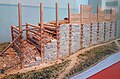 Model of a fortification wall, Urnfield culture
 -
 Fort Harrouard hillfort, Middle-Late Bronze Age
 -
 Model of a Middle Bronze Age house
 -
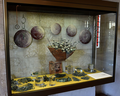 Bronze pins and ornaments, Urnfield culture, c. 1000 BC
 -
 Urnfield culture warrior, reconstruction
 -
 Atlantic Bronze Age, gold belt, 1300-1150 BC
 -
![Gold torc, Atlantic Bronze Age, c. 1200-1000 BC.[35]](//upload.wikimedia.org/wikipedia/commons/thumb/8/8b/Guines_gold_torc_1.jpg/120px-Guines_gold_torc_1.jpg)
-
 Plougrescant sword, Atlantic Bronze Age, c. 1300 BC

![Bronze sword, Tumulus culture, c. 1550 BC.[d]](https://en.wikipedia.org/wiki/File:Bronze_swords-MGR_Lyon-IMG_9733.jpg)
_(36058831702).jpg)


![Bronze jewelry and vessels, Urnfield culture, c. 1000 BC.[34]](https://en.wikipedia.org/wiki/File:Dijon_-_Mus%C3%A9e_arch%C3%A9ologique_de_Dijon_-_04.jpg)


![Gold torc, Atlantic Bronze Age, c. 1200-1000 BC.[35]](https://en.wikipedia.org/wiki/File:Guines_gold_torc_1.jpg)

The Iron Age
[edit]
The spread of iron-working led to the development of the Hallstatt culture (c. 700 to 500 BC) directly from the Urnfield. Proto-Celtic, the latest common ancestor of all known Celtic languages, is generally considered to have been spoken at the time of the late Urnfield or early Hallstatt cultures, in the early 1st millennium BC.[36]
The Hallstatt culture was succeeded by the La Tène culture, which developed out of the Hallstatt culture without any definite cultural break, under the impetus of considerable Mediterranean influence from Greek, and later Etruscan civilizations. The La Tène culture developed and flourished during the late Iron Age (from 450 BC to the Roman conquest in the 1st century BC) in eastern France, Switzerland, Austria, southwest Germany, the Czech Republic, and Hungary. Farther to the north extended the contemporary Pre-Roman Iron Age culture of Northern Germany and Scandinavia.[36][37]
In addition, Greeks and Phoenicians settled outposts like Marseille in this period (c. 600 BC).[38]
By the 2nd century BC, Celtic France was called Gaul by the Romans, and its people were called Gauls. The people to the north (in what is present-day Belgium) were called Belgae (scholars believe this may represent a mixture of Celtic and Germanic elements) and the peoples of the south-west of France were called the Aquitani by the Romans, and may have been Celtiberians or Vascons.[citation needed]
-
 Vix palace, Hallstatt culture, 500 BC
 -
 Vix grave, wagon burial reconstruction, Hallstatt culture, 500 BC
 -

-
 Cult wagon, Hallstatt culture, 750 BC
 -
 Swords, La Tène culture
 -
 Painted pottery, La Tène culture
 -
 Chariot mounts from Somme-Bionne, La Tène culture
 -
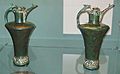 Basse Yutz flagons, La Tène culture, 450 BC
 -
 Chariot fitting, La Tène culture
 -
 Chariot burial, La Tène culture
 -
 Bibracte oppidum, outer walls, La Tène culture
 -
 Gallic farm at Verberie, La Tène culture
 -
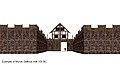 Murus Gallicus, c. 100 BC, La Tène culture
 -
 Corent oppidum, La Tène culture
 -
 Settlement at Arles, c. 2nd century BC
 -
 Statue from Roquepertuse, 3rd-2nd century BC


.jpg)
.jpg)
.jpg)


Timeline
[edit]


.jpg)


Prehistoric and Iron Age France - all dates are BC
- 1,800,000 (Date not considered secure) : Appearance of stone tools (possibly by Homo erectus) in France (Chilhac, Haute-Loire).[39]
- 1,570,000: Stone tools at Lézignan-la-Cèbe.[3]
- 1,050,000 to 1,000,000: stone tools at Grotte du Vallonnet, near Menton.[5]
- 900,000: Beginning of Günz glaciation.[40]
- 700,000: Oldest shaped tools in Brittany.
- 600,000: Beginning of Günz-Mindel interglacial.[40] Appearance of Homo heidelbergensis in Europe.
- 450,000: "Tautavel man" (possibly Homo heidelbergensis).
- 410,000: Beginning of Mindel glaciation (Mindel I).[40] Abbevillian culture, taming of fire.
- 400,000: Mindel II. Shards of "proto-Levallois" tools.
- 400,000 to 380,000: Traces of first domestication of fire at Terra Amata (Nice).
- 300,000: Beginning of Mindel-Riss interglacial.[40]
- 300,000: Appearance of Neanderthals in Europe.[6]
- 200,000: Beginning of Riss glaciation.[40]
- 130,000: Beginning of Riss-Würm interglacial.[40]
- 70,000: Beginning of Würm glaciation.[40]
- 62,000: Würm I/II interglacial.[40]
- 57,000: Brorup interglacial.[40]
- 55,000: Würm II.[40]
- 40,000: Laufen interglacial.[40] Arrival of first modern humans (Cro-Magnons) in Europe.
- 35,000: Würm IIIa.[40] Châtelperronian culture.
- 33,000: Mask of la Roche-Cotard, a Mousterian artefact.
- 32,000: Aurignacian culture.[15]
- 30,000: First statuettes and engravings in France. Disappearance of Neanderthals.
- 28,000: Arcy interglacial.[citation needed]
- 27,500: Würm IIIb.[40]
- 25,000: Paudorf interglacial.
- 23,000: Würm IIIc.[40]
- 18,000: End of Würm glaciation.[40]
- 18,692: Beginning of Solutrean culture.
- 16,000: Cold spell (Oldest Dryas).
- 15,000: Magdalenian culture.[18]
- 15,300: Lascaux.[18]
- 14,500: Middle Magdalenian. Bølling Oscillation.[18]
- 14,100: Cold spell (Older Dryas).
- 14,000: Allerød Oscillation.
- 13,500: Upper Magdalenian.[18]
- 13,000: Hamburg culture[18]
- 10,300: Cold spell (Younger Dryas).
- 9500: Beginning of Holocene.
- 7000: Domestication of the sheep.
- 6900: Domestication of the dog.
- 5000: Appearance of Linear Pottery culture in France.[citation needed]
- 4650: Oldest neolithic village in France, Courthézon in the Vaucluse.[citation needed]
- 4000: Neolithic Chasséen culture village of Bercy.[citation needed]
- 3610: Appearance of first megaliths in France.[24]
- 3430: Chasséen culture village of Saint-Michel du Touch near Toulouse.[citation needed]
- 3430: Appearance of Rössen culture at Baume de Gonvilla in Haute-Saône.[citation needed]
- 3250: Expansion of Chasséen culture in the south of France, from the Lot to the Vaucluse.[citation needed]
- 3190: Chasséen culture in Calvados.[citation needed]
- 2530: Chasséen culture in Pas-de-Calais.[citation needed]
- 2450: End of Chasséen culture in Eure-et-Loir.[citation needed]
- 2400: End of Chasséen culture in Saint-Mitre (in Reillanne, Alpes-de-Haute-Provence).[citation needed]
- 2300: Village at Ponteau (in Martigues, Provence) of the Beaker culture.[citation needed]
- 1800: Beginning of Bronze Age in France.[30]
- 800: Appearance in France, via the Rhine and the Moselle, and expanding into Champagne and Bourgogne of the Urnfield culture.[36]
- 725: Beginning of Hallstatt culture.[36]
- 680: Founding of Antibes, the first Greek colony in France.[38]
- 600: Founding of Massalia (future Marseille) by the Greeks from the Ionian city of Phocaea.[38]
- 450: The Celts of la Tène appear in Champagne. They expand to the Garonne, forming what will come to be called the Gaul civilization.[38]
- 390: The Celtic chief Brennus sacks Rome.[38]
- 121: Roman occupation of Gallia Narbonensis.[38]
- 118: Founding of the Roman colony Narbo Martius (future Narbonne).[38]
- 58-51: Conquest of Gaul by Julius Caesar.[38]
See also
[edit]Notes
[edit]- ^ The oldest known Neanderthal fossil in France was found in 1998 in the cave of Pradayrol, in Caniac-du-Causse, in Lot-et-Garonne. A Neanderthal incisor has been dated there to 335,000 years.[6]
- ^ The engraving on the Thaïs bone is a non-decorative notational system of considerable complexity. The cumulative nature of the markings together with their numerical arrangement and various other characteristics strongly suggest that the notational sequence on the main face represents a non-arithmetical record of day-by-day lunar and solar observations undertaken over a time period of as much as 3½ years. The markings appear to record the changing appearance of the moon, and in particular its crescent phases and times of invisibility, and the shape of the overall pattern suggests that the sequence was kept in step with the seasons by observations of the solstices. The latter implies that people in the Azilian period were not only aware of the changing appearance of the moon but also of the changing position of the sun, and capable of synchronizing the two. The markings on the Thaïs bone represent the most complex and elaborate time-factored sequence currently known within the corpus of Palaeolithic mobile art. The artefact demonstrates the existence, within Upper Palaeolithic (Azilian) cultures c. 12,000 years ago, of a system of time reckoning based upon observations of the phase cycle of the moon, with the inclusion of a seasonal time factor provided by observations of the solar solstices.[16]
- ^ Provence stelae with chevron ornamentation are relatively well dated. They have always been dated to the Middle Neolithic, and more exactly to the Late Chasséen.[26]
- ^ The technostylistic origin of the swords of Tréboul and Le Cheylounet types has been widely debated elsewhere. For the former, J. Briard (1965) favoured an evolution from the Armorican Tumulus daggers; for the latter, J.P. Daugas and D. Vuaillat (2009) highlight a Unétician tradition, but the strong technostylistic kinship between the two sword types suggests a complex interplay of influences. Their chronological position is clearly established: Middle Bronze Age 1, from about 1550 to 1450 BC according to the latest available chronological details. (Translated from French).[33]
References
[edit]- ^ Slimak & Zanolli 2022.
- ^ Price 2022.
- ^ a b Jones 2009.
- ^ a b Airvaux et al. 2012.
- ^ a b c Lumley 2009.
- ^ a b Dufau, Favarel & Séronie-Vivien 2004.
- ^ Sankararaman et al. 2012.
- ^ Champagne et al. 1990.
- ^ Bourguignon et al. 2008.
- ^ Nougier 1963.
- ^ Les Sépultures néandertaliennes 1976.
- ^ Postel 2008.
- ^ Slimak, Zanolli & Higham 2022.
- ^ Dickson 1992.
- ^ a b Klein 2009.
- ^ Astronomical Heritage n.d.
- ^ Conneller et al. 2016.
- ^ a b c d e f Rozoy 1998.
- ^ Flores-Bello et al. 2021.
- ^ National Geographic 2022.
- ^ Barras 2019.
- ^ Haak et al. 2019.
- ^ Thorpe 2015.
- ^ a b Alexander 1978.
- ^ Cassen et al 2014.
- ^ d'Anna et al. 2015.
- ^ Joussaume 1988.
- ^ "Copper axe, National Archaeological Museum, France". 30 December 2004.
- ^ Librado 2021.
- ^ a b Déchelette 1910.
- ^ Hatt 1958.
- ^ Gascó́ 2000.
- ^ Chopin & Gomez de Soto 2014.
- ^ Musée Archéologique n.d.
- ^ Armbruster 2013, pp. 454–468.
- ^ a b c d Anthony 2010.
- ^ Fischer et al. 2022.
- ^ a b c d e f g h Ebel 1976.
- ^ Bindon 1995, p. 137.
- ^ a b c d e f g h i j k l m n o STD 2016.
Sources
[edit]- Airvaux, Jean; Despriée, Jackie; Turq, Alain; et al. (2012). "Premières présences humaines en France entre 1,2 et 0,5 million d'années". Academia (in French). Retrieved 3 September 2022.
- Thom, Alexander; Thom, Archibald Stevenson (1978). Megalithic Remains in Britain and Brittany. Clarendon Press. ISBN 978-0-19-858156-7.
- Anthony, David W. (26 July 2010). The Horse, the Wheel, and Language: How Bronze-Age Riders from the Eurasian Steppes Shaped the Modern World. Princeton University Press. ISBN 978-1-4008-3110-4. Retrieved 3 September 2022.
- Armbruster, Barbara (2013). "Gold and gold working of the Bronze Age". The Oxford Handbook of the European Bronze Age. pp. 454–468. doi:10.1093/OXFORDHB/9780199572861.013.0025.
- "The Thaïs Bone, France". UNESCO Portal to the Heritage of Astronomy.
- Barras, Colin (27 March 2019). "Story of most murderous people of all time revealed in ancient DNA". New Scientist.
- Bindon, Peter (1995). "Tephrofacts and the first human occupation of the French Massif Central". Proceedings of the European Science Foundation Workshop at Tautaval (France), 1993: 129–146.
- Bourguignon, Laurence (2008). Les sociétés du Paléolithique dans un grand Sud-Ouest de la France : nouveaux gisements, nouveaux résultats, nouvelles méthodes: journées SPF, Université Bordeaux 1, Talence, 24-25 novembre 2006 (in French). Paris: Société préhistorique française. ISBN 978-2-913745-37-7.
- Champagne, Fernand; Champagne, Christian; Jauzon, Pierre; et al. (1990). "Le site préhistorique des Fieux à Miers (Lot) [Etat actuel de la recherche]: Etat actuel de la recherche". Gallia préhistoire. 32 (1): 1–28. doi:10.3406/galip.1990.2275.
- Cassen, Serge; Grimaud, V; Lescop, L; et al. (2014). "The first radiocarbon dates for the construction and use of the interior of the monument at Gavrinis (Lamor-Baden, France)". Past: The Newsletter of the Prehistoric Society. 77. University College London: 1–4.
- Chopin, Jean-François; Gomez de Soto, José (2014). "Fragment de lame d'épée ou de poignard du type de Tréboul-Saint-Brandan du site du Perrou 2 à Maillé (Indre-et-Loire)". Bulletin de la Société préhistorique française. 111 (3): 530–533. doi:10.3406/bspf.2014.14439. S2CID 194679648.
- Conneller, Chantal; Bayliss, Alex; Milner, Nicky; Taylor, Barry (2016). "The Resettlement of the British Landscape: Towards a chronology of Early Mesolithic lithic assemblage types". Internet Archaeology. 42 (42). doi:10.11141/ia.42.12. hdl:10034/621138.
- d'Anna, André; Bosansky, Christiane; Bellot-Gurlet, Ludovic; et al. (2015). "Les stèles gravées néolithiques de Beyssan à Gargas (Vaucluse)". Bulletin de la Société préhistorique française. 112 (4): 761–768. doi:10.3406/bspf.2015.14599.
- Déchelette, Joseph (1910). Manuel d'archéologie préhistorique celtique et gallo-romaine: Archéologie celtique ou protohistorique. second Âge du fer ou époque de la Tène (in French). Librairie A. Picard. ISBN 978-0-576-19993-3.
{{cite book}}: ISBN / Date incompatibility (help) - Defleur, Alban R.; Desclaux, Emmanuel (April 2019). "Impact of the last interglacial climate change on ecosystems and Neanderthals behavior at Baume Moula-Guercy, Ardèche, France". Journal of Archaeological Science. 104: 114–124. Bibcode:2019JArSc.104..114D. doi:10.1016/j.jas.2019.01.002. S2CID 133992282.
- Dickson, D. Bruce (July 1992). The Dawn of Belief: Religion in the Upper Paleolithic of Southwestern Europe. University of Arizona Press. ISBN 978-0-8165-1336-9.
- Dufau, Jean; Favarel, Jacques; Séronie-Vivien, M. (2004). "Un site pléistocène moyen à hominidé en Quercy: La grotte de Pradayrol à Caniac-du-Causse (Lot)" (in French). S2CID 190002964.
{{cite web}}: Missing or empty|url=(help) - Ebel, Charles (1976). "Chapter 2, Massilia and Rome before 390 B.C.". Transalpine Gaul: the emergence of a Roman province. Brill Archive. pp. 5–16. ISBN 90-04-04384-5.,
- Fischer, Claire-Elise; Pemonge, Marie-Hélène; Ducoussau, Isaure; et al. (April 2022). "Origin and mobility of Iron Age Gaulish groups in present-day France revealed through archaeogenomics". iScience. 25 (4) 104094. Bibcode:2022iSci...25j4094F. doi:10.1016/j.isci.2022.104094. PMC 8983337. PMID 35402880.
- Flores-Bello, André; Bauduer, Frédéric; Salaberria, Jasone; et al. (May 2021). "Genetic origins, singularity, and heterogeneity of Basques". Current Biology. 31 (10): 2167–2177.e4. Bibcode:2021CBio...31E2167F. doi:10.1016/j.cub.2021.03.010. hdl:10230/52292. PMID 33770488. S2CID 232359452.
- Gascó́, Jean (1951- ) Auteur du texte (2000). "L'Âge du bronze dans la moitié sud de la France / Jean Gascó́". Histoire de la France préhistorique.
{{cite journal}}: CS1 maint: numeric names: authors list (link) - Haak, Wolfgang; Lazaridis, Iosif; Patterson, Nick; et al. (11 June 2015). "Massive migration from the steppe was a source for Indo-European languages in Europe". Nature. 522 (7555): 207–211. arXiv:1502.02783. Bibcode:2015Natur.522..207H. doi:10.1038/nature14317. ISSN 0028-0836. PMC 5048219. PMID 25731166.
- Hatt, Jean-Jacques (1958). "Chronique de protohistoire, IV. Nouveau projet de chronologie pour l'âge du Bronze en France". Bulletin de la Société préhistorique française. 55 (5): 304–306. doi:10.3406/bspf.1958.3663.
- Jones, Tim (17 December 2009). "Lithic Assemblage Dated to 1.57 Million Years Found at Lézignan-la-Cébe, Southern France «". Anthropology.net. Archived from the original on 24 September 2015. Retrieved 21 June 2012.
- Joussaume, Roger (1988). Dolmens for the dead: megalith-building throughout the world. London: Batsford. ISBN 978-0-7134-5369-0.
- Klein, Richard G. (22 April 2009). The Human Career: Human Biological and Cultural Origins, Third Edition. University of Chicago Press. ISBN 978-0-226-02752-4.
- Les Sépultures néandertaliennes: colloque: Nice, vendredi 17 septembre 1976 (in French). Centre national de la recherche scientifique. 1976.
- Librado, Pablo (2021). "The origins and spread of domestic horses from the Western Eurasian steppes". Nature. 598 (7882): 634–640. Bibcode:2021Natur.598..634L. doi:10.1038/s41586-021-04018-9. PMC 8550961. PMID 34671162.
- Lumley, Henry de,. (2009). La grande histoire des premiers hommes européens. Paris: O. Jacob. ISBN 978-2-7381-2386-2.
{{cite book}}: CS1 maint: multiple names: authors list (link) - "Le dépôt de Blanot". archeologie.dijon.fr. Retrieved 9 April 2022.
- "Doggerland - The Europe That Was | National Geographic Society". education.nationalgeographic.org. National Geographic Society. Retrieved 13 September 2022.
- Nougier, Louis-René (1963). La préhistoire: essai de paléosociologie religieuse (in French). Bloud & Gay.
- Postel, B (2008). "Neandertal et la mort | Archéologia n° 458". www.archeologia-magazine.com (in French) (458): 6–11.
- Price, Michael (9 February 2022). "Did Neanderthals and modern humans take turns living in a French cave?". www.science.org.
- Rozoy, J. (1 January 1998). "The (Re-) population of Northern France between 13,000 and 8000 BP". Quaternary International. 49–50 (1): 69–86. Bibcode:1998QuInt..49...69R. doi:10.1016/S1040-6182(97)00054-2.
- Sankararaman, Sriram; Patterson, Nick; Li, Heng; Pääbo, Svante; Reich, David (2012). "The date of interbreeding between Neandertals and modern humans". arXiv:1208.2238 [q-bio.PE].
- Savatier, François (2019). "Des Néandertaliens cannibales dans la vallée du Rhône". Pourlascience.fr (in French). Retrieved 3 September 2022.
- Slimak, L.; Zanolli, C.; Higham, T.; et al. (2022). "Modern human incursion into Neanderthal territories 54,000 years ago at Mandrin, France". Science Advances. 8 (6) eabj9496. Bibcode:2022SciA....8J9496S. doi:10.1126/sciadv.abj9496. PMC 8827661. PMID 35138885.
- Slimak, Ludovic; Zanolli, Clément (11 February 2022). "Modern human incursion into Neanderthal territories 54,000 years ago at Mandrin, France". Science Advances. 8 (6) eabj9496. Bibcode:2022SciA....8J9496S. doi:10.1126/sciadv.abj9496. hdl:2440/134613. ISSN 2375-2548. PMC 8827661. PMID 35138885.
- "Stratigraphische Tabelle von Deutschland 2016" (PDF). www.stratigraphie.de. Deutsche Stratigraphische Kommission. Retrieved 7 September 2022.
- Thorpe, Nick (2015). "The Atlantic Mesolithic-Neolithic Transition". In Fowler, Chris (ed.). The Oxford Handbook of Neolithic Europe. Oxford University Press. p. 221. ISBN 978-0-19-166688-9.
Further reading
[edit]- Brunel, Samantha; Bennett, E. Andrew; Cardin, Laurent; et al. (9 June 2020). "Ancient genomes from present-day France unveil 7,000 years of its demographic history". Proceedings of the National Academy of Sciences. 117 (23): 12791–12798. Bibcode:2020PNAS..11712791B. doi:10.1073/pnas.1918034117. PMC 7293694. PMID 32457149.
- Forbes, Peter (29 March 2018). "Who We Are and How We Got Here by David Reich review – new findings from ancient DNA". the Guardian.
- Gaucher, Gilles (1 January 1993). L'Âge du bronze en France (in French). Presses universitaires de France (réédition numérique FeniXX). ISBN 978-2-13-066958-6.
- Giacobini, Giacomo (January 2006). "Les sépultures du Paléolithique supérieur: la documentation italienne". Comptes Rendus Palevol (in French). 5 (1–2): 169–176. Bibcode:2006CRPal...5..169G. doi:10.1016/j.crpv.2005.09.018. Retrieved 3 September 2022.
- Gibbons, Ann (24 July 2015). "Revolution in human evolution". Science. 349 (6246): 362–366. doi:10.1126/science.349.6246.362. ISSN 1095-9203. PMID 26206910.
- Haak, Wolfgang; Lazaridis, Iosif; Patterson, Nick; et al. (11 June 2015). "Massive migration from the steppe was a source for Indo-European languages in Europe". Nature. 522 (7555): 207–211. arXiv:1502.02783. Bibcode:2015Natur.522..207H. doi:10.1038/nature14317. ISSN 1476-4687. PMC 5048219. PMID 25731166.
- Hallegouët, Bernard; Hinguant, Stéphan; Gebhardt, Anne; et al. (1992). "Le gisement Paléolithique inférieur de Ménez-Drégan 1 (Plouhinec, Finistère)". Bulletin de la Société préhistorique française (in French). 89 (3): 77–81. doi:10.3406/bspf.1992.9504.
- Hatt, Jean-Jacques (1954). "Pour une nouvelle chronologie de la Protohistoire française". Bulletin de la Société préhistorique de France. 51 (7): 379–384. doi:10.3406/bspf.1954.3113.
- Olalde, Iñigo; Brace, Selina; Allentoft, Morten E.; et al. (March 2018). "The Beaker phenomenon and the genomic transformation of northwest Europe". Nature. 555 (7695): 190–196. Bibcode:2018Natur.555..190O. doi:10.1038/nature25738. ISSN 1476-4687. PMC 5973796. PMID 29466337.
- Rivollat, Maïté; Jeong, Choongwon; Schiffels, Stephan; et al. (29 May 2020). "Ancient genome-wide DNA from France highlights the complexity of interactions between Mesolithic hunter-gatherers and Neolithic farmers". Science Advances. 6 (22) eaaz5344. Bibcode:2020SciA....6.5344R. doi:10.1126/sciadv.aaz5344. PMC 7259947. PMID 32523989.
External links
[edit]
- French National Museum of Antiquities in the Château of Saint-Germain-en-Laye (in French)
- Lascaux Cave at the Library of Congress Web Archives (archived 2002-11-13) – official Lascaux Web site, from the French Ministry of Culture
- The Dawn of Rock Art – an article summarizing the earliest known rock art, with a focus on recently discovered painted caves in Europe, Grotto Cosquer and Grotto Chauvet
- La Tène site at the Wayback Machine (archived 2009-02-07) – brief text, illustrations (in French)
- Late bronze age graves with weighing equipment from eastern France
Prehistory of France
View on GrokipediaGeological and Environmental Context
Geographical and Paleoenvironmental Setting
France's prehistoric geography encompassed a varied terrain that shaped paleoenvironmental conditions and resource distribution across the region. The Pyrenees mountains along the southwestern border and the Alps in the southeast acted as formidable natural barriers, particularly during glacial maxima when they supported extensive ice caps and limited cross-mountain passage.[18] In contrast, the Rhine River valley in the northeast and the Rhone River valley in the southeast facilitated faunal migrations and connectivity between central Europe and the Mediterranean, serving as key ecological corridors during the Pleistocene.[19] Coastal zones along the Atlantic to the west and the Mediterranean to the south provided diverse marine habitats, including intertidal zones rich in shellfish and fish, while the central Massif Central offered access to volcanic materials essential for early tool-making.[20] Paleoenvironmentally, the region exhibited stark contrasts during the Last Glacial Maximum (approximately 26.5–19 ka BP). Northern France, north of about 47.5°N, was dominated by continuous permafrost, evidenced by widespread ice-wedge pseudomorphs in loess and fluvial deposits, creating frozen tundra-steppe landscapes unsuitable for dense vegetation.[21] The Mediterranean-influenced south, below this latitude, experienced milder conditions with only seasonal frost and discontinuous permafrost, supporting more varied shrublands and refugia for warmth-tolerant species.[21] The Paris Basin's lowlands, while cold and open during peak glacials, intermittently hosted forested patches during warmer interstadials, contributing to a mosaic of steppe and woodland environments.[22] Key resources were unevenly distributed, influencing prehistoric exploitation patterns. Abundant flint deposits occurred in northern regions like the Othe area and eastern zones near the upper Rhine, where high-quality nodules from Cretaceous and Jurassic formations were quarried extensively.[23] Obsidian, a volcanic glass prized for sharp edges, originated from sources in the Auvergne region of the Massif Central, such as the Cantal volcano, and was transported over long distances.[24] Megafauna habitats reflected this diversity: woolly mammoths roamed the open northern plains and basins, thriving in cold steppe environments, while reindeer favored upland and periglacial zones in the southwest and central highlands for seasonal grazing.[25] Post-glacial sea-level rise, from about -125 m at 17 ka cal BP to near-modern levels by 7 ka cal BP, dramatically reshaped coastal landscapes, inundating low-lying plains and submerging numerous Paleolithic and Mesolithic sites along the Atlantic and Mediterranean shores.[20] Paleogeographic maps reconstruct these changes, showing how the Molène archipelago, for instance, fragmented from a single large island into smaller islets, altering access to former coastal resources.[26]Climate Changes and Human Adaptation
The Pleistocene epoch in France was marked by significant climatic oscillations, particularly during the Würm glaciation, which spanned approximately 115,000 to 11,700 years ago and represented the last major glacial period in Europe. This glaciation led to extensive ice cover in the northern and alpine regions, transforming much of the landscape into tundra-steppe biomes with cold, dry conditions that supported sparse vegetation and cold-adapted megafauna. In contrast, southern France served as a key refugium, maintaining milder microclimates that allowed for pockets of more diverse ecosystems amid the overall cooling. Proxy evidence from pollen records in lake sediments, such as those from the Jura Mountains, indicates shifts from open grasslands during glacial peaks to brief expansions of shrubs and herbs during milder interstades, reflecting temperature drops of up to 10–15°C below modern levels.[27] Preceding the Würm's intensification, the Eemian interglacial (130,000–115,000 years ago) brought warmer temperatures, with average conditions 1–2°C above present-day levels, fostering lush deciduous forests across much of France and enabling a diverse fauna including deer, elephants, and rhinoceroses. Pollen analyses from southern French sequences reveal a dominance of oak, hazel, and hornbeam, indicating humid temperate conditions that contrasted sharply with the subsequent glacial aridity. These interglacial phases provided temporary windows for faunal and floral expansion, influencing early hominin distributions before the return of colder climates. Ice core data from nearby Alpine regions corroborate these vegetation shifts, showing elevated precipitation and reduced dust deposition during the Eemian.[28][27] Human populations, including Neanderthals during the Middle Palaeolithic, adapted to these fluctuations through strategic migrations, retreating to southern refugia like the Iberian and Italian peninsulas connected to southwestern France during the Last Glacial Maximum (around 26,500–19,000 years ago), when northern areas became uninhabitable due to extreme cold and ice advance. Post-glacial warming after 11,700 years ago initiated the Holocene, with temperatures rising by 4–7°C, promoting rapid forest expansion from thermophilous species in the south northward, and sea level rise of over 120 meters that submerged land bridges such as Doggerland, isolating continental populations. These changes prompted recolonization of northern France by early modern humans, who exploited expanding woodlands for resources. Multi-proxy reconstructions from Jura lake cores and regional pollen diagrams highlight this transition, with arboreal pollen percentages increasing from under 20% in the Late Glacial to over 60% by the early Holocene, underscoring the scale of environmental reconfiguration. Neanderthal tool kits, briefly adapted for cold hunting, illustrate broader survival strategies without delving into cultural specifics.[29][30][27]The Palaeolithic Era
Lower Palaeolithic
The Lower Palaeolithic in France represents the earliest phase of human occupation, spanning from approximately 1.8 million to 300,000 years ago, marked by the arrival of early hominins and the development of rudimentary stone tool technologies in response to diverse environmental conditions.[31] This period begins with sparse evidence of hominin activity in southern regions, transitioning to more widespread Acheulean industries characterized by bifacial tools. Sites are predominantly located in open-air settings or caves near water sources, reflecting adaptive strategies to Pleistocene landscapes.[32] The earliest confirmed evidence of hominin presence in France comes from the Bois-de-Riquet site at Lézignan-la-Cèbe in Hérault, where a lithic assemblage including pebble tools and choppers dates to approximately 1.1–1.3 million years ago, attributed to early Homo erectus based on technological simplicity and faunal associations.[31] Similarly, the nearby Vallonnet Cave near Roquebrune-Cap-Martin yields stone tools dated to approximately 1.2 million years ago, featuring basic flakes and cores indicative of early scavenging activities amid Epivillafranchian fauna.[31] These finds suggest initial dispersals from Africa via southern Europe, with tools showing Oldowan-like traits such as unifacial retouch.[33] The Acheulean culture, dominant from about 1.7 million to 200,000 years ago, introduced more sophisticated bifacial hand axes and cleavers, enabling efficient butchery and woodworking. At Terra Amata near Nice, dated to around 380,000 years ago, excavators uncovered Acheulean toolkits alongside postholes suggesting temporary huts and evidence of large-game processing, such as horse and elephant remains. The Vallonnet Cave also preserves Acheulean elements in later layers, around 400,000 years ago, with tools indicating hunting of ungulates in a coastal context.[34] These assemblages highlight a shift toward planned tool production, with hand axes often made from local flint or quartzite.[35] Key hominin species include influences from Homo antecessor, whose tool-making traditions from nearby Iberian sites likely contributed to early French occupations through migratory exchanges around 800,000 years ago.[36] More definitively, Homo heidelbergensis is represented at Arago Cave in Tautavel, where fossils dated to about 450,000 years ago, including the Arago 21 mandible, show robust features adapted to cold climates, alongside cut-marked bones.[37] Early evidence of fire use appears in the same strata, with heated sediments and charred bones suggesting controlled hearths for warmth and cooking, predating widespread Neanderthal practices.[38] Subsistence strategies combined scavenging and active big-game hunting, targeting megafauna like straight-tusked elephants and wild horses, as evidenced by accumulations of skeletal remains with percussion marks at sites such as Terra Amata.[39] Hominins preferred river valley locations for resource access, with over 70% of known Lower Palaeolithic sites in France clustered along fluvial systems like the Rhône and Loire, facilitating mobility and water-dependent foraging.[40] This pattern underscores opportunistic exploitation of riparian ecosystems rich in prey and raw materials. Technological progression evolved from simple Oldowan choppers—seen in the 1.2-million-year-old flakes at Vallonnet—to the symmetrical bifaces of the Acheulean, with hand axes achieving greater refinement through bilateral flaking.[41] Regional variations are notable, as southern French sites like Terra Amata exhibit more standardized, thin-sectioned tools suited to Mediterranean woodlands, while northern assemblages show cruder forms adapted to open steppes.[42] This diversification reflects local raw material availability and environmental pressures, culminating in advanced cleavers by 300,000 years ago.[43]Middle Palaeolithic
The Middle Palaeolithic in France, spanning approximately 300,000 to 40,000 years ago, is characterized by the dominance of Neanderthals (Homo neanderthalensis), who adapted to diverse environments across the region during Marine Isotope Stages 9 through 3.[44] These hominins occupied a variety of sites, from caves and rock shelters in the southwest to open-air locations in the north, reflecting their resilience amid fluctuating climates and ecosystems.[45] Key archaeological evidence highlights their technological sophistication, subsistence strategies, and emerging social behaviors, primarily associated with the Mousterian cultural complex.[46] Neanderthal fossils in France provide direct evidence of their physical presence and potential mortuary practices. At La Chapelle-aux-Saints in the Corrèze region, a nearly complete Neanderthal skeleton, dated to around 50,000–60,000 years ago, was discovered in a deliberately dug pit within a cave, suggesting intentional burial by other group members to protect the body from scavengers.[47] This interpretation is supported by the absence of carnivore damage and the positioning of the remains, indicating protective deposition shortly after death.[48] Similarly, the La Ferrassie rock shelter in Dordogne yielded multiple Neanderthal skeletons, including adults and children, from layered inhumations dated to approximately 70,000–40,000 years ago, with evidence of deliberate pit burials and associated grave goods like stone tools, pointing to structured mortuary behaviors.[49] These findings, among the earliest indications of Neanderthal care for the dead, contrast with simpler disposal in earlier periods and suggest social complexity.[50] The Mousterian tool industry, named after Le Moustier in Dordogne, represents a hallmark of Neanderthal technology in France, featuring the Levallois technique for producing standardized flakes from prepared cores.[51] This method involved careful core shaping to detach predetermined flakes, enabling efficient production of tools like scrapers for hide processing and points for spears, as seen in assemblages from Combe-Grenal in Dordogne, where layers dating to 100,000–50,000 years ago show recurrent Levallois reduction alongside Quina and discoid methods.[46] Regional variations existed, such as the Denticulate Mousterian in northern France, characterized by higher frequencies of notched and denticulated tools on sites like Biache-Saint-Vaast, likely adapted for woodworking or plant processing in loess-covered landscapes during colder phases.[52] These innovations improved resource exploitation compared to Lower Palaeolithic handaxes, allowing Neanderthals to maintain mobility across France's varied terrains.[53] Neanderthal subsistence in France involved seasonal mobility and targeted hunting, with evidence from the Aquitaine Basin indicating short-term camps focused on large herbivores. Sites like Les Pradelles in Charente reveal specialized reindeer (Rangifer tarandus) hunting around 60,000 years ago, where kill-off patterns and bone fracturing suggest group drives and marrow extraction during autumn-winter aggregations.[54] Bison (Bison priscus) remains are common in nearby Dordogne assemblages, reflecting opportunistic predation on herds in open grasslands, supplemented by smaller game and gathered plants.[45] Fire control enhanced these strategies, as demonstrated by structured hearths at Roc de Marsal in Dordogne, dated to about 110,000 years ago, where ash layers and burnt bones indicate repeated use for cooking and warmth, facilitating extended stays in cold climates.[55] Cultural traits among French Neanderthals include potential symbolic behaviors, such as pigment use at Pech de l'Azé in Dordogne, where over 50 pieces of manganese-rich ochre, dated to 50,000–60,000 years ago, show striations from deliberate scraping, possibly for body decoration or ritual marking.[56] This systematic processing implies cognitive planning beyond utilitarian needs, though interpretations remain debated. The coexistence of these traits with practical technologies underscores Neanderthal behavioral flexibility across regions. Neanderthal populations in France declined toward the end of the Middle Palaeolithic, around 50,000–40,000 years ago, influenced by climatic cooling during the onset of the Last Glacial Maximum and increasing competition from incoming Homo sapiens groups.[44] Heinrich Event 4, a period of abrupt cold and arid conditions circa 40,000 years ago, reduced habitable zones in interior France, exacerbating resource stress.[57] Overlap with early modern humans in southwestern France, evidenced by dated sites, suggests demographic pressure and potential resource exclusion contributed to Neanderthal disappearance by 40,000 years ago.[58]Upper Palaeolithic
The Upper Palaeolithic in France, spanning approximately 45,000 to 12,000 years before present (BP), marks the period when anatomically modern humans (Homo sapiens) arrived and established complex hunter-gatherer societies across the region, particularly in the southwest, including the Dordogne and Charente areas. Evidence of early modern human presence dates to at least 54,000 years ago at Grotte Mandrin in the Rhône Valley, where tools from the Neronian industry indicate overlap with Neanderthals during an Initial Upper Paleolithic phase before the main Aurignacian expansion around 43,000 BP.[4] This era is characterized by the development of advanced lithic technologies, symbolic behaviors, and artistic expressions that distinguish it from preceding periods associated with Neanderthals. Key sites in the Vézère Valley, such as those in the Périgord region, reveal evidence of seasonal occupations tied to glacial environments, where humans adapted to cold climates through specialized hunting and resource exploitation. Radiocarbon dating from stratified sites confirms the timeline, with early phases showing rapid cultural diversification following the Last Glacial Maximum's approach. The cultural sequence begins with the Aurignacian (ca. 45,000–35,000 BP), the earliest Upper Palaeolithic industry in France, marked by innovations in bone and antler working. At Abri Pataud in Les Eyzies-de-Tayac (Dordogne), split-base points—antler projectiles with a notched base for hafting—represent a hallmark technology, produced through groove-and-splinter techniques that allowed for efficient spear production. This site yields layers with hearths and faunal remains indicating organized camp activities. Transitioning to the Gravettian (ca. 35,000–25,000 BP), communities produced distinctive portable art, including Venus figurines symbolizing fertility or social roles; examples from sites like Abri du Poisson in the Gorge d'Enfer (Dordogne) include engraved reliefs and small carvings associated with this period's emphasis on symbolic expression. The later Magdalenian (ca. 20,000–12,000 BP) saw further refinement, with harpoons crafted from reindeer antler for fishing and hunting, as evidenced at Lascaux Cave, where artifacts date to around 17,000 BP and complement the site's renowned parietal art. Human remains from this period affirm the presence of modern Homo sapiens, with the Cro-Magnon fossils discovered in 1868 near Les Eyzies (Dordogne) dating to approximately 28,000 BP and exhibiting fully modern skeletal anatomy, including high foreheads and gracile builds. These individuals were intentionally buried with grave goods such as ochre, shells, and tools, suggesting ritual practices and social complexity; analysis of the skeletal collection indicates a group of at least five adults and a child interred in a shallow pit. Such burials highlight emerging symbolic behaviors, contrasting with earlier, less elaborate Neanderthal interments. Economically, Upper Palaeolithic groups in France relied on big-game hunting, with reindeer (Rangifer tarandus) dominating faunal assemblages in the Périgord region due to their abundance during the cold, steppe-tundra environments. Sites like those in the Dordogne show evidence of seasonal herding and communal drives, where hunters targeted migrating herds in fall and winter for meat, hides, and antler resources. Coastal adaptations included the procurement of marine shells for jewelry, sourced from the Atlantic shores; a notable workshop at La Roche-à-Pierrot (Saint-Césaire, Charente-Maritime), dated to around 42,000 years ago and recently studied in 2025, contains perforated Littorina shells, pigments, and tools from the Châtelperronian culture— a transitional industry debated as Neanderthal or early modern human—indicating bead production and potential trade networks up to 100 km inland.[59] Technological advancements underpinned these adaptations, including the production of bladelets—small, sharp flint flakes used as inserts in composite tools for cutting and scraping—from the Aurignacian onward. Bone needles, eyed for threading sinew, enabled tailored clothing from animal hides, essential for cold climates; examples from southwestern French sites date to 40,000–30,000 BP and show polishing from use. The atlatl, a spear-thrower leveraging leverage for increased velocity, enhanced hunting efficiency against large prey like reindeer and horses, with fragments recovered from Magdalenian layers across France. Artistic achievements, particularly cave paintings, exemplify symbolic cognition. Chauvet Cave (Ardèche) features polychrome depictions of lions, rhinos, and mammoths dated to ca. 36,000 BP, created using charcoal for black outlines and ochre for red accents, applied via blowing or finger-tracing techniques. Similarly, Lascaux Cave (Dordogne) preserves over 600 animal figures, including bison and horses, from ca. 17,000 BP, rendered in vivid reds, blacks, and yellows with charcoal and manganese oxides to evoke movement and naturalism. These artworks, often in deep chambers, suggest ritual or narrative functions, with engravings enhancing the visual impact. Toward the period's end, post-glacial shifts influenced toolkits, leading to microlith adoption in subsequent eras.The Mesolithic and Neolithic Eras
Mesolithic
The Mesolithic period in France, spanning approximately 12,000 to 6,000 years before present (BP), represents a transitional phase following the end of the Last Glacial Maximum, characterized by hunter-gatherer societies adapting to warming climates and the retreat of ice sheets. These groups relied on microlithic tool technologies, small bladelets hafted into composite tools for hunting and processing, reflecting increased efficiency in exploiting a diversifying resource base amid seasonal mobility patterns. Archaeological evidence indicates a shift from the megafauna-focused economies of the Upper Palaeolithic to more varied subsistence strategies targeting smaller game and aquatic resources, with sites distributed across diverse landscapes from coastal zones to inland valleys.[60] The Azilian and Tardenoisian cultures define key regional expressions of this era, with the Azilian prominent in southern France around 12,000–10,000 BP and the Tardenoisian in the north from about 11,000–8,000 BP. The Azilian, named after the type site at Mas d'Azil Cave in Ariège, features microliths such as backed bladelets and geometric forms used as barbs for composite arrows, alongside bone harpoons and perforated stones.[61] In the Aisne Valley, Tardenoisian sites like Fère-en-Tardenois yield assemblages of geometric microliths, including trapezes and crescents, indicative of advanced projectile technology for hunting in forested environments. These cultures exhibit continuity in lithic traditions from the Magdalenian but emphasize smaller, standardized tools suited to post-glacial mobility.[62] Environmental transformations during this period included rapid forest expansion from birch and pine to deciduous woodlands, fostering abundant game such as red deer and wild boar, which became primary prey species by the Boreal chronozone. Coastal adaptations are evident in shell middens at sites like Hoedic in Brittany, where layers of limpets, periwinkles, and fish remains document intensive marine resource exploitation around 8,000–6,000 BP. Settlement patterns consisted of short-term, ephemeral camps concentrated in riverine and lacustrine settings, such as those along the Seine and Aisne valleys, where hearths, knapping debris, and faunal scatters suggest seasonal aggregations for resource processing. Evidence for dog domestication emerges around 10,000 BP, with morphological analyses of canid remains from sites like Pont d'Ambon indicating early human-canine partnerships for hunting assistance.[60][63][64] Artistic expression persisted in symbolic forms, with over 1,300 engraved and painted pebbles recovered from Mas d'Azil Cave, featuring linear motifs, dots, and occasional zoomorphic elements like salmon, signaling cultural continuity from Upper Palaeolithic traditions. These artifacts, often in red ochre or black manganese, may have served ritual or identificatory purposes within mobile groups. Population dynamics reveal low densities, estimated at under one person per 100 km², supported by ancient DNA from burials at Hoedic and Téviec showing predominant Western Hunter-Gatherer ancestry with minimal admixture from other lineages. This genetic profile underscores isolated, kin-based networks persisting until the Neolithic transition.[65]Neolithic
The Neolithic period in France, spanning approximately 6000 to 2200 BCE, marked a profound transformation from mobile hunter-gatherer societies to settled agricultural communities, driven by the adoption of farming practices and the construction of enduring monuments. This era began with the arrival of early farming groups via two primary diffusion routes: the Cardial Ware or Impressa culture, which spread from the eastern Mediterranean along coastal pathways into southern France around 6000 BCE, introducing impressed pottery and initial domestication of crops and animals. Simultaneously, the Linearbandkeramik (LBK) culture, originating from the Danube region, influenced northeastern France, particularly the Paris Basin, where settlers established farming villages by around 5500 BCE. These migrations facilitated the widespread adoption of agriculture across diverse landscapes, from Mediterranean coasts to inland river valleys.[66][67][68] The Neolithic economy centered on domesticated plants and animals, with emmer wheat and barley as staple crops, alongside sheep and cattle herding, which supported permanent settlements and surplus production. In the Paris Basin, LBK sites featured characteristic longhouses—rectangular timber structures up to 40 meters long—housing extended families and serving as multifunctional spaces for living, storage, and animal shelter, as evidenced by posthole patterns and associated artifacts. Regional adaptations flourished, notably in the south with the Chasséen culture (ca. 4500–3500 BCE), known for finely polished stone axes used in woodworking and agriculture, reflecting technological refinement in forested environments. A significant 2023 discovery at Val-des-Marais in the Marne region uncovered a late Neolithic village (ca. 3500 BCE) with defensive palisades, storage pits, and Cardial-style pottery, highlighting organized community defense and ceramic traditions after over a century of surveys.[66][69][70][71] Megalithic traditions emerged prominently in western France, particularly Brittany, where communities erected dolmens (chambered tombs) and menhirs (standing stones) as ritual and funerary structures, symbolizing territorial claims and ancestral veneration. The Carnac alignments, comprising over 3,000 menhirs arranged in rows up to 4 km long, date to around 4500 BCE and were inscribed on the UNESCO World Heritage List in 2025 for their density and cultural significance. Nearby, the Locmariaquer passage tombs, including the Table des Marchands dolmen with intricate engravings of axes and crooks, exemplify mid-Neolithic (ca. 4000 BCE) architectural complexity, incorporating massive orthostats weighing up to 300 tons. These monuments underscore a shift toward communal labor and symbolic expression.[72][73] Social structures evolved with evidence of emerging inequality, particularly in burial practices, where variations in grave goods and tomb elaboration suggest status differentiation. In the Cerny culture of the Paris Basin (ca. 4700–4400 BCE), cemeteries like Gurgy display gendered and hierarchical patterns, with elite males receiving richer offerings such as polished adzes and jewelry, indicating patrilineal inheritance and social stratification. A 2024 excavation at Marliens in Burgundy revealed an unprecedented Neolithic monument of interlocked enclosures—two horseshoe-shaped ditches flanking a central circle—potentially linked to ritual gatherings or status displays, alongside burials showing disparate treatments. These findings illustrate how agricultural surpluses fostered hierarchical societies by the late Neolithic.[74][75][76]The Metal Ages
Chalcolithic (Copper Age)
The Chalcolithic period in France, spanning approximately 3500 to 2500 BCE, marked a transitional phase between the Neolithic and Bronze Age, characterized by the initial adoption of copper metallurgy alongside continued reliance on stone tools, and the emergence of more complex social structures evidenced by intensified trade and specialized burial practices. This era saw gradual innovations in subsistence strategies and cultural exchanges, particularly in southern and western regions, where environmental stability supported agricultural expansion. Archaeological evidence from sites across France indicates a diverse regional development, with southern areas showing early metallurgical activity and western zones influenced by maritime interactions. Early copper metallurgy appeared in France around 3000 BCE, with the first evidence of smelting at sites like La Capitelle du Broum in Cabrières (Hérault), where arsenic-copper alloys were produced using local fahlore ores in simple hearth-based processes. These alloys, combining copper with naturally occurring arsenic from the ore, were cast into flat axes and daggers, representing a technological leap from purely stone-based toolkits and enabling harder, more durable implements for woodworking and combat. The limited scale of production suggests specialized craftsmanship, likely controlled by emerging elites, though widespread use remained restricted until later periods.[77] Subsistence during this period built on Neolithic foundations, with continued mixed farming of cereals, legumes, and domesticated animals, augmented by the introduction of the ard plough—a simple wooden scratching tool pulled by oxen—to till heavier soils in regions like the Paris Basin and Mediterranean coast. Fortified or enclosed settlements emerged as precursors to later oppida, such as those near Clermont-Ferrand in the Massif Central, where ditched villages like Cambous (Hérault) indicate defensive architecture amid population growth and resource competition. These structures, often 1-5 hectares in size, housed communities practicing crop rotation and animal husbandry, reflecting adaptive responses to climatic variability.[78] The Bell Beaker phenomenon, arriving via maritime routes around 2500 BCE, profoundly influenced western France, particularly in Armorica (Brittany), where over 670 sites document the spread of distinctive inverted-bell pottery, archery kits including wrist-guards and arrowheads, and gold ornaments. Originating from Iberian and Central European influences, these arrivals are evidenced by coastal settlements and graves, suggesting mobile groups integrating with local populations through exchange rather than conquest. In Armorica, sites like those in the Morbihan reveal hybrid styles blending local megalithic traditions with Beaker motifs.[79] Burial practices shifted toward single grave inhumations, often under low tumuli, accompanied by Bell Beaker pottery, metal daggers, and archery equipment, signaling the rise of warrior elites with status differentiated by grave goods. In northwestern France, over 300 funerary contexts show flexed or extended bodies oriented east-west, with beakers placed near the head, contrasting earlier collective Neolithic tombs and indicating individualistic social hierarchies tied to martial prowess. These practices highlight gender-specific roles, with male graves more frequently featuring weapons.[79] Trade networks expanded significantly, linking France to distant regions and facilitating the flow of prestige materials that underscored social inequalities. Baltic amber beads, sourced from northern European coasts, appear in Chalcolithic contexts along the Mediterranean and Paris Basin, with early examples predating widespread Bell Beaker expansion and indicating overland or riverine routes. These exchanges, influenced by Iberian metallurgical and ceramic traditions, connected Atlantic and Mediterranean spheres, promoting cultural diffusion without large-scale migration.[80]Bronze Age
The Bronze Age in France, extending from roughly 2500 to 800 BCE, represented a period of technological innovation and social stratification, with bronze metallurgy enabling the production of prestige goods that underscored emerging hierarchies. This era followed the Chalcolithic and preceded the Iron Age, characterized by increased trade networks and fortified settlements that reflected growing population pressures and elite control over resources. Archaeological evidence indicates a transition from simpler copper-based tools to complex bronze alloys, fostering cultural exchanges across Europe.[81] The Early Bronze Age (2500–1800 BCE) was marked by cist burials, simple stone-lined graves containing bronze daggers and axes, signaling the initial adoption of metalworking in domestic contexts across regions like Brittany and the Rhône valley. These burials often included amber beads and pottery, suggesting early connections to northern European networks. By the Middle Bronze Age (1800–1300 BCE), tumuli—large earthen mounds—became prominent, particularly in Normandy, where sites like Saint-Germain-le-Vaux yielded Wessex-style riches, including gold ornaments and imported Baltic amber, indicative of elite status and long-distance trade. The Late Bronze Age (1300–800 BCE) saw a shift to Urnfield culture influences, with cremation burials in urns deposited in cemeteries, accompanied by weapons and jewelry that highlighted warrior ideologies.[15][82] Technological advancements centered on bronze production, utilizing the lost-wax casting method to create detailed swords, helmets, and ornaments, which required skilled craftsmanship and access to diverse metals. Tin, essential for alloying with copper to produce durable bronze, was primarily imported from Cornwall and Devon in southwest Britain, as evidenced by isotopic analysis of artifacts from coastal French sites dating to around 1300 BCE. These imports facilitated the widespread use of bronze for both utilitarian tools and ceremonial items, enhancing social differentiation.[83][84] Key sites illustrate the period's defensive and settlement patterns, such as the hillfort at Le Petit-Celland in Vendée, a Middle to Late Bronze Age enclosure with ramparts enclosing over 10 hectares, likely serving as a communal refuge and trade hub. In Brittany, excavations in 2025 at a coastal site uncovered evidence of 6,000 years of continuous occupation, spanning from the Neolithic through the Bronze Age, with layers revealing evolving settlement structures and metalworking debris. These findings underscore the region's role in sustained maritime activities.[85] Society during the Bronze Age organized into chiefdoms, where power was concentrated among elites, as seen in warrior burials with accompanying chariots, weapons, and exotic goods that denoted status and martial prowess. Horse domestication, introduced around 2000 BCE, supported elite mobility and symbolic displays, with remains found in high-status graves indicating their role in rituals and transport. Artifacts frequently incorporated solar symbolism, such as disc motifs on jewelry and rock carvings, reflecting cosmological beliefs tied to cycles of life and authority.[86][87][88] Cultural influences stemmed from Atlantic and Danubian exchanges, with maritime routes linking France to Britain and Iberia for metals and ideas, while continental ties to the Tumulus culture introduced new burial practices and goldworking techniques. Notable goldwork from sites near Mulhouse in Alsace, including embossed sheets and rings from Middle Bronze Age contexts, exemplifies these interactions, blending local styles with central European motifs.[89][90]Iron Age
The Iron Age in prehistoric France, extending from roughly 800 BCE to the Roman conquest around 50 BCE, represents a period of significant social, technological, and cultural transformation among Celtic-speaking populations. This era is divided into the Hallstatt phase (c. 800–450 BCE), marked by early elite hierarchies and the widespread adoption of iron technology, and the subsequent La Tène phase (c. 450–50 BCE), characterized by artistic innovation, proto-urban settlements, and expanded trade networks. Iron's abundance compared to bronze democratized tool and weapon production, fostering agricultural intensification, population growth, and larger-scale societies across regions from Burgundy to the Atlantic coast. These developments laid the groundwork for complex chiefdoms that interacted with Mediterranean civilizations, blending local traditions with external influences. During the Hallstatt period, elite burials underscore emerging social stratification, exemplified by the Vix grave in Burgundy, a tumulus containing an exceptionally wealthy female burial dated to around 500 BCE. Among the grave goods was a massive imported bronze krater, standing over 1.6 meters tall and weighing 208 kg, likely crafted in Greece or a Greek colony and transported via Etruscan intermediaries, highlighting long-distance elite exchanges. Iron technology revolutionized agriculture, with the introduction of iron-tipped plows and sickles enabling more efficient land clearance and cultivation, which supported surplus production and population expansion in fertile river valleys. Sites like Mont Lassois near Vix reveal fortified hilltop settlements with craft workshops, where iron smelting and woodworking contributed to a burgeoning economy. The La Tène culture, succeeding Hallstatt, is renowned for its distinctive artistic style featuring swirling vegetal motifs, stylized animals such as swans and boars, and intricate metalwork, evident in artifacts from oppida like Gergovia in Auvergne. Torcs—elaborate neck rings symbolizing status—were common, often crafted from gold or electrum with elaborate terminals, reflecting both aesthetic sophistication and social hierarchy. This period also saw the emergence of Celtic coinage around the 4th century BCE, initially imitating Greek and Macedonian designs before developing local iconography, which facilitated trade and political alliances. Druidic influences, as priestly and intellectual elites, likely shaped religious and artistic expressions, integrating cosmological themes into metalwork and monuments, though direct evidence remains interpretive through later historical accounts. Proto-urbanism flourished in the late La Tène phase with the development of oppida, large fortified hilltop settlements serving as political, economic, and religious centers. Bibracte, capital of the Aedui tribe in Burgundy during the 1st century BCE, exemplifies this, encompassing over 200 hectares with workshops, sanctuaries, and housing for an estimated 5,000 to 10,000 inhabitants, supporting a diverse economy of craft production and exchange. The economy thrived on iron tools, including axes that accelerated deforestation for farmland expansion, particularly in the interior highlands. In western France, salt production from coastal evaporation pans became a key resource, traded inland for metals and luxury goods. Extensive commerce with Etruscans, via Mediterranean routes, brought wine, ceramics, and orientalizing motifs in exchange for iron, amber, and slaves, integrating Gaulish society into broader European networks. A notable 2025 discovery by the French National Institute for Preventive Archaeological Research (INRAP) at Creuzier-le-Neuf in central France uncovered an extensive La Tène necropolis dating to the 4th–3rd centuries BCE, comprising over 100 graves within a ditched enclosure. Although acidic soil preserved no human remains, more than half the burials yielded metal artifacts, including two intact iron swords in copper-alloy sheaths—one shorter blade adorned with spirals, circles, crescent moons, and swastika-like motifs, the other with decorative waist rings—alongside 18 fibulae, bracelets engraved with Celtic patterns, and a small vase from a cremation burial. These finds demonstrate advanced metalworking techniques, such as gem inlays, silver leaf application, and precise engraving, suggesting specialized craftsmanship and ritual deposition practices associated with elite warriors or communal ceremonies.Chronology and Key Discoveries
Timeline of Major Periods
The prehistory of France spans from the earliest evidence of hominin occupation around 1.1 million years ago to the Roman conquest in the 1st century BCE, marked by successive technological and cultural shifts influenced by climatic changes. This timeline delineates the major periods, with dates derived from radiocarbon, luminescence, and stratigraphic methods, reflecting regional adaptations in what is now French territory. Transitions between periods often overlap due to gradual cultural evolutions and varying site-specific chronologies, calibrated against standard archaeological frameworks.[91][7]| Period | Approximate Date Range | Key Features and Transitions |
|---|---|---|
| Lower Palaeolithic | 1.1 million–300,000 BP | Earliest hominin presence with Mode 1 and Mode 2 tool industries, including Acheulean bifaces; occupation at sites like Lunery-Rosières la-Terre-des-Sablons (~1.1 Ma). Transition to Middle Palaeolithic marked by refined Levallois technique around 300,000 BP.[92][93] |
| Middle Palaeolithic | 300,000–40,000 BP | Mousterian flake tools dominant, associated with Neanderthal populations; sites like La Quina show continuous occupation from ~250,000 BP. Ends with decline of Neanderthals and arrival of anatomically modern humans around 54,000 BP.[94][95] |
| Upper Palaeolithic | 54,000–12,000 BP | Successive cultures from early sapiens occupations to Aurignacian (bone/antler tools, early art) to Magdalenian (harpoons, portable art); cave paintings at Chauvet dated ~36,000–30,000 BP. Concludes with Younger Dryas cooling, leading to Mesolithic adaptations.[96][97][4] |
| Mesolithic | 12,000–6,000 BP | Microlithic tools for hunting/gathering in warming post-glacial forests; microliths appear ~11,000 BP. Transitions to Neolithic via early farming influences from the Near East around 6,000 BP.[98] |
| Neolithic | 6,000–2,200 BCE | Spread of agriculture, pottery, and domesticated animals from Cardial Ware culture; megalithic monuments like Carnac erected ~4,500–3,000 BCE. Ends with copper metallurgy emergence, overlapping into Chalcolithic.[99] |
| Chalcolithic | 4,500–2,500 BCE | Bell Beaker phenomenon with copper tools and single burials; Varna-type influences ~3,500 BCE. Leads into full Bronze Age with alloy advancements.[91] |
| Bronze Age | 2,500–800 BCE | Widespread bronze casting, tumulus burials in early phase, Urnfield cremation rites in late phase ~1,300–800 BCE. Transitions to Iron Age with increased social complexity.[100] |
| Iron Age | 800 BCE–50 BCE | Hallstatt culture (early, elite burials ~800–450 BCE) evolves into La Tène (Celtic art, oppida ~450–50 BCE); ends with Roman conquest under Julius Caesar.[91] |