Hubbry Logo
Realism (arts)Realism (arts)Main
Open search
Realism (arts)
Community hub
Realism (arts)
logo
8 pages, 0 posts
0 subscribers
Be the first to start a discussion here.
Realism (arts)
Realism (arts)
from Wikipedia
Eilif Peterssen Summer Night (1886)

In art, realism is generally the attempt to represent subject-matter truthfully, without artificiality, exaggeration, or speculative or supernatural elements. The term is often used interchangeably with naturalism, although these terms are not necessarily synonymous. Naturalism, as an idea relating to visual representation in Western art, seeks to depict objects with the least possible amount of distortion and is tied to the development of linear perspective and illusionism in Renaissance Europe.[1] Realism, while predicated upon naturalistic representation and a departure from the idealization of earlier academic art, often refers to a specific art historical movement that originated in France in the aftermath of the French Revolution of 1848. With artists like Gustave Courbet capitalizing on the mundane, ugly or sordid, realism was motivated by the renewed interest in the commoner and the rise of leftist politics.[2] The realist painters rejected Romanticism, which had come to dominate French literature and art, with roots in the late 18th century.

In 19th-century Europe, "Naturalism" or the "Naturalist school" was somewhat artificially erected as a term representing a breakaway sub-movement of realism, that attempted (not wholly successfully) to distinguish itself from its parent by its avoidance of politics and social issues, and liked to proclaim a quasi-scientific basis, playing on the sense of "naturalist" as a student of natural history, as the biological sciences were then generally known.

There have been various movements invoking realism in the other arts, such as the opera style of verismo, literary realism, theatrical realism and Italian neorealist cinema.

Visual arts

[edit]

When used as an adjective, "realistic" (usually related to visual appearance) distinguishes itself from "realist" art that concerns subject matter. Similarly, the term "illusionistic" might be used when referring to the accurate rendering of visual appearances in a composition.[3][4] In painting, naturalism is the precise, detailed and accurate representation in art of the appearance of scenes and objects. It is also called mimesis or illusionism and became especially marked in European painting in the Early Netherlandish painting of Robert Campin, Jan van Eyck and other artists in the 15th century. In the 19th century, Realism art movement painters such as Gustave Courbet were not especially noted for fully precise and careful depiction of visual appearances; in Courbet's time that was more often a characteristic of academic painting, which very often depicted with great skill and care scenes that were contrived and artificial, or imagined historical scenes.

Resisting idealization

[edit]
Francisco Goya, Charles IV of Spain and His Family, 1800–01

Realism, or naturalism as a style depicting the unidealized version of the subject, can be used in depicting any type of subject without commitment to treating the typical or the everyday. Despite the general idealism of classical art, this too had classical precedents, which was useful when defending such treatments in the Renaissance and Baroque. Demetrius of Alopece was a 4th-century BCE sculptor whose work (all now lost) was said to prefer realism over ideal beauty, and during the Ancient Roman Republic, politicians preferred a truthful depiction in portraits, though the early emperors favored Greek idealism. Goya's portraits of the Spanish royal family represent a sort of honest, unflattering portrayal of important people.

A recurring trend in Christian art was "realism" that emphasized the humanity of religious figures, above all Christ and his physical sufferings in his Passion. Following trends in devotional literature, this developed in the Late Middle Ages, where some painted wooden sculptures in particular strayed into the grotesque in portraying Christ covered in wounds and blood, with the intention of stimulating the viewer to meditate on the suffering that Christ had undergone on their behalf. These were especially found in Germany and Central Europe. After abating in the Renaissance, similar works re-appeared in the Baroque, especially in Spanish sculpture.

Renaissance theorists opened a debate, which was to last several centuries, as to the correct balance between drawing art from the observation of nature and from idealized forms, typically those found in classical models, or the work of other artists generally. Some admitted the importance of the natural, but many believed it should be idealized to various degrees to include only the beautiful. Leonardo da Vinci was one who championed the pure study of nature and wished to depict the whole range of individual varieties of forms in the human figure and other things.[5] Leon Battista Alberti was an early idealizer, stressing the typical,[6] with others such as Michelangelo supporting the selection of the most beautiful – he refused to make portraits for that reason.[7]

Henri Biva, Matin à Villeneuve, c. 1905–06

In the 17th century, the debate continued. In Italy, it usually centered on the contrast between the relative "classical-idealism" of the Carracci and the "naturalist" style of the Caravaggisti, or followers of Caravaggio, who painted religious scenes as though set in the back streets of contemporary Italian cities and used "naturalist" as a self-description. Bellori, writing some decades after Caravaggio's early death and no supporter of his style, refers to "Those who glory in the name of naturalists" (naturalisti).[8]

During the 19th century, naturalism developed as a broadly defined movement in European art, though it lacked the political underpinnings that motivated realist artists. The originator of the term was the French art critic Jules-Antoine Castagnary, who in 1863 announced: "The naturalist school declares that art is the expression of life under all phases and on all levels, and that its sole aim is to reproduce nature by carrying it to its maximum power and intensity: it is truth balanced with science".[9] Émile Zola adopted the term with a similar scientific emphasis for his aims in the novel. Many Naturalist paintings covered a similar range of subject matter as that of Impressionism, but using tighter, more traditional brushwork styles.[9]

The term "continued to be used indiscriminately for various kinds of realism" for several decades, often as a catch-all term for art that was outside Impressionism and later movements of Modernism and also was not academic art. The later periods of the French Barbizon School and the Düsseldorf School of painting, with its students from many countries, and 20th-century American Regionalism are movements that are often also described as "naturalist", although the term is rarely used in British painting. Some recent art historians claimed either Courbet or the Impressionists for the label.[9]

Illusionism

[edit]
Lord Leighton's Cimabue's Celebrated Madonna of 1853–55 is at the end of a long tradition of illusionism in painting, but is not Realist in the sense of Courbet's work of the same period.

The development of increasingly accurate representations of the visual appearances of things has a long history in art. It includes elements such as the accurate depiction of the anatomy of humans and animals, the perspective and effects of distance, and the detailed effects of light and color. The art of the Upper Paleolithic in Europe achieved remarkably lifelike depictions of animals. Ancient Egyptian art developed conventions involving both stylization and idealization. Ancient Greek art is commonly recognized as having made great progress in the representation of anatomy. No original works on panels or walls by the great Greek painters survive, but from literary accounts and the surviving corpus of derivative works (mostly Graeco-Roman works in mosaic), illusionism seems to be highly valued in painting. Pliny the Elder's famous story of birds pecking at grapes painted by Zeuxis in the 5th century BC may well be a legend.

As well as accuracy in shape, light, and color, Roman paintings show an unscientific but effective knowledge of representing distant objects smaller than closer ones and representing regular geometric forms such as the roof and walls of a room with perspective. This progress in illusionistic effects in no way meant a rejection of idealism; statues of Greek gods and heroes attempt to represent with accuracy idealized and beautiful forms, though other works, such as heads of the famously ugly Socrates, were allowed to fall below these ideal standards of beauty. Roman portraiture, when not under too much Greek influence, shows a greater commitment to a truthful depiction of its subjects, called verism.

Bas-de-page of the Baptism of Christ, "Hand G" (Jan van Eyck?), Turin–Milan Hours. An illusionistic work for c. 1425, with the dove of the Holy Ghost in the sky.

The art of Late Antiquity famously rejected illusionism for expressive force, a change already well underway by the time Christianity began to affect the art of the elite. In the West, classical standards of illusionism did not begin to be reached again until the Late medieval and Early Renaissance periods and were helped first in the Netherlands in the early 15th century, and around the 1470s in Italy by the development of new techniques of oil painting which allowed very subtle and precise effects of light to be painted using several layers of paint and glaze. Scientific methods of representing perspective were developed in Italy in the early 15th century and gradually spread across Europe, with accuracy in anatomy rediscovered under the influence of classical art. As in classical times, idealism remained the norm.

The accurate depiction of landscape in painting had also been developing in Early Netherlandish/Early Northern Renaissance and Italian Renaissance painting and was then brought to a very high level in 17th-century Dutch Golden Age painting, with very subtle techniques for depicting a range of weather conditions and degrees of natural light. After being another development of Early Netherlandish painting, 1600 European portraiture subjects were often idealized by smoothing features or giving them an artificial pose. Still life paintings and still life elements in other works played a considerable role in developing illusionistic painting, though in the Netherlandish tradition of flower painting they long lacked "realism", in that flowers from all seasons were typically used, either from the habit of assembling compositions from individual drawings or as a deliberate convention; the large displays of bouquets in vases were atypical of 17th-century habits; the flowers were displayed one at a time.

Depiction of ordinary subjects

[edit]
Woodcutting, miniature from a set of Labours of the Months by Simon Bening, c. 1550

The depiction of ordinary, everyday subjects in art also has a long history, though it was often squeezed into the edges of compositions or shown at a smaller scale. This was partly because art was expensive and usually commissioned for specific religious, political or personal reasons, which allowed only a relatively small amount of space or effort to be devoted to such scenes. Drolleries in the margins of medieval illuminated manuscripts sometimes contain small scenes of everyday life, and the development of perspective created large background areas in many scenes set outdoors. Medieval and Early Renaissance art usually showed non-sacred figures in contemporary dress by convention.

Early Netherlandish painting brought the painting of portraits as low down the social scale as the prosperous merchants of Flanders, and some of these, notably the Arnolfini Portrait by Jan van Eyck (1434) and more often in religious scenes such as the Merode Altarpiece by Robert Campin and his workshop (circa 1427), include very detailed depictions of middle-class interiors full of lovingly depicted objects. However, these objects are at least largely there because they carry layers of complex significance and symbolism that undercut any commitment to realism for its own sake. Cycles of the Labours of the Months in late medieval art, of which many examples survive from books of hours, concentrate on peasants laboring on different tasks through the seasons, often in a rich landscape background, and were significant both in developing landscape art and the depiction of everyday working-class people.

Annibale Carracci, The Butcher's Shop, early 1580s

In the 16th century, there was a fashion for the depiction in large paintings of scenes of people working, especially in food markets and kitchens; in many, the food is given as much prominence as the workers. Artists included Pieter Aertsen and his nephew Joachim Beuckelaer in the Netherlands, working in an essentially Mannerist style, and in Italy the young Annibale Carracci in the 1580s, using an unpolished style, with Bartolomeo Passerotti somewhere between the two. Pieter Bruegel the Elder pioneered large panoramic scenes of peasant life. Such scenes acted as a prelude for the popularity of scenes of work in genre painting in the 17th century, which appeared all over Europe, with Dutch Golden Age painting sprouting several different subgenres of such scenes, the Bamboccianti (though mostly from the Low Countries) in Italy, and in Spain the genre of bodegones, and the introduction of unidealized peasants into history paintings by Jusepe de Ribera and Velázquez. The Le Nain brothers in France and many Flemish artists including Adriaen Brouwer and David Teniers the Elder and Younger painted peasants, but rarely townsfolk. In the 18th century, small paintings of working people remained popular, mostly drawing on the Dutch tradition and featuring women.

Much art depicting ordinary people, especially in the form of prints, was comic and moralistic, but the mere poverty of the subjects seems relatively rarely to have been part of the moral message. From the mid-19th century onwards, the difficulties of life for the poor were emphasized. Despite this trend coinciding with large-scale migration from the countryside to cities in most of Europe, painters still tended to paint poor rural people. Crowded city street scenes were popular with the Impressionists and related painters, especially ones showing Paris.

Medieval manuscript illuminators were often asked to illustrate technology, but after the Renaissance, such images continued in book illustrations and prints, with the exception of marine painting which largely disappeared in fine art until the early Industrial Revolution, scenes from which were painted by a few painters such as Joseph Wright of Derby and Philip James de Loutherbourg. Such subjects probably failed to sell very well, and there is a noticeable absence of industry, other than a few railway scenes, in painting until the later 19th century, when works began to be commissioned, typically by industrialists or for institutions in industrial cities, often on a large scale, and sometimes given a quasi-heroic treatment.

American realism, a movement of the early 20th century, is one of many modern movements to use realism in this sense.

Realist movement

[edit]

The Realist movement began in the mid-19th century as a reaction to Romanticism and History painting. In favor of depictions of 'real' life, the Realist painters used common laborers, and ordinary people in ordinary surroundings engaged in real activities as subjects for their works. Its chief exponents were Gustave Courbet, Jean-François Millet, Honoré Daumier and Jean-Baptiste-Camille Corot.[10][11][12] According to Ross Finocchio, formerly of the Department of European Paintings at the Metropolitan Museum of Art, Realists used unprettified detail depicting the existence of ordinary contemporary life, coinciding with the contemporaneous naturalist literature of Émile Zola, Honoré de Balzac and Gustave Flaubert.[13]

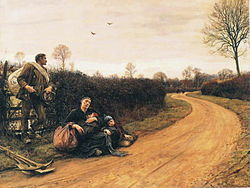
The French Realist movement had equivalents in all other Western countries, developing somewhat later. In particular the Peredvizhniki or Wanderers group in Russia who formed in the 1860s and organized exhibitions from 1871 included many realists such as Ilya Repin, Vasily Perov and Ivan Shishkin, and had a great influence on Russian art. In Britain, artists such as Hubert von Herkomer and Luke Fildes had great success with realist paintings dealing with social issues.

Literature

[edit]

Broadly defined as "the faithful representation of reality",[14] Realism as a literary movement is based on "objective reality." It focuses on showing everyday activities and life, primarily among the middle- or lower-class society, without romantic idealization or dramatization.[15] According to Kornelije Kvas, "the realistic figuration and re-figuration of reality form logical constructs that are similar to our usual notion of reality, without violating the principle of three types of laws – those of natural sciences, psychological and social ones".[16] It may be regarded as a general attempt to depict subjects as they are considered to exist in third-person objective reality without embellishment or interpretation and "in accordance with secular, empirical rules."[17] As such, the approach inherently implies a belief that such reality is ontologically independent of humankind's conceptual schemes, linguistic practices and beliefs and thus can be known to the artist, who can in turn represent this 'reality' faithfully. As Ian Watt states, modern realism "begins from the position that truth can be discovered by the individual through the senses" and as such, "it has its origins in Descartes and Locke, and received its first full formulation by Thomas Reid in the middle of the eighteenth century."[18]

While the preceding Romantic era was also a reaction against the values of the Industrial Revolution, realism was in its turn a reaction to Romanticism, and for this reason it is also commonly derogatorily referred as "traditional bourgeois realism".[19] Some writers of Victorian literature produced works of realism.[20] The rigidities, conventions, and other limitations of "bourgeois realism" prompted in their turn the revolt later labeled as modernism; starting around 1900, the driving motive of modernist literature was the criticism of the 19th-century bourgeois social order and world view, which was countered with an anti-rationalist, anti-realist and anti-bourgeois program.[19][21][22]

Theatre

[edit]
A compelling scene from Chekhov's 'Uncle Vanya' captured during a performance at the Moscow Art Theatre. This image reflects the emotional climax of the play in its fourth act.
A photograph taken during the 1922 performance of 'Uncle Vanya' at the Moscow Art Theatre

Theatrical realism is said to have first emerged in European drama in the 19th century as an offshoot of the Industrial Revolution and the age of science.[23][24] Some also specifically cited the invention of photography as the basis of the realist theater[25][26] while others view that the association between realism and drama is far older as demonstrated by the principles of dramatic forms such as the presentation of the physical world that closely matches reality.[27]

The achievement of realism in the theatre was to direct attention to the social and psychological problems of ordinary life. In its dramas, people emerge as victims of forces larger than themselves, as individuals confronted with a rapidly accelerating world.[28] These pioneering playwrights present their characters as ordinary, impotent, and unable to arrive at answers to their predicaments. This type of art represents what we see with our human eyes. Anton Chekov, for instance, used camera works to reproduce an uninflected slice of life.[29] Scholars such as Thomas Postlewait noted that throughout the nineteenth and twentieth centuries, there were numerous joining of melodramatic and realistic forms and functions, which could be demonstrated in the way melodramatic elements existed in realistic forms and vice versa.[30]

In the United States, realism in drama preceded fictional realism by about two decades as theater historians identified the first impetus toward realism during the late 1870s and early 1880s.[31] Its development is also attributed to William Dean Howells and Henry James who served as the spokesmen for realism as well as articulator of its aesthetic principles.[31]

The realistic approach to theater collapsed into nihilism and the absurd after World War II.[23]

Cinema

[edit]

Italian Neorealism was a cinematic movement incorporating elements of realism that developed in post-WWII Italy. Notable Neorealists included Vittorio De Sica, Luchino Visconti, and Roberto Rossellini. Realist films generally focus on social issues.[32] There are two types of realism in film: seamless realism and aesthetic realism. Seamless realism tries to use narrative structures and film techniques to create a "reality effect" to maintain its authenticity.[32] Aesthetic realism, which was first called for by French filmmakers in the 1930s and promoted by Andre Bazin in the 1950s, acknowledges that a "film cannot be fixed to mean what it shows", as there are multiple realisms; as such, these filmmakers use location shooting, natural light and non-professional actors to ensure the viewer can make up her/his own choice based on the film, rather than being manipulated into a "preferred reading".[32] Siegfried Kracauer is also notable for arguing that realism is the most important function of cinema.[33]

Aesthetically realist filmmakers use long shots, deep focus and eye-level 90-degree shots to reduce manipulation of what the viewer sees.[32] Italian neorealism filmmakers from after WWII took the existing realist film approaches from France and Italy that emerged in the 1960s and used them to create a politically oriented cinema. French filmmakers made some politically oriented realist films in the 1960s, such as the cinéma vérité and documentary films of Jean Rouch[32] while in the 1950s and 1960s, British, French and German new waves of filmmaking produced "slice-of-life" films (e.g., kitchen sink dramas in the UK).[32]

Opera

[edit]

Verismo was a post-Romantic operatic tradition associated with Italian composers such as Pietro Mascagni, Ruggero Leoncavallo, Umberto Giordano, Francesco Cilea and Giacomo Puccini. They sought to bring the naturalism of influential late 19th-century writers such as Émile Zola, Gustave Flaubert and Henrik Ibsen into opera. This new style presented true-to-life drama that featured gritty and flawed lower-class protagonists[34] while some described it as a heightened portrayal of a realistic event.[35] Although an account considered Giuseppe Verdi's Luisa Miller and La traviata as the first stirrings of the verismo,[36] some claimed that it began in 1890 with the first performance of Mascagni's Cavalleria rusticana, peaked in the early 1900s.[37] It was followed by Leoncavallo's Pagliacci, which dealt with the themes of infidelity, revenge, and violence.[34]

Verismo also reached Britain where pioneers included the Victorian-era theatrical partnership of the dramatist W. S. Gilbert and the composer Arthur Sullivan (1842–1900).[35] Specifically, their play Iolanthe is considered a realistic representation of the nobility although it included fantastical elements.

See also

[edit]

Notes

[edit]

References

[edit]

Further reading

[edit]
[edit]
Revisions and contributorsEdit on WikipediaRead on Wikipedia
from Grokipedia
Realism in the arts was a mid-19th-century movement originating in that sought to depict contemporary everyday life, ordinary people, and social realities with objective accuracy and without idealization, directly observing the modern world in contrast to the dramatic fantasies of or the heroic subjects of . Pioneered by , who proclaimed in his 1855 Realist Manifesto a commitment to representing only what he could personally observe—"To be able to paint the way I do, one must see my way"—the movement emphasized empirical truth over artistic convention, often focusing on rural laborers, urban poverty, and unflattering human conditions to highlight societal truths. Key characteristics included precise rendering of light, texture, and anatomy in natural settings, rejection of mythological or historical grandeur, and a documentary-like approach that provoked controversy for elevating mundane subjects to the scale traditionally reserved for elevated themes, as seen in Courbet's large-scale Burial at Ornans (1849–50), which scandalized the Salon for its egalitarian portrayal of a provincial . The movement spread to other European countries, influencing artists like in depictions of peasant life and in satirical urban scenes, while extending to literature through novelists such as , who applied similar principles of detached observation to human behavior and social critique. Its defining achievement lay in democratizing art by validating the dignity of the and critiquing industrial-era inequities, though it faced resistance from establishments favoring idealized forms, ultimately paving the way for later movements like by prioritizing perceptual reality.

Philosophical Foundations

Core Principles of Truthful Representation

Realism in the arts prioritizes the accurate and unembellished portrayal of subjects drawn from observable reality, eschewing idealization, exaggeration, or supernatural elements to achieve an objective representation of contemporary existence. This commitment stems from a philosophical alignment with and , which assert that genuine knowledge derives solely from sensory experience and verifiable facts, rejecting metaphysical speculation or emotional distortion. Artists employed meticulous to capture the prosaic details of daily life, including the physical textures, lighting conditions, and human imperfections that define unvarnished truth, often rendering figures with unflattering realism to underscore their inherent flaws and struggles. Central to this truthful representation is the deliberate selection of ordinary subjects—such as laborers, rural peasants, and urban dwellers engaged in routine activities—over heroic, exotic, or historical narratives favored by prior movements. By focusing on the middle and lower classes amid industrialization's social upheavals, Realists aimed to expose underlying causal realities like economic disparity and environmental determinism without moralizing or romantic overlay. Technical fidelity further reinforced this principle, with painters adopting precise modeling of form, color, and perspective to mimic the eye's direct perception, a method validated by the advent of photography in 1839, which provided empirical benchmarks for visual accuracy. In opposition to Romanticism's emphasis on sublime emotion and subjective transcendence, Realism insisted on impartial detachment, treating art as a scientific into societal conditions rather than a for personal sentiment or aesthetic elevation. This entailed a causal realism that linked depicted events to material circumstances—such as poverty's toll on or labor's monotony—drawing from empirical data on urban growth and class structures in mid-19th-century , where populations swelled from 20 million in alone by 1850 due to migration and birth rates. Such principles not only democratized subject matter but also challenged institutional biases toward elite , prioritizing evidentiary truth over contrived harmony.

Distinction from Preceding Movements

Realism in the arts marked a deliberate departure from the prevailing emphases of Romanticism, which dominated the early 19th century by prioritizing intense emotion, individualism, the sublime aspects of nature, and heroic or exotic subjects drawn from history, mythology, or imagination. In contrast, Realists sought an objective portrayal of contemporary life, focusing on ordinary people—such as workers, peasants, and urban dwellers—in unidealized, everyday settings, often highlighting social conditions like poverty and industrialization without dramatic exaggeration or moral sentimentality. This shift reflected a broader philosophical turn toward empirical observation and positivist principles, influenced by scientific advancements and the 1848 revolutions across Europe, which exposed the disconnect between Romantic escapism and tangible societal realities. Unlike , the movement preceding that emphasized rational order, balanced composition, and idealized forms inspired by and Roman antiquity, Realism rejected such historical revivalism in favor of direct representation of the modern world as it was perceived. Neoclassical works, exemplified by Jacques-Louis David's paintings of stoic heroes and moral exemplars from antiquity, aimed to elevate viewers through universal ideals of virtue and harmony, whereas Realists like insisted on painting "only what I see," capturing unflattering truths of mid-19th-century , including rural labor and urban vice, to critique bourgeois complacency. This distinction underscored Realism's causal orientation: rather than abstract harmony or emotional transcendence, it foregrounded verifiable social mechanisms, such as class struggles and , often drawing from photographic accuracy emerging in the 1830s–1840s to ground depictions in observable evidence over stylized convention. The movement's insistence on truthfulness over aesthetic pleasure or narrative invention also diverged from both predecessors' reliance on imagination; Romanticism's stormy landscapes and passionate figures, like those in Eugène Delacroix's works from the 1820s–1830s, evoked subjective feeling, while Neoclassicism imposed geometric precision on human forms, but Realism demanded fidelity to mundane details—wrinkled skin, coarse fabrics, and prosaic activities—as a means to reveal underlying realities without interpretive distortion. Critics of Romanticism, including Courbet in his 1850 manifesto, argued that its excesses perpetuated illusion amid rapid industrialization, positioning Realism as a democratizing force that validated the commonplace as philosophically equal to the grand. This break facilitated Realism's role as the inaugural modern art movement, challenging academic hierarchies that privileged preceding styles' elevation of the exceptional over the empirical.

Historical Origins

Emergence in Mid-19th Century

Realism emerged in during the 1840s as an artistic response to the emotive and idealized portrayals of , prioritizing instead the direct observation and faithful depiction of contemporary everyday life, including the unvarnished conditions of the working classes. This shift aligned with broader social upheavals, such as the industrialization of urban centers and the political instability following the 1830 and the 1848 uprisings, which exposed stark class divisions and prompted artists to confront observable realities rather than escapist fantasies. Gustave Courbet (1819–1877), who arrived in around 1839, became the movement's foremost advocate by rejecting academic conventions that elevated historical, mythological, or allegorical subjects. In 1849, he completed , a portraying two laborers engaged in grueling roadwork—one elderly and bent, the other young and clumsy—rendered life-size to underscore their ordinary toil without sentimentality or moralizing. This work exemplified Courbet's principle of painting only what he could see in nature, drawing from direct study of rural and proletarian subjects during visits to his native Ornans. The Paris Salon of 1850–1851 marked a pivotal moment, where Courbet exhibited Burial at Ornans (completed 1850), a monumental (10 feet high by nearly 22 feet wide) depicting a provincial funeral procession with unposed figures from his hometown, including farmers and locals in contemporary dress. Critics decried its scale for such prosaic content, traditionally reserved for grand historical narratives, yet it garnered attention for its unflinching detail and democratic treatment of subjects, challenging the French Academy's . Concurrently, (1808–1879) had laid groundwork through satirical lithographs since the , capturing urban poverty and bureaucratic absurdities in publications like La Caricature, which influenced realist commitments to social observation. By 1855, during the Exposition Universelle, Courbet financed an independent pavilion titled "Pavillon du Réalisme" adjacent to the official venue, displaying over 40 works to assert autonomy from institutional gatekeepers and explicitly naming the approach. This self-organized show, featuring pieces like The Artist's Studio (1855), a panoramic allegory of realist principles amid societal figures, crystallized the movement's identity, though it drew mixed reviews for its perceived coarseness. (1814–1875), associated with the near , complemented this urban focus with rural realism; his (1857) portrayed impoverished women scavenging fields post-harvest, based on meticulous outdoor sketches that highlighted the causal hardships of agrarian existence. These developments reflected a causal emphasis on empirical —deriving from artists' firsthand encounters with —over contrived narratives, though early realists faced resistance from salons favoring polished , prompting alternative exhibition strategies. Figures like (1822–1899), who gained acclaim for anatomically precise animal studies such as Plowing in the Nivernais (1849), further diversified the approach by applying rigorous observation to livestock markets and farms, earning state commissions despite gender barriers.

Expansion Across Europe and Beyond

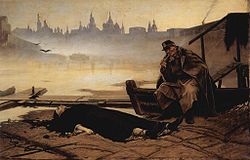
Realism expanded from through international exhibitions and artists' exposure to Courbet's works, influencing regional adaptations by the 1850s. In , exemplified the movement with precise depictions of industrial and everyday scenes, such as his 1875 painting The Balcony Room, capturing Berlin's modern life without romantic idealization. German Realism, emerging around 1850, emphasized dispassionate observation of contemporary society, diverging from Romanticism's emotional excess. In , the group, active from the 1850s to 1870s in , adopted realist principles amid national unification efforts, painting unvarnished scenes of rural life and military campaigns en to convey optical truth over academic conventions. Their focus on light effects and everyday subjects paralleled French Realism while addressing Italian social realities. In , the (Wanderers), formed in 1870 following the 1863 Academy revolt, rejected imperial patronage by touring exhibitions across the empire, producing works like Vasily Perov's The Drowned (1867) that critiqued poverty and injustice through direct portrayals of peasant existence. This cooperative emphasized truthful representation of Russian landscapes and societal conditions, gaining popularity among the public by 1870s. Across , Realism manifested in the late 19th century, with Danish artists favoring naturalistic depictions of daily life to convey social truths, as seen in works from the onward. Swedish painters integrated Realism with national themes in the second half of the century, portraying rural labor and environments. In the , emerged mid-century, with artists like Hubert von Herkomer addressing industrial hardship in paintings such as Hard Times (1885), highlighting working-class struggles without sentimentality. Spain incorporated Realism later in the 19th century, with landscapists like Carlos de Haes (1829–1898) producing detailed views of national terrain from the 1850s, blending empirical observation with costumbrista traditions. Beyond Europe, American Realism developed in the late 19th century, led by and , who applied scientific precision to and seascapes, reflecting post-Civil War societal shifts by the 1870s. These extensions adapted Realism's core commitment to unadorned verity amid diverse cultural contexts.

Visual Arts

Technical Approaches and Subject Matter

Realist painters prioritized direct observation from life models and nature, employing traditional oil-on-canvas techniques adapted to convey unidealized accuracy rather than refined polish. applied thick and loose brushwork to render tangible textures, as in The Stone Breakers (1849), where the coarse surfaces of clothing and rock emphasize manual labor's physicality through modeling and muted earth tones. used layered applications and conservative glazing for depth, generalizing peasant forms into sculptural solidity in (1857), capturing precise postures and tools amid rural toil without preparatory idealization. These methods often violated academic conventions by scaling ordinary scenes monumentally—Courbet's (1849–1850) spans over 10 feet wide, with flat compositions, bold contours, and dark palettes to depict a provincial procession's raw solemnity. focused on tight framing and detailed facial expressions in (c. 1862–1864), using contrasts to highlight socioeconomic disparities in urban transport without heroic elevation. Subject matter emphasized contemporary social realities, centering on working-class lives, rural poverty, and urban drudgery to reflect mid-19th-century economic structures. Courbet and Millet portrayed peasants and laborers in unglamorous activities—stone-breaking, gleaning, shearing—eschewing mythological or historical themes for verifiable daily existence. This extended to critiques of inequality, as in Daumier's carriage scenes contrasting classes, and later works like Hubert von Herkomer's Hard Times (1885), depicting indigent families in stark domestic hardship. Realists avoided narrative moralizing, instead documenting causal conditions of labor and environment through empirical fidelity.

Key Artists and Exemplary Works

(1819–1877), often credited as the founder of Realism, rejected idealized in favor of depicting ordinary subjects with unvarnished accuracy, as seen in The Stonebreakers (1849–1850), which portrays two laborers breaking rocks in a , emphasizing their physical exertion and social anonymity without heroic elevation. His (1849–1850), a large-scale showing a provincial funeral procession with unposed figures from everyday life, scandalized the 1850 Salon for its egalitarian treatment of common mourners, measuring over 10 feet high to rival traditional grand manner works. Courbet's (1855) further manifests his realist manifesto by assembling a cross-section of French society around the artist at work, blending autobiography with social commentary on post-revolutionary life. Jean-François Millet (1814–1875), associated with the Barbizon School, focused on rural peasants in dignified yet laborious scenes, exemplified by The Gleaners (1857), which depicts three women gathering leftover grain in a field, rendered with earthy tones and monumental scale to convey the harsh realities of agricultural poverty. In The Sower (1850), Millet captures a solitary figure scattering seeds across barren soil at dusk, using dynamic brushwork to highlight the cyclical toil of farming life amid industrial encroachment. The Angelus (1857–1859) shows a peasant couple pausing prayer amid potato harvest, its subdued palette and attentive detail to worn clothing underscoring spiritual routine intertwined with manual labor. Honoré Daumier (1808–1879) advanced Realism through satirical lithographs and paintings critiquing urban bourgeoisie and legal inequities, as in Rue Transnonain (1834), a stark print documenting a massacre's aftermath with a slain family in disarray, drawn from eyewitness accounts to expose state violence. His oil (1862–1864) portrays crowded commuters in muted grays, their slumped postures and threadbare attire revealing class divides in with empathetic precision. Beyond France, Realism influenced national schools; in Russia, Ilya Repin (1844–1930) exemplified social critique in Religious Procession in Kursk Province (1880–1883), depicting a chaotic Orthodox pilgrimage with pilgrims of varied devotion, from fervent to opportunistic, using detailed crowd dynamics to expose religious hypocrisy and folk customs.

Reception and Institutional Challenges

Realist paintings encountered sharp criticism from the academic establishment and public audiences accustomed to idealized neoclassical and romantic subjects, with detractors decrying depictions of ordinary laborers and rural life as crude, ugly, and politically provocative. Gustave Courbet's The Stonebreakers (1849–50) and A Burial at Ornans (1849–50), exhibited at the Salon of 1850–51, provoked outrage for their monumental scale applied to unvarnished scenes of manual toil and provincial funerals, which critics labeled as vulgar and subversive in the wake of the 1848 revolutions. Similarly, Jean-François Millet's The Gleaners (1857), shown at the Salon, scandalized viewers by portraying impoverished rural women without romantic elevation, emphasizing instead the harsh realities of agrarian labor. While some, like anarchist thinker Pierre-Joseph Proudhon, praised The Stonebreakers as a pointed critique of industrial dehumanization, prevailing sentiment in art circles viewed Realism's rejection of heroic narratives and refined technique as a deliberate affront to aesthetic hierarchies. The Paris Salon's jury, dominated by advocates of prioritizing and classical ideals, systematically rejected Realist submissions that deviated from established norms, forcing artists to seek alternative venues and highlighting institutional gatekeeping. In 1855, at the Exposition Universelle, Courbet's The Painter's Studio (1854–55) was refused entry, prompting him to finance and erect the Pavilion of Realism nearby, where he displayed over 40 works and published a declaring his intent to represent "the customs, ideas, and appearance" of contemporary life without idealization. This self-initiated exhibition drew mixed reviews but underscored Realists' defiance of monopolistic controls. The crisis escalated in 1863 when nearly 4,000 works were rejected from the official Salon, leading Emperor to authorize the —an exhibition of the refused that included Realist pieces and foreshadowed broader independence, though it temporarily placated rather than reformed the system's biases toward conservative tastes. These challenges ultimately eroded the Salon's unchallenged authority, paving the way for diverse exhibition societies, yet Realists persisted amid accusations of coarseness and social agitation from entrenched institutions.

Literature

Narrative Realism and Character Development

Narrative realism in literature prioritizes an objective, unadorned depiction of events, drawing on verifiable social and environmental causes to portray human actions without idealization or intervention. This approach, emerging prominently in the mid-19th century, employs third-person to chronicle the mundane of daily life, often through meticulous detail of settings and routines that shape outcomes. Authors avoided melodramatic plots, instead constructing stories around incremental developments driven by character-environment interactions, as seen in the emphasis on authentic and verifiable motivations over contrived coincidences. Character development under narrative realism focuses on psychological depth and moral complexity, presenting individuals as products of their socioeconomic contexts rather than archetypal figures. Protagonists exhibit flaws, internal conflicts, and gradual evolution influenced by external pressures, with authors employing techniques like free indirect discourse to reveal subjective thoughts while maintaining narrative detachment. , in works like (1830–1850), typified this by embedding characters in detailed societal webs, where personal ambitions reflect broader class dynamics and . Gustave Flaubert advanced this in Madame Bovary (1857), using impersonal narration to dissect Emma Bovary's disillusionment as a causal outcome of provincial and romantic delusions clashing with material reality, thereby highlighting without authorial judgment. Leo Tolstoy extended psychological realism in novels such as (1878), integrating physical manifestations of inner states—termed a psychophysical method—to portray characters' moral quandaries and relational failures as emergent from authentic human impulses and societal norms. These methods underscored realism's commitment to empirical observation of , fostering characters whose development mirrors observable causal chains rather than imposed heroic trajectories.

Major Authors and Regional Variations

In French literary realism, pioneered the movement with his expansive series, comprising over 90 interconnected novels and stories published between 1829 and 1848 that cataloged the intricacies of post-Napoleonic French society, emphasizing economic motivations and social hierarchies through meticulous observation of character behaviors and environments. advanced this approach in (1857), employing precise, detached narration to depict the disillusionments of provincial bourgeois life, prioritizing verifiable details of daily routines over romantic embellishment. contributed through short stories like "Boule de Suif" (1880), capturing acute social tensions and human flaws in concise, ironic vignettes of everyday French provincialism. French realism characteristically focused on causal chains of ambition and class dynamics, often derived from direct empirical scrutiny of urban and rural milieus. Russian realism diverged by integrating profound psychological introspection with social critique, as seen in Ivan Turgenev's Fathers and Sons (1862), which examined generational conflicts and among the through naturalistic dialogues and settings rooted in rural estate life. Leo Tolstoy's (1877) portrayed marital disintegration and aristocratic ennui via extended causal analyses of personal choices and societal pressures, drawing on autobiographical observations of Russian provincial customs. Fyodor , in works like (1866), delved into moral causality and urban poverty's corrosive effects on the psyche, using polyphonic narratives to reveal characters' internal rationalizations amid St. Petersburg's squalor. This regional variant emphasized existential dilemmas and ethical realism, often probing the interplay between agency and deterministic social forces in autocratic . American realism adapted European models to vernacular dialects and regional locales, with theorizing a restrained fidelity to ordinary experience in novels like (1885), which traced a self-made man's ethical navigation of Boston's through dialogue reflecting midwestern speech patterns. embodied this in (1884), employing Mississippi River dialects and episodic realism to expose slavery's hypocrisies and frontier moral ambiguities via Huck's causal decision-making process. U.S. variants highlighted local color—specific , , and socioeconomic variances—fostering a decentralized portrayal of post-Civil War diversity, contrasting Europe's more centralized national critiques. In England, George Eliot's Middlemarch (1871–1872) exemplified moral realism by interconnecting provincial characters' aspirations with reform-era causality, using omniscient narration to dissect failed ambitions in a Midlands town based on empirical studies of community dynamics. Thomas Hardy extended this to rural fatalism in The Mayor of Casterbridge (1886), depicting laborers' lives under industrial encroachment and deterministic natural laws, informed by Dorset fieldwork and statistical insights into agrarian decline. English realism often incorporated evolutionary and , varying from French detachment by embedding ethical judgments within depictions of class immobility and rural stasis.

Thematic Focus on Everyday Causality

In realist , the thematic emphasis on everyday manifested through narratives that traced the inexorable links between mundane actions, social conditions, and consequent outcomes, eschewing improbable coincidences or interventions in favor of deterministic sequences grounded in observable reality. This approach portrayed as shaped by environmental pressures, personal habits, and incremental decisions, reflecting the era's growing awareness of socioeconomic amid industrialization and . Authors constructed plots with linear, chronological progression where causes—such as financial pressures or familial obligations—directly precipitated effects like moral compromise or social decline, mirroring the causal chains of ordinary existence. Honoré de Balzac's (published serially from 1829 to 1848, comprising 91 finished works) exemplified this by depicting Parisian society's causal mechanisms, where characters' ambitions interacted with class structures and economic incentives to produce realistic trajectories of ascent or downfall; for instance, in Le Père Goriot (1835), the boarder Eugène de Rastignac's pursuit of wealth through social climbing leads to ethical erosion via calculated alliances and betrayals, driven by the competitive logic of post-Revolutionary France. advanced this theme in (1857), where protagonist Emma Rouault's dissatisfaction with rural provincialism—fueled by escapist reading and unmet domestic expectations—initiates a chain of adulterous liaisons and extravagant debts, culminating in her as a direct result of exposed scandals and creditor pursuits, underscoring how trivial dissatisfactions amplify into tragedy through habitual imprudence. Leo Tolstoy's (serialized 1875–1877) contrasted destructive and constructive causalities in everyday spheres: Anna's illicit affair with Vronsky triggers ostracism by aristocratic norms, eroding her mental stability and leading to her under a train on January 31 in the novel's timeline, while Konstantin Levin's rural existence illustrates positive outcomes from pragmatic farming decisions and familial duties, yielding personal fulfillment amid seasonal labors and philosophical reflections. This dual structure highlighted causality's impartial operation across emotional and practical domains, influenced by Tolstoy's observations of Russian life and elite . In English variants, George Eliot's (1871–1872) similarly explored intersecting causalities, as Dorothea Brooke's idealistic to Casaubon results in disillusionment and reformist redirection, propelled by intellectual mismatches and provincial , demonstrating how aspirations collide with communal realities to forge constrained paths. Across regions, this focus critiqued romantic individualism by attributing outcomes to verifiable, non-heroic factors—such as in Balzac's character typologies or in Flaubert's precise psychological renderings—yet allowed for contingency within bounds of plausibility, as in Tolstoy's integration of debates with empirical life patterns. Critics like Georg Lukács later interpreted these works as capturing bourgeois society's "complicated laws of development," where everyday revealed underlying historical dialectics without overt . This thematic rigor distinguished realism from preceding genres, prioritizing empirical fidelity over embellishment, though it drew charges of from contemporaries favoring .

Theatre

Transition to Verisimilitude in Staging

The transition to in theatrical staging during the late marked a departure from the stylized, two-dimensional painted backdrops and declamatory conventions of earlier periods, toward illusionistic environments that replicated everyday spaces to enhance narrative authenticity. This shift aligned with realism's emphasis on depicting ordinary life without exaggeration, using three-dimensional sets, practical props, and natural lighting to create the appearance of on stage. Pioneered in around the 1870s, these techniques aimed to immerse audiences in plausible domestic or social settings, supporting plays focused on middle-class struggles and psychological depth. A foundational innovation was the , which enclosed the stage in realistic interior walls with doors and windows, contrasting prior flat scenery wings. Introduced in 1832 by actress-manager Lucia Elizabeth Vestris in her production of The Conquering Game, the gained prominence by the as theatres adopted it for greater spatial depth and everyday . Electric lighting, increasingly available from the , further enabled subtle, directional illumination mimicking natural sources like or lamps, replacing gaslights' uniform glow and painted illusions. André Antoine's Théâtre Libre, established in on March 30, 1887, exemplified this evolution through naturalistic staging practices. Influenced by the of Saxe-Meiningen's ensemble troupe tours, Antoine employed authentic props—such as real meat carcasses in productions—and detailed box sets to evoke lived environments, prioritizing atmospheric realism over spectacle. His approach extended to actor placement within these sets, fostering organic interactions that blurred artificiality, and ran until 1894, influencing subsequent directors across Europe. In , advanced verisimilitude via the , founded in 1898, where staging integrated psychological realism with meticulously reproduced locales. Productions of Chekhov's works, such as (1898) and (1899), featured rural estates and interiors with period furnishings, upholding the "" to sustain immersion and causal everyday actions. Stanislavski's techniques emphasized environmental details as extensions of character motivations, achieving unified scenic truth that reinforced thematic focus on mundane causality over dramatic artifice. This staging paradigm spread internationally, solidifying realism's theatrical foundation by the early .

Influential Playwrights and Productions

Henrik , often regarded as the father of modern realism in theatre, introduced psychologically probing dramas that exposed social hypocrisies and individual dilemmas through everyday settings and dialogue. His play (1879), premiered on December 21 at the Royal Theatre in , portrayed the marital entrapment of Nora Helmer, culminating in her departure from husband and children, which provoked outrage for questioning patriarchal norms and women's roles. This production, directed amid controversy, marked a shift toward verisimilar staging and character-driven conflict, influencing subsequent realist works by prioritizing causal motivations over melodramatic contrivance. Ibsen's Ghosts (1881), addressing inherited and familial deceit, further advanced realism by confronting taboo subjects like disease and moral inheritance, though initial stagings faced in due to their unflinching depiction of consequences. In Germany, contributed to the realist-naturalist strand with (Before Sunrise), premiered October 20, 1889, at the Freie Bühne in , which scandalized audiences by illustrating alcoholism's environmental and hereditary roots among the , employing detailed props and dialects for authenticity. Hauptmann's (The Weavers, 1892) depicted the 1844 Silesian weavers' uprising with collective protagonism and historical specificity, reinforcing realism's focus on socioeconomic causation over individual heroism. Anton refined realism toward subtle psychological depth and ensemble dynamics in late 19th-century Russia, emphasizing inaction's tragedies and unspoken tensions. The (MAT), established in 1898 by and , revolutionized productions through methodical actor preparation and environmental fidelity. Chekhov's (1896), after a failed Petersburg premiere, achieved triumph in the MAT's 1898 revival on December 29, showcasing innovative use of and symbolic motifs like the bird to mirror artistic frustrations. The MAT's (1899), directed by Stanislavski and opened in October, captured rural stagnation and unfulfilled lives via nuanced pacing and actor immersion, establishing benchmarks for interpreting Chekhov's irony and causality in human inertia. These stagings, prioritizing rehearsal-derived authenticity over star vehicles, disseminated realism's principles globally, fostering systems like Stanislavski's that prioritize internal truth in performance.

Cinema

Early Realist Techniques in Silent Era

The Lumière brothers pioneered realist techniques in cinema through their actualités, short films capturing unscripted everyday events without narrative intervention or theatrical staging. In 1895, their Cinematograph enabled public screenings of works like Workers Leaving the Lumière Factory and Arrival of a Train at La Ciotat Station, which depicted ordinary activities—workers exiting a factory or passengers disembarking—with a stationary camera positioned to observe natural depth and movement, emphasizing verisimilitude over spectacle. These films prioritized empirical recording of causal sequences in real environments, laying the groundwork for realism by treating the medium as a tool for documenting life rather than fabricating illusion. Edwin S. Porter advanced narrative realism in The Great Train Robbery (1903), employing editing to construct causal continuity across multiple shots, departing from single-take tableaux. By between simultaneous actions—such as the robbery inside the train and the pursuit outside—Porter simulated temporal progression and spatial coherence, heightening dramatic tension through verifiable cause-and-effect rather than mere juxtaposition. This technique integrated location footage with minimal staging, using panning shots and close-ups to focalize key actions, thereby fostering audience immersion in plausible events grounded in observable reality. D.W. Griffith refined these methods from 1908 onward, developing to enhance psychological and spatial realism in Biograph shorts and features like (1912). His use of parallel editing interwove concurrent storylines, while varying shot scales—from long shots establishing environments to close-ups revealing emotional responses—mirrored perceptual , allowing viewers to infer motivations from depicted behaviors without explanatory intertitles. Griffith's innovations prioritized seamless narrative flow over discontinuity, drawing on empirical observation of human interaction to depict authentically. In the 1920s, documentary realists like extended unmediated capture through newsreels (1922–1925), compiling street-level footage of urban life "caught unawares" via hidden cameras and rapid montage to reveal underlying social mechanisms without scripted drama. Robert Flaherty's (1922) complemented this by staging Inuit survival activities in authentic settings, using extended takes and natural lighting to convey and daily causality, though with directed reenactments to highlight pre-modern existence. These approaches underscored realism's emphasis on location authenticity and observational editing, influencing later by privileging evidentiary footage over artifice.

Post-War Neorealism and Documentary Styles

Italian Neorealism emerged in the immediate , primarily in between 1943 and the early 1950s, as filmmakers responded to the devastation of war, economic hardship, and the collapse of the fascist regime by depicting the unvarnished struggles of ordinary people. Directors such as , , and pioneered this approach, using on-location shooting in ruined urban and rural settings, non-professional actors drawn from local populations, and minimalistic narratives that avoided dramatic contrivances or resolutions to highlight systemic social issues like , , and black-market survival. This style rejected the polished artifice of pre-war studio productions, which had been constrained by fascist and resources, instead prioritizing empirical observation of post-war causality—such as how bombed-out infrastructure and directly exacerbated individual desperation. Rossellini's (1945), shot amid actual rubble with a mix of scripted scenes and improvised dialogue, exemplified neorealism's fusion of fiction and lived reality, portraying partisan resistance and civilian suffering without heroic idealization. De Sica's (1948) further embodied these principles through its focus on a father's futile search for his stolen bicycle in Rome's underclass, employing long takes and natural lighting to underscore the inexorable grind of economic determinism over personal agency. Visconti's (1948), filmed entirely in Sicilian dialect with fishermen from the region as actors, extended this to rural exploitation, using documentary-like authenticity to critique feudal land structures persisting into the republican era. These techniques arose partly from practical constraints—destroyed studios and material shortages forced outdoor production—but evolved into a deliberate aesthetic choice to confront audiences with unaltered causal chains of societal failure. Neorealism's affinity for documentary styles stemmed from its emphasis on unmediated observation, blurring boundaries between narrative fiction and factual recording to achieve greater causal fidelity. Films incorporated real events, such as Rossellini's use of actual war footage in Paisan (1946), and eschewed studio illusions for handheld cameras and ambient sound, mirroring practices that prioritize evidence over embellishment. This approach influenced subsequent movements by validating non-professionalism and location veracity as tools for dissecting social mechanics, though it faced criticism for aesthetic austerity and perceived pessimism, as economic recovery by the mid- shifted Italian cinema toward more commercial forms. Beyond , neorealist methods informed realist strains in British (e.g., Karel Reisz's socially observational shorts in the ) and American independent films, promoting -inflected realism that privileged empirical grit over escapist fantasy.

Opera and Music

Verismo as Realist Counterpoint to Romantic Opera

Verismo emerged in during the late as a deliberate reaction against the exalted, often fantastical narratives of Romantic opera, which emphasized heroic figures, mythological subjects, and elaborate vocal display as exemplified by Verdi's works like Aida (1871) and Richard Wagner's leitmotif-driven cycles such as The Ring (1876–1883). Instead, composers sought to depict the raw, unvarnished realities of contemporary lower-class life, drawing from literary naturalism and short stories by authors like , prioritizing causal sequences of events driven by social and economic pressures over idealized passion. This shift manifested in concise, one-act formats with continuous musical texture, declamatory vocal lines mimicking speech patterns, and orchestration evoking urban grit rather than symphonic grandeur. Pietro Mascagni's , premiered on May 17, 1890, at the Teatro Costanzi in , is widely regarded as the inaugural opera, adapting Verga's to portray a Sicilian peasant's jealousy-fueled murder amid rural poverty and honor codes, eschewing Romantic opera's aristocratic or elements for immediate, violent consequences of human impulses. Ruggiero Leoncavallo followed with on May 21, 1892, in , blending performers' lives with adultery and revenge, further emphasizing psychological realism through naturalistic dialogue set to pulsating rhythms and chromatic harmonies that underscore emotional eruptions without heroic resolution. , while transitional, incorporated traits in operas like (premiered February 1, 1896, in ), which chronicles bohemian artists' struggles with , destitution, and fleeting romance in 19th-century , focusing on the inexorable causality of illness and poverty rather than transcendent love. These works countered Romantic opera's bel canto elegance and structural arias by favoring verità—truthful representation of milieu, including dialect-infused librettos, on-stage violence, and scores that integrated folk elements to ground narratives in verifiable social conditions, such as rural Sicily's agrarian tensions or urban proletarian hardships. Verismo's brevity—often under 90 minutes—and rejection of extended ensembles prioritized dramatic momentum over musical abstraction, reflecting a broader artistic push toward empirical observation of unmediated by operatic convention. Though short-lived, peaking before , verismo influenced subsequent realism by insisting on causality rooted in environment and class, distinct from Romantic opera's emphasis on individual or fate.

Instrumental Music's Limited Engagement with Realism

Instrumental music, lacking the textual narratives or dramatic staging available in opera and theatre, exhibited only marginal alignment with realism's emphasis on objective depiction of everyday social conditions and causal events. Historians note that while vocal forms like opera directly adapted realist literary techniques—such as Mascagni's (1890), which dramatized rural Sicilian violence and passion through sung dialogue—instrumental works could at best evoke generalized moods or scenes via programmatic intent, but without the specificity to capture prosaic reality. Program music represented the closest approximation, as in Berlioz's (1830), which programmatically illustrated an artist's opium-induced reveries through orchestral tone painting, or Liszt's symphonic poems like (1854), inspired by poetic introspection rather than unvarnished daily life. These efforts prioritized subjective emotional arcs over realism's causal and empirical detail, often drawing from or literary instead of sociological observation, as critiqued by contemporaries like , who in Vom Musikalisch-Schönen (1854) argued that music's essence lay in abstract tonal relationships, not external . Absolute music, championed by Brahms in his symphonies (e.g., No. 1, 1876), reinforced this detachment by foregrounding formal development and motivic logic—Brahms's reliance on Beethovenian structures eschewed descriptive titles or extramusical programs, aligning more with an autonomous aesthetic than realism's representational demands. Carl Dahlhaus observes that 19th-century instrumental realism surfaced sporadically in "Biedermeier" genres like character pieces (e.g., Schumann's , 1848), which hinted at bourgeois domesticity through concise, illustrative miniatures, yet these remained exceptions amid romantic dominance, limited by music's inherent ambiguity in conveying verifiable causality without verbal anchors. By the fin de siècle, instrumental trends veered toward impressionism (Debussy's Prélude à l'après-midi d'un faune, 1894) or expressionism, which abstracted sensory impressions or inner states further from realist verisimilitude, underscoring the medium's structural barriers to sustained engagement with movements rooted in visual or literary fidelity to the observable world.

Criticisms and Controversies

Accusations of Aesthetic Deficiency

Critics of Realism in the visual arts, particularly in the mid-19th century, frequently accused the movement of deliberate ugliness and a deficiency in aesthetic appeal, arguing that its commitment to unvarnished depiction of everyday subjects sacrificed traditional ideals of beauty for mere photographic fidelity. Gustave Courbet's The Stone Breakers (1849), which portrayed laborers in mundane, laborious toil without heroic elevation or compositional grace, drew charges of "purposeful ugliness" and compositional flatness from Salon reviewers, who viewed the work's raw portrayal of proletarian life as repellent rather than elevating. Similarly, Courbet's Burial at Ornans (1850), depicting a provincial funeral with unidealized mourners, prompted accusations of pursuing ugliness over artistry, with critics dismissing its figures as coarse and its scale as inappropriately monumental for such prosaic content. These objections stemmed from a broader Romantic-era preference for idealized forms and emotional transcendence, which Realists rejected in favor of empirical observation, leading detractors to claim the movement elevated banality at the expense of harmonious proportion and noble subject matter. In literature, realist authors faced parallel indictments for aesthetic drabness, with works prioritizing social observation and psychological veracity over poetic elevation or stylistic ornamentation. Honoré de Balzac's series (1830–1850), chronicling French society through detailed, unromanticized character studies, was critiqued by contemporaries for its "vulgar" focus on mercenary motives and physical decrepitude, lacking the lyrical beauty associated with Romantic prose. Émile Zola's naturalist novels, such as Germinal (1885), which graphically depicted miners' squalor and class strife, elicited charges of "putrid realism" from conservative reviewers who argued the emphasis on hereditary and environmental grimness produced aesthetically indigestible narratives devoid of redemptive . Defenders like Zola countered that truth itself possessed aesthetic value, but critics maintained that such fidelity to "low" realities undermined literature's capacity for transcendent beauty, reducing it to sociological reportage. Theatrical Realism encountered accusations of aesthetic paucity in its staging and dramaturgy, where naturalist techniques emphasized everyday speech, domestic settings, and psychological subtlety over spectacle or verse. Henrik Ibsen's A Doll's House (1879), with its prosaic dialogue and critique of bourgeois convention, was decried by 19th-century theater critics for lacking poetic grandeur and visual pomp, rendering performances visually and aurally monotonous compared to the operatic flair of earlier melodramas. Anton Chekhov's plays, produced at the from 1898 onward, faced similar rebukes for their "slice-of-life" inertia and absence of dramatic , with reviewers like those in early 20th-century European journals arguing that the movement's stripped theater of its mythic allure, prioritizing mundane inertia over aesthetically compelling structure. These criticisms highlighted a perceived : while Realism advanced causal depth in character motivation, it allegedly impoverished sensory and formal elements, favoring documentary accuracy over the harmonious synthesis prized in classical .

Political Co-optations and Ideological Distortions

Socialist Realism, formalized as the official doctrine of Soviet art at the 1934 Congress of Soviet Writers under Joseph Stalin's influence, represented a major ideological appropriation of the realist aesthetic. Rather than pursuing unvarnished empirical depiction of everyday life as in 19th-century Realism, it mandated portrayals that advanced Marxist-Leninist , emphasizing heroic workers, collective triumphs, and an inevitable communist future while omitting societal flaws like famine or repression. This distortion prioritized propagandistic optimism over causal accuracy, with state enforcing compliance; non-conforming artists faced exile, imprisonment, or execution, as seen in the suppression of movements post-1920s. The style's extension to other communist regimes amplified these distortions. In Maoist from the 1950s, artists adopted Soviet-derived to glorify the and party leadership, adapting it to depict revolutionary struggles and peasant upliftment in works like Dong Xiwen's Founding of the Nation (1953, revised multiple times for ideological purity). Such mandates subordinated aesthetic truth to , fostering a uniformity that stifled individual observation; by 1966, the further purged "bourgeois" realist influences, enforcing formulaic representations that served state mobilization rather than objective inquiry. Fascist regimes similarly co-opted realist techniques for nationalist propaganda, though with less emphasis on proletarian themes. In , the annual Great German Art Exhibitions from 1937 promoted ""—figurative, muscular depictions of Aryan ideals and labor, as in Arno Breker's sculptures—rejecting modernist abstraction as "degenerate" while idealizing subjects to embody racial and martial superiority. under Mussolini tolerated some futurist elements but favored a "fascist realism" in murals and posters glorifying empire and virility, evident in Mario Sironi's works, which fused realist clarity with mythic heroism to reinforce regime loyalty over unfiltered social observation. These adaptations transformed realism's anti-romantic into tools for authoritarian myth-making, where artistic masked enforced conformity. In the West, during the 1930s carried ideological freight through Marxist-influenced depictions of urban poverty and labor exploitation, as in Ben Shahn's paintings or Diego Rivera's murals. While not state-imposed, this variant often aligned with communist sympathies, selectively framing economic hardship to critique without equivalent scrutiny of collectivist alternatives, thus tilting toward advocacy over neutral reportage—a tendency critiqued for mirroring socialist realism's amid prevailing left-leaning artistic circles. Such co-optations underscore realism's vulnerability to politicization, where its commitment to observable reality yielded to narrative imperatives, compromising the movement's foundational pursuit of causal fidelity.

Legacy and Contemporary Relevance

Influence on Successor Movements

Naturalism emerged as the most immediate successor to Realism in the late 19th century, extending its commitment to objective depiction by incorporating scientific , portraying characters and subjects as products of , environment, and social forces beyond individual control. In painting, artists like applied naturalistic techniques to rural and urban scenes, emphasizing atmospheric effects and unvarnished human struggle, as seen in works from the 1880s that built on Courbet's earthy realism but added physiological detail. Literary naturalism, led by from the 1860s onward, formalized this shift in his 1880 manifesto Le Roman expérimental, treating novels as laboratory experiments to reveal causal mechanisms in , influencing global authors to prioritize empirical observation over moralizing. In the 20th century, Realism's emphasis on social documentation inspired movements like , particularly during the era from the 1930s, where American artists under the depicted proletarian life and industrial hardship to advocate reform, echoing Courbet's focus on the working classes but with explicit political intent. Similarly, Germany's (Neue Sachlichkeit) in the 1920s, responding to disillusionment, revived realist precision in works by and , using sharp, unidealized portrayals of and Weimar society's hypocrisies to critique capitalism and militarism without romantic distortion. These movements maintained Realism's causal realism—linking aesthetic choices to observable socioeconomic realities—while adapting to modern contexts like and . Contemporary revivals, such as from the 1960s onward, directly inherit Realism's pursuit of through hyper-detailed reproductions of everyday scenes, often using as a tool for mechanical accuracy, as in Chuck Close's large-scale portraits that challenge perception without narrative embellishment. This lineage underscores Realism's enduring methodological impact, prioritizing perceptual fidelity over abstraction, though successors sometimes diverge by amplifying technical precision or ideological focus at the expense of 19th-century neutrality.

Modern Revivals and Debates on Objectivity

In the late 20th and early 21st centuries, realism in the underwent a notable revival, driven by critiques of , , and postmodern fragmentation, which prioritized subjective expression over precise representation. Emerging prominently from the 1970s onward, the contemporary realism movement sought to restore figurative techniques emphasizing accurate of observable reality, human , and everyday scenes, often through hyper-detailed rendering that rivaled or surpassed photographic . This shift gained traction via institutions like the Art Renewal Center, founded in 1999 to archive and promote classical methods, and programs reviving 19th-century training regimens focused on sight-size and glazing. By 2020, exhibitions and indicated realism's role in addressing social crises through unvarnished portrayals, contrasting with abstract art's detachment. Key figures in this revival include painters like Jacob Collins, who in 2000 established the Grand Central Academy of Art to emphasize disciplined realism against modernist experimentation, training over 100 students annually in techniques derived from masters like Ingres and Bouguereau. Similarly, Odd Nerdrum's advocacy for "" as a realist antidote to elite abstraction influenced a generation, with his 1984 manifesto arguing for emotional truth over conceptual novelty. Auction sales reflect this momentum: representational works by living realists fetched over $50 million collectively at and in 2024, signaling collector preference for verifiable skill amid digital saturation. Debates on objectivity have intensified with these revivals, centering on whether realism achieves verifiable truth or merely simulates it through selective . Advocates maintain that realism's empirical basis—grounded in direct perceptual accuracy and measurable proportions—offers a causal fidelity to physical , superior to abstraction's interpretive distortions, as evidenced by its historical utility in scientific and portraiture. Critics from postmodern perspectives, however, contend that choices in composition, , and omission embed unavoidable subjectivity, rendering claims of pure objectivity illusory, a view echoed in analyses questioning realism's post-photographic relevance since the 1839 invention. These tensions persist in academic , where realism's revival is often framed as reactionary, yet empirical studies of viewer response show higher cross-cultural agreement on representational works' emotional impact compared to non-figurative ones.

References

Add your contribution
Related Hubs
User Avatar
No comments yet.