Hubbry Logo
Saint AnneSaint AnneMain
Open search
Saint Anne
Community hub
Saint Anne
logo
8 pages, 0 posts
0 subscribers
Be the first to start a discussion here.
Saint Anne
Saint Anne
from Wikipedia

According to Christian tradition, Saint Anne was the mother of Mary, the wife of Joachim and the maternal grandmother of Jesus. Mary's mother is not named in the Bible's canonical gospels. In writing, Anne's name and that of her husband Joachim come from New Testament apocrypha, of which the Gospel of James (written perhaps around 150 AD) seems to be the earliest that mentions them. The mother of Mary is mentioned but not named in the Quran.

Key Information

Christian tradition

[edit]

The story is similar to that of Samuel, whose mother Hannah (Hebrew: חַנָּה Ḥannāh "favour, grace"; etymologically the same name as Anne) had also been childless. The Immaculate Conception was eventually made dogma by the Catholic Church following an increased devotion to Anne in the twelfth century.[4] Dedications to Anne in Eastern Christianity occur as early as the sixth century.[5] In the Eastern Orthodox tradition, Anne and Joachim are ascribed the title Ancestors of God,[6] and both the Nativity of Mary and the Presentation of Mary are celebrated as two of the twelve Great Feasts of the Orthodox Church. The Dormition of Anne is also a minor feast in Eastern Christianity. In Lutheran Protestantism, it is held that Martin Luther chose to enter religious life as an Augustinian friar after invoking St. Anne while endangered by lightning.[7]

Masolino and Masaccio, Virgin and Child with Saint Anne (c. 1424), Uffizi, Florence

Beliefs

[edit]

Although the canonical books of the New Testament never mention the mother of the Virgin Mary, traditions about her family, childhood, education, and eventual betrothal to Joseph developed very early in the history of the church. The oldest and most influential source for these is the apocryphal Gospel of James, first written in Koine Greek around the middle of the second century AD. In the West, the Gospel of James fell under a cloud in the fourth and fifth centuries when it was accused of "absurdities" by Jerome and condemned as untrustworthy by Pope Damasus I, Pope Innocent I, and Pope Gelasius I.[8] However, despite having been condemned by the Church, it was taken over almost in toto by another apocryphal work, the Gospel of Pseudo-Matthew, which popularised most of its stories.[9]

Ancient belief, attested to by a sermon of John of Damascus, was that Anne married once.[10] The sister of Saint Anne was Sobe, mother of Elizabeth. In the fifteenth century, the Catholic cleric Johann Eck related in a sermon that St Anne's parents were named Stollanus and Emerentia. Frederick George Holweck, writing in the Catholic Encyclopedia (1907) regards this genealogy as spurious.[11]

In the 4th century and then much later in the fifteenth century, a belief arose that Mary was conceived of Anne without original sin. This belief in the Immaculate Conception states that God preserved Mary's body and soul intact and sinless from her first moment of existence, through the merits of Jesus Christ.[12] The Immaculate Conception, often confused with the Annunciation of the Incarnation (Mary's virgin birth of Jesus), was made dogma in the Catholic church by Pope Pius IX's papal bull, Ineffabilis Deus, in 1854. The 13th century Speculum Maius of Vincent of Beauvais incorporates information regarding the life of Saint Anne from an earlier work by Hrotsvitha of Gandersheim Abbey.[13]

Veneration

[edit]
Birth of St. Anne, by Adriaen van Overbeke (c. 1521–1525)

In the Eastern church, the veneration of Anne herself may go back as far as c. 550, when Justinian built a church in Constantinople in her honour.[14] The earliest pictorial sign of her veneration in the West is an eighth-century fresco in the church of Santa Maria Antiqua, Rome.[8] The Feast of the Conception of the Virgin Mary had reached southern Italy by the ninth century. In the Latin Church St. Anne was not venerated, except, perhaps, in the south of France, before the thirteenth century.[12] A shrine at Douai, in northern France, was one of the early centres of devotion to St. Anne in the West.[15]

The Anna Selbdritt was a type of iconography depicting the three generations of Saint Anne, Mary, and the child Jesus. Emphasizing the humanity of Jesus, it drew on the earlier conventions of the Seat of Wisdom, and was popular in northern Germany in the 1500s.[16] During the High Middle Ages, Saint Anne became increasingly identified as a maritime saint, protecting sailors and fisherman, and invoked against storms.[17]

Two well-known shrines to St. Anne are that of Ste-Anne-d'Auray in Brittany, France; and that of Ste-Anne-de-Beaupré near the city of Québec. The number of visitors to the Basilica of Ste-Anne-de-Beaupré is greatest on St Anne's Feast Day, 26 July, and the Sunday before the Nativity of the Virgin Mary, 8 September. In 1892, Pope Leo XIII sent a relic of St Anne to the church.[17]

In the Maltese language, the Milky Way galaxy is called It-Triq ta' Sant'Anna, literally "The Way of St. Anne".[18] In the United States, the Daughters of the Holy Spirit named the former Annhurst College in her honor.[19]

Church of St. Anne in Jerusalem, c. 1140
Feast of Saint Anne in Marsaskala Parish Church [fr], Malta

Commemoration

[edit]

By the middle of the 7th century, a distinct feast day, the Conception of St. Anne (Maternity of Holy Anna) celebrating the conception of Mary by Saint Anne, was observed at the Monastery of Saint Sabas.[20] It is now known in the Greek Orthodox Church as the feast of "The Conception by St. Anne of the Most Holy Theotokos", and celebrated on 9 December.[21] In the Catholic Church, the Feast of Saints Anne and Joachim is celebrated on 26 July.

Feast day

[edit]

Catholic Church

[edit]
  • 26 July

Eastern Orthodox Church

[edit]

Anglican Communion

[edit]

Lutheranism

[edit]
  • 26 July

Coptic Orthodox Church and Ethiopian Orthodox Tewahedo Church

[edit]

Armenian Apostolic Church

[edit]

Syro-Malabar Church

[edit]

Syro-Malankara Catholic Church

[edit]

Maronite Church

[edit]
St. Anne's Shrine, with the reliquary of her skull, Annakirche, Düren

Relics

[edit]

The alleged relics of St. Anne were brought from the Holy Land to Constantinople in 710 and were kept there in the church of St. Sophia as late as 1333.[12] During the 12th and 13th centuries, returning crusaders and pilgrims from the East brought relics of Anne to a number of churches, including most famously those at Apt, in Provence, Ghent, and Chartres.[8] St. Anne's relics have been preserved and venerated in the many cathedrals and monasteries dedicated to her name, for example in Austria, Canada,[28] Germany, Italy,[29] and Greece in the semi-autonomous Mount Athos, and the city of Katerini.[30] Medieval and baroque craftsmanship is evidenced in, for example, the metalwork of the life-size reliquaries containing the bones of her forearm. Examples employing folk art techniques are also known. Düren has been the main place of pilgrimage for Anne since 1506, when Pope Julius II decreed that her relics should be kept there, after they were stolen from the church of St. Stephen in Mainz.

Basilica of Sainte-Anne-de-Beaupré, Quebec, Canada

Patronage

[edit]

The Church of Saint Anne in Beit Guvrin National Park was built by the Byzantines and the Crusaders in the 12th century, known in Arabic as Khirbet (lit.'ruin') Sandahanna, the mound of Maresha being called Tell Sandahanna. Saint Anne is the patroness of unmarried women, housewives, women in labour or who want to be pregnant, grandmothers, mothers and educators. She is also a patroness of horseback riders, cabinet-makers[15] and miners. As the mother of Mary, this devotion to Saint Anne as the patron of miners arises from the medieval comparison between Mary and Christ and the precious metals silver and gold. Anne's womb was considered the source from which these precious metals were mined.[31]

Saint Anne is the patron saint of Brittany (France), Cuenca (Ecuador), Chinandega (Nicaragua), the Mi'kmaq people of Canada, Castelbuono (Sicily), Quebec (Canada), Santa Ana (California), Norwich (Connecticut), Detroit (Michigan),[32] Adjuntas (Puerto Rico), Santa Ana and Jucuarán (El Salvador), Berlin (New Hampshire), Santa Ana Pueblo, Seama, and Taos (New Mexico), Chiclana de la Frontera, Marsaskala, Tudela, Atarfe and Fasnia (Spain), Town of Sta Ana Province of Pampanga, Molo, Iloilo City, Balasan, Iloilo, Hagonoy, Santa Ana, Taguig City, Saint Anne Shrine, Malicboy, Pagbilao, Quezon and Malinao, Albay (Philippines), Santana (Brazil), Saint Anne (Illinois), Sainte Anne Island, Baie Sainte Anne and Praslin Island (Seychelles), Bukit Mertajam and Port Klang (Malaysia), Kľúčové (Slovakia) and South Vietnam. The parish church of Vatican City is Sant'Anna dei Palafrenieri. There is a shrine dedicated to Saint Anne in the Woods in Bristol, United Kingdom.

In art

[edit]

Iconography

[edit]

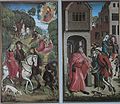
The subject of Joachim and Anne The Meeting at the Golden Gate was a regular component of artistic cycles of the Life of the Virgin. The couple meet at the Golden Gate of Jerusalem and embrace. They are aware of Anne's pregnancy, of which they have been separately informed by an archangel. This moment stood for the conception of Mary, and the feast was celebrated on the same day as the Immaculate Conception. Artworks representing the Golden Gate and the events leading up to it were influenced by the narrative in the widely read Golden Legend of Jacobus de Voragine. The Birth of Mary, the Presentation of Mary and the Marriage of the Virgin were usual components of cycles of the Life of the Virgin in which Anne is normally shown here. Her emblem is a door.[15] She is often portrayed wearing red and green, representing love and life.[3]

Anne is never shown as present at the Nativity of Christ but is frequently shown with the infant Christ in various subjects. She is sometimes believed to be depicted in scenes of the Presentation of Jesus at the Temple and the Circumcision of Christ, but in the former case, this likely reflects a misidentification through confusion with Anna the Prophetess. There was a tradition that Anne went (separately) to Egypt and rejoined the Holy Family after their Flight to Egypt. Anne is not seen with the adult Christ, so was regarded as having died during the youth of Jesus.[33] Anne is also shown as the matriarch of the Holy Kinship, the extended family of Jesus, a popular subject in late medieval Germany; some versions of these pictorial and sculptural depictions include Emerentia who was reputed in the fifteenth century to be Anne's mother. In modern devotions, Anne and her husband are invoked for protection for the unborn.

Christ in the House of His Parents by John Everett Millais, 1849–50

Virgin and Child with Saint Anne

[edit]

The role of the Messiah's grandparents in salvation history was commonly depicted in early medieval devotional art in a vertical double-Madonna arrangement known as the Virgin and Child with Saint Anne, and developed into less hierarchical compositions. The painted or sculpted group is called in Italian Metterza, in French Sainte Anne trinitaire, and in German Anna selbdritt. Another typical subject has Anne teaching the Virgin Mary the scriptures.

Christ in the House of His Parents

[edit]

In John Everett Millais's 1849–50 work, Christ in the House of His Parents, Anne is shown in her son-in-law Joseph's carpentry shop. Her daughter Mary, and Joseph are caring for a young Jesus who had cut his hand on a nail, prefiguring the wounds of his Crucifixion. The coeval John the Baptist carries a bowl of water to clean the injured hand of Jesus, also prefiguring the Baptism of Jesus.

In Islam

[edit]

Anne (Arabic: حنة بنت فاقوذ, romanizedḤannah bint Faḳūdh) is also revered in Islam, recognized as a highly spiritual woman and as the mother of Mary. She is not named in the Quran, where she is referred to as "the wife of Imran". The Quran describes her remaining childless until her old age. One day, Anne saw a bird feeding its young while sitting in the shade of a tree, which awakened her desire to have children of her own. She prayed for a child and eventually conceived; her husband, Imran, died before the child was born. Expecting the child to be male, Anne vowed to dedicate him to isolation and service in the Second Temple;[N 1][34][35] however, Anne bore a daughter instead, and named her Mary. Her words upon delivering Mary reflect her status as a great mystic, realising that while she had wanted a son, this daughter was God's gift to her:[34][35]

When she delivered, she said, “My Lord! I have given birth to a girl,” —and Allah fully knew what she had delivered—“ and the male is not like the female. I have named her Mary, and I seek Your protection for her and her offspring from Satan, the accursed.” So her Lord accepted her graciously and blessed her with a pleasant upbringing—entrusting her to the care of Zachariah...

[edit]

Music

[edit]
  • Marc-Antoine Charpentier composed two motets:
    • Pour Ste Anne, H.315, for two voices and continuo (around 1675)
    • Canticum Annae, H.325, for three voices, two treble instruments, and continuo (around 1680).

See also

[edit]

Notes

[edit]

References

[edit]
[edit]
Revisions and contributorsEdit on WikipediaRead on Wikipedia
from Grokipedia
Saint Anne, traditionally regarded as the mother of the Virgin Mary and grandmother of Christ, is a revered figure in whose life story originates from the second-century apocryphal text known as the Protoevangelium of James. She is also revered in Islamic tradition as Hannah, the mother of Mary. In this account, Anne (also spelled Anna), married to , endured prolonged barrenness in her old age, mourning her childlessness while praying fervently for divine intervention; an angel eventually announced to her that she would conceive a named Mary, who would be honored by all generations. Though not mentioned in the canonical Scriptures, Anne's narrative emphasizes themes of faith, miraculous conception, and maternal devotion, portraying her as a righteous woman who dedicated her to God's service at the Temple from a young age. Veneration of Saint Anne dates back to the early Church, with churches dedicated to her appearing as early as the sixth century and her intercession sought in prayers and devotions. Her feast day, initially celebrated in the Eastern Church on July 25, was extended to the Western Church in the fourteenth century and made universal in the Roman Catholic calendar on July 26 in 1584 by , later combined with the feast of Saint Joachim in 1969 to honor the Holy 's parents. In the Catholic tradition, Anne is formally recognized as a saint and memorialized on this date, serving as a model for life and . Saint Anne is invoked as the patroness of Christian mothers, women in labor, grandmothers, and infertile couples, reflecting her role in the miraculous birth of Mary and her exemplary faithfulness in marriage. She is also patron of housewives, cabinetmakers, and miners, with notable shrines including in , —a major pilgrimage site since the seventeenth century—and Sainte-Anne d'Auray in , , where apparitions are reported to have occurred in 1623. Her iconography often depicts her teaching the young Mary to read or holding the child Mary with the infant , symbolizing intergenerational holiness and the transmission of faith.

Religious Traditions

Christian Tradition

In Christian tradition, Saint Anne is depicted as the devoted wife of , a righteous man, with whom she shared a life of piety and mutual support. This portrayal emerges from early Christian writings, including the second-century apocryphal text known as the Protoevangelium of James, which describes them as a childless couple residing in the region of and , embodying faithfulness amid personal trial. Their union is presented as a model of marital devotion, grounded in Jewish customs and devotion to the Temple. Central to the narrative are the key events surrounding the conception and birth of their daughter, Mary. Long barren, Anne and Joachim endured reproach from their community; Joachim retreated to the wilderness for forty days of fasting and prayer, offering sacrifices to seek divine mercy, while Anne prayed fervently in their garden, vowing that any child would be dedicated to God. An angel then appeared to each separately: to Anne, promising she would conceive and that her offspring's name would be proclaimed across the world; to Joachim, confirming the same glad tidings and instructing him to return home. Their reunion at Jerusalem's Golden Gate symbolizes reconciliation and hope, leading to Mary's miraculous birth nine months later, which Anne joyfully announced to her neighbors. Following Mary's birth, Anne nursed her daughter and raised her in a home filled with scriptural instruction and , fostering the virtues that prepared Mary for her divine . At three years old, in fulfillment of their vow, Anne and Joachim led Mary in procession to the , where she ascended the steps unaided and was received by the to dwell in the holy place, receiving angelic sustenance. This early dedication underscores Anne's role in Mary's during her formative years at home. The Protoevangelium of James provides the foundational account of these events, influencing later Christian piety. The tradition of Anne and Joachim gained traction in the early Church, with mentions appearing in patristic writings by the fourth century. Epiphanius of Salamis, in his Panarion (ca. 374–377), references Anne as Mary's mother and Joachim as her father, using their names in a discussion of proper veneration to affirm Mary's honored but not divine status. The cult of Saint Anne began to develop in the Eastern Church around this time, evidenced by liturgical commemorations and church dedications by the sixth century under Emperor Justinian I, reflecting her growing significance as a figure of maternal intercession in salvation history.

Islamic Tradition

In Islamic tradition, Saint Anne is identified as Hannah (Arabic: هَنْنَة, Hinnah or Anna), the wife of and mother of Maryam (Mary), the virgin mother of the Isa (Jesus). She is portrayed as a pious woman whose story is primarily detailed in the , emphasizing themes of devotion, divine acceptance, and miraculous provision. The Quran does not mention her by name but refers to her as "the wife of Imran," highlighting her role in the lineage of prophets. The key Quranic references to Hannah appear in Surah Al-Imran (3:35-37), where she vows to dedicate her unborn child to God's service during her pregnancy: "My Lord! I have vowed to You what is in my womb, dedicated [to Your service], so accept this from me. Indeed, You are the All-Hearing, All-Knowing." Upon giving birth to a girl, she expresses acknowledgment of divine wisdom, stating, "My Lord, I have delivered a female... And the male is not like the female. And I have named her Maryam, and I seek refuge for her in You and for her descendants from , the accursed." God accepts her offering graciously, blessing Maryam with an excellent upbringing and entrusting her care to the prophet Zakariya (Zechariah). In the sanctuary (), whenever Zakariya entered upon Maryam, he found her with provisions, such as fruits out of season, which she attributed to God's limitless bounty: "It is from Allah. Indeed, Allah provides for whom He wills without account." Surah Maryam (19) focuses on Maryam's own story and that of Isa but does not directly reference Hannah. Hadith and early narrations elaborate on Hannah's circumstances, describing her as having been barren for many years before conceiving Maryam. According to a narration attributed to ibn Ishaq, Hannah observed a its chick, which inspired her to supplicate fervently for a , after which she became pregnant and made her vow to dedicate the offspring to the service of the temple (Bayt al-Maqdis). She played a central role in Maryam's early upbringing by naming her and invoking protection from , ensuring her dedication to worship despite the child's gender, which initially disappointed her as she had anticipated a boy suitable for temple duties. These accounts underscore Hannah's persistent and submission, leading to the fulfillment of her vow through Maryam's exceptional piety and her eventual motherhood of Isa. Islamic scholars interpret Hannah's story as exemplifying profound and trust in divine will. In tafsirs such as those of and Sayyid Muhammad Husayn Tabatabai, her vow is seen as an act of sincere devotion, divinely inspired to initiate the prophetic lineage through Maryam, even though she delivered a daughter—demonstrating that God's plans surpass human expectations. The miracles associated with Maryam's birth and sustenance, including the unaccounted provisions in the , are viewed as signs of God's favor on Hannah's , affirming her and the purity of Maryam and Isa, who were protected from Satan's touch at birth. These elements highlight Hannah's role as a model of faithful rather than personal miraculous feats. Unlike Christian traditions, Islamic views emphasize Hannah as a righteous believer and mother of , without formal saintly veneration or intercessory status; her significance lies in her fulfilled vow contributing to the prophetic narrative, with often described as having passed away before Maryam's birth, shifting focus to her individual devotion and the matrilineal divine favor.

Apocryphal and Legendary Sources

Protoevangelium of James

The Protoevangelium of James, also known as the , is a pseudepigraphal apocryphal text attributed to James, the brother of , but widely regarded by scholars as anonymous and composed in the mid-second century, approximately 140–170 CE. The work is structured in 24 chapters, with the first 16 focusing on the birth and early life of Mary, including her parents' story, and the remainder detailing the , Mary's betrothal to , and the . Likely originating in a Greek-speaking Christian community with some familiarity with Jewish customs, the text expands on sparse references to Mary's origins using legendary and miraculous elements to emphasize her purity and divine election. The narrative begins with Joachim, a wealthy and devout member of the , who customarily offers double portions at the temple as acts of piety. Married to , the couple faces profound sorrow due to their , which leads to social ostracism; when Joachim attempts to present his offerings, the Reuben rebukes him, stating, "It is not lawful for thee to offer thy gifts first, because thou hast not made seed in ." Humiliated, Joachim separates from Anne and retreats to the with his shepherds, where he fasts, prays, and mourns for forty days and nights, echoing biblical motifs of and . In Joachim's absence, Anne grieves deeply in their home, tearing her clothes and lamenting her barrenness as a personal affliction and communal shame. She prays fervently, vowing that any child granted to her would be consecrated to and never defiled. An angel then appears to Anne in the garden, proclaiming, "Fear not, Anne, for thou shalt conceive and bear; and thy seed shall be spoken of in all the world." Simultaneously, an angel visits Joachim in the desert, delivering the same assurance and directing him to return to with ten lambs as offerings, without blemish. Joachim complies, and upon his approach to the city, Anne, watching from the gate, recognizes him and rushes to embrace him, declaring, "Now I know that the Lord hath blessed me exceedingly: for whom the Lord hath given a curse, the same the Lord will bless and has taken away the reproach from the house of ." Their reunion symbolizes divine and the lifting of barrenness as a . Nine months after the angelic announcements, Anne goes into labor and gives birth to a daughter in their chamber, attended by a Hebrew midwife. As the infant cries out, Anne rejoices and instructs the midwife to wrap the child, asking, "What have I brought forth? and she said: A girl." Joachim and Anne name her Mary and immediately consecrate her to the Lord, bathing her seven times in incorruptible water to signify her purity, while expressing wonder at her destined role: "As the Lord God hath remembered me, so He hath remembered her also." Although the text does not depict Anne directly meeting Elizabeth, it later describes the adolescent Mary—after her temple upbringing and the Annunciation—visiting Elizabeth's home for three months, where Elizabeth greets her with words paralleling Luke's Gospel: "Whence is this to me, that the mother of my Lord should come to me?" Composed outside the canonical New Testament, the Protoevangelium was never included in official church collections due to its late date, anonymous authorship, and inclusion of unverified traditions, as determined by early synods like those in the fourth century. Nevertheless, it exerted significant historical influence on Marian devotion by establishing the foundational of Mary's immaculate origins, the names and piety of her parents, and motifs of miraculous conception that informed doctrines of her perpetual virginity and sinlessness. This apocryphal narrative permeated and from the fourth century onward, notably shaping the feast of Mary's Nativity celebrated on in Eastern and Western traditions.

Other Apocryphal Texts

The Gospel of Pseudo-Matthew, a Latin apocryphal text dated to around 800 CE, expands upon earlier narratives by incorporating the story of Anna and her husband as childless for twenty years before an angel announces the conception of Mary. In this account, Anna is portrayed as a pious woman who laments her barrenness in the temple, receives divine reassurance, and subsequently gives birth to Mary, who is dedicated to the temple at a young age. This text adapts material from the second-century Protoevangelium of James but adds details emphasizing Anna's role in Mary's early life, though scholars note its composite nature and lack of historical authenticity as a pseudepigraphal work attributed falsely to Matthew. The Arabic Infancy Gospel, compiled possibly as early as the sixth century, contains limited references to Anna, focusing primarily on the miracles of the infant during the flight to rather than Mary's parentage. While it draws from various infancy traditions, Anna appears only peripherally in some variants as part of the broader context of Mary's divine election, without detailed narrative expansion. Like other , its authenticity is questioned by scholars due to its late composition and syncretic elements blending Christian, Jewish, and possibly Islamic motifs, yet it contributed to Eastern Christian by reinforcing themes of maternal . Medieval expansions of Anna's legend appear in the , a thirteenth-century hagiographical compilation by , Archbishop of , which presents the "Life of Saint Anne" as a devotional narrative. Voragine describes Anna's three successive marriages—to , Cleophas, and —each producing a daughter named Mary: the first to Joachim bears the , mother of Jesus; the second to Cleophas bears Mary of Cleophas, mother of , , Simon, and Jude; and the third to Salome bears Mary Salome, mother of James the Greater and . This trinubium (triple marriage) motif, absent from earlier , served to connect Anna to the extended , amplifying her significance in Christian genealogy. The Anna selbdritt tradition, emerging in Western Europe by the fourteenth century, further popularized the idea of Anna's three marriages through iconographic and textual depictions known as "Anna herself the third," showing her holding the Virgin Mary and Child . Rooted in medieval legends like those in the , this narrative portrayed Anna as a perpetual virgin who bore three daughters, each named Mary, fostering a sense of sacred that resonated in folk across regions like and . Such stories, while not historically verifiable and derived from non-canonical sources, played a key role in popular devotion by modeling familial holiness and encouraging prayers for and lineage. Scholars analyze these apocryphal texts as non-historical but culturally influential, with the Gospel of Pseudo-Matthew and related works like the Libellus de Nativitate Sanctae Mariae reflecting early medieval adaptations that shaped perceptions of Anna as a paragon of and motherhood. Their lack of status underscores debates on authenticity, as they blend scriptural echoes with legendary embellishments, yet they profoundly impacted folk piety by humanizing the and inspiring widespread veneration of Anna in liturgical and devotional practices.

Theological Significance

Role in Christianity

In Christian theology, Saint Anne holds a pivotal doctrinal position as the mother of the Virgin Mary and thus the grandmother of Jesus Christ, positioning her as a key figure in the lineage of history. She is revered as the matriarch of the Holy Kinship, an extended familial network that traces Christ's ancestry through her purported three marriages, linking promises to the and emphasizing themes of divine election and generational holiness. This theological construct underscores Anne's role in preparing the human vessel for the , as her barrenness and subsequent miraculous conception of Mary symbolize God's providential intervention in human history, bridging the covenantal promises to Abraham with the fulfillment in Christ. Early patristic commentary on Anne is sparse, given her absence from canonical Scripture, but later like (c. 675–749) extolled her virtues of profound faith and humility, portraying her as a model of pious endurance amid childlessness, akin to figures like and Hannah in the . Drawing from apocryphal traditions such as the Protoevangelium of James, these views highlight Anne's prayerful submission to God's will, which facilitated Mary's birth and, by extension, the redemptive work of Christ. Her humility is further emphasized in Byzantine theology as a sanctified response to , enabling her to nurture the without personal elevation, thereby exemplifying the theological ideal of self-effacing service in the divine economy. Doctrinal developments concerning Anne have centered on her intercessory potential and the nature of Mary's conception within her womb, sparking debates intertwined with the broader dogma of the . In Eastern traditions, figures like implicitly advanced the idea of sanctifying Mary's conception by Anne, viewing it as a preparatory for the , though without the Western emphasis on original sin's exemption until later clarifications. Medieval Western theology elevated Anne's status, portraying her not merely as an intercessor but as an active participant in , capable of aiding devotees' entry into due to her proximity to Christ, a notion promoted to address contemporary anxieties about eternal destiny. These developments culminated in official recognition, such as the 1584 papal confirmation of her feast, affirming her sanctity without dogmatizing her personal conception. Ecumenically, Anne's sanctity is affirmed across traditions with varying emphases. In Catholicism, she embodies maternal fidelity and is doctrinally linked to the Holy Family's salvific role, as articulated in liturgical texts that praise her for bearing the "" Mary. Eastern Orthodoxy honors her as the "Righteous Anna" and "Forbear of God," celebrating her dormition and conception feasts to underscore her righteous lineage from the , integral to the theological narrative of Christ's humanity. Protestant perspectives, while rejecting formal veneration, acknowledge Anne through historical tradition as Mary's mother, with early reformers like invoking her in moments of peril, though later emphasizing scriptural sufficiency over extrabiblical figures in . (Note: Adapted for Anne's context from Marian )

Role in Islam

In Islamic , Hannah, known as the wife of and mother of Maryam, exemplifies (the oneness of ) through her complete submission to divine will. Her story, as recounted in the , portrays her dedicating her unborn child entirely to 's service, declaring, "My Lord, indeed I have pledged to You what is in my womb, consecrated [for Your service], so accept this from me" ( 3:35). This act underscores her unwavering monotheistic devotion, prioritizing 's commands over personal expectations, as she accepted the birth of a despite hoping for a son, affirming that "the male is not like the female" in divine decree ( 3:36). Hannah holds a pivotal role in the prophetic lineage as the mother of Maryam, who in turn bore the prophet Isa (), positioning her as an ancestor in the chain of divine messengers. This maternal link elevates her status within Islamic , where her ensured the continuation of a blessed line chosen by , as evidenced by the divine acceptance of her vow and the subsequent protection granted to Maryam and her descendants from ( 3:36). Her position bridges the narratives of earlier prophets and underscores the importance of righteous parenthood in preserving monotheistic faith. Sufi and scholarly traditions regard Hannah as a profound of maternal and the efficacy of answered , emphasizing her patient supplications amid and her trust in God's wisdom. In Sufi thought, her dedication of her child mirrors spiritual renunciation, inspiring figures like a Sufi who similarly vowed his son to divine service, highlighting themes of selfless devotion (, , 4:66). Scholars such as describe her as a model of righteous intent, whose prayers were divinely rewarded with Maryam, illustrating how sincere du'a () aligns human will with the divine, fostering spiritual growth and . Within Islamic , Hannah is often compared to exemplary female figures like , who endured persecution for her , and Khadijah, the steadfast supporter of the Prophet Muhammad, as shared icons of devotion and resilience in upholding . Like Asiya's quiet resistance against tyranny and Khadijah's nurturing of prophetic mission, Hannah's story represents maternal sacrifice that sustains divine purpose, reinforcing women's integral role in spiritual narratives without veneration as saints.

Veneration and Devotion

Historical Development

The veneration of Saint Anne emerged in within the Eastern Church by the , heavily influenced by apocryphal texts such as the Protoevangelium of James, which detailed her role as the mother of the Virgin Mary. This narrative provided a foundation for her devotional identity, blending scriptural echoes with legendary elements to emphasize themes of barrenness, , and divine favor. By the , the cult had solidified, as evidenced by the dedication of basilicas in , including the Church of Saint Anne in the Deuteron, constructed under Emperor around 550 CE, which initiated widespread liturgical recognition in . The medieval period witnessed significant expansion of Saint Anne's cult in , propelled by the (1095–1291), which brought Eastern relics, traditions, and pilgrims into contact with Latin , fostering new devotions and translations of apocryphal stories. A landmark event was the purported discovery of her relics in Apt, , in 792 CE during ceremonies presided over by , who documented the miracle in a letter to , attributing it to divine intervention through a deaf-mute boy who miraculously spoke. This event, preserved in hagiographic accounts, catalyzed relic veneration in the West, leading to church dedications, confraternities, and growing popularity among nobility and laity by the 13th century, particularly in and the . The Protestant Reformation (16th century onward) curtailed Saint Anne's veneration in emerging Protestant territories, where and rejection of non-biblical saints diminished her role in devotional practices, though remnants persisted in some Lutheran contexts. In contrast, Catholic and Orthodox traditions upheld and expanded her , with continuity in Eastern and Western efforts reinforcing her as a model of familial . The brought revivals through sustained pilgrimage to sites like in .

Patronage and Dedications

Saint Anne is widely venerated in the as the of mothers, grandmothers, pregnant women, and women in labor, reflecting her role as the mother of the Virgin Mary. She is also invoked by childless couples, drawing from the apocryphal of her own long barrenness before conceiving Mary. Additionally, Saint Anne serves as patron of educators, symbolizing her legendary instruction of Mary in reading and piety. Her is sought for against , as the patroness of the poor and those facing economic hardship, and against storms, particularly by sailors and fishermen in maritime traditions. Prominent dedications to Saint Anne include the in , , established in 1658 as a by Breton settlers and now a major pilgrimage center. In , the 18th-century Church of Matriz de Santana in Salvador da honors her as a key local devotion site. The features several significant churches, such as the Minor and Archdiocesan Parish of Saint Anne in Taguig City, built in 1587 by , and the National and of Saint Anne in , enshrining a miraculous image from 1581. In medieval , confraternities and guilds dedicated to Saint Anne flourished, promoting devotion through communal prayers and charitable works, such as the Saint Anne's Guild in , , documented from the . These organizations underscored her role in family and community life during the .

Liturgical Observance

Feast Days

In the , the universal feast day of Saints Anne and Joachim, parents of the Virgin Mary, is celebrated on July 26. It was elevated to a double of the second class by in 1879 and is included in the . The commemorates the Conception of the by Saint Anne on September 9, immediately following the Nativity of the on September 8, highlighting Anne's role in the divine plan of salvation. Additionally, the Dormition (falling asleep) of Saint Anne is observed on July 25 in the Orthodox liturgical calendar. In Anglican and Lutheran traditions, the feast of Saints Anne and Joachim is generally observed on July 26, aligning with the Western calendar, though some Anglican provinces may vary in emphasis or combine it with broader commemorations of biblical figures. Lutheran calendars, such as those of the , include it as a lesser focused on familial . Among , the honors the departure of Saint Anne on Hator 11 (corresponding to approximately November 20 in the ), as recorded in the Coptic Synaxarium. The celebrates the Conception of Saint Anne on December 9, tying it to Advent preparations and emphasizing her barrenness overcome by . Local customs enrich these observances, particularly in regions with strong devotion to Saint Anne. In , Canada, the hosts massive pilgrimages culminating on July 26 with candlelight processions, where thousands carry lit candles in prayer for healing and family blessings, a dating to the 17th century. In , village feasts such as that in on July 27 feature solemn processions with Saint Anne's statue borne through streets adorned with flowers and lights, accompanied by brass bands and fireworks, reflecting the island's vibrant festa culture.

Relics and Pilgrimage Sites

One of the most prominent relics attributed to Saint Anne is a fragment of her bone, housed in the of Sainte-Anne-d'Auray in , . This major relic, measuring approximately four inches, was presented as a gift to the by in 1892, originating from the ancient discovery site in Apt, . The also possesses a smaller consisting of a portion of Saint Anne's bone, acquired in 1670 from the Chapter, and a third consisting of a portion of her bone, donated by in 1960. These artifacts have been authenticated through papal provenance and are venerated in sealed reliquaries, drawing pilgrims seeking for family and health matters. In , , the serves as a major repository for relics of Saint Anne, including a finger obtained in 1670 and two fragments of her forearm , gifted by Popes Leo XIII in 1892 and Pius X in 1912. These relics trace their origins to the 8th-century discovery in Apt and have been officially authenticated by the Vatican for public veneration. The site, established in 1658, became a focal point after reports of healings linked to the relics, with over two million pilgrims visiting annually, particularly during the feast days when special expositions occur. A notable in , , is the right hand of Saint Anne, preserved in the Church of St. Anne since the medieval period and authenticated through historical ecclesiastical records. This first-class is exposed for each July 26, attracting devotees who attribute miracles of protection and healing to its presence. The relic's authenticity was reaffirmed during restorations in the , linking it to early translations from the . The historical discovery of Saint Anne's relics is primarily associated with Apt, France, where, according to a 9th-century account by to , they were miraculously revealed on 792 AD through the aid of a deaf-mute boy who suddenly spoke upon touching the tomb. Subsequent distributions in the 17th and 19th centuries, including to 's Sainte-Anne-d'Auray following the 1625 apparition to Yves Nicolazic, involved papal authentications to ensure their integrity amid growing devotion. In , while no major relic discovery occurred in the , the site's development tied to authenticated fragments from Apt, with Vatican approval for veneration granted in the . Key pilgrimage centers centered on these relics include the Basilica of Sainte-Anne-d'Auray, where between 1625 and 1684, church authorities authenticated 1,277 miracles, including healings from paralysis and infertility, leading to up to 500,000 pilgrims during the annual Great Pardon procession on July 25-26. In Detroit, Michigan, the Basilica of Sainte Anne de Détroit, established in 1701 as North America's second-oldest parish, functions as the official Archdiocesan Shrine and hosts relics from Beaupré, drawing thousands for novenas and reported cures related to family unity. The Church of Saint Anne in Jerusalem, a 12th-century Crusader basilica at the traditional site of Mary's birthplace, preserves no major relics but serves as a pilgrimage hub for reflection on Saint Anne's role, with visitors noting spiritual renewals near the adjacent Pool of Bethesda. Veneration of these relics often intensifies around Saint Anne's feast day on July 26, aligning with liturgical observances that emphasize her maternal .

Artistic and Cultural Representations

Iconography and Symbolism

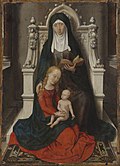
In , Saint Anne is commonly depicted with specific attributes that underscore her maternal and educational role. She is often shown holding an open book, symbolizing her teaching the young Virgin Mary to read and imparting scriptural knowledge, a motif drawn from medieval traditions emphasizing Mary's education. Another frequent attribute is the door, representing the of where Anne met her husband after their vow of chastity, alluding to themes of reconciliation and the . These elements, influenced briefly by apocryphal texts like the Protoevangelium of James, highlight Anne's foundational place in salvation history. Gestural motifs further define her , particularly in northern European art. The "Anna Selbdritt" or "three Annes" composition, popular from around 1480 to 1520 in German regions, portrays Anne alongside the young Mary and the , either in a vertical embrace or side-by-side arrangement, emphasizing the three generations of sanctity and lineage. Anne's teaching gesture, such as counting on her fingers while pointing to the book, reinforces her role as educator of the Virgin. Color schemes in depictions of Saint Anne carry symbolic weight, with green robes signifying hope and rebirth—reflecting her bearing of Mary as the New Eve—and red evoking love or the suffering akin to martyrdom in her trials. These colors, while not rigidly prescribed, appear consistently in medieval and later art to convey her virtues. The evolution of Saint Anne's iconography traces from sparse Byzantine-era narrative scenes, such as her meeting at the Golden Gate, rooted in Eastern Christian veneration since the 6th century, to more developed motifs in the Western Middle Ages and Renaissance. By the late medieval period, emphasis shifted to intimate family groupings like the Holy Kinship, culminating in the realistic, emotive Anna Selbdritt figures of the Renaissance, which humanized her as a devoted grandmother while retaining symbolic depth. This progression reflects broader artistic transitions from stylized Eastern icons to naturalistic Western representations.

Notable Artworks

One of the most renowned depictions of Saint Anne is Leonardo da Vinci's The Virgin and Child with Saint Anne, an unfinished oil painting dated to circa 1503–1519 and housed in the Musée du Louvre in . The composition portrays Saint Anne seated with her daughter, the Virgin Mary, on her lap, while the infant reaches toward a symbolizing his future sacrifice; the layered figures create a sense of intimacy and divine hierarchy, reflecting ideals of maternal lineage and theological depth. This work, influenced by Leonardo's studies of anatomy and light, exemplifies the emphasis on sfumato and emotional expression in religious art. Albrecht Dürer's Virgin and Child with Saint Anne, completed in 1519 and held at the in New York, presents a more intimate, triangular composition where Saint Anne consoles the Virgin Mary with a hand on her shoulder, while the reaches toward the book held by Saint Anne; the painting's rich colors and detailed draw from Venetian influences, underscoring Saint Anne's role as protector and grandmother in German devotional tradition. Dürer's use of oil on panel highlights his mastery of light and texture, making this a seminal example of piety focused on familial sanctity. The central panel of Gerard David's Saint Anne Altarpiece, painted around 1500–1520 and now in the in , shows Saint Anne enthroned with the Virgin and Child, flanked by saints in a format typical of late Flemish art; the serene figures and intricate brocades emphasize themes of and lineage. This , originally intended for a church in , demonstrates David's workshop's blend of realism and symbolism, with Saint Anne as a central maternal figure. John Everett Millais's Pre-Raphaelite painting Christ in the House of His Parents (also known as The Carpenter's Shop), created in 1849–1850 and located at in , includes Saint Anne removing a nail from the young Christ's injured hand amid the Holy Family's scene, symbolizing foreshadowing of the Passion; the realistic details and controversial domestic portrayal challenged Victorian norms. Millais's attention to everyday elements, like tools and blood, integrates Saint Anne into a of human vulnerability and divine foreshadowing. In the 20th century, icons such as the hand-painted works from , like the Icon of Saint Anne from the Saint Anne (circa mid-20th century), continue the Eastern Orthodox tradition by depicting her in prayer with the Virgin, often in gold-ground style to evoke timeless holiness; these pieces, preserved in monastic settings, reflect ongoing liturgical through simplified forms and symbolic gestures.

In Literature and Music

Saint Anne has been invoked in medieval and Renaissance literature as a symbol of virtuous ancestry and maternal piety. In Dante Alighieri's Divine Comedy, particularly in Paradiso Canto 32, she appears among the highest ranks of the blessed in the Empyrean, seated in the celestial rose opposite Saint Peter, underscoring her exalted role as the mother of the Virgin Mary and grandmother of Christ. Similarly, Geoffrey Chaucer references the "St. Anne Trinity"—depicting Anne with Mary and Jesus—in passages that highlight her as a model of devotion and lineage, as seen in works like The Legend of Good Women and the Prioress's Tale, where her intercessory power is emphasized in the context of maternal and familial sanctity. In liturgical and devotional music, Saint Anne features prominently in hymns across Christian traditions. The Orthodox Akathist Hymn to the Righteous and Anna, ancestors of God, praises her barrenness turned to joy through the birth of Mary, portraying her as a vessel of divine promise and intercessor for the faithful; this , structured in the traditional akathist form with kontakia and ikoi, is chanted during feasts honoring the couple. In Catholic practice, litanies dedicated to Saint Anne invoke her as "Mother of the Immaculate Virgin," "Spouse of Saint ," and "Patroness of Christian Mothers," with petitions for her aid in family matters and spiritual protection, often recited during novenas or on her feast day. Renaissance composers contributed to the era's heightened devotion to Saint Anne through polyphonic motets that celebrated her role in salvation history. During the late 15th and early 16th centuries, when veneration of Saint Anne peaked, works by figures like and his contemporaries incorporated texts praising her as the "root of Jesse" and grandmother of the Redeemer, blending chant-based tonalities with intricate vocal lines to evoke her humility and grace; these motets, such as those anthologized in period collections, were performed in courts and chapels to honor her patronage. In modern compositions, choral and forms have occasionally drawn on her imagery, though direct dedications remain less common, reflecting a shift toward broader Marian themes. Folk traditions further embed Saint Anne in oral and musical expressions tied to her patronage. In Breton culture, where she is revered as the region's patroness, traditional songs like "Sainte Anne, ô Bonne Mère" (Saint Anne, O Good Mother) are sung in processions and pardons, with lyrics beseeching her aid for sailors and families, often accompanied by bombarde and in a style that preserves Celtic influences. In Caribbean contexts, particularly , she syncretizes with figures like Granmoun St. Anne or , appearing in rhythmic chants and ballads such as those in the "So Anne" repertoire, where drumming and call-and-response invoke her for protection and healing, blending Catholic roots with African-derived spiritual practices.

References

Add your contribution
Related Hubs
User Avatar
No comments yet.