Recent from talks
Nothing was collected or created yet.
Tehran
View on Wikipedia
Key Information
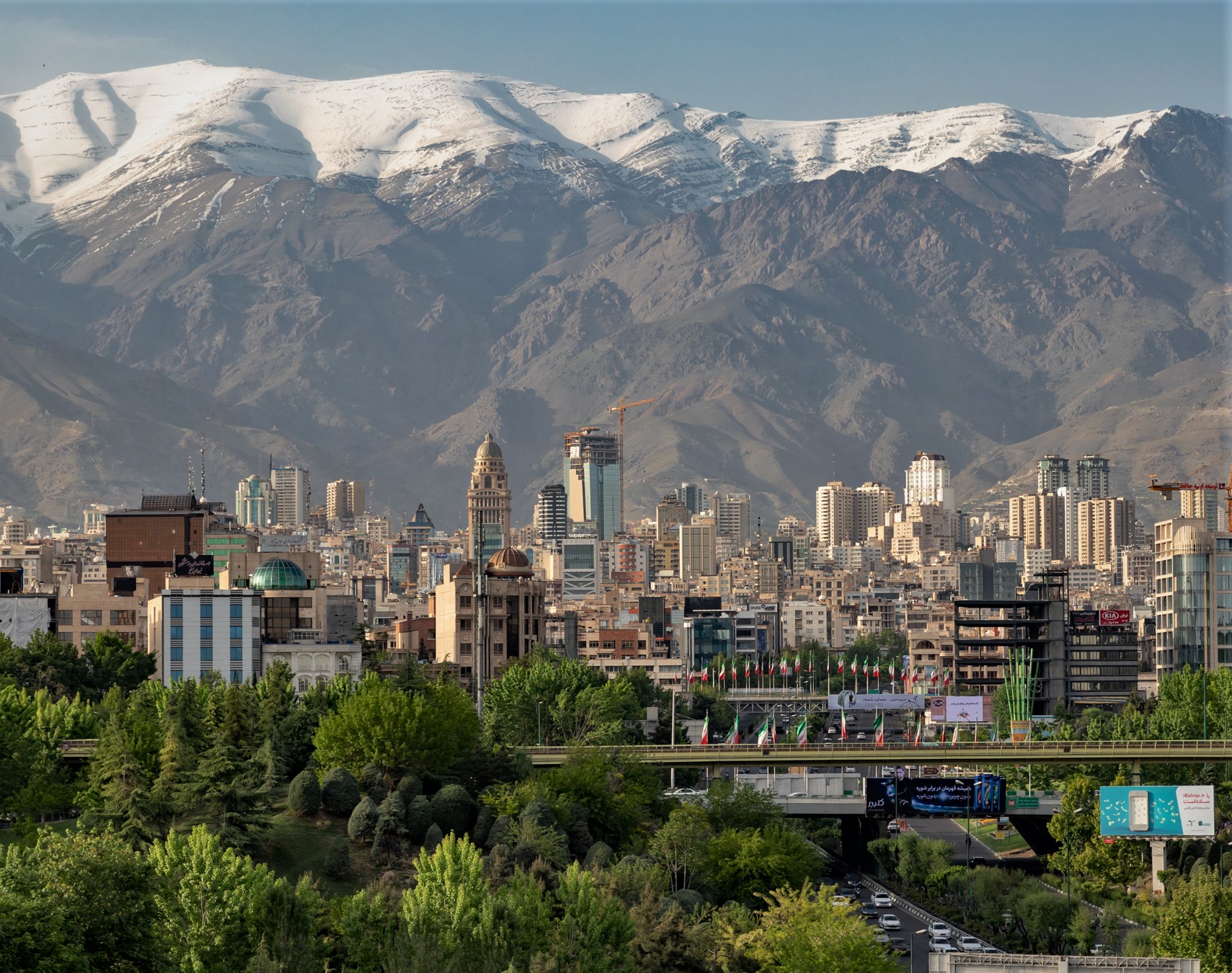
Tehran[a] is the capital and largest city of Iran.[6] It is also the capital of Tehran province and the administrative center for Tehran County and its Central District.[7] With a population of around 9.8 million in the city,[8] and 16.8 million in the metropolitan area, Tehran is the most populous city in Iran and Western Asia,[9] the second-largest metropolitan area in the Middle East after Cairo, and the 24th-most-populous metropolitan area in the world. Greater Tehran includes several municipalities, including Karaj, Eslamshahr, Shahriar, Qods, Malard, Golestan, Pakdasht, Qarchak, Nasimshahr, Parand, Pardis, Andisheh and Fardis.
In classical antiquity, part of the territory of present-day Tehran was occupied by Rhages (now Ray), a prominent Median city that was destroyed in the medieval Arab, Turkic, and Mongol invasions.[10] Modern Ray was absorbed into the metropolitan area of Greater Tehran. Tehran was first chosen as the capital of Iran in 1786 by Agha Mohammad Khan of the Qajar dynasty, due to its proximity to Iran's territories in the Caucasus—which were contested in the Russo-Iranian Wars—and to avoid the vying factions of prior ruling Iranian dynasties; the capital of Iran had been moved several times throughout its long history, with Tehran becoming the 32nd. Under Naser al-Din Shah (1848-1896), Tehran witnessed Iran's first institute of higher learning, bank, railway line, and museum. Large-scale construction works began in the 1920s, and Tehran became a destination for mass migrations from all over Iran in the 20th century.[11]
Tehran is home to many historical sites, including the World Heritage Site Golestan Palace of the Qajar dynasty and the Masoudieh,Sa'dabad, Niavaran and Marmar palace complexes of both the Qajar and Pahlavi dynasties. Landmarks include the Azadi Tower, a memorial built in 1971 to mark the 2,500th anniversary of the Persian Empire; the Milad Tower, the world's sixth-tallest self-supporting tower, completed in 2007; and the Tabiat Bridge, completed in 2014.[12]
Most residents of Tehran are Persian,[13][14] of whom roughly 99% speak the Persian language; there are numerous other ethnolinguistic groups that are Persianised and assimilated.[15] Tehran has been described as a cultural "melting pot", hosting more Azerbaijanis than any other city in the world.[16][17][18][19][20][21] Tehran is served by Imam Khomeini International Airport, alongside the domestic Mehrabad Airport, a central railway station, Tehran Metro, the Tehran Bus Rapid Transit system, trolleybuses, and a large network of highways.
Due to air pollution and earthquakes, there have been plans to relocate the capital to another area, although none have been approved. A 2016 survey of 230 cities across the globe by Mercer ranked Tehran 203rd for quality of life.[22] According to the Global Destinations Cities Index in 2016, Tehran is among the top ten fastest growing tourism destinations.[23] In 2016, the Tehran City Council declared 6 October "Tehran Day", celebrating the date in 1907 when the city officially became the capital of Iran.[24]
Etymology
[edit]Various theories on the origin of the name Tehran have been put forward. Iranian linguist Ahmad Kasravi, in an article "Shemiran-Tehran", suggests that Tehran and Kehran mean "the warm place", and "Shemiran" means "the cool place". He lists cities with the same base and suffix and studied the components of the word in ancient Iranian languages, and came to the conclusion that Tehran and Kehran meant the same thing in different Iranian language families, as the constant "t" and "k" are close to each other in such languages. He also provided evidence that cities named "Shemiran" were colder than those named "Tehran" or "Kehran". He considered other theories not consider the ancient history of Iranian languages, such as "Tirgan" theory and "Tahran" theory folk etymology.[25]
The official City of Tehran website says that "Tehran" comes from the Persian words "Tah" meaning "end", or "bottom", and "Ran" meaning "[mountain] slope"—, the bottom of the mountain (ته کوه), referring to Tehran's position at the foot of the Alborz mountains.[26]
The most interesting toponymic theory of the place name Tehran is proposed by the Iranian linguist Zana Vahidzadeh (Dana Pishdar). According to Dana Pishdar, the etymological root of the place name Tehran should be sought in the ancient Iranian languages, such as Median and Avestan. Since the city of Rey and the area around Tehran were the largest cities in the Media region in pre-Islamic times, and since in Zoroastrian times they were considered a holy city and the center of a theocratic government similar to modern Vatican City, this suggestion does not sound illogical.[27]
According to Dana Pishdar, the name Tehran consists of two lexical elements: "Teh" and "Ran." According to Pishdar, "Teh" in the ancient Median language means "honeyberry," and "Ran" means "foot of hills." Honeyberry trees used to grow in the northern parts of Tehran province. It is also mentioned in the Dehkhoda dictionary, where Dehkhoda explains it as follows: "Teh" is a noun used in Shemiranat and around Tehran for "the honeyberry tree."
According to Dana Pishdar (Zana Vahidzadeh), the word Tehran means a place where the "honeyberry tree" grows. The suffix "Ran" is also found in many names of districts and villages in modern Tehran, such as Shemiran, Niavaran, Jamaran, Kasran, and Shahran, which are also not unrelated to each other. In Avestan and also in the Avesta, "Ran" had the meaning of "foot" and "plain," which is still associated with the name of the city of Rey. The Zoroastrian Medes called their largest and most important city Rhaga or Rey, which means the city located on the plain and at a foot. Therefore, the words "Rey" and "Ran" mean the foot of the mountain, and the etymological reason for this is the geographical location of Rey and Tehran, because both are located at the foot of the mountain and on a plain.[28]
In English, it is also spelt "Teheran",[29] with both variants being used in books since at least 1800, and "Teheran" being the dominant form from after WWII until shortly before the Islamic Revolution.[30]
History
[edit]Archaeological remains from the ancient city of Ray suggest that settlement in Tehran dates back over 6,000 years.[31]
Classical era
[edit]Tehran is in the historical Media region of (Old Persian: 𐎶𐎠𐎭 Māda) in northwestern Iran. By the time of the Median Empire, part of present-day Tehran was a suburb of the prominent Median city of Rhages (Old Persian: 𐎼𐎥𐎠 Ragā). In the Avesta's Videvdat (i, 15), Rhages is mentioned as the 12th sacred place created by Ohrmazd.[32] In Old Persian inscriptions, Rhages appears as a province (Bistun 2, 10–18). From Rhages, Darius I sent reinforcements to his father Hystaspes, who was putting down a rebellion in Parthia (Bistun 3, 1–10).[32] Some Middle Persian texts give Rhages as the birthplace of Zoroaster,[33] although modern historians generally place the birth of Zoroaster in Khorasan province.
Mount Damavand, the highest peak of Iran, which is located near Tehran, is an important location in Ferdowsi's Šāhnāme,[34] an Iranian epic poem based on the ancient legends of Iran. It appears in the epics as the homeland of the protoplast Keyumars, the birthplace of King Manuchehr, the place where King Fereydun bound the dragon fiend Aždahāk (Bivarasp), and the place where Arash shot his arrow.[34]
Medieval period
[edit]In 641, during the reign of the Sasanian Empire, Yazdgerd III issued his last appeal to the nation from Rhages, before fleeing to Khorasan.[32] Rhages was dominated by the Parthian House of Mihran, and Siyavakhsh—the son of Mehran, the son of Bahram Chobin—who resisted the seventh-century Muslim invasion of Iran.[32] Because of this resistance, when the Arabs captured Rhages, they ordered the town destroyed and rebuilt anew by traitor aristocrat Farrukhzad.[32]
In the ninth century, Tehran was a well-known village, but less so than Rhages, flourishing nearby. Rhages was described in detail by tenth-century Muslim geographers.[32] Despite the interest that Arabian Baghdad displayed in Rhages, the number of Arabs in the city remained insignificant and the population mainly consisted of Iranians of all classes.[32][35]
The Oghuz Turks invaded Rhages in 1035 and again in 1042, but the city was recovered under the Seljuks and the Khwarezmians.[32] Medieval writer Najm od Din Razi declared the population of Rhages about 500,000 before the Mongol invasion. In the 13th century, the Mongols invaded Rhages, laid the city to ruins, and massacred many of its inhabitants.[32] Others escaped to Tehran. In July 1404, Castilian ambassador Ruy González de Clavijo visited Tehran on a journey to Samarkand, the capital of Turco-Mongol conqueror Timur, the ruler of Iran at the time. He described it in his diary as an unwalled region.
Early modern era
[edit]Italian traveler Pietro della Valle passed through Tehran overnight in 1618, and in his memoirs called the city Taheran. English traveler Thomas Herbert entered Tehran in 1627, and mentioned it as Tyroan. Herbert states that the city had about 3,000 houses.[36]

In the early 18th century, Karim Khan of the Zand dynasty ordered a palace and a government office built in Tehran, possibly to declare the city his capital; but he later moved his government to Shiraz. Eventually, Qajar king Agha Mohammad Khan chose Tehran as the capital of Iran in 1786.[37] Khan's choice of his capital was based on a similar concern for the control of both northern and southern Iran.[37] He was aware of the loyalties of the inhabitants of former capitals Isfahan and Shiraz to the Safavid and Zand dynasties respectively, and was wary of the power of the local notables in these cities.[37] Thus, he probably viewed Tehran's lack of a substantial urban structure as a blessing, because it minimized the chances of resistance to his rule by the notables and by the general public.[37] He had to remain within close reach of Azerbaijan and Iran's integral northern and southern Caucasian territories[37]—at that time not yet irrevocably lost per the treaties of Golestan and Turkmenchay to the neighboring Russian Empire—which would follow in the course of the 19th century.[38]

After 50 years of Qajar rule, the city still barely had more than 80,000 inhabitants.[37] Up until the 1870s, Tehran consisted of a walled citadel, a roofed bazaar, and the three main neighborhoods of Udlajan, Chale-Meydan, and Sangelaj, where the majority resided.
During the long reign of Naser al-Din Shah (1848-1896), Tehran witnessed Iran's first institute of higher learning, bank, railway line and museum.[39][40][41] The city expanded rapidly through multiple development plans.[42] The first development plan in 1855 emphasized traditional spatial structure. The second, under the supervision of Dar ol Fonun in 1878, included new city walls, in the form of a perfect octagon with an area of 19 square kilometers, mimicking the Renaissance cities of Europe.[43] Tehran was 19.79 square kilometers and had expanded more than fourfold.[44]
Late modern era
[edit]
Growing awareness of civil rights resulted in the Constitutional Revolution and the first constitution of Iran in 1906. On 2 June 1907, the parliament passed a law on local governance known as the Baladie (municipal law), providing a detailed outline of issues such as the role of councils within the city, the members' qualifications, the election process, and the requirements to be entitled to vote.
Mohammad Ali Shah abolished the constitution and bombarded the parliament with the help of the Russian-controlled Cossack Brigade on 23 June 1908. That was followed by the capture of the city by the revolutionary forces of Ali-Qoli Khan (Sardar Asad II) and Mohammad Vali Khan (Sepahsalar e Tonekaboni) on 13 July 1909. As a result, the monarch was exiled and replaced by his son Ahmad, and the parliament was re-established.
During the Persian campaign of World War I, Russian forces that were occupying the northwest of Iran marched around Qazvin and approached Tehran, causing a crisis and the dissolution of parliament. Ahmad Shah Qajar and his entourage decided to leave Tehran and move the capital to another place, sparking fears of rebellion in other cities.[45] During the Battle of Robat Karim, Iranian forces led by Heydar Latifiyan prevented the Russians from taking Tehran, despite the latter winning the battle.[46] This also allowed government functions to be moved to Qom and then to Isfahan, while the monarchy remained in Tehran.[45]
Pahlavi rule
[edit]
After World War I, the constituent assembly elected Reza Shah of the Pahlavi dynasty as the new monarch, who immediately suspended the Baladie law of 1907, replacing the decentralized and autonomous city councils with centralist approaches to governance and planning.[43] From the 1920s to the 1930s, under the rule of Reza Shah, the city was rebuilt. Several old buildings, including parts of the Golestan Palace, Tekye Dowlat, and Tupkhane Square, were replaced with modern buildings influenced by classical Iranian architecture, particularly the buildings of the National Bank, the police headquarters, the telegraph office, and the military academy.

Changes to the urban fabric began with the street-widening act of 1933, which served as a framework for changes in all other cities. The Grand Bazaar was divided in half and many historic buildings were demolished and replaced by wide straight avenues,[48] and the traditional texture of the city was replaced with intersecting cruciform streets that created large roundabouts in major public spaces such as the bazaar. As an attempt to create a network for easy transportation within the city, the old citadel and city walls were demolished in 1937, replaced by wide streets cutting through the urban fabric. By 1937, the city was heavily influenced by modernist planning patterns of zoning and gridiron networks.[43]
During World War II, Soviet and British troops entered the city. In 1943, Tehran was the site of the Tehran Conference, attended by U.S. President Franklin D. Roosevelt, Soviet premier Joseph Stalin, and British Prime Minister Winston Churchill.
The establishment of the planning organization of Iran in 1948 resulted in the first socioeconomic development plan covering the period from 1949 to 1955. These plans not only failed to slow the unbalanced growth of Tehran but, with the 1962 land reforms that Reza Shah's son and successor, Mohammad Reza Shah named the White Revolution, Tehran's chaotic growth was further accentuated.
In the 1960s and 1970s, Tehran developed rapidly under Mohammad Reza Shah. Modern buildings altered the face of Tehran, and ambitious projects were planned for the following decades. To resolve the problem of social exclusion, the first comprehensive plan was approved in 1968. The consortium of Iranian architect Abd-ol-Aziz Farmanfarmaian and the American firm of Victor Gruen Associates identified the main problems blighting the city as high-density suburbs, air and water pollution, inefficient infrastructure, unemployment, and rural-urban migration. Eventually, the whole plan was marginalized by the 1979 Revolution and the subsequent Iran–Iraq War.[43]
Tehran's most famous landmark, the Azadi Tower, was built by the order of the Shah in 1971. It was designed by Hossein Amanat, an architect whose design won a competition, combining elements of classical Sassanian architecture with post-classical Iranian architecture. Formerly known as the Shahyad Tower, it was built to commemorate the 2,500th anniversary of the Imperial State of Iran.
Islamic Republic
[edit]
Following the 1979 Islamic Revolution, Tehran underwent profound transformations in its urban landscape, political structure, and social dynamics. The revolution led to the establishment of the Islamic Republic of Iran, which brought about a shift from a pro-Western monarchy to a theocratic system based on Islamic principles. This change was reflected in various aspects of Tehran's development.[49][50][51] Politically, the revolution resulted in the consolidation of power by forces loyal to Ayatollah Ruhollah Khomeini, the leader of the revolution. This period saw the establishment of new governance structures aligned with Islamic ideologies.[52][53]
During the Iran–Iraq War from 1980 to 1988, Tehran was repeatedly targeted by airstrikes and Scud missile attacks, and the war led to substantial infrastructural damage.[54][55]
The 435-meter-high Milad Tower, one of the proposed development projects of pre-revolutionary Iran,[56] was completed in 2007 and has become a famous landmark of Tehran. Tabiat Bridge, a 270-meter pedestrian overpass[12] that was designed by award-winning architect Leila Araghian, was completed in 2014. The city municipality started planting a large number of imported palm trees, replacing endemic plane trees.[57] In June 2025, Tehran was attacked by Israeli airstrikes.[58] On June 2025 an unprecedented event in the history of Iran and Tehran took place as people of Tehran committed mass evacuation.[59][60][61]
Demographics
[edit]

Population
[edit]| Year | Pop. | ±% p.a. |
|---|---|---|
| 1554 | 1,000 | — |
| 1626 | 3,000 | +1.54% |
| 1797 | 15,000 | +0.95% |
| 1807 | 50,000 | +12.79% |
| 1812 | 60,000 | +3.71% |
| 1834 | 80,000 | +1.32% |
| 1867 | 147,256 | +1.87% |
| 1930 | 250,000 | +0.84% |
| 1940 | 540,087 | +8.01% |
| 1956 | 1,560,934 | +6.86% |
| 1966 | 2,719,730 | +5.71% |
| 1976 | 4,530,223 | +5.23% |
| 1986 | 6,058,207 | +2.95% |
| 1991 | 6,497,238 | +1.41% |
| 1996 | 6,758,845 | +0.79% |
| 2006 | 7,711,230 | +1.33% |
| 2011 | 8,244,759 | +1.35% |
| 2016 | 8,737,510 | +1.17% |
Tehran had a population of 7,711,230 people, in 2,286,787 households at the time of the 2006 National Census.[62] The 2011 census counted 8,154,051 people, in 2,624,511 households.[63] The 2016 census recorded 8,693,706 people, in 2,911,065 households.[5]
Language and ethnicity
[edit]With its cosmopolitan atmosphere, Tehran is home to diverse ethnic and linguistic groups from all over the country. The present-day dominant language is the Tehrani variety of the Persian language, and the majority of people identify themselves as Persians.[14][13] Historically the native language of the Tehran–Ray region was not Persian, which is linguistically Southwest Iranian and originates in Fars, an extinct Northwestern Iranian language.[64]
Iranian Azeris are the second-largest ethnic group, comprising about 10-15% [65][66] of the population. Ethnic Mazanderanis are the third-largest, comprising about 5% of the population.[67] Tehran's other ethnic communities include Kurds, Armenians, Georgians, Bakhtyaris, Talysh, Baloch, Assyrians, Arabs, Jews, and Circassians. In the 2010 census by the Sociology Department of the University of Tehran, in many districts of Tehran across various socio-economic classes in proportion to population sizes of each district and socio-economic class, 63% of the people were born in Tehran, 98% knew Persian, 75% identified themselves as ethnic Persian, and 13% had some degree of proficiency in a European language.[13]
There was a drastic change in ethnic-social composition in the early 1980s. After the political, social, and economic consequences of the 1979 Revolution and the years that followed, many Iranian citizens, mostly Tehranis, left Iran. The majority of Iranian emigrations have left for the United States, Germany, Sweden, and Canada. With the start of the Iran–Iraq War, a second wave of inhabitants fled the city, especially during the Iraqi air offensives on Tehran. With most major powers backing Iraq at the time, economic isolation gave yet more reason for many inhabitants to leave Tehran and the country. Having left all they had and having struggled to adapt to a new country and build a life, most of them never came back when the war was over. During the war, Tehran received a great number of migrants from the west and the southwest of Iran bordering Iraq. The unstable situation and the war in neighbouring Afghanistan and Iraq prompted a rush of refugees into Iran, who arrived in millions. Tehran was a magnet for many seeking work, who helped Tehran to recover from war wounds, working for a far lower pay than local construction workers. Many of these refugees are being repatriated with the assistance of the UNHCR, but there are still sizable groups of Afghan and Iraqi refugees in Tehran who are reluctant to leave, being pessimistic about the situation in their own countries. Afghan refugees are mostly Dari-speaking Tajik and Hazara, speaking a variety of Persian, and Iraqi refugees are mainly Mesopotamian Arabic-speakers who are often of Iranian and Persian ethnic heritage.
Religion
[edit]The majority of Tehranis are officially Twelver Shia Muslims, which has been the state religion since the 16th-century Safavid conversion. Other religious communities include followers of the Sunni and Mystic branches of Islam, Christian denominations, Judaism, Zoroastrianism, and the Baháʼí Faith. In the 2016 "Tehran Survey", when residents were asked about the importance of religion in their life, 53.5% considered it to be "very important/important", 31.1% to be "rather important", 10.5% to be "not very important", and 4.8% to be "not at all important."[68]
There are many religious centres scattered around Tehran, from old to newly built centres, including mosques, churches, synagogues, and Zoroastrian fire temples. Tehran has a very small third-generation Indian Sikh community with a local gurdwara that was visited by the Indian Prime Minister, Manmohan Singh in 2012.[69]
Geography
[edit]Location and subdivisions
[edit]
City of Tehran is bounded in the north by southern end and the highest point of Alborz Mountain Range (Tochal Peak, 3'963m), in the east by a hilly stretch of Alborz (namely, Sorkheh Hesar National Park, part of Khojir National Park and the northeastern badlands), in the southeast by Raga Mountain and in the west and southwest by fertile meadows and many villages, fed by numerous rivers and streams, mainly Karaj and Jajrud.
The metropolis is divided into 22 municipal districts, each with its administrative center. Of the 22 municipal districts, 20 are located in Tehran County's Central District, while districts 1 and 20 are respectively located in the counties of Shemiranat and Ray.
| Regions and municipal districts of Tehran | |||||
|---|---|---|---|---|---|
|
| Municipal districts of Tehran | |||||||||||||||||||||||||||||||||||||||||||||||||||||||||||||||||||||||||||||||||||||||||||||||||||||||||||||||||||||||||||||||||||||||||||||||||||||||||||||||||||||||||||||||||||||||||
|---|---|---|---|---|---|---|---|---|---|---|---|---|---|---|---|---|---|---|---|---|---|---|---|---|---|---|---|---|---|---|---|---|---|---|---|---|---|---|---|---|---|---|---|---|---|---|---|---|---|---|---|---|---|---|---|---|---|---|---|---|---|---|---|---|---|---|---|---|---|---|---|---|---|---|---|---|---|---|---|---|---|---|---|---|---|---|---|---|---|---|---|---|---|---|---|---|---|---|---|---|---|---|---|---|---|---|---|---|---|---|---|---|---|---|---|---|---|---|---|---|---|---|---|---|---|---|---|---|---|---|---|---|---|---|---|---|---|---|---|---|---|---|---|---|---|---|---|---|---|---|---|---|---|---|---|---|---|---|---|---|---|---|---|---|---|---|---|---|---|---|---|---|---|---|---|---|---|---|---|---|---|---|---|---|---|
|
Northern Tehran is the wealthiest part of the city,[70] with districts such as Zafaraniyeh, Jordan, Elahiyeh, Pasdaran, Kamranieh, Ajodanieh, Farmanieh, Darrous, Niavaran, Jamaran, Aghdasieh, Mahmoodieh, Velenjak, Qeytarieh, Ozgol and Ekhtiarieh.[71][72] The city center houses government ministries and headquarters. Commercial centers are located further north.
Topography
[edit]Northern Tehran is at the foot of Alborz, starting at an elevation of 1,800 meters (5,900 ft), with many houses and streets on steep slopes and hills. There is a stretch of hills in the middle of the city (which historically divided Tehran and Shemiran) with its highest point at 1,500 metres (4,900 ft). Southwards and westwards of those hills, Tehran is less steep. On the east, there are numerous hills, with the highest point at 1,950 metres (6,400 ft). The southern end of Tehran (Rey) is at 1,100 metres (3,600 ft), next to a single mountain (Raga) at 1,500 metres (4,900 ft).
Climate
[edit]
Most of Tehran has a cold semi-arid climate, BSk within the Köppen climate classification. The climate is BSh (hot semi-arid) around Mehrabad International Airport and cold semi-arid in higher areas, with a borderline Mediterranean climate (Csa) in the northern area of Tehran, with hot, dry summers and cool, rainy winters. Tehran's climate is largely defined by its geographic location, with the towering Alborz mountains to its north and Iran's central desert to the south.
There are significant differences in elevation among various districts, and the weather is often cooler in the hilly north than in the flat southern part of Tehran. For instance, the 17.3 km (10.7 mi) Valiasr Street runs from Tehran's railway station at 1,117 m (3,665 ft) elevation above sea level in Tehran's south, to Tajrish Square at 1712.6 m (5612.3 ft) elevation above sea level in the north.[73] The elevation rises up to 2,000 m (6,600 ft) at the end of Velenjak in northern Tehran. The sparse texture, the existence of old gardens, orchards, green spaces along the highways, and the lack of industrial activities in the north of Tehran make the air in the northern areas 2 to 3 degrees Celsius cooler than the southern areas.[74] Air currents have a great effect on Tehran's weather. The prevailing wind blowing from the west causes the west of Tehran to always be exposed to fresh air. Although this wind brings smoke and pollution from the western industrial areas, its strong wind takes polluted air out of Tehran.[74]
The main direction of the prevailing wind is northwest to southeast.[75] Other air currents that blow in the area are:
- Tochal breeze: With the rapid cooling of the Alborz mountain range at night, a local high-pressure center is formed on Mount Tochal. This cold current flows down the mountain due to its weight and high pressure. Thus, a gentle breeze blows into the city from the north at night.[74]
- Southern and southeastern regional winds: These winds blow from the desert plains in the hot months of the year.[74]
- Western winds: these winds are among the planetary winds that affect Tehran throughout the year and can be called the prevailing wind.[74]
Most of the annual precipitation occurs from late autumn to mid-spring. March is the wettest month with an average precipitation of 39.6 mm (1.56 in). Summer is the least rainy season, and September is the driest month of the year. The average annual rainfall is sometimes very different in the north and south regions.[74] One of the most intense rains happened on 21 April 1962, with 10 hours of rain. Meteorology determined that the amount of rainfall on that one day was equivalent to six years.[76] The hottest month is July, with a mean minimum temperature of 24 °C (75 °F) and a mean maximum temperature of 36.7 °C (98.1 °F). The coldest is January, with a mean minimum temperature of −0.4 °C (31.3 °F) and a mean maximum temperature of 7.9 °C (46.2 °F).[77] There are between 205 and 213 days of clear to partly cloudy weather.[78]
Summer is hot and dry with little rain, and relative humidity is generally low. Average high temperatures are between 31 °C (88 °F) and 38 °C (100 °F) during summer months, and it can sometimes rise up to 40 °C (104 °F) during heat waves. Average low temperatures in summer are between 18 °C (64 °F) and 25 °C (77 °F). It can occasionally drop to below 14 °C (57 °F) in the mountainous north of the city at night. Winter is cold and occasionally snowy, with an average of 12.3 snow days annually in central Tehran and 23.7 snow days annually in northern Tehran. During the winter months, average high temperatures are between 3 °C (37 °F) and 11 °C (52 °F). Average low temperatures are between −5 °C (23 °F) and 1 °C (34 °F), and it can occasionally drop to below −10 °C (14 °F) during cold waves.
The highest recorded temperature was 43 °C (109 °F) on 3 July 1958. The lowest recorded temperature was −15 °C (5 °F) on 8 January 1969.[79]
| Climate data for Tehran Mehrabad, altitude: 1191 m (1991-2020 normals, extremes 1951-present)[b] | |||||||||||||
|---|---|---|---|---|---|---|---|---|---|---|---|---|---|
| Month | Jan | Feb | Mar | Apr | May | Jun | Jul | Aug | Sep | Oct | Nov | Dec | Year |
| Record high °C (°F) | 19.6 (67.3) |
24.4 (75.9) |
30.3 (86.5) |
33.4 (92.1) |
37.0 (98.6) |
42.2 (108.0) |
43.0 (109.4) |
42.4 (108.3) |
38.4 (101.1) |
33.4 (92.1) |
26.4 (79.5) |
21.0 (69.8) |
43.0 (109.4) |
| Mean daily maximum °C (°F) | 8.5 (47.3) |
11.1 (52.0) |
16.2 (61.2) |
22.3 (72.1) |
28.2 (82.8) |
34.3 (93.7) |
36.9 (98.4) |
35.8 (96.4) |
31.6 (88.9) |
24.6 (76.3) |
15.7 (60.3) |
10.2 (50.4) |
23.0 (73.3) |
| Daily mean °C (°F) | 4.7 (40.5) |
7.0 (44.6) |
11.8 (53.2) |
17.6 (63.7) |
23.2 (73.8) |
28.8 (83.8) |
31.4 (88.5) |
30.5 (86.9) |
26.3 (79.3) |
19.6 (67.3) |
11.6 (52.9) |
6.5 (43.7) |
18.3 (64.9) |
| Mean daily minimum °C (°F) | 1.3 (34.3) |
3.0 (37.4) |
7.2 (45.0) |
12.6 (54.7) |
17.6 (63.7) |
22.5 (72.5) |
25.2 (77.4) |
24.6 (76.3) |
20.7 (69.3) |
14.8 (58.6) |
7.8 (46.0) |
3.2 (37.8) |
13.4 (56.1) |
| Record low °C (°F) | −15.0 (5.0) |
−13.0 (8.6) |
−8.0 (17.6) |
−4.0 (24.8) |
2.4 (36.3) |
5.0 (41.0) |
14.0 (57.2) |
13.0 (55.4) |
9.0 (48.2) |
2.8 (37.0) |
−7.2 (19.0) |
−13.0 (8.6) |
−15.0 (5.0) |
| Average precipitation mm (inches) | 31.7 (1.25) |
32.9 (1.30) |
42.5 (1.67) |
34.8 (1.37) |
14.0 (0.55) |
2.3 (0.09) |
2.3 (0.09) |
1.4 (0.06) |
0.9 (0.04) |
13.6 (0.54) |
30.9 (1.22) |
31.8 (1.25) |
239.1 (9.43) |
| Average snowfall cm (inches) | 24.0 (9.4) |
11.6 (4.6) |
1.7 (0.7) |
0.1 (0.0) |
0.0 (0.0) |
0.0 (0.0) |
0.0 (0.0) |
0.0 (0.0) |
0.0 (0.0) |
0.0 (0.0) |
0.0 (0.0) |
7.3 (2.9) |
44.7 (17.6) |
| Average precipitation days (≥ 1.0 mm) | 4.8 | 5.4 | 5.9 | 5.2 | 3.7 | 0.8 | 0.5 | 0.3 | 0.2 | 2.5 | 4.9 | 5.3 | 39.5 |
| Average rainy days | 6 | 7.1 | 10.3 | 9.8 | 6.9 | 2 | 1.6 | 0.9 | 0.7 | 5.3 | 8.6 | 7.8 | 67 |
| Average snowy days | 5.1 | 2.9 | 1.1 | 0.1 | 0.0 | 0.0 | 0.0 | 0.0 | 0.0 | 0.0 | 0.4 | 2.7 | 12.3 |
| Average relative humidity (%) | 57 | 51 | 43 | 39 | 31 | 25 | 25 | 26 | 28 | 36 | 50 | 58 | 39 |
| Mean monthly sunshine hours | 176.0 | 178.0 | 208.0 | 232.0 | 284.0 | 339.0 | 344.0 | 344.0 | 305.0 | 254.0 | 181.0 | 164.0 | 3,009 |
| Average ultraviolet index | 2 | 3 | 3 | 5 | 6 | 7 | 7 | 7 | 5 | 4 | 3 | 2 | 5 |
| Source 1: NOAA NCEI[80] (snowfall 1981-2010)[81] | |||||||||||||
| Source 2: Iran Meteorological Organization (records[79]), (snow/sleet days 1951-2005[82]), Weather Atlas (UV)[83] | |||||||||||||
| Climate data for Tehran-Shomal (north of Tehran), altitude: 1549.1 m (1988–2010, temperature normals, precipitation, and snow days 1988-2020, records 1988-present) | |||||||||||||
|---|---|---|---|---|---|---|---|---|---|---|---|---|---|
| Month | Jan | Feb | Mar | Apr | May | Jun | Jul | Aug | Sep | Oct | Nov | Dec | Year |
| Record high °C (°F) | 17.2 (63.0) |
23.5 (74.3) |
29.0 (84.2) |
32.4 (90.3) |
34.6 (94.3) |
40.4 (104.7) |
41.8 (107.2) |
42.0 (107.6) |
36.9 (98.4) |
31.2 (88.2) |
23.6 (74.5) |
19.6 (67.3) |
42.0 (107.6) |
| Mean daily maximum °C (°F) | 6.9 (44.4) |
9.1 (48.4) |
14.3 (57.7) |
20.2 (68.4) |
26.1 (79.0) |
32.2 (90.0) |
34.9 (94.8) |
33.9 (93.0) |
29.8 (85.6) |
22.9 (73.2) |
14.3 (57.7) |
9.0 (48.2) |
21.1 (70.0) |
| Daily mean °C (°F) | 3.0 (37.4) |
4.8 (40.6) |
9.6 (49.3) |
15.0 (59.0) |
20.3 (68.5) |
26.1 (79.0) |
28.9 (84.0) |
27.8 (82.0) |
23.7 (74.7) |
17.3 (63.1) |
9.8 (49.6) |
5.0 (41.0) |
15.9 (60.7) |
| Mean daily minimum °C (°F) | −1.0 (30.2) |
0.5 (32.9) |
4.8 (40.6) |
9.8 (49.6) |
14.5 (58.1) |
19.9 (67.8) |
22.9 (73.2) |
21.6 (70.9) |
17.5 (63.5) |
11.6 (52.9) |
5.2 (41.4) |
1.0 (33.8) |
10.7 (51.2) |
| Record low °C (°F) | −13.0 (8.6) |
−11.0 (12.2) |
−8.0 (17.6) |
−2.4 (27.7) |
0.0 (32.0) |
12.0 (53.6) |
15.4 (59.7) |
10.6 (51.1) |
8.8 (47.8) |
2.6 (36.7) |
−8.3 (17.1) |
−9.6 (14.7) |
−13.0 (8.6) |
| Average precipitation mm (inches) | 56.6 (2.23) |
64.2 (2.53) |
70.1 (2.76) |
54.9 (2.16) |
25.6 (1.01) |
3.9 (0.15) |
5.0 (0.20) |
3.9 (0.15) |
3.7 (0.15) |
24.5 (0.96) |
53.8 (2.12) |
61.1 (2.41) |
427.3 (16.83) |
| Average precipitation days | 12.3 | 10.9 | 12.3 | 10.0 | 8.9 | 3.3 | 3.4 | 1.6 | 1.3 | 5.8 | 8.6 | 10.7 | 89.1 |
| Average snowy days | 7.3 | 5.6 | 2.3 | 0.1 | 0.1 | 0 | 0 | 0 | 0 | 0 | 1.0 | 4.0 | 20.4 |
| Average relative humidity (%) | 67 | 59 | 53 | 44 | 39 | 30 | 31 | 31 | 33 | 44 | 57 | 66 | 46 |
| Mean monthly sunshine hours | 135.8 | 146.4 | 185.1 | 215.0 | 274.6 | 322.8 | 331.8 | 327.5 | 292.6 | 245.5 | 171.5 | 135.8 | 2,784.4 |
| Source 1: [84] | |||||||||||||
| Source 2: [85] | |||||||||||||
| Climate data for Tehran Geophysic, altitude: 1418.6 m (1991–2010, temperature normals and precipitation 1991-2020, records 1991-2022) | |||||||||||||
|---|---|---|---|---|---|---|---|---|---|---|---|---|---|
| Month | Jan | Feb | Mar | Apr | May | Jun | Jul | Aug | Sep | Oct | Nov | Dec | Year |
| Record high °C (°F) | 17.0 (62.6) |
22.7 (72.9) |
28.4 (83.1) |
32.0 (89.6) |
36.0 (96.8) |
40.6 (105.1) |
41.6 (106.9) |
40.9 (105.6) |
37.3 (99.1) |
32.0 (89.6) |
24.0 (75.2) |
19.6 (67.3) |
41.6 (106.9) |
| Mean daily maximum °C (°F) | 7.4 (45.3) |
9.7 (49.5) |
14.8 (58.6) |
20.7 (69.3) |
26.5 (79.7) |
32.6 (90.7) |
35.3 (95.5) |
34.2 (93.6) |
30.1 (86.2) |
23.3 (73.9) |
14.6 (58.3) |
9.1 (48.4) |
21.5 (70.7) |
| Daily mean °C (°F) | 4.2 (39.6) |
6.2 (43.2) |
10.7 (51.3) |
16.3 (61.3) |
21.9 (71.4) |
27.8 (82.0) |
30.5 (86.9) |
29.5 (85.1) |
25.4 (77.7) |
18.8 (65.8) |
10.8 (51.4) |
6.0 (42.8) |
17.3 (63.2) |
| Mean daily minimum °C (°F) | 0.8 (33.4) |
2.5 (36.5) |
6.6 (43.9) |
11.7 (53.1) |
16.5 (61.7) |
22.1 (71.8) |
25.1 (77.2) |
24.1 (75.4) |
20.2 (68.4) |
14.3 (57.7) |
7.3 (45.1) |
2.7 (36.9) |
12.8 (55.1) |
| Record low °C (°F) | −11.7 (10.9) |
−8.2 (17.2) |
−6.0 (21.2) |
−1.8 (28.8) |
4.5 (40.1) |
11.8 (53.2) |
15.4 (59.7) |
13.6 (56.5) |
10.0 (50.0) |
6.4 (43.5) |
−7.9 (17.8) |
−7.2 (19.0) |
−11.7 (10.9) |
| Average precipitation mm (inches) | 47.4 (1.87) |
38.7 (1.52) |
51.9 (2.04) |
40.5 (1.59) |
17.3 (0.68) |
3.6 (0.14) |
3.2 (0.13) |
2.5 (0.10) |
2.0 (0.08) |
17.2 (0.68) |
36.1 (1.42) |
39.5 (1.56) |
299.9 (11.81) |
| Average precipitation days | 10.0 | 9.1 | 11.2 | 9.3 | 8.5 | 2.7 | 1.6 | 0.9 | 1.2 | 4.1 | 8.4 | 10.1 | 77.1 |
| Average snowy days | 5.1 | 3.3 | 2.0 | 0.0 | 0.0 | 0.0 | 0.0 | 0.0 | 0.0 | 0.1 | 0.3 | 2.9 | 13.7 |
| Mean monthly sunshine hours | 157.3 | 172.3 | 198.1 | 213.8 | 279.1 | 342.4 | 345.2 | 346.7 | 308.4 | 257.1 | 180.1 | 146.8 | 2,947.3 |
| Source: Iran Meteorological Organization (records[79] (temperatures[86]), (precipitation[87]), (humidity[88]), (days with precipitation[89][82]), (sunshine[90]) | |||||||||||||
In February 2005, heavy snow covered all parts of Tehran. Snow depth was recorded as 15 cm (6 in) in the south and 100 cm (39 in) in the north. One newspaper reported that it had been the worst weather in 34 years. Ten thousand bulldozers and 13,000 municipal workers were deployed to keep the main roads open.[91][92] On 5 and 6 January 2008, a wave of heavy snow and low temperatures covered Tehran in a thick layer of snow and ice, forcing the Council of Ministers to declare a state of emergency and close down the capital from 6 January to 7 January.[93] On 3 February 2014, Tehran received heavy snowfall, specifically in the northern parts of the city, with a depth of 2 metres (6.6 ft). In one week of successive snowfalls, roads were made impassable in some areas, with the temperature ranging from −8 °C (18 °F) to −16 °C (3 °F).[94] On 3 June 2014, a severe thunderstorm with powerful microbursts created a haboob, engulfing Tehran in sand and dust and causing five deaths, with more than 57 injured. This event knocked down numerous trees and power lines. It struck between 5:00 and 6:00 p.m., dropping temperatures from 33 °C (91 °F) to 19 °C (66 °F) within an hour. The dramatic temperature drop was accompanied by wind gusts reaching nearly 118 km/h (73 mph).[95]
During July and August 2025, Tehran experienced extreme heat and severe drought conditions, marking one of the most acute environmental crises in the city’s recent history. Temperatures exceeded 40 °C during a prolonged heatwave, coinciding with the fifth consecutive year of below-average rainfall. Reservoir levels in the surrounding region fell, with water storage at Karaj Dam reduced by 58 percent, Lar by 34 percent, Taleghan by 32 percent, and the combined Latyan and Mamloo reservoirs by 47 percent compared to normal capacity. Inflows to major dams were reported to be 43 percent lower than the previous year.[96] The water shortage prompted authorities to announce temporary public holidays and the closure of government offices and banks to conserve electricity and water.[97][98]
Environmental issues
[edit]
Tehran is located near two major fault lines. Tehran suffers from severe air pollution, 80% of it due to cars.[99] The remaining 20% is due to industrial pollution. Other estimates suggest that motorcycles account for 30% of air and 50% of noise pollution in Tehran.[100] Tehran is considered one of the strongest sources of greenhouse gas emissions in the Middle East. Enhanced concentration of carbon dioxide over Tehran, that likely originate from the anthropogenic urban sources in the city, is easily detectable from satellite observations throughout the year.[101] A plan to move the capital has been discussed many times in prior years, due mainly to the environmental issues of the region. In 2010, the government announced that "for security and administrative reasons, the plan to move the capital from Tehran has been finalized."[102] There are plans to relocate 163 state firms and several universities from Tehran to avoid damages from a potential earthquake.[102][103]
City officials are engaged in a battle to reduce air pollution. They have, for instance, encouraged taxis and buses to convert from petrol engines to compressed natural gas. The government has set up a "Traffic Zone" covering the city centre during peak traffic hours. Entering and driving inside this zone is only allowed with a special permit. There are efforts to raise people's awareness of the hazards of pollution. Pollution Indicator Boards have been installed all around the city to monitor the level of particulate matter (PM2.5/PM10), nitrogen dioxide (NO2), ozone (O3), sulfur dioxide (SO2), and carbon monoxide (CO).
Economy
[edit]
Tehran is the economic centre of Iran.[104] About 30% of Iran's public-sector workforce and 45% of its large industrial firms are located in the city, and almost half of these workers are employed by the government.[105] Most of the remainder of workers are factory workers, shopkeepers, laborers, and transport workers.
Few foreign companies operate in Tehran, due to the government's complex international relations. But before the 1979 Revolution, many foreign companies were active in Iran.[106] Tehran's present-day modern industries include the manufacturing of automobiles, electronics and electrical equipment, weaponry, textiles, sugar, cement, and chemical products. It is also a leading centre for the sale of carpets and furniture. The oil refining companies of Pars Oil, Speedy, and Behran are based in Tehran.
Tehran relies heavily on private cars, buses, motorcycles, and taxis, and is one of the most car-dependent cities in the world. The Tehran Stock Exchange, is a full member of the World Federation of Exchanges and a founding member of the Federation of Euro-Asian Stock Exchanges.[107]
Fashion industry
[edit]Design, manufacturing, distribution, marketing, retail, advertising, and other sectors of the fashion industry in Tehran have been able to grow significantly according to the needs of the country. In particular, a large number of male and female models are working in Tehran's fashion advertising and promotion sections. Despite the lack of adequate laws to support models, payments to female models have been considered high. Also, modeling of children is usually prohibited in Tehran. Clothing manufacturers are closely related to other fashion sectors in Tehran. For example, the manufacturers of women's boots and bodysuits have strengthened their exports and branding in other countries by using this connection.[108]
Shopping
[edit]Tehran has a wide range of shopping centers and is home to over 60 modern shopping malls.[109][110] The city has a number of commercial districts, including those located at Valiasr, Davudie, and Zaferanie. The largest old bazaars are the Grand Bazaar and the Bazaar of Tajrish. Iran Mall is the largest mall in the world in area.[111] Most of the international branded stores and upper-class shops are in the northern and western parts of the city. Tehran's retail business is growing with several newly built malls and shopping centres.[109] Shoe (Mostly women's boots) manufacturing companies in Tehran can be reached in the malls.[112]
Tourism
[edit]
Tehran, as one of the main tourist destinations in Iran, has a wealth of cultural attractions. It is home to royal complexes of Golestan, Saadabad, and Niavaran, which were built under the reign of the country's last two monarchies. There are several historic, artistic, and scientific museums in Tehran, including:
- National Museum
- Malek Museum
- Cinema Museum at Ferdows Garden
- Abgineh Museum
- Museum of the Qasr Prison
- Carpet Museum
- Reverse Glass Painting Museum (vitray art)
- Safir Office Machines Museum
- Palestine Square Countdown Clock
The Museum of Contemporary Art hosts works of famous artists such as Van Gogh, Pablo Picasso, and Andy Warhol. The Iranian Imperial Crown Jewels, one of the largest jewel collections in the world, are on display at Tehran's National Jewelry Museum. Several cultural and trade exhibitions take place in Tehran, which are mainly operated by the country's International Exhibitions Company. The annual International Book Fair is known to the international publishing world as one of the most important publishing events in Asia.[113]
Infrastructure
[edit]Highways and streets
[edit]
Following the Islamic Revolution in 1979, the political system changed from constitutional monarchy to Islamic republic. Then the construction of political power in the country needed to change so that new spectrums of political power and decision-making centers emerged in Iran. Motives, desires, and actions of these new political power decision-making centers in Iran made them rename streets and public places throughout the country, especially Tehran. For example Shahyad square changed to Azadi square and Pahlavi street changed to Valiasr street.[114] The metropolis of Tehran is equipped with a large network of highways and interchanges.
According to the head of Tehran Municipality's Environment and Sustainable Development Office, Tehran was designed to have a capacity of about 300,000 cars, but more than five million cars are on the roads.[115] The automotive industry has recently developed, but international sanctions influence the production processes periodically.[116] According to local media, Tehran has more than 200,000 taxis plying the roads daily,[117] with several types of taxi available in the city. Airport taxis have a higher cost per kilometer as opposed to regular green and yellow taxis in the city.
Buses
[edit]
Buses have served the city since the 1920s. Tehran's transport system includes conventional buses, trolleybuses, and bus rapid transit (BRT). The city's four major bus stations include the South Terminal, the East Terminal, the West Terminal, and the northcentral Beyhaghi Terminal.
The trolleybus system was opened in 1992, using a fleet of 65 articulated trolleybuses built by Czech Republic's Škoda.[118] This was the first trolleybus system in Iran.[118] In 2005, trolleybuses were operating on five routes, all starting at Imam Hossein Square.[119] Two routes running northeastwards operated almost entirely in a segregated busway located in the middle of the wide carriageway along Damavand Street, stopping only at purpose-built stops located about every 500 metres along the routes, effectively making these routes trolleybus-BRT (but they were not called such). The other three trolleybus routes ran south and operated in mixed traffic. Both route sections were served by limited-stop services and local (making all stops) services.[119] A 3.2-kilometer extension from Shoosh Square to Rah Ahan Square was opened in March 2010.[120] Visitors in 2014 found that the trolleybus system had closed, apparently sometime in 2013.[121] However, it reopened in March 2016, operating on a single 1.8-km route between Meydan-e-Khorasan (Khorasan Square) and Bozorgrah-e-Be'sat.[122][123] Around 30 vehicles had been refurbished and returned to service.[122][123] Extensions were planned.[123]
Tehran's bus rapid transit (BRT) was officially inaugurated in 2008. It has 10 lines with some 215 stations in different areas of the city. As of 2011[update], the BRT system had a network of 100 kilometres (62 miles), transporting 1.8 million passengers on a daily basis.
Railway and subway
[edit]
Tehran has a central railway station that connects services round the clock to various cities in the country, along with a Tehran–Europe train line also running. The feasibility study and conceptual planning of the construction of Tehran's subway system were started in the 1970s.
| Line | Opening[124] | Length | Stations[125] | Type |
|---|---|---|---|---|
| 1 | 2001 | 70 km (43 mi)[126] | 32[126][127] | Metro |
| 2 | 2000 | 26 km (16 mi)[128] | 22[127][128] | Metro |
| 3 | 2012 | 37 km (23 mi)[129] | 24[127][129] | Metro |
| 4 | 2008 | 22 km (14 mi)[130] | 22[130] | Metro |
| 5 | 1999 | 43 km (27 mi)[131] | 11[131][132] | Commuter rail |
| 6 | 2019 | 9 km (5.6 mi)[133] | 3 | Metro |
| 7 | 2017 | 13.5 km (8.4 mi)[134] | 8 | Metro |
| Metro Subtotal: | 177.5 km (110 mi) | 111 | ||
| Total: | 220.5 km (137 mi) | 122 | ||
Airport
[edit]Tehran is served by the international airports of Mehrabad and Imam Khomeini. Mehrabad Airport, an old airport in western Tehran that doubles as a military base, is mainly used for domestic and charter flights. Imam Khomeini Airport, located 50 kilometres (31 miles) south of the city, handles the main international flights.
Parks and green spaces
[edit]There are over 2,100 parks within the metropolis of Tehran,[135] with one of the oldest being Jamshidie Park, which was first established as a private garden for Qajar prince Jamshid Davallu, and was then dedicated to the last empress of Iran, Farah Pahlavi. The total green space within Tehran stretches over 12,600 hectares, covering over 20 percent of the city's area. The Parks and Green Spaces Organization of Tehran was established in 1960, and is responsible for the protection of the urban nature present in the city.[136]
Tehran's Birds Garden is the largest bird park in Iran. There is also a zoo located on the Tehran–Karaj Expressway, housing over 290 species within an area of about five hectares.[137] In 2009, the Ab-o-Atash Park ("Water and Fire park") was founded. Its main features are an open water fountain area for cooling in the hot climate, fire towers, and an amphitheatre.[138]
Energy
[edit]- Groundwater (37.0%)
- Sewage treatment (63.0%)
Greater Tehran is supplied by surface water from the Lar dam on the Lar River in the northeast of the city, the Latyan dam on the Jajrood River in the north, the Karaj River in the northwest, as well as by groundwater in the vicinity of the city. The city experiences stark water supply inequalities: impoverished districts struggle with inadequate water provision and hazardous water quality, while affluent areas are largely exempt from these hardships.[139]
According to the national energy roadmap, the government plans to promote green technology to increase the nominal capacity of power plants from 74 gigawatts to over 120 gigawatts by the end of 2025.[140] Solar panels have been installed in Pardisan Park for green electricity production, said Masoumeh Ebtekar, head of the Department of Environment.
Education
[edit]
Tehran is the largest and most important educational center in Iran. There are a total of nearly 50 major colleges and universities in Greater Tehran. Since the establishment of Dar ol Fonun by the order of Amir Kabir in the mid-19th century, Tehran has amassed a large number of institutions of higher education. Some of these institutions have played crucial roles in the unfolding of Iranian political events. Samuel M. Jordan, whom Jordan Avenue in Tehran was named after, was one of the founding pioneers of the American College of Tehran, which was one of the first modern high schools in the Middle East. Tehran is home to Iran's largest military academy and several religious schools and seminaries.
Among major educational institutions located in Tehran, Amirkabir University of Technology (Tehran Polytechnic), University of Tehran, Sharif University of Technology, and Tehran University of Medical Sciences are the most prestigious. Other major universities located in Tehran include Tehran University of Art, Allameh Tabatabaei University, K. N. Toosi University of Technology, Shahid Beheshti University (Melli University), Kharazmi University, Iran University of Medical Sciences, Islamic Azad University, International Institute of Earthquake Engineering and Seismology, Iran's Polymer and Petrochemical Institute, Shahed University, and Tarbiat Modarres University. Sharif University of Technology, Amirkabir University of Technology, Iran University of Science and Technology and K. N. Toosi University of Technology also located in Tehran is nationally well known for taking in the top undergraduate Engineering and Science students; and internationally recognized for training competent undergraduate students. It has probably the highest percentage of graduates who seek higher education abroad.
Culture
[edit]Iranian festivals are held in Tehran along with regional and western festivals. Nowruz, Chaharshanbe Suri, Sizdah Be-dar, Yaldā Night, Valentine's Day and Halloween have been popular festivals in recent decades.[141]
Architecture
[edit]The oldest surviving architectural monuments are from the Qajar and Pahlavi eras. In Greater Tehran, monuments dating back to the Seljuk era remain as well; notably the Toqrol Tower in Ray. Rashkan Castle, dating back to the ancient Parthian Empire, of which some artifacts are housed at the National Museum;[142] and the Bahram fire temple, which remains since the Sassanian Empire. Tehran only had a small population until the late 18th century but it began to take a more considerable role in Iranian society after it was chosen as the capital city. Despite the regular occurrence of earthquakes during the Qajar period and after, some historic buildings remain from that era.[143] Tehran is Iran's primate city, and is considered to have the most modernized infrastructure in the country. However, the gentrification of old neighbourhoods and the demolition of buildings of cultural significance have caused concerns.[144]
-
A view of the building of the City Theater of Tehran
-
Police House,
the National Garden
Previously a low-rise city due to seismic activity in the region, modern high-rise developments in Tehran have been built in recent decades in order to service its growing population. There have been no major quakes in Tehran since 1830.[145] Tehran International Tower is the tallest skyscraper in Iran. It is 54-stories tall and located in the northern district of Yusef Abad. The Azadi Tower, a memorial built under the reign of the Pahlavi dynasty, has long been the most famous symbol of Tehran. Originally constructed in commemoration of the 2,500th year of the foundation of the Imperial State of Iran, it combines elements of the architecture of the Achaemenid and Sassanid eras with post-classical Iranian architecture. The Milad Tower, which is the sixth tallest tower[146] and the 24th-tallest freestanding structure in the world,[147] is the city's other famous landmark tower. Leila Araghian's Tabiat Bridge, the largest pedestrian overpass in Tehran, was completed in 2014 and is also considered a landmark.[12]
Fashion and clothing
[edit]The city has produced many notable Iranian design houses and clothing companies. Fashion events are also held in some areas of the city.[148] Many famous Iranian models were born in Tehran, including Nazanin Afshin-Jam, Cameron Alborzian, Sahar Biniaz, Elnaaz Norouzi, Shermine Shahrivar and Sadaf Taherian. Women of Tehran widely used over-the-knee and leather boots after 2000s.[149]
Theater
[edit]
Under the reign of the Qajars, Tehran was home to the royal theatre of Tekye Dowlat, located to the southeast of the Golestan Palace, in which traditional and religious performances were observed. It was eventually demolished and replaced with a bank building in 1947, following the reforms during the reign of Reza Shah.
Before the 1979 Revolution, the Iranian national stage had become the most famous performing scene for known international artists and troupes in the Middle East,[150] with the Vahdat Hall, formerly known as Rudaki Hall, constructed to function as the national stage for opera and ballet. The hall was inaugurated in October 1967 and named after prominent Persian poet Rudaki. It is home to the Tehran Symphony Orchestra, the Tehran Opera Orchestra, and the Iranian National Ballet Company.
The City Theater of Tehran, one of Iran's biggest theatre complexes, which contains several performance halls, was opened in 1972. It was built at the initiative and presidency of Empress Farah Pahlavi, and was designed by architect Ali Sardar Afkhami, constructed within five years.
One of the gathering centers of cabarets in old Tehran was Laleh-Zar Street. Famous Persian cabarets were active in the city until 1979. They also introduced many domestic artists. In common language, cabaret was sometimes called "home of dance" or "dancing place".[151]
The annual events of Fajr Theater Festival and Tehran Puppet Theater Festival take place in Tehran.
Cinema
[edit]The first movie theater in Tehran was established by Mirza Ebrahim Khan in 1904.[152] Until the early 1930s, there were 15 theaters in Tehran province and 11 in other provinces.[153] Most of the movie theatres are located downtown. The complexes of Kourosh Cinema, Mellat Gallery and Cineplex, Azadi Cinema, and Cinema Farhang are among the most popular cinema complexes in Tehran. Several film festivals are held in Tehran, including Fajr Film Festival, Children and Youth Film Festival, House of Cinema Festival, Mobile Film and Photo Festival, Nahal Festival, Roshd Film Festival, Tehran Animation Festival, Tehran Short Film Festival, and Urban Film Festival.
Music and dance
[edit]There are a variety of concert halls in Tehran. An organization like the Roudaki Culture and Art Foundation has five different venues where more than 500 concerts take place this year. Vahdat Hall, Roudaki Hall, Ferdowsi Hall, Hafez Hall and Azadi Theater are the top five venues in Tehran, where classical, pop, traditional, rock or solo concerts take place.[154] Erotic dancers were active and trained in Tehran until the 1979 revolution. But after this date, due to the policies of the new government, these activities were completely banned.[141]
Sports
[edit]Football and volleyball are the city's most popular sports, while wrestling, basketball, and futsal are also major parts of the city's sporting culture. Ice hockey and rugby are also popular. 12 ski resorts operate in Iran, the most famous being Tochal, Dizin, and Shemshak, all within one to three hours from the city of Tehran.
Tochal's resort is the world's fifth-highest ski resort at over 3,730 meters (12,240 feet) above sea level at its highest point. It is also the world's nearest ski resort to a capital city. The resort was opened in 1976, shortly before the 1979 Revolution. It is equipped with an 8-kilometre-long (5 mi) gondola lift that covers a huge vertical distance.[155] There are two parallel chair ski lifts in Tochal that reach 3,900 meters (12,800 feet) high near Tochal's peak, rising higher than the gondola's seventh station, which is higher than any of the European ski resorts. From the Tochal peak, there are views of the Alborz range, including the 5,610-metre-high (18,406 ft) Mount Damavand, a dormant volcano.
Tehran is the site of the national stadium of Azadi, the biggest stadium by capacity in West Asia, where many of the top matches of Iran's Premier League are held. The stadium is a part of the Azadi Sport Complex, which was originally built to host the 7th Asian Games in September 1974. This was the first time the Asian Games were hosted in West Asia. Tehran played host to 3,010 athletes from 25 countries/NOCs, which was at the time the highest number of participants since the inception of the Games.[156] That followed hosting the 6th AFC Asian Cup in June 1976, and then the first West Asian Games in November 1997. The success of the games led to the creation of the West Asian Games Federation (WAGF), and the intention of hosting the games every two years.[157] The city had also hosted the final of the 1968 AFC Asian Cup. Several FIVB Volleyball World League courses have also been hosted in Tehran. In 2014, the city hosted the FILA Wrestling World Cup event at the Azadi Indoor Stadium.[158]
-
Tehran derby in Azadi Stadium. The match is considered one of the world's most intense derbies.
-
Iran's ice hockey league in Tehran
-
Horse riding in the west of the city
-
One of the health clubs in the city
-
Dizin, Iran's largest ski resort, is located near Tehran.
Food
[edit]There are many restaurants and cafes in Tehran, both modern and classic, serving both Iranian and cosmopolitan cuisine. Pizzerias, sandwich bars, and kebab shops make up the majority of food shops in Tehran.[159]
Graffiti
[edit]Many styles of graffiti are seen in Tehran. Some are political and revolutionary slogans painted by governmental organizations,[160] and some are works of art by ordinary citizens, representing their views on both social and political issues. However, unsanctioned street art is forbidden in Iran,[160] and such works are usually short-lived. During the 2009 Iranian presidential election protests, many graffiti works were created by people supporting the Green Movement. They were removed from the walls by the paramilitary Basij forces.[161] In recent years, the Tehran Municipality has been using graffiti in order to beautify the city. Several graffiti festivals have also taken place in Tehran, including the one organized by the Tehran University of Art in October 2014.[162]
Twin towns – sister cities
[edit]This section needs additional citations for verification. (September 2023) |
Al-Quds, Palestine
Ankara, Turkey
Baghdad, Iraq
Beijing, China
Bishkek, Kyrgyzstan
Brasília, Brazil
Budapest, Hungary
Caracas, Venezuela
Dushanbe, Tajikistan
Havana, Cuba
Kabul, Afghanistan
Khartoum, Sudan
London, England, United Kingdom[164]
Los Angeles, United States[165]
Manila, Philippines
Minsk, Belarus[166]
Moscow, Russia
Pretoria, South Africa
Sanaa, Yemen
Sarajevo, Bosnia and Herzegovina[167]
Tbilisi, Georgia
Yerevan, Armenia
See also
[edit]Notes
[edit]- ^ /tɛˈræn, -ˈrɑːn, teɪˈ-/ terr-A(H)N, tay-RA(H)N; Persian: تهران, romanized: Tehrân, pronounced [tʰehˈɹɒːn, -ˈɾɒːn] ⓘ
- ^ Rainy days from parameter codes 46 and 71 from the NOAA source
References
[edit]- ^ "City of Tehran Statisticalyearbook" (PDF). Archived (PDF) from the original on 13 April 2021. Retrieved 13 April 2021.
- ^ Tehran, Environment & Geography Archived 17 November 2015 at the Wayback Machine. Tehran.ir.
- ^ "Estimated population in Iran by province in 2024". www.iranopendata.org/fa/. Iran Open Data (IOD). 5 December 2024. Retrieved 27 December 2024.
- ^ "Population of Tehran". Archived from the original on 13 April 2021. Retrieved 27 December 2024.
- ^ a b سرشماري عمومي نفوس و مسكن 1395 : استان تهران [General Population and Housing Census 2016: Tehran Province]. مرکز آمار ایران [Statistical Centre of Iran] (in Persian). Archived from the original (Excel) on 12 December 2021. Retrieved 25 June 2025.
- ^ Marsi, Federica (31 July 2024). "Israel war on Gaza updates: Fears of escalation grow after Haniyeh killing". Al Jazeera English. Retrieved 17 August 2024.
Hamas says its political chief Ismail Haniyeh was killed in an Israeli missile attack in Iran's capital, Tehran.
- ^ Habibi, Hassan (12 September 1990) [تاریخ تصویب (Approval date) 1369/06/21 (Iranian Jalali calendar)]. تصویب سازمان و سلسله تابعیت عناصر و واحدهای تقسیمات کشوری استان تهران به مرکزیت شهر تهران [Approval of the organization and chain of citizenship of the elements and units of the national divisions of Tehran province centered on the city of Tehran]. لام تا کام [Lam ta Kam] (in Persian). وزارت کشور [Ministry of the Interior]. کمیسیون سیاسی دفاعی هیأت دولت [Political Defense Commission of the Government Board]. شناسه [ID] B559F46F-4863-4D87-ACAB-5274C02BA3C5. شماره دوره [Course number] 69, شماره جلد [Volume number] 3. Archived from the original on 21 June 2025. Retrieved 21 June 2025.
- ^ "City population 2025".
- ^ SI ee List of metropolitan areas in Asia.
- ^ Erdösy, George. (1995). The Indo-Aryans of ancient South Asia: Language, material culture and ethnicity. Walter de Gruyter. p. 165.
Possible western place names are the following: Raya-, which is also the ancient name of Median Raga in the Achaemenid inscriptions (Darius, Bisotun 2.13: a land in Media called Raga) and modern Rey south of Tehran
- ^ "Tehran (Iran) : Introduction – Britannica Online Encyclopedia". Encyclopædia Britannica. Archived from the original on 30 March 2012. Retrieved 21 May 2012.
- ^ a b c "Tabiat Pedestrian Bridge / Diba Tensile Architecture". ArchDaily. 17 November 2014. Archived from the original on 23 September 2015. Retrieved 12 October 2015.
- ^ a b c "چنددرصد تهرانیها در تهران به دنیا آمدهاند؟" [What percentage of Tehran residents were born in Tehran?]. tabnak.ir (in Persian). 3 November 2010. Archived from the original on 27 February 2012. Retrieved 18 December 2010.
- ^ a b Abbasi-Shavazi, Mohammad Jalal; McDonald, Peter; Hosseini-Chavoshi, Meimanat (30 September 2009). "Region of Residence". The Fertility Transition in Iran: Revolution and Reproduction. Springer. pp. 100–101.
- ^ Schuppe, Mareike. (2008). Coping with Growth in Tehran: Strategies of Development Regulation. GRIN Verlag. p. 13.
Besides Persian, there are Azari, Armenian, and Jewish communities in Tehran. The vast majority of Tehran's residents are Persian-speaking (98.3%).
- ^ "When did tehran became capital?". 14 October 2024.
- ^ "About Tehran: Exploring the Area, Population, and Characteristics of Iran's Capital City". 27 November 2023.
- ^ "It's time we consider Iran's ethnic minorities".
- ^ "The Situation of the Kurdish Community at Tehran, By H. S. Soran". theinsightinternational.com.
- ^ "Archived copy". Archived from the original on 4 June 2016.
{{cite web}}: CS1 maint: archived copy as title (link) - ^ "Gate of Tehran".
- ^ Barbaglia, Pamela. (29 March 2016). "Iranian expats hard to woo as Western firms seek a foothold in Iran". Reuters. Archived from the original on 1 April 2017. Retrieved 2 July 2017.
- ^ Erenhouse, Ryan. (22 September 2016). "Bangkok Takes Title in 2016 Mastercard Global Destinations Cities Index". MasterCard's newsroom. Archived from the original on 28 April 2017. Retrieved 12 June 2017.
- ^ "Citizens of Capital Mark Tehran Day on October 6". 6 October 2018. Archived from the original on 6 July 2019. Retrieved 7 October 2018.
- ^ Yahya, Zoka (1978). Karvand of Kasravi. Tehran: Franklin. pp. 273–283.
- ^ Behrooz, Samira; Karampour, Katayoun (15 November 2008). "A Research on Adaptation of Historic Urban Landscapes". Archived from the original on 24 July 2011. Retrieved 18 June 2009.
- ^ Ahmad Kasravi, Kārvand-e Kasravi, ed. Yahyā Dokā, Téhéran, 1973. p. 273-83.
- ^ Vladimir Minorsky, « Teheran », Encyclopædia Iranica 1, IV, p. 713-20.
- ^ "Tehran: national capital, Iran". Britannica.com. Encyclopædia Britannica, Inc. 25 November 2023. Archived from the original on 13 August 2018. Retrieved 25 November 2023.
- ^ John Allen Gay for The National Interest, 27 May 2014. "When Did Peking Become Beijing and Persia Become Iran? We Have the Data", with the Google Books Ngram Viewer graph here. Accessed 12 December 2023.
- ^ "Tehrān - History". Archived from the original on 20 October 2021. Retrieved 1 September 2021.
- ^ a b c d e f g h i Minorsky, Vladimir; Bosworth, Clifford Edmund. "Al-Rayy". Encyclopaedia of Islam: New Edition. Vol. 8. pp. 471–473.
- ^ Sarkhosh Curtis, Vesta; Stewart, Sarah (2005), Birth of the Persian Empire, I.B. Tauris, p. 37
- ^ a b A. Tafazolli, "In Iranian Mythology" in Encyclopædia Iranica
- ^ (Bulddan, Yackubl, 276)
- ^ Houtum-Schindler, Albert (1911). . In Chisholm, Hugh (ed.). Encyclopædia Britannica. Vol. 26 (11th ed.). Cambridge University Press. pp. 506–507: final para.
- ^ a b c d e f Amanat, Abbas (1997). Pivot of the Universe: Nasir Al-Din Shah Qajar and the Iranian Monarchy, 1831–1896. University of California Press. ISBN 9780520083219. Archived from the original on 1 January 2018. Retrieved 26 December 2014.
- ^ Dowling, Timothy C. (2 December 2014). Russia at War: From the Mongol Conquest to Afghanistan, Chechnya, and Beyond. ABC-CLIO. pp. 728–730. ISBN 978-1-59884-948-6. Archived from the original on 12 October 2017. Retrieved 18 March 2016.
- ^ "Chisholm, Hugh, (22 Feb. 1866–29 Sept. 1924), Editor of the Encyclopædia Britannica (10th, 11th and 12th editions)", Who Was Who, Oxford University Press, 1 December 2007, doi:10.1093/ww/9780199540884.013.u194658, archived from the original on 10 August 2020, retrieved 26 September 2024
- ^ Scott-Keltie, John; Epstein, Mortimer, eds. (25 August 1922). The Statesman's Year-Book. Basingstoke: Palgrave Macmillan. doi:10.1057/9780230270510 (inactive 12 July 2025). ISBN 978-0-230-27051-0.
{{cite book}}: ISBN / Date incompatibility (help)CS1 maint: DOI inactive as of July 2025 (link) - ^ "IV. KARL BAEDEKER UND SEINE ERBEN – REISE-INFORMATION", Baedeker & Cook – Tourismus am Mittelrhein 1756 bis ca. 1914, Peter Lang, 2010, doi:10.3726/978-3-653-00471-7/6, ISBN 978-3-631-59581-7, retrieved 26 September 2024
- ^ Chisholm, Hugh (1913). Britannica year-book, 1913 - a survey of the world's progress since the completion in 1910 of the Encyclopaedia Britannica. London: Encyclopaedia Britannica. doi:10.5962/bhl.title.18648.
- ^ a b c d Vahdat Za, Vahid. (2011). "Spatial Discrimination in Tehran's Modern Urban Planning 1906–1979". Journal of Planning History vol. 12 no. 1 49–62. Archived from the original on 16 October 2015. Retrieved 11 April 2013.
- ^ Shirazian, Reza, Atlas-i Tehran-i Qadim, Dastan Publishing House: Tehran, 2015, P. 11
- ^ a b Bahar, Mohammad Taghi (1992). A brief history of political parties in Iran: the extinction of the Qajar dynasty. J. First. Amir Kabir Publications. ISBN 9789640005965
- ^ "جنگهای جهانی". مورخ (in Persian). Archived from the original on 5 May 2024. Retrieved 5 May 2024.
- ^ "نگاهي به تاريخ تهران در دوران قاجار و پهلوي /از دارالخلافه ناصري تا تهران مدرن". www.cgie.org.ir (in Persian). Archived from the original on 29 April 2025. Retrieved 13 July 2025.
- ^ Chaichian, Mohammad (2009). Town and Country in the Middle East: Iran and Egypt in the Transition to Globalization. New York: Lexington Books. pp. 95–116. ISBN 978-0-7391-2677-6.
- ^ "Ideology and Iran's Revolution: How 1979 Changed the World". institute.global. Retrieved 17 June 2025.
- ^ "1979: Iran and America". Brookings. Retrieved 17 June 2025.
- ^ Amirahmadi, Hooshang (1990). "Economic Reconstruction of Iran: Costing the War Damage". Third World Quarterly. 12 (1): 26–47. doi:10.1080/01436599008420213. ISSN 0143-6597. JSTOR 3992446.
- ^ "Iranian Revolution - Aftermath, Reforms, Legacy | Britannica". www.britannica.com. 22 May 2025. Retrieved 17 June 2025.
- ^ "Tehran: An Introduction – Approaches to the Modern City". 17 May 2020. Retrieved 17 June 2025.
- ^ Sedighi, Mohamad (12 April 2018). "Megastructure Reloaded: A New Technocratic Approach to Housing Development in Ekbatan, Tehran". ARENA Journal of Architectural Research. 3 (1). doi:10.5334/ajar.56. ISSN 2397-0820.
- ^ Khatam, Azam (December 2015). "Tehran Urban Reforms Between Two Revolutions Developmentalism, Worlding Urbanism and Neoliberalism". Graduate Program in Environmental Studies York University.
- ^ Vanstiphout, Wouter. "The Saddest City in the World". The New Town. Archived from the original on 19 December 2013. Retrieved 1 June 2013.
- ^ "پیام ما؛ رسانه توسعه پایدار ایران | تهران با نخل دبی نمیشود". Archived from the original on 27 May 2025.
- ^ Motamedi, Maziar. "Shock, fear in Tehran after Israel bombs residential, military areas". Al Jazeera. Retrieved 17 June 2025.
- ^ Hafezi, Parisa (16 June 2025). "Iranians flee capital for safety as Israeli airstrikes intensify". Reuters. Retrieved 13 July 2025.
- ^ Caldero, Rocco (15 June 2025). "Mass Exodus Grips Tehran as Israeli Strikes and Warnings Spark Panic". The Rio Times. Retrieved 13 July 2025.
- ^ "Exodus, shortages and strikes: Tehran reels under weight of Israel-Iran war - AL-Monitor: The Middle Eastʼs leading independent news source since 2012". www.al-monitor.com. Retrieved 13 July 2025.
- ^ سرشماري عمومي نفوس و مسكن 1385 : استان تهران [General Population and Housing Census 2006: Tehran Province]. مرکز آمار ایران [Statistical Centre of Iran] (in Persian). Archived from the original (Excel) on 20 September 2011. Retrieved 25 June 2025.
- ^ سرشماري عمومي نفوس و مسكن 1390 : استان تهران [General Population and Housing Census 2011: Tehran Province]. Iran Data Portal—Syracuse University (in Persian). مرکز آمار ایران [Statistical Centre of Iran]. Archived from the original (Excel) on 20 January 2023. Retrieved 25 June 2025.
- ^ Windfuhr, Gernot L. (1991). "Central Dialects". In Yarshater, Ehsan (ed.). Encyclopædia Iranica. Vol. 5. London and New York: Routledge. pp. 242–252. Archived from the original on 5 September 2013. Retrieved 23 August 2013.
- ^ "Iran-Azeris". Library of Congress Country Studies. December 1987. Archived from the original on 25 January 2020. Retrieved 13 August 2013.
- ^ "Country Study Guide-Azerbaijanis". STRATEGIC INFORMATION AND DEVELOPMENTS-USA. 2005. ISBN 9780739714768. Archived from the original on 4 September 2015. Retrieved 13 August 2013.
- ^ "یک و نیم میلیون مازندرانی پایتخت نشین شدند" (in Persian). IRNA. 3 April 2016. Archived from the original on 20 August 2017. Retrieved 30 April 2017.
- ^ Asadzade, Peyman (28 February 2019). "Faith or Ideology? Religiosity, Political Islam, and Anti-Americanism in Iran". Journal of Global Security Studies. 4 (4): 545–559 (see Figure 2). doi:10.1093/jogss/ogy038. ISSN 2057-3170.
- ^ Lakshman, Nikhil. "Indian Prime Minister in Tehran". Rediff.com. Archived from the original on 3 September 2012. Retrieved 3 September 2012.
- ^ "Iran Lightens Up On Western Ways". Chicago Tribune. 9 May 1993. Archived from the original on 6 August 2017. Retrieved 6 August 2017.
- ^ Buzbee, Sally. "Tehran: Split Between Liberal, Hard-Line" Archived 6 August 2017 at the Wayback Machine. Associated Press via The Washington Post. Thursday 4 October 2007.
- ^ Hundley, Tom. "Pro-reform Khatami appears victorious after 30 million Iranians cast votes". Chicago Tribune. 8 June 2001.
- ^ Tools, Free Map. "Elevation Finder". Freemaptools.com. Archived from the original on 16 May 2020. Retrieved 2 February 2017.
- ^ a b c d e f "Tehran Geography" (in Persian). Archived from the original on 11 September 2018. Retrieved 11 October 2018.
- ^ lake (in Persian) Archived 9 December 2022 at the Wayback Machine. hamshahrionline.ir
- ^ "Institute for Iranian Contemporary Historical Studies" (in Persian). Archived from the original on 21 November 2015. Retrieved 11 June 2018.
- ^ "Climate of Tehran". Irantour.org. Archived from the original on 10 June 2003. Retrieved 12 November 2010.
- ^ Climate and air pollution of Tehran (in Persian). atlas.tehran.ir
- ^ a b c * "Highest record temperature in Tehran by Month 1951–2010". Iran Meteorological Organization. Retrieved 11 March 2018. [permanent dead link]
- "Highest Record temperatures in Tehran by Month 2011–2020". Iran Meteorological Organization. Archived from the original on 29 May 2020. Retrieved 27 October 2022.
- "Lowest record temperature in Tehran by Month 1951–2010". Iran Meteorological Organization. Archived from the original on 5 February 2020. Retrieved 5 February 2020.
- "Lowest record temperatures in Tehran by Month 2011–2020". Iran Meteorological Organization. Archived from the original on 29 May 2020. Retrieved 27 October 2022.
- ^ "World Meteorological Organization Climate Normals for 1991-2020: TehranMehrabadAirport-40754" (CSV). ncei.noaa.gov. NOAA. Archived from the original on 30 March 2024. Retrieved 17 March 2024.
- ^ "WMO Climate Normals for 1981-2010: Tehran (Mehrabad airport)" (XLS). ncei.noaa.gov. NOAA. Archived from the original on 20 November 2022. Retrieved 28 March 2024.
WMO number: 40754
- ^ a b "Form 32: No. Of days with snow or sleet Station: Tehran Mehrabad(40754)". Iran Meteorological Organization. Archived from the original on 16 August 2012. Retrieved 28 March 2024.
- ^ "Tehran, Iran - Detailed climate information and monthly weather forecast". Archived from the original on 16 November 2017. Retrieved 10 October 2022.
- ^ I.R. of Iran Shahrekord Meteorlogical Organization (in Persian) Archived 29 August 2017 at the Wayback Machine. 1988–2020
- ^ I.R. of Iran Shahrekord Meteorlogical Organization (in Persian) Archived 29 May 2020 at the Wayback Machine. 1988–2020
- ^ * "Average Maximum temperature in Tehran by Month 1951–2010". Iran Meteorological Organization. Retrieved 6 September 2014. [permanent dead link]
- "Average Maximum temperatures in Tehran by Month 2011–2020". Iran Meteorological Organization. Archived from the original on 29 May 2020. Retrieved 27 October 2022.
- "Average Mean Daily temperature in Tehran by Month 1951–2010". Iran Meteorological Organization. Archived from the original on 5 February 2020. Retrieved 5 February 2020.
- "Average Minimum temperature in Tehran by Month 1951–2010". Iran Meteorological Organization. Retrieved 20 March 2016. [permanent dead link]
- "Average Minimum temperatures in Tehran by Month 2011–2020". Iran Meteorological Organization. Archived from the original on 29 May 2020. Retrieved 27 October 2022.
- ^ "Monthly Total Precipitation in Tehran(Jeophysics by Month 1991–2005". Iran Meteorological Organization. Archived from the original on 20 March 2016. Retrieved 28 March 2024.
- ^ "Average relative humidity in Tehran by Month 1951–2010". Iran Meteorological Organization. [permanent dead link]
- ^ "No. Of days with precipitation in Tehran by Month 1951–2010". Iran Meteorological Organization. [permanent dead link]
- ^ "Monthly total sunshine hours in Tehran by Month 1951–2010". Iran Meteorological Organization. [permanent dead link]
- ^ Harrison, Frances (19 February 2005). "Iran gripped by wintry weather". BBC News. Archived from the original on 11 October 2011. Retrieved 20 August 2012.
- ^ "Heavy Snowfall in Tehran" (in Persian). Archived from the original on 26 April 2013. Retrieved 30 March 2018.
- ^ Heavy Snowfall in Tehran (in Persian). irna.com
- ^ "Rare snow blankets Iran's capital Tehran". BBC News. Archived from the original on 22 May 2014. Retrieved 3 June 2014.
- ^ "Deadly Dust Storm Engulfs Iran's Capital". AccuWeather.com. 3 June 2014. Archived from the original on 3 June 2014. Retrieved 3 June 2014.
- ^ "As summer temperatures soar, Iran's water crisis worsens". Global Voices. 10 August 2025. Retrieved 10 August 2025.
- ^ "Scorching heat in Iran forces closure of public buildings, banks". Reuters. 5 August 2025. Retrieved 10 August 2025.
- ^ Scott, LaToya (31 July 2025). Tehran’s 10 million residents face a dire water crisis | CNN. Retrieved 10 August 2025 – via www.cnn.com.
- ^ "Car exhaust fumes blamed for over 80% of air pollution in Tehran". Payvand.com. 22 November 2006. Archived from the original on 29 June 2011. Retrieved 25 September 2010.
- ^ "Motorcycles Account for 30% of Air Pollution in Tehran". Payvand.com. 22 November 2006. Archived from the original on 7 January 2011. Retrieved 12 November 2010.
- ^ Labzovskii, Lev (2 August 2019). "Working towards confident spaceborne monitoring of carbon emissions from cities using Orbiting Carbon Observatory-2". Remote Sensing of Environment. 233 (2019) 11359 111359. Bibcode:2019RSEnv.23311359L. doi:10.1016/j.rse.2019.111359. Archived from the original on 27 January 2020. Retrieved 27 January 2020.
- ^ a b "For Security and Administrative [sic] Reasons: Plan to Move Capital From Tehran Finalized". Payvand.com. Archived from the original on 3 June 2010. Retrieved 25 September 2010.
- ^ "Iran Moots Shifting Capital from Tehran". Payvand.com. 22 November 2006. Archived from the original on 10 July 2010. Retrieved 25 September 2010.
- ^ "Tehran (Iran): People – Britannica Online Encyclopedia". Encyclopædia Britannica. Archived from the original on 23 November 2012. Retrieved 21 May 2012.
- ^ Cordesman, Anthony H. (23 September 2008). "The US, Israel, the Arab States and a Nuclear Iran. Part One: Iranian Nuclear Programs" (PDF). Center for Strategic and International Studies. Archived (PDF) from the original on 6 August 2010. Retrieved 25 September 2010.
- ^ Chaichian, Mohammad (2009). Town and Country in the Middle East: Iran and Egypt in the Transition to Globalization. New York: Lexington Books. pp. 98–103. ISBN 978-0-7391-2677-6.
- ^ "Iran blocks share price gains". BBC News. 6 August 2003. Archived from the original on 11 January 2009. Retrieved 21 May 2012.
- ^ تاریخچه صنعت مد، پوشاک و شبکه توزیع وابسته در جهان و ایران (چاپ نخست) (in Persian). 2020. pp. 34, 35.
- ^ a b Gulf News (9 June 2017). "Hopes for shopping revolution as malls sprout in Iran". Archived from the original on 18 October 2017. Retrieved 12 June 2017.
- ^ "THE 10 BEST Tehran Shopping Malls (with Photos)". Tripadvisor.com. Archived from the original on 7 August 2020. Retrieved 30 November 2019.
- ^ "Top 10 Biggest Shopping Malls In The World 2022". Infos10.com. 27 September 2021. Archived from the original on 24 January 2022. Retrieved 23 February 2022.
- ^ کتابشناسى و راهنماى صناىع دستى کشور - Page 177, 180.
- ^ "Tehran International Book Fair". Tibf.ir. Archived from the original on 10 May 2012. Retrieved 15 June 2009.
- ^ M, Badiei Azandehi (1 January 2009). "The Discourse of Streets' Naming in Tehran After Islamic Revolution". Geopolitics Quarterly. 5 (114): 72–101. Archived from the original on 20 August 2021. Retrieved 20 August 2021.
- ^ "Smogglarm i många världsstäder" [Smog alerts in many global cities]. Göteborgs-Posten (in Swedish). 19 December 2015. Archived from the original on 2 January 2016. Retrieved 19 December 2015.
- ^ "'Tehran's overpopulation will cause ecological ruin'". Payvand.com. 22 November 2006. Archived from the original on 28 October 2010. Retrieved 4 March 2016.
- ^ "Getting a cab in Tehran: Airport Taxis". Living in Tehran. 19 December 2017. Archived from the original on 1 January 2018. Retrieved 24 December 2017.
- ^ a b Murray, Alan (2000). World Trolleybus Encyclopaedia, pp. 57 and 99. Yateley, Hampshire, UK: Trolleybooks. ISBN 0-904235-18-1.
- ^ a b Trolleybus Magazine No. 265 (January–February 2006), pp. 16–17. National Trolleybus Association (UK). ISSN 0266-7452.
- ^ Trolleybus Magazine No. 298 (July–August 2011), pp. 89–90. National Trolleybus Association (UK).
- ^ Haseldine, Peter (March–April 2015). "Tehran Closure". Trolleybus Magazine No. 320, pp. 40–43. National Trolleybus Association (UK). ISSN 0266-7452.
- ^ a b Trolleybus Magazine No. 328 (July–August 2016), pp. 118–119. National Trolleybus Association (UK).
- ^ a b c Budach, D. (11 July 2016). "Teheran: Trolleybuses return!". TrolleyMotion. Archived from the original on 2 July 2018. Retrieved 23 January 2022.
- ^ "About Metro - Metro History". Tehran Urban & Suburban Railway Operating Company. Archived from the original on 24 April 2014. Retrieved 23 April 2014.
- ^ "Development of stations operating" (PDF). Tehran Urban & Suburban Railway Operating Company. 20 June 2011. Archived from the original (PDF) on 24 April 2014. Retrieved 23 April 2014.
- ^ a b "خط ۱ مترو تهران و توسعه شمالي و جنوبي خط تا كهريزك". tehranmetrogroup.com (in Persian). Archived from the original on 8 December 2015. Retrieved 8 November 2015.
- ^ a b c "Stations". tehran.ir. Archived from the original on 25 August 2015. Retrieved 23 September 2015.
- ^ a b "خط 2 متروي تهران و توسعه شرقي خط تا پايانه شرق". tehranmetrogroup.com (in Persian). Archived from the original on 8 December 2015. Retrieved 8 November 2015.
- ^ a b "خط 3 مترو تهران". tehranmetrogroup.com (in Persian). Archived from the original on 25 October 2015. Retrieved 8 November 2015.
- ^ a b "خط 4 مترو تهران". tehranmetrogroup.com (in Persian). Archived from the original on 4 March 2016. Retrieved 8 November 2015.
- ^ a b "خط 5 مترو". tehranmetrogroup.com (in Persian). Archived from the original on 8 December 2015. Retrieved 8 November 2015.
- ^ "Final profile Tehran Metro Station Line 5" (PDF). Tehran Urban & Suburban Railway Operating Company. Archived from the original (PDF) on 4 March 2016. Retrieved 5 September 2015.
- ^ "Tehran Metro Line 6 Opens". Financial Tribune. 7 April 2019. Archived from the original on 24 February 2020. Retrieved 28 June 2019.
- ^ Barrow, Keith. "Tehran metro Line 7 inaugurated". Archived from the original on 15 June 2017. Retrieved 15 June 2017.
- ^ "Mokhtari: There are over 2,100 parks in Tehran". IRNA. 15 February 2015. Archived from the original on 2 January 2016. Retrieved 9 November 2015.
- ^ "About Tehran Parks & Green Space Organization". Municipality of Tehran. Archived from the original on 29 October 2015. Retrieved 9 November 2015.
- ^ "The Tehran Zoological Garden". ITTO. Archived from the original on 2 January 2016. Retrieved 9 November 2015.
- ^ "Ab-o Atash Park (Water and Fire Park - Ibrahim Park)". Tishineh.com. Archived from the original on 26 March 2022. Retrieved 23 February 2022.
- ^ Nasri Roodsari, Elmira; Hoseini, Parian (2022). "An assessment of the correlation between urban green space supply and socio-economic disparities of Tehran districts—Iran". Environment, Development and Sustainability. 24 (11): 12867–12882. doi:10.1007/S10668-021-01970-4. hdl:10419/287117.
- ^ "Tehran Park Gets Solar Panels". Financial Tribune. 16 October 2016. Archived from the original on 7 August 2020. Retrieved 30 November 2019.
- ^ a b فرهنگ عامه مردم تهران - ۹۸.
- ^ Karimian, Hossein. "Anjomane Asare Melli". Ancien Rey.[full citation needed]
- ^ "A guide to Iran – etiquette, customs, clothing and more…". Kwintessential.co.uk. Archived from the original on 17 October 2007. Retrieved 16 December 2007.
- ^ Urschel, Donna. "The Style of Tehran – Library of Congress". Loc.gov. Archived from the original on 19 August 2012. Retrieved 21 May 2012.
- ^ "Women to blame for earthquakes, says Iran cleric". The Guardian. 19 April 2010. Archived from the original on 25 February 2017. Retrieved 17 December 2016.
- ^ "Milad Tower, a perfect product for a perfect project". NBN (Nasl Bartar Novin). n.d. Archived from the original on 17 November 2009. Retrieved 10 September 2009.
- ^ Andrew Burke, Mark Elliott. Iran (Lonely Planet Country Guide). p. 114. Lonely Planet Publications, 5th Edition, 2008. ISBN 978-1-74104-293-1.
- ^ "ششمین نمایشگاه ایران مد از فردا آغاز میشود" [The sixth Iran Mode exhibition begins tomorrow]. خبرگزاری ایلنا (in Persian). Retrieved 16 September 2019.
- ^ Fashion Fads History V2 -Persia-, p.171,172,176.
- ^ Kiann, Nima (2015). The History of Ballet in Iran. Wiesbaden, Germany: Reichert Verlag.
- ^ Entekhab.ir, پایگاه خبری تحلیلی انتخاب | (29 May 2023). "گزارشی از شب های تهران ۴۷ سال پیش / آمارهای قابل توجه درمورد تهرانی ها و خرج هایی که صرف خوشگذرانی می کردند". fa (in Persian). Retrieved 29 May 2023.
- ^ Mehrabi, Massoud. "The history of Iranian cinema". Archived from the original on 23 June 2018. Retrieved 9 June 2017.
- ^ "Iranian Cinema: Before the Revolution". offscreen.com. November 1999. Archived from the original on 26 February 2014. Retrieved 9 November 2015.
- ^ "Tehran Day Tour | Concert in Tehran - HiPersia". hipersia.com. Archived from the original on 8 August 2020. Retrieved 30 November 2019.
- ^ "Lines of Telecabin". tochal.org. Archived from the original on 21 November 2008.
- ^ "TEHRAN 1974". Olympic Council of Asia. Archived from the original on 11 July 2006.
- ^ Stokkermans, Karel (22 January 2015). "West Asian Games". RSSSF. Archived from the original on 4 June 2011. Retrieved 16 December 2007.
- ^ "Iran to host 2014 FILA Greco-Roman World Cup - Sports news". Tasnim News Agency. Retrieved 18 June 2025.
- ^ "Tehran Food Guide". The City Lane. 27 July 2015. Archived from the original on 28 July 2015. Retrieved 26 July 2015.
- ^ a b Cheragh Abadi, Mehrnoush. (10 February 2017). "The fleeting freedom of street art in Tehran". Equal Times. Archived from the original on 6 July 2017. Retrieved 14 June 2017.
- ^ "Tehran's graffiti war". France 24. 2 March 2010. Archived from the original on 21 March 2011. Retrieved 19 November 2014.
- ^ "دانشگاه هنر میزبان فستیوال گرافیتی" [The University of Art is hosting the Graffiti Festival] (in Persian). Deutsche Welle. 24 October 2012. Archived from the original on 11 September 2013. Retrieved 30 March 2018.
- ^ "گذری بر خواهرخوانده تهران در شرق اروپا". isna.ir (in Persian). Iranian Students' News Agency. 21 March 2018. Archived from the original on 28 May 2021. Retrieved 18 June 2020.
- ^ "The Twin Cities of Oxford, Cambridge and London". oxford-royale.com. Oxford Royale Academy. 16 February 2017. Archived from the original on 19 June 2020. Retrieved 18 June 2020.
- ^ "Sister Cities of Los Angeles". Sister Cities of Los Angeles. Retrieved 8 March 2025.
- ^ "Twin towns of Minsk". minsk.gov.by. Minsk. Archived from the original on 9 September 2020. Retrieved 18 June 2020.
- ^ "Gradovi pobratimi: Spisak". sarajevo.ba (in Bosnian). Sarajevo. Archived from the original on 19 December 2019. Retrieved 18 June 2020.
- ^ "Sister and Friendship Cities". seoul.go.kr. Seoul. Archived from the original on 5 July 2017. Retrieved 18 June 2020.
Bibliography
[edit]- Emerson, Charles. 1913: In Search of the World Before the Great War (2013) compares Tehran to 20 major world cities; pp. 309–24.
External links
[edit]- Google Map: Tehran
- Tehran Municipality website
- Tehran Geographic Information Center
- Tehranimages. A photographic project focusing on neglected pieces of architecture in downtown Tehran, Iran.
- Must see in Tehran
Tehran
View on GrokipediaEtymology
Origins and Historical Interpretations
The etymology of Tehran remains conjectural, with no consensus on its precise linguistic origins despite proposals rooted in ancient Iranian languages such as Old Persian or Median dialects. Scholarly examinations emphasize the challenges in tracing the name to pre-Islamic sources, as Tehran emerged as a documented settlement only in the medieval period, likely as a village subordinate to the nearby ancient city of Ray (Rhagae). The absence of references in Achaemenid inscriptions or earlier texts suggests the name postdates classical antiquity, though the region's Median heritage—encompassing southern Alborz foothills suitable for early settlements—may inform broader toponymic patterns.[6] Prominent theories include derivations indicating topography or climate. One interpretation, advanced by Ahmad Kasravi, posits "Tahrān" as signifying a "warm place," in contrast to the cooler Shemiran highlands, aligning with Tehran's position in a relatively temperate lowland receiving Alborz precipitation.[6] Complementary views suggest "Tah-rān," from "tah" (bottom or end) and "rān" (slope), denoting the site's location at the mountain base; this is echoed in popular and some official accounts but lacks robust attestation.[6] A variant by Vladimir Minorsky links it to dependency on Ray, with "Tah" implying depth or below and "Rān" as an abbreviation of Rayy, though this is complicated by other sites bearing similar names, such as one near Isfahan.[6] Earlier suggestions, like Martin Schindler's "Tir-ān" (from "tir" as plain or desert plain), highlight potential ties to Parthian-era locales but remain speculative without epigraphic support.[6] The name's form persisted through Sassanid and early Islamic eras, appearing in 9th-10th-century Arabic geographies (e.g., by al-Ṭehrāni al-Rāzi, d. ca. 874–885, and Yāqut) with an initial emphatic ṭ, later rendered as t in Persian orthography; no substantive Arabic modifications occurred, preserving its Iranian character.[6] Post-Mongol references (e.g., 1284–1294) specify "Tehran near Ray," underscoring its secondary status until Ray's decline. These interpretations prioritize geographic causality over mythic elements, such as unverified links to Zoroastrian deities like Tir, which lack primary textual backing.[6]History
Ancient and Classical Periods
Archaeological evidence indicates human settlement in the Tehran plain dating back to the Neolithic and Chalcolithic periods, with the Cheshmeh-Ali mound in nearby Rey yielding a 7,000-year-old skeleton and artifacts associated with early prehistoric communities.[7] These findings, part of the broader Central Plateau culture, suggest small-scale agrarian villages rather than urban centers, with pottery and burial practices reflecting continuity from around 5000 BCE.[8] During the Bronze Age, occupation persisted in the region, as evidenced by recent excavations in southern Tehran uncovering Late Bronze Age (c. 1500–1000 BCE) artifacts beneath later layers, including pottery and structural remains indicative of fortified settlements.[9] However, Tehran itself remained a peripheral village, overshadowed by the more developed city of Ray (ancient Rhages), which emerged as a key hub during the Median expansion in the 8th–6th centuries BCE. Ray served as a political and cultural base in Media, with Tehran functioning as a subordinate rural outpost lacking independent urban features.[10] Under the Achaemenid Empire (550–330 BCE), the Tehran-Ray area fell within the Median satrapy, experiencing administrative integration but no significant development in Tehran, which archaeological surveys show as sparsely populated compared to Ray's fortified structures.[11] Successive Hellenistic Seleucid rule (312–63 BCE) brought Greek influences to Ray, including potential Arsacid renaming, yet Tehran evidenced minimal Hellenistic material culture, remaining a minor agrarian site amid cycles of regional invasions and rebuilds.[10] In the Parthian Empire (247 BCE–224 CE), Ray functioned as one of the royal capitals, hosting administrative and military roles, while Tehran continued as an inconsequential village with limited archaeological traces of Parthian-era expansion.[12] The Sassanid Empire (224–651 CE) further elevated Ray's status through Zoroastrian fire temples and fortifications, but Tehran's role stayed marginal, characterized by small-scale farming communities vulnerable to seismic and invasive disruptions, setting the stage for its pre-Islamic obscurity relative to regional powers.[10]Medieval Era
Following the Muslim conquest of Persia, completed by 651 CE, Tehran existed as a small village in the administrative district of Ray, integrated into the early Islamic governance under the Umayyad and subsequent Abbasid Caliphates (750–1258 CE). Primarily agricultural, it supported nearby Ray with produce like pomegranates and fruits from its orchards, while its position at the base of the Alborz Mountains offered natural defenses supplemented by rudimentary fortifications—likely earthen walls and watchtowers—to ward off nomadic incursions from the north and east. These structures reflected broader Abbasid-era efforts to secure frontier villages amid ongoing Arab-Persian integration and occasional revolts, though Tehran lacked the prominence of Ray as a provincial hub.[13][6] During the Seljuk Sultanate (1037–1194 CE), Tehran retained its subordinate role to Ray but gained modest economic vitality from its location astride caravan routes linking the Caspian region via Qazvin to the central Iranian plateau and beyond toward Khorasan. These paths facilitated trade in textiles, spices, and agricultural goods, positioning Tehran as a waystation rather than a major entrepôt, with its 12 semi-autonomous neighborhoods fostering local rivalries and self-defense militias. The period's Turkic military focus prioritized larger centers like Isfahan and Ray, leaving Tehran overshadowed yet resilient amid dynastic expansions and Buyid interregnums (934–1062 CE), during which Shiite influences began permeating local demographics without altering its village character.[14][15] The Mongol invasions of the 13th century profoundly reshaped Tehran's trajectory; in 1220 CE, Hulagu Khan's forces razed Ray, massacring inhabitants and destroying its infrastructure, prompting survivors to seek refuge in nearby Tehran and accelerating its transition from village to fortified regional settlement. Under the Ilkhanid regime (1256–1335 CE), this influx supported gradual urbanization, with Tehran serving as a defensive outpost against residual tribal threats, though Ilkhanid capitals like Tabriz and Sultaniyeh directed resources elsewhere. Timurid incursions in the late 14th century, led by Timur (Tamerlane), spared Tehran direct devastation but reinforced its role as a secure waystation on recovering trade networks; sparse architectural remnants, such as traces of early madrasas and minarets, indicate limited patronage for Islamic institutions amid the era's cultural patronage in eastern Iran.[16][17][18]Qajar Dynasty and Early Modernization
In 1786, Agha Mohammad Khan Qajar, founder of the Qajar dynasty, selected Tehran as the new capital of Iran, citing its strategic central location, natural defensibility provided by the surrounding Alborz Mountains, and proximity to his northern power base in Mazandaran.[19] This decision marked a shift from previous capitals like Sari, elevating Tehran's status from a provincial town to the political heart of the realm.[19] At the time, Tehran's population was estimated at around 15,000 residents.[20] Under Qajar rule, Tehran experienced rapid urban expansion driven by migrations of officials, merchants, and ethnic groups seeking opportunities in the capital.[21] The population surged to approximately 200,000 by the mid-19th century, fueled by the centralization of administration and commerce.[22] The Grand Bazaar emerged as a vital economic hub, with expansions under Naser al-Din Shah (r. 1848–1896) accommodating the influx and solidifying Tehran's role in regional trade.[23] Early modernization efforts included infrastructure projects influenced by European contacts, such as the introduction of telegraph lines in the 1850s–1860s, initiated by reformers like Mirza Malkom Khan, connecting Tehran to provincial centers and international networks.[24] Limited road improvements and the construction of European-style buildings, exemplified by the embellishment of Golestan Palace, reflected selective adoption of Western techniques amid royal initiatives.[24] However, these developments coexisted with periodic famines, such as those in the 1870s, exacerbated by poor harvests and inadequate governance, alongside Qajar court extravagance that strained resources and highlighted dynastic fiscal mismanagement.[25][4]Pahlavi Era (1925–1979)
Under Reza Shah Pahlavi, who ruled from 1925 to 1941, Tehran underwent significant infrastructural and urban modernization efforts aimed at centralizing authority and emulating European models. The Trans-Iranian Railway, initiated in 1927 and completed in 1938, connected the Persian Gulf to the Caspian Sea through Tehran, facilitating trade and military mobility while symbolizing national integration.[26] The University of Tehran was established in 1934 as Iran's first modern higher education institution, promoting secular education and producing a cadre of professionals aligned with state goals.[27] These projects, alongside street widening and new administrative buildings in central Tehran, expanded the city's footprint and population, which roughly doubled from approximately 400,000 in the mid-1920s to around 700,000 by the early 1940s, driven by internal migration and administrative centralization.[28] However, such top-down secular reforms, including bans on traditional clerical attire and veiling, eroded traditional social structures and provoked resistance from religious conservatives, laying early groundwork for cultural tensions.[29] Following Reza Shah's abdication in 1941, his son Mohammad Reza Shah accelerated modernization during his reign until 1979, particularly through the White Revolution launched in January 1963. This program included land redistribution, which disrupted rural economies and spurred mass migration to urban centers like Tehran, where the population surged from 2.7 million in 1966 to 4.5 million by 1976, fueled by oil revenue windfalls after 1973.[30] Oil-funded infrastructure, such as expanded roads, high-rise developments, and industrial zones, transformed Tehran's skyline and economy, but uneven wealth distribution created sprawling shantytowns and exacerbated social disparities.[31] The SAVAK intelligence agency, formed in 1957 with CIA and Mossad assistance, enforced these changes through widespread surveillance and torture of dissidents in Tehran, detaining tens of thousands and alienating intellectuals, leftists, and clerics.[32][33] Cultural Westernization under Mohammad Reza Shah, emphasizing secular lifestyles, women's enfranchisement, and Western dress in public spaces, further distanced the regime from Tehran's bazaar merchants and Shia clergy, who viewed it as an assault on Islamic norms.[34] Policies granting women voting rights and raising marriage ages clashed with conservative interpretations, while state expropriation of religious endowments reduced clerical influence, fostering opposition networks that capitalized on economic grievances from rapid urbanization.[35] This combination of authoritarian control and perceived cultural imperialism, without broad-based political inclusion, intensified resentments that culminated in widespread protests by the late 1970s, as empirical data on repression and migration underscore causal links to systemic instability rather than isolated events.[31][30]Islamic Revolution and Early Republic (1979–1989)
Protests against the Pahlavi regime escalated in Tehran during 1978, fueled by high inflation rates stemming from excessive government spending amid the 1970s oil boom and uneven wealth distribution that left many urban residents economically strained despite national revenue gains.[36] On September 8, 1978, known as Black Friday, security forces fired on demonstrators in Tehran's Jaleh Square, resulting in at least 100 deaths and marking a turning point that radicalized opposition.[37] The Shah departed Iran on January 16, 1979, paving the way for Ayatollah Ruhollah Khomeini's return from exile on February 1, where he was met by millions of supporters in the streets of Tehran, amplifying revolutionary momentum.[37] The monarchy collapsed on February 11, 1979, after military defections and widespread strikes, with overall revolutionary violence claiming thousands of lives nationwide, centered heavily in the capital.[38] Following the revolution's success, revolutionary courts in Tehran swiftly executed former regime officials accused of corruption and repression, beginning with four generals on February 15, 1979, for alleged treason and involvement in protest crackdowns.[39] By March 1979, at least 23 such executions had occurred, escalating to over 49 by April as purges targeted military and political figures to consolidate Islamist control.[40][41] On November 4, 1979, Iranian militants stormed the U.S. Embassy in Tehran, seizing 52 American diplomats and staff as hostages in a crisis that lasted 444 days, severely straining international relations and symbolizing anti-Western sentiment under the nascent Islamic Republic.[42] The Iran-Iraq War, initiated by Iraqi invasion on September 22, 1980, brought direct devastation to Tehran through repeated aerial bombings and ballistic missile strikes, particularly during the 1984–1988 "War of the Cities" phases.[43] Iraqi forces launched 86 missiles that struck populated areas of the capital, killing 422 civilians and injuring 1,579 others, with an average of 4.9 deaths and 18.3 injuries per missile impact.[44] These attacks prompted mass civilian evacuations from Tehran, disrupting daily life and causing widespread infrastructure damage, including to residential zones and utilities, as Iraq aimed to erode morale and economic function in the Iranian heartland.Post-Revolutionary Developments (1990s–Present)
The presidency of Mohammad Khatami from 1997 to 2005 initiated a period of attempted political liberalization in Iran, including relaxed press freedoms and dialogue with the West, but these reforms faced resistance from conservative institutions centered in Tehran.[45] Student-led protests erupted in Tehran on July 8, 1999, following the judicial closure of the reformist newspaper Salaam, escalating into widespread demonstrations against hardline policies.[46] Security forces raided Tehran University dormitories on July 9, 1999, resulting in clashes that highlighted divisions between reformists and conservatives, with Khatami condemning violence while urging restraint to avoid pretext for crackdowns.[47] Mahmoud Ahmadinejad's election in 2005 shifted policy toward economic populism and nuclear defiance, intensifying international sanctions that strained Tehran's urban economy through inflation and import shortages.[48] The 2009 presidential election, contested by reformist candidates Mir-Hossein Mousavi and Mehdi Karroubi, sparked the Green Movement protests in Tehran starting June 12, 2009, amid allegations of widespread fraud in Ahmadinejad's victory.[49] Security forces, including Basij militias, suppressed demonstrations in Tehran streets and universities, with estimates of at least 72 deaths nationwide, many occurring during crackdowns in the capital such as the June 15 assault on Kahrizak detention center.[50] Hassan Rouhani's 2013–2021 term brought the 2015 Joint Comprehensive Plan of Action (JCPOA), temporarily easing U.S. and EU sanctions and boosting Tehran's oil revenues, though U.S. withdrawal in 2018 under President Trump reimposed measures, fueling economic discontent.[48] Protests in Tehran and nationwide intensified in late 2019 after a November 15 fuel price hike, driven by subsidy cuts amid sanction-hit budgets, with Reuters sources estimating 1,500 deaths over two weeks, though Amnesty International reported at least 304 confirmed killings, concentrated in urban centers like the capital.[51] [52] Ebrahim Raisi's 2021–2024 presidency, following hardliner dominance, coincided with the September 16, 2022, death of Mahsa Amini in Tehran morality police custody, igniting protests demanding an end to compulsory hijab and broader freedoms, originating in the city's Kurdish community before spreading.[53] Iran Human Rights documented at least 551 protester deaths by September 2023, including 68 minors, with state media acknowledging over 300 by late 2022, many from security force gunfire in Tehran hotspots like Revolution Square.[54] Sanctions persisted into 2024–2025, exacerbating Tehran's inflation above 40% and youth unemployment, contributing to sporadic economic dissent despite Masoud Pezeshkian's July 2024 election as a moderate promising JCPOA revival.[55]Geography
Location and Administrative Divisions
Tehran occupies a central position in northern Iran, centered at 35°41′20″N 51°23′24″E.[56] The city extends across the southern slopes of the Alborz Mountains to the north, while its southern periphery approaches the fringes of the Dasht-e Kavir salt desert.[57] This positioning places Tehran approximately 120 kilometers southeast of the Caspian Sea and over 1,000 kilometers from the Persian Gulf, anchoring it as Iran's political and economic hub within the Iranian Plateau.[58] Administratively, Tehran falls under Tehran Province and is governed by the Tehran Municipality, which divides the city into 22 districts (manāṭeq) and over 100 sub-districts (nahiyeh) for localized service delivery and urban planning.[59] This structure emerged from a 1996 reorganization aimed at decentralizing management amid rapid urbanization, replacing earlier configurations with finer-grained divisions to address infrastructure demands and population pressures.[60] The Greater Tehran metropolitan area surpasses the municipal boundaries, integrating adjacent counties and municipalities across Tehran and Alborz provinces, with an estimated extent supporting around 15 million inhabitants.[61] Suburbs such as Karaj, located 36 kilometers northwest in Alborz Province, function as extensions of Tehran's urban fabric, accommodating spillover development through commuter links and shared economic ties, though provincial separations—formalized by Alborz's 2010 detachment from Tehran Province—introduce coordination challenges under central governmental supervision.[62][30]Topography and Seismic Risks
Tehran occupies the southern flanks of the Alborz Mountains, with elevations ascending from about 900 meters above sea level in the southern alluvial plains to approximately 1,800 meters in the northern foothills.[63] This north-south topographic gradient features gently sloping terrain in the central and southern districts, transitioning to steeper inclines and rugged outcrops northward, where the city abuts the mountain range's base.[64] The underlying geology consists primarily of Quaternary alluvial deposits in the lowlands, overlaid by older sedimentary and volcanic rocks nearer the mountains, shaping a landscape prone to differential settling and erosion.[63] The metropolis lies within a tectonically active zone along the Alpine-Himalayan belt, traversed by multiple active fault systems, foremost among them the North Tehran Fault—a right-lateral strike-slip structure extending over 80 kilometers parallel to the city's northern edge.[65] This fault has demonstrated capability for generating earthquakes up to magnitude 7.2, with paleoseismic evidence revealing at least seven surface-rupturing events in the Holocene epoch.[66] Seismic gap analyses indicate the North Tehran Fault and adjacent segments remain locked, accumulating strain for a potential major rupture, compounded by inner-city faults that could amplify shaking in urban cores. Relative to proximity to active faults, central areas of Tehran, particularly the old citadel (Arg-e Qadim) bounded by Shush, 17 Shahrivar, Enghelab, and southern Kargar streets—including neighborhoods such as Tehran Bazaar, Molavi, Baharestan, Imam Khomeini Square, and Amirabad—exhibit the lowest risk. Other relatively safer zones include the railway axis, Navab, the Enghelab-Azadi axis, and Haft Chenar. Nonetheless, no area is entirely safe, as the city overlies multiple active faults, with northern and eastern districts generally facing higher risks from fault proximity.[67] Historical precedents underscore the peril: the March 27, 1830, Shemiranat-Damavand earthquake (Ms 7.1) devastated northern Tehran suburbs, triggering landslides and aftershocks that induced panic and structural failures across the city, with regional fatalities estimated in the thousands.[68] No comparably large event has struck directly since, heightening overdue risk assessments; experts project that a magnitude 7+ quake on the North Tehran Fault could collapse widespread infrastructure, yielding casualties exceeding 700,000 given current densities exceeding 10,000 persons per square kilometer in vulnerable zones.[69] Urban expansion into foothills exacerbates secondary hazards like landslides on steep northern slopes during seismic events.[65] Compounding these threats, accelerating land subsidence—rates up to 31 centimeters annually in southern and central districts from excessive groundwater withdrawal—induces ground fissuring and infrastructure strain, potentially magnifying earthquake-induced amplification and liquefaction on softened sediments.[70][71] This subsidence alters fault mechanics indirectly by redistributing subsurface stresses, though primary seismic hazard stems from tectonic sources.[66] Mitigation efforts, including retrofitting and zoning, lag behind the cumulative risk profile.[65]Climate Patterns
Tehran experiences a cold semi-arid climate classified as BSk under the Köppen-Geiger system, characterized by hot, dry summers and cold winters that include snowfall typically from December to March, with snow accumulating on residential yards, roofs, trees, and traditional Iranian-style houses (featuring courtyards and sloped roofs), particularly in northern neighborhoods near the Alborz Mountains where heavier accumulations occur, alongside low annual precipitation concentrated in the cooler months.[72][73] The average annual temperature is approximately 17°C, with July marking the hottest month at a mean of around 29–30°C (highs often exceeding 35°C) and January the coldest at about 5–6°C (lows frequently near freezing).[74] [73] Annual precipitation totals roughly 230 mm, predominantly falling as rain from October to April, with November seeing the peak of wet days (averaging 5–6 days with measurable rain); summers are nearly rainless, reinforcing the aridity.[73] [74] Long-term meteorological records from 1951 to 2020 indicate a slight warming trend, with air temperatures rising by approximately 2.3–2.5°C over the period, at a rate of about 0.37°C per decade, influenced by both global climate variability and local urbanization.[75] The urban heat island effect exacerbates these extremes, elevating nighttime temperatures in central districts by up to 6°C compared to rural surroundings, driven by concrete heat retention and reduced vegetation cover.[75] [76] Seasonal dust storms, originating from arid basins and deserts in western and southwestern Iran, periodically reduce visibility in Tehran, particularly during spring and summer when frequencies peak due to low soil moisture and strong winds.[77] [78] These events, linked to reduced precipitation and land degradation, have shown increasing intensity in recent decades, though annual variability remains high.[79]Environmental Challenges
Tehran experiences chronic air pollution, primarily driven by vehicular and industrial emissions in a context of heavy fossil fuel dependence. Annual average PM2.5 concentrations in the city reached 38.2 µg/m³ in recent monitoring, surpassing the World Health Organization's guideline of 5 µg/m³ by over seven times.[80]-air-quality-and-health) Vehicles account for more than 85% of Tehran's air pollutants, fueled by an aging fleet reliant on subsidized gasoline and diesel in a national energy mix where fossil fuels comprise 98% of production.[81][82] Atmospheric inversions, common in winter, trap these emissions, exacerbating health risks; in December 2024, authorities closed schools, universities, and government offices across Tehran province for two days due to hazardous levels.[83] Water scarcity poses an acute threat, with Tehran's reservoirs at critically low levels from prolonged drought intensified by mismanagement and excessive urban demand. Dams supplying the capital, such as those in the Lar and Karaj systems, approached depletion by late 2025, prompting warnings of potential cutoff by September absent reforms; inflows had dropped to historic lows, with official data showing reservoirs at under 20% capacity in mid-year assessments.[84][85] Policy failures, including subsidies distorting consumption patterns and inefficient allocation, have driven per capita use far beyond sustainable yields, while aquifer contamination from agricultural nitrates further limits potable sources.[86] Iranian officials have invoked external sanctions and climatic shifts to deflect blame, but empirical analyses highlight internal overexploitation and infrastructure neglect as primary drivers, independent of international pressures.[87] Additional pressures include deforestation in surrounding Alborz foothills, reducing natural buffers against erosion and dust storms, alongside inadequate waste management systems that exacerbate groundwater pollution and landfill overflows. Seismic vulnerabilities compound these risks, as lax enforcement of building codes leaves approximately 60% of structures non-compliant with earthquake-resistant standards, heightening collapse potential in a seismically active zone.[88] Rapid urbanization and population influx have strained these systems, with policy inertia—evident in persistent fossil fuel subsidies despite known environmental tolls—prioritizing short-term stability over mitigation, as corroborated by domestic monitoring data over regime narratives attributing woes to adversaries like Israel.[89]Demographics
Population Growth and Urbanization
Tehran's population has expanded dramatically since the mid-20th century, driven primarily by internal migration from rural areas. In 1956, the city proper housed approximately 1.5 million residents, but by the 2016 census, this figure reached 8.69 million, reflecting sustained annual growth rates averaging over 2% in earlier decades before tapering to around 1% recently.[2] [90] The metropolitan area, encompassing surrounding suburbs, now exceeds 15 million inhabitants as of 2024 estimates, with the city proper at about 9.8 million.[2] This surge accelerated following the White Revolution land reforms initiated in 1963, which disrupted traditional agrarian structures and prompted a massive rural-to-urban exodus as displaced farmers sought employment in expanding industrial and service sectors.[91] Tehran's appeal as Iran's economic hub intensified this inflow, transforming it from a modest capital into a megacity within decades, though subsequent economic stagnation and sanctions have moderated net migration.[35] The resultant population density stands at approximately 11,800 persons per square kilometer, exacerbating infrastructure strains including water supply, transportation, and sanitation.[2] Informal settlements, often on urban peripheries, accommodate a significant portion of newcomers amid chronic housing shortages, with estimates indicating that 25-30% of urban housing stock in areas like Tehran consists of substandard or unauthorized structures.[92] Demographic pressures persist due to a lingering youth bulge, with roughly 23% of Iran's urban population under 15 and a median age around 33-34 years, though fertility declines signal an emerging aging trend that offsets some growth while heightening demands on education, employment, and social services.[93] [94] This structure continues to fuel urbanization challenges, as young migrants contribute to density without proportional infrastructure expansion.[95]Ethnic and Linguistic Composition
Tehran's population is predominantly composed of Persians, who constitute an estimated 60-70% of residents based on migration patterns and informal surveys, reflecting the city's role as a magnet for internal migrants from central Iran.[96] Azerbaijanis form the largest minority group, comprising approximately 25-30% of the population, with around 5 million individuals in the greater metropolitan area due to historical settlement and economic migration from northwestern provinces.[97] Other ethnic groups include Kurds, Lurs, and Gilaks/Mazanderanis, each estimated at 5-10% collectively, often concentrated in working-class districts from rural-to-urban influxes. Historic Christian minorities such as Armenians and Assyrians number in the tens of thousands, primarily in established urban enclaves like the Tehran Grand Bazaar vicinity.[98] Linguistically, Persian serves as the dominant language across Tehran, functioning as the primary medium of education, administration, and commerce, with near-universal proficiency among residents regardless of ethnic origin.[99] Azerbaijani Turkish is widely spoken within Azeri communities, particularly in northern and eastern neighborhoods, while Kurdish dialects persist in suburban pockets inhabited by migrants from western Iran. Smaller groups maintain Luri or Gilaki in familial and social settings, though intergenerational shift toward Persian accelerates assimilation in urban environments.[100] Post-1979 migrations, driven by the Iran-Iraq War, economic dislocations, and rural depopulation, have diversified Tehran's ethnic balance by drawing disproportionate numbers from Azeri- and Kurdish-majority provinces, elevating minority shares beyond national averages.[101] This influx, peaking in the 1980s with millions relocating to the capital, has fostered enclave formation but also sporadic ethnic tensions, such as Kurdish-led protests in southern suburbs that authorities attribute to separatist influences from cross-border networks.[102] These events, including unrest in 2022, highlight underlying frictions over resource allocation and cultural recognition, though they remain localized without widespread inter-ethnic violence.[103]Religious Demographics and Trends
Official Iranian census data report that Tehran's residents are overwhelmingly Muslim, comprising approximately 99% of the population, with 90–95% adhering to Twelver Shia Islam and 5–10% to Sunni Islam, primarily among Kurdish, Arab, and Baloch communities. Recognized religious minorities—Christians (mainly Armenian Apostolic and Assyrian), Jews, and Zoroastrians—account for less than 1% collectively, concentrated in specific neighborhoods like the Armenian quarter in Tehran. These figures, derived from state-administered surveys, reflect the constitutional designation of Shia Islam as the official religion and the requirement for citizens to declare Islamic affiliation on official documents.[104][105] Independent online surveys, such as those by GAMAAN, reveal starkly lower levels of religious identification, suggesting official statistics inflate adherence due to coercion, surveillance, and legal penalties for apostasy or irreligion. The GAMAAN 2020 survey of Iranians (with urban respondents like those in Tehran overrepresented) found only 32% identifying as Shia Muslims, 5% as Sunni, and 40% overall as Muslim, while 22% reported no religious affiliation, 9% atheism, and 8% agnosticism or other non-religious views—figures that aggregate to 32% non-religious when combining categories. A 2022 GAMAAN poll similarly indicated 56% Shia identification amid rising secular sentiments, with 32% encompassing atheists, agnostics, and the non-religious, highlighting underreporting in state data where expressing doubt risks imprisonment or social ostracism. These surveys, conducted anonymously via digital platforms to mitigate fear, underscore systemic bias in government polling, which privileges state ideology over empirical candor.[106] Post-2022 "Woman, Life, Freedom" protests, religiosity in Tehran has shown further decline, with reports of reduced mosque attendance and prayer frequency among youth, as mandatory Islamic practices fuel backlash against theocratic enforcement. A 2023 Iranian Ministry of Culture study documented drops in religious observance, including prayer rates falling from 78.5% in 2015 to 54.8% by 2023, particularly in cosmopolitan Tehran where secularization accelerates via education and internet exposure. The unrecognized Baha'i community, numbering around 300,000 nationwide with significant urban pockets in Tehran, remains demographically marginal but illustrates suppressed pluralism, as adherents avoid public identification amid property seizures and professional bans.[107][108][109]Government and Administration
Municipal Structure and Governance
The Tehran Municipality functions as the central administrative entity for the city's operations, including public services, urban development, and infrastructure maintenance, under the leadership of a mayor appointed by the 21-member Tehran City Council. Alireza Zakani has served as mayor since September 2021, following his selection by the council amid a landscape dominated by conservative factions.[110] The municipality oversees 22 administrative districts, each equipped with its own sub-municipal offices and local councils that handle district-specific issues such as waste management and minor zoning, while coordinating with the central body on broader policies.[111] This structure emphasizes decentralized execution but centralizes authority in the mayor's office for budgeting and major projects. Elected elements coexist with appointed oversight in a system shaped by Iran's theocratic governance, where the city council's members are chosen through local elections held every four years, but candidates must pass vetting by the Guardian Council, which applies ideological and loyalty criteria to exclude those deemed insufficiently aligned with Islamic Republic principles. This process has systematically barred reformist candidates, as seen in the 2021 local elections where disqualifications favored hardline contenders, reinforcing conservative control over municipal decisions and curtailing opposition influence.[112] The supreme leader's indirect authority further ensures alignment with national ideological priorities, subordinating local autonomy to clerical vetting mechanisms. The municipality's annual budget, which exceeded 100 trillion tomans (approximately $2.4 billion at official rates) in recent fiscal years, primarily draws from urban services taxes, fees on construction permits and property transfers, fines, and revenue from public land sales or leases, though reliance on volatile real estate transactions has amplified fiscal vulnerabilities during economic downturns.[113] Deficits have persisted, with debt ratios climbing amid inflation rates surpassing 40% annually in the early 2020s, prompting cuts in services and increased borrowing. Corruption scandals have undermined governance efficacy, including documented financial irregularities exceeding hundreds of millions of dollars in the 2010s extending into the 2020s, particularly in real estate dealings where undervalued public assets were allegedly transferred to insiders amid soaring property inflation.[114] Recent probes, such as those into Tehran Municipality's real estate operations in 2025, revealed mismanagement and favoritism, with council interventions shielding internal processes from external scrutiny, highlighting entrenched patronage networks that prioritize elite interests over transparent administration.[115] These issues reflect broader institutional weaknesses, where weak accountability under theocratic oversight enables graft despite periodic audits.Tehran's Role in National Politics
Tehran functions as the political nerve center of Iran, hosting the residence and primary offices of the Supreme Leader, who appoints the head of the judiciary and influences the executive and legislative branches from the capital.[116] The Islamic Consultative Assembly (Majlis), Iran's unicameral parliament with 290 seats, convenes in Tehran, where Tehran Province's allocation of 30 seats provides disproportionate influence to the urban population in shaping national laws and policies. [117] This concentration amplifies Tehran's role in voicing metropolitan concerns, such as economic pressures from sanctions, within the broader legislative framework. The city has long served as the epicenter for mass protests challenging regime authority, with sites like Enghelab Square repeatedly hosting large-scale demonstrations since the 1979 revolution.[118] To maintain control, the regime deploys Basij paramilitary forces and Islamic Revolutionary Guard Corps (IRGC) units, particularly in Tehran, to suppress dissent through rapid mobilization and violent crackdowns during unrest.[119] These forces, integrated into the IRGC structure, prioritize securing the capital's key districts to prevent protests from escalating nationally.[120] In recent years, Tehran has emerged as a flashpoint for intra-elite debates, exemplified by 2024–2025 political infighting over responses to reimposed international sanctions, where rival factions in the Majlis and executive circles publicly attribute economic woes to each other's policies.[121] [122] These disputes, centered in the capital's power institutions, highlight Tehran's centrality in negotiating regime survival strategies amid external pressures, though outcomes often favor hardline suppression over reform.[123]Economy
Key Sectors and Economic Structure
Tehran's economy relies heavily on the services sector, which encompasses finance, retail, and professional services as primary drivers of urban economic output. The Tehran Stock Exchange, established in 1967, facilitates trading in over 40 industries and serves as the central hub for financial transactions in Iran. Retail trade thrives through traditional markets like the Grand Bazaar, a UNESCO-recognized site spanning over 10 kilometers and employing tens of thousands in wholesale and retail activities. Emerging tech hubs, including areas around Pardis Technology Park, support software development and IT services, contributing to a growing knowledge-based economy. Manufacturing accounts for a significant but secondary portion of Tehran's economic structure, with key industries including automobiles, electronics, and pharmaceuticals. Iran Khodro, headquartered in Tehran and the largest vehicle producer in the Middle East, assembles passenger cars and trucks, bolstering industrial employment. Pharmaceutical production is concentrated in the city, with firms like Darou Pakhsh generating substantial output despite import dependencies. While nearby facilities such as the Ray Oil Refinery process hydrocarbons, Tehran's core economic focus remains non-extractive trade and assembly rather than primary resource processing. Textiles and fashion represent a niche sector, with underground design and production persisting amid mandatory hijab regulations. The informal sector has expanded to encompass roughly 30% of Tehran's workforce, involving unregulated street vending, small-scale services, and unregistered trades that fill gaps in formal employment. This growth occurs against a backdrop of overall unemployment rates around 12% in the pre-2018 period, with youth unemployment exceeding 25% due to limited job creation in high-skill areas.[124][125][126]Effects of International Sanctions
International sanctions, primarily imposed by the United States and United Nations since the 1979 Iranian Revolution but intensifying with nuclear-related measures from 2006 onward, have profoundly disrupted Tehran's economy as Iran's primary commercial and financial center. UN Security Council resolutions beginning in December 2006 targeted Iran's uranium enrichment activities, leading to a sharp decline in oil exports from approximately 2.5 million barrels per day in 2006 to around 1.2 million by 2012, halving revenue streams critical for foreign exchange reserves that fund Tehran's import-dependent sectors such as manufacturing and consumer goods.[127] [128] This forex scarcity exacerbated supply chain bottlenecks in Tehran, where industries rely on imported raw materials and machinery, contributing to a 7.6% contraction in real GDP and over 200% currency devaluation in affected periods, contrary to Iranian government assertions of minimal impact.[129] The U.S. withdrawal from the Joint Comprehensive Plan of Action (JCPOA) in May 2018 triggered a rapid escalation, with secondary sanctions curtailing oil sales and banking access, causing annual inflation to surge from 10% in 2017 to over 35-40% by 2019 and the Iranian rial to depreciate by more than 300% against the U.S. dollar within a year (from roughly 42,000 IRR/USD to over 130,000 by mid-2019).[130] [131] In Tehran, this manifested in skyrocketing prices for essentials like food and fuel, straining urban households and small businesses, while official narratives downplayed the causality by attributing woes to domestic mismanagement rather than external pressures—a claim undermined by pre-2018 JCPOA relief periods when inflation fell below 10% and growth averaged 4.8%.[132] [133] The reimposition of UN sanctions via the JCPOA snapback mechanism in August-September 2025, following Iran's non-compliance determinations by the E3 (France, Germany, UK), has intensified these pressures, projecting oil revenues to plummet below $18 billion annually under full enforcement and pushing inflation potentially beyond 90%, with immediate effects including deepened shortages of imported medicines, parts, and energy in Tehran.[134] [135] [136] Tehran's black market has proliferated as a workaround, with smuggling networks enabling illicit imports at premium prices, but this has disproportionately benefited regime-connected elites who control sanction-evasion channels like front companies and trust entities, laundering billions from oil sales while ordinary residents face rationing and price gouging—evident in the widened inequality where politically linked families amass wealth amid public austerity.[137] [138] [139] Regime minimization persists, yet empirical trade data and GDP contractions refute it, highlighting sanctions' causal role in Tehran's economic vulnerabilities over internal factors alone.[140]Recent Crises and Informal Economy
Iran's economy, centered in Tehran as the national hub, entered a projected recession in 2025 with the World Bank forecasting a GDP contraction of 1.7% for the year and 2.8% in 2026, reversing prior modest growth amid renewed international pressures and domestic policy failures.[136] Hyperinflation persisted above 40%, reaching 45.3% annually by September 2025, driven by unchecked liquidity expansion from government spending rather than external factors alone.[141] Poverty afflicted approximately 30% of the population nationwide, with Tehran's urban densities exacerbating food insecurity and housing strains, as official lines masked broader deprivation affecting 25-26 million people.[142] These indicators reflect internal mismanagement, including inefficient subsidy allocations and corruption siphoning resources, which compounded fiscal imbalances beyond sanction impacts.[143] Recurrent water and energy blackouts plagued Tehran in 2024-2025, with southern districts facing over 30% more outages than affluent northern areas, stemming from subsidized overconsumption, aging infrastructure, and failed maintenance tied to budgetary misprioritization.[144] Peak shortages hit 18,000 megawatts in 2024, forcing industrial halts and mandatory closures, as subsidies distorted demand without incentivizing conservation or investment.[145] These disruptions, evident in daily Tehran life from shop generators to reservoir depletions, highlighted causal failures in resource governance, including corruption in energy sectors that prioritized regime allies over systemic upgrades.[146] In response, Tehran's Grand Bazaar merchants staged strikes in December 2024, shuttering sections to protest rampant inflation and rial devaluation, echoing historical unrest but focused on price control distortions that fueled shortages.[147] Youth disillusionment accelerated brain drain, with emigration surging 141% to around 115,000 skilled departures in recent years, depriving Tehran of talent amid perceptions of irredeemable governance.[148] This exodus, concentrated among educated urbanites, intensified labor gaps and social tensions, as official emigration data understated the scale driven by economic despair. The informal economy in Tehran expanded to comprise roughly 37.7% of national GDP, encompassing unregulated trade, microenterprises, and black-market exchanges that buffered formal sector collapse but evaded taxation and oversight.[149] In Tehran, where 89% of informal manufacturing workers operated in small units, this shadow sector absorbed displaced labor from crises, facilitating currency arbitrage and subsidy circumvention, yet perpetuated inefficiencies and inequality without addressing root mismanagement.[150] Such dynamics strained urban infrastructure further, as informal activities bypassed regulated utilities, amplifying blackout vulnerabilities in underserved areas.Infrastructure
Transportation Networks
Tehran's transportation infrastructure relies heavily on private vehicles, which account for 72% of daily trips, resulting in chronic congestion with average vehicle speeds of 26.5 km/h and an annual time loss of 150–170 hours per driver.[151][152][153] Major urban highways, including the Hemmat Expressway, manage substantial traffic volumes but experience recurrent bottlenecks, particularly during peak hours, due to over-reliance on automobiles and inadequate integration with public alternatives.[154][155] The Tehran Metro system, operational since 1999, comprises seven lines totaling over 250 km with 159 stations, transporting approximately 2.5 million passengers daily and serving as the region's largest rail network.[156][157] Despite expansions, coverage remains incomplete in outer districts, limiting its ability to fully mitigate surface-level gridlock and prompting continued dependence on roads for peripheral access.[151] Complementary Bus Rapid Transit (BRT) corridors, featuring dedicated lanes and high-capacity service, transport hundreds of thousands of riders daily and provide partial relief from congestion by prioritizing mass transit over mixed-traffic buses.[158][159] Imam Khomeini International Airport, located 35 km southwest of the city center, functions as Tehran's primary international gateway with capacity for millions of passengers annually, though planned terminal expansions and runway upgrades have been stalled by U.S. sanctions reimposed since 2018, restricting access to advanced aviation technology and foreign investment.[160][161] Recent domestic contracts, such as a $300 million freight terminal deal in 2025 and a $2.7 billion development award to a Chinese firm in 2023, aim to address capacity constraints amid these limitations.[162][163]Utilities and Energy Supply
Tehran's electricity supply relies predominantly on the national grid, which generated approximately 94% of Iran's power from fossil fuels in recent years, primarily natural gas at 79% and other fossil sources at 15%.[164] The city's gas and electric infrastructure has faced chronic strain, exacerbated by international sanctions that restrict access to spare parts and technology for maintenance, alongside domestic factors such as high summer demand and unauthorized cryptocurrency mining operations.[165] [166] Widespread blackouts plagued Tehran and surrounding areas throughout the 2020s, with intensified rolling outages in summer 2025 leading to government office closures and industrial shutdowns to manage overload.[167] [168] These disruptions, which included multi-hour daily cuts, stemmed partly from gas shortages for power plants and the regime's continued electricity exports despite domestic shortfalls.[169] [170] Water provisioning in Tehran has deteriorated amid a national crisis, with rationing implemented by mid-2025 as reservoirs dropped to critically low levels, such as 258 million cubic meters compared to 485 million the prior year.[171] [144] Officials warned of potential depletion within weeks, forcing reliance on tankers and upper-floor supply failures in high-rises.[172] [173] Sewage systems suffer from overflows and exfiltration, contributing to groundwater nitrate contamination and pollution in Tehran, where aging infrastructure allows untreated wastewater to infiltrate aquifers.[174] [175] Incidents of pipe bursts in 2025 further released sewage into streets, amplifying risks to water tables.[176] While Iran's Bushehr nuclear plant, operational since 2011, connects to the national grid and contributes about 1% of total electricity (roughly 1,000 megawatts), its southern location and transmission constraints provide negligible direct relief to Tehran's strained northern grid.[177] [178] Overall nuclear output remains marginal amid fossil fuel dominance and infrastructure limitations.[179]Urban Green Spaces and Planning
Tehran's urban green spaces, including major parks such as Mellat Park spanning 34 hectares, provide limited recreational and ecological benefits amid rapid urbanization.[180] The city's total green space area totals approximately 6,017.5 hectares, yielding a per capita allocation of about 6.93 square meters as of 2021, falling short of the commonly referenced World Health Organization guideline of 9 square meters per person.[181] [182] Distribution remains uneven, with northern districts enjoying higher access while southern areas lag, exacerbating environmental inequities. Environmental stressors have accelerated tree loss in these areas, with around 16,000 trees perishing in Tehran's forest parks over recent years due to drought, pests, and air pollution.[183] From 2001 to 2024, the city lost 1 hectare of tree cover, contributing to diminished carbon sequestration and heightened vulnerability to heat islands.[184] Persistent water shortages, including Tehran's lowest rainfall in 60 years during recent droughts, have compounded these losses, undermining green infrastructure resilience.[185] Urban planning in Tehran has prioritized expansion over sustainability, with post-1979 sprawl extending into seismic-prone zones often disregarding Iran's National Seismic Code standards established in 2007.[186] [187] This over-densification, including inefficient high-rise developments averaging 91% spatial efficiency but vulnerable to earthquakes, reflects policy failures in balancing growth with hazard mitigation.[188] [189] Informal vending proliferates in parks and green belts, driven by economic pressures from sanctions and crises, as vendors resort to street sales for survival amid high unemployment.[190] Such activities encroach on designed spaces, signaling broader desperation in the informal economy.[191]
Education
Higher Education Institutions
Tehran is home to approximately 46 accredited universities and higher education institutions, concentrating a significant portion of Iran's academic capacity.[192] The University of Tehran, founded in 1934 as the country's first modern university, serves as a flagship institution with over 50,000 students across diverse faculties.[193] Sharif University of Technology, established in 1966, excels in science, technology, engineering, and mathematics (STEM) disciplines, ranking among Iran's top engineering programs.[194] Other prominent centers include Amirkabir University of Technology and Tehran University of Medical Sciences, the latter leading in clinical medicine and dentistry fields.[195][196] These institutions collectively enroll hundreds of thousands of students, with national tertiary enrollment figures exceeding 3 million, a substantial share in Tehran due to its urban density and infrastructure.[197] Engineering and medical programs demonstrate particular strengths, producing graduates who contribute to Iran's technical and healthcare sectors despite international isolation.[195] In contrast, humanities and social sciences face curriculum revisions aligned with state ideology, limiting critical inquiry and enforcing compliance through periodic purges of non-conforming faculty and materials.[198] Enrollment reflects near gender parity, with a female-to-male ratio of approximately 1.01 in tertiary education, though women often exceed 60% in certain fields like humanities.[199] This participation occurs amid mandatory hijab policies, which have sparked campus protests against enforcement, including the 2022 unrest following Mahsa Amini's death in custody.[200] Output metrics highlight robust undergraduate throughput, with the University of Tehran alone having graduated over 407,000 alumni by 2025.[193]Scientific Research and Challenges
Tehran's scientific research landscape, centered on state-directed laboratories and universities, has produced notable outputs in strategic fields such as nuclear technology and missile development. The Tehran Nuclear Research Center, operational since the 1960s, hosts key facilities including the Tehran Research Reactor and Jabr Ibn Hayan Multipurpose Laboratories, which support isotope production and nuclear fuel cycle research, contributing to Iran's advancements in uranium enrichment and related technologies despite international scrutiny over potential military applications.[201][202] State labs affiliated with the Atomic Energy Organization of Iran in Tehran have enabled progress in ballistic missile propulsion and guidance systems, with patents and publications reflecting dual-use innovations prioritized by the government.[203] Civilian research outputs from Tehran-based institutions, including medical and nanotechnology fields, have grown quantitatively, with Iran ranking first among Islamic countries in technological articles and producing over 50,000 scientific papers annually by the late 2010s, many originating from Tehran universities like Tehran University of Medical Sciences, which leads in patent-cited publications among Iranian medical schools.[204][205] However, this expansion masks quality concerns, as metrics emphasize volume over impact, with low international collaboration rates below 8% and discrepancies between publication counts and genuine innovation, exacerbated by systemic pressures.[206][205] International sanctions have severely constrained Tehran's research ecosystem, blocking access to global collaborations, equipment imports, and funding transfers, leading to psychological strain on researchers and a collapse in purchasing power that hampers experimental work across disciplines.[207][208] While some collaborations persisted domestically or with non-Western partners, U.S. restrictions since 2018 have isolated Iranian scientists, limiting peer-reviewed integrations and patent validations in civilian sectors.[209] Brain drain has accelerated these challenges, with Iran's Minister of Science reporting that 25% of university professors emigrated in recent years, driven by economic collapse, political repression, and lack of merit-based opportunities, resulting in the loss of approximately 1,500 top faculty from higher education over five years.[210][211] In the 2020s, this exodus intensified amid protests and inflation exceeding 40%, with skilled emigration rates among educated professionals reaching historic highs, depleting Tehran's talent pool and contributing to a decline in research sustainability.[212][213] Corruption further undermines outputs, as sanctions create opaque funding channels prone to favoritism toward regime-aligned researchers, fostering a environment where grants and resources prioritize loyalty over excellence, as evidenced by distorted publication incentives and restricted international scrutiny.[214][205] This has led to inflated metrics without proportional technological breakthroughs in non-strategic fields, perpetuating a cycle of isolation and inefficiency in Tehran's scientific endeavors.[214]Culture
Architectural Heritage
Tehran's architectural heritage reflects its evolution from a Qajar-era capital to a modern metropolis, with key structures showcasing Persian traditions integrated with foreign influences. The Golestan Palace complex, initiated during the Safavid period in the 16th century but substantially expanded under Qajar rulers from the 19th century, stands as a prime example of this blend, featuring ornate tiles, mirrored halls, and gardens that combine indigenous crafts with 19th-century European elements such as clock towers and photography studios. Designated a UNESCO World Heritage Site in 2013, it preserves Qajar opulence amid urban encroachment.[215] During the Pahlavi dynasty, architectural focus shifted toward modernism while evoking pre-Islamic Persian forms, as seen in the Azadi Tower, constructed between 1969 and 1971 on the outskirts of the city to mark the 2,500th anniversary of the Persian Empire under Shah Mohammad Reza Pahlavi. Designed by Iranian architect Hossein Amanat, the 45-meter structure merges white marble cladding with symbolic motifs like Zoroastrian fire temples and Achaemenid arches, serving as a gateway monument at Azadi Square.[216] Other Pahlavi-era sites, such as the Niavaran and Sa'adabad palace complexes, incorporate functionalist designs with traditional courtyards, though many residential Qajar mansions like Masoudieh persist as cultural relics.[217] Post-1979, religious architecture gained prominence, exemplified by the Imam Khomeini Musalla, a vast mosque and cultural complex begun in 1985 under architect Parviz Moayyed Ahd, drawing from Persian, Tajik, and Azerbaijani Islamic styles with plans for a 63-meter dome and multiple minarets aiming to create the world's largest such facility, though construction remains ongoing after decades.[218] Preservation challenges persist due to rapid post-war modernization, which has demolished or neglected numerous historic buildings through urban expansion and deterioration, with some intentional removals documented for development or ideological reasons.[219] Tehran's seismic vulnerability exacerbates risks, as retrofitting of adobe and masonry heritage structures—prevalent in Qajar edifices—has been sporadic; isolated efforts, such as fiber-reinforced polymer and steel jacketing at the Tehran University Museum, demonstrate feasible techniques, but lack of comprehensive programs leaves many sites exposed to potential earthquakes from the nearby North Tehran Fault.[220][221]

