


Community hub
Recent from talks
Contribute something
Nothing was collected or created yet.
University of Pennsylvania
View on Wikipedia
 | This article has multiple issues. Please help improve it or discuss these issues on the talk page. (Learn how and when to remove these messages)
|

The University of Pennsylvania (Penn[note 3] or UPenn[note 4]) is a private Ivy League research university in Philadelphia, Pennsylvania, United States. One of nine colonial colleges, it was chartered in 1755 through the efforts of founder and first president Benjamin Franklin, who had advocated for an educational institution that trained leaders in academia, commerce, and public service.
Key Information


The university has four undergraduate schools and 12 graduate and professional schools. Schools enrolling undergraduates include the College of Arts and Sciences, the School of Engineering and Applied Science, the Wharton School, and the School of Nursing. Among its graduate schools are its law school, whose first professor, James Wilson, helped write the U.S. Constitution; and its medical school, the first in North America.
In 2023, Penn ranked third among U.S. universities in research expenditures, according to the National Science Foundation.[16] As of 2025, its endowment was $24.8 billion, making it the sixth-wealthiest private academic institution in the nation. The University of Pennsylvania's main campus is in the University City neighborhood of West Philadelphia, and is centered around College Hall. Campus landmarks include Houston Hall, the first modern student union; and Franklin Field, the nation's first dual-level college football stadium and the nation's longest-standing NCAA Division I college football stadium in continuous operation.[17] The university's athletics program, the Penn Quakers, fields varsity teams in 33 sports as a member of NCAA Division I's Ivy League conference.
Penn alumni, trustees, and faculty include eight Founding Fathers of the United States who signed the Declaration of Independence,[18] seven who signed the U.S. Constitution,[18] 24 members of the Continental Congress, three Presidents of the United States,[note 5][19] 38 Nobel laureates, nine foreign heads of state, three United States Supreme Court justices, at least four Supreme Court justices of foreign nations,[20] 32 U.S. senators, 163 members of the U.S. House of Representatives, 19 U.S. Cabinet Secretaries, 46 governors, 28 State Supreme Court justices, 36 living undergraduate billionaires (the largest number of any U.S. college or university),[21] and five Medal of Honor recipients.[22][23]
History
[edit]In 1740, a group of Philadelphians organized to erect a great preaching hall for George Whitefield, a traveling Anglican evangelist,[24] which was designed and constructed by Edmund Woolley. It was the largest building in Philadelphia at the time, and thousands of people attended it to hear Whitefield preach.[25]: 26
In the fall of 1749, Benjamin Franklin, a Founding Father and polymath in Philadelphia, circulated a pamphlet, "Proposals Relating to the Education of Youth in Pensilvania," his vision for what he called a "Public Academy of Philadelphia".[26]
On June 16, 1755, the College of Philadelphia was chartered, paving the way for the addition of undergraduate instruction.[27]
Penn identifies as the fourth-oldest institution of higher education in the United States, though this representation is challenged by Princeton and Columbia since the College of Philadelphia was not chartered or commence classes until 1755 and the first board of trustees was not convened until 1749, arguably making it the sixth or fifth-oldest.[note 2]
Campus
[edit]
The University of Pennsylvania's campus spans approximately 299 acres in West Philadelphia, featuring a blend of historic and modern architecture. Key facilities include the Perelman Center for Advanced Medicine, the Penn Museum, and the recently constructed Pennovation Center, which serves as a hub for innovation and entrepreneurship.
Much of the current architecture on Penn's campus was designed by the Philadelphia-based architecture firm Cope and Stewardson, whose owners were Philadelphia born and raised architects and Penn professors who also designed Princeton University and a large part of Washington University in St. Louis.[28][29] They were known for having combined the Gothic architecture of the University of Oxford and University of Cambridge with the local landscape to establish the Collegiate Gothic style.[30]
Penn's main artery at the center of Penn's Campus Historic District is Locust Walk, a pedestrian only walkway first announced by Penn President, Harold Stassen in 1948.[31] Work began in the summer of 1960, and was completed in 1972.[32]
.jpg)
The present core campus covers over 299 acres (121 ha) in a contiguous area of West Philadelphia's University City section, and the older heart of the campus comprises the University of Pennsylvania Campus Historic District. All of Penn's schools and most of its research institutes are located on this campus. The surrounding neighborhood includes several restaurants, bars, a large upscale grocery store, and a movie theater on the western edge of campus. Penn's core campus borders Drexel University and is a few blocks from the University City campus of Saint Joseph's University, which absorbed University of the Sciences in Philadelphia in a merger, and The Restaurant School at Walnut Hill College.
Wistar Institute, a cancer research center, is also located on Penn's campus. In 2014, a new seven-story glass and steel building was completed next to the institute's original brick edifice built in 1897 further expanding collaboration between the university and the Wistar Institute.[33]
The Module 6 Utility Plant and Garage at Penn was designed by BLT Architects and completed in 1995. Module 6 is located at 38th and Walnut and includes spaces for 627 vehicles, 9,000 sq ft (840 m2) of storefront retail operations, a 9,500-ton chiller module and corresponding extension of the campus chilled water loop, and a 4,000-ton ice storage facility.[34]
In 2010, in its first significant expansion across the Schuylkill River, Penn purchased 23 acres (9.3 ha) at the northwest corner of 34th Street and Grays Ferry Avenue, the then site of DuPont's Marshall Research Labs. In October 2016, with help from architects Matthias Hollwich, Marc Kushner, and KSS Architects, Penn completed the design and renovation of the center piece of the project, a former paint factory named Pennovation Works, which houses shared desks, wet labs, common areas, a pitch bleacher, and other attributes of a tech incubator. The rest of the site, known as South Bank, is a mixture of lightly refurbished industrial buildings that serve as affordable and flexible workspaces and land for future development.[35]
Parks and arboreta
[edit]In 2007, Penn acquired about 35 acres (14 ha) between the campus and the Schuylkill River at the former site of the Philadelphia Civic Center and a nearby 24-acre (9.7 ha) site then owned by the United States Postal Service. Dubbed the Postal Lands, the site extends from Market Street on the north to Penn's Bower Field on the south, including the former main regional U.S. Postal Building at 30th and Market Streets, now the regional office for the U.S. Internal Revenue Service. Over the next decade, the site became the home to educational, research, biomedical, and mixed-use facilities. The first phase, comprising a park and athletic facilities, opened in the fall of 2011.
In September 2011, Penn completed the construction of the $46.5 million, 24-acre (9.7 ha) Penn Park, which features passive and active recreation and athletic components framed and subdivided by canopy trees, lawns, and meadows. It is located east of the Highline Green and stretches from Walnut to South Streets.
Penn maintains two arboreta. The first, the roughly 300-acre (120 ha) Penn Campus Arboretum at the University of Pennsylvania, encompasses the entire University City main campus. The campus arboretum is an urban forest with over 6,500 trees representing 240 species of trees and shrubs, ten specialty gardens, and five urban parks,[36] which has been designated as a Tree Campus USA[37] since 2009 and formally recognized as an accredited ArbNet Arboretum since 2017.[36] Penn maintains an interactive website linked to Penn's comprehensive tree inventory, which allows users to explore Penn's entire collection of trees.[38] The 92-acre second arboretum Morris Arboretum is the official arboretum of the Commonwealth of Pennsylvania and includes more than 13,000 labelled plants of 2,500 types, representing the temperate floras of North America, Asia, and Europe, with a primary focus on Asia. [39]
New Bolton Center
[edit]Penn also owns the 687-acre (278 ha) New Bolton Center, the research and large-animal health care center of its veterinary school.[40] Located near Kennett Square, New Bolton Center received nationwide media attention when Kentucky Derby winner Barbaro underwent surgery at its Widener Hospital for injuries suffered while running in the Preakness Stakes.[41]
Libraries
[edit]


Penn library system has grown into a system with 300 full-time equivalent (FTE) employees, and a total operating budget of more than $95 million.[42] The library system has 6.19 million book and serial volumes as well as 4.23 million microform items and 1.11 million e-books.[10] It subscribes to over 68,000 print serials and e-journals.[43][44]
The university has 19 libraries.[45] Van Pelt Library on the Penn campus is the university's main library. The other 18 include:
- Annenberg School for Communication library located on Walnut Street between 36th and 37th Streets
- Archaeology and Anthropology Library located at the Penn Museum of Archaeology and Anthropology
- Biddle Law Library located on campus on the 3500 block of Sansom Street at the School of Law
- Chemistry Library located on campus on 3300 block of Spruce Street in the Chemistry Building
- Dental Medicine Library on campus on the 4000 the block of Locust Street at the Dental School
- Fisher Fine Arts Library located on campus on the 3400 block of Woodland Avenue
- Holman Biotech Commons library located on campus on the 3500 block of Hamilton Walk adjacent to the Robert Wood Johnson Pavilion at the Medical School and the Nursing School
- Humanities and Social Sciences Library, including Weigle Information Commons, located on campus between 34th and 35th streets on Locust Street in the Van Pelt Library
- Katz Center for Advanced Judaic Studies library located off campus at 420 Walnut Street near Independence Hall and Washington Square
- Lea Library, a collection of Catholic Church history, located on campus between 34th and 35th streets on Locust Street on the 6th floor of the Van Pelt Library
- Lippincott Business Library located on campus between 35th and 36th streets on Locust Street in the second floor of the Van Pelt Library
- Math/Physics/Astronomy library located on campus on 3200 block of Walnut Streets adjacent to The Palestra on the third floor of the David Rittenhouse Laboratory
- Rare Books and Manuscripts library and Yarnall Library of Theology located on campus between 34th and 35th streets on Locust Street in Van Pelt Library
- Veterinary Medicine Library located on the campus between 38th and 39th streets on Sansom Street at the Veterinary Medicine School with satellite library located off campus at New Bolton Center.
Penn also maintains books and records off campus at their high-density storage facility.
The Penn Design School's Fine Arts Library was built to be Penn's main library and the first with its own building. The main library at the time was designed by Frank Furness to be first library in nation to separate the low ceilings of the library stack, where the books were stored, from forty-foot-plus high ceilinged rooms, where the books were read and studied.[46][47][48]
The Yarnall Library of Theology, a major American rare book collection, is part of Penn's libraries. The Yarnall Library of Theology was formerly affiliated with St. Clement's Church in Philadelphia. It was founded in 1911 under the terms of the wills of Ellis Hornor Yarnall (1839–1907) and Emily Yarnall, and subsequently housed at the former Philadelphia Divinity School. The library's major areas of focus are theology, patristics, and the liturgy, history and theology of the Anglican Communion and the Episcopal Church in the United States of America. It includes a large number of rare books, incunabula, and illuminated manuscripts, and new material continues to be added.[49][50]
Art installations
[edit]The campus has more than 40 notable art installations, in part because of a 1959 Philadelphia ordinance requiring total budget for new construction or major renovation projects in which governmental resources are used to include 1% for art[51] to be used to pay for installation of site-specific public art,[52] in part because many alumni collected and donated art to Penn, and in part because of the presence of the University of Pennsylvania School of Design on the campus.[53]

Alexander Archipenko's sculpture of King Solomon was initially loaned to Penn in 1985 by parents of a Penn student and donated in 1995 to honor the inauguration of Judith Rodin as Penn president in 1994.[54]
In 2020, Penn installed Brick House, a monumental work of art, created by Simone Leigh at the College Green gateway to Penn's campus near the corner of 34th Street and Woodland Walk. This 5,900-pound (2,700 kg) bronze sculpture, which is 16 feet (4.9 m) high and 9 feet (2.7 m) in diameter at its base, depicts an African woman's head crowned with an afro framed by cornrow braids atop a form that resembles both a skirt and a clay house.[55] At the installation, Penn president Amy Guttman proclaimed that "Ms. Leigh's sculpture brings a striking presence of strength, grace, and beauty—along with an ineffable sense of mystery and resilience—to a central crossroad of Penn's campus."[56]

The Covenant, known to the student body as "Dueling Tampons"[57][58] or "The Tampons",[59] is a large red structure created by Alexander Liberman and located on Locust Walk as a gateway to the high-rise residences "super block". It was installed in 1975 and is made of rolled sheets of milled steel.

A white button, known as The Button and officially called the Split Button is a modern art sculpture designed by designed by Swedish sculptor Claes Oldenburg (who specialized in creating oversize sculptures of everyday objects). It sits at the south entrance of Van Pelt Library and has button holes large enough for people to stand inside. Penn also has a replica of the Love sculpture, part of a series created by Robert Indiana. It is a painted aluminum sculpture and was installed in 1998 overlooking College Green.[53]

In 2019, the Association for Public Art loaned Penn[60] two multi-ton sculptures. The works are Social Consciousness, created by Sir Jacob Epstein in 1954,[61] and Atmosphere and Environment XII, created by Louise Nevelson in 1970.[60] Until the loan, both works had been located at the West Entrance to the Philadelphia Art Museum, the older since its creation and the Nevelson work since 1973. Social Consciousness was relocated to the walkway between Wharton's Lippincott Library and Phi Phi chapter of Alpha Chi Rho fraternity house, and Atmosphere and Environment XII is sited on Shoemaker Green between Franklin Field and Ringe Squash Courts.[62]

In addition to the contemporary art, Penn also has several traditional statues, including a good number created by Penn's first Director of Physical Education Department, R. Tait McKenzie.[64] Among the notable sculptures is that of Young Ben Franklin, which McKenzie produced and Penn sited adjacent to the fieldhouse contiguous to Franklin Field. The sculpture is titled Benjamin Franklin in 1723 and was created by McKenzie during the pre-World War I era (1910–1914).

Other sculptures he produced for Penn include the 1924 sculpture of then Penn provost Edgar Fahs Smith.

Penn is presently reevaluating all of its public art and has formed a working group led by Penn Design dean Frederick Steiner, who was part of a similar effort at the University of Texas at Austin that led to the removal of statues of Jefferson Davis and other Confederate officials, and Penn's Chief Diversity Officer, Joann Mitchell. Penn has begun the process of adding art and removing or relocating art.[66] Penn removed from campus in 2020 the statue of the Reverend George Whitefield (who had inspired the 1740 establishment of a trust to establish a charity school, which trust Penn legally assumed in 1749) when research showed Whitefield owned fifty enslaved people and drafted and advocated for the key theological arguments in favor of slavery in Georgia and the rest of the Thirteen Colonies.[67]
Penn Museum
[edit]
Since the founding of Penn Museum in 1887,[68] it has taken part in 400 research projects worldwide.[69] The museum's first project was an excavation of Nippur, a location in present-day Iraq.[70]
Penn Museum is home to the largest authentic sphinx in North America, which is about seven feet high, four feet wide, 13 feet long, 12.9 tons, and made of solid red granite.
The sphinx was discovered in 1912 by the British archeologist, Sir William Matthew Flinders Petrie, during an excavation of the ancient Egyptian city of Memphis, Egypt, where the sphinx had guarded a temple to ward off evil. Since Petri's expedition was partially financed by Penn Petrie offered it to Penn, which arranged for it to be moved to museum in 1913. The sphinx was moved in 2019 to a more prominent spot intended to attract visitors.[71]
The museum has three gallery floors with artifacts from Egypt, the Middle East, Mesoamerica, Asia, the Mediterranean, Africa and indigenous artifacts of the Americas.[69] Its most famous object is the goat rearing into the branches of a rosette-leafed plant, from the royal tombs of Ur.
Penn Museum's excavations and collections foster a strong research base for graduate students in the Graduate Group in the Art and Archaeology of the Mediterranean World. Features of the Beaux-Arts building include a rotunda and gardens that include Egyptian papyrus.
Other Penn museums and galleries
[edit]Penn maintains a website providing a detailed roadmap to small museums and galleries and over one hundred locations across campus where the public can access Penn's over 8,000 artworks acquired over 250 years, which includes paintings, sculptures, photography, works on paper, and decorative arts.[72] The largest of the art galleries is the Institute of Contemporary Art, one of the only kunsthalles in the country, which showcases various art exhibitions throughout the year. Since 1983, the Arthur Ross Gallery, located at the Fisher Fine Arts Library, has housed Penn's art collection[73] and is named for its benefactor, philanthropist Arthur Ross.
Residences
[edit]
Every College House at the University of Pennsylvania has at least four members of faculty in the roles of House Dean, Faculty Master, and College House Fellows.[74] Within the College Houses, Penn has nearly 40 themed residential programs for students with shared interests such as world cinema or science and technology. Many of the nearby homes and apartments in the area surrounding the campus are often rented by undergraduate students moving off campus after their first year, as well as by graduate and professional students. The College Houses include W.E.B. Du Bois, Fisher Hassenfeld, Gregory, Gutmann, Harnwell, Harrison, Hill College House, Kings Court English, Lauder, Riepe, Rodin, Stouffer, and Ware. The first College House was Van Pelt College House, established in the fall of 1971. It was later renamed Gregory House.[75] Fisher Hassenfeld, Ware and Riepe together make up one building called "The Quad". The latest College House to be built is Guttman[76] (formerly named New College House West), which opened in the fall of 2021.[77]
Penn students in Junior or Senior year may live in the 45 sororities and fraternities governed by three student-run governing councils, Interfraternity Council,[78] Intercultural Greek Council, and Panhellenic Council.[79]
-
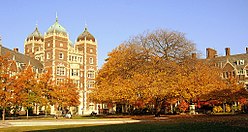
 The university's first purpose-built dormitory in the foreground (on right), built in 1765[80]
 -
-
 Woodland Walk pathway between Hill College House and Lauder College House
 -
 Hill College House, a dormitory designed in 1958 to house female students, was designed by Eero Saarinen
 -
 "The Quad", formerly known as the Men's Dormitory, in 2014
 -
 The Alpha Tau Omega fraternity house, built by George W. Childs Drexel as one of two mansions for his daughters
_(14578281487).jpg)


_-_University_of_Pennsylvania_-_IMG_6638.jpg)
Organization
[edit]| School | Year founded |
|---|---|
| Medicine | 1765[84] |
| Engineering | 1852[85] |
| Law | 1850[note 6] |
| Design | 1868 |
| Dental | 1878[87] |
| Wharton | 1881[88] |
| Arts and Sciences | 1755[89] |
| Veterinary | 1884[90] |
| Social Policy | 1908 |
| Education | 1915 |
| Nursing | 1935 |
| Communication | 1958 |
The College of Arts and Sciences is the undergraduate division of the School of Arts and Sciences. The School of Arts and Sciences also contains the Graduate Division and the College of Liberal and Professional Studies, which is home to the Fels Institute of Government, the master's programs in Organizational Dynamics, and the Environmental Studies (MES) program. Wharton School is the business school of the University of Pennsylvania. Other schools with undergraduate programs include the School of Nursing and the School of Engineering and Applied Science (SEAS).
The current president is J. Larry Jameson (interim).[91]
Campus police
[edit]The University of Pennsylvania Police Department (UPPD) is the largest private police department in Pennsylvania, with 117 members. All officers are sworn municipal police officers and retain general law enforcement authority while on the campus.[92]
Seal
[edit]
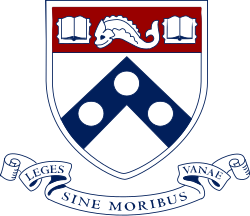
The official seal of the Trustees of the University of Pennsylvania serves as the signature and symbol of authenticity on documents issued by the corporation.[93] The most recent design, a modified version of the original seal, was approved in 1932, adopted a year later and is still used for much of the same purposes as the original.[93] The official seal of the Trustees of the University of Pennsylvania serves as the signature and symbol of authenticity on documents issued by the corporation.[93] A request for one was first recorded in a meeting of the trustees in 1753 during which some of the Trustees "desired to get a Common Seal engraved for the Use of [the] Corporation." In 1756, a public seal and motto for the college was engraved in silver.[94]
The outer ring of the current seal is inscribed with "Universitas Pennsylvaniensis", the Latin name of the University of Pennsylvania. The inside contains seven stacked books on a desk with the titles of subjects of the trivium and a modified quadrivium, components of a classical education: Theolog[ia], Astronom[ia], Philosoph[ia], Mathemat[ica], Logica, Rhetorica and Grammatica. Between the books and the outer ring is the Latin motto of the university, "Leges Sine Moribus Vanae".[93]

Academics
[edit]Penn's "One University Policy" allows students to enroll in classes in any of Penn's twelve schools.[95]
Penn has a strong focus on interdisciplinary learning and research. It offers double degree programs, unique majors, and academic flexibility. Penn's "One University" policy allows undergraduates access to courses at all of Penn's undergraduate and graduate schools except the medical, veterinary and dental schools. Undergraduates at Penn may also take courses at Bryn Mawr, Haverford, and Swarthmore under a reciprocal agreement known as the Quaker Consortium.
Admissions
[edit]| 2022[96] | 2019[97] | 2018[98] | 2017[99] | |
|---|---|---|---|---|
| Applicants | 54,588 | 44,961 | 44,491 | 40,413 |
| Admits | 3,404 | 3,446 | 3,740 | 3,757 |
| Admit rate | 4.24% | 6.66% | 7.41% | 8.30% |
| Enrolled | 2,417 | 2,400 | 2,518 | 2,456 |
| Yield | 68.18% | 69.65% | 67.33% | 65.37% |
| SAT range* | 1510–1560 | 1450–1560 | 1440–1560 | 1420–1560 |
| ACT range* | 34–36 | 33–35 | 32–35 | 32–35 |
* SAT and ACT ranges are from the 25th to the 75th percentile. Undergraduate admissions to the University of Pennsylvania is considered by US News to be "most selective". Admissions officials consider a student's GPA to be a very important academic factor, with emphasis on an applicant's high school class rank and letters of recommendation.[100] Admission is need-blind for U.S., Canadian, and Mexican applicants.[101]
For the class of 2026, entering in Fall 2022, the university received 54,588 applications.[102] The Atlantic also ranked Penn among the 10 most selective schools in the country. At the graduate level, based on admission statistics from U.S. News & World Report, Penn's most selective programs include its law school, the health care schools (medicine, dental medicine, nursing, veterinary), the School of Engineering and Applied Sciences, and the Wharton School.
Coordinated dual-degree, accelerated, interdisciplinary programs
[edit]
Penn offers unique and specialized coordinated dual-degree (CDD) programs, which selectively award candidates degrees from multiple schools at the university upon completion of graduation criteria of both schools in addition to program-specific programs and senior capstone projects. Additionally, there are accelerated and interdisciplinary programs offered by the university. These undergraduate programs include:
- Huntsman Program in International Studies and Business[103]
- Jerome Fisher Program in Management and Technology (M&T)[104]
- Roy and Diana Vagelos Program in Life Sciences and Management (LSM)[105]
- Nursing and Health Care Management (NHCM)[106]
- Roy and Diana Vagelos Integrated Program in Energy Research (VIPER)[107]
- Vagelos Scholars Program in Molecular Life Sciences (MLS)[108]
- Singh Program in Networked and Social Systems Engineering (NETS)[109]
- Digital Media Design (DMD)[110]
- Computer and Cognitive Science: Artificial Intelligence[111]
- Accelerated 7-Year Bio-Dental Program[112]
- Accelerated 6-Year Law and Medicine Program[113]
Dual-degree programs that lead to the same multiple degrees without participation in the specific above programs are also available. Unlike CDD programs, "dual degree" students fulfill requirements of both programs independently without the involvement of another program. Specialized dual-degree programs include Liberal Studies and Technology as well as an Artificial Intelligence: Computer and Cognitive Science Program. Both programs award a degree from the College of Arts and Sciences and a degree from the School of Engineering and Applied Sciences. Also, the Vagelos Scholars Program in Molecular Life Sciences allows its students to either double major in the sciences or submatriculate and earn both a BA and an MS in four years. The most recent Vagelos Integrated Program in Energy Research (VIPER) was first offered for the class of 2016. A joint program of Penn's School of Arts and Sciences and the School of Engineering and Applied Science, VIPER leads to dual Bachelor of Arts and Bachelor of Science in Engineering degrees by combining majors from each school.
For graduate programs, Penn offers many formalized double degree graduate degrees such as a joint J.D./MBA and maintains a list of interdisciplinary institutions, such as the Institute for Medicine and Engineering, the Joseph H. Lauder Institute for Management and International Studies, and the Institute for Research in Cognitive Science.
The School of Social Policy and Practice, commonly known as Penn SP2, is a school of social policy and social work that offers degrees in a variety of subfields, in addition to several dual degree programs and sub-matriculation programs.[114][115][116] Penn SP2's vision is: "The passionate pursuit of social innovation, impact and justice."[117]
Originally named the School of Social Work, SP2 was founded in 1908 and is a graduate school of the University of Pennsylvania. The school specializes in research, education, and policy development in relation to both social and economic issues.[118][119]
The School of Veterinary Medicine offers five dual-degree programs, combining the Doctor of Veterinary Medicine (VMD) with a Master of Social Work (MSW), Master of Environmental Studies (MES), Doctor of Philosophy (PhD), Master of Public Health (MPH) or Masters in Business Administration (MBA) degree. The Penn Vet dual-degree programs are meant to support veterinarians planning to engage in interdisciplinary work in the areas of human health, environmental health, and animal health and welfare.[120]
Academic medical center and biomedical research complex
[edit]In 2018, the university's nursing school was ranked number one by Quacquarelli Symonds.[121] That year, Quacquarelli Symonds also ranked Penn's school of Veterinary Medicine sixth.[122] In 2019, the Perelman School of Medicine was named the third-best medical school for research in U.S. News & World Report's 2020 ranking.[123]
The University of Pennsylvania Health System, also known as UPHS, is a multi-hospital health system headquartered in Philadelphia, Pennsylvania, owned by Trustees of University of Pennsylvania. UPHS and the Perelman School of Medicine at the University of Pennsylvania together constitute Penn Medicine, a clinical and research entity of the University of Pennsylvania. UPHS hospitals include the Hospital of the University of Pennsylvania,[124] Penn Presbyterian Medical Center, Pennsylvania Hospital, Chester County Hospital, Lancaster General Hospital, and Princeton Medical Center.[125] Penn Medicine owns and operates the first hospital in the United States, the Pennsylvania Hospital.[126] It is also home to America's first surgical amphitheatre[127] and its first medical library.[128]
-
 The Pennsylvania Hospital as painted by Pavel Svinyin in 1811
 -

-
 Hospital of the University of Pennsylvania
 -
 Penn-owned Princeton Medical Center, eastern facade


International partnerships
[edit]Students can study abroad for a semester or a year at partner institutions, which include the Singapore Management University, London School of Economics, University of Edinburgh, Chinese University of Hong Kong, University of Melbourne, Sciences Po, University of Queensland, University College London, King's College London, Hebrew University of Jerusalem, and ETH Zurich.
Reputation and rankings
[edit]| Academic rankings | |
|---|---|
| National | |
| Forbes[129] | 10 |
| U.S. News & World Report[130] | 7 |
| Washington Monthly[131] | 3 |
| WSJ/College Pulse[132] | 13 |
| Global | |
| ARWU[133] | 14 |
| QS[134] | 15 |
| THE[136] | 14[135] |
| U.S. News & World Report[137] | 15 |
U.S. News & World Report's 2024 rankings place Penn 6th of 394 national universities in the United States.[130] The Princeton Review student survey ranked Penn in 2023 as 7th in their Dream Colleges list.[138] Penn was ranked 4th of 444 in the United States by College Factual for 2024.[139] In 2023, Penn was ranked as having the seventh-happiest students in the United States and the most happy among all Ivy League universities.[140][141] Wall Street Journal reported in 2024 that Penn's undergraduate alumni earned the 5th highest salaries (taking into account the cost of education and other factors[142]), which was 2nd in Ivy League behind Princeton.[143][verification needed]
Among its professional schools, the school of education was ranked number one in 2021 and Wharton School was ranked number one in 2022[144] and 2024[145] and the communication, dentistry, medicine, nursing, law and veterinary schools rank in the top 5 nationally.[146] Penn's Law School was ranked number 4 in 2023[147] and Penn's School of Design and Architecture, and its School of Social Policy and Practice are ranked in the top 10.[146]
Research
[edit]
Penn is classified as an "R1" doctoral university: "Highest research activity".[148] Its economic impact on the Commonwealth of Pennsylvania for 2015 amounted to $14.3 billion.[149] Penn had research expenditures totaling over $1.9 billion in 2023, raking third among U.S. universities in research and development spending, according to the National Science Foundation.[16] In fiscal year 2019 Penn received $582.3 million in funding from the National Institutes of Health.[150]
Penn's research centers often span two or more disciplines. In the 2010–2011 academic year, five interdisciplinary research centers were created or substantially expanded; these include the Center for Health-care Financing,[151] the Center for Global Women's Health at the Nursing School,[152] the Morris Arboretum's Horticulture Center,[153] the Jay H. Baker Retailing Center at Wharton[154] and the Translational Research Center at Penn Medicine.[155] With these additions, Penn now counts 165 research centers hosting a research community of over 4,300 faculty and over 1,100 postdoctoral fellows, 5,500 academic support staff and graduate student trainees.[10] To further assist the advancement of interdisciplinary research President Amy Gutmann established the "Penn Integrates Knowledge" title awarded to selected Penn professors "whose research and teaching exemplify the integration of knowledge."[156] These professors hold endowed professorships and joint appointments between Penn's schools.
Penn is also among the most prolific producers of doctoral students. With 487 PhDs awarded in 2009, Penn ranks third in the Ivy League behind Columbia and Cornell; Harvard did not report data.[157] It also has one of the highest numbers of post-doctoral appointees (933 in number for 2004–2007), ranking third in the Ivy League (behind Harvard and Yale) and tenth nationally.[158]
In most disciplines Penn professors' productivity is among the highest in the nation and first in the fields of epidemiology, business, communication studies, comparative literature, languages, information science, criminal justice and criminology, social sciences and sociology.[159] According to the National Research Council nearly three-quarters of Penn's 41 assessed programs were placed in ranges including the top 10 rankings in their fields, with more than half of these in ranges including the top five rankings in these fields.[160]
Penn's research tradition has historically been complemented by innovations that shaped higher education. In addition to establishing the first medical school, the first university teaching hospital, the oldest continuously operating degree-granting program in chemical engineering,[161] the first business school, and the first student union, Penn was also the cradle of other significant developments.
In 1852, Penn Law was the first law school in the nation to publish a law journal still in existence (then called The American Law Register, now the Penn Law Review, one of the most cited law journals in the world).[162] Under the deanship of William Draper Lewis, the law school was also one of the first schools to emphasize legal teaching by full-time professors instead of practitioners, a system that is still followed today.[163]
The Wharton School was home to several pioneering developments in business education. It established the first research center in a business school in 1921 and the first center for entrepreneurship in 1973[164] and it regularly introduced novel curricula for which BusinessWeek wrote, "Wharton is on the crest of a wave of reinvention and change in management education."[165][166] The university has also contributed major advancements in the fields of economics and management. Among the many discoveries are conjoint analysis, widely used as a predictive tool especially in market research, Simon Kuznets's method of measuring gross national product,[167] the Penn effect (the observation that consumer price levels in richer countries are systematically higher than in poorer ones) and the "Wharton Model"[168] developed by Nobel-laureate Lawrence Klein to measure and forecast economic activity. The idea behind Health Maintenance Organizations also belonged to Penn professor Robert Eilers, who put it into practice during then-president Nixon's health reform in the 1970s.[167]
Several major scientific discoveries have also taken place at Penn. The university is probably best known as the place where the first general-purpose electronic computer (ENIAC) was born in 1946 at the Moore School of Electrical Engineering.[169] It was here also where the world's first spelling and grammar checkers were created, as well as the popular COBOL programming language.[169]
Penn can also boast some of the most important discoveries in the field of medicine. The dialysis machine used as an artificial replacement for lost kidney function was conceived and devised out of a pressure cooker by William Inouye while he was still a student at Penn Med;[170] the Rubella and Hepatitis B vaccines were developed at Penn;[170] the discovery of cancer's link with genes, cognitive therapy, Retin-A (the cream used to treat acne), Resistin, the Philadelphia gene (linked to chronic myelogenous leukemia) and the technology behind PET Scans were all discovered by Penn Med researchers.[170] More recent gene research has led to the discovery of the genes for fragile X syndrome, the most common form of inherited mental retardation; spinal and bulbar muscular atrophy, a disorder marked by progressive muscle wasting; Charcot–Marie–Tooth disease, a progressive neurodegenerative disease that affects the hands, feet and limbs;[170] and genetically engineered T cells used to treat lymphoblastic leukemia and refractory diffuse large B cell lymphoma.[171][172] Another contribution to medicine was made by Ralph L. Brinster (Penn faculty member since 1965) who developed the scientific basis for in vitro fertilization and the transgenic mouse at Penn and was awarded the National Medal of Science in 2010.
Penn professors Alan J. Heeger, Alan MacDiarmid and Hideki Shirakawa invented a conductive polymer process that earned them the Nobel Prize in Chemistry. The theory of superconductivity was also partly developed at Penn, by then-faculty member John Robert Schrieffer (along with John Bardeen and Leon Cooper).
Penn professors Carl June and Michael C. Milone at Penn Medicine developed Kymriah, the first FDA-approved CAR T cell therapy for treating certain types of leukemia, approved in August 2017.[173][174]
Student life
[edit]| Ethnic enrollment, fall 2018[175] |
Number (percentage) of undergraduates |
|---|---|
| African American | 715 (7.1%) |
| Native American | 12 (0.1%) |
| Asian American and Pacific Islander |
2,084 (20.7%) |
| Hispanic and Latino American |
1,044 (10.4%) |
| White | 4,278 (42.6%) |
| International | 1,261 (12.6%) |
| Two or more races, non-Hispanic |
460 (4.6%) |
| Unknown | 179 (1.8%) |
| Total | 10,033 (100%) |
Of those accepted for admission in 2018, 48 percent were Asian, Hispanic, African-American or Native American.[10] Fourteen percent of entering undergraduates in 2018 were international students.[10] The composition of international first-year students in 2018 was: 46% from Asia; 15% from Africa and the Middle East; 16% from Europe; 14% from Canada and Mexico; 8% from the Caribbean, Central America and South America; 5% from Australia and the Pacific Islands.[10] The acceptance rate for international students admission in 2018 was 493 out of 8,316 (6.7%).[10] In 2018, 55% of all enrolled students were women.[10]
In the last few decades, Jewish enrollment has been declining. c. 1999 about 28% of the students were Jewish.[176] In early 2020, 1,750 Penn undergraduate students were Jewish,[177] which would be approximately 17%[178] of the some 10,000 undergrads for 2019–20. Penn has been ranked as the number one LGBTQ+ friendly school in the country.[179] Penn's LGBTQ+ center is second oldest in the nation[180] and oldest in Commonwealth of Pennsylvania as it has been serving the LGBTQ+ community since 1979 by providing support and guidance through 25 groups (including Penn J-Bagel a Jewish LGBTQ+ group, the Lambda Alliance a general LGBTQ social organization, and oSTEM a group for LGBTQ people in STEM fields).[181] Penn offers courses in Sexuality and Gender Studies which allows students to discover and learn queer theory, history of sexual norms, and other gender orientation related courses.[182]
Penn Face and behavioral health
[edit]The university's social pressure surrounding academic perfection, extreme competitiveness, and nonguaranteed readmission have created what is known as "Penn Face": students put on a façade of confidence and happiness while enduring mental turmoil.[183][184][185][186][187] Stanford University calls this phenomenon "Duck Syndrome".[186][188] In recent years, mental health has become an issue on campus with ten student suicides between the years of 2013 to 2016.[189] The school responded by launching a task force.[190][191] The most widely covered case of Penn Face has been Madison Holleran.[192][193] In 2018, initiatives were enacted to ameliorate mental health problems, such as requiring sophomores to live on campus and the daily closing of Huntsman Hall at 2:00 a.m.[194][195] The university's suicide rate was the catalyst for a 2018 state bill, introduced by Governor Tom Wolf, to raise Pennsylvania's standards for university suicide prevention.[196] The university's efforts to address mental health on campus came into the national spotlight again in September 2019 when the director of the university's counseling services died by suicide six months after starting the position.[197]
Student organizations
[edit]
The Philomathean Society, founded in 1813, is the United States' oldest continuously existing collegiate literary society and continues to host lectures and intellectual events open to the public.[198]
The Daily Pennsylvanian is an independent, student-run newspaper, which has been published daily since it was founded in 1885.[199] The newspaper went unpublished from May 1943 to November 1945 due to World War II.[199] In 1984, the university lost all editorial and financial control of The Daily Pennsylvanian (also known as The DP) when the newspaper became its own corporation.[199] The Daily Pennsylvanian has won the Pacemaker Award administered by the Associated Collegiate Press multiple times, most recently in 2019.[200][201] The DP also publishes a weekly arts and culture magazine called 34th Street Magazine.
The Penn Debate Society (PDS), founded in 1984 as the Penn Parliamentary Debate Society, is Penn's debate team, which competes regularly on the American Parliamentary Debate Association and the international British Parliamentary circuit.[202]
The Penn History Review is a journal, published twice a year, through the Department of History, for undergraduate historical research, by and for undergraduates, and founded in 1991.[203][204][205]
Penn Electric Racing
[edit]
Penn Electric Racing is the university's Formula SAE (FSAE) team, competing in the international electric vehicle (EV) competition. Colloquially known as "PER," the team designs, manufactures, and races custom electric racecars against other collegiate teams. In 2015, PER built and raced their first racecar, REV1, at the Lincoln Nebraska FSAE competition, winning first place.[206] The team repeated their success with their next two racecars: REV2 won second place in 2016,[207] and REV3 won first place in 2017.[208]
Performing arts organizations
[edit]Penn is home to numerous organizations that promote the arts, from dance to spoken word, jazz to stand-up comedy, theatre, a cappella and more. The Performing Arts Council (PAC) oversees 45 student organizations in these areas.[209] The PAC has four subcommittees: A Cappella Council; Dance Arts Council; Singer, Musicians, and Comedians (SMAC); and Theatre Arts Council (TAC-e).
Penn Glee Club
[edit]
The University of Pennsylvania Glee Club, founded in 1862, is tied for fourth oldest continually running glee clubs in the United States[210] and the oldest performing arts group at the University of Pennsylvania.
Each year, the Penn Glee Club writes and produces a fully staged, Broadway-style production with an eclectic mix of Penn standards, Broadway classics, classical favorites, and pop hits, highlighting choral singing from all genders[211]
The Glee Club draws its singing members from the undergraduate and graduate students.
The Penn Glee Club has traveled to nearly all 50 states in the United States and over 40 nations and territories on five continents and has appeared on national television with such celebrities as Bob Hope, Frank Sinatra, Jimmy Stewart, and Ed McMahon. Since its first performance at the White House for President Calvin Coolidge in 1926, the club has sung for numerous heads of state and world leaders.
Penn Band
[edit]
The University of Pennsylvania Band has been a part of student life since 1897.[212] The Penn Band presently mainly performs at football and basketball games as well as university functions (e.g. commencement and convocation). It was the first college band to perform at Macy's Thanksgiving Day Parade, and has performed with notable musicians, including John Philip Sousa, members of the Philadelphia Orchestra, and the U.S. Marine Band ("The President's Own").
Penn Band has performed for Princess Grace Kelly of Monaco (sister and aunt to number of alumni), alumnus and District Attorney and Mayor of Philadelphia, and Governor of Pennsylvania Ed Rendell, Vice President Al Gore, presidents Theodore Roosevelt, Lyndon B. Johnson and Ronald Reagan, and Polish dissident and president Lech Wałęsa.
Penn's a cappella community
[edit]
The A Cappella Council (ACK) is composed of 14 a cappella groups. Penn's a cappella groups entertain audiences with repertoires including pop, rock, R&B, jazz, Hindi, and Chinese songs.[213] ACK is also home to Off The Beat, which has received the most contemporary a cappella recording awards of any collegiate group in the United States and the most features on the Best of College A Cappella albums.[214] Penn Masala, formed in 1996, is world's oldest[215][216] and premier[217][218] South Asian a cappella group based in an American university, which has performed for Barack Obama, Joe Biden, Henry Kissinger, Ban Ki-moon, Farooq Abdullah, Imran Khan, Rajkumar Hirani, A.R. Rahman, Narendra Modi[219] and Sunidhi Chauhan, had their a cappella version of Nazia Hassan's Urdu classic "Aap Jaisa Koi", (originally from the movie Qurbani) sung in the movie American Desi.[220]
Penn alumni Elizabeth Banks (class of 1996) and Max Handelman (Banks' husband, class of 1995) invited Masala to appear in Pitch Perfect 2, as Banks reported that Penn's a capella community inspired the film series starring or produced by Banks and Handleman.[221]
Comedy organizations
[edit]
Mask and Wig, a club founded in 1889, was (until fall of 2021[222]) the oldest all-male musical comedy troupe in the country. In 2021 the club voted to become gender-inclusive, with auditions open to all undergraduates: male, female, and non-binary.
Bloomers comedy group, founded in 1978, is the .".. nation's first collegiate all-women musical and sketch comedy troupe...."[223] Bloomers was founded at Penn by Joan Harrison.[224] In the mid teens, Bloomers revised its constitution to be open to .".. anyone who does not identify as a cisgender man...."[223] and now accepts all persons from under-represented gender identities who perform comedy.[225][226] Bloomers performs sketches and elaborate shows almost every semester. The comedy troupe is named after bloomers, the once popular long, loose fitting undergarment, gathered at the ankle, worn under a short skirt (developed in the mid 19th century as a healthy comfortable alternative to the heavy, constricting dresses then worn by American women), which were in turn, named after Amelia Jenks Bloomer. Bloomers' most well-known performing alumna is Vanessa Bayer, formerly of Saturday Night Live and is SNL's longest-serving female cast member.[227]
Religious and spiritual organizations
[edit]The following religious and spiritual organizations have a significant on campus presence at Penn:
(A) Mainstream Protestantism: Dating back to 1857, The Christian Association (a.k.a. The CA), is composed primarily of students from Mainline Protestant backgrounds.[228] Historically, the CA ran several foreign missions including one in China[229] and for decades ran a camp for socio-economically disadvantaged children from Philadelphia.[230] At present the CA occupies part of the parsonage at Tabernacle United Church of Christ.[231]
(B) Judaism: Organized Jewish life did not begin on campus in earnest until the start of 20th century.[232] Jewish Life on campus is centered at Penn branch of Hillel International,[233][178] which inspires students to explore Judaism, creates patterns of Jewish living that can be sustained after graduation, provides religious communities, promotes educational initiatives, social justice projects, social and cultural opportunities, and groups focusing on Israel education and politics, and hosts a Kosher Penn approved dining hall (supervised by the Community Kashrus of Greater Philadelphia).[234] In addition to Hillel, the other major Jewish organization with significant impact on Penn's campus is The Chabad Lubavitch House at Penn (founded in 1980[235]), which, among other activities, brings together Jewish college students with noted Jewish academics for in-depth discussions and debate.[236]
(C) Roman Catholicism: The Penn Newman Catholic Center (the Newman Center), founded in 1893 (as the first Newman Center in the country) with the mission of supporting students, faculty, and staff in their religious endeavors. The organization brings prominent Christian figures to campus, including Rev. Thomas "Tom" J. Hagan, OSFS, who worked in the Newman Center and founded Haiti-based non-profit Hands Together;[237] and James Martin SJ (Wharton School undergraduate class of 1982[238]). Father Martin, an editor-at-large of the Jesuit magazine America,[239] and frequent commentator on the life and teachings of Jesus and Ignatian spirituality, is especially well known for his outreach to the LGBT community, which has drawn a strong backlash from parts of the Catholic Church, but has provided comfort to Penn students and other members of Roman Catholic community who wish to stay connected with their faith and identify as LGBQT.[240][241][242]
(D) Hinduism and Jainism: Penn funds (via the Graduate and Professional Student Assembly or similar undergraduate organization) a variety of official clubs focused on India including a number focused on students who are Hindu or Jain such as: (1) 'Pan-Asian American Community House (PAACH)', a center for students to celebrate South Asian, East Asian, Southeast Asian, culture and religion,[243] (2) 'Rangoli—The South Asian Association at Penn' that educates and informs Penn students (mainly graduate and professional students) with ancestry or interest in South Asia whose goals include a desire to "rekindle the spirit of community" through events,[244] and (3) 'Penn Hindu & Jain Association', a student-run official club at Penn that has 80 to 110 student members and an extensive alumni network, dedicated to raise awareness of the Hindu and Jain faiths and foster further development of these communities in the greater Philadelphia area by providing a variety of services and hosting a number of events such as Holi Festival (which has been held annually at Penn since 1993[245][246][247]) and "... aims to be a home to anyone seeking to explore their spiritual, religious, or social interests."[248]
(E) Islam: In 1963, the Muslim Students' Association (MSA National) and Penn chapter of MSA National were founded to facilitate Muslim life among students on college campuses.[249][250] Penn MSA was established to help Penn Muslims build faith and community by fostering a space under the guidance of Islamic principles[251][252] and towards that goal Penn MSA supports mission of its related umbrella organization, Islamic Society of North America, to "foster the development of the Muslim community, interfaith relations, civic engagement, and better understandings of Islam."[253] The Muslim Life Program at Penn also provides such support and helped cause Penn (in January 2017) to hire its first full-time Muslim chaplain, the co-president of the Association of Campus Muslim Chaplains, Sister Patricia Anton (whose background includes working with Muslim, interfaith, academic and peace-building institutions such as Islamic Society of North America and Islamic Relief). Chaplain Anton's mandate includes supporting and guiding the Penn Muslim community to foster further development of such community by creating a welcoming environment that provides Penn Muslim community opportunities to intellectually and spiritually engage with Islam.[254] Penn also has a residential house, the Muslim Life Residential Program, which provides a live/learn environment focused on the appreciation of Islamic culture, food, history, and practice, and shows its Penn student residents how Islam is deeply integrated in the culture of Philadelphia so they may appreciate how Islam influences daily life.[255]
(F) Buddhism: Penn has a Buddhist chaplain[256][257] (as well as chaplains of other faiths) and funds the Penn Meditation and Buddhism Club, which (1) is dedicated to helping Penn students practice mindfulness and meditation and learning about Buddhism, (2) conducts weekly meetings that begin with a guided meditation and are followed by discussions of topic(s) relating to mindfulness and Buddhism, and (3) organizes other activities such as ramen nights and weekend meditation retreats to the local Won Buddhism center.[258]
Athletics
[edit]Penn's sports teams are nicknamed the Quakers, but the teams are often also referred to as The Red and Blue as reflected in the popular song sung after every athletic contest where the Penn Band or other musical groups are present.[259][260] The athletes participate in the Ivy League and Division I (Division I FCS for football) in the NCAA. In recent decades, they often have been league champions in football (14 times from 1982 to 2010) and basketball (22 times from 1970 to 2006). The first athletic team at Penn was the cricket team, which formed in 1842 and played regularly through 1846, the year it lost its "grounds", and then only played intermittently until 1864, the year it played its first intercollegiate game (against Haverford College).[261]

The rowing (or crew) team composed of Penn students but not officially representing Penn was formed in 1854 but did not compete against other colleges as official part of Penn until 1879. The rugby football team began to play against other colleges, most notably against College of New Jersey (now Princeton University) in 1874 using a combination of association football (i.e. soccer) and rugby rules (the twenty players on each side were able to use their hands but were not able to pass or bat the ball forward).[262][263][264]
Baseball
[edit]
The University of Pennsylvania's first baseball team was fielded in 1875. Penn has won four championships in the Eastern Intercollegiate Baseball League, a baseball-only conference that existed from 1930 to 1992, which consisted of the eight Ivy League schools and Army and Navy.[265]
Since 1992, Penn baseball has claimed an Ivy League title, advancing to the NCAA Division I Baseball Championship five times.[266]
Basketball
[edit]_(14796131623).jpg)
Penn basketball is steeped in tradition. Penn was retroactively recognized as the pre-NCAA tournament national champion for the 1919–20 and 1920–21 seasons by the Helms Athletic Foundation and for the 1919–20 season by the Premo-Porretta Power Poll.[268] Penn made its only (and the Ivy League's second) Final Four appearance in 1979, where the Quakers lost to Magic Johnson-led Michigan State in Salt Lake City. (Dartmouth twice finished second in the tournament in the 1940s, but that was before the beginning of formal League play.) Penn's team is also a member of the Philadelphia Big 5, along with La Salle, Saint Joseph's, Temple, Villanova, and Drexel. In 2007, the men's team won its third consecutive Ivy League title and then lost in the first round of the NCAA Tournament to Texas A&M. Penn last made the NCAA tournament in 2018 where it lost to top seeded Kansas.[269]
Cricket
[edit]
The first University of Pennsylvania cricket team, reported to be the first cricket team in the United States composed exclusively of Americans,[270] was organized in 1842.[270]
On May 7, 1864, Penn played its first intercollegiate game against Haverford College (the 3rd oldest intercollegiate athletic contest after Harvard Yale 1852 crew race and Amherst Williams 1859 Baseball game[271][261]).[272][273] After Penn moved west of the Schuylkill River in 1872, Penn played cricket at one of the local clubs, Belmont Cricket Club, Merion Cricket Club, Germantown Cricket Club, or at Haverford College.[272] Beginning in 1875 and through 1880, Penn fielded a varsity eleven, which played a few matches each year against opponents that included Haverford College and Columbia College.[261]
In 1881, Penn, Harvard College, Haverford College, Princeton College (then known as College of New Jersey), and Columbia College formed the Intercollegiate Cricket Association,[273] which Cornell University later joined.[261] Penn won The Intercollegiate Cricket Association championship, the de facto national championship, 23 times (18 solo, three shared with Haverford and Harvard, one shared with Haverford and Cornell, and one shared with just Haverford) during the 44 years that The Intercollegiate Cricket Association existed from 1881 through 1924.[note 7]
In the 1890s, Penn's cricket team frequently toured Canada and the British Isles.[261] Perhaps the university's most famous cricket player was George Patterson (class of 1888), who still holds the North American batting record and who went on to play for the professional Philadelphia Cricket Team.[274]
Following the World War I, cricket began to experience a serious decline,[275] such that in 1924 Penn fielded its last team in the twentieth century. Starting in 2009, however, Penn once again fielded a cricket team, albeit club, that ended up being the first winner of a tournament for teams from the Ivies.[276]
Curling
[edit]University of Pennsylvania Curling Club qualified for the 2023 National Championship at 6th place, the same ranking they qualified for the 2022 National Championship (where they finished in 2nd place), but in 2023 the team won the national championship by defeating arch rival Princeton University in the championship match (6 to 3).[277][278] Penn Curling also won the National Championship in 2016 and is the only East Coast team to have won the Curling National Championship.[279]
Football
[edit]
Penn first fielded a football team against Princeton at the Germantown Cricket Club in Philadelphia on November 11, 1876.[280]
During the 1890s, Penn's coach and alumnus George Washington Woodruff introduced the quarterback kick, a forerunner of the forward pass, as well as the place-kick from scrimmage and the delayed pass.
The achievements of two of Penn's other outstanding players from that era, John Heisman, a Law School alumnus, and John Outland, a Penn Med alumnus, are remembered each year with the presentation of the Heisman Trophy to the most outstanding college football player of the year, and the Outland Trophy to the most outstanding college football interior lineman of the year.
The Bednarik Award, named for Chuck Bednarik, a three-time All-American center and linebacker who starred on the 1947, is awarded annually to college football's best defensive player. Bednarik went on to play for 12 years with the Philadelphia Eagles, and was elected to the Pro Football Hall of Fame in 1969.
Penn's game against University of California, Berkeley on September 29, 1951, in front of a crowd of 60,000 at Franklin Field, was first college football game to be broadcast in color.[281][282]
Ice hockey
[edit]
Penn's first ice hockey team competed during the 1896–97 academic year, and joined the nascent Intercollegiate Hockey Association (IHA) in 1898–99. On the first team in 1896–97 were several players of Canadian background, among them middle-distance runner and Olympian George Orton (the first disabled person to compete in the Olympics). Penn fielded teams intermittently until 1965 when it formed a varsity squad that was terminated in 1977. Penn now fields a club team that plays in the American Collegiate Hockey Association Division II,[283] is a member of the Colonial States College Hockey Conference, and continues to play at the Class of 1923 Arena in Philadelphia.[284]
Olympic athletes
[edit],_1907_ICAA_point_winners_UPenn.jpg)
At least 43 Penn alumni have earned 81 Olympic medals (26 gold).[286][note 8] Penn won more of its "medals"[286] (which were actually cups, trophies, or plaques, as medals were not introduced until a later Olympics) at 1900 Summer Olympics held in Paris than at any other Olympics.[287] In the 2024 Summer Olympics in Paris, 13 Penn present students or alumni participated in 5 sports (athletics [4], breaking [1], fencing [3], rowing [4], and swimming [1] for 7 countries (Australia [1], Bermuda [1], Canada [2], Egypt [1], Nigeria [1], Slovenia [1], and USA [6])[288]
Rowing
[edit]
Rowing at Penn dates back to at least 1854 with the founding of the University Barge Club. The university currently hosts both heavyweight and lightweight men's teams and an open weight women's team, all of which compete as part of the Eastern Sprints League. Ellis Ward was Penn's first intercollegiate crew coach from 1879 through 1912.[290] During the course of Ward's coaching career at Penn his .".. Red and Blue crews won 65 races, in about 150 starts."[291] Ward coached Penn's 8-oared boat to the finals of the Grand Challenge Cup (the oldest and most prized trophy) at the Henley Royal Regatta (but in that final race was defeated by the champion Leander Club).[292]
Penn Rowing has produced a long list of famous coaches and Olympians. Members of Penn crew team, rowers Sidney Jellinek, Eddie Mitchell, and coxswain, John G. Kennedy, won the bronze medal for the United States at 1924 Olympics.[293]
Joe Burk (class of 1935) was captain of Penn crew team, winner of the Henley Diamond Sculls twice, named recipient of the James E. Sullivan Award for nation's best amateur athlete in 1939, and Penn coach from 1950 to 1969. The 1955 Men's Heavyweight 8, coached by Joe Burk, became one of only four American university crews in history to win the Grand Challenge Cup at the Henley Royal Regatta. The outbreak of World War Two canceled the 1940 Olympics for which Burk was favored to win the gold medal.
Other Penn Olympic athletes and or Penn coaches of such athletes include: (a) John Anthony Pescatore (who competed in the 1988 Seoul Olympic Games for the United States as stroke of the men's coxed eight which earned a bronze medal[294] and later competed at the 1992 Barcelona Olympic Games in the men's coxless pair), (b) Susan Francia (winner of gold medals as part of the women's 8 oared boat at 2008 Olympics and 2012 Olympics), (c) Regina Salmons (member of 2021 USA team),[295] (d) Rusty Callow, (e) Harry Parker, (f) Ted Nash,[293] and (g) John B. Kelly Jr., son of John B. Kelly Sr. (winner of three medals at 1920 Summer Olympics) and brother of Princess Grace of Monaco, was the second Penn Crew alumnus to win the James E. Sullivan Award[296] for being nation's best amateur athlete (in 1947), who was winner of a bronze medal at the 1956 Summer Olympics).
Penn men's crew team won the National Collegiate Rowing Championship in 1991. A member of that team, Janusz Hooker (Wharton School class of 1992)[297] won the bronze medal in Men's Quadruple Sculls for Australia at the 1996 Summer Olympics.[298] The Penn teams presently row out of College Boat Club, No. 11 Boathouse Row.
Rugby
[edit]
The Penn men's rugby football team is one of the oldest collegiate rugby teams in the United States. Penn first fielded a team in mid-1870s playing by rules much closer to the rugby union and association football code rules relative to American football rules (as such American football rules had not yet been invented[262]). Among its earliest games was a game against the College of New Jersey, which became Princeton in 1895, played in Philadelphia on Saturday, November 11, 1876, which was less than two weeks before Princeton met on November 23, 1876, with Harvard and Columbia to confirm that all their games would be played using the rugby union rules.[280][262] Princeton and Penn played their November 1876 game per a combination of rugby (there were 20 players per side and players were able to touch the ball with their hands) and Association football codes. The rugby code influence was due, in part, to the fact that some of their students had been educated in English public schools.[300] Among the prominent alumni to play in a 19th-century version of rugby in which rules then did not allow forward passes or center snaps was John Heisman, namesake of the Heisman Trophy and an 1892 graduate of the University of Pennsylvania Law School.[301]
Heisman was instrumental in the first decade of the 20th century in changing the rules to more closely relate to the present rules of American football.[302] One of Heisman's teammates (who was unanimously voted Captain in the fall after Heisman graduated) was Harry Arista Mackey, Penn Law class of 1893[303] (who subsequently served as Mayor of Philadelphia from 1928 to 1932).[304] In 1906, Rugby per Rugby Union code was reintroduced to Penn[305] (as Penn last played per Rugby Union Code in 1882 as Penn played rugby per a number of different rugby football rulebooks and codes from 1883 through 1890s[306]) by Frank Villeneuve Nicholson (Penn Dental School (class of 1910)),[307] who in 1904 had captained the Australian national rugby team in its match against England.[308]
Penn played per rugby union code rules at least through 1912, contemporaneously with Penn playing American gridiron football. Evidence of such may be found in an October 22, 1910, Daily Pennsylvanian article (quoted below) and a yearbook photo[309] that rugby per rugby union code was played.
Such is the devotion to English rugby football on the part of University of Pennsylvania's students from New Zealand, Australia, and England that they meet on Franklin Field at 7 o'clock every morning and practice the game. The varsity track and football squads monopolize the field to such an extent that the early hours of the morning are the only ones during which the rugby enthusiasts can play. Any time except Friday, Saturday and Sunday, a squad of 25 men may be seen running through the hardest kind of practice after which they may divide into two teams and play a hard game. Once a week, captain CC Walton, ('11), dental, who hails from New Zealand, gives the enthusiastic players a blackboard talk in which he explains the intricacies of the game in detail.[310]
The player-coach of United States Olympic gold-winning rugby team at the 1924 Summer Olympics was Alan Valentine, who played rugby while at Penn (which he attended during 1921/1922 academic year) as he was getting a master's degree at Wharton.[286]
Though Penn played rugby per rugby union rules from 1929 through 1934,[311] there is no indication that Penn had a rugby team from 1935 through 1959 when Penn men's rugby became permanent due to leadership of Harry "Joe" Edwin Reagan III[312] Penn's College class of 1962 and Penn Law class of 1965, who also went onto help create and incorporate (in 1975) and was Treasurer (in 1981) of USA Rugby and Oreste P. "Rusty" D'Arconte Penn's College class of 1966.[309] Thus, with D'Arconte's hustle and Reagan's charisma and organizational skills, a team, which had fielded a side of fifteen intermittently from 1912 through 1960, became permanent.
In spring of 1984, Penn women's rugby,[313][314] led by Social Chair Tamara Wayland (College class of 1985,[315] who subsequently became the women's representative to and vice president of USA Rugby South from 1996 to 1998); club president Marianne Seligson; and Penn Law student Gigi Sohn,[316] began to compete. Penn women's rugby team is coached, as of 2020, by (a) Adam Dick,[317] a 300-level certified coach with over 15 years of rugby coaching experience including being the first coach of the first women's rugby team at the University of Arizona and who was a four-year starter at University of Arizona men's first XV rugby team and (b) Philly women's player Kate Hallinan.
Penn's men's rugby team plays in the Ivy Rugby Conference[318] and have finished as runners-up in both 15s and 7s in the Conference and won the Ivy Rugby Tournament in 1992.[319] As of 2011[update], the club uses the state-of-the-art facilities at Penn Park. The Penn Quakers' rugby team played on national TV at the 2013 Collegiate Rugby Championship, a college rugby tournament that for a number of years had been played each June at Subaru Park in Philadelphia, and was broadcast live on NBC. In their inaugural appearance in the tournament, the Penn men's rugby team won the Shield Competition, beating local Big Five rival, Temple University, 17–12 in the final. In the semifinal match of that Shield Competition, Penn Rugby became the first Philadelphia team to beat a non-Philadelphia team in CRC history, with a 14–12 win over the University of Texas.[320]
As of 2020, Penn men's rugby team is coached by Tiger Bax,[321] a former professional rugby player hailing from Cape Town, South Africa, whose playing experience includes stints in the Super Rugby competition with the Stormers (15s) and Mighty Mohicans (7s), as well as with the Gallagher Premiership Rugby side, Saracens[322] and whose coaching experience includes three successful years as coach at Valley Rugby Football Club in Hong Kong; and Tyler May, from Cherry Hill, New Jersey, who played rugby at Pennsylvania State University where he was a first XV player for three years.
Penn's graduate business and law schools also fielded rugby teams. The Wharton rugby team has competed from 1978 to the present.[323] The Penn Law Rugby team (1985 through 1993) counts among its alumni Walter Joseph Jay Clayton, III[324] Penn Law class of 1993, and chair of the U.S. Securities and Exchange Commission from May 4, 2017, until December 23, 2020, Raymond Hulser, former Chief of Public Integrity Section of United States Department of Justice[325] (who also was hired by DOJ special counsel Jack Smith to investigate the alleged mishandling by former President Donald J. Trump of certain top secret documents),[326] and Magistrate Judge Bruce Reinhart[327] who approved the search of Mar-a-Lago, the residence of current U.S. president Donald Trump in Palm Beach, Florida.[328]
Undergraduate Penn Rugby Alumni include (1) Conor Lamb (Penn College class of 2006 and Penn Law class of 2009), who played for undergraduate team, and, as of 2021, is a member of United States House of Representatives, elected originally to Pennsylvania's 18th congressional district, since 2019 is a U.S. Representative from Pennsylvania's 17th congressional district and (2) Argentina's richest person,[329] Marcos Galperin (Wharton Undergraduate Class of 1994), a premier player on the 1992 Ivy League Tournament championship team,[330] who founded Mercado Libre,[331] an online marketplace dedicated to e-commerce and online auction, which, as of 2016,[332] is the most popular e-commerce site in South America by number of visitors.[333]
Facilities
[edit]
Franklin Field, with a present seating capacity of 52,593,[334] is where the Quakers play football, lacrosse, sprint football and track and field (and formerly played baseball, field hockey, soccer, and rugby). It is the oldest stadium still operating for college football games,[17] first stadium to sport two tiers,[335] first stadium in the country to have a scoreboard, second stadium to have a radio broadcast of football, first stadium from which a commercially televised football game was broadcast,[334] and first stadium from which college football game was broadcast in color.[281] Franklin Field also played host to the Philadelphia Eagles from 1958 to 1970.[334] Since 1895, Franklin Field has hosted the annual collegiate track and field event "the Penn Relays", which is the oldest and largest track and field competition in the United States.[336]

Penn's Palestra is home gym of the Penn Quakers men's and women's basketball and volleyball teams, wrestling team, Philadelphia Big Five basketball, and other high school and college sporting events, and is located mere yards from Franklin Field.[338] The Palestra has been called "the most important building in the history of college basketball" and "changed the entire history of the sport for which it was built".[339] The Palestra has hosted more NCAA Tournament basketball games than any other facility.
Penn's River Fields hosts a number of athletic fields including the Rhodes Soccer Stadium, the Ellen Vagelos C'90 Field Hockey Field, and Irving "Moon" Mondschein Throwing Complex.[340] Penn baseball plays its home games at Meiklejohn Stadium at Murphy Field.
Penn's Class of 1923 Arena (with seating for up to 3,000 people) was built to host the University of Pennsylvania Varsity Ice Hockey Team, which has been disbanded, and now hosts or in the past hosted: Penn's Men's and Penn Women's club ice hockey teams, practices or exhibition games for the Philadelphia Flyers, Colorado Avalanche and Carolina Hurricanes, roller hockey for the Philadelphia Bulldogs professional team, and rock concerts such as one in 1982 featuring Prince.[341][342][343]

People
[edit]Notable people
[edit] |
Penn alumni, faculty and trustees include those who have distinguished themselves in the sciences, academia, politics, business, military, sports, arts, and media.
Since its founding, Penn alumni, trustees, and faculty have included eight Founding Fathers of the United States who signed the Declaration of Independence,[18] seven who signed the United States Constitution,[18] and 24 members of the Continental Congress.
Penn alumni include two presidents of the United States (William Henry Harrison,[note 5] and Donald Trump), 32 U.S. senators, 163 members of the U.S. House of Representatives, 19 U.S. Cabinet Secretaries, 46 governors, and 28 State Supreme Court justices, 36 billionaires,[21][345] and as of 2023[update] there have been 38 Nobel laureates affiliated (see List of Nobel laureates by university affiliation) with the University.[346][347]
Prior to becoming president of the United States, Joe Biden was a Benjamin Franklin Presidential Practice Professor at University of Pennsylvania, where he led the Penn Biden Center for Diplomacy and Global Engagement, a center focused principally on diplomacy, foreign policy, and national security.[348]
Nine foreign heads of state attended Penn (including former prime minister of the Philippines, Cesar Virata; first president of Nigeria, Nnamdi Azikiwe; first president of Ghana, Kwame Nkrumah, former Prime Minister of Latvia, Krišjānis Kariņš, former President of Panama, Ernesto Pérez Balladares, former President of Argentina, Mauricio Macri, former President of Estonia, Toomas Hendrik Ilves, and the current president of Ivory Coast, Alassane Ouattara.[349] [citation needed]
Penn alumni or faculty also include three United States Supreme Court justices (William J. Brennan, Owen J. Roberts, and James Wilson) and four Supreme Court justices of foreign nations, (including Ronald Wilson of the High Court of Australia, Ayala Procaccia of the Israel Supreme Court, Yvonne Mokgoro, former justice of the Constitutional Court of South Africa, and Irish Court of Appeal justice Gerard Hogan).[citation needed]
Penn alumni in business, finance and investment banking include Warren Buffett[note 9] (CEO of Berkshire Hathaway), Elon Musk (CEO of Tesla, cofounder of OpenAI and Neuralink, founder of SpaceX, The Boring Company and xAI), and Sundar Pichai (CEO of Alphabet and Google).[350]
Penn alumni have won 53 Tony Awards,[351][352] 17 Grammy Awards,[353] 25 Emmy Awards,[354][355] 13 Oscars, and 1 EGOT (John Legend[356]).[note 10]
In the military, Penn alumni include Samuel Nicholas, "founder" of United States Marine Corps[357] and William A. Newell, whose congressional action formed a predecessor to the current United States Coast Guard.[358] Two Penn alumni have been NASA astronauts,[359] and five Penn alumni have been awarded the Medal of Honor.[22][23]

At least 43 different Penn alumni have earned 81 Olympic medals (26 gold).[286][note 11]
Penn's alumni also include poets Ezra Pound and William Carlos Williams, civil rights leader Martin Luther King, Jr., linguist and political theorist Noam Chomsky, architect Louis Kahn, cartoonist Charles Addams, actresses Candice Bergen and Elizabeth Banks, and educator Alice West Fleet, one of the first black women to obtain a master’s degree in the university.
Alumni organizations
[edit]Penn has over 120 international alumni clubs in 52 countries and 37 states, which offer opportunities for alumni to reconnect, participate in events, and work on collaborative initiatives.[361] In addition, in 1989, Penn bought a 14-story clubhouse building (purpose-built for Yale Club) in New York City from Touro College for $15 million[362] to house Penn's largest alumni chapter. After raising a separate $25 million (including $150,000+ donations each from such alumni as Estee Lauder heirs Leonard Lauder and Ronald Lauder, Saul Steinberg, Michael Milken, Donald Trump, and Ronald Perelman) and two years of renovation,[363] the Penn Club of New York moved to its current location at 30 West 44th Street on NYC's Clubhouse Row.[364]
See also
[edit]

Notes
[edit]- ^ see "Statutes of the Trustees". University of Pennsylvania. Retrieved September 12, 2022.
- ^ a b The university officially uses 1740 as its founding date and has since 1899. The ideas and intellectual inspiration for the academic institution stem from 1749, with a pamphlet published by Benjamin Franklin (1705/1706–1790). When Franklin's institution was established, it inhabited a schoolhouse built on November 14, 1740, for another school, which never came to practical fruition.[5] Penn archivist Mark Frazier Lloyd noted, "In 1899, UPenn's Trustees adopted a resolution that established 1740 as the founding date, but good cases may be made for 1749, when Franklin first convened the Trustees, or 1751, when the first classes were taught at the affiliated secondary school for boys, Academy of Philadelphia, or 1755, when Penn obtained its collegiate charter to add a post-secondary institution, the College of Philadelphia."[6] Princeton's library presents another diplomatically-phrased view.[7]
- ^ The registered trademark as the primary substitute for using the University's full name; it is part of the university's official brand.[14]
- ^ From The Pennsylvania Gazette: "The University's online style guide says that while Penn is the officially sanctioned term, UPenn is 'permissible ... in situations where it may help to distinguish Penn from other universities within the Commonwealth of Pennsylvania."[15] UPenn is the element used in the university's domain name.
- ^ a b William Henry Harrison studied medicine at Penn from 1790 until his father died in 1791; after his father's death Harrison left the University to join the army.[344]
- ^ In 1790, the first lecture on law was given by James Wilson; however, a full time program was not offered until 1850.[86]
- ^ Haverford won such championships nineteen times: three shared with Penn and Harvard, one shared with Penn and Cornell, and one shared with Penn. In third place, Harvard won it six times, none after 1899, three of these shared with Haverford and Penn.
- ^ See list of University of Pennsylvania people athletics section for list of Penn Olympic medal winners, replete with hyperlinks.
- ^ Buffett studied at Penn for two years before he transferred to the University of Nebraska.
- ^ See List of University of Pennsylvania people 'Arts, media, and entertainment' section for list of Penn alumni who earned Emmy, Grammy, Oscar, and Tony award winners, replete with hyperlinks.
- ^ See list of University of Pennsylvania people athletics section for list of Penn Olympic medal winners, replete with hyperlinks.
References
[edit]- ^ "Frequently Asked Questions | Office of the University Secretary".
- ^ Record of the Jubilee Celebrations of the University of Sydney. Sydney, New South Wales: William Brooks and Co. 2009 [1903]. ISBN 9781112213304.
- ^ Actes du Jubilé de 1909 (in Swiss French). Geneva, Switzerland: Georg Keck & Cie. 2016 [1910]. ISBN 9781360078335.
- ^ "Penn in the 18th Century". upenn.edu. Archived from the original on April 28, 2006. Retrieved July 20, 2021.
- ^ "Penn History Exhibits". University Archives and Records Center. Archived from the original on August 22, 2019. Retrieved January 31, 2019.
- ^ "A Penn Trivial Pursuit – Penn Current". June 3, 2011. Archived from the original on June 3, 2011.
- ^ Weeren, John (March 19, 2003) [20 July 2001]. "Seeley G. Mudd Library: FAQ Princeton vs. University of Pennsylvania: Which is the Older Institution?". Princeton University. Archived from the original on March 19, 2003.
- ^ "About Us Penn Office of Investments". Penn Office of Investments. June 30, 2025. Retrieved October 11, 2025.
- ^ "Operating Budget". Office of Budget and Management Analysis, University of Pennsylvania. Archived from the original on October 9, 2023. Retrieved December 10, 2023.
- ^ a b c d e f g h "Penn: Penn Facts". University of Pennsylvania. Archived from the original on October 23, 2019. Retrieved January 18, 2020.
- ^ "Facts". University of Pennsylvania. Archived from the original on January 24, 2020. Retrieved February 1, 2020.
- ^ a b c "Common Data Set 2022–2023" (PDF). University of Pennsylvania. Archived (PDF) from the original on August 3, 2023. Retrieved September 12, 2023.
- ^ "Elements of the Penn Logo". Branding.Web-Resources.UPenn.edu. Retrieved November 14, 2022.
- ^
- "Penn Brand Standards". UPenn Web Resources. University of Pennsylvania. Archived from the original on April 18, 2022. Retrieved December 19, 2023.
- UPenn Brand Guidelines, University of Pennsylvania, September 2022
- ^ Yagoda, Ben (August 29, 2017). "Penn v. UPenn". The Pennsylvania Gazette. Archived from the original on November 4, 2021. Retrieved June 30, 2024.
- ^ a b "Higher Education Research and Development: Fiscal Year 2023". National Center for Science and Engineering Statistics. November 25, 2024. Retrieved November 26, 2024.
- ^ a b Northam, Mitchell (July 26, 2022). "These are the 10 oldest stadiums in Division I college football". NCAA. Archived from the original on October 4, 2023. Retrieved September 13, 2023.
- ^ a b c d "Penn Notables: Penn Signers of the Declaration of Independence and the Constitution". Penn University Archives and Records Center. Penn Libraries, University of Pennsylvania. Archived from the original on June 4, 2024. Archived March 7, 2017, at the Wayback Machine
- ^ two as students: William Henry Harrison see note 5, and Donald J. Trump and one as Professor: Joseph R. Biden https://www.nytimes.com/2021/07/02/us/politics/biden-ambassador-germany-gutmann.html?smid=nytcore-
- ^ see list with citations in Notable People section
- ^ a b "Nearly a fifth of America's billionaires went to just 5 colleges". Quartz. June 9, 2024. Slide 1: University of Pennsylvania. Retrieved June 10, 2024.
- ^ a b Ahern, Joseph-James; Hawley, Scott W. (January 2011). "Congressional Medals of Honor, Recipients from the Civil War". University Archives and Records Center. Penn Libraries, University of Pennsylvania. Archived from the original on January 23, 2019. Retrieved October 9, 2020.
- ^ a b "Frederick C. Murphy, Our Facility's Namesake". archives.gov. National Archives at Boston. August 15, 2016. Retrieved October 14, 2023.
- ^ see second footnote 9 in Extracts from the Benjamin Franklin published Pennsylvania Gazette, (January 3 to December 25, 1740) – Founders Online https://founders.archives.gov/documents/Franklin/01-02-02-0065 Archived August 26, 2023, at the Wayback Machine "Note: The annotations to this document, and any other modern editorial content, are copyright the American Philosophical Society and Yale University. All rights reserved."
- ^ Montgomery, Thomas Harrison (1900). A History of the University of Pennsylvania from Its Foundation to A. D. 1770. Philadelphia: George W. Jacobs & Co. LCCN 00003240.
- ^ Friedman, Steven Morgan. "A Brief History of the University, University of Pennsylvania Archives". Archives.upenn.edu. Archived from the original on January 2, 2010. Retrieved December 9, 2010.
- ^ Wood, George Bacon (1834). The History of the University of Pennsylvania, from Its Origin to the Year 1827. McCarty and Davis. p. 13. LCCN 07007833. OCLC 760190902.
- ^ "Walter Cope". Archived from the original on March 23, 2023. Retrieved March 23, 2023.
- ^ "John Stewardson". University Archives and Records Center. Penn Libraries, University of Pennsylvania. Archived from the original on March 23, 2023. Retrieved March 23, 2023.
- ^ Cope & Stewardson (fl. 1885–1912) data from the Philadelphia Architects and Buildings (PAB) project of the Athenaeum of Philadelphia
- ^ Stassen was quoted in Volume 47, no. 4 (December 1948) issue: [pages 13-15] of the Pennsylvania Gazette that Locust Walk would make Penn, “one of the most beautiful metropolitan campuses in the world. The plan will result in a campus that is both utilitarian and beautiful.” see https://archives.upenn.edu/digitized-resources/docs-pubs/institutional-planning/gazette-expansion-plans-revealed-1948/ retrieved December 5, 2024
- ^ Leong, Jeanne (October 22, 2015). "For the Record: Locust Walk". University of Pennsylvania. Retrieved December 5, 2024.
- ^ Clarke, Dominique (September 26, 2011). "Wistar strategic plan includes new building and research". The Daily Pennsylvanian. Archived from the original on January 21, 2012. Retrieved November 10, 2011.
- ^ "University of Pennsylvania Module 6 Utility Plant and Garage". BLT Architects. Archived from the original on August 12, 2011. Retrieved August 19, 2011.
- ^ Helmer, Madeleine (March 16, 2017). "Tracking The Evolution Of Industry At 34th And Grays Ferry". Pennovation Works University of Pennsylvania. Archived from the original on June 23, 2021. Retrieved March 19, 2021.
- ^ a b "Penn Campus Arboretum at the University of Pennsylvania". arbnet.org. Archived from the original on April 19, 2021. Retrieved March 19, 2021.
- ^ "Tree Campus Higher Education at arborday.org". arborday.org. Archived from the original on December 2, 2023. Retrieved December 19, 2023.
- ^ "Welcome". University of Pennsylvania Facilities & Real Estate. University of Pennsylvania. Archived from the original on March 4, 2021. Retrieved March 19, 2021.
- ^ George E. Thomas (August 1978). "National Register of Historic Places Inventory Nomination Form: Compton and Bloomfield" (PDF). Archived (PDF) from the original on August 14, 2022. Retrieved September 1, 2023.
- ^ "National Historic Landmarks & National Register of Historic Places in Pennsylvania". CRGIS: Cultural Resources Geographic Information System. Archived from the original (Searchable database) on July 21, 2007. Retrieved March 25, 2021. Note: This includes George E. Thomas (June 1991). "Pennsylvania Historic Resource Survey Form: South Brook Farm" (PDF). Archived from the original (PDF) on December 16, 2013. Retrieved December 16, 2012.
- ^ "Barbaro". Archived from the original on April 4, 2023. Retrieved December 19, 2023.
- ^ https://penntoday.upenn.edu/news/reimagining-penn-libraries-brigitte-weinsteiger (accessed April 30, 2025) and "Penn Libraries Visitor Information". Penn Libraries. Archived from the original on March 14, 2022. Retrieved March 14, 2022.
- ^ "Penn Library Data Farm". Archived from the original on March 17, 2011. Retrieved December 24, 2009.
- ^ Data Farm, archived from the original on March 17, 2011
- ^ https://penntoday.upenn.edu/news/reimagining-penn-libraries-brigitte-weinsteiger (accessed April 30, 2025)
- ^ "Penn's Spectacular Architecture – YouTube". youtube.com. March 18, 2011. Archived from the original on December 11, 2021.
- ^ see also Applications for Historical Landmark Status
- ^ "1971 Nomination Form, by George Thomas". Archived from the original on July 29, 2020. Retrieved July 20, 2007.
- ^ Joyce L. White, "Biographical and Historical Background of the Yarnall Library of Theology" (Offprint from The Library Chronicle, University of Pennsylvania, Volume XLIII, number 2, Winter, 1979.)
- ^ Yarnall Library of Theology of St. Clement's Church, Philadelphia: The Ellis Hornor Yarnall Foundation. Press of E. Stern & Company, Incorporated. 1933.
- ^ Lloyd M. Abernethy (1988). Benton Spruance, the Artist and the Man. Associated University Presses. pp. 118–119. ISBN 978-0-87982-517-1.
- ^ "The City of Philadelphia Celebrates 60 Years of Percent for Art" (Press release). City of Philadelphia. April 18, 2019. Archived from the original on June 23, 2021. Retrieved March 16, 2021.
- ^ a b "Campus Sculpture Tour". University of Pennsylvania. Archived from the original on November 12, 2020. Retrieved March 16, 2021.
- ^ "Clarification: A Colorful Collection of Outdoor Sculpture on Penn's Campus". University of Pennsylvania Almanac. October 13, 2015. Retrieved December 4, 2024.
- ^ "Brick House". The High Line. Archived from the original on December 3, 2019. Retrieved February 29, 2020.
- ^ "Towering bronze sculpture installed at the entrance to Penn's campus". Penn Today. November 10, 2020. Archived from the original on May 5, 2021. Retrieved December 19, 2023.
- ^ "Dueling Tees". Archived from the original on April 5, 2023. Retrieved December 19, 2023.
- ^ "'Dueling Tampons' graffitied". The Daily Pennsylvanian. Archived from the original on April 2, 2021. Retrieved March 18, 2021.
- ^ "The Tampons Look Like Tampons: A Public Reminder". thedp.com. Archived from the original on June 5, 2016. Retrieved May 16, 2016.
- ^ a b Shepard, Louisa (August 23, 2019). "Two monumental sculptures arrive on campus". Penn Today. Archived from the original on March 4, 2021. Retrieved March 17, 2021.
- ^ "Social Consciousness". sorocabana.com. Archived from the original on May 24, 2007.
- ^ "aPA to Relocate Nevelson and Epstein Sculptures to Penn". Association for Public Art. July 9, 2019. Archived from the original on March 3, 2021. Retrieved March 17, 2021.
- ^ Strawbridge, Justus C. (2009) [1899]. Ceremonies Attending the Unveiling of the Statue of Benjamin Franklin. Allen, Lane & Scott. ISBN 978-1-103-92435-6. Retrieved November 24, 2007.
justus c strawbridge.
- ^ Hanaway, Joseph; Cruess, Richard L. (1996). McGill Medicine – 1885 to 1936. Montreal: McGill-Queen's University Press. p. 56.
- ^ "Benjamin Franklin in 1723 (or The Young Franklin) (1914)". Association for Public Art. Retrieved December 4, 2024.
- ^ Hertzler, Lauren (April 5, 2021). "Reassessing iconography on campus". Penn Today. Archived from the original on November 27, 2021. Retrieved December 24, 2021. and Snyder, Susan. "Penn to remove statue of slavery supporter, forms group to look at campus iconography'". The Philadelphia Inquirer. and "Campus Iconography Group Report". University of Pennsylvania Almanac. Archived from the original on April 14, 2021. Retrieved April 14, 2021.
- ^ Weisman, Zoey (February 7, 2020). "Penn announces plan to remove statue of slave owner George Whitefield from the Quad". The Daily Pennsylvanian. Archived from the original on April 1, 2021. Retrieved December 24, 2021.
- ^ "Our Museum – Penn Museum". Penn Museum. University of Pennsylvania Museum of Archaeology and Anthropology. Archived from the original on September 4, 2020. Retrieved September 6, 2020.
- ^ a b "About Us". Penn Museum. University of Pennsylvania Museum of Archaeology and Anthropology. Archived from the original on May 21, 2011. Retrieved August 20, 2011.
- ^ "Research at the Penn Museum". Penn Museum. University of Pennsylvania Museum of Archaeology and Anthropology. Archived from the original on August 11, 2011. Retrieved August 20, 2011.
- ^ Crimmins, Peter (June 12, 2019). "Like 'Back to the Future': Penn Museum floats its ancient sphinx to a new home" Archived April 10, 2021, at the Wayback Machine.
- ^ "Curator's Welcome — The Penn Art Collection". Archived from the original on April 4, 2023. Retrieved December 19, 2023.
- ^ "History". Arthur Ross Gallery. Archived from the original on December 21, 2014. Retrieved December 21, 2014.
- ^ "College Houses at Penn" (PDF). College Houses and Academic Services. University of Pennsylvania. Archived from the original (PDF) on October 1, 2011. Retrieved August 19, 2011.
- ^ "College Houses & Academic Services: University of Pennsylvania". Collegehouses.upenn.edu. Archived from the original on August 12, 2013. Retrieved July 23, 2013.
- ^ "Gutmann College House | College Houses & Academic Services". Archived from the original on May 28, 2023. Retrieved June 3, 2023.
- ^ "Penn to Build New College House Near 40th and Walnut Streets: University of Pennsylvania". Archived from the original on January 29, 2019. Retrieved May 15, 2019.
- ^ "Chapters". University of Pennsylvania IFC. August 27, 2020. Archived from the original on June 2, 2021. Retrieved June 2, 2021.
- ^ "Organizations to Join – Office of Fraternity & Sorority Life". Archived from the original on May 17, 2021. Retrieved June 2, 2021.
- ^ "Penn's First Campus, 1749–1801". University Archives and Records Center. Archived from the original on December 12, 2022. Retrieved December 12, 2022.
- ^ Nitzche, George Erazmus (1918). The University of Pennsylvania: Its History, Traditions, Buildings and Memorials (7th ed.). Philadelphia: International Printing Company. pp. 62–74. Retrieved April 5, 2021 – via The Internet Archive.
- ^ "For the Record: Quadrangle dormitories". Penn Today. November 15, 2012. Archived from the original on April 5, 2023. Retrieved December 19, 2023.
- ^ "Graduate and Professional Programs". University of Pennsylvania. Retrieved August 22, 2011.
- ^ Carson, Joseph (1869). . Philadelphia: Lindsay and Blakiston – via Wikisource.
- ^ "History and Heritage". Penn Engineering. University of Pennsylvania School of Engineering and Applied Science. Retrieved August 22, 2011.
- ^ "History of Penn Law school". Penn Law. University of Pennsylvania Law School. Retrieved August 22, 2011.
- ^ "History". Penn Dental Medicine. The Robert Schattner Center University of Pennsylvania School of Dental Medicine. Retrieved August 22, 2011.
- ^ "About Wharton". The Wharton School, University of Pennsylvania. Retrieved August 22, 2011.
- ^ "About the Graduate Division". Penn Arts & Sciences. University of Pennsylvania School of Arts and Sciences. Retrieved August 22, 2011.
- ^ "About Us". Penn Veterinary Medicine. University of Pennsylvania School of Veterinary Medicine. Retrieved August 22, 2011.
- ^ "Perelman School of Medicine Dean J. Larry Jameson named Penn's interim president".
- ^ "Penn Police Department". University of Pennsylvania. Archived from the original on June 3, 2016. Retrieved November 3, 2016.
- ^ a b c d "Frequently Asked Questions: Questions about the University". University of Pennsylvania. Archived from the original on October 31, 2012. Retrieved October 4, 2011.
- ^ Coleman, William (1749–1768). Trustees of the University of Pennsylvania Minute Books, volume 1. University of Pennsylvania Archives: University of Pennsylvania. pp. 36, 68. Archived from the original on June 7, 2012. Retrieved October 5, 2011.
- ^ Meyerson, Martin (January 29, 1973). "Report of the University Development Commission" (PDF). upenn.com. Retrieved June 16, 2018.
- ^ "Common Data Set 2020–2021" (PDF). University of Pennsylvania. June 25, 2021. pp. 35, 11. Archived from the original (PDF) on August 17, 2022. Retrieved January 19, 2022.
- ^ "Common Data Set 2019–2020" (PDF). University of Pennsylvania. May 19, 2020. pp. 35, 11. Archived from the original (PDF) on August 18, 2022. Retrieved January 19, 2022.
- ^ "Common Data Set 2018–2019" (PDF). University of Pennsylvania. March 8, 2019. pp. 35, 11. Archived from the original (PDF) on July 7, 2022. Retrieved January 19, 2022.
- ^ "Common Data Set 2017–2018" (PDF). University of Pennsylvania. November 5, 2018. pp. 35, 11. Archived from the original (PDF) on July 2, 2022. Retrieved January 19, 2022.
- ^ "University of Pennsylvania". U.S. News & World Report: Education. Archived from the original on June 23, 2021. Retrieved February 3, 2021.
- ^ "Financial Aid At Penn". Penn admissions. Archived from the original on December 23, 2019. Retrieved December 23, 2019.
- ^ Tilitei, Leanna. "Penn accepts record-low 5.68% of applicants to the Class of 2025". thedp.com. Archived from the original on March 17, 2022. Retrieved January 19, 2022.
- ^ "The Huntsman Program in International Studies and Business". The Huntsman Program in International Studies and Business. Archived from the original on January 18, 2022. Retrieved January 16, 2022.
- ^ "Home". Jerome Fisher Program in Management & Technology. Archived from the original on January 18, 2022. Retrieved January 16, 2022.
- ^ "Home | Penn Life Sciences & Management Program". lsm.upenn.edu. Archived from the original on January 16, 2022. Retrieved January 16, 2022.
- ^ "Nursing and Healthcare Management Dual Degree Program". nursing.upenn.edu. Archived from the original on January 18, 2022. Retrieved January 16, 2022.
- ^ "VIPER | Vagelos Integrated Program in Energy Research | Vagelos Integrated Program in Energy Research". viper.upenn.edu. Archived from the original on January 16, 2022. Retrieved January 16, 2022.
- ^ "Vagelos MLS Scholars: Frequently Asked Questions". sas.upenn.edu. Archived from the original on January 16, 2022. Retrieved January 16, 2022.
- ^ "Networked & Social Systems Engineering". Archived from the original on January 16, 2022. Retrieved January 16, 2022.
- ^ "CG@Penn | DMD Program". cg.cis.upenn.edu. Archived from the original on November 24, 2021. Retrieved January 16, 2022.
- ^ "Computer and Cognitive Science Dual Degree". Archived from the original on January 18, 2022. Retrieved January 16, 2022.
- ^ "Seven Year Bio-Dental Program | Department of Biology". bio.upenn.edu. Archived from the original on January 18, 2022. Retrieved January 16, 2022.
- ^ "Penn to launch joint degree program in law and medicine". Philly.com. June 22, 2016. Archived from the original on June 23, 2016. Retrieved June 22, 2016.
- ^ "SP2 Programs". Archived from the original on June 22, 2014. Retrieved May 16, 2020.
- ^ "Peterson's National Guide University of Pennsylvania SP2". Petersons. Archived from the original on May 23, 2020. Retrieved May 16, 2020.
- ^ "About the Programs | School of Social Policy & Practice". sp2.upenn.edu. Archived from the original on July 30, 2016. Retrieved June 30, 2016.
- ^ "About SP2". University of Pennsylvania School of Social Policy & Practice. Archived from the original on July 15, 2014. Retrieved May 16, 2020.
- ^ "SP2 Vision". Archived from the original on July 15, 2014. Retrieved May 16, 2020.
- ^ "SP2 School of Social Policy & Practice". Graduate Guide. August 10, 2018. Archived from the original on October 14, 2018. Retrieved May 16, 2020.
- ^ Hackett, Martin (September 11, 2020). "Penn Vet expands timely dual degree during COVID-19 pandemic | Penn Today". Penn Today. Archived from the original on September 29, 2020. Retrieved September 14, 2020.
- ^ Chin, Zachary. "Penn Nursing ranked top in the world, but receives mediocre score for 'employer reputation'". The Daily Pennsylvanian. Archived from the original on February 25, 2020. Retrieved February 25, 2020.
- ^ "QS world university rankings 2018: veterinary science". The Guardian. February 28, 2018. ISSN 0261-3077. Archived from the original on February 25, 2020. Retrieved February 25, 2020.
- ^ Hachenburg, Carmina. "Perelman School of Medicine ranked third place for research in U.S. News report". The Daily Pennsylvanian. Archived from the original on February 25, 2020. Retrieved February 25, 2020.
- ^ Ellison, Alya (September 22, 2021). "Penn Medicine to open $1.6B hospital in October". Becker's Hospital Review. Archived from the original on October 22, 2021. Retrieved December 24, 2021.
- ^ "Hospitals of the University of Pennsylvania-Penn Presbyterian". U.S. News & World Report. Archived from the original on February 13, 2022. Retrieved December 24, 2021.
- ^ Williams, William Henry (1976). America's First Hospital: The Pennsylvania Hospital, 1751–1841. Haverford House. ISBN 9780910702027.
- ^ "Visitor Information for Pennsylvania Hospital". University of Pennsylvania. Penn Medicine. Archived from the original on March 4, 2016. Retrieved September 23, 2021.
- ^ Weise, F (January 2004). "Being there: the library as place". Journal of the Medical Library Association. 92 (1): 6–13. PMC 314099. PMID 14762459.
- ^ "America's Top Colleges 2025". Forbes. September 6, 2025. Retrieved October 3, 2025.
- ^ a b "2025-2026 Best National Universities Rankings". U.S. News & World Report. September 23, 2025. Retrieved October 3, 2025.
- ^ "2024 National University Rankings". Washington Monthly. August 25, 2024. Retrieved August 29, 2024.
- ^ "2025 Best Colleges in the U.S." The Wall Street Journal/College Pulse. September 4, 2025. Retrieved October 3, 2025.
- ^ "2024 Academic Ranking of World Universities". ShanghaiRanking Consultancy. August 15, 2024. Retrieved August 21, 2024.
- ^ "QS World University Rankings 2026". Quacquarelli Symonds. June 19, 2025. Retrieved June 19, 2025.
- ^ https://www.timeshighereducation.com/world-university-rankings/latest/world-ranking retrieved October 10, 2025
- ^ "World University Rankings 2025". Times Higher Education. October 9, 2024. Retrieved June 19, 2025.
- ^ "2025-2026 Best Global Universities Rankings". U.S. News & World Report. June 17, 2025. Retrieved June 17, 2025.
- ^ "2024 College Hopes & Worries Survey Results Are Here!". The Princeton Review. Retrieved January 20, 2024.
- ^ "2024 Best Colleges in the United States". College Factual. Retrieved January 20, 2024.
- ^ "Pa. University among top 'happiest colleges' in U.S.: Report". Pennlive. March 27, 2023. Archived from the original on March 30, 2023. Retrieved March 30, 2023.
- ^ Binday, Ben. "Penn ranked happiest college in Pennsylvania, No. 7-happiest in country by new study". Archived from the original on April 2, 2023. Retrieved April 2, 2023.
- ^ Note: see methodology in WSJ / College Pulse Rankings Best Salaries https://www.wsj.com/rankings/college-rankings/salary-impact-2025?mod=article_inline&wsj_native_webview
- ^ [1] – via The Wall Street Journal (subscription required) accessed September 10, 2024
- ^ "2023 Best Business Schools". U.S. News & World Report. Archived from the original on March 14, 2012. Retrieved March 30, 2022.
- ^ Ethier, Marc (March 29, 2024). "The Top 100 Business Schools, Ranked By Research". Poets & Quants. Retrieved March 30, 2024.
- ^ a b "University of Pennsylvania Grad Schools". U.S. News & World Report. Archived from the original on March 20, 2019. Retrieved March 19, 2019.
- ^ "2023 Best Law Schools". U.S. News & World Report. Archived from the original on January 13, 2024. Retrieved January 13, 2024.
- ^ "University of Pennsylvania". Center for Postsecondary Research. 2018. Archived from the original on August 6, 2018. Retrieved August 5, 2018.
- ^ "Study: Penn has $14.3B economic impact". February 18, 2016. Archived from the original on March 1, 2016. Retrieved February 18, 2016.
- ^ "NIH Awards by Location & Organization". National Institutes of Health. Archived from the original on May 10, 2020. Retrieved May 2, 2020.
- ^ "New Penn Medicine/Wharton Center to Study Health-care Financing". Archived from the original on October 31, 2012. Retrieved September 4, 2011.
- ^ "Nursing Goes Global". Penn Current. June 9, 2011. Archived from the original on June 4, 2016. Retrieved May 8, 2016.
- ^ "Morris Arboretum's Horticulture Center is a Model of Workaday Sustainability". Archived from the original on June 5, 2011. Retrieved August 28, 2011.
- ^ "Wharton School Announces $15 Million Gift from Patty and Jay H. Baker to Establish the Jay H. Baker Retailing Center". The Wharton School, University of Pennsylvania. October 28, 2010. Archived from the original on October 10, 2014. Retrieved October 6, 2014.
- ^ Nadine Zylberberg (September 17, 2010). "Penn Med receives $13 million for new research center". The Daily Pennsylvanian. Archived from the original on August 29, 2011. Retrieved April 7, 2015.
- ^ "Penn's PIK Professors". Archived from the original on October 11, 2019.
- ^ "Association of Research Libraries Annual Tables". Archived from the original on January 17, 2013. Retrieved August 28, 2011.
- ^ "MUP Post Doctoral Appointees Table". Archived from the original on August 22, 2011. Retrieved August 28, 2011.
- ^ "The Chronicle of Higher Education Faculty Scholarly Productivity Index". Archived from the original on January 17, 2012. Retrieved August 28, 2011.
- ^ Holtzman, Phyllis. "National Research Council Ranks Penn's Graduate Programs Among Nation's Best". Penn News. University of Pennsylvania. Archived from the original on June 30, 2012. Retrieved November 10, 2011.
- ^ "Fast Facts". Archived from the original on December 31, 2022. Retrieved December 31, 2022.
- ^ "Law Journals: Submissions and Ranking". Washington and Lee University School of Law. Archived from the original on November 21, 2011. Retrieved November 10, 2011.
- ^ Owen Roberts, "William Draper Lewis", 89 U. Pa. L. Rev. 1 (1949)
- ^ "Wharton History". The Wharton School. Archived from the original on August 28, 2011. Retrieved August 28, 2011.
- ^ "Wharton: A Century of Innovation". Archived from the original on January 16, 2013.
- ^ John Byrne; Lori Bongiorno (October 24, 1994). "The Best B Schools Move over, Northwestern – this time, Wharton is No. 1". Businessweek. Archived from the original on November 2, 2012. Retrieved November 10, 2011.
- ^ a b "125 Influential People and Ideas" (PDF). Archived from the original (PDF) on June 10, 2011. Retrieved August 28, 2011.
- ^ "Wharton Model (economics) – Britannica Online Encyclopedia". Britannica.com. Archived from the original on September 19, 2011. Retrieved March 18, 2012.
- ^ a b "Important Milestones and Fascinating Innovations During the Last Fifty Years of Computing Research at the University of Pennsylvania". Archived from the original on October 9, 2011. Retrieved August 28, 2011.
- ^ a b c d "Some Research Highlights at Penn Medicine". Archived from the original on June 20, 2011. Retrieved August 28, 2011.
- ^ "June Lab". Penn Medicine Center for Cellular Immunotherapies. Archived from the original on August 20, 2019. Retrieved July 24, 2021.
- ^ T Cell cancer therapy research conducted by Carl H. June who, as of July 2021, is the Richard W. Vague Professor in Immunotherapy in the Department of Pathology and Laboratory Medicine at the Perelman School of Medicine of the University of Pennsylvania see also "Trailblazing Researchers in Immunotherapy Selected to Receive America's Most Distinguished Prize in Medicine". Albany Medical College. August 15, 2018. Archived from the original on February 13, 2021. Retrieved July 24, 2021.
- ^ Commissioner, Office of the (March 24, 2020). "FDA approval brings first gene therapy to the United States". FDA. Archived from the original on May 13, 2019. Retrieved June 5, 2024.
- ^ Braendstrup, Peter; Levine, Bruce L.; Ruella, Marco (February 2020). "The Long Road to the First FDA Approved Gene Therapy: Chimeric Antigen Receptor T Cells Targeting CD19". Cytotherapy. 22 (2): 57–69. doi:10.1016/j.jcyt.2019.12.004. ISSN 1465-3249. PMC 7036015. PMID 32014447.
- ^ "University of Pennsylvania Common Data Set 2017–2018, Part B2" (PDF). University of Pennsylvania. Archived (PDF) from the original on November 25, 2018. Retrieved November 24, 2018.
- ^ Pam, Caroline C. (May 31, 1999). "Enrollment of Jews at Princeton Drops by 40 Percent in 15 Years". The New York Observer. Archived from the original on August 31, 2018. Retrieved August 31, 2018.
- ^ "About | Penn Hillel". Penn Hillel. Archived from the original on September 22, 2020. Retrieved September 6, 2020.
- ^ a b "Record". Default. Archived from the original on July 23, 2021. Retrieved July 24, 2021.
- ^ "50 Great LGBTQ-Friendly Colleges". Great Value Colleges. Retrieved October 22, 2021.
- ^ "History – LGBT Center at the University of Pennsylvania". Archived from the original on October 23, 2021. Retrieved October 23, 2021.
- ^ "20th Anniversary Spotlight:: University of Pennsylvania". campuspride.org. August 17, 2021. Retrieved October 22, 2021.
- ^ "Friendliest Colleges for the LGBTQ Community". April 23, 2019.
- ^ Scelfo, Julie (July 27, 2015). "Suicide on Campus and the Pressure of Perfection". The New York Times. Archived from the original on June 14, 2019. Retrieved June 17, 2019.
An apothegm long used by students to describe the practice of acting happy and self-assured even when sad or stressed, Penn Face is so widely employed that it has showed up in skits performed during freshman orientation...[e]lite colleges often make it difficult for students to take time off, and readmission is not always guaranteed, something frequently cited as a deterrent to getting help.
- ^ Capriglione, Danielle (April 12, 2019). "Mental health researchers highlight risk factors for student suicide at Penn panel". The Daily Pennsylvanian. Archived from the original on April 13, 2019. Retrieved June 17, 2019.
'Penn Face,' the tendency of Penn students to act as though their lives are perfect despite the challenges and stresses they are facing.
- ^ Dent, Mark (December 11, 2015). "'Penn Face' and the 'social' Ivy's suicide problem, and how students are fighting back". BillyPenn. Archived from the original on June 17, 2019. Retrieved June 17, 2019.
Penn Face...[i]t means putting on the facade that you're perfect and your life is perfect, no matter how pressured you are to keep up with school and social life.
- ^ a b Hu, Lucy (September 26, 2017). "Penn Face is a part of who we are". The Daily Pennsylvanian. Archived from the original on June 17, 2019. Retrieved June 17, 2019.
[I]t becomes a breeding ground for competitiveness. And with competition comes the need to uphold reputation. Low acceptance rates come with very high stakes, and a slip of the mask of strength calls into question the legitimacy of your place at Penn... Stanford University calls it the Duck Syndrome... Interestingly, Penn Face perfectly mirrors social media trends.
- ^ Maheshwari, Karisma (March 16, 2018). "Exchange Students Share Their Experiences with Penn Face". 34th Street. Archived from the original on June 17, 2019. Retrieved June 17, 2019.
Penn Face...[i]t's the name given to Penn's culture of perfection, which pressures students to constantly 'do more' with their time and appear put together academically and socially while hiding their insecurities.
- ^ Zhao, Dora (September 18, 2018). "Benefits of doing nothing". The Daily Princetonian. Archived from the original on June 17, 2019. Retrieved June 17, 2019.
Peer institutions like Stanford University and the University of Pennsylvania have problems with the duck syndrome or Penn Face, respectively — similar phenomena that encourage students to appear to be unstressed while actually grappling with a lot of work. The duck appears calm from the surface, but underwater, it is struggling to stay afloat. It makes small mistakes feel like big failures and discourages students from seeking out mental health resources when needed.
- ^ Lala, Elisa (January 12, 2016). "Penn student's death ruled suicide; tenth in three years at university". PhillyVoice. WWB Holdings, LLC. Archived from the original on July 25, 2016. Retrieved August 4, 2016.
- ^ "Report of the Task Force on Student Psychological Health and Welfare" (PDF). Almanac Supplement. Vol. 61 (23 ed.). University of Pennsylvania (published February 17, 2015). Task Force on Student Psychological Health and Welfare. February 27, 2015. Archived (PDF) from the original on March 25, 2018. Retrieved June 17, 2019.
- ^ Ozio, Ron (February 19, 2014). "Penn Forms New Task Force on Student Psychological Health and Welfare". Penn News. University of Pennsylvania. Archived from the original on August 14, 2016. Retrieved August 4, 2016.
- ^ Fagan, Kate (August 1, 2017). What Made Maddy Run: The Secret Struggles and Tragic Death of an All-American Teen. Little, Brown and Company. ISBN 978-0316356541.
- ^ Zamore, Zachary (February 5, 2018). "Harvard's Varsity Club distributes biography on Penn student Madison Holleran to all athletes". The Daily Pennsylvanian. Archived from the original on June 17, 2019. Retrieved June 17, 2019.
- ^ Fortinsky, Sarah; Tan, Rebecca (September 26, 2018). "Penn will require all sophomores to live in college housing starting in 2021". The Daily Pennsylvanian. Archived from the original on January 22, 2019. Retrieved January 22, 2019.
- ^ Heinzerling, Kelly (August 23, 2018). "Huntsman Hall will now close at 2 a.m. as part of an effort to improve wellness on campus". The Daily Pennsylvanian. Archived from the original on January 22, 2019. Retrieved January 22, 2019.
- ^ Cohen, Max; Hodges, Bebe (October 24, 2018). "In response to suicides at Penn, a new mental health bill may soon become law". The Daily Pennsylvanian. Archived from the original on June 17, 2019. Retrieved June 17, 2019.
In light of the recent suicides at Penn, a new Pennsylvania bill aiming to improve suicide prevention services and mental health resources at Pennsylvania universities is close to being signed into law by Gov. Tom Wolf (D-Pa.)...In a press release, Schlossberg also said the new bill was inspired by a study conducted in response to 'multiple suicides at the University of Pennsylvania.'
- ^ Johnson, Elin (September 11, 2019). "Head of Counseling at Penn Dies in Suicide". Inside Higher Ed. Archived from the original on September 14, 2019. Retrieved December 6, 2019.
- ^ Philomathean Society (1913). A History of the Philomathean Society of the University of Pennsylvania. Philadelphia: University of Pennsylvania. p. 22. Retrieved November 5, 2015.
- ^ a b c "About Us". The Daily Pennsylvanian. Archived from the original on August 7, 2011. Retrieved August 19, 2011.
- ^ "2007 ACP Newspaper Pacemaker Winners". ACP. National Scholastic Press Association/Associated Collegiate Press. Archived from the original on September 27, 2011. Retrieved August 19, 2011.
- ^ Cohen, Max. "The Daily Pennsylvanian wins 'Pulitzer' of college journalism for third year in a row". The Daily Pennsylvania. Archived from the original on December 21, 2019. Retrieved December 21, 2019.
- ^ "History — Penn Debate Society". Penndebatesociety.com. Retrieved July 4, 2022.
- ^ "Penn History Review". University of Pennsylvania. Retrieved April 30, 2022.
- ^ "Penn History Review". Department of History. Penn Arts & Sciences. Retrieved April 30, 2022.
- ^ "Penn History Review". pennclubs.com. Retrieved April 30, 2022.
- ^ "Electric 2015 Overall Results" (PDF). SAE. June 24, 2015. p. 1. Retrieved July 28, 2023.
- ^ "Electric 2016 Overall Results" (PDF). SAE. June 30, 2016. p. 1. Retrieved July 28, 2023.
- ^ "Electric 2017 Overall Results" (PDF). SAE. June 28, 2017. p. 1. Retrieved July 28, 2023.
- ^ "Performing Arts Council at the University of Pennsylvania". Archived from the original on November 1, 2015. Retrieved November 3, 2015.
- ^ "A Timeline of The History of The University of Pennsylvania". The University of Pennsylvania Archives. Archived from the original on August 11, 2007. Retrieved July 5, 2008.
- ^ "Penn Glee Club becomes fully gender inclusive after 159 years of all-male singers". Penn Today. April 9, 2021. Retrieved July 24, 2021.
- ^ "Who are we?!". Penn Band. University of Pennsylvania Band. Archived from the original on October 5, 2011. Retrieved August 20, 2011.
- ^ "Performing Arts Council at the University of Pennsylvania". Archived from the original on July 28, 2018. Retrieved July 28, 2018.
- ^ "Off The Beat". Archived from the original on September 6, 2018. Retrieved February 1, 2020.
- ^ Rapkin, Mickey (2009). Pitch Perfect: The Quest for Collegiate A Cappella Glory. Penguin. ISBN 978-1-59240-463-6.
- ^ Penn Masala performs at the White House Archived April 20, 2016, at the Wayback Machine Penn Current – October 15, 2009
- ^ Penn Masala to perform in city The Hindu – January 10, 2010
- ^ Penn Masala – The World's Premier South Asian A Cappella Group Archived January 13, 2012, at the Wayback Machine India West
- ^ "Penn Masala sings SRK's 'Chaiyya Chaiyya' at White House for PM Modi's welcome". The Times of India. June 22, 2023.
- ^ Matheson, Kathy (February 24, 2007). "UPenn group spices up college a cappella scene with Hindi songs". Associated Press. Retrieved February 17, 2008.
- ^ "Pitch Perfect and Penn". The Pennsylvania Gazette. April 15, 2015. Retrieved July 24, 2021.
- ^ "Making Mask and Wig history". October 12, 2022.
- ^ a b Ao, Bethany (October 19, 2018). "Penn's pioneering all-female musical comedy troupe launched an SNL star. What's next?". The Philadelphia Inquirer.
- ^ "History".
- ^ "A Bloomer By Any Other Name". bloomerscomedy.org. Retrieved June 21, 2021.
- ^ DiSanto, Jill (October 22, 2018). "Bloomers mark 40 years of edgy comedy". Penn Today. Retrieved June 21, 2021.
- ^ "Bloomers mark 40 years of edgy comedy". October 22, 2018.
- ^ Cheyney, Edward Potts. "A History of the University of Pennsylvania, 1740–1940." Philadelphia: University of Pennsylvania Press (1940): 433–434.
- ^ Chen, Kaiyi, ed. (1995). "Josiah C. McCracken Papers 1906–1993". Penn Libraries, University of Pennsylvania. Archived from the original on April 2, 2015. Retrieved June 30, 2024.
- ^ "Online Collection Guides: Christian Association Records, 1857–2000". University Archives and Records Center. Penn Libraries, University of Pennsylvania. Archived from the original on January 13, 2016. Retrieved January 30, 2016.
- ^ "The Christian Association at The University of Pennsylvania". Archived from the original on January 20, 2016. Retrieved January 30, 2016.
- ^ "Timeline of Diversity at Penn: 1740–1915". University Archives and Records Center.
- ^ "Resources". Jewish Federation of Greater Philadelphia. February 8, 2017. Retrieved July 24, 2021.
- ^ "myJLI.com :: Jewish Learning". myjli.com. Retrieved November 22, 2021.
- ^ "About Us - LubavitchHouse.com". Retrieved April 5, 2024.
- ^ Che, Jenny (April 7, 2011). "Floch '11 presents winning paper". The Dartmouth. Dartmouth College. Archived from the original on July 10, 2015. Retrieved July 9, 2015.
- ^ DiStefano, Joseph (June 21, 2016). "Our Father – The Pennsylvania Gazette". The Pennsylvania Gazette. Retrieved September 6, 2020.
- ^ "Father Martin's New Mission". The Pennsylvania Gazette. August 25, 2022. Retrieved September 9, 2023.
- ^ "James Martin, S.J., Editor At Large". America Magazine. Retrieved August 7, 2018.
- ^ Martin, James (September 21, 2017). "I called for Christians to love gay people. Now the Catholic alt-right is taking revenge". Retrieved November 18, 2019.
- ^ "Archbishop Chaput: Fr. Martin deserves respectful criticism, not trash-talking". Catholic News Agency. September 21, 2017. Retrieved August 8, 2019.
- ^ Faggioli, Massimo (December 29, 2017). "Catholic Cyber-Militias and the New Censorship". international.la-croix.com. Retrieved August 8, 2019.
- ^ "UPenn Diversity Statistics: An In-Depth Look". blog.collegevine.com. January 3, 2021. Retrieved July 24, 2021.
- ^ "Rangoli – South Asian Association at Penn". pennrangoli.org. Retrieved January 4, 2023.
- ^ DP Staff; Levenson, Lisa (April 4, 1994). "Students celebrate spring at Holi festival". The Daily Pennsylvanian. Retrieved July 26, 2021.
- ^ "Penn Holi 2017: Celebrate Your Colors". thedp.com. Retrieved July 26, 2021.
- ^ "The Year We Learned to Grieve". 34st.com. Retrieved July 26, 2021.
- ^ "About". pennhja.com. Retrieved July 26, 2021.
- ^ "About". Penn MSA. Retrieved March 27, 2017.
- ^ "Muslim Students' Association". pennclubs.com. Retrieved July 26, 2021.
- ^ "Spirituality & Religion | University of Pennsylvania". University of Pennsylvania. Retrieved July 24, 2021.
- ^ "Masjid Al-Jamia: The History of Penn's Muslim Students Association and the Mosque in West Philadelphia". Here and Over There: Penn, Philadelphia and the Middle East. Archived from the original on September 24, 2019. Retrieved August 30, 2021.
- ^ Islamic Society of North America (2019). "Mission". isna.net. Archived from the original on October 1, 2019. Retrieved March 27, 2021.
- ^ "Muslim Life at Penn". Muslim Life Program University of Pennsylvania. Retrieved March 27, 2021.
- ^ "The Muslim Life Residential Program | College Houses & Academic Services". harnwell.house.upenn.edu. Retrieved July 24, 2021.
- ^ "A Short Introduction to Won Buddhism".
- ^ "Dr. Rev. Grace – Won Dharma Center". December 20, 2021.
- ^ "Penn Meditation and Buddhism Club".
- ^ "William John Goeckel (1871–1922)". The University of Pennsylvania Archives. Archived from the original on July 3, 2008. Retrieved July 8, 2008. The song's copyright was originally held by W. H. Boner & Company.
- ^ "William John Goeckel". University of Pennsylvania. Retrieved November 15, 2021.
- ^ a b c d e Seth S. Tannenbaum; Clifton R. Hood (February 2006). "Cricket: Penn's First Organized Sport". University Archives and Records Center. University of Pennsylvania. Archived from the original on July 4, 2018.
- ^ a b c Farnsworth, Ed (April 16, 2020). "The origins of soccer in Philadelphia, part 5: Local college-based football after the 1863 Laws of the Game – Society for American Soccer History". Society for American Soccer History.
- ^ Kieran, John (October 8, 1932). "Sports of the Times". The New York Times. p. 22.
- ^ "Penn Athletics in the 19th Century: Timeline".
- ^ Martha Mitchell. "Baseball". Encyclopedia Brunoniana. Retrieved June 1, 2015.
- ^ "Quick Facts" (PDF). University of Pennsylvania Athletics.
- ^ Spalding's Official A.A.U. Basketball Guide. Indianapolis, Indiana: Amateur Athletic Union of the United States. September 1907. p. 44.
- ^ ESPN, ed. (2009). ESPN College Basketball Encyclopedia: The Complete History of the Men's Game. New York, NY: ESPN Books. p. 535. ISBN 978-0-345-51392-2.
- ^ Pollack, Jonathan (March 15, 2018). "Penn men's basketball shines early, fades late in NCAA Tournament loss to No. 1 Kansas". The Daily Pennsylvanian. Archived from the original on April 27, 2021. Retrieved April 27, 2021.
- ^ a b "William Rotch Wister". University Archives and Records Center. Archived from the original on January 23, 2019. Retrieved August 20, 2022.
- ^ Lewis, Guy (Summer 1970). "The Beginning of Organized Collegiate Sport" (PDF). American Quarterly. 22 (2, Part 1): 222–229. doi:10.2307/2711645. JSTOR 2711645.
- ^ a b Graham, Archibald H. Jr. (1930). "Cricket at University of Pennsylvania". Retrieved December 24, 2021 – via Hathi Trust. which was privately printed in 1930 and now on deposit with University of Michigan Library system.
- ^ a b March, Lochlahn (October 28, 2020). "Penn's oldest sport goes back 168 years, and it's not one you might think". The Daily Pennsylvanian. Retrieved March 30, 2024.
- ^ Karpyn, Michael (2016). "Cricket". The Encyclopedia of Greater Philadelphia. Retrieved December 18, 2021.
- ^ "How Cricket Struck Out". historynet.com. September 12, 2018. Retrieved April 17, 2021.
- ^ "Universities: UPenn". americancollegecricket. Retrieved December 24, 2021. and "College Sports Pioneer UPenn Cricket Names Its Team for Nationals!". americancollegecricket.com. Retrieved March 28, 2021.
- ^ Jerez, Roger; Legler, Sophie (March 14, 2023). "Penn Curling: 2023 National Champions". recreation.upenn.edu. Archived from the original on April 20, 2023. Retrieved September 9, 2023.
- ^ "Penn Curling defeats reigning champs, brings home 2023 National Championship".
- ^ "Birmingham native member of Penn's 2023 College National Curling Championship team | Bham Now". March 20, 2023.
- ^ a b Rottenberg, Dan (1985) "Fight On, Pennsylvania" Trustees of University of Pennsylvania pp. 25, 28, 33, 34.
- ^ a b "September 29, 1951 ... Two College Football Television Firsts". Eyes Of A Generation – Television's Living History. September 29, 2016. Archived from the original on August 4, 2021. Retrieved August 4, 2021.
- ^ Frank, Matthew (March 28, 2021). "Highlighting Penn football's small role in color television broadcasting". The Daily Pennsylvanian. Retrieved August 4, 2021.
- ^ "Stats – ACHA". achahockey.org. Archived from the original on July 1, 2020. Retrieved April 20, 2023.
- ^ "College Hockey". cms.business-services.upenn.edu.
- ^ "John Taylor". Olympedia. Retrieved March 5, 2021.
- ^ a b c d "Penn in the Olympics". University of Pennsylvania. Archived from the original on August 21, 2021. Retrieved August 12, 2021.
- ^ Johnson, Greg (August 4, 2021). "Penn put on a show at the 1900 Olympics". Penn Today. Retrieved August 5, 2021.
- ^ "114 Ivies Bound for 2024 Olympic and Paralympic Games in Paris". Ivy League. Princeton, New Jersey. July 17, 2024. Retrieved August 3, 2024.
- ^ "1901 Killarney Regatta". University of Pennsylvania. Retrieved March 30, 2021.
- ^ With a one-year gap in 1887 and a four-year gap from 1892 to 1895.
- ^ "Ellis Ward, Former Penn Coach, Dies". The Philadelphia Inquirer. August 26, 1922. p. 9. Retrieved March 30, 2021 – via newspapers.com.
- ^ "1901 Henley Regatta". University of Pennsylvania. Retrieved December 24, 2021. and "Ellis Ward". University of Pennsylvania. Retrieved March 30, 2021.
- ^ a b March, Lochlahn. "Penn rowing at the Olympics: Nearly a century of history and a recent flourish of success". The Daily Pennsylvanian. Retrieved July 26, 2021.
- ^ Ralph Hickok (February 18, 2009). "History – Olympic Rowing Medalists". HickokSports.com. Archived from the original on December 15, 2011. Retrieved December 25, 2011.
- ^ "Regina Salmons – 2019 – Senior National Team". USRowing. Retrieved July 26, 2021.
- ^ "USOC seeks nominations for Jack Kelly Fair Play Award". Xinhua.net. May 25, 2007. Archived from the original on July 9, 2009. Retrieved April 19, 2021 – via beijing2008.cn.
- ^ "Board of Directors". ljhooker.com.au. Archived from the original on May 29, 2012. Retrieved August 17, 2021.
- ^ "Robert Williams". worldrowing.com. Retrieved August 17, 2021.
- ^ Hertzel, Bob (July 10, 2019). "The Heisman remains the most iconic pose in sports". The Morgantown News. Retrieved April 14, 2021.
- ^ Bath (1977) p77
- ^ "John W. Heisman". Retrieved April 5, 2024.
- ^ "History of the Forward Pass". biletnikoffaward.com. Retrieved December 28, 2017.
- ^ "Mackey Their New Captain" (PDF). The New York Times. December 6, 1892. Retrieved May 1, 2011.
- ^ "Milestones, Oct. 31, 1938". Time Magazine. October 31, 1938. Archived from the original on August 26, 2010.
- ^ "Athletic Notes". Old Penn Weekly. Vol. V, no. 4. October 19, 1906. p. 19 – via Hathi Trust. and "Athletic Notes". Old Penn Weekly. Vol. V, no. 5. October 27, 1906. p. 10 – via Hathi Trust.
- ^ Melvin I. Smith (2008). Evolvements of Early American Foot Ball: Through the 1890/91 Season. AuthorHouse. ISBN 9781434362476.
- ^ "| Rugby Union | Player | Classic Wallabies". classicwallabies.com.au.
- ^ "Old Penn; weekly magazine of the University of Pennsylvania. Volume 5 (1906–1907)". HathiTrust. 1902.
- ^ a b "Penn Men". Ivy Rugby Conference. August 17, 2017. Retrieved July 8, 2020.
- ^ October 22, 1910, The Daily Pennsylvanian
- ^ as reported in Evolvements of Early American Foot Ball: (see EASTERN USA RUGBY UNION TEAMS 1929/30-1950/51) by Melvin I. Smith (Library of Congress Control Number 2008903251 first published December 2, 2008)
- ^ "The Record of 1960" (PDF). University of Pennsylvania. p. 217. Note: a team photo and erroneous report that the then newly founded rugby club was first rugby team Penn had ever fielded
- ^ The Daily Pennsylvanian, Volume C, Number 71, September 12, 1984
- ^ Ashley, Marc (September 12, 1984). "Penn women tackle a male-dominated sport". The Daily Pennsylvanian – via Daily Pennsylvanian Digital Archives.
- ^ "Tamara Wayland". Wayland Law.; "Meet Tamara Wayland, Attorney". Andersen Law. Archived from the original on January 15, 2021. Retrieved January 26, 2021.
- ^ "Flexibility, Humility, Connectivity: Three Ingredients for a Successful Career". Benton Foundation. February 7, 2019.
- ^ "ABOUT". home.
- ^ "The Official Website of the University of Pennsylvania's Men's Rugby Football Club". upennrugby.com.
- ^ "College 7s Looks to CRC". Rugby Mag. December 12, 2012. Archived from the original on January 16, 2013.
- ^ "Fixtures and Results". usasevenscrc.com. Archived from the original on June 16, 2013. Retrieved June 24, 2013.
- ^ "Team: Coaching staff". University of Pennsylvania Men's Rugby Football Club.
- ^ "Saracens sign South African Bax". February 28, 2011 – via news.bbc.co.uk.
- ^ "Wharton Rugby Football Club". wharthogs.com/. Archived from the original on August 6, 2020. Retrieved August 13, 2020.
- ^ "U.S. SEC chairman speaks at Ocean City H.S." Ocean City Sentinel. Archived from the original on July 26, 2019. Retrieved July 26, 2019.
- ^ Ekstrand, Laurie E. (January 2001). "DOJ's Public Integrity Section: Case Management Policies Followed, but Closing Some Matters Took Too Long" (PDF). U.S. General Accounting Office. Report to the Chairman, Committee on the Judiciary, House of Representatives (GAO-01-122).
- ^ Cohen, Zachary; Polantz, Katelyn; Sneed, Tierney; Murray, Sara; Reid, Paula (January 6, 2023). "Two years after US Capitol attack, investigation into Trump and insurrection enters new phase". CNN Politics. Archived from the original on January 6, 2023. Retrieved December 1, 2024.
- ^ "Judge Bruce e. Reinhart | Southern District of Florida | United States District Court".
- ^ Montague, Zach; Robles, Frances (August 18, 2022). "Bruce Reinhart, the Magistrate Judge Who Approved the Mar-a-Lago Search". The New York Times.
- ^ "Meet Argentina's richest man". The Economist. Retrieved June 30, 2024.
- ^ "Miami Sharks pro rugby team has deep Argentina ties, will play at Inter Miami ...". Miami Herald.
- ^ "Profile: Marcos Galperin". Forbes. Retrieved September 3, 2021.
- ^ "The Free Market portal sold 181.2 million products in 2016". La Republica. March 6, 2017.
- ^ "Most popular online retailers in Latin America". Statista. Retrieved April 28, 2016.
- ^ a b c "Historic Moments". University of Pennsylvania Athletics. December 21, 2018. Retrieved October 6, 2022.
- ^ "Penn Athletics in the 19th Century". archives.upenn.edu. Penn Libraries. Retrieved October 1, 2025.
- ^ "History of the Penn Relays". Official Site of the Penn Relay Carnival. https://web.archive.org/web/20100427063802/http://www.thepennrelays.com/ViewArticle.dbml?DB_OEM_ID=1720&KEY=&ATCLID=1403812 Retrieved September 13, 2023
- ^ "Visit The Palestra".
- ^ "Take a Tour of College Basketball Mecca The Palestra". July 3, 2008 – via YouTube.
- ^ "HomePage - OnSI - Sports Illustrated". On SI.
- ^ "River Fields". University of Pennsylvania Facilities and Real Estate Services. December 20, 2012. Retrieved July 26, 2021.
- ^ "Colorado Avalanche practice on Penn's campus". thedp.com. Retrieved February 25, 2016.
- ^ "Practice at the Class of 1923 Arena in Philadelphia – 01/22/2010 – Carolina Hurricanes – Photo Galleries". hurricanes.nhl.com. Retrieved February 25, 2016.
- ^ "Penn Ice Rink at the Class of 1923 Arena Philadelphia PA".
- ^ "William H. Harrison". Ohio History Central An Online Encyclopedia of Ohio History. Ohio Historical Society. Archived from the original on June 28, 2011. Retrieved August 19, 2011.
- ^ "Top Colleges for Billionaires". Forbes. Retrieved June 10, 2024.
- ^ "Nobel Laureates at Penn". University of Pennsylvania. Archived from the original on November 3, 2013. Retrieved October 20, 2008.
- ^ Nobel Prize Awarded to Covid Vaccine Pioneers Archived October 4, 2023, at the Wayback Machine accessed October 2, 2023
- ^ "Joe Biden | the Andrea Mitchell Center for the Study of Democracy".
- ^ clock on hyperlink to see sources: List of heads of state and government educated in the United States
- ^ Long, Heather (October 2, 2014). "Want a job on Wall Street? Go to UPenn or Georgetown". CNNMoney. Retrieved August 26, 2020.
- ^ Siegel, Tatiana (October 10, 2012), "NY Comic-Con: Beatles Manager Getting Biopic From Broadway's Vivek J. Tiwary", The Hollywood Reporter
- ^ "Vivek Tiwary: Award winning producer who brought punk to Broadway - '96 Penn". August 9, 2022.
- ^ "Indian American Vivek Tiwary Wins Grammy for Best Musical Theater Album for 'Jagged Little Pill'". American Kahani. March 17, 2021. Retrieved September 9, 2023.
- ^ "Tom Rinaldi Bio & Career Accomplishments".
- ^ "Who is Tom Rinaldi? Breaking Down the Award-Winning Journalist's Career". February 12, 2023.
- ^ "This chart shows how long it took all 15 EGOT winners to get their awards, and John Legend was one of the fastest". Business Insider.
- ^ "Major Samuel Nicholas, Continental Marines (Ca. 1744 –1790)".
- ^ "Death of Governor Newell" (PDF). The Matawan Journal. Vol. 33, no. 7. August 15, 1901. p. 1, col. 5; p. 2 col. 1. Archived from the original (PDF) on July 23, 2015. Retrieved July 23, 2015.
- ^ "Biographical Data" (PDF). Archived (PDF) from the original on February 12, 2021. Retrieved October 14, 2023.
- ^ "War Memorial Flagpole (1951)". Association for Public Art. Retrieved December 3, 2024.
- ^ "Alumni Regional Clubs".
- ^ "(Former) Yale Club of New York City Building (now Penn Club of New York)" (PDF). Landmarks Preservation Commission of New York City. February 9, 2010. Archived from the original (PDF) on December 19, 2021. Retrieved July 24, 2022.
- ^ Moonan, Wendy (July 14, 1994). "CURRENTS; Clubhouse for Penn (Published 1994)". The New York Times.
- ^ Slatin, Peter (May 9, 1993). "Penn's Racing to Join Clubhouse Row". The New York Times. Retrieved November 2, 2020.
External links
[edit]


| ||||||||||||||||||||||||||||||||||||||||||||||||||||||||||||||||||||||||


.JPG)

.jpg)
University of Pennsylvania
View on GrokipediaHistory
Founding and Colonial Era
The Academy and Charitable School in the Province of Pennsylvania was established in 1750 following Benjamin Franklin's 1749 pamphlet Proposals Relating to the Education of Youth in Pensilvania, which outlined a plan for educating youth of various social classes in practical subjects including modern languages, sciences, history, and moral philosophy to prepare them for roles in business, government, and public service.[11] [12] The institution opened in 1751 in a repurposed Quaker meetinghouse purchased by trustees, initially focusing on grammar school-level instruction while laying groundwork for higher learning.[12] Franklin, as a founding trustee and advocate, emphasized "useful knowledge" over the classical and theological curricula dominant in earlier colonial colleges like Harvard and Yale, aiming for a non-sectarian approach that integrated vocational training with civic utility.[11] [1] In 1755, the institution received a royal charter as the College of Philadelphia, becoming the first secular college in the British North American colonies and granting degrees starting with its inaugural class in 1757.[12] [13] Under Provost William Smith, the curriculum expanded to include English literature, natural philosophy, and mathematics alongside Latin and Greek, though it partially reverted toward traditional liberal arts amid resistance to Franklin's more radical practical emphases.[12] This multidisciplinary orientation—encompassing trades, sciences, and public affairs—distinguished it from clergy-focused predecessors, supporting claims of pioneering a model akin to the modern university through its emphasis on applied learning for societal benefit.[1] [12] Early operations faced funding hurdles, reliant on private subscriptions, lotteries, and provincial grants, which delayed full implementation of Franklin's vision and sparked debates over institutional control.[14] The American Revolution disrupted activities further: British occupation of Philadelphia from 1777 to 1778 commandeered College Hall for military use, while wartime instability contributed to enrollment declines and financial strain.[15] In 1779, amid radical Pennsylvania Assembly suspicions of Loyalist sympathies among faculty and trustees, the state dissolved the College of Philadelphia, seizing its assets to reorganize it as the University of the State of Pennsylvania—the first institution in America to adopt the "university" designation by incorporating professional faculties beyond undergraduate arts.[15] [16] This upheaval reflected broader colonial tensions between revolutionary ideology and established institutions, though Franklin's earlier contributions to independence, including signing the Declaration, underscored the college's patriotic elements.[12]19th-Century Expansion
In the mid-19th century, the University of Pennsylvania experienced significant institutional growth driven by Philadelphia's rapid industrialization and population expansion, which heightened demand for advanced education. By the 1870s, the university's enrollment had outgrown its central Philadelphia facilities, necessitating a relocation to West Philadelphia in 1872 to provide ample space for an expanding curriculum and student body. This move facilitated the construction of key infrastructure, including College Hall, designed by architect Thomas Webb Richards, and enabled the university to adapt to the needs of an urbanizing economy where industrial enterprises required a more educated workforce.[17][18] A landmark development was the founding of the Wharton School in 1881, the world's first collegiate business school, established via a donation from industrialist Joseph Wharton, co-founder of Bethlehem Steel. Wharton's initiative aimed to elevate business education from informal apprenticeships to a rigorous academic discipline, training managers for the complexities of industrial capitalism amid America's post-Civil War economic boom. This reflected causal pressures from Philadelphia's manufacturing surge—steel production, railroads, and textiles—which demanded systematic knowledge in finance, commerce, and operations to sustain elite enterprise.[19] The medical and law programs also expanded to meet professional demands tied to urban growth and health challenges. The Medical School underwent curriculum reforms in 1847, extending the term from four to five-and-a-half months and integrating foundational clinical training with emerging fields like pathology, which positioned it to address rising disease burdens in densely populated industrial cities. Although initial reforms temporarily reduced enrollment due to higher standards, the school's adaptation supported long-term growth aligned with medical advancements. Similarly, the Law Department, tracing to lectures since 1790, relocated to larger quarters in the 1880s and 1890s, accommodating increased students pursuing legal expertise essential for corporate contracts, property disputes, and regulatory navigation in an industrializing society. These shifts underscored the university's pivot toward serving Philadelphia's burgeoning industrial class, whose wealth accumulation necessitated specialized, evidence-based professional training over traditional liberal arts.[20][20][21]20th-Century Modernization and Growth
Following World War II, the Servicemen's Readjustment Act of 1944, commonly known as the GI Bill, enabled millions of veterans to attend college, contributing to a nationwide enrollment surge at institutions including the University of Pennsylvania.[22] This influx necessitated infrastructural adaptations, as Penn transitioned from a predominantly commuter campus to one supporting a larger residential population. Under President Gaylord P. Harnwell, who served from 1953 to 1970, the university undertook an extensive building program, constructing 93 new facilities, including high-rise dormitories in the late 1950s and 1960s to house growing student numbers.[23] These expansions, such as the high-rises completed in 1969 as part of westward growth, replaced urban blocks cleared through eminent domain and were partly financed by federal urban renewal programs under the Housing Act of 1959 and General Services Administration funds.[24][25] Federal postwar funding also bolstered Penn's research infrastructure, particularly in engineering and materials science, aligning with Cold War priorities for technological advancement. The Laboratory for Research on the Structure of Matter, established in 1960 with initial federal support, exemplified this shift, fostering multidisciplinary work in semiconductors and advanced materials critical to defense and industry needs.[26] Concurrently, the Annenberg School for Communication was founded in 1958 through a major philanthropic gift from alumnus Walter Annenberg, emphasizing media studies amid rising demands for expertise in information technologies.[27] Engineering enrollment and output grew, supported by expanded federal R&D contracts that prioritized applied sciences over less empirically grounded fields, though institutional narratives sometimes overstate social sciences' contributions relative to measurable outputs like technological innovations.[28] Penn's research prominence in the 20th century is evidenced by affiliations with multiple Nobel laureates in the hard sciences, including prizes in Physiology or Medicine—nine such awards by affiliates through the period—reflecting strengths in biomedical and physical research rather than disproportionate emphasis on interpretive disciplines.[29] Patent activity, while accelerating nationally after the Bayh-Dole Act of 1980, built on earlier 20th-century foundations in university-generated inventions, with Penn contributing to fields like chemicals and medical devices amid postwar commercialization trends.[30] Endowment growth, reaching significant scale by century's end, derived primarily from private donors like Annenberg rather than reliance on government appropriations, enabling sustained independence in academic priorities.[27] This philanthropic base, coupled with targeted federal inputs for physical and research expansion, positioned Penn as a leader in empirical scholarship without dependency on expansive public subsidies.[31]Post-2000 Developments and Challenges
Under the presidency of Judith Rodin (1994–2004) and subsequent leaders, the University of Pennsylvania's endowment expanded significantly, growing from approximately $3.2 billion in fiscal year 2000 to over $20 billion by the early 2020s, enabling substantial investments in academic programs.[32] This financial strength supported interdisciplinary efforts such as the Penn Integrates Knowledge (PIK) initiative, launched in 2006 by President Amy Gutmann, which recruited over 30 professors to bridge silos across disciplines like health sciences and urban studies, fostering collaborative research on complex societal issues.[33][34] Global engagement intensified post-2000 through expanded study abroad programs and partnerships, with Penn Abroad facilitating annual participation of around 1,000 undergraduates in 48 countries by the 2010s, emphasizing experiential learning in regions like Europe and Asia.[35] These efforts complemented on-campus globalization via centers like the Perry World House (opened 2016), which integrated international policy expertise, though participation data indicated concentration in Western destinations, with over 60% of students opting for programs in the UK, Spain, and Italy.[36] Facing urban crime spikes in the surrounding West Philadelphia neighborhoods—where rates had risen 10% annually through the mid-1990s—Penn implemented the West Philadelphia Initiatives (1996–2002), a university-led strategy combining private security enhancements, business improvement districts like University City District, and community partnerships.[37] This approach, including expanded campus policing and coordinated patrols, correlated with a 40% drop in local violent crime by 2002, outperforming broader Philadelphia trends and demonstrating the effectiveness of institutionally directed interventions over generalized public policy measures alone.[38][39] Emerging in the 2000s and 2010s were indicators of ideological skew in faculty composition and scholarly output, with surveys revealing faculty self-identification as overwhelmingly left-leaning—often exceeding 80% in social sciences—and citation analyses in fields like political science showing disproportionate references to sources aligned with progressive viewpoints, potentially signaling conformity pressures in hiring and tenure.[40][41] Such patterns, observed across elite institutions including Penn, raised questions about viewpoint diversity, though empirical impacts on research neutrality remained debated prior to heightened scrutiny in the late 2010s.[42]Campus and Facilities
Main Campus Layout and Architecture
The main campus of the University of Pennsylvania spans 299 acres in West Philadelphia's University City neighborhood, encompassing 222 buildings excluding the hospital complex.[3] Established following the university's relocation from Center City in the early 1870s, the core layout features a traditional quadrangle configuration centered around College Hall, constructed between 1871 and 1872 in a blend of Second Empire and Gothic Revival styles by architect Thomas W. Richards.[43] This quad-oriented design prioritized functional adjacency of academic facilities, with subsequent expansions incorporating Collegiate Gothic elements through the work of architects Cope and Stewardson, who developed the Quadrangle Dormitories starting in the 1890s.[44] Architectural evolution on campus reflects a shift from 19th-century historicism to 20th- and 21st-century modernism, balancing preservation with programmatic needs. Iconic Gothic structures like the Quadrangle, completed in phases through the 1910s, feature pointed arches, ribbed vaults, and ornamental stonework evoking medieval universities, comprising 39 conjoined residence houses that expanded dormitory capacity amid growing enrollment.[45] Modern additions, such as Jon M. Huntsman Hall for the Wharton School, opened in 2002 and spanning over 300,000 square feet, introduce glass facades and open-plan interiors to accommodate collaborative business education, contrasting earlier enclosed designs while adhering to campus height and massing guidelines. These developments have added verifiable square footage, with post-2000 constructions contributing to a total built area exceeding 10 million gross square feet across academic and support structures.[46] Central green spaces enhance the layout's utility, with Locust Walk serving as the primary east-west pedestrian spine from 34th to 40th Streets, closed to non-emergency vehicles to prioritize foot traffic estimated at thousands daily during term time.[47] Maintenance involves continuous inspections for hazards and seasonal beautification, including brick repointing and tree care, underscoring the walk's role in fostering incidental interactions among students and faculty from proximate schools like Arts and Sciences, Engineering, and Wharton.[48] This compact, walkable configuration—unlike more dispersed Ivy League peers with siloed faculties—facilitates efficient interdisciplinary collaboration by reducing transit times between disciplines, as evidenced by clustered research centers and shared pathways that promote causal encounters over isolated departmental silos.[49] Woodland Walk and other linear greens further integrate natural buffers, comprising over 10 acres of maintained landscapes that support biodiversity while directing pedestrian flow toward academic hubs.[50]Libraries and Collections
The Penn Libraries system encompasses 19 physical libraries across three campuses, supplemented by associated collections and a robust digital infrastructure, collectively maintaining over 8.3 million print volumes, more than 192,000 journal subscriptions, and approximately 3.5 million digitized images as of recent assessments.[51] This network prioritizes scholarly resources that facilitate direct access to primary sources, enabling researchers to engage with unaltered historical texts and data for rigorous verification. The Weigle Information Commons, situated on the first floor of the Van Pelt-Dietrich Library Center, equips users with collaborative workspaces, advanced computing facilities, and expertise in digital tools, recording high utilization through metrics such as bookings for group study rooms and technology consultations.[52] Prominent among specialized holdings is the Horace Howard Furness Memorial Library, dedicated to William Shakespeare's works, encompassing editions, commentaries, theatrical records, and related manuscripts that trace the evolution of textual interpretations and performance practices.[53] These rare materials, non-circulating and housed primarily at Van Pelt-Dietrich with select items in the Kislak Center, underpin empirical studies in literary criticism by preserving artifacts immune to modern reinterpretations. Digitization initiatives, including the migration of the Schoenberg Center for Electronic Text & Image (SCETI) content to the Colenda digital repository, have broadened global access, evidenced by over 3.5 million downloads of Penn-authored articles from worldwide users in 2023 alone.[54] [55] Sustained by the university's endowment of $24.8 billion as of June 30, 2025, which allocates resources toward perpetual collection maintenance over transient subsidies, the libraries advance open-access models through transformative agreements with publishers such as Wiley and Sage, eliminating article processing charges for corresponding Penn authors and promoting unmediated dissemination of findings.[56] [57] These efforts, including the ScholarlyCommons repository for institutional outputs, prioritize causal transparency in research by minimizing paywalls that could distort empirical validation across disciplines.[58]Museums and Cultural Institutions
The University of Pennsylvania Museum of Archaeology and Anthropology, known as the Penn Museum, was founded in 1887 through the university's sponsorship of an expedition to Nippur, marking the inception of systematic archaeological research integrated with academic study.[59] Its collections encompass over one million objects gathered from empirical field excavations worldwide, including approximately 25,000 artifacts from the 1920s-1930s joint digs at the Sumerian city of Ur led by Leonard Woolley, which yielded cuneiform tablets, royal tombs, and insights into Mesopotamian society.[59] [60] These holdings, derived from verifiable stratigraphic methods, form the core of the museum's anthropological and archaeological assets, supporting research into human history without reliance on interpretive overlays disconnected from material evidence. Annually drawing over 180,000 visitors, the Penn Museum functions as a key academic resource, with teaching collections utilized in university courses through hands-on programs such as the Center for the Analysis of Archaeological Materials and artifact loan boxes for K-12 and higher education curricula.[59] [61] This integration advances scholarly analysis, as seen in laboratory access for anthropology and history students examining provenance-documented items. Recent curatorial efforts, however, have centered on repatriation of human remains; in February 2024, the museum buried skulls from Samuel G. Morton's 19th-century collection, acquired for phrenological studies that advanced discredited racial typologies, framing the act as restitution for historically marginalized groups.[62] [63] Parallel issues emerged with the delayed return of remains from the 1985 MOVE bombing victims, leading to a 2021 public apology and the 2023 departure of an implicated curator amid accusations of ethical oversights in storage and use for teaching.[64] Such decisions, while addressing provenance disputes rooted in past scientific practices, have prompted critiques that they subordinate ongoing empirical research—such as genetic or osteological analysis—to ideological imperatives of identity-based reconciliation. The Arthur Ross Gallery, situated in the Fisher Fine Arts Library since 1983, complements these resources by exhibiting architecture, urbanism, and design works on loan from credible collections, emphasizing scholarly exhibitions that trace historical developments through documented artifacts and drawings.[65] Open to the public free of charge, it hosts events and displays that link visual culture to university disciplines like the Weitzman School of Design, prioritizing verifiable loans over transient installations.[66] Together, these institutions maintain the university's emphasis on evidence-driven cultural preservation, though curatorial evolutions underscore ongoing debates over prioritizing historical data against contemporary redress narratives.Student Residences and Housing
The University of Pennsylvania maintains 13 undergraduate College Houses accommodating approximately 6,000 residents, comprising traditional dormitory rooms with shared bathrooms, suites offering greater privacy, and limited apartment-style units with kitchens.[67] All first-year and second-year students are required to reside in these on-campus facilities under the university's two-year housing policy, which aims to foster community integration but limits options for early off-campus moves despite urban proximity to Philadelphia's private rental market.[68] This capacity supports over half of the roughly 10,000 undergraduates, with housing assignment prioritizing first-years in specific communities like the renovated Quadrangle.[69] Post-2000 developments addressed growing enrollment through targeted expansions, including the New College House opened in August 2016 with 350 beds in suite configurations, and New College House West in fall 2021 adding 450 beds for upperclassmen.[70] [71] The historic Quadrangle underwent phased renovations from May 2023 to August 2026, modernizing three first-year houses (Fisher-Hassenfeld, Ware, and Riepe) with 1,400 updated bedrooms, all-gender restrooms, and enhanced common areas to improve functionality amid aging infrastructure.[72] [73] These investments reflect causal pressures from enrollment growth—undergrad numbers rose from about 9,000 in 2000 to over 10,000 by 2024—necessitating higher-density housing in a constrained West Philadelphia footprint.[74] Housing costs for the 2024-2025 academic year averaged $12,640 for a standard room, billed separately from the mandatory $6,534 dining plan for first-years, totaling over $19,000 in residential expenses that align with market rates for premium urban student accommodations amid Philadelphia's supply shortages.[75] Annual College House surveys indicate consistently high satisfaction with security features, such as 24-hour staffing and keycard access, though qualitative feedback highlights trade-offs: first-year communal setups prioritize proximity to classes and peers for retention (with four-year graduation rates exceeding 95%), but upperclass preferences shift toward suite privacy, evidenced by room retention policies favoring multi-occupancy units.[76] [77] Greek organizations, numbering over 50 chapters, integrate via chapter houses where juniors and seniors may reside post-two-year requirement, with the university owning 24 of 31 such properties and enforcing occupancy agreements tied to conduct standards.[78] [79] This policy supports fraternity retention, as upperclassmen in chapter housing report stronger affiliation, correlating with overall Greek involvement rates of 20-25% among juniors and seniors, though direct causation remains unquantified in university data beyond general community-building aims.[80]Athletic and Recreational Facilities
The University of Pennsylvania's athletic facilities support its 34 varsity teams competing in the Ivy League and NCAA Division I, with infrastructure emphasizing multi-use venues for competition and training. Franklin Field, constructed in 1922, functions as the primary stadium for football and track and field, accommodating the annual Penn Relays carnival that draws over 15,000 participants and spectators annually; the U-shaped, two-tiered structure holds approximately 52,000 spectators and underwent renovations including a new turf surface in 2001.[81] [82] The Palestra, dedicated in January 1927, provides arena space for basketball, wrestling, and volleyball programs, with a seating capacity of 8,500; it features a main court measuring 94 by 50 feet and auxiliary practice areas, and received a $10 million upgrade in 2021 that installed energy-efficient windows and improved air handling to meet modern building codes.[83] [84] The venue's design includes fixed bleachers and a suspended hardwood floor supported by steel beams, enabling configurations for events beyond athletics such as concerts.[85] Modern track infrastructure expanded with the Ott Center for Track and Field, a 73,000-square-foot indoor complex opened in November 2024 at 610 River Fields Drive, equipped with a 200-meter banked track, long- and high-jump pits, pole vault runway, and throwing circles for shot put and discus; the facility seats about 1,000 and connects to adjacent River Fields for outdoor training.[86] [87] River Fields itself spans 18 acres along the Schuylkill River, hosting soccer, field hockey, and lacrosse fields with synthetic turf surfaces installed in phases from 2000 onward, plus the Hollenback Center for locker rooms and training suites.[88] Recreational amenities prioritize student and faculty wellness through the David Pottruck Health and Fitness Center, a four-story, 120,000-square-foot building at 37th and Walnut streets opened in 2005, containing three basketball/volleyball courts, an indoor track, free weights, cardio machines, a 25-yard pool, 47-foot climbing wall, and studios for group classes; access logs indicate over 1 million visits annually pre-pandemic, with membership required for Penn affiliates.[89] [90] Complementing this, the Robert A. Fox Fitness Center offers compact cardio and strength equipment during weekday hours from 6 a.m. to 8 p.m., while Penn Park provides 24 acres of open turf fields, tennis courts, and pathways for informal recreation since its 2011 completion.[91] [92] The Penn Ice Rink, operational seasonally outdoors, supports hockey and figure skating with a 12,000-square-foot NHL-sized surface.[90]Governance and Organization
Administrative Leadership
The president of the University of Pennsylvania serves as the chief executive officer, overseeing day-to-day operations, strategic initiatives, and implementation of policies set by the Board of Trustees. This role encompasses coordination with the provost and deans on academic and fiscal matters, including allocation of resources from the university's FY25 academic operating budget of $4.7 billion.[93] The president's tenure has historically varied, with longer periods of stability in the late 20th and early 21st centuries giving way to recent shorter terms, exemplified by Liz Magill's presidency from July 2022 to December 2023, marking the shortest since the position's formalization in 1930.[94] [95] Following Magill's resignation, J. Larry Jameson, previously dean of the Perelman School of Medicine, assumed the role of interim president in December 2023 and was appointed as the 10th permanent president in March 2025, with his term extending through June 2027.[96] [97] Jameson's leadership has emphasized continuity in operations amid this transition, distinguishing executive functions from the board's oversight of long-term governance. Prior to these changes, Amy Gutmann held the presidency from 2004 to 2022, during which the university managed sustained growth in its consolidated operating budget, reaching figures exceeding $15 billion when including the health system by FY25.[93] The provost, currently John L. Jackson Jr., acts as the chief academic officer, managing faculty affairs, curriculum development, and budget distribution across schools in collaboration with the president.[98] Deans of the university's 12 schools—such as those for the Wharton School (Erika James), Perelman School of Medicine (Jonathan A. Epstein), and School of Arts and Sciences (Steven J. Fluharty)—handle operational leadership within their units, reporting to the provost on matters like enrollment and programmatic funding.[99] This structure supports empirical assessment of leadership efficacy through metrics like steady undergraduate enrollment applications, which totaled 65,236 for the Class of 2028 with a 5% admission rate, reflecting operational resilience despite recent presidential turnover.[3] Recent administrative adjustments, including new vice provost roles for graduate and undergraduate education announced in June 2025, aim to enhance day-to-day academic coordination.[98]Board of Trustees and Decision-Making
The Board of Trustees of the University of Pennsylvania serves as the primary governing body, responsible for strategic oversight, fiduciary duties, and long-term policy direction. Composed of approximately 50 voting members as of 2024, including 28 term trustees serving up to two five-year terms, 14 charter trustees with life terms, and additional alumni and corporation trustees, the board draws heavily from successful alumni and business leaders.[100] Many members are major donors, reflecting the institution's reliance on private philanthropy; for instance, annual giving to the Penn Fund alone reached $99.1 million in the most recent reported year, supporting operational priorities like financial aid and faculty resources.[101] This donor-heavy composition has drawn critiques of "elite capture," where affluent alumni exert disproportionate influence over decisions, potentially prioritizing donor interests over broader academic missions, as evidenced by high-profile donor withdrawals and public pressure campaigns following campus controversies in late 2023.[102] The board's executive committee, typically comprising at least ten members, handles interim actions between full meetings and delegates day-to-day management to the administration while retaining ultimate authority over major initiatives.[103] In endowment management, the trustees oversee investments through the Office of Investments, achieving annualized returns of 9.2% over the past decade and 8.6% over twenty years as of recent data, though performance dipped to 1.3% in fiscal year 2023 amid market volatility before rebounding to 7.1% in 2024.[56] These returns have sustained endowment growth to over $22 billion, funding about 15-20% of annual operating expenses without heavy dependence on tuition or state appropriations.[104] As a private university, Penn's trustee-led governance enables rapid decision-making and flexibility unencumbered by the regulatory layers and political oversight typical of public institutions, allowing quicker responses to financial pressures or strategic shifts—such as reallocating resources during economic downturns—compared to state universities navigating legislative approvals and bureaucratic delays.[105] However, this autonomy has amplified debates over accountability, with some observers arguing that concentrated donor power on the board risks insulating leadership from faculty or student input, as seen in accelerated executive transitions driven by external philanthropy pressures rather than internal consensus processes.[106]Policies on Security and Conduct
The University of Pennsylvania's Division of Public Safety (DPS) oversees campus security through the University of Pennsylvania Police Department (UPPD), which employs 121 full-time sworn officers certified by the Pennsylvania Municipal Police Officers' Education and Training Commission.[107] These officers patrol a designated zone from 30th to 43rd Streets east-west and Market Street to Baltimore Avenue north-south, focusing on crime prevention, investigation, and abatement, including a detective unit and K-9 operations.[107] DPS also maintains over 700 emergency phones, hundreds of CCTV cameras, and the Penn Guardian app for rapid incident reporting, supplemented by 24/7 walking escorts and shuttle services to address urban crime risks in West Philadelphia.[108] UPenn's codes of conduct, including the Guidelines on Open Expression, prioritize freedom of speech and assembly while restricting expression that interferes with others' activities, endangers health or safety, or exceeds 85 decibels in noise.[109] Limits apply narrowly to direct threats or disruptions, such as blocking movement or accessing restricted areas like classrooms during use; violations are enforced by the Vice Provost for University Life, with referrals to the Office of Student Conduct for students or deans for faculty and staff.[109] Empirical data from Clery Act reports indicate enforcement challenges, with reported violations including assaults and thefts contributing to overall campus incidents.[108] A 2020 Public Safety Review prompted operational enhancements, including greater transparency in DPS funding and activities, amid critiques of prior oversight gaps exposed by rising urban-adjacent crimes like robberies (from 25 in 2021 to 38 in 2023).[110] [108] Total reported crimes on campus and affiliated properties increased from 866 in 2021 to 1,400 in 2023, reflecting persistent effectiveness hurdles in a high-crime urban environment despite added surveillance and response infrastructure.[108] These measures, including a centralized communications center handling over 73,000 calls annually, aim to sustain response efficacy without specified average times under five minutes in public data.[108]Academics
Schools and Academic Programs
The University of Pennsylvania comprises twelve schools offering undergraduate, graduate, and professional degrees in fields ranging from humanities to medicine and engineering. These include the School of Arts and Sciences, Wharton School of Business, School of Engineering and Applied Science, School of Nursing, Perelman School of Medicine, Carey Law School, School of Dental Medicine, Stuart Weitzman School of Design, Annenberg School for Communication, Graduate School of Education, School of Veterinary Medicine, and School of Social Policy and Practice.[3] Undergraduate education occurs primarily through four schools, with the College of Arts and Sciences providing the broadest array of majors, including disciplines such as biology, economics, and physics that incorporate quantitative methods like statistics and calculus.[111] Across its undergraduate programs, Penn offers approximately 90 majors, supplemented by concentrations and interdisciplinary options, emphasizing foundational skills in quantitative analysis evident in curricula requiring advanced mathematics and data science coursework in schools like Wharton and Engineering.[112] Empirical outcomes reflect program rigor: the six-year graduation rate for undergraduates stands at 96%, with median starting salaries for full-time employed 2023 graduates reaching $100,000, attributable in part to quantitative emphases aligning with high-demand sectors like finance and technology.[3][113] Professional schools deliver specialized degrees with strong market outcomes. The Carey Law School's J.D. program yields first-time bar passage rates of 96.3% and ultimate passage (within two years) of 99.2%, indicating effective preparation for legal practice.[114] Wharton's M.B.A. integrates quantitative finance and analytics, contributing to alumni placement in consulting and investment banking where median base salaries exceed $150,000 post-graduation.[115] Perelman School of Medicine's M.D. program, paired with Ph.D. tracks, maintains residency match rates above 98%, with graduates entering fields like surgery and oncology.[3] These metrics underscore curricular focus on verifiable skills over breadth alone.Admissions and Enrollment Data
For the Class of 2029, the University of Pennsylvania received 72,544 applications, admitting approximately 3,530 students for an overall acceptance rate of about 4.9%.[116][117] This marks a continuation of highly selective admissions, with early decision comprising 51% of admits from a pool exceeding 9,500 binding applicants.[116] Standardized test scores among admitted students remain elite, with 83% scoring 1500-1600 on the SAT (median total around 1550, including 760 in evidence-based reading/writing and 790 in math) and the vast majority submitting scores despite test-optional policies.[116][3] Legacy admissions constitute a minority of the incoming class, estimated at 13-14% in recent cycles, though higher in early decision rounds where familial ties provide a measurable but limited advantage amid holistic review processes emphasizing academic metrics.[118][119] Undergraduate enrollment stands at roughly 10,500 students, with demographic data revealing Asian American students at 30% of the body—disproportionately high relative to national population shares (about 6%) and indicative of sustained emphasis on quantitative merit over equity-driven adjustments in selection criteria.[74][120] Yield rates exceed 68%, approaching 70% for the Class of 2029, reflecting applicants' strong preference for Penn due to its demonstrated return on investment in career outcomes and prestige, rather than diluted standards.[121][122] This selectivity persists despite institutional pressures for broader access, as evidenced by consistent high-median test scores and overrepresentation of high-achieving groups, underscoring causal links between rigorous entry barriers and sustained academic quality.[123][74]Specialized Dual-Degree and Interdisciplinary Offerings
The University of Pennsylvania offers several coordinated dual-degree programs that integrate curricula from multiple schools, enabling students to earn two bachelor's degrees in four years through specialized tracks in business combined with international studies, life sciences, or engineering.[124] These include the Huntsman Program in International Studies and Business, which pairs Wharton's undergraduate business degree with a Bachelor of Arts in international studies from the College of Arts and Sciences, emphasizing advanced language proficiency and global business coursework; the Roy and Diana Vagelos Program in Life Sciences and Management (formerly the Roy and Diana Vagelos Life Sciences and Management Program or LSM), combining a Bachelor of Arts in a life sciences field from the College with Wharton's business degree; and the Jerome Fisher Program in Management and Technology, which awards a Bachelor of Science in Economics from Wharton alongside a Bachelor of Science in Engineering from the School of Engineering and Applied Science.[125][124] Admission to these programs is highly competitive, with separate applications required beyond general university admission; for instance, the Jerome Fisher Program admits 50-55 students annually from thousands of applicants, yielding an acceptance rate below 3 percent.[126] Similar selectivity applies to Huntsman and Vagelos, with cohorts typically numbering 25-50 students each year, far below the university's overall undergraduate intake of around 3,500 admits.[127][128] Empirical outcomes show these programs yield earnings premiums attributable in part to dual credentials, as general studies indicate double majors confer a 3.2 percent average salary advantage over single majors, with larger gains in interdisciplinary fields like business and sciences.[129] Huntsman alumni, for example, frequently enter consulting, finance, or international policy roles, with many securing Rhodes, Marshall, or Fulbright awards before advanced study.[130] However, completion rates provide a metric for assessing program value: in the related Vagelos Molecular Life Sciences Program, only about 25-30 percent of entering cohorts (typically 50-60 students) graduated between 2002 and 2013, averaging 13.5 completers annually amid shifting student interests toward other paths.[131] Such attrition highlights potential inefficiencies in subsidized, structured dual tracks compared to standalone majors, where students can flexibly combine disciplines without dedicated program resources, though direct causal data on program-specific subsidies versus outcomes remains limited.[132]Rankings, Reputation, and Selectivity Metrics
In the 2026 U.S. News & World Report Best National Universities rankings, the University of Pennsylvania placed seventh overall, reflecting strong performance in outcomes such as graduation rates and faculty resources, though the methodology's 30% weighting toward subjective peer assessments from academic administrators has drawn criticism for perpetuating prestige biases rather than measuring instructional efficacy or student value added.[74][133] Similarly, the Times Higher Education World University Rankings 2025 positioned Penn 14th globally, emphasizing research quality and industry income, but peer reputation components remain vulnerable to institutional echo chambers that undervalue dissenting or non-consensus-driven scholarship.[134] Penn's $24.8 billion endowment as of fiscal year 2025 enables robust financial aid and infrastructure investments that correlate with high retention and alumni earnings, providing a causal buffer against selectivity-driven exclusivity.[32] Selectivity metrics underscore Penn's competitiveness, with the Class of 2029 achieving a 4.9% overall acceptance rate from 72,544 applications, admitting 3,530 students amid a yield rate exceeding 70%, which prioritizes committed high-achievers but risks amplifying credentialism over meritocratic diversity.[135] Empirical employer surveys offer a counterpoint to academic peer views, as QS World University Rankings 2026 awarded Penn near-perfect scores (99.9) in employer reputation, particularly validating strengths in business via the Wharton School's top-tier placement in finance and management hiring outcomes.[4] In medicine, Perelman School metrics align with high employer demand, evidenced by THE's 10th global ranking for medical and health fields, driven by clinical trial outputs and alumni trajectories in biotech and healthcare leadership rather than survey sentiment alone.[136] Conversely, FIRE's 2025 College Free Speech Rankings rated Penn's campus climate "Very Poor" with a score of 12.50 out of 100, placing it 248th out of 257 institutions, attributable to administrative policies and protest responses that administrators perceived as suppressing open inquiry, a metric grounded in student surveys favoring viewpoint neutrality over institutional signaling.[137] This contrasts with prestige-driven rankings, highlighting tensions where peer assessments overlook causal links between speech restrictions and intellectual stagnation, as evidenced by post-2023 controversy fallout in FIRE's reopened surveys.[138]| Ranking Organization | Year | Position | Key Methodology Note |
|---|---|---|---|
| U.S. News National Universities | 2026 | 7th | 30% peer assessment; outcomes-focused weights |
| Times Higher Education World | 2025 | 14th | Research quality emphasis; industry ties |
| QS Employer Reputation | 2026 | 99.9/100 | Global employer survey data |
| FIRE Free Speech | 2025 | 248/257 | Student-perceived climate score |
Research
Major Research Institutes and Centers
The University of Pennsylvania operates over 200 research centers and institutes, many structured for interdisciplinary collaboration spanning schools like medicine, engineering, business, and the social sciences, with collective outputs including extensive peer-reviewed publications and applied innovations.[139] These hubs prioritize empirical advancements, such as mechanistic insights into biological processes and behavioral economics, evidenced by verifiable metrics like publication volumes and breakthrough validations. The Abramson Cancer Center, part of Penn Medicine and founded in 1973 as one of the nation's first NCI-designated comprehensive cancer centers, exemplifies high-output biomedical research.[140] It generated 728 peer-reviewed publications across its programs in a recent four-year span, focusing on causal pathways in tumor immunology and precision therapies.[141] Affiliated researchers secured four American Association for Cancer Research Scientific Achievement Awards in 2023 alone, underscoring contributions to clinical translation like CAR-T cell therapies.[142] The Wharton Neuroscience Initiative integrates neural mechanisms with business applications, directing studies on decision-making under uncertainty and organizational incentives.[143] Outputs include empirical analyses, such as 2023 brain imaging data linking baseline physical activity to moderated reward processing in professional contexts, published in peer-reviewed journals.[144] The initiative has also produced interdisciplinary work on AI-neuroscience intersections, including models for predictive analytics in leadership and consumer behavior.[145] Biomedical centers at the Perelman School of Medicine have driven foundational mRNA research, with Katalin Karikó and Drew Weissman establishing in 2005 that pseudouridine-modified mRNA circumvents innate immune activation, enabling stable protein expression for therapeutic use.[146] This pre-COVID mechanism, validated through in vitro and animal models, directly informed scalable vaccine platforms and earned the 2023 Nobel Prize in Physiology or Medicine for its causal role in mRNA efficacy.[147][146]Funding Sources and Expenditures
The University of Pennsylvania's academic operating budget for fiscal year 2025 totals $4.7 billion, with major funding sources including tuition and fees, endowment distributions, sponsored research awards, and philanthropic gifts.[93] Endowment income supports approximately 18% of the academic budget, amounting to roughly $846 million annually, reflecting a rise from 12% a decade prior due to strong investment performance and growing asset values.[148] The endowment, valued at $22.3 billion as of June 30, 2024, generated a 7.1% return in fiscal year 2024 and 12.2% in fiscal year 2025, outperforming benchmarks and contributing to long-term operational stability through diversified investments in alternatives and public markets.[104][32] Research and development expenditures exceed $1.37 billion annually, comprising a significant portion of overall university spending and underscoring Penn's emphasis on sponsored activities.[149] Approximately half of this derives from federal grants, with the National Institutes of Health providing over $700 million in fiscal year 2023 alone, dominating biomedical and health-related funding streams.[150] Total federal funding surpassed $1 billion in fiscal year 2024, primarily for research via agencies like NIH, NSF, and DoD, though such grants often impose regulatory overhead, reporting mandates, and priority alignments that can influence project selection and execution independent of pure scientific merit.[151] This reliance on government sources, while enabling scale, contrasts with private funding mechanisms that afford greater flexibility, as evidenced by endowment-driven initiatives free from external bureaucratic constraints. Technology transfer through the Penn Center for Innovation generates licensing revenue from patents and intellectual property, bolstering financial self-sufficiency and incentivizing applied innovation.[152] Penn ranked first nationally in annual licensing income as of recent surveys, with revenues peaking at $310 million in fiscal year 2021 from royalties including COVID-19 vaccine technologies, though fluctuating yearly based on commercialization milestones.[153][154] These proceeds, distributed to inventors and reinvested in operations, demonstrate causal links between property rights protections and research productivity, yielding returns that supplement grant-dependent expenditures without attached policy strings.[155]Key Contributions and Intellectual Property
The University of Pennsylvania's Moore School of Electrical Engineering developed ENIAC, the first general-purpose electronic computer, completed in 1945 and designed to calculate artillery firing tables for the U.S. Army during World War II.[156] This 30-ton machine, comprising 17,468 vacuum tubes, marked a foundational advance in programmable computing, enabling rapid numerical integration and influencing subsequent digital technologies.[157] In biotechnology, Penn faculty Katalin Karikó and Drew Weissman invented nucleoside-modified mRNA, overcoming immune rejection issues to enable viable mRNA vaccines, including those for COVID-19 from Pfizer-BioNTech and Moderna.[158] Their work earned the 2023 Nobel Prize in Physiology or Medicine and drove over $1 billion in university licensing revenue in fiscal year 2022, primarily from vaccine-related intellectual property.[159] Additionally, the Abramson Cancer Center pioneered chimeric antigen receptor T-cell (CAR-T) therapy, with the first FDA-approved product, Kymriah, originating from Penn research in the 2010s, transforming treatment for certain leukemias by engineering patients' T-cells to target cancer.[160] In 2025, Penn Medicine and Children's Hospital of Philadelphia administered the world's first personalized CRISPR-based gene-editing therapy to a newborn with a rare urea cycle disorder, using base editing to correct a specific mutation without double-strand DNA breaks.[161] The Wharton School has produced influential economic frameworks, including the Penn Wharton Budget Model (PWBM), a dynamic simulation tool integrating microsimulation, general equilibrium analysis, and big data to project policy effects on fiscal deficits, GDP, and distribution.[162] PWBM analyses, such as projections of generative AI boosting U.S. GDP by 1.5% by 2035 through productivity gains, inform debates on taxation, tariffs, and entitlements.[163] Penn's intellectual property portfolio reflects substantial commercialization impact, with the Penn Center for Innovation filing 929 invention disclosures and patents in fiscal year 2022—the highest annual total—and generating over $1 billion in revenue from licensing and startups, fueled largely by mRNA technologies.[164] In a 2023 Association of University Technology Managers survey of 153 U.S. institutions, Penn ranked first in licensing income receipts, underscoring efficient translation of research into societal applications.[165]Student Life
Campus Culture and Demographics
The University of Pennsylvania enrolls approximately 24,219 full-time students as of fall 2024, with undergraduates comprising about 41 percent of the total, or roughly 10,013 individuals.[3][74] The student body reflects a socioeconomic profile skewed toward affluence, with a median family income of $195,500 among undergraduates and 71 percent originating from the top 20 percent of income earners nationally; conversely, only 2.1 percent come from the bottom quintile.[166] This elite composition fosters a campus environment oriented toward high achievement and professional ambition, where cohesion often arises from shared meritocratic drive rather than broad socioeconomic representation, despite institutional emphases on racial and ethnic diversity.[166][167] International students constitute around 19.5 percent of the overall enrollment, totaling 6,903 individuals in fall 2024, drawn predominantly from Asia, Europe, and other regions.[168] This global element contributes to a cosmopolitan atmosphere, though the predominant domestic cohort from high-income U.S. backgrounds reinforces cultural homogeneity in social and professional networks. Campus traditions underscore this dynamic, such as Hey Day, an annual event since 1916 marking the transition from junior to senior year, during which participants don red shirts and mock skimmer straw hats and parade along Locust Walk with mahogany canes to celebrate impending graduation and alumni status.[169][170] Social interactions at Penn are characterized by a high-pressure, pre-professional ethos that correlates with prevalent hookup culture, as documented in student surveys and journalistic accounts; for instance, analyses indicate that casual encounters dominate romantic pursuits amid rigorous academic demands, with broader college data suggesting 91 percent of students perceive such patterns as pervasive.[171][172] This phenomenon ties causally to the institution's competitive selectivity and career-focused milieu, where time for sustained relationships is scarce, though empirical critiques highlight potential long-term relational trade-offs without endorsing normative judgments.[173][171]Extracurricular Organizations and Activities
The University of Pennsylvania maintains over 450 registered student organizations, encompassing academic, professional, cultural, political, and service-oriented groups that foster skill development and networking among undergraduates and graduates.[174] These entities, coordinated through bodies like the Student Activities Council (SAC), which allocates funds to more than 250 groups annually, enable broad participation, with notable examples including engineering-focused teams and debate societies that compete nationally.[175] Engagement levels vary, but specific clubs demonstrate substantial involvement; for instance, Greek life organizations attract approximately 25% of undergraduates, comprising nearly 40 chapters with around 3,000 members across fraternities and sororities.[176] [177] Professional and technical clubs emphasize practical application, such as Penn Electric Racing, a student-led Formula SAE Electric team with over 100 members that designs, builds, and races electric vehicles, achieving top rankings in North American competitions since 2017.[178] [179] Entrepreneurship organizations, including the Wharton Undergraduate Entrepreneurship Club (WUEC) and Penn Social Entrepreneurship Movement (PennSEM), provide mentorship, pitch competitions, and access to incubators like Venture Lab's programs, which have supported early-stage ventures from student founders, contributing to Penn's ecosystem of alumni-led startups.[180] [181] [182] Political and advocacy groups span ideologies, with the Penn Political Union featuring student-affiliated parties labeled Libertarian, Conservative, Centrist, Liberal, and Radical to facilitate debates on policy issues.[183] However, event data and observer analyses indicate a left-leaning dominance in campus political programming, where progressive speakers and initiatives outnumber conservative counterparts, reflecting broader institutional trends rather than balanced representation in practice.[184] [185] Academic-oriented clubs like the Penn Debate Society and Model United Nations delegation further engagement, preparing participants for intercollegiate competitions and simulations of international diplomacy, though precise participation metrics across all groups remain aggregated through university event tracking rather than publicly detailed surveys.[174]Performing Arts and Traditions
The University of Pennsylvania maintains a vibrant tradition of student-led performing arts groups, primarily selected through competitive auditions emphasizing musical and theatrical proficiency. These organizations, including marching bands, choral ensembles, a cappella troupes, and comedy clubs, trace their origins to the late 19th century and continue to produce performers who advance to professional careers in music, theater, and entertainment. Membership in these groups relies on demonstrated skill rather than demographic quotas, fostering ensembles known for technical rigor and public performances that draw large campus audiences.[186][187][188] The Penn Band, established in 1897 as one of the nation's earliest collegiate marching bands, operates as a student-led ensemble of approximately 130 members from diverse U.S. states and countries. It performs at athletic events, including away games, and has a history of high-profile appearances, such as being the first collegiate band to march in the Macy's Thanksgiving Day Parade. The group's traditions include original fight songs and outreach initiatives, with alumni frequently transitioning to professional music roles due to the emphasis on precision marching and brass/woodwind execution honed through rigorous rehearsals.[186][189][190] Vocal performing arts at Penn feature the University of Pennsylvania Glee Club, founded in 1862 and recognized as the institution's oldest continuously active group, alongside a council of about 17 a cappella ensembles. The Glee Club, now gender-inclusive following its historical all-male origins, stages annual Broadway-style musical productions and international tours, with selections based on vocal auditions that prioritize range, harmony, and stage presence. A cappella groups such as the Pennchants (premier all-male), Counterparts (oldest co-ed, focusing on pop and jazz), Off The Beat (rock and pop specialists), and Penny Loafers (indie-pop) similarly recruit via tryouts assessing pitch accuracy and arrangement creativity, resulting in award-winning recordings and national competitions that pipeline members to industry opportunities.[187][191][188][192] The Mask and Wig Club, initiated in 1889 as an all-male alternative to conventional theater, stands as the oldest collegiate musical comedy troupe in the U.S., producing original satirical revues with music, dance, and drag elements performed on campus and in professional venues like Carnegie Hall. Auditions for roles and chorus demand comedic timing, vocal talent, and ensemble coordination, sustaining a legacy where participants leverage the experience for Broadway and television pursuits.[193][194] Annual traditions amplify these groups' visibility, notably Spring Fling, a two-day festival organized by the Student Performing Arts Collective since the 1970s, attracting up to 10,000 attendees for concerts featuring student acts alongside guest artists. Held at Penn Park, the event—celebrating its 50th anniversary in 2023—showcases merit-selected performers in genres from a cappella to bands, underscoring the causal link between audition-based training and large-scale, high-stakes execution that builds professional resumes.[195][196]Religious and Spiritual Engagement
The Spiritual and Religious Life Center (SPARC) at the University of Pennsylvania, overseen by the Office of the Chaplain, coordinates faith-based programming and supports over a dozen religious communities on campus. Established in 2010 with the creation of the Faith Fund to finance activities exploring religious and spiritual themes, SPARC maintains facilities open extended hours and facilitates chaplaincy services for students seeking pastoral care or spiritual guidance.[197] Jewish life centers on Penn Hillel, housed in the 35,000-square-foot Steinhardt Hall since its dedication, which annually engages more than 85% of the roughly 1,300 Jewish undergraduates through events fostering Jewish identity and community.[198][199] Catholic engagement occurs via the Penn Catholic Newman Center, affiliated with St. Agatha-St. James Parish and active since 1893, providing daily Masses at 12:05 p.m., weekend services, confession, and student-led communities focused on Gospel living and service.[200] Interfaith initiatives, led by the student group PRISM (Programs for Religious, Interfaith, and Spiritual Matters), promote collaboration and mutual understanding among diverse faith organizations, including Christian, Muslim, and others, through dialogue events and joint programming.[201] A campus survey around 2017 found 38% of students identifying as Christian and 13% as Jewish by religion, indicating sustained affiliation despite national trends of declining religious service attendance—from 42% of U.S. adults in the early 2000s to 30% by 2024—potentially amplified by secular academic environments.[202][203] Chaplaincy efforts have adapted by emphasizing inclusive support, enabling groups like Hillel and Newman to maintain high participation rates amid these pressures.[204]Behavioral Health and "Penn Face" Phenomenon
The "Penn Face" denotes a cultural norm at the University of Pennsylvania wherein students project an image of unflagging success and composure amid underlying emotional distress, often prioritizing achievement over authentic expression of vulnerability.[205][206] This facade, documented in student focus groups and theses, arises from stigma associating mental health disclosures with weakness, reinforced by social media portrayals of perfection and peer comparisons of stressors.[207] Empirical indicators of behavioral health strains include high suicide incidence and self-reported depression. From 2013 to 2018, at least 14 undergraduates died by suicide, exceeding national college averages and correlating with unaddressed pleas for support in some cases.[208][209] Surveys position Penn atop U.S. institutions for student depression prevalence, with approximately 38% of respondents indicating moderate to severe symptoms in a 2021 assessment.[210][211] Such data reflect pressures in a selective environment drawing intrinsically motivated high-achievers, where causal factors like unrelenting competition—rather than ambition itself—amplify risks of concealed burnout. Penn's academic rigor, characterized by lower grade inflation relative to peer Ivies and a pre-professional ethos, empirically heightens these tensions by tying self-worth to relative performance.[212][213] Faculty observations describe this as among the most cutthroat cultures encountered, fostering isolation over collaboration.[214] While therapeutic interventions address symptoms, evidence suggests overemphasis on counseling may overlook resilience cultivation; for instance, the Penn Resiliency Program yields short-term depressive symptom reductions in meta-analyses but lacks robust long-term prevention effects.[215][216] Post-2014 suicide clusters, a task force catalyzed resource expansions, including doubled Counseling and Psychological Services staffing to cut wait times from 21.6 to 8.5 days and a 24/7 crisis line.[217] A 2017 reconvening affirmed adequacy of ongoing measures like stigma-reduction training, yet persistent incidents indicate incomplete efficacy, underscoring needs for cultural shifts toward normalized vulnerability without diminishing performance incentives.[218][219]Athletics
Intercollegiate Programs and Conferences
The University of Pennsylvania's intercollegiate athletics program, known as the Penn Quakers, competes at the NCAA Division I level across 33 varsity teams as a founding member of the Ivy League conference, nicknamed the Ancient Eight.[220][221] This affiliation emphasizes balanced competition among academically elite institutions, with all member schools adhering to a need-based financial aid system that prohibits athletic scholarships.[222] The model's design fosters an amateur ethos, prioritizing student-athletes' academic rigor over professionalized recruitment, as evidenced by ongoing legal challenges to the no-scholarship policy under antitrust scrutiny yet upheld to preserve institutional priorities.[223] This framework supports competitive yet disciplined participation, reflected in historical performance metrics that highlight sustained excellence without financial incentives; for instance, the men's basketball program records 1,849 wins against 1,186 losses since the 1896-97 season, including 38 regular-season Ivy League titles.[224] Similarly, the football team's legacy includes a 618-369-40 overall record through 1981, with national championships in 1895, 1897, 1904, and 1908 under pre-modern rules.[225] These outcomes underscore the Ivy League's commitment to holistic development, where athletic success complements scholarly achievement rather than supplanting it. In alignment with Title IX mandates for gender equity, Penn's program ensures proportional participation and opportunities, with approximately 1,107 student-athletes across varsity sports as of recent data, and full compliance affirmed through a 2025 resolution agreement addressing policies for women's athletics.[226][227] This includes equitable resource allocation and non-discrimination practices, maintaining balance amid evolving federal interpretations of sex-based protections in intercollegiate competition.[228]Notable Teams and Achievements
The University of Pennsylvania's men's basketball team has achieved notable dominance within the Ivy League, securing 38 regular-season conference championships since the league's inception in 1956-57, along with one tournament title.[224] This record reflects consistent performance, including 24 appearances in the NCAA Tournament, underscoring the program's ability to recruit high-caliber student-athletes who balance academic demands with competitive play in a conference that prohibits athletic scholarships.[224] In rowing, the Penn Quakers heavyweight crew has earned national recognition, including a victory in the U.S. National Championship and Eastern Sprints in 1991, with the varsity eight boat edging out rivals in a closely contested final.[229] The program has also medaled multiple times at the Intercollegiate Rowing Association (IRA) National Championships, such as third-place finishes for the varsity eight and four in recent competitions, demonstrating sustained excellence through rigorous training and non-monetary talent development.[230] Historically, the Penn Quakers football team claimed seven national championships between 1894 and 1924, retroactively recognized and tying the program with Michigan and Oklahoma for seventh all-time among college football teams.[231] These titles, achieved in an era predating modern NCAA governance, highlight early institutional investment in athletics without contemporary financial incentives. The fencing program has secured four NCAA national championships—three in men's and one in women's—capitalizing on the sport's alignment with Ivy League emphases on precision and discipline. Cricket, Penn's first organized team sport established in 1842, maintains a heritage of intercollegiate competition, including a win in the American College Cricket Ivy League Championship, preserving a tradition rooted in Philadelphia's sporting history.[232][233] Across these sports, successes stem from merit-based recruitment and academic integration, countering narratives of underachievement by evidencing competitive viability absent pay-for-play models.Olympic and Professional Pipeline
The University of Pennsylvania has affiliated nearly 200 individuals with the Olympic Games as athletes, coaches, managers, doctors, or committee members across multiple Summer editions.[234] Early track and field standouts include Alvin Kraenzlein, who secured four gold medals at the 1900 Paris Olympics in the 60-meter dash, 110-meter hurdles, 200-meter hurdles, and long jump, and Irving Knott Baxter, who earned two golds and three silvers in high jump, long jump, and pole vault events that year.[235] Rowing has also yielded Olympic participants and medals, with alumni competing in events dating back to the early 20th century.[236] In recent Games, 12 Penn affiliates represented various nations at the 2024 Paris Olympics across sports including fencing, rowing, track, equestrian, tennis, and swimming, while nine competed in Tokyo 2020.[237][238] In professional basketball, nearly two dozen UPenn alumni were selected in the NBA Draft from 1947 to 1995, though sustained careers were rare; notable draftees include Howie Dallmar and Jack McCloskey, with others like Matt Maloney reaching the league via undrafted routes.[239][240] In American football, 55 UPenn players have been drafted into the NFL since the league's early years, contributing to a total of 64 professional alumni, including recent active players as of 2022 such as those pursuing opportunities post-college.[241][242] Wrestling and other programs have fed into NCAA accolades and occasional Olympic berths but lack a prominent pipeline to professional contracts, with empirical outputs emphasizing academic-elite balance over volume drafts.[243] A notable case in swimming involved Lia Thomas, a biological male who competed on the UPenn men's team from 2017 to 2020 before transitioning and joining the women's team, where Thomas won the NCAA Division I 500-yard freestyle title on March 19, 2022, along with All-America honors in the 200-yard and 100-yard freestyles.[244] Following a federal civil rights investigation, UPenn revoked Thomas's records and titles on July 1, 2025, issued an apology to affected female athletes, and agreed to bar transgender women from women's sports categories.[245][246] While the proportion of UPenn student-athletes advancing to Olympic or professional levels remains low—typically under 1% annually given an undergraduate enrollment exceeding 10,000—these outputs generate outsized institutional visibility through media coverage and alumni networks.[239][241]Facilities and Infrastructure
Franklin Field, constructed in 1895 at a cost of $100,000 (equivalent to approximately $3 million in 2019 dollars), serves as the primary venue for University of Pennsylvania football games and the annual Penn Relays track and field event, with a seating capacity of 52,958.[247][248][249] As the oldest operational college football stadium in the United States, it has undergone periodic renovations, including structural upgrades to the north side stands completed in 2016 and a $2 million electrical system overhaul as part of a broader $27.7 million project finalized in 2008.[250][251] Maintenance has historically relied on alumni donations, with annual contributions of up to $100,000 allocated for upkeep and operations since the early 20th century.[81] The Palestra, opened in 1927, functions as the home arena for men's and women's basketball, wrestling, and volleyball, accommodating up to 8,500 spectators and hosting events tied to the historic Philadelphia Big Five basketball rivalry.[83][84] Named after ancient Greek athletic training sites, it features multi-sport capabilities but has faced deferred maintenance challenges common to aging infrastructure, with no major cost-documented overhauls reported in recent budgets specific to athletics.[252] Rowing infrastructure includes the Madeira Shell House boathouse, built in 1875 and one of the nation's oldest, alongside modern additions like the Indoor Rowing Center equipped with two eight-station In-River water propulsion tanks funded in part by the Class of 2012 donations.[253][254] These tanks, rebuilt with updated plumbing and finishes in projects totaling around 4,000 square feet, enable year-round training simulating on-water conditions.[255][256] University sustainability initiatives, such as LEED certifications for select buildings and renewable energy credit purchases, extend to athletic venues but lack granular metrics isolating their energy consumption from broader campus operations, where overall reductions in greenhouse gas emissions have been modest despite claims of progress.[257][258] Franklin Field's upgrades have incorporated efficiency measures like improved lighting, contributing to reported 7% drops in venue-specific energy use in analogous stadium contexts, though Penn's athletic facilities continue to draw from high grid dependency without on-site renewables.[258]Policy and Eligibility Controversies
In March 2022, Lia Thomas, a biological male who had transitioned to female and previously competed on the University of Pennsylvania men's swimming team, won the NCAA Division I women's 500-yard freestyle championship while representing UPenn, marking the first such victory by an openly transgender athlete.[259] This outcome intensified debates over eligibility policies, with critics arguing that post-puberty physiological advantages—such as greater muscle mass, bone density, and cardiovascular capacity retained by biological males—undermine competitive fairness in women's categories under Title IX, the 1972 federal law prohibiting sex discrimination in education programs receiving public funding.[260] Empirical data on elite swimming performance indicate a consistent 8-12% gap favoring males over females across events, attributable to sex-based differences in biomechanics and physiology that hormone therapy does not fully mitigate.[261] [262] The Thomas case prompted a Title IX complaint from fellow swimmers, alleging UPenn violated equal opportunity protections by permitting a biological male to displace female competitors.[263] In April 2025, the Trump administration's Department of Education Office for Civil Rights (OCR) determined UPenn had breached Title IX through its handling of Thomas's participation, leading to the withholding of $175 million in federal research funding in March 2025.[264] [265] To resolve the probe, UPenn entered a July 2025 agreement banning transgender women from women's sports teams, issuing apologies to affected female athletes, and committing to compliance measures, which restored the funding.[245] [266] Despite this settlement, UPenn rejected the Trump administration's October 2025 higher education compact on October 16, 2025, declining commitments that included barring transgender women from women's sports and prioritizing biological sex in eligibility determinations.[267] [268] The compact, aimed at tying federal funding preferences to policy alignments on issues like transgender participation, represented a broader effort to enforce Title IX's original intent of safeguarding women's athletic opportunities amid persistent performance disparities.[269] UPenn's refusal, echoed by other institutions, risks renewed funding restrictions and highlights ongoing tensions between institutional autonomy and federal mandates grounded in biological sex differences.[270][271]Notable People
Prominent Alumni in Business and Economics
The Wharton School of the University of Pennsylvania has cultivated numerous alumni who have excelled in business entrepreneurship, investment management, and corporate executive roles, often founding or scaling enterprises that prioritize efficiency and market-driven innovation. Its graduates have established or led multiple Fortune 500 companies, including Comcast (founded by Ralph J. Roberts, BS 1941), [CVS Health](/page/CVS Health) (co-founded by Stanley and Sidney Goldstein, both Wharton alumni), and BlackRock (co-founded by Robert Kapito, MBA 1984).[272] These achievements underscore Wharton's emphasis on practical economic principles, with alumni frequently applying rigorous financial analysis to achieve outsized returns. Elon Musk earned a Bachelor of Science in economics from Wharton in 1997, concurrently obtaining a Bachelor of Arts in physics from Penn's College of Arts and Sciences. As founder and CEO of Tesla, Inc. (market capitalization exceeding $800 billion as of October 2024) and SpaceX (valued at over $200 billion), Musk has pioneered advancements in electric vehicles and reusable rocketry, disrupting automotive and aerospace sectors through capital-intensive scaling and technological first-mover advantages.[273] His approach exemplifies causal linkages between innovation incentives and economic value creation, amassing a personal net worth surpassing $250 billion. Warren Buffett attended Wharton starting in 1947 for two years before transferring to the University of Nebraska–Lincoln, where he completed his undergraduate degree; he later obtained a master's from Columbia. As chairman and CEO of Berkshire Hathaway (market capitalization over $900 billion as of 2024), Buffett developed a value investing framework emphasizing intrinsic business worth over speculative pricing, compounding Berkshire's book value at an average annual rate of 19.8% from 1965 to 2023.[274] His early Wharton exposure informed foundational economic reasoning, though he has critiqued formal business education for underemphasizing independent analysis in favor of credentialism.[275] Other notable alumni include Sundar Pichai (MBA 2002), CEO of Alphabet Inc. since 2015, steering Google’s parent company to dominate digital advertising and cloud computing with annual revenues exceeding $300 billion; Safra Catz (BS 1984), co-CEO of Oracle Corporation, which under her tenure grew enterprise software sales to over $50 billion annually; and Ronald Perelman (BS 1964), a leveraged buyout specialist whose MacAndrews & Forbes holdings have generated billions through operational turnarounds in consumer goods.[276] Wharton alumni occupy CEO positions at Fortune 500 firms such as Johnson & Johnson (Alex Gorsky, MBA 1988) and Pfizer, contributing to Wharton's ranking among top U.S. business schools for producing corporate leaders, with analyses showing it second only to Harvard Business School in certain Fortune 100 CEO counts.[277][278]| Alumni | Degree and Year | Key Business Achievement |
|---|---|---|
| Peter Lynch | MBA 1968 | Managed Fidelity Magellan Fund to 29% average annual returns from 1977–1990, growing assets from $18 million to $14 billion.[276] |
| John Sculley | MBA 1963 | CEO of PepsiCo (1977–1983) and Apple (1983–1993), pioneering consumer marketing strategies that boosted Pepsi's market share and Apple's early personal computing push.[279] |