


Community hub
Recent from talks
Contribute something
Nothing was collected or created yet.
Caste
View on Wikipedia

| Part of a series on |
| Political and legal anthropology |
|---|
| Social and cultural anthropology |
A caste is a fixed social group into which an individual is born within a particular system of social stratification: a caste system. Within such a system, individuals are expected to marry exclusively within the same caste (endogamy), follow lifestyles often linked to a particular occupation, hold a ritual status observed within a hierarchy, and interact with others based on cultural notions of exclusion, with certain castes considered as either more pure or more polluted than others.[1][2][3] The term "caste" is also applied to morphological groupings in eusocial insects such as ants, bees, and termites.[4]
The paradigmatic ethnographic example of caste is the division of India's Hindu society into rigid social groups. Its roots lie in South Asia's ancient history and it still exists;[1][5] however, the economic significance of the caste system in India seems to be declining as a result of urbanisation and affirmative action programs. A subject of much scholarship by sociologists and anthropologists, the Hindu caste system is sometimes used as an analogical basis for the study of caste-like social divisions existing outside Hinduism and India. In colonial Spanish America, mixed-race castas were a category within the Hispanic sector but the social order was otherwise fluid.
Etymology
[edit]The English word caste (/kæst/, also UK: /kɑːst/) derives from the Spanish and Portuguese casta, which, according to the John Minsheu's Spanish dictionary (1569), means "race, lineage, tribe or breed".[6] The Portuguese and Spanish word "casta" originated in Gothic "kasts" - "group of animals". The word entered the languages of the Iberian Peninsula with the sense "type of animal," and soon developed into "race of men" and later "class, condition of men".[7] When the Spanish colonised the New World, they used the word to mean a 'clan or lineage'. It was, however, the Portuguese, the first Europeans to reach India by sea in 1498, to first employ casta in the primary modern sense of the English word 'caste' when they applied it to the thousands of endogamous, hereditary Indian social groups they encountered.[6][8] The use of the spelling caste, with this latter meaning, is first attested in English in 1613.[6] In the Latin American context, the term caste is sometimes used to describe the casta system of racial classification, based on whether a person was of pure European, Indigenous or African descent, or some mix thereof, with the different groups being placed in a racial hierarchy; however, despite the etymological connection between the Latin American casta system and South Asian caste systems (the former giving its name to the latter), it is controversial to what extent the two phenomena are really comparable.[9][page needed]
In South Asia
[edit]India
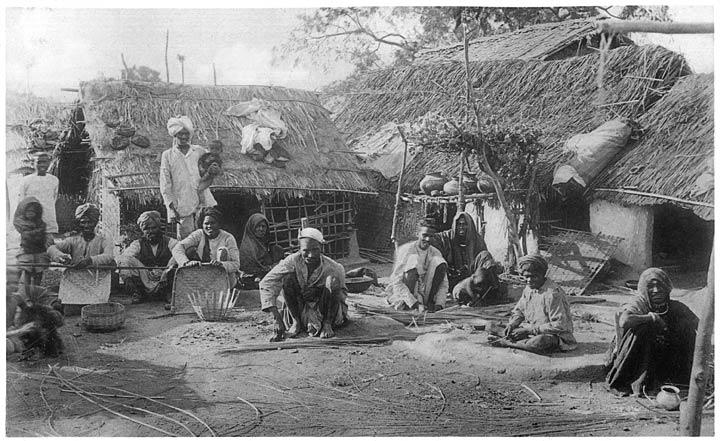
[edit]Modern India's caste system is based on the superimposition of an old four-fold theoretical classification called varna on the social ethnic grouping called jāti. The Vedic period conceptualised a society as consisting of four types of varnas, or categories: Brahmin, Kshatriya, Vaishya and Shudra, according to the nature of the work of its members. Varna was not an inherited category and the occupation determined the varna. However, a person's Jati is determined at birth and makes them take up that Jati's occupation; members could and did change their occupation based on personal strengths as well as economic, social and political factors.[citation needed] A 2016 study based on the DNA analysis of unrelated Indians determined that endogamous jatis originated during the Gupta Empire.[10][11][12] Today, there are around 3,000 castes and 25,000 sub-castes in India.[13]
| This article is part of a series on the |
| Politics of India |
|---|
 |
 India portal India portal |
From 1901 onwards, for the purposes of the Decennial Census, British authorities in India categorized all Jātis into the four Varna categories as described in ancient Indian texts. Herbert Hope Risley, the Census Commissioner, noted that "The principle suggested as a basis was that of classification by social precedence as recognized by native public opinion at the present day, and manifesting itself in the facts that particular castes are supposed to be the modern representatives of one or other of the castes of the theoretical Indian system."[14]
Varna, as mentioned in ancient Hindu texts, describes society as divided into four categories: Brahmins (scholars and yajna priests), Kshatriyas (rulers and warriors), Vaishyas (farmers, merchants and artisans) and Shudras (workmen/service providers). Scholars believe that the Varnas system was never truly operational in society and there is no evidence of it ever being a reality in Indian history. The practical division of the society has been in terms of Jatis (birth groups), which are not based on any specific religious principle but could vary from ethnic origins to occupations to geographic areas. The Jātis have been endogamous social groups without any fixed hierarchy but subject to vague notions of rank articulated over time based on lifestyle and social, political, or economic status. Many of India's major empires and dynasties like the Mauryas,[15][page needed] Shalivahanas,[16] Chalukyas,[17][full citation needed] Kakatiyas[18] among many others, were founded by people who would have been classified as Shudras, under the Varnas system, as interpreted by the British. It is well established that by the 9th century, kings from all the four Varnas, including Brahmins and Vaishyas, had occupied the highest seat in the monarchical system in Hindu India, contrary to the Varna theory.[19] Historically the kings and rulers had been called upon to mediate on the ranks of Jātis, which might number in thousands all over the subcontinent and vary by region. In practice, the jātis are seen to fit into the varna classes, but the varna status of jātis itself was subject to articulation over time.[20]
Starting with the 1901 Census of India led by colonial administrator Herbert Hope Risley, all the jātis were grouped under the theoretical varnas categories.[21] According to political scientist Lloyd Rudolph, Risley believed that varna, however ancient, could be applied to all the modern castes found in India, and "[he] meant to identify and place several hundred million Indians within it."[22] The terms varna (conceptual classification based on occupation) and jāti (groups) are two distinct concepts: while varna is a theoretical four-part division, jāti (community) refers to the thousands of actual endogamous social groups prevalent across the subcontinent. The classical authors scarcely speak of anything other than the varnas, as it provided a convenient shorthand; but a problem arises when colonial Indologists sometimes confuse the two.[23] Sujata Patel argues that colonial ethnographic practices, frequently in association with Brahmin elites, constructed Indian society as traditional and caste-based. These practices, according to Patel, emphasise the cultural and religious dimensions and downplay economic and political factors.[24]
.jpg)
Upon independence from Britain, the Indian Constitution listed 1,108 Jatis across the country as Scheduled Castes in 1950, for positive discrimination.[25] This constitution would also ban discrimination of the basis of the caste, though its practice in India remained intact.[26] The Untouchable communities are sometimes called Dalit or Harijan in contemporary literature.[27] In 2001, Dalits were 16.2% of India's population.[28] Most of the 15 million bonded child workers are from the lowest castes.[29][30] Independent India has witnessed caste-related violence. In 2005, government recorded approximately 110,000 cases of reported violent acts, including rape and murder, against Dalits.[31]
The socio-economic limitations of the caste system are reduced due to urbanisation and affirmative action. Nevertheless, the caste system still exists in endogamy and patrimony, and politics. The globalisation and economic opportunities from foreign businesses has influenced the growth of India's middle-class population. Some members of the Chhattisgarh Potter Caste Community (CPCC) are middle-class urban professionals and no longer potters unlike the remaining majority of traditional rural potter members. There is persistence of caste in Indian politics. Caste associations have evolved into caste-based political parties. Political parties and the state perceive caste as an important factor for mobilisation of people and policy development.[32]
Studies by Bhatt and Beteille have shown changes in status, openness, mobility in the social aspects of Indian society. As a result of modern socio-economic changes in the country, India is experiencing significant changes in the dynamics and the economics of its social sphere.[33] While arranged marriages are still the most common practice in India, the internet has provided a network for younger Indians to take control of their relationships through the use of dating apps. This remains isolated to informal terms, as marriage is not often achieved through the use of these apps.[34] Hypergamy is still a common practice in India and Hindu culture. Men are expected to marry within their caste, or one below, with no social repercussions. If a woman marries into a higher caste, then her children will take the status of their father. If she marries down, her family is reduced to the social status of their son in law. In this case, the women are bearers of the egalitarian principle of the marriage. There would be no benefit in marrying a higher caste if the terms of the marriage did not imply equality.[35] However, men are systematically shielded from the negative implications of the agreement.[citation needed]

Geographical factors also determine adherence to the caste system. Many Northern villages are more likely to participate in exogamous marriage, due to a lack of eligible suitors within the same caste. Women in North India have been found to be less likely to leave or divorce their husbands since they are of a relatively lower caste system, and have higher restrictions on their freedoms. On the other hand, Pahari women, of the northern mountains, have much more freedom to leave their husbands without stigma. This often leads to better husbandry as his actions are not protected by social expectations.[36]
Chiefly among the factors influencing the rise of exogamy is the rapid urbanisation in India experienced over the last century.[citation needed] It is well known that urban centers tend to be less reliant on agriculture and are more progressive as a whole[citation needed]. As India's cities boomed in population, the job market grew to keep pace. Prosperity and stability were now more easily attained by an individual, and the anxiety to marry quickly and effectively was reduced. Thus, younger, more progressive generations of urban Indians are less likely than ever to participate in the antiquated system of arranged endogamy.[citation needed]
India has also implemented a form of Affirmative Action, locally known as "reservation groups". Quota system jobs, as well as placements in publicly funded colleges, hold spots for the 8% of India's minority, and underprivileged groups. As a result, in states such as Tamil Nadu or those in the north-east, where underprivileged populations predominate, over 80% of government jobs are set aside in quotas. In education, colleges lower the marks necessary for the Dalits to enter.[37]
Nepal
[edit]The Nepali caste system resembles in some respects the Indian jāti system, with numerous jāti divisions with a varna system superimposed. Inscriptions attest the beginnings of a caste system during the Licchavi period.[citation needed] Jayasthiti Malla (1382–1395) categorised Newars into 64 castes (Gellner 2001). A similar exercise was made during the reign of Mahindra Malla (1506–1575). The Hindu social code was later set up in the Gorkha Kingdom by Ram Shah (1603–1636).[citation needed]
Pakistan
[edit]McKim Marriott claims a social stratification that is hierarchical, closed, endogamous and hereditary is widely prevalent, particularly in western parts of Pakistan. Frederik Barth in his review of this system of social stratification in Pakistan suggested that these are castes.[38][39][40]
Sri Lanka
[edit]The caste system in Sri Lanka is a division of society into strata,[41] influenced by the textbook jāti system found in India. Ancient Sri Lankan texts such as the Pujavaliya, Sadharmaratnavaliya and Yogaratnakaraya and inscriptional evidence show that the above hierarchy prevailed throughout the feudal period.[42] The repetition of the same caste hierarchy even as recently as the 18th century, in the Kandyan-period Kadayimpoth – Boundary books as well indicates the continuation of the tradition right up to the end of Sri Lanka's monarchy.[43]
Rest of Asia
[edit]Southeast Asia
[edit]
Indonesia
[edit]Balinese caste structure has been described as being based either on three categories—the noble triwangsa (thrice born), the middle class of dwijāti (twice born), and the lower class of ekajāti (once born), much similar to the traditional Indian BKVS social stratification — or on four castes[44]
The Brahmana caste was further subdivided by Dutch ethnographers into two: Siwa and Buda. The Siwa caste was subdivided into five: Kemenuh, Keniten, Mas, Manuba and Petapan. This classification was to accommodate the observed marriage between higher-caste Brahmana men with lower-caste women. The other castes were similarly further sub-classified by 19th-century and early-20th-century ethnographers based on numerous criteria ranging from profession, endogamy or exogamy or polygamy, and a host of other factors in a manner similar to castas in Spanish colonies such as Mexico, and caste system studies in British colonies such as India.[44]
Philippines
[edit]
In the Philippines, pre-colonial societies do not have a single social structure. The class structures can be roughly categorised into four types:[45]
- Classless societies – egalitarian societies with no class structure. Examples include the Mangyan and the Kalanguya peoples.[45]
- Warrior societies – societies where a distinct warrior class exists, and whose membership depends on martial prowess. Examples include the Mandaya, Bagobo, Tagakaulo, and B'laan peoples who had warriors called the bagani or magani. Similarly, in the Cordillera highlands of Luzon, the Isneg and Kalinga peoples refer to their warriors as mengal or maingal. This society is typical for head-hunting ethnic groups or ethnic groups which had seasonal raids (mangayaw) into enemy territory.[45]
- Petty plutocracies – societies which have a wealthy class based on property and the hosting of periodic prestige feasts. In some groups, it was an actual caste whose members had specialised leadership roles, married only within the same caste, and wore specialised clothing. These include the kadangyan of the Ifugao, Bontoc, and Kankanaey peoples, as well as the baknang of the Ibaloi people. In others, though wealth may give one prestige and leadership qualifications, it was not a caste per se.[45]
- Principalities – societies with an actual ruling class and caste systems determined by birthright. Most of these societies are either Indianized or Islamized to a degree. They include the larger coastal ethnic groups like the Tagalog, Kapampangan, Visayan, and Moro societies. Most of them were usually divided into four to five caste systems with different names under different ethnic groups that roughly correspond to each other. The system was more or less feudalistic, with the datu ultimately having control of all the lands of the community. The land is subdivided among the enfranchised classes, the sakop or sa-op (vassals, lit. "those under the power of another"). The castes were hereditary, though they were not rigid. They were more accurately a reflection of the interpersonal political relationships, a person is always the follower of another. People can move up the caste system by marriage, by wealth, or by doing something extraordinary; and conversely they can be demoted, usually as criminal punishment or as a result of debt. Shamans are the exception, as they are either volunteers, chosen by the ranking shamans, or born into the role by innate propensity for it. They are enumerated below from the highest rank to the lowest:[45][46][47][page needed]
- Royalty – (Visayan: kadatoan) the datu and immediate descendants. They are often further categorised according to purity of lineage. The power of the datu is dependent on the willingness of their followers to render him respect and obedience. Most roles of the datu were judicial and military. In case of an unfit datu, support may be withdrawn by his followers. Datu were almost always male, though in some ethnic groups like the Banwaon people, the female shaman (babaiyon) co-rules as the female counterpart of the datu.
- Nobility – (Visayan: tumao; Tagalog: maginoo; Kapampangan ginu; Tausug: bangsa mataas) the ruling class, either inclusive of or exclusive of the royal family. Most are descendants of the royal line or gained their status through wealth or bravery in battle. They owned lands and subjects, from whom they collected taxes.
- Shamans – (Visayan: babaylan; Tagalog: katalonan) the spirit mediums, usually female or feminised men. While they were not technically a caste, they commanded the same respect and status as nobility.
- Warriors – (Visayan: timawa; Tagalog: maharlika) the martial class. They could own land and subjects like the higher ranks, but were required to fight for the datu in times of war. In some Filipino ethnic groups, they were often tattooed extensively to record feats in battle and as protection against harm. They were sometimes further subdivided into different classes, depending on their relationship with the datu. They traditionally went on seasonal raids on enemy settlements.
- Commoners and slaves – (Visayan, Maguindanao: ulipon; Tagalog: alipin; Tausug: kiapangdilihan; Maranao: kakatamokan) – the lowest class composed of the rest of the community who were not part of the enfranchised classes. They were further subdivided into the commoner class who had their own houses, the servants who lived in the houses of others, and the slaves who were usually captives from raids, criminals, or debtors. Most members of this class were equivalent to the European serf class, who paid taxes and can be conscripted to communal tasks, but were more or less free to do as they please.[citation needed]
East Asia
[edit]Tibet
[edit]There is significant controversy over the social classes of Tibet, especially with regards to the serfdom in Tibet controversy.[citation needed] There were three main feudal social groups in Tibet prior to 1959, namely ordinary laypeople (mi ser in Tibetan), lay nobility (sger pa), and monks.[48]
Heidi Fjeld [no] has put forth the argument that pre-1950s Tibetan society was functionally a caste system, in contrast to previous scholars who defined the Tibetan social class system as similar to European feudal serfdom, as well as non-scholarly western accounts which seek to romanticise a supposedly egalitarian ancient Tibetan society.[citation needed]
Japan
[edit]
In Japan's history, social strata based on inherited position, rather than personal merit, were rigid and highly formalised in a system called mibunsei (身分制). At the top were the Emperor and Court nobles (kuge), together with the Shōgun and daimyō.[citation needed]
Older scholars believed that there were Shi-nō-kō-shō (士農工商, four classes) of "samurai, peasants (hyakushō), craftsmen, and merchants (chōnin)" under the daimyo, with 80% of peasants under the 5% samurai class, followed by craftsmen and merchants.[53] However, various studies have revealed since about 1995 that the classes of peasants, craftsmen, and merchants under the samurai are equal, and the old hierarchy chart has been removed from Japanese history textbooks. In other words, peasants, craftsmen, and merchants are not a social pecking order, but a social classification.[49][50][51]

Marriage between certain classes was generally prohibited. In particular, marriage between daimyo and court nobles was forbidden by the Tokugawa shogunate because it could lead to political maneuvering.[citation needed] For the same reason, marriages between daimyo and high-ranking hatamoto of the samurai class required the approval of the Tokugawa shogunate. It was also forbidden for a member of the samurai class to marry a peasant, craftsman, or merchant, but this was done through a loophole in which a person from a lower class was adopted into the samurai class and then married. Since there was an economic advantage for a poor samurai class person to marry a wealthy merchant or peasant class woman, they would adopt a merchant or peasant class woman into the samurai class as an adopted daughter and then marry her.[54][55] Samurai had the right to strike and even kill with their sword anyone of a lower class who compromised their honour.[56]
Japan had its own untouchable caste, shunned and ostracised, historically referred to by the insulting term eta, now called burakumin. While modern law has officially abolished the class hierarchy, there are reports of discrimination against the buraku or burakumin underclasses.[57] The burakumin are regarded as "ostracised".[58] The burakumin are one of the main minority groups in Japan, along with the Ainu of Hokkaido and those of Korean or Chinese descent.[citation needed]
Korea
[edit]| Class | Hangul | Hanja | Status |
|---|---|---|---|
| Yangban | 양반 | 兩班 | noble class |
| Chungin | 중인 | 中人 | intermediate class |
| Sangmin | 상민 | 常民 | common people |
| Ch'ŏnmin | 천민 | 賤民 | lowborn people (nobi, paekchŏng, mudang, kisaeng, namsadang, etc.) |
.jpg)
The baekjeong (백정) were an "untouchable" outcaste of Korea. The meaning today is that of butcher. It originates in the Khitan invasion of Korea in the 11th century. The defeated Khitans who surrendered were settled in isolated communities throughout Goryeo to forestall rebellion. They were valued for their skills in hunting, herding, butchering, and making of leather, common skill sets among nomads. Over time, their ethnic origin was forgotten, and they formed the bottom layer of Korean society.[citation needed]
In 1392, with the foundation of the Confucian Joseon dynasty, Korea systemised its own native class system. At the top were the two official classes, the Yangban, which literally means "two classes". It was composed of scholars (munban) and warriors (muban). Scholars had a significant social advantage over the warriors. Below were the jung-in (중인-中人: literally "middle people"). This was a small class of specialised professions such as medicine, accounting, translators, regional bureaucrats, etc. Below that were the sangmin (상민-常民: literally 'commoner'), farmers working their own fields. Korea also had a serf population known as the nobi. The nobi population could fluctuate up to about one third of the population, but on average the nobi made up about 10% of the total population.[59] In 1801, the vast majority of government nobi were emancipated,[60] and by 1858 the nobi population stood at about 1.5% of the total population of Korea.[61] The hereditary nobi system was officially abolished around 1886–87 and the rest of the nobi system was abolished with the Gabo Reform of 1894,[61] but traces remained until 1930.[citation needed]
The opening of Korea to foreign Christian missionary activity in the late 19th century saw some improvement in the status of the baekjeong. However, everyone was not equal under the Christian congregation, and even so protests erupted when missionaries tried to integrate baekjeong into worship, with non-baekjeong finding this attempt insensitive to traditional notions of hierarchical advantage.[citation needed] Around the same time, the baekjeong began to resist open social discrimination.[62] They focused on social and economic injustices affecting them, hoping to create an egalitarian Korean society. Their efforts included attacking social discrimination by upper class, authorities, and "commoners", and the use of degrading language against children in public schools.[63]
With the Gabo reform of 1896, the class system of Korea was officially abolished. Following the collapse of the Gabo government, the new cabinet, which became the Gwangmu government after the establishment of the Korean Empire, introduced systematic measures for abolishing the traditional class system. One measure was the new household registration system, reflecting the goals of formal social equality, which was implemented by the loyalists' cabinet. Whereas the old registration system signified household members according to their hierarchical social status, the new system called for an occupation.[64]
While most Koreans by then had surnames and even bongwan, although still substantial number of cheonmin, mostly consisted of serfs and slaves, and untouchables did not. According to the new system, they were then required to fill in the blanks for surname in order to be registered as constituting separate households. Instead of creating their own family name, some cheonmins appropriated their masters' surname, while others simply took the most common surname and its bongwan in the local area. Along with this example, activists within and outside the Korean government had based their visions of a new relationship between the government and people through the concept of citizenship, employing the term inmin ("people") and later, kungmin ("citizen").[64]
North Korea
[edit]The Committee for Human Rights in North Korea reported that "Every North Korean citizen is assigned a heredity-based class and socio-political rank over which the individual exercises no control but which determines all aspects of his or her life."[65] Called Songbun, Barbara Demick describes this "class structure" as an updating of the hereditary "caste system", a combination of Confucianism and Communism.[66] It originated in 1946 and was entrenched by the 1960s, and consisted of 53 categories ranging across three classes: loyal, wavering, and impure. The privileged "loyal" class included members of the Korean Workers' Party and Korean People's Army officers' corps, the wavering class included peasants, and the impure class included collaborators with Imperial Japan and landowners.[67] She claims that a bad family background is called "tainted blood", and that by law this "tainted blood" lasts three generations.[68]
West Asia
[edit]Kurdistan
[edit]Yazidis
[edit]There are three hereditary groups, often called castes, in Yazidism. Membership in the Yazidi society and a caste is conferred by birth. Pîrs and Sheikhs are the priestly castes, which are represented by many sacred lineages (Kurdish: Ocax). Sheikhs are in charge of both religious and administrative functions and are divided into three endogamous houses, Şemsanî, Adanî and Qatanî who are in turn divided into lineages. The Pîrs are in charge of purely religious functions and traditionally consist of 40 lineages or clans, but approximately 90 appellations of Pîr lineages have been found, which may have been a result of new sub-lineages arising and number of clans increasing over time due to division as Yazidis settled in different places and countries. Division could occur in one family, if there were a few brothers in one clan, each of them could become the founder of their own Pîr sub-clan (Kurdish: ber). Mirîds are the lay caste and are divided into tribes, who are each affiliated to a Pîr and a Sheikh priestly lineage assigned to the tribe.[69][70][71]
Iran
[edit]Pre-Islamic Sassanid society was immensely complex, with separate systems of social organisation governing numerous different groups within the empire.[72] Historians believe society comprised four[73][74][75] social classes, which linguistic analysis indicates may have been referred to collectively as "pistras".[76] The classes, from highest to lowest status, were priests (Asravan), warriors (Arteshtaran), secretaries (Dabiran), and commoners (Vastryoshan).[citation needed]
Yemen
[edit]In Yemen there exists a hereditary caste, the African-descended Al-Akhdam who are kept as perennial manual workers. Estimates put their number at over 3.5 million residents who are discriminated, out of a total Yemeni population of around 22 million.[77]
Africa
[edit]Various sociologists have reported caste systems in Africa.[78][79][80] The specifics of the caste systems have varied in ethnically and culturally diverse Africa; however, the following features are common – it has been a closed system of social stratification, the social status is inherited, the castes are hierarchical, certain castes are shunned while others are merely endogamous and exclusionary.[81] In some cases, concepts of purity and impurity by birth have been prevalent in Africa. In other cases, such as the Nupe of Nigeria, the Beni Amer of East Africa, and the Tira of Sudan, the exclusionary principle has been driven by evolving social factors.[82]
West Africa
[edit]
Among the Igbo of Nigeria – especially Enugu, Anambra, Imo, Abia, Ebonyi, Edo and Delta states of the country – scholar Elijah Obinna finds that the Osu caste system has been and continues to be a major social issue. The Osu caste is determined by one's birth into a particular family irrespective of the religion practised by the individual. Once born into Osu caste, this Nigerian person is an outcast, shunned and ostracised, with limited opportunities or acceptance, regardless of his or her ability or merit. Obinna discusses how this caste system-related identity and power is deployed within government, Church and indigenous communities.[78]
The osu class systems of eastern Nigeria and southern Cameroon are derived from indigenous religious beliefs and discriminate against the "Osus" people as "owned by deities" and outcasts.[citation needed]
The Songhai economy was based on a caste system. The most common were metalworkers, fishermen, and carpenters. Lower caste participants consisted of mostly non-farm working immigrants, who at times were provided special privileges and held high positions in society. At the top were noblemen and direct descendants of the original Songhai people, followed by freemen and traders.[83]
In a review of social stratification systems in Africa, Richter reports that the term caste has been used by French and American scholars to many groups of West African artisans. These groups have been described as inferior, deprived of all political power, have a specific occupation, are hereditary and sometimes despised by others. Richter illustrates caste system in Ivory Coast, with six sub-caste categories. Unlike other parts of the world, mobility is sometimes possible within sub-castes, but not across caste lines. Farmers and artisans have been, claims Richter, distinct castes. Certain sub-castes are shunned more than others. For example, exogamy is rare for women born into families of woodcarvers.[84]
Similarly, the Mandé societies in Gambia, Ghana, Guinea, Ivory Coast, Liberia, Senegal and Sierra Leone have social stratification systems that divide society by ethnic ties. The Mande class system regards the jonow slaves as inferior. Similarly, the Wolof in Senegal is divided into three main groups, the geer (freeborn/nobles), jaam (slaves and slave descendants) and the underclass neeno. In various parts of West Africa, Fulani societies also have class divisions. Other castes include Griots, Forgerons, and Cordonniers.[85]
Tamari has described endogamous castes of over fifteen West African peoples, including the Tukulor, Songhay, Dogon, Senufo, Minianka, Moors, Manding, Soninke, Wolof, Serer, Fulani, and Tuareg. Castes appeared among the Malinke people no later than 14th century, and was present among the Wolof and Soninke, as well as some Songhay and Fulani populations, no later than 16th century. Tamari claims that wars, such as the Sosso-Malinke war described in the Sunjata epic, led to the formation of blacksmith and bard castes among the people that ultimately became the Mali empire.[citation needed]
As West Africa evolved over time, sub-castes emerged that acquired secondary specialisations or changed occupations. Endogamy was prevalent within a caste or among a limited number of castes, yet castes did not form demographic isolates according to Tamari. Social status according to caste was inherited by off-springs automatically; but this inheritance was paternal. That is, children of higher caste men and lower caste or slave concubines would have the caste status of the father.[80]
Central Africa
[edit]Ethel M. Albert in 1960 claimed that the societies in Central Africa were caste-like social stratification systems.[86] Similarly, in 1961, Maquet notes that the society in Rwanda and Burundi can be best described as castes.[87] The Tutsi, noted Maquet, considered themselves as superior, with the more numerous Hutu and the least numerous Twa regarded, by birth, as respectively, second and third in the hierarchy of Rwandese society. These groups were largely endogamous, exclusionary and with limited mobility.[88]
Horn of Africa
[edit]In Ethiopia, there have been a number of studies of castes. Broad studies of castes have been written by Alula Pankhurst, who has published a study of caste groups in SW Ethiopia.[89] and a later volume by Dena Freeman writing with Pankhurst.[90][page needed]

In a review published in 1977, Todd reports that numerous scholars report a system of social stratification in different parts of Africa that resembles some or all aspects of caste system. Examples of such caste systems, he claims, are to be found in Ethiopia in communities such as the Gurage and Konso. He then presents the Dime of Southwestern Ethiopia, amongst whom there operates a system which Todd claims can be unequivocally labelled as caste system. The Dime have seven castes whose size varies considerably. Each broad caste level is a hierarchical order that is based on notions of purity, non-purity and impurity. It uses the concepts of defilement to limit contacts between caste categories and to preserve the purity of the upper castes. These caste categories have been exclusionary, endogamous and the social identity inherited.[92]
Among the Kafa, there were also traditionally groups labelled as castes. "Based on research done before the Derg regime, these studies generally presume the existence of a social hierarchy similar to the caste system. At the top of this hierarchy were the Kafa, followed by occupational groups including blacksmiths (Qemmo), weavers (Shammano), bards (Shatto), potters, and tanners (Manjo). In this hierarchy, the Manjo were commonly referred to as hunters, given the lowest status equal only to slaves."[93]
The Borana Oromo of southern Ethiopia in the Horn of Africa also have a class system, wherein the Wata, an acculturated hunter-gatherer group, represent the lowest class. Though the Wata today speak the Oromo language, they have traditions of having previously spoken another language before adopting Oromo.[94]
The traditionally nomadic Somali people are divided into clans, wherein the Rahanweyn agro-pastoral clans and the occupational clans such as the Madhiban were traditionally sometimes treated as outcasts.[95] As Gabooye, the Madhiban along with the Yibir and Tumaal (collectively referred to as sab) have since obtained political representation within Somalia, and their general social status has improved with the expansion of urban centers.[91]
The Aari people caste system lasted for 4,500 years and prevented the exchange of genes between groups.[96]
Europe
[edit]Basque Country
[edit]For centuries, through the modern times, the majority regarded Cagots who lived primarily in the Basque region of France and Spain as an inferior caste, and a group of untouchables.[97] While they had the same skin color and religion as the majority, in the churches they had to use segregated doors, drink from segregated fonts, and receive communion on the end of long wooden spoons. It was a closed social system. The socially isolated Cagots were endogamous, and chances of social mobility non-existent.[98][99]
United Kingdom
[edit]In July 2013, the UK government announced its intention to amend the Equality Act 2010, to "introduce legislation on caste, including any necessary exceptions to the caste provisions, within the framework of domestic discrimination law".[100] Section 9(5) of the Equality Act 2010 provides that "a Minister may by order amend the statutory definition of race to include caste and may provide for exceptions in the Act to apply or not to apply to caste".[citation needed]
From September 2013 to February 2014, Meena Dhanda led a project on "Caste in Britain" for the UK Equality and Human Rights Commission (EHRC).[101]
Americas
[edit]Latin America
[edit]
In colonial Spanish America (16th-early 19th centuries), there were legal divisions of society, the Republic of Spaniards (República de Españoles), comprising European whites, African slaves (negros), and mixed-race castas, the offspring of unions between whites, blacks, and indigenous. The Republic of Indians (República de Indios) comprised all the various indigenous peoples, now classified in a single category, indio, by their colonial rulers. In the social and racial hierarchy, European Spaniards were at the apex, with legal rights and privileges. Lower racial groups (Africans, mixed-race castas, and pure indigenous), had fewer legal rights and lower social status. Unlike the rigid caste system in India, in colonial Spanish America there was some fluidity within the social order.[102]
United States
[edit]In the opinion of W. Lloyd Warner, discrimination in the Southern United States in the 1930s against Blacks was similar to Indian castes in such features as residential segregation and marriage restrictions.[103] In her 2020 book Caste: The Origins of Our Discontents, journalist Isabel Wilkerson used caste as an analogy to understand racial discrimination in the United States.[citation needed]
Gerald D. Berreman contrasted the differences between discrimination in the United States and India. In India, there are complex religious features which make up the system, whereas in the United States race and color are the basis for differentiation. The caste systems in India and the United States have higher groups which desire to retain their positions for themselves and thus perpetuate the two systems.[104]
The process of creating a homogenized society by social engineering in both India and the Southern US has created other institutions that have made class distinctions among different groups evident. Anthropologist James C. Scott elaborates on how "global capitalism is perhaps the most powerful force for homogenization, whereas the state may be the defender of local difference and variety in some instances".[105] The caste system, a relic of feudalistic economic systems, emphasizes differences between socio-economic classes that are obviated by openly free market capitalistic economic systems, which reward individual initiative, enterprise, merit, and thrift, thereby creating a path for social mobility.[citation needed] When the feudalistic slave economy of the southern United States was dismantled, Jim Crow laws and acts of domestic terrorism committed by white supremacists prevented many industrious African Americans from participating in the formal economy and achieving economic success on parity with their white peers, or destroying that economic success in instances where it was achieved, such as Black Wall Street, with only rare but commonly touted exceptions to lasting personal success such as Maggie Walker, Annie Malone, and Madame C.J. Walker. Parts of the United States are sometimes divided by race and class status despite the national narrative of integration.[citation needed]
A survey on caste discrimination conducted by Equality Labs[a] found 67% of Indian Dalits living in the US reporting that they faced caste-based harassment at the workplace, and 27% reporting verbal or physical assault based on their caste.[108] However, the Carnegie Endowment for International Peace study in 2021 criticizes Equality Labs findings and methodology noting Equality Labs study "relied on a nonrepresentative snowball sampling method to recruit respondents. Furthermore, respondents who did not disclose a caste identity were dropped from the data set. Therefore, it is likely that the sample does not fully represent the South Asian American population and could skew in favor of those who have strong views about caste. While the existence of caste discrimination in India is incontrovertible, its precise extent and intensity in the United States can be contested".[109]
In 2023, Seattle became the first city in the United States to ban discrimination based on caste.[110]
Racial casteism
[edit]Racial casteism is a term used to identify the relationship between caste, race, and colorism. In modern-day India, the caste system has expanded to include groups and identities from diasporic groups as well such as the Africana Siddis and Kaffirs. Siddis make up 40,000 of India's vast population and are perceived as untouchables under the caste framework.[citation needed]This categorization is paired with anti-black ideology in the country, that is often adapted by broader uses of the term caste in western countries, most notably the United States. Like the Siddis, Africana caste Sri Lanka Kaffirs make up a small minority of the population with scholars noting that the exact number is hard to determine due to exclusion and lack of recognition from the government. Siddis and Kaffirs are considered untouchables due to their darker skin color alongside other physical factors that distinguish the group as lower caste.[citation needed]
The migration of Africana groups such as the Siddis and Kaffirs to South Asia is widely considered to be a result of the Indian Ocean Slave Trade, initiated by Muslim Arabs. During the trade, enslaved Africans were often brought as court servants, herbalists, midwives, or as bonded labor. The limited awareness of these groups can be attributed to caste-ideology fueled from this trade.[citation needed]
The racial understanding of caste has largely been debated by scholars, with some like Dr. B. R. Ambedkar arguing that caste differences between higher caste Aryans and lower cast native-Indians being more due to religious factors. While the term remains contended, it is widely understood that this racial assessment is based on the way lower-caste people are treated. Africana diasporic groups who do not fit the caste system reflected by the scheduled tribe are thus considered inferior for their darker skin and grouped in with the untouchables.[citation needed] Since caste is inherited at birth and is inflexible to change throughout a lifetime, this can lead to a racial caste system where colorism largely influences the mobility one has in their lifetime. Terminology shifted away from race-conscious terms in South Asian antiquity, where Aryans had pre-conceived social hierarchies built off of race, to a caste framework during Buddhism's rise in the third century BCE.[111]
Racial caste is embedded in the institutions that make up South Asia, particularly its governing bodies. When it comes to the electorate of India, voter preference is often based on race, caste, religion, alongside other attributing physical and political factors. This power imbalance alongside the rigid nature of caste can work against those of darker skin complexion to hold positions of power.[112]
Caste and higher education
[edit]The foundational divisions of caste have historically been seen as a determining factor in one's skills and career prospects. Today, many people perceive higher education as a means of achieving their own professional goals, but there are still methods based on caste assumptions used to keep lower caste out of universities.[citation needed] This leads to their exclusion from the potential to be part of higher-paying jobs that are perceived as more elite. This social expectation and prevention of access to education and opportunity have elongated the struggle for financial and social equity amongst people from scheduled tribes and castes.[citation needed]
Affirmative Action has been a global phenomenon to develop more spaces in politics, jobs, and education for people from historically disadvantaged backgrounds, which has led to the reservation system being applied to universities. Even with these regulations, caste nevertheless remains a largely determining factor in the university system in India.[citation needed] The guarantee of admittance to a certain proportion of people from oppressed castes is not enough to deal with the implications of divisions in higher education. For example, the reservation percentage can vary by state but is generally around 15% for Scheduled Castes, but 2019–20 data shows most universities miss this mark. Across the board, there is an average of 14.7% of scheduled caste students, meaning many universities are at a far lower rate than legislated.[113] These reservation systems have backlash from upper caste groups, who claim that people are only admitted due to their caste status, as opposed to merit, in a similar argument playing out to affirmative action in the United States.[citation needed]
Reservation policies constitute a first step in providing access to admittance into higher education opportunities but do not overcome the overarching challenge of casteism.[114] Caste-based discrimination and social stigma can still affect the experiences of students from marginalized communities in academic institutions. Universities are a crucial place of integration and moving to offer equitable opportunity beyond just attendance, but implementing protective policies to ensure students can be successful. Attendance at university has already been shown to impact how people view caste and has the potential to shape equity building beyond the current interpersonal and systemic relationship.[115]
Several forms of discrimination manifest in universities:
- Social discrimination: Students from marginalized castes face social discrimination, exclusion, and/or isolation on campuses. This affects their general educational experience and mental well-being. Numerous cases of harassment and bullying based on caste lines have been reported, with drastic consequences for the victims, but often none for the perpetrators. This promotes a hostile environment for students and hampers their ability to engage positively in the academic community.[citation needed]
- "When I was enrolled for an undergraduate course, I was vocal about his Dalit identity and vouched for the rights of Dalits and marginalized sections. Most of my upper-caste mates were against reservation. I was always typecast, stereotyped and even labeled with derogatory nicknames," Nishat Kabir, who is studying film at Ambedkar University in New Delhi, told Anadolu Agency.[116]
- Campus facilities: Discrimination can also be observed in access to living facilities, food services, and other campus amenities. Students from marginalized castes may encounter difficulties in availing of these services without bias, and the living arrangements are often internally segregated.[citation needed]
- Academic and faculty discrimination: Discrimination may extend to the academic sphere, with students facing biased treatment, unfair grading, or limited access to academic resources based on their caste background. Instances of discrimination can involve faculty members, who may hold biases that affect their interactions with students. This comes from the inherent hierarchical nature of caste having built centuries of prejudice against lower caste and indigenous students. This influences academic mentorship, guidance, and opportunities for students from marginalized backgrounds.[citation needed]
Eighty-four percent of the SC/ST students surveyed said examiners had asked them about their caste directly or indirectly during their evaluations. One student said: "Teachers are fine till they do not know your caste. The moment they come to know, their attitude towards you changes completely."[117]
Due to the challenges experienced on top of the normal pressure of being a student, the discrimination that Dalits and people of OBCs face has led to increased rates of suicide, with numerous examples shown to be tied directly to campus harassment and lack of administrative support.[citation needed]
The clarity that comes from people sharing their experiences has led to significant pushback in the 21st century, where students have been centering fights for justice and equity, often based on movements that student activists of the past have used. Allahabad University has seen a spike in student protests and demonstrations against institutional discrimination.[118] Students used tactics of information spreading from pamphlets and court cases, to public civil disobedience through marches and sit-ins to disrupt the flow of university life and lead to broader discussions. The student unrest was not unique to Allahabad University but was strong enough to last over 90 days.[citation needed]
Caste in sociology and entomology
[edit]The initial observational studies of the division of labour in ant colonies attempted to demonstrate that ants specialized in tasks that were best suited to their size when they emerged from the pupae stage into the adult stage.[119] A large proportion of the experimental work was done in species that showed strong variation in size.[119] As the size of an adult was fixed for life, workers of a specific size range came to be called a "caste", calling up the traditional caste system in India in which a human's standing in society was decided at birth.[119]
The notion of caste encouraged a link between scholarship in entomology and sociology because it served as an example of a division of labour in which the participants seemed to be uncompromisingly adapted to special functions and sometimes even unique environments.[120] To bolster the concept of caste, entomologists and sociologists referred to the complementary social or natural parallel and thereby appeared to generalize the concept and give it an appearance of familiarity.[121] In the late 19th- and early 20th centuries, the perceived similarities between the Indian caste system and caste polymorphism in insects were used to create a correspondence or parallelism for the purpose of explaining or clarifying racial stratification in human societies; the explanations came particularly to be employed in the United States.[122] Ideas from heredity and natural selection influenced some sociologists who believed that some groups were predetermined to belong to a lower social or occupational status.[122] Chiefly through the work of W. Lloyd Warner at the University of Chicago, a group of sociologists sharing similar principles came to evolve around the creed of caste in the 1930s and 1940s.[122]
The ecologically oriented sociologist Robert E. Park, although attributing more weight to environmental explanations than the biological nonetheless believed that there were obstacles to the assimilation of blacks into American society and that an "accommodation stage" in a biracially organized caste system was required before full assimilation.[123] He did disavow his position in 1937, suggesting that blacks were a minority and not a caste.[123] The Indian sociologist Radhakamal Mukerjee was influenced by Robert E. Park and adopted the concept of "caste" to describe race relations in the US.[124] According to anthropologist Diane Rodgers, Mukerjee "proceeded to suggest that a caste system should be correctly instituted in the (US) South to ease race relations."[124] Mukerjee often employed both entomological and sociological data and clues to describe caste systems.[123] He wrote "while the fundamental industries of man are dispersed throughout the insect world, the same kind of polymorphism appears again and again in different species of social insects which have reacted in the same manner as man, under the influence of the same environment, to ensure the supply and provision of subsistence."[125] Comparing the caste system in India to caste polymorphism in insects, he noted, "where we find the organization of social insects developed to perfection, there also has been seen among human associations a minute and even rigid specialization of functions, along with ant- and bee-like societal integrity and cohesiveness."[123] He considered the "resemblances between insect associations and caste-ridden societies" to be striking enough to be "amusing".[123]
See also
[edit]References
[edit]Notes
[edit]Citations
[edit]- ^ a b
- Lagasse, Paul, ed. (2007). "Caste". The Columbia Encyclopedia. New York, NY: Columbia University Press. ISBN 978-0-231-14446-9. Archived from the original on 1 October 2023. Retrieved 24 September 2012.
caste [Port., casta=basket], ranked groups based on heredity within rigid systems of social stratification, especially those that constitute Hindu India. Some scholars deny that true caste systems are found outside India. The caste is a closed group whose members are severely restricted in their choice of occupation and degree of social participation. Marriage outside the caste is prohibited. Social status is determined by the caste of one's birth and may only rarely be transcended.
- Madan, T. N. (2012), caste, Encyclopædia Britannica Online, archived from the original on 24 October 2023,
caste, any of the ranked, hereditary, endogamous social groups, often linked with occupation, that together constitute traditional societies in South Asia, particularly among Hindus in India. Although sometimes used to designate similar groups in other societies, the "caste system" is uniquely developed in Hindu societies.
- Gupta, Dipankar (2008). "Caste". In Schaefer, Richard T. (ed.). Encyclopedia of Race, Ethnicity, and Society. Thousand Oaks: SAGE Publications. pp. 246–250. ISBN 978-1-4129-2694-2. Retrieved 5 August 2012.
Caste: What makes Indian society unique is the phenomenon of caste. Economic, religious, and linguistic differentiations, even race-based discrimination, are known elsewhere, but nowhere else does one see caste but in India.
- Béteille 2002, pp. 136–137. Quote: "Caste: Caste has been described as the fundamental social institution of India. Sometimes the term is used metaphorically to refer to rigid social distinctions or extreme social exclusiveness wherever found, and some authorities have used the term 'colour-caste system' to describe the stratification based on race in the United States and elsewhere. But it is among the Hindus in India that we find the system in its most fully developed form although analogous forms exist among Muslims, Christians, Sikhs and other religious groups in South Asia. It is an ancient institution, having existed for at least 2,000 years among the Hindus who developed not only elaborate caste practices but also a complex theory to explain and justify those practices (Dumont 1970). The theory has now lost much of its force although many of the practices continue."
- Mitchell, Geoffrey Duncan (2006). "Castes (part of SOCIAL STRATIFICATION)". A New Dictionary of the Social Sciences. New Brunswick, NJ: Aldine Transaction Publishers. pp. 194–195. ISBN 978-0-202-30878-4. Retrieved 10 August 2012.
Castes A pure caste system is rooted in the religious order and may be thought of as a hierarchy of hereditary, endogamous, occupational groups with positions fixed and mobility barred by ritual distances between each caste. Empirically, the classical Hindu system of India approximated most closely to pure caste. The system existed for some 3,000 years and continues today despite many attempts to get rid of some of its restrictions. It is essentially connected with Hinduism.
- "caste, n.", Oxford English Dictionary, Second edition; online version June 2012, Oxford, UK: Oxford University Press, 1989, retrieved 5 August 2019,
caste, n. 2a. spec. One of the several hereditary classes into which society in India has from time immemorial been divided; ... This is now the leading sense, which influences all others.
- Kanti Ghosh, Sumit (18 May 2023). "Body, Dress, and Symbolic Capital: Multifaceted Presentation of PUGREE in Colonial Governance of British India". Textile. 22 (2): 334–365. doi:10.1080/14759756.2023.2208502. ISSN 1475-9756. S2CID 258804155.
- Lagasse, Paul, ed. (2007). "Caste". The Columbia Encyclopedia. New York, NY: Columbia University Press. ISBN 978-0-231-14446-9. Archived from the original on 1 October 2023. Retrieved 24 September 2012.
- ^ Scott & Marshall 2005, p. 66.
- ^ Winthrop 1991, pp. 27–30.
- ^ Wilson, E. O. (1979). "The Evolution of Caste Systems in Social Insects". Proceedings of the American Philosophical Society. 123 (4): 204–210. JSTOR 986579.
- ^ Béteille 2002, p. 66.
- ^ a b c "caste". Oxford English Dictionary (Online ed.). Oxford University Press. (Subscription or participating institution membership required.)
- ^ Solodow, Joseph B. (21 January 2010). Latin Alive: The Survival of Latin in English and the Romance Languages. Cambridge University Press. p. 189. ISBN 978-1-139-48471-8.
- ^ Pitt-Rivers, Julian (1971). "On the word 'caste'". In Beidelman, T. O. (ed.). The translation of culture essays to E.E. Evans-Pritchard. London, UK: Tavistock. pp. 231–256. GGKEY:EC3ZBGF5QC9.
- ^ Vinson, Ben (2018). Before Mestizaje: The Frontiers of Race and Caste in Colonial Mexico. Cambridge University Press. ISBN 978-1-107-02643-8.
- ^ "Genetic study suggests caste began to dictate marriage from Gupta reign". The Indian Express. 16 February 2016. Archived from the original on 24 October 2023. Retrieved 5 April 2023.
- ^ Kalyan, Ray (27 January 2016). "Caste originated during Gupta dynasty: Study". Archived from the original on 1 March 2024.
- ^ Martin, Phillip (27 February 2019). "Even with a Harvard pedigree, caste follows 'like a shadow'". The World from PRX. Archived from the original on 29 July 2024. Retrieved 10 September 2021.
- ^ "What is India's caste system?". BBC News. 19 June 2019.
- ^ Crooke, William. "Social Types". In Risley, Herbert Hope (ed.). The People of India.
- ^ Roy, Kaushik (2012). Hinduism and the Ethics of Warfare in South Asia: From Antiquity to the Present. Cambridge University Press. ISBN 978-1-107-01736-8.
- ^ Taylor, William Cooke (1838). Examination and Analysis of the Mackenzie Manuscripts Deposited in the Madras College Library. Asiatic Society. pp. 49–55.
- ^ Bilhana, in his Sanskrit work Vikramanakadevacharitam claims the Chalukyas were born from the feet of Brahma, implying they were Shudras, while some sources claim they were born in the arms of Brahma, and hence were Kshatriyas (Ramesh 1984, p. 15)
- ^ Talbot, Austin Cynthia (2001). Pre-colonial India in Practice: Society, Region, and Identity in Medieval Andhra. Oxford University Press. ISBN 978-0-19803-123-9.
Most of the Kakatiya records proudly describe them as Shudra.
; Examples include the Bothpur and Vaddamanu inscriptions of Ganapati's general Malyala Gunda senani. The Kakatiyas also maintained marital relations with other Shudra families, such as the Kotas and the Natavadi chiefs. All these evidences indicate that the Kakatiyas were of Shudra origin.[Sastry, P. V. Parabhrama (1978). N. Ramesan, ed. The Kākatiyas of Warangal. Hyderabad: Government of Andhra Pradesh. OCLC 252341228, p. 29] - ^ Altekar, Anant Sadashiv (1934). The Rashtrakutas And Their Times; being a political, administrative, religious, social, economic and literary history of the Deccan during C. 750 A.D. to C. 1000 A.D. Poona: Oriental Book Agency. p. 331. OCLC 3793499.
- ^ Samarendra, Padmanabh (5 June 2015). "Census in Colonial India and the Birth of Caste". Economic and Political Weekly: 7–8. Archived from the original on 21 May 2024.
- ^ Dirks, Nicholas B. (2001). Castes of Mind: Colonialism and the Making of New India. Princeton University Press. ISBN 978-0-691-08895-2.
- ^ Rudolph, Lloyd I.; Rudolph, Susanne Hoeber (1984). The Modernity of Tradition: Political Development in India. University of Chicago Press. pp. 116–117. ISBN 978-0-226-73137-7.
- ^ Dumont, Louis (1980), Homo hierarchicus: the caste system and its implications, Chicago: University of Chicago Press, pp. 66–67, ISBN 978-0-226-16963-7
- ^ Patel, Sujata (4 January 2021). "The nationalist-indigenous and colonial modernity: an assessment of two sociologists in India". The Journal of Chinese Sociology. 8 (1) 2. doi:10.1186/s40711-020-00140-9. ISSN 2198-2635.
- ^ "The Constitution (Scheduled Castes) Order 1950". Lawmin.nic.in. Archived from the original on 28 March 2015. Retrieved 30 November 2013.
- ^ "'I would tell the other girls at school that I was Brahmin': The struggle to challenge India's caste system". ABC News. 27 June 2022. Archived from the original on 13 July 2024.
- ^ Polgreen, Lydia (21 December 2011). "Scaling Caste Walls With Capitalism's Ladders in India". The New York Times. Archived from the original on 24 October 2023.
- ^ "Scheduled castes and scheduled tribes population: Census 2001". Government of India. 2004. Archived from the original on 13 February 2021.
- ^ "Children pay high price for cheap labour". UNICEF. Archived from the original on 27 June 2017.
- ^ Coursen-Neff, Zama (30 January 2003). "For 15 million in India, a childhood of slavery". The New York Times. Archived from the original on 4 April 2023. Retrieved 22 March 2017.
- ^ "UN report slams India for caste discrimination". CBC News. 2 March 2007. Archived from the original on 19 January 2024.
- ^ Sen, Ronojoy (2012). "The persistence of caste in Indian politics". Pacific Affairs. 85 (2): 363–369. doi:10.5509/2012852363.
- ^ Gandhi, Rag S. (1980). "From Caste to Class in Indian Society". Humboldt Journal of Social Relations. 7 (2): 1–14.
- ^ Gandhi, Divya (2 April 2016). "Running in the family". The Hindu.
- ^ Davis, Kingsley (13 June 2013). "Intermarriage in Caste Societies". AnthroSource. 43 (3): 376–395. doi:10.1525/aa.1941.43.3.02a00030.
- ^ Berreman, Gerald D. (1962). "Village Exogamy in Northernmost India". Southwestern Journal of Anthropology. 18 (1): 55–58. doi:10.1086/soutjanth.18.1.3629123. JSTOR 3629123. S2CID 131367161.
- ^ R., A. (13 June 2013). "Indian Reservations". The Economist. Archived from the original on 24 October 2023. Retrieved 4 December 2018.
- ^ Barth, Fredrick (December 1956). "Ecologic Relationships of Ethnic Groups in Swat, North Pakistan". American Anthropologist. 58 (6): 1079–1089. doi:10.1525/aa.1956.58.6.02a00080.
- ^ Ahmed, Zeyauddin (1977). David, Kenneth (ed.). The New Wind: Changing Identities in South Asia. Aldine Publishing Company. pp. 337–354. ISBN 978-90-279-7959-9.
- ^ Marriott, McKim (1960). Caste ranking and community structure in five regions of India and Pakistan. OCLC 186146571.
- ^ Rogers, John (February 2004). "Caste as a social category and identity in colonial Lanka". Indian Economic and Social History Review. 41 (1): 51–77. doi:10.1177/001946460404100104. S2CID 143883066.
- ^ Goghari, Vina M.; Kusi, Mavis (2023). "An introduction to the basic elements of the caste system of India". Frontiers in Psychology. 14 1210577. doi:10.3389/fpsyg.2023.1210577. ISSN 1664-1078. PMC 10764522. PMID 38179495.
- ^ "Karava of Sri Lanka - Govigama". karava.org. Retrieved 21 October 2025.
- ^ a b Boon, James (1977). The Anthropological Romance of Bali 1597-1972: Dynamic Perspectives in Marriage and Caste, Politics and Religion. Cambridge University Press Archive. ISBN 978-0-521-21398-1.
- ^ a b c d e Scott, William Henry (1979). "Class Structure in the Unhispanized Philippines". Philippine Studies. 27 (2, Special Issue in Memory of Frank Lynch): 137–159. JSTOR 42632474.
- ^ Arcilla, José S. (1998). An Introduction to Philippine History. Ateneo de Manila University Press. p. 14–16. ISBN 978-971-550-261-0.
- ^ Scott, William Henry (1994). Barangay: sixteenth-century Philippine culture and society. Ateneo de Manila University Press. ISBN 978-971-550-135-4.
- ^ Snellgrove, Cultural History, pp. 257–259
- ^ a b "'Shinōkōshō' ya ' sì mín píng děng ' No yōgo ga tsukawa rete inai koto ni tsuite" 「士農工商」や「四民平等」の用語が使われていないことについて [Regarding the absence of the terms "Shi-no-Ko-Sho" and "Equality of the Four Classes"]. Tokyo Shoseki (in Japanese). Archived from the original on 30 November 2023. Retrieved 7 March 2024.
- ^ a b "Dai 35-kai kyōkasho kara "shinōkōshō" ga kieta ̄ kōhen ̄-rei wa 3-nen kōhō uki 'ukikara' 8 tsuki-gō" 第35回 教科書から『士農工商』が消えた ー後編ー 令和3年広報うき「ウキカラ」8月号 [No. 35: The disappearance of the four classes of samurai, farmers, artisans and merchants from textbooks - Part 2 - August issue of the Reiwa 3rd year Uki Public Relations "Ukikara"]. Uki, Kumamoto (in Japanese). Archived from the original on 30 August 2023. Retrieved 7 March 2024.
- ^ a b "Jinken ishiki no appudēto" 人権意識のアップデート [Update on human rights awareness] (PDF). Shimonoseki (in Japanese). Archived from the original (PDF) on 6 June 2023. Retrieved 7 March 2024.
- ^ "Kakaku" 家格 [Family status]. Kotobank (in Japanese). Archived from the original on 7 March 2024. Retrieved 7 March 2024.
- ^ Beasley 1972, p. 22.
- ^ "Kekkon wa shukun no kyoka ga hitsuyōdaga, rikon suru toki wa dōdatta? Edo jidai 'bushi' no isshō gyōji" 結婚は主君の許可が必要だが、離婚するときはどうだった?江戸時代「武士」の一生行事 [Marriage required the permission of the lord, but what about divorce? The life events of the Edo period "samurai"] (in Japanese). The Asahi Shimbun. 31 January 2022. Archived from the original on 7 March 2024. Retrieved 7 March 2024.
- ^ "Edo jidai no buke no kekkon wa kantan janakatta. Bakufu no kyoka mo hitsuyōdatta" 江戸時代の武家の結婚は簡単じゃなかった。幕府の許可も必要だった [Marriage among samurai in the Edo period was not easy. They needed permission from the shogunate.]. Livedoor News (in Japanese). 6 June 2023. Archived from the original on 7 March 2024. Retrieved 7 March 2024.
- ^ Kirisute-gomen - Samurai World
- ^ Nair, Ravi (18 June 2001). "Class, Ethnicity and Nationality: Japan Finds Plenty of Space for Discrimination". South Asia Human Rights Documentation System. Archived from the original on 31 March 2022. Retrieved 30 November 2013.
- ^ Newell, William H. (December 1961). "The Comparative Study of Caste in India and Japan". Asian Survey. 1 (10): 3–10. doi:10.2307/3023467. JSTOR 3023467.
- ^ Rodriguez, Junius P. (1997). The Historical Encyclopedia of World Slavery. ABC-CLIO. p. 392. ISBN 978-0-87436-885-7. Retrieved 14 February 2017.
10 percent of the total population on average, but it could rise up to one-third of the total.
- ^ Kim, Youngmin; Pettid, Michael J. (1 November 2011). Women and Confucianism in Choson Korea: New Perspectives. SUNY Press. p. 141. ISBN 978-1-4384-3777-4. Retrieved 14 February 2017.
- ^ a b Campbell, Gwyn (23 November 2004). Structure of Slavery in Indian Ocean Africa and Asia. Routledge. p. 163. ISBN 978-1-135-75917-9. Retrieved 14 February 2017.
- ^ Kim, Joong-Seop (1999). "In Search of Human Rights: The Paekchŏng Movement in Colonial Korea". In Shin, Gi-Wook; Robinson, Michael (eds.). Colonial Modernity in Korea. Harvard Univ Asia Center. p. 326. ISBN 978-0-674-00594-5.
- ^ Kim, Joong-Seop (2003). The Korean Paekjŏng under Japanese rule: the quest for equality and human rights. p. 147.
- ^ a b Hwang, Kyung Moon (2004). "Citizenship, Social Equality and Government Reform: Changes in the Household Registration System in Korea, 1894–1910". Modern Asian Studies. 38 (2): 355–387. doi:10.1017/S0026749X04001106.
- ^ "North Korea caste system 'underpins human rights abuses'". The Daily Telegraph. UK. 6 June 2012. Archived from the original on 11 January 2022. Retrieved 3 November 2013.
- ^ Demick, Barbara (2010). Nothing to Envy: Love, Life and Death in North Korea. London: Fourth Estate. pp. 26–27.
- ^ Cha, Victor D. (2013). The Impossible State: North Korea, Past and Future. Internet Archive. New York: Ecco. p. 186. ISBN 978-0-06-199850-8.
- ^ Demick 2010, pp. 28, 197, 202.
- ^ Pirbari, Dimitri; Mossaki, Nodar; Yezdin, Mirza Sileman (March 2020). "A Yezidi Manuscript:—Mišūr of P'īr Sīnī Bahrī/P'īr Sīnī Dārānī, Its Study and Critical Analysis". Iranian Studies. 53 (1–2): 223–257. doi:10.1080/00210862.2019.1669118. ISSN 0021-0862. S2CID 214483496.
- ^ Omarkhali, Khanna (31 December 2008). "On the Structure of the Yezidi Clan and Tribal System and its Terminology among the Yezidis of the Caucasus". Journal of Kurdish Studies. 6: 104–119. doi:10.2143/jks.6.0.2038092. ISSN 1370-7205.
- ^ Omarkhali, Khanna (2017). The Yezidi religious textual tradition: from oral to written categories, transmission, scripturalisation and canonisation of the Yezidi oral religious texts. Harrassowitz Verlag. p. 27. ISBN 978-3-447-10856-0. OCLC 1007841078.
- ^ Nicolle, p. 11
- ^ These four are the three common "Indo-Euoropean" social tripartition common among ancient Iranian, Indian and Romans with one extra Iranian element (from Yashna xix/17). cf. Frye, p. 54.
- ^ Taheri, Amir (1986). The Persian Night: Iran under the Khomeinist Revolution. Encounter books.
- ^ ʻAlamdārī, Kāẓim. Why the Middle East Lagged Behind: The Case of Iran. University Press of America. p. 72.
- ^ Chaudhuri, K. N. (1990). Asia Before Europe: Economy and Civilisation of the Indian Ocean from the Rise of Islam to 1750. CUP Archive. ISBN 978-0-521-31681-1.
- ^ "Yemen's Al-Akhdam face brutal oppression". CNN. Archived from the original on 29 November 2013. Retrieved 22 October 2017.
- ^ a b Obinna, Elijah (2012). "Contesting identity: the Osu caste system among Igbo of Nigeria". African Identities. 10 (1): 111–121. doi:10.1080/14725843.2011.614412. S2CID 144982023.
- ^ Watson, James B. (Winter 1963). "Caste as a Form of Acculturation". Southwestern Journal of Anthropology. 19 (4): 356–379. doi:10.1086/soutjanth.19.4.3629284. S2CID 155805468.
- ^ a b Tamari, Tal (1991). "The Development of Caste Systems in West Africa". The Journal of African History. 32 (2): 221–250. doi:10.1017/S0021853700025718. S2CID 162509491.
- ^ Igwe, Leo (21 August 2009). "Caste discrimination in Africa". International Humanist and Ethical Union. Archived from the original on 3 October 2009.
- ^ Nadel, S. F. (1954). "Caste and government in primitive society". Journal of Anthropological Society. 8: 9–22.
- ^ "Kingdoms of Ancient African History". africankingdoms.com. Archived from the original on 19 May 2019. Retrieved 22 October 2017.
- ^ Richter, Dolores (January 1980). "Further considerations of caste in West Africa: The Senufo". Africa. 50 (1): 37–54. doi:10.2307/1158641. JSTOR 1158641. S2CID 146454269.
- ^ Feder, Lisa (June 2020). "Negotiating between Manding and American1 Sensibilities. Anthropology and Humanism". Two World Systems Collide. 45 (1): 60. doi:10.1111/anhu.12280. Retrieved 8 March 2025.
- ^ Albert, Ethel M. (Spring 1960). "Socio-Political Organization and Receptivity to Change: Some Differences between Ruanda and Urundi". Southwestern Journal of Anthropology. 16 (1): 46–74. doi:10.1086/soutjanth.16.1.3629054. S2CID 142847876.
- ^ Maquet, Jacques J. (1962). The Premise of Inequality in Ruanda: A Study of Political Relations in a Central African Kingdom. London: Oxford University Press. pp. 135–171. ISBN 978-0-19-823168-4.
{{cite book}}: ISBN / Date incompatibility (help) - ^ Codere, Helen (1962). "Power in Ruanda". Anthropologica. 4 (1): 45–85. doi:10.2307/25604523. JSTOR 25604523.
- ^ Pankhurst, Alula (1999). "'Caste' in Africa: the evidence from south-western Ethiopia reconsidered". Africa. 69 (4): 485–509. doi:10.2307/1160872. JSTOR 1160872.
- ^ Freeman, D.; Pankhurst, A. (2003). Peripheral people: The excluded minorities of Ethiopia. Lawrenceville, NJ: Red Sea Press.
- ^ a b Lewis, I. M. (2008). Understanding Somalia and Somaliland: Culture, History, Society. Columbia University Press. p. 8. ISBN 978-0-231-70084-9.
- ^ Todd, D. M. (October 1977). "La Caste en Afrique? (Caste in Africa?)". Africa. 47 (4): 398–412. doi:10.2307/1158345. JSTOR 1158345. S2CID 144428371.
- ^ Yoshida, Sayuri (2009). "Why did the Manjo convert to Protestant? Social Discrimination and Coexistence in Kafa, Southwest Ethiopia?". In Ege, Svein; Aspen, Harald; Teferra, Birhanu; Bekele, Shiferaw (eds.). Proceedings of the 16th International Conference of Ethiopian Studies. Trondheim. pp. 299–309 [299].
{{cite book}}: CS1 maint: location missing publisher (link) - ^ Smith, Edwin William; Forde, Cyril Daryll; Westermann, Diedrich (1981). Africa. Oxford University Press. p. 853.
- ^ Lewis, I. M. (1999). A pastoral democracy: a study of pastoralism and politics among the Northern Somali of the Horn of Africa. LIT Verlag Berlin-Hamburg-Münster. pp. 13–14.
- ^ Who We Are and How We Got Here 9 Rejoining Africa to the Human Story
- ^ Delacampagne, Christian (1983). L'invention du racisme: Antiquité et Moyen-Âge [The invention of racism: Antiquity and the Middle Ages]. Hors collection (in French). Paris: Fayard. pp. 114–115, 121–124. doi:10.3917/fayar.delac.1983.01. ISBN 9782213011172. Archived from the original on 19 April 2023.
- ^ Thomas, Sean (28 July 2008). "The Last Untouchable in Europe". The Independent. London. Archived from the original on 12 January 2021. Retrieved 28 July 2008.
- ^ Jolly, Geneviève (2000). "Les cagots des Pyrénées: une ségrégation attestée, une mobilité mal connue" [The cagots of the Pyrenees: an attested segregation, a poorly known mobility]. Le Monde alpin et rhodanien (in French). 28 (1–3): 197–222 [205]. Archived from the original on 13 February 2023.
L'étendue des aires matrimoniales et la distribution des patronymes constituent les principaux indices de la mobilité des cagots. F. Bériac relie l'extension des aires matrimoniales des cagots des différentes localités étudiées (de 20 à plus de 35 km) à l'importance et la densité relative des groupes de cagots, corrélant la recherche de conjoints lointains à l'épuisement des possibilités locales. A. Guerreau et Y. Guy, en utilisant la documentation gersoise exploitée par G. Loubès et les documents publiés par Fay pour le Béarn et la Chalosse (XVe–XVIIe s.) concluent que l'endogamie des cagots semble s'opérer au sein de trois sous-ensembles qui correspondent à ceux que distingue la terminologie à partir du XVIe siècle: agotes, cagots, capots. Au sein de chacun d'eux, les distances moyennes d'intermariage sont relativement importantes: entre 12 et 15 km en Béarn et Chalosse, plus de 30 km dans le Gers, dans une société où plus de la moitié des mariages se faisaient à l'intérieur d'un même village.
[The extent of marital areas and the distribution of surnames are the main indices of cagot mobility. F. Bériac links the extension of the matrimonial areas of the Cagots of the different localities studied (from 20 to more than 35 km) to the importance and the relative density of the groups of cagots, correlating the search for distant spouses with the exhaustion of possibilities local. Alain Guerreau and Y. Guy, using the Gers documentation exploited by G. Loubès and the documents published by Fay for Béarn and Chalosse (15th–17th century) conclude that the endogamy of Cagots seems to operate within three subsets that correspond to those distinguished by terminology from the 16th century: agotes, cagots, capots. Within each of them, the average intermarriage distances are relatively long: between 12 and 15 km in Béarn and Chalosse, more than 30 km in the Gers, in a society where more than half of marriages took place at home, inside the same village.] - ^ "Caste legislation introduction – programme and timetable" (PDF). Government Equalities Office. Retrieved 2 June 2016.
- ^ "Research report 91: Caste in Britain: Socio-legal Review". Equality and Human Rights Commission. Archived from the original on 27 February 2023. Retrieved 21 October 2017.
- ^ Cope, R. Douglas (1994). The Limits of Racial Domination: Plebeian Society in Colonial Mexico City, 1660–1720. Madison: University of Wisconsin Press.
- ^ Warner, W. Lloyd (1936). "American Caste and Class". American Journal of Sociology. 42 (2): 234–237. doi:10.1086/217391. S2CID 146641210.
- ^ Berreman, Gerald (September 1960). "Caste in India and the United States". American Journal of Sociology. 66 (2): 120–127. doi:10.1086/222839. JSTOR 2773155. S2CID 143949609.
- ^ Scott, James C. (1998). Seeing like a state: how certain schemes to improve the human condition have failed. New Haven: Yale University Press. p. 8. ISBN 0-300-07016-0. OCLC 37392803.
- ^ Lakshman, Sriram (24 January 2022). "Group opposes protection from caste discrimination in California Varsity's faculty union". The Hindu. Archived from the original on 14 January 2025.
- ^ Walker, Nani Sahra (4 July 2021). "Even in the U.S. he couldn't escape the label 'untouchable'". Los Angeles Times. Archived from the original on 14 August 2024.
- ^ Equality Labs, 2018, pp. 20, 27.
- ^ Badrinathan, Sumitra; Kapur, Devesh; Kay, Jonathan; Vaishnav, Milan (9 June 2021). "Social Realities of Indian Americans: Results From the 2020 Indian American Attitudes Survey". Carnegie Endowment for International Peace. Archived from the original on 28 January 2025. Retrieved 9 June 2023.
- ^ Matza, Max (22 February 2023). "Seattle becomes first US city to ban caste discrimination". BBC News. Archived from the original on 28 December 2024.
- ^ Jayawardene, Sureshi M. (2016). "Racialized Casteism: Exposing the Relationship Between Race, Caste, and Colorism Through the Experiences of Africana People in India and Sri Lanka". Journal of African American Studies. 20: 323–345 – via EBSCOhost Academic Search Premier.
- ^ Ahuja, Amit, Susan, Ashish (2016). "Is Only Fair Lovely in Indian Politics? Consequences of Skin Color in a Survey Experiment in Delhi". Journal of race, ethnicity, and politics. 1.2: 227–252 – via Cambridge University Press Journals.
- ^ Nagaraj, Anuradha (29 November 2021). "Indian student's fight against caste discrimination raises Dalit hopes". Reuters. Archived from the original on 25 November 2023.
- ^ Kahali, Sonu; Sagarika, Sipra (October 2021). "Education and Caste Based Discrimination: A Sociological Understanding". Social Issues & Problems. 10 (2) – via ResearchGate.
- ^ Gundemeda, Nagaraju (2020). "Caste in Twenty First Century India: Sociological Reflections on University Students' Perceptions in South India" (PDF). Asian and African Studies. 29 (1). SAV. Archived (PDF) from the original on 25 November 2023.
- ^ Adil, Ahmad (24 January 2022). "India 'struggling' with casteism in higher education". Anadolu Agency. Archived from the original on 25 November 2023.
- ^ Sitlhou, Makepeace (21 November 2017). "India's Universities Are Falling Terribly Short on Addressing Caste Discrimination". The Wire. Archived from the original on 25 November 2023.
- ^ Kumar, Satendra (31 May 2022). "Transforming universities: Student activism, caste, and politics in North India". Universities as Transformative Social Spaces. Oxford University Press. doi:10.1093/oso/9780192865571.003.0008. ISBN 978-0-19-286557-1.
- ^ a b c Gordon 2010, p. 26.
- ^ Rodgers 2008, p. 80.
- ^ Rodgers 2008, pp. 80–82.
- ^ a b c Rodgers 2008, p. 81.
- ^ a b c d e Rodgers 2008, p. 82.
- ^ a b Rodgers 2008, pp. 81–82.
- ^ Mukerjee 1926, p. 228.
Sources
[edit]- Beasley, William G. (1972). The Meiji Restoration. Stanford, California: Stanford University Press. ISBN 0-8047-0815-0.
- Béteille, André (2002). "Caste". In Barnard, Alan; Spencer, Jonathan (eds.). Encyclopedia of Social and Cultural Anthropology. New York; London: Routledge. pp. 136–137. ISBN 978-0-415-28558-2.
- Doniger, Wendy, ed. (1999). "Caste". Merriam-Webster's Encyclopedia of World Religions. Springfield, MA: Merriam-Webster. p. 186. ISBN 978-0-87779-044-0. Retrieved 24 September 2012.
- Gordon, Deborah M. (2010). Ant Encounters: Interaction Networks and Colony Behavior. Primers in Complex Systems. Princeton and Oxford: Princeton University Press. ISBN 978-0-691-13879-4.
- Gordon, Deborah M. (1999). Ants at work: How an insect society is organized. New York: The Free Press. ISBN 0-684-85733-2.
- Gupta, Dipankar (2008). "Caste". In Schaefer, Richard T. (ed.). Encyclopedia of Race, Ethnicity, and Society. Thousand Oaks: SAGE Publications. pp. 246–250. ISBN 978-1-4129-2694-2. Retrieved 5 August 2012.
- Lagasse, Paul, ed. (2007), "Caste", The Columbia Encyclopedia, New York: Columbia University Press, ISBN 978-0-231-14446-9, retrieved 24 September 2012
- Madan, T. N. (2012), caste, Encyclopædia Britannica Online
- Mitchell, Geoffrey Duncan (2006), "Castes (part of Social Stratification)", A New Dictionary of the Social Sciences, New Brunswick, NJ: Aldine Transaction Publishers, pp. 194–195, ISBN 978-0-202-30878-4, retrieved 10 August 2012
- Morris, Mike (2012). "caste". Concise Dictionary of Social and Cultural Anthropology. Malden, MA: John Wiley & Sons. p. 33. ISBN 978-1-4443-3209-4. Retrieved 10 August 2012.
- Mukerjee, Radhakamal (1926). Regional Sociology. New York and London: The Century Co. OCLC 899573.
- Nagar, Richa (2011). "caste". In Gregory, Derek (ed.). The Dictionary of Human Geography. Ron Johnston, Geraldine Pratt, Michael Watts, Sarah Whatmore. John Wiley & Sons. p. 72. ISBN 978-1-4443-5995-4. Retrieved 10 August 2012.
- Oxford English Dictionary ("caste, n.", Oxford English Dictionary (Second ed.), Oxford, UK: Oxford University Press, 1989, retrieved 5 August 2012) Quote: caste, n. 2a. spec. One of the several hereditary classes into which society in India has from time immemorial been divided; ... This is now the leading sense, which influences all others.
- Parry, Jonathan (2003). "Caste". In Kuper, Adam; Kuper, Jessica (eds.). Social Science Encyclopedia. London and New York: Routledge. p. 131. ISBN 978-0-415-28560-5.
- Pavri, Firooza (2004), "Caste", in Forsyth, Tim (ed.), Encyclopedia of International Development, Abingdon, Oxon; New York: Routledge, pp. 63–, ISBN 978-0-415-25342-0
- Ramu, G. N. (2008), "Caste", in William A. Darity (ed.), International Encyclopedia of the Social Sciences, (Macmillan social science library), Detroit, MI: Macmillan Reference US, ISBN 978-0-02-865967-1, retrieved 24 September 2012
- Roberts, Nathaniel P. (2008), "Anthropology of Caste", in William A. Darity (ed.), International Encyclopedia of the Social Sciences, Macmillan social science library, Detroit, MI: Macmillan Reference US, ISBN 978-0-02-865967-1, retrieved 24 September 2012
- Rodgers, Diane M. (2019). "Scientific Analogies and Hierarchical Thinking: lessons from the hive?". In Brekhus, Wayne H.; Ignatow, Gabe (eds.). The Oxford Handbook of Cognitive Sociology. doi:10.1093/oxfordhb/9780190273385.013.28.
- Rodgers, Diane M. (2008). Debugging the Link between Social Theory and Social Insects. Baton Rouge: Louisiana State University Press. ISBN 978-0-8071-3369-9.
- Salamone, Frank A. (1997), "Caste", in Rodriguez, Junius P. (ed.), The Historical Encyclopedia of World Slavery, vol. 1, Santa Barbara, CA; Oxford, UK: ABC-CLIO, p. 133, ISBN 978-0-87436-885-7, retrieved 5 August 2012
- Scott, John; Marshall, Gordon (2005). "caste". A Dictionary of Sociology. Oxford; New York: Oxford University Press. p. 66. ISBN 978-0-19-860987-2. Retrieved 10 August 2012.
- Sonnad, Subhash R. (2003). "Caste". In Christensen, Karen; Levinson, David (eds.). Encyclopedia of Community: From the Village to the Virtual World. Thousand Oaks, CA: SAGE Publications. pp. 115–121. ISBN 978-0-7619-2598-9. Retrieved 5 August 2012.
- Sooryamoorthi, Radhamany (2006). "Caste Systems". In Leonard, Thomas M. (ed.). Encyclopedia of the Developing World. New York: Routledge. pp. 252–. ISBN 978-0-415-97662-6. Retrieved 5 August 2012.
- Winthrop, Robert H. (1991). Dictionary of Concepts in Cultural Anthropology. ABC-CLIO. pp. 27–30. ISBN 978-0-313-24280-9. Retrieved 10 August 2012.
- Zwick-Maitreyi, M.; Soundararajan, T.; Dar, N.; Bheel, R. F.; Balakrishnan, P. (2018), Caste in the United States: A survey of Caste among South Asian Americans (PDF), Equality Labs, ISBN 978-0-692-94411-0, archived (PDF) from the original on 3 September 2021
Further reading
[edit]- Ludden, David (2001). "Spectres of Agrarian Territory". University of Pennsylvania. Archived from the original on 19 April 2024. Retrieved 18 January 2025.
- Ludden, David (2002). "Spectres of agrarian territory in southern India". Indian Economic & Social History Review. 39 (2–3): 233–257. doi:10.1177/001946460203900206.
- "Early Evidence for Caste in South India", pp.467–492 in Dimensions of Social Life: Essays in honour of David G. Mandelbaum, Edited by Paul Hockings and Mouton de Gruyter, Berlin, New York, Amsterdam, 1987.[ISBN missing]
External links
[edit]

- Caste at the Encyclopædia Britannica
- Casteless
- Auguste Comte on why and how castes developed across the world – in The Positive Philosophy, Volume 3 (see page 55 onwards) Archived 7 July 2012 at the Wayback Machine
- Robert Merton on Caste and The Sociology of Science
- Caste, Society and Politics in India from the Eighteenth Century to the Modern Age ISBN 9780521798426 – Susan Bayly
- Caste In Yemen at the Wayback Machine (archived 2006-11-05) by Marguerite Abadjian (Archive of the Baltimore Sun)
- International Dalit Solidarity Network: An international advocacy group for Dalits
Segregation in countries by type (in some countries, categories overlap) | |
|---|---|
| Religious | |
| Ethnic and racial | |
| Gender | |
| Dynamics | |
| Related topics |
|

| |||||||||||||||||||||||||||
| |||||||||||||||||||||||||||
| |||||||||||||||||||||||||||
| International | |
|---|---|
| National | |
| Other | |

Caste
View on GrokipediaEtymology and Definitions
Linguistic Origins
The English term "caste" derives from the Portuguese word casta, which originally denoted breed, race, or pure lineage, rooted in the Latin castus meaning pure or chaste.[5] Portuguese traders and settlers first applied casta to describe the hereditary social groups they observed in India during the 16th century, translating indigenous endogamous units known as jāti into a framework emphasizing biological descent and purity of bloodline.[6][7] This usage, documented in early European accounts from the mid-1500s, imposed an Iberian concept of stratified racial or ethnic enclosure onto Indian subcontinental social organization, distinct from prior local terminologies.[8] In indigenous Sanskrit terminology, the concept of broad social classification appears as varṇa, derived from the verbal root vṛ or vṛṇoti, connoting to choose, cover, or classify, rather than strictly "color" in a racial sense.[9] The term first emerges in the Rigveda, composed circa 1500–1200 BCE, particularly in the Purusha Sukta (RV 10.90.12), where it delineates a fourfold division—brāhmaṇa (priestly), kṣatriya (warrior), vaiśya (producer), and śūdra (servant)—emerging metaphorically from the cosmic being's body parts, without implying rigid heredity or occupational monopoly at that stage.[9] This Vedic usage prioritizes functional roles and ritual purity over birth exclusivity, as evidenced by textual references to mobility and non-hereditary assignment in early hymns.[10] Distinct from varṇa, the term jāti—from the Sanskrit root jan meaning to be born—refers to birth-determined kindred groups or species, encompassing thousands of localized, endogamous occupational or kinship clusters that proliferated post-Vedic periods.[11] Appearing in later texts like the Manusmriti (circa 200 BCE–200 CE), jāti signifies innate origin or kind, often overlapping with but not synonymous to varṇa, as regional variations in Dravidian languages (e.g., Tamil jāti) retained similar connotations of natal affiliation without the broader classificatory scope of varṇa.[12] European observers, lacking native philological nuance, conflated these layered terms under casta, a projection critiqued for overlaying colonial racial hierarchies onto pre-existing, textually fluid divisions.[13]Sociological and Anthropological Definitions
In sociology and anthropology, caste refers to a form of social stratification characterized by hereditary membership, endogamy, and restricted social intercourse, including commensality, which enforces group boundaries and limits mobility across strata.[14] Status is ascribed at birth based on parental lineage, often linked to traditional occupations, with corporate-like functions such as mutual support and ritual regulation within the group.[15] Ethnographic studies, particularly from Indian subcontinent, document these traits as mechanisms of social closure, where inter-caste marriages and shared meals are proscribed to maintain purity distinctions, though enforcement varies by region and era.[16] Louis Dumont's influential framework in Homo Hierarchicus (1966) conceptualizes caste as a hierarchical system rooted in the ideological opposition of purity and pollution, rather than economic power or political dominance.[17] He argued that this produces an encompassing hierarchy, where higher castes like Brahmins derive status from ritual superiority that ideologically subordinates others, irrespective of material control—a model derived from textual analysis and structural comparison with Western individualism.[18] However, empirical observations from field studies indicate deviations, including economic interdependence, occasional hypergamy, and instances of jati-level mobility through wealth accumulation or state interventions, suggesting that purity ideology interacts with pragmatic power dynamics rather than fully determining them.[19] Gerald Berreman, in comparative anthropology, framed caste as a system of ascribed inequality akin to racial or slavery-based stratifications, emphasizing endogamy, hereditary occupation, and exclusionary rituals as core enforcers of closure.[20] Drawing from fieldwork in Himalayan India and parallels to U.S. Jim Crow segregation, Berreman highlighted caste's ritual pollution basis—distinct from physical markers in race—yet noted its functional equivalence in perpetuating lifelong subordination without consent-based entry.[21] This approach underscores caste's adaptability beyond Hindu contexts, as seen in non-Indian analogs like Balinese or African systems, but prioritizes verifiable ethnographic criteria over universalism, cautioning against overgeneralization without local data on commensal taboos and group solidarity.[22]Distinctions from Class, Race, and Ethnicity
Caste differs from social class primarily in its ascriptive nature, where membership is determined by birth and reinforced through hereditary endogamy, contrasting with class's achievement-based structure tied to economic productivity and opportunity.[23] In the Indian context, while caste groups often align with occupational roles and wealth disparities, upward mobility across caste lines has historically been constrained by ritual and social barriers, unlike class systems where merit, markets, or inheritance enable shifts.[19] Longitudinal analyses using surname distributions indicate persistent intergenerational status transmission in India from 1860 onward, with lower mobility rates for lower castes compared to open class hierarchies elsewhere, though pre-modern evidence documents limited jati reclassifications via processes like Sanskritization—adopting higher-caste practices—or regional migrations, suggesting some fluidity absent in purely rigid models.[24] Unlike race, which centers on perceived phenotypic traits and ancestral lineages with varying degrees of biological clustering, caste in India lacks a foundational racial dichotomy, as genetic studies reveal widespread admixture between Ancestral North Indians (ANI) and Ancestral South Indians (ASI) across all varna levels prior to the enforcement of endogamy around 1,900–2,000 years ago.[25] [26] Proto-Asian origins with later West Eurasian inputs show rank-related genetic gradients but no evidence of discrete racial imports sustaining the hierarchy; instead, endogamy post-admixture created differentiation without implying innate racial superiority, undermining colonial-era racializations that projected European racial categories onto Indian society for administrative control.[27] These interpretations, often rooted in 19th-century Indology, falter empirically against admixture data indicating shared ancestries and rejecting purity claims.[28] Caste's rigidity, enforced by mandatory endogamy and concepts of ritual purity-pollution that prohibit intermingling, sets it apart from ethnicity, where group boundaries are typically cultural, linguistic, or voluntary, allowing assimilation, intermarriage, or reidentification over time.[29] Anthropological frameworks highlight ethnicity's fluidity in response to migration or political incentives, as seen in boundary negotiations among groups, whereas caste operates as a closed, particularistic system resistant to such dynamics due to hereditary closure and hierarchical interdependence.[30] Empirical patterns in voluntary ethnic formations, such as modern diasporic communities, fail to replicate caste's multigenerational stability, as ethnic ties often weaken without enforced segregation, underscoring caste's unique causal mechanisms rooted in social reproduction rather than elective affinity.[31]Biological Analogies
Castes in Eusocial Insects
In eusocial insects, castes refer to morphologically and behaviorally distinct groups within a colony that perform specialized roles, primarily in ants (Formicidae), bees (Apidae), wasps (Vespidae), and termites (Isoptera). These castes typically include reproductives such as queens (and kings in termites) responsible for egg-laying, sterile workers handling foraging, brood care, and nest maintenance, and soldiers dedicated to defense.[32] [33] Male castes, often called drones, focus on mating and die post-reproduction. This division of labor enhances colony efficiency and survival through specialization, as documented in extensive ethological studies.[34] Caste determination in Hymenopteran eusocial insects like ants and bees involves haplodiploid sex determination, where females develop from fertilized diploid eggs and males from unfertilized haploid ones, creating asymmetric genetic relatedness: full sisters share 75% of genes on average, exceeding the 50% relatedness to their own offspring.[35] [36] This asymmetry, combined with pheromonal inhibition from queens and nutritional factors during larval development, enforces sterility and task allocation in workers, preventing reproduction to prioritize colony-level fitness. Termites, being diploid, achieve similar caste polyphenism through distinct mechanisms like royal pheromone signaling and staged molts, yet exhibit comparable reproductive-worker-soldier divisions.[32] E.O. Wilson's research on ant societies emphasized how such mechanisms evolve sterility in workers, viewing colonies as "superorganisms" where individual altruism supports collective reproduction.[34] The evolution of castes aligns with kin selection theory, formalized by W.D. Hamilton's rule (rB > C), where an altruistic act spreads if the benefit (B) to recipients, weighted by genetic relatedness (r), exceeds the actor's cost (C). In eusocial insects, workers' reproductive sacrifice benefits highly related sisters or nephews/nieces, promoting sterile castes despite individual fitness loss.[37] [38] Over 15,000 ant species, comprising nearly all described Formicidae, display such castes, with polymorphic workers (e.g., minors for nursing, majors for foraging) in many lineages.[39] Fossil evidence from Cretaceous Burmese amber, dating to approximately 100 million years ago, reveals early ants and termites with preserved queens, workers, and soldiers, indicating advanced eusociality originated in the Mesozoic era.[40] [41]Parallels and Limitations in Human Contexts
While eusocial insect colonies feature castes defined by reproductive division of labor, where non-reproductive workers forgo personal reproduction to support queens and brood, human caste-like systems exhibit only partial parallels in occupational specialization and endogamy, without equivalent genetic enforcement of sterility.[32] In humans, endogamy serves to maintain group cohesion and preserve specialized skills or resources, akin to how cultural group selection models predict transmission of adaptive traits across generations, but this operates through social norms rather than irreversible physiological castes.[42][43] These analogies falter under causal scrutiny, as human social structures prioritize cultural evolution over fixed biological adaptation; unlike insects, where caste determination is largely irreversible post-metamorphosis, humans retain reproductive agency across all strata, enabling shifts via migration, intermarriage, or conquest that disrupt rigid hierarchies.[44] Anthropological data from small-scale societies underscore this limitation: for most of human history, hunter-gatherer bands enforced egalitarianism through demand-sharing norms and counter-dominant behaviors, such as ridicule of would-be accumulators, overriding any innate tendencies toward stratification evident in later agrarian contexts.[45][46] Further, evolutionary pressures in humans favor flexibility absent in eusocial insects; group selection hypotheses suggest endogamy could stabilize skill transmission within subgroups, yet empirical patterns reveal periodic dissolution of barriers, as in the Mughal Empire (1526–1857), where diverse landowning castes—including Jats, Gujars, and Ahirs—were incorporated into fiscal and military roles, reflecting adaptive integration over insect-like stasis.[47] Such dynamics highlight cultural override, where conquest and administrative pragmatism tempered hereditary closure, contrasting the superorganism rigidity of ant or bee colonies.[48] This precludes deterministic biologism, emphasizing instead human capacity for institutional reinvention grounded in environmental contingencies rather than immutable castes.Historical Origins
Varna System in Ancient India
The varna system in ancient India originated as a conceptual framework in Vedic literature, classifying society into four functional groups aligned with cosmic order and occupational roles rather than rigid heredity. The foundational textual reference is the Purusha Sukta, a hymn in Rigveda 10.90, which depicts the primordial being Purusha sacrificed by the gods to create the universe, with the four varnas emerging from distinct parts of his body: Brahmins (priests and scholars) from the mouth, Kshatriyas (warriors and rulers) from the arms, Vaishyas (merchants, farmers, and artisans) from the thighs, and Shudras (laborers and servants) from the feet.[49][50] This cosmological narrative, composed as part of the Rigveda around 1500–1200 BCE, emphasized interdependence for societal harmony, portraying varnas as archetypal divisions derived from a unified source rather than innate superiority by birth.[51] Subsequent dharma-shastra texts formalized varna duties (svadharma), reinforcing the system's ideal structure while allowing for some occupational and social mobility based on qualities (gunas) and actions (karma). The Manusmriti, dated to approximately 200 BCE–200 CE, delineates specific responsibilities: Brahmins to study, teach, and officiate rituals; Kshatriyas to govern justly and wage war; Vaishyas to engage in agriculture, trade, and cattle-rearing; and Shudras to provide manual service without ritual privileges.[52] It acknowledges mixed-varna progeny through anuloma (higher male with lower female) and pratiloma (reverse) unions, assigning offspring to intermediate categories or primary varnas per dominant traits, indicating early conceptual fluidity over strict endogamy.[53] The "twice-born" (dvija) status applied to the first three varnas via initiation rites, underscoring ritual distinctions but not absolute closure, as Vedic hymns and epics reference individuals shifting roles through merit or circumstance.[54] Archaeological evidence from the preceding Indus Valley Civilization (c. 3300–1300 BCE) reveals minimal signs of hierarchical stratification, with standardized housing, uniform burial practices lacking elite grave goods, and absence of palaces or monumental tombs indicative of ruling classes.[55][56] This relative egalitarianism contrasts with the varna model's post-IVC emergence, likely tied to Indo-Aryan migrations introducing pastoral-warrior elements and Vedic ideology around 1500 BCE, as inferred from linguistic shifts and material discontinuities like horse remains and fire altars absent in Harappan sites.[57] Early varna thus functioned as an aspirational division of labor in semi-nomadic Vedic tribes, prioritizing functional specialization over inherited exclusion, with rigidities accruing in later centuries amid urbanization and textual elaboration.[51]Evolution into Jati and Regional Variations
The jati, meaning "birth-group," developed as a subdivision of the varna system, evolving into numerous localized, endogamous occupational communities between approximately 200 BCE and 500 CE, adapting the Vedic framework to post-urbanization agrarian and mercantile economies. Epigraphic records from the Mauryan and subsequent periods document early guilds (shrenis or nigamas) that mirrored proto-jati structures, organizing artisans, traders, and laborers into hereditary associations for economic specialization and social regulation. By the early medieval era, these had proliferated into thousands of distinct jatis, each tied to specific trades and regions, as reflected in land grants and temple inscriptions specifying community roles.[58] Genetic analyses of modern Indian populations indicate a marked intensification of endogamy around 1,900 years ago, with inter-group mixing largely ceasing by 100–400 CE, aligning with the socio-political stability of the Gupta Empire (c. 320–550 CE). This shift, estimated at roughly 70 generations prior to recent studies, likely reinforced jati boundaries by prohibiting exogamous marriages, preserving occupational and ritual distinctions amid expanding agricultural surplus and urbanization. Researchers attribute this to institutional rules codified during the Gupta reign, which formalized prohibitions on inter-caste unions, contrasting with earlier fluid inter-varna interactions evidenced in pre-Gupta texts and demographics.[59][60] Regional variations in jati formation reflected ecological and economic differences, with northern India emphasizing guild monopolies (shrenis) for crafts and trade in riverine plains, as seen in Mathura and Taxila inscriptions from the Kushan era (c. 30–375 CE). In southern India, jatis integrated with temple economies and agrarian villages, including Brahmin-dominated agraharams—land grants supporting scholarly communities—while merchant jatis formed powerful associations controlling maritime trade routes. These southern structures fostered greater ritual specialization and interdependence with royal patronage, differing from the north's focus on urban guild autonomy and military-linked occupations.[58]Pre-Colonial and Colonial Interpretations
In pre-colonial India, the social order was interpreted through the framework of dharma, positing varna as an ideal functional division of labor based on individual qualities (guna) and actions (karma), rather than strictly hereditary status, with texts like the Bhagavad Gita (c. 2nd century BCE–2nd century CE) emphasizing mobility through righteous conduct. Jatis, as practical occupational subgroups, maintained endogamy and regional customs but allowed alliances, inter-jati cooperation, and status shifts via economic success or royal patronage, reflecting a fluid rather than ossified hierarchy. Chinese traveler Faxian (Fa-Hien), visiting between 399 and 412 CE, documented the four varnas—noting Shudras as the majority who resided outside towns and lacked certain ritual privileges like direct worship before Buddha images—but observed no systemic oppression, describing light punishments and a generally harmonious society where people lived carefree without the extreme degradations later emphasized by colonial observers.[61][62] During the Mughal period (1526–1857), interpretations retained this dharma-oriented flexibility, as evidenced in Abu'l-Fazl's Ain-i-Akbari (c. 1590s), which cataloged diverse jatis by profession and landownership but illustrated their integration into the empire's mansabdari system, where artisans, merchants, and even lower-status groups could achieve rank and mobility through military or administrative service to the emperor, underscoring practical social ascent over rigid exclusion.[47] Colonial European views, particularly from British administrators and missionaries, reframed this order as an immutable, pollution-based hierarchy of degradation, with missionaries like William Ward in A View of the History, Literature, and Mythology of the Hindoos (1817–1820) attributing Hindu societal ills—such as poverty and idolatry—directly to caste as a tyrannical institution stifling progress and justifying conversion efforts.[63] British censuses, commencing systematically in 1871–1872 and intensifying caste enumeration by 1881 and 1901, imposed rigidity on these fluid jatis by requiring self-declaration of caste identities for administrative control, taxation, and military recruitment, as directed by officials like Denzil Ibbetson and Herbert Risley, who in the 1901 Census applied anthropometric measurements (e.g., nasal indices) to classify castes racially and hierarchically, thereby amplifying divisions and encouraging competitive claims to higher status that hardened pre-existing flexibilities into fixed categories.[64][65][66]Core Characteristics
Hereditary Endogamy and Social Closure
Hereditary endogamy, the practice of marrying within one's caste or jati group, serves as a primary mechanism for preserving group identity, cultural norms, and specialized skills across generations.[67] In surveys such as the India Human Development Survey, endogamy rates exceed 95% in rural areas, with inter-caste marriages comprising only about 5%, reflecting near-universal adherence to prohibitions on exogamy.[68] This restriction enforces social closure by limiting inter-group alliances that could dilute inherited traits or dilute occupational expertise, such as the transmission of artisanal techniques in blacksmith or weaving jatis.[67] Genetic studies corroborate the longevity and efficacy of this endogamy, revealing minimal gene flow between castes for approximately 1,900–2,000 years, following an earlier period of admixture between ancestral North and South Indian populations around 4,200 years ago.[69] Such continuity indicates that endogamy halted widespread mixing, maintaining distinct genetic clusters aligned with jati boundaries and rank, with evidence of proto-Asian origins admixed with West Eurasian elements in higher castes.[27] This genetic isolation underscores endogamy's role in causal realism for social closure, as it perpetuates endogamous units that resist dilution through empirical barriers to mobility. While purity rules generally enforce closure by penalizing hypogamy (downward marriage) more severely than hypergamy, historical patterns show tolerance for women's upward marriages into higher jatis, allowing limited vertical integration without fully breaching group monopolies.[70] For instance, anuloma marriages (higher-varna male to lower-varna female) were culturally accepted in certain contexts, facilitating skill preservation within dominant occupational lines while curbing broader exogamy.[71] This asymmetry reinforces endogamy's function in sustaining specialized labor divisions, as seen in jatis holding monopolies over trades like metalworking, where intra-group marriages ensure apprenticeship and knowledge transfer remain hereditary.[72]Hierarchical Purity and Pollution Concepts
In the Hindu varna framework, castes are ranked hierarchically according to degrees of ritual purity, with Brahmins positioned at the apex due to their specialized role in preserving sacred knowledge through Vedic recitation and avoidance of polluting substances or actions, such as direct handling of death or bodily emissions.[73] Kshatriyas and Vaishyas occupy intermediate positions, associated with protective and productive functions that maintain relative purity, while Shudras serve in supportive roles that inherently risk greater pollution exposure, reinforcing a symbolic order where proximity to the divine correlates with elevated status.[74] This purity gradient manifests empirically in rules governing physical and social contact, where pollution—often temporary and ritually removable through purification rites—arises from events like childbirth, menstruation, or proximity to corpses, with higher castes imposing stricter avoidance to safeguard their sanctity.[75] At the jati level, these concepts yield granular, localized hierarchies comprising over 3,000 distinct endogamous groups across India, each evaluated not by a uniform pan-Indian standard but by region-specific criteria of ritual distance from the sacred, such as dietary taboos or ceremonial precedence in village rituals.[76] Ethnographic observations document variability, as seen in South Indian temples where certain jatis gain purity elevation through priestly service, contrasting with North Indian contexts emphasizing birth-based impurity for leatherworkers or sanitation handlers.[3] Such gradations underscore the system's adaptability, with pollution serving as a symbolic boundary mechanism rather than an absolute binary, allowing for situational reversals like post-ritual cleansing.[77] Causally, these purity-pollution dynamics contributed to social stability in pre-state agrarian societies by delineating clear ritual boundaries that minimized inter-group friction over sacred resources, fostering cooperative interdependence wherein lower-ranked jatis performed polluting tasks essential for communal hygiene and lifecycle rites, thus integrating diverse subgroups under a shared religious idiom without relying on centralized coercion.[78] This functional ordering, rooted in Brahmanic texts like the Manusmriti, prioritized symbolic hierarchy over material equality, enabling scalable alliances in fragmented polities where empirical enforcement depended on mutual recognition of purity claims across localities.[79] Scholarly analyses, drawing from field studies in rural Uttar Pradesh and Tamil Nadu, confirm that such mechanisms persisted by aligning individual behaviors with collective ritual efficacy, though interpretations vary, with some attributing undue emphasis to ideology over observable power asymmetries.[80]Occupational Specialization and Division of Labor
In the Hindu Indian caste system, jatis functioned as hereditary occupational groups akin to guilds, specializing in specific trades such as pottery, weaving, and metalworking, which ensured the transmission of specialized skills through family-based apprenticeships. These groups maintained monopolies over their crafts via localization of trades, with entire villages or streets dedicated to particular occupations, such as Kammara-Gaamo for ironsmiths or Kumbarara-beedi for potters, fostering quality control through internal regulations and generational training under masters.[81][58] This structure paralleled ancient sreni guilds, which evolved into or overlapped with jatis by the medieval period, promoting economic efficiency by pooling resources and standardizing practices within hereditary units.[58] Occupational specialization within jatis adapted to regional ecologies, with castes developing expertise suited to local environments; for instance, fishing communities like the Mogaveera on India's western coast or Mukkuvar in the south specialized in marine extraction, organizing labor around coastal resources and traditional practices such as site rotation systems documented since at least the 18th century.[82][83] Inland, agricultural jatis focused on land-based production, while artisan groups like potters thrived in clay-rich areas, illustrating how endogamous units optimized division of labor for environmental niches without relying on broad mobility.[84] Dominant castes, often landowning groups such as the Marathas in western India, derived prosperity from controlling agricultural resources and surplus production, as evidenced by their historical elite status under pre-colonial rule and persistence in rural economic hierarchies into the 20th century.[85] This resource dominance enabled investment in trade networks and guild-like operations, countering narratives of inherent inefficiency by demonstrating material benefits from specialized, closed labor pools that sustained high productivity in key sectors.[86][87]Primary Manifestations in Indian subcontinent
India
India's caste system is characterized by a complex network of approximately 3,000 jatis (castes) and over 25,000 sub-jatis, which form the practical units of social organization beyond the ancient varna categories.[88] These groups enforce hereditary endogamy and occupational associations, with demographic estimates indicating that Other Backward Classes (OBCs) comprise 41-52% of the population, based on the 1980 Mandal Commission report identifying 3,743 castes and estimating 52% share, though recent surveys like Bihar's 2023 caste enumeration reported higher state-level figures around 63% for OBCs and Extremely Backward Classes combined.[89][90] Scheduled Castes (SCs), formerly known as untouchables, constitute 16.6% of the population per the 2011 census, totaling over 201 million individuals across more than 1,100 jatis.[91] Caste identities persist amid rapid urbanization, with rural areas showing stronger entrenchment through traditional occupations, land ownership patterns, and village-level hierarchies, while urban migration has enabled some occupational diversification yet reinforced caste-based networks in housing, employment, and matrimony.[92] Studies indicate intergenerational mobility is higher in cities due to education and market forces, but discrimination endures, particularly in social interactions and elite professions. Politically, caste mobilizes vote banks, with parties aligning along jati lines, as evidenced by ongoing demands for sub-categorization within OBCs and SCs to address uneven representation. The push for a national caste census, approved by the Cabinet in April 2025 for inclusion in the delayed decennial enumeration, underscores high political stakes, potentially reshaping reservation quotas amid opposition claims of undercounting OBCs and intra-group disparities.[93] Reservations allocating 15% of central government jobs and education seats to SCs have yielded gains in literacy rates—from 54.7% in 2001 to 66.1% in 2011—and representation in civil services, though benefits skew toward dominant SC subcastes like Chamars, exacerbating intra-SC inequalities where marginalized jatis lag in access.[94][95]Nepal
The caste system in Nepal represents a localized adaptation of the varna-jati framework, incorporating indigenous hill ethnic groups—predominantly Tibeto-Burman—into a hierarchical structure dominated by Indo-Aryan Khas castes such as Bahun (Brahmin) and Chhetri (Kshatriya). This hybrid emerged through historical conquests and state policies that subordinated ethnic diversity to concepts of ritual purity and occupational roles, distinct from the more homogeneous varna application in plains regions.[96][97] The Muluki Ain, enacted on September 10, 1854, by Prime Minister Jung Bahadur Rana, systematically codified this hierarchy across approximately 64 jatis and ethnic subgroups, dividing society into four primary categories: Tagadhari (sacred-thread wearers, encompassing upper castes), Matwali (enslaving and non-enslaving alcohol-consuming ethnic groups), Pani nachalne choichito (impure but touchable castes), and Pani nachalne achhoot (untouchables prohibited from water-sharing). This legal code enforced endogamy, pollution taboos, and commensal restrictions, integrating hill ethnicities like Magar and Gurung as intermediate Matwali ranks while marginalizing artisan and service jatis.[98][99] The framework persisted socially despite formal abolition via the New Muluki Ain on August 17, 1963, which outlawed caste-based discrimination and mandated legal equality, as evidenced by ongoing exclusion in marriage, employment, and resource access.[100][101] Regional variations distinguish the hill zones, where Khas dominance fused varna norms with ethnic integrations, from the Terai plains, populated by Madhesi groups exhibiting caste structures closer to those in adjacent northern India, including Yadav and Kurmi as Vaishya equivalents. Hill Dalits, such as Kami (blacksmiths, comprising 0.9% of the 2011 population) and Sarki (cobblers, 0.6%), endure acute marginalization through untouchability practices like barred temple entry and forced labor, with 2022 surveys indicating Dalits hold under 5% of civil service positions despite quotas.[96][102] Terai Dalits, including Musahar and Chamar, face parallel barriers compounded by ethnic Madhesi dynamics.[103] The Maoist insurgency from February 13, 1996, to November 21, 2006, explicitly targeted caste inequities, recruiting over 30% Dalits into People's Liberation Army ranks and enforcing inter-caste marriages to dismantle hierarchies, amid grievances over upper-caste land monopolies affecting 80% of rural poor. Conflict reports document Maoist attacks on high-caste elites and advocacy for Dalit representation, contributing to the 2007 interim constitution's anti-discrimination clauses, though post-war data show persistent violence with 207 caste-based incidents recorded from 2010-2020.[104][105]Pakistan and Sri Lanka
In Pakistan, the biradari system functions as a network of endogamous kinship groups that mirror caste structures, enforcing social closure through marriage preferences within groups despite Islam's doctrinal emphasis on equality.[106][107] These biradaris, prevalent in rural Punjab, number in the hundreds and correlate with hereditary occupations, with lower-status groups facing exclusion from land ownership and political leadership.[108] The Chuhras, historically an outcaste community associated with sanitation work, represent one such marginalized group; by the early 20th century, mass conversions to Christianity in the late 19th century positioned them as a distinct minority, comprising the majority of Pakistan's Christian population today.[109][110] Following the 1947 partition, while many upper-caste Hindus and Sikhs migrated to India, Punjabi Christians of Chuhra origin largely remained in Pakistan, perpetuating their socioeconomic subordination amid urban slum demolitions and discrimination as of 2015.[111] Biradari enforcement often manifests in violence, particularly honor killings, where inter-group marriages violate endogamy norms; in rural areas, such acts numbered over 470 reported cases annually as of recent human rights data, with perpetrators citing family tradition and caste hierarchy.[112][113] Consanguineous unions within biradaris, preferred to preserve status, exceed 60% in some Punjabi villages, linking to health risks but underscoring the system's resilience against religious egalitarianism.[107] In Sri Lanka, caste hierarchies among the Sinhalese persisted despite British colonial interventions following the 1815 annexation of the Kandyan Kingdom, where the convention nominally upheld customs but subsequent reforms eroded caste-based administrative privileges by the mid-19th century.[114] The Govigama caste, traditionally agriculturists and landowners, dominates Sinhalese society, controlling rural power structures and marriage alliances into the 21st century.[115] Among Tamils, the Vellalar caste holds analogous prominence as elite landowners, influencing politics and social exclusion despite Buddhism's and Hinduism's egalitarian ideals.[116] Formal abolition efforts proved ineffective, as caste endures in partner selection— with over 90% of rural Sinhalese marriages endogamous as late as 2023—and land tenure disputes, fueling subtle discrimination in education and employment.[117][116] Post-independence modernization has weakened overt hierarchies, yet lower castes like the Wahumpura face barriers in upward mobility, with caste factoring into 2023 analyses of social barriers beyond class.[118]Analogous Systems Elsewhere
Southeast Asia
![A Sudra man from Bali][float-right] In Bali, Indonesia, a syncretic caste system known as wangsa persists as a remnant of Hindu influence from Indian traders and priests arriving between the 8th and 15th centuries, blending with local animist traditions to form a hierarchy distinct from mainland Southeast Asian polities. The system divides society into the upper tri wangsa—comprising brahmana (priests), satriya (warriors and nobility), and wesiya (merchants and officials)—and the vast sudra majority, who form approximately 93% of the population and handle farming and manual labor.[119][120] Unlike the Indian varna, Balinese castes emphasize ritual roles over strict occupational pollution, with endogamy enforced mainly among the elite tri wangsa to preserve purity for temple ceremonies. Dutch colonial records from the 19th century, including administrative reports and ethnographies, confirm the system's intact operation, documenting wangsa-based land rights, marriage customs, and royal lineages in kingdoms like Badung and Klungkung prior to the 1906-1908 conquests.[121] In the Philippines, pre-colonial social organization featured stratified barangays led by datus (chiefs from the maginoo nobility class), supported by timawa freemen or commoners who paid tribute but retained personal freedoms, and alipin dependents ranging from semi-free household servants to debt-bound laborers, without the rigid hereditary endogamy of Indian subcontinental castes.[122] Spanish colonization from 1565 hybridized these structures by classifying natives as indios within a broader casta framework that prioritized European-born peninsulares and criollos over mixed mestizos and indigenous groups, yet preserved datu privileges through principalia status for local elites who collected tribute.[123] This colonial overlay introduced racial endogamy incentives but diluted indigenous hierarchies via Christian conversion and encomienda labor systems, as evidenced in 16th-17th century Jesuit and Augustinian accounts. Islamic influences in Indonesia outside Bali, such as in Java and Sumatra, fostered syncretic hierarchies where sultanates adopted Hindu-Buddhist courtly ranks but rejected explicit castes, integrating ulama scholars and sayyid descendants as de facto elites amid egalitarian adat customs.[124] Post-colonial nationalism in both Indonesia and the Philippines accelerated dilution: Indonesia's 1945 constitution mandates equality, prohibiting caste discrimination and promoting pancasila unity, while Philippine independence in 1946 emphasized republican meritocracy, eroding datu lineages through land reforms and urbanization by the mid-20th century.[125][126] In Bali, however, wangsa retains ceremonial significance, with inter-caste marriages rising from under 5% in the 1960s to over 20% by 2020, reflecting modernization's impact on social closure.[127][128]East and West Asia
In Japan, the burakumin, historically termed eta ("filth") and hinin ("non-humans"), originated in the Edo period (1603–1868) as segregated groups assigned to ritually impure occupations including execution, animal slaughter, and corpse handling, enforced by shogunal purity regulations that barred intermingling with commoners.[129] This hereditary status stemmed from Buddhist and Shinto concepts of pollution, confining affected families to designated settlements and prohibiting marriage or social ties outside their group.[130] The Meiji Restoration's 1871 Emancipation Edict formally abolished the distinctions, reclassifying eta and hinin as shin-heimin ("new commoners") and dismantling legal segregation, though socioeconomic stigma and employment barriers endured into the 20th century.[129] Contemporary estimates place the burakumin population at around 3 million, concentrated in western Japan, with ongoing activism through groups like the Buraku Liberation League addressing residual discrimination in marriage and hiring.[131] Korea's Joseon dynasty (1392–1910) featured a stratified hierarchy where yangban elites dominated, while cheonmin (base people), also known as paekjong, occupied the hereditary bottom tier, restricted to stigmatized trades such as butchery, tanning, and basket-weaving, viewed as defiling due to contact with death or hides. Endogamy and residential isolation reinforced this closure, with paekjong barred from civil service exams, land ownership, and interclass unions, perpetuating poverty across generations amid Confucian ideals prioritizing scholarly purity.[132] Legal abolition occurred in 1894 under the Gabo Reforms, which dismantled the class system and emancipated slaves, enabling nominal integration, though cultural prejudices lingered in rural areas. In Yemen, the akhdam (servants) constitute a hereditary underclass at the social nadir, endogamously tied to menial labors like sanitation, scavenging, and domestic service, tracing origins to putative Ethiopian invaders subdued in the 6th century and thereafter marginalized.[133] Distinct by darker African features, akhdam—self-identifying as muhamasheen (marginalized)—face ritual avoidance, intermarriage taboos, and occupational monopolies, with no formal legal caste but pervasive tribal enforcement of separation yielding higher poverty rates and limited mobility.[134] Iranian historical analogs, such as Sassanid-era divisions into priests, warriors, artisans, and laborers, emphasized occupational heredity without equivalent pollution hierarchies or untouchability, evolving under Islam into fluid classes rather than rigid endogamy.[135]Africa and the Middle East
In sub-Saharan Africa, descent-based social stratification manifests through endogamous occupational groups and ritual outcastes, often originating from slavery or sacred dedications rather than purity-pollution hierarchies. Among the Igbo of southeastern Nigeria, the osu system designates individuals as "taboo-born" or dedicated to deities as ritual slaves, a practice rooted in pre-colonial Odinani earth laws. Osu face hereditary exclusion from freeborn (diala) society, including prohibitions on intermarriage, communal participation, and land ownership, with violations historically punished by ostracism or violence.[136][137] This enforces strict endogamy, as osu unions with non-osu are socially invalidated, perpetuating segregation in villages through dedicated quarters and barred interactions.[138] In the Horn of Africa, particularly among Somalis, artisan castes such as the Madhiban (also Midgan), Tumal, and Yibir occupy hereditary roles in tanning, smithing, and pottery, deemed impure and excluded from noble clans (sab). These groups, comprising about 15-20% of the population in some regions, trace origins to servile or captive ancestors integrated into pastoral societies, facing clanless status and endogamy rates approaching 90% due to stigma against exogamy.[139][140] Sudanese variants, including Midgan-like artisans among Beja and Nubians, similarly inherit occupational niches tied to historical slavery, with social closure reinforced by prohibitions on intermarriage and commensality.[141] In the Middle East, Yemen's Akhdam (Muhamasheen) represent a descent-based undercaste of African origin, historically linked to enslaved soldiers or migrants left from ancient Ethiopian invasions, confined to menial sanitation and domestic labor. Numbering around 3-5% of Yemenis, they endure hereditary discrimination through segregated slums, endogamous marriages, and exclusion from higher-status unions, despite formal abolition of slavery in 1962.[142][143] This system parallels African cases in emphasizing inherited servitude over ritual, with empirical persistence in high endogamy and occupational fixation.[144]Europe, Americas, and Diaspora Communities
In medieval Europe, society was stratified into hereditary estates comprising the nobility, clergy, and peasantry, with serfs forming the lowest tier bound to the land and obligated to labor for lords in exchange for protection and minimal land use.[145] These divisions enforced occupational roles and limited social mobility, as serfs required lordly permission to marry or relocate, echoing rigid hierarchies though lacking the ritual purity concepts of Indian subcontinental castes.[145] By the late Middle Ages, such systems began eroding through commutations of labor to cash rents and legal reforms, culminating in widespread serf emancipation across Western Europe by the 16th century.[145] In colonial Latin America under Spanish rule, the casta system classified individuals by racial ancestry to preserve European dominance, ranking peninsulares (Spain-born whites) above criollos (American-born whites), mestizos (European-Indigenous mixes), mulattos (European-African mixes), and Indigenous or African descendants at the base.[146] This hierarchy dictated access to professions, marriage, and legal privileges, with intermixture producing over 100 subcategories documented in 18th-century casta paintings that visually reinforced purity gradients.[146] Though fluid in practice due to economic incentives for whitening (blanqueamiento), the system institutionalized discrimination until independence movements in the 19th century dismantled formal categories, leaving enduring socioeconomic disparities.[146] Among Indian diaspora communities in the United States and United Kingdom, caste endogamy persists at high rates, with Indian Americans exhibiting the lowest outmarriage among major Asian groups—over 90% marrying within the community—and subcaste preferences influencing matches via matrimonial networks.[147] Discrimination manifests in workplaces, as in the 2020 California lawsuit by the Department of Fair Employment and Housing against Cisco Systems, alleging a manager from a higher caste denied promotions and isolated Dalit engineers, prompting broader calls for caste protections despite opposition from groups viewing it as cultural overreach.[148] Surveys indicate 40% of Dalit diaspora students face educational bias, while professional exclusion reinforces networks among upper castes, with similar patterns reported in UK tech and service sectors where caste influences hiring and social ties.[149]Genetic and Evolutionary Perspectives
Evidence of Endogamy from Genetic Studies
A genome-wide analysis of 73 diverse Indian population groups demonstrated that admixture between Ancestral North Indians (ANI), related to Central Asians and Europeans, and Ancestral South Indians (ASI), resembling indigenous Andaman Islanders, occurred between approximately 4,200 and 1,900 years ago, after which gene flow largely ceased, establishing endogamy as a persistent feature across castes.[150] This cessation of mixture, dated using linkage disequilibrium decay, coincides with the inferred rise of strict social stratification, with upper castes showing higher ANI ancestry (up to 70%) and lower castes and tribal groups exhibiting greater ASI proportions (often exceeding 50%).[150][25] Paternally inherited Y-chromosome variation further evidences endogamy's enforcement, as upper castes display significantly higher similarity to Europeans than to Asians, while lower castes cluster closer to tribal populations, reflecting restricted male gene flow between groups.[151] In contrast, maternally inherited mitochondrial DNA shows less differentiation, with castes more uniformly resembling East Asian lineages, suggesting historical asymmetry in inter-caste unions favoring female mobility but limited overall admixture.[151] These patterns indicate that endogamy has preserved distinct paternal lineages over millennia, with genetic distances correlating to caste rank.[152] Contemporary sequencing of jati-specific cohorts reinforces these findings, identifying unique genetic markers attributable to 2,000+ years of isolation. A 2024 study of South Indian endogamous groups reported inbreeding coefficients averaging 59%, with 29.2% of detected variants exclusive to single populations, enabling jati-level ancestry inference and highlighting endogamy's role in generating fine-scale genetic structure. Such markers, often deleterious and population-restricted, underscore the long-term biological imprint of marital restrictions at the sub-caste (jati) level.Ancestral Mixtures and Caste Differentiation
Genetic studies model the ancestry of modern Indian populations as a mixture of two primary ancestral sources: Ancestral North Indians (ANI), related to West Eurasians including Steppe pastoralists, and Ancestral South Indians (ASI), an indigenous ancient South Asian hunter-gatherer-related component.[153] Upper-caste groups typically exhibit higher ANI proportions, averaging around 70%, while lower-caste and tribal groups show greater ASI ancestry, with ANI fractions as low as 39%.[153] [25] This cline correlates with caste rank, Indo-European language affiliation, and geography, reflecting historical admixture events followed by endogamy that preserved gradients.[25] Population differentiation among castes is quantified by FST statistics, which measure genetic variance due to drift and selection under endogamy; values between upper and lower castes often range from 0.005 to 0.01, exceeding continental European inter-population FST (around 0.001-0.005) despite geographic proximity.[154] [155] Higher FST between castes underscores how thousands of years of strict marital rules amplified subtle ancestral differences into distinct genetic clusters.[156] A 2015 study of paternal lineages in Uttarakhand revealed non-hierarchical sharing of Y-chromosome haplogroups across castes, with Brahmins and lower-caste Rajputs exhibiting similar East Eurasian influences, contradicting expectations of unidirectional gene flow from upper to lower castes in classical models.[157] This pattern suggests localized deviations from pan-Indian hierarchy, possibly due to regional migrations or incomplete enforcement of endogamy.[158] Asymmetric ancestry patterns emerge in uniparental markers: mitochondrial DNA (mtDNA, maternally inherited) in upper castes shows stronger ASI affinity, while Y-chromosomes display elevated ANI/Steppe components, consistent with historical female hypergamy—where women from lower groups married into higher ones—and patrilocality, which restricted male mobility and reinforced paternal lineage purity.[27] [159] Such dynamics explain why upper-caste Y-haplogroups align more closely with West Eurasians than their mtDNA does.[27]Health and Biological Consequences
Endogamy within castes has promoted genetic isolation, resulting in elevated homozygosity and heightened susceptibility to autosomal recessive disorders across various Indian populations. This effect is amplified in subgroups practicing consanguineous marriages, which occur at rates exceeding 20-30% in southern Indian communities, correlating with increased incidences of childhood genetic disorders such as congenital malformations and metabolic conditions.[160] [161] Long-term endogamy, dating back approximately 1,900-2,000 years, has fixed deleterious alleles in small jatis (sub-castes), leading to population-specific disease burdens that manifest as higher rates of conditions like spinal muscular atrophy and certain hemoglobinopathies.[159] [162] Beta-thalassemia exemplifies this pattern, with carrier prevalence varying markedly by endogamous group; rates of 5-10% have been documented in castes such as Rajputs, Jains, and certain Muslim subgroups, while overall national estimates range from 3-4%, translating to 35-45 million carriers.[163] [164] In smaller, more isolated lower-caste or tribal populations, where effective population sizes are reduced and consanguinity may compound endogamy, the expression of recessive traits—including intellectual disabilities—shows stronger familial clustering.[165] These outcomes stem from reduced heterozygosity, which fails to mask harmful variants, rather than uniform across-caste differences, as disorder frequencies reflect founder effects and drift within specific lineages. Ancestral admixtures further shape biological adaptations, with upper castes exhibiting higher Ancestral North Indian (ANI) components—linked to steppe pastoralist migrations—correlating with increased lactase persistence (up to 49% in northwestern groups like Rors), enabling adult dairy consumption as a selected trait.[167] [168] In contrast, populations with greater Ancient Ancestral South Indian (AASI) ancestry, more prevalent in lower castes, show lower frequencies of such alleles. Genetic studies from 2016 highlight enduring caste-linked variations in traits like height and immune gene expression, attributable to endogamy-driven selection and reduced gene flow, independent of recent environmental factors.[169] Upper-caste groups average taller statures by 4-5 cm genetically, reflecting polygenic influences from ANI admixture, while immune profiles differ due to homogenized HLA loci from isolation.[170] These patterns underscore causal links between reproductive isolation and differential morbidity, with homozygosity purging some variants but exposing others to natural selection.[171]Sociological Theories and Analyses
Functionalist Explanations
Ghurye characterized the caste system as a dynamic institution of guilds, wherein jatis functioned through reciprocal exchanges of specialized goods and services, thereby upholding social cohesion and order in the absence of strong state mechanisms.[172] This guild-like structure emphasized interdependence over rigid hierarchy, with higher-status patrons relying on lower-status artisans and laborers for essential village-level support, as illustrated by the jajmani arrangements that bound families across castes in ongoing patron-client ties.[173] Such reciprocity minimized conflicts and ensured the fulfillment of communal needs, promoting a segmented yet integrated society resilient to internal disruptions.[174] The caste framework aligned with principles of occupational specialization, akin to divisions of labor that enhanced pre-industrial productivity by confining individuals to hereditary roles suited to their group's expertise.[175] Jati-based networks further amplified trade efficiency, as evidenced in historical commerce where shared caste affiliations lowered enforcement costs for contracts and facilitated trust in service exchanges, particularly in agrarian and artisanal economies lacking formal legal recourse.[67] Empirical patterns from colonial-era textile industries reveal how these networks spurred entrepreneurial clusters, with specific jatis dominating cotton and jute sectors through intra-group capital pooling and skill transmission.[176] During environmental shocks like famines, castes operated as mutual aid units, extending kinship-like obligations to provide intra-group relief and buffer against widespread destitution. Pre-colonial records indicate that caste norms complemented joint family systems in distributing resources during scarcities, averting total societal breakdown by localizing support networks.[177] This functional resilience underscores how endogamous groups internalized welfare functions, stabilizing populations in decentralized polities prone to crop failures.[178]Conflict and Exploitation Theories
Conflict theories of caste, drawing from Marxist frameworks, interpret the system as a mechanism that reinforces economic exploitation akin to class antagonism, where upper castes extract surplus labor from lower groups while masking it through ritual hierarchy. In this view, caste divisions perpetuate unequal access to resources, with Brahmins and other elites historically controlling ideological justification for labor extraction from Shudras and Dalits, though material relations often blur with emerging capitalist dynamics in post-colonial India.[179] Ambedkarite perspectives extend this by emphasizing caste as a unique axis of graded inequality and domination, distinct from but compounding class oppression, where untouchables (Dalits) endure systemic economic subjugation through hereditary occupations and denial of property rights, necessitating annihilation of caste for emancipation.[180][181] Critiques of structuralist analyses, such as Louis Dumont's emphasis on purity-pollution ideology in Homo Hierarchicus, argue that they underplay power imbalances by neglecting economic control, particularly land dominance by Shudra castes in rural settings, which grants them leverage over subordinate groups despite ritual inferiority.[182] Evidence of exploitation includes bonded labor, where debt traps compel indefinite servitude, disproportionately affecting Dalits who comprise over 86% of identified cases per government data, often in agriculture and brick kilns under upper-caste landowners.[183] However, countervailing data reveal partial agency, with land reforms since the 1950s enabling some Dalit ownership; for instance, while 71% of Dalits remain landless laborers, over half of rural Dalit households possess some cultivable land, challenging narratives of absolute dispossession and indicating evolving intra-rural power shifts.[184] Analogies equating Hindu Indian caste to racial hierarchies elsewhere, as in Isabel Wilkerson's Caste, posit immutable barriers to mobility, yet empirical scrutiny highlights weaknesses: India's affirmative action policies have facilitated intergenerational ascent for Scheduled Castes, with metrics like educational attainment and urban migration outpacing stagnant U.S. Black mobility in comparable low-start cohorts, underscoring contextual differences over universal rigidity.[185] These conflict lenses, while illuminating coercion, overlook documented reciprocal exchanges in pre-modern systems—like jajmani ties involving mutual obligations between artisans and patrons—that tempered outright exploitation, fostering localized interdependence amid hierarchy.[186]Empirical Critiques of Dominant Narratives
Empirical studies challenge the portrayal of caste as a perpetually rigid and unidirectionally oppressive institution devoid of participant agency, highlighting historical fluidity and policy-induced distortions. In pre-colonial India, epigraphic records from dynastic transactions reveal hypergamous marriages—where women from lower social groups wed into higher-status families—indicating pathways for upward mobility and negotiated alliances rather than absolute hierarchy. Such practices, embedded in regional power structures, suggest that caste boundaries allowed strategic permeability, contradicting narratives of immutable victimhood by demonstrating lower-group agency in alliance-building. India's affirmative action reservations, intended to rectify historical disadvantages, exhibit inefficiencies through "creamy layer" capture, where benefits accrue disproportionately to educated and economically advanced individuals within reserved categories, sidelining the truly marginalized. A 2023 parliamentary report documented that 20-40% of Scheduled Caste and Scheduled Tribe job quotas in central government roles went unfilled annually from 2018-2022, attributable in part to a lack of suitable candidates amid creamy layer dominance in preparatory opportunities like education.[187] Economic analyses in 2024-2025 underscore this distortion, noting that without uniform creamy layer exclusions across all reserved groups—as partially addressed in recent Supreme Court rulings—resources fail to target persistent poverty, perpetuating intra-group inequalities under the guise of equity.[188] Market liberalization and urbanization since the 1990s have empirically eroded caste endogamy, fostering individual choice over collective enforcement. Urban surveys reveal declining residential segregation by caste, with 46% of India's largest cities showing reduced isolation between 2001 and 2011, driven by labor mobility and economic incentives that prioritize skills over birth.[189] National health and demographic data indicate weakening occupational-caste links, with the traditional jajmani exchange system—tying lower castes to hereditary servitude—virtually extinct by the early 2000s, as market competition enables cross-caste employment and mate selection reflecting personal agency rather than inherited constraint.[19] These shifts, quantified in longitudinal studies, demonstrate caste's adaptive decline under causal pressures of modernity, undermining claims of its indestructibility as an oppression mechanism.Modern Developments and Controversies
Persistence Despite Legal Abolition
The Indian Constitution's Article 17, effective from January 26, 1950, explicitly abolishes untouchability and forbids its practice in any form, rendering enforcement of related disabilities a punishable offense.[190] Similarly, Nepal legally abolished caste-based discrimination on September 5, 1963, through legislative reforms aimed at ending hereditary hierarchies.[191] These measures, however, have not eradicated underlying social behaviors, as demonstrated by ongoing enforcement challenges and data on discriminatory incidents. In India, the Scheduled Castes and Scheduled Tribes (Prevention of Atrocities) Act, 1989, addresses residual caste-based violence, yet National Crime Records Bureau (NCRB) data records persistent high volumes: over 57,000 cases of crimes against Scheduled Castes were registered in 2023 alone, marking a 0.4% increase from 2022.[192] Such figures reflect behavioral inertia, including social exclusion and violence, despite constitutional prohibitions and affirmative policies like reservations, which at the central level allocate 15% for Scheduled Castes, 7.5% for Scheduled Tribes, and 27% for Other Backward Classes—totaling 49.5%—with several states exceeding 50% through local expansions to counter entrenched disparities.[193] Surveys underscore continued caste identification and endogamy preferences. A 2020 Carnegie Endowment study of Indian Americans found that roughly half of Hindu respondents identified with a specific caste group, with foreign-born individuals showing stronger ties, correlating with preferences for intra-caste networks in marriage and social life.[194] Matrimonial data from over 14,000 profiles of Indian diaspora in the US further reveals dominant endogamous patterns, where caste filters heavily influence partner selection, indicating cultural persistence beyond legal frameworks in host countries.[195] This continuity stems from deeply ingrained social norms rather than formal institutions alone, as evidenced by private sector hiring experiments showing educated upper-caste applicants receiving preferential callbacks over equally qualified lower-caste candidates in urban India.[196] Quota expansions in both India and Nepal signal official recognition of incomplete assimilation, yet surveys like Pew's 2021 national poll in India—where majorities across castes report opposition to inter-caste marriages—highlight self-reinforcing attitudes that sustain hierarchies informally.[197]Political Weaponization and Reservations
The implementation of the Mandal Commission's recommendations in 1990 by Prime Minister V. P. Singh's government, providing 27% reservation for Other Backward Classes (OBCs) in central government jobs and educational institutions, triggered nationwide protests and self-immolations among upper-caste youth, who viewed it as a politically motivated expansion of quotas to consolidate lower-caste vote banks.[198][199] This move, building on the Commission's 1980 report identifying 3,743 OBC castes comprising 52% of India's population, exemplified how caste-based policies were leveraged for electoral advantage, deepening social fissures rather than resolving them through merit-based alternatives.[200] Subsequent expansions have entrenched reservations as a political instrument, with the central OBC quota fixed at 27% alongside 15% for Scheduled Castes (SCs) and 7.5% for Scheduled Tribes (STs), pushing total reservations beyond the Supreme Court's 50% cap in practice when including Economically Weaker Sections (EWS) at 10%.[201] State-level maneuvers, such as Bihar's 2023 caste survey revealing OBCs and Extremely Backward Classes (EBCs) at 63% of the population, prompted the Nitish Kumar government to hike quotas to 65% in November 2023, a policy struck down by the Patna High Court in June 2024 for exceeding constitutional limits but signaling ongoing efforts to recalibrate reservations for sub-caste vote mobilization ahead of 2025 Bihar assembly elections.[202][203] The push for a national caste census, intensified post-2024 Lok Sabha elections where non-dominant OBC and Dalit consolidation eroded Bharatiya Janata Party (BJP) support, underscores caste's role in perpetuating divisions for partisan gains, with opposition alliances demanding enumeration to justify proportional quotas while the BJP initially resisted on grounds of fostering Hindu unity over caste fragmentation.[204][205] Prime Minister Narendra Modi has argued that such censuses exacerbate societal splits, prioritizing national cohesion, though the government's 2025 pivot toward inclusion reflects tactical recalibration amid electoral pressures rather than principled reform.[206] Empirical evidence of backlash includes elevated dropout rates in elite institutions like the Indian Institutes of Technology (IITs), where approximately 63% of undergraduate dropouts from the top seven IITs over the past five years were from reserved categories, correlating with lower entry cutoffs under quotas that critics attribute to merit dilution and mismatched preparedness.[207][208] This pattern, observed in JoSAA counseling data, highlights how reservation expansions, often driven by census-like surveys, prioritize group representation over individual competence, fueling debates on long-term institutional efficacy without addressing root causes like primary education disparities.[209]Discrimination, Atrocities, and Inter-Caste Violence
In India, discrimination against Scheduled Castes (SCs), often referred to as Dalits, manifests in various forms of violence and atrocities, including assault, rape, murder, and social boycotts, primarily perpetrated by individuals from non-SC communities. According to the National Crime Records Bureau (NCRB) data for 2023, 57,789 cases were registered under the Scheduled Castes and Scheduled Tribes (Prevention of Atrocities) Act, 1989, against SCs, marking a slight increase from 57,582 cases in 2022 and reflecting a broader upward trend in reported incidents over the past decade, with a 13% rise noted between 2021 and 2022.[192][210] The crime rate stood at 28.7 per lakh SC population, with Uttar Pradesh, Rajasthan, and Madhya Pradesh accounting for the highest numbers, where over 97% of such cases nationwide were concentrated in 13 states in 2022.[192][211] Perpetrators in these cases are predominantly from upper or intermediate castes, such as landlords or dominant rural communities, targeting SCs over disputes involving land, labor, or perceived social transgressions like inter-caste interactions. Human Rights Watch reports document patterns where upper-caste villagers and police officers collaborate in abuses, including beatings and custodial violence against SC victims, often in rural settings where economic dependencies exacerbate power imbalances.[212] A significant subset involves honor killings, typically motivated by inter-caste romantic relationships or marriages between upper-caste individuals and SC partners, with the Supreme Court noting 288 such cases registered between 2014 and 2016, averaging around 96 annually, though underreporting likely inflates the true figure.[213] These incidents frequently involve family members or community enforcers from higher castes eliminating the couple to preserve endogamy and social hierarchy.[112] Conviction rates under the Atrocities Act remain low, hovering below 30% nationally, with some states like Karnataka reporting rates under 1% in recent years, attributable to investigative delays, witness intimidation, and judicial backlogs rather than a lack of evidence in all instances.[214][215] While underreporting persists due to victim fears of retaliation, police reluctance to register complaints, and systemic biases favoring dominant castes—evidenced by NCRB's acknowledgment of concentrated atrocities in regions with entrenched hierarchies—critiques from empirical analyses highlight potential exaggeration in some filings to leverage affirmative action benefits or settle personal scores, contributing to the Act's low pendency resolution.[216] Despite legal frameworks, enforcement gaps sustain vulnerability, particularly for SC women facing compounded gender-caste violence, as seen in disproportionate rape and assault cases within the NCRB totals.[217] Overall reported trends indicate rising registrations, potentially driven by heightened awareness and NGO advocacy, though per capita incidence stabilizes amid population growth and urbanization diluting traditional rural enforcements.[218]Global Recognition and Analogies to Race
In 2023, the California State Legislature passed Senate Bill 403 (SB 403), which sought to explicitly add "caste" as a protected category in the state's Fair Employment and Housing Act and Unruh Civil Rights Act, alongside race, ancestry, and national origin, effectively equating caste discrimination with racial discrimination in employment, housing, and public accommodations.[219][220] The bill, sponsored by Senator Aisha Wahab, aimed to address reported discrimination against Indian subcontinental immigrants, particularly Dalits, in Silicon Valley tech firms, drawing on surveys claiming workplace bias based on caste identity.[221] However, it faced opposition from Hindu American organizations and legal experts, who argued that existing laws already prohibit discrimination on grounds like ancestry and national origin, rendering the addition redundant and potentially singling out Hindu communities through a colonial-era lens that conflates caste with immutable racial traits.[222][223] Governor Gavin Newsom vetoed the bill on October 7, 2023, stating that California's robust anti-discrimination framework sufficiently covers such harms without needing explicit enumeration, which could invite unnecessary litigation.[224] Proponents of caste-as-race analogies, such as journalist Isabel Wilkerson in her 2020 book Caste: The Origins of Our Discontents, posit that the U.S. racial hierarchy functions as an invisible caste system akin to India's, with rigid barriers to mobility enforced by social norms rather than overt biology.[225] Wilkerson draws parallels in inherited status and endogamy, suggesting both systems prioritize purity and hierarchy over class fluidity.[226] Critics counter that this overlooks mechanistic differences: Hindu Indian caste derives from ritual purity concepts in Hindu texts like the Manusmriti, involving notions of pollution through intermingling, which lack direct equivalents in U.S. racial dynamics focused on phenotype and historical enslavement.[185] Empirical data on social mobility further challenges the equivalence; U.S. African Americans have seen intergenerational income gains post-1960s civil rights reforms, with Black children of top-quintile parents experiencing less downward mobility than in earlier eras, whereas Dalit households in India exhibit persistent low upward mobility, with over 70% remaining in the bottom income quintiles across generations due to entrenched rural networks and endogamy.[227][228] International bodies have extended recognition to caste primarily through descent-based frameworks, treating it as analogous to racial discrimination. The International Labour Organization (ILO) links caste to forced labor under Convention No. 105 (1957), ratified by India in 1954, and addresses it via general equality principles in Convention No. 111 (1958), without specific provisions for its ritual foundations.[229] United Nations experts, in compilations like the 2021 OHCHR report on descent-based discrimination, classify caste under "analogous systems of inherited status," subsuming it into racial discrimination treaties like CERD (1965), despite India's reservations emphasizing caste's non-racial, socio-religious character.[230] This approach has been critiqued for ignoring caste's unique causal mechanisms—rooted in religious sanction and occupational heredity rather than physical markers—potentially misapplying remedies like quotas that exacerbate divisions without addressing purity taboos.[231] Genetic evidence underscores distinctions: while castes show endogamy-driven allele clusters, India's overall population harbors greater internal genetic diversity than typical continental racial groups, complicating direct racial mappings.[232]Economic and Social Impacts
Benefits of Specialization and Networks
In the diamond polishing industry of Surat, Gujarat, tight-knit networks within the Palanpuri Jain community have enabled dominance over approximately 90% of India's diamond trade as of 2018, facilitating vertical integration from rough diamond sourcing to export.[233] This control stems from intra-community trust, which minimizes transaction costs in high-value, low-formality dealings; family and caste ties ensure reliable delivery, quality control, and dispute resolution without extensive legal oversight. Surat processes over 90% of the world's diamonds, with these networks underpinning export values exceeding $20 billion annually in polished stones as of recent years.[234] Historically, jatis—endogamous occupational subgroups—functioned as guild-like structures that specialized labor and transmitted technical expertise, including in metallurgy, where communities preserved smelting and forging techniques vital for tools and weapons.[235] In ancient and medieval India, such specialization contributed to advancements like corrosion-resistant iron production, with evidence from archaeological sites showing consistent high-quality output tied to hereditary craft groups.[236] This intra-jati knowledge transfer, enforced by social norms and marriage patterns, sustained productivity in pre-industrial economies by reducing skill dilution and enabling incremental innovations over centuries. Caste-based social capital manifests in lower defection rates for intra-group economic interactions, such as lending, where reputational sanctions within the community deter defaults more effectively than formal contracts.[237] Empirical analyses by economist Kaivan Munshi demonstrate that these networks provide commitment devices, supporting occupational mobility and informal finance in contexts of weak institutions; for instance, caste ties facilitate risk-sharing and credit access with reduced monitoring, as seen in rural and urban business clusters where intra-caste loans exhibit higher repayment rates due to collective enforcement.[238] This cohesion yields efficiency gains, with studies estimating that network-supported entrepreneurship contributes to localized economic clusters outperforming diverse ones in trust-dependent sectors.[239]Costs of Discrimination and Inefficiency
Discrimination rooted in the caste system imposes substantial economic inefficiencies in India by restricting access to capital for lower-ranked castes, who comprise approximately 29.5% of the population but receive only 4.7% of total credit.[240] This borrowing constraint leads to underinvestment in productive enterprises, with firms owned by lower-ranked castes exhibiting 25-30% higher average revenue product of capital compared to those owned by higher-ranked castes, signaling a misallocation of resources that dampens overall entrepreneurial output.[240] Simulations indicate that equalizing access to finance across castes could boost output per worker by 5.6% and total factor productivity by an equivalent margin, comprising gains from both intensive (3.1%) and extensive (2.5%) margins of capital utilization.[240] Caste-based reservation policies in higher education exacerbate talent waste through mismatches between admitted students' abilities and program demands, particularly in engineering. At India's top seven Indian Institutes of Technology (IITs), reserved category students—who constitute about 50% of undergraduate intake—account for 63% of dropouts over a five-year period analyzed in 2021.[241] Specifically, 40% of these dropouts belong to Scheduled Castes (SC) and Scheduled Tribes (ST), with rates exceeding 75% from reserved categories at institutions like IIT Guwahati and IIT Delhi.[241] Such elevated attrition rates, often linked to academic underperformance, result in lost educational slots for potentially more qualified candidates and inefficient allocation of subsidized resources, contributing to broader human capital underutilization.[241] Endogamous marriage practices within castes further compound inefficiencies by inducing inbreeding depression, which impairs cognitive abilities and reduces average intelligence quotients (IQs). Studies of consanguineous unions, prevalent due to caste restrictions on intermarriage, show IQ deficits of approximately 5 points for offspring of first-cousin parents compared to non-inbred peers.[242] In populations with higher inbreeding coefficients, such as those in endogamous groups, full-scale IQ can decline by 24 points or more relative to outbred controls, alongside elevated risks of mental retardation.[243] These genetic effects, interacting with heritability estimates from twin studies placing IQ variance at 50-80% genetic, translate to systemic drags on workforce productivity and innovation potential across generations.[244]Interactions with Modernity and Markets
Economic liberalization in India since 1991 has promoted merit-based opportunities in sectors like information technology and services, fostering social mixing through urbanization and migration, which challenge traditional jati endogamy by prioritizing skills over hereditary roles.[245] Longitudinal surveys indicate that while overall inter-caste marriage rates remained low at approximately 5.8% as of 2011 with no clear upward trend over prior decades, urban and educated cohorts exhibit marginally higher rates and acceptance, driven by exposure in cosmopolitan workplaces.[246][247] This partial dilution is evident in the IT industry's growth, where NASSCOM-reported expansion to over 5 million employees by 2020 emphasized performance metrics, though upper castes continue to dominate hiring due to educational access disparities.[248] Globalization has accelerated this dynamic by integrating Indian firms into international supply chains, rewarding efficiency and networks over rigid hierarchies, yet caste persists adaptively through entrepreneurial ventures.[249] For instance, caste-specific matchmaking platforms like BharatMatrimony, which facilitate over 990,000 unique monthly visitors and segment users by jati, have capitalized on persistent endogamy preferences, contributing to a projected online matrimony market of $350 million by 2025.[250] Empirical analyses of matrimonial site data reveal strong preferences for intra-caste matches even among urban professionals, underscoring how digital markets reproduce caste logics amid modernization.[251] In business networks, caste-based associations provide capital and trust advantages, enabling startups in tech and services; however, competitive markets erode monopolies tied to traditional occupations, as seen in the diversification of former artisanal jatis into global trade.[252] This synthesis yields net economic gains from specialization while inefficiencies from discrimination diminish, with longitudinal data from 2005-2020 showing increased lower-caste participation in non-agricultural sectors correlating with reduced rural caste violence, though urban prejudice endures in hiring referrals.[19][253]References
- https://www.antwiki.org/wiki/Caste_Terminology
- https://www.thehindu.com/news/national/telangana/[endogamy](/page/Endogamy)-a-major-cause-for-health-disparity-in-india-says-csir-ccmb-study/article69290229.ece