
Kshatriya
View on Wikipedia

| Part of a series on |
| Hinduism |
|---|
 |

Kshatriya (Sanskrit: क्षत्रिय, romanized: Kṣatriya) (from Sanskrit kṣatra, "rule, authority"; also called Rajanya)[1] is one of the four varnas (social orders) of Hindu society and is associated with the warrior aristocracy.[2] The Sanskrit term kṣatriyaḥ is used in the context of later Vedic society wherein members were organised into four classes: brahmin, kshatriya, vaishya, and shudra.[3]
History
[edit]Early Rigvedic tribal monarchy
[edit]The administrative machinery in Vedic India was headed by a tribal king called a Rajan whose position may or may not have been hereditary.[4] The king may have been elected in a tribal assembly (called a Samiti), which included women.[5][4] The Rajan protected the tribe and cattle; was assisted by a priest; and did not maintain a standing army, though in the later period the rulership appears to have risen as a social class. The concept of the fourfold varna system is not yet recorded.[6]
Later Vedic period
[edit]The hymn Purusha Sukta in the Rigveda describes the symbolic creation of the four varnas through cosmic sacrifice (yajña). Some scholars consider the Purusha Sukta to be a late interpolation into the Rigveda based on the neological character of the composition, as compared to the more archaic style of the Vedic literature.[7] Since not all Indians were fully regulated under varna paradigm in Vedic society,[8] the Purusha Sukta was supposedly composed to secure Vedic sanction for the hereditary caste scheme.[7] An alternate explanation is that the word Shudra does not occur anywhere else in the Rigveda except the Purusha Sukta, leading some scholars to believe the Purusha Sukta was a composition of the later Rigvedic period itself to denote, legitimise and sanctify an oppressive and exploitative class structure that had already come into existence.[9]
Although the Purusha Sukta uses the term rajanya, not Kshatriya, it is considered the first instance in the extant Vedic texts where four social classes are mentioned for the first time together.[10] Usage of the term Rajanya possibly indicates the 'kinsmen of the Rajan' (i.e., kinsmen of the ruler) had emerged as a distinct social group then,[10] such that by the end of the Vedic period, the term rajanya was replaced by Kshatriya; where rajanya stresses kinship with the Rajan and Kshatriya denotes power over a specific domain.[10] The term rajanya unlike the word Kshatriya essentially denoted the status within a lineage. Whereas Kshatra, means "ruling; one of the ruling order".[11] Jaiswal points out the term Brahman rarely occurs in the Rigveda with the exception of the Purusha Sukta and may not have been used for the priestly class.[10] Based on the authority of Pāṇini, Patanjali, Kātyāyana and the Mahabharata, Jayaswal believes that Rajanya was the name of political people and that the Rajanyas were, therefore, a democracy (with an elected ruler).[12] Some examples were the Andhaka and Vrsni Rajanyas who followed the system of elected rulers.[10] Ram Sharan Sharma details how the central chief was elected by various clan chiefs or lineage chiefs with increasing polarisation between the rajanya (aristocracy helping the ruler) and the vis (peasants) leading to a distinction between the chiefs as a separate class (raja, rajanya, kshatra, kshatriya) on one hand and vis (clan peasantry) on the other hand.[13]
The term kshatriya comes from kshatra and implies temporal authority and power which was based less on being a successful leader in battle and more on the tangible power of laying claim to sovereignty over a territory, and symbolising ownership over clan lands. This later gave rise to the idea of kingship.[14]
In the period of the Brahmanas (800 BCE to 700 BCE) there was ambiguity in the position of the varna. In the Panchavimsha Brahmana (13,4,7), the Rajanya are placed first, followed by Brahmana then Vaishya. In Shatapatha Brahmana 13.8.3.11, the Rajanya are placed second. In Shatapatha Brahmana 1.1.4.12 the order is—Brahmana, Vaishya, Rajanya, Shudra. The order of the Brahmanical tradition—Brahmana, Kshatriya, Vaishya, Shudra—became fixed from the time of dharmasutras (450 BCE to 100 BCE).[15] The kshatriya were often considered pre-eminent in Buddhist circles.[16] Even among Hindu societies they were sometimes at rivalry with the Brahmins, but they generally acknowledged the superiority of the priestly class.[16] The Kshatriyas also began to question the yajnas of the historical Vedic religion, which led to religious ideas developed in the Upanishads.[17]
Hindu ritual duties
[edit]The Kshatriyas studied Vedas, gave gifts and performed fire sacrifice.[18]
| Adhyayan (Study Vedas) |
Yajana (performing sacrifice for one's own benefit) |
Dana (Giving Gifts) |
Adhyapana (Teaching Vedas) |
Yaajana (Acting as Priest for sacrifice) |
Pratigraha (accepting gifts) | |
|---|---|---|---|---|---|---|
| Brahmin | ✓ | ✓ | ✓ | ✓ | ✓ | ✓ |
| Kshatriya | ✓ | ✓ | ✓ | No | No | No |
| Vaishya | ✓ | ✓ | ✓ | No | No | No |
Mahajanapadas
[edit]The gaṇa sangha form of government was an oligarchic republic during the period of the Mahajanapadas (c. 600–300 BCE), that was ruled by Kshatriya clans. However, these kshatriyas did not follow the Vedic religion, and were sometimes called degenerate Kshatriyas or Shudras by Brahmanical sources. The kshatriyas served as representatives in the assembly at the capital, debated various issues put before the assembly.[19] Due to the lack of patronage of Vedic Brahmanism, the kshatriyas of the gana sanghas were often patrons of Buddhism and Jainism.[20] In the Pali canon, Kshatriya is referred as khattiya.[21]
In the kingdoms of the Mahajanapadas, the king claimed kshatriya status through the Vedic religion. While kings claimed to be kshatriya, some kings came from non-kshatriya origins.[22]
After the Mahajanapada period, most of the prominent royal dynasties in northern India were not kshatriyas. The Nanda Empire, whose rulers were stated to be shudras, destroyed many kshatriya lineages.[23]
Post-Mauryan Kshatriyas
[edit]After the collapse of the Maurya Empire, numerous clan-based polities in Punjab, Haryana, and Rajasthan claimed kshatriya status.[24]
The Shakas and Yavanas were considered to be low-status kshatriyas by Brahmin authors.[25]
In the third to fourth centuries CE, kingdoms in the Krishna and Godavari rivers claimed kshatriya status and performed Vedic rituals to legitimate themselves as rulers.[26] During his visit to India in the 7th century, Hieun Tsang noted that kshatriya rulers were ruling the kingdoms like Kabul,[27] Kosala,[28] Bhillamala,[29] Maharashtra[30] and Vallabhi.[31]
Emergence of "Puranic" Kshatriyas
[edit]In the era from 300 to 700 CE, new royal dynasties were bestowed kshatriya status by Brahmins by linking them to the kshatriyas of the epics and Puranas. Dynasties began affiliating themselves with the Solar and Lunar dynasties and this gave them legitimation as rulers. In return the newly christened kshatriyas would patronize and reward the Brahmins. The Sanskritic culture of the kshatriyas of this period was heavily influential for later periods and set the style that kshatriyas of later periods appealed to. This process took place both in North India and the Deccan.[32]
Modern era
[edit]Writing in the context of how the jajmani system operated in the 1960s, Pauline Kolenda noted that the "caste function of the Kshatriya is to lead and protect the village, and with conquest to manage their conquered lands. The Kshatriyas do perform these functions today to the extent possible, by distributing food as payments to kamins and providing leadership."[33]
Symbols
[edit]In rituals, the nyagrodha (Ficus indica or India fig or banyan tree) danda, or staff, is assigned to the kshatriya class, along with a mantra, intended to impart physical vitality or 'ojas'.[34]
Lineage
[edit]The Vedas do not mention kshatriya (or varna) of any vamsha (lineage). The lineages of the Itihasa-Purana tradition[35] are: the Solar dynasty (Suryavamsha);[35] and the Lunar dynasty (Chandravamsha/Somavamsha).[35]
There are other lineages, such as Agnivanshi ("fire lineage"), in which an eponymous ancestor is claimed from Agni (fire),[35] and Nagavanshi (snake-born), claiming descent from the Nāgas, whose description can be found in scriptures such as Mahabharata.[36]
See also
[edit]References
[edit]Citations
[edit]- ^
- Upinder Singh (2017). Political Violence in Ancient India. Harvard University Press. p. 23. ISBN 9780674975279.
- John McLeod (2002). The History of India. Greenwood Publishing Group. p. 207. ISBN 9780313314599.
- ^ Thapar 2004, p. 63.
- ^ Bujor Avari (2007). India: The Ancient Past: A History of the Indian Sub-Continent from c. 7000 BC to AD 1200, p. 89
- ^ a b Renou, Louis (1957). Vedic India. p. 130.
- ^ Shori, Maj Gen A. K. "Fifth Shade : Rama as A King". Seven Shades of Rama. Notion Press. ISBN 978-93-84391-74-4.
- ^ Sharma, Ram Sharan (2005). India's ancient past. the University of Michigan: Oxford University Press. pp. 110–112. ISBN 9780195667141.
- ^ a b Jamison, Stephanie W.; Brereton, Joel P. (2014). The Rigveda: The Earliest Religious Poetry of India. Oxford University Press. pp. 57–58. ISBN 978-0-19-937018-4.
- ^ David Kean (2007). Caste-based Discrimination in International Human Rights Law, p. 26. Ashgate Publishing Ltd.
- ^ Jayantanuja Bandyopadhyaya (2007). Class and Religion in Ancient India, pp. 37–47. Anthem Press.
- ^ a b c d e Kumkum Roy (2011). Insights and Interventions: Essays in Honour of Uma Chakravarti, p. 148. Primus Books.
- ^ Turner, Sir Ralph Lilley; Dorothy Rivers Turner (January 2006) [1962]. A Comparative Dictionary of the Indo-Aryan Languages (Accompanied by three supplementary volumes: indexes, compiled by Dorothy Rivers Turner: 1969. – Phonetic analysis: 1971. – Addenda et corrigenda: 1985. ed.). London: Oxford University Press. pp. 189–190. Archived from the original on 25 August 2013. Retrieved 23 October 2011.
- ^ Radhakrishna Choudhary (1964). The Vrātyas in Ancient India, Volume 38 of Chowkhamba Sanskrit studies, p. 125. Sanskrit Series Office.
- ^ Ram Sharan Sharma (1991). Aspects of Political Ideas and Institutions in Ancient India, p. 172. Motilal Banarsidass Publications.
- ^ Reddy (2005). General Studies History 4 Upsc. Tata McGraw-Hill Education. pp. 78, 79, 33, 80, 27, 123. ISBN 9780070604476.
- ^ Upinder Singh (2008). A History of Ancient and Early Medieval India: From the Stone Age to the 12th Century, p. 202. Pearson Education India.
- ^ a b Jeanne Auboyer (1965). Daily Life in Ancient India. Phoenix Press. pp. 26–27. ISBN 1-84212-591-5.
- ^ Thapar 2004, p. 129, 131.
- ^ a b Ludo Rocher (2014). "9.Caste and occupation in classical India: The normative texts". In Donald R. Davis Jr. (ed.). Studies in Hindu Law and Dharmaśāstra. Anthem Press. pp. 205–206. ISBN 9781783083152.
- ^ Thapar 2004, pp. 146–150.
- ^ Thapar 2004, p. 170.
- ^ Gautama Buddha: The Life and Teachings of The Awakened One. Hachette UK. 2011. ISBN 978-1849169233.
- ^ Thapar 2004, pp. 150–151.
- ^ Thapar 2004, pp. 155–156.
- ^ Thapar 2004, p. 211.
- ^ Thapar 2004, p. 227.
- ^ Thapar 2004, pp. 228–229.
- ^ Devi Dayal Aggarwal (2017). India Ever Independent. Balboa Press. ISBN 978-1504391702.
- ^ Mishra, Patit Paban (2005). Cultural rapprochement between India and Southeast Asia. National Book Organisation. pp. 5–6. ISBN 8187521171.
Hsuan Tsang mentions the existence of kshatriya rulers by stating that the ruler of Kosala was a kshatriya and follower of Buddhism.
- ^ K.K Sehgal (1973). Rajasthan District Gazetteers: Jalor.
Hiuen Tsang, who visited Bhillamala in about 641 A.D. refers to it as the capital of the Gurjara kingdom . According to him the king of this place was a Kshatriya, a profound believer in Buddhism and a man of exceptional abilities.
- ^ K.A Acharya (1978). Maratha-Rajput Relations from 1720 to 1795 A.D. University of California. p. 4.
Hiuen – Tsang (first half of seventh century) speaks Pulakeshi (Pu–lo–ki–she) as the great kshatriya king of Maharashtra.
- ^ Vincent A. Smith (1999). The Early History of India. Atlantic Publishers & Dist. p. 325. ISBN 9788171566181.
Sīlāditya, the former Raja of Valabhi and Mo-la-p'o, was considered to be a Kshatriya
- ^ Thapar 2004, p. 320, 324, 341, 370.
- ^ Kolenda, Pauline Mahar (Spring 1963). "Toward a Model of the Hindu Jajmani System". Human Organization. 22 (1): 11–31. doi:10.17730/humo.22.1.x01162046g995q1j. JSTOR 44124164.
- ^ Brian K. Smith. Reflections on Resemblance, Ritual, and Religion, Motilal Banarsidass Publishers, 1998
- ^ a b c d Indian History: Ancient and medieval, p. 22. Volume 1 of Indian History, Encyclopædia Britannica (India) Pvt. Ltd, 2003.
- ^ Omacanda Hāṇḍā. Naga Cults and Traditions in the Western Himalaya, p. 251. [1]
Bibliography
[edit]- Thapar, Romila (2004). History of Early India: From the Origins to AD 1300. University of California Press. ISBN 0520242254.
Further reading
[edit]- Ramesh Chandra Majumdar, Bharatiya Vidya Bhavan. History and Culture of Indian People, The Vedic Age. Bharatiya Vidya Bhavan, 1996. pp. 313–314


| |||||||||||||||||||||||||||
| |||||||||||||||||||||||||||

Kshatriya
View on GrokipediaOrigins and Scriptural Foundations
Etymology and Conceptual Definition
The term Kshatriya originates from the Sanskrit root kṣatra, denoting "power," "rule," "dominion," or "authority," with the suffix forming a designation for those embodying or wielding such authority.[7] [8] In early Vedic usage, it paralleled rājanya, an adjectival form of rājan meaning "ruler" or "king," reflecting a conceptual link to governance and protection rather than strictly martial roles.[7] Etymological analyses, such as those in Yāska's Nirukta and Pāṇini's grammar, trace it to roots implying shelter, prosperity, or guardianship, emphasizing functions of safeguarding societal order over mere conquest.[8] Conceptually, Kshatriya designates the second varna in the Vedic social framework, positioned after Brahmins and tasked with upholding dharma through governance, justice administration, and defense against threats.[1] The Rigveda's Purusha Sukta (10.90) mythically originates this varna from the arms of the primordial Purusha, symbolizing strength and action-oriented protection of the cosmic and social order.[9] Early Vedic literature prioritizes Kshatriyas as initial holders of kshatra—authority—above priests in ritual rankings, indicating their role in tribal leadership and conflict resolution before the solidification of priestly dominance.[7] This varna's ideals center on valor, strategic rule, and ethical warfare, distinct from economic or ritual pursuits, though interpretations vary with later texts emphasizing birth-based inheritance over functional aptitude.[10]Varna System in Vedic Literature
The varna system, delineating four primary social classes, receives its foundational mythological depiction in the Purusha Sukta (Rigveda 10.90), a hymn narrating the dismemberment of the primordial cosmic entity Purusha during a sacrificial rite that birthed the universe. In verse 12, the text states: "The Brahmana was his mouth, of both his arms was the Rajanya made; his thighs became the Vaishya, from his feet the Shudra was produced."[11] Here, the Rajanya—synonymous with the emerging Kshatriya class, derived from kshatra meaning "power" or "authority"—originates from the arms, symbolizing physical strength, martial prowess, and the capacity for governance and defense.[12] This imagery posits the varnas as organically interconnected parts of a unified whole, with the Kshatriya's role centered on wielding protective force rather than priestly ritual or economic production. Preceding the Purusha Sukta in the Rigveda's earlier mandalas (books 1–9, composed circa 1500–1200 BCE), social stratification manifests more fluidly through functional distinctions rather than a codified fourfold framework. Terms like kshatra frequently denote the domain of ruling power held by tribal chieftains (rajan) and warriors, who organized raids, defended settlements, and distributed spoils, as seen in hymns invoking Indra's aid against adversaries.[13] Rajanya appears as an adjectival form linked to kingship, emphasizing kinship-based nobility engaged in warfare and leadership, without rigid hereditary barriers; evidence of priests assuming warrior roles or vice versa suggests initial varna alignment by aptitude and occupation.[14] Parallel accounts in other Samhitas, such as the Vajasaneyi Samhita of the Yajurveda (circa 1200–1000 BCE) and Atharvaveda, reiterate the Purusha cosmogony with minor variations, affirming the Kshatriya's (or Rajanya's) emergence from the arms and assigning duties of upholding order (dharma) through arms-bearing and adjudication.[15] These texts, part of the broader Vedic corpus spanning roughly 1500–500 BCE, portray varnas as complementary societal organs, with Kshatriya authority checked by Brahmana counsel, though some scholars argue the Purusha Sukta's varna-specific verses represent a later interpolation to retroactively sanction evolving hierarchies amid post-tribal consolidation.[16] Empirical linguistic analysis supports a progression from rajanya dominance in early Vedic usage to kshatriya prevalence in later layers, reflecting semantic shifts toward institutionalized rule.[12]Post-Vedic and Puranic Elaborations
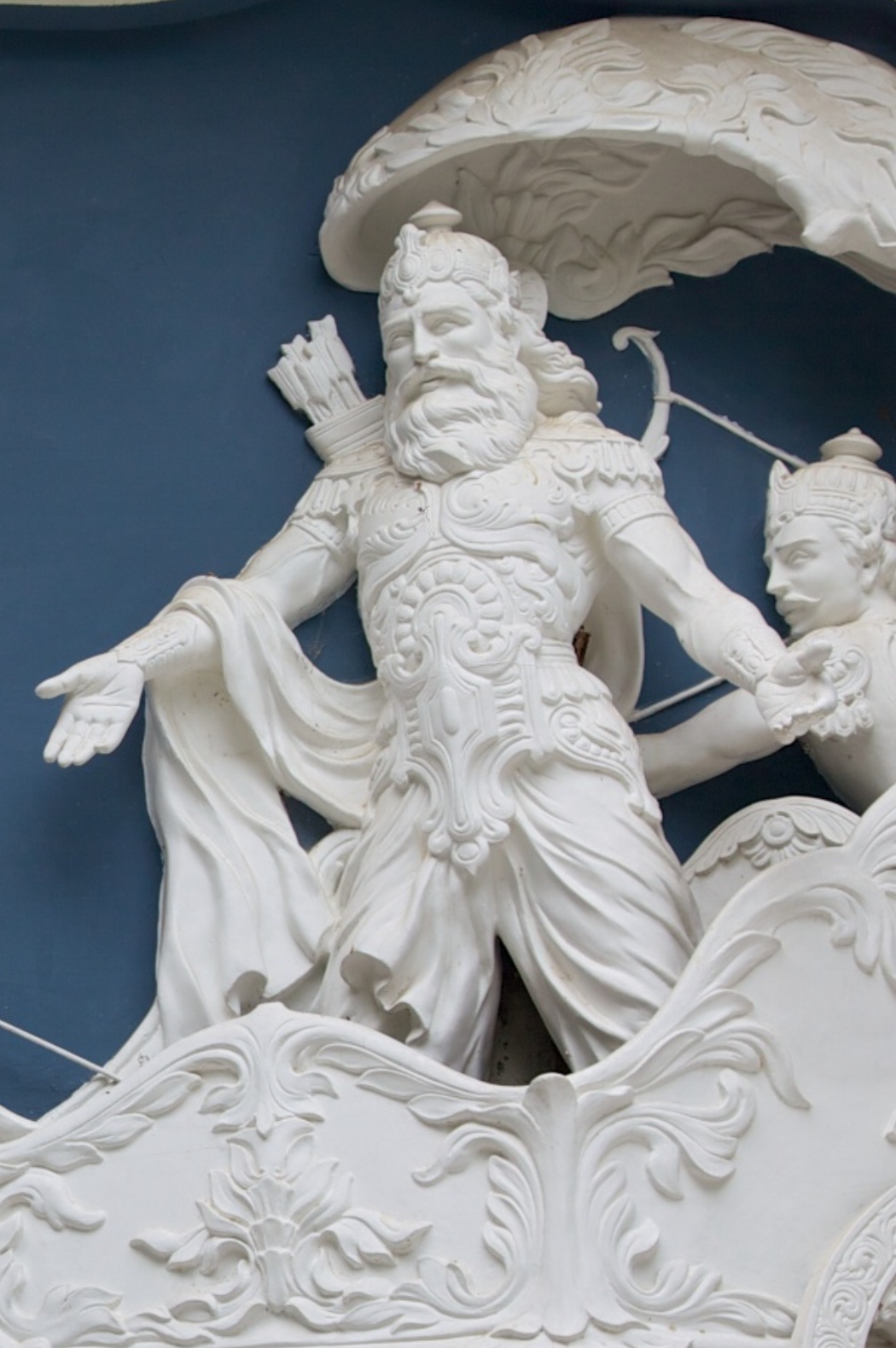
![Statue of Bhishma][float-right]In the post-Vedic epics, the Mahabharata and Ramayana, composed between approximately 400 BCE and 400 CE, the Kshatriya varna is exemplified through narratives of warriors and rulers confronting moral and martial challenges. The Ramayana presents Rama as the archetypal Kshatriya, upholding virtues of honor, loyalty, and self-sacrifice in governance and combat.[17] The Mahabharata, particularly in the Bhagavad Gita (18.43), delineates Kshatriya qualities as including heroism (shaurya), majesty (tejah), firmness (dhriti), skill in battle (daakshyam), non-retreat from combat (na chaiv ikshataa), generosity (daana), and sovereignty (daakshyam).[18] These texts elaborate Kshatriya dharma as encompassing ethical warfare, protection of the realm, and adherence to righteous rule amid familial and cosmic conflicts.[17] The Puranas, compiled from around the 3rd to 10th centuries CE, further expand on Kshatriya roles by integrating them into cosmological and genealogical frameworks. Texts like the Vishnu Purana trace major Kshatriya lineages to the solar dynasty (Suryavanshi), descending from Ikshvaku, and the lunar dynasty (Chandravanshi), originating from Chandra, providing historical legitimacy to ruling houses through detailed king lists.[19][20] These genealogies emphasize Kshatriyas as protectors of dharma, with duties centered on wielding arms, administering justice, and sustaining societal order.[21] The Narada Purana classifies varnas by guna and karma, positioning Kshatriyas as responsible for rulership and defense, distinct from priestly functions.[20] Scholar F.E. Pargiter posited that the Puranas embody a Kshatriya tradition, privileging royal heroes and dynastic lore over the Brahmana-centric Vedic corpus, though transmitted via Suta narrators.[20] This contrasts with Vedic primacy of ritual knowledge, highlighting Puranic focus on temporal power and ethical kingship. From the Gupta era onward (circa 300–700 CE), emerging dynasties invoked Puranic and epic Kshatriya ancestries to affirm their varna status and authority.[22] Such elaborations reinforced Kshatriya interdependence with other varnas, portraying them as upholders of cosmic order through martial prowess and just governance.[20]
Historical Evolution
Early Vedic Tribal Structures
In the early Vedic period, circa 1500–1000 BCE, Indo-Aryan society was structured around tribes known as janas, which encompassed clans (vis) and smaller settlements or military bands (gramas). The foundational social unit was the extended family (kula), headed by a patriarch (grihapati), with patriarchal norms dominating kinship ties and pastoral livelihoods centered on cattle herding and rudimentary agriculture.[23][24] This tribal framework emphasized mobility and kinship, with vis groups forming the productive and martial backbone, often mobilizing as gramas for conflicts termed samgrama or cattle raids (gavishti).[23] The rajan served as the tribal chief, typically selected through hereditary lines but subject to endorsement or challenge by assemblies like the samiti, reflecting a non-absolute authority focused on warfare, protection, and rudimentary governance rather than territorial kingship. Assisted by the purohita (chaplain-priest) for ritual guidance and the senani (military commander), the rajan led expeditions against rival tribes, prioritizing defense and resource acquisition over centralized administration.[23][24] Village-level leadership fell to the gramani, who coordinated local defense and herding, underscoring the martial orientation of tribal units.[23] Noble warriors, designated rajanyas in Rigvedic texts, constituted the elite stratum linked to the rajan, embodying rulership and combat prowess as precursors to the formalized Kshatriya varna; they are evoked in the Purusha Sukta (Rigveda 10.90) as emerging from the cosmic being's arms, alongside brahmanas from the mouth and vaisyas from the thighs, though divisions remained fluid and occupationally based without rigid endogamy.[25][23] Assemblies such as the sabha (elder council for judicial and advisory functions), samiti (broader tribal forum for electing or deliberating on the rajan), and vidatha (inclusive body handling rituals, military, and economic matters, often involving women) provided checks on leadership and communal decision-making.[23][24] Prominent janas included the Bharatas, Purus, Yadus, and Matsyas, whose inter-tribal rivalries—such as the Bharata-Puru clashes celebrated in Rigvedic hymns—drove much of the period's recorded history, fostering a polity where martial alliances and conquests shaped territorial expansions in the Punjab region.[24]Later Vedic and Epic Periods
During the Later Vedic period (c. 1000–500 BCE), Kshatriyas emerged as the dominant ruling class in increasingly territorial kingdoms, transitioning from tribal rajans to hereditary monarchs who centralized power and led military expansions.[26] The Brahmanas and other texts portray Kshatriyas as protectors of societal order, performing yajnas to legitimize rule while relying on Brahmin counsel for rituals, with their authority rooted in kshatra—force and governance—distinct from priestly brahman.[27] Archaeological evidence from sites like Hastinapura and Ahichchhatra supports the growth of fortified settlements under Kshatriya oversight, reflecting agricultural surplus and iron-age warfare that enabled state formation.[26] Kshatriya dharma emphasized justice, protection of vassals, and conquest, as seen in rulers like Janaka of Videha, who balanced martial duties with Vedic scholarship, achieving rishi status through philosophical inquiry in texts like the Brihadaranyaka Upanishad.[28] This era witnessed varna rigidification, with Kshatriyas positioned second to Brahmins in ritual hierarchy but first in political power, funding sacrifices and assemblies like the sabha, though oligarchic elements persisted in some janapadas.[27] Inter-varna tensions arose, as Kshatriyas asserted autonomy, occasionally challenging Brahmin supremacy through patronage or doctrinal debates.[28] In the Epic periods, as idealized in the Mahabharata and Ramayana (narratives rooted in late Vedic societal structures but redacted later), Kshatriyas embodied heroic ideals of righteous warfare and governance, with central figures like the Pandavas and Rama exemplifying dharma through adherence to svadharma—personal duty amid moral conflicts.[29] The Mahabharata depicts Kshatriya clans in large-scale ksatriya-yuddha, underscoring ethical constraints like avoiding harm to non-combatants and upholding vows, as articulated in the Bhagavad Gita's counsel to Arjuna on detached action in battle.[29] These epics reflect historical kernels of Kshatriya internecine strife and alliances, promoting ideals of rajadharma—kingly duty to welfare and cosmic order—while critiquing excesses like adharmic tyranny.[29]Mahajanapada and Imperial Eras
During the Mahajanapada period (c. 600–300 BCE), Kshatriyas formed the ruling class in most of the 16 major polities, functioning as monarchs in kingdoms such as Magadha, Kosala, Vatsa, and Avanti, where they exercised centralized authority over territories, taxation, and military campaigns. Rulers like Bimbisara of Magadha (r. c. 558–491 BCE) and his son Ajatashatru (r. c. 492–460 BCE) of the Haryanka dynasty consolidated power through conquests and alliances, patronizing religious movements while upholding Kshatriya dharma of protection and governance.[30] In republican ganasanghas like the Vajji confederacy and the Sakya clan (to which Siddhartha Gautama belonged), governance was oligarchic, with assemblies of Kshatriya chiefs (rajas) sharing decision-making, emphasizing collective defense and ritual sovereignty rather than hereditary monarchy. These structures reflected Kshatriya emphasis on martial prowess and territorial control, as evidenced by fortifications at sites like Rajgir and military expansions documented in contemporary accounts.[31] The transition to imperial eras began with the Nanda dynasty (c. 345–322 BCE), whose ruler Mahapadma Nanda is noted in Puranic traditions for subjugating rival Kshatriya lineages, though the Nandas themselves originated outside traditional varna claims. This paved the way for the Maurya Empire (c. 322–185 BCE), founded by Chandragupta Maurya (r. 321–297 BCE), whose Moriya clan was classified as Kshatriya in early Buddhist texts such as the Mahāparinibbāna Sutta, linking them to the Pipphalivana region and warrior traditions.[32] Despite later Brahmanical sources questioning their varna due to non-Aryan origins, Buddhist and Jain narratives consistently affirm Chandragupta's Kshatriya status, portraying him as a unifier who wielded a vast army of 600,000 infantry, 30,000 cavalry, and war elephants to conquer the Nandas and repel Seleucid incursions.[33] His grandson Ashoka (r. 268–232 BCE), initially a conqueror exemplifying Kshatriya martial duty in the Kalinga War (c. 261 BCE), later shifted toward dharmic rule emphasizing non-violence, yet retained imperial administration rooted in Kshatriya governance ideals.[34] In the subsequent Gupta Empire (c. 320–550 CE), the dynasty, initially of probable Vaishya merchant origins, elevated its status to Kshatriya through strategic marriages—such as Chandragupta I (r. c. 319–335 CE) wedding Licchavi princess Kumaradevi—and Brahmanical endorsements in inscriptions depicting rulers as parama-bhattaraka (supreme lords) and devotees of Vishnu, aligning with Kshatriya ideals of divine kingship.[35] Samudragupta (r. c. 335–375 CE), lauded in the Allahabad Pillar Inscription as a conqueror of forest tribes and southern kings, embodied Kshatriya prowess by expanding the empire from the Himalayas to the Deccan, fostering a centralized bureaucracy with military governors (kumaramatyas) drawn from elite varna backgrounds.[36] This era saw Kshatriyas as patrons of Vedic rituals and warfare ethics, with the empire's stability enabling cultural syntheses, though post-Gupta fragmentation led regional dynasties like the Gurjara-Pratiharas to assert Kshatriya lineages amid feudal militarization.[37] Throughout these periods, Kshatriya identity intertwined with political legitimacy, often verified through genealogical claims and alliances rather than rigid birth, reflecting pragmatic adaptations in power consolidation.[38]Medieval Dynasties and Regional Kingdoms
The fragmentation of northern India following the death of Harsha in 647 CE gave rise to numerous regional powers, many led by clans asserting Kshatriya lineage through solar (Suryavanshi) or lunar (Chandravanshi) descent, or the Agnikula myth of fire-born warriors.[39] These Rajput dynasties, emerging prominently from the 7th to 12th centuries, embodied Kshatriya ideals of governance, warfare, and patronage, while contending with tripartite struggles among themselves, Rashtrakutas, and later Arab incursions.[39] Their rule emphasized fortified capitals, cavalry-based armies, and temple-building, sustaining Hindu cultural continuity amid political decentralization.[40] The Gurjara-Pratiharas, ruling from Ujjain and later Kannauj circa 730–1036 CE, exemplified early medieval Kshatriya imperialism in the north. Nagabhata I (r. 730–760 CE) repelled Arab forces at Umayyad battles in Rajasthan in 738 CE, establishing defenses along the western frontier.[40] His successors, including Vatsaraja (r. 775–800 CE) and Mihira Bhoja (r. 836–885 CE), expanded control over Gujarat, Malwa, and Bihar, controlling key trade routes and fostering economic prosperity through land grants to Brahmins and temples.[41] The dynasty's decline accelerated after Rashtrakuta invasions in the 10th century, culminating in Mahmud of Ghazni's sack of Kannauj in 1018 CE, yet Pratiharas maintained claims to ancient Kshatriya heritage via Puranic genealogies.[40] In western India, the Chaulukya (Solanki) dynasty of Gujarat, from 940–1244 CE, asserted Agnivanshi Kshatriya origins and supplanted the Chavda rulers. Mularaja I (r. 940–995 CE) founded Anhilwara (Patan) as capital, while Bhima I (r. 1022–1064 CE) defended against Mahmud of Ghazni's raid on Somnath temple in 1025 CE, though the shrine was plundered.[39] Kumarapala (r. 1143–1172 CE) extended influence into Malwa and Rajasthan, promoting Jainism alongside Shaivism and commissioning architectural feats like the Modhera Sun Temple.[39] The Chaulukyas balanced martial expansion with cultural patronage, including water management systems that supported agriculture in arid regions.[42] The Chauhan (Chahamana) dynasty, based in Shakambhari and Ajmer from the 7th–12th centuries CE, rose as Pratihara vassals before achieving independence. Ajayaraja II (r. 1110–1135 CE) shifted the capital to Ajmer and constructed lakes for irrigation, while Vigraharaja IV (r. 1150–1164 CE) subdued neighboring Chalukyas and Tomars, capturing Delhi.[39] Prithviraj III (r. 1178–1192 CE), the most renowned, defeated Ghurid forces in the First Battle of Tarain (1191 CE) but fell in the second battle (1192 CE), marking a pivotal shift toward Islamic dominance in the north.[39] Chauhan inscriptions affirm their Kshatriya dharma through conquests and temple endowments, such as those at Pushkar.[43] The Paramara dynasty of Malwa, active from the 9th–13th centuries CE, claimed descent from legendary Kshatriya figures and peaked under Bhoja (r. 1010–1055 CE), who ruled from Dhara and waged campaigns against Chalukyas, Kalachuris, and Chandellas.[44] Bhoja authored Sanskrit treatises on grammar, medicine, and architecture, constructed the Bhojeshwar Temple and Bhojpur lake (spanning 250 square miles), and fortified his realm against Ghaznavid threats.[44] Despite alliances and defeats, including losses to Rashtrakutas under Siyaka II (r. 946–972 CE), Paramaras upheld Kshatriya patronage of learning, with Bhoja's court hosting scholars like Bilhana.[39] The dynasty ended with Mahalakadeva's submission to Alauddin Khalji in 1305 CE.[39] In southern India, the Imperial Cholas (850–1279 CE) revived earlier traditions, claiming Kshatriya status via Ikshvaku solar lineage from Rama. Vijayalaya (r. 850–871 CE) captured Thanjavur, but Rajaraja I (r. 985–1014 CE) and Rajendra I (r. 1014–1044 CE) built a thalassocracy, conquering Sri Lanka, Maldives, and parts of Southeast Asia with navies of 1,000 ships.[45] Their brihadeeswarar Temple at Thanjavur (completed 1010 CE) exemplifies Kshatriya endowment of Shaivite architecture, while administrative innovations like village assemblies reinforced varna-based governance.[45] Chola expansions integrated Kshatriya martial ethos with maritime trade, influencing regional kingdoms like the Pandyas and Hoysalas, who also adopted similar claims.[45]| Dynasty | Core Region | Key Ruler(s) and Reign | Notable Achievements/Events |
|---|---|---|---|
| Gurjara-Pratihara | Kannauj, Rajasthan | Mihira Bhoja (836–885 CE) | Frontier defense; empire peak covering 800,000 sq km[40] |
| Chauhan | Ajmer, Delhi | Prithviraj III (1178–1192 CE) | Battles of Tarain; Ajmer fortification[39] |
| Paramara | Malwa (Dhara) | Bhoja (1010–1055 CE) | Scholarly works; 104 temples built[44] |
| Chaulukya | Gujarat (Anhilwara) | Kumarapala (1143–1172 CE) | Jain-Shaiva synthesis; Modhera Temple[39] |
| Chola | Tamil Nadu, overseas | Rajendra I (1014–1044 CE) | Naval conquests to Ganges and Sumatra[45] |
Colonial Encounters and Transformations
The British colonial administration encountered Kshatriyas primarily through alliances with ruling dynasties in princely states, many of which traced their legitimacy to Kshatriya varna ideals of governance and martial prowess, such as the Rajput kingdoms in Rajasthan that signed subsidiary alliance treaties starting in the early 19th century, ceding military autonomy in exchange for protection.[46] These arrangements diminished traditional Kshatriya roles in independent warfare and territorial expansion, redirecting elite martial functions toward auxiliary forces under British command, as seen in the integration of Rajput contingents into the Bengal Army prior to the 1857 revolt.[47] Post-1857, the British formalized caste classifications through decennial censuses, beginning with the 1871-72 enumeration, which enumerated Kshatriyas—often conflated with Rajputs—as comprising over 5 million individuals in British provinces, using ethnographic surveys to map occupations and hierarchies for administrative control.[48] This process rigidified fluid pre-colonial varna identities into enumerated jatis, encouraging groups to petition for upward reclassification; for instance, Yadavs asserted Kshatriya descent from the mythological Yadu lineage to align with varna prestige during census deliberations.[49] Such claims reflected Sanskritization efforts among agrarian and artisanal communities in the Gangetic plains, where reform movements promoted Kshatriya rituals and genealogies to access land rights and military recruitment preferences.[50] The "martial races" theory, articulated by officials like Lord Roberts in the 1880s, designated certain Kshatriya-associated groups—such as Rajputs and Pathans—as inherently warlike due to perceived Aryan martial traits, prioritizing their recruitment into the British Indian Army to suppress internal dissent and bolster imperial defense.[47] By 1900, these classifications influenced over 30% of army composition from Punjab and Rajputana, transforming Kshatriya ideals of dharma yuddha (ethical warfare) into disciplined colonial soldiery, while excluding others deemed non-martial, thus exacerbating caste-based divisions for divide-and-rule governance.[46] This selective patronage, however, eroded autonomous Kshatriya polities, as princely rulers increasingly served as ceremonial zamindars under the Permanent Settlement of 1793, shifting from sovereign protectors to revenue collectors aligned with British paramountcy.[49] Overall, colonial encounters catalyzed a dual transformation: the erosion of Kshatriya political sovereignty through disarmament and treaty subjugation, coupled with the proliferation of status assertions that hybridized traditional varna with modern bureaucratic identities, laying groundwork for post-independence caste mobilizations.[50] While British policies exploited existing hierarchies rather than inventing them, their ethnographic fixation amplified competitive claims, as evidenced by disputes over rank in census reports that persisted into the 20th century.[46]Traditional Duties and Ideals
Dharma of Governance and Justice
The dharma of Kshatriyas in governance, known as rajadharma, centers on the protection of subjects, the maintenance of social order, and the impartial administration of justice to uphold cosmic and societal harmony. As rulers, Kshatriyas bear the primary responsibility for wielding danda—the instrument of punishment—to deter wrongdoing while ensuring its application remains proportionate and free from personal bias. This framework, derived from Vedic and post-Vedic texts, positions the king as a servant of dharma rather than an absolute sovereign, accountable for fostering prosperity, defending the realm from aggression, and promoting the welfare of all varnas through ethical rule.[51][52] In the Manusmriti, the king's duties explicitly include daily oversight of judicial proceedings, consultation with Brahmin advisors versed in sacred law, and the collection of taxes solely for public protection and infrastructure, prohibiting excess to avoid burdening the populace. Justice requires swift resolution of disputes, with penalties calibrated to the offense's severity—fines for minor infractions, corporal punishment for greater crimes—and an emphasis on rehabilitation over vengeance to restore balance. The text warns that neglect of these obligations invites chaos, as an unjust ruler undermines the varna system's interdependence, leading to societal decline.[53][54] The Mahabharata's Shanti Parva elaborates these ideals through Bhishma's counsel to Yudhishthira, portraying governance as a science demanding mastery of fourteen knowledges, including ethics, economics, and jurisprudence, to ensure equitable laws binding even the ruler. Bhishma stresses dandaniti—the policy of measured chastisement—as essential for deterrence, advocating a court system with appointed judges who prioritize evidence and precedent over favoritism. True justice, he teaches, manifests in universal application of law, protection of the vulnerable, and policies yielding tangible outcomes like reduced crime and economic stability, with the ruler's personal virtue serving as the ultimate exemplar.[55][56][57]Martial Responsibilities and Ethical Warfare
Kshatriyas held the core duty of safeguarding society through martial prowess, including the defense of territories against invasions and the suppression of internal threats to maintain order and justice.[58] This responsibility extended to protecting weaker varnas from oppression, as articulated in Vedic texts where the Kshatriya's valor (kshatra) ensured societal stability by countering aggression without undue subjugation.[59] In epic narratives like the Mahabharata, this manifested as the obligation to wage war when dharma demanded it, prioritizing the ruler's role in upholding righteous governance over personal reluctance.[60] Ethical warfare, termed dharmayuddha, governed Kshatriya conduct to distinguish legitimate conflict from adharma, emphasizing honor, proportionality, and restraint.[61] Primary rules included initiating combat only between sunrise and sunset, prohibiting attacks on unarmed opponents, those in retreat, or individuals below the navel, and forbidding multiple warriors from assailing a single combatant simultaneously.[62] Deceitful tactics, such as concealed weapons or ambushes against equals, were condemned, with violations incurring severe karmic or social penalties, as seen in the training regimens that instilled these codes alongside martial skills.[63] In the Mahabharata's Kurukshetra war, these principles were idealized through figures like Bhishma, who adhered to duels and fair combat despite the conflict's scale, though lapses by others highlighted the tension between strategic necessity and ethical imperatives.[61] Such frameworks underscored causal accountability, where victory in dharmayuddha accrued merit only if rules were observed, reinforcing the Kshatriya's role as a protector bound by moral realism rather than unchecked power.[59]Interdependence with Other Varnas
The Kshatriya varna's functions of rulership and defense were inherently linked to the Brahmin varna's priestly and advisory roles, forming a symbiotic relationship essential for legitimate governance. In classical texts such as the Manusmriti, the king—a prototypical Kshatriya—is instructed to consult Brahmins for counsel on dharma, perform Vedic sacrifices under their guidance, and grant them villages for sustenance in exchange for spiritual sanction of authority. This interdependence ensured that temporal power derived moral legitimacy from ritual purity, while Brahmins received protection from external threats and internal disorder, allowing uninterrupted pursuit of knowledge and rites.[64] Kshatriyas also depended on Vaishyas for economic viability, extracting revenue through taxes like bali and shulka to fund military and administrative apparatus, while safeguarding trade routes and agricultural lands from invasions. The Arthashastra details how rulers relied on Vaishya productivity in commerce, herding, and farming to amass wealth, with protections against exploitation fostering mutual prosperity; in turn, Vaishyas contributed to state granaries and loans for campaigns. This economic nexus prevented fiscal collapse, as unchecked aggression without resource backing historically undermined kingdoms, as seen in Vedic hymns emphasizing protection of productive classes.[65] Relations with Shudras emphasized service and enforcement, where Kshatriyas imposed labor duties for public infrastructure, such as forts and irrigation, while upholding laws against abuse to maintain social order. Dharmashastras prescribe that Shudras perform menial tasks supporting Kshatriya-led endeavors, like artisanal work for weaponry or porterage in armies, receiving in exchange security and minimal shares of produce. This division, rooted in functional specialization rather than equality, sustained the societal framework, with Kshatriya failure to regulate leading to revolts, as critiqued in epic narratives like the Mahabharata's accounts of disordered realms.[66] Overall, varna interdependence mirrored an organic body, per Puranic analogies, where Kshatriya vitality preserved the whole against entropy.[67]Lineages and Social Identity
Puranic and Genealogical Claims
The Puranas delineate Kshatriya origins through mythological genealogies centered on the solar (Sūryavaṃśa) and lunar (Candravaṃśa) dynasties, portraying them as ancient royal lineages descended from divine progenitors. The Vishnu Purana, in its fourth book, traces the solar dynasty from Brahmā via the Manu Vaivasvata to Ikṣvāku, founder of the Ikṣvāku dynasty in Ayodhya, encompassing kings such as Hariscandra, Sagara, and Rāma, the seventh avatar of Viṣṇu.[68] [19] This lineage symbolizes continuity of righteous rule and dharma, with over 100 named kings listed up to the composition period around the 4th-5th century CE.[68] The lunar dynasty, detailed similarly in the Vishnu Purana and echoed in the Bhāgavata Purana, originates from the moon god Candra through Budha, Iḷā, and Purūravas, branching via Yayāti into the Pūru (ancestors of the Bharatas and Kurus, including the Pāṇḍavas of the Mahābhārata) and Yadu lines (Yādavas, including Kṛṣṇa).[68] [19] These accounts, spanning thousands of years in Puranic chronology, integrate epic narratives to affirm Kshatriya supremacy in governance and warfare, with the Bhāgavata Purana emphasizing the Yadu lineage's role in Viṣṇu's avatāras.[69] Puranic texts also reference subsidiary origins, such as fire-born (Agnivaṃśa) clans emerging from sacrificial fires, as in stories of Viśvakarman creating warriors for depleted Kshatriya stocks after Pārśurāma's purges.[70] Genealogical claims by later dynasties and jātis, including Rajputs and others, invoke these vanshas—Sūryavaṃśī, Candravaṃśī, or Agnivaṃśī—to substantiate Kshatriya status, often fabricating or adapting Puranic pedigrees for political legitimacy during medieval periods.[70] Scholarly assessments treat these as retrospective constructs blending myth, legend, and selective history, lacking empirical verification but serving to reinforce varṇa hierarchies and royal authority in pre-modern India.[71]Major Clans and Jati Affiliations
The major Kshatriya clans trace their origins to three principal vanshas (lineages) described in Puranic texts and epics: Suryavanshi (solar dynasty), Chandravanshi (lunar dynasty), and Agnivanshi (fire dynasty). These genealogical frameworks emphasize patrilineal descent from divine or semi-divine progenitors, serving as foundational claims for authority and identity among ruling and warrior groups.[72][73] Suryavanshi clans claim descent from the sun god Surya through the line of Manu, Ikshvaku, Harishchandra, Raghu, Dasharatha, and Rama of the Ramayana, often termed Raghuvanshi. This lineage historically associated with kingdoms in northern and central India, including clans such as Bais (from Bharata), Kachwaha (rulers of Amber/Jaipur), and Sisodia (of Mewar).[72][73] Chandravanshi clans derive from the moon god Chandra via Ila, Pururavas, Yayati, and his sons Puru and Yadu, branching into Puruvanshi (Puru line, including Bharata, Kuru, and the Pandavas/Kauravas of the Mahabharata) and Yaduvanshi (Yadu line, including Krishna and the Yadavas). Associated clans include Bhati (of Jaisalmer), Jadaun (Yaduvanshi), Katoch (of Kangra), and Rathore (Puruvanshi, rulers of Marwar).[72][73] Agnivanshi clans originate from a Puranic myth wherein four (or five) warriors emerged from a sacrificial fire at Mount Abu to combat demons, descending from Agnipala and including Pratihara, Parmara (of Malwa), Chauhan (of Ajmer/Delhi), Solanki (of Gujarat), and Chandela (of Bundelkhand). This lineage gained prominence in medieval western India.[72][73] Jati affiliations among contemporary Kshatriya groups often align with these vanshas through kul (clan) identities, particularly among Rajputs, who recognize 36 primary royal kuls subdivided into shakhas (branches). These include, alongside those mentioned, Gahlot (Sisodia branch), Tomar, Bargujar, Sengar, and Dahima, with many Rajput jatis maintaining endogamous practices tied to specific vansh claims. Other regional Kshatriya jatis, such as Marathas (claiming Yaduvanshi ties) and certain Bhumihar groups, affiliate similarly but emphasize localized historical rulership over pan-Indian Puranic descent.[72][73]| Vansha | Key Progenitors | Example Clans/Jatis |
|---|---|---|
| Suryavanshi | Surya, Ikshvaku, Rama | Bais, Kachwaha, Sisodia |
| Chandravanshi | Chandra, Yayati, Yadu/Puru | Bhati, Jadaun, Rathore, Katoch |
| Agnivanshi | Agni (Mount Abu fire ritual) | Chauhan, Parmara, Solanki, Pratihara |