


Community hub
Recent from talks
Contribute something
Nothing was collected or created yet.
Oyster
View on Wikipedia
 | This article is missing information about oyster reproduction, including its "set". (June 2025) |
| Oyster Temporal range:
| |
|---|---|

| |
| Pacific oyster from the Marennes-Oléron basin in France | |
Scientific classification
| |
| Kingdom: | Animalia |
| Phylum: | Mollusca |
| Class: | Bivalvia |
| Subclass: | Pteriomorphia |
| Groups included | |
| |
| Cladistically included but traditionally excluded taxa | |
|
All other members of Pteriomorphia | |

Oyster is the common name for a number of different families of salt-water bivalve molluscs that live in marine or brackish habitats. In some species, the valves are highly calcified, and many are somewhat irregular in shape. Many, but not all oysters, are in the superfamily Ostreoidea.
Some species of oyster are commonly consumed and are regarded as a delicacy in some localities. Some types of pearl oysters are harvested for the pearl produced within the mantle. Others, such as the translucent windowpane oysters, are harvested for their shells.
Etymology
[edit]The word oyster comes from Old French oistre, and first appeared in English during the 14th century.[1] The French derived from the Latin ostrea, the feminine form of ostreum,[2] which is the latinisation of the Ancient Greek ὄστρεον (ostreon) 'oyster'.[3] Compare ὀστέον (osteon) 'bone'.[4]
Types
[edit]True oysters
[edit]True oysters are members of the family Ostreidae. This family includes the edible oysters, which mainly belong to the genera Ostrea, Crassostrea, Magallana, and Saccostrea. Examples include the European flat oyster, eastern oyster, Olympia oyster, Pacific oyster, and the Sydney rock oyster. Ostreidae evolved in the Early Triassic epoch: The genus Liostrea grew on the shells of living ammonoids.[5]
Pearl oysters
[edit]
Almost all shell-bearing mollusks can secrete pearls, yet most are not very valuable. Pearls can form in both saltwater and freshwater environments.
Pearl oysters are not closely related to true oysters, being members of a distinct family, the feathered oysters (Pteriidae). Both cultured pearls and natural pearls can be extracted from pearl oysters, though other molluscs, such as the freshwater mussels, also yield pearls of commercial value.
The largest pearl-bearing oyster is the marine Pinctada maxima, which is roughly the size of a dinner plate. Not all individual oysters produce pearls.
In nature, pearl oysters produce pearls by covering a minute invasive object with nacre. Over the years, the irritating object is covered with enough layers of nacre to become a pearl. The many different types, colours and shapes of pearls depend on the natural pigment of the nacre, and the shape of the original irritant.
Pearl farmers can culture a pearl by placing a nucleus, usually a piece of polished mussel shell, inside the oyster. In three to seven years, the oyster can produce a perfect pearl. Since the beginning of the 20th century, when several researchers discovered how to produce artificial pearls, the cultured pearl market has far outgrown the natural pearl market.[6]
Other types
[edit]A number of bivalve molluscs (other than true oysters and pearl oysters) also have common names that include the word "oyster", usually because they either taste like or look somewhat like true oysters, or because they yield noticeable pearls. Examples include:
- Thorny oysters in the genus Spondylus
- Pilgrim oyster, another term for a scallop, in reference to the scallop shell of St. James
- Saddle oysters, members of the Anomiidae family also known as jingle shells
- Dimydarian oysters, members of the family Dimyidae
- Windowpane oysters
-

-
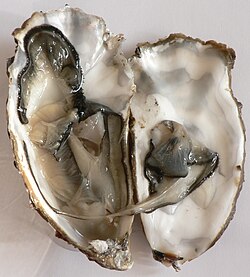 Pacific oyster, opened


In the Philippines, a local thorny oyster species known as Tikod amo is a favorite seafood source in the southern part of the country.[7] Because of its good flavor, it commands high prices.
Anatomy
[edit]Oysters breathe primarily via gills. In addition to their gills, oysters can exchange gases across their mantles, which are lined with many small, thin-walled blood vessels. A small, three-chambered heart, lying under the adductor muscle, pumps colorless blood to all parts of the body. At the same time, two kidneys, located on the underside of the muscle, remove waste products from the blood. Their nervous system includes two pairs of nerve cords and three pairs of ganglia. There is no evidence that oysters have a brain.
While some oysters have two sexes (European oyster and Olympia oyster), their reproductive organs contain both eggs and sperm. Because of this, it is technically possible for an oyster to fertilize its own eggs. The gonads surround the digestive organs, and are made up of sex cells, branching tubules, and connective tissue.
Once her millions of eggs are fertilized, the female discharges them into the water. The larvae develop in about six hours and exist suspended in the water column as veliger larvae for two to three weeks before settling on a bed and reaching sexual maturity within a year.
Feeding
[edit]Oysters are filter feeders, drawing water in over their gills through the beating of cilia. Suspended plankton and non-food particles are trapped in the mucus of a gill, and from there are transported to the mouth, where they are eaten, digested, and expelled as feces or pseudofeces that fall to the bottom and remain out of the water column. Oysters feed most actively at temperatures ranging from the high 60s to the high 70s (20–26 °C).[8] Under ideal laboratory conditions, an oyster can filter up to 190 L (50 US gal) of water per day. Under average conditions, mature oysters filter 11–45 L (3–12 U.S. gal). Chesapeake Bay's once-flourishing oyster population historically filtered excess nutrients from the estuary's entire water volume every three to four days. As of 2008 it was estimated that a complete cycle would take nearly a year.[9]
Habitat and behaviour
[edit]
A group of oysters is commonly called a bed or oyster reef.

Oysters are filter feeders, taking in large amounts of water to feed and breathe (exchange O2 and CO2 with water) but they are not permanently open. They regularly shut their valves to enter a resting state, even when they are permanently submersed. Their behaviour follows very strict circatidal and circadian rhythms according to the relative moon and sun positions. During neap tides (the time periods of mildly shifting tides), they exhibit much longer closing periods than during the spring tide (the time period of more drasticly shifting tides).[10]
As a keystone species, oysters provide habitat for many marine species. Crassostrea and Saccostrea live mainly in the intertidal zone, while Ostrea is subtidal. The hard surfaces of oyster shells and the nooks between the shells provide places where a host of small animals can live. Hundreds of animals, such as sea anemones, barnacles, and hooked mussels, inhabit oyster reefs. Many of these animals are prey to larger animals, including fish, such as striped bass, black drum and croakers.
An oyster reef can increase the surface area of a flat bottom 10-fold.[citation needed] An oyster's mature shape often depends on the type of bottom to which it is originally attached, but it always orients itself with its outer, flared shell tilted upward. One valve is cupped and the other is flat.
Reproduction
[edit]Oysters usually reach maturity in one year. They are protandric; during their first year, they spawn as males by releasing sperm into the water. As they grow over the next two or three years and develop greater energy reserves, they spawn as females by releasing eggs. Bay oysters usually spawn from the end of June until mid-August. An increase in water temperature prompts a few oysters to spawn. This triggers spawning in the rest, clouding the water with millions of eggs and sperm. A single female oyster can produce up to 100 million eggs annually. The eggs become fertilized in the water and develop into larvae, which eventually find suitable sites, such as another oyster's shell, on which to settle. Attached oyster larvae are called spat. Spat are oysters less than 25 mm (1 in) long. Many species of bivalves, oysters included, seem to be stimulated to settle near adult conspecifics.

Some tropical oysters, such as the mangrove oyster in the family Ostreidae, grow best on mangrove roots. Low tide can expose them, making them easy to collect.
The largest oyster-producing body of water in the United States is the Chesapeake Bay, although these beds have decreased in number due to overfishing and pollution. Other large oyster farming areas in the US include the bays and estuaries along the coast of the Gulf of Mexico from Apalachicola, Florida, in the east to Galveston, Texas, in the west. Large beds of edible oysters are also found in Japan and Australia. In 2005, China accounted for 80% of the global oyster harvest.[11] In Europe, France remained the industry leader.
Predation
[edit]Common oyster predators include crabs, seabirds, starfish, and humans. Some oysters contain crabs, known as oyster crabs.[12]
Nutrient cycling
[edit]Bivalves, including oysters, are effective filter feeders and can have large effects on the water columns in which they occur.[13] As filter feeders, oysters remove plankton and organic particles from the water column.[14] Multiple studies have shown individual oysters are capable of filtering up to 190 litres (42 imp gal; 50 US gal) of water per day, and thus oyster reefs can significantly improve water quality and clarity.[15][16][17][18] Oysters consume nitrogen-containing compounds (nitrates and ammonia), phosphates, plankton, detritus, bacteria, and dissolved organic matter, removing them from the water.[19] What is not used for animal growth is then expelled as solid waste pellets, which eventually decompose into the atmosphere as nitrogen.[20] In Maryland, the Chesapeake Bay Program had implemented a plan to use oysters to reduce the amount of nitrogen compounds entering the Chesapeake Bay by 8,600 t (9,500 short tons) per year by 2010.[21] Several studies have shown that oysters and mussels have the capacity to dramatically alter nitrogen levels in estuaries.[22][23][24] In the U.S., Delaware is the only East Coast state without aquaculture, but making aquaculture a state-controlled industry of leasing water by the acre for commercial harvesting of shellfish is being considered.[25] Supporters of Delaware's legislation to allow oyster aquaculture cite revenue, job creation, and nutrient cycling benefits. It is estimated that one acre (0.40 ha) can produce nearly 750,000 oysters, which could filter between 57,000 to 150,000 m3 (2.0–5.3 million cu ft) of water daily.[25] Also see nutrient pollution for an extended explanation of nutrient remediation.
Ecosystem services
[edit]As an ecosystem engineer, oysters provide supporting ecosystem services, along with provisioning, regulating and cultural services. Oysters influence nutrient cycling, water filtration, habitat structure, biodiversity, and food web dynamics.[26] Oyster reef habitats have been recognized as green infrastructure for shoreline protection.[27] Assimilation of nitrogen and phosphorus into shellfish tissues provides an opportunity to remove these nutrients from the water column.[28][29][30] In California's Tomales Bay, native oyster presence is associated with higher species diversity of benthic invertebrates.[31][32] As the ecological and economic importance of oyster reefs has become more acknowledged, restoration efforts have increased.[33]
Human history
[edit]
Middens testify to the prehistoric importance of oysters as food, with some middens in New South Wales, Australia, dated at ten thousand years.[35] They have been cultivated in Japan from at least 2000 BC.[35] In the United Kingdom, the town of Whitstable is noted for oyster farming from beds on the Kentish Flats that have been used since Roman times. The borough of Colchester holds an annual Oyster Feast each October, at which "Colchester Natives" (the native oyster, Ostrea edulis) are consumed. The United Kingdom hosts several other annual oyster festivals; for example, Woburn Oyster Festival is held in September. In fact, in Victorian England, it was quite common for people to go to the pub and enjoy their favorite beer with some oysters. They quickly realized that the "rich, sweet, malty stouts" were great with the "briny, creamy oyster". Then brewers found that oyster shells naturally clarify a beer and they started putting crushed oyster shells into their brews. The first known brewery to start this was in 1938 at the Hammerton Brewery in London. That is where the oyster stout was first started.[36]
The French seaside resort of Cancale in Brittany is noted for its oysters, which also date from Roman times. Sergius Orata of the Roman Republic is considered the first major merchant and cultivator of oysters. Using his considerable knowledge of hydraulics, he built a sophisticated cultivation system, including channels and locks, to control the tides. He was so famous for this, the Romans used to say he could breed oysters on the roof of his house.[37]

In the early 19th century, oysters were cheap and mainly eaten by the working class. Throughout the 19th century, oyster beds in New York Harbor became the largest source of oysters worldwide. On any day in the late 19th century, six million oysters could be found on barges tied up along the city's waterfront. They were naturally quite popular in New York City, and helped initiate the city's restaurant trade.[38] New York's oystermen became skilled cultivators of their beds, which provided employment for hundreds of workers and nutritious food for thousands. Eventually, rising demand exhausted many of the beds. To increase production, they introduced foreign species, which brought disease; effluent and increasing sedimentation from erosion destroyed most of the beds by the early 20th century. Oysters' popularity has put ever-increasing demands on wild oyster stocks.[39] This scarcity increased prices, converting them from their original role as working-class food to their current status as an expensive delicacy.
In Britain, the native species (European flat oyster) has five years to mature and is protected by the people during their May-to-August spawning season. The current market is dominated by the larger Pacific oyster and Rock oyster species which are farmed year-round.
Fishing from the wild
[edit]
Oysters are harvested by simply gathering them from their beds. In very shallow waters, they can be gathered by hand or with small rakes. In somewhat deeper water, long-handled rakes or oyster tongs are used to reach the beds. Patent tongs can be lowered on a line to reach beds that are too deep to reach directly. In all cases, the task is the same: the oysterman scrapes oysters into a pile, and then scoops them up with the rake or tongs.
In some areas, a scallop dredge is used. This is a toothed bar attached to a chain bag. The dredge is towed through an oyster bed by a boat, picking up the oysters in its path. While dredges collect oysters more quickly, they heavily damage the beds, and their use is highly restricted. Until 1965, Maryland limited dredging to sailboats, and even since then motor boats can be used only on certain days of the week. These regulations prompted the development of specialized sailboats (the bugeye and later the skipjack) for dredging.
Similar laws were enacted in Connecticut before World War I and lasted until 1969. The laws restricted the harvesting of oysters in state-owned beds to vessels under sail. These laws prompted the construction of the oyster sloop-style vessel to last well into the 20th century. Hope is believed to be the last-built Connecticut oyster sloop, completed in 1948.
Oysters can also be collected by divers.
In any case, when the oysters are collected, they are sorted to eliminate dead animals, bycatch (unwanted catch), and debris. Then they are taken to market, where they are either canned or sold live.
Cultivation
[edit]
Oysters have been cultured since at least the days of the Roman Empire. The Pacific oyster (Magallana gigas) is presently the most widely grown bivalve around the world.[40] Two methods are commonly used, release and bagging. In both cases, oysters are cultivated onshore to the size of spat, when they can attach themselves to a substrate. They may be allowed to mature further to form "seed oysters". In either case, they are then placed in the water to mature. The release technique involves distributing the spat throughout existing oyster beds, allowing them to mature naturally to be collected like wild oysters. Bagging has the cultivator putting spat in racks or bags and keeping them above the bottom. Harvesting involves simply lifting the bags or rack to the surface and removing the mature oysters. The latter method prevents losses to some predators, but is more expensive.[41]
The Pacific oyster has been grown in the outflow of mariculture ponds. When fish or prawns are grown in ponds, it takes typically 10 kg (22 lb) of feed to produce 1 kg (2+1⁄4 lb) of product (dry-dry basis). The other 9 kg (20 lb) goes into the pond and after mineralization, provides food for phytoplankton, which in turn feeds the oyster.
To prevent spawning, sterile oysters are now cultured by crossbreeding tetraploid and diploid oysters. The resulting triploid oyster cannot propagate, which prevents introduced oysters from spreading into unwanted habitats.[42]
Restoration and recovery
[edit]
In many areas, non-native oysters have been introduced in attempts to prop up failing harvests of native varieties. For example, the eastern oyster (Crassostrea virginica) was introduced to California waters in 1875, while the Pacific oyster was introduced there in 1929.[43] Proposals for further such introductions remain controversial.
The Pacific oyster prospered in Pendrell Sound, where the surface water is typically warm enough for spawning in the summer. Over the following years, spat spread out sporadically and populated adjacent areas. Eventually, possibly following adaptation to the local conditions, the Pacific oyster spread up and down the coast and now is the basis of the North American west coast oyster industry. Pendrell Sound is now a reserve that supplies spat for cultivation.[44] Near the mouth of the Great Wicomico River in the Chesapeake Bay, five-year-old artificial reefs now harbor more than 180 million native Crassostrea virginica. That is far lower than in the late 1880s, when the bay's population was in the billions, and watermen harvested about 910,000 m3 (25 million imp bsh) annually. The 2009 harvest was less than 7,300 m3 (200,000 imp bsh). Researchers claim the keys to the project were:
- using waste oyster shells to elevate the reef floor 25–45 cm (9.8–17.7 in) to keep the spat free of bottom sediments
- building larger reefs, ranging up to 8.1 ha (20 acres) in size
- disease-resistant broodstock[45]
The "oyster-tecture" movement promotes the use of oyster reefs for water purification and wave attenuation. An oyster-tecture project has been implemented at Withers Estuary, Withers Swash, South Carolina, by Neil Chambers-led volunteers, at a site where pollution was affecting beach tourism.[46] Currently, for the installation cost of $3000, roughly 4.8 million liters of water are being filtered daily. In New Jersey, however, the Department of Environmental Protection refused to allow oysters as a filtering system in Sandy Hook Bay and the Raritan Bay, citing worries that commercial shellfish growers would be at risk and that members of the public might disregard warnings and consume tainted oysters. New Jersey Baykeepers responded by changing their strategy for utilizing oysters to clean up the waterway, by collaborating with Naval Weapons Station Earle. The Navy station is under 24/7 security and therefore eliminates any poaching and associated human health risk.[47] Oyster-tecture projects have been proposed to protect coastal cities, such as New York, from the threat of rising sea levels due to climate change.[48] Additionally, oyster reef restoration has shown to increase the population of oyster beds within the oceans while also conserving the biolife within the oyster reefs.
Human impact
[edit]The accidental or intentional introduction of species by humans has the potential to negatively impact native oyster populations. For example, non-native species in Tomales Bay have resulted in the loss of half of California's Olympia oysters.[49] Oyster reefs occupy a small fraction of their distribution prior to mass harvesting during the last three centuries.[50]
In October 2017, it was reported that underwater noise pollution can affect oysters as they close their shells when exposed to low frequencies of sounds in experimental conditions. Oysters rely on hearing waves and currents to regulate their circadian rhythms, and perception of weather events—such as rain—may induce spawning. Cargo ships, pile drivers, and explosions conducted underwater produce low frequencies that may be detected by oysters.[51]
Environmental stressors as a result of global change are also negatively impacting oysters around the world, with many impacts affecting molecular, physiological, and behavioral processes in species including Magallana gigas.[52]
Shell recycling
[edit]Recycled oyster shells can help restore oyster reefs to provide marine life habitat that reduces flooding, and protects shorelines from storms.[53] Shell-recycling non-profits retrieve shells from restaurants, wash and dry them, and set them in the sun for up to a year to kill bacteria. Some states encourage shell recycling by offering tax incentives.[53]
The Billion Oyster Project out of New York has a goal of engaging one million people to return a billion Oysters to the New York Harbor. The nonprofit partners with 60+ restaurants to recycle discarded oyster shells to rebuild Oyster reefs.
$5 Million was awarded to Restore America's Estuaries by the NOAA's Office of Habitat Conservation to rebuild oyster reefs in Louisiana, Florida, Alabama, and Texas to expand oyster recycling efforts and create new Oyster Recycling programs.[54] Along the Gulf, many communities support nonprofits that recycle oyster shells.
The Shells for Shorelines Initiative similarly collects donated oyster shells from restaurants in Southern California.[55] The shells are repurposed as part of a restoration project to restore native Olympia oysters (Ostrea Larida) reefs, the only native oyster to the West Coast, Canada, and Alaska.[56]
Historically, Oyster shell waste was repurposed to form tabby concrete in construction. The origins of the material is debated, but likely was developed on the Iberian Peninsula or North Africa, where it was then introduced to the Americas via colonization[57] Tabby concrete is composed of burnt oyster shells for a source of lime and broken oyster shells as aggregate, and was a popular construction choice on the Atlantic coast until the mid 19th century.[58] The Kingsley Plantation on Fort George Island, build by African slaves, is one of the most notable examples of tabby concrete, but it is commonly found on plantations, factories, military forts, and historical landmarks in the South.[58]
As food
[edit]
Jonathan Swift is quoted as having said, "He was a bold man that first ate an oyster".[59] Evidence of oyster consumption goes back into prehistory, evidenced by oyster middens found worldwide. Oysters were an important food source in all coastal areas where they could be found, and oyster fisheries were an important industry where they were plentiful. Overfishing and pressure from diseases and pollution have sharply reduced supplies, but they remain a popular treat celebrated in oyster festivals in many cities and towns.
It was once assumed that oysters were only safe to eat in months with the letter 'r' in their English and French names. This myth is based in truth, in that in the Northern Hemisphere, oysters are much more likely to spoil in the warmer months of May, June, July, and August.[60] In recent years,[citation needed] pathogens such as Vibrio parahaemolyticus have caused outbreaks in several harvesting areas of the eastern United States during the summer months, lending further credence to this belief.
Dishes
[edit]Oysters can be eaten on the half shell, raw, smoked, boiled, baked, fried, roasted, stewed, canned, pickled, steamed, or broiled, or used in a variety of drinks. Eating can be as simple as opening the shell and eating the contents, including juice. Butter and salt are often added. Poached oysters can be served on toast with a cream roux.[61] In the case of Oysters Rockefeller, preparation can be very elaborate. They are sometimes served on edible seaweed, such as brown algae.
Care should be taken when consuming oysters. They may be eaten raw, with no dressing or with lemon juice, vinegar (most commonly shallot vinegar), or cocktail sauce. Upscale restaurants pair raw oysters with mignonette sauce, which consists primarily of fresh chopped shallot, mixed peppercorn, dry white wine and lemon juice or sherry vinegar. Raw oysters have complex flavors that vary among varieties and regions: salty, briny, buttery, metallic or fruity. The texture is soft and fleshy. North American varieties include Kumamoto and Yaquina Bay from Oregon, Duxbury and Wellfleet from Massachusetts, Malpeque from Prince Edward Island, Canada, Blue Point from Long Island, New York, Pemaquid from Maine, Rappahannock River and James River from Virginia, Chesapeake from Maryland and Cape May from New Jersey. In Connecticut they are frequently fished in Niantic whose municipal symbol is a scallop shell in reference to its strong seafood culture. Variations in water salinity, alkalinity, and mineral and nutritional content influence their flavor.
-
 Smoked oysters
 -
 Chargrilled oysters
 -
 Steamed Eastern oysters on the half shell
 -

-

-
![Oyster omelette from Singapore. Also common in Malaysia[62] and throughout Southeast Asia and Taiwan](//upload.wikimedia.org/wikipedia/commons/thumb/9/91/FriedOyster.JPG/330px-FriedOyster.JPG) Oyster omelette from Singapore. Also common in Malaysia[62] and throughout Southeast Asia and Taiwan
Oyster omelette from Singapore. Also common in Malaysia[62] and throughout Southeast Asia and Taiwan -
 Raw "Fine de Claire" oysters at Mercado de San Miguel in Madrid
 -
![Japanese kaki furai[63]](//upload.wikimedia.org/wikipedia/commons/thumb/c/cf/Cutlet_Oysters_in_Hong_Kong_Japanese_Restaurant.jpg/330px-Cutlet_Oysters_in_Hong_Kong_Japanese_Restaurant.jpg) Japanese kaki furai[63]
Japanese kaki furai[63] -
 Chinese oysters with garlic and peppers


.jpg)
![Oyster omelette from Singapore. Also common in Malaysia[62] and throughout Southeast Asia and Taiwan](https://en.wikipedia.org/wiki/File:FriedOyster.JPG)

![Japanese kaki furai[63]](https://en.wikipedia.org/wiki/File:Cutlet_Oysters_in_Hong_Kong_Japanese_Restaurant.jpg)

Nutrition
[edit]Oysters are an excellent source of zinc, iron, calcium, and selenium, as well as vitamin A and vitamin B12. Oysters are low in food energy; one dozen raw oysters provides only 460 kilojoules (110 kilocalories).[64] They are rich in protein (approximately 9 g in 100 g of Pacific oysters).[65] Two oysters (28 grams or 1 ounce) provide the Reference Daily Intake of zinc and vitamin B12.[66]
Traditionally, oysters are considered to be an aphrodisiac, partially because they resemble female sex organs.[67] A team of American and Italian researchers analyzed bivalves and found they were rich in amino acids that trigger increased levels of sex hormones.[68] Their high zinc content aids the production of testosterone.[38]
Shucking oysters
[edit]
Zora Neale Hurston wrote, "No, I do not weep at the world--I am too busy sharpening my oyster knife."[69] She references the special knives for opening live oysters, referred to as "oyster-shucking", and requires skill. The preferred method is to use a special knife (called an oyster knife, a variant of a shucking knife), with a short and thick blade about 5 cm (2 in) long.
While different methods are used to open an oyster (which sometimes depend on the type), the following is one commonly accepted oyster-shucking method.
- Insert the blade, with moderate force and vibration if necessary, at the hinge between the two valves.
- Twist the blade until there is a slight pop.
- Slide the blade upward to cut the adductor muscle which holds the shell closed.
Inexperienced shuckers can apply too much force, which can result in injury if the blade slips. Heavy gloves, sometimes sold as oyster gloves, are recommended; apart from the knife, the shell itself can be razor-sharp. Professional shuckers require fewer than three seconds to open the shell.[38]
If the oyster has a particularly soft shell, the knife can be inserted instead in the "sidedoor", about halfway along one side where the oyster lips widen with a slight indentation.
Oyster-shucking has become a competitive sport; competitions are staged around the world.[70] The Guinness World Oyster Opening Championship was held annually in September at the Galway International Oyster Festival, in Galway, Ireland until 2010.[71] Since 2011, "Guinness" has been dropped from the title.[72]
Food safety and storage
[edit] | This section needs additional citations for verification. (January 2020) |
Unlike most shellfish, oysters can have a fairly long shelf life of up to four weeks. However, their taste becomes less pleasant as they age. Fresh oysters must be alive just before consumption or cooking.[73]
Cooked oysters that do not open are generally assumed to be previously dead and therefore unsafe.[74] There is only one criterion: the oyster must be capable of tightly closing its shell.[citation needed] Open oysters should be tapped on the shell; a live oyster will close up and is safe to eat.[citation needed] Oysters which are open and unresponsive are dead and must be discarded. Some dead oysters, or oyster shells which are full of sand, may be closed. These make a distinctive noise when tapped, and are known as "clackers".
Oysters can contain harmful bacteria. Oysters are filter feeders, so will naturally concentrate anything present in the surrounding water. Oysters from the Gulf Coast of the United States, for example, contain high bacterial loads of human pathogens in the warm months, most notably Vibrio vulnificus and Vibrio parahaemolyticus. In these cases, the main danger is for immunocompromised individuals, who are unable to fight off infection and can succumb to sepsis, leading to death. Vibrio vulnificus is the most deadly seafood-borne pathogen.[75]
Depuration
[edit].jpg)
Depuration of oysters is a common industry practice and widely researched in the scientific community but is not commonly known by end consumers. The main objective of seafood depuration is to remove fecal contamination in seafood before being sold to end consumers. Oyster depuration is useful since they are generally eaten raw, and in many countries the process is government-regulated or mandatory. The United Nations Food and Agriculture Organization (FAO) formally recognizes depuration and has published detailed documents on the process,[76] whereas the Codex Alimentarius, encourages the application of seafood depuration.[77]
Oyster depuration begins after the harvest of oysters from farmed locations. The oysters are transported and placed into tanks pumped with clean water for periods of 48 to 72 hours. The holding temperatures and salinity vary according to species. The seawater that the oysters were originally farmed in does not remain in the oyster, since the water used for depuration must be fully sterilized, and the depuration facility would not necessarily be located near the farming location.[78] Depuration of oysters can remove moderate levels of contamination of most bacterial indicators and pathogens. Well-known contaminants include Vibrio parahaemolyticus, a temperature-sensitive bacterium found in seawater animals, and Escherichia coli, a bacterium found in coastal waters near highly populated cities having sewage systems discharging waste nearby, or in the presence of agricultural discharges.[citation needed] Depuration expands beyond oysters into many shellfish and other related products, especially in seafood that is known to come from potentially polluted areas; depurated seafood is effectively a product cleansed from inside-out to make it safe for human consumption.
Cultural aspects
[edit]Religious
[edit]As shellfish, consumption of oyster is forbidden by Jewish dietary law. Similarly, in Islam, Jaʽafari Shia and Hanafi Sunni dietary jurisprudence prohibit consuming bivalves, including oysters, as it is makruh (highly disliked).
Diseases
[edit]Oysters are subject to various diseases which can reduce harvests and severely deplete local populations. Disease control focuses on containing infections and breeding resistant strains, and is the subject of much ongoing research.
- "Dermo" is caused by a protozoan parasite (Perkinsus marinus). It is a prevalent pathogen, causes massive mortality, and poses a significant economic threat to the oyster industry. The disease is not a direct threat to humans consuming infected oysters.[79] Dermo first appeared in the Gulf of Mexico in the 1950s, and until 1978 was believed to be caused by a fungus. While it is most serious in warmer waters, it has gradually spread up the east coast of the United States.[80]
- Multinucleated sphere X (MSX) is caused by the protozoan Haplosporidium nelsoni, generally seen as a multinucleated Plasmodium. It is infectious and causes heavy mortality in the eastern oyster; survivors, however, develop resistance and can help propagate resistant populations. MSX is associated with high salinity and water temperatures.[79] MSX was first noted in Delaware Bay in 1957, and is now found all up and down the East Coast of the United States. Evidence suggests it was brought to the US when Crassostrea gigas, Pacific oyster variety, was introduced to Delaware Bay.[80]
- Denman Island disease causes visible yellow/green pustules on the body and adductor muscles of oysters. This disease mainly affects Pacific oysters (Crassostrea gigas). The disease was first described in 1960 near Denman Island off the eastern aspect of Vancouver Island, British Columbia. It was found that the causative agent of these lesions are associated with amitochondriate protistan microcells, which were later identified as Mikrocytos mackini.
Some oysters also harbor bacterial species which can cause human disease; of importance is Vibrio vulnificus, which causes gastroenteritis, which is usually self-limiting, and cellulitis. Cellulitis can be severe and rapidly spreading, requiring antibiotics, medical care, and in some severe cases amputation. It is usually acquired when the contents of the oyster come in contact with a cut skin lesion, as when shucking an oyster.
See also
[edit]

- Angels on horseback – Classic recipe
- Auckland oyster
- Bluff oyster
- Eastern oyster – Species of bivalve
- European flat oyster
- List of delicacies
- List of smoked foods
- Ostrea angasi – Australian southern mud or native flat oyster
- Oyster omelette – Taiwanese, Hokkien and Teochew dish of eggs and oysters
- Oyster pirate – Persons who engage in the poaching of oysters
- Oyster sauce – Condiment made by cooking oysters
- Oysters Kirkpatrick – Classic recipe and minor English literary character
- Oysters Queensland – Classic recipe made from Tasmanian Gold Oysters and Tasmanian Black Truffle
- Red tide
- Rolled oyster – Seafood dish from Louisville Kentucky, United States
- San Leandro Oyster Beds
- Sydney rock oyster
- Tabby concrete – A type of concrete using lime from burnt shell
References
[edit]- ^ Oysters in Cynee, Recipe for Oysters in Bread Sauce (Oysters in Cynee) from the 1390 English text, The Forme of Cury, from Celtnet Recipes
- ^ ostrea, ostreum, Charlton T. Lewis, Charles Short, A Latin Dictionary, on Perseus
- ^ Henry George Liddell, Robert Scott (1940). "ὄστρεον". In Henry Stuart Jones, Roderick McKenzie (eds.). A Greek-English Lexicon. Oxford: Clarendon Press – via perseus.tufts.edu.
- ^ Henry George Liddell, Robert Scott (1940). "ὀστέον". In Henry Stuart Jones, Roderick McKenzie (eds.). A Greek-English Lexicon. Oxford: Clarendon Press – via perseus.tufts.edu.
- ^ Hautmann M, Ware D, Bucher H (2017). "Geologically oldest oysters were epizoans on Early Triassic ammonoids". Journal of Molluscan Studies. 83 (3): 253–260. doi:10.1093/mollus/eyx018.
- ^ Nagai K (2013). "A History of the Cultured Pearl Industry". Zoological Science. 30 (10). BioOne: 783–793. doi:10.2108/zsj.30.783. PMID 24125642. S2CID 1429376.
- ^ "Native oyster species in Surigao del Sur draws attention for R&D | eVolved". eVolved. 2 December 2011. Retrieved 12 December 2017.
- ^ Wheeler TB (20 May 2020). "Pumped-up performance: Oysters' filtering feat overstated". Bay Journal. Retrieved 14 April 2022.
- ^ "Oyster Reefs: Ecological importance" (PDF). US National Oceanic and Atmospheric Administration. Archived from the original (PDF) on 8 September 2014. Retrieved 16 January 2008.
- ^ Tran D, Nadau A, Durrieu G, Ciret P, Parisot JP, Massabuau JC (2011). "Field chronobiology of a molluscan bivalve: How the moon and sun cycles interact to drive oyster activity rhythms". Chronobiology International. 28 (4): 307–317. doi:10.3109/07420528.2011.565897. PMID 21539422. S2CID 25356955.
- ^ "China harvests almost 4 m tonnes of oyster in 2005". Archived from the original on 26 January 2012. Retrieved 12 July 2008.
- ^ Christensen AM, McDermott JJ (April 1958). "Life-History and Biology of the Oyster Crab, Pinnotheres ostreum Say". Biological Bulletin. 14 (2): 146–179. doi:10.2307/1538845. JSTOR 1538845. S2CID 88045743.
- ^ Padilla DK (2010). "Context-dependent impacts of a non-native ecosystem engineer, the Pacific oyster Crassostrea gigas". Integrative and Comparative Biology. 50 (2): 213–225. doi:10.1093/icb/icq080. PMID 21558200.
- ^ Jud Z, Layman C (2011). "Loxahatchee River oyster reef restoration monitoring report: Using baselines derived from long-term monitoring of benthic community structure on natural oyster reefs to assess the outcome of large-scale oyster reef restoration" (PDF). Martin County, Florida. Archived from the original (PDF) on 8 August 2022. Retrieved 14 July 2022.
- ^ Jonas RB (1997). "Bacteria, Dissolved Organics and Oxygen Consumption in Salinity Stratified Chesapeake Bay, an Anoxia Paradigm". American Zoologist. 37 (6): 612–620. doi:10.1093/icb/37.6.612.
- ^ Officer C, Smayda T, Mann R (1982). "Benthic Filter Feeding – a Natural Eutrophication Control" (PDF). Marine Ecology Progress Series. 9: 203–210. Bibcode:1982MEPS....9..203O. doi:10.3354/meps009203.
- ^ Ulanowicz RE, Tuttle JH (1992). "The Trophic Consequences of Oyster Stock Rehabilitation in Chesapeake Bay". Estuaries. 15 (3): 298–306. doi:10.2307/1352778. JSTOR 1352778. S2CID 84975440.
- ^ Newell, R. 2004. Ecosystem Influences of Natural and Cultivated Populations of Suspension-Feeding Bivalve Molluscs: A Review. J. Shellfish Research, 23(1):51-61.
- ^ Crisp DJ, Yule AB, White KN (1985). "Feeding by Oyster Larvae: The Functional Response, Energy Budget and a Comparison with Mussel Larvae". Journal of the Marine Biological Association of the United Kingdom. 65 (3): 759–783. Bibcode:1985JMBUK..65..759C. doi:10.1017/S0025315400052589. S2CID 83713773.
- ^ "A dozen ocean-cleaners and a pint of Guinness, please". The Economist. 18 December 2008. Retrieved 26 December 2008.
- ^ "Oyster Restoration Projected to Provide Significant Boost to Bay Grasses While Removing Nitrogen Pollution from the Bay". Maryland Department of Natural Resources. Archived from the original on 3 September 2006. Retrieved 26 December 2008.
- ^ Newell, R. I. E., Fisher, T. R., Holyoke, R. R., Cornwell, J. C. (2005). "Influence of eastern oysters on nitrogen and phosphorus regeneration in the Chesapeake Bay, USA". In Dame, R., Olenin, S. (eds.). The Comparative Roles of Suspension Feeders in Ecosystems, Vol. 47. NATO Science Series IV: Earth and Environmental Series (NATO Science Series IV: Earth and Environmental Sciences ed.). Netherlands: Springer. pp. 93–120. doi:10.1007/1-4020-3030-4_6. ISBN 978-1-4020-3030-7.
- ^ Grabowski, J. H., Petersen, C. H. (2007). "Restoring oyster reefs to recover ecosystem services". In Cuddington, K., Byers, J. E., Wilson, W.G., Hastings, A. (eds.). Ecosystem Engineers – Plants to Protists. Theoretical Ecology Series. Vol. 4 (Ecosystem Engineers: Concepts, Theory and Applications ed.). Amsterdam: Elsevier-Academic Press. pp. 281–298. doi:10.1016/S1875-306X(07)80017-7. ISBN 978-0-12-373857-8.
- ^ Rose JM, Tedesco M, Wikfors GH, Yarish C (2010). "International Workshop on Bioextractive Technologies for Nutrient Remediation Summary Report". US Dept Commer, Northeast Fish Sci Cent Ref Doc. 10–19; 12 p. Available from: National Marine Fisheries Service, 166 Water Street, Woods Hole, Massachusetts 02543-1026.
- ^ a b Brown A (10 June 2013). "'Aquaculture' shellfish harvesting bill moves forward". Delaware State News. Archived from the original on 22 October 2013. Retrieved 11 June 2013.
- ^ Schulte DM, Burke RP, Lipcius RN (2009). "Unprecedented Restoration of a Native Oyster Metapopulation". Science. 325 (5944): 1124–1128. Bibcode:2009Sci...325.1124S. doi:10.1126/science.1176516. PMID 19644073. S2CID 206521248.
- ^ Arkema KK, Guannel G, Verutes G, Wood SA, Guerry A, Ruckelshaus M, Kareiva P, Lacayo M, Silver JM (14 July 2013). "Coastal habitats shield people and property from sea-level rise and storms". Nature Climate Change. 3 (10): 913–918. Bibcode:2013NatCC...3..913A. doi:10.1038/nclimate1944. ISSN 1758-678X.
- ^ Wikfors GH (2011). "Trophic Interactions Between Phytoplankton and Bivalve Aquaculture". Shellfish Aquaculture and the Environment. pp. 125–133. doi:10.1002/9780470960967.ch5. ISBN 978-0-8138-1413-1.
- ^ Officer, C.B., T.J. Smayda & R. Mann. 1982. Benthic filter feeding, a natural eutrophication control. Marine Ecology Progress Series. 9:203–120.
- ^ Lindahl O, Hart R, Hernroth B, Kollberg S, Loo LO, Olrog L, Rehnstam-Holm AS, Svensson J, Svensson S, Syversen U (2005). "Improving Marine Water Quality by Mussel Farming: A Profitable Solution for Swedish Society". Ambio: A Journal of the Human Environment. 34 (2): 131–138. Bibcode:2005Ambio..34..131L. doi:10.1579/0044-7447-34.2.131. PMID 15865310. S2CID 25371433.
- ^ Kimbro DL, Grosholz ED (2006). "Disturbance influences oyster community richness and evenness, but not diversity". Ecology. 87 (9): 2378–2388. doi:10.1890/0012-9658(2006)87[2378:diocra]2.0.co;2. PMID 16995638.
- ^ Camara MD, Vadopalas B (2009). "Genetic Aspects of Restoring Olympia Oysters and Other Native Bivalves: Balancing the Need for Action, Good Intentions, and the Risks of Making Things Worse". Journal of Shellfish Research. 28: 121–145. doi:10.2983/035.028.0104. S2CID 12695460.
- ^ Jud Z, Layman C (2011). "Loxahatchee River oyster reef restoration monitoring report: Using baselines derived from long-term monitoring of benthic community structure on natural oyster reefs to assess the outcome of large-scale oyster reef restoration" (PDF). Martin County, Florida. Archived from the original (PDF) on 8 August 2022. Retrieved 14 July 2022.
- ^ "Dishes with Oysters, Fruit, and Wine". National Gallery of Art. Retrieved 28 October 2018.
- ^ a b "Oyster industry in NSW". NSW Department of Primary Industries. NSW Government. Archived from the original on 22 December 2015. Retrieved 20 December 2015.
- ^ "10 pearls of wisdom about the opulent oyster". BBC. Retrieved 2 December 2021.
- ^ Holland, Tom (2003). Rubicon. Doubleday. ISBN 978-0-385-50313-6.
- ^ a b c Kurlansky M (2006). The Big Oyster: History on the Half Shell. New York: Ballantine Books. ISBN 978-0-345-47638-8.
- ^ Clover C (2004). The End of the Line: How overfishing is changing the world and what we eat. London: Ebury Press. ISBN 978-0-09-189780-2.
- ^ "FAO Fisheries & Aquaculture – Aquatic species". www.fao.org.
- ^ "Oyster Farming in Louisiana" (PDF). Louisiana State University. Archived from the original (PDF) on 1 December 2007. Retrieved 16 January 2008.
- ^ Nell J. A. (2002). "Farming triploid oysters". Aquaculture. 210 (1–4): 69–88. Bibcode:2002Aquac.210...69N. doi:10.1016/S0044-8486(01)00861-4.
- ^ Conte, Fred S. "California Oyster Culture" (PDF). University of California, Davis Department of Animal Science. Archived from the original (PDF) on 1 December 2007. Retrieved 16 January 2008.
- ^ "Shellfish Tenures Locations Map". Archived from the original on 19 November 2007. Retrieved 16 January 2008.
- ^ Fountain H (3 August 2009). "Oysters Are on the Rebound in the Chesapeake Bay". The New York Times. Retrieved 25 August 2009.
- ^ "Oyster-Tecture in Action". THE DIRT. 24 February 2011. Archived from the original on 14 April 2013. Retrieved 12 December 2017.
- ^ "NY/NJ Baykeeper | Protect, Preserve, Restore". www.nynjbaykeeper.org. Retrieved 12 December 2017.
- ^ "Oyster-tecture – SCAPE". SCAPE. Retrieved 12 December 2017.
- ^ "Invasive Species Threaten Critical Habitats, Oyster Among Victims". ScienceDaily. 10 August 2009. Retrieved 1 November 2017.
- ^ Kirby MX (23 August 2004). "Fishing down the coast: Historical expansion and collapse of oyster fisheries along continental margins". Proceedings of the National Academy of Sciences. 101 (35): 13096–13099. Bibcode:2004PNAS..10113096K. doi:10.1073/pnas.0405150101. ISSN 0027-8424. PMC 516522. PMID 15326294.
- ^ Quenqua D (25 October 2017). "Yes, Oysters Can 'Hear.' They Probably Wish We'd Clam Up". The New York Times. Archived from the original on 25 October 2017. Retrieved 1 November 2017.
- ^ Ducker J, Falkenberg LJ (2020). "How the Pacific Oyster Responds to Ocean Acidification: Development and Application of a Meta-Analysis Based Adverse Outcome Pathway". Frontiers in Marine Science. 7. Bibcode:2020FrMaS...797441D. doi:10.3389/fmars.2020.597441. ISSN 2296-7745.
- ^ a b Journal KR. "The 'Save the Oceans' Tax Break: Recycling Oyster Shells". WSJ.
{{cite news}}: CS1 maint: multiple names: authors list (link) CS1 maint: numeric names: authors list (link) - ^ Fisheries N (28 June 2024). "Gulf Coast: Oyster Shell Recycling Key to Sustainable Seafood and Coastal Protection | NOAA Fisheries". NOAA. Retrieved 1 April 2025.
- ^ "Shells for Shorelines". Orange County Coastkeeper. Retrieved 1 April 2025.
- ^ "Olympia Oyster". Orange County Coastkeeper. Retrieved 1 April 2025.
- ^ Jacksonville MA, Us F3. "Tabby - Timucuan Ecological & Historic Preserve (U.S. National Park Service)". www.nps.gov. Retrieved 1 April 2025.
{{cite web}}: CS1 maint: numeric names: authors list (link) - ^ a b Idowu J (24 September 2024). "Tapia, Tabbi, Tabique, Tabby". Places Journal (2024). doi:10.22269/240924.
- ^ Polite Conversations, 1738, cited e.g. in "Oyster Heaven". Wilmington Magazine. 24 November 2004. Archived from the original on 28 September 2007. Retrieved 16 January 2008.
- ^ "Nefsc Fish Faq". Nefsc.noaa.gov. 16 June 2011. Archived from the original on 4 October 2011. Retrieved 16 August 2011.
- ^ Creamed Oysters and Leeks On Toast. Food and Wine. Retrieved 30 January 2020.
- ^ "Fried Oyster". Best Malaysian Food Guide. Archived from the original on 25 July 2015. Retrieved 24 July 2015.
- ^ "Let's Cook Japanese – Kaki Furai (Oysters Deep-Fried in Breadcrumbs)". NHK World-Japan. NHK. 28 February 2020. Retrieved 21 August 2021.
- ^ "Nutrition Facts and Analysis for Mollusks, oyster, eastern, wild, raw". Nutritiondata.com. Retrieved 16 August 2011.
- ^ "Calories in pacific Oyster". Recipeofhealth.com. 28 March 2015.
- ^ "Nutrients for 2 oyster, NFS, raw (28 g) Oysters, raw". nutritioncalculator.net. Archived from the original on 22 March 2020. Retrieved 22 March 2020.
- ^ Stott R (2004). Oyster. The University of Chicago Press. ISBN 978-1-86189-221-8. Retrieved 16 January 2008.[permanent dead link]
- ^ "Pearly wisdom: oysters are an aphrodisiac". The Sydney Morning Herald. 24 March 2005.
- ^ "African American Poetry: Zora Neale Hurston, "How It Feels to Be Colored Me" (1928)". African American Poetry: A Digital Anthology. Retrieved 1 April 2025.
- ^ Mateer N (11 September 2019). "Competitive Oyster Shucking Is Real, Decadent, And China's Best Party". Deadspin. Retrieved 24 September 2022.
- ^ Melia P (27 September 2010). "Clodagh gets a real taste of the festival atmosphere". Irish Independent. Retrieved 18 September 2021.
- ^ Comparison of archived title of the game:
- "Guinness World Oyster Opening Championship". Galway Oyster Festival. Archived from the original on 23 September 2010. Retrieved 18 September 2021.
- "Bollinger World Oyster Opening Championship – Craobhchomórtas Domhanda Oscailt Oisrí". Galway Oyster Festival. Archived from the original on 17 October 2011. Retrieved 18 September 2021.
- "World Oyster Opening Championship – Craobhchomórtas Domhanda Oscailt Oisrí". Galway Oyster Festival. Archived from the original on 21 December 2013. Retrieved 18 September 2021.
- ^ Thomson J (25 May 2017). "Raw Oysters Are Alive Until You Eat Them, In Case You Didn't Know". HuffPost.
- ^ "Safely Cooking Oysters and Other Molluscan Shellfish". SafeOysters.org. 9 March 2009. Archived from the original on 15 June 2015. Retrieved 13 June 2015.
- ^ Jones MK, Oliver JD (1 May 2009). "Vibrio vulnificus: Disease and Pathogenesis". Infection and Immunity. 77 (5): 1723–1733. doi:10.1128/IAI.01046-08. ISSN 0019-9567. PMC 2681776. PMID 19255188.
- ^ Bivalve Depuration: fundamental and practical aspects (PDF). FAO (Report). Rome. 2008. ISBN 978-92-5-106006-3. Fisheries Technical paper No. 511.
- ^ (Code of Practice for fish and fishery products (first edition) Rome 2009. WHO and FAO ISBN 978-92-5-105914-2)
- ^ Phuvasate S, Su YC (2013). "Impact of water salinity and types of oysters on depuration for reducing Vibrio parahaemolyticus in Pacific oysters (Crassostrea gigas)". Food Control. 32 (2): 569–573. doi:10.1016/j.foodcont.2013.01.025.
- ^ a b "Oyster Diseases". Connecticut Department of Agriculture. Retrieved 16 January 2008.
- ^ a b "MSX/Dermo". Chesapeake Bay Program. Archived from the original on 1 March 2009. Retrieved 5 April 2009.
External links
[edit]


- molluSCAN-eye - Online biomonitoring project hosted by the University of Bordeaux and the CNRS A website devoted to the online study of molluscan bivalve behavior around the world, including oysters
- World of Boats (EISCA) Collection ~ Fal Oyster Boat, Sunny South
- Oysters grown on trestles in Ireland Archived 17 May 2008 at the Wayback Machine
- Oyster farming in the Rivers Crouch, Roach and Blackwater of Eastern Essex Archived 3 July 2009 at the Wayback Machine
- . New International Encyclopedia. 1905.
| Types |
| ||||||
|---|---|---|---|---|---|---|---|
| Industry |
| ||||||
| Culture |
| ||||||

Commercial mollusks | ||
|---|---|---|
| Marine gastropods |  | |
| Land and freshwater gastropods | ||
| Free-swimming marine bivalves | ||
| Infaunal bivalves | ||
| Sessile bivalves | ||
| Freshwater bivalves | ||
| Cephalopods | ||
| Techniques | ||
Principal commercial fishery species groups | ||||||||||||||||||||
|---|---|---|---|---|---|---|---|---|---|---|---|---|---|---|---|---|---|---|---|---|
| Wild |
|  .png)  | ||||||||||||||||||
| Farmed | ||||||||||||||||||||

Oyster
View on GrokipediaEtymology
Origins and Usage
The English term "oyster" entered the language via Middle English "oistre," borrowed from Anglo-Norman "oistre" and Old French "oistre" or "uistre."[12][13] These French forms derive directly from Latin "ostrea," denoting a bivalve mollusk, which in turn originates from Ancient Greek "ostreon" or "óstreon," referring to the oyster's shell.[12][13] The Greek root connects to the Proto-Indo-European "*ost-," meaning "bone," reflecting the mollusk's rigid, calcareous shell structure akin to bone.[12] Evidence of the word appears in Old English as "ostre" prior to 1150, likely introduced through early Latin ecclesiastical or trade influences, though it gained prominence in Middle English by the 14th century amid Norman linguistic reinforcement following the 1066 Conquest.[12][13] This timing aligns with increased European oyster consumption and trade, as records from medieval England document oysters as a common food source harvested from coastal beds.[13] In usage, "oyster" has consistently signified the edible marine bivalve of the family Ostreidae since its earliest attestations, emphasizing its role as a shellfish with a rough, irregular shell enclosing a soft body.[12][13] By the late 16th century, metaphorical extensions emerged, such as in William Shakespeare's The Merry Wives of Windsor (c. 1600), where the phrase "the world's mine oyster" illustrates the idiom "the world is your oyster," connoting untapped opportunities akin to extracting value from a shell.[14] In the 17th century, the term additionally described reticent individuals, analogous to an oyster's sealed shell resisting intrusion, as noted in period literature equating silence to the mollusk's defensive posture.[15] These extensions persist in modern English, though the primary denotation remains the biological entity.[13]Classification
True Oysters
True oysters, members of the family Ostreidae in the order Ostreida, are bivalve mollusks distinguished from pearl oysters (family Pteriidae) by their rough, irregular shells and primary use as food rather than pearl production.[16] They exhibit a monomyarian muscle arrangement, with the left valve typically cementing to hard substrates via a calcified byssus-like attachment, forming dense reefs in estuarine and coastal environments.[16] These sessile filter feeders pump water through their gills to capture plankton, contributing to water clarification at rates up to 50 liters per oyster per hour under optimal conditions.[17] Ostreidae species display high phenotypic plasticity, with shell morphology varying by environmental factors such as salinity, temperature, and substrate, complicating identification based solely on form.[18] Globally distributed except in Antarctic waters, they thrive in brackish to fully marine habitats from intertidal zones to depths of 35 feet (10.7 meters), tolerating salinities of 8-35 ppt and temperatures from 2°C to 35°C depending on the species.[3] Overexploitation, habitat loss, and diseases like Perkinsus marinus have reduced populations in native ranges, prompting aquaculture and restoration efforts; for instance, wild eastern oyster stocks in the U.S. Gulf of Mexico declined by over 90% since the 1980s due to these factors.[19] Notable genera include Crassostrea (cupped oysters) and Ostrea (flat oysters), with key commercial species encompassing:- Crassostrea gigas (Pacific oyster): Native to the northwestern Pacific from Japan to Southeast Asia, introduced worldwide for farming; grows to over 400 mm, with global production exceeding 5 million metric tons annually as of 2020.[20]
- Crassostrea virginica (Eastern oyster): Endemic to the U.S. Atlantic and Gulf coasts from Gulf of St. Lawrence to Mexico, forming extensive reefs; historically supported fisheries yielding 100 million pounds yearly in the 1880s, now managed for restoration.[3]
- Ostrea edulis (European flat oyster): Distributed across European coasts and the Mediterranean, valued for its briny flavor; populations crashed in the 20th century from overharvesting and Bonamia ostreae parasite, with selective breeding programs ongoing since 2005.[1]
- Ostrea lurida (Olympia oyster): Native to Pacific Northwest U.S. and Canada, the smallest edible species at 25-80 mm; listed as endangered in some areas due to historic dredging reducing habitat by 95%.[21]
Pearl Oysters
Pearl oysters belong to the family Pteriidae, a group of marine bivalve mollusks distinguished from the edible true oysters of the family Ostreidae by their laterally compressed, obliquely ovate shells, straight hinges, and deep byssal notches.[22] Unlike Ostreidae, which are typically found near water surfaces and harvested for consumption, Pteriidae species inhabit deeper or reef-associated environments and are primarily valued for pearl production rather than their flesh, though the adductor muscle can be eaten.[23] The family's key genera are Pinctada and Pteria, with Pinctada species dominating commercial pearl farming due to their capacity to form lustrous nacre layers.[24] Prominent species include Pinctada margaritifera, the black-lip pearl oyster, which ranges widely across the Indo-Pacific from the Red Sea and Persian Gulf through French Polynesia to Baja California, attaching via byssal threads to corals, rocks, or debris in shallow lagoons and subtidal zones up to 30 meters deep.[25][26] Another significant species, Pinctada maxima, yields large South Sea pearls and is cultured mainly in Australia and Indonesia, thriving in similar tropical reef habitats.[27] Pteria penguin is used for half-pearl (mabe) production, featuring wing-like extensions on its shell.[28] Pearl formation in these oysters occurs as a defensive response to irritants, such as parasites or foreign particles, where epithelial cells from the mantle secrete layers of calcium carbonate in nacre (mother-of-pearl) around the intruder, potentially forming a gem-quality pearl over 1-3 years.[29][30] Commercial cultured pearls involve surgically implanting a nucleus and mantle graft into the gonadal tissue of a host oyster, followed by nurturing in protected farm settings to minimize mortality from predators or disease; success rates vary, with P. margaritifera farms in French Polynesia producing over 10,000 pearls annually per site as of 2018 data.[31] These oysters exhibit protandrous hermaphroditism, starting as males before potentially shifting to females, with spawning triggered by rising water temperatures around 25-30°C in summer months.[32] Overharvesting historically depleted wild populations, prompting reliance on aquaculture since the early 20th century, pioneered by techniques developed in Japan around 1921 for Pinctada species.[31]Other Types
Besides the true oysters (family Ostreidae) and pearl oysters (family Pteriidae), the term "oyster" is applied to several other bivalve families characterized by irregular or cementing shells, though they differ in attachment mechanisms, shell structure, and ecology. These groups inhabit marine environments, often attaching to hard substrates, but lack the economic importance for food or pearls of the primary oyster families.[33] Saddle oysters, in the family Anomiidae (order Pectinida), feature thin, translucent, and often colorful shells that resemble saddles or jingling discs, earning them the common name jingle shells. They attach to substrates via a persistent byssal thread rather than cementation, with the left valve typically concave and the right convex, allowing flexibility. Species like Anomia ephippium occur in intertidal to shallow subtidal zones worldwide, feeding as filterers on plankton while serving as epibionts on other shells or rocks; adults reach 2-5 cm in length.[34][35] Hammer oysters of the family Malleidae (order Pteriida) exhibit distinctive T- or hammer-shaped shells, with elongated wing-like projections from the dorsal margin, growing to 10-20 cm. They lie freely on soft sediments or attach weakly by byssus in Indo-West Pacific seagrass beds and reefs at depths of 5-50 m, filtering food via siphons; genera such as Malleus include species like M. malleus, noted for their compressed, irregular forms.[36][37] Dimyarian oysters (family Dimyidae, order Pectinida) are small, rare bivalves under 1 cm, with extremely flattened, pleurothetic shells where the right valve cements to substrates in deeper waters (typically below 50 m). Comprising about 15 species, they inhabit cryptic habitats on rocks or corals globally, with dimyarian musculature (two adductor muscles) distinguishing them; their scarcity limits detailed ecological data, but they function as micro-filter feeders.[38][39] Windowpane oysters (family Placunidae) produce thin, nearly transparent, calcitic shells used in crafts, reaching 6-12 cm across, and dwell in sandy or muddy subtidal zones of the Indo-West Pacific. Placuna placenta, the primary species, filters plankton while lying flat or slightly elevated; populations have declined due to overharvesting for shell products, with soft parts occasionally consumed locally.[40] Thorny oysters (family Spondylidae, order Pectinida) possess heavy, roughly triangular shells adorned with radial spines and vibrant colors, growing to 7-15 cm, and cement the right valve to rocks or corals in tropical reefs at 10-200 m depths. Genera like Spondylus, related more closely to scallops than true oysters, filter-feed and are culturally significant—e.g., S. princeps in pre-Columbian Americas symbolized fertility and trade—but spines deter predation and handling.[41][42]Anatomy
External Structure
The external structure of an oyster features a bivalved shell consisting of two unequal valves articulated at a dorsal hinge and joined by an elastic ligament. The left valve is generally larger, thicker, and cupped to cradle the soft body and facilitate attachment to substrates via cementation in adults, while the right valve is flatter and thinner, functioning as a protective lid.[43][44] Each valve exhibits an umbo, or beak, at the anterior-dorsal region near the hinge, marking the growth initiation point, with the shell expanding ventrally and posteriorly in an irregular, often ovate outline adapted to environmental conditions. The external shell surface is typically rough and foliated, composed primarily of calcium carbonate crystals in calcite form, overlaid by a thin periostracum of conchiolin that may wear away with age or abrasion.[45][46] The valves meet along a commissure with interlocking margins, including small hinge teeth in some species to ensure proper alignment during closure, though oyster hinges are largely ligament-dependent with minimal dentition. Upon opening, the mantle lobes—extensions of the soft body that secrete and maintain the shell—are visible along the pallial line, bordering the inhalant and exhalant currents in the open mantle cavity.[47][48]Internal Organs
The internal organs of oysters, bivalve mollusks primarily from the family Ostreidae, are compactly arranged within the visceral mass and mantle cavity, enabling filter-feeding, respiration, and reproduction in marine environments. Lacking a distinct head or centralized brain, these organs emphasize efficiency in sessile lifestyles, with the mantle—a thin epithelial layer—enveloping and protecting them while secreting shell material.[49][50] Respiratory and feeding functions are primarily handled by the ctenidia, or gills, which consist of paired, feathery structures lining the mantle cavity; these filaments create water currents via ciliary action, extracting oxygen and capturing planktonic food particles with mucus. The digestive system includes a mouth leading to labial palps that sort edible matter, an esophagus, a stomach containing a crystalline style—a rotating gelatinous rod that secretes enzymes to break down organics—a hepatopancreas (digestive gland acting as both liver and pancreas for enzyme production and nutrient absorption), intestine, and dorsal anus for waste expulsion into the excurrent water flow.[51][48][52] Circulation occurs via an open system featuring a single two-chambered heart within the pericardium, which pumps hemolymph (oxygen-carrying fluid) through vessels and open sinuses to organs before collection by pores; this supports low metabolic demands typical of filter-feeders. Excretory organs comprise paired kidneys (nephridia) that filter waste from the pericardial fluid and discharge it into the mantle cavity for removal. Reproductive structures involve diffuse gonads integrated into the visceral mass, with many species like Crassostrea gigas exhibiting protandric hermaphroditism—initial male function followed by female—releasing gametes externally during spawning triggered by temperature cues around 20–30°C in summer months.[51][53][52]Physiology
Feeding and Digestion
Oysters, as sessile bivalve mollusks, primarily feed by filtering suspended particulate matter from seawater using a ciliary-mucus system on their gills. Water is actively pumped into the mantle cavity at rates up to 50 liters per hour for adults of species like Crassostrea virginica, passing over the gill surfaces where plankton, detritus, and microorganisms ranging from 2 to 50 micrometers in size are captured by mucus sheets and directed by ciliary beating toward the mouth.[54][55] The labial palps adjacent to the mouth further sort particles, rejecting non-nutritive material as pseudofeces while directing suitable food into the esophagus.[56] Once ingested, food enters the stomach, where it encounters a crystalline style—a gelatinous, enzyme-secreting rod that rotates against a chitinous gastric shield to mechanically and chemically break down particles. Digestion proceeds extracellularly in the stomach lumen and predominantly intracellularly within the epithelial cells of the digestive diverticula (analogous to a hepatopancreas), where phagocytosed material is lysed by enzymes such as proteases, lipases, and amylases, with absorbed nutrients entering the hemolymph for distribution.[57][46] Undigested residues coalesce into fecal pellets in the intestine and are expelled via the anus into the exhalant current.[58] In the Pacific oyster Crassostrea gigas, feeding and digestive rhythms often synchronize with tidal cycles, with peak pumping and transit times occurring during immersion when food availability is highest, enhancing efficiency in estuarine environments. Digestive transit typically spans 2-4 hours under sequential feeding conditions, influenced by particle concentration and quality.[59][56] This adaptive process supports high filtration capacities, with individuals capable of clearing 100-200 liters of water daily, though rates vary with temperature, salinity, and seston levels.[54]Reproduction
Oysters of the family Ostreidae, such as the Eastern oyster (Crassostrea virginica) and Pacific oyster (Crassostrea gigas), reproduce sexually through external fertilization as broadcast spawners, releasing gametes into the surrounding water column where fertilization occurs.[60][61] Most species exhibit sequential hermaphroditism, often protandrous, beginning life as males during their first spawning season before transitioning to females in subsequent years, though some individuals may remain male or exhibit simultaneous hermaphroditism at low rates (e.g., 1.56% in C. gigas).[62][63] Sex ratios can vary, with females sometimes predominant (e.g., 1:1.64 male:female in certain populations).[63] Spawning is triggered by environmental cues including rising water temperatures (typically above 20°C for many species), increased salinity, and abundant phytoplankton, which provide the energy reserves needed for gamete production.[64][65] Males release sperm in a continuous stream from the dorsal exhalant siphon, while females rhythmically clap their valves to eject eggs in pulses, with a single female capable of producing 1–117 million eggs depending on age and condition (e.g., 4–17 million for C. gigas one- to multi-year-olds).[65][66] Fertilization success relies on proximity of mates and water currents dispersing gametes, with only a fraction of eggs typically fertilized due to dilution.[61] Post-fertilization, the zygote develops rapidly into a free-swimming trochophore larva within 6–12 hours, followed by the shelled veliger stage (D-hinge form) by 24 hours, which feeds on phytoplankton using velar cilia.[67] The veliger progresses to pediveliger after 7–20 days, developing an eye spot and foot for substrate exploration; this stage seeks cues like adult oyster shells or biofilms for settlement, metamorphosing into a spat (young oyster) that cements itself permanently.[68][69] The planktonic larval phase lasts 2–4 weeks, enabling dispersal over kilometers before settlement, after which the spat grows rapidly, reaching sexual maturity in 6–12 months under optimal conditions.[60] Triploid oysters, produced via tetraploid-diploid crosses in aquaculture, have reduced reproductive capacity and rarely spawn, conserving energy for growth.[17]Growth and Lifecycle
Oysters, primarily referring to species in the genus Crassostrea such as the Eastern oyster (C. virginica) and Pacific oyster (C. gigas), exhibit a complex lifecycle characterized by broadcast spawning, planktonic larval phases, and benthic adult stages.[60][70] Adults are sequential hermaphrodites, typically functioning first as males in their initial spawning season before some transitioning to females in subsequent years, a process known as protandry.[71] Spawning occurs externally when mature oysters release gametes into the water column, often triggered by rising water temperatures above 20°C (68°F) in spring or summer, with a single female capable of producing millions of eggs per event.[72][73] Fertilization happens in the water, yielding a zygote that rapidly develops into a trochophore larva within hours, followed by the veliger stage featuring a ciliated velum for locomotion and feeding on phytoplankton, typically within 12 to 24 hours post-fertilization.[60][73] The veliger remains planktonic for 2 to 3 weeks, growing a shell and progressing to the pediveliger phase, where it develops an eye spot and foot for substrate exploration.[74][68] During this period, larvae are vulnerable to predation and environmental stressors like salinity fluctuations, with survival rates often below 1% in natural settings.[64] Settlement marks the transition to a sessile lifestyle, as pediveligers attach byssal threads or cementation to hard substrates such as rocks, shells, or conspecifics, undergoing metamorphosis into spat—juvenile oysters with developing gills and digestive systems.[73][6] Spat initially measure 0.25–0.5 mm and grow rapidly through filter-feeding on suspended particles, achieving 25–50 mm in size within the first year under optimal conditions of moderate salinity (15–25 ppt) and ample food.[17][64] Post-settlement growth proceeds in annual increments, with oysters adding approximately 25 mm (1 inch) of shell height per year, influenced by water temperature, nutrient availability, and density; market harvest size (75–100 mm) is reached in 18–24 months for C. gigas in aquaculture or 1–3 years for C. virginica in wild reefs.[75][68] Maturity occurs by the end of the first year for males, enabling annual spawning cycles thereafter, though lifespan in undisturbed habitats extends 10–20 years, during which individuals contribute to reef accretion and repeated reproduction.[76][71] Growth slows in later years, and oysters in low-salinity or high-predation environments may exhibit stunted development compared to those in stable, high-salinity sites.[17]Ecology
Habitats and Distribution
Oysters primarily inhabit estuarine, coastal, and intertidal zones worldwide, where they attach via cementation to hard substrates such as rocks, shells, piers, or other oysters, forming dense aggregations known as reefs or beds. These environments typically feature brackish to fully marine salinities ranging from 10 to 35 parts per thousand (ppt), with depths from intertidal exposures to subtidal zones up to 10-35 feet (3-10 meters), depending on species and local conditions. They thrive in sheltered bays, lagoons, and mudflats with stable currents for larval settlement and feeding, but tolerate variable temperatures from near-freezing in temperate regions to subtropical highs around 30°C (86°F).[6][77][3] The eastern oyster (Crassostrea virginica), native to the Atlantic and Gulf coasts of North America, ranges from the Gulf of St. Lawrence in Canada to the Gulf of Mexico and the West Indies, favoring shallow estuaries and bays at depths of 8-25 feet (2.5-7.5 meters) with salinities of 14-28 ppt. It has been introduced to Pacific regions like San Francisco Bay and Puget Sound but with limited success due to ecological mismatches. In contrast, the Pacific oyster (Crassostrea gigas), originally from the temperate to subtropical coasts of northeast Asia (from Sakhalin Island, Russia, through Japan, China, Korea, to Pakistan), has been widely introduced since the early 20th century for aquaculture, establishing feral populations in North America (e.g., West Coast from California to British Columbia), Europe (North Sea to Mediterranean), Australia, and New Zealand, often outcompeting natives in altered habitats.[3][78][71] The European flat oyster (Ostrea edulis), historically abundant across European coastal waters from the North Sea to the Mediterranean and Black Sea, occupies shallow subtidal and lower intertidal zones on muddy sands, gravels, or compacted sediments at densities exceeding 5 individuals per square meter, typically in 0-10 meter depths. Its range once formed extensive reefs covering vast coastal areas, but populations have declined by over 95% in many regions due to overexploitation and disease since the 19th century. Tropical and subtropical species, such as those in the Indo-Pacific, extend distribution to eurythermal zones, with global reef-building oysters concentrated in temperate Atlantic, Pacific, and Indo-West Pacific provinces. Introduced species like C. gigas have expanded ranges via shipping and farming, leading to hybrid zones and biodiversity shifts in recipient ecosystems.[79][80][81][82]Behavior and Predation
Oysters exhibit primarily sessile behavior as adults, permanently attaching their left valve to substrates such as rocks or conspecific shells via a calcareous secretion called byssus or cement, which anchors them in estuarine or coastal environments.[83] This immobility limits active evasion, relying instead on passive filtration for feeding, where they pump water across their gills to capture phytoplankton and organic particles at rates up to 50 liters per day per individual under optimal conditions.[83] [84] In response to threats, oysters demonstrate reflexive valve closure mediated by sensory receptors detecting mechanical disturbances, chemical cues from predators, or changes in water quality, effectively sealing soft tissues inside the shell to deter intrusion.[85] This adductor muscle contraction can persist for hours, reducing exposure during high-risk periods like low tide when aerial predators are active.[85] Additionally, exposure to predator metabolites induces phenotypic plasticity, such as shell thickening and increased hardness in species like Crassostrea virginica, enhancing resistance to crushing or drilling without altering overall growth rates.[86] [87] Predation pressure significantly influences oyster population dynamics, with mortality rates increasing up to 4.3-fold in the presence of predators, particularly affecting larger juveniles and adults whose shells become more vulnerable as size increases.[88] Key marine predators include mud crabs (Panopeus herbstii) and blue crabs (Callinectes sapidus), which chip or crush shells using chelae; oyster drills (Urosalpinx cinerea), predatory snails that bore through calcium carbonate via enzymatic dissolution; and cownose rays (Rhinoptera bonasus), which vacuum dislodge oysters from reefs.[89] [90] Fish such as oyster toadfish (Opsanus tau) and sheepshead (Archosargus probatocephalus) target oysters directly or indirectly by consuming smaller predatory crabs, modulating overall predation intensity.[90] [91] Habitat complexity from oyster reefs can mitigate predation by providing refugia, reducing encounter rates with mobile predators like crabs by up to 50% in structured environments compared to flat sediments.[92]Nutrient Cycling
Oysters contribute to nutrient cycling in coastal and estuarine ecosystems by filtering suspended particulates from the water column and depositing nutrient-rich biodeposits on the seabed. Through filter feeding, they remove phytoplankton and organic matter containing nitrogen (N) and phosphorus (P), assimilating a fraction into their tissues and shells while excreting the rest as feces and pseudofeces.[93] This biodeposition transfers bioavailable nutrients from pelagic to benthic zones, stimulating microbial decomposition and remineralization in sediments.[94] Biodeposits from oysters, such as the eastern oyster (Crassostrea virginica), enhance benthic microbial activity, promoting denitrification—a process where bacteria convert nitrate (NO₃⁻) to dinitrogen gas (N₂) under anoxic conditions, resulting in permanent N removal from the ecosystem.[95] Oyster reefs can increase denitrification rates by providing complex substrates that harbor denitrifying microbes and create oxygen-depleted sediment pockets fueled by organic deposition.[96] Studies in restored and aquaculture settings show variable but often elevated denitrification, with oysters facilitating up to several-fold higher N removal compared to unstructured sediments.[97] Oyster-mediated nutrient cycling also influences phosphorus dynamics, as biodeposits can bind P in sediments, reducing its release back to overlying waters, though this effect depends on sediment geochemistry and redox conditions.[98] In eutrophic systems, oysters alleviate nutrient overload by accelerating microbial processing of deposited organics, shifting bacterial communities toward efficient nutrient recyclers and denitrifiers.[99] Quantitatively, a single market-sized oyster may bioextract about 0.2 grams of N through filtration, assimilation, and enhanced denitrification over its growth period.[100] While oysters promote nutrient recycling via remineralization, their net effect often leans toward removal in N-limited systems, particularly when harvested, preventing biomass-bound nutrients from returning to the water.[101] This dual role—recycling and extraction—positions oysters as key regulators of biogeochemical fluxes, with implications for mitigating eutrophication in aquaculture-impacted bays.[102]Ecosystem Services and Interactions
Oysters deliver essential ecosystem services through their filter-feeding activity and reef formation, which enhance water quality and provide habitat complexity. A single adult eastern oyster (Crassostrea virginica) can filter up to 50 gallons (189 liters) of water per day under optimal conditions, removing suspended particles, phytoplankton, and excess nutrients to improve clarity and reduce eutrophication risks.[103] [104] This process benefits light penetration for seagrasses and other primary producers, fostering healthier aquatic ecosystems.[4] Oyster reefs create three-dimensional habitats that support elevated biodiversity, offering refuge, nursery grounds, and foraging areas for diverse taxa including fish, crustaceans, mollusks, and polychaetes.[105] [4] These structures increase species richness and abundance compared to unstructured sediments, with restored reefs often matching natural references in habitat provisioning.[106] Additionally, reefs attenuate wave energy—reducing heights by up to 68% in low-inundation scenarios—and trap sediments, mitigating shoreline erosion by over 50% in controlled studies.[107] [108] In nutrient cycling, oysters promote nitrogen removal via assimilation into tissues, pseudofeces deposition, and stimulation of denitrification in anoxic reef sediments, where restored sites exhibit significantly higher rates than unrestored areas.[96] [109] Ecological interactions shape oyster populations and reef dynamics: predation by predators like mud crabs (Panopeus herbstii), oyster drills (Urosalpinx cinerea), and fish exerts top-down control, often intensifying with reef complexity.[88] Competition for space occurs with encrusting algae, barnacles, and mussels, while positive facilitation in dense clusters reduces per capita predation and boosts filtration efficiency.[110] Microbial symbionts within reefs further enhance denitrification, underscoring oysters' role as ecosystem engineers.[96]Diseases
Major Pathogens
Oysters, particularly commercially important species such as Crassostrea virginica (Eastern oyster) and Crassostrea gigas (Pacific oyster), are host to several protozoan parasites and viruses that cause epizootics and population declines. These pathogens often exploit environmental stressors like temperature fluctuations, salinity changes, and high densities in aquaculture settings to proliferate, leading to chronic or acute infections with mortality rates exceeding 80% in vulnerable cohorts.[111] Protozoans predominate in temperate and subtropical regions, while viruses like Ostreid herpesvirus 1 (OsHV-1) drive recurrent outbreaks in farmed Pacific oysters globally.[112] Perkinsus marinus, the causative agent of dermo disease, infects C. virginica in warm coastal waters above 20°C and salinities exceeding 10 ppt, inducing tissue necrosis, hemocytic infiltration, and reduced filtration rates. Infections intensify during summer, with prevalence reaching 70-90% in endemic areas like the Chesapeake Bay, where it contributes to annual losses of millions of market-sized oysters by weakening hosts and exacerbating secondary bacterial invasions.[113] [114] Similarly, Haplosporidium nelsoni triggers MSX disease in the same species, thriving at cooler temperatures (10-20°C) and higher salinities (15-25 ppt), resulting in rapid systemic spread and mortalities up to 95% in genetically susceptible populations within weeks of infection.[115] [116] In C. gigas aquaculture, OsHV-1 variants, particularly the μVar strain, cause juvenile oyster disease (JOD) with summer epizootics yielding 50-100% mortality in spat under 2 cm, often co-occurring with Vibrio bacteremia that amplifies virulence through hemolymph invasion and immunosuppression.[117] [118] For European flat oysters (Ostrea edulis), Bonamia ostreae induces bonamiosis, a hemocytic parasitosis with prevalences over 75% in infected stocks, leading to granuloma formation and host death after 3-4 weeks of exposure in areas like Bogue Sound, North Carolina.[119] [120] These pathogens persist in wild reservoirs, complicating restoration efforts, though selective breeding has yielded partially resistant strains in regions like Delaware Bay.[121]Impacts on Populations
Oyster populations, both wild and farmed, experience significant declines due to protozoan and viral pathogens, with mortality events often exceeding 50-80% in susceptible cohorts, disrupting recruitment and long-term persistence.[122] [123] In wild settings, low host density from prior overexploitation exacerbates disease transmission by reducing the buffering effect of high population thresholds needed for genetic resistance to evolve.[124] Cultured populations face amplified risks from high stocking densities, though selective breeding has mitigated some losses in aquaculture.[125] Bonamiosis, caused by the intracellular parasite Bonamia ostreae, has inflicted severe mortalities on European flat oyster (Ostrea edulis) populations since the 1970s, with natural beds in Europe and New Zealand suffering collapses exceeding 90% in affected areas due to parasite proliferation in hemocytes leading to tissue necrosis.[126] [127] In Ireland, stocks with limited prior exposure showed higher prevalence and intensity compared to repeatedly challenged populations, indicating partial resistance development but ongoing threats to restoration efforts.[128] Wild populations remain particularly vulnerable, as the parasite persists in low-prevalence carriers, hindering recovery without interventions like resistant strain introduction.[129] Ostreid herpesvirus 1 (OsHV-1), particularly its μVar variant, drives mass juvenile mortalities in Pacific oysters (Crassostrea gigas), with cumulative rates averaging 65% and reaching near 100% under warm water conditions (above 18°C) that enhance viral replication and host immunosuppression.[122] [123] Since 2008 outbreaks in France, this has curtailed spat recruitment in both farmed and wild cohorts, reducing overall population viability and necessitating density management in aquaculture to limit spillover.[130] Surviving individuals may carry latent infections, perpetuating cycles of epizootics during stress periods.[112] Perkinsosis, or Dermo disease from Perkinsus marinus, has caused sustained declines in Eastern oyster (Crassostrea virginica) populations, with annual mortalities up to 30% in endemic areas like Chesapeake Bay and the Gulf of Mexico, compounded by salinity increases and virulent strain emergence since the 1980s.[131] [132] This protozoan invades oyster tissues, thriving in hypoxic and high-salinity environments, leading to over 99% reduction in historical Chesapeake Bay biomass from peak levels in the 19th century.[133] [134] Long-term monitoring reveals gradual resistance in wild stocks, with decreased infection intensities despite stable parasite prevalence, though full recovery requires integrated management beyond disease alone.[135]Management Strategies
Management of oyster diseases primarily involves a combination of selective breeding, environmental manipulation, surveillance, and regulatory controls to mitigate pathogens such as Haplosporidium nelsoni (MSX), Perkinsus marinus (Dermo), and ostreid herpesvirus 1 (OsHV-1).[136][111] Selective breeding programs have developed disease-resistant strains, particularly for MSX in Crassostrea virginica, where high-salinity tolerant lines from Virginia and Delaware exhibit survival rates exceeding 80% in infected waters after multiple generations of breeding since the 1990s.[115][137] These efforts rely on empirical selection from natural survivors, avoiding genetic modification to preserve wild stock compatibility.[137] Environmental strategies exploit pathogen life cycles, such as maintaining oysters at salinities below 15 parts per thousand (ppt) to suppress MSX prevalence, as the parasite thrives above 20 ppt and temperatures over 20°C.[138][139] For Dermo, early harvesting at 2-3 years of age prevents intensification in older oysters, a practice implemented in Connecticut and [Long Island Sound](/page/Long Island Sound) aquaculture since the early 2000s, reducing mortality by limiting exposure during peak summer conditions.[115][140] In European flat oysters (Ostrea edulis), low-salinity immersion treatments below 5 ppt for three weeks in spring have mitigated Bonamia ostreae and Martellia refringens, though efficacy varies with timing and repetition.[141] Surveillance and biosecurity measures include regular histopathological and PCR-based monitoring by agencies like the Virginia Institute of Marine Science and Canada's Food Inspection Agency, enabling early detection and movement restrictions.[136][142] Quarantine protocols, such as those updated in eastern Canada on September 2, 2025, prohibit interstate or international transfers of infected stocks to curb dissemination via water or direct contact.[143][144] Aquaculture operations further act as disease sinks by harvesting triploids or fast-growing Crassostrea gigas before viral shedding peaks, limiting spillover to wild populations as demonstrated in Chesapeake Bay models.[113] Integrated approaches, combining these with improved water circulation to reduce juvenile oyster disease (JOD), emphasize site-specific adaptations over blanket chemical treatments due to oysters' filter-feeding sensitivity.[145][111]Human History
Early Exploitation
Archaeological records reveal human oyster consumption dating to at least 164,000 years ago, with Middle Stone Age foragers in South Africa at sites like Pinnacle Point relying on coastal shellfish, including oysters, for nutrition during periods of environmental stress.[146] These early exploits involved gathering from intertidal zones, evidenced by heat-fractured shells indicating cooking over fires, a practice that minimized risks from raw consumption.[146] Shell middens—piles of discarded valves—worldwide document systematic harvesting, with the oldest systematic marine resource sites at Ysterfontein 1 in South Africa showing intensive shellfish exploitation around 125,000 years ago.[147] Such accumulations, often spanning thousands of square meters, reflect opportunistic yet repeated foraging tied to tidal cycles and resource abundance.[148] In the Americas, Indigenous peoples constructed vast oyster middens over millennia, harvesting billions of shells sustainably without depleting populations, as indicated by consistent shell sizes in deposits from California and Massachusetts dating beyond 6,000 years ago.[149][150] These communities rotated harvesting sites seasonally, allowing reefs to regenerate, and integrated oysters into diets alongside other marine foods, with middens serving later as lime sources or habitat modifiers.[151] European Mesolithic and Neolithic sites similarly feature oyster-dominated middens, such as those in southern Scandinavia and the Iberian Peninsula, where foragers targeted Ostrea edulis beds, though mid-Holocene intensification occasionally stressed local stocks amid population growth.[152][153] Ancient Mediterranean civilizations escalated exploitation through proto-aquaculture. Greeks valued oysters in cuisine by the 5th century BC, while Romans, from the 1st century BC, pioneered bed transplantation to nutrient-rich waters, using stakes and ropes or tiles to capture larvae, as innovated by Sergius Orata for elite markets.[154][155] This selective harvesting and relocation boosted yields but foreshadowed overexploitation risks, contrasting prehistoric sustainability reliant on natural regeneration rather than intervention.[156]Industrial Fishing Era
The industrial fishing era for oysters commenced in the early 19th century, marked by the shift from hand tonging to mechanical dredging, which enabled large-scale harvesting from deeper beds and seafloors previously inaccessible.[157] Dredges, consisting of iron mesh bags or rakes towed by vessels, dramatically increased efficiency but inflicted direct damage to oyster reefs by scraping and disrupting habitats.[133] In regions like Chesapeake Bay, this method proliferated after initial restrictions were lifted or evaded, with annual harvests surpassing 1.5 million bushels by the 1850s.[133][158] By the mid-19th century, the U.S. oyster industry had centralized in key estuaries including Chesapeake Bay, Delaware Bay, and Long Island Sound, where production fueled economic growth through canning, shucking, and export markets.[159] Chesapeake Bay alone accounted for the majority of U.S. output, peaking in the 1880s with vessels from multiple states competing intensely; Virginia's waters saw light exploitation until industrial sail-powered dredgers arrived around 1820, escalating to unsustainable levels.[160] Technological advancements, such as larger skipjacks and buy-boats for transport, supported fleets harvesting tens of millions of bushels annually across the industry by the late 1800s.[161] However, dredging's habitat destruction—compacting sediments and removing juvenile oysters—coupled with unrestricted access, precipitated rapid stock declines; by 1920, Chesapeake Bay yields had fallen over 90% from peaks due to overharvesting and reef degradation.[162][160] Regulatory responses emerged amid depleting resources, including Maryland's 1820 dredging bans in favor of tonging, though enforcement faltered as demand from urban centers like New York and Baltimore persisted.[163] Interstate "oyster wars" intensified from the 1860s, involving armed conflicts, poaching across state lines, and vigilantism among watermen from rival counties or states, as natural sets failed to replenish dredged beds.[164][165] These disputes highlighted causal failures in commons management, where open-access incentives drove tragedy-of-the-commons depletion without property rights or quotas; by the early 20th century, many reefs were functionally extinct, shifting reliance toward nascent aquaculture elsewhere.[166][167]Modern Aquaculture Development
Modern oyster aquaculture expanded significantly in the 20th century through advancements in hatchery technology and culture methods, enabling controlled production from larval stages to market size. Hatcheries allowed for the reliable supply of oyster seed, reducing dependence on variable wild spat collection and facilitating selective breeding for traits like disease resistance and growth rate.[168] Gear innovations, including trays, baskets, cages, and suspended longlines, shifted practices from traditional bottom culture to off-bottom systems that minimize sediment burial and predator losses while improving water flow and oxygenation.[169] The Pacific oyster (Crassostrea gigas), native to East Asia, became the dominant species in global aquaculture due to its rapid growth, adaptability to varied salinities, and high yields. Introductions for farming began in the early 20th century, such as to British Columbia in 1912 and Australia in the 1940s, often via intentional transfers that later led to established wild populations.[170][171] By mid-century, production of this species grew from 156,000 tonnes in 1950 to substantial increases, supporting expansion in Europe, North America, and Asia.[172] Global oyster aquaculture production surged from 1.2 million tonnes in 1990 to 6 million tonnes by 2018, valued at US$7.46 billion, with China accounting for over 83% of output by weight in recent years through intensive raft and longline systems in coastal bays.[173][174] In regions like France's Marennes-Oléron basin and the U.S. Pacific Northwest, refined techniques such as depuration for bacterial reduction and polyculture integrations enhanced product quality and sustainability.[168] These developments responded to wild stock depletions, with aquaculture now comprising the majority of commercial supply and driving economic growth in coastal communities.[175]Economic Role
Global Production and Markets
Global oyster production reached approximately 6.4 million metric tons in 2020, with aquaculture accounting for 98% of the total, reflecting a shift from wild capture due to overexploitation and habitat loss in many regions.[176] China dominates production, contributing over 80% of the global output, primarily through intensive farming of the Pacific oyster (Crassostrea gigas) in coastal areas like Dalian.[177] Other significant producers include South Korea, Japan, the United States, and France, where output focuses on both native species like the European flat oyster (Ostrea edulis) and introduced Pacific varieties; for instance, South Korea produced around 269,000 tons annually in recent assessments, while U.S. production hovered near 141,000 tons.[178] Wild harvest remains marginal globally, comprising less than 2% and concentrated in areas like the U.S. Gulf and Atlantic coasts, where landings totaled about 16.7 million pounds in 2023.[175] International trade in oysters, valued primarily as live, fresh, or chilled product under HS code 030710, totaled around 54,000 tonnes in imports for the first nine months of 2023, showing a slight decline from prior years amid supply chain disruptions and disease concerns.[179] France leads exports with $144 million in 2023, followed by Canada at $68 million and Ireland at $44 million, driven by high-value European flat and Pacific oysters shipped to premium markets in the U.S., U.K., and EU.[180] The United States is the largest importer, absorbing significant volumes for domestic consumption, while China's production largely serves internal demand, limiting its export share despite scale.[180] The global oyster market volume stood at 7.47 million tons in 2024, with projected growth to 8.86 million tons by 2033, fueled by rising demand in Asia and health-focused Western markets, though value-added processing like canning remains secondary to fresh sales.[181] Economic valuations vary, but aquaculture-specific markets were estimated at $9.25 billion in 2024, underscoring oysters' role in coastal economies despite vulnerabilities to environmental regulations and biosecurity issues.[182]Employment and Trade Impacts
Oyster harvesting and aquaculture sustain employment in coastal communities worldwide, with roles spanning cultivation, processing, and distribution. In the United States, the oyster farming sector generated over 16,000 direct and indirect jobs as of 2019 estimates, contributing to local economies through labor-intensive activities like seeding, tending, and harvesting.[183] In North Carolina specifically, farmed oyster production supported 283 jobs and added $14.6 million to the state economy in recent assessments.[184] Similarly, Maryland's oyster aquaculture accounted for more than 100 jobs and $8.1 million in economic impacts in 2018.[185] Globally, employment figures are less granular, but China's dominance in production—accounting for 86% of output by weight in 2016—implies substantial labor involvement, integrated within its broader aquaculture workforce of nearly 15 million people in 2022.[177][186] International trade in oysters remains modest relative to total production, with only about 50,000 tonnes exchanged annually, primarily from exporters like Korea, France, and China.[173] In 2023, France led with $145.7 million in exports, followed by Canada at $67 million and Ireland at $41.2 million, fostering trade surpluses such as the European Union's €54.4 million in 2021.[187][188] These flows bolster employment in exporting nations by sustaining processing and logistics jobs, while imports—often from Canada (38% of U.S. value over 2019–2023), China, and South Korea—support domestic markets without heavily disrupting local production balances.[189] Limited trade volumes minimize vulnerability to global disruptions, preserving stable employment tied to domestic consumption, which dominates given Asia's 95% share of production by weight.[177] The oyster trade's structure promotes regional economic resilience, as high production in Asia correlates with low export reliance, channeling benefits into local jobs rather than volatile international markets. U.S. exports to China rose 18% in value from 2020 to 2021, exemplifying niche opportunities that enhance farmgate revenues and indirectly sustain employment.[190] Overall, the sector's economic footprint, valued at $8 billion globally for oyster farming in 2023, underscores its role in supporting livelihoods amid aquaculture's expansion to $10.7 billion by 2032 projections.[191]Innovations in Farming
Recent innovations in oyster farming emphasize automation, precision monitoring, and sustainable grow-out methods to boost yields, cut labor costs, and minimize environmental impacts. Automated systems for flipping oyster cages, such as the Solar Oyster Production System (SOPS), use sensors to monitor and reposition cages, addressing biofouling and uneven growth while reducing manual handling.[192] Similarly, low-cost mechanical flippers developed by operations like Oyster Girl Oysters enable frequent cage rotation to promote uniform oyster development and industry scalability.[193] Robotic and AI-driven technologies have enhanced farm management by enabling real-time data collection on oyster health and site conditions. Submerged robots equipped with high-resolution cameras scan seafloor beds to inform planting and harvesting decisions, with trials showing potential yield increases of at least 10%.[194] AI systems, including RFID-tagged grow bags and predictive algorithms, optimize environmental parameters like water quality, while biosensors detect stress indicators early, supporting proactive interventions.[195][196][197] Tumble cage methods, refined in regions like Alaska, tumble oysters periodically to prevent clustering and shell adhesion, reducing labor by up to 50% compared to traditional stacking and yielding faster growth rates through increased water flow exposure.[198] Off-bottom culture innovations, including floating structures and integrated multi-trophic systems, further promote sustainability by elevating oysters above sediment and combining them with seaweed or finfish to recycle nutrients.[199] Computer mapping tools track individual oyster cohorts' growth and survival, facilitating data-driven site selection and harvest timing.[200] These advances collectively address labor shortages and climate variability, with triploid oyster strains enabling year-round production via sterility-induced faster maturation.[201]Environmental Impacts
Positive Contributions
Oyster reefs enhance water quality through their filter-feeding activity, with a single adult oyster capable of filtering up to 50 gallons (189 liters) of water per day, removing suspended sediments, excess nutrients like nitrogen, and phytoplankton.[103][202] This process clarifies water, reduces algal blooms, and promotes the growth of submerged aquatic vegetation such as seagrasses by improving light penetration.[4] In aggregated reefs, this filtration scales significantly; for instance, restored oyster populations in South Carolina's aquaculture operations contribute to measurable nitrogen removal from coastal waters.[203] Oyster reefs serve as complex three-dimensional habitats that support high biodiversity, providing crevices and surfaces for attachment that shelter juvenile fish, crabs, shrimp, worms, and other invertebrates.[4][105] These structures function as nurseries for commercially important species, including forage fish and shellfish, thereby bolstering estuarine food webs and fisheries productivity.[6] Restoration efforts have demonstrated increased faunal abundance and diversity on reefs, with benefits extending to adjacent ecosystems like eelgrass beds that host species such as blue crabs.[204] By attenuating wave energy and trapping sediments, oyster reefs mitigate coastal erosion and provide natural shoreline stabilization, reducing the impact of storms and currents on sedimentary coasts.[205][206] Studies indicate that reefs can decrease wave heights, fostering accretion in vulnerable areas and protecting against flooding, as evidenced by historical roles in buffering hurricane effects.[108][207] This protective function integrates with broader coastal resilience, supporting marsh and seagrass expansion in calmer waters.[208]Negative Effects and Criticisms
The non-native Pacific oyster (Crassostrea gigas), extensively farmed globally since its introduction to Europe in the mid-20th century, has escaped aquaculture operations and established invasive populations that alter native ecosystems. In regions such as the Wadden Sea (Netherlands and Germany), these oysters displace native mussel beds (Mytilus edulis) at densities reaching 2,000 individuals per square meter, shifting community structure toward dominance by carnivores over suspension feeders and reducing overall diversity at high coverage levels (up to 100%) due to anoxia and unsuitable sediment chemistry.[209] Similarly, in the Bay of Mont-Saint-Michel (France), Pacific oysters colonize and threaten reefs formed by the native polychaete Sabellaria alveolata, a species of conservation concern, thereby compromising protected habitats.[209] These changes extend to ecosystem functioning, with elevated densities increasing nutrient fluxes (e.g., NH₄⁺ and Si(OH)₄) and greenhouse gas emissions (CO₂ and CH₄) in sites like Lough Swilly (Ireland), while high filtration rates deplete phytoplankton and disrupt trophic dynamics.[209] Critics, including ecologists, argue that aquaculture-driven introductions exacerbate these invasions, outcompeting native species like the European flat oyster (Ostrea edulis), whose populations were already decimated by parasites in the 1960s, leading to long-term biodiversity losses in Atlantic and Mediterranean coasts.[210][209] Oyster farming practices have drawn criticism for physical habitat disturbances, as submerged structures, cages, and harvesting machinery compact sediments, alter tidal flows, and promote silt accumulation, which harms seagrasses and benthic communities.[76] In densely farmed areas, overstocking promotes disease outbreaks—such as those caused by parasites like Mytilicola orientalis introduced via spat transfers—and local habitat degradation through organic enrichment and oxygen depletion.[76][211] Environmental advocates highlight that such operations can indirectly pressure wild populations by depleting recruitment sources, as seen in historical overharvesting contexts like Chesapeake Bay, where native oyster reefs have declined by over 99% since the 19th century, though modern farming contributes via escapes and competition rather than direct harvest.[76] These effects are context-dependent, with some studies noting competition for resources among farmed and wild bivalves, potentially reducing survival rates for non-target species in shared coastal zones.[212]Climate Change Vulnerabilities
Oysters face multiple vulnerabilities from climate change, primarily through ocean acidification, warming seawater temperatures, and rising sea levels, which disrupt their physiological processes, habitat stability, and population dynamics. Ocean acidification, driven by increased atmospheric CO2 absorption, reduces seawater pH and carbonate ion availability, impairing the calcification process essential for shell formation in larval and juvenile stages. For instance, elevated pCO2 levels have been shown to increase shell dissolution rates in estuarine waters, with lower pH directly accelerating breakdown of calcium carbonate shells by up to several times compared to neutral conditions.[213] This effect is particularly pronounced in early development, where oyster larvae exhibit reduced survival and growth under pH levels projected for future scenarios, such as those below 7.8.[214] Additionally, acidification heightens predation vulnerability, as native oysters like Olympia oysters (Ostrea lurida) experience compromised shell integrity, making them more susceptible to invasive predators under elevated pCO2.[215] Rising seawater temperatures exacerbate these issues by altering metabolic rates, reproduction, and disease resistance. Eastern oysters (Crassostrea virginica) exhibit physiological stress above 30°C, with heatwaves prolonging exposure to lethal thresholds and reducing gamete viability, potentially shortening spawning windows by weeks in regions like the U.S. East Coast.[216] Synergistic effects with low salinity or acidification amplify mortality, as temperatures around 29–30°C during summer upwelling events have caused mass die-offs in tidal flat populations, with survival rates dropping rapidly beyond 28°C.[217] Warmer conditions also favor pathogens like Perkinsus marinus, increasing infection rates and larval mortality, while shifting reproductive timing disrupts synchronization with phytoplankton blooms essential for nutrition.[218] Sea level rise poses habitat challenges by potentially submerging intertidal reefs, reducing larval settlement on exposed substrates and increasing submersion-related mortality from prolonged inundation.[218] However, established reefs demonstrate resilience, achieving vertical accretion rates of up to 2 cm per year in response to mean sea level increases, provided recruitment remains sufficient to maintain elevation relative to tidal zones.[219] In vulnerable areas, accelerated rise outpacing accretion—projected at 3–4 mm/year globally by 2100—could erode reef stability without interventions like restored oyster populations to enhance sediment trapping.[220] Interactions among these stressors compound risks; for example, combined warming and acidification reduce juvenile oyster energy metabolism and shell strength more severely than either alone, with projections indicating widespread calcification declines under RCP8.5 scenarios by 2050.[221] Empirical field data from estuaries like Chesapeake Bay confirm these vulnerabilities, where pH drops during stratification events correlate with recruitment failures, underscoring the need for monitoring aragonite saturation states below 1.0 as critical thresholds.[222] Despite some adaptive potential through selective breeding for acid-tolerant strains, wild populations remain at risk without emission reductions.[223]As Food and Resources
Nutritional Value
Oysters provide a nutrient-dense profile, characterized by low caloric content and high concentrations of protein and essential micronutrients relative to their serving size. A typical 85-gram serving (approximately six medium eastern oysters, raw, farmed) contains approximately 50 calories, 4-5 grams of protein, 1.5 grams of fat (including omega-3 fatty acids such as EPA and DHA), and 5 grams of carbohydrates. Nutritional values per 100 grams vary between wild (51 kcal, 5.71 g protein) and farmed (59 kcal, 5.22 g protein) varieties.[224] This composition positions oysters as a lean protein source, with the protein being complete and highly bioavailable due to its amino acid profile comparable to other animal proteins.[225] Key micronutrients in raw oysters include exceptionally high levels of zinc, with 85 grams supplying around 32 milligrams (over 290% of the recommended daily value for adults), supporting enzymatic functions in metabolism and immune response. The high zinc content supports testosterone production, as zinc is essential for its synthesis in the body, with nutritional science linking zinc deficiency to lower testosterone levels.[226] Vitamin B12 content is also prominent, reaching 667% of the daily value per 100 grams, essential for red blood cell formation and neurological function.[225] Other notable elements per 100 grams include copper at 82% of the daily value, selenium at significant levels for antioxidant activity, and iron contributing to oxygen transport, though bioavailability of the latter may vary due to heme and non-heme forms.[225] Omega-3 fatty acids, particularly in Pacific oysters, provide eicosapentaenoic acid (EPA) and docosahexaenoic acid (DHA), averaging 0.3-0.5 grams per serving, which are linked to membrane fluidity and anti-inflammatory pathways.[227]| Nutrient (per 100g raw eastern oysters, farmed) | Amount | % Daily Value* |
|---|---|---|
| Calories | 59 | - |
| Protein | 5.2g | 10% |
| Total Fat | 1.6g | 2% |
| Zinc | 38mg | 345% |
| Vitamin B12 | 16µg | 667% |
| Copper | 0.7mg | 82% |
| Selenium | 64µg | 116% |
| Iron | 5.8mg | 32% |
| Omega-3 (EPA + DHA) | ~0.4g | - |
Culinary Preparation and Dishes
For short-term storage prior to consumption, such as overnight, live oysters should be refrigerated at or below 40°F (4°C) to maintain viability, placed in a single layer if possible with the cupped side down and covered by a damp cloth, but not submerged in fresh water or frozen, as freezing kills the oysters and degrades their texture and quality for raw eating.[229][230] Oysters are commonly prepared by shucking, removing the top shell to expose the mollusk, and served raw on the half-shell with accompaniments such as lemon juice, mignonette sauce (a mixture of vinegar, shallots, and pepper), or cocktail sauce to enhance their briny flavor.[231] This method preserves the oyster's fresh, oceanic taste and texture, often consumed in one bite after detaching the adductor muscle from the bottom shell.[231] Cooked preparations include grilling, frying, baking, steaming, and smoking, which alter the texture to a firmer, more chewy consistency while reducing potential bacterial risks.[231] Grilled oysters, for instance, are placed over high heat until the edges curl, typically topped with butter, garlic, or herbs before cooking.[232] Fried oysters involve dredging shucked oysters in flour, egg, and breadcrumbs or cornmeal, then deep-frying until golden, often served with tartar sauce or in po'boy sandwiches originating from Louisiana.[233] Steaming or poaching gently cooks the oysters in their liquor, used in dishes like chowders or stews where they contribute to creamy broths without disintegrating.[231] One iconic dish is Oysters Rockefeller, created in 1899 at Antoine's Restaurant in New Orleans by chef Jules Alciatore amid a local escargot shortage, substituting oysters baked under a rich, green herb sauce of parsley, celery, scallions, and breadcrumbs, flavored with absinthe or Pernod but originally lacking spinach despite later adaptations.[234] Named for its opulent richness evoking John D. Rockefeller's wealth, the dish is baked at high heat (around 450–500°F) until bubbling and browned, served on the half-shell.[235] Antoine's maintains the exact recipe as a trade secret, with over 3.5 million servings prepared there since inception.[235] Internationally, variations include Japan's kaki fry, breaded and deep-fried oysters enjoyed especially in winter, and Singapore's orh jian, an oyster omelet with eggs, starch, and bean sprouts stir-fried for a crispy exterior.[236] In South Carolina, oyster roasts involve steaming clusters over open fires, eaten with gloves and knives alongside sides like grits.[236] Chinese preparations often feature stir-fried oysters with garlic, black bean sauce, or in noodle soups like Taiwanese oyster misua.[237]Food Safety and Depuration
Oysters pose significant food safety risks when consumed raw due to their filter-feeding nature, which allows accumulation of pathogens from surrounding waters. Primary bacterial threats include Vibrio vulnificus and Vibrio parahaemolyticus, naturally occurring in warm coastal waters; V. vulnificus infections can lead to severe septicemia, with a fatality rate up to 50% in vulnerable populations such as those with liver disease, where the risk is 80 times higher than in healthy adults at 72 cases per million raw oyster servings.[238] In the United States, approximately 84,000 foodborne Vibrio infections occur annually, predominantly linked to raw oyster consumption causing symptoms like diarrhea, vomiting, fever, and abdominal cramps within 24-48 hours.[239] [240] Viral pathogens, notably norovirus, also contaminate oysters via human sewage discharge, resulting in outbreaks; for instance, in early 2025, consumption of raw Louisiana oysters from Harvest Area 3 led to 15 norovirus-like illnesses in New Orleans.[241] [242] Oysters intended for raw consumption undergo specific viral reduction processes, such as treatment with ultraviolet or ozone-processed seawater, to minimize contamination risks, whereas those designated for cooking lack such treatments, adhere to lower hygiene standards, and carry a higher potential for norovirus presence, which is independent of freshness and undetectable by appearance or odor. Consuming cooking-designated oysters raw presents an extremely high risk of norovirus infection; raw eating is recommended solely for oysters certified safe for raw consumption, while cooking-use oysters must be heated to an internal temperature of 85–90 °C for at least 90 seconds to inactivate the virus.[243] Depuration, a post-harvest purification process, mitigates these risks by transferring live oysters to controlled tanks with clean, ultraviolet-treated seawater, enabling natural purging of contaminants over 48-72 hours under optimized conditions of temperature, salinity, and flow.[244] This method effectively reduces bacterial loads, such as Vibrio parahaemolyticus and Salmonella, by supporting oysters' filtration mechanisms, and has been commercially applied since the late 1800s to meet safety standards.[245] In the United States, depuration forms part of FDA-approved post-harvest processing to control Vibrio levels, often combined with rapid cooling and time-temperature standards.[246] However, depuration's efficacy against viruses like norovirus is limited, providing only partial reduction as viral particles bind more persistently to oyster tissues compared to bacteria.[247] [248] European regulations under Regulation (EC) 852/2004 mandate purification or relaying for certain bivalve classifications to ensure hygiene, with official controls verifying system performance, though complete pathogen elimination remains challenging without cooking to 145°F (62.8°C).[249] [242] Consumers, particularly the immunocompromised, face ongoing risks from raw depurated oysters, underscoring the need for cooking as the most reliable safeguard. Additionally, oysters can accumulate heavy metals such as cadmium from environmental sources, which are not addressed by depuration and may pose chronic health risks including carcinogenicity with frequent consumption; moderation, such as limiting intake to 1-2 servings per week, is advised to minimize these risks.[250]Pearl and Shell Uses
Pearl production primarily involves pearl oysters from the family Pteriidae, such as species in the genus Pinctada, including P. margaritifera for Tahitian pearls, P. maxima for South Sea pearls, and P. fucata for Akoya pearls, rather than edible oysters from the family Ostreidae like Crassostrea gigas or Ostrea edulis, which rarely yield commercially viable pearls.[251][17] Pearls form when an irritant, often a parasite or tissue damage rather than sand, prompts the oyster's mantle to secrete layers of nacre, a composite of calcium carbonate and organic proteins, over time; natural pearls are rare, comprising less than 0.01% of harvested oysters, while cultured pearls, pioneered in Japan in 1921 by Mikimoto, involve surgically inserting a nucleus and mantle tissue to induce formation, with global production exceeding 30 million pearls annually as of recent estimates.[29][252] These pearls, valued for jewelry, generated an industry worth over $1 billion in 2023, predominantly from farms in Japan, Australia, and French Polynesia, though edible oyster pearls, when found, are typically irregular and of low luster due to thinner nacre layers.[253] Oyster shells, composed mainly of calcium carbonate (aragonite and calcite crystals), serve multiple practical purposes beyond waste disposal. In aquaculture, recycled shells from edible oysters act as cultch—substrates for larval settlement—restoring reefs; for instance, programs in the U.S. Gulf Coast recycle millions of pounds annually to build reefs that enhance biodiversity, filter water (up to 50 gallons per oyster daily), and mitigate erosion by absorbing wave energy.[254][255] Industrially, crushed shells provide a sustainable aggregate in construction, substituting for limestone in cement production and road base, with studies showing oyster shell powder improving concrete workability and strength when added at 10-20% by weight; in the 19th century, vast quantities were calcined for lime in mortar and plaster, supporting urban development in coastal areas like New York and Biloxi.[256][257] Additional applications include soil amendment to raise pH and supply calcium for crops, animal feed supplements for poultry eggshell formation, and water treatment for pollutant adsorption; pearl oyster shells yield iridescent mother-of-pearl used in inlays, buttons, and decorative items since ancient times, as evidenced by artifacts from Mesopotamia around 2000 BCE.[258][259] Historically, indigenous and colonial societies constructed middens and paths from shells, while modern recycling diverts landfill waste, with Louisiana alone processing over 10 million pounds yearly for reef-building as of 2024.[260][254]Controversies
Debates on Population Declines
Native oyster populations worldwide have declined by an estimated 85% in reef habitat over the past century, driven by overharvesting, habitat loss from dredging and sedimentation, pollution, and infectious diseases.[261] In key regions like the Chesapeake Bay, Eastern oyster (Crassostrea virginica) abundances stand at 1-2% of early 19th-century levels, reflecting cumulative stressors including nutrient runoff exacerbating algal blooms and hypoxia.[3][133] Central debates focus on the primacy of overfishing versus environmental and climatic factors. Historical data show U.S. oyster landings peaking at 27 million bushels in 1890 before a sustained drop, with overharvesting cited as eroding stock resilience to later threats like the protozoan parasites Haplosporidium nelsoni (MSX, introduced 1959) and Perkinsus marinus (Dermo, endemic but virulent post-1980s).[133] Proponents of this view argue mechanical dredging destroyed reef structures, compounding fishing pressure and preventing natural recovery.[262] Contrasting analyses, such as MacKenzie and Tarnowski's 2018 review, contend overfishing's role has been overstated, noting harvests fell to 50,000 bushels by 2003-2004 without population rebound; they attribute collapses to warmer winters tied to North Atlantic Oscillation shifts, which boosted predator abundances (e.g., flathead catfish, hooked mussel) and disease virulence via altered food webs. Critics from institutions like the University of Maryland Center for Environmental Science counter that modeling (e.g., Wilberg et al. 2011) demonstrates overharvesting's dominance, with reduced effort potentially averting 1950s-1960s crashes absent disease emergence.[263] Restoration efficacy sparks further contention, as empirical studies reveal faunal abundances on remnant reefs remain stable despite oyster scarcity, questioning linkages between oyster density, biodiversity, and fishery yields that underpin large-scale interventions like sanctuary networks.[264] Meanwhile, wild declines contrast with aquaculture's expansion—supplying over 90% of consumed oysters—prompting arguments that extinction risks are mitigated commercially, though ecological services like filtration (up to 50 gallons per oyster daily) warrant wild recovery regardless.[265][133] In Apalachicola Bay, recent collapses (post-2010s) blend harvest surges with upstream pollution, underscoring multifaceted causality over singular blame.[266]Aquaculture Conflicts
Oyster aquaculture often generates spatial conflicts in coastal areas due to overlapping uses of near-shore waters, including recreational boating, commercial fishing, and waterfront property enjoyment. In crowded estuaries, farms employing floating cages or bottom culture can restrict navigation, alter aesthetics, or limit public access, prompting opposition from stakeholders who prioritize traditional or leisure activities over expanded shellfish production.[267] These disputes have intensified with industry growth, as aquaculture output surpassed wild harvest globally by 1952 and continues expanding in the U.S., where lease applications frequently face protests—such as 30% in Virginia in 2022.[267] [268] In New York and Rhode Island, specific cases highlight tensions between farmers and affluent communities. In Napeague Bay, East Hampton, New York, Adam Younes established a 4-hectare oyster farm in 2016, which drew objections from the Devon Yacht Club over perceived navigation hazards from floating cages located 805 meters offshore and obstructed scenic views.[268] A Suffolk County review from 2018 to 2021 upheld the lease but reduced overall aquaculture zones by 5,200 hectares amid public pushback.[268] Similarly, in Tiverton, Rhode Island's Sakonnet River, a proposed 0.5-hectare farm in 2021 faced resident protests for encroaching on public fishing, kayaking, and swimming areas, with opponents emphasizing the site's role as a communal access point.[268] Virginia exemplifies regulatory and perceptual barriers exacerbating conflicts, where only 33% of 3,340 analyzed leases (covering 68,942 acres from 2006–2016) were actively used for production, partly due to "not-in-my-backyard" attitudes in high-income areas like the Lynnhaven River.[269] Approximately 40% of lease applications encountered opposition from waterfront owners or recreational users citing unsightly infrastructure or hazards, despite surveys indicating 40–67% of leasable area remains available and no absolute space shortage.[269] In Maine, Mere Point Oyster Co.'s 34.52-acre lease, approved in 2019 after reduction from a 40-acre request, has sparked ongoing litigation from groups like Protect Maine’s Fishing Heritage and Save Maquoit Bay, who allege environmental harm, navigation disruption, and ocean privatization; production scaled from 10,000 oysters in the first season to 25,000 annually by year three, with a December 2024 complaint challenging a temporary dock approval.[270] Such cases underscore how local perceptions of "industrialization" often drive resistance, even as empirical data on ecological benefits like habitat enhancement persist.[270]Regulatory and Ethical Issues
Oyster harvesting and aquaculture are subject to stringent regulations aimed at ensuring food safety, preventing disease transmission, and promoting sustainability. In the United States, the Food and Drug Administration (FDA) and state agencies mandate compliance with the National Shellfish Sanitation Program, which includes water quality monitoring, vibrio bacteria controls through post-harvest processing like cooling to 50°F within two hours of harvest, and restrictions on harvesting from polluted areas.[271] These measures address risks from pathogens such as Vibrio vulnificus, which caused 52 U.S. infections in 2019, primarily linked to raw consumption.[272] Aquaculture operations require permits specifying lease areas, stocking densities (e.g., Delaware's minimum 50,000 oysters per leased acre as of 2025 amendments), and reporting to mitigate overcrowding and waste accumulation.[273] Environmental regulations focus on minimizing habitat disruption and invasive species spread. Federal oversight by the National Oceanic and Atmospheric Administration (NOAA) classifies U.S. farmed oysters as low-impact, with grow-out methods like suspended culture avoiding sediment disturbance, though high-density farming can lead to localized benthic changes if stocking exceeds carrying capacity.[272] Regulations prohibit unpermitted transfers of non-native species like the Pacific oyster (Crassostrea gigas), which has established invasive populations in Europe and Australia, prompting EU directives on biosecurity and containment.[274] User conflicts, such as interference with boating or fisheries, have resulted in zoning laws; for instance, U.S. coastal states delineate aquaculture zones to balance commercial use with recreation, with regulatory costs estimated at 10-20% of Pacific coast shellfish farm expenses due to permitting and compliance.[275][276] Ethically, oyster production raises questions of sustainability and ecological trade-offs, though empirical assessments indicate net benefits when managed properly. Wild harvesting historically caused population crashes—e.g., Chesapeake Bay oyster stocks declined 99% from 1880s peaks due to overexploitation—prompting ethical imperatives for quotas and restoration, with modern aquaculture offsetting wild declines by producing over 20 million pounds annually in the U.S. without external feed inputs, reducing land and emission footprints compared to finfish farming.[277][278] Bivalves like oysters lack a centralized nervous system capable of pain perception, rendering animal welfare concerns minimal relative to vertebrates, though some ethical frameworks debate bivalve sentience based on behavioral responses to stimuli.[76] Potential negatives include nutrient loading from pseudofeces in overstocked farms, which can exacerbate eutrophication in enclosed bays, and displacement of native species, necessitating site-specific monitoring to avoid unintended ecosystem shifts.[211] Certifications like those from the Marine Stewardship Council emphasize verifiable low impacts, countering unsubstantiated claims of broad harm by prioritizing data on water filtration (up to 50 gallons per oyster daily) and carbon sequestration.[279]References
- https://www.coastalwiki.org/wiki/Oyster_reef_shore_protection