


Community hub
Recent from talks
Contribute something
Nothing was collected or created yet.
Timber framing
View on Wikipedia
 | This article needs additional citations for verification. (September 2018) |


Timber framing (German: Fachwerkbauweise) and "post-and-beam" construction are traditional methods of building with heavy timbers, creating structures using squared-off and carefully fitted and joined timbers with joints secured by large wooden pegs. If the structural frame of load-bearing timber is left exposed on the exterior of the building it may be referred to as half-timbered, and in many cases the infill between timbers will be used for decorative effect. The country most known for this kind of architecture is Germany, where timber-framed houses are spread all over the country.[1][2]
The method comes from working directly from logs and trees rather than pre-cut dimensional lumber. Artisans or framers would gradually assemble a building by hewing logs or trees with broadaxes, adzes, and draw knives and by using woodworking tools, such as hand-powered braces and augers (brace and bit).
Since this building method has been used for thousands of years in many parts of the world like Europe[3] (Germany, France, Norway, Switzerland, etc.) and Asia,[4] many styles of historic framing have developed. These styles are often categorized by the type of foundation, walls, how and where the beams intersect, the use of curved timbers, and the roof framing details.
Types of timber frames
[edit]Box frame
[edit]A simple timber frame made of straight vertical and horizontal pieces with a common rafter roof without purlins. The term box frame is not well defined and has been used for any kind of framing (with the usual exception of cruck framing). The distinction presented here is that the roof load is carried by the exterior walls. Purlins are also found even in plain timber frames.
Cruck
[edit]
A cruck is a pair of crooked or curved timbers[5] which form a bent (U.S.) or crossframe (UK); the individual timbers are each called a blade. More than 4,000 cruck frame buildings have been recorded in the UK. Several types of cruck frames are used; more information follows in English style below and at the main article Cruck.
- True cruck or full cruck: blades, straight or curved, extend from ground or foundation to the ridge acting as the principal rafters. A full cruck does not need a tie beam.
- Base cruck: tops of the blades are truncated by the first transverse member such as by a tie beam.
- Raised cruck: blades land on masonry wall, and extend to the ridge.
- Middle cruck: blades land on masonry wall, and are truncated by a collar.
- Upper cruck: blades land on a tie beam, similar to knee rafters.
- Jointed cruck: blades are made from pieces joined near eaves in a number of ways. See also: hammerbeam roof
- End cruck is not a style, but on the gable end of a building.
-
 Half-timbered houses, Backnang, Germany
 -
 Half-timbered houses, Miltenberg im Odenwald, Germany
 -
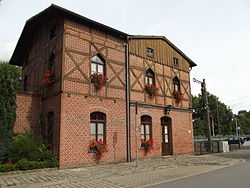 Rural old railway station timber framing style in Metelen, German


Aisled frames
[edit]
Aisled frames have one or more rows of interior posts. These interior posts typically carry more structural load than the posts in the exterior walls. This is the same concept of the aisle in church buildings, sometimes called a hall church, where the center aisle is technically called a nave. However, a nave is often called an aisle, and three-aisled barns are common in the U.S., the Netherlands, and Germany. Aisled buildings are wider than the simpler box-framed or cruck-framed buildings, and typically have purlins supporting the rafters. In northern Germany, this construction is known as variations of a Ständerhaus.
Half-timbering
[edit]

Half-timbering refers to a structure with a frame of load-bearing timber, creating spaces between the timbers called panels (in German Gefach or Fächer = partitions), which are then filled-in with some kind of nonstructural material known as infill. The frame is often left exposed on the exterior of the building.[6]
Infill materials
[edit]Gallery of infill types:
-
 Decorative fired-brick infill with owl holes
 -
 Ordinary brick infill left exposed
 -
 Stone infill called opus incertum by the Romans, The House of opus craticum, Herculaneum, Italy
 -
 Some stone infill left visible
 -
 The wattle and daub was covered with a decorated layer of plaster.
 -
 Like wattle and daub, but with horizontal stakes
 -
 Here, the plaster infill itself is sculpted and decorated.
 -
 Top: wattle and daub, bottom: rubblestone


_IMG_4826.jpg)


The earliest known type of infill, called opus craticum by the Romans, was a wattle and daub type construction.[7] Opus craticum is now confusingly applied to a Roman stone/mortar infill as well. Similar methods to wattle and daub were also used and known by various names, such as clam staff and daub, cat-and-clay, or torchis (French), to name only three.
Wattle and daub was the most common infill in ancient times. The sticks were not always technically wattlework (woven), but also individual sticks installed vertically, horizontally, or at an angle into holes or grooves in the framing. The coating of daub has many recipes, but generally was a mixture of clay and chalk with a binder such as grass or straw and water or urine.[8] When the manufacturing of bricks increased, brick infill replaced the less durable infills and became more common. Stone laid in mortar as an infill was used in areas where stone rubble and mortar were available.
Other infills include bousillage, fired brick, unfired brick such as adobe or mudbrick, stones sometimes called pierrotage, planks as in the German ständerbohlenbau, timbers as in ständerblockbau, or rarely cob without any wooden support.[9] The wall surfaces on the interior were often "ceiled" with wainscoting and plastered for warmth and appearance.
Brick infill sometimes called nogging became the standard infill after the manufacturing of bricks made them more available and less expensive. Half-timbered walls may be covered by siding materials including plaster, weatherboarding, tiles, or slate shingles.[10]
The infill may be covered by other materials, including weatherboarding or tiles,[10] or left exposed. When left exposed, both the framing and infill were sometimes done in a decorative manner. Germany is famous for its decorative half-timbering and the figures sometimes have names and meanings. The decorative manner of half-timbering is promoted in Germany by the German Timber-Frame Road, several planned routes people can drive to see notable examples of Fachwerk buildings.
Gallery of some named figures and decorations:
-
 Simple saltires or St. Andrews crosses in Germany
 -
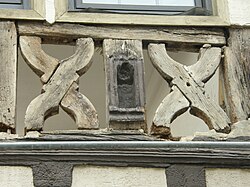 Two curved saltires also called St. Andrews crosses during repairs to a building in Germany: The infill has been removed.
 -
 Several forms of 'man' figures are found in Germany; this one is called a 'wild man'.
 -
 A figure called an Alemannic woman
 -
 Wild man (center), half-man (at the corners)
 -
 Relief carvings adorn some half-timbered buildings.
 -
 The foot braces are carved with sun discs (Sonnenscheiben), a typical design of the North-German Weser-Renaissance.


The collection of elements in half timbering are sometimes given specific names:
-
 Upper German Fachwerk (from 1582/83 in Eppingen BW)
 -
 An example of Fachwerk in Franconia (Fränkisches Fachwerk). Image:I, Metzner
 -
 Fachwerk in Upper Franconia often used to be detailed.
 -
 Close studding is found in England, Spain and France.
 -
 Square-panel half-timbering with fired brick infill: Square paneling is typical of the Low German house, and is found in England.
 -
 Cruck framing can be built with half-timber walls. This house is in the Ryedale Folk Museum in England.


History of the term
[edit]According to Craven (2019),[11] the term:
was used informally to mean timber-framed construction in the Middle Ages. For economy, cylindrical logs were cut in half, so one log could be used for two (or more) posts. The shaved side was traditionally on the exterior and everyone knew it to be half the timber.
The term half-timbering is not as old as the German name Fachwerk or the French name colombage, but it is the standard English name for this style. One of the first people to publish the term "half-timbered" was Mary Martha Sherwood (1775–1851), who employed it in her book, The Lady of the Manor, published in several volumes from 1823 to 1829. She uses the term picturesquely: "...passing through a gate in a quickset hedge, we arrived at the porch of an old half-timbered cottage, where an aged man and woman received us."[12] By 1842, half-timbered had found its way into The Encyclopedia of Architecture by Joseph Gwilt (1784–1863). This juxtaposition of exposed timbered beams and infilled spaces created the distinctive "half-timbered", or occasionally termed, "Tudor" style, or "black-and-white".
Oldest examples
[edit]The most ancient known half-timbered building is called the House of opus craticum. It was buried by the eruption of Mount Vesuvius in 79 AD in Herculaneum, Italy. Opus craticum was mentioned by Vitruvius in his books on architecture as a timber frame with wattlework infill.[13] However, the same term is used to describe timber frames with an infill of stone rubble laid in mortar the Romans called opus incertum.[14]
Alternative meanings
[edit]
A less common meaning of the term "half-timbered" is found in the fourth edition of John Henry Parker's Classic Dictionary of Architecture (1873) which distinguishes full-timbered houses from half-timbered, with half-timber houses having a ground floor in stone[15] or logs such as the Kluge House which was a log cabin with a timber-framed second floor.
Structure
[edit]


Traditional timber framing is the method of creating framed structures of heavy timber jointed together with various joints, commonly and originally with lap jointing, and then later pegged mortise and tenon joints. Diagonal bracing is used to prevent "racking", or movement of structural vertical beams or posts.[16]
Originally, German (and other) master carpenters would peg the joints with allowance of about 1 inch (25 mm), enough room for the wood to move as it 'seasoned', then cut the pegs, and drive the beam home fully into its socket.[citation needed]
To cope with variable sizes and shapes of hewn (by adze or axe) and sawn timbers, two main carpentry methods were employed: scribe carpentry and square rule carpentry.
Scribing or coping was used throughout Europe, especially from the 12th century to the 19th century, and subsequently imported to North America, where it was common into the early 19th century. In a scribe frame, timber sockets are fashioned or "tailor-made" to fit their corresponding timbers; thus, each timber piece must be numbered (or "scribed").
Square-rule carpentry was developed in New England in the 18th century. It used housed joints in main timbers to allow for interchangeable braces and girts. Today, standardized timber sizing means that timber framing can be incorporated into mass-production methods as per the joinery industry, especially where timber is cut by precision computer numerical control machinery.
Taxes
[edit]During the middle ages in France and some other countries the taxes (cens, zins) were calculated by the surface of the buildings at the ground level. This is why some of the medieval houses like these tend to have larger upper floors that stand over the street.
Jetties
[edit]A jetty is an upper floor which sometimes historically used a structural horizontal beam, supported on cantilevers, called a bressummer or 'jetty bressummer'; to bear the weight of the new wall, projecting outward from the preceding floor or storey.
In the city of York in the North of England the famous street known as The Shambles exemplifies this, where jettied houses seem to almost touch above the street.
Timbers
[edit]

Historically, the timbers would have been hewn square using a felling axe and then surface-finished with a broadaxe. If required, smaller timbers were ripsawn from the hewn baulks using pitsaws or frame saws. Today, timbers are more commonly bandsawn, and the timbers may sometimes be machine-planed on all four sides.
The vertical timbers include:
- posts (main supports at corners and other major uprights),
- wall studs (subsidiary upright limbs in framed walls), for example, close studding.
The horizontal timbers include:
- sill-beams (also called ground-sills or sole-pieces, at the bottom of a wall into which posts and studs are fitted using tenons),
- noggin-pieces (the horizontal timbers forming the tops and bottoms of the frames of infill panels),
- wall-plates (at the top of timber-framed walls that support the trusses and joists of the roof).
When jettying, horizontal elements can include:
- The jetty bressummer (or breastsummer), where the main sill (horizontal piece) on which the projecting wall above rests, stretches across the whole width of the jetty wall. The bressummer is itself cantilevered forward, beyond the wall below it.
- The dragon-beam which runs diagonally from one corner to another, and supports the corner posts above and supported by the corner posts below
- The jetty beams or joists conform to floor dimensions above, but are at right angles to the jetty-plates that conform to the shorter dimensions of "roof" of the floor below. Jetty beams are mortised at 45° into the sides of the dragon beams. They are the main constituents of the cantilever system, and determine how far the jetty projects.
- The jetty-plates are designed to carry the jetty beams. The jetty plates themselves are supported by the corner posts of the recessed floor below.
The sloping timbers include:
- Trusses (the slanting timbers forming the triangular framework at gables and roof)
- Braces (slanting beams giving extra support between horizontal or vertical members of the timber frame)
- Herringbone bracing (a decorative and supporting style of frame, usually at 45° to the upright and horizontal directions of the frame)
Post construction and frame construction
[edit]Historically were two different systems of the position of posts and studs:
- In the older (medieval) manner, called post construction, the vertical elements continue from the groundwork to the roof. This post construction in German is called Geschossbauweise or Ständerbauweise. It is somewhat similar to balloon framing method common in North America until the middle of the 20th century.
- In the advanced manner, called frame construction, each story is constructed like a case, and the whole building is constructed like a pile of such cases. This frame construction in German is called Rähmbauweise or Stockwerksbauweise and allows jettying.
Ridge-post framing is a structurally simple and ancient post and lintel framing where the posts extend all the way to the ridge beams. Germans call this Firstsäule or Hochstud.
Modern timber connector method (1930s–1950s)
[edit]
In the 1930s a system of timber framing referred to as the "modern timber connector method"[17] was developed. It was characterized by the use of timber members assembled into trusses and other framing systems and fastened using various types of metal timber connectors. This type of timber construction was used for various building types including warehouses, factories, garages, barns, stores/markets, recreational buildings, barracks, bridges, and trestles.[18] The use of these structures was promoted because of their low construction costs, easy adaptability, and performance in fire as compared to unprotected steel truss construction.
During World War II, the United States Army Corps of Engineers and the Canadian Military Engineers undertook to construct airplane hangars using this timber construction system in order to conserve steel. Wood hangars were constructed throughout North America and employed various technologies including bowstring, Warren, and Pratt trusses, glued laminated arches, and lamella roof systems. Unique to this building type is the interlocking of the timber members of the roof trusses and supporting columns and their connection points. The timber members are held apart by "fillers" (blocks of timber). This leaves air spaces between the timber members which improves air circulation and drying around the members which improves resistance to moisture borne decay.

Timber members in this type of framing system were connected with ferrous timber connectors of various types. Loads between timber members were transmitted using split-rings (larger loads), toothed rings (lighter loads), or spiked grid connectors.[19] Split-ring connectors were metal rings sandwiched between adjacent timber members to connect them together. The rings were fit into circular grooves on in both timber members then the assembly was held together with through-bolts. The through-bolts only held the assembly together but were not load-carrying.[18] Shear plate connectors were used to transfer loads between timber members and metal. Shear plate connectors resembled large washers, deformed on the side facing the timber in order to grip it, and were through-fastened with long bolts or lengths of threaded rod. A leading manufacturer of these types of timber connectors was the Timber Engineering Company, or TECO, of Washington, DC. The proprietary name of their split-ring connectors was the "TECO Wedge-Fit".
Modern features
[edit]

Timber-framed structures differ from conventional wood-framed buildings in several ways. Timber framing uses fewer, larger wooden members, commonly timbers in the range of 15 to 30 cm (6 to 12 in), while common wood framing uses many more timbers with dimensions usually in the 5- to 25-cm (2- to 10-in) range. The methods of fastening the frame members also differ. In conventional framing, the members are joined using nails or other mechanical fasteners, whereas timber framing uses the traditional mortise and tenon or more complex joints that are usually fastened using only wooden pegs.[citation needed] Modern complex structures and timber trusses often incorporate steel joinery such as gusset plates, for both structural and architectural purposes.
Recently, it has become common practice to enclose the timber structure entirely in manufactured panels such as structural insulated panels (SIPs). Although the timbers can only be seen from inside the building when so enclosed, construction is less complex and insulation is greater than in traditional timber building. SIPs are "an insulating foam core sandwiched between two structural facings, typically oriented strand board" according to the Structural Insulated Panel Association.[20] SIPs reduce dependency on bracing and auxiliary members, because the panels span considerable distances and add rigidity to the basic timber frame.
An alternate construction method is with concrete flooring with extensive use of glass. This allows a solid construction combined with open architecture. Some firms have specialized in industrial prefabrication of such residential and light commercial structures such as Huf Haus as low-energy houses or – dependent on location – zero-energy buildings.
Straw-bale construction is another alternative where straw bales are stacked for nonload-bearing infill with various finishes applied to the interior and exterior such as stucco and plaster. This appeals to the traditionalist and the environmentalist as this is using "found" materials to build.
Mudbricks also called adobe are sometimes used to fill in timber-frame structures. They can be made on site and offer exceptional fire resistance. Such buildings must be designed to accommodate the poor thermal insulating properties of mudbrick, however, and usually have deep eaves or a veranda on four sides for weather protection.
Engineered structures
[edit]Timber design or wood design is a subcategory of structural engineering that focuses on the engineering of wood structures. Timber is classified by tree species (e.g., southern pine, douglas fir, etc.) and its strength is graded using numerous coefficients that correspond to the number of knots, the moisture content, the temperature, the grain direction, the number of holes, and other factors. There are design specifications for sawn lumber, glulam members, prefabricated I-joists, composite lumber, and various connection types. In the United States, structural frames are then designed according to the Allowable Stress Design method or the Load Reduced Factor Design method (the latter being preferred).[21]
History and traditions
[edit]
.jpg)
The techniques used in timber framing date back to Neolithic times, and have been used in many parts of the world during various periods such as ancient Japan, continental Europe, and Neolithic Denmark, England, France, Germany, Spain, parts of the Roman Empire, and Scotland.[22] The timber-framing technique has historically been popular in climate zones which favour deciduous hardwood trees, such as oak. Its northernmost areas are Baltic countries and southern Sweden. Timber framing is rare in Russia, Finland, northern Sweden, and Norway, where tall and straight lumber, such as pine and spruce, is readily available and log houses were favored, instead.
Half-timbered construction in the Northern European vernacular building style is characteristic of medieval and early modern Denmark, England, Germany, and parts of France and Switzerland, where timber was in good supply yet stone and associated skills to dress the stonework were in short supply. In half-timbered construction, timbers that were riven (split) in half provided the complete skeletal framing of the building.
Europe is full of timber-framed structures dating back hundreds of years, including manor houses, castles, homes, and inns, whose architecture and techniques of construction have evolved over the centuries. In Asia, timber-framed structures are found, many of them temples.
Some Roman carpentry preserved in anoxic layers of clay at Romano-British villa sites demonstrate that sophisticated Roman carpentry had all the necessary techniques for this construction. The earliest surviving (French) half-timbered buildings date from the 12th century.[citation needed]
Important resources for the study and appreciation of historic building methods are open-air museums.
Topping out ceremony
[edit]The topping out ceremony is a builders' rite, an ancient tradition thought to have originated in Scandinavia by 700 AD.[23] In the U.S., a bough or small tree is attached to the peak of the timber frame after the frame is complete as a celebration. Historically, it was common for the master carpenter to give a speech, make a toast, and then break the glass. In Northern Europe, a wreath made for the occasion is more commonly used rather than a bough. In Japan, the "ridge raising" is a religious ceremony called the jotoshiki.[24] In Germany, it is called the Richtfest.
Carpenters' marks
[edit]
Carpenters' marks are markings left on the timbers of wooden buildings during construction.
- Assembly or marriage marks were used to identify the individual timbers. Assembly marks include numbering to identify the pieces of the frame. The numbering can be similar to Roman numerals except the number four is IIII and nine is VIIII. These marks are chiseled, cut with a race knife (a tool to cut lines and circles in wood), or saw cuts. The numbering can also be in Arabic numerals which are often written with a red grease pencil or crayon. German and French carpenters made some unique marks. (Abbundzeichen (German assembly marks)).
- Layout marks left over from marking out identify the place where to cut joints and bore peg holes; carpenters also marked the location on a timber where they had levelled it, as part of the building process, and called these "level lines"; sometimes they made a mark two feet from a critical location, which was then called the "two-foot mark". These marks are typically scratched on the timber with an awl-like tool until later in the 19th century, when they started using pencils.
- Occasionally, carpenters or owners marked a date and/or their initials in the wood, but not like masons left masons' marks.
- Boards on the building may have "tally marks" cut into them which were numbers used to keep track of quantities of lumber (timber).
- Other markings in old buildings are called "ritual marks", which were often signs the occupants felt would protect them from harm.
Tools
[edit]
Many historic hand tools used by timber framers for thousands of years have similarities, but vary in shape. Electrically powered tools first became available in the 1920s in the U.S. and continue to evolve. See the list of timber framing tools for basic descriptions and images of unusual tools (The list is incomplete at this time).
British tradition
[edit]
Some of the earliest known timber houses in Europe have been found in Great Britain, dating to Neolithic times; Balbridie and Fengate are some of the rare examples of these constructions.
Molded plaster ornamentation, pargetting[25] further enriched some English Tudor architecture houses. Half-timbering is characteristic of English vernacular architecture in East Anglia,[26] Warwickshire,[27][28] Worcestershire,[29] Herefordshire,[30][31] Shropshire,[32][33] and Cheshire,[34] where one of the most elaborate surviving English examples of half-timbered construction is Little Moreton Hall.[35]
In South Yorkshire, the oldest timber house in Sheffield, the "Bishops' House" (c. 1500), shows traditional half-timbered construction.
In the Weald of Kent and Sussex,[36] the half-timbered structure of the Wealden hall house,[37] consisted of an open hall with bays on either side and often jettied upper floors.
Half-timbered construction traveled with British colonists to North America in the early 17th century but was soon abandoned in New England and the mid-Atlantic colonies for clapboard facings (an East Anglia tradition). The original English colonial settlements, such as Plymouth, Massachusetts and Jamestown, Virginia had timber-framed buildings, rather than the log cabins often associated with the American frontier. Living history programs demonstrating the building technique are available at both these locations.
One of the surviving streets lined with almost-touching houses is known as The Shambles, York, and is a popular tourist attraction.
-

-
 Historic timber-framed houses in Warwick, England
 -

-
 Bessie Surtees House, Quayside, Newcastle upon Tyne, England
 -
 The President's Lodge, Queens' College, Cambridge, England
 -
 The south range of Little Moreton Hall, Cheshire, England
 -
 The Yeoman's House, Bignor, West Sussex, England, a three-bay Wealden hall house
 -


English styles
[edit]For Timber-framed houses in Wales see: Architecture of Wales
Historic timber-frame construction in England (and the rest of the United Kingdom) showed regional variation[38] which has been divided into the "eastern school", the "western school", and the "northern school", although the characteristic types of framing in these schools can be found in the other regions (except the northern school).[39] A characteristic of the eastern school is close studding which is a half-timbering style of many studs spaced about the width of the studs apart (for example six-inch studs spaced six inches apart) until the middle of the 16th century and sometimes wider spacing after that time. Close studding was an elite style found mostly on expensive buildings. A principal style of the western school is the use of square panels of roughly equal size and decorative framing utilizing many shapes such as lozenges, stars, crosses, quatrefoils, cusps, and many other shapes.[39] The northern school sometimes used posts which landed on the foundation rather than on a sill beam, the sill joining to the sides of the posts and called an interrupted sill. Another northern style was to use close studding but in a herring-bone or chevron pattern.[39]

As houses were modified to cope with changing demands there sometimes were a combination of styles within a single timber-frame construction.[40] The major types of historic framing in England are 'cruck frame',[40] box frame,[40] and aisled construction. From the box frame, more complex framed buildings such as the Wealden House and Jettied house developed.[citation needed]
The cruck frame design is among the earliest, and was[40] in use by the early 13th century, with its use continuing to the present day, although rarely after the 18th century.[40] Since the 18th century however, many existing cruck structures have been modified, with the original cruck framework becoming hidden.[citation needed] Aisled barns are of two or three aisled types, the oldest surviving aisled barn being the barley barn at Cressing Temple[39] dated to 1205–1235.[41]
Jettying was introduced in the 13th century and continued to be used through the 16th century.[39]
Generally speaking, the size of timbers used in construction, and the quality of the workmanship reflect the wealth and status of their owners. Small cottages often used quite small cross-section timbers which would have been deemed unsuitable by others. Some of these small cottages also have a 'home-made' – even temporary – appearance. Many such example can be found in the English shires. Equally, some relatively small buildings can be seen to incorporate substantial timbers and excellent craftsmanship, reflecting the relative wealth and status of their original owners. Important resources for the study of historic building methods in the UK are open-air museums.
It is often claimed that timber-framed buildings in Britain contain reused ships' timbers. This belief is dismissed by experts, who point out that curved timbers are rarely suitable, that salt is destructive to cellulose in the wood, and that ships' timbers are generally slight compared to cruck trusses.[42]
French tradition
[edit]
Elaborately half-timbered houses of the 13th through 18th centuries still remain in Bourges, Tours, Troyes, Rouen, Thiers, Dinan, Rennes, and many other cities, except in Provence and Corsica. Timber framing in French is known colloquially as pan de bois and half-timbering as colombage. Alsace is the region with the most timbered houses in France.
The Normandy tradition features two techniques: frameworks were built of four evenly spaced regularly hewn timbers set into the ground (poteau en terre) or into a continuous wooden sill (poteau de sole) and mortised at the top into the plate. The openings were filled with many materials including mud and straw, wattle and daub, or horsehair and gypsum.[43]
-
 Half-timbered houses in Tours (Centre, France)
 -
 Old houses in Troyes (Champagne, France)
 -
 Half-timbered houses in Châlons-en-Champagne (Champagne, France)
 -
 Church of Drosnay (Champagne, France)
 -
 Old houses in Rennes (Brittany, France)
 -
 14th-century early corbelled house, Rouen (Normandy, France)
 -
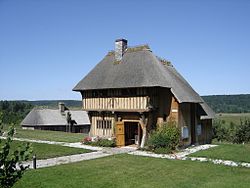 15th-century manor, Saint-Sulpice-de-Grimbouville (Normandy, France)
 -
 16th-century house in Albi (Occitanie, France)
 -

-
 Trinity Church of Langonnet (Brittany, France)


.JPG)


_Maison_Enjalbert_Albi_XVI%C2%B0_si%C3%A8cle_M%C3%A9rim%C3%A9ePA00095478.jpg)

_%C3%89glise_17.JPG)
German tradition (Fachwerkhäuser)
[edit]Germany has several styles of timber framing, but probably the greatest number of half-timbered buildings in the world are to be found in Germany and in Alsace (France). There are many small towns which escaped both war damage and modernisation and consist mainly, or even entirely, of half-timbered houses.


The German Timber-Frame Road (Deutsche Fachwerkstraße) is a tourist route that connects towns with remarkable fachwerk. It is more than 2,000 km (1,200 mi) long, crossing Germany through the states of Lower Saxony, Saxony-Anhalt, Hesse, Thuringia, Bavaria, and Baden-Württemberg.[16][44]
Some of the more prominent towns (among many) include: Quedlinburg, a UNESCO-listed town, which has over 1200 half-timbered houses spanning five centuries; Goslar, another UNESCO-listed town; Hanau-Steinheim (home of the Brothers Grimm); Bad Urach; Eppingen ("Romance city" with a half-timbered church dating from 1320); Mosbach; Vaihingen an der Enz and nearby UNESCO-listed Maulbronn Abbey; Schorndorf (birthplace of Gottlieb Daimler); Calw; Celle; and Biberach an der Riß with both the largest medieval complex, the Holy Spirit Hospital and one of Southern Germany's oldest buildings, now the Braith-Mali-Museum, dated to 1318.
German fachwerk building styles are extremely varied with a huge number of carpentry techniques which are highly regionalized. German planning laws for the preservation of buildings and regional architecture preservation dictate that a half-timbered house must be authentic to regional or even city-specific designs before being accepted.[45][46]
A brief overview of styles follows, as a full inclusion of all styles is impossible.
In general the northern states have fachwerk similar to that of the nearby Netherlands and England while the more southerly states (most notably Bavaria and Switzerland) have more decoration using timber because of greater forest reserves in those areas. During the 19th century, a form of decorative timber-framing called bundwerk became popular in Bavaria, Austria and South Tyrol.
The German fachwerkhaus usually has a foundation of stone, or sometimes brick, perhaps up to several feet (a couple of metres) high, which the timber framework is mortised into or, more rarely, supports an irregular wooden sill.
The three main forms may be divided geographically:
- West Central Germany and Franconia:
- Northern Germany, Central Germany and East German:
- Southern Germany including the Black and Bohemian Forests
- In Swabia, Württemberg, Alsace, and Switzerland, the use of the lap-joint is thought to be the earliest method of connecting the wall plates and tie beams and is particularly identified with Swabia. A later innovation (also pioneered in Swabia) was the use of tenons – builders left timbers to season which were held in place by wooden pegs (i.e., tenons). The timbers were initially placed with the tenons left an inch or two out of intended position and later driven home after becoming fully seasoned.
The most characteristic feature is the spacing between the posts and the high placement of windows. Panels are enclosed by a sill, posts, and a plate, and are crossed by two rails between which the windows are placed—like "two eyes peering out".[45][46]
In addition there is a myriad of regional scrollwork and fretwork designs of the non-loadbearing large timbers (braces) peculiar to particularly wealthy towns or cities.
A unique type of timber-frame house can be found in the region where the borders of Germany, the Czech Republic, and Poland meet – it is called the Upper Lusatian house (Umgebindehaus, translates as round-framed house). This type has a timber frame surrounding a log structure on part of the ground floor.[citation needed]
-
 Ständerbau in Quedlinburg (Germany), Wordgasse 3, built in 1346; in the past suggested as the oldest timber-frame house in Germany; nowadays 3 older houses are known only in Quedlinburg.
 -
 Timber frame town hall of Wernigerode
 -
 House in Rothenburg (Bavaria)
 -
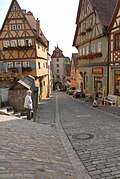 The Plönlein (i.e. little place), the worldwide known timber frame ensemble, as the southern end of the Old town in Rothenburg
 -
 Buildings in Hornburg
 -
 Buildings in Braubach, 16th century first half
 -
 House in Schwerin, built in 1698
 -
 Gelbensande Castle, a hunting lodge built in 1887 near Rostock
 -
 The half-timbered houses in Dinkelsbühl mostly have plastered and painted facades.
 -
 An Umgebindehaus in Oybin (Saxony). The timber frame is outside a log wall on the ground floor.
 -
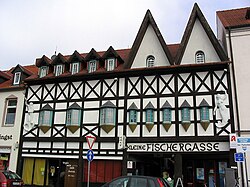 20th-century timber framing in Ribnitz (Mecklenburg)
 -
 Fachwerk (timber framing) under construction in 2013, Tirschenreuth
 -
 Half-timbered mansion of the former Zirkelmühle in Mellenbach-Glasbach (Thuringia)
 -
 Low German house in Walsrode (Lower Saxony)


_cleaned.jpg)


Italy
[edit]Several half-timbered houses can be found in Northern Italy, especially in Piedmont, Lombardy, in the city of Bologna, in Sardinia in the Barbagia region and in the Iglesiente mining region.
-
 Half-timbered house in Ozzano Monferrato, Piedmont
 -
 Half-timbered house in Biella, Piedmont
 -
 Half-timbered house in Arquata Scrivia, Piedmont
 -
 Half-timbered house in Monza, Lombardy
 -
 Half-timbered house in Susa, Piedmont
 -
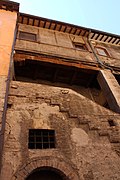 A rare example of a half-timbered house in Central Italy, in Spoleto, Umbria


Poland
[edit].jpg)

Historically, the majority of Polish cities as well as their central marketplaces possessed timber-framed dwellings and housing.[47] Throughout the Middle Ages it was customary in Poland to use either bare brick or wattle and daub (Polish: szachulec) as filling in-between the timber frame.[47] However, the half-timbered houses which can be observed nowadays have been built in regions that were historically German or had significant German cultural influence. As these regions were at some point parts of German Prussia, half-timbered walls are often called mur pruski (lit. Prussian wall) in Polish. A distinctive type of house associated with mostly Mennonite immigrant groups from Frisia and the Netherlands, known as the Olędrzy, is called an "arcade house" (dom podcieniowy). The biggest timber-framed religious buildings in Europe are the Churches of Peace in southwestern Poland.[48] There are also numerous examples of timber-framed secular structures such as the granaries in Bydgoszcz.
The Umgebindehaus rural housing tradition of south Saxony (Germany) is also found in the neighboring areas of Poland, particularly in the Silesian region.
Another world-class type of wooden building Poland shares with some neighboring countries are its wooden church buildings.
-
 Timber frame architecture, Mill Island, Bydgoszcz
 -
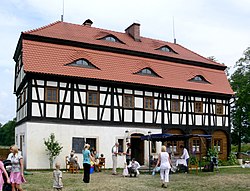 Wheelwright croft in Zgorzelec
 -

-
 Granary in Bydgoszcz, built in 1795 upon 15th-century gothic cellar
 -
 Sts. Peter & Paul Church in Sułów
 -

-
 19th-century timber frame manor house in Toruń


_ID_596258.jpg)


Spain
[edit]The Spanish generally follow the Mediterranean forms of architecture with stone walls and shallow roof pitch. Timber framing is often of the post and lintel style. Castile and León, par example La Alberca, and the Basque Country have the most representative examples of the use of timber framing in the Iberian Peninsula.
Most traditional Basque buildings with half-timbering elements are detached farm houses (in Basque: baserriak). Their upper floors were built with jettied box frames in close studding. In the oldest farmsteads and, if existing, in the third floor the walls were sometimes covered with vertical weatherboards. Big holes were left in the gable of the main façade for ventilation. The wooden beams were painted over, mostly in dark red. The vacancies were filled in with wattle and daub or rubble laid in a clay mortar and then plastered over with white chalk or nogged with bricks. Although the entire supporting structure is made of wood, the timbering is only visible on the main façade, which is generally oriented to the southeast.
Although the typical Basque house is now mostly associated with half-timbering, the outer walls and the fire-walls were built in masonry (rubble stone, bricks or, ideally, ashlars) whenever it could be afforded. Timber was a sign of poverty. Oak-wood was cheaper than masonry: that is why, when the money was running out, the upper floor walls were mostly built timbered. Extant baserriak with half-timbered upper-floor façades were built from the 15th to 19th centuries and are found in all Basque regions with oceanic climate, except in Zuberoa (Soule), but are concentrated in Lapurdi (Labourd).
Some medieval Basque tower houses (Dorretxe) feature an overhanged upper floor in half-timbering.
To a lesser extent timbered houses are also found in villages and towns as row houses, as the photo from the Uztaritz village shows.
Currently, it has again become popular to build Néobasque houses resembling old Basque farmsteads, with more or less respect for the principles of traditional half-timbered building.
-
 Inharri baserri in Ibarron (Lapurdi)
 -
 Aranguren dorretxea (Orozko, Bizkaia)
 -
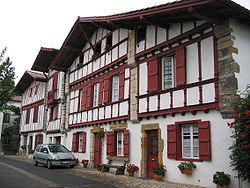 Half-timbered houses from Uztarritz (Lapurdi)
 -
 Timbered house from Guadilla de Villamar (Spain). Popular style.


Switzerland
[edit]
Switzerland has many styles of timber framing which overlap with its neighboring countries.
Belgium
[edit]Nowadays, timber framing is primarily found in the provinces of Limburg, Liège, and Luxembourg. In urban areas, the ground floor was formerly built in stone and the upper floors in timber framing. Also, as timber framing was seen as a cheaper way of building, often the visible structures of noble houses were in stone and bricks, and the invisible or lateral walls in timber framing. The open-air museums of Bokrijk and Saint-Hubert (Fourneau Saint-Michel) show many examples of Belgian timber framing. Many post-and-beam houses can be found in cities and villages, but, unlike France, the United Kingdom, and Germany, there are few fully timber framed cityscapes.
-
 The house where André Grétry was born in Liège
 -
 The Sugny House (18th century), in the Fourneau Saint-Michel Museum
 -
 A House in Theux (17th century)
 -
 The former water mill of Lierneux
 -
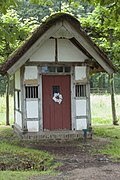 Small "chapel" (shrine) at the Bokrijk Open Air Museum
 -
 Unskilled worker's thatched cottage (Hingeon 19th century) transplanted and reconstituted in the open-air museum Fourneau Saint-Michel
 -
 Timber-frame structure in Bruges
.jpg)
.JPG)


.JPG)

Denmark
[edit]Timber frame (bindingsværk, literally "binding work") is the traditional building style in almost all of Denmark, making it the only Nordic country where this style is prevalent in all regions. Along the west coast of Jutland, houses built entirely of bricks were traditionally more common due to lack of suitable wood. In the 19th and especially in the 20th century, bricks have been the preferred building material in all of Denmark, but traditional timber-frame houses remain common both in the towns and in the countryside. Different regions have different traditions as to whether the timber frame should be tarred and thus clearly visible or be limewashed or painted in the same colour as the infills.
Sweden
[edit]The Swedish mostly built log houses but they do have traditions of several types of timber framing: Some of the following links are written in Swedish. Most of the half-timbered houses in Sweden were built during the Danish time and are located in what until 1658 used to be Danish territory in southern Sweden, primarily in the province Skåne and secondarily in Blekinge and Halland. In Swedish half-timber is known as korsvirke.
- Stave construction is called stavverk. Scandinavia is famous for its ancient stave churches. Stave construction is a traditional timber frame with walls of vertical planks, the posts and planks landing in a sill on a foundation. Similar construction with earthfast posts is called stolpteknik. and Palisade construction where many vertical wall timbers or planks have their feet buried in the ground called post in ground or earthfast construction is called palissadteknik. (see also Palisade church)
- Swedish plank-frame construction is called skiftesverk. This is a traditional timber frame with walls of horizontal planks.
Norway
[edit]Norway has at least two significant types of timber-framed structures: the stave church and Grindverk. The term stave (a post or pole) indicates that a stave church essentially means a framed church, a distinction made in a region where log building is common. All but one surviving stave churches are in Norway, one in Sweden. Replicas of stave churches and other Norwegian building types have been reproduced elsewhere, e.g. at the Scandinavian Heritage Park in North Dakota, United States.
Grindverk translates as trestle construction, consisting of a series of transversal frames of two posts and a connecting beam, supporting two parallel wall plates bearing the rafters. Unlike other types of timber framing in Europe, the trestle frame construction uses no mortise and tenon joints. Archaeological excavations have uncovered similar wooden joints from more than 3,000 years ago, suggesting that this type of framing is an ancient unbroken tradition. Grindverk buildings are only found on part of the western coast of Norway, and most of them are boathouses and barns.
Log building was the common construction used for housing humans and livestock in Norway from the Middle Ages until the 18th century. Timber framing of the type used in large parts of Europe appeared occasionally in late medieval towns, but never became common, except for the capital Christiania. After a fire in 1624 in Oslo, King Christian IV ordered the town to be relocated to a new site. He outlawed log building to prevent future conflagrations and required wealthy burghers to use brickwork and the less affluent to use timber framing in the Danish manner. During the next two centuries, 50 per cent of the houses were timber framed.
All of these buildings disappeared as a consequence of this small provincial town of Christiania becoming the capital of independent Norway in 1814. This caused a rapid growth, with the population rising from 10 000 to 250 000 by 1900. Increasing prices caused a massive urban renewal, which resulted in all wooden structures being replaced with office blocks.
-
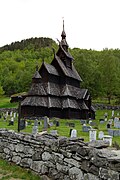 Borgund stave church in Lærdal, Sogn og Fjordane country, Norway
 -
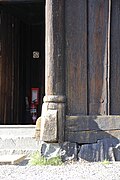 Garmo Stave Church detail. Note how the sills lap and the post fits around the sills. The post is the stave from which these buildings are named.
 -
 Kaupanger stave church interior, Kaupanger, Norway
 -
 An example of grindverk framing. The tie beams are captured in slots in the post tops.
 -
 Frogner Manor in Oslo, timber-framed building 1750, extended 1790
 -
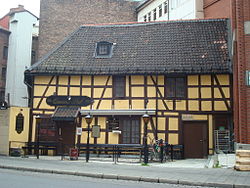 Brugata 14, Oslo. Timber-framed building from around 1800.


Netherlands
[edit]
The Netherlands is often overlooked for its timbered houses, yet many exist, including windmills. It was in North Holland where the import of cheaper timber, combined with the Dutch innovation of windmill-powered sawmills, allowed economically viable widespread use of protective wood covering over framework. In the late 17th century the Dutch introduced vertical cladding also known in Eastern England as clasp board and in western England as weatherboard, then as more wood was available more cheaply, horizontal cladding in the 17th century. Perhaps owing to economic considerations, vertical cladding returned to fashion.[49] Dutch wall framing is virtually always built in bents and the three basic types of roof framing are the rafter roof, purlin roof, and ridge-post roof.[50]
Romania
[edit]Half-timbered houses can be found in Romania mostly in areas once inhabited by Transylvanian Saxons, in cities, towns and villages with Germanic influence such as Bistrița, Brașov, Mediaș, Sibiu and Sighișoara. However the number of half-timbered houses is small. In Wallachia there are few examples of this type of architecture, most of those buildings being located in Sinaia, such as the Peleș Castle.
-
 The Pelișor Castle in Sinaia
 -

-
 "Olimpia" Sports Complex, Brașov
 -
 A half-timbered building in Sinaia


Baltic states
[edit]As the result of centuries of German settlement and cultural influence, towns in the Baltic states such as Klaipėda and Riga also preserve German-style Fachwerkhäuser.
Americas
[edit]Most "haft-timbered" houses existing in Missouri, Pennsylvania, and Texas were built by German settlers.[43] Old Salem North Carolina has fine examples of German fachwerk buildings.[51]: 42–43 Many are still present in Colonia Tovar (Venezuela), Santa Catarina and Rio Grande do Sul (Brazil), where Germans settled. Later, they chose more suitable building materials for local conditions (most likely because of the great problem of tropical termites.)
New France
[edit]In the historical region of North America known as New France, colombage pierroté, also called maçonnerie entre poteaux,[52] half-timbered construction with the infill between the posts and studs of stone rubble and lime plaster or bousillage[52] and simply called colombage in France. Colombage was used from the earliest settlement until the 18th century but was known as bousillage entre poteaus sur solle in Lower Louisiana. The style had its origins in Normandy, and was brought to Canada by early Norman settlers. The Men's House at Lower Fort Garry is a good example. The exterior walls of such buildings were often covered over with clapboards to protect the infill from erosion. Naturally, this required frequent maintenance, and the style was abandoned as a building method in the 18th century in Québec. For the same reasons, half-timbering in New England, which was originally employed by the English settlers, fell out of favour soon after the colonies had become established.
Other variations of half-timbering are colombage à teurques (torchis), straw coated with mud and hung over horizontal staves (or otherwise held in place), colombage an eclisses, and colombage a lattes.[52]
Poteaux-en-terre (posts in ground) is a type of timber framing with the many vertical posts or studs buried in the ground called post in ground or "earthfast" construction. The tops of the posts are joined to a beam and the spaces between are filled in with natural materials called bousillage or pierrotage.
Poteaux-sur-sol (posts on a sill) is a general term for any kind of framing on a sill. However, sometimes it specifically refers to "vertical log construction" like poteaux-en-terre placed on sills with the spaces between the timbers infilled.
Piece-sur-piece, also known as Post-and-plank style or "corner post construction" (and many other names) in which wood is used both for the frame and horizontal infill; for this reason it may be incorrect to call it "half-timbering". It is sometimes a blend of framing and log building with two styles: the horizontal pieces fit into groves in the posts and can slide up and down or the horizontal pieces fit into individual mortises in the posts and are pegged and the gaps between the pieces chinked (filled in with stones or chips of wood covered with mud or moss briefly discussed in Log cabin.)
This technique of a timber frame walls filled in with horizontal planks or logs proved better suited to the harsh climates of Québec and Acadia, which at the same time had abundant wood. It became popular throughout New France, as far afield as southern Louisiana. The Hudson's Bay Company used this technique for many of its trading posts, and this style of framing becoming known as Hudson Bay style or Hudson Bay corners. Also used by the Red River Colony this style also became known as "Red River Framing". "The support of horizontal timbers by corner posts is an old form of construction in Europe. It was apparently carried across much of the continent from Silesia by the Lausitz urnfield culture in the late Bronze Age."[53] Similar building techniques are apparently not found in France[51]: 121 but exist in Germany and Switzerland known as Bohlenstanderbau when planks are used or blockstanderbau when beams are used as the infill. In Sweden the technique is known as sleppvegg or skiftesverk and in Denmark as bulhus.
A particularly interesting example in the U.S. is the Golden Plough Tavern (c. 1741), York, York County, Pennsylvania, which has the ground level of corner-post construction with the second floor of fachwerk (half timbered) and was built for a German with other Germanic features.[54]
Settlers in New France also built horizontal log, brick, and stone buildings.
New Netherland
[edit]Characteristics of traditional timber framing in the parts of the U.S. formerly known as New Netherland are H-framing also known as dropped-tie framing in the U.S. and the similar anchor beam framing as found in the New World Dutch barn.
New England
[edit]Some time periods/regions within New England contain certain framing elements such as common purlin roofs, five sided ridge beams, plank-frame construction and plank-wall construction. The English barn always contains an "English tying joint" and the later New England style barn were built using bents.
Japanese
[edit]
Japanese timber framing is believed to be descended from Chinese framing (see Ancient Chinese wooden architecture). Asian framing is significantly different from western framing, with its predominant use of post and lintel framing and an almost complete lack of diagonal bracing.
Revival styles in later centuries
[edit]

When half-timbering regained popularity in Britain after 1860 in the various revival styles, such as the Queen Anne style houses by Richard Norman Shaw and others, it was often used to evoke a "Tudor" atmosphere (see Tudorbethan), though in Tudor times half-timbering had begun to look rustic and was increasingly limited to village houses (illustration, above left).
In 1912, Allen W. Jackson published The Half-Timber House: Its Origin, Design, Modern Plan, and Construction, and rambling half-timbered beach houses appeared on dune-front properties in Rhode Island or under palm-lined drives of Beverly Hills. During the 1920s increasingly minimal gestures towards some half-timbering in commercial speculative housebuilding saw the fashion diminish.
In the revival styles, such as Tudorbethan (Mock Tudor), the half-timbered appearance is superimposed on the brickwork or other material as an outside decorative façade rather than forming the main frame that supports the structure.
The style was used in many of the homes built in Lake Mohawk, New Jersey, as well as all of the clubhouse, shops, and marina.
For information about "roundwood framing" see the book Roundwood Timber Framing: Building Naturally Using Local Resources by Ben Law (East Meon, Hampshire: Permanent Publications; 2010. ISBN 1856230414)
Advantages
[edit]The use of timber framing in buildings offers various aesthetic and structural benefits, as the timber frame lends itself to open plan designs and allows for complete enclosure in effective insulation for energy efficiency. In modern construction, a timber-frame structure offers many benefits:
- It is rapidly erected. A moderately sized timber-frame home can be erected within 2 to 3 days.
- It is well suited to prefabrication, modular construction, and mass-production. Timbers can be pre-fit within bents or wall-sections and aligned with a jig in a shop, without the need for a machine or hand-cut production line. This allows faster erection on site and more precise alignments. Valley and hip timbers are not typically pre-fitted.
- As an alternative to the traditional infill methods, the frame can be encased with SIPs. This stage of preparing the assembled frame for the installation of windows, mechanical systems, and roofing is known as drying in.
- it can be customized with carvings or incorporate heirloom structures such as barns etc.
- it can use recycled or otherwise discarded timbers.
- it offers some structural benefits as the timber frame, if properly engineered, lends itself to better seismic survivability[57] Consequently, there are many half-timbered houses which still stand despite the foundation having partially caved in over the centuries.
- The generally larger spaces between the frames enable greater flexibility in the placement, at construction or afterwards, of windows and doors with less resulting weakening of the structural integrity and the need for heavy lintels.
In North America, heavy timber construction is classified Building Code Type IV: a special class reserved for timber framing which recognizes the inherent fire resistance of large timber and its ability to retain structural capacity in fire situations. In many cases this classification can eliminate the need and expense of fire sprinklers in public buildings.[58]
Disadvantages
[edit]Traditional or historic structures
[edit]In terms of the traditional half-timber or fachwerkhaus there are maybe more disadvantages than advantages today. Such houses are notoriously expensive to maintain let alone renovate and restore, most commonly owing to local regulations that do not allow divergence from the original, modification or incorporation of modern materials. Additionally, in such nations as Germany, where energy efficiency is highly regulated, the renovated building may be required to meet modern energy efficiencies, if it is to be used as a residential or commercial structure (museums and significant historic buildings have no semi-permanent habitade exempt). Many framework houses of significance are treated merely to preserve, rather than render inhabitable – most especially as the required heavy insecticidal fumigation is highly poisonous.
In some cases, it is more economical to build anew using authentic techniques and correct period materials than restore. One major problem with older structures is the phenomenon known as mechano-sorptive creep or slanting: where wood beams absorb moisture whilst under compression or tension strains and deform, shift position or both. This is a major structural issue as the house may deviate several degrees from perpendicular to its foundations (in the x-axis, y-axis, and even z-axis) and thus be unsafe and unstable or so out of square it is extremely costly to remedy.[59]
A summary of problems with Fachwerkhäuser or half-timbered houses includes the following, though many can be avoided by thoughtful design and application of suitable paints and surface treatments and routine maintenance. Often, though when dealing with a structure of a century or more old, it is too late.[49]
- "slanting"- thermo-mechanical (weather-seasonally induced) and mechano-sorptive (moisture induced) creep of wood in tension and compression.[59]
- poor prevention of capillary movement of water within any exposed timber, leading to afore-described creep, or rot
- eaves that are too narrow or non-existent (thus allowing total exposure to rain and snow)
- too much exterior detailing that does not allow adequate rainwater run-off
- timber ends, joints, and corners poorly protected through coatings, shape or position
- non-beveled vertical beams (posts and clapboards) allow water absorption and retention through capillary action.
- surface point or coatings allowed to deteriorate
- traditional gypsum, or wattle and daub containing organic materials (animal hair, straw, manure) which then decompose.
- in both poteaux-en-terre and poteaux-sur-sol, insect, fungus or bacterial decomposition.
- rot including dry rot.
- infestation of xylophagous pest organisms such as (common in Europe) the Ptinidae family, particularly the common furniture beetle, termites, cockroaches, powderpost beetles, mice, and rats (quite famously so in many children's stories).
- Noise from footsteps in adjacent rooms above, below, and on the same floor in such buildings can be quite audible. This is often resolved with built-up floor systems involving clever sound-isolation and absorption techniques and at the same time providing passage space for plumbing, wiring, and even heating and cooling equipment.
- Other fungi that are non-destructive to the wood but are harmful to humans, such as black mold. These fungi may also thrive on many "modern" building materials.
- Wood burns more readily than some other materials, making timber-frame buildings somewhat more susceptible to fire damage, although this idea is not universally accepted: Since the cross-sectional dimensions of many structural members exceed 15 cm × 15 cm (6" × 6"), timber-frame structures benefit from the unique properties of large timbers, which char on the outside, forming an insulated layer that protects the rest of the beam from burning.[60][61]
- prior flood or soil subsidence damage
See also
[edit]Notes
[edit]- ^ "Немецкий фахверк | DW | 14 July 2021". DW.COM (in Russian). Deutsche Welle. Retrieved 15 July 2021.
- ^ "Timber framing – A rediscovered technique for building a home". Walls with Stories. 17 June 2017. Retrieved 15 July 2021.
- ^ Williams, J. H. (1971). "Roman Building-Materials in South-East England". Britannia. 2. Society for the Promotion of Roman Studies: 166–195. doi:10.2307/525807. JSTOR 525807. S2CID 162393242. Retrieved 20 April 2022.
- ^ "UNESCO - Chinese traditional architectural craftsmanship for timber-framed structures". ich.unesco.org. Retrieved 10 July 2024.
- ^ Oxford English Dictionary
- ^ Davies, Nikolas; Jokiniemi, Erkki (2008). Dictionary of Architecture and Building Construction. Architectural Press. p. 181. ISBN 978-0-7506-8502-3.
- ^ Vitruvious On Architecture (translated in 1931 from the eighth century Latin), Book II, Chapter 8, paragraph 20
- ^ Sunshine, Paula (2006). Wattle and Daub. Princes Risborough: Shire Publications. pp. 7–8. ISBN 0747806527.
- ^ Glick, Thomas F.; Livesey, Steven John; Wallis, Faith (2005). Medieval Science, Technology, and Medicine: An Encyclopedia. New York: Routledge. p. 229. ISBN 0415969301.
- ^ a b Pollard, Richard; Pevsner, Nikolaus (2006). The Buildings of England: Lancashire: Liverpool and the South-West. New Haven and London: Yale University Press. pp. 710–711. ISBN 0-300-10910-5.
- ^ Craven, Jackie (3 July 2019). "The Look of Medieval Half-Timbered Construction". Retrieved 20 April 2022.
- ^ Sherwood, Mary Martha (1827). The lady of the manor being a series of conversations on the subject of confirmation. Intended for the use of the middle and higher ranks of young females. Vol. 5. Wellington, Salop. London: F. Houlston and Son. p. 168. Retrieved 20 April 2022.
- ^ "LacusCurtius • Vitruvius de Architectura – Liber Secundus". penelope.uchicago.edu. Retrieved 1 May 2018.
- ^ Wilson, Nigel Guy (2006). Encyclopedia of Ancient Greece. London: Routledge. p. 82. ISBN 0415973341.
- ^ Parker, Joyn Henry (1986) [1875]. Classic Dictionary of Architecture (4th ed.). Poole, Dorset: New Orchard Editions. pp. 178–179.
- ^ a b Kessler, Karl; Custodis, Paul-Georg; Lang, Helmut R.; Landschaftsmuseum Westerwald; Elenz, Reinhold; Schrammel-Schäl, Nortrud G.; Kreisverwaltung des Westerwaldkreises; Schumacher, Angela; Weinert, Peter P. (1987). Fachwerk im Westerwald: Landschaftsmuseum Westerwald, Hachenburg, Ausstellung vom 11. September 1987 bis 30 April 1988. Landschaftsmuseum Westerwald. ISBN 978-3-921548-37-0.
- ^ National Lumber Manufacturer's Association. "Airplane hangar Construction". Construction Information Series: Lumber and It's Utilization, vol. IV, ch. 8, 1941.
- ^ a b TECO Timber Engineering Company. "Specify Timber with the TECO System for Industrial and Commercial Structures". 1950.
- ^ Raser, William V. (1941). Modern Timber Connectors for Modern Timber Structures (Unpublished master's thesis). Corvallis, OR.: School of Forestry, Oregon State College. Retrieved 20 April 2022 – via Scholars Archive at OSU.
- ^ "What Are SIPs?". sips.org. Structural Insulated Panel Association. Archived from the original on 10 February 2013. Retrieved 1 February 2013.
- ^ "National Design Specification for Wood Construction". American Wood Council. 2018. Retrieved 13 December 2018.
- ^ Williams, J. H. (1971). "Roman Building-Materials in South-East England". Britannia. 2. Society for the Promotion of Roman Studies: 166–195. doi:10.2307/525807. JSTOR 525807. S2CID 162393242. Retrieved 20 April 2022.
- ^ Abrams, Robert J. (1988). Feldman, David (ed.). Why Do Clocks Run Clockwise? And Other Imponderables. Perennial Library/Harper & Row. ISBN 0060915153.
- ^ "History of "topping out" during building construction". tnaqua.org. Tennessee Aquarium. Archived from the original on 11 August 2016. Retrieved 1 May 2018.
- ^ "Pargetting on the White Horse, Pleshey (C) Colin Smith". geograph.org.uk. Archived from the original on 5 August 2016. Retrieved 1 May 2018.
- ^ "Half-timbered house in Laxfield (C) Toby Speight". geograph.org.uk. Archived from the original on 5 August 2016. Retrieved 1 May 2018.
- ^ "Shakespeare's Birthplace in Stratford... (C) Frederick Blake". geograph.org.uk. Archived from the original on 1 May 2018. Retrieved 1 May 2018.
- ^ "The Shakespeare Hotel- Stratford Upon Avon:: OS grid SP2054: Geograph Britain and Ireland – photograph every grid square!". Geograph.org.uk. Archived from the original on 7 July 2012. Retrieved 29 April 2012.
- ^ "Huddington Court (C) Richard Dunn". geograph.org.uk. Archived from the original on 5 August 2016. Retrieved 1 May 2018.
- ^ "West End Farm, Pembridge, Herefordshire (C) Doug Elliot". geograph.org.uk. Archived from the original on 5 August 2016. Retrieved 1 May 2018.
- ^ "Pembridge, Market Hall and New Inn:: OS grid SO3958: Geograph Britain and Ireland – photograph every grid square!". Geograph.org.uk. 10 April 2006. Archived from the original on 8 July 2012. Retrieved 29 April 2012.
- ^ "The Feathers Hotel, Ludlow (C) Humphrey Bolton". geograph.org.uk. Archived from the original on 5 August 2016. Retrieved 1 May 2018.
- ^ "Historic buildings in Ludlow:: OS grid SO5174: Geograph Britain and Ireland – photograph every grid square!". Geograph.org.uk. 24 February 2007. Archived from the original on 8 July 2012. Retrieved 29 April 2012.
- ^ "Half timbered building (C) Andy and Hilary". geograph.org.uk. Archived from the original on 5 August 2016. Retrieved 1 May 2018.
- ^ "Little Moreton Hall: Cheshire (C) Pam Brophy". geograph.org.uk. Archived from the original on 5 August 2016. Retrieved 1 May 2018.
- ^ "Spreadeagle Hotel 1430: Midhurst (C) Pam Brophy". geograph.org.uk. Archived from the original on 4 March 2016. Retrieved 1 May 2018.
- ^ "Wealden house". Geograph.org.uk. Archived from the original on 15 July 2012. Retrieved 29 April 2012.
- ^ Cruck Construction: an introduction and catalogue (CBA Research Report 42), pp. 61–92.
- ^ a b c d e Brown, R. J. (1997). Timber-framed buildings of England. London: R. Hale Ltd. pp. 46–48. ISBN 0709060920.
- ^ a b c d e Vince, J. (1994). The Timbered House. Sorbus. ISBN 1-874329-75-3.
- ^ Bettley, James; Pevsner, Nikolaus (2007). The Buildings of England: Essex. New Haven, Conn.: Yale University Press. p. 313. ISBN 978-0300116144.
- ^ McKenna, Laurie (1994). Timber Framed Buildings in Cheshire. Cheshire County Council. p. 69. ISBN 0906765161.
- ^ a b Van Ravenswaay, Charles (2006). The arts and architecture of German settlements in Missouri: a survey of a vanishing culture. University of Missouri Press. ISBN 978-0-8262-1700-4.
- ^ Edel, Heinrich (1928). Die Fachwerkhäuser der Stadt Braunschweig: ein kunst und kulturhistorisches Bild (in German). Druckerei Appelhaus.
- ^ a b Süvern, Wilhelm (1971). Torbögen und Inschriften lippischer Fachwerkhäuser. Heimatland Lippe: Zeitschrift d. Lippischen Heimatbundes. Vol. 7. Lippischer Heimatbund.
- ^ a b Stiewe, Heinrich (2007). Fachwerkhäuser in Deutschland: Konstruktion, Gestalt und Nutzung vom Mittelalter bis heute (in German). Primus Verlag. ISBN 978-3-89678-589-3.
- ^ a b "Domy z szachulca, czyli co łączy Sudety i Pomorze Gdańskie?". www.foveotech.pl.
- ^ "Pałac Jugowice".
- ^ a b Boström, Lars, ed. (1999). 1st International RILEM Symposium on Timber Engineering: Stockholm, Sweden, 13–14 September 1999. RILEM proceedings. Vol. 8. RILEM Publications. pp. 317–327. ISBN 978-2-912143-10-5.
- ^ Janse, Herman (1989). Houten kappen in Nederland 1000–1940. Delftse Universitaire Pers, Delft / Rijksdienst voor de Monumentenzorg, Zeist.
- ^ a b Noble, Allen George; Geib, M. Margaret (1984). Wood, brick, and stone: the North American settlement landscape. Amherst: University of Massachusetts Press.
- ^ a b c Edwards, Jay Dearborn; Verton, Nicolas (2004). ""colombage pierroté" def. 1.". A Creole Lexicon: Architecture, Landscape, People. Baton Rouge: Louisiana State University Press. p. 65.
- ^ Upton, Dell; Vllach, John Michael (1930). Common places: Readings in American Vernacular Architecture, referencing V. Gordon Childe, The Bronze Age. NY: Macmillan. pp. 206–8.
- ^ Shedd, Nancy S. (10 March 1986). "Corner-Post Log Construction: Description, Analysis, and Sources – A Report to Early American Industries Association". Archived from the original on 25 September 2013. Retrieved 4 March 2023 – via Huntingdon History Research Network.).
- ^ "Saitta House – Report Part 1" (PDF). Dyker Heights Civic Association. 2007. Archived from the original (PDF) on 16 December 2008.
- ^ "About us – Palangos Vėtra". Old Mill Hotel. Retrieved 29 November 2023.
- ^ Gotz, Karl-Heinz; et al. (1989). Timber Design & Construction Sourcebook. McGraw-Hall. ISBN 0-07-023851-0.
- ^ "IBC Building Type" (PDF). Orange, CA: Technical Services Information Bureau. September 2008. Archived (PDF) from the original on 28 July 2011. Retrieved 15 July 2009.
- ^ a b Bengtsson, Charlotte (1999). "Mechano-sorptive creep of wood in tension and compression". In Boström, Lars (ed.). 1st International RILEM Symposium on Timber Engineering, Stockholm, Sweden, 13–14 September 1999. RILEM proceedings. Vol. 8. RILEM Publications. pp. 317–327. ISBN 978-2-912143-10-5.
- ^ "Fire Safety" (PDF). Canadian Wood Council. Archived from the original (PDF) on 30 May 2008.
- ^ Bailey, Colin. "Timber". Structural Material Behavior in Fire. University of Manchester. Archived from the original on 9 May 2008. Retrieved 4 May 2008.
References
[edit]- Richard Harris, Discovering Timber-framed Buildings (3rd rev. ed.), Shire Publications, 1993, ISBN 0-7478-0215-7.
- John Vince (1994). The Timbered House. Sorbus. ISBN 1-874329-75-3.
Further reading
[edit]- English tradition
- Ronald Brunskill (1992) [1981]. Traditional Buildings of England. Gollancz. ISBN 0-575-05299-6.
- A good introductory book on carpentry and joinery from 1898 in London, England is titled Carpentry & Joinery by Frederick G. Webber and is a free ebook in the public domain: Carpentry & joinery or reprint ISBN 9781236011923 or ISBN 9781246034189.
- Timber Buildings. Low-energy constructions. Cristina Benedetti, Bolzano 2010, Bozen-Bolzano University Press, ISBN 978-88-6046-033-2
- For an English summary of important points presented in the Dutch language book Houten kappen in Nederland 1000–1940 (Wooden Roofs in the Netherlands: 1000–1940) use this link Herman Janse, Houten kappen in Nederland 1000–1940 · dbnl.
External links
[edit]- Chisholm, Hugh, ed. (1911). . Encyclopædia Britannica. Vol. 12 (11th ed.). Cambridge University Press. p. 836.
- Jackson, Allen W. (1912). The half-timber house. The country house library. NY: McBride, Nast & Co.


| Lumber/ timber | |
|---|---|
| Engineered wood | |
| Fuelwood | |
| Fibers | |
| Derivatives | |
| By-products | |
| Historical | |
| See also | |
Timber framing
View on GrokipediaFundamentals
Definition and Principles
Timber framing is a traditional construction method that typically employs large, heavy timbers measuring 6 inches or more in cross-section, often sourced from species like oak or pine, to form the primary structural skeleton of a building. Smaller dimensions such as 4x4 beams are employed in modern, DIY, or lighter construction contexts, adapting traditional joinery. These timbers are interconnected using intricate woodworking joinery, such as mortise-and-tenon joints, which rely on the wood's natural compressive strength rather than metal fasteners in its purest historical form.[11][12] The core principles of timber framing center on the material properties of wood and geometric configurations that ensure stability. Wood functions as a renewable, anisotropic material, exhibiting varying mechanical behaviors depending on the direction relative to its grain: it excels in compression parallel to the grain but is weaker in tension perpendicular to it, necessitating careful orientation of members to optimize load distribution. Structural integrity is maintained through load-bearing mechanisms where posts handle vertical compression from above, beams span horizontally to resist bending, and diagonal braces introduce triangulation to counteract shear forces and prevent racking. This contrasts sharply with light-frame construction, which uses smaller dimensional lumber (e.g., 2x4s or 2x6s) fastened with nails and relies on sheathing for overall rigidity rather than the inherent strength of individual members.[13][11][14] Historically, the term "timber framing" originates from Old English "timber," denoting wood prepared for building, rooted in Germanic languages, while "post-and-beam" emerged as a synonymous modern descriptor emphasizing the vertical posts and horizontal beams. These principles enable timber framing to accommodate large spans—often exceeding 20 feet—and multi-story configurations without internal supports, as the robust timbers efficiently transfer loads to foundations, facilitating open floor plans ideal for halls, barns, or residences.[15][16][17]Basic Components and Joints
Timber framing relies on large, dimensionally stable wooden members that form the skeleton of a structure, with key components including posts, beams, braces, plates, and sills. Posts serve as vertical load-bearing elements, typically squared timbers that support beams and transfer loads from upper stories or roofs to the foundation. Beams are horizontal members spanning between posts, designed to carry vertical loads such as floors or roofs while resisting bending. Braces are diagonal elements that provide lateral stability against wind and seismic forces by triangulating the frame. Plates are horizontal timbers crowning the tops of posts, distributing loads to walls or roofs, while sills form the bottom horizontal members resting on the foundation to anchor the frame and support posts. These components are hewn or sawn from solid timber, ensuring straightness and minimal defects for effective load transfer.[18][19] Timber sizing in framing prioritizes structural integrity, with minimum nominal dimensions often starting at 6 inches by 6 inches for beams and posts, though 8 inches by 8 inches is common for primary vertical elements to accommodate joinery and resist buckling under compression. Larger sizes, such as 8x10 inches for beams, allow for longer spans without excessive deflection. Wood species selection emphasizes durability and strength; oak, particularly white oak, is favored for its high resistance to decay and insects, making it ideal for exposed or ground-contact elements, while Douglas fir provides superior stiffness and bending strength for load-bearing beams due to its high modulus of elasticity. These choices ensure longevity, with oak's Janka hardness exceeding 1,200 lbf and Douglas fir's compressive strength parallel to grain around 6,500 psi.[20][21][22][23] Joinery in timber framing uses interlocking cuts without metal fasteners, relying on precise wood-to-wood contact to transfer compressive, tensile, and shear loads through bearing surfaces and mechanical interlock. The mortise-and-tenon joint is fundamental, where a protruding tenon on one timber fits into a slotted mortise on another, secured by wooden pegs driven through drilled holes; the tenon thickness is limited to one-third the mortised member's breadth to prevent weakening, and pegs (0.75–1.25 inches in diameter) resist withdrawal by shear. This proportion holds as a general guideline across various sizes, including smaller applications. Dovetail joints feature trapezoidal "tails" and "pins" that lock perpendicular members, commonly used for connecting purlins to rafters, providing resistance to uplift and tension. Scarf joints elongate timbers by overlapping beveled ends at angles (e.g., 1:8 slope), often with keys or wedges for shear transfer in longitudinal applications like sills. Braced joints connect diagonal braces to posts or beams via halved laps or mortise-and-tenon, with end distances at least twice the peg diameter to avoid splitting. While traditional timber framing favors larger heavy timbers (typically 6x6 inches and above) joined without metal fasteners, smaller-scale applications such as "mini" timber frames, sheds, post-and-beam structures, and DIY or lighter construction commonly use nominal 4x4 beams (actual dimensions approximately 3.5 × 3.5 inches) with similar joints, particularly pegged mortise and tenon (tenon thickness typically one-third the beam width, about 1–1.5 inches), half-lap joints, spline joints, and dovetails, sometimes reinforced with wooden pegs or modern fasteners like bolts for added strength. Assembly sequences typically begin with sills laid on the foundation, followed by raising posts into mortises, inserting beams and braces, and finally pegging all connections sequentially from the ground up to ensure alignment.[24][25][26][27][11][28] Roof integration in timber frames involves geometric elements like rafters, purlins, and struts to distribute loads efficiently. Rafters are sloped principal members running from the ridge to the wall plate, forming the primary roof plane and carrying sheathing or tiles; they are spaced 2–4 feet or more apart in traditional designs, often with purlins providing intermediate support. Purlins are intermediate horizontal timbers perpendicular to rafters, positioned midway up the slope to reduce rafter span and deflection by transferring loads to principal trusses. Struts are vertical or near-vertical supports within trusses, often connecting tie beams to rafters to counter thrust and enhance stability. This configuration allows spans up to 30 feet for common rafters, depending on timber size and species.[29][19] Basic span limits for beams and rafters are determined using deflection criteria to prevent excessive sagging, often limited to L/240 (span over 240) under live loads. A key formula for maximum deflection δ in a simply supported beam under uniform load w (force per unit length) is: where L is the span length, E is the modulus of elasticity of the wood, and I is the moment of inertia of the cross-section. To arrive at this solution, start with the beam's differential equation from Euler-Bernoulli theory: , where M(x) is the bending moment. For a uniform load, reactions at each support are , so . Integrate once for slope , applying boundary condition yields . Integrate again for deflection , with giving . At midspan , substitute to get ; symmetry confirms this as the maximum.[30][31]Types of Timber Frames
Box Frames
Box frames represent a fundamental type of timber framing characterized by fully articulated rectangular bays, where vertical posts are positioned at the corners and along the walls, interconnected by horizontal girders and reinforced with diagonal braces to form a rigid grid-like structure. This configuration provided a sturdy, modular framework suitable for enclosing spaces in buildings such as homes and barns across medieval Europe.[32] In construction, vertical posts rest on base plates or sills, connected horizontally by girders and tie beams that span between them, while wall plates cap the tops of the posts to support roof trusses and distribute loads evenly to the perimeter frame. The design notably omits internal central posts, enabling expansive open interiors without intermediate supports. Basic mortise-and-tenon joints secure these elements, ensuring structural integrity through interlocking timber connections.[33][34] The simplicity of box frame design allowed for straightforward modular expansion by replicating bays side by side or end to end, making it adaptable for growing structures. Typical bay dimensions measured approximately 10 to 16 feet in width, balancing material efficiency with spanning capability using available oak timbers..pdf)[35] Box frames dominated vernacular architecture in England from the 14th to 16th centuries, reflecting widespread adoption for everyday rural and urban buildings due to the abundance of straight-grained oak and the technique's prefabrication advantages.[36][32]Cruck Frames
Cruck frames are a distinctive form of timber framing characterized by pairs of curved timbers, known as crucks or blades, that extend from the ground or low walls directly to the roof ridge, forming A-shaped supports joined at the apex. These blades are typically hewn from naturally crooked trees, such as oak, to utilize the wood's inherent curvature, creating an organic, arch-like structure that spans wide interiors without intermediate posts. There are several types of cruck frames: full crucks, where the blades rise from ground level or sills; half crucks, in which the blades begin at wall-plate height above short side walls; and jointed crucks, where shorter curved sections are scarfed or joined to form longer blades when single trees of sufficient size are unavailable.[37][38] In construction, the paired blades are positioned opposite each other and connected at the top by a ridge piece, while lower sections are often tied together with a horizontal yoke, collar beam, or tie beam to form a stable truss that supports the roof load. The timbers are squared with axes or adzes to rectangular sections, and additional purlins and rafters are fitted to the cruck pairs to carry the roofing material, such as thatch or tiles. This method is particularly suited to creating open-plan spaces in halls and churches, allowing for large, undivided interiors ideal for communal or ceremonial use, as seen in medieval examples like the cruck-trussed halls in rural England.[34][39] Structurally, cruck frames rely on the arch-like action of the curved blades to distribute roof loads downward and resist lateral forces from wind or uneven settling, with the tie beam preventing the blades from splaying outward under compression. The triangular A-frame configuration provides inherent stability, enabling spans typically ranging from 20 to 30 feet, though exceptional examples reach up to 33 feet. However, the reliance on naturally curved timbers limits building height and room width, as excessive curvature or insufficient tree size restricts headroom and overall scale, making crucks less adaptable for multi-story structures.[39][39] Cruck construction originated in medieval Britain and Ireland, with the earliest surviving examples dating to the 12th century, though archaeological evidence suggests possible Anglo-Saxon precursors as early as the 4th century. It became prevalent from the 13th to 15th centuries, particularly in the western and midland regions of England and parts of Ireland, such as South Antrim, where it was used for both elite halls and vernacular farm buildings before declining in the 16th century in favor of more modular framing techniques.[38][37][40]Aisled Frames
Aisled frames extend the capabilities of basic box frames by incorporating internal aisles flanking a central nave, enabling the construction of expansive buildings such as churches and large halls in medieval England. This typology emerged in the 13th century as an advancement over simpler box constructions, allowing for wider spans and more monumental scales without relying on curved cruck forms.[41] The core structure features a central nave supported by arcade posts that rise from sole plates to arcade plates, which horizontally tie the posts and distribute loads to the aisles on either side. These plates form a continuous tie beam along the length of the building, divided into multiple bays where principal rafters ascend to support the roof truss system. Crown posts, positioned vertically between the tie beam and principal rafters, provide essential bracing for roof stability, preventing sagging in the expansive spans typical of this design.[42][43] Aisled frames proved particularly suitable for great halls, cathedrals, and tithe barns, where the open nave facilitated communal gatherings or storage while the aisles offered additional space for circulation or secondary functions. They could achieve nave spans of up to 40 feet, as demonstrated in 13th-century examples like the Barley Barn at Cressing Temple in Essex, which showcases the method's efficiency for agricultural and ecclesiastical applications.[44]Half-Timbering
Infill Materials and Techniques
In half-timbered construction, infill materials serve as non-structural fillers between the timber studs and posts, providing essential insulation, weatherproofing, and enclosure while complementing various frame types such as box or cruck frames. Common materials include wattle and daub, brick nogging, plaster, and stone, each selected for their ability to fill panels effectively and contribute to the wall's overall performance. These infills are typically installed in bays formed by the timber framework, enhancing thermal mass and soundproofing without bearing significant loads.[45] Wattle and daub consists of woven panels of flexible branches, such as hazel or willow (the "wattles"), fixed horizontally between vertical studs and coated with a mixture of clay, sand, straw, and animal dung or hair (the "daub"). This material offers good thermal insulation due to its earthen composition and air-trapping structure, while also providing moderate weatherproofing when properly rendered. Brick nogging involves laying bricks—often in decorative patterns like herringbone—directly into the spaces between timbers, with the bricks cut at angles to fit snugly against the frame and bedded in lime mortar; it excels in fire resistance and durability compared to organic infills. Plaster, applied over wooden laths nailed to the studs, uses lime- or gypsum-based mixes for smooth finishes, and stone infill employs rubble or coursed stones packed with mud or lime mortar for robust enclosure in larger panels.[46][45] Installation techniques focus on secure integration with the timber frame to prevent movement. Nogging methods embed infill panels into grooves or rebates cut into the timbers, ensuring a tight fit; for wattle and daub, wattles are inserted through pre-bored holes in horizontal rails and woven tightly before daubing in layers to avoid cracking. Lath and plaster involves fixing thin wooden strips (laths) across the studs at close intervals, then applying successive coats of plaster—scratch, brown, and finish—for interiors or over primary infills. Variations adapt to climate: in wet or humid regions, lime-based plasters are preferred over clay daubs for superior moisture permeability and resistance to erosion, maintaining indoor humidity variations of 5–15% relative to outdoor levels. Stone or brick nogging predominates in exposed, rainy areas for enhanced longevity.[46][45][47] Aesthetically, infill plays a key role in half-timbered designs, where it can be left exposed to showcase textured surfaces—like the irregular, bulging panels of wattle and daub—or concealed under smooth plaster renders for a uniform appearance. Exposed infills, such as patterned brick nogging or rendered daub, highlight the frame's geometry and add visual interest through motifs like close studding panels, while concealed versions prioritize clean lines and protection. These choices balance functionality with ornamentation, often rendering the infill subordinate to the prominent timbers.[46][45] Durability hinges on moisture management, as infills must resist water ingress to protect the timber frame. Wattle and daub provides fair weatherproofing but is prone to shrinkage cracks from drying and erosion in prolonged wet conditions, leading to daub loss and exposure of the weave. Brick nogging offers better resistance but can suffer from irreversible expansion due to moisture absorption, causing cracks at timber joints from differential movement with shrinking wood. Stone infills endure well against weathering yet fail through stone displacement if mortar degrades. Common mitigation includes lime renders for breathability, preventing trapped moisture that accelerates decay.[46][48][49]Terminology and Historical Context
The term "half-timbering" describes a building technique where heavy timbers are arranged in a framework to form the structural skeleton of walls, with spaces between them filled by infill materials such as brick, plaster, or wattle and daub, creating a visual balance where the exposed timber appears to occupy approximately half the wall surface.[50] This usage contrasted with earlier vernacular descriptions and emphasized the aesthetic exposure of the frame. In German-speaking regions, the equivalent term "Fachwerk," dating to medieval times, derives from "Fach" meaning compartment or panel and "Werk" meaning construction or work, highlighting the compartmentalized nature of the framed panels rather than any proportional measurement.[51] Half-timbering is distinct from pure timber framing, which refers to the load-bearing skeletal structure of beams and posts without the enclosing wall infill; in half-timbering, the focus is on the complete wall system where the timber grid is visible externally, providing both structural support and decorative pattern.[52] This differs from lighter framing methods, such as balloon framing developed in the 19th century in North America, which uses smaller-dimension lumber nailed together rather than joined with traditional mortise-and-tenon connections. The technique originated in Europe around the 12th century, when timber scarcity and the need for rapid construction in rural areas led to its widespread adoption, though few structures from that era survive due to the perishable nature of wood; the oldest reliably dated English examples from the 15th century, such as those documented through dendrochronological analysis in Wiltshire, demonstrate its early refinement.[53] During the 19th century, half-timbering underwent a significant revival amid the Romantic movement's emphasis on medieval vernacular forms, as architects sought to evoke a sense of historical authenticity and picturesque charm in response to industrialization.[54] This romanticization, particularly in Gothic and Tudor Revival styles, led to its stylized application in new buildings, often prioritizing ornamental patterns over structural necessity. A common misconception is that "half-timbering" implies the timber constitutes exactly half the wall's volume or cost; instead, it reflects the visual prominence of the halved or squared timbers against the infill, underscoring the method's emphasis on exposed craftsmanship rather than precise quantification.[50]Notable Historical Examples
One of the earliest surviving examples of half-timbered construction in Switzerland dates to the 14th century, exemplified by the Haus timber houses, particularly Haus Bethlehem in Schwyz, built around 1287 using interlocking timbers without metal nails, making it Europe's oldest continuously inhabited wooden residential structure and a testament to medieval alpine building resilience.[55] In England, notable early instances include structures from the late 15th century, such as those documented through dendrochronological analysis in Wiltshire, that highlight the transition from medieval hall houses to more ornate framed designs.[56] A well-preserved 16th-century English example is Paycocke's House in Coggeshall, Essex, constructed in 1509 by cloth merchant Thomas Paycocke, renowned for its intricate carved pargetting and multiple jettied stories that project outward, showcasing the prosperity of the Tudor weaving trade.[57] Iconic half-timbered ensembles are found in Strasbourg's Grande-Île, a UNESCO World Heritage site since 1988, where clusters of 16th- and 17th-century houses along streets like Rue des Dentelles feature densely packed, multi-story frames with colorful infill, symbolizing the city's Franco-German cultural fusion and preserved as a complete medieval urban core.[58] Similarly, Rothenburg ob der Tauber in Germany boasts over 300 half-timbered buildings from the 14th to 16th centuries, including the Plönlein and Marktplatz structures, which embody late medieval imperial town planning; however, the town faced severe preservation challenges, with around 275 houses (approximately 32% of the old town) destroyed by Allied bombing on March 31, 1945, leading to postwar reconstruction using salvaged timbers to maintain authenticity. These sites underscore half-timbering's role in creating picturesque, fortified urban landscapes that have endured as cultural icons. Architectural features in these examples often include multi-story jetties, where upper floors overhang lower ones by up to two feet for added space and protection from weather, as seen in Paycocke's House with its three jettied levels adorned with motifs like dragons and fleurs-de-lis.[57] A cultural icon is Shakespeare's Birthplace on Henley Street, Stratford-upon-Avon, a half-timbered Tudor house built before 1557 with jettied upper stories and wattle-and-daub infill, where the playwright was born in 1564 and raised, now restored to reflect Elizabethan domestic life.[59] Accurate dating of these structures relies on dendrochronology, a method that analyzes tree-ring patterns from core samples extracted from non-visible timbers, such as roof beams, by matching sequences to regional master chronologies to determine the exact felling year of trees, often revealing construction phases; for instance, this technique has precisely dated Paycocke's timbers to 1509 and confirmed Haus Bethlehem's 1287 origins, aiding preservation efforts by verifying historical integrity.[60]Structural Features
Timbers and Framing Methods
Timber preparation for framing begins with hewing, a process where axes and adzes are used to remove the rounded exterior of logs, converting them into rectangular sections suitable for joinery.[61] This technique, historically dominant before mechanized sawmills, ensures timbers are squared to precise dimensions, typically 6x6 inches or larger for primary members in traditional timber framing (often 8x8 inches or larger for major structural elements), allowing for tight fits in mortise-and-tenon connections. Smaller dimensions such as 4x4 inches are commonly used in lighter-duty, smaller-scale, DIY, shed, or post-and-beam applications, where traditional joinery techniques are adapted and scaled accordingly.[61] Following hewing, timbers undergo seasoning, a drying process that reduces moisture content from green levels (often 30-50%) to 12-19% for structural stability, preventing warping, shrinkage, and decay during assembly.[62] In timber selection, heartwood—the inner, mature core of the tree—offers superior durability compared to sapwood, the outer living layer. Heartwood is denser, with slightly higher compressive and tensile strengths in some species, and greater resistance to fungi and insects due to its lower permeability and extractive content.[62] Sapwood, being lighter and more absorbent, is prone to rapid decay and thus graded lower for load-bearing applications, often limited to non-critical elements.[62] Structural grades, such as Select Structural or No.1 Common, prioritize heartwood content and freedom from defects like knots or checks to ensure load capacities, with bending strength values ranging from 1,000-2,000 psi depending on species and moisture.[62] Framing methods emphasize pre-assembly of structural units known as bents, which are transverse frames consisting of posts, beams, and braces joined on the ground before raising.[11] These bents, typically 10-20 feet wide, are hoisted into place using cranes, gin poles, or human labor, then connected longitudinally with girts and plates to form the complete skeleton.[11] This modular approach allows for efficient erection of large spans while incorporating basic joints like mortises and tenons for rigidity. Scribing ensures precise fits between timbers, particularly in irregular logs, by marking and cutting joinery directly on-site or in assembly using a scribe rule method.[63] Unlike square rule framing, which assumes uniform dimensions, scribing tailors each connection to the actual contours of adjoining timbers, minimizing gaps and enhancing load transfer through full contact.[63] Diagonals are integrated into frames to provide shear resistance against lateral forces, forming braced panels that counteract racking deformation.[24] These members, often at 45-degree angles, connect posts and beams with pegged tenons, distributing shear stresses across the frame and increasing overall stiffness in traditional assemblies.[24] For multi-story construction, timbers are stacked vertically using sills or plates at each level to transfer gravity loads from upper bents to lower ones, with posts aligned to avoid eccentric loading.[29] This cumulative stacking demands robust foundations and intermediate bracing to manage increasing compressive forces, often exceeding 100 tons in tall frames. Wind bracing addresses lateral loads through force balance principles, where bracing is designed according to building codes such as ASCE 7, which specify wind loads as equivalent static forces (F_w = q_h G C_p A, where q_h is velocity pressure, G is gust factor, C_p is pressure coefficient, and A is tributary area). Bracing elements, such as diagonals or shear walls, are sized to resist these forces without exceeding allowable stress (e.g., shear capacity V_r = 0.6 F_v' b d, where F_v' is adjusted shear strength), ensuring the structure limits drift to code requirements like h/400.[64][64] Wall variations include close studding, where vertical timbers are spaced 6-12 inches apart for enhanced shear and compressive strength in load-bearing panels, versus wide studding with 2-4 foot spacing that relies more on infill for stability but uses less material.[65] Close studding provides greater redundancy against localized failure, suitable for exposed or high-wind facades.[65]Jetties and Overhangs
Jetties represent a distinctive structural feature in timber-framed architecture, where upper floors project outward beyond the supporting walls of the story below, creating an overhanging effect. This projection is typically supported by a system of cantilevered beams known as jetty bressummers, which are horizontal timbers that bear the weight of the jettied wall and floor above. In buildings with multiple stories, successive jetties produce a cascading or "hangings" appearance, with each level extending further outward, enhancing the building's silhouette against the street.[66] Construction of jetties relies on robust joinery to transfer loads effectively from the overhanging elements to the main frame. Floor joists are often housed or tucked into the jetty bressummer using mortise-and-tenon joints, sometimes reinforced with brackets or braces to distribute the cantilevered weight. Projections generally range from 1 to 3 feet per story, a dimension that balances structural integrity with the desire for additional space, as evidenced in surviving examples from medieval Essex where joists were precisely fitted to achieve this extension.[67] The primary purposes of jetties included providing extra interior room at upper levels without encroaching on valuable ground space in densely packed urban environments, directing rainwater away from the base of the walls to mitigate erosion and dampness, and contributing to the aesthetic harmony of terraced buildings through their rhythmic projections. In historical contexts, these features also allowed builders to optimize limited lot sizes while complying with narrow street alignments.[68] Jetties were prevalent across Europe, particularly in England, from the 15th to the 17th century, appearing in towns and cities where timber framing dominated vernacular architecture. Their structural limits were governed by the material properties of the timbers and the mechanics of cantilever design, with maximum overhangs determined through principles of moment equilibrium to prevent excessive bending stress on the supporting beams. By the late 17th century, urban regulations increasingly restricted such projections due to concerns over street widths and fire risks.[69]Post-and-Beam vs. Frame Construction
Post-and-beam construction represents a foundational approach in timber framing, characterized by large, exposed timbers arranged as vertical posts supporting horizontal beams and girders, creating an open skeletal framework with infill materials such as wattle and daub or brick inserted in the voids for enclosure rather than structural support. This method highlights the structural integrity of the timber skeleton, allowing for expansive, uninterrupted interior spaces that prioritize the visibility and strength of the heavy timbers. It was predominantly employed in utilitarian structures like barns for storage and livestock management, as well as in communal halls where the open plan facilitated social gatherings and large-scale activities.[70][71] In contrast, frame construction, often referred to as close or box framing, involves a more integrated system of continuous wall frames composed of closely spaced vertical studs braced by horizontal rails and noggings, with infill materials fully embedded to form solid walls that contribute to overall stability. This technique conceals much of the joinery behind the infill, resulting in smoother, more enclosed exteriors suitable for domestic use, and it allows for multi-story configurations with partitioned rooms. Commonly applied in dwellings, it shifted emphasis from a prominent skeleton to a cohesive wall system that provided better insulation and weatherproofing.[72] Historically, post-and-beam dominated early medieval timber building practices, particularly from the 12th to 14th centuries, when resources and craftsmanship favored robust, spaced-out timbers for larger agrarian and assembly buildings, evolving toward frame construction in the 15th and 16th centuries as population growth and urbanization demanded more compact, efficient residential forms. Comparisons reveal that post-and-beam offers greater flexibility for modifications and superior seismic performance due to its articulated joints that permit movement without failure, as the separated timbers absorb shocks effectively, whereas frame construction provides enhanced rigidity and cost savings in material use for smaller-scale dwellings through denser but lighter members.[73][72] Hybrid forms emerged where post-and-beam skeletons incorporated framing elements, such as studded partitions within open bays, blending the openness of halls with the enclosure of domestic walls for versatile applications.[71]Modern Timber Framing
Timber Connectors and Hardware (1930s–1950s)
During the 1930s, the introduction of metal timber connectors marked a significant evolution in timber framing, bridging traditional joinery with modern engineering practices. Engineers at the U.S. Department of Agriculture's Forest Products Laboratory (FPL) played a key role in developing and testing these innovations, including shear-plate connectors, which were designed to enhance the load-bearing capacity of bolted joints in heavy timber structures.[74] Simultaneously, the Timber Engineering Company (TECO) imported split-ring connectors from Germany in 1934, which underwent rigorous testing at the FPL to verify their performance in wood framing applications.[75] These connectors addressed limitations in traditional mortise-and-tenon joints by providing mechanical reinforcement without requiring extensive modifications to the timber members. Key types of connectors from this era included bolted shear plates and split rings, which functioned by embedding into the wood around bolts to distribute shear forces more effectively. Shear plates, resembling large deformed washers, were inserted into pre-drilled holes on opposing faces of joined timbers and secured with through-bolts, thereby increasing the joint's resistance to slippage while maintaining the visual integrity of exposed timber aesthetics.[74] Split rings, circular metal bands split along their circumference, were driven into matching grooves in abutting timbers before bolting, allowing for tighter fits and higher load transfer compared to plain bolted connections. Gusset plates, flat steel sheets perforated for bolting, were also employed in truss assemblies to connect multiple members at angles, reinforcing joints in prefabricated frames without compromising the traditional post-and-beam appearance.[76] The adoption of these connectors facilitated a shift toward prefabrication in timber construction, enabling factory assembly of components like roof trusses and wall frames that could be rapidly erected on-site. This was particularly evident during World War II, when over 300,000 prefabricated wood units were produced to meet urgent housing needs for war workers.[77] Post-war, the technology accelerated residential and commercial building, transitioning from labor-intensive hand-cut joinery to machine-tooled production, which reduced costs and improved consistency in load-bearing performance.[76] Early standardization efforts emerged in the 1940s through guidelines from the National Lumber Manufacturers Association (NLMA), incorporated into the 1944 National Design Specification (NDS) for wood construction, which provided design values and load capacity formulas for timber connector joints. For instance, the NDS outlined allowable loads for split-ring and shear-plate connections based on wood species, bolt size, and geometry, ensuring safe application in structural framing with factors for shear and withdrawal resistance.[78] These standards, informed by FPL research, laid the groundwork for the American Institute of Timber Construction (AITC) codes established in the late 1940s, emphasizing tested capacities to prevent joint failure under typical building loads.[79]Engineered Timber Systems
Engineered timber systems, developed primarily after the 1950s, leverage adhesive bonding and lamination techniques to create composite wood products that surpass the limitations of solid timber in strength, dimensional stability, and predictability. These prefabricated materials facilitate large-scale framing by combining smaller wood elements into robust structural members, reducing waste and enabling complex geometries unattainable with traditional joinery. Key systems include glued laminated timber (glulam), laminated veneer lumber (LVL), and parallel strand lumber (PSL), each optimized for specific load-bearing roles in modern construction.[80] Glulam is fabricated by bonding multiple layers of dimension lumber with all grains aligned parallel, yielding beams and columns with superior mechanical properties, such as bending strengths up to 24 MPa and moduli of elasticity around 11 GPa, which exceed those of equivalent solid sawn lumber due to defect distribution across laminations.[80] LVL, produced from thin veneers (typically 3 mm thick) glued with grains parallel, offers consistent performance for headers, rim boards, and floor joists, with tensile strengths often reaching 30-40 MPa and enhanced resistance to warping compared to solid wood.[81] PSL consists of long, thin wood strands aligned longitudinally and compressed with resins, creating dense beams for heavy loads, with compressive strengths parallel to grain up to 50 MPa, ideal for applications requiring high uniformity and minimal splitting.[82] These systems support ambitious applications, including high-rise structures; by the 2010s, engineered timber enabled buildings like the 18-story Brock Commons Tallwood House (2017), which employed glulam posts, beams, and concrete-composite floors to achieve heights previously dominated by steel and concrete.[83] In seismic zones, moment-resisting connections—such as those using embedded steel rods or ductile brackets—integrate with glulam or LVL frames to provide rotational capacity and energy dissipation, allowing structures to withstand displacements up to 4% of story height without collapse, as demonstrated in full-scale cyclic tests.[84] Structural engineering of these systems relies on classical beam theory, particularly the Euler-Bernoulli model, which governs deflection under bending loads by assuming linear elastic behavior and negligible shear deformation. For a simply supported beam of length subjected to a concentrated load at midspan, the maximum deflection is: This formula derives from integrating the curvature equation , where is the bending moment, is the modulus of elasticity, and is the second moment of area; boundary conditions ( at and ) yield the cubic deflection profile. In engineered timber, values (e.g., 12-13 GPa for glulam) are 20-50% higher and less variable than in solid wood (typically 8-10 GPa with high defect-induced scatter), resulting in reduced deflections and improved serviceability for the same cross-section—critical for spanning large bays without excessive sag.[80][85] Up to 2025, innovations like cross-laminated timber (CLT) have expanded these systems, with panels of orthogonally layered lumber (3-9 layers, each 35 mm thick) serving as shear walls and floor slabs, achieving in-plane shear strengths of 2-4 MPa and enabling rapid assembly for mid-rise buildings.[86] Fire-resistant treatments, including pressure-impregnated phosphates or surface-applied intumescents, promote protective char formation in engineered products, extending fire-resistance ratings to 120 minutes for load-bearing elements by slowing heat transfer and limiting oxygen access.[87]Contemporary Design Features
In contemporary timber framing, exposed trusses have become a hallmark of open-plan residential designs, allowing for expansive, light-filled spaces that highlight the structural integrity and aesthetic appeal of the wood. These trusses, often featuring king post or scissor configurations, enable cathedral ceilings and minimal interior walls, fostering a sense of grandeur in great rooms while distributing natural light evenly throughout the home.[88][89] Hybrid steel-timber systems represent a key adaptation for sustainable construction, combining the tensile strength of steel with the renewability of timber to reduce overall material use and carbon emissions. Life cycle assessments indicate that such hybrids can lower global warming potential by 5% to 35% compared to traditional steel-concrete structures, particularly in mid-rise buildings where steel frames support timber floors or walls.[90][91] This approach enhances design flexibility, as steel elements handle high loads while exposed timber provides warmth and visual interest. Curved glued-laminated (glulam) timbers enable the creation of organic, flowing forms in modern structures, such as arched roofs or undulating facades that evoke natural landscapes. Fabricated by bonding layered wood under pressure, these beams allow architects to achieve complex radii without sacrificing strength, as seen in portal frames or decorative arches that integrate seamlessly with contemporary aesthetics.[92][93] Building codes have evolved to support these innovations, with the 2021 International Building Code (IBC) introducing three new construction types—IV-A, IV-B, and IV-C—that permit mass timber elements in buildings up to 18 stories tall, emphasizing fire-resistant heavy timber dimensions for structural elements. These updates facilitate the use of timber in denser urban environments while ensuring compliance with noncombustible material requirements in key areas like shafts.[94][95] Energy-efficient practices increasingly incorporate structural insulated panels (SIPs) with timber frames, creating airtight envelopes that reduce thermal bridging and heating demands by up to 50% compared to conventional stick framing. SIPs, consisting of foam cores sandwiched between oriented strand board, enclose the timber skeleton rapidly, minimizing on-site labor and enhancing overall insulation without compromising the exposed frame's visibility.[96][97] In the 2020s, trends emphasize eco-certifications like Forest Stewardship Council (FSC) labeling, which verifies responsible sourcing and has driven market growth in sustainable wood products amid rising demand for verified low-impact materials. Modular timber framing kits have gained popularity for DIY applications, offering pre-cut components with traditional joinery for efficient assembly in homes or additions, as provided by specialized suppliers. Urban infill projects leverage these kits and mass timber for compact, high-density developments, such as accessory dwelling units (ADUs) that maximize space with vaulted ceilings in constrained city lots. Notable 2025 projects include mass timber structures for the World Expo 2025 in Osaka, Japan, showcasing innovative applications in large-scale international events.[98][99][100][101] To address durability challenges, contemporary designs incorporate preventive treatments against termites and rot, such as borate-based applications like Tim-bor, which penetrate wood to form a protective barrier against insects and fungal decay without environmental harm. Pressure-treated timbers or copper-based coatings further mitigate risks in humid climates, ensuring long-term performance while maintaining the natural appearance of exposed elements.[102][103]Historical Development
Traditions and Ceremonies
Timber framing traditions often incorporate rituals that honor the materials, the builders, and the spiritual elements believed to influence construction. The topping out ceremony, a prominent rite marking the completion of the structural frame, involves placing an evergreen bough or small tree atop the highest beam to symbolize the building's harmony with nature and to appease forest spirits.[104] This practice, with roots in pagan tree worship dating back to at least the 7th century in Scandinavia, reflects gratitude for the timber used and protection from misfortune during the build.[105] Other rituals include the laying of a cornerstone or symbolic foundation element, such as a coin embedded in the base, to invoke prosperity and stability for the structure.[106] Frame-raising events, known as "raisings," typically conclude with communal feasts for the crew, celebrating the collaborative effort and ensuring the frame's safe assembly through shared nourishment and camaraderie.[107] Symbolic elements like carved motifs on timbers—such as interlocking circles or VV signs—serve protective purposes, intended to ward off evil spirits and safeguard the building's inhabitants.[108] These apotropaic carvings, integrated during framing, underscore the cultural belief in imbuing wood with talismanic power. In contemporary timber framing revival projects, these traditions persist, with topping out ceremonies and raisings adapted to modern sites to foster community and preserve craftsmanship heritage.[109]Tools and Carpenter's Marks
Timber framers traditionally relied on hand tools for shaping and preparing timbers, with the adze, froe, and drawknife serving as essential implements for hewing logs into square beams. The adze, a handheld tool with a perpendicular blade, was used to remove bark and rough-hew the wood surface by striking downward, allowing carpenters to create flat faces on irregular logs. The froe, an L-shaped cleaving tool, was struck with a mallet to split wood along the grain, producing straight-edged pieces suitable for framing members, while the drawknife enabled pulling the blade toward the user to peel bark or refine curves and edges on seated timbers. These tools demanded skill to achieve precise dimensions without power assistance, often resulting in the characteristic hand-hewn texture visible in historic frames.[110][111] For layout and marking, the framing square—a large L-shaped metal tool—and the chalk line were indispensable for ensuring straight lines and right angles across large timbers. The framing square allowed carpenters to measure and scribe perpendicular lines for joinery like mortises and tenons, while the chalk line, stretched taut and snapped to dust with chalk, created long, accurate reference lines for aligning beams during assembly. Over time, these manual methods evolved with the introduction of power tools in the 20th century, particularly during the mid-1900s revival, where chainsaws replaced adzes for initial hewing, band saws refined cuts, and pneumatic drills sped pegging, blending traditional precision with modern efficiency without altering core joinery principles.[112][113] Carpenters' marks, incised into timbers with a chisel or race knife, facilitated on-site assembly by numbering components for matching joints. Assembly numbers, often carved as Roman numerals such as I, V, X, and combinations thereof, indicated which timbers interlocked, preventing mix-ups during erection since each joint was custom-fitted and non-interchangeable. These marks also included personal signatures or symbols unique to the carpenter or crew, serving as identifiers of workmanship and sometimes incorporating brief ceremonial elements like protective motifs. Their primary purpose was practical: to reassemble prefabricated frame sections accurately at the building site, ensuring structural integrity.[108][114] Scribing techniques further enhanced precision in fitting timbers, particularly using dividers to transfer measurements and contours between mating surfaces. In scribe-rule framing, carpenters set dividers to a specific span and walked them along the irregular face of one timber to mark the exact profile onto the adjoining piece, allowing removal of material for a flush joint that accommodated natural twists in the wood. Tally sticks, notched wooden rods calibrated for common dimensions, supplemented this by recording and transferring repetitive measurements across the frame, streamlining layout without repeated use of rulers. These methods emphasized the artisan's ability to adapt to organic timber forms, contrasting with rigid square-rule approaches.[63][115] Preserved carpenters' marks on historic timbers serve as valuable artifacts, aiding archaeological and dating analyses alongside dendrochronology. By correlating assembly numbers and signatures with tree-ring patterns from sampled timbers, researchers can reconstruct building sequences, crew practices, and even regional timber sources, providing context for structures where direct dating is challenging. Such marks, visible in exposed frames of medieval barns and halls, offer insights into medieval craftsmanship without invasive alterations.[116][117]Global Evolution Overview
Timber framing originated in the Neolithic period, with early examples including longhouses constructed around 6000 BCE in Europe, where communities used large wooden posts and beams to create durable communal dwellings.[118] These structures represented a foundational shift from nomadic shelters to permanent architecture, relying on joinery techniques like lashing and simple notching to assemble heavy timbers.[119] During the Bronze Age, approximately 3000–1200 BCE, timber framing advanced through the introduction of metal tools such as bronze axes, which enabled more precise cutting and shaping of timbers for raised platforms, trackways, and religious sites, enhancing structural stability and load-bearing capacity.[120] This period marked improved tool efficiency in timber preparation, laying groundwork for complex assemblies. By the medieval era in Europe, from roughly 1100 to 1600 CE, timber framing reached its technical peak, dominating construction for halls, bridges, and urban buildings through sophisticated mortise-and-tenon joints and bracing systems that supported multi-story designs.[121] The technique spread globally via ancient trade networks and later colonization, with Roman influences introducing trabeated post-and-beam systems that emphasized horizontal lintels over vertical supports, facilitating the export of framing knowledge across the empire from the 1st century BCE onward.[122] However, beginning in the 1700s, industrialization led to a decline as steam-powered sawmills produced dimension lumber more cheaply, culminating in the 19th-century rise of balloon framing, which used lighter, nailed studs and replaced heavy timber methods in favor of faster, less skilled assembly.[123] In the 21st century, timber framing has experienced a resurgence driven by sustainability imperatives, including mass timber innovations that sequester carbon and align with 2020s net-zero building mandates in regions pursuing low-emission construction.[124] This revival integrates traditional joinery with engineered products to meet modern environmental standards, reducing reliance on concrete and steel.[125]Regional Traditions
British and English Styles
Timber framing in England developed distinctive styles during the medieval and Tudor periods, heavily influenced by the abundance of high-quality oak from local woodlands, which provided durable, straight-grained timbers ideal for load-bearing structures.[126] Oak was the predominant material, valued for its strength and longevity, enabling the construction of robust frames that could support multi-story buildings with overhanging upper floors.[72] This resource availability shaped regional practices, with rural areas like Shropshire favoring simpler, functional designs in yeoman houses—modest farm dwellings featuring straightforward post-and-beam arrangements using local oak for walls and roofs—contrasting with more ornate urban examples in towns where space constraints encouraged verticality and decorative elements.[127] In the medieval era, box frames became a hallmark of English construction, consisting of prefabricated panels of close-set vertical studs connected by horizontal rails and braces, often assembled on-site with mortise-and-tenon joints secured by oak pegs.[68] This method allowed for efficient building of hall houses, with the central open hall serving as the living space flanked by private service bays. A specialized form was the Wealden hall, prevalent in southeast England from the late 14th to 16th centuries, characterized by a recessed central open hall bay flanked by projecting end bays with jettied parlors that overhung the ground floor, creating a dramatic silhouette while maximizing interior space.[128] Close studding emerged as a key stylistic feature around the 1440s, featuring tightly spaced vertical timbers—often oak—for enhanced structural integrity and aesthetic appeal, particularly in eastern regions like East Anglia.[68] By the Tudor period (1485–1603), English timber framing evolved toward greater ornamentation, incorporating decorative bracing patterns such as K-braces—diagonal timbers forming a "K" shape between posts and beams—to provide both stability and visual interest, often carved or molded for prosperity symbolism.[68] Long straights, or extended horizontal beams spanning multiple bays without interruption, were common in larger rural structures, emphasizing horizontal lines in contrast to the vertical emphasis of urban builds. These styles reflected social status, with wealthier homes displaying intricate infill patterns between timbers, filled with wattle and daub or brick nogging. Preservation efforts have safeguarded exemplary buildings, such as Little Moreton Hall in Cheshire, constructed starting in 1504 and completed over the following century, showcasing close studding, quatrefoil braces, and jettied upper stories on an oak frame with sandstone plinths.[129] Acquired by the National Trust in 1938 following a public appeal, the hall underwent repairs including oak replacements for decayed timbers and metal tie rods in the 19th century to stabilize its leaning structure, ensuring its status as a Grade I listed monument and a prime example of Tudor timber framing.[129]Continental European Styles
Continental European timber framing encompasses a diverse array of regional traditions, particularly prominent in Germany, France, Switzerland, Belgium, and Scandinavia, where wooden frameworks supported urban and rural structures from the medieval period onward. These styles often featured exposed timber skeletons filled with durable materials like brick or plaster, reflecting adaptations to local climates and resources. Brick infill became prevalent in many designs, providing stability and fire resistance while allowing for intricate exterior patterns.[130] Carpenters' guilds across the continent standardized joinery techniques and ornamental motifs, influencing the evolution of framing patterns through regulated apprenticeships and shared craftsmanship.[131] In Germany, Fachwerk represents a hallmark of ornate half-timbering, characterized by closely spaced vertical posts, horizontal beams, and diagonal or curved braces that formed decorative motifs like the "wild man" or geometric patterns. This style flourished from the 15th to 18th centuries, with frameworks often infilled with brick nogging or wattle and daub for insulation and aesthetics. Quedlinburg, a UNESCO World Heritage site, exemplifies this tradition through its collection of over 1,300 half-timbered buildings spanning six centuries, showcasing exceptional preservation and diversity in Fachwerk construction, including curved bracing and multifaceted gables that highlight medieval urban planning.[132] The town's structures demonstrate how Fachwerk integrated structural integrity with artistic expression, using oak timbers joined via mortise-and-tenon connections without nails. French timber framing, known as colombage, is particularly vivid in the Alsace region, where half-timbered houses feature visible oak frameworks with infills of brick, clay, or plaster, often painted in vibrant colors to accentuate beam patterns. These buildings, dating from the 16th to 18th centuries, typically incorporate steep mansard roofs for additional attic space, blending timber framing with stone bases and ornamental carvings on gables. Examples in towns like Colmar and Strasbourg illustrate regional variants, such as the densely packed vertical posts and diagonal braces that provided earthquake resistance while allowing for symbolic motifs like hearts or flowers on facades.[133] Colombage structures in Alsace emphasized symmetry and integration with surrounding masonry, reflecting influences from neighboring German styles but with a lighter, more vertical emphasis.[134] Swiss timber framing, or Schwyzer Fachwerk, diverged from alpine log construction to emphasize post-and-beam frameworks in lowland and central regions, using heavy oak timbers for multi-story houses with overhanging upper floors to protect foundations from weathering. Historic examples, such as the Haus Bethlehem in Schwyz built in 1287, highlight early medieval techniques with braced walls and shingled roofs, representing one of Europe's oldest surviving timber-framed residences. This style prioritized durability in mountainous terrains, often incorporating wide eaves and integral balconies, and influenced chalet designs by combining framing with board-and-batten siding.[55] In Belgium, particularly in Flanders and Brabant, timber framing appeared in gabled townhouses from the late medieval period, featuring earthfast posts transitioning to raised sills by the 15th century, with frameworks supporting tall, stepped gables clad in brick. These urban structures, common in cities like Ghent and Bruges, used oak beams for load-bearing walls infilled with brick or plaster, allowing for narrow facades that maximized street frontage. The rich interior framing, including braced trusses and curved braces, deviated from Dutch styles by emphasizing verticality and ornamental bargeboards on gables.[135] Flemish examples demonstrate guild-driven innovations, such as reusable modular frames for rapid urban infill.[136] Scandinavian contributions, notably Norwegian stave churches, utilized a unique vertical post-and-plank technique from the 11th to 14th centuries, where tall oak staves formed the core framework on stone sills, supporting raised roofs with dragon-head finials inspired by Viking shipbuilding. Urnes Stave Church, a UNESCO site built in the 12th-13th centuries, exemplifies this with its basilica plan, semi-circular arches, and shingle-covered roofs, reusing 11th-century elements for layered construction. Approximately 28 such churches survive, showcasing timber framing's adaptability to wood-rich environments without metal fasteners, blending Romanesque and pagan motifs.[137]Traditions in the Americas and Asia
In the Americas, timber framing traditions were transported by European colonists and modified to suit abundant local forests and agricultural demands. During the 17th century in New England, post-and-beam construction formed the basis of enduring barns, where large vertical posts were embedded in horizontal sills supported by stone or brick footings to create stable, open interiors for livestock and hay storage.[3] These structures, influenced by English precedents, dominated rural landscapes through the 18th century and evolved into regionally distinct forms by the Revolutionary era, emphasizing heavy timbers for longevity in harsh climates.[138] French settlers in Canada developed habitant houses using vertical hewn timbers set directly into the ground (poteaux-en-terre) or upon foundational plates, allowing quick assembly in remote areas while providing insulation against cold winters. In California, Spanish missions incorporated timber framing for roofs and doors using local redwood and oak, though later architectural developments in the region drew indirect inspiration from Japanese joinery techniques in exposed beam work.[139] Colonial adaptations often blended European styles with practical innovations; in New Netherland, Dutch settlers constructed barns and houses with characteristic stepped gables crowning H-shaped timber frames, which maximized space for grain storage and threshing.[140] By the 18th century, timber shortages in settled areas prompted hybrids, such as lighter infill framing within traditional post-and-beam skeletons, to extend material use amid growing populations.[141] In Asia, timber framing emphasized earthquake resistance and aesthetic harmony through sophisticated joinery. Japanese sukiya architecture, prominent in tea houses and residences from the 16th century onward, relied on nail-free connections like square-pinned mortise-and-tenon joints, enabling flexible, demountable structures that prioritized natural wood expression.[142] Chinese traditions featured dougong brackets—interlocking wooden blocks and arms stacked in tiers—to support overhanging roofs in pagodas, distributing loads effectively and allowing multi-story wooden towers to withstand seismic activity, as seen in the 11th-century Pagoda of Fogong Temple.[143][144] Echoing these traditions in modern times, Amish communities in the United States continue barn-raisings, communal events dating to 18th-century Pennsylvania settlements where groups erect large timber-framed barns in a single day using hand-hewn beams and pegged joints, preserving social and structural heritage.[145]Revival and Applications
19th–20th Century Revivals
In the 19th century, the Gothic Revival movement sought to resurrect medieval architectural traditions, incorporating timber framing in structures that evoked historical authenticity, such as half-timbered facades and exposed beam work in ecclesiastical and domestic buildings. Augustus Welby Northmore Pugin, a leading proponent, advocated for these forms in his designs and publications, emphasizing the moral and aesthetic superiority of pointed arches and wooden frameworks over classical styles, as seen in projects like the interiors of St. Giles' Catholic Church in Cheadle. This revival was part of a broader romantic interest in pre-industrial craftsmanship, though timber elements were often ornamental rather than fully structural.[146][147] The Arts and Crafts movement, emerging in the late 19th century, further propelled timber framing's resurgence by championing hand-hewn joinery and natural materials as antidotes to mechanized production. William Morris, a central figure, promoted these ideals through his firm Morris, Marshall, Faulkner & Co., influencing buildings like the Red House in Bexleyheath, where exposed timber frames and vernacular detailing highlighted artisanal skill over factory-made uniformity. Motivated by nostalgia for medieval guilds and an anti-industrial ethos that critiqued urbanization's dehumanizing effects, proponents viewed timber framing as a symbol of honest labor and environmental harmony, yet its labor-intensive nature posed significant cost barriers to widespread adoption.[148][149][54] Entering the 20th century, innovations in Germany revitalized timber's structural potential; Otto Hetzer patented glued laminated timber (glulam) in 1906, enabling curved and large-span beams that extended traditional framing techniques for modern applications like halls and bridges, thus bridging historical methods with industrial scalability. In the United States, early 20th-century expositions highlighted timber's versatility, with structures like the Forestry Building at the 1904 St. Louis World's Fair demonstrating massive timber assemblies to promote forestry resources and craftsmanship. These displays, often temporary yet monumental, underscored timber framing's enduring appeal amid growing industrialization.[150][151] The mid-to-late 20th century saw further revivals tied to environmental awareness, particularly following the 1970s oil crises, which spurred interest in sustainable, low-energy building alternatives. The Timber Framers Guild, founded in 1985 in the United States, emerged as a key organization to preserve and teach traditional joinery, fostering a community of craftsmen amid broader eco-conscious movements that valued renewable timber over fossil-fuel-dependent materials. While nostalgia and anti-industrial sentiments persisted as drivers, economic limitations—such as high material and skilled labor costs—continued to confine revivals to niche architectural and heritage projects.[152][113][153][54]Modern and Sustainable Uses
In contemporary architecture, timber framing has seen renewed application in residential homes, where it supports energy-efficient, customizable structures that integrate with modern aesthetics and insulation systems. For instance, cross-laminated timber (CLT) panels are increasingly used in multi-story residential buildings to create open floor plans while reducing construction time compared to traditional methods.[154] Beyond housing, timber framing extends to infrastructure like bridges, where glued-laminated (glulam) beams provide durable, lightweight spans that withstand environmental loads. Stadiums and venues also leverage these techniques; the 2024 Paris Olympics Aquatic Centre featured extensive timber elements, including cross-laminated timber (CLT) panels and glulam for structural supports, achieving a low-carbon footprint while accommodating 5,000 spectators. Similarly, the Olympic Village incorporated timber in all buildings up to eight stories, emphasizing modular assembly for rapid deployment.[155][156][157] Sustainability drives much of this resurgence, as timber's natural carbon sequestration properties make it a viable alternative to high-emission materials. Each cubic meter of wood stores approximately one tonne of CO2 absorbed during growth, effectively locking away atmospheric carbon for the building's lifespan. Lifecycle analyses further highlight timber's advantages: a mass timber building can reduce global warming potential by 18-50% compared to equivalent concrete or steel structures, factoring in production, transport, use, and end-of-life phases. These benefits stem from wood's lower embodied energy and renewability, with studies showing timber frames emitting up to 47% less CO2 over their full cycle than steel alternatives. Engineered systems like CLT and glulam amplify these gains by optimizing material use in high-performance designs.[158][159][154][160] Despite these strengths, challenges persist in scaling timber framing sustainably. Supply chain integrity relies heavily on certifications like the Forest Stewardship Council (FSC), which verifies responsible sourcing but faces hurdles in global traceability and availability of certified timber, potentially increasing costs by 10-20% in some markets. Compliance with fire codes also demands innovation; the 2025 updates to Eurocode 5 enhance provisions for mass timber, allowing taller structures with performance-based fire design that accounts for charring rates and encapsulation, thereby addressing historical concerns over combustibility in urban settings.[161][162][163][164] Notable case studies illustrate these applications in diverse contexts. In 2023, the Milano Innovation District (MIND) featured the 'Perception of Timber' exhibition and prototypes using FSC-certified timber and CLT to explore net-zero carbon goals in urban development. In Australia, bushfire-resistant designs incorporate treated timber frames compliant with AS 3959 standards, such as those using fire-retardant hardwoods like spotted gum for BAL-40 rated homes, which endured the 2019-2020 fires with minimal damage through ember-proof detailing and non-combustible claddings. These examples underscore timber framing's adaptability to regional risks while advancing global sustainability targets. In 2025, notable projects included the opening of mass timber buildings such as Timber Square in London and Hosta in Paris, further advancing sustainable timber applications.[165][166][167][101]Advantages and Challenges
Key Benefits
Timber framing offers significant structural advantages, particularly in seismic regions, due to its inherent flexibility and the ductile nature of its joints. The interconnected timber members allow the frame to absorb and dissipate energy during earthquakes, sustaining large displacements without catastrophic failure and often returning to near-original positions afterward. This ductility is enhanced by traditional joinery techniques, such as mortise-and-tenon connections, which provide resilient behavior compared to more rigid materials like concrete or steel.[168] Additionally, timber framing enables quicker assembly on-site, often reducing construction time by up to 25-50% relative to concrete structures, as prefabricated elements can be erected rapidly with lighter equipment and fewer curing delays.[169][170] Environmentally, timber framing leverages the renewability of wood as a resource, sourced from managed forests that can be replenished on human timescales, unlike non-renewable materials such as steel or concrete. Wood acts as a carbon sink, sequestering CO₂ during growth and storing it throughout the building's life, thereby offsetting emissions associated with construction. The embodied energy of processed wood is typically around 10 MJ/kg, compared to 20-30 MJ/kg for steel; life cycle assessments indicate that timber-framed buildings have 28% lower embodied energy than concrete and 47% lower than steel-framed buildings.[171][160][172] Recent code updates as of 2025 enable taller mass timber buildings, expanding applications in seismic and urban areas.[173] Economically, timber-framed structures demonstrate exceptional longevity, with many examples enduring for centuries under regular maintenance, such as periodic inspections and treatments to prevent decay. This durability reduces long-term replacement costs and supports generational use. The exposed timber elements also provide a distinctive aesthetic appeal, evoking natural warmth and biophilic connections that enhance occupant well-being and can increase property values through greater market desirability.[174][175] Beyond these core benefits, timber framing excels in acoustic insulation, as wood's fibrous structure naturally absorbs sound waves, reducing noise transmission when combined with appropriate infill materials like mineral wool. Moreover, its mechanical joinery facilitates deconstruction at the end of a building's life, allowing components to be disassembled and reused with minimal waste, conserving resources and lowering environmental impacts compared to demolition-heavy alternatives.Limitations and Drawbacks
Timber framing structures are inherently susceptible to fire due to the combustibility of wood, which can ignite and sustain flames until a protective char layer forms. The charring rate for most softwoods and hardwoods under standard fire exposure is approximately 1.5 inches per hour, allowing the interior to remain structurally sound longer than unprotected steel, but initial exposure poses a risk of rapid spread if not mitigated by fire-retardant treatments or encapsulation.[176][177] Additionally, timber is vulnerable to biological degradation from insects such as termites and carpenter ants, as well as fungal rot, particularly in moist environments where decay fungi break down cellulose and lignin. These issues can compromise structural integrity over time unless addressed through preventive measures like pressure-treatment with preservatives or ensuring proper ventilation and moisture control during construction and maintenance.[178][179] The construction process demands highly skilled craftsmanship for precise joinery, such as mortise-and-tenon connections, making it labor-intensive and time-consuming compared to conventional stick-built methods. This expertise requirement often results in framing costs that are 25% to 50% higher than stick framing, driven by specialized labor and material handling.[180][181] In traditional and historic timber-framed buildings, ongoing maintenance is essential, including periodic replacement of infill panels like wattle and daub, which can deteriorate and exert unintended loads on the frame if heavier materials are used as substitutes. Older frames may also exhibit settlement from wood shrinkage or foundation shifts, leading to misalignment that requires careful monitoring and remedial shoring to prevent further distortion.[182][183] For modern applications, sourcing sufficiently large, high-quality timbers poses a significant challenge, as sustainable old-growth forests are limited, often necessitating engineered alternatives like glulam that increase complexity and cost. Furthermore, in high-wind regions, building codes impose stricter requirements on connections and bracing for heavy timber elements to resist uplift and lateral forces, potentially limiting design options or requiring supplemental engineering.[184][185]References
- https://en.wiktionary.org/wiki/Fachwerk