


Community hub
Recent from talks
Contribute something
Nothing was collected or created yet.
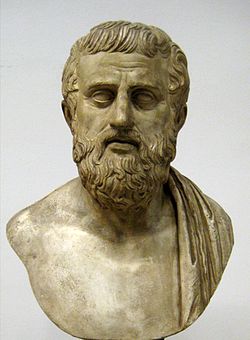
Sophocles
View on Wikipedia
Sophocles (/ˈsɒfəkliːz/;[1] Ancient Greek: Σοφοκλῆς, pronounced [so.pʰo.klɛ̂ːs], Sophoklễs; c. 497/496 – winter 406/405 BC)[2] was an ancient Greek tragedian, one of three from whom at least two plays have survived in full. His first plays were written later than, or contemporary with, those of Aeschylus and earlier than, or contemporary with, those of Euripides. Sophocles wrote more than 120 plays,[3] but only seven have survived in a complete form: Ajax, Antigone, Women of Trachis, Oedipus Rex, Electra, Philoctetes, and Oedipus at Colonus.[4] For almost 50 years, Sophocles was the most celebrated playwright in the dramatic competitions of the city-state of Athens, which took place during the religious festivals of the Lenaea and the Dionysia. He competed in 30 competitions, won 24, and was never judged lower than second place. Aeschylus won 13 competitions and was sometimes beaten by Sophocles; Euripides won four.[5]
Key Information


The most famous tragedies of Sophocles feature Oedipus and Antigone: they are generally known as the Theban plays, though each was part of a different tetralogy (the other members of which are now lost). Sophocles influenced the development of drama, most importantly by adding a third actor (attributed to Sophocles by Aristotle; to Aeschylus by Themistius),[6] thereby reducing the importance of the chorus in the presentation of the plot. He also developed his characters to a greater extent than earlier playwrights.[7]
Life
[edit]
Sophocles, the son of Sophillus, was a wealthy member of the rural deme (small community) of Hippeius Colonus in Attica, which was to become a setting for his play Oedipus at Colonus. He was also probably born there,[2][8] a few years before the Battle of Marathon in 490 BC: the exact year is unclear, but 497/6 is most likely.[2][9] He was born into a wealthy family (his father was an armour manufacturer) and was highly educated. His first artistic triumph was in 468 BC, when he took first prize in the Dionysia, beating the reigning master of Athenian drama, Aeschylus.[2][10] According to Plutarch, the victory came under unusual circumstances: instead of following the usual custom of choosing judges by lot, the archon asked Cimon, and the other strategoi present, to decide the victor of the contest. Plutarch further contends that, following this loss, Aeschylus soon left for Sicily.[11] Though Plutarch says that this was Sophocles's first production, it is now thought that his first production was probably in 470 BC.[8] Triptolemus was perhaps one of the plays that Sophocles presented at this festival.[8]
In 480 BC, Sophocles was chosen to lead the paean (a choral chant to a god), celebrating the Greek victory over the Persians at the Battle of Salamis.[12] Early in his career, the politician Cimon might have been one of his patrons, but if he was, there was no ill will borne by Pericles, Cimon's rival, when Cimon was ostracized in 461 BC.[2] In 443/2, Sophocles served as one of the Hellenotamiai, or treasurers of Athena, helping to manage the finances of the city during the political ascendancy of Pericles.[2] In 441 BC, according to the Vita Sophoclis, he was elected one of the ten generals, executive officials at Athens, as a junior colleague of Pericles; and he served in the Athenian campaign against Samos. He was supposed to have been elected to this position due to his production of Antigone,[13] but this is "most improbable".[14]
In 420 BC, he was chosen to receive the image of Asclepius in his own house when the cult was being introduced to Athens and lacked a proper place (τέμενος).[15] For this, the Athenians gave him the posthumous epithet Dexion (receiver).[16] But "some doubt attaches to this story".[15] He was also elected, in 411 BC, one of the commissioners (probouloi) who responded to the catastrophic destruction of the Athenian expeditionary force in Sicily during the Peloponnesian War.[17]
Sophocles died at the age of 90 or 91 in the winter of 406/5 BC, having seen, within his lifetime, both the Greek triumph in the Persian Wars and the bloodletting of the Peloponnesian War.[2] As with many famous men in classical antiquity, his death inspired a number of apocryphal stories. One claimed that he died from the strain of trying to recite a long sentence from his Antigone without pausing to take a breath. Another account suggests he choked while eating grapes at the Anthesteria festival in Athens. A third holds that he died of happiness after winning his final victory at the City Dionysia.[18] A few months later, a comic poet, in a play titled The Muses, wrote this eulogy: "Blessed is Sophocles, who had a long life, was a man both happy and talented, and the writer of many good tragedies; and he ended his life well without suffering any misfortune."[19] According to some accounts, however, his own sons tried to have him declared incompetent near the end of his life, and he refuted their charge in court by reading from his new Oedipus at Colonus.[20] One of his sons, Iophon, and a grandson, also named Sophocles (son of Ariston), also became playwrights.[21]

An ancient source, Athenaeus's work Sophists at Dinner, contains references to Sophocles's sexuality. In that work, a character named Myrtilus claims that Sophocles "was partial to boys, in the same way that Euripides was partial to women"[22][23] ("φιλομεῖραξ δὲ ἦν ὁ Σοφοκλῆς, ὡς Εὐριπίδης φιλογύνης"),[24] and relates an anecdote, attributed to Ion of Chios, of Sophocles flirting with a serving-boy at a symposium:
βούλει με ἡδέως πίνειν; [...] βραδέως τοίνυν καὶ πρόσφερέ μοι καὶ ἀπόφερε τὴν κύλικα.[24]
Do you want me to enjoy my drink? [...] Then hand me the cup nice and slow, and take it back nice and slow too.[22]
He also says that Hieronymus of Rhodes, in his Historical Notes, claims that Sophocles once led a boy outside the city walls for sex; and that the boy snatched Sophocles's cloak (χλανίς, khlanis), leaving his own child-sized robe ("παιδικὸν ἱμάτιον") for Sophocles.[25][26] Moreover, when Euripides heard about this (it was much discussed), he mocked the disdainful treatment, saying that he had himself had sex with the boy, "but had not given him anything more than his usual fee"[27] ("ἀλλὰ μηδὲν προσθεῖναι"),[28] or, "but that nothing had been taken off"[29] ("ἀλλὰ μηδὲν προεθῆναι").[30] In response, Sophocles composed this elegy:
Ἥλιος ἦν, οὐ παῖς, Εὐριπίδη, ὅς με χλιαίνων
γυμνὸν ἐποίησεν· σοὶ δὲ φιλοῦντι † ἑταίραν †
Βορρᾶς ὡμίλησε. σὺ δ᾿ οὐ σοφός, ὃς τὸν Ἔρωτα,
ἀλλοτρίαν σπείρων, λωποδύτην ἀπάγεις.[31]
It was the Sun, Euripides, and not a boy, that got me hot
and stripped me naked. But the North Wind was with you
when you were kissing † a courtesan †. You're not so clever, if you arrest
Eros for stealing clothes while you're sowing another man's field.[32]
Works and legacy
[edit]
Sophocles is known for innovations in dramatic structure; deeper development of characters than earlier playwrights;[7] and, if it was not Aeschylus, the addition of a third actor,[33] which further reduced the role of the chorus, and increased opportunities for development and conflict.[7] Aeschylus, who dominated Athenian playwriting during Sophocles's early career, adopted the third actor into his own work.[7] Besides the third actor, Aristotle credits Sophocles with the introduction of skenographia, or scenery-painting; but this too is attributed elsewhere to someone else (by Vitruvius, to Agatharchus of Samos).[33] After Aeschylus died, in 456 BC, Sophocles became the pre-eminent playwright in Athens,[2] winning competitions at eighteen Dionysia, and six Lenaia festivals.[2] His reputation was such that foreign rulers invited him to attend their courts; but, unlike Aeschylus, who died in Sicily, or Euripides, who spent time in Macedon, Sophocles never accepted any of these invitations.[2] Aristotle, in his Poetics (c. 335 BC), used Sophocles's Oedipus Rex as an example of the highest achievement in tragedy.[34]
Only two of the seven surviving plays[35] can be dated securely: Philoctetes to 409 BC, and Oedipus at Colonus to 401 BC (staged after his death, by his grandson). Of the others, Electra shows stylistic similarities to these two, suggesting that it was probably written in the later part of his career; Ajax, Antigone, and The Trachiniae, are generally thought early, again based on stylistic elements; and Oedipus Rex is put in a middle period. Most of Sophocles's plays show an undercurrent of early fatalism, and the beginnings of Socratic logic as a mainstay for the long tradition of Greek tragedy.[36][37]
Theban plays
[edit]The Theban plays comprise three plays: Oedipus Rex (also called Oedipus Tyrannus or Oedipus the King), Oedipus at Colonus, and Antigone. All three concern the fate of Thebes during and after the reign of King Oedipus.[38] They have often been published under a single cover;[39] but Sophocles wrote them for separate festival competitions, many years apart. The Theban plays are not a proper trilogy (i.e. three plays presented as a continuous narrative), nor an intentional series; they contain inconsistencies.[38] Sophocles also wrote other plays pertaining to Thebes, such as the Epigoni, but only fragments have survived.[40]
Subjects
[edit]The three plays involve the tale of Oedipus, who kills his father and marries his mother, not knowing they are his parents. His family is cursed for three generations.
In Oedipus Rex, Oedipus is the protagonist. His infanticide is planned by his parents, Laius and Jocasta, to prevent him fulfilling a prophecy; but the servant entrusted with the infanticide passes the infant on, through a series of intermediaries, to a childless couple, who adopt him, not knowing his history. Oedipus eventually learns of the Delphic Oracle's prophecy of him, that he would kill his father, and marry his mother; he attempts to flee his fate without harming those he knows as his parents (at this point, he does not know that he is adopted). Oedipus meets a man at a crossroads accompanied by servants; Oedipus and the man fight, and Oedipus kills the man (who was his father, Laius, although neither knew at the time). He becomes the ruler of Thebes after solving the riddle of the Sphinx and in the process, marries the widowed queen, his mother Jocasta. Thus the stage is set for horror. When the truth comes out, following from another true but confusing prophecy from Delphi, Jocasta commits suicide, Oedipus blinds himself and leaves Thebes. At the end of the play, order is restored. This restoration is seen when Creon, brother of Jocasta, becomes king, and also when Oedipus, before going off to exile, asks Creon to take care of his children. Oedipus's children will always bear the weight of shame and humiliation because of their father's actions.[41]
In Oedipus at Colonus, the banished Oedipus and his daughter Antigone arrive at the town of Colonus, where they encounter Theseus, King of Athens. Oedipus dies and strife begins between his sons Polyneices and Eteocles. They fight, and simultaneously run each other through.
In Antigone, the protagonist is Oedipus's daughter, Antigone. She is faced with the choice of allowing her brother Polyneices's body to remain unburied, outside the city walls, exposed to the ravages of wild animals, or to bury him and face death. The king of the land, Creon, has forbidden the burial of Polyneices for he was a traitor to the city. Antigone decides to bury his body and face the consequences of her actions. Creon sentences her to death. Eventually, Creon is persuaded to free Antigone from her punishment, but his decision comes too late and Antigone commits suicide. Her suicide triggers the suicide of two others close to King Creon: his son, Haemon, who was to wed Antigone, and his wife, Eurydice, who commits suicide after losing her only surviving son.
Composition and inconsistencies
[edit]
The plays were written across 36 years of Sophocles's career and were not composed in chronological order, but instead were written in the order Antigone, Oedipus Rex, and Oedipus at Colonus. Nor were they composed as a trilogy – a group of plays to be performed together, but are the remaining parts of three different groups of plays. As a result, there are some inconsistencies: notably, Creon is the undisputed king at the end of Oedipus Rex and, in consultation with Apollo, single-handedly makes the decision to expel Oedipus from Thebes. Creon is also instructed to look after Oedipus's daughters Antigone and Ismene at the end of Oedipus Rex. By contrast, in the other plays there is some struggle with Oedipus's sons Eteocles and Polynices in regard to the succession. In Oedipus at Colonus, Sophocles attempts to work these inconsistencies into a coherent whole: Ismene explains that, in light of their tainted family lineage, her brothers were at first willing to cede the throne to Creon. Nevertheless, they eventually decided to take charge of the monarchy, with each brother disputing the other's right to succeed. In addition to being in a clearly more powerful position in Oedipus at Colonus, Eteocles and Polynices are also culpable: they consent (l. 429, Theodoridis, tr.) to their father's going to exile, which is one of his bitterest charges against them.[38]
Other plays
[edit]In addition to the three Theban plays, there are four surviving plays by Sophocles: Ajax, Women of Trachis, Electra, and Philoctetes, the last of which won first prize in 409 BC.[42]
Ajax focuses on the proud hero of the Trojan War, Telamonian Ajax, who is driven to treachery and eventually suicide. Ajax becomes gravely upset when Achilles's armor is presented to Odysseus instead of himself. Despite their enmity toward him, Odysseus persuades the kings Menelaus and Agamemnon to grant Ajax a proper burial.
The Women of Trachis (named for the Trachinian women who make up the chorus) dramatizes Deianeira's accidentally killing Heracles after he had completed his famous twelve labors. Tricked into thinking it is a love charm, Deianeira applies poison to an article of Heracles's clothing; this poisoned robe causes Heracles to die an excruciating death. Upon learning the truth, Deianeira kills herself.
Electra corresponds roughly to the plot of Aeschylus's Libation Bearers. It details how Electra and Orestes avenge their father Agamemnon's murder by Clytemnestra and Aegisthus.
Philoctetes retells the story of Philoctetes, an archer who had been abandoned on Lemnos by the rest of the Greek fleet while on the way to Troy. After learning that they cannot win the Trojan War without Philoctetes's bow, the Greeks send Odysseus and Neoptolemus to retrieve him; due to the Greeks' earlier treachery, however, Philoctetes refuses to rejoin the army. It is only Heracles's deus ex machina appearance that persuades Philoctetes to go to Troy.
Fragmentary plays
[edit]Although more than 120 titles of plays associated with Sophocles are known and presented below,[43] little is known of the precise dating of most of them. Philoctetes is known to have been written in 409 BC, and Oedipus at Colonus is known to have only been performed in 401 BC, posthumously, at the initiation of Sophocles's grandson. The convention on writing plays for the Greek festivals was to submit them in tetralogies of three tragedies along with one satyr play. Along with the unknown dating of the vast majority of more than 120 plays, it is also largely unknown how the plays were grouped. It is, however, known that the three plays referred to in the modern era as the "Theban plays" were never performed together in Sophocles's own lifetime, and are therefore not a trilogy (which they are sometimes erroneously seen as).
Fragments of Ichneutae (Tracking Satyrs) were discovered in Egypt in 1907.[44] These amount to about half of the play, making it the best preserved satyr play after Euripides's Cyclops, which survives in its entirety.[44] Fragments of the Epigoni were discovered in April 2005 by classicists at Oxford University with the help of infrared technology previously used for satellite imaging. The tragedy tells the story of the second siege of Thebes.[40] A number of other Sophoclean works have survived only in fragments, including:
|
|
|
Sophocles's view of his own work
[edit]
There is a passage of Plutarch's tract De Profectibus in Virtute 7 in which Sophocles discusses his own growth as a writer. A likely source of this material for Plutarch was the Epidemiae of Ion of Chios, a book that recorded many conversations of Sophocles; but a Hellenistic dialogue about tragedy, in which Sophocles appeared as a character, is also plausible.[45] The former is a likely candidate to have contained Sophocles's discourse on his own development because Ion was a friend of Sophocles, and the book is known to have been used by Plutarch.[46] Though some interpretations of Plutarch's words suggest that Sophocles says that he imitated Aeschylus, the translation does not fit grammatically, nor does the interpretation that Sophocles said that he was making fun of Aeschylus's works. C. M. Bowra argues for the following translation of the line: "After practising to the full the bigness of Aeschylus, then the painful ingenuity of my own invention, now in the third stage I am changing to the kind of diction which is most expressive of character and best."[47]
Here Sophocles says that he has completed a stage of Aeschylus's work, meaning that he went through a phase of imitating Aeschylus's style but is finished with that. Sophocles's opinion of Aeschylus was mixed. He certainly respected him enough to imitate his work early on in his career, but he had reservations about Aeschylus's style,[48] and thus did not keep his imitation up. Sophocles's first stage, in which he imitated Aeschylus, is marked by "Aeschylean pomp in the language".[49] Sophocles's second stage was entirely his own. He introduced new ways of evoking feeling out of an audience, as in his Ajax, when Ajax is mocked by Athene, then the stage is emptied so that he may commit suicide alone.[50] Sophocles mentions a third stage, distinct from the other two, in his discussion of his development. The third stage pays more heed to diction. His characters spoke in a way that was more natural to them and more expressive of their individual character feelings.[51]
Locations named after
[edit]- Sophocles (crater), a crater on Mercury.
See also
[edit]Notes
[edit]References
[edit]- ^ Jones, Daniel; Roach, Peter, James Hartman and Jane Setter, eds. Cambridge English Pronouncing Dictionary. 17th edition. Cambridge UP, 2006.
- ^ a b c d e f g h i j Sommerstein (2002), p. 41.
- ^ The exact number is unknown; the Suda says he wrote 123, another ancient source says 130, but no exact number "is possible", see Lloyd-Jones 2003, p. 3.
- ^ Suda (ed. Finkel et al.): s.v. Σοφοκλῆς.
- ^ Sophocles at the Encyclopædia Britannica.
- ^ LLoyd-Jones, H. (ed. and trans.) (1997). Introduction, in Sophocles I. Sophocles. Cambridge, Massachusetts; London, England: Loeb Classical Library, Harvard University Press. p. 9. ISBN 9780674995574.
- ^ a b c d Freeman, p. 247.
- ^ a b c Sommerstein (2007), p. xi.
- ^ Lloyd-Jones 1994, p. 7.
- ^ Freeman, p. 246.
- ^ Life of Cimon 8. Plutarch is mistaken about Aeschylus' death during this trip; he went on to produce dramas in Athens for another decade.
- ^ McGraw-Hill Encyclopedia of World Drama: An International Reference Work in 5 Volumes, Volume 1, "Sophocles".
- ^ Beer 2004, p. 69.
- ^ Lloyd-Jones 1994, p. 12.
- ^ a b Lloyd-Jones 1994, p. 13.
- ^ Clinton, Kevin, "The Epidauria and the Arrival of Asclepius in Athens", in Ancient Greek Cult Practice from the Epigraphical Evidence, edited by R. Hägg, Stockholm, 1994.
- ^ Lloyd-Jones 1994, pp. 12–13.
- ^ Schultz 1835, pp. 150–51.
- ^ Lucas 1964, p. 128.
- ^ Cicero recounts this story in his De Senectute 7.22.
- ^ Sommerstein (2002), pp. 41–42.
- ^ a b Athenaeus (2011). The Learned Banqueters, Volume VII. Douglas Olson, S. (ed. and trans.). Cambridge, Massachusetts; London, England: Loeb Classical Library, Harvard University Press. p. 53. ISBN 9780674996731.
- ^ Athenaeus (1854). The Deipnosophists. XIII. Translated by Yonge, Charles Duke. London: Henry G. Bohn. pp. 603–4. LCCN 2002554451. Retrieved 24 April 2021.
- ^ a b Athenaeus (2011). The Learned Banqueters, Volume VII. Douglas Olson, S. (ed. and trans.). Cambridge, Massachusetts; London, England: Loeb Classical Library, Harvard University Press. p. 52. ISBN 9780674996731.
- ^ Athenaeus (2011). The Learned Banqueters, Volume VII. Douglas Olson, S. (ed. and trans.). Cambridge, Massachusetts; London, England: Loeb Classical Library, Harvard University Press. pp. 56–57. ISBN 9780674996731.
- ^ Fortenbaugh, William Wall. Lyco and Traos and Hieronymus of Rhodes: Text, Translation, and Discussion. Transaction Publishers (2004). ISBN 978-1-4128-2773-7. p. 161.
- ^ Athenaeus (2011). The Learned Banqueters, Volume VII. Douglas Olson, S. (ed. and trans.). Cambridge, Massachusetts; London, England: Loeb Classical Library, Harvard University Press. p. 57. ISBN 9780674996731.
- ^ Athenaeus (2011). The Learned Banqueters, Volume VII. Douglas Olson, S. (ed. and trans.). Cambridge, Massachusetts; London, England: Loeb Classical Library, Harvard University Press. p. 56. ISBN 9780674996731.
- ^ Sophocles (1992). Greek Lyric, Volume IV: Bacchylides, Corinna, and Others. Campbell, D. A. (ed. and trans.). Cambridge, Massachusetts; London, England: Loeb Classical Library, Harvard University Press. p. 333. ISBN 9780674995086.
- ^ Sophocles (1992). Greek Lyric, Volume IV: Bacchylides, Corinna, and Others. Campbell, D. A. (ed. and trans.). Cambridge, Massachusetts; London, England: Loeb Classical Library, Harvard University Press. p. 332. ISBN 9780674995086.
- ^ Athenaeus (2011). The Learned Banqueters, Volume VII. Douglas Olson, S. (ed. and trans.). Cambridge, Massachusetts; London, England: Loeb Classical Library, Harvard University Press. p. 58. ISBN 9780674996731.
- ^ Athenaeus (2011). The Learned Banqueters, Volume VII. Douglas Olson, S. (ed. and trans.). Cambridge, Massachusetts; London, England: Loeb Classical Library, Harvard University Press. p. 59. ISBN 9780674996731.
- ^ a b Lloyd-Jones 1994, p. 9.
- ^ Aristotle. Ars Poetica.
- ^ The first printed edition of the seven plays is by Aldus Manutius in Venice 1502: Sophoclis tragaediae [sic] septem cum commentariis. Despite the addition 'cum commentariis' in the title, the Aldine edition did not include the ancient scholia to Sophocles. These had to wait until 1518 when Janus Lascaris brought out the relevant edition in Rome.
- ^ Lloyd-Jones 1994, pp. 8–9.
- ^ Scullion, pp. 85–86, rejects attempts to date Antigone to shortly before 441/0 based on an anecdote that the play led to Sophocles' election as general. On other grounds, he cautiously suggests c. 450 BC.
- ^ a b c Sophocles, ed Grene and Lattimore, pp. 1–2.
- ^ See for example: Sophocles: The Theban Plays, Penguin Books, 1947; Sophocles I: Oedipus the King, Oedipus at Colonus, Antigone, University of Chicago, 1991; Sophocles: The Theban Plays: Antigone/King Oidipous/Oidipous at Colonus, Focus Publishing/R. Pullins Company, 2002; Sophocles, The Oedipus Cycle: Oedipus Rex, Oedipus at Colonus, Antigone, Harvest Books, 2002; Sophocles, Works, Loeb Classical Library, Vol I. London: W. Heinemann; New York: Macmillan, 1912 (often reprinted) – the 1994 Loeb, however, prints Sophocles in chronological order.
- ^ a b Murray, Matthew, "Newly Readable Oxyrhynchus Papyri Reveal Works by Sophocles, Lucian, and Others. Archived 11 April 2006 at the Wayback Machine", Theatermania, 18 April 2005. Retrieved 9 July 2007.
- ^ Sophocles. Oedipus the King. The Norton Anthology of Western Literature. Gen. ed. Peter Simon. 8th ed. Vol. 1. New York: Norton, 1984. 648–52. Print. ISBN 0-393-92572-2.
- ^ Freeman, pp. 247–48.
- ^ Lloyd-Jones 2003, pp. 3–9.
- ^ a b Seaford, p. 1361.
- ^ Sophocles (1997). Sophocles I. Lloyd-Jones, H. (ed. and trans.). Cambridge, MA; London, England: Loeb Classical Library, Harvard University Press. p. 11. ISBN 9780674995574.
- ^ Bowra, p. 386.
- ^ Bowra, p. 401.
- ^ Bowra, p. 389.
- ^ Bowra, p. 392.
- ^ Bowra, p. 396.
- ^ Bowra, pp. 385–401.
Sources
[edit]- Beer, Josh (2004). Sophocles and the Tragedy of Athenian Democracy. Greenwood Publishing. ISBN 0-313-28946-8
- Bowra, C. M. (1940). "Sophocles on His Own Development". American Journal of Philology. 61 (4): 385–401. doi:10.2307/291377. JSTOR 291377.
- Finkel, Raphael. "Adler number: sigma,815". Suda on Line: Byzantine Lexicography. Retrieved 14 March 2007.
- Freeman, Charles. (1999). The Greek Achievement: The Foundation of the Western World. New York: Viking Press. ISBN 0-670-88515-0
- Hubbard, Thomas K. (2003). Homosexuality in Greece and Rome: A Sourcebook of Basic Documents.
- Johnson, Marguerite, & Terry Ryan (2005). Sexuality in Greek and Roman Society and Literature: A Sourcebook. Routledge. ISBN 0-415-17331-0, 978-0-415-17331-5
- Lloyd-Jones, Hugh, & Wilson, Nigel Guy (ed.) (1990). Sophoclis: Fabulae. Oxford Classical Texts.
- Lloyd-Jones, Hugh (ed.) (1994). Sophocles: Ajax. Electra. Oedipus Tyrannus. Edited and translated by Hugh Lloyd-Jones, Loeb Classical Library No. 20.
- Lloyd-Jones, Hugh (ed.) (1994). Sophocles: Antigone. The Women of Trachis. Philoctetes. Oedipus at Colonus. Edited and translated by Hugh Lloyd-Jones, Loeb Classical Library No. 21.
- Lloyd-Jones, Hugh (ed.) (1996). Sophocles: Fragments. Edited and translated by Hugh Lloyd-Jones, Loeb Classical Library No. 483.
- Lucas, Donald William (1964). The Greek Tragic Poets. W.W. Norton & Co.
- Plato. Plato in Twelve Volumes, Vols 5 & 6 translated by Paul Shorey. Cambridge, MA, Harvard University Press; London, William Heinemann Ltd. 1969.
- Schultz, Ferdinand (1835). De vita Sophoclis poetae commentatio. Phil. Diss., Berlin.
- Scullion, Scott (2002). "Tragic dates", Classical Quarterly, new sequence 52, pp. 81–101.
- Seaford, Richard A. S. (2003). "Satyric drama". In Simon Hornblower and Antony Spawforth (ed.). The Oxford Classical Dictionary (revised 3rd ed.). Oxford: Oxford University Press. p. 1361. ISBN 978-0-19-860641-3.
- Smith, Philip (1867). "Sophocles". In William Smith (ed.). Dictionary of Greek and Roman Biography and Mythology. Vol. 3. Boston: Little, Brown, and Company. pp. 865–73. Archived from the original on 2 February 2007. Retrieved 19 February 2007.
- Sommerstein, Alan Herbert (2002). Greek Drama and Dramatists. Routledge. ISBN 0-415-26027-2
- Sommerstein, Alan Herbert (2007). "General Introduction", pp. xi–xxix in Sommerstein, A. H., Fitzpatrick, D.. and Tallboy, T. Sophocles: Selected Fragmentary Plays: Volume 1. Aris and Phillips. ISBN 0-85668-766-9
- Sophocles. Sophocles I: Oedipus the King, Oedipus at Colonus, Antigone. 2nd ed. Grene, David, and Lattimore, Richard, eds. Chicago: University of Chicago, 1991.
- Encyclopædia Britannica, Inc. "Macropaedia Knowledge In Depth". The New Encyclopædia Britannica Volume 20. Chicago: Encyclopædia Britannica, Inc., 2005. 344–46.
External links
[edit]


- Works by Sophocles in eBook form at Standard Ebooks
- Works by Sophocles at Project Gutenberg
- Works by Sophocles at Faded Page (Canada)
- Works by or about Sophocles at the Internet Archive
- Works by Sophocles at LibriVox (public domain audiobooks)

- Works by Sophocles at the Perseus Digital Library (Greek and English)
- SORGLL: Sophocles, Electra 1126–1170; read by Rachel Kitzinger Archived 19 October 2017 at the Wayback Machine


| International | |
|---|---|
| National | |
| Academics | |
| Artists | |
| People | |
| Other | |

Sophocles
View on GrokipediaSophocles (c. 496 – 406 BC) was an ancient Athenian tragedian, one of the three principal dramatists of classical Greek tragedy alongside Aeschylus and Euripides.[1] Born in the deme of Colonus near Athens to a prosperous family, he composed over 120 plays across a career spanning six decades, during which he dominated the dramatic competitions at the City Dionysia festival.[2] Only seven of his tragedies survive in full: Ajax, Antigone, Women of Trachis, Oedipus Rex, Electra, Philoctetes, and Oedipus at Colonus.[2] Sophocles' technical innovations elevated the form of tragedy, including the introduction of a third actor—which enabled more intricate dialogue and character development beyond the dueling pairs used by Aeschylus—and the expansion of the chorus from 12 to 15 members, enhancing its role while shifting emphasis toward individual agency.[3] These advancements, combined with his mastery of plot structure, irony, and psychological depth, secured him 18 victories at the Dionysia, surpassing contemporaries in competitive success.[4] His works explore timeless themes of fate, human hubris, and moral conflict, profoundly influencing Western literature.[5] Active in Athenian public life, Sophocles held offices such as strategos (general), serving alongside Pericles in 441/0 BC, and later as a proboulos during the Peloponnesian War, reflecting his status as a prominent citizen beyond the theater.[2]
Biography
Early Life and Family
Sophocles was born around 496 BCE in Colonus (or Colonus Hippius), a rural Attic deme situated roughly a mile northwest of central Athens.[6] Ancient biographical traditions, such as the Suda lexicon, identify him as the son of Sophilos, an Athenian from the same deme, though the precise timing of his birth—linked in the Suda to the 73rd Olympiad (c. 488–485 BCE)—is adjusted by modern scholars to align with contemporary evidence placing it slightly earlier.[4][6] Little is documented about Sophilos's occupation beyond references in ancient vitae portraying him as a craftsman, potentially involved in armor production or woodworking, trades common in Attica that suggest modest prosperity sufficient for civic participation.[6] No reliable accounts exist of Sophocles's mother or siblings, though his family's status in the Colonus deme implies membership in the broader Athenian citizen class, enabling early exposure to cultural and physical training expected of elite youth.[4] These biographical details derive primarily from Hellenistic and Byzantine compilations drawing on lost Peripatetic sources, which blend anecdotal tradition with chronological inference rather than direct testimony.[4]Education and Formative Influences
Sophocles, born circa 496 BC into a prosperous family in the deme of Colonus near Athens, received the comprehensive training typical of Athenian aristocratic youth, emphasizing physical and artistic development to prepare for civic leadership. This education included rigorous instruction in gymnastics, where he reportedly won garlands in competitions, and mousikē, the holistic art of music, poetry, and dance essential to cultural and religious life.[7][8] His musical training was guided by the esteemed master Lamprus, a figure noted in ancient biographies for advancing harmonic innovations, though the precise duration or depth of this tutelage remains unattested beyond the anonymous vita. A pivotal early demonstration of his skills occurred in 480 BC, shortly after the Battle of Salamis, when, at around age 16, Sophocles led a chorus of adolescent boys in performing a paean of victory; he played the lyre, sang, and danced nude around the trophy monument on the island, as recorded by Athenaeus and the anonymous biographer.[7] These formative experiences, rooted in Attic religious festivals and communal celebrations, immersed Sophocles in the epic and choral traditions that underpinned Greek tragedy, including exposure to Homeric poetry through formal study and performance. Ancient testimonies, such as the vita, portray this period as foundational, fostering his grace, charm, and aptitude for public expression, though details derive from later Hellenistic compilations drawing on scattered earlier accounts like those of Ion of Chios.[9][7]Public and Military Service
Sophocles participated actively in Athenian public life, holding financial and advisory roles that underscored his status as a respected citizen. In 443/442 BC, he served as one of the hellēnotamiai, officials tasked with managing the collection and disbursement of tribute from Delian League allies, a position that involved oversight of imperial finances during Athens' expanding influence.[10] His military service came in 441/440 BC, when he was elected as one of the ten stratēgoi (generals), a competitive office requiring popular vote and entailing command responsibilities in naval and land operations. Assigned as a subordinate to Pericles, Sophocles participated in the Samian War (440–439 BC), where Athenian forces besieged and subdued the island of Samos after its revolt against league obligations, marking a key assertion of Athenian hegemony.[11][12] Amid the Peloponnesian War's escalating crises, particularly following the catastrophic Sicilian Expedition of 413 BC—which resulted in the loss of over 40,000 Athenian troops and allies—Sophocles was selected in 411 BC as one of the ten probouloi. This emergency council of senior statesmen advised on fiscal austerity, resource allocation, and political reforms to stabilize the democracy under oligarchic pressures, reflecting trust in his judgment despite his age of around 85.[13] In religious and civic capacities, Sophocles contributed to Athens' response to the plague outbreaks during the war. Around 420 BC, he facilitated the importation of the cult of Asclepius from Epidaurus, leading a delegation to bring the god's sacred image and establishing a sanctuary on the Acropolis; in recognition, he was appointed lifelong priest (hiereus) and composed a paean to Asclepius that became part of the cult's rituals.[14]Later Years and Death
Sophocles remained active in dramatic production into his ninth decade, achieving a first-place victory at the City Dionysia in 409 BC with Philoctetes.[15] He composed Oedipus at Colonus during this period, a play set in his birthplace of Colonus and reflecting themes of exile and redemption, though it was not staged until after his death.[4] In his extreme old age, Sophocles encountered familial discord when his son Iophon initiated legal proceedings to declare him mentally incompetent (adokimos), ostensibly to assume control of his property under Athenian law allowing such challenges against elderly relatives.[16] To counter the accusation, Sophocles reportedly recited excerpts from Oedipus at Colonus before the court, showcasing his enduring compositional skill and lucidity; the jury acquitted him, swayed by the demonstration.[16] This account derives from ancient biographical traditions preserved in the Vita Sophoclis and Suda lexicon, which compile Hellenistic and later anecdotes, though their historicity relies on oral and dramatic lore rather than contemporary records.[4] Sophocles died in the winter of 406/405 BC, at approximately ninety years of age, amid Athens's ongoing struggles in the Peloponnesian War's final phase.[8] His Oedipus at Colonus was posthumously entered into competition in 401 BC by his grandson (also named Sophocles), securing a first-prize victory and affirming his lasting influence.[15] Various later traditions attribute his death to natural causes or dramatic mishaps, such as choking on a grape kernel during a meal or reciting poetry, but these lack corroboration and appear as embellished exempla of advanced age.[11]Dramatic Career
Innovations in Greek Tragedy
Sophocles advanced Greek tragedy by introducing a third actor, expanding dramatic possibilities beyond the two-actor limit established by Aeschylus. This innovation, implemented around 468 BCE following his first victory at the City Dionysia, enabled more nuanced interactions among characters, intricate plotting, and reduced dependence on role-doubling or deus ex machina resolutions.[3][15] The addition facilitated deeper exploration of psychological conflict and moral dilemmas through direct confrontation, as seen in plays like Antigone, where multiple principals engage without choral mediation dominating the action.[15] Concurrently, Sophocles enlarged the chorus from twelve to fifteen members, enhancing its visual and musical scale while simultaneously curtailing its narrative dominance. Choruses in his surviving works contain fewer lines—averaging about 20% less than in Aeschylean tragedies—and serve more as commentators on events rather than primary drivers of the plot.[15] This shift prioritized dialogue and individual agency over collective moralizing, allowing tragedies to focus on personal hubris and ethical ambiguity, as evidenced by the reduced choral odes in Oedipus Rex compared to earlier forms.[17] Aristotle attributes to Sophocles the introduction of skenographia, or painted scenery, which provided perspectival backdrops to denote settings like palaces or sacred groves, marking a departure from minimalist staging.[18] However, this claim is contested, with Vitruvius crediting the painter Agatharchus for early perspectival techniques around the mid-fifth century BCE, suggesting Sophocles may have adapted rather than originated the practice.[18] Regardless, his emphasis on visual and structural realism contributed to tragedy's evolution toward psychological depth and self-contained episodes, including the composition of unconnected trilogies unbound by mythic cycles.[15] These changes collectively refined tragedy as a medium for probing human limits against inexorable fate.[19]Competition Victories and Rivalries
Sophocles achieved his debut victory in the tragic competition at the City Dionysia in 468 BC, defeating the incumbent champion Aeschylus, whose dominance had previously secured 13 first-place wins.[20] This upset marked the young playwright's entry into Athens' premier dramatic festival, held annually in honor of Dionysus, where competing poets presented tetralogies of tragedies plus a satyr play, judged by a panel selected by lot from the citizenry.[15] Over his career, Sophocles is recorded in ancient biographical traditions as securing approximately 18 to 24 first-prize victories at the Dionysia, with estimates varying due to incomplete epigraphic records from the period; he purportedly never placed lower than second in any competition entered.[20][2] Additional successes included at least six wins at the Lenaea festival, reflecting his sustained excellence amid the era's rigorous standards, where only the top performer received a tripod as prize.[21] These triumphs elevated Sophocles above his contemporaries, as Aeschylus' victories totaled 13 before his death in 456 BC, while Euripides, active from around 455 BC, garnered only four or five first prizes despite producing nearly as many plays.[8] The rivalries inherent in these festivals were professional rather than personal, driven by the competitive structure pitting poets against one another for civic prestige and patronage; Sophocles' innovations, such as adding a third actor and enhancing choral elements, likely contributed to his edge over Aeschylus' more archaic style and Euripides' later, more rhetorical approach.[15] No ancient sources attest to overt feuds, but Sophocles' consistent outperformance—evidenced by his unbroken record of high placements—positioned him as the preeminent tragedian of fifth-century Athens, influencing the genre's evolution through repeated validation by public and judicial acclaim.[20]Collaboration and Theatrical Context
Sophocles composed and produced his tragedies within the competitive framework of Athenian dramatic festivals, particularly the City Dionysia, an annual event held in late March or early April to honor Dionysus. This festival, formalized in the 530s BCE, featured competitions where three selected tragedians each presented a tetralogy consisting of three tragedies and a satyr play, performed before up to 14,000 spectators in the Theatre of Dionysus on the Acropolis slope.[22] The archon basileus appointed by lot chose the competing poets from submissions, with winners determined by a panel of ten citizens who judged elements such as plot coherence, choral performance, and actor delivery; victors received an ivy wreath, sacrificial animals, and a civic banquet.[22] Sophocles entered this arena in 468 BCE, securing first prize in his debut competition against the established Aeschylus, marking a generational shift in tragic drama.[11] Over his career, he achieved at least eighteen victories at the Dionysia, participating roughly thirty times across his production of some 123 plays, far surpassing Aeschylus's thirteen wins and Euripides's four. These contests fostered rivalry among the trio, who as contemporaries vied for prestige in a system where success reflected not only artistic merit but also alignment with Athenian civic values during the city's democratic and imperial zenith in the fifth century BCE.[23] Production demanded multifaceted collaboration beyond the solitary composition of scripts. A wealthy citizen, the choregos, was liturgically assigned to fund and oversee each poet's entry, covering costs for training a chorus of fifteen male citizens, procuring masks and costumes, and compensating musicians and auxiliary performers.[22] The playwright, including Sophocles, directed rehearsals, integrating up to three masked actors—who often played multiple roles—and the chorus, whose odes and dances provided narrative commentary and emotional amplification.[22] While Sophocles initially performed as an actor, he later focused on direction, exemplifying how tragedians navigated this collective process amid the festivals' ritual and political stakes, where plays served as public discourse on ethics, fate, and statecraft.[11]Works
The Theban Plays
The Theban Plays consist of three tragedies—Antigone, Oedipus Rex (also known as Oedipus the King or Oedipus Tyrannus), and Oedipus at Colonus—that dramatize interconnected myths surrounding the royal house of Thebes and the fulfillment of Laius's curse on his descendants.[24] Although written separately over several decades and not presented as a tetralogy at the Dionysia, the plays form a loose narrative cycle when read in chronological order of events: Oedipus Rex recounts Oedipus's unwitting patricide and incest, Oedipus at Colonus his blinded exile and death near Athens, and Antigone the ensuing civil strife and burial dispute among his daughters and Creon.[25] Antigone, the earliest composed around 441 BCE, engages with the aftermath of Aeschylus's Seven Against Thebes (performed 467 BCE) by centering on Antigone's defiance of Creon's decree against burying her brother Polynices, the Argive-aligned attacker of Thebes, highlighting tensions between divine law, familial piety, and state authority.[24] Oedipus Rex, produced circa 429 BCE amid the Athenian plague, exemplifies Sophocles' mastery of dramatic irony through Oedipus's quest to end Thebes's affliction, revealing his own role as the pollution's source via the oracle's prophecy.[26] This play, Aristotle later deemed the ideal tragedy for its unity of action, reversal, and recognition.[27] Oedipus at Colonus, Sophocles' final work completed around 406 BCE and staged posthumously in 401 BCE by his grandson, shifts to Oedipus's supplication in Attica, where he receives sanctuary from Theseus, portraying redemption through suffering and Athens's piety contrasted with Theban impiety.[24] Collectively, these plays underscore Sophocles' innovations in character depth and peripeteia, influencing subsequent tragedy by probing human agency against inexorable fate without resolving the antinomy.[28]Other Surviving Tragedies
Ajax, likely one of Sophocles' earliest surviving tragedies, dramatizes the downfall of the Greek hero Ajax during the Trojan War, following the death of Achilles. In the play, Ajax, enraged after losing the contest for Achilles' armor to Odysseus through Athena's intervention, falls into madness induced by the goddess and slaughters livestock under the delusion of attacking his Greek rivals. Upon regaining sanity and facing ridicule from the Greek leaders, Ajax isolates himself, rejects reconciliation despite pleas from his concubine Tecmessa and a messenger from Odysseus, and ultimately commits suicide by falling on his sword. The chorus of sailors and Ajax's son Eurysaces attempt to honor his burial rites, which are contested by the Atreidae (Agamemnon and Menelaus), but Odysseus intervenes to secure a proper burial, affirming Ajax's heroic status despite his flaws.[29][30] Electra explores the theme of vengeance within the house of Atreus, focusing on Electra's unrelenting grief for her father Agamemnon, murdered by her mother Clytemnestra and stepfather Aegisthus. Electra, isolated and mourning at her father's tomb, rejects her mother's attempts at reconciliation and awaits the return of her brother Orestes to exact justice. Orestes, presumed dead but actually alive and plotting with his companion Pylades, arrives in disguise, stages a false report of his death to test Electra's resolve, and reveals himself. Together, they orchestrate the murders: Orestes kills Aegisthus first, then Clytemnestra upon Electra's urging, though the play ends with Electra's complicity in the matricide raising questions of moral excess. The date of production remains uncertain, with scholarly estimates placing it between approximately 420 and 410 BC.[31][32] Philoctetes, first performed in 409 BC at the City Dionysia where it won first prize, recounts the Greeks' desperate mission to retrieve Philoctetes, stranded on Lemnos for ten years due to a festering wound from a snake bite inflicted during the Trojan expedition. Abandoned by the Greeks because of his agonizing cries and stench, Philoctetes possesses the bow of Heracles, essential for Troy's fall as prophesied. Odysseus, accompanied by the young Neoptolemus (son of Achilles), initially plans deception to seize the bow, but Neoptolemus, moved by Philoctetes' suffering and his own sense of honor, confesses the ruse. A divine intervention by Heracles persuades Philoctetes to join the Greeks voluntarily, resolving the conflict through persuasion rather than force.[33][34] Trachiniae (Women of Trachis), whose production date is debated but possibly around 413 BC or earlier, centers on Deianeira, wife of Heracles, who seeks to rekindle her husband's love amid his prolonged absence. Interpreting an oracle ambiguously, Deianeira sends Heracles a robe soaked in what she believes is a love potion from the centaur Nessus but is actually poisonous blood. Upon wearing it during a sacrificial ritual, Heracles suffers excruciating torment as the poison consumes him, leading to his agonized return home where he orders his son Hyllus to marry Iole (Heracles' captive) and arrange his funeral pyre. Deianeira, discovering the robe's lethal effect, commits suicide, leaving Hyllus to grapple with filial duty and the cycle of suffering. The play highlights tragic irony through misinterpretation of signs and the unintended consequences of well-intentioned actions.[35]Lost and Fragmentary Plays
Sophocles is estimated to have authored approximately 123 plays across his six-decade career, spanning tragedies and satyr plays, yet only seven tragedies survive intact.[19] The remainder are lost, with titles attested for roughly 100 works in ancient catalogs and scholia, and fragments—typically brief quotations in later authors or papyri excerpts—preserving content from over 70.[36] These survivals, including discoveries from Egyptian sites like Oxyrhynchus, reveal Sophocles' versatility in adapting myths, though reconstruction remains speculative due to textual gaps.[37] The most extensive fragment belongs to the satyr play Ichneutae (Trackers), recovered in 1907 and comprising about 400 lines from a papyrus roll.[38] Set on Mount Cyllene, it features Apollo enlisting Silenus and a chorus of satyrs to pursue the infant Hermes, thief of Apollo's cattle; the nymph Cyllene narrates Hermes' birth, blending humor with mythological burlesque characteristic of the genre.[39] This play, likely performed as part of a tetralogy, exemplifies Sophocles' contributions to satyr drama, of which around 24 titles are attributed to him with varying certainty.[40] Among tragedies, Triptolemus stands out as an early production from 468 BCE, when Sophocles reportedly secured his first victory over Aeschylus.[19] Surviving in scattered lines, it dramatized the Eleusinian hero Triptolemus receiving Demeter's chariot to propagate agriculture, touching on themes of divine favor and human cultivation; one fragment alludes to a barley-based beverage akin to kykeon.[41] Other fragmentary tragedies, such as those quoted by Athenaeus or Athenaeus, include Athamas and works drawing from Trojan or Theban cycles, attesting to Sophocles' expansive mythic repertoire beyond the preserved canon.[42] These fragments, compiled in scholarly editions like the Loeb Classical Library volumes, illuminate Sophocles' linguistic innovation and thematic depth, often paralleling his complete plays in exploring human-divine tensions, though their brevity limits full dramatic analysis.[43] Papyrological finds continue to refine attributions, underscoring the partial nature of transmission through medieval manuscripts and quotations.[44]Themes and Philosophy
Fate, Divine Will, and Human Agency
Sophocles' tragedies portray moira—the inescapable portion of life allotted by the gods—as a governing force that intersects with human decision-making, often amplified by hybris (excessive pride or overreach), leading to downfall despite apparent agency.[45] In this framework, divine will manifests through oracles and omens, such as Apollo's prophecies, which characters cannot evade but whose fulfillment hinges on their choices, creating a causal chain where human actions precipitate ordained outcomes.[46] Scholars note that Sophocles does not depict pure determinism; rather, protagonists exercise volition in interpreting and responding to divine signals, underscoring personal responsibility amid cosmic inevitability.[47] In Oedipus Tyrannus, the tension exemplifies this dynamic: Oedipus, forewarned by the Delphic oracle of patricide and incest, flees Corinth to avert it, yet his inquiries into Thebes' plague—driven by rational agency and a quest for truth—unwittingly unravel the prophecy's realization.[45] His hybris lies not in defying fate outright but in presuming human intellect could outmaneuver divine knowledge, as when he curses the unknown killer (himself), invoking curses that bind him further.[48] The chorus reflects this interplay, lamenting how pride (hybris) generates the tyrant, implying that while moira predestines events, Oedipus' willful pursuit of clarity enacts his ruin, blending predestination with moral culpability.[48] Antigone shifts emphasis to conflict between divine nomos (unwritten eternal laws) and human edict, where agency asserts piety against state authority. Antigone buries her brother Polyneices, defying Creon's decree, on grounds that divine mandates for burial rites supersede mortal prohibitions, invoking nomima (customs) "not of today or yesterday" but eternal.[49] Creon's hybris manifests in rigid enforcement of his law, ignoring omens like Tiresias' warnings, resulting in familial devastation that Tiresias attributes to pollution from defying divine order.[50] Here, human agency upholds or violates cosmic harmony: Antigone's choice affirms transcendent ethics rooted in nature and gods, while Creon's overreach invites retribution, illustrating Sophocles' view that true wisdom aligns personal will with divine themis (justice).[51] Across plays like Electra and Ajax, divine intervention—via Athena's madness in the latter or Apollo's cues—curbs unchecked agency, punishing hybris that disrupts social and cosmic balance without negating choice.[52] Sophocles thus conveys causal realism: fate operates through predictable mechanisms of divine oversight and human error, where agents bear consequences for decisions that, though free, ignore limits imposed by superior powers.[53] This portrayal influenced later Greek thought, emphasizing piety as reconciliation of will and moira, rather than rebellion.[54]Heroism, Hubris, and Moral Duty
Sophocles' protagonists often embody heroism through their pursuit of arete—excellence in fulfilling civic, familial, or personal roles—yet this drive frequently intersects with hubris, defined in ancient Greek terms as excessive pride that transgresses moral or divine boundaries, inviting nemesis or retribution. In Oedipus Rex, Oedipus exemplifies the tragic hero as a ruler who heroically seeks to purge Thebes of plague by uncovering the killer of Laius, demonstrating intellectual prowess in solving the Sphinx's riddle years earlier; however, his hubris manifests in relentless inquiry despite prophetic warnings, leading to self-blinding and exile as he realizes his unwitting patricide and incest.[55][56] This pattern underscores Sophocles' view that heroism demands moral courage but falters when unbridled self-confidence overrides humility before the gods. Hubris recurs across Sophocles' corpus as a catalyst for downfall, not merely as arrogance but as a violation of cosmic order, often punishing the hero's refusal to accept human limits. Creon in Antigone illustrates state-oriented heroism twisted by hubris: as new king, he prioritizes political stability by decreeing unburied traitors like Polynices, yet his inflexible enforcement ignores divine laws of kinship burial, resulting in his son's and wife's suicides.[49] Similarly, Ajax in Ajax displays warrior heroism through valor against Trojans, but his hubris—fueled by dishonor after Athena's madness—culminates in vengeful cattle-slaughter and eventual suicide, highlighting the fragility of heroic honor when pride eclipses communal reconciliation.[57] Sophocles thus portrays hubris not as isolated vice but as heroism's shadow, where exceptional agency provokes divine equilibrium. Moral duty in Sophocles' tragedies emerges as a hierarchical conflict between piety to gods and ancestors, familial obligations, and civic imperatives, with heroes compelled to choose amid irreconcilable demands. Antigone prioritizes unwritten divine laws—burying her brother to ensure his afterlife—over Creon's edict, enacting a heroism of conscience that affirms familial and religious duty, even at the cost of her life; this act critiques rigid state authority while exposing the isolation of unyielding moral absolutism.[58][59] In Electra, the titular character's dutiful vengeance against Clytemnestra upholds justice for Agamemnon but risks moral excess, reflecting Sophocles' nuanced ethic where duty demands action yet invites scrutiny of its proportionality. Overall, these tensions reveal Sophocles' realism: moral duty propels heroic resolve, but its pursuit without temperance invites tragedy, privileging neither individual nor collective claims absolutely.[60]Family, Piety, and Social Order
In Sophocles' tragedies, family structures (oikos) form the foundational unit of human existence, often clashing with broader social and political orders (polis), while piety toward gods and ancestors mediates these tensions, enforcing moral imperatives through divine retribution or curses. Disruptions to familial bonds—such as curses inherited across generations or failures in kinship duties—precipitate chaos that undermines civic stability, as seen in the Theban cycle where Laius's original transgression against divine hospitality curses his lineage, leading to Oedipus's unwitting patricide and incest, which pollute Thebes and necessitate ritual purification to restore order.[61] This portrayal reflects Athenian values prioritizing household piety as a bulwark against anarchy, yet Sophocles illustrates how rigid adherence to family loyalty can subvert state authority, highlighting causal chains where personal virtues exacerbate collective downfall.[62] The play Antigone exemplifies the primacy of familial and religious piety over civic edicts: Antigone defies Creon's decree denying burial to her brother Polynices, invoking unwritten divine laws (nomoi) that mandate honoring kin and the dead, which transcend human rulers' temporal power. Creon's insistence on state sovereignty—treating Polynices as a traitor to preserve social order—results in his family's annihilation, including the suicides of Antigone, Haemon, and Eurydice, underscoring Sophocles' view that neglecting piety invites nemesis from the gods, who favor kinship rituals as essential to cosmic harmony. Scholars note this as an affirmation of religious theses over political ones, where family duties rooted in piety ultimately prevail, critiquing tyrannical overreach that severs the oikos from divine sanction.[50][59] Creon's hubris in prioritizing polis uniformity ignores the reciprocal obligations binding family, gods, and society, leading to a cascade of retributive deaths that dismantle his rule.[62] In Electra, filial piety (eusebeia) drives the restoration of patriarchal order within the house of Atreus: Electra mourns Agamemnon ceaselessly and urges Orestes to avenge his father by matricide, framing this as a sacred duty to counter Clytemnestra's impious usurpation, which has inverted social hierarchies by elevating adulterous rule over legitimate lineage. The chorus reinforces this by lauding Electra's reverence toward her father, portraying birds' instinctive filial care as a natural analogy for human obligations, yet the play exposes the moral ambiguity of vengeance, as Electra's unyielding piety blinds her to the ensuing familial devastation.[63] Sophocles thus depicts piety not as unalloyed virtue but as a force that, when activated against kin betrayals, realigns disrupted orders at the cost of further blood guilt, preserving the oikos through cycles of retribution sanctioned by ancestral curses.[64] Across these works, Sophocles integrates piety as the adhesive for family and social cohesion, where violations—whether through neglect of burial rites, failure to honor parents, or defiance of oracles—trigger inexorable divine mechanisms that enforce equilibrium, often via human agents whose agency operates within fated constraints. Unlike Aeschylus's emphasis on evolving civic justice, Sophocles maintains a conservative reverence for hierarchical pieties, warning that eroding family sanctity corrodes the polity, as familial curses propagate instability unless expiated through ritual or heroic sacrifice.[65] This causal realism underscores empirical Athenian experiences of kinship feuds destabilizing poleis, privileging evidence from mythic precedents over abstract ideals.[62]Reception and Influence
In Classical Antiquity
Sophocles' tragedies continued to be reperformed in ancient Greek festivals after his death in 406 BCE, with families of tragedians promoting revivals to honor deceased poets.[66] By the 4th century BCE, actors like Theodorus staged Sophoclean plays, contributing to their enduring presence in theatrical competitions.[66] These reperformances sustained audience familiarity and reinforced Sophocles' status alongside Aeschylus and Euripides. Aristotle, in his Poetics (circa 335 BCE), elevated Sophocles as a model tragedian, praising his imitation of nobler character types akin to Homer's and citing Oedipus the King as exemplifying complex plot structure with reversal and recognition.[67] Aristotle referenced the play eight times, more than any other, highlighting its adherence to tragic principles like unity of action and the arousal of pity and fear.[68] This endorsement shaped subsequent dramatic theory, positioning Sophocles as superior in craftsmanship to Euripides, though Aristotle noted Sophocles' characters as ethically better but less realistic.[67] In the Hellenistic period, Alexandrian scholars engaged deeply with Sophocles' texts, producing editions, commentaries, and debates on poetic quality that revealed not unanimous acclaim but critical scrutiny of his style and innovations.[69] This scholarship preserved fragments and facilitated textual transmission, countering modern assumptions of uncritical positivity by evidencing analytical contention over his diction and dramaturgy.[70] Roman reception involved adaptations and performances of Sophoclean tragedies, integrated into Latin drama from the 3rd century BCE onward, though Romans often favored Euripides for direct translations while drawing on Sophocles' thematic depth in works by playwrights like Accius.[71] Cicero and Quintilian commended Sophocles for moral insight and eloquence, influencing elite education and rhetoric, ensuring his plays' study persisted into the Imperial era.[72]Through Medieval and Renaissance Periods
In the Byzantine Empire, Sophocles' tragedies were preserved through a continuous manuscript tradition that emphasized a select "Byzantine triad" of Ajax, Electra, and Oedipus Rex, which were copied and used in educational contexts from late antiquity onward.[73] Byzantine scholars, including Manuel Moschopoulos (late 13th–early 14th century) and Demetrius Triclinius (c. 1280–1340), produced recensions and commentaries that refined the text, correcting perceived errors and adding scholia to aid interpretation, thereby ensuring the survival of the seven complete plays into the medieval era.[74] These efforts contrasted with Western Europe, where full Greek texts of Sophocles remained unavailable during the Middle Ages, with knowledge limited to indirect references in Latin authors like Horace and Statius, who praised his dramatic skill without access to primary works.[75] The transition to the Renaissance marked the reintroduction of Sophocles to Western scholars, as Greek manuscripts arrived in Italy around 1413, facilitated by Byzantine humanists fleeing Ottoman advances.[75] This influx supported humanist studies of Greek tragedy for linguistic purity and moral instruction, with early translations such as the Latin Oedipus Rex by Rinuccio Aretino (c. 1420s) enabling broader engagement.[76] The first printed edition, containing the seven surviving plays with commentaries, was published by Aldus Manutius in Venice in 1502, making Sophocles accessible beyond manuscript elites and influencing tragic theory by emphasizing catharsis and ethical dilemmas over Senecan models.[77] Renaissance adaptations, including Italian performances of Oedipus Rex and its translation by Orsatto Giustiniani (late 16th century), highlighted Sophocles' role in didactic theater, teaching rulers about hubris and fate through staged revivals that blended ancient structure with contemporary humanism.[78][79]Modern Adaptations and Interpretations
Sophocles' tragedies have inspired numerous stage adaptations in the 20th and 21st centuries, often recontextualizing ancient themes of duty, fate, and conflict with authority to address modern political and social crises. Jean Anouilh's Antigone (1944) transposed the play to Vichy France under Nazi occupation, portraying Antigone's defiance of Creon's decree as a symbol of individual resistance against totalitarian regimes; premiered amid wartime censorship, it was interpreted by audiences as veiled opposition to collaborationist government, though Anouilh later clarified its ambiguity on moral absolutism. [80] Similarly, Athol Fugard's The Island (1973), co-authored with John Kani and Winston Ntshona, adapted Antigone to apartheid-era South Africa, with prisoners staging the play to critique racial oppression and state injustice. [10] These works demonstrate how Sophocles' emphasis on unyielding principle amid civic order resonates in contexts of systemic tyranny, prioritizing ethical confrontation over pragmatic compromise. [81] In film and opera, adaptations have explored psychological depths and ritualistic elements of Sophocles' narratives. Pier Paolo Pasolini's Edipo Re (1967) reimagined Oedipus Rex through surreal, Freud-influenced visuals, blending ancient myth with modern alienation to underscore inevitable self-destruction via repressed truths. [82] Igor Stravinsky's opera Oedipus Rex (1927), with libretto by Jean Cocteau, stylized the tragedy as a Latin-chanted spectacle, preserving the oracle's inexorability while evoking modernist detachment from human agency. [83] Contemporary theater, such as Steven Berkoff's visceral Oedipus (1984, revived 2022), employs physicality and raw dialogue to highlight bodily horror and tyrannical downfall, adapting the text for intimate venues to intensify audience confrontation with hubris's consequences. [84] Literary reinterpretations extend Sophocles' influence into novels addressing diaspora and extremism. Kamila Shamsie's Home Fire (2017) recasts Antigone around a British-Pakistani family torn by jihadist radicalization and counterterrorism policies, examining loyalty to kin versus state loyalty in a post-9/11 world; the narrative affirms the play's causal chain where familial piety provokes institutional backlash, without resolving into ideological equivalence. [85] Rita Dove's verse drama The Darker Face of the Earth (1994) parallels Oedipus with an enslaved protagonist's incestuous rise and fall on a 19th-century American plantation, using prophecy as metaphor for racial determinism and rebellion's tragic costs. [86] Interpretations in psychology and philosophy have framed Sophocles' works through lenses of unconscious drives and existential absurdity, though these often impose modern paradigms on ancient causal structures privileging divine ordinance over individual psyche. Sigmund Freud's Oedipus complex, articulated in The Interpretation of Dreams (1899), derived from Oedipus Rex the notion of innate filial rivalry and desire, positing the play as universal revelation of repressed patricidal and incestuous impulses; critics note this psychologizes Sophocles' fatalism, where Oedipus's inquiry actively fulfills prophecy rather than unearths buried psyche. [87] [88] Existential readings, as in analyses linking Oedipus's quest to absurd confrontation with unknowable limits, highlight human striving against opaque fate, akin to Camus's Sisyphus but rooted in Sophoclean piety's clash with contingency; such views underscore the plays' realism about limited agency without endorsing relativism. [89] Modern scholarship, wary of anachronistic overlays, reaffirms the texts' empirical focus on verifiable oaths, oracles, and social repercussions as drivers of catastrophe, influencing ethical debates on authority and retribution. [90]Scholarly Debates and Controversies
Chronology and Dating of Plays
The precise dating of Sophocles' tragedies presents significant challenges, as ancient didascaliae (production records) and vita traditions provide firm dates for only a minority of his works, with the majority reliant on indirect evidence such as historical allusions, prosodic features, and comparative stylistics against dated plays by Aeschylus and Euripides.[91] Sophocles' first victory at the City Dionysia occurred in 468 BCE, marking the approximate start of his dramatic career, though no specific play is definitively assigned to that tetralogy.[92] Subsequent datings draw from papyrological fragments, scholiastic hypotheses, and modern analyses, but uncertainties persist due to the fragmentary nature of records and potential revisions in later revivals.[4] Among the seven extant plays, Philoctetes is securely dated to 409 BCE, based on inscriptional evidence from the Fasti, during which Sophocles won first prize; this late-career work reflects contemporary Peloponnesian War events, including the Sicilian Expedition's aftermath.[91] Similarly, Oedipus at Colonus premiered posthumously in 401 BCE under Sophocles' son Iophon, as recorded in the play's hypothesis and aligned with its setting in the poet's birthplace, Colonus, emphasizing themes of reconciliation amid Athens' post-war recovery.[91] [93] For the remaining plays, scholarly consensus favors a relative chronology placing Ajax as the earliest, likely in the 440s BCE, inferred from its simpler choral lyrics and lack of late stylistic innovations compared to Euripides' early works. Antigone follows around 442–440 BCE, supported by allusions to Periclean policies on burial and stylistic maturity post-Ajax. Oedipus Tyrannus is positioned in the 430s–420s BCE, with references to a plague evoking Athens' 430 BCE epidemic during the Peloponnesian War. Electra and Trachiniae are debated but often dated to the 410s BCE, with Electra's anapaestic rhythms suggesting proximity to Philoctetes, while Trachiniae's archaic diction allows for earlier placement in some analyses (ca. 450s BCE) or later (ca. 415 BCE) based on mythological cross-references.[94] [4]| Play | Approximate Date (BCE) | Primary Evidence Basis |
|---|---|---|
| Ajax | 450–440 | Stylistic primitiveness; pre-Periclean choral structure[4] |
| Antigone | 442–440 | Historical allusions to Theban conflicts; tetralogy context[91] |
| Oedipus Tyrannus | 430–420 | Plague imagery matching 430 BCE outbreak; metrical evolution[94] |
| Trachiniae | 450–415 (debated) | Mythological parallels; variable prosody interpretations[91] |
| Electra | 420–410 | Anapaests akin to late works; post-Oedipus Theban cycle[91] |
| Philoctetes | 409 (firm) | Inscriptional Fasti records; Sicilian Expedition echoes[91] |
| Oedipus at Colonus | 406 (written); 401 (premiere) | Hypothesis and vita; posthumous production[91] [93] |
Textual Transmission and Authenticity Issues
Of the more than 120 plays attributed to Sophocles, only seven tragedies survive in complete form: Ajax, Antigone, Electra, Oedipus Rex, Oedipus at Colonus, Philoctetes, and Trachiniae.[19] A substantial portion of the satyr play Ichneutae (The Trackers) also remains, preserved on a second-century CE papyrus.[36] These texts reached modern editors primarily through a chain beginning with official Athenian copies mandated by Lycurgus around 330 BCE, which ensured state-sponsored preservation of select dramas for performance.[95] Alexandrian scholars in the third and second centuries BCE edited and cataloged works, comparing variants against performance records and early commentaries, though many plays were already lost by late antiquity due to disuse and material decay.[96] Medieval transmission relied on Byzantine manuscripts, with the earliest complete witness being the Laurentianus 32.9 (L), a mid-tenth-century codex containing the seven tragedies in the so-called "Byzantine triad" (Oedipus Rex, Oedipus at Colonus, Antigone) plus the others.[19] This manuscript, housed in Florence's Laurentian Library, derives from an archetype likely copied in the ninth or tenth century from Constantinopolitan sources and remains the most authoritative due to its relative independence from later recensions.[97] Subsequent copies, including those influenced by Byzantine scholars like Manuel Moschopulus (late thirteenth century), introduced systematic revisions for perceived metrical or linguistic inconsistencies, creating families of variants traceable through collations.[98] Textual corruptions arose from scribal errors, abbreviations, and glosses mistaken for original text, particularly in passages with lacunae or ambiguous syntax, as analyzed in stemmatic studies.[99] Authenticity of the seven surviving plays as Sophoclean compositions faces no substantial scholarly challenge, with ancient attributions consistent across didascaliae (production records) and hypotheses (summaries) preserved in medieval codices.[100] Isolated doubts concern potential interpolations, such as the opening lines of Electra, suspected by some as later additions depriving the play of its original parodos structure, though such views rely on metrical analysis rather than conclusive evidence.[100] Fragments of lost plays, numbering over 1,000 lines, pose greater attribution risks due to anonymous quotation in lexica or scholia, but these do not affect the intact tragedies. Modern editions, such as those by R.D. Dawe, prioritize L while emending via conjecture to restore probable authorial intent, acknowledging that full recovery of the archetype remains conjectural.[101] Overall, the corpus's integrity reflects selective survival favoring school texts over comprehensive collections, with losses accelerating post-fourth century CE as pagan literature waned in Christian-dominated regions.[102]Interpretive Disputes and Ancient Criticisms
Ancient literary criticism, as preserved in Aristotle's Poetics, positioned Sophocles as superior to Aeschylus in crafting tragedies with greater psychological depth and structural complexity, exemplified by Oedipus Tyrannus, which Aristotle lauded for its tight unity of action, effective use of reversal (peripeteia), and recognition (anagnorisis), elements that evoke pity and fear through probable causation rather than spectacle.[103] Aristotle further commended Sophocles for portraying characters whose errors (hamartia) arise from specific flaws or misjudgments, enhancing moral realism over Aeschylus' more mythic grandeur, though he critiqued overly episodic plots in some tragedies for diluting focus.[104] In discussing irrational or improbable elements, such as the survival of the exposed Oedipus in Oedipus Tyrannus, Aristotle approved Sophocles' technique of omitting explicit explanation to maintain dramatic plausibility, avoiding audience objection by not dwelling on logical gaps.[68] Comic dramatists offered sharper, if satirical, rebukes; Aristophanes, in plays like Frogs (405 BCE), depicted Sophocles as participating in an underworld contest between tragedians, aligning him with Aeschylus against Euripides' perceived moral laxity, but implied Sophocles' style borrowed excessively from Aeschylus while lacking his bombast, portraying him as opportunistic in poetic lineage.[105] Such parodies extended to broader lampooning of Sophocles' innovations, including his introduction of a third actor and scene painting, which comic writers mocked as gimmicks diluting traditional choral focus, though these critiques often targeted theatrical trends rather than Sophocles alone.[106] Scholia vetera, ancient marginal annotations on Sophocles' texts compiled from Hellenistic and Byzantine eras, reveal exegetical disputes over interpretive ambiguities, particularly in moral and theological tensions. For Antigone, scholiasts debated the interplay of unwritten divine laws (nomoi) versus civic edicts, glossing Antigone's defiance of Creon as rooted in ancestral piety (eusebeia) toward Polyneices' burial, while questioning whether Sophocles endorses absolute familial duty or critiques rigid extremism in both siblings, with variants explaining etymological or mythic allusions to resolve apparent inconsistencies in Theban lore.[107] In Oedipus Tyrannus, commentaries addressed causal puzzles like the oracle's inexorability despite human evasion, attributing outcomes to divine moira (fate) over personal agency, and flagged textual cruxes where Oedipus' hubris (hybris) blurs into unwitting piety, influencing later views on tragic inevitability.[108] Posthumous ancient reception featured contested evaluations of Sophocles' poetic merit, with some critics in the imperial period arguing his diction and metrics, while elegant, occasionally sacrificed vigor for smoothness compared to Aeschylus, sparking debates documented in rhetorical treatises and lexica on whether his "perfection" masked subtle flaws in innovation or orthodoxy.[69] These disputes underscore a tradition where Sophocles was canonized as a stylistic paragon yet scrutinized for balancing human frailty with cosmic order, informing enduring questions on whether his tragedies affirm ethical resilience or inexorable downfall.[109]References
- https://en.wikisource.org/wiki/Dictionary_of_Greek_and_Roman_Biography_and_Mythology/Sophocles