Hubbry Logo
EphesusEphesusMain
Open search
Ephesus
Community hub
Ephesus
logo
8 pages, 0 posts
0 subscribers
Be the first to start a discussion here.
Ephesus
Ephesus
from Wikipedia

Ephesus (/ˈɛfɪsəs/;[1][2] Ancient Greek: Ἔφεσος, romanizedÉphesos; Turkish: Efes; may ultimately derive from Hittite: 𒀀𒉺𒀀𒊭, romanized: Apāša) was an ancient Greek[3][4] city on the coast of Ionia, in present-day Selçuk in İzmir Province, Turkey.[5] It was built in the 10th century BC on the site of Apasa, the former Arzawan capital,[6][7] by Attic and Ionian Greek colonists. During the Classical Greek era, it was one of twelve cities that were members of the Ionian League. The city came under the control of the Roman Republic in 129 BC.

Key Information

The city was famous in its day for the nearby Temple of Artemis (completed around 550 BC), which has been designated one of the Seven Wonders of the Ancient World.[8] Its many monumental buildings included the Library of Celsus and a theatre capable of holding 24,000 spectators.[9]

Ephesus was a recipient city of one of the Pauline epistles and one of the seven churches of Asia addressed in the Book of Revelation.[10] The Gospel of John may have been written there,[11] and it was the site of several 5th-century Christian Councils (Council of Ephesus). The city was destroyed by the Goths in 263. Although it was afterwards rebuilt, its importance as a port and commercial centre declined as the harbour was slowly silted up by the Küçükmenderes River. In 614, it was partially destroyed by an earthquake.

Today, the ruins of Ephesus are a favourite international and local tourist attraction, being accessible from Adnan Menderes Airport and from the resort town Kuşadası. In 2015, the ruins were designated a UNESCO World Heritage Site.

History

[edit]

Neolithic age

[edit]

Humans had begun inhabiting the area surrounding Ephesus by the Neolithic Age (about 6000 BC), as shown by evidence from excavations at the nearby höyük (artificial mounds known as tells) of Arvalya and Cukurici.[12][13]

Bronze Age

[edit]

Early Bronze

[edit]

Excavations in recent years have unearthed settlements from the early Bronze Age at Ayasuluk Hill.

Late Bronze

[edit]

According to Hittite sources, the capital of the kingdom of Arzawa (another independent state in Western and Southern Anatolia/Asia Minor[14]) was Apasa (or Abasa), and some scholars suggest that this is the same place the Greeks later called Ephesus.[6][15][16][17] In 1954, a burial ground from the Mycenaean era (1500–1400 BC), which contained ceramic pots, was discovered close to the ruins of the basilica of St. John.[18] This was the period of the Mycenaean expansion, when the Ahhiyawa began settling in Asia Minor, a process that continued into the 13th century BC. The names Apasa and Ephesus appear to be cognate,[19] and recently found inscriptions seem to pinpoint the places in the Hittite record.[20][21]

Iron Age

[edit]

Greek migration

[edit]
Site of the Temple of Artemis in the town of Selçuk, near Ephesus.

Ephesus was founded as an Attic-Ionian colony in the 10th century BC on a hill (now known as the Ayasuluk Hill), three kilometers (1.9 miles) from the centre of ancient Ephesus (as attested by excavations at the Seljuk castle during the 1990s). The mythical founder of the city was a prince of Athens named Androklos, who had to leave his country after the death of his father, King Kodros. According to the legend, he founded Ephesus on the place where the oracle of Delphi became reality ("A fish and a boar will show you the way"). He was a successful warrior, and as a king he was able to join the twelve cities of Ionia together into the Ionian League. During his reign the city began to prosper. He died in a battle against the Carians when he came to the aid of Priene, another city of the Ionian League.[22] Androklos and his dog are depicted on the Hadrian temple frieze, dating from the 2nd century. Later, Greek historians such as Pausanias, Strabo and Herodotos and the poet Kallinos reassigned the city's mythological foundation to Ephos, queen of the Amazons.

The Greek goddess Artemis and the great Anatolian goddess Kybele were identified together as Artemis of Ephesus. The many-breasted "Lady of Ephesus", identified with Artemis, was venerated in the Temple of Artemis, one of the Seven Wonders of the World and the largest building of the ancient world according to Pausanias (4.31.8). Pausanias mentions that the temple was built by Ephesus, son of the river god Caystrus,[23] before the arrival of the Ionians. Of this structure, scarcely a trace remains.

Ancient sources seem to indicate that an older name of the place was Alope (Ancient Greek: Ἀλόπη, romanizedAlópē).[24]

Archaic period

[edit]
Street scene at the archeological excavations at Ephesus.

Ephesus became an important ally to the kingdom of Lydia because, like other Ionian cities, it had a port that provided land locked Lydia with trade. Hence, its rulers were connected with the Mermnad dynasty by marriage. Melas the Elder was the brother-in-law of Gyges (680-652 BC), while his grandson Miletus married the daughter of Ardys in the late 7th c. BC. This may explain why in 640 BC, Ephesus and the sanctuary of Artemis were raided, following Sardis, by the Cimmerians, a warlike people who had destroyed the kingdom of Phrygia in central Anatolia decades before. Pythagoras became a tyrant towards the late 7th century BC and adopted an anti-aristocratic policy. Melas the Younger must have succeeded him in power, while his son Pindar was a tyrant when his uncle Croesus ascended to the Lydian throne. In the conflict over the Lydian throne Pindar took the side of Croesus's half-brother Pantaleon.[25]

Electrum coin from Ephesus, 620–600 BC. Obverse: Forepart of stag. Reverse: Square incuse punch.

Croesus besieged the city, but the Ephesians connected the walls with a rope extending to the sacred Artemisium and thus were spared. Consequently, Pindar was exiled and Ephesus made peace with Lydia, while Croesus is said to have regretted the sacrilege and thus became the main contributor to the reconstruction of the temple of Artemis.[26]

Later in the same century, the Lydians under Croesus went to war against Persia, which had recently conquered the Median Kingdom. The Ionians refused a peace offer from Cyrus the Great, siding with the Lydians instead. After the Persians defeated Croesus, the Ionians offered to make peace, but Cyrus insisted that they surrender and become part of the empire.[27] They were defeated by the Persian army commander Harpagos in 547 BC. The Persians then incorporated the Greek cities of Asia Minor into the Achaemenid Empire. Those cities were then ruled by satraps.

Ephesus has intrigued archaeologists because for the Archaic Period there is no definite location for the settlement. There are numerous sites to suggest the movement of a settlement between the Bronze Age and the Roman period, but the silting up of the natural harbours as well as the movement of the Kayster River meant that the location never remained the same.

Classical period

[edit]
Artemis Statue, 1st century AD, Ephesus Archaeological Museum
The Lady of Ephesus, 2nd century AD, Ephesus Archaeological Museum

Ephesus continued to prosper, but when taxes were raised under Cambyses II and Darius, the Ephesians participated in the Ionian Revolt against Persian rule in the Battle of Ephesus (498 BC), an event which instigated the Greco-Persian wars. In 479 BC, the Ionians, together with Athens, were able to oust the Persians from the shores of Asia Minor. In 478 BC, the Ionian cities with Athens entered into the Delian League against the Persians. Ephesus did not contribute ships but gave financial support.

During the Peloponnesian War, Ephesus was first allied to Athens[28] but in a later phase, called the Decelean War, or the Ionian War, sided with Sparta, which also had received the support of the Persians. As a result, rule over the cities of Ionia was ceded again to Persia.

These wars did not greatly affect daily life in Ephesus. The Ephesians were surprisingly modern in their social relations:[29] they allowed strangers to integrate and education was valued. In later times, Pliny the Elder mentioned having seen at Ephesus a representation of the goddess Diana by Timarete, the daughter of a painter.[30]

In 356 BC the temple of Artemis was burnt down, according to legend, by a lunatic called Herostratus. The inhabitants of Ephesus at once set about restoring the temple and even planned a larger and grander one than the original.

Hellenistic period

[edit]
Historical map of Ephesus, from Meyers Konversationslexikon, 1890

When Alexander the Great defeated the Persian forces at the Battle of Granicus in 334 BC, the Greek cities of Asia Minor were liberated. The pro-Persian tyrant Syrpax and his family were stoned to death, and Alexander was greeted warmly when he entered Ephesus in triumph. When Alexander saw that the temple of Artemis was not yet finished, he proposed to finance it and have his name inscribed on the front. But the inhabitants of Ephesus demurred, claiming that it was not fitting for one god to build a temple to another. After Alexander's death in 323 BC, Ephesus in 290 BC came under the rule of one of Alexander's generals, Lysimachus.

As the river Cayster (Grk. name Κάϋστρος) silted up the old harbour, the resulting marshes caused malaria and many deaths among the inhabitants. Lysimachus forced the people to move from the ancient settlement around the temple of Artemis to the present site two kilometres (1.2 miles) away, when as a last resort the king flooded the old city by blocking the sewers.[31] The new settlement was officially called Arsinoea (Ancient Greek: Ἀρσινόεια[32] or Ἀρσινοΐα[33]) or Arsinoe (Ἀρσινόη),[34][35] after the king's second wife, Arsinoe II of Egypt. After Lysimachus had destroyed the nearby cities of Lebedos and Colophon in 292 BC, he relocated their inhabitants to the new city.

Ephesus revolted after the treacherous death of Agathocles, giving the Hellenistic king of Syria and Mesopotamia Seleucus I Nicator an opportunity for removing and killing Lysimachus, his last rival, at the Battle of Corupedium in 281 BC. After the death of Lysimachus the town again was named Ephesus.

Thus Ephesus became part of the Seleucid Empire. After the murder of king Antiochus II Theos and his Egyptian wife in 246 BC, pharaoh Ptolemy III invaded the Seleucid Empire and the Egyptian fleet swept the coast of Asia Minor. Ephesus was betrayed by its governor Sophron into the hands of the Ptolemies who ruled the city for half a century until 197 BC.

The Seleucid king Antiochus III the Great tried to regain the Greek cities of Asia Minor and recaptured Ephesus in 196 BC but he then came into conflict with Rome. After a series of battles, he was defeated by Scipio Asiaticus at the Battle of Magnesia in 190 BC. As a result of the subsequent Treaty of Apamea, Ephesus came under the rule of Eumenes II, the Attalid king of Pergamon, (ruled 197–159 BC). When his grandson Attalus III died in 133 BC without male children of his own, he left his kingdom to the Roman Republic, on condition that the city of Pergamon be kept free and autonomous.

Classical Roman period (129 BC–395 AD)

[edit]
The Temple of Hadrian

Ephesus, as part of the kingdom of Pergamon, became a subject of the Roman Republic in 129 BC after the revolt of Eumenes III was suppressed.

The Theatre of Ephesus with harbour street. Due to ancient and subsequent deforestation, overgrazing (mostly by goat herds), erosion and soil degradation, the Mediterranean coast is now 3–4 km (2–2 mi) away from the site, sediment having filled the plain and the coast. In the background can be seen the muddy remains of the former harbour, barren hill ridges and maquis shrubland.
Stone carving of the goddess Nike

The city felt Roman influence at once; taxes rose considerably, and the treasures of the city were systematically plundered. Hence in 88 BC Ephesus welcomed Archelaus, a general of Mithridates, king of Pontus, when he conquered Asia (the Roman name for western Anatolia). From Ephesus, Mithridates ordered every Roman citizen in the province to be killed which led to the Asiatic Vespers, the slaughter of 80,000 Roman citizens in Asia, or any person who spoke with a Latin accent. Many had lived in Ephesus, and statues and monument of Roman citizens in Ephesus were also destroyed. But when they saw how badly the people of Chios had been treated by Zenobius, a general of Mithridates, they refused entry to his army. Zenobius was invited into the city to visit Philopoemen, the father of Monime, the favourite wife of Mithridates, and the overseer of Ephesus. As the people expected nothing good of him, they threw him into prison and murdered him. Mithridates took revenge and inflicted terrible punishments. However, the Greek cities were given freedom and several substantial rights. Ephesus became, for a short time, self-governing. When Mithridates was defeated in the First Mithridatic War by the Roman consul Lucius Cornelius Sulla, Ephesus came back under Roman rule in 86 BC. Sulla imposed a huge indemnity, along with five years of back taxes, which left Asian cities heavily in debt for a long time to come.[36]

King Ptolemy XII Auletes of Egypt retired to Ephesus in 57 BC, passing his time in the sanctuary of the temple of Artemis when the Roman Senate failed to restore him to his throne.[37]

Mark Antony was welcomed by Ephesus for periods when he was proconsul[38] and in 33 BC with Cleopatra when he gathered his fleet of 800 ships before the battle of Actium with Octavius.[39]

When Augustus became emperor in 27 BC, the most important change was when he made Ephesus the capital of proconsular Asia (which covered western Asia Minor) instead of Pergamum. Ephesus then entered an era of prosperity, becoming both the seat of the governor and a major centre of commerce. According to Strabo, it was second in importance and size only to Rome.[40]

The city and temple were destroyed by the Goths in 263 AD. This marked the decline of the city's splendour. However, emperor Constantine the Great rebuilt much of the city and erected new public baths.

The Roman population

[edit]
The 'terrace houses' at Ephesus, showing how the wealthy lived during the Roman period. Eventually the harbour became silted up, and the city lost its natural resources.

Until recently, the population of Ephesus in Roman times was estimated to number up to 225,000 people by Broughton.[41][42] More recent scholarship regards these estimates as unrealistic. Such a large estimate would require population densities seen in only a few ancient cities, or extensive settlement outside the city walls. This would have been impossible at Ephesus because of the mountain ranges, coastline and quarries which surrounded the city.[43]

The wall of Lysimachus has been estimated to enclose an area of 415 hectares (1,030 acres). Not all of this area was inhabited due to public buildings and spaces in the city center and the steep slope of the Bülbül Dağı mountain, which was enclosed by the wall. Ludwig Burchner estimated this area with the walls at 1000 acres. Jerome Murphy-O'Connor uses an estimate of 345 hectares for the inhabited land or 835 acres (Murphey cites Ludwig Burchner). He cites Josiah Russell using 832 acres and Old Jerusalem in 1918 as the yardstick estimated the population at 51,068 at 148.5 persons per hectare. Using 510 persons per hectare, he arrives at a population between 138,000 and 172,500 .[44] J.W. Hanson estimated the inhabited space to be smaller, at 224 hectares (550 acres). He argues that population densities of 150~250 people per hectare are more realistic, which gives a range of 33,600–56,000 inhabitants. Even with these much lower population estimates, Ephesus was one of the largest cities of Roman Asia Minor, ranking it as the largest city after Sardis and Alexandria Troas.[45] Hanson and Ortman (2017)[46] estimate an inhabited area to be 263 hectares and their demographic model yields an estimate of 71,587 inhabitants, with a population density of 276 inhabitants per hectare. By contrast, Rome within the walls encompassed 1,500 hectares and as over 400 built-up hectares were left outside the Aurelian Wall, whose construction was begun in 274 AD and finished in 279 AD, the total inhabited area plus public spaces inside the walls consisted of ca. 1,900 hectares. Imperial Rome had a population estimated to be between 750,000 and one million (Hanson and Ortman's (2017)[46] model yields an estimate of 923,406 inhabitants), which imply in a population density of 395 to 526 inhabitants per hectare, including public spaces.

Byzantine Roman period (395–1308)

[edit]

Ephesus remained the most important city of the Byzantine Empire in Asia after Constantinople in the 5th and 6th centuries.[47] Emperor Flavius Arcadius raised the level of the street between the theatre and the harbour. The basilica of St. John was built during the reign of emperor Justinian I in the 6th century.

Excavations in 2022 indicate that large parts of the city were destroyed in 614/615 by a military conflict, most likely during the Sasanian War, which initiated a drastic decline in the city's population and standard of living.[48]

The importance of the city as a commercial centre further declined as the harbour, today 5 kilometres inland, was slowly silted up by the river (today, Küçük Menderes) despite repeated dredging during the city's history.[49] The loss of its harbour caused Ephesus to lose its access to the Aegean Sea, which was important for trade. People started leaving the lowland of the city for the surrounding hills. The ruins of the temples were used as building blocks for new homes. Marble sculptures were ground to powder to make lime for plaster.

Sackings by the Arabs first in the year 654–655 by caliph Muawiyah I, and later in 700 and 716 hastened the decline further.

When the Seljuk Turks conquered Ephesus in 1090,[50] it was a small village. The Byzantines resumed control in 1097 and changed the name of the town to Hagios Theologos. Crusaders passing through were surprised that there was only a small village, called Ayasalouk, where they had expected a bustling city with a large seaport. Even the temple of Artemis was completely forgotten by the local population.

The Crusaders of the Second Crusade fought the Seljuks just outside the town in December 1147. In 1206, the city came under the control of the Laskaris. It was an important religious and intellectual center during the 13th century. Nikephoros Blemmydes, a prominent intellectual of the time, taught in the city. However, the Byzantines lost control of the region by 1308.[51]

Pre-Ottoman period (1304–1390)

[edit]
The İsa Bey Mosque constructed in 1374–75, is one of the oldest and most impressive remains from the Anatolian beyliks.

On 24 October 1304, the town surrendered to Sasa Bey, a Turkish warlord of the Menteşoğulları principality. Contrary to the terms of the surrender, the Turks pillaged the church of Saint John and, when a revolt seemed probable, deported most of the local population to Thyrea, Greece. During these events, many of the remaining inhabitants were massacred.[52]

Shortly afterwards, Ephesus was ceded to the Aydinid principality that stationed a powerful navy in the harbour of Ayasuluğ (the present-day Selçuk, next to Ephesus). Ayasoluk became an important harbour, from which piratical raids on the surrounding Christian regions were organised, some officially sanctioned by the state and some by private parties.[53]

The town knew a short period of prosperity again during the 14th century under these new Seljuk rulers. They added important architectural works such as the İsa Bey Mosque, caravansaries, and hamams (bathhouses).

Ruins of the baths at Ephesus, by Luigi Mayer

Ottoman period

[edit]

Ephesians were incorporated as vassals into the Ottoman Empire for the first time in 1390. The Central Asian warlord Tamerlane defeated the Ottomans in Anatolia in 1402, and the Ottoman sultan Bayezid I died in captivity. The region was restored to the Anatolian beyliks. After a period of unrest, the region was again incorporated into the Ottoman Empire in 1425.

Ephesus was completely abandoned by the 15th century. Nearby Ayasuluğ (Ayasoluk being a corrupted form of the original Greek name[54]) was turkified to Selçuk in 1914.

Ephesus and Christianity

[edit]
The Preaching of Saint Paul at Ephesus, Eustache Le Sueur, 1649

Ephesus was an important centre for Early Christianity from the AD 50s. From AD 52–54, the apostle Paul lived for three years in Ephesus,[55] working with the congregation and organizing missionary activity into the hinterlands.[56] Initially, according to the Acts of the Apostles, Paul attended the Jewish synagogue in Ephesus, but after three months he became frustrated with the stubbornness of some of the Jews, and moved his base to the school of Tyrannus.[57] The Jamieson-Fausset-Brown Bible Commentary reminds readers that the unbelief of "some" (Greek: τινες) implies that "others, probably a large number, believed"[58] and therefore there must have been a community of Jewish Christians in Ephesus. Paul introduced about twelve men to the 'baptism with the Holy Spirit' who had previously only experienced the baptism of John the Baptist.[59] Later a silversmith named Demetrios stirred up a mob against Paul, saying that he was endangering the livelihood of those making silver Artemis shrines.[60] Demetrios in connection with the temple of Artemis mentions some object (perhaps an image or a stone) "fallen from Zeus". Between 53 and 57 AD Paul wrote the letter 1 Corinthians from Ephesus (possibly from the 'Paul tower' near the harbour, where he was imprisoned for a short time). Later, Paul wrote the Epistle to the Ephesians while he was in prison in Rome (around 62 AD).

Roman Asia was also associated with John,[61] one of the chief apostles, and the Gospel of John might have been written in Ephesus, c 90–100.[62] John is said to have died of natural causes at Ephesus sometime after AD 98, during the reign of Trajan, thus becoming the only apostle who did not die as a martyr.[63] His tomb is thought to be located in the former Basilica of St. John at Selçuk, a small town in the vicinity of Ephesus.[64] Ephesus was one of the seven cities addressed in the Book of Revelation, indicating that the church at Ephesus was strong.

According to Eusebius of Caesarea, Saint Timothy, the companion of Saint Paul, was the first bishop of Ephesus.[65]

In the early 2nd century, the church at Ephesus was still important enough to be addressed by a letter written by Bishop Ignatius of Antioch to the Ephesians which begins with "Ignatius, who is also called Theophorus, to the Church which is at Ephesus, in Asia, deservedly most happy, being blessed in the greatness and fullness of God the Father, and predestinated before the beginning of time, that it should be always for an enduring and unchangeable glory" (Letter to the Ephesians). The church at Ephesus had given their support for Ignatius, who was taken to Rome for execution.

Polycrates of Ephesus (Greek: Πολυκράτης) was a bishop at the Church of Ephesus in the 2nd century. He is best known for his letter addressed to the Pope Victor I, Bishop of Rome, defending the Quartodeciman position in the Easter controversy.

House of the Virgin Mary

A legend, which was first mentioned by Epiphanius of Salamis in the 4th century, purported that Mary, the mother of Jesus, may have spent the last years of her life in Ephesus. The Ephesians derived the argument from John's presence in the city, and Jesus's instructions to the "disciple whom he loved" to take care of his mother, Mary, after his death.[66] Epiphanius, however, claimed that while the Bible says John was leaving for Asia, it does not say specifically that Mary went with him. He later stated that she was buried in Jerusalem.[67] Since the 19th century, The House of the Virgin Mary, about 7 km (4 mi) from Selçuk, has been considered to have been the last home of Mary, mother of Jesus, before her assumption into heaven in the Roman Catholic tradition, based on the visions of Augustinian sister the Blessed Anne Catherine Emmerich (1774–1824). It is a popular place of Catholic pilgrimage which has been visited by three recent popes.

The Church of Mary near the harbour of Ephesus was the setting for the Third Ecumenical Council in 431, which resulted in the condemnation of Nestorius. A Second Council of Ephesus was held in 449, but its controversial acts were never approved by the Catholics. It came to be called the Robber Council of Ephesus or Robber Synod of Latrocinium by its opponents.

Seven Sleepers

[edit]
Image of Ephesus on the reverse of the 20 new lira banknote (2005–2008)

Ephesus is believed to be the city of the Seven Sleepers, who were persecuted by the Roman emperor Decius because of their Christianity, and they slept in a cave for three centuries, outlasting their persecution.

They are considered saints by Catholics and Orthodox Christians and their story is also mentioned in the Qur'an.[68]

Main sites

[edit]
The Gate of Augustus in Ephesus was built to honor the Emperor Augustus and his family.

Ephesus is one of the largest Roman archaeological sites in the eastern Mediterranean. The visible ruins still give some idea of the city's original splendour, and the names associated with the ruins are evocative of its former life. The theatre dominates the view down Harbour Street, which leads to the silted-up harbour.

Coin found at Ephesus depicting the Temple of Artemis

The Temple of Artemis, one of the Seven Wonders of the Ancient World, once stood 418' by 239' with over 100 marble pillars each 56' high. The temple earned the city the title "Servant of the Goddess".[69] Pliny tells us that the magnificent structure took 120 years to build, but it is now represented only by one inconspicuous column, revealed during an archaeological excavation by the British Museum in the 1870s. Some fragments of the frieze (which are insufficient to suggest the form of the original) and other small finds were removed – some to London and some to the İstanbul Archaeology Museums.

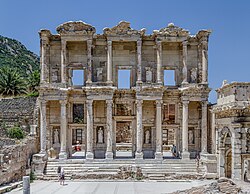
Library of Celsus, side view
Library of Celsus, details

The Library of Celsus, the façade of which has been carefully reconstructed from original pieces, was originally built c. 125 in memory of Tiberius Julius Celsus Polemaeanus, an Ancient Greek[70][71][72] who served as governor of Roman Asia (105–107 AD) in the Roman Empire. Celsus paid for the construction of the library with his own personal wealth[73] and is buried in a sarcophagus beneath it.[74] The library was mostly built by his son Gaius Julius Aquila[75] and once held nearly 12,000 scrolls. Designed with an exaggerated entrance — so as to enhance its perceived size, speculate many historians — the building faces east so that the reading rooms could make best use of the morning light.

The interior of the library measured roughly 180 square metres (1,900 square feet) and may have contained as many as 12,000 scrolls.[76] By the year 400 A.D. the library was no longer in use after being damaged in 262 A.D. The facade was reconstructed during 1970 to 1978 using fragments found on site or copies of fragments that were previously removed to museums.[77]

The Great Theatre, with an estimated 25,000 seating capacity, is believed to be the largest in the ancient world.[9] This open-air theatre was used initially for drama, but during later Roman times gladiatorial combats were also held on its stage; the first archaeological evidence of a gladiator graveyard was found in May 2007.[78]

There were two agoras, one for commercial and one for state business.[79][80]

Aqueduct near Ephesus – Mayer Luigi – 1810

Ephesus also had several major bath complexes, built at various times while the city was under Roman rule.

The city had one of the most advanced aqueduct systems in the ancient world, with at least six aqueducts of various sizes supplying different areas of the city.[81][82] They fed a number of water mills, one of which has been identified as a sawmill for marble.

Odeon of Ephesus

The Odeon was a small roofed theatre[83] constructed by Publius Vedius Antoninus and his wife around 150 AD. It was a small salon for plays and concerts, seating about 1,500 people. There were 22 stairs in the theatre. The upper part of the theatre was decorated with red granite pillars in the Corinthian style. The entrances were at both sides of the stage and reached by a few steps.[84]

Temple of Hadrian at Ephesus

The Temple of Hadrian dates from the 2nd century but underwent repairs in the 4th century and has been reerected from the surviving architectural fragments. The reliefs in the upper sections are casts, the originals now being exhibited in the Ephesus Archaeological Museum. A number of figures are depicted in the reliefs, including the emperor Theodosius I with his wife and eldest son.[85] The temple was depicted on the reverse of the Turkish 20 million lira banknote of 2001–2005[86] and of the 20 new lira banknote of 2005–2009.[87]

Terrace Houses at Ephesus with the protective roofing above them.

On a slope opposite the Hadrian Temple, the Terrace Houses also called as "The Houses of the Rich" includes six luxury Roman residences, featuring mosaics on the floor and frescos on the wall. Built on three terraces at the lower end of the slope of Bulbul Mountain, they were built according to the Hippodamian plan of the city in which roads transected each other at the right angles. The oldest structure dates to the first century BC, and some of them were in use until the seventh century AD. The discovery and excavations of them shed light on the family life during the Roman period. Today, Ephesus terrace houses are covered with protective roofing.[88]

The Temple of the Sebastoi (sometimes called the Temple of Domitian), dedicated to the Flavian dynasty, was one of the largest temples in the city. It was erected on a pseudodipteral plan with 8 × 13 columns. The temple and its statue are some of the few remains connected with Domitian.[85]

The Tomb/Fountain of Pollio was erected in 97 AD in honour of C. Sextilius Pollio, who constructed the Marnas aqueduct, by Offilius Proculus. It has a concave façade.[84][85]

Tomb of John the Apostle at the Basilica of St. John.

A part of the site, Basilica of St. John, was built in the 6th century, under emperor Justinian I, over the supposed site of the apostle's tomb. It is now surrounded by Selçuk.

Archaeology

[edit]
Historical topography of Ephesos

The history of archaeological research in Ephesus stretches back to 1863, when British architect John Turtle Wood, sponsored by the British Museum, began to search for the Artemision. In 1869 he discovered the pavement of the temple, but since further expected discoveries were not made the excavations stopped in 1874. In 1895 German archaeologist Otto Benndorf, financed by a 10,000 guilder donation made by Austrian Karl Mautner Ritter von Markhof, resumed excavations. In 1898 Benndorf founded the Austrian Archaeological Institute, which plays a leading role in Ephesus today.[89]

Finds from the site are exhibited notably in the Ephesos Museum in Vienna, the Ephesus Archaeological Museum in Selçuk and in the British Museum.

In October 2016, Turkey halted the works of the archeologists, which had been ongoing for more than 100 years, due to tensions between Austria and Turkey. In May 2018, Turkey allowed Austrian archeologists to resume their excavations.[90]

Notable people

[edit]

See also

[edit]

References

[edit]

Sources

[edit]
  • Foss, Clive. 1979. "Ephesus After Antiquity." Cambridge: Cambridge University Press.
  • Athas, Daphne. 1991. Entering Ephesus. Sag Harbor, NY: Second Chance Press.
  • Oster, Richard. 1987. A Bibliography of Ancient Ephesus. Philadelphia: American Theological Library Association.
  • Scherrer, Peter, Fritz Krinzinger, and Selahattin Erdemgil. 2000. Ephesus: The New Guide. Rev. ed. 2000. Turkey: Ege Yayinlari (Zero Prod. Ltd.).
  • Leloux, Kevin. 2018. "The Campaign Of Croesus Against Ephesus: Historical & Archaeological Considerations", in Polemos 21–2, p. 47–63.
[edit]
Revisions and contributorsEdit on WikipediaRead on Wikipedia
from Grokipedia
Ephesus (Ancient Greek: Ἔφεσος, romanized: Éphesos) was an ancient port city on the western coast of Minor (modern-day ), strategically located near the mouth of the Cayster River and serving as a vital hub for trade, culture, and religion in the Mediterranean world. Founded by Greek colonists around the 10th century BCE on a site with earlier settlements, it rose to prominence as the capital of the of , boasting a population exceeding 250,000 inhabitants at its peak in the Roman era and featuring monumental architecture that reflected its economic prosperity and civic pride. The city's early history intertwined with Ionian Greek culture and the worship of the goddess , whose grand temple—known as the Artemision—became one of the Seven Wonders of the Ancient World through multiple reconstructions, including a lavish version funded by King Croesus of around 560 BCE. This sanctuary, built on marshy ground to mitigate earthquakes and adorned with sculptures by renowned artists like Scopas and Polyclitus the Younger, drew pilgrims from across the region and symbolized Ephesus's identity as a center of fertility and protection cults. Under Persian rule in the BCE and later Hellenistic influence following the Great's conquest in 334 BCE, the city was refounded nearby by around 290 BCE to address flooding issues, incorporating advanced with grid layouts and aqueducts. In the Roman period, beginning with its inheritance from the Kingdom of Pergamum in 133 BCE and accelerated after the in 31 BCE, Ephesus flourished as a cosmopolitan metropolis connected by the Royal Road to inland trade routes and its deep harbor to maritime commerce in goods like grain, textiles, and luxury items. Key imperial benefactors, including emperors , , and , sponsored expansions that included the (completed in 135 CE, housing 12,000 scrolls in a facade evoking Egyptian influences), the Great Theatre (seating up to 25,000 for dramas, gladiatorial games, and public assemblies), and the (erected in 118 CE to honor the emperor). The Curetes Street, lined with fountains, shops, and altars, and the processional way linking the Artemision to the city center further highlighted its ritual and social vibrancy, with annual festivals like the Artemisia featuring athletic contests and sacrifices. Ephesus also played a pivotal role in , serving as a base for the Apostle Paul's missionary work around 52–55 CE, where he preached against idolatry and established one of the seven churches mentioned in the . Tradition holds that the Apostle John and the Virgin Mary resided there in later years, and the Third convened in 431 CE to affirm Mary's title as , underscoring the city's transition from pagan to Christian prominence. Despite earthquakes in the CE and invasions like the Gothic sack of the Artemision in 262 CE, Ephesus endured into the Byzantine era, but relentless silting of its harbor by the Cayster River—shifting the coastline over 5 kilometers inland—led to economic stagnation and abandonment by the 15th century. Today, extensive excavations since the reveal Ephesus as a , preserving insights into ancient urban life, , and religious evolution.

Geography and Location

Site and Topography

Ephesus is situated on the Aegean coast in the region of , near the modern town of in Province, Turkey, at coordinates 37°56′29″N 27°20′26″E. The ancient city was established within the estuary of the Kaystros River (modern Küçükmenderes), on an alluvial plain formed by river sediments, which provided fertile land but also posed environmental challenges. Flanked by the hills of Coressus (modern Bülbül Dağı) to the south and Pion (modern Panayır Dağı) to the north, the site's topography offered natural defenses, with the elevated slopes protecting the urban core from invasions while the river facilitated access to the sea. The geological context of the alluvial plain made Ephesus particularly vulnerable to flooding and sedimentation from the Kaystros River's seasonal floods, which deposited silt and altered the landscape over centuries. This sedimentation gradually silted the harbor, reducing its depth and usability, which prompted the relocation of settlements inland and westward in the 3rd century BCE to maintain maritime connectivity. The original urban extent spanned approximately 640 acres, enclosed by a circuit wall about 9 km in length, but successive environmental shifts led to multiple phases of city planning and reconfiguration across the plain and hills. By the 15th century, ongoing sedimentation had buried much of the ancient site under layers of alluvium up to 6 meters deep, contributing to its effective abandonment as a major urban center and transforming the former harbor into inland marshland.

Modern Setting and Accessibility

Ephesus lies within the Selçuk district of İzmir Province in western Turkey, where it forms a key component of the local cultural landscape. The site was designated a UNESCO World Heritage Site in 2015 under criteria (iii), (iv), and (vi), recognizing its exceptional testimony to Hellenistic, Roman Imperial, and early Christian cultural traditions; its outstanding example of a settlement shaped by environmental factors as a Roman harbor city; and its significant role in the spread of Christianity through historical and archaeological evidence of religious practices. The archaeological site is situated approximately 3 kilometers southwest of Selçuk town and about 80 kilometers south of İzmir, integrating seamlessly with nearby landmarks such as the Basilica of St. John, located on Ayasuluk Hill overlooking the area, and the House of the Virgin Mary, a pilgrimage site roughly 9 kilometers away in the hills. Visitors can reach Ephesus via İzmir Adnan Menderes Airport, approximately 60 kilometers north of Selçuk, with public transport options including the İZBAN commuter train from the airport to Selçuk station, taking about 1 hour. From Selçuk station, dolmuş minibuses or taxis provide a short 10-minute ride to the site entrance. The site remains open year-round, with hours typically from 8:00 a.m. to 6:30 p.m. in summer (extending to evening visits on select days) and shorter in winter, and an entry fee of €40 per person as of 2025, which includes access to the Ephesus Experience Museum but excludes the Terrace Houses (€15 extra) and the Ephesus Archaeological Museum (€10 extra). Preservation efforts address ongoing challenges from tation, and sure, which strain the site's infrastructure and artifacts through high visitor volumes exceeding 2 million annually. The Turkish Tourism oversees management, providing technical staff, conservation plans, and visitor controls in collaboration with the İzmir Regional Conservation Council to mitigate these risks and ensure sustainable access.

Prehistory and Early Settlement

Neolithic and Bronze Age Origins

The earliest evidence of human activity in the Ephesus region dates to the Neolithic period, with settlements established at Çukuriçi Höyük, a tell site located approximately 1 km southeast of the later ancient city. This mound reveals occupation from the 7th millennium BCE, featuring stone and mud-brick houses, ceramic vessels, and obsidian tools imported from Melos, indicating early maritime trade networks across the . Artifacts such as marble idols and evidence of animal husbandry further suggest the development of sedentary farming communities focused on domestication and basic agriculture. During the Early Bronze Age (c. 3000–2000 BCE), settlement expanded, with settlements emerging at sites like Ayasuluk Hill, where surface ceramics confirm habitation. Trade intensified, involving obsidian, metals, and regional goods, as evidenced by metal-working remains at Çukuriçi Höyük, reflecting growing economic specialization and connections with Anatolian networks. Pottery styles evolved, incorporating local fabrics analyzed through petrography, which highlight continuity in craft traditions from the Chalcolithic transition. In the Late Bronze Age (c. 2000–1200 BCE), the site identified as Apasa—widely equated with —served as the capital of the Arzawan kingdom, mentioned in Hittite texts as a key political center under influence from the Hittite Empire, particularly during campaigns by Mursili II in the 14th century BCE. Mycenaean imports, including Psi-type figurines and pottery dated to LH IIIC (c. 1200–1100 BCE), attest to cultural exchanges with the Aegean world, possibly involving short-term residency by Greek traders or settlers at Ayasuluk Hill. Destruction layers around 1200 BCE, aligned with the broader , mark a period of disruption, leading to gradual depopulation before reoccupation in the .

Iron Age Migrations and Foundations

The establishment of Ephesus during the early Iron Age is linked to the Ionian migration, traditionally dated to around 1050 BC, when Greek colonists from Athens, led by Androclus—son of the last Athenian king, Codrus—founded the settlement. Ancient historiographical traditions, such as those preserved by Pherecydes of Athens, describe Androclus as the oikistēs (founder) who organized the expedition as part of the broader Ionian colonization of western Anatolia following the disruptions of the Late Bronze Age collapse. This migration integrated Ephesus into the network of Ionian city-states, shifting cultural dominance from earlier Anatolian and Mycenaean influences toward Greek ones. A key element of the founding legend involves divine guidance from the oracle of at , which instructed Androclus to seek a site where a fish would leap from a cooking fire and a wild boar would charge into the underbrush, symbolizing fertile land near a sacred harbor. This prophecy led the settlers to the vicinity of the future (Artemision), approximately 1.3 km from the initial harbor at Koressos, where the city was established on a small hill. While no direct architectural remains of Androclus' settlement have been identified, the legend underscores the religious rationale for locating near the pre-existing cult site of the Anatolian goddess later syncretized with , reflecting early Greek adaptation to local sacred landscapes. Archaeological evidence for the early Iron Age phase includes Protogeometric pottery deposits from the Artemision, dated to the late 11th to early 10th centuries BC, featuring simple wheel-thrown vessels with compass-drawn concentric circles and linear motifs typical of early Greek ceramic traditions. These finds, alongside sparse Geometric pottery from the 10th to 9th centuries BC, indicate modest dwellings and communal activities, likely constructed with mud-brick and wood on stone socles, though preservation is limited due to later overbuilding and silting. The material culture shows integration with indigenous Carian populations, evident in hybrid vessel forms and local clay sources, suggesting peaceful coexistence and cultural exchange rather than conflict during the initial settlement phase. By the Archaic period, around the 8th century BC, Ephesus solidified its foundations with the establishment of the Artemision as a central cult site, where the first wooden temple to Artemis was erected, incorporating Anatolian architectural elements like a raised platform (krepis) and possibly an aniconic cult image. This religious development, attested by votive offerings and early terracotta figurines, fostered community cohesion and attracted pilgrims, contributing to population expansion as the settlement grew from a coastal outpost to a burgeoning polis with organized urban quarters. Cult continuity from the Late Bronze Age, including Amazonian foundation myths, further embedded the site in local Anatolian traditions while affirming Ionian identity. A pivotal event occurred around 560 BC when the Lydian king captured Ephesus, incorporating it into his realm without significant destruction, as indicated by the absence of siege-related fortifications in archaeological records. Croesus resettled the population to a more defensible position on the slopes of Mount Coressos (modern Bülbül Dağı), away from the vulnerable coastal Artemision, and enhanced the temple with lavish dedications, including marble columns inscribed in Greek and Lydian. This conquest introduced Eastern influences, notably the adoption of Lydian coinage—early electrum trites and sigloi found in the temple foundations—facilitating trade and marking Ephesus' transition toward a monetized economy under Lydian suzerainty.

Greek Period

Archaic and Classical Developments

During the Archaic period (c. 700–480 BC), Ephesus emerged as a prominent Ionian Greek polis, characterized by political instability and external pressures that shaped its development. The city experienced a phase of tyranny in the mid-6th century BC, notably under co-tyrants Athenagoras and Komas, who ruled during a time of internal factionalism and cultural patronage, as evidenced by the exile of the poet Hipponax around 540/39 BC. This era of autocratic rule ended with the Persian conquest of Lydia and Ionia in 546 BC by Cyrus the Great, incorporating Ephesus into the Achaemenid Empire as a tributary satrapy, which imposed Persian oversight while allowing limited local autonomy. Ephesus was indirectly drawn into the Ionian Revolt (499–493 BC), a broader uprising of Greek cities against Persian rule, though the city itself remained neutral and loyal to Persia, avoiding direct rebellion. The revolt's aftermath saw Persian forces pursue retreating Ionian rebels to Ephesus, resulting in the decisive Battle of Ephesus in 498 BC, where the Persians under generals Daurises, Hymaees, and Otanes crushed the Greek forces, reinforcing imperial control over the region. Following the Greek victory in the Persian Wars (490–479 BC), Ephesus shifted allegiance, joining the Athenian-led around 478 BC as a member contributing financial tribute rather than ships, which bolstered its integration into the emerging Athenian maritime network. In the Classical era (c. 480–323 BC), Ephesus flourished intellectually and economically, serving as a vital trade hub on the Aegean coast, facilitating commerce in grain from the Black Sea region, local wine production, and the slave trade, which supported its role as a key intermediary between Anatolia and the Greek world. Culturally, Ephesus hosted a philosophical tradition exemplified by (c. 535–475 BC), a native pre-Socratic philosopher whose doctrine of flux—positing that all things are in constant change and that opposites unify in a cosmic logos—challenged static views of reality and influenced later Greek philosophy. A pivotal event occurred in 356 BC when Herostratus, seeking notoriety, arsoned the grand , one of the Seven Wonders of the Ancient World, reducing its wooden roof and cedar beams to ashes on the night of 's birth. The Ephesians responded by prohibiting mention of Herostratus's name, yet swiftly initiated reconstruction of an even larger temple, funded through pan-Hellenic donations and contributions from across the Greek world, symbolizing communal resilience and religious devotion. This effort laid the groundwork for further enhancements in the subsequent Hellenistic period.

Hellenistic Expansion

Following Alexander the Great's conquest of the region in 334 BC, Ephesus came under the control of his successors, marking the onset of the Hellenistic era from 323 to 129 BC. , one of Alexander's generals and ruler of and western Anatolia, refounded the city around 290 BC, relocating it from its vulnerable lowland position to a more defensible site near the hills of Coressus and , where he constructed extensive new fortifications spanning approximately 9 kilometers along the slopes. This refounding involved the forced resettlement of inhabitants from Ephesus and nearby settlements like Colophon, significantly boosting the city's population through synoecism and transforming it into a planned Hellenistic urban center with a grid layout inspired by Hippodamian principles. The city was temporarily renamed Arsinoeia in honor of Lysimachus's wife, reflecting the era's royal patronage, though it reverted to Ephesus after his death in 281 BC. Under subsequent Hellenistic rulers, including the Seleucids after Lysimachus's defeat at the Battle of Corupedium, Ephesus experienced cultural , evident in architectural and religious developments. The city's theater, initially constructed during this period to seat thousands, was expanded to accommodate growing audiences for dramatic performances and assemblies, symbolizing the integration of classical Greek traditions with local practices centered on the cult of Artemis. Economic vitality surged as Ephesus emerged as a premier Aegean port, facilitating trade between the Seleucid Empire in Syria and the Ptolemaic Kingdom in Egypt, with its harbor artificially reinforced from the late 3rd century BC onward to handle increased maritime commerce in goods like perfumes, textiles, and luxury items produced locally. The mint at Ephesus produced silver tetradrachms, often featuring the bee symbol associated with Artemis, which circulated widely and underscored the city's role in Hellenistic monetary networks. By the mid-2nd century BC, Ephesus had fallen under the Attalid Kingdom of Pergamum, and in 133 BC, King Attalus III bequeathed the kingdom—including Ephesus—to Rome in his will, initiating its integration into the . This transition sparked brief instability, as the pretender Aristonicus revolted against Roman authority, leading to a period of conflict before Ephesus was firmly secured under Roman control around 129 BC.

Roman Period

Republican Integration and Early Empire

Ephesus was incorporated into the Roman Republic in 129 BC following the bequest of the Kingdom of Pergamon to Rome by Attalus III, becoming a key city within the newly formed province of Asia and retaining the status of a free city with limited autonomy under Roman oversight. This integration leveraged the city's Hellenistic trade foundations, positioning it as a vital commercial hub for Roman interests in the eastern Mediterranean. As the provincial capital, Ephesus hosted Roman administrative functions, though local Greek institutions persisted alongside emerging Roman influences. The Mithridatic Wars (88–63 BC) severely disrupted Ephesus, beginning with the in 88 BC, when Mithridates VI of Pontus ordered the massacre of approximately 80,000 Roman and Italian residents across Asia Minor, including significant losses in Ephesus itself. Initially allying with Mithridates, Ephesus switched allegiance to Rome during the conflict; Roman general Sulla recaptured the city in 86 BC, imposing a heavy indemnity as part of the 20,000 talents levied on the province of Asia, which strained its economy and contributed to population decline through emigration and hardship. These events marked a turbulent transition, with the city's recovery hampered by war-related destruction and punitive measures until the end of the Republican era. Under Augustus, following his consolidation of power in 27 BC, Ephesus underwent reforms that stabilized and enhanced its role as the capital of Asia, including economic incentives that boosted trade and urban development. The city received permission to construct a temple to Roma and Divus Julius around 29 BC, initiating the imperial cult and signaling its privileged status in Roman religious policy. To combat silting from the Cayster River, early imperial initiatives included regular harbor dredging and the construction or repair of aqueducts, such as the one dated to 4–14 CE, which helped flush sediments and maintain navigability. These efforts, supported by up to seven aqueduct systems originating in the Hellenistic period but expanded under Roman rule, underscored Augustus's focus on infrastructure to sustain Ephesus's strategic port function. Socially, Ephesus featured a Greek majority governed by traditional assemblies, augmented by an elite of Roman settlers—primarily merchants, officials, and veterans—who formed a distinct citizen class amid a broader population of non-citizens including slaves and freedmen. This structure fostered a hybrid culture, with Roman patrons integrating into local networks while promoting the new cults of Roma and Augustus through priesthoods and festivals that blended imperial reverence with Ephesian traditions. The enduring legacy of earlier figures like Artemisia II, who had patronized the Temple of Artemis in the 4th century BC, echoed in Roman-era benefactions that continued to support the goddess's cult, reinforcing civic identity amid Romanization.

Imperial Prosperity and Administration

During the 1st to 3rd centuries AD, Ephesus reached its zenith as the capital of the Roman province of Asia, encompassing much of western Asia Minor and serving as a central hub of imperial authority and economic activity. The city's strategic location facilitated its role as the primary administrative center, where the proconsul governed the province, overseeing military, fiscal, and legal matters from the governor's residence. As one of the key assize centers (conventus), Ephesus hosted regular judicial circuits, where the proconsul adjudicated civil and criminal cases for surrounding districts, drawing litigants from across Asia Minor and reinforcing the city's prestige. This administrative prominence also positioned Ephesus as a major tax collection hub, channeling revenues from provincial levies, customs duties, and imperial tributes to Rome, which supported extensive public works and elite benefactions. However, the Antonine Plague in the mid-2nd century CE disrupted this prosperity, causing significant demographic and economic losses. Ephesus's prosperity was bolstered by its status as a neocorate city, receiving imperial grants for temples dedicated to Roman emperors, with four such honors awarded during the imperial period—beginning under around 88 AD, followed by in 114 AD, in 215 AD, and in 230 AD—symbolizing its loyalty and elevating it above rivals like Pergamum and Smyrna. These neocorates, each marked by the construction of grand temples housing the imperial cult, attracted pilgrims, dignitaries, and festivals, further integrating Ephesus into the empire's religious and political fabric. Recent scholarly estimates place the urban population at this peak at around 40,000 to 50,000, making it one of the largest cities in the eastern Mediterranean and a cosmopolitan melting pot. Economically, Ephesus dominated regional trade through its deep-water harbor at the mouth of the Cayster River, which served as a vital gateway for goods flowing between the Aegean, Black Sea, and interior Anatolia, handling spices, textiles, grain, and luxury items that sustained Rome's eastern commerce. Professional guilds, known as collegia, organized key sectors of this economy; for instance, associations of bankers (argentarii or trapezitai) managed credit, currency exchange, and loans at the commercial agora, while shippers (navicularii) coordinated maritime transport, ensuring efficient logistics for merchants and the state grain supply. These guilds not only regulated trade practices but also funded civic amenities, underscoring Ephesus's role as an economic powerhouse. The demographic profile reflected imperial integration, with a notable influx of immigrants from Italy, including veterans, merchants, and officials who introduced Roman customs and architecture. This Roman element was further solidified in 212 AD when Emperor Caracalla's Constitutio Antoniniana extended citizenship to all free inhabitants of the empire, granting Ephesian residents full legal rights and accelerating cultural Romanization.

Later Antiquity and Byzantine Era

Christian Transition and Ecclesiastical Role

The transition to Christianity in Ephesus began in the mid-1st century AD with the arrival of the Apostle Paul during his third missionary journey around 54 AD, where he established a significant Christian community over a three-year period. According to the Book of Acts, Paul's preaching in the synagogue and lecture hall of Tyrannus led to widespread conversions, but also provoked a riot among silversmiths who crafted Artemis shrines, fearing economic loss from the decline in pagan worship. This event, detailed in Acts 19:23–41, highlighted the initial tensions between emerging Christianity and the entrenched cult of Artemis, which dominated Ephesian religious life. Paul is also traditionally attributed with authoring the Epistle to the Ephesians, addressed to this nascent church, emphasizing unity in Christ and spiritual growth. By the late 1st century, traditions link Ephesus further to apostolic figures, including the Apostle John, who is said to have resided there and composed his Gospel and the while exiled on under Emperor 's persecution around 95 AD. Accompanying John was the Virgin Mary, entrusted to his care by Jesus (John 19:26–27), with local tradition holding that she spent her final years in a house near Ephesus, a belief referenced as early as the 431 AD synodal letter. Early persecutions under Domitian, including the martyrdom of figures like Timothy, bishop of Ephesus, underscored the risks faced by Christians, yet the faith spread rapidly via Ephesus's strategic trade routes connecting Asia Minor to the broader . The 4th century marked a pivotal shift toward official Christianization under Emperor Theodosius I, who issued the Edict of Thessalonica in 380 AD, declaring Nicene Christianity the state religion and initiating the suppression of pagan practices empire-wide. In Ephesus, this culminated in the closure of the Temple of Artemis in 391 AD, symbolizing the city's religious transformation as imperial decrees outlawed sacrifices and temple activities. The local church infrastructure expanded accordingly, with the construction of the Church of Mary (also known as the Basilica of the Virgin) in the late 4th or early 5th century, the first known church dedicated to Mary and serving as the metropolitan cathedral. Ephesus's ecclesiastical prominence peaked with the Council of Ephesus in 431 AD, convened by Emperor Theodosius II in the Church of Mary to address Christological controversies. The council, attended by over 200 bishops under 's leadership, condemned 's teachings and affirmed Mary as ("God-bearer"), solidifying orthodox doctrine on the Incarnation. This event elevated Ephesus's bishopric to metropolitan status within the province of Asia, overseeing suffragan sees and reinforcing the city's role as a key Christian center in the Eastern Roman Empire. The council's decisions, ratified by in 432 AD, not only resolved theological disputes but also boosted Ephesus's influence in ecclesiastical governance.

Decline, Invasions, and Final Phases

By the 5th century, Ephesus began experiencing a gradual decline driven by environmental factors, particularly the progressive silting of its harbor due to alluvial deposits from the Cayster River, which reduced its viability as a major port and trade hub. This silting, ongoing since the but accelerating in , led to and prompted shifts in urban activity away from the coastal areas. Compounding these issues, a series of devastating earthquakes struck the region in the mid-4th century, with major events in 358 AD and 365 AD causing widespread structural damage to the city's buildings, including temples, theaters, and aqueducts. The decline intensified in the early 7th century amid the Byzantine-Sasanian War, when Sasanian forces under General Shahin invaded Asia Minor in 615 AD, reaching as far as Chalcedon and ravaging coastal cities like Ephesus. Archaeological evidence from Ephesus reveals a distinct burnt layer overlying the elite residential district, indicating fiery destruction and likely resulting in thousands of casualties across the affected urban centers in southwestern Asia Minor. Although the city saw partial recovery following Emperor Heraclius's victories and the reconquest of lost territories by 628 AD, the invasion marked a turning point, with rebuilding efforts limited and the urban fabric never fully restored to its prior scale. Subsequent Arab raids from the mid-7th to 8th centuries further accelerated depopulation, as repeated incursions targeted the vulnerable coastal settlement, destroying infrastructure and driving residents inland for safety. By the late 7th century, the city's core had contracted significantly, with the population relocating to the more defensible Ayasuluk Hill, where earlier structures like the Basilica of St. John provided a nucleus for resettlement. In its final Byzantine phases, Ephesus was refortified as the stronghold of Theologos on Ayasuluk Hill during the 7th and 8th centuries, with walls incorporating spolia from classical monuments to enclose a reduced amid ongoing threats. This shift reflected a broader demographic collapse, with the population significantly reduced by the 8th century, as economic isolation and insecurity eroded the city's viability.

Medieval and Ottoman Periods

Pre-Ottoman Shifts

During the 11th and 12th centuries, Ephesus experienced initial incursions by the Seljuk Turks amid the broader Byzantine-Seljuk wars, reflecting the weakening of Byzantine control in western Anatolia following the Battle of Manzikert in 1071. In 1090, Seljuk forces under Prince Tengribirmish captured the city, which by then had diminished to a small village centered around the hill of Ayasoluk, but Byzantine general John Doukas reconquered it shortly thereafter in 1097. The region saw further instability during the Second Crusade, when French crusaders under Louis VII repelled a Seljuk ambush in the Battle of Ephesus in December 1147, marking a brief Western Christian presence amid ongoing Turkic pressures. By the 13th century, as Byzantine authority continued to erode due to internal strife and external threats, the Seljuk Sultanate of Rum exerted increasing influence over the area, culminating in a more permanent shift toward Turkic control in the early 14th century. The settlement was renamed Ayasoluk, deriving from the Byzantine epithet for the Church of St. John the Theologian (Hagia Theologos), symbolizing the integration of local Christian heritage into emerging Islamic nomenclature. This period involved the arrival of Ghazi warriors—frontier Muslim fighters—who facilitated the transition to Islamic administration, often converting Byzantine structures for new uses and contributing to the erosion of Christian religious practices. The cultural and religious shift included the destruction or removal of Christian icons in churches repurposed under Seljuk rule, aligning with broader patterns of iconoclastic pressures during the Byzantine-Seljuk transition, though distinct from the earlier 8th-9th century controversies. For instance, the Basilica of St. John was transformed into a mosque following the 1304 conquest by beylik forces under Sasa Bey of the Menteşoğulları, erasing visible Christian iconography to assert Islamic dominance. Economic activities persisted on a reduced scale, with remnants of regional trade networks—including silk production and exchange rooted in Byzantine traditions—sustaining the mixed communities around Ayasoluk, despite the silting of the ancient harbor. In 1375, Isa Bey, ruler of the Aydinid Beylik (a successor state to the Seljuks), commissioned the Isa Bey Mosque at the base of Ayasoluk Hill, constructed by the Damascene architect Ali ibn Mushimish using spolia from nearby ancient sites, including the Temple of Artemis; this structure exemplifies early Anatolian Islamic architecture influenced by Syrian models, such as the Umayyad Mosque in Damascus. The local population comprised mixed Greek Orthodox Christians and incoming Turkish Muslims, fostering a hybridized society, though it faced disruptions from Mongol incursions into the after the 1243 , which imposed vassalage and economic strain.

Ottoman Era and Abandonment

In the 14th century, the region of Ephesus came under the control of the Aydinid Beylik, a Turkic principality that governed western Anatolia, before being annexed by the in 1390 following Sultan Bayezid I's conquest of the beylik during his campaigns in Anatolia. Ottoman control was interrupted after Bayezid's defeat by at the in 1402, which restored Aydinid independence until its final annexation by in 1425. Under Ottoman rule, the ancient city ruins, by then largely abandoned, served as a convenient quarry for marble and stone, with materials repurposed for constructing local structures, including pre-Ottoman mosques adapted for Islamic use. From the 16th to 19th centuries, the settlement of Ayasoluk—centered on the hilltop fortress overlooking the silted ancient harbor—dwindled into a small village, plagued by environmental degradation and health crises. The continuous silting of the Cayster River (modern Küçükmenderes) transformed the former harbor into marshy swamps, eliminating any viable port and fostering stagnant waters that bred mosquitoes. These conditions led to recurrent malaria outbreaks, particularly severe in the swampy lowlands surrounding the site, contributing to high mortality rates and deterring settlement. Ottoman tax registers (tahrir defterleri) from the early 16th century, such as those dated 1517–1518, document a modest socio-economic base in Ayasoluk, reflecting limited agricultural output and a sparse population tied to subsistence farming and minor trade. The site retained minor significance as a pilgrimage destination, drawing visitors to the Basilica of St. John and remnants of the Temple of Artemis, though it never regained prominence. By the 19th century, intensified malaria epidemics accelerated the village's depopulation, with residents increasingly relocating to higher, healthier ground nearby. The cumulative effects of harbor silting, which severed Ephesus's maritime links centuries earlier, and these health crises ultimately prompted the complete abandonment of Ayasoluk as a primary settlement, with the population shifting to the emerging town of Selçuk by the late Ottoman era. Ottoman administrative records underscore this stagnation, portraying Ayasoluk as a peripheral locale with fewer than a few hundred households by the mid-16th century, far removed from its ancient grandeur.

Religion and Culture

Pagan Worship and the Temple of Artemis

Ephesus, as a major Ionian city in Asia Minor, was a vibrant center of pagan worship, with the cult of dominating its religious, economic, and cultural life from the Archaic period onward. The goddess, known locally as Artemis Ephesia, was revered as a multifaceted deity embodying fertility, protection, and civic identity, distinct from her more chaste Greek counterpart. Her sanctuary, the Artemision, attracted pilgrims from across the Mediterranean, fostering a complex of rituals, festivals, and institutions that integrated Anatolian, Greek, and later Hellenistic influences. This pre-Christian religious landscape not only shaped Ephesus's urban development but also sustained its prosperity through pilgrimage-related commerce. The Temple of Artemis, constructed around 550 BC under the architects Chersiphron and Metagenes, stood as one of the , celebrated for its scale and grandeur. Funded in part by the Lydian king , the structure measured approximately 115 meters in length by 55 meters in width, supported by 127 Ionic columns each rising to about 18 meters in height. Designed as a dipteral temple with double colonnades, it housed a cult statue of the goddess, an aniconic wooden xoanon believed to have been fallen from the sky, adorned with symbolic protuberances interpreted as fertility emblems. The temple's construction marked a pinnacle of Ionian architecture, utilizing marble and innovative engineering to create an expansive platform surrounded by a sacred precinct. Catastrophic fire destroyed the original temple in 356 BC, an act attributed to the arsonist Herostratus seeking fame, occurring on the night Alexander the Great was born—a coincidence later mythologized. Rebuilt on an even larger scale with contributions from Hellenistic rulers, the reconstructed edifice was completed by around 200 BC, featuring enhanced friezes and sculptures by renowned artists like Scopas. This version endured as a symbol of Ephesian piety until sacked by Gothic invaders in 262 AD, after which it fell into ruin, though sporadic repairs maintained its cultic function into late antiquity. Central to the cult were elaborate practices that reinforced communal bonds and divine favor. The annual Artemisia festival, held in spring, drew thousands for processions, athletic and musical competitions, theatrical performances, and sacrifices at the temple altar, celebrating Artemis's role in fertility and protection. Eunuch priests known as Megabyzoi, possibly influenced by Persian traditions, presided over rituals, performing ecstatic dances and maintaining the sacred image; their title derived from the Persian "bagoi," reflecting syncretic elements in the priesthood. The cult also involved oracular consultations through the goddess's statue, where devotees sought guidance on personal and civic matters, underscoring Artemis's prophetic aspect. While associations with ritual prostitution appear in later accounts, scholarly analysis indicates no direct evidence of such practices within the Artemision itself, distinguishing it from other fertility cults. Beyond Artemis, Ephesus hosted a diverse pagan pantheon, including worship of , whose ecstatic rites paralleled those of the Megabyzoi and involved similar attendants. Temples and altars to facilitated mystery cults emphasizing wine, ecstasy, and initiation, attracting initiates seeking spiritual transformation. These mystery religions, alongside civic sacrifices to Apollo and Demeter, enriched the religious fabric, with shared festivals promoting social cohesion. The influx of pilgrims to these sites, particularly the Artemision, bolstered Ephesus's economy through trade in votive offerings, incense, and lodging, making religion a cornerstone of urban wealth. The decline of pagan worship accelerated in the late 4th century AD following Emperor Theodosius I's edicts of 391 AD, which prohibited sacrifices, temple access, and public pagan rites across the empire. In Ephesus, these measures led to the suppression of the cult, with the Artemision officially closed and its practices driven underground. By the 5th century, temple stones were systematically quarried for Byzantine constructions, including churches and fortifications, symbolizing the Christian repurposing of pagan heritage; a medieval legend claims remnants were transported to Constantinople for structures like the Hagia Sophia, though this lacks historical confirmation. This spoliation marked the end of organized paganism in Ephesus, though folk veneration of Artemis lingered in rural areas.

Emergence of Christianity

The legend of the Seven Sleepers of Ephesus recounts seven Christian youths who, during the persecution under Emperor Decius in the mid-3rd century, fled to a cave outside the city to escape martyrdom, where they miraculously fell asleep and awoke approximately 200 years later under the Christian emperor Theodosius II, demonstrating the truth of the resurrection. The earliest written accounts of this story appear in Greek manuscripts from the 5th century, though the tradition likely originated earlier in local Christian oral narratives tied to the site's use as a community cemetery. The cave, located on Panayır Dağı hill near Ephesus, became a major pilgrimage destination by the 5th century, with archaeological evidence including a 5th-century basilica and later Byzantine and Ottoman structures built over the site, reflecting its enduring veneration as a place of miraculous preservation. Marian traditions in Ephesus center on the House of the Virgin Mary, a small stone structure on Bülbül Dağı (Mount Koressos), traditionally believed to be where Mary, mother of Jesus, lived her final years under the care of the Apostle John after the Crucifixion; however, this identification relies on 19th-century private revelations rather than contemporary historical records, and while the site shows foundations dating to the 1st century CE, the main structure is from the 5th–6th centuries, with scholarly debate on its direct connection to Mary. The site's identification stems from visions of the German nun Anne Catherine Emmerich, whose descriptions guided French priest Julien Gouyet to the ruins in 1881, with later explorations and confirmations in 1891 by Lazarist sisters; excavations revealed a foundation consistent with the visionary account, leading to its restoration as a chapel. Recognized as an official Catholic pilgrimage site by Pope Leo XIII in 1896 and elevated by Pope Pius XII in 1951, the house draws interfaith visitors, including Muslims who honor Mary as a prophetess, with annual pilgrimages swelling since the 20th century due to papal visits by Paul VI in 1967, John Paul II in 1979, and Benedict XVI in 2006. Ephesus also preserves legends associated with other apostolic figures, notably the Tomb of St. John at the Basilica of St. John, constructed by Emperor Justinian I in the 6th century over a 4th-century martyrium believed to contain the apostle's remains, as per early Christian traditions linking John to the city from the Book of Revelation. Archaeological evidence includes a cruciform basilica with a central tomb chamber and inscriptions invoking John's protection, establishing it as a key early pilgrimage center where dust from the tomb was reputed to have healing properties. Similarly, the Grotto of St. Paul, carved into Mount Bülbül above the ancient theater, is traditionally venerated as a site where the Apostle Paul sought refuge or preached during his ministry in Ephesus around 52-55 CE, though access is restricted and evidence remains largely legendary rather than archaeological. Post-7th-century interfaith syncretism is evident in the shared reverence for the Seven Sleepers site, where the Christian legend parallels the Quranic account of the "Companions of the Cave" (Surah Al-Kahf), leading to its veneration by Muslims as Ashab al-Kahf; Ottoman-era structures at the cave, including a , integrated Christian remains, fostering joint pilgrimage practices that persist today among Turkish Muslims and Christian visitors. This blending extended to magical and protective traditions, with the Sleepers' names invoked in both Christian amulets and Islamic talismans for warding off evil, highlighting Ephesus's role as a crossroads of devotional folklore.

Architecture and Main Sites

Urban Planning and Key Structures

Ephesus's urban planning evolved significantly during the Hellenistic period, when , a successor to , refounded the city around 290 BCE on a new site near the coast, implementing an orthogonal grid layout characteristic of Hippodamian urbanism. This systematic arrangement featured straight streets intersecting at right angles, facilitating efficient movement and expansion within the city's approximately 2.5 square kilometer area. The grid incorporated major thoroughfares aligned with the topography, including the prominent Curetes Street ascending from the lower commercial districts to the upper civic centers, reflecting a deliberate integration of natural slopes with engineered pathways. Key streets exemplified the engineering prowess of the era, with the Arcadian Way (also known as Harbour Street) serving as a primary artery connecting the harbor to the city center. This colonnaded thoroughfare, rebuilt in the 5th century CE under Emperor Arcadius but originating in earlier Hellenistic designs, measured about 11 meters wide and was paved with large marble slabs for durability and grandeur, flanked by stoas and shops that provided shade and commercial vitality. Beneath such streets ran an advanced sewer system, constructed with covered channels of stone and terracotta pipes to manage wastewater and stormwater, ensuring hygiene in a densely populated urban environment. Public fountains, integrated into this network, drew from the city's water supply to provide accessible points for daily use, underscoring the Roman imperial enhancements to Hellenistic foundations. The water infrastructure relied on multiple long-distance aqueducts, with at least four major systems conveying fresh water from sources up to 42 kilometers away, including the Kayapınar line, to support the city's population and public amenities. These aqueducts, built from baked clay pipes and stone channels with precise gradients, delivered water to distribution networks of terracotta and lead pipes, feeding fountains, baths, and private residences while minimizing leakage through siphons and elevated conduits. Complementing this, the Great Theatre, carved into the hillside near the harbor, accommodated up to 25,000 spectators, its tiered seating and acoustic design integrated into the urban grid to host civic and cultural events without disrupting the orthogonal flow. Residential quarters highlighted social stratification within the planned layout, particularly the Terrace Houses on the northern slope of Bülbül Dağı. The terraced complexes were initially developed around 200 BCE, with luxurious multi-story villas for the elite constructed starting in the 1st century CE. These terraced complexes, spanning multiple levels with peristyle courtyards and running water systems, featured intricate floor mosaics in black-and-white geometric patterns or colorful depictions of mythological figures like Dionysos and Medusa, alongside wall frescoes portraying scenes from daily life, gladiatorial combats, and classical motifs such as Herakles and the Muses. Spanning from the 1st to 7th centuries CE, these residences demonstrated the adaptability of the grid to accommodate luxurious private spaces amid public infrastructure. Defensive elements reinforced the urban design, with Hellenistic city walls erected under Lysimachus extending over 9 kilometers to enclose the grid, incorporating towers and gates like the Magnesian Gate for controlled access. These fortifications, averaging 10 meters in height and constructed from local stone, descended from the slopes of Mounts Panayır and Bülbül to the harbor, where additional bastions protected the vital port against maritime threats, ensuring the security of trade routes integral to the city's prosperity.

Monumental Highlights

The Library of Celsus stands as one of Ephesus's most iconic structures, commissioned around 110–114 CE and completed around 135 CE during the reign of Emperor Hadrian as a grand mausoleum and repository of knowledge dedicated to the Roman senator Tiberius Julius Celsus Polemaeanus. Funded by Celsus's son, Tiberius Julius Aquila Polemaeanus—a prominent consul under Emperor Trajan—this monument exemplified imperial patronage, blending funerary honors with public utility to elevate Ephesus's cultural prestige within the Roman Empire. Its facade, featuring nine steps leading to a two-story portico with Corinthian columns and niches for statues, housed approximately 12,000 scrolls in double-walled niches designed to protect against humidity and temperature fluctuations, making it the third-largest library in the ancient world after those in Alexandria and Pergamon. The sarcophagus of Celsus was interred in a crypt beneath the floor, underscoring the building's dual role as a tomb and intellectual center. The Great Theatre of Ephesus, initially constructed in the Hellenistic period and dramatically expanded around 44 CE under Emperor Claudius to accommodate up to 25,000 spectators, represents the pinnacle of Roman engineering adapted to local terrain on the slopes of Mount Coressos. With a diameter exceeding 140 meters, its three-story stage building (skene) was added during Nero's reign (54–68 CE) and further enhanced under (98–117 CE), including an awning for shade that highlighted its role in hosting theatrical performances, public assemblies, and spectacles. In the 3rd century CE, modifications such as the removal of lower seating rows adapted it for gladiatorial contests, reflecting Ephesus's integration into Roman entertainment traditions amid the city's growing imperial alignment. Historically, it is linked to a tumultuous riot in the 1st century CE, sparked by silversmiths protesting threats to their trade, as recounted in ancient accounts of civic unrest. The Temple of Hadrian, dedicated in 118 CE shortly after Emperor Hadrian's accession, exemplifies 2nd-century Roman architectural refinement with its ornate Corinthian columns supporting a distinctive arched pediment, positioned prominently along the Curetes Street. Erected by the local benefactor Publius Vedius Antoninus Sabinus, the structure featured intricate friezes depicting mythological scenes, including the legendary founding of Ephesus, and served as a focal point for civic processions traversing the street's colonnaded length. Later redecorated in the late 4th century CE under Theodosius I with imperial sculptures, it underscored the evolving blend of local and Roman imperial iconography in Ephesus's monumental landscape. The Odeon and adjacent Bouleuterion formed a pair of intimate venues in Ephesus's upper civic district, each with a seating capacity of approximately 1,500, designed for more exclusive gatherings compared to the grander public spaces. Built in the 2nd century CE under the patronage of local elites like Publius Vedius Antoninus and his wife Flavia Paiana, the roofed Odeon accommodated musical performances and lectures within its semi-circular cavea and shallow stage, while the Bouleuterion functioned primarily as a council chamber for the city's gerousia (senate) deliberations. These structures, integrated into the urban grid near the Upper Agora, highlighted Ephesus's emphasis on refined civic and cultural discourse, with marble seating tiers and acoustic optimizations enhancing their utility for elite audiences.

Archaeology and Excavations

Historical Efforts and Major Campaigns

The earliest systematic archaeological efforts at Ephesus in the modern era were undertaken by the British Museum in the 1860s, focusing on locating the long-lost . Led by architect and archaeologist John Turtle Wood, excavations began in 1869 after he identified an inscription referencing the temple near the ancient theater; over several years, Wood's team uncovered the temple's foundations, sculptures, and architectural fragments, confirming its status as one of the . In 1895, the Austrian Archaeological Institute initiated more comprehensive excavations under the direction of Otto Benndorf, marking a shift toward methodical, long-term exploration of the site's urban core. Benndorf, who founded the institute in 1898, oversaw the uncovering of key monuments, including the , where teams revealed the structure's ornate facade, niches for scrolls, and the sarcophagus of Tiberius Julius Celsus Polemaeanus beneath the floor. The Great Theatre, capable of seating over 25,000 spectators, was also systematically excavated during this period as part of broader efforts to map Ephesus's Hellenistic and Roman phases. These works paused during the World Wars but resumed afterward, establishing the Austrians as the primary excavators. Following World War II, Turkish authorities increased their role in Ephesus excavations, collaborating with the Austrian team through the Ephesus Museum starting in 1954. During the interwar period and into the 1950s–1970s, efforts shifted toward residential quarters, with significant work on the Terrace Houses beginning in 1960; these multi-story elite dwellings on Bülbüldağı Hill revealed intricate mosaics, frescoes, and heating systems, offering insights into daily life in Roman Ephesus. By the 1970s, joint Turkish-Austrian campaigns had expanded to include conservation of these areas, emphasizing the site's domestic architecture over monumental structures. International cooperation intensified in the 21st century, with inscribing Ephesus as a World Heritage Site in 2015, providing framework support for ongoing excavations through management plans that integrate research, conservation, and funding. To date, these combined efforts have uncovered approximately 10% of the ancient city's estimated 10 square kilometers, leaving vast portions—including potential suburbs and harbors—still buried.

Recent Discoveries and Methods

In 2022, archaeologists from the uncovered a well-preserved early district in , dating to approximately 1,400 years ago and buried beneath a thick layer of burnt debris from the sack of 614–615 AD. This elite quarter, featuring multi-story buildings used for business and gastronomy, contained intact household items such as glassware, pottery, and coins that were abruptly sealed by the fire, providing evidence of the sudden destruction and offering insights into late antique urban life. The finds confirm the invasion's role in the site's abrupt end. Excavations from 2023 to 2025 have expanded access to previously unused areas of through new tour routes, including paths from Stadium Street to Liman Street and the exposure of original ground textures, enhancing visitor exploration of the site's layout. These efforts coincide with geophysical surveys that have identified subsurface features, such as unexcavated bath complexes, aiding non-invasive mapping of the ancient urban infrastructure. Restoration work on monumental Roman baths, including a newly uncovered labrum basin from the Domitian era, has also progressed, spanning nearly 70 acres and integrating gymnasium structures. Modern methods have revolutionized recent work at Ephesus, with LiDAR and laser scanning enabling detailed 3D modeling of structures like Hadrian's Temple and the ancient theater for conservation and virtual reconstruction. DNA analysis on burials, such as the 2025 examination of remains from the Octagon tomb, has debunked historical attributions—revealing a young male adolescent with developmental disorders rather than a royal figure—while advancing understanding of ancient demographics and health. These techniques support precise documentation and preservation amid ongoing challenges. Climate change poses significant threats to Ephesus's ruins, including increased erosion from rising temperatures and extreme weather, as identified in assessments of Mediterranean heritage sites. In 2025, UNESCO has intensified monitoring of the site due to , with record visitor numbers exceeding 2.7 million in 2024 prompting measures like extended night tours to mitigate overcrowding and environmental strain.

Legacy and Significance

Pre-Roman Era

Heraclitus, active around 500 BCE in , was a pre-Socratic philosopher renowned for his doctrine of flux and the unity of opposites, emphasizing that change is the fundamental principle of the universe, as expressed in fragments like "You could not step twice into the same river." Born into an aristocratic family in the Ionian city under Persian rule, he inherited and later resigned a hereditary position of authority among the Ionians, depositing his philosophical work—a collection of oracular sayings—in the . His critiques of democracy and fellow Ephesians, including their exile of the statesman Hermodorus, reflect his preference for enlightened aristocratic governance. Androclus, a legendary Athenian prince and son of King Codrus, is credited in ancient Greek tradition with founding around 1000 BCE during the Ionian migrations from the Greek mainland. According to the myth, he consulted the Oracle of Apollo at , which advised him to establish the city where a fish and a boar would guide him; upon landing near the site, a fish from his cooking fire startled a boar that revealed a suitable location on the slopes of Mount Coressus. This legend, preserved in sources like Pausanias and , symbolizes the blending of Mycenaean and local Anatolian elements, though archaeological evidence indicates prior Hittite settlement at the site as Apasa, capital of the kingdom of . Herostratus, an obscure Ephesian in 356 BCE, committed arson against the Temple of Artemis—one of the Seven Wonders of the Ancient World—to achieve eternal fame, igniting flammable materials that destroyed its wooden roof, cult statue, and much of the marble structure built around 550 BCE. The temple, measuring 377 feet long and 180 feet wide with 127 Ionic columns, was a grand monument to the goddess; Herostratus confessed under torture but was executed, and Ephesian authorities banned mention of his name to deny him notoriety. Despite the prohibition, the historian Theopompus recorded the event, coining the term "Herostratic fame" for destructive acts motivated by vanity.

Roman Era

Tiberius Julius Celsus Polemaeanus, a Roman senator from who served as suffect consul in 92 CE and proconsul of Asia from 105–106 CE, was honored posthumously with the Library of Celsus in Ephesus, completed around 134 CE by his son Aquila. The library, functioning also as his mausoleum, housed up to 12,000 scrolls in a three-story structure with niches symbolizing virtues like wisdom (Sophia) and knowledge (Episteme), its facade featuring intricate carvings and statues that underscored Roman cultural patronage in the province. Celsus's tomb lay beneath the floor, aligning with Roman funerary practices that integrated public benefaction with personal commemoration. Gaius Sextilius Pollio, a Roman military officer and benefactor in the late first century CE, constructed the Marnas Aqueduct to supply Ephesus with water from the eastern hills, spanning valleys via multi-arched bridges and enabling the city's monumental fountains and public infrastructure. Completed around 4–14 CE during the Augustan era, the aqueduct formed part of a network totaling over 75 kilometers, with the Pollio Fountain—erected in 97 CE by his adopted son Gaius Offilius Proculus—serving as a heroon (heroic shrine) that distributed water and celebrated his engineering contributions. Pollio's work exemplified equestrian patronage in Asia Minor, enhancing urban hygiene and the symbolic power of Roman hydraulics.

Christian Era

Saint Paul, during his third missionary journey around 53–56 CE, established and nurtured the Christian community in Ephesus, spending over two years teaching in the synagogue and the Hall of Tyrannus, where he performed miracles and converted many, including disciples of John the Baptist. As recorded in Acts 19, his preaching against idolatry sparked a riot among silversmiths devoted to , highlighting tensions between emerging Christianity and pagan cults, yet leading to widespread book burnings of magical texts valued at 50,000 silver pieces. Paul's Ephesian ministry, centered on doctrinal purity and ethical living, laid foundations for the church addressed in his , emphasizing unity in Christ. Saint John the Evangelist, according to second-century traditions attested by Irenaeus of Lyons and Polycrates of Ephesus, spent his later years in Ephesus after exile on Patmos, where he authored his Gospel, epistles, and Revelation, fostering the local Christian community until his death around 100 CE. Early church fathers like Tertullian and Jerome corroborate that John was buried on a hill near the city, with his tomb becoming a pilgrimage site by the fourth century, influencing the construction of basilicas over the presumed location. His presence in Ephesus symbolized apostolic continuity, countering Gnostic heresies and promoting orthodox theology through teachings on divine love and incarnation. Cyril of Alexandria, as patriarch from 412 CE, led the in 431 CE, convening over 200 bishops to condemn Nestorius's Christology and affirm the Theotokos (Mary as God-bearer) doctrine, drawing on his second letter to Nestorius and twelve anathemas accepted by the assembly. Opening proceedings on June 22 before Eastern opponents arrived, Cyril secured Nestorius's deposition on June 30, navigating imperial politics under to uphold Nicene orthodoxy against division. His later reconciliation with John of Antioch in 433 via the Formula of Union solidified his legacy as a defender of unified Christological teaching.

Later Period

Murad II incorporated the Ephesus region into the during campaigns in western Anatolia in 1425–1426, marking the site's transition under Ottoman administration amid broader territorial expansions.

Modern Tourism and Preservation

Ephesus serves as a major draw for modern tourism in , attracting around 2 million visitors annually in the pre-pandemic year of 2019, with numbers recovering strongly post-2020 to reach a record 2.7 million in 2024. As of September 2025, Ephesus had already welcomed 1.7 million visitors, on pace to surpass previous records. This influx has significantly bolstered the economy of the surrounding region, where tourism forms the backbone of local employment and business activity, supporting hotels, guides, and artisans. Preservation efforts at Ephesus emphasize sustainable access and structural integrity. In 2025, authorities introduced new pathways and alternative routes, such as one starting from the Vedius Gymnasium to the harbor area, designed to distribute foot traffic and minimize soil erosion on ancient surfaces. Ongoing restorations, including the conservation of the Library of Celsus facade led by the Austrian Archaeological Institute since late 2024, incorporate advanced techniques to stabilize marble elements while preserving historical authenticity. Anti-vandalism measures, including enhanced surveillance, further safeguard the site's artifacts from wear and intentional damage. Despite these initiatives, Ephesus faces pressing challenges from overtourism and environmental threats. High visitor volumes contribute to gradual wear on fragile features like floor mosaics, prompting stricter access controls to prevent irreversible damage. Climate change exacerbates risks, with projections indicating up to a 50% increase in coastal flooding and 13% rise in erosion by 2100, potentially endangering low-lying structures due to rising sea levels. The site's cultural legacy continues to resonate in contemporary contexts, notably through its depiction in the Acts of the Apostles, where events like the riot against early Christians underscore Ephesus's role in shaping biblical narratives and broader literary traditions on religious conflict. Educational programs at the Ephesus Archaeological Museum reinforce this heritage, offering guided tours, workshops, and school initiatives that engage visitors with artifacts and the city's historical significance. Recent archaeological openings, such as expanded routes to previously inaccessible areas, integrate seamlessly with these efforts to enhance interpretive experiences.

References

Add your contribution
Related Hubs
User Avatar
No comments yet.