


Community hub
History of mathematical notation
View on WikipediaThe history of mathematical notation[1] covers the introduction, development, and cultural diffusion of mathematical symbols and the conflicts between notational methods that arise during a notation's move to popularity or obsolescence. Mathematical notation[2] comprises the symbols used to write mathematical equations and formulas. Notation generally implies a set of well-defined representations of quantities and symbols operators.[3] The history includes Hindu–Arabic numerals, letters from the Roman, Greek, Hebrew, and German alphabets, and a variety of symbols invented by mathematicians over the past several centuries.
The historical development of mathematical notation can be divided into three stages:[4][5]
- Rhetorical stage—where calculations are performed by words and tallies, and no symbols are used.[6]
- Syncopated stage—where frequently used operations and quantities are represented by symbolic syntactical abbreviations, such as letters or numerals. During antiquity and the medieval periods, bursts of mathematical creativity were often followed by centuries of stagnation. As the early modern age opened and the worldwide spread of knowledge began, written examples of mathematical developments came to light.
- Symbolic stage—where comprehensive systems of notation supersede rhetoric. The increasing pace of new mathematical developments, interacting with new scientific discoveries, led to a robust and complete usage of symbols. This began with mathematicians of medieval India and mid-16th century Europe,[7] and continues through the present day.
The more general area of study known as the history of mathematics primarily investigates the origins of discoveries in mathematics. The specific focus of this article is the investigation of mathematical methods and notations of the past.
Rhetorical stage
[edit]Many areas of mathematics began with the study of real world problems, before the underlying rules and concepts were identified and defined as abstract structures. For example, geometry has its origins in the calculation of distances and areas in the real world; algebra started with methods of solving problems in arithmetic. The earliest mathematical notations emerged from these problems.
There can be no doubt that most early peoples who left records knew something of numeration and mechanics and that a few were also acquainted with the elements of land-surveying. In particular, the ancient Egyptians paid attention to geometry and numbers, and the ancient Phoenicians performed practical arithmetic, book-keeping, navigation, and land-surveying. The results attained by these people seem to have been accessible (under certain conditions) to travelers, facilitating dispersal of the methods. It is probable that the knowledge of the Egyptians and Phoenicians was largely the result of observation and measurement, and represented the accumulated experience of many ages. Subsequent studies of mathematics by the Greeks were largely indebted to these previous investigations.
Beginning of notation
[edit]
Written mathematics began with numbers expressed as tally marks, with each tally representing a single unit. Numerical symbols consisted probably of strokes or notches cut in wood or stone, which were intelligible across cultures. For example, one notch in a bone represented one animal, person, or object. Numerical notation's distinctive feature—symbols having both local and intrinsic values—implies a state of civilization at the period of its invention.
The earliest evidence of written mathematics dates back to the ancient Sumerians and the system of metrology from 3000 BC. From around 2500 BC onwards, the Sumerians wrote multiplication tables on clay tablets and dealt with geometrical exercises and division problems. The earliest traces of Babylonian numerals also date back to this period.[8] Babylonian mathematics has been reconstructed from more than 400 clay tablets unearthed since the 1850s.[9] Written in cuneiform, these tablets were inscribed whilst the clay was soft and then baked hard in an oven or by the heat of the sun. Some of these appear to be graded homework.[citation needed]
The majority of Mesopotamian clay tablets date from 1800 to 1600 BC, and cover topics which include fractions, algebra, quadratic and cubic equations, and the calculation of regular numbers, reciprocals, and pairs.[10] The tablets also include multiplication tables and methods for solving linear and quadratic equations. The Babylonian tablet YBC 7289 gives an approximation of √2 that is accurate to an equivalent of six decimal places.
Babylonian mathematics were written using a sexagesimal (base-60) numeral system. From this derives the modern-day usage of 60 seconds in a minute, 60 minutes in an hour, and 360 (60 × 6) degrees in a circle, as well as the use of minutes and seconds of arc to denote fractions of a degree. Babylonian advances in mathematics were facilitated by the fact that 60 has many divisors: the reciprocal of any integer which is a multiple of divisors of 60 has a finite expansion in base 60. (In decimal arithmetic, only reciprocals of multiples of 2 and 5 have finite decimal expansions.) Also, unlike the Egyptians, Greeks, and Romans, the Babylonians had a true place-value system, where digits written in the left column represented larger values, much as in the decimal system. They lacked, however, an equivalent of the decimal point, and so the place value of a symbol often had to be inferred from the context.
Initially, the Mesopotamians had symbols for each power of ten.[11] Later, they wrote numbers in almost exactly the same way as in modern times. Instead of using unique symbols for each power of ten, they wrote only the coefficients of each power of ten, with each digit separated by only a space. By the time of Alexander the Great, they had created a symbol that represented zero and was a placeholder.
Rhetorical algebra was first developed by the ancient Babylonians and remained dominant up to the 16th century. In this system, equations are written in full sentences. For example, the rhetorical form of is "The thing plus one equals two" or possibly "The thing plus 1 equals 2".[citation needed]

The ancient Egyptians numerated by hieroglyphics.[12][13] Egyptian mathematics had symbols for one, ten, one hundred, one thousand, ten thousand, one hundred thousand, and one million. Smaller digits were placed on the left of the number, as they are in Hindu–Arabic numerals. Later, the Egyptians used hieratic instead of hieroglyphic script to show numbers. Hieratic was more like cursive and replaced several groups of symbols with individual ones. For example, the four vertical lines used to represent the number 'four' were replaced by a single horizontal line. This is found in the Rhind Mathematical Papyrus (c. 2000–1800 BC) and the Moscow Mathematical Papyrus (c. 1890 BC). The system the Egyptians used was discovered and modified by many other civilizations in the Mediterranean. The Egyptians also had symbols for basic operations: legs going forward represented addition, and legs walking backward to represent subtraction.
The peoples with whom the Greeks of Asia Minor (amongst whom notation in western history begins) were likely to have come into frequent contact were those inhabiting the eastern littoral of the Mediterranean; Greek tradition uniformly assigned the special development of geometry to the Egyptians, and the science of numbers to either the Egyptians or the Phoenicians.
Syncopated stage
[edit]_by_Thomas_Degeorge.png)
The history of mathematics cannot with certainty be traced back to any school or period before that of the Ionian Greeks. Still, the subsequent history may be divided into periods, the distinctions between which are tolerably well-marked. Greek mathematics, which originated with the study of geometry, tended to be deductive and scientific from its commencement. Since the fourth century AD, Pythagoras has commonly been given credit for discovering the Pythagorean theorem, a theorem in geometry that states that in a right-angled triangle the area of the square on the hypotenuse (the side opposite the right angle) is equal to the sum of the areas of the squares of the other two sides.[14] However, this geometric relationship appears in a few earlier ancient mathematical texts (albeit not as a formalized theorem), notably Plimpton 322, a Babylonian tablet of mathematics from around 1900 BC. The study of mathematics as a subject in its own right began in the 6th century BC with the Pythagoreans, who coined the term "mathematics" from the ancient Greek mathema (μάθημα), meaning "subject of instruction".[15]
Plato's influence was especially strong in mathematics and the sciences. He helped to distinguish between pure and applied mathematics by widening the gap between "arithmetic" (now called number theory) and "logistic" (now called arithmetic). Greek mathematics greatly refined the methods (especially through the introduction of deductive reasoning and mathematical rigor in proofs) and expanded the subject matter of mathematics.[16] Aristotle is credited with what later would be called the law of excluded middle.
Abstract or pure mathematics[17] deals with concepts like magnitude and quantity without regard to any practical application or situation, and includes arithmetic and geometry. In contrast, in mixed or applied mathematics, mathematical properties and relationships are applied to real-world objects to model laws of physics, for example in hydrostatics, optics, and navigation.[17]
Archimedes is generally considered to be the greatest mathematician of antiquity and one of the greatest of all time.[18][19] He used the method of exhaustion to calculate the area under the arc of a parabola with the summation of an infinite series, and gave a remarkably accurate approximation of pi.[20] He also defined the spiral bearing his name, formulae for the volumes of surfaces of revolution, and an ingenious system for expressing very large numbers.

The ancient Greeks made steps in the abstraction of geometry. Euclid's Elements (c. 300 BC) is the earliest extant documentation of the axioms of plane geometry—though Proclus tells of an earlier axiomatisation by Hippocrates of Chios[21] —and is one of the oldest extant Greek mathematical treatises. Consisting of thirteen books, it collects theorems proven by other mathematicians, supplemented by some original work. The document is a successful collection of definitions, postulates (axioms), propositions (theorems and constructions), and mathematical proofs of the propositions, and covers topics such as Euclidean geometry, geometric algebra, elementary number theory, and the ancient Greek version of algebraic systems. The first theorem given in the text, Euclid's lemma, captures a fundamental property of prime numbers. The text was ubiquitous in the quadrivium and was instrumental in the development of logic, mathematics, and science. Autolycus' On the Moving Sphere is another ancient mathematical manuscript of the time.[citation needed]
The next phase of notation for algebra was syncopated algebra, in which some symbolism is used, but which does not contain all of the characteristics of symbolic algebra. For instance, there may be a restriction that subtraction may be used only once within one side of an equation, which is not the case with symbolic algebra. Syncopated algebraic expression first appeared in a series of books called Arithmetica, by Diophantus of Alexandria (3rd century AD; many lost), followed by Brahmagupta's Brahma Sphuta Siddhanta (7th century).
Acrophonic and Milesian numeration
[edit]The ancient Greeks employed Attic numeration,[22] which was based on the system of the Egyptians and was later adapted and used by the Romans. Greek numerals one through four were written as vertical lines, as in the hieroglyphics. The symbol for five was the Greek letter Π (pi), representing the Greek word for 'five' (pente). Numbers six through nine were written as a Π with vertical lines beside it. Ten was represented by the letter Δ (delta), from word for 'ten' (deka), one hundred by the letter from the word for hundred, and so on. This system was 'acrophonic' since it was based on the first sound of the numeral.[22]
Milesian (Ionian) numeration was another Greek numeral system. It was constructed by partitioning the twenty-four letters of the Greek alphabet, plus three archaic letters, into three classes of nine letters each, and using them to represent the units, tens, and hundreds.[22] (Jean Baptiste Joseph Delambre's Astronomie Ancienne, t. ii.)
| Α (α) | Β (β) | Г (γ) | Δ (δ) | Ε (ε) | Ϝ (ϝ) | Ζ (ζ) | Η (η) | θ (θ) | Ι (ι) | Κ (κ) | Λ (λ) | Μ (μ) | Ν (ν) | Ξ (ξ) | Ο (ο) | Π (π) | Ϟ (ϟ) | Ρ (ρ) | Σ (σ) | Τ (τ) | Υ (υ) | Φ (φ) | Χ (χ) | Ψ (ψ) | Ω (ω) | Ϡ (ϡ) |
| 1 | 2 | 3 | 4 | 5 | 6 | 7 | 8 | 9 | 10 | 20 | 30 | 40 | 50 | 60 | 70 | 80 | 90 | 100 | 200 | 300 | 400 | 500 | 600 | 700 | 800 | 900 |
This system appeared in the third century BC, before the letters digamma (Ϝ), koppa (Ϟ), and sampi (Ϡ) became obsolete. When lowercase letters became differentiated from uppercase letters, the lowercase letters were used as the symbols for notation. Multiples of one thousand were written as the nine numbers with a stroke in front of them: thus, one thousand was ",α", two thousand was ",β", etc. The letter M (for μύριοι, as in "myriad") was used to multiply numbers by ten thousand. For example, the number 88,888,888 would be written as M,ηωπη*ηωπη.[23]
Milesian numeration, though far less convenient than modern numerals, was formed on a perfectly regular and scientific plan,[24] and could be used with tolerable effect as an instrument of calculation, to which purpose the Roman system was totally inapplicable.
Greek mathematical reasoning was almost entirely geometric (albeit often used to reason about non-geometric subjects such as number theory), and hence the Greeks had no interest in algebraic symbols. An exception was the great algebraist Diophantus of Alexandria.[25] His Arithmetica was one of the texts to use symbols in equations. It was not completely symbolic, but was much more so than previous books. In it, an unknown number was called s; the square of s was ; the cube was ; the fourth power was ; and the fifth power was .[26] So for example, the expression:



would be written as:[citation needed]
- SS2 C3 x5 M S4 u6
Chinese mathematical notation
[edit]
The ancient Chinese used numerals that look much like the tally system.[27] Numbers one through four were horizontal lines. Five was an X between two horizontal lines; it looked almost exactly the same as the Roman numeral for ten. Nowadays, this huama numeral system is only used for displaying prices in Chinese markets or on traditional handwritten invoices.
Mathematics in China emerged independently by the 11th century BC,[28] but has much older roots. The ancient Chinese were acquainted with astronomical cycles, geometrical implements like the rule, compass, and plumb-bob, and machines like the wheel and axle. The Chinese independently developed very large and negative numbers, decimals, a place value decimal system, a binary system, algebra, geometry, and trigonometry. As in other early societies, the purpose of astronomy was to perfect the agricultural calendar and other practical tasks, not to establish a formal system; thus, the duties of the Chinese Board of Mathematics were confined to the annual preparation of the dates and predictions of the almanac.

Early Chinese mathematical inventions include a place value system known as counting rods[29][30] (which emerged during the Warring States period), certain geometrical theorems (such as the ratio of sides), and the suanpan (abacus) for performing arithmetic calculations. Mathematical results were expressed in writing. Ancient Chinese mathematicians did not develop an axiomatic approach, but made advances in algorithm development and algebra. Chinese algebra reached its zenith in the 13th century, when Zhu Shijie invented the method of four unknowns.[clarification needed] Early China exemplifies how a civilization may possess considerable skill in the applied arts with only scarce understanding of the formal mathematics on which those arts are founded.
Due to linguistic and geographic barriers, as well as content, the mathematics of ancient China and the mathematics of the ancient Mediterranean world are presumed to have developed more or less independently. The final form of The Nine Chapters on the Mathematical Art and the Book on Numbers and Computation and Huainanzi are roughly contemporary with classical Greek mathematics. Some exchange of ideas across Asia through known cultural exchanges from at least Roman times is likely. Frequently, elements of the mathematics of early societies correspond to rudimentary results found later in branches of modern mathematics such as geometry or number theory. For example, the Pythagorean theorem was attested in the Zhoubi Suanjing, and knowledge of Pascal's triangle has also been shown to have existed in China centuries before Blaise Pascal,[31] articulated by mathematicians like the polymath Shen Kuo.
The state of trigonometry advanced during the Song dynasty (960–1279), when Chinese mathematicians had greater need of spherical trigonometry in calendrical science and astronomical calculations.[32] Shen Kuo used trigonometric functions to solve mathematical problems of chords and arcs.[32] Shen's work on arc lengths provided the basis for spherical trigonometry developed in the 13th century by the mathematician and astronomer Guo Shoujing.[33] As the historians L. Gauchet and Joseph Needham state, Guo Shoujing used spherical trigonometry in his calculations to improve the calendar system and Chinese astronomy.[32][34] Chinese mathematics later incorporated the work and teaching of Arab missionaries with knowledge of spherical trigonometry who had come to China during the 13th century.
Indian and Arabic numerals and notation
[edit]The Hindu–Arabic numeral system and the rules for the use of its operations, in use throughout the world today, likely evolved over the course of the first millennium AD in India and was transmitted to the west via Islamic mathematics.[35][36] Islamic mathematics developed and expanded the mathematics known to Central Asian civilizations,[37] including the addition of the decimal point notation to the Arabic numerals.[contradictory]
The algebraic notation of the Indian mathematician Brahmagupta was syncopated (that is, some operations and quantities had symbolic representations). Addition was indicated by placing the numbers side by side, subtraction by placing a dot over the subtrahend (the number to be subtracted), and division by placing the divisor below the dividend, similar to our notation but without the bar. Multiplication, evolution, and unknown quantities were represented by abbreviations of appropriate terms.[38]

Despite their name, Arabic numerals have roots in India. The reason for this misnomer is Europeans saw the numerals used in an Arabic book, Concerning the Hindu Art of Reckoning, by Muhammed ibn-Musa al-Khwarizmi. Al-Khwārizmī wrote several important books on the Hindu–Arabic numerals and on methods for solving equations. His book On the Calculation with Hindu Numerals (c. 825), along with the work of Al-Kindi, were instrumental in spreading Indian mathematics and numerals to the West. Al-Khwarizmi did not claim the numerals as Arabic, but over several Latin translations, the fact that the numerals were Indian in origin was lost. The word algorithm is derived from the Latinization of Al-Khwārizmī's name, Algoritmi, and the word algebra from the title of one of his works, Al-Kitāb al-mukhtaṣar fī hīsāb al-ğabr wa'l-muqābala (The Compendious Book on Calculation by Completion and Balancing).
The modern Arabic numeral symbols used around the world first appeared in Islamic North Africa in the 10th century. A distinctive Western Arabic variant of the Eastern Arabic numerals began to emerge around the 10th century in the Maghreb and Al-Andalus (sometimes called ghubar numerals, though the term is not always accepted), which are the direct ancestor of the modern Arabic numerals used throughout the world.[39]
Many Greek and Arabic texts on mathematics were then translated into Latin, which led to further development of mathematics in medieval Europe. In the 12th century, scholars traveled to Spain and Sicily seeking scientific Arabic texts, including al-Khwārizmī's (translated into Latin by Robert of Chester) and the complete text of Euclid's Elements (translated in various versions by Adelard of Bath, Herman of Carinthia, and Gerard of Cremona).[40][41] One of the European books that advocated using the numerals was Liber Abaci, by Leonardo of Pisa, better known as Fibonacci. Liber Abaci is better known for containing a mathematical problem in which the growth of a rabbit population ends up being the Fibonacci sequence.
Symbolic stage
[edit]- Symbols by popular introduction date

Early arithmetic and multiplication
[edit]The transition to symbolic algebra, where only symbols are used, can first be seen in the work of Ibn al-Banna' al-Marrakushi (1256–1321) and Abū al-Ḥasan ibn ʿAlī al-Qalaṣādī (1412–1482).[42][43] Al-Qalasādī was the last major medieval Arab algebraist, who improved on the algebraic notation earlier used in the Maghreb by Ibn al-Banna.[44] In contrast to the syncopated notations of their predecessors, Diophantus and Brahmagupta, which lacked symbols for mathematical operations,[45] al-Qalasadi's algebraic notation was the first to have symbols for these functions and was thus "the first steps toward the introduction of algebraic symbolism". He represented mathematical symbols using characters from the Arabic alphabet.[44]

The 14th century saw the development of new mathematical concepts to investigate a wide range of problems.[46] The two most widely used arithmetic symbols are addition and subtraction, + and −. The plus sign was used starting around 1351 by Nicole Oresme[47] and publicized in his work Algorismus proportionum (1360).[48] It is thought to be an abbreviation for "et", meaning "and" in Latin, in much the same way the ampersand sign also began as "et". Oresme at the University of Paris and the Italian Giovanni di Casali independently provided graphical demonstrations of the distance covered by a body undergoing uniformly accelerated motion, asserting that the area under the line depicting the constant acceleration and represented the total distance traveled.[49] The minus sign was used in 1489 by Johannes Widmann in Mercantile Arithmetic or Behende und hüpsche Rechenung auff allen Kauffmanschafft.[50] Widmann used the minus symbol with the plus symbol to indicate deficit and surplus, respectively.[51] In Summa de arithmetica, geometria, proportioni e proportionalità,[52] Luca Pacioli used plus and minus symbols and algebra, though much of the work originated from Piero della Francesca whom he appropriated and purloined.[citation needed]
The radical symbol (√), for square root, was introduced by Christoph Rudolff in the early 1500s. Michael Stifel's important work Arithmetica integra[53] contained important innovations in mathematical notation. In 1556 Niccolò Tartaglia used parentheses for precedence grouping. In 1557 Robert Recorde published The Whetstone of Witte, which introduced the equal sign (=), as well as plus and minus signs, to the English reader. In 1564 Gerolamo Cardano analyzed games of chance beginning the early stages of probability theory. Rafael Bombelli published his L'Algebra (1572) in which he showed how to deal with the imaginary quantities that could appear in Cardano's formula for solving cubic equations. Simon Stevin's book De Thiende ("The Art of Tenths"), published in Dutch in 1585, contained a systematic treatment of decimal notation, which influenced all later work on the real number system. The new algebra (1591) of François Viète introduced the modern notational manipulation of algebraic expressions.
John Napier is best known as the inventor of logarithms (published in Description of the Marvelous Canon of Logarithms)[54] and made common the use of the decimal point in arithmetic and mathematics.[55][56] After Napier, Edmund Gunter created the logarithmic scales (lines, or rules); William Oughtred used two such scales sliding by one another to perform direct multiplication and division and is credited as the inventor of the slide rule in 1622. In 1631 Oughtred introduced the multiplication sign (×), his proportionality sign (∷), and abbreviations 'sin' and 'cos' for the sine and cosine functions.[57] Albert Girard also used the abbreviations 'sin', 'cos', and 'tan' for the trigonometric functions in his treatise.
René Descartes is credited as the father of analytical geometry, the bridge between algebra and geometry, crucial to the discovery of infinitesimal calculus and analysis. In the 17th century, Descartes introduced Cartesian co-ordinates which allowed the development of analytic geometry, bringing the notation of equations to geometry. Blaise Pascal influenced mathematics throughout his life; for instance, his Traité du triangle arithmétique ("Treatise on the Arithmetical Triangle") (1653) described a convenient tabular presentation for binomial coefficients, now called Pascal's triangle. John Wallis introduced the infinity symbol (∞) and also used this notation for infinitesimals, for example, 1/∞.
Johann Rahn introduced the division sign (÷, an obelus variant repurposed) and the therefore sign (∴) in 1659. William Jones used π in Synopsis palmariorum mathesios[58] in 1706 because it is the initial letter of the Greek word perimetron (περιμετρον), which means perimeter in Greek. This usage was popularized in 1737 by Euler. In 1734, Pierre Bouguer used double horizontal bar below the inequality sign.[59]
Derivatives notation: Leibniz and Newton
[edit]

The study of linear algebra emerged from the study of determinants, which were used to solve systems of linear equations. Calculus had two main systems of notation, each created by one of its creators: that developed by Isaac Newton and that developed by Gottfried Leibniz. Leibniz's notation is used most often today.
Newton's notation was simply a dot or dash placed above the function. For example, the derivative of the function x would be written as . The second derivative of x would be written as . In modern usage, this notation generally denotes derivatives of physical quantities with respect to time, and is used frequently in the science of mechanics. Leibniz, on the other hand, used the letter d as a prefix to indicate differentiation, and introduced the notation representing derivatives as if they were a special type of fraction. For example, the derivative of the function x with respect to the variable t in Leibniz's notation would be written as . This notation makes explicit the variable with respect to which the derivative of the function is taken. Leibniz also created the integral symbol (∫). For example: . When finding areas under curves, integration is often illustrated by dividing the area into infinitely many tall, thin rectangles, whose areas are added. Thus, the integral symbol is an elongated S, representing the Latin word summa, meaning "sum".


High division operators and functions
[edit]At this time, letters of the alphabet were to be used as symbols of quantity; and although much diversity existed with respect to the choice of letters, there came to be several universally recognized rules.[24] Here thus in the history of equations the first letters of the alphabet became indicatively known as coefficients, while the last letters as unknown terms (an incerti ordinis). In algebraic geometry, again, a similar rule was to be observed: the last letters of the alphabet came to denote the variable or current coordinates. Certain letters were by universal consent appropriated as symbols for the frequently occurring numbers (such as for 3.14159... and e for 2.7182818...), and other uses were to be avoided as much as possible.[24] Letters, too, were to be employed as symbols of operation, and with them other previously mentioned arbitrary operation characters. The letters d and elongated S were to be appropriated as operative symbols in differential calculus and integral calculus, and and in the calculus of differences.[24] In functional notation, a letter, as a symbol of operation, is combined with another which is regarded as a symbol of quantity.[24]


Thus, denotes the mathematical result of the performance of the operation upon the subject . If upon this result the same operation is repeated, the new result would be expressed by , or more concisely by , and so on. The quantity itself regarded as the result of the same operation upon some other function; the proper symbol for which is, by analogy, . Thus and are symbols of inverse operations, the former cancelling the effect of the latter on the subject . and in a similar manner are termed inverse functions.


![{\displaystyle f[f(x)]}](https://wikimedia.org/api/rest_v1/media/math/render/svg/5f54da4ffd78a97e0493340583f3157015327436)


Beginning in 1718, Thomas Twinin used the division slash (solidus), deriving it from the earlier Arabic horizontal fraction bar. Pierre-Simon, Marquis de Laplace developed the widely used Laplacian differential operator (e.g. ). In 1750, Gabriel Cramer developed Cramer's Rule for solving linear systems.

Euler and prime notations
[edit]
Leonhard Euler was one of the most prolific mathematicians in history, and also a prolific inventor of canonical notation. His contributions include his use of e to represent the base of natural logarithms. It is not known exactly why e was chosen, but it was probably because the first four letters of the alphabet were already commonly used to represent variables and other constants. Euler consistently used to represent pi. The use of was suggested by William Jones, who used it as shorthand for perimeter. Euler used to represent the square root of negative one () although he earlier used it as an infinite number. Today, the symbol created by John Wallis, , is used for infinity, as in e.g. . For summation, Euler used an enlarged form of the upright capital Greek letter sigma (Σ), known as capital-sigma notation. This is defined as:



where i represents the index of summation; ai is an indexed variable representing each successive term in the series; m is the lower bound of summation, and n is the upper bound of summation. The term "i = m" under the summation symbol means that the index i starts equal to m. The index, i, is incremented by 1 for each successive term, stopping when i = n.
For functions, Euler used the notation to represent a function of .
The mathematician William Emerson[60] developed the proportionality sign (∝). Proportionality is the ratio of one quantity to another, and the sign is used to indicate the ratio between two variables is constant.[61][62] Much later in the abstract expressions of the value of various proportional phenomena, the parts-per notation would become useful as a set of pseudo-units to describe small values of miscellaneous dimensionless quantities. Marquis de Condorcet, in 1768, advanced the partial differential sign (∂), known as the curly d or Jacobi's delta. The prime symbol (′) for derivatives was made by Joseph-Louis Lagrange.
But in our opinion truths of this kind should be drawn from notions rather than from notations.
— Carl Friedrich Gauss, writing about the proof of Wilson's theorem[63]
Gauss, Hamilton, and matrix notations
[edit]At the turn of the 19th century, Carl Friedrich Gauss developed the identity sign for congruence relation and, in quadratic reciprocity, the integral part. Gauss developed functions of complex variables, functions of geometry, and functions for the convergence of series. He devised satisfactory proofs of the fundamental theorem of algebra and the quadratic reciprocity law. Gauss developed the Gaussian elimination method of solving linear systems, which was initially listed as an advancement in geodesy.[64] He would also develop the product sign ().

In the 1800s, Christian Kramp promoted factorial notation during his research in generalized factorial function which applied to non-integers.[65] Joseph Diaz Gergonne introduced the set inclusion signs (⊆, ⊇), later redeveloped by Ernst Schröder. Peter Gustav Lejeune Dirichlet developed Dirichlet L-functions to give the proof of Dirichlet's theorem on arithmetic progressions and began analytic number theory. In 1829, Carl Gustav Jacob Jacobi published Fundamenta nova theoriae functionum ellipticarum with his elliptic theta functions.
Matrix notation would be more fully developed by Arthur Cayley in his three papers, on subjects which had been suggested by reading the Mécanique analytique[66] of Lagrange and some of the works of Laplace. Cayley defined matrix multiplication and matrix inverses. Cayley used a single letter to denote a matrix,[67] thus treating a matrix as an aggregate object. He also realized the connection between matrices and determinants,[68] and wrote "There would be many things to say about this theory of matrices which should, it seems to me, precede the theory of determinants."[69]
William Rowan Hamilton introduced the nabla symbol ( or, later called del, ∇) for vector differentials.[70][71] This was previously used by Hamilton as a general-purpose operator sign.[72] , , and are used for the Hamiltonian operator in quantum mechanics and (or ℋ ) for the Hamiltonian function in classical Hamiltonian mechanics. In mathematics, Hamilton is perhaps best known as the inventor of quaternion notation and biquaternions.


Maxwell, Clifford, and Ricci notations
[edit]
Maxwell's most prominent achievement was to formulate a set of equations that united previously unrelated observations, experiments, and equations of electricity, magnetism, and optics into a consistent theory.[73]
In 1864 James Clerk Maxwell reduced all of the then-current knowledge of electromagnetism into a linked set of differential equations with 20 equations in 20 variables, contained in A Dynamical Theory of the Electromagnetic Field.[74] (See Maxwell's equations.) The method of calculation that is necessary to employ was given by Lagrange, and afterwards developed, with some modifications, by Hamilton's equations. It is usually referred to as Hamilton's principle; when the equations in the original form are used, they are known as Lagrange's equations. In 1871 Richard Dedekind defined a field to be a set of real or complex numbers which is closed under the four arithmetic operations. In 1873 Maxwell presented A Treatise on Electricity and Magnetism.
In 1878 William Kingdon Clifford published his Elements of Dynamic.[75] Clifford developed split-biquaternions (e.g. ) which he called algebraic motors. Clifford obviated quaternion study by separating the dot product and cross product of two vectors from the complete quaternion notation.

The common vector notations are used when working with spatial vectors or more abstract members of vector spaces, while angle notation (or phasor notation) is a notation used in electronics.
Lord Kelvin's aetheric atom theory (1860s) led Peter Guthrie Tait, in 1885, to publish a topological table of knots with up to ten crossings known as the Tait conjectures. Tensor calculus was developed by Gregorio Ricci-Curbastro between 1887 and 1896, presented in 1892 under the title Absolute differential calculus,[76] and the contemporary usage of "tensor" was stated by Woldemar Voigt in 1898.[77] In 1895, Henri Poincaré published Analysis Situs.[78] In 1897, Charles Proteus Steinmetz would publish Theory and Calculation of Alternating Current Phenomena, with the assistance of Ernst J. Berg.[79]
From formula mathematics to tensors
[edit]In 1895 Giuseppe Peano issued his Formulario mathematico,[80] an effort to digest mathematics into terse text based on special symbols. He would provide a definition of a vector space and linear map. He would also introduce the intersection sign (), the union sign (), the membership sign (∈), and existential quantifier (∃). Peano would pass to Bertrand Russell his work in 1900 at a Paris conference; it so impressed Russell that he too was taken with the drive to render mathematics more concisely. The result was Principia Mathematica written with Alfred North Whitehead. This treatise marks a watershed in modern literature where symbol became dominant. Peano's Formulario Mathematico, though less popular than Russell's work, continued through five editions. The fifth appeared in 1908 and included 4,200 formulas and theorems.


Ricci-Curbastro and Tullio Levi-Civita popularized the tensor index notation around 1900.[81]
Mathematical logic and abstraction
[edit]| Abstraction | |
|---|---|
| |


Georg Cantor introduced Aleph numbers, so named because they use the aleph symbol (א) with natural number subscripts to denote cardinality in infinite sets. For the ordinals he employed the Greek letter ω (omega). This notation is still in use today in ordinal notation of a finite sequence of symbols from a finite alphabet that names an ordinal number according to some scheme which gives meaning to the language.
After the turn of the 20th century, Josiah Willard Gibbs introduced into physical chemistry the middle dot for dot product and the multiplication sign for cross products. He also supplied notation for the scalar and vector products, which were introduced in Vector Analysis. Bertrand Russell shortly afterward introduced logical disjunction (or) in 1906. Gerhard Kowalewski and Cuthbert Edmund Cullis[82][83][84] introduced and helped standardized matrices notation, and parenthetical matrix and box matrix notation, respectively.

Albert Einstein, in 1916, introduced Einstein notation, which summed over a set of indexed terms in a formula, thus exerting notational brevity. For example, for indices ranging over the set {1, 2, 3},
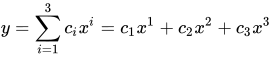
is reduced by convention to:

Upper indices are not exponents but are indices of coordinates, coefficients, or basis vectors.
In 1917 Arnold Sommerfeld created the contour integral sign, and Dimitry Mirimanoff proposed the axiom of regularity. In 1919, Theodor Kaluza would solve general relativity equations using five dimensions, the results would have electromagnetic equations emerge.[85] This would be published in 1921 in "Zum Unitätsproblem der Physik".[86] In 1922, Abraham Fraenkel and Thoralf Skolem independently proposed replacing the axiom schema of specification with the axiom schema of replacement. Also in 1922, Zermelo–Fraenkel set theory was developed. In 1923, Steinmetz would publish Four Lectures on Relativity and Space. Around 1924, Jan Arnoldus Schouten developed the modern notation and formalism for the Ricci calculus framework during the absolute differential calculus applications to general relativity and differential geometry in the early twentieth century. Ricci calculus constitutes the rules of index notation and manipulation for tensors and tensor fields.[87][88][89][90] In 1925, Enrico Fermi described a system comprising many identical particles that obey the Pauli exclusion principle, afterwards developing a diffusion equation (Fermi age equation). In 1926, Oskar Klein develop the Kaluza–Klein theory. In 1928, Emil Artin abstracted ring theory with Artinian rings. In 1933, Andrey Kolmogorov introduces the Kolmogorov axioms. In 1937, Bruno de Finetti deduced the "operational subjective" concept.
Mathematical symbolism
[edit]Mathematical abstraction began as a process of extracting the underlying essence of a mathematical concept,[91][92] removing any dependence on real world objects with which it might originally have been connected,[93] and generalizing it so that it has wider applications or matching among other abstract descriptions of equivalent phenomena. Two abstract areas of modern mathematics are category theory and model theory. Bertrand Russell[94] once said, "Ordinary language is totally unsuited for expressing what physics really asserts, since the words of everyday life are not sufficiently abstract. Only mathematics and mathematical logic can say as little as the physicist means to say." Though, one can substitute mathematics for real world objects, and wander off through equation after equation, and can build a concept structure which has no relation to reality.[95]
Some of the introduced mathematical logic notation during this time included the set of symbols used in Boolean algebra. This was created by George Boole in 1854. Boole himself did not see logic as a branch of mathematics, but it has come to be encompassed anyway. Symbols found in Boolean algebra include (and), (or), and (not). With these symbols, and letters to represent different truth values, one can make logical statements such as , that is "(a is true or a is not true) is true", meaning it is true that a is either true or not true (i.e. false). Boolean algebra has many practical uses as it is, but it also was the start of what would be a large set of symbols to be used in logic. Most of these symbols can be found in propositional calculus, a formal system described as . is the set of elements, such as the a in the example with Boolean algebra above. is the set that contains the subsets that contain operations, such as or . contains the inference rules, which are the rules dictating how inferences may be logically made, and contains the axioms. Predicate logic, originally called predicate calculus, expands on propositional logic by the introduction of variables, usually denoted by x, y, z, or other lowercase letters, and by sentences containing variables, called predicates. These are usually denoted by an uppercase letter followed by a list of variables, such as P(x) or Q(y,z). Predicate logic uses special symbols for quantifiers: ∃ for "there exists" and ∀ for "for all".





Gödel incompleteness notation
[edit]To every ω-consistent recursive class κ of formulae there correspond recursive class signs r, such that neither v Gen r nor Neg (v Gen r) belongs to Flg (κ) (where v is the free variable of r).
— Kurt Gödel[96]
While proving his incompleteness theorems, Kurt Gödel created an alternative to the symbols normally used in logic. He used Gödel numbers—numbers assigned to represent mathematical operations—and variables with the prime numbers greater than 10. With Gödel numbers, a logic statement can be broken down into a number sequence. By taking the n prime numbers to the power of the Gödel numbers in the sequence, and then multiplying the terms together, a unique final product is generated. In this way, every logic statement can be encoded as its own number.[97]
For example, take the statement "There exists a number x such that it is not y". Using the symbols of propositional calculus, this would become
- .
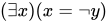
If the Gödel numbers replace the symbols, it becomes:
- .

There are ten numbers, so the first ten prime numbers are used:
- .

Then, each prime is raised to the power of the corresponding Gödel number, and multiplied:
- .

The resulting number is approximately .

Contemporary notation and topics
[edit]Early 20th-century notation
[edit]The abstraction of notation is an ongoing process. The historical development of many mathematical topics exhibits a progression from the concrete to the abstract. Throughout 20th century, various set notations were developed for fundamental object sets. Around 1924, David Hilbert and Richard Courant published Methods of mathematical physics. Partial differential equations.[98] In 1926, Oskar Klein and Walter Gordon proposed the Klein–Gordon equation to describe relativistic particles:

The first formulation of a quantum theory describing radiation and matter interaction is due to Paul Adrien Maurice Dirac, who, during 1920, was first able to compute the coefficient of spontaneous emission of an atom.[99] In 1928, the relativistic Dirac equation was formulated by Dirac to explain the behavior of the relativistically moving electron. The Dirac equation in the form originally proposed by Dirac is:

where, ψ = ψ(x, t) is the wave function for the electron, x and t are the space and time coordinates, m is the rest mass of the electron, p is the momentum (understood to be the momentum operator in the Schrödinger theory), c is the speed of light, and ħ = h/2π is the reduced Planck constant. Dirac described the quantification of the electromagnetic field as an ensemble of harmonic oscillators with the introduction of the concept of creation and annihilation operators of particles. In the following years, with contributions from Wolfgang Pauli, Eugene Wigner, Pascual Jordan, and Werner Heisenberg, and an elegant formulation of quantum electrodynamics due to Enrico Fermi,[100] physicists came to believe that, in principle, it would be possible to perform any computation for any physical process involving photons and charged particles.
In 1931, Alexandru Proca developed the Proca equation (Euler–Lagrange equation) for the vector meson theory of nuclear forces and the relativistic quantum field equations. John Archibald Wheeler in 1937 developed the S-matrix. Studies by Felix Bloch with Arnold Nordsieck,[101] and Victor Weisskopf,[102] in 1937 and 1939, revealed that such computations were reliable only at a first order of perturbation theory, a problem already pointed out by Robert Oppenheimer.[103] Infinities emerged at higher orders in the series, making such computations meaningless and casting serious doubts on the internal consistency of the theory itself. With no solution for this problem known at the time, it appeared that a fundamental incompatibility existed between special relativity and quantum mechanics.
In the 1930s, the double-struck capital Z () for integer number sets was created by Edmund Landau. Nicolas Bourbaki created the double-struck capital Q () for rational number sets. In 1935 Gerhard Gentzen made universal quantifiers. André Weil and Nicolas Bourbaki would develop the empty set sign (∅) in 1939. That same year, Nathan Jacobson would coin the double-struck capital C () for complex number sets.


Around the 1930s, Voigt notation (so named to honor Voigt's 1898 work) would be developed for multilinear algebra as a way to represent a symmetric tensor by reducing its order. Schönflies notation became one of two conventions used to describe point groups (the other being Hermann–Mauguin notation). Also in this time, van der Waerden notation[104][105] became popular for the usage of two-component spinors (Weyl spinors) in four spacetime dimensions. Arend Heyting would introduce Heyting algebra and Heyting arithmetic.
The arrow (→) was developed for function notation in 1936 by Øystein Ore to denote images of specific elements and to denote Galois connections. Later, in 1940, it took its present form (f: X→Y) through the work of Witold Hurewicz. Werner Heisenberg, in 1941, proposed the S-matrix theory of particle interactions.

Bra–ket notation (Dirac notation) is a standard notation for describing quantum states, composed of angle brackets and vertical bars. It can also be used to denote abstract vectors and linear functionals. It is so called because the inner product (or dot product on a complex vector space) of two states is denoted by a ⟨bra|ket⟩: . The notation was introduced in 1939 by Paul Dirac,[106] though the notation has precursors in Grassmann's use of the notation [φ|ψ] for his inner products nearly 100 years previously.[107]

Bra–ket notation is widespread in quantum mechanics: almost every phenomenon that is explained using quantum mechanics—including a large portion of modern physics—is usually explained with the help of bra–ket notation. The notation establishes an encoded abstract representation-independence, producing a versatile specific representation (e.g., x, or p, or eigenfunction base) without much ado, or excessive reliance on, the nature of the linear spaces involved. The overlap expression ⟨φ|ψ⟩ is typically interpreted as the probability amplitude for the state ψ to collapse into the state ϕ. The Feynman slash notation (Dirac slash notation[108]) was developed by Richard Feynman for the study of Dirac fields in quantum field theory.
Geoffrey Chew, along with others, would promote matrix notation for the strong interaction in particle physics, and the associated bootstrap principle, in 1960. In the 1960s, set-builder notation was developed for describing a set by stating the properties that its members must satisfy. Also in the 1960s, tensors are abstracted within category theory by means of the concept of monoidal category. Later, multi-index notation eliminates conventional notions used in multivariable calculus, partial differential equations, and the theory of distributions, by abstracting the concept of an integer index to an ordered tuple of indices.
Modern mathematical notation
[edit]In the modern mathematics of special relativity, electromagnetism, and wave theory, the d'Alembert operator () is the Laplace operator of Minkowski space. The Levi-Civita symbol (ε), also known as the permutation symbol, is used in tensor calculus.

Feynman diagrams are used in particle physics, equivalent to the operator-based approach of Sin-Itiro Tomonaga and Julian Schwinger. The orbifold notation system, invented by William Thurston, has been developed for representing types of symmetry groups in two-dimensional spaces of constant curvature.
The tetrad formalism (tetrad index notation) was introduced as an approach to general relativity that replaces the choice of a coordinate basis by the less restrictive choice of a local basis for the tangent bundle (a locally defined set of four linearly independent vector fields called a tetrad).[109]
In the 1990s, Roger Penrose proposed Penrose graphical notation (tensor diagram notation) as a, usually handwritten, visual depiction of multilinear functions or tensors.[110] Penrose also introduced abstract index notation. His usage of the Einstein summation was in order to offset the inconvenience in describing contractions and covariant differentiation in modern abstract tensor notation, while maintaining explicit covariance of the expressions involved.[citation needed]
.jpg)
John Conway furthered various notations, including the Conway chained arrow notation, the Conway notation of knot theory, and the Conway polyhedron notation. The Coxeter notation system classifies symmetry groups, describing the angles between with fundamental reflections of a Coxeter group. It uses a bracketed notation, with modifiers to indicate certain subgroups. The notation is named after H. S. M. Coxeter; Norman Johnson more comprehensively defined it.
Combinatorial LCF notation, devised by Joshua Lederberg and extended by Harold Scott MacDonald Coxeter and Robert Frucht, was developed for the representation of cubic graphs that are Hamiltonian.[111][112] The cycle notation is the convention for writing down a permutation in terms of its constituent cycles.[113] This is also called circular notation and the permutation called a cyclic or circular permutation.[114]
Computers and markup notation
[edit]In 1931, IBM produces the IBM 601 Multiplying Punch; it is an electromechanical machine that could read two numbers, up to eight digits long, from a card and punch their product onto the same card.[115] In 1934, Wallace Eckert used a rigged IBM 601 Multiplying Punch to automate the integration of differential equations.[116]
In 1962, Kenneth E. Iverson developed an integral part notation, which became known as Iverson notation, that developed into APL.[117] In the 1970s within computer architecture, Quote notation was developed for a representing number system of rational numbers. Also in this decade, the Z notation (just like the APL language, long before it) uses many non-ASCII symbols, the specification includes suggestions for rendering the Z notation symbols in ASCII and in LaTeX. There are presently various C mathematical functions (Math.h) and numerical libraries used to perform numerical calculations in software development. These calculations can be handled by symbolic executions—analyzing a program to determine what inputs cause each part of a program to execute. Mathematica and SymPy are examples of computational software programs based on symbolic mathematics.
References and citations
[edit]- General
- Florian Cajori (1929) A History of Mathematical Notations, 2 vols. Dover reprint in 1 vol., 1993. ISBN 0-486-67766-4.
- Citations
- ^ Florian Cajori. A History of Mathematical Notations: Two Volumes in One. Cosimo, Inc., 1 Dec 2011
- ^ A Dictionary of Science, Literature, & Art, Volume 2. Edited by William Thomas Brande, George William Cox. Pg 683
- ^ "Notation – from Wolfram MathWorld". Mathworld.wolfram.com. Retrieved 24 June 2014.
- ^ Diophantos of Alexandria: A Study in the History of Greek Algebra. By Sir Thomas Little Heath. Pg 77.
- ^ Mathematics: Its Power and Utility. By Karl J. Smith. Pg 86.
- ^ The Commercial Revolution and the Beginnings of Western Mathematics in Renaissance Florence, 1300–1500. Warren Van Egmond. 1976. Page 233.
- ^ Solomon Gandz. "The Sources of al-Khowarizmi's Algebra"
- ^ Melville, Duncan J. (28 August 2003). "Third Millennium Chronology". stlawu.edu. Archived from the original on 15 January 2020. Retrieved 2 January 2025.
- ^ Boyer, C. B. A History of Mathematics, 2nd ed. rev. by Uta C. Merzbach. New York: Wiley, 1989 ISBN 0-471-09763-2 (1991 pbk ed. ISBN 0-471-54397-7). "Mesopotamia" p. 25.
- ^ Aaboe, Asger (1998). Episodes from the Early History of Mathematics. New York: Random House. pp. 30–31.
- ^ "Mathematics in Egypt and Mesopotamia" (PDF). Archived from the original (PDF) on 28 December 2022. Retrieved 25 July 2013.
- ^ Encyclopædia Americana. By Thomas Gamaliel Bradford. Pg 314
- ^ Mathematical Excursion, Enhanced Edition: Enhanced Webassign Edition By Richard N. Aufmann, Joanne Lockwood, Richard D. Nation, Daniel K. Cleg. Pg 186
- ^ That is, .
- ^ Heath (1931). "A Manual of Greek Mathematics". Nature. 128 (3235): 5. Bibcode:1931Natur.128..739T. doi:10.1038/128739a0. S2CID 3994109.
- ^ Sir Thomas L. Heath, A Manual of Greek Mathematics, Dover, 1963, p. 1: "In the case of mathematics, it is the Greek contribution which it is most essential to know, for it was the Greeks who made mathematics a science."
- ^ a b The new encyclopædia; or, Universal dictionary of arts and sciences. By Encyclopaedia Perthensi. Pg 49
- ^ Calinger, Ronald (1999). A Contextual History of Mathematics. Prentice-Hall. p. 150. ISBN 0-02-318285-7.
Shortly after Euclid, compiler of the definitive textbook, came Archimedes of Syracuse (ca. 287 212 BC), the most original and profound mathematician of antiquity.
- ^ "Archimedes of Syracuse". The MacTutor History of Mathematics archive. January 1999. Retrieved 9 June 2008.
- ^ O'Connor, J.J.; Robertson, E.F. (February 1996). "A history of calculus". University of St Andrews. Archived from the original on 15 July 2007. Retrieved 7 August 2007.
- ^ "Proclus' Summary". Gap.dcs.st-and.ac.uk. Archived from the original on 23 September 2015. Retrieved 24 June 2014.
- ^ a b c Mathematics and Measurement By Oswald Ashton Wentworth Dilk. Pg 14
- ^ Boyer, Carl B. A History of Mathematics, 2nd edition, John Wiley & Sons, Inc., 1991.
- ^ a b c d e A dictionary of science, literature and art, ed. by W.T. Brande. Pg 683
- ^ Diophantine Equations. Submitted by: Aaron Zerhusen, Chris Rakes, & Shasta Meece. MA 330-002. Dr. Carl Eberhart. 16 February 1999.
- ^ Heath, Sir Thomas Little (1921). A History of Greek Mathematics. Oxford : Clarendon Press. pp. 456, 458.
{{cite book}}: CS1 maint: publisher location (link) - ^ The American Mathematical Monthly, Volume 16. Pg 131
- ^ "Overview of Chinese mathematics". Groups.dcs.st-and.ac.uk. Retrieved 24 June 2014.
- ^ George Gheverghese Joseph, The Crest of the Peacock: Non-European Roots of Mathematics, Penguin Books, London, 1991, pp. 140—148
- ^ Georges Ifrah, Universalgeschichte der Zahlen, Campus, Frankfurt/New York, 1986, pp. 428—437
- ^ "Frank J. Swetz and T. I. Kao: Was Pythagoras Chinese?". Psupress.psu.edu. Retrieved 24 June 2014.
- ^ a b c Needham, Joseph (1986). Science and Civilization in China: Volume 3, Mathematics and the Sciences of the Heavens and the Earth. Taipei: Caves Books, Ltd.
- ^ Sal Restivo
- ^ Marcel Gauchet, 151.
- ^ Robert Kaplan, "The Nothing That Is: A Natural History of Zero", Allen Lane/The Penguin Press, London, 1999
- ^ O'Connor, J. J.; Robertson, E. F. (November 2000). "Indian numerals". Archived from the original on 22 October 2019. Retrieved 24 June 2014.
"The ingenious method of expressing every possible number using a set of ten symbols (each symbol having a place value and an absolute value) emerged in India. The idea seems so simple nowadays that its significance and profound importance is no longer appreciated. Its simplicity lies in the way it facilitated calculation and placed arithmetic foremost amongst useful inventions. the importance of this invention is more readily appreciated when one considers that it was beyond the two greatest men of Antiquity, Archimedes and Apollonius." – Pierre-Simon Laplace
- ^ A.P. Juschkewitsch, "Geschichte der Mathematik im Mittelalter", Teubner, Leipzig, 1964
- ^ Boyer, C. B. (1989). "China and India". In Uta C. Merzbach (ed.). A History of Mathematics (2nd ed.). New York: Wiley. p. 221. ISBN 0-471-09763-2.
[...] he was the first one to give a general solution of the linear Diophantine equation ax + by = c, where a, b, and c are integers. [...] It is greatly to the credit of Brahmagupta that he gave all integral solutions of the linear Diophantine equation, whereas Diophantus himself had been satisfied to give one particular solution of an indeterminate equation. Inasmuch as Brahmagupta used some of the same examples as Diophantus, we see again the likelihood of Greek influence in India – or the possibility that they both made use of a common source, possibly from Babylonia. It is interesting to note also that the algebra of Brahmagupta, like that of Diophantus, was syncopated. Addition was indicated by juxtaposition, subtraction by placing a dot over the subtrahend, and division by placing the divisor below the dividend, as in our fractional notation but without the bar. The operations of multiplication and evolution (the taking of roots), as well as unknown quantities, were represented by abbreviations of appropriate words.
- ^ Kunitzsch, Paul (2003), "The Transmission of Hindu-Arabic Numerals Reconsidered", in J. P. Hogendijk; A. I. Sabra (eds.), The Enterprise of Science in Islam: New Perspectives, MIT Press, pp. 3–22 (12–13), ISBN 978-0-262-19482-2
- ^ Marie-Thérèse d'Alverny, "Translations and Translators", pp. 421–62 in Robert L. Benson and Giles Constable, Renaissance and Renewal in the Twelfth Century, (Cambridge: Harvard University Press, 1982).
- ^ Guy Beaujouan, "The Transformation of the Quadrivium", pp. 463–87 in Robert L. Benson and Giles Constable, Renaissance and Renewal in the Twelfth Century, (Cambridge: Harvard University Press, 1982).
- ^ O'Connor, John J.; Robertson, Edmund F., "al-Marrakushi ibn Al-Banna", MacTutor History of Mathematics Archive, University of St Andrews
- ^ Gullberg, Jan (1997). Mathematics: From the Birth of Numbers. W. W. Norton. p. 298. ISBN 0-393-04002-X.
- ^ a b O'Connor, John J.; Robertson, Edmund F., "Abu'l Hasan ibn Ali al Qalasadi", MacTutor History of Mathematics Archive, University of St Andrews
- ^ Boyer, C. B. (1989). "Revival and Decline of Greek Mathematics". In Uta C. Merzbach (ed.). A History of Mathematics (2nd ed.). New York: Wiley. p. 178. ISBN 0-471-09763-2.
The chief difference between Diophantine syncopation and the modern algebraic notation is the lack of special symbols for operations and relations, as well as of the exponential notation.
- ^ Grant, Edward and John E. Murdoch (1987), eds., Mathematics and Its Applications to Science and Natural Philosophy in the Middle Ages, (Cambridge: Cambridge University Press) ISBN 0-521-32260-X.
- ^ Mathematical Magazine, Volume 1. Artemas Martin, 1887. Pg 124
- ^ Der Algorismus proportionum des Nicolaus Oresme: Zum ersten Male nach der Lesart der Handschrift R.40.2. der Königlichen Gymnasial-bibliothek zu Thorn. Nicole Oresme. S. Calvary & Company, 1868.
- ^ Clagett, Marshall (1961) The Science of Mechanics in the Middle Ages, (Madison: University of Wisconsin Press), pp. 332–45, 382–91.
- ^ Later, early modern version: Michael Walsh. (1801). A New System of Mercantile Arithmetic: Adapted to the Commerce of the United States, in Its Domestic and Foreign Relations with Forms of Accounts and Other Writings Usually Occurring in Trade. Edmund M. Blunt.
{{cite book}}: CS1 maint: numeric names: authors list (link) - ^ Miller, Jeff (4 June 2006). "Earliest Uses of Symbols of Operation". Gulf High School. Retrieved 24 September 2006.
- ^ Arithmetical Books from the Invention of Printing to the Present Time. By Augustus De Morgan. p 2.
- ^ Arithmetica integra. By Michael Stifel, Philipp Melanchton. Norimbergæ: Apud Iohan Petreium, 1544.
- ^ Rooney, Anne (15 July 2012). The History of Mathematics. Rosen Publishing Group, Inc. p. 40. ISBN 978-1-4488-7369-2.
- ^ Napier, Mark (1834). Memoirs of John Napier of Merchiston, his lineage, life, and times, with a history of the invention of logarithms. William Blackwood, Edinburgh, and Thomas Cadell, London.
- ^ David Stewart Erskine Earl of Buchan; Minto, Walter (1787). An Account of the Life, Writings, and Inventions of John Napier, of Merchiston. R. Morison, junr.
- ^ Cajori, Florian (1919). A History of Mathematics. Macmillan. p. 157.
- ^ Synopsis Palmariorum Matheseos. By William Jones. 1706. (Alt: Synopsis Palmariorum Matheseos: or, a New Introduction to the Mathematics. archive.org.)
- ^ When Less is More: Visualizing Basic Inequalities. By Claudi Alsina, Roger B. Nelse. Pg 18.
- ^ Emerson, William (1794). The elements of geometry. London: F. Wingrave.
- ^ Emerson, William (1763). The Doctrine of Proportion, Arithmetical and Geometrical. Together with a General Method of Arening by Proportional Quantities.
- ^ Baron, George (1804). The Mathematical Correspondent: Containing New Eludications, Discoveries, and Improvements, in Various Branches of the Mathematics. Sage and Clough. p. 83.
- ^ Disquisitiones Arithmeticae (1801) Article 76
- ^ Vitulli, Marie. "A Brief History of Linear Algebra and Matrix Theory". Department of Mathematics. University of Oregon. Archived from the original on 10 September 2012. Retrieved 24 January 2012.
- ^ "Kramp biography". History.mcs.st-and.ac.uk. Retrieved 24 June 2014.
- ^ Mécanique analytique: Volume 1, Volume 2. By Joseph Louis Lagrange. Ms. Ve Courcier, 1811.
- ^ The collected mathematical papers of Arthur Cayley. Volume 11. Page 243.
- ^ Historical Encyclopedia of Natural and Mathematical Sciences, Volume 1. By Ari Ben-Menahem. Pg 2070.
- ^ Vitulli, Marie. "A Brief History of Linear Algebra and Matrix Theory". Department of Mathematics. University of Oregon. Originally at: darkwing.uoregon.edu/~vitulli/441.sp04/LinAlgHistory.html
- ^ The Words of Mathematics. By Steven Schwartzman. 6.
- ^ Electro-Magnetism: Theory and Applications. By A. Pramanik. 38
- ^ History of Nabla and Other Math Symbols. homepages.math.uic.edu/~hanson.
- ^ "James Clerk Maxwell". IEEE Global History Network. Retrieved 25 March 2013.
- ^ Maxwell, James Clerk (1865). "A dynamical theory of the electromagnetic field" (PDF). Philosophical Transactions of the Royal Society of London. 155: 459–512. Bibcode:1865RSPT..155..459M. doi:10.1098/rstl.1865.0008. S2CID 186207827. (This article accompanied an 8 December 1864 presentation by Maxwell to the Royal Society.)
- ^ Books I, II, III (1878) at the Internet Archive; Book IV (1887) at the Internet Archive
- ^ Ricci Curbastro, G. (1892). "Résumé de quelques travaux sur les systèmes variables de fonctions associés à une forme différentielle quadratique". Bulletin des Sciences Mathématiques. 2 (16): 167–189.
- ^ Voigt, Woldemar (1898). Die fundamentalen physikalischen Eigenschaften der Krystalle in elementarer Darstellung. Leipzig: Von Veit.
- ^ Poincaré, Henri, "Analysis situs", Journal de l'École Polytechnique ser 2, 1 (1895) pp. 1–123
- ^ Whitehead, John B. Jr. (1901). "Review: Alternating Current Phenomena, by C. P. Steinmetz" (PDF). Bull. Amer. Math. Soc. 7 (9): 399–408. doi:10.1090/s0002-9904-1901-00825-7.
- ^
There are many editions. Here are two:
- (French) Published 1901 by Gauthier-Villars, Paris. 230p. OpenLibrary OL15255022W, PDF.
- (Italian) Published 1960 by Edizione cremonese, Roma. 463p. OpenLibrary OL16587658M.
- ^ Ricci, Gregorio; Levi-Civita, Tullio (March 1900), "Méthodes de calcul différentiel absolu et leurs applications", Mathematische Annalen, 54 (1–2), Springer: 125–201, doi:10.1007/BF01454201, S2CID 120009332
- ^ Cullis, Cuthbert Edmund (March 2013). Matrices and determinoids. Vol. 2. Cambridge University Press. ISBN 978-1-107-62083-4.
- ^ Can be assigned a given matrix: About a class of matrices. (Gr. Ueber eine Klasse von Matrizen: die sich einer gegebenen Matrix zuordnen lassen.) by Isay Schur
- ^ An Introduction To The Modern Theory Of Equations. By Florian Cajori.
- ^ Proceedings of the Prussian Academy of Sciences (1918). Pg 966.
- ^ Sitzungsberichte der Preussischen Akademie der Wissenschaften (1918) (Tr. Proceedings of the Prussian Academy of Sciences (1918)). archive.org; See also: Kaluza–Klein theory.
- ^ Synge J.L.; Schild A. (1949). Tensor Calculus. first Dover Publications 1978 edition. pp. 6–108.
- ^ J.A. Wheeler; C. Misner; K.S. Thorne (1973). Gravitation. W.H. Freeman & Co. pp. 85–86, §3.5. ISBN 0-7167-0344-0.
- ^ R. Penrose (2007). The Road to Reality. Vintage books. ISBN 978-0-679-77631-4.
- ^ Schouten, Jan A. (1924). R. Courant (ed.). Der Ricci-Kalkül – Eine Einführung in die neueren Methoden und Probleme der mehrdimensionalen Differentialgeometrie (Ricci Calculus – An introduction in the latest methods and problems in multi-dimensional differential geometry). Grundlehren der mathematischen Wissenschaften (in German). Vol. 10. Berlin: Springer Verlag.
- ^ Robert B. Ash. A Primer of Abstract Mathematics. Cambridge University Press, 1 Jan 1998
- ^ The New American Encyclopedic Dictionary. Edited by Edward Thomas Roe, Le Roy Hooker, Thomas W. Handford. Pg 34
- ^ The Mathematical Principles of Natural Philosophy, Volume 1. By Sir Isaac Newton, John Machin. Pg 12.
- ^ In The Scientific Outlook (1931)
- ^ Mathematics simplified and made attractive: or, The laws of motion explained. By Thomas Fisher. Pg 15. (cf. But an abstraction not founded upon, and not consonant with Nature and (Logical) Truth, would be a falsity, an insanity.)
- ^ Proposition VI, On Formally Undecidable Propositions in Principia Mathematica and Related Systems I (1931)
- ^ Casti, John L. 5 Golden Rules. New York: MJF Books, 1996.
- ^ Gr. Methoden Der Mathematischen Physik
- ^ P.A.M. Dirac (1927). "The Quantum Theory of the Emission and Absorption of Radiation". Proceedings of the Royal Society of London A. 114 (767): 243–265. Bibcode:1927RSPSA.114..243D. doi:10.1098/rspa.1927.0039.
- ^ E. Fermi (1932). "Quantum Theory of Radiation". Reviews of Modern Physics. 4 (1): 87–132. Bibcode:1932RvMP....4...87F. doi:10.1103/RevModPhys.4.87.
- ^ F. Bloch; A. Nordsieck (1937). "Note on the Radiation Field of the Electron". Physical Review. 52 (2): 54–59. Bibcode:1937PhRv...52...54B. doi:10.1103/PhysRev.52.54.
- ^ V. F. Weisskopf (1939). "On the Self-Energy and the Electromagnetic Field of the Electron". Physical Review. 56 (1): 72–85. Bibcode:1939PhRv...56...72W. doi:10.1103/PhysRev.56.72.
- ^ R. Oppenheimer (1930). "Note on the Theory of the Interaction of Field and Matter". Physical Review. 35 (5): 461–477. Bibcode:1930PhRv...35..461O. doi:10.1103/PhysRev.35.461.
- ^ Van der Waerden B.L. (1929). "Spinoranalyse". Nachr. Ges. Wiss. Göttingen Math.-Phys. 1929: 100–109.
- ^ Veblen O. (1933). "Geometry of two-component Spinors". Proc. Natl. Acad. Sci. USA. 19 (4): 462–474. Bibcode:1933PNAS...19..462V. doi:10.1073/pnas.19.4.462. PMC 1086023. PMID 16577541.
- ^ Dirac, P.A.M. (1939). "A new notation for quantum mechanics". Mathematical Proceedings of the Cambridge Philosophical Society. 35 (3): 416–418. Bibcode:1939PCPS...35..416D. doi:10.1017/S0305004100021162. S2CID 121466183.
- ^ H. Grassmann (1862). Extension Theory. History of Mathematics Sources. American Mathematical Society, London Mathematical Society, 2000 translation by Lloyd C. Kannenberg.
- ^ Weinberg, Steven (1964), The quantum theory of fields, Volume 2, Cambridge University Press, 1995, p. 358, ISBN 0-521-55001-7
{{citation}}: ISBN / Date incompatibility (help) - ^ De Felice, F.; Clarke, C.J.S. (1990), Relativity on Curved Manifolds, p. 133
- ^ "Quantum invariants of knots and 3-manifolds" by V. G. Turaev (1994), page 71
- ^ Pisanski, Tomaž; Servatius, Brigitte (2013), "2.3.2 Cubic graphs and LCF notation", Configurations from a Graphical Viewpoint, Springer, p. 32, ISBN 978-0-8176-8364-1
- ^ Frucht, R. (1976), "A canonical representation of trivalent Hamiltonian graphs", Journal of Graph Theory, 1 (1): 45–60, doi:10.1002/jgt.3190010111
- ^ Fraleigh 2002:89; Hungerford 1997:230
- ^ Dehn, Edgar. Algebraic Equations, Dover. 1930:19
- ^ "The IBM 601 Multiplying Punch". Columbia.edu. Retrieved 24 June 2014.
- ^ "Interconnected Punched Card Equipment". Columbia.edu. 24 October 1935. Retrieved 24 June 2014.
- ^ McDonnell, Eugene, ed. (1981), A Source Book in APL, Introduction, APL Press, retrieved 19 April 2016

Further reading
[edit]- General
- A Short Account of the History of Mathematics. By Walter William Rouse Ball.
- A Primer of the History of Mathematics. By Walter William Rouse Ball.
- A History of Elementary Mathematics: With Hints on Methods of Teaching. By Florian Cajori.
- A History of Elementary Mathematics. By Florian Cajori.
- A History of Mathematics. By Florian Cajori.
- A Short History of Greek Mathematics. By James Gow.
- On the Development of Mathematical Thought During the Nineteenth Century. By John Theodore Merz.
- A New Mathematical and Philosophical Dictionary. By Peter Barlow.
- Historical Introduction to Mathematical Literature. By George Abram Miller
- A Brief History of Mathematics. By Karl Fink, Wooster Woodruff Beman, David Eugene Smith
- History of Modern Mathematics. By David Eugene Smith.
- History of modern mathematics. By David Eugene Smith, Mansfield Merriman.
- Other
- Principia Mathematica, Volume 1 & Volume 2. By Alfred North Whitehead, Bertrand Russell.
- The Mathematical Principles of Natural Philosophy, Volume 1, Issue 1. By Sir Isaac Newton, Andrew Motte, William Davis, John Machin, William Emerson.
- General investigations of curved surfaces of 1827 and 1825. By Carl Friedrich Gaus.
External links
[edit]- Mathematical Notation: Past and Future
- History of Mathematical Notation
- Earliest Uses of Mathematical Notation
- Finger counting. files.chem.vt.edu.
- Some Common Mathematical Symbols and Abbreviations (with History). Isaiah Lankham, Bruno Nachtergaele, Anne Schilling.
| By topic |
|
|---|---|
| Numeral systems | |
| By ancient cultures | |
| Controversies | |
| Other |
|

History of mathematical notation
View on GrokipediaRhetorical Stage
Origins in Ancient Civilizations
The earliest evidence of mathematical notation appears in prehistoric tally marks, simple incisions on bones used as counting aids. The oldest known such artifact is the Lebombo bone, discovered in the 1970s in Border Cave near the Lebombo Mountains, Eswatini (Swaziland), and dated to approximately 35,000–44,000 years ago, featuring 29 distinct notches that may represent a lunar calendar or basic tallying.[4] Another early example, the Ishango bone, discovered in 1950 near Lake Edward in the Democratic Republic of the Congo and dated to approximately 20,000–25,000 years ago, features organized groups of notches that scholars interpret as potential records of lunar cycles or basic arithmetic tallies.[5] These markings represent a pre-symbolic stage of enumeration, relying entirely on repetitive physical counts without abstract symbols or verbal elaboration. In ancient Mesopotamia, Sumerian cuneiform script emerged around 3000 BCE as the first written system for recording basic arithmetic, primarily through verbal lists and tables inscribed on clay tablets. Scribes documented addition and subtraction operations in prose-like sequences, such as listing quantities of grain or livestock without positional notation, focusing on practical administrative needs like taxation and trade.[6][7] These texts, often from sites like Nippur, trained apprentices in rote memorization of numerical relations, marking the onset of rhetorical notation where calculations were described linguistically rather than symbolically. Egyptian mathematics, preserved in hieroglyphic papyri, similarly employed verbal-rhetorical methods around 1650 BCE, as seen in the Rhind Mathematical Papyrus copied by the scribe Ahmose. Problems involving fractions were articulated descriptively, with unit fractions (e.g., 1/2 termed "half" and 1/n as "one over n") integrated into word problems about dividing resources like loaves or beer, emphasizing practical solutions through step-by-step prose explanations.[8][9] This approach avoided abbreviations, using hieroglyphs to convey narrative contexts for arithmetic and geometry. By approximately 2000 BCE, Babylonian mathematics built on Sumerian foundations with a sexagesimal (base-60) system, but retained a primarily rhetorical style in cuneiform tablets featuring word problems on areas, volumes, and proportions. Calculations were outlined verbally, with positional hints implied through context rather than explicit symbols, as in problems solving for lengths or rates without a dedicated zero or decimal marker.[10][11] This verbal emphasis persisted until around 600 BCE, when Greek thinkers in Ionia transitioned to fully prose-based rhetorical descriptions, influencing later abbreviated systems.[12]Greek Rhetorical Developments
In ancient Greek mathematics, from approximately the 6th century BCE to the 3rd century CE, the rhetorical stage dominated, wherein mathematical ideas, operations, and proofs were articulated entirely through prose without the aid of symbols or abbreviations. This verbal approach reflected a cultural emphasis on geometric reasoning and logical deduction over practical computation, influenced by philosophical traditions that valued demonstrative proof as the cornerstone of knowledge. Greek mathematicians built upon earlier influences, such as Egyptian unit fractions, but adapted them into a framework prioritizing axiomatic structures and verbal exposition to ensure clarity in proofs.[1][13] Euclid's Elements (c. 300 BCE) exemplifies this rhetorical tradition, presenting geometric constructions and theorems through detailed prose descriptions rather than symbolic representations. For instance, Euclid verbally instructs to "describe the circle BCD with center A and radius AB," relying on narrative to convey relationships between lines, circles, and angles while using letters only to label figures. This method facilitated rigorous deductive proofs but required extensive verbal elaboration to specify operations like drawing parallels or bisecting segments.[1] Archimedes similarly employed purely rhetorical descriptions in his calculations, such as in Measurement of a Circle (c. 250 BCE), where he approximated π by inscribing and circumscribing polygons around a circle and expressed the result verbally as the circumference being "more than three times the diameter but less than three and a seventh parts of the diameter." His works, including On the Sphere and Cylinder, detailed areas and volumes through word-based geometric arguments, underscoring the era's focus on exhaustive verbal justification for numerical insights.[1] The limitations of this rhetorical style became evident in more complex practical computations, as seen in Heron's Metrica (c. 100 CE), where lengthy prose descriptions were necessary to outline formulas for areas and volumes of various solids, such as frustums or cylinders, often spanning multiple paragraphs for a single derivation. This verbosity hindered efficiency in handling intricate problems, contrasting with the Greek preference for proof-oriented geometry that de-emphasized streamlined arithmetic tools. As a late outlier, Diophantus's Arithmetica (c. 250 CE) remained predominantly verbal, phrasing equations like "a square and ten of its roots equal nine and thirty dirhems," though it hinted at emerging abbreviations that would later influence syncopated notations.[1][14]Syncopated Stage
Early Positional and Acrophonic Systems
The syncopated stage of mathematical notation marked a transition from purely rhetorical descriptions to the use of abbreviations and initial symbols, allowing for more efficient recording of numbers and basic operations, particularly in Greek and Roman contexts following the earlier verbal traditions of ancient civilizations. This development, emerging around the 6th century BCE, introduced acrophonic and alphabetic systems that abbreviated number words while incorporating rudimentary positional elements, contrasting with the fully verbal rhetoric of prior Greek practices.[15] Acrophonic numerals, first attested in Attic Greece around 600 BCE, derived from the initial letters or sounds of number names, serving primarily for practical accounting and inscriptions rather than advanced computation. For units, simple vertical strokes represented 1 to 4 (I, II, III, IIII), followed by Π (from pente) for 5, with additive combinations such as ΠI for 6, ΠII for 7, ΠIII for 8, and ΠIIII for 9; higher values used Δ (from deka) for 10, ΠΔ for 50, H (from hekaton) for 100, and Χ (from chilioi) for 1,000, with M (from myrias) denoting 10,000. This system persisted in Attic usage until about 300 BCE, facilitating public records like tribute lists but lacking true positional value.[16][17][18] The Milesian, or Ionian, numeral system, originating around 500 BCE in Ionia and later adopted widely across the Greek world, simplified notation by assigning values to letters of the alphabet, marking an early step toward more systematic abbreviation. Numbers 1 through 9 were denoted by the first nine letters (α for 1, β for 2, ..., θ for 9), 10 through 90 by the next nine (ι for 10, κ for 20, ..., ϙ for 90), and 100 through 900 similarly (ρ for 100, σ for 200, ..., ϡ for 900); thousands were indicated positionally by placing a stroke or apostrophe before the unit letter, as in ´α for 1,000 or ´β for 2,000. This alphabetic approach, sometimes called the Ionic system, replaced acrophonic numerals in many regions by the 4th century BCE, enabling compact representation in texts and inscriptions while retaining additive principles without a zero placeholder.[19][20] Parallel to Greek developments, Roman numerals evolved from Etruscan influences around 700 BCE, maturing into a standard form by the 1st century CE, and emphasized additive combinations with limited subtractive notation for efficiency. Basic symbols included I for 1, V for 5, X for 10, L for 50, C for 100, D for 500, and M for 1,000, typically added from left to right (e.g., III for 3, VIII for 8); the subtractive principle, where a smaller symbol precedes a larger one to indicate subtraction (e.g., IV for 4, IX for 9, XL for 40), emerged sporadically in the late Republic and became conventional by the imperial era, reducing repetition in larger numbers. Though non-positional and cumbersome for calculations, this system supported Roman engineering, commerce, and monumental inscriptions.[21] In the Hellenistic period, from the 3rd century BCE onward, Greek mathematicians advanced syncopation by employing abbreviations for common terms in astronomy and geometry, bridging numerical systems with operational shorthand. For instance, in astronomical texts, κϜ abbreviated kosines (thousands), combining kappa (from chilioi) with a modifier for multiples of 1,000, allowing concise notation of large stellar distances or periods. These abbreviations, often context-specific and reliant on reader familiarity, appeared in works like those of Hipparchus and influenced later compilations, enhancing the practicality of syncopated notation without full symbolism.[22][15] Precursors to true positional notation appeared in Greek astronomy by the 2nd century CE, notably in Ptolemy's Almagest (circa 150 CE), where sexagesimal (base-60) representations adapted Babylonian influences for trigonometric and astronomical tables. Ptolemy denoted digits using alphabetic numerals, arranging them from highest to lowest powers of 60 without a zero, but employed overbars to separate integer and fractional parts or indicate place values (for instance, 2;30 might be written as β͞ ; λ, using overbars for the integer part and alphabetic numerals for digits, with omissions or special marks for zero places). This limited positional system, applied to chord tables and planetary models, facilitated precise calculations but remained tied to additive alphabetic bases rather than a fully autonomous place-value framework.[23][24][25]Chinese and Indian Syncopated Notations
In ancient China, the development of rod numerals represented a significant advancement in syncopated notation, enabling positional decimal arithmetic as early as the Warring States period (circa 475–221 BCE). These numerals were formed by arranging small bamboo or wooden rods on a counting board, where digits 1–4 were denoted by one to four vertical rods, 5 by a horizontal rod, and 6–9 by combinations thereof (e.g., horizontal plus one vertical for 6), allowing for efficient representation of numbers in a place-value system. Notably, the absence of a rod served as a placeholder for zero, facilitating calculations without an explicit symbol, which distinguished this system from earlier additive notations.[26][27] This rod-based method found detailed application in texts like the Sunzi Suanjing (Master Sun's Mathematical Manual), composed around 400 CE, which provided instructions for operations such as multiplication and division using the rods arranged in positional grids. For instance, the text describes aligning rods to perform multiplications by partial products, emphasizing the system's practicality for solving linear equations and congruences on the board. Such notations blended rhetorical descriptions of problems with abbreviated rod placements for solutions, marking a hybrid syncopated approach that supported algorithmic computation without full symbolic abstraction..pdf)[26] A foundational Chinese mathematical compendium, The Nine Chapters on the Mathematical Art (Jiuzhang suanshu), compiled by the 1st century CE, exemplifies this rhetoric-syncopation hybrid through its structure of verbal problem statements followed by rod-placed algorithmic solutions. The text covers practical topics like area calculations and linear systems, where problems are posed in prose but resolved via rod manipulations on the counting board, such as Gaussian elimination precursors for solving simultaneous equations. This method allowed for concise notation of intermediate steps, bridging descriptive rhetoric with positional efficiency.[28] In parallel, Indian mathematics advanced syncopated notations through the evolution of Brahmi numerals, which emerged around 300 BCE as an early positional system inscribed on ashoka pillars and evolving into forms like Devanagari by the medieval period. These numerals, initially non-positional but additive, transitioned to full place-value usage by the early centuries CE, incorporating an explicit symbol for zero known as śūnya (void), which Aryabhata employed in his astronomical treatise Aryabhatiya around 499 CE to denote absence of value in positional contexts. This innovation enabled precise representation of large numbers and decimal fractions, contrasting with the blank-space zero in Chinese rods.[29][30] Indian syncopated algebra reached a sophisticated level in Bhāskara II's Līlāvatī (circa 1150 CE), the arithmetic section of his Siddhānta Shiromani, where abbreviations like yāvat tāvat (as much as... so much) denoted unknowns in quadratic equations, allowing concise rhetorical expressions of relations without full verbal expansion. For example, the text uses such terms alongside color names (e.g., kālaka for black, representing a variable) to frame problems poetically yet abbreviate algebraic manipulations, facilitating solutions to indeterminate equations and progressions. This approach built on earlier Indian traditions, emphasizing brevity in notation while retaining a syncopated, semi-verbal style.[31][32] The transmission of Indian numerals to China occurred via trade routes and Buddhist scholarly exchanges during the Tang and Sui dynasties (7th–8th centuries CE), as evidenced by records of Indian astronomical texts like the Brahmam Suan Fa influencing Chinese calculations. These interactions introduced explicit zero concepts, complementing the indigenous rod system and later contributing to the broader dissemination of positional numerals to the Islamic world through Silk Road commerce, where Indian forms were adapted into Arabic scripts by the 9th century.[33][29]Arabic Algebraic Syncopation
Arabic algebraic syncopation emerged in the Islamic world during the 8th and 9th centuries, synthesizing rhetorical traditions with abbreviated verbal forms and the Indian positional numeral system, which provided a foundational zero as a placeholder for efficient computation.[29] This period marked a transition from fully verbal descriptions toward concise notations, particularly in algebra, where terms for unknowns and powers were shortened for practical use on dust boards. Muhammad ibn Musa al-Khwarizmi's Al-Kitab al-mukhtasar fi hisab al-jabr wa al-muqabala (The Compendious Book on Calculation by Completion and Balancing), composed around 820 CE, exemplified early syncopated algebra through its verbal-rhetorical style augmented by abbreviated terms.[34] Al-Khwarizmi used "shay'" (thing) to denote the unknown quantity, a syncopated stand-in that influenced later symbolism, while the title's "al-jabr" (restoration) and "al-muqabala" (balancing) derived from techniques to equalize equations.[35] A key innovation was the balance-scale metaphor, envisioning equations as scales where positive and negative terms (described as "deficient" or "complete") must equilibrate, with operations like addition or subtraction performed verbally but occasionally abbreviated in calculations, such as using initial letters for powers like "mal" (square).[35] For instance, an equation might be stated as "a mal and ten roots equal twenty-one things," representing , solved by balancing terms across the scale.[36] Concurrently, Arabic scholars adopted the Indian-Arabic numeral system, featuring positional digits 0 through 9 in Eastern forms (e.g., a more angular 2 and 3), which facilitated algebraic computations.[37] This system, first detailed in al-Khwarizmi's earlier On the Calculation with Hindu Numerals (ca. 825 CE), gained traction by around 900 CE, as seen in astronomical works like the Sindhind tables, which employed these digits for trigonometric and positional calculations. The numerals' integration with syncopated algebra allowed coefficients to be written efficiently, bridging verbal equations with numerical precision. By the 13th century, syncopation advanced further in the works of Ibn al-Banna al-Marrakushi (ca. 1256–1321 CE), who incorporated abbreviations into geometric algebra for solving quadratics and higher equations.[38] In treatises like Talkhis amal al-hisab, Ibn al-Banna used the letter jīm (ج) superscripted over a number to signify its square root, as in ج9 for , alongside shīn (ش) for the unknown "shay'" and mīm (م) for "mal" (square).[38] These partial symbols, combined with verbal phrases and the balance-scale approach, enabled concise representations of equations like "five māl less four things," denoting , often proved geometrically by completing squares.[39] This syncopated tradition transmitted to Europe via Leonardo of Pisa (Fibonacci)'s Liber Abaci (1202 CE), which popularized Hindu-Arabic numerals and rudimentary syncopated algebra drawn from Arabic sources.[40] Fibonacci employed abbreviated terms like "radix" (root) for unknowns in practical problems, such as merchant calculations, while using the numerals for coefficients, thus laying groundwork for European adoption of balanced, abbreviated notations.Symbolic Stage
Renaissance Arithmetic Symbols
The Renaissance period, spanning roughly from the late 15th to early 17th centuries, witnessed a transformative shift in mathematical notation from the syncopated styles of earlier eras to more purely symbolic representations, particularly in arithmetic and elementary algebra. This evolution was facilitated by the invention of the printing press around 1440, which allowed for the rapid dissemination of standardized symbols in printed texts across Europe, enabling merchants, scholars, and educators to adopt consistent notations for commercial and academic purposes. These developments built upon Arabic influences introduced via Leonardo Fibonacci's 1202 Liber Abaci, which had popularized Hindu-Arabic numerals but retained much verbal description. A pivotal advancement occurred in 1489 with the publication of Johannes Widmann's Behende und hüpsche Rechenung auff allen Kauffmanschafft (Mercantile Arithmetic), the first printed book to employ the plus sign (+) for addition—derived from the Latin et meaning "and"—and the minus sign (−) for subtraction, initially in the context of bookkeeping and mercantile calculations. These symbols had appeared in manuscripts as early as 1481, such as one in the Dresden Library (Codex C.80), but Widmann's text marked their debut in print, promoting their use in German-speaking regions for denoting surplus (mer) and deficit (minus). By the early 16th century, they spread widely; for instance, Luca Pacioli incorporated them in his 1494 Summa de arithmetica, geometria, proportioni et proportionalita, influencing Italian arithmetic practices. Division notation during this era remained largely rhetorical or used simple line-based fractions, with the dividend above a horizontal bar and the divisor below, as seen in the 1478 Treviso Arithmetic. Early precursors to the modern division symbol (÷), known as the obelus, emerged in mercantile contexts around Widmann's time, evolving from ancient editorial marks to denote separation or ratio, though its explicit use for division solidified later in the 17th century. The equals sign (=) was introduced in 1557 by Welsh mathematician Robert Recorde in his The Whetstone of Witte, where he described it as two parallel lines "becaus noe 2 thynges can be moare equal," replacing cumbersome verbal phrases like "is equal to" in algebraic equations. This innovation addressed the tedium of syncopated algebra, appearing in English texts to clarify relations such as $ 14 \frac{5}{6} + 10 = 25 $. Recorde's symbol quickly gained traction, appearing in subsequent works like those of Thomas Harriot by 1631. Multiplication lacked a dedicated symbol in early Renaissance texts, often indicated by juxtaposition of terms (e.g., ab for $ a \times b $) or words like in, as in Regiomontanus's writings or Pacioli's Summa. The cross symbol (×) was first proposed by English mathematician William Oughtred in his 1631 Clavis mathematicae, distinguishing it from the lowercase x variable and promoting clarity in expressions like $ 2 \times 3 = 6 $. In algebraic notation, François Viète advanced symbolic methods in his 1591 In artem analyticam isagoge, assigning vowels (A, E, I, O, U, Y) to unknowns and consonants (except Z) to known quantities, with the plus sign (+) for addition and phrases like "A in B" for multiplication. For example, he might denote an equation as $ A + B = C $ in species, treating quantities as magnitudes rather than numbers, which facilitated geometric interpretations and problem-solving. This system contrasted with prior Italian cossist traditions by emphasizing letters over abbreviations. The printing press amplified these innovations, as exemplified by Christoff Rudolff's 1525 Behende und hübsche Rechnung durch die kunstreichen Regeln Algebra, so gemeynklich die Coss genannt werden, the first German algebra textbook, which integrated + and − signs alongside early power notations (e.g., aa for square) and radicals, making symbolic algebra accessible to broader audiences. Rudolff's work, published in Nuremberg, reflected the era's blend of practical arithmetic and emerging abstraction, setting the stage for further symbolization in European mathematics.Calculus and Function Notations
The development of calculus in the 17th century necessitated new notations to express rates of change, infinitesimals, and integrals, primarily through the independent contributions of Isaac Newton and Gottfried Wilhelm Leibniz. Building on earlier symbolic advances like the equals sign from the Renaissance, these innovations shifted mathematics toward infinitesimal methods, enabling precise handling of continuous variation. Newton's approach emphasized fluxions as momentary velocities, while Leibniz's focused on differentials as small increments, leading to enduring dual systems that facilitated the spread of calculus across Europe. Isaac Newton devised his method of fluxions around 1665–1666, using a dot over a variable to denote the fluxion, or time rate of change, such as for the fluxion of . He represented infinitesimals or "moments" with the letter , as in expressions like or for the fluxion of powers, viewing these as vanishingly small quantities generated by motion. Although Newton drafted treatises like De Analysi (circa 1669–1671) and a tract on fluxions in 1666, his notation appeared in print only later, such as in John Wallis's Arithmetica Infinitorum (1656, with Newton's additions in the 1695 edition) and Newton's Principia (1687), where fluxions supported geometric arguments. This system, tied to physical concepts of flowing quantities (fluents), influenced British mathematicians but proved cumbersome for higher-order operations due to printing limitations. Gottfried Wilhelm Leibniz independently developed his calculus of differentials starting in 1672–1675, introducing the lowercase to signify an infinitesimal differential, as in and , first noted in a manuscript dated November 11, 1675. He denoted the derivative as the ratio , interpreting it as the quotient of small changes, and created the integral symbol —an elongated for "summa"—to represent the accumulation of infinitesimals, first appearing in a manuscript on October 29, 1675, as . These notations debuted in print in Acta Eruditorum (1684 and 1686), promoting an analytic style that separated calculus from geometry and gained rapid adoption on the Continent for its clarity in chain rules and substitutions. Early notions of functions emerged alongside these, with Leibniz using forms like in the 1690s to denote a mapping or geometric dependence, though not fully formalized. Leonhard Euler later standardized function notation as in his Introductio in Analysin Infinitorum (1748), treating functions as analytic expressions and integrating them with calculus symbols. Euler also introduced the capital sigma around 1755 in Institutiones Calculi Differentialis to compactly denote infinite series summation, as in , building on Leibnizian integrals for series expansions. A bitter priority dispute erupted in 1711 when John Keill accused Leibniz of plagiarism in Philosophical Transactions, prompting Leibniz to appeal to the Royal Society; Newton, as president, orchestrated the Commercium Epistolicum (1712–1713) to affirm his earlier work, fueling national rivalries that delayed Leibnizian notation's acceptance in Britain until the mid-19th century. Despite the acrimony, both systems persisted, with Leibniz's proving more versatile for pure mathematics and Newton's for physics, shaping modern calculus pedagogy.Advanced Algebraic and Geometric Symbols
As mathematical notation evolved into the symbolic stage during the 18th and 19th centuries, advanced algebraic and geometric symbols emerged to handle increasingly complex structures in analysis, number theory, and multidimensional geometry. These notations facilitated precise expression of abstract concepts like infinite series bases, imaginary quantities, and linear transformations, building on earlier differential frameworks while enabling new fields such as vector analysis and matrix theory. Key innovations from figures like Euler, Gauss, Hamilton, and Cayley standardized representations that remain foundational today. Leonhard Euler introduced the symbol for the base of the natural logarithm around 1727 in unpublished notes on explosive forces, marking its first documented use as a constant approximately equal to 2.71828; this notation appeared in print in his 1736 work Mechanica. Euler also adopted to denote the imaginary unit in 1777, defining it explicitly in his investigations of complex numbers, though the symbol gained widespread acceptance posthumously after his death in 1783. Additionally, Euler employed the prime symbol for denoting derivatives, such as , in his 1734 introduction of function notation , extending Leibniz's differential approach to higher-order operations like for second derivatives. Carl Friedrich Gauss advanced number-theoretic notation in the early 19th century. In his 1801 Disquisitiones Arithmeticae, he introduced the congruence symbol to express modular relations, writing to mean divides , formalizing residue systems for the first time. Around 1808, in his third proof of quadratic reciprocity, Gauss originated the bracket notation for the floor function, representing the greatest integer less than or equal to , which symmetrized expressions in Diophantine analysis. William Rowan Hamilton's contributions in the 1830s and 1840s extended algebraic structures to three and four dimensions. In 1837, he introduced the nabla symbol , or del operator, as part of his quaternion-based vector calculus, using it to denote directional derivatives like for the gradient of a scalar field . Hamilton's 1843 discovery of quaternions formalized four-dimensional numbers as , where are imaginary units satisfying ; he denoted the vector part in boldface to distinguish it from the real scalar , pioneering bold notation for vectors in geometric contexts. Arthur Cayley's 1858 paper "A Memoir on the Theory of Matrices" established modern matrix notation, representing linear transformations as rectangular arrays of coefficients, such as the matrixwith uppercase letters like for the matrix itself, often in bold to emphasize its tensorial nature. Cayley also used vertical bars to denote the determinant of , a scalar invariant crucial for solving systems of equations. Geometric notations solidified during this era for precise spatial description. The angle symbol emerged in the 18th century, with widespread adoption in trigonometric texts to denote the measure between two rays, as in for the angle at vertex . Concurrently, Christian Kramp introduced the exclamation mark for the factorial in his 1808 Éléments d'arithmétique universelle, defining for positive integers , streamlining combinatorial calculations like permutations.
Logical and Abstract Notations
The late 19th and early 20th centuries marked a pivotal shift in mathematical notation toward greater abstraction, particularly in logic, set theory, and emerging fields like abstract algebra and topology. This period saw the introduction of symbols that enabled precise expression of membership, quantification, and structural relations, facilitating the formalization of mathematics and laying the groundwork for modern foundational studies. Italian mathematician Giuseppe Peano played a key role in this transition with his 1889 work Arithmetices principia, nova methodo exposita, where he introduced the symbol ∈ to denote set membership, representing "is an element of" as a reversed epsilon derived from the Greek word for "is." Peano also employed ∪ and ∩ for union and intersection of sets in his 1888 publication Calcolo geometrico secondo l'Ausdehnungslehre di H. Grassmann, symbols that were later standardized in set theory despite initial variations in usage. Set theory's notations emerged concurrently, with German mathematician Georg Cantor pioneering the use of curly braces {} to denote sets in his 1878 paper "Ein Beitrag zur Mannifaltigkeitslehre," allowing compact representation of collections such as {a, b}. Cantor's work in the late 1800s further developed subset relations, with ⊆ introduced to indicate one set is contained within another, though its widespread adoption came slightly later through influences like those in the 1897 Beiträge zur Begründung der transfiniten Mengenlehre. These innovations abstracted collections beyond concrete arithmetic, influencing logic and analysis. In the early 20th century, Bertrand Russell and Alfred North Whitehead's Principia Mathematica (1910–1913) advanced logical notation to support their program of reducing mathematics to logic. They used the horseshoe symbol ⊃ for material implication, denoting "if...then" in propositional contexts, and employed (x).φx for universal quantification ("for all x") and defined existential quantification as (∃x).φx, equivalent to ¬(x).¬φx ("there exists x"). These notations, building on Peano's earlier systems, were refined for ramified type theory in Principia to avoid paradoxes, enabling precise expression of predicates over variables and profoundly impacting formal logic. Kurt Gödel's 1931 paper "Über formal unentscheidbare Sätze der Principia Mathematica und verwandter Systeme" introduced innovative encoding techniques to prove his incompleteness theorems, using Gödel numbering to assign unique natural numbers to logical statements via prime factorization, where each symbol is coded by exponents of successive primes (e.g., the number for a formula is , with as symbol codes). Central to this was the β function, defined as , which encodes finite sequences of natural numbers into a single number, ensuring that for any sequence length and values up to , there exists such that $\beta(c, a, i) = $ the -th term for to (the β-function lemma). This interpretability function β allowed Gödel to arithmetize syntax, demonstrating undecidable propositions within consistent formal systems. Abstract algebra's notations crystallized in the 1920s, abstracting structures like groups and rings from specific number systems. Emmy Noether's seminal 1921 paper "Idealtheorie in Ringbereichen" established rings as abstract algebraic structures with addition and multiplication satisfying distributive laws, using R to denote a general ring, which became standard for denoting the carrier set with operations. Similarly, group notation G for a set with a binary operation satisfying associativity, identity, and inverses emerged post-1920s in Noether's school, as seen in her lectures and Emil Artin's 1924 textbook Theorie der Algebraischen Zahlen, where G symbolizes the group structure independently of embeddings. These letters facilitated unification across algebra, emphasizing isomorphisms over concrete realizations. In topology, Henri Poincaré's 1895 paper "Analysis Situs" introduced the term homeomorphism for continuous bijections with continuous inverses, using ~ to denote topological equivalence (homeomorphic spaces), as in X ~ Y for spaces deformable into each other without tearing. This notation abstracted geometric figures to their qualitative properties, influencing later developments in manifold theory. Earlier abstractions, like Leonhard Euler's 18th-century function notation f(x), hinted at such trends by treating operations as mappings, though without the logical rigor of later symbols.20th-Century and Computational Developments
In the early 20th century, mathematical notation advanced significantly through applications in physics and abstract algebra, particularly with the development of tensor calculus. Gregorio Ricci-Curbastro introduced the absolute differential calculus in the 1890s, laying the groundwork for tensor notation using indexed symbols to represent multi-linear objects invariant under coordinate transformations. This framework was pivotal in Albert Einstein's formulation of general relativity in 1915, where he employed Ricci's notation, such as the Ricci curvature tensor , to express the geometric structure of spacetime. Einstein's collaboration with Marcel Grossmann further refined these symbols, emphasizing contravariant and covariant indices to model gravitational fields. Vector calculus notations also saw standardization during this period, building on late 19th-century innovations. Josiah Willard Gibbs and Oliver Heaviside developed modern vector analysis in the 1880s, initially using arrows or contextual descriptions for vectors, but boldface notation—such as for a vector—emerged as a common convention in the early 20th century. This boldface style was explicitly adopted by Edwin Bidwell Wilson in his 1901 textbook Vector Analysis, distinguishing vectors from scalars and facilitating clearer printed expressions in physics and engineering texts. Concurrently, the partial derivative symbol , first proposed by Adrien-Marie Legendre in 1786, became fully standardized in vector calculus contexts by the mid-20th century, denoting differentiation with respect to one variable while holding others constant, as in . Abstract mathematical notations evolved to support emerging fields like algebra and quantum mechanics. David Hilbert's work in the 1900s, including his basis theorem for polynomial rings (proven in 1893 but elaborated in foundational texts around 1900), introduced symbolic representations for ideals and modules, using notations like to denote generated ideals, which became standard in commutative algebra. In quantum mechanics, Paul Dirac introduced the bra-ket notation in 1939, denoted as for the inner product of quantum states, providing a compact, operator-friendly framework that revolutionized the field's symbolic language. The rise of computers in the mid-20th century imposed new constraints on notation due to ASCII's limitations, which supported only basic characters like , , , and , forcing approximations for complex symbols such as integrals or summations. This led to the adoption of simple operator notations in early programming languages. By the 1990s, Unicode addressed these issues, introducing the Mathematical Alphanumeric Symbols block in version 3.1 (2001), which encoded over 2,500 symbols including bold, italic, and script variants for variables, enabling richer digital mathematical expression. Markup systems emerged to facilitate precise typesetting and web rendering of mathematics. Donald Knuth developed TeX in 1978 during his sabbatical, creating a programmable system for high-quality output of symbols like and , with LaTeX extensions by Leslie Lamport in the 1980s adding structured document markup for academic publishing. In 1998, the World Wide Web Consortium released MathML 1.0 as the first XML-based standard for mathematical notation on the web, allowing structured encoding of expressions for browser rendering and accessibility. Contemporary developments integrate interactive and symbolic notations in computational environments. SymPy, a Python library for symbolic mathematics initiated in 2006, extends notation through functions likesymbols('x') and Integral(f, x), enabling programmatic manipulation of expressions akin to traditional pen-and-paper algebra. Jupyter Notebooks, evolving from IPython in 2011 and formalized as Project Jupyter in 2014, support interactive notation with inline LaTeX rendering and executable code cells, fostering exploratory mathematics in data science and education during the 2010s.