Hubbry Logo
Science in the medieval Islamic worldScience in the medieval Islamic worldMain
Open search
Science in the medieval Islamic world
Community hub
Science in the medieval Islamic world
logo
8 pages, 0 posts
0 subscribers
Be the first to start a discussion here.
Science in the medieval Islamic world
from Wikipedia

The Tusi couple, a mathematical device invented by the Persian polymath Nasir al-Din Tusi to model the not perfectly circular motions of the planets

Science in the medieval Islamic world was the science developed and practised during the Islamic Golden Age under the Abbasid Caliphate of Baghdad, the Umayyads of Córdoba, the Abbadids of Seville, the Samanids, the Ziyarids and the Buyids in Persia and beyond, spanning the period roughly between 786 and 1258. Islamic scientific achievements encompassed a wide range of subject areas, especially astronomy, mathematics, and medicine. Other subjects of scientific inquiry included alchemy and chemistry, botany and agronomy, geography and cartography, ophthalmology, pharmacology, physics, and zoology.

Medieval Islamic science had practical purposes as well as the goal of understanding. For example, astronomy was useful for determining the Qibla, the direction in which to pray, botany had practical application in agriculture, as in the works of Ibn Bassal and Ibn al-'Awwam, and geography enabled Abu Zayd al-Balkhi to make accurate maps. Islamic mathematicians such as Al-Khwarizmi, Avicenna and Jamshīd al-Kāshī made advances in algebra, trigonometry, geometry and Arabic numerals. Islamic doctors described diseases like smallpox and measles, and challenged classical Greek medical theory. Al-Biruni, Avicenna and others described the preparation of hundreds of drugs made from medicinal plants and chemical compounds. Islamic physicists such as Ibn Al-Haytham, Al-Bīrūnī and others studied optics and mechanics as well as astronomy, and criticised Aristotle's view of motion.

During the Middle Ages, Islamic science flourished across a wide area around the Mediterranean Sea and further afield, for several centuries, in a wide range of institutions.

Context and history

[edit]
Islamic expansion:
  under Muhammad, 622–632
  under Rashidun caliphs, 632–661
  under Umayyad caliphs, 661–750

The Islamic era began in 622. Islamic armies eventually conquered Arabia, Egypt and Mesopotamia, and successfully displaced the Persian and Byzantine Empires from the region within a few decades. Within a century, Islam had reached the area of present-day Portugal in the west and Central Asia in the east. The Islamic Golden Age (roughly between 786 and 1258) spanned the period of the Abbasid Caliphate (750–1258), with stable political structures and flourishing trade. Major religious and cultural works of the Islamic empire were translated into Arabic and occasionally Persian. Islamic culture inherited Greek, Indic, Assyrian and Persian influences. A new common civilisation formed, based on Islam. An era of high culture and innovation ensued, with rapid growth in population and cities. The Arab Agricultural Revolution in the countryside brought more crops and improved agricultural technology, especially irrigation. This supported the larger population and enabled culture to flourish.[1][2] From the 9th century onwards, scholars such as Al-Kindi[3] translated Indian, Assyrian, Sasanian (Persian) and Greek knowledge, including the works of Aristotle, into Arabic. These translations supported advances by scientists across the Islamic world.[4]

The Abbasid Caliphate, 750–1261 (and later in Egypt) at its height, c. 850

Islamic science survived the initial Christian reconquest of Spain, including the fall of Seville in 1248, as work continued in the eastern centres (such as in Persia). After the completion of the Spanish reconquest in 1492, the Islamic world went into an economic and cultural decline.[2] The Abbasid caliphate was followed by the Ottoman Empire (c. 1299–1922), centred in Turkey, and the Safavid Empire (1501–1736), centred in Persia, where work in the arts and sciences continued.[5]

Fields of inquiry

[edit]

Medieval Islamic scientific achievements encompassed a wide range of subject areas, especially mathematics, astronomy, and medicine.[4] Other subjects of scientific inquiry included physics, alchemy and chemistry, ophthalmology, and geography and cartography.[6][a]

Alchemy and chemistry

[edit]

The early Islamic period saw the development of theoretical frameworks in alchemy and chemistry, laying the foundation for later advancements in both fields. The sulfur-mercury theory of metals, first found in Sirr al-khalīqa ("The Secret of Creation", c. 750–850, falsely attributed to Apollonius of Tyana), and in the writings attributed to Jabir ibn Hayyan (written c. 850–950),[7] remained the basis of theories of metallic composition until the 18th century.[8] The Emerald Tablet, a cryptic text that all later alchemists up to and including Isaac Newton saw as the foundation of their art, first occurs in the Sirr al-khalīqa and in one of the works attributed to Jabir.[9] In practical chemistry, the works of Jabir, and those of the Persian alchemist and physician Abu Bakr al-Razi (c. 865–925), contain the earliest systematic classifications of chemical substances.[10] Alchemists were also interested in artificially creating such substances.[11] Jabir describes the synthesis of ammonium chloride (sal ammoniac) from organic substances,[7] and Abu Bakr al-Razi experimented with the heating of ammonium chloride, vitriol, and other salts, which would eventually lead to the discovery of the mineral acids by 13th-century Latin alchemists such as pseudo-Geber.[10]

Astronomy and cosmology

[edit]
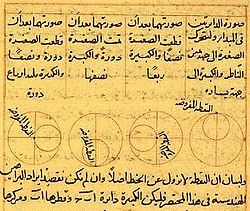
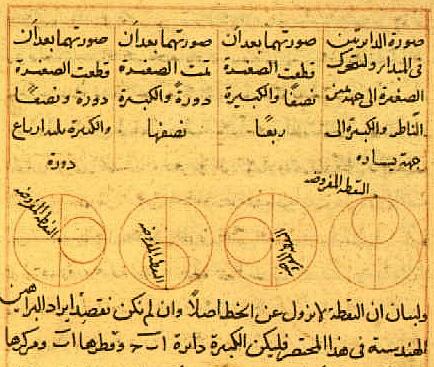
al-Biruni's explanation of the phases of the moon

Astronomy became a major discipline within Islamic science. Astronomers devoted effort both towards understanding the nature of the cosmos and to practical purposes. One application involved determining the Qibla, the direction to face during prayer. Another was astrology, predicting events affecting human life and selecting suitable times for actions such as going to war or founding a city.[12] Al-Battani (850–922) accurately determined the length of the solar year. He contributed to the Tables of Toledo, used by astronomers to predict the movements of the sun, moon and planets across the sky. Copernicus (1473–1543) later used some of Al-Battani's astronomic tables.[13]

Al-Zarqali (1028–1087) developed a more accurate astrolabe, used for centuries afterwards. He constructed a water clock in Toledo, discovered that the Sun's apogee moves slowly relative to the fixed stars, and obtained a good estimate of its motion[14] for its rate of change.[15] Nasir al-Din al-Tusi (1201–1274) wrote an important revision to Ptolemy's 2nd-century celestial model. When Tusi became Helagu's astrologer, he was given an observatory and gained access to Chinese techniques and observations. He developed trigonometry as a separate field, and compiled the most accurate astronomical tables available up to that time.[16]

Botany and agronomy

[edit]
Quince, cypress, and sumac trees, in Zakariya al-Qazwini's 13th century Wonders of Creation

The study of the natural world extended to a detailed examination of plants. The work done proved directly useful in the unprecedented growth of pharmacology across the Islamic world.[17] Al-Dinawari (815–896) popularised botany in the Islamic world with his six-volume Kitab al-Nabat (Book of Plants). Only volumes 3 and 5 have survived, with part of volume 6 reconstructed from quoted passages. The surviving text describes 637 plants in alphabetical order from the letters sin to ya, so the whole book must have covered several thousand kinds of plants. Al-Dinawari described the phases of plant growth and the production of flowers and fruit. The thirteenth century encyclopedia compiled by Zakariya al-Qazwini (1203–1283) – ʿAjā'ib al-makhlūqāt (The Wonders of Creation) – contained, among many other topics, both realistic botany and fantastic accounts. For example, he described trees which grew birds on their twigs in place of leaves, but which could only be found in the far-distant British Isles.[18][17][19] The use and cultivation of plants was documented in the 11th century by Muhammad bin Ibrāhīm Ibn Bassāl of Toledo in his book Dīwān al-filāha (The Court of Agriculture), and by Ibn al-'Awwam al-Ishbīlī (also called Abū l-Khayr al-Ishbīlī) of Seville in his 12th century book Kitāb al-Filāha (Treatise on Agriculture). Ibn Bassāl had travelled widely across the Islamic world, returning with a detailed knowledge of agronomy that fed into the Arab Agricultural Revolution. His practical and systematic book describes over 180 plants and how to propagate and care for them. It covered leaf- and root-vegetables, herbs, spices and trees.[20]

Geography and cartography

[edit]
Surviving fragment of the first World Map of Piri Reis (1513)

The spread of Islam across Western Asia and North Africa encouraged an unprecedented growth in trade and travel by land and sea as far away as Southeast Asia, China, much of Africa, Scandinavia and even Iceland. Geographers worked to compile increasingly accurate maps of the known world, starting from many existing but fragmentary sources.[21] Abu Zayd al-Balkhi (850–934), founder of the Balkhī school of cartography in Baghdad, wrote an atlas called Figures of the Regions (Suwar al-aqalim).[22] Al-Biruni (973–1048) measured the radius of the Earth using a new method. It involved observing the height of a mountain at Nandana (now in Pakistan).[23] Al-Idrisi (1100–1166) drew a map of the world for Roger, the Norman King of Sicily (ruled 1105–1154). He also wrote the Tabula Rogeriana (Book of Roger), a geographic study of the peoples, climates, resources and industries of the whole of the world known at that time.[24] The Ottoman admiral Piri Reis (c. 1470–1553) made a map of the New World and West Africa in 1513. He made use of maps from Greece, Portugal, Muslim sources, and perhaps one made by Christopher Columbus. He represented a part of a major tradition of Ottoman cartography.[25]

Mathematics

[edit]
A page from al-Khwarizmi's Algebra

Islamic mathematicians gathered, organised and clarified the mathematics they inherited from ancient Egypt, Greece, India, Mesopotamia and Persia, and went on to make innovations of their own. Islamic mathematics covered algebra, geometry and arithmetic. Algebra was mainly used for recreation: it had few practical applications at that time. Geometry was studied at different levels. Some texts contain practical geometrical rules for surveying and for measuring figures. Theoretical geometry was a necessary prerequisite for understanding astronomy and optics, and it required years of concentrated work. Early in the Abbasid caliphate (founded 750), soon after the foundation of Baghdad in 762, some mathematical knowledge was assimilated by al-Mansur's group of scientists from the pre-Islamic Persian tradition in astronomy. Astronomers from India were invited to the court of the caliph in the late eighth century; they explained the rudimentary trigonometrical techniques used in Indian astronomy. Ancient Greek works such as Ptolemy's Almagest and Euclid's Elements were translated into Arabic. By the second half of the ninth century, Islamic mathematicians were already making contributions to the most sophisticated parts of Greek geometry. Islamic mathematics reached its apogee in the Eastern part of the Islamic world between the tenth and twelfth centuries. Most medieval Islamic mathematicians wrote in Arabic, others in Persian.[26][27][28]

Omar Khayyam's "Cubic equation and intersection of conic sections"

Al-Khwarizmi (8th–9th centuries) was instrumental in the adoption of the Hindu–Arabic numeral system and the development of algebra, introduced methods of simplifying equations, and used Euclidean geometry in his proofs.[29][30] He was the first to treat algebra as an independent discipline in its own right,[31] and presented the first systematic solution of linear and quadratic equations.[32]: 14  Ibn Ishaq al-Kindi (801–873) worked on cryptography for the Abbasid Caliphate,[33] and gave the first known recorded explanation of cryptanalysis and the first description of the method of frequency analysis.[34][35] Avicenna (c. 980–1037) contributed to mathematical techniques such as casting out nines.[36] Thābit ibn Qurra (835–901) calculated the solution to a chessboard problem involving an exponential series.[37] Al-Farabi (c. 870–950) attempted to describe, geometrically, the repeating patterns popular in Islamic decorative motifs in his book Spiritual Crafts and Natural Secrets in the Details of Geometrical Figures.[38] Omar Khayyam (1048–1131), known in the West as a poet, calculated the length of the year to within 5 decimal places, and found geometric solutions to all 13 forms of cubic equations, developing some quadratic equations still in use.[39] Jamshīd al-Kāshī (c. 1380–1429) is credited with several theorems of trigonometry, including the law of cosines, also known as Al-Kashi's Theorem. He has been credited with the invention of decimal fractions, and with a method like Horner's to calculate roots. He calculated π correctly to 17 significant figures.[40]

Sometime around the seventh century, Islamic scholars adopted the Hindu–Arabic numeral system, describing their use in a standard type of text fī l-ḥisāb al hindī, (On the numbers of the Indians). A distinctive Western Arabic variant of the Eastern Arabic numerals began to emerge around the 10th century in the Maghreb and Al-Andalus (sometimes called ghubar numerals, though the term is not always accepted), which are the direct ancestor of the modern Arabic numerals used throughout the world.[41]

Medicine

[edit]
A coloured illustration from Mansur's Anatomy, c. 1450

Islamic society paid careful attention to medicine, following a hadith enjoining the preservation of good health. Its physicians inherited knowledge and traditional medical beliefs from the civilisations of classical Greece, Rome, Syria, Persia and India. These included the writings of Hippocrates such as on the theory of the four humours, and the theories of Galen.[42] al-Razi (c. 865–925) identified smallpox and measles, and recognized fever as a part of the body's defenses. He wrote a 23-volume compendium of Chinese, Indian, Persian, Syriac and Greek medicine. al-Razi questioned the classical Greek medical theory of how the four humours regulate life processes. He challenged Galen's work on several fronts, including the treatment of bloodletting, arguing that it was effective.[43] al-Zahrawi (936–1013) was a surgeon whose most important surviving work is referred to as al-Tasrif (Medical Knowledge). It is a 30-volume set mainly discussing medical symptoms, treatments, and pharmacology. The last volume, on surgery, describes surgical instruments, supplies, and pioneering procedures.[44] Avicenna (c. 980–1037) wrote the major medical textbook, The Canon of Medicine.[36] Ibn al-Nafis (1213–1288) wrote an influential book on medicine; it largely replaced Avicenna's Canon in the Islamic world. He wrote commentaries on Galen and on Avicenna's works. One of these commentaries, discovered in 1924, described the circulation of blood through the lungs.[45][46]

Optics and ophthalmology

[edit]
The eye according to Hunayn ibn Ishaq, c. 1200
Ibn al-Haytham (Alhazen), (965–1039 Iraq). A polymath, sometimes considered the father of modern scientific methodology due to his emphasis on experimental data and on the reproducibility of its results.[47][48]

Optics developed rapidly in this period. By the ninth century, there were works on physiological, geometrical and physical optics. Topics covered included mirror reflection. Hunayn ibn Ishaq (809–873) wrote the book Ten Treatises on the Eye; this remained influential in the West until the 17th century.[49] Abbas ibn Firnas (810–887) developed lenses for magnification and the improvement of vision.[50] Ibn Sahl (c. 940–1000) discovered the law of refraction known as Snell's law. He used the law to produce the first Aspheric lenses that focused light without geometric aberrations.[51][52]

In the eleventh century Ibn al-Haytham (Alhazen, 965–1040) rejected the Greek ideas about vision, whether the Aristotelian tradition that held that the form of the perceived object entered the eye (but not its matter), or that of Euclid and Ptolemy which held that the eye emitted a ray. Al-Haytham proposed in his Book of Optics that vision occurs by way of light rays forming a cone with its vertex at the center of the eye. He suggested that light was reflected from different surfaces in different directions, thus causing objects to look different.[53][54][55][56] He argued further that the mathematics of reflection and refraction needed to be consistent with the anatomy of the eye.[57] He was also an early proponent of the scientific method, the concept that a hypothesis must be proved by experiments based on confirmable procedures or mathematical evidence, five centuries before Renaissance scientists.[58][59][60][61][62][63]

Pharmacology

[edit]
Ibn Sina teaching the use of drugs. 15th-century Great Canon of Avicenna

Advances in botany and chemistry in the Islamic world encouraged developments in pharmacology. Muhammad ibn Zakarīya Rāzi (Rhazes) (865–915) promoted the medical uses of chemical compounds. Abu al-Qasim al-Zahrawi (Abulcasis) (936–1013) pioneered the preparation of medicines by sublimation and distillation. His Liber servitoris provides instructions for preparing "simples" from which were compounded the complex drugs then used. Sabur Ibn Sahl (died 869) was the first physician to describe a large variety of drugs and remedies for ailments. Al-Muwaffaq, in the 10th century, wrote The foundations of the true properties of Remedies, describing chemicals such as arsenious oxide and silicic acid. He distinguished between sodium carbonate and potassium carbonate, and drew attention to the poisonous nature of copper compounds, especially copper vitriol, and also of lead compounds. Al-Biruni (973–1050) wrote the Kitab al-Saydalah (The Book of Drugs), describing in detail the properties of drugs, the role of pharmacy and the duties of the pharmacist. Ibn Sina (Avicenna) described 700 preparations, their properties, their mode of action and their indications. He devoted a whole volume to simples in The Canon of Medicine. Works by Masawaih al-Mardini (c. 925–1015) and by Ibn al-Wafid (1008–1074) were printed in Latin more than fifty times, appearing as De Medicinis universalibus et particularibus by Mesue the Younger (died 1015) and as the Medicamentis simplicibus by Abenguefit (c. 997 – 1074) respectively. Peter of Abano (1250–1316) translated and added a supplement to the work of al-Mardini under the title De Veneris. Ibn al-Baytar (1197–1248), in his Al-Jami fi al-Tibb, described a thousand simples and drugs based directly on Mediterranean plants collected along the entire coast between Syria and Spain, for the first time exceeding the coverage provided by Dioscorides in classical times.[64][17] Islamic physicians such as Ibn Sina described clinical trials for determining the efficacy of medical drugs and substances.[65]

Physics

[edit]
Self trimming lamp in Ahmad ibn Mūsā ibn Shākir's treatise on mechanical devices, c. 850

The fields of physics studied in this period, apart from optics and astronomy which are described separately, are aspects of mechanics: statics, dynamics, kinematics and motion. In the sixth century John Philoponus (c. 490 – c. 570) rejected the Aristotelian view of motion. He argued instead that an object acquires an inclination to move when it has a motive power impressed on it. In the eleventh century Ibn Sina adopted roughly the same idea, namely that a moving object has force which is dissipated by external agents like air resistance.[66] Ibn Sina distinguished between "force" and "inclination" (mayl); he claimed that an object gained mayl when the object is in opposition to its natural motion. He concluded that continuation of motion depends on the inclination that is transferred to the object, and that the object remains in motion until the mayl is spent. He also claimed that a projectile in a vacuum would not stop unless it is acted upon. That view accords with Newton's first law of motion, on inertia.[67] As a non-Aristotelian suggestion, it was essentially abandoned until it was described as "impetus" by Jean Buridan (c. 1295–1363), who was likely influenced by Ibn Sina's Book of Healing.[66]

In the Shadows, Abū Rayḥān al-Bīrūnī (973–1048) describes non-uniform motion as the result of acceleration.[68] Ibn-Sina's theory of mayl tried to relate the velocity and weight of a moving object, a precursor of the concept of momentum.[69] Aristotle's theory of motion stated that a constant force produces a uniform motion; Abu'l-Barakāt al-Baghdādī (c. 1080 – 1164/5) disagreed, arguing that velocity and acceleration are two different things, and that force is proportional to acceleration, not to velocity.[70]

The Banu Musa brothers, Jafar-Muhammad, Ahmad and al-Hasan (c. early 9th century) invented automated devices described in their Book of Ingenious Devices.[71][72][73] Advances on the subject were also made by al-Jazari and Ibn Ma'ruf.

Zoology

[edit]
Page from the Kitāb al-Hayawān (Book of Animals) by Al-Jahiz. Ninth century

Many classical works, including those of Aristotle, were transmitted from Greek to Syriac, then to Arabic, then to Latin in the Middle Ages. Aristotle's zoology remained dominant in its field for two thousand years.[74] The Kitāb al-Hayawān (كتاب الحيوان, English: Book of Animals) is a 9th-century Arabic translation of History of Animals: 1–10, On the Parts of Animals: 11–14,[75] and Generation of Animals: 15–19.[76][77]

The book was mentioned by Al-Kindī (died 850), and commented on by Avicenna (Ibn Sīnā) in his The Book of Healing. Avempace (Ibn Bājja) and Averroes (Ibn Rushd) commented on and criticised On the Parts of Animals and Generation of Animals.[78]

Significance

[edit]

Muslim scientists helped in laying the foundations for an experimental science with their contributions to the scientific method and their empirical, experimental and quantitative approach to scientific inquiry.[79] In a more general sense, the positive achievement of Islamic science was simply to flourish, for centuries, in a wide range of institutions from observatories to libraries, madrasas to hospitals and courts, both at the height of the Islamic golden age and for some centuries afterwards. It did not lead to a Scientific Revolution like that in Early modern Europe, but such external comparisons are probably to be rejected as imposing "chronologically and culturally alien standards" on a successful medieval culture.[2]

See also

[edit]

References

[edit]

Notes

[edit]

Sources

[edit]

Further reading

[edit]
[edit]
Revisions and contributorsEdit on WikipediaRead on Wikipedia
from Grokipedia
Science in the medieval Islamic world, spanning roughly the 8th to 14th centuries CE during the , represented a vibrant era of intellectual and innovation in fields such as , astronomy, , and chemistry, , and , , and physics and , where scholars translated, preserved, and expanded upon , Indian, Persian, and other traditions. This period saw the establishment of major centers of learning, including the in founded around 832 CE under the , which facilitated systematic translations of classical texts into Arabic and fostered original research supported by royal patronage. Islamic scientists not only safeguarded knowledge that would later influence the European Renaissance but also made pioneering contributions that shaped modern disciplines, driven by a cultural emphasis on empirical and rational compatible with religious principles. Overall, the medieval Islamic world's scientific enterprise was characterized by a synthesis of diverse intellectual heritages, institutional support from caliphs and sultans, and a commitment to both theoretical and applied knowledge, profoundly influencing subsequent global developments in science and technology.

Historical Context

Periodization and Definitions

The medieval Islamic world, in the context of scientific development, refers to the period spanning approximately the 8th to the 14th centuries CE, beginning with the establishment of the and extending through various regional dynasties, encompassing a vast geographical expanse from (Islamic Spain) in the west to and parts of the in the east. This era is characterized by the integration of diverse cultural influences within Muslim-ruled societies, where scientific pursuits flourished under caliphal patronage and institutional support. A key distinction must be made between "Islamic science," which denotes the rational and empirical investigations into natural phenomena conducted by Muslim scholars or within Islamic societies—encompassing fields like , astronomy, and —and the "sciences of Islam," which include religious disciplines such as (Islamic ), (), and () focused on scriptural interpretation and legal reasoning. Islamic science emphasized secular, rational grounded in observation, experimentation, and logical deduction, often drawing on Greek, Indian, and Persian traditions while aligning with Islamic ethical principles, thereby prioritizing conceptual and practical advancements over purely doctrinal concerns. The development of Islamic science unfolded in distinct phases: a formative phase marked by initial translations and foundational syntheses; a classical or (roughly 9th–13th centuries CE) of peak innovation and systematization; and a post-classical phase (from the 13th century onward) featuring regional variations, critical refinements, and continuations in centers like the Ottoman domains. Pivotal events delineate these boundaries, including the founding of in 762 CE by Abbasid Caliph , which transformed the city into a preeminent hub for scholarly exchange and scientific inquiry. The period's conventional endpoint is often associated with the Mongol sack of in 1258 CE or the Ottoman conquest of in 1453 CE, symbolizing transitions in the Islamic world, though scientific activity persisted in evolving forms.

Influences from Pre-Islamic Traditions

The medieval Islamic scientific tradition drew heavily from Greco-Roman sources, which were preserved and transmitted primarily through Syriac Christian communities in the pre-Islamic Near East. Syriac scholars, including Nestorians and Monophysites, translated key Greek texts into Syriac as early as the 5th and 6th centuries, laying the groundwork for later Arabic adaptations. For instance, Sergius of Reshʿayna (d. 536 CE), a Monophysite physician, rendered approximately 30 treatises by Galen into Syriac, facilitating the integration of Hippocratic medicine's emphasis on humoral theory and empirical observation into emerging Islamic medical practices. Similarly, Nestorian scholars at the Academy of Gundishapur in Sasanian Persia safeguarded Aristotelian logic from the Organon and Ptolemaic astronomy from the Almagest, providing foundational texts on deductive reasoning and geocentric models that influenced early Muslim philosophers like al-Kindi. Persian Sasanian traditions contributed administrative sciences, medicine, and astronomical knowledge that shaped Islamic scholarship. The Sasanian Empire's Academy of Gundishapur served as a major hub for translating Greek and Indian works into (Pahlavi), including astrological treatises like the Zij-i-Shah and medical texts emphasizing diet and . Early Sasanian rulers, such as (r. 224–242 CE) and (r. 240–270 CE), commissioned these translations of Greek and astronomical and astrological materials, preserving Ptolemaic and Hellenistic methods that later informed Abbasid observatories. This Sasanian legacy in bureaucratic and scientific organization, including calendar reforms and , was directly adopted by Muslim administrators and healers post-conquest. Indian influences introduced innovative mathematical and astronomical concepts, notably the decimal system and positional numerals, which revolutionized Islamic computation. Originating in works like Brahmagupta's Brahmasphuta-Siddhanta (7th century CE), the concept of zero as a placeholder (termed sunya in , becoming sifr in ) and the base-10 decimal notation were transmitted to the Islamic world around the 8th century via translations at the behest of Caliph . By the 9th century, ibn Musa incorporated these into his treatise On the Calculation with Hindu Numerals, standardizing the system across the Islamic realm and enabling advanced algebra and astronomy. Indian astronomical tables, or Siddhantas, provided methods for planetary calculations, influencing texts like al-Khwarizmi's Zij al-Sindhind and blending with Ptolemaic models to create hybrid Islamic zijes. Pre-Islamic Arabian knowledge, rooted in practices, contributed practical foundations in through local craftsmanship. herbalism formed the basis of early Arabian , utilizing desert plants for remedies such as honey for and black seed for , as documented in Prophetic traditions that integrated these with incoming Greek and Persian systems. This empirical approach to emphasized natural observation, influencing later compendia like al-Tabari's Firdaws al-Hikmah. These indigenous elements ensured that Islamic science was not merely derivative but synthesized with local environmental knowledge.

The Translation Movement

The Translation Movement, a systematic endeavor under the Abbasid Caliphate, involved the large-scale rendering of scientific and philosophical texts from Greek, Syriac, Persian, and Indian languages into Arabic, peaking from the late 8th to the 10th century CE. This effort began in earnest during the reign of Caliph al-Mansur (r. 754–775 CE) and intensified under his successors, particularly Caliph al-Ma'mun (r. 813–833 CE), who established the Bayt al-Hikma (House of Wisdom) around 815 CE in Baghdad as a central hub for translation, scholarship, and research. The movement's institutional support transformed Baghdad into a nexus of intellectual activity, where translators worked collaboratively to preserve and adapt ancient knowledge. Key figures drove this initiative, including (d. 873 CE), a prolific translator who rendered over 129 works of into Syriac and , alongside texts by and Dioscorides, often supervising revisions for accuracy. Jewish scholars, such as Sahl ibn , also played a vital role in translating philosophical and scientific texts. Another prominent scholar, Thabit ibn Qurra (d. 901 CE), contributed translations in astronomy and mathematics, including Ptolemy's , while also authoring commentaries on . These individuals, many of whom were multilingual , , or from the Nestorian and Jacobite communities, bridged linguistic divides through methodical processes that frequently used Syriac as an intermediary language before finalizing in . Translation methods emphasized precision and iteration, with teams of translators, scribes, and revisers producing multiple versions of texts to refine interpretations; for instance, Euclid's Elements was first translated by al-Hajjaj ibn Matar around 830 CE, later revised by others. incentivized quality through generous compensation, such as Caliph al-Ma'mun's policy of paying translators the weight of the translated book in gold, which reportedly led to the use of thicker to increase earnings, and monthly salaries like the 500 dinars provided by the Banu Musa brothers to in-house experts. The introduction of paper-making technology, acquired from Chinese captives after the in 751 CE, revolutionized manuscript production by replacing costly and enabling widespread copying in Baghdad's burgeoning paper markets. The movement's outcomes included the formation of a cohesive scientific corpus that integrated diverse traditions, facilitating subsequent Islamic innovations; notable translations encompassed Ptolemy's (by al-Hajjaj ibn Matar and later Thabit ibn Qurra) for astronomy and Euclid's Elements for mathematics, making these foundational works accessible to Arabic-speaking scholars. This corpus not only preserved ancient knowledge but also spurred a culture that influenced global intellectual exchange.

Institutions and Patronage

Major Centers of Learning

The , or , in served as a pivotal institution during the , functioning as a comprehensive , astronomical , and for translations and scholarly research from the early 9th century onward. Established under Caliph (r. 786–809 CE) and expanded by (r. 813–833 CE), it centralized the collection and study of knowledge from Greek, Persian, Indian, and Syriac sources, employing scholars to translate and advance works in , astronomy, , and . The became one of the largest repositories of knowledge in the world at the time, serving as a hub for intellectual collaboration supported by caliphal patronage. Beyond Baghdad, other major centers emerged across the Islamic world, each integrating facilities for education and research tailored to regional strengths. In , Cordoba's caliphal library under (r. 961–976 CE) exemplified this, amassing around 400,000 volumes through systematic acquisitions and translations, fostering advancements in astronomy, , and amid a vibrant network of over 70 public and private libraries in the city. In , was founded in 970 CE under the Fatimid caliph as a center for promoting Ismaili Shi'i learning, which later evolved into a major Sunni institution for Islamic and sciences. These centers were characterized by the seamless integration of specialized institutions that doubled as sites for and teaching. Libraries, known as maktabat, preserved and disseminated texts across disciplines; observatories, or rasad khana, enabled precise celestial observations and instrument innovation; and hospitals, termed , combined medical treatment with anatomical studies and pharmacological experiments, often staffed by scholar-physicians. This holistic approach facilitated interdisciplinary progress, with facilities like Baghdad's incorporating all three elements to support ongoing scientific inquiry. The prominence of these hubs shifted following the Mongol sack of Baghdad in 1258 CE, when Hulagu Khan's forces destroyed the Bayt al-Hikma and other libraries, reportedly dumping countless manuscripts into the River and causing its waters to run black with ink. This devastation marked the decline of as the preeminent center, prompting the migration of scholars and knowledge eastward to regions like Persia and , where new institutions later flourished.

Role of Caliphs, Scholars, and Social Factors

The caliphs of the played a pivotal role in fostering scientific advancement through generous patronage, particularly during the 8th and 9th centuries CE. (r. 786–809 CE) supported the translation of key Greek and Indian works into Arabic, including Euclid's Elements and medical texts, by establishing libraries and appointing scholars like Al-Fadl ibn Naubakht to oversee collections in . His initiatives laid the groundwork for systematic knowledge acquisition, blending diverse intellectual traditions under state sponsorship. Similarly, his son (r. 813–833 CE) expanded this effort by founding the (Bayt al-Hikma) in , where he commissioned translations of philosophical and scientific texts while promoting rational inquiry through organized scholarly discussions that emphasized empirical methods and debate. 's patronage not only preserved ancient knowledge but also encouraged original research in astronomy and , reflecting his vision of caliphal authority intertwined with intellectual progress. Prominent polymath scholars exemplified the integration of philosophy, science, and medicine, often serving in advisory or medical roles at courts. Al-Kindi (ca. 801–873 CE), known as the "Philosopher of the Arabs," was a pioneering figure who synthesized Greek with Islamic thought, authoring over 260 works on , music, and metaphysics while working under Abbasid patronage in . His emphasis on Aristotelian logic and empirical observation influenced subsequent generations of scientists. Later, Ibn Sina (, 980–1037 CE) served as court physician to Buyid rulers in Persia, where his medical expertise and philosophical writings, including the Canon of Medicine, bridged theoretical and practical knowledge across disciplines. Ibn Sina's role highlighted how scholars navigated political patronage to advance polymathic inquiry, producing enduring texts that shaped global scientific discourse. Social factors, including and institutional endowments, created an environment conducive to scientific collaboration. The dhimmi system granted protected status to non-Muslims, allowing Christian and Jewish scholars like the Nestorian physician (d. 873 CE) to lead translation efforts and contribute to and without persecution. endowments, perpetual charitable trusts under Islamic law, funded libraries, observatories, and educational institutions, ensuring long-term support for scholarship independent of fluctuating political fortunes. Gender participation, though limited, included notable examples such as Fatima al-Fihri, who in 859 CE established the Al-Qarawiyyin and in Fez using her family's , creating one of the earliest centers for open to diverse scholars. Post-10th century challenges arose from sectarian tensions, which disrupted patronage and intellectual freedoms. The rise of the Ash'ari theological school in the , opposing the rationalist Mu'tazilites, shifted emphasis toward orthodoxy and curtailed support for speculative sciences in some regions. Political fragmentation and doctrinal conflicts, including Sunni-Shi'a rivalries, led to reduced caliphal funding and migrations of scholars, contributing to a gradual decline in centralized scientific endeavors by the . These factors, compounded by invasions, fragmented the supportive networks that had earlier propelled Islamic scientific progress.

Fields of Scientific Inquiry

Mathematics

Mathematics in the medieval Islamic world advanced significantly through the synthesis of Greek, Indian, and indigenous traditions, with particular emphasis on and as foundational tools for solving equations and modeling relationships. Scholars developed systematic approaches to linear and quadratic equations, introducing algebraic notation and geometric methods that influenced later European . This period saw the refinement of positional numeral systems and the creation of , enabling precise calculations in various fields. A pivotal contribution came from , whose treatise Kitab al-jabr wa'l-muqabala (The Compendious Book on Calculation by Completion and Balancing), composed around 820 CE, established as a distinct . In this work, al-Khwarizmi classified and provided systematic solutions for linear and quadratic equations, categorizing six types of quadratics and demonstrating methods such as to resolve them geometrically. For instance, to solve an like x2+10x=39x^2 + 10x = 39, he would add 2525 to both sides to form (x+5)2=64(x + 5)^2 = 64, yielding x=3x = 3 after taking square roots (considering the positive root), emphasizing rhetorical rather than symbolic notation. This approach treated as a practical art for balancing unknowns, laying the groundwork for equation-solving techniques. Building on these algebraic foundations, Omar Khayyam (1048–1131 CE) advanced methods for solving cubic equations geometrically, classifying various types and using intersections of conic sections such as parabolas and circles to construct positive roots. His mathematical innovations also contributed to the reform of the Persian calendar into the more accurate Jalali system. Al-Khwarizmi also played a key role in integrating Indian mathematical influences, particularly the decimal positional notation system, which he detailed in his earlier work On the Calculation with Hindu Numerals (c. 825 CE). This system utilized digits 0 through 9 with place values, facilitating efficient arithmetic operations and introducing the zero as a placeholder, a concept derived from Indian sources like Brahmagupta's works. The term "algorithm" itself stems from Latinizations of al-Khwarizmi's name, reflecting his step-by-step procedures (algorismus) for computations, which bridged Indian arithmetic with Islamic scholarship. Trigonometry saw major refinements with Abu Abd Allah Muhammad ibn Jabir ibn Sinan al-Battani (c. 858–929 CE), who enhanced spherical trigonometry in his Zij (astronomical tables). Al-Battani refined the law of sines for spherical triangles, stating that in any spherical triangle, the ratio of the sine of an angle to the sine of the opposite side is constant, improving upon earlier Ptolemaic approximations. He also introduced tangent and cotangent functions, presenting tables for these alongside sines, which allowed for more accurate calculations of angles and arcs; for example, he computed the tangent as the ratio of opposite to adjacent sides in right triangles. These innovations expanded trigonometry beyond chord-based Greek methods, providing tools essential for astronomical applications. Islamic mathematicians further explored indeterminate (Diophantine) equations, seeking integer solutions to equations with multiple variables, building on Greek and Indian precedents. Scholars like (c. 850–930 CE) and al-Karaji (c. 953–1029 CE) developed methods for solving such systems, including quadratic indeterminate forms. (c. 965–1040 CE) contributed geometric proofs to these problems in works like On the Elaboration of the Problems Concerning the Books of , using visual constructions to demonstrate solutions for indeterminate equations of the first degree and plane challenges, emphasizing rigorous deduction over mere computation. These efforts highlighted the interplay between and , with applications briefly noted in astronomical modeling.

Astronomy

Astronomy flourished in the medieval Islamic world as scholars built upon Greek, Indian, and Persian traditions to conduct precise observations, develop sophisticated instruments, and refine cosmological models. This era saw the establishment of dedicated observatories that facilitated systematic data collection, leading to accurate astronomical tables known as . Key contributions included improvements in measuring celestial positions, critiques of established geocentric theories, and innovations in modeling planetary motion, which enhanced the predictive power of astronomy for timekeeping, , and religious purposes. One of the earliest advancements was the refinement of the , a versatile instrument for solving astronomical problems such as determining altitudes and azimuths. In the , Muhammad ibn Ibrahim al-Fazari is credited with constructing the first plane astrolabe in the Islamic world, adapting and improving upon earlier designs to incorporate Islamic prayer times and directions. Later observatories exemplified the scale of these efforts; the 13th-century , founded in 1259 CE under Hulagu Khan and directed by , featured advanced instruments like a large for precise stellar measurements. Theoretical progress included critical examinations of Ptolemaic astronomy. In his work Doubts Concerning Ptolemy (written around 1025–1028 CE), (Alhazen) systematically critiqued inconsistencies in 's geocentric model, particularly the equant mechanism, arguing for a more physically coherent system based on uniform while emphasizing empirical verification. Building on such ideas, introduced the "" in the 13th century, a geometric device comprising two circular motions that produced , resolving Ptolemaic irregularities in planetary paths without violating the principle of uniform circularity. This innovation, detailed in his Tahrir al-Majisti (Commentary on the , ca. 1247 CE), influenced later European astronomers. Astronomical tables, or , synthesized these observations into practical resources. Al-Battani's 9th-century Zij al-Sabi improved calculations of at 54.5 arcseconds per year and determined the solar year length as 365 days, 5 hours, 46 minutes, and 24 seconds—remarkably close to modern values. These works not only advanced predictive astronomy but also applied mathematical tools like for celestial computations.

Medicine

Medicine in the medieval Islamic world advanced through a synthesis of theoretical knowledge and practical innovations, emphasizing both the Galenic humoral theory and empirical clinical observations. The foundational text, Ibn Sina's (completed in 1025 CE), served as an encyclopedic compendium that organized medical knowledge into five books covering , , , diagnostics, and therapeutics, while integrating the four humors—, , yellow , and black bile—as the basis for understanding disease causation and treatment. Ibn Sina emphasized as the cornerstone of medicine, distinguishing structures like nerves and tendons and advocating for their surgical repair, thereby bridging theoretical frameworks with practical application. Complementing this, Al-Razi's Doubts about Galen (late 9th century CE) critiqued aspects of Galenic theory, particularly the rigid separation of the four humors, by incorporating empirical evidence from patient observations to refine understandings of bodily imbalances and disease processes. Clinical practices were revolutionized by the establishment of bimaristans, specialized hospitals that provided free care and featured dedicated wards for various conditions, including internal diseases, , and contagious illnesses, fostering both treatment and . Al-Razi pioneered measures for infectious diseases, notably in his 910 CE treatise distinguishing from through detailed clinical descriptions of symptoms like patterns and fever progression, marking an early recognition of contagion's role in transmission. These institutions, such as the renowned bimaristan under Al-Razi's direction, implemented isolation protocols that prevented outbreaks, reflecting a practical application of observational data to . Anatomical knowledge progressed despite religious constraints on human dissection, with scholars relying on limited autopsies, animal dissections, and surgical experience to advance understanding of the body. Al-Zahrawi's Kitab al-Tasrif (c. 1000 CE), a 30-volume surgical encyclopedia, detailed over 200 innovative instruments, including tools for and specialized scalpels for precise incisions, elevating from rudimentary procedures to a systematic . His descriptions of techniques like fracture reduction and wound management underscored the integration of empirical trial with inherited Greek knowledge. Theoretical advancements in blended Greek humoral with Islamic empirical methods, where physicians like Al-Razi and Ibn Sina tested hypotheses through repeated observations to modify Galenic principles, such as adjusting humoral balances based on environmental and dietary factors. Precursors to contagion theory emerged in Al-Razi's work, which posited that certain diseases spread via airborne particles or direct contact, challenging purely humoral explanations and laying groundwork for later epidemiological concepts. This empirical refinement ensured that treatments, including brief clinical uses of pharmacological remedies, were tailored to observed outcomes rather than unverified doctrine.

Alchemy and Chemistry

In the medieval Islamic world, (al-kīmiyāʾ) represented a blend of philosophical , mystical elements, and practical experimentation aimed at understanding and transforming substances, gradually evolving toward empirical chemistry. This period marked significant advancements in techniques and theories of , building on Greco-Egyptian and Persian traditions while emphasizing systematic observation. Alchemists sought not only transmutation of base metals into but also the preparation of elixirs for purification and , with methods that laid foundational principles for modern chemistry. A pivotal figure was (c. 721–815 CE), often called the father of chemistry, whose extensive corpus of over 3,000 treatises detailed innovative processes such as , , and the production of acids. In works like Kitab al-Kimya (Book of Chemistry), Jabir described the of from green vitriol (iron ) through heating and , a method that produced a concentrated form known as oil of vitriol. He also outlined techniques for purifying salts and metals by dissolving them in solutions and allowing controlled , enabling the isolation of purer compounds. These experimental recipes emphasized precise measurements and repeatable procedures, shifting toward a more scientific discipline. Jabir's theoretical framework integrated the classical four elements—earth, air, fire, and water—with the sulfur-mercury hypothesis, positing that all metals formed from varying proportions of (representing combustibility) and mercury (representing fusibility). This theory, elaborated in texts such as Kitab al-Rahma (Book of Mercy), proposed a balance of —hot/cold, wet/dry—to explain substance properties and guide transmutations, supported by detailed recipes for alloys and compounds. He classified substances into categories like spirits (volatile liquids), metals (fusible solids), and stones (non-fusible), facilitating systematic study. The invention of the , a apparatus with a swan-necked condenser, allowed for efficient separation of liquids by points, revolutionizing the purification of alcohols and oils. Later advancements included the isolation of (aqua fortis) around the 10th century by Muhammad ibn Zakariya al-Razi (Rhazes, 865–925 CE), who prepared it by distilling a mixture of , saltpeter, and , yielding a powerful for metals. Al-Razi's Kitab al-Asrar (Book of Secrets) documented this process, highlighting its corrosive properties for and dissolution. Islamic alchemists also conducted limited early experiments with gunpowder-like mixtures, combining saltpeter, , and for incendiary devices, though these were primarily for rather than widespread weaponry until later centuries. These chemical methodologies found brief application in for preparing therapeutic compounds, but their primary impact lay in advancing substance transformation techniques.

Optics

The study of optics in the medieval Islamic world marked a pivotal advancement in understanding light, vision, and , building on Greek foundations while introducing rigorous experimentation. Central to this development was the work of (965–1040 CE), whose Kitāb al-Manāẓir (), completed around 1021 CE, revolutionized the field by emphasizing empirical methods over philosophical speculation. In this seven-volume treatise, Ibn al-Haytham systematically investigated the nature of light rays, their propagation, and interaction with matter, laying the groundwork for modern . Ibn al-Haytham decisively refuted the ancient emission theory of vision, which posited that rays emanate from the eye to "touch" objects, as proposed by and . Through controlled experiments, he demonstrated that vision occurs via intromission, where rays from illuminated objects travel in straight lines and enter the eye, forming an image on the . To illustrate this, he described and utilized the —a darkened room with a small aperture through which projects an inverted image of external objects onto a surface—proving the rectilinear propagation of without reliance on eye-emitted rays. His analysis extended to , where he explored how bends at interfaces between media, providing precursors to by measuring angles of incidence and in various substances like water and glass. Additionally, explained atmospheric optical phenomena, such as rainbows and mirages, attributing them to and dispersion of in varying densities of air and water droplets. In ophthalmic applications, Islamic scholars integrated optical principles with detailed eye . Ibn al-Haytham mapped the eye's , identifying the crystalline humor (lens) as the primary focusing element for vision, and traced the path of through the aqueous and vitreous humors to the . Building on this, Ibn al-Nafis (c. 1210–1288 CE) advanced surgical techniques in his Al-Mujarrab fī al-Kuḥl (The Polished Book on Experimental , 13th century), which included treatments for cataracts by couching or aspiration to displace the clouded lens, informed by optical understanding of transmission. Optical instruments also progressed, with Ibn Sahl (c. 940–1000 CE) detailing burning mirrors and plano-convex lenses in his 984 CE treatise, which concentrated sunlight to ignite objects at focal points, demonstrating principles of reflection and . Ibn al-Haytham further explored these devices, noting the magnifying effects of convex lenses and parabolic mirrors for and enlargement.

Geography and Cartography

Geography and cartography in the medieval Islamic world advanced through systematic compilation of travel accounts, astronomical observations, and inherited classical knowledge, enabling more accurate representations of . Scholars integrated data from explorers, merchants, and astronomers to produce maps and texts that emphasized practical , routes, and regional descriptions, often dividing the into climatic zones for organizational purposes. This era saw the production of influential works that combined textual geography with visual mapping, influencing global cartographic traditions for centuries. A seminal contribution was Muruj al-dhahab wa ma'adin al-jawhar (Meadows of Gold and Mines of Gems), completed by the 10th-century and Al-Mas'udi around 956 CE, which provided detailed accounts of climates, seas, rivers, mountains, and trade routes across the Islamic world and beyond. Al-Mas'udi described the seven climatic zones, drawing from Greek traditions while incorporating his own travels to regions like , Ceylon, , and , and noted the hot, fertile climate of the (East African) coast extending to . His work outlined maritime routes from and Siraf to the island of Qanbalu (likely or Pemba), spanning about 500 farsakhs (approximately 1,415 miles), highlighting dangers like whales and crocodiles along these paths used for to and . In the , Muhammad al-Idrisi's (1154 CE), commissioned by Norman King , represented a pinnacle of Islamic , compiling a divided into 70 rectangular sections that encompassed , , , and parts of the networks. This atlas, also known as Nuzhat al-mushtaq fi ikhtiraq al-afaq (The Book of Roger), featured detailed regional descriptions and was engraved on a large silver disk weighing about 400 pounds, remaining the most accurate for over three centuries due to its integration of contemporary traveler reports and Ptolemaic coordinates. Al-Idrisi's maps accurately depicted coastlines and inland features, including Indian Ocean ports vital for spice and silk trade routes linking , the , , and . Exploration accounts further enriched geographical knowledge, as exemplified by Ibn Battuta's Rihla (completed around 1355 CE), a 14th-century travelogue documenting his 30-year journey covering over 75,000 miles across 44 modern countries from in to in the East. Ibn Battuta's narrative detailed routes through , the , , the , , and the , providing vivid descriptions of societies, economies, and landscapes that informed later maps and trade strategies. His travels, beginning as a pilgrimage from in 1325 CE, included official roles in the and observations of trans-Saharan and maritime commerce. Cartographic methods advanced with the adoption of grids, derived from astronomical positioning techniques, allowing for more precise plotting of locations on both planar and models. The 11th-century polymath pioneered empirical measurement of the Earth's sphericity and size, calculating its radius as approximately 6,340 km—within 1% of the modern value of 6,371 km—by measuring the dip angle of the horizon from a mountain top and using trigonometric formulas assuming a spherical globe. 's approach in works like Al-Qanun al-Mas'udi (c. 1030 CE) supported the integration of celestial data into earthly mapping, enhancing the accuracy of grids used in subsequent Islamic atlases. Regional knowledge compilation included detailed hypotheses on the Nile's sources, with medieval Islamic geographers like Al-Idrisi adopting and refining Ptolemy's theory of dual origins from the Mountains of the Moon (Jabal al-Qamar) in , depicted as snow-capped peaks feeding lakes that birthed the river. These maps showed the flowing northward through cataracts into , influencing representations in works like Al-Khwarizmi's Surat al-Ard (9th century) and later Balkhi school atlases. For the , cartographers produced trade-oriented maps emphasizing monsoon winds and ports, as seen in Al-Idrisi's sections on the region, which accurately outlined routes from to the and beyond, facilitating the exchange of goods like , textiles, and precious stones.

Natural History

In the medieval Islamic world, natural history advanced through systematic studies of and animals, integrating , , and practical applications in . and emerged as key areas, building on translations of Greek and Persian texts while incorporating empirical knowledge from diverse regions. A foundational work in Arabic was Kitāb al-Nabāt (Book of Plants), authored by Abū Ḥanīfah al-Dīnawarī (d. ca. 895 CE) in the . This multi-volume described approximately 637 plant species alphabetically, detailing their physical characteristics, growth patterns, and environmental adaptations, establishing al-Dīnawarī as the founder of systematic Arabic . The book emphasized morphological and drew from regional across Persia and , influencing later herbal compilations. Agronomy benefited from practical manuals that addressed arid climates and . In 11th-century Al-Andalus, Ibn Baṣṣāl of Toledo composed Dīwān al-Filāḥa (The Book of Agriculture), a comprehensive describing 177 plant species and advocating advanced techniques such as to maintain and systems to optimize water use in . This work promoted sustainable practices, including soil preparation and seasonal planting, which enhanced yields in Mediterranean agriculture. Innovations in included the widespread refinement of qanāt systems—subterranean aqueducts that tapped aquifers to deliver via to surface canals—enabling cultivation in arid zones from Persia to during the Islamic period. In , of crops and livestock, such as hybridizing fruit varieties and improving animal strains for resilience, further boosted productivity and diversified produce like olives and . Some botanical texts featured herbaria-style illustrations to depict plant structures accurately, facilitating identification and study. Zoological inquiry paralleled these efforts, with classifications and behavioral observations forming the core of animal studies. Al-Jāḥiẓ (ca. 776–868 CE), a scholar from , produced Kitāb al-Ḥayawān (Book of Animals) in the , a seven-volume covering over 350 animal through anecdotes, proverbs, and scientific descriptions derived from Qur'anic references, pre-Islamic , and direct observation. The work classified animals into categories based on , , and function, while noting adaptive traits such as and environmental responses that prefigured evolutionary concepts. Al-Jāḥiẓ's text delved into behavior, including social hierarchies among and mammals, for survival, and ecological interdependencies like food chains, portraying nature as a dynamic system of struggle and balance. These insights extended to brief discussions of pharmacological uses, such as extracts for preservation or enhancement in contexts, linking and . Overall, such works underscored an empirical approach to , prioritizing observable patterns over purely philosophical speculation.

Physics and Mechanics

In the medieval Islamic world, physics and mechanics advanced through empirical observations and practical engineering, building on Greek foundations while introducing innovations in understanding motion, forces, and mechanical devices. Scholars integrated mathematical precision with experimentation to explain natural phenomena and develop technologies for , timekeeping, and , often driven by the needs of expanding empires and urban centers. These contributions emphasized the interplay between theoretical insights and functional applications, laying groundwork for later European developments. Key theoretical advancements included early concepts of and precise measurements of physical properties. Ibn al-Haytham (c. 965–1040 CE), in his work on and motion, proposed ideas consistent with the principle of , suggesting that a body in motion continues perpetually unless acted upon by an external force, challenging Aristotelian views and influencing subsequent theories of impetus. Complementing this, (973–1048 CE) pioneered accurate determinations of specific gravity for various substances, using a hydrostatic balance to compare weights of equal volumes and a cone-shaped vessel method to calculate by measuring displaced . His results, such as densities for , silver, and gemstones expressed as ratios (e.g., sapphire at approximately 4), enabled distinctions between pure materials and alloys, advancing the "science of gravity" and material science. Engineering applications demonstrated practical mastery of forces and motion, particularly in water management and power generation. In Persia from the CE onward, vertical-axis windmills—known as asbads—harnessed through slit towers with fabric sails on a vertical , generating up to 75 horsepower to grind grain or irrigate fields, as described by 10th-century al-Mas'udi. Adaptations of the for pumps, termed al-mil or water-snail, were widely employed in systems across Egypt, Syria, and , lifting water efficiently from rivers and wells to support agriculture in arid regions. Mechanics reached sophisticated levels with the works of (1136–1206 CE), whose Book of Knowledge of Ingenious Mechanical Devices (1206 CE) cataloged over 100 inventions, including , water clocks, and , emphasizing self-regulating hydraulic systems. 's in a twin-cylinder converted rotary motion to linear, a foundational mechanism for later engines. His , a water-powered featuring an base with moving figures of a , dragon, and phoenix to mark hours via counterweights and pulleys, exemplified through precise timing. , partial circular gears in his water-raising machines, enabled for efficient pumping, predating similar European designs and enhancing mechanical . These devices highlighted the integration of , levers, and to achieve reliable, programmable operations.

Scientific Methods and Philosophy

Empirical Methods and Experimentation

In the medieval Islamic world, empirical methods gained prominence through a synthesis of rational inquiry and systematic , marking a shift toward verifiable knowledge over mere deduction. This approach was influenced by Mu'tazilite , which prioritized reason and to understand divine creation, asserting that of the natural world complemented theological principles. Scholars like those in the Mu'tazila school advocated for testing hypotheses against sensory data, fostering an environment where experimentation became integral to scientific progress across disciplines. A cornerstone of this empirical tradition was the articulated by (Alhazen) in his Kitab al-Manazir (), composed around 1021 CE. He outlined a cyclical process involving problem identification, hypothesis formulation, experimentation under controlled conditions, and verification through repeated trials, explicitly rejecting untested ancient authorities like when observations contradicted them. This methodology emphasized the need for precise instrumentation, such as cameras obscura and pinhole devices, to measure light refraction and reflection, ensuring reproducibility and minimizing subjective bias. Ibn al-Haytham's framework extended beyond , influencing broader scientific inquiry by establishing experimentation as a tool for hypothesis falsification and refinement. In medicine, Abu Bakr al-Razi (Rhazes) applied empirical rigor through early forms of clinical trials in the 9th-10th centuries, comparing treatments via case-control methods to assess efficacy. For instance, in Al-Hawi, he conducted a case-control experiment on meningitis, applying venesection to one group while leaving another untreated, to verify treatment outcomes based on observed results. He also distinguished smallpox from measles through detailed documentation of symptoms across numerous patients, identifying patterns via clinical observations to guide therapeutic interventions like bloodletting or herbal remedies. Similarly, in astronomy, al-Battani (Albategnius) conducted over four decades of observations from 878 to 918 CE at Raqqa, refining Ptolemaic models by systematically recording planetary and stellar positions, correcting errors through iterative measurements with astrolabes and quadrants. His Zij (astronomical tables) incorporated error analysis by averaging multiple sightings to reduce inaccuracies, achieving precisions like a solar year length of 365 days, 5 hours, 46 minutes, and 24 seconds—more accurate than Ptolemy's by about 10 minutes. Alchemy further exemplified controlled experimentation, with (Geber) in the 8th-9th centuries pioneering laboratory techniques like and under standardized conditions to investigate substance transformations. works, such as the Kitab al-Kimya, stressed quantitative measurements of ingredients and repeatable procedures to classify chemicals and predict reactions, laying groundwork for empirical chemistry by emphasizing balance () in compositions. These innovations in and data verification underscored a commitment to empirical validation, distinguishing medieval Islamic science through its emphasis on testable, observational knowledge.

Classification Systems and Encyclopedias

In the medieval Islamic world, scholars adapted and expanded Aristotelian frameworks to organize scientific knowledge, distinguishing between theoretical sciences—encompassing , (physics), and metaphysics—and practical sciences, which included , , and . This adaptation emphasized the hierarchy of disciplines, with serving as a foundational tool for understanding both natural and rational phenomena, while natural sciences focused on observable change and motion in the physical world. Such classifications facilitated interdisciplinary connections, allowing astronomers to draw on and physicians to integrate physics with . Al-Farabi (d. 950 CE), often called the "Second Teacher" after , provided one of the earliest comprehensive classifications in his Iḥṣāʾ al-ʿulūm (Enumeration of the Sciences), dividing knowledge into eight primary categories: six theoretical (including arithmetic, , , astronomy, , and under ; physics and metaphysics) and two practical (civic and political sciences). His system integrated Aristotelian logic as an instrumental tool () to underpin all sciences, promoting a structured progression from abstract mathematical principles to empirical natural investigations. Building on this foundation, Ibn Sina (Avicenna, d. 1037 CE) further refined the integration of Aristotle's ten categories—such as substance, quantity, quality, and relation—into a cohesive philosophical and scientific framework in works like Al-Shifāʾ (The Cure). He adapted these categories to classify sciences hierarchically, treating logic as a preparatory discipline that enabled precise definitions across fields, from metaphysics (studying being qua being) to natural sciences (analyzing causes and effects in the material world). This approach emphasized the unity of , where provided demonstrative certainty and natural sciences relied on probabilistic reasoning derived from . Al-Biruni (d. 1048 CE) exemplified interdisciplinary classification through his polymathic works, such as Al-Āthār al-Bāqiya (The Chronology of Ancient Nations), where he categorized sciences by their methodological overlaps, linking chronology and astronomy with geography and anthropology to measure historical and physical phenomena. His classifications prioritized empirical interconnections, treating sciences not in isolation but as mutually reinforcing, with mathematics serving as a bridge to validate historical and natural inquiries. A prominent encyclopedic example is the Rasāʾil Ikhwān al-Ṣafāʾ (Epistles of the ), a 10th-century compilation of 52 treatises authored by an anonymous Ismaili group, organized into four classificatory sections: (14 treatises on arithmetic, , astronomy, and music), natural sciences (17 on matter, plants, animals, and human physiology), rational sciences (10 on and ), and religious sciences (11 on ethics and ). This structure linked disparate fields through Neoplatonic and Pythagorean influences, portraying sciences as stages in a cosmic that unified empirical with spiritual insight. These classification systems had a profound impact on standardizing across the Islamic world and beyond, as Al-Farabi's model influenced subsequent Arabic encyclopedias and was translated into Latin and Hebrew, establishing consistent Arabic terms like ʿilm al-riyāḍiyyāt (mathematical sciences) that persisted in scholarly discourse. By providing shared organizational schemas, they enabled transmission and reduced ambiguity in technical language, fostering a cohesive tradition that integrated Greek heritage with Islamic thought.

Significance and Legacy

Transmission to the West

The transmission of scientific knowledge from the medieval Islamic world to primarily occurred through several key routes during the 12th and 13th centuries, facilitated by political conquests, trade, and scholarly exchanges. In , particularly after the Christian reconquest of Toledo in 1085, the city became a major center for translating Arabic texts into Latin. Gerard of Cremona, working in Toledo from around 1140 until his death in 1187, played a pivotal role by producing over 70 translations, including works on , astronomy, and medicine such as Ptolemy's and al-Khwārizmī's astronomical tables. These efforts were supported by ecclesiastical patronage and the availability of Arabic manuscripts in former Muslim libraries. Another significant pathway was through , which served as a cultural crossroads under Norman rule from the . and other Sicilian centers hosted translations by scholars like (active around 1220) and William of Luna, often under the patronage of Frederick II, who maintained diplomatic ties with Muslim rulers. This route introduced Islamic advancements in , , and , with texts flowing northward to Italian universities. Crusader contacts, though more limited, also contributed; during the 12th and 13th centuries, interactions in the allowed European scholars to acquire Arabic works on and directly from Muslim physicians, as seen in the court of Frederick II, where Muslim scholars were employed. Key texts exemplify this transfer's impact on European mathematics and geometry. In 1202, Leonardo Fibonacci published Liber Abaci, which popularized the Hindu-Arabic numeral system—including zero and positional notation—learned by Fibonacci during his travels in North African Islamic centers like Bugia (modern Béjaïa). This work revolutionized European commerce and calculation by replacing cumbersome Roman numerals. Similarly, Adelard of Bath produced one of the earliest Latin translations of Euclid's Elements around 1120, drawing from Arabic versions that included commentaries by Islamic scholars like al-Hajjāj; Adelard's version, revised multiple times, influenced 12th-century scholastic geometry and natural philosophy. In medicine, the School of Salerno in southern Italy integrated Islamic knowledge from the 11th century onward, with Constantine the African translating key texts like al-Majusi's Complete Book of the Medical Art (known in Latin as Pantegni). This synthesis of Arabic pharmacology, anatomy, and clinical methods, derived from earlier Abbasid translations of Galen and Hippocrates, elevated Salerno as Europe's first organized medical school and shaped European practices until the 13th century. Astronomy saw profound influence later, as Nicolaus Copernicus in his 1543 De revolutionibus employed geometric models resembling the "Tusi couple"—a device for planetary motion oscillation developed by Nasir al-Din al-Tusi in 13th-century Persia—to resolve inconsistencies in Ptolemaic theory. A later catalyst was the fall of Constantinople in 1453 to the Ottomans, which prompted Byzantine scholars to flee westward, carrying manuscripts that included -Arabic hybrids preserving Islamic astronomical innovations. One such manuscript, containing al-Tusi's models in a Greek adaptation, reached Italian libraries and likely informed astronomers like Copernicus during his studies in and . This event accelerated the influx of scientific texts, bridging medieval Islamic legacies with the emerging European .

Impact on Modern Science

The medieval Islamic scientific tradition has been increasingly recognized in modern as a foundational precursor to the European , particularly through its emphasis on empirical observation and experimentation. Ibn al-Haytham's (c. 1015), which systematically applied controlled experiments to study and vision, established methodological principles that anticipated the inductive approach later championed by in the 17th century. This work influenced European scholars via translations, providing a model for hypothesis testing and replication that bridged ancient Greek ideas with modern scientific inquiry. Similarly, the experimental rigor of figures like in astronomy and physics underscored a commitment to verifiable evidence, contributing to the that enabled the Scientific Revolution's breakthroughs in and . Historiographical perspectives have shifted away from the traditional "decline" , which posited a sharp drop in Islamic scientific productivity after the due to religious conservatism or invasions, toward an emphasis on continuity and resilience. Scholars now highlight sustained intellectual activity, such as the Ottoman Empire's advancements in astronomy and from the 15th to 19th centuries, where institutions like the (1577) and medical madrasas built directly on medieval traditions. Recent analyses demonstrate sustained intellectual activity, challenging the traditional decline and attributing any later lag to geopolitical factors rather than internal decay. This revisionism, supported by archival evidence from Ottoman catalogs, challenges Eurocentric periodizations and underscores ongoing , including derivative yet productive works in and that persisted into the early . Specific legacies of medieval Islamic science permeate modern disciplines, notably in and computing through Al-Khwarizmi's (c. 780–850) introduction of and . His Compendious Book on Calculation by Completion and Balancing (c. 820) provided step-by-step methods for solving equations, with the term "algorithm" deriving from his Latinized name, Algoritmi, and influencing computational theory from the 12th-century European translations onward. In healthcare, the bimaristans—public established from the , such as Baghdad's in 805—introduced models of comprehensive care, including segregated wards, , and free treatment, which informed the development of modern hospital systems worldwide and emphasized holistic . These innovations, integrating , , and , continue to shape frameworks, as seen in the World Health Organization's adoption of integrated care principles. Addressing historiographical gaps, recent has illuminated underrepresented areas like and women's contributions, revealing deeper impacts on contemporary fields. Al-Jazari's (1136–1206) Book of Knowledge of Ingenious Mechanical Devices pioneered programmable automata and mechanisms, concepts that prefigured modern and but were long marginalized in Western narratives until 20th-century rediscoveries. His designs, such as feedback-controlled water pumps, influenced and human-centered , yet Eurocentric histories often credit later European inventors, overlooking this continuity. Likewise, studies on have revealed contributions that challenge male-dominated accounts and inspire modern practices, promoting a more inclusive legacy by integrating gender perspectives into the narrative of Islamic science's enduring influence.

References

Add your contribution
Related Hubs
User Avatar
No comments yet.