


Community hub
Recent from talks
Contribute something
Nothing was collected or created yet.
Pnictogen
View on Wikipedia
| Pnictogens | |||||||||||||||||||||||||||||||||||||||||||||||||||||||||||||||||||||||||||||||||||||||||||||||||||||||||||||||||||||||||||||||||||||||||||||||||||||||||||||||||||||||||||||||||||||||||||||||||||||||||||||||||||||||||||||||||
|---|---|---|---|---|---|---|---|---|---|---|---|---|---|---|---|---|---|---|---|---|---|---|---|---|---|---|---|---|---|---|---|---|---|---|---|---|---|---|---|---|---|---|---|---|---|---|---|---|---|---|---|---|---|---|---|---|---|---|---|---|---|---|---|---|---|---|---|---|---|---|---|---|---|---|---|---|---|---|---|---|---|---|---|---|---|---|---|---|---|---|---|---|---|---|---|---|---|---|---|---|---|---|---|---|---|---|---|---|---|---|---|---|---|---|---|---|---|---|---|---|---|---|---|---|---|---|---|---|---|---|---|---|---|---|---|---|---|---|---|---|---|---|---|---|---|---|---|---|---|---|---|---|---|---|---|---|---|---|---|---|---|---|---|---|---|---|---|---|---|---|---|---|---|---|---|---|---|---|---|---|---|---|---|---|---|---|---|---|---|---|---|---|---|---|---|---|---|---|---|---|---|---|---|---|---|---|---|---|---|---|---|---|---|---|---|---|---|---|---|---|---|---|---|---|---|
|
| |||||||||||||||||||||||||||||||||||||||||||||||||||||||||||||||||||||||||||||||||||||||||||||||||||||||||||||||||||||||||||||||||||||||||||||||||||||||||||||||||||||||||||||||||||||||||||||||||||||||||||||||||||||||||||||||||
| |||||||||||||||||||||||||||||||||||||||||||||||||||||||||||||||||||||||||||||||||||||||||||||||||||||||||||||||||||||||||||||||||||||||||||||||||||||||||||||||||||||||||||||||||||||||||||||||||||||||||||||||||||||||||||||||||
| ↓ Period | ||||
|---|---|---|---|---|
| 2 |  7 Other nonmetal | |||
| 3 |  15 Other nonmetal | |||
| 4 |  33 Metalloid | |||
| 5 |  51 Metalloid | |||
| 6 |  83 Other metal | |||
| 7 | Moscovium (Mc) 115 other metal | |||
|
Legend
| ||||
A pnictogen[1] (/ˈ(p)nɪktədʒən/; from Ancient Greek πνίγω (pnígō) 'to choke' and -gen 'generator') is any of the chemical elements in group 15 of the periodic table. Group 15 is also known as the nitrogen group or nitrogen family. Group 15 consists of the elements nitrogen (N), phosphorus (P), arsenic (As), antimony (Sb), bismuth (Bi), and moscovium (Mc).
The IUPAC has called it Group 15 since 1988. Before that, in America it was called Group VA, owing to a text by H. C. Deming and the Sargent-Welch Scientific Company, while in Europe it was called Group VB, which the IUPAC had recommended in 1970.[2] (Pronounced "group five A" and "group five B"; "V" is the Roman numeral 5.) In semiconductor physics, it is still usually called Group V.[3] The "five" ("V") in the historical names comes from the "pentavalency" of nitrogen, reflected by the stoichiometry of compounds such as N2O5. They have also been called the pentels.
Characteristics
[edit]Chemical
[edit]Like other groups, the members of this family manifest similar patterns in electron configuration, notably in their valence shells, resulting in trends in chemical behavior.
| Z | Element | Electrons per shell |
|---|---|---|
| 7 | nitrogen | 2, 5 |
| 15 | phosphorus | 2, 8, 5 |
| 33 | arsenic | 2, 8, 18, 5 |
| 51 | antimony | 2, 8, 18, 18, 5 |
| 83 | bismuth | 2, 8, 18, 32, 18, 5 |
| 115 | moscovium | 2, 8, 18, 32, 32, 18, 5
(predicted)
|
This group has the defining characteristic whereby each component element has 5 electrons in their valence shell, that is, 2 electrons in the s sub-shell and 3 unpaired electrons in the p sub-shell. They are therefore 3 electrons shy of filling their valence shell in their non-ionized state. The Russell-Saunders term symbol of the ground state in all elements in the group is 4S3⁄2.
The most important elements of this group to life on Earth are nitrogen (N), which in its diatomic form is the principal component of air, and phosphorus (P), which, like nitrogen, is essential to all known forms of life.
Compounds
[edit]Binary compounds of the group can be referred to collectively as pnictides. Magnetic properties of pnictide compounds span the cases of diamagnetic systems (such as BN or GaN) and magnetically ordered systems (MnSb is paramagnetic at elevated temperatures and ferromagnetic at room temperature); the former compounds are usually transparent and the latter metallic. Other pnictides include the ternary rare-earth (RE) main-group variety of pnictides. These are in the form of REaMbPnc, where M is a carbon group or boron group element and Pn is any pnictogen except nitrogen. These compounds are between ionic and covalent compounds and thus have unusual bonding properties.[4]
These elements are also noted for their stability in compounds due to their tendency to form covalent double bonds and triple bonds. This property of these elements leads to their potential toxicity, most evident in phosphorus, arsenic, and antimony. When these substances react with various chemicals of the body, they create strong free radicals that are not easily processed by the liver, where they accumulate. Paradoxically, this same strong bonding causes nitrogen's and bismuth's reduced toxicity (when in molecules), because these strong bonds with other atoms are difficult to split, creating very unreactive molecules. For example, N2, the diatomic form of nitrogen, is used as an inert gas in situations where using argon or another noble gas would be too expensive.
Formation of multiple bonds is facilitated by their five valence electrons whereas the octet rule permits a pnictogen for accepting three electrons on covalent bonding. Because 5 > 3, it leaves unused two electrons in a lone pair unless there is a positive charge around (like in [NH4]+). When a pnictogen forms only three single bonds, effects of the lone pair typically result in trigonal pyramidal molecular geometry.
Oxidation states
[edit]The light pnictogens (nitrogen, phosphorus, and arsenic) tend to form −3 charges when reduced, completing their octet. When oxidized or ionized, pnictogens typically take an oxidation state of +3 (by losing all three p-shell electrons in the valence shell) or +5 (by losing all three p-shell and both s-shell electrons in the valence shell). However heavier pnictogens are more likely to form the +3 oxidation state than lighter ones due to the s-shell electrons becoming more stabilized.[5]
−3 oxidation state
[edit]Pnictogens can react with hydrogen to form pnictogen hydrides such as ammonia. Going down the group, to phosphane (phosphine), arsane (arsine), stibane (stibine), and finally bismuthane (bismuthine), each pnictogen hydride becomes progressively less stable (more unstable), more toxic, and has a smaller hydrogen-hydrogen angle (from 107.8° in ammonia[6] to 90.48° in bismuthane).[7] (Also, technically, only ammonia and phosphane have the pnictogen in the −3 oxidation state because, for the rest, the pnictogen is less electronegative than hydrogen.)
Crystal solids featuring pnictogens fully reduced include yttrium nitride, calcium phosphide, sodium arsenide, indium antimonide, and even double salts like aluminum gallium indium phosphide. These include III-V semiconductors, including gallium arsenide, the second-most widely used semiconductor after silicon.
+3 oxidation state
[edit]Nitrogen forms a limited number of stable III compounds. Nitrogen(III) oxide can only be isolated at low temperatures, and nitrous acid is unstable. Nitrogen trifluoride is the only stable nitrogen trihalide, with nitrogen trichloride, nitrogen tribromide, and nitrogen triiodide being explosive—nitrogen triiodide being so shock-sensitive that the touch of a feather detonates it (the last three actually feature nitrogen in the -3 oxidation state). Phosphorus forms a +III oxide which is stable at room temperature, phosphorous acid, and several trihalides, although the triiodide is unstable. Arsenic forms +III compounds with oxygen as arsenites, arsenous acid, and arsenic(III) oxide, and it forms all four trihalides. Antimony forms antimony(III) oxide and antimonite but not oxyacids. Its trihalides, antimony trifluoride, antimony trichloride, antimony tribromide, and antimony triiodide, like all pnictogen trihalides, each have trigonal pyramidal molecular geometry.
The +3 oxidation state is bismuth's most common oxidation state because its ability to form the +5 oxidation state is hindered by relativistic properties on heavier elements, effects that are even more pronounced concerning moscovium. Bismuth(III) forms an oxide, an oxychloride, an oxynitrate, and a sulfide. Moscovium(III) is predicted to behave similarly to bismuth(III). Moscovium is predicted to form all four trihalides, of which all but the trifluoride are predicted to be soluble in water. It is also predicted to form an oxychloride and oxybromide in the +III oxidation state.
+5 oxidation state
[edit]For nitrogen, the +5 state is typically serves as only a formal explanation of molecules like N2O5, as the high electronegativity of nitrogen causes the electrons to be shared almost evenly.[clarification needed] Pnictogen compounds with coordination number 5 are hypervalent. Nitrogen(V) fluoride is only theoretical and has not been synthesized. The "true" +5 state is more common for the essentially non-relativistic typical pnictogens phosphorus, arsenic, and antimony, as shown in their oxides, phosphorus(V) oxide, arsenic(V) oxide, and antimony(V) oxide, and their fluorides, phosphorus(V) fluoride, arsenic(V) fluoride, antimony(V) fluoride. They also form related fluoride-anions, hexafluorophosphate, hexafluoroarsenate, hexafluoroantimonate, that function as non-coordinating anions. Phosphorus even forms mixed oxide-halides, known as oxyhalides, like phosphorus oxychloride, and mixed pentahalides, like phosphorus trifluorodichloride. Pentamethylpnictogen(V) compounds exist for arsenic, antimony, and bismuth. However, for bismuth, the +5 oxidation state becomes rare due to the relativistic stabilization of the 6s orbitals known as the inert-pair effect, so that the 6s electrons are reluctant to bond chemically. This causes bismuth(V) oxide to be unstable[8] and bismuth(V) fluoride to be more reactive than the other pnictogen pentafluorides, making it an extremely powerful fluorinating agent.[9] This effect is even more pronounced for moscovium, prohibiting it from attaining a +5 oxidation state.
Other oxidation states
[edit]- Nitrogen forms a variety of compounds with oxygen in which the nitrogen can take on a variety of oxidation states, including +II, +IV, and even some mixed-valence compounds and very unstable +VI oxidation state.
- In hydrazine, diphosphane, and organic derivatives of the two, the nitrogen or phosphorus atoms have the −2 oxidation state. Likewise, diimide, which has two nitrogen atoms double-bonded to each other, and its organic derivatives have nitrogen in the oxidation state of −1.
- Similarly, realgar has arsenic–arsenic bonds, so the arsenic's oxidation state is +II.
- A corresponding compound for antimony is Sb2(C6H5)4, where the antimony's oxidation state is +II.
- Phosphorus has the +1 oxidation state in hypophosphorous acid and the +4 oxidation state in hypophosphoric acid.
- Antimony tetroxide is a mixed-valence compound, where half of the antimony atoms are in the +3 oxidation state, and the other half are in the +5 oxidation state.
- It is expected that moscovium will have an inert-pair effect for both the 7s and the 7p1/2 electrons, as the binding energy of the lone 7p3/2 electron is noticeably lower than that of the 7p1/2 electrons. This is predicted to cause +I to be a common oxidation state for moscovium, although it also occurs to a lesser extent for bismuth and nitrogen.[10]
Physical
[edit]The pnictogens exemplify the transition from nonmetal to metal going down the periodic table: a gaseous diatomic nonmetal (N), two elements displaying many allotropes of varying conductivities and structures (P and As), and then at least two elements that only form metallic structures in bulk (Sb and Bi; probably Mc as well). All the elements in the group are solids at room temperature, except for nitrogen which is gaseous at room temperature. Nitrogen and bismuth, despite both being pnictogens, are very different in their physical properties. For instance, at STP nitrogen is a transparent non-metallic gas, while bismuth is a silvery-white metal.[11]
The densities of the pnictogens increase towards the heavier pnictogens. Nitrogen's density is 0.001251 g/cm3 at STP.[11] Phosphorus's density is 1.82 g/cm3 at STP, arsenic's is 5.72 g/cm3, antimony's is 6.68 g/cm3, and bismuth's is 9.79 g/cm3.[12]
Nitrogen's melting point is −210 °C and its boiling point is −196 °C. Phosphorus has a melting point of 44 °C and a boiling point of 280 °C. Arsenic is one of only two elements to sublimate at standard pressure; it does this at 603 °C. Antimony's melting point is 631 °C and its boiling point is 1587 °C. Bismuth's melting point is 271 °C and its boiling point is 1564 °C.[12]
Nitrogen's crystal structure is hexagonal. Phosphorus's crystal structure is cubic. Arsenic, antimony, and bismuth all have rhombohedral crystal structures.[12]
Nuclear
[edit]All pnictogens up to antimony have at least one stable isotope; bismuth has no stable isotopes, but has a primordial radioisotope with a half-life much longer than the age of the universe (209Bi); and all known isotopes of moscovium are synthetic and highly radioactive. In addition to these isotopes, traces of 13N, 32P, and 33P occur in nature, along with various bismuth isotopes (other than 209Bi) in the decay chains of thorium and uranium.
History
[edit]The nitrogen compound sal ammoniac (ammonium chloride) has been known since the time of the Ancient Egyptians. In the 1760s two scientists, Henry Cavendish and Joseph Priestley, isolated nitrogen from air, but neither realized the presence of an undiscovered element. It was not until several years later, in 1772, that Daniel Rutherford realized that the gas was indeed nitrogen.[13]
The alchemist Hennig Brandt first discovered phosphorus in Hamburg in 1669. Brandt produced the element by heating evaporated urine and condensing the resulting phosphorus vapor in water. Brandt initially thought that he had discovered the Philosopher's Stone, but eventually realized that this was not the case.[13]
Arsenic compounds have been known for at least 5000 years, and the ancient Greek Theophrastus recognized the arsenic minerals called realgar and orpiment. Elemental arsenic was discovered in the 13th century by Albertus Magnus.[13]
Antimony was well known to the ancients. A 5000-year-old vase made of nearly pure antimony exists in the Louvre. Antimony compounds were used in dyes in the Babylonian times. The antimony mineral stibnite may have been a component of Greek fire.[13]
Bismuth was first discovered by an alchemist in 1400. Within 80 years of bismuth's discovery, it had applications in printing and decorated caskets. The Incas were also using bismuth in knives by 1500. Bismuth was originally thought to be the same as lead, but in 1753, Claude François Geoffroy proved that bismuth was different from lead.[13]
Moscovium was successfully produced in 2003 by bombarding americium-243 atoms with calcium-48 atoms.[13]
Names and etymology
[edit]The term "pnictogen" (or "pnigogen") is derived from the ancient Greek word πνίγειν (pnígein) meaning "to choke", referring to the choking or stifling property of nitrogen gas.[14] It can also be used as a mnemonic for the two most common members, P and N. The term "pnictogen" was suggested by the Dutch chemist Anton Eduard van Arkel in the early 1950s. It is also spelled "pnicogen" or "pnigogen". The term "pnicogen" is rarer than the term "pnictogen", and the ratio of academic research papers using "pnictogen" to those using "pnicogen" is 2.5 to 1.[4] It comes from the Greek root πνιγ- (choke, strangle), and thus the word "pnictogen" is also a reference to the Dutch and German names for nitrogen (stikstof and Stickstoff, respectively, "suffocating substance": i.e., substance in air, unsupportive of breathing). Hence, "pnictogen" could be translated as "suffocation maker". The word "pnictide" also comes from the same root.[14]
The name pentels (from Greek πέντε, pénte, five) also at one time stood for this group.[15]
Occurrence
[edit]
Nitrogen makes up 25 parts per million of the Earth's crust, 5 parts per million of soil on average, 100 to 500 parts per trillion of seawater, and 78% of dry air. Most nitrogen on Earth is in nitrogen gas, but some nitrate minerals exist. Nitrogen makes up 2.5% of a typical human by weight.[citation needed]
Phosphorus is 0.1% of the earth's crust, making it the 11th most abundant element. Phosphorus comprises 0.65 parts per million of soil and 15 to 60 parts per billion of seawater. There are 200 Mt of accessible phosphates on earth. Phosphorus makes up 1.1% of a typical human by weight.[13] Phosphorus occurs in minerals of the apatite family, which are the main components of the phosphate rocks.
Arsenic constitutes 1.5 parts per million of the Earth's crust, making it the 53rd most abundant element. The soils hold 1 to 10 parts per million of arsenic, and seawater carries 1.6 parts per billion of arsenic. Arsenic comprises 100 parts per billion of a typical human by weight. Some arsenic exists in elemental form, but most arsenic is found in the arsenic minerals orpiment, realgar, arsenopyrite, and enargite.[13]
Antimony makes up 0.2 parts per million of the earth's crust, making it the 63rd most abundant element. The soils contain 1 part per million of antimony on average, and seawater contains 300 parts per trillion on average. A typical human has 28 parts per billion of antimony by weight. Some elemental antimony occurs in silver deposits.[13]
Bismuth makes up 48 parts per billion of the earth's crust, making it the 70th most abundant element. The soils contain approximately 0.25 parts per million of bismuth, and seawater contains 400 parts per trillion of bismuth. Bismuth most commonly occurs as the mineral bismuthinite, but bismuth also occurs in elemental form or sulfide ores.[13]
Moscovium is produced several atoms at a time in particle accelerators.[13]
Production
[edit]Nitrogen
[edit]Nitrogen can be produced by fractional distillation of air.[16]
Phosphorus
[edit]The principal method for producing phosphorus is to reduce phosphates with carbon in an electric arc furnace.[17]
Arsenic
[edit]Most arsenic is prepared by heating the mineral arsenopyrite in the presence of air. This forms As4O6, from which arsenic can be extracted via carbon reduction. However, it is also possible to make metallic arsenic by heating arsenopyrite at 650 to 700 °C without oxygen.[18]
Antimony
[edit]With sulfide ores, the method by which antimony is produced depends on the amount of antimony in the raw ore. If the ore contains 25% to 45% antimony by weight, then crude antimony is produced by smelting the ore in a blast furnace. If the ore contains 45% to 60% antimony by weight, antimony is obtained by heating the ore, also known as liquidation. Ores with more than 60% antimony by weight are chemically displaced with iron shavings from the molten ore, resulting in impure metal.
If an oxide ore of antimony contains less than 30% antimony by weight, the ore is reduced in a blast furnace. If the ore contains closer to 50% antimony by weight, the ore is instead reduced in a reverberatory furnace.
Antimony ores with mixed sulfides and oxides are smelted in a blast furnace.[19]
Bismuth
[edit]Bismuth minerals do occur, in particular in the form of sulfides and oxides, but it is more economic to produce bismuth as a by-product of the smelting of lead ores or, as in China, of tungsten and zinc ores.[20]
Moscovium
[edit]Moscovium is produced a few atoms at a time in particle accelerators by firing a beam of calcium-48 ions at americium-243 until the nuclei fuse.[21]
Applications
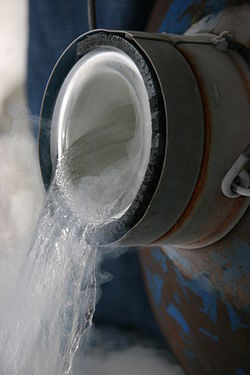
[edit]- Liquid nitrogen is a commonly used cryogenic liquid.[11]
- Nitrogen in the form of ammonia is a nutrient critical to most plants' survival.[11] Synthesis of ammonia accounts for about 1–2% of the world's energy consumption and the majority of reduced nitrogen in food.
- Phosphorus is used in matches and incendiary bombs.[11]
- Phosphate fertilizer helps feed much of the world.[11]
- Arsenic was historically used as a Paris green pigment, but is not used this way anymore due to its extreme toxicity.[11]
- Arsenic in the form of organoarsenic compounds is sometimes used in chicken feed.[11]
- Antimony is alloyed with lead to produce some bullets.[11]
- Antimony currency was briefly used in the 1930s in parts of China, but this use was discontinued as antimony is both soft and toxic.[22]
- Bismuth subsalicylate is the active ingredient in Pepto-Bismol.[11]
- Bismuth chalcogenides are being studied in cancerous mice as a candidate for use in improving radiation therapy in human cancer patients.[23]
- Moscovium is too unstable and scarce to have any known practical application.
Biological role
[edit]Nitrogen is a component of molecules critical to life on earth, such as DNA and amino acids. Nitrates occur in some plants, due to bacteria present in the nodes of the plant. This is seen in leguminous plants such as peas [clarification needed] or spinach and lettuce.[citation needed] A typical 70 kg human contains 1.8 kg of nitrogen.[13]
Phosphorus in the form of phosphates occur in compounds important to life, such as DNA and ATP. Humans consume approximately 1 g of phosphorus per day.[24] Phosphorus is found in foods such as fish, liver, turkey, chicken, and eggs. Phosphate deficiency is a problem known as hypophosphatemia. A typical 70 kg human contains 480 g of phosphorus.[13]
Arsenic promotes growth in chickens and rats, and may be essential for humans in small quantities. Arsenic has been shown to be helpful in metabolizing the amino acid arginine. There are 7 mg of arsenic in a typical 70 kg human.[13]
Antimony is not known to have a biological role. Plants take up only trace amounts of antimony. There are approximately 2 mg of antimony in a typical 70 kg human.[13]
Bismuth is not known to have a biological role. Humans ingest on average less than 20 μg of bismuth per day. There is less than 500 μg of bismuth in a typical 70 kg human.[13]
Moscovium is too unstable to occur in nature or have a known biological role. Moscovium does not typically occur in organisms in any meaningful amount.
Toxicity
[edit]Nitrogen gas is completely non-toxic, but breathing in pure nitrogen gas is deadly, because it causes nitrogen asphyxiation.[22] The build-up of nitrogen bubbles in the blood, such as those that may occur during scuba diving, can cause a condition known as the "bends" (decompression sickness). Many nitrogen compounds such as hydrogen cyanide and nitrogen-based explosives are also highly dangerous.[13]
White phosphorus, an allotrope of phosphorus, is toxic, with 1 mg per kg bodyweight being a lethal dose.[11] White phosphorus usually kills humans within a week of ingestion by attacking the liver. Breathing in phosphorus in its gaseous form can cause an industrial disease called "phossy jaw", which eats away at the jawbone. White phosphorus is also highly flammable. Some organophosphorus compounds can fatally block certain enzymes in the human body.[13]
Elemental arsenic is toxic, as are many of its inorganic compounds; however some of its organic compounds can promote growth in chickens.[11] The lethal dose of arsenic for a typical adult is 200 mg and can cause diarrhea, vomiting, colic, dehydration, and coma. Death from arsenic poisoning typically occurs within a day.[13]
Antimony is mildly toxic.[22] Additionally, wine steeped in antimony containers can induce vomiting.[11] When taken in large doses, antimony causes vomiting in a victim, who then appears to recover before dying several days later. Antimony attaches itself to certain enzymes and is difficult to dislodge. Stibine, or SbH3, is far more toxic than pure antimony.[13]
Bismuth itself is largely non-toxic, although consuming too much of it can damage the liver. Only one person has ever been reported to have died from bismuth poisoning.[13] However, consumption of soluble bismuth salts can turn a person's gums black.[11]
Moscovium is too unstable to conduct any toxicity chemistry.
See also
[edit]- Oxypnictide, including superconductors discovered in 2008
- Iron-based superconductor, ferropnictide and oxypnictide superconductors
References
[edit]- ^ International Union of Pure and Applied Chemistry (2005). Nomenclature of Inorganic Chemistry (IUPAC Recommendations 2005). Cambridge (UK): RSC–IUPAC. ISBN 0-85404-438-8. p. 51. Electronic version.
- ^ Fluck, E (1988). "New notations in the periodic table" (PDF). Pure and Applied Chemistry. 60 (3): 431–6. doi:10.1351/pac198860030431. S2CID 96704008.
- ^ Adachi, S., ed. (2005). Properties of Group-IV, III-V and II-VI Semiconductors. Wiley Series in Materials for Electronic & Optoelectronic Applications. Vol. 15. Hoboken, New Jersey: John Wiley & Sons. Bibcode:2005pgii.book.....A. ISBN 978-0-470-09032-9.
- ^ a b "Pnicogen – Molecule of the Month". University of Bristol
- ^ Boudreaux, Kevin A. "Group 5A — The Pnictogens". Department of Chemistry, Angelo State University, Texas
- ^ Greenwood, N.N.; Earnshaw, A. (1997). Chemistry of the Elements (2nd ed.). Oxford: Butterworth-Heinemann. p. 423. ISBN 0-7506-3365-4.
- ^ Jerzembeck W, Bürger H, Constantin L, Margulès L, Demaison J, Breidung J, Thiel W (2002). "Bismuthine BiH3: Fact or Fiction? High-Resolution Infrared, Millimeter-Wave, and Ab Initio Studies". Angew. Chem. Int. Ed. 41 (14): 2550–2552. doi:10.1002/1521-3773(20020715)41:14<2550::AID-ANIE2550>3.0.CO;2-B. PMID 12203530.
- ^ Scott, Thomas; Eagleson, Mary (1994). Concise encyclopedia chemistry. Walter de Gruyter. p. 136. ISBN 978-3-11-011451-5.
- ^ Greenwood, Norman N.; Earnshaw, Alan (1997). Chemistry of the Elements (2nd ed.). Butterworth-Heinemann. pp. 561–563. doi:10.1016/C2009-0-30414-6. ISBN 978-0-08-037941-8.
- ^ Keller, O. L. Jr.; C. W. Nestor, Jr. (1974). "Predicted properties of the superheavy elements. III. Element 115, Eka-bismuth" (PDF). Journal of Physical Chemistry. 78 (19): 1945. Bibcode:1974JPhCh..78.1945K. doi:10.1021/j100612a015.
- ^ a b c d e f g h i j k l m n Gray, Theodore (2010). The Elements.
- ^ a b c Jackson, Mark (2001), Periodic Table Advanced, BarCharts Publishing, Incorporated, ISBN 1-57222-542-4
- ^ a b c d e f g h i j k l m n o p q r s t u Emsley, John (2011), Nature's Building Blocks, ISBN 978-0-19-960563-7
- ^ a b Girolami, Gregory S. (2009). "Origin of the Terms Pnictogen and Pnictide". Journal of Chemical Education. 86 (10). American Chemical Society: 1200. Bibcode:2009JChEd..86.1200G. doi:10.1021/ed086p1200.
- ^ Holleman, Arnold Frederik; Wiberg, Egon (2001), Wiberg, Nils (ed.), Inorganic Chemistry, translated by Eagleson, Mary; Brewer, William, San Diego/Berlin: Academic Press/De Gruyter, p. 586, ISBN 0-12-352651-5
- ^ Sanderson, R. Thomas (February 1, 2019). "nitrogen – Definition, Symbol, Uses, Properties, Atomic Number, and Facts". Encyclopædia Britannica.
- ^ "phosphorus (chemical element)". Encyclopædia Britannica. 11 October 2019.
- ^ "arsenic (chemical element)". Encyclopædia Britannica. 11 October 2019.
- ^ Butterman, C.; Carlin, Jr., J.F. (2003). Mineral Commodity Profiles: Antimony. United States Geological Survey.
- ^ Bell, Terence. "Metal Profile: Bismuth". About.com. Archived from the original on 5 July 2012.
- ^ Oganessian, Yu Ts; Utyonkov, V K (9 March 2015). "Superheavy Element Research". Reports on Progress in Physics. 78 (3): 3. Bibcode:2015RPPh...78c6301O. doi:10.1088/0034-4885/78/3/036301. PMID 25746203.
- ^ a b c Kean, Sam (2011), The Disappearing Spoon, Transworld, ISBN 978-1-4464-3765-0
- ^ Huang, Jia; Huang, Qiong; Liu, Min; Chen, Qiaohui; Ai, Kelong (February 2022). "Emerging Bismuth Chalcogenides Based Nanodrugs for Cancer Radiotherapy". Frontiers in Pharmacology. 13 844037. doi:10.3389/fphar.2022.844037. PMC 8894845. PMID 35250594.
- ^ "Phosphorus in diet". MedlinePlus. NIH–National Library of Medicine. 9 April 2020.


| International | |
|---|---|
| National | |
| Other | |

Pnictogen
View on GrokipediaCharacteristics
Physical properties
The pnictogen elements display characteristic physical trends as one moves down group 15 of the periodic table, reflecting increasing atomic size and a shift from nonmetallic to metallic character. Atomic radii increase progressively due to the addition of successive electron shells, with covalent radii expanding from 75 pm for nitrogen to 155 pm for bismuth. This enlargement facilitates weaker interatomic bonding in heavier elements, contributing to their more ductile and conductive properties. Electronegativity, which measures an atom's tendency to attract electrons in bonds, decreases from 3.0 for nitrogen to 1.9 for both antimony and bismuth on the Pauling scale, underscoring the transition toward more electropositive behavior in the heavier members.[4] At room temperature, nitrogen exists as a diatomic gas (N₂), while phosphorus is a low-melting solid that exhibits multiple allotropes, including reactive white phosphorus (melting point 44°C) with tetrahedral P₄ molecules, more stable red phosphorus (melting point ~600°C), and semiconducting black phosphorus (melting point ~600°C) resembling the structure of arsenic. The heavier pnictogens—arsenic, antimony, and bismuth—are solids, with melting points generally increasing down the group from phosphorus (44°C) to antimony (630°C), considering arsenic's sublimation point of ~613°C at atmospheric pressure (its melting point of 817°C occurs under high pressure of ~28 atm), until an anomaly at bismuth (271°C) due to its more metallic bonding and lower bond strength. Boiling points follow a similar upward trend, from -196°C for nitrogen to 1560°C for bismuth, reflecting stronger intermolecular forces in the heavier elements. These phase behaviors highlight the group's progression from volatile molecular species to stable metallic solids.[5][6] Densities increase markedly down the group, from 1.251 g/L for gaseous nitrogen at standard conditions to 9.78 g/cm³ for solid bismuth, driven by larger atomic masses and more compact crystal packing in the heavier elements. Phosphorus (white allotrope) has a density of 1.823 g/cm³, arsenic 5.727 g/cm³, and antimony 6.697 g/cm³, illustrating the densification associated with metallic character.[7]| Element | Atomic Radius (covalent, pm) | Electronegativity (Pauling) | Melting Point (°C) | Boiling Point (°C) | Density (g/cm³ or g/L) |
|---|---|---|---|---|---|
| Nitrogen | 75 | 3.0 | -210 | -196 | 1.251 g/L |
| Phosphorus | 110 | 2.1 | 44 | 280 | 1.823 |
| Arsenic | 121 | 2.0 | 817 (at 28 atm) | — (sublimes at 613) | 5.727 |
| Antimony | 140 | 1.9 | 630 | 1750 | 6.697 |
| Bismuth | 155 | 1.9 | 271 | 1560 | 9.78 |
Chemical properties
The pnictogens, group 15 elements, commonly exhibit oxidation states of -3, +3, and +5 in their compounds, reflecting their five valence electrons and ability to form three covalent bonds while utilizing d orbitals for higher states in heavier members. Nitrogen is unique among the group in displaying oxidation states of -3, +1, +2, +4, and +5, as seen in compounds like ammonia (NH₃) and nitric acid (HNO₃), due to its small size and high electronegativity that limit expansion beyond the octet. For phosphorus through bismuth, the +5 state is accessible but decreases in stability down the group owing to the inert pair effect, where the ns² electrons become less available for bonding; this effect strengthens from phosphorus to bismuth, promoting the +3 state as predominant for bismuth, as in Bi₂O₃.[10] Bonding behaviors vary significantly across the group, driven by atomic size and orbital overlap efficiency. Nitrogen readily forms strong multiple bonds, such as the triple bond in dinitrogen (N≡N), facilitated by effective pπ-pπ overlap between its compact 2p orbitals, enabling stable compounds like azides and nitriles. In contrast, phosphorus demonstrates pronounced catenation, forming extended chains and rings, exemplified by the tetrahedral P₄ molecule in white phosphorus, due to favorable P-P bond strengths around 200 kJ/mol. Heavier pnictogens like arsenic, antimony, and bismuth show reduced catenation and multiple bonding, transitioning toward metallic bonding in their elemental forms, with bismuth displaying delocalized electrons akin to post-transition metals. Pnictogen hydrides, of the general formula EH₃ (E = pnictogen), illustrate decreasing reactivity and stability down the group. Ammonia (NH₃) is a stable, basic gas that serves as a key nitrogen source, while phosphine (PH₃), arsine (AsH₃), stibine (SbH₃), and bismuthine (BiH₃) become increasingly unstable and toxic, with bond dissociation energies dropping from 388 kJ/mol for N-H to about 220 kJ/mol for Bi-H, leading to spontaneous decomposition for BiH₃ at room temperature. Oxides follow a trend of decreasing acidity: nitrogen oxides like NO₂ are strongly acidic, forming nitric acid upon hydrolysis; P₄O₁₀ is a powerful dehydrating agent yielding phosphoric acid; As₂O₃ and Sb₂O₃ are amphoteric; and Bi₂O₃ is basic, reflecting the shift from nonmetallic to metallic character. Halides typically adopt trigonal pyramidal geometry for the +3 state (EX₃) and trigonal bipyramidal for +5 (EX₅, where accessible), with nitrogen limited to NX₃ due to its octet restriction. These compounds show hydrolysis tendencies that increase with the pnictogen's nonmetallic nature: nitrogen trihalides like NF₃ are inert to water, but NCl₃ hydrolyzes explosively; phosphorus halides such as PCl₃ and PCl₅ react vigorously with water to form phosphorous or phosphoric acids, respectively, via stepwise addition. Heavier halides like SbCl₃ and BiCl₃ hydrolyze more slowly, forming oxychlorides. Overall reactivity diminishes from nitrogen's high oxidizing power—exemplified by nitrogen fixation, N₂ + 3H₂ → 2NH₃ under catalytic conditions—to bismuth's relative inertness, mirroring the group's metallic progression.Nuclear properties
The pnictogen elements exhibit varying nuclear stability, with the number of stable isotopes decreasing down the group. Nitrogen has two stable isotopes, ^{14}N (99.632% abundance) and ^{15}N (0.368% abundance); phosphorus has one, ^{31}P (100% abundance); arsenic has one, ^{75}As (100% abundance); antimony has two, ^{121}Sb (57.21% abundance) and ^{123}Sb (42.79% abundance); bismuth has one naturally occurring isotope, ^{209}Bi (100% abundance), though it is radioactive; and moscovium has no stable isotopes.[11] Isotopic abundance in pnictogens follows the even-odd rule of nuclear stability, where nuclei with even numbers of both protons and neutrons are most stable, followed by those with even neutrons and odd protons, while odd-odd nuclei are generally less stable. Since pnictogens have odd atomic numbers (Z = 7, 15, 33, 51, 83, 115), their stable isotopes predominantly feature even numbers of neutrons (N), except for nitrogen's ^{14}N (odd-odd). The neutron-to-proton (N/Z) ratios in stable isotopes increase down the group to maintain stability against Coulomb repulsion, from approximately 1.00 in ^{14}N to 1.52 in ^{209}Bi.[11] Bismuth-209 undergoes alpha decay with an extremely long half-life of (1.9 ± 0.2) × 10^{19} years, far exceeding the age of the universe, via the process: This slow decay highlights bismuth's practical stability despite its radioactivity.[12] Moscovium isotopes are highly unstable, with no long-lived species; the most stable known, ^{289}Mc, has a half-life of approximately 220 milliseconds and decays via alpha emission to ^{285}Nh, often followed by further alpha decays or spontaneous fission in the chain. Superheavy pnictogens like moscovium are synthesized through nuclear fusion reactions and exhibit relevance to fission barriers, as their decay chains probe the island of stability predictions for enhanced binding in heavier nuclei.[13][14] Nuclear properties trend with increasing atomic mass down the group: nuclear charge radii, which scale roughly as A^{1/3} where A is the mass number, increase from nitrogen (~2.5 fm for ^{14}N) to bismuth (~5.5 fm for ^{209}Bi), reflecting larger nucleon counts. Binding energies per nucleon follow the general semi-empirical mass formula, rising from ~7.6 MeV/nucleon in nitrogen isotopes to a peak near iron before declining slightly to ~7.8 MeV/nucleon in bismuth, underscoring the group's position away from maximum stability.History
Etymology
The term "pnictogen" for the group 15 elements of the periodic table was proposed in the early 1950s by Dutch chemist Anton Eduard van Arkel during lectures at the National Research Council in Ottawa, Canada, as an analogy to the established terms "chalcogen" (for group 16) and "halogen" (for group 17). It derives from the Ancient Greek verb pnígein ("to choke" or "suffocate"), alluding to the asphyxiating nature of nitrogen gas, known in German as Stickstoff ("choking substance"). The first published use of "pnictogen" and the related "pnictide" (for binary compounds of these elements) appeared in 1961. Alternative names considered in early nomenclature discussions included the variant spelling "pnigogen," though these did not gain traction.[3] Although the International Union of Pure and Applied Chemistry (IUPAC) initially disapproved of "pnictogen" in 1970—favoring the term "pentels" instead—the organization reversed its stance in 2005, officially endorsing "pnictogen" and "pnictides" in its recommendations on inorganic nomenclature. This adoption reflected the term's growing prevalence in scientific literature, with hundreds of annual publications using it by the 2000s, solidifying its place in periodic table descriptions post-1950s.[3] The individual element names within the pnictogen group also carry distinct etymological roots. Nitrogen originates from the French nitrogène (coined around 1790), combining nitre (niter, or potassium nitrate) with the suffix -gène ("producing"), as the element forms nitric compounds essential to niter. Phosphorus comes from the Greek phōsphóros ("light-bearer"), named for its phosphorescence in the dark when isolated in 1669. Arsenic derives from the Greek arsénikon, likely a folk etymology meaning "bold" or "masculine," though rooted in the Persian zarnīḵ for the yellow pigment orpiment (arsenic sulfide). Antimony stems from the Greek antímonos ("not alone"), reflecting its tendency to occur in compounds rather than pure form. Bismuth is from the German Wismut ("white mass"), describing its appearance as a silvery-white metal. Finally, moscovium, the synthetic superheavy pnictogen, was named in 2016 by IUPAC after the Moscow region in Russia, home to the Joint Institute for Nuclear Research where it was synthesized.[15]Element discoveries
The pnictogen elements were discovered over a span of centuries, beginning with ancient uses of their compounds and culminating in the synthesis of superheavy isotopes in particle accelerators. Arsenic, known to ancient civilizations in the form of ores like orpiment (As₂S₃), was first isolated as an element around 1250 by the German scholar Albertus Magnus, who obtained it by heating orpiment with soap.[16] Antimony was utilized in ancient Egypt for eye makeup (stibnite, Sb₂S₃) and medicinal purposes as early as 3000 BCE, but the pure element was not isolated until the 16th century, when Italian metallurgist Vannoccio Biringuccio described a procedure for its extraction from ores in his 1540 book De la Pirotechnia; further recognition and detailed studies came in the 17th century through publications by Johann Thölde, who detailed isolation methods in works attributed to the pseudonymous Basil Valentine, and by French chemist Nicolas Lémery, who conducted systematic experiments on its properties between 1695 and 1710.[17][18] Phosphorus was the first pnictogen discovered in relatively pure form, isolated in 1669 by German alchemist Hennig Brand during his search for the philosopher's stone; he obtained a waxy, glowing substance by distilling fermented urine residues under low oxygen conditions.[19] Bismuth, long confused with lead and tin due to similar appearances, was recognized as a distinct element in 1753 by French chemist Claude François Geoffroy the Younger, who demonstrated through affinity tables and chemical tests that it did not behave like lead in reactions with other substances.[20] Nitrogen was identified in 1772 by Scottish physician Daniel Rutherford, who isolated it from air by removing oxygen via combustion and absorption of carbon dioxide with limewater, leaving a residue he called "noxious air" that extinguished flames and did not support life.[21] In 1869, Russian chemist Dmitri Mendeleev formulated his periodic table, grouping nitrogen, phosphorus, arsenic, antimony, and bismuth together in what is now group 15 based on similarities in valence and chemical behavior, while predicting the existence and properties of undiscovered elements like ekaphosphorus (later germanium).[22] The final pnictogen, moscovium (element 115), was first synthesized on August 14, 2003, by a collaborative Russian-American team at the Joint Institute for Nuclear Research (JINR) in Dubna, Russia, through the fusion reaction of americium-243 with calcium-48 ions accelerated in a cyclotron, producing three atoms of moscovium-288 with a half-life of about 220 milliseconds; the discovery was independently verified and officially credited by the International Union of Pure and Applied Chemistry (IUPAC) and the International Union of Pure and Applied Physics (IUPAP) in December 2015, leading to its naming in 2016 to honor the Moscow region.[23]Occurrence and abundance
In the universe
Pnictogens exhibit varying abundances in the universe, with nitrogen being relatively plentiful while heavier members are significantly rarer. Nitrogen ranks as the seventh most abundant element by mass in the cosmos, following hydrogen, helium, oxygen, carbon, neon, and magnesium.[24] In the solar photosphere, its abundance is given by log ε(N) = 7.83 ± 0.07, corresponding to a number ratio of N/H ≈ 6.8 × 10^{-5}, or approximately 10^{-4} relative to hydrogen.[25] Phosphorus is far less common, with a solar abundance of log ε(P) = 5.41 ± 0.03, yielding P/H ≈ 2.6 × 10^{-7}.[25] Arsenic, antimony, and bismuth occur at trace levels, with abundances typically below 10^{-9} relative to hydrogen, reflecting their production in less frequent astrophysical events.[26] The primary formation of nitrogen occurs via stellar nucleosynthesis rather than primordial processes. In the Big Bang nucleosynthesis, nitrogen production is minor, with predicted abundances of CNO isotopes on the order of 10^{-15} relative to hydrogen due to the rapid destruction of light nuclei beyond helium.[27] Instead, most nitrogen arises from the CNO cycle in hydrogen-burning cores of stars more massive than the Sun, where carbon, nitrogen, and oxygen isotopes act as catalysts to fuse four protons into helium, converting carbon and oxygen into nitrogen through proton capture and beta decay. Phosphorus, in contrast, forms predominantly through explosive nucleosynthesis in core-collapse supernovae of massive stars (≥8 M_⊙), where neutron-rich environments during silicon and oxygen burning produce phosphorus isotopes via neutron capture and charged-particle reactions.[28] Detection of pnictogens in cosmic environments provides insights into their distribution. Nitrogen is readily observed in the spectra of interstellar nebulae through forbidden emission lines of [N II], such as those at 122 μm and 205 μm, which trace ionized gas in H II regions and planetary nebulae.[29] Phosphorus appears in meteoritic material as reduced phosphides like schreibersite ((Fe,Ni)_3P), preserving primordial solar system compositions from early nebular processes.[30] Isotopic ratios of pnictogens in cosmic rays and presolar grains reveal diverse stellar origins and processing. In presolar grains, such as silicon carbide from asymptotic giant branch stars, nitrogen exhibits extreme ^{14}N/^{15}N enrichments (δ^{15}N up to +1000‰ or more), far exceeding solar values, due to incomplete CNO cycling and hot bottom burning.[31] Cosmic rays show enhanced ^{15}N/^{14}N ratios from spallation reactions on heavier nuclei, with measurements indicating secondary production that traces propagation through the interstellar medium.[32] For phosphorus, isotopic analyses in presolar grains are rarer but confirm supernova contributions, with ^{31}P excesses linked to neutrino-driven winds in core-collapse events.[33]On Earth
The pnictogen elements exhibit varying abundances and distributions across Earth's crust, with nitrogen being the most abundant but predominantly sequestered in the atmosphere rather than the solid crust. In the continental crust, nitrogen has an average concentration of 19 ppm, primarily occurring in trace amounts within minerals like silicates and nitrates, though its crustal presence is minor compared to atmospheric reservoirs. Phosphorus is more enriched at 1050 ppm, largely bound in the mineral apatite as calcium phosphate, which serves as the primary host in igneous and sedimentary rocks. Arsenic occurs at 1.8 ppm, often associated with sulfide minerals, while antimony and bismuth are scarcer, at 0.2 ppm and 0.009 ppm, respectively, typically found in trace sulfides and oxides.[34]| Element | Crustal Abundance (ppm) | Primary Form(s) |
|---|---|---|
| Nitrogen | 19 | Trace in silicates, nitrates |
| Phosphorus | 1050 | Apatite (calcium phosphate) |
| Arsenic | 1.8 | Sulfides |
| Antimony | 0.2 | Sulfides, oxides |
| Bismuth | 0.009 | Sulfides, native metal |
Pnictogen elements
Nitrogen
Nitrogen is the lightest pnictogen and exists primarily as a colorless, odorless diatomic gas (N₂) under standard conditions, comprising approximately 78% of Earth's atmosphere by volume. This prevalence stems from its high stability due to the strong triple bond in the N≡N molecule, with a dissociation energy of 944.7 kJ/mol, making it relatively inert and unreactive at ambient temperatures. Nitrogen gas has low solubility in water, approximately 18 mg/L at 20°C, which limits its direct bioavailability in aquatic environments. Liquid nitrogen, obtained by cooling below its boiling point of -195.8°C, is widely used in cryogenic applications for its ability to rapidly freeze materials without significant residue.[41][42][43][44] Commercial production of nitrogen gas occurs mainly through fractional distillation of liquefied air, exploiting the 78% atmospheric abundance to yield high-purity N₂ for industrial use. For reactive nitrogen compounds, the Haber-Bosch process synthesizes ammonia (NH₃) from N₂ and H₂ under high pressure (200–300 atm) and temperature (400–500°C) with an iron catalyst, via the reversible exothermic reaction N₂ + 3H₂ ⇌ 2NH₃ (ΔH = -92 kJ/mol); this method revolutionized agriculture by enabling large-scale fertilizer production. Ammonia serves as a precursor for nitric acid (HNO₃) through the Ostwald process, involving catalytic oxidation of NH₃ to NO, followed by further oxidation to NO₂ and absorption in water. Other key compounds include azides (e.g., NaN₃), which are explosive solids used in airbags and as reducing agents due to their N₃⁻ anion.[41][45][46] Beyond its atmospheric dominance, nitrogen occurs in mineral forms such as nitrate deposits in the Atacama Desert of Chile, known as Chile saltpeter (primarily NaNO₃), formed geologically over millions of years through arid evaporation of oceanic and volcanic sources; these deposits historically supplied nitrates for fertilizers and explosives before synthetic methods prevailed. In applications, over 80% of produced ammonia is converted to nitrogen-based fertilizers like urea and ammonium nitrate, enhancing global crop yields by addressing soil nitrogen deficiencies. Nitrogen compounds also feature in explosives, such as TNT (trinitrotoluene, C₇H₅N₃O₆), where nitro groups provide the explosive power through rapid gas expansion. Cryogenic uses of liquid N₂ include food preservation, medical sample storage, and superconductivity research, leveraging its inertness and low temperature.[47] Biologically, nitrogen is essential for life, forming the backbone of amino acids in proteins and nitrogenous bases in DNA and RNA, enabling genetic information storage and enzymatic function. Atmospheric N₂ is fixed into bioavailable forms primarily by the nitrogenase enzyme complex in symbiotic bacteria (e.g., Rhizobium in legumes), which catalyzes N₂ reduction to NH₃ using ATP and ferredoxin, a process critical for ecosystems lacking synthetic inputs. Elemental nitrogen and ammonia exhibit low toxicity, but nitrogen oxides (NOₓ), formed from combustion, act as pollutants causing respiratory irritation, acid rain, and eutrophication; short-term exposure to high NOₓ levels can lead to pulmonary edema.[48]Phosphorus
Phosphorus exists in several allotropes, with white, red, and black being the primary forms. White phosphorus consists of discrete tetrahedral P4 molecules and is a soft, waxy solid with a melting point of 44.1 °C; it is highly reactive, igniting spontaneously in air at temperatures above 30 °C and is toxic upon ingestion or inhalation. Red phosphorus is an amorphous, polymeric form that is more stable and non-toxic, often used in industrial applications due to its lower reactivity compared to the white allotrope. Black phosphorus adopts a layered, orthorhombic structure resembling graphite, exhibiting metallic luster and semiconducting properties, making it the most thermodynamically stable allotrope under standard conditions.[49] Commercially, elemental phosphorus is produced primarily from phosphate rock, which is mainly composed of fluorapatite (Ca5(PO4)3F), via a carbothermic reduction process in an electric arc furnace operating at around 1500 °C. The reaction involves mixing phosphate rock with silica (SiO2) and coke (carbon) as a reductant, yielding white phosphorus vapor that is condensed:This method accounts for nearly all industrial production, with byproducts including calcium silicate slag used in construction. Phosphate rock occurs predominantly in sedimentary deposits formed from ancient marine phosphorite beds, with apatite minerals hosting about 75% of phosphorus in the Earth's crust, where the element's average abundance is approximately 0.1% by weight. Major reserves are found in regions like Morocco, the United States, and China, often extracted through open-pit mining of these apatite-rich formations.[50][51] Key phosphorus compounds include phosphoric acid (H3PO4), a tribasic acid produced by oxidizing and hydrating phosphorus, widely used as a precursor for fertilizers and food additives. Phosphates, salts or esters of phosphoric acid such as sodium phosphate (Na3PO4), serve in water softening and buffering applications. Phosphine (PH3) is a colorless, highly toxic gas with a garlic-like odor, generated from metal phosphides reacting with water or acids, and employed in fumigation and organic synthesis despite its flammability and toxicity.[52] Phosphorus finds extensive applications in agriculture, particularly as superphosphate fertilizers derived from treating phosphate rock with sulfuric acid to produce mono- and dicalcium phosphates, enhancing soil fertility and crop yields for phosphorus-deficient soils. In detergents, phosphates like sodium tripolyphosphate act as builders to soften water and improve cleaning efficiency, though their use has declined due to environmental concerns over eutrophication. Red phosphorus is a key component in safety matches, providing the striking surface that ignites upon friction without the hazards of white phosphorus. In steel production, ferro-phosphorus alloys are added to improve machinability and strength in low-carbon steels, with controlled phosphorus content (typically 0.05-0.15%) enhancing ferrite hardening while avoiding brittleness.[50][52] Biologically, phosphorus is essential for energy transfer as a component of adenosine triphosphate (ATP), the primary energy currency in cells, and forms the sugar-phosphate backbone of DNA and RNA, enabling genetic information storage and replication. In skeletal health, phosphorus constitutes about 85% of the body's phosphorus content in the form of hydroxyapatite [Ca10(PO4)6(OH)2], providing structural integrity to bones and teeth. Deficiency in phosphorus, often linked to inadequate dietary intake or malabsorption, can lead to rickets in children, characterized by softened bones and skeletal deformities due to impaired mineralization. White phosphorus is highly toxic, causing severe burns upon skin contact, gastrointestinal distress if ingested, and liver and kidney damage through systemic absorption, with historical cases of "phossy jaw" necrosis from industrial exposure.[53][54]