Hubbry Logo
Water politicsWater politicsMain
Open search
Water politics
Community hub
Water politics
logo
8 pages, 0 posts
0 subscribers
Be the first to start a discussion here.
Water politics
Water politics
from Wikipedia
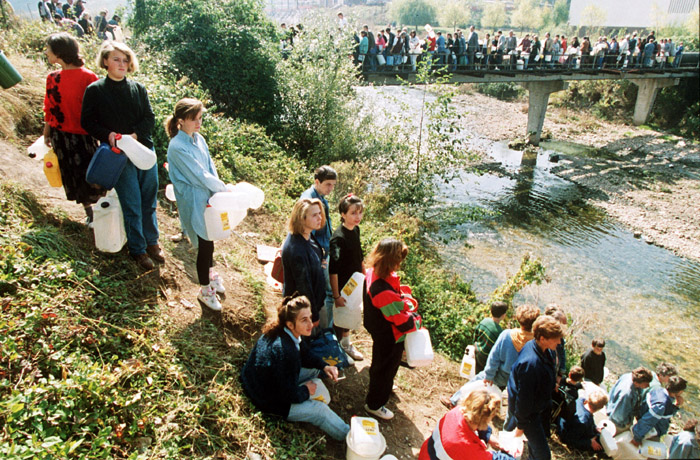
People waiting in line to gather water during the Siege of Sarajevo

Water politics, sometimes called hydropolitics, is politics affected by the availability of water and water resources, a necessity for all life forms and human development.

Arun P. Elhance's definition of hydropolitics is "the systematic study of conflict and cooperation between states over water resources that transcend international borders".[1] Mollinga, P. P. classifies water politics into four categories, "the everyday politics of water resources management", "the politics of water policy in the context of sovereign states", "inter-state hydropolitics" and "the global politics of water".[2] The availability of drinking water per capita is inadequate and shrinking worldwide.[3] The causes, related to both quantity and quality, are many and varied; they include local scarcity, limited availability and population pressures,[4] but also human activities of mass consumption, misuse, environmental degradation and water pollution, as well as climate change.

Water is a strategic natural resource, and scarcity of potable water is a frequent contributor to political conflicts throughout the world. With decreasing availability and increasing demand for water, some have predicted that clean water will become the "next oil"; making countries like Canada, Chile, Norway, Colombia and Peru, with this resource in abundance, the water-rich countries in the world.[5][6][7] The UN World Water Development Report (WWDR, 2003) from the World Water Assessment Program indicates that, in the next 20 years, the quantity of water available to everyone is predicted to decrease by 30%. Currently, 40% of the world's inhabitants have insufficient fresh water for minimal hygiene. More than 2.2 million people died in 2000 from diseases related to the consumption of contaminated water or drought. In 2004, the UK charity WaterAid reported that a child dies every 15 seconds from easily preventable water-related diseases; often this means lack of sewage disposal; see toilet. The United Nations Development Program sums up world water distribution in the 2006 development report: "One part of the world, sustains a designer bottled water market that generates no tangible health benefits, another part suffers acute public health risks because people have to drink water from drains or from lakes and rivers."[8] Fresh water—now more precious than ever in our history for its extensive use in agriculture, high-tech manufacturing, and energy production—is increasingly receiving attention as a resource requiring better management and sustainable use.

Riparian water rights have become issues of international diplomacy, in addition to domestic and regional water rights and politics.[9] World Bank Vice President Ismail Serageldin predicted, "Many of the wars of the 20th century were about oil, but wars of the 21st century will be over water unless we change the way we manage water."[10][11] This is debated by some, however, who argue that disputes over water usually are resolved by diplomacy and do not turn into wars.[12] Another new school of thought argues that "perceived fears of losing control over shared water might contribute towards a constant preparedness to go to war among riparian nations, just in case there is one".[13]

Water policy

[edit]

Water resource policy, sometimes called water resource management or water management, encompasses the policy-making processes and legislation that affect the collection, preparation, use, disposal, and protection of water resources.[14] The long-term viability of water supply systems poses a significant challenge as a result of water resource depletion, climate change, and population expansion.[15]

Water is a necessity for all forms of life as well as industries on which humans are reliant, like technology development and agriculture.[16][17] This global need for clean water access necessitates water resource policy to determine the means of supplying and protecting water resources. Water resource policy varies by region and is dependent on water availability or scarcity, the condition of aquatic systems, and regional needs for water.[15] Since water basins do not align with national borders, water resource policy is also determined by international agreements, also known as hydropolitics.[18] Water quality protection also falls under the umbrella of water resource policy; laws protecting the chemistry, biology, and ecology of aquatic systems by reducing and eliminating pollution, regulating its usage, and improving the quality are considered water resource policy.[14] When developing water resource policies, many different stakeholders, environmental variables, and considerations have to be taken to ensure the health of people and ecosystems are maintained or improved. Finally, ocean zoning, coastal, and environmental resource management are also encompassed by water resource management, like in the instance of offshore wind land leasing.[19]

As water scarcity increases with climate change, the need for robust water resource policies will become more prevalent. An estimated 57% of the world's population will experience water scarcity at least one month out of the year by 2050.[20] Mitigation and updated water resource policies will require interdisciplinary and international collaboration, including government officials, environmental scientists, sociologists, economists, climate modelers, and activists.[21][22]

World water availability

Water politics concepts

[edit]

Hydro-hegemony

[edit]

The framework of hydro-hegemony was postulated by scholars Mark Zeitoun and Jeroen F. Warner in 2006 as a useful analytical paradigm useful to examine the options of powerful or hegemonized riparians and how they might move away from domination towards cooperation.[23] The framework of hydro-hegemony is especially valuable in approaching cases where both powerrelations fall between the two poles of cooperation and the often discussed water wars.[24]

Hydro-hegemony refers to "hegemony at the river basin level, achieved through water resource control strategies such as resource capture, integration and containment. The strategies are executed through an array of tactics (e.g. coercion-pressure, treaties, knowledge construction, etc.) that are enabled by the exploitation of existing power asymmetries within a weak international institutional context."[23] The two pillars of hydro-hegemony are riparian position and exploitation potential. Although exceptions are possible, as a rule of thumb "upstreamers use water to get more power, downstreamers use power to get more water."[24] The actor who wins control over the resource is determined through the form of hydro-hegemony that is established, in favor of the most powerful actor ('first among equals').

In 2010, Mark Zeitoun and Ana Elisa Cascão modified the framework to constitute of four overarching pillars of power— geographical power, material power, bargaining power and ideational power.[25] As such, hydro-hegemony can be understood as hegemony at the river basin level that occurs where control over transboundary flows is consolidated by the most powerful actor.

Although Zeitoun and Warner argue that hydro-hegemony is generally a source of stability, in some instances weaker states might engage in counter-hydro-hegemony. In this instance, it is attempted to renegotiate and eventually also shift the distribution of power. Strategies that might be applied in this are attempts to shift the discourse to the favour of the non-hegemon.[26]

Water as a critical resource

[edit]

Most importantly, fresh water is a fundamental requirement of all living organisms, crops, livestock and humanity included. The UNDP considers access to it a basic human right and a prerequisite for peace. The Ex-UN Secretary-General Kofi Annan stated in 2001, "Access to safe water is a fundamental human need and, therefore, a basic human right. Contaminated water jeopardizes both the physical and social health of all people. It is an affront to human dignity." With increased development, many industries, including forestry, agriculture, mining, manufacturing and recreation require sizable additional amounts of freshwater to operate. This, however, has led to increases in air and water pollution, which in turn have reduced the quality of water supply. More sustainable development practices are advantageous and necessary.

According to the WHO, each human being requires a bare minimum of 20 litres of fresh water per day for basic hygiene;[27] this equals 7.3 cubic metres (about 255 ft3) per person, per year. Based on the availability, access and development of water supplies, the specific usage figures vary widely from country to country, with developed nations having existing systems to treat water for human consumption, and deliver it to every home. At the same time however, some nations across Latin America, parts of Asia, South East Asia, Africa and the Middle East either do not have sufficient water resources or have not developed these or the infrastructure to the levels required. This occurs for many varied reasons. It has resulted in conflict and often results in a reduced level or quantity of fresh water per capita consumption; this situation leads toward disease, and at times, to starvation and death.

The source of virtually all freshwater is precipitation from the atmosphere, in the form of mist, rain and snow, as part of the water cycle over eons, millennia and in the present day. Freshwater constitutes only 3 percent of all water on Earth, and of that, slightly over two thirds is stored frozen in glaciers and polar ice caps.[28] The remaining unfrozen freshwater is mainly found as groundwater, with only a small fraction present in the air, or on the ground surface.[29] Surface water is stored in wetlands or lakes or flows in a stream or river, and is the most commonly utilized resource for water. In places, surface water can be stored in a reservoir behind a dam, and then used for municipal and industrial water supply, for irrigation and to generate power in the form of hydroelectricity. Sub-surface groundwater, although stored in the pore space of soil and rock; it is utilized most as water flowing within aquifers below the water table. Groundwater can exist both as a renewable water system closely associated with surface water and as a separate, deep sub-surface water system in an aquifer. This latter case is sometimes called "fossil water", and is realistically non-renewable. Normally, groundwater is utilized where surface sources are unavailable or when surface supply distribution is limited.

Rivers sometimes flow through several countries and often serve as the boundary or demarcation between them. With these rivers, water supply, allocation, control, and use are of great consequence to survival, quality of life, and economic success. The control of a nation's water resources is considered vital to the survival of a state.[30] Similar cross-border groundwater flow also occurs. Competition for these resources, particularly where limited, have caused or been additive to conflicts in the past.

The highlands of Ethiopia may be considered a water tower region in East Africa. Sovereign control of upland water supply is likely to govern downstream politics for many years.

Contamination from human activity

[edit]

Water contamination usually occurs through a series of two mechanisms: point and non-point sources of pollution. According to the U.S. Environmental Protection Agency (EPA), point source pollution is "any single identifiable source of pollution from which pollutants are discharged, such as a pipe, ditch, ship or factory smokestack."[31] Therefore, among the most common examples of point source pollution, poor factory and sewage treatment appear high on the list; although not as frequent, but, nevertheless, equally—if not more—dangerous, oil spills are another famous example of point source of pollution. On the other hand, non-point sources of pollution are those that may come from different sources, among which, poor and badly monitored agricultural activities can negatively affect the quality of any nearby sources of water.[32]

Point sources of pollution

[edit]
  • Industrial products and wastes: Many harmful chemicals are used widely in local business and industry. These can become drinking water pollutants if not well managed. The most common sources of such problems are:
    • Local businesses: Factories, industrial plants, and even small businesses such as gas stations and dry cleaners handle a variety of hazardous chemicals that need careful management. Spills and improper disposal of these chemicals or of industrial wastes can threaten ground water supplies.
    • Leaking underground tanks and piping: Petroleum products, chemicals, and wastes stored in underground storage tanks and pipes may end up in the ground water. Tanks and piping leak if they are constructed or installed improperly. Steel tanks and piping corrode with age. Tanks are often found on farms. The possibility of leaking tanks is great on old, abandoned farm sites. Farm tanks are exempt from the EPA rules for petroleum and chemical tanks.[33]
    • Landfills and waste dumps: Modern landfills are designed to contain any leaking liquids, but floods can carry conaminants over the barriers. Older dumpsites may have a wide variety of pollutants that can seep into ground water.
  • Household wastes: Improper disposal of many common products can pollute ground water. These include cleaning solvents, used motor oil, paints, and paint thinners. Even soaps and detergents can harm drinking water. These are often a problem from faulty septic tanks and septic leaching fields.[33]
  • Lead and copper: Elevated concentrations of lead are rarely found in source water. Lead is commonly found in household plumbing materials. Homes built before 1986 are more likely to have lead pipes, fixtures, and solder. Lead can leach into water systems when these plumbing materials corrode. The acidity or alkalinity of water – or of any solution – is expressed as pH, from 0–14. Anything neutral, for example, has a pH of 7. Acids have a pH less than 7, bases (alkaline) greater than 7 pH greatly affects corrosion. Temperature and mineral content also affect how corrosive it is. Lead in drinking water can cause a variety of adverse health effects. Exposure to lead in drinking water can cause delays in physical and mental development in babies and children. Adults who drink this water over many years could develop kidney problems or high blood pressure.[33]
  • Water treatment chemicals: Improper handling or storage of water-well treatment chemicals (such as disinfectants or corrosion inhibitors) close to your well can cause problems.[33]

Non-point sources of pollution

[edit]

Agricultural activities that cause non-point source pollution include:

  • Poorly managed animal feeding operations
  • Overgrazing
  • Overworking the land (for example, plowing too often)
  • Poorly managed and ineffective application of pesticides, irrigation water, and fertilizer.[32]
  • Bacteria and nitrates: These contaminants are found in human and animal wastes. Septic tanks or large numbers of farm animals can also cause bacterial and nitrate pollution. Both septic systems and animal manures must be carefully managed to prevent private well contamination.[33]
  • Concentrated animal feeding operations: The number of concentrated animal feeding operation, often called "factory farms," is growing. On these farms thousands of animals are raised in a small space. The large amounts of animal wastes/manures from these farms can threaten water supplies. Strict and careful manure management is needed to prevent pathogen and nutrient problems in private wells. Salts from high levels of manures can also pollute ground water.[33]
  • Heavy metals: Activities such as mining and construction can release large amounts of heavy metals into nearby ground water sources. Some older fruit orchards may contain high levels of arsenic, once used as a pesticide. At high levels, these metals pose a health risk.[33]
  • Fertilizers and pesticides: Farmers use fertilizers and pesticides to promote growth and reduce insect damage. These products are also used on golf courses and suburban lawns and gardens. The chemicals in these products may end up in ground water. The extent of contamination depends on the types and amounts of chemicals used and how they are applied. Local environmental conditions (such as soil types, seasonal snow, and rainfall) also impact their contamination potential.[33] Groundwater will normally look clear and clean because the ground naturally filters out particulate matter. But, natural and human-induced chemicals can be found in groundwater. As groundwater flows through the ground, metals such as iron and manganese are dissolved and may later be found in high concentrations in the water. Industrial discharges, urban activities, agriculture, groundwater pumpage, and disposal of waste all can affect groundwater quality. Contaminants can be human-induced, as from leaking fuel tanks or toxic chemical spills. Pesticides and fertilizers applied to lawns and crops can accumulate and migrate to the water table. Leakage from septic tanks and/or waste-disposal sites also can introduce bacteria to the water, and pesticides and fertilizers that seep into farmed soil can eventually end up in water drawn from a well. Or, a well might have been placed in land that was once used for something like a garbage or chemical dump site.[34] Polluted runoff is created by rainfall or snow-melt moving over and through the ground. As the runoff moves, it picks up and carries away natural and human-made pollutants, finally depositing them into watersheds via lakes, rivers, wetlands, coastal waters, and even our underground sources of drinking water.[32] In 2002, in the National Water Quality Inventory report to U.S. Congress, the states reported that agricultural non-point source (NPS) pollution is the leading cause of river and stream impairment and the second leading cause of impairment in lakes, ponds, and reservoirs.[32]

Water politics by country

[edit]

OECD countries

[edit]
Hopetoun Falls near Otway National Park, Victoria, Australia

With nearly 2,000 cubic metres (71,000 cu ft) of water used per person per year, the United States leads the world in water consumption per capita. Among the developed OECD countries, the U.S. is highest in water consumption, then Canada with 1,600 cubic metres (57,000 cu ft) of water per person per year, which is about twice the amount of water used by the average person from France, three times as much as the average German, and almost eight times as much as the average Dane. A 2001 University of Victoria report says that since 1980, overall water use in Canada has increased by 25.7%. This is five times faster than the overall OECD increase of 4.5%. In contrast, nine OECD nations were able to decrease their overall water use since 1980 (Sweden, the Netherlands, the United States, the United Kingdom, the Czech Republic, Luxembourg, Poland, Finland and Denmark).[35][36]

India

[edit]
Ganges river delta, Bangladesh and India

India–Bangladesh

[edit]

The Ganges is disputed between India and Bangladesh. The water reserves are being quickly depleted and polluted, while the Gangotri glacier that feeds the river is retreating hundreds of feet each year[37] (experts blame climate change[38]) and deforestation in the Himalayas is causing subsoil streams flowing into the Ganges river to dry up. Downstream, India controls the flow to Bangladesh with the Farakka Barrage, 10 kilometers (6 mi) on the Indian side of the border. Until the late 1990s, India used the barrage to divert the river to Calcutta, to keep the city's port from drying up during the dry season. This denied Bangladeshi farmers water and silt, and it left the Sundarban wetlands and mangrove forests at the river's delta seriously threatened. The two countries have now signed an agreement to share the water more equally. Water quality, however, remains a problem, with high levels of arsenic and untreated sewage in the river water.[38]

India–Pakistan

[edit]

Recently India starting constructing Kishanganga Dam thus depriving Pakistan of its 33 percent water coming in Jehlum River. Pakistan is building the same type of dam called Neelum Jehlum Dam. After the Indo Pak Treaty of 1960, Ravi and Sutleg River belong to India while Jehlum, Chenab, Indus belong to Pakistan. But still a growing dissatisfication exist on Pakistani side for sharing its water with India.

Kaveri dispute

[edit]

Mexico

[edit]

Mexico has experienced significant issues in preventing contamination and water pollution and in distributing clean water to households and businesses. As society has evolved and urbanization, economic growth, and increased trade have occurred, the demand for clean water has increased.[39] However, pollution associated with economic growth and industrialization combined with the arid climate have restricted access to clean water for many households and firms. The already arid climate is susceptible to droughts with increasing climate change issues, which may further hinder access to water.[40]

Mexico relies on groundwater for their water supply which has led to significant exploitation of aquifers and therefore increased costs in accessing water.[39] Mexico City is the largest city and urban center with a very high demand for drinking water. The water supply provided by the "Sistema de Aguas de la Ciudad de Mexico" (SCAMEX) is only 98 effective and has therefore left about 48,000 households in the city alone without water.[41] However, even those with access to the water provided by the city remain unsatisfied. Even those already connected to SCAMEX experience issues due to water loss and poor water quality.[41] In Mexico City, an estimated 40% of the city's water is lost through leaky pipes built at the turn of the 20th century. According to the results of a 2011 survey, up to 87% of the households in Mexico City would prefer to access water used for cooking and drinking through sources other than the tap. Alternative ways to access water include: purchasing bottled water or filtration devices, or boiling water before drinking. The issue is that these alternative measures are typically significantly more expensive than using the water provided.[41]

Middle East and North Africa

[edit]

In the Middle East and North Africa (MENA), water is an important resource and political issue. According to a report by the Arab League in 1999, two-thirds of Arab countries had less than 1,000 cubic metres (35,000 cu ft) of water per person per year available, which is considered the limit.[42] By 2025, it is predicted that the countries of the Arabian Peninsula will be using more than double the amount of water naturally available to them.[43] By 2030, according to the World Bank, the MENA will most likely be under the limit of absolute water scarcity, as defined by the United Nations.[44][45][46] With rapid population growth and climate change, water scarcity is unlikely to decline. Given these statistics and predictions, water is commonly interpreted as scarce in the MENA and therefore often used as an explanation for conflicts and political instability in the region. However, scholars have argued that this is a form of framing, as the problem is not necessarily the availability of water but rather the way in which it is distributed and used.[47][48]

In the context of the Middle East, with a diverse landscape of national, subnational, ideological, ethnic, religious and pan-national identities, water politics has played an important role in conflicts between Iraq, Syria, and Turkey; Egypt and other Nile riparian states; as well as Israel and Palestine. In the MENA, all major rivers cross at least one international border, such as the Tigris and Euphrates crossing three major Middle Eastern nations. The Nile even crosses eleven countries. This means that downstream riparian states are hugely affected by the actions and decisions of upstream riparian states, an actor they have little practical control over. In particular this is evident with the possibility of cutting or reducing water supply from one nation to the next. Besides rivers, other waters in the Middle East that are important for the region and international trade are the Suez Canal, the Bab-el-Mandeb Strait, the Strait of Hormuz, and the Persian Gulf.[49]

Overview by country

[edit]
Country Water Politics
Algeria

Water scarcity is an increasing problem in Algeria, which is reinforced by climate change and periods of drought. In 2024, protests against the water politics of the government occurred in the city of Tiaret.[45] To secure the supply of drinking water and water for the agricultural and industrial sectors, as well as to mitigate the risk of increasing water scarcity as a consequence of climate change, Algeria provided a budget of USD 5.4 billion to enhance the desalination technology in the country. By 2030, the country aims to generate nearly two thirds of its water through desalination.[50]

Bahrain Water politics form an important aspect for Bahrain, being an archipelago. Similar to other countries in the region, conventional water resources in Bahrain are scarce. To meet its water demands, the country therefore uses techniques such as desalination, as well as greywater filtering for irrigation. These techniques allowed Bahrain to reduce the depletion of unsustainable water resources by 20% between 2000 and 2021.[51] These goals towards a more efficient and sustainable use of water are enshrined in the Bahrain Vision 2030 and the progress made leads to country to claim a "pioneering" role in this realm.[52] Already in the 1980s different laws were implemented to manage water resources in the kingdom more efficient and sustainable, which is implemented and monitored by a variety of state institutions.[53]
Egypt

Egypt's water politics are heavily affected by the Nile treaties that were signed in 1902, 1929, and 1959. In these treaties, Egypt's self-proclaimed dominance over the Nile is confirmed, and Egypt is granted access to the majority of the Nile waters, as well as the right to block construction projects affecting the Nile in upstream countries.[54][55] Despite other states seeing these agreements as colonial products, Egypt perceives them as legally binding.[56][57]

In the course of the intensified nationalism and the claimed descent of modern Egyptians from Pharaonic Egyptians, the Nile has become part of Egypt's national identity. This is also reflected in the securitisation of the Nile, where the river is commonly linked to the nation's existence.[58][59][60] An important step for modern Egypt, in maximising the use of the Nile across several domains, was the construction of the Aswan High Dam under Gamal Abdel Nasser in 1970.[61] Besides the Aswan High Dam, Toshka was an important water policy project in Egypt. Toshka was an ambitious plan to create a new city in the southern Egyptian desert, using water from Lake Nasser to gain new land for agriculture and reduce pressure from issues such as overpopulation and food scarcity. However, the project was never finished.[62]

Since Ethiopia's announcement of the construction of the Grand Ethiopian Renaissance Dam in 2011, Egypt's water politics have been dominated by the dispute over the construction and later filling and operation of the dam. Egypt has opposed the dam, fearing that it will reduce the amount of water it receives from the Nile.[63][64] According to Egypt, the dam is in conflict with the Nile agreements and International Water Law, and threatens the water security of Egypt and Sudan. Egypt fears that the Renaissance Dam will lead to less downstream flowing water in the Nile, which would affect Egypt's water security, as the country is heavily dependent on the Nile.[65][66] Additionally, this might also have negative effects on hydropower production from the Aswan High Dam.[67] In rejecting the Renaissance Dam, Egypt forms an alliance with Sudan.[68] So far, all negotiations have failed and the dispute between Egypt and Ethiopia over the Renaissance Dam has become a national preoccupation in both countries.[59][69]

Iran

In Iran from the 1980s onward, there was a water policy that now appears to have been not very future-oriented. Especially in the 1990s the construction of water infrastructure, such as dams, as well as wells to pump groundwater, increased, and today, while the population is rapidly growing, the water resources and the condition of the water infrastructure are deteriorating rapidly. In political decision-making processes, warnings from experts were—and still are—often neglected, leading some to speak of a "water mafia."[70] According to a study by Allan Hassaniyan, water politics in Iran is heavily influenced by corruption, nepotism, and what is called "environmental racism," as political decision makers often exploit nature and the state treasury to allocate more water to their local districts.[71] Due to further mismanagement and the regime's goal for food sovereignty, affected by sanctions on Iran, the agricultural sector both requires and illegally uses the vast majority of the available water.[72] These developments are intertwined with other broader issues that reduce the availability of water, such as climate change and salinisation and lead to water scarcity.[73]

Iraq Following the 1991 uprising in Iraq, Saddam Hussein drained the Iraqi marshes in an act of revenge against the Marsh Arabs living in the area.[74] The destruction of the marshes, and connected to that, the habitat of the Marsh Arabs is an instance where water was weaponised in a counterinsurgency strategy. It is considered both a genocide and an ecocide. Besides counterinsurgency, scholars also argue that sectarianism played a role in the destruction of the marshes, as the majority of the population in this area was Shi'a. While the Iraqi regime accused Turkey of reducing the water flow of the Euphrates to Iraq in the process of the construction of the Atatürk Dam, thereby allegedly draining the marshes, scholars have argued that nearly all damage was done by Iraq. To drain the marshes, water from the Euphrates and Tigris was redirected into the so-called "Third River," a project by the regime that aimed to increase fertile land in Iraq. After the U.S. invasion of Iraq in 2003, there were attempts by Iraqi officials, the U.S. military, and NGOs to restore the marshes.[75]

Currently, Iraq's water policies include the aim to improve engagement and cooperation with neighbouring countries to mitigate issues surrounding unequal access to water, also involving international actors such as the Netherlands.[76] In early 2025, Iraq and the United Kingdom agreed on a GBP 5.3 billion project to improve the water supply of southwestern regions of the country.[77]

ISIS Although not a country, ISIS was an important actor in regional water politics during the caliphate. The areas ISIS controlled in the Middle East contained water infrastructure crucial for the populations of Syria and Iraq. Constructions such as dams or storages were important strategic goals for ISIS, from 2014 onward leading to heavy battles at the end of which ISIS controlled most of the water infrastructure along the Euphrates and Tigris in Syria and Iraq. Subsequently, water became used as a weapon through causing water shortages, inducing overflows, and intoxicating water. These strategies were used for military warfare but also to attack civilians. The control over a crucial resource such as water gave ISIS power, not only as a weapon but also in a symbolic way, underlining the group's ambition to replace the existing states. Furthermore, water and the electricity generated from hydropower were used by ISIS for its followers, its territories, and the oil production. Blowing up dams was also considered to be a realistic option in a possible strategy of ISIS in case it loses all territories and is on the brink of defeat. In 2014, especially the scenario of ISIS destroying the Mosul Dam would have had serious consequences, destroying both Mosul and Baghdad.[78]
Israel

During the Zionist settlement of Palestine before the establishment of Israel in 1948, control over water was a tool to increase power in the region. Starting in the 1930s, water was declared to be an abundant resource in Palestine by zionist scholars and water companies. This argument was used to enable and increase settlement in Palestine.[79]

Israel is highly active in improving its water infrastructure and methods to enhance water availably in the country. This includes desalination, new irrigation techniques, reusing water, and dams to keep up with rapid population and economic growth. However, differences in access to water can be observed as bedouins and inhabitants of occupied areas have severely less access to water.[80][81]

Water is an important issue in the Arab–Israeli conflict and according to former Israeli prime minister Ariel Sharon was one of the causes of the 1967 Six-Day War.[82] Article 40 of the appendix B of the September 28, 1995 Oslo accords stated that "Israel recognises Palestinians' rights on water in the West Bank".[83] Nevertheless, in the ongoing Gaza war, Israel is criticised by various scholars, activists, and politicians for the weaponisation of water. The water supply to Gaza is blocked and water infrastructure for fresh and waste water was targeted. Yoav Gallant, the former Israeli minister of defence, stated: “We are imposing a complete siege on Gaza. There will be no electricity, no food, no water, no fuel, everything will be closed.” This weaponisation of water and its consequences on civilians in Gaza are considered to be war crimes.[84][85][86][87][88]

Jordan

Due to its downstream position on the Jordan River and Yarmouk River, Jordan's water supply is dependant on other countries and under pressure. Therefore, together with International Organisations, Jordan is preparing new techniques to use non-conventional water resources, such as second-hand use of irrigation water and desalinisation techniques.[89] Another important project was the Disi Water Conveyance Project, transporting groundwater from the Disi aquifer in the south of Jordan to Amman.[90]

After the failure of the negotiations surrounding the Jordan Valley Unified Water Plan in 1955, unlike other regional states, Jordan signed a peace treaty with Israel in 1994, ending the decades of unilateral water politics. Jordans riparian position did not allow a complete withdrawal from negotiations but made cooperation necessary. Although there are still tensions between the countries, the treaty proved to be important as several shared projects enhancing water cooperation and water supply were realised since 1994. There even were plans for a "peace canal" which both countries wanted to construct together, however this project was never realised.[91]

To increase its access to the Yarmouk River, Jordan signed several treaties with Syria, dating back to 1953, however the riparians power imbalance founded in geographical position along the course of the Yarmouk River can also be seen in the treaties. In treaties the countries agreed upon certain amounts of water that Syria must release to Jordan, as well as the number of dams that Syria is allowed to construct, however Syria neglected these agreements multiple times. Therefore, Jordan is considered one of the most water scarce countries in the world.[90][92]

Kuwait The most visible part of Kuwait's water politics are probably the Kuwait Water Towers. The towers, with their characteristic architecture, serve as water reservoirs to provide Kuwait City with desalinated water. Today, the Kuwait Water Towers consist of 31 mushroom-shaped water towers and the Kuwait Towers, and they were an important step for Kuwait towards water security and water sovereignty.[93][94] With increasing demand for water, Kuwait expanded its water reservoir system, which today consists of over 80 above-ground and more than 100 underground reservoirs.[95]
Lebanon

In Lebanon water shortage is a problem affecting over two thirds of the country's population and this is likely to increase in the future due to climate change if there are no countermeasures. To reduce stress on the water supply, scholars identified potential in the agricultural sector which consumes slightly more than half of the country's water. The reuse of greywater for irrigation could increase the share of water available for human consumption.[96] Furthermore, decades of crisis and conflict in Lebanon have negatively affected the water infrastructure, which is struggling to meet Beirut's water demands. Therefore, inhabitants are required to use improvised water acquisition measures, the selection of which is highly affected by their financial possibilities.[97]

Libya An important water policy project in Libya was the Great Man-Made River Project started under Gaddafi. The goal was to supply the densely populated northern region of Libya with water from aquifers discovered in the south. However, the project was never finalised after the fall of Gaddafi in 2011.[98]

Libya faces severe water insecurity and is heavily dependent on non-renewable groundwater resources to a large extent. The conflicts in Libya led to water infrastructure being destroyed, further decreasing water security in the country.[99] During the civil wars, water infrastructure was deliberately targeted, leading to serious pressure on food and water security, which are intertwined and mutually reinforcing factors along with other issues such as displacement, migration, and the environmental consequences of war.[100] In September 2023, two dams collapsed in Libya following Storm Daniel. Scholars and experts have linked the collapse of the dams to the devastating effects of the civil wars on infrastructure in the country, with the storm serving as the final trigger.[101]

Morocco

Water politics in Morocco are shaped by the governments goal to make the water use more sustainable and efficient, as well as to increase the water supply. However, a central obstacle to this is the widespread corruption.[102] Furthermore, in some regions the distribution of water is especially unequal, as more water goes to the farming of cash-crops than to the population. In the town of Zagora, this led to protests called a "thirst revolution" in 2017. In this, a gendered dimension can be observed. Especially women and children are affected by water scarcity in these regions, as men often moved to bigger cities to work there.[103]

Oman The Sultanate of Oman has a very diverse climate, with the southern parts of the country being affected by the seasonal monsoon.[104] Especially, the city of Salalah is popular for its many wadis and rivers. In the Hajar Mountains, the traditional Aflaj Irrigation System is still in place and is part of the UNESCO World Heritage list.[105] However, nowadays, Oman relies heavily on desalination for its water, which makes up more than 85 percent of the drinking water.[106]
Palestine

Already during the Mandate era, access to water was politicised in Palestine. Where local farmers developed practices to negotiate the relative water scarcity, British government officials perceived these practices as outdated and "backward." The inherently racist strategy of the colonial leadership was to cooperate with the first Zionist settlers in Palestine, as Jews were seen as superior to Arabs and therefore able to use the land and resources more efficiently. Under the official aim to increase agricultural output and reduce diseases, Palestinian farmers saw their access to water diminish, as it was reformed by an alliance of convenience of Zionists and the Mandate leadership. Part of the restructuring of water management in Mandate Palestine was the draining of areas such as Lake Hula resulting in the resettlement of Palestinians, making it an important element in the settler colonisation of Palestine.[107]

After the occupation of the West Bank in 1967, Israel limited the access of Palestinians to water, while in the illegal settlements there are no restrictions on water use.[108] Today, most water sources in Palestine are controlled by Israel, leading to a dependence of Palestinians on Mekorot and concessions by Israeli lawmakers. The Oslo Accords enshrined the unequal access to water in legal codes, as they allocate the majority of shared watercourses to Israel.[109][110] This imbalance in access to water also affects the per day consumption of water per person which is around 3-4 times higher in Israel than in the occupied Palestinian territories.[109][108] In Gaza, according to Amnesty International, around 90-95% of the water is unusable for the population.[108] Already before the Gaza war a weaponisation of water could be observed, as the access to water and the use of water management facilities in Gaza is heavily restricted by Israel.[87][88][111] According to Human Rights Watch, the population in Gaza has less than a tenth of the minimum amount of water humans need per day according to the World Health Organization.[112] Therefore, this is considered a war crime by many NGOs, governments, scholars, and activists.[84]

Qatar Despite being one of the most water scarce countries when it comes to conventional water resources, Qatar has a very high consumption of water for different purposes ranging from private use, over public parks, to the construction sector. This water is mainly won through desalination and Qatari citizens receive it for free from the government. To fulfil the water demands Qatar is continuously expanding its water infrastructure.[113] Furthermore the country aims to reduce the use of water and make it more efficient and sustainable in line with SDG 6 of the UN Sustainable Development Goals.[114]
Saudi Arabia

In the formation of the Kingdom of Saudi Arabia, water was an important means of power, as access to water enabled the Al Saud family to assert their dominance and use it to generate stability. Before the discovery and boom of oil, large parts of the Saudi Arabian population were peasants. Therefore, control over access to water could be used to distribute it and, through this, exercise power and create stability.[115]

As groundwater resources are shrinking, Saudi Arabia's dependence on desalination for water has been increasing since 1950. Currently, just under two-thirds of the water demand in the KSA is met by desalinated water.[116] In 1980, the East-West-Pipeline transporting desalinated water from the city of Jubail to Riyadh was constructed.[117] Groundwater is often used for irrigation purposes in more rural agricultural areas of the kingdom.[118]

Water also plays an important role in Saudi Arabia's ambitious NEOM project. To meet the city's water demands, it will entirely depend on desalination. Therefore, to meet the goal of the city being entirely CO2 neutral, new solutions to the energy-intensive desalination process are required. Furthermore, the city plans to recycle all of its wastewater.[119]

Sudan

Water politics in Sudan are historically connected to those in Egypt. Under colonial rule, Sudan was a party to the Nile agreements of 1902 and 1929, where access to water and power in the Nile region was mainly distributed between Egypt and, to a lesser extent, Sudan.[54] After the country became independent in 1956, tensions arose as the new Sudanese government did not recognise the earlier Nile agreements and opposed the Aswan High Dam. After the Sudanese military coup in 1958, Sudan and Egypt made mutual concessions to build dams on the Nile, resulting in another agreement signed in 1959, which reinforced the key contents of the 1929 agreement.[55] The allocation of Nile waters, as formulated in the Nile agreements, is still seen as legally binding by Sudan today, despite criticism from other states regarding the colonial influence in the agreements.[56][57] In 2015, Sudan, Egypt, and Ethiopia signed a Declaration of Principles expressing the goal of increasing cooperation and, ultimately, enhancing regional prosperity.[120]

After Ethiopia announced its plans to construct the Grand Ethiopian Renaissance Dam, Sudan initially welcomed the project. However, after another military coup in 2019, there was a rapprochement between Sudan and Egypt, with both countries expressing shared rejection of the Renaissance Dam. In 2020 and 2021, Sudan and Egypt conducted the military exercises "Guardians of the Nile" and "Nile Eagles" together.[68] Sudan participates in the ongoing negotiations on the filling and operation of the Renaissance Dam.[121]

Syria

Syria is facing severe water shortages and water insecurity. The decline of water in the Euphrates River leads to several intertwined issues in Syria. As an important source for irrigation, reduced Euphrates waters lead to increased rural flight as farming is becoming very hard. However, this rural flight to urban centres leads to a rapid and somewhat uncontrolled population growth in cities and puts severe tension on the (water) infrastructure of these cities. Furthermore, the lack of water in the Euphrates leads to energy shortages as less turbines in Syrian dams can be used. However, it is often argued that these issues could have been partially prevented by better water management in the past decades. With the Civil War starting in 2011, water had the potential to increase conflict but also for limited rapprochement, as state engineers carried out maintenance work on dams in areas controlled by ISIS or Kurdish militias. Currently, however, the water mismanagement continues as reforms are not consequently implemented and the depletion of groundwater resources remains high. Together with the lack of cooperation between Syria and Turkey, this is most likely to increase water scarcity in the future.[122][123] Turkish dams on the Euphrates have significantly reduced the availability of water, partially as Turkey weaponises the dams in an attempt to weaken the Kurdish YPG. Given Turkeys ties with the HTS militia that took power in Syria in late 2024, it will be interesting to see how the tensions between the countries around water evolve in the future.[123][124]

Tunisia

Although the access to clean water was added to the Constitution in 2022, water scarcity remains a problem in Tunisia for humans, animals, agriculture, and the economy. Therefore, the Tunisian Ministry of Agriculture has published plans to enhance the availability of water sources, the access to them, and the efficient use of water in different steps until 2050.[125] In Tunisisia water scarcity acts intertwined with climate change and leads to phenomenons such as desertification and rural flight. Especially the agricultural sector, which for long has focused on water intensive export crops, is affected by increasing water scarcity.[126] The World Bank is engaging in projects aiming to improve water security in Tunisia.[127]

Turkey

The plans for the Southeastern Anatolia Project (GAP), published in 2007, included the construction of the IIısu Dam, which is part of a broader network of Turkish dams on the Euphrates and Tigris, close to the borders with Iraq and Syria. These dams face criticism from Iraq and Syria, as they significantly reduce the amount of water flowing downstream in the two rivers, which are crucial for Syria's and Iraq's water supply. Similar to the dispute over GERD between Egypt and Ethiopia, it can be observed in the case of Turkey and Iraq/Syria that negotiations are difficult, as the parties have opposing interests. Furthermore, the Ilısu Dam is argued to be targeting Kurds, as it destroys some of their lands and the city of Hasankeyf. There are even accusations against Turkey of using dams to deprive Syrian Kurds of water, which would constitute a weaponisation of water.[49][128]

United Arab Emirates Water politics are an important field in the UAE and there even is a policy paper dedicated to it called "Water Security Strategy 2036." In this, the UAE states its aim to increase the sustainability of desalination and to improve the efficient use of water in the country. Furthermore, the policy paper states a belief in and commitment to international solutions for water scarcity.[129]
Yemen

Before 2014, the vast majority of water in Yemen was used by the agricultural sector. Especially in the last third of the 20th century a shift towards the cultivation of cash-crops for export took place. These crops such as bananas, citrus, and khat were often poorly aligned to the climate and availability of water in Yemen.[130]

The ongoing Yemeni Civil War has increased the already existing water scarcity in Yemen. Currently, it is estimated that more than 50% of the population do not have access to clean water. During the war, water infrastructure was destroyed or is no longer functional due to a lack of maintenance and spare parts. The Houthis, as well as the government troops and their allies, have weaponised water, therefore committing war crimes.[131][132][133] Different international actors, such as United Nations Development Programme, the German Ministry for Economic Cooperation and Development, and the United Nations Food and Agriculture Organization are active in Yemen and aim to increase water cooperation and increase water supply.[134]

In response to the Gaza War, the Houthis started to attack ships in the Red Sea along the coast of Yemen. This Red Sea Crisis is ongoing and has led to intensified airstrikes on Yemen, as well as delays and rising prices in international trade, as one of the most important shipping routes between Europe, the MENA, and Asia has become increasingly dangerous to pass.[135][136][137]

South America

[edit]

The Guaraní Aquifer, located between the Mercosur countries of Argentina, Brazil, Paraguay and Uruguay, with a volume of about 40,000 km3, is an important source of fresh potable water for all four countries. It is replenished by water from rains and small rivers and streams, mainly on its margins. As populational growth in its area is still relatively high (the feeder areas of the aquifer, especially the wettest ones, may locate even important and big metropolitan areas such as São Paulo and Curitiba), monitoring is required to avoid deplenishing, and pollution, that would be associated with the still very weak environmental legislation concerning farming and with the still low performance of the coverage of sanitation (mainly in the form of discharge of untreated sewage and exposed untreated garbage, including urban, what potentializes problems associated with flooding), in the countries affected.

United States

[edit]

The Water Justice movement is a largely grassroots US movement, with small groups of citizens taking the issue into their own hands by means of protesting, petitioning, fundraising, or donating items such as water filters in order to broaden access to clean water. Some well-known people have used their exposure to further the cause of water justice: Erin Brockovich, media personality and environmental activist has spoken against Flint officials' mishandling of the water crisis there.[138][139] Actress Shailene Woodley was arrested at a Dakota Access Pipeline protest, writing afterwards about her experience: "If you are a human who requires water to survive, then this issue directly involves you."[140]

Another key player arguing to defend access to clean water in the Standing Rock protests is the Standing Rock Sioux Tribal Chairman, Dave Archambault II, who has spoken to the Human Rights Council at the U.N. in Geneva on behalf of his tribe. In a separate statement, Archambault thanked those who fought the pipeline "in the name of protecting our water."[141]

The Water Justice movement has also moved globally, encompassing a wide array of diverse groups such as the Global Water Justice Movement, Friends of the Right to Water, the Centre on Housing Rights and Evictions, Food and Water Watch, and the Heinrich Böll Foundation. Groups such as these believe that water is part of the global commons, and thus argue against the privatization of water resources and give the state the responsibility of ensuring the right to water.[142][143]

[edit]

To prevent increased pollution, environmental damage, and to keep drinking water clean, various Legal acts have been signed into law.

  • The Clean Water Act: The Clean Water Act was signed into law in 1948 under the name Federal Water Pollution Control Act, with expanded recognition and amendments in 1972. Amendments included:
    • Outlawing of any pollutant being released anywhere that would lead to large bodies of water.
    • Regulation of pollutants entering bodies of water.
    • Provided funding for sewage treatment plants.
    • Empowered the EPA with the authority to enforce water regulation rules.[144]
  • The Ocean Dumping Act: The Ocean Dumping Act was signed into law in 1972 to prevent excess pollution from entering the ocean. The EPA has the authority to fine no more than $50,000 for each breach of permit. The act also allows for general research and EPA research into ridding the ocean of pollutant dumping.[145]
    • Shore Protection Act (SPA): The Shore Protection Act comes from title IV of the Ocean Dumping Act. It forbids vessels from carrying waste within coastal waters without a permit.[146]
  • Right To Water: Also known as the Human Right to Water and Sanitation, it was established by the United Nations on July 28, 2010. It was added to international law when the UN recognized water and general sanitation as a basic human right. It requires states and nations to provide clean, accessible drinking water to their people.[147]
  • Safe Drinking Water Act (SDWA): The Safe Drinking Water Act was put into law in 1974. It provides protection to water both above and below ground. In 1996, amendments were added requiring the EPA to assess risks and costs when creating standards for this law.[148]

Activism

[edit]

When it comes to America alone, there has been much activity surrounding the issues of water in Standing Rock, ND and Flint, Michigan. When the issue arose of a pipeline being implemented on the Standing Rock Indian Reservation of North Dakota, residents began to take action almost immediately. When the pipeline was proposed in January 2016, the Sioux tribe released a petition that garnered almost half a million signatures within three months.[149] This postponed the construction of the pipeline, but the action did not stop there. In July of the same year, the tribe attempted to sue the Army Corps of Engineers with the argument that it would harm the area's water supply. This only led the Energy Transfer Partners to file a counter lawsuit, saying that the group was hindering their work.[149] 2016 presidential candidate Jill Stein led movements against the construction, which included spray painting a bulldozer with the phrase, "I approve this message".[150] Adding to the publication of the issue, actress Shailene Woodley was arrested for blocking the construction of the pipeline.[151] The debate on whether or not the pipeline will actually be built is still in progress.

The water crisis in Flint, Michigan has also led activists to focus on getting clean water to the people. After the 2014 decision to make the Flint River the primary water source of the town, residents quickly noticed the quality of their water declining.[152] The American Civil Liberties Union filed multiple lawsuits against the administration in Flint, saying that the levels of lead in the water is absurd, and demanded the pipes be replaced.[153] This has yet to happen, and the people of Flint continue to struggle for clean water.

[edit]

Several state and national organizations and programs are dedicated to the access of safe water. The scope of these organizations are varied by their outreach (from focusing on a small county to working globally) and the aspects of water justice they are contributing to. Many of these organizations work within governmental systems while others work outside of them.[154] These organizations have helped aid in the understanding and knowledge of water related issues, how they affect individuals and communities, and have found solutions to improve safe water access.

Categories of water justice organizations and programs include:

  • Education: The United States of America has some of the safest drinking water supplies in the world. Despite this, there are several cases and outbreaks of illnesses and related health issues due to contaminated water reported to the Centers for Disease Control and Prevention every year.[155] Several organizations work to educate communities about proper water safety procedures and places emphasis on individuals and communities to understand where their water supply comes from.
  • Industry: Many water justice organizations work within industries related to community water to create safer water infrastructure. Many provide certification to certain professions to ensure work and product quality related to water.[156] Additionally, many organizations have created groups for professions that deal with water infrastructure and safety. Some of these profession include public health professionals, engineers, and scientific researchers.[157]
  • Research: Several of these organizations also promote environmental and public health related research and aid in funding and education of these projects.[158]
  • Governmental:Many organizations related to water justice work with or within the government to enact change in water policy and management. This can include city and state governments, to the federal government, to Tribal governments.[159]

Case studies: Africa

[edit]

Obuasi, Ghana is the home of one of the world's top gold mining sites. It was in 1897 when the first machinery was used to mine the gold from the region.[160] As the years went by, new strategies were needed to establish out ways to "treat the ores".[160] By 1908, A leading chemist was brought in to help with the strategies and brought his Australian method of "dry crushing and roasting preparatory to treatment with cyanide".[160] Many rivers, fishing areas, and irrigation systems have been either slightly or permanently damaged.[161] The mining industry has tried to compensate by building standpipes but for many, they have been to no use. The average amount of contamination in the water system of Obuasi was over 10–38 times the maximum amount that is allowable by law.[162] The two main sources of the contamination is the arsenic powder that flows out from the mills[163] and the extensive amount of run-off water that is disposed of through dams.[162] "Thus in the processing of the ore for gold, the dust may contain particles of the ore, ferric oxide, oxides of arsenic and sulphur".[164] The dust will then get carried into the atmosphere and settle on the soil, humans, and rivers.[164] In Obuasi, they receive a high annual rainfall due to the tropical rainforest that surrounds it (Smedley, 1996, 464). During precipitation or rainfall, the dust "may be oxidized to the trioxide by the air and be converted to the sulphate in dew and rainwater".[164] The soil is the main target of contamination because the soil is contaminated and whatever vegetation grows and decays goes right back in the soil which results in the contamination of the groundwater.[164] However, the groundwater is not as polluted as the streams or rivers mainly due to the high dissolving process of the arsenic and due to the basement rocks that lie between the groundwater and the soil. "The only disadvantage is that whatever is deposited on the surface soil may be carried to greater depths with time by rainwater (Gish et al, 2010, 1973)".[164] The most extensively damaged areas are the ones closest to the mines, but with the wind carrying the dust, areas hundreds of miles away are getting contaminated by the chemicals.[165] Due to the extensive output of the chemicals from the mining mills and un resolved toxic spills, many rivers, streams, lakes and irrigation systems have been damaged or obsolete.[166] The local residents have been affected greatly by this phenomenon. Residents have seen the environmental changes especially in the water. Sludge floats down on streams that were once main sources of drinking water according to local residents.[161] All the marine life in the rivers and streams has died due to the high amounts of chemicals in the water.[167] According to Action Aid, residents have seen pipes that run straight into local streams and rivers that were depositing the waste directly sometimes causing flooding of the streams and rivers (2006, 11). Many local farmers suffered the hardest with the contamination of the water. Due to the irrigation systems using the contaminated water to irrigate all of the soil were then contaminated as well.[161] The soil was no longer usable, causing the killing off their crops that were used for their business as well as for their own families.[161] Children have also been targeted and affected by the pollution. According to Action Aid, many schools have been flooded with the over flow of the local streams, causing the children to leave school, sometimes permanently. AngloGold Ashanti (AGA) has put up standpipes to compensate for the contaminated water supplies, but these have also been useless to the locals. Standpipes were installed in the 1940s and 50s that have now been contaminated with arsenic from the mills.[168] AGA staff claim it is because of them being made of iron, but studies have shown large amounts of arsenic in the water.[168] Many standpipes have been either broken or obsolete.[161] This leads to the residents to walk at least 1.5 miles to go get clean water.[169] All the work the local people have to go through to get clean water is uncalled for. No compensation has been giving to the local residents for the damage they have done to their water and environment.

Economy

[edit]

Global economy

[edit]

Globalization has benefitted the economy greatly through increased trade and production of food, energy, and goods. However, the increase of trade and production of goods requires large quantities of water, in fact the OECD countries predict that by 2050, the global demand for water will increase by 55%.[170] Multiple countries and organizations have declared a water crisis. Water is a finite resource that is shared between nations, within nations, multiple interest groups and private organizations. Roughly 50% of all water available is located between two or more nation states.[170] Water politics and management requires efficient water allocation through policies and cooperation between nations. Poor water politics and practices can result in water conflict, which is more common surrounding freshwater due to its necessity for survival. Countries that have a greater supply of water have greater economic success due to an increase in agricultural business and the production of goods, whereas countries, which have limited access to water, have less economic success.[171] This gap in economic success due to water availability can also result in water conflict. The World Trade Organization has emerged as a key figure in the allocation of water in order to protect the agricultural trade.[171] Water is an essential commodity in the global market for economic success.

Jordan River

[edit]

The Jordan River conflict, otherwise known as the War over Water is an example of transboundary conflict between Israel, Jordan, Lebanon and Palestine. This water conflict begun in 1953 as a result of poor water politics and management between nation states and negotiations are ongoing.[172] The conflict begun with Jordan's intention to irrigate land using a shared basin for agriculture and economic purposes, in response, Israel closed the gates of a dam in the Sea of Galilee, draining the water available.[173] Negotiations started with the Bunger Plan that would allocate water from the Jordan River fairly among the surrounding nations, however Israel declared its riparian rights were not recognized.[173] The consequences of the Jordan River conflict has resulted in economic damages to irrigation, agriculture, production, and resources to all of the nation states involved. The World Health Organization records that the total global economic loss associated with inadequate water politics, supply and sanitation is estimated at $260 billion annually USD.[174] The Jordan River conflict demonstrates a lack of efficient transboundary water politics, which has contributed to this annual global economic loss. Currently, negotiations have attempted to establish a fair divide and share of the Jordan River, but have had little success.[173]

Aral Sea

[edit]

The water conflict in the Aral Sea is an ongoing transboundary conflict starting from 1991 between Kazakhstan, Kyrgyzstan, Turkmenistan, Tajikistan and Uzbekistan.[175][176] Social causes such as economic development, population growth, electricity demand, and pollution has resulted in water scarcity.[175] The water scarcity has resulted in limited availability to allocate water efficiently between the neighboring countries.[176] The water scarcity has impacted many aspects of life and resources such as; fish, biodiversity, water, air pollution, forestry, agricultural land and ecosystem availability.[175] The impact of poor water politics and management has negatively influenced the economy of the surrounding countries and has created stress on resources that are crucial to the agricultural sector.[175][176] Research indicates that water scarcity can cost regions up to 6 percent of their GDP and cause migration, which negatively impacts the local economy.[177] There have been multiple attempts to resolve the conflict from different organizations such as The Interstate Commission for Water Coordination, Interstate Council of the Aral Sea, and The Aral Sea Basin Program, but the issue is still ongoing.[175]

Local economy

[edit]

Water politics is present within nations, otherwise known as subnational. The shared jurisdiction of access to water between intergovernmental actors is crucial to efficient water politics. Inefficient water politics at the subnational level has a greater impact on the local economy through increased costs for businesses, increased costs for the agricultural sector, decreased local competitiveness, decrease in local jobs and infrastructure costs.[178] For instance, Texas plans to build reservoirs to combat water shortages; these reservoirs will cost more than $600 per acre-foot for construction.[179] Subnational states have a crucial role in water politics through managing local water sources and addressing issues concerning water politics such as allocation, scarcity and water pollution.

Colorado River basin

[edit]

The Colorado River basin is transboundary basin shared between the United States and Mexico. However at the subnational level within United States, the basin is shared between Colorado, Utah, Arizona, Nevada and California. The Colorado River Basin demonstrates intergovernmental conflict over the autonomy of water politics.[180] Intergovernmental water politics has many actors such as private organizations and interest groups. Cooperation in subnational water politics can result in economic benefits through shared costs and risk for infrastructure. In addition, efficient water politic management results in profitable allocations of water that can sustain irrigation and the agricultural sector.

Human Rights

[edit]
Indian women carrying water

Water is an absolute necessity in human sustainability and human survival. There is no human activity that can be sustained without the use of water whether it be at a direct or indirect level.[181] The United Nations declared access to water as a fundamental basic human right under articles 11 and 12 of the International Covenant, which identifies and protects rights at an international level. In addition, the Millennium Development Goals of 2000 includes the sharing and fair allocation of water as a major goal.[182] The United Nations and Millennium Development Goals oppose water privatization because water is a human right and every human being is entitled to water use. Equal access to water entails that no individual should be given privilege over the other at the absolute basic level. The sale of water cannot be permitted or justified under the United Nations at the basic level because water is seen as a universal human right. The right to water was created specifically to assist poor individuals in developing countries through attaining equitable access to water to prevent illness and death.[182][183] Additionally, water rights are also associated with protecting the environment, strengthening the economy and strengthening the water delivery system.[182]

There have been many agreements set in place to try to avoid inequality and conflict with the use of water. Still, international leaders are struggling with incorporating bilateral and multilateral agreements to ensure efficient and fair water allocation. For instance, there are approximately 275 river basins and 270 ground water aquifers with policies that manage the sharing of the resource by two or more nations.[183] Despite the use of policies in the shared management of water, there have been multiple conflicts between nations because of poor water allocation.[183] Likewise, there has been over 300 water treaties signed internationally in dealing with water sharing yet the management and allocation of water is still unresolved.[181] Currently, policies and agreements intended to address water politics and allocation between nation states are insufficient. The United Nations has not presented an initiative to create a strategic framework to penalize nations, which have water conflicts.[182] Without enforcement of such policies and frameworks nations feel minimal pressure in complying with policies, resulting in continued inefficient practice of water politics. There has been a demand from countries and interest groups for the United Nations to set out a policy with rules and boundaries on water sharing and allocation. This policy must include clear-cut penalties for countries that go against the policies.[183]

As the availability of water decreases daily, the demand for policies and agreements to address water allocation and sharing increases. Bilateral and multilateral agreements are most important for third world countries since water is a scarce resource, and they will be the first to face water shortages.[183] The purpose of agreements is to ensure that all individuals have access to water as part of their fundamental basic human rights. Developed countries can offer resources to trade for water but third world countries are not as well off as developed countries and will lag behind. If agreements are not set in place many third world countries will have no choice but to turn to warfare in order to secure water.[182] Water wars can arise over the necessity of water for survival; a lack of water can result in economic consequences, biodiversity consequences, environmental consequences, illness and even death. The United Nations emphasizes and prioritizes water as a human right. However, the United Nations fails to create a policy that appropriately creates balance in terms of water-sharing and allocation.[182]

Hydropsychology

[edit]

The creation of policies and agreements becomes even more difficult when the matter of hydropsychology is factored in. Hydropsychology is known as the use of water at the micro-level or at the individual level. Hydropsychology is advantageous because it studies the use of water at the smaller scale. Hydropsychology is noted as the bottom-up approach whereas hydropolitics (water politics) is the top-down approach.[183] Historically, hydropsychology was not given much attention because international leaders focused on international water sharing and allocation rather than domestic use.[181] Currently, international leaders are now requesting urgent and increased attention from the international community on the matter of hydropsychology because it greatly impacts water scarcity.[181] For example, the United States has a large abundance of water; as a result the United States micro-level management of water provides the ability for the United States to have recreational activities such as water parks that provides economic advantages. Whereas, many third world countries do not have access to clean water and their situation will only worsen as the water supply lessens.[181] Hydropsychology is important because it determines how much of the world's water supply is being used at the micro-level. Furthermore, the usage of water for recreational activity instead of sustainability creates a significant increase in the attention that hydropsychology is now receiving as there are drastic gaps between the availability of water in countries. Some countries use water freely for recreation, whereas other countries had limited supplies for survival, efficient water politics addresses this issue through good water allocation and management.[181][183] Hydropsychology indicates that the interest of certain individuals and communities in certain countries takes precedence over the importance of equality and water as a human right.[183] However countries can utilize resources however they please, international agreements exist to avoid water conflict between nations through efficient water allocation practices.

There has been a proposition in a more balanced approach for water-sharing and allocation through a combination of large scale politics on the international level and smaller scale politics (hydropsychology) rather than focusing strictly one a singular approach. This balanced approach would include policies created at community levels and national levels in order to address the issue of water-sharing and allocation.[183] Currently, hydropolitics only studies water at the international level and hydropsychology studies water at local level. The failure of hydropolitics on its own is demonstrated through the conflicts that have occurred in the past and present between nations that share and manage water together. Thus the combination of hydropolitics and hydropsychology would assist international leaders with addressing water-sharing. Both hydropolitics and hydropsychology have different approaches on dealing with the matter and the different ideas can merge to create a more complete solution.[181][183] The combination of hydropsychology and hydropolitics will also assist in dealing with matters such as virtual water trading, river linking scheme, large dams, and climate change.[183] The advantage is based on the premise that the use of water starts at the individual level, which eventually impacts the actions of governments and major institutions.[183] The international level pays minimal attention to local affairs but has extensive knowledge on international policies. Subsequently, the local level pays minimal attention to international affairs but has major knowledge on local water use. Thus, the combination of the two make up for the lack of attention each level gives to the other. It is also important to note that the individual level has an impact on the governmental level, which affects the abundance of water, and international agreements that will be created. The reconciliation of hydropolitics and hydropsychology must be considered in dealing with water-sharing.[181][183] The importance of hydropsychology was neglected in the past but its importance is extremely evident for the present and future.

Privatization

[edit]

Privatization of water companies has been contested on several occasions because of poor water quality, increasing prices, and ethical concerns. In Bolivia for example, the proposed privatization of water companies by the International Monetary Fund was met by popular protests in Cochabamba in 2000, which ousted Bechtel, a US engineering firm based in San Francisco. Suez has started retreating from South America because of similar protests in Buenos Aires, Santa Fe, and Córdoba, Argentina.[184] Consumers took to the streets to protest water rate hikes of as much as 500 percent mandated by Suez. In South and Central America, Suez has water concessions in Argentina, Bolivia, Brazil and Mexico. "Bolivian officials fault Suez for not connecting enough households to water lines as mandated by its contract and for charging as much as $455 a connection, or about three times the average monthly salary of an office clerk", according to The Mercury News.[185]

South Africa also made moves to privatize water, provoking an outbreak of cholera that killed 200.[186]

In 1997, World Bank consultants assisted the Philippine government in the privatization of the city of Manila's Metropolitan Waterworks and Sewerage Systems (MWSS). By 2003, water price increases registered at 81% in the east zone of the Philippines and 36% in the west region. As services became more expensive and inefficient under privatization, there was reduced access to water for poor households. In October 2003, the Freedom from Debt Coalition reported that the diminished access to clean water resulted in an outbreak of cholera and other gastrointestinal diseases.[187]

Water privatization is a strategy utilized to deliver a secure and sustainable supply of water from private organizations rather than having the public sector provide this service.[188] Privatization of water politics entails a reorganization of water allocation from the public sector to the private sector through privatization and commercialization of water.[189] The government forfeits the management of water politics to a private organization. Private organizations allocate water based on capitalism mechanisms.[189] The commercialization of water politics in the private sector distributes water based on rationales that concern economic profitability.[189]

Historically, water privatization has resulted in civil disputes, protests and wars. The United Nations classifies access to clean drinking water as a universal human right.[190]

Mexico City

[edit]

Water privatization has been adopted in Mexico City to combat the growing concern of poor water politics offered by the public sector. Under the public sector, it was estimated that Mexico City lost up to 40% of its water through leaky pipes.[191] In 1994, Mexico City privatized its water services through the Distrito Federal to tackle water shortages.[188] The environmental and economic scenario at the time pressured the Party of the Democratic Revolution to adapt water privatization in order to address water shortages.[188] Mexico City is one of few examples of a successful privatization of water services. From 1994 to 2003 multinational water corporations provided an increase of water quality services, while the public sector held control of infrastructure.[188] However, recently Mexico City has faced some hardships in water privatization due to contract negotiations between the public and private sector, which has resulted in stalled efficiency of water services.[188]

Bolivia

[edit]

Bolivia privatized its water supply in the city of Cochabamba in 1999 to Sempa, a multinational private water organization.[192] Afterwards, Bolivia signed a $2.5 billion contract, behind closed doors for Cochabamba's water system to Aguas del Tunari.[193] The privatization of Cochabamba's water supply resulted in The Cochabamba Water War, which started in 1999 and concluded in 2000. The Cochabamba Water War resulted in multiple protests and violent outbreaks in response to the privatization of water.[192][193] Aguas del Tunari promised to provide electricity and irrigation to Cochabamba. In addition, Bechtel, a major shareholder of Aguas del Tunari, ensured that water and sewage services would increase dramatically under private management.[193] However, Cochabamba citizens were told that these services would result in a 35% increase in costs for water.[194][193] The Bolivian government enacted Law 2029 which provided a regime of concessions regarding the provision of water, Law 2029 essentially gave the private sector the water monopoly and exclusive rights to water within Cochabamba.[194] The goal of law 2029 was to provide more efficient water services to areas in Cochabamba that had a population over 10,000 citizens through water privatization.[194] The situation in Cochabamba was exacerbated when the cost of water doubled, and even tripled in certain areas.[194] The rise in costs was due to the construction of the Misicuni dam project and the debt left behind by Sempa.[193] The drastic increase in cost for water supply resulted in protests that shut down the city for four days.[193] Peaceful protests led by Oscar Olivera quickly became violent causing multiple protests that lasted days resulting in the Bolivian government declaring a state of emergency [194][193] The Cochabamba water war concludes with President Huge Banzer resigning from office, leaving Bolivia in similar conditions before the privatization of water [193]

See also

[edit]

References

[edit]

Bibliography

[edit]
[edit]
Revisions and contributorsEdit on WikipediaRead on Wikipedia
from Grokipedia
Water politics, also known as hydropolitics, refers to the of political processes with the , allocation, and control of , particularly in transboundary contexts where rivers, lakes, and aquifers span multiple sovereign states. It encompasses challenges arising from competing demands for water in , , industry, and human consumption, often intensified by , variability, and uneven distribution. Over 3 billion people depend on transboundary freshwater systems, yet fewer than 25% of countries have comprehensive basin-wide agreements, leading to persistent diplomatic frictions rather than frequent armed conflicts. Historical records document water-related violence dating to ancient , but empirical analyses reveal that outright wars solely over water are rare, with cooperation through treaties—such as the 1960 between and —outnumbering escalations. Defining controversies include upstream dam constructions perceived as threats to downstream flows, exemplified by Ethiopia's on the , which has strained relations with and , and Turkey's altering the Tigris-Euphrates regime, impacting and . Hydrodiplomacy emerges as a key mechanism for mitigating these tensions, promoting technical data-sharing, joint institutions, and benefit-sharing to align national interests with sustainable resource use.

Core Concepts and Frameworks

Definitions and Scope of Hydropolitics

Hydropolitics denotes the confluence of political processes and resource management, encompassing the authoritative claims, allocation decisions, and utilization of freshwater as a strategic asset, particularly in shared hydrologic systems. This field scrutinizes how state power influences , including upstream control over downstream flows and the of usage amid competing national interests. Originating in geopolitical , the concept evolved from early 20th-century analyses of resource rivalries to a broader interdisciplinary examination integrating , , and , though it lacks a singular definition due to varying emphases across scholarly traditions. The scope of hydropolitics centers on transboundary contexts, where sovereignty over international waters generates tensions or alliances, as evidenced by approximately 310 delineated international river basins spanning 150 countries and covering 47.1% of Earth's land area (excluding ). These basins sustain over 52% of the global population and channel around 60% of freshwater discharge, rendering them focal points for disputes over , diversions, and that transcend borders. While interstate dynamics predominate, the purview extends to domestic policies that ripple internationally, such as expansions or conservation mandates, and incorporates non-state actors like multinational corporations in resource extraction. Empirically, hydropolitics addresses causal factors like hydrologic variability—exacerbated by climate shifts—and anthropogenic pressures including and inefficient usage, which amplify allocation inequities without invariably precipitating ; historical records indicate rare outright wars over , with cooperation treaties outnumbering acute conflicts by a factor of over 3:1 since 1945. Key analytical lenses include power asymmetries in basin hegemonies and the of as a national imperative, distinguishing it from narrower hydrodiplomacy focused solely on treaty-making. This framework underscores 's role not merely as a but as a vector for broader geopolitical maneuvering, informed by verifiable basin data rather than alarmist paradigms.

Hydro-hegemony and Power Asymmetries

Hydro-hegemony refers to the exercise of dominance over transboundary water resources at the basin level, where a riparian state leverages relative power advantages to shape resource allocation and interactions in its favor. Introduced by Mark Zeitoun and Jeroen Warner in 2006, the framework analyzes how such hegemony manifests through strategies including resource capture (direct control via infrastructure like dams), containment (suppressing rival claims), and integration (co-opting weaker states into compliant arrangements). This approach draws on Gramscian notions of hegemony, emphasizing not just coercive "hard" power—such as military or geographic positioning—but also "soft" power elements like ideological influence and negotiated norms to legitimize control. Power asymmetries underpin hydro-hegemony, arising from disparities in upstream/downstream geography, economic capacity for exploitation (e.g., dam-building ability), and broader geopolitical leverage. Upstream states often hold structural advantages, as water flows unidirectionally, enabling them to regulate quantities before downstream riparians can access them; for instance, in the -Tigris basin, 's (GAP), initiated in 1980 and encompassing 22 dams by 2023, has captured up to 40-50% of the ' flow during dry periods, reducing downstream availability for and by as much as 30% in low-flow years. These asymmetries favor bilateral negotiations over multilateral equity, with upstream actors like resisting binding data-sharing or allocation treaties, as evidenced by the absence of a comprehensive basin agreement despite decades of talks since the 1920s. Downstream states, constrained by dependency, may accommodate hegemony to avoid escalation, though this can entrench inequities; , receiving 70% of its water from the basin, has protested flow reductions but lacks enforcement mechanisms. In the Nile Basin, historical hydro-hegemony shifted from downstream dominance to contested upstream challenges, illustrating how power dynamics evolve with changing capacities. Egypt long maintained via colonial-era treaties (e.g., 1929 Anglo-Egyptian and 1959 Egypt-Sudan pacts allocating 55.5 and 18.5 billion cubic meters annually to and , respectively, while ignoring upstream states), backed by superiority and geographic centrality. However, Ethiopia's construction of the Grand Ethiopian Renaissance Dam (GERD), begun in 2011 and filling its 74 billion cubic meter reservoir in phases through 2023, has disrupted this by potentially withholding 20-25% of flow during filling, prompting Egyptian threats of intervention but yielding no binding resolution amid Ethiopia's growing regional influence. Such cases underscore that hydro-hegemony persists not merely through scarcity but via sustained power imbalances, where weaker riparians' securitization rhetoric often yields to pragmatic concessions, as seen in the Initiative's (1999) failure to enforce equitable principles against entrenched claims. Empirical analysis reveals that basins with high asymmetry (e.g., expenditure gaps exceeding 10:1) exhibit lower rates, prioritizing over .

Water Security Versus Scarcity Narratives

The narrative frames as a depleting finite resource, wherein rising global demand—projected to exceed supply by 40% by 2030—inevitably leads to crises, conflicts, and geopolitical tensions, often prioritizing hydrological limits over human agency. This perspective, advanced in international reports and policy discourse, attributes shortages primarily to , variability, and overextraction, with claims that half the world's population already faces high stress. However, such framings have been critiqued as socially and politically constructed, embedding in agendas that overemphasize economic valuation while sidelining inequities in access and failures. Empirical assessments reveal that absolute global shortages are overstated; total renewable freshwater resources stand at approximately 43,750 km³ annually, with availability declining due to pressures but remaining sufficient in aggregate when for technological potential. Localized scarcities frequently stem from mismanagement, such as inefficient agricultural withdrawals (which consume 70% of global freshwater), inadequate , and , rather than inherent physical deficits—evident in regions like the where has expanded supply without sparking predicted "water wars." Sources amplifying , including some UN and NGO reports, may reflect institutional incentives toward alarmism, yet data from hydrological models indicate that reforms and gains could meet demands without systemic collapse. The narrative, by contrast, adopts a holistic lens, defining it as the reliable provision of sufficient, safe for human needs while mitigating risks from disasters, , and inequity through adaptive strategies like supply augmentation and decentralized systems. This shift—from demand-side rationing to supply enhancement via innovations such as and reuse—addresses root causes like political asymmetries and infrastructural decay, as demonstrated in cases where improved allocation reduced effective without altering hydrological inflows. Security-oriented policies prioritize resilience and equity, recognizing that insecurity disproportionately affects vulnerable populations due to social injustices rather than uniform .

Historical Evolution

Pre-Modern Water Conflicts and Governance

In ancient , the development of large-scale systems from around 6000 BCE necessitated cooperative governance among city-states to manage the and rivers' unpredictable floods and droughts, with rulers organizing labor for that spanned hundreds of kilometers and supported populations exceeding 1 million by the Early Dynastic period (c. 2900–2350 BCE). These systems, including levees and reservoirs, were politically controlled by kings who claimed divine authority over water distribution, as evidenced by inscriptions crediting rulers like of (c. 2500 BCE) with canal construction to avert famine. The earliest documented water conflict arose between the Sumerian city-states of and around 2500 BCE over control of irrigation canals and fertile lands in the Gu'edena region, escalating into a century-long series of wars triggered by Umma's alleged diversion of from shared boundary ditches. This dispute, commemorated on the Stele of Vultures erected by of Lagash (c. 2450 BCE), involved military campaigns where water infrastructure was targeted, marking the first recorded instance of interstate warfare explicitly linked to hydraulic resources. Similar tensions persisted, as seen in Babylonian disputes involving damming the , which disrupted downstream and prompted retaliatory projects. By the Old Babylonian period, codified laws formalized water governance, with Hammurabi's Code (c. 1750 BCE) imposing penalties for irrigation negligence, such as requiring compensation in grain equivalent to damages if a farmer's breach flooded a neighbor's field (Law 55), or death for deliberate upstream diversion causing crop failure (Law 53). These provisions reflected causal dependencies in arid environments, where equitable maintenance prevented systemic crop losses affecting up to 80% of caloric intake from , and underscored state enforcement to maintain amid power asymmetries between upstream and downstream users. In , pharaonic governance centralized water control around the Nile's annual inundation, with basin irrigation systems—diverting floodwaters into fields via dikes and sluices—sustaining a population of 1–2 million by 2000 BCE and enabling surplus production under state oversight from (c. 2686–2181 BCE). Rulers like those of the Middle Kingdom (c. 2050–1710 BCE) regulated distribution through priestly bureaucracies and royal decrees, minimizing conflicts by aligning water allocation with flood predictability, though upstream Nubian diversions occasionally strained relations, as noted in inscriptions from Senusret III's campaigns (c. 1870 BCE). Medieval Islamic polities advanced governance through systems in Persia and , subterranean galleries channeling over distances up to 70 kilometers to irrigate arid lands, governed by communal mirab overseers who enforced rotational shares based on land ownership and resolved disputes via sharia-derived from the CE onward. In contrast, European feudal systems from the 9th to 15th centuries often localized control via manorial mills and weirs, leading to inter-lord conflicts, such as those over tributaries where upstream damming reduced downstream flow by 20–50%, prompting royal interventions like England's Statute of Marbridges (1285) limiting stream obstructions. These pre-modern frameworks highlight how institutional designs, from centralized hydraulic to decentralized customs, mitigated scarcity-driven violence while adapting to regional hydrogeographies.

20th Century Transboundary Treaties and Wars

The saw a proliferation of transboundary treaties aimed at allocating shared resources amid rising populations, demands, and post-colonial state formations, though these agreements often reflected power asymmetries favoring downstream or hegemon states. Between 1900 and 2000, over 150 such treaties were concluded globally, shifting from boundary demarcation to functional on allocation and , yet many perpetuated inequities by sidelining upstream riparians or prioritizing colonial-era claims. Empirical records indicate these pacts reduced outright diversionary conflicts but frequently sowed seeds for future disputes through rigid quotas that ignored hydrological variability and emerging users. A pivotal example is the signed on September 19, 1960, between and , mediated by the World Bank after nine years of negotiations triggered by 's upstream dams post-1947 partition, which threatened 's agrarian economy reliant on the basin's 168 billion cubic meters annual flow. The treaty divided the six rivers: received unrestricted use of the eastern tributaries (Ravi, , , averaging 33 billion cubic meters yearly) for and , while gained the western ones (Indus, , Chenab, averaging 135 billion cubic meters) with limited Indian usage for non-consumptive purposes; it also established the Permanent Indus Commission for dispute resolution and facilitated transitional canal funding. This allocation, based on pre-partition usage data rather than equitable principles, has endured three wars between the parties but faces strain from climate-induced flows declining 10-20% since 1960 and 's projects. In the Nile Basin, spanning 11 countries and supplying 300 million people with 84 billion cubic meters annually, colonial legacies dominated 20th-century accords. The 1929 Exchange of Notes between Britain (representing upstream territories) and affirmed Egypt's "natural and historical rights" to the full flow, mandating upstream construction obtain Egyptian approval to prevent reduced discharges, a provision rooted in Egypt's downstream dependence rather than basin-wide equity. The 1959 Agreement between and , post-independence, estimated the Nile's "mean" flow at 84 billion cubic meters after evaporation losses and allocated 55.5 billion to (66%) and 18.5 billion to (22%), earmarking the rest for evaporation at while excluding , , and others contributing 40-50% of flow via tributaries; it enabled Egypt's Aswan High Dam (completed 1970) for storage but reinforced bilateral dominance, prompting upstream grievances. These pacts, ignoring upstream abstractions and losses in the swamps (up to 50% evaporation), have constrained equitable renegotiation, with historically threatening military action against upstream dams.
TreatyDatePartiesKey Provisions
Boundary Waters TreatyJanuary 11, 1909, Prohibited upstream diversions harming the other party; established International Joint Commission for approvals and disputes over and boundary rivers.
US-Mexico Water TreatyFebruary 3, 1944, Allocated waters (1.5 million acre-feet annually to Mexico) and shares; created for management.
Indus Waters TreatySeptember 19, 1960Divided Indus system rivers; Permanent Commission for implementation; no storage limits on allocated rivers beyond specified run-of-river uses.
Columbia River TreatyJanuary 17, 1961, Joint development of four dams for flood control and power (15.5 million acre-feet storage); downstream benefits shared via power sales.
Water-related tensions escalated into skirmishes without full-scale "water wars," as resource control intertwined with territorial and ideological conflicts. The 1964-1967 dispute exemplified this: states (, , ) initiated a headwaters diversion scheme to siphon 200 million cubic meters yearly from tributaries (Hasbani, ), aiming to starve Israel's National Water Carrier (operational 1964, diverting 320 million cubic meters annually); Israel responded with artillery and airstrikes on sites, destroying infrastructure and killing dozens, heightening animosities that contributed to the June 1967 , after which Israel seized the and , gaining de facto control over 80% of Basin waters. Analyses attribute escalation to mutual riparians' refusal to negotiate allocations under the 1955 Johnston Plan (proposing 600 million cubic meters total sharing), underscoring how unilateral engineering provoked kinetic responses amid zero-sum perceptions. Similar frictions marked Euphrates-Tigris dynamics, with protesting Turkey's dams (initiated 1980s, reducing flows 30-40% downstream) via UN complaints in 1990, though no direct warfare ensued; these underscore treaties' limits against unilateralism by upstream powers. Overall, 20th-century data logs fewer than 20 acute transboundary water clashes, mostly infrastructure sabotage, contrasting with over 3,600 cooperative events, yet underscoring vulnerability where treaties lacked enforcement or adaptive clauses for scarcity.

Post-Cold War Developments and Institutions

The in 1991 facilitated a surge in transboundary water cooperation agreements, peaking in 1992 amid territorial realignments and the emergence of new riparian states in and . This period marked a pivot from Cold War-era bilateral tensions toward multilateral frameworks, driven by shared basin vulnerabilities exposed by post-communist transitions, such as the crisis, where upstream diversions had depleted the waterbody by over 90% since the , exacerbating regional disputes. Empirical analyses indicate that organizational proximity—through international regimes and information exchanges—sustained this trend, though underlying power asymmetries persisted, often favoring upstream states in negotiations. A foundational shift occurred at the 1992 International Conference on Water and the Environment in , , which articulated four principles emphasizing as an economic good, stakeholder participation, and integrated management, laying the groundwork for the global adoption of integrated water resources management (IWRM) paradigms. These principles influenced subsequent policies, including those of the World Bank, which integrated IWRM into lending criteria for water projects by the mid-1990s. In 1996, the Global Water Partnership (GWP) was established as an intergovernmental network, supported by the World Bank, UNDP, and , to advance IWRM through technical assistance and policy dialogue across over 170 countries, focusing on coordinated development to mitigate scarcity without prioritizing equitable allocation in asymmetric basins. The Convention on the Law of the Non-Navigational Uses of International Watercourses, adopted on May 21, 1997, codified principles of equitable and reasonable utilization, no significant harm, and prior notification for planned measures, applying to surface and systems crossing borders. Though only 37 states had ratified it by 2024—reflecting resistance from downstream powers like and wary of ceding veto power—it entered into force on August 17, 2014, after the required 35 ratifications, providing a baseline for amid rising dam constructions. Regional bodies proliferated, such as the 1999 Nile Basin Initiative (NBI), formed by , , , and six upstream states to pursue cooperative development, yielding investments exceeding $1 billion in like early warning systems by 2019, though tensions over Ethiopia's underscored limits in enforcing benefit-sharing. Post-1990s treaties emphasized data exchange and joint management over outright allocation, with examples including the 1994 Israel-Jordan water annex to their , allocating fixed shares (: 50 million cubic meters annually; : 200 million), and the 1995 River Agreement establishing the Mekong River Commission for among , , , and . By 2007, transboundary treaties had evolved to cover 70% of international drainage areas, shifting from navigation-focused pacts to ecosystem protection and hydropower coordination, yet implementation gaps persisted due to non-binding provisions and enforcement challenges in hegemonic basins like the Euphrates-Tigris, where Turkey's dams reduced downstream flows by up to 40% since the 1990s. These institutions, while promoting dialogue, have been critiqued for underemphasizing causal drivers like —e.g., Nile Basin population doubling to 600 million since 1990—and upstream infrastructure unilateralism, per analyses from riparian data.

Water as a Strategic Resource

Geopolitical Leverage and Weaponization

Turkey's control over the and rivers through the (GAP), encompassing 22 dams and 19 hydroelectric plants completed or under construction since 1980, has enabled to reduce downstream flows to and by up to 40-50% during dry periods, fostering dependency and serving as implicit leverage in negotiations over Kurdish issues, migration, and security cooperation. In 2023, Iraq accused Turkey of releasing only 275 cubic meters per second from the —below the 500 cubic meters per second agreed in a 1987 protocol—exacerbating downstream shortages amid droughts, with Turkish officials citing domestic needs while critics interpret the action as strategic withholding to extract concessions. China's 11 mainstream dams on the Lancang River (upper ), operational since the early 2000s with a combined capacity exceeding 21,000 megawatts, allow to regulate flows affecting 60 million downstream residents in , , , and , where reduced wet-season releases have intensified droughts, as evidenced by satellite data showing withheld water during the 2019-2020 crisis that halved 's rice yields. Analysts have described this as political leverage, with increasing releases during diplomatic tensions to signal goodwill or withholding to assert dominance, though attributes variations to optimization and climate factors. Israel's post-1967 capture of the and aquifers grants it de facto control over 80% of the basin's freshwater, diverting approximately 300 million cubic meters annually for domestic use while allocating fixed shares to under the 1994 —50 million cubic meters from the and Yarmouk rivers plus 30 million from Lake Tiberias—limiting Jordan's riparian rights and enabling water as a bargaining chip in bilateral relations and Palestinian negotiations. Direct weaponization occurs through infrastructure destruction or denial in armed conflicts, escalating from leverage to tactical disruption. In the 2022 , Moscow targeted over 100 water facilities, including the June 6, 2023, which released 18 cubic kilometers of water, flooding 620 square kilometers, displacing 17,000 people, and contaminating supplies for millions while crippling for 584,000 hectares of farmland. The (ISIS) seized in (August 2014) and in (2014), manipulating releases to flood adversary territories—such as 2015 inundations near —while denying water to Mosul's 1.5 million residents and generating revenue from controlled , tactics that sustained territorial control until liberation in 2017. Global incidents of water-related violence reached a record 347 in 2023, a 150% increase from 2022, often involving dams and pipelines as targets in the and .

Economic Valuation and Allocation Challenges

Economic valuation of water resources presents inherent difficulties due to its status as both a private consumable and a public good essential for life, complicating the application of standard market pricing mechanisms. Water's multifaceted uses—spanning irrigation, industrial processes, household consumption, and ecological maintenance—generate non-market values such as existence and bequest benefits that resist quantification through revealed preference methods like hedonic pricing or travel cost approaches. These challenges intensify in politically charged contexts, where governments often subsidize water to agricultural sectors, which account for approximately 70% of global freshwater withdrawals, fostering inefficiencies and overextraction without reflecting true scarcity costs. For instance, underpricing discourages adoption of water-saving technologies, exacerbating depletion in basins like the Colorado River, where allocations based on outdated 1922 compacts ignore modern economic realities and climate variability. Allocation mechanisms further compound these valuation issues, as decisions frequently prioritize political constituencies over , leading to suboptimal distributions amid . In transboundary settings, equitable sharing frameworks struggle with asymmetric power dynamics and differing national priorities; the UNECE Handbook identifies phases involving data-sharing and benefit allocation as prone to deadlock due to unverifiable claims of historical rights or future needs. Administrative allocations, common in developing regions, often favor influential users like large agribusinesses, resulting in externalities such as overdraft—evident in India's region, where subsidized electricity for pumps has depleted aquifers at rates exceeding recharge by 80% in some districts. Market-based instruments, such as cap-and-trade systems trialed in Australia's Murray-Darling Basin since 2007, demonstrate potential for reallocating water to higher-value uses, yielding agricultural output gains of up to 15% through efficiency trades, yet face resistance from entrenched users decrying "water grabs." These challenges manifest in broader economic risks, with degradation threatening up to $58 trillion in global value—equivalent to 60% of annual GDP—as reported by WWF in 2023, underscoring the underappreciation of water's role in supply chains for , and . Politically, reforming to internalize costs encounters barriers like public opposition to perceived of a basic need, necessitating tiered structures that safeguard minimal access while charging marginal users, as advocated in economic models for management. In transboundary disputes, such as those over the Euphrates-Tigris, upstream constructions by since the 1980s have reduced downstream flows by 40-50%, prompting allocation models that incorporate bankruptcy theory to simulate fair divisions under deficit conditions, though implementation falters without enforceable verification. Ultimately, integrating robust valuation—via input-output analyses linking water to sectoral productivity—into allocation policies remains constrained by data asymmetries and institutional biases favoring short-term gains over long-term sustainability.

Empirical Drivers of Scarcity: Population, Usage, and Technology

Global population has risen from approximately 2.5 billion in 1950 to over 8 billion in 2023, with projections estimating 9.7 billion by 2050, contributing to a forecasted 55% increase in total water demand by mid-century due to expanded human needs for food, sanitation, and industry. This growth amplifies pressure on renewable freshwater resources, which total about 42,810 cubic kilometers annually but are unevenly distributed, with 2.5 billion people already facing high water stress in 2020. However, empirical analyses indicate that population alone explains only a portion of rising demand; per capita consumption patterns, driven by urbanization and dietary shifts toward water-intensive crops and meat, often exert stronger causal influence, as evidenced by stagnant or declining per capita withdrawals in high-income nations despite population stability. Water usage patterns reveal as the dominant consumer, accounting for roughly 70% of global freshwater withdrawals, primarily for to support staple crops like and that require 1,000–4,000 liters per produced. Industry follows at about 19%, encompassing cooling in power plants and processes, while domestic use constitutes around 11%, focused on household sanitation and drinking.
SectorShare of Global WithdrawalsPrimary Uses
Agriculture~70%Irrigation for crops and
Industry~19%Thermoelectric power,
Domestic~11%Drinking, ,
These figures, derived from aggregated national data up to 2020, highlight inefficiencies: agricultural withdrawal-to-consumption ratios often exceed 60% due to and runoff in flood irrigation systems prevalent in developing regions. Total global withdrawals reached 3.8 trillion cubic meters in 2023, a sixfold increase since , outpacing and straining aquifers and rivers in arid zones. Technological interventions have partially offset these pressures by enhancing , such as drip and precision systems that reduce agricultural use by 30–50% compared to traditional methods while maintaining yields, as demonstrated in Israel's near-90% rate. Industrial recycling technologies have similarly lowered per-unit withdrawals, with some sectors achieving closure rates above 80%, and global capacity expanded to over 100 million cubic meters per day by 2023, supplying 1% of municipal but critical in coastal scarcity hotspots. Domestic smart metering and have curbed non-revenue losses, which average 20–30% in urban networks, though lags in low-income areas. Despite these advances, technology's net impact remains limited globally, as expanded access and often induce effects, increasing overall consumption; for instance, U.S. agricultural withdrawals declined 9% from 2010 to 2015 amid gains, but total demand rose elsewhere due to intensified production.

International and Transboundary Dynamics

Major Shared Basins and Disputes (Nile, , Euphrates-Tigris)

The River Basin, spanning 11 countries and covering 3.2 million square kilometers, is a focal point of transboundary water disputes primarily involving upstream and downstream and . 's (), under construction since 2011 on the with a reservoir capacity of 74 billion cubic meters capable of storing two years of the river's flow, aims to generate 6,450 megawatts of to support 's economic growth. , which derives 97% of its renewable water from the and relies on it for agriculture irrigating 96% of its , views the as an existential threat due to potential reductions in downstream flow affecting the High Dam's operations and increasing vulnerability. Historical colonial-era agreements, including the 1929 Anglo-Egyptian and 1959 Nile Waters Agreement, allocated 55.5 billion cubic meters annually and 18.5 billion, excluding upstream states and granting veto power over projects, which rejects as inequitable given it contributes 85% of the 's flow via the . Negotiations since 2015, mediated by the and , have failed to yield a binding on filling schedules or operations; proceeded with unilateral reservoir filling in July 2020 (740 million cubic meters) and 2021 (over 5 billion cubic meters), prompting to warn of options and escalate to the UN Security Council in 2021. experiences mixed impacts, with risks of flooding during filling but potential benefits and improved from regulated flow, though its since 2023 has sidelined participation. The River Basin, shared by six countries including upstream and and downstream , , , and , faces escalating disputes over development altering flow regimes and ecosystems. has constructed 12 mainstream dams on the upper (known as the Lancang River) since 1993, with a combined capacity exceeding 21,000 megawatts, enabling water retention that exacerbates downstream droughts, as evidenced by the 2019-2020 low-flow crisis reducing 's water levels by up to 1 meter and causing intrusion affecting 1.6 million hectares of farmland. , pursuing exports, has built or approved over 100 dams, including controversial projects like the Dam (1,460 MW, approved 2021), which downstream states criticize for blocking sediment vital for the delta's 50 million tons of annual deposition supporting 's rice production of 25 million tons from the region. These developments have halved sediment delivery to the delta since 1990, threatening fisheries yielding $17 billion annually across the basin and displacing communities, while 's data-sharing under the 2020 Lancang- Cooperation mechanism remains limited and non-binding. The River Commission, established in 1995 by the lower riparian states, lacks enforcement power over upstream actors, leading to pursue bilateral and multilateral pressure amid geopolitical tensions, including U.S.- , with no comprehensive basin-wide resolving allocation or environmental impacts. The Euphrates-Tigris Basin, originating in and flowing through and with contributions from , supplies critical water to an arid region but is marred by disputes over upstream dam construction reducing downstream shares. 's (GAP), initiated in 1980, includes 22 dams and 19 hydroelectric plants controlling 40% of the ' headwaters, such as the Atatürk Dam (completed 1990, reservoir 48.7 billion cubic meters), which during initial filling diverted 70% of flow for months, prompting to lose up to 80% of its supply in 1989-1990 and to accuse of aggression. A 1990 security protocol between and mandates a minimum 500 cubic meters per second release from to (with passing 58% to ), but lacks enforcement, leading to recurrent crises like the 2018-2020 droughts where 's flows dropped 50% below normal, exacerbating agricultural losses for 70% of its irrigated land dependent on the rivers. , receiving 70% of its water from the basin, faces compounded threats from Turkish dams like Ilisu (1,200 MW, operational 2020s) on the , ISIS sabotage of the in 2014, and inefficient usage, with no trilateral treaty beyond ad hoc memoranda; 's civil war since 2011 has further strained coordination, as upstream control enables to leverage water for regional security objectives including countering Kurdish separatism.

Treaties, Commissions, and Conflict Resolution Mechanisms

The Convention on the Law of the Non-Navigational Uses of International Watercourses, adopted in 1997 and entering into force on August 17, 2014, establishes principles of equitable and reasonable utilization and the obligation not to cause significant harm to other states sharing watercourses, applying to over 276 international drainage basins worldwide. As of 2024, 39 states are parties, with notable absences including upstream powers like and , limiting its enforcement in contested basins such as the and Euphrates-Tigris. The convention provides a framework for dispute settlement through negotiation, fact-finding commissions, or referral to arbitration or the , though its effectiveness depends on and domestic implementation. Basin-specific commissions facilitate cooperative management and data sharing. The of September 19, 1960, between and , allocates the eastern rivers (Ravi, , ) primarily to and the western rivers (Indus, , Chenab) to , with provisions for limited uses by the upstream state and resolution via a Permanent Indus Commission, neutral experts, or ; it has endured three wars and mediated disputes over projects like India's Kishanganga . The Initiative, established in 1999 by ten riparian states including , , and , promotes equitable utilization through shared investments in infrastructure and data exchange, though tensions persist over without a binding allocation . The River Commission, formed in 1995 by , , , and under the Agreement on Cooperation for the of the River Basin, coordinates procedures for water use notifications and prior consultations on projects like dams, addressing upstream ' hydropower expansions amid downstream flood and fishery concerns. In the Euphrates-Tigris basin, lacking a trilateral treaty, bilateral protocols govern flows: Turkey's 1987 protocol with Syria guarantees 500 cubic meters per second from the Euphrates, while Syria's 1990 accord with Iraq allocates 58% of Euphrates waters to Iraq and 42% to Syria, yet enforcement falters due to upstream damming reducing flows by up to 50% since the 1970s. A 2021 Turkey-Iraq memorandum seeks data sharing and minimum flows, but without binding allocations, disputes recur amid droughts and non-state actors' interference. Conflict resolution mechanisms often invoke ad hoc arbitration or third-party mediation, as in the International Joint Commission's role under the 1909 Boundary Waters Treaty between the United States and Canada for Great Lakes management, which has resolved over 100 references through binational reference processes emphasizing empirical data on flows and harms. Empirical analyses of over 800 transboundary agreements indicate that institutionalized commissions correlate with reduced violence, though upstream infrastructure investments frequently strain downstream relations absent robust enforcement. In the 2020s, documented instances of violence linked to water resources have surged globally, with the Pacific Institute recording 248 verified events in 2023 alone, compared to just 19 in 2010, marking a more than tenfold increase driven primarily by protests over shortages, pollution, and access disputes. This escalation reflects compounding pressures from climate variability, population growth, and governance failures in water allocation, particularly in arid regions where economic and physical access to water directly precipitates unrest. Many incidents involve non-state actors clashing with authorities or each other, rather than interstate wars, underscoring water's role as a trigger for domestic instability rather than outright armed conflict between nations. In , acute fueled widespread protests in starting July 2021, where farmers and residents demonstrated against drought-exacerbated shortages and alleged mismanagement of upstream , leading to violent clashes with that resulted in at least three civilian deaths and one police officer killed over six nights. These events, dubbed the "Uprising of the Thirsty," spread to other areas like and continued sporadically into 2022, with demonstrators blocking roads and setting fires amid government crackdowns involving and arrests. Similar patterns emerged in , where severe droughts reduced and inflows by upstream damming and climate impacts, prompting hundreds to protest water shortages in Babil province on July 25, 2025, amid temperatures exceeding 50°C, with demonstrators decrying failed and in distribution. By October 2025, protests extended to Maysan, , and over unpaid wages tied to agricultural collapse and irrigation bans, highlighting how water crises amplify socioeconomic grievances in the region. Intra-state violence over water has also intensified in India, where the Pacific Institute attributes a portion of the global rise to interpersonal and communal conflicts, including homicides; a 2023 UNODC study found that disputes over contributed to approximately one in five murders nationwide, often involving rival claims to wells or canals in water-stressed states like and . In Mexico, criminal groups have exploited scarcity for profit through water theft and extortion, with cartels in using to control illicit extraction from aquifers and pipelines, exacerbating tensions in rural areas where legal supplies have dwindled by up to 40% due to . These cases illustrate a trend where water-related , while rarely escalating to full-scale wars, increasingly manifests as localized riots, killings, and , straining state capacity in vulnerable regions.

Domestic Policies and Governance

Property Rights Regimes and Allocation Systems

Water property rights regimes define the legal entitlements to use and transfer within national boundaries, influencing how is managed and conflicts arise. In many jurisdictions, these regimes evolved from principles adapted to local and economic needs. The riparian , prevalent in water-abundant regions such as the , grants landowners adjacent to a watercourse the right to reasonable use of the flow without significantly diminishing its quantity or quality for downstream users; during shortages, rights are typically shared proportionally among riparians. This system assumes plentiful supply and prioritizes equitable access over efficiency, but it can discourage investment in storage or diversion due to vague boundaries and limited transferability. In contrast, the prior appropriation doctrine, dominant in arid western U.S. states like and , establishes "first in time, first in right" for beneficial uses such as or , requiring actual diversion and application to maintain the right. Adopted during 19th-century settlement to facilitate amid , this regime quantifies entitlements in volume and allows trading or forfeiture for non-use, fostering markets that reallocate to higher-value uses. Empirical analysis indicates prior appropriation enabled irrigated farming to contribute up to 10-15% of GDP growth in western states by 1920 through expanded cultivation, though it has led to over-allocation exceeding sustainable yields in basins like the . Hybrid systems, combining elements of both, exist in states like , where riparian rights apply to streams but appropriation governs reservoirs. Groundwater allocation often follows distinct rules, such as the common-law rule of capture permitting unlimited pumping by overlying owners, which has induced depletion in unconfined aquifers; regulatory overlays, including permit systems in Texas since 1953, impose pumping limits tied to safe yield estimates to mitigate the tragedy of the commons. Internationally, domestic regimes vary: Australia's 2004 National Water Initiative established cap-and-trade markets for surface and groundwater entitlements, reducing overuse in the Murray-Darling Basin by 20-30% through transferable rights, though political resistance from irrigators delayed implementation. In South Africa, post-1998 reforms under the National Water Act centralized allocation via licenses prioritizing basic human needs and ecological reserves, shifting from race-based riparian claims to administrative equity, yet enforcement challenges persist due to informal diversions. Allocation systems operationalize these regimes through mechanisms like administrative permitting, where governments issue volumetric quotas based on priority dates or use types, as in California's allocations favoring senior agricultural during droughts. Market mechanisms, enabled by severable and transferable , have demonstrated efficiency gains; a study of Chilean water markets post-1981 privatization found trades reallocating 5-10% of entitlements annually to urban and industrial sectors, increasing overall value by reflecting prices. Proportional or rotational sharing, common in farmer-managed systems in and parts of the U.S., distributes fixed flows equitably but often incentivizes race-to-pump behavior in contexts. Empirical evidence supports that well-defined, enforceable property reduce overextraction compared to open-access regimes; for instance, introducing priority in Spanish irrigation districts cut water use by 15-25% while maintaining yields through better scheduling. However, political capture by entrenched users can entrench inefficient allocations, as seen in U.S. federal subsidies perpetuating low-value crops despite higher urban demands. These regimes shape domestic water politics by pitting agricultural lobbies against urban growth, with reforms toward tradable often facing opposition despite evidence of net welfare gains.

Regulatory Frameworks: Subsidies, Pricing, and Efficiency

In many countries, domestic regulatory frameworks for water allocate resources through subsidies that often prioritize affordability over , resulting in distorted incentives and inefficient use. Agricultural water subsidies, which account for a significant portion of public expenditures in water-scarce regions, frequently cover operation and maintenance costs at rates below full recovery, encouraging over-extraction from and surface sources. For instance, in the , federal subsidies for infrastructure have historically enabled low-cost access to , leading to annual overuse estimated in the billions of cubic meters, as farmers expand cultivation of water-intensive crops without facing marginal costs. Similarly, flat-rate or unmetered subsidies in developing economies, such as those for pumping in parts of and , have contributed to aquifer depletion rates exceeding recharge by 20-50% in key basins, exacerbating scarcity without proportional productivity gains. Pricing mechanisms under these frameworks typically fail to reflect full economic costs, including environmental externalities like depletion and , which undermines . Low or zero volumetric pricing signals abundance, prompting households and industries to consume 20-50% more than under cost-reflective tariffs, as evidenced by comparative studies across countries where subsidized urban led to higher use without improving access equity. Reforms toward full cost recovery, incorporating capital, operational, and environmental charges, have demonstrated conservation benefits; for example, tiered pricing implementations in Chinese agricultural districts reduced application by 15-25% while maintaining crop yields through better allocation, as farmers shifted to higher-value uses. In contrast, subsidies for technologies, such as drip systems, often trigger rebound effects where total withdrawals increase due to expanded irrigated area, negating net savings at the basin level. Regulatory efforts to enhance efficiency include mandates for metering and , which, when paired with progressive , yield measurable reductions in losses—up to 30% in municipal systems adopting universal metering, per World Bank analyses of urban reforms. However, political resistance to subsidy phase-outs persists due to short-term affordability concerns, even as empirical data from adjustments in water-stressed areas show long-term gains in both supply and user welfare through reinvested revenues for . These frameworks highlight a causal tension: while subsidies address immediate access barriers, they systematically erode incentives for conservation, with full cost recovery emerging as a mechanism to align with realities and promote adaptive efficiency.

Infrastructure Development: Dams, Irrigation, and Desalination

Large dams serve as for , generation, and flood control, but their development frequently intensifies political tensions, particularly in transboundary basins. The Grand Ethiopian Renaissance Dam (GERD), initiated in 2011 on the in , illustrates this dynamic; with a planned capacity of 6,450 megawatts, it aims to generate over 15,000 megawatts of electricity potential for the region but has provoked disputes with downstream and , which fear reductions in flows by up to 25% during initial filling phases, potentially affecting and at Egypt's High Aswan Dam. Negotiations stalled as of 2023 without a binding agreement on filling schedules or operations, highlighting how upstream infrastructure asserts sovereignty while downstream states invoke historical treaties like the 1959 Waters Agreement allocating 55.5 billion cubic meters annually to . Empirical assessments indicate large dams trap 1-3% of global sediment flux, reducing downstream delta fertility and contributing to , as observed in the where has declined by 50-80% post-Aswan. Irrigation systems, expanding globally to support —which consumes approximately 70% of freshwater withdrawals—often rely on politically subsidized that incentivizes inefficiency and overuse. In regions like , low water pricing and free electricity for pumps have led to depletion rates exceeding recharge by 20-30% annually in parts of and , fostering domestic conflicts over . Between 2000 and 2020, over half of new irrigated area developed in already water-stressed basins, amplifying ; for instance, U.S. data from 2023 shows 45% of irrigation water sourced from surface supplies, with subsidies distorting markets and delaying efficiency technologies like drip systems, which recover only 10-20% of potential savings without policy reform. Politically, these subsidies sustain rural constituencies but externalize costs, including salinization affecting 20% of irrigated lands worldwide and reduced . Desalination infrastructure emerges as a strategic response to in arid politics, bypassing river dependencies through processing, though its high energy demands—typically 3-4 kilowatt-hours per cubic meter for —tie it to or nuclear integration. The accounts for 45.9% of global capacity, producing 68 million cubic meters daily as of 2024, with Saudi Arabia's Ras Al-Khair plant at 1,036,000 cubic meters per day exemplifying scale for domestic security. Israel's program, operational since the , supplies 70-80% of municipal via plants like Sorek (624,000 cubic meters daily since ), enabling agricultural exports amid blockade politics and reducing reliance on allocations disputed with neighbors. This shift has geopolitical implications, as Gulf states invest billions—projected market growth to $16.9 billion by 2033—to insulate against shared depletion, though discharge elevates local by 1-2 parts per thousand, straining marine ecosystems without transboundary accords. Overall, such developments underscore causal trade-offs: and prioritize volume control at ecological costs, while offers independence but demands fiscal realism to avoid overextension.

Economic Dimensions

Market Mechanisms and Pricing Reforms

Market mechanisms in water allocation, such as tradable water entitlements and scarcity-based , aim to reallocate resources from lower- to higher-value uses by reflecting supply constraints through economic signals rather than administrative . These approaches, often implemented via cap-and-trade systems or volumetric reforms, have been adopted in regions facing chronic to incentivize conservation and efficiency, drawing on principles of property to minimize and over-extraction. Empirical studies indicate that functional water markets can reduce by enabling transfers during droughts, with prices rising to curb demand; for instance, in Australia's southern Murray-Darling Basin, water prices effectively signaled levels from 2007 to 2021, facilitating reallocations that enhanced overall basin productivity. However, success depends on clear, enforceable and low transaction costs, as informal exchanges precede formal markets in scarcity-prone areas with pre-existing entitlements. Pricing reforms, shifting from subsidized flat rates to tiered or marginal-cost structures, have demonstrated reductions in empirical trials. In , post-2015 urban residential adjustments lowered annual use by 3-4% in treated cities compared to controls, per difference-in-differences analysis, though long-term conservation required complementary enforcement. Agricultural reforms under China's integrated increased farmer incomes by 31.9% while promoting crop shifts away from high-consumption varieties, underscoring how price signals can align incentives without infrastructure overhauls. Yet, political resistance arises from incumbent users benefiting from historical subsidies, often leading to hybrid systems where full marginal is diluted to mitigate short-term shocks. Case studies reveal mixed outcomes on efficiency versus externalities. Chile's 1981 Water Code, establishing tradable rights without extraction limits, spurred private investment and agricultural expansion, with markets reallocating water to higher-value exports like fruit orchards by the ; empirical data from 1990 onward showed transfers averaging 50-100 million cubic meters annually in key basins, boosting GDP contributions from irrigated sectors. In California's Central Valley, temporary water transfers during the 2012-2016 drought saved an estimated $400 million in agricultural losses by shifting supply from fields to permanent crops, though permanent markets remain constrained by conveyance barriers. Critiques highlight equity risks, as markets can exacerbate disparities by favoring wealthier buyers, potentially displacing smallholders; in , unregulated hoarding depleted streams, harming ecosystems and indigenous communities, prompting 2021 reforms to prioritize human consumption and minimum flows. Environmental safeguards, such as return-flow requirements or ecological reservations, are essential to internalize externalities, as unchecked trading has led to overdraft or dewatering in semiarid settings. Overall, while markets outperform rigid quotas in dynamic scenarios—evidenced by 10-20% efficiency gains in traded volumes across Australian and Chilean basins—political implementation hinges on balancing allocative gains against distributive impacts, often requiring compensatory transfers or caps to sustain public support. In politically contested contexts, such as transboundary basins, hybrid mechanisms blending markets with oversight have proven more resilient than pure , averting conflicts over windfall gains.

Privatization Outcomes: Empirical Evidence from Global Cases

Empirical studies on water privatization reveal mixed outcomes, with improvements in and in some regulated environments, but frequent challenges in affordability, access equity, and contract stability, particularly in developing economies where regulatory capacity is limited. A World Bank analysis of global case studies found enhancements in labor productivity, operating costs, and service reliability in select instances, yet no consistent superiority over management across metrics like coverage or leakage reduction. Similarly, econometric reviews indicate no statistically significant efficiency gains from private operation compared to utilities when controlling for levels and regulatory oversight. In , , privatization via concessions in 1997 yielded notable successes for one operator, , which reduced non-revenue water losses from 63% to 13% by 2022 through network rehabilitation and metering, while expanding household connections from 67% to 99% and providing 24-hour supply to 98% of served customers. The counterpart, Maynilad, faced initial financial distress from currency devaluation but later improved coverage and quality under renegotiated terms, contributing to overall metro-wide access gains from 67% pre-privatization to near-universal by the . These results stemmed from performance-based contracts with incentives for efficiency, though critics note persistent disparities in poor areas without targeted subsidies. Conversely, the 1999 privatization in , , collapsed within months amid the "Water War" protests, triggered by tariff increases of up to 200% under the Aguas del Tunari consortium, which prioritized cost recovery over subsidies for low-income users. Pre-privatization coverage stood at around 76%, but post-renationalization in 2000, the restored affordability yet struggled with sustained investment, resulting in stagnant at 53% and no net access gains. The failure highlighted risks in weak regulatory frameworks, where foreign investors demanded full cost recovery without adequate protections for vulnerable populations, leading to termination and political backlash. In the , full privatization of and in 1989 facilitated £100 billion in investments by 2020s standards, markedly improving quality compliance from 39% in 1990 to over 90% by 2010 through mandated environmental upgrades. However, customer bills rose 50% in the first four years and 40% above over 17 years, funding dividends and debt accumulation rather than proportional efficiency gains, with productivity improvements largely predating privatization. Studies attribute limited operational efficiencies to retained public-like , underscoring that capital access, not ownership form, drove upgrades. France's concession model, dominant since the 19th century, initially lowered unit costs by 20-30% in some municipalities through private operators like and , but performance varied with contract terms, and over 100 remunicipalizations occurred by 2020 due to price hikes exceeding 10% upon renewal. In , privatization from 1988 correlated with bill increases of 60-100% by 2013, prompting remunicipalization in 2014, which cut prices by 15-20% while maintaining service levels, suggesting public management can match efficiency under strong oversight. Empirical comparisons show no absolute private advantage, with outcomes hinging on competitive and caps rather than per se.
CaseKey Outcome MetricsChallenges
(1997-)NRW: 63% → 13%; Coverage: 67% → 99%Affordability in slums; initial operator distress
(1999)Tariffs +200%; Contract canceledProtests; No access gains post-failure
(1989-)River quality: 39% → 90%; Investments £100bnBills +40% real; High debt/dividends
(ongoing)Costs -20-30% initially; 100+ remunicipalizationsPrice hikes at renewal; Variable equity
Overall, successes like correlate with robust regulation and incentives, while failures in reflect inadequate safeguards against monopolistic pricing, emphasizing that amplifies efficiency only where governments enforce performance and subsidize access, absent which public alternatives often prove more resilient to affordability pressures.

Cost-Benefit Analysis of Public Versus Private Management

Private water utilities frequently exhibit higher operational costs passed on to consumers compared to ones, with U.S. data from 2022 indicating that private systems charge prices resulting in annual household bills approximately 59% higher—around $185 more—for comparable service levels, driven by profit motives and limited competition in sectors. This pricing disparity reduces affordability for low-income households, as evidenced by regression analyses of large U.S. systems showing private ownership correlates with elevated tariffs and greater financial burden on vulnerable populations, potentially intensifying access inequities in politically charged environments. Conversely, utilities benefit from lower due to subsidized funding and tax exemptions, enabling subsidized pricing that aligns with goals but risks underinvestment in maintenance, as seen in cases where public mismanagement leads to decay without private-sector incentives for optimization. Efficiency comparisons reveal mixed outcomes, with some empirical studies suggesting private operators achieve cost reductions through managerial innovations—such as in select European concessions where labor and operational efficiencies lowered unit costs by 10-20% post-privatization—but these gains often fail to materialize broadly due to high transaction costs, regulatory capture, and the absence of competitive pressures in water's monopoly structure. A World Bank analysis of developing economies found no systematic performance superiority for private utilities over state-owned ones in metrics like service coverage or leakage reduction, attributing this to persistent public investment burdens and minimal private capital infusion, which undermines promised fiscal relief for governments. Political costs further complicate private models, including public backlash against tariff hikes that can destabilize governance, as in Latin American remunicipalizations where over 100 contracts were terminated since 2000 due to unmet efficiency claims and social unrest. Investment benefits tilt toward private management in theory, via access to commercial finance and risk-sharing, yet practical evidence shows limited net gains; for instance, private participation rarely exceeds 10-15% of total capital needs in global cases, leaving governments to cover shortfalls while private firms prioritize high-return urban areas, exacerbating rural-urban divides in water-scarce regions. Public systems, while prone to bureaucratic inefficiencies, demonstrate resilience in compliance under regulatory oversight, though U.S. data from 2020 highlights higher violation rates of standards in public systems, suggesting private operators may enforce stricter internal controls at the expense of . Overall cost-benefit assessments, informed by frameworks weighing differentials, transaction expenses, and variances, indicate that private models yield marginal operational improvements in mature markets but falter in affordability and equity, particularly where weak amplifies opportunistic —a dynamic amplified in water politics by concerns over resource control.

Environmental and Quality Issues

Pollution Sources: Industrial, Agricultural, and Urban

Industrial pollution of water bodies originates from point-source discharges and non-point leaks associated with , , and energy production, introducing persistent toxins such as (e.g., , , lead, , mercury, ) and synthetic chemicals. These contaminants leach from industrial , , and atmospheric deposition, accumulating in sediments and entering food chains via , which diminishes potable availability and escalates treatment costs. For example, in the United States, facilities like Anaconda Aluminum have released lead and into local aquifers, while globally, waste and industrial effluents contribute to elevated levels in rivers, with European releases of , , mercury, lead decreasing by 39%, 56%, 59%, and 64% respectively between 2004 and 2022 due to stricter emissions regulations. Such pollution often sparks interstate or transboundary disputes, as affected downstream users bear cleanup burdens without proportional economic benefits from upstream industries. Agricultural runoff constitutes the predominant non-point source of water impairment worldwide, driven by excess application of and fertilizers, pesticides, herbicides, and , which mobilize during rainfall into surface waters and . This nutrient overload triggers , fostering algal blooms that deplete dissolved oxygen, form hypoxic "dead zones," and disrupt ecosystems, as evidenced by the Gulf of Mexico's annual hypoxia zone exceeding 5,000 square miles since the 1980s, largely attributable to Basin farming. Globally, approximately 12 million tons of and 4 million tons of from fertilizers enter aquatic systems yearly, with up to 50% of applied leaching or running off fields; in the U.S., accounts for the majority of in impaired rivers and lakes. These dynamics intensify water politics by reducing irrigable land viability and fishery yields, prompting regulatory clashes between farming lobbies and environmental advocates over fertilizer subsidies and mandates. Urban pollution arises from municipal sewage, combined sewer overflows during storms, and untreated stormwater runoff from impervious surfaces like roads, parking lots, and rooftops, conveying pathogens (e.g., E. coli), nutrients, , oils, plastics, pharmaceuticals, and sediments directly into waterways. In densely populated areas, daily untreated discharges—exceeding 80% globally—amplify and chemical loads, while stormwater picks up accumulated urban detritus, contributing to beach closures and advisories; for instance, U.S. cities report stormwater as a top impairment factor for urban streams. and lawn maintenance exacerbate this via eroded soils and residues. Politically, urban pollution strains inter-jurisdictional agreements, as expanding cities externalize costs to rural or downstream regions, fueling debates over funding and discharge permits amid .

Contamination Impacts on Usable Supply and Health

Water contamination diminishes the volume of usable supply by rendering sources unsafe for consumption, , or industrial use without costly remediation, effectively contracting the pool of reliable freshwater amid baseline . Globally, agricultural runoff—laden with sediments, nutrients, and pesticides—constitutes the primary driver of quality degradation, impairing rivers and streams essential for broader allocation. Nutrient overloads from fertilizers trigger , fostering algal blooms that deplete oxygen and produce toxins, necessitating advanced treatment or source abandonment that elevates operational costs and curtails accessible volumes. In regions like , industrial effluents and untreated sewage exacerbate this by infiltrating aquifers and canals, compounding through diminished potable yields despite nominal abundance. Pathogenic contaminants, including bacteria and viruses from sewage, directly erode supply usability by infiltrating distribution systems or overwhelming natural dilution in shared basins. In Nigeria, domestic sewage and agricultural waste pollute both surface and groundwater, slashing viable extraction rates and amplifying reliance on distant or imported alternatives. Chemical pollutants such as heavy metals and persistent organics from industry further constrain supply, as low-level persistence demands perpetual monitoring and exclusion from reuse cycles, with remediation technologies like reverse osmosis consuming additional energy and clean water inputs. Health consequences of contaminated water manifest acutely through gastrointestinal illnesses and chronically via carcinogenic and developmental harms. Unsafe contributes to 36% of 1.4 million annual diarrheal deaths worldwide, predominantly in low- and middle-income countries, with 74 million disability-adjusted life years lost to preventable WASH-related diseases in 2019. In the United States, microbial pathogens sicken at least 1.1 million annually via public systems, while per- and polyfluoroalkyl substances (PFAS) in link to over 6,800 cancer cases yearly, underscoring endocrine and immune disruptions even at trace concentrations. Agricultural-derived nitrates elevate risks in infants and correlate with broader endocrine disruptions, while sediment-bound toxins bioaccumulate in food chains, indirectly amplifying human exposure burdens. These impacts politicize remediation priorities, as externalities from upstream polluters impose downstream costs, often resolved through regulatory enforcement rather than market signals.

Adaptation to Variability: Data on Droughts and Floods

Droughts pose significant challenges to water allocation systems by reducing available supplies and intensifying among users, often leading to politically contentious and reallocation decisions. Observed data indicate that anthropogenic forcing has increased global frequency, maximum duration, and intensity across large portions of the , , and since the mid-20th century, based on analyses of and records. In the , the average drought-affected area expanded by 17% from 2000 to 2022 compared to 1948–1999, primarily driven by elevated temperatures rather than reduced alone. Flash droughts, characterized by rapid onset due to high , showed hotspots in regions like , the , and from 1980 to 2015, with varying trends of increase or decline depending on local drivers such as changes. Projections from hydrological models suggest further escalation in duration and severity worldwide from 2015 to 2100 under continued emissions scenarios, necessitating adaptive political measures like revised permitting for extraction. Floods, conversely, disrupt water infrastructure and storage, prompting debates over flood control investments versus drought preparedness in political budgets. Global analyses of flood events from onward reveal increases in both frequency and duration, with a fourfold rise in the since the and a 2.5-fold increase in northern midlatitudes, derived from satellite and gauged river data compiled by the Dartmouth Flood Observatory. In the United States, the annual average of billion-dollar flooding disasters rose to 23 events from 2020 to 2024 (CPI-adjusted), compared to a historical 1980–2024 average of 9, reflecting compounded effects from heavier precipitation events and . These trends exacerbate political tensions in transboundary basins, where upstream releases during floods can be leveraged or contested in allocation treaties. In water politics, the interplay of droughts and floods drives adaptive strategies such as or emergency declarations, but empirical evidence links severe events to institutional strains. For instance, drought exposure in has been associated with reduced trust in political systems among affected populations, based on household surveys correlating exposure timing with perceptions. Macroeconomic models show that rigid water allocation policies amplify drought-induced GDP losses, while flexible reallocations—often politically negotiated—mitigate them, as simulated for agricultural sectors in drought-prone economies. In the , recurrent droughts since the have intensified socio-political impacts in , including protests over mismanaged reservoirs and inequitable urban-rural distributions, underscoring how variability tests regime legitimacy and prompts hegemonic controls on supply. Such data highlight the causal role of hydrological extremes in reshaping property rights and regulatory frameworks, favoring evidence-based reforms over ideological subsidies.

Human Dimensions and Rights Debates

Access Equity: Empirical Disparities and Incentives

As of 2024, approximately 2.1 billion , or one in four globally, lack access to safely managed services, with coverage rising modestly from 68% in 2015 to 74%, driven by gains in piped systems but persistent gaps in treatment and reliability. These disparities are starkest in low-income regions, where accounts for over 40% of those relying on untreated , compared to near-universal access in high-income and . Rural-urban divides compound these inequalities, particularly in developing countries. In and , rural populations are often half as likely to access potable water as urban dwellers, with rural coverage at around 30-50% in many areas versus 80-90% urban, due to infrastructure costs and sparse settlement patterns. Income-based gaps persist even within urban settings; for instance, the poorest quintiles in and face 2-3 times higher rates of unimproved water sources than wealthier households, reflecting not just availability but allocation failures tied to and investment priorities. Subnational variations, such as ethnic or provincial differences, further entrench inequities, with piped water access in some rural Indian districts lagging 20-30% behind national averages as of 2020. Economic incentives shape access patterns through and allocation mechanisms. Flat-rate or subsidized , common in many public systems, discourages conservation by masking marginal costs, leading to overuse by higher-income users and strained supplies that indirectly reduce availability for the poor; empirical analyses of billing data show that unmetered systems result in 20-40% higher consumption compared to metered ones. Increasing block rates (IBRs), which charge progressively higher prices for higher usage, aim to balance equity and by subsidizing while incentivizing restraint, but studies indicate mixed outcomes: in U.S. and Australian cases, IBRs reduced overall demand by 10-15% without disproportionate burden on low-income groups when lifelines (free basic allowances) are included, though abrupt implementations have occasionally increased disconnect rates among the poor by 5-10% absent targeted . Privatization introduces further dynamics, often raising prices to reflect full costs and encourage , but evidence from large U.S. systems shows private operators charge 10-20% more than ones, correlating with reduced affordability for low- households—defined as bills exceeding 2-3% of —without commensurate gains in service equity unless regulated. In developing contexts, like , India, lab experiments reveal farmers prefer equity-focused sharing rules over efficiency-maximizing markets, yet real-world water markets have boosted agricultural productivity by 15-25% in allocated regions, suggesting that clear property rights can enhance total supply and trickle-down access when paired with subsidies for smallholders. Trade-offs emerge in conservation programs: efficiency-driven s, such as rebates for low-flow fixtures, favor wealthier households with means to invest, potentially widening gaps unless offset by progressive funding, as seen in rebate schemes where low- participation lags 30-50% without . These patterns underscore that unpriced or undervalued water fosters waste—evident in per capita use exceeding sustainable yields in subsidized urban by 50%—eroding long-term equity, while market-like incentives, when calibrated with safeguards like vouchers or tiered tariffs, can expand effective access by curbing depletion and funding infrastructure. Empirical cost-recovery models, recovering 70-100% of operational expenses through pricing, have sustained service expansions in and , improving rural connections by 20-30% over decades, though political resistance to removing blanket subsidies often perpetuates disparities.

Human Rights Claims Versus Property and Economic Rights

Claims asserting a human right to water, formalized by United Nations General Assembly Resolution 64/292 on July 28, 2010, prioritize equitable access to sufficient, safe, acceptable, physically accessible, and affordable water for personal and domestic uses, typically estimated at 20-50 liters per person per day. This framework subordinates other uses during scarcity, potentially overriding established property rights in water resources, which in many jurisdictions function as usufructuary entitlements tied to land or permits, enabling transferability and economic valuation to curb waste. Empirical analyses indicate that unpriced or subsidized access under human rights paradigms often results in overconsumption and underinvestment in infrastructure, as users lack incentives to conserve, contrasting with property-based systems where pricing signals scarcity and promotes efficiency. The 2000 Cochabamba Water War in exemplifies this tension: Privatization under Law 2029 granted Aguas del Tunari (a Bechtel-led ) a 40-year concession to expand service and enforce metering, but tariff increases of up to 200% for some households—intended to recover costs and reduce illegal connections—affected low-income irrigators and urban poor, sparking protests that annulled the contract after five months. Pre-privatization, only about 48% of Cochabamba's population had piped water, with high non-revenue losses from leaks and theft; post-reversal, public management via SEMAPA improved connections to over 80% by 2010 but struggled with maintenance due to subsidized tariffs, leading to persistent losses exceeding 40% and delayed expansions. Proponents of the stance hailed the outcome as vindication against , yet economic assessments reveal that the abrupt termination deterred foreign , exacerbating supply shortages amid from 400,000 in 2000 to over 700,000 by 2020. In , the Free Basic Water (FBW) policy, enacted in 2001 as a constitutional imperative under Section 27, guarantees 6 kiloliters per per month (about 25 liters per person for an eight-person ) free for indigent users, aiming to fulfill obligations post-apartheid. Econometric studies of the policy's 2007 expansion for registered indigents found it functions primarily as a lump-sum transfer with negligible impact on overall consumption—households increased usage by less than 5%—while enabling wealthier non-indigent users to capture subsidies through fixed charges, distorting incentives and contributing to national losses averaging 37% in 2022. Beneficiary coverage declined from 38% of consumer units in 2014 to 16% in 2023, correlating with fiscal strains on municipalities, where unpaid bills reached 20 billion rand annually, undermining infrastructure upgrades needed for sustainability. This regressive dynamic underscores how -framed subsidies can inadvertently prioritize short-term access over long-term economic viability, as property-like pricing mechanisms in comparable systems, such as Chile's transferable water rights established in 1981, achieved 90% urban coverage and reduced agricultural overuse by 20% through market reallocations during droughts. Property and economic frameworks, by contrast, treat water as an economic good under the Principles (1992), where defined entitlements—such as prior appropriation doctrines in the western U.S., granting perpetual based on beneficial use—facilitate trading and , empirically correlating with higher ; for instance, Australia's Murray-Darling Basin cap-and-trade system since 2007 reallocated 20% of entitlements from low-value to high-value uses, averting shortages during the Millennium Drought (1997-2009) without widespread infringements. Conflicts arise when claims seek to nullify these entitlements, as in indigenous challenges to riparian , but data from transferable permit systems show they enhance overall supply security by incentivizing conservation—reducing per use by 15-30% in implemented basins—while targeted subsidies can address equity without universal unpriced access. Scholarly reviews emphasize that integrating human needs as a baseline priority within regimes, rather than supplanting them, balances subsistence with efficiency, avoiding the of zero-price entitlements that perpetuate in growing populations.

Migration and Social Conflicts Linked to Water Shortages

Water shortages have driven significant internal migration in arid and semi-arid regions, where declining forces rural populations to urban centers or across borders. A 2021 World Bank analysis estimates that water deficits account for approximately 10% of the observed increase in global migration, particularly in areas with high dependence on rain-fed . Empirical studies confirm this pattern, showing that droughts elevate out-migration rates, as seen in where agricultural vulnerability amplifies the effect on cross-border flows to the . In global drylands, accelerates displacement, though institutional responses like improved can mitigate outflows. The 2006–2011 drought in Syria exemplifies how prolonged water deficits can catalyze mass rural-to-urban migration, displacing an estimated 1.5 million people from the northeastern region and straining urban infrastructure. This influx contributed to socioeconomic tensions in cities like and , exacerbating grievances amid government mismanagement of and subsidies. While some analyses link the —exacerbated by variability and upstream damming—to the 2011 civil war's onset by fueling food insecurity and unrest, others argue that and economic policies were primary drivers, with water acting as an amplifier rather than a root cause. Crop failures affected nearly 60% of Syria's fertile lands during this period, underscoring how water stress interacts with governance failures to spur displacement. Social conflicts over water often arise from competition between settled farmers and nomadic herders in scarcity-prone areas, as in , , where disputes over shrinking water sources and grazing lands ignited violence starting in 2003. , intensified by desertification and erratic rainfall, underlay ethnic clashes between African farmers and Arab pastoralists, leading to the deaths of hundreds of thousands and displacement of millions. Recent escalations in , including the 2023–2025 civil war, have seen water infrastructure weaponized, with groups like the destroying reservoirs in to control populations amid ongoing shortages. In the , soil moisture deficits correlate with localized conflicts, where population growth heightens demand on dwindling supplies, though weak institutions prolong instability rather than water alone causing war. These cases highlight that while scarcity provides a spark, conflicts typically stem from failures in and mechanisms.

Regional and National Case Studies

Middle East and North Africa: Scarcity and Hegemonic Control

The (MENA) region experiences the world's most acute , with average annual renewable water availability at 480 cubic meters in 2023, far below the global threshold of 1,000 cubic meters defining water stress. Fourteen of the 17 countries facing extremely high baseline water stress are in MENA, where 83% of the population contends with such conditions amid arid climates, rapid exceeding 2% annually in some states, and of resources. Transboundary waters, comprising rivers like the , , and Euphrates-Tigris, as well as shared aquifers, intensify politics, as upstream states leverage infrastructure for development while downstream riparians face reduced flows and quality degradation. Hydro-hegemony dynamics prevail, where riparian states with geographic advantages or military-economic power capture resources through dams and diversions, often sidelining equitable sharing absent binding treaties. has historically dominated the via 1929 and 1959 agreements allocating it 55.5 billion cubic meters annually—over 90% of the basin's flow—secured during British colonial influence and upheld post-independence, constraining upstream nations like despite their 85% contribution of waters. 's (GERD), construction initiated in 2011 with a 6.45 billion cubic meter , challenges this by prioritizing (5,150 MW capacity) and , with filling phases since 2020 reducing 's inflows by up to 25% in dry scenarios per modeling studies, prompting Egyptian threats of military action and UN Security Council appeals in 2021 and 2023. Trilateral talks collapsed without agreement on filling schedules or drought operations, reflecting 's rejection of downstream vetoes rooted in outdated pacts. In the basin, Israel exerts upstream control over headwaters captured in the 1967 , diverting approximately 50% of the river's 1.3 billion cubic meter annual flow via the National Water Carrier since 1964, while receives 25 million cubic meters yearly under the 1994 supplemented by Israeli transfers. Palestinian access remains restricted to under 10% of basin potential, with Israeli policies limiting well permits and infrastructure since 1967, contributing to per capita availability below 100 cubic meters in Gaza and the by 2020. from Israeli and Jordanian effluents has rendered 90% of the lower saline and ecologically dead, exacerbating scarcity and straining cooperation despite joint projects like the Red-Dead Sea conduit proposed in 2013 but stalled by conflicts. Turkey's (GAP), encompassing 22 dams including Atatürk on the (completed 1992, 48.7 billion cubic meter reservoir) and Ilısu on the (operational 2020), regulates 30% of the combined 88 billion cubic meter - flow originating in , enabling irrigation for 1.8 million hectares but reducing downstream releases to and by 40-80% during droughts as seen in 2023 inflows dropping to historic lows. , reliant on the basin for 70% of its water, reports salinization affecting 60% of and losses exceeding 50% at , fueling diplomatic protests and a 2023 tripartite memorandum for data sharing that has partially implemented. 's faces similar shortfalls, compounding civil war-era vulnerabilities, while maintains sovereign rights over basin origins, rejecting mandatory allocations beyond protocols like the 1987 technical committee yielding minimal guarantees. Shared aquifers underscore subtler hegemonic strains; Saudi Arabia's pumping from the Disi aquifer, shared with , sustains 90% of its wheat production but depletes rates of 1-2 meters annually, prompting 's 2013 pipeline diversion of 100 million cubic meters yearly amid depletion forecasts by 2050. In , Saudi border extractions from transboundary exacerbate Sana'a Basin exhaustion, projected to dry by 2030 without recharge, intertwining with proxy conflicts. These cases highlight causal realities: investments by capable riparians yield domestic gains but downstream externalities, with absent multilateral enforcement fostering insecurity rather than outright , as power asymmetries deter escalation.

South Asia: Interstate River Disputes (Indus, Ganges)

The of 1960 governs the primary interstate dispute over the basin between and , allocating the eastern tributaries—Ravi, , and —to for unrestricted use, while designating the western rivers—, , and Chenab—predominantly for 's benefit, with allowed limited run-of-the-river hydropower and non-consumptive utilization on the latter. Brokered by the World Bank amid post-partition tensions, the treaty includes provisions for data exchange and via a Permanent Indus Commission, a Neutral Expert, or arbitration. depends on these western rivers for approximately 80% of its irrigated , supporting over 200 million and generating significant economic output. Tensions escalated over Indian dam projects on western tributaries, notably the 330 MW Kishanganga hydroelectric plant on the (commissioned 2018) and the proposed 850 MW Ratle project on the Chenab, which Pakistan alleges reduce dry-season flows and alter in violation of limits on storage and diversion. In 2016, concurrent proceedings were invoked: the World Bank-appointed Neutral reviewed technical compliance, while Pakistan pursued arbitration at the (PCA) in 2022, focusing on project designs; the PCA affirmed jurisdiction in 2023 and issued procedural rulings through 2025. India maintains the projects adhere to run-of-the-river norms without affecting overall allocations. In April 2025, suspended the treaty following a militant attack in Indian-administered that killed 26 civilians, which attributed to Pakistan-based groups, leading to halted hydrological data sharing and threats of reallocation; this move disrupted Pakistan's and planning, prompting warnings of heightened conflict risk amid climate-induced variability. Pakistan rejected the suspension as unilateral, arguing it undermines the treaty's durability despite prior wars, and sought international mediation, though the World Bank declined active intervention. By mid-2025, no resolution had materialized, with India's 2023 modification request and 2024 notice signaling potential renegotiation on grounds of changed circumstances like population growth and upstream storage needs. The Ganges dispute between and revolves around dry-season flows from the shared (Ganga in India), exacerbated by India's , operational since 1975, which diverts water to flush the and sustain Kolkata's port, reducing downstream discharge into by up to 40% during lean periods according to hydrological records. Interim accords in 1977 and 1982 preceded the 1996 Ganges Water Sharing Treaty, effective for 30 years until December 2026, which mandates division at Farakka from January 1 to May 31 in 10-day intervals: equal shares when flows are below 70,000 cubic feet per second (cusecs), with receiving fixed minimums rising to 35,000 cusecs for higher volumes, and above 75,000 cusecs, allocations scaling to ensure gets at least 27,000 cusecs. The treaty requires joint monitoring but lacks enforcement for ecological minimums or upstream developments. Bangladesh contends the arrangement fails to prevent salinity intrusion into the mangrove delta, affecting fisheries yielding 20% of national fish production and exacerbating depletion for 120 million dependent residents; observed flows have fallen below minima in 60% of dry-season periods since 2000, linked to Indian upstream abstractions and barrages. attributes shortfalls to Himalayan variability and , not diversions, while pursuing domestic priorities like for 700,000 hectares via projects such as the Teesta barrage. As expiration approaches, Bangladesh proposed in 2025 a renewal with a 40,000 cusec minimum, 50-year term, climate-adjusted formulas, and expanded flood data sharing during September talks under the Joint Rivers Commission, but seeks amendments for greater flexibility amid its water stress, with no agreement by October 2025 amid Bangladesh's interim government's domestic challenges.

North America: Basin Compacts and Federalism (Colorado River)

The Colorado River Compact of 1922 established the foundational interstate agreement for apportioning the river's waters among seven U.S. states, dividing the basin at Lee Ferry, Arizona, into an Upper Basin (Colorado, New Mexico, Utah, Wyoming, and a portion of Arizona) and a Lower Basin (Arizona, California, Nevada). It allocated 7.5 million acre-feet (MAF) annually to each basin, with an additional 1 MAF unapportioned at the time, for a total of 16 MAF, based on an estimated average flow of 18.5 MAF that has since proven overestimated, with actual long-term averages closer to 13.5 MAF due to hydrologic variability and measurement errors. The compact required the Upper Basin to deliver 75,000 acre-feet less than this amount at Lee Ferry in normal years to ensure Lower Basin supplies, reflecting negotiations driven by fears of downstream states claiming prior appropriation rights under state law. This compact exemplifies in U.S. water governance, as it required congressional ratification under the Constitution's compact clause to bind states and override potential state-level conflicts, while integrating federal authority through agencies like the Bureau of Reclamation, which constructs and operates key infrastructure such as (authorized by the 1928 Boulder Canyon Project Act). The broader "Law of the River" encompasses the 1922 compact, the 1944 U.S.- Water Treaty (allocating 1.5 MAF to ), the 1948 Upper Colorado River Basin Compact, decrees (e.g., Arizona v. , 1963, specifying Lower Basin shares: 4.4 MAF, 2.8 MAF, 0.3 MAF), and federal contracts for water delivery. Federal involvement enforces allocations via operational control of reservoirs like Lakes and Powell, but states retain primary rights to develop and manage intrastate uses under the prior appropriation doctrine, creating tensions when federal mandates—such as Endangered Species Act compliance or shortage declarations—impose cuts. Agriculture consumes approximately 80% of the basin's water, primarily for irrigated crops in arid regions, exacerbating overallocation as demands grew post-compact without corresponding supply increases, leading to chronic deficits evident by the 2000s. In response to 21st-century megadroughts, the 2019 Drought Contingency Plans (DCPs) introduced voluntary state commitments to reduce usage during low reservoir levels, with the Lower Basin DCP mandating Arizona's Central Arizona Project to curtail up to 0.65 MAF and California's Imperial Irrigation District to forgo up to 0.3 MAF in severe scenarios, backed by federal incentives like funding for conservation. The U.S. Bureau of Reclamation declared the first Lower Basin shortage in 2022, triggering tiered cuts, and extended interim guidelines through 2026, but post-2026 operations remain unresolved amid stalled negotiations as of September 2025, with Upper Basin states resisting proportional reductions and advocating for hydrologic data-driven adjustments over fixed entitlements. Federalism challenges persist in balancing state autonomy with national interests, as seen in tribal reserved —senior to many state claims under but often unquantified until litigation—and the Reclamation's role in prioritizing , recreation, and over strict compact deliveries during crises. For instance, 2024 federal investments of $1.2 billion facilitated short-term conservation deals totaling 1.1 MAF in reductions, averting immediate collapse but highlighting reliance on federal funding to enforce cooperative outcomes among non-compliant states. Projections indicate reservoirs could drop below operational thresholds by 2027 without deeper cuts, pressuring for potential overrides of compact terms, though historical precedent favors over federal imposition to preserve state incentives.

Africa: Post-Colonial Institutions and Local Crises

Post-colonial African states inherited water management frameworks largely shaped by colonial boundaries that disregarded hydrological realities, leading to fragmented over transboundary resources spanning 63 major and lake basins shared by nearly all continental countries. These institutions often prioritized downstream colonial interests, such as Egypt's historical control via 1929 and 1959 accords, sidelining upstream riparian states like , which contributes 85% of the 's flow but received no allocations under those pacts. Efforts to reform include the Initiative (NBI), established in 1999 by nine riparian nations (expanded to 11 by 2010), promoting cooperative development through shared data and projects, yet implementation falters amid sovereignty disputes and weak enforcement mechanisms. A prominent crisis arises from Ethiopia's Grand Ethiopian Renaissance Dam (GERD), construction begun in 2011 and first filling in 2020, which aims to generate 5,150 megawatts but threatens 's and Sudan's water security— derives 97% of its renewable water from the , supporting 60 million farmers. Negotiations stalled, with rejecting binding and Ethiopia asserting unilateral rights under principles of equitable utilization, exacerbating tensions without a comprehensive treaty replacing colonial-era deals. Similarly, the Lake Chad Basin Commission (LCBC), formed in 1964 by , , , , and the , oversees a lake that has shrunk 90% since the due to upstream diversions, variability, and , displacing 2.5 million and fueling insurgencies like , which exploit scarcity to recruit amid 17 million affected by violence. Local crises compound institutional frailties, particularly in arid zones where pastoralist mobility clashes with sedentary farming amid recurrent droughts. In Kenya's and northern regions, 2021-2023 droughts—the worst in 40 years—triggered inter-ethnic violence over boreholes and grazing lands, displacing thousands and killing hundreds in clashes between groups like Pokot and Turkana, as reduced rainfall forces herd migrations into settled areas. In the , over-reliance on fixed water infrastructure like deep boreholes has intensified sedentarization, heightening conflicts by concentrating resources and undermining traditional , with studies showing a 20-30% rise in violence post-drought in pastoral corridors. These incidents underscore causal links between governance failures—such as unregulated privatization of water points—and resource-driven instability, rather than solely climatic factors, as weak post-colonial states prioritize over equitable allocation.

Other Regions: Europe, Latin America, and Asia-Pacific

In , transboundary water management prioritizes institutional cooperation over conflict, given that more than 60% of river basins cross national borders. The European Union's (2000/60/EC), enacted in 2000, mandates integrated river basin management to achieve good ecological and chemical status for all waters, explicitly addressing transboundary districts through coordinated planning and monitoring. This framework has supported multilateral commissions on rivers like the , where 19 countries collaborate on flood control, , and reduction via the International Commission for the Protection of the Danube River, established in 1998, averting disputes through and joint investments exceeding €10 billion since 2000 in infrastructure upgrades. Similarly, the Rhine Action Programme, initiated in 1987 and aligned with EU directives, restored salmon populations from near extinction to over 10,000 returning annually by 2020 through cooperative de-pollution efforts among , , , and . While climate-induced droughts, such as the 2022 Rhine low-water event disrupting shipping by 40%, strain allocations, EU mechanisms have contained escalations, contrasting with less institutionalized regions. In , water politics center on basin-level negotiations to manage potential and amid variable precipitation, with the La Plata River Basin—covering 13% of South America's land area and shared by , , , , and Uruguay—serving as a key arena. The 1973 Itaipú between and delineated sharing of the Paraná River's flows for the Itaipú Dam, the world's second-largest hydroelectric facility at 14,000 MW capacity, resolving prior territorial claims but prompting later environmental disputes over downstream impacts, addressed via bilateral commissions and joint ecological projects like the 1980s Gralha Azul initiative. The basin's Intergovernmental Committee, formed in 1969 and strengthened by the 1969 La Plata Basin , facilitates data exchange and conflict prevention, though disputes persist, as seen in 2023 tensions over dredging fees on the Paraguay-Paraná waterway, which handles 80% of regional trade. In the arid Andean context, the Silala (Siloli) Aquifer dispute between and , adjudicated by the in 2022, affirmed Chile's right to natural cross-border flows while requiring compensation for artificial channeling, highlighting how historical engineering alters equitable use claims. Basin organizations have mitigated violence, but upstream dam constructions, like 's planned projects, raise downstream flood risks, with annual variability exceeding 50% in some tributaries exacerbating allocation frictions. In the Asia-Pacific, domestic federalism and upstream-downstream asymmetries drive water politics, as in Australia's Murray-Darling Basin, which spans 1 million km² across four states and one territory, supplying 40% of national agriculture. The 2007 Water Act and 2012 Basin Plan aimed to recover 2,750 gigaliters annually for environmental flows via buybacks and efficiency upgrades, costing A$13 billion, but implementation faltered amid scandals: a 2017 audit revealed widespread metering failures enabling illegal extractions up to 75 gigaliters, while 2019 mass fish kills exceeding 1 million in the Darling River exposed over-allocation during droughts. Interstate legal battles persist, including a 2025 New South Wales-federal dispute halting 70 gigaliters of environmental releases over classification of return flows, underscoring political resistance from irrigation lobbies prioritizing economic output—valued at A$15 billion yearly—over ecological recovery, with compliance rates below 50% for planned efficiencies as of 2023. Regionally, China's cascade of 11 mainstream dams on the upper Mekong (Lancang) River, operational since the 1990s and including the 16 GW Nuozhadu facility, has intensified tensions with downstream Mekong River Commission (MRC) members Cambodia, Laos, Thailand, and Vietnam, whose 70 million residents depend on the river for 60% of protein via fisheries yielding 2.4 million tons annually. The 1995 MRC Agreement governs lower-basin allocations equitably but excludes China, which shares hydrological data sporadically; 2019-2020 record-low flows, correlating with 90% capacity dam withholding during dry seasons, devastated Vietnamese delta rice yields by 1 million tons and Cambodian Tonle Sap fisheries by 50%, prompting accusations of unilateral hydrology manipulation despite bilateral Lancang-Mekong Cooperation forums established in 2016. While no armed conflicts have ensued, withheld data and Laos's 100+ tributary dams exacerbate scarcity risks, with projections of 20-30% flow reductions by 2050 under climate models.

Contemporary Challenges and Innovations (2020s)

Recent U.S. Policy Shifts: Groundwater Reforms and Interstate Deals

In , the Sustainable Groundwater Management Act (SGMA), enacted in 2014, mandates local groundwater sustainability agencies to halt and achieve sustainable yields by 2040 or 2042 in critically overdrafted basins covering about 20 percent of the state's land area. Recent developments include statewide storage increases of 2.2 million acre-feet in 2024, driven by atmospheric rivers and enhanced recharge projects, with 72 percent of monitored wells showing stable levels and 13 percent rising over five feet between spring 2024 and 2025. However, implementation faces delays from litigation, such as lawsuits by agricultural interests challenging groundwater sustainability plan approvals, exploiting ambiguities in SGMA's coordination requirements among agencies. Federally, a December 2024 report from the President's Council of Advisors on Science and Technology documented widespread depletion, with extraction exceeding natural recharge rates by factors of 2 to 10 in regions like the High Plains and Central Valley, urging expanded USGS monitoring, federal-state data integration, and economic incentives for conservation over regulatory mandates. Other states have advanced reforms, including Oregon's 2025 water law overhaul, which introduced pilot programs in the Deschutes and Walla Walla basins for streamlined permitting and conjunctive surface-groundwater management to address declining flows. These efforts mark a decentralized shift prioritizing measurable recharge and pumping limits, though enforcement varies due to property rights conflicts and data gaps in non-monitored areas. Interstate water deals center on the , where seven basin states negotiate post-2026 operations to replace expiring 2007 and 2019 guidelines amid reservoirs at 30-35 percent capacity since 2022. In May 2025, the Department of the Interior finalized 18 short-term System Conservation Pilot Program agreements, compensating participants with $100-200 per saved, yielding over 200,000 annually through 2026 from urban, agricultural, and tribal sources to avert immediate shortages. As of October 2025, talks remain impasse-prone, with upper basin states (, , , ) proposing risk-based sharing tied to while lower basin states (, , ) seek guaranteed cuts exceeding 1.5 million yearly; a November 11, 2025, state consensus deadline precedes federal review, highlighting tensions over the 1922 Compact's fixed allocations versus adaptive drought contingencies.

Global Conflict Escalations: 2023-2025 Incidents and Projections

In 2023, global incidents of violence over reached a record high of 347, marking a 50% increase from 231 in 2022 and continuing an upward trend observed over the prior decade, according to data compiled by the Pacific Institute's Water Conflict Chronology. These events encompassed attacks on water infrastructure, protests turning violent due to shortages, and targeted disruptions, with hotspots in regions like the , , and . Early and 2025 data indicate sustained escalation, including a rise in "hydroterrorism" tactics such as deliberate contamination or sabotage of supplies, particularly in conflict zones like the . A prominent interstate escalation occurred along the Tigris-Euphrates basin, where 's upstream dam operations, including the Ilisu Dam, reduced flows to and by up to 40% during droughts in 2023-2024, prompting Iraqi accusations of water weaponization and Syrian infrastructure vulnerabilities amid recovery. By October 2025, and finalized a draft agreement for coordinated releases and joint monitoring to avert crisis, though implementation remains contingent on drought severity and Syria's exclusion from formal talks heightens risks of unilateral actions. On the , Ethiopia's completion and inauguration of the Grand Ethiopian Renaissance Dam (GERD) in September 2025 triggered sharp rebukes from and , who cited potential 25% reductions in downstream flows during filling phases without binding agreements on minimum releases. Flood surges in October 2025 exacerbated disputes, with alleging uncoordinated Ethiopian releases endangered its Aswan High Dam, while Ethiopia defended the project as essential for its 6,000 MW needs amid stalled tripartite negotiations since 2011. Military posturing, including 's historical threats of intervention, underscores the potential for proxy or direct confrontation if intensifies. In , suspended participation in the 1960 on April 23, 2025, following a terrorist attack in that it attributed to Pakistan-based militants, halting data-sharing and joint commissions while advancing plans to expand irrigation diversions from the western Indus tributaries, potentially slashing 's supply by 10-20%. responded by formulating countermeasures, including domestic conservation policies, warning of retaliatory escalation given the river's role in irrigating 80% of its farmland and averting risks for 240 million people. This represents the treaty's most severe strain since its , amid climate-amplified melt reducing basin inflows by 30% since 2000. Projections for late 2025 and beyond anticipate further intensification, with models from the Water, Peace, and Security Partnership forecasting heightened conflict risks in 25% of transboundary basins due to compounding factors like 1.5°C warming disrupting monsoons and aquifers. By 2025, up to 1.8 billion people may inhabit scarcity-prone areas, driving migration and intra-state violence that spills into interstate disputes, particularly in arid zones where economic losses could reach 6% of GDP annually. Analysts warn of "water wars" materializing in unmanaged basins like the , where upstream Chinese and Laotian dams have already halved sediment flows to Vietnam's delta, eroding 500 square kilometers of farmland yearly and priming geopolitical friction. Absent multilateral enforcement, such as expanded UN frameworks, hydro-hegemony by upstream powers risks normalizing coercive allocations over equitable sharing.

Technological and Policy Solutions: Efficiency Gains and Desalination Advances

Technological advancements in have significantly enhanced water use efficiency, particularly in , which accounts for approximately 70% of global freshwater withdrawals. Precision irrigation systems, utilizing sensors, IoT devices, and AI-driven analytics, enable real-time monitoring and targeted water delivery, achieving efficiency gains of 40-60% compared to traditional methods. combined with mulching further optimizes soil moisture retention, reducing evaporation losses and boosting crop yields while conserving water in arid regions. These technologies mitigate over-extraction from shared aquifers and rivers, potentially alleviating interstate disputes by lowering demand pressures. Policy measures promoting efficiency include tiered pricing structures and subsidies for retrofitting infrastructure, as demonstrated in U.S. basin compacts where incentives have encouraged farmers to adopt low-flow technologies, yielding 20-30% reductions in consumptive use. In , groundwater reforms post-2014 mandated metering and assessments, spurring digital management tools that integrate satellite data for field-level conservation, though enforcement varies due to property rights tensions. Such policies prioritize economic signals over mandates, fostering voluntary adoption amid political resistance from agricultural lobbies. Desalination, primarily via (RO), has advanced through high-permeability, anti-fouling membranes and optimized devices, driving unit costs down to around $0.30 per cubic meter in large-scale plants by 2025. Innovations like closed-circuit configurations reduce discharge impacts and needs by 20-30%, with retrofits in existing facilities enabling up to 40% electricity savings. In , desalination now supplies over 80% of municipal , stabilizing supply amid regional and reducing reliance on contested allocations. Integration of renewables, such as solar-powered RO, addresses high energy costs—historically 40-50% of operations—yielding 90% reductions in hybrid systems and enhancing viability in sun-rich MENA states. Policies like Saudi Arabia's Vision 2030 incentives, including tax breaks for renewable-desal projects, have expanded capacity to over 5 million cubic meters daily, buffering against Gulf depletion. Globally, public-private partnerships and concessional financing accelerate deployment, though management and upfront capital remain barriers in politically unstable areas. The market is projected to reach $49.8 billion by 2032, driven by these efficiencies, offering a supply-side counter to scarcity-induced conflicts.

References

Add your contribution
Related Hubs
User Avatar
No comments yet.