Hubbry Logo
The BeatlesThe BeatlesMain
Open search
The Beatles
Community hub
The Beatles
logo
8 pages, 0 posts
0 subscribers
Be the first to start a discussion here.
The Beatles
The Beatles
from Wikipedia

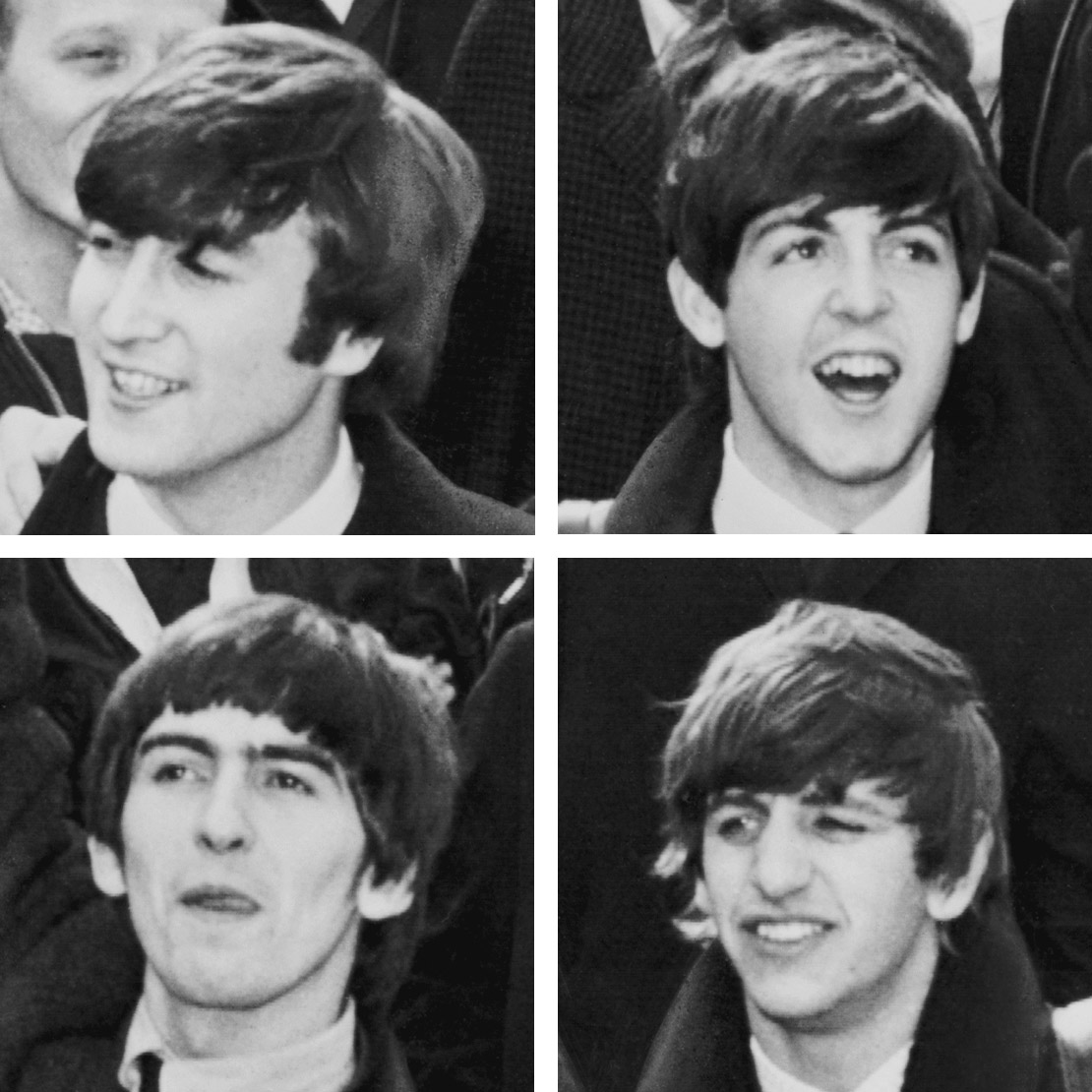
The Beatles were an English rock band formed in Liverpool in 1960. The core lineup of the band comprised John Lennon, Paul McCartney, George Harrison and Ringo Starr. They are widely regarded as the most influential band in Western popular music and were integral to the development of 1960s counterculture and the recognition of popular music as an art form.[2][3] Rooted in skiffle, beat and 1950s rock 'n' roll, their sound incorporated elements of classical music and traditional pop in innovative ways. The band also explored music styles ranging from folk and Indian music to psychedelia and hard rock. As pioneers in recording, songwriting and artistic presentation, the Beatles revolutionised many aspects of the music industry and were often publicised as leaders of the era's youth and sociocultural movements.[4]

Key Information

Led by primary songwriters Lennon and McCartney, the Beatles evolved from Lennon's previous group, the Quarrymen, and built their reputation by playing clubs in Liverpool and Hamburg, Germany, starting in 1960. The core trio of Lennon, McCartney and Harrison, together since 1958, went through a succession of drummers before inviting Starr to join them in 1962. Manager Brian Epstein moulded them into a professional act, and producer George Martin developed their recordings, greatly expanding their domestic success after they signed with EMI and achieved their first hit, "Love Me Do", in late 1962. As their popularity grew into the intense fan frenzy dubbed "Beatlemania", the band acquired the nickname "the Fab Four".

By early 1964, the Beatles were international stars and had achieved unprecedented levels of critical and commercial success. They became a leading force in Britain's cultural resurgence, ushering in the British Invasion of the United States pop market. They soon made their film debut with A Hard Day's Night (1964). A growing desire to refine their studio efforts, coupled with the challenging nature of their concert tours, led to the band's retirement from live performances in 1966. During this time, they produced albums of greater sophistication, including Rubber Soul (1965), Revolver (1966) and Sgt. Pepper's Lonely Hearts Club Band (1967). They enjoyed further commercial success with The Beatles (also known as "the White Album", 1968) and Abbey Road (1969). The success of these records heralded the album era, increased public interest in psychedelic drugs and Eastern spirituality, and furthered advancements in electronic music, album art and music videos. In 1968, they founded Apple Corps, a multi-armed multimedia corporation that continues to oversee projects related to the band's legacy. After the group's break-up in 1970, all principal former members enjoyed success as solo artists. While some partial reunions occurred over the next decade, the four members never reunited. Lennon was murdered in 1980 and Harrison died of lung cancer in 2001; McCartney and Starr remain musically active.

The Beatles are the best-selling music act of all time, with estimated sales of 600 million units worldwide.[5][6] They are the most successful act in the history of the US Billboard charts,[7] with the most number 1 hits on the U.S. Billboard Hot 100 chart (20), and they hold the record for most number 1 albums on the UK Albums Chart (15) and most singles sold in the UK (21.9 million). The band received many accolades, including eight Grammy Awards, four Brit Awards, an Academy Award (for Best Original Song Score for the 1970 documentary film Let It Be) and fifteen Ivor Novello Awards. They were inducted into the Rock and Roll Hall of Fame in their first year of eligibility, 1988, and each principal member was individually inducted between 1994 and 2015. In 2004 and 2011, the group topped Rolling Stone's lists of the greatest artists in history. Time magazine named them among the 20th century's 100 most important people.

History

[edit]

1956–1963: Formation

[edit]

The Quarrymen and name changes

[edit]

In November 1956, sixteen-year-old John Lennon formed a skiffle group with several friends from Quarry Bank High School in Liverpool. They were called the Quarrymen, a reference to their school song "Quarry men old before our birth".[8] Fifteen-year-old Paul McCartney met Lennon on 6 July 1957 and joined as a rhythm guitarist shortly after.[9] In February 1958, McCartney invited his friend George Harrison, then aged fifteen, to watch the band. Harrison auditioned for Lennon, impressing him with his playing, but Lennon initially thought Harrison was too young. After a month's persistence, during a second meeting (arranged by McCartney), Harrison performed the lead guitar part of the instrumental song "Raunchy" on the upper deck of a Liverpool bus,[10] and they enlisted him as lead guitarist.[11][12]

By January 1959, Lennon's Quarry Bank friends had left the group and he began his studies at the Liverpool College of Art.[13] The three guitarists, billing themselves as Johnny and the Moondogs,[14] were playing rock and roll whenever they could find a drummer.[15] They also performed as the Rainbows. Paul McCartney later told New Musical Express that they called themselves that "because we all had different coloured shirts and we couldn't afford any others!"[16]

Lennon's art school friend Stuart Sutcliffe, who had just sold one of his paintings and was persuaded to purchase a bass guitar with the proceeds, joined in January 1960. He suggested changing the band's name to Beatals, as a tribute to Buddy Holly and the Crickets.[17][18] They used this name until May, when they became the Silver Beetles, before undertaking a brief tour of Scotland as the backing group for pop singer and fellow Liverpudlian Johnny Gentle. By early July, they had refashioned themselves as the Silver Beatles and by the middle of August simply the Beatles.[19]

Early residencies and UK popularity

[edit]
Left to right: Pete Best, George Harrison, John Lennon, Paul McCartney, and Stuart Sutcliffe at Hamburg Funfair in 1960, photographed by Astrid Kirchherr. Sutcliffe left the Beatles in 1961 and Ringo Starr replaced Best in 1962.

Allan Williams, the Beatles' unofficial manager, arranged a residency for them in Hamburg. They auditioned and hired drummer Pete Best in mid-August 1960. The band, now a five-piece, departed Liverpool for Hamburg four days later, contracted to club owner Bruno Koschmider for what would be a 3+12-month residency.[20] Beatles historian Mark Lewisohn writes: "They pulled into Hamburg at dusk on 17 August, the time when the red-light area comes to life ... flashing neon lights screamed out the various entertainment on offer, while scantily clad women sat unabashed in shop windows waiting for business opportunities."[21]

Koschmider had converted a couple of strip clubs in the red light Reeperbahn district of St. Pauli into music venues and initially placed the Beatles at the Indra Club. After closing Indra due to noise complaints, he moved them to the Kaiserkeller in October.[22] When he learned they had been performing at the rival Top Ten Club in breach of their contract, he gave them one month's termination notice,[23] and reported the underage Harrison, who had obtained permission to stay in Hamburg by lying to the German authorities about his age.[24] The authorities arranged for Harrison's deportation in late November.[25] One week later, Koschmider had McCartney and Best arrested for arson after they set fire to a condom in a concrete corridor; the authorities deported them.[26] Lennon returned to Liverpool in early December, while Sutcliffe remained in Hamburg until late February with his German fiancée Astrid Kirchherr,[27] who took the first semi-professional photos of the Beatles.[28]

During the next two years, the Beatles were resident for periods in Hamburg, where they used Preludin both recreationally and to maintain their energy through all-night performances.[29] In 1961, during their second Hamburg engagement, Kirchherr cut Sutcliffe's hair in the "exi" (existentialist) style, later adopted by the other Beatles.[30][31] Sutcliffe decided to leave the band early that year and resume his art studies in Germany. McCartney took over bass.[32] Producer Bert Kaempfert contracted what was now a four-piece group until June 1962, and he used them as Tony Sheridan's backing band on a series of recordings for Polydor Records.[18][33] As part of the sessions, the Beatles were signed to Polydor for one year.[34] Credited to "Tony Sheridan & the Beat Brothers", the single "My Bonnie", recorded in June 1961 and released four months later, reached number 32 on the Musikmarkt chart.[35]

After the Beatles completed their second Hamburg residency, they enjoyed increasing popularity in Liverpool with the growing Merseybeat movement. However, they were growing tired of the monotony of numerous appearances at the same clubs night after night.[36] In November 1961, during one of the group's frequent performances at the Cavern Club, they encountered Brian Epstein, a local record-store owner and music columnist.[37] He later recalled: "I immediately liked what I heard. They were fresh, and they were honest, and they had what I thought was a sort of presence ... [a] star quality."[38]

First EMI recordings

[edit]

Epstein courted the band over the next couple of months, and they appointed him as their manager in January 1962.[39] Throughout early and mid-1962, Epstein sought to free the Beatles from their contractual obligations to Bert Kaempfert Productions. He eventually negotiated a one-month early release in exchange for one last recording session in Hamburg.[40] On their return to Germany in April, a distraught Kirchherr met them at the airport with news of Sutcliffe's death the previous day from a brain haemorrhage.[41] Epstein began negotiations with record labels for a recording contract. To secure a UK record contract, Epstein negotiated an early end to the band's contract with Polydor, in exchange for more recordings backing Tony Sheridan.[42] After a New Year's Day audition, Decca Records rejected the band, saying, "Guitar groups are on the way out, Mr. Epstein".[43] However, three months later, producer George Martin signed the Beatles to EMI's Parlophone label.[41]

A flight of stone steps leads from an asphalt car park up to the main entrance of a white two-story building. The ground floor has two sash windows, the first floor has three shorter sash windows. Two more windows are visible at basement level. The decorative stonework around the doors and windows is painted grey.
Main entrance at EMI Studios (now Abbey Road Studios, pictured 2007)

Martin's first recording session with the Beatles took place at EMI Recording Studios (later Abbey Road Studios) in London on 6 June 1962.[44] He immediately complained to Epstein about Best's drumming and suggested they use a session drummer in his place.[45] Already contemplating Best's dismissal,[46] the Beatles replaced him in mid-August with Ringo Starr, who left Rory Storm and the Hurricanes to join them.[44] A 4 September session at EMI yielded a recording of "Love Me Do" featuring Starr on drums, but a dissatisfied Martin hired drummer Andy White for the band's third session a week later, which produced recordings of "Love Me Do", "Please Please Me" and "P.S. I Love You".[44]

Martin initially selected the Starr version of "Love Me Do" for the band's first single, though subsequent re-pressings featured the White version, with Starr on tambourine.[44] Released in early October, "Love Me Do" peaked at number 17 on the Record Retailer chart.[47] Their television debut came later that month with a live performance on the regional news programme People and Places.[48] After Martin suggested rerecording "Please Please Me" at a faster tempo,[49] a studio session in late November yielded that recording,[50] of which Martin accurately predicted, "You've just made your first No. 1".[51]

In December 1962, the Beatles concluded their fifth and final Hamburg residency at the Star-Club.[52] By 1963, they had agreed that all four band members would contribute vocals to their albums – including Starr, despite his restricted vocal range, to validate his standing in the group.[53] Lennon and McCartney had established a songwriting partnership, and as the band's success grew, their dominant collaboration limited Harrison's opportunities as a lead vocalist.[54] Epstein, to maximise the Beatles' commercial potential, encouraged them to adopt a professional approach to performing.[55] Lennon recalled him saying, "Look, if you really want to get in these bigger places, you're going to have to change – stop eating on stage, stop swearing, stop smoking ...".[43][nb 1]

1963–1966: Beatlemania and touring years

[edit]

Please Please Me and With the Beatles

[edit]
The logo of the English rock band the Beatles
The band's logo was designed by Ivor Arbiter.[56]

On 11 February 1963, the Beatles recorded ten songs during a single studio session for their debut LP, Please Please Me. It was supplemented by the four tracks already released on their first two singles. Martin considered recording the LP live at The Cavern Club, but after deciding that the building's acoustics were inadequate, he elected to simulate a "live" album with minimal production in "a single marathon session at Abbey Road".[57] After the moderate success of "Love Me Do", the single "Please Please Me" was released in January 1963, two months ahead of the album. It reached number 1 on every UK chart except Record Retailer, where it peaked at number 2.[58]

Recalling how the Beatles "rushed to deliver a debut album, bashing out Please Please Me in a day", AllMusic critic Stephen Thomas Erlewine wrote: "Decades after its release, the album still sounds fresh, precisely because of its intense origins."[59] Lennon said little thought went into composition at the time; he and McCartney were "just writing songs à la Everly Brothers, à la Buddy Holly, pop songs with no more thought of them than that – to create a sound. And the words were almost irrelevant."[60]

Released in March 1963, Please Please Me was the first of eleven consecutive Beatles albums released in the United Kingdom to reach number 1.[63] The band's third single, "From Me to You", came out in April and began an almost unbroken string of seventeen British number 1 singles, including all but one of the eighteen they released over the next six years.[64] Issued in August, their fourth single, "She Loves You", achieved the fastest sales of any record in the UK up to that time, selling three-quarters of a million copies in under four weeks.[65] It became their first single to sell a million copies and remained the biggest-selling record in the UK until 1978.[66][nb 2]

The success brought increased media exposure, to which the Beatles responded with an irreverent and comical attitude that defied the expectations of pop musicians at the time, inspiring even more interest.[67] The band toured the UK three times in the first half of the year: a four-week tour that began in February, the Beatles' first nationwide, preceded three-week tours in March and May–June.[68] As their popularity spread, a frenzied adulation of the group took hold. On 13 October, the Beatles starred on Sunday Night at the London Palladium, the UK's top variety show.[69] Their performance was televised live and watched by 15 million viewers. One national paper's headlines in the following days coined the term "Beatlemania" to describe the riotous enthusiasm by screaming fans who greeted the band – and it stuck.[69][70] Although not billed as tour leaders, the Beatles overshadowed American acts Tommy Roe and Chris Montez during the February engagements and assumed top billing "by audience demand", something no British act had previously accomplished while touring with artists from the US.[71] A similar situation arose during their May–June tour with Roy Orbison.[72]

Paul McCartney, George Harrison, Swedish pop singer Lill-Babs and John Lennon on the set of the Swedish television show Drop-In in 1963
McCartney, Harrison, Swedish pop singer Lill-Babs and Lennon on the set of the Swedish television show Drop-In, 30 October 1963[73]

In late October, the Beatles began a five-day tour of Sweden, their first time abroad since the final Hamburg engagement of December 1962.[74] On their return to the UK on 31 October, several hundred screaming fans greeted them in heavy rain at Heathrow Airport. Around 50 to 100 journalists and photographers, as well as representatives from the BBC, also joined the airport reception, the first of more than 100 such events.[75] The next day, the band began its fourth tour of Britain within nine months, this one scheduled for six weeks.[76] In mid-November, as Beatlemania intensified, police resorted to using high-pressure water hoses to control the crowd before a concert in Plymouth.[77] On 4 November, they played in front of The Queen Mother and Princess Margaret during the Royal Variety Performance at the Prince of Wales Theatre.[78]

Please Please Me maintained the top position on the Record Retailer chart for 30 weeks, only to be displaced by its follow-up, With the Beatles,[79] which EMI released on 22 November to record advance orders of 270,000 copies. The LP topped a half-million albums sold in one week.[80] Recorded between July and October, With the Beatles made better use of studio production techniques than its predecessor.[81] It held the top spot for 21 weeks with a chart life of 40 weeks.[82] Erlewine described the LP as "a sequel of the highest order – one that betters the original".[83]

In a reversal of then standard practice, EMI released the album ahead of the impending single "I Want to Hold Your Hand", with the song excluded to maximise the single's sales.[84] The album caught the attention of music critic William Mann of The Times, who suggested that Lennon and McCartney were "the outstanding English composers of 1963".[81] The newspaper published a series of articles in which Mann offered detailed analyses of the music, lending it respectability.[85] With the Beatles became the second album in UK chart history to sell a million copies, a figure previously reached only by the 1958 South Pacific soundtrack.[86] When writing the sleeve notes for the album, the band's press officer, Tony Barrow, used the superlative the "fabulous foursome", which the media widely adopted as "the Fab Four".[87]

First visit to the United States and the British Invasion

[edit]
A black-and-white image of four men standing in front of a crowd of people at the bottom of an aeroplane staircase
The Beatles arriving at John F. Kennedy International Airport, 7 February 1964

EMI's American subsidiary, Capitol Records, hindered the Beatles' releases in the United States for more than a year by initially declining to issue their music, including their first three singles. Concurrent negotiations with the independent US label Vee-Jay led to the release of some, but not all, of the songs in 1963.[88] Vee-Jay finished preparation for the album Introducing... The Beatles, comprising most of the songs of Parlophone's Please Please Me, but a management shake-up led to the album not being released.[nb 3] After it emerged that the label did not report royalties on their sales, the licence that Vee-Jay had signed with EMI was voided.[90] A new licence was granted to the Swan label for the single "She Loves You". The record received some airplay in the Tidewater area of Virginia from Gene Loving of radio station WGH and was featured on the "Rate-a-Record" segment of American Bandstand, but it failed to catch on nationally.[91]

A newspaper clipping from 8 February 1964 covering "Beatlemania"

Epstein brought a demo copy of "I Want to Hold Your Hand" to Capitol's Brown Meggs, who signed the band and arranged for a $40,000 US marketing campaign. American chart success began after disc jockey Carroll James of AM radio station WWDC, in Washington, DC, obtained a copy of the British single "I Want to Hold Your Hand" in mid-December 1963 and began playing it on-air.[92] Taped copies of the song soon circulated among other radio stations throughout the US. This caused an increase in demand, leading Capitol to bring forward the release of "I Want to Hold Your Hand" by three weeks.[93] Issued on 26 December, with the band's previously scheduled debut there just weeks away, "I Want to Hold Your Hand" sold a million copies, becoming a number 1 hit in the US by mid-January.[94] In its wake Vee-Jay released Introducing... The Beatles[95] along with Capitol's debut album, Meet the Beatles!, while Swan reactivated production of "She Loves You".[96] The Odeon label, an EMI subsidiary, pressed Beatles LPs to be shipped out and distributed abroad.[97] After the Beatles' US trip, MGM Records released the single "My Bonnie" backed with "The Saints" in the US on 27 January 1964 as a Beatles single,[98] and Atco followed in issuing the recordings the Beatles had made in Germany with Tony Sheridan in 1961 and 1962.[99]

The Beatles performing on The Ed Sullivan Show, February 1964

On 7 February 1964, the Beatles departed from Heathrow with an estimated 4,000 fans waving and screaming as the aircraft took off.[100] Upon landing at New York's John F. Kennedy Airport, an uproarious crowd estimated at 3,000 greeted them.[101] They gave their first live US television performance two days later on The Ed Sullivan Show, watched by approximately 73 million viewers in over 23 million households,[102] or 34 per cent of the American population. Biographer Jonathan Gould writes that, according to the Nielsen rating service, it was "the largest audience that had ever been recorded for an American television program".[103] The next morning, the Beatles awoke to a largely negative critical consensus in the US,[104] but a day later at their first US concert, Beatlemania erupted at the Washington Coliseum.[105] Back in New York the following day, the Beatles met with another strong reception during two shows at Carnegie Hall.[102] The band flew to Florida, where they appeared on The Ed Sullivan Show a second time, again before 70 million viewers, before returning to the UK on 22 February.[106]

The Beatles' first visit to the US took place when the nation was still mourning the assassination of President John F. Kennedy the previous November.[107] Commentators often suggest that for many, particularly the young, the Beatles' performances reignited the sense of excitement and possibility that momentarily faded in the wake of the assassination and helped pave the way for the revolutionary social changes to come later in the decade.[108] Their hairstyle, unusually long for the era and mocked by many adults,[18] became an emblem of rebellion to the burgeoning youth culture.[109]

The group's popularity generated unprecedented interest in British music, and many other UK acts subsequently made their American debuts, successfully touring over the next three years in what was termed the British Invasion.[110] The Beatles' success in the US opened the door for a successive string of British beat groups and pop acts such as the Dave Clark Five, the Animals, Herman's Hermits, Petula Clark, the Kinks and the Rolling Stones to achieve success in America.[111] During the week of 4 April 1964, the Beatles held twelve positions on the Billboard Hot 100 singles chart, including the top five.[112][nb 4]

A Hard Day's Night

[edit]

Capitol Records' lack of interest throughout 1963 did not go unnoticed, and a competitor, United Artists Records, encouraged its film division to offer the Beatles a three-motion-picture deal, primarily for the commercial potential of the soundtracks in the US.[114] Directed by Richard Lester, A Hard Day's Night involved the band for six weeks in March–April 1964 as they played themselves in a musical comedy.[115] The film premiered in London and New York in July and August, respectively, and was an international success, with some critics drawing a comparison with the Marx Brothers.[116]

United Artists released a full soundtrack album for the North American market, combining Beatles songs and Martin's orchestral score; elsewhere, the group's third studio LP, A Hard Day's Night, contained songs from the film on side one and other new recordings on side two.[117] According to Erlewine, the album saw them "truly coming into their own as a band. All of the disparate influences on their first two albums coalesced into a bright, joyous, original sound, filled with ringing guitars and irresistible melodies."[118] That "ringing guitar" sound was primarily the product of Harrison's 12-string electric Rickenbacker, a prototype given to him by the manufacturer, which made its debut on the record.[119][nb 5]

1964 world tour, meeting Bob Dylan and stand on civil rights

[edit]
Paul McCartney, George Harrison and John Lennon of the Beatles performing on Dutch TV in 1964
McCartney, Harrison and Lennon performing on Dutch TV in 1964

Touring internationally in June and July, the Beatles staged 37 shows over 27 days in Denmark, the Netherlands, Hong Kong, Australia and New Zealand.[120][nb 6] In August and September, they returned to the US, with a 30-concert tour of 23 cities.[122] Generating intense interest once again, the month-long tour attracted between 10,000 and 20,000 people to each 30-minute performance in cities from San Francisco to New York.[122]

In August, journalist Al Aronowitz arranged for the Beatles to meet Bob Dylan.[123] Visiting the band in their New York hotel suite, Dylan introduced them to cannabis.[124] Gould points out the musical and cultural significance of this meeting, before which the musicians' respective fanbases were "perceived as inhabiting two separate subcultural worlds": Dylan's audience of "college kids with artistic or intellectual leanings, a dawning political and social idealism, and a mildly bohemian style" contrasted with their fans, "veritable 'teenyboppers' – kids in high school or grade school whose lives were totally wrapped up in the commercialised popular culture of television, radio, pop records, fan magazines and teen fashion. To many of Dylan's followers in the folk music scene, the Beatles were seen as idolaters, not idealists."[125]

Within six months of the meeting, according to Gould, "Lennon would be making records on which he openly imitated Dylan's nasal drone, brittle strum, and introspective vocal persona"; and six months after that, Dylan began performing with a backing band and electric instrumentation, and "dressed in the height of Mod fashion".[126] As a result, Gould continues, the traditional division between folk and rock enthusiasts "nearly evaporated", as the Beatles' fans began to mature in their outlook and Dylan's audience embraced the new, youth-driven pop culture.[126]

During the 1964 US tour, the group were confronted with racial segregation in the country at the time.[127][128] When informed that the venue for their 11 September concert, the Gator Bowl in Jacksonville, Florida, was segregated, the Beatles said they would refuse to perform unless the audience was integrated.[129][127][128] Lennon stated: "We never play to segregated audiences and we aren't going to start now ... I'd sooner lose our appearance money."[127] City officials relented and agreed to allow an integrated show.[127] The group also cancelled their reservations at the whites-only Hotel George Washington in Jacksonville.[128] For their subsequent US tours in 1965 and 1966, the Beatles included clauses in contracts stipulating that shows be integrated.[128][130]

Beatles for Sale, Help! and Rubber Soul

[edit]

According to Gould, the Beatles' fourth studio LP, Beatles for Sale, evidenced a growing conflict between the commercial pressures of their global success and their creative ambitions.[131] They had intended the album, recorded between August and October 1964,[132] to continue the format established by A Hard Day's Night which, unlike their first two LPs, contained only original songs.[131] They had nearly exhausted their backlog of songs on the previous album, however, and given the challenges constant international touring posed to their songwriting efforts, Lennon admitted, "Material's becoming a hell of a problem".[133] As a result, six covers from their extensive repertoire were chosen to complete the album. Released in early December, its eight original compositions stood out, demonstrating the growing maturity of the Lennon–McCartney songwriting partnership.[131]

In early 1965, following a dinner with Lennon, Harrison and their wives, Harrison's dentist, John Riley, secretly added LSD to their coffee.[134] Lennon described the experience: "It was just terrifying, but it was fantastic. I was pretty stunned for a month or two."[135] He and Harrison subsequently became regular users of the drug, joined by Starr on at least one occasion. Harrison's use of psychedelic drugs encouraged his path to meditation and Hinduism. He commented: "For me, it was like a flash. The first time I had acid, it just opened up something in my head that was inside of me, and I realised a lot of things. I didn't learn them because I already knew them, but that happened to be the key that opened the door to reveal them. From the moment I had that, I wanted to have it all the time – these thoughts about the yogis and the Himalayas, and Ravi's music."[136][137] McCartney was initially reluctant to try it, but eventually did so in late 1966.[138] He became the first Beatle to discuss LSD publicly, declaring in a magazine interview that "it opened my eyes" and "made me a better, more honest, more tolerant member of society".[139]

The Beatles performing music in a field. In the foreground, the drums are played by Starr (only the top of his head is visible). Beyond him, the other three stand in a column with their guitars. In the rear, Harrison, head down, strikes a chord. In the front, Lennon smiles and gives a little wave toward camera, holding his pick. Between them, McCartney is jocularly about to choke Lennon.
The US trailer for Help! with (from the rear) Harrison, McCartney, Lennon and (largely obscured) Starr

Controversy erupted in June 1965 when Queen Elizabeth II appointed all four Beatles Members of the Order of the British Empire (MBE) after Prime Minister Harold Wilson nominated them for the award.[140] In protest – the honour was at that time primarily bestowed upon military veterans and civic leaders – some conservative MBE recipients returned their insignia.[141]

In July, the Beatles' second film, Help!, was released, again directed by Lester. Described as "mainly a relentless spoof of Bond",[142] it inspired a mixed response among both reviewers and the band. McCartney said: "Help! was great but it wasn't our film – we were sort of guest stars. It was fun, but basically, as an idea for a film, it was a bit wrong."[143] The soundtrack was dominated by Lennon, who wrote and sang lead on most of its songs, including the two singles: "Help!" and "Ticket to Ride".[144]

The Help! album, the group's fifth studio LP, mirrored A Hard Day's Night by featuring soundtrack songs on side one and additional songs from the same sessions on side two.[145] The LP contained all original material save for two covers, "Act Naturally" and "Dizzy Miss Lizzy"; they were the last covers the band would include on an album until Let It Be's brief rendition of the traditional Liverpool folk song "Maggie Mae".[146] The band expanded their use of vocal overdubs on Help! and incorporated classical instruments into some arrangements, including a string quartet on the pop ballad "Yesterday".[147] Composed and sung by McCartney – none of the other Beatles perform on the recording[148] – "Yesterday" has inspired the most cover versions of any song ever written.[149] With Help!, the Beatles became the first rock group to be nominated for a Grammy Award for Album of the Year.[150]

The Beatles at a press conference in August 1965
The Beatles at a press conference in Minnesota in August 1965, shortly after playing at Shea Stadium in New York

The group's third US tour opened with a performance before a world-record crowd of 55,600 at New York's Shea Stadium on 15 August – "perhaps the most famous of all Beatles' concerts", in Lewisohn's description.[151] A further nine successful concerts followed in other American cities. At a show in Atlanta, the Beatles gave one of the first live performances ever to make use of a foldback system of on-stage monitor speakers.[152] Towards the end of the tour, they met with Elvis Presley, a foundational musical influence on the band, who invited them to his home in Beverly Hills.[153][154] Presley later said the band was an example of a trend of anti-Americanism and drug abuse.[155][156]

September 1965 saw the launch of an American Saturday-morning cartoon series, The Beatles, that echoed A Hard Day's Night's slapstick antics over its two-year original run.[157] The series was the first weekly television series to feature animated versions of real, living people.[158]

In mid-October, the Beatles entered the recording studio; for the first time when making an album, they had an extended period without other major commitments.[159] Until this time, according to George Martin, "we had been making albums rather like a collection of singles. Now we were really beginning to think about albums as a bit of art on their own."[160] Released in December, Rubber Soul was hailed by critics as a major step forward in the maturity and complexity of the band's music.[161] Their thematic reach was beginning to expand as they embraced deeper aspects of romance and philosophy, a development that NEMS executive Peter Brown attributed to the band members' "now habitual use of marijuana".[162] Lennon referred to Rubber Soul as "the pot album"[163] and Starr said: "Grass was really influential in a lot of our changes, especially with the writers. And because they were writing different material, we were playing differently."[163] After Help!'s foray into classical music with flutes and strings, Harrison's introduction of a sitar on "Norwegian Wood (This Bird Has Flown)" marked a further progression outside the traditional boundaries of popular music. As the lyrics grew more artful, fans began to study them for deeper meaning.[164]

While some of Rubber Soul's songs were the product of Lennon and McCartney's collaborative songwriting,[165] the album also included distinct compositions from each,[166] though they continued to share official credit. "In My Life", of which each later claimed lead authorship, is considered a highlight of the entire Lennon–McCartney catalogue.[167] Harrison called Rubber Soul his "favourite album",[163] and Starr referred to it as "the departure record".[168] McCartney has said, "We'd had our cute period, and now it was time to expand."[169] However, recording engineer Norman Smith later stated that the studio sessions revealed signs of growing conflict within the group – "the clash between John and Paul was becoming obvious", he wrote, and "as far as Paul was concerned, George could do no right".[170]

Controversies, Revolver and final tour

[edit]

Capitol Records, from December 1963 when it began issuing Beatles recordings for the US market, exercised complete control over format,[88] compiling distinct US albums from the band's recordings and issuing songs of their choosing as singles.[171][nb 7] In June 1966, the Capitol LP Yesterday and Today caused an uproar with its cover, which portrayed the grinning Beatles dressed in butcher's overalls, accompanied by raw meat and mutilated plastic baby dolls. According to Beatles biographer Bill Harry, it has been incorrectly suggested that this was meant as a satirical response to the way Capitol had "butchered" the US versions of the band's albums.[173] Thousands of copies of the LP had a new cover pasted over the original; an unpeeled "first-state" copy fetched $10,500 at a December 2005 auction.[174] In England, meanwhile, Harrison met sitar maestro Ravi Shankar, who agreed to train him on the instrument.[175]

During a tour of the Philippines the month after the Yesterday and Today furore, the Beatles unintentionally snubbed the nation's first lady, Imelda Marcos, who had expected them to attend a breakfast reception at the Presidential Palace.[176] When presented with the invitation, Epstein politely declined on the band members' behalf, as it had never been his policy to accept such official invitations.[177] They soon found that the Marcos regime was unaccustomed to taking no for an answer. The resulting riots endangered the group and they escaped the country with difficulty.[178] Immediately afterwards, the band members visited India for the first time.[179]

We're more popular than Jesus now; I don't know which will go first – rock 'n' roll or Christianity.

– John Lennon, 1966[180]

Almost as soon as they returned home, the Beatles faced a fierce backlash from US religious and social conservatives (as well as the Ku Klux Klan) over a comment Lennon had made in a March interview with British reporter Maureen Cleave.[181] "Christianity will go", Lennon had said. "It will vanish and shrink. I needn't argue about that; I'm right and I will be proved right ... Jesus was alright but his disciples were thick and ordinary. It's them twisting it that ruins it for me."[182] His comments went virtually unnoticed in England, but when US teenage fan magazine Datebook printed them five months later, it sparked a controversy with Christians in America's conservative Bible Belt region.[181] The Vatican issued a protest, and bans on Beatles records were imposed by Spanish and Dutch stations and South Africa's national broadcasting service.[183] Epstein accused Datebook of having taken Lennon's words out of context. At a press conference, Lennon pointed out, "If I'd said television was more popular than Jesus, I might have got away with it."[184] He claimed that he was referring to how other people viewed their success, but at the prompting of reporters, he concluded: "If you want me to apologise, if that will make you happy, then okay, I'm sorry."[184]

Released in August 1966, a week before the Beatles' final tour, Revolver marked another artistic step forward for the group.[185] The album featured sophisticated songwriting, studio experimentation and a greatly expanded repertoire of musical styles, ranging from innovative classical string arrangements to psychedelia.[185] Abandoning the customary group photograph, its Aubrey Beardsley-inspired cover – designed by Klaus Voormann, a friend of the band since their Hamburg days – was a monochrome collage and line drawing caricature of the group.[185] The album was preceded by the single "Paperback Writer", backed by "Rain".[186] Short promotional films were made for both songs; described by cultural historian Saul Austerlitz as "among the first true music videos",[187] they aired on The Ed Sullivan Show and Top of the Pops in June.[188]

Among the experimental songs on Revolver was "Tomorrow Never Knows", the lyrics for which Lennon drew from Timothy Leary's The Psychedelic Experience: A Manual Based on the Tibetan Book of the Dead. Its creation involved eight tape decks distributed about the EMI building, each staffed by an engineer or band member, who randomly varied the movement of a tape loop while Martin created a composite recording by sampling the incoming data.[189] McCartney's "Eleanor Rigby" made prominent use of a string octet; Gould describes it as "a true hybrid, conforming to no recognisable style or genre of song".[190] Harrison's emergence as a songwriter was reflected in three of his compositions appearing on the record.[191] Among these, "Taxman", which opened the album, marked the first example of the Beatles making a political statement through their music.[192]

San Francisco's Candlestick Park in the 1960s
San Francisco's Candlestick Park (pictured in the early 1960s) was the venue for the Beatles' final concert before a paying audience.

As preparations were made for a tour of the US, the Beatles knew that their music would hardly be heard. Having originally used Vox AC30 amplifiers, they later acquired more powerful 100-watt amplifiers, specially designed for them by Vox, as they moved into larger venues in 1964; however, these were still inadequate. Struggling to compete with the volume of sound generated by screaming fans, the band had grown increasingly bored with the routine of performing live.[193] Recognising that their shows were no longer about the music, and shaken up from the recent incident in the Philippines, they decided to make the August tour their last.[194][195]

The band performed none of their new songs on the tour.[196] In Chris Ingham's description, they were very much "studio creations ... and there was no way a four-piece rock 'n' roll group could do them justice, particularly through the desensitising wall of the fans' screams. 'Live Beatles' and 'Studio Beatles' had become entirely different beasts."[197] The band's concert at San Francisco's Candlestick Park on 29 August was their last commercial concert.[198] It marked the end of four years dominated by almost non-stop touring that included over 1,400 concert appearances internationally.[199]

1966–1970: Studio years

[edit]

Sgt. Pepper's Lonely Hearts Club Band

[edit]
The album artwork of the Beatles' 1967 album Sgt. Pepper's Lonely Hearts Club Band
Front cover of Sgt. Pepper's Lonely Hearts Club Band, "the most famous cover of any music album, and one of the most imitated images in the world"[200]

Freed from the burden of touring, the Beatles embraced an increasingly experimental approach as they recorded Sgt. Pepper's Lonely Hearts Club Band, beginning in late November 1966.[201] According to engineer Geoff Emerick, the album's recording took over 700 hours.[202] He recalled the band's insistence "that everything on Sgt. Pepper had to be different. We had microphones right down in the bells of brass instruments and headphones turned into microphones attached to violins. We used giant primitive oscillators to vary the speed of instruments and vocals and we had tapes chopped to pieces and stuck together upside down and the wrong way around."[203] Parts of "A Day in the Life" featured a 40-piece orchestra.[203] The sessions initially yielded the non-album double A-side single "Strawberry Fields Forever"/"Penny Lane" in February 1967;[204] the Sgt. Pepper LP followed with a rush-release in May.[205] The musical complexity of the records, created using relatively primitive four-track recording technology, astounded contemporary artists.[200] Among music critics, acclaim for the album was virtually universal.[206] Gould writes:

The overwhelming consensus is that the Beatles had created a popular masterpiece: a rich, sustained, and overflowing work of collaborative genius whose bold ambition and startling originality dramatically enlarged the possibilities and raised the expectations of what the experience of listening to popular music on record could be. On the basis of this perception, Sgt. Pepper became the catalyst for an explosion of mass enthusiasm for album-formatted rock that would revolutionise both the aesthetics and the economics of the record business in ways that far outstripped the earlier pop explosions triggered by the Elvis phenomenon of 1956 and the Beatlemania phenomenon of 1963.[207]

In the wake of Sgt. Pepper, the underground and mainstream press widely publicised the Beatles as leaders of youth culture, as well as "lifestyle revolutionaries".[4] The album was the first major pop/rock LP to include its complete lyrics, which appeared on the back cover.[208][209] Those lyrics were the subject of critical analysis; for instance, in late 1967 the album was the subject of a scholarly inquiry by American literary critic and professor of English Richard Poirier, who observed that his students were "listening to the group's music with a degree of engagement that he, as a teacher of literature, could only envy".[210][nb 8] The elaborate cover also attracted considerable interest and study.[211] A collage designed by pop artists Peter Blake and Jann Haworth, it depicted the group as the fictional band referred to in the album's title track[212] standing in front of a crowd of famous people.[213] The heavy moustaches worn by the group reflected the growing influence of the hippie movement,[214] while cultural historian Jonathan Harris describes their "brightly coloured parodies of military uniforms" as a knowingly "anti-authoritarian and anti-establishment" display.[215]

Sgt. Pepper topped the UK charts for 23 consecutive weeks, with a further four weeks at number 1 in the period through to February 1968.[216] With 2.5 million copies sold within three months of its release,[217] Sgt. Pepper's initial commercial success exceeded that of all previous Beatles albums.[218] It was the first rock album to win the Grammy Award for Album of the Year.[219] It sustained its immense popularity into the 21st century while breaking numerous sales records.[220]

Magical Mystery Tour and Yellow Submarine

[edit]

Two Beatles film projects were conceived within weeks of completing Sgt. Pepper: Magical Mystery Tour, a one-hour television film, and Yellow Submarine, an animated feature-length film produced by United Artists.[221] The group began recording music for the former in late April 1967, but the project then lay dormant as they focused on recording songs for the latter.[222] On 25 June, the Beatles performed their forthcoming single "All You Need Is Love" to an estimated 350 million viewers on Our World, the first live global television link.[223] Released a week later, during the Summer of Love, the song was adopted as a flower power anthem.[224] The Beatles' use of psychedelic drugs was at its height during that summer.[225] In July and August, the group pursued interests related to similar utopian-based ideology, including a week-long investigation into the possibility of starting an island-based commune off the coast of Greece.[226][227]

On 24 August, the group were introduced to Maharishi Mahesh Yogi in London. The next day, they travelled to Bangor for his Transcendental Meditation retreat. On 27 August, their manager's assistant, Peter Brown, phoned to inform them that Epstein had died.[228] The coroner ruled the death an accidental carbitol overdose, although it was widely rumoured to be a suicide.[229][nb 9] His death left the group disoriented and fearful about the future.[231] Lennon recalled: "We collapsed. I knew that we were in trouble then. I didn't really have any misconceptions about our ability to do anything other than play music, and I was scared. I thought, 'We've fuckin' had it now.'"[232] Harrison's then-wife Pattie Boyd remembered that "Paul and George were in complete shock. I don't think it could have been worse if they had heard that their own fathers had dropped dead."[233] During a band meeting in September, McCartney recommended that the band proceed with Magical Mystery Tour.[222]

The Magical Mystery Tour soundtrack was released in the UK as a six-track double extended play (EP) in early December 1967.[88][234] It was the first example of a double EP in the UK.[235][236] The record carried on the psychedelic vein of Sgt. Pepper,[237] though in line with the band's wishes, the packaging reinforced the idea that the release was a film soundtrack rather than a follow-up to Sgt. Pepper.[234] In the US, the soundtrack appeared as an identically titled LP that also included five tracks from the band's recent singles.[113] In its first three weeks, the album set a record for the highest initial sales of any Capitol LP and is the only Capitol compilation later to be adopted in the band's official canon of studio albums.[238]

Magical Mystery Tour first aired on Boxing Day to an audience of approximately 15 million.[239] Largely directed by McCartney, the film was the band's first critical failure in the UK.[240] It was dismissed as "blatant rubbish" by the Daily Express, the Daily Mail called it "a colossal conceit" and The Guardian labelled the film "a kind of fantasy morality play about the grossness and warmth and stupidity of the audience".[241] Gould describes it as "a great deal of raw footage showing a group of people getting on, getting off, and riding on a bus".[241] Although the viewership figures were respectable, its slating in the press led US television networks to lose interest in broadcasting the film.[242]

The group were less involved with Yellow Submarine, which featured the band appearing as themselves for only a short live-action segment.[243] Premiering in July 1968, the film featured cartoon versions of the band members and a soundtrack with eleven of their songs, including four unreleased studio recordings that made their debut in the film.[244] Critics praised the film for its music, humour and innovative visual style.[245] A soundtrack LP was issued seven months later; it contained those four new songs, the title track (already issued on Revolver), "All You Need Is Love" (already issued as a single and on the US Magical Mystery Tour LP) and seven instrumental pieces composed by Martin.[246]

India retreat, Apple Corps and the White Album

[edit]
The Beatles pictured in February 1968

In February 1968, the Beatles travelled to Maharishi Mahesh Yogi's ashram in Rishikesh, India, to take part in a three-month meditation "Guide Course". Their time in India marked one of the band's most prolific periods, yielding numerous songs, including a majority of those on their next album.[247] However, Starr left after only ten days, unable to stomach the food, and McCartney eventually grew bored and departed a month later.[248] For Lennon and Harrison, creativity turned to question when an electronics technician known as Magic Alex suggested that the Maharishi was attempting to manipulate them.[249] When he alleged that the Maharishi had made sexual advances to women attendees, a persuaded Lennon left abruptly just two months into the course, bringing an unconvinced Harrison and the remainder of the group's entourage with him.[248] In anger, Lennon wrote a scathing song titled "Maharishi", renamed "Sexy Sadie" to avoid potential legal issues. McCartney said, "We made a mistake. We thought there was more to him than there was."[249]

In May, Lennon and McCartney travelled to New York for the public unveiling of the Beatles' new business venture, Apple Corps.[250] It was initially formed several months earlier as part of a plan to create a tax-effective business structure, but the band then desired to extend the corporation to other pursuits, including record distribution, peace activism and education.[251] McCartney described Apple as "rather like a Western communism".[252] The enterprise drained the group financially with a series of unsuccessful projects[253] handled largely by members of the Beatles' entourage, who were given their jobs regardless of talent and experience.[254] Among its numerous subsidiaries were Apple Electronics, established to foster technological innovations with Magic Alex at the head, and Apple Retailing, which opened the short-lived Apple Boutique in London.[255] Harrison later said, "Basically, it was chaos ... John and Paul got carried away with the idea and blew millions, and Ringo and I just had to go along with it."[252]

The album artwork of the Beatles' self-titled 1968 album, also known as "the White Album"
The Beatles, known as "the White Album" for its minimalist cover, conceived by pop artist Richard Hamilton "in direct contrast to Sgt. Pepper", while also suggesting a "clean slate"[256]

From late May to mid-October 1968, the group recorded what became The Beatles, a double LP commonly known as "the White Album" for its virtually featureless cover.[257] During this time, relations between the members grew openly divisive.[258] Starr quit for two weeks, leaving his bandmates to record "Back in the U.S.S.R." and "Dear Prudence" as a trio, with McCartney filling in on drums.[259] Lennon had lost interest in collaborating with McCartney,[260] whose contribution "Ob-La-Di, Ob-La-Da" he scorned as "granny music shit".[261] Tensions were further aggravated by Lennon's romantic preoccupation with avant-garde artist Yoko Ono, whom he insisted on bringing to the sessions despite the group's well-established understanding that girlfriends were not allowed in the studio.[262] McCartney has recalled that the album "wasn't a pleasant one to make".[263] He and Lennon identified the sessions as the start of the band's break-up.[264][265]

With the record, the band executed a wider range of musical styles[266] and broke with their recent tradition of incorporating several musical styles in one song by keeping each piece of music consistently faithful to a select genre.[267] During the sessions, the group upgraded to an eight-track tape console, which made it easier for them to layer tracks piecemeal, while the members often recorded independently of each other, affording the album a reputation as a collection of solo recordings rather than a unified group effort.[268] Describing the double album, Lennon later said: "Every track is an individual track; there isn't any Beatle music on it. [It's] John and the band, Paul and the band, George and the band."[269] The sessions also produced the Beatles' longest song yet, "Hey Jude", released in August as a non-album single with "Revolution".[270]

Issued in November, the White Album was the band's first Apple Records album release, although EMI continued to own their recordings.[271] The record attracted more than 2 million advance orders, selling nearly 4 million copies in the US in little over a month, and its tracks dominated the playlists of American radio stations.[272] Its lyrical content was the focus of much analysis by the counterculture.[273] Despite its popularity, reviewers were largely confused by the album's content and it failed to inspire the level of critical writing that Sgt. Pepper had.[272]

Abbey Road, Let It Be and separation

[edit]

Although Let It Be was the Beatles' final album release, it was largely recorded before Abbey Road. The project's impetus came from an idea Martin attributes to McCartney, who suggested they "record an album of new material and rehearse it, then perform it before a live audience for the very first time – on record and on film".[274] Originally intended for a one-hour television programme to be called Beatles at Work, in the event much of the album's content came from studio work beginning in January 1969, many hours of which were captured on film by director Michael Lindsay-Hogg.[274][275] Martin said that the project was "not at all a happy recording experience. It was a time when relations between the Beatles were at their lowest ebb."[274] Lennon described the largely impromptu sessions as "hell ... the most miserable ... on Earth", and Harrison, "the low of all-time".[276] Irritated by McCartney and Lennon, Harrison walked out for five days. Upon returning, he threatened to leave the band unless they "abandon[ed] all talk of live performance" and instead focused on finishing a new album, initially titled Get Back, using songs recorded for the TV special.[277] He also demanded they cease work at Twickenham Film Studios, where the sessions had begun, and relocate to the newly finished Apple Studio. His bandmates agreed and it was decided to salvage the footage shot for the TV production for use in a feature film.[278]

American musician Billy Preston in 1971
The American soul musician Billy Preston (pictured in 1971) was, for a short time, considered a fifth Beatle during the Get Back sessions.

To alleviate tensions within the band and improve the quality of their live sound, Harrison invited keyboardist Billy Preston to participate in the last nine days of sessions.[279] Preston received label billing on the "Get Back" single – the only musician ever to receive that acknowledgment on an official Beatles release.[280] After the rehearsals, the band could not agree on a location to film a concert, rejecting several ideas, including a boat at sea, a lunatic asylum, the Libyan desert and the Colosseum.[274] Ultimately, what would be their final live performance was filmed on the rooftop of the Apple Corps building at 3 Savile Row, London, on 30 January 1969.[281] Five weeks later, engineer Glyn Johns, whom Lewisohn describes as Get Back's "uncredited producer", began work assembling an album, given "free rein" as the band "all but washed their hands of the entire project".[282]

A terrace house with four floors and an attic. It is red brick, with a slate roof, and the ground floor rendered in imitation of stone and painted white. Each upper floor has four sash windows, divided into small panes. The door, with a canopy over it, occupies the place of the second window from the left on the ground floor.
Apple Corps building at 3 Savile Row, site of the Let It Be rooftop concert

New strains developed between the band members regarding the appointment of a financial adviser, the need for which had become evident without Epstein to manage business affairs. Lennon, Harrison and Starr favoured Allen Klein, who had managed the Rolling Stones and Sam Cooke;[283] McCartney wanted Lee and John Eastman – father and brother, respectively, of Linda Eastman,[284] whom McCartney married on 12 March.[285] Agreement could not be reached, so both Klein and the Eastmans were temporarily appointed: Klein as the Beatles' business manager and the Eastmans as their lawyers.[286][287] Further conflict ensued, however, and financial opportunities were lost.[283] On 8 May, Klein was named sole manager of the band,[288] the Eastmans having previously been dismissed as the Beatles' lawyers. McCartney refused to sign the management contract with Klein, but he was out-voted by the other Beatles.[289]

Martin stated that he was surprised when McCartney asked him to produce another album, as the Get Back sessions had been "a miserable experience" and he had "thought it was the end of the road for all of us".[290] The primary recording sessions for Abbey Road began on 2 July.[291] Lennon, who rejected Martin's proposed format of a "continuously moving piece of music", wanted his and McCartney's songs to occupy separate sides of the album.[292] The eventual format, with individually composed songs on the first side and the second consisting largely of a medley, was McCartney's suggested compromise.[292] Emerick noted that the replacement of the studio's valve-based mixing console with a transistorised one yielded a less punchy sound, leaving the group frustrated at the thinner tone and lack of impact and contributing to its "kinder, gentler" feel relative to their previous albums.[293]

The photo session for the Abbey Road album cover, on 8 August 1969, turned out to be the band's penultimate one. From left: Lennon, Starr, McCartney and Harrison

On 4 July, the first solo single by a Beatle was released: Lennon's "Give Peace a Chance", credited to the Plastic Ono Band. The completion and mixing of "I Want You (She's So Heavy)" on 20 August was the last occasion on which all four Beatles were together in the same studio.[294] On 8 September, while Starr was in hospital, the other band members met to discuss recording a new album. They considered a different approach to songwriting by ending the Lennon–McCartney pretence and having four compositions apiece from Lennon, McCartney and Harrison, with two from Starr and a lead single around Christmas.[295] On 20 September, Lennon announced his departure to the rest of the group but agreed to withhold a public announcement to avoid undermining sales of the forthcoming album.[296]

Released on 26 September, Abbey Road sold four million copies within three months and topped the UK charts for a total of seventeen weeks.[297] Its second track, the ballad "Something", was issued as a single – the only Harrison composition that appeared as a Beatles A-side.[298] Abbey Road received mixed reviews, although the medley met with general acclaim.[297] Unterberger considers it "a fitting swan song for the group", containing "some of the greatest harmonies to be heard on any rock record".[299] Musicologist and author Ian MacDonald calls the album "erratic and often hollow", despite the "semblance of unity and coherence" offered by the medley.[300] Martin singled it out as his favourite Beatles album; Lennon said it was "competent" but had "no life in it".[293]

For the still unfinished Get Back album, one last song, Harrison's "I Me Mine", was recorded on 3 January 1970. Lennon, in Denmark at the time, did not participate.[301] In March, rejecting the work Johns had done on the project, now retitled Let It Be, Klein gave the session tapes to American producer Phil Spector, who had recently produced Lennon's solo single "Instant Karma!"[302] In addition to remixing the material, Spector edited, spliced and overdubbed several of the recordings that had been intended as "live". McCartney was unhappy with the producer's approach and particularly dissatisfied with the lavish orchestration on "The Long and Winding Road", which involved a fourteen-voice choir and 36-piece instrumental ensemble.[303] McCartney's demands that the alterations to the song be reverted were ignored,[304] and he publicly announced his departure from the band on 10 April, a week before the release of his first self-titled solo album.[303][305]

On 8 May 1970, Let It Be was released. Its accompanying single, "The Long and Winding Road", was expected to be the Beatles' last; it was released in the US, but not in the UK.[186] The Let It Be documentary film followed later that month and would win the 1970 Academy Award for Best Original Song Score.[306] Sunday Telegraph critic Penelope Gilliatt called it "a very bad film and a touching one ... about the breaking apart of this reassuring, geometrically perfect, once apparently ageless family of siblings".[307] Several reviewers stated that some of the performances in the film sounded better than their analogous album tracks.[308] Describing Let It Be as the "only Beatles album to occasion negative, even hostile reviews", Unterberger calls it "on the whole underrated"; he singles out "some good moments of straight hard rock in 'I've Got a Feeling' and 'Dig a Pony'" and praises "Let It Be", "Get Back" and "the folky 'Two of Us', with John and Paul harmonising together".[309]

McCartney filed suit for the dissolution of the Beatles' contractual partnership on 31 December 1970.[310] Legal disputes continued long after their break-up and the dissolution was not formalised until 29 December 1974,[311] when Lennon signed the paperwork terminating the partnership while on vacation with his family at Walt Disney World Resort in Florida.[312]

After the breakup

[edit]

1970s

[edit]
Lennon in 1974 and McCartney in 1976

Lennon, McCartney, Harrison and Starr all released solo albums in 1970. Their solo records sometimes involved one or more of the other members;[313] Starr's Ringo (1973) was the only album to include compositions and performances by all four ex-Beatles, albeit on separate songs. With Starr's participation, Harrison staged the Concert for Bangladesh in New York City in August 1971.[314] Other than an unreleased jam session in 1974, later bootlegged as A Toot and a Snore in '74, Lennon and McCartney never recorded together again.[315]

Two double-LP sets of the Beatles' greatest hits, compiled by Klein, 1962–1966 and 1967–1970, were released in 1973, at first under the Apple Records imprint.[316] Commonly known as the "Red Album" and "Blue Album", respectively, each has earned a Multi-Platinum certification in the US and a Platinum certification in the UK.[317][318] Between 1976 and 1982, EMI/Capitol released a wave of compilation albums without input from the ex-Beatles, starting with the double-disc compilation Rock 'n' Roll Music.[319] The only one to feature previously unreleased material was The Beatles at the Hollywood Bowl (1977); the first officially issued concert recordings by the group, it contained selections from two shows they played during their 1964 and 1965 US tours.[320][nb 10]

The music and enduring fame of the Beatles were commercially exploited in various other ways, again often outside their creative control. In April 1974, the musical John, Paul, George, Ringo ... and Bert, written by Willy Russell and featuring singer Barbara Dickson, opened in London. It included, with permission from Northern Songs, eleven Lennon–McCartney compositions and one by Harrison, "Here Comes the Sun". Displeased with the production's use of his song, Harrison withdrew his permission to use it.[322] Later that year, the off-Broadway musical Sgt. Pepper's Lonely Hearts Club Band on the Road opened.[323] All This and World War II (1976) was an unorthodox nonfiction film that combined newsreel footage with covers of Beatles songs by performers ranging from Elton John and Keith Moon to the London Symphony Orchestra.[324] The Broadway musical Beatlemania, an unauthorised nostalgia revue, opened in early 1977 and proved popular, spinning off five separate touring productions.[325] In 1979, the band sued the producers, settling for several million dollars in damages.[325] Sgt. Pepper's Lonely Hearts Club Band (1978), a musical film starring the Bee Gees and Peter Frampton, was a commercial failure and an "artistic fiasco", according to Ingham.[326]

Accompanying the wave of Beatles nostalgia and persistent reunion rumours in the US during the 1970s, several entrepreneurs made public offers to the Beatles for a reunion concert.[327] Promoter Bill Sargent first offered the Beatles $10 million for a reunion concert in 1974. He raised his offer to $30 million in January 1976 and then to $50 million the following month.[328][329] On 24 April 1976, during a broadcast of Saturday Night Live, producer Lorne Michaels jokingly offered the Beatles $3,000 to reunite on the show. Lennon and McCartney were watching the live broadcast at Lennon's apartment at the Dakota in New York, which was within driving distance of the NBC studio where the show was being broadcast. The former bandmates briefly entertained the idea of going to the studio and surprising Michaels by accepting his offer, but decided not to.[330]

1980s

[edit]

In December 1980, Lennon was shot and killed outside his New York City apartment by Mark David Chapman, an American Beatles fan. Harrison rewrote the lyrics of his song "All Those Years Ago" in Lennon's honour. With Starr on drums and McCartney and his wife, Linda, contributing backing vocals, the song was released as a single in May 1981.[331] McCartney's own tribute, "Here Today", appeared on his Tug of War album in April 1982.[332] In 1984, Starr co-starred in McCartney's film Give My Regards to Broad Street,[333] and played with McCartney on several of the songs on the soundtrack.[334] In 1987, Harrison's Cloud Nine album included "When We Was Fab", a song about the Beatlemania era.[335]

When the Beatles' studio albums were released on CD by EMI and Apple Corps in 1987, their catalogue was standardised throughout the world, establishing a canon of the twelve original studio LPs as issued in the UK plus the US LP version of Magical Mystery Tour.[336] All the remaining material from the singles and EPs that had not appeared on these thirteen studio albums was gathered on the two-volume compilation Past Masters (1988). Except for the Red and Blue albums, EMI deleted all its other Beatles compilations – including the Hollywood Bowl record – from its catalogue.[320]

In 1988, the Beatles were inducted into the Rock and Roll Hall of Fame, their first year of eligibility. Harrison and Starr attended the ceremony with Lennon's widow, Yoko Ono, and his two sons, Julian and Sean.[337][338] McCartney declined to attend, citing unresolved "business differences" that would make him "feel like a complete hypocrite waving and smiling with them at a fake reunion".[338] The following year, EMI/Capitol settled a decade-long lawsuit filed by the band over royalties, clearing the way to commercially package previously unreleased material.[339][340]

1990s

[edit]

Live at the BBC, the first official release of unissued Beatles performances in 17 years, appeared in 1994.[341] That same year McCartney, Harrison and Starr collaborated on the Anthology project. Anthology was the culmination of work begun in 1970, when Apple Corps director Neil Aspinall, their former road manager and personal assistant, had started to gather material for a documentary with the working title The Long and Winding Road.[342]

During 1995–96, the project yielded a television miniseries, an eight-volume video set and three two-CD/three-LP box sets featuring artwork by Klaus Voormann. Documenting their history in the band's own words, the Anthology project included the release of several unissued Beatles recordings. Alongside producer Jeff Lynne, McCartney, Harrison and Starr also added new instrumental and vocal parts to songs recorded as demos by Lennon in the late 1970s,[343] resulting in the release of two "new" Beatles singles, "Free as a Bird" and "Real Love". A third Lennon demo, "Now and Then", was also attempted, but abandoned due to the low quality of the recording.[344] The Anthology releases were commercially successful and the television series was viewed by an estimated 400 million people.[345] A book, The Beatles Anthology, followed in October 2000. In 1999, to coincide with the re-release of the 1968 film Yellow Submarine, an expanded soundtrack album, Yellow Submarine Songtrack, was issued.[346]

2000s

[edit]

The Beatles' 1, a compilation album of the band's British and American number 1 hits, was released on 13 November 2000. It became the fastest-selling album of all time, with 3.6 million sold in its first week[347] and 13 million within a month.[348] It topped albums charts in at least 28 countries.[349] The compilation had sold 31 million copies globally by April 2009.[350]

Harrison died from metastatic lung cancer in November 2001.[351][352][353] McCartney and Starr were among the musicians who performed at the Concert for George, organised by Eric Clapton and Harrison's widow, Olivia. The tribute event took place at the Royal Albert Hall on the first anniversary of Harrison's death.[354]

In 2003, Let It Be... Naked, a reconceived version of the Let It Be album, with McCartney supervising production, was released. One of the main differences from the Spector-produced version was the omission of the original string arrangements.[355] It was a top-ten hit in both Britain and America. The US album configurations from 1964 to 1965 were released as box sets in 2004 and 2006; The Capitol Albums, Volume 1 and Volume 2 included both stereo and mono versions based on the mixes that were prepared for vinyl at the time of the music's original American release.[356]

As a soundtrack for Cirque du Soleil's Las Vegas Beatles stage revue, Love, George Martin and his son Giles remixed and blended 130 of the band's recordings to create what Martin called "a way of re-living the whole Beatles musical lifespan in a very condensed period".[357] The show premiered in June 2006 and the Love album was released that November.[358] In April 2009, Starr performed three songs with McCartney at a benefit concert held at New York's Radio City Music Hall and organised by McCartney.[359]

On 9 September 2009, the Beatles' entire back catalogue was reissued following an extensive digital remastering process that lasted four years.[336] Stereo editions of all twelve original UK studio albums, along with Magical Mystery Tour and the Past Masters compilation, were released on compact disc both individually and as a box set.[360] A second collection, The Beatles in Mono, included remastered versions of every Beatles album released in true mono along with the original 1965 stereo mixes of Help! and Rubber Soul (both of which Martin had remixed for the 1987 editions).[361] The Beatles: Rock Band, a music video game in the Rock Band series, was issued on the same day.[362] In December 2009, the band's catalogue was officially released in FLAC and MP3 format in a limited edition of 30,000 USB flash drives.[363]

2010s

[edit]

Owing to a long-running royalty disagreement, the Beatles were among the last major artists to sign deals with online music services.[364] Residual disagreement emanating from Apple Corps' dispute with Apple, Inc., iTunes' owners, over the use of the name "Apple" was also partly responsible for the delay, although in 2008, McCartney stated that the main obstacle to making the Beatles' catalogue available online was that EMI "want[s] something we're not prepared to give them".[365] In 2010, the official canon of thirteen Beatles studio albums, Past Masters and the "Red" and "Blue" greatest-hits albums were made available on iTunes.[366]

In 2012, EMI's recorded music operations were sold to Universal Music Group. In order for Universal Music to acquire EMI, the European Union, for antitrust reasons, forced EMI to spin off assets including Parlophone. Universal was allowed to keep the Beatles' recorded music catalogue, managed by Capitol Records under its Capitol Music Group division.[367] The entire original Beatles album catalogue was also reissued on vinyl in 2012; available either individually or as a box set.[368]

In 2013, a second volume of BBC recordings, On Air – Live at the BBC Volume 2, was released. That December saw the release of another 59 Beatles recordings on iTunes. The set, titled The Beatles Bootleg Recordings 1963, had the opportunity to gain a 70-year copyright extension conditional on the songs being published at least once before the end of 2013. Apple Records released the recordings on 17 December to prevent them from going into the public domain and had them taken down from iTunes later that same day. Fan reactions to the release were mixed, with one blogger saying "the hardcore Beatles collectors who are trying to obtain everything will already have these."[369][370]

On 26 January 2014, McCartney and Starr performed together at the 56th Annual Grammy Awards, held at the Staples Center in Los Angeles.[371] The following day, The Night That Changed America: A Grammy Salute to the Beatles television special was taped in the Los Angeles Convention Center's West Hall. It aired on 9 February, the exact date of – and at the same time and on the same network as – the original broadcast of the Beatles' first US television appearance on The Ed Sullivan Show, 50 years earlier. The special included performances of Beatles songs by current artists as well as by McCartney and Starr, archival footage and interviews with the two surviving ex-Beatles carried out by David Letterman at the Ed Sullivan Theater.[372][373] In December 2015, the Beatles released their catalogue for streaming on various streaming music services including Spotify and Apple Music.[374]

In September 2016, the documentary film The Beatles: Eight Days a Week was released. Directed by Ron Howard, it chronicled the Beatles' career during their touring years from 1961 to 1966, from their performances in Liverpool's the Cavern Club in 1961 to their final concert in San Francisco in 1966. The film was released theatrically on 15 September in the UK and the US, and started streaming on Hulu on 17 September. It received several awards and nominations, including for Best Documentary at the 70th British Academy Film Awards and the Outstanding Documentary or Nonfiction Special at the 69th Primetime Creative Arts Emmy Awards.[375] An expanded, remixed and remastered version of The Beatles at the Hollywood Bowl was released on 9 September, to coincide with the release of the film.[376][377]

McCartney and Starr, with Ronnie Wood in 2018

On 18 May 2017, Sirius XM Radio launched a 24/7 radio channel, The Beatles Channel. A week later, Sgt. Pepper's Lonely Hearts Club Band was reissued with new stereo mixes and unreleased material for the album's 50th anniversary.[378] Similar box sets were released for The Beatles in November 2018,[379] and Abbey Road in September 2019.[380] In October 2019, Abbey Road returned to number 1 on the UK Albums Chart. The Beatles broke their own record for the album with the longest gap between topping the charts as Abbey Road hit the top spot 50 years after its original release.[381]

2020s

[edit]

In November 2021, The Beatles: Get Back, a documentary directed by Peter Jackson using footage captured for the Let It Be film, was released on Disney+ as a three-part miniseries.[382] A book by the same title was released on 12 October.[383] A super deluxe version of the Let It Be album was released on 15 October.[384] In January 2022, the album Get Back (Rooftop Performance), consisting of newly mixed audio of the Beatles' rooftop performance, was released on streaming services.[385]

In 2022, McCartney and Starr collaborated on a new recording of "Let It Be" with Dolly Parton, Peter Frampton and Mick Fleetwood, which was released on Parton's album Rockstar in November 2023.[386][387] In October, a special edition of Revolver was released, featuring unreleased demos, studio outtakes, the original mono mix and a new stereo remix using AI de-mixing technology developed by Peter Jackson's WingNut Films, which had previously been used to restore audio for the documentary Get Back.[388] New music videos were produced for "Here, There and Everywhere" and "I'm Only Sleeping", the latter of which won the Grammy Award for Best Music Video at the 66th Annual Grammy Awards.[389]

Starr joined McCartney's 19 December 2024 solo show as a guest performer for two Beatles songs.

In June 2023, McCartney announced plans to release "the final Beatles record" later in the year, using Jackson's de-mixing technology to extract Lennon's voice from an old demo of a song that he had written as a solo artist.[344] In October 2023, the song was revealed to be "Now and Then", with a physical and digital release date of 2 November 2023.[390][391] The official music video for "Now and Then" was released the following day, garnering upwards of 8 million views in its first 12 hours,[392] as the song arrived on Spotify's rankings as one of the most-streamed current songs.[391] "Now and Then" debuted simultaneously across music, alternative, news/talk and sports stations. The song's premiere achieved the record for the most radio stations to simulcast a music track.[393] The song became their first UK number 1 single since 1969.[394] It won the Grammy Award for Best Rock Performance at the 67th Annual Grammy Awards, and was also nominated for Record of the Year.[395] The nominations were also historically significant for making "Now and Then" the first artificial intelligence-assisted track to be nominated for a Grammy award, and first to win.[396]

On 8 May 2024, the 1970 film Let It Be was released on Disney+, following a digital restoration by Jackson's Park Road Post; it was the first time it was publicly screened since its original theatrical release.[397]

Artistry

[edit]

Development

[edit]

In Icons of Rock: An Encyclopedia of the Legends Who Changed Music Forever, Scott Schinder and Andy Schwartz describe the Beatles' musical evolution:

In their initial incarnation as cheerful, wisecracking moptops, the Fab Four revolutionised the sound, style, and attitude of popular music and opened rock and roll's doors to a tidal wave of British rock acts. Their initial impact would have been enough to establish the Beatles as one of their era's most influential cultural forces, but they didn't stop there. Although their initial style was a highly original, irresistibly catchy synthesis of early American rock and roll and R&B, the Beatles spent the rest of the 1960s expanding rock's stylistic frontiers, consistently staking out new musical territory on each release. The band's increasingly sophisticated experimentation encompassed a variety of genres, including folk-rock, country, psychedelia, and baroque pop, without sacrificing the effortless mass appeal of their early work.[398]

In The Beatles as Musicians, Walter Everett describes Lennon and McCartney's contrasting motivations and approaches to composition: "McCartney may be said to have constantly developed – as a means to entertain – a focused musical talent with an ear for counterpoint and other aspects of craft in the demonstration of a universally agreed-upon common language that he did much to enrich. Conversely, Lennon's mature music is best appreciated as the daring product of a largely unconscious, searching but undisciplined artistic sensibility."[399]

Ian MacDonald describes McCartney as "a natural melodist – a creator of tunes capable of existing apart from their harmony". His melody lines are characterised as primarily "vertical", employing wide, consonant intervals which express his "extrovert energy and optimism". Conversely, Lennon's "sedentary, ironic personality" is reflected in a "horizontal" approach featuring minimal, dissonant intervals and repetitive melodies which rely on their harmonic accompaniment for interest: "Basically a realist, he instinctively kept his melodies close to the rhythms and cadences of speech, colouring his lyrics with bluesy tone and harmony rather than creating tunes that made striking shapes of their own."[400] MacDonald praises Harrison's lead guitar work for the role his "characterful lines and textural colourings" play in supporting Lennon and McCartney's parts and describes Starr as "the father of modern pop/rock drumming".[401]

Influences

[edit]

The Beatles' earliest influences include Elvis Presley, Carl Perkins, Little Richard, Chuck Berry and Gene Vincent.[402][403] During the Beatles' co-residency with Little Richard at the Star-Club in Hamburg, from April to May 1962, he advised them on the proper technique for performing his songs.[404] Of Presley, Lennon said, "Nothing really affected me until I heard Elvis. If there hadn't been Elvis, there would not have been the Beatles."[405] Chuck Berry was particularly influential in terms of songwriting and lyrics. Lennon noted, "He was well advanced of his time lyric-wise. We all owe a lot to him."[406] Other early influences include Buddy Holly, Eddie Cochran, Roy Orbison,[407] the Everly Brothers[408] and Jerry Lee Lewis.[409]

The Beatles continued to absorb influences long after their initial success, often finding new musical and lyrical avenues by listening to their contemporaries, including Bob Dylan, Smokey Robinson and the Miracles, the Who, Frank Zappa, the Lovin' Spoonful, the Byrds and the Beach Boys, whose 1966 album Pet Sounds amazed and inspired McCartney.[410][411][412][413][414] Referring to the Beach Boys' creative leader, Martin later stated: "No one made a greater impact on the Beatles than Brian [Wilson]."[415] Ravi Shankar, with whom Harrison studied for six weeks in India in late 1966, had a significant effect on his musical development during the band's later years.[416]

Genres

[edit]

Originating as a skiffle group, the Beatles quickly embraced 1950s rock and roll and helped pioneer the Merseybeat genre,[417] and their repertoire ultimately expanded to include a broad variety of pop music.[418] Reflecting the range of styles they explored, Lennon said of Beatles for Sale, "You could call our new one a Beatles country-and-western LP",[419] while Gould credits Rubber Soul as "the instrument by which legions of folk-music enthusiasts were coaxed into the camp of pop".[420]

Two electric guitars, a light brown violin-shaped bass and a darker brown guitar resting against a Vox amplifier
A Höfner "violin" bass guitar and Gretsch Country Gentleman guitar, models played by McCartney and Harrison, respectively; the Vox AC30 amplifier behind them is the model the Beatles used during performances in the early 1960s.

Although the 1965 song "Yesterday" was not the first pop record to employ orchestral strings, it marked the group's first recorded use of classical music elements. Gould observes, "The more traditional sound of strings allowed for a fresh appreciation of their talent as composers by listeners who were otherwise allergic to the din of drums and electric guitars."[421] They continued to experiment with string arrangements to various effect; Sgt. Pepper's "She's Leaving Home", for instance, is "cast in the mold of a sentimental Victorian ballad", Gould writes, "its words and music filled with the clichés of musical melodrama".[422]

The band's stylistic range expanded in another direction with their 1966 B-side "Rain", described by Martin Strong as "the first overtly psychedelic Beatles record".[423] Other psychedelic numbers followed, such as "Tomorrow Never Knows" (recorded before "Rain"), "Strawberry Fields Forever", "Lucy in the Sky with Diamonds" and "I Am the Walrus". The influence of Indian classical music was evident in Harrison's "The Inner Light", "Love You To" and "Within You Without You" – Gould describes the latter two as attempts "to replicate the raga form in miniature".[424]

Innovation was the most striking feature of their creative evolution, according to music historian and pianist Michael Campbell:

'A Day in the Life' encapsulates the art and achievement of the Beatles as well as any single track can. It highlights key features of their music: the sound imagination, the persistence of tuneful melody and the close coordination between words and music. It represents a new category of song – more sophisticated than pop ... and uniquely innovative. There literally had never before been a song – classical or vernacular – that had blended so many disparate elements so imaginatively.[425]

Philosophy professor Bruce Ellis Benson agrees: "The Beatles ... give us a wonderful example of how such far-ranging influences as Celtic music, rhythm and blues, and country and western could be put together in a new way."[426] Author Dominic Pedler describes the way they crossed musical styles:

Far from moving sequentially from one genre to another (as is sometimes conveniently suggested) the group maintained in parallel their mastery of the traditional, catchy chart hit while simultaneously forging rock and dabbling with a wide range of peripheral influences from country to vaudeville. One of these threads was their take on folk music, which would form such essential groundwork for their later collisions with Indian music and philosophy.[427]

As the personal relationships between the band members grew increasingly strained, their individual tastes became more apparent. The minimalistic cover artwork for the White Album contrasted with the complexity and diversity of its music, which encompassed Lennon's "Revolution 9" (whose musique concrète approach was influenced by Yoko Ono), Starr's country song "Don't Pass Me By", Harrison's rock ballad "While My Guitar Gently Weeps" and the "proto-metal roar" of McCartney's "Helter Skelter".[428]

Contribution of George Martin

[edit]
The Beatles with George Martin in the studio in the mid-1960s
George Martin (second from right) in the studio with the Beatles in the mid-1960s

George Martin's close involvement in his role as producer made him one of the leading candidates for the informal title of the "fifth Beatle".[429] He applied his classical musical training in various ways and functioned as "an informal music teacher" to the progressing songwriters, according to Gould.[430] Martin suggested to a sceptical McCartney that the arrangement of "Yesterday" should feature a string quartet accompaniment, thereby introducing the Beatles to a "hitherto unsuspected world of classical instrumental colour", in MacDonald's description.[431] Their creative development was also facilitated by Martin's willingness to experiment in response to their suggestions, such as adding "something baroque" to a particular recording.[432] In addition to scoring orchestral arrangements for recordings, Martin often performed on them, playing instruments including piano, organ and brass.[433]

Collaborating with Lennon and McCartney required Martin to adapt to their different approaches to songwriting and recording. MacDonald comments, "while [he] worked more naturally with the conventionally articulate McCartney, the challenge of catering to Lennon's intuitive approach generally spurred him to his more original arrangements".[434] Martin said of the two composers' distinct songwriting styles and his stabilising influence:

Compared with Paul's songs, all of which seemed to keep in some sort of touch with reality, John's had a psychedelic, almost mystical quality ... John's imagery is one of the best things about his work – 'tangerine trees', 'marmalade skies', 'cellophane flowers' ... I always saw him as an aural Salvador Dalí, rather than some drug-ridden record artist. On the other hand, I would be stupid to pretend that drugs didn't figure quite heavily in the Beatles' lives at that time ... they knew that I, in my schoolmasterly role, didn't approve ... Not only was I not into it myself, I couldn't see the need for it; and there's no doubt that, if I too had been on dope, Pepper would never have been the album it was. Perhaps it was the combination of dope and no dope that worked, who knows?[435]

Harrison echoed Martin's description of his stabilising role:

I think we just grew through those years together, him as the straight man and us as the loonies; but he was always there for us to interpret our madness – we used to be slightly avant-garde on certain days of the week, and he would be there as the anchor person, to communicate that through the engineers and on to the tape.[436]

In the studio

[edit]

Making innovative use of technology while expanding the possibilities of recorded music, the Beatles urged experimentation by Martin and his recording engineers. Seeking ways to put chance occurrences to creative use, accidental guitar feedback, a resonating glass bottle, a tape loaded the wrong way round so that it played backwards – any of these might be incorporated into their music.[437] Their desire to create new sounds on every new recording, combined with Martin's arranging abilities and the studio expertise of EMI staff engineers Norman Smith, Ken Townsend and Geoff Emerick, all contributed significantly to their records from Rubber Soul and, especially, Revolver onwards.[437]

Along with innovative studio techniques such as sound effects, unconventional microphone placements, tape loops, double tracking and vari-speed recording, the Beatles augmented their songs with instruments that were unconventional in rock music at the time. These included string and brass ensembles as well as Indian instruments such as the sitar in "Norwegian Wood" and the swarmandal in "Strawberry Fields Forever".[438] They also used novel electronic instruments such as the Mellotron, with which McCartney supplied the flute voices on the "Strawberry Fields Forever" intro,[439] and the clavioline, an electronic keyboard that created the unusual oboe-like sound on "Baby, You're a Rich Man".[440]

Legacy

[edit]
Statue in Liverpool
The Beatles statue at Pier Head in Liverpool, their home city
Road crossing in London
Abbey Road crossing in London is a popular destination for Beatles fans. In December 2010 it was given grade II listed status for its "cultural and historical importance"; the Abbey Road studios themselves had been given similar status earlier in the year.[441]

Former Rolling Stone magazine associate editor Robert Greenfield compared the Beatles to Picasso, as "artists who broke through the constraints of their time period to come up with something that was unique and original ... [I]n the form of popular music, no one will ever be more revolutionary, more creative and more distinctive ..."[362] The British poet Philip Larkin described their work as "an enchanting and intoxicating hybrid of Negro rock-and-roll with their own adolescent romanticism" and "the first advance in popular music since the War".[442]

In 1964, the Beatles' arrival in the US is credited with initiating the album era;[443] the music historian Joel Whitburn says that LP sales soon "exploded and eventually outpaced the sales and releases of singles" in the music industry.[444] They not only sparked the British Invasion of the US,[445] they became a globally influential phenomenon as well.[446] From the 1920s, the US had dominated popular entertainment culture throughout much of the world, via Hollywood films, jazz, the music of Broadway and Tin Pan Alley, and later, the rock and roll that first emerged in Memphis, Tennessee.[348] The Beatles are regarded as British cultural icons, with young adults from abroad naming the band among a group of people whom they most associated with UK culture.[447][448]

Their musical innovations and commercial success inspired musicians worldwide.[446][449] Many artists have acknowledged the Beatles' influence and enjoyed chart success with covers of their songs.[450] On radio, their arrival marked the beginning of a new era; in 1968 the programme director of New York's WABC radio station forbade his DJs from playing any "pre-Beatles" music, marking the defining line of what would be considered oldies on American radio.[451] They helped to redefine the album as something more than just a few hits padded out with "filler",[452] and they were primary innovators of the modern music video.[453] The Shea Stadium show with which they opened their 1965 North American tour attracted an estimated 55,600 people,[151] then the largest audience in concert history; Spitz describes the event as a "major breakthrough ... a giant step toward reshaping the concert business".[454] Emulation of their clothing and especially their hairstyles, which became a mark of rebellion, had a global impact on fashion.[109]

According to Gould, the Beatles changed the way people listened to popular music and experienced its role in their lives. From what began as the Beatlemania fad, the group's popularity grew into what was seen as an embodiment of sociocultural movements of the decade. As icons of the 1960s counterculture, Gould continues, they became a catalyst for bohemianism and activism in various social and political arenas, fuelling movements such as women's liberation, gay liberation and environmentalism.[455] According to Peter Lavezzoli, after the "more popular than Jesus" controversy in 1966, the Beatles felt considerable pressure to say the right things and "began a concerted effort to spread a message of wisdom and higher consciousness".[175]

Other commentators such as Mikal Gilmore and Todd Leopold have traced the inception of their sociocultural impact earlier, interpreting even the Beatlemania period, particularly on their first visit to the US, as a key moment in the development of generational awareness.[107][456] Referring to their appearance on the Ed Sullivan Show Leopold states: "In many ways, the Sullivan appearance marked the beginning of a cultural revolution ... The Beatles were like aliens dropped into the United States of 1964."[456] According to Gilmore:

Elvis Presley had shown us how rebellion could be fashioned into eye-opening style; the Beatles were showing us how style could have the impact of cultural revelation – or at least how a pop vision might be forged into an unimpeachable consensus.[107]

Established in 2009, Global Beatles Day is an annual holiday on 25 June each year that honours and celebrates the ideals of the Beatles.[457] The date was chosen to commemorate the date the group participated in the BBC programme Our World in 1967, performing "All You Need Is Love" broadcast to an international audience.[458]

Awards and achievements

[edit]

In 1965, Queen Elizabeth II appointed Lennon, McCartney, Harrison and Starr Members of the Order of the British Empire (MBE).[140] The Beatles won the 1971 Academy Award for Best Original Song Score for the film Let It Be (1970).[306] The recipients of seven Grammy Awards[459] and fifteen Ivor Novello Awards,[460] the Beatles have six Diamond albums, as well as 20 Multi-Platinum albums, 16 Platinum albums and six Gold albums in the US.[317] In the UK, the Beatles have four Multi-Platinum albums, four Platinum albums, eight Gold albums and one Silver album.[318] They were inducted into the Rock and Roll Hall of Fame in 1988.[337]

The best-selling music act in history, the Beatles have sold more than 600 million units as of 2012.[461][nb 11] From 1991 to 2009 the Beatles sold 57 million albums in United States, according to Nielsen Soundscan.[463] They have had more number 1 albums on the UK charts, fifteen,[464] and sold more singles in the UK, 21.9 million, than any other act.[465] In 2004, Rolling Stone ranked the Beatles as the most significant and influential rock music artists of the last 50 years.[466] They ranked number 1 on Billboard magazine's list of the all-time most successful Hot 100 artists, released in 2008 to celebrate the US singles chart's 50th anniversary.[467] As of 2017, they hold the record for most number 1 hits on the Billboard Hot 100, with twenty.[468] The Recording Industry Association of America certifies that the Beatles have sold 183 million units in the US, more than any other artist.[469] They were collectively included in Time magazine's compilation of the 20th century's 100 most influential people.[470] In 2014, they received the Grammy Lifetime Achievement Award.[471] In 2004 and 2011, Rolling Stone named them the greatest artist of all time.[472]

On 16 January each year, beginning in 2001, people celebrate World Beatles Day under UNESCO.[473][474] In 2007, the Beatles became the first band to feature on a series of UK postage stamps issued by the Royal Mail.[475] Earlier in 1999, the United States Postal Service issued a stamp dedicated to the Beatles and Yellow Submarine.[476]

Band members

[edit]

Principal members

  • John Lennon – vocals, guitars, keyboards, harmonica, bass (1960–1969; died 1980)
  • Paul McCartney – vocals, bass, guitars, keyboards, drums (1960–1970)
  • George Harrison – guitars, vocals, sitar, keyboards, bass (1960–1970; died 2001)
  • Ringo Starr – drums, percussion, vocals (1962–1970)

Early members

Temporary members

Timeline

[edit]

Discography

[edit]

The Beatles' core catalogue consists of thirteen studio albums and one compilation album which collects all the UK non-album singles and EP tracks:[481][nb 12]

Song catalogue

[edit]

Until 1969, the Beatles' catalogue was published almost exclusively by Northern Songs, formed in February 1963 by music publisher Dick James specifically for Lennon and McCartney, though it later acquired songs by other artists. The company was organised with James and his partner, Emmanuel Silver, owning a controlling interest, variously described as 51% or 50% plus one share. McCartney had 20%. Reports again vary concerning Lennon's portion – 19 or 20% – and Brian Epstein's – 9 or 10% – which he received in lieu of a 25% band management fee.[482][483][484] In 1965, the company went public. 5 million shares were created, of which the original principals retained 3.75 million. James and Silver each received 937,500 shares (18.75% of 5 million); Lennon and McCartney each received 750,000 shares (15%); and Epstein's management company, NEMS Enterprises, received 375,000 shares (7.5%). Of the 1.25 million shares put up for sale, Harrison and Starr each acquired 40,000.[485] At the time of the stock offering, Lennon and McCartney renewed their three-year publishing contracts, binding them to Northern Songs until 1973.[486]

Harrison created Harrisongs to represent his Beatles compositions, but signed a three-year contract with Northern Songs that gave it the copyright to his work until March 1968, which included "Taxman" and "Within You Without You".[487] The songs on which Starr received co-writing credit before 1968, such as "What Goes On" and "Flying", were also Northern Songs copyrights.[488] Harrison did not renew his contract with Northern Songs when it ended, signing instead with Apple Publishing while retaining the copyright to his work from that point on. Harrison thus owned the rights to his later Beatles songs such as "While My Guitar Gently Weeps" and "Something". That year, as well, Starr created Startling Music, which holds the rights to his Beatles compositions, "Don't Pass Me By" and "Octopus's Garden".[489][490]

In March 1969, James arranged to sell his and his partner's shares of Northern Songs to the British broadcasting company Associated Television (ATV), founded by impresario Lew Grade, without first informing the Beatles. The band then made a bid to gain a controlling interest by attempting to work out a deal with a consortium of London brokerage firms that had accumulated a 14% holding.[491] The deal collapsed over the objections of Lennon, who declared, "I'm sick of being fucked about by men in suits sitting on their fat arses in the City".[492] By the end of May, ATV had acquired a majority stake in Northern Songs, controlling nearly the entire Lennon–McCartney catalogue, as well as any future material until 1973.[493] In frustration, Lennon and McCartney sold their shares to ATV in late October 1969.[494]

In 1981, financial losses by ATV's parent company, Associated Communications Corporation (ACC), led it to attempt to sell its music division. According to authors Brian Southall and Rupert Perry, Grade contacted McCartney, offering ATV Music and Northern Songs for $30 million.[495] According to an account McCartney gave in 1995, he met with Grade and explained he was interested solely in the Northern Songs catalogue if Grade were ever willing to "separate off" that portion of ATV Music. Soon afterwards, Grade offered to sell him Northern Songs for £20 million, giving the ex-Beatle "a week or so" to decide. By McCartney's account, he and Ono countered with a £5 million bid that was rejected.[496] According to reports at the time, Grade refused to separate Northern Songs and turned down an offer of £21–25 million from McCartney and Ono for Northern Songs. In 1982, ACC was acquired in a takeover by Australian business magnate Robert Holmes à Court for £60 million.[497]

In 1985, Michael Jackson purchased ATV for a reported $47.5 million. The acquisition gave him control over the publishing rights to more than 200 Beatles songs, as well as 40,000 other copyrights.[498] In 1995, in a deal that earned him a reported $110 million, Jackson merged his music publishing business with Sony, creating a new company, Sony/ATV Music Publishing, in which he held a 50% stake. The merger made the new company, then valued at over half a billion dollars, the third-largest music publisher in the world.[499] In 2016, Sony acquired Jackson's share of Sony/ATV from the Jackson estate for $750 million.[500]

Despite the lack of publishing rights to most of their songs, Lennon's estate and McCartney continue to receive their respective shares of the writers' royalties, which together are 3313% of total commercial proceeds in the US and which vary elsewhere around the world between 50 and 55%.[501] Two of Lennon and McCartney's earliest songs – "Love Me Do" and "P.S. I Love You" – were published by an EMI subsidiary, Ardmore & Beechwood, before they signed with James. McCartney acquired their publishing rights from Ardmore[502] in 1978,[503] and they are the only two Beatles songs owned by McCartney's company MPL Communications.[504] On 18 January 2017, McCartney filed a suit in the United States district court against Sony/ATV Music Publishing seeking to reclaim ownership of his share of the Lennon–McCartney song catalogue beginning in 2018. Under US copyright law, for works published before 1978 the author can reclaim copyrights assigned to a publisher after 56 years.[505][506] McCartney and Sony agreed to a confidential settlement in June 2017.[507][508]

Selected filmography

[edit]

Fictionalised

Documentaries and filmed performances

Concert tours

[edit]

Headlining

See also

[edit]

Notes

[edit]

References

[edit]

Further reading

[edit]
[edit]
Revisions and contributorsEdit on WikipediaRead on Wikipedia
from Grokipedia
The Beatles were an English rock band formed in Liverpool in the late 1950s. The core lineup consisted of John Lennon on rhythm guitar and vocals, Paul McCartney on bass and vocals, and George Harrison on lead guitar and vocals in 1960, with Ringo Starr joining on drums and vocals in 1962. Emerging from skiffle and rock and roll, they refined their sound through performances in Liverpool and Hamburg, Germany. After signing with Parlophone Records in 1962, they broke through with "Love Me Do". They achieved global fame amid Beatlemania following their 1964 U.S. debut and hits like "I Want to Hold Your Hand," dominating the Billboard Hot 100 with a record top-five sweep in April 1964 and 20 number-one singles. Evolving from pop-rock to experimental works incorporating classical elements and studio techniques, as in Sgt. Pepper's Lonely Hearts Club Band (1967), they sold over 500 million albums worldwide as the best-selling music act. Internal tensions prompted their 1970 breakup and solo pursuits amid lasting influence on music and culture.

Early History (1956–1963)

Formation as the Quarrymen and Early Lineup Changes

John Lennon founded the skiffle group [the Quarrymen](/page/The Quarrymen) in Liverpool during the late summer of 1956, inspired by the British skiffle craze led by artists like Lonnie Donegan. The initial lineup featured Lennon on rhythm guitar and vocals, with school friends Pete Shotton on washboard, on guitar, on banjo, on tea-chest bass, and on drums. Named after Lennon's Quarry Bank High School, the group played skiffle standards and early rock and roll at local church fetes and parties. On 6 July 1957, at St. Peter's Church fete in Woolton, Lennon met 15-year-old Paul McCartney, who impressed him by playing and singing Eddie Cochran's "Twenty Flight Rock" and Gene Vincent's "Be-Bop-a-Lula" on guitar. Lennon, seeking better instrumental skills and lyric knowledge, invited McCartney to join soon after, initiating a shift to more polished musicianship. By late July, McCartney—equipped with a superior guitar and tuning ability—performed with the group, introducing originals and advocating a move from skiffle to rock and roll. In early 1958, McCartney suggested his school friend George Harrison, aged 14, as lead guitarist. Lennon initially resisted due to Harrison's youth and appearance, but Harrison secured the role by auditioning on a bus with Bill Justis's "Raunchy." Harrison joined by February or March, replacing Griffiths and forming a guitar core with Lennon and McCartney, while Hanton stayed on drums. Meanwhile, original members left: Shotton in 1958 for university, Garry by late 1957 for work, and Davis after McCartney's arrival diminished the banjo's role. By mid-1959, the Quarrymen had reduced to the core trio of Lennon, McCartney, and Harrison. In early 1960, they recruited Lennon's art school friend Stuart Sutcliffe on bass and adopted names such as the Beatals and then the Silver Beetles for engagements, with brief drummers including Tommy Moore and Norman Chapman. Pete Best joined on drums in August 1960, coinciding with the final name change to the Beatles; Sutcliffe departed in late 1961 and Best in 1962, preceding the stable "Fab Four" configuration with Ringo Starr from 1962 to 1970.

Hamburg Residencies and Initial Recordings

![The Beatles performing in Hamburg, Germany]float-right In August 1960, the Beatles—John Lennon, Paul McCartney, George Harrison, Stuart Sutcliffe on bass, and Pete Best on drums—traveled to Hamburg, Germany, for their first residency. They arrived on August 17 and performed at the Indra Club in St. Pauli's Grosse Freiheit, owned by Bruno Koschmider, with sets up to eight hours nightly for 48 nights until early October. After noise complaints closed the Indra, they moved to Koschmider's Kaiserkeller on October 4, continuing through November and refining their stage presence and repertoire via repetition. The band returned to Hamburg in spring 1961 for 92 nights at the Top Ten Club on the Reeperbahn, from March 27 to July 2, which built their discipline and drew local notice. During this stay, on June 22–24, they backed Tony Sheridan at Friedrich Ebert Halle, recording eight tracks under Bert Kaempfert for Polydor, including Sheridan-led "My Bonnie," "The Saints," and "Why," plus Beatles-sung "Ain't She Sweet" and "Nobody's Child"; credited as the Beat Brothers to sidestep legal issues. "My Bonnie" appeared as a German single in October 1961, the Beatles' first commercial release (primarily under Sheridan's name), with modest sales that later boosted UK interest via Brian Epstein. These Hamburg efforts yielded their earliest professional recordings—mostly covers, given residency demands—with no original material until their 1962 EMI deal.

UK Breakthrough and First EMI Sessions

After returning from Hamburg in 1962, the Beatles—managed by Brian Epstein since December 1961—auditioned for Decca Records on 1 January 1962 but were rejected in favor of Brian Poole and the Tremeloes. Epstein then secured a recording contract with EMI's Parlophone label from producer George Martin, who offered it on 9 May after reviewing a tape; the group signed on 4 June 1962. Their first EMI session occurred on 6 June 1962 at Abbey Road Studios in London as a test under Martin's supervision. They recorded "Bésame Mucho," "Love Me Do," and "P.S. I Love You," plus tests of Martin's suggestions like "A Taste of Honey" and "Crying, Waiting, Hoping." Martin praised their talent but criticized drummer Pete Best's weak, unconfident playing, which contributed to Best's dismissal on 16 August 1962 and replacement by Ringo Starr from Rory Storm and the Hurricanes. Later sessions followed: on 4 September 1962, with Starr, they recorded "How Do You Do It" and "Love Me Do" in 15 takes; on 11 September, they remade "Love Me Do" (using session drummer Andy White, with Starr on tambourine for one track), "P.S. I Love You," and an early "Please Please Me." Martin chose "Love Me Do" as their debut single, favoring original material over the imposed "How Do You Do It," which he later assigned to Gerry and the Pacemakers. "Love Me Do," backed by "P.S. I Love You," was released by Parlophone on 5 October 1962. It entered the UK Singles Chart, peaking at No. 17 by late November and marking their first national chart entry amid rising Liverpool popularity. Martin then refined "Please Please Me" by speeding it up and adding harmonies in a 26 November session, leading to its 11 January 1963 release, which hit No. 1 on the New Musical Express and Melody Maker charts (No. 2 on Record Retailer). This propelled the Beatles to UK fame, with surging media coverage and Cavern Club excitement heralding Beatlemania.

Beatlemania and Touring Peak (1963–1966)

Please Please Me and With the Beatles

The Beatles' debut studio album, Please Please Me, was released on 22 March 1963 by Parlophone Records in the United Kingdom. Produced by George Martin, it was recorded in a single 13-hour session on 11 February 1963 at EMI Studios, capitalizing on the singles "Love Me Do" and "Please Please Me". The album contained 14 tracks—eight originals and six covers of American rhythm and blues songs, including "Twist and Shout", which strained John Lennon's vocal cords on the final take. It debuted at number one on the UK Albums Chart on 6 April 1963, holding the position for 30 non-consecutive weeks and selling over 300,000 copies in its initial press run. Please Please Me drew on the band's rising popularity from live shows and radio, boosting them to national prominence in the Merseybeat scene. Critics praised its raw energy and fusion of skiffle with rock and roll, despite the rushed production's limitations. Building on this momentum, With the Beatles followed on 22 November 1963 via Parlophone. Recorded from July to October at EMI Studios, it featured six originals and eight covers, with stronger songwriting in tracks like "It Won't Be Long" and "All My Loving". The album shipped 500,000 copies in its first week, exceeded one million units soon after, and topped the UK chart for 21 weeks—extending the band's combined streak with Please Please Me to 51 consecutive weeks. These releases ignited Beatlemania in the UK, with intensifying fan hysteria at concerts and media events by late 1963. With the Beatles offered a polished sound, highlighted by Ringo Starr's drum fills and George Harrison's guitar work, indicating evolution while retaining pop appeal for mass audiences, especially females. No UK singles emerged from it; live sets drew from album tracks amid extensive touring. The albums established the Beatles as commercial frontrunners, outpacing rivals and shattering sales records.

Ed Sullivan Show, US Invasion, and Global Tours

The Beatles arrived at New York City's John F. Kennedy International Airport on February 7, 1964, aboard Pan Am Flight 101 from London Heathrow, greeted by 3,000 to 5,000 fans despite cold weather and security measures. This marked the start of their U.S. market conquest, driven by "I Want to Hold Your Hand," which reached number one on the Billboard Hot 100 by February 1 after Capitol Records' promotion following rejections by other labels. On February 9, they performed live on The Ed Sullivan Show at CBS Studio 50 in New York, playing "I Saw Her Standing There," "I Want to Hold Your Hand," "This Boy," "She Loves You," and repeating "I Want to Hold Your Hand." The show drew a studio audience of 700 and 73 million viewers—about 45% of U.S. households and over 40% of the population. Secured after Sullivan saw fan hysteria at Heathrow, it amplified Beatlemania, with follow-up appearances on February 16 and 23. The U.S. success led to chart dominance: by April 4, 1964, the Beatles occupied the top five Billboard Hot 100 spots—"Can't Buy Me Love," "Twist and Shout," "She Loves You," "I Want to Hold Your Hand," and "Please Please Me"—plus seven others in the top 100, a record for the era. This reflected high sales, radio play, and fan excitement, though some critics attributed it to teenage rebellion and media hype over musical innovation. After February concerts at Washington Coliseum (February 11, 8,000 attendees) and Carnegie Hall (February 12), the Beatles toured North America from August 19 to September 20, 1964, with 32 shows in 24 cities over 22,441 miles in 33 days, earning over $1 million ($8.5 million today). Venues included the Cow Palace in San Francisco (17,130 opening night), facing riots and security issues amid sold-out crowds. This capped a 1964 world tour starting in Europe in June, covering Denmark, Netherlands, Hong Kong, Australia, and New Zealand with crowds over 20,000 and enhanced security. In Amsterdam on June 5 at the Doelen Hotel, fans besieged canals, climbing walls or jumping in for glimpses. Later tours included Europe in June 1965, a record-breaking U.S. run in August (e.g., 55,600 at Shea Stadium on August 15), and a 1966 world tour through West Germany, Japan, and the U.S., ending at San Francisco's Candlestick Park on August 29 before 25,000. These tours generated millions but highlighted strains like logistics, vocal fatigue, and drowned-out performances from screams, leading to their live show retirement.

A Hard Day's Night and Film Ventures

A Hard Day's Night, the Beatles' debut feature film directed by Richard Lester and produced by Walter Shenson, was filmed mainly in London from March 2 to April 24, 1964, portraying the band's hectic lifestyle during Beatlemania. Scripted by Alun Owen after direct observation of the group, the black-and-white production follows a semi-documentary story of the members escaping fans, dealing with Paul McCartney's grandfather (Wilfrid Brambell), and rehearsing for a TV appearance, interspersed with performances of songs like "And I Love Her" and "Can't Buy Me Love". Locations included the Scala Theatre for the final concert on March 31 and staged train interiors. The film premiered at the London Pavilion on July 6, 1964, and opened in the US on August 11, distributed by United Artists via a three-picture deal arranged by manager Brian Epstein to exploit the band's fame and soundtrack income. Lester's rapid editing, handheld camerawork, and fusion of realism and surrealism earned praise for depicting fame's disorder while emphasizing the Beatles' personality and humor, aligned with an album of original film tracks. It achieved strong commercial results, recouping costs swiftly and supporting album sales. The band's second film, Help!, also directed by Lester, transitioned to a Technicolor adventure-comedy, shot from February 23, 1965, in England, Austria, and the Bahamas for diverse scenes. The narrative focuses on Ringo Starr receiving a red sacrificial ring from an Eastern cult, sparking chases by leader Clang (Leo McKern) and scientist Bhuta (Eleanor Bron) through antics with shrinking devices and icy settings. Emphasizing sight gags and exteriors, it contrasted A Hard Day's Night's urban intensity, incorporating numbers like "Ticket to Ride" and "Help!". Help! debuted in the UK on July 29, 1965, and the US on August 11, fulfilling the United Artists commitment and tying into a soundtrack of new Lennon-McCartney songs. It garnered acclaim for inventive comedy and visuals but appeared less realistic to some, performing solidly amid heavy touring. Prompted by obligations and Epstein's expansion plans, these projects broadened the Beatles' appeal and shaped narrative pop films.

Meeting Dylan, Rubber Soul, and Revolver

On 28 August 1964, after a concert at Forest Hills Tennis Stadium in New York, the Beatles met Bob Dylan at the Delmonico Hotel. Dylan arrived with musician Al Kooper and manager Albert Grossman. Mishearing "I get high" in "I Want to Hold Your Hand," he offered them marijuana, introducing the group to the substance—Ringo Starr tried it first, while John Lennon and Paul McCartney hesitated. The encounter built mutual respect: Dylan praised their songcraft, and they gained deeper appreciation for his folk lyricism via The Freewheelin' Bob Dylan, heard earlier that year in Paris. It exposed them to Dylan's introspective storytelling and harmonic depth, prompting Lennon especially to seek greater personal narrative in songwriting. This influence drove the evolution in Rubber Soul, the Beatles' sixth UK studio album, released 3 December 1965 by Parlophone. Recorded mainly from 12 October to 11 November 1965 at EMI Studios, it shifted from rhythm-and-blues pop to folk-rock, with acoustic guitars, sitar on "Norwegian Wood (This Bird Has Flown)," and lyrics on adult themes like regret and relationships in tracks such as "In My Life" and "Nowhere Man." Producer George Martin viewed it as maturation, echoing Dylan's poetry-music blend, though McCartney called "Norwegian Wood" a veiled personal story. Dylan responded ambivalently, seeing echoes of his style in "Norwegian Wood" but crediting the Beatles with accelerating his trends. The album topped UK charts for eight weeks and US charts for six, sold over 6 million copies by 1966, and spurred peers toward cohesive albums over singles. Revolver, released 5 August 1966 in the UK under Martin's production, extended these innovations into bolder experimentation. Sessions from 6 April to 21 June 1966 at EMI Studios included tape loops, artificial double-tracking, backward guitars, and Indian elements on "Love You To" and "Tomorrow Never Knows," the latter informed by Lennon's LSD use and Tibetan Book of the Dead tapes. Engineer Geoff Emerick added close-miked drums for punch and varispeed vocals; Harrison incorporated sitar and tambura amid growing Eastern interests. Dylan's influence persisted in lyrical ambiguity and commentary, as in "Eleanor Rigby" and "Taxman," but psychedelic textures marked new ground that Dylan admired—despite quipping about the cover's revolver aimed at him. It reached number one in the UK and US, with over 5 million US sales by year's end, confirming the band's pivot to studio artistry.

Controversies During Tours and Final Concerts

The Beatles' tours from 1963 to 1966 faced escalating logistical issues, fan hysteria, and backlash, leading to their retirement from live performances after the 1966 world tour. Crowd noise overwhelmed early shows, hindering the band's ability to hear themselves onstage, while mobbing fans heightened security risks amid inadequate protection. By 1966, these challenges merged with international political controversies and U.S. religious outrage. A key incident stemmed from John Lennon's March 4, 1966, interview with Maureen Cleave for the London Evening Standard, where he remarked on Christianity's decline: “Christianity will go. It will vanish and shrink. I needn't argue about that; I'm right and I will be proved right. We're more popular than Jesus now; I don't know which will go first – rock 'n' roll or Christianity. Jesus was all right but his disciples were thick and ordinary. It's them twisting it that ruins it for me.” Uncontroversial in secularizing Britain, the statement ignited backlash in the U.S. after its July 29 republication in Datebook, prompting radio bans, album bonfires, Ku Klux Klan protests, and death threats, especially in the evangelical South. Lennon apologized on August 11 in Chicago, emphasizing declining church attendance over any intent to disparage the faith, but tensions lingered, exacerbating tour security and fatigue. The 1966 tour's international segments heightened dangers. In Japan (June 29–July 5), the Beatles pioneered rock at Tokyo's Nippon Budokan, a site nationalists viewed as sacred for martial arts and war memorials, drawing protests and threats against perceived desecration by Western music. Confined under armed guard, they played five sold-out shows in tense conditions. The July 4 Philippines visit worsened when Brian Epstein declined Imelda Marcos's unannounced palace invitation due to scheduling and policy, but media framed it as a snub, resulting in withdrawn police protection, assaults on staff, unpaid fees, and a hasty exit amid mob threats. Band accounts, photos, and details appear in The Beatles Anthology (2000), pp. 218–221. These strains highlighted exhaustion and vulnerability, culminating in their final paid concert on August 29, 1966, at San Francisco's Candlestick Park before 25,000 fans (over 7,000 tickets unsold). A 30-minute set marred by poor sound and screams ended touring; Paul McCartney cited musical stagnation and safety issues as reasons to shift to studio work. This marked Beatlemania's live finale, enabling recording innovations.

Studio Years and Internal Tensions (1966–1970)

Sgt. Pepper's and Psychedelic Shift

Following the release of Revolver in August 1966 and exhaustion from touring, The Beatles announced they would no longer perform live, allowing full concentration on studio experimentation. This decision facilitated the creation of Sgt. Pepper's Lonely Hearts Club Band, recorded primarily between November 1966 and April 1967 at Abbey Road Studios in over 700 hours of sessions. Producer George Martin, alongside engineer Geoff Emerick, oversaw innovative techniques including tape loops (extending experiments from Revolver), artificial double-tracking (ADT, devised by Emerick during Revolver sessions to create a convincing vocal double without manual overdubs), backmasking, and orchestral arrangements, marking advancements in rock production. The album's concept originated with Paul McCartney's idea of an alter-ego band to liberate creativity from their public personas, though the unified theme largely dissipated during recording. Released on 26 May 1967 in the UK, it featured tracks like "Lucy in the Sky with Diamonds," interpreted by some as referencing LSD, and "A Day in the Life," blending Lennon's stream-of-consciousness lyrics with McCartney's middle section and a climactic orchestral crescendo. George Harrison incorporated sitar and tabla, reflecting his growing interest in Indian music, while McCartney drew from avant-garde composers like Stockhausen. This period represented a psychedelic shift influenced by LSD use, particularly by John Lennon and Harrison, who had experimented since 1965, expanding perceptions that infused lyrics and sonic experimentation. McCartney, who first tried LSD in late 1966, contributed less overtly drug-referential content but embraced studio psychedelia through sound effects and multi-tracking. The album's release coincided with the 1967 "Summer of Love," amplifying its cultural resonance as a pinnacle of LSD's impact on pop music. Critically acclaimed for elevating rock to art form status, Sgt. Pepper's topped charts for 27 consecutive weeks in the UK and achieved over 32 million worldwide sales. Its experimental approach, including the first use of a 40-piece orchestra in rock and seamless segues between tracks, influenced subsequent psychedelic rock and studio practices.

Magical Mystery Tour, Yellow Submarine, and TV Projects

Following the June 1967 release of Sgt. Pepper's Lonely Hearts Club Band, the Beatles developed Magical Mystery Tour, a television film conceived by Paul McCartney as a psychedelic road trip with fans, actors, and improvised vignettes. Filming started on September 11, 1967, with the group traveling from London to Cornwall in a double-decker bus carrying cast members, including Ringo Starr's aunt Jessie and poet Ivor Cutler, plus London studio sequences. The self-directed, scriptless 52-minute production featured surreal elements like dwarf actors, dream sequences, and songs, embodying the era's experimentation but lacking narrative cohesion. Aired on BBC1 on December 26, 1967, the film faced criticism for its indulgent, plotless style and psychedelia, especially after Brian Epstein's August death, with reviewers calling it an "unmitigated misfire." It received no initial U.S. broadcast. Yet the music endured: six tracks recorded April to November 1967 at Abbey Road—including "Magical Mystery Tour," "The Fool on the Hill," "Flying," "Blue Jay Way," "Your Mother Should Know," and "I Am the Walrus"—formed a UK double EP on December 8, reaching number 2. The U.S. LP, released November 27 and adding singles like "Strawberry Fields Forever" and "Penny Lane," topped the Billboard 200 for eight weeks from January 1968 and charted 59 weeks. Concurrently, the Beatles had limited involvement in the 1966-initiated animated Yellow Submarine, a low-effort project using their music and likenesses amid touring exhaustion. Directed by George Dunning and animated by TVC London, it premiered July 17, 1968, depicting a submarine rescue of Pepperland from Blue Meanies with six pre-1967 songs and four new ones: George Harrison's "Only a Northern Song" and John Lennon's "Hey Bulldog" (both February 1967), "All Together Now" (May 1967), and Harrison's "It's All Too Much" (May–June 1967 at Abbey Road and Trident). The band provided voices for a brief August 13, 1968, live-action epilogue but otherwise fulfilled a contractual duty; the film earned over $1 million in its U.S. opening, lauded for visuals despite routine plot. The Yellow Submarine soundtrack LP, mixing new tracks with George Martin orchestral pieces, reached number 2 in the U.S. (January 13, 1969) and number 11 in the UK (January 17), though eclipsed by the White Album. Other TV work included headlining the June 25, 1967, Our World—the first global satellite broadcast to 25 countries—performing "All You Need Is Love" from Abbey Road with guests like Mick Jagger to 400 million viewers, highlighting their peak before rising tensions. Hastily prepared after a BBC invitation, the song's universal message fit Summer of Love optimism and later appeared in Magical Mystery Tour and Yellow Submarine.

Maharishi Retreat, White Album, and Apple Corps Strains

In February 1968, the Beatles traveled to Rishikesh, India, for an advanced Transcendental Meditation course at Maharishi Mahesh Yogi's ashram, accompanied by partners and celebrities like Mia Farrow. Seeking renewal after Brian Epstein's death and amid stresses, the weeks-long retreat inspired songwriting; Lennon, McCartney, and Harrison composed at least 17 tracks for The Beatles (the White Album), including "The Continuing Story of Bungalow Bill," "Julia," and "Sexy Sadie." Harrison stayed longest, embracing Eastern philosophy, while Starr left early due to discomfort with the environment and food. The retreat ended abruptly in April 1968 after allegations of the Maharishi making inappropriate advances toward a female attendee, possibly Prudence Farrow, prompting Lennon and McCartney's departure. Unverified and denied by the Maharishi, the claims cooled the band's enthusiasm for Transcendental Meditation, with Lennon satirizing it in "Sexy Sadie." Harrison defended him variably, but the fallout deepened disillusionment, shifting focus from group spirituality to individual pursuits. Back in London, White Album recording began on 30 May 1968 at EMI Studios (later Abbey Road), extending to 14 October with Trident sessions. The 30-track double album captured eclectic styles and personal expressions amid rising tensions: Yoko Ono's studio presence alienated members, especially McCartney; arguments over arrangements proliferated; and Starr quit temporarily in August, feeling sidelined on "Back in the U.S.S.R.," before returning after two weeks. Experiments like tape loops and guests such as Eric Clapton on "While My Guitar Gently Weeps" stretched sessions to nearly 700 hours, heightening fatigue and discord, with Martin and Emerick continuing to apply advanced engineering like ADT and multi-tracking from prior albums. George Martin described the fractious atmosphere, with separate work efforts foreshadowing fragmentation. Meanwhile, Apple Corps Ltd., launched in January 1968 for independent business handling, showed operational flaws by autumn: unchecked spending on unviable projects, freeloading "Apple scruffs," and lax oversight post-Epstein. Mounting debts led to public unsustainability admissions and accountant hires, revealing weekly losses over £100,000. These issues intensified conflicts—McCartney favored structure, others resisted—fostering chaos that eroded cohesion. The album's 22 November 1968 release, despite commercial success, reflected this transitional strain, mixing output with relational rifts.

Abbey Road, Let It Be, and Band Dissolution

The Beatles began the Get Back project in January 1969 to record a new album and perform live, returning to their roots. Sessions started on January 2 at Twickenham Film Studios, but tensions rose due to filming the rehearsals, Yoko Ono's presence—violating the unwritten no-spouses rule—and George Harrison's frustration over his exclusion from Lennon-McCartney songwriting dominance, despite songs like "While My Guitar Gently Weeps." Harrison quit temporarily on January 10 but returned the next day after relocating to Apple Studios at 3 Savile Row. Billy Preston joined as guest keyboardist on January 22, aiding tracks like "Get Back" and easing dynamics briefly. On January 30, the band gave their last public concert on Apple's rooftop, performing nine songs including "Get Back," "Don't Let Me Down," and "I've Got a Feeling" for about 42 minutes until police stopped them over noise. This event, filmed for the documentary, capped the sessions—which produced over 30 hours of footage revealing strains like John Lennon's heroin use and Ono's influence—but the project stalled, with producer George Martin withdrawing and tapes shelved. Amid management disputes, including Paul McCartney's opposition to Allen Klein (appointed in March) over his father-in-law Lee Eastman, the band shifted to Abbey Road starting February 22, with principal sessions from April to August at EMI Studios. These proved more collaborative than Get Back, yielding the Side B medley, "Come Together," and "Something," with the final backing track "Because" done on August 1, employing refined techniques like tape loops and close-miking innovations from Emerick's engineering. Released September 26 in the UK and October 1 in the US, it topped global charts and sold over 31 million copies despite ongoing issues. Lennon privately told the others of his departure intent in September 1969 but delayed public word to protect business deals, like Klein's EMI negotiations. Let It Be, reworked from January tapes with Phil Spector's overdubs (including orchestra on "The Long and Winding Road," against McCartney's wishes) in March-April 1970, appeared May 8 alongside the discord-showing film. McCartney announced his exit April 10 via self-interview for his solo McCartney album, alerting fans to the end amid Apple and Klein legal ties. The partnership dissolved formally December 29, 1974, through a London court agreement, stemming from clashing visions, Apple mismanagement, and Klein-Eastman trust erosion—centrifugal forces of post-Epstein ambitions, not solely Ono's role. McCartney later cited the split as natural divergence of four personalities beyond shared youth, echoed in Harrison's weariness of Lennon's unpredictability and Starr's mediation exhaustion.

Business and Commercial Operations

Management Under Epstein and After

Brian Epstein encountered the Beatles in December 1961 at Liverpool's Cavern Club, where he managed the family-owned NEMS Enterprises record retail chain. He signed them to a management contract on January 24, 1962, taking a 25% commission on gross earnings. Epstein professionalized their image by replacing leather jackets and jeans with tailored suits, banning onstage smoking and eating, and introducing bows to audiences, broadening their appeal beyond local clubs. He secured their EMI Parlophone recording contract via producer George Martin in June 1962, after Decca's rejection. Epstein drove their global success, including "Operation USA" with pre-release airplay for "I Want to Hold Your Hand" from November 1963 and their February 9, 1964, Ed Sullivan Show appearance, viewed by 73 million. Epstein handled merchandising and publishing, though early deals granted the group only 49% song ownership, later seen as undervaluing their catalog. He managed tours, raising fees to £3,000 per concert by 1965 and generating millions in revenue, while overseeing legal and promotional efforts that produced over $100 million by 1966. Despite maintaining cohesion amid fame, Epstein battled addiction and depression; he died from an accidental barbiturate overdose on August 27, 1967, at age 32, leaving the group without key leadership. After Epstein's death, the Beatles pursued self-management, launching Apple Corps in January 1968 as a multimedia entity for independent control. This caused chaos, with monthly spending over £200,000 on unvetted projects by mid-1968. They hired Allen Klein in early 1969, who had boosted the Rolling Stones' royalties; Klein recovered £3.5 million from EMI and restructured Apple, but his tactics and accounting eroded trust. McCartney favored Lee Eastman over Klein, citing Klein's disputes with ex-clients like the Stones, who fired him in 1970. The dispute deepened divisions, leading to McCartney's December 31, 1970, lawsuit to dissolve the partnership. Klein's contract ended in 1973, prompting $19 million fee claims. This vacuum and litigation hindered post-1969 collaboration.

Apple Corps Formation and Financial Mismanagement

Apple Corps Ltd. was founded in January 1968 by [[John Lennon]], [[Paul McCartney]], [[George Harrison]], and [[Ringo Starr]] to consolidate their business operations into a multimedia conglomerate after manager [[Brian Epstein]]'s death in August 1967. The company sought creative control over music production, films, electronics, and other ventures, replacing Beatles Ltd. and funding ideas without strict commercial limits. Offices opened on 22 January 1968 at 95 Wigmore Street in London, with [[Apple Records]] launched on 11 August 1968 as the music division. Operations moved to headquarters at 3 Savile Row on 15 July 1968, site of the band's final live performance on the rooftop on 30 January 1969. Divisions included Apple Music for records, Apple Films for cinema, and Apple Electronics under Yianni "Magic Alex" Mardas, a Greek electronics enthusiast appointed director despite no formal qualifications. Mardas promised innovations like a 72-track console and speaker-embedded wallpaper but delivered none, wasting funds on failed projects that delayed album production. Broader issues arose from advances to unvetted artists and associates, plus spending on allowances, parties, and hires from the band's circles, without accounting controls. By autumn 1968, overstaffing—up to 50 minimally productive employees—and lavish perks led to weekly losses near £100,000, totaling millions in the first year. The "give it away" ethos fueled tensions amid fiscal shortfalls from self-management lacking Epstein's oversight. Public reports in January 1969 prompted staff reductions, accountant hires, and [[Allen Klein]]'s appointment as manager, though disputes over control continued into the band's 1970 dissolution.

Licensing, Merchandising, and Long-Term Revenue Streams

The Beatles' merchandising surged during mid-1960s Beatlemania, driven by massive fan demand for branded goods. In 1964, Reliant Shirt Corporation licensed official T-shirts for $100,000, selling over one million in three days. Unauthorized products, such as chewing gum generating millions in months and New York-marketed "Beatle Breath" cans, spurred global counterfeiting, leading Apple Corps to tighten image rights controls for quality assurance. By the late 1960s, licensed items expanded to wigs, dolls (Remco Toys selling 100,000 initially), watches, pens, towels, lunch boxes, and apparel, establishing the band as a pioneering commercial brand in music. In 2025, for the band's 65th anniversary, the licensing program boosted with new merchandise releases, sustaining the commercial legacy. Music licensing remains selective, prioritizing artistic integrity while approving prestigious alignments for high-value revenue. The 2012 Mad Men use of "Tomorrow Never Knows" exceeded typical under-$100,000 rates for major songs, reflecting the catalog's scarcity and significance. The 2010 iTunes deal revolutionized digital access, yielding substantial royalties to members, publishers, and Apple Corps as one of history's most profitable music contracts. Productions like the 2006 Cirque du Soleil Love continue generating income via tickets and media from remixed recordings. Apple Corps manages long-term streams through recording masters and publishing rights (Lennon-McCartney shared with Sony/ATV), fueling earnings from sales, reissues, and royalties. Equivalent album sales reached 523.8 million by late 2025, with Abbey Road at 60 million including 29.6 million pure sales. Royalties hit $71 million in 2013 and about $67 million in 2019, enhanced by 2015 streaming launches on platforms like Spotify and Apple Music. Inflation-adjusted, 1964 merchandising and touring earnings of $25 million equal nearly $188 million today, underpinning ongoing ventures like remasters and multimedia under Apple Corps. These systems secure financial stability for surviving members and estates, with the catalog valued in billions per comparable multiples.

Artistry and Musical Development

Influences from Rock, Blues, and Classical

The Beatles' early sound drew heavily from mid-1950s American rock 'n' roll, which shaped their Quarrymen setlists and initial performances. John Lennon first heard Elvis Presley's "Heartbreak Hotel" in April 1956, calling it transformative and inspiring him to form a skiffle group that shifted toward rock, with the Quarrymen covering tracks like "Baby Let's Play House" by July 1957. Carl Perkins influenced guitar techniques and songwriting, as seen in covers of "Honey Don't" (October 1964, Beatles for Sale) and "Matchbox" (June 1964, UK Long Tall Sally EP), preserving his rockabilly blend of country and blues. Chuck Berry shaped rhythmic patterns in songs like "I Saw Her Standing There" and the cover "Roll Over Beethoven" (November 1963, With the Beatles), while Buddy Holly's band structure and harmonies informed the Beatles' quartet, with Paul McCartney emulating the Crickets. Blues permeated these rock roots, as idols adapted blues into electrified 12-bar forms and call-response patterns evident in early covers and originals. Berry's riffs and Little Richard's gospel-blues energy influenced performances like "Long Tall Sally" (March 1964) and "Twist and Shout" (Isley Brothers cover, February 1963), with Arthur Alexander adding melodic phrasing. Later, Lennon paid direct homage in "Yer Blues" (August 1968, The White Album), using raw 12-bar structure and slide guitar akin to Chicago blues, though the band's blues focus stayed secondary to rockabilly until solo work. Classical influences surfaced in the mid-1960s amid studio experiments, often through informal adaptations without formal training. Lennon's "Because" (August 1969, Abbey Road) based its harmonies on a reversed Beethoven Moonlight Sonata progression, guided by Yoko Ono. McCartney's "Penny Lane" (February 1967) echoed Bach's Brandenburg Concerto No. 2 in melodies and trumpet lines, while "Blackbird" (June 1968, The White Album) fingerpicked Bach's Bourrée in E minor. These drew casual from complex sources, enabling innovations like the string quartet in "Eleanor Rigby" (1966, Revolver), evoking chamber austerity. Lennon's limited classical background until later years highlighted such pop-genre fusions.

Songwriting Dynamics and Genre Evolution

The Lennon–McCartney partnership propelled the Beatles' original songwriting from the start, as in early works like "Love Me Do"—composed in 1958 and released as their debut single on 5 October 1962—which featured simple, harmonica-driven pop rooted in skiffle and rock 'n' roll. The duo adopted joint credits for all songs in their teens, even for mostly individual contributions, building a unified brand while masking distinct authorship. Lennon's contributions emphasized acerbic, introspective lyrics with rhythmic drive and narrower melodies, while McCartney favored expansive, lyrical melodies, sentimental themes, and broader tonal ranges focused on harmonic resolution. Initial collaboration included mutual lyric and arrangement edits, evident in Please Please Me (22 March 1963) tracks blending doo-wop harmonies and upbeat rhythms. By mid-decade, joint writing waned as members composed more independently before group polishing, a change clear in Rubber Soul (3 December 1965) amid influences like Bob Dylan's folk style. George Harrison's contributions grew from "Don't Bother Me" (recorded 12 September 1963 for With the Beatles), a bluesy dismissal of intrusion, to later pieces like "Taxman" and "While My Guitar Gently Weeps," adding Eastern modes and philosophical depth across 22 originals. These dynamics mirrored genre shifts, from Merseybeat's guitar-driven pop with tight ensembles and call-response vocals to Rubber Soul's folk-rock introspection via acoustic textures and narratives. Revolver (5 August 1966) embraced psychedelia through tape loops, sitar, and backward tapes, as in "Tomorrow Never Knows," spurred by hallucinogens and avant-garde ideas. Sgt. Pepper's Lonely Hearts Club Band (1 June 1967) advanced this with conceptual unity, orchestral elements, and music-hall nods, broadening pop into symphonic and vaudeville forms. Later albums diversified: the "White Album" (22 November 1968) ranged from hard rock to folk and proto-metal amid fragmentation, while Abbey Road (26 September 1969) fused medleys with rock and baroque touches. Factors included LSD use, Harrison's Ravi Shankar influences, and studio freedom enabling experimentation beyond live limits.

Studio Innovations and Production Techniques

The Beatles, with producer George Martin and Abbey Road Studios engineers, transformed pop music production by using the studio as an instrument for experimentation after ending live tours in 1966. This allowed overdubbing, tape manipulation, and novel effects, shifting from replicating performances to crafting layered soundscapes. A major advance was artificial double tracking (ADT), invented by engineer Ken Townsend on April 6, 1966, to address John Lennon's dislike of re-recording vocals. It synced two tape machines, varying the second's speed slightly for a chorus effect without extra takes. Debuting on "Tomorrow Never Knows" for Revolver, ADT enabled control over delay and pitch, and featured heavily on Revolver and Sgt. Pepper's Lonely Hearts Club Band, shaping rock vocal production. Tape manipulation advanced further in "Tomorrow Never Knows," recorded from April 6, 1966. The band made over 20 loops from guitars, organs, and ambient sounds, altering speeds or reversing them; Martin chose 16 for fader-controlled playback, creating psychedelic textures like backward guitar and slowed Mellotron seagull cries. These loops filled a track on the four-track recorder, with random playback yielding an ethereal drone—influenced by musique concrète but suited to pop. Varispeed, changing tape speed for pitch and tempo shifts, appeared widely on Revolver, such as raising Lennon's vocal to mimic a Tibetan chant. Sgt. Pepper's Lonely Hearts Club Band, tracked from November 1966 to April 1967, used multi-tracking despite four-track limits via bouncing—transferring mixes to free tracks for overdubs—allowing up to 24 vocal harmonies on "A Day in the Life." Techniques included close miking for intimacy, compression for impact, and Leslie speakers for swirling guitars and vocals, as in "She Said She Said." Martin added orchestral swells, EMI sound effects, and backmasking, like reversed tapes in "I'm Only Sleeping," plus direct injection for cleaner bass. Echo chambers and plates provided reverberation, simulating virtual spaces. By Abbey Road, recorded July–August 1969, eight-track recording from 1968 enabled denser arrangements without heavy bouncing. This supported the Side B medley, linking eight songs via crossfades, edits, and splices. Engineer Geoff Emerick used the Moog synthesizer for polyphony in "Maxwell's Silver Hammer" and "I Want You (She's So Heavy)," with flanging and panning for immersion, plus automated faders for dynamics. These methods highlighted post-production as composition, inspiring progressive rock suites. These innovations, fueled by Martin's orchestration and the band's equipment experimentation, turned recording into art. Techniques like ADT and tape loops endure in production, even digitally.

George Martin's Contributions and Engineering Advances

George Martin, a classically trained oboist and Parlophone producer at EMI, met the Beatles via manager Brian Epstein on May 9, 1962. After their June 6 audition, he signed them to a recording contract. As their main producer from 1962 to 1970, Martin shaped their sound with orchestral additions, including strings on "Yesterday" (June 1965), the octet for "Eleanor Rigby" (1966), and the crescendo in "A Day in the Life" from Sgt. Pepper's Lonely Hearts Club Band (June 1, 1967). He also played on tracks, such as the sped-up piano in "In My Life" from Rubber Soul (December 3, 1965). Martin's oversight turned Abbey Road Studios into an experimental hub. Engineer Ken Townshend developed artificial double tracking (ADT) on April 6, 1966, to ease John Lennon's dislike of manual vocal overdubs. ADT split and delayed signals between tape machines for a phased doubling effect, used widely on Revolver (August 5, 1966), including "Tomorrow Never Knows." Varispeed tape manipulation allowed precise edits, as in "Strawberry Fields Forever" (February 1, 1967 single), where one take slowed from 3¾ ips to match another's pitch sped up from 15 ips, spliced at the 24-second mark. Martin directed tape experiments like splicing library sounds for circus effects in "Being for the Benefit of Mr. Kite!" on Sgt. Pepper's, and routing Lennon's vocals through a Leslie speaker for the swirling tone in "Tomorrow Never Knows" (recorded January 6, 1966). Collaborating with engineers such as Geoff Emerick, these techniques overcame four-track limits via bounces and overdubs, treating the studio as an instrument. This approach prioritized sonic innovation over live sound, influencing pop production.

Controversies and Criticisms

"Bigger Than Jesus" and Religious Backlash

In a March 4, 1966, interview with journalist Maureen Cleave for the London Evening Standard, John Lennon stated that the Beatles were "more popular than Jesus now" amid Britain's post-war secularization, noting empty churches and youth disinterest in religion. He elaborated that Jesus had performed miracles but questioned the band's comparable impact after "a few years and a few laughs." Titled "How Does a Beatle Live?", the article provoked little backlash in the UK, where press viewed the remark as hyperbolic amid the band's cultural dominance. The controversy erupted in the US after Datebook reprinted the quote in its August 1966 issue, sparking outrage among conservative Christians, especially in the Bible Belt South. Radio stations in Birmingham, Alabama, and Memphis, Tennessee, banned Beatles records by August 6, while churches and youth groups organized album bonfires in at least a dozen Southern towns, labeling the statement blasphemous. The Ku Klux Klan issued threats, and death warnings against Lennon increased security for the band's final tour starting August 12; several Southern dates were canceled due to safety risks and sponsor pullouts. At a Chicago press conference on August 11, Lennon clarified he meant no disrespect to Christianity or Jesus, whom he admired, but observed Britain's declining church attendance—below 5% among youth. He apologized for the phrasing's offense, noting it might have passed if referencing television or movies, and affirmed the band's respect for believers. The apology eased some bans in New York and Los Angeles, though Southern opposition lingered, highlighting divides between secular Europe and conservative America; it further tired the band, leading to their post-tour retirement from live shows.

Drug Promotion, Lyrics, and Moral Influences

The Beatles began using drugs during their pre-fame years, starting with stimulants like Benzedrine in June 1960 for extended Hamburg performances. Marijuana use followed in August 1964, introduced by Bob Dylan in New York, while LSD experimentation began for Lennon and Harrison in 1965, with McCartney joining in 1967 and Starr later. These substances shaped their creative process, influencing albums such as Revolver (1966) and Sgt. Pepper's Lonely Hearts Club Band (1967), and led to introspective lyrics on altered consciousness, as Lennon noted regarding LSD's impact. Song lyrics from this period featured veiled drug references, despite initial public denials. "Lucy in the Sky with Diamonds" (1967), drawn from Lennon's son's drawing, evoked hallucinogenic imagery that Lennon eventually acknowledged. Tracks like "Day Tripper" (1965) hinted at LSD with lines such as "She could read your mind," and "A Day in the Life" (1967) used orchestral effects to mimic psychedelic states under drug influence. McCartney confirmed "Got to Get You into My Life" (1966) celebrated marijuana, while Harrison's "It's All Too Much" (1969) reflected LSD-induced overload. Critics contended that these elements encouraged drug use among youth, linking them to 1960s rises in substance abuse. Art Linkletter blamed the Beatles for his daughter's 1969 LSD-related suicide and urged FCC action against drug-themed lyrics in rock. Harrison responded that drug issues predated the band's fame and that individuals should take responsibility for their actions. Data indicate a post-1965 increase in youth drug use coinciding with the Beatles' psychedelic phase, though causation is disputed; their work supported a countercultural challenge to traditional norms on authority and sobriety. The band's lyrics also promoted personal liberation, blending hedonism and anti-establishment views. Early songs like "I Want to Hold Your Hand" (1963) emphasized innocent romance, but later ones such as "Norwegian Wood" (1965) suggested infidelity. Lennon's later reflections portrayed drug use and sexual freedom as routes to authenticity, aligning with cultural shifts toward experimentation in relationships and consciousness, away from traditional norms. Late-1960s youth surveys showed growing acceptance of premarital sex and drugs amid the Beatles' influence.

Personal Behaviors, Relationships, and Group Dynamics

The Beatles' interpersonal relationships stemmed from shared Liverpool roots and early collaborations, creating initial camaraderie among John Lennon, Paul McCartney, George Harrison, and Ringo Starr, who replaced Pete Best in 1962. Lennon and McCartney's core songwriting partnership formed in 1957, fueled by mutual losses of their mothers and competitive creativity that boosted output but eventually sparked rivalry. Harrison, joining at age 14 in 1958, initially deferred to Lennon's leadership, while Starr fit in as the affable newcomer, valued for his drumming and temperament despite lacking prior close ties. Lennon's sharp wit and sarcasm often entertained but could alienate during sessions and interviews; he described creative "love" first with McCartney, then Yoko Ono. McCartney served as diplomatic organizer, though his assertiveness frustrated Harrison over creative control, notably prompting Harrison's temporary walkout during the 1969 Let It Be sessions on January 10. More introverted and spiritually oriented, Harrison resented limited songwriting slots—only two on Revolver (1966) despite unused demos—feeling overshadowed by the Lennon-McCartney duo. Starr acted as stabilizer, easing tensions with his non-competitive demeanor; Lennon called him irreplaceable, and he faced the least conflict. Personal behaviors involved heavy partying and substance use, starting with amphetamines in Hamburg clubs (1960–1962) to endure long shows, progressing to marijuana via Bob Dylan in August 1964, and LSD tried by Lennon and Harrison in 1965 at dentist John Riley's party. Lennon developed dependencies on LSD and heroin by 1968, admitting it affected reliability and studio relations; McCartney delayed LSD until late 1965 and preferred marijuana, while Harrison used LSD for spiritual purposes and Starr participated less but joined group trips. These influenced musical introspection and post-1966 studio focus, though their role in discord is debated alongside existing frictions. Infidelities marked early fame: Lennon left Cynthia for Ono in 1968, McCartney ended his engagement to Jane Asher that year after her infidelity, and members engaged in casual relations amid Beatlemania. Group dynamics eroded in the late 1960s amid clashes with managers like Allen Klein and Ono's persistent session presence from 1968, which Lennon valued for growth but Harrison and McCartney saw as disrupting traditional dynamics. Tensions surfaced in The White Album (1968) recordings with arguments and isolated tracking, yet affections endured; post-breakup, Lennon and Harrison defended McCartney externally, and Starr worked with all on solo projects. Familial bonds proved resilient but succumbed to fame's strains, with no single factor decisive.

Political Statements and Cultural Critiques

The Beatles largely avoided explicit political statements as a group, with manager Brian Epstein advising restraint to preserve their universal appeal amid rising fame. This approach stemmed from a focus on music over ideology, though individual members occasionally voiced fiscal or social critiques through lyrics. George Harrison's "Taxman," the opening track of the 1966 album Revolver, protested Britain's progressive tax system, where top marginal rates exceeded 90% following Labour's 1964 electoral victory under Harold Wilson. Harrison directly referenced Wilson and Conservative opposition leader Edward Heath, portraying tax authorities as predatory: "If you drive a car, I'll tax the street / If you drive a car, I'll tax the seat." The song reflected genuine frustration, as the band's earnings faced supertax rates up to 95%, prompting some members to temporarily relocate abroad. On foreign policy, the band expressed opposition to the Vietnam War during their final U.S. tour in 1966, defying publicist guidance to sidestep the issue. At a New York press conference on August 22, 1966, John Lennon declared the war "wrong," with Paul McCartney concurring that it represented unnecessary violence. George Harrison and Ringo Starr similarly endorsed anti-war sentiments, aligning with growing youth dissent but without deeper activism at the time. These remarks, made amid escalating U.S. involvement—over 385,000 troops deployed by year's end—drew no bonfire-level backlash like Lennon's religious comments, yet reinforced conservative critiques of the band as eroding patriotic norms. Lennon's "Revolution," a B-side single from August 1968, encapsulated intra-band tensions over radicalism amid global protests, including U.S. unrest after the Democratic National Convention and Prague Spring suppression. Lennon sympathized with calls for change but rejected Maoist tactics and violence: "You don't necessarily need a revolution / But when you talk about destruction / Don't you know that you can count me out." This stance critiqued both establishment power and extremist left-wing responses, drawing accusations from militants like the New Left that the Beatles accommodated capitalism. Harrison's "Piggies" from the same year's White Album satirized societal greed and porcine authority figures, interpreted by some as jabs at politicians, though Harrison clarified it targeted general moral decay. Culturally, the band's evolving image—long hair, Eastern influences, and psychedelic experimentation—provoked backlash from traditionalists who viewed them as harbingers of moral decline. Early critics lambasted their "primitive" sound and unearned hype, while 1960s conservatives decried Beatlemania as fomenting rebellion against authority, family values, and short hair norms. Albums like Sgt. Pepper's Lonely Hearts Club Band (1967) were hailed by counterculture adherents for elevating pop art but condemned by others for promoting escapism over discipline. Such critiques peaked in the U.S. Bible Belt, where the band symbolized a generational rift, though empirical sales data—over 1 billion records by 1970—underscored their cultural dominance despite opposition.

Breakup and Solo Pursuits

Tensions over business management grew after Brian Epstein's death in August 1967, leading to Apple Corps Ltd.'s formation in January 1968 as an independent venture for the band's affairs. Apple soon faced heavy losses—estimated at £300,000 by January 1969—from unchecked generosity, failed hires like "Magic Alex" Mardas, and absent fiscal controls, sparking bankruptcy reports. A major rift emerged in 1969 over Epstein's replacement. Lennon, Harrison, and Starr supported Allen Klein, citing his success with the Rolling Stones, while McCartney preferred his father-in-law's firm, Lee and John Eastman, due to Klein's aggressive style and unproven savings claims. Klein gained control as business manager in May 1969 despite McCartney's dissent, taking a 20% stake and handling Apple, which widened divisions as McCartney withheld approvals and pursued solo work. His later fees over $3 million by 1973 and self-dealing confirmed McCartney's warnings, with Lennon admitting in 1974 that McCartney had been right. These disputes hastened the band's 1970 breakup, formalized by McCartney's April 10 solo album McCartney, where a questionnaire revealed no reunion plans amid stalled Get Back sessions and personal strains. Bound by a 1967 partnership without exit provisions, McCartney sued Lennon, Harrison, Starr, and Apple on December 31, 1970, in London's High Court, invoking section 35 of the Partnership Act 1890 for dissolution due to deadlock, collaboration failure, and Klein's mismanagement. In January 1971 before Justice Plowman, McCartney testified on the need to dissolve ties for asset protection and solo careers, against defenses portraying the suit as premature. The court granted dissolution on March 12 as "just and equitable," appointing a receiver for Apple and curbing Klein, though asset division lingered until 1975 amid royalties fights. This enabled solo paths but triggered more litigation, including failed challenges to Klein's 1969 sale of Northern Songs to ATV.

1970s Solo Albums and Rivalries

Following the Beatles' dissolution in 1970, each member rapidly pursued solo endeavors, releasing debut albums within months of the split. Ringo Starr's Sentimental Journey, issued on 27 March 1970, consisted of cover versions of pre-rock standards arranged in diverse styles, marking his initial foray into non-rock material. Paul McCartney's self-titled McCartney, released on 17 April 1970, featured home-recorded tracks with his wife Linda contributing vocals and credits, emphasizing a lo-fi, personal aesthetic amid ongoing legal battles over the band's breakup. George Harrison's All Things Must Pass, a triple album co-produced with Phil Spector and released on 27 November 1970, showcased an abundance of material accumulated during his Beatles tenure, achieving widespread critical and commercial acclaim with hits like "My Sweet Lord." John Lennon's Plastic Ono Band, appearing on 11 December 1970, delivered raw, introspective songs influenced by primal scream therapy, confronting themes of childhood trauma and ego dissolution. In 1971, escalating personal animosities surfaced through lyrical confrontations between Lennon and McCartney. McCartney's Ram, released on 17 May 1971, included "Too Many People," containing lines such as "You took a lucky break and broke it in two" and critiques of preaching, which Lennon interpreted as direct allusions to his lifestyle and public statements. Lennon retaliated on his September 1971 album Imagine with "How Do You Sleep?," a track featuring George Harrison on slide guitar and explicit barbs like "The only thing you done was 'Yesterday'" and references to the "Paul is dead" rumor, framing McCartney's post-Beatles output as irrelevant. McCartney later acknowledged the song targeted him, though he avoided direct public rebuttals at the time, prioritizing his new band Wings' formation and touring efforts. Throughout the decade, McCartney's Wings produced hits via albums like Band on the Run (1973), blending pop accessibility with commercial triumphs, while Harrison followed All Things Must Pass with Living in the Material World (May 1973), incorporating spiritual themes but facing declining sales amid personal setbacks. Lennon's output waned after Walls and Bridges (1974), leading to a self-imposed retirement from music in 1975 until 1980, influenced by domestic priorities. Starr's Ringo (November 1973) benefited from contributions by all ex-Beatles, yielding successes like "Photograph," though his later releases leaned into novelty and collaborations. These solo paths, while individually successful, underscored underlying rivalries, particularly Lennon's resentment toward McCartney's perceived dominance in media and sales, which strained relations until reconciliation efforts in the late 1970s.

1980s–1990s Reunions, Deaths, and Projects

John Lennon was murdered on 8 December 1980 when Mark David Chapman shot him four times outside the Dakota apartment building in New York City, where Lennon resided with Yoko Ono. Chapman, who had obtained an autograph from Lennon earlier that day, waited for him to return from a recording session and confessed immediately after the shooting. Lennon, aged 40, was pronounced dead on arrival at Roosevelt Hospital; the event prompted global mourning and vigils, including a minute of silence observed by tens of thousands in Liverpool and New York. Following Lennon's death, McCartney, Harrison, and Starr pursued separate solo careers amid estrangements from the 1970s legal battles, with no collaborative Beatles projects or reunions in the 1980s; Harrison and McCartney maintained limited contact, focusing on individual releases such as McCartney's Tug of War (1982) and Harrison's Cloud Nine (1987). The 1990s brought a reunion for the Beatles Anthology project, initiated by business meetings in 1989 among McCartney, Harrison, Starr, Ono, and Apple Corps executives to release archival material. This produced a six-part UK television documentary series (broadcast 26 November to 31 December 1995) and a three-episode US version (1996), featuring new interviews with the surviving members alongside archival footage. The project also released three double-CD sets of unreleased recordings, live tracks, and outtakes: Anthology 1 (21 November 1995), Anthology 2 (18 March 1996), and Anthology 3 (28 October 1996), which sold over 20 million copies worldwide. In 1994–1995 sessions at McCartney's Sussex studio with producer Jeff Lynne, the trio overdubbed two mid-1970s Lennon demos from Ono, yielding "Free as a Bird" (single release 4 December 1995; UK No. 2, US No. 6) and "Real Love" (4 March 1996; UK No. 4)—the first new Beatles material in 25 years—though Harrison viewed it as a one-off archival effort. A companion book, The Beatles Anthology, drawing from 1990s interviews, was published in 2000. George Harrison died of lung cancer on 29 November 2001, leaving Paul McCartney and Ringo Starr as the surviving members of the Beatles.

2000s–2020s Posthumous Releases and Media

In 2006, a remix album titled Love was released as the soundtrack to the Cirque du Soleil production of the same name, featuring mashups and reimagined tracks produced by George Martin and his son Giles Martin using multitrack elements from the original recordings. The album, which debuted at number 3 on the Billboard 200 and sold over 5 million copies worldwide, incorporated elements from 130 Beatles tapes to create new sonic landscapes for the Las Vegas show that premiered on June 30, 2006. The Beatles' core studio albums were digitally remastered for the first time and reissued on CD on September 9, 2009, with enhanced clarity derived from original analog tapes, excluding compression and limiting techniques common in prior digital versions. Accompanying this, The Beatles: Rock Band, a rhythm video game developed by Harmonix, launched on September 9, 2009, for consoles including PlayStation 3 and Xbox 360, featuring 45 Beatles tracks with gameplay simulating their instruments and vocals, and selling over 100,000 copies on its debut day in North America. On November 16, 2010, after prolonged negotiations involving Apple Corps, EMI, and Apple Inc., the Beatles' catalog became available for digital download on iTunes, with individual tracks priced at $1.29 and the full collection generating over 450,000 sales in its first week. In the 2020s, director Peter Jackson's three-part documentary The Beatles: Get Back premiered on Disney+ starting November 25, 2021, utilizing over 60 hours of restored 1969 footage from the Let It Be sessions to depict the band's creative process, rehearsals, and rooftop concert, countering prior narratives of discord with evidence of collaboration. The series, which received a 93% approval rating on Rotten Tomatoes from 120 reviews, emphasized the evolution of songs like "Get Back" and included never-before-seen interactions among the members. The single "Now and Then," released on November 2, 2023, as a double A-side with "Love Me Do," utilized artificial intelligence to isolate John Lennon's 1977 demo vocal from piano accompaniment, allowing Paul McCartney and Ringo Starr to add new overdubs, strings, and guitar in 2022 sessions. Billed by McCartney as the final Beatles song, it debuted at number 7 on the Billboard Hot 100—their first top-10 entry since 1996—and was accompanied by a short film detailing its production history, including failed attempts in the 1990s Anthology project due to vocal separation issues. The track's release coincided with expanded editions of the 1973 compilation albums 1962–1966 (Red Album) and 1967–1970 (Blue Album) on November 10, 2023, adding 21 and 12 tracks respectively, many previously unavailable on official compilations.

Legacy and Reception

Cultural and Societal Impacts

Beatlemania emerged in the United Kingdom in October 1963, peaking through 1966, as an unprecedented mass hysteria driven mainly by female fans and signaling a shift toward youth-led cultural fervor. Screaming crowds overwhelmed concerts, amplifying the band's mobilization of teenage consumers and challenge to postwar social norms. Sociologists later viewed it as media-fueled collective behavior that fostered generational unity amid rapid changes. The Beatles' visual style shaped global youth fashion, popularizing the mop-top haircut and collarless Edwardian suits as mod subculture staples in the 1960s. These elements, tailored for stage polish, symbolized a rejection of 1950s conservatism, promoting brighter colors, longer hair, and defiance of authority—extending to accessories like Cuban-heel boots and establishing the band as aesthetic trendsetters. The Beatles accelerated youth identity commercialization, empowering teenagers as an economic force that reshaped marketing toward records, merchandise, and fashion. Their shift from pop to psychedelia mirrored 1960s counterculture, promoting peace and anti-establishment ideals worldwide, including hippie movements; songs like "All You Need Is Love" served as peace anthems, while they refused segregated U.S. performances against racism. This evolution elevated the long-playing record (LP) to an artistic medium, particularly with Sgt. Pepper's Lonely Hearts Club Band (1967), which presented the album as a cohesive conceptual work rather than a mere collection of singles, influencing rock music's focus on album-oriented artistry. Their influence reached hip-hop, with groups like Run-DMC dubbed the "Beatles of hip-hop." From working-class roots, they ignited global subcultures via the British Invasion, blending American rock with British innovation to foster cross-cultural rebellion and exchange. Their media dominance—through TV, film, and records—cemented music's role in post-war generational identity.

Commercial Records and Economic Influence

The Beatles achieved exceptional commercial success, selling over 236 million albums worldwide, including more than 147 million in the United States and 20 million in the United Kingdom. Their singles surpassed 127 million copies globally, establishing them among the best-selling acts ever. In 1964, they sold over 25 million records in the US, including nine million-selling singles and six million-selling albums. These totals reflect strong consumer demand and innovations in packaging, such as stereo releases and compilations. Their chart dominance further highlighted this success, with 20 Billboard Hot 100 number-one singles starting with "Love Me Do" in 1964. On April 4, 1964, they occupied the top five Hot 100 positions—a record that stood for 57 years. In the UK, they amassed multiple number ones, including the longest gap between chart-toppers via "Now and Then" in 2023. Their albums spent 132 weeks at number one on the Billboard 200 across 19 releases. Live shows boosted their earnings; the 1965 Shea Stadium concert grossed $304,000, a single-show record then, with the band earning $160,000 for 30 minutes. Touring revenues, alongside sales, revived post-World War II music markets by showcasing global promotion and distribution. Apple Corps, formed in 1968, managed merchandising and publishing, though initial efforts like the Apple Boutique suffered losses from oversight issues and theft; later licensing recovered over $77 million from counterfeits. The Beatles' influence extended economically, generating nearly £82 million yearly for Liverpool through tourism and supporting over 2,300 jobs at heritage sites. They advanced British pop exports, aiding trade balances and spurring industries in recording technology and retail, as Beatlemania expanded record stores and reshaped international music markets.

Memorabilia

Beatles-related memorabilia, including instruments, autographs, and ephemera, is highly prized by collectors and achieves significant value through frequent high-profile auctions. Items such as guitars played by band members, signed photographs, and tour-related artifacts routinely sell for hundreds of thousands to millions of dollars, evidencing the sustained demand and cultural reverence for the group's history.

Associated Places

Iconic locations linked to the Beatles attract significant visitor numbers as tourist attractions, reflecting the group's enduring cultural legacy. The zebra crossing on Abbey Road in London, featured in the 1969 album Abbey Road cover photograph, draws fans recreating the image. Penny Lane in Liverpool inspired the 1967 song and serves as a key stop on Beatles tours. Strawberry Fields, referenced in John Lennon's 1967 song "Strawberry Fields Forever" and tied to his childhood in Liverpool, has a corresponding memorial garden in New York City's Central Park. The band's childhood homes in Liverpool—Mendips ([[251 Menlove Avenue]], John Lennon's home) and 20 Forthlin Road (Paul McCartney's home)—are preserved by the National Trust as open-to-the-public sites.

Critical Praise Versus Overrating Claims

The Beatles earned widespread critical acclaim for their innovative songwriting, harmonic complexity, and production techniques, especially from the mid-1960s, with albums like Sgt. Pepper's Lonely Hearts Club Band (1967) hailed as benchmarks of studio innovation influencing rock music. They won eight Grammy Awards, including Album of the Year for Sgt. Pepper's, and received 25 nominations, underscoring their artistic growth beyond pop. Rolling Stone has ranked them the greatest artist ever, commending their catalog's depth in lists of top songs, from "Helter Skelter" to "A Day in the Life," for melody and lyrics. Beyond commercial dominance, the Beatles shaped album-oriented rock by elevating the long-playing album to a cohesive artistic medium, produced early promotional films for singles like "Paperback Writer" and "Rain" that served as precursors to modern music videos, and exerted influence in non-Western cultures through widespread adoption and adaptation of their musical styles. Critics counter that such praise stems from Beatlemania's hype and historical timing rather than unparalleled excellence. Kaylie Ramirez has called their music simplistic teen pop, overhyped by nostalgia, with George Harrison's work undervalued yet insufficient to surpass peers. A 2021 Washington Post piece suggests societal struggles with profound beauty inflate their status, making objective evaluation challenging amid constant replay. Others, like those in The Match, acknowledge influence but deem them overrated compared to The Beach Boys, whose Pet Sounds (1966) matched or exceeded their experiments yet received less attention due to weaker promotion. These critiques point to factors like post-war youth culture, TV exposure, and rock canon biases favoring early successes, even as peers like The Kinks pioneered riffs sooner. Their 14 number-one albums and 19 singles reflect commercial dominance, but some argue acclaim ties more to promotion than quality, noting Sgt. Pepper's initial mixed reviews from critics like Richard Goldstein, later revised. Praise aligns with verifiable achievements in genre evolution, while overrating claims emphasize how narratives can overshadow comparisons with underrecognized innovators.

Enduring Influence and Dissenting Views

The Beatles' catalog remains commercially dominant, with over 236 million albums sold worldwide. Their songs have been covered extensively, including "Yesterday" by more than 2,200 artists. Studio innovations like multi-tracking and tape loops, developed with George Martin, influenced later works such as Pink Floyd's The Dark Side of the Moon (1973) and Radiohead's OK Computer (1997), echoing experiments on Revolver (1966). Rock acts like the Byrds incorporated Beatles harmonies and 12-string guitar in folk-rock like Mr. Tambourine Man (1965), while Oasis drew from Lennon-McCartney melodies in Britpop hits such as "Don't Look Back in Anger" (1995). Elements also appear in hip-hop and pop, with Billie Eilish's production referencing Sgt. Pepper's Lonely Hearts Club Band (1967) psychedelia. Liverpool's Beatles sites attract 2.3 million visitors annually as of 2019, generating £80 million in economic impact through tourism, statues, and museums. Dissenting views argue this influence is overstated, driven by 1960s media hype rather than inherent quality. Van Morrison stated in 2025 that the Beatles' cultural impact was "peripheral" and "meaningless," due to amplification over musical substance. Critics like Kaylie Ramirez describe early output as simplistic teen pop and later work as derivative, overshadowed by contemporaries such as the Beach Boys in harmony and production. Some analyses suggest overrating arises from projecting depth onto uncomplicated melodies, contrasting with bands like Led Zeppelin that integrated blues more rigorously. The band's evolution from 1963 R&B covers to 1969 orchestral rock depended on collaborators like Martin and session musicians, with success attributed to post-war youth culture and Capitol Records' marketing, including U.S. releases and TV appearances, alongside timing.

Depiction and references in movies, music and literature

The Beatles have been portrayed and referenced extensively in post-1970 media, reflecting their pervasive cultural footprint. In film, biographical projects include an upcoming four-part series directed by Sam Mendes, slated for 2028 release on Apple TV+, featuring distinct actors as John Lennon, Paul McCartney, George Harrison, and Ringo Starr to depict their story from different perspectives. Jukebox musicals and fictional narratives incorporate their songs, such as Across the Universe (2007), which weaves 33 Beatles tracks into a tale of 1960s counterculture and personal drama, and Yesterday (2019), where a global blackout erases the band from history, leaving one man to perform their catalog. In music, artists have alluded to the Beatles in lyrics and compositions, from Oasis's Britpop homages to hip-hop interpolations, while literature features them in memoirs, novels, and cultural analyses, such as Hunter S. Thompson's writings on their societal impact and fictional works embedding their mythology in broader narratives of fame and rebellion.

References

Add your contribution
Related Hubs
User Avatar
No comments yet.