


Community hub
Recent from talks
Contribute something
Nothing was collected or created yet.
Epicureanism
View on Wikipedia

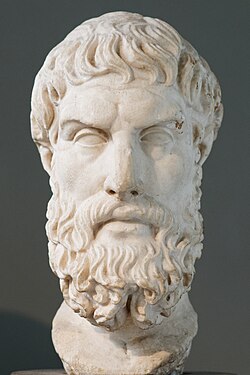
Epicureanism is a system of philosophy founded in 307 BCE and based upon the teachings of Epicurus, an ancient Greek philosopher. Epicurus was an atomist and materialist, following in the steps of Democritus. His materialism led him to religious skepticism and a general attack on superstition and divine intervention. Epicureanism was originally a challenge to Platonism, and its main opponent later became Stoicism. It is a form of hedonism insofar as it declares pleasure to be its sole intrinsic goal. However, the concept that the absence of pain and fear constitutes the greatest pleasure, and its advocacy of a simple life, make it very different from hedonism as colloquially understood.
Following the Cyrenaic philosopher Aristippus, Epicurus believed that the greatest good was to seek modest, sustainable pleasure in the form of a state of ataraxia (tranquility and freedom from fear) and aponia (the absence of bodily pain) through knowledge of the workings of the world and limiting desires. Correspondingly, Epicurus and his followers generally withdrew from politics because it could lead to frustrations and ambitions that would conflict with their pursuit of virtue and peace of mind.[1]
Few writings by Epicurus have survived. Diogenes Laertius has preserved three instructional letters attributed to Epicurus, as well as a list of the Principal Doctrines of Epicureanism. The letters to Herodotus and to Menoeceus are generally accepted as authentic works written by Epicurus himself. However, the letter addressed to Pythocles is often considered to be a compilation by one of his students, likely based on Epicurus’ original writings.[2] There are also independent attestations of his ideas from his later disciples. The epic poem De rerum natura (Latin for "On the Nature of Things") by Lucretius presents the core arguments and theories of Epicureanism in one unified work. Many Epicurean texts have also been found on scrolls unearthed at the Villa of the Papyri in Herculaneum, mostly works written by the Epicurean philosopher Philodemus or his teacher Zeno of Sidon, along with fragments of works by Epicurus himself. Diogenes of Oenoanda, a wealthy Epicurean in the 2nd century CE, had a portico wall inscribed with tenets of the philosophy erected in Oenoanda, Lycia (present-day Turkey).
Epicureanism flourished in the Late Hellenistic period and during the Roman era, and many Epicurean communities were established in places such as Antioch, Alexandria, Rhodes, and Herculaneum. By the late 3rd century CE, Epicureanism had all but died out, being opposed by other philosophies (mainly Neoplatonism) that were then in the ascent. Interest in Epicureanism was resurrected in the Age of Enlightenment and continues in the modern era.
History
[edit]Epicurus, the founder of the Epicurean School, was born in 342/1 BCE on the island of Samos. In his early years, he studied under Pamphilus, a Platonist philosopher in Samos. Later, he received instruction from Nausiphanes of Teos, a follower of Democritus. Although Epicurus would later downplay these early influences, it is generally acknowledged that Nausiphanes had a significant impact on the development of his thought. At the age of eighteen, Epicurus traveled to Athens for military service. After completing his duties, he devoted himself entirely to philosophy while living in Colophon.[2] Epicurus taught and gained followers in Mytilene, the capital of the island Lesbos, and then in Lampsacus. In Athens, Epicurus bought a property for his school called "Garden", which later became the name of Epicurus' school.[3] Its members included Hermarchus, Idomeneus, Colotes, Polyaenus, and Metrodorus. Epicurus emphasized friendship as an important ingredient of happiness, and the school seems to have been a moderately ascetic community that rejected the political limelight of Athenian philosophy. They were fairly cosmopolitan by Athenian standards, including women and slaves. Community activities held some importance, particularly the observance of Eikas, a monthly social gathering. Some members were also vegetarians, as, from slight evidence, Epicurus did not eat meat, although no prohibition against eating meat was made.[4][5]
The school's popularity grew and it became, along with Stoicism, Platonism, Peripateticism, and Pyrrhonism, one of the dominant schools of Hellenistic philosophy, lasting strongly through the later Roman Empire.[6] Deciphered carbonized scrolls obtained from the library at the Villa of the Papyri in Herculaneum contain a large number of works by Philodemus, a late Hellenistic Epicurean, and Epicurus himself, attesting to the school's enduring popularity. Julius Caesar also leaned considerably toward Epicureanism, which led to his plea against the death sentence during the trial against Catiline, during the Catiline conspiracy where he spoke out against the Stoic Cato.[7] His father-in-law, Lucius Calpurnius Piso Caesoninus, was also an adept of the school. In the 2nd century CE, comedian Lucian of Samosata and wealthy promoter of philosophy Diogenes of Oenoanda were prominent Epicureans.
After the death of Epicurus, leadership of the school passed to Hermarchus, who was originally from Mytilene. He was succeeded by Polystratus. Among Epicurus' closest students were Hermarchus, Polyaenus, and Metrodorus of Lampsacus.
One of the earliest Roman writers espousing Epicureanism was Amafinius, although his work has not survived. The Roman philosopher Cicero later wrote that he had listened to Phaedrus, who served as the head of the Athenian school around 90 BCE and had come to Rome. However, the most well-known follower of Epicureanism was the Roman poet Titus Lucretius Carus (c. 91–51 BCE). Lucretius expressed Epicurus' philosophical ideas in his didactic poem De Rerum Natura (On the Nature of Things). The main goal of this work was to free people from the fear of the gods and death, and to guide them toward achieving inner peace and tranquility.[2] The Epicurean philosopher Philodemus of Gadara, until the 18th century only known as a poet of minor importance, rose to prominence as much of his work, along with other Epicurean material such as the lectures of Zeno of Sidon, was discovered in the Villa of the Papyri. Another ancient Epicurean is Diogenes of Oenoanda, in the 2nd century CE, who composed a large inscription at Oenoanda in Lycia. Diogenes Laërtius reports slanderous stories, circulated by Epicurus' opponents.[3]
By the late third century CE, however, there was little trace of its existence.[8] With growing dominance of Neoplatonism and Peripateticism, and later, Christianity, Epicureanism declined.
Philosophy
[edit]Physics
[edit]In his letter to Herodotus (not the historian), Epicurus presented three principles as to the nature of the physical world, i.e. that which exists cannot come into being from that which does not exist, that which is destroyed does not cease to exist, and all that exists now always did exist and always will.[9] The object of these principles was to establish the fact that all that constitutes the world is permanent and unchanging.[10] Epicurean physics held that the entire universe consisted of two things: matter and void.[11] Matter is made up of atoms, which are tiny bodies that have only the unchanging qualities of shape, size, and weight.[12][13] The Epicureans believed that atoms were unchanging because the world was ordered and that changes had to have specific and consistent sources, e.g. a plant species only grows from a seed of the same species,[14][15] but that in order for the universe to persist, what it is ultimately made up of must not be able to be changed or else the universe would be essentially destroyed.[16][14]
Epicurus holds that there must be an infinite supply of atoms, although only a finite number of types of atoms, as well as an infinite amount of void.[12] Epicurus explains this position in his letter to Herodotus:
Moreover, the sum of things is unlimited both by reason of the multitude of the atoms and the extent of the void. For if the void were infinite and bodies finite, the bodies would not have stayed anywhere but would have been dispersed in their course through the infinite void, not having any supports or counterchecks to send them back on their upward rebound. Again, if the void were finite, the infinity of bodies would not have anywhere to be.[17]
Because of the infinite supply of atoms, there are an infinite number of worlds, or cosmoi.[12] Some of these worlds could be vastly different from our own, some quite similar, and all of the worlds were separated from each other by vast areas of void (metakosmia).[12]
Epicureanism states that atoms are unable to be broken down into any smaller parts[16] because void is necessary for matter to move. Anything that consists of both void and matter can be broken down, while if something contains no void, then it has no way to break apart because no part of the substance could be broken down into a smaller subsection of the substance.[14] Atoms are constantly moving in one of four different ways.[18] Atoms can simply collide with each other and then bounce off of each other.[18] When joined with each other and forming a larger object, atoms can vibrate as they collide into each other while still maintaining the overall shape of the larger object.[18]
When not prevented by other atoms, all atoms move at the same speed naturally downwards in relation to the rest of the world.[18][19] This downwards motion is natural for atoms; however, as their fourth means of motion, atoms can at times randomly swerve out of their usual downwards path.[19] This swerving motion is what allowed for the creation of the universe, since as more and more atoms swerved and collided with each other, objects were able to take shape as the atoms joined. Without the swerve, the atoms would never have interacted with each other, and simply continued to move downwards at the same speed.[18][19] Epicurus also felt that the swerve was what accounted for humanity's free will.[20] If it were not for the swerve, humans would be subject to a never-ending chain of cause and effect.[20] This was a point which Epicureans often used to criticize Democritus' atomic theory.[20]
Epistemology
[edit]Epicurean philosophy employs an empirical epistemology, one based on the senses.[21]
Sense perception
[edit]Epicureans believed that the senses also relied on atoms. Every object was continually emitting particles from itself that would then interact with the observer.[22] All sensations, such as sight, smell, or sound, relied on these particles.[22] While the atoms that were emitted did not have the qualities that the senses were perceiving, the manner in which they were emitted caused the observer to experience those sensations, e.g. red particles were not themselves red but were emitted in a manner that caused the viewer to experience the color red.[22] The atoms are not perceived individually, but rather as a continuous sensation because of how quickly they move.[22]
The Epicureans believed that all sense perceptions were true,[23][24] and that errors arise in how we judge those perceptions.[24] When we form judgments about things (hupolepsis), they can be verified and corrected through further sensory information.[24][25][26] For example, if someone sees a tower from far away that appears to be round, and upon approaching the tower they see that it is actually square, they would come to realize that their original judgement was wrong and correct their wrong opinion.[27]
Criterion of truth
[edit]Epicurus is said to have proposed three criteria of truth: sensations (aisthêsis), preconceptions (prolepsis), and feelings (pathê).[28] A fourth criterion called "presentational applications of the mind" (phantastikai epibolai tês dianoias) was said to have been added by later Epicureans.[28][29] These criteria formed the method through which Epicureans thought we gained knowledge.[21]
Since Epicureans thought that sensations could not deceive, sensations are the first and main criterion of truth for Epicureans.[24] Even in cases where sensory input seems to mislead, the input itself is true and the error arises from our judgments about the input. For example, when one places a straight oar in the water, it appears bent. The Epicurean would argue that the image of the oar, that is, the atoms traveling from the oar to the observer's eyes, has been shifted and thus really does arrive at the observer's eyes in the shape of a bent oar.[30] The observer makes the error in assuming that the image he or she receives correctly represents the oar and has not been distorted in some way.[30] In order not to make erroneous judgments about perceivable things and instead verify one's judgment, Epicureans believed that one needed to obtain "clear vision" (enargeia) of the perceivable thing by closer examination.[31] This acted as a justification for one's judgements about the thing being perceived.[31] Enargeia is characterized as sensation of an object that has been unchanged by judgments or opinions and is a clear and direct perception of that object.[32]
An individual's preconceptions are his or her concepts of what things are, e.g. what someone's idea of a horse is, and these concepts are formed in a person's mind through sensory input over time.[33] When the word that relates to the preconception is used, these preconceptions are summoned up by the mind into the person's thoughts.[34] It is through our preconceptions that we are able to make judgments about the things that we perceive.[27] Preconceptions were also used by Epicureans to avoid the paradox proposed by Plato in the Meno regarding learning.[34] Plato argues that learning requires us to already have knowledge of what we are learning, or else we would be unable to recognize when we had successfully learned the information.[34] Preconceptions, Epicureans argue, provide individuals with that pre-knowledge required for learning.[34]
Our feelings or emotions (pathê) are how we perceive pleasure and pain.[29] They are analogous to sensations in that they are a means of perception, but they perceive our internal state as opposed to external things.[29] According to Diogenes Laertius, feelings are how we determine our actions. If something is pleasurable, we pursue that thing, and if something is painful, we avoid that thing.[29]
The idea of "presentational applications of the mind" is an explanation for how we can discuss and inquire about things we cannot directly perceive.[35] We receive impressions of such things directly in our minds, instead of perceiving them through other senses.[28] The concept of "presentational applications of the mind" may have been introduced to explain how we learn about things that we cannot directly perceive, such as the gods.[28][35]
Ethics
[edit]| Part of a series on |
| Hedonism |
|---|
Epicureanism bases its ethics on a hedonistic set of values, seeing pleasure as the chief good in life.[36][37] Hence, Epicurus advocated living in such a way as to derive the greatest amount of pleasure possible during one's lifetime, yet doing so moderately in order to avoid the suffering incurred by overindulgence in such pleasure.[36] Epicurus actively recommended against passionate love and believed it best to avoid marriage altogether. He viewed recreational sex as a natural, but not necessary, desire that should be generally avoided.[38] Since the political life could give rise to desires that could disturb virtue and one's peace of mind, such as a lust for power or a desire for fame, participation in politics was discouraged.[39][40] Further, Epicurus sought to eliminate the fear of the gods and of death, seeing those two fears as chief causes of strife in life.[41]
Pleasure
[edit]When we say ... that pleasure is the end and aim, we do not mean the pleasures of the prodigal or the pleasures of sensuality, as we are understood to do by some through ignorance, prejudice or wilful misrepresentation. By pleasure we mean the absence of pain in the body and of trouble in the soul. It is not by an unbroken succession of drinking bouts and of revelry, not by sexual lust, nor the enjoyment of fish and other delicacies of a luxurious table, which produce a pleasant life; it is sober reasoning, searching out the grounds of every choice and avoidance, and banishing those beliefs through which the greatest tumults take possession of the soul.
— Epicurus, "Letter to Menoeceus"[42]
Epicureans had a very specific understanding of what the greatest pleasure was, and the focus of their ethics was on the avoidance of pain rather than seeking out pleasure.[43] As evidence for this, Epicureans say that nature seems to command us to avoid pain, and they point out that all animals try to avoid pain as much as possible.[44] Epicureanism divided pleasure into two broad categories: pleasures of the body and pleasures of the mind.[43] Pleasures of the body involve sensations of the body, such as the act of eating delicious food or of being in a state of comfort free from pain, and exist only in the present.[43] One can only experience pleasures of the body in the moment, meaning they only exist as a person is experiencing them.[45] Pleasures of the mind involve mental processes and states; feelings of joy, the lack of fear, and pleasant memories are all examples of pleasures of the mind.[43] These pleasures of the mind do not only exist in the present, but also in the past and future, since memory of a past pleasant experience or the expectation of some potentially pleasing future can both be pleasurable experiences.[45] Because of this, the pleasures of the mind are considered to be greater than those of the body.[45]
Emphasis was placed on pleasures of the mind rather than on physical pleasures.[36] The Epicureans further divided each of these types of pleasures into two categories: kinetic pleasure and katastematic pleasure.[46][47][48] Absence of pain, aponia, and lack of disturbance of mind, ataraxia, are two of the katastematic pleasures and often seen as the focal ones to Epicurus.[49][50] Kinetic pleasure is the physical or mental pleasures that involve action or change.[51] Eating delicious food, as well as fulfilling desires and removing pain, which is itself considered a pleasurable act, are all examples of kinetic pleasure in the physical sense.[46][52] According to Epicurus, feelings of joy would be an example of mental kinetic pleasure.[46] Katastematic pleasure is the pleasure one feels while in a state without pain.[52] Like kinetic pleasures, katastematic pleasures can also be physical, such as the state of not being thirsty, or mental, such as freedom from a state of fear.[46][51]
While the pursuit of pleasure formed the focal point of the philosophy, this was largely directed to the "static pleasures" of minimizing pain, anxiety and suffering. From this understanding, Epicureans concluded that the greatest pleasure a person could reach was the complete removal of all pain, both physical and mental.[53] The ultimate goal then of Epicurean ethics was to reach a state of aponia and ataraxia.[53]
Desire
[edit]I learn that your bodily inclination leans most keenly towards sexual intercourse. If you neither violate the laws nor disturb well-established morals nor sadden someone close to you, nor strain your body, nor spend what is needed for necessities, use your own choice as you wish. It is sure difficult to imagine, however, that none of these would be a part of sex because sex never benefitted anyone.
— Epicurus, Vatican Sayings, LI[54]
In order to do this, an Epicurean had to control their desires, because desire itself was seen as painful.[55] Not only will controlling one's desires bring about aponia, as one will rarely suffer from not being physically satisfied, but controlling one's desires will also help to bring about ataraxia because one will not be anxious about becoming discomforted since one would have so few desires anyway.[56] The Epicureans divide desires into three classes: natural and necessary, natural but not necessary, and vain and empty:[55]
- Natural and necessary: These desires are limited desires that are innately present in all humans; it is part of human nature to have them.[55] They are necessary for one of three reasons: necessary for happiness, necessary for freedom from bodily discomfort, and necessary for life.[55] Clothing and shelter would belong to the first two categories, while something like food would belong to the third.[55]
- Natural but not necessary: These desires are innate to humans, but they do not need to be fulfilled for their happiness or their survival.[56] Wanting to eat delicious food when one is hungry is an example of a natural but not necessary desire.[56] The main problem with these desires is that they fail to substantially increase a person's happiness, and at the same time require effort to obtain and are desired by people due to false beliefs that they are actually necessary.[56] It is for this reason that they should be avoided.[56]
- Vain and empty: These desires are neither innate to humans nor required for happiness or health; indeed, they are also limitless and can never be fulfilled.[57] Desires of wealth or fame would fall in this class, and such desires are to be avoided because they will ultimately only bring about discomfort.[57]
If one follows only natural and necessary desires, then, according to Epicurus, one would be able to reach aponia and ataraxia and thereby the highest form of happiness.[57] Unnecessary and, especially, artificially produced desires were to be suppressed.[58]
Politics
[edit]It is impossible to live a pleasant life without living wisely and well and justly, and it is impossible to live wisely and well and justly without living a pleasant life.[59]
The Epicurean understanding of justice was inherently self-interested. Justice was deemed good because it was seen as mutually beneficial.[60] Individuals would not act unjustly even if the act was initially unnoticed because of possibly being caught and punished.[61] Both punishment and fear of punishment would cause a person disturbance and prevent them from being happy.[61]
Epicurus was also an early thinker to develop the notion of justice as a social contract, and in part attempts to address issues with the society described in Plato's Republic.[62] The social contract theory established by Epicureanism is based on mutual agreement, not divine decree.[62] He defined justice as an agreement made by people not to harm each other.[60] The point of living in a society with laws and punishments is to be protected from harm so that one is free to pursue happiness.[62] Because of this, laws that do not contribute to promoting human happiness are not just.[62] He gave his own unique version of the ethic of reciprocity, which differs from other formulations by emphasizing minimizing harm and maximizing happiness for oneself and others.
Epicurean ideas on politics disagree with other philosophical traditions, namely the Stoic, Platonist and Aristotelian traditions.[63] To Epicureans all our social relations are a matter of how we perceive each other, of customs and traditions. No one is inherently of higher value or meant to dominate another.[1] That is because there is no metaphysical basis for the superiority of one kind of person; all people are made of the same atomic material and are thus naturally equal.[1] Epicureans also discourage political participation and other involvement in politics.[1] However, Epicureans are not apolitical; it is possible that some political association could be seen as beneficial by some Epicureans.[63] Some political associations could lead to certain benefits to the individual that would help to maximize pleasure and avoid physical or mental distress.[63]
Friendship
[edit]of all the things which wisdom has contrived which contribute to a blessed life, none is more important, more fruitful, than friendship
— quoted by Cicero[64]
Epicurus laid great emphasis on developing friendships as the basis of a satisfying life. The avoidance or freedom from hardship and fear is ideal to the Epicureans.[63] While this avoidance or freedom could conceivably be achieved through political means, it was insisted by Epicurus that involvement in politics would not release one from fear and he advised against a life of politics.[63] Epicurus also discouraged contributing to political society by starting a family, as the benefits of a wife and children are outweighed by the trouble brought about by having a family.[63] Instead, Epicurus encouraged the formation of a community of friends outside the traditional political state. This community of virtuous friends would focus on internal affairs and justice.[63] However, Epicureanism is adaptable to circumstance, as is the Epicurean approach to politics.[63] The same approaches will not always work in protection from pain and fear. In some situations, it will be more beneficial to have a family, and in other situations, it will be more beneficial to participate in politics. It is ultimately up to the Epicurean to analyse their circumstance and take whatever action befits the situation.[63]
Death
[edit]Epicureanism rejects immortality. It believes in the soul, but suggests that the soul is mortal and material, just like the body.[65] Epicurus rejected any possibility of an afterlife, while still contending that one need not fear death: "Death is nothing to us; for that which is dissolved, is without sensation, and that which lacks sensation is nothing to us."[66] From this doctrine arose the Epicurean Epitaph: Non fui, fui, non sum, non curo ("I was not; I was; I am not; I do not care."), which is inscribed on the gravestones of his followers and seen on many ancient gravestones of the Roman Empire.[67]
Gods
[edit]Epicureanism does not deny the existence of the gods; rather, it denies their involvement in the world. According to Epicureanism, the gods do not interfere with human lives or the rest of the universe in any way[68] – thus, it shuns the idea that frightening weather events are divine retribution.[69] One of the fears the Epicurean ought to be freed from is fear relating to the actions of the gods.[70]
The manner in which the Epicurean gods exist is still disputed. Some scholars say that Epicureanism believes that the gods exist outside the mind as material objects (the realist position), while others assert that the gods only exist in our minds as ideals (the idealist position).[68][71][72] The realist position holds that Epicureans understand the gods as existing as physical and immortal beings made of atoms that reside somewhere in reality.[68][72] However, the gods are completely separate from the rest of reality; they are uninterested in it, play no role in it, and remain completely undisturbed by it.[73] Instead, the gods live in what is called the metakosmia, or the space between worlds.[74] Contrarily, the idealist (sometimes called the "non-realist position" to avoid confusion) position holds that the gods are just idealized forms of the best human life,[71][75] and it is thought that the gods were emblematic of the life one should aspire towards.[71] The debate between these two positions was revived by A. A. Long and David Sedley in their 1987 book, The Hellenistic Philosophers, in which the two argued in favour of the idealist position.[71][72] While a scholarly consensus has yet to be reached, the realist position remains the prevailing viewpoint at this time.[71][72]
Legacy
[edit]Later antiquity
[edit]The early Christian writer Lactantius criticizes Epicurus at several points throughout his Divine Institutes and preserves the Riddle of Epicurus, or Problem of evil, a famous argument against the existence of an all-powerful and providential God or gods.[76] This type of trilemma argument (God is omnipotent, God is good, but Evil exists) was one favoured by the ancient Greek skeptics, and this argument may have been wrongly attributed to Epicurus by Lactantius, who, from his Christian perspective, regarded Epicurus as an atheist.[77] According to Reinhold F. Glei, it is settled that the argument of theodicy is from an academical source which is not only not Epicurean, but even anti-Epicurean.[78] The earliest extant version of this trilemma appears in the writings of the Pyrrhonist philosopher Sextus Empiricus.[79]
Epikoros is a Jewish term figuratively meaning "a heretic", cited in the Mishnah, referring to one who does not have a share in the world to come[80] Although rabbinic literature does not make any specific reference to the Greek philosopher Epicurus, it is apparent that the term is derived from the philosopher's name.[81]

Middle Ages and Renaissance
[edit]In Dante Alighieri's Divine Comedy, the Epicureans are depicted as heretics suffering in the sixth circle of hell. In fact, Epicurus appears to represent the ultimate heresy.[82]
Francis Bacon wrote an apothegm related to Epicureanism:
There was an Epicurean vaunted, that divers of other sects of philosophers did after turn Epicureans, but there was never any Epicurean that turned to any other sect. Whereupon a philosopher that was of another sect, said; The reason was plain, for that cocks may be made capons, but capons could never be made cocks.[83]
This echoed what the Academic skeptic philosopher Arcesilaus had said when asked "why it was that pupils from all the other schools went over to Epicurus, but converts were never made from the Epicureans?" to which he responded: "Because men may become eunuchs, but a eunuch never becomes a man."[84]
Modern revival
[edit]In the 17th century, the French Franciscan priest, scientist and philosopher Pierre Gassendi wrote two books forcefully reviving Epicureanism. Shortly thereafter, and clearly influenced by Gassendi, Walter Charleton published several works on Epicureanism in English. Attacks by Christians continued, most forcefully by the Cambridge Platonists.[85]
In modern times, Thomas Jefferson referred to himself as an Epicurean:
If I had time I would add to my little book the Greek, Latin and French texts, in columns side by side. And I wish I could subjoin a translation of Gassendi's Syntagma of the doctrines of Epicurus, which, notwithstanding the calumnies of the Stoics and caricatures of Cicero, is the most rational system remaining of the philosophy of the ancients, as frugal of vicious indulgence, and fruitful of virtue as the hyperbolical extravagances of his rival sects.[86]
Other modern-day Epicureans were Gassendi, Walter Charleton, François Bernier, Saint-Évremond, Ninon de l'Enclos, Denis Diderot, Frances Wright and Jeremy Bentham.
In France, where perfumer/restaurateur Gérald Ghislain refers to himself as an Epicurean,[citation needed] Michel Onfray is developing a post-modern approach to Epicureanism.[87] In his 2011 book titled The Swerve, Stephen Greenblatt identified himself as strongly sympathetic to Epicureanism and Lucretius. Humanistic Judaism as a denomination also claims the Epicurean label.
Similarities with eastern philosophies
[edit]Some scholars have drawn parallels between Epicureanism and some eastern philosophies that similarly emphasize atomism or a lack of divine interference, such as Jainism, Charvaka, and Buddhism.[88] Epicureanism also resembles Buddhism in its belief that great excess leads to great dissatisfaction.[89][90]
Misconceptions
[edit]In modern popular usage, an Epicurean is a connoisseur of the arts of life and the refinements of sensual pleasures; Epicureanism implies a love or knowledgeable enjoyment especially of good food and drink.
Because Epicureanism posits that pleasure is the ultimate good (telos), it has been commonly misunderstood since ancient times as a doctrine that advocates the partaking in fleeting pleasures such as sexual excess and decadent food. This is not the case. Epicurus regarded ataraxia (tranquility, freedom from fear) and aponia (absence of pain) as the height of happiness. He also considered prudence an important virtue and perceived excess and overindulgence to be contrary to the attainment of ataraxia and aponia.[42] Yet Epicurus referred "the good", and "even wisdom and culture", to the "pleasure of the stomach".[91]
While Epicurus sought moderation at meals, he was also not averse to moderation in moderation, that is, to occasional luxury.[92][93] Called "The Garden" for being based in what would have been a kitchen garden, his community also became known for its Eikas (Greek εἰκάς from εἴκοσῐ eíkosi, "twenty"),[94] feasts of the twentieth (of the Greek month),[95] which was otherwise considered sacred to the god Apollo, and also corresponding to the final day of the rites of initiation to the mysteries of Demeter.[96]
Epicurea
[edit]The Epicurea is a collection of texts, fragments, and testimonies by Epicurus that was collected by Hermann Usener in 1887. This work features a collection of writings by Epicurus that explain the values and beliefs of Ancient Epicurian philosophy.[97]
See also
[edit]Notes
[edit]- ^ a b c d Wilson 2015
- ^ a b c Copleston, Frederick Charles; Copleston, Frederick Charles (1985). Vol. I: Greece and Rome ; Vol. II: Augustine to Scotus ; Vol. III: Ockham to Suarez. A history of philosophy. New York: Doubleday Image Books. p. 401. ISBN 978-0-385-23031-5.
- ^ a b David Konstan (2018). "Epicurus". Stanford Encyclopedia of Philosophy.
- ^ "The Hidden History of Greco-Roman Vegetarianism". Saving Earth | Encyclopedia Britannica. 10 August 2010.
- ^ Dombrowski, Daniel (1984). The Philosophy of Vegetarianism. University of Massachusetts Press. p. 81. ISBN 978-0-87023-431-6.
- ^ MacGillivray, Erlend D (2012). "The Popularity of Epicureanism in Late-Republic Roman Society". The Ancient World. XLIII: 151–172.
- ^ Cf. Sallust, The War With Catiline, Caesar's speech: 51.29 & Cato's reply: 52.13).
- ^ Michael Frede (1999). "Epilogue". The Cambridge History of Hellenistic Philosophy. The Cambridge History of Hellenistic Philosophy. pp. 795–96. doi:10.1017/CHOL9780521250283.024. ISBN 9780521250283.
- ^ Epicurus, Letter to Herodotus 38-39, in Epicurus. The Essential Epicurus: Letters, Principal Doctrines, Vatican Sayings, and Fragments. Translated by Eugene O'Connor. p. 21.
- ^ Long, A.A.; Sedley, D.N. (1987). The Hellenistic Philosophers. Vol. 1. New York: Cambridge University Press. p. 26.
- ^ O'Keefe 2010, pp. 11–13
- ^ a b c d Wilson 2015, p. page=9
- ^ O'Keefe 2010, p. 21
- ^ a b c O'Keefe 2010, pp. 18–20
- ^ Sharples, R. W. (1998). Stoics, Epicureans, and Sceptics: An Introduction to Hellenistic Philosophy. New York, NY: Routledge. pp. 34–35.
- ^ a b Sharples, R. W. (1996). Stoics, Epicureans, and Sceptics: An introduction to Hellenistic Philosophy. New York, NY: Routledge. pp. 35–37.
- ^ Diogenes, Laertius (1925). Lives of Eminent Philosophers: Volume II: Books 6-10. Translated by Hicks, R. D. Cambridge, Mass: Harvard University Press. pp. 573–575.
- ^ a b c d e Wilson 2015, p. =11
- ^ a b c O'Keefe 2010, pp. 25–28
- ^ a b c Sharples, R. W. (1996). Stoics, Epicurus, and Sceptics: An Introduction to Hellenistic Philosophy. New York, NY: Routledge. pp. 64–66.
- ^ a b O'Keefe 2010, p. 85
- ^ a b c d Wilson 2015, pp. 54–55
- ^ Asmis, Elizabeth (2009). "Epicurean empiricism". In Warren, James (ed.). The Cambridge Companion to Epicureanism. Cambridge University Press. p. 84.
- ^ a b c d O'Keefe 2010, pp. 97–98
- ^ Bakalis, Nikolaos (2005). Handbook of Greek Philosophy: From Thales to the Stoics Analysis and Fragments. Canada: Trafford Publishing. pp. 193–197.
- ^ Konstan, David (2011). Fish, Jeffrey; Sanders, Kirk R. (eds.). Epicurus and the Epicurean Tradition. Cambridge: Cambridge University Press. pp. 62–63. ISBN 9780521194785.
- ^ a b O'Keefe 2010, pp. 103–104
- ^ a b c d Sharples, R. W. (1996). Stoics, Epicureans and Sceptics. New York, NY: Routledge. p. 19.
- ^ a b c d Asmis, Elizabeth (2009). "Epicurean empiricism". In Warren, James (ed.). The Cambridge Companion to Epicureanism. Cambridge: Cambridge University Press. pp. 93–94.
- ^ a b Sharples, R. W. (1996). Stoics, Epicureans, and Sceptics: An Introduction to Hellenistic Philosophy. New York, NY: Routledge. pp. 12–13.
- ^ a b Sharples, R. W. (1996). Stoics, Epicureans, and Sceptics: An Introduction to Hellenistic Philosophy. New York, NY: Routledge. pp. 12–16.
- ^ Asmis, Elizabeth (2009). "Epicurean empiricism". In Warren, James (ed.). The Cambridge Companion to Epicureanism. Cambridge University Press. p. 85.
- ^ Sharples, R. W. (1996). Stoics, Epicureans, and Sceptics: An Introduction to Hellenistic Philosophy. New York, NY: Routledge. pp. 18–19.
- ^ a b c d O'Keefe 2010, pp. 101–103
- ^ a b Tsouna, Voula (2016). "Epicurean Preconceptions". Phronesis. 61 (2): 215. doi:10.1163/15685284-12341304.
- ^ a b c O'Keefe 2010, pp. 107–115
- ^ Sharples, R. W. (1996). Stoics, Epicureans, and Sceptics: An Introduction to Hellenistic Philosophy. New York, NY: Routledge. p. 84.
- ^ Wilson 2015, pp. 95–96
- ^ Wilson 2015, pp. 84–85
- ^ O'Keefe 2010, p. 145
- ^ O'Keefe 2010, pp. 155–171
- ^ a b Epicurus, "Letter to Menoeceus", contained in Diogenes Laertius, Lives of Eminent Philosophers, Book X
- ^ a b c d O'Keefe 2010, pp. 117–121
- ^ Wilson 2015, p. 93
- ^ a b c O'Keefe 2010, pp. 118–119
- ^ a b c d O'Keefe 2010, pp. 119–120
- ^ Konstan, David, "Epicurus", The Stanford Encyclopedia of Philosophy (Fall 2013 Edition), Edward N. Zalta (ed.), http://plato.stanford.edu/archives/fall2013/entries/epicurus/
- ^ J. C. B. Gosling and C. C. W. Taylor. Katastematic and Kinetic Pleasures, in The Greeks On Pleasure. Eds. J. C. B. Gosling and C. C. W. Taylor. Clarendon Press, 1982
- ^ Cicero, De Fin i 37-38
- ^ Splawn, Clay (2002). "Updating Epicurus's Concept of Katastematic Pleasure". Journal of Value Inquiry. 36 (4): 473. doi:10.1023/A:1021997823870. S2CID 146146475.
- ^ a b Sharples, R. W. (1996). Stoics, Epicureans, and Sceptics: An Introduction to Hellenistic Philosophy. New York, NY: Routledge. pp. 91–92.
- ^ a b Warren, James (2002). Epicurus and Democritean Ethics: An Archaeology of Ataraxia. New York, NY: University of Cambridge. p. 4.
- ^ a b O'Keefe 2010, p. 120
- ^ Epicurus, Vatican Saying 51
- ^ a b c d e O'Keefe 2010, pp. 124–125
- ^ a b c d e O'Keefe 2010, pp. 126–127
- ^ a b c O'Keefe 2010, pp. 125–126
- ^ O'Keefe 2010, pp. 125–127
- ^ "Epicurus Principal Doctrines 5 and 31 transl. by Robert Drew Hicks". 1925.("Justly" here means to prevent a "person from harming or being harmed by another".)
- ^ a b O'Keefe 2010, pp. 139–140
- ^ a b O'Keefe 2010, pp. 142–145
- ^ a b c d O'Keefe 2010, pp. 139–142
- ^ a b c d e f g h i Warren, James, ed. (2009). The Cambridge companion to epicureanism. Cambridge, UK: Cambridge University Press. ISBN 9780521873475. OCLC 297147109.
- ^ On Goals, 1.65
- ^ Wilson 2015, p. 52
- ^ Russell, Bertrand. A History of Western Philosophy, pp. 239–40
- ^ "Death is Not the End". Catholic Exchange. 26 June 2015. Retrieved 14 September 2023.
- ^ a b c O'Keefe 2010, pp. 155–156
- ^ James Warren (ed.), The Cambridge Companion to Epicureanism, p. 124
- ^ James Warren (ed.), The Cambridge companion to Epicureanism, p. 105
- ^ a b c d e Sedley, David (2011). "Epicurus' theological innatism". In Fish, Jeffrey; Sanders, Kirk R. (eds.). Epicurus and the Epicurean Tradition. United Kingdom: Cambridge University Press. pp. 29–30. ISBN 9780521194785.
- ^ a b c d Konstan, David (2011). "Epicurus on the gods". In Fish, Jeffrey; Sanders, Kirk R. (eds.). Epicurus and the Epicurean Tradition. United Kingdom: Cambridge University Press. pp. 53–54. ISBN 9780521194785.
- ^ Mansfeld, Jaap (1993). "Aspects of Epicurean Theology". Mnemosyne. 46 (2): 176–178. doi:10.1163/156852593X00484.
- ^ Buchheit, Vinzenz (2007). "Epicurus' Triumph of the Mind". In Gale, Monica R. (ed.). Oxford Readings in Classical Studies: Lucretius. New York, NY: Oxford University Press. pp. 110–111.
- ^ O'Keefe 2010, pp. 158–159
- ^ God either wants to eliminate bad things and cannot, or can but does not want to, or neither wishes to nor can, or both wants to and can. If he wants to and cannot, then he is weak – and this does not apply to God. If he can but does not want to, then he is spiteful – which is equally foreign to god's nature. If he neither wants to nor can, he is both weak and spiteful, and so not a god. If he wants to and can, which is the only thing fitting for a god, where then do bad things come from? Or why does he not eliminate them?|Lactantius|De Ira DeorumLactantius, De Ira Deorum, 13.19 (Epicurus, Frag. 374, Usener). David Hume paraphrased this passage in his Dialogues Concerning Natural Religion: "EPICURUS's old questions are yet unanswered. Is he willing to prevent evil, but not able? then is he impotent. Is he able, but not willing? then is he malevolent. Is he both able and willing? whence then is evil?"
- ^ Mark Joseph Larrimore, (2001), The Problem of Evil, pp. xix–xxi. Wiley-Blackwell
- ^ Glei, Reinhold F. (1988). "Et invidus et inbecillus. Das angebliche Epikurfragment bei Laktanz, De ira dei 13, 20–21". Vigiliae Christianae. 42 (1): 47–58. doi:10.2307/1584470. JSTOR 1584470.
- ^ Sextus Empiricus, Outlines of Pyrrhonism, 175: "those who firmly maintain that god exists will be forced into impiety; for if they say that he [God] takes care of everything, they will be saying that god is the cause of evils, while if they say that he takes care of some things only or even nothing, they will be forced to say that he is either malevolent or weak"
- ^ Mishnah, Seder Nezikin, tractate Sanhedrin, 10a
- ^ "Jewish Encyclopedia". Funk and Wagnalls. Retrieved 30 March 2013.
- ^ Trans. Robert Pinsky, The Inferno of Dante, p. 320 n. 11.
- ^ Francis Bacon, Apothegms 280, The Works of Francis Bacon, Volume 1/Apophthegms
- ^ Diogenes Laertius, Lives of the Eminent Philosophers Book IV, Chapter 6, section 45 http://www.perseus.tufts.edu/hopper/text?doc=Perseus%3Atext%3A1999.01.0258%3Abook%3D4%3Achapter%3D6
- ^ "Cambridge Platonists | Seventeenth-Century, Rationalism, Theology | Britannica". www.britannica.com. Retrieved 14 September 2023.
- ^ "Full text of "The writings of Thomas Jefferson;"". archive.org. Retrieved 6 May 2016.
- ^ Michel Onfray, La puissance d'exister: Manifeste hédoniste, Grasset, 2006
- ^ Scharfstein, Ben-Ami (1998). A Comparative History of World Philosophy: From the Upanishads to Kant. SUNY Press. p. 202. ISBN 9780791436837.
- ^ Cooper, David E.; James, Simon P. (2017). Buddhism, Virtue and Environment. Routledge. p. 105. ISBN 9781351954310.
- ^ Dee L. Clayman (2014), Berenice II and the Golden Age of Ptolemaic Egypt, Oxford University Press, p.33
- ^ Cyril Bailey, Epicurus: The Extant Remains, Oxford: Clarendon Press, 1926, p.131
- ^ Diogenes Laërtius, Lives of the Eminent Philosophers, Book X, Section 18
- ^ "Philodemus: Epigrams (excerpted from The Greek Anthology 11.44)". Attalus.
- ^ Frischer, Bernard (1982), The Sculpted Word: Epicureanism and Philosophical Recruitment in Ancient Greece, Berkeley, California: University of California Press. pp. 42
- ^ Cicero. De Finibus Bonorum Et Malorum. p. II.101.
- ^ DeWitt, Norman Wentworth (1964), Epicurus and His Philosophy, Minneapolis, Minnesota: University of Minnesota Press. pp. 104-105
- ^ Epicurus (2010). Usener, Hermann (ed.). Epicurea. doi:10.1017/CBO9780511711077. ISBN 9780511711077.
Sources
[edit]Primary
[edit] Laërtius, Diogenes. . Lives of the Eminent Philosophers. Vol. 2:10. Translated by Hicks, Robert Drew (Two volume ed.). Loeb Classical Library.
- Long, A.A. & Sedley, D.N. The Hellenistic Philosophers, Volume 1, Cambridge: Cambridge University Press, 1987. (ISBN 0-521-27556-3)
- Martin Ferguson Smith (ed.), Diogenes of Oinoanda. The Epicurean inscription, edited with introduction, translation, and notes, Naples: Bibliopolis, 1993.

Secondary
[edit]- Annas, Julia (1995), The Morality of Happiness, Oxford University Press
- Furley, David J. (1999), Routledge History of Philosophy, Volume II. From Aristotle to Augustine, Routledge
- O'Keefe, Tim (2010). Epicureanism. University of California Press.
- Reale, Giovanni (1985), A History of Ancient Philosophy: The Systems of the Hellenistic Age, SUNY Press
- Wilson, Catherine (2015). Epicureanism: a very short introduction. Oxford, United Kingdom: Oxford University Press. ISBN 9780199688326. OCLC 917374685.
Further reading
[edit]- Emily A. Austin, Living for Pleasure: An Epicurean Guide to Life. New York: Oxford University Press, 2022.
- Dane R. Gordon and David B. Suits, Epicurus: His Continuing Influence and Contemporary Relevance. Rochester, New York: RIT Cary Graphic Arts Press, 2003.
- Brooke Holmes and W. H. Shearin, Dynamic Reading: Studies in the Reception of Epicureanism. New York: Oxford University Press, 2012.
- Howard Jones, The Epicurean Tradition. New York: Routledge, 1989.
- Neven Leddy and Avi S. Lifschitz, Epicurus in the Enlightenment. Oxford: Voltaire Foundation, 2009.
- Masi, Francesca; Morel, Pierre-Marie; Verde, Francesco (2023). Epicureanism and scientific debates. Antiquity and late reception, volume I: language, medicine, meteorology. Leuven: Leuven University Press.
- Sigl, Alexander (2023). Die Modellierung epikureischer "personae" in der römischen Literatur. Tübingen: Narr Francke Attempto. ISBN 9783823385035.
- Martin Ferguson Smith, Supplement to Diogenes of Oinoanda: The Epicurean Inscription. Naples: Bibliopolis, 2003.
- Christian Vassallo The Presocratics at Herculaneum: A Study of Early Greek Philosophy in the Epicurean Tradition. Berlin–Boston: De Gruyter, 2021.
- James Warren (ed.), The Cambridge Companion to Epicureanism. Cambridge: Cambridge University Press, 2009.
- Catherine Wilson, Epicureanism at the Origins of Modernity. New York: Oxford University Press, 2008.
- ———, How to Be an Epicurean: The Ancient Art of Living Well. New York: Basic Books (Hachette Book Group), 2019.
External links
[edit]

- Epicureans on PhilPapers
- Complete text of Hermann Usener's Epicurea (1887) (Greek and Latin) at Internet Archive
- English version of the Fragments in Usener's Epicurea at attalus.org

| Deities (Dii Consentes) |
|  | ||||
|---|---|---|---|---|---|---|
| Legendary figures | ||||||
| Legendary beings | ||||||
| Texts | ||||||
| Concepts and practices | ||||||
| Philosophy | ||||||
| Events | ||||||
| Objects | ||||||
| Variations | ||||||
| See also | ||||||
| International | |
|---|---|
| National | |
| Other | |

Epicureanism
View on GrokipediaHistorical Origins
Founding by Epicurus
Epicurus, born in 341 BCE on the island of Samos to Athenian colonists Neocles, a schoolmaster, and Chaerestrate, initiated his philosophical career early, reportedly beginning studies at age 12 under influences including Democritean atomism via teachers like Nausiphanes of Teos. After initial teaching in his birthplace and Colophon, he established short-lived philosophical communities in Mytilene and Lampsacus around 311–310 BCE, attracting early followers before relocating to Athens amid the political instability following Alexander the Great's death. In 306 BCE, during the archonship of Anaxicrates, Epicurus, then approximately 35 years old, purchased a house with an adjacent garden northwest of Athens near the Dipylon Gate, founding there his enduring school known as The Garden (ὁ κῆπος). This private estate differed from urban academies like Plato's Academy or Aristotle's Lyceum by emphasizing communal living, simple meals, and daily discussions centered on achieving tranquility through rational understanding of nature, rather than public debate or state involvement. The Garden's inclusive admission of women, such as the philosopher Themista, and slaves underscored its departure from prevailing social norms, fostering a self-sufficient community devoted to Epicurean practice. The founding crystallized Epicureanism as a cohesive doctrine, with Epicurus composing over 300 works, including key texts like the Letter to Menoeceus on ethics and treatises on atomic physics, though most survive only in fragments or summaries by later adherents like Diogenes Laertius. This institutional base enabled systematic instruction in his tetrapharmakos—remedies against fear of gods, death, pain, and unfulfilled desires—prioritizing empirical observation and logical analysis to dispel superstition and promote moderated pleasure as the path to happiness. Diogenes Laertius, drawing from Epicurean biographies, attests to the school's rapid growth under Epicurus until his death in 270 BCE from renal calculi, after which it persisted through successors like Hermarchus.Establishment of the Garden School
In 307/306 BCE, Epicurus purchased a private house with an attached garden located just outside the walls of Athens, near the road from the Dipylon Gate to Plato's Academy.[7] This property, acquired after his return from teaching in Asia Minor and Lampsacus, became the permanent base for his philosophical school, known as ho Kēpos ("the Garden") due to its landscaped grounds serving as a communal space for residence, discussion, and practice of Epicurean doctrines.[8] Unlike the more institutionalized academies such as Plato's or Aristotle's, the Garden emphasized simple living and mutual support among a close-knit group of followers, reflecting Epicurus's principles of friendship (philia) as essential to achieving ataraxia (tranquility).[9] The school's establishment marked a deliberate withdrawal from public political life, positioning it as an alternative to the competitive intellectual environment of central Athens; Epicurus funded the purchase through contributions from supporters and maintained it affordably, with daily living costs reportedly as low as a few obols per person.[10] Primary accounts, such as those preserved in Cicero's De Finibus (5.1.3), describe the site's suburban isolation, which facilitated uninterrupted philosophical inquiry away from urban distractions and civic obligations.[9] Epicurus resided there until his death in 270 BCE, using the Garden to compose key works like the Letter to Menoeceus and to host symposia focused on ethical and physical theories rather than formal lectures.[8] A distinctive feature of the Garden was its inclusivity: it admitted women, such as the courtesan Leontion (who authored critiques of rival philosophers) and Themista of Lampsacus, as well as slaves, challenging the male-citizen exclusivity of contemporary schools like the Lyceum.[7] This egalitarian approach stemmed from Epicurean materialism, which rejected hierarchical distinctions based on birth or status in favor of rational pursuit of pleasure through knowledge; Diogenes Laërtius reports that Epicurus welcomed "all who wished to join," fostering a community of about 30 core members sustained by shared resources and labor.[11] Archaeological evidence for the exact site remains inconclusive, with proposals linking it to areas northwest of the city, but textual sources consistently portray it as a modest, self-sufficient enclave emphasizing empirical observation and avoidance of superstition.[12]Dissemination in the Hellenistic World
Epicurus initially disseminated his philosophy by establishing Epicurean communities in Mytilene on Lesbos and Lampsacus in Asia Minor around 311–310 BCE, prior to founding the Garden school in Athens circa 307–306 BCE, which served as the central hub for teaching and attracting adherents from across the Greek world.[8] These early outposts facilitated the recruitment of key disciples, including Metrodorus of Lampsacus (c. 331–278 BCE), who co-authored works with Epicurus and emphasized ethical doctrines, and Hermarchus of Mytilene (c. 340–260 BCE), Epicurus's designated successor who led the Athenian school after Epicurus's death in 270 BCE and authored treatises on physics and theology to preserve and propagate core tenets.[8] Polyaenus of Lampsacus (c. 345–285 BCE), an early associate, contributed to the foundational mathematical and logical frameworks supporting Epicurean atomism, aiding its intellectual appeal in Ionian regions.[13] Following Epicurus's lifetime, the philosophy expanded through networks of affiliated "friends" (philoi) and itinerant teachers who maintained doctrinal fidelity via letters, memoranda, and communal gatherings modeled on the Garden's egalitarian structure, which included women and slaves—uncommon among rival schools like the Stoa. By the late 3rd and early 2nd centuries BCE, Epicurean groups had formed in key Hellenistic centers such as Antioch in Syria, Alexandria in Egypt, Rhodes, and Thebes in Boeotia, where local scholarchs adapted teachings to local contexts while upholding atomic materialism, hedonistic ethics, and anti-superstitious theology against Stoic and Academic rivals. This proliferation relied on the circulation of Epicurus's voluminous writings—over 300 rolls documented by contemporaries—though most were lost, with surviving fragments and summaries indicating a focus on practical philosophy over abstract speculation to foster self-sufficient communities.[8] The school's growth was constrained by its apolitical stance, advocating withdrawal from public life to avoid disturbances to tranquility, yet it competed effectively with Stoicism by offering an alternative for urban elites and merchants in the cosmopolitan Hellenistic kingdoms, where political instability post-Alexander favored private ethical systems.[14] Evidence from inscriptions and papyri, such as those from Herculaneum's Epicurean library (preserved from the 1st century BCE but reflecting earlier traditions), attests to sustained doctrinal transmission, with figures like Zeno of Sidon (c. 150–75 BCE) later refining arguments in Antioch to counter Platonic critiques.[15]Core Philosophical Principles
Canonics: Epistemology and Truth Criteria
Epicureanism designates canonics (from Greek kanonikē, meaning "standards" or "rules") as the foundational epistemological framework, establishing reliable methods for discerning truth and avoiding false beliefs. Epicurus posited that direct sensory experience forms the bedrock of knowledge, rejecting abstract reason or innate ideas independent of perception as sources of certainty. This approach counters skepticism by affirming the infallibility of raw sensory inputs, while attributing errors to subsequent mental processes like hasty generalizations or conflicting opinions.[16] The primary criteria of truth, as outlined in Epicurus' Canon (a lost work summarized by later Epicureans), consist of three interrelated faculties: sensations (aisthēseis), preconceptions (prolēpseis), and feelings (pathē). Sensations encompass all perceptual data from the senses—sight, hearing, touch, taste, and smell—which Epicurus deemed inherently true and authoritative, as they arise from atomic films (eidōla) emanating from objects and interacting directly with the soul. Errors occur not in the sensations themselves but in the opinions (doxai) formed about them, such as when one misinterprets a distant object due to poor conditions or preconceived biases. For instance, the sensation of sweetness from honey remains veridical regardless of context, though one might erroneously judge it bitter if anticipating spoilage.[16][17] Preconceptions function as generalized concepts derived from repeated sensations, enabling recognition and naming of external objects without requiring fresh perception each time. These are not Platonic forms but empirical summaries stored in memory, such as the innate notion of "human" formed from observing multiple individuals since childhood. They serve as standards for evaluating claims: a proposition aligns with truth if it coheres with both current sensations and established preconceptions, preventing unfounded speculation. Epicurus emphasized their role in linguistic clarity, arguing in his Letter to Herodotus (c. 300 BCE) that precise definitions grounded in preconceptions allow rigorous testing of hypotheses against observable reality.[17][16] Feelings, particularly pleasure and pain, provide ethical criteria within canonics, guiding practical judgments on what benefits or harms the body and soul. Pleasure (hēdonē) signals natural goods, while pain indicates avoidable evils, rendering these kinesthetic experiences incorrigible guides for action. Later Epicureans, drawing from Diogenes Laertius' account (3rd century CE), occasionally included a fourth criterion: "applications of the intellect" (epibolai tēs dianoias), which involve focused attention to confirm coherence among the primary three, though Epicurus prioritized direct evidence over discursive reasoning to minimize delusion. This system underpins Epicurean physics and ethics, ensuring all doctrines—such as atomism—derive from verifiable perceptions rather than dogmatic assertion.[16]Physics: Materialist Atomism
Epicurean physics posits that the universe comprises only atoms and void, rejecting any immaterial substances or teleological forces. Atoms are conceived as eternal, indivisible, and solid particles varying in shape, size, and weight, while void is the infinite empty space enabling their motion. This materialist framework, adapted by Epicurus from earlier atomists like Democritus and Leucippus, argues for atoms' existence through the observation of bodies in motion, which necessitates void to prevent contradictions with the principle that nothing arises from nothing. Infinite divisibility of matter is denied, as it would lead to annihilation, thus establishing atoms as the unchangeable minima.[8][18][8] Atoms possess intrinsic properties including solidity, which renders them impenetrable, and weight, which imparts a natural downward trajectory in the void, diverging from Democritus' emphasis on shape and position alone. Epicurus introduced the concept of the clinamen or swerve, a spontaneous, minimal deviation in atomic paths occurring at indeterminate times and places, essential for initiating collisions and averting a rigidly deterministic universe. This swerve preserves causal realism by allowing unpredictable interactions while maintaining mechanistic explanations, countering strict determinism attributed to Democritus and ensuring compatibility with free will in composite entities like humans. Unlike Democritus, who viewed sensory qualities as subjective conventions, Epicurus treated them as real phenomena arising from atomic films (eidola) emanating from objects.[19][19][20] The theory's materialism extends to all phenomena, including the soul, which Epicurus described as composed of fine, spherical atoms dispersed at death, eliminating immortality and immaterial essences. Compounds form through atomic aggregations governed by necessity and chance, without divine intervention or purpose, yielding a cosmos of infinite worlds generated and destroyed cyclically. Epicurus defended atomism partly on ethical grounds, arguing that ultimate elements must be indestructible to avoid universal flux undermining stable knowledge and tranquility. This physics underpins Epicurean epistemology by privileging sensory evidence, as reliable perceptions trace back to atomic interactions verifiable through repeated observation.[19][8][21]Ethics: Hedonism and the Good Life
Epicurean ethics centers on hedonism, identifying pleasure (hēdonē) as the sole intrinsic good and pain (lypē) as the sole intrinsic evil, with the aim of life being to maximize pleasure while minimizing pain.[22] Epicurus argued that the magnitude of pleasures is bounded by the complete removal of pains, such that once bodily want is satisfied, further addition yields no increase but only variation in kind.[22] This view contrasts with cruder hedonisms by prioritizing stable, enduring states over fleeting intensities, as no pleasure is inherently evil, though some generate subsequent pains exceeding their benefits.[22] Central to this framework is the distinction between kinetic pleasures, which involve motion or process such as eating to alleviate hunger, and katastematic pleasures, which are static conditions of repose free from disturbance, including aponia (absence of bodily pain) and ataraxia (tranquility of soul).[23] Epicurus emphasized katastematic pleasures as superior and self-sufficient, attainable through satisfying natural and necessary desires—like food and shelter—while avoiding vain or excessive ones that lead to dependency and unrest.[24] Bodily aponia is secured by moderation in diet and habits, as continuous extreme pain is brief, but mental ataraxia demands dispelling fears of death, gods, and fate via rational understanding.[22] The good life (eudaimonia) thus emerges as a secure, prudent pursuit of these equilibrated pleasures, where virtues like justice, wisdom, and temperance serve not as independent ends but as instrumental means to sustained hedonic equilibrium.[22] Epicurus asserted that a pleasant life is impossible without living wisely, honorably, and justly, as injustice breeds perpetual anxiety from fear of detection and retribution.[22] Prudence (phronēsis), in particular, functions as the art of calculating long-term pleasures against pains, guiding choices toward simplicity and self-sufficiency, wherein natural limits render true wealth accessible without endless striving.[22] This ethical calculus yields a life of modest, reliable joys, untroubled by superstition or ambition, aligning personal felicity with causal realities of human nature and circumstance.Practical Applications
Social Ethics: Friendship and Community
Epicurus identified friendship (philia) as essential to achieving a happy life, stating that "of all the means which wisdom acquires to ensure happiness throughout the whole of life, by far the most important is friendship."[25] This principle appears in Vatican Saying 27, emphasizing friendship's role in securing tranquility (ataraxia) by mitigating vulnerabilities such as fear of death or poverty through mutual reliance.[26] Unlike fleeting pleasures, friendship yields enduring benefits, as the wise person prioritizes it alongside wisdom itself, with the latter sustaining life and the former extending beyond it.[27] Epicurus maintained that friendships originate from perceived utility—such as protection and shared resources—but must be pursued for their intrinsic value once established.[25] In Vatican Saying 23, he asserts, "Every friendship is worth choosing for its own sake, though it takes its origin from the benefits [it confers on us]."[26] This reciprocity fosters security, as friends guard against external threats and internal disturbances, aligning with Epicurean hedonism where stable, katastematic pleasures outweigh kinetic ones.[28] Risks in friendship are justified, per Vatican Saying 28, but only among those committed to mutual virtue rather than constant opportunism or withdrawal.[29] The Garden (Kēpos), Epicurus's school founded around 307 BCE in Athens, embodied these ideals through communal living among friends.[30] Participants, including women like Leontion and slaves like Mys, shared simple meals, philosophical discourse, and resources, creating a self-sufficient enclave insulated from political strife.[31] This structure promoted frank speech (parrhesia) and collective resilience, viewing the community as a safeguard for individual eudaimonia.[32] Epicurus's will directed ongoing support for such bonds, underscoring friendship's practical primacy over familial or civic ties alone.[30] Scholars reconcile this social emphasis with Epicurean egoism by noting that friendship's pleasures—derived from trust and cooperation—enhance personal security without requiring altruism, as mutual benefits align self-interest with communal harmony.[28] Cicero, critiquing in De Finibus, acknowledged Epicurean friendship's utility but questioned its depth compared to virtue-based models; however, primary texts affirm its causal role in sustaining hedonic equilibrium.[33] Thus, Epicurean social ethics prioritizes voluntary associations of friends as the optimal framework for ethical living, distinct from state-centric or hierarchical alternatives.[34]Political Stance: Withdrawal and Justice
Epicurus advocated withdrawal from public political life as essential to attaining ataraxia, the undisturbed tranquility central to the Epicurean good life. He viewed political engagement as fraught with ambition, rivalry, and inevitable conflicts that disturb the soul, recommending instead the maxim to "live unknown" (lathe biosas), prioritizing private pursuits over civic duties.[19][8] This stance contrasted sharply with contemporaries like the Stoics, who emphasized active participation in the polity; for Epicureans, the masses' delusions and the powerful's corruption rendered politics a needless source of anxiety, best avoided to safeguard personal security and pleasure.[35][36] In place of political activism, Epicureans cultivated voluntary communities like the Garden school, which fostered friendship (philia) and mutual support as alternatives to state institutions. Justice, in this framework, was not an absolute or natural entity but a pragmatic social compact: "a pledge of reciprocal usefulness, neither to harm one another nor be harmed" (Principal Doctrines 31).[22] Such agreements emerge where they benefit participants by preventing harm in social interactions, dissolving where utility wanes, and holding no validity among solitary animals or gods (Principal Doctrines 32–33, 37).[22][37] This contractarian view underpinned a minimalist approach to law and governance, valuing them solely for their role in maintaining security without imposing moral imperatives. Epicureans thus endorsed obedience to just laws as prudent for tranquility but rejected excess involvement, seeing justice as contextual and human-derived rather than divinely ordained or universally binding.[19][38] The theory anticipated later social contract traditions by grounding societal norms in mutual self-interest, though subordinated to individual hedonic goals.[39]Theology: Gods, Death, and Superstition
Epicurean theology affirms the existence of gods as immortal and supremely happy beings, whose nature aligns with preconceived human notions of divinity derived from sensory experience. These gods inhabit the intermundane spaces beyond the observable cosmos, maintaining perfect ataraxia without labor, anger, or concern for worldly events. Epicurus maintained that true divinity precludes involvement in creation or governance, as such activities would disturb divine tranquility; the universe instead arises from atomic collisions governed by chance swerves, not purposeful design.[19][8] The non-interventionist character of Epicurean gods resolves apparent contradictions between divine benevolence and empirical observations of suffering, such as natural disasters and moral evils, which traditional theologies attribute to providence or punishment. Epicurus rejected astral or providential interpretations of divinity prevalent in Hellenistic religion, arguing that gods neither reward nor punish humans, rendering ritualistic fears baseless. Veneration of gods serves as an ethical model, inspiring adherents to emulate divine self-sufficiency rather than seeking favors or averting wrath.[19][8] Central to Epicurean thought is the doctrine that death holds no significance for the living, encapsulated in Epicurus's maxim: "Death is nothing to us; for while we exist, death is not present, and whenever death is present, then we do not exist." This follows from the materialist view of the soul as a composite of fine atoms dispersed at bodily dissolution, extinguishing all sensation and thus capacity for pleasure or pain. Fear of death arises from misguided beliefs in posthumous torment or eternal oblivion as punitive, but rational understanding eliminates this anxiety, allowing focus on present ataraxia.[2][19] Epicureanism critiques superstition as a primary source of human misery, stemming from distorted conceptions of gods as punitive agents and death as a gateway to suffering. Lucretius, in De Rerum Natura, traces religious dread to prehistoric misinterpretations of natural phenomena, like thunder, as divine anger, fostering unnecessary terror that impedes eudaimonia. By demonstrating through atomic physics that events occur via mechanistic necessity rather than supernatural caprice, Epicureans aimed to liberate individuals from these fears, promoting a life unburdened by irrational awe or eschatological dread.[19][40]