Taiwan
View on Wikipedia
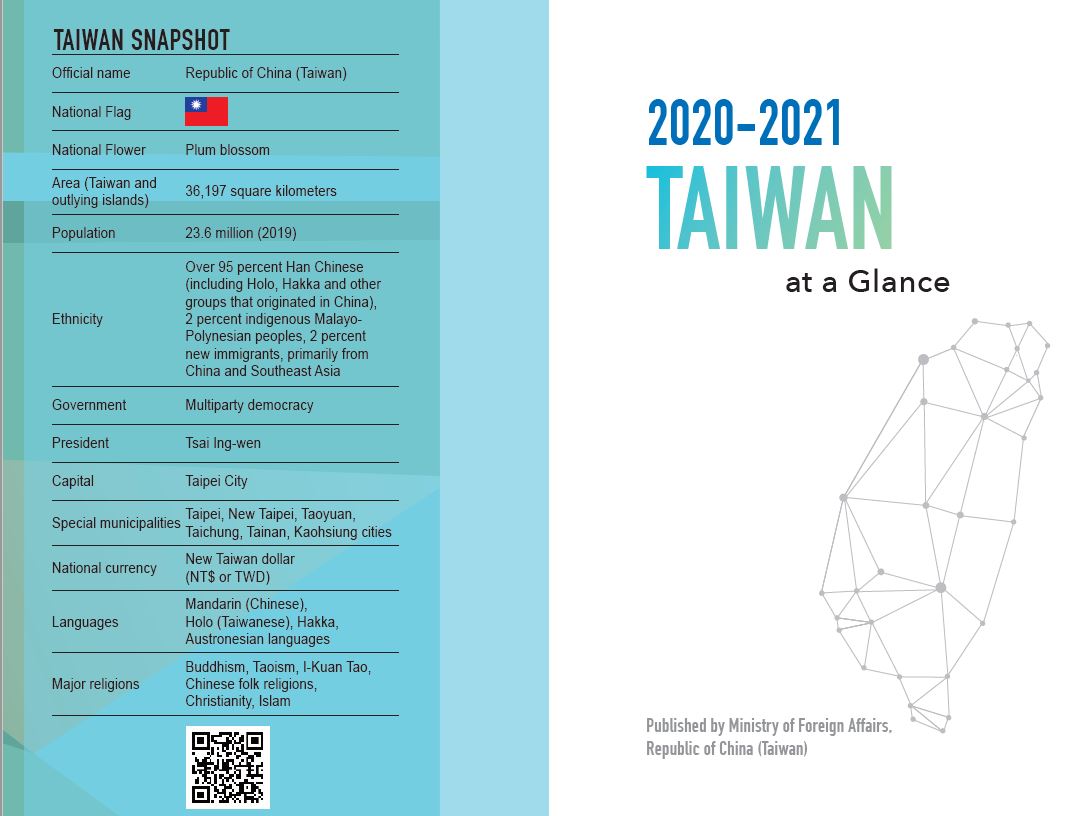
Taiwan,[II][i] officially the Republic of China (ROC),[I] is a country[27] in East Asia.[l] The main island of Taiwan, also known as Formosa, lies between the East and South China Seas in the northwestern Pacific Ocean, with the People's Republic of China (PRC) to the northwest, Japan to the northeast, and the Philippines to the south. It has an area of 35,808 square kilometres (13,826 square miles), with mountain ranges dominating the eastern two-thirds and plains in the western third, where its highly urbanized population is concentrated. The combined territories under ROC control consist of 168 islands[m] in total covering 36,193 square kilometres (13,974 square miles).[17][39] The largest metropolitan area is formed by Taipei (the capital), New Taipei City, and Keelung. With around 23.9 million inhabitants, Taiwan is among the most densely populated countries.
Key Information


.svg)
.svg)


Taiwan has been settled for at least 25,000 years. Ancestors of Taiwanese indigenous peoples settled the island around 6,000 years ago. In the 17th century, large-scale Han Chinese immigration began under Dutch colonial rule and continued under the Kingdom of Tungning, the first predominantly Han Chinese state in Taiwanese history. The island was annexed in 1683 by the Qing dynasty and ceded to the Empire of Japan in 1895. The Republic of China, which had overthrown the Qing in 1912 under the leadership of Sun Yat-sen, assumed control following the surrender of Japan in World War II. But with the loss of mainland China to the Communists in the Chinese Civil War, the government moved to Taiwan in 1949 under the Kuomintang (KMT).
From the early 1960s, Taiwan saw rapid economic growth and industrialization known as the "Taiwan Miracle".[40] In the late 1980s and early 1990s, the ROC transitioned from a one-party state under martial law to a multi-party democracy, with democratically elected presidents beginning in 1996. Taiwan's export-oriented economy is the 21st-largest in the world by nominal GDP and the 20th-largest by PPP measures, with a focus on steel, machinery, electronics, and chemicals manufacturing. Taiwan is a developed country.[41][42] It is ranked highly in terms of civil liberties,[43] healthcare,[44] and human development.[h][22]
The political status of Taiwan is contentious. Despite being a founding member, the ROC no longer represents China as a member of the United Nations after UN members voted in 1971 to recognize the PRC instead. The ROC maintained its claim to be the sole legitimate representative of China and its territory until 1991, when it ceased to regard the Chinese Communist Party as a rebellious group and acknowledged its control over mainland China. Taiwan is claimed by the PRC, which refuses to establish diplomatic relations with countries that recognise the ROC. Taiwan maintains official diplomatic relations with 11 out of 193 UN member states and the Holy See. Many others maintain unofficial diplomatic ties through representative offices and institutions that function as de facto embassies and consulates. International organizations in which the PRC participates either refuse to grant membership to Taiwan or allow it to participate on a non-state basis. Domestically, the major political contention is between the Pan-Blue Coalition, which favors eventual Chinese unification under the ROC and promoting a pan-Chinese identity, contrasted with the Pan-Green Coalition, which favors eventual Taiwanese independence and promoting a Taiwanese identity; in the 21st century, both sides have moderated their positions to broaden their appeal.[49][50]
Etymology
[edit]Names for the island
[edit]In his Daoyi Zhilüe (1349), Wang Dayuan used "Liuqiu" as a name for the island, or the part of it closest to Penghu.[51] Elsewhere, the name was used for the Ryukyu Islands in general or Okinawa specifically; the name Ryūkyū is the Japanese form of Liúqiú. The name also appears in the Book of Sui (636) and other early works, but scholars cannot agree on whether these references are to the Ryukyus, Taiwan or even Luzon.[52]
The name Formosa (福爾摩沙) dates from 1542, when Portuguese sailors noted it on their maps as Ilha Formosa (Portuguese for "beautiful island").[53][54] The name Formosa eventually "replaced all others in European literature"[55] and remained in common use among English speakers into the 20th century.[56]
In 1603, a Chinese expedition fleet anchored at a place in Taiwan called Dayuan, a variant of "Taiwan".[57][58][59] In the early 17th century, the Dutch East India Company established a commercial post at Fort Zeelandia (modern-day Anping) on a coastal sandbar called "Tayouan",[60] after their ethnonym for a nearby Taiwanese aboriginal tribe, possibly Taivoan people.[61]
Use of the current Chinese name (臺灣 / 台灣) became official as early as 1684 during the Qing dynasty with the establishment of Taiwan Prefecture centered in modern-day Tainan. Through its rapid development the entire Taiwanese mainland eventually became known as "Taiwan".[62][63][64][65]
Names of the country and jurisdiction
[edit]The official name of the country in English is the "Republic of China". Shortly after the ROC's establishment in 1912, while it was still located on the Chinese mainland, the government used the short form "China" (Zhōngguó, 中國) to refer to itself, derived from zhōng ("central" or "middle") and guó ("state, nation-state").[n] The term developed under the Zhou dynasty in reference to its royal demesne,[o] and was then applied to the area around Luoyi (present-day Luoyang) during the Eastern Zhou and later to China's Central Plain, before being used as an occasional synonym for the state during the Qing era.[67] The name of the republic had stemmed from the party manifesto of the Tongmenghui in 1905, which says the four goals of the Chinese revolution was "to expel the Manchu rulers, to revive Chunghwa, to establish a Republic, and to distribute land equally among the people."[III] Revolutionary leader Sun Yat-sen proposed the name Chunghwa Minkuo as the assumed name of the new country when the revolution succeeded.
During the 1950s and 1960s, after the ROC government had withdrawn to Taiwan, it was commonly referred to as "Nationalist China" (or "Free China") to differentiate it from "communist China" (or "Red China").[69] Over subsequent decades, the Republic of China has become commonly known as "Taiwan", after the main island. To avoid confusion, the ROC government in Taiwan began to put "Taiwan" next to its official name in 2005.[70] In ROC government publications, the name is written as "Republic of China (Taiwan)", "Republic of China/Taiwan", or sometimes "Taiwan (ROC)".[71][72][73]
"Taiwan Area" was defined to mean the island of Taiwan, Penghu, Kinmen, Matsu, and other territory under ROC's effective control,[74] in contrast to "Mainland Area" which refers to ROC territory outside the Taiwan Area and under Chinese Communist control.[75]
The Republic of China participates in most international forums and organizations under the name "Chinese Taipei" as a compromise with the People's Republic of China (PRC). For instance, it is the name under which it has participated in the Olympic Games as well as the APEC.[76] "Taiwan authorities" is sometimes used by the PRC to refer to the government in Taiwan.[77]
History
[edit]
Pre-colonial period
[edit]Taiwan was joined to the Asian mainland in the Late Pleistocene, until sea levels rose about 10,000 years ago.[78] Human remains and Paleolithic artifacts dated 20,000 to 30,000 years ago have been found.[79][80] Study of the human remains suggested they were Australo-Papuan people similar to Negrito populations in the Philippines.[81] Paleolithic Taiwanese likely settled the Ryukyu Islands 30,000 years ago.[82] Slash-and-burn agriculture practices started at least 11,000 years ago.[83]
Stone tools of the Changbin culture have been found in Taitung and Eluanbi. Archaeological remains suggest they were initially hunter-gatherers that slowly shifted to intensive fishing.[84][85] The distinct Wangxing culture, found in Miaoli County, were initially gatherers who shifted to hunting.[86]
Around 6,000 years ago, Taiwan was settled by farmers of the Dapenkeng culture, most likely from what is now southeast China.[87] These cultures are the ancestors of modern Taiwanese Indigenous peoples and the originators of the Austronesian language family.[88][89] Trade with the Philippines persisted from the early 2nd millennium BCE, including the use of Taiwanese jade in the Philippine jade culture.[90][91]
The Dapenkeng culture was succeeded by a variety of cultures throughout the island, including the Tahu and Yingpu; the Yuanshan were characterized by rice harvesting. Iron appeared in such cultures as the Niaosung culture, influenced by trade with China and Maritime Southeast Asia.[92][93] The Plains Indigenous peoples mainly lived in permanent walled villages, with a lifestyle based on agriculture, fishing, and hunting.[94] They had traditionally matriarchal societies.[94]
Early colonial period (to 1683)
[edit]The Penghu Islands were inhabited by Han Chinese fishermen by 1171, and in 1225 Penghu was attached to Jinjiang.[95][96][97][98] The Yuan dynasty officially incorporated Penghu under the jurisdiction of Tong'an County in 1281.[98] Penghu was evacuated in the 15th century by the Ming dynasty as part of their maritime ban, which lasted until the late 16th century.[99] In 1349, Wang Dayuan provided the first written account of a visit to Taiwan.[100][101] By the 1590s, a small number of Chinese from Fujian had started cultivating land in southwestern Taiwan.[102] Some 1,500-2,000 Chinese lived or stayed temporarily on the southern coast of Taiwan, mostly for seasonal fishing but also subsistence farming and trading, by the early 17th century.[103][101] In 1603, Chen Di visited Taiwan on an anti-wokou expedition and recorded an account of the Taiwanese Indigenous people.[58]
In 1591, Japan sent envoys to deliver a letter requesting tribute relations with Taiwan. They found no leader to deliver the letter to and returned home. In 1609, a Japanese expedition was sent to survey Taiwan. After being attacked by the Indigenous people, they took some prisoners and returned home. In 1616, a Japanese fleet of 13 ships were sent to Taiwan. Due to a storm, only one ship made it there and is presumed to have returned to Japan.[104][105]

In 1624, the Dutch East India Company (VOC) established Fort Zeelandia on the coastal islet of Tayouan (in modern Tainan).[106][65] The lowland areas were occupied by 11 Indigenous chiefdoms, some of which fell under Dutch control, including the Kingdom of Middag.[65][107] When the Dutch arrived, southwestern Taiwan was already frequented by a mostly transient Chinese population numbering close to 1,500.[103] The VOC encouraged Chinese farmers to immigrate and work the lands under Dutch control and by the 1660s, some 30,000 to 50,000 Chinese were living on the island.[108][109] Most of the farmers cultivated rice for local consumption and sugar for export while some immigrants engaged in deer hunting for export.[110][111][112]
In 1626, the Spanish Empire occupied northern Taiwan as a trading base, first at Keelung and in 1628 building Fort Santo Domingo at Tamsui.[113][114] This colony lasted until 1642, when the last Spanish fortress fell to Dutch forces.[115] The Dutch then marched south, subduing hundreds of villages in the western plains.[115]

Following the fall of the Ming dynasty in Beijing in 1644, Koxinga (Zheng Chenggong) pledged allegiance to the Yongli Emperor and attacked the Qing dynasty along the southeastern coast of China.[116] In 1661, under increasing Qing pressure, he moved his forces from his base in Xiamen to Taiwan, expelling the Dutch the following year. The Dutch retook the northern fortress at Keelung in 1664, but left the island in 1668 in the face of indigenous resistance.[117][118]
The Zheng regime, known as the Kingdom of Tungning, proclaimed its loyalty to the overthrown Ming, but ruled independently.[119][120][121][122] However, Zheng Jing's return to China to participate in the Revolt of the Three Feudatories paved the way for the Qing invasion and occupation of Taiwan in 1683.[123][124]
Qing rule (1683–1895)
[edit]
Following the defeat of Koxinga's grandson by an armada led by Admiral Shi Lang in 1683, the Qing dynasty formally annexed Taiwan in May 1684, making it a prefecture of Fujian province while retaining its administrative seat (now Tainan) under Koxinga as the capital.[125][126][127]
The Qing government generally tried to restrict migration to Taiwan throughout the duration of its administration because it believed that Taiwan could not sustain too large a population without leading to conflict. After the defeat of the Kingdom of Tungning, most of its population in Taiwan was sent back to the mainland, leaving the official population count at only 50,000, including 10,000 troops. Despite official restrictions, officials in Taiwan solicited settlers from the mainland, causing tens of thousands of annual arrivals by 1711. A permit system was officially recorded in 1712, but it likely existed as early as 1684; its restrictions included only allowing those to enter who had property on the mainland, family in Taiwan, and who were not accompanied by wives or children. Many of the male migrants married local Indigenous women. Over the 18th century, restrictions were relaxed. In 1732, families were allowed to move to Taiwan.[128][129] By 1811, there were more than two million Han settlers in Taiwan, and profitable sugar and rice production industries provided exports to the mainland.[130][131][132] In 1875, restrictions on entering Taiwan were repealed.[133]

Three counties nominally covered the entire western plains, but actual control was restricted to a smaller area. A government permit was required for settlers to go beyond the Dajia River. Qing administration expanded across the western plains area over the 18th century due to continued illegal crossings and settlement.[134] The Taiwanese Indigenous peoples were categorized by the Qing administration into acculturated aborigines who had adopted Han culture and non-acculturated aborigines who had not. The Qing did little to administer or subjugate them. When Taiwan was annexed, there were 46 aboriginal villages under its control, likely inherited from the Kingdom of Tungning. During the early Qianlong period there were 93 acculturated villages and 61 non-acculturated villages that paid taxes. In response to the Zhu Yigui settler rebellion in 1722, separation of aboriginals and settlers became official policy via 54 stelae used to mark the frontier boundary. The markings were changed four times over the latter half of the 18th century due to continued settler encroachment. Two aboriginal affairs sub-prefects, one for the north and one for the south, were appointed in 1766.[135]
During the 200 years of Qing rule in Taiwan, the Plains Indigenous peoples rarely rebelled against the government and the mountain Indigenous peoples were left to their own devices until the last 20 years of Qing rule. Most of the more than 100 rebellions during the Qing period, such as the Lin Shuangwen rebellion, were caused by Han settlers.[136][137] Their frequency was evoked by the common saying "every three years an uprising, every five years a rebellion" (三年一反、五年一亂), primarily in reference to the period between 1820 and 1850.[138][139][140]
Many officials stationed in Taiwan called for an active colonization policy over the 19th century. In 1788, Taiwan Prefect Yang Tingli supported the efforts of a settler named Wu Sha to claim land held by the Kavalan people. In 1797, Wu Sha was able to recruit settlers with financial support from the local government but was unable to officially register the land. In the early 1800s, local officials convinced the emperor to officially incorporate the area by playing up the issue of piracy if the land was left alone.[141] In 1814, some settlers attempted to colonize central Taiwan by fabricating rights to lease aboriginal land. They were evicted by government troops two years later. Local officials continued to advocate for the colonization of the area but were ignored.[142]

The Qing took on a more active colonization policy after 1874 when Japan invaded Indigenous territory in southern Taiwan and the Qing government was forced to pay an indemnity for them to leave.[143] The administration of Taiwan was expanded with new prefectures, sub-prefectures, and counties. Mountain roads were constructed to make inner Taiwan more accessible. Restrictions on entering Taiwan were ended in 1875 and agencies for recruiting settlers were established on the mainland, but efforts to promote settlement ended soon after.[144] In 1884, Keelung in northern Taiwan was occupied during the Sino-French War but the French forces failed to advance any further inland while their victory at Penghu in 1885 resulted in disease and retreat soon afterward as the war ended. Colonization efforts were renewed under Liu Mingchuan. In 1887, Taiwan's status was upgraded to a province. Taipei became the permanent capital in 1893. Liu's efforts to increase revenues on Taiwan's produce were hampered by foreign pressure not to increase levies. A land reform was implemented, increasing revenue which still fell short of expectation.[145][146][147] Modern technologies such as electric lighting, a railway, telegraph lines, steamship service, and industrial machinery were introduced under Liu's governance, but several of these projects had mixed results. A campaign to formally subjugate the Indigenous peoples ended with the loss of a third of the army after fierce resistance from the Mkgogan and Msbtunux peoples. Liu resigned in 1891 due to criticism of these costly projects.[148][149][125][150]
By the end of the Qing period, the western plains were fully developed as farmland with about 2.5 million Chinese settlers. The mountainous areas were still largely autonomous under the control of Indigenous peoples. Indigenous land loss under the Qing occurred at a relatively slow pace due to the absence of state-sponsored land deprivation for the majority of Qing rule.[151][152]
Japanese rule (1895–1945)
[edit]Following the Qing defeat in the First Sino-Japanese War (1894–1895), Taiwan, its associated islands, and the Penghu archipelago were ceded to Japan by the Treaty of Shimonoseki.[153] Inhabitants wishing to remain Qing subjects had to move to mainland China within a two-year grace period, which few saw as feasible.[154] Estimates say around 4,000 to 6,000 departed before the expiration of the grace period, and 200,000 to 300,000 followed during the subsequent disorder.[155][131][156] On 25 May 1895, a group of pro-Qing high officials proclaimed the Republic of Formosa to resist impending Japanese rule. Japanese forces entered the capital at Tainan and quelled this resistance on 21 October 1895.[157] About 6,000 inhabitants died in the initial fighting and some 14,000 died in the first year of Japanese rule. Another 12,000 "bandit-rebels" were killed from 1898 to 1902.[158][159][160] Subsequent rebellions against the Japanese (the Beipu uprising of 1907, the Tapani incident of 1915, and the Musha incident of 1930) were unsuccessful but demonstrated opposition to Japanese rule.

The colonial period was instrumental to the industrialization of the island, with its expansion of railways and other transport networks, the building of an extensive sanitation system, the establishment of a formal education system, and an end to the practice of headhunting.[161][162] The resources of Taiwan were used to aid the development of Japan. The production of cash crops such as sugar greatly increased, and large areas were therefore diverted from the production of rice.[163] By 1939, Taiwan was the seventh-greatest sugar producer in the world.[164]
The Han and Indigenous populations were classified as second- and third-class citizens, and many prestigious government and business positions were closed to them.[165] After suppressing Han guerrillas in the first decade of their rule, Japanese authorities engaged in bloody campaigns against the Indigenous people residing in mountainous regions, culminating in the Musha Incident of 1930.[166] Intellectuals and laborers who participated in left-wing movements were also arrested and massacred (e.g. Chiang Wei-shui and Masanosuke Watanabe).[167] Around 1935, the Japanese began an island-wide assimilation project.[168] Chinese-language newspapers and curriculums were abolished. Taiwanese music and theater were outlawed. A national Shinto religion was promoted in parallel with the suppression of traditional Taiwanese beliefs. Starting from 1940, families were also required to adopt Japanese surnames, although only 2% had done so by 1943.[168] By 1938, 309,000 Japanese were residing in Taiwan.[169]
During the Second World War, the island was developed into a naval and air base while its agriculture, industry, and commerce suffered.[170][171] Air attacks and the subsequent invasion of the Philippines were launched from Taiwan. The Imperial Japanese Navy operated heavily from Taiwanese ports, and its think tank "South Strike Group" was based at Taihoku Imperial University. Military bases and industrial centers, such as Kaohsiung and Keelung, became targets of heavy Allied bombings, which destroyed many of the factories, dams, and transport facilities built by the Japanese.[172][171] In October 1944, the Formosa Air Battle was fought between American carriers and Japanese forces in Taiwan. Over 200,000 of Taiwanese served in the Japanese military, with over 30,000 casualties.[173] Over 2,000 women, euphemistically called "comfort women", were forced into sexual slavery for Imperial Japanese troops.[174]
After Japan's surrender, most Japanese residents were expelled.[175]
Republic of China (1945–present)
[edit]
While Taiwan was under Japanese rule, the Republic of China was founded on mainland China on 1 January 1912 following the Xinhai Revolution of 1911.[176] Central authority waxed and waned in response to warlordism (1915–28), Japanese invasion (1937–45), and the Chinese Civil War (1927–49), with central authority strongest during the Nanjing decade (1927–37), when most of China came under the control of the Kuomintang (KMT).[177] During World War II, the 1943 Cairo Declaration specified that Formosa and the Pescadores be returned by Japan to the ROC;[178][179] the terms were later repeated in the 1945 Potsdam Declaration[180] that Japan agreed to carry out in its instrument of surrender.[181][182] On 25 October 1945, Japan surrendered Taiwan to the ROC, and in the Treaty of San Francisco, Japan formally renounced their claims to the islands, though without specifying to whom they were surrendered.[183][184][185][186][p] In the same year, Japan and the ROC signed a peace treaty.[187]
While initially enthusiastic about the return of Chinese administration and the Three Principles of the People, Formosans grew increasingly dissatisfied about being excluded from higher positions, the postponement of local elections even after the enactment of a constitution on the mainland, the smuggling of valuables off the island, the expropriation of businesses into government-operated monopolies, and the hyperinflation of 1945–1949.[188][189][190][191] The shooting of a civilian on 28 February 1947 triggered island-wide unrest, which was suppressed with military force in what is now called the February 28 incident.[192][193] Mainstream estimates of the number killed range from 18,000 to 30,000.[194][195][196] Chen was later replaced by Wei Tao-ming, who made an effort to undo previous mismanagement by re-appointing a good proportion of islanders and re-privatizing businesses.[197]

After the end of World War II, the Chinese Civil War resumed. A series of Chinese Communist offensives in 1949 led to the capture of its capital Nanjing on 23 April and the subsequent defeat of the Nationalists on the mainland. The Communists founded the People's Republic of China on 1 October.[198] On 7 December 1949, Chiang Kai-Shek evacuated his Nationalist government to Taiwan and made Taipei the temporary capital of the ROC.[199] Some 2 million people, mainly soldiers, members of the ruling Kuomintang and intellectual and business elites, were evacuated to Taiwan, adding to the earlier population of approximately six million. These people and their descendants became known in Taiwan as waishengren (外省人). The ROC government took to Taipei many national treasures and much of China's gold and foreign currency reserves.[200][201][202] Most of the gold was used to pay soldiers' salaries,[203] with some used to issue the New Taiwan dollar, part of a price stabilization program to slow inflation in Taiwan.[204][205]
After losing control of mainland China in 1949, the ROC retained control of Taiwan and Penghu (Taiwan, ROC), parts of Fujian (Fujian, ROC)—specifically Kinmen, Wuqiu (now part of Kinmen) and the Matsu Islands and two major islands in the South China Sea. The ROC also briefly retained control of the entirety of Hainan, parts of Zhejiang (Chekiang)—specifically the Dachen Islands and Yijiangshan Islands—and portions of Tibet, Qinghai, Xinjiang and Yunnan. The Communists captured Hainan in 1950, captured the Dachen Islands and Yijiangshan Islands during the First Taiwan Strait Crisis in 1955 and defeated the ROC revolts in Northwest China in 1958. ROC forces entered Burma and Thailand in the 1950s and were defeated by Communists in 1961. Since losing control of mainland China, the Kuomintang continued to claim sovereignty over 'all of China', which it defined to include mainland China (including Tibet), Taiwan (including Penghu), Outer Mongolia, and other minor territories.
Martial law era (1949–1987)
[edit]
Martial law, declared on Taiwan in May 1949,[206] continued to be in effect until 1987,[206][207] and was used to suppress political opposition. During the White Terror, as the period is known, 140,000 people were imprisoned or executed for being perceived as anti-KMT or pro-Communist.[208] Many citizens were arrested, tortured, imprisoned or executed for their real or perceived link to the Chinese Communist Party. Since these people were mainly from the intellectual and social elite, an entire generation of political and social leaders was destroyed.
Following the eruption of the Korean War, US President Harry S. Truman dispatched the United States Seventh Fleet into the Taiwan Strait to prevent hostilities between the ROC and the PRC.[209] The United States also passed the Sino-American Mutual Defense Treaty and the Formosa Resolution of 1955, granting substantial foreign aid to the KMT regime between 1951 and 1965.[210] The US foreign aid stabilized prices in Taiwan by 1952.[211] The KMT government instituted many laws and land reforms that it had never effectively enacted on mainland China.[212] Economic development was encouraged by American aid and programs such as the Joint Commission on Rural Reconstruction, which turned the agricultural sector into the basis for later growth. Under the combined stimulus of the land reform and the agricultural development programs, agricultural production increased at an average annual rate of 4 percent from 1952 to 1959.[213] The government also implemented a policy of import substitution industrialization, attempting to produce imported goods domestically.[214] The policy promoted the development of textile, food, and other labor-intensive industries.[215]
As the Chinese Civil War continued, the government built up military fortifications throughout Taiwan. Veterans built the Central Cross-Island Highway through the Taroko Gorge in the 1950s. During the Second Taiwan Strait Crisis in 1958, Nike Hercules missiles were added to the formation of missile batteries throughout the island.[216][217]

During the 1960s and 1970s, the ROC maintained an authoritarian, single-party government under the Kuomintang's Dang Guo system while its economy became industrialized and technology-oriented.[218] This rapid economic growth, known as the Taiwan Miracle, occurred following a strategy of prioritizing agriculture, light industries, and heavy industries, in that order.[219] Export-oriented industrialization was achieved by tax rebate for exports, removal of import restriction, moving from multiple exchange rate to single exchange rate system, and depreciation of the New Taiwan dollar.[220] Infrastructure projects such as the Sun Yat-sen Freeway, Taoyuan International Airport, Taichung Harbor, and Jinshan Nuclear Power Plant were launched, while the rise of steel, petrochemical, and shipbuilding industries in southern Taiwan saw the transformation of Kaohsiung into a special municipality on par with Taipei.[221] In the 1970s, Taiwan became the second fastest growing economy in Asia.[222] Real growth in GDP averaged over 10 percent.[223] In 1978, the combination of tax incentives and a cheap, well-trained labor force attracted investments of over $1.9 billion from overseas Chinese, the United States, and Japan.[224] By 1980, foreign trade reached $39 billion per year and generated a surplus of $46.5 million.[219] Along with Hong Kong, Singapore, and South Korea, Taiwan became known as one of the Four Asian Tigers.
Because of the Cold War, most Western nations and the United Nations regarded the ROC as the sole legitimate government of China until the 1970s. Eventually, especially after Taiwan's expulsion from the United Nations, most nations switched diplomatic recognition to the PRC. Until the 1970s, the ROC government was regarded by Western critics as undemocratic for upholding martial law, severely repressing any political opposition, and controlling the media. The KMT did not allow the creation of new parties and competitive democratic elections did not exist.[225][226][227][228][229]
From the late 1970s to the 1990s, Taiwan underwent political and social reforms that transformed it into a democracy.[230][231] Chiang Ching-kuo, Chiang Kai-shek's son, served as premier from 1972 and rose to the presidency in 1978. He sought to move more authority to "bensheng ren" (residents of Taiwan before Japan's surrender and their descendants).[232] Pro-democracy activists Tangwai emerged as the opposition. In 1979, the Kaohsiung Incident took place in Kaohsiung on Human Rights Day. Although the protest was rapidly crushed by the authorities, it is considered as the main event that united Taiwan's opposition.[233]
In 1984, Chiang Ching-kuo selected Lee Teng-hui as his vice-president. After the Democratic Progressive Party (DPP) was (illegally) founded as the first opposition party in Taiwan to counter the KMT in 1986, Chiang announced that he would allow the formation of new parties.[234] On 15 July 1987, Chiang lifted martial law on the main island of Taiwan.[235][236]
Transition to democracy
[edit]
After Chiang Ching-kuo's death in 1988, Lee Teng-hui became the first president of the ROC born in Taiwan.[237] Lee's administration oversaw a period of democratization in which the Temporary Provisions against the Communist Rebellion were abolished and the Additional Articles of the Constitution were introduced.[238][239] Congressional representation was allocated to only the Taiwan Area,[240] and Taiwan underwent a process of localization in which Taiwanese culture and history were promoted over a pan-China viewpoint[241] while assimilationist policies were replaced with support for multiculturalism.[242] In 1996, Lee was re-elected in the first direct presidential election.[243] During Lee's administration, both he and his party were involved in corruption controversies that came to be known as "black gold" politics.[244][245][246]
Chen Shui-bian of the DPP was elected as the first non-KMT president in 2000.[247] However, Chen lacked legislative majority. The opposition KMT developed the Pan-Blue Coalition with other parties, mustering a slim majority over the DPP-led Pan-Green Coalition.[248] Polarized politics emerged in Taiwan with the Pan-Blue preference for eventual Chinese unification, while the Pan-Green prefers Taiwanese independence.
Chen's reference to "One Country on Each Side" of the Taiwan Strait undercut cross-Strait relations in 2002.[249] He pushed for the first national referendum on cross-Strait relations,[250][251] and called for an end to the National Unification Council.[252] State-run companies began dropping "China" references in their names and including "Taiwan".[253] In 2008, referendums asked whether Taiwan should join the UN.[254] This act alienated moderate constituents who supported the status quo, as well as those with cross-strait economic ties. It also created tension with the mainland and disagreements with the United States.[255] Chen's administration was also dogged by public concerns over reduced economic growth, legislative gridlock, and corruption investigations.[256][257][255]
.jpg)
The KMT's nominee Ma Ying-jeou won the 2008 presidential election on a platform of increased economic growth and better ties with the PRC under a policy of "mutual non-denial".[254] Under Ma, Taiwan and China opened up direct flights and cargo shipments.[258] The PRC government even made the atypical decision to not demand that Taiwan be barred from the annual World Health Assembly.[259] Ma also made an official apology for the White Terror.[260][261] However, closer economic ties with China raised concerns about its political consequences.[262][263] In 2014, university students occupied the Legislative Yuan and prevented the ratification of the Cross-Strait Service Trade Agreement in what became known as the Sunflower Student Movement. The movement gave rise to youth-based third parties such as the New Power Party, and is viewed to have contributed to the DPP's victories in the 2016 presidential and legislative elections,[264] the latter of which resulted in the first DPP legislative majority in Taiwanese history.[265] In January 2024, William Lai Ching-te of the ruling Democratic Progressive Party won Taiwan's presidential elections.[266] However, no party won a majority in the simultaneous Taiwan's legislative election for the first time since 2004, meaning 51 seats for the Democratic Progressive Party (DPP), 52 seats for the Kuomintang (KMT), and the Taiwan People's Party (TPP) secured eight seats.[267]
Geography
[edit]
The land controlled by the ROC consists of 168 islands[m] with a combined area of 36,193 square kilometres (13,974 sq mi).[17][39][i] The main island, known historically as Formosa, makes up 99 percent of this area, measuring 35,808 square kilometres (13,826 sq mi) and lying some 180 kilometres (112 mi) across the Taiwan Strait from the southeastern coast of mainland China. The East China Sea lies to its north, the Philippine Sea to its east, the Luzon Strait directly to its south and the South China Sea to its southwest. Smaller islands include the Penghu Islands in the Taiwan Strait, the Kinmen, Matsu and Wuqiu islands near the Chinese coast, and some of the South China Sea islands.
The main island is a tilted fault block, characterized by the contrast between the eastern two-thirds, consisting mostly of five rugged mountain ranges parallel to the east coast, and the flat to gently rolling plains of the western third, where the majority of Taiwan's population reside. There are several peaks over 3,500 metres, the highest being Yu Shan at 3,952 m (12,966 ft), making Taiwan the world's fourth-highest island. The tectonic boundary that formed these ranges is still active, and the island experiences many earthquakes. There are also many active submarine volcanoes in the Taiwan Strait.
Taiwan contains four terrestrial ecoregions: Jian Nan subtropical evergreen forests, South China Sea Islands, South Taiwan monsoon rain forests, and Taiwan subtropical evergreen forests.[268] The eastern mountains are heavily forested and home to a diverse range of wildlife, while land use in the western and northern lowlands is intensive. The country had a 2019 Forest Landscape Integrity Index mean score of 6.38/10, ranking it 76th globally out of 172 countries.[269]
Climate
[edit]
Taiwan lies on the Tropic of Cancer, and its general climate is marine tropical.[14] The northern and central regions are subtropical, whereas the south is tropical and the mountainous regions are temperate.[270] The average rainfall is 2,600 millimetres (100 inches) per year for the island proper; the rainy season is concurrent with the onset of the summer East Asian Monsoon in May and June.[271] The entire island experiences hot, humid weather from June through September. Typhoons are most common in July, August and September.[271] During the winter (November to March), the northeast experiences steady rain, while the central and southern parts of the island are mostly sunny.
Due to climate change, the average temperature in Taiwan has risen 1.4 °C (2.5 °F) in the last 100 years, twice the worldwide temperature rise.[272] The goal of the Taiwanese government is to cut carbon emissions by 20 percent in 2030 and by 50 percent in 2050, compared to 2005 levels. Carbon emissions increased by 0.92 percent between 2005 and 2016.[273]
Geology
[edit]
The island of Taiwan lies in a complex tectonic area between the Yangtze Plate to the west and north, the Okinawa Plate on the north-east, and the Philippine Mobile Belt on the east and south. The upper part of the crust on the island is primarily made up of a series of terranes, mostly old island arcs which have been forced together by the collision of the forerunners of the Eurasian Plate and the Philippine Sea Plate. These have been further uplifted as a result of the detachment of a portion of the Eurasian Plate as it was subducted beneath remnants of the Philippine Sea Plate, a process which left the crust under Taiwan more buoyant.[274]
The east and south of Taiwan are a complex system of belts formed by, and part of the zone of, active collision between the North Luzon Trough portion of the Luzon Volcanic Arc and South China, where accreted portions of the Luzon Arc and Luzon forearc form the eastern Coastal Range and parallel inland Longitudinal Valley of Taiwan, respectively.[275]
The major seismic faults in Taiwan correspond to the various suture zones between the various terranes. These have produced major quakes. On 21 September 1999, a 7.3 quake known as the "921 earthquake" killed more than 2,400 people. The seismic hazard map for Taiwan by the USGS shows 9/10 of the island at the most hazardous rating.[276]
Government and politics
[edit]Government
[edit]
The government of the Republic of China was founded on the 1947 Constitution of the ROC and its Three Principles of the People, which states that the ROC "shall be a democratic republic of the people, to be governed by the people and for the people".[277] It underwent significant revisions in the 1990s, known collectively as the Additional Articles. The government is divided into five branches (Yuan): the Executive Yuan (cabinet), the Legislative Yuan (Congress or Parliament), the Judicial Yuan, the Control Yuan (audit agency), and the Examination Yuan (civil service examination agency).
.jpg)
The head of state and commander-in-chief of the armed forces is the president, who is elected by popular vote for a maximum of 2 four-year terms on the same ticket as the vice-president. The president appoints the members of the Executive Yuan as their cabinet, including a premier, who is officially the President of the Executive Yuan; members are responsible for policy and administration.[277]
The main legislative body is the unicameral Legislative Yuan with 113 seats. Seventy-three are elected by popular vote from single-member constituencies; thirty-four are elected based on the proportion of nationwide votes received by participating political parties in a separate party list ballot; and six are elected from two three-member aboriginal constituencies. Members serve four-year terms. Originally the unicameral National Assembly, as a standing constitutional convention and electoral college, held some parliamentary functions, but the National Assembly was abolished in 2005 with the power of constitutional amendments handed over to the Legislative Yuan and all eligible voters of the Republic via referendums.[277][278]

The premier is selected by the president without the need for approval from the legislature, and neither the president nor the premier wields veto power.[277] Historically, the ROC has been dominated by strongman single party politics. This legacy has resulted in executive powers currently being concentrated in the office of the president rather than the premier.[279]
The Judicial Yuan is the highest judicial organ. It interprets the constitution and other laws and decrees, judges administrative suits, and disciplines public functionaries. The president and vice-president of the Judicial Yuan and additional thirteen justices form the Constitutional Court, which was established in 1993 to resolve constitutional disputes, regulate the activities of political parties and accelerate the democratization process. The Constitutional Court was formerly called the Council of Grand Justices.[280] They are nominated and appointed by the president, with the consent of the Legislative Yuan. The highest court, the Supreme Court, consists of a number of civil and criminal divisions, each of which is formed by a presiding judge and four associate judges, all appointed for life. The right to a fair public trial is protected by law and respected in practice. There is no trial by jury, however many cases are presided over by multiple judges.[277]
The Control Yuan is a watchdog agency that monitors the actions of the executive. It can be considered a standing commission for administrative inquiry, like the Court of Auditors of the European Union or the Government Accountability Office of the United States.[277] It is also responsible for the National Human Rights Commission.
The Examination Yuan is in charge of validating the qualification of civil servants. It is based on the imperial examination system used in dynastic China. It can be compared to the European Personnel Selection Office of the European Union or the Office of Personnel Management of the United States.[277] It was downsized in 2019, and there have been calls for its abolition.[281][282]
Constitution
[edit]The constitution was drafted by the KMT while the ROC still governed the Chinese mainland.[283] Political reforms beginning in the late 1970s resulted in the end of martial law in 1987, and Taiwan transformed into a multiparty democracy in the early 1990s. The constitutional basis for this transition to democracy was gradually laid in the Additional Articles of the Constitution. These articles suspended portions of the Constitution designed for the governance of mainland China and replacing them with articles adapted for the governance of and guaranteeing the political rights of residents of the Taiwan Area, as defined in the Cross-Strait Act.[284]
National boundaries were not explicitly prescribed by the 1947 Constitution, and the Constitutional Court declined to define these boundaries in a 1993 interpretation, viewing the question as a political question to be resolved by the Executive and Legislative Yuans.[285] The 1947 Constitution included articles regarding representatives from former Qing dynasty territories including Tibet and Mongol banners.[286][287][288] The ROC recognized Mongolia as an independent country in 1946 after signing the 1945 Sino-Soviet Treaty of Friendship and Alliance, but after retreating to Taiwan in 1949 it reneged to preserve its claim over mainland China.[289] The Additional Articles of the 1990s did not alter national boundaries, but suspended articles regarding Mongolian and Tibetan representatives. The ROC began to accept the Mongolian passport and removed clauses referring to Outer Mongolia from the Act Governing Relations between the People of the Taiwan Area and the Mainland Area in 2002.[290] In 2012 the Mainland Affairs Council issued a statement clarifying that Outer Mongolia was not part of the ROC's national territory in 1947.[291] The Mongolian and Tibetan Affairs Commission in the Executive Yuan was abolished in 2017.
Administrative divisions
[edit]According to the 1947 constitution, the territory of the ROC is according to its "existing national boundaries".[292] The ROC is, de jure constitutionally, divided into provinces, special municipalities (which are further divided into districts for local administration), and the province-level Tibet Area. Each province is subdivided into cities and counties, which are further divided into townships and county-administered cities. Some divisions are indigenous divisions which have different degrees of autonomy to standard ones. In addition, districts, cities and townships are further divided into villages and neighborhoods.
Since its retreat, the ROC has controlled only Taiwan Province and some islands of Fujian Province, with the provincial governments now "streamlined" and no longer functional.[293][294] The ROC also controls the Pratas Islands and Taiping Island in the Spratly Islands, which are part of the disputed South China Sea Islands, and has placed them under the administration of Kaohsiung.[295] With provinces non-functional, Taiwan is in practice divided into 22 subnational divisions, each with a self-governing body led by an elected leader and a legislative body with elected members. Duties of local governments include social services, education, urban planning, public construction, water management, environmental protection, transport, public safety, and more.
.svg)
- Notes
- ^ a b c d e f Has an elected executive and an elected legislative council.
- ^ a b c Has an appointed district administrator for managing local affairs and carrying out tasks commissioned by superior agency.
- ^ Has an elected village administrator for managing local affairs and carrying out tasks commissioned by superior agency.
Major camps
[edit]
Taiwan's political scene is divided into two major camps in terms of cross-strait relations, i.e. how Taiwan should relate to China or the PRC. The Pan-Green Coalition (e.g. the Democratic Progressive Party) leans pro-independence, and the Pan-Blue Coalition (e.g. the Kuomintang) leans pro-unification.[296] Moderates in both camps regard the Republic of China as a sovereign independent state, but the Pan-Green Coalition regard the ROC as synonymous with Taiwan,[297] while moderates in the Pan-Blue Coalition view it as synonymous with China.[298] These positions formed against the backdrop of the PRC's Anti-Secession Law, which threatens the use of "non-peaceful means" to respond to formal Taiwanese independence.[299] The ROC government has understood this to mean a military invasion of Taiwan.[300]

The Pan-Green Coalition is mainly led by the pro-independence Democratic Progressive Party (DPP). They oppose the idea that Taiwan is part of China, and seek wide diplomatic recognition and an eventual declaration of formal Taiwan independence.[301] In September 2007, the ruling DPP approved a resolution asserting separate identity from China and called for the enactment of a new constitution for a "normal country". It called also for general use of "Taiwan" as the country's name, without abolishing its formal name, the "Republic of China".[302] Some members of the DPP, such as former President Chen Shui-bian and President Lai Ching-te, argue that it is unnecessary to proclaim independence because Taiwan is already an independent sovereign country called the Republic of China.[303][304] Despite being a member of KMT prior to and during his presidency, Lee Teng-hui also held a similar view and was a supporter of the Taiwanization movement.[305] Taiwan Statebuilding Party (TSP) and Green Party (GPT)[306] have adopted a line that aggressive route more than the DPP, in order to win over pro-independence voters who are dissatisfied with the DPP's conservative stance.
The Pan-Blue Coalition, composed of the pro-unification Kuomintang (KMT), People First Party (PFP) and New Party generally support the spirit of the 1992 Consensus, where the KMT claimed that there is one China, but that the ROC and PRC have different interpretations of what "China" means. They favor eventual unification with China.[307] The mainstream Pan-Blue position is to maintain the status quo, while refusing immediate unification.[308][309] Former President Ma Ying-jeou defined cross-strait relations as special relations, not one between two Chinas or two states.[310][311][312] Ma also noted that unification is unlikely within our lifetimes, as the Taiwanese people oppose the mainland's authoritarian rule.[313] Some Pan-Blue members seek to improve relationships with the PRC, with a focus on improving economic ties.[314]
National identity
[edit]Roughly 84 percent of Taiwan's population are descendants of Han Chinese immigrants between 1683 and 1895. Another significant fraction descends from Han Chinese who immigrated from mainland China in the late 1940s and early 1950s. The shared cultural origin as well as hostility between the rival ROC and PRC have resulted in national identity being a contentious issue with political overtones.
Since democratic reforms and the lifting of martial law, a distinct Taiwanese identity is often at the heart of political debates. Its acceptance makes the island distinct from mainland China, and therefore may be seen as a step towards forming a consensus for de jure Taiwan independence.[315] The Pan-Green camp supports a predominantly Taiwanese identity (although "Chinese" may be viewed as cultural heritage), while the Pan-Blue camp supports a predominantly Chinese identity (with "Taiwanese" as a regional/diasporic Chinese identity).[307] The KMT has downplayed this stance in the recent years and now supports a Taiwanese identity as part of a Chinese identity.[316][317]
Public opinion
[edit]
Taiwanese identification has increased substantially since the early 1990s, while Chinese identification has fallen to a low level, and identification as both has also seen a reduction. In 1992, 17.6 percent of respondents identified as Taiwanese, 25.5 percent as Chinese, 46.4 percent as both, and 10.5 percent non-response. In June 2021, 63.3 percent identified as Taiwanese, 2.6 percent as Chinese, 31.4 percent as both, and 2.7 percent non-response.[318] A survey conducted in Taiwan by Global Views Survey Research Center in July 2009 showed that 82.8 percent of respondents consider the ROC and the PRC two separate countries with each developing on its own but 80.2 percent think they are members of the Chinese.[319]
Domestic public opinion has preferred maintaining the status quo, though pro-independence sentiment has steadily risen since 1994. In June 2021, an annual poll found that 28.2 percent supported the status quo and postponing a decision, 27.5 percent supported maintaining the status quo indefinitely, 25.8 percent supported the status quo with a move toward independence, 5.9 percent supported the status quo with a move toward unification, 5.7 percent gave no response, 5.6 percent supported independence as soon as possible, and 1.5 percent supported unification as soon as possible.[320] A referendum question in 2018 asked if Taiwan's athletes should compete under "Taiwan" in the 2020 Summer Olympics but did not pass; the New York Times attributed the failure to a campaign cautioning that a name change might lead to Taiwan being banned "under Chinese pressure".[321]
International status and relations
[edit].svg)
The political and legal statuses of Taiwan are contentious issues. The People's Republic of China (PRC) claims that Taiwan is Chinese territory and that the PRC replaced the ROC government in 1949, becoming the sole legal government of China.[77] The ROC, however, has its own currency, widely accepted passport, postage stamps, internet TLD, armed forces, constitution, and institutions.[322] It has not formally renounced its claim to the mainland, but ROC government publications have increasingly downplayed this historical claim.[323]
Until 1928, the foreign policy of Republican China was complicated by a lack of internal unity—competing centers of power all claimed legitimacy. This situation changed after the defeat of the Peiyang Government by the Kuomintang (KMT), which led to widespread diplomatic recognition of the Republic of China.[324] After the KMT retreated to Taiwan, most countries, especially those of the Western Bloc – save the United Kingdom, which recognized the PRC in 1950[325] – continued to maintain formal relations with the ROC; but recognition gradually eroded and many countries switched recognition to the People's Republic of China in the 1970s. On 25 October 1971, UN Resolution 2758 was adopted by 76 votes to 35 with 17 abstentions, recognizing the PRC as China's sole representative in the United Nations.[326][327]

The PRC refuses to have diplomatic relations with any nation that has diplomatic relations with the ROC, and requires all nations with which it has diplomatic relations to make a statement on its claims to Taiwan.[328][329] As a result, only 11 UN member states and the Holy See maintain official diplomatic relations with the Republic of China.[330] The ROC maintains unofficial relations with other countries via de facto embassies and consulates mostly called Taipei Economic and Cultural Representative Offices (TECRO), with branch offices called "Taipei Economic and Cultural Offices" (TECO). Both TECRO and TECO are "unofficial commercial entities" of the ROC in charge of maintaining diplomatic relations, providing consular services, and serving the national interests of the ROC.[331]
From 1954 to 1979, the United States was a partner with Taiwan in a mutual defense treaty. The United States remains one of the main supporters of Taiwan and, through the Taiwan Relations Act passed in 1979, has continued selling arms and providing military training to the Republic of China Armed Forces.[332] The PRC considers US involvement disruptive to the stability of the region.[333][334] The official position of the United States is that the PRC is expected to "use no force or threat[en] to use force against Taiwan" and the ROC is to "exercise prudence in managing all aspects of cross-strait relations." Both are to refrain from performing actions or espousing statements "that would unilaterally alter Taiwan's status".[335] While not officially classified as a major non-NATO ally, it has been de facto treated this way by the United States since at least 2003.[336]
Taiwan, since 2016 under the Tsai administration's New Southbound Policy, has pursued closer economic relations with South and Southeast Asian countries, increasing cooperation on investments and people-to-people exchanges despite the region's general lack of official diplomatic ties with Taipei.[337][338] The policy has led to Taiwan receiving an increased number of migrants and students from the region.[339] However, a few scandals of Southeast Asians, particularly Indonesians, experiencing exploitation in scholarship programs[340] and in some labor industries have emerged as setbacks for the policy[341][342] as well as for Indonesia-Taiwan relations.[343][344]
Relations with the PRC
[edit]
On April 30, 1991, President Lee Teng-hui announced the repeal of the Temporary Provisions against the Communist Rebellion, characterizing the Chinese Communist Party as "a political entity that controls the mainland region" or the "mainland authorities" instead and declaring that "we will no longer seek to unify China through force."[345]
The Mainland Affairs Council (MAC) of Taiwan is responsible for relations with the PRC, while the Taiwan Affairs Office (TAO) of the PRC is responsible for relations with Taiwan. Exchanges are conducted through private organizations both founded in 1991: the Straits Exchange Foundation (SEF) of Taiwan and the Association for Relations Across the Taiwan Straits (ARATS) of the PRC.
In November 1992, the ARATS and SEF held a meeting which would later become known as the 1992 Consensus. The SEF announced that both sides agreed that there was only one China, but disagreed on the definition of China (i.e. the ROC vs. PRC), while the ARATS announced that the two agreed on the One China principle, but did not mention differences regarding its definition made in the SEF statement.[346] In Taiwan, the ruling Democratic Progressive Party has rejected the 1992 Consensus since early 2019.[347] President Lai Ching-te has stated that the ROC and the PRC are not subordinate to each other.[348]
The PRC's One China principle states that Taiwan and mainland China are both part of China, and that the PRC is the only legitimate government of China.[349] It seeks to prevent or reduce any formal recognition of the ROC as an independent sovereign state,[350][351] meaning that Taiwan participates in many international forums as a non-state member under names such as "Chinese Taipei". The PRC suggested the "one country, two systems" employed in Hong Kong as a model for peaceful unification with Taiwan.[352][353] While it aims for peaceful reunification, the PRC does not rule out the use of force.[354][355] The political environment is complicated by the potential for military conflict[356][357][358] should events outlined in the PRC's Anti-Secession Law occur, such as Taiwan declaring de jure independence. There is a substantial military presence on the Fujian coast as well as PRC sorties into Taiwan's air defense identification zone (ADIZ).[359][360][361]
Participation in international events and organizations
[edit]The ROC was a founding member of United Nations, and held the seat of China on the Security Council and other UN bodies until 1971, when it was expelled by Resolution 2758 and replaced with the PRC as the ROC now has neither official membership nor observer status in the organization. Since 1993, the ROC has petitioned the UN for entry, but its applications have not made it past committee stage.[362][363] Due to the One China policy, most UN member states, including the United States, do not wish to discuss the issue of the ROC's political status for fear of souring diplomatic ties with the PRC.[364]
The ROC government shifted its focus to organizations affiliated with the UN, as well as organizations outside the UN system.[365] The government sought to participate in the World Health Organization (WHO) since 1997,[366][367] their efforts were rejected until 2009, when they participated as an observer under the name "Chinese Taipei" after reaching an agreement with Beijing.[368][369] In 2017, Taiwan again began to be excluded from the WHO even in an observer capacity.[370] This exclusion caused a number of scandals during the COVID-19 outbreak.[371][372]

The Nagoya Resolution in 1979 approved by the International Olympic Committee (IOC) provided a compromise for the ROC to use the name "Chinese Taipei" in international events where the PRC is also a party, such as the Olympic Games.[373][374][375] Under the IOC charter, ROC flags cannot be flown at any official Olympic venue or gathering.[376] The ROC also participates in the Asia-Pacific Economic Cooperation forum (since 1991) and the World Trade Organization (since 2002) under the names "Chinese Taipei" and "Separate Customs Territory of Taiwan, Penghu, Kinmen and Matsu", respectively.[377][378] It was a founding member of the Asian Development Bank, but since China's ascension in 1986 has participated under the name "Taipei, China". The ROC is able to participate as "China" in organizations in which the PRC does not participate, such as the World Organization of the Scout Movement.
Due to its limited international recognition, the Republic of China has been a member of the Unrepresented Nations and Peoples Organization (UNPO) since the foundation of the organization in 1991, represented by a government-funded organization, the Taiwan Foundation for Democracy (TFD), under the name "Taiwan".[379][380]
Military
[edit]
The Republic of China Armed Forces takes its roots in the National Revolutionary Army, which was established by Sun Yat-sen in 1924 in Guangdong with a goal of reunifying China under the Kuomintang. When the People's Liberation Army won the Chinese Civil War, much of the National Revolutionary Army retreated to Taiwan along with the government. The 1947 Constitution of the ROC reformed it into the Republic of China Armed Forces, making it the national army rather than the army of a political party. Units which surrendered and remained in mainland China were either disbanded or incorporated into the People's Liberation Army.
From 1949 to the 1970s, the primary mission of the Taiwanese military was to "retake mainland China" through Project National Glory. As this mission has transitioned away from attack because the relative strength of the PRC has massively increased, the ROC military has begun to shift emphasis from the traditionally dominant Army to the air force and navy. Control of the armed forces has also passed into the hands of the civilian government.[381][382]
The ROC began a series of force reduction plans since the 1990s to scale down its military from a level of 450,000 in 1997 to 380,000 in 2001.[383] As of 2021[update], the total strength of the Armed Forces is capped at 215,000 with 90 percent manning ratio for volunteer military.[384] Conscription remains universal for qualified males reaching age eighteen, but as a part of the reduction effort many are given the opportunity to fulfill their draft requirement through alternative service.[385][386] The military's reservists is around 2.5 million including first-wave reservists numbered at 300,000 as of 2022[update].[387] Taiwan's defense spending as a percentage of its GDP fell below three percent in 1999 and had been trending downwards over the first two decades of the twenty-first century.[388][389] The ROC government pledged to raise the spending as high as proposed three percent of GDP.[390][391][392] In 2024, Taiwan proposed 2.45 percent of projected GDP in defense spending for the following year.[393]
.jpg)
The ROC and the United States signed the Sino-American Mutual Defense Treaty in 1954, and established the United States Taiwan Defense Command. About 30,000 US troops were stationed in Taiwan, until the United States established diplomatic relations with the PRC in 1979.[394] A significant amount of military hardware has been bought from the United States, and continues to be legally guaranteed by the Taiwan Relations Act.[332] France and the Netherlands have also sold military weapons and hardware to the ROC, but they almost entirely stopped in the 1990s under pressure of the PRC.[395][396]
There is no guarantee in the Taiwan Relations Act or any other treaty that the United States will defend Taiwan, even in the event of invasion.[397] The joint declaration on security between the US and Japan signed in 1996 may imply that Japan would be involved in any response. However, Japan has refused to stipulate whether the "area surrounding Japan" mentioned in the pact includes Taiwan.[398] The Australia, New Zealand, United States Security Treaty (ANZUS Treaty) may mean that other US allies, such as Australia, could be involved.[399][400] While this would risk damaging economic ties with China,[401] a conflict over Taiwan could lead to an economic blockade of China by a greater coalition.[402][403][404][405][406]
LGBTQ rights
[edit]On 24 May 2017, the Constitutional Court ruled that then-current marriage laws had been violating the Constitution by denying same-sex couples the right to marry. The Court ruled that if the Legislative Yuan did not pass adequate amendments to Taiwanese marriage laws within two years, same-sex marriages would automatically become lawful in Taiwan.[407] In a referendum question in 2018, however, voters expressed overwhelming opposition to same-sex marriage and supported the removal of content about homosexuality from primary school textbooks. According to the New York Times, the referendum questions were subject to a "well-funded and highly organized campaign led by conservative Christians and other groups" involving the use of misinformation.[321] Nevertheless, the vote against same-sex marriage does not affect the court ruling, and on 17 May 2019, Taiwan's parliament approved a bill legalizing same-sex marriage, making it the first country in Asia to do so.[408][409][410]
Taiwan has an annual pride event, Taiwan Pride. It currently holds the record for the largest LGBTQ gathering in East Asia, rivaling Tel Aviv Pride in Israel.[411] The event draws more than 200,000 people.[412]
Economy
[edit].jpeg)
The quick industrialization and rapid growth of Taiwan during the latter half of the 20th century has been called the "Taiwan Miracle". Taiwan is one of the "Four Asian Tigers" alongside Hong Kong, South Korea and Singapore. As of October 2022, Taiwan is the 21st largest economy in the world by nominal GDP.[413]
Since 2001, agriculture constituted less than 2 percent of GDP, down from 32 percent in 1951.[414] Unlike its neighbors, South Korea and Japan, the Taiwanese economy is dominated by small and medium-sized enterprises, rather than the large business groups.[415] Traditional labor-intensive industries are steadily being moved offshore and with more capital and technology-intensive industries replacing them. High-technology science parks have sprung up in Taiwan.
Today Taiwan has a dynamic, capitalist, export-driven economy with gradually decreasing state involvement in investment and foreign trade. In keeping with this trend, some large government-owned banks and industrial firms are being privatized.[416] Exports have provided the primary impetus for industrialization. The trade surplus is substantial, and Taiwan remained one of the world's largest forex reserve holders.[417] Taiwan's total trade in 2022 reached US$907 billion. Both exports and imports for the year reached record levels, totaling US$479.52 billion and US$427.60 billion, respectively.[418] China, United States and Japan are Taiwan's three largest trading partners, accounting for over 40 percent of total trade.[419]
Since the beginning of the 1990s, economic ties between Taiwan and China have been extensive. In 2002, China surpassed the United States to become Taiwan's largest export market for the first time.[420] China is also the most important target of outward foreign direct investment.[421] From 1991 to 2022, more than US$200 billion have been invested in China by Taiwanese companies.[422] China hosts around 4,200 Taiwanese enterprises and over 240,000 Taiwanese work in China.[423][424] Although the economy of Taiwan benefits from this situation, some have expressed the view that the island has become increasingly dependent on the mainland Chinese economy.[425] Others argue that close economic ties between Taiwan and mainland China would make any military intervention by the PLA against Taiwan very costly, and therefore less probable.[426]

Since the 1980s, a number of Taiwan-based technology firms have expanded their reach around the world.[427] Taiwan is a key player in the supply chain for advanced chips. Taiwan's rise in the key semiconductor industry was largely attributed to Taiwan Semiconductor Manufacturing Co. (TSMC) and United Microelectronic Corporation (UMC).[428] TSMC was founded 21 February 1987 and as of December 2021 its market capitalization equated to roughly 90% of Taiwan's GDP.[429] The company is the 9th largest in the world by market capitalization[430] as well as the world's biggest semiconductor manufacturing company, surpassing Intel and Samsung.[431] UMC, another major company in Taiwan's high-tech exports and global semiconductors, competes with the American GlobalFoundries, and others, for less advanced semiconductor processes and for silicon wafers.[432] Other well-known international technology companies based in Taiwan include personal computer manufacturers Acer Inc. and Asus, as well as Foxconn, an electronics contract manufacturer.[433]
Taiwan is a major manufacturer of bicycles and their component parts and accounts for around 40% of all bikes imported to Europe. French newspaper Le Monde diplomatique alleged that in the past several decades, the industry has relied on exploitative migrant labor practices to boost its productivity. Workers recruited from poorer neighboring countries face debt bondage, passport retention, wage withholding and substandard living conditions, as well as threats and intimidation from employers. Taiwan is one of the few countries where labor brokers are permitted to charge high recruitment fees to migrant workers. Recent reporting on these practices has led to promises of reform from some manufacturers.[434] In response to the allegations, the Taiwanese trade association stated that all bicycle manufacturers complied with the labor laws and proactively worked to improve working conditions.[435]
Transport
[edit]
The Ministry of Transportation and Communications of Taiwan is the cabinet-level governing body of the transport network in Taiwan. Civilian transport in Taiwan is characterized by extensive use of scooters. In March 2019, 13.86 million were registered, twice that of cars.[436] Both highways and railways are concentrated near the coasts, where the majority of the population resides, with 1,619 km (1,006 mi) of motorway. Railways in Taiwan are primarily used for passenger services, with Taiwan Railways Administration (TRA) operating a circular route around the island and Taiwan High Speed Rail (THSR) running high speed services on the west coast. Urban transit systems include Taipei Metro, Kaohsiung Metro, Taoyuan Metro, New Taipei Metro, and Taichung Metro.
Major airports include Taiwan Taoyuan, Kaohsiung, Taipei Songshan and Taichung. There are currently seven Taiwanese passenger airlines, with the largest two being China Airlines and EVA Air. There are seven international seaports: Keelung, Taipei, Suao, Taichung, Kaohsiung, Anping, and Hualien.[437] The Port of Kaohsiung handled the largest volume of cargo in Taiwan, with about 440 million shipping tonnes, which accounted for 58.6% of Taiwan's total throughput in 2021.[438] The shipping tonnage followed by Taichung (18.6%), Taipei (12%) and Keelung (8.7%).
Demographics
[edit]
Taiwan has a population of about 23.4 million,[439] most of whom are on the island of Taiwan. The remainder live on the outlying islands of Penghu (101,758), Kinmen (127,723), and Matsu (12,506).[440]
Largest cities and counties
[edit]The figures below are the March 2019 estimates for the twenty most populous administrative divisions; a different ranking exists when considering the total metropolitan area populations (in such rankings the Taipei-Keelung metro area is by far the largest agglomeration). The figures reflect the number of household registrations in each city, which may differ from the number of actual residents.
| ||||||||||||||||||||||||||||||||||||||||||||||||||||||
Ethnic groups
[edit]The ROC government reports that 95 percent of the population is ethnically Han Chinese.[441] There are also 2.5 percent indigenous Austronesian peoples and 2.5 percent new immigrants primarily from China and Southeast Asia.[12]
Most Han Taiwanese are descended from the Hoklo people, native to the coastal regions of southern Fujian, and the Hakka people, native to eastern Guangdong. Hoklo and Hakka migrants arrived in large numbers during the 17th and 18th century. Descendants of Hoklo now compose approximately 70 percent of Taiwan's population.[14] Descendants of Hakka make up about 15 percent of the population. Another minority group, called waishengren, comprises those who arrived from China during the 1940s or are descended from them.[442] Genetic studies indicate that the Han people in Taiwan are closer to southern Chinese compared to northern Chinese and, similar to several other groups of Han Chinese, had mixed with Island Southeast Asians, likely before their migration to Taiwan.[443] Nonetheless, they can be genetically distinguished from the indigenous minority despite low-level admixture. In addition, there is also evidence of genetic influence from groups like western Indonesians and Mainland Southeast Asians, especially Kinh Vietnamese.[444][445]
Taiwanese Indigenous peoples number about 584,000, and the government recognises 16 groups.[446] The Ami, Atayal, Bunun, Kanakanavu, Kavalan, Paiwan, Puyuma, Rukai, Saisiyat, Saaroa, Sakizaya, Sediq, Thao, Truku and Tsou live mostly in the eastern half of the island, while the Yami inhabit Orchid Island.[447][448]
Languages
[edit]
The Republic of China does not have any legally designated official language. Mandarin is the primary language used in business and education, and is spoken by the vast majority of the population. Traditional Chinese is used as the writing system.[449]
Around 70% of Taiwan's population belong to the Hoklo ethnic group and are native speakers of Taiwanese Hokkien.[450] The Hakka group, comprising some 14–18 percent of the population, speak Hakka. Although Mandarin is the language of instruction in schools and dominates television and radio, non-Mandarin Chinese varieties have undergone a revival in public life in Taiwan, particularly since restrictions on their use were lifted in the 1990s.[449]
Formosan languages are spoken primarily by the indigenous peoples of Taiwan. They do not belong to the Chinese or Sino-Tibetan language family, but to the Austronesian language family, and are written in the Latin alphabet.[451] Their use among aboriginal minority groups has been in decline as usage of Mandarin has risen.[449] Of the 14 extant languages, five are considered moribund.[452]
Since the May Fourth Movement, written vernacular Chinese had replaced Classical Chinese and emerged as the mainstream written Chinese in the Republic of China. Classical Chinese continued to be widely used in government documents until reforms in the 1970s to shift the written style to a more integrated vernacular Chinese and Classical Chinese style (文白合一行文).[453][454] On 1 January 2005, the Executive Yuan also changed its long-standing convention on the direction of writing in official documents from vertical to horizontal. Standalone Classical Chinese is occasionally used in formal or ceremonial occasions, such as religious or cultural rites. The "National Anthem of the Republic of China" (中華民國國歌), for example, is in Classical Chinese. Most official government, legal, and judiciary documents, as well as courts rulings use a combined vernacular Chinese and Classical Chinese style.[455] As many legal documents are still written in Classical Chinese, which is not easily understood by the general public, a group of Taiwanese have launched the Legal Vernacular Movement, hoping to bring more vernacular Chinese into the legal writings of the Republic of China.[456]
Taiwan is officially multilingual. A national language in Taiwan is legally defined as "a natural language used by an original people group of Taiwan and the Taiwan Sign Language".[9]
Religion
[edit]- Buddhist (28.0%)
- Taoist (24.0%)
- No religion (27.0%)
- Christian (7.00%)
- Combination of religions (5.00%)
- Other (including local/indigenous religion) (8.00%)
The Constitution of the Republic of China protects people's freedom of religion and the practices of belief.[457][458] The government respects freedom of religion, and Taiwan scores highly on the International IDEA's Global State of Democracy Indices for religious freedom.[459]
In 2005, the census reported that the five largest religious groups were Buddhism, Taoism, Yiguandao, Protestantism, and Roman Catholicism.[460] According to Pew Research, the religious composition of Taiwan in 2023[13] was 28 percent Buddhist, 24% Taoist, 7% Christian, 5% combination of religions, 4% local/indigenous, 27% no religion, and 4% others. Taiwanese aborigines comprise a notable subgroup among professing Christians.[461] There has been a small Muslim community of Hui people since the 17th century.[462]
Confucianism serves as the foundation of both Chinese and Taiwanese culture. The majority of Taiwanese people usually combine the secular moral teachings of Confucianism with whatever religions they are affiliated with.
As of 2019[update], there were 15,175 religious buildings in Taiwan, approximately one place of worship per 1,572 residents. 12,279 temples were dedicated to Taoism and Buddhism. There were 9,684 Taoist temples, 2,317 Buddhist temples,[463] and 2,845 Christian churches.[463] On average, there is one temple or church (church) or religious building for every square kilometer. The density of religions and religious buildings in Taiwan is among the highest in the world.[464][465]
A significant percentage of the population is non-religious. Taiwan's lack of state-sanctioned discrimination, and generally high regard for freedom of religion or belief earned it a joint #1 ranking in the 2018 Freedom of Thought Report.[466][467] On the other hand, the Indonesian migrant worker community in Taiwan (estimated to total 258,084 people) has experienced religious restrictions by local employers or the government.[468][469]
Education
[edit]
Taiwan is well known for adhering to the Confucian paradigm of valuing education as a means to improve one's socioeconomic position in society.[471][472] Heavy investment and a cultural valuing of education has made the resource-poor nation to be consistently ranked to the top of global education rankings. Taiwan is one of the top-performing countries in reading literacy, mathematics and sciences. In 2015, Taiwanese students achieved one of the world's best results in mathematics, science and literacy, as tested by the Programme for International Student Assessment (PISA), with the average student scoring 519, compared with the OECD average of 493, placing it seventh in the world.[473][474][475]
The Taiwanese education system has been praised for its comparatively high test results and its major role in promoting Taiwan's economic development while creating one of the world's most highly educated workforces.[476][477] Taiwan has also been praised for its high university entrance rate where the university acceptance rate has increased from around 20 percent before the 1980s to 49 percent in 1996 and over 95 percent since 2008, among the highest in Asia.[478][479][480] The nation's high university entrance rate has created a highly skilled workforce making Taiwan one of the most highly educated countries in the world with 68.5 percent of Taiwanese high school students going on to attend university.[481] Taiwan has a high percentage of its citizens holding a tertiary education degree where 45 percent of Taiwanese aged 25–64 hold a bachelor's degree or higher compared with the average of 33 percent among member countries of the Organization for Economic Cooperation and Development (OECD).[480][482]
On the other hand, the education system has been criticized for placing excessive pressure on students while eschewing creativity and producing an excess supply of overeducated university graduates. Many graduates consequently face unemployment or underemployment due to a lack of graduate-level jobs.[483][472] Taiwan's universities have also been under criticism for not being able to fully meet the requirements and demands of Taiwan's 21st-century fast-moving labor market, citing a skills mismatch among a large number of self-assessed, overeducated graduates who do not fit the demands of the modern Taiwanese labor market.[484] The Taiwanese government has been criticized for failing to adequately address this discrepancy in labor supply and demand.[478][485]
As the Taiwanese economy is largely science and technology based, the labor market demands people who have achieved some form of higher education, particularly related to science and engineering to gain a competitive edge when searching for employment. Although current Taiwanese law mandates only nine years of schooling, 95 percent of junior high graduates go on to attend a senior vocational high school, university, junior college, trade school, or other higher education institution.[481][486] Many Taiwanese students attend cram schools, or buxiban, to improve skills and knowledge on problem solving against exams.[487][488]
Since Made in China 2025 was announced in 2015, aggressive campaigns to recruit Taiwanese chip industry talent to support its mandates resulted in the loss of more than 3,000 chip engineers to mainland China,[489] and raised concerns of a "brain drain" in Taiwan.[490][491]
As of 2020[update], the literacy rate in Taiwan was 99.03 percent.[492]
Health
[edit]
The current healthcare system, known as National Health Insurance (NHI), was instituted in 1995. NHI is a single-payer compulsory social insurance plan that centralizes the disbursement of healthcare funds. The system promises equal access to healthcare for all citizens, and the population coverage had reached 99 percent by the end of 2004.[493] NHI is mainly financed through premiums, which are based on the payroll tax, and is supplemented with out-of-pocket co-payments and direct government funding.[494][495][496] Low-income families, veterans, centenarians, children under three, and catastrophic diseases are exempt from co-payments. Co-pays are reduced for disabled and low-income households maintain 100 percent premium coverage.
Early in the program, the payment system was predominantly fee-for-service. Most health providers operate in the private sector and form a competitive market on the health delivery side. However, many healthcare providers took advantage of the system by offering unnecessary services. In the face of increasing loss and the need for cost containment, NHI changed the payment system from fee-for-service to a global budget, a kind of prospective payment system, in 2002.
The implementation of universal healthcare created fewer health disparities for lower-income citizens in Taiwan. According to a recently published survey, out of 3,360 patients surveyed at a randomly chosen hospital, 75.1 percent of the patients said they are "very satisfied" with the hospital service; 20.5 percent said they are "okay" with the service. Only 4.4 percent of the patients said they are either "not satisfied" or "very not satisfied" with the service or care provided.[497]
The Taiwanese disease control authority is the Taiwan Centers for Disease Control (CDC). During the SARS outbreak in March 2003 there were 347 confirmed cases. During the outbreak the CDC and local governments set up monitoring stations throughout public transportation, recreational sites and other public areas. With full containment in July 2003, there has not been a case of SARS since.[498] Owing to the lessons from SARS, a National Health Command Center was established in 2004, which includes the Central Epidemic Command Center (CECC). The CECC has played a central role in Taiwan's approach to epidemics, including COVID-19.
In 2019, the infant mortality rate was 4.2 deaths per 1,000 live births, with 20 physicians and 71 hospital beds per 10,000 people.[499][500] Life expectancy at birth in 2020 is 77.5 years and 83.9 years for males and females, respectively.[501]
Culture
[edit]
The cultures of Taiwan are a hybrid blend from various sources, incorporating elements of the majority traditional Chinese culture, aboriginal cultures, Japanese cultural influence, traditional Confucianist beliefs, and increasingly, Western values.
During the martial law period, the Kuomintang promoted an official traditional Chinese culture over Taiwan in order to emphasize that the Republic of China represents the true orthodoxy to Chinese Culture as opposed to Communist China.[502] The government launched what's known as the Chinese Cultural Renaissance movement in Taiwan in opposition to the cultural destructions caused by the Chinese Communist Party during the Cultural Revolution. The General Assembly of Chinese Culture was established to help promote Chinese culture in Taiwan and overseas. It was Kuomintang's first structured plan for cultural development on Taiwan. The Chinese Cultural Renaissance movement in Taiwan had led to some aspects of Chinese Culture being better preserved there than in mainland China, for example the continued use of Traditional Chinese. The influence of Confucianism can be found in the behavior of Taiwanese people, known for their friendliness and politeness.[503]

The lifting of martial law ushered a period of democratization whereby Freedom of Speech and Expression led to a flourishing Taiwanese literature and mass media in Taiwan. The Taiwanese Constitution protects "speech, teaching, writing and publication."[504] In 2022, the Economist Intelligence Unit's Democracy Index ranked Taiwan as having the second highest democracy score in Asia and Australasia.[505] Freedom House has ranked Taiwan the second freest place in Asia[506][507] while CIVICUS rated Taiwan and New Zealand as the only "open" countries in the Asia-Pacific.[508][509] In the aftermath of China gaining control of Hong Kong and restricting freedom of speech and protest, 36,789 Hong Kong residents moved to Taiwan from 2019 to 2022, an average of about 9,000 immigrants per year. In 2018, Taiwan only had 4,000 Hong Kong immigrants.[510]
Reflecting the continuing controversy surrounding the political status of Taiwan, politics continues to play a role in the conception and development of a Taiwanese cultural identity, especially in its relationship to Chinese culture.[511] In recent years, the concept of Taiwanese multiculturalism has been proposed as a relatively apolitical alternative view, which has allowed for the inclusion of mainlanders and other minority groups into the continuing re-definition of Taiwanese culture as collectively held systems of meaning and customary patterns of thought and behavior shared by the people of Taiwan.[512] Identity politics, along with the over one hundred years of political separation from mainland China, has led to distinct traditions in many areas, including cuisine and music.
Arts
[edit]
_(cropped).jpg)
Acclaimed classical musicians include violinist Cho-Liang Lin, pianist Ching-Yun Hu, and the Lincoln Center Chamber Music Society artist director Wu Han. Other musicians include Teresa Teng, Jay Chou and groups such as Mayday and heavy metal band Chthonic, led by singer Freddy Lim, which has been referred to as the "Black Sabbath of Asia".[513][514]
Taiwanese films have won various international awards at film festivals around the world. Ang Lee, a Taiwanese director, has directed critically acclaimed films such as: Crouching Tiger, Hidden Dragon; Eat Drink Man Woman; Sense and Sensibility; Brokeback Mountain; Life of Pi; and Lust, Caution. Other famous Taiwanese directors include Tsai Ming-liang, Edward Yang, and Hou Hsiao-hsien. Taiwan has hosted the Golden Horse Film Festival and Awards since 1962.
The National Palace Museum houses more than 650,000 pieces of Chinese bronze, jade, calligraphy, painting, and porcelain and is considered one of the greatest collections of Chinese art and objects in the world.[515]
Popular culture
[edit]Karaoke is extremely popular in Taiwan, where it is known as KTV.[516] KTV businesses operate in a hotel-like style, renting out small rooms and ballrooms according to the number of guests. Many KTV establishments partner with restaurants and buffets to form all-encompassing and elaborate evening affairs. Tour busses that travel around Taiwan have several TVs, primarily for singing karaoke.
Taiwan has a high density of 24-hour convenience stores, which provide services on behalf of financial institutions or government agencies, such as collection of parking fees, utility bills, traffic fines, and credit card payments.[517] Chains such as FamilyMart provide clothing laundry services in select stores,[518] and tickets for TRA and THSR are available at 7-Eleven, FamilyMart, Hi-Life and OK.[519][520]
Cuisine
[edit]Taiwanese culinary history is murky and is intricately tied to patterns of migration and colonization. Local and international Taiwanese cuisine, including its history, is a politically contentious topic. Famous Taiwanese dishes include Taiwanese beef noodle soup, Gua bao, Zongzi, Khong bah png, Taiwanese fried chicken, oyster vermicelli, Sanbeiji, and Aiyu jelly.[521] Bubble tea, created in Taiwan in the 1980s, has now become popular globally.[522] In 2014, The Guardian called Taiwanese night markets the "best street food markets in the world".[523] The Michelin Guide began reviewing restaurants in Taiwan in 2018.[524]
Sports
[edit]
Baseball is commonly considered Taiwan's national sport and is a popular spectator sport.[525] The men's team won medals across all levels of baseball in 2022, including the U-12, U-15, U-18, U-23, and Baseball5 competitions, the only team to do so in baseball history.[526] The results made Taiwan's national baseball team one of the top-ranked teams in the WBSC World Rankings. Professional baseball in Taiwan started with the founding of the Chinese Professional Baseball League (CPBL) in 1989.[527] As of 2024, the CPBL has six teams, with an average attendance of over 7,000 per game.[528][529] Some elite players signed with overseas professional teams in the Major League Baseball (MLB) or the Nippon Professional Baseball (NPB). There have been seventeen Taiwanese MLB players as of the 2024 MLB season, including former pitchers Chien-Ming Wang and Wei-Yin Chen. As for variations of baseball, Taiwan also has a strong women's softball team. Its women's national softball team won a bronze medal at the 2022 World Games.[530]
Basketball is Taiwan's other major sport.[531] The P. League+ and Taiwan Professional Basketball League are the country's two professional basketball leagues.[532] A semi-professional Super Basketball League (SBL) has also been in play since 2003.[533] Other team sports include volleyball and football. Taiwan is also a major competitor in korfball.[534]
Taiwan participates in international sporting organizations and events under the name of "Chinese Taipei". Taiwan has hosted several multi-sport events in the past, including the 2009 World Games in Kaohsiung and the 2009 Summer Deaflympics and 2017 Summer Universiade in Taipei.[535] Taipei and New Taipei City will host the 2025 Summer World Masters Games.[536] Hualien will host the 2026 International Children's Games.[537] Other major recurring events held by Taiwan include:
- Taipei Marathon (marathon)
- New Taipei City Wan Jin Shi Marathon (marathon)
- Taipei Open (badminton)
- U-12 Baseball World Cup (baseball)
- William Jones Cup (basketball)
- Tour de Taiwan (road bicycle racing)

Taekwondo was introduced to Taiwan in 1966 for military training and has become a mature and successful combat sport in Taiwan.[538] The first two Olympic gold medals won by Taiwanese athletes belong to the sport. In the 2004 Olympics, Chen Shih-hsin and Chu Mu-yen won gold medals in the women's flyweight event and the men's flyweight event, respectively. Subsequent taekwondo competitors have strengthened Taiwan's taekwondo culture.
There are many outstanding Taiwanese players at other individual sports, such as badminton, tennis, table tennis, and golf. Taiwan's strength in badminton is demonstrated by Tai Tzu-ying, who spent most weeks as world No. 1 women's singles player in BWF World Ranking, and her compatriots in the BWF World Tour.[539][540] Taiwan also has a long history of strong international presence in table tennis. Six-time Olympian Chuang Chih-yuan made the most appearances at the Olympic Games among Taiwanese athletes.[541] Yani Tseng is the youngest golf player ever, male or female, to win five major championships and was ranked number 1 in the Women's World Golf Rankings for 109 consecutive weeks from 2011 to 2013.[542][543][544] In tennis, Hsieh Su-wei is the country's most successful female tennis player.[545][546]
Calendar
[edit]The standard Gregorian calendar is used for most purposes. The year is often denoted by the Minguo era system which starts in 1912, the year the ROC was founded. 2024 is year 113 Minguo (民國113年). The East Asian date format is used in Chinese.[547] Prior to standardization in 1929, the Chinese calendar was officially used. It is a Lunisolar calendar system which remains in use for traditional festivals such as the Lunar New Year, the Lantern Festival, and the Dragon Boat Festival.[548]
See also
[edit]

Notes
[edit]- ^ Taipei is the official seat of government of the Republic of China although the Constitution of the Republic of China does not specify the de jure capital.[1]
- ^ Mandarin as the standard variety of Chinese[3]
Vernacular Chinese (used in most occasions)
Classical Chinese (used in formal or ceremonial occasions, religious or cultural rites, official documents, legal and court rulings and judiciary documents)[4] - ^ A national language in Taiwan is legally defined as "a natural language used by an original people group of Taiwan and the Taiwan Sign Language".[9]
- ^ a b c d Not designated but meets legal definition.
- ^ Colloquially known as "Taiwanese", it is considered a variety of Hokkien.
- ^ Mixed indigenous-Han ancestry is included in the figure for Han.
- ^ While the tricameral parliament continues to exist de jure, the National Assembly (electoral college) was de facto suspended in 2005 and the Control Yuan (upper house) ceased to be a parliamentary chamber de facto in 1993 leaving the Legislative Yuan (lower house) as the de facto unicameral chamber.
- ^ a b The HDI annual report compiled by the UNDP does not include Taiwan because it is no longer a UN member state, and is neither included as part of the People's Republic of China by the UNDP when calculating data for China.[45] Taiwan's Statistical Bureau calculated its HDI for 2021 to be 0.926 based on UNDP's 2010 methodology,[46][47] which would place Taiwan at 19th globally in 2021 within the 2022 UNDP report.[22][48]
- ^ a b There are four contemporary geopolitical definitions of the extent of "Taiwan":
- The common name referring to the state, also known as the "Republic of China" (ROC), including all 168 islands administered by the ROC, collectively known as Taiwan Area;[24]
- The traditional Taiwan region (本島地區), which consists of the main island of Taiwan and its surrounding islands, including the Penghu islands,[25][26] but excludes Kinmen, Matsu, and Wuqiu, those are traditionally parts of Fujian Province, and also excluding the ROC-controlled South China Sea Islands;
- The traditional region without Penghu, which is sometimes regarded as a separate region;
- The main island of Taiwan (Formosa) alone, excluding all the offshore islands nearby.
- ^ Bellwood's definition: "Island Southeast Asia includes Taiwan, the Philippines, Brunei and the Sarawak and Sabah provinces of East Malaysia (northern Borneo), and all of the islands of Indonesia to the west of New Guinea."
- ^ Robert Blust: "The major western island groups include the great Indonesian, or Malay Archipelago, to its north the smaller and more compact Philippine Archipelago, and still further north at 22 to 25 degrees north latitude and some 150 kilometres from the coast of China, the island of Taiwan (Formosa). Together these island groups constitute insular (or island) Southeast Asia."
- ^ Despite the conventional definition to include Taiwan as part of East Asia, there is some variability as to whether Taiwan is also included in the region of Maritime Southeast Asia. Some scholars, such as Peter Bellwood and Robert Blust,[28][j][k] include Taiwan as part of Southeast Asia in their definition.
- ^ a b According to official data from Executive Yuan and local governments of Taiwan, Taiwan Area consists of total 168 naturally occurring islands.
- Taiwan (Formosa) and its offshore islands (22)[29]
- Penghu Islands (90)[30][31]
- Kinmen, including Wuqiu (17)[32][33][34]
- Matsu Islands (36)[35][36]
- Pratas Island (1)[37][38]
- Spratly Islands (2, Taiping and Zhongzhou)
Note: The Senkaku Islands (known as "Diaoyu" or "Diaoyutai" in standard Chinese), which are an archipelago of 8 islands and islets in the East China Sea, are controlled by Japan, and are disputed by the ROC and the PRC (People's Republic of China) as being a part of Taiwan. Japan administers the Senkaku Islands as a part of the Ryukyu Islands.
- ^ Although this is the present meaning of guó, in Old Chinese (when its pronunciation was something like /*qʷˤək/)[66] it meant the walled city of the Chinese and the areas they could control from them.[67]
- ^ Its use is attested from the sixth-century Classic of History, which states "Huangtian bestowed the lands and the peoples of the central state to the ancestors" (皇天既付中國民越厥疆土于先王).[68]
- ^ Interpretations on whether sovereignty was transferred to the ROC varies. ROC took control of Taiwan under General Order No. 1, on behalf of the Allies of World War II. Taiwan was simultaneously established as a ROC province, though opinions differed among the Allies on the unilateral announcement of annexation of Taiwn by the ROC. Japan later renounced its claims to Taiwan and the Pescadores in the Treaty of San Francisco in 1952; see Retrocession Day, Theory of the Undetermined Status of Taiwan, political status of Taiwan and 1943 Cairo Declaration.
- ^ Also known as the Taiwan area or Tai–Min area (Chinese: 臺閩地區; lit. 'Taiwan–Fujian area')
- ^ The mainland area consists of Mainland China, Tibet and (previously) Outer Mongolia
- ^ Special municipalities, cities, and county-administered cities are all called shi (Chinese: 市; lit. 'city')
- ^ Nominal; provincial governments have been abolished
- ^ Constitutionally having the same structure as the free area, these are currently under the Chinese Communist Party control with a different structure
- ^ Sometimes called cities (Chinese: 市) or provincial cities (Chinese: 省轄市) to distinguish them from special municipalities and county-administered cities
- ^ There are two types of townships: rural townships or xīang (Chinese: 鄉) and urban townships or zhèn (Chinese: 鎮)
- ^ Villages in rural townships are known as cūn (Chinese: 村), those in other jurisdictions are known as lǐ (Chinese: 里)
Words in native languages
[edit]- ^ a b In local languages:
- Traditional Chinese script: 中華民國
- Mandarin Pinyin: Zhōnghuá Mínguó
- Hokkien: Tiong-hûa Bîn-kok
- Sixian Hakka: Chûng-fà Mìn-koet
- ^ In local languages:
- ^ In local languages:
- Traditional Chinese script: 驅除韃虜, 恢復中華, 創立民國, 平均地權
- Mandarin Pinyin: Qūchú dálǔ, huīfù Zhōnghuá, chuànglì mínguó, píngjūn dì quán
References
[edit]Citations
[edit]- ^ "Since the implementation of the Act Governing Principles for Editing Geographical Educational Texts (地理敎科書編審原則) in 1997, the guiding principle for all maps in geographical textbooks was that Taipei was to be marked as the capital with a label stating: "Location of the Central Government"". 4 December 2013. Archived from the original on 1 November 2019.
- ^ "Interior minister reaffirms Taipei is ROC's capital". Taipei Times. 5 December 2013. Archived from the original on 14 April 2019. Retrieved 7 December 2013.
- ^ "推動雙語國家政策問題研析". ly.gov.tw (in Chinese). 23 July 2013. Archived from the original on 1 June 2022. Retrieved 2 June 2021.
- ^ "法律統一用語表-常見公文用語說明" (PDF) (in Chinese). Archived from the original (PDF) on 2 June 2021. Retrieved 2 June 2021.
- ^ "Chapter 2: People and Language". The Republic of China Yearbook 2012. Government Information Office. 2012. p. 24. ISBN 978-986-03-4590-2. Archived from the original on 14 October 2013. Retrieved 18 December 2013.
- ^ Government Information Office (2010). "Chapter 2: People and Language" (PDF). The Republic of China Yearbook 2010. 中華民國政府出版品. p. 42. ISBN 978-986-02-5278-1. Archived from the original (PDF) on 5 August 2011.
- ^ Liao, Silvie (2008). "A Perceptual Dialect Study of Taiwan Mandarin: Language Attitudes in the Era of Political Battle". In Chan, Marjorie K. M.; Kang, Hana (eds.). Proceedings of the 20th North American Conference on Chinese Linguistics (NACCL-20) (PDF). Vol. 1. The Ohio State University. p. 393. ISBN 978-0-9824715-0-0. Archived from the original (PDF) on 24 December 2013.
- ^ "行政院第3251次院會決議". ey.gov.tw (in Chinese). December 2011. Archived from the original on 25 May 2021. Retrieved 25 May 2021.
- ^ a b 國家語言發展法. law.moj.gov.tw (in Chinese). Archived from the original on 11 November 2020. Retrieved 22 May 2019.
- ^ "Hakka Basic Act". law.moj.gov.tw. Archived from the original on 13 February 2019. Retrieved 22 May 2019.
- ^ "Indigenous Languages Development Act". law.moj.gov.tw. Archived from the original on 13 February 2019. Retrieved 22 May 2019.
- ^ a b 2024–2025 Taiwan at a Glance (PDF). Ministry of Foreign Affairs, ROC (Taiwan). 2024. pp. 15–17. ISBN 978-986-5447-77-9. Retrieved 15 July 2025.
- ^ a b c "4 facts about religion and diversity in Taiwan". Pew Research Center's Religion & Public Life Project. 29 July 2024. Archived from the original on 9 September 2024.
- ^ a b c d "Taiwan". The World Factbook. United States Central Intelligence Agency. Archived from the original on 9 January 2021. Retrieved 6 May 2019.
- ^ Kucera, Ondrej (1 July 2006). "Is Taiwan a Presidential System?". China Perspectives (in French). 2006 (4). doi:10.4000/chinaperspectives.1036. ISSN 1996-4617. S2CID 152497908.
- ^ "Taiwan - Chiang Kai-shek's Government, Democratization, and Constitutional Reforms". Britannica. Archived from the original on 19 June 2023. Retrieved 19 June 2023.
- ^ a b c "TAIWAN SNAPSHOT". Archived from the original on 15 March 2020. Retrieved 15 March 2020.
- ^ "Household registration statistics data analysis in Jan 2025". Dept. of Household Registration, Ministry of the Interior. 10 February 2025. Retrieved 2 April 2025.
- ^ "2020 Statistical Tables". National Statistics, ROC (Taiwan). 17 May 2023. Retrieved 2 April 2025.
- ^ a b c d "World Economic Outlook Database, April 2025 Edition (Taiwan)". International Monetary Fund. 16 April 2025. Retrieved 31 May 2025.
- ^ "Table 4. Percentage Share of Disposable Income by Quintile Group of Households and Income Inequality Indices". Statistical Bureau. Retrieved 8 September 2024.
- ^ a b c "國情統計通報(第 195 號)" (PDF). Directorate General of Budget, Accounting and Statistics, Executive Yuan, Taiwan (ROC). 14 October 2021. Archived (PDF) from the original on 11 February 2023. Retrieved 11 February 2023.
- ^ "ICANN Board Meeting Minutes". ICANN. 25 June 2010. Archived from the original on 7 July 2010. Retrieved 25 June 2010.
- ^ "Laws and Regulations Regarding Mainland Affairs". mac.gov.tw. Mainland Affairs Council, Executive Yuan. 17 September 2020. Archived from the original on 28 September 2021. Retrieved 23 September 2021.
Article 2: The following terms as used in this Act are defined below.
1. 'Taiwan Area' refers to Taiwan, Penghu, Kinmen, Matsu, and any other area under the effective control of the Government. - ^ "Taiwan Relations Act". ait.org.tw. American Institute in Taiwan. 30 March 2022. Archived from the original on 19 August 2022. Retrieved 14 December 2022.
...Section. 15. For purposes of this Act- 2. the term 'Taiwan' includes, as the context may require, the islands of Taiwan and the Pescadores (Penghu).
- ^ "Geography". Penghu County Government. Archived from the original on 9 December 2022. Retrieved 14 December 2022.
Penghu locates on the Taiwan Strait between China and Taiwan in Asia. It is the only island county of Taiwan... The utmost west isle (of Penghu) is also the utmost west boundary of Taiwan.
- ^ Multiple sources:
- Kort, Michael (2005). The Handbook Of East Asia. Lerner Publishing Group. p. 7. ISBN 978-0-7613-2672-4. Retrieved 26 June 2022.
South Korea is another emerging economic powerhouse, as is the Republic of China (ROC), a small country that occupies the island of Taiwan in the shadow of its enormous and hostile mainland neighbor, the PRC.
- Fell, Dafydd (2018). Government and Politics in Taiwan. Routledge. p. 305. ISBN 978-1-317-28506-9.
Moreover, its status as a vibrant democratic state has earned it huge international sympathy and a generally positive image.
- Campbell, Matthew (7 January 2020). "China's Next Crisis Brews in Taiwan's Upcoming Election". Bloomberg Businessweek. No. 4642. pp. 34–39. Archived from the original on 24 September 2020. Retrieved 24 September 2020.
Much has changed in Taiwan since Chiang's day, but this liminal quality has never really gone away. By almost any functional standard, it's a sovereign country
- Carolan, Christopher (May 2000). "The 'Republic of Taiwan': Legal-Historical Justification for a Taiwanese Declaration of Independence" (PDF). New York University Law Review. 75 (2): 429–468. Archived (PDF) from the original on 25 March 2022. Retrieved 17 March 2022.
These six criteria demonstrate that under international law Taiwan merits recognition as an independent state and as such is already a de facto state.
- Zagoria, Donald S. (30 October 2003). Breaking the China-Taiwan Impasse. ABC-CLIO. pp. 68–. ISBN 978-0-313-05755-7. OCLC 1058389524.
Taiwan possesses all of the elements of a sovereign state: a legitimate government, population, and a well-defined territory. The fact is that the People's Republic of China (PRC), while claiming sovereignty over Taiwan, has never ruled Taiwan since the PRC's establishment in 1949. Thus, Taiwan is in fact a sovereign country from our perspective.
- Kort, Michael (2005). The Handbook Of East Asia. Lerner Publishing Group. p. 7. ISBN 978-0-7613-2672-4. Retrieved 26 June 2022.
- ^ Bellwood, Peter S. (2017). First islanders: prehistory and human migration in Island Southeast Asia (First ed.). Wiley Blackwell. ISBN 9781119251552.
- ^ "國情簡介-土地" [Country profile-Territories] (in Chinese (Taiwan)). Executive Yuan. 2022. Archived from the original on 4 March 2022.
臺灣本島及其21個附屬島嶼面積共3萬5886.8623平方公里.
[The main island of Taiwan and its 21 associated islands have a total area of 35,886.8623 square kilometers.] - ^ "Measure of the area". Penghu County Government. 2022. Archived from the original on 28 December 2021. Retrieved 9 March 2022.
- ^ "澎湖縣各行政區域島嶼簡介" (in Chinese (Taiwan)). Kun Shan University. 2022. Archived from the original on 1 July 2020.
澎湖群島原為64個島嶼組成, 經2005年澎湖縣政府重新進行澎湖群島島嶼數量清查, 係由90座大小島嶼所組成.
[The Penghu Archipelago was conventionally considered to comprise 64 islands. In 2005, the Penghu County Government re-scrutinized the total number of islands in the archipelago, which consists of 90 islands of varying sizes.] - ^ "自然環境" [Natural Environment] (PDF). 金門縣第四期(104–107年)離島綜合建設實施方案 (in Chinese (Taiwan)). National Development Council, Executive Yuan: 44. 23 December 2014. Archived (PDF) from the original on 19 March 2022. Retrieved 10 March 2022.
金門縣總面積151平方公里, 除大金門本島外, 尚包括小金門、大膽、二膽、東碇、北碇等17個島嶼.西距廈門外港約10海浬, 東距臺灣約150海浬, 為一典型大陸型島嶼.
[The total area of Kinmen County is 151 square kilometers. In addition to the main island of Kinmen, the county also includes Xiaokinmen, Dadan, Erdan, Dongding and Beiding for a total of 17 islands. It is about 10 nautical miles away from the Port of Xiamen to the west and 150 nautical miles away from Taiwan to the east. It is a typical continental island.] - ^ "About Kinmen". Kinmen County Government. 8 December 2017. Archived from the original on 2 March 2022.
- ^ "金門的地理與歷史概說" [The overview of geography and history of Kinmen] (PDF). 第四章 金門的地理、歷史與總體經濟分析 (in Chinese (Taiwan)). National Taiwan Normal University: 131–134. 20 February 2006. Archived (PDF) from the original on 25 March 2022. Retrieved 10 March 2022.
- ^ Guy Plopsky (22 February 2017). "Taiwan's Cold War Fortresses". The Diplomat. Archived from the original on 16 April 2021. Retrieved 9 March 2022.
- ^ "連江縣志 地理志" (in Chinese (Taiwan)). 馬祖資訊網. 12 May 2011. Archived from the original on 19 March 2022. Retrieved 9 March 2022.
馬祖列島所涵括的36座島嶼分屬四鄉, 各鄉除了包括有聚落發展的較大島嶼外, 還轄有數座無人島礁.
[Matsu islands encompass 36 Islands which are divided into four townships. In addition to the larger islands with inhabitants, each township also has numerous uninhabited islands and reefs] - ^ Lung Tsun-Ni (龍村倪) (1998). 東沙群島-東沙島紀事集錦 (in Chinese (Taiwan)). 臺灣綜合研究院. p. 13. ISBN 957-98189-0-8. Archived from the original on 30 January 2009.
東沙島為東沙群島唯一島嶼
[Pratas Island is the only island in the Pratas Islands] - ^ "Limits in the Seas – No. 127 Taiwan's Maritime Claims" (PDF). United States Department of State. 15 November 2005. Archived (PDF) from the original on 15 July 2020.
The Pratas Reef lies 230 miles to the southwest of the southern tip of Taiwan. It consists of an island in the mouth of a semicircular shoal open to the west.
- ^ a b Economic Development R.O.C (Taiwan) (Report). National Development Council (Taiwan). p. 4. Archived from the original on 7 November 2021. Retrieved 6 November 2021.
- ^ Gold (1985).
- ^ World Bank Country and Lending Groups Archived 11 January 2018 at the Wayback Machine, World Bank. Retrieved 10 July 2018.
- ^ "IMF Advanced Economies List. World Economic Outlook, April 2016, p. 148" (PDF). Archived from the original (PDF) on 21 April 2016.
- ^ Keoni Everington (1 March 2024). "Taiwan rated 2nd freest in Asia by Freedom House, 7th in world". Taiwan News. Retrieved 15 May 2024.
- ^ Yao, Grace; Cheng, Yen-Pi; Cheng, Chiao-Pi (5 November 2008). "The Quality of Life in Taiwan". Social Indicators Research. 92 (2): 377–404. doi:10.1007/s11205-008-9353-1. S2CID 144780750.
a second place ranking in the 2000 Economist's world healthcare ranking
- ^ "Human Development Report 2020: Reader's Guide". United Nation Development Program. 2020. Archived from the original on 16 April 2021. Retrieved 12 March 2021.
- ^ "What is the human development index (HDI)? How are relevant data queried?" (PDF). Directorate General of Budget, Accounting and Statistics, Executive Yuan, Taiwan (ROC). Archived (PDF) from the original on 12 June 2021. Retrieved 14 March 2021.
- ^ "人類發展指數(Human Development Index, HDI)" (PDF) (in Chinese (Taiwan)). Directorate General of Budget, Accounting and Statistics, Executive Yuan, Taiwan (ROC). 6 January 2011. Archived from the original (PDF) on 14 April 2021.
- ^ "National Statistics, Republic of China (Taiwan)". Directorate General of Budget, Accounting and Statistics, Executive Yuan, Taiwan (ROC). 14 October 2022. Archived from the original on 16 October 2022. Retrieved 18 March 2018.
- ^ Fell, Dafydd (2006). Party Politics in Taiwan. Routledge. p. 85. ISBN 978-1-134-24021-0.
- ^ Achen, Christopher H.; Wang, T. Y. (2017). "The Taiwan Voter: An Introduction". In Achen, Christopher H.; Wang, T. Y. (eds.). The Taiwan Voter. University of Michigan Press. pp. 1–25. doi:10.3998/mpub.9375036. ISBN 978-0-472-07353-5. pp. 1–2.
- ^ Thompson (1964), p. 166.
- ^ Thompson (1964), p. 163.
- ^ "Chapter 3: History" (PDF). The Republic of China Yearbook 2011. Government Information Office, Republic of China (Taiwan). 2011. p. 46. Archived from the original (PDF) on 14 May 2012.
- ^ "Ilha Formosa: the Emergence of Taiwan on the World Scene in the 17th Century". National Palace Museum. Archived from the original on 14 April 2018. Retrieved 12 April 2018.
- ^ Davidson (1903), p. 10: "A Dutch navigating officer named Linschotten [sic], employed by the Portuguese, so recorded the island in his charts, and eventually the name of Formosa, so euphonious and yet appropriate, replaced all others in European literature."
- ^ see for example:
- Campbell, William (1915). Sketches from Formosa. Marshall Brothers. OL 7051071M.
- Campbell (1903)
- Davidson (1903)
- ^ Thompson 1964, p. 178.
- ^ a b Jenco, Leigh K. (2020). "Chen Di's Record of Formosa (1603) and an Alternative Chinese Imaginary of Otherness". The Historical Journal. 64: 17–42. doi:10.1017/S0018246X1900061X.
- ^ "閩海贈言". National Central Library (in Chinese). pp. 21–29. Archived from the original on 28 March 2023. Retrieved 7 January 2023.
- ^ Valentijn (1903), p. 52.
- ^ Mair, Victor H. (2003). "How to Forget Your Mother Tongue and Remember Your National Language". Pīnyīn.info. Archived from the original on 13 December 2014. Retrieved 5 April 2018.
The true derivation of the name "Taiwan" is actually from the ethnonym of a tribe in the southwest part of the island in the area around Ping'an. As early as 1636, a Dutch missionary referred to this group as Taiouwang. From the name of the tribe, the Portuguese called the area around Ping'an as Tayowan, Taiyowan, Tyovon, Teijoan, Toyouan, and so forth. Indeed, already in his ship's log of 1622, the Dutchman Cornelis Reijersen referred to the area as Teijoan and Taiyowan.
- ^ 蔡玉仙; et al., eds. (2007). 府城文史 (in Chinese). Tainan City Government. ISBN 978-986-00-9434-3.
- ^ Shih Shou-chien, ed. (2003). 福爾摩沙 : 十七世紀的臺灣、荷蘭與東亞 [Ilha Formosa: the Emergence of Taiwan on the World Scene in the 17th Century] (in Chinese). Taipei: National Palace Museum. ISBN 978-957-562-441-5.
- ^ Kato, Mitsutaka (2007) [1940]. 昨日府城 明星台南: 發現日治下的老臺南 (in Chinese). Translated by 黃秉珩. 臺南市文化資產保護協會. ISBN 978-957-28079-9-6.
- ^ a b c Oosterhoff, J.L. (1985). "Zeelandia, a Dutch colonial city on Formosa (1624–1662)". In Ross, Robert; Telkamp, Gerard J. (eds.). Colonial Cities: Essays on Urbanism in a Colonial Context. Springer. pp. 51–62. ISBN 978-90-247-2635-6.
- ^ Baxter-Sagart.
- ^ a b Wilkinson, Endymion (2000), Chinese History: A Manual, Harvard-Yenching Institute Monograph No. 52, Harvard University Asia Center, p. 132, ISBN 978-0-674-00249-4, archived from the original on 4 April 2024, retrieved 25 July 2023
- ^ 《尚書》, 梓材. (in Chinese)
- ^ Garver, John W. (April 1997). The Sino-American Alliance: Nationalist China and American Cold War Strategy in Asia. M.E. Sharp. ISBN 978-0-7656-0025-7.
- ^ BBC 中文網 (29 August 2005). "論壇: 台總統府網頁加注"台灣"" [Forum: Adding "Taiwan" to the website of Taiwan's Presidential Office] (in Traditional Chinese). BBC 中文網. Archived from the original on 12 June 2018. Retrieved 12 March 2007.
台總統府公共事務室陳文宗上周六(7月30日)表示, 外界人士易把中華民國(Republic of China), 誤認為對岸的中國, 造成困擾和不便.公共事務室指出, 為了明確區別, 決定自周六起於中文繁體、简化字的總統府網站中, 在「中華民國」之後, 以括弧加注「臺灣」.[Chen Wen-tsong, Public Affairs Office of Taiwan's Presidential Office, stated last Saturday (30 July) that outsiders tend to mistake the Chung-hua Min-kuo (Republic of China) for China on the other side, causing trouble and inconvenience. The Public Affairs Office pointed out that in order to clarify the distinction, it was decided to add "Taiwan" in brackets after "Republic of China" on the website of the Presidential Palace in traditional and simplified Chinese starting from Saturday.]
- ^ "Office of President of the Republic of China (Taiwan)". Office of President of the Republic of China (Taiwan). Archived from the original on 26 July 2010. Retrieved 15 July 2015.
- ^ "About Taiwan". Taiwan.gov.tw. Archived from the original on 17 November 2021. Retrieved 16 June 2020.
- ^ "President Tsai interviewed by BBC". Office of the President of the Republic of China (Taiwan). 18 January 2020. Retrieved 16 June 2020.
Well, the idea is that we don't have a need to declare ourselves an independent state. We are an independent country already and we call ourselves the Republic of China (Taiwan)
- ^ "Act Governing Relations between the People of the Taiwan Area and the Mainland Area". R.O.C LAWS & REGULATIONS DATABASE, MINISTRY OF JUSTICE. 8 June 2022. Archived from the original on 27 January 2019. Retrieved 19 July 2024.
- ^ "Enforcement Rules for the Act Governing Relations between Peoples of the Taiwan Area and the Mainland Area". R.O.C LAWS & REGULATIONS DATABASE, MINISTRY OF JUSTICE. 30 May 2018. Archived from the original on 11 July 2024. Retrieved 19 July 2024.
- ^ "No need to avoid Xi at APEC, Taiwan envoy says after rare encounter". Reuters. 21 November 2022.
- ^ a b "White Paper—The One-China Principle and the Taiwan Issue". Embassy of the PRC in the Kingdom of Norway. The Taiwan Affairs Office and The Information Office of the State Council. 21 February 2000. Archived from the original on 28 November 2021. Retrieved 27 November 2021.
As we have already said, Taiwan is an inalienable part of Chinese territory and, after replacing the government of the Republic of China in 1949, the government of the PRC has become the sole legal government of China, enjoying and exercising sovereignty over the whole of China, including Taiwan.
- ^ Rosemary Gillespie; Rosemary G. Gillespie; D. A. Clague (2009). Encyclopedia of Islands. University of California Press. p. 904. ISBN 978-0-520-25649-1. Archived from the original on 2 October 2024. Retrieved 25 July 2023.
- ^ Bagyo Prasetyo; Titi Surti Nastiti; Truman Simanjuntak (2021). AUSTRONESIAN DIASPORA: A New Perspective. UGM PRESS. p. 125. ISBN 978-602-386-202-3. Archived from the original on 2 October 2024. Retrieved 25 July 2023.
- ^ Olsen, John W.; Miller-Antonio, Sari (1992). "The Palaeolithic in Southern China". Asian Perspectives. 31 (2): 152. hdl:10125/17011. Archived from the original on 16 April 2024. Retrieved 15 May 2024.
- ^ Hung, Hsiao-chun (2017). "Neolithic Cultures in Southeast China, Taiwan, and Luzon". First Islanders: Prehistory and Human Migration in Island Southeast Asia. By Bellwood, Peter. Wiley-Blackwell. pp. 232–240. ISBN 978-1-119-25154-5. Archived from the original on 18 June 2024. Retrieved 15 May 2024.
In Taiwan, the only known Paleolithic burial recovered so far comes from the Xiaoma cave complex in the southeast of the island, this being an adult male buried in a crouched posture about 4000 bce. My research with Matsumura suggests that this individual was of Australo‐Papuan affinity, most closely related with Negrito populations in the Philippines.
pp. 234–235. - ^ Kaifu, Yousuke; Fujita, Masaki; Yoneda, Minoru; Yamasaki, Shinji (2015). "Pleistocene Seafaring and Colonization of the Ryukyu Islands, Southwestern Japan". In Kaifu, Yousuke; Izuho, Masami; Goebel, Ted; Sato, Hiroyuki; Ono, Akira (eds.). Emergence and Diversity of Modern Human Behavior in Paleolithic Asia. Texas A&M University Press. pp. 345–361. ISBN 978-1-62349-276-2.
- ^ Li, Paul Jen-kuei (2011). 台灣南島民族的族群與遷徙 [The Ethnic Groups and Dispersal of the Austronesian in Taiwan] (Revised ed.). 前衛出版社 [Avanguard Publishing House]. pp. 46, 48. ISBN 978-957-801-660-6. 根據張光直(1969)...9,000BC起...大量種植稻米的遺跡 [Chang, Kwang-chih (1969): ...traces of slash-and-burn agriculture since 9,000 BC... remains of rice cultivation]
- ^ Jiao 2007, pp. 89–90.
- ^ Liu, Yichang (2009). "Changbin Culture". Encyclopedia of Taiwan. Archived from the original on 3 May 2014.
- ^ Liu, Yichang (2009). "Wangxing Culture". Encyclopedia of Taiwan. Archived from the original on 18 April 2013. Retrieved 6 May 2012.
- ^ Jiao (2007), pp. 91–94.
- ^ Diamond, Jared M (2000). "Taiwan's gift to the world" (PDF). Nature. 403 (6771): 709–710. Bibcode:2000Natur.403..709D. doi:10.1038/35001685. PMID 10693781. S2CID 4379227. Archived from the original (PDF) on 16 September 2006.
- ^ Fox, James J (2004). Current Developments in Comparative Austronesian Studies (PDF). Symposium Austronesia. The Australian National University. Archived (PDF) from the original on 30 August 2013. Retrieved 1 April 2012.
- ^ Bellwood, Peter; Hung, Hsiao-chun; Iizuka, Yoshiyuki (2011). "Taiwan Jade in the Philippines: 3,000 Years of Trade and Long-distance Interaction". In Benitez-Johannot, Purissima (ed.). Paths of Origins: The Austronesian Heritage in the Collections of the National Museum of the Philippines, the Museum Nasional Indonesia, and the Netherlands Rijksmuseum voor Volkenkunde. Australian National University: ArtPostAsia. pp. 35–37, 41. hdl:1885/32545. ISBN 978-971-94292-0-3. Archived from the original on 2 October 2024. Retrieved 17 May 2023.
- ^ Iizuka, Yoshiyuki, H. C. Hung, and Peter Bellwood. "A Noninvasive Mineralogical Study of Nephrite Artifacts from the Philippines and Surroundings: The Distribution of Taiwan Nephrite and the Implications for the Island Southeast Asian Archaeology." Scientific Research on the Sculptural Arts of Asia (2007): 12–19.
- ^ Jiao (2007), pp. 94–103.
- ^ Li 2019, pp. 26–27.
- ^ a b 認識平埔族 (in Chinese). Institute of Ethnology, Academia Sinica. 2012. Archived from the original on 9 June 2012. Retrieved 15 September 2012.
- ^ Liu 2012, pp. 170–171.
- ^ Hsu (1980), p. 6.
- ^ Wills (2006), p. 86.
- ^ a b "歷史沿革". 澎湖縣政府全球資訊網. Penghu County Government. 13 July 2017. Archived from the original on 1 March 2021.
- ^ Wills (2006), p. 88.
- ^ Rubinstein 1999, p. 86.
- ^ a b Shepherd, John R. (1993). Statecraft and Political Economy on the Taiwan Frontier, 1600–1800. Stanford University Press. pp. 7–8. ISBN 978-0-8047-2066-3. Reprinted Taipei: SMC Publishing, 1995.
- ^ Hsu 1980, p. 10.
- ^ a b Andrade (2008), Chapter 6 Note 5.
- ^ Clulow, Adam (13 September 2013). Statecraft and Spectacle in East Asia: Studies in Taiwan-Japan Relations. Routledge. ISBN 9781317986256. Archived from the original on 30 April 2024. Retrieved 6 December 2023.
- ^ Li 2019, p. 50.
- ^ Wills (2006), p. 89.
- ^ Campbell, William (1903). Formosa Under the Dutch: Described from Contemporary Records, with Explanatory Notes and a Bibliography of the Island. Kegan Paul, Trench, Trubner. pp. 6–7. ISBN 978-957-638-083-9.
{{cite book}}: ISBN / Date incompatibility (help) - ^ Andrade 2008, Chapter 6.
- ^ Wills (2006), p. 98.
- ^ Koo, Hui-wen (2015). "Weather, Harvests, and Taxes: A Chinese Revolt in Colonial Taiwan". The Journal of Interdisciplinary History. 46 (1): 39–59. doi:10.1162/JINH_a_00795. JSTOR 43829712.
- ^ Andrade, Tonio (2006). "The Rise and Fall of Dutch Taiwan, 1624–1662: Cooperative Colonization and the Statist Model of European Expansion". Journal of World History. 17 (4): 429–450. doi:10.1353/jwh.2006.0052. JSTOR 20079399. S2CID 162203720.
- ^ Koo, Hui-wen (2011). "Deer Hunting and Preserving the Commons in Dutch Colonial Taiwan". The Journal of Interdisciplinary History. 43 (2): 185–203. doi:10.1162/JINH_a_00211. JSTOR 41291189. S2CID 145423135.
- ^ "Fort San Domingo". Tamsui Historical Museum. 3 July 2018. Archived from the original on 10 June 2024. Retrieved 30 October 2020.
Fort San Domingo, located at the hilltop overlooking Tamsui River estuary, was established by the Spanish in 1628.
- ^ Mawson, Stephanie J. (1 August 2016). "Convicts or Conquistadores ? Spanish Soldiers in the Seventeenth-Century Pacific". Past & Present (232): 87–125. doi:10.1093/pastj/gtw008. ISSN 0031-2746.
- ^ a b Wills (2006), p. 91.
- ^ Yan Xing. 臺南與鄭成功 [Tainan and Zheng Chenggong (Koxinga)]. Tainan Literature and History Research Database. National Museum of Taiwan History. Archived from the original on 2 October 2024. Retrieved 12 February 2021. 這時成功意志堅决, 便單獨倡導拒滿復明運動, 以金, 厦兩島爲根據地地, 不斷地向閩, 浙東南一進攻, 奉永明王永曆正朔 ... 于永曆十一年(清順治十四年公元一六五七年)受永水明王封為延平王 [Then Chenggong (Koxinga) resolutely and independently advocated for the movement to resist the Manchus and restore Ming, with bases in Kinmen and Xiamen continuously attacked southeastern Min (Fujian) and Zhejiang, pledged to serve the Youngli emperor of Ming ... in 1657 was conferred the title King of Yanping by the Yong Ming emperor].
- ^ Wills, John E. (2001). The Dutch Reoccupation of Chi-lung, 1664–1668. University of California. ISBN 978-0-936127-09-5.
- ^ Shepherd 1993, p. 95.
- ^ 2020–2021 Taiwan at a Glance (PDF). Ministry of Foreign Affairs, Republic of China (Taiwan). September 2020. p. 14. ISBN 978-986-5447-15-1. Archived (PDF) from the original on 9 April 2023.
- ^ Andrade (2008), Preface Note 1: "Second, this book is also about how Taiwan first came under Chinese political control, thanks to the Ming loyalist regime of Zheng Chenggong."
- ^ Wills (2006), pp. 94–95.
- ^ Struve, Lynn (1988). "The Southern Ming". In Mote, Frederic W.; Twitchett, Denis (eds.). Cambridge History of China, Volume 7, The Ming Dynasty, 1368–1644. Cambridge University Press. pp. 641–725. ISBN 978-0-521-24332-2. Archived from the original on 2 October 2024. Retrieved 7 January 2024. pp. 722–725.
- ^ Hang, Xing (2010). Between Trade and Legitimacy, Maritime and Continent: The Zheng Organization in Seventeenth-Century East Asia (PhD). University of California, Berkeley. Archived from the original on 23 February 2022. Retrieved 24 December 2022.
- ^ Hang, Xing (2016). "Contradictory Contingencies: The Seventeenth-Century Zheng Family and Contested Cross-Strait Legacies". American Journal of Chinese Studies. 23: 173–182. JSTOR 44289147.
- ^ a b Ballantine (1952), p. 15.
- ^ Wong 2017, pp. 189–190.
- ^ Twitchett 2002, p. 146.
- ^ Wong 2017, pp. 193–194.
- ^ Ye 2019, p. 51.
- ^ Stafford, Charles; Shepherd, John Robert (September 1994). "Statecraft and Political Economy on the Taiwan Frontier 1600–1800". Man. 29 (3): 750. doi:10.2307/2804394. JSTOR 2804394.
- ^ a b Davidson (1903), p. 561.
- ^ Ballantine (1952), p. 16.
- ^ Wong 2017, p. 194.
- ^ Ye 2019, pp. 47–49.
- ^ Ye 2019, pp. 50–55.
- ^ Ye 2019, p. 106.
- ^ van der Wees, Gerrit. "Has Taiwan Always Been Part of China?". The Diplomat. Archived from the original on 1 December 2020. Retrieved 1 December 2020.
- ^ Skoggard, Ian A. (1996). The Indigenous Dynamic in Taiwan's Postwar Development: The Religious and Historical Roots of Entrepreneurship. M.E. Sharpe. ISBN 978-1-56324-846-7. OL 979742M. p. 10
- ^ 三年小反五年大亂. 台灣海外網 (in Chinese (Taiwan)). Archived from the original on 13 April 2022.
- ^ 民變 [Civil Strife]. Encyclopedia of Taiwan (台灣大百科). Taiwan Ministry of Culture. Archived from the original on 10 March 2021. Retrieved 28 February 2021. 臺灣有「三年一小反, 五年一大反」之謠.但是根據研究, 這句俗諺所形容民變迭起的現象, 以道光朝(1820-1850)的三十多年間為主 [The rumor of "every three years a small uprising, five years a large rebellion" circulated around Taiwan. According to research, the repeated commotions described by this idiom occurred primarily during the 30-year period between 1820 and 1850.].
- ^ Ye 2019, pp. 56–57.
- ^ Ye 2019, pp. 58–61.
- ^ Ye 2019, pp. 61–62.
- ^ Ye 2019, pp. 63–64.
- ^ Ye 2019, pp. 64–65.
- ^ Gordon 2007, pp. 161–162.
- ^ Rubinstein 1999, pp. 187–190.
- ^ Rubinstein 1999, p. 191.
- ^ Ye 2019, p. 65.
- ^ Davidson (1903), pp. 247, 620.
- ^ Ye 2019, pp. 1, 10, 174.
- ^ Rubinstein 1999, p. 177.
- ^ "Treaty of Peace between China and Japan (Treaty of Shimonoseki)" (PDF). Ch'ing Dynasty Treaties and Agreements Preserved by the Ministry of Foreign Affairs of the Republic of China (Taiwan). National Palace Museum. 17 April 1895. Archived from the original (PDF) on 17 April 2021. 中國將管理下開地方之權並將該地方所有堡壘軍器工廠及一切屬公物件永遠讓於日本 ... 台湾全岛及所有附属各岛屿 ... 澎湖列岛 [China shall yield to Japan in perpetuity the rights to administer the following regions as well as all fortresses, munition factories, and public properties thereof ... the entire island of Taiwan and all appertaining islands ... Penghu archipelago].
- ^ Shiba, Ryōtarō (1995). Taiwan kikō: kaidō o yuku yonjū 台湾紀行: 街道をゆく〈40〉 (in Japanese). Asahi Shinbunsha. ISBN 978-4-02-256808-3.
- ^ Wang 2006, p. 95.
- ^ Rubinstein 1999, p. 208.
- ^ Morris, Andrew (2002). "The Taiwan Republic of 1895 and the failure of the Qing modernizing project". In Corcuff, Stéphane (ed.). Memories of the future: national identity issues and the search for a new Taiwan. M.E. Sharpe. pp. 3–24. ISBN 978-0-7656-0792-8.
- ^ Rubinstein 1999, p. 207.
- ^ Chang 2003, p. 56.
- ^ "History of Taiwan". Windows on Asia. Asian Studies Center, Michigan State University. Archived from the original on 1 September 2006. Retrieved 3 December 2014.
- ^ Hsu, Mutsu (1991). Culture, Self and Adaptation: The Psychological Anthropology of Two Malayo-Polynesian Groups in Taiwan. Institute of Ethnology, Academia Sinica. ISBN 978-957-9046-78-7.
- ^ Chou, Chuing Prudence; Ho, Ai-Hsin (2007). "Schooling in Taiwan". In Postiglione, Gerard A.; Tan, Jason (eds.). Going to school in East Asia. Greenwood Publishing Group. pp. 344–377. ISBN 978-0-313-33633-1. Archived from the original on 19 April 2010.
- ^ Ballantine (1952), p. 39.
- ^ "History". The Republic of China Yearbook 2001. Government Information Office. 2001. Archived from the original on 27 October 2003.
- ^ Ballantine (1952), p. 48.
- ^ Tierney, Robert (2010). Tropics of Savagery: The Culture of Japanese Empire in Comparative Frame. University of California Press. pp. 8–9. ISBN 978-0-520-94766-5.
- ^ 吕, 正惠 (18 November 2014). 吕正惠: 战后台湾左翼思想状况漫谈一——日本剥削下的台湾社会. 观察者. Archived from the original on 14 September 2017. Retrieved 9 June 2017.
- ^ a b Tsai, Chintang (2011). "Kominka Movement". Encyclopedia of Taiwan. Archived from the original on 31 July 2013. Retrieved 25 August 2013.
- ^ Grajdanzev, A. J. (1942). "Formosa (Taiwan) Under Japanese Rule". Pacific Affairs. 15 (3): 311–324. doi:10.2307/2752241. JSTOR 2752241.
- ^ Ballantine (1952), p. 110.
- ^ a b Ballantine (1952), p. 47.
- ^ "Shu LinKou Air Station: World War II: U.S. Bombing Raids on Linkou and Taiwan". Shulinkou Air Station Taiwan. 10 October 2019. Archived from the original on 16 June 2011. Retrieved 1 April 2012.
- ^ Cheung, Han (16 September 2018). "Taiwan in Time: Abandoned by the rising sun". Taipei Times. Archived from the original on 2 October 2024. Retrieved 12 January 2023.
- ^ Hou, Elaine (14 August 2013). "Protesters demand justice from Japan on 'comfort women' (update)". Focus Taiwan. Archived from the original on 25 June 2020.
- ^ Morris, Andrew D. (30 July 2015). Japanese Taiwan: Colonial Rule and its Contested Legacy. Bloomsbury Publishing. pp. 115–118. ISBN 978-1-4725-7674-3. Archived from the original on 16 August 2024. Retrieved 25 July 2023.
- ^ China: Five Thousand Years of History and Civilization. City University Of Hong Kong Press. 2007. p. 116. ISBN 978-962-937-140-1. Archived from the original on 10 April 2023. Retrieved 9 September 2014.
- ^ Roy, Denny (2003). Taiwan: A Political History. Cornell University Press. pp. 55, 56. ISBN 978-0-8014-8805-4.
- ^ "Cairo Communiqué, December 1, 1943". Birth of the Constitution of Japan. National Diet Library. Archived from the original on 26 July 2017. Retrieved 29 November 2021.
It is their purpose that Japan shall be stripped of all the islands in the Pacific which she has seized or occupied since the beginning of the first World War in 1914, and that all the territories Japan has stolen from the Chinese, such as Manchuria, Formosa, and The Pescadores, shall be restored to the Republic of China.
- ^ Ballantine (1952), p. 162: "United States Government replied on this point as follows: ... Cairo Declaration provided that Manchuria, Formosa, and the Pescadores, shall be restored to the Republic of China".
- ^ "Potsdam Declaration". The Atomic Heritage Foundation. The Atomic Heritage Foundation and the National Museum of Nuclear Science & History. Archived from the original on 30 November 2021. Retrieved 29 November 2021.
The terms of the Cairo Declaration shall be carried out and Japanese sovereignty shall be limited to the islands of Honshu, Hokkaido, Kyushu, Shikoku and such minor islands as we determine.
- ^ "Japanese Instrument of Surrender". The National Archives Foundation. The National Archives. Archived from the original on 30 November 2021. Retrieved 29 November 2021.
We hereby undertake for the Emperor, the Japanese Government and their successors to carry out the provisions of the Potsdam Declaration in good faith
- ^ Ballantine (1952), p. 58.
- ^ "Far East (Formosa and the Pescadores)". Hansard. 540 (cc1870–4). 4 May 1955. Archived from the original on 18 October 2017. Retrieved 1 September 2010.
The sovereignty was Japanese until 1952. The Japanese Treaty came into force, and at that time Formosa was being administered by the Chinese Nationalists, to whom it was entrusted in 1945, as a military occupation.
- ^ Charney, Jonathan I.; Prescott, J. R. V. (2000). "Resolving Cross-Strait Relations Between China and Taiwan". American Journal of International Law. 94 (3): 453–477. doi:10.2307/2555319. JSTOR 2555319. S2CID 144402230.
After occupying Taiwan in 1945 as a result of Japan's surrender, the Nationalists were defeated on the mainland in 1949, abandoning it to retreat to Taiwan.
- ^ "Treaty of Peace with Japan" (PDF). United Nations Treaties Collection. The United Nations. Archived (PDF) from the original on 29 September 2017. Retrieved 29 November 2021.
- ^ Alagappa, Muthiah (2001). Taiwan's presidential politics. M.E. Sharpe. p. 265. ISBN 978-0-7656-0834-5. Archived from the original on 16 August 2024. Retrieved 25 July 2023.
- ^ "Treaty of Peace between the Repuiblic of China and Japan" (PDF). United Nations Treaties Collection. The United Nations. Archived (PDF) from the original on 9 December 2021. Retrieved 29 November 2021.
- ^ Makinen & Woodward (1989): "Yet, the Chinese Nationalist government attempted to isolate Taiwan from the mainland inflation by creating it as an independent currency area. And during the later stages of the civil war it was able to end the hyperinflation on Taiwan, something it was unable to do on the mainland despite two attempts."
- ^ "Formosa in transition". The World Today. Vol. 4, no. 5. Royal Institute of International Affairs. 1948. p. 213.
- ^ Ballantine (1952), p. 59.
- ^ United States (1949), pp. 923–925.
- ^ "China: Snow Red & Moon Angel". Time. 7 April 1947. Archived from the original on 11 January 2007.
- ^ Shackleton, Allan J. (1998). Formosa Calling: An Eyewitness Account of Conditions in Taiwan during the February 28th, 1947 Incident (PDF). Taiwan Publishing Company. OCLC 40888167. Archived from the original (PDF) on 5 February 2011. Retrieved 18 December 2014.
- ^ Ballantine (1952), p. 63.
- ^ United States (1949), p. 932.
- ^ "Taiwan takes first steps to explain 1947 massacre". United Press International. 28 February 1991. Archived from the original on 30 January 2022. Retrieved 30 January 2022.
- ^ Ballantine (1952), pp. 64–65.
- ^ Kubek, Anthony (1963). How the Far East was lost: American policy and the creation of Communist China. Intercontex Publishers (England) Limited. ISBN 978-0-85622-000-5.
{{cite book}}: ISBN / Date incompatibility (help) - ^ Huang, Fu-san (2010). 臺灣簡史-麻雀變鳳凰的故事 [A Brief History of Taiwan: A Sparrow Transformed into a Phoenix] (in Chinese). Government Information Office, Republic of China. Archived from the original on 29 April 2011. Retrieved 13 September 2009.
1949年, 國民政府退守臺灣後, 以臺北為戰時首都
- ^ "Taiwan Timeline – Retreat to Taiwan". BBC News. 2000. Archived from the original on 24 June 2009. Retrieved 21 June 2009.
- ^ Dunbabin, J.P.D. (2008). The Cold War. Pearson Education. p. 187. ISBN 978-0-582-42398-5.
In 1949 Chiang Kai-shek had transferred to Taiwan the government, gold reserve, and some of the army of his Republic of China.
- ^ Ng, Franklin (1998). The Taiwanese Americans. Greenwood Publishing Group. p. 10. ISBN 978-0-313-29762-5. Archived from the original on 16 August 2024. Retrieved 25 July 2023.
- ^ Yang, Lavai (July 2011). "Taiwan's Love Affair with Gold". Taiwan Panorama. Translated by Williams, Scott. Archived from the original on 28 March 2023. Retrieved 5 February 2023.
- ^ "Money Value of the New Taiwan Currency". Taiwan Today. 1 June 1954. Archived from the original on 16 August 2024. Retrieved 5 February 2023.
- ^ Li, Shih-hui (2005). "The Currency Conversion in Postwar Taiwan: Gold Standard from 1949 to 1950". The Kyoto Economic Review. 74 (2): 191–203. doi:10.11179/KER.74.191.
- ^ a b 三、 台灣戒嚴令 [III. Decree to establish martial law in Taiwan] (in Chinese). National Archives Administration, National Development Council. 2 October 2009. Archived from the original on 10 October 2012. Retrieved 15 September 2017.
- ^ "28 February 1947 – Taiwan's Holocaust Remembered – 60th Commemoration". New Taiwan, Ilha Formosa. 2007. Archived from the original on 31 October 2018. Retrieved 2 July 2009.
- ^ "Taiwan president apologises for 'white terror' era". Reuters. Archived from the original on 1 April 2019. Retrieved 2 July 2009.
- ^ US Department of Defense (1950). "Classified Teletype Conference, dated 27 June 1950, between the Pentagon and General Douglas MacArthur regarding authorization to use naval and air forces in support of South Korea. Papers of Harry S. Truman: Naval Aide Files". Truman Presidential Library and Museum. p. 1 and 4. Archived from the original on 19 April 2006. Retrieved 9 March 2006.
Page 1: In addition 7th Fleet will take station so as to prevent invasion of Formosa and to insure that Formosa not be used as base of operations against Chinese mainland." Page 4: "Seventh Fleet is hereby assigned to operational control CINCFE for employment in following task hereby assigned CINCFE: By naval and air action prevent any attack on Formosa, or any air or sea offensive from Formosa against mainland of China.
- ^ Jacoby, Neil H. (January 1966). "An Evaluation of U.S. Economic Aid to Free China, 1951–1965" (PDF). A.I.D. Discussion Paper. United States Agency for International Development. Archived from the original (PDF) on 28 March 2023. Retrieved 15 May 2022.
- ^ Makinen & Woodward 1989: "It was the fiscal regime change on Taiwan, as in the European episodes, that finally brought price stability. It was the aid policy that brought the budget to near balance, and when the aid programme reached its full proportions in 1952, prices stabilized."
- ^ "The Land Reform Movement in China". Taiwan Today. 1 June 1951. Archived from the original on 5 February 2023. Retrieved 5 February 2023.
- ^ Ralph Clough, "Taiwan under Nationalist Rule, 1949–1982," in Roderick MacFarquar et al., ed., Cambridge History of China, Vol 15, The People's Republic Pt 2 (Cambridge: Cambridge University Press, 1991), p. 837
- ^ Liu, Da-Nien; Shih, Hui-Tzu (4 December 2013). "The Transformation of Taiwan's Status Within the Production and Supply Chain in Asia". Brookings. Archived from the original on 12 June 2018. Retrieved 6 January 2021.
- ^ Zhu, Tianbiao (2006). "Rethinking Import-substituting Industrialization: Development Strategies and Institutions in Taiwan and China". Research Paper 2006/076. UNU-WIDER. Archived from the original on 5 February 2023. Retrieved 5 February 2023.
- ^ Smura, Tomasz (17 October 2016). "In the shadow of Communistic missiles – Air and Missile Defence in Taiwan". Casimir Pulaski Foundation. Archived from the original on 10 January 2023. Retrieved 10 January 2023.
- ^ Halperin, M.H. (1966). "Memorandum RM-4900-ISA (Abridged), The 1958 Taiwan Straits Crisis: A Documented History (U)" (PDF). RAND Corporation. Archived (PDF) from the original on 20 December 2022. Retrieved 10 January 2023.
- ^ "Taiwan Timeline – Cold war fortress". BBC News. 2002. Archived from the original on 1 April 2019. Retrieved 2 July 2009.
- ^ a b Hsü (1982), p. 173.
- ^ Wu, Tsong-Min (2016). "From Economic Controls to Export Expansion in Postwar Taiwan: 1946–1960". RIETI. Archived from the original on 5 February 2023. Retrieved 5 February 2023.
- ^ Hsü (1982), p. 174.
- ^ "China: Chiang Kai-shek: Death of the Casualty". Time. 14 April 1975. p. 3. Archived from the original on 20 December 2009.
- ^ Wu, Rong-i; Cheng, Cheng-mount (1 June 2002). "Going Up". Taiwan Today. Archived from the original on 5 February 2023. Retrieved 5 February 2023.
- ^ Hsü (1982), pp. 175, 176.
- ^ Sun, Yat-sen; Julie Lee Wei; Ramon Hawley Myers; Donald G. Gillin (1994). Julie Lee Wei; Ramon Hawley Myers; Donald G. Gillin (eds.). Prescriptions for saving China: selected writings of Sun Yat-sen. Hoover Press. p. 36. ISBN 978-0-8179-9281-1. Archived from the original on 16 August 2024. Retrieved 25 July 2023.
The party first applied Sun's concept of political tutelage by governing through martial law, not tolerating opposition parties, controlling the public media, and using the 1947 constitution drawn up on the China mainland to govern. Thus, much of the world in those years gave the government low scores for democracy and human rights but admitted it had accomplished an economic miracle.
- ^ Chao, Linda; Ramon Hawley Myers (1997). Democracy's new leaders in the Republic of China on Taiwan. Hoover Press. p. 3. ISBN 978-0-8179-3802-4. Archived from the original on 16 August 2024. Retrieved 25 July 2023.
Although this party [the KMT] had initiated a democratic breakthrough and guided the democratic transition, it had also upheld martial law for thirty-six years and severely repressed political dissent and any efforts to establish an opposition party. ... How was it possible that this party, so hated by opposition politicians and long regarded by Western critics as a dictatorial, Leninist-type party, still remained in power?
- ^ Fung (2000), p. 67: "Nanjing was not only undemocratic and repressive but also inefficient and corrupt. ... Furthermore, like other authoritarian regimes, the GMD sought to control people's mind."
- ^ Fung (2000), p. 85: "The response to national emergency, critics argued, was not merely military, it was, even more important, political, requiring the termination of one-party dictatorship and the development of democratic institutions."
- ^ Copper, John Franklin (2005). Consolidating Taiwan's democracy. University Press of America. p. 8. ISBN 978-0-7618-2977-5. Archived from the original on 16 August 2024. Retrieved 25 July 2023.
Also, the "Temporary Provisions" (of the Constitution) did not permit forming new political parties, and those that existed at this time did not seriously compete with the Nationalist Party. Thus, at the national level the KMT did not permit competitive democratic elections.
- ^ Chou, Yangsun; Nathan, Andrew J. (1987). "Democratizing Transition in Taiwan". Maryland Series in Contemporary Asian Studies. 1987 (3). Archived from the original on 12 January 2023. Retrieved 12 January 2023.
- ^ Ko, Jim W. (2004). "Cold War Triumph – Taiwan Democratized in Spite of U.S. Efforts". Case Western Reserve Journal of International Law. 36 (1): 137–181. Archived from the original on 11 March 2023. Retrieved 12 January 2023.
- ^ Richard Kagan. Taiwan's Statesman: Lee Teng-hui and Democracy in Asia. Naval Institute Press, 2014. p. 91–93. ISBN 978-1-61251-755-1
- ^ "Out with the old". BBC News. 2002. Archived from the original on 23 February 2019. Retrieved 30 October 2009.
- ^ "Taiwan President to Propose End to Island's Martial Law". The Washington Post. 8 October 1986. Archived from the original on 28 March 2023. Retrieved 12 January 2023.
- ^ Southerl, Daniel (15 July 1987). "After 38 Years, Taiwan Lifts Martial Law". The Washington Post. Archived from the original on 28 March 2023. Retrieved 10 December 2022.
- ^ "Compensation Act for Wrongful Trials on Charges of Sedition and Espionage during the Martial Law Period". Laws and Regulations Database of the Republic of China (Taiwan). Retrieved 10 December 2022.
if the case took place in Kinmen, Matsu, Dongsha and Nansha, the term "martial law period" refers to the period of time from December 10, 1948 to November 6, 1992.
- ^ "Taiwan Leader Chiang Dies; Pushed Reform". Los Angeles Times. 14 January 1988. Archived from the original on 14 January 2023. Retrieved 14 January 2023.
- ^ Chiou, C.L. (1993). "The 1990 National Affairs Conference and the future of democracy in Taiwan". Bulletin of Concerned Asian Scholars. 25 (1): 17–33. doi:10.1080/14672715.1993.10408343.
- ^ Tang, Dennis Te-chung (1999). Constitutional Reforms in Taiwan in the 1990s (PDF). 5th World Congress of the International Association of Constitutional Law. Erasmus University. Archived (PDF) from the original on 14 January 2023. Retrieved 14 January 2023.
- ^ Leng, Shao-chuan; Lin, Cheng-yi (1993). "Political Change on Taiwan: Transition to Democracy?". The China Quarterly. 136 (136): 805–839. doi:10.1017/S0305741000032343. JSTOR 655592. S2CID 154907110.
- ^ Chang, Bi-yu (2004). "From Taiwanisation to De-sinification". China Perspectives. 56 (6). doi:10.4000/chinaperspectives.438.
- ^ Klöter, Henning (2004). "Language Policy in the KMT and DPP eras". China Perspectives. 56 (6). doi:10.4000/chinaperspectives.442.
- ^ Richburg, Keith B. (24 March 1996). "China Fails to Sway Election in Taiwan". The Washington Post. Archived from the original on 28 March 2023. Retrieved 14 January 2023.
- ^ Ching, Heng-wei (22 May 2000). "Lee Teng-hui and the workings of the political machine". Taipei Times. Archived from the original on 14 January 2023. Retrieved 14 January 2023.
- ^ Fell, Dafydd (2005). "Political and Media Liberalization and Political Corruption in Taiwan" (PDF). The China Quarterly. 184 (184): 875–893. doi:10.1017/S0305741005000548. JSTOR 20192543. S2CID 153762560. Archived (PDF) from the original on 11 July 2022. Retrieved 16 January 2023.
- ^ Chung, Lawrence (30 July 2020). "Lee Teng-hui, a controversial figure hailed as Taiwan's "father of democracy"". South China Morning Post. Archived from the original on 14 January 2023. Retrieved 14 January 2023.
- ^ "39% – A-bian wins – just". Taipei Times. 19 March 2000. Archived from the original on 14 January 2023. Retrieved 14 January 2023.
- ^ Huang, Tong-yi (2002). "Taiwan's 2001 Elections and Its Ongoing Democratic Consolidation". American Journal of Chinese Studies. 9 (1): 43–57. JSTOR 44288689.
- ^ Rigger, Shelley (2003). "Taiwan in 2002: Another Year of Political Droughts and Typhoons". Asian Survey. 43 (1): 41–48. doi:10.1525/as.2003.43.1.41.
- ^ "Controversial victory for Chen". Taipei Times. 21 March 2004. Archived from the original on 14 January 2023. Retrieved 14 January 2023.
- ^ "President Chen's Interview by the Washington Post". The Office of the President. 30 March 2004. Archived from the original on 16 August 2024. Retrieved 14 January 2023.
- ^ "Taiwan scraps unification council". BBC News. 27 February 2006. Archived from the original on 9 April 2022. Retrieved 9 June 2017.
- ^ "State-run firms begin name change". Taipei Times. 10 February 2007. Archived from the original on 16 August 2024. Retrieved 18 January 2023.
- ^ a b Lam, Willy (28 March 2008). "Ma Ying-jeou and the Future of Cross-Strait Relations". China Brief. 8 (7). Archived from the original on 13 April 2008.
- ^ a b Wong, Edward (12 March 2008). "Taiwan's Independence Movement Likely to Wane". The New York Times. Archived from the original on 1 July 2017. Retrieved 20 February 2017.
- ^ "The Nationalists are back in Taiwan". The Economist. 23 March 2008. Archived from the original on 16 November 2018.
- ^ "Straitened times: Taiwan looks to China". Financial Times. 25 March 2008. Archived from the original on 29 March 2008. Retrieved 2 April 2012.
- ^ "Going Straight Ahead". Taiway Today. 1 December 2009. Archived from the original on 11 February 2023. Retrieved 18 January 2023.
- ^ "WHO invites "Chinese Taipei" to WHA". Taipei Times. 30 April 2009. Archived from the original on 31 January 2023. Retrieved 18 January 2023.
- ^ Gluck, Caroline (16 July 2008). "Taiwan sorry for white terror era". BBC News. Archived from the original on 3 April 2012. Retrieved 2 April 2012.
- ^ Stolojan, Vladimir; Guill, Elizabeth (2017). "Transitional Justice and Collective Memory in Taiwan: How Taiwanese Society is Coming to Terms with Its Authoritarian Past". China Perspectives. 2017/2 (2 (110)): 27–35. doi:10.4000/chinaperspectives.7327. JSTOR 26380503.
- ^ Mearsheimer, John J. (25 February 2014). "Say Goodbye to Taiwan". The National Interest. Archived from the original on 29 June 2021. Retrieved 18 January 2023.
- ^ Ho, Ming-sho (2015). "Occupy Congress in Taiwan: Political Opportunity, Threat, and the Sunflower Movement". Journal of East Asian Studies. 15 (1): 69–97. doi:10.1017/S1598240800004173.
- ^ Ho, Ming-sho. "The Activist Legacy of Taiwan's Sunflower Movement". Carnegie Endowment for International Peace. Archived from the original on 16 August 2024. Retrieved 4 March 2021.
- ^ Chow, Jermyn (17 January 2016). "Historic change as KMT loses long-held Parliament majority". The Straits Times. Archived from the original on 1 November 2022. Retrieved 1 November 2022.
- ^ "Photos: Taiwan holds closely watched presidential and parliamentary polls". Al Jazeera. Archived from the original on 15 January 2024. Retrieved 15 January 2024.
- ^ "No party gets majority in Legislature; KMT wins most seats – Focus Taiwan". Focus Taiwan – CNA English News. 13 January 2024. Archived from the original on 4 February 2024. Retrieved 15 January 2024.
- ^ Dinerstein, Eric; et al. (2017). "An Ecoregion-Based Approach to Protecting Half the Terrestrial Realm". BioScience. 67 (6): 534–545. doi:10.1093/biosci/bix014. PMC 5451287. PMID 28608869.
- ^ Grantham, H. S.; et al. (2020). "Anthropogenic modification of forests means only 40% of remaining forests have high ecosystem integrity – Supplementary Material". Nature Communications. 11 (1): 5978. Bibcode:2020NatCo..11.5978G. doi:10.1038/s41467-020-19493-3. PMC 7723057. PMID 33293507.
- ^ Exec. Yuan (2014), p. 44.
- ^ a b Exec. Yuan (2014), p. 45.
- ^ "Climate of Taiwan". USA Today. Archived from the original on 29 July 2021. Retrieved 18 September 2020.
- ^ Yi Ling Roy Ngerng (19 August 2020). "Is Taiwan Doing Enough to Address Climate Change in The Hottest Summer Ever?". CommonWealth Magazine. Archived from the original on 6 July 2021. Retrieved 18 September 2020.
- ^ Anderson, Megan (2001). "Taiwan". University of Arizona. Archived from the original on 5 December 2010. Retrieved 1 August 2010.
- ^ Clift, Schouten and Draut (2003) in Intra-Oceanic Subduction Systems: Tectonic and Magmatic Processes, ISBN 1-86239-147-5 p84–86
- ^ "USGS seismic hazard map of Eastern Asia". Seismo.ethz.ch. Archived from the original on 3 March 2000. Retrieved 30 May 2011.
- ^ a b c d e f g "Chapter 4: Government". The Republic of China Yearbook. Government Information Office, Republic of China (Taiwan). 2011. pp. 55–65. Archived from the original (PDF) on 12 May 2008.
- ^ "Taiwan assembly passes changes". BBC News. 7 June 2005. Archived from the original on 23 February 2019. Retrieved 9 June 2005.
- ^ Jayasuriya, Kanishka (1999). Law, capitalism and power in Asia. Routledge. p. 217. ISBN 978-0-415-19743-4. Archived from the original on 2 October 2024. Retrieved 25 July 2023.
- ^ . Article 5 – via Wikisource.
- ^ Wang, Yang-yu; Kao, Evelyn (10 December 2019). "Legislature passes revised law to shrink Examination Yuan". Central News Agency. Archived from the original on 19 February 2020. Retrieved 19 February 2020.
- ^ Yang, Mien-chieh; Chung, Jake. "Examination Yuan at odds with self". Taipei Times. Archived from the original on 17 April 2021. Retrieved 10 March 2021.
- ^ Ginsburg, Tom (2003). Judicial review in new democracies. Cambridge University Press. p. 111. ISBN 978-0-521-52039-3. Archived from the original on 2 October 2024. Retrieved 25 July 2023.
- ^ Yeh, Jiunn-rong (2016). The Constitution of Taiwan. Bloomsbury. pp. 3–4. ISBN 978-1-84946-512-0.
- ^ Chang, Ming-hsuan; Mazzetta, Matthew. "DPP lawmakers seek removal of 'national unification' from Constitution". Central News Agency (Taiwan). No. 3 September 2020. Archived from the original on 28 March 2021. Retrieved 8 March 2021.
- ^ "蒙古不是中華民國固有之疆域". 自由時報 Liberty Times. Archived from the original on 3 February 2021. Retrieved 6 February 2021.
- ^ "Constitution of the Republic of China (Taiwan)". Archived from the original on 23 October 2020. Retrieved 14 February 2021.
- ^ Yin-t'ang Chang (1933). The Economic Development and Prospects of Inner Mongolia (Chahar, Suiyuan, and Ningsia). Commercial Press, Limited. p. 62.
- ^ Clark, Keith Allan II (3 September 2018). "Imagined Territory: The Republic of China's 1955 Veto of Mongolian Membership in the United Nations". Journal of American-East Asian Relations. 25 (3): 263–295. doi:10.1163/18765610-02503003. S2CID 240274376.
- ^ "Taiwan 'embassy' changes anger China". BBC News. 26 February 2002. Archived from the original on 26 May 2004. Retrieved 14 February 2021.
- ^ "Mongolia not within national boundary under ROC Constitution: MAC". Central News Agency (Taiwan). 21 May 2012. Archived from the original on 17 April 2021. Retrieved 8 March 2021.
- ^ Article 4 of the constitution
- ^ "The Rise and Fall of the Taiwan Provincial Government". Taiwan Panorama. January 1999. Retrieved 9 March 2025.
- ^ Cheung, Han (19 July 2020). "Taiwan in Time: A provincial government that ruled no land". Taipei Times. Retrieved 9 March 2025.
- ^ "Taiwan rejects South China Sea claims of the Philippines, China". Focus Taiwan. 12 November 2024. Retrieved 9 March 2025.
- ^ Lin, Gang; Wu, Weixu (2017). "The Transition of Party System in Taiwan: Divergence or Convergence?". China Review. 17 (3): 141–166. JSTOR 44371801.
- ^ Mo, Yan-chih; Chung, Jake (10 October 2011). "Tsai affirms recognition of the ROC". Taipei Times.
... Democratic Progressive Party (DPP) Chairperson Tsai Ing-wen ... said the ROC was Taiwan and Taiwan was the ROC ...
- ^ Shih, Hsiao-kuang; Xie, Dennis (20 June 2020). "KMT task force unveils four pillars for stable, peaceful cross-strait relations". Taipei Times. Retrieved 20 June 2020.
... the KMT and the Chinese Communist Party (CCP) ... acknowledge that there is 'one China,' with each side having its own interpretation of what 'China' means.
- ^ Shi, Jiangtao (20 September 2022). "Beijing may use Anti-Secession Law to seek Taiwan reunification, Wang says". South China Morning Post. Archived from the original on 14 March 2023. Retrieved 7 June 2023.
The 2005 Anti-Secession Law provides a legal framework for Beijing to use non-peaceful means to guard against pro-independence forces in Taiwan.
- ^ "The Official Position of the Republic of China (Taiwan) on the People's Republic of China's Anti-Secession (Anti-Separation) Law". Mainland Affairs Council. Mainland Affairs Council. 29 March 2005. Archived from the original on 8 June 2023. Retrieved 7 June 2023.
[The intention of the 'Anti-Secession Law' is] to establish a legal basis for the military invasion of Taiwan: Through the 'Anti-Secession Law', China has changed its Taiwan policy from a mere political statement to a legal basis, paving the way for an invasion of Taiwan.
- ^ "Taiwan Flashpoint: Independence Debate". BBC News. BBC. Archived from the original on 2 April 2019. Retrieved 6 March 2021.
- ^ "Taiwan party asserts separate identity from China". The Associated Press. 30 September 2007. Archived from the original on 11 February 2023. Retrieved 18 January 2023.
- ^ Crisis Group (6 June 2003). "Taiwan Strait I: What's Left of 'One China'?". International Crisis Group. Archived from the original on 9 July 2008. Retrieved 29 May 2009.
- ^ "Taiwanese premier's independence stance incurs Beijing's wrath". TODAYonline. 28 September 2017. Archived from the original on 6 October 2017. Retrieved 6 October 2017.
- ^ Shirk, Susan L. (2007). China: Fragile Superpower. Oxford University Press. ISBN 978-0-19-530609-5.
- ^ "讓全球綠黨的願景在台灣實現, 守護公平正義的最佳第三勢力". The News Lens. 27 December 2019. Archived from the original on 27 June 2023. Retrieved 19 January 2023.
台灣綠黨是最早表態支持蔡總統連任的小黨, 護台抗中、反紅禦韓的立場鮮明, 頻頻出戰, 讓綠黨被對手批評是小綠、側翼, 甚至還被柯文哲羞辱是比皇帝還著急的太監.
- ^ a b Pares, Susan (24 February 2005). A political and economic dictionary of East Asia. Routledge. p. 267. ISBN 978-1-85743-258-9.
The Pan-Blue coalition on the whole favours a Chinese nationalist identity and policies supporting reunification and increased economic links with the People's Republic of China.
- ^ Huang, Chin-Hao; James, Patrick (2014). "Blue, Green or Aquamarine? Taiwan and the Status Quo Preference in Cross-Strait Relations". The China Quarterly. 219 (219): 670–692. doi:10.1017/S0305741014000745. JSTOR 24740633. S2CID 40724777.
- ^ Cho, Young Chul; Ahn, Mun Suk (2017). "Taiwan's international visibility in the twenty-first century: A suggestive note". International Journal. 72 (1): 79–90. doi:10.1177/0020702017692608. JSTOR 26414076. S2CID 151892075.
- ^ "Impulsa Taiwan la reconciliación". El Sol de México (in Spanish). 2 September 2008. Archived from the original on 4 March 2016. Retrieved 9 June 2009.
Esencialmente, no definiríamos la relación a través del estrecho de Taiwan como una relación de dos países o dos Chinas, porque nuestra Constitución no lo permite. Nosotros definiríamos está relación como una relación muy especial, ya que la Constitución nuestra, igual que la Constitución de China continental, no permite la existencia de otro país dentro del territorio.
- ^ "Taiwan and China in 'special relations': Ma". China Post. 4 September 2008. Archived from the original on 6 September 2008. Retrieved 11 September 2008.
- ^ Ko, Shu-Ling (8 October 2008). "Ma refers to China as ROC territory in magazine interview". Taipei Times. Archived from the original on 3 June 2009. Retrieved 8 October 2008.
- ^ Enav, Peter (16 May 2008). "Unification with China unlikely 'in our lifetimes': president-elect". China Post. Archived from the original on 16 June 2009. Retrieved 13 June 2009.
'It is very difficult for us to see any unification talks even in our lifetimes,' Ma said. 'Taiwanese people would like to have economic interactions with the mainland, but obviously they don't believe their political system is suitable for Taiwan.'
- ^ Smith, Courtney Donovan (21 June 2022). "How pro-China is the KMT now?". Taiwan News. Archived from the original on 29 January 2023. Retrieved 29 January 2023.
- ^ Shambaugh, David L. (2006). Power shift. University of California Press. pp. 179–183. ISBN 978-0-520-24570-9.
- ^ Okazaki, Hisahiko (30 December 2008). "No sign of a 'peace agreement'". Japan Times. Archived from the original on 14 July 2012. Retrieved 15 July 2009.
For one thing, I believe there is recognition that the awareness of Taiwanese identity is now irreversible. The KMT government did things like rename the "Taiwan Post" to "Chunghwa Post" as soon as it came in. But it did not take much time to perceive that it would cause a backlash among the Taiwan populace. The cross-strait exchanges have also brought about opposition demonstrations from time to time. This appears to be one of the reasons for the abrupt decline in the approval rating of the Ma administration.
- ^ "10 Questions: Ma Ying-jeou". Time. 10 July 2006. Archived from the original on 24 October 2007. Retrieved 15 July 2009.
I am Taiwanese as well as Chinese.
- ^ a b "Taiwanese / Chinese Identity(1992/06~2021/06)". Election Study Center. National Chengchi University. Archived from the original on 6 March 2021. Retrieved 27 October 2021.
- ^ "Survey on President Ma's Approval Rating and Cross-Strait Relations After First Year of Direct Flights" (PDF). Global Views Survey Research Center. 24 July 2009. Archived from the original (PDF) on 29 April 2011. Retrieved 3 December 2014.
- ^ "Taiwan Independence vs. Unification with the Mainland". Election Study Center, National Chengchi University. Archived from the original on 26 October 2021. Retrieved 27 October 2021.
- ^ a b Horton, Chris (26 November 2018). "Taiwan Asked Voters 10 Questions. It Got Some Unexpected Answers. (Published 2018)". The New York Times.
- ^ "Taiwan flashpoint: Introduction – Present status". BBC. 2009. Archived from the original on 5 December 2020. Retrieved 6 December 2020.
But Taiwan's leaders say it is clearly much more than a province, arguing that it is a sovereign state. It has its own constitution, democratically-elected leaders, and 400,000 troops in its armed forces.
- ^ Chang, Bi-yu (2015). Place, Identity, and National Imagination in Post-war Taiwan. University of London: Routledge. pp. 35–40, 46–60. ISBN 978-1-317-65812-2. Archived from the original on 2 October 2024. Retrieved 25 July 2023.
- ^ "Countries – China". US Department of State, Office of the Historian. Archived from the original on 15 April 2021. Retrieved 28 May 2009.
- ^ Wolf, David C. 'To Secure a Convenience': Britain Recognizes China – 1950 Archived 15 December 2023 at the Wayback Machine. Journal of Contemporary History, vol. 18, no. 2, 1983, pp. 299–326. JSTOR.
- ^ Eyal Propper. "How China Views its National Security," The Israel Journal of Foreign Affairs, May 2008.
- ^ "General Assembly, 26th session: 1976th plenary meeting, Monday, 25 October 1971, New York (A/PV.1976)". United Nations Digital Library. 1974. p. 41. Archived from the original on 15 February 2020. Retrieved 28 October 2021.
- ^ Henckaerts, Jean-Marie (1996). The international status of Taiwan in the new world order. Martinus Nijhoff Publishers. pp. 96–97. ISBN 978-90-411-0929-3. Archived from the original on 2 October 2024. Retrieved 28 September 2020.
- ^ Lee, Tzu-wen (1996). "The International Legal Status of the Republic of China on Taiwan". UCLA Journal of International Law and Foreign Affairs. 1 (2): 351–392. JSTOR 45302055.
- ^ "Nauru switches diplomatic recognition from Taiwan to China". ABC News. Associated Press. 15 January 2024. Archived from the original on 15 January 2024. Retrieved 15 January 2024.
- ^ Pajtinka, Erik (2017). "Between Diplomacy and Paradiplomacy: Taiwan's Foreign Relations in Current Practice". Journal of Nationalism, Memory & Language Politics. 11 (1). Matej Bel University: 39–57. doi:10.1515/jnmlp-2017-0003. S2CID 158957023.
- ^ a b Yates, Stephen J. (16 April 1999). "The Taiwan Relations Act After 20 Years: Keys to Past and Future Success". The Heritage Foundation. Archived from the original on 22 July 2009. Retrieved 19 July 2009.
- ^ "China: US spat over Taiwan could hit co-operation". Agence France-Presse. 2 February 2010. Archived from the original on 6 February 2010. Retrieved 17 July 2014.
- ^ "Obama to push ahead on Taiwan frigate sales despite Chinese anger". CNBC. Reuters. 14 December 2015. Archived from the original on 29 May 2017. Retrieved 15 September 2017.
- ^ Kelly, James A. (21 April 2004). "Overview of US Policy Towards Taiwan" (Press release). United States Department of State. Archived from the original on 14 October 2019. Retrieved 17 July 2014.
- ^ Kan, Shirley (December 2009). Taiwan: Major U.S. Arms Sales Since 1990. DIANE Publishing. p. 52. ISBN 978-1-4379-2041-3. Archived from the original on 16 August 2024. Retrieved 22 November 2023.
- ^ Sana Hashmi (5 February 2021). "Perfecting Taiwan's New Southbound Policy". The Diplomat. Archived from the original on 25 January 2023.
- ^ "Southbound Policy options discussed". Taipei Times. 30 August 2021. Archived from the original on 25 January 2023. Retrieved 25 January 2023.
- ^ Ralph Jennings (28 February 2019). "Illegal immigration disrupt Taiwan's economic shift away from China and towards Southeast Asia". South China Morning Post. Archived from the original on 4 May 2021. Retrieved 25 January 2023.
- ^ Mimi Leung (7 January 2019). "Indonesia suspends student internships to Taiwan". University World News. Archived from the original on 25 January 2023. Retrieved 25 January 2023.
- ^ Kyodo (29 August 2019). "Migrant worker's death at hands of Taiwan police highlights failings in labour system". South China Morning Post. Archived from the original on 21 October 2023.
A combination of factors – rules of employment, limited education, poor Chinese-language skills and corruption – have long made such workers targets of abuse, leading foreign governments to express concern about their citizens employed in Taiwan.
- ^ Ja Ian Chong (10 April 2019). "Taiwan's New Southbound Policy: Accomplishments and Perceptions". East-West Center. National University of Singapore. Archived from the original on 25 January 2023. Retrieved 25 January 2023.
- ^ Chou, Bryan (5 November 2020). "Taiwan, Indonesia Spar Over Migrant Worker Fees". The News Lens. Archived from the original on 25 January 2023. Retrieved 25 January 2023.
- ^ "Perbudakan ABK di Taiwan Mendapat Perhatian Khusus Dewan" [ABK slavery in Taiwan Receives Special Attention from the Council]. People's Representative Council (in Indonesian). 7 February 2017. Archived from the original on 25 January 2023. Retrieved 25 January 2023.
- ^ Han Cheung (25 April 2021). "Taiwan in Time: The 'communist rebellion' finally ends". Taipei Times. Archived from the original on 22 October 2021.
...Most importantly, with the repeal of the temporary provisions, the Chinese Communist Party would no longer be seen as a rebel group. "From now on, we will see the Chinese Communist Party as a political entity that controls the mainland region and we will call them the 'mainland authorities' or the 'Chinese Communist authorities'," President Lee said during the press conference
- ^ "China/Taiwan: Evolution of the "One China" Policy—Key Statements from Washington, Beijing, and Taipei". www.everycrsreport.com. Archived from the original on 16 August 2024. Retrieved 7 January 2022.
- ^ "President Tsai issues statement on China's President Xi's "Message to Compatriots in Taiwan"". Office of the President, ROC (Taiwan). 2 January 2019. Archived from the original on 22 May 2023. Retrieved 4 July 2023.
- ^ Kawashima, Shin (29 November 2024). "Lai Ching-te and the 'Republic of China' and 'Motherland' Theories". The Diplomat. Retrieved 27 February 2025.
- ^ Wood, Richard (27 November 2021). "What is behind the China-Taiwan dispute?". Nine News. Archived from the original on 27 November 2021. Retrieved 27 November 2021.
Experts agree a direct conflict is unlikely, but as the future of self-ruled Taiwan increasingly becomes a powder keg, a mishap or miscalculation could lead to confrontation while Chinese and American ambitions are at odds.
- ^ Huang, Jing (2017). "Xi Jinping's Taiwan Policy: Boxing Taiwan In with the One-China Framework". In Dittmer, Lowell (ed.). Taiwan and China: Fitful Embrace (1st ed.). University of California Press. pp. 239–248. JSTOR 10.1525/j.ctt1w76wpm.
- ^ Shattuck, Thomas J. (2020). "The Race to Zero?: China's Poaching of Taiwan's Diplomatic Allies". Orbis. 64 (2): 334–352. doi:10.1016/j.orbis.2020.02.003. PMC 7102519. PMID 32292214.
- ^ Chao, Chien-Min (1987). ""One Country, Two Systems": A Theoretical Analysis". Asian Affairs: An American Review. 14 (2): 107–124. doi:10.1080/00927678.1987.10553643. JSTOR 30172037.
- ^ Lin, Gang (2016). "Beijing's New Strategies toward a Changing Taiwan" (PDF). Journal of Contemporary China. 25 (99): 321–335. doi:10.1080/10670564.2015.1104863. S2CID 155357074. Archived (PDF) from the original on 17 December 2022. Retrieved 17 December 2022.
- ^ Chung, Lawrence (27 September 2014). "'One country, two systems' right formula for Taiwan, Xi Jinping reiterates". South China Morning Post. Archived from the original on 12 April 2015. Retrieved 14 April 2015.
- ^ "China-Taiwan tensions: We will not bow to Beijing pressure, says leader". BBC News. BBC. 10 October 2021. Archived from the original on 10 October 2021. Retrieved 10 October 2021.
- ^ Molloy, Shannon (13 October 2021). "Proof China has been practising for years for a war that would spark mass global conflict". News.com.au. Archived from the original on 13 October 2021. Retrieved 13 October 2021.
- ^ Martin, Peter (10 November 2021). "U.S. Lawmakers' Visit to Taiwan Tests Detente With China". Bloomberg. Archived from the original on 12 November 2021. Retrieved 13 November 2021.
- ^ Yahoo News Staff (13 November 2021). "'Inconceivable': Peter Dutton warns of major China move". Yahoo News. Yahoo. Archived from the original on 13 November 2021. Retrieved 13 November 2021.
- ^ "Liancheng / Lianfeng Airbase – Chinese Military Forces". Federation of American Scientists. Archived from the original on 23 August 2021. Retrieved 7 June 2009.
In March 2000 it was reported that the PLA Air Force was deploying new air-defense missiles [possibly batteries of Russian-made S-300 missiles] opposite Taiwan at the coastal cities of Xiamen and Shantou, and at Longtian, near Fuzhou.
- ^ "2004 National Defense Report" (PDF). ROC Ministry of National Defense. 2004. Archived (PDF) from the original on 28 November 2021. Retrieved 27 November 2021.
- ^ "Luftraumverletzungen in Taiwan: Es geht um Einschüchterung" [Airspace intrusion in Taiwan: It's about intimidation]. Schweizer Radio und Fernsehen (in Swiss High German). 5 October 2021. Archived from the original on 16 August 2024. Retrieved 10 October 2021.
- ^ Hickey, Dennis V. (1997). "U.S. Policy and Taiwan's Bid to Rejoin the United Nations". Asian Survey. 37 (11): 1031–1043. doi:10.2307/2645739. JSTOR 2645739.
- ^ Winkler, Sigrid (20 June 2012). "Taiwan's UN Dilemma: To Be or Not To Be". The Brookings Institution. Archived from the original on 31 March 2020. Retrieved 16 November 2022.
- ^ Tkacik, John (13 May 2009). "John Tkacik on Taiwan: Taiwan's 'undetermined' status". Taipei Times. Archived from the original on 2 May 2019. Retrieved 28 May 2009.
- ^ Li, Chien-pin (2006). "Taiwan's Participation in Inter-Governmental Organizations: An Overview of Its Initiatives". Asian Survey. 46 (4): 597–614. doi:10.1525/as.2006.46.4.597. JSTOR 10.1525/as.2006.46.4.597. Archived from the original on 24 September 2023. Retrieved 19 September 2023.
- ^ "Minister Chiu leads our WHA delegation to actively hold bilateral talks with delegations from other nations. This event has been the most successful medical-related diplomatic record over the past years". Ministry of Health and Welfare. 18 June 2014. Archived from the original on 10 February 2015. Retrieved 27 January 2015.
- ^ "ROC urges world public to support WHO bid". Taiwan Info. 3 May 2002. Archived from the original on 10 February 2015. Retrieved 27 January 2015.
- ^ Reid, Katie (18 May 2009). "Taiwan hopes WHO assembly will help boost its profile". Reuters. Archived from the original on 15 October 2013. Retrieved 11 June 2013.
- ^ "Taiwan delegation to participate in WHA". Taiwan Today. 14 May 2010. Archived from the original on 19 January 2012. Retrieved 2 January 2015.
- ^ David Green (18 May 2018). "WHO Bows to China Pressure, Contravenes Human Rights in Refusing Taiwan Media". international.thenewslens.com. Retrieved 31 March 2020.
- ^ Davidson, Helen (30 March 2020). "Senior WHO adviser appears to dodge question on Taiwan's Covid-19 response". The Guardian.
- ^ Blanchard, Ben (24 January 2020). "Parties unite over Taiwan's exclusion from WHO anti-virus planning". Reuters. Retrieved 31 March 2020.
- ^ Brownell, Susan (14 June 2008). "Could China stop Taiwan from coming to the Olympic Games?". History News Network. Retrieved 26 August 2014.
- ^ Catherine K. Lin (5 August 2008). "How 'Chinese Taipei' came about". Taipei Times.
- ^ "Taiwan insists on 'Chinese Taipei'". China Post. 25 July 2008. Archived from the original on 29 June 2017. Retrieved 28 May 2009.
- ^ "Taiwan flags in Salt Lake ruffle a few feelings". The Deseret News. 10 February 2002. Archived from the original on 8 October 2018. Retrieved 19 January 2012.
- ^ Chu, Ming-chin Monique (2016). "No Need to Beg China? Taiwan's Membership of the Asia-Pacific Economic Cooperation as a Contested State" (PDF). The China Quarterly. 225 (225): 169–189. doi:10.1017/S030574101500171X. JSTOR 24743040. S2CID 155769358.
- ^ "Separate Customs Territory of Taiwan, Penghu, Kinmen and Matsu (Chinese Taipei) and the WTO". World Trade Organization. Retrieved 7 June 2009.
- ^ "Taiwan". UNPO. Archived from the original on 23 December 2008. Retrieved 7 May 2009.
- ^ "About TFD". TFD. Archived from the original on 18 March 2008.
- ^ Fravel, M. Taylor (2002). "Towards Civilian Supremacy: Civil-Military Relations in Taiwans's Democratization" (PDF). Armed Forces & Society. 29 (1): 57–84. doi:10.1177/0095327X0202900104. S2CID 146212666. Archived from the original (PDF) on 12 February 2020.
- ^ "Committed to Taiwan". The Wall Street Journal. 26 April 2001. Retrieved 28 May 2009.
- ^ "Taiwan Yearbook 2004". Government Information Office, Republic of China. Archived from the original on 6 January 2012. Retrieved 28 May 2009.
- ^ "ROC National Defense Report 2021" (PDF). Ministry of National Defense, R.O.C. October 2021. pp. 64, 116. Retrieved 27 August 2022.
- ^ "Asia-Pacific | Military alternative in Taiwan". BBC News. 1 May 2000. Retrieved 28 May 2009.
- ^ "Taiwan to extend conscription to one year, citing rising China threat". Reuters. 27 December 2022. Retrieved 28 December 2022.
- ^ "Relax rules to boost reservist numbers: lawmakers". Taipei Times. 27 February 2022. Retrieved 27 August 2022.
- ^ "SIPRI Military Expenditure Database". SIPRI. Retrieved 28 December 2022.
- ^ Li, Steven X. (2020). Why So Little? The Curious Case of Taiwan's Defense Spending (PhD). University of Washington. Retrieved 27 August 2022.
- ^ "Opinion: Taiwan Must Come to its Own Defense". The News Lens. 1 December 2017. Retrieved 27 August 2022.
- ^ "Defense budget fails to meet Tsai campaign pledge". Taipei Times. 16 July 2018. Retrieved 27 August 2022.
- ^ "Lai pledges to raise Taiwan's defense spending to over 3% of GDP". Focus Taiwan. 24 February 2025. Retrieved 27 February 2025.
- ^ "Defense spending to top NT$640 billion". Taipei Times. 23 August 2024. Retrieved 27 February 2025.
- ^ Shortall, Dominick; Johnson, Jesse (28 October 2020). "Once unimaginable, some now debating return of U.S. forces to Taiwan". The Japan Times. Retrieved 6 January 2021.
- ^ Cabestan, Jean-Pierre (2001). "France's Taiwan Policy: A Case of Shopkeeper Diplomacy" (PDF). CERI. Retrieved 5 June 2009.
By excluding the French companies from the bidding lists of many contract, Peking wanted above all to stop a growing trend ... to disregard its objections and interests in the Taiwan issue. ... In spite of the ban of arms sales to Taiwan approved by the French government in January 1994, discreet and small-sized deals have continued to be concluded since then.
- ^ "Taiwan trying to shore up weapons support". USA Today. 24 September 2004. Retrieved 28 May 2009.
- ^ "China Threat to Attack Taiwan Alarms Asia". Associated Press. 14 March 2005. Archived from the original on 11 April 2005.
- ^ Kapstein, Ethan B.; Michael Mastanduno (1999). Unipolar politics. Columbia University Press. p. 194. ISBN 978-0-231-11309-0.
The Japanese leadership openly split on whether a crisis in Taiwan was included in the geographic expression "area surrounding Japan." In the event, Japan refused to stipulate the contingencies under which it would provide rear area support for U.S. forces or even the geographic scope of the "area surrounding Japan". ... The two sides have not articulated clearly what the alliance stands for, nor who it is defined to protect against.
- ^ Tow, William (2005). "ANZUS: Regional versus Global Security in Asia?". International Relations of the Asia-Pacific. 5 (2): 197–216. doi:10.1093/irap/lci113.
- ^ Seidel, Jamie (31 October 2021). "China reacts to Peter Duttons 'jaw-dropping' promise to defend Taiwan". news.com.au. Nationwide News. Retrieved 13 November 2021.
The Republic of China autocracy-turned-democracy didn't surrender to the Communist Party uprising during the 1949 civil war. It has no intention of doing so now. Now Taipei's own defence minister, Chiu Kuo-cheng, says his country is prepared to defend itself alone, if necessary. "The country must rely on itself," he told media Thursday. "If any friends or other groups can help us, then we're happy to have it. But we cannot completely depend on it."
- ^ "China and Taiwan: flashpoint for a war". The Sydney Morning Herald. 14 July 2004. Retrieved 13 June 2009.
- ^ Mirski, Sean. "Stranglehold: The Context, Conduct and Consequences of an American Naval Blockade of China". Carnegie Endowment for International Peace. Journal Of Strategic Studies. Retrieved 15 January 2021.
- ^ Lague, David; Kang Lim, Benjamin (30 April 2019). "China's fear of an American blockade". Reuters. Retrieved 15 January 2021.
- ^ Axe, David. "To Defeat China In War, Strangle Its Economy: Expert". Forbes. Retrieved 15 January 2021.
- ^ Williams (29 September 2020). "After "the War that Never Was"—The Real Beginning". U.S. Naval Institute. Retrieved 15 January 2021.
- ^ Mehra, Jyotsna. "The Australia-India-Japan-US Quadrilateral: Dissecting the China Factor". Observer Research Foundation. Retrieved 15 January 2021.
- ^ Wu, J. R. (24 May 2017). "Taiwan court rules in favor of same-sex marriage, first in Asia". Reuters.
- ^ "Taiwan gay marriage: Parliament legalises same-sex unions". BBC. 17 May 2019. Archived from the original on 17 May 2019.
- ^ "Taiwan legalizes same-sex marriage in historic first for Asia". CNN. 17 May 2019.
- ^ Steger, Isabella (17 May 2019). "In a first for Asia, Taiwan legalized same-sex marriage—with caveats". Quartz.
- ^ Watt, Louise (31 October 2020). "Taiwan hosts biggest in-person LGBTQ Pride event of post-Covid 2020". NBC News. Retrieved 24 May 2022.
- ^ Lin, Sean (27 October 2019). "Thousands join Taiwan's 17th LGBT Pride parade". Taipei Times. Retrieved 15 January 2024.
- ^ "World Economic Outlook Database". International Monetary Fund. April 2023. Retrieved 11 April 2023.
- ^ "US-Taiwan FTA would have limited impact". bilaterals.org. Archived from the original on 10 May 2006. Retrieved 28 May 2009.
- ^ "SMEs Serve as the Backbone of Taiwan's Stable Economic Development". Ministry of Economic Affairs, R.O.C. 28 October 2022. Archived from the original on 5 February 2023. Retrieved 5 February 2023.
- ^ Her, Kelly (12 January 2005). "Privatization Set in Motion". Taiwan Review. Archived from the original on 30 April 2011. Retrieved 5 June 2009.
- ^ "Reserves of foreign exchange and gold". World Fact Book. CIA. 4 September 2008. Archived from the original on 13 June 2007. Retrieved 3 January 2011.
Rank 5 Taiwan $274,700,000,000 31 December 2007
- ^ "Taiwan exports hit high in 2022 despite weakness in 2nd half". Focus Taiwan. 7 January 2023. Retrieved 5 February 2023.
- ^ "Trade Statistices". The Bureau of Foreign Trade, MOEA. Archived from the original on 5 February 2023. Retrieved 5 February 2023.
- ^ Tung, Chen-yuan (2005). "Trade Relations between Taiwan and China". In Luo, Jing (ed.). China Today: An Encyclopedia of Life in the People's Republic. Greenwood Press. pp. 625–628.
- ^ Kuo, Anthony; Kao, Ming-Sung (23 April 2018). "Taiwan's FDI: Why Outflows are Greater than Inflows". taiwaninsight.org. Retrieved 5 February 2023.
- ^ "Statistics". Investment Commission, Ministry of Economic Affairs. Archived from the original on 5 February 2023. Retrieved 5 February 2023.
- ^ Chang, Hannah (8 July 2021). "Taiwan businesses: Exiting China not an option amid struggle for survival". CommonWealth Magazine. Retrieved 5 February 2023.
- ^ Chase, Steven (29 September 2022). "Fraying ties? More Taiwanese people are leaving successful careers in China to return home". The Globe and Mail. Retrieved 5 February 2023.
- ^ DoIT 2008, p. 5 "Although used-to-be-hostile tension between Taiwan and China has been eased to a certain degree, Taiwan should seek to maintain stable relation with China while continuing to protect national security, and avoiding excessive "Sinicization" of Taiwanese economy. Strategies to avoid excessive "Sinicization" of the Taiwanese economy could include efforts to increase geographic diversity of overseas Taiwanese employment, diversifying Taiwan's export markets and investment. "
- ^ "What's behind China-Taiwan tensions?". BBC News. 2 August 2022. Retrieved 5 February 2023.
Some Taiwanese people worry their economy is now dependent on China. Others believe that closer business ties make Chinese military action less likely, because of the cost to China's own economy.
- ^ Feigenbaum, Evan A. (2020). "Historical Context of Taiwan's Technological Success". Assuring Taiwan's Innovation Future. Carnegie Endowment for International Peace. pp. 5–9.
- ^ How Taiwan Created TSMC, 6 December 2020, retrieved 23 May 2022
- ^ Mak, Robyn (17 December 2021). "Breakingviews – TSMC can fix Taiwan's stalled green transition". Reuters. Retrieved 20 June 2022.
- ^ "TSMC (TSM) – Market capitalization". companiesmarketcap.com. Retrieved 20 May 2022.
- ^ "TSMC Announces Intention to Build and Operate an Advanced Semiconductor Fab in the United States". Taiwan Semiconductor Manufacturing Company Limited. 15 May 2020. Retrieved 23 May 2022.
- ^ LaPedus, Mark (9 September 2009). "GlobalFoundries to give UMC a run for its money". EETimes. Retrieved 22 May 2022.
- ^ "What is Foxconn? Only the world's No. 1 contract electronics maker". Chicago Tribune. 27 July 2017. Retrieved 27 May 2022.
- ^ Bengtsen, Peter (1 February 2025). "The bicycle industry's dirty secret". Le Monde diplomatique. Retrieved 16 March 2025.
- ^ Van Schaik, Jan-Willem (13 February 2025). "法媒《世界外交》描繪台灣自行車行業黑暗面". Bike Europe.
- ^ 交通部統計查詢網. stat.motc.gov.tw (in Chinese). Archived from the original on 5 March 2016. Retrieved 6 May 2019.
- ^ "2018 Annual Report of the Maritime and Port Bureau, MOTC" (PDF) (in Chinese). Maritime and Port Bureau, MOTC. p. 33. Archived from the original (PDF) on 4 October 2022. Retrieved 5 October 2022.
- ^ "Port throughput soars to record". Taipei Times. Central News Agency. 15 February 2022. Retrieved 5 October 2022.
- ^ Exec. Yuan (2014), p. 36.
- ^ "Number of Villages, Neighborhoods, Households and Resident Population". MOI Statistical Information Service. Archived from the original on 29 March 2014. Retrieved 2 February 2014.
- ^ "PEOPLE". Government Portal of the Republic of China (Taiwan). 21 February 2024. Retrieved 21 February 2024.
- ^ Yan, Margaret Mian (2006). Introduction to Chinese Dialectology. LINCOM Europa. p. 169. ISBN 978-3-89586-629-6.
- ^ Lo, Yun-Hua (2021). "Detecting Genetic Ancestry and Adaptation in the Taiwanese Han People". Molecular Biology and Evolution. 38 (10): 4149–4165. doi:10.1093/molbev/msaa276. PMC 8476137. PMID 33170928. Retrieved 18 October 2022.
Consequently, our results showed that the ISEA ancestry in the Taiwanese Han was the outcome of population mixtures rather than shared ancestry, and the admixture event likely occurred before the Taiwanese Han ancestors migrated to Taiwan (fig. 2A). If the admixture occurred only after the Han people migrated to Taiwan, then the observed results would only be seen in the Taiwanese Han. However, similar F3 outcomes were found in the Chinese Han (supplementary fig. S2, Supplementary Material online), supporting that admixture occurred prior to migration to Taiwan. Moreover, signatures of population admixture were also detected between the ancestors of Taiwanese Han and the Ami Austronesian-speaking population using the F4 test; significant positive F4 values were observed when most Sino-Tibetan speaking populations were individually included in the analysis, except for the Chinese Singapore and Chinese Cantonese (table 1). These two populations appear to be genetically closest to the Taiwanese Han among all other Sino-Tibetan speaking populations (fig. 1B), which is consistent with the hypothesis of population mixture before the ancestors of Taiwanese Han migrated to Taiwan.
- ^ Liu, Ting-Yuan; Lu, Hsing-Fang; Chen, Yu-Chia; et al. (2025). "Diversity and longitudinal records: Genetic architecture of disease associations and polygenic risk in the Taiwanese Han population". Science Advances. 11 (23) eadt0539. Bibcode:2025SciA...11..539L. doi:10.1126/sciadv.adt0539. PMC 12136033. PMID 40465716.
- ^ Lin, Marie; Trejaut, Jean A. (2023). "Diversity and distribution of mitochondrial DNA in non-Austronesian-speaking Taiwanese individuals". Human Genome Variation. 10 (2): 2. doi:10.1038/s41439-022-00228-3. PMC 9849472. PMID 36653363.
- ^ "原住民人口數統計資料". Council of Indigenous Peoples (in Chinese). 20 December 2010. Retrieved 31 January 2023.
- ^ "Indigenous People". MOI Statistical Information Service. February 2012. Archived from the original on 20 June 2017. Retrieved 14 April 2012.
- ^ "An Overview of Taiwan's Indigenous Groups". Government Information Office. 2006. Archived from the original on 11 April 2012. Retrieved 14 April 2012.
- ^ a b c "Chapter 2: People and Language" (PDF). The Republic of China Yearbook 2011. Government Information Office, Republic of China (Taiwan). Archived from the original (PDF) on 14 May 2012.
- ^ "Taiwan". Ethnologue.
Principal languages
- ^ "Official documents issued in Aboriginal languages". Taipei Times. Retrieved 20 July 2017.
- ^ Zeitoun, Elizabeth; Yu, Ching-Hua. "The Formosan Language Archive: Linguistic Analysis and Language Processing" (PDF). Computational Linguistics and Chinese Language Processing. 10 (2): 168. Archived from the original (PDF) on 20 July 2011. Retrieved 4 August 2012.
- ^ Tsao, Feng-fu (2000). "The language planning situation in Taiwan". In Baldauf, Richard B.; Kaplan, Robert B. (eds.). Language planning in Nepal, Taiwan, and Sweden. Vol. 115. Multilingual Matters. pp. 60–106. ISBN 978-1-85359-483-0. pages 75–76.
- ^ Cheong, Ching (2001). Will Taiwan break away: the rise of Taiwanese nationalism. World Scientific. p. 187. ISBN 978-981-02-4486-6.
- ^ "法律統一用語表-常見公文用語說明" (PDF) (in Chinese). Archived from the original (PDF) on 2 June 2021. Retrieved 2 June 2021.
- ^ "《法律白話文運動》掀起一場法律革命" (in Chinese). 4 February 2018. Retrieved 9 July 2021.[permanent dead link]
- ^ "Taiwan to host regional religious freedom forum". Taipei Times. 18 November 2020. Retrieved 28 February 2023.
- ^ . Chapter II, Article 13 – via Wikisource.
The people shall have freedom of religious belief
- ^ "Freedom of religion, Scale". World Bank. 2020. Archived from the original on 28 March 2023. Retrieved 19 March 2023.
- ^ "Taiwan Yearbook 2006". Government of Information Office. 2006. Archived from the original on 8 July 2007. Retrieved 1 September 2007.
- ^ Stainton, Michael (2002). "Presbyterians and the Aboriginal Revitalization Movement in Taiwan". Cultural Survival Quarterly 26.2, 5 May 2010. Retrieved 3 December 2014.
- ^ Athena Tacet (31 December 2014). "Islam in Taiwan: Lost in tradition". Al Jazeera.
- ^ a b "表23各宗教教務概況" (in Chinese). Retrieved 2 June 2021.
- ^ Steven Crook (15 May 2020). "Highways and Byways: Bastions of the Unity Sect". Taipei Times. Retrieved 16 May 2024.
Few countries can match Taiwan's density of religions and religious buildings.
- ^ Michelle Yun (25 August 2018). "Dragons and steamed buns at Taiwan's temple-like church". The Jakarta Post. Agence France-Presse. Retrieved 16 May 2024.
Taiwan embraces freedom of religion and has one of the highest densities of temples in the world, with close to 70 percent of the population believers in Taoism, Buddhism, and Chinese folk traditions.
- ^ Scott Morgan (1 November 2018). "Taiwan highly-ranked as good place to live as an atheist: report". Taiwan News. Retrieved 28 February 2023.
- ^ Halpin, Hayley (28 October 2018). "These are the best and worst countries in the world to be an atheist". journal.ie. Retrieved 2 November 2018.
- ^ Tampubolon, Manotar (16 August 2019). "Violations of Religious Freedom of Indonesian Migrant Workers in Taiwan". International Conference on Civilisation Dialogue 2019. University of Malaya: 18 – via Universitas Kristen Indonesia Institutional Repository.
- ^ Sampurna, Rizki Hegia (31 December 2019). "Accommodating Religious Practices in the Workplace: The Case of Indonesian Workers in Taiwan". Society. 7 (2). University of Bangka Belitung: 159–172. doi:10.33019/society.v7i2.93. S2CID 214260850.
- ^ "QS World University Rankings – 2023". QS Quacquarelli Symonds Limited. Retrieved 27 October 2022.
- ^ Prudence Chou, Chuing (2014). "A matter of trust: shadow education in Taiwan". Revue Internationale d'Éducation de Sèvres. doi:10.4000/ries.3800.
- ^ a b "Fears over over-education in Taiwan". The Australian. 3 September 2012.
- ^ "PISA – Results in Focus" (PDF). OECD. p. 5.
- ^ "Chinese Taipei Student performance (PISA 2015)". OECD. Retrieved 19 August 2019.
- ^ Kiersz, Andy (16 December 2016). The latest ranking of top countries in math, reading, and science is out – and the US didn't crack the top 10.
- ^ "TIMSS Math 2003" (PDF).
- ^ "TIMSS Science 2003" (PDF).
- ^ a b Chou, Chuing (12 November 2014). "Education in Taiwan: Taiwan's Colleges and Universities".
- ^ Wiese, Elizabeth (7 May 2015). "Taiwan's problem? Too many college graduates, too few machinists". USA Today. Retrieved 19 August 2019.
- ^ a b Hsueh, Chia-Ming (5 August 2018). "Higher Education Crisis in Taiwan". Inside Higher Ed. Retrieved 19 August 2019.
- ^ a b Sechiyama, Kaku (2013). Patriarchy in East Asia: A Comparative Sociology of Gender. Brill Publishers. p. 254. ISBN 978-90-04-23060-6.
- ^ "5 mil. Taiwanese hold degrees from higher education institutions". China Post. 13 March 2016. Archived from the original on 19 March 2022. Retrieved 19 August 2019.
- ^ Lee, Pearl (13 April 2015). "University degrees: Mindset shift needed". asiaone.com. The Straits Times. Archived from the original on 18 January 2017. Retrieved 15 January 2017.
- ^ "Taiwan's higher education enrolment starts a downward slide". ICEF Monitor. 16 August 2016.
- ^ Sui, Cindy (23 September 2013). "The draw of blue collar jobs in Taiwan". BBC News.
- ^ Taiwan Country: Strategic Information and Developments. International Business Publications. 2012. p. 25. ISBN 978-1-4387-7570-8.
- ^ "Over 70% of Taiwanese parents send kids to English bushibans". Invest in Taiwan, Department of Investment Services. 2 September 2005. Archived from the original on 8 June 2008. Retrieved 28 May 2009.
- ^ C. Smith, Douglas (1997). Middle education in the Middle Kingdom. Greenwood Publishing Group. p. 119. ISBN 978-0-275-95641-7.
- ^ Ihara, Kensaku (3 December 2020). "Taiwan loses 3,000 chip engineers to 'Made in China 2025'". Nikkei Asia. Retrieved 11 November 2020.
- ^ Kyng, James (4 December 2020). "Taiwan's brain drain: semiconductor engineers head to China". ft.com. The Financial Times. Archived from the original on 10 December 2022. Retrieved 11 November 2020.
- ^ Strong, Matthew (1 October 2020). "Taiwan's 'Godfather of DRAM' leaves China". taiwannews.com. Retrieved 11 November 2020.
- ^ 國人教育水準. gender.ey.gov.tw (in Chinese). Retrieved 3 October 2021.
- ^ Fanchiang, Cecilia."New IC health insurance card expected to offer many benefits" Archived 6 June 2008 at the Wayback Machine, Taiwan Journal, 2 January 2004 Accessed 28 March 2008
- ^ "Premium Contribution". National Health Insurance Administration. October 2016. Archived from the original on 7 August 2022. Retrieved 7 August 2022.
- ^ "How Premiums Are Calculated". National Health Insurance Administration. October 2016. Archived from the original on 7 August 2022. Retrieved 7 August 2022.
- ^ "Copayments". National Health Insurance Administration. October 2016. Archived from the original on 7 August 2022. Retrieved 7 August 2022.
- ^ "Taiwanese Hospital Public Satisfaction Poll" (in Chinese). Taiwan Department of Health. October 2004. Archived from the original on 21 September 2009.
- ^ "Center for Disease Control". Taiwan CDC. 18 July 2006. Archived from the original on 7 August 2016.
- ^ "Statistics of Medical Care Institution's Status & Hospital Utilization 2019". 17 July 2020.
- ^ "Infant mortality rate". Archived from the original on 17 August 2020. Retrieved 16 August 2020.
- ^ "Taiwan". 12 August 2020.
- ^ 陳鐵健; 黃鐵炫 (1992). 《蔣介石與中國文化》 (in Chinese). 中華書局. p. 122.
- ^ "Keeping traditional Chinese culture alive". BBC. 13 October 2011.
- ^ "The Constitution of the Republic of China (Taiwan)".
- ^ Ho, Kelly (3 February 2023). "Hong Kong falls to 88th in int'l democracy index as think tank cites civil service exodus". Hong Kong Free Press.
- ^ "Taiwan Provides Powerful Lessons on Democratic Resilience". The Diplomat. 27 January 2022.
- ^ "China-Taiwan: Joseph Wu defends US Speaker Pelosi's visit". BBC. 5 August 2022.
- ^ "'Under attack': Report says repression of rights persists in Asia". Al Jazeera. 8 December 2021. Retrieved 16 March 2023.
- ^ Ni, Vincent (13 December 2021). "US appears to cut video feed of Taiwanese minister at summit". The Guardian.
- ^ Jong, Woon Wei (30 March 2023). "Are Hong Kong immigrants welcome in Taiwan?". thinkchina.sg. Lianhe Zaobao. Retrieved 21 November 2023.
- ^ Yip 2004, pp. 230–248; Makeham 2005, pp. 2–8; Chang 2005, p. 224
- ^ Hsiau 2005, pp. 125–129; Winckler 1994, pp. 23–41
- ^ Hunt, Katie (13 January 2016). "Meet Freddy Lim, the death metal star running for political office in Taiwan". CNN.
- ^ McVeigh, Tracy (26 December 2015). "Taiwan's heavy metal star rallies fans to run for parliament on anti-China platform". The Observer – via The Guardian.
- ^ "Museum". MSN Encarta. Archived from the original on 28 October 2009.
- ^ "KTV: A Space for Sharing". taiwantoday.tw. 1 June 2011.
- ^ American Chamber of Commerce in Taipei. "Convenience Stores Aim at Differentiation". Taiwan Business Topics. 34 (11). Archived from the original on 16 May 2008.
- ^ "FamilyMart rolls out laundry service in Taiwan". Taiwan News. 24 January 2019.
- ^ "TRA tickets collectable at stores". taipeitimes.com. 5 December 2011.
- ^ "台灣高鐵 Taiwan High Speed Rail". en.thsrc.com.tw. Retrieved 5 April 2021.
- ^ Nguyen-Okwu, Leslie (6 March 2019). "16 Dishes That Define Taiwanese Food". Eater. Archived from the original on 13 April 2020.
- ^ Wong, Maggie Hiufu (29 April 2020). "The rise of bubble tea, one of Taiwan's most beloved beverages". CNN.
- ^ Gillan, Audrey (17 May 2014). "Taiwan, home to the best street food markets in the world". The Guardian. Archived from the original on 16 May 2020.
- ^ Sontag, Elazar (25 August 2020). "Michelin Announces 2020 Stars for Taiwan". Eater. Archived from the original on 26 September 2020.
- ^ Hwang, Dong-Jhy; Chiu, Wei-Cheng (October 2010). "Sport and National Identity in Taiwan: Some Preliminary Thoughts" (PDF). East Asian Sport Thoughts. Vol. 1. Archived from the original (PDF) on 20 June 2022. Retrieved 20 June 2022.
- ^ 藍, 宗標 (13 November 2022). "五人制世界盃奪下季軍 各級中華隊都進前3創紀錄". 聯合新聞網 (in Chinese). 聯合線上公司.
- ^ "Taiwan in Time: The beleaguered big league". Taipei Times. 13 March 2022.
- ^ "About CPBL". CPBL. Retrieved 20 June 2022.
- ^ "CPBL voices dismay over near halving of Taipei Dome games for 2025". Focus Taiwan. 1 November 2024. Retrieved 18 November 2024.
- ^ Yen, William (14 July 2022). "Taiwan women bag World Games softball bronze". Focus Taiwan. Retrieved 1 January 2023.
- ^ Wang, Audrey (1 June 2008). "A Passion for Hoops". The Taiwan Review. Archived from the original on 15 February 2012. Retrieved 8 April 2012.
- ^ "TPBL 2024–25 season to tip off Oct. 19". Focus Taiwan. 19 October 2024. Retrieved 18 November 2024.
- ^ "SBL to tip off tomorrow for men's, women's teams". Taipei Times. 6 January 2023.
- ^ "Netherlands Retains World Youth Korfball Champion; Taiwan is on the Way to the World". Reuters Newswire. 8 November 2008. Archived from the original on 3 February 2012.
- ^ Chen, Christie (30 August 2017). "UNIVERSIADE: Foreign athletes praise Taipei's efforts as host city". Focus Taiwan. Archived from the original on 25 May 2018.
- ^ "2025 New Taipei & New Taipei City World Masters Games welcome you: Sports program released". International Masters Games Association (IMGA). 27 June 2022. Archived from the original on 1 January 2023. Retrieved 1 January 2023.
- ^ 王, 燕華 (17 July 2024). "申辦成功!花蓮取得2026國際少年運動會主辦權 各國選手將齊聚". udn.com. Retrieved 18 July 2024.
- ^ "Fighting Adversity:Taiwan's Taekwondo Community Looks to Innovate". Taiwan Panorama. April 2011. Archived from the original on 28 March 2023. Retrieved 20 June 2022.
- ^ Goh, ZK. "Meet Tai Tzu-ying, Chinese Taipei's Badminton Star". Who is Tai Tzu-ying. Olympic Channel Services S.L. Retrieved 29 July 2020.
- ^ "BWF World Rankings". Rankings. Badminton World Federation. Retrieved 29 July 2020.
- ^ "Participations by athlete". olympedia.org. Retrieved 20 June 2022.
- ^ "At Only 22, Tseng Wins Fifth Major". The New York Times. Associated Press. 1 August 2011.
- ^ "Victorious Tseng takes No. 1 ranking". Taipei Times. Agence France-Presse. 14 February 2011.
- ^ "Stacy Lewis wins, now No. 1 in world". ESPN. Associated Press. 17 March 2013.
- ^ "Su-Wei Hsieh". wtatennis.com. Retrieved 21 June 2022.
- ^ "Hsieh & Peng: Co-Doubles No.1s". WTA. 10 May 2014.
- ^ "Chinese (Traditional Han, Taiwan) (zh-Hant-TW)". IBM Knowledge Center. Retrieved 8 May 2019.
- ^ "Holidays and Festivals in Taiwan". Government Information Office, ROC. Archived from the original on 9 October 2009. Retrieved 28 May 2009.
Works cited
[edit]- Andrade, Tonio (2008). How Taiwan Became Chinese. Gutenberg-e E-book. Columbia University Press. ISBN 978-0-231-50368-6.
- Bird, Michael I; Hope, Geoffrey; Taylor, David (2004). "Populating PEP II: the dispersal of humans and agriculture through Austral-Asia and Oceania" (PDF). Quaternary International. 118–119: 145–163. Bibcode:2004QuInt.118..145B. doi:10.1016/s1040-6182(03)00135-6. Archived from the original (PDF) on 12 February 2014.
- Chang, Mau-kuei (2003). On the Origins and Transformation of Taiwanese National Identity.
- Chang, Maukuei (2005). "The Movement to Indigenize to Social Sciences in Taiwan: Origin and Predicaments". In Makeham, John; Hsiau, A-chin (eds.). Cultural, Ethnic, and Political Nationalism in Contemporary Taiwan: Bentuhua. Palgrave Macmillan. ISBN 978-1-4039-7020-6.
- Davidson, James W. (1903). The Island of Formosa, Past and Present : history, people, resources, and commercial prospects: tea, camphor, sugar, gold, coal, sulphur, economical plants, and other productions. Macmillan. OL 6931635M.
- DoIT (2008). "2008 White Paper on Taiwan Industrial Technology" (PDF). Department of Industrial Technology. Archived from the original (PDF) on 29 April 2011.
- Exec. Yuan (2014). The Republic of China Yearbook 2014 (PDF). Executive Yuan, R.O.C. ISBN 978-986-04-2302-0.
- Fenby, Jonathan (2009). The Penguin History of Modern China: The Fall and Rise of a Great Power, 1850–2009. Penguin Books. ISBN 978-0-7139-9832-0.
- Fung, Edmund S. K. (2000). In search of Chinese democracy: civil opposition in Nationalist China, 1929–1949. Cambridge modern China series. Cambridge University Press. ISBN 978-0-521-77124-5.
- Gold, Thomas B. (1985). State and Society in the Taiwan Miracle. M.E. Sharpe. ISBN 978-1-317-45940-8.
- Gordon, Leonard H.D. (2007), Confrontation Over Taiwan, Lexington Books
- Hill, Catherine; Soares, Pedro; Mormina, Maru; Macaulay, Vincent; Clarke, Dougie; Blumbach, Petya B.; Vizuete-Forster, Matthieu; Forster, Peter; Bulbeck, David; Oppenheimer, Stephen; Richards, Martin (January 2007). "A Mitochondrial Stratigraphy for Island Southeast Asia". The American Journal of Human Genetics. 80 (1): 29–43. doi:10.1086/510412. PMC 1876738. PMID 17160892.
- Hsiau, A-Chin (2005). "The Indigenization of Taiwanese Literature: Historical Narrative, Strategic Essentialism, and State Violence". In Makeham, John; Hsiau, A-chin (eds.). Cultural, Ethnic, and Political Nationalism in Contemporary Taiwan: Bentuhua. Palgrave Macmillan. ISBN 978-1-4039-7020-6.
- Hsu, Wen-hsiung (1980). "From Aboriginal Island to Chinese Frontier: The Development of Taiwan before 1683". In Knapp, Ronald G. (ed.). China's Island Frontier: Studies in the Historical Geography of Taiwan. The University of Hawaii. pp. 3–28. hdl:10125/62865. ISBN 978-0-8248-8005-7.
- Jiao, Tianlong (2007). The Neolithic of southeast China: cultural transformation and regional interaction on the coast. Cambria Press. ISBN 978-1-934043-16-5.
- Li, Xiaobing (2019). The history of Taiwan. Greenwood.
- Liu, Yingsheng (2012). The Taiwan Strait between the Twelfth and Sixteenth Centuries and the Maritime Route to Luzon. Harrassowitz Verlag.
- Makeham, John (2005). "Indigenization Discourse in Taiwanese Confucian Revivalism". In Makeham, John; Hsiau, A-chin (eds.). Cultural, Ethnic, and Political Nationalism in Contemporary Taiwan: Bentuhua. Palgrave Macmillan. ISBN 978-1-4039-7020-6.
- Makinen, Gail E.; Woodward, G. Thomas (1989). "The Taiwanese hyperinflation and stabilization of 1945–1952". Journal of Money, Credit and Banking. 21 (1): 90–105. doi:10.2307/1992580. JSTOR 1992580.
- Rubinstein, Murray A. (1999). Taiwan: A New History. East Gate Books.
- Thompson, Lawrence G. (1964). "The earliest eyewitness accounts of the Formosan aborigines". Monumenta Serica. 23: 163–204. doi:10.1080/02549948.1964.11731044. JSTOR 40726116.
- Twitchett, Denis (2002). The Cambridge History of China 9 Volume 1.
- Valentijn, François (1903) [First published 1724 in Oud en Nieuw Oost-Indiën]. "History of the Dutch Trade". In Campbell, William (ed.). Formosa under the Dutch: described from contemporary records, with explanatory notes and a bibliography of the island. Kegan Paul. pp. 25–75. ISBN 978-957-638-083-9. OCLC 644323041.
{{cite book}}: ISBN / Date incompatibility (help) - Wang, Gabe T. (2006). China and the Taiwan Issue: Impending War at Taiwan Strait. University Press of America.
- Wills, John E. Jr. (2006). "The Seventeenth-century Transformation: Taiwan under the Dutch and the Cheng Regime". In Rubinstein, Murray A. (ed.). Taiwan: A New History (expanded ed.). M.E. Sharpe. pp. 84–106. ISBN 978-0-7656-1495-7.
- Winckler, Edwin (1994). Harrell, Stevan; Huang, Chun-chieh (eds.). Cultural Policy in Postwar Taiwan. Cultural Change in Postwar Taiwan ( 10–14 April 1991; Seattle). Westview Press. ISBN 978-0-8133-8632-4.
- Wong, Young-tsu (2017). China's Conquest of Taiwan in the Seventeenth Century: Victory at Full Moon. Springer.
- Wong, Tin (2022). Approaching Sovereignty over the Diaoyu Islands. Springer.
- Ye, Ruiping (2019). The Colonisation and Settlement of Taiwan. Routledge.
- Yip, June (2004). Envisioning Taiwan: Fiction, Cinema and the Nation in the Cultural Imaginary. Duke University Press. ISBN 978-0-8223-3357-9.
- Ballantine, Joseph (1952). Formosa: A Problem for United States Foreign Policy. The Brookings Institution.
- United States (1949). United States relations with China, with special reference to the period 1944–1949, based on the files of the Department of State. U.S. Government Printing Office.
- Hsü, Immanuel Chung-yueh (1982). China Without Mao: The Search for a New Order. Oxford University Press.
- Zhang, Yufa (1998). Zhonghua Minguo shigao 中華民國史稿. Lian jing (聯經). ISBN 957-08-1826-3.
Further reading
[edit]- "Taiwan Flashpoint". BBC News. 2005.
- Bush, R.; O'Hanlon, M. (2007). A War Like No Other: The Truth About China's Challenge to America. Wiley. ISBN 978-0-471-98677-5.
- Bush, R. (2006). Untying the Knot: Making Peace in the Taiwan Strait. Brookings Institution Press. ISBN 978-0-8157-1290-9.
- Carpenter, T. (2006). America's Coming War with China: A Collision Course over Taiwan. Palgrave Macmillan. ISBN 978-1-4039-6841-8.
- Clark, Cal; Tan, Alexander C. (2012). Taiwan's Political Economy: Meeting Challenges, Pursuing Progress. Lynne Rienner Publishers. ISBN 978-1-58826-806-8.
- Cole, B. (2006). Taiwan's Security: History and Prospects. Routledge. ISBN 978-0-415-36581-9.
- Copper, John Franklin (2019). Taiwan: Nation-state or province?. Routledge.
- Copper, J. (2006). Playing with Fire: The Looming War with China over Taiwan. Praeger Security International General Interest. ISBN 978-0-275-98888-3.
- Copper, John F, ed. (1993). Historical dictionary of Taiwan. Scarecrow Press. ISBN 978-0-8108-2608-3.
- Federation of American Scientists; et al. (2006). "Chinese Nuclear Forces and US Nuclear War Planning" (PDF).
- Feuerwerker, Albert (1968). The Chinese Economy, 1912–1949. University of Michigan Press.
- Fravel, M. Taylor (2002). "Towards Civilian Supremacy: Civil-military Relations in Taiwan's Democratization". Armed Forces & Society. 29 (1): 57–84. doi:10.1177/0095327x0202900104. S2CID 146212666.
- Kuo, Shirley W.Y.; Ranis, Gustav (2020). The Taiwan Success Story: Rapid Growith With Improved Distribution In The Republic Of China, 1952–1979. Routledge.
- Lasater, Martin L. (2019). The Taiwan Issue in Sino-American Strategic Relations. Routledge.
- Selby, Burnard (March 1955). "Formosa: The Historical Background". History Today. 5 (3): 186–194.
- Shirk, S. (2007). China: Fragile Superpower: How China's Internal Politics Could Derail Its Peaceful Rise. Oxford University Press. ISBN 978-0-19-530609-5.
- Tinn, Honghong (2025). Island Tinkerers: Innovation and Transformation in the Making of Taiwan's Computing Industry. MIT Press. ISBN 9780262380270.
- Tsang, S. (2006). If China Attacks Taiwan: Military Strategy, Politics and Economics. Routledge. ISBN 978-0-415-40785-4.
- Tucker, N.B. (2005). Dangerous Strait: the US-Taiwan-China Crisis. Columbia University Press. ISBN 978-0-231-13564-1.
External links
[edit] Definitions from Wiktionary
 Media from Commons
 News from Wikinews
 Quotations from Wikiquote
 Texts from Wikisource
 Textbooks from Wikibooks
 Resources from Wikiversity
 Travel information from Wikivoyage


Overviews and data
[edit]- Taiwan. The World Factbook. Central Intelligence Agency.
- Taiwan from UCB Libraries GovPubs (archived)
- Taiwan country profile – BBC News
- Background Note: Taiwan – US Department of State
- Taiwan's 400 years of history. New Taiwan, Ilha Formosa.
- Key Development Forecasts for Taiwan from International Futures
- Chinese Taipei. OECD.
 Wikimedia Atlas of Taiwan

Government agencies
[edit]- Office of the Government
- Office of the President
- Executive Yuan
- Judicial Yuan
- Control Yuan
- Examination Yuan
- Ministry of Foreign Affairs
- Republic of China (Taiwan) Embassies and Missions Abroad
- Taiwan, The Heart of Asia. Archived 23 December 2016 at the Wayback Machine. Tourism Bureau. Republic of China (Taiwan).


| |||||||||||||||||||||||||||||||||||||||||||

| International | |
|---|---|
| National | |
| Geographic | |
| Artists | |
| People | |
| Other | |