



Community hub
Recent from talks
Contribute something
Nothing was collected or created yet.
Apple Inc.
View on Wikipedia
Key Information


| ||
|---|---|---|
.jpg)
Apple Inc. is an American multinational technology company headquartered in Cupertino, California, in Silicon Valley, best known for its consumer electronics, software and online services. Founded in 1976 as Apple Computer Company by Steve Jobs, Steve Wozniak and Ronald Wayne, the company was incorporated by Jobs and Wozniak as Apple Computer, Inc. the following year. It was renamed to its current name in 2007 as the company had expanded its focus from computers to consumer electronics. Apple is considered part of the Big Tech group, alongside Nvidia, Microsoft, Alphabet, Amazon, and Meta.
The company was founded to market Wozniak's Apple I personal computer. Its successor, the Apple II, became one of the first successful mass-produced microcomputers. Apple introduced the Lisa in 1983 and the Macintosh in 1984 as some of the first computers to use a graphical user interface and a mouse. By 1985, internal conflicts led to Jobs leaving the company to form NeXT and Wozniak withdrawing to other ventures; John Sculley served as CEO for over a decade. In the 1990s, Apple lost considerable market share in the personal computer industry to the lower-priced Wintel duopoly of Intel-powered PC clones running Microsoft Windows, and neared bankruptcy by 1997. To overhaul its market strategy, it acquired NeXT, bringing Jobs back to the company. Under his leadership, Apple returned to profitability by introducing the iMac, iPod, iPhone, and iPad devices; creating the iTunes Store; launching the "Think different" advertising campaign; and opening the Apple Store retail chain. Jobs resigned in 2011 for health reasons, and died two months later; he was succeeded as CEO by Tim Cook.
Apple's product lineup includes portable and home hardware like the iPhone, iPad, Apple Watch, Mac, and Apple TV; several in-house operating systems such as iOS, iPadOS, and macOS; and various software and services including Apple Pay and iCloud, as well as multimedia streaming services like Apple Music and Apple TV+. Since 2011, Apple has for the most part been the world's largest company by market capitalization, and, as of 2024[update], is the largest manufacturing company by revenue, the fourth-largest personal computer vendor, the largest vendor of tablet computers, and the largest vendor of mobile phones. Apple became the first publicly traded US company to be valued at over $1 trillion in 2018, and, as of September 2025[update], is valued at just over $3.47 trillion.
Apple has received criticism regarding its contractors' labor conditions, its relationship with trade unions, its environmental practices, and its corporate ethics, including anti-competitive tactics, materials sourcing, and its acquisitions of smaller businesses. Nevertheless, the company has a large following and enjoys a high level of customer loyalty. It has consistently been ranked as one of the world's most valuable brands since the late 2000s.
History
[edit]1976–1980: Founding and incorporation
[edit]

Apple Computer Company was founded on April 1, 1976, by Steve Jobs, Steve Wozniak, and Ronald Wayne as a partnership.[6][9] The company's first product was the Apple I, a computer designed and hand-built entirely by Wozniak.[10] To finance its creation, Jobs sold his Volkswagen Bus, and Wozniak sold his HP-65 calculator.[11] Neither received the full selling price but in total earned $1,300 (equivalent to $7,200 in 2024). Wozniak debuted the first prototype Apple I at the Homebrew Computer Club in July 1976.[12] The Apple I was sold as a motherboard with CPU, RAM, and basic textual-video chips—a base kit concept which was not yet marketed as a complete personal computer.[13] It was priced soon after debut for $666.66 (equivalent to $3,700 in 2024).[14][15]: 180 Wozniak later said he was unaware of the coincidental mark of the beast in the number 666, and that he came up with the price because he liked "repeating digits".[16]
Apple Computer, Inc. was incorporated in Cupertino, California,[2] on January 3, 1977,[17][18] without Wayne, who had left and sold his share of the company back to Jobs and Wozniak for $800 only twelve days after having co-founded it.[19] Multimillionaire Mike Markkula provided essential business expertise and funding of $250,000 (equivalent to $1,297,000 in 2024) to Jobs and Wozniak during the incorporation of Apple.[20] During the first five years of operations, revenue grew exponentially, doubling about every four months. Between September 1977 and September 1980, yearly sales grew from $775,000 to US$118 million, an average annual growth rate of 533%.[21]
The Apple II, also designed by Wozniak, was introduced on April 16, 1977, at the first West Coast Computer Faire.[22] It differs from its major rivals, the TRS-80 and Commodore PET, because of its character cell-based color graphics and open architecture. The Apple I and early Apple II models use ordinary audio cassette tapes as storage devices, which were superseded by the 5+1⁄4-inch floppy disk drive and interface called the Disk II in 1978.[23][24]

The Apple II was chosen to be the desktop platform for the first killer application of the business world: VisiCalc, a spreadsheet program released in 1979.[23] VisiCalc created a business market for the Apple II and gave home users an additional reason to buy an Apple II: compatibility with the office,[23] but Apple II market share remained behind home computers made by competitors such as Atari, Commodore, and Tandy.[25][26]
On December 12, 1980, Apple went public with an initial public offering (IPO) on the fully electronic Nasdaq stock market, selling 4.6 million shares at $22 per share ($.10 per share when adjusting for stock splits as of September 3, 2022[update]),[18] generating over $100 million, which was more capital than any IPO since Ford Motor Company in 1956.[27] By the end of the day, around 300 millionaires were created, including Jobs and Wozniak, from a stock price of $29 per share[28] and a market cap of $1.778 billion.[27][28]
1980–1990: Success with Macintosh
[edit]
In November and December 1979, Steve Jobs and Apple employees, including Jef Raskin, visited Xerox PARC, where they observed the Xerox Alto, featuring a graphical user interface (GUI) and a mouse.[29] Jobs had negotiated with Xerox in advance to gain access to PARC's technology, in exchange for the right to purchase $1 million worth of Apple's pre-IPO shares.[30] This visit influenced Jobs to implement a GUI in Apple's products, starting with the Apple Lisa. Despite being pioneering as a mass-marketed GUI computer, the Lisa suffered from high costs and limited software options, leading to commercial failure.
Jobs, infuriated by his removal from the Lisa team, joined the company's Macintosh division in January 1981.[31] Raskin had envisioned the Macintosh as a low-cost, portable computer and Wozniak had helped its development until a plane crash in early 1981 forced him to step back from the project.[32][33] Wozniak's absence allowed Jobs to quickly take over the project and he redefined the Macintosh as a graphical system that would be cheaper than the Lisa, undercutting his former division.[34] Jobs was also hostile to the Apple II division, which at the time, generated most of the company's revenue.[35]
In 1984, Apple launched the Macintosh, the first personal computer without a bundled programming language.[36] Its debut was signified by "1984", a US$1.5 million television advertisement directed by Ridley Scott that aired during the third quarter of Super Bowl XVIII on January 22, 1984.[37] This was hailed as a watershed event for Apple's success[38] and was called a "masterpiece" by CNN[39] and one of the greatest TV advertisements of all time by TV Guide.[40]
The advertisement created great interest in the Macintosh, and sales were initially good, but began to taper off dramatically after the first three months as reviews started to come in. Jobs had required 128 kilobytes of RAM, which limited its speed and software in favor of aspiring for a projected price point of $1,000 (equivalent to $3,000 in 2024). The Macintosh shipped for $2,495 (equivalent to $7,600 in 2024), a price panned by critics due to its slow performance.[41]: 195 In early 1985, this sales slump triggered a power struggle between Steve Jobs and CEO John Sculley, who had been hired away from Pepsi two years earlier by Jobs[42] saying, "Do you want to sell sugar water for the rest of your life or come with me and change the world?"[43] Sculley removed Jobs as the head of the Macintosh division, with unanimous support from the Apple board of directors.[44]
The board of directors instructed Sculley to contain Jobs and his ability to launch expensive forays into untested products. Rather than submit to Sculley's direction, Jobs attempted to oust him from leadership.[45] Jean-Louis Gassée informed Sculley that Jobs had been attempting to organize a boardroom coup, and called an emergency meeting at which Apple's executive staff sided with Sculley, and stripped Jobs of all operational duties.[45] Jobs resigned from Apple in September 1985 and took several Apple employees with him to found NeXT.[46] Wozniak had also quit his active employment at Apple earlier in 1985 to pursue other ventures, expressing his frustration with Apple's treatment of the Apple II division and stating that the company had "been going in the wrong direction for the last five years".[35][47][48] Wozniak remained employed by Apple as a representative,[47] receiving a stipend estimated to be $120,000 per year.[15] Jobs and Wozniak remained Apple shareholders following their departures.[49]
After the departures of Jobs and Wozniak in 1985, Sculley launched the Macintosh 512K that year with quadruple the RAM, and introduced the LaserWriter, the first reasonably priced PostScript-based laser printer. PageMaker, an early desktop publishing application taking advantage of the PostScript language, was also released by Aldus Corporation in July 1985.[50] It has been suggested that the combination of Macintosh, LaserWriter, and PageMaker was responsible for the creation of the desktop publishing market.[51]
This dominant position in the desktop publishing market[52] allowed the company to focus on higher price points, the so-called "high-right policy" named for the position on a chart of price vs. profits. Newer models selling at higher price points offered higher profit margin, and appeared to have no effect on total sales as power users snapped up every increase in speed. Although some worried about pricing themselves out of the market, the high-right policy was in full force by the mid-1980s, due to Jean-Louis Gassée's slogan of "fifty-five or die", referring to the 55% profit margins of the Macintosh II.[53]: 79–80
This policy began to backfire late in the decade as desktop publishing programs appeared on IBM PC compatibles with some of the same functionality of the Macintosh at far lower price points. The company lost its dominant position in the desktop publishing market and estranged many of its original consumer customer base who could no longer afford Apple products. The Christmas season of 1989 was the first in the company's history to have declining sales, which led to a 20% drop in Apple's stock price.[53]: 117–129 During this period, the relationship between Sculley and Gassée deteriorated, leading Sculley to effectively demote Gassée in January 1990 by appointing Michael Spindler as the chief operating officer.[54] Gassée left the company later that year to set up a rival, Be Inc.[55]
1990–1997: Decline and restructuring
[edit]
The company pivoted strategy and, in October 1990, introduced three lower-cost models: the Macintosh Classic, the Macintosh LC, and the Macintosh IIsi, all of which generated significant sales due to pent-up demand.[56] In 1991, Apple introduced the hugely successful PowerBook with a design that set the current shape for almost all modern laptops. The same year, Apple introduced System 7, a major upgrade to the Macintosh operating system, adding color to the interface and introducing new networking capabilities.
The success of the lower-cost Macs and the PowerBook brought increasing revenue.[57] For some time, Apple was doing very well, introducing fresh new products at increasing profits. The magazine MacAddict named the period between 1989 and 1991 as the "first golden age" of the Macintosh.[58]

The success of lower-cost consumer Macs, especially the LC, cannibalized higher-priced machines. To address this, management introduced several new brands, selling largely identical machines at different price points, for different markets: the high-end Quadra series, the mid-range Centris series, and the consumer-marketed Performa series. This led to significant consumer confusion between so many models.[60]
In 1993, the Apple II series was discontinued. It was expensive to produce, and the company decided it was still absorbing sales from lower-cost Macintosh models. After the launch of the LC, Apple encouraged developers to create applications for Macintosh rather than Apple II, and authorized salespersons to redirect consumers from Apple II and toward Macintosh.[61] The Apple IIe was discontinued in 1993.[62]
Apple experimented with several other unsuccessful consumer targeted products during the 1990s, including QuickTake digital cameras, PowerCD portable CD audio players, speakers, the Pippin video game console, the eWorld online service, and Apple Interactive Television Box. Enormous resources were invested in the problematic Newton tablet division, based on John Sculley's unrealistic market forecasts.[63]
Throughout this period, Microsoft continued to gain market share with Windows by focusing on delivering software to inexpensive personal computers, while Apple was delivering a richly engineered but expensive experience.[64] Apple relied on high profit margins and never developed a clear response; it sued Microsoft for making a GUI similar to the Lisa in Apple Computer, Inc. v. Microsoft Corp.[65] The lawsuit dragged on for years and was finally dismissed. The major product flops and the rapid loss of market share to Windows sullied Apple's reputation, and in 1993 Sculley was replaced as CEO by Michael Spindler.[66]

Under Spindler, Apple, IBM, and Motorola formed the AIM alliance in 1994 to create a new computing platform (the PowerPC Reference Platform or PReP), with IBM and Motorola hardware coupled with Apple software. The AIM alliance hoped that PReP's performance and Apple's software would leave the PC far behind and thus counter the dominance of Windows. That year, Apple introduced the Power Macintosh, the first of many computers with Motorola's PowerPC processor.[67]
In the wake of the alliance, Apple opened up to the idea of allowing Motorola and other companies to build Macintosh clones. Over the next two years, 75 distinct Macintosh clone models were introduced. However, by 1996, Apple executives were worried that the clones were cannibalizing sales of its own high-end computers, where profit margins were highest.[68]
In 1996, Spindler was replaced as CEO by Gil Amelio, who was hired for his reputation as a corporate rehabilitator. Amelio made deep changes, including extensive layoffs and cost-cutting.[69]
This period was also marked by numerous failed attempts to modernize the Macintosh operating system (MacOS). The original Macintosh operating system (System 1) was not built for multitasking (running several applications at once). The company attempted to correct this by introducing cooperative multitasking in System 5, but still decided it needed a more modern approach.[70] This led to the Pink project in 1988, A/UX that same year, Copland in 1994, and evaluated the purchase of BeOS in 1996. Talks with Be stalled when the CEO, former Apple executive Jean-Louis Gassée, demanded $300 million in contrast to Apple's $125 million offer.[71] Only weeks away from bankruptcy,[72] Apple's board preferred NeXTSTEP and purchased NeXT in late 1996 for $400 million, retaining Steve Jobs.[73]
1997–2007: Return to profitability
[edit]The NeXT acquisition was finalized on February 9, 1997,[74] and the board brought Jobs back to Apple as an advisor. On July 9, 1997, Jobs staged a boardroom coup, which resulted in Amelio's resignation after overseeing a three-year record-low stock price and crippling financial losses. The board named Jobs as interim CEO and he immediately reviewed the product lineup. Jobs canceled 70% of models, ending 3,000 jobs and paring to the core of its computer offerings.[75]
The next month, in August 1997, Steve Jobs convinced Microsoft to make a $150 million investment in Apple and a commitment to continue developing Mac software.[76] This was seen as an "antitrust insurance policy" for Microsoft which had recently settled with the Department of Justice over anti-competitive practices in the United States v. Microsoft Corp. case.[77] Around then, Jobs donated Apple's internal library and archives to Stanford University, to focus more on the present and the future rather than the past.[78][79] He ended the Mac clone deals and in September 1997, purchased the largest clone maker, Power Computing.[80] On November 10, 1997, the Apple Store website launched, which was tied to a new build-to-order manufacturing model similar to PC manufacturer Dell's success.[81] The moves paid off for Jobs; at the end of his first year as CEO, the company had a $309 million profit.[75]


On May 6, 1998, Apple introduced a new all-in-one computer reminiscent of the original Macintosh: the iMac. The iMac was a huge success, with 800,000 units sold in its first five months,[82] and ushered in major shifts in the industry by abandoning legacy technologies like the 3+1⁄2-inch diskette, being an early adopter of the USB connector, and coming pre-installed with Internet connectivity (the "i" in iMac)[83] via Ethernet and a dial-up modem. Its striking teardrop shape and translucent materials were designed by Jonathan Ive, who had been hired by Amelio, and who collaborated with Jobs for more than a decade to reshape Apple's product design.[84][85]
A little more than a year later on July 21, 1999, Apple introduced the iBook consumer laptop. It culminated Jobs's strategy to produce only four products: refined versions of the Power Macintosh G3 desktop and PowerBook G3 laptop for professionals, and the iMac desktop and iBook laptop for consumers. Jobs said the small product line allowed for a greater focus on quality and innovation.[86]
Around then, Apple also completed numerous acquisitions to create a portfolio of digital media production software for both professionals and consumers. Apple acquired Macromedia's Key Grip digital video editing software project, which was launched as Final Cut Pro in April 1999.[87] Key Grip's development also led to Apple's release of the consumer video-editing product iMovie in October 1999.[88] Apple acquired the German company Astarte in April 2000, which had developed the DVD authoring software DVDirector, which Apple repackaged as the professional-oriented DVD Studio Pro, and reused its technology to create iDVD for the consumer market.[88] In 2000, Apple purchased the SoundJam MP audio player software from Casady & Greene. Apple renamed the program iTunes, simplified the user interface and added CD burning.[89]
In 2001, Apple changed course with three announcements. First, on March 24, 2001, Apple announced the release of a new modern operating system, Mac OS X. This was after numerous failed attempts in the early 1990s, and several years of development. Mac OS X is based on NeXTSTEP, OpenStep, and BSD Unix, to combine the stability, reliability, and security of Unix with the ease of use of an overhauled user interface. Second, in May 2001, the first two Apple Store retail locations opened in Virginia and California, offering an improved presentation of the company's products.[90][91][92] At the time, many speculated that the stores would fail, but they became highly successful, and the first of more than 500 stores around the world.[93][3] Third, on October 23, 2001, the iPod portable digital audio player debuted. The product was first sold on November 10, 2001, and was extremely successful, with over 100 million units sold within six years.[94]

In 2003, the iTunes Store was introduced with music downloads for 99¢ a song and iPod integration. It quickly became the market leader in online music services, with over 5 billion downloads by June 19, 2008.[95] Two years later, the iTunes Store was the world's largest music retailer.[96]
In 2002, Apple purchased Nothing Real for its advanced digital compositing application Shake,[97] and Emagic for the music productivity application Logic. The purchase of Emagic made Apple the first computer manufacturer to own a music software company. The acquisition was followed by the development of Apple's consumer-level GarageBand application.[98] The release of iPhoto that year completed the iLife suite.[99]

At the Worldwide Developers Conference keynote address on June 6, 2005, Jobs announced that Apple would move away from PowerPC processors, and the Mac would transition to Intel processors in 2006.[100] On January 10, 2006, the new MacBook Pro and iMac became the first Apple computers to use Intel's Core Duo CPU. By August 7, 2006, Apple made the transition to Intel chips for the entire Mac product line—over one year sooner than announced.[100] The Power Mac, iBook, and PowerBook brands were retired during the transition; the Mac Pro, MacBook, and MacBook Pro became their respective successors.[101] Apple also introduced Boot Camp in 2006 to help users install Windows XP or Windows Vista on their Intel Macs alongside Mac OS X.[102]
Apple's success during this period was evident in its stock price. Between early 2003 and 2006, the price of Apple's stock increased more than tenfold, from around $6 per share (split-adjusted) to over $80.[103] When Apple surpassed Dell's market cap in January 2006,[104] Jobs sent an email to Apple employees saying Dell's CEO Michael Dell should eat his words.[105] Nine years prior, Dell had said that if he ran Apple he would "shut it down and give the money back to the shareholders".[106]
2007–2011: Success with mobile devices
[edit]
During his keynote speech at the Macworld Expo on January 9, 2007, Jobs announced the renaming of Apple Computer, Inc. to Apple Inc., because the company had broadened its focus from computers to consumer electronics.[107] This event also saw the announcement of the iPhone[108] and the Apple TV.[109] The company sold 270,000 first-generation iPhones during the first 30 hours of sales,[110] and the device was called "a game changer for the industry".[111]
In an article posted on Apple's website on February 6, 2007, Jobs wrote that Apple would be willing to sell music on the iTunes Store without digital rights management, thereby allowing tracks to be played on third-party players if record labels would agree to drop the technology.[112] On April 2, 2007, Apple and EMI jointly announced the removal of DRM technology from EMI's catalog in the iTunes Store, effective in May 2007.[113] Other record labels eventually followed suit and Apple published a press release in January 2009 to announce that all songs on the iTunes Store are available without their FairPlay DRM.[114]
In July 2008, Apple launched the App Store to sell third-party applications for the iPhone and iPod Touch.[115] Within a month, the store sold 60 million applications and registered an average daily revenue of $1 million, with Jobs speculating in August 2008 that the App Store could become a billion-dollar business for Apple.[116] By October 2008, Apple was the third-largest mobile handset supplier in the world due to the popularity of the iPhone.[117]

On January 14, 2009, Jobs announced in an internal memo that he would be taking a six-month medical leave of absence from Apple until the end of June 2009 and would spend the time focusing on his health. In the email, Jobs stated that "the curiosity over my personal health continues to be a distraction not only for me and my family, but everyone else at Apple as well", and explained that the break would allow the company "to focus on delivering extraordinary products".[118] Though Jobs was absent, Apple recorded its best non-holiday quarter (Q1 FY 2009) during the recession, with revenue of $8.16 billion and profit of $1.21 billion.[119]
After years of speculation and multiple rumored "leaks", Apple unveiled a large screen, tablet-like media device known as the iPad on January 27, 2010. The iPad ran the same touch-based operating system as the iPhone, and all iPhone apps were compatible with the iPad. This gave the iPad a large app catalog on launch, though having very little development time before the release. Later that year on April 3, 2010, the iPad was launched in the US. It sold more than 300,000 units on its first day, and 500,000 by the end of the first week.[120] In May 2010, Apple's market cap exceeded that of competitor Microsoft for the first time since 1989.[121]
In June 2010, Apple released the iPhone 4,[122] which introduced video calling using FaceTime, multitasking, and a new design with an exposed stainless steel frame as the phone's antenna system. Later that year, Apple again refreshed the iPod line by introducing a multi-touch iPod Nano, an iPod Touch with FaceTime, and an iPod Shuffle that brought back the clickwheel buttons of earlier generations.[123] It also introduced the smaller, cheaper second-generation Apple TV which allowed the rental of movies and shows.[124]
On January 17, 2011, Jobs announced in an internal Apple memo that he would take another medical leave of absence for an indefinite period to allow him to focus on his health. Chief operating officer Tim Cook assumed Jobs's day-to-day operations at Apple, although Jobs would still remain "involved in major strategic decisions".[125] Apple became the most valuable consumer-facing brand in the world.[126] In June 2011, Jobs surprisingly took the stage and unveiled iCloud, an online storage and syncing service for music, photos, files, and software which replaced MobileMe, Apple's previous attempt at content syncing.[127] This would be the last product launch Jobs would attend before his death.
On August 24, 2011, Jobs resigned his position as CEO of Apple.[128] He was replaced by Cook and Jobs became Apple's chairman. Apple did not have a chairman at the time[129] and instead had two co-lead directors, Andrea Jung and Arthur D. Levinson,[130] who continued with those titles until Levinson replaced Jobs as chairman of the board in November after Jobs's death.[131]
2011–2020: Post-Jobs era, new devices
[edit]On October 5, 2011, Steve Jobs died, marking the end of an era for Apple.[132] The next major product announcement by Apple was on January 19, 2012, when Apple's Phil Schiller introduced iBooks Textbooks for iOS and iBook Author for Mac OS X in New York City.[133] Jobs stated in the biography Steve Jobs that he wanted to reinvent the textbook industry and education.[134]
From 2011 to 2012, Apple released the iPhone 4s[135] and iPhone 5,[136] which featured improved cameras, an intelligent software assistant named Siri, and cloud-synced data with iCloud; the third- and fourth-generation iPads, which featured Retina displays;[137][138] and the iPad Mini, which featured a 7.9-inch screen in contrast to the iPad's 9.7-inch screen.[139] These launches were successful, with the iPhone 5 (released September 21, 2012) becoming Apple's biggest iPhone launch with over two million pre-orders[140] and sales of three million iPads in three days following the launch of the iPad Mini and fourth-generation iPad (released November 3, 2012).[141] Apple also released a third-generation 13-inch MacBook Pro with a Retina display and new iMac and Mac Mini computers.[138][139][142]
On August 20, 2012, Apple's rising stock price increased the company's market capitalization to a then-record $624 billion. This beat the non-inflation-adjusted record for market capitalization previously set by Microsoft in 1999.[143] On August 24, 2012, a US jury ruled that Samsung should pay Apple $1.05 billion (£665m) in damages in an intellectual property lawsuit.[144] Samsung appealed the damages award, which was reduced by $450 million[145] and further granted Samsung's request for a new trial.[145] On November 10, 2012, Apple confirmed a global settlement that dismissed all existing lawsuits between Apple and HTC up to that date, in favor of a ten-year license agreement for current and future patents between the two companies.[146] It is predicted that Apple will make US$280 million per year from this deal with HTC.[147]
In May 2014, Apple confirmed its intent to acquire Dr. Dre and Jimmy Iovine's audio company Beats Electronics, producer of the "Beats by Dr. Dre" line of headphones and speaker products, and operator of the music streaming service Beats Music, for US$3 billion, and to sell their products through Apple's retail outlets and resellers. Iovine believed that Beats had always "belonged" with Apple, as the company modeled itself after Apple's "unmatched ability to marry culture and technology". The acquisition was the largest purchase in Apple's history.[148]
.jpg)
During a press event on September 9, 2014, Apple introduced a smartwatch called the Apple Watch.[149] Initially, Apple marketed the device as a fashion accessory[150] and a complement to the iPhone, that would allow people to look at their smartphones less.[151] Over time, the company has focused on developing health and fitness-oriented features on the watch, in an effort to compete with dedicated activity trackers. In January 2016, Apple announced that over one billion Apple devices were in active use worldwide.[152]
On June 6, 2016, Fortune released Fortune 500, its list of companies ranked on revenue generation. In the trailing fiscal year of 2015, Apple was listed as the top tech company.[153] It ranked third, overall, with US$233 billion in revenue.[153] This represents a movement upward of two spots from the previous year's list.[153]
In June 2017, Apple announced the HomePod, its smart speaker aimed to compete against Sonos, Google Home, and Amazon Echo.[154] Toward the end of the year, TechCrunch reported that Apple was acquiring Shazam, a company that introduced its products at WWDC and specializing in music, TV, film and advertising recognition.[155] The acquisition was confirmed a few days later, reportedly costing Apple US$400 million, with media reports that the purchase looked like a move to acquire data and tools bolstering the Apple Music streaming service.[156] The purchase was approved by the European Union in September 2018.[157]
Also in June 2017, Apple appointed Jamie Erlicht and Zack Van Amburg to head the newly formed worldwide video unit. In November 2017, Apple announced it was branching out into original scripted programming: a drama series starring Jennifer Aniston and Reese Witherspoon, and a reboot of the anthology series Amazing Stories with Steven Spielberg.[158] In June 2018, Apple signed the Writers Guild of America's minimum basic agreement and Oprah Winfrey to a multi-year content partnership.[159] Additional partnerships for original series include Sesame Workshop and DHX Media and its subsidiary Peanuts Worldwide, and a partnership with A24 to create original films.[160]
During the Apple Special Event in September 2017, the AirPower wireless charger was announced alongside the iPhone X, iPhone 8, and Watch Series 3. The AirPower was intended to wirelessly charge multiple devices, simultaneously. Though initially set to release in early 2018, the AirPower would be canceled in March 2019, marking the first cancellation of a device under Cook's leadership.[161] On August 19, 2020, Apple's share price briefly topped $467.77, making it the first US company with a market capitalization of US$2 trillion.[162]
2020–2024: Transition from Intel CPUs, legal compliance and settlements
[edit]
During its annual WWDC keynote speech on June 22, 2020, Apple announced it would move away from Intel processors, and the Mac would transition to processors developed in-house.[163] The announcement was expected by industry analysts, and it has been noted that Macs featuring Apple's processors would allow for big increases in performance over current Intel-based models.[164] On November 10, 2020, the MacBook Air, MacBook Pro, and the Mac Mini became the first Macs powered by an Apple-designed processor, the Apple M1.[165]
In April 2022, it was reported that Samsung Electro-Mechanics would be collaborating with Apple on its M2 chip instead of LG Innotek.[166] Developer logs showed that at least nine Mac models with four different M2 chips were being tested.[167]
The Wall Street Journal reported that Apple's effort to develop its own chips left it better prepared to deal with the semiconductor shortage that emerged during the COVID-19 pandemic, which led to increased profitability, with sales of M1-based Mac computers rising sharply in 2020 and 2021. It also inspired other companies like Tesla, Amazon, and Meta Platforms to pursue a similar path.[168]
In April 2022, Apple opened an online store that allowed anyone in the US to view repair manuals and order replacement parts for specific recent iPhones, although the difference in cost between this method and official repair is anticipated to be minimal.[169]
In May 2022, a trademark was filed for RealityOS, an operating system reportedly intended for virtual and augmented reality headsets, first mentioned in 2017. According to Bloomberg, the headset may come out in 2023.[170] Further insider reports state that the device uses iris scanning for payment confirmation and signing into accounts.[171] In June 2023, Apple formally announced its first mixed reality headset, the Apple Vision Pro, which ran its new visionOS operating system.[172] The headset was released in February of the following year.[173]
On June 18, 2022, the Apple Store in Towson, Maryland, became the first to unionize in the US, with the employees voting to join the International Association of Machinists and Aerospace Workers.[174]
On July 7, 2022, Apple added Lockdown Mode to macOS 13 and iOS 16, as a response to the earlier Pegasus revelations; the mode increases security protections for high-risk users against targeted zero-day malware.[175]
Apple launched a buy now, pay later service called 'Apple Pay Later' for its Apple Wallet users in March 2023. The program allows its users to apply for loans between $50 and $1,000 to make online or in-app purchases and then repaying them through four installments spread over six weeks without any interest or fees.[176][177]
In November 2023, Apple agreed to a $25 million settlement in a US Department of Justice case that alleged Apple was discriminating against US citizens in hiring. Apple created jobs that were not listed online and that required a paper submission application, while advertising these jobs to foreign workers as part of recruitment for PERM.[178]
In January 2024, Apple announced compliance with the European Union's competition law, with major changes to the App Store and other services, effective on March 7. This enables iOS users in the 27-nation bloc to use alternative app stores, and alternative payment methods within apps. This adds a menu in Safari for downloading alternative browsers, such as Chrome or Firefox.[179]
In June 2024, Apple introduced Apple Intelligence to incorporate on-device artificial intelligence (AI) capabilities.[180]
On November 1, 2024, Apple announced its acquisition of Pixelmator, a company known for its image editing applications for iPhone and Mac. Apple had previously showcased Pixelmator's apps during its product launches, including naming Pixelmator Pro its Mac App of the Year in 2018 for its innovative use of machine learning and AI. In the announcement, Pixelmator stated that there would be no significant changes to its existing apps following the acquisition.[181]
On December 31, 2024, a preliminary settlement was filed in the Oakland California federal court that accused Apple of unlawfully recording private conversations, through unintentional Siri activations, and of sharing them with third parties, including advertisers. Apple agreed to a $95 million cash settlement to resolve this lawsuit in which its Siri assistant violated user privacy. While denying any wrongdoing, Apple settled the case, allowing affected users to potentially claim up to $20 per device. Attorneys sought $28.5 million in fees from the settlement fund.[182]
2025–present: Domestic investment, integrating AI capabilities into products and challenges
[edit]In 2025, Apple Inc. undertook its largest investment initiative to date, announcing a commitment to spend over $500 billion in the United States over the following four years. This extensive strategy includes the opening of a new manufacturing facility in Houston to produce servers supporting Apple Intelligence, expansion of research and development in fields like silicon engineering and AI, and the establishment of a new advanced manufacturing academy in Detroit. The company also pledged to double its US Advanced Manufacturing Fund and increase collaboration with American suppliers, aiming to create tens of thousands of jobs related to R&D, AI, and manufacturing technologies.[183]
The software landscape at Apple underwent a transformation in 2025. At its Worldwide Developers Conference (WWDC), Apple introduced the new "Liquid Glass" design language, rolled out unified system design updates across iOS 26, iPadOS 26, macOS Tahoe 26, and other platforms, and significantly expanded the capabilities of "Apple Intelligence", the company's personal AI system. These updates aimed to address previous criticisms of fragmented interfaces, and use on-device and cloud-based AI to improve privacy and user experience.[184][185]
Despite continued growth in its services sector, including a new all-time high for services revenue in the March quarter and the launch of updated models such as the iPhone 16e and M4 MacBook Air,[186][187] Apple faced significant challenges. The company contended with a 19% decline in stock value year-to-date, ongoing antitrust investigations by the US Department of Justice, and legal disputes involving the App Store. Competition in the AI space escalated, with rivals gaining ground. High-profile departures and political tensions, including calls for Apple to manufacture iPhones domestically or face tariffs, added to the pressure, making 2025 one of the most challenging years for CEO Tim Cook.[188]
Products
[edit]Since the company's founding and into the early 2000s, Apple primarily sold computers, which are marketed as Macintosh since the mid-1980s. Since then, the company has expanded its product categories to include various portable devices, starting with the now discontinued iPod (2001), and later with the iPhone (2007) and iPad (2010). Apple also sells several other products that it categorizes as "Wearables, Home and Accessories", such as the Apple Watch, Apple TV, AirPods, HomePod, and Apple Vision Pro.
Apple devices have been praised for creating a cohesive ecosystem when used in conjunction with other Apple products,[189] though have received criticism for not functioning as well or with as many features when used with competitive devices and instead often relying on Apple's proprietary features, software, and services to work as intended by Apple, an approach often described as "walled garden".[190] As of 2023, there are over 2 billion Apple devices in active use worldwide.[191]
Mac
[edit]
.jpg)
Mac, which is short for Macintosh, its official name until 1999, is Apple's line of personal computers that use the company's proprietary macOS operating system. Personal computers were Apple's original business line, but as of the end of 2024[update] they account for only about eight percent of the company's revenue.[2]
There are six Mac computer families in production:
- iMac: Consumer all-in-one desktop computer, introduced in 1998.
- Mac Mini: Consumer sub-desktop computer, introduced in 2005.
- MacBook Pro: Professional notebook, introduced in 2006.
- Mac Pro: Professional workstation, introduced in 2006.
- MacBook Air: Consumer ultra-thin notebook, introduced in 2008.
- Mac Studio: Professional small form-factor workstation, introduced in 2022.
Macs use Apple silicon chips, run the macOS operating system, and include Apple software like the Safari web browser, iMovie for home movie editing, GarageBand for music creation, and the iWork productivity suite. Apple also sells pro apps: Final Cut Pro for video production, Logic Pro for musicians and producers, and Xcode for software developers. Apple also sells a variety of accessories for Macs, including the Pro Display XDR, Apple Studio Display, Magic Mouse, Magic Trackpad, and Magic Keyboard.
iPhone
[edit]
The iPhone is Apple's line of smartphones, which run the iOS operating system. The first iPhone was unveiled by Steve Jobs on January 9, 2007. Since then, new iPhone models have been released every year. When it was introduced, its multi-touch screen was described as "revolutionary" and a "game-changer" for the mobile phone industry. The device has been credited with creating the app economy.
iOS is one of the two major smartphone platforms in the world, alongside Android. The iPhone has generated large profits for the company, and is credited with helping to make Apple one of the world's most valuable publicly traded companies.[192] As of the end of 2024[update], the iPhone accounts for nearly half of the company's revenue.[2]
iPad
[edit]
The iPad is Apple's line of tablets which run iPadOS. The first-generation iPad was announced on January 27, 2010. The iPad is mainly marketed for consuming multimedia, creating art, working on documents, videoconferencing, and playing games. The iPad lineup consists of several base iPad models, and the smaller iPad Mini, upgraded iPad Air, and high-end iPad Pro. Apple has consistently improved the iPad's performance, with the iPad Pro adopting the same M1 and M2 chips as the Mac; but the iPad still receives criticism for its limited OS.[193][194]
As of September 2020,[update] Apple has sold more than 500 million iPads, though sales peaked in 2013.[195] The iPad still remains the most popular tablet computer by sales as of the second quarter of 2020[update],[196] and accounted for seven percent of the company's revenue as of the end of 2024[update].[2] Apple sells several iPad accessories, including the Apple Pencil, Smart Keyboard, Smart Keyboard Folio, Magic Keyboard, and several adapters.
Other products
[edit]

Apple makes several other products that it categorizes as "Wearables, Home and Accessories".[197] These products include the AirPods line of wireless headphones, Apple TV digital media players, Apple Watch smartwatches, Beats headphones, HomePod smart speakers, and the Vision Pro mixed reality headset. As of the end of 2024[update], this broad line of products comprises about ten percent of the company's revenues.[2]
Services
[edit]Apple offers a broad line of services, including advertising in the App Store and Apple News app, the AppleCare+ extended warranty plan, the iCloud+ cloud-based data storage service, payment services through the Apple Card credit card and the Apple Pay processing platform, digital content services including Apple Books, Apple Fitness+, Apple Music, Apple News+, Apple TV+, and the iTunes Store. As of the end of 2024[update], services comprise about 26% of the company's revenue.[2] In 2019, Apple announced it would be making a concerted effort to expand its service revenues.[198]
Marketing
[edit]Branding
[edit]
According to Steve Jobs, the company's name was inspired by his visit to an apple farm while on a fruitarian diet.[200] Apple's first logo, designed by Ron Wayne, depicts Sir Isaac Newton sitting under an apple tree. It was almost immediately replaced by Rob Janoff's "rainbow Apple", the now-familiar rainbow-colored silhouette of an apple with a bite taken out of it.[201] This logo has been erroneously referred to as a tribute to Alan Turing, with the bite mark a reference to his method of suicide.[202]
On August 27, 1999,[203] Apple officially dropped the rainbow scheme and began to use monochromatic logos nearly identical in shape to the previous rainbow incarnation. An Aqua-themed version of the monochrome logo was used from 1998 until 2003, and a glass-themed version was used from 2007 until 2013.[204]
Apple evangelists were actively engaged by the company at one time, but this was after the phenomenon had already been firmly established. Apple evangelist Guy Kawasaki has called the brand fanaticism "something that was stumbled upon",[205] while Jonathan Ive claimed in 2014 that "people have an incredibly personal relationship" with Apple's products.[84]
Fortune magazine named Apple the most admired company in the United States in 2008, and in the world from 2008 to 2012.[206] On September 30, 2013, Apple surpassed Coca-Cola to become the world's most valuable brand in the Omnicom Group's "Best Global Brands" report.[207] Boston Consulting Group has ranked Apple as the world's most innovative brand every year as of 2005[update].[208] As of January 2021,[update] 1.65 billion Apple products were in active use.[209][210] In February 2023, that number exceeded 2 billion devices.[211][191] In 2023, the World Intellectual Property Organization (WIPO)'s Madrid Yearly Review ranked Apple Inc.'s number of trademark applications, filled under the Madrid System, as 10th in the world, with 74 trademark applications submitted during 2023.[212]
Apple was ranked the No. 3 company in the world in the 2024 Fortune 500 list.[213]
Advertising
[edit]Apple's first slogan, "Byte into an Apple", was coined in the late 1970s.[214] From 1997 to 2002, the slogan "Think different" was used in advertising campaigns, and is still closely associated with Apple.[215] Apple also has slogans for specific product lines—for example, "iThink, therefore iMac" was used in 1998 to promote the iMac,[216] and "Say hello to iPhone" has been used in iPhone advertisements.[217] "Hello" was also used to introduce the original Macintosh, Newton, iMac ("hello (again)"), and iPod.[218]
From the introduction of the Macintosh in 1984, with the 1984 Super Bowl advertisement to the more modern Get a Mac adverts, Apple has been recognized for its efforts toward effective advertising and marketing for its products. However, claims made by later campaigns were criticized,[219] particularly the 2005 Power Mac ads.[220] Apple's product advertisements gained significant attention as a result of their eye-popping graphics and catchy tunes.[221] Musicians who benefited from an improved profile as a result of their songs being included on Apple advertisements include Canadian singer Feist with the song "1234" and Yael Naïm with the song "New Soul".[221]
Stores
[edit]

The first Apple Stores were originally opened as two locations in May 2001 by then-CEO Steve Jobs,[91] after years of attempting but failing store-within-a-store concepts.[92] Seeing a need for improved retail presentation of the company's products, he began an effort in 1997 to revamp the retail program to get an improved relationship to consumers, and hired Ron Johnson in 2000.[92] Jobs relaunched Apple's online store in 1997,[222] and opened the first two physical stores in 2001.[91] The media initially speculated that Apple would fail,[93] but its stores were highly successful, exceeding the sales numbers of competing nearby stores, and within three years reached US$1 billion in annual sales, becoming the fastest retailer in history to do so.[93]
Over the years, Apple has expanded the number of retail locations and its geographical coverage, with 499 stores across 22 countries worldwide as of December 2017[update].[3] Strong product sales have placed Apple among the top-tier retail stores, with sales over $16 billion globally in 2011.[223] Apple Stores underwent a period of significant redesign, beginning in May 2016. This redesign included physical changes to the Apple Stores, such as open spaces and re-branded rooms, and changes in function to facilitate interaction between consumers and professionals.[224]
Many Apple Stores are located inside shopping malls, but Apple has built several stand-alone "flagship" stores in high-profile locations.[92] It has been granted design patents and received architectural awards for its stores' designs and construction, specifically for its use of glass staircases and cubes.[225] The success of Apple Stores have had significant influence over other consumer electronics retailers, who have lost traffic, control and profits due to a perceived higher quality of service and products at Apple Stores.[226] Due to the popularity of the brand, Apple receives a large number of job applications, many of which come from young workers.[223] Although Apple Store employees receive above-average pay, are offered money toward education and health care, and receive product discounts,[223] there are limited or no paths of career advancement.[223]
Market power
[edit]On March 16, 2020, France fined Apple €1.1 billion for colluding with two wholesalers to stifle competition and keep prices high by impeding independent resellers. The arrangement created aligned prices for Apple products such as iPads and personal computers for about half the French retail market. According to the French regulators, the abuses occurred between 2005 and 2017 but were first discovered after a complaint by an independent reseller, eBizcuss, in 2012.[227]
On August 13, 2020, Epic Games, the maker of the popular game Fortnite, sued both Apple and Google after Fortnite was removed from Apple's and Google's app stores. The lawsuits came after Apple and Google blocked the game after it introduced a direct payment system that bypassed the fees that Apple and Google had imposed.[228] In September 2020, Epic Games founded the Coalition for App Fairness together with thirteen other companies, which aims for better conditions for the inclusion of apps in the app stores.[229] Later, in December 2020, Facebook agreed to assist Epic in their legal game against Apple, planning to support the company by providing materials and documents to Epic. Facebook had, however, stated that the company would not participate directly with the lawsuit, although did commit to helping with the discovery of evidence relating to the trial of 2021. In the months prior to their agreement, Facebook had been dealing with feuds against Apple relating to the prices of paid apps and privacy rule changes.[230] Head of ad products for Facebook Dan Levy commented, saying that "this is not really about privacy for them, this is about an attack on personalized ads and the consequences it's going to have on small-business owners," commenting on the full-page ads placed by Facebook in various newspapers in December 2020.[231]
Privacy
[edit]
Apple has publicly taken a pro-privacy stance, actively making privacy-conscious features and settings part of its conferences, promotional campaigns, and public image.[233] With its iOS 8 mobile operating system in 2014, the company started encrypting all contents of iOS devices through users' passcodes, making it impossible at the time for the company to provide customer data to law enforcement requests seeking such information.[234] With the popularity rise of cloud storage solutions, Apple began a technique in 2016 to do deep learning scans for facial data in photos on the user's local device and encrypting the content before uploading it to Apple's iCloud storage system.[235] It also introduced "differential privacy", a way to collect crowdsourced data from many users, while keeping individual users anonymous, in a system that Wired described as "trying to learn as much as possible about a group while learning as little as possible about any individual in it".[236] Users are explicitly asked if they want to participate, and can actively opt-in or opt-out.[237]
However, Apple has aided law enforcement in criminal investigations by providing iCloud backups of users' devices,[238] and the company's commitment to privacy has been questioned by its efforts to promote biometric authentication technology in its newer[when?] iPhone models, which do not have the same level of constitutional privacy as a passcode in the United States.[239]
With Apple's release of an update to iOS 14, Apple required all developers of iPhone, iPad, and iPod Touch applications to directly ask iPhone users permission to track them. The feature, called "App Tracking Transparency", received heavy criticism from Facebook, whose primary business model revolves around the tracking of users' data and sharing such data with advertisers so users can see more relevant ads, a technique commonly known as targeted advertising. After Facebook's measures, including purchasing full-page newspaper advertisements protesting App Tracking Transparency, Apple released the update in early 2021. A study by Verizon subsidiary Flurry Analytics reported only 4% of iOS users in the United States and 12% worldwide have opted into tracking.[240]
Prior to the release of iOS 15, Apple announced new efforts at combating child sexual abuse material on iOS and Mac platforms. Parents of minor iMessage users can now be alerted if their child sends or receives nude photographs. Additionally, on-device hashing would take place on media destined for upload to iCloud, and hashes would be compared to a list of known abusive images provided by law enforcement; if enough matches were found, Apple would be alerted and authorities informed. The new features received praise from law enforcement and victims rights advocates. However, privacy advocates, including the Electronic Frontier Foundation, condemned the new features as invasive and highly prone to abuse by authoritarian governments.[241]
Ireland's Data Protection Commission launched a privacy investigation to examine whether Apple complied with the EU's GDPR law following an investigation into how the company processes personal data with targeted ads on its platform.[242]
In December 2019, security researcher Brian Krebs discovered that the iPhone 11 Pro would still show the arrow indicator –signifying location services are being used– at the top of the screen while the main location services toggle is enabled, despite all individual location services being disabled. Krebs was unable to replicate this behavior on older models and when asking Apple for comment, he was told by Apple that "It is expected behavior that the Location Services icon appears in the status bar when Location Services is enabled. The icon appears for system services that do not have a switch in Settings."[243] Apple later further clarified that this behavior was to ensure compliance with ultra-wideband regulations in specific countries, a technology Apple started implementing in iPhones starting with iPhone 11 Pro, and emphasized that "the management of ultra wideband compliance and its use of location data is done entirely on the device and Apple is not collecting user location data." Will Strafach, an executive at security firm Guardian Firewall, confirmed the lack of evidence that location data was sent off to a remote server. Apple promised to add a new toggle for this feature and in later iOS revisions Apple provided users with the option to tap on the location services indicator in Control Center to see which specific service is using the device's location.[244][245]
According to published reports by Bloomberg News on March 30, 2022, Apple turned over data such as phone numbers, physical addresses, and IP addresses to hackers posing as law enforcement officials using forged documents. The law enforcement requests sometimes included forged signatures of real or fictional officials. When asked about the allegations, an Apple representative referred the reporter to a section of the company policy for law enforcement guidelines, which stated, "We review every data request for legal sufficiency and use advanced systems and processes to validate law enforcement requests and detect abuse."[246]
Corporate affairs
[edit]Business trends
[edit]The key trends for Apple are, as of each financial year ending September 24:[247][248]
| Fiscal year | Revenue figures | Non-revenue figures | Ref. | ||||||
|---|---|---|---|---|---|---|---|---|---|
| Total revenue[a] (US$ b) |
iPhone revenue (US$ b) |
Mac revenue (US$ b) |
iPad revenue (US$ b) |
Wearables, Home, and Accessories revenue (US$ b) |
Services revenue (US$ b) |
Net profit[b] (US$ b) |
Number of employees (k, FTE) | ||
| 2011 | 108 | 45.9 | 21.7 | 19.1 | 11.9 | 9.3 | 25.9 | 60.4 | [249] |
| 2012 | 156 | 78.6 | 23.2 | 30.9 | 10.7 | 12.8 | 41.7 | 72.8 | [250] |
| 2013 | 170 | 91.2 | 21.4 | 31.9 | 10.1 | 16.0 | 37.0 | 80.3 | [251] |
| 2014 | 182 | 101 | 24.0 | 30.2 | 8.3 | 18.0 | 39.5 | 92.6 | [252] |
| 2015 | 233 | 155 | 25.4 | 23.2 | 10.0 | 19.9 | 53.3 | 110 | [253] |
| 2016 | 215 | 136 | 22.8 | 20.6 | 11.1 | 24.3 | 45.6 | 116 | [254] |
| 2017 | 229 | 139 | 25.5 | 18.8 | 12.8 | 32.7 | 48.3 | 123 | [255] |
| 2018 | 265 | 164 | 25.1 | 18.3 | 17.3 | 39.7 | 59.3 | 132 | [256] |
| 2019 | 260 | 142 | 25.7 | 21.2 | 24.4 | 46.2 | 55.2 | 137 | [257] |
| 2020 | 274 | 137 | 28.6 | 23.7 | 30.6 | 53.7 | 57.4 | 147 | [258] |
| 2021 | 365 | 191 | 35.1 | 31.8 | 38.3 | 68.4 | 94.6 | 154 | [259] |
| 2022 | 394 | 205 | 40.1 | 29.2 | 41.2 | 78.1 | 99.8 | 164 | [260] |
| 2023 | 383 | 200 | 29.3 | 28.3 | 39.8 | 85.2 | 96.9 | 161 | [261] |
| 2024 | 391 | 201 | 29.9 | 26.6 | 37.0 | 96.1 | 93.7 | 164 | [262] |
Leadership
[edit]Senior management
[edit]As of January 3, 2025[update], the management of Apple Inc. includes:[263]
- Tim Cook (chief executive officer)
- Jeff Williams (chief operating officer)
- Kevan Parekh (senior vice president and chief financial officer)
- Katherine L. Adams (senior vice president and general counsel)
- Eddy Cue (senior vice president – Internet Software and Services)
- Craig Federighi (senior vice president – Software Engineering)
- John Giannandrea (senior vice president – Machine Learning and AI Strategy)
- Deirdre O'Brien (senior vice president – Retail + People)
- John Ternus (senior vice president – Hardware Engineering)
- Greg Joswiak (senior vice president – Worldwide Marketing)
- Johny Srouji (senior vice president – Hardware Technologies)
- Sabih Khan (senior vice president – Operations)
Board of directors
[edit]As of January 3, 2025[update], the board of directors of Apple Inc. includes:[263]
- Arthur D. Levinson (chairman)
- Tim Cook (executive director and CEO)
- Wanda Austin
- Alex Gorsky
- Andrea Jung
- Monica Lozano
- Ronald Sugar
- Susan Wagner
Previous CEOs
[edit]- Michael Scott (1977–1981)
- Mike Markkula (1981–1983)
- John Sculley (1983–1993)
- Michael Spindler (1993–1996)
- Gil Amelio (1996–1997)
- Steve Jobs (1997–2011)
Ownership
[edit]As of December 30, 2024[update], the largest shareholders of Apple were:[264]
- The Vanguard Group (1,400,000,000 shares, 9.29%)
- BlackRock (1,120,000,0000 shares, 7.48%)
- State Street Corporation (595,500,000 shares, 3.96%)
- Fidelity Investments (341,640,000 shares, 2.27%)
- Geode Capital Management (340,160,000 shares, 2.26%)
- Berkshire Hathaway (300,000,000 shares, 2.00%)
- Morgan Stanley (238,260,000 shares, 1.59%)
- T. Rowe Price (220,110,000 shares, 1.47%)
- Norges Bank (187,160,000 shares, 1.25%)
- JPMorgan Chase (183,010,000 shares, 1.22%)
Corporate culture
[edit]

Apple is one of several highly successful companies founded in the 1970s that bucked the traditional notions of corporate culture. Jobs often walked around the office barefoot even after Apple became a Fortune 500 company. By the time of the "1984" television advertisement, Apple's informal culture had become a key trait that differentiated it from its competitors.[265] According to a 2011 report in Fortune, this has resulted in a corporate culture more akin to a startup rather than a multinational corporation.[266] In a 2017 interview, Wozniak credited watching Star Trek and attending Star Trek conventions in his youth as inspiration for co-founding Apple.[267]
As the company has grown and been led by a series of differently opinionated chief executives, some media have suggested that it has lost some of its original character.[268][269][270][271] Nonetheless, it has maintained a reputation for fostering individuality and excellence that reliably attracts talented workers, particularly after Jobs returned.[272] Numerous Apple employees have stated that projects without Jobs's involvement often took longer than others.[273]
The Apple Fellows program awards employees for extraordinary technical or leadership contributions to personal computing. Recipients include Bill Atkinson,[274] Steve Capps,[275] Rod Holt,[274] Alan Kay,[276][277] Guy Kawasaki,[276][278] Al Alcorn,[279] Don Norman,[276] Rich Page,[274] Steve Wozniak,[274] and Phil Schiller.[280]
Jobs intended that employees were to be specialists who are not exposed to functions outside their area of expertise. For instance, Ron Johnson—Senior Vice President of Retail Operations until November 1, 2011—was responsible for site selection, in-store service, and store layout, yet had no control of the inventory in his stores. This was done by Tim Cook, who had a background in supply-chain management.[281] Apple is known for strictly enforcing accountability. Each project has a "directly responsible individual" or "DRI" in Apple jargon.[266][282] Unlike other major US companies, Apple provides a relatively simple compensation policy for executives that does not include perks enjoyed by other CEOs like country club fees or private use of company aircraft. The company typically grants stock options to executives every other year.[283]
In 2015, Apple had 110,000 full-time employees. This increased to 116,000 full-time employees the next year, a notable hiring decrease, largely due to its first revenue decline. Apple does not specify how many of its employees work in retail, though its 2014 SEC filing put the number at approximately half of its employee base.[284] In September 2017, Apple announced that it had over 123,000 full-time employees.[285]
Apple has a strong culture of corporate secrecy, and has an anti-leak Global Security team that recruits from the National Security Agency, the Federal Bureau of Investigation, and the United States Secret Service.[286] In December 2017, Glassdoor said Apple was the 48th best place to work, having originally entered at rank 19 in 2009, peaking at rank 10 in 2012, and falling down the ranks in subsequent years.[287] In 2023, Bloomberg's Mark Gurman revealed the existence of Apple's Exploratory Design Group (XDG), which was working to add glucose monitoring to the Apple Watch. Gurman compared XDG to Alphabet's X "moonshot factory".[288]
Offices
[edit]Apple Inc.'s world corporate headquarters are located in Cupertino, in the middle of California's Silicon Valley, at Apple Park, a massive circular groundscraper building with a circumference of one mile (1.6 km). The building opened in April 2017 and houses more than 12,000 employees. Apple co-founder Steve Jobs wanted Apple Park to look less like a business park and more like a nature refuge, and personally appeared before the Cupertino City Council in June 2011 to make the proposal, in his final public appearance before his death.

Apple also operates from the Apple Campus (also known by its address, 1 Infinite Loop), a grouping of six buildings in Cupertino that total 850,000 square feet (79,000 m2) located about 1 mile (1.6 km) to the west of Apple Park.[289] The Apple Campus was the company's headquarters from its opening in 1993, until the opening of Apple Park in 2017. The buildings, located at 1–6 Infinite Loop, are arranged in a circular pattern around a central green space, in a design that has been compared to that of a university.
In addition to Apple Park and the Apple Campus, Apple occupies an additional thirty office buildings scattered throughout the city of Cupertino, including three buildings as prior headquarters: Stephens Creek Three from 1977 to 1978, Bandley One from 1978 to 1982, and Mariani One from 1982 to 1993.[290] In total, Apple occupies almost 40% of the available office space in the city.[291]
Apple's headquarters for Europe, the Middle East and Africa (EMEA) are located in Cork in the south of Ireland, called the Hollyhill campus.[292] The facility, which opened in 1980, houses 5,500 people and was Apple's first location outside of the United States.[293] Apple's international sales and distribution arms operate out of the campus in Cork.[294]
Apple has two campuses near Austin, Texas: a 216,000-square-foot (20,100 m2) campus opened in 2014 houses 500 engineers who work on Apple silicon[295] and a 1.1-million-square-foot (100,000 m2) campus opened in 2021 where 6,000 people work in technical support, supply chain management, online store curation, and Apple Maps data management. The company also has several other locations in Boulder, Colorado; Culver City, California; Herzliya (Israel), London, New York, Pittsburgh, San Diego, and Seattle that each employ hundreds of people.[296]
Litigation
[edit]Apple has been a participant in various legal proceedings and claims since it began operation.[297] In particular, Apple is known for and promotes itself as actively and aggressively enforcing its intellectual property interests. Some litigation examples include Apple v. Samsung, Apple v. Microsoft, Motorola Mobility v. Apple Inc., and Apple Corps v. Apple Computer. Apple has also had to defend itself against charges on numerous occasions of violating intellectual property rights. Most have been dismissed in the courts as shell companies known as patent trolls, with no evidence of actual use of patents in question.[298] On December 21, 2016, Nokia announced that in the US and Germany, it has filed a suit against Apple, claiming that the latter's products infringe on Nokia's patents.[299]
Most recently, in November 2017, the United States International Trade Commission announced an investigation into allegations of patent infringement in regards to Apple's remote desktop technology; Aqua Connect, a company that builds remote desktop software, has claimed that Apple infringed on two of its patents.[300]
Epic Games filed lawsuit against Apple in August 2020 in the United States District Court for the Northern District of California, related to Apple's practices in the iOS App Store.
In January 2022, Ericsson sued Apple over payment of royalty of 5G technology.[301] On June 24, 2024, the European Commission accused Apple of violating the Digital Markets Act by preventing "app developers from freely steering consumers to alternative channels for offers and content".[302] In April 2025, Apple was found guilty and fined 500 million euros ($570 million) for violating the Digital Markets Act.[303]
Lobbying
[edit]In 2025, Apple was one of the donors who funded the White House's East Wing demolition, and planned building of a ballroom.[304]
Finances
[edit]| Country | Share |
|---|---|
| Americas | 43.7% |
| EMEA | 25.9% |
| Greater China | 17.1% |
| Rest of Asia-Pacific | 7.8% |
| Japan | 6.1% |
As of 2024, Apple was the world's fourth-largest personal computer vendor,[306] the largest vendor of tablet computers,[307] and the largest vendor of mobile phones.[308]
In its fiscal year ending in September 2011, Apple Inc. reported a total of $108 billion in annual revenues—a significant increase from its 2010 revenues of $65 billion—and nearly $82 billion in cash reserves.[309] On March 19, 2012, Apple announced plans for a $2.65-per-share dividend beginning in fourth quarter of 2012, per approval by their board of directors.[310]
The company's worldwide annual revenue in 2013 totaled $170 billion.[311] In May 2013, Apple entered the top ten of the Fortune 500 list of companies for the first time, rising 11 places above its 2012 ranking to take the sixth position.[312] As of 2016[update], Apple has around US$234 billion of cash and marketable securities, of which 90% is located outside the United States for tax purposes.[313]
Apple amassed 65% of all profits made by the eight largest worldwide smartphone manufacturers in quarter one of 2014, according to a report by Canaccord Genuity. In the first quarter of 2015, the company garnered 92% of all earnings.[314]
On April 30, 2017, The Wall Street Journal reported that Apple had cash reserves of $250 billion,[315] officially confirmed by Apple as specifically $256.8 billion a few days later.[316]
As of August 3, 2018[update], Apple was the largest publicly traded corporation in the world by market capitalization. On August 2, 2018, Apple became the first publicly traded US company to reach a $1 trillion market value,[317][318] and as of June 2024[update], is valued at just over $3.2 trillion.[319] Apple was ranked No. 4 on the 2018 Fortune 500 rankings of the largest United States corporations by revenue.[320]
In July 2022, Apple reported an 11% decline in Q3 profits compared to 2021. Its revenue in the same period rose 2% year-on-year to $83 billion, though this figure was also lower than in 2021, where the increase was at 36%. The general downturn is reportedly caused by the slowing global economy and supply chain disruptions in China.[321] That year, Apple was one of the largest corporate spenders on research and development worldwide, with R&D expenditure amounting to over $27 billion.[322]
In May 2023, Apple reported a decline in its sales for the first quarter of 2023. Compared to that of 2022, revenue for 2023 fell by 3%. This is Apple's second consecutive quarter of sales decline. This fall is attributed to the slowing economy and consumers putting off purchases of iPads and computers due to increased pricing. However, iPhone sales held up with a year-on-year increase of 1.5%. According to Apple, demands for such devices were strong, particularly in Latin America and South Asia.[323]
Taxes
[edit]Apple has created subsidiaries in low-tax places such as Ireland, the Netherlands, Luxembourg, and the British Virgin Islands to cut the taxes it pays around the world. According to The New York Times, in the 1980s Apple was among the first tech companies to designate overseas salespeople in high-tax countries in a manner that allowed the company to sell on behalf of low-tax subsidiaries on other continents, sidestepping income taxes. In the late 1980s, Apple was a pioneer of an accounting technique known as the "Double Irish with a Dutch sandwich", which reduces taxes by routing profits through Irish subsidiaries and the Netherlands and then to the Caribbean.[324][325]
British Conservative Party Member of Parliament Charlie Elphicke published research on October 30, 2012,[326] which showed that some multinational companies, including Apple Inc., were making billions of pounds of profit in the UK, but were paying an effective tax rate to the UK Treasury of only 3 percent, well below standard corporate tax rates. He followed this research by calling on the Chancellor of the Exchequer George Osborne to force these multinationals, which also included Google and The Coca-Cola Company, to state the effective rate of tax they pay on their UK revenues. Elphicke also said that government contracts should be withheld from multinationals who do not pay their fair share of UK tax.[327]
According to a US Senate report on the company's offshore tax structure concluded in May 2013, Apple has held billions of dollars in profits in Irish subsidiaries to pay little or no taxes to any government by using an unusual global tax structure.[328] The main subsidiary, a holding company that includes Apple's retail stores throughout Europe, has not paid any corporate income tax in the last five years. "Apple has exploited a difference between Irish and U.S. tax residency rules", the report said.[329] On May 21, 2013, Apple CEO Tim Cook defended his company's tax tactics at a Senate hearing.[330]
Apple says that it is the single largest taxpayer in the US, with an effective tax rate of approximately of 26% as of Q2 FY2016.[331] In an interview with the German newspaper FAZ in October 2017, Tim Cook stated that Apple was the biggest taxpayer worldwide.[332]
In 2016, after a two-year investigation, the European Commission claimed that Apple's use of a hybrid Double Irish tax arrangement constituted "illegal state aid" from Ireland, and ordered Apple to pay 13 billion euros ($14.5 billion) in unpaid taxes, the largest corporate tax fine in history. This was later annulled, after the European General Court ruled that the commission had provided insufficient evidence.[333][334] In 2018, Apple repatriated $285 billion to the United States, resulting in a $38 billion tax payment spread over the following eight years.[335]
| 2000 | 2001 | 2002 | 2003 | 2004 | 2005 | 2006 | 2007 | 2008 | 2009 | 2010 | 2011 | 2012 | 2013 | 2014 | 2015 | 2016 | 2017 | 2018 | 2019 |
|---|---|---|---|---|---|---|---|---|---|---|---|---|---|---|---|---|---|---|---|
| 28 | 30 | 25 | 26 | 28 | 26 | 29 | 30 | 30 | 31.8 | 24.4 | 24.2 | 25.2 | 26.2 | 26.1 | 26.4 | 25.6 | 24.6 | 18.3 | 15.9 |
| 2020 | 2021 | 2022 | 2023 | ||||||||||||||||
| 14.4 | 13.3 | 16.2 | 14.7 | ||||||||||||||||
Charity
[edit]Apple is a partner of Product Red, a fundraising campaign for AIDS charity. In November 2014, Apple arranged for all App Store revenue in a two-week period to go to the fundraiser,[336] generating more than US$20 million,[337] and in March 2017, it released an iPhone 7 with a red color finish.[338] As of 2021, Apple has donated over $250 million to Product Red.[339]
Apple contributes financially to fundraisers in times of natural disasters. In November 2012, it donated $2.5 million to the American Red Cross to aid relief efforts after Hurricane Sandy,[340] and in 2017 it donated $5 million to relief efforts for both Hurricane Irma and Hurricane Harvey,[341] and for the 2017 Central Mexico earthquake.[342] The company has used its iTunes platform to encourage donations in the wake of environmental disasters and humanitarian crises, such as the 2010 Haiti earthquake,[343] the 2011 Japan earthquake,[344] Typhoon Haiyan in the Philippines in November 2013,[345] and the 2015 European migrant crisis.[346] Apple emphasizes that it does not incur any processing or other fees for iTunes donations, sending 100% of the payments directly to relief efforts, though it also acknowledges that the Red Cross does not receive any personal information on the users donating and that the payments may not be tax deductible.[347]
On April 14, 2016, Apple and the World Wide Fund for Nature (WWF) announced that they have engaged in a partnership to, "help protect life on our planet". Apple released a special page in the iTunes App Store, Apps for Earth. In the arrangement, Apple has committed that through April 24, WWF will receive 100% of the proceeds from the applications participating in the App Store via both the purchases of any paid apps and the In-App Purchases. Apple and WWF's Apps for Earth campaign raised more than $8 million in total proceeds to support WWF's conservation work. WWF announced the results at WWDC 2016 in San Francisco.[348]
During the COVID-19 pandemic, Apple's CEO Cook announced that the company will be donating "millions" of masks to health workers in the United States and Europe.[349] On January 13, 2021, Apple announced a $100 million Racial Equity and Justice Initiative to help combat institutional racism worldwide after the 2020 murder of George Floyd.[350][351][352] In June 2023, Apple announced doubling this and then distributed more than $200 million to support organizations focused on education, economic growth, and criminal justice. Half is philanthropic grants and half is centered on equity.[350]
Environment
[edit]Apple Energy
[edit]Apple Energy, LLC is a wholly owned subsidiary of Apple Inc. that sells solar energy. As of June 6, 2016[update], Apple's solar farms in California and Nevada have been declared to provide 217.9 megawatts of solar generation capacity.[353] Apple has received regulatory approval to construct a landfill gas energy plant in North Carolina to use the methane emissions to generate electricity.[354] Apple's North Carolina data center is already powered entirely by renewable sources.[355]
Energy and resources
[edit]In 2010, Climate Counts, a nonprofit organization dedicated to directing consumers toward the greenest companies, gave Apple a score of 52 points out of a possible 100, which puts Apple in their top category "Striding".[356] This was an increase from May 2008, when Climate Counts only gave Apple 11 points out of 100, which placed the company last among electronics companies, at which time Climate Counts also labeled Apple with a "stuck icon", adding that Apple at the time was "a choice to avoid for the climate-conscious consumer".[357]
Following a Greenpeace protest, Apple released a statement on April 17, 2012, committing to ending its use of coal and shifting to 100% renewable clean energy.[358][359] By 2013, Apple was using 100% renewable energy to power their data centers. Overall, 75% of the company's power came from clean renewable sources.[360]
In May 2015, Greenpeace evaluated the state of the Green Internet and commended Apple on their environmental practices saying, "Apple's commitment to renewable energy has helped set a new bar for the industry, illustrating in very concrete terms that a 100% renewable Internet is within its reach, and providing several models of intervention for other companies that want to build a sustainable Internet."[361]
As of 2016[update], Apple states that 100% of its US operations run on renewable energy, 100% of Apple's data centers run on renewable energy and 93% of Apple's global operations run on renewable energy.[362] However, the facilities are connected to the local grid which usually contains a mix of fossil and renewable sources, so Apple carbon offsets its electricity use.[363] The Electronic Product Environmental Assessment Tool (EPEAT) allows consumers to see the effect a product has on the environment. Each product receives a Gold, Silver, or Bronze rank depending on its efficiency and sustainability. Every Apple tablet, notebook, desktop computer, and display that EPEAT ranks achieves a Gold rating, the highest possible. Although Apple's data centers recycle water 35 times,[364] the increased activity in retail, corporate and data centers also increase the amount of water use to 573 million US gal (2.2 million m3) in 2015.[365]
During an event on March 21, 2016, Apple provided a status update on its environmental initiative to be 100% renewable in all of its worldwide operations. Lisa P. Jackson, Apple's vice president of Environment, Policy and Social Initiatives who reports directly to CEO, Tim Cook, announced that as of March 2016[update], 93% of Apple's worldwide operations are powered with renewable energy. Also featured was the company's efforts to use sustainable paper in their product packaging; 99% of all paper used by Apple in the product packaging comes from post-consumer recycled paper or sustainably managed forests, as the company continues its move to all paper packaging for all of its products.[366]
Apple announced on August 16, 2016, that Lens Technology, one of its major suppliers in China, has committed to power all its glass production for Apple with 100 percent renewable energy by 2018. The commitment is a large step in Apple's efforts to help manufacturers lower their carbon footprint in China.[367] Apple also announced that all 14 of its final assembly sites in China are now compliant with UL's Zero Waste to Landfill validation. The standard, which started in January 2015, certifies that all manufacturing waste is reused, recycled, composted, or converted into energy (when necessary). Since the program began, nearly 140,000 metric tons of waste have been diverted from landfills.[368]
On July 21, 2020, Apple announced its plan to become carbon neutral across its entire business, manufacturing supply chain, and product life cycle by 2030. In the next 10 years, Apple will try to lower emissions with a series of innovative actions, including: low carbon product design, expanding energy efficiency, renewable energy, process and material innovations, and carbon removal.[369]
In June 2024, the United States Environmental Protection Agency (EPA) published a report about an electronic computer manufacturing facility leased by Apple in 2015 in Santa Clara, California, code named Aria.[370][371] The EPA report stated that Apple was potentially in violation of federal regulations under the Resource Conservation and Recovery Act (RCRA).[370] According to a report from Bloomberg in 2018, the facility is used to develop microLED screens under the code name T159.[372][370][373] The inspection found that Apple was potentially mistreating waste as only subject to California regulations and that they had potentially miscalculated the effectiveness of Apple's activated carbon filters, which filter volatile organic compounds (VOCs) from the air. The EPA inspected the facility in August 2023 due to a tip from a former Apple employee who posted the report on X.[370]
Toxins
[edit]Following further campaigns by Greenpeace,[374] in 2008, Apple became the first electronics manufacturer to eliminate all polyvinyl chloride (PVC) and brominated flame retardants (BFRs) in its complete product line.[375] In June 2007, Apple began replacing the cold cathode fluorescent lamp (CCFL) backlit LCD displays in its computers with mercury-free LED-backlit LCD displays and arsenic-free glass, starting with the upgraded MacBook Pro.[376][377][378][379] Apple offers comprehensive and transparent information about the CO2e, emissions, materials, and electrical usage concerning every product they currently produce or have sold in the past (and which they have enough data needed to produce the report), in their portfolio on their homepage. Allowing consumers to make informed purchasing decisions on the products they offer for sale.[380] In June 2009, Apple's iPhone 3GS was free of PVC, arsenic, and BFRs.[376][381] Since 2009, all Apple products have mercury-free LED-backlit LCD displays, arsenic-free glass, and non-PVC cables.[382] All Apple products have EPEAT Gold status and beat the latest Energy Star guidelines in each product's respective regulatory category.[376][383]
In November 2011, Apple was featured in Greenpeace's Guide to Greener Electronics, which ranks electronics manufacturers on sustainability, climate and energy policy, and how "green" their products are. The company ranked fourth of fifteen electronics companies (moving up five places from the previous year) with a score of 4.6/10.[384] Greenpeace praised Apple's sustainability, noting that the company exceeded its 70% global recycling goal in 2010. Apple continues to score well on product ratings, with all of their products now being free of PVC plastic and BFRs. However, the guide criticized Apple on the Energy criteria for not seeking external verification of its greenhouse gas emissions data, and for not setting any targets to reduce emissions.[385] In January 2012, Apple requested that its cable maker, Volex, begin producing halogen-free USB and power cables.[386]
Green bonds
[edit]In February 2016, Apple issued a US$1.5 billion green bond (climate bond), the first ever of its kind by a US tech company. The green bond proceeds are dedicated to the financing of environmental projects.[380][387]
Supply chain
[edit]Apple products were made in the United States in Apple-owned factories until the late 1990s; however, as a result of outsourcing initiatives in the 2000s, almost all of its manufacturing is now handled abroad. According to a report by The New York Times, Apple insiders "believe the vast scale of overseas factories, as well as the flexibility, diligence and industrial skills of foreign workers, have so outpaced their American counterparts that 'Made in the U.S.A.' is no longer a viable option for most Apple products".[388]
The company's manufacturing, procurement, and logistics enable it to execute massive product launches without having to maintain large, profit-sapping inventories. In 2011, Apple's profit margins were 40 percent, compared with between 10 and 20 percent for most other hardware companies. Cook's catchphrase to describe his focus on the company's operational arm is: "Nobody wants to buy sour milk."[389][390]
In May 2017, the company announced a $1 billion funding project for "advanced manufacturing" in the United States,[391] and subsequently invested $200 million in Corning Inc., a manufacturer of toughened Gorilla Glass technology used in Apple's iPhones.[392] The following December, Apple's chief operating officer, Jeff Williams, told CNBC that the "$1 billion" amount was "absolutely not" the final limit on its spending, elaborating that "We're not thinking in terms of a fund limit... We're thinking about, where are the opportunities across the U.S. to help nurture companies that are making the advanced technology — and the advanced manufacturing that goes with that — that quite frankly is essential to our innovation."[393]
During the Mac's early history, Apple generally refused to adopt prevailing industry standards for hardware, instead creating their own.[394] This trend was largely reversed in the late 1990s, beginning with Apple's adoption of the PCI bus in the 7500/8500/9500 Power Macs. Apple has since joined the industry standards groups to influence the future direction of technology standards such as USB, AGP, HyperTransport, Wi-Fi, NVMe, PCIe and others in its products. FireWire is an Apple-originated standard that was widely adopted across the industry after it was standardized as IEEE 1394 and is a legally mandated port in all cable TV boxes in the United States.[395]
Apple has gradually expanded its efforts in getting its products into the Indian market. In July 2012, during a conference call with investors, CEO Tim Cook said that he "[loves] India", but that Apple saw larger opportunities outside the region.[396] India's requirement that 30% of products sold be manufactured in the country was described as "really adds cost to getting product to market".[397] In May 2016, Apple opened an iOS app development center in Bangalore and a maps development office for 4,000 staff in Hyderabad.[398] In March, The Wall Street Journal reported that Apple would begin manufacturing iPhone models in India "over the next two months",[399] and in May, the Journal wrote that an Apple manufacturer had begun production of the iPhone SE in the country,[400] while Apple told CNBC that the manufacturing was for a "small number" of units.[401] In April 2019, Apple initiated manufacturing of the iPhone 7 at its Bengaluru facility, keeping in mind demand from local customers even as they seek more incentives from the government of India.[402] At the beginning of 2020, Tim Cook announced that Apple schedules the opening of its first physical outlet in India for 2021, while an online store is to be launched by the end of the year.[403] The opening of the Apple Store was postponed, and finally took place in April 2023,[404] while the online store was launched in September 2020.[405]
Worker organizations
[edit]Apple directly employs 147,000 workers including 25,000 corporate employees in Apple Park and across Silicon Valley.[406][407] The vast majority of its employees work at the over 500 retail Apple Stores globally.[408] Apple relies on a larger, outsourced workforce for manufacturing, particularly in China where Apple directly employs 10,000 workers across its retail and corporate divisions. In addition, one further million workers are contracted by Apple's suppliers to assemble Apple products, including Foxconn and Pegatron.[409] Zhengzhou Technology Park alone employs 350,000 Chinese workers in Zhengzhou to exclusively work on the iPhone.[410] As of 2021[update], Apple uses hardware components from 43 different countries.[411] The majority of assembling is done by Taiwanese original design manufacturer firms Foxconn, Pegatron, Wistron and Compal Electronics in factories primarily located inside China,[412] and, to a lesser extent, Foxconn plants in Brazil,[413] and India.[414]
Apple workers around the globe have been involved in organizing since the 1990s.[415] Apple unions are made up of retail, corporate, and outsourced workers. Apple employees have joined trade unions or formed works councils in Australia,[416] France,[417] Germany,[418] Italy,[419] Japan,[420] the United Kingdom[421] and the United States.[422] In 2021, Apple Together, a solidarity union, sought to bring together the company's global worker organizations.[423] The majority of industrial labor disputes (including union recognition) involving Apple occur indirectly through its suppliers and contractors, notably Foxconn plants in China[424] and, to a lesser extent, in Brazil[425] and India.[426]
Democratic Republic of the Congo
[edit]
In 2019, Apple was named as a defendant in a forced labour and child slavery lawsuit by Congolese families of children injured and killed in cobalt mines owned by Glencore and Zhejiang Huayou Cobalt, which supply battery materials to Apple and other companies.[427]
In April 2024, lawyers representing the Democratic Republic of the Congo notified Apple of evidence that Apple may be sourcing minerals from conflict areas of eastern Congo.[428] Apple policies and documentation describe mitigation efforts against conflict minerals, however the lawyers identify discrepancies in supplier reporting as well as a Global Witness report describing a lack of "meaningful mitigation" on Apple's part.[429] In December 2024, DRC filed a lawsuit against Apple's European subsidiaries, accusing them of using conflict minerals.[430][431] In response, Apple said it "strongly disputes" these allegations and insisted it is "deeply committed to responsible sourcing" of the minerals it uses.[432]
See also
[edit]Notes
[edit]References
[edit]Citations
[edit]- ^ "Apple introduces Apple Pay Later". Apple Newsroom (Press release). March 28, 2023. Retrieved August 21, 2025.
- ^ a b c d e f g "Apple 10-K Report FY2024". November 1, 2024. Retrieved November 1, 2024.
- ^ a b c "Store List". Apple Retail. Apple Inc. Archived from the original on November 28, 2017. Retrieved December 5, 2017.
- ^ Certificate of Amendment of Articles of Incorporation Archived September 26, 2020, at the Wayback Machine, November 17, 1977. California Secretary of State
- ^ Certificate of Ownership Archived February 17, 2021, at the Wayback Machine, January 9, 2007. California Secretary of State.
- ^ a b Linzmayer 2004, pp. 6–8.
- ^ Gibbs, Samuel (December 5, 2014). "Steve Wozniak: Apple starting in a garage is a myth". The Guardian. Archived from the original on April 25, 2015. Retrieved November 12, 2019.
- ^ Linzmayer, Owen W. "Apple Confidential: The Real Story of Apple Computer, Inc". The Denver Post. Archived from the original on April 14, 2012.
- ^ Williams, Rhiannon (April 1, 2015). "Apple celebrates 39th year on April 1". The Telegraph. Archived from the original on January 10, 2022. Retrieved July 9, 2017.
- ^ "Apple co-founder tells his side of the story". The Sydney Morning Herald. September 28, 2006. Archived from the original on July 3, 2017. Retrieved July 9, 2017.; "A Chat with Computing Pioneer Steve Wozniak". NPR. September 29, 2006. Archived from the original on March 27, 2019. Retrieved July 9, 2017.
- ^ Isaacson, Walter (October 24, 2011). Steve Jobs: The Exclusive Biography. Little, Brown Book Group. p. 57. ISBN 978-0-7481-3132-7.
- ^ O'Grady 2009, pp. 2–3; "The Homebrew Computer Club". Computer History Museum. Archived from the original on March 27, 2019. Retrieved July 9, 2017.
- ^ Kahney, Leander (November 19, 2002). "Rebuilding an Apple From the Past". Wired. ISSN 1059-1028. Archived from the original on November 7, 2022. Retrieved November 7, 2022.
- ^ "Building the digital age". BBC News. November 15, 2007. Archived from the original on November 28, 2017. Retrieved January 19, 2008.; "Apple I". Computer History Museum. Archived from the original on March 26, 2007. Retrieved January 19, 2008.; Game Makers (TV Show): Apple II. Originally aired January 6, 2005; "Picture of original ad featuring US666.66 price". Archived from the original on January 15, 2020. Retrieved January 21, 2008.
- ^ a b Wozniak, Steve; Smith, Gina (2006). iWoz: Computer Geek to Cult Icon: How I Invented the Personal Computer, Co-Founded Apple, and Had Fun Doing It. W. W. Norton & Company. ISBN 978-0-393-06143-7. OCLC 502898652.
- ^ Blazeski, Goran (November 25, 2017). "Apple-1, Steve Wozniak's hand-built creation, was Apple's first official product, priced at $666.66". The Vintage News. Archived from the original on July 26, 2020. Retrieved November 24, 2019.
- ^ Linzmayer 2004, p. 10.
- ^ a b "Frequently Asked Questions". Apple Inc. Archived from the original on March 12, 2020. Retrieved January 19, 2020.
- ^ Luo, Benny (September 12, 2013). "Ronald Wayne: On Co-founding Apple and Working With Steve Jobs". Next Shark. Archived from the original on March 30, 2019. Retrieved July 9, 2017.; Simon, Dan (June 24, 2010). "The gambling man who co-founded Apple and left for $800". CNN. Archived from the original on April 10, 2014. Retrieved July 9, 2017.
- ^ "Apple chronology". CNNMoney. January 6, 1998. Archived from the original on May 25, 2017. Retrieved May 2, 2017.; Gilbert, Ben (December 26, 2016). "Where are the first 10 Apple employees today?". Business Insider. Archived from the original on March 30, 2019. Retrieved May 2, 2017.
- ^ Infinite Loop Malone, Michael S. (1999). Infinite loop: how the world's most insanely great computer company went insane. New York: Currency/Doubleday. p. 157. ISBN 978-0-385-48684-2. OCLC 971131326.; McCracken, Harry (April 1, 2016). "Apple's sales grew 150x between 1977–1980". Fast Company. Archived from the original on May 25, 2017. Retrieved May 2, 2017.
- ^ Linzmayer 2004, p. 12.
- ^ a b c Linzmayer 2004, pp. 13–15.
- ^ Weyhrich, Steven (April 21, 2002). "Apple II History Chapter 4". Archived from the original on August 1, 2010. Retrieved August 18, 2008.
- ^ Bagnall, Brian (2005). On the Edge: The Spectacular Rise and Fall of Commodore. Variant Press. pp. 109–112. ISBN 978-0-9738649-0-8.; Personal Computer Market Share: 1975–2004 Archived June 6, 2012, at the Wayback Machine The figures show Mac higher, but that is not a single model.
- ^ Reimer, Jeremy (December 15, 2005). "Total share: 30 years of personal computer market share figures". Ars Technica. Archived from the original on June 7, 2012. Retrieved September 1, 2023.
- ^ a b Deffree, Suzanne (December 12, 2018). "Apple IPO makes instant millionaires, December 12, 1980". Archived from the original on June 10, 2019. Retrieved May 16, 2019.
- ^ a b Dilger, Daniel Eran (December 12, 2013). "Apple, Inc. stock IPO created 300 millionaires 33 years ago today". AppleInsider. Archived from the original on March 30, 2019. Retrieved April 18, 2017.
- ^ Linzmayer 2004, pp. 74–75.
- ^ Isaacson 2015, pp. 96–97.
- ^ Linzmayer 2004, p. 92.
- ^ Swaine, Michael (2000). Fire in the Valley: The Birth and Death of the Personal Computer. McGraw-Hill. p. 308. ISBN 9780071358958.
- ^ Linzmayer 2004, pp. 28, 86–88.
- ^ "Steve Wozniak on Newton, Tesla, and why the original Macintosh was a 'lousy' product". June 27, 2013. Archived from the original on March 12, 2016. Retrieved June 25, 2018.
- ^ a b Rice, Valerie (April 15, 1985). "Unrecognized Apple II Employees Exit". InfoWorld. p. 35. Archived from the original on March 1, 2023. Retrieved November 6, 2017.
- ^ Harvey, Brian (1994). "Is Programing Obsolete?". Electrical Engineering and Computer Sciences, University of California, Berkeley. Archived from the original on October 5, 2013. Retrieved June 14, 2013.
- ^ Friedman, Ted. "Apple's 1984: The Introduction of the Macintosh in the Cultural History of Personal Computers". Archived from the original on October 14, 2012.
- ^ Maney, Kevin (January 28, 2004). "Apple's '1984' Super Bowl commercial still stands as watershed event". USA Today. Archived from the original on March 13, 2018. Retrieved April 18, 2017.
- ^ Leopold, Todd (February 3, 2006). "Why 2006 isn't like '1984'". CNN. Archived from the original on April 5, 2014. Retrieved April 18, 2017.
- ^ "The greatest commercials of all time". TV Guide. October 12, 1999. Archived from the original on October 12, 1999. Retrieved April 18, 2017.; Taube, Aaron (January 22, 2014). "How The Greatest Super Bowl Ad Ever – Apple's '1984' – Almost Didn't Make It To Air". Business Insider. Archived from the original on March 30, 2019. Retrieved April 18, 2017.
- ^ Linzmayer 2004, p. 98; Swaine 2014, pp. 441–443; Isaacson, Walter (2015). Steve Jobs. Simon and Schuster. ISBN 978-1-5011-2762-5. pp. 186–187; Hertzfeld, Andy (2005). Revolution in The Valley: The Insanely Great Story of How the Mac Was Made. O'Reilly Media. ISBN 978-0-596-00719-5.
- ^ Linzmayer 2004, p. 156; Isaacson 2015, pp. 153–154
- ^ Gallo, Carmine (January 22, 2014). "How Steve Jobs And Bill Gates Inspired John Sculley To Pursue The 'Noble Cause". Forbes. Archived from the original on March 31, 2019. Retrieved March 31, 2019.
- ^ Schlender, Brent; Tetzeli, Rick (2016). Becoming Steve Jobs: The Evolution of a Reckless Upstart into a Visionary Leader. Crown Business; Reprint edition. pp. 87–92. ISBN 978-0-385-34742-6.; Linzmayer 2004, p. 156
- ^ a b Linzmayer 2004, pp. 156–157.
- ^ Spector, G (September 24, 1985). "Apple's Jobs Starts New Firm, Targets Education Market". PC Week. p. 109.
- ^ a b "I Never Left Apple". Offally Woz. January 3, 2018. Archived from the original on October 2, 2018. Retrieved October 2, 2018.
- ^ "CNN.com Video". CNN. Archived from the original on February 3, 2014. Retrieved March 27, 2019.
- ^ Apple's Other Steve (Stock Research) Archived October 19, 2006, at the Wayback Machine March 2, 2000, The Motley Fool.
- ^ Linzmayer 2004, pp. 158–159.
- ^ "The History of Desktop Publishing". Lifewire. Archived from the original on February 27, 2021. Retrieved April 30, 2007.
- ^ Swaine, Michael (2014). Fire in the Valley: The Birth and Death of the Personal Computer. Pragmatic Bookshelf. ISBN 978-1-68050-352-4. pp. 359–363
- ^ a b Carlton, Jim (1997). Apple: The inside story of intrigue, egomania, and business blunders. New York: Random House. ISBN 978-0-8129-2851-8.
- ^ Linzmayer 2004, p. 184–185.
- ^ Linzmayer 2004, p. 160.
- ^ Linzmayer 2004, p. 128.
- ^ Hormby, Thomas (February 22, 2006). "Growing Apple with the Macintosh: The Sculley years". Low End Mac. Archived from the original on March 25, 2014. Retrieved March 2, 2007.
- ^ "MacAddict". MacAddict. No. 89. January 2004. Retrieved April 1, 2017.
- ^ "Exclusive: New pics of Apple's unreleased tablet prototype from 1992 – and the Mac that flew on the Space Shuttle". stuff.tv. Archived from the original on March 31, 2019. Retrieved April 14, 2016.
- ^ "Macintosh Performa". Vectronics Apple World. Archived from the original on April 19, 2013. Retrieved November 29, 2010.
- ^ "The Apple IIGS, Cont". Apple II History. July 10, 2002. Archived from the original on September 12, 2008. Retrieved July 8, 2017.
- ^ Edwards, Benj (January 18, 2013). "30 years of the Apple Lisa and the Apple IIe". Macworld. International Data Group. Archived from the original on August 19, 2020. Retrieved July 8, 2017.
- ^ Huddleston, Tom Jr. (January 12, 2021). "From Atari's 'Pong' console to the first CD player and Xbox: 10 of the biggest tech products to debut at Las Vegas' famous Consumer Electronics Show". CNBC. Archived from the original on February 18, 2021. Retrieved May 10, 2021.
- ^ "1990–1995: Why the World Went Windows". Roughly Drafted. Archived from the original on January 4, 2012. Retrieved August 12, 2008.
- ^ Hormby, Thomas. The Apple vs. Microsoft GUI lawsuit Archived March 4, 2008, at the Wayback Machine, Low End Mac, August 25, 2006. Retrieved March 2, 2007.
- ^ "Michael Spindler: The Peter Principle at Apple". Archived from the original on September 8, 2008. Retrieved August 12, 2008.
- ^ "Power Macintosh 6100". Archived from the original on September 11, 2007. Retrieved August 12, 2008.
- ^ Linzmayer 2004, pp. 254–256.
- ^ Chaffin, Bryan. "Former Apple CEO Gil Amelio Lands A New CEO Job | The Mac Observer" Archived November 28, 2017, at the Wayback Machine, The Mac Observer, February 6, 2001. Retrieved August 15, 2008.
- ^ "1990–1995: Hitting the Wall". Roughly Drafted. Archived from the original on September 24, 2008. Retrieved August 14, 2008.
- ^ Tom, Hormby (August 10, 2013). "The Rise and Fall of Apple's Gil Amelio". Low End Mac. Cobweb Publishing, Inc. Archived from the original on March 29, 2015. Retrieved March 28, 2015.
- ^ Thompson, Ben (February 5, 2018). "Apple's Middle Age". Stratechery. Archived from the original on March 31, 2019. Retrieved March 31, 2019.
- ^ Kawamoto, Dawn (December 20, 1996). "Apple acquires Next, Jobs". CNET. Archived from the original on June 6, 2022. Retrieved October 26, 2022.
- ^ Apple Computer, Inc. Finalizes Acquisition of NeXT Software Inc. at the Wayback Machine (archive index), Apple Inc., February 7, 1997. Retrieved June 25, 2006.
- ^ a b Fell, Jason (October 27, 2011). "How Steve Jobs Saved Apple". Entrepreneur. Archived from the original on January 24, 2022. Retrieved January 24, 2022.
- ^ Chrasekaran, Rajiv; Shannon, Victoria (August 7, 1997). "Struggling Apple gets boost from Microsoft". The Washington Post. Archived from the original on January 19, 2023. Retrieved January 24, 2022.
- ^ Young, Steve (August 8, 1997). "Apple bailout questioned". CNN Money. Archived from the original on January 24, 2022. Retrieved January 24, 2022.
- ^ "Stanford archives offer look into Apple history". Yahoo Finance. December 29, 2011. Archived from the original on January 18, 2024. Retrieved January 18, 2024.
- ^ "Apple's origins stored in secret Stanford archive". The Seattle Times. December 29, 2011. Archived from the original on January 18, 2024. Retrieved January 18, 2024.
- ^ "Power Computing Corporation". Official Apple Support. Apple Inc. February 18, 2012. Archived from the original on March 25, 2021. Retrieved May 10, 2017.
- ^ Harreld, Heather (January 5, 1997). "Apple gains tech, agency customers in Next deal". Federal Computer Week. Archived from the original on December 6, 2008. Retrieved August 15, 2008.; "Apple unveils new marketing strategy". Knight Ridder/Tribune News Service. November 10, 1997. Archived from the original on November 13, 2008. Retrieved August 15, 2008.
- ^ Apple Canada Inc (January 5, 1999). "800,000 iMacs Sold in First 139 Days". Archived from the original on November 8, 2014. Retrieved January 26, 2008.
- ^ Raletz, Alyson (June 7, 2012). "Man who came up with iMac name tells what the 'i' stands for". Kansas City Business Journal. Archived from the original on November 6, 2012. Retrieved March 30, 2013.
- ^ a b John Arlidge (March 17, 2014). "Jonathan Ive Designs Tomorrow". Time. Archived from the original on March 21, 2014. Retrieved March 22, 2014.
- ^ Grossman, Lev. The Apple Of Your Ear, Time, January 12, 2007. Retrieved February 1, 2007; Wilson, Greg. Private iCreator is genius behind Apple's polish, New York Daily News, January 14, 2007. Retrieved February 1, 2007.
- ^ "The one thing Steve Jobs did that turned around Apple". Launch Tomorrow. July 26, 2019. Archived from the original on March 30, 2022. Retrieved January 24, 2022.
- ^ "Why Apple Bounced Back". Roughly Drafted. October 25, 2006. Archived from the original on August 15, 2018. Retrieved November 8, 2014.; "A new beginning or swan song for Final Cut Pro X". GR Reporter. GRRreporter Ltd. June 7, 2013. Archived from the original on April 2, 2019. Retrieved November 8, 2014.
- ^ a b Matt Bell, Mark Wherry (September 2002). "APPLE/EMAGIC TAKEOVER The Inside Story Of The Deal That Changed The Music World". Sound on Sound. SOS Publications Group. Archived from the original on November 8, 2014. Retrieved November 8, 2014.
- ^ Seff, Jonathan (May 1, 2001). "The Song Is Over for SoundJam". Macworld. International Data Group. Archived from the original on April 2, 2019. Retrieved December 16, 2017.
- ^ "Apple Stores 2001–2003". IFO Apple Store. Archived from the original on September 27, 2011. Retrieved October 7, 2011.
- ^ a b c "Apple to Open 25 Retail Stores in 2001" (Press release). Apple. May 15, 2001. Archived from the original on July 2, 2017. Retrieved May 27, 2017.
- ^ a b c d "Apple Stores". MacRumors. Archived from the original on May 27, 2017. Retrieved May 27, 2017.
- ^ a b c Useem, Jerry (March 8, 2007). "Apple: America's best retailer". Fortune. Retrieved May 27, 2017.
- ^ Apple enjoys ongoing iPod demand Archived November 28, 2017, at the Wayback Machine, BBC News, January 18, 2006. Retrieved April 27, 2007; Cantrell, Amanda. Apple's remarkable comeback story Archived September 15, 2020, at the Wayback Machine, CNN, March 29, 2006. Retrieved March 2, 2007.
- ^ Chacksfield, Marc (June 19, 2008). "iTunes hits 5 billion downloads". TechRadar. Future plc. Archived from the original on April 3, 2019. Retrieved May 24, 2017.; Skillings, Jon (June 19, 2008). "Apple's iTunes hits 5 billion mark". CNET. Archived from the original on May 25, 2017. Retrieved May 24, 2017.
- ^ Griggs, Brandon; Leopold, Todd (April 26, 2013). "How iTunes changed music, and the world". CNN. Archived from the original on December 3, 2013. Retrieved May 24, 2017.; Arthur, Charles (April 28, 2013). "iTunes is 10 years old today. Was it the best idea Apple ever had?". The Guardian. Archived from the original on April 3, 2019. Retrieved May 24, 2017.
- ^ Chaffin, Bryan. "Apple Shake: Apple Buys Nothing Real, A High End Compositing Software Maker" Archived November 28, 2017, at the Wayback Machine, The Mac Observer, February 7, 2002. Retrieved August 15, 2008.
- ^ Deitrich, Andy (February 2, 2004). "Garage Band". Ars Technica. Archived from the original on March 24, 2017. Retrieved March 23, 2017.
- ^ Apple Introduces iPhoto, Apple Inc., January 7, 2002. Retrieved October 30, 2015.
- ^ a b "Apple to Use Intel Microprocessors Beginning in 2006" (Press release). Apple Inc. June 6, 2005. Archived from the original on January 30, 2018. Retrieved March 2, 2007.
- ^ Johnson, Bobbie (August 10, 2006). "Bye-bye Power Mac... hello Mac Pro". The Guardian. Archived from the original on April 3, 2019. Retrieved March 23, 2017.; "Apple Unveils New MacBook Featuring Intel Core Duo Processors" (Press release). Apple Inc. May 16, 2006. Archived from the original on November 7, 2017. Retrieved November 6, 2017.
- ^ Hesseldahl, Arik (April 5, 2006). "News Flash: Apple Introduces 'Boot Camp' To Run Windows XP on Macs". BusinessWeek. Bloomberg L.P. Archived from the original on March 4, 2016. Retrieved August 18, 2008.
- ^ Carter, Shawn M.; Martin, Emmie (August 2, 2018). "If you invested $1,000 in Apple 10 years ago, here's how much you'd have now". CNBC. Archived from the original on April 3, 2020. Retrieved April 5, 2020.
- ^ Gamet, Jeff (January 16, 2006). Apple Passes Dell's Market Cap Archived November 28, 2017, at the Wayback Machine, The MacObserver. Retrieved March 2, 2007.
- ^ Markoff, John (January 16, 2006). "Michael Dell Should Eat His Words, Apple Chief Suggests". The New York Times. Archived from the original on March 18, 2017. Retrieved April 3, 2019.
- ^ Singh, Jai (October 6, 1997). "Dell: Apple should close shop". CNET. Archived from the original on March 24, 2017. Retrieved March 23, 2017.
- ^ "Drop the Computer". The Economist. Economist Group. January 11, 2007. Archived from the original on May 25, 2017. Retrieved May 24, 2017.; "What's In A Name Change? Look At Apple". Forbes. January 25, 2007. Archived from the original on April 3, 2019. Retrieved May 24, 2017.
- ^ "Apple Announces The iPhone". MacRumors. January 9, 2007. Archived from the original on May 25, 2017. Retrieved May 24, 2017.; Arrington, Michael (January 9, 2007). "Apple Announces iPhone, Stock Soars". TechCrunch. AOL. Archived from the original on May 25, 2017. Retrieved May 24, 2017.
- ^ "Apple Announces Apple TV (Formerly 'iTV')". MacRumors. January 9, 2007. Archived from the original on May 25, 2017. Retrieved May 24, 2017.; "Apple TV Coming to Your Living Room" (Press release). Apple Inc. January 9, 2007. Archived from the original on May 25, 2017. Retrieved May 24, 2017.
- ^ Miller, Paul (July 25, 2007). "Apple sold 270,000 iPhones in the first 30 hours". Engadget. Archived from the original on May 25, 2017. Retrieved May 24, 2017.
- ^ Oyedele, Akin (March 21, 2016). "Here's how Apple shares do right after the new iPhone launches". Business Insider. Archived from the original on April 3, 2019. Retrieved May 24, 2017.
- ^ Block, Ryan (February 6, 2007). "A letter from Steve Jobs on DRM: let's get rid of it". Engadget. AOL. Archived from the original on March 24, 2017. Retrieved March 23, 2017.
- ^ Dalrymple, Jim (April 2, 2007). "Apple, EMI offer higher-quality DRM free downloads". Macworld. Archived from the original on January 4, 2012. Retrieved November 29, 2010.
- ^ "Changes Coming to the iTunes Store" (Press release). Apple Inc. January 6, 2009. Archived from the original on May 25, 2017. Retrieved March 23, 2014.
- ^ Flandez, Raymund (August 5, 2008). "Programmers Jockey for iPhone Users at Apple Site". The Wall Street Journal. Archived from the original on April 3, 2019. Retrieved August 16, 2008.
- ^ McLaughlin, Kevin (August 11, 2008). "Apple's Jobs Gushes Over App Store Success". The Channel Wire. Archived from the original on March 1, 2010. Retrieved August 16, 2008.
- ^ Chen, Brian (October 21, 2008). "Jobs: Apple Is Third Largest Handset Supplier". Wired. Archived from the original on November 11, 2011. Retrieved March 23, 2014.
- ^ Jobs, Steve (January 14, 2009). "Apple Media Advisory" (Press release). Apple Inc. Archived from the original on May 25, 2017. Retrieved March 23, 2014.
- ^ "Apple Inc, Form 10-Q, Quarterly Report, Filing Date Apr 23, 2009". secdatabase.com. Archived from the original on May 2, 2013. Retrieved March 8, 2013.; "Apple reports the best non-holiday quarter in its history". Betanews. April 22, 2009. Archived from the original on April 25, 2009. Retrieved November 22, 2010.
- ^ "Apple iPad reaches 1 million sales faster than iPhone". Reuters. Archived from the original on April 3, 2019. Retrieved September 10, 2018.
- ^ "Apple passes Microsoft to be biggest tech company". BBC News. May 27, 2010. Archived from the original on May 29, 2010. Retrieved May 29, 2010.
- ^ "Apple Presents iPhone 4" (Press release). Apple Inc. Archived from the original on September 3, 2011.; Beaumont, Claudine (June 24, 2010). "Apple iPhone 4: Full review". The Telegraph. ISSN 0307-1235. Archived from the original on January 10, 2022. Retrieved September 10, 2018.
- ^ Topolsky, Joshua (September 7, 2010). "iPod touch review (2010)". Engadget. AOL. Archived from the original on March 24, 2017. Retrieved March 23, 2017.; "Apple Reinvents iPod nano With Multi-Touch Interface" (Press release). Apple Inc. September 1, 2010. Archived from the original on November 15, 2010. Retrieved November 11, 2010.; Bell, Donald (September 7, 2010). "Apple iPod Shuffle 2010 (2 GB) review". CNet. Archived from the original on April 4, 2019. Retrieved April 4, 2019.
- ^ Mintz, Jessica; Robertson, Jordan. "Apple unveils new TV box for renting movies, shows". Yahoo! News. Yahoo!. Archived from the original on September 2, 2010. Retrieved September 2, 2010.
- ^ "Apple boss Steve Jobs takes 'medical leave'". BBC News. January 17, 2011. Archived from the original on January 19, 2011. Retrieved January 17, 2011.
- ^ Indvik, Lauren (May 9, 2011). "Apple Now World's Most Valuable Brand". Mashable. Archived from the original on April 3, 2019. Retrieved October 7, 2011.
- ^ Helft, Miguel (June 6, 2011). "Apple Unveils a 'Cloud' Music and Storage Service". The New York Times. Archived from the original on January 1, 2022. Retrieved June 7, 2011.
- ^ Primack, Doug. "Fallen Apple: Steve Jobs resigns". Fortune. CNN. Archived from the original on September 26, 2011. Retrieved August 24, 2011.
- ^ Olivarez-Giles, Nathan; Suh Lauder, Thomas (August 24, 2011). "What does Steve Jobs' chairman role mean for Apple?". Los Angeles Times. Archived from the original on April 11, 2020. Retrieved April 11, 2020.
- ^ Foresman, Chris (November 15, 2011). "Genentech's Levinson replaces Steve Jobs as Apple chairman". ars technica. Archived from the original on April 11, 2020. Retrieved April 11, 2020.
- ^ "Meet Apple's Board of Directors". Ethiopian Review. August 25, 2011. Archived from the original on September 28, 2012. Retrieved October 7, 2011.
- ^ Griggs, Brandon (October 6, 2011). "Steve Jobs, Apple founder, dies". CNN. Archived from the original on April 4, 2019. Retrieved March 27, 2017.; Hess, Ken (October 5, 2011). "October 5th, 2011. The day Apple died". ZDNet. Archived from the original on March 28, 2017. Retrieved March 27, 2017.
- ^ "Apple Reinvents Textbooks with iBooks 2 for iPad – New iBooks Author Lets Anyone Create Stunning iBooks Textbooks" (Press release). Apple Inc. January 19, 2012. Archived from the original on May 25, 2017. Retrieved February 22, 2012.
- ^ Watters, Audrey (November 7, 2011). "Steve Jobs' Plans to Disrupt the Textbook Industry. How Disruptive Were They?". Inside Higher Ed. Archived from the original on April 4, 2019. Retrieved November 10, 2017.
- ^ Ziegler, Chris (October 4, 2011). "iPhone 4S announced, available October 14th starting at $199". The Verge. Archived from the original on April 4, 2019. Retrieved March 23, 2017.; Parr, Ben (October 4, 2011). "Apple Announces iPhone 4S". Mashable. Archived from the original on March 24, 2017. Retrieved March 23, 2017.
- ^ Savov, Vlad (September 12, 2012). "Apple announces 4-inch iPhone 5 with LTE, Lightning connector, September 21st release date". The Verge. Archived from the original on April 4, 2019. Retrieved March 23, 2017.; Shimpi, Anand Lal (September 12, 2012). "Apple iPhone 5: Announced". AnandTech. Purch Group. Archived from the original on April 4, 2019. Retrieved March 23, 2017.
- ^ Mossberg, Walter (March 15, 2012). "New iPad: a Million More Pixels Than HDTV". The Wall Street Journal. Archived from the original on April 4, 2019. Retrieved March 15, 2012.; Lowensohn, Josh (March 7, 2012). "Apple iPad live blog (Wednesday, March 7)". CNET. Archived from the original on March 24, 2017. Retrieved March 23, 2017.
- ^ a b Wood, Molly (October 23, 2012). "The new 'new iPad': Lightning strikes again". CNET. Archived from the original on March 24, 2017. Retrieved March 23, 2017.
- ^ a b Dudley-Nicholson, Jennifer (October 24, 2012). "Apple unveils new iPad Mini, updated iPad and new Macs". Herald Sun. Archived from the original on February 17, 2013. Retrieved November 11, 2012.
- ^ Stein, Scott (October 5, 2012). "Apple iPhone 5 review". CNET. Archived from the original on March 24, 2017. Retrieved March 23, 2017.
- ^ "Apple Sells Three Million iPads in Three Days" (Press release). Apple Inc. November 5, 2012. Archived from the original on May 25, 2017. Retrieved February 22, 2013.
- ^ Brown, Rich (November 11, 2013). "Apple Mac Mini with Fusion Drive review". CNET. Archived from the original on March 24, 2017. Retrieved March 23, 2017.
- ^ Svensson, Peter. "Apple Sets Record for Company Value at $624B". Associated Press. Archived from the original on August 22, 2012. Retrieved August 20, 2012.
- ^ "Apple awarded $1bn in damages from Samsung in US court". BBC News. August 25, 2012. Archived from the original on April 5, 2019. Retrieved August 25, 2012.
- ^ a b "Judge strikes $450 million from $1 billion damages award in Apple v. Samsung: second trial needed". FOSS Patents. Archived from the original on April 4, 2019. Retrieved March 1, 2013.
- ^ "HTC and Apple Settle Patent Dispute" (Press release). Apple Inc. November 10, 2012. Archived from the original on May 25, 2017. Retrieved February 22, 2013.
- ^ Reisinger, Don (November 12, 2012). "Apple predicted to generate up to $280 million a year in HTC deal". CNET. Archived from the original on March 24, 2017. Retrieved March 23, 2017.
- ^ Steele, Billy (May 28, 2014). "Apple acquires Beats Electronics for $3 billion". Engadget. AOL. Archived from the original on March 24, 2017. Retrieved March 23, 2017.; Welch, Chris (May 28, 2014). "Apple confirms it's buying Beats for $3 billion". The Verge. Archived from the original on May 29, 2014. Retrieved March 23, 2017.
- ^ "Apple Watch announced: available for $349 early next year". The Verge. September 9, 2014. Archived from the original on September 9, 2014. Retrieved July 15, 2015.; "The Apple Watch is poised to dominate the market for digital fitness trackers". The Verge. September 9, 2014. Archived from the original on May 25, 2022. Retrieved July 15, 2015.
- ^ "Apple Watch is competing as a fashion accessory, and that's a risky move". The Washington Post. Archived from the original on July 16, 2015. Retrieved July 15, 2015.
- ^ "iPhone Killer: The Secret History of the Apple Watch". Wired. Archived from the original on June 18, 2022. Retrieved January 31, 2022.
- ^ Statt, Nick (January 26, 2016). "1 billion Apple devices are in active use around the world". The Verge. Archived from the original on April 4, 2019. Retrieved May 24, 2017.; Rossignol, Joe (January 26, 2016). "Apple Now Has Over 1 Billion Active Devices Worldwide". MacRumors. Archived from the original on May 25, 2017. Retrieved May 24, 2017.
- ^ a b c McBride, Sarah (June 6, 2016). "Apple leads Tech Industry in Fortune 500". Yahoo Tech. Archived from the original on May 25, 2017. Retrieved June 6, 2016.
- ^ Gartenberg, Chaim (June 5, 2017). "Apple announces HomePod speaker to take on Sonos". The Verge. Vox Media. Archived from the original on June 5, 2017. Retrieved December 14, 2017.
- ^ Lunden, Ingrid; Roof, Katie (December 8, 2017). "Sources: Apple is acquiring music recognition app Shazam". TechCrunch. Oath Inc. Archived from the original on December 14, 2017. Retrieved December 14, 2017.
- ^ Singleton, Micah (December 11, 2017). "Apple confirms it has acquired Shazam". The Verge. Vox Media. Archived from the original on April 4, 2019. Retrieved December 14, 2017.
- ^ "EU clears Apple's purchase of song-recognition app Shazam". CNBC. September 6, 2018. Archived from the original on September 7, 2018. Retrieved September 7, 2018.; Welch, Chris (September 24, 2018). "Apple completes Shazam acquisition, will make app ad-free for everyone". The Verge. Archived from the original on April 4, 2019. Retrieved September 24, 2018.
- ^ Andreeva, Nellie (November 8, 2017). "Apple Gives Reese Witherspoon-Jennifer Aniston Morning Show Series 2-Season Order, Confirms 'Amazing Stories' Reboot". Deadline Hollywood. Archived from the original on January 20, 2019. Retrieved January 18, 2019.
- ^ Robb, David (June 7, 2018). "Apple Signs WGA Contract As It Ramps Up Scripted Shows". Deadline Hollywood. Archived from the original on March 27, 2019. Retrieved January 18, 2019.; Andreeva, Nellie (June 15, 2018). "Oprah Winfrey Partners With Apple For Original Content". Deadline Hollywood. Archived from the original on March 26, 2019. Retrieved January 18, 2019.
- ^ Andreeva, Nellie; Petski, Denise (June 20, 2018). "Apple Teams With Sesame Workshop On Children's Programming Slate". Deadline Hollywood. Archived from the original on March 27, 2019. Retrieved January 18, 2019.; Andreeva, Nellie; Petski, Denise (December 14, 2018). "Apple Makes 'Peanuts' Deal; DHX Media To Produce New Series, Specials & Shorts With Classic Characters For Streamer". Deadline Hollywood. Archived from the original on February 1, 2019. Retrieved January 18, 2019.; Hipes, Patrick; Andreeva, Nellie (November 15, 2018). "Apple Inks Deal With A24 For Multiple Films As Part Of Push Into Movies". Deadline Hollywood. Archived from the original on November 17, 2018. Retrieved January 18, 2019.
- ^ Gurman, Mark (March 29, 2019). "Apple Cancels Plan for AirPower Wireless Charger". Bloomberg.com. Archived from the original on August 5, 2021. Retrieved August 25, 2022.; Panzarino, Matthew (March 29, 2019). "Apple cancels AirPower product, citing inability to meet its high standards for hardware". TechCrunch. Archived from the original on March 29, 2019. Retrieved August 25, 2022.; Goode, Lauren (March 29, 2019). "RIP AirPower: Apple Kills Its Elusive Wireless Charging Pad". Wired. ISSN 1059-1028. Archived from the original on August 25, 2022. Retrieved August 25, 2022.
- ^ Bursztynsky, Jessica (August 19, 2020). "Apple becomes first US company to reach a $2 trillion market cap". CNBC. Archived from the original on July 21, 2022. Retrieved August 19, 2020.
- ^ Warren, Tom (June 22, 2020). "Apple announces it will switch to its own processors for future Macs". The Verge. Archived from the original on June 22, 2020. Retrieved June 22, 2020.
- ^ Haselton, Todd (June 22, 2020). "Apple will stop using Intel chips in all Macs by 2021, top analyst says". CNBC. Archived from the original on June 1, 2022. Retrieved June 22, 2020.
- ^ "Apple announces 'One More Thing' event for November 10th". The Verge. November 2, 2020. Archived from the original on June 2, 2022. Retrieved November 2, 2020.
- ^ McDaniel, Allison (April 21, 2022). "Apple's M2 chip nears as Samsung beats LG as processor packaging partner". 9to5Mac. Archived from the original on April 22, 2022. Retrieved April 27, 2022.
- ^ "Apple tests several new Macs with next-generation M2 chips – Bloomberg News". Reuters. April 14, 2022. Archived from the original on April 27, 2022. Retrieved April 27, 2022.; Clark, Mitchell (April 14, 2022). "Apple's M2 chips and the computers they'll power detailed in new leak". The Verge. Archived from the original on June 2, 2022. Retrieved April 27, 2022.
- ^ Higgins, Tim (April 16, 2022). "The Chips That Rebooted the Mac". The Wall Street Journal. ISSN 0099-9660. Archived from the original on July 29, 2022. Retrieved April 27, 2022.
- ^ Brown, Dalvin (April 27, 2022). "Apple Opens Self-Repair Store With $300 iPhone Screens, 19-Cent Screws". The Wall Street Journal. ISSN 0099-9660. Archived from the original on August 1, 2022. Retrieved April 27, 2022.; Feiner, Lauren (April 27, 2022). "Apple now lets you buy parts so you can fix your iPhone yourself". CNBC. Archived from the original on June 25, 2022. Retrieved April 27, 2022.; Porter, Jon (April 27, 2022). "Apple's DIY repair service is now available in the US". The Verge. Archived from the original on June 29, 2022. Retrieved April 27, 2022.; "Apple's Self Service Repair program is now open to iPhone owners in the US". Engadget. April 27, 2022. Archived from the original on August 2, 2022. Retrieved April 27, 2022.; "Apple opens Self Service Repair to US iPhone users". TechCrunch. April 27, 2022. Archived from the original on April 27, 2022. Retrieved April 27, 2022.; Sherr, Ian. "Apple Launches Do-It-Yourself Repairs For iPhone 13, iPhone 12 and iPhone SE". CNET. Archived from the original on April 27, 2022. Retrieved April 27, 2022.; "Apple's Self-Service Repair Store Finally Launches". PCMAG. April 27, 2022. Archived from the original on June 13, 2022. Retrieved April 27, 2022.
- ^ Porter, Jon (May 30, 2022). "Apple's RealityOS for rumored headset appears in trademark application". The Verge. Archived from the original on July 8, 2022. Retrieved May 30, 2022.; Gurman, Mark; Mochizuki, Takashi; Wu, Debby (January 14, 2022). "Apple's New VR/AR Headset Risks Being Delayed Until 2023". Bloomberg. Archived from the original on April 19, 2022. Retrieved May 30, 2022.
- ^ Fingas, Jon (October 14, 2022). "Apple's mixed reality headset reportedly uses iris scanning for payments and sign-ins". Engadget. Archived from the original on October 19, 2022. Retrieved October 19, 2022.
- ^ "Introducing Apple Vision Pro: Apple's first spatial computer". Apple Newsroom (Press release). Retrieved June 20, 2025.
- ^ Staff, Verge (February 2, 2024). "Vision Pro launch: all the news about Apple's pricey new headset". The Verge. Retrieved June 20, 2025.
- ^ Lerman, Rachel; Gregg, Aaron; Somasundaram, Praveena (June 19, 2022). "Apple Store workers approve union, the first in the U.S." The Washington Post. Archived from the original on June 19, 2022. Retrieved June 19, 2022.
- ^ "Apple launches Lockdown Mode to block spyware attacks on at-risk users". BBC News. July 6, 2022. Archived from the original on July 28, 2022. Retrieved July 7, 2022.
- ^ Hunter, Tatum; Velazco, Chris (March 28, 2023). "Now you can 'buy now, pay later' with Apple Wallet". The Washington Post. Archived from the original on March 29, 2023. Retrieved March 29, 2023.
- ^ De Avila, Joseph (March 28, 2023). "Apple Rolls Out Buy Now, Pay Later Plan". The Wall Street Journal. Archived from the original on March 29, 2023. Retrieved March 29, 2023.
- ^ Gurman, Mark (November 9, 2023). "Apple Settles DOJ Case That It Discriminated Against US Workers". Bloomberg News. Archived from the original on November 27, 2023. Retrieved November 27, 2023.
- ^ Satariano, Adam; Mickle, Tripp (January 25, 2024). "Apple Overhauls App Store in Europe, in Response to New Digital Law". The New York Times. Archived from the original on January 26, 2024. Retrieved January 29, 2024.
- ^ Tilley, Aaron. "Apple Introduces 'Apple Intelligence,' New OpenAI Partnership as AI Takes Center Stage". WSJ. Retrieved June 11, 2024.
- ^ Leswing, Kif (November 1, 2024). "Apple to buy Pixelmator, the iPhone image editing app with AI features". CNBC. Retrieved November 3, 2024.
- ^ Stempel, Jonathan (January 2, 2025). "Apple to pay $95 million to settle Siri privacy lawsuit". Reuters. Retrieved January 4, 2025.
- ^ "Apple will spend more than $500 billion in the U.S. over the next four years". Apple Newsroom (Press release). February 24, 2025. Retrieved July 27, 2025.
- ^ "Apple introduces a delightful and elegant new software design". Apple Newsroom (Press release). June 9, 2025. Retrieved July 27, 2025.
- ^ "WWDC will have three major themes next month, here's what's coming". 9to5Mac. May 5, 2025. Retrieved July 27, 2025.
- ^ "Apple reports second quarter results". Apple Newsroom (Press release). May 1, 2025. Retrieved July 27, 2025.
- ^ "13 New Apple products coming in 2025: What the rumors say". The Gadget Flow. July 12, 2025. Retrieved July 27, 2025.
- ^ "Apple's difficult 2025 is Tim Cook's biggest test yet". Yahoo Finance. May 28, 2025. Retrieved July 27, 2025.
- ^ Ricker, Thomas (September 7, 2016). "Apple's greatest innovation is its ecosystem". The Verge. Retrieved October 13, 2024.
- ^ Johnson, Allison (April 27, 2024). "The walls of Apple's garden are tumbling down". The Verge. Retrieved December 12, 2024.
- ^ a b Shakir, Umar (February 2, 2023). "Apple surpasses 2 billion active devices". The Verge. Archived from the original on July 18, 2023. Retrieved July 18, 2023.
- ^ Satariano, Adam (August 10, 2011). "Apple Surpasses Exxon as World's Most Valuable Company Before Retreating". Bloomberg News. Archived from the original on August 10, 2011. Retrieved May 28, 2017.
- ^ Bohn, Dieter (May 19, 2021). "iPad Pro (2021) review: the best screen, but is that enough?". The Verge. Archived from the original on November 5, 2021. Retrieved November 7, 2022.
- ^ Ivanov, Dzhoro (September 18, 2022). "The M1 iPad Pro can run a desktop OS – Apple just won't let it". Phone Arena. Archived from the original on November 7, 2022. Retrieved November 7, 2022.
- ^ "Apple has sold a total of 500 million iPads in the last 10 years". AppleInsider. September 15, 2020. Archived from the original on January 30, 2022. Retrieved September 21, 2020.; Fried, Ina (January 31, 2017). "iPad sales keep shrinking – down another 20 percent". Recode. Archived from the original on April 29, 2019. Retrieved March 20, 2019.; "'Clearance sale' shows Apple's iPad is over. It's done". The Register. March 23, 2017. Archived from the original on December 3, 2018. Retrieved March 20, 2019.
- ^ Potuck, Michael (August 5, 2020). "Latest data suggests iPad sales hit highest growth rate in 6 years during Q2". 9to5Mac. Archived from the original on January 18, 2021. Retrieved September 21, 2020.
- ^ Leswing, Kif (January 28, 2020). "Apple's fastest-growing business segment, which includes AirPods and Watch, is now bigger than Mac". CNBC. Archived from the original on October 19, 2022. Retrieved October 19, 2022.
- ^ Pullen, John Patrick (March 24, 2019). "Apple's Two-Word Plan for the Future of the Internet: Subscribe Now". Forbes. Archived from the original on March 25, 2019. Retrieved March 25, 2019.
- ^ "Logo Evolution: How Top Brands Redesigned Logos and Boosted Conversion". Vardot. Archived from the original on March 29, 2022. Retrieved April 9, 2017.
- ^ "Steve Jobs bio says Apple CEO abhorred 'corrupt' execs". CBC News. October 20, 2011. Archived from the original on September 9, 2013. Retrieved October 21, 2011.
- ^ "Wired News: Apple Doin' the Logo-Motion". September 26, 2003. Archived from the original on December 3, 2023. Retrieved December 3, 2023.
- ^ "Logos that became legends: Icons from the world of advertising". The Independent. UK. January 4, 2008. Archived from the original on October 3, 2009. Retrieved September 14, 2009.; "Archived Interview with Rob Janoff". March 14, 2005. Archived from the original on March 14, 2005.
- ^ "Apple Computer". August 27, 1999. Archived from the original on August 27, 1999. Retrieved January 1, 2014.
- ^ "The Lost Apple Logos You've Never Seen". thebrainfever.
- ^ McConnell, Ben; Huba, Jackie. "The father of evangelism marketing". Creating Customer Evangelists. Archived from the original on July 25, 2003. Retrieved April 18, 2017.
- ^ Fisher, Anne (March 17, 2008). "America's Most Admired Companies". Fortune. Vol. 157, no. 5. CNN. pp. 65–67. Archived from the original on May 23, 2022. Retrieved August 2, 2020.; Colvin, Geoff (March 16, 2009). "The World's Most Admired Companies 2009". Fortune. Vol. 159, no. 5. CNN. p. 76. Archived from the original on August 14, 2020. Retrieved August 2, 2020.; "World's Most Admired Companies". Fortune. CNN. March 2010. Archived from the original on March 7, 2010. Retrieved March 7, 2010.; "World's Most Admired Companies". Fortune. CNN. November 2011. Archived from the original on June 27, 2022. Retrieved November 10, 2011.; "The World's Most Admired Companies". Fortune. Vol. 165, no. 4. March 19, 2012. pp. 139–140. Archived from the original on June 23, 2022. Retrieved August 2, 2020.
- ^ Elliot, Stuart (September 29, 2013). "Apple Passes Coca-Cola as Most Valuable Brand". The New York Times. Archived from the original on January 1, 2022. Retrieved October 21, 2013.
- ^ Is Apple The World's Most Innovative Company (Still)? Archived September 10, 2017, at the Wayback Machine, Forbes, September 27, 2013.
- ^ "Apple sees revenue growth accelerating after setting record for iPhone sales, China strength". Reuters. January 27, 2021. Archived from the original on July 18, 2023. Retrieved July 18, 2023.
- ^ "Apple Now Has 1.65 Billion Active Devices Worldwide". Archived from the original on January 27, 2021. Retrieved January 27, 2021.
- ^ "Apple Now Has More Than Two Billion Active Devices Worldwide". MacRumors. February 2, 2023. Archived from the original on July 18, 2023. Retrieved July 18, 2023.
- ^ "Madrid Yearly Review 2024" (PDF). p. 22.
- ^ "Fortune 500". Fortune. Retrieved October 2, 2024.
- ^ "Apple Company". Operating System Documentation Project. December 10, 2007. Archived from the original on September 21, 2008. Retrieved August 18, 2008.
- ^ "Apple Think Different Campaign". The Inspiration Room Daily. October 6, 2005. Archived from the original on August 19, 2010. Retrieved August 12, 2008.
- ^ "MacWorld New York: I think, therefore iMac". Archived from the original on May 21, 2011. Retrieved August 13, 2008.
- ^ "Say hello to iPhone". BillDay.com. June 29, 2007. Archived from the original on September 7, 2008. Retrieved August 13, 2008.
- ^ Manjoo, Farhad (January 11, 2002). "IMac: What's in a Design, Anyway?". Wired. Archived from the original on March 4, 2014. Retrieved February 15, 2010.
- ^ Williams, Ian (June 13, 2007). "UK watchdog clears Apple ads". Computing. Incisive Media Ltd. Archived from the original on January 10, 2008. Retrieved April 18, 2017.
- ^ "Apple Power Mac ads 'misleading'". BBC News. June 11, 2004. Archived from the original on June 1, 2013. Retrieved April 18, 2017.
- ^ a b Farber, Jim. Apple ad creates recognition for Yael Naim Archived October 11, 2011, at the Wayback Machine, New York Daily News, March 11, 2008.
- ^ Fiegerman, Seth (May 16, 2014). "The Slow Evolution of Apple's Online Store". Mashable. Archived from the original on July 1, 2017. Retrieved May 27, 2017.
- ^ a b c d Segal, David (June 23, 2012). "Apple's Retail Army, Long on Loyalty but Short on Pay". The New York Times. Archived from the original on January 1, 2022. Retrieved May 27, 2017.
- ^ Webb, Alex (May 19, 2016). "Inside the New Apple Retail Store Design". Bloomberg L.P. Archived from the original on April 27, 2017. Retrieved April 26, 2017.; Statt, Nick (May 19, 2016). "Apple just revealed the future of its retail stores". The Verge. Archived from the original on April 27, 2017. Retrieved May 27, 2017.
- ^ Panzarino, Matthew (April 19, 2012). "Apple out to patent curved glass panels used in Shanghai Retail Store". The Next Web. Archived from the original on October 26, 2017. Retrieved May 27, 2017.
- ^ Simpson, Stephen D. (October 8, 2012). "How Apple's fortunes affect other stocks". The Globe and Mail. The Woodbridge Company. Archived from the original on April 15, 2016. Retrieved May 27, 2017.; Crothers, Brooke (March 29, 2012). "Is Best Buy following CompUSA, Circuit City to certain doom?". CNET. Archived from the original on July 9, 2016. Retrieved May 27, 2017.
- ^ Abboud, Leila (March 16, 2020). "France hits Apple with €1.1bn antitrust fine". Financial Times. Archived from the original on December 10, 2022. Retrieved March 16, 2020.
- ^ Nicas, Jack; Browning, Kellen; Griffith, Erin (August 13, 2020). "Fortnite Creator Sues Apple and Google After Ban From App Stores". The New York Times. Archived from the original on August 13, 2020. Retrieved August 13, 2020.
- ^ Amadeo, Ron (September 24, 2020). "Epic, Spotify, and others take on Apple with "Coalition for App Fairness"". Ars Technica. Archived from the original on September 26, 2020. Retrieved September 26, 2020.
- ^ Horwitz, Patience Haggin and Jeff (August 26, 2020). "Facebook Says Apple's New iPhone Update Will Disrupt Online Advertising". The Wall Street Journal. ISSN 0099-9660. Archived from the original on December 20, 2020. Retrieved December 25, 2020.
- ^ "How Convincing is Facebook's Case Against Apple?". Bloomberg.com. December 17, 2020. Archived from the original on December 17, 2020. Retrieved December 25, 2020.; Horwitz, Sarah E. Needleman and Jeff (December 16, 2020). "Facebook Wades Into 'Fortnite' Maker's Dispute With Apple". The Wall Street Journal. ISSN 0099-9660. Archived from the original on March 28, 2021. Retrieved December 25, 2020.
- ^ Tsotsis, Alexia (June 18, 2013). "Why Was Apple Late To The PRISM Party?". TechCrunch. Archived from the original on January 18, 2024. Retrieved January 17, 2024.
- ^ Vincent, James (June 13, 2016). "Apple promises to deliver AI smarts without sacrificing your privacy". The Verge. Vox Media. Archived from the original on July 13, 2023. Retrieved December 9, 2017.; Heisler, Yoni (May 22, 2017). "Apple is expertly trolling Android users with its new iPhone ads". BGR. Archived from the original on December 14, 2017. Retrieved December 9, 2017.; Greenberg, Andy (June 8, 2015). "Apple's latest selling point: how little it knows about you". Wired. Archived from the original on March 28, 2018. Retrieved December 9, 2017.
- ^ Farivar, Cyrus (September 18, 2014). "Apple expands data encryption under iOS 8, making handover to cops moot". Ars Technica. Archived from the original on December 13, 2017. Retrieved December 9, 2017.
- ^ Hall, Zac (November 16, 2017). "Apple details how it performs on-device facial detection in latest machine learning journal entry". 9to5Mac. Archived from the original on December 13, 2017. Retrieved December 9, 2017.
- ^ Greenberg, Andy (June 13, 2016). "Apple's 'differential privacy' is about collecting your data – but not your data". Wired. Archived from the original on December 13, 2017. Retrieved December 9, 2017.
- ^ Rossignol, Joe (December 6, 2017). "Here's How Apple Improves the iOS and Mac User Experience While Protecting Your Privacy". MacRumors. Archived from the original on December 10, 2017. Retrieved December 9, 2017.
- ^ Menn, Joseph (January 21, 2020). "Exclusive: Apple dropped plan for encrypting backups after FBI complained – sources". Reuters. Archived from the original on April 23, 2020. Retrieved April 15, 2020.; Pagliery, Jose (February 22, 2016). "Apple promises privacy – but not on iCloud". CNN. Archived from the original on December 10, 2017. Retrieved December 13, 2017.; Cunningham, Andrew (February 24, 2016). "The case for using iTunes, not iCloud, to back up your iPhone". Ars Technica. Archived from the original on December 14, 2017. Retrieved December 13, 2017.
- ^ Robertson, Adi (September 12, 2017). "Why Face ID won't give you the legal protection of a passcode". The Verge. Vox Media. Archived from the original on May 7, 2018. Retrieved December 13, 2017.
- ^ Aten, Jason (May 12, 2021). "Apple's App Tracking Transparency Update Is Turning Out to Be the Worst-Case Scenario for Facebook". Inc.com. Archived from the original on May 12, 2021. Retrieved May 12, 2021; Heisler, Yoni. "New data shows how devastating Apple's new anti-tracking feature is for Facebook". MSN. BGR. Archived from the original on May 12, 2021. Retrieved May 12, 2021; Stanley, Alyse (May 8, 2021). "Too Bad, Zuck: Just 4% of U.S. iPhone Users Let Apps Track Them After iOS Update". Gizmodo. Archived from the original on May 12, 2021. Retrieved May 12, 2021; Datti, Sharmishte (May 12, 2021). "Apple's App Tracking Transparency Becomes Facebook's Nightmare: Only 4% Allow Tracking". Gizbot. Archived from the original on June 4, 2021. Retrieved May 12, 2021.
- ^ Bajak, Frank; Ortutay, Barbara (August 5, 2021). "Apple to scan U.S. iPhones for images of child sexual abuse". AP NEWS. Archived from the original on August 5, 2021. Retrieved August 6, 2021; McKinney, India; Portnoy, Erica (August 5, 2021). "Apple's Plan to "Think Different" About Encryption Opens a Backdoor to Your Private Life". Electronic Frontier Foundation. Archived from the original on October 18, 2022. Retrieved August 6, 2021.
- ^ "Irish Regulator Opens Third Privacy Probe Into Apple". Gadgets360. Reuters. July 3, 2019. Archived from the original on July 24, 2019. Retrieved July 24, 2019; "Data Protection Commission opens privacy investigation into Apple". RTE. July 2, 2019. Archived from the original on July 24, 2019. Retrieved July 24, 2019.
- ^ Krebs, Brian (December 3, 2019). "The iPhone 11 Pro's Location Data Puzzler". KrebsonSecurity. Archived from the original on March 2, 2024. Retrieved March 2, 2024.
- ^ Whittaker, Zack (December 5, 2019). "Apple says its ultra wideband technology is why newer iPhones appear to share location data, even when the setting is disabled". TechCrunch. Archived from the original on March 2, 2024. Retrieved March 2, 2024.
- ^ "Learn the meaning of the iPhone status icons". iPhone User Guide. Archived from the original on March 2, 2024. Retrieved March 2, 2024.
- ^ Turton, William (March 30, 2022). "Apple and Meta Gave User Data to Hackers Who Used Forged Legal Requests". Yahoo! Finance. Archived from the original on May 30, 2022. Retrieved March 30, 2022.
- ^ a b "Investor Relations – Apple". investor.apple.com. Archived from the original on May 4, 2020. Retrieved November 13, 2023.
- ^ a b "SEC Filings – Apple". investor.apple.com. Archived from the original on November 11, 2021. Retrieved November 13, 2023.
- ^ "2011 10-K" (PDF). Apple. Archived (PDF) from the original on November 13, 2023. Retrieved November 13, 2023.
- ^ "2012 10-K" (PDF). Apple. Archived (PDF) from the original on November 13, 2023. Retrieved November 13, 2023.
- ^ "2013 10-K" (PDF). Apple. Archived (PDF) from the original on November 9, 2023. Retrieved November 13, 2023.
- ^ "2014 10-K" (PDF). Apple. Archived (PDF) from the original on November 13, 2023. Retrieved November 13, 2023.
- ^ "2015 10-K" (PDF). Apple. Archived (PDF) from the original on November 13, 2023. Retrieved November 13, 2023.
- ^ "2016 10-K" (PDF). Apple. Archived (PDF) from the original on November 13, 2023. Retrieved November 13, 2023.
- ^ "2017 10-K" (PDF). Apple. Archived (PDF) from the original on November 13, 2023. Retrieved November 13, 2023.
- ^ "2018 10-K" (PDF). Apple. Archived (PDF) from the original on April 12, 2019. Retrieved November 13, 2023.
- ^ "2019 10-K" (PDF). Apple. Archived (PDF) from the original on May 5, 2020. Retrieved November 13, 2023.
- ^ "2020 10-K" (PDF). Apple. Archived (PDF) from the original on December 4, 2023. Retrieved November 13, 2023.
- ^ "2021 10-K" (PDF). Apple. Archived (PDF) from the original on November 27, 2023. Retrieved November 13, 2023.
- ^ "2022 10-K" (PDF). Apple. Archived (PDF) from the original on November 27, 2023. Retrieved November 13, 2023.
- ^ "2023 10-K" (PDF). Apple. Archived (PDF) from the original on November 27, 2023. Retrieved November 13, 2023.
- ^ "2024 10-K" (PDF). Apple. November 1, 2024.
- ^ a b "Apple Leadership". Apple Inc. Archived from the original on January 4, 2025. Retrieved January 3, 2025.
- ^ "Apple Inc. (AAPL) Stock Major Holders – Yahoo Finance". Yahoo Finance. Archived from the original on June 3, 2020. Retrieved March 6, 2024.
- ^ Deutschman, Alan (October 11, 2000). "The once and future Steve Jobs". Salon.com. Archived from the original on December 2, 2010. Retrieved November 22, 2010.
- ^ a b Lashinsky, Adam (August 25, 2011). "How Apple works: inside the world's largest startup". Fortune. CNN. Archived from the original on November 13, 2011. Retrieved November 14, 2011.
- ^ Huffingtonpost Interview: Steve Wozniak on Sci-Fi, Comic Books, and How Star Trek Shaped the Future Archived September 18, 2017, at the Wayback Machine. April 19, 2017.
- ^ Murphy, Margi (July 31, 2018). "Has the Apple brand really lost its bite?". The Sydney Morning Herald. Retrieved October 12, 2024.
- ^ Levy, Steven (May 6, 2022). "Apple Has Lost Its Soul. But Who Cares?". Wired. ISSN 1059-1028. Retrieved October 12, 2024.
- ^ "A decade after Steve Jobs's death, has Apple lost its magic?". The Economic Times. October 4, 2021. ISSN 0013-0389. Retrieved October 12, 2024.
- ^ Shirky, Clay (May 1, 2022). "Apple Inc., 'After Steve'". The New York Times. Retrieved October 12, 2024.
- ^ Haden, Jeff (March 9, 2023). "27 Years Ago, Steve Jobs Said the Best Employees Focus on Content, Not Process. Research Shows He Was Right". Inc. Retrieved October 13, 2024.
- ^ Brownlee, John (July 7, 2010). "What It's Like To Work At Apple". Cult of Mac. Archived from the original on July 25, 2011. Retrieved November 10, 2010.
- ^ a b c d Hertzfeld, Andy. Credit Where Due Archived March 26, 2014, at the Wayback Machine, Folklore.org, January 1983. Retrieved May 26, 2006.
- ^ "Newton Hall of Fame!". Technology at Msu. August 7, 2015. Archived from the original on March 26, 2019. Retrieved March 26, 2019.
- ^ a b c Eisenhart, Mary. Fighting Back For Mac Archived May 25, 2017, at the Wayback Machine, MicroTimes, 1997. Retrieved May 26, 2006.
- ^ Hertzfeld, Andy. Leave of Absence Archived March 26, 2014, at the Wayback Machine, Folklore.org, March 1984. Retrieved May 26, 2006.
- ^ Kawakami, John. Apple Taps Guy Kawasaki For Apple Fellows Program Archived September 3, 2017, at the Wayback Machine, MacTech, September 1995. Retrieved May 26, 2006.
- ^ Montfort, Nick. "Wired 4.10: Spawn of Atari". Archived from the original on November 3, 2012. Retrieved March 5, 2017.
- ^ "Phil Schiller advances to Apple Fellow". Apple Newsroom (Press release). Archived from the original on August 8, 2020. Retrieved August 9, 2020.
- ^ Lashinsky, Adam. "How Apple works: Inside the world's biggest startup – Fortune Tech". Tech.fortune.cnn.com. Archived from the original on January 2, 2012. Retrieved December 24, 2011.
- ^ Lichty, Ron; Mantle, Mickey. Managing the Unmanageable: Rules, Tools, and Insights for Managing Software. p. 207.
- ^ "Apple CEO gets modest 2012 pay after huge 2011". December 27, 2012. Archived from the original on June 27, 2023. Retrieved December 27, 2012.
- ^ Leswing, Kif (October 27, 2016). "Apple added only 6,000 people last year – its slowest growth since 2009". Business Insider. Archived from the original on September 26, 2018. Retrieved May 29, 2017.
- ^ "BRIEF-Apple says had 123,000 full-time employees as of Sept. 30". Reuters. November 3, 2017. Archived from the original on July 13, 2023. Retrieved November 9, 2017.
- ^ Turton, William (June 20, 2017). "Leaked recording: Inside Apple's global war on leakers". The Outline. Archived from the original on September 20, 2023. Retrieved June 20, 2017.; Deahl, Dani (June 20, 2017). "Internal Apple presentation on how to handle leaks gets leaked". The Verge. Archived from the original on July 13, 2023. Retrieved June 20, 2017.; Mayo, Benjamin (June 20, 2017). "Report details Apple's efforts to increase product secrecy, more leaks from Apple campus than supply chain in 2016". 9to5Mac. Archived from the original on June 20, 2017. Retrieved June 20, 2017.
- ^ Lovejoy, Ben (December 6, 2017). "Facebook named Glassdoor's 'best place to work' as Apple falls 48 places to No. 84". 9to5Mac. Archived from the original on December 15, 2017. Retrieved December 14, 2017.; Rossignol, Joe (December 6, 2017). "Apple Plummets to Lowest Ranking Ever in Glassdoor's Annual List of Best Places to Work". MacRumors. Archived from the original on December 15, 2017. Retrieved December 14, 2017.
- ^ Gurman, Mark (February 26, 2023). "Apple's Secret 'XDG' Team Is Working on More Than Just a Glucose Monitor". Bloomberg.com. Archived from the original on February 28, 2023. Retrieved February 28, 2023.
- ^ Simonson, Sharon (October 2, 2005). "Apple gobbles up Cupertino office space". Archived from the original on August 11, 2010. Retrieved July 31, 2006.
- ^ Steeber, Michael (November 13, 2017). "Before the spaceship: A look back at the previous campuses that Apple called home". 9to5Mac. Archived from the original on January 8, 2022. Retrieved January 7, 2022.
- ^ Simonson, Sharon (September 30, 2005). "Apple gobbles up Cupertino office space". San Jose Business Journal. Archived from the original on March 20, 2006. Retrieved May 11, 2010.
- ^ Shead, Sam. "We went to see Apple's European HQ in Ireland — here's what we found". Business Insider. Archived from the original on January 7, 2022. Retrieved January 7, 2022.
- ^ "Irish Examiner Article". Irish Examiner. October 6, 2011. Archived from the original on July 11, 2012. Retrieved April 21, 2012.
- ^ "Bloomberg Businessweek Profile of Apple Sales International". Bloomberg Businessweek. Archived from the original on May 1, 2013. Retrieved April 18, 2012.[verification needed]; "Apple's Irish website with contact information for Apple Distribution International at Cork". Apple.com. Archived from the original on April 14, 2012. Retrieved April 18, 2012.
- ^ Goel, Vindu (November 20, 2016). "How Apple Empowers, and Employs, the American Working Class". The New York Times. Archived from the original on January 1, 2022. Retrieved July 14, 2017.
- ^ Tsang, Amie; Satariano, Adam (December 13, 2018). "Apple to Add $1 Billion Campus in Austin, Tex., in Broad U.S. Hiring Push". The New York Times. ISSN 0362-4331. Archived from the original on December 13, 2018. Retrieved January 7, 2022.; "Apple CEO Tim Cook to inaugurate new Israeli headquarters next week". The Jerusalem Post. Archived from the original on June 27, 2023. Retrieved February 12, 2015.
- ^ "Federal Court Cases Involving Apple, Inc". Docket Alarm, Inc. Archived from the original on July 6, 2014. Retrieved May 10, 2014.
- ^ Mullin, Joe (January 26, 2016). "Patent troll VirnetX wants jury to give it a half-billion dollars of Apple's cash". Ars Technica. Archived from the original on March 24, 2017. Retrieved March 23, 2017.
- ^ Novet, Jordan (December 21, 2016). "Nokia sues Apple for patent infringement in the U.S. and Germany". VentureBeat. Archived from the original on May 11, 2017. Retrieved March 23, 2017.; Swartz, Jon (December 21, 2016). "Nokia sues Apple for patent infringement". USA Today. Archived from the original on May 25, 2017. Retrieved March 23, 2017.
- ^ Orlowski, Andrew (November 15, 2017). "US trade cops agree to investigate Apple's 'embrace and extend". The Register. Archived from the original on November 15, 2017. Retrieved November 16, 2017.
- ^ Mukherjee, Supantha (January 18, 2022). "Ericsson sues Apple again over 5G patent licensing". Reuters. Archived from the original on January 18, 2022. Retrieved January 18, 2022.
- ^ Brodkin, Jon (June 24, 2024). "EU says Apple violated app developers' rights, could be fined 10% of revenue". arstechnica. Retrieved June 25, 2024.
- ^ "EU Commission fines Apple, Meta over digital law breaches – DW – 04/23/2025". Deutsche Welle. Retrieved April 23, 2025.
- ^ Maher, Kit; Tapper, Jake; Jaramillo, Alejandra. "White House releases list of donors for Trump's multi-million-dollar ballroom". CNN. Archived from the original on October 23, 2025. Retrieved October 23, 2025.
- ^ "Apple Inc.: Business Segments and Geographical Breakdown of Revenue". www.marketscreener.com. Retrieved May 10, 2025.
- ^ Singh, Khushi (October 9, 2025). "Global PC shipments rise 9.4% in Q3 2025, Apple secures fourth spot: IDC". seekingalpha.com. Retrieved October 13, 2025.
- ^ "Apple iPad leads tablet market globally, here are the other four biggest tablet companies in the world". The Times of India. February 7, 2025. ISSN 0971-8257. Retrieved October 13, 2025.
- ^ Friedman, Alan (February 3, 2025). "Apple repeats as the top global smartphone manufacturer in 2024 and this iPhone model was number one". PhoneArena. Retrieved October 13, 2025.
- ^ Nuttall, Chris (December 29, 2011). "Apple in race to keep ahead in 2012". Financial Times. Archived from the original on December 10, 2022.
- ^ Tsukayama, Hayley (March 20, 2012). "FAQ: Apple's Dividend". The Washington Post. Archived from the original on January 19, 2023. Retrieved March 21, 2012.
- ^ "Annual Financials for Apple". Marketwatch. Archived from the original on July 8, 2023. Retrieved February 2, 2014.
- ^ Rodriguez, Salvador (May 6, 2013). "Apple makes Fortune 500's top 10 for first time; Facebook makes list". Los Angeles Times. Archived from the original on May 27, 2013. Retrieved June 10, 2013.
- ^ La Monica, Paul R. (July 22, 2015). "Apple has $203 billion in cash. Why?". CNNMoney. Archived from the original on August 18, 2015. Retrieved September 28, 2015.
- ^ Farivar, Cyrus (July 13, 2015). "Apple makes 92 percent of all smartphone profits". Ars Technica. Archived from the original on March 22, 2017. Retrieved March 23, 2017.
- ^ Mickle, Tripp (April 30, 2017). "Apple's Cash Hoard Set to Top $250 Billion". The Wall Street Journal. Archived from the original on July 13, 2023. Retrieved May 24, 2017.
- ^ Wang, Christine (May 2, 2017). "Apple's cash hoard swells to record $256.8 billion". CNBC. Archived from the original on June 2, 2023. Retrieved May 24, 2017.
- ^ Salinas, Sara (August 2, 2018). "Apple just hit a $1 trillion market cap". CNBC. Archived from the original on May 28, 2020. Retrieved August 2, 2018.
- ^ Davies, Rob (August 2, 2018). "Apple becomes world's first trillion dollar company". The Guardian. Archived from the original on April 28, 2020. Retrieved August 2, 2018.
- ^ www.ETTelecom.com. "Apple overtakes Microsoft to return as world's most valuable company – ET Telecom". ETTelecom.com. Retrieved June 12, 2024.
- ^ "Fortune 500 Companies 2018: Who Made the List". Fortune. Archived from the original on November 10, 2018. Retrieved November 9, 2018.
- ^ Duffy, Clare (July 28, 2022). "Apple's profit declines nearly 11%". CNN Business. CNN. Archived from the original on August 1, 2022. Retrieved August 2, 2022.
- ^ Irwin-Hunt, Alex (June 19, 2023). "Top 100 global innovation leaders". fDi Intelligence. Retrieved June 16, 2024.
- ^ "Apple sales falter again but iPhone demand persists". BBC. Archived from the original on May 5, 2023. Retrieved May 5, 2023.
- ^ Duhigg, Charles; Kocieniewski, David (April 28, 2012). "How Apple Sidesteps Billions in Taxes". The New York Times. Archived from the original on January 1, 2022. Retrieved April 29, 2012.
- ^ Drawbaugh, Kevin; Temple-West, Patrick. "Untaxed U.S. corporate profits held overseas top $2.1 trillion: study". Reuters. Archived from the original on November 14, 2015. Retrieved February 11, 2015.; "Apple Earnings Call". Apple Inc. Archived from the original on May 1, 2016. Retrieved April 28, 2016.
- ^ Watson, Roland (October 30, 2012). "Foreign companies 'avoid billions in corporation tax'". The Times. Archived from the original on February 23, 2017. Retrieved November 4, 2012.
- ^ Ebrahimi, Helia (November 2, 2012). "Foreign firms could owe UK £11bn in unpaid taxes". The Telegraph. London. Archived from the original on November 2, 2012.
- ^ Levin, Carl; McCain, John (May 2013), Memorandum: Offshore profit shifting and the U.S. tax code – Part 2 (Apple Inc.) (memorandum of the Permanent Subcommittee on Investigations), archived from the original (PDF) on June 29, 2013, retrieved June 27, 2013
- ^ "Senate Probe Finds Apple Used Unusual Tax Structure to Avoid Taxes". CNBC. Reuters. May 20, 2013. Retrieved March 21, 2025.
- ^ McCoy, Kevin (May 21, 2013). "Apple CEO defends tax tactics at Senate hearing". USA Today. Archived from the original on May 22, 2013. Retrieved May 21, 2013.
- ^ "Investor Relations". Apple Inc. Archived from the original on August 30, 2018. Retrieved April 28, 2016.
- ^ Knop, Carsten (November 14, 2017). "Tim Cook im Interview: "Hoffentlich seid ihr Deutschen richtig stolz auf euch"". Faz.net (in German). Archived from the original on March 5, 2024. Retrieved March 26, 2019.
- ^ "Apple ne devra pas rembourser 13 milliards d'euros à l'Irlande, a conclu la justice européenne". Le Monde (in French). July 15, 2020. Archived from the original on August 16, 2021. Retrieved June 22, 2021.
- ^ Brennan, Joe (July 15, 2020). "Ireland wins appeal in €13bn Apple tax case". Irish Times. Archived from the original on July 15, 2020. Retrieved July 15, 2020.
- ^ Wakabayashi, Daisuke; Chen, Brian X. (January 17, 2018). "Apple, Capitalizing on New Tax Law, Plans to Bring Billions in Cash Back to U.S." The New York Times.
- ^ D'Orazio, Dante (November 23, 2014). "Apple partners with app developers for major Product RED fundraising effort". The Verge. Retrieved April 18, 2017.
- ^ Chmielewski, Dawn (December 17, 2014). "Apple's Holiday Product Red Campaign Raises $20 Million for AIDS Research". Recode. Retrieved April 18, 2017.; Clover, Juli (December 17, 2014). "Apple's (Product) RED Holiday Campaign Raised $20 Million to Fight AIDS". MacRumors. Retrieved April 18, 2017.
- ^ Miller, Chance (March 21, 2017). "Apple officially announces (RED) iPhone 7 & 7 Plus, updated iPhone SE with double the storage". 9to5Mac. Retrieved April 18, 2017.; Warren, Tom (March 21, 2017). "Apple launches red iPhone 7". The Verge. Retrieved April 18, 2017.
- ^ "Apple". RED. Retrieved June 22, 2025.
- ^ Weintraub, Seth (November 9, 2011). "Apple donates $2.5M to Hurricane Sandy relief". 9to5Mac. Retrieved November 18, 2012.
- ^ "Apple donates $5M to Hand in Hand Hurricane Irma/Harvey relief, sets up iTunes donations". 9to5Mac. September 8, 2017. Retrieved December 13, 2017.
- ^ Miller, Chance (September 21, 2017). "Tim Cook says Apple is donating $1 million to earthquake recovery efforts in Mexico". 9to5Mac. Retrieved December 13, 2017.
- ^ Weintraub, Seth (January 14, 2010). "Apple sets up Haiti donation page in iTunes". 9to5Mac. Retrieved December 13, 2017.
- ^ Gurman, Mark (March 12, 2011). "Apple now taking Red Cross donations through iTunes for Japan relief fund". 9to5Mac. Retrieved December 13, 2017.
- ^ Lovejoy, Ben (November 12, 2013). "Apple invites donations to American Red Cross to support Philippine typhoon relief". 9to5Mac. Retrieved December 13, 2017.
- ^ Lovejoy, Ben (September 18, 2015). "Apple invites Red Cross donations through iTunes to help the Mediterranean refugee crisis [Updated]". 9to5Mac. Retrieved December 13, 2017.
- ^ Miller, Chance (August 27, 2017). "Apple now accepting donations via iTunes for Hurricane Harvey relief efforts". 9to5Mac. Retrieved December 13, 2017.
- ^ "Help the planet. One app at a time". World Wildlife Fund. Retrieved April 14, 2016.; "Environment". Apple Inc. Retrieved April 14, 2016.; "Global Apps for Earth campaign with WWF raises more than $8M" (Press release). Apple Inc. Retrieved June 18, 2016.
- ^ "Tech billionaires including Tim Cook, Elon Musk, and Mark Zuckerberg promised 18 million masks to fight COVID-19". Business Insider. Retrieved March 23, 2020.
- ^ a b "Apple Doubles to $200 Million Its Support for Racial Equity". Philanthropy. June 16, 2023. Archived from the original on June 21, 2023. Retrieved January 29, 2024.
- ^ "Apple launches major new Racial Equity and Justice Initiative projects to challenge systemic racism, advance racial equity nationwide". Apple Newsroom (Press release). Retrieved January 13, 2021.
- ^ "Apple commits $100M to its new Racial Equity and Justice Initiative". TechCrunch. June 11, 2020. Retrieved August 20, 2021.; "Apple announces new projects related to its $100 million pledge for racial equity and justice". TechCrunch. January 13, 2021. Retrieved August 20, 2021.
- ^ Weaver, John Fitzgerald (June 10, 2016). "Apple Energy deeper dive: Is this Apple running its own microgrids or more?". Electrek. Retrieved June 12, 2016.; Weintraub, Seth (June 9, 2016). "Apple has just become an energy company, looks to sell excess electricity into the grid and maybe more". 9to5Mac. Retrieved June 12, 2016.
- ^ "Catawba County approves lease for Apple's renewable energy center". HDR | Hickory Daily Record. June 9, 2016. Retrieved June 12, 2016.
- ^ Lovejoy, Ben (June 10, 2016). "As Apple moves into the energy business, it gets approval to turn landfill gas into power". 9to5Mac. Retrieved June 14, 2016.
- ^ "Climate Counts scorecard". Climatecounts.org. Archived from the original on January 4, 2009. Retrieved October 7, 2011.
- ^ "Environmental Group Hits Apple". Information Week.
- ^ McMillan, Robert (May 17, 2012). "After Greenpeace Protests, Apple Promises to Dump Coal Power". Wired. Retrieved August 22, 2013.
- ^ "Powering Our Facilities with Clean, Renewable Energy". Wired Magazine. Archived from the original on April 22, 2014. Retrieved August 22, 2013.[verification needed]
- ^ Burrows, Peter (March 21, 2013). "Apple Says Data Centers Now Use 100% Renewable Energy". Business Week. Archived from the original on December 2, 2013. Retrieved August 30, 2013.
- ^ "ClickClean". Click Clean. Greenpeace. Retrieved April 28, 2016.
- ^ "Environment". Apple. Retrieved May 26, 2016.
- ^ Cardwell, Diane (August 23, 2016). "Apple Becomes a Green Energy Supplier, With Itself as Customer". The New York Times. Archived from the original on November 29, 2016. Retrieved December 30, 2016.
clean power often does not flow directly to their facilities. They typically buy the renewable energy in amounts to match what they draw from the grid. They're actually getting power from their local utility, which may be coal
; Cole, Nicki Lisa (August 5, 2015). "Why Is Apple Lying About Powering Its Data Centers With Renewable Energy?". Truthout. Archived from the original on June 30, 2016. Retrieved December 30, 2016.Apple buys renewable energy certificates to offset its reliance on Duke's dirty energy. ..purchasing offsets is not the same as actually powering something with renewable energy
- ^ "Environment – Climate Change". Why we measure our carbon footprint so rigorously. Apple Inc. March 2016. Retrieved March 27, 2016.
- ^ "How Much Water Do Apple Data Centers Use?". Data Center Knowledge. June 15, 2016. Retrieved November 5, 2016.
- ^ "Apple Environmental Responsibility Report (2015)" (PDF). Apple Inc. Archived (PDF) from the original on October 9, 2022. Retrieved March 30, 2016.; "Apple Environmental Responsibility Report 2016 Progress Report, Covering Fiscal Year 2015" (PDF). Apple Inc. Archived (PDF) from the original on October 9, 2022.
- ^ Sumra, Husain (August 16, 2016). "Supplier Lens Technology Commits to 100 Percent Renewable Energy for Apple Manufacturing". MacRumors. Retrieved August 17, 2016.
- ^ Ochs, Susie (August 17, 2016). "Apple steps up environmental efforts in China". Macworld. Retrieved September 20, 2022.
- ^ "Apple commits to be 100 percent carbon neutral for its supply chain and products by 2030". Apple Newsroom (Press release). Retrieved October 16, 2020.
- ^ a b c d Roscoe, Jules (June 25, 2024). "California Apple Manufacturing Facility Has 19 'Potential Violations' of EPA Regulations". 404 Media. Retrieved June 27, 2024.
- ^ Donato-Weinstein, Nathan (April 11, 2016). "Zeus, Medusa, Pegasus, Athena: Inside Apple's mysterious Silicon Valley industrial projects". Business Journals. Archived from the original on March 16, 2023. Retrieved June 26, 2024.
- ^ Gurman, Mark (March 19, 2018). "Apple Is Said to Develop Gadget Displays in Secret Facility". Bloomberg News. Archived from the original on April 30, 2018. Retrieved June 26, 2024.
- ^ Ma, Wayne (March 6, 2023). "How Apple's Need for Cutting Edge Screens Kept Tech's Unhappiest Marriage Alive". The information. Retrieved July 4, 2024.
- ^ "Greenpeace | iPoison + iWaste". November 28, 2008. Archived from the original on November 28, 2008. Retrieved July 11, 2023.
- ^ "Apple – Environment – Update". Apple Inc. Archived from the original on November 15, 2010. Retrieved November 22, 2010.; "Which companies are phasing out PVC and BFRs". Greenpeace International. Archived from the original on November 10, 2010. Retrieved January 13, 2011.
- ^ a b c "Apple – Environment – Environmental Progress". Archived from the original on November 24, 2010. Retrieved November 22, 2010.
- ^ "Apple – A Greener Apple". Archived from the original on July 25, 2008. Retrieved August 12, 2008.
- ^ "Apple – Mac – Green Notebooks". Apple Inc. 2008. Archived from the original on December 22, 2008. Retrieved December 24, 2008.
- ^ "Apple: MacBook Pro Graphics". Archived from the original on June 2, 2007. Retrieved June 8, 2007.; "First Look: LED-Backlit displays: What you need to know". Macworld. May 4, 2007. Retrieved February 16, 2021.
- ^ a b "Environment – Reports". Apple Inc. Retrieved May 28, 2016.
- ^ "iMac and the Environment". Apple Inc. Archived from the original on November 29, 2010. Retrieved November 29, 2010.; Michaels, Philip; Snell, Jason; Macworld | (June 8, 2009). "iPhone 3G S offers speed boost, video capture". Macworld. Retrieved February 16, 2021.
- ^ "Six of the worst toxins Apple says it has phased out of its products". Quartz. April 18, 2016. Retrieved October 1, 2024.
- ^ "Energy Star Computers Final Program Requirements" (PDF). Energy Star. EPA. March 2016. Archived (PDF) from the original on October 9, 2022. Retrieved March 30, 2016.
- ^ Slivka, Eric (November 9, 2011). "Apple Jumps to Fourth in Greenpeace's Environmental Rankings of Electronics Companies". MacRumors. Retrieved April 18, 2017.; "Apple ranks fourth on Greenpeace's 'Guide to Greener Electronics'". AppleInsider. November 9, 2011. Retrieved April 18, 2017.
- ^ "Apple, 4th position, 4.6/10" (PDF). Greenpeace. Archived (PDF) from the original on October 9, 2022. Retrieved April 18, 2017.
- ^ Anderson, Ash. "Apple Power Cables to Become Even More Environmentally Friendly". KeyNoodle. Archived from the original on January 17, 2012. Retrieved January 14, 2012.; "Fire Resistant yet Environment Friendly Power Cables From Apple". AppleToolBox. March 20, 2018. Archived from the original on October 14, 2022. Retrieved February 16, 2021.
- ^ "Apple launches $1.5bn green bond". Climate Home News. February 17, 2016. Retrieved February 16, 2021.
- ^ Duhigg, Charles; Bradsher, Keith (January 21, 2012). "Apple, America and a Squeezed Middle Class". The New York Times. Archived from the original on January 1, 2022.
- ^ "Apple's Supply-Chain Secret? Hoard Lasers". BusinessWeek. Bloomberg L.P. Archived from the original on December 10, 2020. Retrieved November 4, 2011.
The iPhone maker spends lavishly on all stages of the manufacturing process, giving it a huge operations advantage
- ^ "Ruthlessness and lasers: Apple's supply chain revealed". Financial Post. Business.financialpost.com. November 9, 2011. Retrieved December 24, 2011.
- ^ Statt, Nick (May 3, 2017). "Tim Cook says Apple is investing $1 billion in US manufacturing". The Verge. Vox Media. Retrieved December 14, 2017.; Ochs, Susie (May 3, 2017). "Apple joins 'Made in America' trend with $1 billion fund to promote U.S. manufacturing". Macworld. International Data Group. Retrieved December 14, 2017.
- ^ Gartenberg, Chaim (May 12, 2017). "Apple's first target for its $1 billion US manufacturing fund is glass supplier Corning". The Verge. Vox Media. Retrieved December 14, 2017.; Heater, Brian (May 12, 2017). "Gorilla Glass maker Corning gets $200 million from Apple's US manufacturing investment fund". TechCrunch. Oath Inc. Retrieved December 14, 2017.
- ^ Salinas, Sara (December 13, 2017). "Apple has a $1 billion fund for US manufacturers, but it's ready to spend more, says COO Jeff Williams". CNBC. NBCUniversal News Group. Retrieved December 14, 2017.; Miller, Chance (December 13, 2017). "Jeff Williams says Apple is prepared to invest more than $1B in US manufacturers". 9to5Mac. Retrieved December 14, 2017.
- ^ "Mac Ports". Lawlor.cs.uaf.edu. March 17, 2001. Retrieved October 7, 2011.
- ^ "1394 Trade Association: What is 1394?". Archived from the original on April 4, 2014.
- ^ Lunden, Ingrid (July 24, 2012). "Apple's Feeling Europe's Economic Crisis: 'Essentially Flat' Sales And A 'Slowdown' In Business, Says Cook". TechCrunch. AOL. Retrieved May 24, 2017.
- ^ "Apple CEO Tim Cook: 'I love India, but...'". Gadgets360. NDTV. July 25, 2012. Retrieved May 24, 2017.
- ^ "Apple Opens Development Office in Hyderabad" (Press release). Apple Inc. Retrieved October 18, 2017.;
Rai, Saritha (May 17, 2016). "Apple CEO Makes First India Trip With Billion Phone Sales at Stake". Bloomberg Technology. Bloomberg L.P. Retrieved May 24, 2017.;
Byford, Sam (May 18, 2016). "Apple announces app development accelerator in Bangalore, India". The Verge. Retrieved May 24, 2017.;
Russell, Jon (May 17, 2016). "Apple is opening an app design and development accelerator in India". TechCrunch. AOL. Retrieved May 24, 2017. - ^ Roy, Rajesh; Purnell, Newley (March 23, 2017). "Apple to Start Making iPhones in India Over Next Two Months". The Wall Street Journal. Retrieved May 24, 2017.; Gartenberg, Chaim (March 23, 2017). "Apple reportedly to start manufacturing iPhones in India". The Verge. Retrieved May 24, 2017.
- ^ Roy, Rajesh; Purnell, Newley; Mickle, Tripp (May 17, 2017). "Apple Assembles First iPhones in India". The Wall Street Journal. Retrieved May 24, 2017.; Mayo, Benjamin (May 17, 2017). "Apple has started production of iPhone SE in India, shipping to customers later in May". 9to5Mac. Retrieved May 24, 2017.
- ^ Haselton, Todd (May 17, 2017). "Apple begins manufacturing iPhone SE in India". CNBC. NBCUniversal News Group. Retrieved May 24, 2017.
- ^ "Apple starts iPhone 7 production in Bengaluru". livemint.com. April 2, 2019. Retrieved April 2, 2019.
- ^ "Apple to open first Indian store in 2021". BBC News. February 27, 2020. Retrieved February 27, 2020.
- ^ Travelli, Alex; Raj, Suhasini (April 18, 2023). "Apple Opens First Store in India, a Promising Frontier for the Tech Giant". The New York Times. Retrieved October 6, 2024.
- ^ Warwick, Stephen (September 23, 2020). "Apple's online store opens in India". iMore. Retrieved October 6, 2024.
- ^ Downey, Rosellen "Rosie" (July 9, 2021). "Two Big Tech rivals compete for top spot on largest employers list". BizJournals. Archived from the original on July 9, 2021. Retrieved December 7, 2021.
- ^ Leswing, Kif (April 26, 2021). "Apple will spend $1 billion to open 3,000-employee campus in North Carolina". NBC News. Archived from the original on December 7, 2021. Retrieved December 7, 2021.
- ^ "Apple Retail Store - Store List". Apple Inc. Archived from the original on February 15, 2011. Retrieved September 9, 2021.
- ^ Wu, Debby (February 4, 2020). "Apple suppliers aim to resume full China production Monday". Los Angeles Times. Retrieved October 30, 2022.
- ^ Jacobs, Harrison (May 7, 2018). "Inside 'iPhone City,' the massive Chinese factory town where half of the world's iPhones are produced". Business Insider. Archived from the original on August 29, 2021. Retrieved August 28, 2021.
- ^ Petrova, Magdalena (December 14, 2018). "We traced what it takes to make an iPhone, from its initial design to the components and raw materials needed to make it a reality". CNBC. Archived from the original on July 15, 2021. Retrieved July 15, 2021.
- ^ Moorhead, Patrick (April 13, 2019). "Who Are Apple's iPhone Contract Manufacturers?". Forbes. Archived from the original on July 15, 2021. Retrieved July 15, 2021.
- ^ "Apple's India and Brazil iPhone plants haven't reduced its dependence on China: Report". Tech2 Firstpost. August 29, 2019. Archived from the original on July 15, 2021. Retrieved July 15, 2021.
- ^ Phartiyal, Sankalp; Ahmed, Aftab; Blanchard, Ben (February 9, 2021). "Apple supplier Wistron to restart India factory, still on probation". Reuters. Archived from the original on July 15, 2021. Retrieved July 15, 2021.
- ^ Hyde, Alan (2002). "Employee Organization in Silicon Valley: Networks, Ethnic Organization, and New Unions". University of Pennsylvania Journal of Labor and Employment Law. 4 (3): 493.
- ^ Zhuang, Yan (October 18, 2022). "New Crack in Apple's Armor as Dozens Strike at Its Stores in Australia". New York Times. ISSN 0362-4331. Retrieved November 15, 2022.
- ^ De Clercq, Geert (September 20, 2023). "Apple France workers call strike ahead of iPhone 15 launch". Reuters. Retrieved September 21, 2023.
- ^ Loehne, Niedrige (November 11, 2012). "Alle deutschen Apple Stores bekommen Betriebsrat" [All German Apple stores have a works council]. Golem.de. Archived from the original on August 29, 2021. Retrieved August 28, 2021.
- ^ "Italy: first company agreement for Apple Stores | EWCDB". European Works Council Database. November 6, 2013. Retrieved January 7, 2023.
- ^ Corrales, Roberto; Aguiar, Alberto R. (November 3, 2022). "Los sindicatos de Apple crean una red de solidaridad mundial, de Maryland a Tokio pasando por Barcelona: qué demandan en España". Business Insider España (in Spanish). Retrieved November 15, 2022.
- ^ Hilliard, Wesley (December 15, 2022). "London Apple Store at White City unionizing with UTAW". Apple Insider. Retrieved January 6, 2023.
- ^ Albergotti, Reed (February 18, 2022). "Some U.S. Apple Store employees are working to unionize, part of a growing worker backlash". The Washington Post. Archived from the original on February 18, 2022. Retrieved February 18, 2022.
- ^ Harrington, Caitlin (May 13, 2022). "Apple Together Brings Corporate Workers Into the Union Effort". Wired. ISSN 1059-1028. Retrieved May 13, 2022.
- ^ Chan, Jenny (2013). "A Suicide Survivor: The Life of a Chinese Worker". New Technology, Work and Employment. 28 (2): 84–99. doi:10.1111/NTWE.12007. S2CID 154463838.
- ^ Chen, Michelle (April 17, 2012). "Apple's Two Faces: Power Gaps Between Brazil and China Foxconn Workers". In These Times. Archived from the original on August 29, 2021. Retrieved August 29, 2021.
- ^ "India: arrests made after Foxconn food poisoning protest in Chennai". South China Morning Post. December 20, 2021. Retrieved December 20, 2022.
- ^ Kelly, Annie (December 16, 2019). "Apple and Google named in US lawsuit over Congolese child cobalt mining deaths". The Guardian. ISSN 0261-3077. Retrieved December 17, 2024.
- ^ Rolley, Sonia (May 22, 2024). "Congo lawyers say they have new evidence on Apple's minerals supply chain". Reuters. Archived from the original on May 25, 2024. Retrieved December 17, 2024.
- ^ Imray, Gerald (April 25, 2024). "Congo questions Apple over knowledge of conflict minerals in its supply chain". AP News. Retrieved December 17, 2024.
- ^ Pilling, David; Hancock, Alice; Acton, Michael; Dubois, Laura (January 20, 2025). "Apple hit by Belgian probe over 'blood minerals' from Congo". Financial Times. Retrieved January 22, 2025.
- ^ AFP (December 17, 2024). "DR Congo sues Apple over alleged illegal mineral exploitation". JusticeInfo.net. Retrieved December 17, 2024.
- ^ "Apple accused by DR Congo of using conflict minerals". www.bbc.com. December 17, 2024. Retrieved October 18, 2025.
Bibliography
[edit]- Price, Rob (1987). So Far: The First Ten Years of a Vision. Apple Computer. ISBN 978-1-55693-974-7.
- Polsson, Ken. "Chronology of Events in the History of Microcomputers". Archived from the original on June 2, 2008. Retrieved August 18, 2008.
Further reading
[edit]- Amelio, Gil; Simon, William L. (1999). On the Firing Line: My 500 Days at Apple. New York: Harper Business. ISBN 978-0-88730-919-9. OCLC 41424094.
- Carlton, Jim (1998). Apple: The Inside Story of Intrigue, Egomania and Business Blunders (Revised ed.). Random House Business Books. ISBN 978-0-88730-965-6. OCLC 1068545200.
- Deutschman, Alan (2000). The Second Coming of Steve Jobs. Broadway Books. ISBN 978-0-7679-0432-2. OCLC 59470055.
- Hertzfeld, Andy (2004). Revolution in the Valley: The Insanely Great Story of How the Mac Was Made. O'Reilly Books. ISBN 978-0-596-00719-5. OCLC 774133318.
- Kunkel, Paul (1997). AppleDesign: The Work of the Apple Industrial Design Group. Graphis Incorporated. ISBN 978-1-888001-25-9. OCLC 450559301.
- Lashinsky, Adam (2013). Inside Apple: How America's Most Admired—and Secretive—Company Really Works. Grand Central. ISBN 978-1-4555-1216-4. OCLC 984131988.
- O'Grady, Jason D. (2009). Apple Inc. ABC-CLIO. ISBN 978-0-313-36244-6.
- Levy, Steven (2000) [1994]. Insanely Great: The Life and Times of Macintosh, the Computer That Changed Everything. New York: Penguin Books. ISBN 978-0-14-029177-3. OCLC 474924791.
- Linzmayer, Owen (2004). Apple Confidential 2.0. No Starch Press. ISBN 978-1-59327-010-0. OCLC 921280642.
- Rose, Frank (1990). West of Eden: The End of Innocence at Apple Computer. Penguin Books. ISBN 978-0-14-009372-8. OCLC 924684399.
- Sculley, John; Byrne, John A. (1990) [October 1, 1987]. Odyssey: Pepsi to Apple ... A Journey of Adventure, Ideas and the Future. Diane Pub Co. ISBN 978-0-7881-6949-6. OCLC 947796756.
- Wozniak, Steve; Smith, Gina (2006). iWoz: From Computer Geek to Cult Icon: How I Invented the Personal Computer, Co-Founded Apple, and Had Fun Doing It. W. W. Norton & Company. ISBN 978-0-393-06143-7. OCLC 502898652.
- Young, Jeffrey S. (1988). Steve Jobs: The Journey Is the Reward. Lynx Books. ISBN 978-1-55802-378-9. OCLC 502695173.
- Young, Jeffrey S.; Simon, William L. (2005). iCon Steve Jobs: The Greatest Second Act in the History of Business. John Wiley & Sons. ISBN 978-0-471-72083-6. OCLC 487439489.
External links
[edit]- Official website

- Business data for Apple Inc.:
- Apple Inc. companies grouped at OpenCorporates
- Apple Inc. on OpenSecrets, a website that tracks and publishes data on campaign finance and lobbying
| Products |
| ||||||||||||||||||||
|---|---|---|---|---|---|---|---|---|---|---|---|---|---|---|---|---|---|---|---|---|---|
| Services |
| ||||||||||||||||||||
| Companies |
| ||||||||||||||||||||
| Related | |||||||||||||||||||||
| People |
| ||||||||||||||||||||
| |||||||||||||||||||||

| |||||||||||||||||


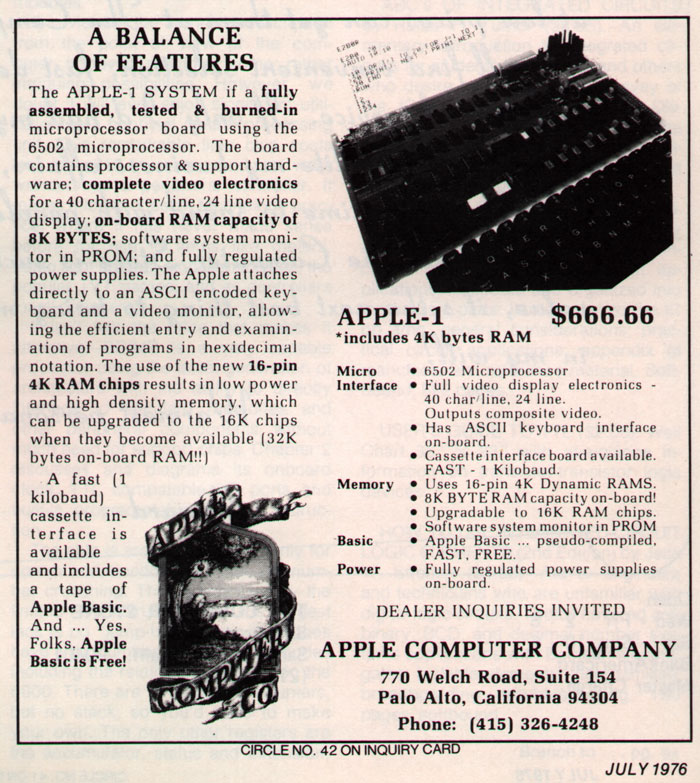

Apple Inc.
View on GrokipediaApple Inc. is an American multinational technology company that designs, manufactures, and markets consumer electronics, personal computers, software, and online services. Founded on April 1, 1976, by Steve Jobs, Steve Wozniak, and Ronald Wayne as Apple Computer Company in Cupertino, California, it was formally incorporated on January 3, 1977.[1][2] Headquartered at One Apple Park Way in Cupertino, the firm has a market capitalization of approximately $3.85 trillion as of January 2026, making it the third most valuable publicly traded company in the world behind Nvidia and Alphabet.[3][4] The company's breakthrough came with the Apple II, introduced in 1977 as the first successful preassembled personal computer, which propelled annual sales from $775,000 to $118 million by 1980 through its expandability, color graphics, and user-friendly design.[5] Subsequent innovations under returning co-founder Jobs in 1997 included the iMac, iPod, and iPhone, transforming Apple into a leader in consumer technology by integrating hardware, software, and services into a closed ecosystem that prioritizes seamless user experience, security, and premium aesthetics, though this closed ecosystem has drawn antitrust scrutiny for limiting competition in app distribution, payments, and fostering vendor lock-in.[6] Apple's services revenue, including the App Store and Apple Music, now constitutes a significant portion of its earnings, supporting high profit margins amid criticisms of supply chain labor practices in Asia.[7]
History
Founding and Incorporation (1976–1984)
Apple Computer Company was established as a partnership on April 1, 1976, by Steve Jobs, Steve Wozniak, and Ronald Wayne in Cupertino, California, with the aim of selling the Apple I personal computer, a single-board design created by Wozniak.[8][9] The Apple I, priced at $666.66, went on sale in July 1976 and was marketed primarily to hobbyists through outlets like the Byte Shop, which ordered 50 units after Jobs demonstrated a prototype.[10] Wayne, who contributed to the partnership agreement and initial logo design, held a 10% stake but departed just 12 days later on April 12, 1976, selling his interest back to Jobs and Wozniak for $800 due to concerns over personal financial liability in the nascent venture.[11][12] To scale production and operations, Jobs and Wozniak secured funding by selling personal assets—Jobs his Volkswagen microbus and Wozniak his HP-65 calculator—and attracted investor Mike Markkula, who provided $250,000 in seed capital and business expertise.[1] The company was formally incorporated as Apple Computer, Inc. on January 3, 1977, in Cupertino, without Wayne's involvement, enabling structured growth and limiting personal liability for the founders.[13] Following incorporation, Apple introduced the Apple II at the West Coast Computer Faire in April 1977, a fully assembled system with color graphics, expandable RAM starting at 4 KB, and a price of $1,298, which became the company's first major commercial success due to its user-friendly design and compatibility with software like VisiCalc spreadsheet in 1979.[6][14] By 1980, Apple's revenues had grown sufficiently to pursue an initial public offering (IPO) on December 12, 1980, issuing approximately 4.6 million shares at $22 each on the NASDAQ, raising over $100 million and valuing the company at around $1.8 billion, making it one of the largest IPOs since Ford Motor Company in 1956.[15][16] The IPO proceeds funded further expansion, including development of the Apple III in 1980, though it faced reliability issues and underperformed compared to the Apple II.[2] Through 1984, Apple solidified its position in the personal computing market, with the Apple II series driving sales exceeding 6 million units by the mid-1980s, setting the stage for innovations like the Macintosh introduced in January 1984.[17] The early years highlighted Wozniak's engineering prowess in hardware design and Jobs' focus on marketing and vision for accessible computing, though internal tensions arose over product direction and equity, contributing to Apple's volatile startup dynamics.[18] Despite challenges like supply chain constraints and competition from IBM, the period established Apple's reputation for innovative, integrated systems that prioritized usability over raw technical specifications.Macintosh Era and Initial Successes (1984–1990)
The Macintosh 128K personal computer was introduced by Apple on January 24, 1984, featuring a graphical user interface (GUI), mouse input, and integrated hardware-software design that made computing more accessible to non-technical users. Priced at $2,495, it included 128 KB of RAM, a 9-inch monochrome display, and a 400 KB floppy drive, drawing inspiration from Xerox PARC technologies but implemented affordably for consumer markets. The launch was preceded by the iconic "1984" Super Bowl advertisement directed by Ridley Scott, which aired during Super Bowl XVIII and positioned the Macintosh as a revolutionary tool against conformist computing paradigms.[19][20][21] Initial sales were strong, with Apple selling approximately 70,000 units in the first 100 days, exceeding modest internal expectations and validating the GUI's appeal for desktop publishing and creative applications. Innovations such as bitmap graphics, pull-down menus, and the ability to connect multiple units via LocalTalk networking differentiated the Macintosh from command-line dominant competitors like IBM PCs, influencing industry standards despite proprietary hardware limiting compatibility. However, hardware constraints—including non-expandable RAM, absence of a hard drive, and the Motorola 68000 processor's performance bottlenecks—hindered scalability for power users, leading to software limitations and user frustration after the novelty wore off.[22][23][24] Under CEO John Sculley, who had joined from PepsiCo in 1983 at Steve Jobs' invitation, Apple pursued aggressive marketing strategies like the "Test Drive a Macintosh" campaign to boost adoption, contributing to revenue growth from quarterly figures of $422 million in Q2 1984 to $1.4 billion by Q2 1990. Yet, escalating competition from lower-cost IBM-compatible PCs eroded market share, prompting price reductions and model updates such as the Macintosh 512K in September 1984 and the Macintosh Plus in January 1986, which added SCSI ports and expanded memory options. Internal tensions culminated in Jobs' departure in September 1985 following boardroom conflicts over management style and strategic direction, including his abrasive leadership and attempts to undermine Sculley, diluting his influence as ownership stakes had diminished through funding rounds.[25][26][27] By 1990, the Macintosh line had expanded to include the Macintosh SE and Macintosh II series in 1987, introducing color graphics and expandability, which sustained initial successes in niche markets like education and graphics but failed to achieve broad enterprise penetration due to higher costs and closed architecture. Apple's refusal to license the Macintosh operating system, a decision attributed to Sculley's strategy emphasizing hardware control, contrasted with Microsoft's open approach and contributed to competitive disadvantages against Windows-compatible systems. Despite these challenges, the era established Apple's reputation for user-centric design, with cumulative sales reflecting innovation's commercial viability amid growing pains.[28][29][30]Decline and Restructuring (1990–1997)
During the early 1990s, Apple experienced a sharp decline in market share as the personal computer industry shifted toward lower-cost IBM PC compatibles running Microsoft Windows, which offered greater software compatibility and hardware flexibility at reduced prices. By the mid-1990s, Apple's share of the global PC market had fallen below 5 percent, exacerbated by its proprietary hardware ecosystem that limited third-party development and cloning until a brief licensing program in 1995, which ultimately cannibalized sales without stemming the tide.[31][32] Under CEO John Sculley, who led until October 1993, and successor Michael Spindler from 1993 to 1996, the company grappled with stagnant innovation and internal disarray following Steve Jobs' 1985 departure, resulting in fragmented product lines like multiple Macintosh variants that confused consumers and strained resources. Financial pressures mounted, with revenues failing to keep pace with competitors; in fiscal 1996, Apple reported operating losses amid high production costs and inefficiencies. To address overstaffing, Apple implemented repeated layoffs: 400 employees in February 1990 (about 3 percent of staff), 1,500 in 1991 (10 percent), and 2,500 in July 1993 (16 percent worldwide), alongside restructuring charges such as $224 million in 1991.[33][34][35][36][37] In February 1996, the board appointed Gil Amelio, formerly of National Semiconductor, as CEO to enforce fiscal discipline and refocus operations, inheriting a company with cash reserves dwindling toward bankruptcy levels. Amelio streamlined the product portfolio, reduced SKUs from dozens to a core few, and pursued strategic acquisitions, including the $400 million purchase of NeXT Software in December 1996 to license its advanced operating system as the basis for a Mac OS successor (later Mac OS X). Despite these moves, which brought Steve Jobs back as an advisor, Apple posted a $1.04 billion net loss for fiscal 1997, with worldwide PC market share dipping to 3.1 percent by September 1997, prompting further drastic cuts of 4,100 jobs (over 30 percent of the workforce) announced in March 1997.[38][39][40][41][34][42][43] Gil Amelio's tenure ended abruptly on July 9, 1997, when the board ousted him amid ongoing losses and strategic missteps, paving the way for Steve Jobs to assume the role of interim CEO later that month and initiate a profound turnaround through aggressive cost-cutting, supplier renegotiations, and a pivot to consumer-focused innovation.[44]Return Under Jobs and iPod Dominance (1997–2006)
Apple acquired NeXT Software for approximately $400 million in cash and 1.5 million shares on December 20, 1996, with the deal finalized on February 7, 1997, bringing Steve Jobs back to the company as an advisor to CEO Gilbert Amelio.[41] Following Amelio's resignation amid ongoing losses, Jobs was appointed interim CEO on September 16, 1997.[45] In this role, Jobs implemented aggressive cost-cutting measures, including laying off about 40% of the workforce and reducing the product lineup from dozens of models to a focused matrix of four categories: consumer and professional desktops and portables.[46] These changes aimed to streamline operations and prioritize profitability, as Apple's fiscal 1997 revenue stood at $7.1 billion but with net losses exceeding $1 billion.[47] Jobs also forged a pivotal alliance with Microsoft in August 1997, securing a $150 million investment in non-voting Apple stock and a commitment to develop Office for Mac, while ending Apple's lawsuit against Microsoft over patent issues; this infusion provided crucial liquidity.[48] The "Think Different" advertising campaign launched in September 1997, featuring iconic figures to reposition Apple as an innovative brand.[49] On January 5, 2000, at Macworld Expo, Jobs dropped the "interim" title to become permanent CEO.[50] The iMac G3, unveiled on May 6, 1998, and released for sale on August 15, 1998, marked a design and marketing revival with its translucent Bondi Blue casing, integrated monitor, and simplified setup targeting internet users.[51] Apple sold 278,000 units in the first six weeks, and by the 1998 holiday season, it became the best-selling computer, contributing to a market share increase and first annual profit since 1995, though fiscal 1998 revenue dipped to $5.9 billion.[52][47] Subsequent iMac revisions and complementary products like the iBook portable in 1999 sustained momentum, with revenue rising to $8 billion in fiscal 2000.[47] The iPod digital music player launched on October 23, 2001, featuring a 5GB hard drive for 1,000 songs, scroll wheel interface, and FireWire connectivity, priced at $399.[53] Initially comprising 11% of Apple's revenue in 2002, iPod sales propelled growth, with fiscal 2002 revenue at $5.7 billion and accelerating to $13.9 billion by 2005 as variants like the Mini captured market share from 31% to 74% by 2005.[47][54] The iTunes Music Store opened on April 28, 2003, offering 200,000 tracks at 99 cents each, selling one million songs in the first week and integrating seamlessly with iPod to legitimize digital downloads amid piracy concerns.[55] By fiscal 2006, revenue reached $19.3 billion, driven by iPod dominance representing over 40% of sales, though Apple maintained its Mac focus with PowerPC to Intel processor transition announced in June 2005 for improved performance.[47][56]iPhone Launch and Mobile Expansion (2007–2011)
Apple announced the first-generation iPhone on January 9, 2007, during a keynote by CEO Steve Jobs at the Macworld Conference in San Francisco, positioning it as an integration of a mobile phone, widescreen iPod, and internet communicator with a multi-touch interface.[57] The device launched on June 29, 2007, exclusively through AT&T in the United States, featuring a 3.5-inch capacitive touchscreen, 2-megapixel camera, and EDGE data connectivity but lacking 3G support, GPS, or third-party application installation.[58] Apple sold approximately 1.4 million units of the original iPhone in 2007, with sales accelerating in the fourth quarter as production ramped up.[59] The iPhone 3G, announced on June 9, 2008, and released on July 11, 2008, in 22 countries, introduced 3G cellular networking, GPS, and a plastic casing for reduced cost, priced starting at $199 with a two-year contract.[60] Concurrently, Apple launched the App Store on July 10, 2008, offering over 500 native applications initially, which enabled developers to create and distribute software, fundamentally expanding the device's functionality and ecosystem.[61] This model sold 11.3 million units through early 2009, contributing to Apple's shift toward mobile as its primary growth driver. The iPhone 3GS, released on June 19, 2009, added video recording, a 3-megapixel camera with autofocus, and faster processing, with cumulative sales reaching over 20 million units by mid-2009.[62] In 2010, the iPhone 4, announced June 7 and released June 24, featured a Retina display with 326 pixels per inch, stainless steel band antenna, glass front and back, and front-facing camera for FaceTime, alongside the iOS 4 update supporting multitasking.[63] However, users reported signal attenuation—termed "Antennagate"—when gripping the lower left side, causing dropped calls; Apple attributed this to a software-display flaw in signal bars present since the original model and offered free bumper cases as a remedy while updating software to adjust bar thresholds.[64] The iPhone 4 sold nearly 94.8 million units cumulatively by 2011.[65] The iPhone 4S, announced October 4, 2011, following Jobs' death, introduced the Siri voice assistant, 8-megapixel camera, and dual-core processor, launching October 14 and selling 4 million units in its first weekend.[66] iPhone sales propelled Apple's revenue from $24.6 billion in fiscal 2007 to $108.2 billion in fiscal 2011, with mobile devices comprising over 50% of revenue by 2011 as the company expanded carrier partnerships globally and cultivated the App Store, which grew to millions of apps and billions in developer payouts.[67][68] This period marked Apple's transition from computer-centric to mobile-dominant, with iPhone unit sales exceeding 93 million in fiscal 2011 alone.[69]Post-Jobs Growth and Diversification (2011–2019)
Following the death of Steve Jobs on October 5, 2011, Tim Cook, who had served as chief operating officer, assumed the role of permanent CEO on August 24, 2011, steering Apple toward sustained expansion built on operational efficiencies and incremental product enhancements rather than radical reinvention.[70] Under Cook's leadership, Apple's fiscal year revenue grew from $108.249 billion in 2011 to $260.174 billion in 2019, driven primarily by iPhone sales which accounted for over 50% of revenue by the mid-decade, reflecting the device's entrenched market position amid smartphone commoditization.[71] Net income rose from $25.922 billion in 2011 to a peak of $59.531 billion in 2018 before dipping to $55.256 billion in 2019, underscoring profitability from scale and margins bolstered by Cook's supply chain optimizations, which reduced inventory cycles and vendor dependencies.[72] The company's market capitalization surpassed $1 trillion for the first time on August 2, 2018, elevating it to the world's most valuable publicly traded firm by year-end, a milestone attributed to investor confidence in recurring hardware upgrades and ecosystem lock-in rather than diversified revenue streams at that juncture.[73] Apple's hardware portfolio expanded modestly during this period, with iPhone iterations emphasizing larger screens, improved cameras, and processor upgrades to sustain upgrade cycles: the iPhone 4S launched in October 2011 with Siri voice assistant integration; the iPhone 5 in September 2012 introduced 4G LTE; the iPhone 6 and 6 Plus in September 2014 featured screen sizes up to 5.5 inches, spurring a sales surge to over 231 million units annually by fiscal 2015; subsequent models like the iPhone X in November 2017 added facial recognition via Face ID.[74] iPad variants proliferated, including the iPad mini in November 2012 and iPad Pro in September 2015 for productivity, though tablet sales plateaued after peaking at 26 million units quarterly in 2013 due to market saturation and competition from larger smartphones.[74] The Mac line saw refreshes like the Retina MacBook Pro in 2012 and thinner MacBook in 2015, maintaining steady sales around 18-20 million units yearly, while diversification into wearables began with the Apple Watch debut in April 2015, achieving 10 million units sold in its first year through health tracking features like heart rate monitoring.[74] AirPods wireless earbuds followed in December 2016, contributing to a wearables category that generated $6 billion in revenue by fiscal 2017.[74] Efforts to diversify beyond hardware accelerated mid-decade as iPhone growth slowed, with services revenue climbing from approximately $5 billion in 2011 to $46.3 billion in 2019, representing a shift toward higher-margin, recurring income streams comprising about 18% of total revenue by fiscal year's end.[75] Key introductions included iCloud storage expansion in 2011, Apple Pay mobile payments in October 2014 enabling contactless transactions, and Apple Music streaming service in June 2015, which amassed 28 million subscribers by 2016 through exclusive content deals.[74] The App Store ecosystem, bolstered by in-app purchases and subscriptions, processed over $100 billion in developer payouts cumulatively by 2016, fostering platform stickiness but drawing antitrust scrutiny for its 30% commission structure.[76] Infrastructure investments, such as the April 2017 opening of Apple Park headquarters in Cupertino, California, symbolized operational scale, housing 12,000 employees in a 2.8 million-square-foot facility designed for energy efficiency.[70]| Fiscal Year | Revenue (billions USD) | Net Income (billions USD) |
|---|---|---|
| 2011 | 108.2 | 25.9 |
| 2012 | 156.5 | 41.7 |
| 2013 | 170.9 | 37.0 |
| 2014 | 182.8 | 39.5 |
| 2015 | 233.7 | 53.4 |
| 2016 | 215.6 | 45.7 |
| 2017 | 229.2 | 48.4 |
| 2018 | 265.6 | 59.5 |
| 2019 | 260.2 | 55.3 |
Transition to Arm Chips, AI Integration, and External Pressures (2020–present)
In June 2020, Apple announced its transition from Intel x86 processors to its custom Arm-based Apple Silicon chips for Mac computers, citing greater performance, power efficiency, and integration with its ecosystem as key motivations.[77] The company planned to complete the shift within two years, beginning with the first Apple Silicon Mac by the end of 2020.[77] On November 10, 2020, Apple unveiled the M1 chip, featuring an 8-core CPU, up to 8-core GPU, and 16-core Neural Engine, which debuted in the MacBook Air, 13-inch MacBook Pro, and Mac mini on November 17.[78] Subsequent releases included the professional-oriented M1 Pro and M1 Max in October 2021 for higher-end Macs. By mid-2022, Apple had fully transitioned its Mac lineup to Apple Silicon, discontinuing Intel-based models and reporting up to 3.5 times faster performance in benchmarks compared to prior Intel equivalents, alongside improved battery life and reduced manufacturing costs through vertical integration.[79] Apple's integration of artificial intelligence accelerated in 2024 with the introduction of Apple Intelligence, a suite of on-device and cloud-based AI features emphasizing privacy through Private Cloud Compute servers.[80] Announced at WWDC in June 2024, initial features rolled out on October 28, 2024, via iOS 18.1, iPadOS 18.1, and macOS Sequoia 15.1, including enhanced Siri with natural language understanding, Writing Tools for text summarization and proofreading, and image generation via Image Playground.[81] Further expansions in December 2024 added Genmoji creation and ChatGPT integration for complex queries, requiring user opt-in and limited to compatible devices like iPhone 15 Pro and later models with A17 Pro or newer chips.[82] In January 2026, Apple acquired Q.ai, an Israeli startup specializing in audio AI technology for enhancing speech recognition and audio processing, valued at approximately $1.5–2 billion, to further its AI integration efforts.[83] These capabilities leverage the Neural Engine in Apple Silicon for efficient on-device processing, though rollout delays from initial beta stages highlighted challenges in scaling generative AI without compromising security.[84] From 2020 onward, Apple faced intensifying external pressures, including geopolitical tensions and regulatory scrutiny. US-China trade frictions, exacerbated by tariffs and export controls, prompted Apple to diversify its supply chain beyond China, where over 90% of iPhone assembly occurs; production shifted partially to India and Vietnam, with iPhone exports from India rising to 14% of global volume by 2023, though higher costs and logistical hurdles increased prices.[85][86] Antitrust actions mounted, with the EU's Digital Markets Act designating Apple a gatekeeper in 2023, leading to mandates for sideloading and alternative app stores in the EU by 2024, a €500 million fine in April 2025 for App Store violations, and ongoing complaints over developer restrictions as of October 2025.[87][88] In the US, the United States Department of Justice filed a lawsuit in 2024 alleging monopolistic App Store practices, echoing Epic Games' 2020 challenge that forced concessions like external payment links.[89] Despite these headwinds, Apple's revenue grew from $274.5 billion in fiscal 2020 to $391.0 billion in 2024, with services revenue surging 14% year-over-year in Q3 2025 to $24.9 billion, buoyed by iPhone sales comprising 51% of total revenue; its stock reached an all-time high closing price of $262.96 on October 24, 2025.[71][56][90] Apple's 2020 pivot to custom Apple Silicon marked a decade-long decoupling from Intel dependency, announced June 22, 2020, citing superior integration and efficiency. The M1 chip debuted November 10, 2020, in MacBook Air, 13-inch MacBook Pro, and Mac mini, featuring an 8-core CPU, 7-8 core GPU, and 16-core Neural Engine on 5nm process, delivering up to 3.5x CPU and 6x GPU performance over Intel equivalents at similar power envelopes. Full transition completed by June 2023 with the Mac Pro M2 Ultra; M-series chips (M1 to M4 by 2024) enabled fanless designs, extended battery life exceeding 18 hours, and Rosetta 2 for x86 emulation with minimal overhead. Mac shipments reached 22.1 million in fiscal 2021 post-M1 launch, sustaining 8-10% global share through 2025, with Q1 2025 at 8.7%.[77][79][91] Current lineup includes MacBook Air (M2/M3, starting at 13-inch Retina display, 8-core CPU/GPU), MacBook Pro (14/16-inch with M3 Pro/Max/Ultra variants up to 40-core GPU), iMac (24-inch M3/M4), Mac mini (M4), Mac Studio (M2 Max/Ultra), and Mac Pro (M2 Ultra with up to 76-core GPU). Emphasis on AI acceleration via Neural Engine supports on-device machine learning, with M4 introducing hardware ray tracing. Despite premium pricing—MacBook Air at $999 base—revenue hit $7.95 billion in Q2 fiscal 2025, up 6.7% year-over-year, reflecting sustained demand among creative professionals and developers prioritizing ecosystem cohesion over raw commoditized performance.[92][56][93]Products and Services
Computers (Mac Line)
The Mac (formerly Macintosh) line consists of Apple's desktop and laptop computers, unified under the macOS operating system, emphasizing integrated hardware-software design and user-friendly interfaces. Launched with the Macintosh 128K on January 24, 1984, it pioneered mass-market adoption of a graphical user interface (GUI), bitmap display, and mouse, powered by a Motorola 68000 processor at 7.833 MHz with 128 KB RAM. Priced at $2,495, initial sales reached 70,000 units within 100 days, though high costs and limited expandability constrained early market penetration to under 10% of personal computer shipments by 1985.[94][95] Subsequent compact Macs, such as the Macintosh Plus (January 1986) with SCSI ports and 4 MB RAM support, and the Macintosh SE (March 1987) offering an expansion slot, addressed expandability while maintaining all-in-one designs. The Macintosh II series (March 1987) introduced color graphics and modular expansion via NuBus slots, targeting professional users with up to 8 MB RAM and 256 colors at 640x480 resolution. Laptop entry came with the Macintosh Portable (September 1989), a 16-pound battery-powered model with an active-matrix LCD, though sales lagged due to high pricing at $7,300. By 1990, Apple's Mac market share hovered around 10-12% in the U.S., bolstered by desktop publishing dominance via LaserWriter printers and PageMaker software.[95][96] The 1990s shift to PowerPC processors began in March 1994 with the Power Macintosh 6100, 7100, and 8100, delivering 2-3 times the performance of 680x0-based systems through IBM-Motorola chips at 60-80 MHz, with PCI expansion replacing NuBus in later models. PowerBook laptops, starting with the 100/140/170 series (October 1991) using 68030 processors, evolved to PowerPC in 1994, introducing trackpads and hot-swappable batteries. Despite innovations, Mac shipments declined to 2.95 million units in fiscal 1997 amid competition from Wintel PCs, representing under 5% global share. The 1998 iMac G3 revived the line with translucent Bondi Blue design, USB ports, and a 233 MHz PowerPC G3, selling 800,000 units in five months at $1,299 and restoring double-digit U.S. market share by 1999.[97][96][56] Transition to Intel x86 architecture accelerated performance; announced at WWDC 2005, the first Intel-based iMac G5 successor shipped January 2006 with Core Duo at 1.66-2.16 GHz, enabling Boot Camp for Windows and boosting application compatibility. MacBook (May 2006) replaced iBook with Intel Core Duo, while MacBook Pro (January 2006) targeted professionals with up to 2.16 GHz Core Duo and FireWire 800. By 2008, unibody aluminum designs emerged in MacBook and Mac Pro, enhancing durability and thermals. Shipments grew to 13.6 million units in fiscal 2010, capturing 7-9% global PC share, driven by OS X Snow Leopard optimizations.[98][99]Chronological List of All Mac Models
- 1984: [Macintosh 128K](/page/Macintosh_128K)
- 1984: [Macintosh 512K](/page/Macintosh_512K)
- 1986: [Macintosh Plus](/page/Macintosh_Plus)
- 1986: [Macintosh 512ke](/page/Macintosh_512ke)
- 1987: [Macintosh SE](/page/Macintosh_SE)
- 1987: [Macintosh II](/page/Macintosh_II)
- 1987: [Macintosh SE/30](/page/Macintosh_SE/30)
- 1988: [Macintosh IIx](/page/Macintosh_IIx)
- 1988: [Macintosh IIcx](/page/Macintosh_IIcx)
- 1989: [Macintosh Portable](/page/Macintosh_Portable)
- 1989: [Macintosh IIci](/page/Macintosh_IIci)
- 1990: [Macintosh LC](/page/Macintosh_LC)
- 1990: [Macintosh IIfx](/page/Macintosh_IIfx)
- 1990: [Macintosh Classic](/page/Macintosh_Classic)
- 1991: [PowerBook 100](/page/PowerBook_100)
- 1991: [PowerBook 140](/page/PowerBook_140)
- 1991: [PowerBook 170](/page/PowerBook_170)
- 1991: [Macintosh Classic II](/page/Macintosh_Classic_II)
- 1992: [Macintosh IIvi](/page/Macintosh_IIvi)
- 1992: [Macintosh IIvx](/page/Macintosh_IIvx)
- 1993: [Macintosh Centris](/page/Macintosh_Centris)
- 1993: [Macintosh Quadra](/page/Macintosh_Quadra)
- 1994: [Power Macintosh](/page/Power_Macintosh)
- 1994: [PowerBook 500 series](/page/PowerBook_500_series)
- 1998: [iMac G3](/page/iMac_G3)
- 2001: [iMac G4](/page/IMac_G4)
- 2002: [iMac G5](/page/IMac_G5)
- 2006: [MacBook](/page/MacBook)
- 2006: [MacBook Pro](/page/MacBook_Pro)
- 2006: [Mac Pro](/page/Mac_Pro)
- 2008: [MacBook Air](/page/MacBook_Air)
- 2020: [Mac M1](/page/Apple_M1) models
- 2023: [Mac Studio](/page/Mac_Studio)
- 2024: [Mac with M4](/page/Apple_M4)
Wearables and Accessories
Apple's wearables and accessories segment includes the Apple Watch smartwatch, AirPods wireless earbuds, HomePod smart speakers, and Beats headphones, contributing substantially to the company's revenue. This category generated over $41 billion in fiscal year 2023, surpassing the Mac computer segment's revenue by 2020.[107][108]
The Apple Watch debuted in April 2015, following its announcement in September 2014, marking Apple's initial foray into wearable technology with features such as fitness tracking, heart rate monitoring, and iPhone integration.[109] By the second quarter of 2025, cumulative revenue from Apple Watch sales exceeded $100 billion, driven by iterative improvements in health sensors and processor performance.[110] The Series 11, announced on September 9, 2025, introduced hypertension notifications, sleep scores powered by Apple Intelligence, and up to 24 hours of battery life.[111]
AirPods, introduced on September 7, 2016, alongside the iPhone 7, popularized truly wireless earbuds through seamless Apple ecosystem pairing and audio quality enhancements.[112] They generated $18 billion in revenue in 2023, positioning them as Apple's third-largest hardware product after the iPhone and Mac.[112] The AirPods Pro 3, released on September 19, 2025, added advanced noise cancellation and health-oriented features like hearing aid functionality.[113]
Additional products in the segment include HomePod speakers, launched in 2018 for Siri-enabled home audio, and Beats electronics, acquired by Apple in 2014 and now sold through Apple channels for premium headphones and earbuds.[114] Combined, Apple Watch and AirPods alone form a roughly $30 billion annual business as of recent estimates.[115] This diversification has solidified the segment's role in Apple's portfolio, emphasizing integrated health, audio, and smart home capabilities over standalone accessories.[116]
Software Platforms and Services
Apple's software platforms encompass a family of interconnected operating systems designed for its hardware devices, emphasizing user privacy, security, and cross-device continuity. macOS powers Macintosh computers, providing a Unix-based foundation with features like Spotlight search and Gatekeeper for app verification. iOS and its derivative iPadOS operate iPhones and iPads, respectively, supporting multitasking, augmented reality via ARKit, and on-device machine learning through Core ML. watchOS drives Apple Watch functionality, including health monitoring and complication-based interfaces, while tvOS enables streaming and gaming on Apple TV hardware. These platforms utilize common frameworks such as Metal for graphics acceleration and SwiftUI for declarative user interfaces, fostering developer efficiency across ecosystems. In September 2025, updates to iOS 26, iPadOS 26, macOS Tahoe 26, watchOS 26, and tvOS 26 introduced the Liquid Glass design language for enhanced visual fluidity and consistency.[117][118] The App Store, launched on July 10, 2008, serves as the primary marketplace for apps on iOS, iPadOS, macOS (via Mac App Store since January 6, 2011), watchOS, and tvOS, enforcing guidelines for quality and security while taking a 15-30% commission on transactions. In 2024, the App Store ecosystem facilitated $1.3 trillion in global developer billings and sales, with $131 billion originating from iOS app purchases and in-app spending.[61][119][120] Apple's services extend beyond distribution to include iCloud for data syncing and storage, Apple Music for audio streaming, Apple TV+ for original video content, Apple Pay for digital transactions, and Apple Arcade for subscription gaming. iCloud, emphasizing end-to-end encryption for select data, generated an estimated $10.4 billion in 2024 revenue. Apple Music, with over 100 million tracks and spatial audio support, contributed about $8.9 billion that year. Apple TV+, debuting in November 2019, focuses on premium scripted series and has earned critical acclaim for titles like Ted Lasso. These services leverage device integration for features like Family Sharing and Handoff, driving user retention through subscription models.[121][76] In fiscal year 2024, Apple's services segment achieved $96.17 billion in revenue, up 12.87% from the prior year and comprising roughly 25% of total company revenue of $391.04 billion, with growth fueled by paid subscriptions exceeding 1.1 billion across offerings. iCloud storage subscriptions lead the category in adoption, underscoring the value of seamless data access in Apple's closed ecosystem. Quarterly services revenue hit records, such as $26.3 billion in the period ending December 2024, though overall expansion has moderated amid market saturation.[122][91][56][123][124]Technology and Innovation
Hardware Engineering Milestones
Apple's hardware engineering efforts originated with the Apple I in 1976, a single-board computer kit designed by Steve Wozniak featuring a 1 MHz MOS Technology 6502 microprocessor, 4 KB of user-expandable RAM, and video output capabilities via a standard television.[125] The device lacked a built-in keyboard or case, requiring assembly by purchasers, and represented an early milestone in accessible personal computing hardware.[109] The Apple II, introduced in June 1977, advanced hardware design with a 1 MHz MOS Technology 6502 processor, up to 48 KB RAM, integrated color graphics supporting 6 colors at 280x192 resolution, and seven expansion slots for peripherals, enabling customization such as floppy disk controllers and printers.[2] This modular architecture contributed to its commercial success, with over 5 million units sold by the mid-1990s, establishing benchmarks for personal computer expandability and visual output.[97] In January 1984, the Macintosh 128K pioneered integrated graphical computing hardware, incorporating a 7.8336 MHz Motorola 68000 processor, 128 KB RAM, 64 KB ROM, a 400 KB 3.5-inch floppy drive, and a 9-inch monochrome CRT display with 512x342 resolution alongside a mouse for direct manipulation input.[126] [127] The all-in-one chassis eliminated the need for separate components, reducing assembly complexity and cost while embedding custom video hardware for bitmapped graphics, which facilitated the graphical user interface.[23] The Power Macintosh series, launched in March 1994, marked Apple's adoption of PowerPC RISC processors co-developed with IBM and Motorola, starting with models like the 6100 featuring a 60 MHz 601 CPU, 8 MB RAM, and integrated video capabilities, delivering superior integer performance over prior 680x0 architectures.[128] This transition to reduced instruction set computing enhanced efficiency in multimedia tasks, with later iterations incorporating faster clock speeds and PCI expansion buses.[97] The iMac G3, unveiled in August 1998, integrated a 233 MHz PowerPC 750 (G3) processor, 32 MB RAM, a 4 GB hard drive, and a 15-inch CRT display into a translucent Bondi Blue polycarbonate enclosure, eliminating floppy drives in favor of USB ports and CD-ROM for modern connectivity.[129] [130] Its hockey-puck mouse and slot-loading optical drive prioritized aesthetics and ease of use, selling over 800,000 units in the first five months and reviving Apple's market position through simplified hardware integration.[2] Subsequent milestones included the October 2001 iPod, which engineered a 5 GB 1.8-inch hard drive, mechanical scroll wheel for navigation, and FireWire interface into a compact aluminum case, achieving 10 hours of battery life for portable digital audio.[131] The iPhone, announced January 2007, introduced capacitive multi-touch hardware with a 3.5-inch 320x480 pixel display, 412 MHz ARM11 processor, integrated accelerometer, and proximity sensor, redefining smartphone engineering by merging phone, iPod, and internet device functionalities without a physical keyboard.[132] In November 2020, Apple initiated its transition to custom silicon with the M1 chip, a 5-nanometer ARM-based system-on-chip integrating an 8-core CPU, 8-core GPU, 16-core Neural Engine, and unified memory architecture with 16 billion transistors, powering initial MacBook Air and Mac mini models with up to 3.5x faster CPU performance compared to Intel equivalents.[79] [77] This in-house design eliminated licensing dependencies, optimized power efficiency—yielding up to 20 hours of battery life—and enabled hardware-accelerated machine learning, completing the shift from Intel by 2022.[133]Software and Ecosystem Development
Apple's software development originated with the System Software 1.0 for the Macintosh, released on January 24, 1984, which introduced a graphical user interface emphasizing intuitive mouse-driven interactions over command-line inputs.[134] This evolved into subsequent versions, including System 7 in May 1991, which added virtual memory, QuickTime for multimedia, and improved networking, though it suffered from stability issues due to its non-preemptive multitasking architecture.[134] The acquisition of NeXT Software in December 1996 for $429 million brought Steve Jobs back to Apple and provided the foundation for a modern Unix-based operating system; NeXTSTEP's object-oriented design influenced the development of Mac OS X, with its first public beta (Kodiak) released in September 2000 and version 10.0 Cheetah launching in March 2001, incorporating the open-source Darwin kernel for enhanced security and POSIX compliance.[135] Subsequent macOS iterations, renamed from OS X in 2016 to align with iOS naming conventions, have emphasized stability, with features like Spotlight search in Tiger (10.4, 2005) and Time Machine backups in Leopard (10.5, 2007).[136] For mobile devices, iOS emerged as a derivative of macOS, initially branded iPhone OS 1.0 and released on June 29, 2007, with the first iPhone; it shared the XNU kernel and Cocoa frameworks but was optimized for touch interfaces and power efficiency on ARM processors.[134] iOS 4 in June 2010 introduced multitasking and unified the naming, while later versions added iPadOS as a fork in 2019 for tablet-specific multitasking like Split View; Apple's enterprise market presence expanded through the 2014 global partnership with IBM to develop industry-specific iOS apps combining IBM's analytics and cloud services with Apple's devices, enabling faster innovation and improved enterprise solutions.[136][137] Apple's ecosystem cohesion relies on cross-platform APIs enabling features such as Handoff (introduced in OS X Yosemite and iOS 8, October 2014), which allows seamless task continuation across devices, and Continuity, including Universal Clipboard for copy-paste synchronization via iCloud.[138] iCloud, launched on October 12, 2011, as MobileMe's successor, provides encrypted cloud syncing for photos, documents, and backups, with end-to-end encryption for data like iMessages since iOS 7 in 2013, prioritizing user privacy over third-party access.[139] The App Store, debuted on July 10, 2008, revolutionized software distribution by creating a curated marketplace for iOS apps, enforcing sandboxing for security and generating $1.3 trillion in global developer billings and sales by 2024 through a 30% commission on initial purchases (reduced to 15% for small developers under $1 million annual revenue).[138] This closed ecosystem fosters lock-in through services like Apple Music (launched June 30, 2015, succeeding iTunes Store from April 2003) and Apple TV+ (November 1, 2019), which integrate deeply with hardware via APIs for Siri voice control and HomeKit smart home protocols, alongside revenue diversification from partnerships such as the long-standing agreement with Google to make it the default search engine on Apple devices, generating approximately $20 billion annually.[140][141] Developer tools advanced with Swift, announced June 2, 2014, as a safer alternative to Objective-C, reducing code by up to 40% while compiling to native performance, and ARKit in iOS 11 (September 2017), enabling motion tracking and light estimation for augmented reality apps using device cameras and sensors, with privacy safeguards requiring explicit user consent for camera access.[142] App Tracking Transparency, mandated in iOS 14.5 (April 2021), requires opt-in for cross-app tracking, limiting ad personalization but enhancing user control amid regulatory pressures.[139] In recent years, Apple has integrated artificial intelligence via Apple Intelligence, unveiled June 10, 2024, and initially rolled out in iOS 18.1, iPadOS 18.1, and macOS Sequoia 15.1 on October 28, 2024, emphasizing on-device processing with Private Cloud Compute for complex tasks to minimize data transmission to servers.[81] Features include Writing Tools for text summarization and proofreading, image generation via Image Playground, and enhanced Siri with ChatGPT integration (opt-in) through the partnership with OpenAI announced in June 2024, enabling advanced responses, writing assistance, and image generation while maintaining privacy safeguards like private cloud processing; this collaboration accelerates Apple's generative AI deployment and leverages OpenAI's expertise, alongside potential integrations with Google's Gemini models for further AI enhancements and benefits from Google's distribution.[143][144] Available on devices with A17 Pro or M1 chips and above; further expansions in 2025 via iOS 18.3 and 18.4 added notification prioritization and visual intelligence, though rollout delays highlighted integration challenges with legacy codebases.[145] This approach contrasts with cloud-heavy competitors by leveraging Apple silicon's Neural Engine for efficient, private inference, though critics note potential limitations in model scale compared to open alternatives.[143]Research, Development, and Patents
Apple invests heavily in research and development, with expenditures reaching $31.4 billion in fiscal year 2024, up from $29.9 billion in fiscal 2023, reflecting a strategic emphasis on advancing hardware, software, and services amid competitive pressures in semiconductors and artificial intelligence.[146][147] This increase aligns with broader commitments, including a planned $500 billion investment in the United States over four years announced in February 2025, which prioritizes R&D, silicon engineering, and AI infrastructure, alongside hiring approximately 20,000 employees primarily in these areas.[148][148] The company's R&D is organized around specialized functional teams that integrate expertise across disciplines, including silicon design, camera software, reliability engineering, motion sensors, and video processing, enabling tightly coupled hardware-software innovations such as custom Arm-based chips and on-device AI processing.[149][150] Primary facilities include the Apple Park campus in Cupertino, California, serving as the central hub for core engineering, supplemented by dedicated sites like a new research center in Austin, Texas, focused on advanced technologies, and a 20,000-square-meter laboratory in Shenzhen, China, established in 2024 as Apple's largest overseas R&D operation to support regional innovation and supply chain integration.[148][151] Additional centers in locations such as Pittsburgh and Bengaluru further distribute efforts in areas like AI server manufacturing and developer tools.[152][153] Apple maintains a substantial patent portfolio, holding 34,908 patents globally as of 2025, with 27,995 granted and over 78% active, emphasizing domains like software services, telecommunications, and user interfaces.[154] In 2024, it secured 3,115 U.S. patents, ranking sixth among global companies and leading in consumer electronics with significant influence in areas such as health sensors (e.g., ECG and blood oxygen monitoring in wearables) and spatial computing.[155][156][157] These patents underpin innovations like custom neural engines for AI tasks and advanced display modules, though their value stems from practical implementation in products rather than isolated inventions, often building on acquired technologies integrated through in-house refinement.[158][159][160]Business Operations
Marketing and Branding Strategies
Apple's marketing and branding strategies emphasize simplicity, emotional resonance, and a narrative of innovation and rebellion against conformity, positioning its products as premium tools for creative individuals rather than mere commodities. This approach, rooted in first-mover advantages from integrated hardware-software ecosystems, avoids technical specifications in favor of user experience storytelling, fostering brand loyalty through aspirational messaging.[161][162] A landmark example is the "1984" advertisement, directed by Ridley Scott and aired only once during Super Bowl XVIII on January 22, 1984, to introduce the Macintosh computer. Depicting a dystopian Orwellian world shattered by a female athlete symbolizing liberation from IBM's dominance, the $900,000 production cost the ad elevated Super Bowl commercials to cultural events and generated massive pre-order buzz, with Macintosh sales exceeding initial projections despite limited initial availability.[163][164] Upon Steve Jobs' return in 1997, the "Think Different" campaign, developed by TBWA\Chiat\Day, launched on September 28, 1997, featuring black-and-white portraits of icons like Albert Einstein and Mahatma Gandhi with the slogan celebrating "the crazy ones" who change the world. Part of a $90 million annual advertising budget, it revitalized Apple's image amid near-bankruptcy, correlating with a stock price rebound from $0.43 to over $1 per share by 1998 and reinforcing the brand's association with nonconformity and genius.[165][166] Product launch events, epitomized by Jobs' keynotes, build hype through secrecy and theatrical reveals, such as the iPhone unveiling at Macworld on January 9, 2007, framed as "three revolutionary products" converging into one device, which drove immediate cultural impact and over 1 million units sold in the first five months despite supply constraints.[167][168] Under Tim Cook, these evolve into September media events emphasizing ecosystem integration, sustaining buzz without heavy reliance on traditional ads.[169] Apple maintains global brand consistency via minimalist design and experiential retail stores, opened since 2001, which serve as branding hubs generating foot traffic equivalent to theme parks and contributing to 20-25% of U.S. sales through hands-on demonstrations. Advertising efficiency stems from word-of-mouth and viral events over mass spend, with annual budgets around $2 billion yielding high ROI via premium pricing that supports 40%+ gross margins.[170][171] This strategy's causal effectiveness lies in aligning marketing with tangible product superiority in usability, evidenced by customer retention rates exceeding 90% in core markets.[172]Retail and Global Distribution
Apple launched its proprietary retail strategy in May 2001, opening the first two company-owned stores on May 19 in Glendale, California, and Tysons Corner, Virginia, under the direction of then-CEO Steve Jobs to provide controlled customer experiences and product demonstrations distinct from third-party resellers.[173] [174] This move followed failed attempts at store-within-a-store concepts and aimed to counter inconsistent retail presentations of Apple hardware amid the company's near-bankruptcy in the late 1990s. By emphasizing minimalist design, hands-on interaction, and services like the Genius Bar, these stores prioritized brand immersion over high-pressure sales tactics common in electronics retail.[175] The retail network expanded rapidly within the United States, reaching 50 stores by 2002, before venturing internationally with the first non-U.S. location in Tokyo, Japan, in 2003.[176] Growth accelerated in key markets, including China, which hosted 50 stores by 2021, reflecting Apple's focus on high-population regions with rising consumer demand for premium devices.[177] As of 2024, Apple operated over 500 retail stores across more than 25 countries and regions, with ongoing expansions such as new stores in India in 2025 and planned flagship locations in Saudi Arabia starting in 2026, preceded by an online store launch in summer 2025.[178] [179] [180] These outlets generate significant foot traffic and sales productivity, often cited for leading per-square-foot revenue in the industry due to integrated services and ecosystem demonstrations.[174] Complementing physical retail, Apple's global distribution leverages direct online sales via apple.com, launched in 1997 and expanded worldwide, alongside indirect channels including partnerships with wireless carriers and authorized resellers. In the United States, carriers such as Verizon, AT&T, and T-Mobile dominate iPhone distribution, accounting for the majority of unit sales despite Apple's gradual increase in direct-to-consumer share through its stores and website.[181] Internationally, similar carrier agreements facilitate subsidized device sales tied to service contracts, while resellers like Best Buy and Walmart handle broader product lines in regions without Apple Stores.[182] [183] This hybrid model enables rapid market penetration—such as in emerging economies—while maintaining quality control through authorized partner training and Apple's oversight of pricing and inventory. Online channels further support global reach, with eSIM-compatible carrier integrations expanding access in over 100 countries as of 2025.[184]Supply Chain Management
Apple's supply chain management emphasizes efficiency, vertical integration where feasible, and close collaboration with specialized suppliers, a strategy largely shaped by CEO Tim Cook during his tenure as operations chief starting in 1998. Tim Cook implemented just-in-time inventory practices that reduced Apple's inventory from months to days, enabling rapid response to demand fluctuations and minimizing holding costs; by 2001, this approach had slashed excess stock and contributed to operational turnaround amid financial struggles.[185][186] The model relies on a network of over 200 primary suppliers globally, with assembly concentrated in Asia, particularly China, where Taiwanese firms like Foxconn (Hon Hai Precision Industry) handle approximately 70% of iPhone production as of 2023.[187] Key component suppliers include Taiwan Semiconductor Manufacturing Company (TSMC) for advanced processors, which fabricates Apple's custom A-series and M-series chips, and display providers like Samsung and LG, though Apple has increased in-house production of components such as modems to reduce dependence. Foxconn and Pegatron, which together account for the bulk of final assembly, derive significant revenue from Apple—Foxconn's Apple-related sales exceed 50% of its total in recent years—creating mutual interdependence that incentivizes capacity alignment but exposes Apple to supplier-specific disruptions.[188][189] Manufacturing occurs predominantly in Chinese facilities, with over 90% of iPhones assembled there as of 2024, supplemented by emerging hubs in India and Vietnam for diversification.[190][191] Geopolitical tensions and U.S. tariffs, intensified by policies in 2025, have accelerated supply chain reconfiguration, with Apple shifting 15-20% of production to India and Vietnam by targeting 2026 milestones; in India alone, supplier expansion to 45 firms created 350,000 jobs and positioned the country as an export hub for iPhones.[192][193] This "China plus one" strategy mitigates risks from U.S.-China trade frictions, though China retains dominance in critical minerals and assembly scale, with factories from suppliers like 3M proliferating there from 5 in 2013 to 13 in 2023.[194] Despite efficiency gains, vulnerabilities persist, including COVID-19 disruptions that halted production in 2020-2022 and ongoing dependence on single-country sourcing for rare earths.[86] Labor and environmental challenges have drawn scrutiny, with reports documenting insufficient due diligence at supplier sites leading to worker rights violations, including excessive overtime and unsafe conditions at Foxconn facilities in prior years, though Apple mandates audits and supplier codes prohibiting forced labor.[195] Apple's manufacturing supply chain constituted 54% of its gross carbon footprint in 2024, prompting commitments to net-zero emissions by 2030 via supplier renewable energy transitions—over 320 suppliers pledged 100% renewables for Apple production, avoiding 21.8 million metric tons of emissions that year.[196][197] Independent analyses question the pace of these reforms, attributing delays to cost pressures in low-wage assembly regions, yet empirical data from Apple's verified audits show progressive improvements in compliance rates.[198][199]Corporate Governance
Leadership and Executive Team
Tim Cook has served as Chief Executive Officer of Apple Inc. since August 24, 2011, succeeding co-founder Steve Jobs following Jobs's resignation due to health issues.[200] Cook, previously Apple's COO since 2005, optimized the company's supply chain and operations, contributing to its expansion into consumer electronics dominance.[200] Under his leadership, Apple achieved a market capitalization exceeding $3 trillion by 2023 and emphasized services revenue growth alongside hardware innovation. Apple's executive structure features a compact team of senior vice presidents reporting directly to Cook, overseeing hardware, software, operations, finance, legal, and other core functions.[201] This lean approach, inherited from Jobs's era, prioritizes cross-functional alignment but has faced scrutiny for limited diversity in top roles, with most executives being long-tenured internal promotions.[202] Recent transitions, including early December 2025 announcements of retirements and a departure—SVP of Machine Learning and AI Strategy John Giannandrea retiring effective spring 2026 following December 1 announcement, VP of Environment, Policy, and Social Initiatives Lisa Jackson retiring in late January 2026, SVP and General Counsel Katherine Adams transitioning out with successor Jennifer Newstead assuming the role in March 2026, VP of Human Interface Design Alan Dye joining Meta, and Apple’s senior vice president of Hardware Technologies Johny Srouji informing CEO Tim Cook in December 2025 that he is seriously considering leaving the company—reflect planned succession amid Cook's ongoing tenure, which analysts view as stable but increasingly focused on identifying internal successors like hardware leader John Ternus.[203][204][205][206][207]| Executive | Title | Key Details |
|---|---|---|
| Tim Cook | CEO | Leads overall strategy; joined Apple in 1998.[200] |
| Kevan Parekh | SVP and CFO | Assumed role January 1, 2025, succeeding Luca Maestri; previously VP of financial planning.[208] |
| Sabih Khan | COO | Appointed July 2025, replacing Jeff Williams; formerly SVP of operations, overseeing global supply chain.[209][210] |
| John Ternus | SVP, Hardware Engineering | Oversees hardware development since 2021; key in Apple silicon transition and product launches like M-series chips.[211] |
| Craig Federighi | SVP, Software Engineering | Manages iOS, macOS, and ecosystem software; joined in 2009 after prior stints at NeXT and Ariba. |
| Katherine Adams | SVP and General Counsel | Handles legal affairs and regulatory compliance; transitioning out, succeeded by Jennifer Newstead in March 2026; former in-house counsel at Honeywell.[204] |
| Deirdre O'Brien | SVP, Retail and People | Leads retail operations and HR; former VP of iOS applications and enterprise marketing.[212] |
| Eddy Cue | SVP, Services | Oversees Apple Music, iCloud, and Apple TV+; long-time Apple executive involved in iTunes launch. |
Board and Ownership Structure
Apple Inc.'s board of directors consists of eight members, including the chief executive officer, with a majority qualifying as independent under the company's corporate governance guidelines. Arthur D. Levinson serves as chairman and was the co-founder and CEO of Genentech from 1999 to 2014. Tim Cook is the chief executive officer and director. The independent directors are Wanda Austin, former president and CEO of The Aerospace Corporation; Alex Gorsky, executive chairman of Johnson & Johnson; Andrea Jung, former president and CEO of Avon Products; Monica Lozano, president and CEO of Futuro Media; Ronald D. Sugar, former chairman and CEO of Northrop Grumman Corporation; and Susan L. Wagner, retired vice chairman of BlackRock.[201][214] The board maintains three standing committees to support its oversight functions: the Audit and Finance Committee, responsible for financial reporting and internal controls; the Compensation Committee, which oversees executive pay and incentives; and the Nominating and Corporate Governance Committee, tasked with director nominations and governance policies. These structures align with Apple's guidelines requiring independent majorities on committees and annual self-evaluations.[214][215] Apple Inc. operates as a publicly traded corporation on the Nasdaq Global Select Market under the ticker symbol AAPL, with shares widely dispersed among institutional and retail investors. Institutional ownership accounts for approximately 64.34% of outstanding shares, reflecting significant influence from large asset managers but no single controlling entity. The Vanguard Group holds the largest stake at about 9.54%, followed by BlackRock at 5.87% and State Street Corporation at around 4%. Insider ownership, including shares held by executives and directors such as Tim Cook and Arthur Levinson, is minimal at roughly 0.06%, emphasizing the company's reliance on public markets for capital and accountability. Berkshire Hathaway also maintains a substantial position, valued at tens of billions, though exact percentages fluctuate with market activity.[216][217][218]Internal Culture and Policies
Apple's internal culture prioritizes top-notch excellence, creativity, innovation, and secrecy, with moderate combativeness among teams fostering competitive drive.[219] This structure features experts leading experts, enabling focused innovation through specialized leadership rather than general management hierarchies.[149] Secrecy remains a core tenet, with strict compartmentalization limiting information flow to protect product development and maintain competitive edges, though this has eroded somewhat amid leaks and internal dissent.[220] [221] Employee policies emphasize comprehensive benefits, including health coverage, financial security programs, and paid time off ranging from 15 to 20 days annually for new hires, alongside perks like on-site fitness and tuition assistance.[222] [223] However, the high-pressure environment often results in intense workloads and limited work-life balance, with reports of constant availability via company devices and burnout risks, particularly in engineering roles.[224] [225] Policies mandating return-to-office post-pandemic have sparked internal pushback, including advocacy for remote work via internal channels like Slack, leading to firings and U.S. National Labor Relations Board (NLRB) complaints over restrictions on such discussions.[226] [227] Diversity, equity, and inclusion (DEI) initiatives form a key policy pillar, with Apple committing resources to underrepresented groups and supplier diversity, yet these have drawn criticism for potential litigation and reputational risks amid shifting legal landscapes.[228] While competitors such as Meta, Amazon, and Google scaled back their DEI initiatives amid political pressures in 2025, Apple maintained its programs.[229] In February 2025, shareholders voted more than 97% against a proposal to dismantle DEI programs, despite arguments from groups like the National Center for Public Policy Research highlighting discriminatory practices in hiring and promotions based on race and other attributes.[230][231] [232] Apple's response emphasized ongoing oversight to mitigate risks while maintaining operations.[233] Labor relations policies enforce strict confidentiality and non-disclosure agreements, alongside limits on social media and internal tool usage for collective bargaining discussions, prompting NLRB accusations of illegal impediments to organizing.[234] Some allegations, such as coercive interrogations during union campaigns, were overturned on appeal in 2025, affirming certain employer communications as lawful.[235] Retail workers have formed unions in select locations, like Towson, Maryland, securing contracts, but broader corporate resistance persists through policy enforcement rather than overt union-busting.[236] Overall, while fostering innovation, these cultural and policy elements contribute to employee turnover and external scrutiny over treatment.[237]Financial Performance
Revenue Streams and Growth Metrics
Apple's revenue is predominantly derived from hardware products, including the iPhone, Mac, iPad, and wearables, home, and accessories, supplemented by services such as the App Store, Apple Music, iCloud, Apple TV+, and advertising. In fiscal year 2024, ending September 28, 2024, total net sales reached $391.04 billion, with products comprising the majority at approximately 76% and services at 24%. The iPhone remained the largest single contributor, generating $201.18 billion, or 51.45% of total revenue, driven by sales of models like the iPhone 15 and 16 series, though growth in this segment has moderated as the smartphone market matures.[122][238][56] Services revenue, which benefits from the installed base of Apple devices through subscriptions and commissions, totaled approximately $96.17 billion in fiscal 2024, reflecting a 23.09% year-over-year increase and outpacing overall company growth. This segment's expansion stems from higher adoption of premium features like Apple One bundles and expanded content offerings, reducing Apple's reliance on cyclical hardware sales. Other product categories included wearables, home, and accessories at around 11% of revenue, Mac at 7-8%, and iPad at 6%, with these areas showing varied performance amid economic pressures and competition.[239][56] The following table summarizes key revenue segments for fiscal 2024:| Segment | Revenue ($ billions) | Percentage of Total |
|---|---|---|
| iPhone | 201.18 | 51.45% |
| Services | 96.17 | 24.59% |
| Wearables, Home, Accessories | ~43 | ~11% |
| Mac | ~29 | ~7.4% |
| iPad | ~28 | ~7.2% |