


Community hub
Recent from talks
Contribute something
Nothing was collected or created yet.
Freediving
View on Wikipedia
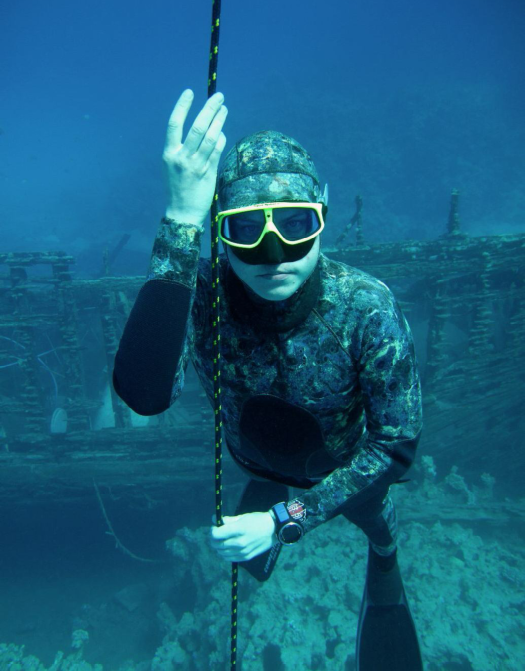
Freediving, free-diving, free diving, breath-hold diving, or skin diving, is a mode of underwater diving that relies on breath-holding until resurfacing rather than the use of breathing apparatus such as scuba gear.
Besides the limits of breath-hold, immersion in water and exposure to high ambient pressure also have physiological effects that limit the depths and duration possible in freediving.
Examples of freediving activities are traditional fishing techniques, competitive and non-competitive freediving, competitive and non-competitive spearfishing and freediving photography, synchronised swimming, underwater football, underwater rugby, underwater hockey, underwater target shooting and snorkeling. There are also a range of "competitive apnea" disciplines; in which competitors attempt to attain great depths, times, or distances on a single breath.
Historically, the term free diving was also used to refer to scuba diving, due to the freedom of movement compared with surface supplied diving.[1][2][3]
History
[edit].jpg)
In ancient times freediving without the aid of mechanical devices was the only possibility, with the exception of the occasional use of reeds and leather breathing bladders.[4] The divers faced the same problems as divers today, such as blacking out during a breath hold. Freediving was practiced in ancient cultures to gather food, harvest resources such as sponge and pearl, reclaim sunken valuables, and to help aid military campaigns.
In Ancient Greece, both Plato and Homer mention the sponge as being used for bathing. The island of Kalymnos was a main centre of diving for sponges. By using weights (skandalopetra) of as much as 15 kilograms (33 lb) to speed the descent, breath-holding divers would descend to depths up to 30 metres (98 ft) to collect sponges.[5] Harvesting of red coral was also done by divers.[citation needed]
The Mediterranean had large amounts of maritime trade. As a result of shipwrecks, particularly in the fierce winter storms, divers were often hired to salvage whatever they could from the seabed.[6] Divers would swim down to the wreck and choose the most valuable pieces to salvage.
Divers were also used in warfare. Defenses against sea vessels were often created, such as underwater barricades, and hence divers were often used to scout out the seabed when ships were approaching an enemy harbor. If barricades were found, it was divers who were used to disassemble them, if possible.[7] During the Peloponnesian War, divers were used to get past enemy blockades to relay messages as well as supplies to allies or troops that were cut off,[8] and in 332 BC, during the Siege of Tyre, the city used divers to cut the anchor cables of Alexander's attacking ships.[9]
In Japan, ama divers began to collect pearls about 2,000 years ago.[10][11] For thousands of years, most seawater pearls were retrieved by divers working in the Indian Ocean, in areas such as the Persian Gulf, the Red Sea, and in the Gulf of Mannar (between Sri Lanka and India).[12] A fragment of Isidore of Charax's Parthian itinerary was preserved in Athenaeus's 3rd-century Sophists at Dinner, recording freediving for pearls around an island in the Persian Gulf.[13]
Pearl divers near the Philippines were also successful at harvesting large pearls, especially in the Sulu Archipelago. At times, the largest pearls belonged by law to the sultan, and selling them could result in the death penalty for the seller. Nonetheless, many pearls made it out of the archipelago by stealth, ending up in the possession of the wealthiest families in Europe.[14] Pearling was popular in Qatar, Bahrain, Japan, and India. The Gulf of Mexico was also known for pearling. Native Americans harvested freshwater pearls from lakes and rivers like the Ohio, Tennessee, and Mississippi, while others dived for marine pearls from the Caribbean and waters along the coasts of Central and South America.
In 1940, Dottie Frazier pioneered freediving for women in the United States and also began teaching classes. It was also during this time that she began to design and sell rubber suits for Navy UDT divers.[15]
Freediving activities
[edit]Recreational hunting and gathering
[edit]Spearfishing
[edit]Spearfishing is an ancient method of fishing that has been used throughout the world for millennia. Early civilizations were familiar with the custom of spearing fish from rivers and streams using sharpened sticks.
Today modern spearfishing makes use of elastic powered spearguns and slings, or compressed gas pneumatic powered spearguns, to strike the hunted fish. Specialised techniques and equipment have been developed for various types of aquatic environments and target fish. Spearfishing may be done using free-diving, snorkelling, or scuba diving techniques. Spearfishing while using scuba equipment is illegal in some countries. The use of mechanically powered spearguns[clarification needed] is also outlawed in some countries and jurisdictions.[citation needed] Spearfishing is highly selective, normally uses no bait and has limited by-catch.
Collection of shellfish
[edit]Various cultures have collected shellfish by freediving for "possibly thousands" of years.[16][17][18] One example is the historical recreational collection of abalone in South Africa, before illegal harvesting reduced stocks to levels which resulted in recreational collection being banned indefinitely. This did not completely stop illegal harvesting, because selling illegally harvested abalone remained lucrative.[19]
Competitive breath-hold watersports
[edit]Aquathlon
[edit]Aquathlon (also known as underwater wrestling) is an underwater sport where two competitors wearing masks and fins wrestle underwater in an attempt to remove a ribbon from each other's ankle band in order to win the bout. The "combat" takes place in a 5-metre (16 ft) square ring within a swimming pool, and is made up of three 30-second rounds, with a fourth round played in the event of a tie. The sport originated during the 1980s in the former USSR (now Russia) and was first played at international level in 1993. It was recognised by the Confédération Mondiale des Activités Subaquatiques (CMAS) in 2008.[20][21][22][23]
Competitive spearfishing
[edit]Competitive spearfishing is defined by the world governing body CMAS as "the hunting and capture of fish underwater without the aid of artificial breathing devices, using gear that depends entirely on the physical strength of the competitor." They publish a set of competition rules that are used by affiliated organisations.[24][25]
Synchronised swimming
[edit]
Synchronized swimming is a hybrid form of swimming, dance, and gymnastics, consisting of swimmers (either solos, duets, trios, combos, or teams) performing a synchronized routine of elaborate moves in the water, accompanied by music. Synchronized swimming demands advanced water skills, and requires great strength, endurance, flexibility, grace, artistry and precise timing, as well as exceptional breath control when upside down underwater. During lifts swimmers are not allowed to touch the bottom.[26]
Traditionally it was a women's sport, but following the addition of a new mixed-pair event, FINA World Aquatics competitions are open to men since the 16th 2015 championships in Kazan, and the other international and national competitions allow male competitors in every event. However, men are currently still barred from competing in the Olympics. Both USA Synchro and Synchro Canada allow men to compete with women. Most European countries also allow men to compete, and France even allows male only podiums, according to the number of participants. In the past decade, more men are becoming involved in the sport and a global biannual competition called Men's Cup has been steadily growing.[citation needed]
Swimmers perform two routines for the judges, one technical and one free, as well as age group routines and figures. Synchronized swimming is both an individual and team sport. Swimmers compete individually during figures, and then as a team during the routine. Figures are made up of a combination of skills and positions that often require control, strength, and flexibility. Swimmers are ranked individually for this part of the competition. The routine involves teamwork and synchronization. It is choreographed to music and often has a theme. Synchronized swimming is governed internationally by FINA (Fédération Internationale de Natation).
Underwater hockey
[edit]
Underwater hockey (also called octopush, mainly in the United Kingdom) is a globally played limited-contact sport in which two teams compete to manoeuvre a hockey puck across the bottom of a swimming pool into the opposing team's goal by propelling it with a hockey stick. The sport originated in England in 1954 when Alan Blake, the founder of the newly formed Southsea Sub-Aqua Club, invented the game he called octopush to keep the club's members interested and active during the cold winter months, when open-water diving lost its appeal.[27] Underwater hockey is now played worldwide, governed by the Confédération Mondiale des Activités Subaquatiques (CMAS).[28] The first Underwater Hockey World Championship was held in Canada in 1980, after a planned championship in 1979 was scuttled by international politics and apartheid.[citation needed]
Underwater football
[edit]
Underwater football is a two-team underwater sport that shares common elements with underwater hockey and underwater rugby. As with both of those games, it is played in a swimming pool with snorkeling equipment (mask, snorkel, and fins). The goal of the game is to manoeuvre (by carrying and passing) a slightly negatively buoyant ball from one side of a pool to the other by players who are completely submerged underwater. Scoring is achieved by placing the ball (under control) in the gutter on the side of the pool. Variations include using a toy rubber torpedo as the ball, and weighing down buckets to rest on the bottom and serve as goals.[citation needed]
It is played in the Canadian provinces of Alberta, Manitoba, Newfoundland and Labrador, and Saskatchewan.[29]
Underwater rugby
[edit]Underwater rugby is an underwater team sport. During a match, two teams try to score a negatively buoyant ball (filled with saltwater) into the opponents’ goal at the bottom of a swimming pool. It originated from within the physical fitness training regime existing in German diving clubs during the early 1960s and has little in common with rugby football except for the name. It was recognised by the Confédération Mondiale des Activités Subaquatiques (CMAS) in 1978 and was first played as a world championship in 1980.[citation needed]
Underwater target shooting
[edit]Underwater target shooting is an underwater sport that tests a competitors’ ability to accurately use a speargun via a set of individual and team events conducted in a swimming pool using free diving or apnea technique. The sport was developed in France during the early 1980s and is currently practised mainly in Europe. It is known as Tir sur cible subaquatique in French and as Tiro al Blanco Subacuático in Spanish.
Competitive apnea
[edit]
Competitive freediving is currently governed by two world associations: AIDA International[30] and Confédération Mondiale des Activités Subaquatiques (CMAS). Historically, there were two more organisations that regulated freediving records and activities — International Association of Freedivers (IAFD) and Freediving Regulations and Education Entity (FREE).[31][32] Each organization has its own rules on recognizing a record attempt which can be found on the organization's website. Alongside competitive disciplines, there are record disciplines — disciplines that are not held in competitions, that are just for setting world records. There is a third organization, Guinness, which in addition to AIDA and CMAS presides over record disciplines.[citation needed]
Almost all types of competitive freediving are individual sports based on the best individual achievement. Exceptions to this rule are the bi-annual AIDA Team World Championship, where the combined score of the team members makes up the team's total points, and Skandalopetra diving competitions held by CMAS, the only truly ‘team’ event in freediving for which teams are formed by two athletes: one acting as the diver (βουτηχτής, voutichtis) and the other acting as an assistant (κολαουζέρης, kolaouzeris).
Disciplines
[edit]There are currently eleven recognized disciplines defined by AIDA and CMAS, and a dozen more that are only practiced locally.[clarification needed][citation needed] All disciplines can be practiced by both men and women, and only CMAS currently separates records in fresh water from those at sea. The disciplines of AIDA can be done both in competition and as a record attempt, with the exception of variable weight and no limits, which are both solely for record attempts. For all AIDA depth disciplines, the depth the athlete will attempt is announced before the dive; this is accepted practice for both competition and record attempts. Most divers choose monofin (MF) over bifins (BF) where there is a choice.
| Discipline | Measurement | AIDA[33] | CMAS[34] | Description | ||
|---|---|---|---|---|---|---|
| open water | pool | open water | pool | |||
| Constant weight apnea (CWT) | depth |  |
– | |
– | Maximum depth following a guide line. The line to act solely as a guide and only a single hold of the rope to stop the descent and start the ascent is permitted. Dropping dive weights is not permitted. Both bi-fins and monofin are permitted and the technique is irrelevant. |
| Constant weight bi-fins (CWT BF, CWTB) | depth | |
– | |
– | As for CWT above but monofins are not permitted and the athlete is prohibited to use a dolphin kick for his / her propulsion. |
| Constant weight without fins (CNF) | depth | |
– | |
– | As for CWT above but no swimming aids such as fins are permitted. This discipline is the most recently recognised discipline having been recognised by AIDA since 2003. |
| Dynamic apnea without fins (DNF) | horizontal distance | – | |
|
|
Maximum distance underwater, in a pool, no swimming aids such as fins are permitted (AIDA). |
| Dynamic apnea with fins (DYN) | horizontal distance | – | |
|
|
Maximum horizontal distance on one breath in a pool. Monofin or bi-fins are permitted and the technique is irrelevant. |
| Dynamic apnea with bifins (DYN BF, DYNB) | horizontal distance | – | |
– |
|
Same as DYN above but monofins are not permitted and the athlete is prohibited to use a dolphin kick for his / her propulsion. |
| Free immersion apnea (FIM) | depth | |
– | |
– | Maximum depth following a vertical line. The line may be used to pull down to depth and back to the surface. No ballast or fins are permitted. It is known for its ease compared with the Constant Weight disciplines, while still not permitting the release of weights. |
| Jump blue (JB, also the cube) | horizontal distance |  |
|
– | Maximum distance covered around a 15-metre square at a depth of 10 metres. Monofin, bi-fins or no fins are all permitted. Sled may be used for descent. | |
| No-limits apnea (NLT) | depth | |
– |
|
Any means of breath-hold diving to depth and return to the surface is permitted provided that a guideline is used to measure the distance. Most divers use a weighted sled to descend and an inflatable bag to ascend. It is important to note that new attempts are not recognised due to the level of danger presented to divers[35] | |
| Skandalopetra | depth & min. time | |
|
– | The only true team event in freediving. Diver 1 descends, usually assisted by a stone or marble slab attached to a rope, while Diver 2 waits on the surface. Diver 1 reaches the target depth and is hauled to the surface by Diver 2 using only muscle power. No diving mask, suit or fins are permitted, only nose clip. | |
| Static apnea (STA) | max. time | |
|
|
|
Timed breathhold endurance while floating on the surface or standing on the bottom. Usually in a pool. |
| Static apnea with pure oxygen (STA O2) | max. time | |
|
Timed breathhold endurance, pre-breathing 100% oxygen for up to 30 minutes prior to the breathhold is permitted. Usually in a pool. Although no longer recognised by either AIDA or CMAS there were three instances of records being approved by AIDA. | ||
| Speed-endurance apnea (S&E apnea)[36] | min. time | |
– |
|
Shortest time over a fixed, underwater distance. An endurance sub-discipline is swum in fractions of a pool length alternating apnoea swimming with passive recovery at the intervals. Disciplines are SPE – 100m speed apnoea, END 16x50 – 800m and END 8x50 – 400m endurance apnoea. | |
| Variable weight apnea without fins (VNF) | depth | |
|
– | Descent is assisted by a weighted sled sliding down a line, the ascent may be by pulling up along the line or swimming without fins. | |
| Variable weight apnea (VWT) | depth | |
– | |
– | Descent is assisted by a weighted sled sliding down a line, the ascent may be either by: 1.) pulling up along the line or swimming with or without fins under AIDA rules 2.) swimming with fins under CMAS rules. |


| Discipline | Aids permitted | Weight change permitted? | |
|---|---|---|---|
| Descent | Ascent | ||
| CNF | None or weight |
None | No |
| CWT | BF / MF and/or weight |
BF / MF | No |
| CWT BF | BF and/or weight |
BF | No |
| DNF | – | – | – |
| DYN | – | – | – |
| DYN BF | – | – | – |
| FIM | Rope or none |
Rope or none |
No |
| JB | Sled and/or BF / MF or none |
BF / MF or none |
Sled only |
| NLT (No Limit) (Only AIDA) | Any | Any | Yes |
| Skandalopetra | Stone | Hauled up | Yes |
| STA | – | – | – |
| STA O2 | – | – | – |
| S&E Apnoea | – | – | – |
| VNF (only CMAS) | Sled | Rope or none |
Yes |
| VWT | Sled | BF / MF or rope |
Yes |
Competition safety
[edit]Following the deaths of two freedivers in competitions, AIDA has a system set up for monitoring and if necessary, recovering competitors who lose consciousness underwater. As of 2022 the incidence of adverse events in depth competitions varies between 3 and 4%. This rate is considered relatively low and is expected during competitions where divers push their breath-hold limits. Almost all of these divers are successfully assisted and recover completely. There is a much lower incidence of more serious injuries.[39]
Safety divers
[edit]
The safety team is usually made up of volunteers, or paid staff in some major events, and is supervised by the Chief of Safety. Each competitor is monitored by a team of breath-hold safety divers who will descend in time to meet the competitor during their ascent, and monitor them for the rest of the ascent. They will intervene if necessary, typically by securing the competitor's airway and swimming them up to the surface. The first safety diver will meet the competitor at somewhere around 1/3 to 1/4 of the target depth, usually with a maximum of 30m. The second will meet them about 10m shallower, and a third will be on standby in case of an emergency. The work can be challenging as many dives are done in a day, so the team of safety divers is usually rotated to ensure that they are not overtasked.[39]
In case of a deeper incident, the competitor is clipped to the downline for the duration of the dive, which can be rapidly raised by the surface support team, which includes a medical support group.[39]
World records
[edit]The best official result in static apnea is the Guinness WR of 11:54 by Branko Petrović in 2014, a freediver who has results over 10 minutes under both AIDA and CMAS. The best no limits result is 253.2m by Herbert Nitsch in 2012; his intention of having the dive sanctioned by AIDA fell through due to a sponsoring conflict. After 2001, AIDA International no longer separated the records achieved in fresh water from those in the sea.
CMAS recognized world records
[edit]As of 1 January 2024[update], the CMAS recognized world records are:[40]
| Discipline | Gender | Depth [m] |
Distance [m] |
Time | Name/Country | Date | Place | |
|---|---|---|---|---|---|---|---|---|
| Static apnea | STA | Men | – | – | 10:45.000 |  Branko Petrović (SRB) Branko Petrović (SRB) |
2017-11-11 | Subotica, Serbia |
| Women | – | – | 08:53.150 |  Veronika Dittes (AUT) Veronika Dittes (AUT) |
2017-06-15 | Cagliari, Italy | ||
| Dynamic apnea with fin | DYN | Men | – | 321.43 | – |  Mateusz Malina (POL) Mateusz Malina (POL) |
2022-06-15 | Belgrade, Serbia |
| Women | – | 275.36 | – |  Mirela Kardašević (CRO) Mirela Kardašević (CRO) |
2022-06-15 | Belgrade, Serbia | ||
| under ice | Men | – | 175 | – |  Arthur Guérin-Boëri (FRA) Arthur Guérin-Boëri (FRA) |
2017-03-11 | Lake Sonnanen, Finland | |
| Women | – | 140 | – | Valentina Cafolla (CRO) |
2024-02-23 | Lake Anterselva, Italy[41] | ||
| open water | Men | – | 200 | – |  Sertan Aydin (TUR) Sertan Aydin (TUR) |
|||
| Women | – | – | ||||||
| Dynamic apnea with bifins | DBF | Men | – | 274.70 | – | Guillaume Bourdila (FRA) |
2022-06-13 | Belgrade, Serbia |
| Women | – | 250.00 | – | Mirela Kardašević (CRO) |
2022-06-13 | Belgrade, Serbia | ||
| Dynamic apnea without fins | DNF-50 | Men | – | 236 | – | Guillaume Bourdila (FRA) |
2019-06-19 | Istanbul, Turkey |
| Women | – | 210 | – | Julia Kozerska (POL) |
2022-06-12 | Belgrade, Serbia | ||
| DNF-25 | Men | – | 220.70 | – | Vanja Peles (CRO) |
2021-03-28 | Sisak, Croatia | |
| Women | – | 206.20 | – | Mirela Kardasevic (CRO) |
2021-03-28 | Sisak, Croatia | ||
| Speed 100 m. | SPE | Men | – | – | 00:30.350 |  Malte Striegler (GER) Malte Striegler (GER) |
2018-06-15 | Lignano, Italy |
| Women | – | – | 00:35.860 |  Vera Yarovitskaya (RUS) Vera Yarovitskaya (RUS) |
2017-06-15 | Cagliari, Italy | ||
| Endurance | END16x50 | Men | – | – | 09:10.030 | Max Poschart (GER) |
2019-06-19 | Istanbul, Turkey |
| Women | – | – | 10:41.120 | Evgeniia Kozyreva (RUS) |
2021-06-23 | Belgrade, Serbia | ||
| END8x50 | Men | – | – | 03Paris 20205.720 | Mikhail Drozdov (RUS) |
2019-06-22 | Istanbul, Turkey | |
| Women | – | – | 04:10.190 |  Chiara Zaffaroni (ITA) Chiara Zaffaroni (ITA) |
2023-05-10 | Kuwait | ||
| END4x50 | Men | – | – | |||||
| Women | – | – | 01:33.860 | Chiara Zaffaroni (ITA) |
2023-05-11 | Kuwait | ||
| Jump blue apnea with fins | at sea | Men | – | 201.61 | – | Arthur Guérin-Boëri (FRA) |
2015-10-09 | Ischia, Italy |
| Women | – | 190.48 | – | Alessia Zecchini (ITA) |
2015-10-09 | Ischia, Italy | ||
| fresh water | Men | – | 170 | – |  Alfredo Leonidas Rosado Estrada (ECU) Alfredo Leonidas Rosado Estrada (ECU) |
|||
| Women | – | 132.92 | – | Gilda Rivadeneria Montalvo (ECU) |
||||
| Constant weight with fins | at sea | Men | 136 | – | – | Alexey Molchanov (RUS) |
2023-08-23 | Roatan, Honduras |
| Women | 122 | – | – |  Alenka Artnik (SLO) Alenka Artnik (SLO) |
2021-07-21 | Long Island, Bahamas | ||
| fresh water | Men | 80 | – | – | Michele Tomasi (ITA) |
|||
| Women | 57 | – | – |  Tanya Streeter (UK) Tanya Streeter (UK) |
1998-12-28 | Ocala, Fl, USA | ||
| Constant weight with bifins (CWT BF) | at sea | Men | 124 | – | – | Alexey Molchanov (RUS) |
2023-08-25 | Roatan, Honduras |
| Women | 106 | – | – | Alenka Artnik (SLO) |
2021-09-30 | Kaş, Turkey | ||
| fresh water | Men | 75 | – | – | Michele Tomasi (ITA) |
|||
| Women | – | – | ||||||
| Constant weight without fins | at sea | Men | 100 | – | – | Alexey Molchanov (RUS) |
2023-08-23 | Roatan, Honduras |
| Women | 78 | – | – |  Kateryna Sadurska (UKR) Kateryna Sadurska (UKR) |
2023-08-24 | Roatan, Honduras | ||
| fresh water | Men | 65 | – | – |  Michal Rišian (CZE) Michal Rišian (CZE) |
2016-07-10 | Weyregg, Austria | |
| Women | – | – | – | – | – | – | ||
| Free immersion apnea | at sea | Men | 132 | – | – | Petar Klovar (CRO) |
2022-10-04 | Kaş, Turkey |
| Women | 72 | – | – | Alessia Zecchini (ITA) |
2021-07-17 | Long Island, Bahamas | ||
| Variable weight apnea monofin | at sea | Men | 131 | – | – | Homer Leuci (ITA) |
2012-09-11 | Soverato, Italy |
| Women | 116 | – | – | Lena Balta (SER) |
2022-06-25 | Sharm el Sheik, Egypt | ||
| Variable weight apnea bifins | at sea | Men | 130 | – | – |  William Winram (SWI) William Winram (SWI) |
2021-10-21 | Sharm el Sheik, Egypt |
| Women | - | – | – | |||||
| Variable weight apnea without fins (VNF) | at sea | Men | 140 | – | – | William Winram (SWI) |
2023-12-11 | Sharm el Sheik, Egypt |
| Women | 106 | – | – | Şahika Ercümen (TUR) |
2023-10-17 | Hatay, Turkey | ||
| Skandalopetra | at sea | Men | 112 | – | – | Andreas Güldner (GER) |
2014-06-26 | Red Sea, Egypt |
| Women | 68.9 | – | – |  Karol Meyer (BRA) Karol Meyer (BRA) |
2012 | Bonaire, Caribbean | ||
AIDA recognized world records
[edit]As of 26 July 2023[update], the AIDA recognized world records are:[42][43][44]
| Discipline | Gender | Depth [m] | Distance [m] | Time | Name | Date | Place |
|---|---|---|---|---|---|---|---|
| Static apnea (STA) | Men | – | – | 11 min 35 sec | Stéphane Mifsud (FRA) |
2009-06-08 | Hyères, Var, France |
| Women | – | – | 9 min 22 sec | Heike Schwerdtner (GER) |
2025-05-04 | Stockholm, Sweden | |
| Dynamic apnea with fins (DYN) | Men | – | 316.53 | – | Mateusz Malina (POL)[45] |
2019-06-22 | Turku, Finland |
| Women | – | 280 | – |  Zsófia Törőcsik (HUN) Zsófia Törőcsik (HUN) |
2025-07-02 | Wakayama, Japan | |
| Dynamic apnea with bifins (DYNB) | Men | – | 298 | – | Guillaume Bourdila (FRA) |
2025-06-28 | Wakayama, Japan |
| Women | – | 208 | – | Kardasevic Mirela (CRO) |
2019-03-07 | Moscow, Russia | |
| Dynamic apnea without fins (DNF) | Men | – | 250 | – | Mateusz Malina (POL) |
2022-05-01 | Dębica, Poland |
| Women | – | 213 | – | Julia Kozerska (POL) |
2023-06-13 | Seogwipo, South Korea | |
| Constant weight apnea (CWT) | Men | 133 | – | – | Alexey Molchanov (RUS) |
2023-07-22 | Dean's Blue Hole, Long Island Bahamas |
| Women | 123 | – | – | Alessia Zecchini (ITA) |
2023-04-24 | Camotes Island, Philippines | |
| Constant weight apnea with bifins (CWTB) | Men | 126 | – | – | Alexey Molchanov (RUS) |
2025-09-26 | Limassol, Cyprus |
| Women | 111 | – | – | Alenka Artnik (SVN) |
2023-07-30 | Dean's Blue Hole, Long Island Bahamas | |
| Constant weight apnea without fins (CNF) | Men | 103 | – | – | Petar Klovar (CRO) |
2025-05-26 | Sharm el-Sheikh, Egypt |
| Women | 73 | – | – | Alessia Zecchini (ITA) |
2016-04-26 | Dean's Blue Hole, Long Island Bahamas | |
| Free immersion apnea (FIM) | Men | 133 | – | – | Alexey Molchanov (RUS) |
2023-07-21 | Dean's Blue Hole, Long Island Bahamas |
| Women | 103 | – | – | Sanda Delija (HRV) |
2025-05-04 | Mabini, Philippines | |
| Variable weight apnea (VWT) | Men | 156 | – | – | Alexey Molchanov (RUS) |
2023-03-28 | Bonaire, Caribbean |
| Women | 130 | – | – |  Nanja van den Broek (NED) Nanja van den Broek (NED) |
2015-10-18 | Sharm el-Sheikh, Egypt | |
| No Limit apnea (NLT) | Men | 214 | – | – | Herbert Nitsch (AUT) |
2012-06-06 | Santorini, Greece |
| Women | 160 | – | – | Tanya Streeter (UK) |
2002-08-17 | Turks and Caicos |
| Discipline | Gender | Points | Team / Individual | Date | Place |
|---|---|---|---|---|---|
| AIDA team | Men | 840.6 | CRO Goran Čolak, Božidar Petani, Veljano Zanki |
2012-09-16 | Nice, France [46][47] |
| Women | |||||
| Men | 313.3 |  William Trubridge (NZL) William Trubridge (NZL) |
2010-07-06 | Okinawa, Japan [48][49] | |
| Women |
Guinness recognized world records
[edit]The following table only includes those disciplines that are modifications of existing AIDA or CMAS disciplines and Guinness-exclusive (as it recognizes and inherits some AIDA/CMAS records) or Guinness-conceived (CMAS and AIDA do/did sanction at some time) disciplines.
As of 25 February 2018[update]:
| Discipline | Gender | Depth [m] | Distance [m] | Time | Name | Date | Place |
|---|---|---|---|---|---|---|---|
| STA O2 | Men | – | – | 24:11 | Budimir Šobat (CRO) |
24 February 2018 | Zagreb |
| Women | – | – | 18:32 | Karol Meyer (BRA) |
10 July 2009 | Florianopolis | |
| DYN under ice | Men | – | 175 | – | details under CMAS world records | ||
| Women | – | 125 | – | ||||
| DNF under ice | Men | – | 84 | – | Nik Linder (GER) |
Feb 2013 | Weissensee [50][51] |
| Women | – | – | |||||
| DNF under ice (no diving suit) | Men | – | 81 | – | David Vencl (CZ) |
Feb 2021 | Lahošť lake |
| Women | – | 50 | – |  Johanna Nordblad (FIN) Johanna Nordblad (FIN) |
Mar 2015 | Päijänne [52] | |
| NLT under ice | Men | 65 | – | – | Andreas Pap (SRB) |
Feb 2013 | Weissensee [50] |
| Women | – | – | |||||
Recreational
[edit]
Freediving as a recreational activity is widely practiced and differs significantly from scuba diving. Although there are potential risks to all freediving, it can be safely practiced using a wide range of skill levels from the average snorkeler to the professional freediver. Compared to scuba diving, freediving offers:[citation needed]
- Freedom from cumbersome equipment and short preparation times.
- Low cost.
- It is quiet and does not disturb fish, the noise of breathing and bubbles can be quite loud on open circuit scuba though rebreathers are much quieter.
- Mobility and speed, but for a much more limited period.
- No decompression time for deep dives, although it is possible to get decompression sickness, or taravana, from repetitive deep free-diving with short surface intervals.[53]
- The lack of exhaled air bubbles on ascent gives greater visibility on ascent.
- Accessibility, if the site can be walked to it can, potentially, be dived.
- Appropriately skilled and fit freedivers can go as deep, or deeper than, recreational scuba divers, the depth being limited only by the willingness to accept the risks; scuba diving is restricted by the level of certification.
Freshwater springs, often with excellent visibility, provide good freediving opportunities but with greater risks.[citation needed] Diving into spring caverns with restricted access to the surface is very different from diving in open water. The time available to a freediver to solve problems underwater before hypoxia sets in is severely restricted in comparison with scuba. Freediving into confined cave systems such as Eagle's Nest Cave, Florida and Blue Springs State Park, Florida has resulted in several deaths. Cave freediving is commonly discouraged in basic freediver safety training.
Physiology
[edit]![[icon]](https://en.wikipedia.org/wiki/File:Wiki_letter_w_cropped.svg) | This section needs expansion. You can help by adding to it. (July 2017) |
General adaptations
[edit]The human body has several oxygen-conserving adaptations that manifest under diving conditions as part of the mammalian diving reflex. The adaptations include:
- Reflex bradycardia: Significant drop in heart rate.
- Blood-shift: Blood flow and volume is redistributed towards vital organs by means of a reflex vasoconstriction. Blood vessels distend and become engorged, which in the case of the pulmonary capillaries assists with pressure compensation that comes with increasing diving depth, and without which a largely air-filled chest cavity would simply collapse for lack of compliance.[citation needed]
- Body-cooling: peripheral vasoconstriction results in cooling of peripheral tissue beds, which lower their oxygen demand in a thermodynamic manner. In addition, Murat et al. (2013) recently discovered that breath-holding results in prompt and substantial brain cooling, just like in diving birds and seals. (Dry) breath-holds result in cooling on the order of about 1 °C/minute, but this is likely to be greater with cold water submersion, in proportion to the magnitude and promptness of the dive response.[citation needed]
- Splenic contraction: Releasing red blood cells carrying oxygen.[54]
Recent human evolution
[edit]In addition to general adaptations within the human species, freediving is an example of an activity that has been directly affected by recent human evolution. The Bajau, or “Sea Nomads,” have engaged in freediving for thousands of years, and natural selection has led to larger spleen sizes. This serves as an oxygen reservoir when diving. It is hypothesized that other isolated diving populations globally may have experienced the same selection.[55]
Techniques
[edit]Breath-holding ability, and hence dive performance, is a function of on-board oxygen stores, scope for metabolic rate reduction, efficient oxygen utilization, and hypoxia tolerance.[56] Athletes attempt to accomplish this in various ways. Some divers use "packing", which increases lung volume beyond normal total lung capacity.[57] In addition, training is allocated to enhance blood and muscle oxygen stores, to a limited extent.[clarification needed] Most divers rely on increasing fitness by increasing CO2 tolerance and lung capacity. Simple breath-holding practice is highly effective for the build-up of tolerance to CO2 and to some degree increased lung capacity. In an interview on the radio talk show Fresh Air, journalist James Nestor, author of the book Breath: The New Science of a Lost Art,[58] stated: "Some divers have a lung capacity of 14 liters, which is about double the size for a typical adult male. They weren't born this way. ... They trained themselves to breathe in ways to profoundly affect their physical bodies."[59]
| This section needs expansion. You can help by adding to it. (October 2019) |
Ascent
[edit] | This section is empty. You can help by adding to it. (October 2019) |
Certification
[edit]There is no requirement by law that free-divers are required to do formal freediving training or be certified, but due to the risks inherent to the sport, freediving without training poses a significant risk to life. The free-diving courses contain three components: theory studies, confined water sessions generally conducted in a swimming pool, and open water sessions in the ocean or other large body of fresh or salt water.[60][61]
| This section needs expansion with: What is the characteristic course content? (minimum content? Is there a minimum international standard?). You can help by adding to it. (January 2025) |
Training
[edit]Training for freediving can take many forms, some of which can be performed on land. One training exercise is the apnea walk. This consists of a preparation "breathe-up", followed by a short (typically 1 minute) breath hold taken at rest. Without breaking the hold, participants then begin walking as far as possible until it becomes necessary to breathe again. Some athletes can do close to 400 meters in training this way.[citation needed]
This form of training is good for accustoming muscles to work under anaerobic conditions, and for tolerance to carbon dioxide build-up in the circulation. It is also easy to gauge progress, as increasing distance can be measured.[citation needed]
Before competition attempts, freedivers perform a preparation sequence, which usually consists of physical stretching, mental exercise and breath exercise. It may include a succession of variable length static apnea and special purging deep breaths. Results of the preparation sequence are slower metabolism, lower heart and breathing rates, lower levels of carbon dioxide in the bloodstream,[62] and overall mental equilibrium.[citation needed][clarification needed]
The University of Miami presents a scientific freediving class that was developed by Claire Paris, a marine scientist and freediver,[63] the class is the first of its kind at the university.[64][65]
| This section needs expansion with: What is typical content of training program?. You can help by adding to it. (January 2025) |
Safety
[edit]Hazards
[edit]The most obvious hazard is lack of access to air for breathing – a necessity for human life. This can result in asphyxia from drowning if the diver does not reach the surface while still capable of holding their breath and resuming breathing. The risk depends on several factors, including the depth, duration and shape of the dive profile.[citation needed][clarification needed]
Latent hypoxia is a specific hazard of deeper freedives. This effect can cause hypoxic blackout during surfacing.[66]
There is also a wide range of environmental hazards possible specific to the site and water and weather conditions at the time of diving, and there may be other hazards specific to the freediving activity.[clarification needed]
| This section needs expansion. You can help by adding to it. (October 2018) |
Risk
[edit]Failing to respond to physiological warning signals, or crossing the mental barrier by strong will, may lead to blackout underwater or on reaching the surface.[10][67] Trained freedivers are well aware of this and competitions must be held under strict supervision and with competent first-aiders on standby.[68] However, this does not eliminate the risk of blackout. Freedivers are encouraged by certification and sporting organisations to dive only with a 'buddy' who accompanies them, observing from in the water at the surface, and ready to dive to the rescue if the diver loses consciousness during the ascent. This is only reasonably practicable if the water clarity allows observation, and the buddy is capable of safely reaching the diver.[citation needed] Due to the nature of the sport, the risks of freediving can be reduced by strict adherence to safety measures as an integral part of the activity, but cannot be eliminated. Competition rules may require all participants to be adept in rescue and resuscitation.[citation needed]
Statistics and notable accidents
[edit]Nicholas Mevoli, a diver from New York died on 17 November 2013 after losing consciousness on surfacing from a 3-minute 38 second dive to a depth of 72 metres (236 ft) during an official record attempt in the "constant weight without fins" event. He had previously reached greater depths and longer times in other disciplines.[69]
| This section needs expansion with: other cases, statistics. You can help by adding to it. (January 2025) |
On 22 July 2017, Irish safety diver Stephen Keenan died during a dive in Dahab, Egypt. [70] He was the safety diver for Italian freediver Alessia Zecchini, who was attempting to swim through the Arch of the Blue Hole (Red Sea). For reasons that remain unclear, Keenan began his descent approximately 20 seconds later than planned, causing him to miss the scheduled meeting point with Zecchini. He eventually reached her and assisted her ascent to the surface. Shortly afterward, Keenan lost consciousness and was later found floating face down in the water.
Fiction and documentaries
[edit]Documentaries
[edit]- Ocean Men (2001) is a documentary film about the art and science of freediving, featuring two of its most outstanding exponents: Francisco "Pipín" Ferreras and Umberto Pelizzari.[71]
- My Pilot, Whale (2014) is a short documentary film directed by Alexander and Nicole Gratovsky, demonstrating direct communication between a human and free pilot whales in the open ocean. The entire underwater part was shot without underwater breathing equipment; both the operator and the person appearing in the frame are freediving.[72]
- My Octopus Teacher (2020) is a nature documentary. Filmmaker Craig Foster captured most of the footage used in the film while freediving.
- The Deepest Breath (2023) is a feature-length documentary written and directed by Laura McGann about Italian freediver Alessia Zecchini and Irish safety diver Stephen Keenan.
Fiction
[edit]- In the film Mission: Impossible – Rogue Nation, Tom Cruise plays super spy Ethan Hunt fighting the forces of evil, and goes freediving in a scene to expose the villains.
- The Pearl by John Steinbeck (1947) is a novel about a poor pearl diver, Kino, who finds the 'Pearl of Heaven', which is exceptionally valuable, changing his life forever. The novel explores themes of man's nature as well as greed and evil.
- In South Sea Adventure (1952) by Willard Price the Hunt brothers, marooned on a coral island, use free diving to collect both pearls and fresh water.[clarification needed]
- In Ian Fleming's (1964) James Bond novel You Only Live Twice, the character Kissy Suzuki is an ama diver. This connection was also mentioned in the film version.
- Man from Atlantis was a 1970s TV series which featured a superhero with the ability to breathe underwater and freedive in his own special way.
- The Big Blue (1988) is a romantic film about two world-class freedivers, a heavily fictionalized depiction of the rivalry of freedivers Jacques Mayol and Enzo Maiorca.
- In the movie Phoenix Blue (2001), protagonist Rick is a musician who freedives competitively.
- The children's novel The Dolphins of Laurentum by Caroline Lawrence (2003), which takes place in ancient Rome, describes the applications of freediving (sponge and pearl diving) and its hazards, as one of the principal characters, as well as the main antagonist, try to beat each other to a sunken treasure.
- The Freediver (2004) is a film about a talented female freediver who is discovered and brought to an island, where she is trained by an ambitious scientist to break a freediving world record currently held by an American woman.
- In the film Into the Blue (2005) starring Jessica Alba, a group of divers find themselves in deep trouble with a drug lord after they come upon the illicit cargo of a sunken airplane in the Caribbean. Jessica Alba is an accomplished freediver, and did much of the underwater work; some other stunts were performed by Mehgan Heaney-Grier.
- In Greg Iles' novel Blood Memory (2005), the main character Cat Ferry is an odontologist and a freediver.
- H2O: Just Add Water Series 3 added a freediver (Will Benjamin played by Luke Mitchell) as a regular. Freediving is featured in some episodes.
- The Greater Meaning of Water (2010) is an independent film about competitive constant weight freediving, focusing on the 'zen' of freediving.
- In the Canadian television series Corner Gas, the character Karen Pelly (Tara Spencer-Nairn) competed in static apnea, ranking fifth in Canada with a personal best of over six minutes.
- In the American television series Baywatch episode "The Chamber" (Session 2, Episode 17), the character Mitch Buchannon rescues a diver trapped 90 feet below the ocean surface, but almost dies while suffering the effects of decompression sickness; decompression sickness is highly improbable following freediving exposure to this depth.
- In the book Hornblower and the Atropos, CS Forester's character Horatio Hornblower is tasked by the Royal Navy to retrieve sunken treasure with the help of freediving Sinhalese pearl divers
- In the film Avatar: The Way of Water the Metkayina Clan of the Na'vi have adapted to freediving and have built their entire culture around it, which they teach to the Sully family.
- In Black Panther: Wakanda Forever a Mayan priest freedives and discovers a mutated plant that is used to mutate his tribe into merpeople.
See also
[edit]- British Freediving Association – British affiliate to AIDA International
- Nordic Deep – Freediving competition in Lysekil, Sweden
- Vertical Blue – Freediving competition in the Bahamas at Dean's Blue Hole
- Skandalopetra diving – Freediving using a stone weight at the end of a rope to the surface
- Audrey Mestre – French world record-setting freediver
- Snorkeling – Swimming while inhaling through a snorkel
References
[edit]- ^ Rebikoff, Dimitri (1955). Free Diving. Sidgwick & Jackson.
- ^ Owen, David M. (1955). A Manual for Free-Divers Using Compressed Air. Pergamon.
- ^ Tailliez, Philippe; Dumas, Frederic; Cousteau, Jacques-Yves; et al. (1957). The Complete Manual of Free Diving. New York: G. P. Putnam's sons.
- ^ Ivanova, Desislava; Nihrizov, Hristo; Zhekov, Orlin (1999). "The Very Beginning". Human Contact With the Underwater World. Think Quest. Archived from the original on 2009-12-18. Retrieved 2009-09-06.
- ^ Sandra Hendrikse; André Merks (12 May 2009). "Diving the Skafandro suit". Diving Heritage. Retrieved 16 October 2009.
- ^ Galili, Ehud; Rosen, Baruch (2008). "Ancient Remotely-Operated Instruments Recovered Under Water off the Israeli Coast". International Journal of Nautical Archaeology. 37 (2). Nautical Archaeology Society: 283–94. Bibcode:2008IJNAr..37..283G. doi:10.1111/j.1095-9270.2008.00187.x. S2CID 110312998.
- ^ Frost, F. J. (1968). "Scyllias: Diving in Antiquity". Greece & Rome. Second Series. 15 (2). Cambridge University Press: 180–5. doi:10.1017/S0017383500017435.
- ^ Thucydides (2009) [431 BCE]. History of the Peloponnesian War. Translated by Crawley, Richard.
- ^ Arrian of Nicomedia. "Chapter XXI: Siege of Tyre". The Anabasis of Alexander; or, The History of the Wars and Conquests of Alexander the Great. Translated by Chinnock, E. J. London: Hodder & Stoughton.
- ^ a b Lundgren, Claus E. G.; Ferrigno, Massimo, eds. (1985). "Physiology of Breath-hold Diving. 31st Undersea and Hyperbaric Medical Society Workshop". Undersea and Hyperbaric Medical Society. Archived from the original on June 2, 2009. Retrieved 16 April 2009.
- ^ Rahn, H.; Yokoyama, T. (1965). Physiology of Breath-Hold Diving and the Ama of Japan. United States: National Academy of Sciences – National Research Council. p. 369. ISBN 0-309-01341-0. Archived from the original on October 7, 2008. Retrieved 16 April 2009.
- ^ De Silva, K. M. (1995). History of Ceylon: History of Sri Lanka. Vol. 2. Peradeniya: Ceylon University Press. p. 56. ISBN 955-589-004-8. OCLC 952216.
- ^ Ἰσίδωρος Χαρακηνός [Isidore of Charax]. Τὸ τῆς Παρθίας Περιηγητικόν [Tò tēs Parthías Periēgētikón, A Journey around Parthia]. c. 1st century AD (in Ancient Greek) in Ἀθήναιος [Athenaeus]. Δειπνοσοφισταί [Deipnosophistaí, Sophists at Dinner], Book III, 93E. c. 3rd century (in Ancient Greek) Trans. Charles Burton Gulick as Athenaeus, Vol. I, p. 403. Harvard University Press (Cambridge), 1927. Accessed 13 Aug 2014.
- ^ Streeter's Pearls and pearling life dedicates a chapter to the Sooloo islands. Streeter was one of the leading and most influential English jewelers in the 19th century and outfitted his own schooner the Shree-Pas-Sair which he sailed as well and on which he himself went pearl fishing in 1880. (For an illustration of divers on a schooner, see Pearl fishers obtaining the world's best pearls. Streeter furthermore led a consortium to compete with Baron Rothschild to lease Ruby mines in Burma.
- ^ Russ. "Dottie Frazier Pioneer/Women". skindivinghistory.com. Retrieved 2018-03-09.
- ^ Krüger, Louise (20 June 2023). "'There is no mercy!': the young women swapping South Korea's work culture for freediving". The Guardian. Archived from the original on 20 June 2023. Retrieved 28 September 2024.
- ^ Stratton, Mark (5 May 2019). "Dispatches: Freediving with Japan's ama women". Wanderlust Magazine. Archived from the original on 28 September 2024. Retrieved 28 September 2024.
- ^ Rincon, Paul (20 April 2018). "Bajau people 'evolved bigger spleens' for free-diving". BBC. Retrieved 28 September 2024.
- ^ de Greef, Kimon (18 August 2018). "The poachers and the treasures of the deep: diving for abalone in South Africa". The Observer. Archived from the original on 19 August 2018. Retrieved 28 September 2024.
- ^ "History of Aquathlon". International Aquathlon Association. Archived from the original on 8 June 2004.
- ^ "Philosophy of the I.A.A". International Aquathlon Association. Archived from the original on 8 June 2004. Retrieved 6 October 2014.
- ^ Cedeño O., Miguel A. (21 February 2009). "The Aquathlon (Fight Underwater) continues its development in 2009". SPORTALSUB.NET. Archived from the original on 28 September 2022. Retrieved 31 October 2016.
- ^ "Aquatlon". History of CMAS. CMAS. Archived from the original on 2013-05-16.
- ^ "About Spearfishing". www.cmas.org. World Underwater Federation (CMAS). Archived from the original on 23 March 2023. Retrieved 25 August 2017.
- ^ "Underwater Fishing (Spear fishing) International Rules - English version". www.cmas.org. World Underwater Federation (CMAS). 23 January 2015. Retrieved 25 August 2017.
- ^ "Synchronized swimming". www.iwsfederation.com. International Water Sports Federation. 23 December 2021. Retrieved 9 August 2025.
- ^ "The History of Underwater Hockey". www.cmas.org. Archived from the original on 5 April 2017. Retrieved 5 August 2014.
- ^ "CMAS Underwater Hockey Commission". www.cmas.org. Retrieved 5 August 2014.
- ^ "Where is it Played". underwaterfootball.com. Retrieved 7 November 2014.
- ^ McKie, N. (2004). "Freediving in cyberspace". Journal of the South Pacific Underwater Medicine Society. 34: 101–03. Archived from the original on October 5, 2013. Retrieved 5 October 2013.
- ^ Engelbrecht, Christian (January 2009). "History of freediving". seanomad-freediving.com. Retrieved 9 August 2020.
- ^ "Rudi Castineyra – ApneaBlue". Archived from the original on 2018-06-18. Retrieved 2018-06-18.
- ^ AIDA International. "AIDA-disciplines". Archived from the original on 20 November 2015. Retrieved 5 August 2015.
- ^ Confédération Mondiale des Activités Subaquatiques. "CMAS-disciplines". Archived from the original on 19 November 2017. Retrieved 5 August 2015.
- ^ "AIDA | Competitive". www.aidainternational.org. Retrieved 2025-05-17.
- ^ a b "Freediving Disciplines Explained". www.deeperblue.com. Retrieved 9 August 2020.
- ^ "About Free Diving". www.cmas.org. Archived from the original on 19 November 2017. Retrieved 9 August 2020.
- ^ "Introducing… The Jump Blue - CMAS freediving". www.freedive-earth.com. Retrieved 9 August 2020.
- ^ a b c Melikhov, Oleg G. (6 July 2022). "Ensuring Safety in Freediving Competitions". DAN Southern Africa. Retrieved 19 August 2024.
- ^ Confédération Mondiale des Activités Subaquatiques. "Apnoea Records" (PDF). www.cmas.org. Retrieved 28 January 2024.
- ^ "New CMAS World Record For Freediving Under Ice". divemagazine. 23 February 2024. Retrieved 2 March 2024.
- ^ AIDA International. "World Records". Archived from the original on 17 August 2016. Retrieved 1 June 2017.
- ^ "Apnoetauchen Rekorde: Alle Weltrekorde (2020)". apnoetauchen-lernen.de (in German). 2020-01-24. Retrieved 2020-05-28.
- ^ depthdev.com; Development, Depth. "News | VERTICAL BLUE". News | VERTICAL BLUE. Retrieved 2023-07-26.
- ^ Klugstedt, Sebastian (2019-12-16). "Apnoetauchen Rekorde: Alle Rekorde (2020) inkl. Video". freitauchen-lernen.com (in German). Retrieved 2020-04-04.
- ^ "Freediving World Team Championship 2012". Aida-worldchampionship.com. Archived from the original on 2013-07-24. Retrieved 2015-04-30.
- ^ "Freediving World Team Championship 2012". Aida-worldchampionship.com. Archived from the original on 2018-01-18. Retrieved 2020-08-09.
- ^ "Willian Trubridge"World Freediving Record Holder" signed photograph". www.trademe.co.nz. Retrieved 9 August 2020.
- ^ "Event Details 7th AIDA Team World Championship 2010". Aida-worldchampionship.com. Retrieved 2020-08-09.
- ^ a b "Two new world records under ice for Nik Linder from Freiburg". bonex-systeme.de. Retrieved 9 August 2020.
- ^ "Rekorde & Disziplinen". free-diving.de (in German). Retrieved 9 August 2020.
- ^ "Under Ice, 50M new world record". .freedive-earth.com. Retrieved 9 August 2020.
- ^ Wong, R. M. (1999). "Taravana revisited: Decompression illness after breath-hold diving". South Pacific Underwater Medicine Society Journal. 29 (3). ISSN 0813-1988. OCLC 16986801. Archived from the original on 21 August 2009. Retrieved 8 April 2008.
- ^ Milton, Sarah (2004). "Go ahead, vent your spleen!". Journal of Experimental Biology. 207 (3): 390. Bibcode:2004JExpB.207..390M. doi:10.1242/jeb.00794.
- ^ Ilardo, M. A.; Moltke, I.; Korneliussen, T. S.; Cheng, J.; Stern, A. J.; Racimo, F.; de Barros Damgaard, P.; Sikora, M.; Seguin-Orlando, A.; Rasmussen, S.; van den Munckhof, I. C. L.; ter Horst, R.; Joosten, L. A. B.; Netea, M. G.; Salingkat, S.; Nielsen, R.; Willerslev, E. (April 18, 2018). "Physiological and Genetic Adaptations to Diving in Sea Nomads" (PDF). Cell. 173 (3): 569–580.e15. doi:10.1016/j.cell.2018.03.054. PMID 29677510.
- ^ Schagatay E (2009). "Predicting performance in competitive apnoea diving. Part I: static apnoea". Diving Hyperb Med. 39 (2): 88–99. PMID 22753202. Archived from the original on October 8, 2013. Retrieved 6 October 2013.
- ^ Simpson, G.; Ferns, J.; Murat, S. (2003). "Pulmonary effects of 'lung packing' by buccal pumping in an elite breath-hold diver". Journal of the South Pacific Underwater Medicine Society. 33: 122–126. Archived from the original on October 8, 2013. Retrieved 14 October 2016.
- ^ Nestor, James (26 May 2020). Breath: The New Science of a Lost Art. Penguin Publishing Company. ISBN 9780735213616.
- ^ Gross, Terri. "How The 'Lost Art' Of Breathing Can Impact Sleep And Resilience". npr.org. Retrieved 29 May 2020.
- ^ Outfitters, Adreno-Ocean. "How To Start Freediving: Training and Courses". Adreno - Ocean Outfitters. Retrieved 2023-12-27.
- ^ "Becoming a Certified PADI Freediver™ FAQs". PADI. Retrieved 2023-12-27.
- ^ Pollock, Neal W.; Vann, Richard D.; Thalmann, Edward D.; Lundgren, Claus E. G. (1997). Maney, E. J. Jr.; Ellis, C. H. Jr. (eds.). Oxygen-Enhanced Breath-hold Diving, Phase I: Hyperventilation and Carbon Dioxide Elimination. Diving for Science 1997. Proceedings of the American Academy of Underwater Sciences. No. 17th Annual Scientific Diving Symposium. Archived from the original on June 2, 2009. Retrieved 16 April 2009.
- ^ "RSMAS General (RSM) < University of Miami". bulletin.miami.edu. Retrieved 2021-10-16.
- ^ Tannen, Janette Neuwahl (October 23, 2020). "Oceanographer finds solace under the surface". news.miami.edu. Retrieved 2021-10-16.
- ^ Paris, Claire; Paris, Ricardo (August 1, 2020). "Freediving for Science". Divers Alert Network. Retrieved 2021-10-16.
- ^ Lindholm, P.; Pollock, N.W.; Lundgren, C.E.G., eds. (2006). Breath-hold diving. Proceedings of the Undersea and Hyperbaric Medical Society/Divers Alert Network 2006 June 20–21 Workshop. Durham, NC: Divers Alert Network. ISBN 978-1-930536-36-4. Archived from the original on October 7, 2008. Retrieved 2008-07-21.
- ^ Lindholm, P.; Pollock, N. W.; Lundgren, C. E. (2006). Breath-hold diving. Proceedings of the Undersea and Hyperbaric Medical Society/Divers Alert Network 2006 June 20–21 Workshop. Durham, NC: Divers Alert Network. ISBN 978-1-930536-36-4. Archived from the original on October 7, 2008. Retrieved 30 April 2008.
- ^ Fitz-Clarke, J. R. (2006). "Adverse events in competitive breath-hold diving". Undersea Hyperb Med. 33 (1): 55–62. PMID 16602257. Archived from the original on August 20, 2008. Retrieved 6 October 2013.
- ^ Skolnick, Adam (17 November 2013). "A Deep-Water Diver From Brooklyn Dies After Trying for a Record". The New York Times. Retrieved 30 November 2013.
- ^ "AIDA | News". www.aidainternational.org. Retrieved 2025-10-14.
- ^ "Ocean Men: Extreme Dive (2001)". IMDb. IMDb.com, Inc. 31 August 2001b. Retrieved 15 June 2018.
- ^ My Pilot, Whale on YouTube Dolphin_Embassy, 24 July 2015
Further reading
[edit]- DeeperBlue.com (2016) The Beginners Guide to Freediving, published by DeeperBlue.com
- Callagy, Feargus (2012) A Beginners Guide to Freediving, e-book published by DeeperBlue.com Archived 2012-09-04 at the Wayback Machine
- Donald, Ian (2013) Underwater foraging – Freediving for food, Createspace publishing, USA. ISBN 978-1484904596
- Farrell, Emma (2006) One Breath: A Reflection on Freediving, photographs by Frederic Buyle, Pynto Ltd., Hatherley, UK: ISBN 0-9542315-2-X
- Pelizzari, Umberto & Tovaglieri, Stefano (2001) Manual of Freediving: Underwater on a single breath, English translation 2004 by Idelson-Gnocchi Ltd., Reddick, FL: ISBN 1928649270
- Severinsen, Stig A. (2010) Breathology: The Art of Conscious Breathing, Idelson-Gnocchi Ltd., Reddick, FL: ISBN 978-1928649342
- James Nestor (2015) "Deep: Freediving, Renegade Science, and What the Ocean Tells Us About Ourselves", Eamon Dolan/Mariner Books New York, NY: ISBN 978-0544484078
External links
[edit]

- AIDA International
- Collaborative cartography of freediving spots/Cartographie collaborative des spots apnée (in French)
- DeeperBlue website
- The Beginners Guide to Freediving - published by DeeperBlue.com
- FreedivingCourses.com - a way to find Freediving instructors and dive centers around the world
- DiveWise.Org - non profit organization dedicated to freediving education and safety
- Explore Freediving - Freediving and Snorkeling events and instructor directory
- Freediving Spots
- Freedive Central - The ultimate platform for freediving professionals
- Borgosub.fr French association to promote Wreck freediving
- Freitauchen-lernen.com - deutschsprachiger Freediving Blog
- www.apnoetauchen-lernen.de - German Center for education and development of freediving.
- Freediving blog - Trusted knowledge hub for freediving


| International | |
|---|---|
| National | |
| Other | |

Freediving
View on GrokipediaHistory
Origins in Ancient and Traditional Cultures
Freediving has roots in ancient Mediterranean civilizations, where it served essential economic, military, and exploratory purposes. In ancient Greece, professional sponge divers, known for their breath-hold capabilities, were active as early as the 5th century BCE, harvesting sponges vital for hygiene, medicine, and trade across the region.[7] These divers operated in the Aegean Sea, facing significant physiological challenges such as hypoxia during prolonged submersion to depths of up to 30 meters.[7] Historical texts, including those attributed to Aristotle, document the pressures on divers' eardrums and their techniques for managing underwater hazards like marine life.[8] A notable example of freediving's military application in ancient Greece is the legend of Scyllis (or Scyllias), a skilled diver from around 500 BCE who reportedly escaped Persian captivity during the naval battles of the Greco-Persian Wars by swimming and diving undetected for miles, using a reed as a snorkel.[9] This account, drawing from Herodotus' Histories (Book 8, Chapter 8) and later sources like Pausanias, highlights early tactical uses of breath-hold diving for espionage and evasion, though details such as the reed snorkel appear in subsequent Roman-era texts. Homeric epics, such as the Iliad (Book 16, line 750), reference divers in the context of warfare and salvage during the Trojan era, portraying them as integral to seafaring societies around the 8th century BCE.[7] In ancient Rome, freedivers called urinatores formed specialized guilds and military units, employed from the Republican era onward for harbor construction, bridge building, and recovering sunken treasures or weapons.[9] Pliny the Elder, in his Natural History (Book 9), describes their techniques, including the use of diving bells for extended work and observations of shark behavior to avoid attacks during operations.[10] These divers contributed to engineering feats like the massive ports at Ostia and Caesarea, often diving to depths exceeding 20 meters without modern aids.[11] Across East Asia, traditional freediving practices emerged prominently among Japan's ama—female divers who harvested abalone, pearls, and seaweed from coastal waters. Archaeological evidence from shell middens in Mie Prefecture dates these activities to at least 1000 BCE, with the practice evolving into a culturally significant occupation by the 8th century CE as noted in the Man’yōshū poetry anthology.[12] Ama divers, working independently in all-female groups, relied on breath-holds of up to two minutes to depths of 10-20 meters, embodying a sustainable, ritualistic connection to the sea that supported local economies and imperial tributes.[12] Their techniques, minimally altered over millennia, included weighted stones for descent and traditional chants for safety, underscoring women's pivotal role in Japan's maritime heritage.[13] Similarly, in Korea, the haenyeo women of Jeju Island have practiced breath-hold diving for over 2,000 years, harvesting seafood such as abalone and seaweed in cold waters. These divers, often working in groups, demonstrate remarkable physiological adaptations for prolonged submersion, with breath-holds up to three minutes in depths of 10-20 meters. The haenyeo tradition, recognized by UNESCO as an Intangible Cultural Heritage in 2016, highlights women's economic independence and cultural rituals tied to the sea.[14] In the Pacific, Polynesian communities practiced pearl diving as a core survival and ceremonial activity, with freedivers in regions like the Tuamotu Archipelago collecting oysters and shellfish from lagoon depths since ancient migrations around 1000 BCE.[15] These breath-hold dives, often performed by men in groups using chants and navigation by currents, held spiritual importance tied to ancestral sea gods and provided pearls for adornments in rituals and trade.[16] The practice emphasized communal harmony with the ocean, influencing social structures where skilled divers earned status as navigators and providers.[15] Indigenous groups like the Moken sea nomads of the Andaman Sea exemplify innate freediving adaptations honed through generations of nomadic life. The Moken, who have inhabited Thai and Burmese waters for centuries, possess exceptional underwater vision, with children able to constrict pupils and adjust lenses to see clearly at depths without equipment—a skill absent in non-diving populations.[17] Their cultural practices include daily breath-hold dives lasting up to 30-60 seconds for foraging seafood and building floating homes, reflecting a profound, survival-driven symbiosis with marine environments.[18] This traditional expertise, passed orally, underscores freediving's role in sustaining isolated communities against environmental challenges.[17]Modern Pioneers and Milestones
In the post-World War II era, freediving transitioned from a primarily recreational and utilitarian pursuit to a structured competitive sport, driven by innovations in equipment and the establishment of depth records. This shift was catalyzed by pioneers who challenged physiological limits and popularized the activity through media and organized events. In the United States, Dottie Frazier emerged as a trailblazing figure in the 1940s, teaching freediving classes in Long Beach, California, and developing early wetsuits under her Penguin Suits brand to enhance diver comfort and mobility in cold waters.[19] Her efforts helped democratize access to underwater exploration for women in a male-dominated field, laying groundwork for broader participation.[20] The 1950s marked a pivotal decade for competitive freediving, with Italian Air Force captain Raimondo Bucher setting the first official depth record of 30 meters in Naples Bay in 1949, debunking myths about fatal depths and inspiring global emulation.[16] This era saw American diver Bob Croft push boundaries further, achieving a 54-meter dive in 1959 using innovative lung-packing techniques to maximize breath-hold capacity, which became a foundational method in the sport.[21] The formation of the Confédération Mondiale des Activités Subaquatiques (CMAS) in 1959, under the presidency of Jacques-Yves Cousteau, formalized international standards for underwater activities, including freediving competitions and safety protocols, fostering organized events across Europe and beyond.[22] By the 1970s, freediving had gained romantic allure through cinematic portrayals, exemplified by Jacques Mayol's groundbreaking 100-meter no-limits dive off Elba, Italy, in 1976, which utilized weighted descent and free ascent to surpass previous barriers and symbolized human harmony with the sea.[23] The 1990s brought further advancements with Italian freediver Umberto Pelizzari, who set multiple world records across disciplines, including a 131-meter variable-weight dive in 1996, and co-authored influential training manuals that emphasized mental preparation and physiological optimization.[16] His versatility helped elevate freediving's profile, culminating in the founding of the International Association for Development of Apnea (AIDA) in 1992, which standardized rules for safe competitions and record validation to address growing risks in the unregulated sport.[24]Recent Developments and Records
In the early 2020s, freediving records continued to push physiological boundaries, with Alexey Molchanov setting a new men's constant weight (CWT) world record of 136 meters in Roatán, Honduras, on August 21, 2023.[25] Molchanov further extended his dominance in 2024 by achieving 125 meters in constant weight with bifins (CWTB) at the 33rd AIDA Freediving World Championship, and in 2025, he added another meter to reach 126 meters in CWTB during the 35th AIDA event in Limassol, marking his 40th world record overall.[26][27] These feats highlight incremental progress in depth disciplines, often ratified by both AIDA and CMAS, emphasizing safety protocols amid increasing dive times exceeding three minutes.[28] Women's records have also advanced notably, exemplified by Croatian freediver Valentina Cafolla, who reclaimed the apnea ice diving world record in February 2024 by swimming 140 meters under ice at Lake Anterselva, Italy, using a monofin without scuba gear or air hose, beating the prior mark by 14 meters.[29] In constant no-fins (CNF), Polish athlete Agata Załęcka achieved a national record of 55 meters at the 35th AIDA Freediving World Championship in September 2025, contributing to a competitive field where women like Alenka Artnik and Alessia Zecchini also dived beyond 110 meters in related disciplines, fostering a surge in female high-depth performances.[30][31] Participation among women has grown significantly, with AIDA and CMAS initiatives promoting inclusivity through dedicated women's categories, training scholarships, and anti-discrimination policies.[32] Technological integrations have enhanced safety and performance monitoring since the 2020s, with freediving-specific dive computers like the Garmin Descent G1 and Suunto models providing real-time depth, bottom time, and ascent rate data via large, readable displays to prevent shallow water blackout.[33] These devices, distinct from scuba counterparts, avoid repetitive dive penalties and include recovery time alerts, allowing athletes to optimize surface intervals during competitions.[34] Emerging biofeedback tools, such as wearable heart rate variability monitors integrated into training apps, enable divers to track physiological stress and relaxation states pre-dive, improving breath-hold efficiency without compromising the sport's purity.[35] Environmental regulations have increasingly shaped competition formats, with marine protected areas (MPAs) imposing restrictions on dive sites to minimize ecosystem disturbance, as seen in California's MPAs where non-extractive activities like freediving are permitted but require no-touch protocols and buoy limits.[36] Organizations like AIDA and CMAS now mandate eco-impact assessments for events, leading to relocations from sensitive habitats—such as avoiding coral reefs during spawning seasons—and the adoption of biodegradable gear to align with IUCN guidelines on recreational diving in protected zones.[37] These measures, while limiting some venues, have bolstered freediving's role in conservation advocacy, with athletes participating in MPA monitoring to sustain access to pristine waters.[38]Physiology
Breath-Hold Mechanisms and Adaptations
The mammalian diving reflex, a conserved physiological response in humans and other mammals, is triggered by facial immersion in cold water and breath-holding, enabling prolonged submersion by optimizing oxygen use and protecting vital organs.[39] This reflex primarily manifests through three interconnected components: bradycardia, peripheral vasoconstriction, and blood shift. Bradycardia involves a significant reduction in heart rate, often by 20-50% in trained divers, which lowers cardiac output and conserves oxygen for essential functions.[40] Peripheral vasoconstriction narrows blood vessels in non-vital areas like the limbs and skin, redirecting blood flow to the brain, heart, and lungs while minimizing heat loss and oxygen consumption in peripheral tissues.[41] Concurrently, blood shift occurs as plasma is squeezed from the extremities into the thoracic cavity due to hydrostatic pressure, expanding lung volume and maintaining gas exchange efficiency during descent.[39] Hypoxic adaptation further enhances breath-hold capacity through splenic contraction, a response that releases stored, oxygen-rich red blood cells into circulation. During apnea, the spleen contracts rapidly—within seconds—ejecting up to 10-20% more erythrocytes, which can increase hemoglobin concentration by 3-10% and boost total blood oxygen stores by approximately 10%.[42] This mechanism is particularly pronounced in repeated breath-holds, as seen in trained divers, where it helps mitigate hypoxia by augmenting oxygen delivery without relying on external respiration.[43] Effective gas management during breath-holds relies on the dive reflex's role in oxygen conservation and carbon dioxide (CO2) tolerance. The reflex promotes O2 conservation by reducing metabolic rate and prioritizing blood flow to oxygen-dependent organs, allowing divers to extend apnea times beyond what voluntary control alone permits.[40] CO2 tolerance builds gradually during dives, as the body adapts to rising partial pressures that would otherwise trigger the urge to breathe; trained freedivers develop heightened tolerance through repeated exposure, delaying respiratory drive while the dive response suppresses unnecessary ventilation cues.[44] Several factors influence maximum breath-hold durations, with hyperventilation posing notable risks despite its common use to preload oxygen. Pre-dive hyperventilation lowers CO2 levels, artificially extending hold times by delaying the breathing reflex, but it can lead to hypoxic blackout by allowing divers to exceed oxygen reserves without warning, as arterial O2 saturation drops critically before CO2 buildup signals surfacing.[45] Other influences include dive depth, water temperature, and individual training, where colder water amplifies the reflex's intensity, potentially adding seconds to holds.[39]Evolutionary and Genetic Factors
Human evolution has equipped individuals with a foundational mammalian dive reflex, an innate physiological response that conserves oxygen during submersion by slowing heart rate and redirecting blood flow. Comparative anatomy reveals significant differences in oxygen storage mechanisms between humans and marine mammals, which highlight evolutionary trade-offs in diving capabilities. Marine mammals such as seals and whales possess elevated myoglobin concentrations in their skeletal muscles—up to 10 times higher than in humans—to facilitate prolonged oxygen delivery during dives.[46] This adaptation enhances aerobic metabolism under hypoxia, allowing species like the sperm whale to store substantial oxygen reserves in muscle tissue, far exceeding human levels of approximately 8 ml/kg.[47] In contrast, humans rely more on lung-based oxygen stores and cardiovascular adjustments, reflecting an evolutionary history less specialized for extreme apnea.[48] Recent genetic studies have identified specific adaptations in human populations with long histories of breath-hold diving, demonstrating ongoing natural selection. The Bajau people of Southeast Asia, known as sea nomads, exhibit enlarged spleens—about 50% larger than in neighboring populations—due to variants in the PDE10A gene, which regulates spleen contraction and red blood cell release during dives.[49] This adaptation, under positive selection over roughly 1,000 years, increases oxygenated blood supply, enabling prolonged dives to depths of up to 70 meters. Similarly, the Haenyeo women divers of Jeju Island, Korea, show genetic markers associated with enhanced oxygen efficiency, such as variants linked to lower blood pressure and improved cold-water tolerance, alongside training-induced physiological changes like increased lung volume.[50] Research in the 2020s has begun to disentangle trainable versus innate traits in elite freedivers, emphasizing the interplay between genetics and practice. Studies on competitive freedivers indicate that while innate factors like baseline spleen size and myoglobin expression provide advantages, extensive training amplifies these through phenotypic plasticity, such as improved vagal tone and oxygen conservation.[44] For instance, elite performers exhibit breath-hold durations exceeding 10 minutes, attributable partly to heritable traits but largely to acquired adaptations from repeated exposure, as seen in longitudinal analyses of professional divers.[15] These findings underscore that human freediving prowess emerges from evolutionary legacies refined by cultural and environmental pressures.[51]Physiological Limits and Risks
Freediving imposes strict physiological limits primarily dictated by hypoxia rather than nitrogen narcosis, as breath-hold divers do not inhale compressed gases that lead to inert gas buildup seen in scuba diving.[52] Elite freedivers can achieve breath-hold durations of up to 11 minutes in static apnea under optimal conditions, with women's records reaching over 9 minutes as of 2025, but thresholds approach critical hypoxia levels around 5-10 minutes during dynamic or deep dives, where arterial oxygen partial pressure (PaO₂) may drop below 30 mmHg, nearing the 20 mmHg limit for consciousness.[53] These limits stem from finite oxygen stores in the lungs, blood, and muscles, depleted faster by exercise and pressure-induced compression, with evolutionary adaptations like the mammalian dive response aiding but not eliminating the risk of cerebral hypoxia.[52] Pressure effects become pronounced beyond approximately 40 meters, where lung volume compresses to residual levels (typically 1-1.5 liters in adults), risking pulmonary barotrauma or "lung squeeze" if thoracic blood shift fails to buffer the compression.[54] Ear barotrauma similarly arises from unequalized pressure differentials in the middle ear, potentially causing eardrum rupture or sinus damage without proper techniques, with risks escalating as ambient pressure exceeds 5 atmospheres.[53] These injuries manifest as edema, hemoptysis, or sharp pain, underscoring the mechanical boundaries of human thoracic compliance during descent.[52] A primary risk of exceeding breath-hold limits is blackout, particularly shallow-water blackout induced by pre-dive hyperventilation, which causes hypocapnia (low CO₂) and delays the respiratory drive until severe hypoxia onset during ascent.[55] This mechanism reduces the hypocapnic threshold for breathing, allowing oxygen desaturation to critical levels (below 50% SpO₂) without warning, often at depths under 10 meters where pressure reduction exacerbates gas expansion.[55] Individual variability significantly influences these limits, with factors like age reducing dive reflex efficacy (e.g., weaker bradycardia in older divers), fitness enhancing oxygen efficiency through higher vital capacity, and cold water immersion amplifying vasoconstriction but potentially shortening breath-holds due to increased metabolic demand.[56] Trained athletes exhibit greater tolerance via adaptations in hypoxia sensitivity, yet inherent differences in lung compliance and genetic traits can alter safe depths by 20-30% across individuals.[53]Techniques
Preparation and Dive Initiation
The pre-dive routine in freediving emphasizes mental and physical preparation to optimize breath-hold capacity and reduce anxiety, drawing on foundational breath-hold physiology for efficient oxygen utilization.[57] Divers typically begin with relaxation techniques, such as tidal breathing during the breathe-up phase—natural, relaxed respiration at the normal resting rate and depth, akin to the body's rest breathing and not intentionally shallow or minimal—to stay relaxed, avoid hyperventilation (which can lead to dangers like shallow-water blackout), maintain mental calmness, and induce the mammalian dive reflex, which conserves oxygen by slowing heart rate and redirecting blood flow.[6] Visualization follows, where divers mentally rehearse the dive sequence—from surface entry to freefall—to build confidence and streamline movements, often performed during the final relaxation phase before immersion.[58] Dry apnea practice, conducted out of water on a bed or mat, simulates breath-holds to enhance CO2 tolerance; for example, holding until the first contraction and adding 20 seconds helps acclimate to discomfort without water risks.[58] Entry techniques focus on efficient surface penetration to minimize energy expenditure and maintain streamlining. The duck dive, a forward somersault entry, is the primary method for freedivers starting from the water surface, involving a streamlined glide with initial fin kicks to propel downward while keeping the body horizontal before tucking and rotating.[57] In contrast, the giant stride—stepping outward from a boat platform with fins trailing—is used for initial water entry in boat-based freediving, allowing quick submersion but requiring immediate transition to a duck dive for deeper initiation; it suits calm conditions to avoid fin damage or instability.[59] Equalization methods address pressure changes in the ears and mask during the initial descent, starting proactively from the surface to prevent barotrauma. The Frenzel maneuver, preferred for freediving due to its precision and independence from swallowing, involves pinching the nose, closing the glottis, and pushing air from the mouth using the tongue to compress against the Eustachian tubes, enabling frequent equalizations without disrupting breath-hold.[60] The Toynbee maneuver, an alternative for beginners, combines nose pinching with swallowing to open the tubes via tongue and throat action, offering a simpler but less controlled option that may limit depth compared to Frenzel.[60] Both techniques require pre-dive practice to ensure smooth application, with equalization attempted every meter or two during entry. Buoyancy control at dive initiation relies on lung volume adjustments to achieve neutral buoyancy near the surface, facilitating an energy-efficient transition to descent. Divers inhale to functional residual capacity or slightly above, expanding lung volume for positive buoyancy that aids the entry push-off, then exhale partially post-immersion to reduce volume and compressibility, promoting neutral positioning without excessive effort.[52] This adjustment, combined with streamlined body posture, prevents upward drift and sets the stage for freefall, with neutral buoyancy typically calibrated to one-third of the planned depth (e.g., -10 meters for a -30 meter dive).[58]Descent and Navigation Methods
In freediving, propulsion during descent relies on efficient kicking techniques tailored to the diver's equipment and discipline. Monofins, which encase both feet in a single blade, enable powerful, dolphin-like undulations that minimize drag and maximize forward thrust in streamlined positions, making them particularly effective for deep, vertical descents where straight-line efficiency is paramount.[61] In contrast, bifins—separate fins for each foot—allow for more flexible flutter kicks but often generate higher resistance and require greater energy expenditure to achieve comparable speeds, though they offer better maneuverability in variable conditions.[62] Monofin propulsion can reduce energy expenditure compared to bifins by enabling efficient burst-and-glide patterns, analogous to those in marine mammals; for example, in dynamic apnea swims, monofins show a lower energy cost of 5.5 J·kg⁻¹·m⁻¹ versus 7.4 J·kg⁻¹·m⁻¹ for bifins.[61][63] Depth disciplines in freediving emphasize distinct propulsion strategies to reach target depths while conserving oxygen. In Constant Weight with Fins (CWT), divers descend using only fin kicks (monofin or bifins) and arm movements, without pulling on the dive line, to maintain constant ballast and test propulsion efficiency under pressure.[64] This contrasts with Free Immersion (FIM), where no fins are used; instead, divers pull hand-over-hand along a vertical rope for both descent and ascent, relying on upper-body strength and minimal leg movement to achieve neutral buoyancy and reduce metabolic demand.[65] According to AIDA International rules, pulling the line in CWT results in disqualification, while FIM permits it exclusively, highlighting the focus on self-propelled versus assisted descent to evaluate technique and endurance.[64] Navigation during descent becomes critical in environments with limited visibility, such as murky waters or under-ice scenarios, where divers may employ compact underwater compasses to maintain orientation. These devices, liquid-filled for stability, allow heading fixes by aligning a lubber line with the compass card's north indicator, aiding precise directional control without disrupting streamlined form.[66] In under-ice freediving, where natural references like the surface or bottom are obscured, compasses combined with pre-dive mapping help divers follow planned paths, preventing disorientation in zero-visibility conditions.[66] Effective pace management in descent involves alternating active propulsion with glide phases to optimize energy use, particularly as pressure alters buoyancy. Divers initiate kicks to build momentum, then transition to passive gliding during neutral or positive buoyancy zones, reducing oxygen consumption by minimizing muscle activity.[67] Modeling studies indicate that incorporating prolonged glides during descent enhances efficiency by aligning with buoyancy changes and physiological adaptations like the diving reflex; in human freediving, propulsion energy costs range from 5.5 to 7.4 J/kg/m depending on technique and equipment.[67][63] This approach conserves limited breath-hold reserves, allowing sustained performance without excessive fatigue.Ascent Techniques and Equipment
In freediving, ascent techniques prioritize efficiency and relaxation to conserve oxygen and minimize physical strain after reaching the turnaround point. In Free Immersion (FIM), divers ascend by pulling hand-over-hand on the dive line, using a streamlined body position with arms extended forward or alongside the body to reduce drag, which allows for a highly relaxed form that supports prolonged breath-holds.[68] In Constant Weight (CWT), ascent relies on finning propulsion with bi-fins or a monofin, maintaining a horizontal or slightly head-up posture with gentle, undulating kicks to ascend steadily while avoiding tension that could accelerate oxygen depletion.[68] Essential equipment for ascent includes wetsuits made of neoprene, which provide thermal insulation to prevent hypothermia during prolonged surface intervals and offer positive buoyancy that aids neutral positioning upon surfacing.[69] Weight systems, typically elastic belts loaded with lead weights, are crucial for achieving trim—horizontal body alignment that facilitates a smooth ascent without excessive effort or deviation from the vertical path.[69] Upon surfacing, freedivers follow strict protocols to ensure safety and recovery, including signaling neutral buoyancy by raising a hand or thumb to indicate all-clear to safety divers while positioning at a surface buoy.[70] Post-dive recovery breaths, such as hook breathing—a method involving deep inhalations followed by controlled, interrupted exhalations to build intrapulmonary pressure—accelerate arterial oxygen saturation (SaO₂) recovery, particularly for those with slower baseline responses, reaching 95% SaO₂ in about 60 seconds compared to 120 seconds with normal breathing.[70] Modern freediving gear emphasizes performance and sustainability, with low-volume masks (internal volume ≤100 ml) like the Cressi Nano or Mares X-Free enabling easier equalization during ascent by requiring less air to clear pressure, featuring soft silicone skirts for a secure seal.[71] Nose clips, often silicone or aluminum models attached via lanyards, are vital for hands-free equalization and triggering the mammalian diving reflex, conserving air and streamlining the ascent by eliminating the need to pinch the nose manually.[72] In the 2020s, sustainability trends have introduced biodegradable fins using ocean-bound plastic composites, such as those from C4 in collaboration with Tide Ocean Material, reducing environmental impact while maintaining stiffness for efficient finning propulsion.[73]Training
Physical Conditioning Exercises
Physical conditioning exercises form a cornerstone of freediving preparation, targeting cardiovascular endurance, muscular strength, and flexibility to optimize performance and safety during breath-hold dives. These routines enhance the body's ability to utilize oxygen efficiently, supporting longer submersion times and reduced fatigue.[74] Cardio routines emphasize interval-based activities to elevate VO2 max, the maximum rate of oxygen consumption during intense exercise, which aids in sustaining aerobic efforts before transitioning to anaerobic phases in dives. Interval swimming, such as alternating one high-intensity lap with a recovery lap, trains the cardiovascular system to recover quickly from oxygen depletion, mimicking the demands of repeated freedives.[75] Similarly, running intervals—running for 30 seconds at high effort followed by 60 seconds of walking—build anaerobic capacity and improve heart efficiency, with recommendations to maintain 60-80% of maximum heart rate for optimal gains.[75][74] Integrating breath-holds into cardio, like 6-8 repetitions of 6-second apneas during cycling with 24-second recoveries, further adapts the body to low-oxygen conditions, though systematic reviews indicate minimal direct impact on VO2 max from apnea training alone.[76] Strength training focuses on core and lower body muscles to generate finning power and maintain hydrodynamic positioning. Core exercises like planks, held for 20-60 seconds across multiple sets, strengthen the abdominal and back muscles, enabling stable body control and energy conservation underwater.[77] Leg-focused movements, including squats and lunges performed in 3 sets of 10-15 repetitions, target the quadriceps, hamstrings, and glutes to enhance propulsion efficiency during fin kicks, reducing oxygen expenditure per stroke.[78][77] Apnea squats, where breath-holds are incorporated during the exercise, simulate dive conditions to build lactic tolerance in these muscle groups.[79] Flexibility work, particularly through yoga, supports lung expansion by increasing diaphragm and intercostal muscle pliability, allowing greater vital capacity and easier adaptation to pressure. Yoga poses such as cat-cow, performed in 10 repetitions with controlled breathing, promote rib cage mobility and diaphragmatic stretching, facilitating fuller inhalations and relaxation during dives.[80][81] Segmental breathing exercises derived from yoga—focusing sequentially on belly, intercostal, and chest expansion for 5 seconds each—enhance overall lung flexibility over sessions of 2 minutes per segment.[80] Regular stretching routines also reduce muscle tension in the legs and core, improving buoyancy control and minimizing cramping risks.[81] Progressive training programs structure physical conditioning to build from foundational endurance to advanced intensity, often incorporating dry-land sessions 3-4 times weekly alongside rest days for recovery. Beginners start with light cardio, basic core exercises, and introductory yoga to establish form and baseline stamina, gradually introducing moderate intervals, strength work, apnea-integrated cardio, and extended flexibility sessions as fitness improves. Progressions should be monitored for overtraining, with adjustments based on individual recovery.[79][78][75][77][82]Mental and Breath-Holding Drills
Mental and breath-holding drills form a cornerstone of freediving training, emphasizing psychological resilience and physiological adaptation to hypoxia and hypercapnia to extend safe dive times. These exercises, often performed on land or in controlled environments, build tolerance to the urge to breathe and enhance focus under stress, complementing physical conditioning as a foundational prerequisite. By progressively challenging the mind and body, divers learn to manage contractions and maintain composure, reducing the risk of blackout or panic during actual dives.[83] CO2 tables are structured breath-hold exercises designed to increase tolerance to elevated carbon dioxide levels, which trigger the urge to breathe through diaphragmatic contractions. In these drills, divers perform a series of fixed-duration breath-holds—typically 50% of their personal best static apnea time—with progressively shorter recovery intervals to build CO2 accumulation. For example, a table might involve eight holds of 2 minutes each, starting with 2 minutes of recovery and decreasing by 15 seconds per interval until reaching 15 seconds, training the body to relax through discomfort without pushing to exhaustion. This method enhances mental control over the "burning" sensation, allowing divers to remain calm during prolonged apnea.[84][85] O2 tables, in contrast, focus on adapting to low oxygen levels by extending breath-hold durations while maintaining consistent recovery periods, thereby improving overall aerobic efficiency and maximum hold capacity. Divers execute holds up to 80% of their personal best, with recovery fixed at around 2 minutes to fully expel CO2 between attempts; a representative progression might start at 1:30 minutes and increase by 15 seconds per step over eight rounds, culminating at 3:15 minutes. These drills foster confidence in operating with reduced oxygen, simulating the hypoxic conditions of deep dives and promoting smoother transitions in dynamic disciplines. However, O2 tables carry a higher risk of blackout if pushed too far, as full recoveries suppress CO2 buildup and the associated urge to breathe, which serves as a warning for hypoxia; caution is required, and they should ideally be performed with a buddy. They are also less effective for directly training tolerance to the CO2-driven urge to breathe, potentially making them less comfortable in addressing this primary drive.[84][85][86] Meditation techniques, such as mindfulness and breath awareness, are integral for controlling panic and sharpening focus, enabling divers to override instinctive responses during breath-holds. Belly breathing, a yogic pranayama-inspired method, involves deep diaphragmatic inhalations that fill the abdomen before the chest, slowing the heart rate and activating the parasympathetic nervous system to reduce anxiety prior to dives. Body scanning meditation further aids by systematically directing attention to muscle groups—from toes to head—to release tension and distract from rising CO2 discomfort, often practiced during static apnea sessions to build equanimity. These practices, rooted in mindfulness traditions, help divers achieve a meditative state underwater, minimizing energy expenditure and enhancing safety.[87] Visualization drills involve mental rehearsals of dive profiles to reinforce technique and build psychological preparedness, leveraging imagery to simulate successful outcomes. Divers close their eyes and vividly envision the entire sequence—from breath-up and descent to equalization and ascent—incorporating sensory details like water pressure, fin strokes, and emotional calm to reduce pre-dive anxiety. Pre-dive visualizations, performed for 5-20 minutes daily, focus on specific goals such as maintaining relaxation at depth, while advanced sessions rehearse responses to challenges like strong currents. This cognitive training, supported by sports psychology principles, strengthens neural pathways for real dives, improving performance and confidence without physical strain.[88][83] The apnea walk is a dynamic land-based drill that simulates freediving exertion by combining breath-holds with movement, targeting CO2 tolerance and mental endurance. After a 2-3 minute breath-up, the diver takes a full inhalation, holds until initial contractions, then walks at a normal pace—often marking distance between holds—repeating 6-8 times to progressively extend range while a buddy monitors for safety. Performed on soft surfaces like grass, this exercise acclimates the body to working through discomfort in motion, mirroring the physical demands of finning or swimming underwater and fostering resilience against fatigue.[89]Progression and Skill Development
Freediving progression typically begins with novice practitioners focusing on foundational skills in controlled environments, such as pool sessions emphasizing breath-hold techniques and relaxation to build confidence and basic equalization methods.[90] As skills develop, divers transition to intermediate stages in open water, starting with shallow depths around 10-20 meters to apply descent and ascent techniques while managing buoyancy and peer support.[91] Advanced progression involves deeper dives, often exceeding 40 meters, where refined equalization like the Frenzel maneuver and freefall efficiency become critical for sustained performance.[92] Cross-training integrates physical conditioning, such as strength and cardiovascular exercises, with mental drills like visualization and CO2 tolerance sessions, all reinforced through buddy systems that ensure safety and real-time feedback during open-water practice.[90] This holistic approach allows divers to combine pool-based apnea training with ocean sessions, gradually increasing dive frequency from 1-2 times weekly for beginners to more intensive routines for experts, while always prioritizing paired supervision to mitigate risks.[91] Performance tracking is essential for skill enhancement, with divers maintaining detailed logs of dive depths, times, conditions, and sensations to analyze patterns and adjust techniques accordingly.[93] Tools like dive computers or simple spreadsheets record metrics such as water temperature, equipment used, and recovery quality, enabling practitioners to identify efficiency gains, such as improved ascent speeds or extended bottom times over successive sessions.[94] Common plateaus often occur around the 20-meter depth, where fear of increasing pressure and equalization challenges can stall advancement, requiring focused mental preparation and incremental depth increases to achieve breakthroughs.[91] At intermediate levels, such as 40-55 meters, divers may encounter mouthfill technique hurdles or subconscious blocks, overcome through consistent logging and cross-training that builds physiological resilience and psychological confidence for deeper explorations.[92]Certification and Organizations
Governing Bodies and Standards
The International Association for the Development of Apnea (AIDA), founded in 1992 in France and now headquartered in Zürich, Switzerland, stands as a leading governing body dedicated exclusively to the sport of freediving, also known as apnea. AIDA emphasizes the purity of breath-hold techniques, establishing rigorous standards for safety protocols, official world record validations, and the organization of international competitions and events. Through its democratic structure, comprising national member organizations, AIDA promotes global unity in the freediving community while prioritizing athlete education and anti-doping measures.[24][95] In contrast, the Confédération Mondiale des Activités Subaquatiques (CMAS), established in 1959 in Monaco with Jacques-Yves Cousteau as its first president, functions as a broader international federation for underwater activities, integrating freediving within a multi-sport framework that includes scuba diving and other aquatic disciplines. Recognized by the International Olympic Committee, CMAS focuses on developing technical standards, environmental conservation, and inclusive regulations that apply across its over 130 member federations worldwide, fostering the growth of freediving alongside other underwater sports.[22][96] Key differences between AIDA and CMAS arise in their competition rules, particularly regarding equipment and techniques in depth disciplines; AIDA mandates bi-fins in its constant weight bi-fins (CWTB) category to uphold apnea purity, allowing limited propulsion techniques like one dolphin kick at turns per current rules, while CMAS allows variable weight sleds in variable weight apnea (VWT) and distinguishes separate categories for monofins and bi-fins to accommodate diverse approaches. These variations ensure standardized yet distinct frameworks for record attempts and events under each body.[97][64][98] Other organizations, such as the National Association of Scuba Diving Schools (NASDS), contribute to freediving governance by setting standards for recreational practices, emphasizing safe breath-hold exploration and integration with scuba activities for broader accessibility.[99]Certification Programs and Levels
Freediving certification programs provide structured training pathways that ensure participants develop essential skills safely and progressively. Major organizations such as the International Association for Development of Apnea (AIDA), Professional Association of Diving Instructors (PADI), Scuba Schools International (SSI), Molchanovs, and Apnea Total offer multi-level courses recognized worldwide, typically progressing from beginner to advanced proficiency. These programs emphasize risk management, physiological understanding, and practical techniques, with certifications serving as proof of competence for personal development and professional opportunities.[57][100][101] Certification levels generally align with increasing depth limits and breath-hold durations, building on prior achievements. For instance, a Level 1 or beginner course targets depths up to 20 meters and static apnea times of around 2 minutes, focusing on foundational relaxation and basic dives. Level 2 advances to 30 meters and 3 minutes, incorporating intermediate equalization and rescue skills. Level 3, for advanced freedivers, extends to 40 meters or more, with enhanced freefall and safety protocols. These benchmarks vary slightly by agency but represent standard progression goals.[100][101]| Agency | Level 1/Beginner | Level 2/Intermediate | Level 3/Advanced |
|---|---|---|---|
| AIDA | 10m depth (no STA specified) | 20m depth, 2 min STA | 30m depth, 2:45 min STA |
| PADI | up to 20m depth, ~1:30-2 min STA | up to 30m depth, ~2:30 min STA | up to 40m depth, ~3:30 min STA |
| SSI | up to 20m depth, min 1:30 min STA | up to 30m depth, ~2:30 min STA | 30-40m depth, 3-4 min STA |