Recent from talks
Nothing was collected or created yet.
Kaunas
View on Wikipedia
Kaunas (/ˈkaʊnəs/; Lithuanian: [ˈkɒʊ̯ˑnˠɐs] ⓘ) is the second-largest city in Lithuania after Vilnius, the fourth-largest city in the Baltic States and an important centre of Lithuanian economic, academic, and cultural life.[9] Kaunas was the largest city and the centre of a county in the Duchy of Trakai of the Grand Duchy of Lithuania and Trakai Palatinate since 1413. In the Russian Empire, it was the capital of the Kaunas Governorate from 1843 to 1915.[9]
Key Information
Between 1920 and 1939, when (through military action in the Polish–Lithuanian War) Vilnius was seized and controlled by Poland, Kaunas served as the temporary capital of Lithuania. During the interwar period Kaunas was celebrated for its rich cultural and academic life, fashion, construction of countless Art Deco and Lithuanian National Revival architectural-style buildings as well as popular furniture, interior design of the time, and a widespread café culture.[1] The city's interwar architecture is regarded as among the finest examples of European Art Deco and has received the European Heritage Label.[10][11] This contributed to Kaunas being designated as the first city in Central and Eastern Europe as a UNESCO City of Design,[12][13][14] and also to becoming a World Heritage Site in 2023 as the only European city displaying large-scale urbanization during the interwar period and a range of modernist architecture.[15]
Kaunas was selected as the European Capital of Culture for 2022, together with Esch-sur-Alzette and Novi Sad.[16][17]
The city is the capital of Kaunas County, and the seat of the Kaunas city municipality and the Kaunas District Municipality. It is also the seat of the Roman Catholic Archdiocese of Kaunas. Kaunas is located at the confluence of the two largest Lithuanian rivers, the Nemunas and the Neris, and is near the Kaunas Reservoir, the largest body of water in the whole of Lithuania.
As defined by Eurostat, the population of Kaunas functional urban area, is estimated at 391,153 (as of[update] 2021),[18] while according to statistics of Kaunas territorial health insurance fund, there are 447,946 permanent inhabitants (as of 2022) in Kaunas and Kaunas district municipalities combined.[19][20] Moreover, the tertiary education institutions of Kaunas attract thousands of students annually.[21]
Name
[edit]Etymology
[edit]
The city's name is of Lithuanian origin and most likely derives from a personal name, however the exact person is unknown and it is believed that he was the ruler of Kaunas Castle.[22] The personal name Kaunas is derived from an adjective kaunus which means "who likes to fight".[22] Other possible meaning of the name of the city of Kaunas is that it is derived from an old adjective which is not in use anymore and which meant "deep", "low", "located in the valley".[22]
Before Lithuania regained independence, the city was generally known in English as Kovno, the traditional Slavicized form of its name. The Polish name is Kowno [ˈkɔvnɔ], and the names in Belarusian include Koўна (Kowna [ˈkou̯nɐ]) and Каўнас (Kawnas [ˈkau̯nɐs]).[23] The Yiddish name is קאָװנע Kovne, and the names in German include Kaunas and Kauen. On Carta Marina from 1539, the city was named Cavm. The city and its elderates also have names in other languages (see Names of Kaunas in other languages and names of Kaunas elderates in other languages).
Folk history
[edit]A 16th-century legend in the Bychowiec Chronicle claims that Kaunas was established by the Romans in ancient times. These Romans were supposedly led by a patrician named Palemon, who had three sons: Barcus, Kunas and Sperus.[24][22] Palemon fled from Rome because he feared the mad Emperor Nero. Palemon, his sons and other relatives travelled to Lithuania. After Palemon's death, his sons divided his land. Kunas got the land where Kaunas now stands. He built a fortress near the confluence of the Nemunas and Neris rivers and the city that grew up there was named after him. A suburban region in the vicinity is named "Palemonas".[25]
According to historian Teodor Narbutt, the Lithuanians previously worshiped the god Kaunis, whose statue was located in the Kaunas Old Town near the Neman River.[22]
Coat of arms
[edit]
In 1408 Vytautas the Great granted Kaunas the city rights and himself chose the coat of arms of Kaunas with aurochs.[26]
On 30 June 1993, the historical coat of arms of Kaunas city was re-established by a special presidential decree. The coat of arms features a white aurochs with a golden cross between its horns, set against a deep red background. The aurochs was the original heraldic symbol of the city, established in 1400. The heraldic seal of Kaunas, introduced in the early 15th century during the reign of Grand Duke Vytautas, is the oldest city heraldic seal known in the territory of the Grand Duchy of Lithuania.[27] The current emblem was the result of much study and discussion on the part of the Lithuanian Heraldry Commission, and realized by the artist Raimondas Miknevicius. An aurochs has replaced a wisent, which was depicted in the Soviet-era emblem that was used since 1969.
Blazon: Gules, an aurochs passant guardant argent ensigned with a cross Or between his horns.
Kaunas also has a greater coat of arms, which is mainly used for purposes of Kaunas city representation. The sailor, three golden balls, and Latin text "Diligite justitiam qui judicatis terram" (English: Cherish justice, you who judge the earth[2]) in the greater coat of arms refers to Saint Nicholas, patron saint of merchants and seafarers, who was regarded as a heavenly guardian of Kaunas by Queen Bona Sforza.[28][29]
History
[edit]Early history
[edit]According to the archeological excavations, the richest collections of ceramics and other artifacts found at the confluence of the Nemunas and the Neris rivers are from the second and first millennium BC. During that time, people settled in some territories of the present Kaunas: the confluence of the two longest rivers of Lithuania area, Eiguliai, Lampėdžiai, Linkuva, Kaniūkai, Marvelė, Pajiesys, Romainiai, Petrašiūnai, Sargėnai, and Veršvai sites.[27]
Grand Duchy of Lithuania
[edit]
A settlement was established on the site of what is now Kaunas Old Town, at the confluence of two large rivers, by at latest the 10th century AD and more settlements developed in the 11th century AD.[30] Kaunas was first mentioned in written sources in 1361 and at the end of the 13th century the brick Kaunas Castle was constructed to defend the residents from attacks by the Teutonic Order.[31] At the time only two brick castles stood near the Nemunas River (in Kaunas and Grodno), which was the main front line of fights between the Crusaders and Lithuanians.[32] Consequently, Kaunas Castle had a strategic importance, as it prevented the Crusaders from intruding deeper into Lithuania and its capital, Vilnius.[33]
In 1362, the castle was captured after a siege of several weeks and destroyed by the Teutonic Order.[34][35] Lithuanian rulers Kęstutis and Grand Duke Algirdas arrived to help the castle's defenders, but the castle was already surrounded by the fortifications of the Crusaders, and they could only watch the collapse of the castle.[32] Most of the 400 defenders of the castle were killed in action; commander Vaidotas of the Kaunas Castle garrison tried to break through with 36 men, but was taken prisoner.[32] It was one of the largest and most important military victory of the Teutonic Knights in the 14th century against the Grand Duchy of Lithuania.[36]

The Lithuanians constructed a new wooden castle on the island of Virgalė, which stood at the confluence of the Nemunas and Nevėžio rivers; however in 1363 the Crusaders burned the castle.[38] The wooden castle was rebuilt, but in 1368 the Crusaders attacked once again, destroyed the castle and, according to the chronicles, killed 600 pagan defenders, while they themselves suffered only three casualties.[38][39]
The Lithuanians attempted to rebuild the castle with masonry and higher, wider walls, four flanking towers and a moat, but before its completion the Crusaders attacked in the summer of 1369, expelled the Lithuanians from the island of Virgalė, and with their masonry built Gotteswerder Castle.[38][40][34][39] Gotteswerder Castle was captured after a five-week siege by the Grand Ducal Lithuanian Army, led by Algirdas and Kęstutis, and two wooden castles were built close to it.[39][41] Nevertheless, the fighting between the Crusaders and the Lithuanians for the area went on until the Lithuanians eventually took control in 1404; it was an important point during the 1409 Samogitian Rebellion and the 1410 war with the Crusaders.[40][39]
Grand Duke Vytautas the Great funded Church of the Assumption of the Blessed Virgin Mary in Kaunas (the construction was completed in 1400) to show his gratitude to the Virgin Mary for saving him from almost drowning in the river, during the Battle of the Vorskla River, in 1399.[37] Following the Battle of Grunwald in 1410, Kaunas Castle became a residence of the elder of Kaunas, and its military significance decreased.[40]
"After leaving Poseur, I arrived in a large fortified city of Kaunas. It has a very beautiful large castle standing on a cliff of the Nemunas River. Kaunas is twelve miles from Poseur."

In 1408, the town was granted Magdeburg rights by Vytautas the Great and in 1413 became the centre of Kaunas Powiat, in Trakai Voivodeship.[43][27] Moreover, Vytautas ceded Kaunas the right to own the scales used for weighing the goods brought to the city or packed on the site, the wax processing, and woolen cloth-trimming facilities. The power of the self-governing Kaunas was shared by three interrelated major institutions: vaitas (the Mayor), the Magistrate (12 lay judges and 4 burgomasters), and the so-called Benchers' Court (12 persons). Kaunas began to gain prominence, since it was at the intersection of trade routes and a river port.[44] At the time, Kaunas became an important port and centre of trade with Western Europe, thus rapidly growing.[31] In 1441, Kaunas joined the Hanseatic League, and Hansa merchant office Kontor was opened – the only one in the Grand Duchy of Lithuania.[45]
By the 16th century, Kaunas also had a public school and a hospital and was one of the most firmly established towns in the whole country.[31][27] Furthermore, in the 16th century Grand Duchess Bona Sforza achieved that the Kaunas Eldership should become a property of the Jagiellonian dynasty; starting in 1533, she carried out the Volok Reform.[46]

The late 16th and early 17th centuries saw the greatest period of economic growth in Kaunas, which throughout the city brought the construction of many brick masonry buildings.[27] In the early 17th century, the city's prosperity led to the beginning of the construction of the Wall of Kaunas, which, however, was not completed, due to later wars and economic reasons.[27][47] In 1665, the Russian army attacked the city several times, and in 1701 the city was occupied by the Swedish Army during the Great Northern War.[27] Bubonic plague struck the area in 1657 and 1708, killing many residents.[27] Fires destroyed parts of the city in 1731 and 1732.[27]
In the first half of the 18th century, the northern wall and two towers of the Kaunas Castle collapsed, due to damage from river water; this led to the abandonment of the castle, and it collapsed into ruins.[40] Subsequently, a jail was established in one part of the castle, in the middle of the 18th century.[40] At the end of the 18th century, the castle was sometimes used to hold meetings of noble families of Kaunas Powiat.[40]
Russian Empire
[edit]

After the third and final partition of the Polish–Lithuanian state in 1795, the city was taken over by the Russian Empire and became a part of Vilna Governorate.[27] During the French invasion of Russia in 1812, the Grand Army of Napoleon passed through Kaunas twice, devastating the city both times. A hill fort mound in Kaunas is named Napoleon's Hill.[27]
To prevent possible easy access through the city and protect the western borders of Russia, the Kovno Fortress was built. It is still visible throughout the town.[48]
Kovno Governorate, with a centre in Kovno (Kaunas), was formed in 1843. In 1862, a railway connecting the Russian Empire and Imperial Germany was built, making Kaunas a significant railway hub with one of the first railway tunnels in the Empire, completed in 1861. In 1898 the first power plant in Lithuania started operating.[49]


After the unsuccessful January Uprising in 1863 against the Russian Empire, the tsarist authority moved the Catholic Seminary of Varniai, prominent bishop Motiejus Valančius and Samogitian diocese institutions to Kaunas, where they were given the former Bernardine Monastery Palace and St. George the Martyr Church.[50] Only selected noblemen were permitted to study in the Seminary, with the only exception being peasant son Antanas Baranauskas, who illegally received the nobleman documents from Karolina Praniauskaitė. He began lectures using the Lithuanian language, rather than Russian, and greatly influenced the spirit of the seminarians by narrating about the ancient Lithuania and especially its earthwork mounds. Later, many of the Seminary students were active in Lithuanian book smuggling; its chief main objective was to resist the Russification policy. Kaunas Spiritual Seminary finally became completely Lithuanian when in 1909 professor Jonas Mačiulis-Maironis became the rector of the Seminary, and replaced use of the Polish language for teaching with the Lithuanian language.[51]
Prior to the Second World War, Kaunas, like many cities in Eastern Europe, had a significant Jewish population. According to the Russian census of 1897, Jews numbered 25,500, 35.3% of the total of 73,500. The population was recorded as 25.8% Russian, 22.7% Polish, 6.6% Lithuanian.[52] It established numerous schools and synagogues and were important for centuries to the culture and business of the city.
During the Imperial Russian Army's Great Retreat of World War I, Paul von Hindenburg's German Tenth Army occupied Kaunas in August 1915.[53]
Interwar Lithuania
[edit]


After Vilnius was occupied by the Red Army in 1919, the Government of the Republic of Lithuania established its main base in Kaunas during the Lithuanian Wars of Independence. Later, after the capital, Vilnius, had been annexed by the Second Polish Republic, Kaunas became the temporary capital of Lithuania.[54] It held this position until 28 October 1939, when the Red Army handed Vilnius over to Lithuania after its invasion of Poland.[55] The Constituent Assembly of Lithuania first met in Kaunas on 15 May 1920. It passed some important laws, particularly on land reform, on the national currency, and adopted a new constitution. The military coup d'état took place in Kaunas on 17 December 1926. It was largely organized by the military, especially general Povilas Plechavičius, and resulted in the replacement of the democratically elected Government and President Kazys Grinius with a conservative nationalist authoritarian Government led by Antanas Smetona.[56] Shortly afterwards, tension between Antanas Smetona and Augustinas Voldemaras, supported by the Iron Wolf Association, arose seeking to gain authority. After the unsuccessful coup attempt in June 1934, Voldemaras was imprisoned for four years and received an amnesty on condition that he leave the country.[57]


During the interwar period, Kaunas was nicknamed the Little Paris because of its rich cultural and academic life, fashion, Art Deco architecture, Lithuanian National Romanticism architectural style buildings as well as popular furniture, interior design of the time and widespread café culture.[1][58] The interim capital and the country itself also had a Western standard of living with sufficiently high salaries and low prices. At the time, qualified workers there were earning very similar real wages to workers in Germany, Italy, Switzerland and France, the country also had a high natural increase in population of 9.7 and the industrial production of Lithuania increased by 160% from 1913 to 1940.[59] The population of Kaunas increased 8,6 times during the interwar period from ~18,000 to ~154,000 residents.[58]
Between the World Wars, industry prospered in Kaunas, which was the largest city in Lithuania. Under the direction of Mayor Jonas Vileišis (1921–1931) Kaunas grew rapidly and was extensively modernised. A water and waste water system, costing more than 15 million Lithuanian litas, was put in place, the city expanded from 18 to 40 square kilometres (6.9 to 15.4 sq mi), more than 2,500 buildings were built, plus three modern bridges over the Neris and Nemunas rivers. All of the city's streets were paved, horse-drawn transportation was replaced with modern bus lines, new suburbs were planned and built (Žaliakalnis neighbourhood in particular), and new parks and squares were established.[27] The foundations of a social security system were laid, three new schools were built, and new public libraries, including the Vincas Kudirka library, were established. Vileišis maintained many contacts in other European cities, and as a result, Kaunas was an active participant in European urban life.[60]


The city also was a particularly important centre for the Lithuanian Armed Forces. In January 1919, during the Lithuanian Wars of Independence, the War School of Kaunas was established and started to train soldiers who were soon sent to the front to strengthen the fighting Lithuanian Armed Forces.[61] Part of the Lithuanian armoured vehicles military unit was moved to Žaliakalnis, armed with advanced and brand new tanks, including the famous Renault FT, Vickers-Armstrong Model 1933 and Model 1936.[62] In May 1919, the Lithuanian Aircraft State Factory was founded in Freda to repair and to supply the army with military aircraft. It was considerably modernized by Antanas Gustaitis and started to build Lithuanian ANBO military aircraft. The exceptional discipline and regularity caused the Lithuanian Air Force to be an example for other military units. The ANBO 41 was far ahead of the most modern foreign reconnaissance aircraft of that time in structural features, and most importantly in speed and in rate of climb.[63]

At the time, Kaunas had a Jewish population of 35,000–40,000, about one quarter of the city's total population.[64] Jews made up much of the city's commercial, artisan, and professional sectors. Kaunas was a centre of Jewish learning, and the yeshiva in Slobodka (Vilijampolė) was one of Europe's most prestigious institutes of higher Jewish learning. Kaunas had a rich and varied Jewish culture. There were almost 100 Jewish organizations, 40 synagogues, many Yiddish schools, 4 Hebrew high schools, a Jewish hospital, and scores of Jewish-owned businesses.[64] It was also an important Zionist centre.[65]
Initially prior to World War II, Lithuania declared neutrality.[66] However, on 7 October 1939, the Lithuanian delegation departed to Moscow, where it later had to sign the Soviet–Lithuanian Mutual Assistance Treaty because of the unfavorable situation. The treaty resulted in five Soviet military bases with 20,000 troops established across Lithuania in exchange for Lithuania's historical capital Vilnius. According to the Lithuanian Minister of National Defence Kazys Musteikis, Lithuanian Minister of Foreign Affairs Juozas Urbšys initially told that Lithuanians refused Vilnius Region as well as the Russian garrisons, but the nervous Joseph Stalin replied, "No matter if you take Vilnius or not, the Russian garrisons will enter Lithuania anyway".[67] He also informed Juozas Urbšys about the Soviet–German secret protocols and showed maps of the spheres of influence.[68] Two of the military bases with thousands of Soviet soldiers were established close to Kaunas in Prienai and Gaižiūnai.[69] Despite regaining the beloved historical capital, the Presidency and the Government remained in Kaunas.[70]

On 14 June 1940, just before midnight, the last meeting of the Lithuanian government was held in Kaunas. During it, the ultimatum presented by the Soviet Union was debated.[71] President Antanas Smetona categorically declined to accept most of the ultimatum's demands, argued for military resistance and was supported by Kazys Musteikis, Konstantinas Šakenis, Kazimieras Jokantas, however the Commander of the Armed Forces Vincas Vitkauskas, Divisional General Stasys Raštikis, Kazys Bizauskas, Antanas Merkys and most of the Lithuanian government members decided that it would be impossible, especially the previously stationed Soviet soldiers, and accepted the ultimatum.[72] On that night before officially accepting the ultimatum, the Soviet forces executed the Lithuanian border guard Aleksandras Barauskas near the Byelorussian SSR border.[73] In the morning, the Lithuanian Government resigned, and the president left the country to avoid the fate of the Soviets' puppets and in the hope of forming a government-in-exile.[74] Soon the Red Army flooded Lithuania through the Belarus–Lithuania border with more than 200,000 soldiers and took control of the most important cities, including Kaunas where the heads of state resided. The Lithuanian Armed Forces were ordered not to resist, and the Lithuanian Air Force remained on the ground.[75][76] At the time, the Lithuanian Armed Forces had 26,084 soldiers (of which 1,728 officers) and 2,031 civil servants.[77] While the Lithuanian Riflemen's Union, subordinate to the army commander, had over 62,000 members, of which about 70% were farmers and agricultural workers.[78]
After the occupation, the Soviets immediately took brutal action against the high-ranking officials of the state. Both targets of the ultimatum, Minister of the Interior Kazys Skučas and the Director of the State Security Department of Lithuania Augustinas Povilaitis, were transported to Moscow and later executed. Antanas Gustaitis, Kazys Bizauskas, Vytautas Petrulis, Kazimieras Jokantas, Jonas Masiliūnas, Antanas Tamošaitis also faced that fate, and President Aleksandras Stulginskis, Juozas Urbšys, Leonas Bistras, Antanas Merkys, Pranas Dovydaitis, Petras Klimas, Donatas Malinauskas and thousands of others were deported.[74] Stasys Raštikis, persuaded by his wife, secretly crossed the German border. After realizing this, NKVD started terror against the Raštikis family. His wife was separated from their one-year-old daughter and brutally interrogated at Kaunas Prison, his old father Bernardas Raštikis, three daughters, two brothers and sister were deported to Siberia.[79] Soldiers, officers, senior officers and generals of the Lithuanian Army and LRU members, who were seen as a threat to the occupiers, were quickly arrested, interrogated and released to the reserve, deported to the concentration camps or executed, which made many, trying to avoid that fate, join the Lithuanian partisan forces. The army itself was initially renamed the Lithuanian People's Army but was later reorganised into the 29th Rifle Corps of the Soviet Union.[78]
Soviet occupation and June Uprising
[edit]
In June 1940, the Soviet Union occupied and annexed Lithuania in accordance with the Molotov–Ribbentrop Pact.[80][81] Vladimir Dekanozov, a Soviet emissary from Moscow, gained effective power in Lithuania. Shortly afterwards, on 17 June 1940 the puppet People's Government of Lithuania was formed, which consistently destroyed Lithuanian society and political institutions and opened the way for the Communist Party to establish itself. To establish the legitimacy of the government and design the plans of Lithuania's "legal accession to the USSR", on 1 July, the Seimas of Lithuania was dismissed, and elections to the puppet People's Seimas were announced. The controlled (passports had imprints) and falsified elections to the People's Seimas were won by the Lithuanian Labour People's Union, which obeyed the occupiers' proposal to "ask" the Soviet authorities to have Lithuania admitted to the Soviet Union.[82]


After the occupation, the Lithuanian Diplomatic Service did not recognize the new occupiers' authority and started the diplomatic liberation campaign of Lithuania.[82] In 1941, Kazys Škirpa, Leonas Prapuolenis, Juozas Ambrazevičius and their supporters, including the former Commander of the Lithuanian Army General Stasys Raštikis, whose whole family was deported to Siberia, began organizing an uprising.[79][83] After realizing the reality of the repressive and brutal Soviet rule, in the early morning of 22 June 1941 (the first day when the Nazi Germany attacked the Soviet Union), Lithuanians began the June Uprising, which was organized by the Lithuanian Activist Front, in Kaunas, where its main forces were concentrated. The uprising soon expanded to Vilnius and other locations. Its main goal was not to fight the Soviets but to secure the city from the inside (secure organizations, institutions, enterprises) and declare independence. By the evening of 22 June, the Lithuanians had controlled the Presidential Palace, post office, telephone and telegraph, and radio station. Control of Vilnius and most of the rest of Lithuanian territory was also shortly taken over by the rebels.[84]
Multiple Red Army divisions stationed around Kaunas, including the brutal 1st Motor Rifle Division NKVD responsible for the June deportation, and the puppet Lithuanian Soviet Socialist Republic regime commanders were forced to flee into the Latvian SSR through the Daugava River. The commander of the Red Army's 188th Rifle Division colonel Piotr Ivanov reported to the 11th Army Staff that during the retreat of his division through Kaunas "local counterrevolutionaries from the shelters deliberately fired on the Red Army, the detachments suffering heavy losses of soldiers and military equipment".[85][86] About 5,000 occupants were killed in Lithuania.[87]
On 23 June 1941 at 9:28 am Tautiška giesmė, the national anthem of Lithuania, was played on the radio in Kaunas. Many people listened to the Lithuanian national anthem with tears in their eyes.[88] From Kaunas radio broadcasts, Lithuania learned that the rebellion was taking place in the country, the insurgents took Kaunas and the Proclamation of the Independence Restoration of Lithuania and the list of the Provisional Government were announced by Leonas Prapuolenis. The message was being repeated several times in different languages. The Provisional Government hoped that Nazi Germany would re-establish Lithuanian independence or at least allow some degree of autonomy (similar to the Slovak Republic), was seeking the protection of its citizens and did not support the Nazis' Holocaust policy.[84] However, the Provisional Government did little to stop the anti-Jewish violence encouraged by the Nazis and the anti-Semitic leadership of the Lithuanian Activist Front.[89]
Minister of National Defence General Stasys Raštikis met personally with the Wehrmacht generals to discuss the situation.[84] He approached the Kaunas War Field Commandant General Oswald Pohl and the Military Command Representative General Karl von Roques by trying to plead for him to spare the Jews, but they replied that the Gestapo is handling those issues and that they could not help. Furthermore, in the beginning of the occupation, the prime minister of the Provisional Government of Lithuania, Juozas Ambrazevičius, convened the meeting in which the ministers participated together with the former President Kazys Grinius, Bishop Vincentas Brizgys and others. Ministers expressed distress at the atrocities being committed against the Jews but advised only that "despite all the measures which must be taken against the Jews for their Communist activity and harm done to the German Army, partisans and individuals should avoid public executions of Jews".[89] According to the Lithuanian-American Holocaust historian Saulius Sužiedėlis, "none of this amounted to a public scolding which alone could have persuaded at least some of the Lithuanians who had volunteered or been co-opted into participating in the killings to rethink their behavior." Lithuanian police battalions formed by the Provisional Government were eventually enlisted by the Nazis to help carry out the Holocaust.[89]
In the first issue of the daily Į laisvę (Towards Freedom) newspaper, the Independence Restoration Declaration was published, which had been previously announced on the radio. It stated that "The established Provisional Government of revived Lithuania declares the restoration of the Free and Independent State of Lithuania. The young Lithuanian state enthusiastically pledges to contribute to the organization of Europe on a new basis in front of the whole world innocent conscience. The Lithuanian Nation, exhausted from the terror of the brutal Bolsheviks, decided to build its future on the basis of national unity and social justice." and signatures.[84]
On 24 June 1941, tank units of the Red Army in Jonava were ordered to retake Kaunas. The rebels radioed the Germans for assistance. The units were bombed by the Luftwaffe and did not reach the city. It was the first coordinated Lithuanian–German action.[90] The first German scouts, lieutenant Flohret and four privates, entered Kaunas on 24 June and found it in friendly hands.[91] A day later the main forces marched into the city without obstruction and almost as if they were on parade.[92]
Nazi occupation
[edit]
On 26 June 1941 the German Oberkommando der Wehrmacht ordered the rebel groups to disband and disarm.[93] Two days later Lithuanian guards and patrols were also relieved of their duties. In July, the Tilsit Nazi Gestapo agent Heinz Gräfe stated to Stasys Raštikis that the Provisional Government was formed without German knowledge and was unacceptable to the Germans, and that the current Provisional Government should be transformed into a National Committee or Council under the German military authority.[94] The Nazi Germans did not recognize the new Provisional Government, but they did not take any action to dissolve it. The Provisional Government, not agreeing to continue to be an instrument of the German occupiers, disbanded itself on 5 August 1941 after signing a protest for the Germans action of suspending the Lithuanian Government powers. Members of the Provisional Government then went as a body to the Garden of the Vytautas the Great War Museum, where they laid a wreath near the Tomb of the Unknown Soldier in the presence of numerous audience. The Sicherheitsdienst confiscated the pictures of the wreath-laying ceremony, thinking that it could be dangerous for the German occupation policy in Lithuania.[95]
On 17 July 1941 the German civil administration was established. The government's powers were taken over by the new occupants.[96] Nazi Germany established the Reichskommissariat Ostland in the Baltic states and much of Belarus, and the administrative centre for Lithuania (Generalbezirk Litauen) was in Kaunas ruled by a Generalkommissar Adrian von Renteln.[97]
Jewish community of Kaunas
[edit]
Jews began settling in Kaunas in the second half of the 17th century. They were not allowed to live in the city, so most of them stayed in the Vilijampolė settlement on the right bank of the Neris river. Jewish life in Kaunas was first disrupted when the Soviet Union occupied Lithuania in June 1940. The occupation was accompanied by arrests, confiscations, and the elimination of all free institutions. Jewish community organizations disappeared almost overnight. Soviet authorities confiscated the property of many Jews, while hundreds were exiled to Siberia.[64]
As the Second World War began, there were 30,000 Jews living in Kaunas, comprising about 25% of the city's population.[98] When the Soviet Union took over Lithuania in 1940, some Jewish Dutch residents in Lithuania approached the Dutch consul Jan Zwartendijk to get a visa to the Dutch West Indies. Zwartendijk agreed to help them and Jews who had fled from German-occupied Poland also sought his assistance. In a few days, with the help of aides, Zwartendijk produced over 2,200 visas for Jews to Curaçao.[99] Then refugees approached Chiune Sugihara, a Japanese consul, who gave them a transit visa through the USSR to Japan, against the disapproval of his government. This gave many refugees an opportunity to leave Lithuania for the Russian Far East via the Trans-Siberian Railway.[100] The fleeing Jews were refugees from German-occupied Western Poland and Soviet-occupied Eastern Poland, as well as residents of Kaunas and other Lithuania territories.[101] The Sugihara House, where he was previously issuing transit visas, currently is a museum and the Centre For Asian Studies of Vytautas Magnus University.[102][103]
Following Hitler's invasion of the Soviet Union on 22 June 1941, Soviet forces fled from Kaunas. Both before and during the German occupation starting 25 June, the anti-Communists, encouraged by the anti-Semitic leadership of the Berlin-based Lithuanian Activist Front (LAF), began to attack Jews, blaming them for the Soviet repressions, especially along Jurbarko and Kriščiukaičio streets.[64] The LAF's manifesto-type essay "What Are the Activists Fighting for?" states: "The Lithuanian Activist Front, by restoring the new Lithuania, is determined to carry out an immediate and fundamental purging of the Lithuanian nation and its land of Jews ...".[104] Nazi authorities took advantage of the Lithuanian TDA Battalions and established a concentration camp at the Seventh Fort, one of the city's ten historic forts, and 4,000 Jews were rounded up and murdered there.[105] The Kaunas pogrom was a massacre of Jewish people living in Kaunas that took place on 25–29 June 1941; the first days of the Operation Barbarossa and of Nazi occupation of Lithuania. Prior to the construction of the Ninth Fort museum on the site, archaeologists unearthed a mass grave and personal belongings of the Jewish victims.[106] The Ninth Fortress has been renovated into a memorial for the wars and is the site where nearly 50,000 Lithuanians were killed during Nazi occupation. Of these deaths, over 30,000 were Jews.[107]
Soviet administration
[edit]
Beginning in 1944, the Red Army began offensives that eventually led to the reconquest of all three of the Baltic states. Kaunas was captured on 1 August 1944 and this led to the continuation of Soviet repressions.[108] Kaunas again became the major centre of resistance against the Soviet Union.[108] From the very start of the Lithuanian partisans war, the most important partisan districts were based around Kaunas.[27] Although guerrilla warfare ended by 1953, Lithuanian opposition to Soviet rule did not. In 1956 people in the Kaunas region supported the uprising in Hungary by rioting.[108]
On All Souls' Day in 1956, the first public anti-Soviet protest rally took place in Kaunas: citizens burned candles in the Kaunas military cemetery and sang national songs, resulting in clashes with the Militsiya.[27]

On 14 May 1972, 19-year-old Romas Kalanta, having proclaimed "Freedom for Lithuania!", immolated himself in the garden of the Musical Theatre, after making a speech denouncing the Soviet suppression of national and religious rights.[109] The event broke into a politically charged riot, which was forcibly dispersed by the KGB and Militsiya. It led to new forms of resistance: passive resistance all around Lithuania. The continuous oppression of the Catholic Church and its resistance caused the appearance of the Chronicle of the Catholic Church in Lithuania. In strict conspiracy, Catholic priest Sigitas Tamkevičius (now the Archbishop Metropolitan of Kaunas) implemented this idea and its first issue was published in the Alytus district on 19 March 1972. The Kronika started a new phase of resistance in the life of Lithuania's Catholic Church and of all Lithuania fighting against the occupation by making known to the world the violation of the human rights and freedoms in Lithuania for almost two decades.[110]

On 1 November 1987, a non-sanctioned rally took place near the Kaunas Cathedral Basilica, where people gathered to mark famous Lithuanian poet Maironis's 125th-birthday anniversary. On 10 June 1988, the initiating group of the Kaunas movement of Sąjūdis was formed. On 9 October 1988, the Flag of Lithuania was raised above the tower of the Military Museum.[27] Kaunas, along with Vilnius, became the scene of nearly constant demonstrations as the Lithuanians, embarked on a process of self-discovery. The bodies of Lithuanians who died in Siberian exile were brought back to their homeland for reburial, and the anniversaries of deportations as well as the important dates in Lithuanian history began to be noted with speeches and demonstrations.
On 16 February 1989 Cardinal Vincentas Sladkevičius, for the first time, called for the independence of Lithuania in his sermon at the Kaunas Cathedral. After the services, 200,000 persons gathered in the centre of Kaunas to participate in the dedication of a new monument to freedom to replace the monument that had been torn down by the Soviet authorities after World War II.[111]
Restored independence
[edit]

After World War II Kaunas became the main industrial city of Lithuania; it produced about a quarter of Lithuania's industrial output.
After the proclamation of Lithuanian independence in 1990, Soviet attempts to suppress the rebellion focused on the Sitkūnai Radio Station.[112] They were defended by the citizenry of Kaunas.[113] Pope John Paul II said Holy Mass for the faithful of the Archdiocese of Kaunas at the Kaunas Cathedral Basilica and held a meeting with the young people of Lithuania at the S. Darius and S. Girėnas Stadium, during his visit to Lithuania in 1993.[114] Kaunas natives Vytautas Landsbergis and Valdas Adamkus became the Head of state in 1990, and, respectively, in 1998 and 2004. Since the restoration of independence, substantially improving air and land transport links with Western Europe have made Kaunas easily accessible to foreign tourists.
Kaunas is famous for its basketball club, Žalgiris, which was founded in 1944 and was one of the most popular nonviolent expressions of resistance during its struggle with the CSKA Moscow. In 2011, the largest indoor arena in the Baltic states was built and was named Žalgiris Arena. Kaunas hosted finals of the EuroBasket 2011.
In March 2015, Kaunas's interwar buildings received the European Heritage Label.[10][11]
On 29 March 2017, Kaunas was named European Capital of Culture of 2022.[115]
On 28 September 2017, the winner of the M. K. Čiurlionis Concert Centre architectural competition was announced and the centre was planned to be completed by 2022, close to the Vytautas the Great Bridge.[116]
On 18 September 2023, Kaunas's interwar modern architecture was included in the list of the UNESCO World Heritage Sites.[15]
Geography
[edit]
The city covers 15,700 hectares. Parks, groves, gardens, nature reserves, and agricultural areas occupy 8,329 hectares.[119] The city follows in suit of the country and is lowland. Kaunas is known for its landscape complexes of rivers and stream valleys as the city is located at the confluence of Neris and Nemunas rivers.[120]
In Kaunas there are 16 urban parks (Ąžuolyno, A.Šančių ąžuolynas, Dainavos, Draugystės, Kalniečių, Santakos, Vilijos, Nepriklausomybės, Santarvės, Marvos dvaro, Girstupio, Gričiupio, Kovo 11-osios, Neries krantinės, Antakalnio g., Sargėnų dvaro) which total territory is 1080 hectares.[120] Moreover, there are three forest parks (Panemunės, Kleboniškio, Lampėdžių), three landscape reserves (Jiesios, Veršvos, Nevėžio), one regional park (Kauno Marios Regional Park), five teriological reserves, and one ornithological reserve.[120]
In Kaunas and its surrounding area there are 43 mineral deposits that are suitable for extracting: anhydrite and gypsum, sand and gravel, freshwater limestone, clay, chalk marl, peat, and mineral water.[120]
Administrative divisions
[edit]
Kaunas is divided into the following elderships:
| Eldership | Area | Population (2021) | Population density (per km2) |
|---|---|---|---|
| Aleksotas | 24 km2 (5,930.53 acres; 9.27 sq mi) | 21,390 | 890 |
| Centras | 4.6 km2 (1,136.68 acres; 1.78 sq mi) | 14,356 | 3,100 |
| Dainava | 5.3 km2 (1,309.66 acres; 2.05 sq mi) | 53,053 | 10,000 |
| Eiguliai | 14.5 km2 (3,583.03 acres; 5.60 sq mi) | 39,371 | 2,700 |
| Gričiupis | 3.8 km2 (939.00 acres; 1.47 sq mi) | 23,894 | 6,300 |
| Panemunė | 24.8 km2 (6,128.21 acres; 9.58 sq mi) | 14,888 | 600 |
| Petrašiūnai | 28.5 km2 (7,042.50 acres; 11.00 sq mi) | 12,835 | 450 |
| Šančiai | 7.4 km2 (1,828.58 acres; 2.86 sq mi) | 18,954 | 2,600 |
| Šilainiai | 25.3 km2 (6,251.77 acres; 9.77 sq mi) | 55,125 | 2,200 |
| Vilijampolė | 14.4 km2 (3,558.32 acres; 5.56 sq mi) | 23,687 | 1,600 |
| Žaliakalnis | 7.4 km2 (1,828.58 acres; 2.86 sq mi) | 21,200 | 2,900 |
Climate
[edit]
Kaunas has a humid continental climate (Köppen climate classification Dfb) with an average annual temperature of approximately 7 °C (45 °F).
Despite its northern location, the climate in Kaunas is relatively mild compared to other locations at similar latitudes, mainly because of the Baltic Sea. Because of its latitude, Kaunas has 17 hours of daylight in midsummer but only around 7 hours in midwinter. The Kazlų Rūda Forest,[121] west of Kaunas, creates a microclimate around the city, regulating humidity and temperature of the air, and protecting it from strong westerly winds.
Summers in Kaunas are warm and pleasant with average daytime high temperatures of 21–22 °C (70–72 °F) and lows of around 12 °C (54 °F), but temperatures could reach 30 °C (86 °F) on some days. Winters are relatively cold, and sometimes snowy with average temperatures ranging from −8 to 0 °C (18 to 32 °F), and rarely drop below −15 °C (5 °F). Spring and autumn are generally cool to mild.
| Climate data for Kaunas (1991–2020 normals, extremes 1901-present) | |||||||||||||
|---|---|---|---|---|---|---|---|---|---|---|---|---|---|
| Month | Jan | Feb | Mar | Apr | May | Jun | Jul | Aug | Sep | Oct | Nov | Dec | Year |
| Record high °C (°F) | 13.9 (57.0) |
14.8 (58.6) |
23.8 (74.8) |
28.6 (83.5) |
31.4 (88.5) |
32.9 (91.2) |
34.9 (94.8) |
35.3 (95.5) |
33.3 (91.9) |
23.9 (75.0) |
16.7 (62.1) |
11.1 (52.0) |
35.3 (95.5) |
| Mean maximum °C (°F) | 5.8 (42.4) |
6.3 (43.3) |
12.8 (55.0) |
22.5 (72.5) |
26.5 (79.7) |
28.2 (82.8) |
30.7 (87.3) |
30.5 (86.9) |
25.3 (77.5) |
18.3 (64.9) |
11.4 (52.5) |
6.7 (44.1) |
32.0 (89.6) |
| Mean daily maximum °C (°F) | −0.8 (30.6) |
0.3 (32.5) |
5.0 (41.0) |
12.9 (55.2) |
18.7 (65.7) |
21.7 (71.1) |
24.0 (75.2) |
23.5 (74.3) |
17.9 (64.2) |
10.9 (51.6) |
4.7 (40.5) |
0.7 (33.3) |
11.6 (52.9) |
| Daily mean °C (°F) | −3.0 (26.6) |
−2.4 (27.7) |
1.2 (34.2) |
7.6 (45.7) |
13.0 (55.4) |
16.3 (61.3) |
18.6 (65.5) |
17.8 (64.0) |
12.9 (55.2) |
7.2 (45.0) |
2.6 (36.7) |
−1.2 (29.8) |
7.5 (45.5) |
| Mean daily minimum °C (°F) | −5.5 (22.1) |
−5.1 (22.8) |
−2.1 (28.2) |
2.8 (37.0) |
7.5 (45.5) |
11.0 (51.8) |
13.5 (56.3) |
12.8 (55.0) |
8.8 (47.8) |
4.2 (39.6) |
0.6 (33.1) |
−3.3 (26.1) |
3.8 (38.8) |
| Mean minimum °C (°F) | −18.2 (−0.8) |
−16.2 (2.8) |
−9.9 (14.2) |
−3.4 (25.9) |
0.6 (33.1) |
5.0 (41.0) |
8.3 (46.9) |
7.0 (44.6) |
1.5 (34.7) |
−2.9 (26.8) |
−7.0 (19.4) |
−12.2 (10.0) |
−21.3 (−6.3) |
| Record low °C (°F) | −35.8 (−32.4) |
−36.3 (−33.3) |
−26.3 (−15.3) |
−12.0 (10.4) |
−3.7 (25.3) |
0.1 (32.2) |
2.1 (35.8) |
0.3 (32.5) |
−3.0 (26.6) |
−13.7 (7.3) |
−21.0 (−5.8) |
−30.6 (−23.1) |
−36.3 (−33.3) |
| Average precipitation mm (inches) | 48 (1.9) |
38 (1.5) |
38 (1.5) |
38 (1.5) |
53 (2.1) |
65 (2.6) |
88 (3.5) |
77 (3.0) |
51 (2.0) |
61 (2.4) |
47 (1.9) |
47 (1.9) |
651 (25.6) |
| Average precipitation days | 12.29 | 10.77 | 10.40 | 8.50 | 9.25 | 10.76 | 10.72 | 10.51 | 8.46 | 10.76 | 10.65 | 11.21 | 124.53 |
| Average relative humidity (%) | 88 | 86 | 79 | 70 | 68 | 72 | 74 | 75 | 80 | 85 | 89 | 90 | 80 |
| Average dew point °C (°F) | −5 (23) |
−5 (23) |
−3 (27) |
1 (34) |
7 (45) |
11 (52) |
13 (55) |
13 (55) |
9 (48) |
5 (41) |
1 (34) |
−3 (27) |
4 (39) |
| Mean monthly sunshine hours | 42.1 | 63.4 | 141.8 | 205.5 | 275.0 | 272.5 | 277.1 | 254.6 | 176.0 | 106.0 | 37.7 | 32.3 | 1,884 |
| Source 1: Lithuanian Hydrometeorological Service,[122] World Meteorological Organization (average records high & low),[123] NOAA (extremes)[124] | |||||||||||||
| Source 2: Météo Climat (precipitation days),[125] Time and Date (dewpoints, 1985-2015)[126] | |||||||||||||
Religion
[edit]


Following the Christianization of Lithuania in 1387 which marked the Lithuanians' shift from the Lithuanian paganism to Catholicism, Grand Duke Vytautas the Great in ~1400 had funded the establishment of the Church of Vytautas the Great to possibly give thanks to the God for saving his life during the Battle of the Vorskla River in 1399.[128] Subsequently, in a period before 1413, Vytautas the Great established a parish church of St. Peter which in the 15th century already had the highest status in Kaunas and is the basis of the Cathedral Basilica of Apostles St. Peter and St. Paul.[129] In 1471, the Church of St. George the Martyr and Bernardines Monastery was funded and were wooden, the Bernardine monks constantly had preachers in the Lithuanian language to attract Lithuanian-speaking townspeople of Kaunas and soon gained popularity, while in the 15th–16th centuries the church and the monastery were rebuilt using bricks.[130] Other surviving 15th century Catholic churches in Kaunas are the Church of Saint Nicholas and Church of St. Gertrude.[131] In 1558, the Lutherans established their first parish in Kaunas and their masses were held in a small church near Town Hall Square, however the church was damaged by fire and in 1682–1683 the Kaunas Lutheran Holy Trinity Church was built.[132]
In the early 17th century the Church of Apostles St. Peter and St. Paul became the center of Kaunas Deanery of the Vilnius Diocese, but the occupations of Kaunas by Muscovites (1655), Swedes (1707) and a fire in 1732 damaged the church, thus it gained nowadays interior appearance only after the restoration in the second half of the 18th century.[129] The Jesuits opened their first residence in Kaunas in 1642 and established a chapel in the House of Perkūnas in 1643, while their Church of St. Francis Xavier was constructed in 1666–1720.[133] Moreover, since 1664 Krzysztof Zygmunt Pac funded the construction of the Pažaislis Monastery and the Church of the Visitation, a splendid example of Italian Baroque in Lithuania, dedicated to Camaldolese monks.[134] In the first half of the 17th century the Dominican Order monks arrived in Kaunas and in 1641 Grand Duke Władysław IV Vasa granted a permission for them to build the Church of the Blessed Sacrament and a monastery, both of which were completed in the late 17th century.[135]
Following the Partitions of the Polish–Lithuanian Commonwealth, the Tsarist authorities arbitrarily moved the center of the Diocese of Samogitia from Varniai to Kaunas in 1863, but this was recognized by Pope Leo XIII only in 1883. The Church of Apostles St. Peter and St. Paul was granted cathedral status in 1895; as a result it included the throne of the Bishop of Samogitia and was the highest-status church of Samogitia.[129] The Samogitian Priest Seminary (now Kaunas Priest Seminary) was also moved from Varniai to Kaunas in 1863 and subsequently became one of the centers of the Lithuanian National Revival during the Russification era.[136] In 1862, the Holy Resurrection Orthodox Church was built for Orthodox Russians living in the city. In 1895, Russian Emperor Alexander III ordered the construction of the Neo-Byzantine style Church of St. Michael the Archangel for the use of the Russian Orthodox imperial garrison of the Kaunas Fortress.[137]
After the restoration of Lithuania's statehood in 1918, the Lithuanian Ecclesiastical Province was established by Pope Pius XI in 1926 with a center in Kaunas, while the Cathedral of Apostles St. Peter and St. Paul received the archcathedral status and since then has archbishop's metropolitan throne.[129][138] During the interwar period the Catholic Church had the status of a national church and its popularity was boosted due to the pro-Lithuanian stances of its priests during Tsarist times.[139] In 1930, the 500th death anniversary of Vytautas the Great was commemorated by building the Kaunas Mosque, which replaced the older mosque which was built in 1906, for the Lipka Tatars who were settled in Lithuania by Vytautas the Great during the Middle Ages.[127] In 1934, the construction of the Christ's Resurrection Church was started as a monument to the Independence of Lithuania.[140]
After the outbreak of the World War II, many priests of the Roman Catholic Archdiocese of Kaunas and Kaunas Priest Seminary were repressed and killed during the Soviet and Nazis occupations of Lithuania, while since the start of the second Soviet occupation in 1944 the religious buildings in Kaunas were nationalized or abolished by the Soviets who also restricted priests and bishops rights.[141][136] Nevertheless, priests of the Roman Catholic Archdiocese of Kaunas regularly gathered secretly, transmitted information abroad, and since 1972 participated in the publishing of Chronicle of the Catholic Church in Lithuania, which focused on Soviet repressions against Catholics and human rights in Lithuania.[141] In the late 1980s and early 1990s, following the start of the Sąjūdis movement and the restoration of the independence of Lithuania, the returning of the nationalized church property began and church institutions were restored or newly created, while Cardinal Vincentas Sladkevičius was appointed as Archbishop of Kaunas.[141] According to 2023 statistics, the Roman Catholic Archdiocese of Kaunas had ~430,000 residents of who 334,000 were Catholics.[142]
Culture
[edit]

Kaunas is a city centered around culture. The Old Town of Kaunas is located at the confluence of the Nemunas and Neris Rivers where old architectural monuments and other historical buildings are located. Located to the East of the Old Town is the city's New Town, which started developing in 1847 and got its name when it became a distinct part of the city.[62] Central Kaunas is defined by two pedestrian streets: the 1.6 km long Laisvės alėja (Liberty Avenue), a central street of the city, lined by linden trees and decorated with flower beds.[143]
The Old Town is the historical center of Kaunas. The streets in Old Town have been turned to pedestrian sidewalks, so it is best to tour the place by foot. Prominent features of the Old Town include Kaunas Castle, the Town Hall, and the historical Presidential Palace. The Town Hall in Kaunas played an important role in the Medieval Times as a center for trade, festivals, and criminals were brought here for punishment. The Town Hall was originally built with wooden frames, however, after numerous fires in 1542 they began to construct buildings with stone. The stone buildings, however, also burned down, so the Town Hall that stands today was constructed in a more advanced way, which took from 1771 to 1780. The Town Hall is still a center of culture today, it holds weddings and is the home of the Museum of Ceramics.[144]
Other historical, cultural features of Kaunas include:

- Tomb of the Unknown Soldier, Eternal flame, and Statues of Lithuanian national renaissance figures are located in the Vienybės square in front of the War museum
- Kaunas Fortress, one of the largest defensive structures in Europe, occupying 65 km2 (25 sq mi), a 19th–20th century military fortress, which includes a Holocaust site of the Ninth Fort
- House of Perkūnas
- Interbellum functionalism architecture complexes
- Two funiculars – Žaliakalnis Funicular Railway and the Aleksotas Funicular Railway
- Lithuanian open-air Ethnographic Museum displaying the heritage of Lithuanian rural life in a vast collection of authentic resurrected buildings is situated east of Kaunas on the bank of Kaunas Reservoir in a town of Rumšiškės
- Kaunas Cultural Centre of Various Nations
Museums
[edit]

Kaunas is often called a city of museums, because of the abundance and variety of them. The museums in Kaunas include:
- the War Museum of Vytautas the Great
- the M. K. Čiurlionis National Art Museum, commemorating the work of the early 20th century avant-garde artist M. K. Čiurlionis who sought to combine painting and music into a single artistic medium
- the Žmuidzinavičius Museum (best known as the Devils' Museum), which houses a collection of more than two thousand sculptures and carvings of devils from all over the world, most of them of folk provenance. Of particular interest are the Adolf Hitler and Joseph Stalin devils, together doing the dance of death over a playground littered with human bones
- Lithuanian Aviation Museum
- Museum of the History of Lithuanian Medicine and Pharmacy
- Historical Presidential Palace, displaying exhibits from the interwar period
- Kaunas Museum for the Blind
- Maironis Lithuanian Literature Museum
- Kaunas Picture Gallery
- Mykolas Žilinskas Art Gallery
- Povilas Stulga Museum of Lithuanian Folk Instruments
- Tadas Ivanauskas Zoological Museum
- Sugihara house-museum
- The so-called ab underground printing house was a part of the nonviolent resistance press during the Soviet times. Now it is the branch of Kaunas War Museum, located 8 km (5 mi) north of Kaunas in a small Saliu village, near the town of Domeikava. Although the AB printing house worked regularly, it was never detected by KGB.[145] It was included into the Registry of Immovable Cultural Heritage Sites of Lithuania in 1999.[146]
- The apartments of some famous Kaunas natives, including Paulius Galaunė, Adam Mickiewicz, Juozas Grušas, Balys Sruoga, Juozas Tumas-Vaižgantas, Salomėja Nėris, Juozas Zikaras, Vincentas Sladkevičius have been turned into public museums.[147]
Theatres
[edit]
Kaunas is notable for the diversity of its cultural life. Kaunas Symphony Orchestra is the main venue for classical music concerts. There is an old circus tradition in Kaunas. There was established static circus in the Vytautas park of Kaunas in the beginning of the 19th century. The only professional circus organisation in Lithuania, the Baltic Circus, was founded in Kaunas in 1995.[148] Kaunas theatres play an important role in Lithuanian society. There are at least seven professional theatres, many amateur theatres, ensembles and abundant groups of art and sports. Some of the best examples of cultural life in Kaunas are theatres of various styles:
Cityscape
[edit]Urbanism and architecture
[edit]
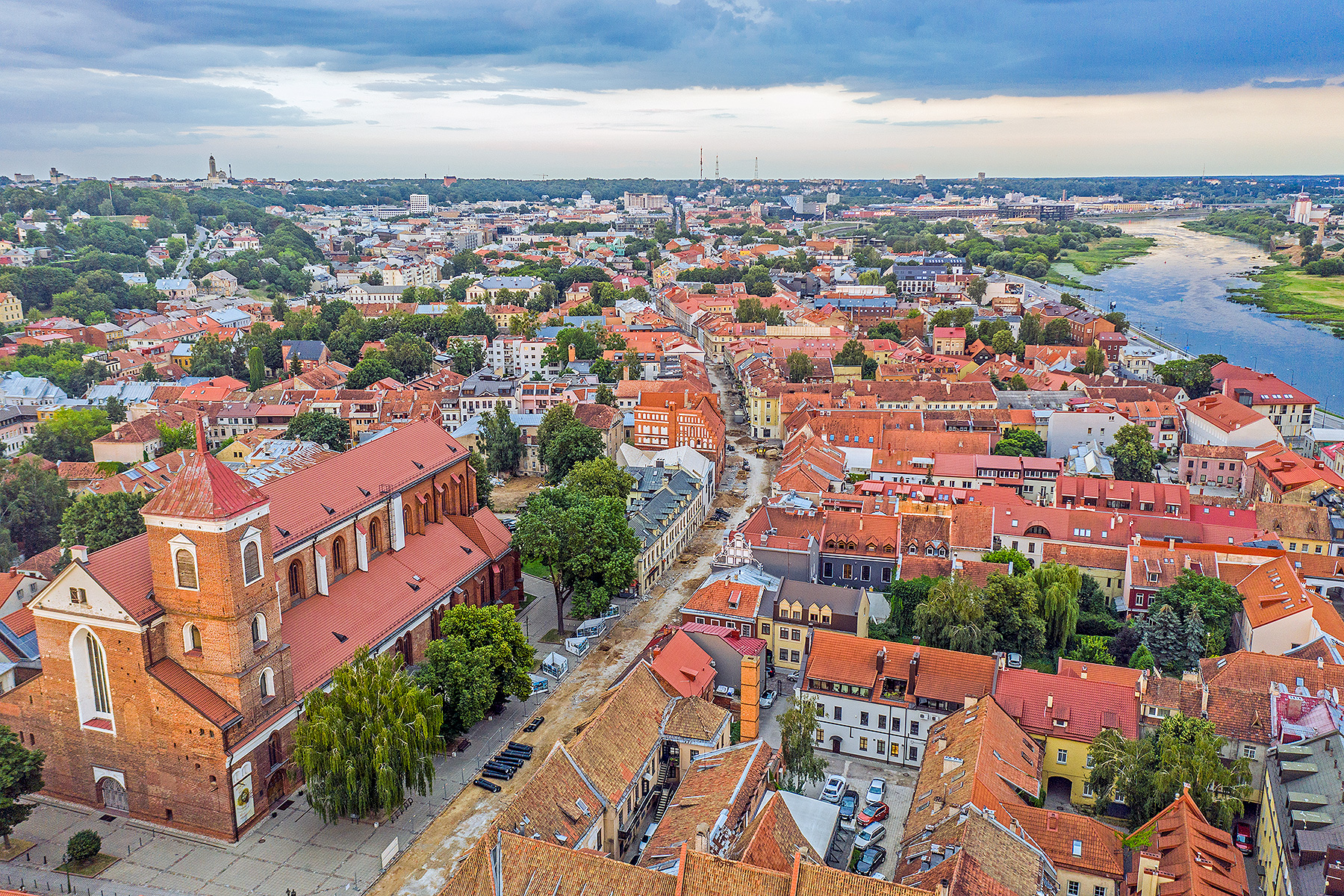
The city plan is mixed. The rectangular old town at the confluence of the Nemunas and the Neris rivers is rich in valuable buildings and their complexes. During the Gothic period, the Kaunas Castle (13th–16th centuries), Old Kaunas Ducal Palace (15th century), Church of Vytautas the Great (beginning of the 15th century; also known as the Church of the Assumption of the Blessed Virgin Mary), Church of Saint Nicholas (late 15th century), St. George's Church and the Bernardine Monastery (1472), Church of St. Gertrude (15th–16th centuries; also has Renaissance elements), Kaunas Cathedral Basilica (construction began in the 15th century; later was reconstructed and expanded), Kaunas Town Hall (construction began in 1542; later gained late Baroque and early Classicism forms), House of Perkūnas (late 15th century – early 16th century), residential houses in the Town Hall Square, Vilnius and Kurpių Streets were built.[150] The ensemble of the Church of the Holy Trinity and the Bernardine monastery (started in the late 16th century), the so-called Napoleonic House (16th century) has Gothic, Renaissance, Baroque and Mannerist architecture features.[150] The Renaissance remains of the Kaunas defensive fortifications have survived (second half of the 17th century).[150]


One of the most famous monuments of Baroque architecture is the ensemble of Pažaislis Church and Monastery (started in 1667, architects G. Frediani, C. Puttini, P. Puttini).[150] Other Baroque-style buildings: Kaunas Lutheran Holly Trinity Church (1683; in 1862 Romanticism style bell tower was built, its architect was J. Woller), Corpus Christi Church (1690, in 1866 was reconstructed to an Orthodox church gained Byzantine forms), Church of St. Francis Xavier (1720; towers were built in 1725); Baroque and Classicism elements: the ensemble of the Church of the Holy Cross (1690) and the Carmelite Monastery (1777), Siručiai Palace (18th century; also known as Maironis House, from 1936 is used as the Maironis Lithuanian Literature Museum).[150]
Forms of classicist architecture are typical in the Aukštoji Freda Manor (early 19th century), post station building complex (early 19th century; architect J. Poussier).[150] Notable buildings of the Historicism period in Kaunas are: Kaunas State Musical Theatre (1892; architect J. Golinevičius; was expanded in the 20th century), St. Michael the Archangel Church (Neo-Byzantine style; architect K. Limarenko), brick-style Saulės Gymnasium building (1913; engineer F. Malinovskis, later E. A. Frykas), Kaunas Fortress (1889).[150]


In the first half of the 20th century, when Kaunas became the temporary capital of Lithuania in 1919, the city was extensively modernized and thousands of new buildings were built. From 1918 to 1940 more than 12.000 construction permits were issued in Kaunas, which was an extremely rapid growth for a relatively small-scale city (90.000 inhabitants) that fundamentally changed the city's character.[151] The construction permits resulted in more than 10.000 buildings being built in the city and the area of Kaunas expanded 7,1 times during the interwar period.[58] Neoclassicism prevailed in the 3rd decade of the 20th century (Kaunas School of Arts, built in 1923, Bank of Lithuania building, built in 1928, Palace of Justice and the Parliament with Art Deco elements, built in 1930) and a search for the Lithuanian national style was typical (e.g. residential house of Ragutis factory, built in 1925[152]).[150] The styles of Classicism and Modernism intertwined in buildings built in the beginning of the 1930s (e.g. Faculty of Medicine at Vytautas Magnus University, built in 1933, now belongs to the Lithuanian University of Health Sciences,[153] Vytautas the Great War Museum and M. K. Čiurlionis National Art Museum, built in 1936[154]), while Modernism and national style intertwined in the Kaunas Central Post Office (architect F. Vizbaras), built in 1932,[155] Kaunas Garrison Officers' Club Building (architect S. Kudokas and others), built in 1937.[156][150]
The most notable Rationalism style buildings in Kaunas are: Christ's Resurrection Church (construction began in 1933, but it was converted into a radio factory from 1952 and so it was returned to the believers only in 1990 and was reconstructed in 2005), palaces of Pienocentras (architects Vytautas Landsbergis-Žemkalnis, K. Reisonas), Pažangos with Art Deco decoration elements (architect F. Vizbaras), Physical Culture (architect V. Landsbergis‑Žemkalnis, now belongs to the Lithuanian Sports University), Prekybos, pramonės ir amatų (1938, architect V. Landsbergis‑Žemkalnis), Taupomųjų kasų (1939; architects A. Funkas, B. Elsbergas, A. Lukošaitis; now is the primary building of Kaunas City Municipality);[150] Church of the Most Sacred Heart of Jesus (1938; architect A. Šalkauskis), Military Research Laboratory for the Lithuanian Ministry of National Defense (1938; architect V. Landsbergis‑Žemkalnis; now Faculty of Chemical Technology at Kaunas University of Technology),[157] Kaunas Clinics complex (1939; French architect U. Cassan), Kaunas Sports Hall (1939; engineer A. Rozenbliumas), Pasaka Cinema (1939), Romuva Cinema (1940), residential houses complex in V. Putvinskio Street (formed in 1928–1937).[150] In 2023, the UNESCO World Heritage Centre included the Kaunas modernist architecture into the List of World Heritage Sites.[15]
After World War II buildings of pseudoclassical forms were built (e.g. Kaunas railway station, built in 1953), complex engineering structures (Kaunas Hydroelectric Power Plant, built in 1960). From the 7th decade of the 20th century Modernism style buildings were further developed. New residential areas were built (e.g. Kalniečiai, completed in 1985), public buildings (e.g. Industrial Construction Design Institute, 1966,[158] House for Political Education (now part of Vytautas Magnus University), 1976),[159] shopping malls (e.g. Girstupis, 1975, Vitebskas, 1980, Kalniečių, 1986), shops (Viešnagė, 1982, Merkurijus, 1983), galleries (e.g. Kaunas Picture Gallery, 1978, Mykolas Žilinskas Art Gallery, 1989), educational institutions (e.g. Faculty of Light Industry at Kaunas University of Technology, 1983).[150]

In the late 20th century and early 21st century, buildings were built in Kaunas based on the projects of architects V. Adomavičius (e.g. Ąžuolynas Sports Center Complex, 2003), G. Jurevičius (e.g. Peugeot, Toyota, Lexus, Honda car showrooms), A. Kančas (e.g. Aleksotas Church of St. Casimir, 1997, company Kraft Foods Lietuva administrative and laboratory buildings complex, 2001, shopping and entertainment center Akropolis, 2007), A. Karalius (building materials salon Iris, 2002, block of flats Aušros namai, 2005), D. Paulauskienė (e.g. Catherine's Monastery, 2000) E. Miliūnas (e.g. Žalgiris Arena, 2001), G. Janulytė‑Bernotienė (e.g. Library and Health Sciences Information Center of Lithuanian University of Health Sciences, 2007, Center for Science Studies and Business of Kaunas University of Technology Santakos Valley, 2013), G. Balčytis (e.g. Kaunas Bus Station reconstruction, 2017), G. Natkevičius (e.g. Moxy Kaunas Center Hotel), A. Kaušpėdas, V. Klimavičius, D. Laurinaitienė.[150]
Education
[edit]Primary and secondary education
[edit]
At the time of paganism Lithuanian children were educated at home schools near manors, however following the Christianization of Lithuania in 1387 schools began to be established near churches and the first parochial school in Kaunas was established in 1473.[27][161] The ability to write was essential for Kaunas's merchants, craftsmen and employees of the offices of city self-government institutions work.[162]
In 1648, Kaunas Jesuit College (Latin: Collegium Caunense) was established and until 1702 its status as collegium inchoatum settled down, which meant a high school with a shortened philosophy course.[163] Therefore, in the 16th–18th centuries Kaunas had education with levels from primary to secondary school and the studies met demands not only of Kaunas but also of the surrounding area.[162]
On 14 October 1773, the Commission of National Education was created by the Sejm of the Polish–Lithuanian Commonwealth and the Grand Duke Stanisław August Poniatowski, which supervised universities, schools and was responsible for other educational matters in the Commonwealth. Because of its vast authority and autonomy, it is considered as the first Ministry of Education in European history and an important achievement of the Enlightenment in the Commonwealth.[164] At the time the education province of Lithuania was assigned to be managed by Vilnius University.[165]
Following the Third Partition of the Commonwealth, Kaunas and Lithuania proper became a part of the Russian Empire. In 1843, the Gymnasium of the Kražiai College, one of the most important centers of education and Jesuit science in Lithuania, was transferred from Kražiai to Kaunas, and currently it is named Kaunas Maironis University Gymnasium.[166][167] In 1848, Kaunas became capital of the Kovno Governorate which had 197 Lithuanian primary schools, however the education was greatly affected by the Lithuanian press ban (1865–1904) and Russification policies, especially after the 1863 January Uprising.[168] Nevertheless, Kovno Governorate was one of the leading governorates by population literacy – 55,3%, compared to the average of 19% of population (9 years or older) of the Russian Empire in 1897.[169][170]

Following the adoption of the Act of Independence of Lithuania in 1918, the Government of Lithuania was soon forced to retreat from Vilnius to Kaunas in January 1919, and from 1919 the Ministry of Education of Lithuania operated in Kaunas.[160] This resulted in an influx into Kaunas of Lithuanian intellectuals (e.g. Jonas Jablonskis, Juozas Tumas-Vaižgantas) and teachers who began educational activities.[172] During the interwar period the Lithuanian educational system was transformed based on Western countries examples and the Constituent Assembly of Lithuania adopted the Primary Schools Act which required 7-11-year-old children to attend free primary education for four years (the primary education was prolonged to six years in 1936) and many new schools for various ages pupils were established.[173] Moreover, children were taught patriotism from an early age, later children joined Ateitis and Lietuvos Skautija organizations, while school notebooks covers for pupils were printed with famous Lithuanian personalities portraits (e.g. Vytautas, Birutė, Jonas Basanavičius, etc.).[171] In 1922, the Kaunas Art School was established in Kaunas and it was the only public art school in interwar Lithuania.[174] In 1931, Jonas Laužikas established a special education school in Kaunas which was the first such type school in Lithuania and it still operates.[175] The overall improvement of education system during the interwar period resulted in 92% of literacy rate of the population in Lithuania in 1939 (mostly only part of the older age inhabitants were still illiterate).[170]
In January 1919, the War School of Kaunas was established as a military school for junior officers, while since 1921 the senior officers studied at the Higher Officers' Courses which in 1932 became the Higher Military School when a department of the General Staff was established, however both institutions were dissolved in 1940.[176]
The Soviet occupation of Lithuania in 1940 and in 1944 resulted in the Sovietization of Lithuanian education system which also affected education in Kaunas until 1990, while many students, teachers, and lecturers departed to the Western Europe or faced Soviet deportations.[177]
Following the Re-Establishment of the State of Lithuania in 1990, the Lithuanian education system was once again significantly reformed.[178] Currently, Kaunas has a network of state-funded schools: 6 primary schools, 17 progymnasiums, 20 gymnasiums, and 43 private pre-school and general education institutions.[179] The Kaunas University of Technology Gymnasium is one of the best ranked gymnasiums in Lithuania (2nd in 2024).[180] Most of pupils in Kaunas later studies in the universities or colleges as Lithuania is one of the world's leading countries in OECD's statistics of population with tertiary education (58.15% of 25–34-year-olds in 2022).[181]
Tertiary education
[edit]


Until the 20th century Kaunas had no tertiary education institutions as the Vilnius University (est. 1579) for centuries was the only university in the Grand Duchy of Lithuania, but it was closed in 1832 by the tsarist authorities and the Council of Lithuania desired to revive it in the 20th century.[183] However, during the conflict for the Vilnius Region the Lithuanians were unable to maintain control in the since 1918 declared capital Vilnius with the remnants of the Vilnius University which was firstly captured by the Bolsheviks in January 1919, then by the Polish forces in November 1920 and was eventually annexed by Poland in 1922 which left a newly restored Lithuania without any tertiary education institutions, therefore Lithuanian intellectuals sought to promptly establish it.[184]
Already in the fall of 1919 a memorandum of Lithuanian cultural workers to establish a tertiary education institution in Kaunas was handed to the Government of Lithuania, however it was rejected due to difficult political and financial situation.[184] Nevertheless, on 27 January 1920 the Lithuanian intellectuals who initiated the memorandum decided to establish (without the permission and financial support of the Government) the Higher Courses with six divisions which was the first higher education institution of a restored Lithuania.[184][185] On 16 February 1922, the Higher Courses were reorganized to the University of Lithuania and in March an autonomy was granted, while in 1930 it was renamed after Vytautas the Great commemorating his 500th death anniversary.[186] The status of the university diminished during the Soviet and Nazi periods and on 31 October 1950 it was even reorganized to two institutes.[186] In 1988, the issue of re-establishment of the university was raised, while in March 1989 the Re-establishment Council was elected and in April 1989 re-established Vytautas Magnus University.[186] Currently, VMU is among three percent of the best ranked universities worldwide per QS World University Rankings (741–750) and is the second largest Lithuanian university according to the number of enrolments.[187][188]
The Kaunas University of Technology also traces its origins to the interwar VMU as a part of it was reorganized in 1950 by the Soviets to the Kaunas Polytechnic Institute, however in 1990 its university status was restored.[189] Currently, the KTU is ranked 751-760 worldwide per QS World University Rankings and has over 1,000 academicians along with over 7,000 students.[189] Moreover, KTU is a member of the European Consortium of Innovative Universities.
The Lithuanian University of Health Sciences is yet another university which traces its origins to the interwar VMU as a part of it was reorganized in 1950 by the Soviets to the Kaunas Medical Institute, but in 1998 its university status was restored as the Kaunas Medical University which in 2010 was merged with the Lithuanian Veterinary Academy to form a single university and currently is the largest Lithuanian university in the field of biomedical sciences.[190]
The Lithuanian Sports University (est. in 1934, granted university status in 2012) is a unique tertiary education institution in Lithuania which specializes in the training of physical education, sports and wellness specialists of which it has already prepared 15,000.[191]
Some Lithuanian tertiary education institutions has its divisions in Kaunas: Vilnius University Kaunas Faculty, Mykolas Romeris University Faculty of Public Security, Vilnius Academy of Art Kaunas Faculty of Art.
Non-university tertiary education in Kaunas is provided by Kaunas College, Kaunas Technical College, Kolpingo College, Kaunas College of Forestry and Environmental Engineering, SMK College of Applied Sciences, St. Ignatius of Loyola College, V. A. Graičiūnas School of Management, Vilnius Cooperative College Kaunas Branch.[192]
The Santaka Valley is an integrated Science, Studies and Business Centre (Valley) which is one of the largest and most modern in Baltic states.[193]
The network of tertiary education institutions which attracts a high number of students (e.g. 40,000 in 2023) resulted in Kaunas being nicknamed the "student city" for decades and in 2024 Kaunas was included in the worldwide list of the QS Best Student Cities Rankings 2025.[21]
Libraries
[edit]Kaunas has numerous libraries. The most important is the Kaunas County Public Library. It was established as the Central Library of Lithuania in 1919. A part of its collection was transferred to Martynas Mažvydas National Library of Lithuania in 1963.[194] Now the Kaunas County Public Library holds more than 2.2 million volumes in its collection and functions as a depository library of the International Bank for Reconstruction and Development.[195]
Parks, leisure, and cemeteries
[edit]
The city of Kaunas has a number of parks and public open spaces. It devotes 7.3% of its total land acreage to parkland.[196] Ąžuolynas (literally, "Oak Grove") park is a main public park in the heart of Kaunas. It covers about 63 hectares and is the largest urban stand of mature oaks in Europe. To protect the unique lower landscape of Kaunas Reservoir, its natural ecosystem, and cultural heritage Kaunas Reservoir Regional Park was established in the eastern edge of Kaunas in 1992.
By the initiative of a prominent Lithuanian zoologist Tadas Ivanauskas and biologist Constantin von Regel the Botanical Garden was founded in 1923.[197] It serves not only as a recreational area for public, but also serves as a showcase for local plant life, and houses various research facilities.[197] In addition, Kaunas is home to Kaunas Zoo, the only state-operated zoo in all of Lithuania.[198]
Lithuania's premiere last resting place formally designated for graves of people influential in national history, politics, and arts is Petrašiūnai Cemetery in Kaunas. It is also the burial site of some signatories of the 1918 Act of Independence. There are four old Jewish cemeteries within city limits. Furthermore, since 1959 there is the Ramybė Park which is a public park located in the territory of the Kaunas City Old Cemetery, which was established in 1847.
On 23 September 2018, Pope Francis visited Santakos Park in Kaunas as part of a tour of the Baltic states.[199]
Economy
[edit]

The Kaunas Mint produced coins of the Grand Duchy of Lithuania from 17 October 1665 to 15 January 1667 during the reign of Grand Duke John II Casimir Vasa.[201] During the interwar period, the Kaunas Mint was reestablished in 1936 and produced coins of the Republic of Lithuania.[202]
Kaunas is a large center of industry, trade, and services in Lithuania. The most developed industries in Kaunas are amongst the food and beverage industries, textile and light industries, chemical industry, publishing and processing, pharmaceuticals, metal industry, wood processing and furniture industry. Recently information technology and electronics have become part of the business activities taking place in Kaunas. In addition, the city also has large construction industry which includes, but is not limited to commercial, housing and road construction.[203]
Primary foreign investors in Kaunas are companies from the Sweden, United States, Finland, Estonia, Denmark, and Russia.[204] Head offices of several major International and Lithuanian companies are located in Kaunas, including largest Generic Pharmaceuticals producer in Lithuania "Sanitas", producer of sportswear AB "Audimas", one of the largest construction companies "YIT Kausta", JSC "Senukai", largest producer in Lithuania of strong alcoholic drinks JSC "Stumbras", Finnish capital brewery JSC "Ragutis", JSC "Fazer Gardesis", JSC "Stora Enso Packaging",[205] producer of pharmaceuticals, and the only producer of homoeopathic medicines in Lithuania JSC "Aconitum".[206] Its geographic location causes Kaunas to be considered one of the largest logistics centres in Lithuania. The largest wholesale, distribution and logistics company in Lithuania and Latvia JSC "Sanitex",[207] as well as a subsidiary of material handling and logistics company Dematic in the Baltics[208] have been operated in Kaunas. Currently, Kaunas Public Logistics Centre is being built by the demand of national state-owned railway company Lithuanian Railways.[209] The "Margasmiltė" company currently has been working on a project that concerns exploitation of Pagiriai anhydrite deposit. The project includes mining of anhydrite, a mine with underground warehouses, building the overground transport terminal, as well as an administrative building. The Pagiriai anhydrite deposit is located 10.5 km (6.5 mi) south from the downtown of Kaunas, at a 2.2 km (1.4 mi) distance to the southwest from the Garliava town. The resources of thoroughly explored anhydrite in the Pagiriai deposit amount to 81.5 million tons.[210]
The Lithuanian Central Credit Union—national cooperative federation for credit unions established in 2001, is located in Kaunas. At present the Lithuanian Central Credit Union has 61 members.[211]

There are also some innovative companies located in Kaunas, such as leading wholesaler of computer components, data storage media "ACME group", internet and TV provider, communications JSC "Mikrovisata group", developer and producer original products for TV and embedded technologies JSC "Selteka". Joint Lithuanian-German company "Net Frequency", based in Kaunas, is a multimedia and technology service provider. Kaunas is also home to R&D department of Dassault Systèmes producing world-leading modeling tools software CATIA. A LED lighting assembly plant was opened in Kaunas by South Korean company LK Technology in February 2011.[212] JSC "Baltic car equipment" is one of the leaders in Baltic countries, in the field of manufacturing electronic equipment for automobiles. It also specialises in development of new telemetry, data base creation, mobile payment projects.[213] Kaunas Free Economic Zone[214] established in 1996 has also attracted some investors from abroad, including the development of the new 200 MW Cogeneration Power Plant project, proposed by the Finnish capital company Fortum Heat Lithuania.[215] Before its disestablishment, Air Lithuania had its head office in Kaunas.[216] Kaunas Hydroelectric Power Plant is the largest one in Lithuania.
Some notable changes are under construction and in the stage of disputes.[citation needed] The construction of a new landmark of Kaunas—the Žalgiris Arena—began in the autumn of 2008.[217] It was completed in August 2011. Currently discussions are underway about the further development of the Vilijampolė district on the right bank of the Neris River and the Nemunas River, near their confluence.[218]
In October 2017, an automotive parts and technologies manufacturer Continental AG decided to invest over 95 million euros to build a new factory in Kaunas, which is the largest direct investment from a foreign country.[219]
Kaunas is also known for its programmers, as they developed a software for the American billionaire Robert Pera's Ubiquiti Networks product NanoStation, therefore the company established a R&D division Ubiquiti Networks Europe in Kaunas.[220]
Demographics
[edit]| Year | Pop. | ±% |
|---|---|---|
| 1897 | 70,920 | — |
| 1923 | 92,446 | +30.4% |
| 1959 | 214,348 | +131.9% |
| 1970 | 305,116 | +42.3% |
| 1979 | 370,419 | +21.4% |
| 1989 | 422,931 | +14.2% |
| 2001 | 378,943 | −10.4% |
| 2011 | 315,993 | −16.6% |
| 2021 | 298,753 | −5.5% |
| Source: pop-stat.mashke.org[221] | ||
Today, with more than 94% of its citizens being ethnic Lithuanians, Kaunas is one of the most Lithuanian cities in the country.
Ethnic composition As of the last census in 2021, out of a total population of 298,753:[222]
- Lithuanians – 94.4%
- Russians – 2.9%
- Ukrainians – 0.3%
- Poles – 0.4%
- Belarusians – 0.2%
- Other – 1.4%
Ethnic composition in 2011, out of a total of 315,933:[223]
- Lithuanians – 93.6%
- Russians – 3.8%
- Ukrainians – 0.4%
- Poles – 0.4%
- Belarusians – 0.2%
- Other – 1.6%
According to the official census of 1923, there were 92,446 inhabitants in Kaunas:[224]
- Lithuanians – 58.9% (54,520)
- Jews – 27.1% (25,044)
- Poles – 4.5% (4,193)
- Germans – 3.5% (3,269)
- Russians – 3.2% (2,914)
- Belarusians – 0.2% (171)
- Latvians – 0.1% (123)
- Other – 2.4% (2,212)
1897 Russian census revealed the following linguistic composition in the city (by mother tongue, out of 70,920):[227]
- Yiddish 25,052 – 35%
- Russian language 18,308 – 26%
- Polish language 16,112 – 23%
- Lithuanian language 4,092 – 6%
- German language 3,340 – 5%
- Tatar 1,084 – 2%
- Other 2932 – 4%
Municipality council
[edit]
Kaunas city municipality council is the governing body of the Kaunas city municipality and is responsible for municipality laws.[228][229] The council is composed of 41 members (40 councillors and a mayor) all directly elected for four-year terms.[230]
The council is the member of the Association of Local Authorities in Lithuania.[231]
Mayors
[edit]- 1995–1997 – Vladas Katkevičius (Conservative)
- 1997 – Alfonsas Andriuškevičius (Conservative)
- 1997–2000 – Henrikas Tamulis (Conservative)
- 2000 – Vytautas Šustauskas (Liberty Union)
- 2000 – Gediminas Budnikas (Liberty Union)
- 2001–2002 – Erikas Tamašauskas (Liberal)
- 2002–2003 – Giedrius Donatas Ašmys (Social Democrat)
- 2003–2007 – Arvydas Garbaravičius (Liberal-Centrist)
- 2007–2011 – Andrius Kupčinskas (Conservative)
- 2011 – Rimantas Mikaitis (Liberal)
- 2011–2015 Andrius Kupčinskas (Conservative)
- since 2015 – Visvaldas Matijošaitis (Vieningas Kaunas)[232]
Transportation
[edit]Airports
[edit]
Kaunas International Airport (KUN) is the second-busiest airport in Lithuania and the fourth-busiest airport in the Baltic states. In 2016, it handled 740,448 passengers (in addition to 2,488 tons of cargo), down from the peak of 872,618 passengers in 2011. Irish low-cost airline Ryanair announced Kaunas Airport as their 40th base and first in Central Europe in February 2010.[233] The smaller S. Darius and S. Girėnas Airport, established in 1915, is located about three kilometres (1.9 mi) south of the city centre. It is one of the oldest still functioning airports in Europe used for tourism and air sports purposes and now hosts the Lithuanian Aviation Museum.
Bus stations
[edit]
Kaunas bus station went through a major renovation and reopened in 2017.[234][235] The bus station services domestic and international bus lines. After reconstruction, the bus station has multiple shops and cafes. The total indoor floor area is 13 thousand m2. More than half of the total floor area is underground, mostly for vehicle and bicycle parking. It is Lithuania's largest and busiest bus station with more than 20 bus gates.[236][237][238]
Highways
[edit]Kaunas is served by a number of major motorways. European route E67 is a highway running from Prague in the Czech Republic to Helsinki in Finland by way of Poland, Kaunas, Riga (Latvia), and Tallinn (Estonia). It is known as the Via Baltica between Warsaw and Tallinn, a distance of 670 km (416 mi). It is the most important road connection between the Baltic states. Kaunas also is linked to Vilnius to its east and Klaipėda, on the Baltic Sea, via the A1 motorway and Daugavpils (Latvia), via E262(A6) highway.
Bridges
[edit]
The construction of the Kaunas Railway Tunnel and Railway Bridge across the Nemunas river helped move goods from the eastern part of Russian Empire west to the German Empire and Kaunas grew rapidly in the second part of the 19th century. The oldest part of Kaunas was connected with Žaliakalnis neighbourhood in 1889. The city increased once more when it was connected by bridges with Aleksotas and Vilijampolė districts in the 1920s.[2]
Since Kaunas is located at the confluence of two rivers, there were 34 bridges and viaducts built in the city at the end of 2007, including:
- Vytautas the Great Bridge, connecting Old Town with Aleksotas across the Nemunas
- M. K. Čiurlionis Bridge, an automotive bridge across the Nemunas
- Lampėdžiai Bridge across the Nemunas that serves as western bypass of Kaunas
- Petras Vileišis Bridge, connecting Old Town with Vilijampolė across the Neris River
- Varniai Bridge, connecting Žaliakalnis with Vilijampolė across the Neris River
- The Green railway bridge, built in 1862
Railways
[edit]

Kaunas is an important railway hub in Lithuania. First railway connection passing through Kaunas was constructed in 1859–1861 and opened in 1862.[239] It consisted of Kaunas Railway Tunnel and the Railway Bridge across the Nemunas river. Kaunas Railway Station is an important hub serving direct passenger connections to Vilnius and Warsaw as well as being a transit point of Pan-European corridors I and IX. Some trains run from Vilnius to Šeštokai, and, Poland, through Kaunas. International route connecting Kaliningrad, Russia and Kharkiv, Ukraine, also crosses Kaunas. The first phase of the Standard gauge Rail Baltica railway section from Šeštokai to Kaunas was completed in 2015.
Hydrofoil
[edit]There used to be a hydrofoil route serving the Port of Nida through Nemunas and across the Curonian Lagoon. It has been repeatedly discontinued and reopened, so the most current status is unclear. The company still exists and has its boats in working condition.[240][better source needed]
Public transportation
[edit]
The public transportation system is managed by Kauno viešasis transportas (KVT).[241] There are 14 trolleybus routes, 43 bus routes.[242] In 2007 new electronic monthly tickets began to be introduced for public transport in Kaunas. The monthly E-ticket cards may be bought once and might be credited with an appropriate amount of money in various ways including the Internet.[243] Previous paper monthly tickets were in use until August 2009.[244] Kaunas is also one of the major river ports in the Baltic States and has two piers designated for tourism purposes and located on the banks of Nemunas river and Kaunas Reservoir—the largest Lithuanian artificial lake, created in 1959 by damming the Nemunas near Kaunas and Rumšiškės.[245]
In 2015, Kauno autobusai bought four Van Hool AGG300 to serve the mostly populated 37th route. These are the longest buses used in the Baltic states.[246] The bus station in Kaunas underwent reconstruction for six months and reopened on 23 January 2017. It is the largest and most modern bus station in Lithuania.[247] In 2017, Kauno autobusai began planning to cardinally upgrade the trolleybuses and buses park till the end of 2019.[248] The new Mercedes-Benz minibuses were introduced on 2 September 2019.[249] The first new trolleybuses Škoda 26Tr Solaris were publicly introduced on 30 September 2019.[250] In November 2019, Kauno autobusai signed a contract for 100 new model units of MAN Lion's City 12 hybrid electric buses, which replaced over half of city's old buses.[251]
Kaunas public transport has a mobile app Žiogas (English: Grasshopper) which allow to purchase and activate digital tickets using a smartphone.[252] After reaching the E-ticket card's monthly fee (28 Eur), the remaining trips are free of charge until the end of the month.[252]
Kaunas has two funiculars: Žaliakalnis Funicular and Aleksotas Funicular. Both are from the 1930s. Aleksotas Funicular works every day from 7am to 7pm (a break from 12pm to 1pm). Žaliakalnis Funicular works from Monday to Friday from 8am to 5pm.[253]
Sports
[edit]


Sports in Kaunas have a long and distinguished history. Team and individual sports like football, baseball, ice hockey, rugby, track and field, orienteering are all considered popular in the city, although basketball is considered the most popular. The city is home to a few historic clubs such as: LFLS Kaunas football club (est. 1920), LFLS Kaunas baseball club (est. 1922), Granitas Kaunas (handball club, EHF Cup champions in 1987), Žalgiris basketball club (est. 1944, EuroLeague champions in 1999).
Kaunas is home to some historic venues such as: the main stadium of the city—Darius and Girėnas Stadium (total capacity after renovation 15,315), which is also the home stadium for soccer clubs from Kaunas and the Lithuanian national football team established in 1923, and Kaunas Sports Hall, completed in 1939 for the Third European Basketball Championship. Darius and Girėnas Stadium is also used as the only large athletics stadium in Lithuania. On 16 October 2022 the Darius and Girėnas Stadium was reopened as a UEFA 4th class stadium following a reconstruction for 43 million euros.[254]
Ice hockey was first played in Lithuania in 1922. The first Lithuanian ice hockey championship composed of four teams (LFLS, KSK, Kovas, and Macabi) was held in Kaunas, in 1926.[255]
The Kaunas Marathon is an international marathon with thousands of Lithuanian and foreign participants every year.[256]
In July 1938 Kaunas, together with Klaipėda (where sailing and rowing competitions were held), hosted the Lithuanian National Olympiad that gathered the Lithuanian athletes from all around the world.[257]
The university status Lithuanian Academy of Physical Education, founded during the interwar period, is the only state-supported institution of tertiary physical education in Lithuania.[258]
The city is also the birthplace or childhood home of many of the country's top basketball stars, among them Arvydas Sabonis, Šarūnas Marčiulionis, Zydrunas Ilgauskas, Linas Kleiza, Donatas Motiejūnas and Šarūnas Jasikevičius. Kaunas is also the home to one of the most successful men's basketball clubs in Europe - BC Žalgiris.
Kaunas is home to some historic venues such as: the main stadium of the city—Darius and Girėnas Stadium (total capacity after renovation 15,315), which is also the home stadium for the Žalgiris Kaunas football team (as the recently formed branch of the bigger basketball club - BC Žalgiris) and Lithuanian national football team established in 1923 and the Kaunas Sports Hall, opened in 1923, which is considered one of the legendary basketball courts in Europe (that hosted some of the first European basketball tournaments).
The city is home to handball club HC Granitas-Karys that won the EHF Cup in 1987.
The first golf club "Elnias" in Lithuania was opened in Kaunas in 2000.
Nemuno žiedas is Lithuania's only motor racing circuit, situated in Kačerginė, a small town near Kaunas.
A yacht club operates in the Kaunas Reservoir Regional Park.
A round of the UIM F2 World Championship is held by the site of the old Kaunas Lagoon pier every year. The powerboat race is organised by Edgaras Riabko who also competes in the event.[259]
Kaunas was one of the host cities for the 2021 FIFA Futsal World Cup.
During 10–14 January 2024, Kaunas hosted the 2024 European Figure Skating Championships in the Žalgiris Arena.[260]
Annual events
[edit]

Kaunas is best known for the Kaunas Jazz Festival, International Operetta Festival, Photo Art Festival "Kaunas photo" or Pažaislis Music Festival, which usually run from early June until late August each year.[261][262][263] The open-air concerts of the historical 49-bell Kaunas Carillon are held on weekends. Probably the longest established festival is the International Modern Dance Festival, which first ran in 1989.[264]
- Kaziukas Fair Kaunas fork (beginning of March)
- International open-air "Kaunas Jazz Festival" (April–May)
- Day of Kaunas city (middle of May)
- Pažaislis music festival (June–August)
- Traditional folk music competition "Play, Jurgelis" (November)
- Christmas tree lighting (end of November)
Significant depictions in popular culture
[edit]- Kaunas is one of the starting towns of Lithuania in the turn-based strategy game Medieval II: Total War: Kingdoms.[265]
- Some scenes of HBO's miniseries Chernobyl were filmed in Kaunas.[266]
- HBO's miniseries Catherine the Great, featuring Helen Mirren, was also filmed in the Pažaislis Monastery in Kaunas.[267]
- The 2018 historical drama film Ashes in the Snow is partly based in 1941 in Kaunas.[268]
Notable people
[edit]Twin towns – sister cities
[edit]
Białystok, Poland
Brescia, Italy
Brno, Czech Republic
Cava de' Tirreni, Italy
Ferrara, Italy
Grenoble, France
Hiratsuka, Japan
Kharkiv, Ukraine
Linköping, Sweden
Lippe (district), Germany
Los Angeles, United States
Lutsk, Ukraine
Lviv Oblast, Ukraine
Myślibórz, Poland
Odense, Denmark
Rende, Italy
Riga, Latvia
Rishon LeZion, Israel
San Martín, Argentina
Tampere, Finland
Tartu, Estonia
Toruń, Poland
Växjö, Sweden
Vestfold, Norway
Vestland, Norway
Wrocław, Poland
Xiamen, China
Dunavarsány, Hungary
Yaotsu, Japan
The city was previously twinned with:[270]
Kaliningrad, Russia
Saint Petersburg, Russia
Honours
[edit]A minor planet 73059 Kaunas, discovered by Lithuanian astronomers Kazimieras Černis and Justas Zdanavičius, in 2002, is named after the city of Kaunas.[271]
See also
[edit]- Das Vort, defunct newspaper
References
[edit]- ^ a b c "Kodėl Kaunas buvo vadinamas mažuoju Paryžiumi?". lrytas.lt (in Lithuanian). Retrieved 3 January 2013.
- ^ a b Raffa, Guy P. (2009). The Complete Danteworlds: A Reader's Guide to the Divine Comedy. University of Chicago Press. ISBN 978-0226702872.
- ^ "Kaunas city municipality – Mayor's office". Kaunas city municipality. Retrieved 7 June 2018.
- ^ "Kaunas (City Municipality, Lithuania)". Population Statistics, Charts, Map and Location. 1 January 2024. Retrieved 8 August 2025.
- ^ a b "Kaunas metropolitan region". GEODATALAND. 9 December 2023. Retrieved 8 August 2025.
- ^ "Gross domestic product by region in 2023 M." osp.stat.gov.lt.
- ^ "Kaunas patvirtino rekordinį biudžetą: investicijos į švietimą, sporto, laisvalaikio erdves ir susisiekimą".
- ^ "Modernist Kaunas: Architecture of Optimism, 1919–1939". UNESCO World Heritage Centre. Retrieved 18 September 2023.
- ^ a b "Kaunas". Visuotinė lietuvių enciklopedija (in Lithuanian). Retrieved 5 October 2024.
- ^ a b "Kaunas of 1919–1940, Lithuania – Creative Europe – European Commission". EC.Europa.eu. Retrieved 25 October 2017.
- ^ a b "Kaunas Was Awarded a European Heritage Label". Visit.Kaunas.lt. Archived from the original on 11 March 2018. Retrieved 8 November 2017.
- ^ Bryant, Jon (8 September 2016). "10 of the best European cities for art deco design". The Guardian. Retrieved 8 September 2016.
- ^ "Art Deco Kaunas". ArtDecoKaunas.lt. Retrieved 4 November 2017.
- ^ "Kaunas – Cities of Design Network". DesignCities.net. Retrieved 4 November 2017.
- ^ a b c "Kauno tarpukario architektūra įrašyta į UNESCO Pasaulio paveldo sąrašą". Lithuanian National Radio and Television (in Lithuanian). 18 September 2023. Retrieved 18 September 2023.
- ^ "Kaunas European Capital of Culture 2022". Kaunas2022.eu. 21 January 2016. Archived from the original on 8 December 2017. Retrieved 7 December 2017.
- ^ "European Capitals of Culture". Retrieved 8 May 2022.
- ^ "Population on 1 January by age groups and sex - functional urban areas". Eurostat. Retrieved 15 June 2019.
- ^ "Gyventojų skaičius » Kauno teritorinė ligonių kasa". www.ktlk.lt.
- ^ "Kauno teritorinė ligonių kasa - Prisirašiusių gyventojų skaičius" (in Lithuanian). Retrieved 9 December 2022.
- ^ a b "Kaunas ranked among the best student cities in the world". KTU.lt. Retrieved 17 August 2024.
- ^ a b c d e "Kaunas Lietuva". Lithuaniainworld.lt (in Lithuanian). Retrieved 12 October 2024.
- ^ http://www.tnpa.by/#!/FileText/328852/231296
- ^ Ivinskis, Zenonas (1953–1966). "Palemonas". Lietuvių enciklopedija. Vol. 21. Boston: Lietuvių enciklopedijos leidykla. pp. 400–401. LCCN 55020366.
- ^ "Palemonas.info; Kauno mikrorajonas – Palemonas" (in Lithuanian). Archived from the original on 24 August 2011. Retrieved 13 April 2011.
- ^ Bucevičiūtė, Laima (5 January 2018). "Kaip LDK laikotarpiu atsirado ir keitėsi Kauno herbas?". Kauno diena (in Lithuanian). Retrieved 4 March 2023.
- ^ a b c d e f g h i j k l m n o p Varsackytė, Rasa; Balkus, Mindaugas. "Kaunas: Dates and Facts. Overview of Kaunas History". Kaunas County Public Library. Retrieved 29 October 2010.
- ^ "Tūkstantmečio metų palydose bus pristatytas didysis Kauno herbas". Delfi.
- ^ "Kauno miesto savivaldybė". Archived from the original on 18 December 2012. Retrieved 23 June 2004.
- ^ Oniščik, Marija (20 January 2021). "Kaunas: maža didelio miesto istorija (I)". Nemunas.press (in Lithuanian). Retrieved 12 January 2023.
- ^ a b c "Miesto istorija". Kaunas.lt (in Lithuanian). Archived from the original on 4 March 2021. Retrieved 12 January 2023.
- ^ a b c Baranauskas, Tomas (28 May 2021). "Pažinkime Lietuvos kunigaikščius: Vaidotas". Msavaite.lt (in Lithuanian). Retrieved 12 January 2023.
- ^ "Kauno pilis: istorija" (in Lithuanian). Archived from the original on 25 October 2009.
- ^ a b "Places to Visit: "Kaunas Castle"". Archived from the original on 28 September 2011.
- ^ Šapoka, Adolfas (29 June 2017). "Gediminaičiai: Algirdo ir Kęstučio laikai". Istorijai.lt (in Lithuanian). Retrieved 12 January 2023.
- ^ Simas Sužiedėlis, ed. (1970–1978). "Vaidotas". Encyclopedia Lituanica. Vol. VI. Boston: Juozas Kapočius. p. 21. LCCN 74-114275.
- ^ a b "Vytautas the Great Church (Church of the Assumption of the Blessed Virgin Mary)". Visit.Kaunas.lt. Retrieved 13 January 2023.
- ^ a b c Karpinskas, Giedrius. "Naujasis Kaunas ir Gotesverderis". Virtualus.KaunoMuziejus.lt (in Lithuanian). Retrieved 12 January 2023.
- ^ a b c d Rūkas, Eugenijus (2013). "Pirmoji Kauno pilis ir kovos su Vokiečių ordinu Kauno apylinkėse iki XV a. pradžios" (PDF). Kauno istorijos metraštis (in Lithuanian). 13: 229–230. ISSN 2335-8734.
- ^ a b c d e f Jankevičienė, Algė; Kiaupa, Zigmantas. "Kauno pilis". Visuotinė lietuvių enciklopedija (in Lithuanian). Retrieved 12 January 2023.
- ^ Baranauskas, Tomas. "Gotteswerder". Vle.lt (in Lithuanian). Retrieved 5 February 2023.
- ^ Jurginis, J.; Šidlauskas, A. "Dvi Žiliberto de Lanua kelionės į Lietuvą" (PDF). Ktug.lt (in Lithuanian). p. 2. Retrieved 12 January 2023.
- ^ Laužikas, Rimvydas (15 October 2004). "Trakų vaivadija". Aruodai (in Lithuanian). Lithuanian Institute of History. Retrieved 22 April 2011.
- ^ "L.Karalius: "Europos pirkliai puikiai žinojo Kauną LDK laikais"". LZinios.lt. Archived from the original on 5 December 2017. Retrieved 29 January 2014.
- ^ Mills, Jennifer (May 1998). "The Hanseatic League in the Eastern Baltic". Encyclopedia of Baltic History (group research project). University of Washington. Archived from the original on 29 June 2011.
- ^ "1557 11 19 mirė Lenkijos karalienė, Lietuvos dk Bona Sforca d'Aragona". DELFI, Lithuanian Institute of History (in Lithuanian). Retrieved 4 March 2023.
- ^ Bertašius, Mindaugas. "Kauno miesto gynybinė siena". Kaunosenamiestis.autc.lt (in Lithuanian). Retrieved 5 February 2023.
- ^ Kauno tvirtovės istorija (in Lithuanian), Gintaras Česonis, 2004, archived from the original on 10 May 2011, retrieved 20 March 2011
- ^ "Lietuvos Energija > About us > Profile > Development of Lithuanian energy sector". Archived from the original on 3 February 2011. Retrieved 20 March 2011. AB Lietuvos Energija. Development of Lithuanian Energy Sector.
- ^ "Žemaičių vyskupystės istorinis ir dailės palikimas". www.limis.lt (in Lithuanian). Archived from the original on 19 August 2018. Retrieved 2 November 2017.
- ^ "Kauno kunigų seminarija – katalikybės ir lietuvybės židinys". www.xxiamzius.lt. Archived from the original on 28 April 2019. Retrieved 26 October 2017.
- ^ Robert Blobaum, Feliks Dzierzynski, The SDKPIL: a study of the origins of Polish Communism, p. 42
- ^ Robson, Stuart (2007). The First World War (1 ed.). Harrow, England: Pearson Longman. p. 25. ISBN 978-1-4058-2471-2 – via Archive Foundation.
- ^ Eidintas, Alfonsas; Vytautas Žalys; Alfred Erich Senn (1999). Ed. Edvardas Tuskenis (ed.). Lithuania in European Politics: The Years of the First Republic, 1918–1940 (Paperback ed.). New York: St. Martin's Press. pp. 67–70. ISBN 0-312-22458-3.
- ^ Senn, Alfred Erich (2007). Lithuania 1940: Revolution from Above. On the Boundary of Two Worlds: Identity, Freedom, and Moral Imagination in the Baltics. Rodopi. p. 10. ISBN 978-90-420-2225-6.
- ^ Vardys, Vytas Stanley; Judith B. Sedaitis (1997). Lithuania: The Rebel Nation. Westview Series on the Post-Soviet Republics. WestviewPress. pp. 34–36. ISBN 0-8133-1839-4.
- ^ Aras, Lukšas. "Nevykę "vilkų" žaidimai". LZinios.lt. Archived from the original on 23 November 2018. Retrieved 16 August 2013.
- ^ a b c "Kaunas – laikinoji sostinė". IstorinePrezidentura.lt (in Lithuanian). Retrieved 12 January 2023.
- ^ Lapinskas, Anatolijus. "Lietuva tarpukariu nebuvo atsilikėlė". DELFI. Retrieved 29 September 2013.
- ^ Dobkevičius, Kazimieras (6 February 2002). "Klojęs Lietuvos valstybės pamatus". XXI amžius (in Lithuanian). 10 (1017). Archived from the original on 28 September 2011. Retrieved 20 July 2011.
- ^ "Karo Mokyklos Kūrimasis 1919 M." Partizanai.org (in Lithuanian). Retrieved 27 November 2017.
- ^ a b "Šarvuota Lietuva: kiek iš tikro mūsų kariuomenė turėjo tankų? :: Istorija ir archeologija :: www.technologijos.lt". www.technologijos.lt (in Lithuanian). Retrieved 21 February 2017.
- ^ "Paskutinįjį Lietuvos karo aviacijos viršininką prisimenant". www.xxiamzius.lt. Archived from the original on 19 July 2010. Retrieved 27 November 2017.
- ^ a b c d "Kovno". Ushmm.org. Retrieved 5 May 2009.
- ^ "This Month in Holocaust History - Related Resources". Archived from the original on 17 April 2014. Retrieved 12 October 2014.
- ^ Liekis, Šarūnas (2010). 1939: The Year that Changed Everything in Lithuania's History. New York: Rodopi. pp. 119–122. ISBN 978-9042027626.
- ^ Gureckas, Algimantas. "Ar Lietuva galėjo išsigelbėti 1939–1940 metais?". lrytas.lt (in Lithuanian). Retrieved 30 June 2010.
- ^ Urbšys, Juozas (Summer 1989). "Lithuania and the Soviet Union 1939–1940: the Fateful Year". Lituanus. 2 (34). ISSN 0024-5089. Archived from the original on 26 September 2019. Retrieved 10 December 2017.
- ^ Łossowski, Piotr (2002). "The Lithuanian–Soviet Treaty of October 1939". Acta Poloniae Historica (86): 98–101. ISSN 0001-6829.
- ^ Cibulskis, Gediminas. "Lietuvos sostinės atgavimo kaina". 15min.lt. Retrieved 28 October 2009.
- ^ "Šimtmečio belaukiant: Reikšmingiausi Pirmosios Lietuvos Respublikos (1918–1940 m.) įvykiai". IstorinePrezidentura.lt. Archived from the original on 1 September 2019. Retrieved 3 November 2017.
- ^ Musteikis, Kazys (1989). Prisiminimų fragmentai (PDF). Vilnius: Mintis. pp. 56–57. Retrieved 10 December 2017.
- ^ Juozevičiūtė, Vilma; Trimonienė, Rūta. "Aleksandras Barauskas" (PDF). Genocid.lt. Retrieved 30 January 2018.
- ^ a b Ašmenskas, Viktoras. "Didžiosios tautos aukos". Partizanai.org. Retrieved 3 November 2017.
- ^ Senn, Alfred Erich (2007). Lithuania 1940: Revolution from Above. Rodopi. p. 99. ISBN 978-90-420-2225-6.
- ^ Šeinius, Ignas. "Kaip raudonarmiečiai įžengė į Lietuvą: apverktinai atrodę kariai ir lygiame kelyje gedę tankai". DELFI. Retrieved 10 December 2017.
- ^ Antanas Račis, ed. (2008). "Reguliariosios pajėgos". Lietuva (in Lithuanian). Vol. I. Science and Encyclopaedia Publishing Institute. p. 335. ISBN 978-5-420-01639-8.
- ^ a b Knezys, Stasys. "Lietuvos kariuomenės naikinimas (1940 m. birželio 15 d.–1941 m.)". Genocid.lt. Retrieved 14 December 2017.
- ^ a b Starinskas, Kęstutis. "Lemtingi metai generolo Raštikio dienoraščiuose". LZinios.lt. Archived from the original on 1 August 2018. Retrieved 16 September 2006.
- ^ I. Žiemele. Baltic Yearbook of International Law, 2001. 2002, Vol. 1 p. 10
- ^ K. Dawisha, B. Parrott. The Consolidation of Democracy in East-Central Europe. 1997 p. 293.
- ^ a b "Lietuvos okupacija (1940 m. birželio 15 d.)". LRS.lt. Archived from the original on 22 January 2021. Retrieved 4 December 2017.
- ^ Blaževičius, Kazys. "Už laisvę". www.xxiamzius.lt. Archived from the original on 30 June 2019. Retrieved 10 January 2018.
- ^ a b c d "Kuo reikšmingas 1941 m. birželio 22–28 d. sukilimas?". LLKS.lt. Archived from the original on 21 June 2019. Retrieved 20 June 2014.
- ^ "1941 metų Joninės. Šlovės savaitė: kaip lietuviai laimėjo hibridinį karą prieš Kremlių « Lietuvos Žurnalistų draugija". Lietuvos žurnalistų draugija. Retrieved 26 June 2016.
- ^ Aleksandravičius, Arnoldas. "1941 metų Joninės. Šlovės savaitė: kaip lietuviai laimėjo hibridinį karą prieš Kremlių". Lietuvos kariuomenės kūrėjų savanorių sąjunga (in Lithuanian). Retrieved 26 June 2016.
- ^ Brandišauskas, Valentinas (2002). "1941 m. sukilimas ir nepriklausomybės viltys". Gimtoji istorija. Nuo 7 iki 12 klasės (in Lithuanian). Vilnius: Elektroninės leidybos namai. ISBN 9986-9216-9-4. Archived from the original on 3 March 2008. Retrieved 4 July 2009.
- ^ "The History of Lithuania's National Anthem". DRAUGAS NEWS. Retrieved 15 September 2015.
- ^ a b c Sužiedėlis, Saulius. "The Burden of 1941 Archived 15 September 2012 at archive.today". Lituanus Lithuanian Quarterly Journal of Arts and Sciences, Volume 47, No. 4 (Winter 2001).
- ^ Gerutis, Albertas, ed. (1984). Lithuania: 700 Years. translated by Algirdas Budreckis (6th ed.). New York: Manyland Books. pp. 325–326. ISBN 0-87141-028-1. LCCN 75-80057.
- ^ Bubnys, Arūnas (1998). Vokiečių okupuota Lietuva (1941–1944) (in Lithuanian). Vilnius: Lietuvos tautinis kultūros fondas. p. 40. ISBN 9986-757-12-6.
- ^ Misiunas, Romuald J.; Rein Taagepera (1993). The Baltic States: Years of Dependence 1940–1990 (expanded ed.). University of California Press. p. 47. ISBN 0-520-08228-1.
- ^ Bubnys, Arūnas (1998). Vokiečių okupuota Lietuva (1941–1944) (in Lithuanian). Vilnius: Lietuvos tautinis kultūros fondas. p. 38. ISBN 9986-757-12-6.
- ^ Valiušaitis, Vidmantas. "Kodėl J. Brazaičio perlaidojimo ceremonija sukėlė tiek aistrų?". DELFI. Retrieved 25 May 2012.
- ^ Škirpa, Kazys (1973). Sukilimas Lietuvos suverenumui atstatyti. New York: Franciscan Fathers Press. p. 502.
- ^ Misiunas, Romuald J.; Rein Taagepera (1993). The Baltic States: Years of Dependence 1940–1990 (expanded ed.). University of California Press. p. 47. ISBN 0-520-08228-1.
- ^ Kay, Alex J. (2006) Exploitation, Resettlement, Mass Murder: Political and Economic Planning for German Occupation Policy in the Soviet Union, 1940–1941, p. 129. Berghahn Books.
- ^ "The Jewish Community of Kaunas". The Museum of the Jewish People at Beit Hatfutsot. Archived from the original on 1 July 2018. Retrieved 1 July 2018.
- ^ Paldiel, Mordecai (2000). Saving the Jews: Amazing Stories of Men and Women Who Defied the "Final Solution. Schreiber. pp. 75–77. ISBN 1887563555.
- ^ Pulvers, Roger (11 July 2015). "Chiune Sugihara: man of conscience". The Japan Times. Retrieved 11 July 2015.
- ^ Kaleem, Jaweed (24 January 2013). "Chiune Sugihara, Japan Diplomat Who Saved 6,000 Jews During Holocaust, Remembered". Huffington Post. Retrieved 24 January 2013.
- ^ "Sugihara House". www.sugiharahouse.com. Archived from the original on 9 December 2017. Retrieved 8 December 2017.
- ^ "Centre For Asian Studies | ASC, Asian Studies, VMU, Lithuania, Kaunas". asc.vdu.lt. Retrieved 9 December 2017.
- ^ Nikzentaitis, Alvydas; Nikžentaitis, Alvydas; Schreiner, Stefan; Staliūnas, Darius (2004). "The Murder of the Jews in German-Occupied Lithuania (Paper by Yitzhak Arad delivered at the international conferences in Nida (1997) and Telsiai (2001)". The Vanished World of Lithuanian Jews. Rodopi. p. 191. ISBN 9042008504.
- ^ "Stasys Knezys. Kauno karo komendantūros Tautinio darbo batalionas 1941 m." genocid.lt. Retrieved 30 January 2004.
- ^ Aderet, Ofer (31 August 2012). "Trove of Everyday Items Reveals Lithuania's Dark Holocaust Secret". Haaretz.
- ^ "Kaunas' 9th fort museum". 25 December 2007. Archived from the original on 25 December 2007.
- ^ a b c Šulga, Antanas; Tininis, Vytautas. "Lietuva stalininio režimo metais (1944–1953)". Visuotinė lietuvių enciklopedija (in Lithuanian). Retrieved 18 January 2023.
- ^ Vardys, Stanley (Summer 1972). "Protests in Lithuania not Isolated". Lituanus. Archived from the original on 13 January 2013. Retrieved 29 January 2011.
- ^ "The Chronicle of the Catholic Church in Lithuania. Situation of the Catholic Church in Lithuania in Soviet times". Archived from the original on 9 May 2010. Retrieved 10 November 2010.
- ^ Satter, David (Summer 2009). "From a Journalist's Notebook: Vilnius, January 13, 1991". Lituanus. Archived from the original on 15 April 2013. Retrieved 29 January 2011.
- ^ "Seimas of the Republic of Lithuania. A Chronicle of the Events of January 1991 and Later Months, which were a critical part of the remaining free media". Retrieved 29 January 2011.
- ^ "Facts & History". Archived from the original on 22 July 2011. Retrieved 10 November 2009. Kaunas. Facts&History.
- ^ "The Holy See: Apostolic journey to Lithuania, Latvia and Estonia (4–10 September 1993)". Holy See. Retrieved 30 October 2009.
- ^ "Kaunas paskelbtas 2022-ųjų Europos kultūros sostine". DELFI.lt. Retrieved 29 March 2017.
- ^ "Paaiškėjo Kauno M.K. Čiurlionio koncertų centro vaizdas: architektūrinį konkursą laimėjo vilniečiai". 15min.lt. Retrieved 28 September 2017.
- ^ "Ąžuolyno Parkas". visit.kaunas.lt (in Lithuanian). Archived from the original on 27 January 2018. Retrieved 8 November 2017.
- ^ "Central square redevelopment in Lithuania's Kaunas wins prestigious iF Design award". Lithuanian National Radio and Television. 27 April 2021. Retrieved 14 January 2023.
- ^ "Baltic University Programme Urban Forum City Status Report V". Baltic University Programme. Archived from the original on 10 June 2007. Retrieved 25 January 2009.
- ^ a b c d "Gamtos ištekliai". Kaunas.lt (in Lithuanian). Retrieved 1 September 2024.
- ^ "Portrait of the Regions of Lithuania; Kazlų Rūda Municipality". Archived from the original on 26 May 2011. Retrieved 6 December 2010.
- ^ "Klimato duomenys 1991-2020". Lietuvos hidrometeorologijos tarnyba (in Lithuanian).
- ^ "World Weather Information Service – Kaunas". World Meteorological Organization. May 2011. Retrieved 1 December 2008.
- ^ "Kaunas Climate Normals 1961–1990". National Oceanic and Atmospheric Administration (FTP). Retrieved 2 February 2013.[dead ftp link] (To view documents see Help:FTP)
- ^ "Météo Climat stats for Kaunas 1991–2020". Météo Climat. Retrieved 15 October 2017.
- ^ "Climate & Weather Averages in Kaunas". Time and Date. Retrieved 28 July 2022.
- ^ a b "Kauno totoriai". Totoriai.lt. Archived from the original on 7 March 2016. Retrieved 26 October 2017.
- ^ "Švč. M. Marijos Ėmimo į dangų bažnyčia, vad. Vytauto Didžiojo". Kvr.Kpd.lt (in Lithuanian). Retrieved 1 September 2024.
- ^ a b c d "Istorija". Kaunoarkikatedra.lt (in Lithuanian). Retrieved 1 September 2024.
- ^ "Kauno Šv. Jurgio Kankinio bažnyčia ir bernardinų vienuolyno istorija". KaunoSenamiestis.autc.lt (in Lithuanian). Retrieved 1 September 2024.
- ^ "Kauno bažnyčios: miesto tapatumo kodas". Kaunobaznycios.kvb.lt (in Lithuanian). Retrieved 1 September 2024.
- ^ "Kauno parapijos istorija". Liuteronai.lt (in Lithuanian). Archived from the original on 9 November 2012.
- ^ "Kauno Šv. Pranciškaus Ksavero bažnyčia ir jėzuitų vienuolynas". Kaunosenamiestis.autc.lt (in Lithuanian). Retrieved 1 September 2024.
- ^ "Kauno (Pažaislio) buvęs kamaldulių (dabar - Šv. Kazimiero seserų) vienuolynas". vienuolynai.mch.mii.lt (in Lithuanian). Archived from the original on 10 April 2006.
- ^ "Kauno Dievo Kūno bažnyčia ir dominikonų vienuolynas". Autc.lt (in Lithuanian). Retrieved 1 September 2024.
- ^ a b "Kauno kunigų seminarija". Vle.lt (in Lithuanian). Retrieved 1 September 2024.
- ^ "St. Michael the Archangel Church (a.k.a. the Garrison Church)". Visit.Kaunas.lt. Retrieved 1 September 2024.
- ^ "Lietuvos bažnytinė provincija". Vle.lt (in Lithuanian). Retrieved 1 September 2024.
- ^ "Tarpukario katalikiškoje visuomenėje į priekį kelią skynėsi laisvamaniai: tarp jų – tautos vedliai Basanavičius ir Šliūpas". Lrt.lt (in Lithuanian). 14 October 2023. Retrieved 1 September 2024.
- ^ "Kristaus Prisikėlimo bazilika". Vle.lt (in Lithuanian). Retrieved 1 September 2024.
- ^ a b c "Kauno arkivyskupija". Vle.lt (in Lithuanian). Retrieved 1 September 2024.
- ^ "Statistika". KaunoArkivyskupija.lt (in Lithuanian). Retrieved 1 September 2024.
- ^ Biliukevičiūtė, Jurgita. "Laisvės alėja". Vle.lt (in Lithuanian). Retrieved 12 June 2023.
- ^ Semaska, Algimantas (2013). Lithuania: A State at the Centre of Europe. Vilnius: Algimantas. pp. 65–76. ISBN 978-609-423-011-0.
- ^ Underground Printing-House "ab" The Branch Museum of Vytautas the Great War Museum Retrieved on 29 April 2011.
- ^ "Pilnas aprašas". Archived from the original on 10 August 2011. Retrieved 29 April 2011. The Registry of Immovable Cultural Heritage Sites: Unique object code: 24807. Retrieved on 29 April 2011.
- ^ Museums in Kaunas Retrieved on 9 June 2011.
- ^ The Baltic Circus Home Page. Retrieved on 29 October 2010.
- ^ "Kaunas defence wall". VisitKaunas.lt. Retrieved 18 January 2023.
- ^ a b c d e f g h i j k l m "Kauno architektūra". Vle.lt (in Lithuanian). Retrieved 12 July 2020.
- ^ "Modernusis Kaunas: optimizmo architektūra, 1919–1939". modernizmasateiciai.lt. Retrieved 12 July 2020.
- ^ "Fabriko "Ragutis" gyvenamasis namas". autc.lt (in Lithuanian). Retrieved 12 July 2020.
- ^ "Faculty of Medicine at Vytautas Magnus University". autc.lt.
- ^ "Vytautas the Great War Museum and M. K. Čiurlionis National Art Museum". autc.lt. Retrieved 13 July 2020.
- ^ "Kaunas Central Post Office". tarpukaris.autc.lt. Retrieved 13 July 2020.
- ^ "Officers club Ramovė". autc.lt. Retrieved 13 July 2020.
- ^ "Military Research Laboratory for the Lithuanian Ministry of National Defense". autc.lt. Retrieved 13 July 2020.
- ^ "Pramoninės statybos projektavimo instituto rūmai ("Pramprojektas")". autc.lt (in Lithuanian). Retrieved 13 July 2020.
- ^ "House for Political Education (now Vytautas Magnus University)". autc.lt. Retrieved 13 July 2020.
- ^ a b "Tarpukario Lietuvą menantis pastatas Kaune: čia buvo sprendžiami svarbiausi valstybės klausimai". DELFI (in Lithuanian). Retrieved 17 August 2024.
- ^ "Švietimas Lietuvos Didžiojoje Kunigaikštystėje". Vle.lt (in Lithuanian). Retrieved 17 August 2024.
- ^ a b "Mokyklos Kaune XVI‑XVIII a. pirmojoje pusėje". Kaunosenamiestis.autc.lt (in Lithuanian). Retrieved 17 August 2024.
- ^ Kasperavičiūtė, Vitalija. "Jėzuitų ir Edukacims komisijos mokyklos Kaune: sąveika ir perimamumas (XVIII a.)" (PDF). Kauno istorijos metraštis (in Lithuanian): 51. Retrieved 17 August 2024.
- ^ Davies, Norman (28 February 2005). God's Playground: 1795 to the present. Columbia University Press. p. 167. ISBN 978-0-231-12819-3. Retrieved 17 August 2024.
- ^ "Edukacinė komisija". Vle.lt (in Lithuanian). Retrieved 17 August 2024.
- ^ "Kražių kolegija". Vle.lt (in Lithuanian). Retrieved 17 August 2024.
- ^ "Istorija". Kauno Maironio universitetinė gimnazija (in Lithuanian). Retrieved 17 August 2024.
- ^ "Švietimas Lietuvoje Rusijos imperijos valdymo metais". Vle.lt (in Lithuanian). Retrieved 17 August 2024.
- ^ "Kauno gubernija". Vle.lt (in Lithuanian). Retrieved 17 August 2024.
- ^ a b "Raštingumas". Vle.lt (in Lithuanian). Retrieved 17 August 2024.
- ^ a b "Tarpukaris: vaikų patriotizmą ugdė ir sąsiuvinių viršeliai". Kaunas.kasvyksta.lt (in Lithuanian). Retrieved 17 August 2024.
- ^ "Prieš 100 metų Kaunas tapo laikinąja sostine". 15min.lt (in Lithuanian). Retrieved 17 August 2024.
- ^ "Lietuvos Respublikos švietimo sistema 1918–1940". Vle.lt (in Lithuanian). Retrieved 17 August 2024.
- ^ "Kauno meno mokykla". Vle.lt (in Lithuanian). Retrieved 17 August 2024.
- ^ "Pirmosios vaikų su intelekto negaliomis mokyklos direktorė: baisiausia buvo sovietmečiu". Delfi.lt (in Lithuanian). Retrieved 17 August 2024.
- ^ "Aukštieji karininkų kursai". Vle.lt (in Lithuanian). Retrieved 17 August 2024.
- ^ "Švietimas Lietuvoje sovietinės okupacijos metais (1940–1941 ir 1944–1990)". Vle.lt (in Lithuanian). Retrieved 17 August 2024.
- ^ "Lietuvos Respublikos švietimo sistema po nepriklausomybės atkūrimo". Vle.lt (in Lithuanian). Retrieved 17 August 2024.
- ^ "Kauno miesto savivaldybės švietimo stebėsenos rodikliai". Kaunas.lt. Retrieved 17 August 2024.
- ^ "Naujausiuose švietimo reitinguose – geriausios gimnazijos, savivaldybės lyderės ir keistos tendencijos". lrytas.lt. Retrieved 17 August 2024.
- ^ "Population with tertiary education". OECD. Retrieved 17 August 2024.
- ^ "Hospital of Lithuanian University of Health Sciences Kauno Klinikos". Lsmuni.lt. Retrieved 17 August 2024.
- ^ "Universitetas Vilniuje tarpukariu: nuo prašmatnių pokylių iki išdaužytų langų". 15min.lt (in Lithuanian). Retrieved 17 August 2024.
- ^ a b c "Lietuvos universitetas – nuo 1922 m. iki dabar". Journal Kur stoti (in Lithuanian). Retrieved 17 August 2024.
- ^ "Aukštieji kursai". Vle.lt (in Lithuanian). Retrieved 17 August 2024.
- ^ a b c "History of the University of Lithuania". VDU.lt. 31 May 2022. Retrieved 17 August 2024.
- ^ "Apie VDU". VDU.lt (in Lithuanian). 30 January 2012. Retrieved 17 August 2024.
- ^ "Neužleidžia pozicijų: VDU pagal įstojusiųjų skaičių išlieka antru Lietuvoje ir pirmu Kaune". 15min.lt (in Lithuanian). 4 September 2023.
- ^ a b "Apie KTU". KTU.edu (in Lithuanian). Retrieved 17 August 2024.
- ^ "LSMU istorija". LSMU.lt (in Lithuanian). Retrieved 17 August 2024.
- ^ "Apie LSU". LSU.lt (in Lithuanian). 6 October 2017. Retrieved 17 August 2024.
- ^ "Aukštosios mokyklos Kaune". Imones.lt (in Lithuanian). Retrieved 17 August 2024.
- ^ "Slėnis Santaka". KTU.lt (in Lithuanian). Retrieved 17 August 2024.
- ^ Martynas Mažvydas National Library of Lithuania. Historical Outlines Archived 2 March 2012 at the Wayback Machine Retrieved on 30 December 2011.
- ^ Kaunas County Public Library Retrieved on 9 December 2011.
- ^ "Aplinkos apsauga. Kauno miesto savivaldybė; Kauno miesto želdynų sistemos formavimas" (in Lithuanian). Archived from the original on 22 July 2011. Retrieved 11 December 2010.
- ^ a b "VDU Botanical garden". Visit.Kaunas.lt. Retrieved 18 January 2023.
- ^ "Apie Mus". Lietuvos zoologijos sodas (in Lithuanian). Retrieved 18 January 2023.
- ^ "Santakos Park in Kaunas, Lithuania, Secured by TLC Fencing During Pope Francis' Visit". Retrieved 25 October 2018.
- ^ Inytė, Vėjūnė (6 November 2018). "Šie rūmai Kaune stulbina prabanga – norėtų pamatyti kiekvienas". lrytas.lt (in Lithuanian). Retrieved 13 July 2020.
- ^ "Kauno monetų kalykla". Universal Lithuanian Encyclopedia (in Lithuanian). Retrieved 1 August 2021.
- ^ Remecas, Eduardas. "Kauno monetų kalykla". Universal Lithuanian Encyclopedia (in Lithuanian). Retrieved 1 August 2021.
- ^ Kaunas County Governor's Administration Archived 22 March 2012 at the Wayback Machine Retrieved on 8 April 2011.
- ^ European Business Guide. Kaunas Archived 6 January 2012 at the Wayback Machine Retrieved on 8 December 2011.
- ^ Stora Enso.Kaunas Mill Archived 3 October 2011 at the Wayback Machine Retrieved on 3 September 2011.
- ^ Pharmaceutical company "Aconitum" Archived 9 November 2011 at the Wayback Machine Retrieved on 3 September 2011.
- ^ Sanitex. Distribution & Logistics Retrieved on 3 September 2011.
- ^ Dematic Europe and South America Archived 14 February 2012 at the Wayback Machine Retrieved on 10 February 2012.
- ^ UK Trade&Investment. Lithuania – Development of Kaunas Public Logistics Centre Archived 5 August 2012 at archive.today Retrieved on 10 February 2012.
- ^ JSC "Margasmiltė". Anhydrite mining Archived 26 April 2012 at the Wayback Machine Retrieved on 7 December 2011.
- ^ Lithuanian Central Credit Union Archived 11 December 2011 at the Wayback Machine Retrieved on 7 December 2011.
- ^ Koreans open LED lighting assembly plant in Kaunas. Retrieved on 16 March 2011.
- ^ Baltic Car Equipment Archived 3 February 2012 at the Wayback Machine. Retrieved on 12 March 2012.
- ^ Kaunas Free Economic Zone Home page. Retrieved on 25 October 2010.
- ^ Fortum Heat Lithuania is planning to build a power plant in Kaunas Archived 14 September 2012 at the Wayback Machine Retrieved on 12 March 2012.
- ^ "Home page". Air Lithuania. 6 August 2002. Archived from the original on 6 August 2002. Retrieved 15 January 2010.
- ^ "Kamanė; Blessing to Open Kaunas Arena Facades". Archived from the original on 27 July 2011. Retrieved 17 May 2010.
- ^ "Kamanė; Exam of New Architecture in Vilijampolė and near Kalniečiai Park". Retrieved 15 December 2009.[permanent dead link]
- ^ ""Continental" statys gamyklą Kaune: ruošia 1 tūkst. darbo vietų". DELFI. Retrieved 30 October 2017.
- ^ Povilaitis, Nerijus. "JAV milijardierius verslui pasirinko Kauną: gatvėse jo niekas neatpažįsta, o darbuotojai uždirba tūkstantines algas". DELFI. Retrieved 4 February 2020.
- ^ "Cities of Lithuania". 15 April 2024.
- ^ "Gyventojų ir būstų surašymai - Oficialiosios statistikos portalas". osp.stat.gov.lt.
- ^ "2011 Census – Lithuanian Government Department of Statistics" (PDF). Retrieved 30 September 2012.[dead link]
- ^ "Official results of the 1923 census in Lithuania" (PDF).
- ^ "Žydai Lietuvoje | Kaunas". www.zydai.lt. Retrieved 5 April 2007.
- ^ "2007 m. Europos žydų kultūros dienos atgarsiai". www.heritage.lt. Archived from the original on 15 February 2008. Retrieved 2 September 2007.
- ^ Первая Всеобщая перепись населения Российской Империи 1897 г. Таблица XIII. Распределение населения по родному языку. Т.Т.1–50. С.-Петербург: 1903–1905
- ^ "Teisinė informacija". Kaunas.lt (in Lithuanian). Kaunas City Municipality. Retrieved 6 September 2021.
- ^ "Veikla". Kaunas.lt (in Lithuanian). Kaunas City Municipality. Retrieved 6 September 2021.
- ^ "City Council". Kaunas.lt. Kaunas City Municipality. Retrieved 6 September 2021.
- ^ "ALAL Members". Lsa.lt. Association of Local Authorities in Lithuania (ALAL). Retrieved 6 September 2021.
- ^ "Mayor's office". Kaunas.lt. Kaunas City Municipality. Retrieved 6 September 2021.
- ^ "Ryanair". www.ryanair.com.
- ^ "Pradedama Kauno autobusų stoties rekonstrukcija". 15min.lt (in Lithuanian). 1 July 2015. Retrieved 18 August 2023.
- ^ "Naująją Kauno autobusų stotį planuojama atidaryti kitų metų sausį". 15min.lt (in Lithuanian). 17 November 2016. Retrieved 18 August 2023.
- ^ "Didžiausia autobusų stotis – Lietuvos rekordai". Lietuvos rekordai – Lietuvos rekordų svetainė (in Lithuanian). 5 September 2017. Retrieved 18 August 2023.
- ^ Informacija, Ekonomikos Ir Finansų; Garkauskas, Paulius (17 November 2016). "Finišo tiesioji: didžiausia autobusų stotis Lietuvoje netrukus atvers duris". Delfi verslas (in Lithuanian). Retrieved 18 August 2023.
- ^ "Finišo tiesioji: didžiausia autobusų stotis Lietuvoje netrukus atvers duris". DELFI (in Lithuanian). 18 August 2023. Retrieved 18 August 2023.
- ^ http://www.litrail.lt/wps/portal/!ut/p/c1/pZDBDoIwDIafhQcw7TY3uI4EBUJGwpwiF8KBmCUCHozPL-jJA-Vge2q-fG3-QgNzj93L37qnn8buDjU0qj1GokwOKUcsQo1cytyauGRxijO_rnOnCLvKN2zDKDthpF1Z_sdtEYuN3JflU6rFldL45dRnCC5OjPYNzT_pqf1Lvh9eRplCXsiz1ft5DBWYdBp6sP0Ij8E5V6PPfLbTOgjeA3OhEw!!/dl2/d1/L2dJQSEvUUt3QS9ZQnB3LzZfRzgzT0VGSDIwMEw3QTAyNTVKU05CTzFSVjQ!/ Archived 22 July 2011 at the Wayback Machine History of Lithuanian Railways. Construction of First Railways. Retrieved on 7 April 2011.
- ^ "Visit Lithuania". www.visitlithuania.net. Archived from the original on 1 May 2014. Retrieved 4 January 2013.
- ^ "Kauno viešasis transportas (KVT)". KVT. Archived from the original on 2 March 2011. Retrieved 6 March 2011.
- ^ "Schedules: Buses". Kauno viešasis transportas (KVT). Retrieved 6 March 2011.
- ^ "Kaunas card". Kvt.lt. Kauno viešasis transportas. Retrieved 6 September 2021.
- ^ "Kaunas city public transport. General information". Archived from the original on 26 January 2010. Retrieved 15 December 2009.
- ^ "Menas valdyti energiją" (PDF) (in Lithuanian). Lietuvos Energija. Archived from the original (PDF) on 21 February 2011. Retrieved 19 May 2011.
- ^ "Kauno gatvėse – ilgiausias autobusas Baltijos šalyse". Delfi verslas.
- ^ Stasaityte, Vytene (January 2017). "Verslo žinios".
- ^ ""Kauno autobusai" ruošiasi kardinaliam transporto priemonių parko atnaujinimui". Kas vyksta Kaune (in Lithuanian). 29 August 2017. Retrieved 29 August 2017.
- ^ "Kaunas tęsia viešojo transporto atnaujinimą: įsigijo 30 mažųjų autobusų". 15min.lt (in Lithuanian). Retrieved 30 September 2019.
- ^ "Į gatves išrieda specialiai Kaunui Lenkijoje pagaminti troleibusai: įrengtos net USB jungtys". 15min.lt (in Lithuanian). Retrieved 30 September 2019.
- ^ Miknevičius, Lukas. ""Kauno autobusai" už 24 mln. Eur perka 100 hibridinių autobusų". vz.lt (in Lithuanian). Retrieved 24 November 2019.
- ^ a b "Kaip Kaune keliauti su Žiogu?". Kvt.lt (in Lithuanian). Kauno viešasis transportas. Retrieved 6 September 2021.
- ^ "Kaunas funiculars". Visit.Kaunas.lt. Retrieved 21 January 2023.
- ^ "120 minučių futbolo šventė Kaune: stadioną atidarė garsios sirgalių dainos ir sunki favoritų pergalė". DELFI (in Lithuanian). Retrieved 14 January 2023.
- ^ "Elektrėnų sporto, turizmo ir pramogų centras; Ledo ritulys" (in Lithuanian). Archived from the original on 14 August 2010. Retrieved 25 October 2010.
- ^ "Kaunas Marathon". KaunasMarathon.com. Retrieved 14 January 2023.
- ^ "Lietuvos tautinė olimpiada ir Pasaulio lietuvių sporto žaidynės". Lietuvos olimpinis muziejus (in Lithuanian). 10 June 2016. Archived from the original on 9 December 2017. Retrieved 8 December 2017.
- ^ "About University". Lietuvos sporto universitetas. 8 November 2017. Retrieved 14 January 2023.
- ^ "So that was 2020 – UIM F2 World Championship". 21 December 2020.
- ^ "Kaunas – the heart of Lithuanian figure skating". EC 2024. 31 August 2023.
- ^ "History". www.Kaunasjazz.lt. Retrieved 26 October 2017.
- ^ "Pažaislio muzikos festivalis – XXII". Pazaislis.lt (in Lithuanian). Retrieved 26 October 2017.
- ^ "Kaunas Photo – festival in Lithuania, since 2004". festival.Kaunasphoto.com. Retrieved 26 October 2017.
- ^ "About festival". DanceFestival.lt. 5 September 2015. Retrieved 26 October 2017.
- ^ "Lithuania (M2TW-K-TC faction)". wiki.totalwar.com. Retrieved 27 November 2019.
- ^ ""Černobylio" kūrėjai atskleidžia serialo filmavimo vietas Lietuvoje: pamatykite, kuo žavisi visas pasaulis". 15min.lt. Retrieved 30 May 2019.
- ^ Medd, James (13 October 2019). "Where was Catherine the Great filmed?". cntraveller.com. Retrieved 4 December 2019.
- ^ "Ashes in the Snow". Kaunas Film Office. Retrieved 12 June 2023.
- ^ "Miesto partneriai". kaunas.lt (in Lithuanian). Kaunas. Archived from the original on 22 May 2020. Retrieved 30 March 2022.
- ^ "Kaunas has canceled the cooperation with two Russian cities and will pass the ambulances to Ukraine". kaunas.lt. 1 March 2022. Retrieved 8 January 2023.
- ^ "JPL Small-Body Database Browser". NASA. Retrieved 7 December 2010.
External links
[edit]
Media related to Kaunas at Wikimedia Commons- Official website
- Modernist Kaunas: Architecture of Optimism, 1919-1939 UNESCO Collection on Google Arts and Culture
- Tourist Information Centre of Kaunas region
- Kaunas Travel Guide
Kaunas travel guide from Wikivoyage- Kaunas, Lithuania at JewishGen
Kaunas
View on GrokipediaName and Etymology
Historical Origins and Linguistic Roots
The name Kaunas is of Lithuanian origin, reflecting the language of the indigenous Baltic population in the region. Etymological research indicates it most likely derives from a personal name, a common pattern in Lithuanian toponymy where settlements were named after founders or notable individuals, though the specific person associated with Kaunas remains unidentified.[7] Alternative interpretations suggest connections to descriptive terms in Lithuanian for geographical features, such as a low or marshy location at the confluence of the Nemunas and Neris rivers, aligning with the site's topography.[8] The earliest historical mention of Kaunas occurs in 1361 within Teutonic Order chronicles, documenting preparations for an assault on the local castle by the Knights, who rendered the name in variants approximating "Kaunas."[9] [10] This reference establishes the settlement's existence as a fortified site by the mid-14th century, amid conflicts between Lithuanian forces and the Order. The name's consistency across subsequent records in Lithuanian, Polish ("Kowno"), and German ("Kauen") contexts underscores its Baltic linguistic foundation, distinct from Slavic or Germanic influences.[9] Archaeological evidence from the Kaunas Old Town area reveals human habitation predating the 1361 record, with findings indicating continuous occupation since ancient times at the river junction, a naturally defensible location conducive to early settlements by prehistoric Baltic communities.[9] These material traces, including artifacts from early medieval layers, provide empirical support for the site's long-term significance, though direct linguistic links to prehistoric nomenclature are absent due to the absence of written records.[11]Evolution of Names and Folk Traditions
The Lithuanian form Kaunas is attested in early historical documents, with the settlement first mentioned in written sources in 1361 by Teutonic Knights' chroniclers preparing an assault on the site.[9] As the region integrated into the Polish-Lithuanian Commonwealth after 1569, Polish administrative and cartographic records adapted the name to Kowno, aligning with Slavic phonetic conventions while retaining core elements of the original.[12] The Third Partition of Poland in 1795 incorporated the territory into the Russian Empire, where officials standardized Kovno (Ковно) in Russian, reflecting further Russification of toponyms through Cyrillic orthography and vowel shifts.[13] German usage, evident in military reports and maps during occupations like World War I (1915–1918), rendered it as Kauen, emphasizing umlauted vowels and Teutonic historical associations with the area.[14] These variants persisted in respective linguistic spheres until the 20th century, often coexisting with the Lithuanian Kaunas in local vernacular. Folk traditions preserve a legendary origin tying the name to Kunas, purported son of the mythical Roman exile Palemon, who founded the settlement circa 1030 at the Nemunas-Neris confluence as a refuge.[15] This narrative, rooted in 16th–17th-century chronicles romanticizing Baltic origins, posits the name as a direct patronymic but lacks corroboration from archaeological or contemporary records predating 1361. In contrast, linguistic evidence favors derivation from the Proto-Baltic root kaun-, yielding the adjective kaunas ("belligerent" or "fond of fighting"), as in third-person verbal forms like kaunasi ("they fight"), predating legends and aligning with the site's strategic defensibility without invoking mythic founders.[16] During the 19th-century Lithuanian National Revival, amid imperial bans on Latin-script Lithuanian publications (1864–1904), intellectuals deliberately revived Kaunas in clandestine books, newspapers, and folklore collections to assert linguistic sovereignty against the imposed Kovno, embedding the native form in emerging national consciousness.[9] This selective emphasis on indigenous nomenclature, documented in over 2,000 prohibited titles smuggled from Prussian Lithuania, distinguished verifiable philological continuity from Russified adaptations, fostering cultural resilience without altering administrative usage until independence in 1918.[17]Heraldry and Symbols
Coat of Arms and Its Symbolism
The coat of arms of Kaunas consists of a red heraldic shield bearing a silver aurochs passant to sinister, with a golden Latin cross positioned between its horns.[18] This design traces its origins to the early 15th century, during the reign of Grand Duke Vytautas, when the first known city seals featured the aurochs motif around 1400, coinciding with Kaunas's establishment as a fortified settlement at the confluence of the Nemunas and Neris rivers.[18] The emblem was confirmed in royal privileges issued on 18 August 1492 by Grand Duke Alexander and on 17 July 1540 by Sigismund the Old, with the cross element added by the late 15th century.[18] The aurochs symbolizes raw strength, nobility, and defensive resilience, evoking the city's medieval role as a bulwark against invasions and its strategic riverine position that facilitated control over trade and military routes.[19] [20] The golden cross denotes Christian faith and divine safeguarding, linked in folklore to a legend where a duke encountered an aurochs bearing a cross between its horns during a hunt, leading to the site's fortification as Kaunas Castle.[20] [21] Red signifies the historical battles for the city, while silver and gold represent purity and sovereignty, aligning with established heraldic conventions.[18] Following Lithuania's restoration of independence, the historical coat of arms was officially readopted on 30 June 1993 via presidential decree, with a standardized rendition by artist R. Miknevičius, superseding Soviet-era modifications such as the 1969 version featuring a stylized tree stump.[18] An interwar variant had been approved on 2 May 1935 by the Kaunas City Council, designed by J. Burba, maintaining the core elements amid the First Republic's emphasis on pre-occupation traditions.[18] A greater coat of arms, approved by the State Heraldry Commission on 8 May 2008, augments the principal shield with supporters including a golden sailboat with silver sails—evoking the city's fluvial heritage—and a motto "DILIGITE JUSTITIAM QUI JUDICATIS TERRAM" (Love justice, you who judge the earth), drawn from biblical wisdom to underscore governance and equity.[18] This extended version incorporates modern aspirational symbols while preserving heraldic integrity.[21] As an official municipal symbol, the coat of arms is protected under Lithuanian law governing heraldry, with usage regulated by the municipal council to prevent unauthorized alterations and ensure fidelity to approved standards.[18]Flag and Modern Emblems
The flag of Kaunas features three horizontal stripes of gold, red, and gold, measuring 120 cm by 144 cm for the representative variant, with a silver aurochs—the city's heraldic symbol—centered on the obverse side.[18][22] The reverse displays symbols associated with Saint Nicholas, Kaunas's patron saint, including a bishop's mitre, the letter "M," and three golden spheres, accompanied by the inscription "Mylekime teisuma" ("Let us love justice").[18][22] An ordinary variant, slightly larger at 102 cm by 155 cm, repeats the aurochs on both sides for promotional purposes without strict regulations.[22] Designed by artist Algimantas Lapienis, the flag was officially adopted by the Kaunas City Council on April 19, 1999, following a 1993 decision to revive pre-1940 traditions after Lithuania's 1990 restoration of independence.[18][22] This post-Soviet emblem draws from medieval city seals for the aurochs while incorporating elements of local religious heritage, serving to promote Kaunas's identity in official ceremonies, at municipal buildings like City Hall, and in international contexts alongside Lithuania's national tricolor.[18][22] Modern emblems include Kaunas's visual identity logo, composed of multicolored stripes symbolizing the city's diverse layers—from economic activities to cultural facets—used in contemporary branding and urban promotion since the early 21st century.[23]History
Early Settlements and Medieval Foundations
Archaeological evidence from the broader Lithuanian region points to human activity during the Bronze Age (c. 1600–500 BC) and Iron Age, with settlements and hillforts drawn to river confluences like that of the Nemunas and Neris for access to trade routes, water resources, and defensive advantages. While specific excavations at the Kaunas site remain limited, the area's topography aligns with patterns of early fortified communities observed elsewhere in Lithuania, suggesting prehistoric occupation facilitated by these natural features.[24][25] The medieval establishment of Kaunas traces to its development as a fortified outpost amid escalating conflicts with the Teutonic Order in the 14th century. The brick Kaunas Castle, constructed in the mid-14th century, marked a key defensive initiative by the Grand Duchy of Lithuania to secure the western frontier and riverine trade pathways. This structure, strategically positioned on a rise overlooking the Nemunas, represented an advancement in military architecture for the duchy, transitioning from wooden fortifications to more durable brick defenses.[9] Historical records first reference Kaunas in 1361, coinciding with a Teutonic siege on the newly erected castle, underscoring its immediate role in repelling knightly incursions. The fortress's location exploited the rivers' natural barriers while controlling commerce along vital waterways connecting the Baltic to inland territories. Early privileges under rulers like Gediminas in the 1330s likely supported initial settlement growth by attracting merchants and craftsmen, though documentation primarily highlights the castle's foundational significance in transforming the site into a enduring urban nucleus.[9]Grand Duchy and Polish-Lithuanian Era
Kaunas Castle, constructed in the early 14th century as a brick fortress to defend against Teutonic Knights, anchored the city's military significance within the Grand Duchy of Lithuania. After the Peace of Thorn in 1411 stabilized frontiers, defensive priorities eased, allowing resources to support urban expansion and commerce along the Nemunas River trade routes.[26] On February 14, 1408, Grand Duke Vytautas the Great bestowed Magdeburg rights upon Kaunas, granting self-governance, judicial autonomy, and market freedoms that elevated its status as a regional hub for exporting timber, flax, honey, and furs to Prussian and Hanseatic ports. These privileges fostered rapid population growth and infrastructure development, including guilds for craftsmen and merchants.[27][28] In 1441, following the Hanseatic League's treaty, Kaunas established a kontor—the sole such office in the Grand Duchy—facilitating exchanges with Lübeck and Riga traders, though local regulations by 1449 under Grand Duke Casimir IV Jagiellon restricted foreign retail to protect native interests. Trade volumes peaked in the mid-16th century, as evidenced by the 1561–1564 city register detailing forest commodity sales, which comprised a major export alongside riverine transit to the Baltic.[9][29][30] The 1569 Union of Lublin integrated Kaunas into the Polish-Lithuanian Commonwealth, preserving its economic role amid intensified grain and timber shipments southward, yet recurrent fortifications—such as bastioned walls by the late 16th century—reflected ongoing vulnerabilities to Muscovite threats and internal strife.[31]Russian Imperial Period
Following the Third Partition of Poland-Lithuania in 1795, Kaunas was annexed by the Russian Empire and incorporated into the Vilna Governorate, marking the onset of direct imperial control over the city.[32] Initially, Kaunas served primarily as a regional administrative and military outpost, with limited economic development, though its strategic location along trade routes facilitated modest growth in commerce.[33] By the mid-19th century, imperial investments transformed the city; the completion of the St. Petersburg-Warsaw railway line through Kaunas in 1861, including the opening of its station on April 11, established it as a key transportation hub connecting Russia to Western Europe, spurring factory construction and industrial activity in sectors like woodworking and metalworking.[34] This infrastructure boom attracted migrant labor, contributing to rapid urbanization and economic integration into the empire's network, though it also heightened dependence on Russian administrative oversight.[35] The 1863 January Uprising against Russian rule saw significant activity in the Kaunas region, where local insurgents, including Lithuanian peasants and nobles, engaged Russian forces in skirmishes, briefly disrupting imperial control before brutal suppression by tsarist troops.[36] In response, authorities intensified Russification policies, closing Lithuanian schools, mandating Russian as the language of instruction and administration, and imposing a ban on Lithuanian publications in the Latin alphabet from 1865 to 1904, which aimed to erode local cultural identity but instead provoked underground resistance, including secret printing presses that preserved Lithuanian literacy and fueled nascent national consciousness.[32] These measures, rooted in post-uprising fears of Polish-Lithuanian solidarity, systematically marginalized the Lithuanian language, replacing it with Russian in public life and Orthodox influences over Catholic practices, thereby exacerbating ethnic tensions and demographic shifts as Russophone officials and settlers increased. Demographically, Kaunas experienced substantial growth under imperial rule, with the population expanding from around 10,000 in the early 19th century to approximately 88,000 by 1914, driven by industrial opportunities and railway connectivity. The Jewish community, residing within the Pale of Settlement, proliferated markedly, rising from about 2,000 in 1847 to over 25,000 by 1897 (comprising roughly 35% of the city's inhabitants), as economic prospects drew Yiddish-speaking migrants who dominated trade, crafts, and small-scale manufacturing, though they faced periodic restrictions and pogrom risks amid Russification's ethnic hierarchies.[37] This expansion, while boosting urban vitality, intertwined with policies that privileged Russian elements, sowing seeds for interethnic frictions and localist resistance against cultural assimilation.[38]World War I and Emergence as Temporary Capital
During World War I, Russian Imperial forces defended Kaunas using its extensive fortress system, but German troops initiated a siege on August 12, 1915, capturing the city after 11 days of bombardment and assault on August 17.[31] [39] The occupation lasted until November 1918, with Kaunas integrated into the German Ober Ost administrative zone, where military governance suppressed local autonomy and exploited resources for the war effort, including labor conscription and economic requisitions.[40] The Lithuanian Council (Taryba), operating under German oversight in Vilnius, proclaimed Lithuania's independence from Russia and Germany on February 16, 1918, asserting state sovereignty amid the collapsing empires.[41] Following the November 1918 Armistice and German withdrawal, Bolshevik forces seized Vilnius in December 1918 during their push westward, compelling the provisional Lithuanian government to evacuate and reestablish operations in Kaunas by early 1919 as a secure base against Soviet advances.[42] Lithuanian armies, bolstered by alliances like the Soviet-Lithuanian Treaty of July 1920, repelled Bolshevik incursions but could not prevent further territorial losses. In October 1920, Polish General Lucjan Żeligowski, in a mutiny tacitly orchestrated by Warsaw to circumvent the Suwałki Treaty of September 1920—which had delineated a border leaving Vilnius to Lithuania—advanced on and captured the city, establishing the puppet Republic of Central Lithuania.[9] This Polish maneuver, motivated by historical claims and strategic control over ethnic Polish populations in the Vilnius region, denied Lithuania its designated capital and prompted the permanent relocation of government functions to Kaunas, which served as the de facto capital until the Soviet ultimatum of 1940.[43] Administrative centralization ensued, with ministries, diplomatic missions, and the Seimas parliament consolidating in Kaunas, transforming it into the political nerve center despite its secondary status. The shift imposed immediate economic strains, as Poland responded with trade blockades and sanctions to pressure Lithuania over Vilnius, exacerbating post-war inflation and reconstruction costs.[43] Kaunas's population surged from approximately 50,000–60,000 at war's end to over 130,000 by the late 1920s, driven by the influx of government officials, military personnel, and returning World War I refugees—totaling around 350,000 across Lithuania—who resettled amid nation-building efforts.[44] [45] This rapid urbanization overwhelmed housing, sanitation, and transport infrastructure, necessitating hasty expansions funded by limited state revenues and foreign loans, while peripheral villages were annexed to bolster the ethnic Lithuanian demographic base.[39]Interwar Independence Achievements
During the interwar period from 1919 to 1940, Kaunas served as Lithuania's temporary capital following the Polish occupation of Vilnius in 1920, enabling significant nation-building efforts centered on the city. Under President Antanas Smetona's authoritarian regime, which consolidated power through a 1926 coup and maintained stability until 1940, Kaunas experienced rapid urbanization that transformed it from a provincial town into a modern administrative and cultural hub.[46][47] The city's population grew from approximately 70,000 in 1919 to over 150,000 by 1940, driven by influxes of Lithuanian speakers and refugees, with the 1923 census recording 92,446 residents, of whom 59% identified as Lithuanian.[44][48] This expansion supported a construction boom, with thousands of modernist buildings erected between 1919 and 1939, reflecting optimism, nationalism, and European influences like functionalism and Bauhaus styles, concentrated in districts such as Naujamiestis and Žaliakalnis.[49][50] Infrastructure developments underscored Kaunas's role in fostering industrial and civic self-sufficiency amid geopolitical threats. Economic policies emphasized import substitution and light industry growth, with the city expanding its footprint from 18 to 40 square kilometers and implementing comprehensive water, sewage, and road systems to accommodate burgeoning trade and manufacturing sectors.[51] Despite the global economic crisis hitting in 1932, which slowed construction, pre-crisis investments yielded over 6,000 modernist structures, including public buildings that symbolized state ambition and provided employment.[52][48] Military modernization efforts, headquartered in Kaunas, included the establishment of officer training facilities and the construction of the War Museum in the 1930s, enhancing defensive capabilities against regional adversaries while integrating the city into national security architecture.[53] Culturally, Kaunas emerged as a center for Lithuanian revival, hosting the founding of the University of Lithuania on February 16, 1922, which evolved into Vytautas Magnus University by 1930 and became a key institution for fostering national intelligentsia and research in humanities and sciences.[54] Smetona's presidency prioritized Lithuanian-language education and cultural institutions, with Kaunas's theaters, museums, and press infrastructure promoting ethnic consolidation and countering Russification legacies from prior imperial rule.[4] These achievements, achieved despite resource constraints and external isolation, demonstrated effective state-directed modernization, though reliant on authoritarian governance to navigate internal divisions and economic vulnerabilities.[55]Soviet Occupation and Lithuanian Resistance
The Soviet occupation of Lithuania began following the secret protocols of the Molotov-Ribbentrop Pact signed on August 23, 1939, which assigned the Baltic states to the Soviet sphere of influence, enabling territorial expansion without immediate German interference.[56] On June 14, 1940, the USSR issued an ultimatum to Lithuania demanding the admission of Soviet troops and the formation of a pro-Soviet government, citing fabricated provocations; Lithuanian President Antanas Smetona capitulated to avoid immediate bloodshed, and Red Army forces numbering over 100,000 crossed the border on June 15, rapidly occupying key cities including Kaunas, the de facto capital.[56] Rigged elections in late July produced a "People's Seimas" that petitioned for annexation, formalized by the USSR on August 3, 1940, as the Lithuanian Soviet Socialist Republic; in Kaunas, Soviet authorities swiftly targeted local elites, intelligentsia, and perceived nationalists through arrests and property seizures, fostering widespread resentment rooted in direct experiences of authoritarian imposition rather than ideological alignment with communism.[57] Soviet repressions intensified in the year of occupation, with the NKVD conducting mass arrests and executions; by early 1941, thousands of Lithuanians, including politicians, military officers, and cultural figures in Kaunas, faced imprisonment or execution for alleged anti-Soviet activities, as documented in declassified NKVD orders prioritizing class enemies and nationalists.[57] The culmination occurred in the mass deportation operation of June 14–18, 1941, code-named "Operation Priboi" precursor, targeting entire families; approximately 17,000 Lithuanians—men, women, and children—were rounded up and transported to Siberian gulags and remote settlements, with Kaunas serving as a primary staging point due to its administrative role, where local resistance to roundups highlighted self-preservation motives against existential threats rather than mere political dissent.[58] Empirical records from survivor testimonies and archival lists indicate mortality rates exceeding 20% en route or in exile from starvation and disease, underscoring the operation's punitive intent to decapitate potential opposition ahead of anticipated conflict.[57] The June Uprising erupted on June 22, 1941, coinciding with the German launch of Operation Barbarossa, but originated as a decentralized Lithuanian nationalist response to Soviet atrocities, with armed groups in Kaunas and surrounding areas seizing NKVD prisons and government buildings to preempt further deportations and restore sovereignty.[59] In Kaunas, approximately 3,400 partisans, organized into ad hoc units like the Lithuanian Activist Front, liberated the city by June 24, declaring the Provisional Government under Juozas Ambrazevičius-Brazaitis on June 23, which issued manifestos emphasizing anti-communist self-defense and independence from both Soviet and German domination.[60] This brief interregnum, lasting until German forces entered Kaunas on June 25, reflected causal drivers of accumulated grievances—deportations, cultural suppression, and economic ruin—over any pro-Axis affinity, as evidenced by the government's unheeded appeals for Allied recognition and its dissolution under Nazi pressure; Lithuanian accounts prioritize these events as legitimate resistance against totalitarian occupation, contrasting Soviet historiographical dismissals of the uprising as fascist collaboration.[59]Nazi Occupation, War Crimes, and Local Dynamics
The German invasion of the Soviet Union reached Kaunas on June 24, 1941, initiating Nazi occupation amid local anti-Soviet uprisings by Lithuanian nationalists who had formed provisional authorities in the preceding days.[61] Prior to organized German control, Lithuanian activists and mobs, resenting perceived Jewish collaboration with the Soviet regime—which had deported approximately 17,000 Lithuanians in June 1941—launched pogroms from June 25 to 29, resulting in at least 3,800 Jewish deaths through beatings, shootings, and burnings at sites including the Lietukis garage and the Seventh Fortress.[62] [61] These actions, while spontaneous in initiation, were encouraged by German security forces to incite local complicity and deflect responsibility for antisemitic violence, as documented in Einsatzgruppen reports.[62] The Kovno ghetto was established in the Vilijampolė (Slobodka) suburb between July and August 1941, sealed on August 15, and initially confined around 35,000 Jews from Kaunas's pre-war Jewish population of approximately 32,000–40,000, with inflows from surrounding areas.[61] Lithuanian auxiliary police units, numbering in the thousands and organized under provisional governments, guarded the ghetto perimeter, conducted roundups, and participated in internal selections, facilitating Nazi operations despite some nationalists' initial hopes for Lithuanian independence under German auspices.[61] Systematic killings escalated with the "Great Action" on October 28–29, 1941, when SS and police, aided by Lithuanian forces, murdered 9,200 ghetto residents—primarily women, children, and the elderly—by shooting at the Ninth Fort, leaving fewer than 15,000 Jews in the ghetto by November.[61] Subsequent war crimes included forced labor exploitation, starvation rations, and periodic Aktionen at forts IV, VII, and IX, where Lithuanian auxiliaries assisted in executions totaling tens of thousands by 1944, per Nazi perpetrator records like the Jäger Report, which logged over 137,000 Jewish deaths across Lithuania, with Kaunas contributing significantly.[62] By ghetto liquidation in July–August 1944, amid Soviet advances, nearly all remaining Jews—estimated at around 30,000 total from Kaunas—had been killed, with survivors numbering under 500, mostly via deportations to concentration camps.[61] Debates persist on local dynamics, with some historical analyses attributing heightened radicalism to Soviet-era grievances, including Jewish overrepresentation in communist institutions (though Jews comprised only 7% of Lithuania's population yet held disproportionate roles in repressive organs), fostering narratives of retribution; however, this contextual resentment does not mitigate the scale of voluntary collaboration, as evidenced by auxiliary participation exceeding mere coercion.[62] [61] Limited armed resistance emerged in 1943–1944 through underground groups, but Kaunas lacked major uprisings like Vilnius, partly due to intense surveillance and informant networks.[61]Postwar Soviet Control and Suppression
Soviet forces reoccupied Kaunas in August 1944, as the Red Army pushed German troops out of Lithuania during the Baltic Offensive.[63] This re-annexation integrated the city into the Lithuanian Soviet Socialist Republic, subjecting it to centralized control from Moscow, with local Communist Party structures enforcing loyalty purges and collectivization drives.[64] Mass deportations intensified postwar repression, targeting nationalists, intellectuals, former officials, and perceived class enemies; between 1944 and 1953, Lithuanian authorities deported approximately 120,000-140,000 people to remote Siberian and Central Asian regions, with Kaunas—a hub of prewar independence—as a focal point for operations against urban elites and anti-Soviet partisans.[57] Operations like the 1949 Priboi action alone exiled over 28,000 Lithuanians, including families from Kaunas factories and universities, disrupting social fabrics and instilling widespread fear through arbitrary arrests without due process.[64] Mortality in exile reached high rates due to harsh conditions, with estimates of 20-30% of deportees perishing from starvation, disease, and forced labor.[57] Russification policies accelerated cultural suppression, mandating Russian as the primary language in higher education, industry, and administration while marginalizing Lithuanian; in Kaunas, this manifested through the influx of Russian-speaking workers to heavy industries, elevating the Russian population share from under 3% in 1944 to around 20% by the 1980s, diluting local identity via state-sponsored migration and bilingual mandates.[65] Lithuanian cultural institutions faced censorship, with historical narratives reframed to emphasize proletarian struggles over national heritage, leading to the demolition or Sovietization of interwar landmarks and erasure of independence symbols.[64] Soviet industrialization prioritized heavy industry in Kaunas, establishing factories for chemicals, machinery, and electronics under five-year plans, yet centralized planning engendered chronic inefficiencies—misallocated resources, output quotas over quality, and supply chain bottlenecks—resulting in persistent shortages and technological lag by the 1970s Brezhnev-era stagnation, where growth rates fell below 2% annually amid black markets and worker absenteeism.[66] Urban decay compounded these failures, as inadequate infrastructure maintenance contributed to vulnerabilities like the 1958 Nemunas River flood, which inundated low-lying districts and exposed regime incompetence in flood control despite prior warnings.[67] Subterranean dissident activity emerged as precursors to broader movements, exemplified by Romas Kalanta's 1972 self-immolation in Kaunas protesting Soviet oppression, which ignited youth demonstrations suppressed by force but highlighting simmering resistance; underground networks disseminated samizdat like the Chronicle of the Catholic Church in Lithuania (launched 1972) and joined the 1976 Helsinki Group to document human rights abuses, fostering networks that later informed Sąjūdis without overt organization. These efforts persisted amid KGB surveillance, underscoring the regime's reliance on coercion to maintain control over a population resentful of economic privations and cultural homogenization.[64]Restoration of Independence and Post-1990 Transitions
Lithuania's Supreme Council adopted the Act on the Re-Establishment of the Independent State of Lithuania on March 11, 1990, restoring sovereignty after nearly 50 years of Soviet occupation, with Kaunas serving as a key center for pro-independence activism through the Sąjūdis movement.[68] The Soviet Union responded with an economic blockade from April 18 to July 2, 1990, disrupting trade and supplies, which exacerbated initial transition hardships in Kaunas, a major industrial hub reliant on Soviet-era supply chains. Economic liberalization followed, including price deregulation from 1990 to 1994 and privatization of state assets, shifting Kaunas from centralized planning to market-oriented production in sectors like manufacturing and textiles, though hyperinflation peaked at over 1,000% in 1992 before stabilizing.[69] Accession to NATO and the European Union on March 29 and May 1, 2004, respectively, integrated Kaunas into Western security and economic frameworks, facilitating foreign direct investment and export growth while aligning local industries with EU standards.[70] However, post-independence emigration posed persistent challenges; Lithuania lost approximately 940,000 residents by 2016, with Kaunas experiencing outflows of skilled workers to Western Europe, contributing to labor shortages despite recent declines to 9,486 net emigrants nationwide in 2024 amid improving wages and return migration.[71] Kaunas mitigated some demographic pressures through urban development, including its designation as European Capital of Culture in 2022, which drew over 2 million visitors via events like festivals and exhibitions, boosting tourism revenue and local cultural infrastructure.[72] Infrastructure advancements underscored economic recovery, with Kaunas International Airport initiating terminal expansion in early 2024—valued at €17.7 million and set for completion by mid-2025—to double annual capacity to 2 million passengers, enhancing connectivity for low-cost carriers and cargo.[73] The residential property market reflected sustained demand, with apartment prices rising 8.4% in Kaunas over the 12 months ending July 2025, driven by urbanization and limited supply amid moderate annual growth of 5-8% projected through the year.[74] In 2025, Kaunas hosted international concerts by artists like Justin Timberlake and Robbie Williams alongside energy transition forums, such as the Energy and Society Conference in September, highlighting shifts toward sustainable technologies in line with EU decarbonization goals.[75][76]Geography and Climate
Topography and Natural Features
Kaunas occupies a strategic position at the confluence of the Nemunas and Neris rivers, where the narrower Neris flows into the broader Nemunas, creating a natural funnel that historically supported early settlements for riverine trade and defense.[77] The city's topography features low-lying river valleys prone to flooding, with the 1958 spring flood at the confluence reaching significant heights due to ice jams and rapid snowmelt, highlighting the vulnerability of these alluvial plains.[67] [78] Elevations in Kaunas range from approximately 40 to 80 meters above sea level, with the central area averaging around 50 meters amid gently rolling terrain shaped by glacial and fluvial processes.[79] [80] Surrounding hills, such as Aleksotas Hill, rise to provide varied relief and have influenced urban development patterns, with slope stability concerns arising from erosion and geological composition including clays and sands. The region includes extensive forested areas, with pine-dominated stands like those in the Rokų forest contributing to the natural buffer around the city.[81] The Kaunas Reservoir Regional Park encompasses the largest artificial lake in Lithuania, formed by damming the Nemunas, and protects diverse landscapes including valleys, outcrops, and over 100 hectares of forests and protective plantings that support local biodiversity.[82] [83] Geological features, observable along trails like Žiegždrių, reveal erosive formations and ancient hill forts amid the park's terrain.[84]Climate Patterns and Environmental Changes
Kaunas experiences a humid continental climate classified as Dfb under the Köppen-Geiger system, characterized by cold winters, warm summers, and no prolonged dry season.[85] The average annual temperature is 7.9 °C, with monthly means ranging from -4.5 °C in January to 17.8 °C in July, and the average high temperature (mean daily maximum) in August reaching 23.5 °C (about 74 °F), based on 1991–2020 climate normals, drawn from long-term observations at local meteorological stations.[85] [86] Annual precipitation totals approximately 725 mm, distributed relatively evenly but with peaks in summer months, averaging 60-70 mm per month during July and August.[85] Snow cover typically persists from December to March, contributing to seasonal flooding risks upon thaw along the Nemunas and Neris rivers.[87] Winters feature frequent sub-zero temperatures and overcast skies, with average January lows reaching -7 °C and highs around 0 °C, while summers bring occasional heatwaves exceeding 30 °C alongside thunderstorms that account for up to 40% of annual rainfall.[86] Relative humidity remains high year-round at 80-90%, fostering misty conditions in autumn and spring transitions.[87] These patterns align with broader Baltic regional influences, moderated by proximity to the Baltic Sea, which tempers extremes compared to more continental eastern areas.[88] From 1991 to 2025, observational data from Kaunas stations indicate a warming trend, with average annual temperatures rising by about 1.5-2 °C relative to pre-1990 baselines, manifesting in milder winters and extended growing seasons.[89] Heavy precipitation events (≥20 mm per day) have increased by 12% nationwide, elevating flood risks in Kaunas due to intensified Nemunas River overflows, as seen in events like the 2001 and 2010 inundations exacerbated by rapid snowmelt and storms.[90] The number of hot days (maximum ≥30 °C) has risen 32%, correlating with anthropogenic greenhouse gas accumulations alongside local urban heat effects.[90] Post-Soviet deindustrialization since 1991 has led to substantial air pollution reductions in Kaunas, with particulate matter (PM10) and nitrogen dioxide (NO2) levels declining due to factory closures and regulatory enforcement under EU standards.[91] Urban vegetation, including approximately 284,000 trees in central areas, removes an estimated 2,084 tons of NO2 and 217 tons of PM10 annually as of 2022 measurements.[91] Current air quality indices hover at moderate levels (AQI 50-100), though episodic spikes occur from traffic and seasonal biomass burning.[92] These improvements contrast with ongoing climate-driven challenges, such as intensified storms and potential wildfire risks from drier summer soils.[90]Administration and Governance
Municipal Divisions
Kaunas City Municipality is administratively subdivided into 12 elderships (Lithuanian: seniūnijos), serving as the fundamental units for local coordination and management within the urban and suburban framework. These elderships partition the municipality's territory, facilitating targeted oversight of neighborhoods, infrastructure maintenance, and community services while aligning with Lithuania's broader system of municipal districts.[93][94] The elderships comprise:- Aleksotas
- Centras
- Dainava
- Eiguliai
- Gričiupis
- Kirtimai
- Panemunė
- Petrašiūnai
- Šančiai
- Šilainiai
- Vilijampolė
- Žalieniai
Political Structure and Leadership
The municipal governance of Kaunas operates under a mayor-council system, with the city council (savivaldybės taryba) serving as a unicameral legislative body composed of 41 members elected by proportional representation every four years through direct popular vote.[95] The council approves budgets, enacts local regulations, and oversees municipal services, reflecting Lithuania's decentralized local self-government framework established post-independence in 1990 and refined by subsequent laws.[96] Since constitutional amendments in 2015, the mayor (meras) is directly elected by residents in a separate ballot, typically requiring a majority or runoff, and serves as both executive head and council chair, streamlining decision-making while maintaining checks through council veto powers.[97] Visvaldas Matijošaitis, a businessman running via the non-partisan public election committee Vieningas Kaunas (United Kaunas), has held the mayoralty since 2015, winning re-election in 2019 and decisively in 2023 with 58.33% of the vote; his committee secured a council majority in the 2023 elections, enabling unified control over policy implementation.[98] This dominance marks a post-independence evolution from multi-party fragmentation to voter-backed independent lists prioritizing local pragmatism over national affiliations, with Vieningas Kaunas emphasizing business-oriented reforms amid criticisms of centralized power.[99] Under this structure, key empirics include council-approved initiatives for infrastructure modernization and innovation hubs, leveraging EU cohesion funds—allocated at €1.4 billion nationally for 2021–2027, with Kaunas directing portions toward sustainable urban projects like green spaces and public transport electrification—while adhering to national anti-corruption standards enforced via transparency in procurement.[100] Matijošaitis's administration has pursued measurable outcomes, such as increased construction activity evidenced by rising urban cranes and GDP contributions from revitalized districts, though opposition from traditional parties highlights tensions over accountability in fund allocation.[99]Mayors and Key Policies
Visvaldas Matijošaitis has served as mayor of Kaunas since March 2015, initially elected as an independent candidate leading the Vieningas Kaunas coalition, with re-elections in 2019 and 2023 securing over 60% of the vote in the first round each time.[101][102] Prior to Matijošaitis, Andrius Kupčinskas held the position from 2013 to 2015, following a period of interim and appointed leadership in the early post-independence years marked by economic transition challenges.[103] Matijošaitis's administration has prioritized infrastructure modernization, including the implementation of a Sustainable Mobility Plan to enhance non-car transport options and reduce urban congestion.[100] Key investments encompass renovations of central neighborhoods, landmarks, and sports facilities, supported by international financing to foster inclusive growth.[104] The city's 2030 strategic vision emphasizes becoming a smart, dynamic, and sustainable hub, with goals for innovation-driven development and attraction of foreign direct investment, evidenced by Kaunas ranking among Europe's top mid-sized cities for investment in recent FDI Intelligence assessments.[105][106] Policies promoting tech hubs include the establishment of the Kaunas Innovation Park in a repurposed industrial site, attracting investors with commitments exceeding €50 million by 2024.[107] Tourism initiatives focus on cultural infrastructure upgrades and event calendars to leverage Kaunas's heritage, with municipal investments in new spaces and renovations enhancing accessibility and visitor appeal.[108] However, urban expansion efforts under Matijošaitis have drawn criticism for potential conflicts of interest, as municipal decisions on land development have aligned with business interests linked to the mayor's family, prompting investigations by anti-corruption authorities.[109][110] These policies have correlated with visible urban revitalization but also raised concerns over gentrification pressures in historic districts, though empirical data on displacement remains limited.[109]Demographics
Population Dynamics and Trends
The population of Kaunas city municipality was recorded at 298,753 in the 2021 census, marking a 5.5 percent decrease from the 2011 figure of approximately 316,000.[111] [112] This reflects broader trends of net population loss in Lithuania, where emigration has driven about 80 percent of the decline over the past two decades.[113] The functional urban area, as defined by Eurostat standards, encompassed roughly 391,000 residents in 2021, with estimates for the wider metropolitan region reaching 567,980 in 2024.[114] Historically, Kaunas grew to around 154,000 inhabitants by 1940 amid interwar industrialization and urbanization as Lithuania's temporary capital.[115] World War II and subsequent Soviet occupations inflicted severe demographic shocks, including combat losses, the systematic murder of approximately 30,000-40,000 Jews in the Holocaust, and mass deportations to Siberia in 1941, reducing the population to levels well below pre-war figures by 1945.[116] Soviet reconstruction and industrial expansion from the late 1940s onward spurred recovery and net in-migration, elevating numbers through the 1970s and 1980s via state-directed urbanization. Post-1990 independence triggered renewed outflows, with cumulative emigration from Lithuania exceeding 1 million since 1991, accelerated by EU membership in 2004 that opened labor markets in wealthier member states.[117] Kaunas mirrored national patterns, experiencing consistent annual declines averaging 0.5-1 percent in recent years, driven more by negative net migration than natural decrease until the 2010s.[118] Compounding this, Lithuania's total fertility rate fell to 1.18 children per woman in 2023—far below the 2.1 replacement level—fostering an aging demographic where the median age exceeds 42 years and the proportion of those over 65 rises steadily.[119] [120] These factors have shifted Kaunas toward a shrinking, older resident base, with projections indicating continued contraction absent policy interventions to curb outflows or boost natality.Ethnic and Religious Composition
As of the 2021 census, Kaunas's population of approximately 299,000 is ethnically dominated by Lithuanians, who comprise 94.2% (281,941 individuals), followed by Russians at 2.9% (8,632), Ukrainians at 0.3% (972), Poles at 0.4% (1,086), Belarusians at 0.2% (552), and other groups including Jews at negligible levels under 0.1%.[121] This composition reflects a post-Soviet stabilization with Lithuanians exceeding 90% since the early 1990s, as non-Lithuanian shares declined from higher Soviet-era proportions through natural demographic processes.[1] Historically, Kaunas featured greater diversity; in 1933, Jews numbered around 38,000, forming about 30% of the population, alongside Lithuanians, Poles, and smaller Russian and German communities.[37] The Jewish share had grown from 25% in 1923 (25,044 individuals), positioning Kaunas (then Kovno) as a key center of Lithuanian Jewish life with active communal institutions.[37] Post-World War II, the Jewish population plummeted to near zero due to the Holocaust, which eradicated over 95% of the pre-war community, resulting in a lasting shift toward ethnic Lithuanian predominance by the late 20th century.[116] Religiously, Roman Catholicism prevails, with 79.9% of residents (238,562 out of 298,753) identifying as such in 2021, aligning closely with the ethnic Lithuanian majority.[122] Eastern Orthodoxy accounts for 1.6% (4,642), largely among Russian speakers, while other Christian denominations, including Evangelicals and Lutherans, represent under 1% combined; non-religious or unspecified affiliations make up the remainder, with no significant Muslim or other non-Christian minorities beyond trace numbers.[122] Post-1990 trends show religious adherence mirroring ethnic patterns, with Catholic identification stable above 75% amid overall secularization limited compared to national averages.[123]| Ethnic Group | Percentage (2021) | Population (2021) |
|---|---|---|
| Lithuanians | 94.2% | 281,941 |
| Russians | 2.9% | 8,632 |
| Poles | 0.4% | 1,086 |
| Ukrainians | 0.3% | 972 |
| Belarusians | 0.2% | 552 |
| Other | 1.9% | ~5,670 |
Migration Patterns and Urban Challenges
Following Lithuania's accession to the European Union on May 1, 2004, Kaunas experienced substantial net emigration, mirroring national trends where over 818,000 residents departed compared to 584,000 arrivals by 2023, primarily driven by young adults aged 25-35 seeking higher wages and opportunities in Western Europe, including the United Kingdom, Ireland, and Germany.[124] In Kaunas municipality, migration outflows were among the largest alongside Vilnius, with annual departures of 20,000-30,000 nationally contributing to population decline and labor shortages in sectors like manufacturing and services.[113] [125] This exodus reflected causal factors such as stagnant real wages relative to EU peers and limited upward mobility, exacerbating demographic aging without effective retention policies like targeted incentives for skilled workers. Recent patterns show a reversal, with net migration turning positive nationally since 2019—reaching 44,935 in 2023—and return migration exceeding outflows for two consecutive years by 2022, facilitated by remote work arrangements allowing expatriates to maintain foreign incomes while repatriating.[126] [127] In Kaunas, initiatives such as the "Maybe to Lithuania" project have promoted labor market information to diaspora members, encouraging returns to the city's universities and tech hubs, though structural barriers like employer resistance to international experience persist.[128] Despite these shifts, policy shortcomings, including inadequate fiscal incentives and infrastructure upgrades, have limited the scale of returns, sustaining brain drain in high-skill fields. Inflows surged with the Russian invasion of Ukraine on February 24, 2022, as Lithuania registered approximately 80,936 Ukrainian arrivals by September 2023, with Kaunas absorbing a significant share as a secondary urban center offering employment in industry and education.[129] Integration efforts yielded high employment rates among refugees, yet challenges include language barriers hindering 14% of cases, housing shortages affecting 11%, and employment mismatches due to credential recognition delays, straining local social services without proportional policy adaptations like expanded language programs.[130] [131] Urban challenges in Kaunas compound migration pressures through unchecked sprawl in its functional urban area, where land use analyses from 1989 to 2020 reveal expansion into agricultural zones, reducing biodiversity and increasing commuting distances via car dependency.[132] This pattern stems from post-Soviet planning failures prioritizing peripheral greenfield developments over infill, leading to inefficient infrastructure like extended public transport routes and elevated maintenance costs, as critiqued in national assessments urging compact growth to mitigate environmental degradation. [133] Refugee inflows have intensified housing demand, exposing policy gaps in zoning enforcement and affordable stock, while emigration-induced vacancies in core areas remain underutilized due to regulatory hurdles.Economy
Industrial Base and Key Sectors
Kaunas's industrial foundation traces back to the interwar period (1918–1940), when the city, as Lithuania's temporary capital, experienced rapid industrialization in sectors such as food processing, textiles, and metalworking, supported by policies under mayors like Jonas Vileišis.[134] During the Soviet era (1940–1991), Kaunas was designated a key industrial center, with heavy emphasis on machine tools, electronics, and chemical production, leading to an reported 84-fold increase in industrial output by Soviet metrics, though this included inefficient resource allocation and environmental costs.[135] Post-independence restructuring in the 1990s dismantled much of the Soviet-era heavy industry due to market liberalization and privatization, resulting in factory closures and a pivot toward export-oriented light manufacturing and services, which now dominate the local economy.[136] Today, manufacturing remains a core sector, contributing through specialized sub-industries like furniture production, where firms such as LTP Group operate large-scale facilities offering end-to-end supply chains from upholstery to logistics integration.[137] The Kaunas Free Economic Zone (FEZ), spanning 534 hectares, hosts manufacturing operations in automotive components, electronic systems, and automation solutions, attracting foreign direct investment with tax incentives.[138] [139] Emerging biotechnology manufacturing is evident in facilities like the Kaunas Innovation Park, where companies such as Wellgem Biopharma develop genetic engineering and biopharma products, leveraging the region's skilled workforce.[107] Logistics forms another pivotal sector, positioning Kaunas as a Baltic distribution hub due to its strategic rail and road connections across Europe, supplemented by Kaunas International Airport's cargo handling capacity of over 10,000 tons annually as of recent operations.[140] Major logistics centers, including those for European retailers in the Kaunas district, facilitate warehousing and distribution for manufacturing exports, enhancing the city's role in regional supply chains.[141] This infrastructure supports the transition from Soviet-style production to integrated value chains, though manufacturing's GDP share in Lithuania overall hovers around 23%, with services comprising the majority.[142]Post-Independence Growth and Innovations
Following Lithuania's declaration of independence on March 11, 1990, and full Soviet withdrawal by 1993, Kaunas underwent rapid economic liberalization, including privatization of state-owned enterprises and the introduction of a flat 29% income tax rate in 1994, which fostered entrepreneurial activity and attracted foreign direct investment in manufacturing and services. These domestic reforms, prioritizing market deregulation over reliance on international aid, enabled Kaunas to transition from a Soviet-era industrial base to a diversified economy, with real GDP per capita in Lithuania rising from approximately $1,800 in 1995 to over $10,000 by 2008, driven by export-oriented sectors in Kaunas such as furniture and electronics.[110] Local policies emphasizing fiscal discipline and banking sector stabilization further contributed to this rebound, countering initial post-Soviet contraction of up to 40% in output during 1990-1994. Innovations in Kaunas accelerated through the establishment of science and technology parks, notably the Kaunas Science and Technology Park in 1998, which supported over 100 startups by providing incubation services and R&D infrastructure, evolving into the Santaka Valley complex by the early 2010s. Santaka Valley, anchored by Kaunas University of Technology, emerged as a hub for biotechnology, ICT, and advanced materials, hosting integrated research facilities that facilitated public-private partnerships and generated patents in health tech and laser applications, contributing to Lithuania's rise as a Baltic innovation leader with R&D expenditure reaching 1% of GDP by 2010.[143][144] These initiatives stemmed from national strategies like the 2003 High Technology Development Program, which prioritized endogenous innovation over aid dependency, yielding clusters that exported high-value goods and employed skilled graduates locally.[145] Despite these advances, growth faced challenges including rising income inequality, with the Gini coefficient climbing to 0.36 by 2005 amid uneven privatization benefits, and persistent brain drain, as over 300,000 skilled workers emigrated from Lithuania between 1990 and 2010, depleting Kaunas's talent pool in tech sectors and slowing potential output. Critiques highlight that while reforms spurred aggregate growth, they exacerbated regional disparities and labor shortages, with Kaunas losing up to 20% of its working-age population to Western Europe due to wage gaps rather than policy failures alone.[146][147] Empirical analyses attribute emigration primarily to push factors like limited domestic opportunities post-reform, underscoring the need for sustained retention policies to realize innovation gains.[148]Recent Developments and Economic Indicators
In 2024, Lithuania's economy, with Kaunas as a key industrial contributor, recorded GDP growth of 2.7%, driven by private consumption and wage increases, following near-stagnation in 2023 at 0.4%. Forecasts indicate 2.8% growth in 2025, supported by investment rebound and export recovery in manufacturing sectors prominent in Kaunas.[149][150][151] Kaunas International Airport advanced infrastructure expansions, completing the northern apron project in March 2025 to boost parking for civil and military aircraft, adding over 35,000 m². The passenger terminal reconstruction, underway since 2023, will expand by 4,400 m² for arrivals and departures, with completion targeted for late 2025 to enhance capacity and technological efficiency. These developments align with Lithuania's €58 million airport investments in 2025, facilitating logistics for Kaunas's export-oriented industries.[152][153][154] Residential property prices in Kaunas surged 3.3% in Q2 2025, exceeding Vilnius's 1.4% rise, amid strong transaction volumes and supply shifts favoring secondary markets. Annual nominal increases reached 10.5% in Kaunas by mid-2025, outpacing other Lithuanian cities due to lower baseline prices and demand from industrial employment.[155][156] Lithuania's energy diversification, eliminating Russian imports since March 2022, has stabilized supply for Kaunas's energy-intensive sectors through enhanced interconnections and renewable integration, with no reversal through 2025. Kaunas region's GDP per capita narrowed the gap with Riga to 15% by 2024, approaching parity with leading Baltic urban areas amid Lithuania's national figure of $57,200 PPP. Nationally, innovation metrics improved, with Lithuania ranking 33rd in the 2025 Global Innovation Index, though global R&D growth slowed to 2.9%.[157][158][159]Culture and Society
Architectural Heritage and Modernism
Kaunas's architectural heritage centers on its Historic Old Town, a compact historic core originating in the 14th century, featuring a mix of Gothic, Renaissance, and Baroque structures amid medieval street layouts, serving as a key cultural attraction for its preserved historical character. The Kaunas Castle, constructed by the Teutonic Knights around 1340 as a defensive outpost and recognized as a principal attraction, represents the earliest extant fortification and has undergone partial restorations following damages from 17th-century wars.[160] The House of Perkūnas, a Gothic brick building erected circa 1500 and later adapted for residential and commercial use, exemplifies flamboyant northern European Gothic with its ornate facade and stepped gables.[161] The City Hall, originally built in the 15th century and rebuilt in Renaissance style after a 1540 fire, stands as a symbol of municipal governance with its red-brick tower and arcaded square.[160] Baroque elements appear prominently in structures like the Church of St. Francis Xavier (built 1624–1637) and the Pažaislis Monastery complex (1662–1674), which integrate Carmelite architecture with Lithuanian vernacular features.[161] In stark contrast to the modest scale of the Old Town, Kaunas experienced a surge in modernist architecture during the interwar period (1919–1939), when it served as Lithuania's provisional capital amid rapid urbanization driven by state-building and population influx. Approximately 6,000 buildings from this era survive, reflecting functionalist, Art Deco, and Bauhaus influences adapted to local needs for administrative, residential, and industrial purposes.[47] Over 1,500 of these, concentrated in the Naujamiestis (New Town) and Žaliakalnis districts, demonstrate innovative responses to topographic challenges, such as terraced designs on hillsides and reinforced concrete framing for seismic resilience.[162] This ensemble, inscribed on the UNESCO World Heritage List in September 2023 as "Modernist Kaunas: Architecture of Optimism, 1919–1939," underscores the era's emphasis on efficiency, national symbolism, and European stylistic integration without direct imitation.[163] Preservation of both heritage and modernist stock faced challenges during the Soviet occupation (1940–1991), including selective demolitions for ideological projects—such as the replacement of the original 1930s stadium—and material repurposing that altered original intents.[164] Post-independence restorations, supported by municipal and EU funding since 1991, have prioritized structural reinforcements, facade cleanings, and adaptive reuse, with over 80% of interwar buildings retained through regulatory protections enacted in the 1990s.[165] These efforts contrast with Soviet-era neglect, enabling Kaunas to maintain a dual architectural identity that balances medieval compactness with interwar expansiveness.[166]Museums, Theatres, and Cultural Institutions
The M. K. Čiurlionis National Museum of Art, established in 1921, stands as one of Lithuania's oldest and largest art museums, housing extensive collections of Lithuanian and foreign fine and applied arts, with a primary focus on the works of painter and composer Mikalojus Konstantinas Čiurlionis (1875–1911).[167] Its holdings include over 461,000 exhibits, encompassing paintings, sculptures, and historical artifacts.[168] The museum attracted 87,002 visitors in a recent reporting period, reflecting sustained public interest despite fluctuations, such as 135,205 in 2016.[169] It organizes around 698 educational workshops annually, fostering engagement with its collections.[169] The National Kaunas Drama Theatre, founded on December 19, 1920, with the premiere of Hermann Sudermann's Midsummer, operates as Lithuania's oldest professional theatre troupe.[170] Relocated to its current venue in 1921, it has maintained a continuous program of dramatic productions, evolving from its origins as the Drama Playhouse to a state institution by 1925.[170] The theatre contributes to Kaunas's cultural landscape through regular performances, drawing on a century-long tradition amid the city's interwar prominence in arts.[171] The Antanas Žmuidzinavičius Creations and Collections Museum, commonly known as the Devil's Museum, holds a unique global distinction as the world's only institution dedicated exclusively to depictions of devils, featuring over 3,000 sculptures, carvings, and artworks from various cultures and media.[172] Initiated by artist Antanas Žmuidzinavičius in the 1930s, the collection grew from 260 pieces by 1966 through donations, including international visitor contributions of folk devil figures.[173] It explores mythological and religious interpretations of the devil across global folklore, with exhibits spanning wood, stone, and other materials.[174] The Kaunas Ninth Fort Museum, a key cultural institution focused on mid-20th-century history, encompasses a 50-hectare memorial complex documenting Nazi mass executions and Soviet deportations during World War II, preserving authentic sites for historical education and remembrance.[175] Kaunas supports over 60 museums and galleries alongside more than 10 professional theatres, forming a robust network of cultural venues.[176] The city's 2022 designation as European Capital of Culture involved extensive collaboration among these institutions, resulting in infrastructure enhancements and heightened international profile for museums and theatres, though specific post-designation attendance metrics for individual venues remain tied to broader tourism upticks.[177]Festivals, Events, and Popular Culture
Kaunas hosts the annual International Kaunas Jazz Festival, founded in 1991 following Lithuania's declaration of independence, which brings together international and Lithuanian jazz artists for performances across venues in the city and extensions to Vilnius. The festival, now in its 35th edition in 2025, typically spans spring dates, emphasizing improvisation and global jazz traditions.[178] Other recurring cultural events include the International Modern Dance Festival, held yearly to showcase contemporary choreography and integrate into Kaunas's broader artistic scene, and the Kaunas City Festival in May, featuring local music, traditional crafts, and public performances that highlight regional heritage.[179][180] In 2025, the city drew large crowds for stadium-scale concerts, including Justin Timberlake's June 6 appearance at Darius and Girėnas Stadium on his Forget Tomorrow World Tour, marking a first for the venue with high-energy pop performances. Robbie Williams followed with an August 1 show at the same stadium as part of his Live 2025 tour, delivering hits like "Angels" and engaging fans in an entertainment-focused spectacle.[181][182] Kaunas appears in early 20th-century Lithuanian cinema, such as the 1928 silent documentaries depicting the Second Song Festival and interwar urban life, reflecting national cultural gatherings. The city also hosts the Kaunas International Film Festival, promoting Lithuanian and international films to foster industry growth and public appreciation.[183][184]Education and Science
Primary and Secondary Systems
Kaunas operates a network of general education schools providing primary education (grades 1–4, ages 7–10), basic education (grades 5–10, ages 11–16), and secondary education (grades 11–12, ages 17–18), with compulsory schooling up to age 16 aligning with national standards. These institutions emphasize Lithuanian as the primary language of instruction, though select schools incorporate bilingual programs in English or minority languages such as Russian and Polish to accommodate the city's diverse population, including historical Russian-speaking communities. For instance, Kauno Jurgio Dobkevičiaus Progymnasium offers bilingual International Baccalaureate programs starting from grade 4, integrating English-language subjects alongside Lithuanian curricula. Similarly, Erudito Licejus Kaunas provides partially English-medium secondary education with IB accreditation, catering to both local and international students seeking global qualifications.[185][186] Following Lithuania's independence in 1991, post-Soviet reforms reshaped Kaunas's primary and secondary systems by dismantling ideological indoctrination and rote-learning models prevalent under Soviet rule. The 1992 General Concept of Education initiated decentralization, curriculum modernization, and integration of humanistic and critical thinking elements, with Kaunas schools adopting updated standards by the mid-1990s to foster creativity and problem-solving over memorization. These changes reduced centralized control, allowing local adaptations while aligning with European norms, though challenges persisted in teacher training and resource allocation during the transition. By the 2010s, emphasis shifted toward competency-based learning, including digital literacy and STEM integration, reflecting broader national efforts to improve outcomes amid demographic declines in student numbers.[187][188] Student performance in Kaunas mirrors national trends, with Lithuanian 15-year-olds scoring 475 in mathematics, 472 in reading, and 482 in science on the 2022 PISA assessment, positioning the country near the OECD average of 472, 476, and 485 respectively. Urban schools in Kaunas, benefiting from relatively better infrastructure, often achieve comparable or marginally higher results than rural counterparts, though socio-economic disparities contribute to a 92-point performance gap between advantaged and disadvantaged students. Minority-language schools, such as Russian-medium ones in Kaunas, tend to underperform Lithuanian-medium institutions by notable margins in international metrics, attributed to linguistic barriers and curriculum differences rather than inherent quality issues. Ongoing reforms target equity through targeted support programs, with enrollment in general education stabilizing around 30,000–40,000 students annually in the city.[189][190]Higher Education and Research Institutions
Kaunas hosts several prominent higher education institutions emphasizing research and innovation, with Kaunas University of Technology (KTU), Vytautas Magnus University (VMU), and the Lithuanian University of Health Sciences (LSMU) as leading examples. These universities collectively enroll over 25,000 students and contribute significantly to Lithuania's R&D landscape through interdisciplinary projects, patent developments, and collaborations with industry.[191] KTU, focusing on engineering, technology, and sustainable innovations such as clean energy and digital transformation, serves approximately 10,900 students and leads national efforts in attracting EU research funding, securing €33.2 million in 2024 for Horizon Europe initiatives.[192][193] VMU, the largest university in Kaunas by enrollment with around 8,000 students, promotes innovation in bioeconomy, environmental sustainability, and social sciences via five dedicated research institutes, including the Bioeconomy Research Institute and the Research Institute of Natural and Technological Sciences.[194][195] Its projects span biotechnology, biophysics, and educational methodologies, fostering interdisciplinary outputs like eco-friendly solutions and societal impact studies.[196] LSMU specializes in biomedical sciences and medicine, enrolling over 8,000 students, with a strong emphasis on integrating clinical practice, research in areas like veterinary medicine and public health, and innovation in healthcare technologies.[197] The institution maintains 81 research departments and supports R&D through EU-funded programs, contributing to advancements in medical diagnostics and treatment protocols.[198] Collectively, these institutions drive Kaunas's role as a Baltic hub for applied research, with outputs including peer-reviewed publications and technology transfers bolstered by EU structural funds.[199]Libraries and Knowledge Resources
Kaunas hosts several prominent libraries serving as key knowledge resources, with a focus on archival preservation and increasing digital access. The Kaunas Vincas Kudirka Public Library, established in 1925, functions as the city's primary municipal library, maintaining a network of 21 branches that provide access to traditional books, e-catalogues, and digital resources for public use.[200][201] The Kaunas County Public Library, known as Ąžuolyno biblioteka, operates as Lithuania's largest public library by collection size and has held responsibility for the archival second copy of national publications since 1993, ensuring long-term preservation of printed materials.[202] University-affiliated libraries in Kaunas emphasize research support and specialized collections. The Vytautas Magnus University Library, spanning approximately 5,000 square meters across multiple sites including V. Čepinskio Street and S. Daukanto Street, supplies information resources for studies and scholarly work, with holdings developed through post-independence expansions.[203][204] Similarly, the Kaunas University of Technology Library maintains one of Lithuania's richest technical and scientific collections, replenished continuously since its renaming in 1990 to align with national academic priorities.[205] Archival repositories in Kaunas provide extensive access to historical records. The Kaunas Regional State Archives holds 2,421 fonds comprising 1,306,440 units of documents, covering regional history from the 13th century onward, with facilities at Maironio Street 28B for researcher consultations.[206] Nationally, the Lithuanian Academic Electronic Library (eLABa) serves as an aggregated open-access repository managed under the Ministry of Education, Science and Sport, hosting digitized academic outputs from Kaunas institutions to facilitate broader scholarly dissemination.[207][208] Post-1990 developments have prioritized digitization and modernization to enhance archival accessibility. Following Lithuania's independence restoration, Kaunas libraries shifted from ideological constraints to computerized systems, with the Kaunas County Public Library completing a transition to digital cataloging between 1990 and 2006.[209][210] Initiatives like eLABa have integrated open science practices, enabling Kaunas-based universities such as KTU to upload electronic theses, dissertations, and publications into national databases, thereby improving remote access to preserved knowledge.[211] These efforts reflect a broader post-Soviet emphasis on recovering cultural significance while adapting to digital infrastructure for sustained archival integrity.[210]Infrastructure and Transportation
Road Networks and Highways
Kaunas serves as a central hub in Lithuania's national road network, intersected by major European routes that facilitate east-west and north-south connectivity. The A1 highway, designated as both E67 and E85, links Kaunas directly to Vilnius in the east and Klaipėda in the west, spanning 311.4 km in total and forming Lithuania's primary east-west corridor for freight and passenger traffic.[212] The Vilnius-Kaunas segment, approximately 100 km long, was reconstructed into a full motorway with grade-separated interchanges and safety barriers, achieving motorway classification by March 2022 following works completed in 2021.[213] [214] This upgrade addressed pre-existing bottlenecks, reducing travel time and enhancing capacity amid average annual daily traffic (AADT) of nearly 30,000 vehicles.[213] To the south, the A5 highway, integral to the E67 Via Baltica route, connects Kaunas to Marijampolė and onward to Suwałki in Poland, bypassing central Kaunas for through-traffic and alleviating urban congestion.[215] This 56.8 km stretch was expanded to four lanes with EU co-financing under the Connecting Europe Facility (CEF), culminating in its full operational linkage to Poland's network on October 20, 2025, as part of broader post-2004 EU accession investments totaling hundreds of millions of euros for TEN-T corridors.[216] [217] Earlier phases, including 60 km of E67 reconstruction from 1999 to 2003, laid groundwork for these enhancements, funded initially through pre-accession instruments like ISPA.[218] [219] Traffic intensities on these highways reflect Kaunas's role as an industrial and logistical center, with volumes ranging from 16,000 to 50,000 vehicles per day on approach routes, peaking near urban fringes due to regional freight from the Kaunas Free Economic Zone and intercity flows.[220] Ongoing EU-funded projects, such as planned four-lane extensions northward along Via Baltica toward Latvia by 2033, aim to sustain this capacity amid rising cross-border volumes, which reached up to 45,000 vehicles daily on E67 segments.[221] [222] These developments prioritize dual-use for civilian and military mobility, underscoring causal links between infrastructure resilience and regional security.[221]Public Transit and Urban Mobility
Kaunas maintains an integrated public transport system primarily comprising buses and trolleybuses, operated by the municipal enterprise Kauno Autobusai. The network includes 51 bus routes, identifiable by red vehicles numbered 00 to 68, and 15 trolleybus routes using lime-green vehicles numbered 1 to 16, covering the city's core districts and extending to suburbs.[223][224] Trolleybuses, operational since 1965, account for approximately 62% of total passenger trips, supported by overhead wiring that enables zero-emission travel on electrified lines.[225] Single-journey tickets cost €1, purchasable via contactless cards, mobile apps, or from drivers, with integrated e-ticketing facilitating seamless transfers.[226][227] Efforts to enhance efficiency include fleet modernization, such as the introduction of hybrid buses in 2022—starting with models outperforming older diesel units in fuel efficiency and emissions—and trial electric buses like the MAN Lion's City E on high-demand routes since 2021.[228][229] Newer trolleybuses, funded by international loans, incorporate advanced traction systems and passenger information displays to improve reliability and comfort.[230] Despite these upgrades, the system faces challenges from urban traffic congestion, exacerbated by high private car usage and suboptimal road infrastructure, which disrupts bus and trolleybus schedules.[231] Urban mobility options extend to micromobility, with bike-sharing services like RIDE providing electric bicycles accessible via app-based rentals, available citywide as of 2024.[232] The city's Sustainable Urban Mobility Plan (SUMP) targets doubling bicycle modal share from 4% to 8% through expanded cycling infrastructure, while maintaining pedestrian trips at around 10%, addressing congestion by promoting alternatives to private vehicles.[233] Initiatives such as the 2021 "Like Bike" project aim to foster a bike-friendly environment, though road safety concerns with emerging e-powered personal vehicles persist.[234][235]Airports, Railways, and Water Links
Kaunas International Airport (IATA: KUN), located 14 kilometers from the city center, serves as Lithuania's primary hub for low-cost carriers and cargo operations. The airport handled 5,200 tons of cargo in 2024, reflecting steady volumes amid regional growth. It has been a base for Ryanair since 2010, with ultralow-cost carriers like Wizz Air contributing to a 13% increase in offered seats in 2024 compared to the prior year. Terminal expansion, initiated in early 2024 with a €17.7 million contract, aims to increase capacity to over 2 million passengers annually, with completion targeted for October 2025. Concurrent projects include the northern apron expansion, started in early 2024, and a new multi-storey car park begun in early 2025, supported by Lithuanian Airports' €58 million investment plan for the year.[236][237][238][73][239] Rail connections position Kaunas as a key node in Lithuania's network, with the Vilnius–Kaunas Railway providing direct service to the capital over 210 kilometers. This line, operational since the 19th century, supports passenger and freight traffic, with journey times typically around 1.5 hours. Kaunas Central Station facilitates links to other Baltic states and Poland via broader corridors. The Rail Baltica project, integrating high-speed rail across the Baltics, designates Kaunas as a major interchange, with sections to Poland advancing design phases as of August 2025. Revised plans for the Kaunas-Vilnius branch, presented in 2024, include a 95-kilometer main line with additional spurs totaling 156 kilometers, though Lithuanian authorities abandoned a direct Vilnius integration in June 2025, prioritizing the core Kaunas route for European connectivity.[240][241][242] Water links center on the Nemunas River, where the Port of Kaunas in the Marvelė district functions as Lithuania's main inland facility, handling cargo via river barges connected to the Baltic Sea through Klaipėda. Infrastructure upgrades, including a 2015 cargo berth near Via Baltica highway, support multimodal transport, with ambitions to process over 1.2 million tonnes annually during navigation seasons exceeding 200 days. Efforts toward emission-free operations, including multi-purpose energy hubs for electric vessels, advanced in 2024. Historically, hydrofoil services like the Soviet-era Raketa operated from Kaunas to Nida in the 1960s, revived sporadically for tourism—such as in 2019 and 2020, carrying thousands—though regular passenger transport ceased by the late 20th century, supplanted by ferries for local crossings like Zapyškis to Kulautuva. Steamboat services on the Nemunas persisted until 1958 before shifting to road and rail dominance.[243][244][245][246][247]Sports and Recreation
Professional Teams and Venues
BC Žalgiris, established in 1944, is the dominant professional basketball club in Kaunas and Lithuania, with a record of multiple Soviet Union League titles in the 1980s and 25 Lithuanian Basketball League championships as of 2024.[248] The team competes in the EuroLeague, Europe's premier club competition, and has reached the Final Four multiple times, including runner-up finishes.[249] Its home games are held at Žalgirio Arena, a multi-purpose indoor venue opened in 2011 on the Nemunas River island, with a basketball capacity of 15,315, making it the largest arena in the Baltic states.[250] FK Kauno Žalgiris, founded in 2004 as FM Spyris Kaunas, is the primary professional football club representing the city, playing in the A Lyga, Lithuania's top division.[251] The club has competed consistently in the league since promotion in 2015 and participates in domestic cup competitions and UEFA qualifiers.[252] Home matches are hosted at the Kauno Žalgiris FA Stadium, which supports professional-level play.[251] Other professional teams include Hegelmann Litauen, a football club based in the Kaunas region competing in the A Lyga with a focus on youth development and senior squad performance.[253] Kaunas hosts limited other elite-level professional sports entities, with basketball remaining the city's flagship discipline due to Žalgiris's sustained success and fanbase.[254]Parks, Cemeteries, and Outdoor Activities
Vytautas Park, one of Kaunas's oldest green spaces, was established in 1871 with the initial development of walking paths and later incorporated amusement facilities dating to the mid-19th century. Historically, it served as a key recreation area featuring tennis courts and football pitches managed by organizations like the Lithuanian Riflemen's Union.[255] Today, it remains a central site for leisure amid urban surroundings, contributing to the city's network of accessible green areas. Kaunas Lagoon Regional Park encompasses preserved landscapes around the Kaunas Reservoir, including flooded Nemunas River tributaries, supporting passive outdoor recreation such as walking and nature observation.[256] The Pažaislis Educational Trail, a 3.6 km loop within this vicinity, offers views of lakes, the Pažaislis Monastery, and ancient oaks, facilitating low-impact hiking and environmental education.[257] These trails integrate with broader pedestrian networks, promoting non-competitive outdoor engagement. Historical cemeteries in Kaunas include the Old Cemetery, which functioned as the city's primary burial ground from 1847 to 1959 across 6 hectares before disestablishment.[258] Jewish cemeteries feature prominently among these sites: the Žaliakalnis Cemetery, operational from 1861 to 1952, retains monuments exemplifying traditional Lithuanian-Jewish burial designs and layouts.[259] The Aleksotas Jewish Cemetery, active since the 19th century, remains in use and spans a large area with preserved gravestones.[260] Memorials at sites like the main Jewish Cemetery honor relocated historical burials and Holocaust victims, underscoring their role as preserved cultural and memorial landscapes.[261] Green spaces constitute approximately 17% of Kaunas's urban area, with urban vegetation—including 284,305 trees in the city center and environs—removing 2,084 tons of NO₂, 217 tons of PM₁₀, and 22,938 tons of CO₂ annually as of 2022, aiding air quality maintenance.[262][91] City efforts emphasize sustaining these areas through pollution mitigation and accessibility, aligning with broader ecological goals without exceeding air quality thresholds on average.[262]Notable Figures
Historical Leaders and Contributors
Vytautas the Great, Grand Duke of Lithuania from 1392 to 1430, played a pivotal role in elevating Kaunas's status by granting it Magdeburg rights on June 1, 1408, which fostered its growth as a trading hub at the confluence of the Nemunas and Neris rivers.[31] He further reinforced the city's privileges in 1415, enhancing its legal and economic autonomy amid regional conflicts with the Teutonic Order.[31] The Church of Vytautas the Great, constructed around 1400 in Kaunas, stands as a testament to his influence on local religious and architectural development. These actions integrated Kaunas more firmly into the Grand Duchy, promoting its strategic importance. Jonas Vileišis, a signatory of Lithuania's Act of Independence on February 16, 1918, served as mayor of Kaunas from September 30, 1921, to July 2, 1931, during its tenure as the provisional capital.[9] Under his leadership, Kaunas underwent rapid modernization, including infrastructure expansions like paved streets, public utilities, and welfare programs that supported urban growth from a population of about 70,000 in 1920 to over 150,000 by 1930.[31] Vileišis prioritized city planning and cultural initiatives, commissioning projects such as his own residence and fostering the development of administrative and educational facilities essential to the interwar republic.[263] Mikalojus Konstantinas Čiurlionis (1875–1911), a pioneering Lithuanian composer and painter, contributed to Kaunas's cultural heritage through his innovative fusion of music, art, and mythology, influencing the city's role as a center for national artistic expression in the early 20th century.[264] Although primarily active in Vilnius and Warsaw, his works—over 300 paintings and numerous symphonic pieces—became central to Kaunas's institutions post-independence, with the M. K. Čiurlionis National Art Museum established there in 1944 to house and promote his legacy, reflecting the city's interwar emphasis on preserving Lithuanian identity.[265] His abstract visions of nature and cosmos inspired local societies and exhibitions, embedding his contributions in Kaunas's pre-1940 cultural fabric.[266]Modern Influentials and Achievers
Arvydas Sabonis, born in Kaunas on December 19, 1964, emerged as a dominant force in basketball following Lithuania's independence, captaining the national team to bronze medals at the 1992 and 1996 Summer Olympics and securing a EuroLeague title with Žalgiris Kaunas in 1999.[267] Drafted by the Portland Trail Blazers in 1986 but debuting in the NBA only in 1995 due to political barriers, Sabonis played until 2001, earning induction into the Naismith Memorial Basketball Hall of Fame in 2011 for his skill as a 7-foot-3 center despite chronic injuries.[267] He later served as president of the Lithuanian Basketball Federation from 2012 onward, fostering the sport's growth in Kaunas, home to the storied Žalgiris club.[267] Žydrūnas Ilgauskas, born in Kaunas on June 28, 1975, achieved prominence in the NBA after 1993, playing 13 seasons mainly with the Cleveland Cavaliers from 1997 to 2011, where he averaged 13.0 points and 7.8 rebounds per game over 939 contests.[268] Selected 20th overall in the 1996 draft, Ilgauskas earned All-Star nods in 2003 and 2005, contributing to the Cavaliers' 2007 NBA Finals run and retiring with franchise records in games played and blocks.[268] Šarūnas Jasikevičius, born in Kaunas on February 5, 1975, excelled post-independence as a point guard, winning three EuroLeague titles with FC Barcelona (2003, 2010) and one with Žalgiris Kaunas (1999), alongside brief NBA stints with the Indiana Pacers and Golden State Warriors from 2005 to 2006.[268] Transitioning to coaching after retirement in 2013, he led Barcelona to EuroLeague championships in 2019 and 2021, and as of 2023, coaches Fenerbahçe, solidifying Kaunas' reputation as a basketball talent hub.[268] In technology, Kaunas' startup ecosystem has produced innovators like Elvinas Kukys, co-founder and CEO of Luna Robotics, launched in autumn 2023 to develop autonomous systems for industrial applications, leveraging the city's Tech-Park resources.[269] Similarly, Mante Sidlauskaitė, a Kaunas University of Technology graduate, founded Cogastro in the 2010s, focusing on AI-driven cognitive analytics tools adopted by enterprises across Europe.[270] These figures underscore Kaunas' post-1990 shift toward tech entrepreneurship, supported by over 100 ICT firms in local clusters as of 2025.[144]International Ties
Twin Cities and Partnerships
Kaunas maintains twin city agreements with approximately 15 cities worldwide, primarily in Europe but also in North America and Asia, aimed at promoting cultural exchanges, educational programs, student mobility, sports collaborations, and economic partnerships such as joint business initiatives and tourism promotion.[271][272] These relations often involve reciprocal participation in festivals, exhibitions, and urban development projects, with intensified activity following Lithuania's European Union accession in 2004, enabling access to EU-funded cooperation frameworks.[273] Notable partnerships include:- Los Angeles, United States (established 1991): Focuses on cultural and industrial exchanges, reflecting Kaunas' role as Lithuania's primary industrial hub.[274]
- Odense, Denmark (1992): Involves collaborations across education, culture, and economic sectors, including joint events and knowledge sharing.[272]
- Tampere, Finland (1997): Emphasizes cultural ties, highlighted by shared European Capital of Culture status in 2022 for both cities.[273]
- Ferrara, Italy (1998): Supports ongoing friendly relations in cultural and historical preservation initiatives.[275]
- Cava de' Tirreni, Italy (2008): Part of broader Italian network for mutual visits and project collaborations.[275]
- Toruń, Poland (2018): Centers on exchanges in cultural, artistic, and sports events, with active proposals for joint participation.[271]
- Hiratsuka, Japan (2023): Builds on seven years of prior cooperation to formalize ties in education and cultural promotion.[276]
- Brescia, Italy (2024): Strengthens existing partnerships through formal twinning for enhanced economic and cultural dialogue.[275]
Honors, Recognitions, and Global Role
Kaunas was designated one of three European Capitals of Culture for 2022 by the European Commission, alongside Esch-sur-Alzette, Luxembourg, and Novi Sad, Serbia.[279] The title, under the slogan "From temporary to permanent," commemorated the city's interwar role as Lithuania's de facto capital and supported over 1,000 cultural events, including festivals, exhibitions, and performances, which drew more than 2 million visitors and boosted local tourism infrastructure.[280][72][281] In September 2023, UNESCO's World Heritage Committee added "Modernist Kaunas: Architecture of Optimism, 1919–1939" to the World Heritage List, honoring approximately 6,000 buildings from the interwar era that represent a distinctive fusion of functionalist modernism and regional motifs amid rapid urban expansion.[47][163] This inscription protects core districts such as Naujamiestis and Žaliakalnis, where over 150 protected structures exemplify optimistic post-World War I reconstruction, with state and municipal safeguards ensuring preservation.[49] Kaunas also holds UNESCO City of Design status since 2015, acknowledging its design ecosystem and textile heritage contributions to global creative networks.[282] On the international stage, Kaunas bolsters Baltic security within NATO's framework as Lithuania's second-largest city and a logistical node, with its international airport facilitating regional connectivity and potential allied deployments along the alliance's eastern flank.[283] The city has hosted key Baltic defense coordination meetings, such as the December 2021 gathering of Estonia, Latvia, and Lithuania's ministers to align on deterrence strategies amid Russian threats.[284] Its position near the Suwałki Gap underscores contributions to NATO's multinational battlegroups and infrastructure like Rail Baltica, enhancing rapid reinforcement capabilities for the region.[285][286]References
- https://commons.wikimedia.org/wiki/Category:Mayors_of_Kaunas

