A depiction of the town in 1594The central part of the townView from Pöstlingberg
Linz originated as a Roman fort named Lentia, established in the first century. The name reflects its location at a bend in the Danube (Celtic root lentos = "bendable"). This strategic position on the river made it the first Roman fort in the Noricum region, protecting a vital transportation route.[3][4]
The name "Linz" in its present form was first documented in 799.[3]
Linz was mentioned as a fortified city in 1236 and was granted city rights in 1324.[5]
The Oeconomische Encyclopädie (also simply known as the Krünitz), with the entry about Linz being written around 1800,[8] describes the city as well built and fortified and its economy as growing, partially because of its location on the Danube and the connection to routes to Hungary and Vienna. At that time, the city had a population of 16,000–17,000. Major industries were the productions of gunpowder, iron, steel, salt, and firewood. The wool industry was particularly important: a wool manufactory, established in 1672, was the biggest in then-Austria, or rather, the Austrian states. It was nationalized in 1754. Plans, made in 1770, of selling it to a tradesman were canceled. Although it kept production going, by the end of the 18th century its golden era was over. When the Krünitz entry was written, the manufactuary had a yearly revenue of 1.5 million Gulden and was generating 100,000 in profit and was employing around 30,000 people.[9]
Adolf Hitler was born in Braunau am Inn (an Austrian town near the German border) and moved to Linz during his childhood. The notorious Holocaust bureaucrat Adolf Eichmann also spent his youth in Linz. Until the end of his life, Hitler considered Linz to be his hometown.[11] Hitler effected the founding of the Bruckner Symphony Orchestra, which began presenting concerts in autumn 1943. His plan for one of the bell towers in Linz to play a theme from Bruckner's Fourth Symphony never came to pass.[12]
During World War II Linz was a giant industrial complex in support of the Nazi war effort. Hermann Göring supervised the construction of the Voest complex, ultimately a gigantic construction site built by slave labour. The Mauthausen concentration camp was established to the east of Linz, but three Mauthausen sub-camps were within the Voest complex.[13]
In addition to an ordnance depot Linz had a benzol plant which was bombed during the Oil Campaign of World War II.[14] The city's confrontation with its Nazi past resulted in the renaming of many streets. In 1945, immediately after the end of the Nazi dictatorship, 39 streets in Linz were renamed, but from 1946 to 1987, only two streets were renamed. However, since 1988, 17 new traffic areas were named after victims of National Socialism or resistance fighters.[citation needed]
Linz is one of the main economic centres of Austria. Voestalpine is a large technology and capital goods group, founded as the "Reichswerke Hermann Göring" during World War II. It is now known for basic oxygen steelmaking technique. The former "Chemie Linz" chemical group has been split up into several companies.
The Meeting Industry Report Austria (mira) ranks Linz as the third most important destination for congresses in Austria, with a share of 7.4 percent in the total number of congresses, conferences and seminars held in Austria.[15] Linz has more than 60 congress and event venues. With the Blue Meeting concept, the local tourism association has developed a conference format which focuses on individual needs of participants and adapts to the idea of green meetings, therefore supporting waste minimisation, energy efficiency, climate-neutral travel, as well as regional added value.[16]
Linz has 1 of 4 Austrian harbours on the Danube (österreichischen Donauhäfen). Manufacturing plants can be found along the waterfront. The economic importance of Linz was founded over centuries in trade. Large industrial enterprises are still located in Linz nowadays, for example Voestalpine AG.
Thirteen shopping malls can be found in Linz, three of which are situated in the city centre. Shopping centres include: Arkade, Atrium City Center, Shopping Mall Auwiesen, Shopping Mall Biesenfeld, Shopping Mall Industriezeile, Shopping Mall Kleinmünchen, Shopping Mall Muldenstraße, EuroCenter Oed, Shopping Mall Wegscheid, Infra Center, Lentia City, Passage, and PRO-Kaufland.
According to a study by Infrapool in Oktober 2010, the Linzer Landstraße is the busiest shopping street outside of Vienna. The weekly frequency is noted between 240,500 (Monday–Saturday, 8 a.m. until 7 p.m.) and 228,400 (8 a.m. until 6 p.m.) passers-by, which is the second highest value – only in 2005 more passers-by were detected.
There are eleven farmer's markets as well as one weekly flea market, and two Christmas markets in Linz. One of these markets, the "Urfahraner Markt", takes place in spring and fall every year. Furthermore, there are annually Christmas and New Year's Markets. The aim of the market administration is to provide the population with a wide range of products, as well as operating the markets in an economical, suitable and customer oriented manner. Additionally, the annual market called "Linzer Marktfrühling" sets further accents and lures new customers with attractive offers.[citation needed]
Linz Airport lies about 14 kilometres (8+1⁄2 mi) southwest of the town centre, in the municipality of Hörsching. The airport can be reached easily via federal highways B139 and B1. The bus line 601 connects the airport within 20 minutes with the centre of Linz. There is also a free shuttle service from Hörsching railway station. Direct flights include Frankfurt, Düsseldorf and Vienna with additional seasonal routes added during the summer and winter months, like for example Mallorca, Ibiza, Tenerife, several Greek islands (like Kos, Rhodes, Crete or Corfu) or Hurghada. Ryanair also flies to London Stansted Airport.
The city also has a central railway station (German: Hauptbahnhof) on Austria's main rail axis, the West railway, linking Vienna with western Austria, Germany and Switzerland. The Linz central station has been awarded eight times (from 2005 to 2011 and 2014) by Austrian Traffic Club as the most beautiful train station in Austria.[17]
Local public transport comprises the city tram network, the city trolleybus network and the city bus network, all operated by the Linz Linien division of Linz AG.[18] The city tram network includes the Pöstlingbergbahn, a steeply graded tramway which climbs a small mountain at the northwest edge of the town.
The urban area includes (parts of) 13 other municipalities with together 271,000 inhabitants. Linz is also part of the Linz-Wels-Steyr metropolitan area of Upper Austria, home to around one third of the state's population (460,000 people) and second-largest urban area in Austria.[19][20]
In 2018, Germans were the most frequent guests from other countries, followed by tourists from China (including Hong Kong and Macao), making Italians 3rd in comparison with the years before – the ranking is nearly equal to the overnight stays ranking which is listed in the following.[28] Some restaurants and cafés are closed on Sundays.
The new cathedralA close up of the neogothic new cathedralPart of main square with trinity columnOld quarter scene
The main street "Landstraße" leads from the "Blumauerplatz" to "Taubenmarkt" (Pigeonmarket) near the main square. The main square (built in 1230), with an area of 13,200 m2 (142,000 sq ft), is one of the largest converted squares in Europe. In the middle of the main square the high "Pestsäule" ("plague column", also known as "Dreifaltigkeitssäule" (Dreifaltigkeit means Holy Trinity)) was built to remember the people who died in the plague epidemics.[29][30] It was designed by Antonio Beduzzi in 1713, and was finished in 1723.[31]
Around the main square are many historically relevant and architecturally interesting houses, such as the Old Town Hall, the Feichtinger House with its carillon, which changes the melody depending on the season, the Kirchmayr House, the Schmidtberger House or the bridgehead buildings, which house a part of the Linz Art University.
West of the main square there is the old quarter with many other historic buildings, such as Renaissance houses or older houses with a baroque face.
Near the Schloss/castle, being the former residence of emperor Friedrich the III—the oldest Austrian church is located: Sankt/Saint Martins church. It was built during early medieval Carolingian times.[32]
St. Mary's Cathedral (Mariä-Empfängnis-Dom), Roman Catholic,[33] in Gothic-Revival style. With a total height of 134.8 m (442 ft), the cathedral is the tallest church in Austria. Constructed in the years of 1862 and 1924, it is fully built of sandstone with unfinished front details.
Mozarthaus is the house, dating to the end of the 16th century, where the famous Austrian composer Wolfgang Amadeus Mozart composed the "Linz" Symphony and "Linz" Sonata during a three-day stay there in November 1783. Today, the exterior and inner courtyard of the house can be visited, but not the interior.
Pöstlingberg-Kirche: pilgrimage church on the Pöstlingberg hill. The basilica is the city's landmark and was built from 1738 until 1774, located on 537m sea level.
Pöstlingbergbahn is the steepest mountain rail in the world which was built in 1898 and operates gear-wheel free (functional grip between wheel and rail: gradient of 10.5%)
Linzer Grottenbahn: A grotto railway is based up on the hill of Pöstling
Brucknerhaus: the concert and congress house located on the Donaulände was first opened in 1973 and is venue of the Brucknerfest since 1974. It is named after the composer Anton Bruckner, who was born in Ansfelden, a small town next to Linz.[34] The modern Concert Hall owes its unique acoustics to its wood paneling. The Great Hall of the Bruckner House, also called Brucknersaal, is the architectural jewel hosting an organ consisting of more than 4,200 pipes and 51 registers. The spacious stage in particular was designed for 220 performers.[35] In 2017 the life and works of Anton Bruckner were the focus of the Bruckner Festival held under the motto "Bruckner elementar". Bruckner's works were the focus of the festival presented by national and international artists.[36]
Gugl Stadium, is home to the LASK (Linzer Athletik Sport Klub), which is claimed to be the third oldest football club in Austria.[37]
Kremsmünsterer Haus: is to find at the "Alter Markt", located in the inner city of Linz where, as legends say, emperor Friedrich III. had died.
Landhaus: The country house was built in the 16th century and is the headquarters of the governor, the upper Austrian parliament and the government of upper Austria. Johannes Kepler used to teach here for more than 14 years.
The former townhouse of Kremsmünster AbbeyA historic suburban villa at FreinbergThe old town hall
As many central European cities, the cityscape of Linz is characterised by small and several sacred buildings. The Mariä Empfängnis Dom or New Cathedral is the biggest church in Austria, not by height (it is roughly 2 metres shorter than the St. Stephen's Cathedral (Stephansdom) in Vienna), but by capacity.
The historic centre is characterised by its medieval architectural style, whereas in those parts of the city that border with the historic centre the architecture is of neoclassical, neo-baroque and neo-renaissance styles. Even further from the historic centre there are living areas, such as Franckviertel, Froschberg, Bindermichl and Kleinmünchen southern of the Danube and Alt-Urfahr northern of the Danube. These areas are where residential buildings can be found that are still referred to as "Hitlerbauten" or "Hitler buildings", because they were built during the interwar period and the time of Nazi dictatorship. The residential area called Gugl became a well liked living area among the wealthy at around 1900, which is why there are numerous villas still there today.
Amongst the newer buildings is the Linz Hauptbahnhof station, which was designed by Wilhelm Holzbauer and added the Terminal Tower skyscraper as part of a mixed-use complex. Between 2005 und 2011 it was voted Austria's most beautiful railway station seven times in a row by the Verkehrsclub Österreich. The Wissensturm ("Tower of knowledge") with a height of about 63 metres, houses the public library and the Volkshochschule, an adult education centre. It was designed by Franz Kneidinger and Heinz Stögmüller and opened in 2007. Lentos Art Museum, which opened in 2003, was designed by Zürich-based architects Weber & Hofer and the Musiktheater (music theatre), which opened in 2013, was designed by Terry Pawson.
The city is now home to a vibrant music and arts scene that is well-funded by the city and the state of Upper Austria. Between Lentos Art Museum and the "Brucknerhaus", is the "Donaulände", which is also referred to as "Kulturmeile" ("culture mile"). This is a park alongside the river, which is used mainly by young people to relax and meet in summer. It is also used for the Ars Electronica Festival in early September and the "Stream Festival", which takes place annually. In June, July and August the "Musikpavillon" is placed in the park where musical groups of different styles perform on Thursdays, Fridays, Saturdays and Sundays free of charge.
Linz has other culture institutions, such as the Posthof, which is near the harbour,[40] and the Stadtwerkstatt, which is by the river Danube.[41] The Pflasterspektakel, an international street art festival, takes place each year in July in and around the Landstraße and the main square.[42] Linz was the European Capital of Culture in 2009, along with Vilnius, the capital of Lithuania.[43]
The aim is to maintain and represent the cultural diversity.[44]
The Ars Electronica Center can be considered as the centre of media art and attracts every year during its festival national and international guests to Linz.
The latest project developed by Linz in the context of the City of Media Arts project is the Valie Export Center, which is located in the Tabakfabrik (tobacco factory) and carried out in cooperation with the University of Art and Design Linz. It serves as an international research hub for media and performance art. Beyond that, it comprises the legacy as well as the archives of the most renowned media artist coming from Linz, Valie Export, who has received numerous national as well as international prizes.[45] Along with the Ars Electronica archives, Linz hosts two internationally renowned archives for media art.[46]
Since 2009, the Open Commons Linz initiative has made available a wide variety of "free" data: geo-data and statistical information having to do with city life, local government, recreation and tourism. An associated effort is the Hotspot initiative that has installed 202 hotspots providing free WLAN, as well as Public Server, the municipal cloud available to all citizens registered in Linz. Linz is thus at the forefront in Europe when it comes to universal access to open data.[47]
Linz houses 43 galleries and exhibit rooms, 13 cultural centres, one club centre, as well as four educational institutes.
The Lentos (built 2003) is a modern art gallery, presenting art from the 20th and 21st centuries. It is situated on the south banks of the river Danube. The building can be illuminated at night from the inside with blue, pink, red and violet, due to its plastic casing.
Ars Electronica Center (AEC) (also called museum of the future) is a museum and research facility on the north bank of the Danube (in the Urfahr district), across the river from the Hauptplatz (main square). The AEC is a significant world centre for new media arts, attracting a large gathering of technologically oriented artists every year for the Ars Electronica Festival. The AEC museum is home to the Deep Space 8K, which offers a unique Ars Electronica Centervirtual world with wall and floor projections (each 16 by 9 m [52 by 30 ft]), laser tracking and 3-D animations.
City Museum Nordico houses an art collection as well as a historical and an archeological collection, all of which relate to the city of Linz. About 16,000 people visited the museum in 2013.
Upper Austrian Regional Museum (Oberösterreichisches Landesmuseum) has three main locations that focus on different aspects of the regional history: The Landesgalerie (regional gallery) exhibits modern and contemporary art, the Schlossmuseum houses archeological findings all of which retrace Upper Austria's cultural history whereas the aim of the Biologiezentrum Linz-Dornach (centre of biology) is to retrace the region's natural history with an exhibition of about 16 million objects (which makes it the second biggest museum for natural history in Austria).[48]
Regional gallery
At the headquarters of the Upper Austrian art association (Oberösterreichischer Kunstverein) in the Ursulinenhof in Linz there are regular exhibitions of contemporary art.
Upper Austrian museum of literature (Oberösterrreischisches Literaturmuseum), the Adalbert Stifter Institute for literature and linguistics and the Upper Austrian house of literature (Oberösterreichisches Literaturhaus) all are situated in the StifterHaus, where Austrian writer, painter and educationalist Adalbert Stifter lived from 1848 to his death in 1868.
Upper Austrian forum for architecture (Architekturforum Oberösterreich) in the house of architecture (Haus der Architektur) attracts about 6,000 visitors annually. The forum organises lectures, exhibitions, conferences and competitions.
The Brucknerhaus, a famous concert hall in Linz is named after Anton Bruckner. It is situated just some 200 metres away from the "Lentos". It is home to the "Bruckner Orchestra", and is frequently used for concerts, as well as balls and other events. It is also the venue of the "Linz Fest" which takes place annually in May as well as one of the venues during the Ars Electronica Festival in early September. In June, July and August the "Musikpavillon" is placed in the park where musical groups of different styles perform on Thursdays, Fridays, Saturdays and Sundays free of charge.[49]
The Musiktheater (music theatre) was opened in April 2013 and is considered to be one of the most modern opera houses in Europe. It offers five stages of varying sizes; the big hall ("Großer Saal") with 1,200 seats, the BlackBox with up to 270 seats, the BlackBoxLounge with up to 150 seats, the orchestra hall ("Orchestersaal") with up to 200 seats and another stage in the foyer ("FoyerBühne"). Performances at the Musiktheater include operas and typically Austrian operettas, ballets and musicals.[50]
The ensemble of the Landestheater (regional theatre) Linz used to perform musical productions as well as theatre productions at a venue located on the "Promenade" in the inner city of Linz (this venue is still referred to simply as "Landestheater"). Since the opening of the new Musiktheater, only theatre performances take place at the "Promenade" venue, whereas musical productions are shown in the Musiktheater. The Landestheater Linz is especially renowned for its theatre for young audiences called u\hof:.
The Posthof is one of the biggest event centres in Linz with three rooms offering up to 630 seats or standing room for about 1,200 people respectively in the big hall. The programme focuses on contemporary art and covers concerts, theatre, cabaret, dance and literature. Artists from Linz are regularly invited to improve the local cultural scene; e.g. bands from Linz get the opportunity to play as pre-bands alongside nationally and internationally known artists. Altogether a total of about 250 events take place at the Posthof each year with a total number of visitors of about 80.000.[51]
The Stadtwerkstatt is an independent association for culture and was founded in 1979. Its headquarters is located in the Urfahr district on the north bank of the Danube close to the Ars Electronica Centre and serves as venue for music events and other artistic and cultural activities. Situated at the same address is the Stadtwerkstatt's own Café Strom café/bar.[52]
The history of cinema and film begins in Linz in September 1896, when, as part of a variety programme, a film programme was shown in "Roithner's vaudeville" for the first time in Upper Austria. Until the next screening of a film it took until 20 March 1897, when Johann Bläser's travelling cinema guested in the "Hotel of the Golden Ship".
Until the opening of the first cinemas with regular programme, it took till the end of the year 1908. At that time, Karl Lifka opened his "Lifka's Grand Théâtre électrique" in that building, where already the very first film showing took place. Subsequently, the second cinema of Linz was opened a few months later.
As the owner of travelling cinemas, Johann Bläser, got settled in Linz, he bought the "Hotel of the Golden Ship", and installed a cinema in it, the "Bio-Kinematograph". The third stationary cinema, called "Kino Kolloseum", in town was founded around 1910 by the vaudeville operator Karl Roithner. Its first location was the former festival hall at Hessenplatz.
The Linz International Short Film Festival is the first film festival in Upper Austria to focus on international short films. It launched in October 2018 at the Moviemento in Linz, showing 114 films over four days. The concept goes back to the festival director Parisa Ghasemi.[53]
In Linz there are both traditional restaurants and old wine taverns, as well as modern and exotic cuisine. The influence of 140 nations can be felt in Linz's culinary offerings. A coalition of over 40 restaurants, cafes and among other locations bars are called "hotspots". Moreover, Linz has several à la carte restaurants and Gault Millau gourmet restaurants.
Typical dishes in Linz include not only the famous Linzer torte but also knödel and strudel in many different kinds of variations. Another specialty is the erdäpfelkäs, a spread made from mashed potatoes and cream. Some well-known chefs from Linz are Lukas Erich, who cooks in the Verdi and Georg Essig from the Der neue Vogelkäfig.[54]
Ars Electronica Festival: the Ars Electronica Festival is a festival for media art which has been taking place annually in Linz since 1986 and includes exhibitions, concerts, performances, symposia and interventions on changing themes that take place in public settings such as churches and industrial halls. The events focus on art, technology and society and the nexus among them. In 2015 about 92,000 visitors attended the Ars Electronica Festival.[55] The topic in 2016 was "RADICAL ATOMS and the alchemists of our time".[56] In 2017 the festival took place under the theme "Artificial Intelligence—The Alter Ego".[57] The festival takes place in different public spaces and is considered to be a confrontation with and in the public sphere.[58]
Black Humour Festival: Every two years in May, the Festival of Black Humour with guests from all over Europe takes place in the Posthof in Linz.
Bubble Days: the Bubble Days have been taking place annually in June since 2011 and are hosted by local creative collective LI.K.I.DO. During the event a number of extreme sports shows, such as aviation performances and a wake boarding contest, the Red Bull WAKE OF STEEL, take place in the harbour of Linz. Additionally there are a number of art exhibitions and live music acts and visitors can explore the harbour on boat tours, in paddle boats or kayaks. In 2013 the Bubble Days reached a total number of 12,000 visitors.[59]
Christkindlmärkte: Christmas markets at Hauptplatz and Volksgarten.[60]
Crossing Europe Film Festival: Since 2004 this festival takes place annually in Linz. Starting at a total number of 9,000 visitors in the first year, the tenth edition of the Crossing Europe Film Festival in 2014 attracted over 20,000 people; 184 feature films, documentaries and short films from 37 countries were shown. The film screenings are accompanied by exhibitions, talks and live music acts ("Nightline"). There are currently eight different awards to be won at the Crossing Europe Film Festival in categories such as "CROSSING EUROPE Audience Award", the "FEDEORA AWARD for European Documentaries" and the "CROSSING EUROPE AWARD Local Artist".[61]
Donau in Flammen (Danube in Flames): Annual music fireworks from June to August in Upper Austria on the banks of the Danube, accompanied by a broad supporting program.[62]
Festival der Regionen (Festival of the regions): The festival of the regions focuses on contemporary local art and culture and takes place every second year in varying locations across Upper Austria. It took place for the first time in 1993 and has been dedicated to different themes such as "the other", "marginal zones" or "normality".[63]
Höhenrausch: Höhenrausch is an annual art project that was developed in 2009. As part of the DonauArt, an inter-institutional cultural project, Höhenrausch 2018 is under the motto "The other shore". The element of water is worked on by international artists, with the definition of the shore being the focus of artistic exploration. Diverse spaces and places underline the presentation of this project.[64]
International Brucknerfest: Following the opening of the "Brucknerhaus" concert hall in Linz three years earlier, the international Brucknerfest took place for the first time in 1977. Whereas the first two editions were only dedicated to classical music in general and Anton Bruckner's pieces in particular, this changed in 1979 when the international Brucknerfest, the Ars Electronica festival and the "Klangwolke" (sound cloud), which now marks the beginning of the Brucknerfest, were merged to create a festival worthy of competing with those in Vienna and Salzburg. Taking place annually for three weeks in September/October it closes the Austrian festival season.[65][66]
Kinderfilmfestival (Kids' Film Festival): The international children's film festival is organized by the Kinderfreunde Oberösterreich. Films are shown in the original version while being live synchronised by an actor. The 29th festival will supposedly take place in November 2017.[67]
Kinderkulturwoche (Children's Week of Culture): The children's culture week has been taking place regularly since 2013 with plays, workshops, intro courses for children and teenagers.[68]
Klangwolke (Cloud of sound): Created as a link between the Ars Electronica Festival and the international Brucknerfest, this open-air multimedia musical event takes place annually at the beginning of September at the riverside Donaupark in Linz. It is free of charge and attracted about 110,000 people in 2013. Today there are three different "Clouds of sound", the visualised Klangwolke, in which modern music (mostly commissioned works) is staged with lasers, video projections, fireworks, ships, cranes, balloons, etc., the Klangwolke for children (since 1998) and the classical Klangwolke.
Linzfest: This open air festival has taken place in Linz since 1990. It is financed by the city of Linz and several sponsors and organised for the broad public of all ages in cooperation with partners such as local cultural institutions. The festival is dedicated to a different theme every year (the last one in 2014 was "Old is the new new") and includes concerts, theatre, dance, comedy, art in the public space, culinary art, literature and parties, all of which are in line with the general theme of the event. It is held in the "Donaupark", a wide park area next to the Danube, also referred to as "Donaulände" or "Kulturmeile".[69]
Lido Sounds: a three-days-festival with various music styles at the Danube riverside.
Pflasterspektakel: The festival takes place annually since 1986 in the city centre of Linz and includes musical acts, juggling, acrobatics, pantomime, improvisational theatre, clownery, fire dancing, painting, samba parades, as well as a programme for children. With about 250,000 visitors (2014) the festival is one of the biggest street art festivals in Europe; its 28th edition featured 300 artists from 36 different nations.[70]
The Stadtfest (City festival) is held annually in August in the inner city of Linz. The three-day festival features live music acts of different styles, with each music style being represented on a different stage. The concerts are held by national and international artists. Every year about 100,000 people take part in this event.
Archive of the city of Linz: collection of important documents of the city of Linz, presenting Linz' town history
Atelierhaus Salzamt: living and working space for artists, featuring continuous exhibitions.
Botanic garden: about 100,000 visitors every year; featuring a summer programme of music acts, readings and dance performances in the garden pavilion
Donaupark Linz: contains sculptures by national and international artists such as Herbert Bayer, Max Bill and David Rabinowitch. The original idea of this project, called 'forum metall', by Helmuth Gsöllpointner and Peter Baum, was to set an example of Linz as an art metropolis with sculptures symbolizing a fusion of art and economy.
The project "Linz 1938/1918", which started on 29 June 2018, commemorates the 100th anniversary of the founding of the Republic (1918) and 80 years of "political union" (1938). With this installation in the public space, presented in the city center, Linz fulfills its responsibility and commitment to maintaining peace with its declaration, making a contribution to dealing with the past. The idea is to reach people who have little relation to the years of 1918 or 1938.[71]
The Johannes Kepler University Linz is situated in the north-east of Linz, and hosts law, business, social sciences, medicine, engineering and science faculties; about 24,000 students (2023/2024) are enrolled.[72] A spin-off of the university, as well as a Fachhochschule for various computer-related studies, (polytechnic) is located 20 mi (32 km) north of Linz in the small town of Hagenberg im Mühlkreis.
Lakes and public swimming pools: Pichlinger See, Pleschinger See, Weikerlsee, Biesenfeldbad, Hummelhofbad, Parkbad, Schörgenhubbad. One of the first public swimming pools was the former "Fabriksarm", a Danube branch stream (from Parkbad to Winterhafen) that was filled up in 1890. Afterwards a makeshift at the "Obere Donaulände" was built, which existed until a flood in 1954. In 1901 the "Städtische Schwimmschule" (city swimming school) was built at the place of the former Parkbad.
Botanischer Garten: About 100,000 visitors are attracted by Botanischer Garten, which makes it one of the most visited sights of the city since 1952. Situated at Bauernberg, and comprising 4.2 hectares, the arrangement distinguishes by its harmonious design, its abundance of plant species (about 8,000 different types in culture) and the multifaceted cultural and event programme.
Donaulände or "Lände": public park on the Danube between Lentos and the Brucknerhaus. In summer, the Donaulände is a common meeting point among young people living in Linz. It also hosts the Linzer Klangwolke.
Freinberg: a public park frequented by families and joggers.
Pfenningberg: Pfenningberg is a part of the northeastern green belt directioning to Steyregg. It overlooks the port facilities and the grounds of the VÖEST.
Wasserwald: Big Park (approximately 1 km2 (0.39 sq mi)) in the south of Linz. The park is located in the district of Kleinmünchen, where large waterworks are situated. The most frequent visitors are walkers, joggers, Nordic walkers and dog owners, who enjoy the idyllic atmosphere of the park. The park is equipped with well-maintained sidewalks, playgrounds, two toboggan hills, a fitness trail, a running track and a senior park with chess. Furthermore, two public toilets are available.
Stadtpark: On 22 August 2003, the new Linz City Park between Huemer-, Museum-, Noßberger- and Körnerstraße was officially opened. With 10,807 square metres of green area, it is the second largest inner-city park. The city of Linz has acquired this area due to a barter with the Austrian postal service. Since Schiller Park in 1909, there has been no newly opened park of this magnitude in the centre of Linz.
Landschaftspark Bindermichl-Spallerhof: In the first phase of the establishment of the 8.3 -hectare sized area, which reconnects the boroughs Bindermichl and Spallerhof, the province of Upper Austria was responsible for the expansion of the park. The park replaces the urban motorway, which runs subterranean in this area since 2006. Old paths were re-established and until mid 2007 the city's gardeners designed prethe new parkland with 550 trees and various shrubs, perennials and flower beds.[citation needed]
Linzer Zoo: Linz Zoo is located at Pöstlingsberg and is home to around 600 animals from 110 different species on 4 acres (2 ha). In recent years, the zoo was able to increase its visitor numbers continuously. In 2014, about 132,000 visitors visited Linz Zoo.
Kirchschlag bei Linz ski resort is located 15 km north of Linz and has three ski lifts: The Hauslift, the Waldlift or the Babylift. The special features of the ski area include the "How fast am I – route" which automatically measures the time or the night skiing. The ski area also has a 2 km long cross-country ski run, a curling ground and a nature ice rink.[73]
Linz is the capital of the federal state of Upper Austria and the third-largest city in Austria, located on the Danube River in the northern part of the country.[1] With a population of approximately 212,000 inhabitants, it functions as a key regional hub for commerce, industry, and culture.[2] Historically, Linz prospered from its strategic position as a Danube toll station since the 13th century, fostering economic growth through trade and later industrialization.[3] In the 20th century, it emerged as a major center for steel production, anchored by the voestalpine steelworks, one of Europe's leading facilities processing over 2 million tons annually into specialized products for automotive and construction sectors.[4] The city has since diversified its economy, emphasizing services, technology, and innovation while reducing reliance on heavy industry.[5] Culturally, Linz has reinvented itself as a dynamic metropolis, earning recognition as a UNESCO City of Media Arts and serving as the European Capital of Culture in 2009, with flagship events like the Ars Electronica Festival blending art, technology, and society.[6] This transformation underscores its commitment to forward-looking urban development, integrating historical landmarks such as the old town with modern infrastructure like trams and the Pöstlingberg hill railway.[7]
Geography
Location and physical features
Linz occupies a strategic position in northern Austria as the capital of Upper Austria, extending across both banks of the Danube River at coordinates 48°18′N 14°17′E.[8][9] The city center sits at an elevation of 261 meters above sea level, within a valley landscape shaped by the Danube's course through the region.[10] Covering an area of 96 km², Linz features a mix of riverine floodplains and adjacent hills, including the prominent Pöstlingberg rising to higher elevations south of the Danube.[11][12]The Danube serves as a defining physical feature, bisecting the urban territory and historically facilitating trade and transport while influencing local hydrology and settlement patterns.[8] The surrounding terrain transitions from the river's low-lying banks to undulating foothills of the Bohemian Massif northward and pre-Alpine ridges southward, contributing to a varied topography with average elevations around 350 meters across the municipal area.[12][13] This setting embeds Linz in the Upper Austrian Danube valley, characterized by rocky slopes, forested areas, and a blend of flat alluvial plains conducive to industrial and residential development.[13]
The city's environment is influenced by its position along the Danube River and industrial base, including steel production at Voestalpine, which contributes to localized air emissions. Air quality remains generally moderate, with PM2.5 concentrations often below hazardous levels but occasionally rising to influence AQI readings of 50-100 during inversions or high-traffic periods; monitoring by the Austrian Environment Agency indicates compliance with EU limits for NO2 and PM10 in most years, aided by provincial regulations.[17][18][19] The Danube exhibits variable water quality downstream of urban and upstream industrial inputs, though Austrian segments benefit from federal and international basin management reducing pollutants like heavy metals and nutrients since the 1990s.[20]Urban green spaces, such as the Donaupark and surrounding hills like the Pöstlingberg, mitigate some heat island effects and support biodiversity, while municipal initiatives focus on emission controls and river restoration to address flood risks exacerbated by climate variability. Recent decades show a warming trend, with 2024 marking one of the warmest years on record in Upper Austria, including Linz, where annual means exceeded long-term norms by over 2 °C in some periods.[21][22]
History
Ancient and medieval foundations
The region surrounding modern Linz exhibits evidence of continuous human habitation from the late Neolithic period, with permanent settlements established by the fourth millennium B.C., alongside early Bronze Age urn fields and Hallstatt-period burial sites discovered at the VOEST-Alpine location.[23][3] Prehistoric ramparts on the Freinberg and Gründberg hills underscore the site's strategic value at the Danube's bend, facilitating east-west riverine trade and north-south overland routes from the Adriatic to the Baltic Seas.[23] Seventh-century Bavarian burials on the left bank of the Traun River, approximately 7 kilometers downstream from the city center, indicate early post-Roman resettlement amid the broader Migration Period.[3]In the first century A.D., the Romans constructed a fortification at Lentia, named after the Celtic term lentos denoting "bendable" or "curving," reflecting its position at a pronounced meander in the Danube.[3] This initial wooden fort, located near the present-day Landestheater courtyard, was superseded in the second century by a larger stone castrum, accompanied by a civilian vicus (canabae) to the west of the modern Hauptplatz and a sacred precinct featuring a Mithraeum at the Tummelplatz.[3] Although partially destroyed by Gothic incursions in the late second century, a late antique settlement persisted at the Martinsfeld into the barbarian invasions, preserving elements of Roman infrastructure.[3]The first documented reference to Linz appears in 799 A.D. as Locus Linze, denoting a site encompassing St. Martin's Church and a castrum, marking its transition under Bavarian influence during eighth-century expansions.[3][24] By 903–905, Linz hosted a market and customs station, leveraging its Danube position for toll collection.[3] The Babenberg dynasty assumed control around 1205/1206, elevating it to administrative prominence; formal city status was granted by 1236, centering development on the Hauptplatz with fortified walls and extended market privileges, such as the four-week St. Bartholomew's fair, fostering trade in goods transiting the river.[3] By the early thirteenth century, Linz functioned as the provincial administrative hub under the Enns captaincy, solidifying its role as a medieval commercial nexus.[3]
Early modern period under Habsburg rule
In the 16th century, Linz emerged as an administrative and military hub under Habsburg rule, marked by significant events such as the 1521 marriage of Ferdinand I to Anna of Hungary in the city, which facilitated Habsburg consolidation of Austrian territories following the 1526 Battle of Mohács.[25] The Reformation took hold, with Anabaptists influencing craftsmen from the 1520s and Lutherans electing their first mayor in 1542, alongside the operation of a royal mint from 1527 to 1562 that bolstered economic activity.[25] Infrastructure developments included the construction of the Landhaus assembly building between 1564 and 1571, while archduke Matthias resided intermittently with his court from 1582 to 1593, underscoring Linz's role as a temporary residence.[25] Catholic Counter-Reformation efforts began in earnest from 1598 to 1601.[25]The 17th century brought intensified religious conflict and warfare, with Jesuits arriving in 1600 to spearhead the Counter-Reformation, establishing a grammar school in 1608 and leading the re-Catholicization of inhabitants from 1624 to 1645.[26] Supported by Capuchins from 1606, these orders constructed key institutions, including St. Ignatius' Church (the Old Cathedral) from 1669 to 1678.[26] The Upper Austrian Peasant War of 1626, a major uprising against Habsburg religious policies and Bavarian occupation during the Thirty Years' War, saw peasants under Stefan Fadinger besiege Linz for nine weeks from June to August, razing suburbs before suppression; ringleaders were executed in March 1627, marking a peak of resistance to Counter-Reformation enforcement.[26][27] Further turmoil included the 1636 execution of rebel leader Martin Laimbauer and the conclusion of the Linz Peace in 1645 between Emperor Ferdinand III and Transylvanian prince George Rakoczi during the ongoing Thirty Years' War.[26] Architectural and economic advancements persisted, with the provincial castle rebuilt from 1599 to 1614 under Rudolf II, a wool factory founded in 1672, and monasteries like the Carmelites (1679-1710) and Ursulines (1690-1723) established.[26]During the 18th century, Linz benefited from Habsburg reforms amid wars and secularization. The woollen mill, founded in 1672 and nationalized in 1754, represented early industrial efforts.[28] The War of the Austrian Succession saw occupation by Bavarian and French troops in 1741-1742, with suburbs burned during Austrian reconquest.[28]Joseph II's policies led to the 1773 suppression of the Jesuits, the 1783 establishment of the Linz diocese with St. Ignatius as cathedral, and the abolition of several monasteries in 1784-1787, repurposing sites like the Carmelite complex for a hospice.[28] Cultural highlights included Pope Pius VI's visit in 1782 and Wolfgang Amadeus Mozart composing his Linz Symphony in 1783 during a brief stay.[28]Infrastructure like permanent barracks from 1751 and a public library in 1774 reflected administrative modernization.[28]
Industrialization and 19th-century growth
The onset of industrialization in Linz during the early 19th century was driven by enhancements in transportation infrastructure along the Danube River. The introduction of steam boats on the Danube in 1837–1838 facilitated expanded river trade, while the horse-drawn railway connecting Linz to České Budějovice, constructed in the 1830s, supported freight transport, particularly salt from the Salzkammergut region.[29] These developments positioned Linz as a key nodal point for commerce within the Habsburg Empire, laying the groundwork for subsequent economic expansion.[30]Textile manufacturing marked the initial phase of industrial growth, with Kleinmünchen emerging as the provincial center for cotton production after factories were established there post-1832.[31] By mid-century, metalworking and heavy industry took hold: the Linzer Schiffswerft shipyard opened in 1840, followed by a railway workshop in 1858 and the Krauss & Comp engine factory in 1880, which produced locomotives.[31]Food processing also advanced, including a tobacco factory in 1850 and the Poschacher brewery in 1854.[31] The Chamber of Commerce, founded in 1851, further institutionalized economic coordination.[32] Industrial activities concentrated outside the historic city center to accommodate expansion.Railway construction accelerated growth in the 1850s–1880s, with the Empress Elisabeth line linking Vienna to Linz and Salzburg (1856–1860) and extending to Passau in 1861, alongside the western rail route from Vienna in 1858.[32] The Mühlkreis Railway to Aigen-Schlägl followed in 1888, and the first iron bridge over the Danube was built 1870–1872 to support burgeoning traffic.[32] These links spurred factory proliferation in shipbuilding, locomotives, textiles, and foodstuffs, contributing to systematic urban extension southward and southwestward into areas like Neustadt. Incorporations such as Lustenau and Waldegg in 1873 reflected population pressures from industrial influx, with Linz reaching approximately 80,000 inhabitants by 1900.[33]
Interwar years and Nazi integration
Following the dissolution of Austria-Hungary in November 1918, Linz integrated into the First Austrian Republic as an industrial hub in Upper Austria, grappling with postwar economic dislocation from severed markets and hyperinflation that masked underlying weaknesses until currency stabilization exposed them. The city's steel and ironworks, centered around the Vereinigte Österreichische Eisen- und Stahlwerke (VOEST), sustained employment amid national turmoil, but the global depression of the late 1920s triggered factory closures and unemployment spikes. Politically, Linz harbored strong pan-German sentiments dating to the empire's final years, fostering early National Socialist organizing; the Nazi Party established a local branch by 1919 in a city of over 100,000 residents, where it competed with Christian Social conservatives and Social Democrats in a polarized landscape of street clashes moderated by democratic institutions.[34][35]By the early 1930s, amid Austria's shift to Austrofascism under Engelbert Dollfuss—who banned the Nazis in June 1933 and Schuschnigg's succession—Linz emerged as a clandestine center of National Socialist agitation from 1931 to 1934, drawing on industrial workers' grievances and Adolf Hitler's personal affinity for the city where he resided from ages eight to eighteen (1898–1907) and attended secondary school. Underground Nazi cells proliferated, fueled by propaganda promising economic revival and Greater German unity, eroding support for the Fatherland Front regime despite repressive measures like the 1934 putsch attempt. Local NS leaders coordinated bombings and assassinations, reflecting broader Austrian Nazi radicalism that pressured Vienna toward capitulation.[34][36][37]The Anschluss on March 13, 1938—preceded by Hitler's entry into Linz on March 12 amid jubilant crowds numbering in the tens of thousands—marked seamless Nazi integration, with the city proclaimed the "Führer's adopted hometown" and capital of the new Reichsgau Oberdonau. Hitler, prioritizing Linz in his visionary redesigns conceived as early as the 1920s, commissioned monumental urban plans by architects like Hermann Giesler to elevate it as the Reich's cultural gem on the Danube, including a vast Führermuseum for looted art, opera house, and boulevards to eclipse Vienna, though wartime exigencies largely unrealized them. Economically, Hermann Göring oversaw rapid expansion of VOEST into armaments production via the Reichswerke Hermann Göring conglomerate, positioning Linz as a strategic heavy-industry node with enhanced rail, road, and port infrastructure; opposition elements, including clergy and former regime loyalists, faced swift arrests and Gleichschaltung, dissolving independent institutions by mid-1938.[38][36][39][35]
World War II destruction and occupation
Following the Anschluss on March 12, 1938, Linz became a focal point of Nazi urban planning, with Adolf Hitler designating it as one of the Third Reich's premier "Führerstädte" intended to rival major European capitals in cultural grandeur.[40] Hitler, who considered Linz his hometown after spending part of his youth there, envisioned it as the Reich's art capital, featuring monumental architecture including a vast Führermuseum to house looted European masterpieces, grand opera houses, theaters, and boulevards designed by architect Hermann Giesler.[39] These plans, however, prioritized symbolic prestige over practical wartime needs and remained largely unrealized amid resource shortages.[41]Linz's wartime role centered on heavy industry, particularly steel production at the Reichswerke Hermann Göring complex, expanded under Hermann Göring's oversight into a key armaments hub supplying the Wehrmacht with steel, munitions, and synthetic fuels. The Voestalpine steelworks, integrated into this network, relied heavily on forced labor from concentration camps like Mauthausen, with prisoners enduring brutal conditions to meet production quotas amid Allied advances.[42] By 1944, the city's marshalling yards, benzol plants, and industrial facilities made it a strategic target in the Allied Oil Campaign and transportation disruption efforts.[43]Allied air raids intensified from late 1944, culminating in 22 major attacks by U.S. Fifteenth Air Force bombers between October 1944 and April 1945, devastating industrial sites, rail infrastructure, and civilian areas.[44] The April 25, 1945, raid— the Fifteenth Air Force's final mass mission over Europe—targeted Linz's rail hubs and factories despite heavy flak and fighter defenses, contributing to widespread infrastructure collapse.[45] These bombings destroyed over 12,000 buildings and killed approximately 1,700 civilians, rendering much of the city uninhabitable and halting steel output critical to the German war machine.[43]German forces capitulated in Linz on May 4, 1945, with U.S. Army units of the 11th Armored Division entering the city the next day, marking the onset of Allied occupation.[44]Upper Austria, including Linz, fell within the American occupation zone under the Allied Council for Austria, established by the 1943 Moscow Declaration, with U.S. forces administering the area until the 1955 Austrian State Treaty restored sovereignty.[46] American authorities seized Nazi-era industrial assets, including the Voestalpine works, as "German property" for reparations and reconstruction, while managing displaced persons camps and enforcing denazification amid Cold War tensions with the adjacent Soviet zone.[42] A brief Soviet incursion occupied the Urfahr district from July 27 to August 3, 1945, before zone boundaries were finalized, but U.S. control predominated, facilitating Linz's transition to post-war recovery.[44]
Post-war reconstruction and economic modernization
Following the end of World War II, Linz faced extensive destruction from Allied air raids, particularly targeting the Hermann Göring Reichswerke steel complex, which had made the city a key industrial target. American forces entered Linz on May 5, 1945, initiating occupation under the Allied framework, with the steel facilities seized as former German assets and renamed Vereinigte Österreichische Eisen- und Stahlwerke (VÖEST) by 1946 to facilitate national reconstruction efforts.[44][42] The U.S. occupation authorities prioritized economic rehabilitation, employing displaced persons in factory rehabilitation and providing initial aid to restore basic operations amid Austria's divided zones.[47][46]The Marshall Plan, commencing in 1948, played a pivotal role in modernizing Linz's steel industry through the European Recovery Program, supplying equipment and funds that enabled upgrades to the Linz Steel Works and supported Austria's post-war industrial revival.[48][49] A breakthrough came with the development of the Linz-Donawitz (LD) process, an oxygen-blown converter method for steelmaking; initial trials began on June 3, 1949, at the reconstructed Linz facilities, with the first industrial-scale operation in November 1952, dramatically improving efficiency and output over traditional methods.[50][51] This innovation, born from post-war necessities like scrap shortages, positioned VÖEST as a global leader, with steel production rising to meet reconstruction demands across Europe and fueling Linz's economic expansion.[51]Urban reconstruction emphasized functional modernism, rebuilding bombed districts with new housing and infrastructure while leveraging the steel sector's growth; by the 1955 Austrian State Treaty ending occupation, Linz's economy had stabilized, with VÖEST employing thousands and contributing to Austria's broader "economic miracle" through export-oriented heavy industry.[46] The city's GDP per capita surged in the 1950s-1960s, driven by steel exports and related manufacturing, though this reliance later exposed vulnerabilities to global market fluctuations.[42][49]
Government and politics
Municipal administration
Linz functions as a statutory city (Statutarstadt) in Austria, combining municipal and district-level administrative competencies under the Upper Austria state framework.[52] The executive branch is led by a directly elected mayor (Oberbürgermeister), who oversees daily operations, represents the city externally, and chairs the City Senate.[53] Dietmar Prammer of the Social Democratic Party (SPÖ) has served as mayor since January 26, 2025, following a runoff election victory with 77.1% of the vote against Freedom Party (FPÖ) candidate Michael Raml; Prammer succeeded Klaus Luger, who resigned amid a scandal.[54][55] The mayor's portfolio includes spatial planning, urban development, housing, and economic promotion.[56]The City Council (Stadtrat), the legislative body, comprises 61 members elected proportionally every five years, with the most recent full election in 2021.[53] It approves budgets, ordinances, and major policies, while members hold the title of city councilor. As of 2025, the council's composition reflects the 2021 results, which persisted after the 2025 mayoral vote: SPÖ with 22 seats, Austrian People's Party (ÖVP) with 11, The Greens (Die Grünen) with 10, FPÖ with 9, and the remaining 9 seats distributed among minor parties including NEOS (1), Communist Party (KPÖ, 1), MFG (1), Linz+ (1), and others like WANDEL.[57][58] This gives SPÖ a plurality but requires coalitions for majorities on contentious issues.Supporting the mayor and council is the CitySenate (Stadtregierung), an executive body of eight members, each assigned to oversee specific departments such as education, health, culture, environment, finance, and public safety.[53]Senate members are typically drawn from the ruling coalition and appointed by the mayor, ensuring alignment with council priorities. The administration manages services across Linz's 12 citydistricts (Stadtbezirke), which serve statistical and planning functions without independent governance, facilitating coordinated delivery of utilities, waste management, and local infrastructure.[59]
Electoral history and political shifts
Since the establishment of the Second Austrian Republic, the Social Democratic Party of Austria (SPÖ) has maintained uninterrupted control of Linz's municipal government, with SPÖ mayors serving continuously from the first post-war elections onward. This dominance stems from the city's industrial heritage and large working-class electorate, which aligned strongly with social democratic policies in the immediate aftermath of World War II. Provisional governance began on May 7, 1945, under American military occupation, with Ernst Koref appointed as mayor and a temporary city council formed on May 15, 1945; subsequent national and state elections on November 25, 1945, confirmed SPÖ majorities that shaped local councils.[60][60]Direct popular elections for mayor were introduced in the 1990s, replacing council appointments, yet SPÖ candidates have secured victory in every contest, typically capturing 40-60% of first-round votes and consolidating opposition support in runoffs. Voter turnout has trended downward from peaks above 65% in the early 2000s to 42.2% in 2025, potentially signaling reduced engagement amid stable partisan alignments. The following table summarizes key mayoral election outcomes:
Year
Turnout (%)
SPÖ First-Round (%)
Primary Opponent First-Round (%)
Runoff Result (SPÖ %)
Mayor (SPÖ)
1997
66.9
53.5
FPÖ 16.8
N/A
Dobusch
2003
65.8
66.0
ÖVP 24.8
N/A
Dobusch
2009
67.3
58.1
ÖVP 32.4
N/A
Dobusch
2015
67.7
43.8
ÖVP 21.1
61.0 vs. ÖVP 39.0
Luger
2021
57.5
43.7
ÖVP 16.4
73.1 vs. ÖVP 26.9
Luger
2025
42.2
40.2 (Prammer)
FPÖ 20.2
77.1 vs. FPÖ 22.9
Prammer
City council (Gemeinderat) elections, held concurrently with state votes every six years, have mirrored this pattern, with SPÖ consistently holding pluralities of 35-45% and forming coalitions, often with Greens or ÖVP, to govern the 61-seat body.[58] The Freedom Party of Austria (FPÖ) has shown intermittent growth, rising from 8.1% in 2009 to 17.3% in 2015 and 20.2% in the 2025 mayoral first round—trends attributable to voter concerns over migration and economic pressures, as evidenced by FPÖ's national parliamentary victory in 2024 with 29% overall and strong Upper Austrian results.[61][61] Despite these gains, FPÖ has failed to break SPÖ hegemony locally, as runoffs favor SPÖ through tactical voting from centrist and left-leaning parties; ÖVP support has eroded from highs near 30% to 16-21% recently, while Greens hold steady at 12-14%.[61] This resilience underscores Linz's role as a SPÖ "red stronghold" amid broader Austrian rightward shifts.[62]
Policy debates on migration and security
In Linz, policy debates on migration and security have centered on the city's capacity to handle asylum inflows amid concerns over public order and integration limits. In November 2024, FPÖ Security Councillor Michael Raml demanded an immediate asylum stop for Linz, citing strains on local resources and security, alongside a cap of 30% children with migration backgrounds per school class to preserve educational cohesion.[63] These proposals, voiced ahead of mayoral elections, reflect FPÖ's emphasis on prioritizing native residents' safety and order in urban planning documents.[64]Even the SPÖ-led city administration under Mayor Klaus Luger has pushed back against federal asylum placements, demanding in March 2023 the dissolution of contracts for mass asylum quarters in Linz and a commitment from the interior minister to avoid future large-scale housing there.[65] This stance highlights cross-party frustration with uncoordinated national policies overwhelming municipal infrastructure, including housing and services. Critics, including FPÖ figures, attribute recurring security incidents—such as nightly disturbances in November 2022 that necessitated police reinforcements from surrounding areas—to lax federal migration controls enabling economic migrants to enter unchecked.[66]Local efforts to counter these challenges include the Advisory Committee for Immigration and Integration, established by the city to represent migrant interests and promote policy input, though opponents argue it insufficiently addresses enforcement gaps.[67] FPÖ proposals advocate stricter border measures, remigration of ineligible claimants, and enhanced policing to prevent a "security vacuum," drawing from national FPÖ platforms that link uncontrolled inflows to rising disorder.[66] These local debates align with Austria's 2025 coalition shift toward curbing irregular migration, accelerating deportations, and conditioning citizenship on language proficiency and cultural assimilation, amid broader electoral pressures.[68]
Demographics
Population trends and statistics
As of January 1, 2025, Linz had a population of 214,102 main residents, reflecting an increase of 1,564 persons over the course of 2024.[69] This growth was driven entirely by net positive migration, as natural population change remained negative with 2,012 births and 2,057 deaths recorded in 2024.[69] Migration inflows totaled 16,774, while outflows were 15,159, yielding a net gain that has stabilized around 1,500 annually in recent years following higher inflows amid international crises in 2022.[69]Historical population growth in Linz accelerated during the late 19th and early 20th centuries amid industrialization, rising from 54,000 in 1869 to 84,000 by 1900 and reaching 204,000 by 1971.[70] A period of stagnation and slight decline followed in the late 20th century, attributed to suburbanization and out-migration, with the population dipping to 183,000 in 2001 before recovering to 205,000 by 2021.[70] Recent upturns since 2011 have been fueled by immigration compensating for persistent low fertility and aging demographics, consistent with national patterns where net migration accounts for nearly all population gains.[71][69]
Year
Population
1869
54,000
1900
84,000
1951
183,000
1971
204,000
1991
203,000
2001
183,000
2011
189,000
2021
205,000
2024
214,000
Projections from Statistik Austria anticipate continued modest growth, reaching 220,000 by 2030 and 230,000 by 2040, assuming sustained migration inflows amid declining native birth rates.[70] The city's population density stands at approximately 2,230 inhabitants per square kilometer over its 96 square kilometers, concentrated in core districts like Innere Stadt (24,771 residents) and Urfahr (23,942 residents) as of 2024.[70]
Ethnic diversity and immigration patterns
As of 1 January 2025, foreign citizens comprised 30.2% of Linz's total population of 214,064, totaling 64,714 individuals from 155 different nationalities.[72] This marked an increase from 21.9% (44,704 foreign citizens) recorded on 1 January 2017, reflecting broader trends of rising non-Austrian residency in urban centers driven by labor demands and asylum inflows.[67] Approximately 28% of the population had a migrant background as of 2017, encompassing foreign-born residents and those with at least one foreign-born parent, though updated figures suggest a higher share given the growth in foreign citizens.[67]The largest foreign nationality groups in Linz as of early 2025 were Romania, Bosnia and Herzegovina, Croatia, Turkey, Germany, Syria, Afghanistan, Hungary, Kosovo, Serbia, Ukraine, and North Macedonia, with these groups accounting for the majority of non-Austrian residents due to historical labor migration and recent displacements.[73]Romania and former Yugoslav states (e.g., Bosnia, Croatia, Serbia, Kosovo) dominate EU and Balkan-origin cohorts, stemming from post-2004 EU enlargements and family reunifications, while Turkey represents long-established guest worker communities from the 1960s onward.[73] Non-EU groups like Syrians and Afghans have grown since the 2015 migrant crisis, often arriving via asylum processes amid conflicts in their origin countries.[73]Immigration to Linz has historically followed Austria's national patterns but intensified locally due to the city's industrial base, including steel production, which drew Turkish and Yugoslav workers during the post-World War II economic boom.[74] The 1990s Balkans conflicts spurred inflows from Bosnia and Croatia, while EU labor mobility post-2004 boosted Romanians and Hungarians in sectors like manufacturing and services.[74] Recent years (2020–2024) saw net immigration slow nationally amid policy tightenings, yet Linz's foreign share rose, with asylum-related arrivals from Syria and Afghanistan contributing despite a 8.4% drop in overall Austrian immigration in 2024 compared to 2023.[75]Naturalization rates remain low, preserving distinct ethnic enclaves, though second-generation integration varies by origin group.[76]
Social challenges including crime rates
In Upper Austria, including Linz, police-recorded offenses rose by 7.6% in 2023 to 68,571 reported crimes, with a slight decline to 67,733 in 2024, of which 61% were solved.[77] Linz district exhibits the highest crime rate in the state at 53.51 incidents per 1,000 residents, exceeding surrounding areas like Linz-Land (29.99).[78]Property crimes and vandalism constitute significant portions, aligning with national trends where offenses against property accounted for 31.2% of convictions in 2023.[79]Youth crime represents a pressing challenge, with suspect numbers surging; in Linz's judicial district, foreigners comprised 55.3% of youth suspects, surpassing the national average of 45.6% for all foreign suspects in 2023 (150,480 total).[80][81] This overrepresentation correlates with immigration patterns from high-crime-origin countries, as evidenced by events like the 2022 Halloween riots in Linz, where over 200 youths—predominantly of Syrian and Afghan origin—engaged in hours-long disturbances involving arson, property damage, and clashes with police.[82][83] Such incidents underscore causal links between inadequate integration, cultural clashes, and elevated risks of group violence among unassimilated migrant youth, prompting targeted prevention like Linz police youth contact programs to avert criminal trajectories.[84]Broader social strains include segregation in migrant-heavy neighborhoods, fostering parallel communities with heightened delinquency, as noted in national reports on cohesion breakdowns.[85] Despite Austria's overall low violent crime rate (86,205 nationwide in 2024, up 1%), Linz experiences localized spikes in gang-related and drug offenses, with user perceptions indicating moderate concerns over theft (35.56 index) and drug issues (36.89).[86][87] Official data from police and courts, less prone to underreporting biases seen in media narratives, confirm these patterns without attributing them to systemic discrimination, emphasizing instead failures in screening and enforcement post-2015 migration waves.[88]
Economy
Industrial base and major sectors
Linz serves as a primary hub for heavy industry in Austria, with its economic foundation anchored in steel production and chemical manufacturing. The city's industrial prominence stems from post-World War II reconstruction, where facilities like the former Reichswerke Hermann Göring steelworks were repurposed into modern operations. Today, steel and chemicals account for a significant portion of Linz's industrial output, supported by the Danube River's logistical advantages for raw material transport and exports.[89][90]The steel sector is dominated by voestalpine AG, headquartered in Linz, which operates a major integrated steel plant utilizing blast furnace and basic oxygen furnace technology. Established in 1940, the facility produces high-quality steel products, with the associated Steel & Service Center processing over 2 million tons of steel strip and heavy plates annually into slit coils, cut-to-length plates, and other semi-finished goods. Voestalpine focuses on advanced steel technologies for automotive, construction, and energy sectors, employing thousands in the region. In 2025, construction began on the Hy4Smelt project at the Linz site, aiming to pioneer industrial-scale hydrogen-based direct reduction for low-carbon steelmaking, representing Austria's largest climate research initiative in the sector.[91][92][90]Chemical production forms another pillar, centered in the Chemiepark Linz, where Borealis maintains its international innovation headquarters and key facilities. Borealis, a leader in polyolefins and base chemicals, operates ammonia plants using natural gas feedstock via the Haber-Bosch process, producing ammonia, nitric acid, urea, NPK fertilizers, and calcium ammonium nitrate (CAN). The company invested €80 million in 2016 to upgrade melamine and fertilizer production for enhanced competitiveness. These operations integrate with steel activities, as seen in collaborative projects like CORALIS for industrial symbiosis between Borealis and voestalpine.[93][94][95]Supporting sectors include mechanical engineering and logistics, leveraging Linz's port on the Danube, which handles container traffic essential for industrial supply chains. Upper Austria's economy, with Linz as its core, emphasizes mechanical and steel engineering alongside chemicals and automotive components, contributing to the region's €81.8 billion GDP in 2023. While traditional heavy industries remain central, emerging focuses on sustainability and technology integration, such as IoT in manufacturing, are diversifying the base without displacing core sectors.[96][97][98]
Employment dynamics and labor market
Linz's labor market is dominated by manufacturing and industrial sectors, reflecting the city's historical role as an industrial hub in Upper Austria. In 2024, the unemployment rate in Linz averaged 6.5%, exceeding the national figure of 4.9% and showing a gender disparity with male unemployment at 7.1% compared to 5.8% for women.[99] This rate has trended upward amid economic pressures, with 8,933 individuals registered as unemployed in September 2025, marking an 11.7% increase from the prior year, driven partly by slowdowns in key industries.[100] Major employers like voestalpine, headquartered in Linz, sustain significant employment, with its Steel Division alone supporting 10,675 workers in the 2024/25 fiscal year, focusing on steel production and processing.[101] However, recent announcements of potential job reductions at voestalpine, including 450 positions at risk as of October 2025, highlight vulnerabilities tied to global steel market fluctuations and energy costs.[102]Labor dynamics reveal a paradox of rising unemployment alongside persistent shortages of skilled workers, particularly in engineering, metalworking, and technical trades, exacerbated by skill mismatches and regional variations.[103] Projections indicate a skilled labor gap of up to 83,460 professionals in Upper Austria by 2030, intensifying in the Linz-Wels area due to demographic aging and insufficient domestic training pipelines.[104] Immigration, including from Ukraine, has partially mitigated gaps, with 19,871 Ukrainian citizens in insured employment nationwide in 2024, though integration challenges persist in matching skills to industrial needs. Efforts by the Austrian PublicEmployment Service (AMS) emphasize vocational training and apprenticeships, yet structural issues like automation in manufacturing and a shift toward services contribute to underemployment among low-skilled workers.The labor market's resilience stems from Linz's high productivity—107% of the national average in the Linz-Wels region in 2022—but faces headwinds from national recessionary trends, with Upper Austria's unemployment climbing faster than the EUaverage.[105] Secondary sector employment remains robust at around 23% of jobs in Upper Austria, underscoring Linz's dependence on export-oriented industries vulnerable to international demand cycles.[106]Policy responses prioritize upskilling and attracting foreign talent in shortage occupations, such as specialist engineers, to sustain dynamics amid forecasts of long-term deficits reaching 150,000-180,000 skilled roles in the region by 2040.
Recent economic performance amid national recession
Amid Austria's ongoing recession, with real GDP contracting by 1.2% in 2024 and forecasts indicating stagnation or a marginal decline of -0.1% to 0.3% in 2025 due to weak consumption, investment, and export demand, Upper Austria—where Linz serves as the economic hub—exhibited greater resilience.[107][108][109] Regional GDP in Upper Austria fell by 0.7% in 2024, outperforming the national decline of 2.9%, supported by its strong industrial base in metals, machinery, and chemicals despite global headwinds like elevated energy costs and subdued international trade.[110]Linz's key employer, voestalpine AG, mirrored this pattern of moderated strain, reporting a 5.6% revenue drop to €15.7 billion for its 2024/25 business year (April 2024–March 2025) amid lower steel prices and shipment volumes, yet achieving a solid operating result through cost controls and efficiency measures in its Linz-based steel division.[111] The company's focus on high-value products like automotive and rail steels helped mitigate broader sector pressures, with no major layoffs announced in Linz operations during the period.[112]National unemployment stabilized at 5.2% in 2024 amid the downturn, with Upper Austria's labor market likely benefiting from its export-oriented industries; preliminary regional data suggest Linz-area joblessness remained below the Austrian average, buoyed by steady demand in manufacturing and logistics despite national hiring freezes in services.[113] Forecasts for 2025 project gradual recovery in Upper Austria, with GDP growth potentially reaching 1% by 2026 as energy prices ease and global trade rebounds, positioning Linz to outperform national trends through its diversified industrial cluster.[114][109]
Education and research
Higher education institutions
The primary higher education institution in Linz is Johannes Kepler University Linz (JKU), a public comprehensive university founded in 1966 as the first institution of higher education in Upper Austria.[115] It enrolls approximately 25,000 students, with over 19% being international from more than 100 countries, and offers bachelor's, master's, and doctoral programs across faculties in engineering and natural sciences, social sciences, economics and business, and law.[116] The university's park-like campus, located northeast of the citycenter, spans about 90 acres and emphasizes interdisciplinary research, including strengths in computer science, materials science, and business informatics.[117]Specialized private universities complement JKU's offerings. The Anton Bruckner Private University, established as a higher education institution for music and performing arts in 1998 (with roots tracing to 1829), focuses on individualized training in instrumental performance, composition, conducting, voice, dance, drama, and music education, serving around 900 students.[118] It is one of seven Austrian universities dedicated to artistic disciplines and promotes innovative programs like contemporary music and interdisciplinary arts.[119]Other notable institutions include the Catholic Private University of Linz, a theological university founded in 2007 that provides ecclesiastical and secular degrees in theology, philosophy, and religious education with about 200 students, emphasizing Catholic doctrine and interfaith dialogue.[120] The University of Art and Design Linz, established in 1973, specializes in visual arts, industrial design, and digital media, fostering experimental and applied creative practices.[120] Additionally, the Linz campus of the University of Applied Sciences Upper Austria delivers practice-oriented bachelor's and master's programs in fields like medical engineering, informatics, and social sciences, with enrollment integrated into the broader system of over 5,000 students across its sites.[121] These institutions collectively support Linz's role as an educational hub, though JKU dominates in scale and research output.
Scientific contributions and innovation hubs
The Johannes Kepler University Linz (JKU) serves as the primary center for scientific research in the city, hosting over 140 institutes across fields including computer science, engineering, and natural sciences.[122] Its Linz Institute of Technology (LIT) coordinates interdisciplinary efforts in artificial intelligence, quantum technologies, and sustainable systems, with researchers contributing to high-impact publications in these areas.[123] JKU's research output emphasizes practical applications, such as mechatronics through the Linz Center of Mechatronics and computational mathematics via the Johann Radon Institute for Computational and Applied Mathematics (RICAM), affiliated with the Austrian Academy of Sciences.[124][125]Key contributions include advancements in quantum materials, where JKU researchers developed precise color centers in silicon to enable scalable quantum technologies, addressing challenges in qubit stability and efficiency.[126] In artificial intelligence, JKU participates in Austria's neuromorphic computing initiatives, aiming to enhance AI processing speed and energy efficiency through brain-inspired hardware.[127] As of 2024, 35 JKU scientists ranked among the global top 2% most cited researchers, reflecting strengths in computer science and chemistry.[128] The university also leads in Austria's Clusters of Excellence for quantum technologies and energy storage, fostering basic research with industrial ties.[129]Innovation hubs in Linz bridge academia and industry, exemplified by the LIT Open Innovation Center, an 8,000 m² facility at JKU that integrates startups, businesses, and researchers for collaborative prototyping in digital transformation and AI.[130] The city's Innovationshauptplatz initiative promotes cross-sector partnerships in technology and digitalization, supporting SMEs via European Digital Innovation Hubs like AI5production, which focuses on AI applications in manufacturing.[131][132] Additional facilities, such as the Raiffeisen Innovation Center at JKU, provide design thinking spaces and co-working areas to accelerate applied innovations in finance and engineering.[133] These hubs leverage Linz's industrial base to translate research into economic outputs, with ongoing projects in sustainable technologies and citizen science.[134]
Culture and society
Museums and cultural institutions
The Lentos Art Museum (Kunstmuseum Lentos), situated on the Danube riverfront promenade, exhibits classical modern and contemporary art in a striking architectural structure designed by Weber Hofer Architekten. Opened in 2003, it displays highlights from its permanent collection, including works by Austrian artists such as Gustav Klimt and Egon Schiele, alongside international figures like Andy Warhol and Keith Haring.[135][136] The museum emphasizes postwar and digital-era art, with rotating exhibitions that explore themes in visual culture and media.[136]The Ars Electronica Center, a flagship institution for media art and technology, investigates the societal impacts of digital innovation through hands-on exhibits. Founded in 1979 as part of the Ars Electronica ecosystem, it features interactive installations on artificial intelligence, robotics, self-driving vehicles, and 3D printing, allowing visitors to program machines and simulate future technologies.[137] The center positions Linz as a hub for exploring the "digital revolution," with programs developed since 1996 that integrate art, science, and public engagement.[137]The Linz Castle Museum (Schlossmuseum Linz), housed in the 13th-century Linz Castle overlooking the city, preserves Upper Austrian history through archaeological finds, medieval artifacts, and exhibits on regional development from prehistoric settlements to industrial eras. Restored sections blend historical architecture with modern displays, including Gothic altarpieces and Habsburg-era items.[138] The museum operates under the Upper Austria State Museums network, focusing on verifiable artifacts to document local heritage without interpretive overreach.[138]Additional cultural institutions include the Nordico City Museum, which documents Linz's urban evolution through period rooms and social history collections from the 19th to 20th centuries, and the Diocesan Museum, dedicated to ecclesiastical art with medieval sculptures and liturgical objects from regional churches.[138] These venues collectively underscore Linz's evolution from industrial center to a venue for innovative cultural expression, supported by public funding and private partnerships.[138]
Performing arts and music scene
The performing arts in Linz center on the Landestheater Linz, a state-funded institution delivering drama, dance, children's theater, and music theater across multiple venues. Its Musiktheater am Volksgarten, completed in 2013 and engineered with advanced stage technology including a 1,200-seat main hall, hosts operas, operettas, and musicals such as Der Rosenkavalier and Shrek the Musical.[139][140]Classical music thrives through the Bruckner Orchester Linz, Upper Austria's principal symphony orchestra with origins tracing to the early 19th century and renamed in 1967 after composerAnton Bruckner, who was born in nearby Ansfelden. Led by principal conductor Markus Poschner since 2017, the ensemble of about 90 musicians performs symphonic works, including Bruckner's symphonies, at the Brucknerhaus and international venues.[141][142]The Brucknerhaus, opened on March 24, 1974, with a Vienna Philharmonic concert under Herbert von Karajan, functions as Linz's primary concert hall for orchestral, chamber, jazz, and world music events, staging roughly 180 programs yearly and accommodating up to 1,200 patrons in its main auditorium.[143][144]Annual highlights include the International Bruckner Festival, held since 1963 to honor the composer's legacy with orchestral cycles and guest conductors, and the Linz Klangwolke, an open-air sound-cloud event launched in 1979 that integrates music, projections, and performance art along the Danube, attracting over 100,000 attendees in peak years.[145]
Festivals, events, and local traditions
Linz hosts several prominent annual festivals that highlight its cultural vibrancy, particularly in media arts, street performance, and classical music. The Ars Electronica Festival, established in 1979, is a leading international event exploring the intersection of art, technology, and society, attracting over 100,000 visitors annually to venues like POSTCITY and the Ars Electronica Center; it occurred from September 3 to 7 in 2025, with the next edition scheduled for September 9–13, 2026.[146][147]The Pflasterspektakel, one of Europe's largest free street art festivals, takes place in mid-July, featuring performances by musicians, acrobats, jugglers, and comedians across the city's pedestrian zones; the 2025 edition ran from July 17 to 19, drawing participants from over 30 countries.[145][148]Classical music enthusiasts attend the Brucknerfest Linz, held from late September into early October, which honors composer Anton Bruckner with orchestral concerts, chamber music, and symphonic works at venues including the Brucknerhaus; the 2019 program emphasized Bruckner's symphonies under the theme "New Worlds."[149][150]The Linzer Klangwolke, an annual open-air sound installation and concert event in early September, transforms the Danube riverside into a multimedia spectacle with projections, music, and pyrotechnics, involving thousands of performers and reaching audiences of up to 100,000.[151][145]Local traditions include seasonal folk events tied to Upper Austrian customs, such as harvest-time wine festivals and patron saint celebrations with traditional music and dances, though these are less formalized than the city's major festivals; broader regional practices like the Almabtrieb cattle processions occur in early October, with decorated livestock descending from alpine pastures.[149][148][152]The Linzer Krone-Fest, a three-day open-air music event in summer, offers free access to pop, rock, and local bands along the Danube promenade, emphasizing community gathering.[153]
Culinary heritage and daily life
Linz's culinary heritage is epitomized by the Linzer Torte, recognized as the world's oldest documented cake, with references dating to 1696 in historical records from the city. This tart features a shortcrust pastry enriched with ground nuts, typically hazelnuts or almonds, layered with redcurrant jam and topped with a lattice crust, reflecting 17th-century baking techniques that emphasize local ingredients like nuts from Upper Austrian forests. Bakeries such as Jindrak uphold this tradition, producing versions faithful to recipes preserved over centuries, though the exact inventor remains unknown amid claims linking it to court cooks or guild masters.[154][155]Regional specialties extend to hearty Upper Austrian dishes, including Mostbratl—pork roast marinated in cider (Most) for tenderness—and linseed oil-drizzled potatoes, which highlight the area's agricultural output of cider apples and oilseeds. Austrian staples like Wiener Schnitzel, breaded veal cutlets fried in clarified butter, and Tafelspitz, boiled beef served with horseradish and apple sauce, feature prominently in local Gasthäuser, often paired with regional beers from Upper Austria's brewing strongholds. Linz Beer, produced at the city's historic brewery since approximately 1879, embodies this tradition, with guided tours revealing methods rooted in Bohemian influences and local barley. The brewery's integration into urban sites like the Tabakfabrik underscores beer's role in social rituals, from inn toasts to seasonal festivals.[156][157][158][159]Daily life in Linz revolves around structured routines shaped by its industrial and cultural fabric, with standard workweeks of 38.5 to 40 hours and entitlements to five weeks of annual paid vacation plus 13 public holidays, fostering a balance of productivity and leisure. Residents prioritize high-quality local produce, frequenting markets and cafés for breakfast routines of coffee with pastries, while evenings often involve Gasthaus meals emphasizing fresh ingredients from nearby farms—evident in the prevalence of home-style Hausmannskost like goulash or Kaiserschmarrn. Public transit facilitates efficient commutes, enabling access to Danube-side parks for outdoor activities, and the city's quieter pace compared to Vienna supports community-oriented lifestyles, including herb hikes or brewery visits that integrate culinary traditions into weekly recreation. Food quality remains a cultural constant, with emphasis on unprocessed, regionally sourced items reflecting Austria's agrarian roots.[160][161][162]
Architecture and urban development
Historic landmarks
Linz's historic landmarks primarily cluster in the Altstadt, the preserved old town core, which traces the city's evolution from its Roman origins as Lentia—a camp established around 15 BC—to a medieval stronghold and Baroque administrative center under Habsburg rule.[163] These sites feature Romanesque, Gothic, Renaissance, and Baroque elements, with many incorporating salvaged ancient materials, underscoring continuous settlement since the late Stone Age but emphasizing verifiable medieval and early modern constructions.[164]St. Martin's Church (Martinskirche), located in the city center, stands as one of Austria's oldest extant churches, with the first documentary mention dating to 799 AD during Charlemagne's reign.[165] Constructed using debris from prior Roman structures, including inscription stones and a kiln oven visible inside, its core was redesigned as a basilica in the 11th century, reflecting early Christian continuity north of the Alps amid Frankish influences.[164] The simple Romanesque exterior belies its layered history, serving as a parish church through centuries of regional power shifts.Linz Castle (Linzer Schloss), perched on the Schlossberg overlooking the Danube, originates from fortifications first recorded in 799 AD on the site of the Roman castrum Lentia.[166] Substantially rebuilt in 1477 under Emperor Frederick III, who resided there from 1489 to 1493, it exemplifies late Gothic defensive architecture adapted for imperial use.[167] Expansions in the 17th century under Rudolf II incorporated Renaissance features, though the south wing was gutted by fire in 1800 and later rebuilt to house the Upper Austria Provincial Museum, preserving artifacts from prehistoric to industrial eras.[168]The Hauptplatz, Linz's central square established by 1230, ranks among Austria's largest coherent urban plazas at approximately 13,200 square meters, framed by arcaded bourgeois houses from the 16th to 18th centuries.[169] At its heart rises the Holy Trinity Column (Dreifaltigkeitssäule), a 20-meter Baroque monument sculpted by Josef Anton Pfaffinger and erected between 1713 and 1723 to commemorate victims of plagues, wars, and Turkish incursions, symbolizing post-Reformation Catholic resilience.[170] The square's uniformity stems from 19th-century restorations following fires, maintaining its role as a market and civic hub since the Middle Ages.The Landhaus, seat of the Upper Austrian provincial government, exemplifies early Renaissance architecture with construction beginning around 1570 under Italian master builders.[171] Its arcaded courtyard, centered on a fountain, and the tower—lower section from 1568, upper added in 1638—highlight Mannerist detailing influenced by South Tyrolean models, originally housing administrative offices and briefly the Jesuit university.[172] Damaged in 1800 but restored, it embodies the Habsburg era's centralization of regional power.The Old Cathedral (Alter Dom or Jesuit Church of St. Ignatius), completed between 1669 and 1683 to designs by Pietro Francesco Carlone, represents Linz's principal Baroque ecclesiastical monument, built as a Jesuit college chapel.[173] Designated the diocesan cathedral from 1785 to 1909 under Emperor Joseph II's reforms, its single-nave interior with lateral chapels and stucco work by local artists like Jakob Rudoph emphasizes Counter-Reformation aesthetics, including frescoes depicting Loyola's life.[174] The structure's restrained facade integrates with the surrounding seminary, reflecting the Jesuits' educational dominance until their 1773 suppression.
Nazi-era structures and their legacy
Adolf Hitler designated Linz as a "Führerstadt" following the 1938 Anschluss of Austria, envisioning its transformation into the Reich's premier cultural capital and one of five model cities, surpassing Vienna in grandeur with monumental neoclassical architecture emphasizing German nationalist themes.[40][36] The plans, directed by architects Roderich Fick initially and later Hermann Giesler, featured a central axis along the Danube with structures including the Führermuseum—a 1,100-meter-long gallery intended to house over 5,000 artworks, many plundered from across Europe; a festival hall seating 30,000; an opera house; a congress center; the Adolf Hitler Hotel; a 162-meter bell tower to enshrine Hitler's parents' remains; and a parade ground for 100,000 spectators.[40][41] The Nibelungen Bridge was to anchor the scheme with colossal granite statues of mythic figures like Siegfried and Kriemhild, symbolizing heroic Teutonic lore.[40][41]Few grandiose elements materialized before the war's end in 1945, as resources shifted to armaments production; completed works included select Danube River façades designed by Fick in a restrained regionalist style and initial segments of housing estates known as "Hitlerbauten"—modern apartment blocks accommodating influxes of industrial workers, totaling several thousand units across settlements like those near Ramsauerstraße and Uhlandstraße.[41][175] Prestige-related buildings at Hauptplatz 6 and 8, originally tied to Nazi cultural initiatives, were erected and later repurposed for civic use.[175] The Nibelungen Bridge's gates saw only temporary plaster statue installations during Hitler's 1939 visit, with full realization halted by wartime priorities.[40] Overall, Linz's Nazi-era construction emphasized practical wartime needs over ideological monuments, with Giesler's hypertrophic visions largely confined to detailed models inspected by Hitler as late as 1945.[41][36]Post-1945, Allied occupation forces dynamited select Nazi symbols elsewhere, but Linz's surviving structures—primarily the Hitlerbauten residential complexes and repurposed prestige buildings—persisted, integrated into the city's fabric without widespread demolition due to housing shortages.[41] These apartments, valued for their functional design, continue to house residents, though their origins evoke ongoing debates about architectural inheritance from the regime.[41] The city has confronted this legacy through institutional efforts, including the 2008–2009 exhibition "The Culture Capital of the Führer: Art and National Socialism in Linz and Upper Austria" at the Lentos Kunstmuseum, which documented continuity in local art scenes from the Nazi period into the present while highlighting suppressed modernist and Jewish contributions.[40] As Linz positioned itself as the 2009 European Capital of Culture, such initiatives underscored a shift toward critical remembrance, avoiding glorification and emphasizing the unbuilt plans' role in Hitler's personal mythology tied to his childhood in the region.[40][176]
Contemporary planning and waterfront redevelopment
Linz has pursued contemporary urban planning initiatives to transform its post-industrial Danube waterfront from heavy cargo facilities into mixed-use areas emphasizing public access, recreation, and residential development. The Hafenviertel, or port district, features a scenic promenade offering views of the Danube River and city skyline, integrating remnants of historic docks with modern recreational spaces designed as a "futuristic playground" for residents and visitors.[177] This redevelopment promotes pedestrian-friendly zones and suburban cultural engagement, positioning the waterfront as an active urban extension rather than isolated industrial land.[178]Infrastructure enhancements, including new Danube bridges, support waterfront accessibility and traffic relief. The Donautalbrücke, a 305-meter single-span suspension bridge completed as part of the A26 western bypass, connects the A7 motorway to the B127 federal road, facilitating smoother integration of riverfront areas with the city's core.[179] Similarly, a steel-arched Danube bridge links the Urfahr district to the city center, serving as a landmark that enhances connectivity for waterfront-oriented growth.[180] These projects, initiated in the 2010s with ongoing refinements into the 2020s, underscore Linz's emphasis on sustainable mobility and urban expansion along the river.[181]Residential innovations like the Waterside Living Winterhafen project exemplify waterfront redevelopment, featuring four buildings on the Danube banks that reinterpret houseboat concepts for contemporary housing.[182] Complementing these efforts, green space strategies divert recreational activities from flood-prone river areas to structured urban parks, balancing ecological preservation with development.[183] Overall, Linz's planning prioritizes converting industrial riverfronts into vibrant, accessible locales through targeted infrastructure and adaptive reuse.
Tourism and recreation
Key attractions and visitor sites
Linz's key attractions encompass a mix of technological innovation, historical landmarks, and panoramic viewpoints along the Danube. The Ars Electronica Center, opened in 1996, is a flagship museum dedicated to digital art, media technology, and future-oriented exhibits, drawing over 100,000 visitors annually for interactive installations on artificial intelligence and robotics.[184][1] The adjacent Lentos Kunstmuseum, inaugurated in 2003, houses contemporary art collections with a focus on Austrian and international postwar works, its illuminated facade reflecting on the river at night.[1]The historic Hauptplatz, Linz's central square dating to the 13th century, features Baroque buildings like the Trinity Column erected in 1723 and hosts seasonal markets, serving as the focal point for pedestrian exploration of the old town.[184] Nearby, the Mariendom (New Cathedral), completed in 1924, stands as Austria's largest church with a 134-meter tower and capacity for 20,000 worshippers, its neo-Gothic design symbolizing 19th-century Catholic revival.[185][186]For elevated perspectives, the Pöstlingberg, reached via the Pöstlingbergbahn—the world's steepest adhesion railway operating since 1898—offers sweeping views of the city and Danube valley from its 427-meter summit, complemented by grottoes and a Grottenbahn miniature railway.[184][186] The Linz Schloss (castle), originally a 13th-century fortress now housing the Upper Austria Regional Museum since 1906, displays artifacts from prehistoric to industrial eras, including Voestalpine steelworks exhibits.[187][188]
Parks, gardens, and outdoor activities
Linz maintains a network of urban parks and gardens that integrate with its Danube riverside setting, offering residents and visitors spaces for relaxation and light recreation despite the city's industrial heritage. The Donaulände, also known as Donaupark, extends along the southern Danube bank between the Nibelungenbrücke and VOEST-Brücke, encompassing lawns, public sculptures, and waterfront promenades that facilitate walking, picnics, and casual gatherings.[189][190] Adjacent amenities include bars, restaurants, and the Brucknerhaus concert hall, enhancing its role as a central recreational hub.[189]The Botanical Garden, situated on the Gugl hill in the city's northern outskirts, covers 42,000 square meters and features over 10,000 plant species, including tropical collections in five greenhouses dedicated to cacti, orchids, and succulents.[191] Established as one of Europe's notable botanical sites, it provides accessible paths for strolling and hosts occasional summer concerts amid its diverse flora.[192]Central parks such as the Stadtpark and Schlosspark offer compact green areas near historic sites, with tree-lined avenues, benches, and children's playgrounds integrated into the urban fabric.[193] The Volksgarten, a historic enclave in the city core, emphasizes manicured rose beds, lawns, and shaded pathways ideal for leisurely walks or picnics.[194]Outdoor pursuits in these spaces emphasize low-impact activities like riverside cycling and pedestrian trails along the Donaulände, which connect to broader Danube paths for extended excursions.[195] The Pöstlingberg area, accessible via funicular, includes the Tiergarten zoo grounds with surrounding trails for hiking and wildlife observation, drawing families for its elevated views and natural terrain.[196] Bike tours, often guided, traverse these green corridors and Danube banks, capitalizing on Linz's flat topography and infrastructure.[196]
Transportation
Internal mobility and public transit
Linz's internal mobility relies on an integrated public transport network operated by Linz AG Linien, encompassing trams and buses that serve the city's core zones and suburbs.[197] Trams form the backbone, with frequent services on principal lines connecting key districts, while buses supplement coverage to peripheral areas, ensuring reliable access across the urban expanse.[198] The system supports single tickets, day passes, and the Linz Card, which grants unlimited rides in the central area for visitors.[199]The Pöstlingbergbahn, integrated into the tram network, operates as Europe's steepest adhesion railway, spanning 4.14 km from central Linz to the Pöstlingberg summit while ascending 255 meters over 20 minutes.[200] Opened in 1898, this metre-gauge line uses friction-based propulsion without rack assistance on its steepest sections, blending historical charm with modern reliability for both commuters and tourists.[201]Complementing motorized transit, cycling infrastructure includes dedicated paths totaling many kilometers through the city, with the Citybike Linz sharing system providing access to bikes at stations for flexible, eco-friendly travel.[202]Pedestrian mobility is facilitated by walkable zones, including the main square area where low-speed cycling is allowed, promoting active transport alongside public options.[202] Bus routes, numbering around 33, extend service to areas beyond tram reach, with real-time apps aiding navigation.[203]
Regional and international connections
Linz Hauptbahnhof provides extensive rail connectivity through ÖBB services, including hourly Railjet high-speed trains to Vienna (approximately 1 hour 20 minutes) and Salzburg (about 1 hour), enabling onward international links to major European cities via EuroCity and Nightjet routes.[204] The Pyhrn Line supports north-south international freight and passenger traffic, while infrastructure upgrades, such as the westside station expansion to four tracks by 2026, aim to enhance capacity for cross-border services.[205][206]The A1 Westautobahn links Linz directly to Vienna (140 km east) and Salzburg (120 km west), forming part of Austria's primary east-west corridor with full motorway access via the Linz/Zentrum interchange.[207] Northward, the A7 Mühlkreis Autobahn extends 27 km from Linz to Unterweitersdorf, connecting to the S10 expressway and facilitating routes toward the Czech Republic border.[208]Linz Airport (LNZ), also known as Blue Danube Airport, operates non-stop flights to 9 destinations across 6 countries, primarily in Europe, with scheduled services to hubs like Frankfurt and London, alongside seasonal holiday routes to Mediterranean and North African sites.[209] Operators include Lufthansa and Ryanair, with expansions planned for summer 2025 adding connections beyond established routes.[210][211] No domestic flights operate from the airport, which handled international passenger traffic focused on short-haul and charter services as of 2025.[210]The Port of Linz, an inland facility on the Danube, specializes in cargo transshipment, integrating with rail and road networks to support bulk goods like steel via the Rhine-Main-Danube corridor linking to the North Sea and Black Sea.[212] Annual navigation reports indicate it processes significant volumes alongside nearby sites, with passenger cruise options connecting to Upper Austrian piers for regional tourism.[213][214]
Notable individuals
Political and intellectual figures
Adolf Hitler, who served as Chancellor and later Führer of Germany from 1933 until his death in 1945, resided in Linz during much of his adolescence after his family moved there in 1898 upon his father's retirement from the civil service. He attended the Linz Realschule from 1900 to 1905, where his academic performance was mediocre, leading to his expulsion. Hitler later described Linz as his favorite city and planned extensive redevelopment projects for it as the intended cultural capital of his envisioned Reich.[215][37]Adolf Eichmann, born in 1906 in Solingen, Germany, spent his childhood and early adulthood in Linz following his family's relocation there around 1914, residing at addresses such as 3 Bischofstraße until the early 1930s. As an SS-Obersturmbannführer, Eichmann oversaw the logistics of deporting millions of Jews to concentration camps and extermination sites as part of the Nazi regime's Final Solution, for which he was convicted and executed in Israel in 1962.[216][217]While Linz has produced or hosted various local politicians, such as ÖVP member Claudia Plakolm (born 1994), who served as State Secretary for European and International Affairs, no globally prominent intellectuals or philosophers are prominently associated with the city as natives or long-term residents.[218]
Artists, scientists, and business leaders
Johannes Kepler, the astronomer and mathematician, lived and worked in Linz from 1612 to 1626 as the imperial district mathematician and a teacher at the Protestant Gymnasium. There, he derived his third law of planetary motion and authored key texts including Harmonices Mundi (1619), which advanced understanding of planetary harmonies and geometry.[219] His tenure in Linz provided the stability needed amid religious conflicts, enabling empirical analysis of Tycho Brahe's data to refine heliocentric models.[220]In the arts, Valie Export (born Waltraud Lehner, 1940 in Linz) emerged as a pioneering feminist artist and filmmaker, creating works like the 1968 action Tapp- und Tastkino that critiqued voyeurism and the male gaze through interactive performance. Her oeuvre spans body art, expanded cinema, and installations addressing gender power dynamics, influencing conceptual and media art globally.[221]Parov Stelar (born Marcus Füreder, 1974 in Linz) developed electro swing, blending 1920s jazz with electronic beats; his albums Rough Science (2004) and The Burning Spider (2012) achieved international acclaim, with tracks topping charts in Europe.[222]Business figures include Helmut Sohmen (born 1939 in Linz), who built a shipping empire starting with BW Group in the 1960s; by 2023, it operated over 700 vessels, generating annual revenues exceeding $10 billion, rooted in his early ventures in tanker chartering.[223] Gerhard Andlinger (1930–2014, born in Linz) founded Andlinger & Co. in 1969, managing $1.5 billion in assets by focusing on undervalued industrial firms; his philanthropy endowed Princeton's Andlinger Center for Energy and the Environment with $25 million in 2009.[224] Linz's industrial base, particularly steel via Voestalpine AG (headquartered there since 1938), has fostered leaders like those advancing sustainable metallurgy, though specific Linz-born executives remain less documented beyond these.
Sports personalities and other notables
Andreas Ulmer, born 30 October 1985 in Linz, is a professional footballer known for his tenure as left-back and captain of FC Red Bull Salzburg, where he has made over 500 appearances since joining in 2009 and contributed to multiple Austrian Bundesliga titles and UEFA Champions League qualifications.[225][226] His early career included stints with local clubs SK Asten and LASK Linz before professional breakthroughs at Austria Wien and SV Ried.[226]Xaver Schlager, born 28 September 1997 in Linz, plays as a central midfielder for RB Leipzig and the Austria national team, earning 35 caps by 2025 with notable performances in UEFA Euro 2020 and the 2022 FIFA World Cup qualifiers.[227] He progressed through the Red Bull Salzburg academy from age 12, debuting professionally in 2015 and transferring to RB Leipzig in 2022 for a reported €12 million fee.[228]Sybille Bammer, born 27 April 1980 in Linz, is a retired tennis player who achieved a career-high WTA singles ranking of No. 19 on 17 December 2007, shortly after resuming competition post-maternity leave in 2005; she won two WTA titles and reached the quarterfinals of the 2007 US Open.[229][230] Representing Austria, she competed in the 2008 Beijing Olympics and amassed a 363–338 win-loss record on the main tour.[230]Erika Mahringer (1924–2018), born in Linz, was an alpine skier who participated in the 1948 St. Moritz and 1952 Oslo Winter Olympics, specializing in downhill and slalom events; post-retirement in 1954, she co-founded the Mayrhofen Ski School with her husband, Austrian skier Ernst Spiess.[231]Mateo Kovačić, born 6 May 1994 in Linz to Croatian immigrant parents, is a Croatian international midfielder with over 80 caps, currently at Manchester City, where he has won five Premier League titles and the 2023 UEFA Champions League since joining in 2023; he began professionally at Dinamo Zagreb and gained prominence at Inter Milan and Chelsea.


.jpg/250px-Linz_Blick_von_Freinbergstrasse_32-2_(cropped).jpg)


.jpg)

.jpg)
.jpg)


.jpg)


 Romania
 Bosnia and Herzegovina
 Turkey
 Germany
 Croatia
 Afghanistan
 Syria
Syria Kosovo
 Hungary
 Serbia
 North Macedonia
 Russia
 Italy
Italy China
China Switzerland,
 Liechtenstein
 United States
 United Kingdom
 Netherlands
 France
 Czech Republic
.JPG)


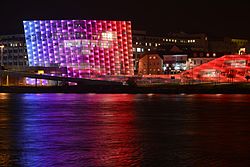


_20.jpg)
 Albufeira, Portugal (2008)
 Brașov, Romania (2012)
 České Budějovice, Czech Republic (1987)
 Charlottenburg-Wilmersdorf (Berlin), Germany (1995)
 Chengdu, China (1983)
 Dodoma, Tanzania (2019)
 Eskişehir, Turkey (2012)
 Gwangyang, South Korea (1991)
 Kansas City, United States (1988)
 Linköping, Sweden (1995)
 Modena, Italy (1992)
 Nasushiobara, Japan (2009)
 Nizhny Novgorod, Russia (1993)
 San Carlos, Nicaragua (1988)
 Tampere, Finland (1995)
 Tuzla, Bosnia and Herzegovina (2014)
 Zaporizhia, Ukraine (1983)
 Sumgait, Azerbaijan (2009)


