


Community hub
Recent from talks
Contribute something
Nothing was collected or created yet.
Munich
View on Wikipedia

Key Information


.svg)
.svg)


Munich[a] is the capital and most populous city of Bavaria, Germany. As of 30 November 2024, its population was 1,604,384,[2] making it the third-largest city in Germany after Berlin and Hamburg. Munich is the largest city in Germany that is not a state of its own, and it ranks as the 11th-largest city in the European Union. The metropolitan area has around 3 million inhabitants, and the broader Munich Metropolitan Region is home to about 6.2 million people.[3] It is the third largest metropolitan region by GDP in the European Union. Munich is located on the river Isar north of the Alps. It is the seat of the Upper Bavarian administrative region. With 4,500 people per km2, Munich is Germany's most densely populated municipality. It is also the second-largest city in the Bavarian dialect area after Vienna.
The first record of Munich dates to 1158. The city has played an important role in Bavarian and German history. During the Reformation, it remained a Catholic stronghold. Munich became the capital of the Kingdom of Bavaria in 1806 and developed as a centre for arts, architecture, culture, and science. The House of Wittelsbach ruled until 1918, when the German revolution of 1918–1919 ended their reign and saw the short-lived Bavarian Soviet Republic. In the 1920s, Munich became a centre of political movements, including the rise of the Nazi Party. The city was known as the "Capital of the Movement". During World War II, Munich was heavily bombed, but much of its historic architecture has since been restored.[4][5] After the war, the city's population and economy grew rapidly. Munich hosted the 1972 Summer Olympics.
Munich is a major centre for science, technology, finance, innovation, business, and tourism. It has a high standard of living, ranking first in Germany and third worldwide in the 2018 Mercer survey.[6] It was named the world's most liveable city by Monocle's Quality of Life Survey 2018.[7] Munich is the wealthiest city in the European Union by GDP per capita among cities with over one million inhabitants[8] and is among the most expensive German cities for real estate and rents.[9][10] In 2023, 30.1% of residents were foreigners, and 19.4% were German citizens with a migration background from abroad.[11] Munich's economy is based on high tech, automobiles, the service sector, information technology, biotechnology, engineering, and electronics. Multinational companies such as BMW, Siemens, Allianz SE, and Munich Re are headquartered there. The city has two research universities and many scientific institutions.[12] Munich is known for its architecture, cultural venues, sports events, exhibitions, and the annual Oktoberfest, the world's largest Volksfest.[13]
History
[edit]
Etymology
[edit]Munich was a tiny 12th-century monastic settlement, which was named zu den Munchen ("to the monks"). The Old High German Munche served as the base for the modern German city name München.[14]
Prehistory
[edit]The river Isar was a prehistoric trade route and in the Bronze Age Munich was among the largest raft ports in Europe.[15] Bronze Age settlements up to four millennia old have been discovered.[16] Evidence of Celtic settlements from the Iron Age have been discovered in areas around Ramersdorf-Perlach.[17]
Roman period
[edit]The ancient Roman road Via Julia, which connected Augsburg and Salzburg, crossed over the Isar south of Munich, at the towns of Baierbrunn and Gauting.[18] A Roman settlement north-east of Munich was excavated in the neighborhood of Denning.[19]
Post-Roman settlements
[edit]Starting in the 6th century, the Baiuvarii populated the area around what is now modern Munich, such as in Johanneskirchen, Feldmoching, Bogenhausen and Pasing.[20][21] The first known Christian church was built ca. 815 in Fröttmanning.[22]
Origin of medieval town
[edit]

The first medieval bridges across the river Isar were located in current city areas of Munich and Landshut.[15] Henry the Lion, the Duke of Saxony and Bavaria, founded the town of Munich in his territory to control the salt trade, after having burned down the town of Föhring and its bridges over the Isar.[23] Historians date this event at about 1158.[24]: 167 The layout of Munich city, with five city gates and market place, resembled that of Höxter.[24]: 168
Henry built a new toll bridge, customs house and a coin market closer to his home, somewhat upstream, at a settlement around the area of modern old town Munich. This new toll bridge most likely crossed the Isar where the Museuminsel and the modern Ludwigsbrücke are now located.[25]
Otto of Freising protested to his nephew, Emperor Frederick Barbarossa. However, on 14 June 1158, in Augsburg, the conflict was settled in favor of Duke Henry. The Augsburg Arbitration mentions the name of the location in dispute as forum apud Munichen. Although Bishop Otto had lost his bridge, the arbiters ordered Duke Henry to pay a third of his income to the Bishop in Freising as compensation.[26][27][28]
The 14th June 1158 is considered the official founding day of the city of Munich. Archaeological excavations at Marienhof Square (near Marienplatz) in advance of the expansion of the S-Bahn (subway) in 2012 discovered shards of vessels from the 11th century, which prove again that the settlement of Munich must be older than the Augsburg Arbitration of 1158.[29][30] The old St. Peter's Church near Marienplatz is also believed to predate the founding date of the town.[31]
In 1175, Munich received city status and fortification. In 1180, after Henry the Lion's fall from grace with Emperor Frederick Barbarossa, including his trial and exile, Otto I Wittelsbach became Duke of Bavaria, and Munich was handed to the Bishop of Freising. In 1240, Munich was transferred to Otto II Wittelsbach and in 1255, when the Duchy of Bavaria was split in two, Munich became the ducal residence of Upper Bavaria.
Duke Louis IV, a native of Munich, was elected German king in 1314 and crowned as Holy Roman Emperor in 1328. He strengthened the city's position by granting it the salt monopoly, thus assuring it of additional income.
On 13 February 1327, a large fire broke out in Munich that lasted two days and destroyed about a third of the town.[32]
In 1349, the Black Death ravaged Munich and Bavaria.[33]
The growth of Munich was supplemented by its location on top of a gravel bed, where the Isar branched into Munich City Streams, which in turn provided power for many mills and industries within Munich.
In the 15th century, Munich underwent a revival of Gothic arts: the Old Town Hall was enlarged, and Munich's largest Gothic church – the Frauenkirche – now a cathedral, was constructed in only 20 years, starting in 1468.
Capital of reunited Bavaria
[edit]
When Bavaria was reunited in 1506 after a brief war against the Duchy of Landshut, Munich became its capital. The arts and politics became increasingly influenced by the court.[citation needed] The Renaissance movement beset Munich and the Bavarian branch of the House of Wittelsbach under Duke Albrecht V who bolstered their prestige by conjuring up a lineage that reached back to classical antiquity. In 1568 Albrecht V built the Antiquarium to house the Wittelsbach collection of Greek and Roman antiquities in the Munich Residenz.[34] Albrecht V appointed the composer Orlando di Lasso as director of the court orchestra and tempted numerous Italian musicians to work at the Munich court, establishing Munich as a hub for late Renaissance music.[35] During the rule of Duke William V Munich began to be called the "German Rome" and William V began presenting Emperor Charlemagne as ancestor of the Wittelsbach dynasty.[36]
Duke William V further cemented the Wittelsbach rule by commissioning the Jesuit Michaelskirche. He had the sermons of his Jesuit court preacher Jeremias Drexel translated from Latin into German and published them to a greater audience.[37] William V was addressed with the epithet "the Pious" and like his contemporary Wittelsbach dukes promoted himself as "father of the land" (Landesvater), encouraged pilgrimages and Marian devotions.[38] William V had the Hofbräuhaus built in 1589. It would become the prototype for beer halls across Munich. After World War II the Residenze, the Hofbräuhaus, the Frauenkirche, and the Peterskirche were reconstructed to look exactly as they did before the Nazi Party seized power in 1933.[39]


The Catholic League was founded in Munich in 1609. In 1623, during the Thirty Years' War (1618–1648), Munich became an electoral residence when Duke Maximilian I was invested with the electoral dignity, but in 1632 the city was occupied by King Gustavus Adolphus of Sweden.[40]
In 1634 Swedish and Spanish troops advanced on Munich. Maximilian I published a plague ordinance to halt an epidemic escalation.[41] The bubonic plague nevertheless ravaged Munich and the surrounding countryside in 1634 and 1635.[42] During the Thirty Years' War (1618–1648) troops again converged on Munich in 1647 and precautions were taken, so as to avoid another epidemic.[43]
Under the regency of the Bavarian electors, Munich was an important centre of Baroque life, but also had to suffer under Habsburg occupations in 1704 and 1742.[citation needed] When Elector Maximilian III Joseph died in 1745, the succession empowered the Palatinate branch within the House of Wittelsbach.[44]
In 1777 Bavarian lands were inherited by Karl Theodor. The new duke was disliked by the citizens of Munich for his supposedly enlightened ideas. In 1785 Karl Theodor invited Count Rumford Benjamin Thompson to take up residency in Munich and implement stringent social reforms. The poor were forced to live in newly built workhouses. The Bavarian army was restructured, with common soldiers receiving better food and reassurances that they would be treated humanely by officers.[45] Munich was the largest German city to lose fortification in the 1790s.[46] In 1791 Karl Theodor and Count Rumford started to demolish Munich's fortifications.[47] After 1793 Munich's citizens, including house servants, carpenters, butchers, merchants, and court officials, seized the opportunity, building new houses, stalls, and sheds outside the city walls.[48]
After making an alliance with Napoleonic France, the city became the capital of the new Kingdom of Bavaria in 1806 with Elector Maximillian IV Joseph becoming its first king. The state parliament (the Landtag) and the new archdiocese of Munich and Freising were also located in the city.[49]
The establishment of Bavarian state sovereignty profoundly affected Munich. Munich became the center of a modernizing kingdom, and one of the king's first acts was the secularization of Bavaria. He had dissolved all monasteries in 1802 and once crowned, Maximilian Joseph generated state revenues by selling off church lands. While many monasteries were reestablished, Maximilian Joseph I succeeded in controlling the right to brew beer (Braurecht). The king handed the brewing monopoly to Munich's wealthiest brewers, who in turn paid substantial taxes on their beer production. In 1807 the king abolished all ordinances that limited the number of apprentices and journeymen a brewery could employ. Munich's population had swelled and Munich brewers were now free to employ as many workers as they needed to meet the demand.[50] In October 1810 a beer festival was held on the meadows just outside Munich to commemorate the wedding of the crown prince and princess Therese of Saxe-Hildburghausen. The parades in regional dress (Tracht) represented the diversity of the kingdom. The fields are now part of the Theresienwiese and the celebrations developed into Munich's annual Oktoberfest.[51]
The Bavarian state proceeded to take control over the beer market, by regulating all taxes on beer in 1806 and 1811. Brewers and the beer taverns (Wirtshäuser) were taxed, and the state also controlled the quality of beer while limiting the competition among breweries.[52] In 1831 the king's government introduced a cost-of-living allowance on beer for lower-ranking civil servants and soldiers. Soldiers stationed in Munich were granted a daily allowance for beer in the early 1840s.[53] By the 1850s beer had become essential staple food for Munich's working and lower classes. Since the Middle Ages beer had been regarded as nutritious liquid bread (fließendes Brot) in Bavaria. But Munich suffered from poor water sanitation and as early as the 1700s beer came to be regarded as the fifth element. Beer was essential in maintaining public health in Munich and in the mid-1840s Munich police estimated that at least 40,000 residents relied primarily on beer for their nutrition.[54]

In 1832 Peter von Hess painted the Greek War of Independence at the order of King Ludwig I. Ludwig I had the Königsplatz built in neoclassicism as a matter of ideological choice. Leo von Klenze supervised the construction of a Propylaea between 1854 and 1862.[55]
During the early to mid-19th century, the old fortified city walls of Munich were largely demolished due to population expansion.[56] The first Munich railway station was built in 1839, with a line going to Augsburg in the west. By 1849 a newer Munich Central Train Station (München Hauptbahnhof) was completed, with a line going to Landshut and Regensburg in the north.[57][58] In 1825 Ludwig I had ascended to the throne and commissioned leading architects such as Leo von Klenze to design a series of public museums in neoclassical style. The grand building projects of Ludwig I gave Munich the endearment "Isar-Athen" and "Monaco di Bavaria".[59] Between 1856 and 1861 the court gardener Carl von Effner landscaped the banks of the river Isar and established the Maximilian Gardens. From 1848 the Münchner Neueste Nachrichten was published as a regional newspaper in Munich. In 1857 the construction of the Maximilianeum was begun.[60]
By the time Ludwig II became king in 1864, he remained mostly aloof from his capital and focused more on his fanciful castles in the Bavarian countryside, which is why he is known the world over as the 'fairytale king'. Ludwig II tried to lure Richard Wagner to Munich, but his plans for an opera house were declined by the city council. Ludwig II nevertheless generated a windfall for Munich's craft and construction industries. In 1876 Munich hosted the first German Art and Industry Exhibition, which showcased the northern Neo-Renaissance fashion that came to be the German Empire's predominant style. Munich based artists put on the German National Applied Arts Exhibition in 1888, showcasing Baroque Revival architecture and Rococo Revival designs.[61]

In 1900 Wilhelm Röntgen moved to Munich, where he was appointed as a professor of physics. In 1901 he was awarded the Nobel Prize in Physics.[62]
The Prince Regent Luitpold's reign from 1886 to 1912 was marked by tremendous artistic and cultural activity in Munich.[63] At the dawn of the 20th century Munich was an epicenter for the Jugendstil movement, combining a liberal magazine culture with progressive industrial design and architecture. The German art movement took its name from the Munich magazine Die Jugend (The Youth).[64] Prominent Munich Jugendstil artists include Hans Eduard von Berlepsch-Valendas, Otto Eckmann,[65] Margarethe von Brauchitsch, August Endell, Hermann Obrist, Wilhelm von Debschitz,[66] and Richard Riemerschmid. In 1905 two large department stores opened in Munich, the Kaufhaus Oberpollinger and the Warenhaus Hermann Tietz, both having been designed by the architect Max Littmann.[67] In 1911 the expressionist group Der Blaue Reiter was established in Munich. Its founding members include Gabriele Münter.[68]
World War I to World War II
[edit]Following the outbreak of World War I in 1914, life in Munich became very difficult, as the Allied blockade of Germany led to food and fuel shortages. During French air raids in 1916, three bombs fell on Munich.[citation needed]
In 1916, the 'Bayerische Motoren Werke' (BMW) produced its first aircraft engine in Munich.[69] The public limited company BMW AG was founded in 1918, with Camillo Castiglioni owning one third of the share capital. In 1922 BMW relocated its headquarters to a factory in Munich.[70]
After World War I, the city was at the centre of substantial political unrest. In November 1918, on the eve of the German revolution, Ludwig III of Bavaria and his family fled the city. After the murder of the first republican premier of Bavaria Kurt Eisner in February 1919 by Anton Graf von Arco auf Valley, the Bavarian Soviet Republic was proclaimed.[71] The November 1918 revolution ended the reign of the Wittelsbach in Bavaria.[72] In Mein Kampf Adolf Hitler described his political activism in Munich after November 1918 as the "Beginning of My Political Activity". Hitler called the short-lived Bavarian Soviet Republic "the rule of the Jews".[73] In 1919 Bavaria Film was founded and in the 1920s Munich offered film makers an alternative to Germany's largest film studio, Babelsberg Studio.[74]

In 1923 Gustav von Kahr was appointed Bavarian prime minister and immediately planned for the expulsion of all Jews who did not hold German citizenship. Chief of Police Ernst Pöhner and Wilhelm Frick openly indulged in antisemitism, while Bavarian judges praised people on the political right as patriotic for their crimes and handed down mild sentences.[75] In 1923, Adolf Hitler and his supporters, who were concentrated in Munich, staged the Beer Hall Putsch, an attempt to overthrow the Weimar Republic and seize power. The revolt failed, resulting in Hitler's arrest and the temporary crippling of the Nazi Party (NSDAP).[76]
Munich was chosen as capital for the Free State of Bavaria and acquired increased responsibility for administering the city itself and the surrounding districts. Offices needed to be built for bureaucracy, so a 12-story office building was erected in the southern part of the historic city centre in the late 1920s.[72]
Munich again became important to the Nazis when they took power in Germany in 1933. The party created its first concentration camp at Dachau, 16 km (10 mi) north-west of the city. Because of its importance to the rise of National Socialism, Munich was referred to as the Hauptstadt der Bewegung ("Capital of the Movement").[77]
The NSDAP headquarters and the documentation apparatus for controlling all aspects of life were located in Munich. Nazi organizations, such as the National Socialist Women's League and the Gestapo, had their offices along Brienner Straße and around the Königsplatz. The party acquired 68 buildings in the area and many Führerbauten ("Führer buildings") were built to reflect a new aesthetic of power.[78] Construction work for the Führerbau and the party headquarters (known as the Brown House) started in September 1933.[79] The Haus der Kunst (House of German Art) was the first building to be commissioned by Hitler. The architect Paul Troost was asked to start work shortly after the Nazis had seized power because "the most German of all German cities" was left with no exhibition building when in 1931 the Glass Palace was destroyed in an arson attack.[80] The Red Terror that supposedly preceded Nazi control in Munich was detailed in Nazi publications; seminal accounts are that of Rudolf Schricker Rotmord über München published in 1934, and Die Blutchronik des Marxismus in Deutschland by Adolf Ehrt and Hans Roden.[81]
In 1930 Feinkost Käfer was founded in Munich; the Käfer catering business is now a world leading party service.[82]
The city was the site where the 1938 Munich Agreement signed between the United Kingdom and the Third French Republic with Nazi Germany as part of the Franco-British policy of appeasement. The British Prime Minister Neville Chamberlain assented to the German annexation of Czechoslovakia's Sudetenland in the hopes of satisfying Hitler's territorial expansion.[83]
The Munich-Riem Airport was completed in October 1939.[84]
On 8 November 1939, shortly after the Second World War had begun, Georg Elser planted a bomb in the Bürgerbräukeller in Munich in an attempt to assassinate Adolf Hitler, who held a political party speech. Hitler, however, had left the building minutes before the bomb went off.[85] By mid 1942 the majority of Jews living in Munich and the suburbs had been deported.[86]

During the war, Munich was the location of multiple forced labour camps, including two Polenlager camps for Polish youth,[87][88] and 40 subcamps of the Dachau concentration camp, in which men and women of various nationalities were held.[89] With up to 17,000 prisoners in 1945, the largest subcamp of Dachau was the Munich-Allach concentration camp.
Munich was the base of the White Rose, a student resistance movement. The group had distributed leaflets in several cities and following the 1943 Battle of Stalingrad members of the group stenciled slogans such as "Down with Hitler" and "Hitler the Mass Murderer" on public buildings in Munich. The core members were arrested and executed after Sophie Scholl and her brother Hans Scholl were caught distributing leaflets on Munich University campus calling upon the youth to rise against Hitler.[90]
The city was heavily damaged by the bombing of Munich in World War II, with 71 air raids over five years. US troops captured Munich on 30 April 1945.[91]
Postwar
[edit]In the aftermath of World War II, Germany and Japan were subject to US Military occupation.[92] Due to Polish annexation of the Former eastern territories of Germany and expulsion of Germans from all over Eastern Europe, Munich operated over a thousand refugee camps for 151,113 people in October 1946.[93] After US occupation Munich was completely rebuilt following a meticulous plan, which preserved its pre-war street grid, bar a few exceptions owing to then-modern traffic concepts. In 1957, Munich's population surpassed one million. The city continued to play a highly significant role in the German economy, politics and culture, giving rise to its nickname Heimliche Hauptstadt ("secret capital") in the decades after World War II.[94] In Munich, the Bayerischer Rundfunk began its first television broadcast in 1954.[95]
The Free State of Bavaria used the arms industry as kernel for its high tech development policy.[96] Since 1963, Munich has been hosting the Munich Security Conference, held annually in the Hotel Bayerischer Hof.[97] Munich also became known on the political level due to the strong influence of Bavarian politician Franz Josef Strauss from the 1960s to the 1980s. The Munich Airport, which commenced operations in 1992, was named in his honor.[98]
In the early 1960s Dieter Kunzelmann was expelled from the Situationist International and founded an influential group called Subversive Aktion in Munich. Kunzelmann was also active in West Berlin, and became known for using situationist avant-garde as a cover for political violence.[99]

Munich hosted the 1972 Summer Olympics. After winning the bid in 1966 the Mayor of Munich Hans-Jochen Vogel accelerated the construction of the U-Bahn subway and the S-Bahn metropolitan commuter railway. In May 1967 the construction work began for a new U-Bahn line connecting the city with the Olympic Park. The Olympic Park subway station was built near the BMW Headquarters and the line was completed in May 1972, three months before the opening of the 1972 Summer Olympics. Shortly before the opening ceremony, Munich also inaugurated a sizable pedestrian priority zone between Karlsplatz and Marienplatz.[100] In 1970 the Munich city council released funds so that the iconic gothic facade and Glockenspiel of the New City Hall (Neues Rathaus) could be restored.[101]
During the 1972 Summer Olympics 11 Israeli athletes were murdered by Palestinian terrorists in the Munich massacre, when gunmen from the Palestinian "Black September" group took hostage members of the Israeli Olympic team.[102]
The most deadly militant attack the Federal Republic of Germany has ever witnessed was the Oktoberfest bombing. The attack was eventually blamed on militant Neo-Nazism.[103]

Munich and its urban sprawl emerged as the leading German high tech region during the 1980s and 1990s. The urban economy of Munich became characterized by a dynamic labour market, low unemployment, a growing service economy and high per capita income.[96] Munich is home of the famous Nockherberg Strong Beer Festival during the Lenten fasting period (usually in March). Its origins go back to the 17th/18th century, but has become popular when the festivities were first televised in the 1980s. The fest includes comical speeches and a mini-musical in which numerous German politicians are parodied by look-alike actors.[104]
In 2007 the ecological restoration of the river Isar in the urban area of Munich was awarded the Water Development Prize by the German Association for Water, Wastewater and Waste (known as DWA in German). The renaturation of the Isar allows for the near natural development of the river bed and is part of Munich's flood protection.[105] About 20% of buildings in Munich now have a green roof. Munich city council has been encouraging better stormwater management since the 1990s with regulations and subsidies.[106]
On the fifth anniversary of the 2011 Norway attacks an active shooter perpetrated a hate crime. The 2016 Munich shooting targeted people of Turkish and Arab descent.[107]
Munich was one of the host cities for UEFA Euro 2020, which was delayed for a year due to the COVID-19 pandemic in Germany, and was a host city for UEFA Euro 2024.[108]
Geography
[edit]
Topography
[edit]Munich lies on the elevated plains of Upper Bavaria, about 50 km (31 mi) north of the northern edge of the Alps, at an altitude of about 520 m (1,706 ft) ASL. The local rivers are the Isar and the Würm. Munich is situated in the Northern Alpine Foreland. The northern part of this sandy plateau includes a highly fertile flint area which is no longer affected by the folding processes found in the Alps, while the southern part is covered with morainic hills. Between these are fields of fluvio-glacial out-wash, such as around Munich. Wherever these deposits get thinner, the ground water can permeate the gravel surface and flood the area, leading to marshes as in the north of Munich.
Climate
[edit]According to the Köppen climate classification, the climate is oceanic (Cfb), independent of the isotherm but with some humid continental (Dfb) features like warm to hot summers and cold winters, but without permanent snow cover.[109][110] The city centre lies between both climates, while the airport of Munich has a humid continental climate. The warmest month, on average, is July. The coolest is January.
The proximity to the Alps brings higher volumes of rainfall and consequently greater susceptibility to flood problems. Studies of adaptation to climate change and extreme events are carried out; one of them is the Isar Plan of the EU Adaptation Climate.[111]
Showers and thunderstorms bring the highest average monthly precipitation in late spring and throughout the summer. The most precipitation occurs in July, on average. Winter tends to have less precipitation, the least in February.
The higher elevation and proximity to the Alps cause the city to have more rain and snow than many other parts of Germany. The Alps affect the city's climate in other ways too; for example, the warm downhill wind from the Alps (föhn wind), which can raise temperatures sharply within a few hours even in the winter.
Being at the centre of Europe, Munich is subject to many climatic influences, so that weather conditions there are more variable than in other European cities, especially those further west and south of the Alps.
Munich is near the Alps. Annual variation in temperature can be significant, because there are no large bodies of water nearby. The winter in Munich is generally cold and overcast, and some Munich winters have significant snow. January is the coldest month. While winter averages remain only moderately cold, and relatively mild for an elevated inland location of Munich's latitude, inversion from the nearby Alps causes cold air to sink and result in temperatures below −15 °C (5 °F). In Munich the summer is usually pleasantly warm, with daytime temperatures averaging 25 °C (77 °F).
Munich is subject to active convective seasons and sometimes damaging events. The Alpine thunderstorm system moves along the mountain range, or detaches, heading east-north-east over the foothills of the Alps.[112]
At Munich's official weather stations, the highest and lowest temperatures ever measured are 37.5 °C (100 °F), on 27 July 1983 in Trudering-Riem, and −31.6 °C (−24.9 °F), on 12 February 1929 in the Botanic Garden of the city.[113][114]
| Climate data for Munich (Dreimühlenviertel) (1991–2020 normals, extremes 1954–present) | |||||||||||||
|---|---|---|---|---|---|---|---|---|---|---|---|---|---|
| Month | Jan | Feb | Mar | Apr | May | Jun | Jul | Aug | Sep | Oct | Nov | Dec | Year |
| Record high °C (°F) | 18.9 (66.0) |
21.4 (70.5) |
24.0 (75.2) |
32.2 (90.0) |
31.8 (89.2) |
35.2 (95.4) |
37.5 (99.5) |
37.0 (98.6) |
31.8 (89.2) |
28.2 (82.8) |
24.2 (75.6) |
21.7 (71.1) |
37.5 (99.5) |
| Mean maximum °C (°F) | 11.8 (53.2) |
13.7 (56.7) |
18.9 (66.0) |
23.6 (74.5) |
27.5 (81.5) |
30.5 (86.9) |
31.9 (89.4) |
31.5 (88.7) |
26.8 (80.2) |
22.6 (72.7) |
17.0 (62.6) |
12.6 (54.7) |
33.1 (91.6) |
| Mean daily maximum °C (°F) | 4.0 (39.2) |
5.6 (42.1) |
10.1 (50.2) |
15.2 (59.4) |
19.4 (66.9) |
22.9 (73.2) |
24.9 (76.8) |
24.7 (76.5) |
19.6 (67.3) |
14.5 (58.1) |
8.2 (46.8) |
4.8 (40.6) |
14.5 (58.1) |
| Daily mean °C (°F) | 0.9 (33.6) |
1.9 (35.4) |
5.7 (42.3) |
10.2 (50.4) |
14.3 (57.7) |
17.8 (64.0) |
19.6 (67.3) |
19.4 (66.9) |
14.7 (58.5) |
10.1 (50.2) |
4.9 (40.8) |
1.8 (35.2) |
10.1 (50.2) |
| Mean daily minimum °C (°F) | −1.8 (28.8) |
−1.4 (29.5) |
1.7 (35.1) |
5.3 (41.5) |
9.3 (48.7) |
12.9 (55.2) |
14.7 (58.5) |
14.5 (58.1) |
10.4 (50.7) |
6.5 (43.7) |
2.1 (35.8) |
−0.8 (30.6) |
6.1 (43.0) |
| Mean minimum °C (°F) | −13.8 (7.2) |
−12.4 (9.7) |
−7.3 (18.9) |
−3.3 (26.1) |
1.5 (34.7) |
5.3 (41.5) |
7.8 (46.0) |
6.6 (43.9) |
1.9 (35.4) |
−2.1 (28.2) |
−6.8 (19.8) |
−12.3 (9.9) |
−16.8 (1.8) |
| Record low °C (°F) | −22.2 (−8.0) |
−25.4 (−13.7) |
−16.0 (3.2) |
−6.0 (21.2) |
−2.3 (27.9) |
1.0 (33.8) |
6.5 (43.7) |
4.8 (40.6) |
0.6 (33.1) |
−4.5 (23.9) |
−11.0 (12.2) |
−20.7 (−5.3) |
−25.4 (−13.7) |
| Average precipitation mm (inches) | 51.9 (2.04) |
45.5 (1.79) |
61.2 (2.41) |
56.0 (2.20) |
107.0 (4.21) |
120.9 (4.76) |
118.9 (4.68) |
116.5 (4.59) |
78.1 (3.07) |
66.9 (2.63) |
58.4 (2.30) |
58.5 (2.30) |
939.7 (37.00) |
| Average precipitation days (≥ 1.0 mm) | 15.3 | 14.0 | 15.6 | 13.5 | 16.1 | 16.7 | 16.1 | 15.0 | 14.2 | 14.2 | 14.6 | 16.8 | 182.0 |
| Average snowy days (≥ 1.0 cm) | 11.7 | 11.2 | 4.5 | 0.6 | 0 | 0 | 0 | 0 | 0 | 0 | 3.3 | 8.0 | 39.3 |
| Average relative humidity (%) | 80.3 | 75.9 | 70.7 | 64.6 | 67.2 | 67.2 | 66.1 | 68.1 | 75.5 | 79.9 | 83.3 | 82.3 | 73.4 |
| Mean monthly sunshine hours | 74.6 | 95.2 | 145.3 | 186.0 | 213.0 | 223.7 | 241.4 | 232.1 | 169.7 | 123.3 | 74.0 | 66.4 | 1,841.4 |
| Source 1: World Meteorological Organization[115] | |||||||||||||
| Source 2: DWD[116] SKlima.de[117] Infoclimat[118] | |||||||||||||
Climate change
[edit]In Munich, the general trend of global warming with a rise of medium yearly temperatures of about 1 °C (1.8 °F) in Germany between 1900 and 2020 can be observed as well. In November 2016 the city council concluded officially that a further rise in medium temperature, a higher number of heat extremes, a rise in the number of hot days and nights with temperatures higher than 20 °C (tropical nights), a change in precipitation patterns, as well as a rise in the number of local instances of heavy rain, is to be expected as part of the ongoing climate change. The city administration decided to support a joint study from its own Referat für Gesundheit und Umwelt (department for health and environmental issues) and the German Meteorological Service that will gather data on local weather. The data is supposed to be used to create a plan for action for adapting the city to better deal with climate change as well as an integrated action program for climate protection in Munich. With the help of those programs issues regarding spatial planning and settlement density, the development of buildings and green spaces as well as plans for functioning ventilation in a cityscape can be monitored and managed.[119]
Demographics
[edit]| Year | Pop. | ±% |
|---|---|---|
| 1500 | 13,447 | — |
| 1600 | 21,943 | +63.2% |
| 1750 | 32,000 | +45.8% |
| 1880 | 230,023 | +618.8% |
| 1890 | 349,024 | +51.7% |
| 1900 | 499,932 | +43.2% |
| 1910 | 596,467 | +19.3% |
| 1920 | 666,000 | +11.7% |
| 1930 | 728,900 | +9.4% |
| 1940 | 834,500 | +14.5% |
| 1950 | 823,892 | −1.3% |
| 1960 | 1,055,457 | +28.1% |
| 1970 | 1,311,978 | +24.3% |
| 1980 | 1,298,941 | −1.0% |
| 1990 | 1,229,026 | −5.4% |
| 2001 | 1,227,958 | −0.1% |
| 2011 | 1,348,335 | +9.8% |
| 2022 | 1,478,638 | +9.7% |
| Population size may be affected by changes in administrative divisions. | ||
From only 24,000 inhabitants in 1700, the city population doubled about every 30 years. It was 100,000 in 1852, 250,000 in 1883 and 500,000 in 1901. Since then, Munich has become Germany's third-largest city. In 1933, 840,901 inhabitants were counted, and in 1957 over 1 million. Munich has reached 1.5 million in 2022.
Immigration
[edit]In December 2023, Munich had 1.58 million inhabitants; 477,855 foreign nationals resided in the city as of 31 December 2023 with 42.88% of these residents being citizens of EU member states, and 29.66% citizens in European states not in the EU (including Kosovo and Turkey).[120] Along with the Turks, the Croats are one of the two largest foreign minorities in the city, which is why some Croats refer to Munich as their "second capital".[121] The largest groups of foreign nationals were Turks (38,947), Croats (37,541), Italians (28,142), Greeks (24,843), Bosnians (24,161), Ukrainians (21,899), and Austrians (21,944).
| Country | Population |
|---|---|
 Turkey Turkey |
39,757 |
 Croatia Croatia |
36,934 |
 Italy Italy |
28,723 |
 Greece Greece |
24,684 |
 Bosnia and Herzegovina Bosnia and Herzegovina |
24,729 |
 Ukraine Ukraine |
24,744 |
 Austria Austria |
19,185 |
 India India |
17,417 |
 Romania Romania |
16,793 |
 Poland Poland |
16,530 |
 Serbia Serbia |
14,869 |
 Bulgaria Bulgaria |
14,561 |
 Kosovo Kosovo |
13,274 |
 China China |
13,259 |
 Russia Russia |
12,022 |
 Spain Spain |
10,135 |
 Afghanistan Afghanistan |
10,128 |
 France France |
10,088 |
 Iraq Iraq |
9,165 |
 Hungary Hungary |
7,014 |
 United States United States |
6,789 |
 Vietnam Vietnam |
6,350 |
 North Macedonia North Macedonia |
4,633 |
 Syria Syria |
4,545 |
 Albania Albania |
4,106 |
 Nigeria Nigeria |
3,648 |
 United Kingdom United Kingdom |
3,694 |
 Portugal Portugal |
3,472 |
 Somalia Somalia |
3,240 |
Religion
[edit]About 45% of Munich's residents are not affiliated with any religious group; this ratio represents the fastest growing segment of the population. As in the rest of Germany, the Catholic and Protestant churches have experienced a continuous decline in membership. As of 31 December 2017, 31.8% of the city's inhabitants were Catholic, 11.4% Protestant, 0.3% Jewish (see: History of the Jews in Munich),[123] and 3.6% were members of an Orthodox Church (Eastern Orthodox or Oriental Orthodox).[124] About 1% adhere to other Christian denominations. There is also a small Old Catholic parish and an English-speaking parish of the Episcopal Church in the city. According to Munich Statistical Office, in 2013 about 6.9% of Munich's population was Muslim.[125] Munich has the largest Uyghur population with about 800 (whole Germany about 1,600) people with Uyghur diaspora. Many of them fled to Munich due to the Chinese government and are exiled in Munich. Munich is also home to World Uyghur Congress, which is an international organisation of exiled Uyghurs.[126]
Government and politics
[edit]
As the capital of Bavaria, Munich is an important political centre for both the state and country as a whole. It is the seat of the Landtag of Bavaria, the State Chancellery, and all state departments. Several national and international authorities are located in Munich, including the Federal Finance Court of Germany, the German Patent Office and the European Patent Office. Bavaria has been dominated by the Christian Social Union in Bavaria (CSU) on a federal, state, and local level since the establishment of the Federal Republic in 1949.
Mayor
[edit]The current mayor of Munich is Dieter Reiter, he is from the Social Democratic Party of Germany (SPD). He was elected in 2014 and re-elected in 2020.
The most recent mayoral election was held on 15 March 2020, with a runoff held on 29 March, and the results were as follows:
| Candidate | Party | First round | Second round | |||
|---|---|---|---|---|---|---|
| Votes | % | Votes | % | |||
| Dieter Reiter | Social Democratic Party | 259,928 | 47.9 | 401,856 | 71.7 | |
| Kristina Frank | Christian Social Union | 115,795 | 21.3 | 158,773 | 28.3 | |
| Katrin Habenschaden | Alliance 90/The Greens | 112,121 | 20.7 | |||
| Wolfgang Wiehle | Alternative for Germany | 14,988 | 2.8 | |||
| Tobias Ruff | Ecological Democratic Party | 8,464 | 1.6 | |||
| Jörg Hoffmann | Free Democratic Party | 8,201 | 1.5 | |||
| Thomas Lechner | The Left | 7,232 | 1.3 | |||
| Hans-Peter Mehling | Free Voters of Bavaria | 5,003 | 0.9 | |||
| Moritz Weixler | Die PARTEI | 3,508 | 0.6 | |||
| Dirk Höpner | Munich List | 1,966 | 0.4 | |||
| Richard Progl | Bavaria Party | 1,958 | 0.4 | |||
| Ender Beyhan-Bilgin | FAIR | 1,483 | 0.3 | |||
| Stephanie Dilba | mut | 1,267 | 0.2 | |||
| Cetin Oraner | Together Bavaria | 819 | 0.2 | |||
| Valid votes | 542,733 | 99.6 | 560,629 | 99.7 | ||
| Invalid votes | 1,997 | 0.4 | 1,616 | 0.3 | ||
| Total | 544,730 | 100.0 | 562,245 | 100.0 | ||
| Electorate/voter turnout | 1,110,571 | 49.0 | 1,109,032 | 50.7 | ||
| Source: Wahlen München (1st round, 2nd round) | ||||||
City council
[edit]
Left/PARTEI: 4 seats
SPD/Volt: 19 seats
Greens/Pink List: 24 seats
ÖDP/FW: 6 seats
FDP/BP: 4 seats
CSU: 20 seats
AfD: 3 seats
The Munich city council (Stadtrat) governs the city alongside the Mayor. The most recent city council election was held on 15 March 2020, and the results were as follows:
| Party | Lead candidate | Votes | % | +/− | Seats | +/− | |
|---|---|---|---|---|---|---|---|
| Alliance 90/The Greens (Grüne) | Katrin Habenschaden | 11,762,516 | 29.1 |  12.5 12.5
|
23 | 10
| |
| Christian Social Union (CSU) | Kristina Frank | 9,986,014 | 24.7 |  7.8 7.8
|
20 | 6
| |
| Social Democratic Party (SPD) | Dieter Reiter | 8,884,562 | 22.0 | 8.8
|
18 | 7
| |
| Ecological Democratic Party (ÖDP) | Tobias Ruff | 1,598,539 | 4.0 | 1.4
|
3 | 1
| |
| Alternative for Germany (AfD) | Iris Wassill | 1,559,476 | 3.9 | 1.4
|
3 | 1
| |
| Free Democratic Party (FDP) | Jörg Hoffmann | 1,420,194 | 3.5 | 0.1
|
3 | ±0 | |
| The Left (Die Linke) | Stefan Jagel | 1,319,464 | 3.3 | 0.8
|
3 | 1
| |
| Free Voters of Bavaria (FW) | Hans-Peter Mehling | 1,008,400 | 2.5 | 0.2
|
2 | ±0 | |
| Volt Germany (Volt) | Felix Sproll | 732,853 | 1.8 | New | 1 | New | |
| Die PARTEI (PARTEI) | Marie Burneleit | 528,949 | 1.3 | New | 1 | New | |
| Pink List (Rosa Liste)[b] | Thomas Niederbühl | 396,324 | 1.0 | 0.9
|
1 | ±0 | |
| Munich List | Dirk Höpner | 339,705 | 0.8 | New | 1 | New | |
| Bavaria Party (BP) | Richard Progl | 273,737 | 0.7 | 0.2
|
1 | ±0 | |
| mut | Stephanie Dilba | 247,679 | 0.6 | New | 0 | New | |
| FAIR | Kemal Orak | 142,455 | 0.4 | New | 0 | New | |
| Together Bavaria (ZuBa) | Cetin Oraner | 120,975 | 0.3 | New | 0 | New | |
| BIA | Karl Richter | 86,358 | 0.2 | 0.5
|
0 | ±0 | |
| Valid votes | 531,527 | 97.6 | |||||
| Invalid votes | 12,937 | 2.4 | |||||
| Total | 544,464 | 100.0 | 80 | ±0 | |||
| Electorate/voter turnout | 1,110,571 | 49.0 | 7.0
|
||||
| Source: Wahlen München[127] | |||||||
The governing coalition after the 2020 election consisted of the Greens and the SPD, as well as the allied Volt and Pink List, which had one seat each. While the Greens had gained the most seats in the city council, the mayor was from the SPD. The parties made an agreement including social and ecological goals and focusing on heightening stipulations for new development in the city. The Red-Green alliance is a reprise of the 1990-2014 coalition, which was interrupted by a six-year CSU-SPD majority from 2014 to 2020.[128][129]
State Landtag
[edit]
In the Landtag of Bavaria, Munich is divided between nine constituencies. After the 2018 Bavarian state election, the composition and representation of each was as follows:
| Constituency | Area | Party | Member | |
|---|---|---|---|---|
| 101 München-Hadern |
|
CSU | Georg Eisenreich | |
| 102 München-Bogenhausen |
|
CSU | Robert Brannekämper | |
| 103 München-Giesing |
|
GRÜNE | Gülseren Demirel | |
| 104 München-Milbertshofen |
|
GRÜNE | Katharina Schulze | |
| 105 München-Moosach |
|
GRÜNE | Benjamin Adjei | |
| 106 München-Pasing |
|
CSU | Josef Schmid | |
| 107 München-Ramersdorf |
|
CSU | Markus Blume | |
| 108 München-Schwabing |
|
GRÜNE | Christian Hierneis | |
| 109 München-Mitte |
|
GRÜNE | Ludwig Hartmann | |
Federal parliament
[edit]In the Bundestag, Munich is divided between four constituencies. In the 20th Bundestag, the composition and representation of each was as follows:
| Constituency | Area | Party | Member | |
|---|---|---|---|---|
| 217 Munich North |
|
CSU | Bernhard Loos | |
| 218 Munich East |
|
CSU | Wolfgang Stefinger | |
| 219 Munich South |
|
GRÜNE | Jamila Schäfer | |
| 220 Munich West/Centre |
|
CSU | Stephan Pilsinger | |
Subdivisions
[edit]
Since the reform of 1992, Munich is divided into 25 administrative boroughs (Stadtbezirke). They are subdivided into 105 statistical areas.
Allach-Untermenzing (23), Altstadt-Lehel (1), Aubing-Lochhausen-Langwied (22), Au-Haidhausen (5), Berg am Laim (14), Bogenhausen (13), Feldmoching-Hasenbergl (24), Hadern (20), Laim (25), Ludwigsvorstadt-Isarvorstadt (2), Maxvorstadt (3), Milbertshofen-Am Hart (11), Moosach (10), Neuhausen-Nymphenburg (9), Obergiesing (17), Pasing-Obermenzing (21), Ramersdorf-Perlach (16), Schwabing-Freimann (12), Schwabing-West (4), Schwanthalerhöhe (8), Sendling (6), Sendling-Westpark (7), Thalkirchen-Obersendling-Forstenried-Fürstenried-Solln (19), Trudering-Riem (15), and Untergiesing-Harlaching (18).
There is no official division into districts. The number of districts is about 50, and if smaller units are counted as well, there are about 90 to 100 (see map). The three largest districts are Schwabing in the north (about 110,000 inhabitants), Sendling in the southwest (about 100,000 inhabitants), and Giesing in the south (about 80,000 inhabitants).[130]
Architecture
[edit]


Old Town
[edit]
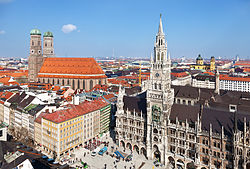
At the centre of the old town is the Marienplatz with the Old Town Hall and the New Town Hall. Its tower contains the Rathaus-Glockenspiel. The Peterskirche is the oldest church of the inner city. Nearby St. Peter, the Gothic hall-church Heiliggeistkirche was converted to baroque style from 1724 onwards and looks down upon the Viktualienmarkt. Three gates of the demolished medieval fortification survive; these are the Isartor, the Sendlinger Tor, and the Karlstor. The Karlstor leads up to the Stachus, a square dominated by the Justizpalast (Palace of Justice).
The Frauenkirche serves as the cathedral for the Catholic Archdiocese of Munich and Freising. The nearby Michaelskirche is the largest renaissance church north of the Alps, while the Theatinerkirche is a basilica in Italianate high baroque, which had a major influence on southern German baroque architecture. Its dome dominates the Odeonsplatz.
Palaces and castles
[edit]Schloss Nymphenburg (Nymphenburg Palace, construction started 1664) is a museum open to the public for tours.[131][132]
The smaller Schloss Fürstenried (Fürstenried Palace, construction 1715–1717) is used by the Archdiocese of Munich and Freising as a conference location.[133]
Schloss Blutenburg (Blutenburg Castle) opened as a children's library in 2024,[134] but visitors may tour the late-Gothic Blutenburg Castle Church built on the same grounds.[135]
The large Munich Residenz complex on the edge of Munich's Old Town now ranks among Europe's most significant museums of interior decoration. Within the Residenz is the splendid Cuvilliés Theatre and next door is the National Theatre Munich. Among the mansions that still exist in Munich are the Palais Porcia, the Palais Preysing, the Palais Holnstein and the Prinz-Carl-Palais. All mansions are situated close to the Residenz, so is the Alter Hof, the first residence of the House of Wittelsbach.
Modernist architecture
[edit]Despite Munich being the breeding ground for German Jugendstil, starting with the architect Martin Dülfer, Munich Jugendstil style was quickly submerged as historic trash. While the modernist architect Theodor Fischer was based in Munich, his influence on Munich underwhelmed. Prior to 1914 the city of Munich was under-industrialized. During the Weimar Republic, the Munich establishment was hostile to modernism. The TUM professor German Bestelmeyer favored a conservative style, and Jacobus Oud was rejected for the post of city building chief. Modernist exceptions include a series of post offices by Robert Vorhoelzer built in the late 1920s and early 1930s. Examples of avant-garde temporary constructions include the Wohnmaschine (Housing Machine) by Robert Vorhoelzer, as well as the Flachdachhaus (Flat Roof House) by Fritz Norkauer. Paul Schultze-Naumburg, and the Kampfbund enjoyed particular popularity.[136]
High rise buildings
[edit]
Several high-rise buildings are clustered at the northern edge of Munich in the skyline, like the HVB Tower, the Arabella High-Rise Building, the Highlight Towers, Uptown Munich, Münchner Tor and the BMW Headquarters next to the Olympic Park. Further high-rise buildings are located in the Werksviertel in Berg am Laim.
Long-term residential development
[edit]Munich is subject to a long-term residential development plan that is established by the city administration of Munich. The LaSie ("Langfristige Siedlungsentwicklung") was passed in 2011 in response to the acute housing crisis. LaSie is aligned with the strategic development plan passed for Munich in 1998 ("Perspektive München"). LaSie defines three priorities for the construction of residential housing in Munich. Existing housing estates, post-war low-density developments, and the suburban area are subject to densification ("Nachverdichtung"). Non-residential industrial areas are subject to conservation and will be turned into residential and mixed-use areas. On greenfield sites in the Munich periphery medium and large-scale housing estates are to be built so as to extend Munich's urban center.[137]
Parks
[edit].jpg)
Friedrich Ludwig von Sckell became famous for designing the Englischer Garten between 1789 and 1807. Besides planning the first public garden in Europe, Sckell also redesigned Baroque gardens as landscape gardens, including the parks of Nymphenburg Palace and the Botanischer Garten München-Nymphenburg.[138]
Other large green spaces are the Olympiapark, the Westpark and the Ostpark. The city's oldest park is the Hofgarten, near the Residenz, dating back to the 16th century. The site of the largest beer garden in town, the former royal Hirschgarten, was founded in 1780.[citation needed]
Sports
[edit]Football
[edit]

Munich is home to several professional Association football teams including the FC Bayern Munich. Other notable clubs include 1860 Munich, who currently play in the 3. Liga. Noticeably, FC Bayern Munich is the most successful club in Germany and it is also very reputed across Europe and the world. Munich hosted matches in the 2006 FIFA World Cup.[139]
Basketball
[edit]FC Bayern Munich Basketball is currently playing in the Beko Basket Bundesliga. The city hosted the final stages of the FIBA EuroBasket 1993, where the German national basketball team won the gold medal.
Ice hockey
[edit]The city's ice hockey club is EHC Red Bull München who play in the Deutsche Eishockey Liga. The team has won four DEL Championships, in 2016, 2017, 2018 and 2023.
Olympics
[edit]Munich hosted the 1972 Summer Olympics; the Munich massacre took place in the Olympic village. It was one of the host cities for the 2006 Football World Cup, which was not held in Munich's Olympic Stadium, but in a new football specific stadium, the Allianz Arena. Munich bid to host the 2018 Winter Olympic Games, but lost to Pyeongchang.[140] In September 2011 the DOSB President Thomas Bach confirmed that Munich would bid again for the Winter Olympics in the future.[141] These plans were abandoned some time later.
Road running
[edit]Regular annual road running events in Munich are the Munich Marathon in October, the Stadtlauf end of June, the company run B2Run in July, the New Year's Run on 31 December, the Spartan Race Sprint, the Olympia Alm Crosslauf and the Bestzeitenmarathon.
Swimming
[edit]
Public sporting facilities in Munich include ten indoor swimming pools[142] and eight outdoor swimming pools,[143] which are operated by the Munich City Utilities (SWM) communal company.[144] Popular indoor swimming pools include the Olympia Schwimmhalle of the 1972 Summer Olympics, the wave pool Cosimawellenbad, as well as the Müllersches Volksbad which was built in 1901. Further, swimming within Munich's city limits is also possible in several artificial lakes such as for example the Riemer See or the Langwieder lake district.[145]
River surfing
[edit]
River surfing is a popular sport in Munich. The Flosskanal wave in the south of Munich is less challenging. A well visited surfing spot for experienced surfers is the Eisbach standing wave, where the annual Munich Surf Open is celebrated on the last Saturday of July.[146]
Culture
[edit]Language
[edit]German is spoken and understood in and around Munich. While the German language has many dialects, so-called "Standard German" or "High German" is learned in schools and spoken among Germans, Austrians and in some parts of Switzerland. A speaker of a Low German dialect in Hamburg may find it difficult to understand the dialect of a Bavarian mountaineer.[147] The Bavarian dialects are recognized as regional language and continues to be spoken alongside Standard German.[148]
Museums
[edit]

The gothic Morris dancers of Erasmus Grasser are exhibited in the Munich City Museum in the old gothic arsenal building in the inner city.
In 1903 Oskar von Miller assembled a group of engineers and industrialists, who chartered the Deutsches Museum. The Museum was built with the financial support of the German business and imperial nobility community, as well as the blessing of Wilhelm II, German Emperor.[149] The Deutsches Museum had its grand opening in 1925, but has undergone a reinvention recently. The Deutsches Museum now operates three locations. The original site in central Munich continues to expand its exhibits.[150]

The city has several important art galleries, most of which can be found in the Kunstareal. The Lenbachhaus displays works of the movement Der Blaue Reiter (The Blue Rider), a Munich-based modernist art.[citation needed] Starting in 1970s, German municipalities started to respond to cultural tourism and invested in public museums. The Neue Pinakothek, like other German museums, was wholly reconstructed from 1974 until 1981.[151] The Pinakothek der Moderne lets the public see an eclectic mix of contemporary art and the principle attention of the permanent collection is Classical Moderns. But the displays are enhanced continuously with spectacular gifts from private collections.[152]
City guides published in the early 1860s directed tourists to Munich's architecture and art collections, which at the time were unique in Germany and are a legacy mainly of Ludwig I of Bavaria, with contributions from Maximilian II of Bavaria.[153] The Alte Pinakothek contains works of European masters between the 14th and 18th centuries. Major displays include Albrecht Dürer's Self-Portrait (1500), his Four Apostles, Raphael's paintings The Canigiani Holy Family and Madonna Tempi as well as Peter Paul Rubens large Judgment Day.

An extensive collection of Greek and Roman art is held in the Glyptothek[154] and the Staatliche Antikensammlungen (the State Antiquities Collections). Works on display include the Medusa Rondanini, the Barberini Faun and figures from the Temple of Aphaea on Aegina for the Glyptothek.[155] Another interesting museum is the Staatliche Sammlung für Ägyptische Kunst (the State Collection of Egyptian Art).[156][157][158]
Several public collections of the Ludwig Maximilian University of Munich are still housed in the Kunstareal. The expanded state collections are housed in the Paläontologisches Museum München, and the Zoologische Staatssammlung München.[citation needed] After the first German art exhibition in the Glaspalast for an international audience in 1869, Munich emerged as a focal point for the arts. Men of distinction from around the world visited the Academy of Fine Arts under the directorship of Karl von Piloty and later Wilhelm von Kaulbach.[159]
The Museum Five Continents is the second largest collection in Germany of artefacts and objects from outside Europe, while the Bavarian National Museum and the adjoining Bavarian State Archaeological Collection display regional art and cultural history. The Schackgalerie is an important gallery of German 19th-century paintings.[160]
The memorial museum of the former Dachau concentration camp is just outside the city.
Music
[edit]
Munich is a major international musical centre and has played host to many prominent composers including Orlande de Lassus, Wolfgang Amadeus Mozart, Carl Maria von Weber, Richard Wagner, Gustav Mahler, Richard Strauss, Max Reger and Carl Orff. Some of classical music's best-known compositions have been created in and around Munich by composers born in the area, for example, Richard Strauss's tone poem Also sprach Zarathustra or Carl Orff's Carmina Burana.[citation needed][161]
Opera
[edit]
Richard Wagner was a supporter of William I, German Emperor, but Wagner only found a generous patron in Ludwig II of Bavaria.[162] 1870 til 1871 Wagner premiered Die Meistersinger von Nürnberg (The Mastersingers of Nuremberg) in Munich, a popular success for Wagner and King Ludwig II. Wagner premiered at the Hoftheater, now the National Theatre Munich, with Angelo Quaglio the Younger designing the premiere production.[163]
The National Theatre Munich is now the home of the Bavarian State Opera and the Bavarian State Orchestra. Next door, the modern Residenz Theatre was erected in the building that also houses the Cuvilliés Theatre. The Staatstheater am Gärtnerplatz is a state theater while another opera house, the Prinzregententheater, has become the home of the Bavarian Theater Academy and the Munich Chamber Orchestra.
Orchestra
[edit]The modern Gasteig centre houses the Munich Philharmonic Orchestra. The third orchestra in Munich with international importance is the Bavarian Radio Symphony Orchestra. Its primary concert venue is the Herkulessaal in the former city royal residence, the Munich Residenz. Many important conductors have been attracted by the city's orchestras, including Felix Weingartner, Hans Pfitzner, Hans Rosbaud, Hans Knappertsbusch, Sergiu Celibidache, James Levine, Christian Thielemann, Lorin Maazel, Rafael Kubelík, Eugen Jochum, Sir Colin Davis, Mariss Jansons, Bruno Walter, Georg Solti, Zubin Mehta and Kent Nagano. A stage for shows, big events and musicals is the Deutsche Theater. It is Germany's largest theatre for guest performances.[164]

Pop and electronica
[edit]Munich was the centre of Krautrock in southern Germany, with many important bands such as Amon Düül II, Embryo or Popol Vuh hailing from the city. In the 1970s, the Musicland Studios developed into one of the most prominent recording studios in the world, with bands such as the Rolling Stones, Led Zeppelin, Deep Purple and Queen recording albums there. Munich also played a significant role in the development of electronic music, with genre pioneer Giorgio Moroder, who invented synth disco and electronic dance music, and Donna Summer, one of disco music's most important performers, both living and working in the city. In the late 1990s, Electroclash was substantially co-invented if not even invented in Munich, when DJ Hell introduced and assembled international pioneers of this musical genre through his International DeeJay Gigolo Records label here.[165]
Other notable musicians and bands from Munich include Konstantin Wecker, Willy Astor, Spider Murphy Gang, Münchener Freiheit, Lou Bega, Megaherz, FSK, Colour Haze and Sportfreunde Stiller.[citation needed]
Munich hosted several Love Parades and Mayday Party rave events throughout the 1990s. Munich continues to rave, the local youth scenes are active.[166]
Theatre
[edit]The Munich Kammerspiele is one of the most important German-language theaters. Since Gotthold Ephraim Lessing's premieres in 1775 many important writers have staged their plays in Munich, they include Christian Friedrich Hebbel, Henrik Ibsen, and Hugo von Hofmannsthal.[citation needed]
Schwabing
[edit]
At the turn of the 20th century Schwabing was a preeminent cultural metropolis. Schwabing was an epicenter for both literature and the fine arts, with numerous German and non-German artists living there.[167]
Vladimir Lenin authored What Is to Be Done? while living in Schwabing. Central to Schwabing's bohemian scene were Künstlerlokale (Artist's Cafés) like Café Stefanie or Kabarett Simpl, whose liberal ways differed fundamentally from Munich's more traditional localities. The Simpl, which survives to this day, was named after Munich's anti-authoritarian satirical magazine Simplicissimus, founded in 1896 by Albert Langen and Thomas Theodor Heine, which quickly became an important organ of the Schwabinger Bohème. Its caricatures and biting satirical attacks on Wilhelmine German society were the result of countless of collaborative efforts by many of the best visual artists and writers from Munich and elsewhere.[citation needed]
In 1971 Eckart Witzigmann teamed up with a Munich building contractor to finance and open the Tantris restaurant in Schwabing. Witzigmann is credited for starting the German Küchenwunder (kitchen wonder).[168]
Biedermeier
[edit]The Biedermeier era was named after a character that regularly appeared in the satire magazine Münchner Fliegende Blätter (Loose Munich Pages), which was published by Adolf Kussmaul and Ludwig Eichrodt in Munich between 1855 and 1857. Biedermeier was a synonym for arts, furniture, and the lifestyle of the nonheroic middle class. The Biedermeier era painters Ferdinand Georg Waldmüller, Moritz von Schwind, and Carl Spitzweg are shown in the Neue Pinakothek.[169]
Prinzregentenzeit
[edit]Celebrity literary figures worked in Munich especially during the final decades of the Kingdom of Bavaria, the so-called Prinzregentenzeit (literally prince regent's time) under the reign of Luitpold, Prince Regent of Bavaria. This includes Thomas Mann, Heinrich Mann, Paul Johann Ludwig von Heyse, Rainer Maria Rilke, Ludwig Thoma, Fanny zu Reventlow, Oskar Panizza, Gustav Meyrink, Max Halbe, Erich Mühsam and Frank Wedekind.
Weimar Republic
[edit]
The period immediately before World War I saw continued economic and cultural prominence for the city. Thomas Mann wrote in his novella Gladius Dei about this period: "München leuchtete" (literally "Munich shone"). Munich remained a centre of cultural life during the Weimar Republic, with figures such as Lion Feuchtwanger, Bertolt Brecht, Peter Paul Althaus, Stefan George, Ricarda Huch, Joachim Ringelnatz, Oskar Maria Graf, Annette Kolb, Ernst Toller, Hugo Ball, and Klaus Mann adding to the already established big names.[citation needed]
Karl Valentin, the cabaret performer and comedian, is to this day remembered and beloved as a cultural icon of his hometown. Between 1910 and 1940, he wrote and performed in many absurdist sketches and short films that were highly influential, earning him the nickname of "Charlie Chaplin of Germany".[170][171]
Liesl Karlstadt, before working together with Valentin, cross-dressed and performed cabaret with yodeling on stage and in Munich's Cafe-Theatres. The cabaret scene was crushed when the Nazis seized power in 1933 and Karlstadt was saved from Nazi sterilization by a doctor. Contemporary Munich cabaret still reverences 1920s cabaret, the Munich alternative rock band F.S.K. absorbs yodels.[172]
Post-war literature
[edit]After World War II, Munich soon again became a focal point of the German literary scene and remains so to this day, with writers as diverse as Wolfgang Koeppen, Erich Kästner, Eugen Roth, Alfred Andersch, Elfriede Jelinek, Hans Magnus Enzensberger, Michael Ende, Franz Xaver Kroetz, Gerhard Polt and Patrick Süskind calling the city their home.[citation needed]
Fine arts
[edit]From the Gothic to the Baroque era, the fine arts were represented in Munich by artists like Erasmus Grasser, Jan Polack, Johann Baptist Straub, Ignaz Günther, Hans Krumpper, Ludwig von Schwanthaler, Cosmas Damian Asam, Egid Quirin Asam, Johann Baptist Zimmermann, Johann Michael Fischer and François de Cuvilliés. Munich had already become an important place for painters like Carl Rottmann, Lovis Corinth, Wilhelm von Kaulbach, Carl Spitzweg, Franz von Lenbach, Franz Stuck, Karl Piloty and Wilhelm Leibl.[citation needed]
Cinema
[edit]Munich was (and in some cases, still is) home to many of the most important authors of the New German Cinema movement, including Rainer Werner Fassbinder, Werner Herzog, Edgar Reitz and Herbert Achternbusch. In 1971, the Filmverlag der Autoren was founded, cementing the city's role in the movement's history. Munich served as the location for many of Fassbinder's films, among them Ali: Fear Eats the Soul. The Hotel Deutsche Eiche near Gärtnerplatz was somewhat like a centre of operations for Fassbinder and his "clan" of actors. New German Cinema is considered by far the most important artistic movement in German cinema history since the era of German Expressionism in the 1920s.[173][174]

In 1919, the Bavaria Film Studios were founded, which developed into one of Europe's largest film studios. Directors like Alfred Hitchcock, Billy Wilder, Orson Welles, John Huston, Ingmar Bergman, Stanley Kubrick, Claude Chabrol, Fritz Umgelter, Rainer Werner Fassbinder, Wolfgang Petersen and Wim Wenders made films there. Among the internationally well-known films produced at the studios are The Pleasure Garden (1925) by Alfred Hitchcock, The Great Escape (1963) by John Sturges, Paths of Glory (1957) by Stanley Kubrick, Willy Wonka & the Chocolate Factory (1971) by Mel Stuart and both Das Boot (1981) and The Neverending Story (1984) by Wolfgang Petersen. Munich remains one of the centres of the German film and entertainment industry.[175]
Festivals
[edit]
Coopers' Dance
[edit]
The Coopers' Dance (German: Schäfflertanz) is a guild dance of coopers originally started in Munich. Since early 1800s the custom spread via journeymen in it is now a common tradition over the Old Bavaria region. The dance was supposed to be held every seven years.[176]
Starkbierfest
[edit]March and April, for three weeks during Lent, celebrating Munich's "strong beer". Starkbier was created in 1651 by the local Paulinerkirche, Leipzig monks who drank this 'Flüssiges Brot', or 'liquid bread'. It became a public festival in 1751 and is now the second largest beer festival in Munich. A Starkbierfest may be celebrated in beer halls and pubs.[citation needed]
Frühlingsfest
[edit]Held for two weeks at the Theresienwiese from the end of April to the beginning of May, the new local spring beers are served.[177]
Auer Dult
[edit]A regular event combining a market and a German style folk festival on the Mariahilfplatz. The Auer Dult can be up to 300 stalls, selling handmade crafts, household goods, and local foods.[178]
Kocherlball
[edit]Munich's Kocherlball (Cooks' Ball) is an annual event, to commemorate all servants, ranging from kitchenhands to cooks. The tradition started in the 19th century.[179]
Tollwood
[edit]
Usually held annually in July and December, Olympia Park. The Tollwood Festival showcases fine and performing arts with live music, and several lanes of booths selling handmade crafts, as well as Organic food, mostly Fusion cuisine.[180]
Oktoberfest
[edit]At Theresienwiese, the largest beer festival in the world, Munich's Oktoberfest runs for 16–18 days from the end of September through early October. In the last 200 years the festival has grown to span 85 acres and now welcomes over six million visitors every year. Beer is served from the six major Munich breweries. These are Augustiner-Bräu, Hacker-Pschorr Brewery, Löwenbräu Brewery, Paulaner Brewery, Spaten-Franziskaner-Bräu, and Staatliches Hofbräuhaus in München. Food must be bought in each tent.[181]
Christkindlmarkt
[edit]The Munich Christkindlmarkt started to evolve in the 14th century. The German Christkindlmarkt reached the desired accomplishment[clarification needed] in the 17th century in Nuremberg.[182]
Cuisine and culinary specialities
[edit]
The Munich cuisine contributes to the Bavarian cuisine. Munich Weißwurst ("white sausage", German: Münchner Weißwurst) was invented here in 1857. It is a Munich speciality. Traditionally Weißwurst is served in pubs before noon and is served with sweet mustard and freshly baked pretzels.
Munich has 11 restaurants that have been awarded one or more Michelin Guide stars in 2021.[183]
Beers and breweries
[edit]


Munich is known for its breweries and Weissbier (wheat beer). Helles, a pale lager with a translucent gold color, is the most popular contemporary Munich beer. Helles has largely replaced Munich's dark beer, known as Dunkel, which gets its color from roasted malt. It was the typical beer in Munich in the 19th century. Starkbier is the strongest Munich beer, with a high alcohol content of 6%–9%. It is dark amber in color and has a heavy malty taste. The beer served at Oktoberfest is a special type of beer with a higher alcohol content.
Wirtshäuser are traditional Bavarian pubs, many of which also have small outside areas. Biergärten (beer gardens) are a popular fixture in Munich's gastronomic landscape. They are central to the city's culture, and are an overt melting pot for members of all walks of life, regardless of social class. There are many smaller beer gardens, but some beer gardens have thousands of seats. Large beer gardens can be found in the Englischer Garten, on the Nockherberg, and in the Hirschgarten.
There are six main breweries in Munich are Augustiner-Bräu, Hacker-Pschorr Brewery, Hofbräuhaus, Löwenbräu, Paulaner, and Spaten-Franziskaner-Bräu. Smaller breweries are becoming more prevalent in Munich.
Circus
[edit]The Circus Krone based in Munich is one of the largest circuses in Europe.[184] It was the first and still is one of only a few in Western Europe to also occupy a building of its own.
Nightlife
[edit]
Nightlife in Munich is located mostly in the boroughs Ludwigsvorstadt-Isarvorstadt, Maxvorstadt, Au-Haidhausen, Berg am Laim and Sendling. Between Sendlinger Tor and Maximiliansplatz, on the edge of the central Altstadt-Lehel district, there is also the so-called Feierbanane (party banana), a roughly banana-shaped unofficial party zone spanning 1.3 km (0.8 mi) along Sonnenstraße, characterized by a high concentration of clubs, bars and restaurants, which became the center of Munich's nightlife in the mid-2000s.[185]

In the 1960s and 1970s, Schwabing was considered a center of nightlife in Germany, with internationally known clubs such as Big Apple, PN hit-house, Domicile, Hot Club, Piper Club, Tiffany, Germany's first large-scale discotheque Blow Up and the underwater nightclub Yellow Submarine,[165][186][187] and Munich has been called "New York's big disco sister" in this context.[165][188] Bars in the Schwabing district of this era include, among many others, Schwabinger 7 and Schwabinger Podium. Since the 1980s, however, Schwabing has lost much of its nightlife activity due to gentrification and the resulting high rents, and the formerly wild artists' and students' quarter developed into one of the city's most coveted and expensive residential districts, attracting affluent citizens with little interest in partying.[189]
Since the 1960s, the Rosa Viertel (pink quarter) developed in the Glockenbachviertel and around Gärtnerplatz, which in the 1980s made Munich "one of the four gayest metropolises in the world" along with San Francisco, New York City and Amsterdam.[190] In particular, the area around Müllerstraße and Hans-Sachs-Straße was characterized by numerous gay bars and nightclubs. One of them was the travesty nightclub Old Mrs. Henderson, where Freddie Mercury, who lived in Munich from 1979 to 1985, filmed the music video for the song Living on My Own at his 39th birthday party.[190][187][191]
Since the mid-1990s, the Kunstpark Ost and its successor Kultfabrik, a former industrial complex that was converted to a large party area near München Ostbahnhof in Berg am Laim, hosted more than 30 clubs and was especially popular among younger people from the metropolitan area surrounding Munich and tourists.[190][192] The Kultfabrik was closed at the end of the year 2015 to convert the area into a residential and office area. Apart from the Kultfarbik and the smaller Optimolwerke, there is a wide variety of establishments in the urban parts of nearby Haidhausen. Before the Kunstpark Ost, there had already been an accumulation of internationally known nightclubs in the remains of the abandoned former Munich-Riem Airport.[165][193][194]

Munich nightlife tends to change dramatically and quickly. Establishments open and close every year, and due to gentrification and the overheated housing market many survive only a few years, while others last longer. Beyond the already mentioned venues of the 1960s and 1970s, nightclubs with international recognition in recent history included Tanzlokal Größenwahn, The Atomic Café and the techno clubs Babalu Club, Ultraschall, KW – Das Heizkraftwerk, Natraj Temple, MMA Club (Mixed Munich Arts), Die Registratur and Bob Beaman.[195] From 1995 to 2001, Munich was also home to the Union Move, one of the largest technoparades in Germany.[186]
Munich has the highest density of music venues of any German city, followed by Hamburg, Cologne and Berlin.[196][197] Within the city's limits are more than 100 nightclubs and thousands of bars and restaurants.[198][199]
Some notable nightclubs are: popular techno clubs are Blitz Club, Harry Klein, Rote Sonne, Bahnwärter Thiel, Pimpernel, Charlie, Palais and Pathos.[200][201] Popular mixed music clubs are Call me Drella, Wannda Circus, Tonhalle, Backstage, Muffathalle, Ampere, Pacha, P1, Zenith, Minna Thiel and the party ship Alte Utting.
Education
[edit]Colleges and universities
[edit]


Munich is a leading location for science and research with a long list of Nobel Prize laureates from Wilhelm Röntgen in 1901 to Theodor W. Hänsch in 2005.
The Ludwig Maximilian University (LMU)[202] and the Technische Universität München (TUM),[203] were two of the first three German universities to be awarded the title elite university by a selection committee composed of academics and members of the Ministries of Education and Research of the Federation and the German states (Länder).
- Ludwig Maximilian University of Munich (LMU), founded in 1472 in Ingolstadt, moved to Munich in 1826
- Technical University of Munich (TUM), founded in 1868
- Akademie der Bildenden Künste München, founded in 1808
- Bundeswehr University Munich, founded in 1973 (located in Neubiberg)
- Deutsche Journalistenschule, founded in 1959
- Bayerische Akademie für Außenwirtschaft, founded in 1989
- Hochschule für Musik und Theater München, founded in 1830
- International Max Planck Research School for Molecular and Cellular Life Sciences, founded in 2005
- International School of Management, Germany, founded in 1990
- Katholische Stiftungsfachhochschule München, founded in 1971
- Munich Business School (MBS), founded in 1991
- Munich Intellectual Property Law Center (MIPLC), founded in 2003
- Munich School of Philosophy, founded in 1925 in Pullach, moved to Munich in 1971
- Munich School of Political Science, founded in 1950
- Munich University of Applied Sciences (HM), founded in 1971
- New European College, founded in 2014
- Ukrainian Free University, founded in 1921 (from 1945 – in Munich)
- University of Television and Film Munich (Hochschule für Fernsehen und Film), founded in 1966
Primary and secondary schools
[edit]Notable Gymnasien in Munich include the Maria-Theresia-Gymnasium, the Luitpold Gymnasium, the Wilhelmsgymnasium, as well as the Wittelsbacher Gymnasium. Munich has several notable international schools, including Lycée Jean Renoir, the Japanische Internationale Schule München, the Bavarian International School, the Munich International School, and the European School, Munich.[citation needed]
Scientific research institutions
[edit]
Max Planck Society
[edit]The Max Planck Society, a government funded non-profit research organization, has its administrative headquarters in Munich.
Fraunhofer Society
[edit]The Fraunhofer Society, the German government funded research organization for applied research, has its headquarters in Munich.
Other research institutes
[edit]
- Botanische Staatssammlung München, a notable herbarium
- Ifo Institute for Economic Research, theoretical and applied research in economics and finance
- Doerner Institute
- European Southern Observatory
- Helmholtz Zentrum München
- Zoologische Staatssammlung München
- German Aerospace Center (DLR), Oberpfaffenhofen bei München
International relations
[edit]Twin towns and sister cities
[edit]
Economy
[edit]


Munich has the strongest economy of any German city according to a study[205] and the lowest unemployment rate (5.4% in July 2020) of any German city of more than a million people (the others being Berlin, Hamburg and Cologne).[206][207] Munich ranks third on the list of German cities by gross domestic product (GDP). In addition, it is one of the most attractive business locations in Germany.[205] The city is also the economic centre of southern Germany. Munich topped the ranking of the magazine Capital in February 2005 for the economic prospects between 2002 and 2011 in 60 German cities.
Munich is a financial, business and commercial center and global city that holds the headquarters of many companies. This includes more companies listed by the DAX than any other German city, as well as the German or European headquarters of many foreign companies such as McDonald's and Microsoft. One of the best-known newly established Munich companies is Flixbus.
Manufacturing
[edit]Munich holds the headquarters of Siemens AG (electronics), BMW (car), Traton (truck manufacturer, engineering), MTU Aero Engines (aircraft engine manufacturer), Linde (gases) and Rohde & Schwarz (electronics). Among German cities with more than 500,000 inhabitants, purchasing power is highest in Munich (€26,648 per inhabitant) as of 2007[update].[208] In 2006, Munich blue-collar workers enjoyed an average hourly wage of €18.62 (ca. $20).[209]
The breakdown by cities proper (not metropolitan areas) of Global 500 cities listed Munich in 8th position in 2009.[210] Munich is also a centre for biotechnology, software and other service industries. Furthermore, Munich is the home of the headquarters of many other large companies such as the injection moulding machine manufacturer Krauss-Maffei, and its arms manufacturing branch Krauss-Maffei & Wegmann, the camera and lighting manufacturer Arri, the semiconductor firm Infineon Technologies (headquartered in the suburban town of Neubiberg), lighting giant Osram, as well as the German or European headquarters of many foreign companies such as Microsoft.
Finance
[edit]Munich has significance as a financial centre (second only to Frankfurt), being home of HypoVereinsbank and the Bayerische Landesbank. It outranks Frankfurt though as home of insurance companies such as Allianz (insurance) and Munich Re (re-insurance).[211]
Media
[edit]Munich is the largest publishing city in Europe[212] and home to the Süddeutsche Zeitung, one of Germany's biggest daily newspapers. The city is also the location of the programming headquarters of Germany's largest public broadcasting network, ARD, while the largest commercial network, Pro7-Sat1 Media AG, is headquartered in the suburb of Unterföhring. The headquarters of the German branch of Random House, the world's largest publishing house, and of Burda publishing group are also in Munich.
The Bavaria Film Studios are located in the suburb of Grünwald. They are one of Europe's biggest film production studios.[213]
Technology
[edit]![[icon]](https://en.wikipedia.org/wiki/File:Wiki_letter_w_cropped.svg) | This section needs expansion. You can help by adding to it. (October 2024) |
- Teamwire, 2010 technology startup company
Quality of life
[edit]Most Munich residents enjoy a high quality of life. Mercer HR Consulting consistently rates the city among the top 10 cities with the highest quality of life worldwide – a 2011 survey ranked Munich as 4th.[214] In 2007 the same company also ranked Munich as the 39th most expensive in the world and most expensive major city in Germany.[215] Munich enjoys a thriving economy, driven by the information technology, biotechnology, and publishing sectors. Environmental pollution is low, although as of 2006[update] the city council is concerned about levels of particulate matter (PM), especially along the city's major thoroughfares. Since the enactment of EU legislation concerning the concentration of particulate in the air, environmental groups such as Greenpeace have staged large protest rallies to urge the city council and the state government to take a harder stance on pollution.[216] Due to the high standard of living in and the thriving economy of the city and the region, there was an influx of people and Munich's population surpassed 1.5 million by June 2015, an increase of more than 20% in 10 years.[citation needed]
Transport
[edit]Munich has an extensive public transport system consisting of an underground metro, trams, buses and high-speed rail. In 2015, the transport modal share in Munich was 38 percent public transport, 25 percent car, 23 percent walking, and 15 percent bicycle.[217] Its public transport system delivered 566 million passenger trips that year.[218]
Munich is the hub of a developed regional transportation system, including the second-largest airport in Germany and the Berlin–Munich high-speed railway, which connects Munich to the German capital city with a journey time of about 4 hours. Flixmobility which offers intercity coach service is headquartered in Munich.
The trade fair Transport Logistic is held every two years at the Neue Messe München (Messe München International).
Public transport
[edit]


For its urban population of 2.6 million people, Munich and its closest suburbs have a comprehensive network of public transport incorporating the Munich U-Bahn, the Munich S-Bahn, trams and buses. The system is supervised by the Munich Transport and Tariff Association (Münchner Verkehrs- und Tarifverbund). The Munich tramway is the oldest existing public transportation system in the city, which has been in operation since 1876. Munich also has an extensive network of bus lines. The average amount of time people spend commuting to and from work with public transit in Munich on a weekday is 56 min.[citation needed]
The extensive network of subway and tram lines assists and complement pedestrian movement in the city centre. The 700m-long Kaufinger Straße, which starts near the Main train station, forms a pedestrian east–west spine that traverses almost the entire centre. Major spines and many smaller streets cover an extensive area of the centre that can be enjoyed on foot and bike. These attributes result from applying the principle of filtered permeability. Pedestrian and bike paths, which permeate the entire Munich city centre, go through public squares and open spaces for enjoyment. Munich city centre was subject to urban planning and has a comprehensive model for laying out neighborhoods and districts according to grid plan.[219]
Cycling
[edit]
Cycling has a strong presence in the city and is recognized as a good alternative. The growing number of bicycle lanes are widely used throughout the year. Cycle paths can be found alongside the majority of sidewalks and streets, although the newer or renovated ones are much easier to tell apart from pavements than older ones. A modern bike hire system is available within the area bounded by the Mittlerer Ring.
Cultural history trails and bicycle routes
[edit]Since 2001, historically interesting places in Munich can be explored via the List of cultural history trails in Munich (KulturGeschichtsPfade). Sign-posted cycle routes are the Outer Äußere Radlring (outer cycle route) and the RadlRing München.[220]
Munich Central Train Station
[edit]Munich Central Train Station (München Hauptbahnhof) is the central railway station located in the city centre and is the long-distance station in Munich.[citation needed]
Munich Central Train Station serves about 450,000 passengers a day, which puts it on par with other large stations in Germany. Munich Central Train Station alongside München Ost railway station are two of the 21 stations in Germany classified by Deutsche Bahn as a category 1 station.
The central mainline station is a terminal station with 32 platforms. The subterranean S-Bahn with 2 platforms and U-Bahn stations with 6 platforms are through stations.[citation needed]
Intercity-Express (ICE) and EuroCity-Express (ECE; Munich–Bregenz–Zurich) trains – and starting in 2026 also TGV trains (Munich–Paris)[221] – stop at Munich Central Train Station. InterCity (IC) and EuroCity (EC) trains to destinations east of Munich also stop at the München Ost railway station. Munich is connected to Nuremberg via Ingolstadt by the Nuremberg–Munich high-speed railway and Berlin–Munich high-speed railway.[citation needed]
The old air raid shelter next to platform 11 of Munich Central Train Station was an important distribution point for guest workers (Gastarbeiter) between 1960 and 1973. At peak more than 1,000 guest workers arrived per day, in total 1.8 million guest workers passed through Munich Central Train Station.[222]
Autobahns
[edit]
Munich is an integral part of the Autobahn network of southern Germany. Motorways from Stuttgart (W), Nuremberg, Frankfurt and Berlin (N), Deggendorf and Passau (E), Salzburg and Innsbruck (SE), Garmisch Partenkirchen (S) and Lindau (SW) terminate at Munich, allowing direct access to the different parts of Germany, Austria and Italy.
Traffic is often very heavy in and around Munich. Traffic congestion are commonplace at the beginning and end of major Bavarian holidays. There are few "green waves" or roundabouts, and an abundance of construction sites.[citation needed]
Munich has introduced an environmental zone and was among the first German cities to require a green sticker for vehicles, these are a requirement when entering the city or driving in the wider surrounding area.[223]
Air
[edit]Munich International Airport
[edit]
Franz Josef Strauss International Airport (IATA: MUC, ICAO: EDDM) is the second-largest airport in Germany and seventh-largest in Europe after London Heathrow, Paris Charles de Gaulle, Frankfurt, Amsterdam, Madrid and Istanbul Atatürk. It is used by about 46 million passengers a year, and lies some 30 km (19 mi) north east of the city centre. It replaced the smaller Munich-Riem Airport in 1992. The airport can be reached by suburban train lines from the city. From the main railway station the journey takes 40–45 minutes. A magnetic levitation train (called Transrapid), which was to have run at speeds of up to 400 km/h (249 mph) from the central station to the airport in a travel time of 10 minutes, had been approved,[224] but was cancelled in March 2008 because of cost escalation and after heavy protests.[225] Lufthansa opened its second hub at the airport when Terminal 2 was opened in 2003.
Other airports
[edit]In 2008, the Bavarian state government granted a licence to expand Oberpfaffenhofen Air Station located west of Munich, for commercial use. These plans were opposed by many residents in the Oberpfaffenhofen area as well as other branches of local government, including the city of Munich, which took the case to court.[226] However, in October 2009, the permit allowing up to 9725 business flights per year to depart from or land at Oberpfaffenhofen was confirmed by a regional judge.[227]
Despite being 110 km (68 mi) from Munich, Memmingen Airport has been advertised as Airport Munich West. After 2005, passenger traffic of nearby Augsburg Airport was relocated to Munich Airport, leaving the Augsburg region of Bavaria without an air passenger airport within close reach.
Around Munich
[edit]Nearby towns
[edit]The Munich agglomeration sprawls across the plain of the Alpine foothills comprising about 2.6 million inhabitants. Several smaller traditional Bavarian towns and cities like Dachau, Freising, Erding, Starnberg, Landshut and Moosburg are today part of the Greater Munich Region, formed by Munich and the surrounding districts, making up the Munich Metropolitan Region, which has a population of about 6 million people.[3]
Recreation
[edit]South of Munich, there are numerous nearby freshwater lakes such as Lake Starnberg, Ammersee, Chiemsee, Walchensee, Kochelsee, Tegernsee, Schliersee, Simssee, Staffelsee, Wörthsee, Kirchsee and the Osterseen (Easter Lakes), which are popular among Munich residents for recreation, swimming and watersports and can be quickly reached by car and a few also by Munich's S-Bahn.[228]


Notable people
[edit] | This section needs additional citations for verification. (March 2025) |
Born in Munich
[edit]
Entertainment[edit]
Fashion designers[edit]
Musicians[edit]
Journalists and Writers[edit]
Nobel Prize laureates[edit]
|
Nobility[edit]
Painters[edit]
Photographers[edit]
Politicians[edit]
Professional athletes[edit]
Others[edit]
|
Notable residents
[edit]
|
|
Notes
[edit]- ^ English: /ˈmjuːnɪk/ ⓘ MEW-nik; German: München [ˈmʏnçn̩] ⓘ; Bavarian: Minga [ˈmɪŋ(ː)ɐ] ⓘ.
- ^ It is a local party, founded in 1989 to support the queer community. It is represented in some Munich borough councils since 1990 (with its stronghold in the borough of Ludwigsvorstadt-Isarvorstadt) and in the city council continuously since 1996.
References
[edit]- ^ "Daten und Fakten aus der Metropolregion München" [Data and facts about the Munich Metropolitan Region]. Europäische Metropolregion München e.V. Archived from the original on 20 June 2019. Retrieved 20 June 2019.
- ^ Stadtverwaltung, Landeshauptstadt München. "Bevölkerung". stadt.muenchen.de (in German). Archived from the original on 24 March 2023. Retrieved 21 March 2024.
- ^ a b "The Munich Metropolitan Region" (in German). Europäische Metropolregion München e.V. Archived from the original on 31 May 2017. Retrieved 17 April 2017.
- ^ Englund, Peter (1993). Ofredsår. Stockholm: Atlantis.
- ^ "Archived copy" (PDF). Archived (PDF) from the original on 29 March 2024. Retrieved 6 April 2024.
{{cite web}}: CS1 maint: archived copy as title (link) - ^ "Quality of Living City Rankings". Business Insider. Archived from the original on 19 March 2023. Retrieved 19 March 2023.
- ^ "Munich Named The Most Livable City In The World". Forbes. 25 June 2018. Archived from the original on 3 July 2018. Retrieved 2 July 2018.
- ^ OECD. "Metropolitan areas". OECD Data Explorer. Retrieved 4 August 2025.
- ^ Wille, Robin (15 July 2021). "Immobilien: Das sind die 10 teuersten Städte in Deutschland". Business Insider (in German). Archived from the original on 16 April 2022. Retrieved 16 April 2022.
- ^ "Die 10 teuersten Städte Deutschlands 2020". www.haus.de (in German). Archived from the original on 18 April 2022. Retrieved 16 April 2022.
- ^ "Bevölkerung am 31.12.2023 nach Migrationshintergrund in den Stadtbezirken" [Population on 31.12.2023 by migration background in the city districts] (PDF). Statistisches Amt München. 31 December 2024. Archived (PDF) from the original on 10 November 2024. Retrieved 10 November 2024.
- ^ Boytchev, Hristio (2018). "A European heavyweight". Nature. 563 (7729): S14 – S15. Bibcode:2018Natur.563S..14B. doi:10.1038/d41586-018-07208-0. PMID 30382228. S2CID 256769767.
- ^ "Munich Travel Tourism Munich". muenchen.de. Archived from the original on 14 February 2016. Retrieved 12 February 2016.
- ^ Everett-Heath, John (2019). The Concise Dictionary of World Place-Names. Oxford University Press. ISBN 9780192602541.
- ^ a b River Culture: Life as a dance to the rhythm of the waters. Bernan Associates UNESCO. 2023. p. 616. ISBN 9789231005404.
- ^ "Feldkirchen: Bronzezeit-Funde auf dem Bauma-Parkplatz". 23 August 2022. Archived from the original on 27 March 2023. Retrieved 27 March 2023.
- ^ Klaus Schwarz: Atlas der spätkeltischen Viereckschanzen Bayerns – Pläne und Karten. München, 1959
- ^ Wolfgang Krämer: Geschichte der Gemeinde Gauting einschließlich der Hofmarken Fußberg und Königswiesen nebst Grubmühle, Reismühle und Gemeinde Stockdorf sowie der Schwaigen Kreuzing und Pentenried. Selbstverlag der Gemeinde Gauting, 1949.
- ^ Willibald Karl (Hrsg.): Dörfer auf dem Ziegelland. Daglfing-Denning-Englschalking-Johanneskirchen-Zamdorf. Buchendorfer, München 2002, ISBN 978-3-934036-90-1.
- ^ "Sensationsfund: Die Überreste der ersten Pasinger". 17 June 2016. Archived from the original on 21 October 2021.
- ^ "Archäologie in München – Archäologische Staatssammlung München". Archived from the original on 21 October 2021.
- ^ Bernd Meier, Ludwig Maile: Heilig Kreuz Fröttmaning 815–1990. Kirchenverwaltung und Pfarrgemeinderat St. Albert, München 1990, S. 13–15.
- ^ William T. Bogart (2006). Don't Call It Sprawl: Metropolitan Structure in the 21st Century. Cambridge University Press. p. 161. ISBN 9781139458719.
- ^ a b John Freed (2016). Frederick Barbarossa: The Prince and the Myth. Yale University Press. p. 167. ISBN 9780300221169.
- ^ Peter Klimesch: Münchner Isarinseln – Geschichte, Gegenwart und Zukunft. (Zum nördlichen Teil der Museumsinsel mit dem Vater-Rhein-Brunnen.) In: Ralf Sartori (Hrsg.): Die neue Isar, Band 4. München 2012. ISBN 978-3-86520-447-9.
- ^ Wolf-Armin Freiherr von Reitzenstein (2006), "München", Lexikon bayerischer Ortsnamen. Herkunft und Bedeutung. Oberbayern, Niederbayern, Oberpfalz (in German), München: C. H. Beck, p. 171, ISBN 978-3-406-55206-9
- ^ Deutsches Ortsnamenbuch. Hrsg. von Manfred Niemeyer. De Gruyter, Berlin/Boston 2012, S. 420.
- ^ Fritz Lutz: Oberföhring. Zur 75-Jahrfeier der Eingemeindung Oberföhrings. Buchendorf: Buchendorfer Verlag 1988.
- ^ Archaeological Showcase at the Münchner Stadtmuseum: Discoveries from the Marienhof excavations (2011/2012). 7 November 2021.
- ^ Ausgrabungen und Dokumentation – Vergangenheit aus dem Boden. Zweite Stammstrecke München. Deutsche Bahn Website, 5 May 2021
- ^ Christian Behrer: Das Unterirdische München. Stadtkernarchäologie in der bayerischen Landeshauptstadt. Buchendorfer Verlag, München 2001, ISBN 3-934036-40-6, Kap. 4.2.1: St. Peter, S. 61–83.
- ^ Bayerischer Architekten- und Ingenieurverein (Hrsg.): München und seine Bauten. BoD – Books on Demand, 2012, S. 48/49
- ^ Wie die Pest die Münchner dahinraffte – Süddeutsche Zeitung (12. Dezember 2018), 13 December 2018
- ^ Andrew L. Thomas (2010). A House Divided: Wittelsbach Confessional Court Cultures in the Holy Roman Empire, C. 1550–1650. BRILL. p. 88. ISBN 9789004183704.
- ^ Andrew L. Thomas (2010). A House Divided: Wittelsbach Confessional Court Cultures in the Holy Roman Empire, C. 1550–1650. BRILL. p. 90. ISBN 9789004183704.
- ^ Andrew L. Thomas (2010). A House Divided: Wittelsbach Confessional Court Cultures in the Holy Roman Empire, C. 1550–1650. BRILL. p. 88. ISBN 9789004183704.
- ^ Andrew L. Thomas (2010). A House Divided: Wittelsbach Confessional Court Cultures in the Holy Roman Empire, C. 1550–1650. BRILL. p. 92. ISBN 9789004183704.
- ^ Andrew L. Thomas (2010). A House Divided: Wittelsbach Confessional Court Cultures in the Holy Roman Empire, C. 1550–1650. BRILL. p. 101. ISBN 9789004183704.
- ^ Charles E. Greer; Daniel C. Knudsen; Michelle M. Metro-Roland (2016). Landscape, Tourism, and Meaning. Taylor & Francis. p. 69. ISBN 9781317108139.
- ^ George Henry Townsend (1877). "Munich". Manual of Dates (5th ed.). Frederick Warne & Co. hdl:2027/wu.89097349427 – via HathiTrust.
- ^ Sigrun Haude (2021). Coping with Life During the Thirty Years' War (1618–1648). Brill. p. 104. ISBN 9789004467385.
- ^ Sigrun Haude (2021). Coping with Life During the Thirty Years' War (1618-1648). Brill. p. 105. ISBN 9789004467385.
- ^ Sigrun Haude (2021). Coping with Life During the Thirty Years' War (1618-1648). Brill. pp. 108–109. ISBN 9789004467385.
- ^ Brian A. Pavlac; Elizabeth S. Lott (2019). The Holy Roman Empire: A Historical Encyclopedia [2 Volumes]. ABC-CLIO. p. 85. ISBN 9781440848568.
- ^ Yair Mintzker (2012). The Defortification of the German City, 1689–1866. Cambridge University Press. p. 113. ISBN 9781108577755.
- ^ Yair Mintzker (2012). The Defortification of the German City, 1689–1866. Cambridge University Press. p. 106. ISBN 9781108577755.
- ^ Yair Mintzker (2012). The Defortification of the German City, 1689–1866. Cambridge University Press. p. 112. ISBN 9781108577755.
- ^ Yair Mintzker (2012). The Defortification of the German City, 1689–1866. Cambridge University Press. p. 113. ISBN 9781108577755.
- ^ "Munich". Encyclopaedia Britannica. Encyclopaedia Britannica, Inc. Retrieved 18 October 2025.
In 1806, Munich became the capital of the new Kingdom of Bavaria. It is the seat of the Landtag of Bavaria, the State Chancellery, and all state departments.
- ^ Alexander Cowan; Jill Steward (2013). The City and the Senses: Urban Culture Since 1500. Ashgate Publishing Limited. pp. 136–137. ISBN 9781409479604.
- ^ Sara Hume (2022). Regional Dress: Between Tradition and Modernity. Bloomsbury Publishing. pp. 169–170. ISBN 9781350147997.
- ^ Alexander Cowan; Jill Steward (2013). The City and the Senses: Urban Culture Since 1500. Ashgate Publishing Limited. p. 140. ISBN 9781409479604.
- ^ Alexander Cowan; Jill Steward (2013). The City and the Senses: Urban Culture Since 1500. Ashgate Publishing Limited. p. 149. ISBN 9781409479604.
- ^ Alexander Cowan; Jill Steward (2013). The City and the Senses: Urban Culture Since 1500. Ashgate Publishing Limited. pp. 143–144. ISBN 9781409479604.
- ^ Christina Koulouri (2022). Historical Memory in Greece, 1821–1930: Performing the Past in the Present. Taylor & Francis. ISBN 9781000638653.
- ^ Brigitte Huber: Mauern, Tore Bastionen. München und seine Befestigungen. Hrsg.: Historischer Verein von Oberbayern. Volk Verlag, München 2015, ISBN 978-3-86222-182-0
- ^ Bernhard Ücker: Die bayrische Eisenbahn 1835–1920. Süddeutscher Verlag, München, ISBN 3-7991-6255-0
- ^ Siegfried Bufe: Hauptbahn München–Regensburg. Bufe Fachbuchverlag, Egglham 1997, ISBN 3-922138-61-6.
- ^ Sabine Wieber (2021). Jugendstil Women and the Making of Modern Design. Bloomsbury Publishing. pp. 6–7. ISBN 9781350088542.
- ^ Christophe Girot; Dora Imhof (2016). Thinking the Contemporary Landscape. Princeton Architectural Press. p. 56. ISBN 9781616895594.
- ^ Sabine Wieber (2021). Jugendstil Women and the Making of Modern Design. Bloomsbury Publishing. p. 8. ISBN 9781350088542.
- ^ Gerd Rosenbusch; Annemarie de Knecht-van Eekelen (2019). Wilhelm Conrad Röntgen: The Birth of Radiology. Springer International Publishing. p. 115. ISBN 9783319976617.
- ^ Sabine Wieber (2021). Jugendstil Women and the Making of Modern Design. Bloomsbury Publishing. p. 9. ISBN 9781350088542.
- ^ Sabine Wieber (2021). Jugendstil Women and the Making of Modern Design. Bloomsbury Publishing. p. 11. ISBN 9781350088542.
- ^ Sabine Wieber (2021). Jugendstil Women and the Making of Modern Design. Bloomsbury Publishing. p. 12. ISBN 9781350088542.
- ^ Sabine Wieber (2021). Jugendstil Women and the Making of Modern Design. Bloomsbury Publishing. p. 15. ISBN 9781350088542.
- ^ Sabine Wieber (2021). Jugendstil Women and the Making of Modern Design. Bloomsbury Publishing. p. 25. ISBN 9781350088542.
- ^ Maiken Umbach (2009). German Cities and Bourgeois Modernism, 1890-1924. BOUP Oxford. p. 120. ISBN 9780199557394.
- ^ Alain Verbeke (2014). International Business Strategy. Vahlen. p. 02. ISBN 9783800648702.
- ^ Alain Verbeke (2013). International Business Strategy. Cambridge University Press. p. 237. ISBN 9781107355279.
- ^ "From the Murder of Eisner to the "Räterepublik Baiern" (Soviet Republic of Bavaria) | bavarikon". www.bavarikon.de. Archived from the original on 8 April 2024. Retrieved 20 January 2024.
- ^ a b Jeremy White; Swati Chattopadhyay (2010). City Halls and Civic Materialism. Taylor & Francis. p. 85. ISBN 9781317802280.
- ^ Michael Brenner (2022). In Hitler's Munich: Jews, the Revolution, and the Rise of Nazism. Princeton University Press. p. 3. ISBN 9780691191034.
- ^ Robert C. Reimer; Carol J. Reimer (2010). The A to Z of German Cinema. Scarecrow Press. p. 51. ISBN 9781461731863.
- ^ Michael Brenner (2022). In Hitler's Munich: Jews, the Revolution, and the Rise of Nazism. Princeton University Press. p. 23. ISBN 9780691191034.
- ^ Magazine, Smithsonian; Wexler, Ellen. "Before He Rose to Power, Adolf Hitler Staged a Coup and Went to Prison". Smithsonian Magazine. Archived from the original on 20 January 2024. Retrieved 20 January 2024.
- ^ "NS-Wiege: "Hauptstadt der Bewegung"". Bayerischer Rundfunk. 26 November 2007. Archived from the original on 23 November 2021. Retrieved 23 November 2021.
- ^ David Ian Hall (2021). Hitler's Munich: The Capital of the Nazi Movement. Pen & Sword Books Limited. p. 176. ISBN 9781526704955.
- ^ David Ian Hall (2021). Hitler's Munich: The Capital of the Nazi Movement. Pen & Sword Books Limited. p. 178. ISBN 9781526704955.
- ^ David Ian Hall (2021). Hitler's Munich: The Capital of the Nazi Movement. Pen & Sword Books Limited. p. 177. ISBN 9781526704955.
- ^ Christopher Dillon (2016). Dachau and the SS: A Schooling in Violence. OUP Oxford. ISBN 9780192513342.
- ^ Adrienne Steffen; Susanne Doppler, eds. (2020). Case Studies on Food Experiences in Marketing, Retail, and Events. Elsevier Science. p. 137. ISBN 9780128177938.
- ^ Cole, Robert A. "Appeasing Hitler: The Munich Crisis of 1938: A Teaching and Learning Resource," New England Journal of History (2010) 66#2 pp 1–30
- ^ "Online archive of the old Munich-Riem Airport". Flughafen München. 20 December 2018. Archived from the original on 20 January 2024. Retrieved 20 January 2024.
- ^ Moorhouse, Roger, Killing Hitler: The Third Reich and the Plots against the Führer. Jonathan Cape, 2006, pp. 36–58. ISBN 0-224-07121-1
- ^ Alan E. Steinweis; Susanna Schrafstetter (2015). The Germans and the Holocaust. Berghahn Books. p. 113. ISBN 9781782389538.
- ^ "Außenkommando "Polenlager Ost" des Jugendgefängnisses München-Stadelheim". Bundesarchiv.de (in German). Archived from the original on 25 July 2023. Retrieved 24 October 2023.
- ^ "Außenkommando "Polenlager Süd" des Jugendgefängnisses München-Stadelheim". Bundesarchiv.de (in German). Archived from the original on 28 March 2024. Retrieved 24 October 2023.
- ^ "Anlage zu § 1. Verzeichnis der Konzentrationslager und ihrer Außenkommandos gemäß § 42 Abs. 2 BEG" (in German). Archived from the original on 23 April 2009. Retrieved 24 October 2023.
- ^ Frank McDonough (2021). The Hitler Years: Disaster, 1940–1945. St. Martin's Publishing Group. ISBN 9781250275134.
- ^ Liberation of Munich April 30, 1945 (Video)
- ^ Masako Shibata (2005). Japan and Germany Under the U.S. Occupation. Lexington Books. p. 1. ISBN 9780739111499.
- ^ Walter Ziegler. "Flüchtlinge und Vertriebene". historisches-lexikon-bayerns.de. Archived from the original on 25 November 2023. Retrieved 25 November 2023.
- ^ Rosenfeld, Gavriel D. (2000). Munich and Memory: Architecture, Monuments, and the Legacy of the Third Reich. Berkeley: University of California Press. p. 157. ISBN 0520219104.
- ^ Das Fernsehen kommt – 1953 bis 1969" (in German). BR. Retrieved 22 July 2017.
- ^ a b Alan Murie; Sako Musterd, eds. (2011). Making Competitive Cities. Wiley. ISBN 9781444390421.
- ^ Michael Warner; John Childress (2020). The Use of Force for State Power: History and Future. Springer International Publishing. p. 223. ISBN 9783030454104.
- ^ Peter Siebenmorgen: Franz Josef Strauß, Ein Leben im Übermaß. Siedler, München 2015, ISBN 978-3-8275-0080-9.
- ^ Charity Scribner (2014). After the Red Army Faction: Gender, Culture, and Militancy. Columbia University Press. p. 65. ISBN 9780231538299.
- ^ David Clay Large (2012). Munich 1972: Tragedy, Terror, and Triumph at the Olympic Games. Rowman & Littlefield Publishers. pp. 90–91. ISBN 9780742567399.
- ^ David Clay Large (2012). Munich 1972: Tragedy, Terror, and Triumph at the Olympic Games. Rowman & Littlefield Publishers. p. 92. ISBN 9780742567399.
- ^ Levitt, Michael (5 September 2022). "'The darkest day in Olympic history': Half a century later, the Munich massacre still casts a long shadow". Toronto Star. Archived from the original on 27 October 2022. Retrieved 26 October 2022.
- ^ Randall D. Law (2015). The Routledge History of Terrorism. Taylor & Francis. ISBN 9781317514862.
- ^ Hannes Burger: 350 Jahre Paulaner-Salvator-Thomasbräu AG. 1634–1984. Jubiläums-Festschrift. Paulaner-Salvator-Thomasbräu AG, München 1984
- ^ Jürgen Breuste (2022). The Green City. Springer Berlin Heidelberg. p. 211. ISBN 9783662639764.
- ^ Ashok Sharma; Don Begbie; Ted Gardner (2018). Approaches to Water Sensitive Urban Design. Elsevier Science. p. 573. ISBN 9780128128442.
- ^ John Maszka (2018). Washington's Dark Secret: The Real Truth about Terrorism and Islamic Extremism. Potomac Books. p. 26. ISBN 9781640120242.
- ^ UEFA.com (11 January 2024). "EURO 2024 host cities: Venue guide | UEFA EURO 2024". UEFA. Archived from the original on 20 January 2024. Retrieved 20 January 2024.
- ^ "Munich, Germany Köppen Climate Classification (Weatherbase)". Weatherbase. Archived from the original on 7 February 2019. Retrieved 5 February 2019.
- ^ Jordan-Bychkov, Terry G.; Jordan, Bella Bychkova; Murphy, Alexander B. (28 August 2008). The European Culture Area: A Systematic Geography. Rowman & Littlefield Publishers. ISBN 978-0-7425-7906-4. Archived from the original on 7 November 2021. Retrieved 18 November 2020.
- ^ "Munich — Climate-ADAPT". 19 March 2018. Archived from the original on 19 March 2018. Retrieved 5 February 2019.
- ^ Ulrich Schumann (2012). Atmospheric Physics: Background, Methods, Trends. Springer Berlin Heidelberg. p. 102. ISBN 9783642301834.
- ^ "Extremwertetafel (München-Riem)". SKlima.de. Retrieved 12 February 2019.
- ^ "Extremwertetafel (München-Botanischer Garten)". SKlima.de. Retrieved 12 February 2019.[permanent dead link]
- ^ "World Meteorological Organization Climate Normals for 1991–2020". World Meteorological Organization Climatological Standard Normals (1991–2020). National Oceanic and Atmospheric Administration. Archived from the original on 12 October 2023. Retrieved 12 October 2023.
- ^ "CDC (Climate Data Center)". DWD. Archived from the original on 14 January 2017. Retrieved 2 May 2016.
- ^ "Monatsauswertung". sklima.de (in German). SKlima. Archived from the original on 7 June 2016. Retrieved 2 May 2016. |date=May 2016
- ^ "Climatologie de l'année à Nuernberg" (in French). Infoclimat. Archived from the original on 29 October 2023. Retrieved 14 October 2023.
- ^ "Anpassung an den Klimawandel". Landeshauptstadt München Redaktion. Archived from the original on 11 May 2020. Retrieved 22 April 2020.
- ^ "Die ausländische Bevölkerung nach der Staatsangehörigkeit 2023" (PDF). Archived (PDF) from the original on 19 June 2018. Retrieved 19 June 2018.
- ^ "Kroaten in München – Die zweite Hauptstadt". sueddeutsche.de (in German). 17 May 2010. Archived from the original on 24 July 2023. Retrieved 24 July 2023.
- ^ "Die ausländische Bevölkerung nach der Staatsangehörigkeit 2024" (PDF). Archived (PDF) from the original on 19 June 2018. Retrieved 19 June 2018.
- ^ "Landeshauptstadt München: Bevölkerungsbestand – Aktuelle Jahreszahlen: Die Bevölkerung in den Stadtbezirken nach ausgewählten Konfessionen am 31.12.2017" (PDF). muenchen.de. Archived (PDF) from the original on 24 March 2018. Retrieved 21 March 2018.
- ^ "Bevölkerung im regionalen Vergleich nach Religion (ausführlich) in %". Statistische Ämter des Bundes und der Länder. 2014. Archived from the original on 21 June 2013. Retrieved 7 May 2018.
- ^ "Extremisten sind eine kleine Minderheit". Süddeutsche Zeitung. 2014. Archived from the original on 28 August 2019. Retrieved 28 August 2019.
- ^ "Weltkongress der Uiguren – München". www.sueddeutsche.de (in German). 25 November 2019. Archived from the original on 24 July 2023. Retrieved 24 July 2023.
- ^ "Wahl des Stadtrats 2020: Munchen" (in German). Landeshauptstadt München Kreisverwaltungsreferat. Archived from the original on 21 May 2020.
- ^ Effern, Heiner (27 April 2020). "München bekommt eine grün-rote Koalition im Stadtrat". Süddeutsche.de (in German). Retrieved 10 December 2024.
- ^ "München: Thema Finanzen im Koalitionsvertrag von SPD und Grüne ausgespart". Hallo München – Ihre lokale Wochenzeitung für München (in German). 27 April 2020. Retrieved 10 December 2024.
- ^ "Germany: München (Boroughs and Quarters) – Population Statistics, Charts and Map". citypopulation.de. Archived from the original on 19 June 2023. Retrieved 19 June 2023.
- ^ Zen, Jessica (19 November 2020). "A quick guide to Nymphenburg Palace in Munich". Stripes Europe. Archived from the original on 19 March 2024. Retrieved 19 March 2024.
- ^ "Schloss Nymphenburg". Lonely Planet. 10 January 2010. Archived from the original on 19 March 2024. Retrieved 19 March 2024.
- ^ "Schloss Fürstenried". muenchen.de (in German). 28 September 2022. Archived from the original on 19 March 2024. Retrieved 19 March 2024.
- ^ Hordych, Barbara (17 March 2024). "Wiedereröffnung der Kinderbibliothek in der Blutenburg". Süddeutsche.de (in German). Archived from the original on 19 March 2024. Retrieved 19 March 2024.
- ^ "Blutenburg Castle: idyllic castle in Munich's Northwest". muenchen.de. 19 October 2022. Archived from the original on 19 March 2024. Retrieved 19 March 2024.
- ^ Gavriel D. Rosenfeld (2000). Munich and Memory: Architecture, Monuments, and the Legacy of the Third Reich. University of California Press. p. 51. ISBN 9780520923027.
- ^ Norbert Kling (2020). The Redundant City: A Multi-Site Enquiry Into Urban Narratives of Conflict and Change. transcript Verlag. p. 245. ISBN 9783839451144.
- ^ Shmuel Burmil; Ruth Enis (2011). The Changing Landscape of a Utopia. Wernersche Verlagsgesellschaft. p. 143. ISBN 9783884622841.
- ^ "Bundesliga history: All clubs that have played in Germany's top flight". bundesliga.com - the official Bundesliga website. Retrieved 30 June 2024.[permanent dead link]
- ^ "Olympia 2018 in Südkorea, München chancenlos". Die Welt (in German). 6 July 2011. Archived from the original on 9 July 2011. Retrieved 6 July 2011.
- ^ "Munich To Bid Once Again". Games Bids. 27 September 2011. Archived from the original on 8 October 2016. Retrieved 12 April 2016.
- ^ "Public Indoor Swimming Pools in Munich". muenchen.de – The official city portal. Archived from the original on 17 September 2016. Retrieved 6 September 2016.
- ^ "Public Outdoor Swimming Pools in Munich". muenchen.de – The official city portal. Archived from the original on 17 September 2016. Retrieved 6 September 2016.
- ^ "Munich: Swimming pools". Munich City Utilities Company (SWM). Archived from the original on 18 September 2016. Retrieved 5 September 2016.
- ^ "Lakes in Munich" (in German). muenchen.de – The official city portal. Archived from the original on 17 September 2016. Retrieved 6 September 2016.
- ^ Gavin Pretor-Pinney (2010). The Wavewatcher's Companion. Bloomsbury Publishing. ISBN 9781408811160.
- ^ Chan Sin-wai (2014). Routledge Encyclopedia of Translation Technology. Taylor & Francis. p. 537. ISBN 9781317608158.
- ^ Christopher Moseley (2010). Atlas of the World's Languages in Danger. UNESCO Publishing. p. 37. ISBN 9789231040962.
- ^ P. Morris (2016). Science for the Nation: Perspectives on the History of the Science Museum. Palgrave Macmillan UK. p. 297. ISBN 9780230283145.
- ^ P. Morris (2016). Science for the Nation: Perspectives on the History of the Science Museum. Palgrave Macmillan UK. p. 299. ISBN 9780230283145.
- ^ Georgina S Walker (2019). The Private Collector's Museum: Public Good Versus Private Gain. Taylor & Francis. ISBN 9781351370516.
- ^ Cathrin Klingsöhr-Leroy; Jane Bainbridge (2005). Modern art at the Pinakothek der Moderne Munich. Scala. p. 8. ISBN 9783406531880.
- ^ Charles Youmans, ed. (2010). The Cambridge Companion to Richard Strauss. Cambridge University Press. p. 4. ISBN 9781139828529.
- ^ Knell, Heiner; Kruft, H. W. (June 1972). "Re-opening of the Munich Glyptothek". Burlington Magazine. 114: 431.
- ^ "Aegina, sculptures". Columbia Electronic Encyclopedia (6 ed.): 1. March 2021.
- ^ Rankin, Elizabeth (July 2014). "Staatliches Museum Ägyptischer Kunst, Glyptothek, and Alte Pinakothek, Munich". Museum Worlds. 2 (1): 207–210. doi:10.3167/armw.2014.020113.
- ^ Reeves, Nicholas (January 2015). "A Rare Mechanical Figure from Ancient Egypt". Metropolitan Museum Journal. 50 (1): 42–61. doi:10.1086/685672. S2CID 192400311.
- ^ "Staatliches Museum Ägyptischer Kunst | einfach München". Staatliches Museum Ägyptischer Kunst | einfach München (in German). Archived from the original on 4 September 2023. Retrieved 4 September 2023.
- ^ Sandra L. Singer (2003). Adventures Abroad: North American Women at German-speaking Universities, 1868–1915. Praeger. p. 161. ISBN 9780313323713.
- ^ "Sammlung Schack". www.pinakothek.de. Retrieved 15 January 2025.
- ^ Orff, Carl (1996). Carl Orff Carmina Burana: Cantiones Profange. Bolchazy-Carducci Publishers. ISBN 978-0-86516-268-6. Archived from the original on 28 September 2023. Retrieved 22 September 2023.
- ^ John Louis DiGaetani (2013). Richard Wagner: New Light on a Musical Life. McFarland, Incorporated, Publishers. p. 166. ISBN 9780786485024.
- ^ John Louis DiGaetani (2013). Richard Wagner: New Light on a Musical Life. McFarland, Incorporated, Publishers. p. 167. ISBN 9780786485024.
- ^ "Germany's largest Touring Theatre". deutsches-theater.de. Archived from the original on 6 February 2024. Retrieved 29 May 2024.
- ^ a b c d Hecktor, Mirko; von Uslar, Moritz; Smith, Patti; Neumeister, Andreas (1 November 2008). Mjunik Disco – from 1949 to now (in German). Blumenbar. ISBN 978-3-936738-47-6.
- ^ Mark W. Rectanus (2002). Culture Incorporated: Museums, Artists, and Corporate Sponsorships. University of Minnesota Press. p. 146. ISBN 9780816638529.
- ^ "Munich Schwabing: the artists' quarter | simply Munich". Munich Schwabing: the artists' quarter | simply Munich. Archived from the original on 11 November 2023. Retrieved 11 November 2023.
- ^ Christel Lane (2014). The Cultivation of Taste: Chefs and the Organization of Fine Dining. OUP Oxford. p. 34. ISBN 9780191631474.
- ^ Christian Lenz, ed. (2007). The Neue Pinakothek, Munich. Beck. p. 41. ISBN 9783406512728.
- ^ "Fall 2023 Undergraduate Courses". 1 January 2024. Archived from the original on 1 January 2024. Retrieved 1 January 2024.
{{cite web}}: CS1 maint: bot: original URL status unknown (link) - ^ "Karl Valentin Kabarett – Cultural Affairs Bureau". www.icm.gov.mo. Archived from the original on 1 January 2024. Retrieved 1 January 2024.
- ^ Bart Plantenga (2013). Yodel in Hi-Fi: From Kitsch Folk to Contemporary Electronica. University of Wisconsin Press. pp. 173–174. ISBN 9780299290535.
- ^ "History of film – German Expressionism, Weimar Republic, Nazi Propaganda | Britannica". Encyclopedia Britannica. Archived from the original on 1 January 2024. Retrieved 1 January 2024.
- ^ Delaney, Darby (29 June 2018). "A Beginner's Guide to New German Cinema". Film School Rejects. Archived from the original on 1 January 2024. Retrieved 1 January 2024.
- ^ Kaiser, Robert; Liecke, Michael (10 September 2007). "The Munich Feature Film Cluster: The Degree of Global Integration and Explanations for its Relative Success". Industry & Innovation. 14 (4): 385–399. doi:10.1080/13662710701524031. ISSN 1366-2716. S2CID 153719792.
- ^ "Gründungsmythos der Schäffler: So wahr wie die offiziellen Abgaswerte der Autoindustrie" Archived 6 June 2021 at the Wayback Machine, Sueddeutsche Zeitung ("Cooper's founding myth: As true as the official emissions values of the automotive industry"), 19 February 2017
- ^ "Essen und Trinken 2023 – Schmankerl und Spezialitäten auf dem Frühlingsfest – Frühlingswiesn München". www.fruehlingsfest-theresienwiese.de. Archived from the original on 22 May 2023. Retrieved 22 May 2023.
- ^ Wagenlaender, Michelle (30 July 2012). "Auer Dult". The Munich Eye.
- ^ Monika Schuster; Anna Cavelius (2016). Taste of Bavaria: Typical Recipes and Impressions. GRÄFE UND UNZER Verlag GmbH. ISBN 9783833859311.
- ^ ich. "Tollwood-Community". community.tollwood-festival.info. Retrieved 18 June 2025.
- ^ "Oktoberfest Munich". Thirsty Swagman. Archived from the original on 2 May 2023. Retrieved 2 May 2023.
- ^ Donald Heinz (2010). Christmas: Festival of Incarnation. Fortress Press. p. 138. ISBN 9780800697334.
- ^ "MICHELIN Guide, Germany, Munich Restaurants". MICHELIN Guide. Archived from the original on 15 November 2021. Retrieved 15 November 2021.
- ^ "Circus Krone: Europe's largest traditional circus". Munichfound.com. December 2005. Archived from the original on 31 May 2013. Retrieved 1 May 2013.
- ^ Wimmer, Susi (6 July 2013). "Immer Ärger mit der Feierbanane" [Always trouble with the party banana] (in German). Süddeutsche Zeitung. Archived from the original on 19 April 2023. Retrieved 19 April 2023.
- ^ a b Ertl, Christian (2010). Macht's den Krach leiser! Popkultur in München von 1945 bis heute [Turn down the noise! Pop culture in Munich from 1945 to today] (in German). Allitera Verlag. ISBN 978-3-86906-100-9.
- ^ a b Schauberger, Anja. "11 verrückte Clubs in München, die Geschichte schrieben" [11 crazy clubs in Munich that made history]. Mit Vergnuegen. Archived from the original on 29 October 2019. Retrieved 5 March 2020.
- ^ "München ist "New Yorks große Discoschwester"" [Munich is "New York's big disco sister"]. Abendzeitung. 21 November 2008. Archived from the original on 27 December 2022. Retrieved 2 January 2023.
- ^ Nisslmüller, Sabine. "Vergnügte Viertel: Schwabing damals und heute" [Fun neighborhoods: Schwabing then and now]. Mit Vergnuegen. Archived from the original on 19 April 2023. Retrieved 19 April 2023.
- ^ a b c Stankiewitz, Karl (May 2018). Aus is und Gar is (in German). Allitera Verlag. ISBN 978-3-96233-023-1.
- ^ Sechs Jahre hat Freddie Mercury in München gelebt – eine Spurensuche [Freddie Mercury lived in Munich for six years – a search for clues] (documentary) (in German). Bayerischer Rundfunk. 4 October 2021. Retrieved 29 December 2022.
- ^ "Corpus Techno: The music of the future will soon be history". MUNICHfound.com. Archived from the original on 6 February 2017. Retrieved 5 February 2017.
- ^ Schauberger, Anja (February 2017). "Club Legenden #4: Raves und Nirvanas letztes Konzert am Flughafen Riem" [Club Legends #4: Raves and Nirvana's last concert at Riem Airport] (in German). Mit Vergnügen. Archived from the original on 6 August 2022. Retrieved 6 August 2022.
- ^ Techno House Deutschland [Techno House Germany] (documentary) (in German). Das Erste. 31 July 2022. Archived from the original on 5 August 2022. Retrieved 6 August 2022.
- ^ Thillmann, Paulina (29 November 2017). "Deutschlandkarte: Legendäre Clubs" [Germany map: legendary clubs]. Die Zeit. Zeitmagazin. Archived from the original on 11 April 2018. Retrieved 20 September 2019.
- ^ "Clubstudie 2021: Initiative Musik legt Einzelauswertungen der Bundesländer vor" [Club Study 2021: Initiative Musik presents individual evaluations of the German federal states]. Faze Magazin (in German). 20 September 2021. Archived from the original on 3 January 2022. Retrieved 3 January 2022.
- ^ "Clubstudie 2021: Einzelauswertungen der Bundesländer" [Club Study 2021: Individual evaluations of the German federal states]. Initiative Musik (in German). 20 September 2021. Archived from the original on 3 January 2022. Retrieved 3 January 2022.
- ^ "List of bars in Munich" (in German). muenchen.de – The official city portal. Archived from the original on 17 September 2016. Retrieved 6 September 2016.
- ^ "List of nightclubs in Munich" (in German). muenchen.de – The official city portal. Archived from the original on 17 September 2016. Retrieved 6 September 2016.
- ^ "Club-Szene: Klein-Berlin" [Club Scene: Little Berlin] (in German). Süddeutsche Zeitung. 16 October 2016. Archived from the original on 6 August 2022. Retrieved 6 August 2022.
- ^ "Die besten Clubs & Techno Partys in München heute" [The best clubs & techno parties in Munich today] (in German). The Clubmap. Archived from the original on 28 October 2018. Retrieved 6 August 2022.
- ^ "About LMU Munich". www.lmu.de. Retrieved 30 June 2024.
- ^ "Excellence Strategy | TUM as a university of excellence - TUM". www.tum.de. Retrieved 30 June 2024.
- ^ "Partnerstädte". muenchen.de (in German). Munich. Archived from the original on 21 October 2021. Retrieved 27 February 2021.
- ^ a b "Study conducted by INSM (New Social Market Economy Initiative) and WirtschaftsWoche magazine". Icm-muenchen.de. Archived from the original on 19 June 2012. Retrieved 25 July 2012.
- ^ "Statistik der BA". statistik.arbeitsagentur.de. Archived from the original on 28 February 2014. Retrieved 11 August 2020.
- ^ Artikel empfehlen (27 September 2010). "Endlich amtlich: Köln ist Millionenstadt". Koeln.de. Archived from the original on 1 October 2011. Retrieved 15 September 2011.
- ^ "In Hesse the purchasing power is highest in Germany – CyberPress". Just4business.eu. 25 July 2007. Archived from the original on 16 September 2011. Retrieved 25 July 2012.
- ^ Landeshauptstadt München, Direktorium, Statistisches Amt: Statistisches Jahrbuch 2007, page 206 (Statistical Yearbook of the City of Munich 2007). "EUR to USD – Exchange Rate – Euro to Dollar Conversion – Live Rates". Retrieved 17 March 2020.
- ^ "Global 500 2008: Cities". Money.cnn.com. 21 July 2008. Archived from the original on 29 May 2010. Retrieved 25 July 2012.
- ^ "Insurance – Munich Financial Centre Initiative". www.fpmi.de. Archived from the original on 27 February 2018. Retrieved 27 February 2018.
- ^ "Munich Literature House: About Us". Archived from the original on 4 April 2003. Retrieved 17 February 2008.
- ^ "Bavaria Film GmbH: Company Start". Bavaria-film.de. Archived from the original on 29 May 2012. Retrieved 25 July 2012.
- ^ [1] Mercer Human Resource Consulting Archived 11 March 2014 at the Wayback Machine
- ^ 2007 Cost of Living Report Munich Mercer Human Resource Consulting Archived 10 April 2014 at the Wayback Machine
- ^ "Gesunde Luft für Gesunde Bürger – Stoppt Dieselruß! – Greenpeace misst Feinstaub und Dieselruß in München". Greenpeace-Munich branch. 28 June 2005. Archived from the original on 24 July 2012. Retrieved 25 July 2012.
- ^ "Munich Transport Corporation (MVG) Sustainability Report 2014/2015" (PDF). www.mvg.de. Archived (PDF) from the original on 10 January 2019. Retrieved 10 January 2019.
- ^ "Urban mobility 2030: How cities can realize the economic effects". McKinsey & Company. 2 March 2016. Archived from the original on 30 July 2021. Retrieved 29 February 2024.
- ^ NWC. "Map of Munich transport: transport zones and public transport of Munich". munichmap360.com. Archived from the original on 30 October 2023. Retrieved 30 October 2023.
- ^ "Münchens Stadtbezirke entdecken" (in German). Landeshauptstadt München. Archived from the original on 24 October 2020. Retrieved 22 October 2020.
- ^ "Paris-München: Neue direkte Zugverbindung für 2026 angekündigt" [Paris-Munich: New direct train connections announced for 2026]. www.sortiraparis.com (in German). 7 February 2025. Retrieved 12 August 2025.
- ^ Jan Plamper (2023). We Are All Migrants: A History of Multicultural Germany. Cambridge University Press. p. 62. ISBN 9781009242288.
- ^ "Environmental Zone Munich". environmentalbadge.com. Archived from the original on 10 August 2020. Retrieved 2 April 2023.
- ^ "Germany to build maglev railway". BBC News. 25 September 2007. Archived from the original on 16 February 2008. Retrieved 7 April 2008.
- ^ "Germany Scraps Transrapid Rail Plans". Deutsche Welle. 27 March 2008. Archived from the original on 28 March 2008. Retrieved 27 March 2008.
- ^ "Flughafen Oberpfaffenhofen: Rolle rückwärts – Bayern – Aktuelles – merkur-online" (in German). Merkur-online.de. 8 July 2009. Archived from the original on 22 June 2012. Retrieved 25 July 2012.
- ^ "Flughafen Oberpfaffenhofen – Business-Jets willkommen – München". sueddeutsche.de. 17 May 2010. Archived from the original on 25 July 2012. Retrieved 25 July 2012.
- ^ "Lakes in Munich's vicinity" (in German). muenchen.de – The official city portal. Archived from the original on 17 September 2016. Retrieved 6 September 2016.
- ^ Eisenberg, Ludwig (1903). Ludwig Eisenberg's großes biographisches Lexikon der deutschen Bühne im XIX (in German). Leipzig. p. 251.
{{cite book}}: CS1 maint: location missing publisher (link) - ^ "DSDS 2012: Kandidat Joey Heindle" (in German). RTL. Archived from the original on 2 July 2012. Retrieved 18 April 2012.
- ^ "03608 Robert Raudner" Archived 8 January 2021 at the Wayback Machine, Matrikelbücher, Akademie der Bildenden Künste München. Retrieved 5 January 2020
- ^ "01904 Franz Widnmann" Archived 2 April 2015 at the Wayback Machine, Matrikelbücher, Akademie der Bildenden Künste München. Retrieved 4 January 2020
External links
[edit] Definitions from Wiktionary
 Media from Commons
 News from Wikinews
 Quotations from Wikiquote
 Texts from Wikisource
 Textbooks from Wikibooks
 Resources from Wikiversity
 Travel information from Wikivoyage


- Official website Archived 8 April 2022 at the Wayback Machine


Munich
View on GrokipediaMunich (German: München) is the capital and most populous city of the Free State of Bavaria, a federal state in southern Germany, with a population of 1,607,285 residents as of September 2025 and a land area of 310.7 square kilometers.[1] Founded on June 14, 1158, by Henry the Lion, Duke of Saxony and Bavaria, who established a bridge and market toll on the Isar River to supplant a rival settlement, Munich rapidly developed into a regional trade hub under the Wittelsbach dynasty, which ruled Bavaria from 1180 until 1918.[2] The city's economy stands as one of Europe's most robust, generating a gross domestic product of €138.53 billion in recent figures, propelled by high-value sectors including automotive engineering (headquartered by BMW), information technology, biotechnology, and precision manufacturing, with unemployment at 4.5 percent and employment growth of 1.1 percent recorded for 2024.[3][4] Munich hosts the annual Oktoberfest, the world's largest beer festival, which originated on October 12, 1810, as a public celebration of the wedding between Bavarian Crown Prince Ludwig and Princess Therese of Saxony-Hildburghausen, evolving from horse races into a multi-week event drawing millions for traditional Bavarian customs, food, and specially brewed beer.[5] Architecturally and culturally, Munich exemplifies Bavarian heritage through landmarks like the Residenz palace complex, Nymphenburg Palace, and the Frauenkirche cathedral, while its modern profile includes hosting the 1972 Summer Olympics and serving as a center for innovation amid Germany's engineering prowess; however, its interwar history includes the Beer Hall Putsch, an early Nazi attempt to seize power that foreshadowed the party's later national dominance under Adolf Hitler, who drew support from the city's nationalist and industrial elements.[2]
History
Etymology and Pre-Roman Foundations
The territory encompassing modern Munich was settled during the late Iron Age by Celtic tribes associated with the La Tène culture, spanning roughly 450 BC to 15 BC, prior to Roman expansion into the region.[6] Excavations in Lerchenauer Field, a northern suburb, uncovered remains of a substantial Celtic village dating to approximately 300 BC, featuring post-built longhouses, storage pits, and artifacts such as pottery and tools that suggest a community engaged in agriculture and local trade.[7] These findings indicate denser population and settlement activity in the Munich area than previously documented for the period, with the Celts likely belonging to broader Bavarian groups like the Boii or Vindelici, who exploited the Isar River valley for its fertile floodplains and strategic location.[8][9] Archaeological evidence points to continuity of occupation from earlier Bronze Age sites, but the La Tène phase marks intensified activity, including fortified oppida nearby that facilitated metalworking and exchange networks across Central Europe.[10] No monumental structures survive, but the material culture—characterized by wheel-turned ceramics, iron implements, and fibulae—reflects technological advancements and cultural influences from transalpine Celtic spheres, underscoring the region's role in pre-Roman economic patterns driven by resource access rather than centralized polities.[11] The name "Munich," rendered in German as München, derives from the Old High German Munichen or zu den Munichen, translating to "at the monks'" or "by the monks' place," alluding to a Benedictine monastery established near the Isar River that preceded the town's documented founding as a market settlement in 1158 by Henry the Lion.[12] This etymology ties directly to monastic influence, as the monks from Tegernsee Abbey developed the site for salt trading and religious purposes, embedding the toponym in the linguistic landscape of medieval Bavaria where monastic foundations often shaped early urban nomenclature.[13] The term's root in mönich (monk) highlights causal ties between ecclesiastical land grants and settlement patterns, distinct from pre-Roman Celtic substrates that left no enduring linguistic imprint on the city's name.[14]Roman and Early Medieval Periods
Archaeological evidence indicates limited Roman occupation at the site of modern Munich, which lay within the province of Raetia established after the Roman conquest in 15 BC. Excavations in the Lerchenauer Field suburb uncovered remnants of a small Roman settlement, including the burial of a farmer suggesting agricultural activity, overlaid on an earlier Celtic La Tène village from the 2nd century BC.[10] [15] No major fortifications or urban centers existed here, unlike more southerly Bavarian sites along the Limes Germanicus frontier; the area's role was primarily rural and peripheral to Roman administration centered in places like Augsburg (Augusta Vindelicum).[16] After the Roman withdrawal circa 476 AD amid Germanic migrations, the Munich region transitioned to early medieval patterns dominated by Bavarian tribes, who formed a stem duchy by the 6th century under Frankish overlordship. Settlement remained sparse and agrarian, with no continuous urban tradition; traces of late Neolithic activity predate this, but early medieval habitation focused on riverine villages along the Isar. By the 8th century, Benedictine monks from Tegernsee Abbey established cells near the river, originating the toponym "Munichen" (derived from Old High German for "at the monks").[17] These monastic outposts facilitated Christianization and basic trade, fostering small communities in locales later known as Sendling, Schwabing, and Giesing on elevated Isar banks safe from flooding.[13] Dispersed rural hamlets characterized the Carolingian and Ottonian eras (8th–11th centuries), with recent digs revealing a 9th–13th century settlement and wooden church north of Munich, complete with post-built structures and artifacts indicating self-sufficient farming villages.[18] [19] Such finds underscore a pattern of fragmented, low-density occupation vulnerable to feudal rivalries, setting preconditions for later consolidation under the Wittelsbachs without evidence of centralized early medieval authority at the core site.[20]Emergence as a Medieval Trade Center
Munich's emergence as a medieval trade center began in 1158, when Duke Henry the Lion of Bavaria and Saxony founded the settlement by constructing a bridge over the Isar River and establishing a market nearby.[17] This action followed Henry the Lion's destruction of a rival toll bridge controlled by Bishop Otto IV of Freising, which had previously dominated the lucrative salt trade route from Austrian sources like Bad Reichenhall and the Salzkammergut to western markets.[21] By diverting trade to his new bridge at Munich, Henry the Lion secured toll revenues and market duties previously accruing to the bishop, positioning the site as a strategic hub where the Salzburg road intersected the Isar.[22] The salt trade, often termed "white gold" for its high value, drove Munich's initial economic growth, as the commodity was essential for food preservation and commanded premium prices in medieval Europe.[21] Henry the Lion granted the monks of nearby Tegernsee Abbey rights to operate the market, fostering rapid settlement and commerce in grains, meats, fish, and wine alongside salt.[17] By the late 12th century, following Henry the Lion's deposition in 1180 and the transfer of control to the Wittelsbach family, Munich received further privileges, including the right to mint coins and hold annual fairs, solidifying its role as a regional trade node.[23] During the 13th and 14th centuries, Munich expanded with fortified walls and guilds, becoming the wealthiest city under Wittelsbach rule by the 1300s due to diversified trade and its location facilitating exchange between Alpine producers and northern consumers.[17] The city's market privileges, reinforced by Emperor Frederick Barbarossa's 1158 charter, attracted merchants and artisans, enabling population growth from a few hundred in the founding era to several thousand by 1300, though exact figures remain estimates based on limited medieval records.[23] This trade-centric foundation laid the groundwork for Munich's enduring economic prominence, unmarred by the ideological overlays common in later historical narratives.Bavarian Capital and Absolutist Rule
In 1255, the Duchy of Bavaria was partitioned between brothers Louis II and Henry XIII, with Louis II receiving Upper Bavaria and establishing Munich as his ducal residence, thereby designating it the political center of that territory.[24][25] This shift elevated Munich from a trade hub to the administrative seat of Wittelsbach power in Upper Bavaria, where Louis expanded the ducal castle and fortified the city against regional conflicts.[24] Under subsequent Wittelsbach rulers, Munich's status as the Bavarian capital consolidated through strategic marriages, territorial consolidations, and infrastructure developments that reinforced ducal authority. The city's growth accelerated in the late 16th century, setting the stage for centralized governance amid the religious and political upheavals of the Reformation era. Elector Maximilian I (r. 1597–1651) initiated absolutist rule by systematically curtailing the feudal privileges of the Bavarian estates (Landstände), centralizing fiscal and military control in Munich and establishing the foundations of princely absolutism.[26] His administration professionalized the bureaucracy, enforced Catholic uniformity post-Reformation, and invested in urban fortifications and the Munich Residenz, transforming the city into a Baroque showcase of monarchical power while amassing wealth through alliances like the Catholic League.[26][27] Maximilian's policies spared Munich direct devastation during the Thirty Years' War (1618–1648), as his diplomatic maneuvering secured relative prosperity until wartime strains peaked in the 1640s, after which reconstruction efforts under his successors perpetuated absolutist structures. Successors like Ferdinand Maria (r. 1651–1679) extended this era with palace expansions, such as Nymphenburg, underscoring Munich's role as the unchallenged locus of Bavarian sovereignty into the 18th century.[27]Industrialization and 19th-Century Growth
The population of Munich expanded rapidly during the 19th century, reflecting its status as the capital of the Kingdom of Bavaria established in 1806. By 1840, the city had around 90,000 residents, growing to 193,024 by 1875, 349,024 by 1890, and reaching approximately 500,000 by 1900, driven by migration from rural areas and administrative centralization rather than heavy industry.[28][29][30] This surge necessitated urban expansion; the medieval city walls, which had constrained development, were systematically demolished starting in the early 19th century under King Ludwig I, enabling the creation of new boulevards and suburbs while preserving select gates like Karlstor and Sendlinger Tor as landmarks.[28][31] Infrastructure improvements accelerated connectivity and economic activity. The arrival of the first railway line, linking Munich to Augsburg in 1840, marked Bavaria's entry into modern transport networks, serving as a transshipment hub for goods and fostering trade despite the kingdom's relative lag in coal and steel production compared to Prussia.[28] Bavarian policies under Maximilian II and Ludwig II emphasized state-led modernization, including sewer systems and public works, though Munich trailed northern German cities in adopting subterranean infrastructure until the late 19th century.[32][33] Industrial development focused on light and precision sectors suited to local resources and skills, rather than resource-intensive heavy industry. Brewing emerged as a cornerstone, with Munich's output expanding via rail distribution and innovations in lager production, supported by abundant water from the Isar River and established guilds; by mid-century, major breweries like Löwenbräu scaled operations for export.[33] Machine building gained traction with firms such as J.A. Maffei, founded in 1841, producing locomotives and engines, while optical and instrument manufacturing advanced through Joseph von Fraunhofer's legacy at the Reichenbach-Utzschneider workshop, contributing to scientific instruments and early electrical appliances.[34] This mix, combined with administrative and cultural patronage, propelled Munich's growth, though empirical data indicate Bavaria's GDP per capita trailed the German average until unification in 1871 facilitated tariff protections and market access.[35]Interwar Period and Rise of Nazism
Following Germany's defeat in World War I and the establishment of the Weimar Republic in 1919, Munich emerged as a hub of right-wing nationalist activity amid widespread resentment over the Treaty of Versailles, which imposed reparations and territorial losses. The German Workers' Party (DAP), precursor to the National Socialist German Workers' Party (NSDAP), was founded in Munich in January 1919, attracting disaffected veterans and völkisch nationalists opposed to the republican government. Adolf Hitler, who had served in the war, joined the DAP in September 1919 and quickly rose to leadership, renaming it the NSDAP in February 1920 and outlining its 25-point program that emphasized anti-Semitism, anti-communism, and revocation of Versailles.[36][37] Economic turmoil exacerbated political extremism in Munich, as hyperinflation peaked in 1923, eroding savings and fueling anger against the national government. On November 8, 1923, Hitler and NSDAP members, allied with figures like General Erich Ludendorff, stormed the Bürgerbräukeller beer hall during a speech by Bavarian leaders Gustav von Kahr, Hans von Seisser, and Otto von Lossow, proclaiming a "national revolution" to overthrow the Weimar regime and install a dictatorship. The next day, approximately 2,000 marchers, including Hitler, advanced toward the city center but were halted by police at the Feldherrnhalle, resulting in 16 Nazi deaths and four police fatalities; Hitler fled but was arrested two days later.[38][39][40] The failed Beer Hall Putsch, also known as the Munich Putsch, led to Hitler's trial in early 1924, where his nationalist rhetoric gained publicity, resulting in a lenient five-year sentence he served only nine months in Landsberg Prison, during which he dictated Mein Kampf. The NSDAP was banned in Bavaria until 1925, but Hitler reorganized it upon release, centralizing control and expanding the Sturmabteilung (SA) paramilitary for street violence against communists and socialists. Munich's early Nazi offices at sites like the Sterneckerbräu beer hall served as bases for propaganda and recruitment, fostering a cult of martyrdom around the putsch victims.[38][41][42] The Great Depression from 1929 intensified unemployment across Germany, with wages dropping 39% by 1932 and employment falling from 20 million to under 14 million nationally, conditions mirrored in Munich's industrial sectors like brewing and machinery. The NSDAP capitalized on this distress, gaining electoral traction; by 1930, it secured 18% of the national vote, with strongholds in Bavaria where anti-Weimar sentiment persisted. Munich became the "Capital of the Movement," hosting NSDAP headquarters like the Brown House acquired in 1929, from which Hitler directed party expansion through rallies and antisemitic campaigns. Local support grew due to promises of economic revival and rejection of Versailles humiliations, enabling the Nazis' breakthrough in Bavarian politics by 1932-1933.[43][44][45]World War II Destruction and Nazi Legacy
Munich, designated by the Nazis as the "Capital of the Movement" due to its pivotal role in the origins of National Socialism, faced intensive Allied bombing from 1942 onward, targeting its aircraft production facilities, rail yards, and symbolic structures associated with the regime. The city endured repeated raids by the Royal Air Force and United States Army Air Forces, culminating in widespread devastation of the urban core by April 1945, when American forces entered and secured the area on April 30.[44] Structures like the Residenz palace sustained severe damage, with portions left exposed and interiors gutted, while broader infrastructure—including residential and industrial zones—suffered extensive losses that hindered immediate postwar recovery.[46] Postwar reconstruction efforts prioritized rubble clearance and rebuilding, but the Nazi legacy demanded parallel reckoning through denazification trials and the repurposing of regime sites. The Dachau concentration camp, established by Heinrich Himmler in March 1933 as the first Nazi camp on the outskirts of Munich to detain political opponents, processed over 200,000 prisoners during the war, with estimates of 41,500 deaths from execution, starvation, disease, and medical experiments; today, it operates as a memorial site under Bavarian state administration, preserving barracks, crematoria, and exhibits on camp operations to document systemic atrocities.[47] [48] In central Munich, the former NSDAP headquarters known as the Brown House on Brienner Straße—destroyed in a 1944 bombing raid—was designated for the Munich Documentation Centre for the History of National Socialism, which opened in May 2015 to trace the local genesis of the party from the 1923 Beer Hall Putsch through its dictatorship and global repercussions.[49] This facility, integrated into the planned but incomplete Nazi party quarter, hosts permanent exhibitions on propaganda, persecution, and resistance, underscoring Munich's causal contributions to the regime's ideological foundations and terror apparatus without sanitizing the city's complicity.[50] Other preserved elements, such as the Führerbau (now housing administrative offices), highlight the regime's architectural ambitions while serving educational purposes to contextualize authoritarianism's appeal and mechanisms.[51]Postwar Reconstruction and Wirtschaftswunder
Following the unconditional surrender of Germany on May 8, 1945, Munich faced acute challenges from wartime devastation, including the destruction of roughly 50% of its built environment through 71 Allied air raids that targeted industrial and symbolic sites. Approximately 81,500 residential and commercial structures were fully or partially obliterated, displacing around 300,000 inhabitants and reducing the city's population to about 550,000 by mid-1945. American occupation forces took control on April 30, 1945, initiating rubble clearance operations that involved local civilians, including former prisoners of war, to remove millions of cubic meters of debris from streets and basements. Initial reconstruction emphasized utilitarian priorities such as emergency shelter, utilities restoration, and denazification processes, which purged Nazi officials from municipal roles while fostering a provisional city council under U.S. Military Government oversight.[52][51] By 1948, the introduction of the Deutsche Mark currency reform and influx of Marshall Plan funds—totaling over $1.4 billion in U.S. aid to West Germany—catalyzed stabilization, enabling Munich to shift from survival measures to systematic rebuilding. Municipal planners, drawing on pre-war architectural records and even Nazi propaganda photographs for reference, prioritized reconstructing the historic Altstadt (old town) to preserve its medieval street layout and Baroque facades, rejecting modernist tabula rasa approaches favored in some cities like Frankfurt. Key landmarks, including the Frauenkirche cathedral and Residenz palace, underwent phased repairs starting in the early 1950s, with completion of major restorations extending into the 1960s; for instance, the New Town Hall (Neues Rathaus) was fully habitable again by 1958 after scaffolded facade work. Housing initiatives addressed shortages through peripheral satellite developments, such as the Olympiadorf precursor projects, accommodating expellees from Eastern territories who swelled the labor pool.[53][54][55] Munich's integration into Bavaria's and West Germany's broader Wirtschaftswunder from the mid-1950s propelled it from rubble to regional economic powerhouse, with annual GDP growth rates mirroring national figures of around 8% through the decade, fueled by export-oriented manufacturing and social market policies under Economics Minister Ludwig Erhard. Traditional sectors like mechanical engineering and brewing revived, while automotive production at BMW's expanded facilities in Milbertshofen surged, employing thousands and leveraging skilled migrant workers from Italy and Yugoslavia; by 1960, BMW output had quadrupled from 1948 levels amid rising demand for vehicles. Electronics firms such as Siemens and Messerschmitt-Bölkow-Blohm (aerospace precursor) capitalized on pent-up technological innovation, contributing to low unemployment—dipping below 1% nationally by 1961—and a population rebound to pre-war levels of 829,000 by 1950, then accelerating to 1,294,000 by 1970 through inward migration. This era's causal drivers included suppressed wartime savings released into consumption, Allied non-reparations policies post-1953 London Agreement, and infrastructure investments that positioned Munich as Bavaria's export hub, with per capita income rising 400% from 1948 baselines by the late 1950s. Strict zoning preserved urban cohesion, avoiding sprawl-induced inefficiencies, though it later constrained expansion.[56][57][58]Geography
Topography and Urban Layout
Munich is positioned in the Northern Alpine Foreland, a flat to gently undulating plain shaped by glacial and fluvial sediments from Pleistocene ice ages, lying about 50 kilometers north of the Bavarian Alps' northern foothills. This positioning places Munich centrally in southern Germany, proximate to several major cities: Augsburg (56 km), Innsbruck (98 km), Regensburg (104 km), Salzburg (115 km), and Ulm (121 km) by straight-line distance, with driving routes generally longer (e.g., 82 km to Augsburg, 150 km to Salzburg); further cities include Nuremberg (~150 km) and Stuttgart (~190 km).[59] The city's mean elevation measures 520 meters above sea level, with subtle topographic variations including low hills; the highest point within municipal boundaries is Baldehöhe at 585 meters, while the terrain generally lacks steep gradients conducive to erosion or pronounced valleys.[60][61][61] The Isar River, rising at 1,750 meters in Austria's Karwendel Mountains, courses northward through central Munich for roughly 15 kilometers, bifurcating the urban area into eastern and western halves and historically prone to flooding until regulated by 19th- and 20th-century channelization and dams. The Würm River borders the southwestern edge, feeding into groundwater systems, while the overall geology consists of permeable gravels and sands supporting high water tables in low-lying districts. Northward, the landscape grades into the Franconian Alb's Tertiary hills, framing southern vistas of alpine peaks under favorable atmospheric conditions.[62][63][61] Urban development radiates from a dense historic core in the Altstadt-Lehel borough, where narrow medieval lanes cluster around landmarks like Marienplatz, enclosed post-fortification by 19th-century boulevards derived from former walls. Encircling this is the Mittlerer Ring, a 20th-century arterial road network spanning about 60 kilometers that delineates inner from outer zones, channeling vehicular traffic and underscoring Munich's concentric expansion pattern from absolutist-era bastions to industrial and postwar suburbs. The city divides into 25 administrative boroughs—such as Schwabing-Freimann northward with its academic enclaves or Au-Haidhausen east of the Isar—each aggregating neighborhoods with specialized functions, integrated by extensive rail and cycle infrastructure amid preserved green wedges like the English Garden.[64][65][66][67]Climate Patterns and Variability
Munich experiences an oceanic climate classified as Cfb under the Köppen-Geiger system, featuring moderate temperatures, relatively mild winters, and consistent precipitation influenced by its position in the northern Alpine foreland.[68] [69] This classification reflects westerly air flows from the Atlantic moderated by continental influences and orographic effects from the nearby Alps, resulting in lower diurnal temperature ranges than purely continental climates further east. Annual average temperature stands at 8.8 °C, with seasonal swings driven by solar insolation and cyclonic activity rather than extreme aridity or heat.[69] Seasonal patterns show cool winters from November to March, with average highs of 3–6 °C and lows around -2 to 1 °C, often accompanied by snowfall averaging 60–80 cm annually at lower elevations.[70] Summers from June to August bring warmer conditions, with highs of 22–24 °C and lows of 12–13 °C, fostering convective showers amid longer daylight hours. Precipitation totals approximately 1,000 mm yearly, distributed fairly evenly but peaking in summer months due to thunderstorm activity, while winter sees more persistent drizzle or snow from low-pressure systems.[69] [71]| Month | Avg High (°C) | Avg Low (°C) | Precipitation (mm) |
|---|---|---|---|
| January | 3.5 | -2.0 | 50 |
| February | 4.5 | -1.5 | 46 |
| March | 9.5 | 1.5 | 60 |
| April | 13.5 | 4.5 | 70 |
| May | 18.0 | 9.0 | 100 |
| June | 21.0 | 12.0 | 126 |
| July | 23.5 | 13.5 | 119 |
| August | 23.0 | 13.0 | 110 |
| September | 19.0 | 10.0 | 86 |
| October | 13.5 | 6.0 | 80 |
| November | 7.5 | 2.0 | 71 |
| December | 4.0 | -0.5 | 60 |
Demographics
Population Dynamics and Trends
As of September 2025, Munich's registered population stood at 1,607,285 inhabitants, reflecting modest annual increments amid ongoing urban pressures.[1] The city's demographic expansion traces back to the postwar era, when it first exceeded one million residents on December 15, 1957, amid reconstruction and industrial resurgence that attracted labor inflows.[2] By contrast, the population hovered around 831,000 in 1950, marking a near-doubling over seven decades through phases of acceleration during economic booms and deceleration in periods of housing constraints.[30] Recent trends show annual growth of approximately 0.4%, with net gains primarily from migration rather than natural increase.[30] Internal migration from other German states contributed a positive balance of about 9,600 in 2023, down from higher prior levels, while foreign immigration remained elevated, supporting overall expansion despite fluctuating asylum and economic migrant arrivals.[74] Germany's national net migration surplus, which drove much of the country's 2023 population rise, mirrors Munich's pattern, as the city's high-wage job market in engineering, IT, and services pulls skilled workers from abroad and rural areas.[75] Fertility dynamics underscore migration's dominance: Munich's total fertility rate, estimated 5% above the German average of 1.35 children per woman in 2024, yields limited organic growth insufficient to offset aging and outflows without sustained inflows.[76][77] This urban fertility edge, observed in comparably prosperous European cities, stems partly from better childcare access and family policies, yet remains sub-replacement, projecting dependency on immigration for vitality.[77] Forecasts anticipate acceleration to 1.72 million by 2030, a 15% rise from 2013 baselines, contingent on housing development and economic pull amid national fertility declines.[78] Longer-term models suggest potential for 1.9 million by mid-century if migration sustains current trajectories, though constraints like land scarcity and infrastructure strain could moderate this.[79]Ethnic Composition and Immigration Patterns
As of December 31, 2023, foreign nationals comprised 490,821 residents of Munich, representing 30.6% of the city's total population of 1,603,776.[80] This proportion marks a substantial increase from 27.3% recorded in the 2022 census, underscoring Munich's appeal as a destination for international labor in sectors like manufacturing, technology, and services.[81] The remaining 69.4% consists of German citizens, predominantly of ethnic German descent without foreign-born parents, though a notable subset includes naturalized individuals and their German-born children, contributing to a broader estimate of around 50% of the population having some migration background when including second-generation descendants.[82] Historical immigration to Munich traces back to the postwar economic boom, when West Germany's guest worker program from 1955 onward recruited laborers for industries such as automotive and construction. Initial waves originated from Italy, Greece, Spain, and Portugal in the late 1950s, followed by a dominant influx from Turkey after the 1961 bilateral agreement, with over 800,000 Turks arriving nationwide by 1973. In Munich, these migrants filled labor shortages at firms like BMW and Siemens, with many transitioning from temporary contracts to permanent settlement via family reunification in the 1970s and 1980s, despite official recruitment halts amid economic slowdowns. This era established enduring Turkish, Italian, Greek, and former Yugoslav communities, which by the 1980s accounted for the bulk of the city's then-10.4% foreign population.[81] Subsequent patterns shifted with geopolitical events. The 1990s Yugoslav dissolution and wars prompted refugee inflows from Croatia, Serbia, Bosnia, and Kosovo, swelling Balkan-origin groups; by 2005, Croats and Serbs numbered among the largest non-EU contingents. EU expansions in 2004 and 2013 facilitated intra-European mobility, drawing skilled workers from Poland, Romania, Hungary, and Slovakia for Munich's high-tech and finance sectors, alongside intra-EU migrants from Italy, Austria, and Spain. These economic drivers contrast with humanitarian streams: the 2015-2016 migrant crisis brought asylum seekers primarily from Syria, Afghanistan, Iraq, and Eritrea, though Bavaria's conservative policies under the Christian Social Union limited distributions compared to northern states, with Munich processing around 10,000 asylum applications annually at peak.[83] More recent dynamics include the 2022 Russian invasion of Ukraine, yielding over 100,000 temporary protection grants nationwide by 2023, with Munich absorbing a share due to its employment opportunities.[84] Economic migration persists from non-EU sources like India, China, and the United States, attracted by multinational hubs such as Allianz and tech startups, often via skilled worker visas. Despite net internal migration losses—exemplified by a 3,007-person deficit in 2023—international inflows sustain population growth, with 65.3% of 120,657 inbound movers being non-German.[2] Among foreign nationals, Europeans predominate (over 60%), followed by Turks and Middle Eastern groups, though precise rankings fluctuate; Turks remain a foundational community at around 40,000-50,000, per consistent patterns from labor recruitment legacies.[30]| Period | Key Origins | Drivers | Approximate Impact on Foreign Share |
|---|---|---|---|
| 1955-1973 | Turkey, Italy, Greece, Yugoslavia | Guest worker recruitment for industry | Established base; share rose to ~10% by 1980s |
| 1990s | Balkans (Croatia, Serbia, Bosnia) | Wars and refugees | Boosted non-EU Europeans; share ~20% by 2000s |
| 2004-2013 | Eastern EU (Poland, Romania) | EU enlargement, economic mobility | Increased EU skilled labor; share ~23% by 2011 |
| 2015-2023 | Syria, Afghanistan, Ukraine; India/China | Asylum crisis, war, skilled visas | Share to 30%+; humanitarian + economic mix |
Religious Affiliations and Secularization
As of December 31, 2023, church membership data from the Munich Statistical Office indicate that 24.7% of the city's population of 1,589,026 residents were registered Roman Catholics, down from 25.9% the previous year.[85] Evangelical (Protestant) affiliation stood at 9.0%, a decrease from 9.4%, reflecting formal ties to the Evangelical Lutheran Church in Bavaria.[85] Other Christian denominations accounted for 1.4%, while affiliations with Islam and other non-Christian religions were recorded at 0.2% and 0.1%, respectively; these figures likely underrepresent actual adherence, as they depend on voluntary registrations rather than comprehensive surveys, unlike church-tax-linked data for Christians.[85] The remainder, 64.5%, were classified as konfessionslos (unaffiliated with any organized religion), up from 63.0% in 2022, encompassing those who have formally exited churches or never joined.[85] Munich's religious landscape remains shaped by its historical role as a Catholic bastion; during the Protestant Reformation in the 16th century, the city under Bavarian Wittelsbach rule actively suppressed Lutheranism, maintaining near-universal Catholic adherence through the Counter-Reformation.[86] This legacy persisted into the 20th century, with Catholics comprising over 70% of Bavarians as late as the 1970s, but urban Munich has experienced sharper divergence from rural Bavaria due to industrialization, migration, and higher education levels correlating with church exits. Surveys suggest a somewhat lower unaffiliated rate around 49% in recent years, potentially capturing nominal believers not reflected in registration data.[30] Secularization has accelerated since the late 20th century, driven by factors including the 2002 church tax reform enabling easier exits, clerical abuse scandals exposed in the 2010s, and demographic shifts from low-birth-rate native populations alongside non-Christian immigration. In Munich alone, 14,035 residents left the Catholic Church in the first half of 2022, nearly double the prior year's figure, though national and local exit numbers declined slightly in 2024 amid economic pressures reducing voluntary departures.[87] Absolute Catholic membership fell by 17,412 and Evangelical by 6,053 between 2022 and 2023, contributing to the rising konfessionslos share.[85] Bavaria-wide, church membership dropped to about 55% by 2024, with projections indicating halving by 2060 under current trends of aging congregations and youth disaffiliation. Despite this, religious infrastructure endures, with over 100 Catholic parishes and active Protestant communities sustaining cultural traditions like Oktoberfest's blended faith-secular ethos.[88]Government and Politics
Municipal Structure and Leadership
Munich functions as a kreisfreie Stadt (independent city with district authority) under the Bavarian Municipal Code (Gemeindeordnung), combining municipal and county-level responsibilities such as education, public health, and waste management. The executive branch is led by the Oberbürgermeister (Lord Mayor), who holds both ceremonial and administrative powers, including budget preparation, policy implementation, and representation in state and federal matters. The legislative body, the Stadtrat (City Council), consists of 80 honorary members elected every six years via proportional representation with a 5% threshold for parties or 10% for independents, plus the mayor as a voting member, totaling 81 votes.[89] The council approves ordinances, oversees the administration, and elects standing committees like the finance and building committees. The Oberbürgermeister is directly elected by residents for a six-year term, requiring a runoff if no candidate secures an absolute majority in the first round. Dieter Reiter of the Social Democratic Party (SPD) has served since May 1, 2014, after winning 57.4% in the 2014 runoff, and was re-elected on March 29, 2020, with 56.6% against Kristina Frank of the Christian Social Union (CSU). His administration emphasizes urban development, sustainability, and social housing amid population growth. Two deputy mayors assist: the second, Dominik Krause of Alliance 90/The Greens, appointed October 2023 to handle housing and integration; and the third, Verena Dietl of the Greens, since May 2020, overseeing environment and health.[89] Following the March 15, 2020, elections, the Stadtrat composition reflects a left-leaning majority, with Alliance 90/The Greens holding 24 seats (30.1% vote share), SPD 20 seats (25.4%), CSU 19 seats (23.5%), Free Voters 5 seats, and smaller groups including the FDP (4 seats) and others totaling the remainder. A coalition between the Greens and SPD, formalized in April 2020, governs with 44 seats, prioritizing climate action and affordable housing while facing opposition from the CSU on fiscal conservatism. The council meets publicly up to twice monthly, with decisions recorded in the Ratsinformationssystem (RIS) for transparency. Administrative operations are divided into seven referendariats (departments) under the mayor, covering areas like public order, education, and urban planning, supported by approximately 28,000 city employees as of 2024.[90]Political Parties and Ideological Shifts
Munich's city council, the Stadtrat, comprises representatives from several parties, including the Greens (Bündnis 90/Die Grünen), Social Democratic Party (SPD), Christian Social Union (CSU), Free Voters (Freie Wähler), Free Democratic Party (FDP), The Left (Die Linke), Alternative for Germany (AfD), and smaller groups such as the Ecological Democratic Party (ÖDP) and the Bavarian Party (Bayernpartei).[91] The SPD has maintained dominance in the mayoral office since Thomas Wimmer's election in 1948, with subsequent holders including Hans-Jochen Vogel (1960–1972), Georg Kronawitter (1972–1978 and 1984–1993), Christian Ude (1993–2014), and current Oberbürgermeister Dieter Reiter (since 2014), reflecting the party's appeal to the city's working-class and urban professional base.[92] Interruptions occurred under CSU mayors Karl Scharnagl (1945–1948) and Erich Kiesl (1978–1984), periods aligned with Bavaria's broader conservative governance.[93] Postwar elections initially favored the CSU, which secured 35.7% of the vote and 20 seats in the 1946 Stadtrat election, compared to the SPD's 29.7% and 17 seats, amid reconstruction priorities emphasizing economic stability and anti-communism.[94] By the 1990s, however, the CSU's share declined to around 28%, while the SPD hovered near 27%, with emerging fragmentation from parties like the Greens gaining 13.5% amid growing environmental concerns and anti-nuclear sentiments following Chernobyl in 1986.[94] This pattern intensified in the 2000s, as the Greens rose to 18.6% in 2002, capitalizing on urban voters' priorities for sustainable transport and housing density, contrasting the CSU's rural-traditionalist base in Bavaria.[94] Ideological shifts in Munich's politics have trended leftward since the 1970s, driven by demographic changes including influxes of educated migrants and students, fostering support for progressive policies on welfare expansion under SPD leadership—such as Kronawitter's high-rise housing initiatives to address postwar shortages—and later Green-influenced emphases on climate action and multiculturalism.[92] The Greens overtook traditional parties to become the largest council faction in the 2020 election with 19.5% of the vote, followed by SPD at 18.6% and CSU at 17.1%, signaling a pivot from class-based social democracy to eco-social priorities amid low turnout of 49%.[94] The AfD, emphasizing immigration restriction, holds a marginal 5–6% in Munich—far below its statewide gains—due to the city's internationalized economy and higher education levels correlating with lower populist support, though it secured council seats post-2014.[91] These dynamics often place Munich at odds with the CSU-dominated state government on issues like refugee integration and urban tolls, underscoring causal tensions between local cosmopolitanism and Bavarian conservatism.[95]Policy Debates and Governance Challenges
Munich's municipal government grapples with acute housing shortages, exacerbated by rapid population growth and stringent building regulations that prioritize preservation over expansion. As of 2024, the city required approximately 20,000 new housing units annually to meet demand, yet construction lagged significantly due to zoning restrictions, environmental mandates, and opposition to high-density developments from residents concerned about neighborhood character.[96] Local policies under the SPD-led administration of Lord Mayor Dieter Reiter have emphasized subsidized housing initiatives, but critics, including the CSU, argue that these favor bureaucratic allocation over market-driven solutions, perpetuating waitlists exceeding 100,000 households and average rents surpassing €20 per square meter.[97] This crisis intersects with immigration pressures, as refugee inflows strain available stock; Bavaria's asylum applications dropped over 50% in early 2025 compared to the prior year, yet integration costs burden the city's €7.91 billion 2024 budget.[98] [99] Immigration governance presents ongoing challenges, including enforcement gaps and administrative corruption. A February 2025 knife attack at Munich's central train station by an Afghan asylum seeker, who had entered illegally and evaded prior deportation attempts, underscored systemic failures in border controls and return policies, fueling debates over federal versus local responsibilities.[100] In April 2025, prosecutors investigated six Munich Immigration Office employees for alleged bribery in residency approvals, highlighting vulnerabilities in processing over 10,000 annual applications amid Bavaria's stricter state-level stance under CSU leadership.[101] While national reforms in 2025 tightened asylum rules and accelerated deportations, city officials face tensions in balancing humanitarian obligations with resource limits, as housing refugees competes with native residents' needs and contributes to public sentiment shifts away from earlier "welcome culture."[102] [103] Transportation policy debates center on alleviating congestion in a car-dependent urban core while advancing sustainability goals. Munich's Vision Mobility 2050 framework promotes shared mobility hubs, targeting 100–200 by 2026 with €6.7 million allocated, yet faces resistance from motorists amid rising SUV registrations, which increased 31% since 2010.[104] [105] Public transport expansions, bolstered by the national Deutschlandticket's low fares from 2023, have boosted ridership but strained infrastructure, with debates over prioritizing cycling infrastructure versus road capacity in a city where traffic delays cost billions annually.[106] Governance hurdles include fragmented authority between city, state, and federal levels, impeding coordinated responses to electrification and autonomous vehicle integration.[107] Fiscal sustainability poses a structural challenge, with mounting debt from unfunded mandates in social services, climate adaptation, and infrastructure. The 2025 budget earmarks €3.04 billion for investments in housing and education, but projections indicate potential shortfalls as federal transfers decline and energy transition costs rise.[108] [109] Municipal leaders warn of insolvency risks without debt brake reforms, as administrative burdens from migration and welfare reforms outpace revenue from Munich's high tax base. These pressures amplify partisan divides, with CSU advocating spending restraint and Greens pushing expansive green policies, complicating consensus in the city council.[110]Economy
Core Industries and Manufacturing Base
Munich serves as a pivotal hub for advanced manufacturing in Germany, with core industries encompassing automotive production, mechanical engineering, and aerospace components, leveraging the city's proximity to skilled labor pools and research institutions. The automotive sector dominates, anchored by BMW AG's headquarters and primary assembly plant, which produced 213,000 vehicles in 2019 and is transitioning to exclusive electric vehicle manufacturing starting in 2027 following a €650 million investment in production upgrades.[111][112] This facility emphasizes precision engineering and digital integration, contributing significantly to Bavaria's manufacturing output of €382 billion in 2019 across 7,600 firms.[113] Mechanical and rail engineering further bolster Munich's base, exemplified by Siemens Mobility's expanded Munich-Allach facility, which opened in July 2025 after a €250 million investment doubling production space to over 100,000 square meters for Vectron locomotives and passenger cars, while tripling service capacity through robotics and AI.[114][115] Companies like MAN Truck & Bus and Krauss-Maffei Wegmann add to capabilities in commercial vehicles and defense systems, supporting export-oriented manufacturing that aligns with Germany's industrial emphasis, where manufacturing accounts for about 18% of national GDP.[116] In aerospace, Munich hosts a cluster of over 200 firms and research entities under the Munich Aerospace network, including MTU Aero Engines for turbine manufacturing and Isar Aerospace for rocket development, alongside the German Aerospace Center's facilities focused on satellite control and propulsion technologies.[117][118] This sector benefits from collaborations with Technical University of Munich, driving innovations in aviation and space systems, though it represents a smaller share of local output compared to automotive and engineering.[119] Overall, these industries sustain low unemployment and high productivity, with Munich's metropolitan GDP exceeding $226 billion in 2018, underpinned by manufacturing's role in fostering technological exports.[120]Financial Services and Innovation Hubs
Munich serves as a prominent hub for financial services in Germany, particularly in insurance and reinsurance, hosting the headquarters of Allianz SE and Munich Re. Allianz, one of the world's largest insurance conglomerates, generated €106.4 billion in turnover as of 2012, while employing tens of thousands globally from its Munich base; Munich Re, a leading reinsurer founded in 1880, reported a consolidated net result of €5,671 million and equity of €32.8 billion in recent figures, supported by 43,584 employees.[121] These firms anchor the sector, contributing to Munich's status as a key European financial center, ranking 18th globally in the 2023 Global Financial Centres Index, just behind Frankfurt.[122] The banking landscape includes HypoVereinsbank (part of UniCredit) and BayernLB, alongside a robust leasing and asset management presence, fostering a specialized ecosystem in reinsurance, InsurTech, and venture capital. Munich's financial community emphasizes stability and risk management, with the city positioning itself as a leading location for insurance innovation amid Germany's AAA-rated economy. This sector benefits from proximity to industrial giants, enabling integrated financial products for manufacturing and tech risks, though it trails Frankfurt in overall trading volume.[123][124] Complementing finance, Munich's innovation hubs drive tech and startup growth, leveraging institutions like the Technical University of Munich (TUM) to create Europe's "Isar Valley" tech corridor. The city attracts global talent and firms through clusters in AI, biotech, and applied technologies, with initiatives like the Munich Innovation Hub for Applied AI connecting startups, corporates, and academia to accelerate commercialization. TUM's ecosystem has propelled Munich to one of Europe's strongest innovation centers, boasting high startup density and funding access, where over 1,000 deep-tech ventures emerged by 2023, often intersecting with financial services via FinTech ventures.[125][126][127] These hubs, including biotech incubators and accelerators, integrate with the financial sector through venture capital flows and corporate partnerships, as seen in Munich's joint second-place FinTech ranking with Frankfurt. The ecosystem's strength stems from public-private collaborations, yielding practical advancements in areas like AI-driven risk modeling for insurers, though challenges persist in scaling beyond automotive-adjacent tech due to high operational costs.[128][129]Labor Market and Economic Indicators
Munich maintains one of Germany's most resilient labor markets, with unemployment consistently below the national average due to its concentration of high-value industries such as automotive manufacturing, information technology, and professional services. As of December 2024, the city's unemployment rate stood at 3.8%, the lowest among major German urban centers, compared to the national rate of approximately 6.3% in mid-2025.[130][131] This disparity reflects structural advantages including a skilled workforce and proximity to research institutions, though it masks challenges like skill mismatches in emerging sectors and housing costs deterring inbound migration. Employment levels reached a record 960,354 persons subject to social insurance contributions in 2024, underscoring sustained demand amid moderate national economic stagnation.[132] Key economic indicators highlight Munich's productivity edge. The metropolitan region's GDP per capita exceeds €80,000, positioning it among Europe's wealthiest urban economies and surpassing the German average by over 50%, driven by exports and innovation clusters.[133] Average annual gross salaries in Munich average €59,053, with medians around €56,000–€58,000, reflecting premiums in engineering and tech roles but also widening income inequality tied to educational attainment.[134][135] Labor force participation remains high at approximately 77%, bolstered by female employment rates near 74% and robust apprenticeships, though youth unemployment hovers above national norms in non-STEM fields.[136]| Indicator | Munich (Latest Available) | Germany National Comparison |
|---|---|---|
| Unemployment Rate | 3.8% (Dec 2024) | 6.3% (Aug 2025)[130][131] |
| Employment (Social Insurance) | 960,354 (2024) | ~45.8 million (Aug 2025)[132][137] |
| GDP per Capita | ~€80,000 (Metro, recent est.) | ~€48,000 (2023 avg.)[133] |
| Average Gross Salary | €59,053/year | €50,250/year (2025 est.)[134][138] |