Hubbry Logo
MicrocontrollerMicrocontrollerMain
Open search
Microcontroller
Community hub
Microcontroller
logo
8 pages, 0 posts
0 subscribers
Be the first to start a discussion here.
Microcontroller
Microcontroller
from Wikipedia
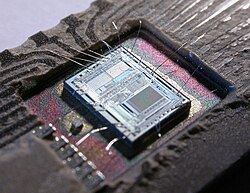
The die from an Intel 8742, an 8-bit microcontroller that includes a CPU running at 12 MHz, 128 bytes of RAM, 2048 bytes of EPROM, and I/O in the same chip
Two ATmega microcontrollers

A microcontroller (MC, uC, or μC) or microcontroller unit (MCU) is a small computer on a single integrated circuit. A microcontroller contains one or more CPUs (processor cores) along with memory and programmable input/output peripherals. Program memory in the form of NOR flash, OTP ROM, or ferroelectric RAM is also often included on the chip, as well as a small amount of RAM. Microcontrollers are designed for embedded applications, in contrast to the microprocessors used in personal computers or other general-purpose applications consisting of various discrete chips.

In modern terminology, a microcontroller is similar to, but less sophisticated than, a system on a chip (SoC). A SoC may include a microcontroller as one of its components but usually integrates it with advanced peripherals like a graphics processing unit (GPU), a Wi-Fi module, or one or more coprocessors.

Microcontrollers are used in automatically controlled products and devices, such as automobile engine control systems, implantable medical devices, remote controls, office machines, appliances, power tools, toys, and other embedded systems. By reducing the size and cost compared to a design that uses a separate microprocessor, memory, and input/output devices, microcontrollers make digital control of more devices and processes practical. Mixed-signal microcontrollers are common, integrating analog components needed to control non-digital electronic systems. In the context of the Internet of Things, microcontrollers are an economical and popular means of data collection, sensing and actuating the physical world as edge devices.

Some microcontrollers may use four-bit words and operate at frequencies as low as 4 kHz for low power consumption (single-digit milliwatts or microwatts). They generally have the ability to retain functionality while waiting for an event such as a button press or other interrupt; power consumption while sleeping (with the CPU clock and most peripherals off) may be just nanowatts, making many of them well suited for long lasting battery applications. Other microcontrollers may serve performance-critical roles, where they may need to act more like a digital signal processor (DSP), with higher clock speeds and power consumption.

History

[edit]

Background

[edit]

The first multi-chip microprocessors, the Four-Phase Systems AL1 in 1969 and the Garrett AiResearch MP944 in 1970, were developed with multiple MOS LSI chips. The first single-chip microprocessor was the Intel 4004, released on a single MOS LSI chip in 1971. It was developed by Federico Faggin, using his silicon-gate MOS technology, along with Intel engineers Marcian Hoff and Stan Mazor, and Busicom engineer Masatoshi Shima.[1] It was followed by the 4-bit Intel 4040, the 8-bit Intel 8008, and the 8-bit Intel 8080. All of these processors required several external chips to implement a working system, including memory and peripheral interface chips. As a result, the total system cost was several hundred (1970s US) dollars, making it impossible to economically computerize small appliances.

MOS Technology introduced its sub-$100 microprocessors in 1975, the 6501 and 6502. Their chief aim was to reduce this cost barrier but these microprocessors still required external support, memory, and peripheral chips which kept the total system cost in the hundreds of dollars.

Development

[edit]

One book credits TI engineers Gary Boone and Michael Cochran with the successful creation of the first microcontroller in 1971. The result of their work was the TMS 1000, which became commercially available in 1974. It combined read-only memory, read/write memory, processor and clock on one chip and was targeted at embedded systems.[2]

During the early-to-mid-1970s, Japanese electronics manufacturers began producing microcontrollers for automobiles, including 4-bit MCUs for in-car entertainment, automatic wipers, electronic locks, and dashboard, and 8-bit MCUs for engine control.[3]

Partly in response to the existence of the single-chip TMS 1000,[4] Intel developed a computer system on a chip optimized for control applications, the Intel 8048, with commercial parts first shipping in 1977.[4] It combined RAM and ROM on the same chip with a microprocessor. Among numerous applications, this chip would eventually find its way into over one billion PC keyboards. At that time Intel's President, Luke J. Valenter, stated that the microcontroller was one of the most successful products in the company's history, and he expanded the microcontroller division's budget by over 25%.

Various PIC microcontrollers with
integrated EPROM
Piggyback microcontroller from MOSTEK

Most microcontrollers at this time had concurrent variants. One had EPROM program memory, with a transparent quartz window in the lid of the package to allow it to be erased by exposure to ultraviolet light. These erasable chips were often used for prototyping. The other variant was either a mask-programmed ROM or a PROM variant which was only programmable once. For the latter, sometimes the designation OTP was used, standing for "one-time programmable". In an OTP microcontroller, the PROM was usually of identical type as the EPROM, but the chip package had no quartz window; because there was no way to expose the EPROM to ultraviolet light, it could not be erased. Because the erasable versions required ceramic packages with quartz windows, they were significantly more expensive than the OTP versions, which could be made in lower-cost opaque plastic packages. For the erasable variants, quartz was required, instead of less expensive glass, for its transparency to ultraviolet light—to which glass is largely opaque—but the main cost differentiator was the ceramic package itself. Piggyback microcontrollers were also used.[5][6][7]

In 1993, the introduction of EEPROM memory allowed microcontrollers (beginning with the Microchip PIC16C84)[8] to be electrically erased quickly without an expensive package as required for EPROM, allowing both rapid prototyping, and in-system programming. (EEPROM technology had been available prior to this time,[9] but the earlier EEPROM was more expensive and less durable, making it unsuitable for low-cost mass-produced microcontrollers.) The same year, Atmel introduced the first microcontroller using Flash memory, a special type of EEPROM.[10] Other companies rapidly followed suit, with both memory types.

Nowadays microcontrollers are cheap and readily available for hobbyists, with large online communities around certain processors.

Volume and cost

[edit]

In 2002, about 55% of all CPUs sold in the world were 8-bit microcontrollers and microprocessors.[11]

Over two billion 8-bit microcontrollers were sold in 1997,[12] and according to Semico, over four billion 8-bit microcontrollers were sold in 2006.[13] More recently, Semico has claimed the MCU market grew 36.5% in 2010 and 12% in 2011.[14]

A typical home in a developed country is likely to have only four general-purpose microprocessors but around three dozen microcontrollers. A typical mid-range automobile has about 30 microcontrollers. They can also be found in many electrical devices such as washing machines, microwave ovens, and telephones.

Historically, the 8-bit segment has dominated the MCU market [..] 16-bit microcontrollers became the largest volume MCU category in 2011, overtaking 8-bit devices for the first time that year [..] IC Insights believes the makeup of the MCU market will undergo substantial changes in the next five years with 32-bit devices steadily grabbing a greater share of sales and unit volumes. By 2017, 32-bit MCUs are expected to account for 55% of microcontroller sales [..] In terms of unit volumes, 32-bit MCUs are expected account for 38% of microcontroller shipments in 2017, while 16-bit devices will represent 34% of the total, and 4-/8-bit designs are forecast to be 28% of units sold that year. The 32-bit MCU market is expected to grow rapidly due to increasing demand for higher levels of precision in embedded-processing systems and the growth in connectivity using the Internet. [..] In the next few years, complex 32-bit MCUs are expected to account for over 25% of the processing power in vehicles.

— IC Insights, MCU Market on Migration Path to 32-bit and ARM-based Devices[15]

Cost to manufacture can be under US$0.10 per unit.

Cost has plummeted over time, with the cheapest 8-bit microcontrollers being available for under US$0.03 in 2018,[16] and some 32-bit microcontrollers around US$1 for similar quantities.

In 2012, following a global crisis—a worst ever annual sales decline and recovery and average sales price year-over-year plunging 17%—the biggest reduction since the 1980s—the average price for a microcontroller was US$0.88 (US$0.69 for 4-/8-bit, US$0.59 for 16-bit, US$1.76 for 32-bit).[15]

In 2012, worldwide sales of 8-bit microcontrollers were around US$4 billion, while 4-bit microcontrollers also saw significant sales.[17]

In 2015, 8-bit microcontrollers could be bought for US$0.311 (1,000 units),[18] 16-bit for US$0.385 (1,000 units),[19] and 32-bit for US$0.378 (1,000 units, but at US$0.35 for 5,000).[20]

In 2018, 8-bit microcontrollers could be bought for US$0.03,[16] 16-bit for US$0.393 (1,000 units, but at US$0.563 for 100 or US$0.349 for full reel of 2,000),[21] and 32-bit for US$0.503 (1,000 units, but at US$0.466 for 5,000).[22]

In 2018, the low-priced microcontrollers above from 2015 were all more expensive (with inflation calculated between 2018 and 2015 prices for those specific units) at: the 8-bit microcontroller could be bought for US$0.319 (1,000 units) or 2.6% higher,[18] the 16-bit one for US$0.464 (1,000 units) or 21% higher,[19] and the 32-bit one for US$0.503 (1,000 units, but at US$0.466 for 5,000) or 33% higher.[20]

A PIC 18F8720 microcontroller in an 80-pin TQFP package

Smallest computer

[edit]

On 21 June 2018, the "world's smallest computer" was announced by the University of Michigan. The device is a "0.04 mm3 16 nW wireless and batteryless sensor system with integrated Cortex-M0+ processor and optical communication for cellular temperature measurement." It "measures just 0.3 mm to a side—dwarfed by a grain of rice. [...] In addition to the RAM and photovoltaics, the new computing devices have processors and wireless transmitters and receivers. Because they are too small to have conventional radio antennae, they receive and transmit data with visible light. A base station provides light for power and programming, and it receives the data."[23] The device is 110th the size of IBM's previously claimed world-record-sized computer from months back in March 2018,[24] which is "smaller than a grain of salt",[25] has a million transistors, costs less than $0.10 to manufacture, and, combined with blockchain technology, is intended for logistics and "crypto-anchors"—digital fingerprint applications.[26]

Embedded design

[edit]

A microcontroller can be considered a self-contained system with a processor, memory and peripherals and can be used as an embedded system.[27] The majority of microcontrollers in use today are embedded in other machinery, such as automobiles, telephones, appliances, and peripherals for computer systems.

While some embedded systems are very sophisticated, many have minimal requirements for memory and program length, with no operating system, and low software complexity. Typical input and output devices include switches, relays, solenoids, LEDs, small or custom liquid-crystal displays, radio frequency devices, and sensors for data such as temperature, humidity, light level etc. Embedded systems usually have no keyboard, screen, disks, printers, or other recognizable I/O devices of a personal computer, and may lack human interaction devices of any kind.

Interrupts

[edit]

Microcontrollers must provide real-time (predictable, though not necessarily fast) response to events in the embedded system they are controlling. When certain events occur, an interrupt system can signal the processor to suspend processing the current instruction sequence and to begin an interrupt service routine (ISR, or "interrupt handler") which will perform any processing required based on the source of the interrupt, before returning to the original instruction sequence. Possible interrupt sources are device-dependent and often include events such as an internal timer overflow, completing an analog-to-digital conversion, a logic-level change on an input such as from a button being pressed, and data received on a communication link. Where power consumption is important as in battery devices, interrupts may also wake a microcontroller from a low-power sleep state where the processor is halted until required to do something by a peripheral event.

Programs

[edit]

Typically microcontroller programs must fit in the available on-chip memory, since it would be costly to provide a system with external, expandable memory. Compilers and assemblers are used to convert both high-level and assembly language code into a compact machine code for storage in the microcontroller's memory. Depending on the device, the program memory may be permanent, read-only memory that can only be programmed at the factory, or it may be field-alterable flash or erasable read-only memory.

Manufacturers have often produced special versions of their microcontrollers in order to help the hardware and software development of the target system. Originally these included EPROM versions that have a "window" on the top of the device through which program memory can be erased by ultraviolet light, ready for reprogramming after a programming ("burn") and test cycle. Since 1998, EPROM versions are rare and have been replaced by EEPROM and flash, which are easier to use (can be erased electronically) and cheaper to manufacture.

Other versions may be available where the ROM is accessed as an external device rather than as internal memory, however these are becoming rare due to the widespread availability of cheap microcontroller programmers.

The use of field-programmable devices on a microcontroller may allow field update of the firmware or permit late factory revisions to products that have been assembled but not yet shipped. Programmable memory also reduces the lead time required for deployment of a new product.

Where hundreds of thousands of identical devices are required, using parts programmed at the time of manufacture can be economical. These "mask-programmed" parts have the program laid down in the same way as the logic of the chip, at the same time.

A customized microcontroller incorporates a block of digital logic that can be personalized for additional processing capability, peripherals and interfaces that are adapted to the requirements of the application. One example is the AT91CAP from Atmel.

Other microcontroller features

[edit]

Microcontrollers usually contain from several to dozens of general purpose input/output pins (GPIO). GPIO pins are software configurable to either an input or an output state. When GPIO pins are configured to an input state, they are often used to read sensors or external signals. Configured to the output state, GPIO pins can drive external devices such as LEDs or motors, often indirectly, through external power electronics.

Many embedded systems need to read sensors that produce analog signals. However, because they are built to interpret and process digital data, i.e. 1s and 0s, they are not able to do anything with the analog signals that may be sent to it by a device. So, an analog-to-digital converter (ADC) is used to convert the incoming data into a form that the processor can recognize. A less common feature on some microcontrollers is a digital-to-analog converter (DAC) that allows the processor to output analog signals or voltage levels.

In addition to the converters, many embedded microprocessors include a variety of timers as well. One of the most common types of timers is the programmable interval timer (PIT). A PIT may either count down from some value to zero, or up to the capacity of the count register, overflowing to zero. Once it reaches zero, it sends an interrupt to the processor indicating that it has finished counting. This is useful for devices such as thermostats, which periodically test the temperature around them to see if they need to turn the air conditioner on/off, the heater on/off, etc.

A dedicated pulse-width modulation (PWM) block makes it possible for the CPU to control power converters, resistive loads, motors, etc., without using many CPU resources in tight timer loops.

A universal asynchronous receiver/transmitter (UART) block makes it possible to receive and transmit data over a serial line with very little load on the CPU. Dedicated on-chip hardware also often includes capabilities to communicate with other devices (chips) in digital formats such as Inter-Integrated Circuit (I²C), Serial Peripheral Interface (SPI), Universal Serial Bus (USB), and Ethernet.[28]

Higher integration

[edit]
Die of a PIC12C508 8-bit, fully static, EEPROM/EPROM/ROM-based CMOS microcontroller manufactured by Microchip Technology using a 1200 nanometer process
Die of a STM32F100C4T6B ARM Cortex-M3 microcontroller with 16 kilobytes flash memory, 24 MHz central processing unit (CPU), motor control and Consumer Electronics Control (CEC) functions. Manufactured by STMicroelectronics.

Microcontrollers may not implement an external address or data bus as they integrate RAM and non-volatile memory on the same chip as the CPU. Using fewer pins, the chip can be placed in a much smaller, cheaper package.

Integrating the memory and other peripherals on a single chip and testing them as a unit increases the cost of that chip, but often results in decreased net cost of the embedded system as a whole. Even if the cost of a CPU that has integrated peripherals is slightly more than the cost of a CPU and external peripherals, having fewer chips typically allows a smaller and cheaper circuit board, and reduces the labor required to assemble and test the circuit board, in addition to tending to decrease the defect rate for the finished assembly.

A microcontroller is a single integrated circuit, commonly with the following features:

This integration drastically reduces the number of chips and the amount of wiring and circuit board space that would be needed to produce equivalent systems using separate chips. Furthermore, on low pin count devices in particular, each pin may interface to several internal peripherals, with the pin function selected by software. This allows a part to be used in a wider variety of applications than if pins had dedicated functions.

Microcontrollers have proved to be highly popular in embedded systems since their introduction in the 1970s.

Some microcontrollers use a Harvard architecture: separate memory buses for instructions and data, allowing accesses to take place concurrently. Where a Harvard architecture is used, instruction words for the processor may be a different bit size than the length of internal memory and registers; for example: 12-bit instructions used with 8-bit data registers.

The decision of which peripheral to integrate is often difficult. The microcontroller vendors often trade operating frequencies and system design flexibility against time-to-market requirements from their customers and overall lower system cost. Manufacturers have to balance the need to minimize the chip size against additional functionality.

Microcontroller architectures vary widely. Some designs include general-purpose microprocessor cores, with one or more ROM, RAM, or I/O functions integrated onto the package. Other designs are purpose-built for control applications. A microcontroller instruction set usually has many instructions intended for bit manipulation (bit-wise operations) to make control programs more compact.[29] For example, a general-purpose processor might require several instructions to test a bit in a register and branch if the bit is set, where a microcontroller could have a single instruction to provide that commonly required function.

Microcontrollers historically have not had math coprocessors, so floating-point arithmetic has been performed by software. However, some recent designs do include FPUs and DSP-optimized features. An example would be Microchip's PIC32 MIPS-based line.

Programming environments

[edit]

Microcontrollers were originally programmed only in assembly language, but various high-level programming languages, such as C, Python and JavaScript, are now also in common use to target microcontrollers and embedded systems.[30] Compilers for general-purpose languages will typically have some restrictions as well as enhancements to better support the unique characteristics of microcontrollers. Some microcontrollers have environments to aid developing certain types of applications. Microcontroller vendors often make tools freely available to make it easier to adopt their hardware.

Microcontrollers with specialty hardware may require their own non-standard dialects of C, such as SDCC for the 8051, which prevent using standard tools (such as code libraries or static analysis tools) even for code unrelated to hardware features. Interpreters may also contain nonstandard features, such as MicroPython, although a fork, CircuitPython, has looked to move hardware dependencies to libraries and have the language adhere to a more CPython standard.

Interpreter firmware is also available for some microcontrollers. For example, BASIC on the early microcontroller Intel 8052;[31] BASIC and FORTH on the Zilog Z8[32] as well as some modern devices. Typically these interpreters support interactive programming.

Simulators are available for some microcontrollers. These allow a developer to analyze what the behavior of the microcontroller and their program should be if they were using the actual part. A simulator will show the internal processor state and also that of the outputs, as well as allowing input signals to be generated. While on the one hand most simulators will be limited from being unable to simulate much other hardware in a system, they can exercise conditions that may otherwise be hard to reproduce at will in the physical implementation, and can be the quickest way to debug and analyze problems.

Recent microcontrollers are often integrated with on-chip debug circuitry that when accessed by an in-circuit emulator (ICE) via JTAG, allow debugging of the firmware with a debugger. A real-time ICE may allow viewing and/or manipulating of internal states while running. A tracing ICE can record executed program and MCU states before/after a trigger point.

Types

[edit]

As of 2008, there are several dozen microcontroller architectures and vendors including:

Many others exist, some of which are used in very narrow range of applications or are more like applications processors than microcontrollers. The microcontroller market is extremely fragmented, with numerous vendors, technologies, and markets. Note that many vendors sell or have sold multiple architectures.

Interrupt latency

[edit]

In contrast to general-purpose computers, microcontrollers used in embedded systems often seek to optimize interrupt latency over instruction throughput. Issues include both reducing the latency, and making it be more predictable (to support real-time control).

When an electronic device causes an interrupt, during the context switch the intermediate results (registers) have to be saved before the software responsible for handling the interrupt can run. They must also be restored after that interrupt handler is finished. If there are more processor registers, this saving and restoring process may take more time, increasing the latency. (If an ISR does not require the use of some registers, it may simply leave them alone rather than saving and restoring them, so in that case those registers are not involved with the latency.) Ways to reduce such context/restore latency include having relatively few registers in their central processing units (undesirable because it slows down most non-interrupt processing substantially), or at least having the hardware not save them all (this fails if the software then needs to compensate by saving the rest "manually"). Another technique involves spending silicon gates on "shadow registers": One or more duplicate registers used only by the interrupt software, perhaps supporting a dedicated stack.

Other factors affecting interrupt latency include:

  • Cycles needed to complete current CPU activities. To minimize those costs, microcontrollers tend to have short pipelines (often three instructions or less), small write buffers, and ensure that longer instructions are continuable or restartable. RISC design principles ensure that most instructions take the same number of cycles, helping avoid the need for most such continuation/restart logic.
  • The length of any critical section that needs to be interrupted. Entry to a critical section restricts concurrent data structure access. When a data structure must be accessed by an interrupt handler, the critical section must block that interrupt. Accordingly, interrupt latency is increased by however long that interrupt is blocked. When there are hard external constraints on system latency, developers often need tools to measure interrupt latencies and track down which critical sections cause slowdowns.
    • One common technique just blocks all interrupts for the duration of the critical section. This is easy to implement, but sometimes critical sections get uncomfortably long.
    • A more complex technique just blocks the interrupts that may trigger access to that data structure. This is often based on interrupt priorities, which tend to not correspond well to the relevant system data structures. Accordingly, this technique is used mostly in very constrained environments.
    • Processors may have hardware support for some critical sections. Examples include supporting atomic access to bits or bytes within a word, or other atomic access primitives like the LDREX/STREX exclusive access primitives introduced in the ARMv6 architecture.
  • Interrupt nesting. Some microcontrollers allow higher priority interrupts to interrupt lower priority ones. This allows software to manage latency by giving time-critical interrupts higher priority (and thus lower and more predictable latency) than less-critical ones.
  • Trigger rate. When interrupts occur back-to-back, microcontrollers may avoid an extra context save/restore cycle by a form of tail call optimization.

Lower end microcontrollers tend to support fewer interrupt latency controls than higher end ones.

Memory technology

[edit]

Two different kinds of memory are commonly used with microcontrollers, a non-volatile memory for storing firmware and a read–write memory for temporary data.

Data

[edit]

From the earliest microcontrollers to today, six-transistor SRAM is almost always used as the read/write working memory, with a few more transistors per bit used in the register file.

In addition to the SRAM, some microcontrollers also have internal EEPROM and/or NVRAM for data storage; and ones that do not have any (such as the BASIC Stamp), or where the internal memory is insufficient, are often connected to an external EEPROM or flash memory chip.

A few microcontrollers beginning in 2003 have "self-programmable" flash memory.[10]

Firmware

[edit]

The earliest microcontrollers used mask ROM to store firmware. Later microcontrollers (such as the early versions of the Freescale 68HC11 and early PIC microcontrollers) had EPROM memory, which used a translucent window to allow erasure via UV light, while production versions had no such window, being OTP (one-time-programmable). Firmware updates were equivalent to replacing the microcontroller itself, thus many products were not upgradeable.

Motorola MC68HC805[9] was the first microcontroller to use EEPROM to store the firmware. EEPROM microcontrollers became more popular in 1993 when Microchip introduced PIC16C84[8] and Atmel introduced an 8051-core microcontroller that was first one to use NOR Flash memory to store the firmware.[10] Today's microcontrollers almost all use flash memory, with a few models using FRAM and some ultra-low-cost parts still using OTP or Mask ROM.

See also

[edit]

References

[edit]
[edit]
Revisions and contributorsEdit on WikipediaRead on Wikipedia
from Grokipedia
A microcontroller is a compact that integrates a , , and programmable peripherals onto a single chip, enabling it to function as a self-contained computer for controlling specific tasks in embedded systems. The history of microcontrollers traces back to 1971, when engineers Gary Boone and Michael Cochran developed the TMS1000, the first 4-bit microcontroller with built-in ROM and RAM, initially used in calculators. This innovation evolved from earlier microprocessors like Intel's 4004 (1971), shifting focus in the early 1980s toward integrated, low-power devices optimized for size and efficiency rather than raw speed. Key milestones include Intel's 8051 (1980), Motorola's MC68HC05 family (known for its low-power design), and the 1990s introduction of for reprogrammability, leading to modern families like and AVR. At their core, microcontrollers feature a (CPU), typically RISC-based for efficiency; volatile RAM for temporary data storage (e.g., 32 KB in some models); like flash or ROM for program storage (e.g., 256 KB); and peripherals such as timers, analog-to-digital converters (ADCs), UARTs for , and general-purpose I/O (GPIO) pins for interfacing with sensors and actuators. These components often employ with separate instruction and data buses to enable parallel access, supporting real-time operations at clock speeds from a few MHz to up to 600 MHz in advanced variants. Microcontrollers power a vast array of applications in embedded systems, from like remote controls and appliances to automotive systems (e.g., anti-lock braking), medical devices (e.g., pacemakers), , IoT sensors, and industrial controls, where they read inputs, execute control algorithms, and manage outputs with low power consumption. Their ubiquity—with over 30 billion units shipped worldwide in 2021—stems from cost-effectiveness (under $1 for basic models), reprogrammability, and integration that reduces component count in designs.

Fundamentals

Definition and Purpose

A microcontroller (MCU) is a compact that integrates a processor core, , and programmable peripherals into a single chip, functioning as a self-contained small computer. This design enables it to perform dedicated control tasks within larger electronic systems. Microcontrollers are primarily purposed for embedded applications, where they manage hardware operations in devices such as household appliances, automotive systems, and Internet of Things (IoT) gadgets, prioritizing attributes like minimal size, low cost, and reduced power usage to suit resource-constrained environments. At their core, microcontrollers operate through a fetch-execute cycle, in which the processor retrieves instructions from on-chip , decodes them, and executes operations to handle real-time tasks efficiently. This cycle is optimized for embedded control, leveraging integrated resources like timers and interfaces to reduce reliance on external components and enable responsive, deterministic performance in time-sensitive applications. The high level of integration in microcontrollers simplifies overall system design by minimizing the need for additional circuitry, which in turn lowers costs—often under $1 per unit in high-volume production—and power consumption, typically in the milliwatts range for low-power modes. The concept of the microcontroller originated in the 1970s from the demand for single-chip solutions to replace discrete components in computing and control systems, laying the groundwork for modern embedded computing.

Core Components

The core components of a microcontroller form its foundational hardware structure, integrating essential elements for computation, storage, timing, and basic interfacing on a single chip. These components enable the microcontroller to execute instructions autonomously while managing real-time operations efficiently. The processor core, often referred to as the (CPU), serves as the computational heart of the microcontroller, executing instructions fetched from . It is typically an 8-bit, 16-bit, or 32-bit , with 8-bit cores common in simple applications due to their low power and cost, while 32-bit cores offer higher performance for complex tasks. s may follow reduced instruction set (RISC), which uses a smaller set of simple instructions (e.g., around 30 instructions with 3-5 addressing modes) for faster execution, or complex instruction set (CISC), featuring more intricate instructions (e.g., up to 80 with 12-24 addressing modes) for denser code. Operating speeds range from kilohertz in low-power devices to up to 1 GHz in advanced models as of 2025. Memory systems provide the storage necessary for program execution and data handling, all integrated on-chip to minimize external dependencies. Program memory, typically implemented as (ROM) or , is non-volatile and stores the or operating instructions that persist without power. Data memory consists of (RAM), which is volatile and used for temporary storage of variables and intermediate results during runtime. Additionally, electrically erasable programmable (EEPROM) offers non-volatile storage for user data that must be retained across power cycles, such as configuration settings. These memory types ensure efficient access, with flash allowing in-system reprogramming for flexibility. The clock system generates the timing signals that synchronize all operations, using internal or external oscillators to produce a stable . Internal oscillators are built-in for and low , while external ones provide higher precision. The clock directly impacts performance, as the number of instructions executed per second (IPS) is calculated as IPS = clock speed / (), where CPI represents the average clock cycles needed per instruction—often 1 to 4 in microcontrollers, such as 4 cycles per instruction in PIC architectures. This relationship scales processing power; for instance, doubling the clock speed from 50 MHz to 100 MHz with a CPI of 1 effectively doubles the IPS to 100 million . Timers and counters are hardware modules dedicated to tracking time intervals or event counts, essential for periodic tasks without relying on software loops. They increment based on the (or a divided version via prescaler), and upon reaching their maximum value (e.g., 255 for an 8-bit counter), they overflow and reset, potentially triggering an event. The initial count value for a desired overflow period is determined by the formula: initial count = (maximum count + 1) - (desired period × clock frequency / prescaler), ensuring precise timing; for example, with a 16 MHz clock, prescaler of 64, and 1 ms period on a 16-bit , the calculation yields an initial count of 65536 - (0.001 × 16000000 / 64) = 65286. This allows reliable generation of delays or measurements. Basic (I/O) ports consist of digital pins that serve as the primary interface to the external world, configurable as either inputs to read signals or outputs to drive devices. Each port typically comprises multiple pins (e.g., 8 per port in many designs), supporting bidirectional operation through register settings. Integrated pull-up or pull-down resistors stabilize pin states when floating, preventing undefined logic levels—pull-up resistors connect to the positive supply for a default high state, while pull-downs tie to ground for a default low. These ports enable simple control of LEDs, switches, or sensors with minimal external circuitry.

Distinction from Microprocessors

A microprocessor is a general-purpose central processing unit (CPU) fabricated on a single integrated circuit, exemplified by architectures like Intel's x86 series, which focuses on high computational performance but requires external memory, input/output interfaces, and peripherals to operate as a complete system. In contrast, a microcontroller integrates the CPU core with on-chip memory (such as RAM and ROM/Flash) and essential peripherals (including timers, analog-to-digital converters, and communication interfaces) into a single chip, enabling self-contained operation for dedicated tasks. This fundamental design philosophy distinguishes microcontrollers as optimized for embedded systems where reliability and efficiency in specific functions are paramount, while microprocessors emphasize modularity and scalability for broader computing applications. The key differences lie in their integration levels and optimization priorities: microcontrollers achieve self-sufficiency through on-chip resources, reducing external dependencies and supporting low-power, cost-effective designs ideal for real-time control in devices like appliances or sensors; microprocessors, however, rely on modular external components via buses, allowing greater flexibility and higher processing speeds but at the expense of increased complexity and power consumption. Microcontrollers typically employ a with separate buses for instructions and data to enhance efficiency in constrained environments, whereas microprocessors often use with a shared bus for versatile data handling. These choices reflect trade-offs in expandability—microcontrollers offer limited scalability due to fixed on-chip resources, facilitating quicker development cycles and lower overall costs, while microprocessors provide extensive potential through add-ons but more engineering effort and higher expenses for integration. For instance, an board based on the microcontroller features around 28 pins dedicated to direct I/O and analog functions, enabling simple prototyping for hobbyist projects with minimal external hardware; in comparison, a PC like an i7 has over 1,000 pins primarily for high-speed bus interfaces to components, supporting complex multitasking but requiring a full of supporting chips. Microcontroller pin counts generally range from 20 to 100 for general-purpose I/O, contrasting with microprocessors' focus on fewer direct pins but expansive bus connectivity for peripherals. Hybrid systems address these distinctions by combining a for compute-intensive tasks with an MCU co-processor for precise control functions, as seen in devices like the STM32MP1 series, where an microprocessor core handles general processing alongside a Cortex-M4 MCU core for real-time operations. This approach leverages the strengths of both, optimizing for applications like industrial automation where high performance and embedded reliability coexist.

History

Early Concepts and Prototypes

The advent of integrated circuits in the late 1950s, exemplified by Jack Kilby's invention at , enabled the miniaturization of electronic systems during the 1960s, setting the stage for more compact computing architectures. Minicomputers like Digital Equipment Corporation's PDP-8, launched in 1965, further inspired this trend by providing affordable, programmable platforms for industrial and scientific control, initially using discrete transistors but evolving to incorporate integrated circuits in later models such as the PDP-8/I. These developments highlighted the potential to consolidate logic, memory, and processing onto fewer chips, driving the conceptual shift toward single-chip computers for embedded applications. A pivotal early was the MP944 , developed by in 1970 for the U.S. Navy's F-14 Tomcat Central . Designed by Steve Geller and Raymond Holt, the MP944 comprised six metal-oxide-semiconductor (MOS) chips that integrated a 20-bit processor, 8192 words of 28-bit (roughly 25 kB total, with 1536 words variable), and support for parallel processing, operating at a clock speed of approximately 375 kHz with a 2.8-microsecond cycle time. This aerospace-oriented system addressed the need for rugged, programmable logic in harsh environments, reducing discrete requirements from thousands to a compact multi-chip set while handling real-time computations like and altitude. The , released in 1971, represented the first true single-chip microprocessor and accelerated microcontroller prototyping. Conceived by Marcian "Ted" Hoff and Stanley Mazor, and implemented by and Masatoshi Shima using , the 4-bit 4004 featured 2300 transistors in a 16-pin package, capable of addressing up to 4 kB of memory and executing instructions at 740 kHz. Initially targeted at calculators, it demonstrated the viability of on-chip programmability for control tasks, inspiring subsequent integrations of peripherals and memory to form complete microcontrollers on one die. Fairchild Semiconductor's F8 experiments, initiated around 1973 and announced in 1974, explored multi-chip architectures that bridged microprocessors and microcontrollers. The F8 system included the F3850 CPU chip with an 8-bit ALU, 64-byte scratchpad RAM, and I/O ports, paired with the F3851 program storage unit offering 1-2 kB ROM, all functioning at low clock speeds under 1 MHz in a . These prototypes faced challenges like programming complexity due to indirect addressing and limited on-chip resources, yet they reduced component counts for control applications and influenced single-chip evolutions, such as Mostek's MK3870, by emphasizing cost-effective integration for devices like multimeters. The TMS1000, prototyped in 1971 as an extension of calculator chips and announced in 1974, emerged as the first single-chip general-purpose microcontroller. Invented by Gary Boone and Michael Cochran, the 4-bit TMS1000 combined a CPU, 1 kB (8192 bits) masked ROM, 32 bytes (256 bits) RAM, and basic I/O on one chip, with a maximum clock frequency of 0.4 MHz yielding 2.5-microsecond cycles and instruction execution in 15 microseconds. Driven by demands for programmable logic in toys, alarms, and appliances, it slashed discrete needs from thousands to a single IC, though constrained by minimal memory and speed that limited complex operations.

Commercial Development

The commercial development of microcontrollers began in the late 1970s with Intel's introduction of the MCS-48 family, including the 8048 mask-programmable ROM variant and the 8748 version, which allowed for field reprogramming and marked the first widespread commercial availability of single-chip controllers optimized for embedded applications. These devices quickly found adoption in 1980s , powering appliances like microwaves for timer and control functions and toys such as , where their low cost and integration reduced system complexity compared to discrete logic circuits. By the mid-1980s, key players emerged, including , which in 1989 acquired General Instrument's PIC line—originally launched as the PIC1650 in 1976—and expanded it into a versatile 8-bit family emphasizing peripherals for peripheral interface control in cost-sensitive designs. The 1990s saw further diversification with 's AVR architecture in 1996, an 8-bit RISC design featuring on-chip for easier in-system , targeting hobbyist and industrial uses with improved code efficiency. Concurrently, ARM's licensing model, established in 1990 through Advanced RISC Machines Ltd., boomed as companies integrated its low-power RISC cores into microcontrollers, enabling scalable embedded solutions across consumer and telecom sectors. Technological advancements during this period included the shift from mask ROM and to reprogrammable , with introducing the first flash-based 8-bit microcontroller (an 8051 variant) in 1993, providing block-erasable program storage that facilitated iterative development without specialized equipment. The PIC16C84, also released in 1993, advanced serial programming with program memory and integrated data . This transition, combined with increased peripheral integration such as ADCs, timers, and communication interfaces, lowered barriers to embedding intelligence in products. Market impacts were profound, igniting the embedded systems revolution by enabling compact, reliable control in diverse applications; by the , annual production scaled to billions of units, driven by demand in appliances, , and beyond. Key milestones included the 1980s adoption in control units, where microcontrollers like Intel's 8048 and Motorola's 6805 optimized and ignition in vehicles from Ford and GM, improving efficiency and emissions compliance. In the , open-source tools like the GNU Compiler Collection (GCC), ported to embedded targets by the mid-decade, democratized programming for architectures such as and AVR, accelerating development and fostering innovation in non-proprietary ecosystems.

Evolution in Scale and Cost

The physical scale of microcontrollers has dramatically reduced since their , driven by advances in fabrication. In the 1970s, early devices like the Intel 8048 were housed in 40-pin dual in-line packages (DIP) measuring approximately 52 mm by 13 mm, occupying centimeters of board space. By the 2020s, modern microcontrollers have achieved sub-millimeter footprints, exemplified by ' MSPM0C1104, which fits into a wafer chip-scale package of just 1.38 mm²—comparable to a flake of —enabling integration into ultra-compact applications such as wearables and implants. This miniaturization stems from progressive node shrinks in processes, from micron-scale features in the 1970s to 40 nm and below today, allowing die sizes to drop from several square millimeters to under 1 mm² in high-volume parts. Parallel to size reductions, microcontroller costs have plummeted, making them ubiquitous in consumer and industrial products. In the 1970s, units like the 8048 retailed for under $10 in volume, but typical pricing ranged from $10 to $100 depending on configuration and quantity. By the 2020s, high-volume pricing has fallen below $0.10 per unit for basic 8-bit and 32-bit models, with average selling prices (ASPs) for 32-bit microcontrollers stabilizing around $1 or less after a period of erosion. This trend aligns with , where transistor density on integrated circuits doubles approximately every two years, exponentially increasing performance while halving costs through in fabrication. For instance, ' series, launched in 2007 with entry-level models priced around $3–$5, now offers variants like the STM32C0 at $0.21 in volume, reflecting over an 80% price drop for comparable functionality. These evolutions have propelled massive adoption, with global microcontroller shipments reaching 31.2 billion units in 2021 and estimated at over 35 billion units in 2024, continuing to grow at 9–13% annually as of 2025, resulting in cumulative shipments exceeding 250 billion units since the . Key drivers include scaling, which enhances density and efficiency, and high-volume manufacturing tailored to sectors like automotive (e.g., controls) and consumer electronics (e.g., appliances), where billions of units are produced yearly to amortize fixed costs. However, the 2020–2022 global semiconductor shortages, triggered by pandemic-related demand surges and supply chain disruptions, temporarily reversed cost declines, inflating MCU prices by up to 20–30% and extending lead times to over a year for certain models. Looking ahead, advanced packaging techniques such as chiplets and wafer-level integration are projected to further reduce costs, potentially enabling sub-$0.01 pricing for basic microcontrollers in high volumes by 2030, while supporting denser integration for edge AI applications.

Architecture

Central Processing Unit

The (CPU) serves as the computational core of a microcontroller, executing instructions to perform arithmetic, logic, and control operations essential for tasks. In microcontrollers, the CPU is optimized for low power, real-time responsiveness, and integration with on-chip resources, distinguishing it from general-purpose processors by prioritizing efficiency over raw speed. Microcontroller CPUs typically employ either Von Neumann or Harvard architectures. In the Von Neumann architecture, a single bus handles both program instructions and data, simplifying design but potentially creating bottlenecks during simultaneous access; this is common in simpler microcontrollers like the ARM Cortex-M0+. Conversely, the Harvard architecture uses separate buses for instructions and data, enabling parallel fetching and execution for improved efficiency, as seen in many advanced microcontrollers such as ARM Cortex-M3 and later variants. This separation reduces latency in instruction handling, making Harvard variants prevalent in performance-oriented embedded applications. Instruction sets in microcontroller CPUs are broadly classified as Reduced Instruction Set Computing (RISC) or Complex Instruction Set Computing (CISC). RISC architectures, exemplified by the series, feature a compact set of simple, fixed-length instructions (typically 16- or 32-bit) that execute in fewer clock cycles, enhancing speed and power efficiency; for instance, the Cortex-M4 supports Thumb-2 instructions optimized for embedded code density. In contrast, CISC architectures like the 8051 use a larger repertoire of variable-length instructions (up to 255 opcodes) for more complex operations in a single instruction, though this increases decoding complexity. Pipeline stages in these CPUs range from 1 to 5: basic designs like the Cortex-M0+ use a 2-stage (fetch and execute/decode), while advanced ones such as the Cortex-M7 employ a 6-stage superscalar pipeline with fetch, decode, execute, memory, and write-back stages to overlap operations and boost throughput. Emerging architectures like (e.g., in CH32V series) offer open-source alternatives with similar RISC efficiency. Performance in microcontroller CPUs is gauged by metrics like clock speed and millions of instructions per second (MIPS). Clock frequencies typically span 1 MHz for ultra-low-power devices like the TI MSP430 to 600 MHz in high-end models such as the STM32H7 series based on Cortex-M7 (as of 2025). MIPS ratings, often expressed as Dhrystone MIPS (DMIPS), reflect instruction execution efficiency; the Cortex-M4 achieves approximately 1.25 DMIPS/MHz, allowing a 168 MHz instance to deliver around 210 DMIPS for signal processing tasks. Power consumption, critical for battery-operated systems, follows the dynamic power equation P=CV2fP = C V^2 f, where PP is power, CC is switched capacitance, VV is supply voltage, and ff is frequency; scaling frequency linearly affects power, but voltage adjustments (e.g., 1.2-3.3 V) have a quadratic impact, enabling trade-offs for low-power modes. The register file in microcontroller CPUs includes 8 to 32 general-purpose registers (GPRs) for temporary and fast access, alongside special-purpose registers. For example, the provides 16 visible 32-bit GPRs (R0-R12, plus stack pointer (SP), link register (LR), and program counter (PC)), supporting efficient handling during execution. The 8051 architecture features 32 GPRs organized in four 8-register banks (R0-R7), with the PC (16-bit) tracking the next instruction address and SP (8-bit) managing the stack for subroutine calls and interrupts. These registers facilitate rapid computations without frequent memory access, enhancing overall efficiency. The execution model in microcontroller CPUs revolves around the fetch-decode-execute cycle. During the fetch stage, the CPU retrieves the next instruction from program using the PC; in the decode stage, it interprets the and operands; and in the execute stage, it performs the operation, updating registers or the PC as needed. Advanced microcontrollers incorporate branch prediction to mitigate stalls from conditional jumps: the Cortex-M7 uses a branch target address cache (BTAC) and static predictor to anticipate branch outcomes, prefetching instructions and improving performance by up to 20% in branch-heavy code. This cycle repeats continuously, with brief interactions to systems for loads during execution.

Memory Systems

Microcontrollers employ non-volatile program memory, primarily in the form of flash or ROM, to store and executable code persistently without power. This memory typically ranges from 4 KB to 2 MB in capacity, depending on the device family and application requirements. Flash-based program memory supports electrical erasure and reprogramming, with endurance ratings of 10,000 to 100,000 write/erase cycles at , enabling repeated field updates. Data memory in microcontrollers consists of volatile SRAM, used for storing runtime variables, stack, and temporary data during program execution. Capacities vary from 256 bytes in low-end devices to 512 KB in higher-performance models, balancing power efficiency and processing needs. Access to SRAM occurs through addressing modes such as direct, which targets specific locations across the entire data space, and indirect, which uses pointer registers like X, Y, or Z for flexible operand retrieval. These modes support operations like pre-decrement and post-increment for efficient stack management and array processing. For persistent data storage beyond program code, microcontrollers incorporate non-volatile options like or FRAM, which retain configuration settings or logs across power cycles. provides byte-level read and write access, ideal for small datasets such as calibration values, with endurance up to 1 million cycles and retention exceeding 10 years. FRAM offers superior performance with write times under 50 ns, over 10^12 cycles, and up to 151 years of data retention (e.g., in specific devices like CY15B104Q), making it suitable for high-reliability applications like automotive systems. Both technologies enable granular updates without block erasure, contrasting with bulk program memory operations. The in microcontrollers organizes address spaces for program, , and other regions, with modern designs favoring unified addressing where instructions and share a single contiguous space for simplified CPU fetching. Segmented addressing, common in legacy architectures, divides memory into separate code and segments to manage limited address buses. Contemporary microcontrollers integrate units (MPUs), such as those in cores, to define up to 16 regions with access permissions, preventing unauthorized reads or writes and enhancing security in multitasking environments. Program memory technologies predominantly use NOR flash in microcontrollers due to its capabilities, enabling direct execution without loading to RAM. NOR flash trades off density for speed, offering faster reads than NAND but at higher cost per bit and lower storage capacity. NAND flash, while denser and cheaper for bulk storage, requires block-level operations unsuitable for real-time fetching in embedded systems. Both exhibit of 10 to 20 years under normal conditions, with NOR providing greater reliability for long-term archival needs.

Peripherals and Interfaces

Microcontrollers incorporate a variety of peripherals and interfaces to facilitate interaction with external devices, enabling functions such as , data exchange, and control of actuators. These modules are typically integrated on-chip to minimize external components and power consumption, allowing the microcontroller to manage inputs from sensors and outputs to effectors efficiently. Digital input/output (I/O) is primarily handled through (GPIO) pins, which serve as versatile ports for connecting to switches, LEDs, and other binary devices. Modern microcontrollers feature up to 100 or more GPIO pins, often organized into ports for grouped configuration as inputs, outputs, or bidirectional lines. These pins support advanced configurations, including (PWM) generation for analog-like outputs and triggering on edge transitions to detect changes without constant polling. To handle noisy signals from mechanical switches, debounce techniques are employed, such as software delays or hardware RC filters, ensuring reliable state detection. Analog peripherals enable the conversion between digital and continuous signals, essential for interfacing with real-world sensors. Analog-to-digital converters (ADCs) in microcontrollers typically offer 8- to 16-bit resolution and sampling rates up to 100 ksps, allowing precise digitization of voltages from sources like potentiometers or light sensors. Digital-to-analog converters (DACs) provide complementary output functionality, generating analog voltages for applications such as creation or motor speed referencing, often with similar resolution levels. Communication interfaces support data transfer between the microcontroller and other devices, ranging from simple serial links to networked protocols. (UART) enables point-to-point for debugging or connections, while (SPI) and inter-integrated circuit (I2C) facilitate multi-device buses for short-range, synchronous data exchange with peripherals like displays or memory chips. For industrial and automotive applications, controller area network (CAN) provides robust, error-checked messaging over longer distances, and Ethernet interfaces allow high-speed networking in connected embedded systems. Timers and PWM modules are crucial for precise timing and control tasks, such as generating periodic signals or regulating power delivery. These peripherals often include multiple channels—up to eight or more per —for simultaneous operation, making them suitable for where independent drive multiple phases. The PWM duty cycle, which determines the average output power, is calculated as: duty cycle=(on-timeperiod)×100%\text{duty cycle} = \left( \frac{\text{on-time}}{\text{period}} \right) \times 100\% This formula allows fine-tuned control of actuators like DC motors by varying the high-time proportion within each cycle. Peripherals like timers can operate under CPU oversight or via interrupt-driven handling for efficient event response. Integration of sensors and actuators expands microcontroller functionality, with I2C being a common interface for low-speed, addressable connections. For instance, temperature sensors such as the TMP116 can connect via I2C to provide digital readings for , while actuators like servos interface through PWM outputs for position control. This setup enables seamless and response in applications from IoT devices to industrial automation.

Programming and Development

Languages and Models

Microcontrollers are programmed using a range of languages and models tailored to their constrained environments, balancing direct hardware control with for efficiency and . Low-level languages like assembly provide precise instruction over hardware resources, while high-level languages such as offer portability and productivity. Programming models further differentiate approaches, from bare-metal implementations that interact directly with registers to real-time operating systems (RTOS) that enable multitasking. Firmware structure typically organizes code into bootloaders, main loops, and service routines (ISRs), with memory allocation managed statically or dynamically via stack and heap mechanisms in . Compilation relies on cross-compilers like GCC, which apply optimization levels to minimize code size or maximize execution speed on target architectures such as ARM. Assembly language serves as the foundational programming method for microcontrollers, enabling direct manipulation of hardware through mnemonic instructions that correspond to opcodes. For instance, in the 8051 architecture, the MOV instruction transfers data between registers, memory locations, or immediate values, such as MOV A, #0x05 to load the accumulator with a constant. This approach excels in efficiency, generating compact code with minimal overhead for resource-limited devices, but it suffers from poor portability across different microcontroller architectures due to instruction set variations. High-level languages predominate in modern microcontroller development for their readability and reduced development time, with C and C++ being the most widely adopted due to their support for low-level features like alongside . Embedded variants, such as , impose strict guidelines to enhance safety and reliability in critical applications by prohibiting unsafe constructs like pointer arithmetic without bounds checking, as defined in the MISRA C:2012 standard. For scripting and rapid prototyping, Python implementations like provide an interpreted environment optimized for microcontrollers, allowing dynamic code execution on platforms with limited RAM, though at the cost of higher memory usage compared to compiled languages. Additionally, has gained prominence in embedded programming for its guarantees, preventing issues like dereferences and data races without a garbage collector, supported by crates like embedded-hal for . Programming models for microcontrollers range from bare-metal approaches, where software directly accesses hardware registers without an intermediary layer, to RTOS-based systems that abstract resource management for concurrent operations. In bare-metal programming, developers write code that polls peripherals or handles interrupts manually, offering deterministic control and minimal footprint suitable for simple, real-time tasks. Conversely, an RTOS like introduces multitasking via prioritized threads, semaphores, and queues, facilitating complex applications with multiple independent processes while maintaining real-time responsiveness through preemptive scheduling. Firmware for microcontrollers follows a structured to ensure reliable initialization and operation. A resides in and executes first to load the main application, often verifying integrity via checksums before jumping to the user code. The core application then enters a main loop that repeatedly checks states and executes non-time-critical tasks, while ISRs handle urgent hardware events like overflows or input changes by saving context, processing the , and restoring execution. This separation ensures the system remains responsive without blocking the primary flow. In C-based , memory allocation distinguishes between the stack, used for automatic variables and function calls with fixed-size, last-in-first-out management, and the heap for dynamic allocation via functions like malloc, though the latter is often avoided in embedded contexts to prevent fragmentation and non-determinism in resource-constrained environments. Stack size is typically predefined in the linker script to accommodate maximum depth and ISR overhead, while heap usage requires careful bounding to fit within available RAM, often limited to 1-64 KB on typical microcontrollers. Cross-compilation is essential for building microcontroller on host machines, with tools like Collection (GCC) configured for targets such as via variants like arm-none-eabi-gcc. Optimization levels in GCC, ranging from -O0 (no optimization for ) to -O3 (aggressive speed enhancements including inlining), or -Os (size-focused), allow trade-offs between code density and performance; for example, -Os can reduce flash usage by 10-20% in embedded binaries by eliminating redundant instructions.

Integrated Development Environments

Integrated development environments (IDEs) for microcontrollers provide comprehensive software platforms that streamline the creation, compilation, testing, and deployment of , integrating multiple tools into a unified interface to enhance developer productivity. These environments typically include a code editor for writing , a and linker for generating binaries, simulators for virtual testing, and debuggers for identifying issues, all tailored to the constraints of embedded systems such as limited and real-time requirements. By supporting various microcontroller architectures, IDEs facilitate efficient workflows from prototyping to production, often incorporating device-specific libraries and configuration tools to abstract hardware complexities. Prominent examples include Keil µVision, which offers , editing with , program , and complete capabilities optimized for ARM-based microcontrollers, enabling developers to build and test applications without physical hardware. MPLAB X IDE, developed by Microchip, is a highly configurable environment supporting PIC, dsPIC, AVR, and SAM devices, featuring an integrated code editor, assembler, linker, and simulator for 8-bit to 32-bit microcontrollers. The Arduino IDE, designed for accessibility, provides a simplified editor, , and uploader for Arduino-compatible boards and third-party microcontrollers, emphasizing with built-in serial monitor and library management. (VS Code), extended with plugins like PlatformIO, has become widely used for its cross-platform support, multi-architecture compilation (including , AVR, ), and integrated via tools like OpenOCD, appealing to both hobbyists and professionals for its extensibility and open-source nature. Toolchains within these IDEs encompass compilers like the ARM Compiler or GCC for translating high-level code to machine instructions, assemblers for low-level optimization, and linkers to resolve references and produce images. Debuggers leverage standard interfaces such as for multi-pin testing or Serial Wire Debug (SWD) for efficient, two-wire communication, allowing breakpoints, variable inspection, and step-through execution directly on the target microcontroller. Hardware tools complement IDEs by enabling physical interaction with microcontrollers, including programmers like the ST-LINK/V2, which serves as an in-circuit debugger and flasher for STM8 and families via SWIM or /SWD protocols, supporting voltages from 1.65V to 5.5V. Emulators, such as those integrated with in-circuit test setups, replicate microcontroller behavior for hardware-in-the-loop validation, allowing developers to monitor signals and peripherals without risking production boards. The typical development workflow in microcontroller IDEs follows a write-compile-flash-debug cycle: developers edit code in the IDE's editor, compile it using the to generate a hex or , flash the to the microcontroller via a connected , and debug iteratively using on-chip or external tools to resolve errors. Many modern IDEs integrate systems like , enabling collaborative development, branching for feature testing, and rollback capabilities to manage iterations effectively. Open-source IDEs, such as Eclipse-based platforms like STM32CubeIDE, offer free access to extensible frameworks with community-driven plugins, supporting multiple vendors and toolchains but often requiring manual configuration, which suits hobbyists and cost-sensitive projects. In contrast, IDEs like Keil µVision provide polished, vendor-optimized features with seamless integration for specific architectures, though they involve licensing fees—typically free for or limited code sizes but escalating to thousands of dollars annually for commercial unlimited use—impacting professional deployment costs.

Debugging Techniques

Debugging microcontrollers involves a range of techniques to identify and resolve software and hardware faults, often integrating hardware interfaces, simulation tools, and runtime monitoring to ensure reliable operation in resource-constrained environments. In-circuit debugging enables real-time interaction with the microcontroller while it runs on the target hardware, typically using standards like IEEE 1149.1 () or its two-wire variant, Serial Wire Debug (SWD). halt execution at specific code addresses via the Flash Patch and Breakpoint (FPB) unit, allowing inspection of registers and memory without altering the program flow. Watchpoints monitor data accesses using comparators in the Data Watchpoint and Trace (DWT) macrocell, triggering on matches to addresses or values for detecting anomalies like invalid memory writes. Trace buffers, such as the Embedded Trace Buffer (ETB) or Micro Trace Buffer (MTB) in processors, capture execution history including samples and timestamps, providing non-intrusive insight into code paths without halting the processor. Simulation offers a hardware-free alternative for testing microcontroller code, with cycle-accurate emulators replicating the processor's timing and behavior to verify functionality before deployment. Tools like provide functional emulation for ARM-based microcontrollers, suitable for software validation and full-system testing including peripherals, though for precise cycle-accurate , frameworks like gem5 or vendor tools such as Fast Models are employed, supporting workloads like on embedded platforms. Logging and profiling techniques capture runtime data to diagnose issues, often leveraging serial interfaces for output. UART-based printf statements redirect debug messages to a host via a virtual COM port, allowing developers to log variable states and execution flow without dedicated hardware debuggers. Oscilloscopes analyze in UART communications, decoding protocols to verify baud rates, timing, and during debugging sessions. Common issues in microcontroller programming include stack overflows, which corrupt beyond allocated bounds leading to erratic behavior or crashes, and timing errors arising from imprecise delays or latencies. Techniques like assertions code validate assumptions at runtime, such as checking pointer validity or buffer sizes, and trigger a controlled response like a system reset upon failure to isolate faults early. Advanced debugging employs specialized tools for deeper analysis, including logic analyzers that capture multiple digital signals simultaneously to inspect bus traffic, such as SPI or I2C transactions, revealing protocol violations or synchronization problems in microcontroller peripherals. Power profiling tools, like those integrated with J-Link probes, sample current draw at high frequencies (up to 100 kHz) to identify efficiency bugs, correlating power spikes with code sections for optimization in battery-powered applications.

Types and Classifications

By Architecture and Instruction Set

Microcontrollers are classified by their architecture and instruction set, which determine how instructions are fetched, decoded, and executed, influencing efficiency and design choices. The primary distinction lies between Reduced Instruction Set Computing (RISC) and Complex Instruction Set Computing (CISC) paradigms, with RISC emphasizing simpler, uniform instructions for faster execution and CISC supporting more complex operations in fewer instructions. Other architectures incorporate hybrid or specialized features, such as modified memory models. RISC architectures dominate modern microcontroller designs due to their streamlined instruction handling. The ARM Cortex-M series employs a 32-bit RISC core with instruction set, which uses primarily 16-bit instructions for compact code density while supporting 32-bit extensions for enhanced functionality, enabling binary compatibility across Cortex-M variants. , developed by (now Microchip), utilize an 8-bit Harvard RISC architecture, featuring a fixed-length instruction set with separate program and data memory buses to optimize access speeds. The architecture, an open-standard ISA, is increasingly popular for its modularity and royalty-free licensing, supporting 32-bit and 64-bit implementations in microcontrollers like the SiFive FE310 and Espressif ESP32-C series, allowing custom extensions for embedded applications. These designs prioritize pipelined execution and load-store operations, aligning with RISC principles for reduced complexity. CISC architectures, though less common in new designs, persist in legacy and cost-sensitive applications. The 8051 family, originally from Intel and now widely produced by derivatives, exemplifies CISC with its variable-length instructions (1-3 bytes) that allow multi-operand operations directly on memory, contributing to its enduring use in embedded systems despite higher decoding overhead. Other notable architectures include PIC from Microchip, which adopts a modified Harvard model with separate instruction and data buses but permits limited data access to program memory, supporting 8-bit and 16-bit variants for versatile instruction execution. The MSP430 series from Texas Instruments uses a 16-bit RISC core optimized for low-power operation, incorporating a unified memory architecture with 27 single-cycle instructions for efficient handling in battery-constrained environments. Instruction set features further differentiate microcontroller families. RISC designs like and AVR typically employ fixed-length instructions (e.g., 16-bit or AVR opcodes) to simplify decoding and enable uniform pipelining, whereas CISC like 8051 uses variable-length formats for denser code. , the byte ordering in multi-byte data, is predominantly little-endian in these architectures—placing the least significant byte at the lowest address—to facilitate efficient arithmetic and compatibility with common peripherals, though some like ARM support configurable big-endian modes. Compatibility across architectures varies significantly. Binary portability is limited to within the same family, such as cores sharing Thumb executables, while source-level portability relies on compilers abstracting instruction differences, allowing code reuse via standardized languages like but requiring adaptations for architecture-specific intrinsics.

By Data Width and Performance

Microcontrollers are categorized by their width, which determines the of they can process in a single operation, directly impacting , addressing, and power . This classification ranges from 8-bit devices suited for basic operations to 32-bit and 64-bit variants capable of handling more complex computations. is often measured in millions of (MIPS), with higher widths generally enabling greater throughput, though actual capability depends on clock speed, , and peripherals. 8-bit microcontrollers represent the most cost-effective category, ideal for simple tasks such as monitoring, basic timers, and low-complexity control in and appliances. Examples include Microchip's PIC16 family, which processes 8 bits of data at a time and achieves up to 16 MIPS in enhanced models, and the ATmega series (e.g., ), offering 20 MIPS at 20 MHz for straightforward embedded applications. These devices prioritize affordability and minimal resource use, with typical performance ranging from 1 to 20 MIPS, making them suitable for legacy systems or battery-constrained designs where high precision is unnecessary. 16-bit microcontrollers strike a balance between efficiency and capability, supporting moderate control tasks like motor drives, , and human-machine interfaces that require improved precision over 8-bit options. The MSP430 family exemplifies this class, featuring a 16-bit RISC core with up to 16 MIPS at 16 MHz and orthogonal addressing for flexible instruction execution. Performance typically spans 20 to 100 MIPS in advanced 16-bit families (e.g., Microchip's PIC24 at 40 MIPS), enabling better handling of multi-byte arithmetic and interrupts compared to 8-bit devices without excessive power draw. 32-bit and 64-bit microcontrollers target high-performance applications involving complex processing, such as , networking, and multimedia in industrial and IoT systems. ARM's Cortex-M series (32-bit) delivers over 100 MIPS with integrated floating-point units (FPU) in models like the Cortex-M4 and M7 for precise mathematical operations, while high-end embedded processors like the series provide 64-bit addressing for scalable tasks exceeding 1000 MIPS, though they often include features more typical of microprocessors. These widths support advanced features like vector processing, making them essential for algorithms demanding 32- or 64-bit data manipulation. Key performance factors beyond data width include cache memory for faster instruction and data access in 32/64-bit devices, reducing latency in compute-intensive workloads, and direct memory access (DMA) controllers that offload data transfers from the CPU to peripherals, enhancing overall efficiency. Benchmarks like CoreMark provide standardized metrics; for instance, 8-bit AVR devices score around 1-2 CoreMark/MHz, 16-bit MSP430 around 2-3 CoreMark/MHz, and 32-bit Cortex-M up to 4-6 CoreMark/MHz, illustrating scalability in real-world embedded scenarios. Selection criteria emphasize trade-offs between power consumption and capability: 8-bit MCUs often achieve ultra-low active power in the range of 100-500 µA/MHz for simple, intermittent tasks, while 32/64-bit variants may consume 0.2-1 mA/MHz for high-performance models at elevated clock speeds, though optimized designs (e.g., low-power Cortex-M) can match or undercut this at 35-180 µA/MHz. Designers prioritize narrower widths for cost-sensitive, low-throughput needs and wider ones for future-proofing complex systems, balancing metrics like MIPS per watt against application demands.

Application-Specific Variants

Application-specific variants of microcontrollers are designed with optimizations for targeted industries, integrating features like enhanced communication protocols, , and to address unique operational demands. These variants build on general architectures but incorporate domain-specific peripherals and certifications to ensure reliability in harsh environments or constrained scenarios. Automotive microcontrollers, such as the NXP S32K series, are AEC-Q100 qualified to withstand automotive-grade stresses including temperature extremes and vibration. They support CAN-FD for high-speed, reliable vehicle networking, enabling data rates up to 8 Mbps in flexible formats. Fault-tolerant designs, including Cortex-M7 cores in models like the S32K3, provide redundancy to detect and mitigate errors in safety-critical systems. For (IoT) and wireless applications, microcontrollers like the Espressif integrate (BLE) alongside , facilitating seamless connectivity in sensor networks. These devices feature ultra-low-power modes, such as deep-sleep with an ultra-low-power (ULP) co-processor, reducing consumption to microwatts for extended battery life in remote deployments. Motor control microcontrollers, exemplified by ' C2000 series like the TMS320F280049, include high-resolution (PWM) modules with 150-ps edge placement accuracy for precise torque and speed regulation. They also incorporate enhanced quadrature encoder pulse (eQEP) interfaces to interface with position sensors, supporting real-time feedback in industrial drives and . Sensor hub microcontrollers target ultra-low-power always-on sensing in wearables, with devices like ' series employing Batch Acquisition Mode (BAM) to collect and process data in bursts, minimizing active time and enabling years of operation on small batteries. Similarly, ' MAX32664 integrates biometric algorithms for and , operating in low-power states while interfacing multiple sensors without waking the main processor. A key trend in application-specific variants is the adoption of ASIL-rated designs compliant with for safety-critical automotive functions, where levels from ASIL B to D ensure probabilistic fault avoidance in braking and steering systems. For instance, Renesas' RH850 family achieves ASIL-D certification through multicore execution and embedded safety mechanisms, reflecting broader industry shifts toward in autonomous vehicles.

Embedded System Integration

Interrupt Mechanisms

Interrupt mechanisms in microcontrollers enable the processor to respond promptly to asynchronous events, such as signals from peripherals or external devices, without constant polling, thereby improving system efficiency and responsiveness in embedded applications. These mechanisms typically involve detecting an (IRQ), determining its priority, saving the current execution , executing an interrupt service routine (ISR), and restoring the context to resume normal operation. In modern microcontroller architectures like , the Nested Vectored Interrupt Controller (NVIC) handles much of this process automatically, supporting low-latency responses essential for real-time systems. Microcontroller interrupts are classified into hardware and software types. Hardware interrupts are triggered by external events, such as changes on input pins or timer overflows, while software interrupts are generated explicitly by program instructions to invoke specific handlers, often for task switching or debugging. Within hardware interrupts, sources include external pins for sensor inputs and internal timers for periodic tasks. Additionally, interrupts can be vectored or non-vectored: vectored interrupts use a dedicated vector table to directly jump to the appropriate ISR address upon detection, minimizing overhead, as seen in ARM Cortex-M where the NVIC fetches the vector automatically; non-vectored systems, common in older architectures like early 8051 variants, require the processor to poll interrupt sources sequentially to identify the cause, increasing latency. Priority levels allow microcontrollers to manage multiple simultaneous interrupt requests by assigning configurable priorities to each source, enabling preemption where higher-priority interrupts can interrupt lower ones. In processors, the NVIC supports up to 240 interrupts with 4 to 256 programmable priority levels (0 being the highest), grouped into major and sub-priority fields for fine-grained control; for instance, a priority of 0 preempts all others, while equal priorities are resolved by fixed exception numbers. This nested structure facilitates efficient handling in complex systems, with dynamic reprioritization possible during runtime. Interrupt latency, the time from IRQ assertion to ISR execution start, is typically calculated as the sum of interrupt enable time, vector fetch, and save operations, often approximating 12-20 clock cycles in zero-wait-state systems like Cortex-M3/M4. For example, in NXP's RT series (Cortex-M7 at 600 MHz), measured latency is 10 cycles (16.67 ns), including hardware stacking of registers; factors like wait states or ongoing instructions can add cycles, but optimizations keep it low for responsive behavior. The ISR structure generally involves automatic hardware actions for context preservation—pushing registers like R0-R3, R12, LR, PC, and xPSR onto the stack upon entry—followed by the software handler addressing the event, such as clearing flags or processing data, and then returning via a special instruction that triggers hardware restoration. In , tail-chaining optimizes consecutive ISRs by skipping unnecessary stack pop and push operations when exiting one exception and entering another of equal or higher priority, reducing inter-interrupt latency from 12 cycles (entry + exit) to 6 cycles and saving up to 18 cycles overall in multi-interrupt scenarios. External interrupts on microcontroller pins are configurable for edge or level triggering to suit different signal types. Edge triggering responds to rising or falling transitions, ideal for pulse events like button presses, while level triggering activates while the input remains high or low, suitable for sustained signals from sensors; for instance, Microchip's PIC devices allow selection via control registers for falling/rising edges or low levels on INT pins. To mitigate noise-induced false triggers, especially with mechanical switches, software debouncing is employed in the ISR or main loop, typically by ignoring subsequent edges for a short delay (e.g., 10-50 ms) after detection or using timers to confirm stable input states.

Real-Time Capabilities

Real-time capabilities in microcontrollers enable deterministic behavior essential for embedded systems where timing constraints are critical. Hard real-time systems require that tasks meet absolute deadlines, as failure can result in catastrophic consequences, such as in automotive braking controls. In contrast, soft real-time systems tolerate occasional deadline misses, leading to degraded performance rather than failure, as seen in multimedia streaming applications on microcontrollers. Deadlines define the maximum allowable time for task completion relative to their release, while jitter measures the variation in actual response times, which must be minimized to ensure predictability in microcontroller operations. Real-time operating systems (RTOS) integrate with microcontrollers to manage task scheduling and enforce timing guarantees. Priority-based preemptive scheduling assigns higher priorities to urgent tasks, allowing them to interrupt lower-priority ones, thus ensuring critical operations execute promptly. , a fixed-priority , assigns priorities inversely proportional to task periods—shorter periods receive higher priorities—to optimize for periodic tasks common in microcontroller applications like polling. The Zephyr RTOS, designed for resource-constrained microcontrollers, implements priority-based scheduling with options for earliest-deadline-first (EDF) when configured, using scalable ready queues to handle threads efficiently and support real-time determinism on devices like . Hardware features in microcontrollers bolster real-time performance by providing precise timing and offloading tasks from the CPU. The SysTick timer, a 24-bit countdown peripheral in processors, serves as a system tick for RTOS schedulers, generating periodic interrupts to trigger context switches and maintain timing accuracy. (DMA) controllers enable peripherals to transfer data to memory without CPU intervention, reducing interrupt overhead and latency, which is vital for acquisition in systems like industrial controls. Determinism in microcontroller real-time systems is quantified through Worst-Case Execution Time (WCET) analysis, which estimates the maximum time a task may take under all possible inputs and hardware states. Static WCET analysis employs techniques like and on program binaries to predict bounds without execution, ensuring schedulability in safety-critical embedded applications. This metric is crucial for verifying that task sets meet deadlines, particularly in multicore microcontrollers where shared resources could introduce timing interferences. A key challenge in real-time microcontroller systems is , where a high-priority task is delayed indefinitely by a low-priority task holding a , exacerbated if medium-priority tasks the low-priority one. Priority inheritance protocols mitigate this by temporarily elevating the low-priority task's priority to match the high-priority requester's, bounding the delay to the length and preventing unbounded blocking in RTOS environments.

Power and Resource Management

Power management in microcontrollers is essential for extending battery life and ensuring efficient operation in resource-constrained embedded systems, where energy consumption directly impacts performance and longevity. Techniques focus on reducing power draw during idle periods and optimizing active states, balancing computational needs with minimal energy use. Resource management complements this by allocating limited hardware assets like memory and peripherals judiciously, preventing waste in applications such as IoT devices and wearables. Low-power modes enable microcontrollers to enter states of reduced activity, conserving energy while allowing quick resumption of operations. Common modes include , where the CPU halts but peripherals remain active; , which disables the clock to most components; stop, shutting down the oscillator while retaining RAM contents; and standby, the deepest mode that powers down nearly everything except essential wake-up circuits, often drawing less than 1 μA. Wake-up sources such as real-time clocks (RTC), external interrupts, or timers trigger exits from these modes, ensuring responsiveness without constant high-power operation; for instance, the family supports these modes with wake-up times under 5 μs from stop mode. , a technique that disables clocks to unused modules, further minimizes dynamic power in these modes. Dynamic voltage and frequency scaling (DVFS) adjusts the supply voltage and clock based on workload demands to optimize energy efficiency. Power consumption in CMOS-based microcontrollers scales linearly with and quadratically with voltage, allowing DVFS to reduce by lowering these parameters during light loads. The total EE for a task is given by E=P(t)dtE = \int P(t) \, dt, where P(t)P(t) is instantaneous power, minimized through DVFS by trading off computation speed for lower ; studies show up to 70% savings in variable-load applications like sensor nodes. Clock integrates with DVFS by halting clocks to idle sections, reducing leakage power that dominates in low-activity states. Resource allocation strategies involve partitioning memory into active and sleep regions to avoid unnecessary refreshes and selectively enabling/disabling peripherals like ADCs or UARTs only when needed. Memory partitioning, for example, isolates critical data in low-power RAM banks, while peripheral control prevents constant polling or background activity; this can cut average power by 50% in multi-tasking firmware. In systems with multiple cores or modules, dynamic allocation ensures resources match application phases, such as deactivating wireless radios during idle sensor processing. Energy consumption is measured through current draw profiling, with active modes typically consuming 1-10 mA at 3.3V and modes dropping to 0.1-10 nA, depending on the silicon process. Tools like oscilloscope-based energy profilers or plugins (e.g., from Keil or IAR) capture these metrics over time, enabling optimization; for ultra-low-power designs, targets below 1 μA/MHz active efficiency are common in modern 32-bit MCUs. Standards such as the EEMBC ULPMark for microcontrollers benchmark core efficiency in various modes, promoting designs with active currents under 50 μA/MHz and under 1 μA. Ultra-low-power architectures, like those in EFM32 series, achieve these via subthreshold operation and advanced process nodes.

Advanced Topics

The evolution of microcontrollers into System-on-Chip (SoC) architectures has significantly advanced their capabilities, transitioning from basic CPU cores to highly integrated designs that incorporate specialized processing units. These include Processors (DSPs) for signal handling, Graphics Processing Units (GPUs) for visual computations, and AI accelerators such as Neural Processing Units (NPUs) for tasks. For example, Arm's Cortex-M processors can integrate with the Ethos-U NPU, enabling efficient on-device AI inference with up to 4 performance while maintaining low power consumption suitable for edge applications. Similarly, NXP's series SoCs combine Cortex-A CPUs, GPUs, and neural processing units alongside DSPs to support multimedia and AI workloads in industrial and automotive systems. Texas Instruments' Jacinto TDA4x family exemplifies this by embedding C7x DSPs, GPUs, and deep learning accelerators with Arm cores for real-time vision analytics, achieving up to 8 TOPS of AI processing. Key examples of functional integration highlight the practical impacts of these trends. In microcontrollers, RF s are commonly embedded to enable seamless connectivity; Nordic Semiconductor's nRF52 series integrates a 2.4 GHz multiprotocol RF directly with an Cortex-M4F CPU, supporting 5 and protocols in a single low-power package for IoT devices. On-chip further demonstrates this consolidation, where microcontrollers process and combine data from multiple s—such as accelerometers, gyroscopes, and magnetometers—to deliver accurate motion tracking and context awareness without external processors. NXP's Kinetis MCU family, for instance, uses dedicated libraries to fuse inertial data on-chip, enabling precise 9-axis orientation estimation for applications like wearables and . STMicroelectronics' LSM6DSV32X IMU incorporates embedded cores for finite state machine-based , detecting activities like gestures or falls directly on the chip. Shrinking process nodes have been instrumental in enabling this higher density, with microcontrollers advancing from 40 nm technologies—such as NXP's LPC55S6x series using 40 nm flash—to 7 nm and 5 nm nodes by 2025. These finer nodes, led by foundries like TSMC and Samsung, allow for transistor densities exceeding 100 million per square millimeter, supporting over 1 billion transistors in advanced MCU-based SoCs for complex feature sets. The benefits include substantial reductions in PCB real estate by minimizing external components and lower inter-module latency through on-chip interconnects, which can improve system responsiveness by up to 25 times compared to discrete designs. However, increased transistor density exacerbates thermal management challenges, as heat dissipation becomes more difficult in compact packages, potentially leading to hotspots that degrade performance and reliability without advanced cooling like integrated heat spreaders. Industry analyses project a strong market shift toward SoC-integrated microcontrollers, with the global MCU market—valued at approximately USD 34.75 billion in 2025—driven primarily by these highly functional designs across automotive, , and industrial sectors. This trend aligns with broader growth, where SoC architectures are expected to dominate new MCU shipments due to demands for edge AI and connectivity.

Security and Reliability Features

Modern microcontrollers integrate hardware-based security and reliability features to safeguard against software vulnerabilities, physical attacks, and environmental faults, ensuring robust operation in safety-critical embedded systems. These protections encompass cryptographic acceleration, boot integrity verification, , and fault detection mechanisms, often aligned with industry standards for compliance in sectors like automotive and industrial automation. Security features in microcontrollers typically include dedicated hardware engines for cryptographic operations, such as AES encryption and SHA hashing, which offload processing from the CPU to enhance performance and reduce exposure to timing attacks. For instance, STMicroelectronics' STM32H7 series employs a Secure AES peripheral designed to resist side-channel attacks through techniques like data masking and constant-time execution. Secure boot processes further protect firmware integrity by authenticating code during startup, preventing execution of tampered images via root-of-trust mechanisms. Texas Instruments' MSPM0 family implements secure boot using a Boot Image Manager combined with flash memory protection and controlled ROM execution. True Random Number Generators (TRNGs) generate unpredictable seeds for cryptographic keys by harvesting entropy from physical noise sources, such as ring oscillator jitter. Arm's TRNG architecture, integrated in many Cortex-M microcontrollers, conditions this entropy to produce compliant random bits for secure key derivation. Mitigations against side-channel attacks, including power analysis and electromagnetic leakage, are embedded in these engines through shielding, randomization, and fault-resistant designs, as seen in NXP's LPC55S00 with Arm TrustZone-M isolation. Reliability is bolstered by error-detection and recovery mechanisms to handle transient faults from radiation, voltage fluctuations, or software errors. Error-Correcting Code (ECC) applied to on-chip memory, such as flash and SRAM, detects and corrects single-bit errors while flagging multi-bit failures, maintaining data integrity in harsh environments. NXP's MCX E series microcontrollers incorporate ECC across flash, SRAM, and registers to support functional safety in industrial applications. Watchdog timers provide independent supervision by requiring periodic "kicks" from software; failure to do so triggers a reset, preventing system lockups. These timers, often with windowed modes for precise timing, are standard in devices like TI's MSP432 for real-time fault recovery. Cyclic Redundancy Check (CRC) modules verify data integrity during transfers or storage, appending checksums to detect corruption. Texas Instruments' MCRC peripheral enables efficient CRC computation for peripherals and memory operations in embedded protocols. Compliance with standards like validates the security of cryptographic modules through rigorous testing of design, implementation, and operational integrity. NXP's 8X series with Manager (HSM) achieves Level 3 certification, supporting secure key storage and operations for federal and enterprise use. testing assesses these features by deliberately introducing errors—such as bit flips or timing disruptions—to evaluate detection and recovery efficacy, a method widely used for dependability validation in microprocessors. Additional safeguards include Units (MPUs) and privilege level controls, which segment memory into regions with granular access permissions to isolate code and prevent unauthorized reads, writes, or executions. In microcontrollers, the MPU supports up to 16 configurable regions, enforcing rules based on privileged (kernel) versus unprivileged (user) modes to mitigate buffer overflows and privilege escalations. In automotive contexts, these features gained prominence following high-profile hacks, such as the 2015 remote takeover of a via its system, which demonstrated vulnerabilities in connected vehicles and spurred regulatory action. The UNECE WP.29 regulation (UN R155), effective from 2022, mandates cybersecurity management systems across the vehicle lifecycle, requiring secure boot, intrusion detection, and supply-chain protections in ECUs to prevent similar exploits.

Emerging Technologies

One of the most significant advancements in microcontroller technology as of 2025 is the integration of and capabilities directly onto resource-constrained devices through TinyML frameworks. Lite for Microcontrollers, now rebranded as LiteRT for Microcontrollers by , enables the deployment of compact models on devices with limited , often just kilobytes, facilitating edge inference for applications like sensor data processing and without relying on connectivity. This framework supports optimized operations for common MCU architectures, achieving inference speeds suitable for real-time tasks while consuming minimal power, as demonstrated in deployments on series processors. Surveys indicate that TinyML adoption has grown rapidly, with frameworks like Edge Impulse complementing LiteRT to streamline model compression and quantization for MCUs, enabling widespread use in IoT devices for and voice recognition. In response to the advancing threat of , microcontroller manufacturers are incorporating (PQC) algorithms into hardware accelerators to ensure long-term security for embedded systems. The National Institute of Standards and Technology (NIST) finalized its first three PQC standards in August 2024—FIPS 203 (ML-KEM for key encapsulation), FIPS 204 (ML-DSA for digital signatures), and FIPS 205 (SLH-DSA for stateless hash-based signatures)—which are being adapted for low-power environments. Companies like have integrated these algorithms into their microcontroller families, providing hardware-accelerated implementations that maintain performance overhead below 10% compared to classical crypto on similar devices. ' whitepaper highlights migration challenges and solutions for embedded systems, emphasizing PQC's role in securing IoT communications against harvest-now-decrypt-later attacks, with initial commercial MCU support rolling out in 2025. Advanced manufacturing techniques are enabling more modular and efficient microcontroller designs, particularly through 3D integrated circuits (3D ICs) and architectures. 3D ICs stack multiple layers of to reduce interconnect lengths, improving speed and power efficiency by up to 30% in high-density applications, as seen in prototypes from TSMC's advanced packaging roadmap targeting 2025 production. allow for customizable MCUs by combining pre-fabricated modular blocks—such as compute, memory, and I/O dies—facilitating faster design cycles and lower costs for specialized variants, with IDTechEx forecasting widespread adoption in embedded systems by 2030. Experimental neuromorphic computing integrations, inspired by brain-like processing, are emerging in MCUs; Innatera's Pulsar, launched in 2025, is the first commercial neuromorphic microcontroller, using to process data with sub-milliwatt power consumption for always-on edge AI tasks. Sustainability efforts in microcontroller development focus on eco-friendly materials and designs to address electronic waste concerns, which exceeded 62 million metric tons globally in 2022 and continue to rise. Manufacturers like are prioritizing recyclable substrates and lead-free processes in their 2025 sustainability initiatives, aiming to reduce Scope 3 emissions by 50% through supplier audits and principles. Innovations in biodegradable polymers for packaging and low-power architectures, such as NXP's MCX L series ultra-low-power MCUs, extend device lifespans and minimize energy use, supporting e-waste reduction by enabling longer operational cycles in battery-constrained IoT applications. , like those developed at the University of for circuit restoration, are being explored for MCUs to automatically repair microcracks, potentially cutting replacement needs by 40% in harsh environments. Looking ahead, projections indicate that microcontrollers will evolve to support connectivity, with early standardization efforts in 2025 paving the way for terabit-per-second edge processing by 2030, as outlined in IoT hardware trend analyses. Self-healing hardware is expected to mature into standard features for resilient embedded systems by 2030, integrating dynamic composites that restore functionality post-damage, driven by research from institutions like . These developments build on historical trends in power efficiency and integration, promising more adaptive and environmentally conscious MCUs for future applications.

References

Add your contribution
Related Hubs
User Avatar
No comments yet.