


Community hub
Recent from talks
Contribute something
Nothing was collected or created yet.
Regency era
View on Wikipedia
| Regency era | |||
|---|---|---|---|
| c. 1795 – 1820 (1837) | |||
| |||
 Prince George by Thomas Lawrence (c. 1814) | |||
| Monarch(s) | George III George IV William IV | ||
| Leaders | George, Prince Regent[1] | ||


| English history |
|---|
| Timeline |
The Regency era of British history is commonly understood as the years between c. 1795 and 1837, although the official regency for which it is named only spanned the years 1811 to 1820. King George III first suffered debilitating illness in the late 1780s, and relapsed into his final mental illness in 1810. By the Regency Act 1811, his eldest son George, Prince of Wales, was appointed Prince Regent to discharge royal functions. The Prince had been a major force in Society for decades. When George III died in 1820, the Prince Regent succeeded him as George IV. In terms of periodisation, the longer timespan is roughly the final third of the Georgian era (1714–1837), encompassing the last 25 years or so of George III's reign, including the official Regency, and the complete reigns of both George IV and his brother and successor William IV. It ends with the accession of Queen Victoria in June 1837 and is followed by the Victorian era (1837–1901).
Although the Regency era is remembered as a time of refinement and culture, that was the preserve of the wealthy few, especially those in the Prince Regent's own social circle. For the masses, poverty was rampant as urban population density rose due to industrial labour migration. City dwellers lived in increasingly larger slums, a state of affairs severely aggravated by the combined impact of war, economic collapse, mass unemployment, a bad harvest in 1816 (the "Year Without a Summer"), and an ongoing population boom. Political response to the crisis included the Corn Laws, the Peterloo Massacre, and the Representation of the People Act 1832. Led by William Wilberforce, there was increasing support for the abolitionist cause during the Regency era, culminating in passage of the Slave Trade Act 1807 and the Slavery Abolition Act 1833.
The longer timespan recognises the wider social and cultural aspects of the Regency era, characterised by the distinctive fashions, architecture and style of the period. The period began in the midst of the French Revolutionary and Napoleonic Wars. Throughout the whole period, the Industrial Revolution gathered pace and achieved significant progress by the coming of the railways and the growth of the factory system. The Regency era overlapped with Romanticism and many of the major artists, musicians, novelists and poets of the Romantic movement were prominent Regency figures, such as Jane Austen, William Blake, Lord Byron, John Constable, John Keats, John Nash, Ann Radcliffe, Walter Scott, Mary Shelley, Percy Bysshe Shelley, J. M. W. Turner and William Wordsworth.
Legislative background
[edit]George III (1738–1820) became King of Great Britain on 25 October 1760 when he was 22 years old, succeeding his grandfather George II. George III had himself been the subject of legislation to provide for a regency when Parliament passed the Minority of Successor to Crown Act 1751 following the death of his father Frederick, Prince of Wales, on 31 March 1751. George became heir apparent at the age of 12 and he would have succeeded as a minor if his grandfather had died before 4 June 1756, George's 18th birthday. As a contingency, the Act provided for his mother, Augusta, Dowager Princess of Wales, to be appointed regent and discharge most but not all royal functions.[citation needed]
In 1761, George III married Princess Charlotte of Mecklenburg-Strelitz and over the following years they had 15 children (nine sons and six daughters). The eldest was Prince George, born on 12 August 1762 as heir apparent. He was named Prince of Wales soon after his birth. By 1765, three infant children led the order of succession and Parliament again passed a Regency Act as contingency. The Minority of Heir to the Crown Act 1765 provided for either Queen Charlotte or Princess Augusta to act as regent if necessary.[citation needed] George III had a long episode of mental illness in the summer of 1788. Parliament proposed the Regency Bill 1789 which was passed by the House of Commons. Before the House of Lords could debate it, the King recovered and the Bill was withdrawn. Had it been passed into law, the Prince of Wales would have become the regent in 1789.[2]
The King's mental health continued to be a matter of concern but, whenever he was of sound mind, he opposed any further moves to implement a Regency Act. Finally, following the death on 2 November 1810 of his youngest daughter, Princess Amelia, he became permanently insane. Parliament passed the Care of King During his Illness, etc. Act 1811, commonly known as the Regency Act 1811. The King was suspended from his duties as head of state and the Prince of Wales assumed office as Prince Regent on 5 February 1811.[3] At first, Parliament restricted some of the Regent's powers, but the constraints expired one year after the passage of the Act.[4] The Regency ended when George III died on 29 January 1820 and the Prince Regent succeeded him as George IV.[5]
After George IV died in 1830, a further Regency Act was passed by Parliament. George IV was succeeded by his brother William IV. His wife, Queen Adelaide, was 37 and there were no surviving legitimate children. The heir presumptive was Princess Victoria of Kent, aged eleven. The new Act provided for her mother, Victoria, Dowager Duchess of Kent to become regent in the event of William's death before 24 May 1837, the young Victoria's 18th birthday. The Act made allowance for Adelaide having another child, either before or after William's death. If the latter scenario had arisen, Victoria would have become Queen only temporarily until the new monarch was born. Adelaide had no more children and, as it happened, William died on 20 June 1837, just four weeks after Victoria was 18.[6]
Perceptions
[edit]Periodisation terminology
[edit]Officially, the Regency began on 5 February 1811 and ended on 29 January 1820 but the "Regency era", as such, is generally perceived to have been much longer. The term is commonly, though loosely, applied to the period from c. 1795 until the accession of Queen Victoria on 20 June 1837.[7] The Regency Era is a sub-period of the longer Georgian era (1714–1837), both of which were followed by the Victorian era (1837–1901). The latter term had contemporaneous usage although some historians give it an earlier startpoint, typically the enactment of the Great Reform Act on 7 June 1832.[8][9][10]
Social, economic and political counterpoints
[edit]The Prince Regent himself was one of the leading patrons of the arts and architecture. He ordered the costly building and refurbishing of the exotic Brighton Pavilion, the ornate Carlton House, and many other public works and architecture. This all required considerable expense which neither the Regent himself nor HM Treasury could afford. The Regent's extravagance was pursued at the expense of the common people.[11]
While the Regency is noted for its elegance and achievements in the fine arts and architecture, there was a concurrent need for social, political and economic change. The country was enveloped in the Napoleonic Wars until June 1815 and the conflict heavily impacted commerce at home and internationally. There was mass unemployment and, in 1816, an exceptionally bad harvest. In addition, the country underwent a population boom and the combination of these factors resulted in rampant poverty. Apart from the national unity government led by William Grenville from February 1806 to March 1807, all governments from December 1783 to November 1830 were formed and led by Tories. Their responses to the national crisis included the Peterloo Massacre in 1819 and the various Corn Laws. The Whig government of Earl Grey passed the Great Reform Act in 1832.[10][12]
Essentially, England during the Regency era was a stratified society in which political power and influence lay in the hands of the landed class. Their fashionable locales were worlds apart from the slums in which the majority of people existed. The slum districts were known as rookeries, a notorious example being St Giles in London. These were places where alcoholism, gambling, prostitution, thievery and violence prevailed.[13] The population boom, comprising an increase from just under a million in 1801 to one and a quarter million by 1820, heightened the crisis.[14] Robert Southey drew a comparison between the squalor of the slums and the glamour of the Regent's circle:[15]
The squalor that existed beneath the glamour and gloss of Regency society provided sharp contrast to the Prince Regent's social circle. Poverty was addressed only marginally. The formation of the Regency after the retirement of George III saw the end of a more pious and reserved society, and gave birth of a more frivolous, ostentatious one. This change was influenced by the Regent himself, who was kept entirely removed from the machinations of politics and military exploits. This did nothing to channel his energies in a more positive direction, thereby leaving him with the pursuit of pleasure as his only outlet, as well as his sole form of rebellion against what he saw as disapproval and censure in the form of his father.
The arts
[edit]Architecture
[edit]Regent's Park and London Zoo
[edit]In the 1810s, the Prince Regent proposed the conversion of Crown land in Marylebone and St Pancras into a pleasure garden. The design work was initially assigned to the architect John Nash but it was the father and son partnership of James and Decimus Burton who had the majority of input to the project.[16] Landscaping continued through the 1820s and Regent's Park was finally opened to the public in 1841.[17]
The Zoological Society of London (ZSL) was founded in 1826 by Sir Stamford Raffles and Sir Humphry Davy. They obtained land alongside the route of the Regent's Canal through the northern perimeter of Regent's Park, between the City of Westminster and the London Borough of Camden. Following the death of Raffles soon afterwards, the 3rd Marquess of Lansdowne assumed responsibility for the project and supervised construction of the first animal houses.[18] At first, the zoo was used for scientific purposes only with admittance restricted to Fellows of the ZSL which, in 1829, was granted a Royal charter by George IV. The zoo was not opened to the public until 1847, after it became necessary to raise funds.[18]
Literature
[edit]Jane Austen, Lord Byron, Walter Scott and others were the most prominent writers of the Regency era. However, the time period also produced some of the 19th century's most prolific writers such as Charles Dickens, Charlotte Brontë, and Benjamin Disraeli.[19] Especially popular forms of literature at this time were novels and poetry, such as C. F. Lawler (fl. 1812–1819)'s satirical The Regent's Bomb (The R----t's bomb! c. 1816) (published under Lawler's pseudonym Peter Pindar[a]).[20][21]
Music
[edit]Wealthy households staged their own music events by relying on family members who could sing or play an instrument. For the vast majority of people, street performers provided their sole access to music of any kind. However, the upper class enjoyed music such as Ludwig van Beethoven's Piano Sonata No. 30, Felix Mendelssohn's Violin Sonata in F major, MWV Q 7, and much more.[22][23] Especially popular composers of the time included Beethoven, Rossini, Liszt, and Mendelssohn.[24]
Painting
[edit]The most prominent landscape painters were John Constable and J. M. W. Turner. Notable portrait painters include Thomas Lawrence and Martin Archer Shee, both Presidents of the Royal Academy. The National Gallery was established in London in 1824.
Theatre
[edit]
The plays of William Shakespeare were very popular throughout the period. The performers wore modern dress, however, rather than 16th-century costumes.[25]
London had three patent theatres at Covent Garden, Drury Lane and the Haymarket. Other prominent theatres were the Theatre Royal, Bath and the Crow Street Theatre in Dublin. The playwright and politician Richard Brinsley Sheridan controlled the Drury Lane Theatre until it burned down in 1809.
Media
[edit]Among the popular newspapers, pamphlets and other publications of the era were:[citation needed]
Science and technology
[edit]In 1814, The Times adopted steam printing. Using this method, it could print 1,100 sheets every hour, five and a half times the prior rate of 200 per hour.[26] The faster speed of printing enabled the rise of the "silver fork novels" which depicted the lives of the rich and aristocratic. Publishers used these as a way of spreading gossip and scandal, often clearly hinting at identities. The novels were popular during the later years of the Regency era.[27]
Sport and recreation
[edit]Women's activities
[edit]During the Regency era and well into the succeeding Victorian era, society women were discouraged from exertion although many did take the opportunity to pursue activities such as dancing, riding and walking that were recreational rather than competitive. Depending on a lady's rank, she may be expected to be proficient in reading and writing, mathematics, dancing, music, sewing, and embroidery.[28] In Pride and Prejudice, the Bennet sisters are frequently out walking and it is at a ball where Elizabeth meets Mr Darcy. There was a contemporary belief that people had limited energy levels; women, as the "weaker sex", being most at risk of over-exertion because their menstruation cycles caused periodic energy reductions.[29]
Balls
[edit]One of the most common activities among the upper class was attending and hosting balls, house parties, and more. These often included dancing, food, and gossip. The food generally served included items such as white soup made with veal stock, almonds and cream, cold meats, and salads.[24]
Bare-knuckle boxing
[edit]
Bare-knuckle boxing, also known as prizefighting, was a popular sport through the 18th and 19th centuries. The Regency era has been called "the peak of British boxing" because the champion fighter in Britain was also, in effect, the world champion. Britain's only potential rival was the United States, where organised boxing began c. 1800.[30] Boxing was in fact illegal but local authorities, who were often involved on the gambling side of the sport, would turn a blind eye. In any case, the huge crowds that attended championship bouts were almost impossible to police. Like cricket and horse racing, boxing attracted gamblers. The sport needed the investment provided by gambling, but there was a seamier side in that many fights were fixed.[30]
At one time, prizefighting was "anything goes" but the champion boxer Jack Broughton proposed a set of rules in 1743 that were observed throughout the Regency era until they were superseded by the London Prize Ring Rules in 1838.[30] Broughton's rules were a reaction to "bar room brawling" as they restricted fighters to use of the fists only. A round ended when a fighter was grounded and the rules prohibited the hitting of a downed opponent. He was helped to his corner and then had thirty seconds in which to "step up to the mark", which was a line drawn for that purpose so that the fighters squared off less than a yard apart. The next round would then begin. A fighter who failed to step up and square off was declared the loser. Contests continued until one fighter could not step up.[30]
There were no weight divisions and so a heavyweight always had a natural advantage over smaller fighters. Even so, the first British champion of the Regency era was Daniel Mendoza, a middleweight who had successfully claimed the vacant title in 1792. He held it until he was defeated by the heavyweight Gentleman John Jackson in April 1795. Other Regency era champions were famous fighters like Jem Belcher, Hen Pearce, John Gully, Tom Cribb, Tom Spring, Jem Ward and James Burke.[31] Gully went on to become a successful racehorse owner and, representing the Pontefract constituency, a Member of the first post-Reform Parliament from December 1832 to July 1837.[32] Cribb was the first fighter to be acclaimed world champion after he twice defeated the American Tom Molineaux in 1811.[33][34]
Cricket
[edit]Marylebone Cricket Club, widely known as MCC, was founded in 1787 and became cricket's governing body. In 1788, the club drafted and published a revised version of the sport's rules. MCC had considerable influence throughout the Regency era and its ground, Lord's, became cricket's premier venue.[35] There were in fact three Lord's grounds. The first, opened in 1787 when the club was formed, was on the site of Dorset Square in Marylebone, hence the name of the club.[36] The lease was terminated in 1811 because of a rental dispute and the club took temporary lease of a second ground in St John's Wood.[36] This was in use for only three seasons until the land was requisitioned because it was on the proposed route of the Regent's Canal. MCC moved to a nearby site on which they established their present ground.[37]
Lord Byron played for Harrow School in the first Eton v Harrow match at Lord's in 1805.[38] The match became an annual event in the social calendar.[citation needed]
Lord's staged the first Gentlemen v Players match in 1806.[citation needed] This fixture provides another illustration of the class divide in Regency society as it matched a team of well-to-do amateurs (Gentlemen) against a team of working-class professionals (Players). The first match featured Billy Beldham and William Lambert, who have been recognised as the outstanding professionals of the period, and Lord Frederick Beauclerk as the outstanding amateur player.[citation needed] The 1821 match ended prematurely after the Gentlemen team, well behind in the contest, conceded defeat. This had been billed as the "Coronation Match" because it celebrated the accession of the Prince Regent as King George IV and the outcome was described by the sports historian Sir Derek Birley as "a suitably murky affair".[citation needed]
Football
[edit]
Football in Great Britain had long been a no-holds-barred pastime with an unlimited number of players on opposing teams which might comprise whole parishes or villages. The playing area was an undefined stretch of land between the two places. The ball, as such, was often a pig's bladder that had been inflated and the object of the exercise was to move the ball by any means possible to a distant target such as a church in the opposing village. The contests were typically arranged to take place on feast days like Shrove Tuesday.[39][40] By the beginning of the 19th century, efforts were being made in the English public schools to transform this mob football into an organised team sport. The earliest-known versions of football code rules were written at Eton College (1815) and Aldenham School (1825).[41]
Horse racing
[edit]Horse racing had been very popular since the years after the Restoration when Charles II was a frequent visitor to Newmarket Racecourse. In the Regency era, the five classic races had all been inaugurated and have been run annually since 1814. These races are the St Leger Stakes (first run in 1776), The Oaks (1779), the Epsom Derby (1780), the 2,000 Guineas Stakes (1809) and the 1,000 Guineas Stakes (1814).[42]
National Hunt racing began in 18th century Ireland and developed in England through the Regency era. There are tentative references to races held between 1792 and 1810.[43] The first definitely recorded hurdle race took place on Durdham Down, near Bristol, in 1821.[44] The first officially recognised steeplechase was over a cross-country route in Bedfordshire on 8 March 1830.[45]
Aintree Racecourse held its first meeting on 7 July 1829.[46] On 29 February 1836, a race called the Grand Liverpool Steeplechase was held. One of its organisers was Captain Martin Becher who rode The Duke to victory. The infamous sixth fence at Aintree is called Becher's Brook. The 1836 race, which became an annual event, is recognised by some as the first Grand National, but there are historical uncertainties about the three races between 1836 and 1838 so they are officially regarded as precursors to the Grand National. Some sources insist they were held on Old Racecourse Farm in nearby Maghull but this is impossible as that course closed in 1835.[47] The first official Grand National was the 1839 race.[48]
Rowing and sailing
[edit]Rowing and sailing had become popular pastimes among the wealthier citizens. The Boat Race, a rowing event between the Cambridge University Boat Club and the Oxford University Boat Club, was first held in 1829 at the instigation of Charles Merivale and Charles Wordsworth, who were students at Cambridge and Oxford, respectively. Wordsworth was a nephew of William Wordsworth. The first race was at Henley-on-Thames and the contest later became an annual event on the River Thames in London.[49] In sailing, the first Cowes Week regatta was held on the Solent in August 1826.[50]
Track and field athletics
[edit]Track and field competitions in the modern sense were first recorded in the early 19th century. They are known to have been held by schools, colleges, army and navy bases, social clubs and the like, often as a challenge to a rival establishment.[51] In the public schools, athletics competitions were conceived as human equivalents of horse racing or fox hunting with runners known as "hounds" and named as if they were racehorses. The Royal Shrewsbury School Hunt, established in 1819, is the world's oldest running club. The school organised paper chase races in which the hounds followed a trail of paper shreds left by two "foxes". The oldest running race of the modern era is Shrewsbury's Annual Steeplechase (cross-country), first definitely recorded in 1834.[52]
Events
[edit]- 1811
- George Augustus Frederick, Prince of Wales,[53] began his nine-year tenure as regent and became known as The Prince Regent. This sub-period of the Georgian era began the formal Regency. The Duke of Wellington held off the French at Fuentes de Oñoro and Albuhera in the Peninsular War. The Prince Regent held the Carlton House Fête at 9:00 p.m. 19 June 1811, at Carlton House in celebration of his assumption of the Regency. Luddite uprisings. Glasgow weavers riot.
- 1812
- Prime Minister Spencer Perceval was assassinated in the House of Commons. The final shipment of the Elgin Marbles arrived in England. Sarah Siddons retired from the stage. Shipping and territory disputes started the War of 1812 between the United Kingdom and the United States. The British were victorious over French armies at the Battle of Salamanca. Gas company (Gas Light and Coke Company) founded. Charles Dickens, English writer and social critic of the Victorian era, was born on 7 February 1812.
- 1813
- Pride and Prejudice by Jane Austen was published. William Hedley's Puffing Billy, an early steam locomotive, ran on smooth rails. Quaker prison reformer Elizabeth Fry started her ministry at Newgate Prison. Robert Southey became Poet Laureate.
- 1814
- Invasion of France by allies led to the Treaty of Paris, ended one of the Napoleonic Wars. Napoleon abdicated and was exiled to Elba. The Duke of Wellington was honoured at Burlington House in London. British soldiers burn the White House. Last River Thames Frost Fair was held, which was the last time the river froze. Gas lighting introduced in London streets.

The Battle of Waterloo by Jan Willem Pieneman, 1824. Wellington at the Battle of Waterloo - 1815
- Napoleon I of France defeated by the Seventh Coalition at the Battle of Waterloo. Napoleon was exiled to St. Helena. The English Corn Laws restricted corn imports. Sir Humphry Davy patented the miners' safety lamp. John Loudon Macadam's road construction method adopted.
- 1816
- Income tax abolished. A "year without a summer" followed a volcanic eruption in Indonesia. Mary Shelley wrote Frankenstein. William Cobbett published his newspaper as a pamphlet. The British returned Indonesia to the Dutch. Regent's Canal, London, phase one of construction. Beau Brummell escaped his creditors by fleeing to France.
- 1817
- Antonin Carême created a spectacular feast for the Prince Regent at the Royal Pavilion in Brighton. The death of Princess Charlotte, the Prince Regent's daughter, from complications of childbirth changed obstetrical practices. Elgin Marbles shown at the British Museum. Captain Bligh died.
- 1818
- Queen Charlotte died at Kew. Manchester cotton spinners went on strike. Riot in Stanhope, County Durham between lead miners and the Bishop of Durham's men over Weardale game rights. Piccadilly Circus constructed in London. Frankenstein published. Emily Brontë born.
- 1819
- Peterloo Massacre. Princess Alexandrina Victoria (future Queen Victoria) was christened in Kensington Palace. Ivanhoe by Walter Scott was published. Sir Stamford Raffles, a British administrator, founded Singapore. First steam-propelled vessel (the SS Savannah) crossed the Atlantic and arrived in Liverpool from Savannah, Georgia.
- 1820
- Death of George III and the accession of The Prince Regent as George IV. The House of Lords passed a bill to grant George IV a divorce from Queen Caroline, but because of public pressure, the bill was dropped. John Constable began work on The Hay Wain. Cato Street Conspiracy failed. Royal Astronomical Society founded. Venus de Milo discovered.

Places
[edit]The following is a list of places associated with the Regency era:[54]

- The Adelphi Theatre[55]
- Almack's
- Angelo's, a fencing parlor
- Apsley House
- Argyll Rooms
- Astley's Amphitheatre
- Attingham Park[56]
- Bank of England
- Bath, Somerset[57]
- Bond Street
- Brighton Pavilion
- Brighton and Hove
- Brooks's
- Burlington Arcade
- Bury St Edmunds
- Carlton House, London
- Chalk Farm Tavern
- Chapel Royal, St. James's
- Cheltenham, Gloucestershire[58]
- Circulating libraries, 1801–1825[59]
- Covent Garden
- Custom Office, London Docks
- Doncaster Races[60]
- Drury Lane
- Floris of London
- Fortnum & Mason
- Gretna Green[61]
- Gentleman Jackson's Saloon, a pugilist's parlor by bare-knuckle champion John Jackson
- Hatchard's
- Little Theatre, Haymarket
- His Majesty's Theatre
- Hertford House
- Holland House
- Houses of Parliament
- Hyde Park, London
- Jermyn Street
- Kensington Gardens[62]
- King of Clubs
- Lansdowne House
- List of gentlemen's clubs in London
- Lloyd's of London
- London Docks
- London Institution
- London Post Office[61]
- Lyme Regis
- Marshalsea, closed in 1811, new site opened in 1811 where White Lion Prison had been. Primarily a debtors' prison, also housed seditionists and political prisoners
- Mayfair, London
- Newgate Prison
- Newmarket Racecourse
- The Old Bailey
- Old Bond Street
- Opera House[63]
- Pall Mall, London
- The Pantheon
- Ranelagh Gardens
- Regent's Park
- Regent Street
- Royal Circus[63]
- Royal Opera House
- Royal Parks of London
- Rundell and Bridge jewellery firm
- Savile Row
- Somerset House
- St George's, Hanover Square
- St. James's
- Sydney Gardens, Bath[62]
- Temple of Concord, St. James's Park
- Tattersalls
- The Thames Tunnel
- Tunbridge Wells
- Vauxhall Gardens
- West End of London
- West India Docks
- Watier's
- White's
- Waterloo Bridge
Notable people
[edit]


.jpg)


_(1785-1867),_by_Alfred_Edward_Chalon.jpg)


.jpg)

For more names see Newman (1997).[64]
- Rudolph Ackermann
- Arthur Aikin
- Henry Addington, 1st Viscount Sidmouth
- William Arden, 2nd Baron Alvanley
- Elizabeth Armistead
- Jane Austen
- Charles Babbage
- Joseph Banks
- Richard Barry, 7th Earl of Barrymore
- Henry Bathurst, 3rd Earl Bathurst
- William Beechey
- William Blake
- Beau Brummell
- Mary Brunton
- Lord Frederick Beauclerk
- Henrietta Ponsonby, Countess of Bessborough
- Marguerite Gardiner, Countess of Blessington
- Junius Brutus Booth
- Bow Street Runners
- Marc Isambard Brunel
- Caroline of Brunswick
- Frances Burney
- James Burton
- Decimus Burton
- Lord Byron
- George Campbell, 6th Duke of Argyll
- Amelia Stewart, Viscountess Castlereagh
- Robert Stewart, Viscount Castlereagh
- George Canning
- George Cayley
- Georgiana Cavendish, Duchess of Devonshire
- Francis Leggatt Chantrey
- Princess Charlotte Augusta of Wales
- John Clare
- Mary Anne Clarke
- William Cobbett
- Samuel Taylor Coleridge
- Patrick Colquhoun
- John Constable
- Elizabeth Conyngham, Marchioness Conyngham
- Tom Cribb
- John Wilson Croker
- George Cruikshank
- John Dalton
- Humphry Davy
- John Disney
- David Douglas
- Maria Edgeworth
- Pierce Egan
- Thomas Bruce, 7th Earl of Elgin
- Grace Elliott
- Maria Fitzherbert
- Elizabeth Fry
- David Garrick
- George IV of the United Kingdom, Prince of Wales, Prince Regent then King
- James Gillray
- Frederick Robinson, 1st Viscount Goderich
- William Grenville, 1st Baron Grenville
- Charles Grey, 2nd Earl Grey
- Emma, Lady Hamilton
- William Harcourt, 3rd Earl Harcourt
- Ann Hatton
- William Hazlitt
- William Hedley
- Leigh Hunt
- Isabella Ingram-Seymour-Conway, Marchioness of Hertford
- Washington Irving
- John Jackson
- Edward Jenner
- Sarah, Countess of Jersey
- Dorothea Jordan
- Edmund Kean
- Charles Kemble
- John Philip Kemble
- Stephen Kemble
- Michael Kelly
- John Keats
- Lady Caroline Lamb
- Charles Lamb
- Emily Lamb, Countess Cowper
- Sir Thomas Lawrence, PRA
- Princess Lieven
- Mary Linwood
- Robert Jenkinson, 2nd Earl of Liverpool
- Hudson Lowe
- Ada Byron Lovelace
- William Macready
- John Loudon McAdam
- Lord Melbourne
- Thomas Moore
- Hannah More
- John Murray
- John Nash
- Horatio Nelson, 1st Viscount Nelson
- Elizabeth O'Neill
- William, Prince of Orange
- George Ormerod
- Henry Paget, 1st Marquess of Anglesey
- Thomas Paine
- John Palmer, Royal Mail
- Sir Robert Peel
- Spencer Perceval
- Thomas Phillips
- William Pitt the Younger
- Jane Porter
- Hermann, Fürst von Pückler-Muskau
- Thomas De Quincey
- Thomas Raikes
- Humphry Repton
- Samuel Rogers
- Thomas Rowlandson
- James Sadler
- Walter Scott
- Richard "Conversation" Sharp
- Martin Archer Shee
- Percy Bysshe Shelley
- Mary Shelley
- Richard Brinsley Sheridan
- Sarah Siddons
- John Soane
- Adam Sedgwick
- Robert Stewart, Viscount Castlereagh
- John Wedgwood
- Arthur Wellesley, 1st Duke of Wellington
- Richard Wellesley, 1st Marquess Wellesley
- Amelia Stewart, Viscountess Castlereagh
- Thomas Telford
- Benjamin Thompson, Count Rumford
- Joseph Mallord William Turner
- Henry Vassall-Fox, 3rd Baron Holland
- Benjamin West
- William Wilberforce
- Harriette Wilson
- William Hyde Wollaston
- Mary Wollstonecraft
- William Wordsworth
- Jeffry Wyattville
- Thomas Young
Gallery
[edit]-
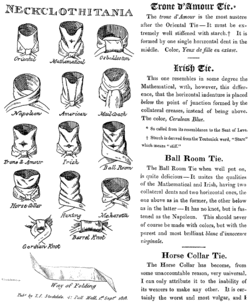 "Neckclothitania", 1818
 -
 Astley's Amphitheatre, 1808–1811
 -
 Brighton Pavilion, 1826
 -
 Carlton House, Pall Mall, London
 -
 Vauxhall Gardens, 1808–1811
 -
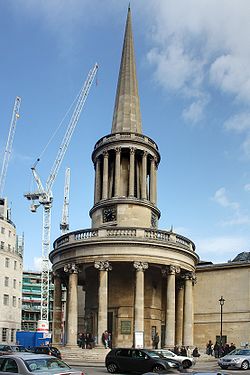 Church of All Souls, architect John Nash, 1823
 -
 Regent's Canal, Limehouse, 1823
 -
 Frost Fair, Thames River, 1814
 -
 The Piccadilly entrance to the Burlington Arcade, 1819
 -
 Princess Charlotte Augusta of Wales and Prince Leopold of Saxe-Coburg-Saalfeld, 1817
 -
 Morning dress, Ackermann, 1820
 -
 Water at Wentworth, Humphry Repton, 1752–1818
 -
 Hanover Square, Horwood Map, 1819
 -
 Beau Brummell, 1805
 -
 Battle of Waterloo, 1815
 -
 Almack's Assembly Room, 1805–1825
 -
 Balloon ascent, James Sadler, 1811
 -
 The Anatomist, Thomas Rowlandson, 1811
 -
 Regent's Park, Schmollinger map, 1833
 -
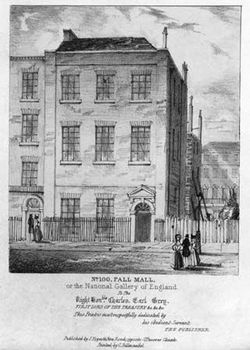 100 Pall Mall, former location of National Gallery, 1824–1834
 -
 Cognocenti, Gillray Cartoon, 1801
 -
 Custom Office, London Docks, 1811–1843
 -
 Customs and Excise, London Docks, 1820
 -
 Mail coach, 1827
 -
 Assassination of Spencer Perceval, 1812
 -
 The Trial of Queen Caroline by George Hayter, 1823
 -
 The pillory at Charing Cross, Ackermann's Microcosm of London, 1808–1811
 -
 Covent Garden Theatre, 1827–1828


_edited.jpg)


See also
[edit]- Regency architecture
- Regency fashions
- Regency dance
- Régence, the period of the early 18th-century regency in France
- Society of Dilettanti
- Era of Good Feelings, for the United States
Notes
[edit]- ^ The pseudonym Peter Pindar had previously been used by the satirist John Wolcot.
References
[edit]- ^ Pryde, E. B. (1996). Handbook of British Chronology. Cambridge University Press. p. 47. ISBN 978-0-5215-6350-5.
- ^ Herman, N. (2001). Henry Grattan, the Regency Crisis and the Emergence of a Whig Party in Ireland, 1788–9. Irish Historical Studies, 32(128), 478–497. [1].
- ^ "No. 16451". The London Gazette. 5 February 1811. p. 227.
- ^ Innes (1915), p. 50.
- ^ Innes (1915), p. 81.
- ^ Kendall, Paul (2022). Queen Victoria: Her Life and Legacy. Havertown: Pen & Sword Books Limited. ISBN 978-1-3990-1834-0.
- ^ Dabundo, Laura; Mazzeno, Laurence W.; Norton, Sue (2021). Jane Austen: A Companion. McFarland. pp. 177–179. ISBN 978-1-4766-4238-3.
- ^ Plunkett, John; et al., eds. (2012). Victorian Literature: A Sourcebook. Houndmills, Basingstoke: Palgrave Macmillan. p. 2.
- ^ Sadleir, Michael (1927). Trollope: A Commentary. Constable & Co. pp. 17–30.
- ^ a b Hewitt, Martin (Spring 2006). "Why the Notion of Victorian Britain Does Make Sense". Victorian Studies. 48 (3): 395–438. doi:10.2979/VIC.2006.48.3.395. S2CID 143482564. Archived from the original on 30 October 2017. Retrieved 23 May 2017.
- ^ Parissien, Steven (2002). George IV: inspiration of the Regency (1st ed.). New York: St. Martin's Press. ISBN 978-0-312-28402-2.
- ^ May, Thomas Erskine (1895). The Constitutional History of England Since the Accession of George the Third, 1760–1860. Vol. 1. pp. 263–364.
- ^ Low, Donald A. (2000). The Regency underworld (Revised ed.). Stroud: Sutton. ISBN 978-0-7509-2121-3.
- ^ Low, Donald A. (1999). The Regency Underworld, p. x. Gloucestershire: Sutton. [ISBN missing]
- ^ Smith, E. A., George IV, p. 14. Yale University Press (1999).
- ^ Williams, Guy (1990). Augustus Pugin Versus Decimus Burton: A Victorian Architectural Duel. London: Cassell Publishers Ltd. pp. 11–12. ISBN 978-0-3043-1561-1.
- ^ Encyclopaedia Britannica. Article on Regent's Park. Retrieved 30 June 2022.
- ^ a b "ZSL's History". Zoological Society of London. Archived from the original on 28 February 2008. Retrieved 1 July 2022.
- ^ "20 novels that shaped the Victorian era". www.penguin.co.uk. 30 August 2021. Retrieved 5 March 2024.
- ^ Behrendt, Stephen C. (2012). "Was There a Regency Literature? 1816 as a Test Case". Keats-Shelley Journal. 61: 25–34. ISSN 0453-4387. JSTOR 24396032.
- ^ "Lawler, C. F.". Jackson Bibliography of Romantic Poetry. University of Toronto Libraries. Retrieved 1 September 2025.
- ^ Kerman, Joseph (1983). Beethoven. The new Grove. New York London: Norton & Company. ISBN 978-0-393-30091-8.
- ^ Todd, Ralph Larry (2003). Mendelssohn: a life in music. Oxford: Oxford University press. ISBN 978-0-19-511043-2.
- ^ a b "A Walk Through The Regency Era". Wentworth Woodhouse. Retrieved 5 March 2024.
- ^ Tapley, Jane. Jane Austen’s Regency World Magazine, vol. 17, p. 23.
- ^ Morgan, Marjorie (1994). Manners, Morals, and Class in England, 1774–1859, p. 34. New York: St. Martin's Press. [ISBN missing]
- ^ Wu, Duncan (1999). A Companion to Romanticism. John Wiley & Sons. p. 338. ISBN 978-0-6312-1877-7.
- ^ Halsey, Katie (4 July 2015). "The home education of girls in the eighteenth-century novel: 'the pernicious effects of an improper education'". Oxford Review of Education. 41 (4): 430–446. doi:10.1080/03054985.2015.1048113. ISSN 0305-4985.
- ^ A History of Women in Sport Prior to Title IX. Richard C. Bell (2018). The Sport Journal. United States Sports Academy.
- ^ a b c d Encyclopaedia Britannica. The Bare-knuckle Era. Retrieved 3 July 2022.
- ^ "The Cyber Boxing Zone Encyclopedia presents The Bare Knuckle Heavyweight Champions of England". Cyber Boxing Zone. Retrieved 2 July 2022.
- ^ Miles, Henry Downes (1906). Pugilistica: the history of British boxing containing lives of the most celebrated pugilists. Edinburgh: John Grant. pp. 182–192. Retrieved 2 July 2017.
- ^ Pierce Egan, Boxiana, Volume I (1813).
- ^ Snowdon, David (2013). Writing the Prizefight: Pierce Egan's Boxiana World.
- ^ Warner, Pelham (1946). Lord's 1787–1945. Harrap. pp. 17–18.
- ^ a b Warner, p. 18.
- ^ Warner, p. 19.
- ^ Williamson, Martin (18 June 2005). "The oldest fixture of them all: the annual Eton vs Harrow match". Cricinfo Magazine. London: Wisden Group. Retrieved 23 July 2008.[permanent dead link]
- ^ Dunning, Eric (1999). Sport Matters: Sociological Studies of Sport, Violence and Civilisation. Routledge. p. 88–89. ISBN 978-0-415-09378-1.
- ^ Baker, William (1988). Sports in the Western World. University of Illinois Press. p. 48. ISBN 978-0-252-06042-7.
- ^ Cox, Richard William; Russell, Dave; Vamplew, Wray (2002). Encyclopedia of British Football. Routledge. p. 243. ISBN 978-0-7146-5249-8.
- ^ Fletcher, J. S. (1902). The history of the St Leger stakes, 1776–1901. Hutchinson & Co. ISBN 978-0-9516-5281-7.
{{cite book}}: ISBN / Date incompatibility (help) - ^ Barrett, Norman, ed. (1995). The Daily Telegraph Chronicle of Horse Racing. Enfield, Middlesex: Guinness Publishing. pp. 9–12.
- ^ Barrett, p. 12.
- ^ Sporting Magazine (1830), May and July editions.
- ^ "And they're off – a brief history of Aintree racecourse and the Grand National". Age Concern Liverpool & Sefton. 9 April 2019.[permanent dead link]
- ^ "The Birth of The Grand National: The Real Story". Mutlow, Mick (15 June 2009). Thoroughbred Heritage. Retrieved 9 July 2020.
- ^ Wright, Sally (3 April 2020). "An early history of Aintree racecourse". Timeform.
- ^ "The Boat Race origins". The Boat Race Limited. Archived from the original on 7 October 2014. Retrieved 1 July 2022.
- ^ "Icons, a portrait of England 1820–1840". Archived from the original on 22 September 2007. Retrieved 2 July 2022.
- ^ History – Introduction Archived 1 May 2010 at the Wayback Machine. IAAF. Retrieved 2 July 2020.
- ^ Robinson, Roger (December 1998). "On the Scent of History". Running Times: 28.
- ^ "George IV (r. 1820–1830)". The Royal Household. Retrieved 12 April 2015.
- ^ Newman, Gerald, ed. (1997). Britain in the Hanoverian Age, 1714-1837: An Encyclopedia. Taylor & Francis. ISBN 978-0-8153-0396-1.
- ^ Nelson, Alfred L.; Cross, Gilbert B. "The Adelphi Theatre, 1806–1900". Archived from the original on 8 June 2007.
- ^ "Attingham Park: History". National Trust. Retrieved 12 April 2015.
- ^ "Roman, Regency and really nearby". The Daily Telegraph. London. 14 April 2006. Archived from the original on 11 January 2022.
- ^ Sanders, Stephanie (6 December 2013). "Explore the Regency spa town of Cheltenham". visitengland.com.
- ^ "Circulating Libraries, 1801–1825". Library History Database. Archived from the original on 14 April 2008. Retrieved 12 April 2015.
- ^ "Jane Austen: Sports". Jane's Bureau of Information. Archived from the original on 9 May 2008. Retrieved 12 April 2015.
- ^ a b "Jane Austen: Places". Jane's Bureau of Information. Archived from the original on 8 May 2008. Retrieved 12 April 2015.
- ^ a b "Jane Austen: Gardens". Jane's Bureau of Information. Archived from the original on 13 May 2008. Retrieved 12 April 2015.
- ^ a b "Jane Austen: Theatre". Jane's Bureau of Information. Archived from the original on 13 May 2008. Retrieved 12 April 2015.
- ^ Newman, Gerald, ed. (1997). Britain in the Hanoverian Age, 1714-1837: An Encyclopedia. Taylor & Francis. ISBN 978-0-8153-0396-1.
Sources
[edit]- Bowman, Peter James. The Fortune Hunter: A German Prince in Regency England. Oxford: Signal Books, 2010. [ISBN missing]
- David, Saul. Prince of Pleasure The Prince of Wales and the Making of the Regency. New York: Atlantic Monthly Press, 1998. [ISBN missing]
- Innes, Arthur Donald (1914). A History of England and the British Empire. Vol. 3. The MacMillan Company.[ISBN missing]
- Innes, Arthur Donald (1915). A History of England and the British Empire. Vol. 4. The MacMillan Company.[ISBN missing]
- Knafla, David, Crime, punishment, and reform in Europe, Greenwood Publishing, 2003 [ISBN missing]
- Lapp, Robert Keith. Contest for Cultural Authority – Hazlitt, Coleridge, and the Distresses of the Regency. Detroit: Wayne State UP, 1999. [ISBN missing]
- Marriott, J. A. R. England Since Waterloo (1913) online
- Morgan, Marjorie. Manners, Morals, and Class in England, 1774–1859. New York: St. Martin's Press, 1994. [ISBN missing]
- Morrison, Robert. The Regency Years: During Which Jane Austen Writes, Napoleon Fights, Byron Makes Love, and Britain Becomes Modern. 2019, New York: W. W. Norton, London: Atlantic Books online review
- Newman, Gerald, ed. (1997). Britain in the Hanoverian Age, 1714–1837: An Encyclopedia. Taylor & Francis. ISBN 978-0-8153-0396-1. online review; 904pp; 1121 short articles on Britain by 250 experts.
- Parissien, Steven. George IV Inspiration of the Regency. New York: St. Martin's P, 2001. [ISBN missing]
- Pilcher, Donald. The Regency Style: 1800–1830 (London: Batsford, 1947).
- Rendell, Jane. The pursuit of pleasure: gender, space & architecture in Regency London (Bloomsbury, 2002). [ISBN missing]
- Richardson, Joanna. The Regency. London: Collins, 1973. [ISBN missing]
- Webb, R.K. Modern England: from the 18th century to the present (1968) online widely recommended university textbook
- Wellesley, Lord Gerald. "Regency Furniture", The Burlington Magazine for Connoisseurs 70, no. 410 (1937): 233–241.
- White, R.J. Life in Regency England (Batsford, 1963). [ISBN missing]
Crime and punishment
[edit]- Emsley, Clive. Crime and society in England: 1750–1900 (2013).
- Innes, Joanna and John Styles. "The Crime Wave: Recent Writing on Crime and Criminal Justice in Eighteenth-Century England" Journal of British Studies 25#4 (1986), pp. 380–435 JSTOR 175563.
- Low, Donald A. The Regency Underworld. Gloucestershire: Sutton, 1999.
- Morgan, Gwenda, and Peter Rushton. Rogues, Thieves And the Rule of Law: The Problem of Law Enforcement in North-East England, 1718–1820 (2005).
Primary sources
[edit]- Simond, Louis. Journal of a tour and residence in Great Britain, during the years 1810 and 1811 online
External links
[edit]- Greenwood's Map of London, 1827
- Horwood Map of London, 1792–1799
- Results of the 1801 and 1811 Census of London, The European Magazine and London Review, 1818, p. 50
- The Bluestocking Archive
- End of an Era: 1815–1830
- New York Public Library, England – The Regency Style
- Regency Style Furniture Archived 14 April 2021 at the Wayback Machine
| International | |
|---|---|
| National | |
| Other | |

Regency era
View on GrokipediaDefinition and Chronology
Precise Dates and Legal Basis
The Regency era, in its strict political sense, began on 5 February 1811, when Parliament passed the Regency Act 1811 in response to King George III's irreversible incapacity from recurrent episodes of acute mental derangement, later attributed to porphyria.[7][8] This legislation, enacted after medical commissions confirmed the monarch's inability to govern since late 1810, formally appointed George, Prince of Wales (later George IV), as Prince Regent to exercise royal authority on an interim basis.[7][8] The Regency Act 1811, titled "An Act to provide for the Administration of the Government during the Continuance of His Majesty's Illness," stipulated restrictions on the Regent's powers for the first twelve months to avert radical policy shifts, such as dismissals from office or peerage creations without parliamentary approval; these limitations lapsed on 18 February 1812, granting the Regent full exercise of monarchical prerogatives.[7][8] The Act's legal foundation drew from precedents like the 1788-1789 Regency Bill during George III's earlier illness, but adapted to the permanence of his condition following the death of his daughter Princess Amelia in November 1810, which precipitated his final decline.[7] The era concluded precisely on 29 January 1820, with George III's death at Windsor Castle, prompting the immediate accession of the Prince Regent as King George IV and thereby dissolving the regency under the Act's terms.[9][10] This nine-year span delineates the official Regency period, distinct from broader cultural associations sometimes extended to 1795-1837 encompassing late Georgian styles and early Victorian transitions.[7]Broader Cultural Extensions and Debates
The political Regency spanned from 5 February 1811, when Parliament passed the Regency Act declaring George, Prince of Wales, as regent amid King George III's porphyria-induced incapacity, to 29 January 1820, upon the king's death, after which the prince ascended as George IV.[11] In cultural historiography, however, the term extends more broadly, often from circa 1795 to 1837, to denote stylistic and social continuities shaped by the prince's pre-regency extravagance and post-ascension patronage, encompassing late Georgian neoclassicism in dress, decor, and demeanor that bridged revolutionary aftermaths and pre-Victorian shifts.[12] This dilation accommodates phenomena like the persistence of high-waisted Empire-line gowns, influenced by French Directoire simplicity post-Revolution, which dominated women's attire from the mid-1790s through the 1820s before fuller skirts reemerged.[6] Literary and artistic extensions similarly outstrip political bounds: Jane Austen's novels, published between 1811 and 1818, evoke gentry customs from the 1790s-1810s, while Romantic poets like Lord Byron (active 1807-1824) and Walter Scott embodied the era's introspective individualism, their works reflecting wartime introspection rather than regency-specific governance.[1] Architectural hallmarks, such as John Nash's Regency designs blending classical restraint with oriental fantasy—as in the Brighton Pavilion's 1815-1822 transformations—extended into George IV's reign until circa 1830, marking urban and landscaped innovations that prefigured Victorian eclecticism.[13] Historians debate this broadening's precision, with some advocating strict adherence to 1811-1820 to preserve causal ties to the regency's political stasis and wartime exigencies, arguing extensions dilute distinctions from the preceding American Revolutionary era's fiscal strains or succeeding Reform agitation.[14] Others defend the cultural span for its empirical coherence in patronage networks: the prince's Carlton House renovations began in 1783, influencing dandy subcultures and Beau Brummell's 1810s tailoring codes that lingered into the 1830s, while post-1820 economic dislocations sustained Regency-era entertainments like Vauxhall Gardens amid industrial flux.[15] Empirical data from fashion plates and diaries indicate stylistic inertia—e.g., tailcoats and cravats peaking 1805-1825—driven by textile imports and elite emulation, not abrupt political terminus, though critics note risks of anachronism in conflating George III's restrained court with the regent's dissipations.[1] Popular depictions, including 21st-century adaptations, amplify this extended frame for its romanticized elegance, yet rigorous analysis privileges verifiable continuities over narrative convenience.[12]Political Framework
Establishment of the Regency
King George III experienced recurrent episodes of mental incapacity throughout his reign, with significant crises in 1788 and 1804 from which he recovered. A final and permanent relapse began in late 1810, triggered in part by the death of his youngest daughter, Princess Amelia, on 2 November 1810, rendering him unfit for governance.[16][7] In response, Parliament introduced the Regency Bill in December 1810 to address the constitutional vacuum. After debates and medical testimonies confirming the king's incapacity, the bill received royal assent—via commissioners acting on the king's behalf—and became the Regency Act 1811 on 5 February 1811. This legislation appointed George, Prince of Wales and eldest son of the king, as Prince Regent with authority to exercise royal prerogatives during his father's incapacity.[7][12][17] The Prince Regent formally took the oath of office on 6 February 1811 at Carlton House. Initial provisions of the Act imposed temporary restrictions on his powers, prohibiting actions such as creating peers, granting certain offices, or dissolving Parliament without consulting a committee of ministers; these limitations expired after one year, on 18 February 1812, granting him unrestricted regency authority thereafter.[17][18][19] The Regency endured until George III's death on 29 January 1820, after which the Prince Regent acceded as George IV. This arrangement ensured continuity of monarchical rule amid the king's porphyria-attributed illness, though contemporary diagnoses emphasized acute mania without modern etiological consensus.[16][20]Tory Dominance and Key Ministers
The Tory Party exercised unchallenged control over British government during the Regency era, forming administrations continuously from the establishment of the Regency on 5 February 1811 until well after its end in 1820, amid the exigencies of the Napoleonic Wars and domestic unrest.[12] This dominance stemmed from the Tories' strong parliamentary majority, bolstered by the unreformed electoral system favoring landed interests, and the Regent's pragmatic shift away from his earlier Whig affiliations toward Tory stability in prosecuting the war against France.[21] Whig attempts to form a coalition government in late 1811 failed due to Regent George IV's insistence on retaining Tory leadership, ensuring policy continuity in foreign affairs, finance, and internal security.[22] Spencer Perceval, who had become Prime Minister on 4 October 1809, led the initial Regency government until his assassination by John Bellingham on 11 May 1812 in the House of Commons lobby.[23] A committed Pittite Tory, Perceval prioritized unrelenting war efforts, rejecting peace overtures from Napoleon and implementing economic measures like the Orders in Council to blockade French trade, which exacerbated smuggling and neutral shipping disputes but sustained Britain's naval supremacy.[24] His cabinet included key figures such as Robert Jenkinson (Lord Hawkesbury, later Liverpool) as Home Secretary, handling Luddite disturbances through repressive legislation, and Henry Bathurst as War Secretary, overseeing military logistics amid Peninsular War campaigns.[22] Perceval's opposition to Catholic emancipation and economic reforms further solidified Tory appeal among Anglican landowners and the establishment. Following Perceval's death, Robert Jenkinson, 2nd Earl of Liverpool, formed a new ministry on 8 June 1812, providing fifteen years of relative stability through coalitions of moderate and ultra-Tories.[25] Liverpool's government navigated the War of 1812 with the United States, culminating in the Treaty of Ghent on 24 December 1814, and orchestrated the coalition victory at Waterloo on 18 June 1815 under Arthur Wellesley, Duke of Wellington.[26] Core ministers included Robert Stewart, Viscount Castlereagh, as Foreign Secretary from 1812, who directed postwar diplomacy at the Congress of Vienna (1814–1815), establishing a balance-of-power system to contain French revanchism; Henry Addington, Viscount Sidmouth, as Home Secretary from 1812, enforcing the Six Acts of 1819 to curb radical agitation after Peterloo; and John Scott, 1st Earl of Eldon, as Lord Chancellor until 1827, resisting judicial reforms and upholding property rights in chancery proceedings.[27] Nicholas Vansittart, Chancellor of the Exchequer until 1823, managed war debts through income tax renewals and sinking funds, though postwar deflation strained finances.[27] This Tory cadre's cohesion, rooted in shared commitment to monarchy, Church, and anti-reform conservatism, marginalized Whig critiques and sustained governance despite economic distress and calls for parliamentary change, with no successful opposition ministry until 1830.[28]Legislative Outputs and Stagnation
The Tory government under Robert Jenkinson, 2nd Earl of Liverpool, who assumed the premiership on June 8, 1812, enacted legislation primarily aimed at stabilizing the post-Napoleonic order, protecting agrarian interests, and suppressing domestic unrest rather than pursuing structural reforms.[29] Key among these was the Corn Importation Act of March 1815, which barred wheat imports until domestic prices reached 80 shillings per quarter (equivalent to about £4 per quarter), favoring large landowners by maintaining high grain prices amid wartime inflation but fueling public hardship as demobilized soldiers and industrial workers faced elevated food costs without corresponding wage gains.[30] This measure, driven by parliamentary majorities dominated by rural constituencies, exemplified the government's prioritization of elite economic safeguards over broader relief, contributing to riots in London and agricultural districts later that year.[31] In response to radical movements and economic distress, Parliament passed repressive statutes in 1817, including the Suspension of Habeas Corpus Act (July 1817), which allowed indefinite detention without trial for suspected subversives, and the Seditious Meetings Act, limiting gatherings of over 50 persons without magistrate approval to prevent agitation for reform.[31] These were extended amid fears of revolution, with government spies infiltrating groups like the Spenceans, yet they addressed symptoms of discontent—such as Luddite machine-breaking and demands for universal male suffrage—without tackling root causes like electoral malapportionment, where "rotten boroughs" with few voters returned disproportionate MPs.[32] The period's most notorious legislative package followed the Peterloo Massacre of August 16, 1819, where Manchester yeomanry killed 15 and injured hundreds at a reform rally; in December 1819, the Six Acts imposed training bans on unauthorized "military" groups, restricted public meetings to 50 persons (or 60 with notice), raised penalties for seditious libel to transportation, enabled seizure of arms from radicals, expedited treason trials, and widened the stamp duty on radical newspapers to curb their circulation.[33] While quelling immediate threats, these acts entrenched authoritarian tendencies, as Liverpool's cabinet viewed parliamentary debate on reform as destabilizing, deferring Catholic Relief Bills (which failed repeatedly until 1829) and ignoring Whig proposals for vote expansion despite petitions from industrial centers like Manchester, home to over 100,000 unenfranchised males by 1820.[29] A rare concession to humanitarian pressures was the Cotton Mills and Factories Act of July 1819, sponsored by Robert Owen and Sir Robert Peel the Elder, which banned children under age nine from cotton mill work, capped 9- to 16-year-olds at 12-hour days, and mandated basic education, though enforcement relied on under-resourced inspectors and exempted woollen mills, limiting its impact amid rapid industrialization.[30] Overall, legislative stagnation stemmed from the unreformed Parliament's composition—over 200 MPs from pocket boroughs controlled by peers—and Tory ideology's emphasis on order over innovation, as war debts exceeding £800 million by 1815 constrained fiscal experimentation, fostering a reactive rather than proactive agenda that postponed major changes like the 1832 Reform Act.[28] This inertia, while averting immediate collapse, amplified grievances that persisted into the 1820s, underscoring the era's causal link between elite insulation and deferred modernization.Response to Radical Movements
The Tory government, led by Prime Minister Robert Jenkinson, 2nd Earl of Liverpool, and Home Secretary Viscount Sidmouth, adopted a policy of firm suppression toward radical movements that emerged in the economic distress following the Napoleonic Wars' end in 1815. These movements, advocating parliamentary reform, universal male suffrage, and annual parliaments, drew from Enlightenment ideas and continental revolutions, manifesting in mass petitions and gatherings that occasionally escalated to violence. Fearing replication of the French Revolution's chaos, authorities prioritized public order through intelligence gathering, via networks of spies embedded in radical circles like the Spenceans and Hampden Clubs, which informed preemptive arrests.[34] Early responses targeted urban unrest, such as the Spa Fields meetings in Islington on 15 November and 2 December 1816, organized by radicals including Henry Hunt and James Watson to protest distress and demand reform. The second gathering devolved into riots, with crowds attempting to raid a gunsmith's shop for arms and clashing with constables, prompting the deployment of troops to restore order within hours. Leaders faced treason trials at the Old Bailey in 1817; while most were acquitted due to evidentiary issues, the government used the episode to justify expanded surveillance and the prosecution of peripheral figures like John Cashman, an Irish sailor executed for his role in the disorder.[35][36] Escalating threats led to the suspension of Habeas Corpus on 28 June 1817, following the Pentrich (or Pentridge) rising on 9-10 June in Derbyshire, where about 300 stockingers, misled by promises of national support, marched under Jeremiah Brandreth intending to seize Nottingham. Infiltrated by government spy William Oliver, the abortive revolt resulted in three executions—Brandreth, William Turner, and Isaac Ludlam—by hanging and decapitation on 7 November 1817, alongside transportation for others, signaling judicial severity to deter insurrection. This measure, renewed periodically until 1822, allowed indefinite detention without trial, curbing radical organizing amid reports of plots.[34] The Peterloo Massacre on 16 August 1819 epitomized coercive tactics, when Manchester magistrates, alarmed by a crowd of 50,000-60,000 assembled peacefully at St. Peter's Field for reform speeches by Hunt, ordered the Manchester and Salford Yeomanry—local volunteers—to arrest him, followed by hussars charging the assembly. Resulting in 15 deaths and 400-700 injuries, the event drew condemnation but elicited government backing for the magistrates via the Indemnity Act of 23 December 1819, shielding them from liability and framing the action as necessary to avert sedition. In immediate response, Parliament enacted the Six Acts on 23 December 1819: the Unlawful Drilling Act prohibiting unauthorized military training; the Seditious Meetings Prevention Act limiting public gatherings over 50 without magistrate approval; the Seditious Libels Act increasing penalties for incitement; the Blasphemous and Seditious Libels Act targeting "immoral" publications; the Newspaper and Stamp Duties Act raising taxes on unstamped periodicals to suppress radical press; and the Seizure of Arms Act enabling warrantless arms confiscation in suspected districts.[34][37] These measures extended to thwarting conspiracies like the Cato Street plot uncovered on 23 February 1820, where radicals led by Arthur Thistlewood planned to assassinate the cabinet at a dinner in Grosvenor Square to spark revolution; betrayed by spy George Edwards, five were executed on 1 May 1820, reinforcing the efficacy of infiltration. Complementing prior Combination Acts of 1799 and 1800 banning trade unions, the response maintained Tory dominance by associating reform demands with treasonous violence, though it fueled long-term Whig critiques without immediate policy reversal.[38]Economic Realities
Industrial Revolution Acceleration
The Industrial Revolution, which had begun in the late 18th century, gained momentum during the Regency era through the widespread adoption of mechanized processes in key sectors like textiles and metallurgy. Industrial output expanded at an annual rate of 1.5 to 1.6 percent through the 1820s, surpassing the national income growth of 1.3 percent and reflecting efficiencies from factory organization and power technologies. [39] This period marked a transition from artisanal workshops to large-scale factories, fueled by capital accumulation and technological diffusion, though overall economic growth remained modest amid wartime disruptions and postwar adjustment. [39] The cotton textile industry exemplified this acceleration, with production concentrated in Lancashire and powered by steam-driven mules and power looms. By 1820, cotton goods comprised the largest single export commodity, accounting for over 30 percent of Britain's total exports, while exports represented 60 percent of domestic cotton output. [40] Raw cotton imports, primarily from the American South and India, surged to meet demand, enabling mills to produce calicoes and muslins at scales unattainable by hand labor; Manchester emerged as the epicenter, with factory employment displacing traditional cottage spinners. [40] This export-led boom intertwined with imperial trade networks, as Britain's naval dominance secured cotton supplies despite continental blockades. Iron manufacturing advanced in parallel, supporting machinery fabrication and infrastructural projects like canals and bridges. Coke-fueled blast furnaces and Henry Cort's puddling process (refined post-1784) enabled higher yields of wrought iron, essential for steam engine components and textile frames; output growth in pig iron and bar iron sustained the mechanical infrastructure of factories. The sector's expansion, though data-sparse for exact tonnage between 1810 and 1820, aligned with rising coal consumption for smelting, which doubled national coal output from 1800 levels by mid-decade to power both ironworks and steam applications. Mechanization provoked resistance, culminating in the Luddite disturbances of 1811–1816, where framework knitters and croppers in Nottinghamshire, Yorkshire, and Lancashire smashed wide-frame knitting machines and shearing frames. These actions, led by mythical figure "General Ludd," targeted employers adopting labor-saving devices amid wage stagnation and unemployment, reflecting fears of deskilling rather than technology per se; government deployment of troops suppressed the unrest, with over 12,000 troops committed by 1812. [41] The movement underscored the social costs of acceleration, as factory discipline and child labor intensified in the drive for productivity. [41] Steam engines, licensed under Boulton & Watt patents until 1800, proliferated in collieries, breweries, and textile mills, overcoming water power's geographic limits and enabling 24-hour operations. Total steam horsepower in use accelerated post-1815, integrating with cotton and iron to form a virtuous cycle of reinvestment and innovation. [42] By era's end, these developments laid groundwork for railways, though early locomotives like Richard Trevithick's 1804 trials remained experimental until the 1820s. [42]Agricultural Enclosures and Corn Laws
The parliamentary enclosure movement, which privatized common lands and consolidated fragmented holdings into efficient, individually owned farms, persisted strongly during the Regency era (1811–1820), building on the acceleration seen from the 1760s onward.[43] This process required acts of Parliament to override customary rights, with landowners petitioning for division and hedging of open fields and commons; by the early 19th century, such acts had enclosed roughly one-sixth of England's land, totaling about 7 million acres through some 4,000 bills between 1760 and 1870, many during the wartime and postwar decades including the Regency.[44] Enclosures promoted agricultural innovation, such as crop rotation, selective breeding, and drainage, yielding measurable productivity gains—enclosed parishes showed higher crop outputs compared to open-field systems, with overall English agricultural yields rising amid the period's high grain demand driven by population growth and Napoleonic Wars exports.[43][45] However, enclosures exacerbated rural inequality and displacement, as smallholders and cottagers lost access to commons for grazing, fuel, and subsistence farming, often receiving inadequate compensatory allotments or none at all.[46] This shift favored large proprietors who could invest in improvements, increasing landholding concentration—enclosed areas exhibited greater inequality in farm sizes—while forcing many laborers into wage dependency or urban migration, contributing to rural depopulation and the swelling of industrial workforces.[45] Employment in agriculture grew in absolute terms but lagged population expansion, intensifying poverty among the rural poor who faced enclosure costs (via tithes and rates) without proportional benefits.[47] Complementing enclosures, the Corn Laws of 1815 embodied landowner efforts to sustain high domestic grain prices amid postwar market disruptions. Enacted on March 23, 1815, shortly after Napoleon's defeat at Waterloo, the laws prohibited wheat imports unless the domestic price exceeded 80 shillings per quarter (with sliding scales for other grains), effectively imposing a variable tariff to shield British producers from Baltic and Continental competition as peace restored supply routes and bumper harvests depressed prices from wartime peaks above 120 shillings.[48] Landowners, dominant in Parliament, argued this preserved rents and farm investments incentivized by enclosures, but critics like manufacturers highlighted how elevated food costs eroded workers' purchasing power, fueling urban unrest such as the 1816 agricultural riots and broader Luddite discontent.[49][50] The combined effect of enclosures and Corn Laws reinforced agrarian protectionism, boosting output—English grain production rose sufficiently to support a population increase from 10.5 million in 1801 to 14 million by 1821—yet at the expense of consumer burdens and social friction, as protected high prices strained post-demobilization wages and accelerated proletarianization from rural enclosures.[51] Empirical analyses confirm enclosures' net positive on yields despite inequality spikes, while Corn Laws' "bread tax" demonstrably transferred income from urban classes to landlords until partial reforms in the 1820s eased import thresholds.[45][51]Commercial Expansion and Finance
The end of the Napoleonic Wars in 1815 lifted Napoleon's Continental System, enabling Britain to resume unrestricted trade with European markets and spurring commercial expansion. Exports, which had been constrained by wartime blockades, rebounded sharply; official values of British exports rose from approximately £38 million in 1814 to over £44 million by 1819, driven by demand for manufactured goods like textiles and ironware. Imports similarly surged, with raw materials such as cotton and timber flowing in to fuel industrial output, reflecting the integration of Britain's economy with global commodity chains.[52][53] The Charter Act of 1813 marked a pivotal liberalization by terminating the East India Company's monopoly on trade between Britain and India—retaining only privileges for tea and China trade—thus permitting private merchants to compete in lucrative markets for Indian cotton, indigo, and sugar. This reform, enacted amid parliamentary pressure from free-trade advocates, facilitated an influx of new commercial ventures and diversified shipping routes, with non-Company vessels increasing their share of India-bound cargoes from negligible levels pre-1813 to substantial participation by 1820. The East India Company itself adapted by focusing on its remaining strengths, exporting over 20 million pounds of tea annually by the late Regency years, underscoring the era's shift toward competitive commerce.[54][55] Financially, the Regency coincided with peak wartime indebtedness, as government borrowing to fund the Napoleonic conflicts elevated the national debt from £242 million in 1793 to £844 million by 1819, equivalent to roughly 2.3 times gross national product in the early 1820s. The Bank of England, acting as the government's primary financier, issued consols (perpetual bonds) and managed loans that absorbed much of available domestic capital, with interest payments alone consuming over half of tax revenues by 1815. Provincial country banks proliferated to intermediate local savings into commercial lending, issuing notes backed by Bank of England reserves, though restrictions on joint-stock banking until 1826 limited scale.[56][57] The London Stock Exchange, formalized in 1801, served as the nexus for trading government securities and emerging joint-stock shares, with daily volumes in consols reflecting investor confidence amid post-war fiscal strains; a notable 1814 hoax inflating stock prices by false invasion rumors exposed speculative vulnerabilities but highlighted the market's liquidity. This infrastructure supported commercial ventures by channeling funds to shipping and manufacturing, though high debt servicing—peaking at 15% of GNP in borrowing needs during peak war years—imposed crowding effects on private investment, tempering expansion despite trade gains.[58][57]Post-War Recession and Poverty
The conclusion of the Napoleonic Wars in 1815 triggered a sharp economic contraction in Britain, marked by a collapse in wartime demand for exports, deflation in commodity prices, and a surge in unemployment as government spending plummeted from £165 million in 1813 to £48 million by 1816.[30] The demobilization of approximately 300,000 soldiers and sailors between 1814 and 1816 overwhelmed the domestic labor market, particularly in manufacturing and agriculture, where returning veterans competed for scarce jobs amid reduced industrial output and agricultural slumps.[59] This influx contributed to wage stagnation or declines, with real wages for agricultural laborers falling by up to 20% in some regions by 1816, intensifying hardship for the working poor who relied on employment in textiles, shipbuilding, and farming.[60] Compounding these pressures, the "Year Without a Summer" in 1816—caused by the 1815 eruption of Mount Tambora—resulted in the worst harvest failure in Europe in decades, halving wheat yields in Britain and driving average wheat prices to 105 shillings per quarter, more than double pre-war levels.[30] The Corn Law of March 1815, enacted to shield domestic producers by barring grain imports until prices reached 80 shillings per quarter, sustained artificially high food costs despite the postwar surplus in some years, disproportionately burdening urban laborers and the rural poor who allocated 60-70% of their income to bread and staples.[61] Landowners and farmers benefited from protected rents, but this policy fueled resentment, as evidenced by petitions from manufacturers decrying suppressed exports due to elevated living costs for workers.[62] Widespread poverty manifested in rising pauperism, with poor relief expenditures doubling in many parishes between 1815 and 1819, straining the Speenhamland system of wage supplements tied to bread prices.[60] Urban distress was acute in industrial centers like Manchester and Glasgow, where cotton exports dropped 40% from 1815 to 1816, idling mills and sparking machine-breaking riots by Luddites and food protesters.[63] Rural areas fared little better, with enclosures and high rents displacing smallholders into vagrancy, prompting government responses like the suspension of habeas corpus in 1817 to curb radical agitation over economic grievances.[30] These conditions peaked in events like the 1819 Peterloo Massacre, where 60,000 gathered in St. Peter's Field to demand parliamentary reform amid famine threats, only to face cavalry charges killing 15 and injuring hundreds.[63] Recovery began unevenly by 1820, aided by resumed trade and harvest improvements, but the recession entrenched class divides and skepticism toward protectionist policies favoring agrarian elites.[61]Social Fabric
Rigid Class Hierarchies
The Regency era in Britain (1811–1820) featured a stratified social order dominated by birthright and land ownership, with the aristocracy and landed gentry at the apex. Royalty stood above all, followed by the peerage—comprising dukes, marquesses, earls, viscounts, and barons, numbering around 200–300 families—who wielded political influence through the House of Lords and controlled vast estates generating rental income.[64] Below them, the gentry included untitled landowners such as baronets, knights, and squires, estimated at several thousand families, who emulated aristocratic lifestyles but lacked hereditary legislative power.[65] This upper tier owned the majority of arable land, with primogeniture ensuring estates passed intact to eldest sons, preventing division and reinforcing hereditary privilege.[66] Entailment laws further rigidified inheritance by legally binding estates to male heirs, often across generations, to preserve family wealth and status against fragmentation or female claims.[67] Younger sons received limited portions or pursued careers in the military, church, or law, while daughters depended on marriage settlements, underscoring the system's bias toward male primogeniture.[68] The middle ranks—merchants, professionals, and clergy—experienced some prosperity from commerce and enclosures but faced barriers to aristocratic integration, as titles and social acceptance hinged on lineage over mere wealth.[69] Working classes, including laborers and emerging factory hands, occupied the base, with scant upward mobility amid enclosures that consolidated landholdings.[70] Social interactions reflected this hierarchy, with etiquette dictating separations by rank at events like assemblies or hunts, where inter-class marriages were rare and often scandalous without familial approval.[71] Though industrial shifts began eroding traditional structures, Regency society remained largely impermeable, prioritizing stability over meritocratic ascent.[72]Urban Slums and Working Conditions
The rapid urbanization spurred by the Industrial Revolution and enclosures displaced rural laborers, concentrating populations in cities like London, whose inhabitants numbered roughly 1 million by 1811, and Manchester, which reached approximately 137,000 around the same time. This migration outpaced infrastructure development, fostering slum districts termed rookeries, such as St. Giles in central London, where tenements housed multiple families per room amid filth, open sewers, and unchecked vermin, promoting the spread of typhus and relapsing fevers endemic to overcrowded poor quarters.[73][74][75][76] Factory work, dominant in textile centers like Manchester's early industrial slums such as Angel Meadow, imposed 12- to 16-hour shifts six days weekly in stifling, dimly lit mills rife with machinery hazards, dust, and humidity that aggravated respiratory ailments. Children from age five onward, often parish apprentices, formed 10-20% of textile workforces under 13, enduring beatings for lapses and receiving minimal or no pay—sometimes as little as 4 shillings weekly—while bound until adulthood without formal education or respite.[77][78][77] Adult laborers fared little better, with male wages averaging 15 shillings weekly in comparable roles, barely covering subsistence amid post-war grain price spikes, while women and youths earned half that, compelling entire families into labor to avoid workhouses or starvation. The Cotton Mills and Factories Act of 1819 barred children under nine from mills and capped 9- to 16-year-olds at 12 hours daily, yet lax oversight and exemptions for non-cotton sectors left conditions largely unaltered, as mill owners prioritized output over welfare in an unregulated economy.[77][79][77] Urban casual employment, scavenging, and petty crime supplemented incomes in rookeries, where estimates placed over 30% of London's populace in indigence by the early 1800s, straining parish relief systems and fostering vice as survival mechanisms. Such environments amplified mortality, with typhus claiming lives in fever dens and contributing to urban death rates exceeding births, underscoring the causal link between unchecked industrialization, enclosure-driven displacement, and degraded living standards.[80][76]Gender Roles and Family Structures
In Regency Britain (1811–1820), gender roles were rigidly patriarchal, with men exercising authority over public, economic, and familial domains while women were confined primarily to domestic responsibilities. Men, as household heads, managed finances, property, and legal matters, often pursuing careers in professions, military service, or politics that reinforced their societal dominance.[81] Women, by contrast, were expected to embody moral superiority through homemaking, child-rearing, and social graces, with their education limited to accomplishments such as music, drawing, and needlework rather than substantive intellectual or vocational training.[82] This division stemmed from prevailing views of innate physical and temperamental differences, positioning women as unfit for spheres beyond the home.[83] Under the doctrine of coverture, married women's legal identities merged with their husbands', stripping them of rights to own property, enter contracts, or control earnings until reforms in the 1870s.[84] Unmarried women fared little better, facing economic dependence on fathers or brothers, though some lower-class women engaged in labor such as domestic service, textile work, or retail to supplement family incomes. Marriage remained the primary path to security for women of all classes, governed by the Clandestine Marriages Act of 1753, which mandated parental consent for those under 21, public banns or licenses, and Anglican church ceremonies for validity.[85] Pre-marital sex carried severe reputational risks for women, potentially barring them from respectable marriage markets, while men faced fewer consequences.[86] Family structures emphasized nuclear units centered on the male line, with primogeniture dictating that eldest sons inherit entailed estates and titles to preserve family wealth intact, leaving younger sons to seek fortunes in the army, navy, or clergy and daughters reliant on dowries.[68] This system, rooted in common law, prioritized estate continuity over equitable distribution, often straining familial relations by rendering non-heirs financially precarious.[87] Extended kin networks influenced matchmaking and support, particularly among the aristocracy, but core households operated under paternal authority. While marriages prioritized financial security, social status, and family approval, affection and love were increasingly valued and could lead to matches; purely arranged marriages were rare among non-royals, but love without compatibility was risky.[88] Fathers arranged or approved advantageous unions to secure alliances or mitigate daughters' status as economic burdens. Divorce was exceptionally rare and accessible mainly to wealthy men via costly parliamentary acts, leaving most women trapped in unsatisfactory marriages without legal recourse.[89] Illegitimate children, stigmatized and ineligible for inheritance, highlighted the era's emphasis on legitimate patrilineal descent, with the Bastardy Act compelling putative fathers to provide maintenance but offering little social redemption.[89]Crime Rates and Penal Practices
Property crimes dominated prosecutions during the Regency era, comprising approximately 84 percent of cases heard at the Old Bailey between 1674 and 1913, a trend that persisted into the early 19th century amid rapid urbanization and post-Napoleonic economic distress.[90] Factors such as the demobilization of soldiers after 1815, agricultural enclosures displacing rural laborers, and industrial migration to cities fueled vagrancy and petty theft, with burglary and pickpocketing particularly rife in London.[91] [92] While comprehensive national statistics are limited, local records indicate hundreds of charges annually even in small districts; for instance, 235 individuals faced prosecution for various crimes in Epsom and Ewell parishes from 1780 to 1819.[93] Historians attribute the perceived crime wave to population growth outpacing rudimentary policing, which relied on parish constables rather than organized forces until 1829.[91] The penal system operated under the "Bloody Code," a framework of statutes making over 200 offenses—predominantly property-related, such as theft of goods worth more than five shillings—punishable by death to safeguard elite wealth amid social flux.[94] Executions in England and Wales averaged around 60 to 80 annually from 1800 to 1827, with 2,340 total hangings recorded in that period, often conducted publicly to deter through spectacle but increasingly eliciting public sympathy and calls for mercy.[95] [96] Judges frequently recommended clemency for lesser offenders, leading to alternatives like imprisonment or transportation; actual execution rates remained low relative to convictions, reflecting pragmatic avoidance of overburdening the gallows.[97] Transportation to penal colonies, especially Australia, emerged as the primary non-capital punishment, with convict shipments increasing after 1811 as domestic prisons overflowed.[98] Between 1787 and 1868, over 162,000 convicts were sent, many for seven- or fourteen-year terms of forced labor, serving as a safety valve for Britain's criminal underclass while supplying colonial manpower.[98] Hulks—decommissioned ships moored on the Thames—housed thousands awaiting transport, under harsh conditions of hard labor and disease.[99] Prisons like Newgate exemplified the era's punitive squalor, characterized by overcrowding, filth, and a "fees" system where inmates paid for basics or faced starvation and extortion by keepers.[100] Conditions fostered rampant typhus and moral decay, with separate wards for debtors, felons, and women offering little segregation; reformer John Howard documented Newgate's lice-infested cells and lack of sanitation as early as 1777, yet improvements lagged until post-Regency reforms.[101] Whipping and pillory remained common for minor offenses, enforcing corporal deterrence in an age prioritizing retribution over rehabilitation.[94]Military and Geopolitical Context
Final Phases of Napoleonic Wars
The final phases of the Napoleonic Wars, spanning 1813 to 1815, saw Britain intensify its efforts against France through military campaigns, financial subsidies, and naval supremacy. Following Napoleon's disastrous 1812 invasion of Russia, which depleted French forces, the Sixth Coalition emerged with Britain providing critical monetary support—approximately £5 million in subsidies—to allies including Prussia, Austria, and Russia, enabling their mobilization against Napoleon.[102] Britain's Royal Navy maintained a blockade that crippled French trade and colonial supplies, contributing to economic strain on Napoleon's empire throughout this period.[103] In the Peninsular War, Arthur Wellesley, Viscount Wellington, commanded Anglo-Portuguese-Spanish forces that achieved decisive victories. On June 21, 1813, at the Battle of Vitoria, Wellington's army of about 57,000 British troops, 16,000 Portuguese, and 8,000 Spanish routed Joseph Bonaparte's 65,000 French soldiers, capturing artillery and supplies, which forced the French evacuation of Spain.[104] This triumph opened the path into France; Wellington crossed the Pyrenees in late 1813, winning at Nivelle (November 10) and Nive (December 9-13), then Orthez (February 27, 1814), advancing toward Bordeaux.[103] Concurrently, continental allies under Blücher and Schwarzenberg pushed into eastern France, culminating in the capture of Paris on March 31, 1814, prompting Napoleon's abdication on April 6 and exile to Elba.[105] Napoleon's escape in March 1815 triggered the Hundred Days and Seventh Coalition. Wellington assembled an Anglo-Allied army of roughly 68,000, including 25,000 British regulars, positioning it near Waterloo, Belgium, on June 18, 1815. Facing Napoleon's 72,000 French troops, Wellington's forces held defensively against repeated assaults, notably at Hougoumont and La Haye Sainte, until Prussian reinforcements under Blücher arrived, delivering a flanking attack that shattered the French lines.[106] The battle resulted in approximately 25,000 French casualties versus 24,000 Allied (including Prussian), ending Napoleon's rule and leading to his second abdication on June 22.[107] British commitment, combining Wellington's tactical acumen with naval and financial leverage, proved instrumental in securing Europe's post-war order.[108]Royal Navy Achievements
The Royal Navy's supremacy, secured by the 1805 Battle of Trafalgar, persisted through the Regency period, enabling a sustained blockade of French and allied ports that crippled Napoleon's Continental System and facilitated British economic resilience. From 1811 to 1815, the fleet maintained over 100 ships of the line in active service, enforcing maritime isolation of Europe and supporting amphibious landings, such as the 1813 Walcheren expedition, though that operation faced disease setbacks. This naval stranglehold prevented French resupply and troop movements across the Channel, contributing decisively to the coalition's land victories culminating in Napoleon's 1815 defeat at Waterloo by denying him overseas reinforcements and revenue from trade.[109][110] In the concurrent War of 1812 against the United States, the Royal Navy, despite commitments elsewhere, imposed a progressively tightening blockade along the American coast, capturing or destroying over 1,300 U.S. vessels and merchant ships by 1815, which devastated American commerce and forced economic concessions in the Treaty of Ghent. Key successes included the 1814 reduction of key ports like Penobscot and the Chesapeake, enabling British raids such as the burning of Washington, D.C., on August 24, 1814, and the defeat of the USS Essex off Valparaíso on March 28, 1813, by HMS Phoebe and Cherub, eliminating a major American commerce raider. Overall, British naval forces outnumbered and outgunned their U.S. counterparts, with squadron actions like the January 15, 1815, capture of the USS President underscoring persistent dominance despite isolated American frigate triumphs.[111][112] Post-Napoleonic operations highlighted the Navy's role in securing trade routes, exemplified by the August 27, 1816, bombardment of Algiers under Admiral Edward Pellew, 1st Viscount Exmouth, leading a combined Anglo-Dutch fleet of 18 ships, including five 74-gun ships of the line. The nine-hour assault delivered over 1,000 tons of ordnance, silencing 119 coastal batteries and compelling the Dey of Algiers to sign a treaty abolishing Christian slavery—freeing approximately 3,000 captives—and ceasing Barbary piracy in the Mediterranean, though enforcement waned after French colonization in 1830. British losses totaled 255 killed and wounded, with the action demonstrating the fleet's firepower and logistical projection in suppressing non-state threats to imperial commerce.[113][114]Imperial Administration and Expansion
![De Slag bij Waterloo Rijksmuseum SK-A-1115.jpeg][float-right] The administration of the British Empire during the Regency era fell under the Secretary of State for War and the Colonies, a role held by Henry Bathurst, 3rd Earl Bathurst, from 1812 to 1827. This position encompassed oversight of military operations alongside colonial governance, reflecting the intertwined nature of defense and imperial management post-Napoleonic Wars. Bathurst, part of the inner cabinet under Prime Ministers Perceval and Liverpool, shaped policies for crown colonies by appointing governors, approving legislation, and directing resource allocation to secure trade routes and settler interests.[115][116] India remained distinct, governed by the East India Company under the regulatory Board of Control, which enforced parliamentary directives on the Company's commercial and territorial activities. This dual structure allowed for quasi-private expansion while subjecting it to metropolitan accountability, with governors-general like the Marquess of Hastings exercising broad authority in subcontinental affairs from 1813. Colonial policies emphasized consolidation over radical reform, prioritizing naval supremacy and economic extraction amid ongoing slave trade suppression efforts, though enforcement relied heavily on the Royal Navy's West Africa Squadron established earlier.[117] The Regency period witnessed substantial imperial expansion following the Napoleonic Wars' conclusion in 1815. The Treaty of Paris (1814 and Congress of Vienna confirmed British retention of wartime conquests, including the Cape Colony from the Dutch, Mauritius and other Indian Ocean islands from France, Malta, and parts of Ceylon. These acquisitions, numbering over a dozen strategic outposts, enhanced Britain's maritime dominance, with the Cape Colony's population of approximately 60,000 European settlers providing a vital provisioning base for India routes. Further, the 1819 founding of Singapore by Thomas Stamford Raffles secured a foothold in Southeast Asia, facilitating trade with China and countering Dutch influence.[118] In settler colonies like Australia and Canada, administration focused on expansion through convict transportation and free settlement; New South Wales received over 5,000 convicts annually by the late 1810s, while post-War of 1812 policies under Bathurst reinforced loyalty in British North America via military garrisons and land grants to veterans. Overall, these developments positioned Britain as the preeminent global empire by 1820, with territorial holdings spanning roughly 13 million square miles, though administrative strains from distance and local resistance foreshadowed future challenges.[118][115]Cultural Productions
Literary Developments
The Regency era marked a pivotal phase in British literature, coinciding with the height of Romanticism, which emphasized intense emotion, individualism, the sublime aspects of nature, and a rejection of Enlightenment rationalism in favor of subjective experience.[119] This movement influenced both poetry and prose, producing works that explored personal passion, revolutionary ideals, and historical nostalgia amid the social upheavals of the Napoleonic Wars and industrialization. Key literary figures bridged neoclassical restraint with bolder expressive forms, fostering the modern novel's maturation and poetry's lyrical innovation. In poetry, Lord Byron emerged as a dominant voice, embodying the Byronic hero—flawed, rebellious, and introspective—with works like Childe Harold's Pilgrimage (cantos published 1812 and 1816), which drew from his continental travels and critiqued contemporary society through verse narrative.[120] Byron's satirical epic Don Juan, begun in 1818, further showcased his wit and critique of Regency excess, achieving widespread popularity and scandal.[121] Contemporaries Percy Bysshe Shelley and John Keats contributed odes and lyrics extolling nature and transience, such as Keats's Ode to a Nightingale (1819), reflecting Romantic ideals of beauty and mortality. The novel form advanced significantly, with Jane Austen's witty social comedies dominating domestic fiction; Sense and Sensibility appeared in 1811, followed by Pride and Prejudice (1813), Mansfield Park (1814), and Emma (1815), all anonymously published and offering acute observations of class, marriage, and manners without overt Romantic fervor.[122] Sir Walter Scott popularized the historical novel with Waverley (1814), set during the 1745 Jacobite Rising, blending romance and realism to sell over 1,000 copies on its first day and inaugurating a series that shaped genre conventions.[123] Scott's anonymous authorship until 1827 underscored the era's market-driven publishing, where novels increasingly catered to middle-class readers via circulating libraries. Gothic and proto-science fiction elements persisted, exemplified by Mary Shelley's Frankenstein; or, The Modern Prometheus (1818), conceived during a 1816 gathering with Byron and Shelley at Lake Geneva, exploring ambition, isolation, and ethical limits of science through its narrative of creation and revenge.[124] This work, published anonymously in three volumes, sold 500 copies in its first year and anticipated Victorian concerns with progress's perils. Periodicals like Blackwood's Edinburgh Magazine (founded 1817) debated these trends, fostering literary criticism amid growing print culture. Overall, Regency literature reflected tensions between tradition and innovation, with sales figures indicating novels outselling poetry, signaling prose's ascendancy.Visual Arts and Architecture
In the visual arts of the Regency era (1811–1820), portraiture remained dominant, with Sir Thomas Lawrence (1769–1830) serving as the pre-eminent painter, known for his depictions of monarchs, political figures, and aristocratic sitters that captured psychological depth and fashionable elegance.[125] Lawrence's works, often exhibited at the Royal Academy, emphasized fluid brushwork and vibrant colors, reflecting the era's elite society amid political turbulence.[126] Landscape painting began shifting toward Romantic sensibilities, as seen in J.M.W. Turner's atmospheric seascapes and John Constable's detailed rural scenes; Constable's Flatford Mill (1817) exemplified his focus on natural light and everyday English countryside motifs.[127] Turner's innovative use of color and light in works like those shown at Royal Academy exhibitions from 1811 onward anticipated broader artistic revolutions.[128] Sculpture during this period adhered largely to neoclassical principles, with artists like John Flaxman producing marble works inspired by ancient Greek and Roman models, including memorials and busts commissioned by the nobility. Francis Legatt Chantrey emerged as a notable figure, crafting realistic portraits and public monuments, such as his early busts from the 1810s that blended classical restraint with emerging individualism. Women sculptors, including Anne Seymour Damer, contributed busts of prominent figures like Admiral Nelson and Joseph Banks, though their output was limited by societal constraints.[129] Regency architecture, characterized by neoclassical elements adapted with lighter stucco facades, curved bow windows, and decorative ironwork, marked a transition from Georgian solidity to more playful urban planning.[4] John Nash (1752–1835), favored architect to the Prince Regent, spearheaded developments like Regent Street (planning begun 1811, construction 1813–1820), which featured terraced housing and commercial spaces in a unified, sweeping curve from Carlton House to Marylebone Park.[130] Nash's redesign of the Royal Pavilion in Brighton (1815–1820 phase incorporating Indo-Islamic motifs) exemplified eclectic influences, blending oriental domes and minarets with underlying neoclassical structure for exotic seaside opulence.[131] Other Nash projects, such as the initial layouts for Regent's Park (1811 onward) and All Souls Church, Langham Place (1822–1824, but conceived earlier), integrated green spaces with monumental public buildings, prioritizing aesthetic harmony and imperial grandeur.[132]  These architectural innovations responded to urban expansion and royal patronage, employing iron railings and pale stucco to create a distinctly Regency lightness, distinct from the heavier Palladianism of prior decades.[4] While neoclassical purity persisted in some commissions, the era's style favored functional elegance suited to growing metropolitan populations.[133]Music, Theatre, and Public Entertainment
The Philharmonic Society, founded in London on 8 February 1813 by professional musicians including Johann Baptist Cramer and Vincenzo Mori, aimed to promote high-quality orchestral performances amid dissatisfaction with existing concert venues.[134] Its inaugural concert occurred on 2 March 1813 at the Argyll Rooms, featuring works by Beethoven, Haydn, and Mozart, establishing regular subscription series that elevated public engagement with symphonic music.[135] Italian opera remained dominant among elites at the King's Theatre, where composers like Gioachino Rossini gained popularity post-1815, while domestic music culture emphasized piano sonatas and country dances, often performed by amateur musicians in private homes.[136] Theatre thrived in London despite patent monopolies limiting legitimate drama to Drury Lane and Covent Garden until 1843. The Theatre Royal, Drury Lane, rebuilt after a 1809 fire and reopened on 10 October 1812 under Benjamin Dean Wyatt's neoclassical design with a capacity of about 3,600, hosted innovative productions including melodramas and Shakespeare revivals.[137] Covent Garden, reconstructed following its 1808 destruction by fire and reopening on 18 September 1809, faced the O.P. (Old Prices) riots from September to December 1809, where audiences protested doubled prices and new box seating, leading to temporary concessions before management prevailed.[138] Edmund Kean's debut as Shylock on 26 January 1814 at Drury Lane drew record crowds, signaling a shift toward intense, naturalistic acting styles.[139] Public entertainment extended beyond formal venues to pleasure gardens and circuses, attracting diverse classes. Vauxhall Gardens, operational since 1732 and peaking in the Regency, offered evening promenades with orchestral music, fireworks displays, and tightrope acts for an entry fee of one shilling after 7 p.m., illuminated by thousands of lamps to create a festive ambiance.[140] Astley's Amphitheatre in Lambeth, established by Philip Astley in the 1770s, combined equestrian feats, acrobatics, and pantomimes in a 900-seat arena, drawing 10,000 spectators weekly by blending circus spectacle with theatrical elements.[141]Fashion, Etiquette, and Social Rituals
Fashion during the Regency era reflected neoclassical influences, with women's attire dominated by high-waisted gowns featuring empire-line silhouettes cut directly below the bust, allowing for lightweight, flowing fabrics like muslin that evoked ancient Greek and Roman drapery.[142] These dresses often incorporated sheer overlays and minimal ornamentation to emphasize simplicity and elegance, though accessories such as shawls, reticules, and bonnets added variety; for evening wear, short puffed sleeves and low necklines prevailed.[142] Men's fashion shifted toward tailored simplicity, including frock coats or tailcoats paired with waistcoats, breeches giving way to fitted pantalons or trousers by the 1810s, and starched cravats tied in elaborate knots that signified status and required skilled valets.[143] The 1818 satirical pamphlet Neckclothitania cataloged over a dozen cravat styles, such as the "Oriental" or "Mathematical Tie," highlighting the era's obsession with precise neckwear as a marker of dandyism and social refinement.[144] Etiquette governed interactions rigidly to preserve class distinctions and propriety, mandating formal introductions by a mutual acquaintance before any private conversation or dance invitation, as unescorted engagements risked scandal.[145] In ballrooms, partners were expected to converse politely during sets of country dances or quadrilles, with gentlemen leading ladies to the floor and ensuring no monopolization of dances—typically limiting sets to two per evening to avoid impropriety. Gentlemen treated ladies with deference and restraint, prohibiting private conversations without chaperonage by a female relative; physical contact was limited to offering an arm for walking, assisting with shawls or into carriages, and avoiding handshakes or familiar touches. Ladies were addressed formally as “Miss [Surname]” until mutual intimacy allowed Christian names. Interest was signaled discreetly through chaperoned calls, flowers, or public escorts to events, with dancing more than twice implying serious attachment. Courtship was formal, chaperoned, and focused on social events like balls, assemblies, and private gatherings where eligible individuals met; romantic interest developed gradually through supervised interactions such as walks, teas, and dances, with letters exchanged only after permission and gifts like books, perfume, or locks of hair. Strict etiquette required chaperones to protect reputation, and couples were rarely alone until engaged. While marriages often prioritized financial security, social status, and family approval, affection and love were increasingly valued and could lead to matches—though "true love" was balanced with practicality, unlike the more passionate depictions in Bridgerton—requiring parental approval and restricting correspondence and gifts to prevent scandal and ensure matches aligned with status and financial settlements.[146] Gloves were de rigueur for both sexes at formal events, removed only for supper, while women maintained upright postures and modest gazes, reflecting broader codes of decorum outlined in contemporary conduct manuals that emphasized restraint over overt flirtation.[147] Social rituals centered on structured gatherings like public assemblies and private balls, which served as primary arenas for courtship and networking among the upper classes, often held from 8 p.m. until 11:30 p.m. and financed through subscriptions or host invitations.[148] Exclusive venues such as Almack's in London enforced entry via vouchers from patronesses, where minuets or waltzes (introduced mid-era) facilitated supervised pairings, with chaperones overseeing to prevent unchaperoned walks or prolonged tête-à-têtes.[149] Calling cards facilitated formal visits, left during "morning calls" (afternoon actually, post-noon) to signal interest or return hospitality, a ritual underscoring hierarchical reciprocity; courtship progressed through such calls, escorted promenades, and family approvals before proposals, prioritizing alliances over individual passion.[150] Mourning customs dictated black attire for set periods—two years for widows—enforced socially to honor the deceased without ostentation.[146]Scientific and Technological Advances
Major Inventions and Engineering
In the Regency era, advancements in steam technology drove progress in transportation and industry, with early locomotives demonstrating viable rail haulage for coal. William Hedley, along with Jonathan Forster and Timothy Hackworth, constructed Puffing Billy in 1813–1814 at Wylam Colliery, the world's oldest surviving steam locomotive, which used cast-iron wheels on wooden rails to pull 30 tons of coal at speeds up to 5 mph, proving steam's reliability without fixed engines or cables.[151] George Stephenson built Blücher in 1814 at Killingworth Colliery, incorporating flanged wheels on smooth iron rails for better adhesion and capable of hauling 30 tons at 4 mph, marking a shift toward practical, gearless locomotives that influenced later railway development.[152] Mining safety improved dramatically with Humphry Davy's invention of the wire-gauze safety lamp in 1815, developed after deadly explosions in northeastern collieries; the gauze dissipated heat to prevent the flame from igniting methane without extinguishing the light, reducing fatalities and enabling safer deep mining.[153] Food preservation advanced through Peter Durand's 1810 patent for tin-plated iron cans, which sealed cooked provisions against spoilage, supporting naval and military logistics by extending shelf life to years under varied conditions.[154] Illumination transformed urban infrastructure as coal gas lighting expanded; London's first systematic street installations occurred in 1812 along Pall Mall and Westminster Bridge, with 26 miles of pipelines by 1815, providing brighter, more reliable public lighting than oil lamps and facilitating extended commerce and safety.[155] Civil engineering emphasized durable transport networks amid growing traffic. John Loudon McAdam, appointed surveyor of Bristol turnpikes in 1815, pioneered layered crushed-stone roads raised for drainage and compacted for smoothness, reducing maintenance costs and muddiness while supporting heavier loads from stagecoaches and early steam vehicles.[156] Thomas Telford, tasked in 1815 with upgrading the London-to-Holyhead route, constructed over 1,000 miles of improved roads and bridges by 1823, including the start of the Menai Suspension Bridge in 1819—the world's first large-scale iron suspension span—enhancing mail and troop movement to Ireland.[157] These projects reflected empirical refinements in materials and surveying, prioritizing load-bearing capacity over ornate design.Institutional and Medical Progress
The Apothecaries Act 1815 empowered the Society of Apothecaries to regulate education, training, and licensing for apothecaries across England and Wales, establishing formal examinations and raising standards for general medical practitioners who handled most routine care.[158] This legislation addressed the proliferation of unqualified druggists and empirics by requiring proof of competency, thereby initiating structured oversight in a field previously reliant on guild traditions and apprenticeships.[159] While physicians retained elite status through university degrees and the Royal College of Physicians, and surgeons advanced via the Royal College of Surgeons (chartered 1800), the Act bridged gaps in primary care delivery, fostering gradual professional cohesion amid ongoing debates over medical hierarchy.[160] Smallpox vaccination, pioneered by Edward Jenner in 1796 through cowpox inoculation, gained momentum during the Regency period as public health measures expanded.[161] Government-supported vaccination efforts, including the National Vaccine Establishment founded in 1808, vaccinated thousands annually by the 1810s, significantly curbing epidemics that had previously killed up to 400,000 Europeans yearly.[162] Jenner's method, empirically validated by controlled trials showing near-total immunity without variolation's risks, represented a paradigm shift toward preventive medicine grounded in observation rather than humoral theory.[163] Despite resistance from some traditionalists favoring older inoculation practices, vaccination's efficacy—evidenced by plummeting mortality in vaccinated populations—drove institutional adoption, with local boards and dispensaries integrating it into routine services by 1820.[164] Diagnostic tools also progressed, exemplified by the stethoscope's invention in 1816 by French physician René Laennec, who crafted a wooden tube to auscultate chest sounds noninvasively.[165] Introduced to British practice in the late 1810s, it augmented physicians' reliance on patient reports and pulse-taking, enabling earlier detection of internal conditions like tuberculosis and pneumonia through acoustic analysis. Complementing surgical advances, such as those from Astley Cooper's vascular techniques, these developments reflected empirical refinement over speculative remedies like bloodletting, though full institutional integration awaited later reforms.[166] Overall, Regency medical progress emphasized regulation and evidence-based prevention, laying foundations for Victorian public health amid persistent challenges from urban density and war-wounded casualties.Leisure and Physical Culture
Aristocratic Sports and Gambling
Aristocratic sports in the Regency era emphasized physical prowess, spectacle, and social display, with horse racing and bare-knuckle boxing drawing patronage from the nobility and gentry. Horse racing, centered at events like Royal Ascot—established in 1711 and featuring the Gold Cup race introduced in 1807—served as a premier social occasion for the upper classes during the June season.[167] The Prince Regent, an avid enthusiast, maintained extensive stables costing approximately £31,000 annually in upkeep, reflecting the era's blend of equestrian passion and extravagance among the elite.[168] Boxing, or pugilism, gained prominence as a "scientific" pursuit, attracting aristocrats who viewed it as a test of manhood and discipline. John Jackson, known as "Gentleman Jackson," retired as bare-knuckle champion after 1803 and established a boxing academy at 13 Bond Street, London, where he instructed gentlemen in self-defense techniques, including notable pupils like Lord Byron.[169][170] High-profile matches, such as Tom Cribb's victory over Tom Molineaux in 1811, drew crowds exceeding 20,000 and wagers totaling up to £200,000, underscoring the sport's appeal to wealthy spectators who backed fighters through the patron-supported Pugilistic Club.[169] Gambling permeated these activities and extended to private clubs and card games, forming a core element of aristocratic leisure despite moral critiques of its excesses. At venues like White's Chocolate House, transformed into an exclusive gentlemen's club by the early 19th century, members placed extravagant bets on sports, politics, and trivial events, with stakes reaching £100,000 per whist session as reportedly wagered by the Duke of Wellington.[171] Popular games included whist and piquet, often played for high sums in London clubs during the season, leading to notorious losses that could dissipate family estates and fortunes.[172] Such practices, while socially entrenched among the ton, fueled scandals and financial ruin, as estates were frequently mortgaged or sold to cover debts accrued in pursuit of thrill and status.[173]Working-Class Recreations
Working-class recreations in Regency Britain were shaped by long work hours in agriculture, factories, and trades, limiting leisure primarily to Sundays, saints' days, and local holidays like wakes, where participants engaged in communal activities emphasizing physicality, camaraderie, and escapism.[174] Alehouses and pubs served as central hubs, offering ale, gambling, singing, storytelling, and games like skittles or cards, fostering social bonds amid urban crowding and rural isolation.[174] These venues often hosted informal entertainments, though excessive drinking contributed to rowdiness critiqued by reformers as disruptive to industrial discipline.[174] Bare-knuckle boxing emerged as a premier spectator sport, peaking during the Regency with matches drawing thousands, including laborers who wagered and idolized fighters like Tom Cribb, whose 1811 victory over American Tom Molineaux symbolized national pride and working-class heroism.[175] Prizefights, governed loosely by Broughton's rules from 1743, featured brutal, endurance-based bouts without time limits or gloves, appealing to the physical resilience of manual workers.[175] Participants and crowds were predominantly from lower strata, with bouts held in rings formed by stakes and ropes in fields or pits, though aristocratic patronage occasionally elevated fighters' status.[176] Blood sports such as bull-baiting, cockfighting, and rat-baiting provided visceral thrills, with dogs or birds pitted against animals in staged combats at fairs or pits, attracting bets and crowds from laborers seeking relief from monotonous toil.[177] These activities, rooted in preindustrial traditions, persisted despite growing evangelical opposition, as seen in events at the Westminster Pit where even monkey-baiting occurred around 1820.[177] Cockfights involved breeding gamecocks for matches with metal spurs, while bull-baiting chained beasts for dog attacks, reflecting a cultural acceptance of animal suffering tied to communal festivals.[178] Folk football and wrestling offered participatory outlets, with rough, unregulated games on Shrove Tuesday or holidays pitting villages or neighborhoods in chaotic, goal-less melees over open fields, embodying working-class vigor before codified rules in the 1860s.[179] Fairs and wakes amplified these with itinerant shows, dancing, and athletics, providing seasonal breaks from labor, though urbanization began shifting patterns toward more commercialized urban amusements by the 1820s.[180] Gambling permeated all, from cockfight wagers to informal lotteries, underscoring economic precariousness and the pursuit of quick gains among the poor.[181]Gender-Specific Activities
Men's leisure pursuits in the Regency era emphasized physical prowess, competition, and social bonding, often in exclusively male settings. Boxing matches drew large crowds and wagers, exemplified by the 1811 rematch between English champion Tom Cribb and American challenger Tom Molineaux at Thistleton Gap, where Cribb retained his title after 40 rounds.[182] Hunting and shooting formed core field sports for the gentry, with fox hunts typically commencing in November and continuing through March, utilizing packs of hounds and employing professional huntsmen.[183] Gambling permeated these activities, with gentlemen's clubs like White's hosting high-stakes bets recorded in betting books, sometimes exceeding £20,000 in a single night.[184] Women's recreational activities centered on accomplishments that enhanced domesticity and marriageability, reflecting societal expectations of refinement over athleticism. Musical training was widespread among middle- and upper-class women, who learned instruments like the pianoforte to perform at social gatherings, as Marianne Dashwood's concerto-playing in Sense and Sensibility illustrates contemporary norms.[185] Needlework, including embroidery and samplers, occupied much of their idle time, producing decorative items for the home.[186] Reading novels provided intellectual stimulation, though critics like clergyman James Fordyce warned against their moral influence on young women; despite this, circulating libraries thrived, with women borrowing extensively from collections like those in Bath.[187] These divisions underscored broader gender norms, with men accessing public, vigorous recreations and women confined to private, sedentary ones, though overlap existed in mixed events like dancing at assemblies.[82]Major Events and Disputes
Chronological Timeline of Crises
- 1811–1816: Luddite Riots. Bands of skilled textile workers, known as Luddites, began destroying mechanized knitting frames and other machinery in Nottinghamshire in November 1811, spreading to Yorkshire and Lancashire by 1812, in response to technological unemployment and falling wages exacerbated by the ongoing Napoleonic Wars.[188] The movement involved nighttime raids on factories, with over 1,000 frames smashed by early 1812, leading to military deployments and the suspension of habeas corpus in affected districts; government forces killed several Luddites in clashes, such as at Burton's Mill in 1812.[189] Though lacking centralized organization or explicit political aims beyond local grievances, the riots reflected broader industrial dislocation, culminating in 17 executions in York in 1813 and gradual suppression by 1816 amid postwar economic shifts.[188]
- 1815: Enactment of the Corn Laws. In March 1815, Parliament passed the Corn Law prohibiting grain imports until domestic wheat prices exceeded 80 shillings per quarter, aiming to shield landowners from foreign competition post-war but sparking immediate riots in London and provincial towns due to anticipated food price inflation amid demobilization and harvest variability.[61] The measure, pushed by Tory landlords amid fears of cheap Continental imports after Napoleon's defeat, ignored urban distress from soldier returns and industrial slowdowns, fueling petitions with over 300,000 signatures against it by year's end.[190]
- 1815–1820: Post-Napoleonic Economic Depression. The abrupt end of wartime demand after the Battle of Waterloo on June 18, 1815, triggered widespread bankruptcies, unemployment exceeding 20% in manufacturing centers like Manchester, and agricultural slumps from overproduction and demobilized troops flooding labor markets.[30] Exports fell by nearly 40% from 1814 peaks, compounded by the 1815 Corn Law's price distortions and gold outflows straining the Bank of England, leading to sporadic riots and radical meetings demanding parliamentary reform.[63]
- 1816: The Year Without a Summer. Global cooling from the 1815 Mount Tambora eruption caused Britain's wettest and coldest summer on record, with frosts in July and August destroying wheat yields—down 30% in southern England—and sparking food riots in over 50 locations, including East Anglia, where prices doubled to 100+ shillings per quarter.[191] The crisis amplified postwar hunger, displacing thousands and intensifying Luddite-like unrest in northern mills, as abnormal rains flooded fields and rivers like the Thames overflowed repeatedly.[192]
- November–December 1816: Spa Fields Riots. On November 15, 1816, a radical meeting at Spa Fields in Islington drew 10,000 amid economic despair, escalating on December 2 when Spencean radicals seized a cannon and marched on the Tower of London, looting gun shops before troops dispersed the crowd of several thousand.[36] Leaders like James Watson and Arthur Thistlewood faced treason trials in 1817, highlighting government fears of revolutionary plots inspired by French precedents, though acquittals underscored divisions between reformers and authorities.[193]