
_-_2022-03-21_-_3.jpg/250px-Vue_Nord_Ville_-_Thèbes_(GR03)_-_2022-03-21_-_3.jpg)


_-_2022-03-21_-_3.jpg/2000px-Vue_Nord_Ville_-_Thèbes_(GR03)_-_2022-03-21_-_3.jpg)
Community hub
Recent from talks
Contribute something
Nothing was collected or created yet.
Thebes, Greece
View on Wikipedia

Key Information

_-_2022-03-21_-_3.jpg)


Thebes (/ˈθiːbz/ THEEBZ; Greek: Θήβα, Thíva [ˈθiva]; Ancient Greek: Θῆβαι, Thêbai [tʰɛ̂ːbai̯][2]) is a city in Boeotia, Central Greece, and is one of the oldest continuously inhabited cities in the world. It is the largest city in Boeotia and a major center for the area along with Livadeia and Tanagra.
It played an important role in Greek myths, as the site of the stories of Cadmus, Oedipus, Dionysus, Heracles and others. One myth had the city founded by Agenor, which gave rise to the (now somewhat obscure) name "Agenorids" to denote Thebans. Archaeological excavations in and around Thebes have revealed a Mycenaean settlement and clay tablets written in the Linear B script, indicating the importance of the site in the Bronze Age.
Thebes was the largest city of the ancient region of Boeotia and was the leader of the Boeotian confederacy. It was a major rival of ancient Athens, and sided with the Persians during the 480 BC invasion under Xerxes I. Theban forces under the command of Epaminondas ended Spartan hegemony at the Battle of Leuctra in 371 BC, with the Sacred Band of Thebes, an elite military unit of male lovers, celebrated as instrumental there. Macedonia would rise in power at the Battle of Chaeronea in 338 BC, bringing decisive victory to Philip II over an alliance of Thebes and Athens. Thebes was a major force in Greek history prior to its destruction by Alexander the Great in 335 BC, and was the dominant city-state at the time of the Macedonian conquest of Greece. During the Byzantine period, the city was famous for its silks.
The modern city contains an archaeological museum, the remains of the Cadmea (Bronze Age and forward citadel), and scattered ancient remains. The Holy Church of Luke the Evangelist is also in Thebes and contains Luke's tomb and relics. Modern Thebes is the largest town of the regional unit of Boeotia.
Municipality
[edit]In 2011, as a consequence of the Kallikratis reform, Thebes was merged with Plataies, Thisvi, and Vagia to form a larger municipality, which retained the name Thebes. The other three became units of the larger municipality.[3]
History
[edit]Early history
[edit]Archaeological excavations in and around Thebes have revealed cist graves dated to Mycenaean times containing weapons, ivory, and tablets written in Linear B. Its attested name forms and relevant terms on tablets found locally or elsewhere include 𐀳𐀣𐀂, te-qa-i,[n 1] understood to be read as *Tʰēgʷai̮s (Ancient Greek: Θήβαις, Thēbais, i.e. "at Thebes", Thebes in the dative-locative case), 𐀳𐀣𐀆, te-qa-de,[n 2] for *Tʰēgʷasde (Θήβασδε, Thēbasde, i.e. "to Thebes"),[2][5] and 𐀳𐀣𐀊, te-qa-ja,[n 3] for *Tʰēgʷaja (Θηβαία, Thēbaia, i.e. "Theban woman").[2]

*Tʰēgʷai was one of the first Greek communities to be drawn together within a fortified city, and that it owed its importance in prehistoric days—as later—to its military strength. Deger-Jalkotzy claimed that the statue base from Kom el-Hetan in Amenhotep III's kingdom (LHIIIA:1) mentions a name similar to Thebes, spelled out quasi-syllabically in hieroglyphs as dy-qꜣj-jꜣ-s, and considered to be one of four tj-n3-jj (Danaan?) kingdoms worthy of note (alongside Knossos and Mycenae). *Tʰēgʷai in LHIIIB lost contact with Egypt but gained it with "Miletus" (Hittite: Milawata) and "Cyprus" (Hittite: Alashija). In the late LHIIIB, according to Palaima,[6] *Tʰēgʷai was able to pull resources from Lamos near Mount Helicon, and from Karystos and Amarynthos on the Greek side of the isle of Euboia.
The central area of Thebes, known as the Cadmea, shows signs of destruction towards the end of the Mycenaean era and much of the site was abandoned. In the words of Richard Hope Simpson, "The decline of Thebes after the end of the LH IIIB period recalls the Hypothebai (or "sub-Thebes") of the Homeric Catalogue of the Ships (Iliad ii 505), but we have no reliable indications as to where this residual "lower town" may have been located."[7] The Homeric Hypothebai may have been the seed of the Archaic and Classical polity of Thebes when the city was reestablished in earnest.[8]
Archaic and classical periods
[edit]
As attested already in Homer's Iliad, Thebes was often called "Seven-Gated Thebes" (Θῆβαι ἑπτάπυλοι, Thebai heptapyloi) (Iliad, IV.406) to distinguish it from "Hundred-Gated Thebes" (Θῆβαι ἑκατόμπυλοι, Thebai hekatompyloi) in Egypt (Iliad, IX.383).

In the late 6th century BC, the Thebans were brought for the first time into hostile contact with the Athenians, who helped the small village of Plataea to maintain its independence against them, and in 506 BC repelled an inroad into Attica. The aversion to Athens best serves[according to whom?] to explain the apparently unpatriotic attitude which Thebes displayed during the Persian invasion of Greece (480–479 BC). Though a contingent of 400 was sent to Thermopylae and remained there with Leonidas before being defeated alongside the Spartans,[9] the governing aristocracy soon after joined King Xerxes I of Persia with great readiness and fought zealously on his behalf at the Battle of Plataea in 479 BC.[citation needed] The victorious Greeks subsequently punished Thebes by depriving it of the presidency of the Boeotian League and an attempt by the Spartans to expel it from the Delphic amphictyony was only frustrated by the intercession of Athens.[citation needed]

In 457 BC Sparta, needing a counterpoise against Athens in central Greece, reversed her policy and reinstated Thebes as the dominant power in Boeotia. The great citadel of Cadmea served this purpose well by holding out as a base of resistance when the Athenians overran and occupied the rest of the country (457–447 BC). In the Peloponnesian War, the Thebans, embittered by the support that Athens gave to the smaller Boeotian towns, and especially to Plataea, which they vainly attempted to reduce in 431 BC, were firm allies of Sparta, which in turn helped them to besiege Plataea and allowed them to destroy the town after its capture in 427 BC. In 424 BC, at the head of the Boeotian levy, they inflicted a severe defeat on an invading force of Athenians at the Battle of Delium, and for the first time displayed the effects of that firm military organization that eventually raised them to predominant power in Greece.
,_a_Stunning_Depiction_of_Dionysos.jpg)

After the downfall of Athens at the end of the Peloponnesian War, the Thebans, having learned that Sparta intended to protect the states that Thebes desired to annex, broke off the alliance. In 404 BC, they had urged the complete destruction of Athens; yet, in 403 BC, they secretly supported the restoration of its democracy in order to find in it a counterpoise against Sparta. A few years later, influenced perhaps in part by Persian gold, they formed the nucleus of the league against Sparta. At the Battle of Haliartus (395 BC) and the Battle of Coronea (394 BC), they again proved their rising military capacity by standing their ground against the Spartans. The result of the war was especially disastrous to Thebes, as the general settlement of 387 BC stipulated the complete autonomy of all Greek towns and so withdrew the other Boeotians from its political control. Its power was further curtailed in 382 BC, when a Spartan force occupied the citadel by a treacherous coup de main. Three years later, the Spartan garrison was expelled and a democratic constitution was set up in place of the traditional oligarchy. In the consequent wars with Sparta, the Theban army, trained and led by Epaminondas and Pelopidas, proved itself formidable (see also: Sacred Band of Thebes). Years of desultory fighting, in which Thebes established its control over all Boeotia, culminated in 371 BC in a remarkable victory over the Spartans at Leuctra. The winners were hailed throughout Greece as champions of the oppressed. They carried their arms into Peloponnesus and at the head of a large coalition, permanently crippled the power of Sparta, in part by freeing many helot slaves, the basis of the Spartan economy. Similar expeditions were sent to Thessaly and Macedon to regulate the affairs of those regions.
Decline and destruction
[edit]
The predominance of Thebes was short-lived, as the states that it protected refused to subject themselves permanently to its control. Thebes renewed its rivalry with Athens, which had joined with them in 395 BC in fear of Sparta, but since 387 BC had endeavoured to maintain the balance of power against its ally, preventing the formation of a Theban empire. With the death of Epaminondas at the Battle of Mantinea (362 BC), the city sank again to the position of a secondary power.
In the Third Sacred War (356–346 BC) with its neighbor Phocis, Thebes lost its predominance in central Greece. By asking Philip II of Macedon to crush the Phocians, Thebes extended the former's power within dangerous proximity to its frontiers. The revulsion of popular feeling in Thebes was expressed in 338 BC by the orator Demosthenes, who persuaded Thebes to join Athens in a final attempt to bar Philip's advance on Attica. The Theban contingent lost the decisive battle of Chaeronea and along with it every hope of reassuming control over Greece.
Philip was content to deprive Thebes of its dominion over Boeotia; but an unsuccessful revolt in 335 BC against his son Alexander the Great while he was campaigning in the north was punished by Alexander and his Greek allies with the destruction of the city (except, according to tradition, the house of the poet Pindar and the temples), and its territory divided between the other Boeotian cities. Moreover, the Thebans themselves were sold into slavery.[10]
Alexander spared only priests, leaders of the pro-Macedonian party and descendants of Pindar. The end of Thebes cowed Athens into submission. According to Plutarch, a special Athenian embassy, led by Phocion, an opponent of the anti-Macedonian faction, was able to persuade Alexander to give up his demands for the exile of leaders of the anti-Macedonian party, and most particularly Demosthenes and not sell the people into slavery.[11]
Hellenistic period
[edit]Ancient writings tend to treat Alexander's destruction of Thebes as excessive.[12] Plutarch, however, writes that Alexander grieved after his excess, granting them any request of favors, and advising they pay attention to the invasion of Asia, and that if he failed, Thebes might once again become the ruling city-state.[13] Although Thebes had traditionally been antagonistic to whichever state led the Greek world, siding with the Persians when they invaded against the Athenian-Spartan alliance, siding with Sparta when Athens seemed omnipotent, and famously derailing the Spartan invasion of Persia by Agesilaus. Alexander's father Philip had been raised in Thebes, albeit as a hostage, and had learnt much of the art of war from Pelopidas. Philip had honoured this fact, always seeking alliances with the Boeotians, even in the lead-up to Chaeronea. Thebes was also revered as the most ancient of Greek cities, with a history of over 1,000 years. Plutarch relates that, during his later conquests, whenever Alexander came across a former Theban, he would attempt to redress his destruction of Thebes with favours to that individual.
Restoration by Cassander
[edit]Following Alexander the Great's death in 323 BC, Thebes was re-established in 315 BC[14] by Cassander, one of the diadochi who was ruling in Greece.[15] In restoring Thebes, Cassander sought to rectify the perceived wrongs of Alexander – a gesture of generosity that earned him much goodwill throughout Greece.[16] In addition to currying favor with the Athenians and many of the Peloponnesian states, Cassander's restoration of Thebes provided him with loyal allies in the Theban exiles who returned to resettle the site.[16]
Cassander's plan for rebuilding Thebes called for the various Greek city-states to provide skilled labor and manpower, and ultimately it proved successful.[16] The Athenians, for example, rebuilt much of Thebes's wall.[16] Major contributions were sent from Megalopolis, Messene, and as far away as Sicily and Italy.[16]
Despite the restoration, Thebes never regained its former prominence. The death of Cassander in 297 BC created a power vacuum throughout much of Greece, which contributed, in part, to Thebes's besiegement by Demetrius Poliorcetes in 293 BC, and again after a revolt in 292 BC. This last siege was difficult and Demetrius was wounded, but finally he managed to break down the walls and to take the city once more, treating it mildly despite its fierce resistance. The city recovered its autonomy from Demetrius in 287 BC, and became allied with Lysimachus, the king of Thrace, and the Aetolian League.
Roman and Byzantine period
[edit]After the dissolution of the Boeotian League after the Achaean War of 146 BC, Thebes came under Roman rule. In 27 BC, the city was included in the newly established Province of Achaia. Thebes was assigned to the Eastern Roman Empire after the imperial division of 395. During the early Byzantine period it served as a place of refuge against foreign invaders. In the late 7th century, Justinian II created the Theme of Hellas with Thebes as the capital. The Holy church of Luke the Evangelist was built around the 10th century to commemorate the saint's tomb and relics at the location of his death. During the Byzantine–Bulgarian war of 913–927, Thebes was sacked by Simeon I of Bulgaria.
From the 11th century, Thebes became a centre of the new silk trade, its silk workshops boosted by imports of soaps and dyes from Athens. The growth of this trade in Thebes continued to such an extent that by the middle of the 12th century, the city had become the biggest producer of silks in the entire Byzantine empire, surpassing even the Byzantine capital, Constantinople. The women of Thebes were famed for their skills at weaving. Theban silk was prized above all others during this period, both for its quality and its excellent reputation. This prosperity made it a target for the Normans of Sicily. In 1147, they attacked Boeotia and plundered Thebes. They also captured skilled craftsmen and relocated them to Palermo to develop the sicilian silk industry. Nonetheless, the city quickly regained its prosperity, attracting Venetian merchants who negotiated advantageous privileges to purchase local silk from the imperial government.[17].
Benjamin of Tudela visited Thebes around 1161 or 1162. At that time, the city served as a regional administrative center, home to a local elite, a major producer of silk textiles, and an important regional market, all of which contributed to urban and demographic growth. Although there is no specific data on Thebes's overall population, estimates suggest it housed between 20,000 and 30,000 inhabitants, typical for a major Byzantine provincial city. Benjamin of Tudela reported that Thebes had a Jewish population of 2,000, the largest Jewish community in any Byzantine city of the 12th century, except for Constantinople.[18]
In 1205, Thebes was conquered by the Latins of the Fourth Crusade.
Latin period
[edit]
Thanks to its wealth, the city was selected by the Frankish dynasty de la Roche as its capital, before it was permanently moved to Athens. After 1240, the Saint Omer family controlled the city jointly with the de la Roche dukes. The castle built by Nicholas II of Saint Omer on the Cadmea was one of the most beautiful of Frankish Greece. After its conquest in 1311 the city was used as a capital by the short-lived state of the Catalan Company.
In 1379, the Navarrese Company took the city with the aid of the Latin Archbishop of Thebes, Simon Atumano.[n 4]
Ottoman period
[edit]
Latin hegemony in Thebes lasted to 1458, when the Ottomans captured it. The Ottomans renamed Thebes "İstefe" and managed it until the Greek War of Independence (1821, nominally to 1832) except for a Venetian interlude between 1687 and 1699.
Modern town
[edit]In the modern Greek State, Thebes was the capital of the prefecture of Boeotia until the late 19th century, when Livadeia became the capital.
Today, Thebes is a bustling market town, known for its many products and wares. Until the 1980s, it had a flourishing agrarian production with some industrial complexes. However, during the late 1980s and 1990s the bulk of industry moved further south, closer to Athens. Tourism in the area is based mainly in Thebes and the surrounding villages, where many places of interest related to antiquity exist such as the battlefield where the Battle of Plataea took place. The proximity to other, more famous travel destinations, like Athens and Chalkis, and the undeveloped archaeological sites have kept the tourist numbers low. A notable portion of the inhabitants of Thebes are Arvanites.[19]
-
 Thebes, 1842 by Carl Rottmann
 -
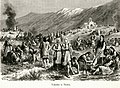 Popular festival at Thebes, 1880s
 -
 A bust of Pindar
 -
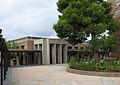 Entrance to the archaeological museum
 -
 Monastery of the Transfiguration of Christ, Sagmata

_-_1887.jpg)


In Greek myth
[edit]

The record of the earliest days of Thebes was preserved among the Greeks in an abundant mass of legends that rival the myths of Troy in their wide ramification and the influence that they exerted on the literature of the classical age. Five main cycles of story may be distinguished:
- The foundation of the citadel Cadmea by Cadmus, and the growth of the Spartoi or "Sown Men" (probably an aetiological myth designed to explain the origin of the Theban nobility which bore that name in historical times).
- The immolation of Semele and the advent of Dionysus.
- The building of a "seven-gated" wall by Amphion, and the cognate stories of Zethus, Antiope and Dirce.
- The tale of Laius, whose misdeeds culminated in the tragedy of Oedipus and the wars of the Seven against Thebes and the Epigoni, and the downfall of his house; Laius's pederastic rape of Chrysippus was held by some ancients to have been the first instance of homosexuality among mortals, and may have provided an etiology for the practice of pedagogic pederasty for which Thebes was famous.
- The exploits of Heracles.
The Greeks attributed the foundation of Thebes to Cadmus, a Phoenician king from Tyre (now in Lebanon) and the brother of Queen Europa. Cadmus was famous for teaching the Phoenician alphabet and building the Acropolis, which was named the Cadmeia in his honor and was an intellectual, spiritual, and cultural center.
Geography
[edit]Thebes is situated in a plain, between Lake Yliki (ancient Hylica) to the north, and the Cithaeron mountains, which divide Boeotia from Attica, to the south. Its elevation is 215 m (705 ft) above mean sea level. It is about 50 km (31 mi) northwest of Athens, and 100 km (62 mi) southeast of Lamia. The A1 motorway and the Athens–Thessaloniki railway connect Thebes with Athens and northern Greece. The municipality of Thebes covers an area of 830.112 km2 (320.508 sq mi), the municipal unit of Thebes 321.015 km2 (123.945 sq mi) and the community 143.889 km2 (55.556 sq mi).[20]
Climate
[edit]According to the nearby weather station of Aliartos, Thebes has a hot-summer Mediterranean climate (Köppen climate classification: Csa) with hot, dry summers and cool, wet winters. During the winter months, Thebes is sometimes affected by the Aegean sea-effect snow,[21] with snow depths reaching over 50 centimetres (20 in) on several occasions.[22][23] Due to its inland location, Thebes may also record very low minimums. In recent years, as registered by the meteorological station operated by the National Observatory of Athens within the city limits, the record minimum temperature is −7.9 °C (17.8 °F), recorded on 10 January 2017.[24] In contrast, the city can be very hot in the summer during heat waves, having reached a record high of 44.5 °C (112.1 °F) on 3 August 2021.[24]
| Climate data for Aliartos, Thebes (180 m, 1967–2001) | |||||||||||||
|---|---|---|---|---|---|---|---|---|---|---|---|---|---|
| Month | Jan | Feb | Mar | Apr | May | Jun | Jul | Aug | Sep | Oct | Nov | Dec | Year |
| Mean daily maximum °C (°F) | 11.5 (52.7) |
12.9 (55.2) |
15.6 (60.1) |
20.4 (68.7) |
25.8 (78.4) |
30.9 (87.6) |
32.4 (90.3) |
31.9 (89.4) |
28.6 (83.5) |
22.5 (72.5) |
17.2 (63.0) |
13.1 (55.6) |
21.9 (71.4) |
| Daily mean °C (°F) | 7.1 (44.8) |
8.3 (46.9) |
10.7 (51.3) |
15.3 (59.5) |
20.7 (69.3) |
25.7 (78.3) |
27.3 (81.1) |
26.4 (79.5) |
22.6 (72.7) |
17.0 (62.6) |
12.2 (54.0) |
8.7 (47.7) |
16.8 (62.2) |
| Mean daily minimum °C (°F) | 2.9 (37.2) |
3.6 (38.5) |
5.0 (41.0) |
8.1 (46.6) |
12.2 (54.0) |
16.0 (60.8) |
17.9 (64.2) |
17.4 (63.3) |
14.5 (58.1) |
11.0 (51.8) |
7.2 (45.0) |
4.4 (39.9) |
10.0 (50.0) |
| Average precipitation mm (inches) | 77.3 (3.04) |
74.1 (2.92) |
63.8 (2.51) |
40.0 (1.57) |
28.8 (1.13) |
13.8 (0.54) |
6.1 (0.24) |
13.8 (0.54) |
17.4 (0.69) |
69.5 (2.74) |
74.1 (2.92) |
96.4 (3.80) |
575.1 (22.64) |
| Source: HNMS[25] | |||||||||||||
Notable people
[edit]Ancient
[edit]- Heracles, mythological hero
- Pindar (c. 518–443 BC), poet
- Attaginus (5th century BC), oligarch
- Pelopidas (c. 420–365) general and statesman, led rebellion against Sparta, commanded the Theban "Sacred band" at Leuctra
- Epaminondas (c. 418–362 BC) general and statesman, commanded the Theban forces at the battles of Leuctra and Mantinea
- Aristides of Thebes (4th century BC), painter
- Nicomachus of Thebes (4th century BC), painter
- Crates of Thebes (c. 365 – c. 285 BC), Cynic philosopher
- Kleitomachos (3rd century BC), athlete
- Luke the Evangelist (died 84 AD), buried here
- Rufus of Thebes (1st century), bishop of Thebes
Modern
[edit]- Theodoros Vryzakis (c. 1814–1878) painter
- Alexandros Merentitis (1880–1964), military officer
- Panagiotis Bratsiotis (1889–1982), theologian
- Pandelis Pouliopoulos (1900–1943), Greek communist politician
- Archbishop Ieronymos II of Athens (born 1938)
- Haris Alexiou (born 1950), singer
- Evangelos Bassiakos (1954–2017), politician
See also
[edit]Notes
[edit]References
[edit]- ^ "Αποτελέσματα Απογραφής Πληθυσμού - Κατοικιών 2021, Μόνιμος Πληθυσμός κατά οικισμό" [Results of the 2021 Population - Housing Census, Permanent population by settlement] (in Greek). Hellenic Statistical Authority. 29 March 2024.
- ^ a b c Θῆβαι. Liddell, Henry George; Scott, Robert; A Greek–English Lexicon at the Perseus Project.
- ^ "ΦΕΚ A 87/2010, Kallikratis reform law text" (in Greek). Government Gazette.
- ^ a b c Raymoure, K.A. "Thebes". Minoan Linear A & Mycenaean Linear B. Deaditerranean. Archived from the original on 15 January 2016. Retrieved 19 March 2014. "The Linear B word te-qa-ja". Palaeolexicon. Word study tool for ancient languages. "KN 5864 Ap (103)". "PY 539 Ep + fr. + fr. + fr. (1)". "TH 65 Wu (γ)". "MY 508 X (unknown)". "TH 140 Ft (312)". DĀMOS: Database of Mycenaean at Oslo. University of Oslo.
- ^ Θήβασδε. Liddell, Henry George; Scott, Robert; An Intermediate Greek–English Lexicon at the Perseus Project.
- ^ Palaima, Thomas G. (2004). "Sacrificial Feasting in the Linear B documents" (PDF). Hesperia. 73 (2): 217–246. doi:10.2972/hesp.2004.73.2.217. S2CID 162875563.
- ^ Hope Simpson, Richard (1981). Mycenaean Greece. Park Ridge, NJ: Noyes Press. p. 70. ISBN 0-8155-5061-8. Retrieved 11 March 2025.
- ^ Mozhajsky, Andrej Y.; Юрьевич, Можайский Андрей (1 September 2024). "Hypothebai of the Iliad as an evidence of the beginning of the formation of the Theban polis". Vestnik drevnei istorii (in Russian). 84 (3): 618–639. ISSN 0321-0391. Retrieved 11 March 2025.
- ^ Herodotus Bibliography VII:204 ,222,223.
- ^ Alexander the Great. Encyclopædia Britannica.
- ^ Plutarch. Phocion. p. 17.
- ^ Siculus, Diodorus. "Book XIX, 54". Bibliotheca historica.
- ^ Plutarch's Lives, Volume III, Life of Alexander, Chapter 13
- ^ "The Parian Marble". The Ashmolean Museum. Archived from the original on 18 July 2017.
- ^ Beckett, Universal Biography, Vol. 1 p. 688
- ^ a b c d e Thirlwall, The History of Greece, Vol. 2 p. 325
- ^ "The silk of Thebes: Boeotia's role in the Byzantine textile industry5". 13 September 2025.
- ^ Jacoby, David (2014). "Benjamin of Tudela and his „Book of Travels"". Travellers, Merchants and Settlers in the Eastern Mediterranean, 11th–14th Centuries. Routledge. pp. 160–161. ISBN 9780367600624.
- ^ Sasse, H. (1991). Arvanitika: die albanischen Sprachreste in Griechenland. Deutschland: O. Harrassowitz, p. 4
- ^ "Population & housing census 2001 (incl. area and average elevation)" (PDF) (in Greek). National Statistical Service of Greece.
- ^ "Τι είναι το "Aegean Effect Snow"" (in Greek). 12 January 2020. Retrieved 20 June 2023.
- ^ Φραγκούλη, Μαρία. "Μεγάλες ποσότητες χιονιού καταγράφονται στην Θήβα από τις πυκνές χιονοπτώσεις που ξεκίνησαν από τα ξημερώματα της Τρίτης (video)". www.forecastweather.gr (in Greek). Retrieved 20 June 2023.
- ^ ΙΝ, Σύνταξη (24 January 2022). "Βυθίστηκαν στο χιόνι Φθιώτιδα και Βοιωτία – Χωρίς θέρμανση και ρεύμα πολλές περιοχές". in.gr (in Greek). Retrieved 20 June 2023.
- ^ a b "Meteosearch | Σελίδα σύνδεσης". meteosearch.meteo.gr. Retrieved 20 June 2023.
- ^ "Κλιματικά Δεδομένα ανά Πόλη- ΜΕΤΕΩΓΡΑΜΜΑΤΑ, ΕΜΥ, Εθνική Μετεωρολογική Υπηρεσία".
External links
[edit]
- Timeless Myths – House of Thebes
- Fossey, J.; J. Morin; G. Reger; R. Talbert; T. Elliott; S. Gillies (22 June 2020). "Places: 541138 (Thebai/Thebae)". Pleiades. Retrieved 8 March 2012.
Administrative division of the Central Greece Region | ||
|---|---|---|
| Regional unit of Boeotia |  | |
| Regional unit of Euboea | ||
| Regional unit of Evrytania | ||
| Regional unit of Phocis | ||
| Regional unit of Phthiotis | ||
| ||


| Kings |
|
|---|---|
| In literature | |
| Related articles | |

Thebes, Greece
View on GrokipediaThebes (Ancient Greek: Θῆβαι, Thêbai; modern Greek: Θήβα, Thíva) is an ancient city in Boeotia, central Greece, inhabited since prehistoric times and renowned for its mythological associations and historical military achievements.[1][2]
Legendarily founded by Cadmus, Thebes served as the backdrop for key Greek myths, including the tales of Oedipus, the Labours of Heracles, and the expedition of the Seven against Thebes, embedding it deeply in the cultural fabric of ancient Greece.[3][4]
In classical history, Thebes emerged as a formidable power, culminating in its victory over Sparta at the Battle of Leuctra in 371 BCE under the generalship of Epaminondas, which shattered Spartan hegemony and ushered in a brief period of Theban dominance across Greek city-states until the Battle of Mantinea in 362 BCE.[5][6]
The modern municipality of Thiva, centered on the ancient site including the Cadmea acropolis, houses an archaeological museum displaying regional antiquities and maintains a population of around 36,000 as the principal urban center of Boeotia.[7][8]
Geography and Environment
Location and Topography
Thebes occupies a central position in Boeotia, a region of mainland Greece characterized by extensive plains hemmed in by mountains, with coordinates approximately 38°19′N 23°19′E.[9] The city lies on the Boeotian plain, northwest of Athens and east of Lake Yliki, in an area of fertile alluvial soil conducive to agriculture, particularly wheat production.[10] This plain is bordered by Mount Cithaeron to the southeast, which forms a natural elevation rising to about 1,409 meters and separates Boeotia from Attica, and Mount Helicon to the southwest, reaching 1,749 meters and influencing local drainage patterns. The ancient core of Thebes centered on the Kadmeia, a citadel situated on a prominent hill approximately 4-5 meters above the surrounding plain, providing inherent defensive elevation and visibility for fortifications.[4] This acropolis overlooked the low-lying terrain vulnerable to periodic inundation from the now-drained Lake Copais, a former basin to the north that once covered much of northern Boeotia but was systematically emptied through 19th-century engineering works completed around 1895.[10] [11] Thebes' placement adjacent to transversal routes through mountain passes, such as those traversing Cithaeron toward Attica and northern corridors linking to Thessaly, positioned it at a nexus for overland movement across central Greece, with access to the Gulf of Corinth facilitating broader economic exchanges.Climate and Natural Resources
Thebes, located in the Boeotian plain of central Greece, features a hot-summer Mediterranean climate characterized by hot, dry summers and mild, wet winters. Average high temperatures in July reach approximately 32°C, while January lows average around 2–5°C, with annual precipitation totaling about 450–550 mm, predominantly falling between October and March.[12][13] This seasonal pattern supports a growing season from spring to autumn but exposes the region to summer droughts, limiting unirrigated crop yields and necessitating reliance on stored winter moisture or supplemental water sources.[14] The region's natural resources center on its fertile alluvial soils in the Boeotian plains, which historically and presently sustain agriculture focused on cereals like wheat, olives, grapes for wine production, and vegetables. The drainage of Lake Copais, initiated in the late 19th century by the Lake Copais Company starting in 1887, reclaimed over 150 square kilometers of marshland for cultivation, significantly expanding arable land and boosting productivity in grains and cotton, though it disrupted local wetland ecosystems and fisheries.[15][16] This intervention addressed chronic flooding vulnerabilities but introduced long-term dependencies on engineered water management, as the former lake bed's fertility derived from periodic inundations. Building materials such as limestone are quarried locally from surrounding hills, contributing to construction in antiquity and today, while the broader area yields minor industrial minerals. Persistent water scarcity, exacerbated by high evaporation rates and agricultural demands, requires modern irrigation systems drawing from rivers like the Asopos and groundwater aquifers, which face depletion risks amid Greece's national water stress ranking it 19th globally for scarcity.[17][18] These constraints have historically amplified vulnerabilities to dry spells, influencing crop reliability despite the plains' inherent productivity.[19]Prehistoric and Early History
Neolithic to Bronze Age Settlements
Archaeological evidence indicates human occupation in the Thebes area during the Neolithic period, with settlements such as Pyri near the city providing testimony to early farming communities.[20] In Boeotia, including sites proximate to Thebes, approximately 65 Neolithic settlements have been recorded, of which 43 are confirmed through excavations and surveys, featuring utilitarian unpainted pottery in the Early Neolithic and decorated ceramics in the Late Neolithic, alongside tools suggesting agricultural and domestic activities.[21] These finds, concentrated near Lake Copais and some closer to Thebes like Eutresis, reflect permanent villages reliant on farming, dating back to around the 7th millennium BC in the broader Greek context.[21][20] The Early Helladic period (c. 3200–2000 BC) saw a strong settlement at Thebes, marked by rectangular houses built with stone socles and mud-brick or timber-framed walls, including apsidal structures and corridor houses that suggest emerging social differentiation.[22] Excavations reveal signs of urbanization, such as large buildings for storage of agricultural goods, seals, and a princely tomb containing gold jewelry, indicating organized communities at strategic locations.[22] Pottery and bronze tools, including axes and chisels, alongside imported vases, point to trade and craftsmanship in these proto-urban phases.[22] During the Middle Helladic period (c. 2000–1700 BC), Thebes maintained its status as a major center in a densely populated Boeotia, with evidence from cist graves and pithos burials containing Minyan ware kylixes and occasional imports like Cycladic ivory figurines.[22][23] Household remains show continuity in rectangular dwellings without identified specialized functions, while larger cist graves toward the period's end suggest the rise of a ruling class.[22] Although fortifications are not prominently attested at Thebes itself, the steady occupation and grave goods reflect stable villages transitioning toward more hierarchical structures by around 1700 BC.[23][20]Mycenaean Thebes and the Kadmeia
The Kadmeia, the fortified acropolis of Bronze Age Thebes, served as the central hub of a major Mycenaean palatial center during the Late Helladic (LH) IIIA and IIIB periods, approximately 1400–1200 BC. Excavations have revealed a sprawling palace complex within its walls, comprising reception halls, administrative archives inscribed with Linear B tablets, storage magazines filled with amphorae, workshops, and residential quarters, indicating a sophisticated bureaucratic and economic system comparable to other Mycenaean palaces like those at Mycenae and Pylos.[24][25] The presence of frescoes depicting motifs such as griffins and processions underscores artistic influences and elite display, while the Linear B records document resource management, including textiles, metals, and possibly agricultural tribute, evidencing Thebes' role as a regional power in Boeotia.[26][27] Archaeological finds attest to Thebes' integration into broader Mediterranean trade networks, with imported Egyptian faience beads, scarabs, and glass objects recovered from palatial contexts, alongside Minoan-style pottery and Canaanite amphorae fragments suggesting exchanges of luxury goods like ivory, perfumes, and metals with Crete, Egypt, and the Levant during LH IIIA2–B1 (c. 1350–1200 BC).[28][29] These artifacts, analyzed through chemical sourcing, confirm direct or indirect maritime commerce that bolstered the palace's wealth and administrative reach, positioning Thebes as a key node in Aegean-Eastern Mediterranean interactions rather than a peripheral site.[30][31] The palace complex met a violent end around 1200 BC, marked by widespread fire destruction layers across the Kadmeia, coinciding with the systemic collapse of Mycenaean palatial society amid the Late Bronze Age crisis.[26][32] This event, evidenced by collapsed walls, charred debris, and abandoned Linear B archives, aligns with similar destructions at other mainland sites, potentially triggered by invasions, earthquakes, or internal upheavals, though no definitive single cause is attributable from Theban stratigraphy alone.[33] Post-palatial continuity is indicated by stratified pottery sequences on the Kadmeia, transitioning from LH IIIC early (c. 1200–1100 BC) coarse wares and imports to Submycenaean and Protogeometric styles without a complete occupational hiatus, challenging notions of total abandonment and suggesting resilient local populations adapted through reduced settlement scale.[34][35] These ceramic developments, including handmade vessels overlying destruction debris, reflect gradual cultural persistence into the Early Iron Age, with Thebes maintaining a nucleated presence amid regional depopulation trends.[36]Archaic and Classical Periods
Boeotian Federation and Early Conflicts
The Boeotian League emerged in the 6th century BC as a confederation of city-states in the region, initially comprising independent polities that coordinated defense and diplomacy, with Thebes emerging as the dominant power due to its size and central location. This federal structure, formalized around 519 BC, enabled Thebes to assert hegemony over smaller Boeotian centers like Orchomenus and Thespiae, fostering oligarchic governance through assemblies and elected officials who represented districts in collective decision-making. The league's organization amplified Thebes' influence by pooling resources for mutual protection against external threats, laying the groundwork for regional cohesion that contrasted with the more fragmented alliances elsewhere in Greece.[37][38] Early conflicts underscored the league's strategic role in Boeotian expansion. In the late 6th century BC, Thebes attempted to annex the independent town of Plataea, prompting Plataea to seek protection from Athens; this led to the first recorded Theban-Athenian clash, around 506 BC, where Athenian intervention preserved Plataea's autonomy and heightened rivalry over border territories. Thebes also vied with Thessaly for control of central Greek passes and trade routes, engaging in sporadic border skirmishes that tested the league's military integration. These rivalries reinforced Theban leadership, as the federation mobilized combined hoplite forces to deter encroachments, though internal power imbalances occasionally sparked dissent among subordinate cities.[39][40] During the Persian Wars, the Boeotian League's alignment shifted toward pragmatism amid invasion threats. Boeotian contingents, including Thebans, provided limited support to the Greek stand at Thermopylae in 480 BC but largely medized after the pass fell, hosting Persian forces under Mardonius near Thebes. At the Battle of Plataea in 479 BC, Boeotian troops fought alongside the Persians against the Greek alliance, contributing around 5,000–10,000 hoplites to the Median lines; this pro-Persian stance stemmed from calculations of Persian dominance and resentment toward Athenian expansionism, though it later invited reprisals from victorious Greek states. The league's federal framework facilitated such coordinated medism, prioritizing survival over pan-Hellenic unity.[41][42] Culturally, the federation preserved distinct Boeotian traditions amid external perceptions of provincialism. The Theban poet Pindar (c. 518–438 BC), in his victory odes, celebrated local athletic triumphs and myths rooted in Boeotian festivals, such as those honoring Dionysus and Heracles, which emphasized communal piety over individualistic heroism. Athenian sources, by contrast, often derided Boeotians as boorish and backward—"Boeotian rusticity" symbolizing cultural inferiority—yet Pindar's panhellenic commissions highlighted Thebes' contributions to Greek lyric poetry, subtly countering such biases through elite patronage networks sustained by league stability.[43][37]Theban Hegemony and Military Ascendancy
In 379 BC, a group of Theban exiles led by Pelopidas infiltrated Thebes and assassinated the pro-Spartan oligarchs, expelling the Spartan garrison from the Cadmeia and restoring democratic rule.[44][45] This coup ended Spartan occupation imposed after the defeat of the anti-Spartan faction in 382 BC and ignited Theban resistance against Spartan dominance in Greece.[46] The success stemmed from internal divisions among Theban collaborators and broader resentment toward Sparta's post-Peloponnesian War hegemony, which relied on coercive alliances rather than loyalty.[47] Under leaders Pelopidas and Epaminondas, Thebes consolidated Boeotia, forming a unified league that challenged Spartan supremacy.[48] The pivotal Battle of Leuctra in 371 BC saw Theban forces decisively defeat the Spartan army, killing King Cleombrotus I and inflicting heavy losses on Sparta's elite.[49] This victory shattered Sparta's military prestige, as its hoplite phalanx—long considered invincible—suffered its first major field defeat, prompting defections among Spartan allies.[50] Theban ascendancy arose from strategic opportunism exploiting Spartan overextension, including garrisons across Greece that strained resources, and effective Boeotian mobilization.[51] Epaminondas directed subsequent invasions of the Peloponnese from 369 to 362 BC, aiming to dismantle Spartan power structurally.[52] In 369 BC, Theban armies penetrated Laconia, freeing Messenian helots who had been enserfed for centuries, thereby depriving Sparta of its agricultural base and founding the independent state of Messene.[53] Further campaigns supported Arcadian resistance, culminating in the foundation of Megalopolis in 368 BC as a fortified bulwark against Spartan resurgence.[54] These actions redistributed power in the Peloponnese, allying former Spartan subjects with Thebes and eroding Sparta's territorial control through liberation rather than direct conquest.[48] The Theban hegemony, spanning roughly 371 to 362 BC, proved ephemeral due to unsustainable casualties from prolonged campaigning and Thebes' absence of a navy to secure maritime influence or supply lines.[47] High losses at battles like Mantinea in 362 BC, where Epaminondas perished, depleted Theban manpower without yielding decisive strategic gains, as coalitions reformed against Theban dominance.[55] Sparta's resilience, bolstered by persistent loyalty among its core citizenry despite peripheral losses, combined with Theban reliance on land power amid rival city-states' naval capabilities, limited long-term control beyond central Greece.[56]Innovations in Warfare: The Sacred Band and Phalanx Tactics
The Sacred Band, an elite unit of approximately 300 Theban hoplites organized into 150 pairs of erastai (lovers), was established around 378 BC by the general Gorgidas following the liberation of Thebes from Spartan control.[57] This formation drew on the principle that personal bonds would enhance unit cohesion and willingness to fight to the death, positioning the Band as a shock force stationed at the forefront of the phalanx to inspire the broader army.[58] Under Pelopidas, the unit proved effective in smaller engagements, such as the victory at Tegyra in 375 BC where 300 Thebans routed a larger Spartan force, demonstrating the tactical value of concentrated elite infantry against traditional hoplite lines.[59] A pivotal innovation came from Epaminondas at the Battle of Leuctra in 371 BC, where he employed an oblique phalanx order by deepening the left wing to 50 ranks—far exceeding the standard 8–12—while echeloning the right to refuse engagement, concentrating superior force against the Spartan right under King Cleombrotus I.[48] This maneuver allowed the Thebans, numbering about 6,000 to the Spartans' 10,000–11,000, to shatter the enemy kingship division early, leading to a rout that killed 1,000 Spartans including the king, while Theban losses remained under 300.[53] The tactic's effectiveness stemmed from overwhelming local superiority and disrupting Spartan morale, marking a shift from evenly matched phalanx clashes to asymmetric concentration, though its success hinged on precise timing and terrain exploitation rather than universal applicability.[60] Subsequent campaigns revealed limitations in these innovations' scalability and dependency on leadership. At Mantinea in 362 BC, Epaminondas replicated the oblique order against a Spartan-led coalition, securing a tactical victory with heavy enemy losses, but his death from a javelin wound halted pursuit, allowing the foes to regroup and exposing the phalanx's vulnerability without rapid exploitation or integrated cavalry.[61] The Sacred Band's annihilation at Chaeronea in 338 BC by Philip II's Macedonians further underscored these flaws: despite initial resistance, Macedonian combined arms—sarissa phalanx depth, hypaspists, and cavalry flanking—overwhelmed the Theban elites, killing all 300 in a lion monument-marked mass grave, as Theban reliance on hoplite cohesion faltered against more flexible formations.[62] Scholarly assessments note that while these tactics enabled short-term Theban ascendancy through empirical advantages in morale and focus, their non-replicability post-Epaminondas and exposure to evolved Macedonian methods highlighted over-dependence on exceptional commanders over systemic reforms.[63]Internal Politics and Societal Structure
The internal politics of classical Thebes operated within an oligarchic framework, where a narrow elite of property-owning hoplites dominated decision-making, justified by the principle that wealth equated to merit and ability. Power concentrated among prominent families, who rotated through key federal roles such as the eleven annually elected boeotarchs, four of whom represented Thebes in the Boeotian confederacy's executive.[64] Prosopographical analysis of these lineages reveals sustained aristocratic continuity, fostering stability amid factional rivalries, as the same clans influenced policy across generations despite periodic institutional shifts.[65] This oligarchic order faced recurrent challenges from democratic elements excluded by property qualifications, leading to internal stasis and exiles who sought external alliances, such as Theban democrats cooperating with Athens in 424 BC to overthrow the regime.[66] Tensions peaked in 395 BC, when civil strife between pro-Spartan oligarchs and anti-oligarchic factions, as chronicled in the Hellenica Oxyrhynchia, aligned Thebes with Corinth and Athens against Sparta, exposing the fragility of elite consensus. Theban society underpinned this politics with a rural economy centered on dry-farmed grains and pulses in Boeotia's fertile plains, sustained by free peasant smallholders who formed the confederacy's demographic base.[67] Elite households supplemented agriculture with slave labor for domestic tasks and field work, as evidenced by manumission inscriptions dedicating slaves to deities like Sarapis and Isis; horse-breeding on pastures supported cavalry needs without dominating production.[68] Gender roles remained rigidly traditional, with women restricted to household management, weaving, and childbearing, their limited public presence confined to religious dedications rather than political agency, as reflected in sparse epigraphic attestations prioritizing male civic roles.[69]Decline, Hellenistic, and Roman Eras
Destruction by Alexander and Aftermath
In 335 BC, following the death of Philip II, Thebes revolted against Macedonian control by expelling the garrison from the Cadmeia and attacking allied forces, prompting Alexander the Great to march south from Thrace.[70] The rebellion, instigated by Theban exiles and influenced by Athenian orators advocating independence from the League of Corinth, escalated when Theban forces slew Macedonian envoys during negotiations.[71] Alexander arrived after covering approximately 240 kilometers in 13 days, besieging the city and breaching its walls after two weeks of resistance. His troops stormed the lower city, engaging in house-to-house combat that resulted in over 6,000 Theban combatants killed and the enslavement of 30,000 inhabitants, including women and children.[71] In a council of Greek allies, Alexander authorized the razing of Thebes—except for its temples, the Cadmeia citadel held by Macedonians, and the house of the poet Pindar—to serve as a deterrent against further defiance of Macedonian hegemony.[72] Primary accounts by Arrian and Diodorus emphasize the deliberate demolition of buildings and walls, though the sparing of key structures indicates the destruction targeted the urban fabric rather than total obliteration.[70] [71] Survivors dispersed to Athens and other Boeotian cities like Orchomenus and Thespiae, which absorbed refugees and resettled some on confiscated Theban land.[72] This dispersal fragmented Theban society and economy, while Boeotian allies who joined Alexander in the assault gained territory, further eroding Thebes' regional influence.[73] Archaeological evidence from the site reveals burn layers and abandonment in lower town areas consistent with the reported sack, though the Cadmeia's occupation provided a nucleus for minimal continuity amid the ruins.[74] The event decisively curtailed Theban autonomy, compelling submission across Greece and enabling Alexander's focus on Persian campaigns without rear threats; Boeotia fell under pro-Macedonian administration, with Thebes' political and military prominence irretrievably lost.[73] Later ancient sources debate the proportionality of the response, attributing it to Alexander's strategic calculus for unity, yet acknowledging Greek auxiliaries' particular fervor in the looting, reflecting lingering resentments from Theban hegemony.[72]Hellenistic Restoration and Roman Integration
Cassander initiated the restoration of Thebes around 315 BC, following its near-total destruction by Alexander the Great in 335 BC, by resettling returning exiles and incorporating settlers from other regions to repopulate the city.[75] [39] This effort aimed to revive Boeotia's political and economic role amid the Wars of the Diadochi, though the rebuilt city remained smaller and less influential than in its classical peak.[76] During the broader Hellenistic era, Thebes aligned with the Antigonid dynasty of Macedon, reflecting Boeotia's general loyalty to Macedonian overlords, before briefly affiliating with the Aetolian League circa 245 BC as shifting alliances countered Achaean influence.[10] Local governance persisted through Boeotian federal structures, but external Hellenistic powers dictated major decisions, limiting Thebes' autonomy. Roman incorporation followed the Battle of Corinth in 146 BC, integrating Thebes into the senatorial province of Achaea, which encompassed central and southern Greece under imperial oversight.[77] Pausanias, traveling in the 2nd century AD, observed surviving monuments including remnants of walls, theaters, and sanctuaries, indicating partial architectural continuity despite earlier devastations. The economy emphasized agricultural continuity, with Boeotia's fertile plains exporting high-quality grain to Rome as tribute or market goods, sustaining local trade networks.[78] Hellenistic cultural practices endured under Roman rule, as evidenced by inscriptions from Theban sanctuaries attesting to ongoing worship of deities like Herakles and the Kabiroi, blending local mystery cults with broader Greco-Roman religious frameworks. [79] This period marked a stabilization rather than innovation, with Thebes functioning as a provincial hub focused on agrarian output over military or political resurgence.Cultural and Economic Shifts
Following the destruction of Thebes by Alexander the Great in 335 BCE and its partial Hellenistic restoration, the region's economy pivoted toward agriculture, capitalizing on Boeotia's fertile alluvial plains for crops such as grains, olives, and grapes. Archaeological field surveys from the Boeotia Project (1978–1987) document a proliferation of rural farmsteads and elite villas in the countryside during the Roman era, with structures featuring advanced features like cisterns and presses indicative of intensified estate-based production and land consolidation by prosperous landowners.[80] [81] This agrarian emphasis reflected a broader provincial integration into the Roman economy, where local output contributed to imperial tribute systems, including taxes on agricultural yields that strained smallholders while benefiting villa-owning elites. Bioarchaeological analysis of skeletal remains from Thebes reveals escalating wealth disparities from the Hellenistic period onward, with markers of mechanical stress and malnutrition suggesting that by the Roman era, the majority of the population endured poverty amid elite accumulation.[82] Trade patterns shifted as well, with exports of Boeotian fine pottery—prominent in earlier Classical markets—declining sharply, as evidenced by reduced amphorae and tableware distributions in Mediterranean assemblages from the late Hellenistic period. Local production persisted, however, with coarse wares and transport amphorae pointing to intra-regional exchange of agricultural goods like wine and oil, supported by ceramic workshops identified in Boeotian surveys spanning circa 150 BCE to 700 CE.[83] Urban centers like Thebes experienced relative stagnation, with demographic and industrial growth favoring rural silk and dyeing workshops outside the core Kadmeia citadel, though overall living standards declined compared to peak Classical prosperity.[84] Culturally, Thebes maintained traditional Boeotian practices with limited adoption of Hellenistic philosophical currents that flourished in Athens, lacking evidence of major academies or schools amid the region's provincial status. Dionysian worship endured prominently, rooted in local mythology associating the god with Thebes; Hellenistic and Roman guilds of Dionysiac artists (technitai Dionusou) organized festivals featuring processions, sacrifices, and performances, integrating into imperial festival networks without supplanting indigenous rites. Artifacts from the Archaeological Museum of Thebes, including votive figurines and ritual vessels, attest to continuity in these ecstatic cults, contrasting with the era's broader Hellenization elsewhere.[85] [74]Medieval to Ottoman Periods
Byzantine Defenses and Invasions
In the 4th to 7th centuries AD, Thebes functioned as a fortified stronghold in Boeotia amid waves of barbarian incursions, including early raids by Heruli and Goths, followed by Slavic invasions starting around 578–582 AD under emperors Tiberius II and Maurice.[86][87] These Slavic groups established settlements across mainland Greece, including Boeotia, where they initially disrupted Byzantine control but were later assimilated, providing demographic reinforcement to the region's population and military resources.[87][88] The city's existing walls and acropolis were bolstered for defense, enabling it to serve as a refuge and administrative node in the Theme of Hellas, formalized in the late 7th century by Justinian II.[89] By the early 9th century, following the 805 AD separation of the Peloponnese theme, Thebes solidified as the capital of the reduced Theme of Hellas, overseeing military districts vulnerable to ongoing threats from Bulgars and Arab forces.[90][89] Bulgarian incursions into Boeotia during the 10th century targeted the region's strategic position and resources, prompting reinforced local garrisons and thematic troops to repel advances.[89] Arab naval raids from Crete, peaking in the 9th–10th centuries, further pressured Hellas, though Thebes' inland location offered relative protection compared to coastal sites; these attacks disrupted trade but underscored the theme's role in Byzantine frontier defense.[91] Thebes' economic prominence as a silk production center emerged by the mid-11th century, with the city hosting specialized workshops that produced high-quality dyed textiles, drawing on sericulture techniques introduced empire-wide since the 6th century.[92][93] This industry, regulated under imperial guilds, elevated Thebes' strategic value, making it a target for plunder during invasions, as silk represented a key export commodity bolstering Byzantine fiscal resilience.[94] The Iconoclastic periods (726–843 AD) exerted minimal disruption locally, with archaeological traces of early Christian basilicas and later Orthodox structures attesting to unbroken liturgical continuity amid broader empire-wide debates.[86]Frankish and Venetian Influences
Following the sack of Constantinople during the Fourth Crusade in 1204, the regions of Boeotia and Attica, encompassing Thebes, were incorporated into the emerging Frankish principalities of Greece. Othon de la Roche, a Burgundian knight participating in the crusade, received these territories as a fief from Baldwin IX of Flanders, establishing the Lordship of Athens and Thebes, which evolved into the Duchy of Athens by the mid-13th century.[95] Thebes functioned as a key administrative and economic hub alongside Athens, benefiting from the de la Roche family's stable governance, which promoted Frankish settlement and feudal organization modeled on Western European systems. Under lords like Guy I de la Roche (r. 1225–1263) and subsequent rulers, including Nicholas II of Saint Omer (r. 1275–1294 as lord of Thebes), the city saw administrative centralization through vassal networks and fortified residences.[96] The ducal line passed to Walter V of Brienne in 1308 via marriage to Isabella de la Roche, but his rule ended abruptly in 1311 with defeat by the Catalan Grand Company at the Battle of the Cephissus River near Thebes, marking the onset of mercenary dominance over the duchy. During the Frankish interlude (1204–1311), fortifications were significantly upgraded, including a prominent tower on the Cadmea acropolis attributed to Saint Omer's era, exemplifying military architecture adapted to local terrain while incorporating Western defensive principles like corner bastions.[97] These enhancements reflected broader efforts to secure trade routes amid ongoing Byzantine and local Greek resistance, though demographic strains from regional conflicts and later plagues contributed to population decline by the early 14th century.[96] Venetian commercial interests intertwined with Frankish administration, as the republic's merchants, active in Thebes since the 11th century, secured privileges for exporting locally produced silk—a industry centered on high-quality weaving techniques inherited from Byzantine times.[98] Thebes' silk output, including brocades and velvets, drew Venetian traders who established informal outposts and integrated into the local economy, fostering syncretic cultural exchanges evident in hybrid architectural forms, such as Gothic-influenced chapels and vaults overlaid on Byzantine or ancient foundations.[99] This period's Latin patronage introduced Western artistic motifs, like pointed arches in ecclesiastical structures, contrasting with indigenous Orthodox traditions, though full-scale Gothic cathedrals remained rare due to resource constraints and brief Frankish tenure.[100] Overall, these influences temporarily revitalized Thebes' economy before the Catalan's disruptive rule shifted dynamics toward exploitation.[101]Ottoman Rule and Local Resistance
The Ottoman conquest of Thebes occurred in 1460, marking the completion of mainland Greece's subjugation following the fall of the Duchy of Athens.[39] The city became part of the Sanjak of Euripos (Negroponte), administered as the kaza of Thebes with an Ottoman garrison stationed there, while Boeotia overall divided into the kazas of Thebes and Livadeia.[86] [102] Christian inhabitants retained limited autonomy through the Orthodox millet system under the Ecumenical Patriarchate, but this was overshadowed by burdensome taxation including the jizya poll tax, harac land tax, and ispence income levies, enforced via the timar feudal land grants to sipahis.[102] Economic exploitation intensified over time, with initial low taxes during the 15th-16th century Pax Ottomanica giving way to heavier impositions by the 17th century as local landlords consolidated control and corruption eroded productivity. The timar system's emphasis on revenue extraction stifled agricultural innovation, leading to stagnation in Boeotia's fertile plains, which relied on wheat, olives, and pastoralism without significant irrigation or crop diversification. Population decline reflected this strain: Thebes counted approximately 8,000 residents in 1570, halving to 4,000 by 1642 amid emigration, disease, and compulsory sürgün resettlements to boost tax yields.[86] [102] Local resistance manifested in brigandage and klephtic bands operating from Boeotia's rugged mountains, where fugitives evaded taxes and conscription by raiding Ottoman convoys and estates, embodying irregular warfare against imperial authority. These groups, often blending banditry with proto-nationalist defiance, persisted through the 18th century, undermining Ottoman control without coordinated success until broader unrest. Thebes contributed to the Greek War of Independence starting in 1821, with Boeotian uprisings aligning against Ottoman forces amid the distraction of Ali Pasha of Ioannina's concurrent rebellion in Epirus, which tied down imperial troops and exposed administrative weaknesses. Heavy reprisals devastated the city, leaving ruins exacerbated by a subsequent earthquake, until Ottoman withdrawal in the late 1820s.[86]Modern Era
Independence and 19th-Century Revival
Following the successful conclusion of the Greek War of Independence in 1829 and the establishment of the Kingdom of Greece in 1832 under King Otto, Thebes, previously a modest village under Ottoman rule, was incorporated into the nascent independent state encompassing central Greece, including Boeotia.[103] This integration marked the beginning of systematic reconstruction efforts, transitioning the locality from peripheral Ottoman administration to a municipal entity within a modernizing European-style monarchy, with initial focus on administrative reorganization and basic infrastructure to support local governance and economic recovery.[104] A pivotal development in the late 19th century was the initiation of the drainage of Lake Copais by the British-formed Lake Copais Company in 1887, which aimed to reclaim the expansive basin for cultivation through extensive engineering works including canals and pumping stations.[16] These efforts, continuing into the early 20th century, transformed the periodically flooded lake into arable land, significantly expanding agricultural productivity in Boeotia by exploiting fertile alluvial soils for crops such as cereals and cotton, thereby enhancing export-oriented farming and local economic viability despite challenges like foreign capital dominance and technical hurdles.[105][106] Archaeological pursuits further underscored the cultural revival, with Christos Tsountas, a pioneering Greek excavator, conducting surveys and digs in Boeotia during the 1880s, including investigations into prehistoric and classical sites that highlighted the region's ancient significance and supported the era's national narrative of continuity with classical heritage.[74] Concurrently, transportation advancements, such as the extension of rail networks linking central Greece, facilitated integration with Athens and broader markets by the early 1900s, aiding population stabilization and modest urban growth amid ongoing modernization pressures.[107]20th-Century Challenges and Development
During World War II, Thebes and the surrounding Boeotia region endured the Axis occupation of Greece from April 1941 to October 1944, marked by resource requisitions, famine affecting over 100,000 deaths nationwide, and guerrilla resistance operations in central Greece's mountainous terrain. Local populations in nearby areas, such as Thisvi municipality units, were displaced, with many seeking refuge in Thiva as villages were abandoned amid wartime disruptions. The subsequent Greek Civil War (1946–1949) compounded these hardships, involving communist insurgents and government forces in rural central Greece, leading to further economic strain, infrastructure damage, and population displacement in provincial towns like Thebes.[108][109] Postwar recovery in the 1950s–1970s saw limited industrialization in Thebes, focused on agricultural processing amid Greece's broader shift toward urban manufacturing, but significant internal migration to Athens drew residents from Boeotia, stagnating local demographics as rural youth sought industrial jobs in the capital. National census data reflect this trend: Greece's population outside Athens declined by over 300,000 between 1961 and 1971, with economically active individuals dropping by 565,000, patterns mirrored in Boeotia's provincial centers.[110] By the 1980s, following Greece's 1981 entry into the European Economic Community, structural funds supported infrastructure improvements, including road networks linking Thebes to Athens and enhancing regional connectivity, though absorption challenges limited immediate local impacts. Boeotia remained vulnerable to recurring floods due to its alluvial plains and seasonal Asopos River overflows, a hazard persisting into the 20th century alongside seismic risks in central Greece.[111]Contemporary Municipality and Economy
The Municipality of Thiva was formed in 2011 as part of Greece's Kallikratis administrative reform, which consolidated the former municipalities of Thiva, Thisvi, Plataies, and Vagia into a single entity covering 514 square kilometers. It serves as the seat of the Boeotia regional unit within the Central Greece region, with administrative responsibilities including local governance, infrastructure, and cultural heritage management. The 2021 Population-Housing Census recorded a permanent population of 32,052 residents in the municipality, reflecting a stable but aging demographic typical of inland Greek locales.[112][113] The local economy centers on agriculture, with key outputs including wheat, cotton, and vegetables cultivated on the fertile Boeotian plain, supplemented by olive and fruit production. Small-scale manufacturing, particularly in food processing and textiles, provides limited industrial employment, while services dominate, including retail and public sector roles. Tourism supports seasonal income through visits to ancient ruins, the Archaeological Museum of Thebes, and nearby sites like Eleon, though it remains underdeveloped compared to coastal areas. Unemployment rates, which hovered around 15% in Boeotia during the late 2010s amid national economic recovery from the debt crisis, have declined to approximately 10% or lower by the mid-2020s, mirroring broader Greek trends driven by tourism rebound and EU structural funds.[114][115] Recent initiatives include EU co-financed expansions at the Archaeological Museum of Thebes under the Greece 2.0 National Recovery and Resilience Plan, enhancing exhibition spaces and digital access to artifacts from 2021 onward to boost cultural tourism. Ongoing excavations at the nearby Eleon site, resumed in 2023 by the Eastern Boeotia Archaeological Project in collaboration with the Canadian Institute in Greece and local authorities, have uncovered Mycenaean and Classical remains, with study seasons continuing into 2025 to inform preservation and potential visitor development. However, outward migration of younger residents to urban centers like Athens persists, contributing to gradual population stagnation and reliance on remittances, as evidenced by national trends of net rural depopulation exceeding 1% annually in non-metropolitan areas during the 2010s-2020s.[116][117][118]Mythology and Cultural Legacy
Central Myths: Oedipus, Cadmus, and the Seven Gates
In Greek mythology, Cadmus, a Phoenician prince from Tyre and brother of Europa, is credited with founding the city of Thebes after an oracle from Delphi instructed him to follow a cow until it collapsed, marking the site for settlement.[119] Upon arriving, Cadmus sent men to fetch water from a spring guarded by a dragon sacred to Ares; after slaying the beast, he sowed its teeth in the earth, from which armed warriors known as the Spartoi (sown men) sprang forth, becoming the ancestral population of Thebes and symbolizing the city's autochthonous origins.[120] Cadmus married Harmonia, daughter of Ares and Aphrodite, establishing the Theban royal line, though their descendants faced recurring divine curses, portraying Thebes as a nexus of heroic foundation intertwined with inevitable strife.[119] The Oedipus cycle centers on the Theban king Oedipus, whose fate exemplifies prophetic inevitability and familial curse. Born to King Laius and Queen Jocasta, Oedipus was abandoned as an infant due to an oracle foretelling he would kill his father and marry his mother; raised in Corinth, he fled after a similar prophecy and unknowingly slew Laius at a crossroads.[121] Arriving in Thebes amid a Sphinx's riddle-plague—devouring travelers unable to solve it—Oedipus answered correctly ("man"), liberating the city, ascending the throne, and wedding the widowed Jocasta, thus unwittingly fulfilling the oracle.[122] Years later, a plague struck Thebes; investigating, Oedipus uncovered his patricide and incest, leading to Jocasta's suicide and his self-blinding exile, with the curse extending to his sons, Eteocles and Polynices, who inherited a legacy of fraternal division and doom.[121] This narrative underscores themes of hubris against fate, positioning Thebes as a stage for generational retribution originating from Laius's abduction of Chrysippus.[123] The myth of the Seven Against Thebes depicts the siege fulfilling Oedipus's curse on his sons, who agreed to alternate rule but clashed when Eteocles refused to yield to Polynices.[124] Exiled, Polynices allied with Adrastus of Argos, assembling six champions—Capaneus, Eteoclus, Hippomedon, Parthenopaeus, Tydeus, and himself—to assault Thebes's seven gates: Electrae, Proetides, Homolois, Ogygian, Neistan, Hypsistan, and Cithaeronian (or variants thereof).[124][125] In Aeschylus's account, Eteocles strategically assigns Theban defenders to counter each attacker, but the brothers mutually slay each other at the seventh gate, ensuring mutual destruction and leaving Thebes victorious yet scarred, with the gates embodying the city's fortified defiance and the myth's function in exploring divided loyalty and prophetic closure.[124] This episode concludes the Labdacid dynasty's tragic arc, emphasizing Thebes's mythic resilience amid heroic catastrophe.[126]Heroic Figures and Theban Cycle
The Theban Cycle encompassed a series of lost epic poems that chronicled the heroic and tragic exploits surrounding Thebes, second in prominence only to the Trojan War cycle in ancient Greek tradition. These epics, including the Oedipodea, Thebais, and Epigoni, detailed generations of conflict within the Labdacid dynasty and allied warriors, emphasizing themes of familial curses, fraternal strife, and retribution as manifestations of divine justice rather than human moral progress.[127][128] Surviving fragments and summaries, preserved in later authors like Proclus, portray these narratives as cautionary exemplars of hubris leading to inevitable downfall under the gods' inexorable will.[129] Heracles, the archetypal Greek hero, maintained deep ties to Thebes through his early life and labors. Raised in Thebes under the stewardship of his mortal stepfather Amphitryon, a Theban general, Heracles married Megara, daughter of King Creon, and fathered children there before Hera-induced madness compelled him to slay them, prompting his penance via the canonical twelve labors imposed by Eurystheus.[130] The first labor, slaying the Nemean Lion whose impenetrable hide terrorized nearby regions, underscored Heracles' role as a protector against chaos, with ancient vase paintings depicting the hero strangling the beast in scenes that highlight raw physical prowess over cunning.[131] These Theban connections framed Heracles not as a flawless paragon but as a figure whose triumphs served divine purposes, averting greater calamities through superhuman endurance. Dionysus, god of wine and ecstasy, featured prominently in Theban lore as Semele's son, born amid divine intrigue in the city. King Pentheus, grandson of founder Cadmus, rejected Dionysus' cult upon its introduction to Thebes, viewing the ecstatic rites as subversive threats to order; in retribution, the god drove the Theban women into maenadic frenzy, leading Pentheus—spying in disguise—to be torn apart by his own mother Agave and aunts.[132] This myth, echoed in Euripides' Bacchae and corroborated by fragmentary epic traditions, exemplified resistance to divine innovation as fatal impiety, with vase iconography often showing Pentheus' dismemberment to warn of the perils in denying cosmic hierarchies.[133] The Labdacid dynasty's tragedies extended into epic warfare, where Oedipus' sons Eteocles and Polynices clashed over the throne, culminating in the failed assault of the Seven against Thebes as narrated in the Thebais.[127] Mutual fratricide ensued, fulfilling Laius' ancient curse, after which the Epigoni—the sons of the Seven—launched a successful revenge expedition, sacking Thebes and installing Thersander as ruler, as detailed in the eponymous epic attributed variably to Homer or Antimachus.[134] Attic vase paintings from the 6th-5th centuries BCE frequently illustrated these sieges, portraying heroes like Adrastus, Tydeus, and Alcmaeon in armored combat to emphasize collective vengeance as a mechanism of restoring equilibrium disrupted by mortal overreach.[135] Across these tales, heroic agency consistently yielded to inexorable fate and godly retribution, underscoring the limits of human ambition in mythic causality.[136]Historical Debates on Myth and Reality
Archaeological investigations at Thebes reveal a thriving Mycenaean settlement from circa 1400 to 1200 BCE, including a fortified palace and over 400 Linear B tablets documenting administrative activities such as land tenure and religious offerings, underscoring the city's regional power but providing no narrative evidence for mythic figures like Oedipus or Cadmus.[137][138] Scholars proposing kernels of historical truth argue that tales of curses and kin strife may echo real Bronze Age clan feuds or succession crises, common in palace economies where dynastic instability often precipitated collapse, yet such links remain conjectural absent textual or artifactual corroboration beyond general patterns of Mycenaean upheaval.[139] Interpretations favoring symbolic or allegorical readings, including Freudian projections of universal subconscious drives onto the Oedipus narrative, overlook the myths' explicit focus on empirical causal chains: violations of kinship taboos leading to communal pollution, monarchical hubris inviting downfall, and inexorable fate overriding individual will—patterns verifiable in historical records of ancient Near Eastern and Greek dynasties where familial betrayals routinely destabilized thrones.[140] These critiques emphasize that prioritizing archaeology over psychologized exegeses better aligns with the myths' original contexts, where Theban stories likely served to rationalize observed political failures rather than encode ahistorical archetypes. Regional literary traditions highlight interpretive biases: Boeotian authors like Pindar exalted Theban origins and heroes such as Heracles, fostering local identity through odes that tied myth to tangible cult sites and victories, while Athenian dramatists in works by Aeschylus and Sophocles portrayed Thebes as a locus of barbarism, incest, and tyranny—constructs that inverted Athenian ideals of democracy and piety to justify rivalries dating to the Archaic period.[141][142] This contrast, rooted in interstate antagonism rather than disinterested historiography, underscores how mythic narratives were shaped by political utility over fidelity to putative events.Archaeology and Preservation
Key Excavation Sites
The Kadmeia, the fortified acropolis of ancient Thebes, has yielded evidence of continuous occupation from the Bronze Age onward through targeted excavations. Initial systematic digs by Antonios Keramopoullos between 1906 and 1929 exposed multi-phase structures, including a Mycenaean palatial complex centered on the summit and dating primarily to the Late Helladic IIIB period (ca. 1300–1200 BC), featuring administrative buildings, storerooms with pottery assemblages indicative of centralized storage, and destruction layers from fires around the palatial collapse.[34] [25] Subsequent explorations, including those by the Greek Archaeological Service in the late 20th century and ongoing work into the 2010s, have uncovered overlying classical-period houses and earlier prehistoric settlements, confirming a densely built urban core with fortifications enclosing approximately 20 hectares.[26] [143] The Ismenion sanctuary, situated on a low hill southeast of the Kadmeia and dedicated to Apollo Ismenios, preserves foundations of multiple temple phases from geometric through classical times. Excavations by the American School of Classical Studies at Athens in 2015–2016 delineated an Archaic to Classical Doric temple (ca. 6th–4th centuries BC), built over earlier structures, with associated votive deposits including terracotta figurines and bronze items traceable to the 8th century BC, signaling the site's role as a major cult center predating Theban hegemony.[144] [145] Limited prior probes in the 20th century confirmed stratigraphic continuity from the Late Bronze Age, though the primary architectural remains align with post-geometric ritual elaboration.[146] The Electran Gate (Elektrai), part of the encircling city walls mythically numbered at seven, was excavated in 1908 by Keramopoullos, revealing twin towers and gate architecture reconstructed in the Hellenistic period under Cassander around 315 BC following Alexander's destruction.[147] The basal courses incorporate massive limestone blocks in a cyclopean style, consistent with Mycenaean defensive techniques (ca. 14th–13th centuries BC), overlaid by later brick and mudbrick superstructures; associated debris layers include iron weapons and pottery sherds attesting to military use and repairs through the classical era.[125] These elements outline a perimeter wall system spanning roughly 4 kilometers, with polygonal masonry transitions marking evolutionary fortification phases.[9]Recent Discoveries and Interpretations
In the 2010s, renewed analysis of Linear B tablets excavated from the Kadmeia confirmed Thebes' role as a major Mycenaean administrative center with widespread literacy for recording economic transactions, including land tenure and personnel management, dating to around 1350–1200 BCE.[148] These reinterpretations, building on publications of over 400 fragments, emphasized empirical textual evidence over speculative ties to later myths, countering tendencies in popular accounts to sensationalize connections to figures like Cadmus without corroborating archaeological data.[149] Surveys and excavations at Eleon, part of the Eastern Boeotia Archaeological Project since 2007, have in the 2020s revealed material culture linking the site to Thebes' palatial sphere, including Mycenaean pottery and structures indicating fluctuating economic integration from 1700–1050 BCE.[150] Renewed digs in 2023 and study seasons in 2025 uncovered fortifications and artifacts suggesting Eleon served as a regional outpost, supported by surface survey data showing trade networks eastward from Thebes without invoking unsubstantiated mythological narratives.[151][152] Debates persist on the circa 1200 BCE destruction of Mycenaean Thebes, with fire layers and collapsed structures cited for both seismic and martial causes; while some evidence points to earthquakes, as at nearby sites, skeletal trauma and weapon deposits favor human conflict, urging caution against overreliance on natural disaster models lacking site-specific seismic records.[153] Preservation challenges include urban expansion in modern Thebes encroaching on the Kadmeia, compounded by looting risks amid economic pressures, though systematic monitoring has mitigated some threats through targeted interventions.[74] Scholarly interpretations prioritize stratified data over dramatic reconstructions, highlighting biases in media toward catastrophe for engagement.[154]The Archaeological Museum and Tourism
The Archaeological Museum of Thebes, inaugurated on June 7, 2016, functions as the central institution for displaying artifacts from excavations throughout Boeotia, encompassing periods from the Palaeolithic to the Post-Byzantine era.[155] Its 1,000-square-meter exhibition space accommodates a diverse array of finds, including rare prehistoric and early historic collections unique to the region.[156] These holdings underscore Thebes' continuous human occupation and cultural significance, with thematic organization highlighting chronological developments in Boeotia.[74] Since the early 2020s, the museum has integrated digital resources, such as a virtual tour, to broaden access beyond physical constraints and complement on-site visits.[157] This adaptation supports scholarly analysis while appealing to remote audiences, though interpretive presentations prioritize empirical artifact data over unsubstantiated mythological overlays.[158] The museum drives tourism to Thebes, positioning it as a niche destination for archaeology enthusiasts en route to major sites like Delphi.[159] Its 2018 nomination for the European Museum of the Year Award reflects international recognition, fostering visitor inflows that enhance local economic activity within Greece's tourism sector, which accounted for up to 33.7% of GDP in 2024.[160][161] Yet, heightened foot traffic from cultural tourism exerts pressure on nearby sites, balancing revenue gains against preservation demands amid historical funding constraints for regional institutions.[162][163]
Notable Figures
Ancient Thebans: Leaders and Thinkers
Epaminondas (c. 410–362 BC) served as a Theban general and statesman whose military innovations elevated Thebes to hegemony over Greece in the mid-4th century BC. He is credited with devising the oblique phalanx formation, which enabled a decisive victory against the Spartans at the Battle of Leuctra in 371 BC, where Theban forces outnumbered but outmaneuvered the enemy, shattering Spartan dominance.[48] Epaminondas led multiple invasions into the Peloponnese between 370 and 362 BC, liberating Messenia from Sparta and founding the city of Messene in 369 BC to weaken Spartan power permanently.[164] Despite his ascetic lifestyle and philosophical inclinations—trained under the Pythagorean Lysis of Tarentum—he pursued Theban supremacy aggressively, though his death from wounds sustained at the Battle of Mantinea in 362 BC ended the brief Theban ascendancy.[165] Pelopidas (d. 364 BC), a contemporary Theban leader, played a pivotal role in restoring Theban independence by orchestrating the clandestine expulsion of the Spartan garrison from the Cadmea in 379 BC, sparking resistance against Spartan hegemony. As commander of the Sacred Band, an elite unit of 300 hoplites organized in pairs of erastai and eromenoi for unbreakable cohesion, Pelopidas integrated this force into Theban tactics, contributing to victories at Tegyra in 375 BC and Leuctra. His diplomatic and military efforts, including campaigns in Thessaly, advanced Theban interests until his death in battle against Alexander of Pherae in 364 BC, after which Epaminondas assumed greater prominence.[166] Pindar (c. 518–438 BC), the preeminent lyric poet of Thebes, composed epinician odes that extolled athletic victors and underscored Theban valor and aristocratic ideals, preserving local pride amid Persian Wars and rival city-state ascendancies.[167] His works, including Olympian and Pythian odes, frequently invoked Theban myths and heroes like Heracles to celebrate panhellenic successes by Boeotian athletes, while subtly affirming Theban cultural superiority over Athenian pretensions.[167] Surviving fragments and complete odes, totaling four books of Olympians, Pythians, Nemeans, and Isthmian, demonstrate Pindar's mastery of choral lyric, commissioned by elites to commemorate triumphs at major games, reflecting Theban patronage of poetry as a marker of civic excellence.[167]Modern Contributions
The Archaeological Museum of Thebes represents a key modern institution dedicated to preserving and exhibiting artifacts from the region's ancient past, with its 1,000 square meter exhibition space housing items from Palaeolithic to Post-Byzantine periods unearthed in Boeotia-wide excavations.[116] Opened to the public following renovations, the museum facilitates scholarly research and public education on Thebes' historical layers, including Mycenaean pottery, Classical sculptures, and Byzantine silks that highlight the city's medieval silk production prominence.[157] Systematic excavations at the Kadmeia citadel, the Bronze Age acropolis of Thebes, resumed in 2012 and have yielded significant findings such as fortifications, administrative structures, and Linear B tablets, enhancing comprehension of Mycenaean palatial organization.[168] These efforts, conducted under the Greek Ministry of Culture and supported by international collaborations, employ modern techniques like geophysical surveys to map unexcavated areas without extensive destruction.[31] Archaeologist Vasileios Aravantinos, former director of the Ephorate of Boeotian Antiquities, has led advancements in interpreting Mycenaean wall-paintings and tomb complexes at Thebes, publishing analyses that link local artistry to broader Aegean networks around 1400–1200 BCE.[31] His work underscores empirical methodologies in stratigraphy and iconography, countering earlier speculative reconstructions with data from conserved fragments.[31] In the 21st century, urban development projects in Thebes have integrated archaeological rescue excavations, unearthing over 300 artifacts from Hellenistic to Ottoman eras beneath modern infrastructure, which are subsequently conserved and displayed to balance preservation with contemporary needs.[169] These initiatives, mandated by Greek law, ensure that infrastructure expansions like roadworks contribute to historical knowledge rather than erasing it.[169]References
- https://www.wikidata.org/wiki/Q12875678