Hubbry Logo
MiletusMiletusMain
Open search
Miletus
Community hub
Miletus
logo
8 pages, 0 posts
0 subscribers
Be the first to start a discussion here.
Miletus
Miletus
from Wikipedia

Key Information

Miletus (Ancient Greek: Μίλητος, romanisedMílētos) was an influential ancient Greek city on the western coast of Anatolia, near the mouth of the Maeander River in present day Turkey. Renowned in antiquity for its wealth, maritime power, and extensive network of colonies, Miletus was a major center of trade, culture, and innovation from the Bronze Age through the Roman period. The city played a foundational role in the development of early Greek philosophy and science, serving as the home of the Milesian school with thinkers such as Thales, Anaximander, and Anaximenes.

Miletus's prosperity was closely linked to its strategic coastal location and the productivity of its surrounding rural hinterland, which supported thriving agriculture and facilitated wide-ranging commercial activity. The city established dozens of colonies around the Mediterranean and Black Sea, significantly shaping the Greek world’s expansion.

Archaeological investigations have revealed a rich material culture, including the sanctuary of Apollo at Didyma, remnants of the city's distinctive grid plan, and evidence of long-term agricultural and rural management. Throughout its history, Miletus experienced periods of autonomy and foreign rule, serving as a cultural crossroads between Greek, Anatolian, and later Persian and Roman spheres. The city’s enduring legacy is reflected in its contributions to philosophy, urban planning, and the spread of Greek civilization.

History

[edit]
Map of Miletus and other cities within the Lydian Empire

Neolithic

[edit]

The earliest available archaeological evidence indicates that the islands on which Miletus was originally placed were inhabited by a Neolithic population in 3500–3000 BC.[4] Pollen in core samples from Lake Bafa in the Latmus region inland of Miletus suggests that a lightly grazed climax forest prevailed in the Maeander valley, otherwise untenanted. Sparse Neolithic settlements were made at springs, numerous and sometimes geothermal in this karst, rift valley topography. The islands offshore were settled perhaps for their strategic significance at the mouth of the Maeander, a route inland protected by escarpments. The graziers in the valley may have belonged to them, but the location looked to the sea.

Middle Bronze Age

[edit]

The prehistoric archaeology of the Early and Middle Bronze Age portrays a city heavily influenced by society and events elsewhere in the Aegean, rather than inland.

Minoan period

[edit]

The earliest Minoan settlement of Miletus dates to 2000 BC.[5] Beginning at about 1900 BC artifacts of the Minoan civilization acquired by trade arrived at the site.[4] For some centuries the location received a strong impulse from that civilization, an archaeological fact that tends to support but not necessarily confirm the founding legend—that is, a population influx from Crete. According to Strabo:[6]

Ephorus says: Miletus was first founded and fortified above the sea by Cretans, where the Miletus of olden times is now situated, being settled by Sarpedon, who brought colonists from the Cretan Miletus and named the city after that Miletus, the place formerly being in possession of the Leleges.

According to Pausanias, however, Miletus was a friend of Sarpedon from Crete, after whom the city was named.[7] Miletus had a son named Kelados, and the heroon of Kelados has been found at Panormos, a port of Miletus near Didyma.[8]

The legends recounted as history by the ancient historians and geographers are perhaps the strongest; the late mythographers have nothing historically significant to relate.[9]

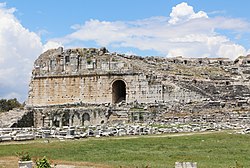
A panoramic view of The Theatre of Miletus, Didim

Late Bronze Age

[edit]

Recorded history at Miletus begins with the records of the Hittite Empire and the Mycenaean records of Pylos and Knossos, in the Late Bronze Age.

Mycenaean period

[edit]

Miletus was a Mycenaean stronghold on the coast of Asia Minor from c. 1450 to 1100 BC.[10] In c. 1320 BC, the city supported an anti-Hittite rebellion of Uhha-Ziti of nearby Arzawa. Muršili ordered his generals Mala-Ziti and Gulla to raid Millawanda, and they proceeded to burn parts of it; damage from LHIIIA found on-site has been associated with this raid.[11] In addition the town was fortified according to a Hittite plan.[12]

Miletus is then mentioned in the "Tawagalawa letter", part of a series including the Manapa-Tarhunta letter and the Milawata letter, all of which are less securely dated. The Tawagalawa letter notes that Milawata had a governor, Atpa, who was under the jurisdiction of Ahhiyawa (a growing state probably in LHIIIB Mycenaean Greece); and that the town of Atriya was under Milesian jurisdiction. The Manapa-Tarhunta letter also mentions Atpa. Together the two letters tell that the adventurer Piyama-Radu had humiliated Manapa-Tarhunta before Atpa (in addition to other misadventures); a Hittite king then chased Piyama-Radu into Millawanda and, in the Tawagalawa letter, requested Piyama-Radu's extradition to Hatti.

The Milawata letter mentions a joint expedition by the Hittite king and a Luwian vassal (probably Kupanta-Kurunta of Mira) against Miletus, and notes that the city (together with Atriya) was now under Hittite control.[citation needed]

Homer mentions that during the time of the Trojan War, Miletus was an ally of Troy and was city of the Carians, under Nastes and Amphimachus.[13]

In the last stage of LHIIIB, the citadel of Bronze Age Pylos counted among its female slaves a mi-ra-ti-ja, Mycenaean Greek for "women from Miletus", written in Linear B syllabic script.[14]

Fall of Miletus

[edit]

During the collapse of Bronze Age civilization, Miletus was burnt again, presumably by the Sea Peoples.

Dark Age

[edit]

Mythographers told that Neleus, a son of Codrus the last King of Athens, had come to Miletus after the "Return of the Heraclids" (so, during the Greek Dark Ages). A heroon for Neleus was allegedly located outside of the city wall of Roman Miletus, which probably marks the former city center contemporary to Neleus.[15][8] The Ionians killed the men of Miletus and married their Carian widows. This is the mythical commencement of the enduring alliance between Athens and Miletus, which played an important role in the subsequent Persian Wars.

Archaic period

[edit]
The Ionic Stoa on the Sacred Way in Miletus

The city of Miletus became one of the twelve Ionian city-states of Asia Minor to form the Ionian League.

Miletus was one of the cities involved in the Lelantine War of the 8th century BC.

Ties with Megara

[edit]

Miletus is known to have early ties with Megara in Greece. According to some scholars, these two cities had built up a "colonisation alliance". In the 7th/6th century BC they acted in accordance with each other.[16]

Temple of Apollo in Didyma
Apollo statue found in Miletus

Both cities acted under the leadership and sanction of an Apollo oracle. Megara cooperated with that of Delphi. Miletus had her own oracle of Apollo Didymeus Milesios in Didyma. Also, there are many parallels in the political organisation of both cities.[16]

According to Pausanias, the Megarians said that their town owed its origin to Car, the son of Phoroneus, who built the city citadel called 'Caria'.[17] This 'Car of Megara' may or may not be one and the same as the 'Car of the Carians', also known as Car (King of Caria).

In the late 7th century BC, the tyrant Thrasybulus preserved the independence of Miletus during a 12-year war fought against the Lydian Empire.[18] Thrasybulus was an ally of the famous Corinthian tyrant Periander.

Miletus was an important center of philosophy and science, producing such men as Thales, Anaximander and Anaximenes. Referring to this period, religious studies professor F. E. Peters described pan-deism as "the legacy of the Milesians".[19] As well as being a philosopher, Thales was also suggested to have initiated the famous grid plan of the city.[8] An archaic orthogonal street system at Miletus has been confirmed by archaeological survey, but this system would not cover the entire urban center of Miletus until the classical period.[20]

By the 6th century BC, Miletus had earned a maritime empire with many colonies, mainly scattered around the Black Sea. Miletus and its numerous colonies were culturally tied by, for example, the cult of Aphrodite, a deity associated with seafaring in the cultural context of Miletus. However, its maritime hegemony declined as a result of the Persian occupation in the early fourth century BC, and the vacuum of power was later filled by Athens.[21]

First Achaemenid period

[edit]
Top: Electrum coinage of Miletus c. 600–550 BC; Bottom: coinage c. 550–450 BC

When Cyrus of Persia defeated Croesus of Lydia in the middle of the 6th century BC, Miletus fell under Persian rule. In 499 BC, Miletus's tyrant Aristagoras became the leader of the Ionian Revolt against the Persians, who, under Darius the Great, quashed this rebellion in the Battle of Lade in 494 BC and punished Miletus by selling all of the women and children into slavery, killing the men, and expelling all of the young men as eunuchs, thereby assuring that no Miletus citizen would ever be born again. A year afterward, Phrynicus produced the tragedy The Capture of Miletus in Athens. The Athenians fined him for reminding them of their loss.[22]

Classical Greek period

[edit]
The plan of Milet in the Classical period

In 479 BC, the Greeks decisively defeated the Persians on the Greek mainland at the Battle of Plataea, and Miletus was freed from Persian rule. Although many sanctuaries of Miletus had been destroyed by the Persians, the restoration of them was prohibited by the "Oath of the Ionians", which aimed to retain the ruins as memorials. However, this oath was only partially observed by the Milesians, with some sanctuaries being restored back to their Archaic appearances.[23] The city's gridlike layout was also constructed across all the area within the city wall, designed by Hippodamus of Miletus. It later became famous and was known as the "Hippodamian plan", serving as the basic layout for the new foundations of Hellenistic and Roman cities.[20]

Second Achaemenid period

[edit]

In 387 BC, the Peace of Antalcidas gave the Persian Achaemenid Empire under king Artaxerxes II control of the Greek city-states of Ionia, including Miletus.

In 358 BC, Artaxerxes II died and was succeeded by his son Artaxerxes III, who, in 355 BC, forced Athens to conclude a peace, which required its forces to leave Asia Minor (Anatolia) and acknowledge the independence of its rebellious allies.[citation needed]

Macedonian period

[edit]

In 334 BC, the Siege of Miletus by the forces of Alexander the Great of Macedonia conquered the city. The conquest of most of the rest of Asia Minor soon followed. In this period, the city reached its greatest extent, occupying within its walls an area of approximately 90 hectares (220 acres).[24]

When Alexander died in 323 BC, Miletus came under the control of Ptolemy, governor of Caria, and his satrap of Lydia, Asander, who had become autonomous.[25] In 312 BC, Macedonian general Antigonus I Monophthalmus sent Docimus and Medeius to free the city and grant autonomy, restoring the democratic patrimonial regime. In 301 BC, after Antigonus I was killed in the Battle of Ipsus by the coalition of Lysimachus, Cassander, and Seleucus I Nicator, founder of the Seleucid Empire, Miletus maintained good relations with all the successors after Seleucus I Nicator made substantial donations to the sanctuary of Didyma and returned the statue of Apollo that had been stolen by the Persians in 494 BC.

In 295 BC, Antigonus I's son Demetrius Poliorcetes was the eponymous archon (stephanephorus) in the city, which allied with Ptolemy I Soter of Egypt, while Lysimachus assumed power in the region, enforcing a strict policy towards the Greek cities by imposing high taxes, forcing Miletus to resort to lending.

Seleucid period

[edit]

Around 287/286 BC Demetrius Poliorcetes returned, but failed to maintain his possessions and was imprisoned in Syria. Nicocles of Sidon, the commander of Demetrius' fleet surrendered the city. Lysimachus dominated until 281 BC, when he was defeated by the Seleucids at the Battle of Corupedium. In 280/279 BC the Milesians adopted a new chronological system based on the Seleucids.

Egyptian artefact found in Miletus

Egyptian period

[edit]

In 279 BC, the city was taken from Seleucid king Antiochus II by Egyptian king Ptolemy II Philadelphus, who donated a large area of land to cement their friendship, and it remained under Egyptian sway until the end of the century.[26]

Aristides of Miletus, founder of the bawdy Miletian school of literature, flourished in the 2nd century BC.

Roman period

[edit]

After an alliance with Rome, in 133 BC the city became part of the province of Asia.

Miletus benefited from Roman rule and most of the present monuments date to this period.

The New Testament mentions Miletus as the site where the Apostle Paul in 57 AD met the elders of the church of Ephesus near the close of his Third Missionary Journey, as recorded in Acts of the Apostles (Acts 20:15–38). It is believed that Paul stopped by the Great Harbour Monument and sat on its steps. He might have met the Ephesian elders there and then bade them farewell on the nearby beach. Miletus is also the city where Paul left Trophimus, one of his travelling companions, to recover from an illness (2 Timothy 4:20). Because this cannot be the same visit as Acts 20 (in which Trophimus accompanied Paul all the way to Jerusalem, according to Acts 21:29), Paul must have made at least one additional visit to Miletus, perhaps as late as 65 or 66 AD. Paul's previous successful three-year ministry in nearby Ephesus resulted in the evangelization of the entire province of Asia (see Acts 19:10, 20; 1 Corinthians 16:9). It is safe to assume that at least by the time of the apostle's second visit to Miletus, a fledgling Christian community was established in Miletus.

In 262 new city walls were built.

However the harbour was silting up and the economy was in decline. In 538 emperor Justinian rebuilt the walls but it had become a small town.

Byzantine period

[edit]
Byzantine Palation Castle

During the Byzantine age the see of Miletus was raised to an archbishopric and later a metropolitan bishopric. The small Byzantine castle called Palation located on the hill beside the city, was built at this time. Miletus was headed by a curator.[27][28]

Turkish rule

[edit]
An Ottoman mosque from the Turkish period at the Miletus site

Seljuk Turks conquered the city in the 14th century and used Miletus as a port to trade with Venice.

In the 15th century, the Ottomans utilized the city as a harbour during their rule in Anatolia. As the harbour became silted up, the city was abandoned. Due to ancient and subsequent deforestation,[29] overgrazing (mostly by goat herds), erosion and soil degradation, the ruins of the city lie some 10 km (6.2 mi) from the sea with sediments filling the plain and bare hill ridges without soils and trees, a maquis shrubland remaining.

The Ilyas Bey Complex from 1403 with its mosque is a Europa Nostra awarded cultural heritage site in Miletus.

Archaeological excavations

[edit]
The Market Gate of Miletus at the Pergamon Museum in Berlin

The first excavations in Miletus were conducted by the French archaeologist Olivier Rayet in 1873, followed by the German archaeologists Julius Hülsen and Theodor Wiegand[30][31][32] between 1899 and 1931. Excavations, however, were interrupted several times by wars and various other events. Carl Weickart excavated for a short season in 1938 and again between 1955 and 1957.[33][34][35] He was followed by Gerhard Kleiner and then by Wolfgang Muller-Wiener. Today, excavations are organized by the Ruhr University of Bochum, Germany.

One remarkable artifact recovered from the city during the first excavations of the 19th century, the Market Gate of Miletus, was transported piece by piece to Germany and reassembled. It is currently exhibited at the Pergamon Museum in Berlin. The main collection of artifacts resides in the Miletus Museum in Didim, Aydın, serving since 1973.

Archaeologists discovered a cave under the city's theatre and believe that it is a "sacred" cave which belonged to the cult of Asklepius.[36][37]

Examples of the Milesian Vase

[edit]

Geography

[edit]
Location of Miletus at the Maeander River's mouth

The ruins appear on satellite maps at 37°31.8'N 27°16.7'E, about 3 km north of Balat and 3 km east of Batıköy in Aydın Province, Turkey.

In antiquity the city possessed a harbor at the southern entry of a large bay, on which two more of the traditional twelve Ionian cities stood: Priene and Myus. The harbor of Miletus was additionally protected by the nearby small island of Lade. Over the centuries the gulf silted up with alluvium carried by the Meander River. Priene and Myus had lost their harbors by the Roman era, and Miletus itself became an inland town in the early Christian era; all three were abandoned to ruin as their economies were strangled by the lack of access to the sea. There is a Great Harbor Monument where, according to the New Testament account, the apostle Paul stopped on his way back to Jerusalem by boat. He met the Ephesian Elders and then headed out to the beach to bid them farewell, recorded in the book of Acts 20:17-38.

Geology

[edit]

During the Pleistocene epoch the Miletus region was submerged in the Aegean Sea. It subsequently emerged slowly, the sea reaching a low level of about 130 meters (430 ft) below present level at about 18,000 BP. The site of Miletus was part of the mainland.

A gradual rise brought a level of about 1.75 meters (5 ft 9 in) below present at about 5500 BP, creating several karst block islands of limestone, the location of the first settlements at Miletus. At about 1500 BC the karst shifted due to small crustal movements and the islands consolidated into a peninsula. Since then the sea has risen 1.75 m but the peninsula has been surrounded by sediment from the Maeander river and is now land-locked. Sedimentation of the harbor began at about 1000 BC, and by 300 AD Lake Bafa had been created.[38]

[edit]

Economy and Land Use

[edit]

The economic prosperity of Miletus during the Archaic and Classical periods depended heavily on its rural hinterland. Archaeological surveys and remote sensing analyses have revealed systems of terraces, field boundaries, and enclosures across the Milesian peninsula. These are interpreted as evidence of long-standing agro-pastoral activity, possibly dating as far back as the Archaic period and extending into Late Antiquity.[39]

Herodotus, describing the tactics of Alyattes against the Milesian countryside, writes: "He sent his army, marching to the sound of pipes and harps and bass and treble flutes, to invade when the crops in the land were ripe; and whenever he came to the Milesian territory, he neither demolished nor burnt nor tore the doors off the country dwellings, but let them stand unharmed; but he destroyed the trees and the crops of the land, and so returned to where he came from; for as the Milesians had command of the sea, it was of no use for his army to besiege their city. The reason that the Lydian did not destroy the houses was this: that the Milesians might have homes from which to plant and cultivate their land, and that there might be the fruit of their toil for his invading army to lay waste."[40]

These rural systems supported olive cultivation, animal herding, and small-scale farming. Faunal remains suggest that herding was a major component of the rural economy. Excavations have shown a predominance of goat bones over sheep, possibly reflecting the influence of Cretan animal husbandry techniques adopted in early Miletus.[41]

Strabo, citing Ephorus, relates: "Miletus was first founded and fortified by the Cretans on the spot above the sea-coast where at present the ancient Miletus is situated, and that Sarpedon conducted thither settlers from the Miletus in Crete, and gave it the same name; that Leleges were the former occupiers of the country, and that afterwards Neleus built the present city."[42]

Farmsteads, oil presses, cisterns, and possible pastoral installations such as shepherding stations have been identified in the countryside, suggesting a decentralized but productive economy.[43] The northern plains and Maeander valley, both under Milesian control, were especially fertile, providing grain and supporting livestock crucial to the city’s sustenance and export economy.[44]

In addition to grain and wool, Miletus likely exported surplus olive oil during favorable years. Archaic Milesian amphorae, widely distributed and characterized by thickened rims, may have been used for oil transport.[45]

Botanical evidence from the Milesian countryside also reveals the cultivation of figs and lentils. Carbonized fig remains have been found in large numbers, and fig trees were likely common along field margins, significantly influencing the diet in the region.[46]

Both literary and archaeological evidence demonstrate that Miletus’ agricultural base was essential for sustaining its urban population, supporting rural life, and providing the surpluses that underpinned Milesian colonization and trade.

Colonies

[edit]
Map of the Black Sea, featuring the chronological phasing of major Milesian colonial foundations

Miletus became known for the great number of colonies it founded. It was considered the greatest Greek metropolis and founded more colonies than any other Greek city. Pliny the Elder (Natural History, 5.31) says that Miletus founded over 90 colonies.

The extent of Milesian colonization was shaped by a convergence of economic, social, and political factors. Like other Greek poleis, Miletus faced pressures from population growth and competition for arable land, which drove many citizens to seek new opportunities overseas. Economic motivations included expanding trade networks and accessing new resources, especially along the Black Sea coast, which offered grain, fish, and raw materials not easily available in Ionia. Political factors, such as stasis (internal conflict) and the impact of foreign powers like Lydia and Persia, also contributed, sometimes prompting groups or exiles to establish new settlements abroad. Scholars note that Milesian colonization was characterized both by “proactive” ventures seeking commercial gain and “reactive” migrations resulting from disruptions at home.[47][48][49]

The Black Sea region became a primary focus of Milesian colonial expansion from the seventh century BCE onward. Milesian foundations such as Sinope, Olbia, and Panticapaeum quickly grew into major trading hubs and centers for the exchange of goods between Greeks and indigenous populations. These colonies enabled Miletus to dominate regional commerce in grain, fish, and slaves, contributing significantly to the city’s wealth. The choice of the Black Sea also reflected both strategies to exploit new resources and responses to population and political pressures in Ionia.[50][51][52]

Sinope, located on the southern coast of the Black Sea, was one of the earliest and most prosperous Milesian colonies, traditionally founded in the late seventh century BCE.[53]

Olbia, on the northwestern Black Sea coast, likewise became a major economic center, especially for grain exports to the Greek world.[54][55]

Milesian colonization not only expanded the city’s economic and political reach, but also established enduring cultural connections across the Mediterranean and Black Sea, with many settlements continuing to thrive and influence local societies for centuries.[56][57]

While some Milesian colonies ultimately declined or were absorbed by neighboring powers, many—such as Sinope and Olbia—remained prominent centers of trade and Hellenic culture well into the Hellenistic and Roman periods. The archaeological remains and historical records of these colonies continue to shed light on the reach and legacy of Milesian influence throughout antiquity.[58][59][60]

Some colonies founded include:

Philosophy

[edit]

Miletus played a foundational role in the origins of Western philosophical inquiry. In the 6th century BCE, thinkers such as Thales, Anaximander, and Anaximenes—collectively known as the Milesian school—began to investigate the material basis of the cosmos through rational, systematic inquiry rather than mythological narrative.[61]

Aristotle records that, “Thales, the founder of this kind of philosophy, stated it to be water. (This is why he declared that the earth rests on water.) …water is the principle of the nature of moist things.”[62] Aristotle further notes, “Some say [the earth] rests on water. This is the oldest account that we have inherited, and they say that Thales of Miletus said this. It rests because it floats like wood or some other such thing…for nothing is by nature such as to rest on air, but on water.”[63]

Thales’ student Anaximander introduced the concept of the apeiron (the infinite or indefinite) as a more abstract source of existence. According to Aristotle (via Simplicius): “Anaximander… said that the apeiron was the arkhē and element of things that are, and he was the first to introduce this name for the arkhē. …He says that the arkhē is neither water nor any of the other things called elements, but some other nature which is apeiron, out of which come to be all the heavens and the worlds in them. The things that are perish into the things from which they come to be, according to necessity, for they pay penalty and retribution to each other for their injustice in accordance with the ordering of time, as he says in rather poetical language.”[64] Aristotle also states that for Anaximander, the apeiron “is deathless and indestructible…for it is divine.”[65]

Anaximenes, in turn, posited air (aēr) as the basic element, suggesting it could transform into other forms of matter through rarefaction and condensation: “Anaximenes… declared that air is the underlying principle and that all the rest come to be from it by rarefaction and condensation. Fire, when air is rarefied; wind, then cloud, when condensed; water, then earth, then stones, and the rest come into being from these.”[66]

The emergence of this rational mode of thinking was likely influenced by Miletus’s cosmopolitanism and its contact with the ancient cultures of the Near East.[67] These intellectual foundations laid the groundwork for later developments in Greek philosophy and science.

Religion and the Sacred Way

[edit]

Miletus had several significant religious institutions, the most important of which was the sanctuary of Apollo at Didyma, located roughly 18 kilometers south of the city. The sanctuary was connected to the city by a ceremonial road known as the Sacred Way, which served as a route for ritual processions and pilgrimage festivals.[68]

Didyma was renowned for its oracle, second in prestige only to that of Delphi. Prophecies were delivered by a priestess within a richly adorned temple complex. Archaeological discoveries along the Sacred Way have uncovered rows of consecrated statues and inscriptions, often commissioned by Milesian elites and foreign notables.[69]

The sanctuary was a hub for both religion and politics, reinforcing Miletus’ influence within Ionia and the wider Aegean. Religious practices at Didyma, including oracular consultation and ritual dedication, reflected and shaped the city’s cultural identity and its connections with other Ionian communities.

Notable people

[edit]
Thales of Miletus was a Greek mathematician, astronomer and pre-Socratic philosopher from the city. He is otherwise historically recognized as the first individual known to have entertained and engaged in scientific philosophy.

See also

[edit]

Notes

[edit]

References and sources

[edit]

Further reading

[edit]
[edit]
Revisions and contributorsEdit on WikipediaRead on Wikipedia
from Grokipedia
Miletus was an situated on the western coast of , near the mouth of the Maeander River in present-day , serving as a major hub for , , and intellectual innovation in the ancient world. Known in Hittite records as Millawanda, it was associated with the political entity Ahhiyawa, likely Mycenaean , during the Late around 1400–1200 BCE, indicating early Indo-European settlement. By the early , around 1000 BCE, it became a key Ionian center, flourishing as a prosperous city with extensive maritime networks across the Mediterranean and regions. In the Archaic period (c. 800–500 BCE), Miletus emerged as a cradle of and science, home to the Milesian School and pioneering thinkers such as Thales (c. 624–546 BCE), (c. 610–546 BCE), and Anaximenes (c. 585–528 BCE), who shifted explanations of natural phenomena from mythology to rational inquiry. The city also influenced through figures like Hippodamus, credited with grid-based layouts in ports such as and . However, its prominence waned after the against Persian rule, culminating in the city's destruction by in 494 BCE at the . Rebuilt following Alexander the Great's conquest in 334 BCE, Miletus thrived in the Hellenistic and Roman eras as a cultural and administrative center, featuring monumental architecture like a grand theater expanded to seat approximately 15,000 and elaborate bath complexes. It gained biblical significance as a stop for the Apostle Paul during his third missionary journey (Acts 20:15). By the Byzantine period (6th–7th centuries CE), silting of its harbors from the Maeander River and repeated invasions led to its gradual abandonment, transforming the once-vibrant port into an inland ruin now preserved as an archaeological site.

Geography and Environment

Location and Topography

Miletus was situated on the western coast of , near the mouth of the Maeander River (modern Büyük Menderes), in present-day , . The city occupied a strategic position at the edge of the ancient Latmic Gulf, which provided natural protection and access to maritime trade routes across the . Originally built on a peninsula-like extending into the , Miletus featured four harbors—three smaller ones and a larger Lion Harbor—enabling it to function as a thriving in antiquity. Over time, sediment deposition from the Maeander River has shifted the site's position, rendering it approximately 8–10 km inland from the contemporary Aegean coastline. The topography of the area is characterized by hilly terrain rising gradually from the sea, with the urban core positioned on a flanked by the waters of the ancient Latmian Gulf on multiple sides and supported by the encircling Latmos Mountains to the east. This elevated and defensible landscape, combined with fertile surrounding plains, contributed to the city's prominence. Key nearby sites include the oracle sanctuary at , roughly 20 km to the south, and the neighboring city of , about 20 km to the north.

Geology and Siltation

Miletus occupies a geological setting characterized by Tertiary-period sedimentary rocks, including prominent formations that form the foundational strata of the region. These rocks, part of the broader sedimentary basins in western , were deposited during the and epochs amid tectonic activity along the Aegean extensional province. Overlying these are extensive alluvial deposits derived from the Maeander River (modern Büyük Menderes), which contributed fine-grained sediments that shaped the coastal plain and deltaic environment surrounding the ancient city. The primary environmental challenge for Miletus was the progressive of its harbors, driven by the Maeander River's transport of erosional sediments from the Anatolian highlands. Originating in the elevated interior plateaus, the river's meandering course delivered substantial loads of silt, clay, and sand into the Latmian Gulf, where Miletus was initially situated as a with multiple bays serving as natural harbors. This infilling process began in earnest during the late and intensified over time, gradually shallowing the waterways and reducing navigable depths; by the Roman era, the accumulation had severely compromised the city's maritime capabilities, contributing to its diminished role as a naval and hub. Geoarchaeological investigations, including analyses of core samples from the former gulf and adjacent Lake Bafa, provide detailed evidence of this sedimentation history. These cores reveal layered deposits of fluvial and marine sediments dating from approximately 1000 BCE onward, with distinct stratigraphic markers indicating marine incursions transitioning to terrestrial dominance. rates accelerated notably during the (circa 300–100 BCE), likely due to increased in the hinterlands and higher river discharge, leading to progradation of the delta, particularly during the . Over the , the relentless transformed Miletus from a thriving coastal emporium into an inland settlement by the late medieval period, rendering the city landlocked and isolating it from direct sea access; this environmental shift compelled economic reorientation toward and overland , marking the final phase of Miletus's decline as a Mediterranean power.

Urban Planning and Architecture

Grid Plan Design

The grid plan of Miletus, attributed to the , emerged in the early 5th century BCE during the city's rebuilding after its sacking by the Persians in 494 BCE. This orthogonal system introduced straight streets intersecting at right angles, systematically dividing the urban space into rectangular blocks known as insulae, each of standardized dimensions to promote uniformity and efficiency. The layout featured a prominent central as the civic and commercial heart, flanked by broad north-south and east-west avenues that structured the flow of people and goods, with public buildings precisely aligned to lines. The plan covered an area integrated with the city's setting, with Hellenistic expansions extending the walled enclosure to approximately 90 hectares. While influenced by earlier Ionian urban patterns and even prehistoric grid-like arrangements in the , Miletus marked the first extensive application of this system in a prominent Greek , evolving beyond smaller colonial examples. To accommodate the site's undulating, hilly , the design incorporated terracing along slopes, ensuring the rigid while mitigating elevation challenges. This planning approach served practical functions, enhancing via improved drainage along straight channels, bolstering defense through unobstructed visibility and controlled entry points, and supporting by organizing markets and transport routes for smoother circulation.

Major Structures

The of Miletus, a key civic structure in the ancient city's central administrative district, was constructed between 175 and 164 BCE during the reign of Seleucid king , as evidenced by dedicatory inscriptions linking the building to his patronage. This Hellenistic featured a rectangular with 18 rows of stone seats arranged in a slightly curved, U-shaped formation, providing capacity for approximately 1,200 council members and officials during assemblies. The interior included a wooden supported by four Ionic columns, while the facade incorporated an inscription on the entrance detailing the building's dedication and architectural elements. Access to the seating was facilitated by four doors leading from an adjacent courtyard, emphasizing its role as a sophisticated venue for political deliberations and public governance in the . The theater of Miletus, one of the largest in the ancient world, originated as a Hellenistic construction around 300–225 BCE, later expanded under Emperor Trajan in the early 2nd century CE. Initially designed to seat about 5,500 spectators, it was ingeniously built into the northeastern hillside of the acropolis, offering panoramic views over the former Theater Harbor to the southwest. Its acoustic design incorporated a sophisticated system of radial vaults, staircases, and passageways beneath the cavea, with a diameter of 139.8 meters and an orchestra width of 27.34 meters, ensuring clear sound projection across the open-air venue. The stage area, measuring 34 meters in length and 6.5–8.8 meters in depth, featured advanced machinery for scene changes and effects, complemented by a three-story scaenae frons rising 22 meters high with five doorways and ornate columnation, supporting dramatic performances and civic events. The , a monumental fountain house exemplifying Roman , was built in the late CE, likely during the reign of Emperor Titus (79–81 CE), at the western edge of the city center near the North . This impressive structure served as the primary public water distribution point, fed by a long aqueduct system that brought fresh water from distant springs, with ornate basins and channels facilitating communal access. Its architecture included multiple niches along the facade for housing statues of deities and benefactors, surrounded by decorative pools and cascading water features that enhanced its aesthetic and symbolic role as a civic . The building's scale and embellishments, including revetments and sculptural elements, underscored Miletus's prosperity and urban sophistication during the imperial period. The Ionic , a prominent lining the , dates to the CE and extended approximately 100 meters in length along the eastern side of the processional route leading to the sanctuary. This colonnaded structure, raised on a high stepped base, featured a double row of Ionic columns supporting a roofed , with rear rooms functioning as shops and storage spaces for pilgrims and merchants. Dedicatory inscriptions on its architectural elements record contributions from local elites and foreign allies, highlighting its integration into the city's ritual and economic landscape. Positioned in the northeastern quarter, the provided shelter and commercial vitality to the sacred pathway, reflecting Miletus's role as a hub for religious processions and .

History

Prehistoric Foundations

The earliest evidence of human occupation at Miletus comes from the late period, designated as Miletus I and dating to approximately 3500–3000 BCE, primarily at Kale Tepe hill near the later Temple of area. Excavations have uncovered pottery sherds, including baking pans, tripod cooking pots, spouted jugs, and storage jars, alongside stone tools, pointing to small-scale farming communities engaged in and basic craftsmanship. These finds, situated in near-coastal layers now overlaid by marine sediments, suggest initial settlement activities in a dynamic environmental setting influenced by the River delta. The presence of from Melos among the artifacts indicates early exchange networks with the , facilitating access to high-quality tool materials. During the Early Bronze Age (Miletus II, ca. 3000–2000 BCE), the settlement expanded with more structured habitation, reflecting influences from indigenous western n cultures that may align with proto-Carian or early Luwian groups. Archaeological layers reveal fortified elements in the , such as defensive walls and organized housing on elevated terrain, alongside continued evidence of trade in and early metals like copper, linking Miletus to broader networks across the Aegean and inland . Pottery styles evolved to include local variants with parallels in the and , underscoring Miletus's role as a coastal hub for resource exchange and cultural interaction. Minoan contacts intensified in the Middle Bronze Age (Miletus III, ca. 2000–1700 BCE), transforming the site into a key outpost of Cretan influence beyond the island. Excavations at the "House of the Mother Goddess," a multi-room complex with ashlar masonry and central courtyard, suggest palace-like administrative and ritual functions, comparable to Cretan prototypes. Cretan-style artifacts, including imported seals, clay sealings impressed by Minoan motifs, and fresco fragments depicting white lilies in a naturalistic style, date to the 18th–17th centuries BCE and attest to direct cultural transfer, likely involving artisans or traders from Crete. This phase ended with destruction, possibly by earthquake, around 1700 BCE, after which rebuilding incorporated hybrid Minoan-Anatolian elements. The transition to the Late Bronze Age around 1400 BCE is marked by a sudden increase in imports, primarily Late Helladic II styles, signaling the onset of Achaean Greek presence amid ongoing local Anatolian traditions. This shift coincides with Hittite diplomatic records identifying the site as Millawanda, a in western subject to intermittent Ahhiyawa (Mycenaean) influence and Hittite interventions from the mid-14th century BCE onward. The influx of wheel-made ceramics, including kylikes and deep bowls, alongside fortified expansions, highlights Miletus's evolving role as a contested maritime bridge between Aegean and Anatolian spheres.

Bronze Age Developments

During the Late , particularly from around 1400 to 1200 BCE, Miletus emerged as a key Mycenaean settlement on the western Anatolian coast, identified in Hittite texts as Millawanda and serving as a primary outpost of the Ahhiyawa, the Hittite term for the Mycenaean Greeks. Archaeological excavations reveal a shift to Mycenaean cultural dominance in this period, marked by the appearance of distinctive , masonry in buildings, and a multi-room complex on the Kalabaktepe hill, suggesting an administrative center with elite residences and storage facilities. Fortifications, including defensive walls and gates, further indicate the site's strategic importance amid regional tensions with the Hittite Empire, as documented in texts describing Ahhiyawa-Hittite conflicts over western . Miletus functioned as a vital trade hub during this era, facilitating exchanges across the eastern Mediterranean through its natural harbor, which underwent expansions to accommodate larger vessels. Goods such as Baltic amber, elephant ivory from the Levant and Egypt, and locally produced textiles were imported and redistributed, evidenced by finds of Mycenaean ceramics alongside Levantine and Egyptian artifacts in settlement layers, underscoring the city's role in interconnected networks linking the Aegean, Cyprus, and Near Eastern powers. Around 1200 BCE, Miletus experienced catastrophic destruction, with multiple layers of fire and collapse in the palace and residential areas signaling the end of its Late phase. This event aligns with the broader collapse, potentially linked to invasions by the —a confederation of maritime raiders disrupting Mediterranean societies—and internal upheavals, as Hittite records note escalating instability in the region. In the aftermath, the site saw significant depopulation, with only sparse, substandard remains indicating limited continuity until resettlement in the 10th century BCE.

Archaic Greek Era

The Archaic Greek era marked the establishment and flourishing of Miletus as a leading Ionian , beginning with its around 1000–800 BCE. According to ancient traditions, the settlement was led by , a figure described as the son of , the last king of , who originated from in the before migrating via ; this narrative positioned the as descendants of heroic lineages tracing back to Nestor of . The colonists intermingled with the indigenous Carian population through mixed marriages and cultural integration, rather than wholesale displacement, fostering a hybrid that retained elements of local Anatolian customs alongside Greek practices. Foundation myths emphasized divine patronage, particularly from Apollo, the god of and seafaring, who was invoked as the city's protector and guide for overseas ventures; archaeological evidence from Milesian colonies along the coast confirms Apollo's central role in ritual practices supporting expansion. During the 7th and 6th centuries BCE, Miletus experienced an economic boom driven by maritime and colonial activity, transforming it into one of the wealthiest Greek poleis. The city's was particularly renowned, with Milesian textiles prized for their and exported widely across the Mediterranean, as attested by ancient authors who highlighted the industry's scale and the employment it provided to local artisans. Pottery production also thrived, featuring distinctive Milesian vases adorned with geometric styles that facilitated exports to regions like and the ; these ceramics not only served practical purposes but also disseminated Ionian artistic influences. This prosperity enabled Miletus to found over 80 colonies, primarily along the and Propontis coasts, including key sites like Sinope, , and , which secured grain supplies and expanded commercial networks. Miletus maintained close ties with , another prominent colonizing power, through joint expeditions and alliances that facilitated shared colonial endeavors in the 7th and 6th centuries BCE. These partnerships were structured around common religious institutions, particularly the worship of Apollo as a patron of overseas settlement, allowing coordinated efforts in the Propontis and regions; for instance, both cities contributed to foundations like and . However, alliances occasionally strained over territorial disputes, such as conflicts involving Thasian interests in the northern Aegean, where Milesian and Megarian settlers competed for control of strategic mining and trade routes. Relations with the Lydian kingdom under King (r. ca. 560–546 BCE) remained cooperative, based on an earlier treaty of alliance with his father , allowing Miletus to retain independence unlike many other Ionian cities. This incorporation into Lydian hegemony, later absorbed by the Persian Empire after Cyrus's conquest of in 546 BCE, sowed seeds of resentment that presaged the . Amid this geopolitical flux, Miletus also emerged as a cradle of philosophical inquiry, with early thinkers like Thales laying foundations for .

Persian and Classical Periods

Following the conquest of by in 546 BCE, Miletus came under Achaemenid Persian control as part of the satrapy of Sparda (), marking the beginning of the first Persian period. The city contributed to the satrapy's annual tribute of 400 talents of silver, shared among Ionian cities and regions. Local governance was handled through pro-Persian tyrants appointed by the satrap in , such as , ensuring loyalty and tax collection while allowing some autonomy in internal affairs. Cultural exchanges during this era included the adoption of Achaemenid artistic motifs, such as rosette patterns and designs, in Milesian and architectural elements, reflecting Persian influence on local Ionian styles. The Ionian Revolt erupted in 499 BCE, led by , the tyrant of Miletus, who renounced his pro-Persian stance after a failed joint expedition with the satrap Artaphernes to conquer , fearing punishment for the debacle. Aristagoras rallied other Ionian cities, , and and for support, inciting attacks on , the Lydian capital, which escalated the conflict. , Aristagoras's father-in-law and former tyrant, played a duplicitous role; detained at the Persian court in , he secretly encouraged the revolt via tattooed messages on a slave's head to regain his position in Miletus, but later betrayed the rebels to the Persians. The revolt ended disastrously for Miletus: after the Persian victory over the Ionian fleet at the in 494 BCE, the city was besieged by land and sea forces under the generals and , leading to its sack and destruction in 493 BCE, with temples burned, walls razed, and survivors sold into . In the 5th century BCE, during the Classical recovery, Miletus was resettled by Persian permission, with inhabitants returning from scattered locations, and the city rebuilt its urban core, including harbors and sanctuaries. Joining the Athenian-led in 478 BCE, Miletus contributed warships and an initial tribute of 15 talents, aiding the Greek coalition against Persia and benefiting from protection that facilitated trade revival. The city implemented democratic reforms around mid-century, abolishing the tyranny system and establishing a boule (council) and popular assembly, influenced by models, though Athens occasionally intervened in local oligarchic-dDemocratic disputes to maintain alliance stability. Miletus's earlier revolt had indirectly contributed to the broader Persian Wars by provoking Darius I's invasions of in 492–490 BCE and 480 BCE. The second Achaemenid phase began after the King's Peace of Antalcidas in 386 BCE, which restored Persian suzerainty over Asian Greek cities, including Miletus, now integrated into the expanded satrapy of Caria. Under Mausolus, satrap from 377 BCE, Miletus experienced administrative centralization from the Carian capital at Halicarnassus, with tribute redirected to support regional defenses and Mausolus's building projects. Mausolus sponsored temple reconstructions, notably initiating the restoration of the grand Temple of Apollo at nearby Didyma, destroyed in 494 BCE, incorporating Hellenistic architectural elements alongside Persian-inspired grandeur to symbolize cultural fusion and imperial loyalty.

Hellenistic and Roman Rule

Following the conquest of Asia Minor by in 334 BCE, Miletus underwent a brief that resulted in its liberation from Persian control. The city, which had been garrisoned by Achaemenid forces, surrendered after 's Macedonian army blockaded its harbors and overwhelmed the defenders, allowing the Milesians to restore local autonomy under Macedonian oversight. This event marked the transition from Persian satrapal rule to Hellenistic influence, with establishing a in the city to support his campaign logistics. After Alexander's death in 323 BCE, Miletus navigated the Wars of the Diadochi, initially falling under local satrapal administration in Ionia before Antigonus I Monophthalmus captured it in 312 BCE. Antigonus, seeking to consolidate power in western Asia Minor, negotiated terms with the Milesians that preserved their democratic institutions in exchange for loyalty, reflecting the early Hellenistic pattern of monarchs granting civic freedoms to secure alliances. By 301 BCE, following Antigonus's defeat at the Battle of Ipsus, control shifted to the Seleucid Empire under Seleucus I Nicator. Miletus demonstrated its alignment through decrees honoring Seleucus, his wife Apame, and son Antiochus, which facilitated political stability and economic recovery; these honors also supported the sanctuary at Didyma, enhancing cultural ties. The Seleucid phase (ca. 301–281 BCE) accelerated Hellenization, with Greek architectural styles influencing urban expansions and the promotion of Koine Greek as a lingua franca among elites, blending local Ionian traditions with Macedonian administrative practices. In the ensuing Seleucid and Ptolemaic phases of the 3rd and early 2nd centuries BCE, Miletus experienced fluctuating influences amid rival Hellenistic kingdoms. After Seleucus I's assassination in 281 BCE, of the Lagid dynasty swiftly secured the city, integrating it into the Ptolemaic naval network and the League of Islanders, which bolstered Aegean trade routes. This Ptolemaic oversight, lasting until approximately 262 BCE, involved naval alliances that protected Milesian commerce against Antigonid incursions from Macedonia, with the city contributing ships and resources to Lagid fleets. To defend its vital harbors, Miletus invested in fortifications, including enhanced breakwaters and defensive monuments, ensuring its role as a strategic port. Control briefly reverted to Seleucid hands under Antiochus II around mid-century, who was honored as a liberator for restoring democratic governance, before Ptolemaic influence waned amid the . These shifts fostered a multicultural Hellenistic environment, evident in the adoption of Egyptian-inspired cult practices alongside traditional Greek festivals, while maintaining Miletus's commercial prominence through grain and textile exports. From 133 BCE, following the Attalid bequest of to , Miletus entered the Roman sphere as an allied city (civitas foederata) within the province of Asia, enjoying significant and economic privileges. Initially retaining its status as a free city, it benefited from tax exemptions on imports and exports, which stimulated trade and shielded it from direct provincial tribute demands, allowing reinvestment in . By the CE, Miletus reached peak prosperity under Roman governance, serving as a key hub for grain shipments to the imperial capital via its harbor, contributing to the system that supplied 's populace. This era saw major , including an extensive aqueduct system delivering from inland sources to support urban growth and public baths, and the reconstruction of the theater under Emperor Trajan around 100 CE, expanding it to seat over 15,000 spectators with Roman-style scenae frons and improved acoustics. These developments underscored Miletus's integration into the , where its privileged status—rooted in Hellenistic-era —ensured continued wealth despite gradual harbor silting.

Byzantine and Medieval Phases

During the Byzantine period from the 4th to the 13th centuries CE, Miletus functioned as a significant , with evidence of a bishop's palace indicating its administrative and religious importance within the ecclesiastical hierarchy of Asia Minor. The city hosted multiple and monumental churches constructed in the early Byzantine era, reflecting its role as a Christian center amid the transition from pagan traditions. One notable example of involved the conversion of pagan sites, such as the Hellenistic Temple of Dionysos, which was repurposed into the Church of St. Michael on a plan. To counter external threats, Miletus's fortifications—originally Hellenistic—underwent renovations in the CE specifically against Arab invasions, alongside earlier 3rd-century updates and later 13th-century reinforcements. These defenses, including a small known as Ta Palatia built on a hill overlooking the city, underscored the site's strategic coastal position. The mid-Byzantine period saw a decline in urban settlement, marked by a scarcity of archaeological finds from the onward, as the population shifted toward rural areas. The Seljuk Turkish conquest in the CE marked a pivotal shift, with the city repurposed as the primary harbor for the Seljuk Emirate of Menteşe, though ongoing siltation of the Maeander River estuary increasingly isolated the port and prompted partial abandonment in favor of inland sites. Despite this, medieval remnants persisted through Venetian and Genoese trade activities, which maintained outposts and commercial links at Miletus until the , leveraging its residual maritime access for Mediterranean exchanges.

Ottoman and Modern Times

Following the conquest by Ottoman Sultan in 1424, Miletus, known locally as Palatia or later Balat, was incorporated into the as a minor settlement. The site's ancient ruins, including marble structures, were increasingly quarried for building materials, contributing to further degradation of the remains. Over time, silting of the former harbor rendered the location an inland village, with the population declining significantly as economic activity shifted elsewhere. In the 19th century, European travelers and scholars began documenting and mapping the ruins, sparking renewed interest in Miletus as an . Accounts from visitors highlighted the visible remnants of ancient theaters and agoras, while initial excavations, such as the French team's work on the theater starting in , marked the beginning of systematic exploration. The Greco-Turkish War of 1919–1922 brought destruction to the region, culminating in the 1923 population exchange under the , which forcibly relocated the remaining Greek Orthodox community from Balat and surrounding areas to , ending centuries of multicultural habitation. Today, the site stands as a major archaeological attraction near the village of Balat in Didim district, , protected within the Dilek Peninsula-Büyük Menderes Delta established in 1966. Miletus was added to Turkey's World Heritage Tentative List in 2014, recognizing its enduring cultural significance.

Archaeology

Excavation Timeline

Archaeological interest in Miletus emerged in the mid-19th century through initial surveys by European scholars mapping the visible ruins. In the , French archaeologist Olivier Rayet initiated the first targeted excavations, concentrating on surface clearance and probing in the theater vicinity to assess the site's potential, supported by private funding from the . Systematic archaeological work began in under the auspices of the Deutsches Archäologisches Institut (DAI), led by Theodor Wiegand, who oversaw large-scale digs until 1911 that employed stratigraphic methods to uncover urban layouts. These efforts continued intermittently through the early , with Julius Hülsen directing campaigns from 1919 to 1931, utilizing architectural documentation and conservation techniques amid political challenges in the region. Excavations paused during World War II but resumed in the postwar period, with DAI teams under Carl Weickert in 1955–1957 focusing on consolidation of earlier trenches using modern surveying tools. From the 1960s onward, joint projects between German archaeologists and the Turkish Ministry of Culture intensified, led by figures like Gerhard Kleiner (1955–1973), emphasizing systematic trenching in civic centers and incorporating interdisciplinary approaches such as epigraphy and numismatics for site chronology. Since 2018, the has coordinated ongoing excavations in partnership with the and Turkish authorities, transforming the site into an international teaching and research campus that integrates student training with advanced methodologies. Recent campaigns from 2020 to 2025 have prioritized non-invasive geophysical surveys, including and magnetometry, to map unexcavated zones without disturbance, alongside targeted soundings in peripheral areas.

Principal Discoveries

Among the most notable artifacts from Miletus are the Archaic Milesian vases, which represent a distinctive style of characterized by orientalizing motifs such as mythical creatures, floral patterns, and Eastern-inspired figures. These vases, primarily from the 6th century BCE, exemplify the cultural synthesis of Greek and Near Eastern influences in , with key examples including amphorae and oinochoai featuring incised details of animals and deities that highlight the technical innovation of the in regional production. Sculptural discoveries include the renowned Miletus Torso, a figure of an athlete or possibly Apollo, dating to the early Classical period around 480–470 BCE, discovered in the theater at Miletus and now housed in the (Ma 2792). This over-life-sized torso, carved from , showcases the transition to more naturalistic proportions and pose typical of the , emphasizing muscular anatomy and serene expression in its historical context of post-Persian War artistic revival. Additionally, archaic kouroi statues, such as the one unearthed in 1936 near Miletus and preserved in the Archaeological Museum, represent youthful male figures from the late 6th century BCE, likely votive offerings along the Sacred Way to Didyma, with rigid stance and idealized features reflecting Ionian sculptural traditions. Other kouroi fragments from the Didyma road, including draped variants, further illustrate the Archaic sculptural output connected to Miletus's religious processions. Inscriptions from Miletus provide crucial insights into religious and diplomatic activities, including dedications to Apollo Delphinios, such as a 5th-century BCE thigh inscription on a statue depicting a rider associated with the god, found in the Miletus Museum and underscoring the deity's role in civic protection. Treaties and alliance texts from the same period, like the Milesian decrees of isopoliteia granting citizenship to settlers from allied poleis around 450 BCE, reveal post-Persian reconstruction efforts and interstate relations, inscribed on marble stelai recovered from the city's civic areas. Recent archaeological work has uncovered elements of Miletus's later phases, including restored mosaics in the Episcopal Palace associated with the Byzantine Church of St. Michael, featuring geometric and floral designs from the 6th century CE that illuminate early Christian architectural decoration in the former necropolis area. Excavations in the silted former harbor have also revealed traces of 3rd-century CE maritime activity, potentially including shipwreck remnants indicative of Roman-era trade disruptions, though full details await further analysis from ongoing surveys.

Economy and Society

Trade Networks

Miletus emerged as a dominant commercial power during the Archaic period, leveraging its strategic coastal location to export high-quality textiles, wine, and distinctive ceramics such as those in the Wild Goat and Fikellura styles to distant regions including the Black Sea colonies, Egypt, and Etruscan Italy. In return, the city imported essential grain from the fertile Black Sea region and Egypt to sustain its growing population, alongside slaves sourced primarily from the Black Sea coasts to support labor-intensive industries and households. These exchanges fueled Miletus's prosperity, with its founded colonies in the Black Sea serving as key outposts for securing trade access. The city's harbor infrastructure was central to this maritime dominance, featuring four natural bays that enabled efficient handling of incoming and outgoing cargoes. By the 6th century BCE, these harbors were supported by extensive warehouses for storing goods and dedicated customs facilities to regulate duties and commerce, integrating the agora directly with the Lion Harbour for seamless economic operations. Through participation in the Ionian League, a confederation of twelve city-states, Miletus forged commercial partnerships with neighboring centers like Phocaea and Ephesus, collaboratively controlling vital Aegean and eastern Mediterranean trade routes to enhance mutual market access and defense against rivals. During the Roman era, Miletus reached new heights as a pivotal node in the eastern trade network, channeling luxury goods such as spices, silks, and precious materials from Asian overland routes—including connections to the —toward Rome and the western Mediterranean. Its longstanding mint, one of the earliest in the Greek world using electrum and later silver standards featuring the iconic lion emblem, continued to produce coins under Roman oversight, facilitating standardized transactions in this expansive commerce until the 3rd century CE.

Agriculture and Resources

Miletus's agricultural economy thrived on the fertile alluvial soils of the Maeander , which supported the cultivation of key Mediterranean crops such as olives, figs, and grains. These lands, enriched by seasonal flooding and sediment deposition, enabled productive farming that underpinned the city's prosperity during the Archaic period. Pollen analyses from the region indicate a predominance of olive and cereal cultivation, reflecting intensive land use tailored to the delta's nutrient-rich environment. Early irrigation practices, leveraging the Maeander's waters through channels and ditches, allowed for expanded crop yields amid the region's This infrastructure facilitated the shift from subsistence to surplus production, with olives and figs particularly suited to the delta's conditions. Beyond farming, Miletus exploited natural resources from nearby Mount Latmos, where marble quarries supplied high-quality stone for local architecture and as well as to regional sites like Didyma. The quarries at Herakleia ad Latmos and those associated with Miletus itself yielded fine-grained white marble used in prominent Hellenistic and Roman works, contributing to the city's artisanal economy. Over time, progradation and siltation of the Maeander delta transformed the landscape, transitioning from an archipelago-like setting in the Bronze Age to a expansive floodplain by Roman times. This process initially expanded arable land for intensive agriculture during the Archaic era but later led to marshy conditions and harbor silting, prompting a shift toward pastoralism with greater emphasis on herding sheep and goats. Geoarchaeological evidence shows reduced cereal pollen and increased pastoral indicators post-Imperial period, reflecting adaptive land use changes. The reliance on slave labor in large agricultural estates exacerbated social disparities in Miletus, as unfree workers—often housed in rural towers—performed much of the intensive field labor, enabling elite landowners to amass wealth while deepening inequality. Archaeological surveys of Ionian farmsteads, including those near Miletus, reveal tower structures linked to coerced labor systems, mirroring broader Greek practices where slaves drove surplus production on elite properties.

Colonies and Expansion

Founded Settlements

Miletus emerged as one of the most prolific colonizing powers among Greek city-states during the Archaic period, establishing numerous settlements across the Mediterranean, Black Sea, and beyond between the 8th and 6th centuries BCE. Ancient sources attribute to Miletus the foundation of up to 90 colonies, though modern scholars estimate a more conservative figure of around 40 to 60, reflecting its strategic maritime reach and economic ambitions. These outposts extended from the Hellespont and Propontis to the shores of the and even into , serving as vital nodes in expanding trade networks. The primary motivations for these foundations included alleviating overpopulation in Miletus itself, securing access to essential resources, and fostering commercial opportunities. Overpopulation pressured the city's arable land and resources, prompting emigration to fertile coastal plains suitable for agriculture and trade. Securing grain supplies from the region was particularly crucial, as colonies like Sinope facilitated the export of surplus cereals to feed Miletus and other Greek centers. Additionally, these settlements disseminated Milesian cultural and economic influence while mitigating risks from regional conflicts in . Among the major colonies, Abydos on the Hellespont controlled key straits for maritime traffic between the Aegean and Propontis, enhancing Miletus's dominance in regional commerce. Cyzicus, located on the southern shore of the Propontis, similarly bolstered trade routes and served as a naval base. Further north, Olbia near the mouth of the Hypanis River (modern Bug) in the Black Sea became a hub for exporting grain, fish, and slaves, while Histria in the Danube Delta positioned Miletus along northern amber trade routes connecting to Baltic sources. In Egypt, Naucratis functioned as the primary Greek trading emporium, initially established by Milesians in the late 7th century BCE and later formalized under Pharaoh Amasis around 570 BCE, who granted it exclusive privileges for Greek commerce. Governance in these Milesian colonies often mirrored democratic structures from the mother city, with assemblies and elected officials managing local affairs, though adapted to regional contexts. Strong ties to Miletus were maintained through isopoliteia treaties granting mutual citizenship rights and shared religious practices, such as the cult of Apollo, which sanctioned new foundations and reinforced cultural unity via festivals and dedications.

Cultural Influence

Miletus exerted significant influence on ancient Greek architecture through the export of innovative urban planning principles, particularly the grid system pioneered by the Milesian architect Hippodamus in the BCE. This orthogonal layout, characterized by straight streets intersecting at right angles to form rectangular blocks, was first implemented in the reconstruction of Miletus itself after its destruction by the Persians in 494 BCE and subsequently adopted in nearby Ionian colonies such as Priene, where the terraced grid plan integrated the city's topography with efficient public spaces. The model spread further, influencing the design of Hellenistic cities like Alexandria in Egypt, founded by Alexander the Great in 331 BCE, where Deinocrates applied similar grid-based principles to accommodate expansive harbors and administrative centers. These architectural exports facilitated the organized expansion of Greek settlements across the Mediterranean and Black Sea regions, promoting civic functionality and aesthetic order. In the realm of art, Milesian and broader Ionian styles profoundly shaped both Attic and Persian artistic traditions during the Archaic and Classical periods. Ionian pottery from Miletus, known for its fine wild goat motifs and orientalizing elements in the 7th and 6th centuries BCE, contributed to the evolution of Attic black-figure and red-figure techniques by introducing dynamic figural compositions and decorative patterns that Attic potters adapted for their narrative vases. Similarly, Milesian sculpture, exemplified by marble fragments from the city's temples depicting figures in motion, provided a key source for the Attic Severe style around 480–450 BCE, with its emphasis on anatomical precision and contrapposto poses that bridged Archaic rigidity and Classical naturalism. Ionian influences extended to Achaemenid Persia through cultural exchanges post-Persian Wars, where motifs from Milesian workshops appeared in Persian reliefs and metalwork, blending Greek figural realism with imperial iconography. The Ionian dialect spoken in Miletus left an enduring linguistic legacy on Greek literature, serving as the foundation for the epic poetry of and the development of early prose forms. This dialect's melodic phonology and vocabulary formed the basis of Homeric Greek, the artificial literary language of the Iliad and Odyssey composed around the 8th century BCE, which blended Ionic elements with epic conventions to create a pan-Hellenic standard recited at Ionian festivals. Miletus's dialect further propelled the transition to prose in the 5th century BCE, influencing historiographical works like those of , a native of nearby Halicarnassus, and the medical treatises of the , where Ionic's clarity and precision enabled systematic argumentation and observation. These contributions elevated the Ionian dialect as a vehicle for intellectual discourse, disseminating Milesian ideas through oral and written traditions across the Greek-speaking world. Politically, Miletus's experiments with governance models, particularly under Hippodamus, impacted Athenian democracy by introducing innovative constitutional and judicial reforms. Hippodamus proposed dividing citizens into classes based on occupations—artisans, farmers, and warriors—to balance representation, a scheme that echoed in Athenian debates on equitable participation during the mid-5th century BCE. His advocacy for written laws and specialized courts to resolve disputes influenced the Athenian dikastic oath, emphasizing justice over precedent and fostering a more rational legal framework in the burgeoning democracy. Through such transmissions, via exiles and advisors like Hippodamus himself who worked on the Piraeus port, Milesian political thought contributed to Athens's evolution into a participatory system that defined Classical Greek civic life.

Philosophy and Science

Milesian Thinkers

The Milesian school of philosophy, originating in the prosperous Ionian city of Miletus during the 6th century BCE, marked a pivotal shift toward rational inquiry into the natural world. Its thinkers sought to identify a fundamental principle, or arche, underlying all existence, moving away from traditional mythological narratives toward explanations based on observable material substances. This approach laid the groundwork for Western philosophy and science by emphasizing empirical observation and logical reasoning over divine intervention. Thales of Miletus (c. 624–546 BCE), regarded as the inaugural figure of this school, proposed as the arche, the originating substance from which all things arise and to which they return. According to Aristotle, Thales reasoned that 's essential role in nourishment and transformation—evident in the moist origins of life and the earth's apparent floating on —made it the primary element sustaining the . Thales also demonstrated practical astronomical knowledge by predicting the of May 28, 585 BCE, which reportedly halted a battle between the Lydians and Medes, showcasing his application of observational patterns to forecast celestial events. In geometry, he is credited with foundational theorems, such as the proposition that a circle's diameter bisects it into two equal semicircles and that an angle inscribed in a semicircle is a right angle, innovations likely influenced by Egyptian techniques he adapted for Greek use. Anaximander (c. 610–546 BCE), a pupil of Thales, advanced the school's cosmological speculations by introducing the apeiron—the boundless, eternal, and indefinite—as the arche. Unlike Thales' tangible water, the apeiron served as an inexhaustible source of opposites (hot and cold, wet and dry), from which the ordered universe emerges through a process of separation, governed by justice-like retribution among elements. Anaximander contributed to by producing the earliest known world map, depicting a cylindrical earth centered on the Aegean Sea and encircled by the Ocean river, reflecting his efforts to systematize spatial knowledge. He also offered proto-evolutionary insights, positing that life originated in primordial moisture, with early animals resembling fish and humans developing from similar aquatic forms until capable of independent survival on land. Anaximenes (c. 585–528 BCE), the third prominent Milesian, refined these ideas by designating air as the arche, a divine and breath-like substance animating the universe and akin to the soul in living beings. He explained transformations through mechanical processes of (thinning, as in fire from heated air) and condensation (thickening, progressing from wind to cloud, water, earth, and stone), providing a unified mechanism for cosmic change. In meteorology, Anaximenes attributed phenomena to these processes: wind arises from slightly condensed air, rain from further condensation of clouds, from frozen water particles, thunder and from wind bursting through clouds, and earthquakes from the earth drying and cracking after rainfall. His emphasis on quantifiable alterations in density highlighted air's versatility as the substrate of all matter. Collectively, the Milesians pioneered a naturalistic philosophy that prioritized observation of the physical world—such as the cycles of celestial movements, and atmospheric changes—over anthropomorphic gods or myths, fostering a tradition of inquiry that influenced subsequent Greek thought. Their rejection of supernatural causation in favor of material principles encouraged a search for underlying regularities, establishing Miletus as a cradle of rational cosmology.

Scientific Innovations

Miletus, as a hub of Ionian intellectual activity, contributed to early astronomical tools through the work of Anaximander, who introduced the gnomon—a vertical rod used to measure shadows for determining solstices and equinoxes. This device allowed for precise observations of the sun's path, enabling the establishment of seasonal markers essential for agriculture and navigation. Anaximander's gnomon facilitated the development of rudimentary calendars by tracking the year's divisions, integrating empirical data into practical timekeeping systems. In geographical mapping, Hecataeus of Miletus advanced knowledge around 500 BCE with a world map that refined earlier depictions, portraying the known world as a disk surrounded by ocean and including detailed descriptions of regions circumnavigated by trade routes. His work, based on travels and reports from merchants, emphasized empirical geography over myth, providing a systematic outline of Europe, Asia, and Libya with relative distances and notable features. Engineering innovations from Miletus included the urban planning of Hippodamus, who designed grid layouts incorporating hydraulics such as drainage systems to manage rainwater and wastewater efficiently. In the reconstruction of Miletus after Persian destruction, his orthogonal street grids integrated covered sewers and channels, promoting hygiene and structural stability in expanding settlements. This approach influenced later Hellenistic cities by combining aesthetic order with functional infrastructure.

Religion and Cults

Local Deities

The cult of Apollo Delphinios held central importance in Miletus as the city's patron deity, functioning as the primary state cult from the seventh century BCE through Late Antiquity. Housed in the Delphinion sanctuary within the urban center, this cult facilitated oracle consultations on civic and colonial matters, mirroring broader Ionian practices of prophetic inquiry dedicated to Apollo. Annual festivals honored the god with elaborate processions, including ritual marches that occasionally extended along sacred routes to regional shrines, reinforcing communal and political unity. Artemis received worship in Miletus through a huntress-oriented drawing influences from the prominent Ephesian traditions nearby, where she was revered as a protector of wildlife and transition rites. Local shrines dedicated to her featured votive offerings such as terracotta figurines and hunting implements, reflecting devotees' appeals for safeguarding in rural pursuits and personal protections. The worship of Demeter and her daughter Kore centered on agricultural mysteries aimed at ensuring fertility and bountiful harvests, integral to Miletus's agrarian economy. By the sixth century BCE, the city observed the Thesmophoria, a women-led festival involving secretive rites like fasting, piglet sacrifices, and the deposition of fertility symbols in underground pits to invoke soil enrichment and crop prosperity. Due to Miletus's location in former Carian territory, religious practices exhibited syncretic elements blending indigenous Anatolian deities with Greek pantheon figures. For instance, Carian gods were often equated with Olympians, as seen in the regional veneration of Zeus Labraundos—a native warrior deity wielding a double axe, later Hellenized as a form of Zeus—highlighting cultural fusion in Ionian-Carian interactions.

Sacred Way to Didyma

The Sacred Way, a monumental paved roadway approximately 20 kilometers in length, linked the city of Miletus to the sanctuary of Apollo at Didyma, facilitating religious pilgrimages and processions from the Archaic period onward. Constructed around the 6th century BCE, the path was meticulously paved with stone slabs, measuring 6 to 7 meters in width, and featured an array of sacred installations including altars for offerings, statues of lions, sphinxes, and seated figures symbolizing divine guardianship, as well as stoas providing shelter for travelers and participants. This infrastructure served as the primary route for annual ritual processions, where worshippers of Apollo traversed the distance to honor the god through communal ceremonies that reinforced Ionian cultural and religious cohesion. At the terminus of the Sacred Way stood the Oracle of Apollo at Didyma, a prominent prophetic center consulted by statesmen, rulers, and city representatives for guidance on matters of state, colonization, and warfare, much like its counterpart at . The oracle operated through a priestess who underwent ritual purifications, including ceremonial baths, before entering a sacred chamber to induce prophetic trances, during which she delivered divine responses often in verse. Accompanying these consultations were elaborate sacrifices of animals at roadside altars along the Way, as well as communal feasts and hymns that emphasized themes of purification and divine favor, fostering a sense of unity among Ionian poleis through shared participation in these rites. The sanctuary's temple, originally built in the Archaic era, was razed by Persian forces in 494 BCE during the , leaving the site in ruins for nearly two centuries until its revival. In the Hellenistic period, following Alexander the Great's conquest of Miletus in 334 BCE, the temple and its associated Sacred Way underwent significant enhancements, transforming the complex into one of the grandest religious sites in the Greek world. Reconstruction efforts elevated the temple to colossal proportions using fine with unfinished elements attesting to the scale of the project, while the pathway received additional monumental features such as ceremonial gates and expanded stoas to accommodate larger processions. Ptolemaic rulers, seeking to assert influence in Asia Minor, contributed dedications including statues of their dynasty within the sanctuary, underscoring the site's enduring role in regional diplomacy and cult practices. These developments not only restored but amplified the Sacred Way's function as a conduit for Ionian religious expression, sustaining its use for prophetic consultations and festivals into the Roman era.

Notable Figures

Philosophers and Scholars

Hecataeus of Miletus (c. 550–476 BCE) was a prominent logographer and early historian from Miletus, renowned for his efforts to rationalize and systematize Greek mythology and geography. His major work, Genealogies (or Genealogiai), comprised four books that traced the lineages of Greek heroes and deities, critiquing traditional myths for inconsistencies and aiming to create a coherent chronological framework. In this text, Hecataeus sought to bridge mythology with emerging historical inquiry, reducing the number of generations in mythic histories to align better with rational timelines. Complementing Genealogies, Hecataeus authored Circuit of the Earth (or Periodos Ges), a pioneering geographical treatise that described the known world, including Europe, Asia, and parts of Africa, based on his travels and earlier accounts. This work, estimated at 357 sections, provided ethnographic details on various peoples and contributed to the development of Greek cartography, possibly including an early world map. Fragments preserved in Herodotus highlight Hecataeus's critical approach, as he questioned overly elaborate myths, such as those surrounding , to favor more plausible narratives. His writings marked a transition from poetic tradition to prose historiography, influencing later historians like . Hippodamus of Miletus (c. 498–408 BCE), often called the father of urban planning, was a Milesian thinker who theorized about ideal city organization and social structures. In his proposed model for a city-state, he envisioned a population of 10,000 citizens divided into three classes—farmers, artisans, and warriors—with land partitioned accordingly to promote social harmony and efficiency. Aristotle critiqued this tripartite division in Politics (2.1268b), noting Hippodamus's innovative but impractical ideas, such as equal votes for all classes despite differing contributions to the state. Beyond theory, Hippodamus applied his principles practically, designing grid-based layouts for cities like the Piraeus in Athens and the rebuilt after Persian destruction. His urban designs emphasized orthogonal street grids to facilitate movement, defense, and public assembly, reflecting a philosophical integration of architecture with political ideals. Hippodamus's work extended to legal reforms, advocating for written laws and specialized courts to resolve disputes, ideas that influenced during his residence there. Though not all his plans were implemented unchanged, his emphasis on planned urbanism set precedents for Hellenistic city foundations. Aspasia of Miletus (c. 470–400 BCE), a rhetorician and intellectual from Miletus, gained prominence in Athens as the companion of the statesman Pericles, exerting influence through her oratorical skills and philosophical engagements. Ancient sources portray her as a teacher of rhetoric, credited with advising Pericles on speeches, including the famous Funeral Oration, and hosting salons where leading thinkers discussed ethics and politics. Plato's Menexenus depicts Aspasia composing a funeral speech for Pericles, highlighting her mastery of persuasive discourse and epideictic oratory. Socratic dialogues by Aeschines and Antisthenes, now lost but referenced in later works, feature Aspasia as a mentor to Socrates, instructing him in the art of love (erōs) and matchmaking through inductive reasoning (epagōgē). Xenophon and Plutarch further attest to her role in Athenian intellectual circles, where she challenged gender norms by participating in male-dominated debates on statecraft and virtue. Despite contemporary comic portrayals as a courtesan, scholarly consensus views Aspasia as a significant figure in early bridging Ionian learning with Athenian philosophy. Timotheus of Miletus (c. 446–357 BCE), a late Classical poet and musician, innovated in the genre of dithyrambs, expanding their form with complex rhythms and vivid narratives. As a citharode (lyre-player and singer), he performed at major festivals, winning victories at and , and composed over 20 dithyrambs, including the famous Persae, which dramatized the Persian Wars with mythological elements. His style, part of the "New Music" movement, introduced monody (solo performance) and harmonic innovations, increasing the lyre's strings from seven to eleven for greater expressiveness. Timotheus's works blended epic storytelling with emotional intensity, as seen in fragments where he evoked sea battles and divine interventions, influencing later Hellenistic poetry. Critics like Pherecrates satirized his elaborate techniques in comedies, yet his popularity endured, with pieces performed into the Roman era. Through such innovations, Timotheus elevated music from ritual accompaniment to a sophisticated art form, reflecting Miletus's enduring cultural legacy.

Political and Cultural Leaders

Histiaeus (c. 540–494 BCE) served as tyrant of Miletus and maintained strong diplomatic ties with the Achaemenid Persian Empire. During Darius I's Scythian campaign around 513 BCE, he advised the king on securing loyalty from Ionian tyrants, earning a grant of land near the Strymon River as reward, though this was later revoked due to suspicions of disloyalty. Detained at the Persian court in Susa to ensure Miletus's compliance, Histiaeus grew restless and secretly instigated the by sending a tattooed message on a slave's head to his son-in-law and deputy, Aristagoras, urging rebellion to secure his return to power. Upon escaping to the Ionian coast, he attempted to rally support but faced rejection from Milesians wary of his pro-Persian past, ultimately meeting his death in Persia after failing to regain influence. Aristagoras (c. 530–497 BCE), son-in-law of Histiaeus and initial deputy tyrant of Miletus, became the primary leader of the Ionian Revolt following a disastrous joint expedition with Persian satrap Artaphernes to conquer Naxos in 499 BCE. Facing Persian reprisals for the failure, he abdicated his tyrannical position to align with popular sentiment, establishing a democratic constitution in Miletus based on isonomia (equality under law) and encouraging other Ionian cities to depose their pro-Persian tyrants in favor of similar democratic reforms. As strategos (general) of the new Milesian democracy, he traveled to mainland Greece seeking allies, securing modest Athenian aid by emphasizing shared Ionian heritage and the revolt's anti-tyrannical ideals, though Spartan support was denied. His leadership faltered amid military setbacks, leading to his flight and death in Thrace around 497 BCE.

References

Add your contribution
Related Hubs
User Avatar
No comments yet.