


Community hub
Recent from talks
Contribute something
Nothing was collected or created yet.
Left- and right-hand traffic
View on Wikipedia

Left-hand traffic (LHT) and right-hand traffic (RHT) are the practices, in bidirectional traffic, of keeping to the left side or to the right side of the road, respectively. They are fundamental to traffic flow, and are sometimes called the rule of the road.[1] The terms right- and left-hand drive refer to the position of the driver and the steering wheel in the vehicle and are, in automobiles, the reverse of the terms right- and left-hand traffic. The rule also includes where on the road a vehicle is to be driven, if there is room for more than one vehicle in one direction, and the side on which the vehicle in the rear overtakes the one in the front. For example, a driver in an LHT country would typically overtake on the right of the vehicle being overtaken.
RHT is used in 165 countries and territories, mainly in the Americas, Continental Europe, most of Africa and mainland Asia (except South Asia and Thailand), while 75 countries use LHT,[2] which account for about a sixth of the world's land area, a quarter of its roads, and about a third of its population.[3] In 1919, 104 of the world's territories were LHT and an equal number were RHT. Between 1919 and 1986, 34 of the LHT territories switched to RHT.[4]
While many of the countries using LHT were part of the British Empire, others such as Indonesia, Japan, Nepal, Bhutan, Macau, Thailand, Mozambique and Suriname were not. Sweden and Iceland, which have used RHT since September 1967 and late May 1968 respectively, previously used LHT. All of the countries that were part of the French Colonial Empire adopted RHT.
Historical switches of traffic handedness have often been motivated by factors such as changes in political administration, a desire for uniformity within a country or with neighboring states, or availability and affordability of vehicles.
In LHT, traffic keeps left and cars usually have the steering wheel on the right (RHD: right-hand drive) and roundabouts circulate clockwise. RHT is the opposite: traffic keeps right, the driver usually sits on the left side of the car (LHD: left-hand drive), and roundabouts circulate counterclockwise.
In most countries, rail traffic follows the handedness of the roads; but many of the countries that switched road traffic from LHT to RHT did not switch their trains. Boat traffic on bodies of water is RHT, regardless of location. Boats are traditionally piloted from the starboard side (and not the port side like RHT road traffic vehicles) to facilitate priority to the right.
Background
[edit]
Historically, many places kept left, while many others kept right, often within the same country. There are many myths that attempt to explain why one or the other is preferred.[5] About 90 percent of people are right-handed,[6] and many explanations reference this. Horses are traditionally mounted from the left, and led from the left, with the reins in the right hand. So people walking horses might use RHT, to keep the animals separated. Also referenced is the need for pedestrians to keep their swords in the right hand and pass on the left as in LHT, for self-defence. It has been suggested that wagon-drivers whipped their horses with their right hand, and thus sat on the left-hand side of the wagon, as in RHT. Academic Chris McManus notes that writers have stated that in 1300, Pope Boniface VIII directed pilgrims to keep left; others suggest that he directed them to keep to the right, and there is no documented evidence to back either claim.[5]
Geographical areas
[edit]Africa
[edit]

The British Empire introduced LHT in the East Africa Protectorate (present-day Kenya), the Protectorate of Uganda, Tanganyika (formerly part of German East Africa; present-day Tanzania), Rhodesia (present-day Zambia/Zimbabwe), Eswatini and the Cape Colony (present-day South Africa and Lesotho), as well as in British West Africa (present-day Ghana, Gambia, Sierra Leone and Nigeria);[7] former British West Africa, however, has now switched to RHT, as all its neighbours, which are mostly former French territories, use RHT. South Africa, formerly the Cape Colony, introduced LHT in former German South West Africa, present-day Namibia, after the end of World War I.
Sudan, formerly part of Anglo-Egyptian Sudan, switched to RHT in 1973. Most of its neighbours were RHT countries, with the exception of Uganda and Kenya, but since the independence of South Sudan in 2011, all of its neighbours drive on the right (including South Sudan, despite its land borders with two LHT countries).[8]
Although Portugal switched to RHT in 1928, its colony of Mozambique remained LHT because it has land borders with former British colonies (with LHT).
France introduced RHT in French West Africa and the Maghreb,[citation needed] where it is still used. Countries in these areas include Mali, Mauritania, Ivory Coast, Burkina Faso, Benin, Niger, Morocco, Algeria, and Tunisia. Other French former colonies that are RHT include Cameroon, Central African Republic, Chad, Djibouti, Gabon, and the Republic of the Congo.
Rwanda and Burundi are RHT but are considering switching to LHT (see "Potential future shifts" section below).
Americas
[edit]United States
[edit]In the late 18th century, right-hand traffic started to be introduced in the United States based on teamsters' use of large freight wagons pulled by several pairs of horses and without a driver's seat; the (typically right-handed) postilion held his whip in his right hand and thus sat on the left rear horse, and therefore preferred other wagons passing on the left so that he would have a clear view of other vehicles.[9][better source needed] The first keep-right law for driving in the United States was passed in 1792 and applied to the Philadelphia and Lancaster Turnpike.[10] Massachusetts formalized RHT in 1821.[11] However, the National Road was LHT until 1850, "long after the rest of the country had settled on the keep-right convention".[12] Today the United States is RHT except the United States Virgin Islands,[13] which is LHT like many neighbouring islands.
Some special-purpose vehicles in the United States, like certain postal service trucks, garbage trucks, and parking-enforcement vehicles, are built with the driver's seat on the right for safer and easier access to the curb. A common example is the Grumman LLV, which is used nationwide by the US Postal Service and by Canada Post.
Other countries in the Americas
[edit]
In Canada, the provinces of Quebec and Ontario were always RHT because they were created out of the former French colony of New France.[14] The province of British Columbia changed to RHT in stages from 1920 to 1923,[15][16] New Brunswick, Nova Scotia, and Prince Edward Island in 1922, 1923, and 1924 respectively,[17] and the Dominion of Newfoundland (part of Canada since 1949)[18] in 1947, in order to allow traffic (without side switch) to or from the United States.[19]
In the West Indies, colonies and territories drive on the same side as their parent countries, except for the United States Virgin Islands. Many of the island nations are former British colonies and drive on the left, including Jamaica, Antigua and Barbuda, Barbados, Dominica, Grenada, Saint Kitts and Nevis, Saint Lucia, Saint Vincent and the Grenadines, Trinidad and Tobago, and The Bahamas. However, most vehicles in The Bahamas,[20] Cayman Islands,[21] Turks and Caicos Islands[22] and both the British Virgin Islands,[23] and the United States Virgin Islands are LHD due to their being imported from the United States.[23]
.jpg)
Brazil, a Portuguese colony until the early 19th century, had in the 19th and the early 20th century mixed rules, with some regions still on LHT, switching these remaining regions to RHT in 1928, the same year Portugal switched sides.[24] Other Central and South American countries that later switched from LHT to RHT include Argentina,[25] Panama,[26] Paraguay,[27] and Uruguay.[28]
Suriname and its neighbour Guyana are the only two remaining LHT countries in South America.[29]
Asia
[edit]
LHT was introduced by the UK in British India (now India, Pakistan, Myanmar, and Bangladesh), British Malaya and British Borneo (now Malaysia, Brunei and Singapore), as well as British Hong Kong. These countries, except Myanmar, are still LHT, as well as neighbouring countries Bhutan and Nepal. Myanmar switched to RHT in 1970,[30] although much of its infrastructure is still geared to LHT as its neighbours India, Bangladesh and Thailand use LHT. Most cars are used RHD vehicles imported from Japan.[31] Afghanistan was LHT until the 1950s, in line with Pakistan (former part of British India).[32]
Although Portuguese Timor (present-day East Timor), which shares the island of Timor with Indonesia, who is LHT, switched to RHT with Portugal in 1928,[1] it switched back to LHT in 1976 during the Indonesian occupation of East Timor.
In the 1930s, parts of China such as the Shanghai International Settlement, Canton and Japanese-occupied northeast China used LHT. However, in 1946 the Republic of China made RHT mandatory in China (including Taiwan). Taiwan was LHT under Japanese colonization from 1895–1945. Portuguese Macau (present-day Macau) remained LHT, along with British Hong Kong, despite being transferred to China in 1999 and 1997 respectively.
Both North Korea and South Korea use RHT since 1946, after liberation from Japanese colonialization.[33]
The Philippines was mostly LHT during its Spanish[34] and American colonial periods,[35][36] as well as during the Commonwealth era.[37] During the Japanese occupation, the Philippines remained LHT,[38] as was required by the Japanese;[39] but during the Battle of Manila, the liberating American forces drove their tanks to the right for easier facilitation of movement. RHT was formalized in 1945 through a decree by president Sergio Osmeña.[40] Even though RHT was formalized, RHD vehicles such as public buses were still imported into the Philippines until a law passed banning the importation of RHD vehicles except in special cases. These RHD vehicles are required to be converted to LHD.[41]
Japan was never part of the British Empire, but its traffic also drives on the left. Although this practice goes back to the Edo period (1603–1868), it was not until 1872 – the year Japan's first railway was introduced, built with technical aid from the British – that this unwritten rule received official acknowledgment. Gradually, a massive network of railways and tram tracks was built, with all railway vehicles driven on the left-hand side. However, it took another half-century, until 1924, until left-hand traffic was legally mandated. Post-World War II Okinawa was ruled by the United States Civil Administration of the Ryukyu Islands until 1972, and was RHT until 6 a.m. the morning of 30 July 1978, when it switched back to LHT.[42] The conversion operation was known as 730 (Nana-San-Maru, which refers to the date of the changeover). Okinawa is one of only a few places to have changed from RHT to LHT in the late 20th century. While Japan drives on the left and most Japanese vehicles are RHD, imported vehicles (e.g. BMW, Mercedes-Benz, Porsche) are generally bought as LHD since LHD cars are considered to be status symbols.[43]
Vietnam became RHT as part of French Indochina, as did Laos and Cambodia. In Cambodia, RHD cars, many of which were smuggled from Thailand, were banned in 2001, even though they accounted for 80% of vehicles in the country.[44]
Europe
[edit]In a study of the ancient traffic system of Pompeii, Eric Poehler was able to show that drivers of carts drove in the middle of the road whenever possible. This was the case even on roads wide enough for two lanes.[45]: 136 The wear marks on the kerbstones, however, prove that when there were two lanes of traffic, and the volume of traffic made it necessary to divide the lanes, the drivers always drove on the right-hand side.[45]: 150–155 These considerations can also be demonstrated in the archaeological findings of other cities in the Roman Empire.[45]: 218–219
One of the first references in England to requiring traffic direction was an order by the London Court of Aldermen in 1669, requiring a man to be posted on London Bridge to ensure that "all cartes going to keep on the one side and all cartes coming to keep on the other side".[46] It was later legislated as the London Bridge Act 1756 (29 Geo. 2 c. 40), which required that "all carriages passing over the said bridge from London shall go on the east side thereof" – those going south to remain on the east, i.e. the left-hand side by direction of travel.[47] This may represent the first statutory requirement for LHT.[48]
In the Kingdom of Ireland, a law of 1793 (33 Geo. 3. c. 56 (I)) provided a ten-shilling fine to anyone not driving or riding on the left side of the road within the county of the city of Dublin, and required the local road overseers to erect written or printed notices informing road users of the law.[49] The Road in Down and Antrim Act 1798 (38 Geo. 3. c. 28 (I)) required drivers on the road from Dublin to Donadea to keep to the left. This time, the punishment was ten shillings if the offender was not the owner of the vehicle, or one Irish pound (twenty shillings) if he/she was.[50] The Grand Juries (Ireland) Act 1836 (6 & 7 Will. 4 c. 116) mandated LHT for the whole country, violators to be fined up to five shillings and imprisoned in default for up to one month.[51]
An oft-repeated story is that Napoleon changed the custom from LHT to RHT in France and the countries he conquered after the French Revolution. Scholars who have looked for documentary evidence of this story have found none, and contemporary sources have not surfaced, as of 1999.[update][4] In 1827, twelve years after Napoleon's reign, Edward Planta wrote that, in Paris, "The coachmen have no established rule by which they drive on the right or left of the road, but they cross and jostle one another without ceremony."[52]
Rotterdam had no fixed rules until 1917,[53] although the rest of the Netherlands was RHT. In May 1917 the police in Rotterdam ended traffic chaos by enforcing right hand traffic.
In Russia, in 1709, the Danish envoy under Tsar Peter the Great noted the widespread custom for traffic in Russia to pass on the right, but it was only in 1752 that Empress Elizabeth officially issued an edict for traffic to keep to the right.[54]


After the Austro-Hungarian Empire broke up, the resulting countries gradually changed to RHT. In Austria, Vorarlberg switched in 1921,[55] North Tyrol in 1930, Carinthia and East Tyrol in 1935, and the rest of the country in 1938.[56] In Romania, Transylvania, the Banat and Bukovina were LHT until 1919, while Wallachia and Moldavia were already RHT. Partitions of Poland belonging to the German Empire and the Russian Empire were RHT, while the former Austrian Partition changed in the 1920s.[57] Croatia-Slavonia switched on joining the Kingdom of Yugoslavia in 1918, although Istria and Dalmatia were already RHT.[58] The switch in Czechoslovakia from LHT to RHT had been planned for 1939, but was accelerated by the start of the German occupation of Czechoslovakia that year.[59]
In Italy, it had been decreed in 1901 that each province define its own traffic code, including the handedness of traffic,[60] and the 1903 Baedeker guide reported that the rule of the road varied by region.[5] For example, in Northern Italy, the provinces of Brescia, Como, Vicenza, and Ravenna were RHT while nearby provinces of Lecco, Verona, and Varese were LHT,[60] as were the cities Milan, Turin, and Florence.[5] In 1915, allied forces of World War I imposed LHT in areas of military operation, but this was revoked in 1918. Rome was reported by Goethe as LHT in the 1780s. Naples was also LHT although surrounding areas were often RHT. In cities, LHT was considered safer since pedestrians, accustomed to keeping right, could better see oncoming vehicular traffic.[60] In 1923 Benito Mussolini decreed that all LHT areas would gradually transition to RHT.[60]
Portugal switched to RHT in 1928.[1]
Finland, formerly part of LHT Sweden, switched to RHT in 1858 as the Grand Duchy of Finland by Russian decree.[61]
Spain switched to RHT in 1918, but not in the entire country. In Madrid people continued to drive on the left until 1924 when a national law forced drivers in Madrid switch to RHT.[62] Madrid Metro still uses LHT.
Sweden switched to RHT in 1967, having been LHT from about 1734[63] despite having land borders with RHT countries Norway and Finland, and approximately 90% of cars being left-hand drive (LHD).[64] A referendum in 1955 overwhelmingly rejected a change to RHT, but, a few years later, the government ordered it and it occurred on Sunday, 3 September 1967[65] at 5 am. The accident rate then dropped sharply,[66] but soon rose to near its original level.[67] The day was known as Högertrafikomläggningen, or Dagen H for short.
When Iceland switched to RHT the following year, it was known as Hægri dagurinn or H-dagurinn ("The H-Day").[68] Most passenger cars in Iceland were already LHD.
The United Kingdom is LHT, but two of its overseas territories, Gibraltar and the British Indian Ocean Territory, are RHT. In the late 1960s, the British Department for Transport considered switching to RHT, but declared it unsafe and too costly for such a built-up nation.[69] Road building standards, for motorways in particular, allow asymmetrically designed road junctions, where merge and diverge lanes differ in length.[70]
Today, four countries in Europe continue to use LHT, all island nations: the United Kingdom, Republic of Ireland (formerly part of the UK), Cyprus and Malta (both former British colonies).
Oceania
[edit]
Many former British colonies in the region have always been LHT, including Australia, New Zealand, Fiji, Kiribati, Solomon Islands, Tonga, and Tuvalu; and nations that were previously administered by Australia: Nauru and Papua New Guinea.
New Zealand
[edit]
Initially traffic was slow and very sparse, but, as early as 1856, a newspaper said, "The cart was near to the right hand kerb. According to the rules of the road, it should have been on the left side. In turning sharp round a right-hand corner, a driver should keep away to the opposite side." That rule was codified when the first Highway Code was written in 1936.[71]
Samoa
[edit]Samoa, a former German colony, had been RHT for more than a century, but switched to LHT in 2009,[72] making it the first territory in almost 30 years to change sides.[73] The move was legislated in 2008 to allow Samoans to use cheaper vehicles imported from Australia, New Zealand, or Japan, and to harmonise with other South Pacific nations. A political party, The People's Party, was formed by the group People Against Switching Sides (PASS) to protest against the change, with PASS launching a legal challenge;[74] in April 2008 an estimated 18,000 people attended demonstrations against switching.[75] The motor industry was also opposed, as 14,000 of Samoa's 18,000 vehicles were designed for RHT and the government refused to meet the cost of conversion.[73] After months of preparation, the switch from right to left happened in an atmosphere of national celebration. There were no reported incidents.[3] At 05:50 local time, Monday 7 September, a radio announcement halted traffic, and an announcement at 6:00 ordered traffic to switch to LHT.[72] The change coincided with more restrictive enforcement of speeding and seat-belt laws.[76] That day and the following were declared public holidays, to reduce traffic.[77] The change included a three-day ban on alcohol sales, while police mounted dozens of checkpoints, warning drivers to drive slowly.[3]
Potential future shifts
[edit] | This section needs to be updated. (September 2023) |
Rwanda and Burundi, former Belgian colonies in Central Africa, are RHT but are considering switching to LHT[78][79] like neighbouring members of the East African Community (EAC).[80] A survey in 2009 found that 54% of Rwandans favoured the switch. Reasons cited were the perceived lower costs of RHD vehicles, easier maintenance and the political benefit of harmonising traffic regulations with other EAC countries. The survey indicated that RHD cars were 16% to 49% cheaper than their LHD counterparts.[81] In 2014, an internal report by consultants to the Ministry of Infrastructure recommended a switch to LHT.[82] In 2015, the ban on RHD vehicles was lifted; RHD trucks from neighbouring countries cost $1,000 less than LHD models imported from Europe.[83][84]
Changing sides at borders
[edit]
Although many LHT jurisdictions are on islands, there are cases where vehicles may be driven from LHT across a border into a RHT area. Such borders are mostly located in Africa and southern Asia. The Vienna Convention on Road Traffic regulates the use of foreign registered vehicles in the 78 countries that have ratified it.
LHT Thailand has three RHT neighbours: Cambodia, Laos, and Myanmar. Most of its borders use a simple traffic light to do the switch, but there are also interchanges that enable the switch while keeping up a continuous flow of traffic.[85]
There are six road border crossing points between Hong Kong and mainland China. In 2006, the daily average number of vehicle trips recorded at Lok Ma Chau was 31,100.[86] The next largest is Man Kam To, where there is no changeover system and the border roads on the mainland side Wenjindu intersect as one-way streets with a main road.
The Takutu River Bridge (which links LHT Guyana and RHT Brazil[87]) is the only border in the Americas where traffic changes sides.
Road vehicle configurations
[edit]
Steering wheel position
[edit]In RHT jurisdictions, vehicles are typically configured as left-hand drive (LHD), with the steering wheel on the left side of the passenger compartment. In LHT jurisdictions, the reverse is true as the right-hand drive (RHD) configuration. In most jurisdictions, the position of the steering wheel is not regulated, or explicitly permitted to be anywhere.[88] The driver's side, the side closer to the centre of the road, is sometimes called the offside, while the passenger side, the side closer to the side of the road, is sometimes called the nearside.[89]
Most windscreen wipers are preferentially designed to better clean the driver's side of the windscreen and thus have a longer wiper blade on the driver's side and wipe up from the passenger side to the driver's side. Thus on LHD configurations, they wipe up from right to left, viewed from inside the vehicle, and do the opposite on RHD vehicles.[citation needed]
In both LHD and RHD vehicles, gear shifters are in the same position, and the shift patterns are not reversed.
Historically there was less consistency in the relationship of the position of the driver to the handedness of traffic. Most American cars produced before 1910 were RHD.[10] In 1908, Henry Ford standardised the Model T as LHD in RHT America,[10] arguing that with RHD and RHT, the passenger was obliged to "get out on the street side and walk around the car" and that with steering from the left, the driver "is able to see even the wheels of the other car and easily avoids danger."[90] By 1915, other manufacturers followed Ford's lead, due to the popularity of the Model T.[10]
In specialised cases, the driver will sit on the nearside, or kerbside. Examples include:
- Where the driver needs a good view of the nearside, e.g. street sweepers, or vehicles driven along unstable road edges.[91] Similarly in mountainous areas the driver may be seated opposite side so that they have a better view of the road edge which may fall away for very many metres into the valley below. Swiss Postbuses in mountainous areas are a well known example.
- Where it is more convenient for the driver to be on the nearside, e.g. delivery vehicles. The Grumman LLV postal delivery truck is widely used with RHD configurations in RHT North America. Some Unimogs are designed to switch between LHD and RHD to permit operators to work on the more convenient side of the truck.
Generally, the convention is to mount a motorcycle on the left,[92] and kickstands are usually on the left[93] which makes it more convenient to mount on the safer kerbside[93] as is the case in LHT. Some jurisdictions prohibit fitting a sidecar to a motorcycle's offside.[94][95]
In 2020, there were 160 LHD heavy goods vehicles in the UK involved in accidents (5%) for a total of 3,175 accidents, killing 215 people (5%) for a total of 4271.[96]
Right-hand drive vehicles, hence the left-hand traffic direction, may have an advantage in terms of safety. As most drivers are right-handed, the dominant right hand can control the steering wheel, while the non-dominant left hand can manipulate gears.[97] The right field of vision may also be more dominant, thereby permitting a superior view of oncoming traffic.[citation needed]
Dashboard configuration
[edit] |
Some manufacturers primarily produce left-hand drive vehicles, due to the larger or nearer market for such vehicles. For such models supplied to left-hand traffic markets, in the right-hand drive configuration, the manufacturer may reuse the same dashboard configuration as is used in the left-hand drive models, with the steering column and pedals moved to the right-hand side. Oft-used controls (such as audio volume and fan controls) that were placed near the left-hand driver for ease of access, are now situated on the far side of the center console for the right-hand driver. This may make them more difficult to reach quickly or without looking away from the road ahead.
In some cases, the manufacturer's dashboard design incorporates blanks and modular components, which permits the controls and underlying electronics to be rearranged to suit the right-hand drive model. This may be done in the factory, after import, or as an after-market modification.
Headlamps and other lighting equipment
[edit]
Most low-beam headlamps produce an asymmetrical light suitable for use on only one side of the road. Low beam headlamps in LHT jurisdictions throw most of their light forward-leftward; those for RHT throw most of their light forward-rightward, thus illuminating obstacles and road signs while minimising glare for oncoming traffic.
In Europe, headlamps approved for use on one side of the road must be adaptable to produce adequate illumination with controlled glare for temporarily driving on the other side of the road,[98]: p.13 ¶5.8 . This may be achieved by affixing masking strips or prismatic lenses to a part of the lens or by moving all or part of the headlamp optic so all or part of the beam is shifted or the asymmetrical portion is occluded.[98]: p.13 ¶5.8.1 Some varieties of the projector-type headlamp can be fully adjusted to produce a proper LHT or RHT beam by shifting a lever or other movable element in or on the lamp assembly.[98]: p.12 ¶5.4 Some vehicles adjust the headlamps automatically when the car's GPS detects that the vehicle has moved from LHT to RHT and vice versa.[citation needed]
Rear fog lamps
[edit]In Europe since the early 1980s,[99] cars must be equipped with one or two red rear fog lamps. A single rear fog lamp must be located between the vehicle's longitudinal centreline and the outer extent of the driver's side of the vehicle.[100]
Crash testing differences
[edit]ANCAP reports that some RHD cars imported to Australia did not perform as well on crash tests as the LHD versions, although the cause is unknown, and may be due to differences in testing methodology.[101]
Rail traffic
[edit]National rail
[edit]
In most countries, rail traffic travels on the same side as road traffic. However, there are many instances of railways built using LHT British technology which remained LHT despite their nations' road traffic becoming RHT. Examples include: Argentina, Belgium, Bolivia, Cambodia, China, Egypt, France, Iraq, Israel, Italy, Laos, Monaco, Morocco, Myanmar, Nigeria, Peru, Portugal, Senegal, Slovenia, Sweden, Switzerland, Taiwan, Tunisia, Uruguay and Venezuela. France is mainly LHT for trains except for the classic lines in Alsace–Lorraine,[102] which were converted from LHT to RHT under German administration from 1870 to 1918. In North America, multi-track rail lines with centralized traffic control are typically signaled to allow operation on any track in both directions, and the side of operation will vary based on the railroad's specific operational requirements.[103] In practice however, rail traffic is more often RHT.

Indonesia is the only country in the world which has RHT for rails (even for newer rail systems such as the LRT and the MRT systems) and LHT for roads.
Metro/tram/light rail
[edit]Metro and light rail sides of operation vary and might not match railways or roads in their country. Some systems where the metro matches the side of the national rail network but not the roads include those in Bilbao, Buenos Aires, Cairo, Catania, Jakarta, Lisbon, Lyon, Naples, and Rome. A small number of cities, including Madrid and Stockholm, originally ran on the same side as road traffic when the systems opened in 1919 and 1950 respectively, but had road traffic change in 1924 and 1967 respectively. Conversely, metros in France (except for the aforementioned Lyon) and mainland China run on the right just like roads, while mainline trains run on the left.
A small number of systems have situational reasons to differ from the norm. Ryazan direction between Moscow and Ryazan, as well as MCD-3 Moscow surface metro line, are left-handed, except a portion from Firsanovskaya to Petrovsko-Razumovskaya. On the MTR in Hong Kong, the section originally known as the Ma On Shan line (now part of the Tuen Ma line) runs on the right to make interchanging with the East Rail line easier, while the rest of the system runs on the left. On the Seoul Metropolitan Subway, lines that integrate with Korail (except Line 3, which is disconnected from the rest of the network) run on the left, while the lines that are not run on the right. In Nizhny Novgorod, Line 2 runs on the left due to the track layout when it first opened as a branch of Line 1. In Lima, Line 1 runs entirely on the left, while Line 2 runs entirely on the right.
Metro Line M1 in Budapest is the only metro line to have switched sides. It originally ran on the left but switched to right-hand running during the line's reconstruction around 1973.
The former Rochester subway, which operated from 1927 to 1956, ran on the left to let unidirectional vehicles with doors on the right use stations with island platforms.
Because trams frequently operate on roads, they generally operate on the same side as other road traffic.
Boat traffic
[edit] |

Boats are traditionally piloted from starboard (the right-hand side) to facilitate priority to the right. According to the International Regulations for Preventing Collisions at Sea, water traffic is effectively RHT: a vessel proceeding along a narrow channel must keep to starboard, and when two power-driven vessels are meeting head-on both must alter course to starboard also.
Typically, especially for larger vessels, a radio call will be made between two vessels, or with a Vessel Traffic Service (VTS) to co-ordinate if the vessels will pass "green-to-green" or "red-to-red". Marine traffic uses a system of green lighting for the starboard (right-hand) side and red for port (left-hand) side: to pass "green-to-green" the green (starboard, right-hand) side of the vessels will pass each other, essentially being left-hand traffic. Similarly, passing "red-to-red" means the red (port, left-hand) side of the vessels will pass each other, forming right-hand traffic.
In busy waterways, directional shipping lanes may be set up to facilitate handedness of traffic. For example, the Strait of Dover (Pas-de-Calais) on the English Channel uses RHT with North Sea-bound vessels following the French coast and Atlantic-bound vessels following the English coast.
Aircraft traffic
[edit]For aircraft, the US Federal Aviation Regulations suggest RHT principles, both in the air and on water, and in aircraft with side-by-side cockpit seating, the pilot-in-command (or more senior flight officer) traditionally occupies the left seat.[104] However, helicopter practice tends to favour the right hand seat for the pilot-in-command, particularly when flying solo.[105]
Worldwide distribution by country
[edit]Of the 195 countries currently recognised by the United Nations, 141 use RHT and 54 use LHT on roads in general.
A country and its territories and dependencies are counted as one. Whichever directionality is listed first is the type that is used in general in the traffic category.
| Country | Road traffic | Date of switch |
Notes, exceptions | |
|---|---|---|---|---|
 Afghanistan Afghanistan
|
RHT | Kabul adopted RHT in 1955.[citation needed] | ||
 Albania Albania
|
RHT[106] | |||
 Algeria Algeria
|
RHT[107] | Part of France until 1962. | ||
 Andorra Andorra
|
RHT[108] | Landlocked between France and Spain. | ||
 Angola Angola
|
RHT[109] | 1928 | Portuguese colony until 1975. | |
 Antigua and Barbuda Antigua and Barbuda
|
LHT[110] | These Caribbean islands were a British colony until 1958. | ||
 Argentina Argentina
|
RHT | 10 June 1945 | The anniversary on 10 June is still observed each year as Día de la Seguridad Vial (road safety day).[111] | |
 Armenia Armenia
|
RHT[112] | |||
 Australia Australia
|
LHT | British colonies before 1901. Includes Australian external territories. | ||
 Austria Austria
|
RHT | 1921–38 | Originally LHT, like most of Austria-Hungary, but switched sides after the annexation of Austria by Nazi Germany. | |
 Azerbaijan Azerbaijan
|
RHT | |||
 Bahamas Bahamas
|
LHT[29] | British colony before 1973. Caribbean island. Most passenger vehicles are LHD due to them being imported from the United States.[20] | ||
 Bahrain Bahrain
|
RHT | November 1967 | Former British protectorate. Switched to the same side as its neighbours.[113] An island nation, linked by road to the Arabian mainland since 1986. | |
 Bangladesh Bangladesh
|
LHT | Part of Pakistan before 1971, which was part of British India before 1947. | ||
 Barbados Barbados
|
LHT | This Atlantic island state was a British colony before 1966. | ||
 Bermuda Bermuda
|
LHT | |||
 Belarus Belarus
|
RHT[114] | |||
 Belgium Belgium
|
RHT | 1899[115] | ||
 Belize Belize
|
RHT | 1961[1] | British colony before 1981. Switched to same side as neighbours. | |
 Benin Benin
|
RHT | Part of French West Africa before 1960. | ||
 Bhutan Bhutan
|
LHT | Under British protection before 1949. | ||
 Bolivia Bolivia
|
RHT | |||
 Bosnia and Herzegovina Bosnia and Herzegovina
|
RHT | 1918 | Switched sides after the collapse of Austria-Hungary. | |
 Botswana Botswana
|
LHT | British colony before 1966. | ||
 Brazil Brazil
|
RHT | 1928 | Portuguese colony before 1822. | |
 Brunei Brunei
|
LHT | British protection until 1984. | ||
 Bulgaria Bulgaria
|
RHT | |||
 Burkina Faso Burkina Faso
|
RHT | Part of French West Africa before 1958. | ||
 Burundi Burundi
|
RHT | Belgian colony before 1962. Considering switching to LHT.[78] | ||
 Cambodia Cambodia
|
RHT | French protectorate before 1953. | ||
 Cameroon Cameroon
|
RHT | 1961 | ||
 Canada Canada
|
 Alberta Alberta
|
RHT | ||
 British Columbia British Columbia
|
1920–1922 | Interior changed 15 July 1920, Vancouver and the coastal area 1 January 1922 | ||
 Manitoba Manitoba
|
||||
 New Brunswick New Brunswick
|
1 December 1922 | |||
 Newfoundland and Labrador Newfoundland and Labrador
|
2 January 1947 | Was a British Dominion until 1949. | ||
 Northwest Territories Northwest Territories
|
||||
 Nova Scotia Nova Scotia
|
15 April 1923 | |||
 Nunavut Nunavut
|
||||
 Ontario Ontario
|
||||
 Prince Edward Island Prince Edward Island
|
1 May 1924 | |||
 Quebec Quebec
|
||||
 Saskatchewan Saskatchewan
|
||||
 Yukon Yukon
|
||||
 Cape Verde Cape Verde
|
RHT | 1928 | Portuguese colony before 1975. | |
 Central African Republic Central African Republic
|
RHT | French colonies before 1960. | ||
 Chad Chad
|
RHT | |||
 Chile Chile
|
RHT | |||
 China China
|
Mainland | RHT | 1946 | Parts of China were LHT in the 1930s. |
 Hong Kong Hong Kong
|
LHT | Hong Kong was a British colony from 1841 to 1941 and from 1945 to 1997, when the dependent territory was transferred to China. | ||
 Macau Macau
|
LHT | Macau was under Portuguese rule until 1999, when the dependent territory was transferred to China. | ||
 Colombia Colombia
|
RHT | |||
 Comoros Comoros
|
RHT | French colony before 1975. | ||
 Congo Congo
|
RHT | French colony before 1960. | ||
 DR Congo DR Congo
|
RHT | Belgian colony before 1960. RHD vehicles are common, especially in the southeast. | ||
 Costa Rica Costa Rica
|
RHT[116] | |||
 Ivory Coast Ivory Coast(Côte d'Ivoire) |
RHT | Part of French West Africa before 1960. | ||
 Croatia Croatia
|
RHT | 1926 | Was then part of the Kingdom of Serbs, Croats and Slovenes. | |
 Cuba Cuba
|
RHT | |||
 Cyprus Cyprus
|
LHT | Under UK administration before 1960. Island nation. De facto divided between the Republic of Cyprus, the Turkish Republic of Northern Cyprus, the UN buffer zone and the British base areas of Akrotiri and Dhekelia. All are LHT. | ||
 Czech Republic Czech Republic
|
RHT | 1939 | Switched during the German occupation of Czechoslovakia. | |
 Denmark Denmark
|
RHT | Includes the Faroe Islands and Greenland. | ||
 Djibouti Djibouti
|
RHT | French colony before 1977. | ||
 Dominica Dominica
|
LHT | British colony before 1978. Caribbean island. | ||
 Dominican Republic Dominican Republic
|
RHT | |||
 Ecuador Ecuador
|
RHT | |||
 Egypt Egypt
|
RHT | |||
 El Salvador El Salvador
|
RHT | |||
 Equatorial Guinea Equatorial Guinea
|
RHT | Spanish colony before 1968. | ||
 Eritrea Eritrea
|
RHT | 8 June 1964 | Italian colony before 1942. | |
 Estonia Estonia
|
RHT | |||
 Eswatini Eswatini
|
LHT | British protectorate until 1968. Continues to drive on the same side as neighbouring countries. | ||
 Ethiopia Ethiopia
|
RHT | 8 June 1964 | ||
 Fiji Fiji
|
LHT | The island nation was a British colony before 1970. | ||
 Finland Finland
|
RHT | 8 June 1858 | ||
 France France
|
RHT | 1792 | Includes French Polynesia, New Caledonia, Saint Pierre and Miquelon, Wallis and Futuna, French Guiana, Réunion, Saint Barthélemy, the Collectivity of Saint Martin, Guadeloupe, and Mayotte. | |
 Gabon Gabon
|
RHT | French colony before 1960. | ||
 Gambia Gambia
|
RHT | 1 October 1965 | British colony until 1965. Switched to RHT on 1 October 1965 being surrounded by the former French colony of Senegal.[117] | |
 Georgia Georgia
|
RHT | About 40% of vehicles in Georgia are RHD due to the low cost of used cars imported from Japan.[citation needed] | ||
 Germany Germany
|
RHT[118] | |||
 Ghana Ghana
|
RHT | 4 August 1974 | British colony until 1957. Ghana switched to RHT in 1974,[119][120] a Twi language slogan was "Nifa, Nifa Enan" or "Right, Right, Fourth".[121] Ghana has also banned RHD vehicles – it prohibited new registrations of RHD vehicles after 1 August 1974, three days before the traffic change. | |
 Greece Greece
|
RHT | 1926 | Originally LHT (albeit unofficially) since independence. The establishment of the traffic code switched traffic officially to RHT traffic in 1926. | |
 Grenada Grenada
|
LHT | British colony before 1974. Caribbean island. | ||
 Guatemala Guatemala
|
RHT | |||
 Guinea Guinea
|
RHT | Part of French West Africa before 1958. | ||
 Guinea-Bissau Guinea-Bissau
|
RHT | 1928 | Portuguese colony until 1974. Drives on the same side as its neighbours. | |
 Guyana Guyana
|
LHT | British colony until 1966. One of the only two countries in continental America which are in LHT, the other being Suriname. | ||
 Haiti Haiti
|
RHT | French colony until 1804. | ||
 Honduras Honduras
|
RHT | |||
 Hungary Hungary
|
RHT | 1941 | Originally LHT, like most of Austria-Hungary, but switched sides during World War II. | |
 Iceland Iceland
|
RHT | 26 May 1968 | This Atlantic island nation changed to RHT on H-dagurinn. Most passenger cars were already LHD. | |
 India India
|
LHT | Part of British India before 1947. | ||
 Indonesia Indonesia
|
LHT[122] | Roads and railways were built by the Dutch, with LHT for roads to conform to British and Japanese standards and RHT for railways to conform with Dutch standards. Urban railways also use RHT. Did not change sides, unlike the Netherlands, in 1906. | ||
 Iran Iran
|
RHT | |||
 Iraq Iraq
|
RHT | |||
 Ireland Ireland
|
LHT | What is now the Republic of Ireland was part of the United Kingdom before 1922. The Republic covers most of the island of Ireland; the rest of Ireland is part of Northern Ireland, which remains part of the United Kingdom, which is also LHT. | ||
 Israel Israel
|
RHT | |||
 Italy Italy
|
RHT | 1924–26 | ||
 Jamaica Jamaica
|
LHT | British colony before 1962. Caribbean island. Most passenger vehicles are RHD, tractor-trailers and other heavy-duty trucks are mostly LHD due to being imported from the United States.[123][124] | ||
 Japan Japan
|
LHT[125] | LHT was enacted in law in 1924. One of the few non-British-colony countries to use LHT. Okinawa Prefecture was RHT from 24 June 1945 to 30 July 1978 because of American rule. | ||
 Jordan Jordan
|
RHT | |||
 Kazakhstan Kazakhstan
|
RHT | |||
 Kenya Kenya
|
LHT[126] | Part of the British East Africa Protectorate before 1963. | ||
 Kiribati Kiribati
|
LHT | This Pacific island nation was a British colony before 1979. | ||
 Kosovo Kosovo
|
RHT | |||
 Kuwait Kuwait
|
RHT | British Protectorate until 1961. | ||
 Kyrgyzstan Kyrgyzstan
|
RHT | In 2012, over 20,000 cheap used RHD cars were imported from Japan.[127] | ||
 Laos Laos
|
RHT | French protectorate until 1953. The First Thai–Lao Friendship Bridge is LHT in connection to Thailand. | ||
 Latvia Latvia
|
RHT | |||
 Lebanon Lebanon
|
RHT | French Mandate of Lebanon before 1946. | ||
 Lesotho Lesotho
|
LHT | British protectorate from 1885 to 1966. Enclave of LHT South Africa. | ||
 Liberia Liberia
|
RHT | Was under American control. | ||
 Libya Libya
|
RHT | Italian colony from 1911 to 1947. | ||
 Liechtenstein Liechtenstein
|
RHT | Landlocked between Switzerland and Austria. | ||
 Lithuania Lithuania
|
RHT | |||
 Luxembourg Luxembourg
|
RHT | |||
 Madagascar Madagascar
|
RHT | This island nation was a French colony until 1958. | ||
 Malawi Malawi
|
LHT | British colony before 1964. | ||
 Malaysia Malaysia
|
LHT | British colony before 1957. | ||
 Maldives Maldives
|
LHT | This island nation was a British colony before 1965. | ||
 Mali Mali
|
RHT | Part of French West Africa before 1960. | ||
 Malta Malta
|
LHT | British colony before 1964. Island nation. | ||
 Marshall Islands Marshall Islands
|
RHT | Was under American control. | ||
 Mauritania Mauritania
|
RHT | Part of French West Africa before 1960. Mining roads between Fderîck and Zouérat are LHT.[128] | ||
 Mauritius Mauritius
|
LHT | This island nation was a British colony before 1968. | ||
 Mexico Mexico
|
RHT | |||
 Micronesia Micronesia
|
RHT | Was under American control. | ||
 Moldova Moldova
|
RHT | |||
 Monaco Monaco
|
RHT | Was under French control. | ||
 Mongolia Mongolia
|
RHT | |||
 Montenegro Montenegro
|
RHT | |||
 Morocco Morocco
|
RHT | Under French and Spanish protection until 1956. | ||
 Mozambique Mozambique
|
LHT | Portuguese colony until 1975. Drives on the same side as its neighbours. | ||
 Myanmar Myanmar
|
RHT | 6 December 1970[129] | British colony until 1948. Switched to RHT under the orders of Ne Win. Theories emerge on the reasoning behind this switch; one claimed that he met an astrologer that recommended him to switch the country's traffic to the right in order to make the nation prosper, while another claimed that international visits caused him to notice that most countries are RHT and so decided to convert the country's handedness of traffic in order to connect Myanmar's roads with other countries' roads in the future. | |
 Namibia Namibia
|
LHT | 1920 | When South Africa occupied German South West Africa in World War I, it switched to LHT. South West Africa was administered by South Africa 1920–1990. | |
 Nauru Nauru
|
LHT | 1918 | This island nation was administered by Australia until 1968. | |
 Nepal Nepal
|
LHT | Shares open land border with LHT India. | ||
 Netherlands Netherlands
|
RHT | 1 January 1906[130] | Includes Aruba, Curaçao, and Sint Maarten. | |
 New Zealand New Zealand
|
LHT[131] | These Pacific islands, including territories Niue and Cook Islands, were former British colonies. | ||
 Nicaragua Nicaragua
|
RHT | |||
 Niger Niger
|
RHT | Part of French West Africa before 1958. | ||
 Nigeria Nigeria
|
RHT | 2 April 1972 | British colony until 1960. Under the military government, it switched to RHT due to being surrounded by RHT former French colonies. | |
 North Korea North Korea
|
RHT | 1946 | Was LHT during the period of Japanese rule. Switched to RHT after the Surrender of Japan. | |
 North Macedonia North Macedonia
|
RHT | |||
 Norway Norway
|
RHT | |||
 Oman Oman
|
RHT[132] | |||
 Pakistan Pakistan
|
LHT | Part of British India before 1947. | ||
 Palau Palau
|
RHT | Most passenger vehicles are RHD due to them being imported from Australia and Japan.[citation needed] Palau was under American control. | ||
 Palestine Palestine
|
RHT | |||
 Panama Panama
|
RHT | 1943 | ||
 Papua New Guinea Papua New Guinea
|
LHT | After Australia occupied German New Guinea during World War I, it switched to LHT. | ||
 Paraguay Paraguay
|
RHT | 25 January 1945 | ||
 Peru Peru
|
RHT | |||
 Philippines Philippines
|
RHT | 1946 | Was LHT during the Spanish and American colonial periods. Switched to RHT after the Battle of Manila in 1945.[40] RHD vehicles such as imported buses were still used up until the late 1980s.[133] Philippine National Railways switched to RHT in 2010. Nowadays RHD vehicles are illegal to register and operate for ordinary use under Republic Act 8506 of 1998 however RHD vintage vehicles made before 1960 in "showroom" condition or off-road specialized vehicles are allowed to be used only for motorsports events.[41] | |
 Poland Poland
|
RHT | South-eastern Poland (former Austrian Partition) was LHT until the 1920s.[57] | ||
 Portugal Portugal
|
RHT[122] | 1928 | Colonies Goa, Macau and Mozambique, which had land borders with LHT countries, did not switch and continue to drive on the left.[134] The Porto Metro uses RHT. | |
 Qatar Qatar
|
RHT | Former British protectorate. Switched to same side as neighbours. | ||
 Romania Romania
|
RHT | 1919 | Regions of Romania (Transylvania, Bukovina, parts of the Banat, Crișana and Maramureș) that were part of Austria-Hungary were LHT until 1919. | |
 Russia Russia
|
RHT | In the Russian Far East, RHD vehicles are common due to the import of used cars from nearby Japan.[135] The railway between Moscow and Ryazan, the Sormovskaya line in Nizhny Novgorod Metro and the Moskva River cable car use LHT. | ||
 Rwanda Rwanda
|
RHT[78] | Belgian colony before 1962. Considering switching to LHT.[78] | ||
 Saint Kitts and Nevis Saint Kitts and Nevis
|
LHT | This Caribbean island nation was a British colony before 1983. | ||
 Saint Lucia Saint Lucia
|
LHT | This Caribbean island nation was a British colony before 1979. | ||
 Saint Vincent and the Grenadines Saint Vincent and the Grenadines
|
LHT | |||
 Samoa Samoa
|
LHT | 7 September 2009 | Despite New Zealand occupying German Samoa during the first World War, the country did not switch to LHT until 2009; this was for economic reasons, to allow cheaper importation of cars from Australia, New Zealand and Japan.[136] | |
 San Marino San Marino
|
RHT | Enclaved state surrounded by Italy. | ||
 São Tomé and Príncipe São Tomé and Príncipe
|
RHT | 1928 | Portuguese colony until 1975. | |
 Saudi Arabia Saudi Arabia
|
RHT | 1942 | ||
 Senegal Senegal
|
RHT | Part of French West Africa before 1960. | ||
 Serbia Serbia
|
RHT | 1926 | (As part of Kingdom of Serbs, Croats and Slovenes). Vojvodina was LHT while part of Austria-Hungary. | |
 Seychelles Seychelles
|
LHT | This island nation was a British colony until 1976. | ||
 Sierra Leone Sierra Leone
|
RHT | 1 March 1971[137] | British colony until 1961. Switched to RHT being surrounded by neighbouring former French colonies. Furthermore, it banned the importation of RHD vehicles in 2013.[138] | |
 Singapore Singapore
|
LHT | This island nation was a British colony until 1963. It was also part of Malaysia until 1965. | ||
 Slovakia Slovakia
|
RHT | 1939–41 | Switched during the German occupation of Czechoslovakia. | |
 Slovenia Slovenia
|
RHT | 1926 | (As part of Kingdom of Serbs, Croats and Slovenes.) Officially LHT from 1915 as part of Austria-Hungary. | |
 Solomon Islands Solomon Islands
|
LHT | This island nation was a British protectorate before 1975. | ||
 Somalia Somalia
|
RHT | The former British Somaliland had LHT until it formed a union with the former Italian Somaliland which had RHT. | ||
 South Africa South Africa
|
LHT[139][140] | British colony before 1910. | ||
 South Korea South Korea
|
RHT | 1946 | Was LHT during the period of Japanese rule. Switched to RHT after the USAMGIK Ordinance 65 came into effect. | |
 South Sudan South Sudan
|
RHT | 1973 | Part of Sudan until 2011. | |
 Spain Spain
|
RHT | 1924 | Up to the 1920s Barcelona was RHT, and Madrid was LHT until 1924. The Madrid Metro still uses LHT. | |
 Sri Lanka Sri Lanka
|
LHT | British Ceylon from 1815 to 1948. | ||
 Sudan Sudan
|
RHT | 1973 | Formerly Anglo-Egyptian Sudan, it switched sides 17 years later to match neighbours. | |
 Suriname Suriname
|
LHT | 1920s | Dutch colony until 1975. One of the only two countries in continental America which are in LHT, the other being Guyana. Did not switch sides, unlike the Netherlands itself. | |
 Sweden Sweden
|
RHT | 3 September 1967 | The day of the switch was known as Dagen H. Most passenger vehicles were already LHD. | |
 Switzerland Switzerland
|
RHT | |||
 Syria Syria
|
RHT | Was under French control. | ||
 Taiwan Taiwan
|
RHT | 1946 | Was LHT during the period of Japanese rule. The Republic of China (1912–1949) changed Taiwan to RHT in 1946 along with the rest of China.[141] | |
 Tajikistan Tajikistan
|
RHT | |||
 Tanzania Tanzania
|
LHT | Was British colony until 1961. | ||
 Thailand Thailand
|
LHT[122] | One of the few non-British-colony LHT countries. Shares a long land border with RHT Myanmar, Laos and Cambodia. | ||
 Timor-Leste Timor-Leste
|
LHT | 19 July 1976 | Portuguese colony until 1975. Switched to RHT with Portugal in 1928; following its annexation by Indonesia in 1976, it switched back to LHT, which it has retained since independence. | |
 Togo Togo
|
RHT | Part of French West Africa until 1960. | ||
 Tonga Tonga
|
LHT | British protectorate before 1970. Polynesian island nation. | ||
 Trinidad and Tobago Trinidad and Tobago
|
LHT[142] | British colony before 1962. Caribbean nation. | ||
 Tunisia Tunisia
|
RHT | RHT was enforced in the French protectorate of Tunisia from 1881 to 1956. | ||
 Turkey Turkey
|
RHT | Except Metrobus, which is usually LHT. | ||
 Turkmenistan Turkmenistan
|
RHT | |||
 Tuvalu Tuvalu
|
LHT | Formerly a British colony. Became independent in 1978. | ||
 Uganda Uganda
|
LHT | Part of British Uganda Protectorate from 1894 until 1962. | ||
 Ukraine Ukraine
|
RHT | 1922[57] | Western parts of the country had LHT under Austro-Hungarian Empire | |
 United Arab Emirates United Arab Emirates
|
RHT | 1 September 1966[143] | Former British protectorate. | |
 United Kingdom and overseas territories United Kingdom and overseas territories
|
Mainland United Kingdom | LHT | An island nation with a land border with the Republic of Ireland, which is also LHT. Also LHT are the British Overseas Territories of Anguilla, Ascension Island, Bermuda, Montserrat, Saint Helena, and Tristan da Cunha. | |
 British Indian Ocean Territory British Indian Ocean Territory
|
RHT | The largest island, Diego Garcia, was leased to the United States Navy as a military base; the United States is RHT. | ||
 British Virgin Islands British Virgin Islands
|
LHT | Most passenger vehicles are LHD due to imports from the United States, which is RHT.[23] | ||
 Cayman Islands Cayman Islands
|
LHT | Most passenger vehicles are LHD due to imports from the United States, which has RHT.[21] | ||
 Falkland Islands Falkland Islands
|
LHT | Briefly switched to RHT during the Falklands War. | ||
 Gibraltar Gibraltar
|
RHT | 1929 | Gibraltar is RHT because of its land border with Spain.[144] | |
 Guernsey Guernsey
|
LHT | Was RHT from 1940 to 1945 due to the German occupation.[145] | ||
 Isle of Man Isle of Man
|
LHT | |||
 Jersey Jersey
|
LHT | Was RHT from 1940 to 1945 due to the German occupation.[145] | ||
 Pitcairn Islands Pitcairn Islands
|
LHT | There is no official vehicle registration system. | ||
 Turks and Caicos Islands Turks and Caicos Islands
|
LHT | Most passenger vehicles are LHD due to imports from the United States, which has RHT.[22] | ||
 United States United States
|
Contiguous U.S. | RHT | British colonies before 1776 (de facto) or 1783 (de jure) | |
 Alaska Alaska
|
RHT | |||
 Hawaii Hawaii
|
RHT | |||
 Puerto Rico Puerto Rico
|
RHT | |||
 U.S. Virgin Islands U.S. Virgin Islands
|
LHT | U.S. Virgin Islands, like much of the Caribbean, is LHT and is the only American jurisdiction that still has LHT, because the islands drove on the left when the US purchased the former Danish West Indies in the 1917 Treaty of the Danish West Indies. Most passenger vehicles are LHD due to them being imported from the American mainland.[23] | ||
 Guam Guam
|
RHT | |||
 Northern Mariana Islands Northern Mariana Islands
|
RHT | |||
 American Samoa American Samoa
|
RHT | |||
 Uruguay Uruguay
|
RHT | 2 September 1945 | Became LHT in 1918, but as in some other countries in South America, changed to RHT in 1945.[28] A speed limit of 30 km/h (19 mph) was observed until 30 September for safety. | |
 Uzbekistan Uzbekistan
|
RHT | |||
 Vanuatu Vanuatu
|
RHT[146] | Co-administered under France and the United Kingdom until 1980. | ||
 Vatican City Vatican City
|
RHT | Enclave of Rome. | ||
 Venezuela Venezuela
|
RHT | |||
 Vietnam Vietnam
|
RHT | French colony until 1954. The Long Bien Bridge uses LHT. | ||
 Western Sahara Western Sahara
|
RHT | Spanish colony until 1976. | ||
 Yemen Yemen
|
RHT | 1977[1] | South Yemen, formerly the British colony of Aden, changed to RHT in 1977, having become one of a few communist countries to use LHT. A series of postage stamps commemorating the event was issued.[147] At that time, North Yemen was already RHT. | |
 Zambia Zambia
|
LHT | British colony before 1964. | ||
 Zimbabwe Zimbabwe
|
LHT | British colony before 1965 (de facto) or 1980 (de jure). | ||
Legality of wrong-hand-drive vehicles by country
[edit] | This section needs additional citations for verification. (November 2021) |
| Country | Usage | Registration (diplomatic vehicles) |
Registration (normal vehicles) |
Ref |
|---|---|---|---|---|
| Afghanistan
|
Yes | Yes | Yes | [148] |
| Angola
|
Yes | Yes | Yes | |
| Argentina
|
Yes | Yes | Yes | [149] |
| Armenia
|
No | No | No | |
| Australia
|
Yes | Yes | Yes | |
| Bahamas
|
Yes | Yes | Yes | [20] |
| Bahrain
|
Yes | Unknown | Yes | |
| Bangladesh
|
Yes | Yes | Yes | |
| Belarus
|
Yes | No | No | [150][151] |
| Belgium
|
Yes | Yes | Yes | |
| Bolivia
|
Yes | Yes | Yes | |
| Brazil
|
No | No | No | [152][153] |
| British Virgin Islands
|
Yes | Yes | Yes | [23] |
| Brunei
|
Yes | Yes | No | [154] |
| Bulgaria
|
Yes | Yes | Yes | |
| Burundi
|
Yes | Yes | Yes | |
| Cambodia
|
Yes | Unknown | No | |
| Canada
|
Yes | Yes | Yes | [155] |
| Cayman Islands
|
Yes | Yes | Yes | [21] |
| Chile
|
Yes | Unknown | No | [156] |
| China
|
Yes | Yes | No | [157] |
| Cyprus
|
Yes | Unknown | Unknown | |
| Czech Republic
|
Yes | Yes | Yes | |
| Dominican Republic
|
Yes | Yes | Yes | |
| DR Congo
|
Yes | Yes | Yes | |
| El Salvador
|
Yes | Yes | Yes | |
| Ethiopia
|
Yes | Unknown | Unknown | |
| Finland
|
Yes | Yes | Yes | |
| France
|
Yes | Yes | Yes | |
| Georgia
|
Yes | Yes | Yes | [158] |
| Germany
|
Yes | Yes | Yes | [159] |
| Ghana
|
Unknown | Unknown | No | |
| Gibraltar
|
Yes | Yes | Yes | |
| Greece
|
Yes | No | No | |
| Guernsey
|
Yes | Unknown | Unknown | |
| Guyana
|
Yes | Unknown | Unknown | |
| Honduras
|
Yes | Yes | Yes | |
| Hong Kong
|
Yes | Yes | No | [160] |
| Hungary
|
Yes | Yes | Yes | |
| India
|
Yes | Yes | No | |
| Indonesia
|
Yes | Yes | Yes | [161][162] |
| Iran
|
Yes | Unknown | Unknown | |
| Ireland
|
Yes | Yes | Yes | |
| Israel
|
Yes | Unknown | Unknown | |
| Italy
|
Yes | Unknown | Unknown | |
| Japan
|
Yes | Yes | Yes | |
| Jersey
|
Yes | Yes | Yes | |
| Kazakhstan
|
Yes | Yes | Yes | |
| Kenya
|
Yes | Yes | Yes | |
| Kyrgyzstan
|
Yes | Yes | Yes | [127] |
| Laos
|
Yes | Unknown | Unknown | |
| Lithuania
|
Yes | Yes | Yes | [163] |
| Macau
|
Yes | Yes | Yes | |
| Malaysia
|
Yes | Yes | No | |
| Malta
|
Yes | Yes | Yes | |
| Micronesia
|
Yes | Yes | Yes | |
| Mongolia
|
Yes | Yes | Yes | |
| Myanmar
|
Yes | Unknown | Unknown | |
| Nepal
|
Yes | Unknown | Unknown | |
| Netherlands
|
Yes | Yes | Yes | |
| New Zealand
|
Yes | Yes | Yes | |
| Nicaragua
|
Yes | Yes | Yes | |
| Nigeria
|
Yes | Yes | No | |
| North Korea
|
Yes | Yes | Yes | |
 Northern Cyprus Northern Cyprus
|
Yes | Unknown | Unknown | |
| Norway
|
Yes | Yes | Yes | |
| Pakistan
|
Yes | Unknown | Unknown | |
| Palau
|
Yes | Yes | Yes | |
| Paraguay
|
Yes | Yes | Yes | |
| Peru
|
Yes | Yes | Yes | |
| Philippines
|
No | No | No | [41] |
| Poland
|
Yes | Yes | Yes | [163] |
| Romania
|
Yes | Yes | Yes | [164] |
| Russia
|
Yes | Yes | Yes | [135] |
| Rwanda
|
Yes | Yes | Yes | |
| Saudi Arabia
|
No | No | No | |
| Sierra Leone
|
No | No | No | [138] |
| Singapore
|
Yes | Yes | Yes | [165] |
| Slovakia
|
Yes | Yes | Yes | |
| Somalia
|
Yes | Unknown | Unknown | |
 Somaliland Somaliland
|
Yes | Yes | Yes | |
| South Africa
|
Yes | Yes | No | |
| South Korea
|
Yes | Yes | Yes | |
| South Sudan
|
Yes | Unknown | Unknown | |
| Spain
|
Yes | Unknown | Unknown | |
| Suriname
|
Yes | Unknown | Unknown | |
| Taiwan
|
Yes | Yes | No | [166] |
| Tanzania
|
Yes | Unknown | Unknown | |
| Thailand
|
Yes | Yes | No | |
| Turkey
|
Yes | Unknown | Unknown | |
| Turks and Caicos Islands
|
Yes | Yes | Yes | [22] |
| Uganda
|
Yes | Yes | Yes | |
| Ukraine
|
Yes | Yes | No | |
| United Arab Emirates
|
Yes | Yes | Yes | |
| United Kingdom
|
Yes | Yes | Yes | |
| United States
|
Yes | Yes | Yes | |
| U.S. Virgin Islands
|
Yes | Yes | Yes | [23] |
| Vietnam
|
Yes | Yes | No | |
| Yemen
|
Yes | Yes | Yes | |
| Zambia
|
Yes | Yes | Unknown |
According to the Vienna Convention on Road Traffic, which mostly covers Europe, if having a vehicle registered and legal to drive in one of the Convention countries, it is legal to drive it in any other of the countries, for visits and first year of residence after moving. This is regardless of whether it fulfils all the rules of the visitor countries. This convention does not affect rules on usage or registration of local vehicles.
Gallery
[edit]Left-hand traffic
[edit]-
 Left-hand traffic on Kwun Tong Road in Hong Kong
 -

-
 Left-hand traffic on Western Express Highway in Mumbai, India
 -
 Left-hand traffic in Macau
 -
 Left-hand traffic on Eshima Ohashi Bridge in Japan
 -
 Left-hand traffic in Bangkok, Thailand
 -
 Road sign reminding motorists to drive on the left in Ireland
 -
 Road sign in Kent, England, placed on right-hand side of the road
 -
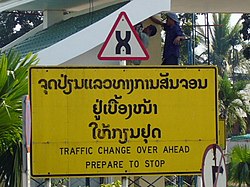 Change of traffic directions at the First Thai–Lao Friendship Bridge


.jpg)
.jpg)


Right-hand traffic
[edit]-
 Right-hand traffic on Ayalon Highway in Israel
 -
 Right-hand traffic on Bundesautobahn 9 in Germany
 -
 Right-hand traffic in Moscow, Russia
 -
 Right-hand traffic in Metro Manila, Philippines
 -
 Right-hand traffic in Oslo, Norway
 -
 Right-hand traffic on Gyeongbu Expressway in South Korea
 -
 Right-hand traffic in Beijing, China
 -
 Right-hand traffic in Taipei, Taiwan
 -
 Right-hand traffic in Gibraltar
_(6).JPG)

.jpeg)


See also
[edit]References
[edit]- ^ a b c d e Kincaid, Peter (December 1986). The Rule of the Road: An International Guide to History and Practice. Greenwood Press. pp. 50, 86–88, 99–100, 121–122, 198–202. ISBN 978-0-313-25249-5.
- ^ "Worldwide Driving Orientation by Country". Archived from the original on 25 December 2018. Retrieved 13 December 2016.[circular reference]
- ^ a b c Barta, Patrick. "Shifting the Right of Way to the Left Leaves Some Samoans Feeling Wronged". The Wall Street Journal. Archived from the original on 5 June 2022. Retrieved 4 December 2016.(subscription required)
- ^ a b Watson, Ian. "The rule of the road, 1919–1986: A case study of standards change" (PDF). Archived (PDF) from the original on 10 October 2021. Retrieved 30 November 2016.
- ^ a b c d McManus, Chris (2002). Right Hand Left Hand: the origins of asymmetry in brains, bodies, atoms, and cultures. Cambridge, Massachusetts: Harvard University Press. p. 247. ISBN 0-674-00953-3. Retrieved 5 November 2019.
- ^ Searing, Linda. "The Big Number: Lefties make up about 10 percent of the world". The Washington Post. Archived from the original on 12 August 2019. Retrieved 27 November 2019.
- ^ Tourist and Business Directory – The Gambia, 1969, page 19
- ^ "LAWS OF SOUTH SUDAN, ROAD TRAFFIC AND SAFETY BILL, 2012" (PDF). Archived (PDF) from the original on 30 July 2020. Retrieved 21 May 2020.
- ^ Why We Drive on the Right of the Road, Popular Science Monthly, Vol.126, No.1, (January 1935), p.37. January 1935. Retrieved 25 April 2012.
- ^ a b c d Weingroff, Richard. "On The Right Side of the Road". United States Department of Transportation. Archived from the original on 6 September 2023. Retrieved 10 January 2014.
- ^ "An Act Establishing the Law of the Road". Massachusetts General Court. Archived from the original on 18 September 2014. Retrieved 14 February 2014.
- ^ Hayes, Brian (2005). Infrastructure: a field guide to the industrial landscape. New York: WW Norton. p. 330. ISBN 0-393-05997-9.
- ^ "Travel Tips | US Virgin Islands". Usvitourism.vi. Archived from the original on 16 March 2011. Retrieved 25 April 2012.
- ^ "The day New Brunswick switched to driving on the right". CBC News. Archived from the original on 11 April 2019. Retrieved 11 April 2019.
- ^ "Change of Rule of Road in British Columbia 1920" (PDF). The British Columbia Road Runner. March 1966. Archived from the original (PDF) on 20 October 2017. Retrieved 27 August 2017.
- ^ Griffin, Kevin (1 January 2016). "Week in History: Switching from the left was the right thing to do". Vancouver Sun. Archived from the original on 27 August 2017. Retrieved 26 August 2017.
- ^ Smith, Ivan. "Highway Driving Rule Changes Sides". History of Automobiles – The Early Days in Nova Scotia, 1899–1949. Archived from the original on 8 August 2018. Retrieved 27 August 2017.
- ^ Snyder, Timothy; Rowe, F.W. "Newfoundland Bill". The Canadian Encyclopedia. Retrieved 30 July 2019.
- ^ Dyer, Gwynne (30 August 2009). "A triumph for left over right". Winnipeg Free Press. Archived from the original on 27 August 2017. Retrieved 27 August 2017.
- ^ a b c Dive the Bahamas: Complete Guide to Diving and Snorkelling, Lawson Wood, Interlink Publishing Group, 2007, page 23
- ^ a b c Adventure Guide to the Cayman Islands, Paris Permenter, John Bigley, Hunter Publishing, Inc, 2001, page 46
- ^ a b c Turks and Caicos, Bradt Travel Guides, Annalisa Rellie, Tricia Hayne, 2008, page 50
- ^ a b c d e f U. S. and British Virgin Islands 2006, Fodor's Travel Publications, 2005, page 28
- ^ "Decreto nº 18.323, de 24 de Julho de 1928". Cãmara dos Deputados. Archived from the original on 28 September 2023. Retrieved 11 April 2019.
- ^ El día en que en la Argentina se paralizó el tránsito para dejar de manejar “a la inglesa” y circular por la derecha Archived 2 March 2025 at the Wayback Machine, Infobae, 10 June 2024 (in Spanish).
- ^ Panama Shifts To Right Handed Driving Of Cars Archived 11 January 2017 at the Wayback Machine, Chicago Tribune, 25 April 1943
- ^ De izquierda a derecha Archived 3 March 2018 at the Wayback Machine, ABC Color, 2 March 2014
- ^ a b El día en que el Río de la Plata dejó de manejar por la izquierda Archived 8 June 2022 at the Wayback Machine, Autoblog, 25 August 2015
- ^ a b "Compilation of Foreign Motor Vehicle Import Requirements" (PDF). United States Department of Commerce International Trade Administration Office of Transportation and Machinery. December 2015. Archived (PDF) from the original on 12 April 2019. Retrieved 9 April 2019.
- ^ "The Unique World of Burmese Driving". a minor diversion. 14 March 2012. Archived from the original on 29 September 2015. Retrieved 28 September 2015.
- ^ Matsui, Motokazu; Nakagawa, Takemi (2 January 2017). "Myanmar's car market set to take new direction". Financial Times. London. Archived from the original on 22 February 2018. Retrieved 25 May 2017.
- ^ Reddy, L. R. (2002). Inside Afghanistan: End of the Taliban Era?. APH. ISBN 9788176483193. Retrieved 31 August 2015.
- ^ Summation: United States Army Military Government Activities in Korea, 1946, page 12
- ^ Plaza Mayor de Manila Archived 20 October 2017 at the Wayback Machine, by José Honorato Lozano (1815/21(?)-1885), in the album Vistas de las islas Filipinas y trajes de sus habitantes Archived 20 October 2017 at the Wayback Machine, published 1847. Collection of the Biblioteca Nacional de España.
- ^ Archived at Ghostarchive and the Wayback Machine: "ESCOLTA MANILA PHILIPPINES- YEAR 1903". 6 March 2010. Retrieved 14 March 2017 – via YouTube.
- ^ Archived at Ghostarchive and the Wayback Machine: "Manila – Castillian Memoirs 1930s". 19 April 2008. Retrieved 14 March 2017 – via YouTube.
- ^ Archived at Ghostarchive and the Wayback Machine: "Manila, Queen of the Pacific 1938". 6 May 2008. Retrieved 14 March 2017 – via YouTube.
- ^ Goupal, Lou (26 June 2013). "Manila Nostalgia: Dewey Boulevard during the Japanese occupation". Manila Nostalgia. Archived from the original on 6 April 2017. Retrieved 14 March 2017 – via YouTube.
Original video clips from a Japanese propaganda film shot in early 1942.
- ^ Tadeo, Patrick Everett (10 March 2015). "How the Philippines became a left-hand-drive country". Top Gear Philippines. Retrieved 14 March 2017.
- ^ a b "Executive Order No. 34, s. 1945". officialgazzete.gov.ph. Archived from the original on 9 November 2020. Retrieved 11 November 2017.
- ^ a b c "Republic Act No. 8506 | GOVPH". Official Gazette of the Republic of the Philippines. Archived from the original on 2 December 2022. Retrieved 27 March 2022.
- ^ Malcolm, Andrew H. (5 July 1978). "U-Turn for Okinawa: From Right-Hand Driving to Left; Extra Policemen Assigned". The New York Times. p. A2. Archived from the original on 6 December 2013. Retrieved 12 February 2017.
- ^ "The birthplace of iconic cars, where cars with both left and right hand drive are allowed | Japan Motor". japan-motor.com. Archived from the original on 7 May 2023. Retrieved 7 May 2023.
- ^ "Cambodia bans right-hand drive cars". BBC News. 1 January 2001. Archived from the original on 25 December 2018. Retrieved 12 January 2007.
- ^ a b c Poehler, Eric E. (2017). The Traffic System of Pompeii. New York: Oxford University Press. ISBN 9780190614676. OCLC 1105466950.
- ^ Latham, Mark (18 December 2009). The London Bridge Improvement Act of 1756: A Study of Early Modern Urban Finance and Administration (PhD). University of Leicester.
- ^ The Statutes at Large from the 26th to the 30th Year of King George III. Printed by J. Bentham. 1766.
- ^ Hamer, Mike (25 December 1986 – 1 January 1987). "Left is right on the road". New Scientist (20 December 1986/1 January 1987): 16–18. Retrieved 7 October 2016.[permanent dead link]
- ^ "Statutes Passed in the Parliaments Held in Ireland". George Grierson, printer to the King's Most Excellent Majesty. 14 August 1799.
- ^ "Statutes Passed in the Parliaments Held in Ireland ...: From the Third Year of Edward the Second, A.D. 1310 [to the Fortieth Year of George III A.D. 1800, Inclusive]". G. Grierson, printer to the King's Most Excellent Majesty. 14 August 1799.
- ^ "6 & 7 Will. 4 c. 116 s.156". A collection of the public general statutes. London: Eyre and Spottiswoode. 1836. pp. 1030–1031 – via Internet Archive.
- ^ Planta, Edward (30 June 1831). "A New Picture of Paris, Or, The Stranger's Guide to the French Metropolis: Also, a Description of the Environs of Paris". S. Leigh and Baldwin and Cradock.
- ^ "De geschiedenis van het linksrijden". Engelfriet.net. Archived from the original on 25 December 2018. Retrieved 14 May 2014.
- ^ "Why do some countries drive on the left and others on the right?". WorldStandards.eu. Archived from the original on 12 July 2024. Retrieved 20 July 2021.
- ^ Vasold, Manfred (2010). "Obacht! Linksverkehr" (PDF). Kultur & Technik. Archived (PDF) from the original on 23 September 2015. Retrieved 13 December 2016.
- ^ "1938 wechselte man nicht nur die Straßenseite – ARGUS Steiermark – DIE RADLOBBY". graz.radln.net. Archived from the original on 4 April 2019. Retrieved 4 April 2019.
- ^ a b c "Krakowska Komunikacja Miejska – autobusy, tramwaje i krakowskie inwestycje drogowe – History of the Cracow tram network". Komunikacja.krakow.eurocity.pl. 3 March 2006. Archived from the original on 16 May 2006. Retrieved 11 May 2009.
- ^ Baedeker, Karl (1900). "Austria, including Hungary, Transylvania, Dalmatia and Bosnia". p. xiii–xiv. Retrieved 28 July 2017.
In Styria, Upper and Lower Austria, Salzburg, Carniola, Croatia, and Hungary we keep to the left, and pass to the right in overtaking; in Carinthia, Tyrol, and the Austrian Littoral (Adriatic coast: Trieste, Gorizia and Gradisca, Istria and Dalmatia) we keep to the right and overtake to the left. Troops on the march always keep to the right side of the road, so in whatever part of the Empire you meet them, keep to the left.
- ^ "Seventy-five years of driving on the right". Radio Prague. 18 March 2014. Archived from the original on 1 April 2017. Retrieved 1 April 2017.
- ^ a b c d Biocca, Dario (24 July 2011). "Quando l' Italia si buttò a destra". la Repubblica (in Italian). Retrieved 4 November 2019.
- ^ "Högertrafik i Sverige och Finland". aland.net. Archived from the original on 25 December 2018. Retrieved 1 April 2015.
- ^ "¿Por qué circulamos por la derecha?". dgt.es. Archived from the original on 2 January 2024. Retrieved 2 January 2024.
- ^ "Högertrafik" (in Swedish). vardo.aland.fi. Archived from the original on 3 December 2007. Retrieved 11 August 2006.
- ^ Réalités, Issues 200–205, Société d'études et publications économiques, 1967, page 95
- ^ "This Day in History: Swedish Traffic Switches Sides – September 3, 1967". 3 September 2014. Archived from the original on 19 May 2023. Retrieved 21 October 2019.
- ^ "Sweden: Switch to the Right". Time. 15 September 1967. Archived from the original on 18 October 2012. Retrieved 31 October 2012.
- ^ Mieszkowski, Katharine (14 August 2009). "Salon News: Whose side of the road are you on?". Salon. Archived from the original on 21 January 2011. Retrieved 12 December 2010.
- ^ "45 ár frá hægri umferð" [45 years with right-hand traffic]. Morgunblaðið (in Icelandic). 26 May 2013. Archived from the original on 7 July 2019. Retrieved 11 December 2016.
- ^ Geoghegan, Tom (7 September 2009). "Could the UK drive on the right?". BBC News. Archived from the original on 1 August 2012. Retrieved 4 July 2012.
- ^ "Layout of Grade Separated Junctions" (PDF). Design Manual for Roads and Bridges. The Highways Agency: 4.9ff. 2006. Archived from the original (PDF) on 4 May 2011.
- ^ "ROAD SAFETY. OTAGO DAILY TIMES". paperspast.natlib.govt.nz. 4 December 1936. Retrieved 27 October 2021.
- ^ a b Bryant, Nick (7 September 2009). "Samoan cars ready to switch sides". BBC News. Archived from the original on 25 February 2021. Retrieved 7 September 2009.
- ^ a b Askin, Pauline (7 September 2009). "Outcry as Samoa motorists prepare to drive on left". Reuters. Retrieved 7 September 2009.
- ^ Whitley, David (3 July 2009). "Samoa provokes fury by switching sides of the road". The Telegraph. Archived from the original on 11 January 2022. Retrieved 12 September 2019.
- ^ Dobie, Michael (6 September 2009). "Samoa drivers brace for left turn". BBC News. Archived from the original on 24 February 2022. Retrieved 7 September 2009.
- ^ "Samoan drivers change from right-hand side of the road to the left". Herald Sun. Retrieved 31 October 2012.
- ^ Jackson, Cherelle (25 July 2008). "Samoa announces driving switch date". The New Zealand Herald. Retrieved 10 June 2012.
- ^ a b c d Nkwame, Marc (27 July 2013). "Burundi, Rwanda to start driving on the left". DailyNews Online. Archived from the original on 25 December 2018. Retrieved 28 May 2016.
- ^ Peter. "Rwanda to adopt EAC driving standards". Rwanda Transport. Archived from the original on 25 December 2018. Retrieved 12 August 2013.
- ^ "Rwanda wants to drive on the left". Independent.co.ug. 3 June 2012. Archived from the original on 14 March 2012. Retrieved 10 June 2012.
- ^ "East Africa: Rwanda Looks to the Left". allAfrica.com. 27 September 2010. Archived from the original on 20 October 2012. Retrieved 10 June 2012.
- ^ Bari, Mahabubul (29 July 2014). "The study of the possibility of switching driving side in Rwanda". European Transport Research Review. 6 (4): 439–453. Bibcode:2014ETRR....6..439B. doi:10.1007/s12544-014-0144-2. ISSN 1866-8887.
- ^ Right-hand-drive vehicles return on Rwandan roads Archived 19 March 2020 at the Wayback Machine, The East African, 13 March 2015
- ^ Tumwebaze, Peterson (9 September 2014). "Govt okays importation of RHD trucks, to decide on other vehicle categories in October". The New Times. Retrieved 29 October 2014.
- ^ Jennings, Ken (15 April 2013). "What Happens When Left-Hand Roads Meet Right-Hand Roads". Conde Nast Traveler. Archived from the original on 19 November 2016. Retrieved 18 November 2016.
- ^ "Hong Kong 2006 – Transport – Cross-Boundary Traffic". Government of Hong Kong. 15 August 2007. Archived from the original on 20 July 2011. Retrieved 12 December 2010.
- ^ "Takutu bridge opens to traffic". Stabroeknews.com. 27 April 2009. Retrieved 12 December 2010.
- ^ Court of Justice of the European Union, C-61/12 – Commission v Lithuania, European Union, steering wheel can be anywhere, 2014-03-20.
- ^ "Nearside (dictionary definition)". Dictionary.reverso.net. Archived from the original on 1 October 2011. Retrieved 12 December 2010.
- ^ Miller, Wayne (2015). Car Crazy: The Battle for Supremacy between Ford and Olds and the Dawn of the Automobile Age. PublicAffairs. p. 279. ISBN 9781610395526. Retrieved 12 December 2016.
- ^ "天彩彩票_官网手机版". lhdspecialist.com. Archived from the original on 21 September 2011.
- ^ Hinchliffe, Mark (11 March 2014). "How to mount your motorbike". Archived from the original on 7 September 2016. Retrieved 11 December 2016.
- ^ a b "MOUNTING AND DISMOUNTING A MOTORCYCLE". Motorcycle Test Tips. Retrieved 11 December 2016.
- ^ "S.I. No. 5/2003 – Road Traffic (Construction and Use of Vehicles) Regulations 2003". Irish Statute Book. 42. (1). Retrieved 6 November 2017.
where a side–car is attached to a mechanically propelled bicycle, the side–car shall be ... fitted on the left side of the vehicle
; "Motorcycle Sidecar & Trailer legislation". MAG Ireland. Irish Motorcyclists Association. 9 February 2014. Archived from the original on 7 November 2017. Retrieved 6 November 2017. - ^ "The Road Vehicles (Construction and Use) Regulations 1986 – Section 93". UK Government. 25 June 1986. Archived from the original on 14 November 2012. Retrieved 9 December 2012.
- ^ Department for Transport statistics, Reported Road Casualties Great Britain Annual Report 2020, RAS40005, Reported accidents, vehicles and casualties by severity, vehicle type and left hand drive, Great Britain, 2020
- ^ "The Advantages and Disadvantages of Left Hand Drive Cars in UK". Left Hand Drives. 28 July 2020.
- ^ a b c "UN Regulation 112, "Motor vehicle headlamps emitting an asymmetrical passing beam or a driving beam or both and equipped with filament lamps"" (PDF). Retrieved 21 October 2019.
- ^ "The Road Vehicles Lighting Regulations 1989 Schedule 11". legislation.gov.uk. Retrieved 2 April 2022.
- ^ "Regulation No. 48" (PDF). UNECE. 16 October 2014. Retrieved 21 October 2019.
- ^ Dowling, Joshua (11 November 2015). "Popular family SUV Hyundai Tucson slammed for 'four-star' Australian crash test result". News.com.au. Archived from the original on 6 December 2021. Retrieved 5 November 2017.
- ^ "Strasbourg to Paris Driver's eye view PREVIEW". Video 125. 13 February 2017. Retrieved 11 March 2019 – via YouTube. Archived at Ghostarchive and the Wayback Machine.
- ^ Lundsen, Carsten (27 September 1998). "North American Signaling Basics". Railroad Rules, Signaling, Operations. Archived from the original on 9 August 2022. Retrieved 17 October 2022.
- ^ "FAR Part 91 Sec. 91.115". Federal Aviation Administration. Archived from the original on 10 October 2018.
When aircraft, or an aircraft and a vessel, are approaching head-on, or nearly so, each shall alter its course to the right to keep well clear.
- ^ "Are Helicopters Flown from the Left or Right Seat? It Depends!". Pilot Teacher. Archived from the original on 28 September 2023.
- ^ "Driving Tips: Albania". Sixt rent a car. Archived from the original on 4 April 2019. Retrieved 3 April 2019.
- ^ "Driving in Algeria". adcidl.com. Archived from the original on 13 July 2022. Retrieved 3 April 2019.
- ^ "Andorra Driving Guide 2021". International Drivers' Association. 9 April 2021. Archived from the original on 13 July 2022. Retrieved 17 June 2021.
- ^ "Driving Tips in Angola". Sixt rent a car. Archived from the original on 3 April 2019. Retrieved 3 April 2019.
- ^ "Road Safety Guidelines For Visitors – Drive-a-Matic Car Rentals Antigua". antiguarentalcar.com. Archived from the original on 13 July 2022. Retrieved 3 April 2019.
- ^ "10 de Junio: Día Nacional de la Seguridad Vial". 9 June 2021.
- ^ "Armenian Government Plans to Ban Right-Hand Drive Vehicles; Drivers Protest Decision". The Armenian Weekly. 10 January 2018. Archived from the original on 14 July 2022. Retrieved 3 April 2019.
- ^ Bahrain Government Annual Reports. Times of India Press. 1968. p. 158.
- ^ "Driving in Belarus". autoeurope. Archived from the original on 13 July 2022. Retrieved 11 April 2019.
- ^ "The history of left- and right-hand traffic". International Driving Authority. Archived from the original on 5 November 2021. Retrieved 11 April 2019.
- ^ "Sistema Costarricense de Información Jurídica". pgrweb.go.cr. Retrieved 17 September 2023.
- ^ Tourist and Business Directory, The Gambia. 1969. p. 19.
- ^ Hillger, Don; Toth, Garry. "Right-Hand/Left-Hand Driving Customs". Colorado State University. Archived from the original on 25 December 2018. Retrieved 13 December 2016.
- ^ "Right-Hand Traffic Act". Ghanalegal.com. Archived from the original on 11 May 2022. Retrieved 14 May 2014.
- ^ Nkrumah, I. K. (21 December 1974). "Daily Graphic: Issue 7526 December 21 1974". Daily Graphic (7526): 9.
- ^ Bartle, Phil. "Studies Among the Akan People of West Africa Community, Society, History, Culture; With Special Focus on the Kwawu by Phil Bartle, PhD". Cec.vcn.bc.ca. Archived from the original on 25 December 2018. Retrieved 14 May 2014.
- ^ a b c "Right-Hand Traffic versus Left-Hand Traffic". The Basement Geographer. Archived from the original on 10 February 2017. Retrieved 22 November 2018.
- ^ "Trucking in Jamaica | 10-4 Magazine". Tenfourmagazine.com. 12 December 2011. Archived from the original on 1 February 2022. Retrieved 16 February 2022.
- ^ "Fire Service Comfortable With Left Hand Drive Trucks – Jamaica Information Service". Jis.gov.jm. 11 February 2022. Archived from the original on 1 February 2022. Retrieved 16 February 2022.
- ^ "Why Does Japan Drive on the Left". 2pass.co.uk. Archived from the original on 25 December 2018. Retrieved 11 August 2006.
- ^ "Customs Services Department – Frequently Asked Questions". KRA. Archived from the original on 25 December 2018. Retrieved 12 December 2010.
- ^ a b "Over 20,000 Right Hand Drive Cars Imported in Kyrgyzstan in 2012". The Gazette of Central Asia. Satrapia. 8 May 2013. Archived from the original on 25 December 2018. Retrieved 10 May 2013.
- ^ "Photo of All Change. Swop Over Point for the Traffic !". Panoramio. Archived from the original on 18 January 2014. Retrieved 10 June 2012.
- ^ The Day Myanmar Started Driving on the Right Archived 17 February 2023 at the Wayback Machine, The Irrawaddy, 6 December 2019
- ^ van Ammelrooy, Peter (12 September 2009). "De Claim links rijden". De Volkskrant (in Dutch). Archived from the original on 21 March 2020. Retrieved 14 May 2014.
- ^ "2.1 "Keeping Left" – Land Transport (Road User) Rule 2004 – New Zealand Legislation". New Zealand Government. Archived from the original on 9 May 2022. Retrieved 28 November 2010.
- ^ "Travel advice by country, Oman". Foreign & Commonwealth Office (fco.gov.uk). Archived from the original on 8 April 2008. Retrieved 8 August 2006.
- ^ Rodriguez, Mia (30 August 2020). "Whatever Happened to the Double-Decker Buses That Used to Ply Metro Manila's Roads?". SPOT.PH. Archived from the original on 30 November 2022. Retrieved 17 November 2022.
- ^ Mozambique: memoirs of a revolution, John Paul, Penguin, 1975, page 41
- ^ a b "Russian Far East is still attached to Japanese cars". Russia behind the headlines. 31 August 2016. Archived from the original on 16 August 2021. Retrieved 12 August 2017.
- ^ Samoa switches smoothly to driving on the left Archived 8 November 2020 at the Wayback Machine, The Guardian, 8 Sep 2009
- ^ The Rising Sun: A History of the All People's Congress Party of Sierra Leone. A.P.C. Secretariat. 1982. p. 396.
- ^ a b de Vries, Nina (17 September 2013). "Sierra Leone Bans Right-Hand Vehicles as Hazards". Voice of America. Archived from the original on 20 May 2022. Retrieved 8 April 2025.
- ^ "Road Rules". SACarRental.com. Archived from the original on 2 January 2013. Retrieved 15 February 2014.
- ^ "Driving in South Africa Information". drivesouthafrica.co.za. Archived from the original on 25 December 2018. Retrieved 15 February 2014.
- ^ "違警罰法 (Act Governing the Punishment of Police Offences)". Passed by the Legislative Yuan. 1946. Archived from the original on 10 December 2013. Retrieved 14 August 2012.
- ^ O'Donnell, Kathleen; Pefkaros, Stassi (2000). Trinidad and Tobago Adventure Guide. Hunter Publishing, Inc. p. 53. ISBN 9781556508868.
- ^ Dennehey, John (1 September 2021). "Remembering the day Dubai swapped left-hand driving for right". Archived from the original on 18 October 2021. Retrieved 18 October 2021.
- ^ Colonial Reports. Annual. Vol. 1480–1499. 1930. p. 76.
- ^ a b King, Peter (1991). The Channel Islands War: 1940–1945. Hale. p. 31. ISBN 9780709045120.
- ^ "RHD/LHD Country Guide". toyota-gib.com. Archived from the original on 8 April 2022. Retrieved 22 September 2017.
- ^ "South Yemen – Postage stamps – 1977". stampworld.com. Archived from the original on 25 December 2018. Retrieved 6 March 2016.
- ^ "Right-hand vehicles legalized in Afghanistan". Ariana News. 12 March 2023. Archived from the original on 12 March 2023. Retrieved 12 March 2023.
- ^ "Repatriación: se trajo un Honda S2000 desde Nueva Zelanda (y con volante a la derecha)".
En nuestro país no hay ninguna normativa que impida que circulen vehículos con volante a la derecha. De hecho, es una configuración muy común entre los autos clásicos. (In our country there are no regulations that prevent right-hand drive vehicles from circulating. In fact, it is a very common configuration among classic cars.)
- ^ "Почему белорусы никогда не покупают праворульные автомобили". avtovzglyad.ru (in Russian). Retrieved 13 November 2023.
- ^ "Почему на некоторых автомобилях из России лучше не приезжать в Беларусь". abw.by (in Russian). Archived from the original on 13 November 2023. Retrieved 13 November 2023.
- ^ Resolution 528, 1 (in Portuguese). Brazilian National Transit Council (Contran). 14 May 2015. Archived from the original on 15 December 2023.
- ^ "Contran Resolution No. 528/2015". InterRegs. Archived from the original on 15 December 2023. Retrieved 15 December 2023.
- ^ "Road Traffic Act" (PDF). Government of Brunei.
- ^ "Right-hand-drive vehicles". ICBC. Archived from the original on 13 July 2011. Retrieved 3 January 2011.
- ^ "¿Puedo modificar un auto que tiene el volante en el lado derecho?". practicatest.cl. Archived from the original on 7 May 2023. Retrieved 7 May 2023.
La ley chilena indica que en el país solo pueden circular automóviles con el volante a la izquierda, por lo que esos autos solo podrán salir a la calle una vez que se modifique el vehículo cambiando todo el equipamiento de manejo al lado correcto. (Chilean law indicates that only left-hand drive cars can circulate in the country, so those cars can only go out on the street once the vehicle is modified by changing all the driving equipment to the correct side.)
- ^ Wang, Joey (3 April 2018). "Spotted in China: G50 Toyota Century V12 in Black, RHD". CarNewsChina.com. Archived from the original on 15 March 2024.
- ^ Roesel, Felix (2021). "The causal effect of wrong-hand drive vehicles on road safety". Economics of Transportation. 11: 15–22. doi:10.1016/j.ecotra.2017.10.002. hdl:10419/170527. S2CID 115656881.
- ^ "Können Rechtslenker in Deutschland zugelassen werden?". tuningblog.eu (in German). 31 December 2021. Archived from the original on 18 January 2022. Retrieved 28 April 2022.
- ^ "GUIDELINES FOR IMPORTATION AND REGISTRATION OF MOTOR VEHICLE". Transport Department. Archived from the original on 14 December 2022. Retrieved 17 November 2022.
Application for the registration and licensing of a left hand drive vehicle will not be accepted unless there are special circumstances.
- ^ "Terkuak Mobil Dinas Favorit FBI, Masih Digunakan Kedubes AS di Indonesia" [FBI's most famous operational vehicle is used by US Embassy in Indonesia]. suara.com (in Indonesian). 18 September 2019. Archived from the original on 2 July 2023. Retrieved 2 July 2023.
- ^ Nugraha, Muhammad Indra (26 August 2024). "Ada yang Aneh dengan Tesla Cybertruck Pertama di Indonesia" [Something is strange with first Tesla Cybertruck arrived in Indonesia]. viva.co.id (in Indonesian). Retrieved 26 August 2024.
- ^ a b Case C‑639/11 – Judgment of the Court (Fifth Chamber), 20 March 2014. European Commission v Republic of Poland, ECLI:EU:C:2014:173
- ^ "Mașinile cu volan pe dreapta aduse din Marea Britanie nu mai pot fi omologate în România de la 1 ianuarie 2021" (in Romanian). 2 January 2021.
- ^ "PROCEDURES ON IMPORTATION AND REGISTRATION OF A CAR IN SINGAPORE". LTA. Archived from the original on 7 April 2016. Retrieved 10 September 2019.
- ^ "道路交通安全規則§83-全國法規資料庫入口網站" (in Chinese). Ministry of Justice (Taiwan). 14 August 2015. Archived from the original on 9 May 2021. Retrieved 17 October 2015.
External links
[edit]
Left- and right-hand traffic
View on GrokipediaDefinitions and Fundamentals
Core Concepts of Left-Hand Traffic (LHT) and Right-Hand Traffic (RHT)
Left-hand traffic (LHT) is the convention in which vehicles adhere to the left side of the road, allowing oncoming traffic to pass on the right side.[1] In LHT jurisdictions, overtaking occurs on the right side of the vehicle ahead, and traffic in roundabouts circulates in a clockwise direction.[1] Approximately 35% of the global population operates under LHT systems.[1] Right-hand traffic (RHT), the predominant global standard, requires vehicles to keep to the right side of the road, with oncoming vehicles passing on the left.[1] Under RHT, overtaking takes place on the left, and roundabouts are navigated counterclockwise.[1][8] Vehicle configurations align inversely with traffic handedness to optimize driver visibility: LHT employs right-hand drive (RHD) vehicles, positioning the driver on the right side nearer to the road's center median for enhanced observation of oncoming traffic and obstacles.[1][9] Conversely, RHT utilizes left-hand drive (LHD) vehicles, placing the driver on the left side closest to the center.[1] This arrangement facilitates safer merging, lane changes, and hazard detection by aligning the dominant right eye of most drivers toward the traffic flow's core.[9] Non-standard configurations, such as RHD vehicles in RHT regions, can impair visibility during overtaking or intersections, increasing collision risks.[9]Historical Origins from First-Principles Reasoning
The predominance of right-handedness among humans, observed in approximately 90% of the population, provided a foundational causal incentive for early traffic conventions to favor keeping to the left side of paths or roads. In pre-modern societies where interpersonal violence was common, individuals traveling on foot or horseback naturally positioned themselves on the left to position their dominant right arm outward toward potential oncoming adversaries, facilitating defensive or offensive actions such as wielding a sword or shield.[1] This arrangement minimized vulnerability by aligning the stronger hand with the direction of approach, a practical adaptation rooted in the biomechanics of asymmetrical handedness rather than arbitrary custom.[5] Archaeological and textual evidence from ancient Rome corroborates this pattern, with depictions and accounts indicating that charioteers and pedestrians adhered to left-side travel, allowing right-handed drivers to steer with their left hand while reserving the right for control or combat. Roman military formations and road-building practices reinforced this norm across their empire, as soldiers marching in columns would keep to the left to maintain right-arm readiness against ambushes or encounters. By the medieval period in Europe, this convention persisted among knights and travelers, who mounted horses from the left and preferred left-side passage to expose their sword arm—typically the right—toward strangers, reducing the risk of surprise attacks in an era of frequent feudal conflicts.[1] The introduction of wheeled vehicles amplified these ergonomic imperatives. In team-drawn carriages common from the late Roman era through the 18th century, postilions or drivers positioned themselves on the left rear horse to wield a whip effectively with their right hand, optimizing control over draught animals while scanning the road ahead from the left-side vantage in a left-hand traffic system.[5] This configuration enhanced visibility of oncoming traffic and alignment with the prevailing left-side norm, as deviations could lead to collisions exacerbated by limited braking capabilities of animal-powered conveyances.[10] Formal codification emerged in Britain by the 18th century, with a 1773 parliamentary act mandating left-hand keeping on bridges like London Bridge to mitigate congestion-induced accidents, institutionalizing a practice already emergent from centuries of handedness-driven utility.[5] In contrast, right-hand traffic arose sporadically in regions with differing social structures or post-revolutionary impositions, but lacked the same organic basis in human laterality; for instance, early American colonists occasionally favored the right for egalitarian reasons among wagon teams, though evidence shows variability without a dominant first-principles rationale until later standardization.[6] Empirically, left-hand traffic's historical ubiquity—spanning from ancient legions to pre-industrial Europe—reflects its alignment with causal realities of asymmetry in human physiology and the demands of interpersonal security, rather than centralized decree, underscoring how traffic handedness originated as an adaptive response to innate biological and environmental pressures.[1]Geographical and Historical Distribution
Current Global Distribution by Country and Population
Right-hand traffic (RHT) is the dominant system worldwide, practiced in approximately 165 countries and territories, which account for roughly 65% of the global population as of 2025.[11] Left-hand traffic (LHT), by contrast, is used in about 76 countries and territories, encompassing around 35% of the world's population.[2] This disparity arises because LHT is concentrated in populous nations such as India (population approximately 1.43 billion), Indonesia (276 million), Japan (123 million), Bangladesh (173 million), and the Philippines (117 million), alongside smaller but significant populations in the United Kingdom (68 million), Australia (26 million), and various African and Caribbean states.[2][12] RHT prevails across continental Europe, the Americas, China, Russia, and much of the Middle East and Africa, including the United States (340 million), Brazil (216 million), Mexico (129 million), and continental African nations like Nigeria (224 million) and Egypt (113 million).[12] The higher population share in LHT countries stems primarily from South Asia's adherence to LHT, a legacy of British colonial influence, despite RHT's broader geographical spread.[13] No major shifts in national traffic handedness have occurred since Samoa's switch to LHT in 2009, maintaining the current distribution stable into 2025.[12]Continental and Regional Patterns
Right-hand traffic (RHT) predominates across most continents, encompassing 165 countries and territories, while left-hand traffic (LHT) is observed in 67 nations, primarily former British dependencies.[13] Globally, LHT accounts for approximately 35% of the world's population despite fewer countries, due to large populations in nations such as India and Indonesia.[2] In Europe, RHT is nearly universal among sovereign states, with only the United Kingdom, Ireland, Malta, and Cyprus adhering to LHT, reflecting British colonial or direct influence in these cases.[14] Continental Europe standardized on RHT by the early 20th century, with Sweden switching from LHT to RHT in 1967 to align with neighbors.[12] Africa exhibits a regional divide, with LHT prevalent in 15 to 18 countries, mostly in the south and east, including Botswana, Kenya, Lesotho, Malawi, Mauritius, Mozambique, Namibia, Seychelles, South Africa, Tanzania, Uganda, Zambia, and Zimbabwe, stemming from British colonial legacies.[15] [16] In contrast, North African and West African nations, often under French influence, uniformly adopt RHT. Asia shows mixed patterns, with LHT dominant in South and Southeast Asia—encompassing India, Pakistan, Bangladesh, Sri Lanka, Indonesia, Malaysia, Singapore, Thailand, Japan, Nepal, and Bhutan—but RHT in East Asia (China, South Korea, Philippines) and the Middle East.[2] Japan maintains LHT despite right-hand vehicles introduced post-World War II, prioritizing traffic flow continuity.[12] The Americas are overwhelmingly RHT, covering all of North and South America except Guyana and Suriname in South America, and several Caribbean islands such as Antigua and Barbuda, Bahamas, Barbados, and Jamaica, where British heritage preserves LHT.[14] Oceania predominantly follows LHT, with Australia, New Zealand, Papua New Guinea, and most Pacific islands driving on the left, aligned with British settlement patterns.[15] This contrasts with isolated RHT territories like Timor-Leste.[12]Major Historical Shifts and Switches
Sweden's transition from left-hand traffic (LHT) to right-hand traffic (RHT) on September 3, 1967—known as Dagen H (H-day)—represented one of the most extensive and publicized national switches in modern history.[17] At 5:00 a.m., after halting non-essential traffic from 1:00 a.m. to 6:00 a.m., vehicles shifted to the right side amid redesigned intersections, repainted road markings, and adjusted traffic signals, following years of public campaigns and infrastructure preparations costing approximately 1 billion Swedish kronor.[18] The primary drivers were alignment with neighboring RHT countries Norway and Finland to reduce cross-border accidents and facilitate imports of RHT vehicles from continental Europe, where Sweden's left-side driving had increasingly isolated its automotive market.[19] Post-switch, initial accident rates did not surge as feared, though long-term data reflected adaptations in driver behavior. ![Danish motorcyclists about to cross the border between Sweden and Norway in 1934][float-right]Pre-switch border crossings, such as between LHT Sweden and RHT Norway, often required hazardous mid-road maneuvers, underscoring the safety imperatives behind such changes.[20] Earlier 20th-century European shifts toward RHT for regional standardization included Spain's nationwide mandate in 1924, Portugal's in 1928 (extending to its colonies like Angola and Guinea-Bissau), and Italy's by 1926, often overriding prior LHT practices rooted in local customs or British influence.[3] In South America, countries like Argentina, Chile, and Uruguay transitioned from LHT—initially adopted via early Spanish colonial variances—to RHT by the mid-20th century to harmonize with major trading partners.[1] These moves reflected broader pressures from rising automobile standardization and international trade, with over 30 nations switching to RHT between 1919 and 1986.[21] Myanmar's abrupt switch from LHT to RHT on December 6, 1970, under military leader General Ne Win, diverged from colonial British norms without evident economic rationale, attributed instead to Ne Win's personal numerology beliefs favoring the number nine (as 1+9+7+0=17, 1+7=8, but linked to auspicious shifts).[22] The change left much infrastructure, including rail systems, mismatched with LHT neighbors like India and Thailand, complicating trade and resulting in persistent use of imported RHT vehicles despite ergonomic challenges for right-handed drivers.[23] In a rare reverse shift, Samoa transitioned from RHT to LHT on September 7, 2009, the first such national change in decades, to ease imports of affordable right-hand-drive vehicles from LHT partners Australia and New Zealand, offsetting high costs of American left-hand-drive imports.[24] Despite protests over adaptation risks and vehicle resales, the switch proceeded without major incidents, with dual-side steering permitted temporarily and public education campaigns emphasizing alignment with Pacific neighbors.[25]
| Country/Region | Year | Direction of Switch | Key Reason(s) |
|---|---|---|---|
| Sweden | 1967 | LHT to RHT | Neighbor alignment, vehicle imports[18] |
| Myanmar | 1970 | LHT to RHT | Political/numerological decision[22] |
| Samoa | 2009 | RHT to LHT | Vehicle import economics[24] |
Safety, Ergonomics, and Empirical Performance
Comparative Accident Statistics and Causal Factors
Studies examining road accident rates between left-hand traffic (LHT) and right-hand traffic (RHT) systems reveal no definitive consensus when raw data is considered, as fatality rates correlate more strongly with economic development, enforcement, and infrastructure than traffic side alone. For instance, high-income LHT countries like the United Kingdom (2.9 deaths per 100,000 population in 2021) and Japan (3.6 per 100,000) exhibit lower rates than the RHT United States (12.7 per 100,000), but this disparity persists even among comparable economies due to factors such as vehicle miles traveled and seatbelt usage. Adjusting for confounders like GDP per capita and motorization levels, some econometric analyses indicate LHT systems yield 10-20% fewer fatalities per vehicle kilometer traveled compared to RHT, based on cross-country panel data from 1960-2019. A 1969 analysis by transportation engineer J.J. Leeming, drawing on pre-1960s data from Europe and colonies, found collision rates approximately 15-25% lower in LHT jurisdictions, attributing this to consistent historical practices minimizing adaptation errors. Conversely, Sweden's 1967 switch from LHT to RHT coincided with a short-term 20-30% drop in fatalities (from 13.1 per 100,000 in 1965 to 9.2 in 1969), though researchers debate whether this stemmed from heightened driver caution post-change or alignment with neighboring RHT countries reducing cross-border incidents, with long-term trends showing convergence to European averages independent of the switch. Causal factors favoring LHT safety include the driver's seating position relative to oncoming traffic: in LHT, the right-side seating places the driver farther from the opposing lane (separated by the vehicle's width), facilitating more accurate visual estimation of closing speeds and reducing head-on collision risks during overtaking or lane changes. Neurophysiological models support this, positing that right-dominant handedness (prevalent in 85-90% of populations) aligns better with LHT's gear-shifting demands on the left hand, minimizing distraction from right-hand controls while maintaining focus on the center line. Empirical simulations confirm higher collision probabilities (up to 40%) when right-hand-drive vehicles operate in RHT environments, as the "wrong-side" configuration impairs peripheral awareness of adjacent lanes. In RHT, the left-side driver position brings the operator closer to oncoming vehicles, potentially exacerbating misjudgments in high-speed scenarios, though ergonomic adaptations like asymmetric headlights mitigate some visibility issues. Pedestrian interactions show marginal LHT advantages in right-turn scenarios, where the driver's proximity to curbside walkers allows quicker reaction, per crash reconstruction data from urban audits. These factors interact with enforcement and culture; for example, LHT's prevalence in former British spheres correlates with stricter licensing, indirectly lowering rates beyond traffic side alone. No large-scale randomized trials exist, limiting causality to observational and simulation evidence.Impact of Human Handedness and Driver Positioning
Approximately 90% of humans are right-handed, with left-handedness comprising about 10% of the global population.[26][27][28] This asymmetry influences driver ergonomics, as right-handed individuals typically favor their dominant hand for precise tasks like gear shifting in manual vehicles or quick control inputs. In right-hand traffic (RHT) systems, where vehicles are left-hand drive (LHD), the driver sits on the left, positioning the gear lever to the right for easy access by the dominant hand, enhancing operational comfort for the majority.[29] Conversely, left-hand traffic (LHT) requires right-hand drive (RHD) vehicles, placing the gear lever to the left of the driver, which demands non-dominant hand use and may increase fatigue or error rates for right-handers during prolonged manual operation.[29] Driver positioning relative to the road's center line also interacts with handedness through visibility and spatial judgment, often linked to correlated eye dominance (right-handers are predominantly right-eyed). In LHT, the driver's right-side seat brings the dominant right eye closer to the centerline, potentially improving peripheral awareness of oncoming traffic and overtaking maneuvers on the right shoulder. In RHT, left-hand drive allows the driver to easily lean forward and observe oncoming traffic in the adjacent lane with minimal body adjustment, reducing risk compared to right-hand drive which limits visibility and requires significant tilting.[30][31] Neurophysiological studies indicate LHT may confer safety benefits, as right-hemisphere lateralization in right-handers aligns better with left-side road rules for threat detection and reflexive responses, reducing collision risks compared to RHT.[32] However, empirical accident data show left-handers experience 1.5 to 2 times higher injury rates overall, with tendencies to veer left into oncoming lanes during evasion, amplifying risks in either system but particularly where infrastructure assumes right-dominant behaviors.[33][34] Despite these factors, the rise of automatic transmissions mitigates gear-shifting disparities, and standardized steering (both hands at 9-and-3 positions) minimizes handedness effects on primary control.[35] No large-scale studies demonstrate handedness-driven differences in overall crash rates between LHT and RHT nations after adjusting for variables like traffic density and enforcement, suggesting systemic uniformity outweighs individual asymmetries in modern contexts.[36] Left- or mixed-handed drivers, though prone to fewer intersection errors than strong right-handers in simulated tasks, remain a minority factor unlikely to sway aggregate safety outcomes.[37]Infrastructure and Vehicle Design Influences on Safety
In right-hand drive vehicles adapted for left-hand traffic (LHT), the driver's central position relative to the roadway enhances visibility of oncoming traffic during overtaking maneuvers, which occur on the right side of the road, potentially reducing head-on collision risks compared to mismatched configurations.[38] Similarly, at intersections, this positioning aligns with right-eye dominance in most individuals, improving peripheral awareness for cross-traffic judgments, particularly beneficial for elderly drivers.[39] Empirical driving simulations demonstrate that using left-hand drive vehicles in LHT environments significantly elevates collision rates due to obscured sightlines and expanded blind spots on the nearside.[40] Conversely, right-hand drive setups in right-hand traffic (RHT) introduce comparable visibility deficits, with studies quantifying heightened accident probabilities from nearside blind areas during lane changes and turns.[41] Headlight beam patterns represent a critical vehicle design adaptation, with RHT vehicles directing low beams forward-left to illuminate the curbside edge where pedestrians and obstacles predominate, thereby minimizing nighttime detection delays.[42] LHT vehicles mirror this by angling beams rightward, optimizing verge lighting while curtailing glare to opposing traffic; mismatched patterns in imported vehicles can exacerbate hazards by under-illuminating the driving-side shoulder or dazzling oncoming drivers, as evidenced by visibility assessments in cross-border operations.[43] Infrastructure complements these through standardized signage and marking orientations—such as yield priorities and curve banking tailored to traffic flow direction—which maintain driver expectancy and reduce errors when aligned with local norms, though deviations in transitional zones elevate incident rates.[7] Overall, consistency between vehicle ergonomics, lighting, and road geometry yields measurable safety gains, with cross-jurisdictional analyses indicating that LHT systems, when fully integrated, correlate with modestly lower fatality rates attributable to superior ergonomic alignment with human visuomotor preferences.[44] Disruptions from non-native designs, however, amplify risks by 20-50% in simulated and observational data, underscoring the causal role of systemic coherence over isolated elements.[32]Vehicle and Infrastructure Configurations
Automotive Adaptations for LHT versus RHT
Vehicles in left-hand traffic (LHT) countries are predominantly configured as right-hand drive (RHD), with the steering wheel positioned on the right side of the cabin to place the driver nearer to the road's centerline for improved visibility during overtaking maneuvers.[45] In contrast, right-hand traffic (RHT) countries utilize left-hand drive (LHD) vehicles, featuring the steering wheel on the left side for analogous reasons. In RHT systems, this LHD configuration positions the driver closer to the centerline, allowing easier leaning forward to observe oncoming traffic in the adjacent lane with minimal body adjustment, thereby reducing risk during overtaking compared to RHD vehicles, which limit visibility and require significant tilting.[31][30] This driver positioning optimizes the dominant right hand's control over the steering wheel while facilitating gear shifting with the non-dominant hand in manual transmissions—left hand in RHD/LHT setups and right hand in LHD/RHT configurations.[46] Headlight designs exhibit asymmetric low-beam patterns tailored to traffic direction: RHT vehicles direct more illumination to the right side of the road with a sharp cutoff on the left to minimize glare for oncoming traffic, whereas LHT vehicles illuminate primarily to the left with the cutoff on the right.[47] [42] Some contemporary vehicles incorporate GPS-linked automatic headlight adjustment systems to adapt beam patterns when crossing between LHT and RHT regions, though manual conversions via beam deflectors or replacement bulbs remain common for temporary use.[48] Additional adaptations include mirrored placements for side-view mirrors to enhance curb and lane visibility aligned with the driver's position, and fuel filler caps often located on the outer side relative to the curb for roadside access.[49] Windshield wiper arms may sweep in opposite directions to clear water more effectively toward the driver's side, and door hinges are reversed in some models to accommodate manufacturing standards by traffic convention.[49] These configurations ensure ergonomic safety and regulatory compliance, with non-native drive-side vehicles facing restrictions or requiring modifications in many jurisdictions to mitigate visibility hazards.[9]Rail, Tram, and Light Rail Systems
Rail traffic handedness determines whether trains on multi-track lines run primarily on the left or right track relative to the direction of travel, analogous to road conventions but often independent due to segregated infrastructure. In most nations, rail systems align with road handedness: left-hand running predominates in countries like the United Kingdom, Australia, India, and Japan, where roads also use left-hand traffic, facilitating consistent operational norms. Conversely, right-hand rail running is standard in the United States, Canada, and much of continental Europe, matching their right-hand road systems. This alignment supports interoperability in vehicle design, such as locomotive cab positioning, where drivers typically sit on the side optimizing visibility of trackside signals, which are conventionally placed to the left or right based on local standards.[50] Discrepancies between rail and road handedness occur in several countries, often stemming from historical engineering influences rather than road practices. For instance, Belgium employs left-hand rail running despite right-hand road traffic, a legacy of early 19th-century British engineering exports that prioritized compatibility with neighboring networks over domestic road conventions. Similarly, in Indonesia, rails operate on the right while roads use the left, reflecting colonial Dutch influences on rail development separate from post-independence road standardization. Such mismatches necessitate adaptations like offset platforms or specialized signaling to prevent confusion at level crossings, though empirical data on elevated accident rates from these divergences remain limited, as rail safety relies more on automated signals and centralized control than driver discretion.[50][51] Tram and light rail systems, which frequently share urban streets with vehicular traffic, overwhelmingly conform to road handedness to ensure safe passing and alignment with driver positioning. In left-hand traffic jurisdictions such as the United Kingdom and Australia, trams keep to the left, with operators seated on the right for optimal sightlines to oncoming vehicles and signals. Right-hand traffic cities like those in Germany or the United States position trams accordingly, minimizing collision risks in mixed-flow environments. Deviations are rare and typically confined to dedicated corridors, as street-running demands synchronization with road rules; for example, historical tram networks in Sweden transitioned to right-hand operation alongside roads in 1960s reforms without major safety disruptions. Light rail extensions into suburbs may adopt rail-specific handedness for efficiency, but urban segments prioritize road conformity to reduce interface hazards at intersections.[52][53] At international borders, rail handedness changes require infrastructure like crossover tracks or dual-gauge sidings, as seen in historical European connections influenced by Prussian right-hand standards versus British left-hand exports. These transitions, while logistically complex, have not been linked to disproportionate safety incidents in verifiable records, underscoring rail's causal reliance on fixed guides and interlocking systems over free-navigation ergonomics. Overall, handedness in rail variants exerts minimal influence on empirical performance metrics compared to roads, with accident causation more attributable to speed, maintenance, and human factors than directional conventions.[54][50]Maritime, Aviation, and Pedestrian Traffic Rules
In maritime navigation, the International Regulations for Preventing Collisions at Sea (COLREGS), adopted in 1972 and administered by the International Maritime Organization, establish a uniform right-hand traffic convention applicable worldwide, irrespective of national road traffic practices. Rule 14 specifies that when two power-driven vessels meet on reciprocal or nearly reciprocal courses with risk of collision, each must alter course to starboard (right), resulting in a port-to-port passing.[55][56] This rule prioritizes predictability in open seas, where vessels from left-hand traffic (LHT) and right-hand traffic (RHT) jurisdictions routinely interact, and overrides local variations by mandating starboard turns for head-on encounters.[57] Similar principles apply to sailing vessels under Rule 12, where overtaking or crossing obligations emphasize avoiding the other vessel's path while favoring right-side maneuvers when applicable.[58] Aviation adheres to a global right-hand rule under the International Civil Aviation Organization (ICAO) standards, mirrored in national regulations such as U.S. Federal Aviation Regulations 14 CFR § 91.113. For head-on or nearly head-on approaches between aircraft, each pilot must alter course to the right to avoid collision, ensuring a standardized port-to-port equivalent passing in three dimensions.[59][60] This convention, derived from early 20th-century air traffic protocols, applies universally in visual meteorological conditions and is reinforced in instrument flight rules by defined airways, though convergence rules (e.g., yielding to the aircraft on the right) further promote right-side priority.[61] Unlike terrestrial roads, aviation's handedness remains consistent across borders, with no alignment to ground-based LHT or RHT systems, as aircraft operate in sovereign airspace but follow ICAO Annex 2 rules for uniformity.[62] Pedestrian traffic lacks a single international standard akin to maritime or aviation rules, instead varying by jurisdiction and often paralleling local road handedness for consistency in shared spaces. In LHT countries such as the United Kingdom and Australia, conventions encourage keeping to the left on sidewalks, paths, and in uncrowded areas, with passing typically on the right to mirror driving norms.[63][64] In RHT jurisdictions like the United States and most of continental Europe, pedestrians generally keep to the right on walkways, though enforcement is informal and compliance varies; escalator etiquette often involves standing on the right and walking on the left in both systems, diverging from pure road alignment due to historical subway practices.[65][66] When no sidewalk is available, safety guidelines universally recommend facing oncoming traffic—positioning pedestrians on the left roadside in RHT areas and the right in LHT—to enhance visibility, independent of overt passing conventions.[67] Empirical studies indicate natural preferences may influence adherence, with right-handed individuals more inclined toward right-side keeping, but cultural and infrastructural factors dominate formalized rules in urban settings.[68]Cross-Border and International Coordination
Management of Side Changes at National Borders
At land borders between countries practicing left-hand traffic (LHT) and right-hand traffic (RHT), transitions are typically managed through specialized infrastructure that guides vehicles across the centerline at reduced speeds, often coinciding with customs and immigration checkpoints. These checkpoints naturally slow traffic, minimizing collision risks during the switch, while road markings, signage, and sometimes physical barriers or overpasses ensure orderly lane changes.[69] Common engineering solutions include lane separations that redirect traffic via crossovers or loops, preventing direct merging into oncoming lanes. For instance, the Takutu River Bridge, connecting LHT Guyana and RHT Brazil since its completion in 2008, features a dedicated crossover section on the Guyanese side where lanes split, allowing vehicles to safely transition to the opposite side before rejoining the roadway. This design handles the side change without requiring drivers to make abrupt maneuvers, and the bridge remains toll-free for crossings.[70][71] Similarly, the Lotus Bridge linking LHT Macau to RHT mainland China employs an asymmetric partial cloverleaf interchange on the Chinese side, where vehicles loop under the structure to switch driving sides seamlessly. Opened in 2006, this configuration accommodates the post-handover traffic needs between the former Portuguese enclave and the People's Republic.[72] In other cases, such as the Thai-Lao Friendship Bridge over the Mekong River—connecting LHT Thailand to RHT Laos since 1994—the side change occurs via controlled junctions post-border formalities, often with traffic signals directing flows. Less formalized borders, like those between LHT Uganda and RHT South Sudan, rely on driver awareness and minimal signage, with vehicles simply crossing into the opposing lane at low volume crossings where confusion risks are lower due to sparse traffic.[69] Such borders are rare globally, numbering around 15 active land crossings, primarily in Africa and Asia due to disparate colonial influences, and infrastructure prioritizes safety through enforced stops and clear delineations to mitigate errors from driver inexperience with the opposite convention.[69]Regulations on Vehicle Imports and Legality
In most countries practicing right-hand traffic (RHT), where left-hand drive (LHD) vehicles predominate, the importation and registration of right-hand drive (RHD) vehicles—termed "wrong-hand drive"—is permitted, though often subject to safety compliance requirements such as headlight adjustments for proper beam patterns and mirror configurations to mitigate visibility issues.[1] Similarly, in left-hand traffic (LHT) nations with standard RHD vehicles, LHD imports are generally legal but may face hurdles like higher insurance premiums due to perceived ergonomic mismatches or restrictions on using drive-through facilities.[73] However, a limited number of jurisdictions outright prohibit the registration and use of wrong-hand drive vehicles to prioritize road safety, citing reduced driver visibility at intersections and during overtaking maneuvers.[74] Countries enforcing such bans include Armenia, Chile, Saudi Arabia, Sierra Leone, and Taiwan, all of which adhere to RHT and thus restrict RHD vehicles; these policies aim to eliminate risks associated with drivers sitting on the curb side, which can impair judgment of clearances.[74] In Chile, for instance, RHD vehicles are not permitted for general use, though temporary cross-border passage may occur without enforcement in some cases.[75] Conversely, LHT countries rarely impose symmetric bans on LHD vehicles, reflecting broader acceptance of imports from RHT markets like continental Europe into places such as the United Kingdom.[76] In the United States, an RHT country, there is no federal prohibition on RHD vehicles, allowing their importation provided they meet Federal Motor Vehicle Safety Standards (FMVSS) if manufactured less than 25 years prior to entry; vehicles exceeding this age threshold are exempt from FMVSS compliance, facilitating imports of classic RHD models.[77][78] State-level variations exist, but RHD vehicles, including those used by rural postal services, are routinely registered nationwide.[78] Canada imposes age-based restrictions, requiring RHD vehicles to be at least 15 years old for registration, with Quebec demanding 25 years.[79] Exceptions to import restrictions commonly apply to diplomatic vehicles, military equipment, temporary tourist imports, and specialized or low-volume production cars qualifying under manufacturer self-certification programs.[80] In regions like the European Union, wrong-hand drive vehicles must undergo technical inspections to ensure compliance with lighting and visibility directives, but outright bans are absent.[73] These regulations balance trade facilitation—such as Samoa's 2009 switch to LHT to accommodate inexpensive RHD imports from Japan—with empirical safety concerns derived from accident data showing elevated risks for wrong-hand configurations in high-density traffic.[1]Economic and Practical Consequences
Costs and Challenges of Traffic Side Transitions
Transitions from left-hand traffic (LHT) to right-hand traffic (RHT), or vice versa, impose significant economic burdens, including infrastructure modifications like repainting road markings, replacing or reconfiguring signage, and adjusting traffic signals, alongside logistical hurdles such as coordinating fleet adaptations and public education campaigns.[81] These changes often necessitate temporary traffic restrictions to minimize chaos, with costs typically borne by governments through taxes or direct funding.[81] Safety challenges arise from driver habit disruption, potentially elevating accident risks during the adaptation phase, though empirical outcomes vary by case.[18] Sweden's Dagen H transition from LHT to RHT on September 3, 1967, exemplified these demands, with preparatory costs estimated at over 600 million Swedish kronor (roughly $120 million USD contemporaneously), ultimately exceeding 800 million kronor as funds covered road realignments and vehicle-related subsidies via a special tax levied from 1964 to 1967.[81] [17] Public resistance stemmed from anticipated accident surges and economic strain, prompting a pre-dawn traffic ban on non-essential vehicles from 1:00 to 6:00 a.m. to enable synchronized lane shifts.[18] Contrary to widespread fears, road deaths fell to 1,077 in 1967 from 1,313 in 1965, with only 157 minor incidents on switch day (32 involving injuries) and 125 the following Monday versus a typical 130–198; initial declines attributed to elevated caution persisted briefly before normalizing.[18] [82] Samoa's reversal from RHT to LHT on September 7, 2009, driven by desires for affordable right-hand-drive imports from Australia and New Zealand, faced vehement opposition over safety perils and modification expenses, including bus door relocations for which operators sought compensation.[83] [84] A two-day holiday curbed traffic volume, complemented by a three-day alcohol sales prohibition to avert impaired driving mishaps.[24] While precise tallies remain limited, critics forecasted lethal crashes from ingrained habits clashing with new norms; 2009 marked Samoa's deadliest year with over 50 fatalities, exceeding prior averages (e.g., 97 over 2004–2008), though high baseline non-compliance with safety measures like seat belts confounded direct attribution to the switch.[85] [86] [87] Broader challenges encompass psychological readjustments for motorists—such as turning into the wrong lane at intersections, confusing windshield wipers for turn signals due to swapped controls, and feeling off-balance when judging the side of the car. A commonly reported adaptation strategy is remembering that the driver is always closest to the center line. Most drivers adapt within a few days with heightened awareness. These adjustments also involve recalibrating spatial awareness and overtaking instincts—and operational strains on public transport, where door placements and boarding protocols require retrofits.[88] Economic evaluations, as in Rwanda's 2009 feasibility assessment for a potential RHT-to-LHT shift, balance these against prospective gains in vehicle affordability and maintenance, yet underscore the rarity of such moves owing to prohibitive disruptions and upfront investments.[89] In practice, transitions demand meticulous planning, including phased signage rollouts and enforcement to mitigate confusion at junctions or roundabouts, where priority rules invert.[90]Effects on Trade, Manufacturing, and Vehicle Economies
The predominance of right-hand traffic (RHT) in approximately 65% of the world's population creates significant economies of scale in left-hand drive (LHD) vehicle manufacturing, as these configurations align with the larger global market.[2] Left-hand drive vehicles comprise about 87% of the global passenger car market, enabling mass production efficiencies that reduce per-unit costs for automakers targeting RHT-dominant regions like continental Europe, the United States, and China.[91] In contrast, right-hand drive (RHD) vehicles for left-hand traffic (LHT) countries, serving roughly 35% of the global population, involve smaller production volumes, which elevate manufacturing expenses due to specialized tooling, mirroring, and dashboard adaptations.[2][73] This disparity impacts vehicle economies in LHT nations such as the United Kingdom, Japan, and Australia, where domestic manufacturers like Toyota and Nissan produce dual configurations but incur higher setup costs for RHD variants, often passing these on through limited model availability or premium pricing.[73] For importers in LHT markets, sourcing LHD vehicles requires costly conversions—estimated at thousands of dollars per unit involving steering, pedals, and instrumentation relocation—which discourages widespread adoption and reinforces reliance on RHD-specific supply chains.[92] Multinational firms mitigate this through regional assembly plants, but the overall fragmentation limits innovation spillovers and standardizes components toward LHD norms, disadvantaging smaller LHT economies in aftermarket parts and technology integration. Trade in vehicles is further constrained by national regulations prohibiting or restricting imports of wrong-hand drive models to enhance road safety, as mismatched configurations increase accident risks from impaired visibility during overtaking and intersections.[41] In RHT countries like those in the European Union and Russia, bans on RHD imports—except for classics or specific exemptions—curb second-hand exports from LHT exporters such as Japan, where low-cost used RHD vehicles flood emerging markets but correlate with elevated crash rates.[41] These barriers reduce bilateral trade volumes; for instance, Georgia and Kyrgyzstan experienced surges in imported RHD vehicles post-Soviet era, leading to policy tightenings that diminished affordable import flows despite economic demand.[93] Conversely, LHT countries impose symmetric restrictions on LHD imports, perpetuating parallel automotive ecosystems and inflating logistics costs for cross-traffic exporters. Historical traffic side transitions underscore these economic frictions, as realignments involve substantial upfront investments to harmonize with dominant neighbors and access broader markets. Sweden's 1967 switch from LHT to RHT, known as Dagen H on September 3, cost 628.3 million Swedish kronor (equivalent to approximately $69 million at the time or $284 million in 2018 dollars), encompassing road sign replacements, vehicle modifications, and public campaigns driven partly by trade integration needs with Denmark and Norway.[94] Post-switch, Sweden benefited from simplified border traffic and cheaper LHD imports from continental Europe, though initial disruptions elevated short-term insurance and repair costs.[18] Similar considerations in studies, such as Rwanda's 2009 assessment of switching to LHT for East African alignment, highlighted prohibitive vehicle fleet adaptation expenses outweighing potential trade gains without regional coordination.[89] These cases illustrate how persistent divergence sustains segmented vehicle economies, with RHT's scale advantages amplifying global manufacturing efficiencies while LHT regions face ongoing premiums in production and procurement.Debates on Global Standardization
Approximately 65 percent of the world's population resides in countries practicing right-hand traffic (RHT), compared to 35 percent in left-hand traffic (LHT) nations, creating incentives for standardization discussions centered on adopting RHT as the global norm to minimize discrepancies in international travel and commerce.[95] Proponents argue that uniformity would reduce navigational errors for tourists and expatriates, as evidenced by persistent confusion at borders like those between Thailand (RHT) and Laos (LHT), where transitional signage and infrastructure mitigate risks but do not eliminate them.[1] Economically, a single standard could streamline automotive manufacturing, allowing producers like major Japanese firms—currently split between domestic LHT vehicles and export-oriented RHT models—to consolidate designs, potentially lowering costs passed to consumers in mixed markets.[96] Opposition to global standardization emphasizes prohibitive transition expenses and negligible safety imperatives. Historical switches, such as Sweden's 1967 shift from LHT to RHT on September 3—known as Dagen H—involved repainting road markings, replacing 400,000 traffic signs, and retraining millions of drivers at an estimated cost of 1.2 billion Swedish kronor (equivalent to about $500 million in 2023 dollars adjusted for inflation), with preparatory campaigns spanning years yet yielding only marginal long-term accident reductions.[1] Empirical analyses, including cross-national fatality comparisons, indicate LHT may correlate with 5-10 percent fewer road deaths per capita, attributed to right-handed drivers' enhanced control and visibility when the dominant hand operates gear shifts and the road edge is on the right; these findings challenge assumptions of RHT superiority and undermine mandates for change absent compelling local rationales.[44][32] No formal international proposals for worldwide unification have gained traction through bodies like the United Nations Economic Commission for Europe or the World Health Organization, which prioritize universal safety protocols (e.g., signage and speed limits) over traffic-side alignment under frameworks like the 1968 Vienna Convention on Road Traffic, which accommodates both systems.[1] The trend toward RHT—observed in over 20 national conversions since 1900, often driven by alignment with continental neighbors or imperial influences like Napoleon's decrees—reflects pragmatic regionalism rather than global consensus, with holdouts like the United Kingdom and Japan citing entrenched infrastructure and cultural inertia as barriers to costly overhauls without proportional benefits.[96] Causal analysis reveals that standardization's purported efficiencies in trade and vehicle economies are overstated, as global supply chains already adapt via dual-production lines, and border-specific adaptations (e.g., reversible lanes or signage) suffice for cross-traffic without necessitating systemic upheaval.[95]References
- https://commons.wikimedia.org/wiki/File:Handedness_of_rail_traffic_worldwide.png