



Community Hub0 Subscribers
Community hub
from Wikipedia


.jpg)
.jpg)


From top to bottom, left to right: Elvis Presley rises to fame with hits like Heartbreak Hotel, Hound Dog, and Don't Be Cruel; the Suez Crisis erupts after Egypt nationalizes the Suez Canal; the Hungarian Revolution of 1956 is crushed by Soviet forces; the 1956 Summer Olympics are held in Melbourne, with equestrian events in Stockholm; the 1956 Grand Canyon mid-air collision kills 128; the Wedding of Rainier III, Prince of Monaco, and Grace Kelly draws global attention; the 1956 Poznań protests challenge Soviet rule in Poland; Typhoon Wanda devastates East Asia; and the Cali explosion kills hundreds in Colombia.
| Years |
|---|
| Millennium |
| 2nd millennium |
| Centuries |
| Decades |
| Years |
| 1956 by topic |
|---|
| Subject |
| By country |
|
| Lists of leaders |
| Birth and death categories |
| Establishments and disestablishments categories |
| Works category |

Wikimedia Commons has media related to 1956.
1956 (MCMLVI) was a leap year starting on Sunday of the Gregorian calendar, the 1956th year of the Common Era (CE) and Anno Domini (AD) designations, the 956th year of the 2nd millennium, the 56th year of the 20th century, and the 7th year of the 1950s decade.
Events
[edit]January
[edit]- January 1 – The Anglo-Egyptian Condominium ends in Sudan after 57 years.
- January 8 – Operation Auca: Five U.S. evangelical Christian missionaries, Nate Saint, Roger Youderian, Ed McCully, Jim Elliot and Pete Fleming, are killed for trespassing by the Waorani people of Ecuador, shortly after making contact with them.
- January 16 – Egyptian leader Gamal Abdel Nasser vows to Liberate Palestine.
- January 25–26 – Finnish troops reoccupy Porkkala, after Soviet troops vacate its military base. Civilians can return February 4.
- January 26 – The 1956 Winter Olympics open in Cortina d'Ampezzo, Italy.
February
[edit]- February 11 – British spies Guy Burgess and Donald Maclean resurface in the Soviet Union, after being missing for 5 years.
- February 14–25 – The 20th Congress of the Communist Party of the Soviet Union is held in Moscow.
- February 16 – The 1956 World Figure Skating Championships open in Garmisch, West Germany.[1]
- February 25 – Nikita Khrushchev attacks the veneration of Joseph Stalin, in a speech "On the Cult of Personality and Its Consequences", at a secret session concluding the 20th Congress of the Communist Party of the Soviet Union. This is not officially made public in the Soviet Union at this time but becomes known in the West in June.
March
[edit]- March 1 – The International Air Transport Association finalizes a draft of the radiotelephony spelling alphabet, for the International Civil Aviation Organization.
- March 2 – Morocco declares its independence from France.[2]
- March 9
- The British deport Archbishop Makarios from Cyprus to the Seychelles.
- The Soviet Armed Forces suppress mass demonstrations in the Georgian Soviet Socialist Republic, reacting to Nikita Khrushchev's de-Stalinization policy.
- March 10 – The Fairey Delta 2 breaks the World Air Speed Record, raising it to 1,132 mph (1,822 km/h) or Mach 1.73, an increase of some 300 mph (480 km/h) over the previous record, and thus becoming the first aircraft to exceed 1,000 mph (1,600 km/h) in level flight.
- March 12 – 96 U.S. Congressmen sign the Southern Manifesto, a protest against the 1954 Supreme Court ruling (Brown v. Board of Education) that desegregated public education.
- March 19 – At age 48, Dutch boxer Bep van Klaveren contests his last match in Rotterdam.
- March 20 – Tunisia gains independence from France.[3]
- March 21 – The 28th Academy Awards Ceremony is held in Los Angeles. Marty is awarded Best Picture.
- March 23 – Pakistan becomes the first Islamic republic, and a national holiday is observed in the country, including the state of East Pakistan.
April
[edit]
- April 7 – Spain relinquishes its protectorate in Morocco.
- April 9 – Habib Bourguiba is elected President of the National Constituent Assembly of the Kingdom of Tunisia; on April 15 he becomes prime minister.[4]
- April 14 – Videotape is first demonstrated at the 1956 NARTB (modern-day NAB) convention in Chicago, United States, by Ampex. It is the demonstration of the first practical and commercially successful videotape format known as 2" Quadruplex.[5]
- April 18
- American actress Grace Kelly legally marries Rainier III, Prince of Monaco; a religious ceremony follows next day.[6]
- Maria Desylla-Kapodistria is elected mayor of Corfu, becoming the first female mayor in Greece.
- April 19
- British diver Lionel (Buster) Crabb (working for MI6) dives into Portsmouth Harbour, to investigate a visiting Soviet cruiser, and vanishes.
- The 5.0 Mw 1956 Atarfe-Albolote earthquake strikes southern Spain killing 12 and injuring dozens more.
May
[edit]- May 1 – Minamata disease is discovered in Japan.[7]
- May 2 – The United Methodist Church in America decides, at its General Conference, to grant women full ordained clergy status. It also calls for an end to racial segregation in the denomination.
- May 8 – The constitutional union between Indonesia and the Netherlands is dissolved.
- May 9 – Manaslu, eighth highest mountain in the world (in the Nepalese Himalayas) is first ascended, by a Japanese team.
- May 18 – Lhotse main summit, the fourth highest mountain (on the Nepalese–Tibetan border) is first ascended, by Fritz Luchsinger and Ernst Reiss.
- May 23 – French minister Pierre Mendès France resigns, due to his government's policy on Algeria.
- May 24 – The first Eurovision Song Contest is broadcast from Lugano, Switzerland. The winning song is the host country's Refrain by Lys Assia (music by Géo Voumard, lyrics by Émile Gardaz).
- May 25 – India announces the institution of diplomatic relations with Francoist Spain.
June
[edit]- June 1 – Vyacheslav Molotov resigns as foreign minister of the Soviet Union; he later becomes ambassador to Mongolia.
- June 4 – Montgomery bus boycott: The related civil suit[8] is heard in federal district court; the U.S. Supreme Court will uphold the ruling in November.
- June 5 – The text of Nikita Khrushchev's February attack on Stalin's reputation, "On the Cult of Personality and Its Consequences", is first published in the West, in The New York Times.
- June 6 – In Singapore, chief minister David Marshall resigns a little over a year into his chief ministership, after the breakdown of talks regarding internal self-government in London.
- June 8 – General Electric/Telechron introduces model 7H241 "The Snooz Alarm", the first snooze alarm clock ever.[9]
- June 10 – 1956 Summer Olympics: Equestrian events open in Stockholm, Sweden (all other events are held in November in Melbourne, Australia).
- June 13
- The International Criminal Police Organization adopts Interpol as its official name.
- Real Madrid beats Stade Reims 4–3 at Parc des Princes, Paris and wins the 1955–56 European Cup (football).
- June 14 – The Flag of the United States Army is formally dedicated.[10]
- June 15 – Eindhoven University of Technology is founded in Eindhoven, The Netherlands.
- June 21 – Playwright Arthur Miller appears before the House Un-American Activities Committee in Washington, D.C.
- June 23 – Gamal Abdel Nasser becomes the 2nd president of Egypt, a post he holds until his death in 1970.
- June 28
- Poznań 1956 protests: Labour riots in Poznań, Poland, are crushed with heavy loss of life. Soviet troops fire at a crowd protesting high prices, killing 53 people.
- The film version of Rodgers and Hammerstein's The King and I, starring Deborah Kerr and Yul Brynner, is released only a few months after the film version of R&H's Carousel. It becomes the most financially successful film version of a Rodgers and Hammerstein musical up to this time, and the only one to win an acting Oscar (Yul Brynner wins Best Actor for his performance as the King of Siam). It is also one of two Rodgers and Hammerstein films to be nominated for Best Picture (which it does not win).
- June 29
- Actress Marilyn Monroe marries playwright Arthur Miller, in White Plains, New York.
- President Dwight D. Eisenhower signs the Federal Aid Highway Act of 1956, creating the Interstate Highway System in the United States.[11]
- June 30 – 1956 Grand Canyon mid-air collision: A TWA Lockheed Constellation and United Airlines Douglas DC-7 collide in mid-air over the Grand Canyon in Arizona, killing all 128 people aboard both aircraft, in the deadliest civil aviation disaster to date; the accident leads to sweeping changes in the regulation of cross-country flight and air traffic control over the United States.
July
[edit]- July 2 – A laboratory experiment involving scrap thorium at Sylvania Electric Products in Bayside, New York, results in an explosion.
- July 4 – An American Lockheed U-2 reconnaissance aircraft makes its first flight over the Soviet Union.
- July 8 – The mountain Gasherbrum II, on the border of Pakistan and China, is first ascended, by an Austrian expedition.
- July 9 – The 7.7 Mw Amorgos earthquake shakes the Cyclades island group in the Aegean Sea, with a maximum Mercalli intensity of IX (Violent). The shaking and the subsequent tsunami leave 53 people dead.
- July 10 – The British House of Lords defeats the abolition of the death penalty.
- July 13 – John McCarthy (Dartmouth), Marvin Minsky (MIT), Claude Shannon (Bell Labs) and Nathaniel Rochester (IBM) assemble the first coordinated research meeting on the topic of artificial intelligence, at Dartmouth College, Hanover, New Hampshire, in the United States.
- July 25 – The Italian ocean liner SS Andrea Doria sinks after colliding with the Swedish ship SS Stockholm in heavy fog 72 kilometers (45 mi) south of Nantucket island, killing 51.
- July 26 – Egyptian president Gamal Abdel Nasser nationalizes the Suez Canal, sparking international condemnation.
- July 30 – A joint resolution of Congress is signed by President Dwight D. Eisenhower, authorizing "In God we trust" as the U.S. national motto.
- July 31
- Cricket: Jim Laker sets an extraordinary record at Old Trafford in the fourth Test between England and Australia, taking 19 wickets in a first class match (the previous best was 17).
- Luzhniki Stadium, well known sports venue of Russia and the Soviet Union, officially opens in Moscow.[12]
August
[edit]- August 7 – Seven ammunition trucks loaded with 1,053 boxes of dynamite explode in Cali, Colombia. Death estimates range from 1,300 to 10,000, in a city that at this time has 120,000 inhabitants.[13]
- August 8 – 262 miners (chiefly Italian nationals) die in a fire at the Bois du Cazier coal mine, in Marcinelle, Belgium.
- August 12 – Around 5,000 members of the Romanian Greek-Catholic Church hold a mass outside Cluj-Napoca Piarists' Church to demonstrate that their church, proscribed by the government in 1948, has not ceased to exist as the regime claims.
- August 17 – West Germany bans the Communist Party of Germany.
- The first interfaith dialogue between Christians, Jews and Muslims with over 850 participants takes place at the monastery of Toumliline in Azrou, Morocco.[14]
September
[edit]- September 13
- The hard disk drive is invented by an IBM team, led by Reynold B. Johnson.
- The dike around the Dutch polder East Flevoland is closed.
- September 16 – Television broadcasting in Australia commences.
- September 21 – Nicaraguan dictator Anastasio Somoza García is assassinated.
- September 25 – The submarine transatlantic telephone cable opens.
- September 27 – The Bell X-2 becomes the first crewed aircraft to reach Mach 3.
October
[edit]- October 5 – Cecil B. DeMille's epic film The Ten Commandments, starring Charlton Heston as Moses, is released in the United States. It will be in the top ten of the worldwide list of highest-grossing films of all time, adjusted for inflation.[15]
- October 8 – Baseball pitcher Don Larsen of the New York Yankees throws the only perfect game in World Series history, in Game 5 of the 1956 World Series against the Brooklyn Dodgers. Yogi Berra catches the game. Dale Mitchell is the final out. The New York Yankees win the series in seven games. Larsen is named series MVP.
- October 10
- Finland joins UNESCO.
- The prototype Lockheed L-1649 Starliner, the final Lockheed Constellation model, makes its first flight.
- October 14 – Dalit Buddhist movement (India): B. R. Ambedkar, Dalit leader, converts to Buddhism, along with 500,000 followers.
- October 15 – The British Royal Air Force retires its last Avro Lancaster bomber.
- October 17
- The world's first industrial-scale commercial nuclear power plant is opened at Calder Hall in the UK.[16]
- The Game of the Century (chess): 13-year-old Bobby Fischer beats grandmaster Donald Byrne, in the Rosenwald Memorial Tournament in New York City.
- October 19 – The Soviet–Japanese Joint Declaration of 1956 is signed in Moscow, ending the legal state of war between the Soviet Union and Japan (with effect from December 12) and making possible the restoration of diplomatic relations between the two nations.[17]
- October 23 – The Hungarian Revolution breaks out against the pro-Soviet government, originating as a student demonstration in Budapest. Hungary attempts to leave the Warsaw Pact.
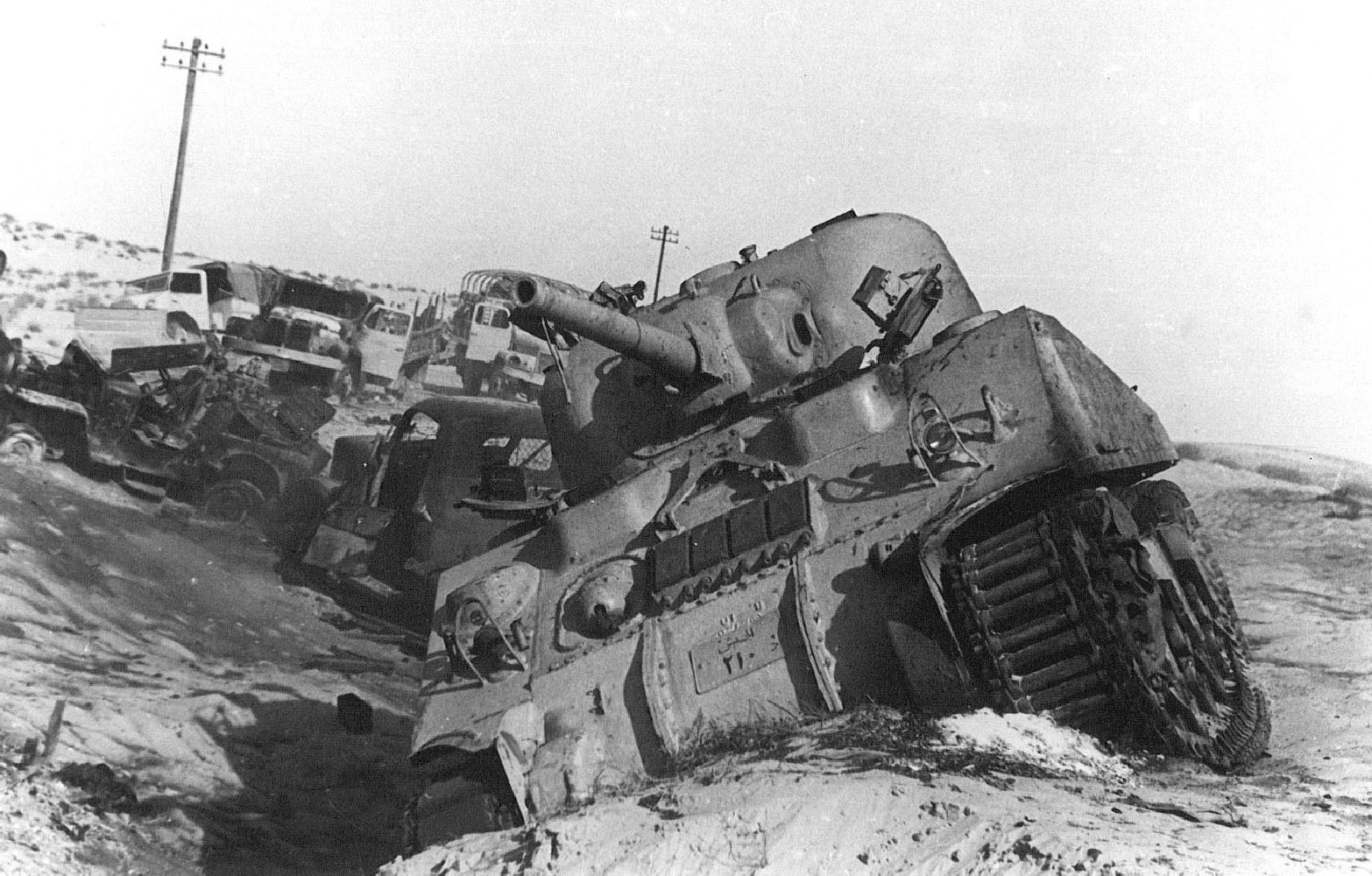
- October 24 – The Protocol of Sèvres, a secret agreement between Israel, France and the United Kingdom, is signed, allowing the former to invade the Sinai Peninsula of Egypt and occupy the Suez Canal with the support of the other two governments, giving rise to the Suez Crisis.[18]
- October 26 – Soviet Red Army troops invade Hungary.
- October 29
- Suez Crisis: Israel invades the Sinai Peninsula and pushes Egyptian forces back toward the Suez Canal.
- Tangier Protocol: The international city Tangier is reintegrated into Morocco.
- The Huntley-Brinkley Report debuts on NBC-TV in the United States.
- October 31
- Suez Crisis: The United Kingdom and France begin bombing Egypt to force the reopening of the Suez Canal.
- A United States Navy team becomes the third group to reach the South Pole (arriving by air), and commences construction of the first permanent Amundsen–Scott South Pole Station.
November
[edit]- November 1
- The States Reorganisation Act of India reforms the boundaries and names of Indian states. Three new states, Kerala, Karnataka and Andhra Pradesh, are formed.
- The film Oklahoma! (1955), previously released to select cities in Todd-AO, now receives a U.S. national release in CinemaScope, since not all theatres are yet equipped for Todd-AO. To accomplish this, the film has actually been shot twice, rather than printing one version in two different film processes, as is later done.
- November 3
- Khan Yunis massacre (Suez Crisis): Israeli soldiers shoot dead hundreds of Palestinian refugees and local inhabitants in Khan Yunis Camp.
- MGM's film The Wizard of Oz is the first major Hollywood film running more than 90 minutes to be televised uncut in one evening, in the United States.
- November 4 – Hungarian Revolution of 1956: More Soviet troops invade Hungary, to crush the revolt that started on October 23. Thousands are killed, more are wounded, and nearly a quarter million leave the country.
- November 6 – 1956 United States presidential election: Republican incumbent Dwight D. Eisenhower defeats Democratic challenger Adlai Stevenson, in a rematch of their contest 4 years earlier.
- November 7 – Suez Crisis: The United Nations General Assembly adopts a resolution calling for the United Kingdom, France and Israel to withdraw their troops from Arab lands immediately.
- November 11 – Hungarian Revolution of 1956: Last insurgents succumb to the invading Soviet army.[19]
- November 12 – Morocco, Sudan and Tunisia join the United Nations.
- November 13 – Browder v. Gayle: The United States Supreme Court declares illegal the state and municipal laws requiring segregated buses in Montgomery, Alabama, thus ending the Montgomery bus boycott.
- November 14 – An eight-mile long stretch of highway is opened west of Topeka, Kansas, creating the first portion of the Interstate Highway System in the United States and the first highway to be completed with funds from the Federal Aid Highway Act of 1956.[20]
- November 15 – Middle East Technical University is founded in Ankara, Turkey.
- November 18 – At a reception for Western ambassadors at the Polish embassy in Moscow, Nikita Khrushchev utters his famous phrase "We will bury you".[21]
- November 20 – In Yugoslavia, former prime minister Milovan Đilas is arrested after he criticizes Josip Broz Tito.
- November 22 – The 1956 Summer Olympics begin in Melbourne, Australia.
- November 23 – The Suez Crisis causes petrol rationing in Britain.[22]
- November 25 – Fidel Castro and Che Guevara depart from Tuxpan, Veracruz, Mexico, en route to Santiago de Cuba aboard the yacht Granma, with 82 men.
- November 28 – Roger Vadim's film And God Created Woman (Et Dieu... créa la femme), is released in France, making Brigitte Bardot an international sex symbol.[23]
- November 30 – African-American Floyd Patterson wins the world heavyweight boxing championship that is vacant after the retirement of Rocky Marciano.
December
[edit]- December 3 – The 1956 Bush Terminal explosion occurs in Brooklyn, United States.
- December 4 – The Million Dollar Quartet (Elvis Presley, Jerry Lee Lewis, Carl Perkins, and Johnny Cash) get together at Sun Studio, for the first and last time in history.
- December 9 – Trans-Canada Air Lines Flight 810, a Canadair North Star, crashes into Slesse Mountain near Chilliwack, British Columbia. All 62 people aboard, including five Canadian Football League players, are killed.
- December 12 – Japan becomes a member of the United Nations.
- December 19 – British doctor John Bodkin Adams is arrested for the murder of 2 patients in Eastbourne, England; he will be acquitted.
- December 23 – British and French troops leave the Suez Canal region.
Births
[edit]| Births |
|---|
| January · February · March · April · May · June · July · August · September · October · November · December · Date unknown |
January
[edit].jpg)


.jpg)

- January 1
- Mark R. Hughes, American entrepreneur (d. 2000)
- Kōji Yakusho, Japanese actor
- Christine Lagarde, French lawyer and politician, IMF Managing Director and ECB president
- Dzulkefly Ahmad, Malaysian politician
- Andrew Lesnie, Australian cinematographer (d. 2015)
- Andy Gill, English musician (Gang of Four) (d. 2020)
- January 3 – Mel Gibson, American actor and director
- January 4 – Bernard Sumner, British musician
- January 5
- Ana Pessoa Pinto, East Timorese politician and jurist
- Celso Blues Boy, Brazilian singer and guitarist (d. 2012)
- Chen Kenichi, Japan-born Chinese chef
- Frank-Walter Steinmeier, German politician
- January 6
- Angus Deayton, British comedian, actor, and television host.
- January 7
- David Caruso, American actor
- Uwe Ochsenknecht, German actor
- Johnny Owen, Welsh boxer (d. 1980)
- January 8 – Anatolii Brezvin, Ukrainian businessman, politician, and ice hockey executive[24]
- January 9
- Kimberly Beck, American actress
- Imelda Staunton, English actress[25]
- January 12 – Nikolai Noskov, Soviet and Russian rock singer and songwriter
- January 15 – Vitaly Kaloyev, Russian convicted murderer, architect deputy minister of construction of North Ossetia-Alania
- January 16 – Martin Jol, Dutch football manager
- January 17 – Paul Young, English musician
- January 18
- Sharon Mitchell, American sexologist
- Jim Mothersbaugh, American rock drummer
- January 19
- Adriana Acosta, Argentine militant and field hockey player (d. 1978)
- Susan Solomon, American atmospheric chemist[26]
- January 20 – Bill Maher, American actor, comedian and political analyst
- January 21
- Robby Benson, American actor, voice actor, director, singer and educator
- Geena Davis, American actress
- January 24 – Lounès Matoub, Algerian Berber Kabyle singer (d. 1998)
- January 25 – Bronwyn Pike, Australian politician
- January 26 – Pat Musick, American voice actress
- January 27
- Susanne Blakeslee, American actress
- Mimi Rogers, American actress
- January 28 – Peter Schilling, German singer
- January 29 – Jan Jakub Kolski, Polish film director
- January 30 – Keiichi Tsuchiya, Japanese racing driver
- January 31
- John Lydon, British punk musician and TV personality
- Trevor Manuel, South African politician
February
[edit].jpg)


- February 1 – Mike Kitchen, Canadian ice hockey player and coach
- February 2 – Alireza Soleimani, Iranian heavyweight freestyle wrestler (d. 2014)
- February 3
- Nathan Lane, American actor
- Lee Ranaldo, American musician
- February 10 – Enele Sopoaga, 12th prime minister of Tuvalu
- February 11 – Didier Lockwood, French jazz violinist (d. 2018)
- February 13
- Peter Hook, British bass player
- Yiannis Kouros, Greek-Australian ultra marathoner
- Jay Nixon, 55th governor of Missouri
- February 14 – Tom Burlinson, Australian actor
- February 15 – Desmond Haynes, West Indian cricketer
- February 18
- Thomas Gradin, Swedish hockey player
- Bidzina Ivanishvili, Georgian-French billionaire oligarch and politician[27]
- February 19
- Kathleen Beller, American actress
- Roderick MacKinnon, American biologist, recipient of the Nobel Prize in Chemistry
- February 20 – François Bréda, Romanian essayist, poet, literary critic, literary historian, translator and theatrologist (d. 2018)
- February 23 – Reinhold Beckmann, German television presenter
- February 24 – Judith Butler, American philosopher
- February 25
- Davie Cooper, Scottish footballer (d. 1995)
- Michel Friedman, German lawyer, politician and talk show host
- February 26 – Keisuke Kuwata, Japanese musician
- February 28 – Thomas Remengesau Jr., 7th and 9th president of Palau
- February 29 – Aileen Wuornos, American serial killer (d. 2002)
March
[edit]
.jpg)


.jpg)
- March 1
- Tim Daly, American actor and producer
- Dalia Grybauskaitė, President of Lithuania[28]
- March 2 – Eduardo Rodríguez, President of Bolivia
- March 5
- Teena Marie, American singer (d. 2010)
- Marco Paolini, Italian stage actor, dramaturge and author
- March 7
- Andrea Levy, English novelist (d. 2019)[29]
- Bryan Cranston, American actor, director, producer and screenwriter
- March 9
- Kadyrzhan Batyrov, Kyrgyz businessman and politician (d. 2018)
- Shashi Tharoor, Indian politician
- March 10 – Prasanna Jayawardena, Sri Lankan puisne justice of the Supreme Court (d. 2019)
- March 11 – Rob Paulsen, American voice actor and singer
- March 13 – Dana Delany, American actress
- March 16
- Boaz Arad, Israeli visual artist (d. 2018)
- Vladimír Godár, Slovak composer
- March 18 – Ingemar Stenmark, Swedish alpine skier
- March 19 – Yegor Gaidar, Russian economist and politician (d. 2009)[30]
- March 20
- Minken Fosheim, Norwegian actress and author (d. 2018)
- Catherine Ashton, British politician
- Naoto Takenaka, Japanese actor, comedian, singer and director
- José Manuel Barroso, Prime Minister of Portugal
- Ingrid Kristiansen, Norwegian runner
- Win Lyovarin, Thai author
- March 22
- Tyrone Brunson, American singer (d. 2013)
- Ilana Kloss, South-African born tennis player, tennis coach, and commissioner of World Team Tennis[31]
- Maria Teresa, Grand Duchess of Luxembourg, consort of Grand Duke Henri[32]
- March 24 – Steve Ballmer, American businessman, CEO of Microsoft (2000–2014), owner of the Los Angeles Clippers
- March 25 – Matthew Garber, English child actor (d. 1977)
- March 28
- Susan Ershler, American mountaineer
- Evelin Jahl, German athlete
- March 29 - George McCaskey, American football executive, owner of the Chicago Bears
- March 30 – Paul Reiser, American actor
April
[edit]


.jpg)
- April 3
- Miguel Bosé, Panamanian-born musician and actor
- Boris Miljković, Serbian TV & theatre director and video artist
- April 4
- Kerry Chikarovski, Australian politician
- David E. Kelley, American writer and television producer
- April 5
- Diamond Dallas Page, American professional wrestler
- El Risitas, Spanish comedian and actor (d. 2021)[33]
- April 6
- Sebastian Spreng, American-Argentinean visual artist
- Dilip Vengsarkar, Indian cricketer
- April 7 – Christopher Darden, African-American attorney, author, actor and lecturer[34]
- April 9 – Edmund Chong Ket Wah, Malaysian politician (d. 2010)
- April 12
- Andy García, Cuban-American actor
- Herbert Grönemeyer, German musician and actor
- Yasuo Tanaka, Japanese politician, novelist
- April 14 – Barbara Bonney, American soprano
- April 16
- David M. Brown, American astronaut (d. 2003)
- Lise-Marie Morerod, Swiss skier
- April 18
- Melody Thomas Scott, American actress
- Karim Abdul Razak, Ghanaian footballer
- Eric Roberts, American actor
- April 19 – Sue Barker, British tennis player and television presenter
- April 22 – Jukka-Pekka Saraste, Finnish conductor
- April 26 – Koo Stark, British actress
- April 28 – Hanka Paldum, Bosnian singer
- April 30 – Lars von Trier, Danish film director and screenwriter
May
[edit]


- May 1 – Alexander Ivanov, Russian-born American chess grandmaster
- May 4
- David Guterson, American writer
- Sharon Jones, African-American singer (d. 2016)[35]
- Ulrike Meyfarth, German high jumper
- May 5 – Lisa Eilbacher, American actress
- May 6 – Vladimir Lisin, Russian business oligarch
- May 7
- S. Scott Bullock, American actor and voice actor
- Jan Peter Balkenende, Prime Minister of the Netherlands (2002–2010)
- Jean Lapierre, Canadian politician and television host (d. 2016)
- May 9
- Frank Andersson, Swedish wrestler (d. 2018)
- Wendy Crewson, Canadian actress
- May 10
- Mickey Faerch, Danish-Canadian burlesque dancer and actress
- Vladislav Listyev, Russian journalist (d. 1995)
- Paige O'Hara, American actress, voice actress, singer and painter
- Bikenibeu Paeniu, 2-Time Prime Minister of Tuvalu
- May 12 – Jānis Bojārs, Latvian shot putter (d. 2018)
- May 13
- Kenneth Eriksson, Swedish rally driver
- Sri Sri Ravi Shankar, Indian guru
- Mirek Topolánek, 7th prime minister of the Czech Republic
- Kirk Thornton, American voice actor
- May 15 – Dan Patrick, American sports commentator
- May 17
- Cheenu Mohan, Indian actor (d. 2018)
- Sugar Ray Leonard, American boxer, motivational speaker and actor
- May 19 – Steven Ford, American actor
- May 20
- Boris Akunin, Russian novelist and essayist[36]
- Dean Butler, American actor and producer
- May 23
- Ursula Plassnik, Austrian politician
- Buck Showalter, American baseball player and manager
- May 26 – Lisa Niemi, American actress and dancer
- May 27 – Giuseppe Tornatore, Italian film director
- May 28
- Jerry Douglas, American dobro player
- John O'Donoghue, Irish Fianna Fáil politician
- Sayuri Yamauchi, Japanese voice actress (d. 2012)
- May 29 – La Toya Jackson, American singer, songwriter, actress, businesswoman and television personality
- May 30 – David Sassoli, 16th president of the European Parliament (d. 2022)
- May 31 – Yoshiko Sakakibara, Japanese voice actress
June
[edit].jpg)


.jpg)
- June 1
- Chintaman Vanaga, Indian politician (d. 2018)
- Peter Tomka, Judge, International Court of Justice
- June 3 – George Burley, Scottish football manager
- June 4 – Keith David, African-American actor and voice actor
- June 5 – Kenny G, American saxophonist
- June 6
- Yuri Shundrov, Russian-Ukrainian ice hockey goaltender (d. 2018)
- Christopher Adamson, British actor
- Björn Borg, Swedish tennis player
- June 7
- Paul Sherwen, English racing cyclist and broadcaster (d. 2018)
- Antonio M. Reid, American record executive
- June 8 – Péter Besenyei, Hungarian pilot
- June 9 – Patricia Cornwell, American novelist
- June 10 – Borwin, Duke of Mecklenburg, German head of the House of Mecklenburg
- June 11
- Joe Montana, American football player
- Arthur Porter, Canadian physician (d. 2015)
- June 13 – Yurik Vardanyan, Soviet weightlifter (d. 2018)
- June 14 – King Diamond, Danish heavy metal musician
- June 15 – Robin Curtis, American actress
- June 17 – Kelly Curtis, American actor
- June 20 – Cho Chikun, Korean Go player
- June 21 – Thomas James O'Leary, American actor
- June 22
- Abdulbaset Sieda, Kurdish-Syrian academic and politician
- François Hadji-Lazaro, French actor and musician
- June 23 – Randy Jackson, African-American musician and talent judge
- June 24 – Turid Leirvoll, Norwegian-Danish politician
- June 25
- Madeleine Petrovic, Austrian politician
- Isabel de Navarre, German figure skating coach
- Boris Trajkovski, President of the Republic of Macedonia (d. 2004)
- Anthony Bourdain, American chef, writer and television personality (d. 2018)[37]
- Chloe Webb, American actress and singer
- June 26
- Catherine Samba-Panza, President of the Central African Republic
- Chris Isaak, American musician
- June 27
- Sultan bin Salman Al Saud, Royal Saudi Air Force pilot
- Heiner Dopp, German field hockey player
- June 28 – Noel Mugavin, Australian rules football player
- June 29 – Honorato Hernández, Spanish long-distance runner
- June 30
- Sun Chanthol, Cambodian politician
- Jessi Lintl, Austrian politician
- David Alan Grier, African-American actor and comedian
- Piero Aiello, Italian politician
July
[edit]
_(cropped_3).jpg)


- July 1
- Alan Ruck, American actor
- Gregg L. Semenza, American cellular biologist, recipient of the Nobel Prize in Physiology or Medicine
- July 2 – Jerry Hall, American model and actress
- July 3 – Dorota Pomykała, Polish actress
- July 5
- Sapawi Ahmad, Malaysian politician
- Horacio Cartes, former president of Paraguay
- Louis Herthum, American actor and producer
- July 7
- Janet Cruz, American politician
- Mullah Krekar, Iraqi Kurdish scholar and militant
- Ryuho Okawa, Japanese religious leader (d. 2023)
- Giam Swiegers, South African-Australian business executive
- July 9 – Tom Hanks, American actor and director
- July 10 – K. Rajagopal, Malaysian football manager and national player
- July 11
- Amitav Ghosh, Indian novelist[38]
- Sela Ward, American actress
- July 12 – Mel Harris, American actress
- July 13
- Günther Jauch, German television host
- Koffi Olomide, Congolese soukous singer, dancer, producer and composer
- Michael Spinks, African-American boxer
- July 14
- Dragan Despot, Croatian actor
- Vladimir Kulich, Czechoslovak actor
- July 15
- Ian Curtis, English rock musician (Joy Division) (d. 1980)
- Barry Melrose, Canadian hockey player, coach and commentator
- Toshihiko Seko, Japanese long-distance runner
- July 16
- Jerry Doyle, American talk show host and actor (d. 2016)
- Tony Kushner, American playwright
- July 17 – Robert Romanus, American actor and musician
- July 18 – Sheila Aldridge, American singer
- July 19
- Peter Barton, American actor
- Yoshiaki Yatsu, Japanese professional wrestler
- July 24
- Charlie Crist, American politician, 44th governor of Florida
- Carmen Nebel, German television presenter
- July 25
- Frances Arnold, American biochemist, recipient of the Nobel Prize in Chemistry
- Andy Goldsworthy, British sculptor and photographer
- July 26 – Dorothy Hamill, American figure skater, Olympic gold medalist
- July 30 – Delta Burke, American actress
- July 31
- Michael Biehn, American actor
- Deval Patrick, American politician, first African-American Governor of Massachusetts
August
[edit]_(cropped).jpg)

.jpg)

- August 4
- Gerry Cooney, American boxer
- Randall Wright, Canadian economist
- August 6 – Stepfanie Kramer, American actress
- August 7 – Christiana Figueres, Costa Rican diplomat and environmentalist
- August 10
- Dianne Fromholtz, Australian tennis player[39]
- Fred Ottman, American professional wrestler
- August 12 – Bruce Greenwood, Canadian actor
- August 14
- Jackée Harry, American actress and television personality
- Rusty Wallace, American NASCAR race car driver
- August 19 – Adam Arkin, American actor
- August 20
- Joan Allen, American actress
- Jan Henry T. Olsen, Norwegian politician (d. 2018)
- August 21 – Kim Cattrall, English-born Canadian actress
- August 22 – Paul Molitor, American baseball player
- August 23
- Andreas Floer, German mathematician (d. 1991)
- Cris Morena, Argentine actress and television producer
- August 25 – Henri Toivonen, Finnish rally car driver (d. 1986)
- August 26 – Mark Mangino, American football coach
- August 29 – Mark Morris, American choreographer
- August 31
- Masashi Tashiro, Japanese television performer
- Tsai Ing-wen, President of the Republic of China (Taiwan)
September
[edit].jpg)

_2.jpg)


- September 1 – Bernie Wagenblast, American editor and broadcaster
- September 2
- Nandamuri Harikrishna, Indian actor and politician (d. 2018)
- Angelo Fusco, Provisional Irish Republican Army member
- September 3 – Pat McGeown, Provisional Irish Republican Army member (d. 1996)
- September 5 – Low Thia Khiang, Singaporean businessman and politician
- September 11 – Phillip D. Bissett, American politician
- September 12
- Leslie Cheung, Hong Kong actor (d. 2003)
- Ricky Rudd, American race car driver
- Walter Woon, law professor, Nominated Member of Parliament and Attorney-General of Singapore
- September 13 – Ilie Balaci, Romanian football player (d. 2018)
- September 14
- Kostas Karamanlis, Greek politician
- Ray Wilkins, English footballer and coach (d. 2018)
- September 15 – George Howard, American jazz saxophone musician (d. 1998)
- September 16
- Sergei Beloglazov, Russian free-style wrestler
- David Copperfield, American illusionist
- September 17 – Almazbek Atambayev, 3-Time Prime Minister of Kyrgyzstan and 4th president of Kyrgyzstan
- September 18 – Tim McInnerny, English actor
- September 20
- Gary Cole, American television, film and voice actor
- Debbi Morgan, African-American actress
- September 21 – Jack Givens, American basketball player
- September 23
- Mait Riisman, Estonian water polo player (d. 2018)
- Peter David, comic book writer and novelist (d. 2025[40]
- Paolo Rossi, Italian soccer player (d. 2020)
- September 25 – Jamie Hyneman, American television co-host
- September 26 – Linda Hamilton, American actress
- September 29 – Sebastian Coe, Baron Coe, British athlete; co-ordinator of the London 2012 Olympic Games[41]
October
[edit]_(cropped).jpg)
.jpg)


- October 1
- Tara Buckman, American actress
- Andrus Ansip, Estonian politician, 10th prime minister of Estonia
- Theresa May, Prime Minister of the United Kingdom
- October 2 – Charlie Adler, American voice actor and director
- October 3 – Ralph Morgenstern, German actor
- October 4 – Christoph Waltz, German-Austrian actor
- October 8
- Danny Jacob, American composer, songwriter and guitarist
- Stephanie Zimbalist, American actress
- October 10 – Amanda Burton, Irish actress
- October 11
- Nicanor Duarte, 47th president of Paraguay
- Doug Lawrence, American jazz saxophonist[42]
- October 12 – Trần Đại Quang, President of Vietnam (d. 2018)
- October 16 – Rudra Mohammad Shahidullah, Bangladeshi poet (d. 1991)
- October 17 – Mae Jemison, African-American astronaut
- October 18
- Craig Bartlett, American animator, writer, storyboard artist, director and voice actor
- Martina Navratilova, Czech-American multiple Grand Slam title winning tennis player
- October 19 – Carlo Urbani, Italian physician (d. 2003)
- October 20 – Danny Boyle, English film director
- October 21 – Carrie Fisher, American actress and novelist (d. 2016)[43]
- October 22 – Marvin Bush, American businessman
- October 23 – Dwight Yoakam, American country singer, musician and actor
- October 26 – Rita Wilson, American actress and producer
- October 28 – Mahmoud Ahmadinejad, 6th president of Iran
November
[edit]

- November 7 – Mikhail Alperin, Soviet-Norwegian jazz pianist (d. 2018)
- November 8
- Richard Curtis, English film director, producer and screenwriter
- Kurt Sorensen, New Zealand rugby league player
- November 10 – Sinbad, African-American stand-up, comedian and actor
- November 11
- Talat Aziz, ghazal singer
- Edgar Lungu, president of Zambia (d. 2025)[44]
- November 14
- Avi Cohen, Israeli football player (d. 2010)
- Greg Pence, American businessman and politician
- Peter R. de Vries, Dutch crime reporter (d. 2021)[45]
- November 17 – Angelika Machinek, German glider pilot (d. 2006)[46]
- November 18 – Noel Brotherston, Irish footballer (d. 1995)
- November 20
- Bo Derek, American actress and model
- Olli Dittrich, German actor, comedian, television personality and musician
- November 22 – Richard Kind, American actor
- November 23
- Shane Gould, Australian Olympic triple gold medallist swimmer (1972)
- Nikolay Sidorov, Soviet athlete
- November 24 – Jouni Kaipainen, Finnish composer
- November 26 – Dale Jarrett, American race car driver
- November 27
- Nazrin Shah of Perak, 35th Sultan of Perak
- William Fichtner, American actor
December
[edit]
.jpg)

_(cropped_2).jpg)
- December 1 – Sultan bin Zayed bin Sultan Al Nahyan, Emirati politician and royal (d. 2019)
- December 4 – Bernard King, American basketball player and commentator
- December 5
- Klaus Allofs, German football player
- Krystian Zimerman, Polish pianist
- December 6
- Peter Buck, American guitarist
- Randy Rhoads, American guitarist (d. 1982)
- December 7
- Chuy Bravo, Mexican-American actor and entertainer (d. 2019)
- Larry Bird, American basketball player
- Iveta Radičová, Prime Minister of Slovakia
- December 9 – Baruch Goldstein, American-Israeli physician and mass murderer (d. 1994)
- December 10 – Rod Blagojevich, American politician and convicted felon, Governor of Illinois (2003–2009)
- December 12
- Ana Alicia, Mexican actress
- Johan van der Velde, Dutch cyclist
- December 13 – Majida El Roumi, Lebanese singer
- December 14 – Béla Réthy, German sports journalist
- December 18 – Ron White, American comedian
- December 19 – Masami Akita, Japanese noise musician (also known as Merzbow)
- December 20 – Anita Ward, American disco singer.
- December 21 – Anna Erlandsson, Swedish filmmaker and animator
- December 23
- Michele Alboreto, Italian racing driver (d. 2001)
- Dave Murray, British musician (Iron Maiden)
- December 24 – Anil Kapoor, Indian actor
- December 26 – David Sedaris, American essayist
- December 28
- Nigel Kennedy, English violinist
- Jimmy Nicholl, Canadian-born footballer
- December 30
- Patricia Kalember, American actress
- Sheryl Lee Ralph, African American-actress
- December 31 – Hussein Ahmed Salah, Djiboutian marathon runner
Deaths
[edit]| Deaths |
|---|
| January · February · March · April · May · June · July · August · September · October · November · December · Date unknown |
January
[edit]

- January 3
- Alexander Gretchaninov, Russian composer (b. 1864)
- Joseph Wirth, Chancellor of Germany (b. 1879)
- January 5 – Mistinguett, French singer and actress (b. 1875)
- January 9 – Marion Leonard, American actress (b. 1881)
- January 12 – Norman Kerry, American actor (b. 1894)
- January 18 – Konstantin Päts, 1st president of Estonia (b. 1874)
- January 23 – Sir Alexander Korda, Hungarian-born film director (b. 1893)
- January 27 – Erich Kleiber, German conductor (b. 1890)
- January 29 – H. L. Mencken, American writer (b. 1880)
- January 31 – A. A. Milne, English author (Winnie The Pooh) (b. 1882)
February
[edit]
- February 2
- Bob Burns, American comedian (b. 1890)
- Charley Grapewin, American actor (b. 1869)
- February 3 – Robert Yerkes, American psychologist and ethologist (b. 1876)
- February 8 – Connie Mack, American baseball executive and manager (Philadelphia Athletics) and a member of the MLB Hall of Fame (b. 1862)
- February 10 – Hugh Trenchard, 1st Viscount Trenchard, British marshal of the Royal Air Force (b. 1873)
- February 18 – Gustave Charpentier, French composer (b. 1860)
- February 20 – Heinrich Barkhausen, German physicist (b. 1881)
- February 26 – Elsie Janis, American singer and actress (b. 1889)
- February 28
- Carlo Gnocchi, Italian Roman Catholic priest and blessed (b. 1902)[47]
- Frigyes Riesz, Hungarian mathematician (b. 1880)[48]
- February 29 – Elpidio Quirino, 6th president of the Philippines (b. 1890)
March
[edit]

- March 12 – Bolesław Bierut, Polish Communist politician and statesman, former prime minister and president of Poland (b. 1892)
- March 14 – David Browning, American Olympic diver (b. 1931)
- March 17
- Fred Allen, American comedian (b. 1894)
- Irène Joliot-Curie, French physicist, recipient of the Nobel Prize in Chemistry (b. 1897)
- March 18 – Louis Bromfield, American writer (b. 1896)
- March 20
- Fanny Durack, Australian swimmer (b. 1889)
- Wilhelm Miklas, 3rd president of Austria (b. 1872)
- March 22
- Eduardo Lonardi, 30th president of Argentina (b. 1896)
- George Sarton, Belgian-American chemist and historian (b. 1884)
- March 25 – Robert Newton, English actor (b. 1905)
- March 28 – Thomas de Hartmann, Russian composer (b. 1885)
- March 30 – Edmund Clerihew Bentley, English writer (b. 1875)
- March 31 – Ralph DePalma, Italian-born American race car driver (b. 1884)
April
[edit]
- April 13 – Emil Nolde, German-Danish painter (b. 1867)
- April 15 – Kathleen Howard, Canadian-born American actress and opera singer (b. 1884)
- April 19 – Ernst Robert Curtius, Alsatian philologist (b. 1886)
- April 21
- Charles MacArthur, American playwright and screenwriter (b. 1895)
- April 24 – Henry Stephenson, British actor (b. 1871)
- April 26 – Edward Arnold, American actor (b. 1890)
- April 29
- Harold Bride, English-born junior radio officer on RMS Titanic (b. 1890)
- Wilhelm Ritter von Leeb, German field marshal (b. 1876)
- April 30 – Alben W. Barkley, 35th Vice President of the United States (b. 1877)
May
[edit]
- May 6 – Fergus Anderson, British motorcycle racer (b. 1909)
- May 12 – Louis Calhern, American actor (b. 1895)
- May 15 – Austin Osman Spare, English artist and occultist (b. 1886)
- May 20
- Max Beerbohm, English essayist, parodist and caricaturist (b. 1872)
- Zoltán Halmay, Hungarian Olympic swimmer (b. 1881)
- May 23 – Gustav Suits, Estonian poet (b. 1883)
- May 24
- Eugen Dieth, dialectologist (b. 1893)
- Guy Kibbee, American actor (b. 1882)
- May 26 – Al Simmons, American baseball player (b. 1902)
- May 29 – Frank Beaurepaire, Australian Olympic swimmer (b. 1891)
- May 30 – George Murray Levick, British Antarctic explorer and naval surgeon (b. 1876)[49]
- May 31 – Diedrich Hermann Westermann, German linguist (b. 1875)
June
[edit]

- June 2 – Jean Hersholt, Danish-born American actor (b. 1886)
- June 4 – Katherine MacDonald, American actress (b. 1891)
- June 6
- Hiram Bingham III, American explorer, discoverer of Machu Picchu (b. 1875)
- Margaret Wycherly, English actress (b. 1881)
- June 7 – Julien Benda, French philosopher and novelist (b. 1867)[50]
- June 11
- Frank Brangwyn, Anglo-Welsh artist (b. 1867)
- Ralph Morgan, American actor (b. 1883)
- June 17 – Artur Văitoianu, Romanian general and politician, 27th prime minister of Romania (b. 1864)
- June 19 – Thomas J. Watson, American computer pioneer (b. 1874)[51]
- June 22 – Walter de la Mare, English poet, short story writer, and novelist (b. 1873)
- June 23 – Reinhold Glière, Russian composer (b. 1875)
- June 25 – Ernest King, American Navy Fleet Admiral and Commander in Chief (b. 1878)
- June 26 – Clifford Brown, American jazz trumpeter (b. 1930)
July
[edit]- July 1 – Tawfik Abu Al-Huda, 4-Time Prime Minister of Jordan (b. 1895)
- July 7 – Gottfried Benn, German poet (b. 1886)
- July 8 – Giovanni Papini, Italian essayist, poet, novelist (b. 1881)
August
[edit]
- August 11
- Jackson Pollock, American painter (b. 1912)
- Mincho Neychev, former chairman of the Presidium of the National Assembly (head of state) of Bulgaria (b. 1887)
- August 14
- Bertolt Brecht, German playwright (b. 1898)
- Konstantin von Neurath, Nazi German diplomat and foreign minister (b. 1873)
- August 16 – Bela Lugosi, Hungarian-born American film actor (Dracula) (b. 1882)
- August 19 – Bernard Griffin, English cardinal (b. 1899)
- August 24 – Kenji Mizoguchi, Japanese film director (b. 1898)
- August 25 – Alfred Kinsey, American sex researcher (b. 1894)
- August 26 – Yeung Kwo, Malayan politician and Deputy Secretary-General of the Malayan Communist Party (b. 1919)
September
[edit].jpg)
- September 7 – C. B. Fry, English sportsman and writer (b. 1872)
- September 11
- Billy Bishop, Canadian World War I flying ace (b. 1894)
- Carlos Bulosan, Filipino-American novelist and poet (b. 1913)[52]
- Lucien Febvre, French historian (b. 1878)
- September 20 – Flora Eldershaw, Australian novelist, critic, and historian (b. 1897)[53]
- September 22 – Frederick Soddy, English chemist, Nobel Prize laureate (b. 1877)
- September 27 – Babe Didrikson Zaharias, American golfer (b. 1911)
- September 28 – William E. Boeing, American engineer and airplane manufacturer (b. 1881)[54]
- September 29 – Anastasio Somoza García, 29th president of Nicaragua (b. 1896)
October
[edit]
- October 2 – George Bancroft, American actor (b. 1882)
- October 6 – Charles E. Merrill, American banker, co-founder of Merrill Lynch (b. 1885)[55]
- October 9 – Marie Doro, American actress (b. 1882)
- October 12 – Lorenzo Perosi, Italian composer (b. 1872)
- October 14 – Jules Richard, French mathematician (b. 1862)
- October 16 – Jules Rimet, French football administrator, 3rd president of FIFA (b. 1873)
- October 17 – Anne Crawford, British actress (b. 1920)
- October 19 – Isham Jones, American musician (b. 1894)
- October 22 – Hannah Mitchell, English socialist and suffragette (b. 1872)
- October 25 – Risto Ryti, 23rd prime minister of Finland and 5th president of Finland (b. 1889)
- October 26 – Walter Gieseking, French-born German pianist (b. 1895)
- October 30 – Pío Baroja, Spanish novelist (b. 1872)
November
[edit]

- November 1
- Pietro Badoglio, Italian field marshal and 28th prime minister of Italy (b. 1871)
- Tommy Johnson, American musician (b. 1896)
- November 2 – Leo Baeck, German rabbi, scholar and theologian (b. 1873)
- November 3 – Jean Metzinger, French painter, theorist and critic (b. 1883)
- November 5 – Art Tatum, American jazz pianist (b. 1909)
- November 6
- Paul Kelly, American stage and film actor (b. 1899)
- Albert F. Nufer, American diplomat and ambassador (b. 1894)[56]
- November 10
- Harry Ford Sinclair, American oil industrialist (b. 1876)[57]
- Victor Young, American composer (b. 1899)
- November 12 – Juan Negrín, 67th prime minister of Spain (b. 1892)
- November 19 – Francis L. Sullivan, English actor (b. 1903)
- November 22 – Theodore Kosloff, Russian-born ballet dancer, choreographer and actor (b. 1882)
- November 23 – André Marty, French Communist Party leader (b. 1886)[58]
- November 24 – Guido Cantelli, Italian conductor (b. 1920)
- November 26 – Tommy Dorsey, American trombonist and bandleader (b. 1905)
December
[edit]
- December 2 – Dell Henderson, Canadian actor (b. 1877)
- December 3 – Alexander Rodchenko, Russian artist (b. 1891)
- December 6 – B. R. Ambedkar, Indian jurist and politician (b. 1891)
- December 9 – Charles Joughin, English-born baker on RMS Titanic (b. 1878)
- December 12 – E. A. Dupont, German film director (b. 1891)
- December 14 – Juho Kusti Paasikivi, twice Prime Minister of Finland and 7th president of Finland (b. 1870)
- December 16
- René Couzinet, French aeronautics engineer and aircraft manufacturer (b. 1904)[59]
- Nina Hamnett, Welsh artist (b. 1890)
- December 17 – Eddie Acuff, American actor (b. 1903)
- December 21 – Lewis Terman, American psychologist (b. 1877)
- December 23 – Josep Puig i Cadafalch, Spanish architect (b. 1867)
- December 26
- Holmes Herbert, English actor (b. 1882)
- Preston Tucker, American automobile designer (b. 1903)[60]
Date unknown
[edit]- Dumitru Coroamă, Romanian soldier and fascist activist (b. 1885)
- Victoria Hayward, Bermudan-born travel writer and journalist (b. 1876)
- Lotte Herrlich, female photographer of German naturism (b. 1883)
Nobel Prizes
[edit]
References
[edit]- ^ The Bulletin, volumes 4-5. Presse- und Informationsamt der Bundesregierung. 1956. p. 8.
- ^ "Morocco profile – Timeline". BBC News. April 24, 2018. Retrieved July 3, 2022.
- ^ "13. French Tunisia (1881-1956)". uca.edu. Retrieved September 2, 2025.
- ^ Bessis, Sophie; Belhassen, Souhayr (2012). Bourguiba (in French). Tunis: Elyzad. ISBN 978-9973-58-044-3.
- ^ Royal Television Society Journal, Volume 18, Issues 7–12. 1981. pp. 14–15.
- ^ "The Big Week in Monaco: Movies' Pretty Princess Assumes a Real Life Title". Life. Vol. 40, no. 18. April 30, 1956. p. 37. ISSN 0024-3019.
'I'm halfway married,' she exclaimed after the first wedding, a 16-minute civil ceremony in his crimson-damasked throne
- ^ "Mercury: The Tragedy of Minamata Disease". Collaborative for Health & Environment. Retrieved September 27, 2025.
- ^ "Browder v. Gayle, 142 F. Supp. 707 (M.D. Ala. 1956)". Justia US law. Retrieved June 23, 2020.
- ^ "7H241 The Snooz-Alarm". www.telechron.net.
- ^ "US Army Flag". World Flags 101. Archived from the original on April 8, 2009. Retrieved April 6, 2009.
- ^ "National Interstate and Defense Highways Act (1956)". National Archives. September 29, 2021. Retrieved September 12, 2025.
- ^ "Stadiums". Russian Football News. July 13, 2013. Archived from the original on July 29, 2013. Retrieved January 19, 2018.
- ^ "La Explosión de Cali: Agosto 7 de 1956". Revista Credencial (in Spanish). September 16, 2016. Retrieved March 21, 2019.
- ^ Ramesa, Rafael. "How the inter-faith 'spirit of Toumliline' lives on 50 years after Moroccan monastery closed". Capacity4dev. European Union. Retrieved December 18, 2023.
- ^ "Domestic Grosses, Adjusted for Ticket Price Inflation". Box Office Mojo. Retrieved January 11, 2013.
- ^ "1956: Queen switches on nuclear power". On This Day. BBC. October 17, 1956. Retrieved January 23, 2019.
- ^ "Preface". Ministry of Foreign Affairs of Japan. Retrieved April 2, 2023.
- ^ Black, Ian (July 11, 2005). "Secrets and lies at the heart of Britain's Middle Eastern folly". The Guardian. London. Retrieved May 27, 2012.
- ^ Lendvai, Paul (2008). One Day That Shook the Communist World: The 1956 Hungarian Uprising and Its Legacy. Princeton University Press.
- ^ Stevens, William K. (November 14, 1976). "Superhighway System, in 20 Years, Has Tied a Vast Nation Together". The New York Times. p. 1.
- ^ ""We Will Bury You!"". Time. November 26, 1956. Archived from the original on January 24, 2007. Retrieved November 18, 2022.
- ^ "1956: Motorists panic as petrol rations loom". On This Day. BBC. November 29, 1956. Retrieved January 23, 2019.
- ^ "Cinema: BB". Time. November 11, 1957. Retrieved December 3, 2024.
- ^ "Брезвін Анатолій Іванович". Лівий берег [Left Bank] (in Ukrainian). Kyiv, Ukraine: Київський інститут проблем управління імені Горшеніна [Gorshenin Institute]. December 14, 2016. Retrieved August 24, 2024.
- ^ "Imelda Staunton". BFI. Archived from the original on March 11, 2016. Retrieved June 10, 2022.
- ^ "Susan Solomon". Pontifical Academy of Sciences. Retrieved November 11, 2024.
- ^ Janssen, Sarah (December 4, 2013). World Almanac and Book of Facts 2014. Simon and Schuster. ISBN 978-1-60057-183-1.
- ^ "Dalia Grybauskaite". Britannica Presents 100 Women Trailblazers. February 25, 2020. Retrieved July 29, 2021.
- ^ Innes, Lyn (February 15, 2019). "Andrea Levy obituary". The Guardian. Retrieved February 15, 2019.
- ^ Mainville, Michael (December 16, 2009). "Yegor Gaidar obituary". the Guardian. Retrieved July 29, 2021.
- ^ Siegman, Joseph (August 1, 2020). Jewish Sports Legends: The International Jewish Sports Hall of Fame. U of Nebraska Press. ISBN 978-1-4962-0188-1.
- ^ The Luxembourg Grand Ducal Family (Grand Duchy of Luxembourg Ministry of State, Press and Information Service, 1986), p. 26
- ^ "Muere El Risitas, Juan Joya Borja, víctima de una larga enfermedad". La Vanguardia (in Spanish). April 28, 2021. Retrieved March 6, 2024.
- ^ "Christopher Darden 1957–". encyclopedia.com. Archived from the original on April 3, 2019. Retrieved December 13, 2023.
- ^ "Sharon Jones, Powerhouse Soul Singer, Dies at 60". The New York Times. November 19, 2016.
- ^ Чхартишвили, Григорий. Collection of materials by Lenta.ru (in Russian). Retrieved November 26, 2009.
- ^ Hayward, Tim (June 9, 2018). "Anthony Bourdain obituary". The Guardian. Retrieved June 4, 2021.
- ^ Ghosh, Amitav Archived 5 August 2011 at the Wayback Machine, Encyclopædia Britannica
- ^ "Dianne Fromholtz (balestrat)". Women's Tennis Association.
- ^ Miller, John Jackson (June 10, 2005). "Comics Industry Birthdays". Comics Buyer's Guide. Iola, Wisconsin. Archived from the original on February 18, 2011.
- ^ "Lord Sebastian Coe". International Olympic Committee. Archived from the original on May 31, 2021. Retrieved February 29, 2020.
- ^ Yanow, Scott. "Doug Lawrence: Biography". AllMusic. Retrieved July 14, 2011.
- ^ Ryan Gilbey (December 27, 2016). "Carrie Fisher obituary". The Guardian. Retrieved February 25, 2024.
- ^ Former Zambian President Lungu dies aged 68
- ^ "Peter de Vries, award-winning Dutch investigative journalist renowned for his probes into the criminal underworld – obituary". The Telegraph. July 15, 2021. Retrieved November 11, 2024.
- ^ Probst, Ernst (2010). Angelika Machinek – Eine Segelfliegerin der Weltklasse [Angelika Machinek – A World Class Glider Pilot] (in German). Munich: Grin-Verl. p. 11. ISBN 978-3-640-73630-0.
- ^ Angel of the war victims
- ^ "Frigyes Riesz | Hungarian mathematician | Britannica". www.britannica.com. Retrieved October 28, 2022.
- ^ "Life story: George Murray Levick | Lives of the First World War".
- ^ Murray, Christopher John (2013). Encyclopedia of Modern French Thought. Routledge. p. 77. ISBN 978-1-135-45564-4.
- ^ "Thomas J. Watson". IBM. January 23, 2003.
- ^ Zia, Helen; Gall, Susan B., eds. (1995). Notable Asian Americans (1st ed.). New York City: Gale Research. p. 22. ISBN 0810396238. OCLC 31170596.
- ^ Flora Sydney Eldershaw (1897–1956)
- ^ "Boeing, William Edward (1881–1956)". www.historylink.org. Retrieved October 28, 2022.
- ^ "Charles E. Merrill | American businessman | Britannica". www.britannica.com. October 15, 2023.
- ^ Times, Special to The New York Times The New York (November 7, 1956). "A.F. NUFER DEAD; U.S. DIPLOMAT, 62; Ambassador to Philippines Had Served in Argentina During Peron Regime Headed European Branch". The New York Times. ISSN 0362-4331. Retrieved February 1, 2025.
- ^ "Obituary for Harry F. Sinclair (Aged 80)". The Daily Advertiser. November 11, 1956. p. 4.
- ^ "André Marty". Spartacus Educational.
- ^ Caloyanni, Emmanuel (2001). "René Couzinet from glory to decline". Translated by Leveillard, Mike. Aérostories. Retrieved December 16, 2022.
{{cite web}}: CS1 maint: deprecated archival service (link) - ^ Carmaker Preston Tucker dies
- ^ "These Nobel Prize Winners Weren't Always Noble". National Geographic News. October 6, 2015. Archived from the original on August 8, 2020. Retrieved January 19, 2021.
Bibliography
[edit]- Ranade, Sadashiv Bhaskar (1974). Cittapāvana Kauśika Gotrī Āgāśe-Kula-vr̥ttānta [The Agashe Family Genealogy belonging to the Chitpavan Kaushik Gotra] (Kulavruttanta) (in Marathi) (1st ed.). Pune: University of Michigan. LCCN 74903020. OCLC 600048059.
Further reading
[edit]- London Institute of World Affairs, The Year Book of World Affairs 1957 (London 1957) full text online, comprehensive reference book covering 1956 in diplomacy, international affairs and politics for major nations and regions
External links
[edit]
from Grokipedia
Overview
Geopolitical and Economic Context
In 1956, the Cold War intensified through proxy crises that exposed the fragility of Soviet dominance in Eastern Europe and the waning imperial influence of Britain and France. Nikita Khrushchev's ongoing de-Stalinization efforts, following his 1956 secret speech denouncing Joseph Stalin, emboldened reform movements in Soviet satellites, leading to unrest in Poland and culminating in the Hungarian Revolution.[4] The revolution erupted on October 23 in Budapest, where protesters organized themselves into thousands of workers' councils and militias demanding democratic reforms, an end to Soviet occupation, and withdrawal from the Warsaw Pact; Imre Nagy formed a new government that declared Hungary's neutrality and multiparty democracy.[3] Soviet forces invaded on November 4, crushing the uprising with tanks and artillery, resulting in approximately 2,500 Hungarian deaths and the flight of 200,000 refugees, while Nagy and other leaders were executed, reinforcing Moscow's resolve to maintain control despite Khrushchev's reforms.[5] This event highlighted the West's limited ability to intervene, as U.S. President Dwight D. Eisenhower prioritized avoiding direct confrontation with the USSR.[4] Concurrently, the Suez Crisis underscored shifting global power dynamics and the rise of U.S. and Soviet influence over European allies. On July 26, Egyptian President Gamal Abdel Nasser nationalized the Suez Canal Company, prompting Britain, France, and Israel to coordinate a military response; Israel invaded the Sinai Peninsula on October 29, followed by Anglo-French landings at Port Said on November 5.[1] The operation aimed to regain control of the canal and weaken Nasser but faced vehement opposition from the United States, which threatened economic sanctions against Britain and France, and the Soviet Union, which issued ultimatums.[1] The invaders withdrew by December under UN pressure, marking a humiliating defeat for Britain and France that accelerated decolonization and diminished their postwar stature, while elevating Nasser's pan-Arab nationalism and demonstrating U.S. economic leverage in containing allies' actions.[6] Economically, 1956 reflected the tail end of robust post-World War II expansion, with global output supported by reconstruction and trade liberalization, though vulnerabilities emerged from geopolitical shocks. The United Nations World Economic Survey noted persistent balance-of-payments strains in many countries, exacerbated by commodity price fluctuations and reconstruction debts, yet overall growth remained positive amid expanding industrial production in Western Europe and the U.S.[7] In the United States, GDP grew steadily, but productivity gains slowed to about 1.7% due to labor disputes and inventory adjustments, foreshadowing the 1957-1958 recession.[8] The Suez blockade disrupted oil shipments, causing temporary spikes in energy prices and shipping costs worldwide, which strained European economies dependent on Middle Eastern imports and illustrated the growing interdependence of geopolitics and global trade.[1] The International Monetary Fund reported that member countries' policies focused on stabilizing currencies and fostering growth, with U.S. aid under the Mutual Security Program bolstering allies amid these pressures.[9]Cultural and Technological Shifts
In 1956, breakthroughs in computing and data storage marked a pivotal shift toward accessible digital processing. IBM announced the 305 RAMAC system on September 14, incorporating the Model 350 disk storage unit—the world's first commercial hard disk drive—with a capacity of 3.75 to 5 megabytes across 50 platters rotating at 1,200 rpm, allowing random access that revolutionized data retrieval compared to sequential tape systems.[10] The same year, IBM released the first FORTRAN reference manual on October 15, introducing the inaugural high-level programming language optimized for scientific calculations, which abstracted machine-specific code and accelerated computational applications in research and engineering.[11] Broadcasting technology advanced with Ampex's VRX-1000, demonstrated on April 14 at the National Association of Radio and Television Broadcasters convention, the first practical videotape recorder using 2-inch quadruplex format to capture high-quality video for editing and playback, supplanting film-based kinescope methods and enabling time-shifted television production.[12] Globally, the TAT-1 submarine cable, activated on September 25 between Scotland and Newfoundland, established the initial transatlantic telephone link supporting 36 simultaneous circuits, reducing reliance on shortwave radio and fostering instantaneous cross-oceanic voice communication for business and diplomacy.[13] In public health, widespread administration of Jonas Salk's inactivated polio vaccine halved U.S. cases to 14,647 from 28,985 in 1955, demonstrating scalable immunization's efficacy against infectious diseases.[14] Culturally, 1956 witnessed the explosive mainstreaming of rock 'n' roll, driven by Elvis Presley's January release of "Heartbreak Hotel," which topped Billboard charts for eight weeks, alongside his controversial television appearances that ignited youth fervor and adult backlash over perceived immorality and racial mixing of rhythm and blues with country influences.[15] This surge signified a youth-led rebellion against post-war conformity, with Presley's sales exceeding 10 million records by year's end and sparking concert riots, eroding barriers between musical genres and amplifying teenage consumer culture. Allen Ginsberg's "Howl and Other Poems," published in October by City Lights Books, provoked an obscenity trial resolved in 1957 favoring free speech, encapsulating the Beat Generation's raw dissent against materialism, psychiatric institutionalization, and suburban ennui through hallucinatory verse celebrating nonconformity.[16] The debut Eurovision Song Contest on May 24 in Lugano, Switzerland, uniting seven nations in live broadcasts, symbolized tentative European cultural cohesion amid decolonization and Cold War divides, with Switzerland's "Refrain" winning via jury votes.[17]Events
January
On January 1, the Republic of Sudan gained independence from the Anglo-Egyptian Condominium, marking the end of joint British and Egyptian administration after agreements reached in 1953, with Ismail al-Azhari serving as the first prime minister under a provisional constitution.[18][19] January 8 saw the deaths of five American missionaries—Jim Elliot, Nate Saint, Ed McCully, Peter Fleming, and Roger Youderian—during Operation Auca, an evangelical outreach to the isolated Huaorani tribe in Ecuador's Amazon region; the group had made initial contact via aircraft drops and beach landing but were speared to death amid tribal hostilities rooted in intertribal violence and suspicion of outsiders.[20] January 16: Egyptian President Gamal Abdel Nasser pledged to reconquer Palestine, articulating ambitions amid post-1948 Arab nationalist sentiments and escalating regional rivalries with Israel.[21] January 18: East Germany established the National People's Army (Nationale Volksarmee), formalizing its military structure under Soviet influence as a counter to NATO forces in the divided Cold War Europe.[21] The VII Winter Olympics opened on January 26 in Cortina d'Ampezzo, Italy, hosting 32 nations and 821 athletes in events including alpine skiing and ice hockey, with the Soviet Union securing the most medals amid thawing East-West athletic exchanges.[21] January 30: The home of Martin Luther King Jr. in Montgomery, Alabama, was bombed with dynamite during the ongoing bus boycott protesting segregation; King's wife Coretta and infant daughter Yolanda were inside but unharmed, an act attributed to white supremacist resistance that prompted King to advocate nonviolent response and intensified federal scrutiny of civil rights violations.[22][23]February
On February 3, Autherine Lucy became the first African American student to attend classes at the University of Alabama, enrolling in the graduate library science program after a federal court order mandating her admission amid ongoing desegregation efforts.[24] She attended three days of classes before riots by white students and locals, involving rock-throwing and threats, prompted university officials to suspend her on February 6, citing inability to protect her safety.[25] Lucy was expelled on February 7 after the university claimed she had defamed it in a libel suit, though a later court ruled the expulsion improper; this incident highlighted resistance to integration in Southern higher education.[26] The Montgomery bus boycott, ongoing since December 1955 in protest of segregated seating, escalated on February 21 when a grand jury indicted 115 leaders, including Martin Luther King Jr., Rosa Parks, and E. D. Nixon, on misdemeanor charges of conspiring to interfere with interstate commerce under an anti-boycott law.[27] The number of indictments was reduced to 89, with arrests beginning February 20 as boycott participants voluntarily surrendered to pressure authorities, aiming to dismantle the carpools sustaining the protest; Rosa Parks was among those rearrested on February 22.[28] These actions failed to halt the boycott, which continued to strain the city's bus system and drew national attention to civil rights enforcement.[29] The 20th Congress of the Communist Party of the Soviet Union convened in Moscow from February 14 to 25, marking a pivotal shift in Soviet policy under Nikita Khrushchev.[30] In a closed session on February 25, Khrushchev delivered the "Secret Speech," officially titled "On the Cult of Personality and Its Consequences," denouncing Joseph Stalin's purges, mass repressions, and cult of personality as distortions of Marxist-Leninist principles, implicating Stalin in crimes against party members and the state.[31] Though intended for delegates only, the speech circulated widely via leaks, initiating de-Stalinization, sparking unrest in Eastern Europe, and reshaping global communist movements by challenging Stalin's legacy without altering core Soviet ideology.[30] Elsewhere, French Prime Minister Guy Mollet faced violent protests on February 6 in Paris from Algerian nationalists and communists opposing France's military response to the Algerian War of Independence, with tomatoes and eggs pelted at him during a National Assembly session.[32] On February 4, French forces clashed with Algerian fighters near Constantine in one of the war's bloodiest early battles, underscoring escalating colonial tensions.[33] These events reflected broader strains in France's empire amid global decolonization pressures.March
On March 2, Morocco achieved formal independence from France, ending the protectorate imposed by the Treaty of Fès in 1912 and restoring sovereignty to Sultan Mohammed V after years of nationalist agitation and exile.[34] The United States recognized this transition on March 7, marking a key step in North African decolonization amid broader post-World War II pressures on European empires.[35] Tunisia secured its independence from France on March 20 through a protocol agreement that ended the protectorate established in 1881 and acknowledged the autonomy of the Bey of Tunis under Prime Minister Habib Bourguiba's leadership.[36] The United States extended recognition on March 22, reflecting France's concessions following armed resistance by the Neo-Destour movement and international diplomatic strains.[37] In the Soviet sphere, anti-de-Stalinization protests unfolded in the Georgian Soviet Socialist Republic from March 5 to 9, triggered by Nikita Khrushchev's February secret speech criticizing Joseph Stalin's cult of personality. Centered in Tbilisi, the demonstrations drew thousands of students, workers, and ethnic Georgians who rallied at Stalin's statue, chanting for the preservation of his legacy and against perceived Russification; authorities deployed troops, resulting in at least 12 deaths and numerous arrests by March 9.[38] These events underscored ethnic resentments and elite resistance to Khrushchev's reforms within the USSR.[39] British colonial authorities in Cyprus arrested Archbishop Makarios III on March 9 for allegedly supporting the EOKA guerrilla campaign seeking enosis (union with Greece), exiling him to the Seychelles amid escalating violence that had claimed over 500 lives since 1955.[40] Makarios, as ethnarch of the Greek Cypriot community, had negotiated unsuccessfully with Governor Sir John Harding; his deportation intensified the insurgency without quelling demands for self-determination.[41] Pakistan enacted its first constitution on March 23, transforming from a dominion into an Islamic republic while affirming membership in the Commonwealth; the document, drafted after nine years of delays, established a federal parliamentary system under President Iskander Mirza but sowed seeds for future instability due to imbalances between East and West Pakistan.[42]April
On April 2, 1956, the American soap operas As the World Turns and The Edge of Night, both created by Irna Phillips, premiered on CBS television, marking the debut of extended 30-minute serial dramas in daytime programming. On April 14, 1956, the Ampex Corporation publicly demonstrated the VRX-1000, the first practical videotape recorder using 2-inch magnetic tape, at the National Association of Radio and Television Broadcasters convention in Chicago; the device recorded and played back a live broadcast within seconds, revolutionizing television production by enabling time-shifted content.[43] On April 18, 1956, American actress Grace Kelly and Rainier III, Prince of Monaco, were married in a civil ceremony at the Prince's Palace in Monaco.[44] The following day, April 19, they held a religious ceremony at the Cathedral of Monaco, attended by 600 guests including European royalty and Hollywood figures, in an event dubbed the "wedding of the century" that drew global media attention and symbolized the union of American celebrity and European aristocracy.[45][44] A severe tornado outbreak occurred across the central United States from April 2 to 3, generating at least 24 tornadoes that killed 39 people, injured hundreds, and caused extensive damage in states including Kansas, Texas, and Oklahoma. On April 16, 1956, the Council of Europe established the Resettlement Fund to address national refugee issues and overpopulation in member states.[46]May
On May 1, the neurological disorder known as Minamata disease was first officially reported by the hospital director of the Chisso Corporation in Minamata, Japan, marking the initial recognition of symptoms later attributed to methylmercury poisoning from industrial wastewater discharged into Minamata Bay.[47] The condition primarily affected local fishermen and their families who consumed contaminated seafood, with early cases involving children exhibiting cerebral palsy-like symptoms.[48] May 3 saw the holding of the first World Judo Championships at the Kuramae Kokugikan in Tokyo, Japan, featuring 31 judoka from 21 nations competing in a single open-weight category.[49] Shokichi Natsui of Japan won the gold medal, defeating opponents from Europe and Asia in bouts that emphasized the sport's kodokan techniques.[50] This event, organized under the International Judo Federation, helped internationalize judo beyond its Japanese origins. On May 16, the United Kingdom conducted the first of two nuclear tests under Operation Mosaic at the Montebello Islands off Western Australia, detonating a 15-kiloton device from a tower on Trimouille Island to advance thermonuclear weapon research.[51] The same day, Egypt formally recognized the People's Republic of China, establishing diplomatic relations amid Cold War realignments in the Middle East. The inaugural Eurovision Song Contest occurred on May 24 at the Teatro Kursaal in Lugano, Switzerland, with seven participating countries each submitting two songs performed live before an international jury.[17] Switzerland's Lys Assia won with "Refrain," a ballad emphasizing unity, broadcast to audiences across Europe and laying the foundation for the annual event's format of promoting cross-cultural musical exchange.[52] May 30 marked the running of the 40th Indianapolis 500 at the Indianapolis Motor Speedway, where Pat Flaherty driving a Watson-Offenhauser for John Zink's team secured victory at an average speed of 128.490 mph, completing 200 laps without major incidents dominating the race narrative.[53] Flaherty's win, his only Indy 500 triumph, highlighted the era's front-engine roadster dominance before rear-engine shifts in subsequent years.[54]June
On June 5, a three-judge U.S. District Court panel in Alabama ruled 2-1 that racial segregation on the state's intrastate buses violated the Equal Protection Clause of the Fourteenth Amendment, citing the precedent set by Brown v. Board of Education (1954); this decision stemmed from the ongoing Montgomery Bus Boycott initiated after Rosa Parks' arrest in December 1955 and directly challenged Alabama's laws enforcing bus segregation. The ruling applied to four plaintiffs, including Aurelia Browder, and was stayed pending appeal, with the U.S. Supreme Court affirming it on November 13, 1956, effectively ending legal bus segregation in Montgomery and influencing broader civil rights challenges in the South.[55] On June 7, David Marshall resigned as Chief Minister of Singapore after his negotiations in London failed to secure full self-government from British authorities, amid tensions over internal security and communist influences; Marshall's Labour Front government had prioritized independence, but the Colonial Office insisted on retaining control over defense and foreign affairs.[56] Lim Yew Hock was appointed as his successor on June 8, forming a new government that adopted a harder line against left-wing elements to appease British concerns.[56] The equestrian events of the 1956 Summer Olympics commenced on June 10 in Stockholm, Sweden, due to equine quarantine restrictions preventing horses from traveling to the main Games in Melbourne later that year; competitions included dressage, eventing, and show jumping, with Sweden dominating the medals under home advantage.[57] Workers' protests erupted in Poznań, Poland, on June 28, beginning as a strike at the Cegielski factories over wage cuts and harsh production quotas imposed under the communist regime's post-Stalin economic policies; the demonstrations escalated into riots against Soviet-influenced authorities, with crowds chanting for "bread and freedom" and clashing with security forces using tanks and live ammunition.[58] By June 29, at least 38 protesters were killed and over 270 injured, marking the first major anti-communist uprising in the Eastern Bloc since Stalin's death and prompting Władysław Gomułka's later reforms toward Polish socialism with a national character.[59] President Dwight D. Eisenhower signed the Federal-Aid Highway Act into law on June 29, authorizing $25 billion over 13 years for the construction of 41,000 miles of interstate highways, funded 90% by federal gasoline taxes and designed primarily for national defense and economic efficiency following Eisenhower's World War II experiences with supply lines.[60] The act established the Interstate Highway System, transforming U.S. transportation by prioritizing limited-access roads over urban planning concerns, with initial projects breaking ground shortly after.[61] On June 30, a mid-air collision occurred over the Grand Canyon between Trans World Airlines Flight 2 (a Lockheed L-1049 Super Constellation with 63 aboard) and United Airlines Flight 718 (a Douglas DC-7 with 65 aboard), killing all 128 people in clear weather at 21,000 feet due to pilot error and inadequate air traffic control; wreckage scattered across rugged terrain, complicating recovery.[62] The disaster, the deadliest U.S. commercial aviation accident to date, exposed flaws in visual flight rules over high-traffic areas and led to the creation of the Federal Aviation Agency (predecessor to the FAA) in 1958 to mandate positive control radar separation.[63]July
On July 4, a U.S. U-2 spy plane piloted by Hervey Stockman completed the first overflight of the Soviet Union, capturing photographic intelligence on military installations and capabilities amid escalating Cold War tensions.[64] On July 5, widespread labor strikes erupted across Algeria in protest against French colonial rule, involving thousands of workers in sectors such as mining and transportation, highlighting growing resistance to French administration.[65] On July 18, British forces completed their withdrawal from the Suez Canal Zone, fulfilling agreements from the 1954 Anglo-Egyptian Treaty and ceding operational control to Egyptian authorities, though tensions over canal management persisted.[65] The month saw escalating diplomatic strains in the Middle East, culminating on July 26 when Egyptian President Gamal Abdel Nasser announced the nationalization of the Suez Canal Company during a speech in Alexandria, asserting Egyptian sovereignty over the waterway previously operated under international concessions and redirecting revenues toward the Aswan High Dam project after Western funding was withheld.[66] This action, justified by Nasser as a response to foreign interference, provoked outrage from Britain and France, who held significant financial stakes, and set the stage for the Suez Crisis.[33] A maritime tragedy occurred on July 25 when the Italian ocean liner Andrea Doria collided with the Swedish liner Stockholm off Nantucket Island in dense fog, resulting in the Andrea Doria's sinking; of the 1,706 passengers and crew aboard, 46 died, while rescue efforts by nearby vessels saved over 1,600 lives, marking one of the last major pre-radar liner disasters.[67]August
On August 7, seven army ammunition trucks loaded with approximately 30 tons of dynamite exploded in downtown Cali, Colombia, after parking overnight in a barracks amid densely populated areas with factories and slums; the blast killed more than 1,000 people and injured thousands, with official counts reaching 1,290 dead and suspicions of sabotage alongside accidental causes debated by experts.[68][69] The explosion destroyed eight city blocks, highlighting vulnerabilities in munitions transport and urban storage practices.[70] The following day, August 8, a fire erupted at the Bois du Cazier coal mine in Marcinelle, Belgium, when a mispositioned mining wagon struck electrical cables and an oil pipe during hoist operation, trapping 262 of the 275 underground workers; most victims were Italian immigrants recruited under labor agreements, with rescue efforts hampered by toxic smoke and renewed blazes, marking Belgium's deadliest mining accident.[71][72] Tensions over the Suez Canal escalated as Britain dispatched three aircraft carriers to the region on August 7 in response to Egypt's nationalization, part of broader diplomatic maneuvers including a London conference initiated earlier in the month to address international access.[73] The U.S. prepared related communications through the State Department around August 6 to coordinate with allies.[74] From August 13 to 17, the Democratic National Convention convened in Chicago, nominating Adlai Stevenson for president and Senator Estes Kefauver of Tennessee for vice president on the party's ticket challenging incumbent Dwight D. Eisenhower.[75]September
On September 2, Juan Manuel Fangio secured his third Formula One World Drivers' Championship by winning the Italian Grand Prix at Monza, aided by teammate Peter Collins who handed over his Ferrari after retiring, allowing Fangio to finish ninth but clinch the title on points.[76][77] On September 9, Elvis Presley performed for the first time on The Ed Sullivan Show, singing "Don't Be Cruel," "Love Me Tender," "Ready Teddy," and "Hound Dog," drawing an estimated 82.6% of the U.S. television audience despite initial reluctance from host Ed Sullivan following Presley's controversial appearances on other programs.[78][79] Efforts to implement school desegregation in Kentucky faced violent resistance in early September, particularly in Clay and Sturgis, where mobs prevented Black students from entering previously all-white schools; in Clay, National Guard troops were deployed to escort students to Clay Elementary School amid protests, though attendance remained limited due to ongoing threats and temporary closures ordered by local authorities to avert further unrest.[80][81] On September 18, New York Yankees outfielder Mickey Mantle hit his 50th home run of the season against Chicago White Sox pitcher Billy Pierce in the 11th inning, helping secure a 3–2 victory that clinched the American League pennant and marking Mantle as the eighth player in major league history to reach that milestone in a single season.[82][83] The TAT-1 submarine telephone cable, the first transatlantic system linking the U.S., Canada, and the United Kingdom, became operational on September 25, enabling 36 simultaneous voice circuits and initially handling 588 calls from London to the U.S. plus 119 to Canada in its first day, a technological leap that reduced reliance on shortwave radio for overseas communications.[13][84] On September 30, the Front de Libération Nationale (FLN) executed coordinated bombings in Algiers, targeting multiple sites including cinemas and public areas, killing at least three civilians and injuring dozens in an escalation of urban terrorism during the Algerian War that prompted intensified French counterinsurgency measures.[85][86]October
On October 21, Władysław Gomułka was reinstated as First Secretary of the Polish United Workers' Party following protests against Stalinist policies, marking a push for national communism and de-Stalinization that inspired similar unrest in neighboring Hungary.[87] The Hungarian Revolution erupted on October 23 in Budapest, where university students and workers demonstrated against Soviet domination and the repressive regime of Mátyás Rákosi, demanding democratic reforms, withdrawal of Soviet troops, and free elections; the protests quickly escalated into armed clashes after demonstrators toppled a statue of Joseph Stalin.[88][89] On October 24, Soviet tanks entered the city to suppress the uprising, resulting in at least 12 Hungarian deaths and numerous injuries, while Imre Nagy was appointed prime minister in a bid to placate the rebels.[90] By October 25, revolutionary committees formed across Hungary, capturing key weapons depots and establishing worker councils, with the ÁVH secret police targeted amid reports of widespread executions of agents; Nagy's government promised multiparty elections and the end of one-party rule.[90] Fighting intensified through October 28, as insurgents controlled much of Budapest and provincial cities, forcing a temporary Soviet withdrawal and Nagy's announcement of Hungary's intent to withdraw from the Warsaw Pact.[5] The Suez Crisis commenced on October 29 when Israeli forces launched a coordinated invasion of Egypt's Sinai Peninsula, advancing toward the Suez Canal in response to Egyptian President Gamal Abdel Nasser's nationalization of the waterway earlier that year and cross-border raids; Britain and France, seeking to regain control of the canal, issued ultimatums for a ceasefire that were designed to justify their impending intervention. Israeli troops routed Egyptian forces, capturing strategic positions by month's end, while international condemnation mounted, particularly from the United States and the Soviet Union, highlighting the crisis's role in exposing declining European imperial influence.November
On November 4, 1956, Soviet forces launched a full-scale invasion of Hungary to suppress the ongoing revolution that had begun in late October, deploying tanks and troops into Budapest and other key areas.[5] Hungarian Prime Minister Imre Nagy broadcast an announcement of the invasion at 5:20 a.m., as street fighting erupted between Hungarian resistance fighters and Soviet units, resulting in over 2,500 Hungarian deaths during the suppression phase.[91] Armed resistance persisted until November 10 or 11 in some regions, with the Soviet action driven by Moscow's determination to maintain control over its Eastern Bloc satellite amid fears of broader contagion from de-Stalinization signals under Khrushchev.[92] The Suez Crisis escalated concurrently, as British and French paratroopers and ground forces landed along the Suez Canal on November 5, following Israel's Sinai advance, to seize control from Egyptian President Nasser's nationalized administration.[1] The operation faced immediate international backlash, including U.S. economic pressure via threats to withhold oil and IMF support, and Soviet warnings of potential intervention, prompting a United Nations General Assembly resolution for ceasefire on November 2 that Britain and France reluctantly accepted effective midnight November 6-7.[2] Anglo-French troops halted advances short of full canal recapture, withdrawing under UN-mandated peacekeeping oversight, an outcome that underscored the declining imperial leverage of European powers against superpowers' geopolitical vetoes.[93] On November 6, amid these international tensions, the United States held its presidential election, where incumbent Republican Dwight D. Eisenhower secured re-election against Democrat Adlai Stevenson II in a landslide, garnering 457 electoral votes to Stevenson's 73 and 35,579,180 popular votes to 26,028,028.[94] [95] Eisenhower's victory reflected public approval of his handling of Cold War stability and domestic prosperity, despite his recent heart attack, with running mate Richard Nixon also retained, marking the first back-to-back Republican wins since the 1920s.[96] The election proceeded without disruption from global crises, as Eisenhower had publicly opposed the Suez intervention to prioritize alliance cohesion against Soviet expansion.[1]December
On December 2, 1956, Fidel Castro and approximately 80 revolutionaries, including Che Guevara, landed on the eastern coast of Cuba aboard the yacht Granma after departing Mexico, initiating the armed phase of the Cuban Revolution against the Batista regime; most were captured or killed shortly after, but survivors regrouped in the Sierra Maestra mountains. The Montgomery Bus Boycott, a 381-day mass protest against racial segregation on public buses in Montgomery, Alabama, concluded following the U.S. Supreme Court's November 13 affirmation of the federal district court's ruling in Browder v. Gayle that such segregation violated the Fourteenth Amendment; on December 20, the mandate reached city officials, and integrated service began the next day with African Americans boarding front seats and white passengers moving to the back without incident.[29] In the aftermath of the Soviet suppression of the Hungarian Revolution on November 4, December saw the consolidation of János Kádár's provisional government under Soviet backing, with ongoing executions of revolutionaries—such as that of László Rajk's associates—and the flight of over 200,000 refugees to Austria by month's end, straining Western aid efforts amid Cold War divisions.[97] The Suez Crisis edged toward resolution as Britain and France, facing U.S. economic pressure including threats to withhold oil supplies, announced phased withdrawals from Egyptian territory seized in late October; by December 22, British Prime Minister Anthony Eden committed to completing evacuation by the end of the month, though full Anglo-French departure extended into early 1957, while Israeli forces remained in Sinai until March.[98][99] On December 14, Belgian diplomat Paul-Henri Spaak assumed the role of NATO's second Secretary General, succeeding Lord Ismay amid transatlantic tensions over Suez and Hungary that highlighted strains in Western alliance unity.Science and Technology
Nuclear and Energy Advances
In 1956, the United Kingdom achieved a milestone in nuclear power generation with the opening of Calder Hall, the world's first full-scale commercial nuclear power station designed to supply electricity to the national grid. Located at Sellafield, the plant featured a Magnox reactor—a gas-cooled, graphite-moderated design using natural uranium fuel and carbon dioxide coolant—with an initial capacity of 50 megawatts electric (MWe) from its first reactor, which reached criticality on May 1, 1956. Queen Elizabeth II officially inaugurated the facility on October 17, 1956, by activating the connection to the grid, marking the practical demonstration of nuclear fission for large-scale civilian energy production. Although promoted as a civil advance, Calder Hall's primary purpose was plutonium production for the British nuclear weapons program, with electricity output serving as a byproduct that justified its dual-use infrastructure.[100][101][102] The United States advanced boiling water reactor (BWR) technology through Argonne National Laboratory's Experimental Boiling Water Reactor (EBWR), which achieved first criticality in December 1956. This 20 MWth prototype, designed and constructed entirely by Argonne, represented the initial full-scale test of direct boiling in a nuclear reactor core to produce steam for power generation, paving the way for subsequent commercial BWR designs that emphasized simplicity and efficiency over pressurized systems. The EBWR operated until 1964, providing data on fuel performance, steam separation, and safety under boiling conditions, influencing later reactors like those at Dresden. These developments underscored the shift toward scalable, reactor-specific innovations amid Cold War-driven nuclear research.[103] Broader energy progress included early commercialization of photovoltaic cells, with General Electric introducing the first solar-powered radio in 1956, capable of operating in both daylight and darkness using inefficient but novel silicon-based panels priced at approximately $300 per watt. This built on post-World War II research but remained prohibitively costly for widespread adoption, highlighting solar's potential in niche, remote applications rather than grid-scale viability. In parallel, Denmark installed a 200 kW, 24-meter-diameter wind turbine at Gedser, funded partly by Marshall Plan aid, which operated from 1957 but tested axial-flow designs for electricity generation in variable wind conditions. These non-nuclear efforts reflected incremental steps in harnessing renewables, though they paled in scale and impact compared to nuclear breakthroughs.[104][105]Other Innovations
In computing, IBM shipped the 305 RAMAC system in September 1956, introducing the world's first commercial hard disk drive with 5 megabytes of storage capacity using fifty 24-inch platters, revolutionizing data access speeds from tape-based systems.[106] Also in 1956, MIT researchers constructed the TX-0, the first general-purpose transistorized computer, featuring 2,300 transistors, core memory, and a CRT display, which served as a prototype for more advanced minicomputers and demonstrated the feasibility of solid-state electronics replacing vacuum tubes.[106] The Librascope LGP-30, a compact desktop computer weighing 750 pounds, was introduced as one of the earliest mass-produced machines aimed at scientific and engineering users, incorporating magnetic drum memory and punched paper tape input.[106] The Dartmouth Summer Research Project on Artificial Intelligence, held from June to August 1956 and organized by John McCarthy, Marvin Minsky, Nathaniel Rochester, and Claude Shannon, coined the term "artificial intelligence" and proposed machines capable of using language, forming abstractions, and solving problems reserved for humans, laying the conceptual groundwork for the field despite limited immediate technological outcomes.[107] In medical science, British biochemist Vernon Ingram identified in 1956 that sickle cell anemia results from a single amino acid substitution (valine for glutamic acid) at the sixth position of the beta-globin chain, providing the first direct evidence linking a molecular genetic mutation to a specific disease and advancing understanding of protein structure-function relationships.[108] The Nobel Prize in Physiology or Medicine for 1956 was awarded to André Cournand, Werner Forssmann, and Dickinson Richards for pioneering cardiac catheterization techniques, enabling direct measurement of blood pressure and oxygen levels in the heart, which transformed diagnosis of circulatory disorders.[109] Ampex Corporation demonstrated the VRX-1000, the first practical videotape recorder, on November 13, 1956, using 2-inch magnetic tape to record live television signals with sufficient fidelity for broadcast, supplanting kinescope film for archiving and editing purposes.[110]Culture and Society
Arts, Music, and Entertainment
In cinema, 1956 saw the release of several landmark films, including Cecil B. DeMille's The Ten Commandments, which depicted the biblical Exodus and starred Charlton Heston as Moses; produced on a budget of $13 million, it earned $65.5 million at the domestic box office, making it the highest-grossing film of the year.[111] John Ford's Western The Searchers, featuring John Wayne as the obsessive frontiersman Ethan Edwards on a years-long quest to rescue his niece from Comanche captors, explored themes of vengeance, racism, and cultural alienation; it has since been hailed as one of the greatest American films for its psychological depth and visual innovation, influencing directors like Martin Scorsese and Steven Spielberg.[112] Michael Todd's Around the World in 80 Days, an adaptation of Jules Verne's novel with a multinational cast, also topped box office charts and won five Academy Awards, including Best Picture.[113] Music in 1956 was defined by the mainstream breakthrough of rock 'n' roll, propelled by Elvis Presley's string of hits; his single "Heartbreak Hotel" reached number one on the Billboard charts in January, followed by "Don't Be Cruel" and "Hound Dog," which together held the top spot for 11 weeks and sold millions of copies.[114] Presley's cultural impact peaked with his debut on The Ed Sullivan Show on September 9, attracting an estimated 60 million viewers—82% of the U.S. television audience—and sparking controversy over his energetic performance style, which some critics decried as overly sensual while others credited it with energizing youth culture.[115] On Broadway, My Fair Lady, with book and lyrics by Alan Jay Lerner and music by Frederick Loewe, premiered on March 15 at the Mark Hellinger Theatre, adapting George Bernard Shaw's Pygmalion into a story of phonetician Henry Higgins transforming Cockney flower girl Eliza Doolittle into a socialite; starring Rex Harrison and Julie Andrews in her breakthrough role, it ran for 2,717 performances, the longest Broadway run to that point, and won six Tony Awards.[116] In literature, Allen Ginsberg's Howl and Other Poems was published in the fall by City Lights Books in San Francisco, featuring the titular beat poem's raw critique of materialism and conformity, which later faced obscenity charges but was defended as having redeeming social value in a landmark 1957 trial.[117] Television advanced technically with the first commercial use of videotape on November 30, when CBS aired an episode of Douglas Edwards with the News recorded on Ampex machines, enabling reusable recordings and reducing reliance on costly film for live broadcasts.[118]Social and Civil Rights Developments
The Montgomery Bus Boycott, initiated in December 1955 following Rosa Parks' arrest, persisted throughout 1956 as a sustained nonviolent protest against racial segregation on public buses in Montgomery, Alabama, involving an estimated 40,000 African American participants who carpooled or walked to work, causing significant economic strain on the bus system.[29] On June 5, 1956, a federal district court ruled in Browder v. Gayle that Alabama's bus segregation laws violated the Fourteenth Amendment, a decision upheld by the U.S. Supreme Court on November 13, 1956, leading to the boycott's end on December 20, 1956, when integrated buses resumed operation amid threats of violence.[119] This event marked a pivotal legal and organizational victory for the civil rights movement, demonstrating the efficacy of mass economic pressure against Jim Crow laws, though it provoked backlash including bombings of Black churches and leaders' homes, such as the Ku Klux Klan's attack on Rev. Fred Shuttlesworth's residence on December 25, 1956.[120] In education, Autherine Lucy became the first African American to enroll at the University of Alabama on February 3, 1956, after a federal court ordered her admission in compliance with Brown v. Board of Education (1954), but she attended only three days before riots by white protesters forced her expulsion on February 29, 1956, on grounds of the university's inability to ensure her safety.[24] Lucy's subsequent lawsuit resulted in a November 1956 court ruling reinstating her and awarding damages for the expulsion's impropriety, though the university appealed and she did not return, highlighting the violent resistance to school desegregation in the Deep South.[25] Paralleling this, Virginia enacted "Massive Resistance" legislation in September 1956, including school closure provisions and a Pupil Placement Board to evade integration, signed into law by Governor Thomas B. Stanley as a direct response to federal desegregation mandates.[121] Opposition crystallized politically with the Southern Manifesto, formally the "Declaration of Constitutional Principles," issued March 12, 1956, by 101 Southern congressmen condemning Brown as judicial overreach and advocating states' rights to maintain segregated schools, reflecting widespread Southern defiance that delayed integration for years.[122] Similar bus boycotts emerged elsewhere, such as in Tallahassee, Florida, starting May 15, 1956, after the arrest of two Florida A&M University students for sitting in the front of a bus, leading to a seven-month carpools-based protest that pressured local authorities toward partial desegregation.[123] These developments underscored a pattern of incremental legal gains amid entrenched segregationist violence and legislative countermeasures, with no comprehensive federal civil rights legislation passing until 1957.Sports
Baseball and American Sports
In Major League Baseball, the New York Yankees secured the American League pennant with a 97-57 record, marking their seventh consecutive title, while the Brooklyn Dodgers clinched the National League pennant at 93-61, edging out the Milwaukee Braves.[124][125] The season featured Mickey Mantle of the Yankees achieving the Triple Crown, leading the league with a .353 batting average, 52 home runs, and 130 RBIs, alongside earning the AL Most Valuable Player award.[124] In the National League, Hank Aaron of the Milwaukee Braves topped home runs with 26 and RBIs with 92, while Don Newcombe of the Dodgers became the first recipient of the Cy Young Award with a 27-7 record and 3.06 ERA.[124] The 1956 World Series pitted the Yankees against the Dodgers in a rematch of the previous year, with New York prevailing 4 games to 3 to claim their 17th championship.[126] Game 5 on October 8 at Yankee Stadium saw Don Larsen pitch the only perfect game in postseason history, retiring all 27 Brooklyn batters in a 2-0 Yankees victory, accomplished on just 97 pitches with defensive support including a critical catch by center fielder Mickey Mantle.[127][128] This feat, the sole no-hitter and perfect game in World Series play, underscored the Yankees' resilience after dropping the first two games.[127] Beyond baseball, American football saw the New York Giants win the NFL Championship Game on December 30, defeating the Chicago Bears 47-7, propelled by quarterback Charlie Coner's performance and a strong defensive effort. In college football, the University of Oklahoma finished undefeated at 10-0, claiming the national championship as recognized by the Associated Press, Football Writers Association of America, and United Press International, with an average margin of victory exceeding 40 points per game.[129] Notre Dame's Paul Hornung won the Heisman Trophy despite his team's 2-8 record, leading the nation in total offense with 2,484 yards.[129] The NBA Finals featured the Philadelphia Warriors overcoming the Fort Wayne Pistons 4-1 to win the title, with forward Neil Johnston averaging 30.2 points per game during the regular season. In boxing, Rocky Marciano retired on April 27 undefeated at 49-0, including 43 knockouts, while Floyd Patterson, at age 21, captured the heavyweight title by knocking out Archie Moore in the fifth round on June 8, becoming the youngest champion in the division's history at that time. These events highlighted a year of dominant performances and historic milestones across U.S. professional and collegiate sports.International Competitions
The 1956 Winter Olympics, officially known as the VII Olympic Winter Games, were held from January 26 to February 5 in Cortina d'Ampezzo, Italy, marking the first Winter Games hosted by the country and the last before widespread television coverage expanded globally.[130] Thirty-two nations participated, with 821 athletes competing in 24 events across eight sports, including alpine skiing, biathlon, bobsleigh, ice hockey, Nordic skiing, ski jumping, and speed skating.[131] The Soviet Union debuted as a winter sports power, topping the medal table with 16 medals, including seven golds, particularly dominating speed skating by winning three of four events; Austria led in alpine skiing with four golds, while the United States excelled in figure skating.[130] These Games were broadcast live in black and white to audiences in eight European countries, enhancing international visibility.[132] The 1956 Summer Olympics, or XVI Olympiad, took place from November 22 to December 8 in Melbourne, Australia, the first hosted in the Southern Hemisphere and delayed until late year to accommodate southern seasonal conditions.[133] Sixty-seven nations sent 3,314 athletes (3,095 men, 219 women) to compete in 151 events across 17 sports, though participation was reduced by boycotts: Egypt, Iraq, and Lebanon withdrew over the Suez Crisis, while the Netherlands, Spain, and Switzerland protested the Soviet invasion of Hungary; additionally, the People's Republic of China boycotted due to Taiwan's inclusion.[134] The equestrian events were held separately from June 10 to 17 in Stockholm, Sweden, to comply with Australia's quarantine laws.[133] The Soviet Union led the medal count with 37 golds and 98 total, followed by the United States with 32 golds; notable performances included the U.S. men's basketball team's undefeated run, averaging over twice the points of opponents, and a violent water polo semifinal between Hungary and the USSR on December 6, halted early due to fighting amid tensions from the Hungarian Revolution.[133][134] Other notable international competitions included the inaugural European Cup (now UEFA Champions League) final on June 13, where Real Madrid defeated Stade de Reims 4–3 in Paris, establishing Spanish dominance in club football. In tennis, Australia's Lew Hoad won the first of his two Grand Slams by claiming the French Championships and Wimbledon titles.[135] These events underscored 1956's emphasis on Olympic multilateralism amid geopolitical strains, with no major disruptions beyond withdrawals.[133]Politics and Diplomacy
Elections and Independence Movements
In 1956, decolonization accelerated in North Africa amid negotiations and internal pressures against French and British influence. Morocco achieved independence from France on March 2 through a joint declaration in Paris that abrogated the 1912 Treaty of Fez establishing the protectorate, though Spanish-controlled territories in the north and south remained under negotiation until later agreements.[136] Tunisia secured full sovereignty from the French protectorate on March 20, following similar bilateral talks that built on the prior independence of Morocco and addressed nationalist demands led by figures like Habib Bourguiba.[136] Sudan attained independence from joint Anglo-Egyptian administration on January 1, marking the end of condominium rule established in 1899 and reflecting earlier agreements between Britain, Egypt, and Sudanese leaders to transition to self-governance despite emerging north-south tensions.[137] Elsewhere, independence aspirations faced suppression. The Hungarian Revolution erupted on October 23 as protests in Budapest against Soviet-imposed policies escalated into widespread demands for withdrawal from the Warsaw Pact and neutral status, but Soviet forces intervened on November 4, crushing the uprising by November 10 with over 2,500 Hungarian deaths and prompting mass refugee outflows.[3] In Cyprus, riots in June highlighted Greek Cypriot enosis (union with Greece) movements against British rule, though no independence was granted that year.[138] Elections in 1956 were dominated by the United States presidential contest on November 6, where incumbent Republican Dwight D. Eisenhower won re-election against Democrat Adlai Stevenson II, securing 35,579,180 popular votes (57.4%) and 457 electoral votes to Stevenson's 26,028,028 votes (42%) and 73 electoral votes.[95] Congressional races saw Democrats retain control of the House (234-201) and Senate (49-47), providing a check on Eisenhower's administration amid economic prosperity and foreign policy debates.[96] Voter turnout reached 59.3%, with Eisenhower's landslide attributed to his World War II leadership and handling of crises like the Korean War armistice.[94]Cold War Dynamics
In February 1956, Soviet leader Nikita Khrushchev delivered a closed-door speech to delegates at the 20th Congress of the Communist Party of the Soviet Union, condemning Joseph Stalin's cult of personality, mass repressions, and deviations from Leninist principles, which initiated a process of de-Stalinization across the Eastern Bloc.[139] The address, later circulated internally and leaked to the West, eroded Stalinist orthodoxy, prompted releases of political prisoners, and fostered a "Thaw" in cultural and intellectual life, but it also destabilized communist regimes by encouraging demands for autonomy and reform in satellite states.[139] This shift tested Soviet control, as local leaders invoked the speech to justify deviations from Moscow's line, revealing fissures in the bloc's cohesion amid ongoing ideological rivalry with the West.[140] De-Stalinization sparked immediate unrest in Poland, where worker protests in Poznań on June 28–30 against quotas and living conditions escalated into riots, resulting in dozens killed during suppression by Polish forces backed by Soviet tanks.[141] These events culminated in "Polish October," with mass demonstrations pressuring the communist leadership; on October 21, Władysław Gomułka, a reformist purged under Stalin, was reinstated as Polish United Workers' Party first secretary, pledging national communism, reduced Soviet influence, and economic adjustments.[142] Soviet troops massed near borders and demanded intervention, but after tense negotiations in Moscow on October 19–21, Khrushchev relented, allowing Gomułka's government to proceed with limited concessions, marking a rare instance of Soviet restraint to avoid broader upheaval.[142] Emboldened by Polish developments, Hungary erupted in revolution on October 23, as students and workers in Budapest protested Soviet domination and demanded independence, leading to the formation of a multi-party government under Imre Nagy on October 24.[5] Nagy initially secured a Soviet troop withdrawal, declared Hungary's neutrality, and withdrew from the Warsaw Pact on November 1, but Moscow, viewing this as a direct threat to its buffer zone, launched a full invasion on November 4 with over 1,000 tanks and 60,000 troops, crushing resistance by November 10 at the cost of approximately 2,500 Hungarian deaths and prompting 200,000 refugees to flee westward.[5] The United States condemned the action rhetorically through Radio Free Europe broadcasts and UN resolutions but provided no military aid, adhering to post-World War II spheres of influence to avert escalation into general war.[5] Concurrently, the Suez Crisis unfolded as a flashpoint outside Europe, with Egyptian President Gamal Abdel Nasser nationalizing the Suez Canal on July 26, prompting Israel to invade Sinai on October 29, followed by Anglo-French air strikes and landings on November 5–6 to seize the waterway.[1] The Eisenhower administration, prioritizing anti-colonial optics ahead of U.S. elections and fearing Soviet exploitation of Arab resentment, applied economic pressure via threats to withhold oil and IMF support, forcing British and French withdrawal by December 22.[1] The Soviet Union issued ultimatums threatening rocket strikes on London and Paris, aligning temporarily with U.S. demands for ceasefire to curb Western imperialism while bolstering its Third World influence, though intelligence later indicated limited Soviet military readiness for intervention.[143] This episode underscored superpower convergence against European allies, accelerating decolonization and exposing NATO fissures, even as Eastern European suppressions reaffirmed Moscow's intolerance for defection within its orbit.[1] Earlier in May, the Austrian State Treaty, signed on May 15 by the U.S., USSR, UK, and France, ended Allied occupation and established Austria's permanent neutrality, with Soviet forces fully withdrawn by October, easing one peripheral tension but highlighting the bloc system's selective flexibility.[4] Overall, 1956's dynamics revealed the Cold War's bipolar stability through mutual deterrence—Soviet force in Hungary contrasting U.S. non-intervention there, and joint pressure in Suez—while de-Stalinization exposed ideological vulnerabilities without altering core containment lines.[4]Nobel Prizes
Laureates by Category
PhysicsThe Nobel Prize in Physics was awarded jointly to John Bardeen, Walter H. Brattain, and William B. Shockley for their investigations of the electronic properties of semiconductors, particularly their discovery of the transistor effect, which enabled practical amplification and switching of electrical signals.[144] This work, conducted at Bell Laboratories, laid foundational advancements for modern electronics, including integrated circuits and computing devices.[144] Chemistry
The Nobel Prize in Chemistry was shared by Cyril N. Hinshelwood and Nikolay N. Semenov for their research into the kinetics of chemical chain reactions, elucidating mechanisms where reactive intermediates propagate reactions, such as in explosions and combustions.[145] Hinshelwood's studies focused on gaseous reactions, while Semenov's theoretical framework emphasized branching chains, influencing industrial processes like polymerization.[145] Physiology or Medicine
The Nobel Prize in Physiology or Medicine went to André F. Cournand, Werner Forssmann, and Dickinson W. Richards for discoveries enabling cardiac catheterization, allowing direct measurement of blood pressure and oxygen levels in the heart and lungs.[109] Forssmann pioneered self-catheterization in 1929, while Cournand and Richards refined the technique for clinical diagnosis of cardiovascular diseases, revolutionizing cardiology.[109] Literature
Juan Ramón Jiménez received the Nobel Prize in Literature for his lyrical poetry, noted for its high spirit, purity of artistic form, and profound influence on Spanish-language verse, exemplified in works like Platero y yo.[146] His introspective style bridged modernism and symbolism, emphasizing emotional depth and natural imagery.[146] Peace
No Nobel Peace Prize was awarded in 1956, as the Norwegian Nobel Committee found no sufficiently meritorious candidate amid global tensions including the Suez Crisis and Hungarian Revolution.[147]
Births
January–March
Notable births from January to March 1956 include several figures who achieved prominence in entertainment, business, and politics. January- 1 January: Christine Lagarde, French lawyer and politician who served as Managing Director of the International Monetary Fund from 2011 to 2019 and President of the European Central Bank since 2019.[148]
- 3 January: Mel Gibson, American-Australian actor, director, and producer known for starring in the Mad Max film series and directing Braveheart, which won five Academy Awards.[149]
- 7 January: David Caruso, American actor recognized for his role as Detective John Kelly in NYPD Blue and Lieutenant Horatio Caine in CSI: Miami.[150]
- 20 January: Bill Maher, American comedian, political commentator, and television host of Real Time with Bill Maher on HBO since 2003.[151]
- 21 January: Geena Davis, American actress who won an Academy Award for Best Supporting Actress for The Accidental Tourist and starred in Thelma & Louise.[152]
- 12 February: Arsenio Hall, American comedian, actor, and former late-night talk show host of The Arsenio Hall Show from 1989 to 1994.[153]
- 27 February: Eddie Murray, American former professional baseball player who played 21 seasons in Major League Baseball, primarily as a first baseman and designated hitter, and was inducted into the Baseball Hall of Fame in 2003.[153]
- 7 March: Bryan Cranston, American actor acclaimed for portraying Walter White in the television series Breaking Bad, earning four Primetime Emmy Awards for the role.[154]
- 13 March: Jamie Dimon, American billionaire businessman and CEO of JPMorgan Chase since 2005.[155]
April–June
Notable births in April 1956 included Spanish singer and actor Miguel Bosé on April 3 in Panama City, Panama, known for his contributions to Latin pop music and films such as El Avaro.[156] American actor David Caruso on April 7 in Queens, New York, recognized for roles in NYPD Blue and CSI: Miami.[157] In May 1956, Japanese businessman Akio Toyoda, future president of Toyota Motor Corporation, was born on May 11 in Nagoya, Japan, playing a key role in the company's global expansion and hybrid vehicle development.[158] American boxer Sugar Ray Leonard on May 17 in Rocky Mount, North Carolina, who won world titles in five weight divisions and Olympic gold in 1976.[158] [159] Italian film director Giuseppe Tornatore on May 27 in Bagheria, Sicily, acclaimed for Cinema Paradiso, which earned an Academy Award for Best Foreign Language Film.[159] June 1956 saw the birth of American actor Tim Daly on June 1 in New York City, noted for voicing Superman in animated series and roles in Wings and Madam Secretary.[160] Actor Keith David on June 4 in Brooklyn, New York, with a prolific career including The Thing and voice work in Gargoyles.[161] American musician Chris Isaak on June 26 in Stockton, California, famous for the hit "Wicked Game" and his rockabilly style.[161]July–September
- July 9 – Tom Hanks, American actor and filmmaker known for roles in films such as Forrest Gump and Cast Away, born in Concord, California.[162]
- July 25 – Frances Arnold, American chemical engineer and Nobel Prize laureate in Chemistry (2018) for directed evolution of enzymes, born in Pittsburgh, Pennsylvania.[163]
- July 30 – Delta Burke, American actress recognized for her role as Suzanne Sugarbaker in the television series Designing Women, born in Orlando, Florida.[164]
- August 5 – Maureen McCormick, American actress best known for portraying Marcia Brady in The Brady Bunch, born in Encino, California.[165]
- August 21 – Kim Cattrall, British-Canadian actress noted for her role as Samantha Jones in Sex and the City, born in Liverpool, England.[165]
- September 16 – David Copperfield, American illusionist famous for large-scale magic performances and television specials, born David Seth Kotkin in Metuchen, New Jersey.[166]
- September 26 – Linda Hamilton, American actress acclaimed for her portrayal of Sarah Connor in the Terminator film series, born in Salisbury, Maryland.[166]
October–December
October- Danny Boyle, born 20 October in Manchester, England, film director and producer whose credits include Trainspotting (1996) and the Academy Award-winning Slumdog Millionaire (2008).[167]
- Carrie Fisher, born 21 October in Burbank, California, actress and writer best known for portraying Princess Leia in the Star Wars franchise.[162]
- Rita Wilson, born 26 October in Los Angeles, California, actress and producer noted for roles in films like Sleepless in Seattle (1993) and her marriage to actor Tom Hanks.[167]
- Richard Curtis, born 8 November in Wellington, New Zealand, screenwriter and film producer responsible for romantic comedies such as Four Weddings and a Funeral (1994) and Notting Hill (1999), as well as co-founding the Comic Relief charity.[168]
- Bo Derek, born 20 November in Long Beach, California, actress whose role in the film 10 (1979) made her a cultural icon of beauty standards in the late 1970s.[169]
- Randy Rhoads, born 6 December in Santa Monica, California, guitarist who rose to prominence as a member of Ozzy Osbourne's band and influenced heavy metal with his neoclassical style before dying in a plane crash in 1982.[170]
- Larry Bird, born 7 December in West Baden Springs, Indiana, professional basketball player who played for the Boston Celtics, winning three NBA championships and three MVP awards, later serving as president of the Indiana Pacers.[171]
- Dave Murray, born 23 December in London, England, lead guitarist for the heavy metal band Iron Maiden, contributing to over a dozen studio albums since 1975.[170]
Deaths
January–March
Notable births from January to March 1956 include several figures who achieved prominence in entertainment, business, and politics. January- 1 January: Christine Lagarde, French lawyer and politician who served as Managing Director of the International Monetary Fund from 2011 to 2019 and President of the European Central Bank since 2019.[148]
- 3 January: Mel Gibson, American-Australian actor, director, and producer known for starring in the Mad Max film series and directing Braveheart, which won five Academy Awards.[149]
- 7 January: David Caruso, American actor recognized for his role as Detective John Kelly in NYPD Blue and Lieutenant Horatio Caine in CSI: Miami.[150]
- 20 January: Bill Maher, American comedian, political commentator, and television host of Real Time with Bill Maher on HBO since 2003.[151]
- 21 January: Geena Davis, American actress who won an Academy Award for Best Supporting Actress for The Accidental Tourist and starred in Thelma & Louise.[152]
- 12 February: Arsenio Hall, American comedian, actor, and former late-night talk show host of The Arsenio Hall Show from 1989 to 1994.[153]
- 27 February: Eddie Murray, American former professional baseball player who played 21 seasons in Major League Baseball, primarily as a first baseman and designated hitter, and was inducted into the Baseball Hall of Fame in 2003.[153]
- 7 March: Bryan Cranston, American actor acclaimed for portraying Walter White in the television series Breaking Bad, earning four Primetime Emmy Awards for the role.[154]
- 13 March: Jamie Dimon, American billionaire businessman and CEO of JPMorgan Chase since 2005.[155]
April–June
Notable births in April 1956 included Spanish singer and actor Miguel Bosé on April 3 in Panama City, Panama, known for his contributions to Latin pop music and films such as El Avaro.[156] American actor David Caruso on April 7 in Queens, New York, recognized for roles in NYPD Blue and CSI: Miami.[157] In May 1956, Japanese businessman Akio Toyoda, future president of Toyota Motor Corporation, was born on May 11 in Nagoya, Japan, playing a key role in the company's global expansion and hybrid vehicle development.[158] American boxer Sugar Ray Leonard on May 17 in Rocky Mount, North Carolina, who won world titles in five weight divisions and Olympic gold in 1976.[158] [159] Italian film director Giuseppe Tornatore on May 27 in Bagheria, Sicily, acclaimed for Cinema Paradiso, which earned an Academy Award for Best Foreign Language Film.[159] June 1956 saw the birth of American actor Tim Daly on June 1 in New York City, noted for voicing Superman in animated series and roles in Wings and Madam Secretary.[160] Actor Keith David on June 4 in Brooklyn, New York, with a prolific career including The Thing and voice work in Gargoyles.[161] American musician Chris Isaak on June 26 in Stockton, California, famous for the hit "Wicked Game" and his rockabilly style.[161]July–September
- July 9 – Tom Hanks, American actor and filmmaker known for roles in films such as Forrest Gump and Cast Away, born in Concord, California.[162]
- July 25 – Frances Arnold, American chemical engineer and Nobel Prize laureate in Chemistry (2018) for directed evolution of enzymes, born in Pittsburgh, Pennsylvania.[163]
- July 30 – Delta Burke, American actress recognized for her role as Suzanne Sugarbaker in the television series Designing Women, born in Orlando, Florida.[164]
- August 5 – Maureen McCormick, American actress best known for portraying Marcia Brady in The Brady Bunch, born in Encino, California.[165]
- August 21 – Kim Cattrall, British-Canadian actress noted for her role as Samantha Jones in Sex and the City, born in Liverpool, England.[165]
- September 16 – David Copperfield, American illusionist famous for large-scale magic performances and television specials, born David Seth Kotkin in Metuchen, New Jersey.[166]
- September 26 – Linda Hamilton, American actress acclaimed for her portrayal of Sarah Connor in the Terminator film series, born in Salisbury, Maryland.[166]
October–December
October- Danny Boyle, born 20 October in Manchester, England, film director and producer whose credits include Trainspotting (1996) and the Academy Award-winning Slumdog Millionaire (2008).[167]
- Carrie Fisher, born 21 October in Burbank, California, actress and writer best known for portraying Princess Leia in the Star Wars franchise.[162]
- Rita Wilson, born 26 October in Los Angeles, California, actress and producer noted for roles in films like Sleepless in Seattle (1993) and her marriage to actor Tom Hanks.[167]
- Richard Curtis, born 8 November in Wellington, New Zealand, screenwriter and film producer responsible for romantic comedies such as Four Weddings and a Funeral (1994) and Notting Hill (1999), as well as co-founding the Comic Relief charity.[168]
- Bo Derek, born 20 November in Long Beach, California, actress whose role in the film 10 (1979) made her a cultural icon of beauty standards in the late 1970s.[169]
- Randy Rhoads, born 6 December in Santa Monica, California, guitarist who rose to prominence as a member of Ozzy Osbourne's band and influenced heavy metal with his neoclassical style before dying in a plane crash in 1982.[170]
- Larry Bird, born 7 December in West Baden Springs, Indiana, professional basketball player who played for the Boston Celtics, winning three NBA championships and three MVP awards, later serving as president of the Indiana Pacers.[171]
- Dave Murray, born 23 December in London, England, lead guitarist for the heavy metal band Iron Maiden, contributing to over a dozen studio albums since 1975.[170]