Respect all members: no insults, harassment, or hate speech.
Be tolerant of different viewpoints, cultures, and beliefs. If you do not agree with others, just create separate note, article or collection.
Clearly distinguish between personal opinion and fact.
Verify facts before posting, especially when writing about history, science, or statistics.
Promotional content must be published on the “Related Services and Products” page—no more than one paragraph per service. You can also create subpages under the “Related Services and Products” page and publish longer promotional text there.
Do not post materials that infringe on copyright without permission.
Always credit sources when sharing information, quotes, or media.
Be respectful of the work of others when making changes.
Discuss major edits instead of removing others' contributions without reason.
If you notice rule-breaking, notify community about it in talks.
Do not share personal data of others without their consent.
This glossary of nautical terms is an alphabetical listing of terms and expressions connected with ships, shipping, seamanship and navigation on water (mostly though not necessarily on the sea). Some remain current, while many date from the 17th to 19th centuries. The word nautical derives from the Latin nauticus, from Greek nautikos, from nautēs: "sailor", from naus: "ship".
(of a sail) Filled by the wind on the opposite side to the one normally used to move the vessel forward. On a square-rigged ship, any of the square sails can be braced round to be aback, the purpose of which may be to reduce speed (such as when a ship-of-the-line is keeping station with others), to heave to, or to assist moving the ship's head through the eye of the wind when tacking. A sudden shift in the wind can also cause a square-rigged vessel to be unintentionally "caught aback" with all sails aback. This is a dangerous situation that risks serious damage. In a fore-and-aft-rigged vessel, a headsail is backed either by hauling it across with the weather sheet or by tacking without releasing the sheet. It is used to heave to or to assist with tacking.[1][2] See also back and fill.
abaft
Toward the stern, relative to some object (e.g. "abaft the cockpit").[3]
abaft the beam
Farther aft than the beam; a relative bearing of greater than 90 degrees from the bow; e.g. "two points abaft the beam, starboard side" would describe "an object lying 22.5 degrees toward the rear of the ship, as measured clockwise from a perpendicular line from the right side, center, of the ship, toward the horizon".[4]
abandon ship
An imperative to leave the vessel immediately, usually in the face of some imminent overwhelming danger.[5] It is an order issued by the master or a delegated person in command, and must be a verbal order. It is usually the last resort after all other mitigating actions have failed or become impossible, when destruction or loss of the ship is imminent, and is customarily followed by a command to "man the lifeboats" or life rafts.[5][6]
abeam
On the beam; a relative bearing at right angles to the ship's keel; e.g. describing an object located at a bearing of 90 degrees (starboard) or 270 degrees (port) as measured clockwise from the ship's bow.[7]
A merchant seaman qualified to perform all routine duties on a vessel, or a junior rank in some navies.
aboard
On or in a vessel. Synonymous with "on board". See also close aboard.
about
To change the course of a ship by tacking. "Ready about" is the order to prepare for tacking.[8]
above board
On or above the deck; in plain view; not hiding anything. Pirates would often hide their crews below decks, thereby creating the false impression that an encounter with another ship was a casual matter of chance rather than a planned assault.
above-water hull
The section of a vessel's hull above the waterline; the visible part of a ship. See also topsides.
absentee pennant
A special pennant flown to indicate the absence of a ship's commanding officer, admiral, chief-of-staff, or an officer whose flag is nonetheless flying (a division, squadron, or flotilla commander).
A ship or hull used as housing, generally when there is a lack of quarters available ashore. An operational ship can be used, but more commonly a hull modified for accommodation is used.
A senior naval officer of flag rank. In ascending order of seniority in the Royal Navy: rear admiral, vice admiral, admiral, (until about 2001, when all British five-star ranks were discontinued) admiral of the fleet, and the Lord High Admiral. In the US Navy: rear admiral (lower half), rear admiral, vice admiral, admiral, and (unused since the Second World War) fleet admiral.
The body of law that deals with maritime cases. In the UK, it is administered by the Admiralty Court, a special court within the King's Bench Division of the High Court of Justice. The Admiralty Court is now in the Rolls Building.
adrift
1. Afloat and unattached in any way to the shore or seabed, but not underway. When referring to a vessel, it implies that the vessel is not being or able to be controlled and therefore goes where the wind and current take her; a vessel in this condition may also be described as "loose from her moorings" or "out of place".[9]
2. Any gear not fastened down or stored properly.
3. Any person or thing that is misplaced or missing. When applied to a member of the Navy or Marine Corps, such a person is said to be "absent without leave" (AWOL) or, in US Navy and US Marine Corps terminology, is guilty of an "unauthorized absence" (UA).[10]
advance note
A note for one month's wages issued to a sailor on his signing a ship's articles.
Toward the stern or rear of a vessel. To the purist, this is an adverb (e.g. "he walked aft") with the corresponding adjective being after (e.g. "the after mooring cleat")[11]
after
Towards the stern. This is an adjective, unlike aft which is an adverb.[11]
afterbrow
On larger ships, a secondary gangway rigged in the area abaft of midship. On some military vessels, such as US naval vessels, enlisted personnel below E-7 board the ship at the afterbrow; officers and CPO/SCPO/MCPO board the ship at the brow.[12]
A stern structure behind the mizzenmast and above the transom on large sailing ships, much larger but less common than a forecastle. The aftercastle houses the captain's cabin and sometimes other cabins and is topped by the poop deck.
Resting on or touching the ground or land, or the bottom of a body of water (either unintentionally or deliberately, such as in a drying harbour), as opposed to afloat.[9]
An adjective indicating an un-seamanlike state of disarray. Used to describe something awry, askew, or even round but out of true.[13] E.g. "What a sad lubberly display is that craft underway! They're still dragging their fenders in the surf, and their sails are all ahoo!".
ahoy
A cry to draw attention. Used to hail a boat or a ship, e.g. "boat ahoy".[9]
1. Any device external to a vessel or aircraft specifically intended to assist navigators in determining their position or safe course, or to warn them of dangers or obstructions to navigation.
2. Any sort of marker that aids a traveler in navigation, especially with regard to nautical or aviation travel. Such aids commonly include lighthouses, buoys, fog signals, and day beacons.
A warship designed with a primary mission of deploying and recovering aircraft while at sea, thereby acting as a seagoing airbase. Since 1918, the term generally has been limited to a warship with an extensive flight deck designed to operate conventional fixed-wing aircraft. In US Navy slang, also called a "flat top" or a "bird farm".
air draft
air draught
maximum vertical extent of any part of the vessel above the water surface. Clearance required for passing under a bridge.[14]
Bringing a person or thing up short; i.e. an unforeseen and sudden stop.[10][15]
allision
The impact of a moving vessel with a stationary object (not submerged), such as a bridge abutment or dolphin, pier or wharf, or another vessel made fast to a pier or wharf. More than incidental contact is required. The vessel is said to "allide" with the fixed object and is considered at fault. Contrast collision.
A wide variety of warships designed to land and support marines and ground forces in an amphibious assault. Amphibious warfare ships range in size and capability from large oceangoing ships, some with full-length flight decks, to small vessels designed to land personnel and equipment directly onto a beach.
1. Any object designed to prevent or slow the drift of a ship, attached to the ship by a line or chain; usually a metal, hook, or plough-like object designed to grip the solid seabed under the body of water. See also sea anchor.[17]
2. To deploy an anchor (e.g. "she anchored offshore").[18]
anchor ball
A round, black shape hoisted in the forepart of a vessel to show that it is anchored.
anchor bolster
A metal fabrication or casting on a vessel through which the anchor chain passes, and against which the anchor rests when fully housed. Also called bolster plate.
anchor buoy
A small buoy secured to a line attached to the crown of an anchor. The line allows the anchor to be unhooked from an obstruction, such as a rock or another vessel's anchor cable, so preventing raising the anchor in the normal way.[16]
A group of men who handle ground tackle when the ship is anchoring or getting under way.
anchor home
When the anchor is secured aboard the ship for sea; i.e. when it is not deployed. Typically rests just outside the hawsepipe on the outer side of the hull, at the bow of a vessel.
anchor light
A white light displayed by a ship to indicate that it is at anchor. Two such lights are displayed by a ship over 150 feet (46 m) in length.[19]
anchor rode
Also simply rode.
The anchor line, rope, or cable connecting the anchor chain to the vessel.
anchor scope
Also simply scope.
The ratio of the length of anchor rode to the water depth.
anchor sentinel
Also kellet.
A separate weight on a separate line that is loosely attached to the anchor rode so that it can slide down it easily. It is made fast at a distance slightly longer than the draft of the boat. It is used to prevent the anchor rode from becoming fouled on the keel or other underwater structures when the boat is resting at anchor and moving randomly during slack tide.
anchor watch
The crewmen assigned to take care of a ship while it is anchored or moored, and charged with such duties as making sure that the anchor is holding and the vessel is not drifting. Most marine GPS units have an anchor watch alarm capability.
anchor winch
A horizontal capstan in the bow used for weighing anchor.[2]
anchorage
Any place suitable for a ship to anchor, often an area of a port or harbor.
anchor's aweigh
Said of an anchor to indicate that it is just clear of the bottom and that the ship is therefore no longer anchored.
Andrew
Traditional lower-deck slang term for the Royal Navy.
A naval submariner's term for the angle between a target's course and the line of sight to the submarine. It is expressed as port or starboard, so never exceeds 180 degrees. This is one of the figures entered into the Torpedo Data Computer that makes all the calculations necessary for a torpedo attack on the target. Not to be confused with doubling the angle on the bow.
answer
The expected response of a vessel to control mechanisms, such as a turn "answering" to the wheel and rudder. "She won't answer" might be the report from a helmsman when turning the wheel under a pilot's order fails to produce the expected change of direction.
anti-rolling tanks
A pair of fluid-filled tanks mounted on opposite sides of a ship below the waterline. The tanks are cross-linked by piping or ducts to allow water to flow between them and at the top by vents or air pipes. The piping is sized so that as the fluid flows from side to side it damps the amount of roll.
A piece of wood fitted to the after side of the stem post and the fore side of the sternpost of a clinker-built boat, where the planking is secured.[20]
The combination of the true wind and the headwind caused by the boat's forward motion. For example, it causes a light side wind to appear to come from well ahead of the beam.
Regulations governing the military and naval forces of the UK and US; read to every ship's company on commissioning and at specified intervals during the commission.
as the crow flies
As measured by a straight line between two points (which might cross land), in the way that a crow or other bird would be capable of traveling rather than a ship, which must go around land. See also great circle.
Purportedly an acronym for Allied Submarine Devices Investigation Committee, and a type of SONAR used by the Allies for detecting submarines during the First and Second World Wars. The term has been generically applied to equipment for "under-water supersonic echo-ranging equipment" of submarines and other vessels.[22]
ashore
1. On the beach, shore, or land (as opposed to aboard or on board a vessel).
2. Towards the shore.
3. "To run ashore": to collide with the shore (as opposed to "to run aground", which is to strike a submerged feature such as a reef or sandbar).
The gear or gears that, when engaged with an engine or motor, result in backwards movement or force. Equivalent to reverse in a manual-transmission automobile.
asylum harbour
A harbour used to provide shelter from a storm. See harbor of refuge.
A raised bow with noticeable sheer and flare introduced in German warships in the late 1930s to improve seakeeping by keeping the forecastle drier and to allow easier operation of weapons.
athwart
athwartships
At right angles to the fore and aft or centerline of a ship.
auxiliary
1. An engine installed on a sailing vessel to provide mechanical power when entering harbour or in light or contrary winds.
2. A vessel in naval service but crewed mostly or entirely by civilians (as in Royal Fleet Auxiliary Service and Royal Naval Auxiliary Service)[23]
A naval ship designed to operate in any number of roles supporting combatant ships and other naval operations, including a wide range of activities related to replenishment, transport, repair, harbor services and research.
avast
Stop, cease or desist from whatever is being done. From the Dutch: hou' vast, lit. 'hold on'; the imperative form of Dutch: vasthouden, lit. 'to hold on to', or the Italian: basta.[10] Compare ¡Ya basta!
aviso
Formerly also adviso.
A kind of dispatch boat or advice boat, surviving particularly in the French Navy. They are considered equivalent to modern sloops.
awash
So low in the water that the water is constantly washing across the surface.
aweigh
The position of an anchor that is just clear of making contact with the bottom.
axial fire
Fire oriented towards the ends of the ship; the opposite of broadside fire. In the Age of Sail, this was known as "raking fire".
aye, aye
(/ˌaɪˈaɪ/) A reply to an order or command to indicate that it, firstly, is heard; and, secondly, is understood and will be carried out (e.g. "Aye, aye, sir" to officers). Also the proper reply from a hailed boat, to indicate that an officer is on board.
azimuth circle
An instrument used to take the bearings of celestial objects.
An instrument employed for ascertaining the position of the Sun with respect to magnetic north. The azimuth of an object is its bearing from the observer measured as an angle clockwise from true north.
A style of standing rigging used on sailboats that lacks a backstay. The mast is said to be supported like a "tripod", with swept-back spreaders and a forestay. Used widely on Hunter brand sailboats, among others. Designed and named by Lars Bergstrom and Sven Ridder.[citation needed]
back
1. To make a sail fill with wind on the opposite side normally used for sailing forward. A fore and aft headsail is backed by either not moving the sail across when tacking, or by hauling it to windward with the weather sheet. A square sail is backed by hauling the yards round with the braces. The sail is then aback.[24]
2. (With oars) to push against the water with the oar in the opposite direction than normally used for moving the boat forward. This is used to slow the speed of the boat, or to move astern when manoeuvring.[24]
back and fill
A method of keeping a square-rigged vessel under control while drifting with the tide along a narrow channel. The ship lies broadside to the current, with the main topsail backed and the fore and mizzen topsail full: essentially a hove-to position. Selective backing and filling of these sails moves the ship ahead or astern, so allowing it to be kept in the best part of the channel. A jib and the spanker are used to help balance the sail plan. This method cannot be used if the wind is going in the same direction and at the same speed as the tide.[25]
Any device for removing water that has entered a vessel.
bail out
Tacking away from other boats to obtain clear air. Often used for starting situations.
baldie
A type of Scottish sailboat introduced in 1860, used for fishing. A baldie is carvel-built, with her mast far forward and rigged with a lug sail and sometimes a jib. Some historians believe "Baldie" is a contraction of "Garibaldi", a reference to the Italian general and nationalist Giuseppe Garibaldi, whose name was a household word at the time the baldie was introduced.
balance rudder
Not usually a single rudder, but a set of three or four rudders operating together to maneuver a sternwheel steamboat. Placed just forward of the paddlewheels, the effectiveness of the balance rudder is increased by the flow of water generated by the paddles, giving such steamboats a high degree of maneuverability.[27]
balanced rudder
A rudder with a significant amount of area ahead of the rorational axis, which moves the hydrodynamic centre of the rudder nearer to the rotation axis and reduces the torque required to steer.[28]
Heavy material that is placed in a position low in the hull to provide stability. It can be moveable material, such as gravel or stones, permanently or semi-permanently installed, or integral to the hull, such as the (typically) lead or cast-iron ballast keel of a sailing yacht. See also in ballast.[24]
Mass of sand or earth raised above the general seabed depth by the motion of water. Bars are often found at the mouth of rivers or entrances to harbours and can make navigation over them extremely dangerous at some states of tide and current flow, but can also confer tranquility in the inshore waters by acting as a barrier to large waves. See also touch and go and grounding.
A technique of temporarily rigging a sailboat lazy sheet so as to allow the boat to sail closer to the wind; i.e. using the lazy jib sheet to pull the jib closer to the mid line, allowing a point of sail that would otherwise not be achievable.[citation needed]
1. A fixed armored enclosure protecting a ship's guns aboard warships without gun turrets, generally taking the form of a ring of armor over which guns mounted on an open-topped rotating turntable could fire, particularly on ships built during the second half of the 19th century.
2. The inside fixed trunk of a warship's turreted gun-mounting, on which the turret revolves, containing the hoists for shells and cordite from the shell-room and magazine, particularly on ships built after the late 19th century.
A two- or three-masted lugger used for fishing on the coasts of Spain and Portugal and more widely in the Mediterranean Sea in the late 17th and 18th centuries. The British Royal Navy also used them for shore raids and as dispatch boats in the Mediterranean.
An arrangement for the chartering or hiring of a vessel, whereby the vessel's owner provides no crew or provisions as part of the agreement; instead, the people who rent the vessel are responsible for crewing and provisioning her.
bare poles
Sailing without any canvas raised, usually in a strong wind.
1. A towed or self-propelled flat-bottomed boat, built mainly for river, canal or coastal transport of heavy goods.
2. Admiral's barge: A boat (or aircraft) at the disposal of an admiral (or other high ranking flag officer) for their use as transportation between a larger vessel and the shore, or within a harbor. In Royal Navy service, the colour of the hull (or aircraft cheat-line) denotes the rank - green for Commanders-in-Chief and dark blue for other Flag Officers.[29][30]
In admiralty law, an act of gross misconduct against a shipowner or a ship's demise charterer by a ship's master or crew that damages the ship or its cargo. Acts of barratry can include desertion, illegal scuttling, theft of the ship or cargo and committing any actions that may not be in the shipowner's or demise charterer's best interests.
A type of large capital ship of the first half of the 20th century, similar in size, appearance, and cost to a battleship and typically armed with the same kind of heavy guns, but much more lightly armored (on the scale of a cruiser) and therefore faster than a battleship but more vulnerable to damage.
A type of large, heavily armored warship of the second half of the 19th century and first half of the 20th century, armed with heavy-caliber guns and designed to fight other battleships in a line of battle. It was the successor to the ship-of-the-line used during the Age of Sail.
beach
Or the beach
A term used broadly to refer to land or the shore, and not necessarily literally to a beach. For example, a ship which turns toward the shore can be said to have turned toward the beach, and a person or object on land can be said to be on the beach. See also on the beach.
Deliberately running a vessel aground so as to load or unload it (as with landing craft), or sometimes to prevent a damaged vessel from sinking or to facilitate repairs below the waterline.
1. The ram on the prow of a fighting galley of ancient and medieval times.
2. The protruding part of the foremost section of a sailing ship of the 16th to the 18th centuries, usually ornate, which was used as a working platform by sailors handling the sails of the bowsprit. It also housed the crew's heads (toilets).
The width of a vessel at its widest point, or a point alongside the ship at the midpoint of its length.
beam ends
The sides of a ship. To describe a ship as "on her beam ends" may mean the vessel is literally on her side and possibly about to capsize; more often, the phrase means the vessel is listing 45 degrees or more.
Sailing as close as possible towards the wind (perhaps only about 60°) in a zig-zag course so as to attain an upwind direction into which it is otherwise impossible to sail directly. See also tacking.
A scale describing wind speed, devised by Admiral Sir Francis Beaufort in 1808, in which winds are graded by the effects of their force on the surface of the sea or on a vessel (originally, the amount of sail that a fully rigged frigate could carry).
becalm
To cut off the wind from a sailing vessel, either by the proximity of land or by another vessel.
becalmed
Unable to move due to a lack of wind, said of a sailing vessel; resigned merely to drift with the current rather to move by controlled management of sails.
becket
A short piece of line usually spliced into a circle or with an eye on either end.
before the mast
Literally, the area of a ship before the foremast (the forecastle). Most often used to refer to men whose living quarters are located here: officers were typically quartered in the sternmost areas of the ship (near the quarterdeck), while officer-trainees lived between the two ends of the ship and become known as "midshipmen". Crew members who started out as seamen and then became midshipmen, and later, officers, were said to have gone from "one end of the ship to the other". See also hawsepiper.
belay
1. To make fast a line around a fitting, usually a cleat or belaying pin.
2. To secure a climbing person in a similar manner.
3. An order to halt a current activity or countermand an order prior to execution.
A layer of heavy metal armor plated onto or within the outer hull of a warship, typically on battleships, battlecruisers, cruisers and aircraft carriers, usually covering the warship from her main deck down to some distance below the waterline. If built within the hull, rather than forming the outer hull, the belt would be installed at an inclined angle to improve the warship's protection from shells striking the hull.
A triangular mainsail, without any upper spar, which is hoisted up the mast by a single halyard attached to the head of the sail. This configuration, introduced to Europe about 1920, allows the use of a tall mast, enabling sails to be set higher where wind speed is greater.
A fore-and-aft-rigged sailing vessel with a single mast setting a Bermuda rig mainsail and a single headsail. The Bermuda sloop is a very common type of modern sailing yacht.
A small European merchant sailing ship with two masts, the mainmastlateen-rigged with a trapezoidal mainsail, and the foremast carrying the conventional square course and square topsail. Used in the Netherlands for coast and canal traffic and occasionally in the North Sea, but more frequently used in the Mediterranean Sea.
1. The part of the hull that the ship rests on if it takes the ground; the outer end of the floors. The "turn of the bilge" is the part of the hull that changes from the (approximately) vertical sides of the hull to the more horizontal bottom of the ship.[36]
2. (Usually in the plural: "bilges") The compartment at the bottom of the hull of a ship or boat where water collects and must be pumped out of the vessel; the space between the bottom hull planking and the ceiling of the hold.[2]
3. To damage the hull in the area of the bilge, usually by grounding or hitting an obstruction.
4. To fail an academic course ("bilge") or curriculum ("bilge out").
One of a pair of keels on either side of the hull, usually slanted outwards. In yachts, they allow the use of a drying mooring, the boat standing upright on the keels (and often a skeg) when the tide is out.
The stand on which the ship's compass is mounted, usually near the helm, permitting ready reference by the helmsman.
binnacle list
A ship's sick list. The list of men unable to report for duty was given to the officer or mate of the watch by the ship's surgeon. The list was kept at the binnacle.
Verb used in reference to a rudder, as in "the rudder begins to bite". When a vessel has steerageway the rudder will act to steer the vessel, i.e. it has enough water flow past it to steer with. Physically this is noticeable with tiller or unassisted wheel steering by the rudder exhibiting resistance to being turned from the straight ahead – this resistance is the rudder "biting" and is how a helmsman first senses that a vessel has acquired steerageway.
bitt
1. A post or pair of posts mounted on the ship's bow for fastening ropes or cables.
2. A strong vertical timber or iron fastened through the deck beams that is used for securing ropes or hawsers.[2]
bitt heads
The tops of two massive timbers that support the windlass on a sailing barge.[2]
The last part or loose end of a rope or cable. The anchor cable is tied to the bitts; when the cable is fully paid out, the bitter end has been reached.
The engineering crew of the vessel, i.e. crew members who work in the vessel's engine room, fire room and/or boiler room, so called because they would typically be covered in coal dust during the days of coal-fired steamships.
blinker
A search light, used for signaling by code. Usually fitted with a spring controlled shutter.
A pulley with one or more sheaves or grooves over which a line is roved. It can be used to change the direction of the line, or in pairs used to form a tackle.[2]
block, fiddle
A block with two sheaves in the same plane, one being smaller than the other, giving the block a somewhat violin appearance.
block, snatch
A single sheave block with one end of the frame hinged and able to be opened, so as to admit a line other than by forcing an end through the opening.
A vessel sunk deliberately to block a waterway to prevent the waterway's use by an enemy.
blower
Also blower engine, blower fan.
A mechanically driven fan used to increase air supply to the boiler furnace of a steamboat or steamship, thus increasing combustion and steam pressure, and thereby engine power and speed.
A flag flown as an ensign by certain British ships. Prior to 1864, ships of the Royal Navy's Blue Squadron flew it; since the reorganisation of the Royal Navy in 1864 eliminated its naval use, it has been flown instead by British merchant vessels whose officers and crew include a certain prescribed number (which has varied over the years) of retired Royal Navy or Royal Naval Reserve personnel or are commanded by an officer of the Royal Naval Reserve in possession of a government warrant; Royal Research Ships by warrant, regardless of their manning by naval, naval reserve and Merchant Navy personnel; or British-registered yachts belonging to members of certain yacht clubs, although yachts were prohibited from flying the Blue Ensign during World War I and World War II.
A blue and white flag (the flag for the letter P) hoisted at the foretrucks of ships about to sail. Formerly a white ship on a blue ground, but later a white square on a blue ground.
A pole with a blunt tip and a hook on the end, sometimes with a ring on its opposite end to which a line may be attached. Typically used to assist in docking and undocking a boat, with its hook used to pull a boat towards a dock and the blunt end to push it away from a dock, as well as to reach into the water to help people catch buoys or other floating objects or to reach people in the water.
boat keeper
A boatkeeper was a sailor that knew the harbor thoroughly and was able to act as a pilot. He was in command after the last pilot had left to board a ship and brought the pilot boat back to harbor. He was required to know how to use a sextant as he could be 300 miles from port.
A building especially designed for the storage of boats, typically located on open water such as a lake or river. Boathouses are normally used to store smaller sports or leisure craft, often rowing boats but sometimes craft such as punts or small motor boats.
Also bosun's call, boatswain's pipe, bosun's pipe, boatswain's whistle or bosun's whistle.
A high-pitched pipe or a non-diaphragm-type whistle used on naval ships by a boatswain, historically to pass commands to the crew but in modern times limited to ceremonial use.
1. A short board or swatch of heavy canvas, secured in a bridle of ropes, used to hoist a man aloft or over the ship's side for painting and similar work. Modern boatswain's chairs incorporate safety harnesses to prevent the occupant from falling.
2. A metal chair used for ship-to-ship personnel transfers at sea while underway.
A stay that holds the bowsprit downwards, counteracting the effect of the forestay and the lift of sails. Usually made of wire or chain to eliminate stretching.[2]
body plan
In shipbuilding, an end elevation showing the contour of the sides of a ship at certain points of her length.
From "bol" or "bole", the round trunk of a tree. A substantial vertical pillar to which lines may be made fast. Generally on the quayside rather than the ship.
Also bomb, bombard, bombarde, bomb ketch or bomb ship.
A type of specialized naval wooden sailing vessel of the late 17th through mid-19th centuries designed for bombarding fixed positions on land, armed for this purpose with mortars mounted forward near the bow.
bombard
Also spelled bombarde.
1. A small, two-masted vessel common in the Mediterranean in the 18th and 19th centuries, similar in design to an English ketch.
2. An alternative name used in the 18th and 19th centuries for a bomb vessel.
Bombay runner
A large cockroach.
bonded jacky
A type of tobacco or sweet cake.
bone in her teeth
A phrase describing the appearance of a vessel throwing up a prominent bow wave while travelling at high speed. From a vantage point in front of the vessel, the wave rising in either side of the bow evokes the image of a dog carrying a bone in its mouth, and the vessel is said to have a bone in her teeth.
bonnet
An additional strip of canvas laced to the foot of a sail to increase its area.[37] In square rigged vessels c. 1350–1660 the courses did not have reef points. Instead, the equivalent of a reef was the removal of the bonnet.[38]
A sail control that lets one apply downward tension on a boom, countering the upward tension provided by the sail. The boom vang adds an element of control to sail shape when the sheet is let out enough that it no longer pulls the boom down. Boom vang tension helps control leech twist, a primary component of sail power.
2. Either side of the front (or bow) of the vessel, i.e. the port bow and starboard bow. Something ahead and to the left of the vessel is "off the port bow", while something ahead and to the right of the vessel is "off the starboard bow". When "bow" is used in this way, the front of the vessel sometimes is called her bows (plural), a collective reference to her port and starboard bows synonymous with bow (singular).
A spar projecting from the bow that is used as an anchor for the forestay and other rigging. On a barge it may be pivoted so it may be steeved up in harbor.[2]
bows under
Said of a vessel shipping water over her bow, e.g., "The ship was bows under during the storm."
A small propeller or water-jet at the bow, used for manoeuvring larger vessels at slow speed. May be mounted externally, or in a tunnel running through the bow from side to side.
A feature of some ships, particularly ferries and roll-on/roll-off ships, that allows a vessel's bow to articulate up and down to provide access to her cargo ramp and storage deck near the waterline.
bow wave
The wave created on either side of a vessel's bow as she moves through the water.
On square rigged ships, a line attached to the end of a yard to rotate it around a vertical axis, for trimming the sail. Braces are fitted in pairs to each yard, one at each end.
1. To furl a sail by pulling it in towards the mast and/or to the yard or gaff on which it is set . Where the brailing action is mostly moving towards the mast, it is termed "brailing in". If the sail is generally moving up to a spar, that is called "brailing up".[39]
2. A line used to haul the edges or corners of a sail up or in, either preparatory to furling or as the act of furling the sail. Some brails do not have a more specific name, especially on a fore and aft sail. In other cases, clewlines, buntlines and leechlines may be considered types of brails.[40]
brail net
A type of net incorporating brail lines on a small fishing net on a boat.
brailer
A device consisting of a net of small-mesh webbing attached to a frame, used aboard fishing vessels for unloading large quantities of fish.
brake
The handle of the pump, by which it is worked.
brass monkey, brass monkey weather
Used in the expression "it is cold enough to freeze the balls off a brass monkey".
Apocryphally, it is often claimed that a brass monkey was a frame used to hold cannon balls, and low temperature would cause the frame to contract to a greater degree than the iron balls and thus allow them to roll off. See brass monkey for the probable actual etymology.
brass pounder
Early 20th-century slang term for a vessel's radio operator, so-called because he repeatedly struck a brass key on his transmitter to broadcast in Morse code.
Goods that must be loaded aboard a ship individually and not in intermodal containers or in bulk, carried by a general cargo ship.
breaker
1. A shallow portion of a reef over which waves break.
2. A breaking wave that breaks into foam against the shore, a shoal, a rock or a reef. Sailors use breakers to warn themselves of their vessel's proximity to an underwater hazard to navigation or, at night or during periods of poor visibility, of their vessel's proximity to shore.
3. A ship breaker, often used in the plural, e.g. "The old ship went to the breakers".
4. A small cask of liquid kept permanently in a ship's boat in case of becoming separated from the ship or if used as a lifeboat.
breakwater
1. A structure constructed on a coast as part of a coastal defense system or to protect an anchorage from the effects of weather and longshore drift.
2. A structure built on the forecastle of a ship intended to divert water away from the forward superstructure or gun mounts.
A ring lifebuoy fitted with canvas breeches, functionally similar to a zip line, used to transfer people from one ship to another or to rescue people from a wrecked or sinking ship by moving them to another ship or to the shore.
breast hook
A horizontal knee that joins the sides of a traditional wooden hull to the stem, reinforcing their connection.[36]
breastrope
A mooring rope fastened anywhere on a ship's side that goes directly to the quay, so that it is roughly at right angles to both.[34]
A narrow walkway extending outward from both sides of a pilothouse to the full width of a ship or slightly beyond, to allow bridge personnel a full view to aid in the maneuvering of the ship, such as when docking.
2. An American term for an interior area of a ship that is used to detain prisoners (possibly prisoners-of-war, in wartime) or stowaways, and to punish delinquent crew members. Usually resembles a prison cell with bars and a locked, hinged door.
A type of sloop-of-war introduced in the 1770s that had two square-rigged masts like a brig (in contrast to ship sloops of the time, which had three masts).
1. When a sailing or power vessel loses directional control when travelling with a following sea. The vessel turns sideways to the wind and waves and in more serious cases may capsize or pitchpole. Advice on dealing with heavy weather includes various strategies for avoiding this happening.[41][42]
2. An unintentional appearance above the surface of all or part of a submerged submarine, a dangerous event when the submarine is in proximity to enemy forces or near any ship which might collide with her.
broad
Wide in appearance from the vantage point of a lookout or other person viewing activity in the vicinity of a ship, e.g. another ship off the starboardbow with her side facing the viewer's ship could be described as "broad on the starboard bow" of the viewer's ship.
An area of the southern North Sea which is fairly consistently 14 fathoms (84 feet; 26 metres) deep. On a nautical chart with depths indicated in fathoms, it appears as a broad area with many "14" notations.
2. All the guns on one side of a warship or mounted (in rotating turrets or barbettes) so as to be able to fire on the same side of a warship.
3. The simultaneous firing of all the guns on one side of a warship or able to fire on the same side of a warship.
4. Weight of broadside: the combined weight of all projectiles a ship can fire in a broadside engagement, or the combined weight of all the shells which a group of ships that have formed a line of battle can collectively fire on the same side.
A route used by ships in the 17th century while sailing east from the Cape of Good Hope to the Netherlands East Indies which took advantage of the strong westerly winds in the southern Indian Ocean known as the "Roaring Forties" to speed the trip but required ships to turn north in the eastern Indian Ocean to reach the East Indies. With no accurate means of determining longitude at the time, ships which missed the northward turn ran the risk of being wrecked on the west coast of Australia.
A type of sailboat developed in the Chesapeake Bay by the early 1880s for oyster dredging, superseded as the chief oystering boat in the bay by the skipjack at the end of the 19th century.
A protruding bulb at the bow of a ship just below the waterline which modifies the way water flows around the hull, reducing drag and thus increasing speed, range, fuel efficiency and stability.
One of the lines leading from the foot of a square sail over a block at the head and down to the deck; and used to haul it up to the yard when furling.[44]
A floating object, usually anchored at a given position and fulfilling one of a number of uses, recognised by a defined shape and color for each, including aids to navigation, warnings of danger such as submerged wrecks or divers, or for attaching mooring lines, lobster pots, etc.
buoyed up
Lifted by a buoy, especially a cable that has been lifted to prevent it from trailing on the bottom.
The Builder's Old Measurement, expressed in "tons bm" or "tons BOM", a volumetric measurement of cubic cargo capacity, not of weight. This is the tonnage of a ship, based on the number of tuns of wine that it could carry in its holds. One 252-gallon tun of wine takes up approximately 100 cubic feet, and weighs 2,240 lbs (1 long ton, or Imperial ton).
A dish of ships biscuit crumbs and minced salt pork, usually a meal of last resort for officers when other food stores are exhausted.
butt
Where the butt of one plank joins with the butt of another.
by and large
By means into the wind, while large means with the wind. "By and large" is therefore used to indicate all possible situations, e.g. "the ship handles well both by and large".[citation needed]
A type of powered pleasure craft that provides accommodation for its crew and passengers inside the structure of the craft. A cabin cruiser usually is 7.6 to 13.7 metres (25 to 45 ft) in length, with a powered pleasure craft larger than that considered a motor yacht.
A measure of length or distance equivalent to 1⁄10 nautical mile (608 feet; 185 metres) in the United Kingdom and 100 fathoms (600 feet; 183 metres) in the United States; other countries use different equivalents.
The transport of goods or passengers between two points in the same country along coastal routes by a vessel registered in another country. Originally applied only to shipping, the term now also is applied to analogous transport via aviation, railways, or road transport.
1. Loaded vessels lashed tightly, one on each side of another vessel, and then emptied to provide additional buoyancy that reduces the draft of the ship in the middle.
2. Floating platforms brought alongside for use by yard workers or crew.
can
A type of navigationalbuoy, often a vertical drum, but otherwise always square in silhouette, colored red in IALA region A (Europe, Africa, Greenland, and most of Asia and Oceania) or green in IALA region B (the Americas, Japan, Korea, and the Philippines). In channel marking its use is opposite that of a nun buoy.
canal boat
A specialized watercraft designed for operation on a canal. During the Age of Sail, canal boats typically lacked sails and masts and relied on towboats and mules to move from place to place.[45]
canal schooner
Also sailing canal boat or sailing canal schooner.
A specialized type of canal boat developed in North America in the early 19th century and used on the Great Lakes and in Lake Champlain. Unlike conventional canal boats of the era, which lacked a means of propulsion, canal schooners had a schoonerrig which allowed them to sail from place to place, but could lower their masts and raise their centreboards, allowing mules to tow them through canals. The design allowed their operators to save money by reducing their reliance on towing and paying fewer towing charges.[45]
canaller
A ship designed to transit the locks of the Welland Canal.
A type of antipersonnel cannon load in which lead balls or other loose metallic items were enclosed in a tin or iron shell. On firing, the shell would disintegrate, releasing the smaller metal objects with a shotgun-like effect.
canoe stern
A design for the stern of a yacht such that it is pointed like a bow, rather than squared off as a transom.
canvas
A collective term for all of the sails on a vessel; the total area of all sails aboard her may be expressed as the area of her canvas.
cap
A fitting or band used to connect the head of one mast to the lower portion of the mast above.[44]
Cape Horn fever
A feigned illness from which a malingerer is pretending to suffer.
Cape Horn roller
Also graybeard.
A type of large ocean wave commonly encountered in the stormy seas of the Southern Ocean south of South America's Cape Horn, often exceeding 60 feet (18.3 m) in height. The geography of the Southern Ocean, uninterrupted by continents, creates an endless fetch that is favorable for the propagation of such waves.
One of a set of ships considered a navy's most important warships, generally possessing the heaviest firepower and armor and traditionally much larger than other naval vessels, but not formally defined. During the Age of Sail, capital ships were generally understood to be ships of the line; during the second half of the 19th century and the 20th century, they were typically battleships and battlecruisers; and since the mid-20th century, the term may also include aircraft carriers and ballistic missile submarines.
(of a vessel) To list so severely that the vessel rolls over, exposing the keel. On large vessels, this often results in the sinking of the ship. Compare turtling.
A large winch with a vertical axis used to wind in anchors or to hoist other heavy objects, and sometimes to administer flogging over. A full-sized human-powered capstan is a waist-high cylindrical machine, operated by a number of hands who each insert a horizontal capstan bar in holes in the capstan and walk in a circle.
captain
1. The person lawfully in command of a vessel. "Captain" is an informal title of respect given to the commander of a naval vessel regardless of formal rank; aboard a merchant ship, the ship's captain is called her master.
1. In the United Kingdom, a Royal Navy officer, usually a captain, responsible for the day-to-day operation of a naval dockyard.
2. In the United States, a US Coast Guard officer, usually a captain, responsible for enforcement of safety, security, and marine environmental protection regulations in a commercial port.
captain's daughter
Another name for the cat o' nine tails, which in principle is only used on board on the captain's (or a court martial's) personal orders.
A cargo ship specially designed or fitted to carry large numbers of automobiles. Modern pure car carriers have a fully enclosed, box-like superstructure that extends along the entire length and across the entire breadth of the ship, enclosing the automobiles. The similar pure car/truck carrier can also accommodate trucks.
A small, highly maneuverable sailing ship with a lateen rig, used by the Portuguese in the 15th and 16th centuries to explore along the West African coast and into the Atlantic Ocean.
cardinal
Referring to the four main points of the compass: north, south, east, and west. See also bearing.
A type of merchant ship that became common just after the middle of the 19th century, configured primarily for the transportation of general cargo but also for the transportation of at least some passengers. Almost completely replaced by more specialized cargo ships during the second half of the 20th century.
Any ship or vessel that carries cargo, goods, and materials from one port to another, including general cargo ships (designed to carry break bulk cargo), bulk carriers, container ships, multipurpose vessels, and tankers. Tankers, however, although technically cargo ships, are routinely thought of as constituting a completely separate category.
1. In the Age of Sail, a warrant officer responsible for the hull, masts, spars, and boats of a vessel, and also for sounding the well to see if the vessel was making water.
2. A senior rating responsible for all of the woodwork aboard a vessel.
carpenter's walk
On a tall ship, a is a narrow unlit passageway or bulkhead often with a low (four-foot) ceiling that is fitted around the hull at its waterline. The carpenter's walk allowed the ship's carpenter to tour the entire waterline area of a ship to inspect it for water leaks.[46][47] Because of its dark and seldom-visited nature and location far below decks, it was also sometimes used by mutinous sailors as a secluded place to plan a rebellion against the ship's officers.[48]
A short, smoothbore, cast-iron naval cannon, used from the 1770s to the 1850s as a powerful, short-range, anti-ship and anti-crew weapon.
carry away
To suddenly break a spar, rope or other part of a ship's equipment. May be caused, for example, by overloading, stress of weather, collision or battle damage.[24][34][49]
A ship employed on humanitarian voyages, in particular to carry communications or prisoners between belligerents during wartime. A cartel flies distinctive flags, including a flag of truce, traditionally is unarmed except for a lone signaling gun, and under international law is not subject to seizure or capture during her outbound and return voyages as long as she engages in no warlike acts.
A comparison of the clinker and carvel styles of boat construction
A method of constructing a wooden hull in which planks are butted edge-to-edge on a robust frame, so giving a smooth hull surface; traditionally the planks are not attached to each other, only to the frame, and have only a caulking sealant between them to make them watertight.[37] Contrast clinker-built.
A light metal structure, usually incorporating a deck, built over the upper surface of a submarine's pressure hull to create a flat surface on which crew members can walk. A feature of submarines built prior to the mid-20th century, but not of more modern submarines.
cat
1. To prepare an anchor after raising it by lifting it with a tackle to the cathead, prior to securing (fishing) it alongside for sea. An anchor raised to the cathead is said to be catted.
A short, multi-tailed whip or flail kept by the bosun's mate to flog sailors (and soldiers in the army) who had committed infractions while at sea. When not in use, the cat was often kept in a baize bag, a possible origin for the term "cat out of the bag".[51] "Not enough room to swing a cat" also derives from this.
To create a watertight seal between structures. In traditional carvel construction, this involved hammering oakum (recycled rope fibres) or caulking cotton into the slightly tapered fine gaps between the hull or deck planks and, in older methods, covering with tar. The expansion of the fibres in water tightens up the hull, making it less prone to racking movement, as well as making the joint watertight.[36]
Navigation by the position of celestial objects, including the stars, Sun, and Moon, using tools aboard ship such as a sextant, chronometer, and compass, as well as published tables of the expected positions of celestial objects on specific dates. Celestial navigation was the primary method of navigation until the development of electronic global positioning systems such as LORAN and GPS.
ceiling
Planking attached to the inside of the frames or floors of a wooden hull. It serves to separate the cargo from the hull planking itself, but also has a structural role, contributing to the strength of the hull.. The ceiling has different names in different places; e.g. limber boards, spirketting, quickwork, etc. The lower part of the ceiling is, confusingly to a landsman, what you are standing on at the bottom of the hold of a wooden ship.[37][53]: glossary
Also center of pressure (American spelling) or centre of pressure (British spelling).
The point of origin of net aerodynamic force upon a sail, roughly located in the geometric center of the sail, though the actual position of the center of effort will vary with sail plan, sail trim, or airfoil profile, boat trim, and point of sail.
The point of origin of net hydrodynamic resistance on the submerged structure of a boat, especially a sailboat. This is the pivot point the boat turns about when unbalanced external forces are applied, similar to the center of gravity. On a perfectly balanced sailboat, the center of effort will align vertically with the center of lateral resistance. If this is not the case, the boat will be unbalanced and will exhibit either lee helm or weather helm and will be difficult to control.
Diagram of the position of a centerboard on a boat
Also centerplate (American spelling), centreplate (British spelling).
A wooden board or metal plate which can be pivoted through a fore-and-aft slot along the centerline in the hull of a sailing vessel, functioning as a retractable keel to help the boat resist leeway by moving its center of lateral resistance. Very common in dinghies, but also found in some larger boats. A daggerboard serves the same purpose but slides vertically rather than pivoting.
An imaginary line down the center of a vessel lengthwise. Any structure or anything mounted or carried on a vessel that straddles this line and is equidistant from either side of the vessel is said to be "on the centerline".
A space in the forward part of a ship, typically beneath the bow in front of the foremost collision bulkhead, that contains the anchor chain when the anchor is secured for sea.
Iron bars bolted to a ship's side to which the deadeyes or rigging screws of the lower figging and the back-stays are bolted.[44]
chain-wale
Also channel and chainwale.
A broad, thick plank that projects horizontally from each of a ship's sides abreast a mast (distinguished as the fore, main, or mizzen channel accordingly), serving to extend the base for the shrouds, which support the mast.[44]
1. The impatient excitement in a ship's crew as the end of a voyage becomes imminent. Characteristics include crew members working harder to get the ship sailing faster, off-watch personnel being on deck to keep track of progress, and everyone being packed and in their shore-going clothes (ready to be paid off) the moment the vessel arrives in port.[54]
2. (obsolete usage) A crew member avoiding duties with a feigned illness, usually after leaving port.
A term used by the British East India Company from the 17th to the 19th centuries for a merchant ship it chartered to make a single, often one-way, voyage between England (later the United Kingdom) and ports east of the Cape of Good Hope, a trade over which the company held a strict monopoly. A charter ship during its single voyage was employed in much the same way as what the company called an extra ship, though the company usually hired charter ships on special terms and for much shorter periods.[55]
charthouse
A compartment from which the ship was navigated, especially in the Royal Navy.
chartplotter
An electronic instrument that places the position of the ship (from a GPS receiver) onto a digital nautical chart displayed on a monitor, thereby replacing all manual navigation functions. Chartplotters also display information collected from all shipboard electronic instruments and often directly control autopilots.
A cannon pointing forward or aft, often of longer range than other guns. Those on the bow (bow chasers) were used to fire upon a ship ahead, while those on the rear (stern chasers) were used to ward off pursuing vessels. Unlike guns pointing to the side, chasers could be brought to bear in a chase without slowing down the vessel.
A decked commercial sailing vessel engaged in the transportation of fresh fish directly from fishing grounds to ports in Brittany between the 18th century and around the third quarter of the 19th century. Three-mastedluggers replaced the vessels originally serving in this role; the luggers then were replaced successively by dundees, brigs, and schooners.
2. A line formed where the sides of a boat meet the bottom.[2] Soft chine is when the two sides join at a shallow angle, and hard chine is when they join at a steep angle.
chock
A hole or ring attached to the hull to guide a line via that point; an opening in a ship's bulwark, normally oval in shape, designed to allow mooring lines to be fastened to cleats or bits mounted to the ship's deck. See also Panama chock and Dutchman's chock.
chock-a-block
Rigging blocks that are so tight against one another that they cannot be further tightened.[2]
chop
Waves, usually created by the wind, which are smaller and shorter-lived than swell.
A timekeeping device accurate enough to be used aboard a ship to determine longitude by means of celestial navigation. The invention of the marine chronometer in the 18th century was a major technical achievement for maritime navigation.
A fortified safe room on a vessel to take shelter in the event of pirate attack. Previously, a fortified room to protect ammunition and machinery from damage.
The British Naval Ensign or flag of the British Merchant Navy, a red flag with the Union Flag in the upper left corner. Colloquially called the "red duster".
1. Strictly, a group of government ships, especially naval ships, of the same or similar design.
2. Informally, a group of private or commercial ships of the same or similar design.
3. A standard of construction for merchant vessels, including standards for specific types or specialized capabilities of some types of merchant vessels (see, for example, ice class). A ship meeting the standard is in class, while one not meeting it is out of class.
A certificate issued by a port indicating that a ship carries no infectious diseases. Also called a pratique.
clean slate
At the helm, the watchkeeper would record details of speed, distances, headings, etc. on a slate. At the beginning of a new watch the slate would be wiped clean.
A stationary device used to secure a rope aboard a vessel.[2]
clench
A method of fixing together two pieces of wood, usually overlapping planks, by driving a nail through both planks as well as a washer-like rove. The nail is then burred or riveted over to complete the fastening.
clew
One of the lower corners of a square sail, or, on a triangular sail, the corner at the end of the boom.[2]
A comparison of the clinker and carvel styles of boat construction
A method of constructing hulls that involves overlapping planks and/or plates, much like Viking longships, resulting in speed and flexibility in small boat hulls. Contrast carvel-built.
1. A sailing vessel designed primarily for speed. While the square-rigged clipper ships of the middle of the 19th century are well known, others, such as Baltimore Clippers and opium clippers could be rigged differently, often as schooners, and a small number of 19th-century clippers were built as barques.
A bend used to attach a rope to a post or bollard. Also used to finish tying off the foresail.[2]
club hauling
A maneuver by which a ship drops one of its anchors at high speed in order to turn abruptly. This was sometimes used as a means of obtaining a good firing angle on a pursuing vessel. See kedge.
Loading coal for use as fuel aboard a steamship. A time-consuming, laborious, and dirty process often undertaken by the entire crew, coaling was a necessity from the early days of steam in the 19th century until the early 20th century, when oil supplanted coal as the fuel of choice for steamships.
A type of open traditional fishing boat with a flat bottom and high bow which developed on the northeast coast of England.
cockbill
To angle a square-riggedyard away from the horizontal so that it is out of the way for loading or unloading, or so that the ship may lie alongside another ship without the yards touching.
A type of sailing ship, with a single mast and a single square-riggedsail first developed in the 10th century and widely used, particularly in the Baltic Sea region, in seagoing trade from the 12th through the 14th centuries. It had a distinctive hull design: the flat bottom was carvel-built and the sides were clinker-built.[56]: 225–227
A way of loading a vessel that gives military forces embarked aboard her immediate access to weapons, ammunition, and supplies needed when conducting an amphibious landing. In combat loading, cargo is stowed in such a way that unloading of equipment will match up with the personnel that are landing and in the order they land, so that they have immediate access to the gear they need for combat as soon as they land. Combat loading gives primary consideration to the ease and sequence with which troops, equipment, and supplies can be made ready for combat, sacrificing the more efficient use of cargo space that ship operators seek when loading a ship for the routine transportation of personnel and cargo.
To formally place (a naval vessel) into active service, after which the vessel is said to be in commission. Sometimes used less formally to mean placing a commercial ship into service.
1. (rank) Prior to 1997, the title used in the Royal Navy for an officer of the rank of captain who was given temporary command of a squadron. At the end of the deployment of the squadron, or in the presence of an admiral, he would revert to his de facto rank of captain.
2. (rank) A military rank used in many navies that is superior to a navy captain but below a rear admiral. Often equivalent to the rank of "flotilla admiral" or sometimes "counter admiral" in non-English-speaking navies.
3. (convoy commodore) A civilian put in charge of the good order of the merchant ships in British convoys during World War II, but with no authority over naval ships escorting the convoy.
A raised and windowed hatchway in a ship's deck, with a ladder leading below and the hooded entrance-hatch to the main cabins.
complement
1. The number of persons in a ship's crew, including officers.
2. A collective term for all of the persons in a ship's crew, including officers.
comprise
To include or contain. As applied to a naval task force, the listing of all assigned units for a single transient purpose or mission (e.g. "The task force comprises Ship A, Ship B, and Ship C"). "Comprise" means exhaustive inclusion – there are not any other parts to the task force, and each ship has a permanent squadron existence, independent of the task force.
A vessel constructed of steel and ferrocement (a type of reinforced concrete) rather than of more traditional materials, such as steel, iron, or wood.[57]
To direct a ship or submarine from a position of command. While performing this duty, an officer is said to have the conn.
conning officer
An officer on a naval vessel responsible for instructing the helmsman on the course to steer. While performing this duty, the officer is said to have the conn.
1. An armored control tower of an iron or steel warship built between the mid-19th and mid-20th centuries from which the ship was navigated in battle.
2. A tower-like structure on the dorsal (topside) surface of a submarine, serving in submarines built before the mid-20th century as a connecting structure between the bridge and pressure hull and housing instruments and controls from which the periscopes were used to direct the submarine and launch torpedo attacks. Since the mid-20th century, it has been replaced by the sail (United States usage) or fin (European and Commonwealth usage), a structure similar in appearance that no longer plays a role in directing the submarine.
Unpowered Great Lakes vessels, usually a fully loaded schooner, barge, or steamer barge, towed by a larger steamer that would often tow more than one barge. The consort system was used in the Great Lakes from the 1860s to around 1920.
When two boats are approaching each other from any angle and this angle remains the same over time (constant bearing) they are on a collision course. Because of the implication of collision, "constant bearing, decreasing range" has come to mean a problem or an obstacle which is incoming.[58]
1. A flush-decked sailing warship of the 17th, 18th, and 19th centuries having a single tier of guns, ranked next below a frigate. In the US Navy, it is referred to as a sloop-of-war.
2. A lightly armed and armored warship of the 20th and 21st centuries, smaller than a frigate and capable of transoceanic duty.
A steam-powered wooden warship protected from enemy fire by bales of cotton lining its sides, most commonly associated with some of the warships employed by the Confederate States of America during the American Civil War (1861–1865).
counter
The part of the stern above the waterline that extends beyond the rudder stock culminating in a small transom. A long counter increases the waterline length when the boat is heeled, so increasing hull speed. See also truncated counter.
counterflood
To deliberately flood compartments on the opposite side from already flooded ones. Usually done to reduce a list.
country ship
A term used by the British East India Company from the seventeenth to the nineteenth century for a merchant ship owned by local owners east of the Cape of Good Hope which traded within that area and gathered cargoes for shipment west of the Cape to England (later the United Kingdom) by the company's "chartered ships", "extra ships", and "regular ships". "Country ships" were strictly prohibited from trading west of the Cape, which would violate the company's strict monopoly on that trade.[55] Country ships were also important in the opium trade from India into China until supplanted by the faster opium clipper.[62]: 51
course
1. The direction in which a vessel is being steered, usually given in degrees.
2. The lowest square sail on a square rigged mast, except where that mast is the mizzen – in which case the name cro'jack (cross-jack) or mizzen-sail is used.[63]
cowl
1. A ship's ventilator with a bell-shaped top that can be swiveled to catch the wind and force it below.
2. A vertical projection of a ship's funnel that directs the smoke away from the bridge.
The part of a naval vessel containing the residential quarters and wardroom for chief petty officers. CPO country is off-limits to more junior enlisted personnel unless they are there on official business.
crab
A winch used for raising the leeboard, with a barrel for pulling in the staysail sheets.[2]
A ship with a crane and specialized for lifting heavy loads.
cranse iron
Also crance, crans, or cranze iron.
The metal fitting mounted at the end of a bowsprit to which the forestay (or jibstay), bobstay, and bowsprit shrouds are attached. It is also where the tack of the outermost headsail is fastened.[64]
A term used in the United States to describe military high-speed offshore rescue boats, similar in size and performance to motor torpedo boats, used to rescue pilots and aircrews of crashed aircraft.
Crazy Ivan
US Navy slang for a maneuver in which a submerged Soviet or Russian submarine suddenly turns 180 degrees or through 360 degrees to detect submarines following it.
A vessel specialized for the transportation of offshore support personnel and cargo to and from offshore installations such as oil platforms, drilling rigs, drill ships, dive ships, and wind farms. Also known as a fast support vessel or fast supply vessel.
The services rendered by specialised shipping companies to manage the human resources and manning of all types of vessels, including recruitment, deployment to vessel, scheduling, and training, as well as the ongoing management and administrative duties of seafarers, such as payroll, travel arrangements, insurance and health schemes, overall career development, and day-to-day welfare. Also known as crewing.
cringle
A loop of rope, usually at the corners of a sail, for fixing the sail to a spar. They are often reinforced with a metal eye.[2]
cro'jack
Also crossjack.
The square sail set on the lower mizzen yard of a square-rigged ship. Many full-rigged ships would not set a sail in this position, as it would be interfered with by the spanker[65]
Two horizontal struts at the upper ends of the topmasts of sailboats, used to anchor the shrouds from the topgallant mast. Lateral spreaders for the topmast shrouds (standing back stays).[2]
A masthead constructed with sides and sometimes a roof to shelter the lookouts from the weather, generally by whaling vessels. The term has also become generic for what is properly called a masthead.
A passenger ship used for pleasure voyages, where the voyage itself and the ship's amenities are the purpose of the experience, as are the different destinations along the way. Transportation is not the prime purpose, as cruise ships operate mostly on routes that return passengers to their originating port. A cruise ship contrasts with a passenger liner, which is a passenger ship that provides a scheduled service between published ports primarily as a mode of transportation. Large, prestigious passenger ships used for either purpose are sometimes called ocean liners.
1. From the mid-19th century to the mid-20th century, a classification for a wide variety of gun- and sometimes torpedo-armed warships, usually but not always armored, intended for independent scouting, raiding, or commerce protection; some were designed also to provide direct support to a battle fleet. Cruisers carried out functions performed previously by the cruising ships (sailing frigates and sloops-of-war) of the Age of Sail.
2. From the early to the mid-20th century, a type of armored warship with varying armament and of various sizes, but always smaller than a battleship and larger than a destroyer, capable of both direct support of a battle fleet and of independent operations, armed with guns and sometimes torpedoes.
3. After the mid-20th century, various types of warships of intermediate size armed with guided missiles and sometimes guns, intended for air defense of aircraft carriers and associated task forces or for anti-ship missile attacks against such forces; virtually indistinguishable from large destroyers since the late 20th century.
4. A yacht with one or more cabins containing the facilities for living aboard, thus capable of making voyages.
crutches
Metal Y-shaped pins used to fix oars while rowing.
A join between two lines, similar to an eye-splice, where each rope end is joined to the other a short distance along, making an opening that closes under tension.
cuntline
The "valley" between the strands of a rope or cable. Before serving a section of laid rope, e.g. to protect it from chafing, it may be "wormed" by laying yarns in the cuntlines, giving that section an even cylindrical shape.
cut and run
When wanting to make a quick escape, a ship might cut lashings to sails or cables for anchors, causing damage to the rigging, or losing an anchor, but shortening the time needed to make ready by bypassing the proper procedures.
cut of his jib
The "cut" of a sail refers to its shape. Since this would often vary between ships, it could be used both to identify a familiar vessel at a distance, and to judge the possible sailing qualities of an unknown one. During the 16th and 17th centuries, the ships of different nations used visually distinctive types of jibs that could be determined at a distance, providing an easy way to determine friend from foe.[67] Also used figuratively of people.[68]
1. A sailing vessel defined by its rig. In European waters this is a single-masted fore and aft rig with two or more headsails In North American waters, the definition also considers whether or not the bowsprit is permanently fixed and also takes into account the position of the mast. A standing (permanently fixed) bowsprit and a forward mast position, but with two or more headsails would be classed as a sloop in the North American definition. A running bowsprit, a forestay (carrying a staysail) that is fixed to the stemhead, a jib that is set flying and a mast position that is more aft is a cutter.
2. A type of ship's boat powered by sail or oars, though more optimised for sail than many types of ship's boat.
3. A small- or medium-sized vessel used by governmental agencies or law enforcement in the exercise of official authority, such as harbor pilots' cutters, US Coast Guard cutters, and UK Border Agency cutters.
4. A type of decked sailing vessel originating in the early 18th century designed for speed. Many were used as small warships. Originally cutter referred only to a type of hull, but it came to refer to the rig, which was single-masted with both fore-and-aft and square sails. A cutter rig had very large sail areas available for use in light winds.
A surprise attack by small boats, often at night, against an anchored vessel in which the small-boat crews boarded and captured or destroyed the target vessel. Cutting out became a popular tactic in the latter part of the 18th century and saw extensive use during the Napoleonic Wars. Cutting out was still in use in the mid-19th century, in conflicts such as the Mexican-American War and American Civil War.
A type of light centerboard that is lifted vertically; sometimes in pairs, with the leeward one lowered when beating.
dan
dan-buoy
A temporary marker buoy consisting of a long pole with flag and/or light at the top and, lower down, a float and a ballast weight to make it float vertically. May be used with or without an anchor to attach it to the sea bed. In naval use often marks a swept channel created by minesweeping. In other uses may mark fishing equipment (nets or pots), an anchor, or, most commonly, is attached to a lifebuoy to throw into the sea to mark the position of a man overboard.[69][24]
An unlighted fixed structure equipped with a dayboard for daytime identification.
day-blink
The moment at dawn where, from some point on the mast, a lookout can see above low-lying mist around the ship.
dayboard
The daytime identifier of an aid to navigation presenting one of several standard shapes (square, triangle, or rectangle) and colors (red, green, white, orange, yellow, or black).
day boat
1. A sailing boat without overnight accommodation, sometimes with a small cabin, used for pleasure sailing. Typically around 20 feet (6.1 m) in length.[69]
2. (United States): a steamboat built for daytime service; as opposed to a night boat.
dead ahead
Exactly ahead; directly ahead; directly in front.
dead horse
Debt owed for advanced pay.[50] The "flogging a dead horse" ceremony at sea celebrated discharge of the debt.
dead in the water
Not moving (used only when a vessel is afloat and neither tied up nor anchored). The term is abbreviated to DIW by the US Navy. It is often used to indicate that a pirate or drug runner vessel has been immobilised.
A wooden block with three holes (but no pulleys) spliced to a shroud. It adjusts the tension in the standing rigging of large sailing vessels, by lacing through the holes with a lanyard to the deck. It performs the same job as a turnbuckle.[2]
A method of navigation that estimates a ship's position from the distance run measured by the log and the course steered. If corrections for factors such as tide and leeway are then made, this provides an estimated position.[70] Dead reckoning contrasts with fixing a position with astronomical navigation or satellite navigation. Some sources consider that a dead reckoning position does include adjustments for wind and tide, so care is needed in interpretation of this term.[71]
deadrise
The angle of the hull surface, relative to horizontal, as measured on either side of the keel on a line drawn towards the turn of the bilge. Without any other qualifier, it is taken at the midships cross-section of the hull. This can be expressed in degrees or sometimes as a vertical linear measure (such as inches) at a standard distance from the keel. A hull with a lot of deadrise has an obvious "V" shape to the bottom of the hull, whereas no deadrise denotes sheer sides and a flat-bottomed hull. It is usually taken to be one of several measures of the "sharpness" of a hull. It can also be referred to as the "rise of floor".[72]
deadwood
In a traditional wooden hull, blocks of timber on the top of the keel that form the shape of the hull where its section is too narrow for the method of construction employed elsewhere. It is often used forward of the sternpost.[36]
In a keel boat, the act of broaching to windward, putting the spinnaker pole into the water and causing a crash-gybe of the boom and mainsail, which sweep across the deck and plunge down into the water. During a death roll, the boat rolls from side to side, becoming gradually more unstable until either it capsizes or the skipper reacts correctly to prevent it.
The process of leaving a ship or aircraft, or removing goods from a ship or aircraft.
debunk
The process of removing fuel from a vessel. After a shipwreck, a "debunkering" operation will be performed in an effort to minimize damage and protect the environment from fuel spills.
1. The top of a ship or vessel; the surface that is removed to accommodate the seating area.
2. Any of the structures forming the approximately horizontal surfaces in the ship's general structure. Unlike flats, they are a structural part of the ship.
A gun mounted on the deck of a submarine for use in surface combat. Common on submarines of the first half of the 20th century, deck guns became obsolete as submarines became capable of sustained underwater operations after World War II.
deck hand
Also decky.
A person whose job involves aiding the deck supervisor in (un)mooring, anchoring, maintenance, and general evolutions on deck.
deck supervisor
The person in charge of all evolutions and maintenance on deck; sometimes split into two groups: forward deck supervisor and aft deck supervisor.
The underside of the deck above. The inside of the boat is normally paneled over to hide the structure, pipes, electrical wires. It can be in thin wood planks, often covered with a vinyl lining, or in thin PVC or now even in fiberglass planks.
To formally take (a naval vessel) out of active service, after which the vessel is said to be out of commission or decommissioned. Sometimes used less formally to mean taking a commercial ship out of service.
A fee paid by a charter party to a shipowner if the time taken to load or unload a vessel exceeds the laytime – the amount of time stipulated for loading or unloading – specified in a voyage charter.
A ship that acts as a mobile or fixed base for other ships and submarines or that supports a naval base.
depth of hold
The distance between the underside of the main deck (or its supporting beams) and the top of the limber boards (the part of the ceiling that lies alongside the keelson), measured at the middle frame. It is one of the key measurements in working out the measurement tonnage in most systems.[36]
A fee paid by a shipowner to a charter party if the time taken to load or unload a vessel is less than the laytime – the amount of time stipulated for loading or unloading – specified in a voyage charter.
A type of fast and maneuverable small warship introduced in the 1890s to protect capital ships from torpedo boat attack, and since increased in size and capabilities to become a long-endurance warship intended to escort larger vessels in a fleet, convoy, or battle group and defend them against submarines, surface ships, aircraft, or missiles. Originally torpedo boat destroyer. In US Navy slang, also called a tin can or small boy.
A US Navy term for a smaller, lightly armed warship built in large numbers during World War II (and in smaller numbers thereafter), cheaper, slower, and less-well-armed than a destroyer but larger and more heavily armed than a corvette and designed to escort convoys of merchant ships or naval auxiliaries or second-line naval forces. Employed primarily for anti-submarine warfare, but also used to provide some protection against aircraft and smaller surface ships. Generally known as frigates in other navies, and designated as such in the US Navy as well by the 1970s.
A naval auxiliary ship designed to provide maintenance support to a flotilla of destroyers or other small warships. Known in British English as a destroyer depot ship.
devil seam
The devil was possibly a slang term for the garboard seam, hence "between the devil and the deep blue sea" being an allusion to keel hauling, but a more popular version seems to be the seam between the waterway and the stanchions, which would be difficult to get at, requiring a cranked caulking iron, and a restricted swing of the caulking mallet.
devil to pay
Also devil to pay, and no pitch hot.
"Paying" the devil is sealing the devil seam. It is a difficult and unpleasant job (with no resources) because of the shape of the seam (up against the stanchions) or if the devil refers to the garboard seam, it must be done with the ship slipped or careened.
A type of chain stopper often used to secure an anchor in its hawsepipe. Consists of a two-pronged hook that fits over a link of chain, a turnbuckle and a short chain fastened to a strong point.
The generic name of a number of traditional sailing vessels with one or more masts with lateen sails used in the Red Sea and Indian Ocean region, typically weighing 300 to 500 tons, with a long, thin hull. They are trading vessels primarily used to carry heavy items, like fruit, fresh water, or merchandise. Crews vary from about thirty to around twelve, depending on the size of the vessel.
diamonds
Glass prisms that were laid between the wooden deck planks to allow natural light below were referred to as diamonds due to the sparkle they gave off in the sunlight.
1. A type of small boat, often carried or towed as a ship's boat by a larger vessel.
2. A small racing yacht or recreational open sailing boat, often used for beginner training rather than sailing full-sized yachts.
3. Utility dinghies are usually rowboats or have an outboard motor, but some are rigged for sailing.
dipping the eye
Dipping the eye
A method of attaching more than one hawser to a single bollard, so that each can be lifted off without disturbing the other(s). The second hawser is passed under the first, then up through the eye of the first (hence the name), before being secured over the bollard.
A vessel ranging in size from a small boat to a large ship tasked to carry military dispatches from ship to ship, from ship to shore, or, occasionally, from shore to shore.
Also drogher, raft ship, timber drogher, or timber ship.
A barely seaworthy ship of the 19th century assembled from large timbers lashed or pegged together and designed to make a single voyage from North America to the United Kingdom and then to be disassembled so that her timbers could be sold, thus avoiding high British taxes on lumber imported as cargo. When British taxes on imported lumber fell, the construction of disposable ships ceased.
A flag flown to distinguish ships of one seagoing service of a given country from ships of the country's other seagoing service(s) when ships of more than one of the country's seagoing services fly the same ensign.
1. Especially in the late 19th and early 20th centuries, a permanent battle formation of a fleet, often smaller than a squadron, equipped and trained to operate as a tactical unit under the overall command of a higher command, such as a fleet or squadron.
2. Especially in modern usage, an administrative naval command, smaller than a squadron and often subordinate to an administrative squadron, responsible for the manning, training, supply, and maintenance of a group of ships or submarines but not for directing their operations at sea.[citation needed]
In British usage, a shore-based naval officer responsible for the efficient working of the transports and boats of the flotilla, division, or squadron under his charge.
1. In American usage, a fixed structure attached to shore to which a vessel is secured when in port, generally synonymous with pier and wharf, except that pier tends to refer to structures used for tying up commercial ships and to structures extending from shore for use in fishing, while dock refers more generally to facilities used for tying up ships or boats, including recreational craft.
2. In British usage, the body of water between two piers or wharves that accommodates vessels tied up at the piers or wharves.
A facility where ships or boats are built and repaired. Routinely used as a synonym for shipyard, although dockyard is sometimes associated more closely with a facility used for maintenance and basing activities, while shipyard sometimes is associated more closely with a facility used in construction.
dodger
A hood forward of a hatch or cockpit to protect the crew from wind and spray. Can be soft or hard.
A short watch period, generally half the usual time (e.g., a two-hour watch rather than a four-hour one). Such watches might be included in order to rotate the system over different days for fairness, or to allow both watches to eat their meals at approximately normal times.
doghouse
A slang term (in the US, mostly) for a raised portion of a ship's deck. A doghouse is usually added to improve headroom below or to shelter a hatch.
dogvane
A small weather vane, sometimes improvised with a scrap of cloth, yarn, or other light material mounted within sight of the helmsman. See tell-tale.
A structure consisting of a number of piles driven into the seabed or riverbed as a marker.
dolphin striker
A spar protruding vertically beneath a bowsprit, usually attached to the boswprit cap, used provide a mechanically advantageous run for the martingale stay, and other ropes of a ship's rigging.
A small auxiliary engine used either to start a larger engine or independently, e.g. for pumping water on steamships.[74]
donkeyman
One of a ship's engineering crew. Often a crewman responsible for maintaining a steam donkey, or any machinery other than the main engines. On some ships, the Petty Officer in charge of engineroom ratings.
A dorade box (also called a dorade vent, collector box, or simply a "ventilator") is a type of vent that permits the passage of air in and out of the cabin or engine room of a boat while keeping rain, spray, and sea wash out.
A shallow-draft, lightweight boat, about 5 to 7 metres (16 to 23 ft) long, with high sides, a flat bottom, and sharp bows. Traditionally used as fishing boats, both in coastal waters and in the open sea.
double-banked
(of the arrangement of oars on a boat) having two oarsmen seated on each thwart, each of whom operates one oar on their side of the boat. This contrasts with single-banked, where only one oarsman is seated on each thwart operating one oar on one side of the boat, with the oars alternating between port and starboard along the length of the boat. A third arrangement is to have one rower on each thwart working two oars, one on each side of the boat.[75]: 135
double-shotted
The practice of loading smoothbore cannon with two cannonballs.
doubling the angle on the bow
A technique for establishing the distance from a point on land, such as a headland that is being passed. This is a type of running bearing which requires no plotting on the chart. The ship is sailed on a constant course and speed. The distance shown on the log is noted when the relative bearing of a fixed point is taken, and the increase in that bearing is watched until it is twice the original bearing, and the log is read again. The distance travelled between the two bearings is the distance of the ship from the fixed point when the second bearing was taken. Allowances for tidal streams may or may not be allowed for, depending on the accuracy required.[76][69]
Dover cliffs
A slang term for very rough seas with large white-capped waves.
downbound
1. Travel downstream, with a following current.[77]
The entry of water through any opening into the hull or superstructure of an undamaged vessel, such as an open door or porthole, loose or open hatch, ventilator opening, etc. Downflooding can occur due to a ship's trim, if she heels or lists, or if she becomes totally or partially submerged.
One of a family of traditional paddled long boats of various designs and sizes found throughout Asia, Africa, and the Pacific islands. For competitive events, they are generally rigged with decorative Chinese dragon heads and tails. Dragon boat races are traditionally held during the annual summer solstice festival.
A type of battleship designed with an "all-big-gun" armament layout in which the ship's primary gun power resided in a primary battery of its largest guns intended for use at long range, with other gun armament limited to small weapons intended for close-range defense against torpedo boats and other small warships. Most, but not all, dreadnoughts also had steam turbine propulsion. Predominant from 1906, dreadnoughts differed from earlier steam battleships, retroactively dubbed predreadnoughts, which had only a few large guns, relied on an intermediate secondary battery used at shorter ranges for most of their offensive power, and had triple-expansion steam engines.
To string International Code of Signals flags, arranged at random, from stemhead to masthead, between mastheads (if the vessel has more than one mast), and then down to the taffrail, on a ship in harbor as a sign of celebration of a national, local, or personal anniversary, event, holiday, or occasion. When a ship is properly dressed overall, ensigns fly at each masthead unless displaced by another flag (e.g. that of a flag officer on board), in addition to the ensign flown in the usual position at the stern.
dressing down
1. Treating old sails with oil or wax to renew them.
A device to slow a boat down in a storm so that it does not speed excessively down the slope of a wave and crash into the next one. It is generally constructed of heavy flexible material in the shape of a cone. See also sea anchor.
A technique of maintaining steerageway when going downstream with neither engine nor wind to sail. The vessel uses its anchor to draw itself head-to-stream, then lifts the anchor and drifts stern-first downstream, ferry gliding to maintain position within the stream. As steerage begins to reduce, the vessel anchors again and then repeats the whole procedure as required.
A narrow basin or vessel used for the construction, maintenance, and repair of ships, boats, and other watercraft that can be flooded to allow a load to be floated in, then drained to allow that load to come to rest on a dry platform.
drying harbour
Also drying mooring.
A harbour where the water wholly or partly recedes as the tide goes out, leaving any vessel moored there aground.
dump scow
A type of scow designed to dump waste material at sea.
dunnage
1. Loose packing material used to protect a ship's cargo from damage during transport. See also fardage.
Any of several types of traditional flat-bottomed shoal-draught sailing barge, originally used for carrying cargo in the Zuyder Zee and on the rivers of the Netherlands.
Term of abuse implying shoddiness or (when directed at a person) stupidity or stubbornness, usually embellished with other oaths and insults tagged on fore and aft.
A condition in which a sailing vessel (especially one that sails poorly to windward) is confined between two capes or headlands by a wind blowing directly onshore.
en echelon
Diagram showing the Minas Geraes-class battleship with its central guns arranged en echelon.
An arrangement of gun turrets whereby the turret on one side of the ship is placed further aft than the one on the other side, so that both turrets can fire to either side.
One of the machinery spaces of a vessel, usually the largest one, containing the ship's prime mover (usually a diesel or steam engine or a gas or steam turbine). Larger vessels may have more than one engine room.
ensign
1. (flag) The principal flag or banner flown by a ship to indicate her nationality.
An approximate geographical position obtained by making allowances for leeway, tide, and currents to a dead reckoning position (which is calculated from the distance run and the course steered).
A piece of ship's equipment used to produce fresh drinking water from sea water by distillation.
executive officer
The officer second in command on a warship. Also called "X.O." in the United States and "Number One" in the Royal Navy and Commonwealth navies.
extra ship
A term used by the British East India Company from the seventeenth to the nineteenth century for merchant ships it hired to make voyages for it between England (later the United Kingdom) and ports east of the Cape of Good Hope, a trade over which the company held a strict monopoly. "Extra ships" were chartered for a single round-trip voyage beginning during a single sailing season (September to April) and augmented the voyages of "regular ships", which were merchant ships under long-term charter to make repeated voyages for the company over many seasons. However, if an "extra ship" operated well and the company needed its services, the company often chartered it repeatedly over a number of seasons.[55]
extremis
Also in extremis.
The point under International Rules of the Road (Navigation Rules) at which the privileged (or stand-on) vessel on collision course with a burdened (or give-way) vessel determines it must maneuver to avoid a collision. Prior to extremis, the privileged vessel must maintain course and speed and the burdened vessel must maneuver to avoid collision.
A closed loop or eye at the end of a line, rope, cable, etc. It is made by unraveling its end and joining it to itself by intertwining it into the lay of the line. Eye splices are very strong and compact and are frequently employed in moorings and docking lines, among other uses.
A large oceangoing vessel with extensive on-board facilities for processing and freezing caught fish or whales. Some also serve as mother ships for smaller fishing or whaling vessels. Those used for processing fish are also known as fish processing vessels.
fair
1. A smooth curve, usually referring to a line of the hull with minimum localised deviations.
A device used to keep a line or chain running in the correct direction or to give it a fairlead to prevent it rubbing or fouling.[2]
fairing
1. (noun) A structure that improves the streamlining of a vessel.
2. (verb) The process of making a curve or structure fair.
fairwater
1. A structure that improves the streamlining of a vessel.
2. On submarines: The superstructure ( sail ) of the boat. The fairwater serves as a streamlined housing for the submarine's periscopes and other sensor masts, as well as the air intake, snorkel masts (if applicable).
It also provides a degree of elevation above the sea, and is therefore typically equipped with a small bridge (nautical).
If the submarine is equipped with a conning tower, this structure will also be located somewhere inside of the fairwater.
1. A navigable channel (e.g., in a harbor or offshore) that is the usual course taken by vessels in the area.
2. In military and naval terms, a channel from offshore, in a river, or in a harbor that has enough depth to accommodate the draft of large vessels.
fake
A single turn of rope in a coil or on a drum. A group of fakes is known as a tier. See also fake down.[79][24][49]: 200, 286
fake down
To lay a coil of rope down so that it will run easily; that is, with rope feeding off the top of the coil and the bitter end at the bottom. Often confused with flake. See also range.[24]
Also bear down, bear away, bear off, or head down.
To change the direction of sail so as to point in a direction that is more downwind; to bring the bowleeward. This is the opposite of pointing up or heading up.
fantail
The aft end of a ship, also known as the poop deck.
fardage
Wood placed in the bottom of a ship to keep cargo dry. See also dunnage.
fashion boards
Loose boards that slide in grooves to close off a companionway or cabin entrance.[2]
fast
Fastened or held firmly (e.g. "fast aground": stuck on the seabed; or "made fast": tied securely).[2]
A small, fast, agile warship armed with anti-ship missiles, guns, or torpedoes. The fast attack craft replaced the torpedo boat during the second half of the 20th century in the role of a cheap, offensively-oriented inshore warship.
The largest type of US Navy combat logistics ship, designed to serve as a combined oiler, ammunition ship, and supply ship. The first fast combat support ship entered service in the mid-1960s.
1. A unit of length equal to 6 feet (1.8 m), roughly measured as the distance between a man's outstretched hands. Particularly used in sounding as a measurement of the depth of a body of water.
2. To measure the depth of water; to engage in sounding.
fathomer
A person engaged in sounding to determine the depth of water.
A traditional wooden sailing boat with a rig consisting of one or two lateen sails, used in protected waters of the Red Sea and eastern Mediterranean and particularly along the Nile in Egypt and Sudan, as well as in Iraq.
fend off
A command given to the crew to stop what they are now doing and to immediately manually prevent the boat from banging into the docks or other boats.
A merchant ship used to carry passengers, and sometimes vehicles and cargo, across a body of water.
ferry glide
To hold a vessel against and at an angle to the current/stream such that the vessel moves sideways over the bottom due to the effect of the current operating on the upstream side of the vessel.
the vertical space above a vessel's engine room extending into its stack, usually covered by an iron grating. Also applied to the framework around the opening itself
A sailing boat with two masts with a standard rig consisting of a main dipping lug sail and a mizzen standing lug sail. Developed in Scotland and used for commercial fishing from the 1850s until the 20th century.
fig
US Navy slang for a guided-missile frigate, especially of the Oliver Hazard Perry class, derived from its class designation ("FFG").
fight his ship
To fight his ship (or to fight her ship) is a naval term that denotes a captain taking their vessel into combat or directing their vessel in combat.
fighting top
An enlarged top designed to allow gunfire downward onto an enemy ship. A fighting top could have small guns installed in it or could serve as a platform for snipers armed with muskets or rifles.
A symbolic image, particularly a carved effigy, at the head of a traditional sailing ship or early steamer.
fin
A term used in European and Commonwealth countries for a tower-like structure on the dorsal (topside) surface of a submarine; called a sail in the United States.
fine
Narrow in appearance from the vantage point of a lookout or other person viewing activity in the vicinity of a ship, e.g. another ship off the starboardbow with her bow or stern facing the viewer's ship could be described as "fine on the starboard bow" of the viewer's ship.
fine lines
Descriptive term for a vessel with a hull shape designed for an efficient flow of water around the hull. Simply described by comparing the hull shape to a rectangular cuboid with the same length, breadth and height as the submerged part of the hull. The more that you have to carve off that cuboid to get the hull's shape, the finer the lines. More accurately this is measured as the block coefficient or the prismatic coefficient.
A ship loaded with flammable materials and explosives and sailed into an enemy port or fleet either already burning or ready to be set alight by its crew (who would then abandon it) in order to collide with and set fire to enemy ships.
The classification for the largest sailing warships of the 17th through the 19th centuries. Such vessels often had up to three masts, 850+ crew, and 100+ guns.
1. In the Royal Navy, the senior lieutenant on board; responsible to the commanding officer for the domestic affairs of the ship's company. Also known as 'Jimmy the One' or 'Number One'. Removes his cap when visiting the mess decks as a token of respect for the privacy of the crew in those quarters. Officer in charge of cables on the forecastle.
2. In the US Navy, the officer on a ship serving as the senior person in charge of all deck hands.
A sailing tactic for handling winds too strong for the sail area hoisted when reefing the sails is not feasible or possible. The headsail is set normally while the mainsail is let out until it is constantly luffing. This creates a loss of force on the main and also reduces the efficiency of the headsail while still retaining sailing control of the vessel.
fisherman's sail
On a staysailschooner, the fisherman is a quadrilateral sail set between the two masts above the main staysail. It is used in light to moderate airs.
The period after a ship is launched during which all the remaining construction of the ship is completed and she is readied for sea trials and delivery to her owners.
fixed propeller
A propeller mounted on a rigid shaft protruding from the hull of a vessel, usually driven by an inboard motor; steering must be done using a rudder. See also outboard motor and sterndrive.
The business practice of registering a merchant ship in a sovereign state different from that of the ship's owners, and flying that state's civil ensign on the ship. The practice allows the ship's owner to reduce operating costs or avoid the regulations of the owner's country.
1. A commissioned officer senior enough to be entitled to fly a flag to mark the ship or installation under their command, in English-speaking countries usually referring to the senior officers of a navy, specifically to those who hold any of the admiral ranks and in some cases to those holding the rank of commodore. In modern American usage, additionally applied to US Coast Guard and National Oceanic and Atmospheric Administration Commissioned Corps officers and general officers in the US Army, US Air Force, and US Marine Corps entitled to fly their own flags.
2. A formal rank in the mid-19th century US Navy, conveyed temporarily upon senior captains in command of squadrons of ships, soon rendered obsolete by the creation of the ranks of commodore and rear admiral.
1. A vessel used by the commanding officer of a group of naval ships. The term derives from the custom of commanders of such a group of ships, characteristically a flag officer, flying a distinguishing flag aboard the ship on which they are embarked.
2. Used more loosely, the lead ship in a fleet of naval or commercial vessels, typically the first, largest, fastest, most heavily armed, or, in terms of media coverage, best-known.
flake
To set down in folds, as in stowing a sail or to range a cable on deck so that it is clear to run. Not to be confused with fake down.[79]
A rectangular, flat-bottomed boat with square ends used to transport freight and passengers on inland waterways in the United States during the 18th and 19th centuries.
1. Naval fleet: The highest operational echelon of command of ships commanded by a single person in a navy, and typically the largest type of naval formation commanded by a single person. In modern times, usually (but not necessarily) a permanent formation.
2. During the Age of Sail, a Royal Navy term for any naval command larger than a squadron in size, or commanded by a rear admiral and composed of five ships-of-the-line and any number of smaller vessels.
4. Fishing fleet: A term for an aggregate of commercial fishing vessels, commonly used either to describe all fishing vessels belonging to a single country, operating in a single region, operating out of a particular port, or engaged in particular type of fishing (e.g., the tuna fishing fleet). The term does not imply that the vessels operate as part of a single organization.
5. Informally, any grouping (based on physical proximity or sharing of a common organizational subordination) of naval or civilian vessels.
6. Of a person, to move from one location to another aboard a vessel, or to change positions within a naval organization.
7. To move up a rope – especially when drawing the blocks of a tackle part – to allow a greater advantage in hauling.
8. To cause a rope or chain to slip down the barrel of a capstan or windlass.
9. A former term for the process aboard a vessel of moving deadeyes when the shrouds become too long.
A naval force that extends a controlling influence on maritime operations without ever leaving port by forcing an opposing navy to maintain forces on station to blockade it in port and oppose it if it comes out to fight. A navy which operates its forces as a fleet in being generally seeks to avoid actual combat with an enemy fleet for fear of losing a naval battle and thereby its ability to influence events and activities at sea.[81]
flemish
To coil a line that is not in use so that it lies flat on the deck.
flettner rotor
A spinning cylinder that uses the Magnus effect to harness wind power to propel a ship.
A flat deck on an aircraft carrier used for the launch and recovery of aircraft. In the United States Navy, the term flight deck also refers to a helicopter deck on other types of ships.
floating futtock
A futtock that is not attached to the other futtocks in the frame of which it is part. Instead, it is attached to the hull planking, ceiling and other longitudinal members. This demonstrates that building was done either shell-first or was frame-led, with phases of planking, then fitting of futtocks, followed by another band of planking.[82]: 81, 125, 258, 274
flog the glass
The act of vibrating or shaking a half-hour marine sandglass — used until the early 19th century to time the length of a watch — to speed the passage of the sand in order to get off watch duty earlier.[83]
floor
Transverse structural timbers which form that part of the lower frame of a traditional wooden ship's hull that sits immediately above the keel. The frames continue upwards as pieces called futtocks. A keelson is usually fastened over the top of the floors.[84]
floorhead
Any of the upper extremities of the floor of a vessel.
1. In naval usage, a group of warships under a single commander that is smaller than a fleet but otherwise not formally defined. A flotilla often is larger than a squadron, and usually is made up of smaller vessels than those assigned to a squadron, but some flotillas are smaller than squadrons and some include larger vessels. In some navies, the term flotilla is reserved for naval formations that operate on inland bodies of water, while the terms fleet and squadron denote naval formations that operate at sea. A flotilla may be a permanent or temporary formation. In modern times, a flotilla sometimes is an administrative naval unit responsible for maintaining and supporting vessels but not for commanding their operations at sea.
2. Informally, a group of naval or civilian vessels operating together or in close proximity to one another.
flotilla holiday
A group of chartered yachts that set out together on the same route.
A warship suitable for commanding a flotilla of destroyers or other small warships, typically a small cruiser or a large destroyer, in the latter case known as a destroyer leader.
A Dutch transoceanic sailing cargo vessel, square-rigged with two or three masts that were much taller than the masts of a galleon, developed in the 16th century and widely used in the 17th and 18th centuries.
Waves going in the same direction as a ship, or within 15° of the heading, at a speed slower than the ship. See overtaking sea for waves travelling faster than the ship.[31]
foo-foo band
An impromptu musical band on late 19th-century sailing vessels, made up from members of the ship's crew.[85][86]
A sailing rig consisting mainly of sails that are set along the line of the keel rather than perpendicular to it. Such sails, and the vessel itself, are said to be fore-and-aft-rigged.
fore-and-afters
Removable wooded beams running along the centre of the hold openings, beneath the hatches that they support.[2]
fore horse
A transverse wooden or iron beam afore the main mast to which the foresail sheet is attached.[2]
(pronounced /ˈfoʊksəl/) A partial deck above the upper deck and at the head of the vessel; traditionally the location of the sailors' living quarters. The name is derived from the castle fitted to bear archers in time of war.[2]
foredeck
The portion of the deck that is forward of the forward mast.
1. Having freedom of motion interfered with by collision or entanglement; entangled; the opposite of clear. For instance, a rope is foul when it does not run straight or smoothly, and an anchor is foul when it is caught on an obstruction.
2. A ship's bottom is foul when it is overgrown with marine life such as barnacles.
3. An area of water treacherous to navigation due to many shallow obstructions such as reefs, sandbars, rocks, etc.
4. A breach of racing rules.
5. Foul the range: To block another vessel from firing her guns at a target.
foulies
A slang term for oilskins, the foul-weather clothing worn by sailors.
In the British Royal Navy during the first half of the 18th century, a ship-of-the-line mounting between 46 and 60 guns.
frame
A transverse structural member that gives the hull strength and shape. Wooden frames may be sawn, bent, or laminated into shape; planking is then fastened to the frames. In traditional wooden ship building, an individual frame may be made of the following individual parts: floor, several futtocks, then a top timber as the last component closest to the deck. If the hull is built frame-first, these frame components are fastened to each other. In a shell-first (or planking-first) construction, they are only fastened to the hull planking.[87]
The height of a ship's hull (excluding the superstructure) above the waterline; the vertical distance from the current waterline to the lowest point on the highest continuous watertight deck. This usually varies from one part to another.
1. In the 17th century, any warship built for speed and maneuverability.
2. In the 18th and early 19th centuries, a sailing warship with a single continuous gun deck, typically used for patrolling, blockading, etc., but not in line of battle.
3. In the second half of the 19th century, a type of warship combining sail and steam propulsion, typically of ironclad timber construction, with all guns on one deck.
4. In the 20th and 21st centuries, a warship, smaller than a destroyer, originally introduced during World War II as an anti-submarine vessel but now general-purpose.
Sailing into the wind (by), but not as close-hauled as might be possible, so as to make sure the sails are kept full. This provides a margin for error to avoid being taken aback in a tricky sea (a serious risk for square-rigged vessels). Figuratively it implies getting on with the job but in a steady, relaxed way, without undue urgency or strain.
Strong westerly winds found in the Southern Hemisphere, generally between the latitudes of 50 and 60 degrees. They are stronger than the similar "Roaring Forties" to their north.
A method of improving the stability of a wooden vessel by increasing the breadth of the hull. The planking is removed and pieces of wood are added to the outside of the frames. Then the planking is replaced. An increase in breadth of about 1 foot (300 mm) could typically be achieved on each side. This was a common remedial technique at a time before shipwrights were able to carry out mathematical stability calculations.[53]: ch 6 the Gresham Ship
A narrow, light, and fast ship with a shallow draft, powered both by oars and sail, with a single mast carrying a lateen sail; a favorite of North African corsairs during the 16th and 17th centuries.
Rope, wire, or chain links in the rigging of a traditional square-rigged ship running from the outer edges of a top downwards and inwards to a point on the mast or lower shrouds. They carry the load of the shrouds that rise from the edge of the top, preventing the top from tilting relative to the mast.[80]
futtock
The part of a ship's frame that continues the structure above the floors. These often exist as individual pieces termed first futtock, second futtock and third futtock, numbered moving away from the keel.[87] See also floating futtock
The typical Scottish sailingbarge or lighter of the 17th through 19th centuries, used mainly on inland waterways and especially on the River Clyde. A gabbart was a long, narrow, flat, single-masted vessel with a hatchway that extendied almost the full length of her deck, and some gabbarts had a mast that could be lowered to allow them to pass under bridges. Most later Scottish canal craft had their design origins in that of the gabbart.
gaff
1. (gaff rig) A spar that holds the upper edge of a four-sided fore-and-aft-mounted sail. On a hoisting gaff, the lower end is supported by gaff jaws which partly encircle the mast; it is hoisted using peak and throathalliards. A standing gaff remains aloft, its sails brailed when not in use.[80]
2. (fishing gaff) A hook on a long pole used to haul in fish.
A boat rigged with a four-sided fore-and-aft sail set abaft the mast, its head being spread by a gaff. The gaff may be standing (permanently in position) with the sail being brailed up to the gaff when not in use, or, more commonly, is hoisted using two halliards: the peak and the throat.[80]
1. Also foist and fuste, a narrow, light, and fast ship with a shallow draft, powered both by oars and sail, with a single mast carrying a lateen sail; a favorite of North Africancorsairs during the 16th and 17th centuries.
2. A type of Dutch or German merchant ship of the 17th through 19th centuries, similar to a ketch, with a rounded bow and stern like a fluyt and a nearly flat bottom, used especially for coastal navigation in the North Sea and Baltic Sea. Modernized after 1830 with a sharper bow similar to a schooner.
3. Also galiote, a type of French warship of the 17th through 19th centuries with one or two masts, lateen sails, and a bank of oars. When built with only one mast, little more than a large chaloupe or launch. A galiote a bombes was a galiote armed with a mortar for use in bombarding the coast.
4. Also galiote, a horse-drawn barge used on canals and rivers in France from the mid-17th century through the 19th century.
5. Also galiote or scute, a flat-bottomed boat with a simple sail used to transport wine in the Anjou region of France.
Illustration of a typical 15th-century galleon
A large, multi-decked sailing ship with a prominent, squared-off, raised stern, generally carrying three or more masts, typically lateenfore-and-aft-rigged on the rear mast and square-rigged on the mainmast and foremast. Galleons were used primarily as armed cargo carriers and sometimes as warships by European states from the 16th to the 18th centuries.
galley
1. (galley (kitchen)) The compartment of a ship where food is cooked or prepared; a ship's kitchen.
2. (galley) A type of ship propelled by oars, used especially in the Mediterranean for warfare, piracy, and trade from the 8th century BC to the 16th century AD, with some in use until the early 19th century.
3. A type of oared gunboat built by the United States in the late 18th century, akin to a brigantine but termed "galley" for administrative and funding purposes.
A meeting of two (or more) whaling ships at sea. The ships each send out a boat to the other, and the two captains meet on one ship, while the two chief mates meet on the other.[88]
A movable bridge used in boarding or leaving a ship at a pier.
gangway
An opening in the bulwark of a ship to allow passengers to board or leave the ship.
gantline
A rope running through a block at or near the masthead, with both ends reaching the deck. It is used solely for hoisting and lowering crew members and/or tools into the rigging for maintenance and repair work.
garbling
The illegal practice of mixing cargo with garbage.
garboard
The strake closest to the keel (from Dutch gaarboard).
garboard planks
The planks immediately on either side of the keel.
garland
A frame of wood or rope for holding shot, usually attached to a coaming or ledge on a ship's deck.
gash
Any refuse or rubbish discarded into a refuse container or dustbin, also known as "gash fanny" (South African Navy).
Any of several types of galley-like ships from the Nusantara archipelago in Southeast Asia. The term refers both to Mediterranean vessels built by local people and to native vessels with Mediterranean influence.
ghost
To sail slowly when there is apparently no wind.
ghost fleet
In the modern United States, an informal term for a reserve fleet.
A type of open boat designed primarily for propulsion under oar, but often fitted with a sailing rig for appropriate conditions. Used most often for the swift transport of one or a few people, as in a pilot gig or as a naval ship's boat. In US Navy usage, a captain's gig is reserved for use by a ship's captain and, in modern times, is a power-boat.
A fishing vessel that employs gillnetting as its means of catching fish.
gin-pole
Also jin-pole.
A pole that is attached perpendicular to a mast, to be used as a lever for raising the mast.
girt
1. Said of a vessel moored by cables to two anchors in such a way that the force of a current or tide causes her to swing against one of the cables.
2. To capsize because of forces exerted on a cable by another vessel attached to it. Tug girting specifically refers to girting that causes a tugboat to capsize because of forces placed on a cable attached to her by another vessel attached to the same cable.
give-way
In a situation where two vessels are approaching one another so as to involve a risk of collision, the vessel directed to keep out of the way of the other.
glass
1. A marine barometer. Older barometers used mercury-filled glass tubes to measure and indicate barometric pressure.
A satellite-based radionavigation system providing continuous worldwide coverage of geolocation and time information to air, marine, and land users wherever there is an unobstructed line of sight to at least four GPS satellites developed and operated by the United States Department of Defense but publicly available for use by anyone with an enabled GPS receiver.
A small, fast boat designed with a long narrow platform and a planing hull to enable it to reach high speeds. Colloquially equivalent to a "rum-runner" or a "cigarette boat".
(of a fore-and-aft-rigged vessel) Sailing directly away from the wind, with the sails set on opposite sides of the vessel (e.g. with the mainsail to port and the jib to starboard) so as to maximize the amount of canvas exposed to the wind. See also running.
Small balls of lead fired from a cannon, analogous to shotgun shot but on a larger scale; similar to canister shot but with larger individual shot. Intended specifically to injure personnel and damage rigging more than to cause structural damage.
A narrow basin, usually made of earthen berms and concrete, closed by gates or by a caisson, into which a vessel may be floated and the water pumped out, leaving the vessel supported on blocks; the classic form of drydock.
The practice of navigating a vessel along the arc of a great circle. Such routes yield the shortest possible distance between any given pair of points on the surface of the Earth.
green-to-green
A passage of two vessels moving in the opposite direction on their starboard sides, so called because the green navigation light on one of the vessels faces the green light on the other vessel.
A British term used in the 18th and 19th centuries for any whaling ship operating in the Arctic Ocean or northern waters near the Arctic.
green water
1. That portion of the ocean lying generally within a few hundred nautical miles of shore but beyond the edge of the continental shelf, and thus between "brown water" over the continental shelf and "blue water" farther out to sea.
2. A large amount of water on or passing over or across a ship's deck or superstructure after a large wave strikes her, e.g., The ship took green water over her bow during the storm.
green-water navy
A navy capable of sustained operations beyond coastal areas out to a few hundred nautical miles from shore, i.e., in "green water," but not farther into the open ocean, i.e., in "blue water." While a green-water navy can possess ships capable of operating farther out to sea than in "green water," it requires logistical support from foreign countries to sustain such longer-range operations.
gridiron
A large metal cross-frame on which vessels are placed at high water for examination, cleaning, and repairs after the tide falls.
The tendency of a ship to turn into the wind despite the efforts of the helmsman, usually due to either the design of a ship or more commonly the incorrect distribution of weight on and within the hull.
Watered-down pusser's rum consisting of half a gill with an equal part of water, issued to all seamen over twenty (CPOs and POs were issued with neat rum). From the British Admiral Vernon who, in 1740, ordered the men's ration of rum to be watered down. He was called "Old Grogram" because he often wore a grogram coat, and the watered rum came to be called grog. Specific quantities of grog were often traded illegally as a form of currency; a sailor might repay a colleague for a favour by giving him part or all of his grog ration, ranging from "sippers" (a small amount) via "gulpers" (a larger quantity) to "grounders" (the entire tot). Additional issues of grog were made on the command "splice the mainbrace" for celebrations or as a reward for performing especially onerous duties. The Royal Navy discontinued the practice of issuing rum in 1970.
The bed of the sea; the underwater surface or sea floor to which an anchor holds.
grounding
When a ship (while afloat) touches the bed of the sea, or runs aground. A moored vessel that grounds as the tide goes out is said to "take the ground".
groundway
Also ground way.
A substantial foundation of wood or stone for the blocks on which a vessel is built, typically lying on either side of the keel of a ship under construction, which also serves to support and guide the blocks when they slide to carry the vessel into the water when she is launched.
growler
A small iceberg or ice floe barely visible above the surface of the water.
Guineaman
Another name for a slave ship, coined after the emergence of the transatlantic slave trade from Africa in the 15th century.
guards
Also paddle guards and wheel guards.
1. (on an oceangoing sidewheel steamship) Horizontal structures, usually of wood, built around the paddle boxes just above their lowest point and extending a short distance forward and aft, designed to protect them from damage and to provide additional support for the paddle shaft.[89]
2. (on an American sidewheel steamboat) Extensions of the main deck beyond the hull to the outer extremity of the paddle boxes, and tapering to the bow and stern (thus giving the deck a characteristic oval shape), to increase the available deck space for passengers, cargo, and/or machinery.[89]
1. Any vessel that makes the rounds of a fleet at anchor to see that due watch is kept at night.
2. A warship stationed at a port or harbour to act as a guard there.
3. In former times in the British Royal Navy, a ship that received men impressed for naval service, often the flagship of the admiral commanding along the coast.
4. In Soviet and Russian terminology, a guard ship (storozhevoj korabl') is a small, general-purpose patrol or escort vessel.
1. Up through the 19th century, a deck aboard a ship that was primarily used for the mounting of cannon to be fired in broadsides.
2. On smaller vessels (of frigate size or smaller) up through the 19th century, the completely covered level under the upper deck, though in such smaller ships it carried none of the ship's guns.
3. On marine seismic survey vessels, the lowest deck on the ship, which carries the seismic source arrays, consisting of air guns arranged in clusters.
4. In naval slang, to fabricate or falsify something; in modern usage, meaning especially to falsify documentation in order to avoid doing work or make present conditions seem acceptable without having made a real effort to improve them.
A type of flat-bottomed sailing barge with a single large lateen sailbrailed to a heavy yard, used on rivers in Maine and New Hampshire from the mid-17th century to the early 20th century. Sometimes referred to as a gondola in period accounts.[90]
An opening in the side of a ship or in a turret through which a gun fires or protrudes.
gunroom
In a sailing vessel, the compartment in the stern in which stern chasers were mounted. This is also where the tiller enters through a tiller port, and so either the lower end of the whipstaff or the steering ropes that run to the wheel are present. In later ships, a mess in a warship used by sub-lieutenants, midshipmen and cadets.[91]
A fore-and-aft sail set abaft (behind) the mast, approximately triangular in shape, with the top half of the luff (front) of the sail attached to a yard which extends the sail above the top of the mast. The yard is raised and lowered with the sail.[92] This traditional sail is popular in small boats and produces aerodynamic performance close to that of the highly developed Bermuda rig.[93]
Generally, the upper edge of the hull; more specifically, in an open (undecked) boat of timber construction, the longitudinal stringer that connects the top of the ribs.[92][91]
gurdy
A mechanical crank used to set and retrieve fishing lines.
guy
1. A rope or stay leading to the side of the vessel.[80]
To change from one tack to the other away from the wind, with the stern of the vessel turning through the wind. See also going about and wearing ship.[2]
gypsy winch
A type or component of an anchor winch. The "gypsy" or "gypsy wheel" engages the anchor chain.
Canvas sheets, slung from the deckhead in messdecks, in which seamen slept. "Lash up and stow" was a piped command to tie up hammocks and stow them (typically) in racks inboard of the ship's side so as to protect the crew from splinters from shot and provide a ready means of preventing flooding caused by damage.
hamper
Articles that normally are indispensable aboard ship but at certain times are in the way.
A fastener attached to the luff of the headsail that attaches the headsail to the forestay. Typical designs include a bronze or plastic hook with a spring-operated gate, or a strip of cloth webbing with a snap fastener.[95]
The fees charged by the owners or operators of a harbour to those vessels using the harbour. Under British legislation, the person in charge of a vessel must report to the harbourmaster within 24 hours of arrival in a port where harbour dues are payable.[94][24]
A person in charge of a harbour, with powers including the collection of the harbour dues, instructing the masters of vessels where to moor, and overall safety within the area of the harbour, often including pilotage and navigational aids. In most countries the powers of a harbour master are laid down by legislation, and can be quite extensive.[94][24]
hard
A section of otherwise muddy shoreline suitable for mooring or hauling out.
The shaft or hole in the side of a vessel's bow through which the anchor chain passes. "In through the hawsepipe" describes someone with experience and savvy.[50]
An informal term for an officer of a merchant ship who began their career as an unlicensed merchant seaman, and so did not attend a traditional maritime academy to earn their officer's licence. See also before the mast.
4. The toilet or latrine of a vessel, which in sailing ships usually projected from the bow and therefore was located in the "head" of the vessel.
head boat
A fishing boat that takes recreational fishermen out for a fee paid individually by each person (i.e. per head). A head boat differs from a charter boat, which is a fishing boat that a party of fishermen hires for an agreed-upon period.
A sea in which waves are directly opposing the motion of the ship, or approaching within 15° of ahead.[31]
head-sail
1. Jibs and staysails set between the bowsprit and the fore[95]
2. Sometimes refers to the square sails on the fore-mast of a square rigged vessel.[95]
head-stays
Stays between the bowsprit and the foremost mast.
[95]
header
A change in the wind direction that forces the helmsman of a close-hauled sailboat to steer away from its current course to a less favorable one. This is the opposite of a lift.
Any sail set in front of the most forward mast. A sailing vessel may have one or more headsails. A headsail may be hanked to a stay, or may be set flying, with the luff being kept taut by the tension of the halyard. Where several headsails are set, a complex arrangement might be termed (from the front and top) flying jib, outer jib, inner jib, and (fore) staysail; less complex would be jib and staysail[96]
A combination of high winds and rough seas that may be dangerous for a ship or boat, sometimes requiring changes to a passage plan (such as a precautionary diversion to a safe harbour), heaving to, running under bare poles, or other similar survival strategies.
1. The lean caused by the wind's force on the sails of a sailing vessel.
2. The inclination or canting of a vessel to one side or the other from the vertical as she maneuvers, e.g. "The ship heeled to port as she turned to starboard".
3. The lowest or last part of something, such as the heel of the mast or the heel of the vessel.
A type of seagoing fishing vessel used by Dutch and Flemish herring fishermen from the 15th through the early 19th century.
highfield lever
A type of tensioning lever, usually for running backstays. Their use allows the leeward backstay to be completely slackened so that the boom can be let fully out.
A knot used to tie a rope or line to a fixed object. See also bend.[2]
hobby horsing
Harmonic pitching of a vessel forward and backward.
hog
1. A fore-and-aft structural member of the hull fitted over the keel to provide a fixing for the garboard planks.
2. A rough, flat scrubbing brush for cleaning a ship's bottom under water.
3. A semi-permanent bend in a ship's keel, especially in wooden-hulled ships, caused over time by the ship's center being more buoyant than her bow or stern.
hog frame
A heavy wooden truss fitted lengthwise along each side of a large American steamboat, secured to the hull and rising above deck just outside the superstructure, to provide support for the hull and prevent hogging. Similar in appearance and function to a truss bridge. See also king post.
1. A condition in which the hull of a vessel bends upward such that the ends of the keel are lower than the middle. Hogging can occur when the peak of a wave is amidships or during loading or unloading of a vessel and can damage her or even break her in half. Contrast sagging.
2. A permanent distortion of the hull in the same manner as above, caused over time by the bow and stern of a ship being less buoyant than the midships section. During the Age of Sail, shipwrights employed a number of different designs of braces to stiffen ships' hulls against this warping.
hogging line
A line passed under a ship from side to side to pull a collision mat into place over a leak.[97] Also a line passed under a ship from side to side used as a reference to indicate position of a frame during underwater inspections.[98]
The lower part of the interior of a ship's hull, especially when considered as storage space, as for cargo. In earlier use, the term referred to all interior spaces below the orlop deck; in later merchant vessels it extended up through the decks to the underside of the weather deck.
holiday
A gap in the coverage of newly applied paint, slush, tar, or another preservative.
A chunk of sandstone used to scrub a ship's decks. The name comes from both the kneeling position sailors adopt to scrub the deck (reminiscent of genuflection for prayer), and the stone itself (which resembled a Bible in shape and size).
The port at which a vessel is based. Often confused with the ship's port of registry, which is the port listed in the vessel's registration documents and lettered on her stern but which may differ from her home port. In the cruise ship industry, the term "home port" is often incorrectly used to refer to a ship's port of departure.
homeward bounder
A slang term for a sail repair, especially one done with large herringbone stitches.[2]
honey barge
Slang term for a vessel that transports sewage.
hoop
Wooden or metal hoops used to secure the topsail to the topmast so it can be speedily raised or lowered.[2]
horn
A sound signal that uses electricity or compressed air to vibrate a disc diaphragm.
Shaped ends to the chocks where the main horse is bolted.[2]
horn timber
A fore-and-aft structural member of the hull sloping up and backwards from the keel to support the counter.
horse
1. A metal bar (sometimes a shaped aluminium extrusion), running athwartships, to which a sheet is attached with a traveller that slides along the horse or is adjusted to be fixed in one position on it. Commonly used for a mainsheet, but also seen with some headsails, particularly a staysail fitted with a boom.[94]
3. (verb) To move or adjust a sail by manual force (i.e. directly with the hands) rather than by using running rigging.
4. (verb) A term used since the end of the 17th century for the action of a strong, favorable current on a sailing vessel allowing her to make good progress despite insufficient wind for sailing; the vessel is considered to be horsed by the current, riding it in the way a human rides a horse.
A ship designated and equipped to serve primarily as a floating medical healthcare facility or hospital, usually operated by military forces such as navies for use in or near war zones, or for the support of disaster relief and other humanitarian operations.
1. In a sailing vessel, stopping her by backing some of the sails and lashing the helm to leeward. In a fore-and-aft-riggedsloop, this involves backing the headsail and allowing the mainsail to fill somewhat (the precise arrangement varies from one vessel to another). The vessel will gradually drift to leeward, with the speed of the drift depending on the vessel's design.
2. In a powered vessel, stopping her by stopping her engines.
2. An additional crewman who assists getting a vessel in and out of harbour. See also huffler (regional usage of these words varies substantially, with strongly held views on the differences).[100][99]
how's your head?
A question asked of the helmsman to report the vessel's course at that moment. The actual course may differ from the course to steer that has been ordered.
hoy
1. A cutter-rigged craft, having a pole masted with a boomless gaffmainsail and a steeved-up bowsprit. Hoys were square, swim-headed Thames estuary barges of 40 to 150 tons burthen.[101]
2. A barge making regular passages on a fixed route with mixed third-party cargoes. Also passage barge or goods barge.[2][101]
hufflers
Additional crew taken on to enter harbour or navigate in confined waters, particularly applying to Thames barges. See also hoveller.[99]
1. A ship, often an old ship or one that has become obsolete or uneconomical to operate, that has had its rigging or internal equipment removed and is incapable of going to sea, but that is still afloat and continues to serve a useful function, such as providing living, office, training, storage, or prison space.
2. (v.) To convert a ship into a hulk.
3. A ship that has been launched but not completed.
Of a vessel when only her upper parts (e.g. funnel, masts, and superstructure) are visible on the horizon but her hull remains below the horizon. Contrast hull-up.
A boat with wing-like foils mounted on struts below the hull, lifting the hull entirely out of the water at speed and therefore greatly reducing water resistance.
A fast motorboat with a hull shaped so that at speed planing forces support the boat's weight, rather than simple buoyancy. A hydroplane moving at speed thus relies on the water for lift instead of buoyancy.
A notation assigned by a ship classification society or a national government authority to denote a ship's level of strengthening and other arrangements enabling her to navigate through sea ice. In some cases, an ice class also establishes the performance requirements for a vessel operating in sea ice.
A serious hazard where cold temperatures — below about −10 °C (14 °F) — combined with high wind speed (typically force 8 or above on the Beaufort scale) result in spray blown off the sea freezing immediately upon contact with the ship. If the weight of the ice becomes too great, the ship will become top-heavy and capsize.
idlers
Members of a ship's company not required to serve watches. In general, these were specialist tradesmen such as the carpenter and the sailmaker.
in ballast
Also in ballast condition.
(of a vessel) Having only ballast, and no cargo, as a load.
An 18th- and 19th-century term originally used to refer to a naval vessel that is out of service for repair or maintenance, later coming to mean naval ships in reserve with no more than a caretaker crew.
A method of surveying the underwater parts of a ship while it is still afloat instead of having to drydock it for examination of these areas as was conventionally done.
in way of
In the vicinity of; in the area of.
inboard
1. Situated within a vessel.
2. Situated within a vessel and positioned close (or closer relative to another object) to her centerline.
3. Situated outside a vessel but nearer to her hull, e.g. "The larger boat was tied up alongside the ship inboard of the smaller boat."
4. Nearer the pier or shore, e.g. "The tanker and cargo ship were tied up at the pier alongside one another with the tanker inboard of the cargo ship."
An engine mounted within the hull of a vessel, usually driving a fixed propeller by a shaft protruding through the stern. Generally used on larger vessels. See also sterndrive and outboard motor.
A type of clip for attaching a flag to a flag halyard.
inshore
1. Near (especially in sight of) or toward the shore.
2. (of a wind) Blowing from the sea to the land.
interloper
A term used by the British East India Company in the seventeenth century for a merchant ship operating in violation of the company's monopoly over trade between England (later the United Kingdom) and ports east of the Cape of Good Hope. If caught, an "interloper" and her cargo could be confiscated, and her crew faced harsh penalties.[55]
2. (jack (flag)) A national or other official flag flown on a short jackstaff at the bow of a vessel indicating nationality or subordination to a navy or other particular seagoing service or to a government department or subnational government (such as a state or province), or to indicate membership in a yacht club. Typically, crew members spoke of the jack as if it were a member of the crew. A jack contrasts with an ensign, which is a flag with a generally similar purpose flown from the vessel's stern. Typically, vessels fly a jack while in port and an ensign while at sea (in daylight hours).
On a yacht, a deck lifeline of rope or (preferably) flat tape, running fore and aft, to which the crew can clip their harnesses for safety. Sometimes called a jackstay, though this is a misnomer as a jackline is a line rather than a stay. The line must be very strong to take the weight of all crew clipped to it.
A small vertical pole on the bow of a vessel upon which is flown its flag, or jack. The jackstaff was introduced in the 18th century.
jackstay
1. A rope, bar, or batten running along a ship's yard, to which is attached the head of a square sail.[95]
2. A stay for racing or cruising vessels used to steady the mast against the strain of the gaff.
3. A cable between two ships or from a ship to a fixed point that supports a load during transfer of personnel or materiel along the cable.
4. On a yacht, a deck lifeline of rope or (preferably) flat tape may be called a jackstay, though this is a misnomer as a jackstay is a stay rather than a line.[2]
1. A flexible hanging ladder consisting of vertical ropes or chains supporting horizontal rungs, used to allow access over the side of a ship, either to transfer between the ship and another vessel alongside it or to perform maintenance tasks along the side of the ship. Sometimes mistakenly referred to as a pilot ladder, which differs from a Jacob's ladder in its use of spreaders and in terms of specific regulations governing step size and step spacing.
2. A vertical ladder from the ratlines found on square-rigged ships, used to get around the top while climbing between the lower mast and the topmast.
jetty
A man-made pier in a marina or open water, typically made of wood or rocks and rising several feet above high tide in order to create a breakwater, shelter, pr channel, to control erosion, or to perform another function.
A triangular headsail at the front of a sailing vessel. The tack is attached to the bow or to a bowsprit. May be the only headsail, or one of several – in which case the jib is set forward of the fore staysail. A large jib that overlaps the mainmast is called a genoa or genny.
jib top
A high-clewed overlapping headsail for beam reaching in medium to strong winds[102]
The fourth mast on a ship, or the aftmost mast where it is smallest on vessels of less than four masts.[95]
joggle
A slender, triangular recess cut into the faying surface of a frame or steamed timber to fit over the land of clinker planking, or cut into the faying edge of a plank or rebate to avoid feather ends on a strake of planking. The feather end is cut off to produce a nib. The joggle and nib in this case is made wide enough to allow a caulking iron to enter the seam.
jollies
Traditional Royal Navy nickname for the Royal Marines.
jolly boat
A type of ship's boat used to ferry crew and stores.
Both the act of rigging a temporary mast and/or sails and the name of the resulting rig. A jury rig would be built at sea when the original rig was damaged, and then used to sail to a harbor or other safe place for permanent repairs. Also used as a general term for a temporary repair, hence "jury rudder", "jury tiller", etc.[103]
A technique for moving or turning a ship by using a kedge. The kedge anchor may be dropped while in motion to create a pivot and thus perform a sharp turn. It may also be carried away from the ship in a smaller boat, dropped, and then weighed, pulling the ship forward.
The principal central longitudinal structural member of a hull, positioned at or close to the lowest point of the hull. Where the keel protrudes below the surface of the hull, it provides hydrodynamic resistance to the lateral forces that give rise to leeway. A ballast keel of (typically) lead or cast iron may be fastened underneath the structural keel in sailing vessels to provide stability and usually also additional hydrodynamic lift and lateral resistance effects.[105] See also bilge keel.
keel draft
keel draught
Depth of water occupied by the vessel from the waterline to the underside of the keel.[28] Compare with moulded draught.
A baulk of timber or a steel girder immediately above the keel that forms the backbone of a wooden ship. A chine keelson of more modest proportions is fitted at the junction of the floors and frames.[2]
2. A seaman promoted to the first step of the promotion ladder in the British Royal Navy. A fouled anchor is the substantive badge of non-commissioned officers, signifying that the wearer is an able seaman skilled to cope with the awkward job of dealing with a fouled killick.
kicking strap
1. A rope, tackle, or hydraulic ram running from the mast at or just above deck level to a point partway along the boom of a yacht's mainsail or mizzen. Its function is to pull the boom down, flattening the sail in strong winds, reducing twist, and preventing the boom from kicking up when running.
2. A chain rigged from rudder to quarter that is tight at anchor, stopping the rudder from kicking and reducing pressure on its gudgeons.[2]
king plank
The centerline plank of a laid deck. Its sides are often recessed, or nibbed, to take the ends of their parallel curved deck planks.
king post
1. On an American wooden-hulled steamboat, a type of mast or stanchion located along the vessel's centerline from which heavy chains (and later cables) were suspended to support the weight of the hull and provide stiffening, in much the same manner as the cables on a suspension bridge; usually used in conjunction with a hog frame.[106]
2. On a cargo ship, a strong vertical post from which a derrick or boom is suspended.
A type of seacock designed so that the water pressure from the sea keeps it closed under normal operating conditions, but can be opened from the inside of the ship, allowing seawater to enter internal fuel, water, or ballast tanks. Kingston valves can be opened to scuttle a ship.
The condition of a sailboat being pushed abruptly over on its side, i.e. to horizontal or "on its beam ends", with the masts parallel to the water surface.
A unit of speed equivalent to 1 nautical mile (1.8520 km; 1.1508 mi) per hour. Originally the speed of a moving vessel was measured by paying out a line from the stern; the line was tied into a knot every 47 feet 3 inches (14.40 m), and the number of knots paid out in 30 seconds gave the speed through the water in nautical miles per hour. Sometimes "knots" is mistakenly stated as "knots per hour", but the latter is a measure of acceleration (i.e. "nautical miles per hour per hour") rather than of speed. Both vessel speed and wind speed are commonly reported in knots.
know the ropes
A sailor who knows the ropes can identify all the many ropes used in working a sailing vessel. On a square rigged ship, there would typically be more than 130 named ropes in the running rigging which are made fast at deck level – the majority of these are duplicated on both the port and starboard sides, so doubling that count.[107] In order to know the ropes, a sailor must first learn the ropes. There were conventions with the positioning of all the many ropes belayed at deck level on a square-rigged ship, so a newly signed-on hand would quickly know where to find a particular rope on a strange ship.
To attach a sail to a spar by passing a rope through eyelet holes and around the spar or its jackstay.[2]
ladder
On board a ship, all "stairs" are called ladders, except for literal staircases aboard passenger ships. Most "stairs" on a ship are extremely narrow and nearly vertical, hence the name.
lagan
Cargo that has been thrown overboard, sunk to the seabed, and buoyed so it can be found later.[24]
laid up
To be placed in reserve or mothballed. The latter usage in modern times refers to a specific set of procedures used by the United States Navy to preserve ships in good condition.
A Great Lakes term for the general cargo and passenger trade between settlements on the Great Lakes during the 19th and early 20th centuries. Lakeshoring usually was conducted by schooners of 50 to 60 feet (15 to 18 m) in length, sometimes referred to as lakeshoring schooners.[108]
land lubber
A person unfamiliar with being on the sea or with the workings of a seafaring vessel.
landfall
1. Arrival at a coastline by ship.
2. In now-obsolete usage, the first land discovered after a sea voyage.
landmark
An object ashore that is visible from sea and sufficiently distinct such that it is marked on nautical charts for the purpose of fixing position while at sea.
A military rank for a naval recruit, used in the United Kingdom in the 18th century and the first half of the 19th century and in the United States in the 19th and early 20th centuries.
An obsolete term for the left side of a ship.[24] Derived from "lay-board", which provided access between a ship and a quay when ships normally docked with the left side to the wharf. Later replaced by "port side" or "port", to avoid confusion with starboard.
A system of aids to navigation in which characteristics of buoys and beacons indicate the sides of the channel or route relative to a conventional direction of buoyage (usually upstream).
A type of observation mast constructed with a hyperboloid structure using an array of thin columns at angles, crossing each other in a double-helical spiral configuration. Lattice masts were most common aboard major United States Navy warships in the early 20th century, particularly on dreadnoughtbattleships and armored cruisers; they were largely replaced by tripod masts during the 1920s and 1930s.
launch
1. The largest ship's boat carried by a warship – usually an open boat and, in more recent times, fitted with an engine. Historically, fitted both to be rowed or sailed.[24]
5. To put into the water any boat that is stored or temporarily kept out of the water; e.g., "launch the lifeboat" or "launch a dinghy".
lay
1. To come and go, used in giving orders to the crew, e.g., "lay forward" or "lay aloft", respectively indicating that the crew should move to the forward part of the ship or take up positions aloft.
3. (verb) To twist the strands of a rope together. (n) The direction of twist in cordage made from twisted strands
4. To travel in a direction which will reach or pass just upwind of a mark, buoy, or harbor, e.g., "We will lay the mark".
lay day
An unexpected delay time during a voyage often spent at anchor or in a harbor. It is usually caused by bad weather, equipment failure, or needed maintenance.
To bring a vessel into the wind and hold her stationary. A vessel doing this is said to be laying to.
laying down
Laying the keel of a ship in a shipyard, and thereby beginning her construction. The age of a ship is often indicated by giving the date it was laid down.
The amount of time stipulated in a voyage charter for a vessel to be loaded or unloaded. If a vessel is loaded or unloaded in less than the laytime, the shipowner may be required to pay despatch to the charter party. If the loading or unloading takes longer than the laytime, the charter party may be required to pay demurrage to the shipowner.
lazaret
Also lazarette or lazaretto.
1. A small stowage locker at the aft end of a boat.
2. A ship or building used for the quarantine of sick patients.
3. An area on some merchant ships where provisions are stored.
4. In modern shipbuilding and on powerboats of all sizes, the location of the steering gear equipment for the vessel.
A network of cordage rigged to a point on the mast and to a series of points on either side of the boom that cradles and guides the sail onto the boom when the sail is lowered.
lazy line
Also slime line.
A line used for stern-to mooring attached to a floating pontoon or harbor wall which leads back to a seabed mooring.[110]
The first in a series or class of ships. The lead ship is usually, but not always, the first of her class to be completed and often, but not always, the class as a whole is known by her name. In the latter case, the lead ship is also the name ship of the class.
A unit of length used to measure distances, normally equal to three nautical miles, but varies by nationality.
learn the ropes
To be trained in the identification and proper use of the many various ropes used on a sailing ship. An apprentice sailor, especially on a square-rigged ship, needs to know which rope of the many that are belayed at deck level does which job. A small square sail will have, at a minimum, two sheets, two clewlines, several buntlines, and two braces, and may also have a halyard. A single mast may have up to five square sails. To do his job, a sailor must be able to identify each rope from all the many options – and in the dark. Slacking or hauling the wrong one may not only be inefficient but also potentially dangerous. Once proficient in these tasks, a sailor is said to "know the ropes".
The tendency of a sailboat to turn to leeward in a strong wind when there is no change in the rudder's position. This is the opposite of weather helm and is the result of a dynamically unbalanced condition. See also center of lateral resistance.
The side of a ship that is sheltered from the wind; i.e. the side that is downwind, or in the direction toward which the wind is blowing. Contrast weather side or windward.
A large fan-shaped wooden board or fin mounted in pairs on the side of a boat. They can be lowered on the lee side of the ship to reduce leeway (similarly to a centerboard on a dinghy).[2]
leeboard irons
The iron bars that run from the mainmast case to the head of each leeboard, which they support.[2]
leeboard pendant
A wire connecting the fan of the leeboard to a winch on the barges quarter. They control the fall of the leeboard.[2]
leech
Also leach.
The aft or trailing edge of a fore-and-aft sail, the leeward edge of a spinnaker, or a vertical edge of a square sail. The leech is susceptible to twist, which is controlled by the boom vang, mainsheet, and, if rigged with one, the gaff vang.[2]
lee-oh
Also hard alee.
A command to come about (tack through the wind) on a sailing boat. The response by the helmsman to indicate the order has been carried out, is "helm's alee"
The amount that a ship is blown leeward by the wind. Also the amount of open free sailing space available to the lee side of a vessel before encountering hazards. See also weatherly.[2]
leg
In navigation, a segment of a voyage between two waypoints.
The length of a vessel along the waterline from the forward surface of the stem or main bow perpendicular member, to the after surface of the sternpost or main stern perpendicular member. The measure generally allows for a reasonable estimate of the vessel's carrying capacity, as it excludes the small, often unusable volume contained in her overhanging ends.
The maximum length of a vessel's hull measured parallel to the waterline, usually measured on the hull alone, and including overhanging ends that extend beyond the main bow and main stern perpendicular members. For sailing vessels, this may exclude the bowsprit and other fittings added to the hull, but sometimes bowsprits are included.
let go and haul
An order indicating that the ship is now on the desired course relative to the wind and that the sails should be trimmed (hauled) to suit.
An official warrant granted to a privateer condoning specific acts of piracy against a specific target as a redress for grievances.
liberty
A relatively short period when a sailor is allowed ashore for recreation. See also shore leave.
licensed ship
A term used by the British East India Company from the 17th to the 19th centuries for merchant ships not under charter to it which it nevertheless permitted under a license issued by the company to trade between England (later the United Kingdom) and ports east of the Cape of Good Hope, a trade over which the company otherwise held a strict monopoly. The company placed strict controls on what ports a licensed ship could visit and what kinds of trade it could engage in. A licensed ship that violated these rules became an interloper and faced harsh penalties if caught.[55]
lie to
To arrange a ship's sails so that they counteract each other. A ship in this condition or in the process of achieving this condition is said to be lying to.
An inflatable, sometimes covered raft used in the event of a vessel being abandoned or in the evacuation of an aircraft after a water landing.
lift
1. A rope that supports a spar on a sailing vessel. Examples include the topping lift on the boom of a fore and aft rigged sail, or the lifts on the yard of a square rigged sail, which can adjust the yard to the horizontal or cock-bill the yard to get it out of the way when unloading cargo or alongside another vessel.[34]
2. An enabling shift in the direction of the wind that allows a close-hauled sailing ship to point up from its current course to a more favorable one. This is the opposite of a header.
light irons
Iron bars mounted near the main shrouds that support the navigation lights.[2]
light screens
Boards on which the navigation lights are hooked and which shield the direction that the red or green light shows.[2]
A flat-bottomed barge used to transfer goods and passengers to and from moored ships, traditionally unpowered and moved and steered using "sweeps" (long oars), with their motive power provided by water currents.
The process of transferring cargo from one vessel to another in order to reduce the draft of the first vessel, typically done to allow a vessel to enter a port with limited depth or to help free a grounded vessel.
A permanently anchored vessel performing the functions of a lighthouse, typically in a location where construction of the latter is impractical. These have largely been replaced by buoys or, as construction techniques have improved, actual lighthouses.
A channel cut in the underside of a frame, close to the keel, to allow bilge water to drain away to the pump well, rather than being trapped between each set of frames.[36]
limber strake
In traditional timber construction, the lowest permanently fastened strake of ceiling, positioned close to the keelson. It performs a structural role, usually binding together each pair of floor and first futtock.[53]: glossary
line
The correct nautical term for the majority of the cordage or "ropes" used on a vessel. An individual line will always have a more specific name (e.g,. the mizzentopsailhalyard) that specifies its use.
lines
hull lines
lines drawing
1. The depiction of the shape of a hull with three views: sheer plan, body plan and half breadth plan. The lines on these drawings denote the shape of the hull similarly to the contours of a map.[111]
2. Any cargo or passenger ship running scheduled service along a specific route with published ports of call, excluding ferries and other vessels engaged in short-sea trading. When referring to cargo ships, "liner" contrasts with "tramp", which refers to a ship engaged in spot-market trade that does not follow a regular schedule or make regular calls at specific ports. When referring to passenger ships, "ocean liner" refers to ships providing scheduled transportation between regular ports of call, but excludes cruise ships, which voyage for recreational purposes and not primarily as a form of transportation between ports.
A ship with severe list
The degree or angle to which a vessel leans or tilts to one side, on the roll axis, at equilibrium, i.e. with no external forces acting upon it. The term typically refers to a lean caused by flooding or improperly loaded or shifted cargo, as opposed to heeling, which is a consequence of external forces. A vessel with such a lean is said to be listing.[24] Compare loll.
lizard
A short length of rope with an eye, used to hold another rope in position.[2]
In boat construction, a drafting technique used to convert a scaled drawing to full size.
loggerhead
1. A bollard mounted in the sternsheets of a whaleboat for snubbing the whale line as a harpooned whale swam away from the boat.[112]: 144
2. An iron ball attached to a long handle, used for driving caulking into seams and (occasionally) in a fight; hence the expression "at loggerheads".[citation needed]
An area of the northern North Sea which is fairly consistently 40 fathoms (240 feet; 73 metres) deep. On nautical charts with depths indicated in fathoms, it appears as a long area with many "40" notations.
long stay
The relative slackness of an anchor chain; this term means taut and extended.
1. In the Age of Sail, a double-banked open boat carried by a sailing ship, rowed by eight or ten oarsmen, two per thwart, although designed also to be rigged for sailing; more seaworthy than a cutter or dinghy and with a beam greater than that of a gig. Eventually supplanted by the whaleboat.
2. The largest, and thus the most capable, of boats carried on a ship.
3. Great Lakes slang for a vessel that spends all of her time on any of the five Great Lakes, referring to the slender appearance of such vessels.
A type of ship invented and used by the Vikings for trade, commerce, exploration, and warfare, evolving over several centuries and appearing in its complete form between the 9th and 13th centuries.
lookout
A member of the crew specifically assigned to watch surrounding waters for other vessels, land, objects in the water, hazards, threats, etc. Lookouts usually have duty stations high on a vessel's superstructure, in a specially designed top or crow's nest, or in her rigging, in order to enhance their field of view.
loose cannon
An irresponsible and reckless individual whose behavior (either intentionally or unintentionally) endangers the group he or she belongs to. The term refers to a hypothetical literal loose cannon which, weighing thousands of pounds, would crush anything and anyone in its path, and possibly even break a hole in the hull, thus endangering the seaworthiness of the whole ship.
loose-footed
A fore-and-aftmainsail that is not connected to a boom along its foot.[2]
A sailing vessel of 30 to 150 tons burthen developed around 1550 that has a junkrig with Cantonese or other Chinese-style battensails on a Portuguese or other European-style hull. The design combines the ease of handling of a junk rig with the greater speed, cargo capacity, and ease of repair of the European-style hull.
A port cut into the bottom of a masthead or top (crow's-nest) allowing easy entry and exit. It was considered "un-seamanlike" to use this method rather than going over the side from the shrouds, and few sailors would risk the scorn of their shipmates by doing so (at least if there were witnesses). In practice, it is often actually quicker and easier for a fit sailor to climb outside the masthead than through the lubber's hole.[113]
lubber's line
A line or mark inside or on a compass case or binnacle indicating the direction of the ship's head.[24]
lucky bag
1. A locker or compartment for storage of unclaimed articles.[114]
2. The fullest or roundest part of a ship's bow.[115][49]
3. To point a sailing vessel closer to the wind.[116][2]
luff and touch her
To bring a vessel so close to the wind that the sails shake.[117]
luff barge
Also paddy boat.
An 18th-century term for a sailing barge with a rounded bow and not a swim-head.[118]
luff perpendicular (LP)
The shortest distance between the clew and the luff, which is a perpendicular line from the luff to the clew. Commonly given as a percentage of the "J" measurement.[119]
luff up
To steer a sailing vessel more towards the direction of the wind until the pressure is eased on the sheet.
1. (of a sailing vessel) Being steered far enough to windward that the sail is no longer completely filled with wind; in such a state, the luff of a fore-and-aft sail begins to flap first.
2. Loosening a sheet so far past optimal trim that the sail no longer completely fills with wind.
3. The flapping of a sail from having no wind at all.[citation needed]
A Great Lakes ship designed to simultaneously carry her own deck load of lumber and to tow one or two barges. The barges were big old schooners stripped of their masts and running gear to carry large cargoes of lumber.
A sailing vessel with lug sails set on one, two, or more masts and perhaps lug topsails, widely used as traditional fishing boats, particularly off the coasts of France, England, and Scotland; also used as privateers and smugglers.
A four-sided fore-and-aftsail supported by a spar along the top that is fixed to the mast at a point some distance from the center of the spar. A dipping lug had to be moved to the other side of the mast when tacking (in larger vessels, by partially lowering the sail and hauling down either the peak or the throat to move the yard across). A standing lug can be used on either tack in the same position. It was common for British fishing luggers to have a dipping lug on the foremast and a standing lug on the mizzen.[120]
^ abcdSaunders, Harold E. (1965). "10: Definitions and nomenclature for Seakeeping". In Taggart, Robert (ed.). Hydrodynamics in ship design. Vol. 3. New York, NY: Society of Naval Architects and Marine Engineers. p. 156.
^Hancock, Jim (2004-07-20). "Anchoring Principals". www.sailmagazine.com. Retrieved 2022-04-19.
^ abcAdams, Jonathan (2013). A maritime archaeology of ships: innovation and social change in late medieval and early modern Europe. Oxford: Oxbow Books. ISBN9781782970453.
^Trocki, Carl A. (1999). Opium, Empire, and the Global Political Economy : a study of the Asian opium trade, 1750-1950 (Kindle ed.). London: Routledge. ISBN0-415-21500-5.
^Grenier, Robert (2007). Grenier, Robert; Bernier, Marc-Andre; Stevens, Willis (eds.). The Underwater Archaeology of Red Bay. Vol. 3: The 24M Hull. Ottawa: Parks Canada. ISBN9780660196527.
^Nichols, David L (2014). The Working Guide to Traditional Small-Boat Sails: A How-To Handbook for Owners and Builders. Halcotsville NY: Breakaway Books. ISBN978-1-62124-017-4.
^Ansel, Willits Dyer (1978). The Whaleboat : a study of design, construction, and use from 1850 to 1970. [Mystic, Conn.]: Mystic Seaport Museum. ISBN0-913372-39-0.
Admiralty Manual of Seamanship BR 67(1). Vol. 1 (Consolidated Edition 1972 ed.). London: Her Majesty's Stationery Office. 1972. ISBN0-11-770973-5.
Benham, Hervey; Finch, Roger; Kershaw, Philip (1986). Down tops'l: the story of the East Coast sailing-barges (3rd ed.). London: Harrap. ISBN0-245-54487-9.
Biddlecombe, George (1990) [1848]. The art of rigging: containing an explanation of terms and phrases and the progressive method of rigging expressly adapted for sailing ships. New York: Dover Publications. ISBN0-486-26343-6. (1848 edition)
Carr, Frank (1951). Sailing Barges (Revised ed.). London: Peter Davies.
Cunliffe, Tom (2016). Hand, Reef and Steer: Traditional Sailing Skills for Classic Boats (second, Kindle ed.). London and New York: Adlard Coles Nautical. ISBN978-1-4729-2588-6.
Greenhill, Basil (1988). The Evolution of the Wooden Ship (B. T. Batsford Ltd. reprint ed.). Caldwell, New Jersey: The Blackburn Press. ISBN978-1932846195.
Harland, John (1984). Seamanship in the Age of Sail: an account of the shiphandling of the sailing man-of-war 1600-1860, based on contemporary sources. London: Conway Maritime Press. ISBN978-1-8448-6309-9.
Hunter, Louis C. (1993) [1949]. Steamboats on the Western Rivers: An Economic and Technological History. New York: Dover Publications. pp. 173–174. ISBN0-486-27863-8.
March, Edgar J. (1972). Sailing Drifters: the Story of the Herring Luggers of England, Scotland and the Isle of Man. Newton Abbot: David & Charles (Publishers). ISBN0-7153-4679-2.
Mayne, Richard (2000). The Language of Sailing. Abingdon: Routledge. ISBN978-1-57958-278-4.
Ridgely-Nevitt, Cedric (1981). American Steamships on the Atlantic. East Brunswick, New Jersey: Associated University Presses. p. 371. ISBN0-87413-140-5.
Steffy, J. Richard (1994). Wooden ship building and the interpretations of shipwrecks (5th printing ed.). College Station, Texas: Texas A&M University Press. ISBN9781603445207.
The Glossary of nautical terms (A–L) is an alphabetical reference compilation defining key maritime vocabulary from the letters A through L, encompassing terminology related to ship handling, navigation, rigging, and seamanship essential for safe and effective operations at sea.[1] These terms form a specialized subset of the broader nautical lexicon, which originated largely during the Age of Sail between the 16th and 19th centuries, when wooden sailing vessels dominated global trade and exploration.[2] Precise usage of such vocabulary is critical in boating and maritime contexts to facilitate clear communication among crew members and avoid misunderstandings, particularly during emergencies.Nautical terms in this range often derive from historical naval practices, with many tracing roots to English, Dutch, French, and other European seafaring traditions, reflecting the international evolution of maritime technology and customs.[3] For instance, directional terms like abaft (toward the stern) and abeam (at right angles to the ship's length) ensure consistent orientation independent of a vessel's facing, a principle vital since the era of oar- and sail-powered ships.[1] The glossary covers diverse categories, including vessel parts (e.g., bilge for the lowest hull section), maneuvers (e.g., jibe to change course across the wind), and navigational aids (e.g., buoy for a floating marker of position or hazard), all of which support practical applications in both recreational boating and professional shipping.[4] By standardizing these expressions, the A–L section serves as a foundational tool for novices and experts alike, promoting safety and efficiency on waterways worldwide.
A
Abaft
Abaft is a nautical term denoting a position toward the stern relative to a specific reference point on a vessel, such as amidships or another object.[5] This relative direction emphasizes location behind the reference, distinguishing it from absolute rear positions like the general aft area of the ship.[6]In practical usage, "abaft" describes spatial relationships on board; for instance, a structure located "abaft the funnel" lies behind the ship's smokestack toward the stern.[7] Another example is positioning equipment "abaft the mast," indicating it is situated rearward of the mast along the vessel's length.[8] It contrasts with phrases like "abaft the beam," which specifies directions behind the vessel's widest point.The term originates from Middle English "on baft" (circa 13th century), derived from Old English "beæftan," combining "be" (by) and "æftan" (behind), literally meaning "from behind" or "aftward."[9] First attested in nautical contexts around the late 14th century, it evolved to denote rearward positioning in maritime language.[10]In navigation, "abaft the beam" measures bearings greater than 90 degrees from the bow, covering the arc from perpendicular to the stern on either side; for example, an object two points abaft the beam lies approximately 112.5 degrees relative to the heading.[5] This usage aids in describing sightings or light sectors, such as masthead lights visible from right ahead to 22.5 degrees abaft the beam.[11]
Abeam
In nautical terminology, "abeam" refers to a position or direction at a right angle to the centerline of a vessel, typically 90 degrees off the fore-and-aft line.[12] This term describes the location of an object, such as another ship or a landmark, that lies directly to the side of the vessel, broadside on.[5]The term is commonly employed in maritime navigation to indicate relative bearings, for instance, when a vessel passes a navigational aid or buoy positioned abeam during transit.[13] Mariners use it to report positions in communications, such as noting a lighthouse or hazard abeam to maintain situational awareness.[14]Visually, abeam can be conceptualized as an imaginary line extending perpendicularly from the midpoint of the vessel's keel outward to either port or starboard side, perpendicular to the direction of travel.[15]In safety contexts, awareness of objects abeam is critical during maneuvers, as international navigation rules specify actions to avoid collision risks when altering course toward a vessel or hazard positioned abeam.[16] For example, captains must monitor and steer clear of submerged rocks or wrecks abeam to prevent grounding, especially in confined waters.[17]
Aboard
In nautical terminology, "aboard" denotes the state of being on or within a vessel, such as a ship or boat, and also signifies the action of coming onto or being taken into the vessel.[18] The term applies to both personnel boarding for duty or travel and cargo being loaded for transport.[19] Common phrases include "all hands aboard," a naval command summoning the entire crew to assemble on deck for muster, drills, or emergencies, reflecting its role in coordinating shipboard operations.[20] Similarly, "come aboard" functions as a courteous invitation for visitors or new crew to board the vessel, often via the gangway as the primary access point.[21]Historically, "aboard" appears in 19th-century naval documentation and commands, emphasizing readiness and movement in maritime settings, including accounts of crew and provisions being hoisted aboard during voyages.[18] In pirate lore and naval traditions, the term underscores the dynamic process of embarking on ships, as seen in phrases describing captures or departures where individuals or spoils are brought aboard captured vessels.[3] While often interchangeable with "on board," "aboard" more precisely conveys the transitional act of entry rather than a static position.[22]
Aft
In nautical terminology, "aft" refers to the direction toward the stern or rear end of a vessel, positioned opposite to forward or toward the bow.[12] This term is essential for describing positions and movements on board, indicating anything located at, near, or in the direction of the stern.[23]The word "aft" originates from Old Englishæftan, meaning "from behind" or "farthest back," derived as a superlative of æf or af, signifying "away" or "off." This etymology underscores its fundamental role in denoting rearward orientation in maritime contexts.On vessels, aft sections typically encompass critical areas such as engine rooms in motor-driven ships, where propulsion systems are housed toward the stern for balance and efficiency, or the quarterdeck on traditional sailing ships, an elevated platform between the mainmast and stern used for command and navigation.[24][24]Aft is commonly incorporated into crew commands, such as "look aft," instructing personnel to direct their attention toward the stern to monitor surroundings or perform tasks.[25]
Anchor
An anchor is a heavy device attached to a vessel by a rode, typically consisting of chain or rope, that is lowered to the seabed to secure the vessel against wind and current, preventing drift.[26]Common types include fluke anchors, which feature hinged or fixed flukes that dig into the seabed for high holding strength in substrates like sand or mud; examples are the lightweight Danforth anchor, known for its efficiency and parts including the shank, flukes, crown, and stock, and plow anchors, shaped like an agricultural plow to penetrate various bottoms effectively. Historical types, such as the Admiralty pattern anchor with its stock and fixed flukes, were widely used in naval fleets for their reliability despite being relatively heavy.[27][28]Deployment, or "letting go" the anchor, involves positioning the vessel head to wind or current, halting forward momentum to gain slight sternway, and lowering the anchor slowly hand-over-hand until it reaches the bottom, taking a working turn on a bitt or cleat for control in strong conditions. The scope, or ratio of rode length to water depth, is then set to 5-7 times the depth for optimal holding— for instance, 100 feet of rode in 20 feet of water at a 5:1 ratio— increasing to 10:1 in heavy weather.[27][29]Weighing anchor refers to the retrieval process, where the rode is hauled in slowly to avoid fouling the vessel's propeller, positioning directly over the anchor before lifting it aboard for stowing.[27]
Astern
In nautical terminology, "astern" refers to the direction or position behind a vessel, specifically toward or abaft the stern, often indicating a bearing of 180 degrees from ahead.[12] This term is commonly used in navigation to describe relative positions, such as a vessel located astern of another, meaning it is positioned to the rear.[30]In maneuvering contexts, "astern" denotes motion in reverse, as in the command "full astern," which instructs the propulsion system to generate thrust backward for slowing or stopping the vessel.[31] Engine orders frequently incorporate this term, including variations like "slow astern" for minimal reverse speed or "half astern" for moderate reverse propulsion, transmitted via the engine order telegraph to coordinate bridge and engine room operations.[31]For safety, particularly under the International Regulations for Preventing Collisions at Sea (COLREGS), a power-driven vessel operating astern propulsion must sound three short blasts on its whistle to warn nearby vessels of the maneuver.[32] Additionally, when one vessel is astern of another within overtaking parameters—approaching from more than 22.5 degrees abaft the beam—the overtaking vessel must keep clear to avoid collision, emphasizing the importance of maintaining separation in this rearward position.[33]
Athwartships
Athwartships refers to the transverse direction on a vessel, running from side to side perpendicular to the keel line.[34][35]The term originates from "athwart," meaning crosswise or from side to side, dating to the late 15th century and derived from the prefix a- combined with thwart (to place across), with "-ships" added as an adverbial ending in nautical contexts to denote direction across a ship.[36][37]In usage, athwartships describes elements like bunks oriented across the vessel for crew sleeping, which can provide stability in certain conditions but may be challenging during vessel movement.[38] Additionally, athwartships motion refers to the side-to-side rolling of a ship in rough seas, affecting crew balance and operations.[39][40]In ship construction, athwartships members such as beams form transverse structural elements that support the deck plating and connect the vessel's sides, enhancing overall rigidity.[41][42]
B
Backstay
A backstay is a piece of standing rigging on a sailing vessel that consists of a wire or rope running from the top of the mast to the stern, providing essential aft support to counteract the forward loads exerted by sails and the forestay.[43][44] This component helps maintain mast stability and prevents excessive forward bending under wind pressure.There are two primary types of backstays: fixed and running. A fixed backstay is a permanent installation, typically used on cruising sloops for reliable, low-maintenance support.[43] In contrast, running backstays, often employed on performance-oriented sloops with fractional rigs, consist of adjustable or removable lines in pairs—one per side—that can be tensioned on the windward side and eased on the leeward side to avoid interference with the mainsail.[45][46]The backstay is tensioned to induce controlled mast bend, which flattens the mainsail for better upwind performance, or to simply provide structural support under sail.[47][44] Proper adjustment also influences headstay tension, optimizing overall rig balance.On modern yachts, particularly in racing configurations, hydraulic backstay adjusters are commonly integrated to allow precise, rapid tension changes without manual effort, enhancing sail shape control in varying conditions.[48][49][50]
Ballast
In nautical terminology, ballast refers to any heavy material added to a vessel to provide stability by lowering its center of gravity, typically placed in the hold or lower compartments.[28] This practice ensures the ship remains upright and manageable, particularly when sailing without cargo or with a light load, by counteracting the effects of wind and waves on the upper structure.[51] Common materials include solids like sand, gravel, or stone, as well as liquids such as seawater.[41]There are two primary types of ballast: permanent and movable. Permanent ballast consists of fixed weights, such as lead or iron integrated into the keel of sailing vessels, which remain in place to provide ongoing stability without adjustment.[52] In contrast, movable ballast, often water in dedicated tanks, can be pumped in or out as needed to adjust trim and balance during voyages, allowing for flexibility in response to changing conditions.[28] These tanks are commonly located in the double bottom or sides of modern ships.[53]Historically, sailing ships relied on stone or iron as ballast, loaded into the hold to stabilize empty vessels during outbound journeys; for example, 19th-century wooden ships often used basalt stones sourced from coastal areas.[54] This method evolved from ancient practices but became standardized in the age of sail to prevent capsizing when ships departed light for cargo pickup.[28] The shift to water ballast in the 20th century improved efficiency by enabling easier discharge at ports.[53] In modern shipping, the use of ballast water is regulated by the International Convention for the Control and Management of Ships' Ballast Water and Sediments (BWM Convention), which entered into force in 2017 to prevent the spread of invasive aquatic species through ballast water discharge. Amendments effective as of February 2025 update record-keeping requirements in the Ballast Water Record Book to enhance compliance and environmental protection.[55]
Bight
In nautical contexts, a bight refers to a U-shaped bend or curve in a rope that does not cross itself, distinguishing it from a loop where the rope overlaps.[56] This term is fundamental in ropework, describing the middle portion or fold of a line between its ends, allowing manipulation without access to the extremities.[57]A common usage in rope handling is the phrase "take a bight," which instructs forming such a bend to facilitate tasks like passing the rope around an object or preparing for knots.[58] In knot tying, the bight serves as the basis for specialized knots, such as the bowline on a bight, which creates two secure, non-slip loops in the middle of a rope for applications in sailing, rescue, and securing loads without using the ends.[59]Geographically, a bight denotes a long, gradual bend or recess in a coastline, forming a large, open bay that is typically shallow and can offer shelter but also present navigational hazards due to its contours.[60] Such coastal features, including wide indentations like the Bight of Benin in the Gulf of Guinea along West Africa's shoreline, provide protected areas suitable for anchoring vessels.[61] Bights in rivers or coastlines similarly allow for safe mooring in bends that reduce exposure to open water currents.[60]
Bilge
The bilge refers to the lowest compartment within a ship's hull, specifically the curved area where the hull's sides transition to meet the bottom, forming a V- or U-shaped trough that naturally collects water from seepage, condensation, or minor leaks.[62] This interior space, distinct from the external hull curve, requires vigilant management to prevent flooding, as water accumulation can compromise stability if not addressed.[63]In ship construction, particularly wooden vessels, the bilge is reinforced by bilge strakes—the longitudinal planks or plates positioned at the turn of the bilge, extending from the bottom plating outward to where the sides rise vertically, providing structural integrity to this vulnerable junction.[64] These strakes help distribute stress and protect against damage from grounding or rolling seas.[65]Maintenance of the bilge involves regular use of bilge pumps to automatically or manually remove accumulated water, ensuring the vessel remains seaworthy. Cleaning the area periodically, often with biodegradable cleaners to dissolve oils and debris, prevents foul odors, bacterial growth, and pump clogs that could lead to inefficiencies.[66]In nautical slang, "bilge" or "bilge water" denotes nonsense or rubbish, derived from the foul, stagnant water typically found in this compartment.[67]
Binnacle
A binnacle is a protective housing or pedestal designed to enclose a ship's magnetic compass, shielding it from wind, weather, and mechanical interference while allowing the helmsman easy access for steering.[68] Typically constructed from non-ferrous materials such as wood or brass to avoid magnetic distortion, the binnacle ensures the compass remains a reliable navigational tool by minimizing external influences on its readings.[69] In sailing ships, these structures were often waist-high stands mounted directly on the deck, evolving from simpler wooden enclosures to more elaborate brass designs by the 19th century.[70]Key features of a binnacle include gimbals that keep the compass card level despite the ship's motion, and illumination systems—historically oil lamps, later electric lights—for visibility during night watches.[69] It also houses correctors to compensate for magnetic deviation caused by the vessel's iron components, such as Flinders bars (soft iron rods), quadrantal spheres, heeling magnets, and fore-and-aft or athwartship magnets, which adjust the compass to true north.[68] These elements collectively maintain accuracy in heading determination, with the binnacle often positioned near the helm in the helmsman's direct line of sight to facilitate precise course adjustments.[70]Historically, the term "binnacle" derives from the Latin habitaculum, meaning "little dwelling," reflecting its role as a secure enclosure for the compass on early vessels.[69] In wooden sailing ships of the 18th and 19th centuries, binnacles were commonly crafted from brass for durability and corrosion resistance, sometimes incorporating shades to block sunlight glare during daytime use.[70] Modern iterations adhere to standards like those in SOLAS Chapter V, Regulation 19, retaining the core protective function while integrating advanced lighting and materials like non-magnetic alloys.[68]
Boom
In sailing, the boom is a horizontal spar attached to the foot of a fore-and-aft rigged sail, such as the mainsail, to extend its lower edge and improve control over its angle and shape.[71] It connects to the mast at its forward end via a gooseneck fitting, allowing pivotal movement both horizontally and vertically, while the aft end attaches to the sail's clew, the lower corner.[72] This setup enables the boom to hold the sail out from the mast, optimizing aerodynamic performance during various points of sail.[73]The primary functions of the boom involve regulating sail shape and position through attached rigging lines. The mainsheet, connected to the boom's aft section, adjusts the sail's angle relative to the wind by pulling or easing the boom side to side.[71] Additionally, a boom vang—a system of lines or a rigid strut—prevents the boom from lifting upward under wind pressure, maintaining a flatter sail profile and reducing twist, which enhances boat speed and stability.[74] These controls allow sailors to fine-tune the mainsail's camber and draft for optimal efficiency across wind conditions.[75]Modern booms are typically mounted on a gooseneck that slides or pivots on the mast, facilitating easy adjustment and reefing. In contemporary sailboats, booms are commonly constructed from aluminum for its strength and affordability, or carbon fiber for its lighter weight—up to 35% less than aluminum—offering reduced rig loads and improved responsiveness without sacrificing durability.[76] Carbon fiber booms also resist corrosion better than aluminum in marine environments, though they require careful handling to avoid impact damage.[77]A significant risk associated with the boom arises during an uncontrolled jibe, when the boat turns downwind and the boom swings rapidly across the cockpit, potentially striking crew members and causing severe injuries such as fractures or concussions—a hazard often called "boom swing."[78] To mitigate this, sailors employ preventers—lines that secure the boom to one side—or boom brakes to dampen the swing's force and speed.[79] Proper crew positioning and vigilance during maneuvers are essential to avoid such accidents.[80]
Bow
The bow refers to the forwardmost part of a ship or boat, where the hull's sides converge to form the leading edge that parts the water during forward motion.[23] This design minimizes resistance and ensures stability as the vessel advances.[81]Key structural features of the bow include the stem, which is the curved or straight upright frame at the apex of the hull's forward intersection, extending from the keel upward to support the planking or plating.[82] As the ship progresses, it generates a bow wave—a V-shaped wave pattern radiating outward from each side of the bow due to displacement of water. Many contemporary vessels, particularly large commercial and naval ships, employ a bulbous bow: a bulb-shaped protrusion located just below the waterline at the forward end, which optimizes wave-making resistance by creating counteracting pressure fields, thereby enhancing propulsion efficiency and reducing fuel consumption by up to 15%.[83]In terms of positioning, the bow lies entirely forward of amidships—the midpoint along the vessel's length where the hull achieves maximum beam width—distinguishing it as the directional forefront opposite the aft sections.[84] Historically, from ancient seafaring eras through the Age of Sail (peaking around 1750–1870), bows were adorned with figureheads: elaborately carved wooden figures, often depicting mythical creatures, warriors, or national symbols, intended to invoke protection from sea spirits, embody the ship's identity, or serve as navigational aids by providing a forward-facing "eye" for the crew.[85][86] Anchors are typically stowed near the bow for deployment in this forward area.[84]
Buoy
A buoy is a floating aid to navigation, typically anchored to the seabed, that serves to indicate safe channels, hazardous areas, or specific positions for mariners. These devices are essential for guiding vessels through waterways, preventing collisions with underwater obstacles, and marking fairways in accordance with international standards. In the United States and other IALA Region B countries, the "red right returning" mnemonic aids recall: when returning from seaward, red buoys should be kept to starboard and green to port. Buoys are secured by anchors or sinkers connected via chain or mooring lines to maintain their position against currents and tides.[87][88]Common buoy types include can buoys, which are cylindrical and typically green for port-side lateral marks; nun buoys, conical and usually red for starboard-side marks; and spherical buoys, round in shape and often striped red and white for safe water indications. Under the IALA Maritime Buoyage System Region B—adopted by the U.S. and covering the Americas, Japan, the Philippines, and South Korea—lateral marks use these shapes and colors to delineate channels: green cans or pillars for port hand (odd numbers) and red nuns or pillars for starboard hand (even numbers), with preferred channel marks featuring horizontal red and green bands where the top color signifies the primary side. Other types, such as isolated danger marks (black with red bands) and special marks (yellow), provide warnings for specific hazards or features like cable areas.[89][88]Many buoys incorporate lights for low-visibility conditions, flashing in standardized rhythms: green fixed, flashing, or occulting (up to 30 flashes per minute) for port marks, red equivalents for starboard, composite group flashing (two quick plus one long) for preferred channels, and white Morse "A" (short-long) for safe water. Auditory signals, such as bells, gongs, or horns, are also common, activated irregularly by wave motion to help in fog or poor visibility, distinguishing them from fixed aids' steady tones.[90][91][88]In practical usage, buoys extend beyond navigation to include mooring buoys—white with a horizontal blue band—for securing vessels without dropping anchors, reducing seabed damage in sensitive areas like coral reefs.[92] In sailboat racing, buoys act as turning marks that competitors must round, with the Racing Rules of Sailing (Rule 18) requiring outside boats to provide mark-room to inside overlapped boats, ensuring safe and fair passage around the mark without contact.[93]
C
Cabin
A cabin is an enclosed interior compartment on a vessel, serving as a living space that includes berths for sleeping, a galley for food preparation, or heads for sanitary facilities.[94][95] These spaces provide privacy and comfort for crew or passengers during voyages.[96]Common types of cabins vary by vessel design; the owner's cabin is typically positioned aft to maximize space and privacy, often featuring a full-beam layout with en-suite facilities.[97] In contrast, the V-berth forward forms a triangular sleeping area in the bow, suitable for smaller sailing vessels where space is limited.[98] Cabins are generally situated below the main deck to protect occupants from weather exposure.[95]Key features of cabins include ventilation systems, such as forced-air units, fancoils, or natural airflow via portholes and hatches, to regulate temperature and humidity for occupant health.[99][100]Lighting consists of overhead fixtures for general illumination, adjustable reading lamps, and low-level courtesy lights to support navigation and safety without glare.[101] On larger commercial or naval ships, watertight doors are incorporated into cabin bulkheads to contain flooding and maintain vessel stability during emergencies.[102]Historically, in naval vessels, the wardroom serves as the mess and recreational space for commissioned officers above midshipman rank, used for meals, official meetings, and relaxation. This arrangement underscores the hierarchical structure aboard warships, separating officer accommodations from enlisted areas.[103]
Cable
In nautical terminology, a cable serves as both a unit of length and a heavy rope or chain employed in maritime operations, particularly for anchoring. As a measure of distance, one cable equates to one-tenth of a nautical mile, approximately 608 feet (185 meters) under the international standard, though the U.S. Navy defines it as 120 fathoms or 720 feet (219 meters).[104][105] This unit derives from the historical length of anchor cables, allowing mariners to gauge separations or depths succinctly, such as reporting a vessel "two cables off" to indicate roughly 1,216 feet (370 meters) distant.[105]As a physical component, the cable refers to the robust line—either rope or chain—that connects a ship's anchor to its hull, transmitting tension to secure the vessel against wind and current.[106] In contemporary usage, anchor cables consist primarily of stud-link chain, where each oval link incorporates a central stud or bar to bolster tensile strength, resist deformation under load, and maintain alignment during deployment, typically forged from high-grade steel for durability in harsh marine environments.[107] These chains are proof-tested to withstand extreme forces, ensuring reliable holding power for the anchor system.[106]Historically, during the Age of Sail, cables were crafted from hemp fibers, prized for their exceptional tensile strength and flexibility, enabling them to coil compactly aboard wooden vessels. Hemp cables required tarring for water resistance and periodic replacement due to rot from saltwater exposure, with lengths standardized around 100 to 120 fathoms.[108] The shift to iron chain cables accelerated in the early 19th century, with British and American navies issuing both hemp and chain variants from 1812 to 1860 as technology evolved toward greater reliability and reduced maintenance.[109]
Capstan
A capstan is a spool-shaped vertical cylinder mounted on a spindle and bearing, designed as a rotating machine to apply mechanical advantage when hauling heavy loads such as ropes, cables, or hawsers. It is turned by inserting horizontal bars or levers into sockets around its upper drumhead, allowing multiple crew members to push or pull in unison to multiply force. This device has been essential on sailing ships and modern vessels for tasks requiring significant pulling power.[110]Primarily used for weighing anchor—retrieving the anchor and its attached cable from the seabed—and for warping a ship, where lines are hauled to fixed points like buoys or the shore to maneuver the vessel into position. The capstan winds the line around its barrel, providing controlled tension to shift the ship's position without relying solely on sails or engines. In these operations, the capstan handles the heavy cable lengths, ensuring precise control during mooring or anchoring.[12][111]Historically, capstans were powered manually by crew or, from the early 19th century, by steam engines to reduce labor demands on larger vessels. In contemporary maritime applications, they are predominantly hydraulic or electric, offering greater efficiency and remote operation for anchoring and mooring on commercial ships and offshore platforms.[112][113]For safety, capstans incorporate pawls—ratchet-like mechanisms at the base—that engage with a toothed ring on the deck to prevent unintended backward rotation under load, protecting crew and equipment during operations. These pawls allow incremental advancement while locking the capstan in place between turns.[114]
Cathead
A cathead is a strong beam of timber or iron projecting horizontally from the bow of a vessel, designed to support and hoist the anchor clear of the hull.[115] This projecting arm, often positioned on either side of the bow and angled outward, enables the anchor to be suspended by a shackle or ring, preventing contact with the ship's side during raising or lowering operations.[116] The primary function is to "cat the anchor," a process where the anchor is hoisted from the water to the cathead after being weighed, securing it in a stowed position away from the bow.[110]In historical wooden ships, the cathead was typically a robust timber beam, sometimes carved at its outer end with decorative elements such as a cat's face or whiskers for superstitious good luck, contributing to the term's etymology.[117] These carvings were common on sailing vessels from the 17th century onward, reflecting both practical reinforcement and maritime folklore.[117] The anchor was secured directly to this beam, ensuring stability during voyages.In modern vessels, large projecting catheads have largely been replaced by stockless anchors and integrated bow fittings, though the term persists for anchor davits on small ships and yachts that perform similar securing functions.[118]
Chafe
In nautical contexts, chafe refers to the abrasion and wear of ropes caused by friction against rough surfaces or hardware, which progressively weakens the line's integrity and can lead to sudden failure if unchecked.[119] This damage typically manifests as fraying, fuzzing, or glazing of the rope's outer fibers, compromising its strength and safety.[120]Common causes of chafe include the repeated rubbing of lines against structural elements such as booms, rails, or cleats during sailing or mooring, exacerbated by wave action, wind, or tidal movements.[121] For instance, halyards may chafe on mast sheaves, while sheets can wear from contact with the boom or lifelines.[122] Primarily affecting synthetic or natural fiber ropes, this friction generates heat and mechanical stress that accelerates degradation.[123]To prevent chafe, sailors employ protective measures known as chafe gear, such as leather patches, tubular nylon sleeves, or heat-shrink tubing wrapped around vulnerable sections of the line.[124] These barriers reduce direct contact with abrasive surfaces while allowing flexibility; for example, securing leather over dock lines at chocks can extend their lifespan significantly in rough conditions.[119]Regular inspection is essential for mitigating risks, with recommendations to visually examine sheets, halyards, and mooring lines daily or before each voyage for signs of wear, such as reduced diameter or exposed core.[120] Early detection allows for timely replacement or reinforcement, preventing potential accidents at sea.[121]
Chart
A nautical chart is a specialized graphical representation of a sea, lake, or river area, including adjacent coastal regions, that depicts water depths, the nature of the seabed, shorelines, and topographic features.[125] It serves as a fundamental tool for mariners, illustrating navigational hazards such as wrecks or rocks, as well as aids to navigation like buoys and lights.[126] Unlike general maps, nautical charts prioritize hydrographic data essential for safe vessel passage, including tide and current information.[127]Nautical charts exist in two primary formats: traditional paper charts, which are printed representations, and electronic navigational charts (ENCs), which are vector-based digital files designed for use in electronic chart systems.[126] ENCs provide the same information as paper charts but enable real-time updates and integration with global positioning systems for dynamic navigation.[128] The majority of nautical charts utilize the Mercator projection, a cylindrical method that maintains angles and allows straight lines to correspond to constant bearing courses, or rhumb lines.[129]Standardized symbols on nautical charts denote key elements, such as distinctive shapes and colors for buoys that mark channels, safe water, or isolated dangers.[130] Depth measurements, or soundings, appear as numerals indicating the vertical distance from the chart datum to the seabed, typically expressed in feet or fathoms (with one fathom equaling six feet), and the unit is noted in the chart's title block.[131] A compass rose on the chart illustrates true north and magnetic variation for directional reference.[132]To maintain accuracy, nautical charts receive regular updates via Notices to Mariners, which detail critical and routine corrections for changes in depths, hazards, or aids to navigation.[133] These notices, issued by hydrographic offices like NOAA, ensure mariners have the latest information to avoid outdated data that could compromise safety.[132]
Cleat
A cleat is a nautical fitting, typically mounted on a deck, consisting of a two-horned or projecting arm device designed for belaying and securing ropes or lines to prevent slippage under tension.[134] This hardware allows sailors to fasten lines quickly and securely, often by wrapping the rope around the horns in a figure-eight pattern known as a cleat hitch.[135]Common types of cleats include the horn cleat, which features two parallel projecting horns for traditional line securing; the cam cleat, equipped with spring-loaded cams that grip and release lines for easy adjustment; and the jam cleat, which uses a V-shaped slot to pinch and hold the line when pulled downward.[134] These variations cater to different needs, with horn cleats suited for heavy loads and cam or jam cleats preferred for frequent adjustments in sailing.[136]Cleats are widely used for securing fenders to protect hulls during docking and for belaying sheets, which are control lines for sails.[135] In practice, a line is wrapped around the cleat to hold the boat steady against docks, moorings, or wind forces.[134]Materials for cleats vary by application and environment, including metal such as stainless steel or aluminum for durability in saltwater, wood for traditional vessels, and plastic like nylon for lightweight, low-load scenarios.[136] Metal cleats provide superior strength for critical securing tasks, while plastic options reduce weight and corrosion risk in freshwater use.[137]
Clipper
A clipper was a type of mid-19th-century merchant sailing vessel designed for exceptional speed rather than cargo capacity, characterized by a sharp bow, narrow hull, and raked masts to cut through waves efficiently.[138] These ships typically featured three or more masts rigged with square sails, enabling them to achieve speeds exceeding 20 knots and daily runs of over 250 nautical miles under optimal conditions.[139] A prominent example is the Cutty Sark, launched in 1869 in Scotland, which boasted 32,000 square feet of sail area and a main mast height of 153 feet, making it one of the last and fastest tea clippers built.[140]Clippers served critical roles in global trade, particularly in the transportation of high-value commodities like tea from China to Europe and the United States, where their speed allowed them to win lucrative "tea races" by arriving first in port.[138] They also facilitated the illicit opium trade, smuggling the drug into China during the mid-19th century, which fueled profits for owners but contributed to geopolitical tensions leading to the Opium Wars.[138] Additionally, during the California Gold Rush of the 1840s and 1850s, clippers like the Flying Cloud transported passengers and supplies around Cape Horn to San Francisco in record times, such as 89 days, transforming distant markets into viable destinations.[139] Their complex rigging setups demanded skilled crews of 50 to 60 sailors to handle the extensive sails efficiently.[138]The era of clippers peaked in the 1850s but declined sharply by the 1870s with the advent of steamships, which offered greater reliability and independence from wind patterns for long-haul routes.[141] The opening of the Suez Canal in 1869 further marginalized clippers by shortening routes for steam-powered vessels carrying bulk cargoes, rendering the speed-focused wooden designs economically obsolete.[141] By the 1880s, most clippers had been repurposed for secondary trades or scrapped, marking the end of their dominance in merchant shipping.[139]
D
Davit
A davit is a mechanical device, typically consisting of a curved arm or jib mounted on a ship's deck, designed for supporting, raising, and lowering equipment such as lifeboats, rescue boats, or anchors.[142] In nautical contexts, it functions as a launching appliance, enabling the controlled deployment of survival craft from the embarkation deck to the water, often via falls (ropes or wires) connected to a winch.[143]Common types include gravity davits and free-fall davits. Gravity davits rely on the weight of the loaded lifeboat to swing it outboard over the side, utilizing a cradle on a roller track for smooth movement, and are swung back by hand or powered means after use.[144] Free-fall davits, in contrast, support specialized free-fall lifeboats that are released to drop directly into the sea from a height, certified for heights up to 50 meters or more, depending on the approval and vessel design, without wires or winches during the initial launch phase.[145]Operation of davits generally involves winches—manual, electric, or hydraulic—for hoisting and lowering, with hydraulic systems providing powered control for heavier loads and precise positioning.[142] Stored energy sources, such as springs or hydraulics, ensure functionality without reliance on the ship's main power during emergencies.[143]Under the International Convention for the Safety of Life at Sea (SOLAS) Chapter III and the Life-Saving Appliances (LSA) Code, davits must enable the launching of lifeboats in their fully loaded condition within 5 minutes, even when the ship heels to 20 degrees or lists to 5 degrees transversely or 10 degrees longitudinally.[143] For ships of 20,000 gross tonnage and above, davits are required to safely launch lifeboats while the vessel proceeds at speeds up to 5 knots in calm water.[143] Additionally, SOLAS mandates regular inspections, maintenance by authorized personnel, and simulated launching drills to verify operational readiness.[146]
Dead reckoning
Dead reckoning is a fundamental navigation technique used at sea to estimate a vessel's current position by calculating the distance and direction traveled from a previously known position, or fix, based on course, speed, and elapsed time. This method relies on the principle of advancing a known position along the vessel's ordered course and speed, providing an approximate location when external references are unavailable. It originated from early maritime practices, with historical roots traceable to Mediterranean navigators predating the 15th century, and remains a core skill for mariners despite modern aids.[147][148]The process begins with a confirmed fix, after which the navigator computes the distance run using the formula distance=speed×time, where speed is typically in knots and time in hours, yielding distance in nautical miles. For course changes, positions are updated through vector addition, plotting each leg as a directed line segment from the prior point, with the new position at the endpoint of the resultant vector. These calculations are performed at regular intervals, such as hourly, or immediately after any alteration in course or speed, and the results are plotted on a chart to visualize the track. Key tools include a log—historically a chip log for measuring speed through the water—and a compass, often a 32-point magnetic compass, for determining heading.[147][149][148]Errors in dead reckoning accumulate over time and primarily stem from unaccounted factors like leeway—the lateral drift due to wind pushing the vessel off course—and current, which includes set (direction) and drift (speed) of water movement affecting the vessel's path over ground. Additional inaccuracies arise from compass deviations, helmsman steering errors, or instrument faults, leading to a growing discrepancy between estimated and actual positions, errors accumulate over time, potentially leading to discrepancies of several nautical miles after a few hours of navigation. To mitigate these, navigators obtain frequent fixes from visual or electronic means to reset the dead reckoning position, apply corrections for estimated current and leeway, and maintain an estimated position (EP) that incorporates such adjustments for safer plotting on the chart.[147][149][148]
Deck
In nautical terminology, a deck refers to the horizontal platform or floor that spans the hull of a vessel, providing a structural covering that supports the weight of cargo, crew, and equipment above it. This foundational element extends across the breadth and length of the ship, forming a continuous surface that distributes loads evenly to the hull's framework. Decks are essential for maintaining the vessel's integrity, as they act as a barrier against water ingress while enabling efficient use of internal space.Various types of decks serve distinct purposes on a ship. The weather deck, also known as the main deck, is the uppermost exposed surface, directly facing the elements and used for operations like mooring or cargo handling. Below it, the orlop deck—historically the lowest continuous deck in older vessels—provides storage or utility space without direct exposure to weather. The poop deck, located at the stern above the captain's quarters, offers an elevated vantage for navigation and oversight. These designations vary by ship type, with sailing vessels often featuring multiple partial decks like the quarterdeck for officers.Construction of decks has evolved from traditional wooden planking, where boards are laid over beams and caulked for watertightness, to modern steel plating welded onto a framework of girders and stiffeners. A key feature is the camber, a slight upward curve in the deck's centerline that facilitates drainage of rainwater and seawater toward the sides, preventing pooling and corrosion. In steel decks, non-slip coatings or gratings enhance safety on working surfaces.Decks primarily function as versatile working areas for crew activities, such as rigging sails or securing lines, while also providing weather protection to underlying compartments through sealed hatches for access. This dual role ensures operational efficiency and structural stability across diverse maritime environments.
Draft
In nautical terminology, the draft (or draught) of a vessel refers to the vertical distance from the waterline to the lowest point of its hull, usually the keel, when the ship is afloat.[150] This measurement indicates how deeply the vessel sits in the water and is fundamental to its operational profile.[151]Draft is typically measured at three key positions along the hull: forward (at the bow), midships (at the center), and aft (at the stern), often averaging port and starboard readings at each point to account for any list or uneven loading.[152] These readings help calculate the mean draft and assess the vessel's trim, which is the difference between forward and aft drafts, ensuring balanced stability.[153] Draft marks, numerical indicators etched or painted on the hull at these locations, facilitate precise readings from the dock or aboard the ship.[154]The draft plays a critical role in navigation and safety, as it determines whether a vessel can access channels, harbors, or waterways with depth limitations, preventing grounding incidents.[155] It also sets loading limits by correlating with the ship's displacement and stability; excessive draft from overloading can compromise buoyancy and increase the risk of capsizing.[150]Ballast adjustments are commonly used to control draft and maintain optimal trim during voyages.[150]To regulate maximum allowable draft, load lines—also known as Plimsoll marks—are internationally required markings positioned amidships on the hull, denoting legal limits for various seawater types, seasons, and zones based on buoyancy and safety standards.[156] These marks, shaped like a circle with a horizontal line, vary by conditions such as tropical freshwater (TF) or winter North Atlantic (WNA), ensuring vessels do not exceed safe immersion depths.[157] Compliance with load lines is enforced by maritime authorities to protect crew, cargo, and the environment.[158]
Drift
In nautical terminology, drift refers to the lateral movement of a vessel perpendicular to its intended course, primarily caused by wind or current forces acting on the hull and sails. This phenomenon, often termed leeway when induced by wind pushing against the vessel's side, results in the boat sliding sideways from its heading. Additionally, drift encompasses the dragging of an anchor, where a vessel moves unintentionally despite being anchored, due to insufficient holding power against wind or current.[159][72][160]The drift angle measures this deviation in navigation, defined as the angle between a vessel's heading and its actual track over the ground. This angle is critical for accurate course plotting and is observed through visual alignment with landmarks or electronic aids.[161]To compensate for drift, particularly leeway from wind, vessels employ a crabbing technique by adjusting the heading into the wind to maintain the desired path. In sailing, helmsmen counter drift by applying weather helm—steering slightly upwind to balance the lateral force, ensuring the boat tracks true without excessive sail trim adjustments that could reduce speed.[162][163]
Drogue
A drogue is a drag device deployed from the stern of a vessel in heavy weather to reduce its speed through the water while maintaining steerage way and preventing sideways slewing or rolling in following seas.[164] It functions similarly to a sea anchor but is typically smaller and trailed astern rather than from the bow, helping to keep the vessel's stern oriented to the waves and limiting drift.[12]Common types include the series drogue and the parachute sea anchor. The series drogue, invented by naval architect Donald Jordan, consists of a long line with multiple small conical parachutes spaced along its length, providing consistent drag even when portions are submerged under wave crests.[164][165] This design significantly reduces the vessel's speed while maintaining steerage way (typically to 3-7 knots depending on conditions) in storm conditions, stabilizing the boat without fully halting it.[164] The parachute sea anchor, often a larger single parachute-like cone made of heavy canvas, is deployed to slow drift and keep the bow into the waves, though it can also be adapted for stern use in some configurations.[164]The primary purpose of a drogue is to mitigate the risks of broaching or capsizing in severe weather by damping the vessel's motion and ensuring it rides with the seas rather than being overtaken by them.[164] It is particularly valuable for sailing vessels and small craft, where it helps preserve crew safety by reducing the vessel's vulnerability to beam seas.[12]Deployment typically occurs from the stern during storms, with the device streamed astern on a long line to allow it to fully open underwater.[164] All cockpit and stern openings must be securely closed beforehand, as breaking waves may sweep over the area; retrieval involves hauling in the line once conditions improve.[164] Testing by institutions like the University of Southampton's Wolfson Unit has validated these devices for offshore racing and general nautical use.[164]
E
Echo sounder
An echo sounder is a sonar-based instrument used in nautical navigation and hydrographic surveying to measure water depth beneath a vessel by transmitting acoustic pulses downward and detecting their reflections from the seabed.[166] These pulses, typically at frequencies ranging from 12 kHz for deep water to over 200 kHz for shallow areas, propagate through the water column until they encounter the bottom, where they reflect back to the transducer mounted on the hull.[166]The core principle of operation relies on the time-of-flight method, where depth zm is computed as zm=2c⋅t, with c representing the speed of sound in water and t the elapsed time for the round-trip echo.[166] Modern digital echo sounders process this data in real time, displaying depth readings on electronic screens, often in units such as meters or fathoms, while accounting for vessel draft to show clearance below the keel.[132] Single-beam echo sounders employ a single transducer to measure depth along a narrow vertical path, providing precise point data suitable for basic navigation in shallow to moderate depths up to 1500 meters.[166] In contrast, multi-beam echo sounders use an array of transducers to emit multiple simultaneous beams, enabling swath coverage of the seafloor for efficient charting over wide areas, particularly in deeper waters exceeding 1500 meters.[166]Accurate operation requires calibration to correct for environmental factors influencing sound velocity, which varies significantly with water temperature, salinity, and pressure.[166] Temperature changes alter velocity by approximately 4.5 m/s per 1°C, while salinity affects it by about 1.3 m/s per practical salinity unit (‰); these are measured using conductivity-temperature-depth (CTD) profilers to generate a sound velocity profile for ray-tracing corrections.[166] Instruments are typically factory-calibrated to a standard velocity of 800 fathoms per second (roughly 1463 m/s), but field adjustments via bar-check methods or dedicated calibration transducers ensure sub-decimeter accuracy in nautical applications.[132]
Ensign
In nautical terminology, the ensign refers to the national flag of the vessel's country of registry, flown to denote its nationality and allegiance. It is the primary distinguishing flag for ships and boats, distinguishing them from those of other nations during peacetime navigation and international encounters.[167]The ensign is traditionally positioned aft, attached to a staff mounted on the stern of the vessel, which is considered the place of honor. When at sea, particularly on sailing vessels, it may instead be flown from the gaff—an angled spar extending from the mast—to maintain visibility and precedence over other flags. In contrast, a burgee, which is a triangular pennant signifying membership in a yacht club or organization, is flown forward from the masthead or bow staff.[168][167][169]Specific protocols govern the ensign's display to convey important messages. It is flown at half-mast to indicate mourning, such as following the death of a crew member or during national periods of remembrance, and is raised to full height after appropriate ceremonies. An inverted ensign—flown upside down—serves as a universal distress signal, alerting nearby vessels to extreme danger or urgent need for assistance, a practice rooted in longstanding maritime customs.[168][170]Historically, ensigns have held significant roles in naval warfare, where they must be displayed before engaging in hostile actions to identify belligerents under international law. Striking or lowering the ensign denotes surrender, a tradition exemplified in conflicts like the War of 1812, such as when HMS Java struck its colors to USS Constitution after sustaining heavy damage in battle. This act formalizes capitulation and prevents further combat, underscoring the ensign's symbolic authority at sea.[171]
Eye splice
An eye splice is a permanent loop formed at the end of a rope by weaving its strands back into the rope itself, creating a secure and durable termination without relying on knots.[172] This method is particularly valued in nautical applications for its reliability under load, as it integrates seamlessly with the rope's structure.[173]The construction of an eye splice begins by unlaying the rope's end to expose the individual strands, typically 16 to 20 twists for three-strand ropes, then forming the desired loop size by bending the rope back on itself.[173] The strands are then tucked under the standing part of the rope in a direction counter to the rope's twist, with 4 to 5 full tucks completed, or 6 to 7 for critical applications, to interlock securely.[173] To ensure neatness and reduce bulk, the splice is tapered by progressively cutting and trimming the tucked strands, often removing one full strand and halving the others before final tucks.[173] A metal thimble is commonly inserted into the loop during construction to protect against abrasion and maintain the eye's shape, especially in high-wear environments.[173] The splice is finished by tightening the tucks and securing the end with whipping twine or tape to prevent slippage.[172]In nautical use, eye splices are employed for dock lines and mooring lines to secure vessels to cleats or pilings, as well as for halyards to attach sails to masts or booms.[172] They also serve in anchor rodes and sheets, providing attachment points to shackles, blocks, or chains without compromising the line's integrity.[173]Eye splices retain 85% to 95% of the rope's original breaking strength, significantly outperforming knots which typically reduce strength by 35% to 50%.[173] This high efficiency makes them essential for load-bearing applications where maximum rope performance is required.[172]
Ebb
In nautical contexts, an ebb refers to the tidal current that flows away from the shore as the water level falls during the ebbing phase of the tide.[174] This seaward movement, also known as the ebb tide, typically occurs between high water and low water in the tidal cycle.[175]For navigation, mariners often utilize the ebb tide to facilitate departures from harbors or anchorages, as the current assists vessels moving seaward and reduces the need for engine power in favorable conditions.[176] The strength of the ebb current can vary significantly by geographic location, influenced by factors such as coastal topography, tidal range, and proximity to river mouths, potentially reaching speeds of 1 to 4 knots in estuarine areas.[174]Ebb tides are predicted using tide tables, which provide scheduled times and heights for high and low water at specific ports, allowing skippers to time passages accordingly.[177] These predictions are derived from harmonic analysis of historical observations and are published by authorities like NOAA for global coastal regions.[177]The term "ebb and flow" describes the alternating pattern of these tidal currents, where ebb represents the outgoing phase and flow the incoming, forming the rhythmic basis of coastal water movement.[174]
F
Fathom
A fathom is a traditional unit of length in the imperial and U.S. customary systems, defined as exactly six feet, and it is predominantly employed in nautical contexts to measure water depths and the lengths of cables or ropes.[131] This unit facilitates navigation by providing a standardized measure for assessing seabed proximity, particularly in shallower coastal areas.[178]The term "fathom" derives from the Old English word fæþm, signifying the span of outstretched arms or an embrace, which historically approximated the arm length of an average man at about six feet.[179] In practice, mariners use fathoms on nautical charts to denote soundings—water depth measurements often taken with a lead line, a weighted line marked at fathom intervals for manual depth gauging.[180] For instance, chart notations like "10 fathoms" indicate a depth of 60 feet beneath the surface.[178]One fathom equals 1.8288 meters, aligning with the international foot definition of 0.3048 meters.[181] This conversion underscores its role in anchoring systems, where cable lengths are segmented into multiples of fathoms, such as a standard shackle of 15 fathoms.[182]
Fender
A fender is a protective device employed in nautical settings to cushion the impact between a vessel and a pier, dock, or another boat, thereby absorbing kinetic energy and preventing structural damage.[183] These bumpers are essential during docking maneuvers, where they serve as the primary barrier against collisions.[184]Common types include spar fenders and inflatable fenders. Spar fenders consist of a cylindrical wooden spar, often wrapped in rope, providing a rigid yet cushioned barrier suitable for traditional vessels.[185]Inflatable fenders, typically made from durable vinyl or rubber, offer flexibility and can be deflated for compact storage, making them ideal for smaller yachts and recreational boats.[184] Materials such as rubber, foam elastomers, or woven rope are selected for their ability to distribute force evenly and resist wear, ensuring they do not cause abrasion or chafe to the vessel's hull.[183]Deployment involves hanging fenders over the vessel's rail using dedicated lines, typically 5/16 to 3/8 inch in diameter and made from marine-grade nylon to allow adjustment for tidal changes or varying dock heights.[184] They are secured to cleats on the deck for stability, positioned vertically against flat surfaces or horizontally for angled contacts like pilings. Fender covers, often of polyester or fleece, are recommended to further minimize hull chafe from dirt or marine growth.[184]
Flank speed
Flank speed refers to the maximum possible speed a vessel can attain, particularly in naval operations where it denotes an emergencyengine order for full throttle ahead to achieve the ship's true top velocity. This term originates from American naval terminology and is distinct from routine operational speeds, reserved for critical scenarios such as urgent transit, evasion of threats, or rapid repositioning in formation.[186]In the U.S. Navy's standard engine orders, flank speed exceeds "full speed" by engaging all available power, pushing beyond the manufacturer's recommended sustained limits, though the resulting velocity increase is typically modest.[187] This differentiation ensures full speed maintains operational integrity for extended periods, while flank prioritizes immediacy at the cost of equipment strain.Sustained flank speed imposes significant limitations, including exponentially higher fuel consumption—often several times that of cruising speeds—and increased stress on the hull, propellers, and propulsion machinery, which can lead to accelerated wear or potential failure if prolonged. Even nuclear-powered warships, unconstrained by fuel volume, limit flank operations to avoid overheating reactors or structural fatigue from hydrodynamic forces. In modern naval contexts, flank speed remains essential for warships during evasion tactics or high-threat pursuits, emphasizing its role in survival rather than routine navigation.[188]
Fore
In nautical terminology, "fore" refers to the direction toward the bow or front of a vessel, positioned opposite to "aft," which indicates the stern or rear. This directional term is essential for navigation and shipboard operations, providing a consistent frame of reference relative to the vessel's longitudinal axis.The term "fore" appears in various compound nautical expressions, such as "foredeck," which denotes the forward portion of the main deck ahead of the superstructure, and "foresail," a sail set on the foremast of a sailing vessel to capture wind from the front. These usages help crew members specify locations and equipment precisely during maneuvers or maintenance. Additionally, the command "fore and aft" instructs alignment along the vessel's length from bow to stern, ensuring orderly positioning of personnel or cargo.The word "fore" originates from Old English "fore," meaning "before" or "in front," evolving through Middle English to its modern nautical application by the 14th century. This etymology underscores its longstanding role in maritime language, distinguishing it from broader directional terms like "forward" in non-nautical contexts.
Furl
In nautical terminology, furling refers to the process of gathering and securing a sail by rolling or folding it neatly against its supporting spar, such as the boom or yard, to stow it out of use while keeping it attached for quick redeployment.[189][190] This practice ensures the sail is protected from wind damage and maintains the vessel's streamlined profile.[191]The traditional method involves flaking the sail—laying it in even, overlapping folds along the spar—to prevent creases and facilitate smooth unfurling later, followed by binding it securely with gaskets, which are short lines or straps passed through eyelets or around the sail and spar.[190] On square-rigged vessels, historically, crew members would climb aloft to the yard, haul the sail's lower corners inward using clew lines and buntlines to gather the fabric from the foot upward, then roll it tightly and lash it in place with gaskets—a labor-intensive and hazardous task performed by hand in all weather conditions.[190]In modern racing, quick furling systems have revolutionized sail handling, enabling crews to reef or stow sails rapidly from the cockpit without ascending the rig. Roller furling for headsails wraps the sail around a rotating foil on the forestay, while top-down systems for spinnakers or gennakers start furling from the head to ensure even wrapping, minimizing drag and allowing competitive maneuvers in high winds.[192][193] These innovations prioritize speed and safety, often integrating continuous-line controls for seamless operation during regattas.[191]
Fairlead
A fairlead is a nautical fitting designed to guide ropes or lines along a desired path, ensuring smooth routing and minimizing friction. It typically consists of a roller, eye, or ring that allows lines to pass through or around it without binding, thereby reducing wear on both the rope and the vessel's surfaces. This device is essential in rigging systems to maintain optimal line angles and prevent snags during operation.[194]Common types of fairleads in sailing include deck-mounted variants, which are bolted directly to the deck to direct lines horizontally or at angles, and toe rail fairleads, which clamp or bolt onto the vessel's toe rail for guiding lines along the hull edge. These configurations adapt to specific deck layouts, with deck-mounted fairleads often used for central routing and toe rail types for peripheral control. By providing a controlled pathway, fairleads prevent chafe where lines might otherwise rub against sharp edges.[194][195]Fairleads are primarily used for sheets and halyards, where they help manage the tension and direction of sail control lines during maneuvers. For instance, jib sheets may pass through deck fairleads to adjust sail trim efficiently, while halyards utilize them to run cleanly from mast to winch. This application enhances overall sail handling and safety by keeping lines organized and free from interference.[194][196]In construction, fairleads are made from robust materials suited to marine environments, such as nylon reinforced with UV stabilizers for lightweight applications, or metals like stainless steel and aluminum for greater strength and corrosion resistance. Nylon fairleads often incorporate stainless steel liners to further reduce friction, while metal versions provide durability in high-load scenarios. Selection depends on the line diameter and exposure to saltwater.[197][196]
G
Galley
The galley is the dedicated kitchen area on a ship, equipped with essential facilities for cooking and food preparation, including a stove, sink, and storage units for provisions and utensils. This compact space serves as the heart of onboard nutrition, designed to operate efficiently despite the vessel's motion and limited room.Key features prioritize safety and functionality at sea; the stove is typically gimbaled, mounted on pivots that allow it to swing and remain level as the ship heels or rolls, preventing spills from pots and pans during rough conditions. Fire safety measures include non-combustible surfaces and portable extinguishers suitable for grease and oil fires, such as Type B-II units, placed according to SOLAS requirements (one per 230 m² or fraction thereof). Storage often incorporates overhead cabinets and refrigeration to maximize vertical space, while sinks facilitate cleaning amid the galley's modular layout.In smaller boats, the galley remains highly compact and primitive, with bolted-down appliances and minimal ventilation to conserve space, whereas larger ships feature expansive, segmented designs for specialized tasks like baking or meal assembly. Historically, the term "galley" for the ship's kitchen emerged around 1750, evolving from earlier "cook rooms" with brick hearths; during the steamship era of the 19th century, coal-fired stoves became common, enhancing cooking capacity on longer voyages.
Gangway
A gangway is a movable plank, platform, walkway, or ramp that provides safe access between a ship's deck and a dock or pier, enabling passengers, crew, and cargo to embark or disembark. In nautical usage, the term "Gangway!" serves as a warning call to clear the path, often shouted to ensure unobstructed movement on deck or along passageways.On larger vessels, the gangway is commonly implemented as an accommodation ladder, a steep, inclined stairway rigged fore or aft along the ship's side, typically with a maximum angle of 55 degrees to facilitate boarding when the vessel is moored. This leads directly to the deck, where it connects through an opening in the bulwarks or lifelines.Safety features are critical for gangways, including sturdy handrails on both sides—at least 1 m (39 inches) high, often made of chain, wire, or rope—to prevent falls, in accordance with International Maritime Organization (IMO) guidelines such as MSC.1/Circ.1331. Non-slip surfaces on the treads, combined with requirements for a minimum width of 600 mm (24 inches), ensure stability against ship motion, tides, or wet conditions, as mandated by the International Convention for the Safety of Life at Sea (SOLAS) regulations.
Genoa
A genoa is a type of large jib headsail that attaches to the forestay and extends aft beyond the mast, overlapping the mainsail to provide additional sail area. This design distinguishes it from a smaller jib, which does not overlap the mainsail. Primarily used in light to moderate winds, the genoa captures more wind for enhanced propulsion, making it suitable for both cruising and racing sailboats.Genoa sizes are typically measured as a percentage of the foretriangle area, ranging from 100% (non-overlapping, equivalent to a working jib) to 150% or larger for maximum power in light conditions. Common variants include a 130% light genoa for moderate breezes and a 150% standard genoa for optimal performance in racing and upwind sailing. Many modern genoas are equipped with roller-furling systems, allowing sailors to easily reef or adjust the sail area from the cockpit without changing sails.In terms of performance, the genoa increases overall sail power and boat speed, particularly in light winds where its large surface area excels at generating lift and momentum on upwind and reaching points of sail. This added sail area improves pointing ability and velocity made good compared to smaller headsails, though it requires careful trimming to manage twist and heel in stronger gusts.The genoa originated in the 1920s, named after the Italian city of Genoa where it was first popularized for racing in light Mediterranean winds. Swedish sailor Sven Salén introduced the oversized overlapping headsail in 1926 on his 6-meter R-yacht May-Be during the Coppa del Tirreno regatta, revolutionizing racing tactics by boosting speed in variable conditions. Its adoption grew in subsequent decades, becoming a staple in competitive yacht racing due to favorable rating rules that rewarded the extra area with minimal penalties.
Gybe
A gybe, also spelled jibe, is a sailing maneuver performed when a vessel is sailing downwind, involving a turn such that the stern passes through the wind, causing the boom and mainsail to shift from one side of the boat to the other. This contrasts with maneuvers in other wind directions and is essential for changing course while maintaining downwind progress.To execute a controlled gybe, the skipper first prepares by centering the boom with the mainsheet and ensuring crew are positioned safely away from the boom's path. The helm then steers the boat slowly through the wind on a dead run or slightly above it to reduce apparent wind speed, while the mainsheet is eased progressively to allow the boom to cross without excessive force. Once the mainsail's leech lifts and flips, opposite helm is applied to prevent broaching, and the mainsheet is trimmed on the new side; headsails like the genoa are gybed afterward by releasing and sheeting to the opposite side.The primary risks of a gybe include an accidental or uncontrolled swing of the boom, which can lead to injury from impacts, equipment damage such as to the gooseneck or traveler track, or a broach where the boat heels violently and potentially capsizes in strong winds. To mitigate these, preventer lines are rigged from the boom end to a bow cleat or similar point to restrict unintended movement, the traveler is secured to eliminate slack, and clear crew communication is maintained throughout the maneuver.In sail racing, planned gybes are strategically timed to optimize downwind speed, such as gybing on waves to maintain momentum or adjusting for the rhumb line to the mark, while tactical gybes help avoid opponents' wind shadows or position for better laylines. Competitors often decide pre-mark whether to gybe immediately after rounding or delay for advantageous positioning, emphasizing precise execution to minimize speed loss.
Gunwale
The gunwale, also spelled gunnel, refers to the upper longitudinal edge of a boat's or ship's hull, typically at the point where it meets the deck. This structure serves as a rail at deck level, providing a boundary between the hull and the open space above. The term originates from the Middle English "gonnewalle," combining "gonne" (gun) and "wale" (plank or ridge), dating back to the mid-15th century when it denoted the reinforced upper edge of a warship's side designed to support mounted cannons.In construction, the gunwale is typically reinforced to enhance the hull's structural integrity, often consisting of a solid timber or composite beam fastened along the hull's uppermost strake. It is commonly topped with a cap rail—a protective covering made of wood, aluminum, or fiberglass—that shields the edge from weathering and impacts while providing a finished appearance and additional rigidity to prevent hull flexing under load.The gunwale has practical uses beyond support, including serving as an attachment point for lashings to secure gear, mounting cleats or hardware, and hanging fenders to protect the hull during docking. In small boats such as canoes or dinghies, the gunwale often features low freeboard, positioning it close to the waterline and making it a convenient ledge for resting oars or paddles.
Grapnel
A grapnel is a small anchor equipped with four or five prongs or arms, serving as a hook for temporary attachment or recovery of objects. This device provides a lightweight alternative to larger anchors, focusing on quick securing rather than long-term holding.In nautical applications, grapnels are employed to retrieve lost gear, snag underwater cables, or moor small craft such as dinghies or skiffs in shallow waters. Their multi-arm design allows them to grasp irregular surfaces like rocks or debris effectively, making them ideal for such targeted tasks.Deployment is straightforward, with the grapnel thrown by hand from a vessel or shore to embed its prongs in the desired location.Historically, grapnels evolved from grappling hooks used in naval warfare to secure enemy vessels by catching rigging or hulls, enabling boarding parties to engage in close combat.
H
Halyard
A halyard is a line, typically made of rope or wire, used to hoist and lower sails, spars, or flags up a mast or spar on a sailing vessel.[96] This vertical rigging element attaches to the head of a sail and runs through a sheave at the masthead, allowing crews to raise the sail efficiently for propulsion.[198] Proper halyard tension is essential for maintaining sail shape and performance, as excessive slack can cause fluttering while over-tensioning may distort the luff.[199]Common types include the main halyard, which hoists the mainsail, and the jib halyard, dedicated to the jib or headsail; these are often operated via winches to manage the load during hoisting, especially on larger vessels.[200] Materials such as polyester provide durability for recreational use, while low-stretch options like Dyneema (HMPE fiber) are preferred for racing due to their superior strength-to-weight ratio and minimal elongation under load.[200]Maintenance involves regular inspections for fraying, UV degradation, or chafe at connection points, with spliced eyes recommended over knots to preserve line strength, as knots can reduce capacity by up to 50 percent.[198] Cleaning with mild soap and water, followed by thorough drying, extends lifespan, and tapered designs—where excess cover is removed—can reduce weight aloft for better boat balance.[200] Crews should also verify secure attachments at the masthead sheave to prevent slippage.[198]On deck, commands for halyard operations include "Hoist the mainsail" to raise the main using the main halyard, or "Lower the jib" to release the jib halyard, ensuring coordinated crew action during maneuvers.[199] These directives facilitate safe and efficient sail handling, often accompanied by winch handling to control speed and tension.[199]
Hatch
A hatch is a removable lid or cover for an opening in the deck of a ship or boat, providing access to compartments below decks, such as storage areas or cabins. These openings are essential for maintenance, inspection, and entry, and are designed to be weatherproof to prevent water ingress during voyages.Common types of hatches include watertight hatches, which are engineered to maintain vessel integrity in rough seas by sealing tightly against flooding, and companionway hatches, which serve as entry points to living quarters and often feature steps or ladders for safe descent. Watertight hatches are typically found on cargo ships and naval vessels, while companionway hatches are prevalent on sailing yachts.Key features of hatches include coamings, which are raised vertical borders around the opening that enhance structural strength and direct water away from the interior, and dogs, which are mechanical clamps or levers used to secure the hatch cover firmly in place against pressure. Coamings are often made of steel or reinforced materials to withstand wave impact, and dogs ensure quick yet reliable fastening during operations.For ventilation purposes, dorade boxes are frequently installed over hatches to allow air circulation below decks without permitting water entry, even in heavy weather; these cowl-like vents capture airflow while using baffles to block spray. This system is particularly useful on smaller vessels where hatches double as primary airflow points. Hatches are integrated into the overall deck structure to support these functions seamlessly.
Heave to
Heaving to is a sailing maneuver used to stop a vessel's forward progress and stabilize it in heavy weather, typically by backing the jib to push the bow downwind while countering with the mainsail and rudder to stall the boat into the wind.[201] This technique creates a balanced state where the boat drifts slowly to leeward, often at 1-2 knots, with minimal motion.[202]To execute heaving to on a monohull, first reef the sails according to wind strength—for instance, full sails in light winds up to 5 knots or fully reefed above 25 knots—then sail close-hauled with sails trimmed tightly.[202] Tack without releasing the jib sheet to backwind the jib, which fills on the wrong side and forces the bow through the wind; simultaneously, ease the mainsail slightly and turn the rudder to leeward (or lash the helm to windward) to round up and maintain a heading of 40-50 degrees off the wind, allowing the boat to stall.[201][202] Fine adjustments to the mainsheet and helm may be needed to achieve equilibrium, as the exact balance varies by boat design, keel type, and sail configuration.[201]The primary benefits include providing rest for the crew during storms, as the boat's motion becomes surprisingly comfortable, enabling activities like meals or repairs without excessive pounding.[203] It also reduces leeward drift compared to other tactics, minimizing the risk of being driven onto a lee shore while keeping sails ready for quick resumption of sailing.[202]For multihulls like catamarans, heaving to requires adjustments to account for their inherent stability and wide beam, which can make traditional monohull setups less effective.[204] Deep-reef the mainsail, drop the traveler fully to leeward, and sheet the main hard in, while partially raising daggerboards or centerboards if fitted; secure the helm to push the bow into the wind, resulting in a close-hauled drift at about 0.5 knots with smooth, stable motion suitable for heavy weather endurance.[204]
Helm
The helm is the steering apparatus of a vessel, consisting of a wheel or tiller used to control the position of the rudder, which in turn directs the ship's course. In smaller boats, a tiller—a lever attached directly to the rudder post—serves as the primary means of steering, allowing the helmsman to pivot the rudder by hand. Larger vessels typically employ a steering wheel connected via cables or hydraulic systems to the rudder, providing greater mechanical advantage for precise control.[28][110]Nautical commands involving the helm ensure coordinated maneuvers among the crew. For instance, "Helm's a-lee" is the order given by the helmsman when putting the tiller hard to leeward (or turning the wheel toward the windward side) to begin tacking, alerting the crew to adjust sails as the vessel comes about into the wind. This traditional call dates back to sailing eras when verbal precision was critical for safety during turns.[205][206]On modern ships, the primary helm is positioned on the bridge, where it integrates with navigational systems including gyrocompass repeaters that display real-time heading information to the helmsman and watch officers. These repeaters synchronize with the master compass, ensuring accurate steering even in low visibility or high-speed operations.[207][208]Historically, before widespread use of wheels, steering relied on tiller ropes—strong lines attached to the tiller head and led to the rudder or an auxiliary control point—to transmit the helmsman's movements, often passing through blocks for leverage on larger sailing ships. These ropes were vulnerable to damage from battle or weather, as seen in naval engagements where severed tiller ropes left vessels unsteerable.[209][210]
Hull
The hull is the main body of a vessel, forming its watertight structure that provides buoyancy by displacing water and defines the overall form of the craft.[211] It serves as the primary structural component, encompassing the sides, bottom, and deck, while the keel acts as its backbone to enhance strength and prevent sideways drift.[211]Vessel hulls are classified by their operational characteristics and configuration, including displacement hulls, which move through the water by pushing it aside for steady, efficient travel under load, and planing hulls, which lift onto the surface at higher speeds for reduced drag.[212] Monohulls feature a single continuous body, suitable for a range of designs from sailboats to powerboats, whereas catamarans employ two parallel hulls connected by a deck, offering enhanced stability and interior space.[212]Hull construction typically involves materials selected for durability and performance, such as fiberglass for smaller recreational vessels due to its lightweight, corrosion-resistant properties and ease of molding into complex shapes, or steel for larger commercial ships owing to its superior strength and impact resistance.[213] The hull's lines—its curved contours and profiles—are engineered to optimize hydrodynamics, minimizing water resistance to improve speed, fuel efficiency, and maneuverability.[213]Maintaining hull integrity is critical, as collisions with other vessels or objects can compromise the structure, leading to breaches, flooding, or loss of stability if not promptly inspected and repaired.[214] Such damage often requires forensic analysis to assess material failure and ensure compliance with safety regulations.[214]
Hawsepipe
The hawsepipe is a tubular fitting, typically constructed of cast iron or steel, installed in the bow of a vessel to allow the anchor chain to pass through from the deck to the sea. It lines the hawsehole, the opening in the hull, and guides the chain overboard while connecting to the windlass on deck.[215][216]Key features of the hawsepipe include its role in fairleading the chain to ensure smooth passage and minimize wear on both the chain and hull structure, often reinforced with doubling plates at the deck and bolsters or chafing rings at the shell to enhance durability and prevent chafing.[217][216] Some designs incorporate hinged covers or seals that create a watertight barrier when the chain is stowed, protecting the interior from water ingress.[218]Most vessels are equipped with two hawsepipes, positioned one on each side of the stem to accommodate the port and starboard bower anchors, enabling independent deployment for improved stability during anchoring.[215][219]Maintenance of the hawsepipe involves regular inspection and cleaning to remove accumulated debris, salt, and marine growth, which can lead to corrosion or impede chain movement; this includes clearing blockages and replacing rusted components as needed to maintain operational integrity.[220][221]
I
Inboard
In nautical terminology, "inboard" refers to a direction or position toward the center line or midline of a vessel, as opposed to outward toward the sides or hull.[23] This usage applies to various contexts, such as describing the placement of equipment, rigging, or personnel relative to the vessel's core structure.[35]In the context of propulsion systems, an inboard engine is one mounted entirely within the hull of the vessel, typically driving a propeller via a shaft that extends through the bottom of the boat.[222] This contrasts with outboard motors, which are attached externally to the transom. In sailing, the term may also describe configurations like an "inboard tack," where the forward lower corner (tack) of a sail is secured toward the vessel's centerline for optimal trim.[223]Inboard engines offer key advantages, including protection from environmental elements such as saltwater corrosion and debris, which enhances their durability and reduces maintenance needs.[224] Their internal placement also provides balanced weight distribution, lowering the center of gravity for improved stability, especially in larger vessels or rough conditions.[225]Historically, inboard propulsion traces its origins to steam engines, with the first successful commercial application in Robert Fulton's 1807 steamboat Clermont, which featured an internal steam powerplant driving paddle wheels via inboard-mounted mechanisms.[226] This innovation marked the transition from sail to mechanized inboard power in maritime vessels.
In irons
In sailing, a boat is in irons when it is stalled and pointing directly into the wind, with its sails luffing uncontrollably and lacking the momentum to maneuver forward or complete a tack.[227][228] This position, also known as the no-go zone, renders the vessel unable to make progress upwind due to the absence of airflow over the sails that would generate lift.[5]This stalled state typically arises from poor timing during a tack, where the boat enters the wind without sufficient speed to carry it through the turn, causing it to lose all forward way and become trapped head-to-wind.[227]To recover from irons, the crew can back the jib by easing one sheet and pulling the other to leeward, which uses the wind to swing the bow off the wind; once the boat begins to bear away, the backed sheet is released, the jib is trimmed on the new tack, and the mainsail is filled to regain speed.[229][227]In sailboat racing, being in irons is a severely disadvantageous position that can result in significant time loss relative to competitors, effectively acting as a self-imposed penalty for a botched maneuver.[227]
Interval
In nautical terminology, an interval refers to the time duration between successive events or signals, such as the flashes from a lighthouse or the crests of waves. This measurement is essential for identification and timing in maritime operations. For instance, in aids to navigation, the interval defines the rhythm of light signals, where the period—the time from the start of one cycle to the next—ensures distinct patterns for safe passage.[230]A key usage of intervals occurs in lighted buoys and beacons, where the time between flashes aids in their identification; a flashing light with a 4-second interval, for example, displays a brief illumination every 4 seconds, helping mariners distinguish it from nearby aids under the U.S. Aids to Navigation System. Chronometers, highly accurate timepieces, measure precise intervals to support traditional navigation, recording elapsed time for calculations like longitude determination.In celestial navigation, intervals between sextant observations of heavenly bodies are critical; navigators note the exact time gaps using a chronometer to plot accurate lines of position, as even small discrepancies can affect fixes. Modern GPS systems rely on timing intervals for satellite signal processing, updating vessel positions at one-second intervals to provide real-time navigational data.[231]
Idler
In nautical terminology, an idler refers to a member of a ship's crew whose duties, such as those of a carpenter, sailmaker, or cook, require daytime work and exempt them from standing night watches.[232] These individuals were part of the watch system but operated on a day schedule to maintain essential ship functions during daylight hours.[233]Historically, in naval contexts like the Royal Navy during the Age of Sail, idlers formed a distinct group of off-watch personnel who focused on maintenance and repair tasks, often viewed derisively by watch-standing sailors for their absence from night duties.[234] This term dates back to at least the 18th century, originating from the Middle Englishidlen meaning "useless," reflecting the perceived idleness during night hours despite their critical daytime contributions.[235]In slang usage among sailors, idler evolved to denote a lazy or unproductive crew member who avoids work, extending the original naval connotation of non-watch personnel to broader criticism of shirking responsibilities.[236]Beyond personnel, an idler also describes a tension pulley or idle wheel in nautical rigging and machinery, used to guide and maintain tension in lines, cables, or chains without transmitting power, such as in steering systems or chain drives on vessels.[237] In marine engines and winches, an idler sprocket similarly supports chain tension to prevent slack and ensure smooth operation.[238]
J
Jib
A jib is a triangular staysail positioned forward of the foremost mast on a sailing vessel, with its luff attached to the forestay and extending to the bow or bowsprit.[5] It serves as a headsail, typically secured along the forestay using hanks or clips for efficient deployment.[5] The sail's head is hoisted via a halyard to the masthead or a point on the forestay.[239]Common types include the working jib, a smaller, standard headsail suited for moderate to heavy winds and everyday upwind sailing.[240] A genoa represents a larger variant of the jib that overlaps the mainsail.[241]The jib enhances a vessel's windward performance by improving pointing ability, allowing closer sailing to the wind through better airflow over the mainsail and increased lift.[242] Proper trim of the jib also balances the helm and optimizes boat speed in upwind conditions.[243]Many modern jibs incorporate roller furling systems, which wrap the sail around the forestay for quick reefing and deployment directly from the cockpit, enhancing safety and convenience.[244] These systems use a rotating foil or drum to manage the sail area without traditional hanking.[245]
Jibe
In sailing, a jibe is a maneuver performed when sailing downwind, in which the stern of the vessel passes through the direction of the wind, causing the mainsail's boom to swing across the boat from one side to the other.[246] This action changes the boat's tack, shifting the wind from one side to the opposite side. The term "jibe" is the preferred American English spelling, while "gybe" is the British English variant for the identical maneuver.[247]To execute a jibe safely, the crew typically prepares by easing the mainsail slightly, steering the boat gradually through the wind while monitoring the boom's movement, and often using a preventer line rigged from the boom end to a bow cleat to control or restrict uncontrolled swinging—though the preventer is released just before the intentional jibe to allow the boom to cross.[248] This controlled approach minimizes risks such as the boom sweeping across the cockpit with force, which can be hazardous in stronger winds.In windsurfing, a jibe refers to a similar downwind turn where the rider rotates the board so its tail passes through the wind, switching the sail from one side to the other while maintaining speed and balance, often executed as a carve jibe for fluid progression.[249]
Jigger
In nautical terminology, a jigger refers to the aftermost mast on multi-masted sailing vessels, typically the smallest and positioned farthest aft to support auxiliary sails such as the jigger sail or spanker.[250] This mast configuration enhances stability and maneuverability by distributing sail area toward the stern, often seen in rigs where it serves as a type of mizzenmast variant.[251]In rigging, the jigger mast is specifically the fourth mast from the bow in four-masted ships, including square-riggers and schooners, where it carries fore-and-aft sails to aid in balance during heavy weather or cargo operations.[250] On vessels with five or more masts, it maintains this role as the aftermost spar, contributing to the overall sail plan without the complexity of square rigging on forward masts.[252]As a tool, a jigger is a light tackle consisting of a double block and single block connected by a rope, used to increase mechanical advantage in various rigging tasks, such as tensioning lines or holding the anchor cable during heaving with the capstan.[253] This purchase, often rove to provide up to fourfold power, was particularly employed in merchant ships to secure the chain while the capstan crew advanced the anchor, preventing slippage and easing manual labor.[254]Historically, the jigger mast featured prominently in schooners, especially four- and multi-masted designs of the late 19th and early 20th centuries, where it supported gaff-rigged sails for efficient coastal and transoceanic trade.[250] In these vessels, such as American-built cargo schooners, the jigger allowed for simplified handling aft, reducing crew needs while optimizing wind capture in fore-and-aft rigs prevalent during the era of sail-powered commerce.[255]
Jury rig
A jury rig refers to a temporary, improvised arrangement of masts, spars, and sails constructed from onboard materials following the loss or severe damage to a vessel's original rigging, most commonly after dismasting in rough seas.[24] This emergency setup contrasts with a vessel's permanent rig, which is precisely engineered for sustained performance and efficiency.[256] The term "jury" derives from an archaic nautical sense meaning makeshift or temporary, while "rig" denotes the overall configuration of sails and spars, a usage dating to the 15th century in sailing contexts.[257]Common examples of jury rigs include repurposing the boom or a spare spar as a makeshift mast, secured with ropes or wires from the vessel's inventory, and fashioning sails from tarpaulins, storm sails, or even bedding to capture wind.[258] The primary purpose is to restore minimal propulsion and stability, allowing the crew to navigate to the nearest safe harbor without external assistance, thereby averting potential abandonment or loss of the vessel.[259]Historically, jury rigs have featured prominently in maritime survival narratives, underscoring sailors' resourcefulness in dire circumstances. For instance, during the 2016-2017 Vendée Globe solo yacht race, New Zealand skipper Conrad Colman, after his IMOCA 60 Foresight Energy dismasted in the Southern Ocean, erected a jury rig using a carbon fiber pole and storm jib, enabling him to complete the circumnavigation and finish 11th overall despite extreme conditions.[260] Similarly, in 2023, Finnish sailor Ari Känsäkoski sailed approximately 1,200 nautical miles under a jury rig in the Roaring Forties after his yacht's mast snapped in the Indian Ocean, reaching Durban, South Africa, safely after 25 days.[259] More recently, in the 2024-2025 Vendée Globe, British skipper Pip Hare's IMOCA 60 Medallia dismasted on December 15, 2024, approximately 800 nautical miles south of Australia; she improvised a jury rig and sailed for 13 days to reach safety.[261] These accounts highlight the technique's enduring role in enabling safe returns from perilous voyages.
K
Kedge
A kedge is a small, light anchor designed for warping a vessel short distances by hauling on its rode, often used in calm conditions or confined waterways where precise control is needed.[110] This auxiliary anchor, typically lighter than a main bower anchor, allows a ship to be maneuvered without relying on sails or engines.[262]The kedging technique involves rowing or towing the kedge anchor out from the vessel in a dinghy to a desired position, dropping it to set on the seabed, and then heaving the vessel toward it using capstans, winches, or manual effort on the line.[263] A long rode provides the necessary scope for secure holding, emphasizing line length over anchor weight for effective purchase.[263]In traditional rigging, the stream anchor—slightly heavier than a dedicated kedge but still portable—could double as a kedge for similar warping operations in narrow channels.[18]Kedging proves invaluable for beaching and refloating, such as pulling a grounded vessel off a sandbar by setting the kedge in deeper water and hauling while heeling the boat to lessen its draft.[263][264]
Keel
The keel is the longitudinal structural beam running along the centerline of a vessel's hull bottom, serving as its foundational backbone that provides overall rigidity and prevents the hull from racking under stress.[265] In nautical contexts, particularly sailing, it enhances stability by lowering the center of gravity and integrates ballast to counterbalance wind forces, while also aiding directional tracking by resisting sideways drift known as leeway.[266][267]Common types include the full keel, which extends nearly the entire hull length for superior stability and straight-line tracking in cruising yachts, ideal for offshore passages; the fin keel, a deeper, narrower protrusion often with a weighted bulb at its base to optimize speed and upwind performance in racing vessels; and bilge keels, a pair of shorter keels fitted symmetrically along the hull sides to provide roll resistance and allow the boat to remain upright on tidal flats, though they offer shallower draft at the cost of reduced hydrodynamic efficiency.[268][266] Keels are typically constructed from dense materials like lead for modern performance boats due to its high specific gravity and corrosion resistance, or cast iron in traditional designs for affordability, then bolted or molded into the hull structure.[269]
Ketch
A ketch is a two-masted, fore-and-aft rigged sailing vessel featuring a taller mainmast positioned forward and a shorter mizzenmast aft of the mainmast but forward of the rudder post.[270][271] The mizzenmast is typically stepped just before the rudder head, allowing for a balanced sail plan that often includes a jib forward of the mainmast.[271] This configuration divides the sail area between the two masts, promoting overall vessel stability.[272]The ketch rig provides advantages in sail balance and ease of handling, especially on larger boats over 40 feet, where the smaller, divided sails reduce heeling and enable quick adjustments in varying wind conditions.[273][272] It allows for versatile sail combinations, facilitating short-handed operation and safer reefing during heavy weather without excessive deck work.[272]In comparison to a yawl, which also has two masts but positions the smaller mizzenmast aft of the rudder post, the ketch's forward mizzen placement supports a larger mizzen sail for added power and better balance.[271][274]Historically, the ketch rig was widely used on fishing boats, notably the Brixham trawlers developed in the late 18th century in southwest England, where the tall gaff ketch configuration enabled speeds up to 10 knots and efficient towing of trawls in deep waters by small crews.[275] By the mid-19th century, over 120 such ketches operated from Brixham, valued for their stability and ability to handle varied weather during long fishing passages.[275]
Knot
In nautical terminology, a knot serves dual purposes: as a unit of speed equal to one nautical mile per hour, approximately 1.15 statute miles per hour or 1.852 kilometers per hour, and as a method of tying or fastening ropes and lines to secure them against slippage.[276][277] The speed measurement derives from historical practices where sailors assessed vessel velocity by deploying a chip log—a wooden board attached to a line marked with knots at regular intervals—allowing the number of knots passing in a fixed time to indicate speed in knots.[278][279]The term's etymology traces to the 16th or 17th century, when knots were tied into log lines at intervals of 47 feet 3 inches (one-fifteenth of a nautical mile, the basis for the unit), enabling sailors to count how many passed through their hands during a 28-second sandglass interval to calculate speed.[280][279] This method standardized maritime speed notation, persisting today in navigation despite modern instruments like GPS.[277]As a rope-fastening technique, a nautical knot interlaces or loops line to form a secure hold, often for mooring, rigging, or splicing, with common examples including the reef knot—used to join two ropes of similar thickness, such as reefing sails—and the clove hitch, employed for temporary attachment to a post or spar.[281][282] These knots emphasize reliability under tension, distinguishing them from mere bends or hitches in maritime applications.[283]
Kicking strap
The kicking strap, known as a boom vang in American English, is a rigging system on a sailboat consisting of a line, block-and-tackle, or rigid mechanism designed to apply downward force on the boom, thereby controlling the mainsail's shape by flattening it and adjusting leech tension.[284] This equipment is essential for optimizing sail performance across various wind conditions.[285]Typically, the kicking strap attaches at the base of the mast or just above deck level and connects to a point on the underside of the boom, often about one-third of the way aft from the gooseneck, allowing it to pivot and exert leverage to pull the boom downward.[286] Traditional versions use a block-and-tackle purchase system for adjustable tension, while modern iterations incorporate rigid rods or hydraulic rams for greater control and reduced maintenance.[285]In usage, the kicking strap prevents the boom from lifting in gusts, which minimizes twist in the mainsail and maintains a flat profile to reduce heeling and drag, particularly when sailing upwind or in stronger winds.[284] Downwind, it stabilizes the boom to avoid abrasion against the sail and supports overall sail trim by countering upward forces from the mainsail's leech.[285] The term "kicking strap" is predominantly used in the United Kingdom, reflecting regional variations in nautical terminology.[284]
L
Lagan
In maritime law, lagan refers to goods or wreckage that have been cast overboard from a vessel, typically to lighten the load during distress, and intentionally sunk to the seabed while attached to a buoy or float for later recovery by the original owner.[287] This marking distinguishes lagan from other forms of lost property at sea, ensuring it remains claimable.[288]Unlike flotsam, which consists of wreckage or cargo floating freely on the surface after a shipwreck, or jetsam, which involves goods deliberately thrown overboard to lighten the ship but allowed to drift without intent to retrieve, lagan is specifically secured to prevent permanent loss and facilitate salvage.[288] The attachment to a buoy signals ongoing ownership and intent to reclaim, preserving the original proprietor's rights under international conventions.[289]Legally, lagan falls under salvage law provisions, where finders or salvors who recover it are entitled to a reward proportional to the value saved, the degree of danger involved, and the skill employed, as outlined in frameworks like the International Convention on Salvage of 1989.[290] The original owner retains title for a specified period—often up to one year—after which unclaimed lagan may escheat to the state, but salvors must report discoveries to authorities like the Receiver of Wreck to secure their rights and avoid penalties.[288] In jurisdictions such as Canada, lagan is explicitly included in the definition of "wreck" under the Canada Shipping Act, subjecting it to mandatory reporting and equitable division of proceeds if unclaimed.[291]The term "lagan" originates from Old French "lagan," meaning "lying" or "lying down," reflecting its position on the seabed, and has been a fixture in English maritime law since at least the 16th century, evolving from medieval customs that governed sea commerce and wreck recovery.[287] By the 19th century, statutory reforms in Britain centralized oversight under receivers, formalizing procedures for marked goods like lagan to balance owner claims with salvor incentives.[288]
Lanyard
A lanyard is a short length of rope, cord, or wire used in nautical contexts to secure, attach, or handle various items on board a vessel. It typically measures a few feet in length and is designed for practical utility in rigging, safety, or equipment management.In modern sailing and boating, lanyards serve multiple purposes, such as attaching a whistle to a sailor's personal flotation device for quick access during emergencies or connecting a safety harness to a lifeline to prevent falls overboard. They may also secure small tools, like a knife, to prevent loss during use.Historically, lanyards played a key role in naval gunnery, where a firing lanyard—a thin cord attached to the gun's lock mechanism—allowed crew members to remotely trigger the cannon from a safe distance, reducing the risk of premature explosion.Nautical lanyards are commonly made from durable materials such as nylon for its strength and resistance to weathering, or leather for traditional applications requiring flexibility and grip.
Larboard
Larboard is an archaic nautical term denoting the left side of a vessel when facing forward toward the bow.[292]The word derives from the Middle English "ladde-bord" or "ladebord," referring to the "loading side" of a ship, as cargo was commonly loaded from the left due to the position of the steering oar on the right.[293] This etymology traces back to at least the 16th century, with records of usage appearing in English nautical contexts by the 1580s.[117]Over time, "larboard" fell out of favor because its pronunciation closely resembled "starboard," potentially causing dangerous mix-ups amid the noise of wind and waves during maneuvers.[294] In 1844, the Royal Navy mandated the replacement of "larboard" with "port" to eliminate this confusion, a change that spread to international maritime practice.[292]The term persisted in historical ship logs and nautical literature into the 19th century, often appearing in accounts of voyages and seafaring narratives to describe directions or positions on board.[117] For instance, it features in Mark Twain's 1883 memoir Life on the Mississippi, where it refers to the left side of a riversteamboat. Today, "port" serves as its modern equivalent in standard nautical terminology.[292]
Leeward
In nautical terminology, leeward refers to the side or direction away from the wind, specifically the sheltered side facing toward which the wind is blowing, in contrast to the windward side which faces into the wind.[295][296] This positioning creates a relatively calmer area, as the wind's force is reduced on the leeward side of a vessel, island, or other object.[297]The term is pronounced "loo-ard" (/ˈluːərd/) in nautical contexts, distinguishing it from the more general "lee-wərd" (/ˈliːwərd/) used in non-maritime settings.[298]In sailing, leeward is crucial for tactics and safety; for instance, the leeward tack describes a boat's orientation where it sails on the downwind side relative to the course, often gaining right-of-way over a windward boat on the same tack during overlaps.[299] A lee shore, being the shoreline on the leeward side, poses significant danger as prevailing winds and currents drive vessels toward it, increasing the risk of grounding, particularly for sailing craft unable to beat upwind effectively.[300] During maneuvers, sailors may intentionally fall off to leeward—turning the bow away from the wind to bear downwind—which adjusts sail trim, reduces weather helm, and allows for faster progress in certain points of sail, such as from close-hauled to a beam reach.[71]
Lee helm
Lee helm refers to the tendency of a sailboat to turn away from the wind, bearing its bow toward the leeward side, in contrast to the more common weather helm. This occurs when the boat is left unattended, requiring the helmsman to apply corrective force by pushing the tiller or wheel to leeward to maintain a straight course.[301][302]The primary cause of lee helm is an imbalance where the center of effort (CE) of the sails lies too far forward relative to the center of lateral resistance (CLR) of the underwater hull and appendages. Common contributing factors include insufficient aft rake of the mast, which positions the CE forward; sail trim imbalances that overemphasize forward sails like the jib; or a centerboard or keel positioned too far forward.[301][302]To correct lee helm, adjustments focus on shifting the CE aft. This involves powering the mainsail by trimming the mainsheet and boom vang while easing the outhaul and cunningham to add draft, and depowering the jib by easing its sheet. Structural tweaks, such as increasing mast rake aft or repositioning the centerboard rearward, provide longer-term balance.[303][301]In sailboat design, lee helm is uncommon and typically avoided, as vessels are engineered for neutral to slight weather helm to enhance stability and pointing ability. It can emerge in heavy weather, however, due to excessive heeling that shifts the CLR forward or inadequate reefing that maintains forward sail power.[302]
Log
In nautical terminology, a log refers to an instrument used to measure a vessel's speed through the water, as well as to the logbook serving as a daily record of the ship's voyage. The term originates from early methods of estimating speed by trailing a physical log or object behind the ship.[304]Historically, the chip log, also known as the common log, was a primary device for speed measurement from the 16th century onward. It consisted of a quarter-circle wooden chip attached to a line marked at intervals of 47 feet 3 inches (approximately one-sixtieth of a nautical mile) with knots tied in it, and a 28- or 30-second sandglass for timing. The chip was thrown overboard from the stern, and as the vessel moved forward, the line was allowed to run out freely; the number of knots that paid out during the sandglass interval indicated the speed in knots, where one knot equals one nautical mile per hour. This method provided a practical estimate of speed relative to the water, independent of wind or current effects.[305][304]By the 19th century, mechanical logs like the taffrail log improved accuracy and convenience. Mounted on the taffrail (the rail at the stern), this device featured a rotator—a streamlined propeller or finned tube—towed astern via a braided line connected to a register on board. As the rotator spun in the water, it drove the line to increment dials on the register, recording distance traveled and allowing speed calculation by timing intervals; it functioned similarly to an odometer for maritime use.[306][307]Modern types include impeller logs, which use a rotating impeller or paddle wheel mounted through the hull or towed, where water flow spins the impeller to generate electrical pulses proportional to speed. Electronic variants, such as electromagnetic (EM) logs, rely on Faraday's law of electromagnetic induction to detect the voltage generated by seawater moving through a magnetic field, providing precise speed readings without moving parts in the water. Pitot logs, a pressure-based type, measure the difference between static and dynamic water pressure via tubes to compute speed, often used on both surface ships and submarines.[308][309][310]As a record, the logbook documents essential voyage details, including the ship's position (typically via latitude and longitude), weather conditions such as wind direction and sea state, course alterations, and notable events to aid navigation, legal compliance, and historical analysis. Entries are made at regular intervals, often hourly or at noon, ensuring a chronological account of operations.[311][304]
Lubber's line
The lubber's line is a fixed reference mark, often a black line or point engraved on the forward inner side of a marine compass bowl, aligned parallel to the ship's fore-and-aft centerline to indicate the vessel's heading relative to the magnetic compass card.[12] This alignment ensures that the compass accurately reflects the ship's bow direction, allowing navigators to steer a precise course by observing the numerical markings on the rotating compass card that line up with the lubber's line.[312]In practice, the lubber's line serves as the primary visual aid for reading the ship's magnetic heading, distinguishing it from the freely pivoting compass card that responds to the Earth's magnetic field.[313] For standard magnetic compasses, proper installation requires verifying that the lubber's line is exactly parallel to the keel line, typically using an azimuth circle or precise measurements from the ship's centerline to avoid systematic deviation errors in heading readings.[314] Misalignment can introduce a constant "A" error in the compass deviation curve, necessitating adjustments by rotating the binnacle during calibration.[314]The term may also refer to a lubber's point, a short projection serving the same purpose on certain compass designs, emphasizing its role in both steering and navigational plotting aboard ships.[12] This feature is essential for safe maritime operations, particularly in conditions requiring accurate course maintenance, such as open-sea transits or collision avoidance.[312]




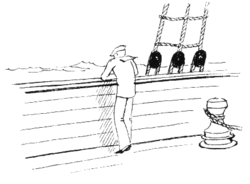
.png)
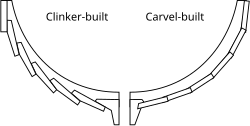


.svg)