
.jpg/250px-Kung_Hei_Fat_Choi!_(6834861529).jpg)


.jpg/2000px-Kung_Hei_Fat_Choi!_(6834861529).jpg)
Community hub
Recent from talks
Contribute something
Nothing was collected or created yet.
Chinese New Year
View on Wikipedia
| Chinese New Year | |||||||||||||||||||||||||||||||||
|---|---|---|---|---|---|---|---|---|---|---|---|---|---|---|---|---|---|---|---|---|---|---|---|---|---|---|---|---|---|---|---|---|---|
.jpg)   .jpg)    Clockwise from the top: Fireworks over Victoria Harbour in Hong Kong; lion dance in Boston Chinatown; red lanterns on display; complex patterns woven at dragon dance in Binondo, Manila; red envelopes; firecrackers exploding; and spring couplet | |||||||||||||||||||||||||||||||||
| Also called | Spring Festival | ||||||||||||||||||||||||||||||||
| Observed by | Chinese people and Sinophone communities[1] | ||||||||||||||||||||||||||||||||
| Type | Cultural Religious (Chinese folk religion, Han Buddhist, Confucian, Taoist, some Christian communities) | ||||||||||||||||||||||||||||||||
| Significance | Commemoration of the beginning of a new year on the traditional lunisolar Chinese calendar | ||||||||||||||||||||||||||||||||
| Celebrations | Lion dances, dragon dances, fireworks, family gathering, family meal, visiting friends and relatives, giving red envelopes, decorating with chunlian couplets | ||||||||||||||||||||||||||||||||
| Date | First day of the first Chinese lunisolar month | ||||||||||||||||||||||||||||||||
| 2024 date | 10 February | ||||||||||||||||||||||||||||||||
| 2025 date | 29 January | ||||||||||||||||||||||||||||||||
| 2026 date | 17 February | ||||||||||||||||||||||||||||||||
| Frequency | Annual | ||||||||||||||||||||||||||||||||
| Related to | Lantern Festival and similar celebrations in other Asian cultures | ||||||||||||||||||||||||||||||||
| Chinese name | |||||||||||||||||||||||||||||||||
| Traditional Chinese | 春節 | ||||||||||||||||||||||||||||||||
| Simplified Chinese | 春节 | ||||||||||||||||||||||||||||||||
| Literal meaning | "Spring Festival" | ||||||||||||||||||||||||||||||||
| |||||||||||||||||||||||||||||||||
| Agricultural Calendar New Year | |||||||||||||||||||||||||||||||||
| Traditional Chinese | 農曆新年 | ||||||||||||||||||||||||||||||||
| Simplified Chinese | 农历新年 | ||||||||||||||||||||||||||||||||
| |||||||||||||||||||||||||||||||||
| Traditional Chinese New Year | |||||||||||||||||||||||||||||||||
| Traditional Chinese | 中國傳統新年 | ||||||||||||||||||||||||||||||||
| Simplified Chinese | 中国传统新年 | ||||||||||||||||||||||||||||||||
| |||||||||||||||||||||||||||||||||
| Spring Festival— Social practices of the Chinese people in celebration of traditional new year | |
|---|---|
 Chinese New Year Celebrations | |
| Country | China |
| Reference | 2126 |
| Region | Asia and the Pacific |
| Inscription history | |
| Inscription | 2024 (19th session) |
| List | Representative |
 UNESCO Cultural Heritage | |
Chinese New Year, also known as the Spring Festival (see also § Names), marks the beginning of a new year on the traditional lunisolar Chinese calendar. It is one of the most important holidays in Chinese culture and was placed on the UNESCO Intangible Cultural Heritage of Humanity list in 2024. Marking the end of winter and the beginning of spring, this festival takes place from Chinese New Year's Eve (the evening preceding the first day of the year) to the Lantern Festival, held on the 15th day of the year. The first day of the Chinese New Year falls on the new moon that appears between 21 January and 20 February.[a]
The Chinese New Year is associated with several myths and customs. The festival was traditionally a time to honour deities and ancestors.[3] Throughout China, different regions celebrate the New Year with distinct local customs and traditions.[4] Chinese New Year's Eve is an occasion for Chinese families to gather for the annual reunion dinner. Traditionally, every family would thoroughly clean their house, symbolically sweeping away any ill fortune to make way for incoming good luck. Windows and doors may be decorated with red paper-cuts and couplets representing themes such as good fortune, happiness, wealth, and longevity. Other activities include lighting firecrackers and giving money in red envelopes.
Chinese New Year is also celebrated worldwide in regions and countries with significant Overseas Chinese or Sinophone populations, especially in Southeast Asia, including Australia, Singapore,[5] Brunei, Cambodia, Indonesia, Malaysia, Myanmar,[6] the Philippines,[7] and Thailand. It is also prominent beyond Asia, especially in Australia, Canada, France, Mauritius,[8] New Zealand, Peru,[9] South Africa, the United Kingdom, as well as in many other European countries, and the United States.[10][11][12] Chinese New Year has influenced celebrations, commonly referred to collectively as Lunar New Year, in other cultures, such as the Losar of Tibet, the Tết of Vietnam, the Seollal of Korea, the Shōgatsu of Japan, and the Ryukyu New Year (Okinawan: Sjoogwaci).[13][14][15]
Names
[edit]In Chinese, the festival is commonly known as the "Spring Festival" (traditional Chinese: 春節; simplified Chinese: 春节; pinyin: Chūnjié),[16] as the spring season in the lunisolar calendar traditionally starts with lichun, the first of the twenty-four solar terms that the festival celebrates around the time of the Chinese New Year.[17] The name was first proposed in 1914 by Yuan Shikai, who was the interim president of the Republic of China.[18] The official usage of the name "Spring Festival" was retained by the government of the People's Republic of China, but the government of the Republic of China based in Taiwan has since adopted the name "Traditional Chinese New Year".[19]
The festival is also called "Lunar New Year" in English, despite the traditional Chinese calendar being lunisolar and not lunar. However, "Chinese New Year" is still a commonly used translation for people of non-Chinese backgrounds.[20] Along with the Han Chinese inside and outside of Greater China, as many as 29 of the 55 ethnic minority groups in China also celebrate Chinese New Year. Korea, Vietnam, Singapore, Malaysia, Indonesia, and the Philippines celebrate it as an official festival.[20]
Dates in the Chinese lunisolar calendar
[edit]


The Chinese calendar defines the lunisolar month containing the winter solstice as the eleventh month, meaning that Chinese New Year usually falls on the second new moon after the winter solstice (rarely the third, if an intercalary month occurs[b]).[21][2] In more than 96 percent of years, the Chinese New Year is the closest new moon to the beginning of spring (lichun) according to the calendar. In the Gregorian calendar, Chinese New Year occurs on the new moon that falls between 21 January and 20 February.[22]
| Gregorian | Date | Animal | Day of the week |
|---|---|---|---|
| 2024 | 10 Feb | Dragon | Saturday |
| 2025 | 29 Jan | Snake | Wednesday |
| 2026 | 17 Feb | Horse | Tuesday |
| 2027 | 6 Feb | Goat | Saturday |
| 2028 | 26 Jan | Monkey | Wednesday |
| 2029 | 13 Feb | Rooster | Tuesday |
| 2030 | 3 Feb | Dog | Sunday |
| 2031 | 23 Jan | Pig | Thursday |
| 2032 | 11 Feb | Rat | Wednesday |
| 2033 | 31 Jan | Ox | Monday |
| 2034 | 19 Feb | Tiger | Sunday |
| 2035 | 8 Feb | Rabbit | Thursday |
Chinese Calendar Computation
[edit] | This section may incorporate text from a large language model. (September 2025) |
The compilation and implementation of the Chinese calendar adhere to the following rules:
- Standard Time Reference: Beijing Time is used as the standard time for calculations.
- First Day of Lunisolar Month: Each lunisolar month begins on the new moon (Shuo Ri, 朔日).
- Eleventh Lunisolar Month: The lunisolar month that contains the Winter Solstice (Dongzhi, 冬至) is designated as the 11th lunisolar month.
- Intercalary Month Rule: If there are 13 lunisolar months in a year, the first month without a major solar term (Zhongqi, 中氣) is designated as the leap month.
- Start of the New Year: The second lunisolar month after the 11th month (excluding leap months) is designated as the first month of the new year.
The Chinese calendar is based on precise astronomical calculations of the sun and the moon's positions, following the standards set by the International Celestial Reference System (ICRS) and the International Earth Rotation and Reference Systems Service (IERS).
The naming of the years follows the Sexagenary Cycle (Ganzhi, 干支纪年), where years cycle through 60 combinations of the 10 Heavenly Stems (Tiangan, 天干) and 12 Earthly Branches (Dizhi, 地支). For example, the Chinese year from 2 February 1984, to 19 February 1985, was designated as a Jiazi (甲子) year.[23]
Mythology
[edit]
According to legend, Chinese New Year started with combatting a mythical beast called the Nian (a beast that lives under the sea or in the mountains that looks like a lion with horns) during the annual Spring Festival. The Nian would eat villagers, especially children, in the middle of the night.[24] One year, all the villagers decided to hide from the beast. An older man appeared before the villagers went into hiding and said that he would stay the night and would get revenge on the Nian. The old man put up red papers and set off firecrackers. The day after, the villagers came back to their town and saw that nothing had been destroyed. They assumed that the old man was a deity who had come to save them. The villagers then understood that the Nian was afraid of the colour red and loud noises.[24] As the New Year approached, the tradition grew: villagers wore red clothing, hung red lanterns and spring scrolls on windows and doors, and used firecrackers and drums to frighten away the Nian. From then on, the Nian never came to the village again. The Nian was eventually captured by Hongjun Laozu, an ancient Taoist monk.[25]
History
[edit]| Part of a series on |
| Chinese folk religion |
|---|
 |
|
Major cultural forms
Main philosophical traditions: Ritual traditions: Devotional traditions:
 Confucian churches and sects: |

Before the new year celebration was established, ancient Chinese gathered and celebrated the end of the harvest in autumn. However, this was not the Mid-Autumn Festival, during which the Chinese gathered with family to worship the Moon. In the Classic of Poetry, a poem written during the Western Zhou period (1046 BC – 771 BC) by an anonymous farmer, described the traditions of celebrating the 10th month of the ancient solar calendar, which was in autumn.[26] The poem describes people cleaning millet stacks, offering mijiu (rice wine) to guests, slaughtering lambs, visiting their master's home, toasting him, and expressing wishes for longevity together. The 10th month celebration is believed to be one of the prototypes of Chinese New Year.[27] The records of the first Chinese New Year celebration can be traced to the Warring States period (475 – 221 BC). In the Lüshi Chunqiu, in the Qin state, an exorcism ritual to expel illness, called "Big Nuo", was recorded as being carried out on the last day of the year.[28][29] Later, Qin unified China, and the Qin dynasty was founded; and the ritual spread. It evolved into the practice of cleaning one's house thoroughly in the days preceding the Chinese New Year.
The first mention of celebrating the start of a new year was recorded during the Han dynasty (202 BC – 220 AD). In the book Simin Yueling (四民月令), written by the Eastern Han agronomist Cui Shi (崔寔), such a celebration was described: "The starting day of the first month is called Zheng Ri. I bring my wife and children to worship ancestors and commemorate my father." Later, he wrote: "Children, wife, grandchildren, and great-grandchildren all serve pepper wine to their parents, make their toast, and wish their parents good health. It's a thriving view."[30] The practice of worshipping ancestors on New Year's Eve is maintained by Chinese people to this day.[31]
Han Chinese also started the custom of visiting acquaintances' homes and wishing each other a happy new year. In Book of the Later Han, volume 27, a county officer was recorded as going to his prefect's house with a government secretary, toasting the prefect, and praising the prefect's merit.[32][33]
During the Jin dynasty (266–420), people started the New Year's Eve tradition of all-night revelry called shousui (守歲). It was described in an article by Zhou Chu, a general of the Western Jin, Fengtu Ji (風土記, "Notes on Local Conditions"): "At the ending of a year, people gift and wish each other, calling it Kuisui (饋歲, 'time for gifts'); people invited others with drinks and food, calling it Biesui (別歲, 'sending off the year'); on New Year's Eve, people stayed up all night until sunrise, calling it Shousui (守歲, 'guard the year')."[34] The article used the phrase chuxi (除夕) to indicate New Year's Eve—a phrase still used today.
A book of the Northern and Southern dynasties, Jingchu Suishiji, describes the practice of firing bamboo in the early morning of New Year's Day,[35] a New Year's tradition of the ancient Chinese. Poet and chancellor of the Tang dynasty, Lai Gu, also described this tradition in his poem Early Spring (早春): "新曆才將半紙開,小亭猶聚爆竿灰", meaning "Another new year just started as a half-opening paper, and the family gathered around the dust of exploded bamboo poles."[36] The practice was used by ancient Chinese people to scare away evil spirits, since bamboo would noisily crack and explode from being fired.
During the Tang dynasty, people established the custom of sending bai nian tie (拜年帖, "New Year's greetings"), New Year's greeting cards. It is said that the custom was started by Emperor Taizong of Tang. The emperor wrote "普天同慶" ("whole nation celebrates together") on gold leaves and sent them to his ministers. Word of the emperor's gesture spread, and later it became the custom of people in general, who used Xuan paper instead of gold leaves.[37] Another theory is that bai nian tie was derived from the Han dynasty's name tag, men zhuang (門狀, "door opening"). As imperial examinations became essential and reached their heyday under the Tang dynasty, candidates curried favour to become pupils of respected teachers and to get recommendation letters. After obtaining good examination marks, a pupil went to the teacher's home with a men zhuang to convey their gratitude. Eventually, men zhuang became a symbol of good luck, and people started sending them to friends on New Year's Day, calling them by a new name, bai nian tie.[38]

The Chunlian (Spring Couplets) was written by Meng Chang, an emperor of the Later Shu (935–965 AD), during the Five Dynasties and Ten Kingdoms period:"新年納餘慶,嘉節號長春" ("Enjoying past legacies in the new year, the holiday foreseeing the long-lasting spring"). As described by Song dynasty official Zhang Tangying in his book Shu Tao Wu, Volume 2, on the day of New Year's Eve the emperor ordered the scholar Xin Yinxun to write the couplets on peach wood and hang them on the emperor's bedroom door.[39][40] It is believed that placing the couplets on the door to the home in the days preceding the new year was widespread during the Song dynasty. The famous Northern Song politician, littérateur, philosopher, and poet Wang Anshi recorded the custom in his poem "元日" ("New Year's Day").[41]
爆竹聲中一歲除,
春風送暖入屠蘇。
千門萬戶曈曈日,
總把新桃換舊符。
Amid the sound of firecrackers, a year has come to an end,
The spring wind has wafted warm breath to the Tusu wine.
While the rising sun shines over each and every household,
People get rid of the old couplets and put up the new ones.

The poem Yuan Ri (元日) also includes the word bao zhu (爆竹, "exploding bamboo"), which is believed to be a reference to firecrackers,[citation needed] instead of the previous tradition of firing bamboo, both of which are called the same in the Chinese language. After gunpowder was invented in the Tang dynasty and widely used under the Song dynasty, people modified the tradition of firing bamboo by filling the bamboo pole with gunpowder, which made for louder explosions. Later, under the Song, people discarded the bamboo and started to use paper to wrap the gunpowder in cylinders, in imitation of the bamboo. The firecracker was still called bao zhu (爆竹), thus equating the new and old traditions. It is also recorded that people linked the firecrackers with hemp rope and created the bian pao (鞭炮, "gunpowder whip") in the Song dynasty. Both bao zhu (爆竹) and bian pao (鞭炮) are still used today to celebrate the Chinese New Year and other festive occasions.[42]
It was also during the Song dynasty that people started to give money to children in celebration of a new year. The money was called sui nian qian (随年钱, "money based on age"). In the chapter, "Ending of a Year" (歲除) in Wulin jiushi (武林舊事), concubines of the emperor prepared a hundred and twenty coins for princes and princesses to wish them longevity.[43]
New Year's celebrations continued under the Yuan dynasty, when people also gave nian gao (年糕, "year cakes") to relatives.[44]
The tradition of eating Chinese dumplings, jiaozi (餃子), was established under the Ming dynasty, at the latest. It is described in the book Youzhongzhi (酌中志): "People get up at 5 in the morning of new year's day, burn incense and light firecrackers, throw door latch or wooden bars in the air three times, drink pepper and thuja wine, eat dumplings. Sometimes put one or two silver currency inside dumplings, and whoever gets the money will attain a year of fortune."[45] Modern Chinese people also put other food that is auspicious into dumplings: such as dates, which prophesy a flourishing new year; candy, which predicts sweet days; and nian gao (年糕, "year cakes"), which foretell a rich life.
In the Qing dynasty, the name ya sui qian (壓歲錢, "New Year's Money") was money given to children during New Year's. The book Qing Jia Lu (清嘉錄) recorded: "elders give children coins threaded together by a red string, and the money is called Ya Sui Qian."[46] The term is still used by Chinese people today. The money was presented in two forms: coins strung on red string or colourful purses filled with coins.[47]
In 1928, the ruling Kuomintang party decreed that Chinese New Year would fall on 1 January of the Gregorian calendar, but this was abandoned due to overwhelming opposition. In 1967, during the Cultural Revolution, official Chinese New Year celebrations were banned in China. The State Council of the People's Republic of China announced that the public should "change customs" and have a "revolutionized and fighting Spring Festival". Since people needed to work on Chinese New Year's Eve, they would not need holidays during the Spring Festival. After the Cultural Revolution ended, public celebrations were reinstated.[48]
Recognition by the United Nations
[edit]In 2024, Chinese New Year was added to the Intangible Cultural Heritage of Humanity list by the United Nations Educational, Scientific and Cultural Organisation.[49][50][51]
Public holiday
[edit]Chinese New Year is observed as a public holiday in some countries and territories, outside of China, with a sizable Chinese population. Since Chinese New Year falls on different days of the week each year, the governments of some of these countries choose to adjust working days to create a longer public holiday. In certain countries, a statutory holiday is added on the following workday if the New Year (as a public holiday) falls on a weekend. For example, in 2013, New Year's Eve (9 February) fell on a Saturday and New Year's Day (10 February) on a Sunday. The holiday may be referred to by different names depending on the country: common English terms include "Chinese New Year", "Lunar New Year", "New Year Festival", and "Spring Festival".
For New Year celebrations that follow Chinese-inspired calendars but are outside of China and the Chinese diaspora (such as Korea's Seollal and Vietnam's Tết), see the article on Lunar New Year.
For other countries and regions where the Chinese New Year is celebrated but not as an official holiday, see the table below.
| Country/region | Official name | Description | No. of days |
|---|---|---|---|
| Malaysia | Tahun Baru Cina | The first 2 days of Chinese New Year.[52] | 2[53][52] |
| Singapore | Chinese New Year | The first 2 days of Chinese New Year.[54] | 2 |
| Brunei | Tahun Baru Cina | Half-day on Chinese New Year's Eve and the first day of Chinese New Year.[55] | 1 |
| Hong Kong | Lunar New Year | The first 3 days of Chinese New Year.[56] | 3 |
| Macau | Novo Ano Lunar | The first 3 days of Chinese New Year[57] | 3 |
| Indonesia | Tahun Baru Imlek (Sin Cia) | The first day of Chinese New Year.[58][59] | 1 |
| China | Spring Festival (Chūn Jié) | The eve and first 3 days of Chinese New Year. Extra holiday days are de facto added adjusting the weekend days before and after the three days holiday, resulting in a full week of public holiday known as Golden Week.[60][61] During the Chunyun holiday travel season. | 4 (official holiday days) 7 (de facto holiday days) |
| Myanmar | Chinese New Year | The first day of Chinese New Year. | 1 |
| Philippines | Chinese New Year | Half-day on Chinese New Year's Eve and the first day of Chinese New Year.[62] | 1 |
| South Korea | Korean New Year (Seollal) | The first 3 days of Chinese New Year. | 3 |
| Taiwan | Lunar New Year | Chinese New Year's Eve and the first 3 days of Chinese New Year; will be made up on subsequent working days if any of the 4 days fall on Saturday or Sunday. The day before Chinese New Year's Eve is also designated as holiday, but as a bridge holiday, and will be made up on an earlier or later Saturday. Additional bridge holidays may apply, resulting in 9-day or 10-day weekends.[63][64][65] | 4 (legally) 9–10 (including Saturdays and Sundays)[66] |
| Thailand | Wan Trut Chin (Chinese New Year's Day) | Observed by Thai Chinese and parts of the private sector. Usually celebrated for three days, starting on the day before the Chinese New Year's Eve. Chinese New Year is observed as a public holiday in Narathiwat, Pattani, Yala, Satun[67] and Songkhla Provinces.[54] | 1 |
| Vietnam | Tết Nguyên Đán (Vietnamese New Year) | The first 3 days of Chinese New Year. | 3 |
| Japan | Shōgatsu (Japanese New Year) | Since 1873, the official Japanese New Year has been celebrated according to the Gregorian calendar, on January 1 of each year, New Year's Day (元日, Ganjitsu). | 4 |
| New York, United States | Lunar New Year | The first day of Lunar New Year. | 1 |
| California, United States | |||
| Suriname | Maan Nieuwjaar | The first day of Chinese New Year. | 1 |
Festivities
[edit]Red couplets and red lanterns are displayed on the door frames and light up the atmosphere. The air is filled with strong Chinese emotions. In stores in Beijing, Shanghai, Wuhan, and other cities, products of traditional Chinese style have started to lead fashion trend[s]. Buy yourself a Chinese-style coat, get your kids tiger-head hats and shoes, and decorate your home with some beautiful red Chinese knots, then you will have an authentic Chinese-style Spring Festival.
— Xinwen Lianbo, January 2001, quoted by Li Ren, Imagining China in the Era of Global Consumerism and Local Consciousness[68]
Preceding days
[edit]On the eighth day of the lunisolar month before the Chinese New Year, the Laba Festival, a traditional porridge, Laba porridge (simplified Chinese: 腊八粥; traditional Chinese: 臘八粥; pinyin: làbā zhōu), is served in remembrance of an ancient festival, called La, that occurred shortly after the winter solstice.[69] Pickles such as Laba garlic, which turns green from vinegar, are made on this day. For those who practice Buddhism, the Laba holiday is also considered Bodhi Day. Layue (simplified Chinese: 腊月; traditional Chinese: 臘月; pinyin: Làyuè) is a term often associated with Chinese New Year as it refers to the sacrifices held in honour of the gods in the twelfth lunisolar month; hence, the cured meats of Chinese New Year are known as larou (simplified Chinese: 腊肉; traditional Chinese: 臘肉; pinyin: làròu). The porridge was prepared by the women of the household at first light, with the first bowl offered to the family's ancestors and the household deities. Every member of the family was then served a bowl, with leftovers distributed to relatives and friends.[70] It is still served as a special breakfast on this day in some Chinese homes. The concept of the "La month" is similar to Advent in Christianity. Many families eat vegetarian meals on Chinese New Year's Eve, and the garlic and preserved meat are eaten on Chinese New Year Day.

On the days immediately before the new year celebration, Chinese families give their homes a thorough cleaning. There is a Cantonese saying "Wash away the dirt on nin ya baat" (Chinese: 年廿八,洗邋遢; pinyin: nián niàn bā, xǐ lātà; Jyutping: nin4 jaa6 baat3, sai2 laap6 taap3 (laat6 taat3), the 28th day of month 12), but the practice is not restricted to nin ya baat. It is believed that the cleaning sweeps away the bad luck of the preceding year and prepares homes for good luck. Brooms and dust pans are put away on the first day so that the newly arrived good luck cannot be swept away. Some people give their homes, doors, and window-frames a new coat of red paint; decorators and paper-hangers experience a year-end rush of business before the Chinese New Year.[71] Homes are often decorated with paper cutouts of Chinese auspicious phrases and couplets. Purchasing new clothing and shoes also symbolizes a new start. Any haircuts need to be completed before the New Year, as cutting hair on New Year is considered bad luck due to the homonymic nature of the word "hair" (fa) and the word for "prosperity". Businesses are expected to pay off all the debts outstanding for the year before New Year's Eve, including debts of gratitude. Thus, it is a common practice to send gifts and rice to close business associates and extended family members.
In many households where Buddhism or Taoism is observed, home altars and statues are cleaned thoroughly, and decorations used to adorn altars over the past year are taken down and burned a week before the new year starts on Little New Year, to be replaced with new decorations. Taoists (and Buddhists to a lesser extent) will also "send gods back to heaven" (Chinese: 送神; pinyin: sòngshén): an example would be burning a paper effigy of the Kitchen God, the recorder of family functions. This is done so that the Kitchen God can report to the Jade Emperor of the family household's transgressions and good deeds. Families often offer sweet foods (such as candy) to "bribe" the deities into reporting good things about the family.
Before the Reunion Dinner, a prayer of thanksgiving is held to mark the safe passage of the previous year. Confucianists take the opportunity to remember their ancestors, and those who had lived before them are revered. Some people do not offer a Buddhist prayer due to the influence of Christianity, with a Christian prayer offered instead.
Chinese New Year's Eve
[edit]The day before Chinese New Year is usually accompanied by a dinner feast, consisting of special meats as a main course and an offering for the New Year. This meal is comparable to Thanksgiving dinner or Christmas dinner.
In northern China, it is customary to make jiaozi or dumplings, which are eaten at midnight. Dumplings symbolize wealth because their shape resembles a Chinese sycee. In the South, it is customary to make a glutinous new year cake (niangao) and send pieces of it as gifts to relatives and friends in the coming days.[72]
Some families visit local temples hours before midnight to pray for success and by lighting the first incense of the year. Today, many households hold parties. Traditionally, firecrackers were lit to ward off evil spirits. The household doors are sealed and not reopened until dawn in a ritual called "opening the door of fortune" (simplified Chinese: 开财门; traditional Chinese: 開財門; pinyin: kāicáimén).[73] The tradition of staying up late on Chinese New Year's Eve is known as shousui (Chinese: 守岁). It is still practised and believed to add to parental longevity.
First day
[edit]The first day, known as the "Spring Festival" (simplified Chinese: 春节; traditional Chinese: 春節), is for the welcoming of the deities of the heavens and Earth at midnight. It is a traditional practice to light fireworks, burn bamboo sticks and firecrackers, and perform a lion dance to ward off evil spirits.
Typical actions such as lighting fires and using knives are considered taboo; thus, all consumable food has to be cooked beforehand. Using the broom, swearing, and breaking any dinnerware without appeasing the deities are also considered taboo.[74]
Normal traditions occurring on the first day involve house gatherings for families, specifically the elders and families to the oldest and most senior members of their extended families, usually their parents, grandparents, and great-grandparents, and trading Mandarin oranges as a courtesy to symbolize wealth and good luck. Members of the family who are married also give red envelopes containing cash known as lai see (Cantonese: 利事) or angpow (Hokkien and Teochew), or hongbao (Mandarin: 红包), a form of a blessing and to suppress both the ageing and other challenges that were associated with the coming year, to junior members of the family, mostly children and teenagers. Business managers may also give bonuses in the form of red packets to employees.[75] The money can be of any form, specifically in numbers ending with 8 (Mandarin: ba 八), which sounds similar to fa (Mandarin: 发), meaning prosperity; but packets with denominations of odd or unlucky numbers, or packets without money, are usually not allowed due to bad luck. The number 4 is especially unlucky, because it sounds similar to si (Mandarin: 死), which means death.[76][75]
While fireworks and firecrackers are traditionally very popular, some regions have banned them due to concerns over fire hazards. For this reason, various city governments (e.g., Kowloon, Beijing, Shanghai for a number of years) have issued bans on fireworks and firecrackers in certain precincts of the city. As a substitute, large-scale fireworks displays have been sponsored by governments in Hong Kong and Singapore.
Second day
[edit]
The second day, entitled "a year's beginning" (simplified Chinese: 开年; traditional Chinese: 開年; pinyin: kāinián),[77] sees married daughters visiting their birth parents, relatives, and close friends, often renewing family ties and relationships. (Traditionally, married daughters didn't have the opportunity to visit their birth families frequently.)
The second day also saw giving offering money and sacrifices to the God of Wealth (Chinese: 财神) to symbolize a rewarding time after hardship in the preceding year. During the days of imperial China, "beggars and other unemployed people circulate[d] from family to family, carrying a picture [of the God of Wealth] shouting, 'Cai Shen dao!' [The God of Wealth has come!]."[78] Householders would respond with "lucky money" to reward the messengers. Business people of the Cantonese dialect group will hold a Hoi Nin prayer to start their business on the second day of the Chinese New Year, blessing their business to thrive in the coming year.
As this day is believed to be The Birthday of Che Kung, a deity worshipped in Hong Kong, worshippers go to Che Kung Temples to pray for his blessing. A representative from the government asks Che Kung about the city's fortune through kau cim.
Third day
[edit]The third day is known as "red mouth", or Chikou (Chinese: 赤口; pinyin: Chìkǒu), which is also called "Chigou's Day" (Chinese: 赤狗日; pinyin: Chìgǒurì). Chigou, literally "red dog", is an epithet of "the God of Blazing Wrath" (Chinese: 熛怒之神; pinyin: Biāo nù zhī shén). Rural villagers continue the tradition of burning paper offerings over trash fires. It is considered an unlucky day to have guests or go visiting.[79] Hakka villagers in rural Hong Kong in the 1960s called it the Day of the Poor Devil and believed everyone should stay at home.[80] This is also considered a propitious day to visit the temple of the God of Wealth and have one's future told.
Fourth day
[edit]In communities that celebrate Chinese New Year for 15 days, the fourth day marks the beginning of corporate "spring dinners" and the return to normal business operations. In other regions with a longer Chinese New Year holiday, celebrations include welcoming back the gods who were previously sent off on this day.
Fifth day
[edit]This day, powu (Chinese: 破五; pinyin: pòwǔ), is the birthday of the God of Wealth, also known as Guan Yu. In northern China, people eat jiaozi, or dumplings, in the morning.
In China, it is also common that on the 5th day people will shoot off firecrackers to get Guan Yu's attention, thus ensuring his favour and good fortune for the new year.
Sixth day
[edit]On the sixth day, known as Horse's Day, people drive away the Ghost of Poverty by discarding the garbage accumulated during the festival. The methods may vary, but they essentially convey the same meaning: to dispel the Ghost of Poverty. This practice reflects the common desire among the Chinese people to bid farewell to the old and welcome the new year, to rid themselves of past poverty and hardships, and to usher in a prosperous and auspicious life in the new year.[81]
Seventh day
[edit]The seventh day, traditionally known as Renri (the common person's birthday), is the day when everyone grows one year older. In some overseas Chinese communities in Southeast Asia, such as Malaysia and Singapore, it is also the day when tossed raw fish salad, yusheng, is eaten for continued wealth and prosperity.
For many Chinese Buddhists, this is another day to avoid meat, as the seventh day commemorates the birth of Sakra, lord of the Devas in Buddhist cosmology, who is analogous to the Jade Emperor.
Eighth day
[edit]
Another family dinner is held to celebrate the eve of the birth of the Jade Emperor, the ruler of heaven. People typically return to work by the eighth day. Therefore, store owners will host a lunch or dinner for their employees, expressing gratitude for the work they have done throughout the year.
Ninth day
[edit]The ninth day is traditionally the birthday of the Jade Emperor of Heaven (Chinese: 玉皇; pinyin: Yù Huáng), and many people pray to the Taoist Pantheon in thanks or gratitude.[82] The day is commonly known as Ti Kong Dan (Chinese: 天公誕; Pe̍h-ōe-jī: Thiⁿ-kong Tan), Ti Kong Si (Chinese: 天公生; Pe̍h-ōe-jī: Thiⁿ-kong Siⁿ/Thiⁿ-kong Seⁿ), or Pai Ti Kong (Chinese: 拜天公; Pe̍h-ōe-jī: Pài Thiⁿ-kong), and is especially important to Hokkiens.[83]
A prominent requisite offering is sugarcane.[83] Legends hold that the Hokkien were spared from a massacre by Japanese pirates by hiding in a sugarcane plantation, between the eighth and ninth days of the Chinese New Year, coinciding with the Jade Emperor's birthday.[83] "Sugarcane" (Chinese: 甘蔗; Pe̍h-ōe-jī: kam-chià) is a near homonym to "thank you" (Chinese: 感謝; Pe̍h-ōe-jī: kám-siā) in the Hokkien dialect.[83]
Tenth day
[edit]Some celebrate the Jade Emperor's birthday on this day.
Fifteenth day
[edit]The fifteenth day of the new year is celebrated as the Lantern Festival, also known as the Yuanxiao Festival (simplified Chinese: 元宵节; traditional Chinese: 元宵節; pinyin: Yuán xiāo jié), the Shangyuan Festival (simplified Chinese: 上元节; traditional Chinese: 上元節; pinyin: Shàng yuán jié), and Chap Goh Meh (Chinese: 十五暝; Pe̍h-ōe-jī: Cha̍p-gō͘-mê; lit. 'the fifteen night' in Hokkien). Rice dumplings, or tangyuan (simplified Chinese: 汤圆; traditional Chinese: 湯圓; pinyin: tang yuán), a sweet glutinous rice ball brewed in soup, are eaten this day. Candles are lit outside houses as a way to guide wayward spirits home. Families may walk the streets carrying lanterns, which sometimes have riddles attached to or written on them as a tradition.[84]
In China and Malaysia, this day is celebrated by individuals seeking a romantic partner, akin to Valentine's Day.[85] Nowadays, single women write their contact numbers on mandarin oranges and throw them into a river or a lake, after which single men collect the oranges and eat them. The taste serves as an indication of their potential love life: a sweet taste represents good fortune, while a sour taste represents a less favorable outcome.
This day often marks the end of the Chinese New Year festivities.
Traditional food
[edit]
A reunion dinner is held on New Year's Eve, during which family members gather for a celebration.[86] The venue will usually be in or near the home of the most senior member of the family. The New Year's Eve dinner is very large and sumptuous and traditionally includes dishes of meat (namely, pork and chicken) and fish. Most reunion dinners also feature a communal hot pot, as it is believed to signify the coming together of the family members for the meal. Reunion dinners (particularly in the Southern regions) may prominently feature specialty meats (e.g. wax-cured meats such as duck and Chinese sausage) and seafood (e.g. lobster and abalone) that are usually reserved for special occasions. In most areas, fish (simplified Chinese: 鱼; traditional Chinese: 魚; pinyin: yú) is included, but not eaten completely (and the remainder is stored overnight), as the Chinese phrase "may there be surpluses every year" (simplified Chinese: 年年有余; traditional Chinese: 年年有餘; pinyin: niánnián yǒu yú) sounds the same as "let there be fish every year". Eight individual dishes are served to reflect the belief in good fortune being associated with the number. If in the previous year a death was experienced in the family, seven dishes are served.
Other traditional foods consist of noodles, fruits, dumplings,[87] spring rolls,[88] and Tangyuan,[86] which are also known as sweet rice balls. Each dish served during Chinese New Year represents something special. The noodles used to make longevity noodles are usually very thin, long wheat noodles, which are longer than normal noodles, and are usually fried and served on a plate, or boiled and served in a bowl with their broth. The noodles symbolize the wish for a long life. The fruits that are typically selected would be oranges, tangerines, and pomelos, as they are round and "golden" in color, symbolizing fullness and wealth. The pronunciations of these Chinese words are said to harbor luck and prosperity, such as the Chinese pronunciation for orange (橙 chéng), which sounds the same as the Chinese for 'success' (成). The pomelo, which is believed to bring constant prosperity, also has a pronunciation that symbolize good luck. The Chinese word for pomelos (柚 yòu) sounds similar to 'to have' (有 yǒu); disregarding its tone, however, it sounds exactly like 'again' (又 yòu). Certain Chinese characters can represent luck as well, such as the Chinese word for tangerine (桔 jú), which contains the Chinese character for luck (吉 jí). Additionally, dumplings and spring rolls symbolize wealth, whereas sweet rice balls symbolize family togetherness.
Red envelopes may be distributed during the reunion dinner to the immediate family. These packets contain money in an amount that reflects good luck and honorability. Several foods are consumed to usher in wealth, happiness, and good fortune. Several of the Chinese food names are homophones for words that also mean good things.
Many families in China still follow the tradition of eating only vegetarian food on the first day of the new year, as it is believed that doing so will bring good luck into their lives for the whole year.[89]
Like many other New Year dishes, certain ingredients that have names that relate to long life, prosperity, or wealth also take precedence over others.
| Food item | Simplified Chinese | Traditional Chinese | Hanyu Pinyin | Description |
|---|---|---|---|---|
| Buddha's delight | 罗汉斋 | 羅漢齋 | Luóhàn zhāi | An elaborate vegetarian dish served by Chinese families on the eve and the first day of the New Year. A type of black hair-like algae, pronounced "fat choy" in Cantonese, is also featured in the dish for its name, which sounds like "prosperity". Hakkas usually serve kiu nyuk (Chinese: 扣肉; pinyin: kòuròu) and ngiong teu fu. |
| Chicken | 鸡 | 雞 | Jī | Boiled chicken is served because it is figured that any family, no matter how humble their circumstances, can afford a chicken for the Chinese New Year. |
| Apples | 苹果 | 蘋果 | Píngguǒ | Apples symbolize peace because the word for apple ("ping") is a homonym of the word for peace. |
| Fish | 鱼 | 魚 | Yú | Is usually eaten or merely displayed on the eve of the Chinese New Year. The pronunciation of fish makes it a homophone for "surpluses" (simplified Chinese: 余; traditional Chinese: 餘; pinyin: yú). |
| Garlic | 蒜 | Suàn | Is usually served in a dish with rondelles of Chinese sausage or Chinese cured meat during the Chinese New Year. The pronunciation of Garlic makes it a homophone for "calculating (money)" (Chinese: 算; pinyin: suàn). The Chinese cured meat is so chosen because it is traditionally the primary method for storing meat over the winter, and the meat rondelles resemble coins. | |
| Jau gok | 油角 | Yóu jiǎo | The main Chinese New Year dumpling for Cantonese families. It is believed to resemble a sycee or yuánbǎo, the old Chinese gold and silver ingots, and to represent prosperity for the coming year. | |
| Jiaozi | 饺子 | 餃子 | Jiǎozi | The common dumpling eaten in northern China, also believed to resemble sycee. At the reunion dinner, Chinese people add various foods into Jiaozi fillings to represent good fortune: coins, Niangao, dried dates, candy, etc. |
| Mandarin oranges | 桔子 | Júzi | Oranges, particularly mandarin oranges, are a common fruit during the Chinese New Year. They are particularly associated with the festival in southern China, where its name is a homophone of the word for "luck" in dialects such as Teochew (in which 橘, jú, and 吉, jí, are both pronounced gik).[90] | |
| Melon seed/Guazi | 瓜子 | Guāzi | Other variations include sunflower, pumpkin and other seeds. It symbolizes fertility and having many children. | |
| Niangao | 年糕 | Niángāo | Most popular in eastern China (Jiangsu, Zhejiang and Shanghai) because its pronunciation is a homophone for "a more prosperous year (年高 lit. year high)". Niangao is also popular in the Philippines, where there is a large Chinese population and is known as tikoy (Chinese: 甜粿, from Min Nan) there. Known as the Chinese New Year pudding, niangao is made up of glutinous rice flour, wheat starch, salt, water, and sugar. The color of the sugar used determines the color of the pudding (white or brown). | |
| Noodles | 面条 | 麵條 | Miàntiáo | Families may serve uncut noodles (making them as long as they can[91]), which represent longevity and long life, though this practice is not limited to the new year. |
| Sweets | 糖果 | Tángguǒ | Sweets and similar dried fruit goods are stored in a red or black Chinese candy box. | |
| Rougan (Yok Gon) | 肉干 | 肉乾 | Ròugān | Chinese salty-sweet dried meat, akin to jerky, which is trimmed of the fat, sliced, marinated, and then smoked for later consumption or as a gift. |
| Taro cakes | 芋头糕 | 芋頭糕 | Yùtougāo | Made from the vegetable taro, the cakes are cut into squares and often fried. |
| Turnip cakes | 萝卜糕 | 蘿蔔糕 | Luóbogāo | A dish made of shredded radish and rice flour, usually fried and cut into small squares. |
| Yusheng or Yee sang | 鱼生 | 魚生 | Yúshēng | Raw fish salad. Eating this salad is said to bring good luck. This dish is usually eaten on the seventh day of the New Year, but may also be eaten throughout the period. |
| Five Xinpan | 五辛盘 | 五辛盤 | Wǔ xīnpán | Five Xin include onion, garlic, pepper, ginger, and mustard. As an ancient traditional folk culture, it has existed since the Jin dynasty. It symbolizes health. In a positive economic growth dynasty, like Song, The Five Xinpan would not only have five spicy vegetables but would also include Chinese bacon and other vegetables. Moreover, it was offered to the family's ancestors to express respect and seek a blessing.[92] |
| Laba porridge | 腊八粥 | 臘八粥 | Làbā zhōu | This dish is eaten on Laba Festival, the eighth day of the twelfth month of the Chinese lunisolar calendar. The congees are made of mixed walnut, pine nuts, mushrooms, and persimmon. The congees are for commemorating the sacrifices of ancestors and celebrating the harvest.[93] |
Practices
[edit]Red envelopes
[edit]

Traditionally, red envelopes or red packets (traditional Chinese: 紅包; simplified Chinese: 红包; Mandarin pinyin: hóngbāo; Hokkien Pe̍h-ōe-jī: âng-pau; Hakka Pha̍k-fa-sṳ: fùng-pâu), alternatively known as lai see, particularly in Cantonese-speaking areas (Chinese: 利是 / 利市 / 利事; Cantonese Yale: laih sih; pinyin: lìshì), are passed out during the Chinese New Year's celebrations, from married couples or the elderly to unmarried juniors or children. During this period, red packets are also known as yasuiqian (壓歲錢; 压岁钱; yāsuìqián), which evolved from a homophonous phrase yasuiqian (壓祟錢; 压祟钱; yāsuìqián), literally meaning "money to suppress evil spirits".[94] According to legend, a demon named Sui would pat a child on the head three times on New Year's Eve, causing the child to have a fever. In response, parents wrapped coins in red paper and placed them next to their children's pillows. When Sui approached, the flash of the coins scared him away. Since then, on every New Year's Eve, parents have wrapped coins in red paper to protect their children.[95]
Red packets almost always contain money, usually varying from a couple of dollars to several hundred. Chinese superstitions favour amounts that begin with even numbers, such as 8 (八, pinyin: bā), a homophone for "wealth", and 6 (六, pinyin: liù), a homophone for "smooth"—but not the number 4 (四, pinyin: sì), which is a homophone of "death", and is, as such, considered unlucky in Asian culture. Odd numbers are also avoided, as they are associated with cash given during funerals (帛金, pinyin: báijīn).[96][97] It is also customary for bills placed inside a red envelope to be new.[98]
A request for red packets (Mandarin: 討紅包; tǎo hóngbāo, Cantonese: 逗利是; dauh laih sih) wouldn't be refused by a married person as it would mean that he or she would be "out of luck" in the new year. Red packets are generally given by married couples to the younger unmarried members of the family.[88] It is customary and polite for children to wish elders a happy new year and a year of happiness, health, and good fortune before accepting the red envelope.[88] Red envelopes are then kept under the pillow and slept on for seven nights after the Chinese New Year, before opening, because that symbolizes good luck and fortune.
In the mid-2010s, Chinese messaging apps such as WeChat popularized the distribution of red envelopes in a virtual format via mobile payments, usually within group chats.[99][100] In 2017, it was estimated that over 100 billion of these virtual red envelopes would be sent over the New Year holiday.[101][102]
Combatting demons
[edit]In ancient times, there was a monster named sui (祟) which came out on New Year's Eve and touched the heads of sleeping children. The child would be frightened by the touch and wake up and have a fever. The fever would eventually cause the child to have intellectual disabilities. Hence, families will light up their homes and stay awake, leading to a tradition of shou sui (守祟), to guard against sui harming their children.
A folklore tale of sui is about an elderly couple with a precious son. On the night of New Year's Eve, since they were afraid that sui would come, they took out eight pieces of copper coins to play with their son to keep him awake. Their son was very sleepy, however, so they let him go to sleep after placing a red paper bag containing the copper coins under the child's pillow. The two older children also stayed with him for the whole night. Suddenly, the doors and windows were blown open by a strange wind, and even the candlelight was extinguished. It turned out to be a sui. When the sui was going to reach out and touch the child's head, the pillow suddenly brightened with the golden light, and the sui was scared away, so the exorcism effect of "red paper wrapped copper money" spread in China[103] (see also Chinese numismatic charms). The money was then called ya sui qian (壓歲錢), the money to suppress sui.
Another tale recounts a village terrorized by a huge demon that none could defeat; numerous warriors and statesmen had attempted to do, to no avail. A young orphan, wielding a magical sword passed down from his ancestors, confronted and battled the demon, ultimately slaying it. With the demon vanquished, peace returned to the village, and in gratitude, the elders bestowed upon the courageous young man a red envelope filled with money as a token of appreciation for his valor and for freeing the village from the demon's menace.[104]
Gift exchange
[edit]
In addition to red envelopes, typically given from older individuals to younger ones, small gifts such as food or sweets are exchanged between friends or relatives from different households during Chinese New Year. These gifts are often brought when visiting friends or relatives at their homes. Common gifts include fruits (especially oranges, but never pears), cakes, biscuits, chocolates, and candies. It is customary for gifts to be wrapped in red or golden paper, symbolizing good luck.
Certain items should not be given, as they are considered taboo. Taboo gifts include:[105][106]
- items associated with funerals (i.e. handkerchiefs, towels, chrysanthemums, items coloured white and black)
- items that show that time is running out (i.e. clocks and watches)
- sharp objects that symbolize cutting a tie (i.e. scissors and knives)
- items that symbolize that you want to walk away from a relationship (examples: shoes and sandals)
- mirrors
- homonyms for unpleasant topics (examples: "clock" sounds like "the funeral ritual" or "the end of life", green hats because "wear a green hat" sounds like "cuckold", "handkerchief" sounds like "goodbye", "pear" sounds like "separate", "umbrella" sounds like "disperse", and "shoe" sounds like a "rough" year)
Markets
[edit]Markets or village fairs are set up as the New Year approaches. These usually open-air markets feature New Year–related products such as flowers, toys, clothing, and even fireworks and firecrackers. It is convenient for people to buy gifts for their New Year visits as well as their home decorations at these markets. In some places, the practice of shopping for the perfect plum tree is not dissimilar to the Western tradition of buying a Christmas tree.
Fireworks
[edit]
Bamboo stems filled with gunpowder that were burnt to create small explosions were once used in ancient China to drive away evil spirits. In modern times, this method has evolved into the use of firecrackers during the festive season. Firecrackers are usually strung on a long, fused string so it can be hung. Each firecracker is rolled up in red paper, as red is auspicious, with gunpowder in its core. Once ignited, the firecracker lets out a loud popping noise and, as they are usually strung together by the hundreds, the firecrackers are known for their deafening explosions that are thought to scare away evil spirits. The burning of firecrackers also signifies a joyful time of year and has become an integral aspect of Chinese New Year celebrations.[107] Since the 2000s, firecrackers have been banned in various countries and towns.
Music
[edit]"Happy New Year!" (Chinese: 新年好呀; pinyin: Xīn Nián Hǎo Ya) is a popular children's song for the New Year holiday.[108] The melody is similar to the American folk song, Oh My Darling, Clementine. Another popular Chinese New Year song is Gong Xi Gong Xi (Chinese: 恭喜恭喜!; pinyin: Gongxi Gongxi!) .
Movies
[edit]Watching Chinese New Year films is an expression of Chinese cultural identity. During the New Year holidays, stage bosses gather the most popular actors from various troupes and let them perform repertories from the Qing dynasty. Nowadays, many people celebrate the New Year by watching these movies.[109] In mainland China, the New Year's Gala is broadcast by every TV station, featuring traditional performances and a message by the president.
Hong Kong filmmakers also release Chinese New Year films, mostly comedies, at this time of year.
Clothing
[edit].jpg)
The colour red is commonly worn throughout Chinese New Year; traditional beliefs held that red could scare away evil spirits.[88] The wearing of new clothes is another clothing custom during the festival;[110] the new clothes symbolize a new beginning.[88]
Family portrait
[edit]In some places, the taking of a family portrait is an important ceremony after the relatives are gathered.[111] The photo is taken in the hall of the house or in front of the house. The eldest male head of the family sits in the center.
Symbolism
[edit]
As with all cultures, Chinese New Year traditions incorporate elements that are symbolic of deeper meanings. One common example of Chinese New Year symbolism are the red diamond-shaped fu characters (Chinese: 福; pinyin: fú; Cantonese Yale: fūk; lit. 'blessings', 'happiness'), which are displayed on the entrances of Chinese homes. This sign is usually seen hanging upside down, since the Chinese word for "upside down" (倒; dào), is homophonous, or nearly homophonous, with the word for "arrive" (到; dào) in all varieties of Chinese. Therefore, it symbolizes the arrival of luck, happiness, and prosperity. Other characters may include (壽; shòu), (萬; wàn), (寶; bǎo), (財; cái), or a combination such as (招財進寶; zhāo cái jìn bǎo).
For Cantonese-speaking people, if the fu sign is hung upside down, the implied dao (upside down) sounds like the Cantonese word for "pour", producing "pour the luck [away]", which would usually symbolize bad luck; this is why the fu character is not usually hung upside-down in Cantonese communities.
Red is the predominant colour used in New Year celebrations. Red symbolizes joy, virtue, truth and sincerity. On the Chinese opera stage, a painted red face usually denotes a sacred or loyal personage and sometimes a great emperor. Candies, cakes, decorations, and many things associated with the New Year and its ceremonies are coloured red. The sound of the Chinese word for "red" (pinyin: hóng; Cantonese Yale: húng) is in Mandarin homophonous with the word for "prosperous". Therefore, red is an auspicious colour and has an auspicious sound.
According to Chinese tradition, the year of the pig is a generally unlucky year for the public, which is why you need to reevaluate most of your decisions before you come to a conclucion. However, this only helps you get even more control over your life as you learn to stay ahead of everything by being cautious.[112]
Nianhua
[edit]
Nianhua can be a form of Chinese coloured woodblock printing, for decoration during the Chinese New Year.[113] It employs a range of subjects to express and invite positive prospects as the new year begins. The most popular representatives of these prospects take inspiration from nature, religion, folklore, etc., and are portrayed in flashy and lively ways.[114]
Leisure
[edit]During Chinese New Year day, work at most establishments stops, and a favourite pastime is playing Mahjong with family or friends.
Flowers
[edit]The following are popular floral decorations for the New Year and are available at New Year markets.
Floral Decor Meaning Plum Blossom symbolizes luck Kumquat symbolizes prosperity Calamondin symbolizes luck Narcissus symbolizes prosperity Bamboo a plant used for any time of year, its sturdiness represents strength Sunflower means to have a good year Eggplant a plant to heal all of your sicknesses Chom Mon Plant a plant which gives you tranquility Orchid represents fertility and abundance, as well as good taste, beauty, luxury and innocence Phalaenopsis symbolizes wealth, good luck, prosperity, and the flourishing of family and career
Each flower has a symbolic meaning, and many Chinese people believe that it may usher in the values that it represents.[115] In general, except for those in lucky colours like red and yellow, chrysanthemums should not be displayed at home during the New Year, because they are normally used for ancestral veneration.[116]
Icons and ornaments
[edit]Icons Meaning Illustrations Lanterns These lanterns differ from those of the Mid-Autumn Festival. They are typically red and oval shaped. These are the traditional Chinese paper lanterns. Those lanterns, used on the fifteenth day of the Chinese New Year for the Lantern Festival, are bright, colorful, and come in many different sizes and shapes. 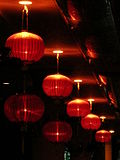
Decoration Decorations generally convey a New Year greeting. They are not advertisements. Faichun, also known as Huichun—Chinese calligraphy of auspicious Chinese idioms on typically red posters—are hung on doorways and walls. Other decorations include a New Year picture, Chinese knots, Sycee, papercutting and couplets. 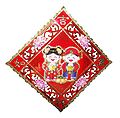

Dragon dance and Lion dance Dragon and lion dances are common during the Chinese New Year. It is believed that the loud beats of the drum and the deafening sounds of the cymbals, together with the face of the Dragon or lion dancing, can evict bad or evil spirits. Lion dances are also popular for the opening of businesses in Hong Kong and Macau. 

Fu Lu Shou Nianhua of the Fu Lu Shou. 
Red envelope Typically given to children, the elderly and Dragon/Lion Dance performers while saying t 恭喜發財 j gung1 hei2 faat3 coi4, s 恭喜发财 p gōng xǐ fā cái. 
Shrubs Citrus trees are typically used for decoration. 


Spring travel
[edit]
Traditionally, families gather together during the Chinese New Year. In modern China, migrant workers travel home to have reunion dinners with their families on Chinese New Year's Eve. Owing to a large number of interprovincial travellers, special arrangements are made by railways, buses, and airlines starting from fifteen days before the New Year's Day. This 40-day period is called chunyun, and is known as the world's largest annual migration.[117] More interurban trips are taken in China in this period than the total population of China.
Festivities outside China
[edit]Chinese New Year is also celebrated annually in many countries that house significant Chinese populations. These include countries throughout Asia, Oceania, and North America. Sydney,[118] London,[119] and San Francisco[120] claim to host the largest New Year celebration outside of Asia and South America. The largest Chinese New Year Celebration in the Southern Hemisphere is held in Australia.
East Asia
[edit]Korea
[edit]Seollal (Korean: 설날; RR: Seollal; MR: Sŏllal) is a traditional Korean festival and national holiday commemorating the first day of the lunisolar calendar. It is one of the most important traditional holidays for ethnic Koreans, being celebrated in both North Korea and South Korea as well as by the Korean diaspora all around the world.[121] During this time, many Koreans would visit their family, perform ancestral rites, wear the hanbok (한복; 韓服) / Chosŏn-ot (조선옷; 朝鮮옷), eat traditional food, and play traditional folk games. One of the most well-known practices of the current day is receiving money from their elders after performing a formal bow, a tradition likely adopted from Confucian customs.[citation needed]
Japan
[edit]The Japanese New Year (正月, Shōgatsu) is an annual festival that takes place in Japan. Since 1873, the official Japanese New Year has been celebrated according to the Gregorian calendar, on 1 January of each year, New Year's Day (元日, Ganjitsu). Before 1872, traditional events of the Japanese New Year were celebrated on the first day of the year of the modern Tenpō calendar, the last official lunisolar calendar. Before the Meiji period, the date of the Japanese New Year had been based on Japanese versions of lunisolar calendar (the last of which was the Tenpō calendar) and, before, Jōkyō calendar, the Chinese version. However, in 1873, five years after the Meiji Restoration, Japan adopted the Gregorian calendar, and the first day of January became the official and cultural New Year's Day in Japan.
Taiwan
[edit]In Taiwan, the most common terms for the Chinese New Year are Chinese: 農曆新年; pinyin: Nónglì Xīnnián; lit. 'Agricultural Calendar New Year' and Chinese: 過年; pinyin: Guònián; lit. 'passing year'. Unlike in China, where Chinese: 春节; pinyin: Chūn Jié; lit. 'Spring Festival' is the standard and official term; people in Taiwan typically do not use "Spring Festival" in daily conversations. Instead, they emphasize the connection to the traditional Chinese calendar by calling it 農曆新年 ("lunar new year"), or simply refer to it as 過年 ("past year"), which is more casual and widely used among families and friends.[122]
Taiwanese Guonian differs from the Chinese Spring Festival in several cultural practices, traditions, and customs, despite both celebrations being based on the traditional Chinese calendar. In Taiwan, the Chinese New Year (農曆新年) emphasises honouring ancestors through elaborate rituals, including offering food and incense at home altars. Taiwanese families often prioritise local delicacies, such as pineapple cakes and kuih s, symbolizing prosperity and good fortune. While large firework displays are popular in some places, Taiwan tends to focus more on temple visits, lantern-lighting ceremonies, and family reunions.
In Taiwan, businesses traditionally reopen on the sixth day of the Chinese New Year, accompanied by firecrackers. In the morning of the ninth day (traditionally anytime between midnight and 7 am), Taiwanese households set up an altar table with three layers: one top (containing offertories of six vegetables (Chinese: 六齋; pinyin: liù zhāi; those being noodles, fruits, cakes, tangyuan, vegetable bowls, and unripe betel), all decorated with paper lanterns), and two lower levels (five sacrifices and wines) to honour the deities below the Jade Emperor.[82] The household then kneels three times and kowtows nine times to pay obeisance and wish him a long life.[82] Incense, tea, fruits, vegetarian food or roasted pig, and gold paper are served as customary protocol for paying respect to an honored person. In Taiwan in the 2000s, some employers also gave red packets as a bonus to maids, nurses, or domestic workers from Southeast Asian countries, although whether this is appropriate is controversial.[123][124]
In Taiwan, spring travel is a significant event known as the Spring Festival travel rush. The primary mode of transportation in western Taiwan is oriented in a north–south direction, facilitating long-distance travel between the urbanized north and rural hometowns in the south. However, transportation in eastern Taiwan and between Taiwan and its outlying islands is less convenient. Cross-strait flights between Taiwan and China commenced in 2003 as part of the Three Links initiative, primarily catering to "Taiwanese businessmen" returning to Taiwan for the new year.[125]
Southeast Asia
[edit]Chinese New Year is a national public holiday in many Southeast Asian countries and is considered to be one of the most important holidays of the year.
Malaysia
[edit]
Chinese New Year's Eve is typically a half-day holiday in Malaysia, while Chinese New Year is a two-day public holiday. George Town, a Chinese-majority city, is known for its lively Chinese New Year celebrations that last until the Lantern Festival on the fifteenth day. Kek Lok Si, the largest Buddhist temple in Malaysia, is typically lit up throughout the festivities.[127] Penang's Chief Minister customarily hosts an "open house" for the public, while various other events take place across the city, including at the Chinese clan houses and the Snake Temple.[128][129] Hokkien households celebrate the Jade Emperor's birthday, known colloquially as the "Hokkien New Year", on the ninth day, with offerings.[130] Traditionally, during the Lantern Festival, single females throw oranges at seafront locations such as the Esplanade in the hope of finding their partners.[131]
Singapore
[edit].jpg)
In Singapore, Chinese New Year is officially a two-day public holiday and is accompanied by various festive activities. One of the main highlights is the Chinatown celebrations. In 2010, this included a Festive Street Bazaar, nightly staged shows at Kreta Ayer Square, and a lion dance competition.[132] The Chingay Parade also features prominently in the celebrations. It is an annual street parade in Singapore, well known for its colourful floats and a wide variety of cultural performances.[133] The highlights of the Parade for 2011 included a Fire Party, multi-ethnic performances, and a travelling dance competition.[134]
Indonesia
[edit]


In Indonesia, the first day of the Chinese New Year is recognized as a national holiday.[135] The remaining 14 days are usually only celebrated by ethnic Chinese families.[136] Chinese Year follows the Confucius year or Kǒngzǐlì (Chinese: 孔子历) or Kongzili in Indonesian. Chinese New Year is officially named Tahun Baru Imlek (Chinese: 陰曆新年; Pe̍h-ōe-jī: im-le̍k sin-nî), with Imlek deriving from the Hokkien word for "Lunar Calendar" (Chinese: 陰曆; Pe̍h-ōe-jī: im-le̍k).[137][138] It is known locally in Hokkien as Sin Cia (Chinese: 新正; Pe̍h-ōe-jī: sin-chiaⁿ).[139] It was celebrated as one of the official national religious holidays by Chinese Indonesians from 18 June 1946 to 1 January 1953 through a government regulation signed by President Sukarno on 18 June 1946.[140] It was unofficially celebrated by ethnic Chinese from 1953 to 1967 based on a government regulation signed by vice-president Mohammad Hatta on 5 February 1953, which annulled the previous regulation, among others.[141]
Effectively from 6 December 1967,[142] until 1998, the spiritual practice of celebrating Chinese New Year by Chinese families was specifically restricted to only inside the Chinese house. This restriction was made by the New Order government through Presidential Instruction No. 14 of 1967 signed by President Suharto. This restriction was ended when the regime changed and President Suharto was overthrown. The celebration was conducted unofficially by the Chinese community from 1999 to 2000. On 17 January 2000, President Abdurrahman Wahid issued Presidential Decree No. 6 of 2000 to annul the previous instruction.[143] On 19 January 2001, the Ministry of Religious Affairs issued Ministerial Decree No.13 of 2001 on Imlek Day as a National Holiday to set Hari Tahun Baru Imlek as a "facultative holiday" for the Chinese community.[144] Through a presidential decree it was officially declared as a one-day public holiday as of 9 April 2002 by President Megawati.[138]
Cities with significant Chinese populations in Indonesia such as Jakarta, Medan, Batam, Surabaya, Semarang, Surakarta, Singkawang, Pangkal Pinang, Binjai, Bagansiapiapi, Tanjungbalai, Pematangsiantar, Selat Panjang, Pekanbaru, Tanjung Pinang, Ketapang, Pontianak, Sungailiat, Tanjung Pandan, Manggar, Toboali, Muntok, Lubuk Pakam, Bandung, Rantau Prapat, Tebing Tinggi, Sibolga, Dumai, Panipahan, Bagan Batu, Tanjung Balai Karimun, Jambi, Palembang, Bengkayang, Manado, and Tangerang always celebrate the new year with parades and fireworks. Shopping malls typically decorate their interiors and exteriors with lanterns and various Chinese ornaments. Lion dances are very common throughout the city, usually in residential areas, temples, and shopping centres. Usually, Buddhists, Confucians, and Taoists will burn incense made out of aloeswood in front of their houses as prayers. Chinese temples are generally open for 24 hours on the first day, distributing red envelopes and sometimes rice, fruits or sugar to the poor.
Philippines
[edit].jpg)

In the Philippines, Chinese New Year (Philippine Hokkien Chinese: 咱人年兜; Pe̍h-ōe-jī: Lán-nâng Nî-tau) is considered one of the important festivals for Chinese Filipinos, and its celebration has also extended to the majority non-Chinese Filipinos, especially since, in 2012, Chinese New Year was included as a public non-working holiday in the Philippines. During this time of year, the selling or giving of tikoy, especially by Chinese Filipinos, is widely known and practised. Celebrations are centered primarily in Binondo in Manila, the oldest Chinatown in the world, with other celebrations taking place in key cities.
In 2024, Manila celebrated the Spring Festival of the Wooden Dragon, as well as the 430th anniversary of Manila Chinatown, featuring the "Manila Chinatown Solidarity Float Parade"—along Manila Central Post Office in Lawton, Ermita, and Jones Bridge—led by Chinese ambassador Huang Xilian with the winners of Mr. & Ms. Chinatown Philippines 2023. It was preceded by Chinese New Year's Eve, with the "First incense offering" at Binondo Church, a Taoist prayer ritual with Joss sticks, including Chinese ancestor worship at Martyr Saints of China altars in Binondo Chinese Parish Church. At midnight, a 2-minute pyro-musical fireworks display was witnessed by 1.5 million at the Chinese-Filipino Friendship Bridge.[145] In Cebu, a festival called the Red Lantern Festival was held.[146]
Thailand
[edit].jpg)
Chinese New Year festivities occur throughout Thailand, especially in provinces where many people of Chinese descent live, such as Nakhon Sawan, Suphan Buri, and Phuket.[147][148][149] Chinese New Year is observed as a public holiday in the provinces of Narathiwat, Pattani, Yala, Satun,[67] and Songkhla.[150] In Bangkok, there are large celebrations in Chinatown, Yaowarat Road, where the main road is closed and turned into a pedestrian street, with a member of the royal family in attendance each year to open the ceremony, such as Princess Maha Chakri Sirindhorn.[151][152][153] For 2021 (for one year only), the government declared the Chinese New Year a government holiday. It applied mostly to civil servants. Financial institutions and private businesses were allowed to decide whether or not to observe it.[154]
Observed by Thai Chinese and parts of the private sector, the festivities occur over three days, starting on the day before Chinese New Year's Eve. The first day is Wan chai (Thai: วันจ่าย; pay day), the day that people go out to shop for offerings. The second day is Wan wai (Thai: วันไหว้; worship day), which is a day of worshiping the gods and ancestral spirits, which is further divided into three periods—dawn, late morning, and afternoon. The third day is Wan tieow (Thai: วันเที่ยว; holiday), which is a holiday where everyone will leave the house to travel or to bless relatives or respectable people, often wearing red clothes, which are believed to be auspicious.[155]
Australia and New Zealand
[edit]
With one of the largest Chinese populations outside of Asia, Sydney also boasts the largest Chinese New Year celebrations outside of Asia, annually attracting over 600,000 attendees to the festivities in Chinatown. The events span over three weeks and include a launch celebration, outdoor markets, evening street food stalls, Chinese opera performances, dragon boat races, a film festival, and multiple parades featuring participants from Chinese, Japanese, Korean, and Vietnamese communities. The main parade, which sees over 100,000 spectators and involves more than 3,500 performers, is a notable highlight of the celebrations.[156] The festival also attracts international media coverage, reaching millions of viewers in Asia.[157] The festival in Sydney is organized in partnership with a different Chinese province each year. In addition to Sydney, other state capital cities in Australia also celebrate the Chinese New Year due to the large number of Chinese residents in those cities.[158] The cities include: Brisbane, Adelaide, Melbourne, Box Hill, and Perth. The common activities are the lion dance, dragon dance, New Year market, and food festival. In the Melbourne suburb of Footscray, Victoria, a Lunar New Year celebration, initially focusing on the Vietnamese New Year, has expanded into a celebration of the Chinese New Year as well as the April New Year celebrations of the Thais, Cambodians, Laotians, and other Asian Australian communities, which celebrate the New Year in either January/February or April.[159]
In New Zealand, Auckland hosts the Auckland Lantern Festival for 4 days. Meanwhile, Wellington hosts a two-day weekend festival for Chinese New Year,[160] and a one-day festival is held in Dunedin, centred on the city's Chinese gardens.[161]
North America
[edit]Many cities in North America sponsor official parades for Chinese New Year. Among the cities with such parades are New York City (Manhattan, Flushing, Queens, and Brooklyn), San Francisco,[162] Los Angeles,[163] Boston,[164] Chicago,[165] Mexico City,[166] Toronto, and Vancouver.[167] However, even smaller cities that are historically connected with Chinese immigration, such as Butte, Montana,[168] have recently hosted parades.
New York City
[edit]
Multiple groups in New York City cooperate to sponsor a week-long Chinese New Year celebration. The festivities include a cultural festival and special exhibits.[169] One of the key celebrations is the Chinese New Year parade[170] with floats and fireworks taking place along the streets in Chinatown, Manhattan, the largest Chinese New Year parade outside Asia.[171] In June 2015, New York City Mayor Bill de Blasio declared that the Lunar New Year would be made a public school holiday,[172] and in September 2023, New York State made Lunar New Year a mandatory public school holiday.[173]
California
[edit]
Signed into law in 2022 and effective in 2023, California declared the Lunar New Year a state government holiday.[174] Many communities throughout all of California celebrate with large celebrations taking place in both the San Francisco Bay Area and Greater Los Angeles, as well as in Fresno, Sacramento, San Diego, Santa Rosa, and Stockton.
San Francisco
[edit]The San Francisco Chinese New Year Festival and Parade is the oldest and one of the largest events of its kind outside of Asia, and one of the largest Asian cultural events in North America.
The festival incorporates Grant and Kearny Streets into its street festival and parade route, respectively. The use of these streets traces its lineage back to early parades, beginning the custom in San Francisco. In 1849, with the discovery of gold and the ensuing California Gold Rush, over 50,000 people came to San Francisco to seek their fortune or just a better way of life. Among those were many Chinese, who had come to work in the gold mines and on the railroad. By the 1860s, the residents of San Francisco's Chinatown were eager to share their culture with their fellow San Francisco residents who may have been unfamiliar with (or hostile towards) it. The organizers chose to showcase their culture by using a favourite American tradition – the parade. They invited a variety of other groups from the city to participate, and they marched down what today are Grant Avenue and Kearny Street, carrying colourful flags, banners, lanterns, drums, and firecrackers to drive away evil spirits.
In San Francisco, over 100 units participate in the annual Chinese New Year Parade, which has been held since 1958.[175] The parade is attended by some 500,000 people, along with another 3 million TV viewers.[176]
Greater Los Angeles
[edit]The Golden Dragon Parade has happened annually in Chinatown, Los Angeles, since 1899, one of the oldest and largest Chinese New Year parades outside of Asia. Beginning in the 1970s, famous Asian American actors have held the title of Grand Marshall of the parade, the first being Bruce Lee.[177]
Around Southern California, many communities also put on festivals and parades that can last multiple days, with some of the largest occurring in the San Gabriel Valley, home to the largest Chinese community outside of Asia and often called the first suburban Chinatown, and Little Saigon, where many Vietnamese and Chinese live. The Little Saigon area has hosted Tet celebrations since 1982 for its Chinese and Vietnamese communities.[178] They were originally held at Garden Grove Park, with parades in both Garden Grove and Westminster. Monterey Park puts on the largest of such festivals, occupying 5 blocks in the city and attracting over 100,000 individuals.[179]
Neighboring Alhambra has also hosted a large festival since 1993 with many performances and street vendors.[180] San Gabriel hosts an annual Chinese Gala at the San Gabriel Mission Playhouse in addition to its street festival.[181] Starting in 2014, there are also larger celebrations at the Orange County Fair and Events Center in Costa Mesa, which attract over 50,000 visitors.[178] Neighboring Fountain Valley also hosts an annual Chinese New Year carnival in Mile Square Regional Park with many food vendors and a Ferris wheel.[182]
Many people also celebrate by going to temples across Southern California, and the largest temple celebration is held at Hsi Lai Temple in Hacienda Heights.[183] Most major shopping malls will also be decorated for the Chinese New Year.[184] Disneyland California Adventure in Anaheim celebrates the Chinese New Year by decorating certain areas of the park in Chinese displays, serving speciality East Asian foods and allowing for character photos with Mulan, Mushu, Raya, Tigger, and Mickey and Minnie Mouse in Chinese Costumes.[185] Some other communities that hold Chinese New Year Celebrations include Eastvale, Hollywood, Irvine, Palos Verdes, Pasadena, Rancho Cucamonga, Riverside, Rosemead, San Marino, San Pedro, Santa Monica, Temple City, Tustin, and West Covina.
Europe
[edit]United Kingdom
[edit]
In London, celebrations take place in Chinatown, Leicester Square, and Trafalgar Square. Festivities include a parade, culturally oriented feast, fireworks, concerts, and performances.[186] The celebration attracts between 300,000 and 500,000 people yearly, according to the organisers.[187]
France
[edit]In Paris, since the 1980s, month-long celebrations have been held in several districts with many performances.[188] The largest of three parades has around 40 groups and 4,000 performers and is attended by more than 200,000 people in the 13th arrondissement.[189][190]
Netherlands
[edit]Official celebrations are held in The Hague,[191][192] Amsterdam, and Rotterdam.[193][194]
Hungary
[edit]
In Budapest, celebrations have been held since 2017 in the Kőbánya district with many parades and performances.[195]
India and Pakistan
[edit]
In India, many celebrate Chinese New Year with lion and dragon dances in Chinatown, Kolkata, where a significant community of people of Chinese origin exists.
In Pakistan, Chinese New Year is celebrated among the sizeable Chinese expatriate community that lives in the country. During the festival, the Chinese embassy in Islamabad arranges various cultural events in which Pakistani arts and cultural organizations and members of the civil society also participate.[196][197][198][199]
Mauritius
[edit]Chinese culture in Mauritius is an important component of the multiculturalism in Mauritius.[200] Despite the small size of the Sino-Mauritian community (estimated to be only about 3% of the total population),[201] Chinese New Year (also known as Chinese Spring Festival) is a time when Chinese culture is celebrated on the island.[202] Mauritius is also the only country in Africa that lists the Chinese Spring Festival as a statutory public holiday.[203] During this period of the year, there is a joyful and festive atmosphere throughout the entire country.[200]
Sino-Mauritians are very attached to Chinese traditions.[204] The Chinese Spring Festival is the biggest celebration for the Sino-Mauritians on the island.[204] The dates of the celebration follow the Chinese lunisolar calendar instead of the Gregorian calendar.[204] During the week before New Year's Day, spring cleaning in homes is performed. The festival starts on Chinese New Year's Eve by lighting firecrackers to ward off evil spirits.[205]: 71 Traditionalists visit pagodas for offerings and prayers on New Year's Eve.[205]: 71 Following Chinese customs, there is a big family dinner on New Year's Eve.[204][206] While the family dinner was traditionally celebrated at the house of the oldest family members, going to restaurants for New Year's Eve is getting more popular; some restaurants may have special dinners to foster the family reunions of Sino-Mauritians.[204] After the New Year Eve's dinner, youths often go to nightclubs.[204]
On Chinese New Year day, it is customary for Sino-Mauritians to share niangao with their relatives and friends and to light firecrackers to ward off evil spirits.[203][204] Red envelopes are also given. Some families would also visit pagodas on New Year's Day to honour their ancestors.[204] There are families who observe a vegetarian diet on New Year's Day.[206] The main events typically take place in the Chinatown area in Port Louis, the capital of Mauritius.[203][207] The Dragon dance and the Southern Lion dance are customarily performed on that day.[204][206] The colour red is predominantly used to decorate the streets and houses. Chinese items (e.g. Chinese lanterns) are also used as decorations.[207]
Greetings
[edit]Chinese New Year is often accompanied by loud, enthusiastic greetings, often referred to as 吉祥話 (jíxiánghuà) in Mandarin or 吉利說話 (Kat Lei Seut Wa) in Cantonese, loosely translated as "auspicious words or phrases". New Year couplets printed in gold letters on bright red paper, referred to as chunlian (春聯) or fai chun (揮春), are another way of expressing wishes for an auspicious new year. They probably predate the Ming dynasty (1368–1644), but did not become widespread until then.[208] Today, they are ubiquitous with Chinese New Year.
Some of the most common greetings include:

- Xin nian kuai le / San nin fai lok: simplified Chinese: 新年快乐; traditional Chinese: 新年快樂; pinyin: Xīnniánkuàilè; Jyutping: san1 nin4 faai3 lok6; Pe̍h-ōe-jī: Sin-nî khòai-lo̍k; Hakka: Sin Ngen Kai Lok; Taishanese: Slin Nen Fai Lok. A more contemporary greeting reflective of Western influences, it literally translates the greeting "Happy New Year" more common in the West. It is written in English as "xin nian kuai le".[209] In northern parts of China, traditionally people say simplified Chinese: 过年好; traditional Chinese: 過年好; pinyin: Guònián Hǎo instead of simplified Chinese: 新年快乐; traditional Chinese: 新年快樂 (Xīnniánkuàile), to differentiate it from the international new year. And 過年好 (Guònián Hǎo) can be used from the first day to the fifth day of the Chinese New Year. However, 過年好 (Guònián Hǎo) is considered very short and therefore somewhat discourteous.
- Gong xi fa cai / Gong hei fat choi: simplified Chinese: 恭喜发财; traditional Chinese: 恭喜發財; pinyin: Gōngxǐfācái; Hokkien: Kiong hee huat chai (POJ: Kiong-hí hoat-châi); Cantonese: Gung1 hei2 faat3 coi4; Hakka: Gung hee fatt choi, which loosely translates as "congratulations and be prosperous". It is spelled varyingly in English, such as gung hay fat choy,[210] gong hey fat choi,[209] or kung hei fat choy.[211] It is often mistakenly assumed to be synonymous with "Happy New Year". The saying is now commonly heard in English-speaking communities for greetings during Chinese New Year in parts of the world where there is a sizeable Chinese-speaking community, including overseas Chinese communities that have been resident for several generations, relatively recent immigrants from Greater China, and those who are transient migrants (particularly students).
Numerous other greetings exist, some of which may be exclaimed out loud to no one in particular in specific situations. For example, as breaking objects during the new year is considered inauspicious, one may then say 歲歲平安 (Suìsuì-píng'ān) immediately, which means "everlasting peace year after year". Suì (歲), meaning "age", is homophonous with 碎 (suì) (meaning "shatter"), in the demonstration of the Chinese love for wordplay in auspicious phrases. Similarly, 年年有餘 (niánnián yǒu yú), a wish for surpluses and bountiful harvests every year, plays on the word yú that can also refer to 魚 (yú meaning "fish"), making it a catch phrase for fish-based Chinese New Year dishes and for paintings or graphics of fish that are hung on walls or presented as gifts.
The most common auspicious greetings and sayings consist of four characters, such as the following:
- 金玉滿堂, Jīnyùmǎntáng – "May your wealth [gold and jade] come to fill a hall"
- 大展鴻圖, Dàzhǎnhóngtú – "May you realize your ambitions"
- 迎春接福, Yíngchúnjiēfú – "Greet the New Year and encounter happiness"
- 萬事如意, Wànshìrúyì – "May all your wishes be fulfilled"
- 吉慶有餘, Jíqìngyǒuyú – "May your happiness be without limit"
- 竹報平安, Zhúbàopíng'ān – "May you hear [in a letter] that all is well"
- 一本萬利, Yīběnwànlì – "May a small investment bring ten-thousandfold profits"
- 福壽雙全, Fúshòushuāngquán – "May your happiness and longevity be complete"
- 招財進寶, Zhāocáijìnbǎo – "When wealth is acquired, precious objects follow"[212]
These greetings or phrases may also be used just before children receive their red packets, when gifts are exchanged, when visiting temples, or even when tossing the shredded ingredients of yusheng, particularly popular in Malaysia and Singapore. Children and their parents can also pray in a temple, in hopes of getting good blessings for the new year to come.
Children and teenagers sometimes jokingly use the phrase "恭喜發財,紅包拿來" (pinyin: gōngxǐfācái, hóngbāo nálái; Cantonese: 恭喜發財,利是逗來; Jyutping: gung1hei2 faat3coi4, lei6 si6 dau6 loi4), roughly translated as "Congratulations and be prosperous, now give me a red envelope!". In Hakka, the saying is more commonly said as Gung hee fatt choi, hung bao diu loi, which would be written as 恭喜發財,紅包逗來 – a mixture of the Cantonese and Mandarin variants of the saying.
In the 1960s, children in Hong Kong used to say 恭喜發財,利是逗來,斗零唔愛 (Cantonese, Gung Hei Fat Choy, Lai Si Tau Loi, Tau Ling M Ngoi), which was recorded in the pop song "Kowloon Hong Kong" by The Reynettes in 1966. Later, in the 1970s, children in Hong Kong used the saying: 恭喜發財,利是逗來,伍毫嫌少,壹蚊唔愛, roughly translated as "Congratulations and be prosperous, now give me a red envelope, fifty cents is too little, don't want a dollar either". It basically meant that they disliked small change – coins that were called "hard substance" (Cantonese: 硬嘢). Instead, they wanted "soft substance" (Cantonese: 軟嘢), which was either a ten dollar or a twenty dollar note.
See also
[edit].svg)


- The Birthday of Che Kung
- Other celebrations of Lunar New Year in China:
- Tibetan New Year (Losar)
- Mongolian New Year (Tsagaan Sar)
- Celebrations of Lunar New Year in other parts of Asia:
- Buryat New Year (Sagaalgan)
- Korean New Year (Seollal)
- Japanese New Year (Shōgatsu)
- Mongolian New Year (Tsagaan Sar)
- Vietnamese New Year (Tết Nguyên Đán)
- Similar Asian Lunisolar New Year celebrations that occur in April:
- Burmese New Year (Thingyan)
- Cambodian New Year (Chaul Chnam Thmey)
- Lao New Year (Pii Mai)
- Sri Lankan New Year (Aluth Avuruddu)
- Thai New Year (Songkran)
- Chinese New Year Gregorian Holiday in Malaysia
- Malaysia Chinese New Year (Tahun Baru Cina)
- Indonesian Chinese New Year (Imlek)
- Lunar New Year fireworks display in Hong Kong
Notes
[edit]References
[edit]- ^ "Asia welcomes lunar New Year". BBC. 1 February 2003. Retrieved 7 November 2008.
- ^ a b c Aslaksen, Helmer (17 July 2010). "The Mathematics of the Chinese Calendar" (PDF). Archived from the original (PDF) on 21 August 2016.
- ^ "Chinese New Year". History.com. 4 February 2010. Retrieved 9 February 2013.
- ^ "The Year of the Dog – Celebrating Chinese New Year 2018". EC Brighton. 16 February 2018. Retrieved 13 November 2018.
- ^ "Chinese New Year 2011". VisitSingapore.com. Retrieved 2 November 2011.
- ^ "Chinese New Year Celebrated in Grand Scale in Yangon". Mizzima.com. Retrieved 28 January 2019.
- ^ "Philippines adds Chinese New Year to holidays". Yahoo! News Philippines. 2 December 2011. Retrieved 29 June 2013.
- ^ "Festivals, Cultural Events and Public Holidays in Mauritius". Mauritius Tourism Authority. Archived from the original on 11 February 2016. Retrieved 28 January 2012.
- ^ "Peru leads Chinese New Year celebrations in Latin America". China Daily. Retrieved 18 January 2022.
- ^ Crabtree, Justina (16 February 2018). "As the Lunar New Year celebrations begin, CNBC looks at Chinatowns across the world". CNBC.
- ^ "Happy Chinese New Year! The year of the Dog has begun". USA TODAY.
- ^ "Chinese New Year and its effect on the world economy". BostonGlobe.com.
- ^ Yeung, Jessie (29 January 2023). "Is it Chinese New Year or Lunar New Year? Depends who you ask". CNN.
- ^ Roy, Christian (2005). Traditional Festivals: A Multicultural Encyclopedia. ABC-CLIO. p. 320. ISBN 978-1-57607-089-5.
- ^ "Lunar New Year Ceremonies Live On in the Okinawa Islands". nippon.com. 28 February 2019. Retrieved 30 January 2022.
- ^ Lee, Jonathan H. X.; Nadeau, Kathleen M. (2011). Encyclopedia of Asian American Folklore and Folklife. ABC-CLIO. p. 312. ISBN 978-0-313-35066-5.
- ^ "There are 6 Chinese solar terms in spring". GBTIMES. Archived from the original on 8 April 2019. Retrieved 28 January 2020.
- ^ Huang, Alice (21 January 2020). "Lunar New Year explainer: what's with all the lions and lanterns?". South China Morning Post. Retrieved 12 February 2024.
- ^ 民國政府 曾強廢農曆新年. China Times. 9 February 2016. Retrieved 12 February 2024.
- ^ a b Haiwang Yuan. "The Origin of Chinese New Year". pp. 3, 6. Retrieved 2 January 2016.
... it is also called Lunar New Year in Chinese communities all over the world. ... Chinese outside mainland China still prefer calling it Lunar [New] Year. 'Chinese New Year' is a popular and convenient translation for people of non-Chinese cultural backgrounds. Along with the Han Chinese in and outside China, as many as 29 of the 55 ethnic minority groups in China also celebrate Chinese New Year. Countries like Korea, Vietnam, Singapore, Malaysia, and Indonesia celebrate it as their official festival.
- ^ 中國古代歲首分那幾種?各以何為起點? [In ancient China, how to decide the starting point of a year?] (in Chinese). Central Weather Bureau. Archived from the original on 12 September 2017. Retrieved 26 January 2017.
- ^ Aslaksen, Helmer (17 July 2010), The Mathematics of the Chinese Calendar (PDF), National University of Singapore, p. 31, archived from the original (PDF) on 13 January 2014
- ^ "国家标准《农历的编算和颁行》解读". 中国科学院紫金山天文台 (in Chinese). 中国科学院. 9 March 2022. Retrieved 28 February 2025.
- ^ a b Chan Sui Jeung (2001). Traditional Chinese Festivals and Local Celebrations. Wan Li Book Company Limited.
- ^ "保庇有狗讚-這些年 年獸去了哪裡?". tw.news.yahoo.com (in Chinese). Retrieved 1 January 2023.
- ^ . (in Chinese) – via Wikisource.
九月肅霜,十月滌場。朋酒斯饗,曰殺羔羊。躋彼公堂,稱彼兕觥。萬壽無疆。
- ^ "春节起源". www.sohu.com.
- ^ 呂不韋. "季冬紀". (in Chinese). Vol. 12 – via Wikisource.
命有司大儺,旁磔,出土牛,以送寒氣。
- ^ 司馬彪. "禮儀中". (in Chinese). Vol. 95 – via Wikisource.
先臘一日,大儺,謂之逐疫。
- ^ 崔寔. (in Chinese) – via Wikisource.
正月之旦,是謂正日。躬率妻孥,絜祀祖禰...子、婦、孫、曾,各上椒酒於其家長,稱觴舉壽,欣欣如也。
- ^ "Chinese New Year". History.com. 20 April 2023.
Ritual sacrifices of food and paper icons were offered to gods and ancestors.
- ^ "吳良". [Book of the Later Han] (in Chinese). Vol. 27 – via Wikisource.
歲旦與掾史入賀,門下掾王望舉觴上壽,謅稱太守功德。
- ^ "The Lunar New Year: Rituals and Legends". Asia for Educators, Columbia University.
On New Year's Day and for the next several days, people still follow the custom of exchanging visits — with close relatives first, then with distant relatives and friends. Traditionally, the order of these visits also began with the eldest, and the first day was usually devoted to paternal family relatives.
- ^ 周處. (in Chinese) – via Wikisource.
蜀之風俗,晚歲相與饋問,謂之饋歲。酒食相邀為別歲。至除夕,達旦不眠,謂之守歲。
- ^ 宗懍. (in Chinese) – via Wikisource.
正月一日,是三元之日也,謂之端月。鷄鳴而起。先於庭前爆竹,以辟山臊惡鬼。
- ^ 来鵠. "早春". (in Chinese) – via Wikisource.
新曆才將半紙開,小庭猶聚爆竿灰。 偏憎楊柳難鈐轄,又惹東風意緒來。
- ^ "古代春节:春秋战国有雏形 "桃梗"是最初的春联". 新文化报. 7 February 2014 – via www.chinanews.com.
- ^ "古人拜年常用"拜年帖"". 半岛晨报. 30 January 2011 – via www.chinanews.com.
- ^ 張唐英. (in Chinese). Vol. 2 – via Wikisource.
蜀未亡前一年歲除日,昶令學士辛寅遜題桃符板於寢門,以其詞工,昶命筆自題云:「新年納餘慶,嘉節賀長春。」
- ^ "Love of Chinese Language Expressed in Couplets".
The earliest known couplet was written at Spring Festival 964 by the King of Later Shu. It said: "The New Year is bathed in forefathers' blessings; the joyous festival promises everlasting youth and wealth."
- ^ "Chinese Couplets History, Categories & Quotable Examples". 9 March 2019.
The famous poet Wang Anshi (1021–1086) in Northern Song dynasty even created a poem to depict the spectacular scene of pasting Spring Festival couplets, called New Year's Day (《元日》 [yuán rì]).
- ^ 周, 廣玲 (9 February 2011). "宋代人怎样过年:大抵与今人相似". Guangzhou Daily.
- ^ 周密. (in Chinese). Vol. 3 – via Wikisource.
后妃諸閣,又各進歲軸兒及珠翠百事、吉利市袋兒、小樣金銀器皿,並隨年金錢一百二十文。
- ^ 熊夢祥. (in Chinese) – via Wikisource.
車馬紛紜於街衢、茶坊、酒肆,雜遝交易至十三日,人家以黃米為糍糕,饋遺親戚,歲如常。
- ^ 劉若愚. (in Chinese). Vol. 20 – via Wikisource.
正月初一五更起,焚香放紙炮,將門閂或木杠於院地上拋擲三度,名曰「跌千金」。飲椒柏酒,吃水點心,即「扁食」也。或暗包銀錢一二於內,得之者以卜一年之吉。
- ^ 顾禄. "遞貢望". 清嘉錄.
長者貽小兒以朱繩綴百錢,謂之壓歲錢;置橘、荔諸果於枕畔、謂之壓歲果子。元旦睡覺時食之,取讖于吉利,為新年休征。
- ^ 邱建一 (24 January 2020). "皇帝也有「壓歲錢」可領內容物曝光". Archived from the original on 26 July 2020.
皇帝領到的壓歲錢的內容是這樣的:「賜皇上之荷包,乃黃緞繡五彩加金,繡有歲歲平安四字,內裝金銀錢、金銀錁子、金銀八寶各一個(各五分重),口上插一小金如意,約二吋許。上鏨連年如意四字。」
- ^ Huang, Wei; Xie, Ying (January 2012). "The New Year That Wasn't". NewsChina. NewsChinaMagazine. Archived from the original on 24 February 2015. Retrieved 24 February 2015.
- ^ "Spring festival, social practices of the Chinese people in celebration of traditional new year". UNESCO. Archived from the original on 4 December 2024.
- ^ "Spring Festival added to Unesco cultural heritage list". RTHK. Archived from the original on 6 December 2024.
- ^ "UNESCO Intangible Cultural Heritage Spring Festival Debuts in Greece, Presented by Beijing Municipal Culture and Tourism Bureau". The Globe and Mail. 26 January 2025. Archived from the original on 31 January 2025.
- ^ a b "HOLIDAYS". Embassy of the United States: Kuala Lumpur, Mayalsia. U.S. Department of State. Retrieved 29 January 2017.
- ^ "Jadual hari kelepasan am persekutuan 2012" [Federal Public Holiday Schedule 2012] (PDF) (in Malay). Putrajaya, Malaysia: Jabatan Perdana Menteri (Department of the Prime Minister). Archived from the original (PDF) on 29 March 2013. Retrieved 4 March 2015.
- ^ a b "Public holidays: entitlement and pay". Ministry of Manpower Singapore.
- ^ "Embassy Holidays". Embassy of the United States: Bandar Seri Begawan, Brunei Darussalam. U.S. Department of State. Archived from the original on 13 May 2015. Retrieved 4 March 2015.
- ^ "General holidays for 2018". Hong Kong Government. Retrieved 16 February 2018.
- ^ "Public Holidays in 2019 Decree Law No. 60/2000 on Public Holidays". Macao SARG Portal. Macao SAR of the People's Republic of China. Retrieved 24 January 2019.
- ^ "National Public Holidays in Indonesia". AngloINFO, the global expat network: INDONESIA. AngloINFO Limited. Archived from the original on 2 April 2015. Retrieved 4 March 2015.
- ^ "Holiday Schedule". Embassy of the United States: Jakarta, Indonesia. U.S. Department of State. Archived from the original on 2 April 2015. Retrieved 4 March 2015.
- ^ Zhu Yafei (16 October 2006). "从数字之外看黄金周的去与留 (Seeing Golden Week from Beyond the Numbers)". news.cctv.com. Retrieved 7 June 2020.
黄金周的7天连续假期是通过对法定三天假日前、后的周末休息日进行调整而形成的。(The 7 seven-consecutive day Golden Week is formed by adjusting the weekend days before and after the 3 day holiday).
- ^ "Chinese New Year – China's Grandest Festival & Longest Public Holiday". TravelChinaGuide.
- ^ "Proclamation No. 831, s. 2014 by the President of the Philippines, Declaring the Regular Holidays, Special (Non-Working) Days, and Special Holiday (for all Schools) for the Year 2015" (Press release). Malacañang Palace, Manila: Official Gazette of the Philippines. 17 July 2014. Retrieved 3 May 2017.
- ^ "紀念日及節日實施辦法". Laws & Regulations Database of The Republic of China (Taiwan). Retrieved 8 January 2023.
- ^ "Before You Go: Useful Information: Public Holidays". Taiwan, the heart of Asia. Tourism Bureau, Republic of China (Taiwan). 4 February 2015. Archived from the original on 26 February 2015. Retrieved 4 March 2015.
Chinese Lunar year: Lunar New Year's Eve; 1st, 2nd, 3rd of the 1st month by lunar calendar
- ^ 2015 Work Calendar (Revised Version), Directorate-General of Personnel Administration, 27 October 2014, archived from the original on 23 September 2015
- ^ "AIT Offices to Close for Multiple Holidays in February" (Press release). American Institute in Taiwan. 10 February 2015. Archived from the original on 25 February 2015. Retrieved 4 March 2015.
- ^ a b "ประกาศสำนักนายกรัฐมนตรี เรื่อง กำหนดเวลาทำงานและวันหยุดราชการ (ฉบับที่ ๒๐) พ.ศ. ๒๕๕๕" (PDF). Archived from the original (PDF) on 9 December 2019.
- ^ Li Ren (2003). "Imagining China in the Era of Global Consumerism and Local Consciousness: Media, Mobility, and the Spring Festival". PhD thesis, College of Communications, Ohio University. Retrieved 13 September 2007. Edited for grammar.
- ^ Bodde, Derk. Festivals in Classical China: New Year and other Annual Observances during the Han Dynasty, Princeton University Press, 1975, pp. 49 ff.
- ^ Welch 1997, p. 5.
- ^ Welch 1997, p. 9.
- ^ Welch 1997, p. 36.
- ^ Welch 1997, p. 30.
- ^ "Chinese New Year customs in Singapore | Infopedia". eresources.nlb.gov.sg.
- ^ a b Laing, Jennifer; Frost, Warwick (30 October 2014). Rituals and Traditional Events in the Modern World. Routledge. p. 87. ISBN 978-1-134-59313-2. Retrieved 1 January 2023.
- ^ "10 taboos you should always observe during Chinese New Year". www.msn.com.
- ^ Welch 1997, p. 40.
- ^ Kong, Shiu L. Chinese Culture and Lore. HK: University of Toronto Press, 1989, p. 48
- ^ "¬K¸'". .ctps.tp.edu.tw. Archived from the original on 21 July 2011. Retrieved 25 August 2010.
- ^ Berkowitz and Brandauer, Folk Religion in an Urban Setting, Hong Kong, 1969, p. 49.
- ^ "Chinese New Year". yourchineseastrology.com.
- ^ a b c Lin Meirong (2011). "Jade Emperor". Encyclopedia of Taiwan. Council for Cultural Affairs. Archived from the original on 22 February 2014. Retrieved 12 September 2012.
- ^ a b c d Conceicao, Jeanne Louise (2009). "Hokkien community". Singapore Infopedia. National Library Board Singapore. Retrieved 12 September 2012.
- ^ "This Mid-Autumn Festival, learn all about the ancient Chinese tradition of writing riddles on lanterns – and solve some yourself". Young Post. 23 September 2018. Retrieved 1 December 2022.
- ^ "Thousands throw oranges to mark Chap Goh Meh". Thestar.com.my. 1 March 2010. Archived from the original on 2 March 2010. Retrieved 25 August 2010.
- ^ a b "Chinese New Year Traditions". History.com. 19 March 2021. Retrieved 31 December 2022.
- ^ "Chinese New Year Food". Timothy S. Y. Lam Museum of Anthropology. Retrieved 31 December 2022.
- ^ a b c d e Laing, Jennifer; Frost, Warwick (30 October 2014). Rituals and Traditional Events in the Modern World. Routledge. p. 85. ISBN 978-1-134-59313-2. Retrieved 1 January 2023.
- ^ Chan, Yannie (26 January 2021). "Why do Chinese families stick to a vegetarian diet on Lunar New Year?". The Loop HK. Retrieved 31 December 2022.
- ^ Thianchai Iamworamet. Chinese-Thai Dictionary. Bangkok: Ramsar, 1998. page 73, 272. (เธียรชัย เอี่ยมวรเมธ. พจนานุกรม จีน-ไทย. กรุงเทพฯ : รวมสาส์น, 2541. หน้า 73, 272.) ISBN 978-974-246-307-6
- ^ Butler, Stephanie (30 January 2014). "Symbolic Foods Of Chinese New Year – Hungry History". History.com. Retrieved 11 February 2019.
- ^ 李, 開周 (2016). 過一個歡樂的宋朝新年. 臺北市: 華藝數位股份有限公司. pp. 95–98. ISBN 9789571365213.
- ^ (宋)周密. 武林舊事·卷一~卷三. 浙江大学图书馆.
- ^ Flanagan, Alice K. (2004). Chinese New Year. Compass Point Books. ISBN 9780756504793. Retrieved 4 November 2008.
- ^ "Red Pockets". Chinese New Year. Retrieved 30 October 2021.
- ^ "This numbers game is crazy – for 8s". The Globe and Mail. Retrieved 24 January 2020.
- ^ "How much money should you put in red envelope..." Taiwan News. 26 January 2017. Retrieved 24 January 2020.
- ^ "What's the significance of Lunar New Year red envelopes?". The Seattle Times. 25 January 2017. Retrieved 24 January 2020.
- ^ Chao, Eveline (2 January 2017). "How Social Cash Made WeChat The App For Everything". Fast Company. Archived from the original on 3 January 2017. Retrieved 4 January 2017.
- ^ Young, Doug. "Red envelope wars in China, Xiaomi eyes US". South China Morning Post. Archived from the original on 18 February 2015. Retrieved 18 February 2015.
- ^ "Why this Chinese New Year will be a digital money fest". BBC News. 27 January 2017. Archived from the original on 28 January 2017. Retrieved 29 January 2017.
- ^ "Tencent, Alibaba Send Lunar New Year Revelers Money-Hunting". Caixin Global. 13 January 2017. Archived from the original on 29 August 2018. Retrieved 29 August 2018.
- ^ 超宏, 陳 (2014). 紅包. 香港: 商務書局。.
- ^ Zhang, Qian; Li, Jun; Wang, Shanyong; Zhou, Yu (2019). "Understanding the User's Economical and Psychological Intentions to Snatch Electronic Red Envelopes: An Experimental Study". IEEE Access. 7: 5749–5759. Bibcode:2019IEEEA...7.5749Z. doi:10.1109/ACCESS.2018.2888576. ISSN 2169-3536.
- ^ "Chinese Culture: New Years – Cantonese Culture Notes and Phrases". chinese-lessons.com. Retrieved 4 November 2008.
- ^ David (3 December 2009). "Green Hat a No-No".
- ^ "Firecrackers". Infopedia.nlb.gov.sg. 15 April 1999. Retrieved 2 November 2011.
- ^ "新年好 (xīnniánhǎo) Happy New Year". eChineseLearning.com. Archived from the original on 5 January 2015. Retrieved 20 December 2012.
- ^ Lee, Jen Sookfong (3 October 2017). Chinese New Year: A Celebration for Everyone. Orca Book Publishers. p. 40. ISBN 978-1-4598-1127-0. Retrieved 31 December 2022.
- ^ Ong, Siew Chey (2005). China Condensed: 5000 Years of History & Culture. Marshall Cavendish. p. 182. ISBN 978-981-261-067-6. Retrieved 1 January 2023.
- ^ "就地过年|定格幸福:来张特殊的春节"全家福"". 澎湃新闻. Retrieved 1 January 2023.
春节来临,不少家庭喜欢趁团聚拍一张全家福,记录时光、记录美好,是一件很有仪式感的事。
- ^ "Year of the Pig | 2019 Chinese Horoscope | Ask Astrology Blog". 16 October 2018.
- ^ Wood, Frances. "The Boxer Rebellion, 1900: A Selection of Books, Prints and Photographs". British Library. Archived from the original on 3 March 2016. Retrieved 28 June 2010.
- ^ Holm, David (1 January 2006). "The Cult of Happiness: Nianhua, Art, and History in Rural North China. James A. Flath". The China Journal. 55: 230–231. doi:10.2307/20066170. ISSN 1324-9347. JSTOR 20066170.
- ^ "10 Lucky Flowers & Plants For Chinese New Year". thehkhub.com. Retrieved 6 February 2023.
- ^ "清明節掃墓為什麼用菊花?清明節掃墓用什麼顏色菊花好". Archived from the original on 22 August 2021. Retrieved 22 August 2021.
- ^ China's holiday rush begins early, BBC
- ^ "Chinese New Year parade doomed as Baird government's new route 'too narrow' for floats". Smh.com.au. 15 August 2015. Retrieved 11 February 2019.
- ^ "London – Chinese New Year – "The largest celebrations outside of Asia"". BBC. 22 January 2009. Retrieved 2 November 2011.
- ^ Kim, Ryan (28 February 2010). "Year of the Tiger off to roaring start at parade". San Francisco Chronicle. Retrieved 1 March 2010.
- ^ "설". Encyclopedia of Korean Culture. Retrieved 22 January 2023.
- ^ Tsai, Eric (14 February 2018). "Happy Lunar New Year! Happy Chinese New Year! — What's the Difference and Why It Matters". OFTAIWAN. Retrieved 7 January 2025.
- ^ "Ofw chinese new year things to remember" (PDF). South East Asia Group [an agency introducing foreign workers to work in Taiwan]. Archived from the original (PDF) on 17 March 2016. Retrieved 29 January 2012.
- ^ 家庭外傭過年習俗應注意事項 (JPEG) (in Chinese, Vietnamese, Indonesian, Thai, and English). South East Asia Group. 23 January 2012.
- ^
Shan, Shelley (7 January 2012). "Ministry warns of heavy Lunar New Year holiday traffic". Taipei Times.
Lee, I-chia (25 January 2012). "Despite rain, millions hit the road". Taipei Times.
Lee, I-chia (29 January 2012). "Early start beats tolls and congestion as the holiday ends". Taipei Times.
... total traffic volume on Friday was 2.7 million vehicles, about 1.7 times the average daily traffic volume of about 1.6 million. "We estimate the total traffic volume [yesterday] was between 2.1 million and 2.3 million vehicles", Chen said. "Northbound traffic volume was much higher than southbound and peak hours were between 3 pm and 6 pm."
- ^ Lo, Tern Chern (25 January 2025). "Kek Lok Si Temple in George Town shines for Chinese New Year". The Star. Retrieved 25 January 2025.
- ^ Lo, Tern Chern (4 February 2024). "Kek Lok Si Temple lights up for Chinese New Year". The Star. Retrieved 4 February 2024.
- ^ Trisha, N. (31 January 2024). "Penang gears up for a month of Chinese New Year festivities". The Star. Retrieved 4 February 2024.
- ^ Wang, Yi (30 January 2023). "Discover cultural treasures in Chinese New Year celebration at Malaysia's Penang". Xinhua News Agency. Retrieved 4 February 2024.
- ^ Chong, Kah Yuan (24 February 2018). "Penang Chinese usher in Hokkien New Year with grand offerings". The Star. Retrieved 4 February 2024.
- ^ Edmund Lee (1 February 2023). "Penang expects grander Chap Goh Meh celebration". Buletin Mutiara. Retrieved 4 February 2024.
- ^ "Singapore in spring: Chinatown Chinese New Year Celebrations 2010". VisitSingapore.com. Archived from the original on 20 April 2016. Retrieved 2 November 2011.
- ^ "Chingay Parade Singapore 2011". VisitSingapore.com. Retrieved 2 November 2011.
- ^ "Chinggay Parade 2011 Highlights". Archived from the original on 31 July 2010. Retrieved 29 January 2017.
- ^ "KEPPRES No. 8 Tahun 2024". Database Peraturan | JDIH BPK. Retrieved 30 January 2025.
- ^ "Pemerintah Tetapkan Hari Libur Nasional dan Cuti Bersama Tahun 2017". Retrieved 23 March 2018.
- ^ "Hari-Hari Penting Di Indonesia" (in Indonesian). Archived from the original on 8 October 2016. Retrieved 23 March 2018.
- ^ a b "Keputusan Presiden Republik Indonesia. Nomor 19 Tahun 2002. Tentang. Hari Tahun Baru Imlek" [Decree of the President of the Republic of Indonesia. Number 19 of 2002. About. Chinese New Year's Day] (PDF). kepustakaan-presiden.pnri.go.id. Archived from the original (PDF) on 18 November 2017.
- ^ Chang-Yau Hoon (2009). "The politics of Imlek". Inside Indonesia. Retrieved 28 July 2013.
- ^ "Penetapan Pemerintah 1946 No 2/Um::Aturan Hari Raya". ngada.org. Archived from the original on 27 January 2012. Retrieved 23 March 2018.
- ^ "Keputusan Presiden Republik Indoniesia No. 24 Tahun 1953 Tentang Hari-Hari Libur" [Decree of the President of the Republic of Indonesia No. 24 of 1953 concerning Holidays]. Aswin Weblog (in Indonesian). 24 May 2012. Retrieved 23 March 2018.
- ^ (in Indonesian) – via Wikisource.
- ^ (in Indonesian) – via Wikisource.
- ^ "Keputusan Menteri Agama No. 13 dan 14 Tahun 2001 – Imlek Sebagai Hari Libur Fakultatif ". www.hukumonline.com. Retrieved 24 March 2018.
- ^ Calusin, Diann (11 February 2024). "Crowd of 1.5 million seen at Chinese New Year festivity in Binondo". Manila Bulletin.
- ^ "Cebu City to celebrate Chinese new year with a Red Lantern Festival at Plaza Sugbo". INQUIRER.net. 20 January 2023. Retrieved 12 February 2024.
- ^ "Nakhon Sawan Chinese New Year Festival". TAT. Archived from the original on 10 January 2019. Retrieved 10 January 2019.
- ^ "Chinese New Year in Phuket". PHUKET.COM. Retrieved 10 January 2019.
- ^ "Suphanburi Chinese New Year Festival". TAT. Archived from the original on 10 January 2019. Retrieved 10 January 2019.
- ^ "ประกาศสำนักนายกรัฐมนตรี เรื่อง กำหนดเวลาทำงานและวันหยุดราชการ (ฉบับที่ ๒๑) พ.ศ. ๒๕๕๖" (PDF). Archived from the original (PDF) on 9 December 2019.
- ^ Pramarnpanich, Tanachai (16 February 2018). "Gateway to the Chinese new year". The Nation. Archived from the original on 10 January 2019. Retrieved 10 January 2019.
- ^ "Princess Sirindhorn to open Chinese New Year Festival in China Town Bangkok today". TPBS. 19 February 2015. Archived from the original on 10 January 2019. Retrieved 10 January 2019.
- ^ "Princess Sirindhorn opens Chinese New Year Celebration at China Town". TPBS. 31 January 2014. Archived from the original on 10 January 2019. Retrieved 10 January 2019.
- ^ "CHINESE NEW YEAR IS AMONG NEW GOV'T HOLIDAYS FOR 2021". Khao Sod. 29 December 2020. Retrieved 11 February 2021.
- ^ "วันตรุษจีน 2561 กับ 7 คำถามยอดฮิตที่คนอยากรู้" [Chinese New Year 2018 with 7 popular questions that people want to know]. Kapook.com (in Thai). 7 January 2013. Retrieved 11 January 2019.
- ^ "2013 Sydney Chinese New Year Twilight Parade". sydneychinesenewyear.com. 17 February 2013. Archived from the original on 13 December 2012. Retrieved 22 February 2013.
- ^ "City of Sydney Official Chinese New Year Website". Cityofsydney.nsw.gov.au. 1 January 2011. Archived from the original on 31 August 2011. Retrieved 2 November 2011.
- ^ "Chinese New Year in Australia". www.chinesenewyear.net.au. Archived from the original on 6 January 2017. Retrieved 5 January 2017.
- ^ "East Meets West Lunar New Year Festival". Archived from the original on 7 January 2017. Retrieved 11 February 2019.
- ^ "Chinese New Year Festival, Wellington New Zealand". Chinesenewyear.co.nz. Retrieved 7 November 2008.
- ^ "Tourists flock for Year of the Rooster". www.odt.co.nz. 28 January 2017. Retrieved 21 December 2017.
- ^ "Southwest Airlines Chinese New Year Parade in San Francisco". Chineseparade.com. Retrieved 2 November 2011.
- ^ "The Golden Dragon Parade". Chinese Chamber of Commerce of Los Angeles. 2014. Archived from the original on 1 September 2013.
- ^ "Welcome to Chinatown, Boston". Chinatown Main Street. Archived from the original on 13 January 2015. Retrieved 23 January 2012.
- ^ "Chicago Chinatown Chamber of Commerce Events". Chicago Chinatown Chamber of Commerce. 2016. Archived from the original on 28 January 2016. Retrieved 27 January 2016.
- ^ "Realizarán desfile en DF por Año Nuevo chino". El Universal. Archived from the original on 17 March 2015. Retrieved 12 March 2015.
- ^ "Chinese New Year Parade in Vancouver". Seechinatown.com. Archived from the original on 12 January 2012. Retrieved 2 November 2011.
- ^ Rhein, Jamie (16 February 2007). "A Chinese New Year Parade in Butte, Montana? Sure". Gadling.com. Retrieved 2 November 2011.
- ^ "Fireworks Fly on Hudson River For Chinese Lunar New Year". CBSNewYork. 17 February 2015.
- ^ "Chinese New Year". 7 November 2022.
- ^ "LNY PARADE". 10 January 2020.
- ^ Harris, Elizabeth A.; Grynbaum, Michael M. (22 June 2015). "Mayor de Blasio to Make Lunar New Year a School Holiday". The New York Times. Retrieved 13 September 2015.
- ^ David Robinson (11 September 2023). "NY makes Asian Lunar New Year a public school holiday. When is it in 2024?". USA TODAY Network. Retrieved 24 February 2024.
- ^ "State Holidays". www.calhr.ca.gov.
- ^ "Chinese New Year festival & Parade". chineseparade.com. 1 February 2013. Retrieved 22 February 2013.
- ^ "Best San Francisco Bay Area Events, Weekends & Festivals 2013". hiddensf.com. 1 February 2013. Retrieved 22 February 2013.
- ^ "Welcome to the Visit California Homepage". www.visitcalifornia.com. 6 October 2014.
- ^ a b HENRIQUEZ, CRYSTAL (20 January 2023). "Tet Parades Across OC Gear Up for Year of the Cat Festivities". Voice of OC.
- ^ "Lunar New Year". Lunar New Year.
- ^ "Gallery". Retrieved 5 February 2023.
- ^ "2023 Lunar New Year Festival | San Gabriel, CA – Official Website". www.sangabrielcity.com. Archived from the original on 23 January 2023. Retrieved 23 January 2023.
- ^ "OC Tet Festival at Mile Square Park 2023 | Enjoy OC". 11 January 2023.
- ^ "Fo Guang Shan Hsi Lai Temple 1/1/2022 News: New Year Festival at Hsi Lai Temple". www.hsilai.org.
- ^ "Lunar New Year – South Coast Plaza". www.southcoastplaza.com.
- ^ "Lunar New Year". Disneyland. Retrieved 5 February 2023.
- ^ "Chinese New Year 2013 – Year of the Snake starts in style". chinatownlondon.org. 4 February 2013. Archived from the original on 12 February 2013. Retrieved 22 February 2013.
- ^ "London's Chinese New Year is More Chinese than Ever Before". londonnet.co.uk. 8 February 2013. Retrieved 22 February 2013.
- ^ "Le Nouvel An Chinois à Paris 2013". sortiraparis.com. 9 February 2013. Retrieved 22 February 2013.
- ^ "Le Nouvel An Chinois". mairie13.paris.fr. 2 February 2013. Archived from the original on 27 January 2013. Retrieved 22 February 2013.
- ^ "Le grand défilé du Nouvel An Chinois". mairie13.paris.fr. 2 February 2013. Archived from the original on 1 February 2014. Retrieved 22 February 2013.
- ^ "Chinese New Year Festival | DenHaag.com". denhaag.com.
- ^ "Chinees Nieuwjaarfeest Den Haag 2020". Stichting Chinese Culturele Evenementen Nederland. 27 December 2019.
- ^ "Chinees Nieuwjaar in Amsterdam (binnenstad)". Immaterieel Erfgoed.
- ^ "'Chinees Nieuwjaar stelt steeds meer voor in Nederland'". NU. 31 January 2019.
- ^ "Kitárul a budapesti kínai negyed". Híradó (in Hungarian). Retrieved 12 November 2024.
- ^ Iqbal, Myra (15 February 2013). "Chinese New Year: Celebrating spring and all it brings". The Express Tribune. Retrieved 18 February 2013.
- ^ "Chinese new year : Pakistan in photo show". The Express Tribune. 12 February 2013. Retrieved 18 February 2013.
- ^ "CELEBRATING THE CHINESE NEW YEAR WITH THE PAKISTAN-CHINA INSTITUTE – – Youlin Magazine". Youlin Magazine.
- ^ "Chinese New Year celebrated in Islamabad". CCTV English. 15 February 2013. Archived from the original on 20 February 2013. Retrieved 18 February 2013.
- ^ a b "Relishing a different Spring Festival in Mauritius ( An Essay written by Chinese Ambassador in Mauritius)". www.mfa.gov.cn. Retrieved 22 April 2022.
- ^ "Chinese Spring Festival in Mauritius in 2023". Office Holidays. Retrieved 21 April 2022.
- ^ "Chinese New Year Mauritius: A cultural celebration". www.airmauritius.com. Retrieved 22 April 2022.
- ^ a b c "Republic of Mauritius- Festivals". www.govmu.org. Archived from the original on 22 April 2022. Retrieved 21 April 2022.
- ^ a b c d e f g h i administrator (18 February 2021). "How is the Chinese New Year celebrated in Mauritius? | World Marks". Retrieved 22 April 2022.
- ^ a b Richards, Alexandra (2012). Mauritius, Rodrigues, Réunion (Ed. 8 ed.). Chalfont St. Peter: Bradt Travel Guides. ISBN 978-1-84162-410-5. OCLC 795856647.
- ^ a b c Turenne, Christine (8 February 2016). "Nouvel an chinois: la force des symboles". lexpress.mu (in French). Retrieved 22 April 2022.
- ^ a b "A Taste of Chinese New Year in Mauritius". www.airmauritius.com. Retrieved 22 April 2022.
- ^ Welch 1997, p. 20.
- ^ a b Friedman, Sophie (4 February 2019). "Top 10 things to know about Chinese New Year". nationalgeographic.com. Archived from the original on 5 February 2019. Retrieved 5 February 2019.
In Mandarin, they'll say gong xi fa cai (恭喜发财), wishing you a prosperous New Year. In Cantonese, it's gong hey fat choi. Still, if you wish someone xin nian kuai le (新年快乐), literally 'happy new year,' that's perfectly welcome, too.
- ^ Rabinovitz, Jonathan (29 January 1998). "Bettors Try to Ride the Tiger; Chinese Hope Good Luck Accompanies the New Year". The New York Times. Retrieved 5 February 2019.
When they arrived at Foxwoods, casino employees greeted them with 'Gung hay fat choy,' the Cantonese phrase that translates roughly as 'Happy New Year.'
- ^ Magida, Lenore (18 December 1994). "What's Doing in Hong Kong". The New York Times. Retrieved 5 February 2019.
In such an environment, it seems fitting that the traditional New Year's greeting is, in Cantonese, 'Kung Hei Fat Choy' – which means 'Wishing You Success and Prosperity.'
- ^ Welch 1997, p. 22.
Bibliography
[edit]- Welch, Patricia Bjaaland (1997). Chinese New Year. Oxford University Press. ISBN 978-0-19-587730-4.
External links
[edit] Media related to Chinese New Year at Wikimedia Commons


| National holidays |
|
|---|---|
| Other |
|

| Golden weeks |  | |
|---|---|---|
| Other holidays | ||
Sometimes if Mid-Autumn Festival is near National Day, Mid-Autumn Festival may be in the golden week. | ||

 | ||


| Regular holidays | |
|---|---|
| Special non-working days | |
| |

| National holidays (fixed) |  | |
|---|---|---|
| National holidays (moveable) | ||
| Removed holidays | ||
.svg) | ||


Chinese New Year
View on GrokipediaTerminology and Calendar
Names and Regional Variations
In Mainland China, the festival is officially designated as the Spring Festival, rendered in Mandarin as Chūnjié (春节), a term that underscores its association with the arrival of spring and agricultural renewal following the winter solstice.[8] Colloquially, it is also known as guò nián (过年), literally "passing the year," reflecting the transition from the old to the new lunar year, a usage prevalent in everyday speech across regions.[9] In Taiwan, Hong Kong, and Macau, the name Chūnjié persists with traditional Chinese characters, though Hong Kong residents often employ nónglì xīnnían (农历新年), or "lunar calendar new year," to denote the calendar basis.[10] Among overseas Chinese communities, such as those in Singapore and Malaysia, the event retains the appellation "Chinese New Year" in English, while local Mandarin speakers use huá rén xīnnían (华人新年) or simply Chūnjié; in Malaysia, local Mandarin speakers may also use nónglì xīnnían (农历新年), "lunar calendar new year," similar to usage in Hong Kong.[10] In Cantonese-dominant areas like parts of Guangdong province and Hong Kong, it may be voiced as sīu nín (新年). These variations stem from dialectal differences, with Mandarin standardizing Chūnjié post-1949 in the People's Republic, whereas southern dialects preserve older phonetic forms tied to historical migration patterns. Parallel lunisolar new year observances in neighboring cultures bear distinct nomenclature reflective of localized adaptations. In Vietnam, it is termed Tết Nguyên Đán, translating to "feast of the first morning of the first month," emphasizing ancestral veneration and rice harvest cycles distinct from Chinese emphases on zodiac animals.[11] South Korea designates it Seollal (설날), focusing on familial bows and ancestral rites under a shared but independently evolved calendar.[12] Mongolia's version, Tsagaan Sar ("white month"), highlights purity and dairy offerings, aligning with nomadic pastoralism rather than Han agricultural symbolism.[8] These names illustrate how a common calendrical framework diverges into culturally specific identities, with empirical records showing calendar synchronization since the 13th-century Mongol adoption of Chinese systems, yet ritual divergences persisting due to ethnic and environmental factors.[13]Lunisolar Calendar Mechanics
The Chinese lunisolar calendar integrates lunar phases for monthly divisions with solar positioning to maintain seasonal alignment, using 24 jiéqì (solar terms) that divide the tropical year into 15-day intervals based on the sun's ecliptic longitude. These terms, calculated astronomically from apparent solar motion, include 12 jié (initiating terms like lìchūn, Start of Spring, around February 4) and 12 zhōngqì (medial terms like yǔshuǐ, Rain Water, around February 19), with modern computations using true solar positions referenced to Beijing mean solar time. Lunar months start at the precise moment of solar-lunar conjunction (new moon), lasting 29 or 30 days to average 29.53059 days per synodic month, resulting in 354 or 355 days for a 12-month year—approximately 11 days shorter than the solar year of 365.2422 days.[14][15] Intercalary months are inserted to reconcile this discrepancy, following rules codified in historical reforms like the Dàtǒng Calendar of 545 AD and refined in subsequent dynasties. A lunar month qualifies as regular if it contains a zhōngqì; absence of a zhōngqì designates it intercalary, typically inserted after months 2 through 11 and named as a duplicate (e.g., "intercalary sixth"). The year's framework is fixed by placing the winter solstice (dōngzhì, December 21 or 22 Gregorian) within the 11th month (làyuè), then sequencing prior and subsequent months accordingly; if 13 intervals occur between consecutive dōngzhì-containing 11th months, a leap year ensues with 383 or 385 days. This yields 7 leap years per 19-year cycle (235 lunar months ≈ 19 solar years), mirroring the Metonic cycle but adjusted for Chinese solar term precision, preventing drift from equinoxes and solstices.[16][17] Chinese New Year initiates the first month (zhēngyuè), defined as the lunar month encompassing the zhōngqì of yǔshuǐ, with the festival falling on its starting new moon—ensuring proximity to lìchūn for symbolic renewal. This positions the date variably from January 21 to February 20 Gregorian, as the second (or occasionally third) new moon post-dōngzhì, with rare exceptions (less than 4% of years) where an extra new moon before lìchūn shifts it to maintain seasonal coherence. Calculations employ high-precision astronomy, historically via gnomons and water clocks, now via algorithms accounting for precession and nutation.[18][19]Date Calculation and Zodiac Cycle
The date of Chinese New Year is calculated according to the Chinese lunisolar calendar, falling on the first day of the first lunar month, which commences with the astronomical new moon. In the majority of years, this corresponds to the second new moon after the winter solstice, occurring approximately 354 days after the previous New Year to account for the lunar year's length, though adjustments via intercalary months synchronize it with the solar year of about 365.25 days.[20] This results in Chinese New Year varying between January 21 and February 20 on the Gregorian calendar (for example, February 17 in 2026), with precise determination relying on observations of solar terms like Lìchūn (立春, "Establishment of Spring"), fixed around February 4–5, to ensure the calendar aligns with seasonal cycles.[1][18] The following table lists the Gregorian calendar dates for the first day of Chinese New Year from 2010 to 2040:| Year | Date |
|---|---|
| 2010 | February 14 |
| 2011 | February 3 |
| 2012 | January 23 |
| 2013 | February 10 |
| 2014 | January 31 |
| 2015 | February 19 |
| 2016 | February 8 |
| 2017 | January 28 |
| 2018 | February 16 |
| 2019 | February 5 |
| 2020 | January 25 |
| 2021 | February 12 |
| 2022 | February 1 |
| 2023 | January 22 |
| 2024 | February 10 |
| 2025 | January 29 |
| 2026 | February 17 |
| 2027 | February 6 |
| 2028 | January 26 |
| 2029 | February 13 |
| 2030 | February 3 |
| 2031 | January 23 |
| 2032 | February 11 |
| 2033 | January 31 |
| 2034 | February 19 |
| 2035 | February 8 |
| 2036 | January 28 |
| 2037 | February 15 |
| 2038 | February 4 |
| 2039 | January 24 |
| 2040 | February 12 |
Origins and History
Mythological Foundations
The legend of Nian, a ferocious mythical beast, forms a central mythological narrative explaining the protective customs observed during Chinese New Year. According to folklore, Nian emerged from the sea or mountains once a year to devour villagers and livestock, particularly targeting children, but retreated when confronted by the color red, loud noises, and fire.[26][27] In one account, an elderly man persuaded villagers to adorn their homes with red paper, ignite bamboo for explosive crackling sounds, and wear red clothing, successfully repelling the creature; subsequent years perpetuated these practices to ward off its return.[28] The term "Nian" itself derives from ancient Chinese words denoting "ripe grains" or the passage of a year, linking the beast to seasonal cycles of harvest and renewal, though the monster tale likely evolved as an etiological explanation for explosive rituals predating written records.[29] A related myth involves the demon Sui, which targeted sleeping children on New Year's Eve, averted only by red threads tied around wrists or, later, red envelopes containing money symbolizing protection and prosperity.[30][31] These stories underscore themes of chaos yielding to order through communal defiance, with empirical traces in archaeological evidence of fire rituals from the Zhou Dynasty (1046–256 BCE), though the beast motifs appear in later oral traditions without direct textual attestation before the modern era.[2] The mythological basis for the lunisolar zodiac cycle, integral to determining the festival's date, stems from the "Great Race" legend attributed to the Jade Emperor. In this tale, the emperor convened a contest among animals to cross a river, assigning zodiac positions based on arrival order: the cunning Rat hitched a ride on the Ox to finish first, followed by Ox, Tiger, Rabbit (who hopped on stones and a log), Dragon (distracted by rain-making), Snake (hiding on Horse's hoof), Horse, Goat, Monkey, Rooster, Dog, and finally Pig, who dawdled for food and sleep.[32][33] Variations exist, such as Cat replacing Rabbit or disputes over positions, but the core narrative rationalizes the 12-animal sequence observed in calendars from the Han Dynasty (206 BCE–220 CE) onward, symbolizing cyclical time and animal traits influencing horoscopes.[34] These myths, while not historically verifiable, encapsulate first-principles of renewal—defeating annual peril and ordering cosmic progression—evident in zodiac inscriptions on oracle bones dating to circa 1200 BCE, predating formalized festival links.[35]Ancient and Imperial Developments
The earliest historical evidence for practices akin to Chinese New Year emerges during the Shang Dynasty (c. 1600–1046 BCE), where oracle bone inscriptions and archaeological records indicate seasonal sacrificial ceremonies honoring deities and ancestors at the turn of the agricultural year, marking the transition from winter to spring.[36] These rituals, tied to the lunisolar calendar's origins traceable to the 14th century BCE, involved offerings to ensure bountiful harvests and communal prosperity, though direct links to modern festivities remain inferential from textual traditions rather than explicit festival documentation.[37] During the Zhou Dynasty (1046–256 BCE), these customs evolved into more structured observances, with the establishment of a formalized calendar year (nian) that emphasized ancestral veneration and imperial sacrifices to heaven and earth, as recorded in classical texts like the Book of Rites.[37] The period saw the integration of seasonal renewal themes, including purification rites and communal gatherings, which laid foundational elements for later New Year practices amid feudal fragmentation.[38] In the Han Dynasty (206 BCE–220 CE), under Emperor Wu (r. 141–87 BCE), the festival gained imperial endorsement through standardized zodiac associations and court rituals reinforcing dynastic legitimacy via ancestor worship and heavenly mandates, with records noting extended celebrations lasting up to ten days. Subsequent imperial eras, including the Tang (618–907 CE), Song (960–1279 CE), Ming (1368–1644 CE), and Qing (1644–1912 CE) dynasties, saw accelerated elaboration: Tang innovations included early fireworks from gunpowder experiments, Song urban temple fairs and poetic couplets, and Qing refinements like the Qianlong Emperor's personal inscription of spring couplets for auspicious display, blending Confucian hierarchy with folk elements into state-sanctioned grandeur.[2][38] These developments prioritized causal linkages between ritual performance, agricultural cycles, and social order, evolving from decentralized Bronze Age sacrifices to centralized imperial spectacles that unified diverse regional customs under dynastic authority.[39]Modern Evolution and International Recognition
Following the founding of the People's Republic of China on October 1, 1949, the Chinese Communist Party under Mao Zedong regarded traditional New Year observances as feudal and religiously influenced, leading to their curtailment and rebranding as the secular Spring Festival.[40] [37] This shift aimed to align cultural practices with socialist principles, reducing emphasis on ancestral rites and superstitions while preserving family reunions and communal meals.[41] During the Cultural Revolution (1966–1976), celebrations were further suppressed as part of broader efforts to eradicate the "Four Olds," including old customs. In January 1967, revolutionary groups in Shanghai initiated calls for no holiday and continued work during Spring Festival, prompting the State Council to issue a notice on January 29, 1967, canceling the holiday nationwide "in accordance with the demands of the broad revolutionary masses" and to implement the policy of "grasping revolution and promoting production." This launched the "revolutionary Spring Festival" campaign, during which authorities criticized traditional customs and promoted new ideological practices, such as "recall bitterness and think of sweetness" education, family "struggle against selfishness and criticize revisionism" meetings, and slogans urging production during the festival, like "refine steel in front of the furnace over Spring Festival." These efforts often met with public resistance and were not strictly enforced, resulting in many citizens clandestinely maintaining old traditions. In 1968, the State Council restored a three-day holiday but encouraged workers to remain local and avoid travel for visits. Throughout the 1970s, customs such as New Year's Eve family dinners and visits gradually reemerged. The campaign waned and was fully abandoned after the Cultural Revolution ended in 1976.[42] [43] [44] Post-Mao reforms after 1978 facilitated a revival, as the government promoted Spring Festival as a national holiday to foster cultural continuity and social harmony, incorporating state-organized events like gala broadcasts starting in 1983.[45] By the 21st century, it had become China's longest public holiday, spanning seven days officially, with massive migrations of over 3 billion trips annually during the Chunyun period.[46] Internationally, the festival gained UNESCO recognition on December 4, 2024, when "Spring Festival, social practices of the Chinese people in celebration of traditional new year" was inscribed on the Representative List of the Intangible Cultural Heritage of Humanity, highlighting its role in family cohesion and prosperity rituals.[47] [48] The United Nations General Assembly adopted a resolution on December 22, 2023, designating Lunar New Year as a global floating holiday, acknowledging its observance across Asia and diaspora communities.[49] In overseas Chinese enclaves, modern adaptations include grand parades—such as New York City's since the late 19th century and San Francisco's since 1958—featuring lion dances, fireworks, and multicultural fusions, drawing millions and boosting local economies.[50] [51] Public holidays are observed in countries with significant Chinese populations, including Indonesia, Malaysia, Philippines, Singapore, Thailand, and Vietnam, where it often extends to two or three days.[52]Cultural and Symbolic Significance
Core Themes of Renewal and Prosperity
Chinese New Year centers on renewal through pre-holiday house cleaning, which metaphorically sweeps away the previous year's misfortunes and prepares space for positive change.[53] This practice draws on the linguistic link where "dust" (chen) homophonically evokes "old" (chen), symbolizing the expulsion of stagnation to invite fresh beginnings aligned with the lunar calendar's start.[54] Cleaning concludes before New Year's Day to preserve incoming good luck, as sweeping on the holiday itself risks banishing prosperity.[55] Participants further embody renewal by donning new attire, settling debts, and avoiding quarrels, actions that demarcate a clean break from past hardships.[56] Prosperity manifests prominently via the color red, deployed in decorations, clothing, and envelopes to attract wealth and repel malevolent forces.[5] Red envelopes (hongbao), containing even sums of money—avoiding the unlucky number four—are given by married adults to children and juniors, transferring blessings and financial well-wishes for abundance in the year ahead.[57] The envelope's red hue itself evokes good fortune, independent of its contents, reinforcing communal sharing of luck.[58] Symbolic elements like the inverted fu (福) character, denoting "happiness" or "fortune," are affixed upside down on doors to signify the arrival of blessings, as "upside down" (dao) puns with "here it comes" (dao).[59] Spring couplets on doorposts invoke prosperity through auspicious phrasing, while plants such as peach blossoms represent longevity and renewal, their early blooms heralding growth and harmony.[60] These motifs collectively underscore causal efforts to cultivate material and existential thriving, rooted in folk beliefs equating ritual action with empirical outcomes like familial stability and economic gain.[61]Religious Syncretism: Confucianism, Taoism, and Folk Elements
![Ritual offerings to receive the gods during Chinese New Year][float-right] Chinese New Year, or Spring Festival, exemplifies religious syncretism in Chinese culture, integrating elements from Confucianism, Taoism, and folk religion without rigid doctrinal boundaries, as these traditions historically merged under the concept of "three teachings harmoniously united" (sān jiào hé yī).[62] This blending reflects practical adaptations where philosophical ethics, cosmological rituals, and popular beliefs coexist to emphasize renewal, harmony, and prosperity.[63] Confucian influence manifests primarily through filial piety (xiào), a core virtue mandating respect for ancestors and elders, evident in mandatory family reunions and ancestral veneration during the festival. Families gather for reunion dinners on New Year's Eve, symbolizing unity and hierarchical social order, while offerings at gravesites or home altars honor deceased forebears, reinforcing Confucian ethics of continuity between generations.[64] [62] These practices, dating back to imperial eras, prioritize moral duties over supernatural intervention, yet integrate with other rites to sustain familial bonds amid urbanization.[65] Taoist elements emphasize alignment with natural cycles and divine intermediaries, including rituals to "send off" and "welcome back" household deities like the Kitchen God (Zao Jun), who ascends to report family conduct to the Jade Emperor on the 23rd or 24th day of the twelfth lunar month. Households prepare sweet offerings, such as sticky rice cakes, to "sweeten" the god's lips, ensuring favorable judgments, followed by burning his effigy to facilitate return on New Year's Eve.[66] Temple visits involve incense lighting and talisman burning to dispel stagnant qi and invite auspicious energies, drawing on Taoist cosmology of yin-yang balance and the lunisolar calendar's renewal.[67] [68] Folk religious practices infuse animistic and protective customs, such as sweeping homes before the festival to expel evil spirits and posting door couplets invoking deities like Door Gods (Mén Shén) for warding off misfortune. Firecrackers and red decorations derive from the Nian legend, where red and noise repelled a mythical beast, blending superstition with communal exorcism.[4] Ancestor tablets receive food offerings alongside folk taboos, like avoiding brooms on New Year's Day to prevent sweeping away good fortune, illustrating localized beliefs prioritizing empirical avoidance of ill omens over abstract theology.[69] This syncretism enables flexible participation, where urban Chinese might selectively adopt rituals for cultural continuity rather than devout adherence.[62]Family and Ancestral Roles
The family reunion dinner on Lunar New Year's Eve, known as tuán yuán fàn, serves as the pinnacle of familial unity, with members often traveling great distances—sometimes thousands of kilometers—to convene at the ancestral home, underscoring the priority of kinship bonds over individual convenience.[70][71] This gathering reinforces intergenerational continuity, as elders recount family histories and impart wisdom, while the shared feast featuring symbolic dishes like longevity noodles and fish for abundance fosters collective prosperity wishes.[72] Ancestor veneration constitutes a core ritual, typically performed at home altars on New Year's Eve after dusk, where the family head—usually the eldest male—leads offerings of incense, food, and paper money to deceased forebears, followed by kneeling and bowing from younger generations to invoke blessings and maintain spiritual lineage ties.[73][74] These practices, rooted in folk beliefs that ancestors influence living descendants' fortunes, emphasize reciprocity: the living sustain the dead through rituals, expecting guidance in return, distinct from Qingming Festival grave-sweeping but integrated into the holiday's renewal theme.[75] Elders embody authority and benevolence, distributing hóngbāo red envelopes containing money to children and juniors as tokens of protection and good fortune, while receiving bàinián greetings—formal well-wishes recited by the young to affirm respect.[76] Children, in turn, demonstrate filial piety through obedience, new attire symbolizing purity, and assistance in rituals, perpetuating Confucian hierarchies where deference to seniors ensures household harmony and cosmic order.[77][78] This dynamic, observed across urban and rural settings, counters modern fragmentation by ritualizing obligations, with non-participation often viewed as a breach of duty.[79]Public Observance
Holiday Status in China and Territories
In Mainland China, Chinese New Year—officially termed Spring Festival—is a statutory national public holiday spanning seven consecutive days, typically including Lunar New Year's Eve and the first six days of the first lunar month, with the State Council adjusting adjacent workdays to create this unbroken period. This arrangement, formalized since the 1990s holiday reforms, accommodates the world's largest annual human migration, known as Chunyun, involving over 3 billion passenger trips as families return home. In 2026, Chunyun began on February 2, expecting a record 9.5 billion person-trips, with official efforts emphasizing travel safety and smooth operations.[80] Businesses, government offices, and schools close nationwide, though essential services like transportation and healthcare operate with reduced staff. For instance, in 2025, the holiday covered January 28 to February 4, totaling eight rest days after adjustments. In 2026, the public holiday ran from February 15 to February 23, totaling nine rest days with workdays adjusted on February 14 and February 28. Weather during this period varies greatly by region, influencing Chunyun travel patterns: northern areas (e.g., Beijing, Harbin) are very cold (-15°C to 5°C / 5°F to 41°F), often dry and snowy, with snow festivals; southern areas (e.g., Guangzhou, Yunnan) are milder (10°C to 18°C / 50°F to 64°F), mostly sunny, offering warmer escapes; eastern areas (e.g., Shanghai) are 5°C to 11°C (41°F to 52°F), damp and overcast. The A股 markets (Shanghai and Shenzhen stock exchanges) had their last trading day before the Spring Festival holiday on February 13, 2026, with trading resuming on February 24, 2026.[81][82][83][84][85][86][87] In Hong Kong, a Special Administrative Region under the "one country, two systems" framework, Chinese New Year confers three consecutive statutory public holidays: Lunar New Year's Day, the second day, and the third day. These dates, determined by the lunar calendar, result in bank and stock exchange closures, with many private businesses extending observances voluntarily; for 2025, they fell on January 29 to 31. The Hong Kong government mandates paid leave for employees, reinforcing the holiday's role in family-centric traditions amid the city's hybrid Sino-Western legal system.[88][89] Macau, the other Special Administrative Region, mirrors Hong Kong's structure with three mandatory public holidays for the first, second, and third days of Lunar New Year, plus a half-day off for public employees on the eve in some years. In 2025, these were January 29 to 31, leading to casino and tourism sector slowdowns despite the enclave's economy relying on year-round operations; labor laws require employers to provide paid time off, with penalties for non-compliance.[90][91] In Taiwan, governed separately under its own constitution, Lunar New Year is a prolonged national holiday from New Year's Eve through the fifth day of the first lunar month—five statutory days plus the eve—frequently extended to nine or more days via weekend bridging, as in 2026 when it aligns with February 14 to 22. This setup, emphasizing ancestral rites and family obligations, closes government offices, schools, and most retail outlets, though night markets and temples remain active; the Ministry of Labor enforces paid leave, with Chunyun-scale travel straining infrastructure.[92][93][94] Beyond these, Chinese New Year is an official public holiday in several other countries and regions with significant Chinese cultural influence, including Singapore, Malaysia, Indonesia, Brunei, Vietnam (known as Tết Nguyên Đán), South Korea (known as Seollal), and North Korea. It is also observed as a public holiday in Mauritius and as a government holiday in East Timor. In Thailand, it is a holiday only in certain provinces. The holiday duration and exact status can vary by year and location.[95]Duration, Closures, and Legal Framework
The Chinese New Year, known as Spring Festival in the People's Republic of China (PRC), traditionally extends over fifteen days in the lunar calendar, beginning on the new moon marking the start of the first month and ending with the Lantern Festival on the full moon of the fifteenth day.[82] This full observance encompasses preparatory rituals, family gatherings, and communal festivities, though participation varies by region and family customs. In practice, the intensity of celebrations peaks during the first week, with subsequent days focusing on specific customs like temple visits and ancestral rites. The official public holiday in the PRC, however, is more limited to facilitate national rest while minimizing economic disruption. The duration of the official holiday varies annually based on the lunisolar calendar date and State Council scheduling, often extended to seven to nine consecutive days through the inclusion of weekends and compensatory work shifts to support family reunions and travel during Chunyun. For example, in 2025, the statutory Spring Festival holiday was extended to four days, incorporating Lunar New Year's Eve (previously not a paid holiday), with the total vacation period adjusted to eight consecutive days from January 28 (New Year's Eve) to February 4, requiring employees to work on January 26 (Sunday) and February 8 (Saturday) to compensate.[81][96][97] In 2026, the holiday spanned February 15 to 23, including Lunar New Year's Eve on February 16 and Chinese New Year on February 17, with festivities culminating in the Lantern Festival on March 3.[84][82] In 2027, Chinese New Year begins on February 6.[82] This framework applies nationwide, covering government offices, public schools, and most enterprises, though essential services like transportation and healthcare maintain partial operations. Business closures extend beyond the statutory period due to the Chunyun phenomenon, the world's largest annual human migration, where hundreds of millions of rural migrant workers travel home, halting factory production for two to four weeks in many cases.[98][99] Manufacturing sectors, particularly in export-oriented regions like Guangdong and Zhejiang, experience near-total shutdowns as workers prioritize family obligations over extended overtime, leading to supply chain delays globally.[100] Urban retail and services may reopen sooner, but rural areas see prolonged inactivity tied to agricultural cycles and kinship networks. Legally, Spring Festival is enshrined as one of the PRC's seven statutory holidays under the Provisions on Paid Annual Leave for Employees and related labor regulations, with paid time off mandated for the designated period.[101] The State Council annually promulgates the holiday schedule via official notices, balancing rest with productivity by shifting workdays, a practice rooted in post-1999 reforms to create "golden weeks" for tourism and consumption.[102] This system reflects causal priorities of family cohesion and economic recovery, though it imposes compensatory labor that critics argue undermines true rest; enforcement varies, with state-owned enterprises adhering strictly while private firms negotiate based on contracts.[103]Core Festivities and Customs
Preparatory Rituals and New Year's Eve
In the days leading up to Chinese New Year, families undertake thorough house cleaning and decluttering to symbolically sweep away the misfortunes of the past year and make space for good fortune in the coming one. This includes discarding old, unwanted, or broken items such as clothes, books, toys, and other clutter to remove bad luck and stagnant energy. This ritual, rooted in the belief that dust represents accumulated bad luck, involves deep cleaning of every corner but requires completion before New Year's Eve, with sweeping, cleaning, or taking out trash prohibited after around 10 PM on New Year's Eve and on the first day itself (for example, February 17 in 2026) to prevent expelling incoming prosperity. These practices apply generally, including in the Year of the Fire Horse (2026), with no unique cleaning restrictions specific to that zodiac cycle or the days immediately following the first day, though Feng Shui principles recommend maintaining a clean, clutter-free home throughout the year.[104][53][105][106] Preparations also include settling outstanding debts and accounts, a custom ensuring financial cleanliness and avoiding carrying over burdens into the new lunar cycle, as unresolved obligations are seen to invite hardship. Individuals often get haircuts and purchase new clothes prior to the festival, refreshing their appearance to embody renewal, though cutting hair during the holiday period is taboo due to associations with loss or death. Homes are decorated with red lanterns, spring couplets (duilian) inscribed with auspicious phrases, paper cuttings, and symbols of wealth like peach blossoms or kumquats, colors and motifs chosen for their connotations of joy, protection from evil, and prosperity.[107][108][109][110][111] On New Year's Eve, the central ritual is the reunion dinner (nianyefan), where family members, even those living afar, gather for a lavish meal featuring symbolic dishes such as fish for abundance, dumplings resembling ingots for wealth, and longevity noodles for extended life. In contemporary practice, including 2026, trends include "reverse reunions" with parents visiting children in urban areas, home chefs preparing dinners, robots inscribing "fu" characters, and rising interest in rural experiences for authentic folk customs and local cuisine.[112][113] This feast underscores familial bonds and ancestral reverence, with some households offering prayers or incense to forebears before eating. Following dinner, the shousui (guarding the years) tradition involves staying awake through the night—often until dawn—to ward off the mythical Nian beast, hasten the growth of children and crops, or simply to extend elders' longevity by keeping them from sleeping into the new year. Activities include storytelling, games like mahjong, snacking on glutinous rice cakes, and in modern times, watching the state-televised Spring Festival Gala broadcast.[114][73][115][116]Customs Across the First Fifteen Days
The period spanning the first fifteen days after New Year's Eve features sequential rituals rooted in folk beliefs to secure blessings from deities, sustain household fortune, and mitigate ill omens, with practices varying by locality and diminishing in urban observance.[117][118] On Day 1, families host feasts—sometimes vegetarian—and visit elders or temples, detonating firecrackers at dawn to ward off the legendary Nian monster, while abstaining from sweeping to preserve incoming luck.[117][118] Day 2, known as "迎婿日" (Yíng Xù Rì, Welcoming the Son-in-Law Day) or "回娘家日" (Returning to the Maternal Home Day), marks married daughters' return to natal homes with their husbands and children to pay respects, sharing prosperity meals that symbolize familial harmony; this custom is widespread in Chinese regions such as mainland China, Taiwan, and Hong Kong.[117] Day 3, known as "Red Mouth Day," discourages outings to evade quarrels, with rice left for rodents' nuptials in some customs.[117] Day 4 honors the Kitchen God through offerings of food and wine.[117] Day 5, known as "破五" (Pò Wǔ, Breaking Five), marks the breaking of taboos observed during the first four days, symbolizing a transition from festive restrictions to normal life while enhancing prosperity for the new year; customs include thoroughly cleaning the house and throwing garbage outside while setting off firecrackers to "send away poverty" (送穷) and banish bad luck, welcoming the God of Wealth—often considered his birthday—with offerings, incense, and firecrackers to invite prosperity, eating dumplings (饺子) symbolizing wealth and good fortune (especially in northern China), and resuming work or business activities with many shops and companies holding opening ceremonies; regional variations exist, such as consuming "stirred dough" in some areas to "fill the poverty hole"; visitations remain restricted to contain auspicious energies.[117][118][119][120] Day 6 entails stove repairs and discarding refuse to renew domestic purity.[117] Day 7, "Human Day," prompts consumption of longevity noodles, raw fish, or seven-vegetable congee for vitality and renewal.[117] Day 9 celebrates the Jade Emperor's birthday with communal prayers for divine favor.[117] Day 10 reveres the Earth Mother with baked offerings, emphasizing agrarian gratitude.[117] Days 11 and 12 involve son-in-laws' visits and ancestral tributes, while Days 13 and 14 prepare lanterns and stoves, culminating in temple rites.[117] Throughout, lion and dragon dances accompany visitations, purportedly expelling evil through rhythmic clamor.[118]Lantern Festival Climax
The Lantern Festival, known as Yuanxiao Festival in Chinese, occurs on the fifteenth day of the first lunar month, marking the traditional conclusion of the Chinese New Year celebrations after a period spanning from New Year's Eve.[121][122] This date aligns with the first full moon of the lunar year, symbolizing unity, perfection, and the renewal of familial and societal bonds following the winter solstice's extended darkness.[122][123] Historically, the festival's lantern-lighting customs trace back over 2,000 years, with early practices linked to the Han Dynasty (206 BCE–220 CE), where Buddhist monks illuminated lanterns to honor the Buddha, evolving into broader communal rituals by the Tang Dynasty (618–907 CE).[124][121] Central to the festival are elaborate lantern displays, where communities light thousands of colorful paper lanterns in shapes ranging from animals to mythical figures, often suspended in public spaces or paraded through streets to ward off misfortune and invite prosperity.[122][1] Participants, particularly children, carry these lanterns at night, engaging in the custom of guessing riddles inscribed on them—a practice popularized during the Song Dynasty (960–1279 CE) that combines intellectual diversion with poetic wordplay rooted in classical Chinese literature.[122] These riddles, typically written on red paper tags, test knowledge of history, folklore, and idioms, fostering social interaction and mental acuity amid the festivities.[123] Culinary traditions emphasize tangyuan, glutinous rice balls filled with sweet sesame paste or other fillings, boiled and served in syrup; their round shape evokes the full moon and family wholeness, with consumption believed to promote harmony and dispel evil influences for the coming year.[122][121] Performances such as lion and dragon dances accompany the lanterns, with performers in vibrant costumes mimicking animal movements to thunderous drumbeats, symbolizing the expulsion of the mythical Nian beast and the arrival of good fortune—customs amplified in urban settings with fireworks and parades.[1][123] In contemporary China, the festival holds official holiday status, prompting mass migrations for family reunions and large-scale events in cities like Beijing and Shanghai, where lantern exhibitions draw millions, blending ancient rites with modern lighting technologies while preserving core symbolic intents of release from past burdens and communal renewal.[121][122]Cuisine and Dietary Traditions
Symbolic Foods and Regional Dishes
Certain foods consumed during Chinese New Year carry symbolic meanings rooted in homophones, shapes, or cultural associations intended to invoke prosperity, longevity, and family unity. Fish, typically served whole and steamed, represents abundance due to the phrase "nian nian you yu," meaning "may there be surpluses every year."[125][126] Dumplings (jiaozi), shaped like ancient Chinese ingots, symbolize wealth and good fortune, often prepared by families to fill them with coins or dates for added luck.[125][127] Nian gao, a glutinous rice cake steamed or fried, embodies aspirations for progress with its name evoking "nian gao yi nian," or "a higher year after year," its sticky texture signifying unbreakable family bonds.[126][128] Longevity noodles, uncut strands of wheat or rice noodles, denote long life and health, consumed to wish elders extended years.[127][129] Spring rolls, golden-fried and filled with vegetables or meat, mimic bars of gold to attract prosperity.[125][130]| Food | Symbolism |
|---|---|
| Whole chicken | Wholeness and family completeness, as the bird is served intact to symbolize unity.[127] |
| Oranges/mandarins | Good fortune and wealth, due to their round shape and the homophone for "luck."[127][131] |
| Tangyuan (sweet rice balls) | Reunion and harmony, their round form representing wholeness and family togetherness.[125] |
Feasting Etiquette and Taboos
The reunion dinner on Lunar New Year's Eve serves as the central feasting event, where family members gather to share symbolic dishes believed to invite prosperity and harmony for the coming year. Etiquette emphasizes respect for elders and communal sharing; diners typically wait for the senior family member to initiate the toast before beginning the meal, often with auspicious phrases invoking wealth and health. [135] [136] Small portions are taken initially from shared dishes to ensure equitable distribution, with seconds pursued only after confirming sufficiency for all, reflecting values of moderation and family unity. [137] Chopstick handling forms a key aspect of table manners, with utensils placed neatly parallel to the table edge or atop the bowl rim during pauses, avoiding upright insertion into rice bowls, which evokes funeral incense sticks and invites misfortune. [138] [139] Conversations steer clear of negative topics such as death or misfortune, substituting them with optimistic references to abundance, as verbalizing ill omens is thought to manifest them. [140] Certain foods and actions carry taboos rooted in phonetic symbolism and superstition: porridge (congee) is avoided at breakfast or meals, signifying poverty due to its association with meager sustenance, while meat paired with it exacerbates the connotation of hardship. [140] [141] Poultry must be presented whole and uncut at the head during serving to preserve familial leadership symbolism, and squid is eschewed for its ink evoking disputes. [142] White-colored foods, like tofu or eggs without yolks, are generally omitted, as white denotes mourning in Chinese tradition. [143] Breaking bones in fish or other dishes is discouraged, paralleling broader prohibitions against shattering objects that could "break" fortune. [144] These practices persist variably by region, with northern families favoring dumplings intact to symbolize unbroken wealth, though urban adaptations may relax stricter observances. [145]Symbolic Practices and Decorations
Red Envelopes, Gifts, and Wealth Symbols
Red envelopes, known as hongbao in Mandarin, consist of monetary gifts enclosed in red paper packets distributed during Chinese New Year celebrations.[146] The red color of the envelope symbolizes good fortune and prosperity, intended to ward off evil spirits and attract positive energy for the coming year.[57] Typically given by married adults to children, unmarried relatives, or employees on New Year's Eve or the first day of the lunar new year, these packets convey blessings for health, wealth, and longevity.[147] The amount of money inside must be an even number to signify harmony, often favoring multiples of 6 or 8 for their phonetic associations with smoothness and prosperity, while avoiding 4 due to its similarity to the word for death.[146] Beyond red envelopes, other gifts exchanged during the festival emphasize prosperity and relational harmony, such as pairs of mandarin oranges or tangerines, whose name gān sounds like jīn meaning gold, evoking wealth, and their round shape represents completeness and family unity.[148] Fruits are popular housewarming gifts during Chinese New Year, brought by family or visitors, symbolizing prosperity, good luck, and positive wishes; common choices include tangerines, mandarins, and oranges (often in pairs or baskets for wealth, fortune, and happiness), pomelos for family unity, abundance, and completeness, apples for peace and safety (homophonous with "ping an"), and pineapples in Cantonese or Hokkien traditions, sometimes rolled into the home to invite prosperity ("wong lai" or "ong lai").[149] Traditional hampers may include dried fruits, nuts, tea, or premium foods like abalone, selected for their auspicious connotations and to avoid taboos such as sharp objects symbolizing severed relationships or clocks evoking the end of life.[150] Gift-giving etiquette prioritizes red, gold, or yellow packaging to align with themes of abundance, with recipients often reciprocating in subsequent visits to maintain social bonds.[150] Wealth symbols feature prominently in decorations, with the Chinese character fú (福), denoting fortune and happiness, displayed inverted on doors or walls because the word for "upside down" (dào) phonetically resembles "arrives" (dào), implying prosperity has arrived at the household.[151] Gold-colored ingots or fish motifs represent surplus (yú, homophonous with fish), while bamboo stalks signify growth and financial ascent; these elements, often in red and gold hues, reinforce causal beliefs in attracting material success through visual invocation of abundance.[152] Red couplets and lanterns further amplify these themes, their vibrant colors empirically linked in cultural practice to repelling misfortune and fostering economic optimism during the festival.[153]Fireworks, Performances, and Noise Rituals
Firecrackers and fireworks form a central element of Chinese New Year observances, primarily employed to generate loud noises believed to repel malevolent spirits. This practice traces its origins to ancient customs involving the burning of bamboo stalks, known as baozhu or "exploding bamboo," which produced crackling sounds when heated; these were used as early as the Tang Dynasty (618–907 AD) to ward off evil.[154] The tradition evolved with the invention of gunpowder in China around the 9th century, transforming bamboo into true firecrackers filled with explosive powder, enhancing their auditory impact.[155] Rooted in the legend of the Nian beast, which purportedly feared loud detonations and the color red, families ignite strings of firecrackers—often thousands in length—immediately after midnight on New Year's Eve to symbolize the expulsion of misfortune and the welcoming of prosperity.[5] In contemporary celebrations, massive fireworks displays illuminate urban skylines, with cities like Beijing launching over 15,000 fireworks in coordinated shows, though restrictions in some areas limit private use due to safety concerns.[154] Noise rituals extend beyond pyrotechnics to include communal clamor intended to disrupt lingering negativity from the departing year. Households and communities bang pots, pans, and improvised instruments, echoing the explosive sounds to mimic the Nian-scaring tactics from folklore, where villagers burned bamboo and shouted to deter the monster's annual raids.[156] Drums, gongs, and cymbals contribute to this auditory barrage, particularly during street processions, reinforcing the causal belief that persistent noise disrupts ethereal threats and invites auspicious energies.[157] These practices persist in rural areas and overseas communities, where the sheer volume—reaching decibel levels comparable to rock concerts—serves both ritual and festive purposes, though urban regulations increasingly curb excesses to mitigate pollution and injury risks.[158] Performances such as lion and dragon dances amplify the noise rituals through synchronized acrobatics and percussion. Lion dances, originating in southern China and performed by troupes in colorful costumes, involve two dancers manipulating a lion head and tail amid vigorous drumming and cymbal clashes to symbolize the pursuit and vanquishment of evil, typically enacted over the first 15 days of the lunar month.[159] Dragon dances feature elongated, serpentine figures hoisted by teams of 10 to 50 performers undulating to thunderous beats, evoking imperial power and rain-bringing benevolence while the accompanying clamor drives away misfortune.[160] These spectacles, demanding precise coordination and physical prowess, culminate in rituals like the lion "eating" green vegetables or lettuce—representing wealth—before spitting them out to "bless" businesses, with the noise ensuring spiritual efficacy.[161] Empirical observations from global diaspora events confirm their role in heightening communal excitement, with performances in places like San Francisco's Chinatown drawing tens of thousands annually.[162]Attire, Colors, and Household Ornaments
Red dominates the color palette of Chinese New Year celebrations, symbolizing good fortune, joy, prosperity, and vitality, while believed to repel malevolent forces.[163][153][164] This association stems from red's links to fire, blood, and solar energy in traditional Chinese cosmology, positioning it as an emblem of life-affirming power during the festival's renewal themes.[164] Gold or yellow complements red, evoking wealth and imperial dignity, while green signifies health and growth.[165] Attire customs emphasize renewal through donning new garments, typically in red to invoke luck and a fresh start, a practice rooted in pre-modern agrarian hopes for prosperity amid seasonal transitions.[166] Women often wear the qipao or cheongsam, form-fitting silk dresses originating in the 1920s but evoking earlier Manchu influences, dyed red for festive auspiciousness.[167][168] Men may opt for red-accented modern suits or traditional tangzhuang jackets, avoiding white or black hues tied to mourning and misfortune.[169][170] These choices reflect pragmatic symbolism over ostentation, prioritizing colors that align with empirical associations of red with communal warding rituals observed historically during winter festivals. Household ornaments amplify symbolic intent through red-dominated displays affixed before New Year's Eve. Spring couplets—antithetical poems on red paper, pasted vertically on doorframes—convey blessings like harmony and abundance, a Tang Dynasty-era custom persisting for its concise invocation of Confucian ideals.[171] Paper cuttings, intricate red foil designs of auspicious motifs such as fish (for surplus) or bats (for fortune), adorn windows to filter evil influences while permitting positive qi.[171][172] Upside-down "fu" (prosperity) characters exploit phonetic puns—"inverted fu arrives"—hung centrally to manifest wealth, alongside lanterns that illuminate communal spaces and echo ancestral fire rites for protection.[171] These elements, handmade or commercially produced, underscore causal beliefs in visible symbols shaping perceptual and social realities of fortune.[172]Greetings and Social Norms
Traditional Phrases and Well-Wishes
Traditional well-wishes during Chinese New Year, known as jíxiánghuà (auspicious words), emphasize prosperity, health, and harmony to invoke good fortune and dispel misfortune for the coming year.[173] These phrases are exchanged loudly and enthusiastically during family gatherings and visits, reflecting cultural beliefs in the power of spoken blessings to influence outcomes. Greetings to specific relatives, such as aunts (gūgu, 姑姑), often personalize these wishes for health, prosperity, and happiness. Common examples include:- 姑姑新年好!祝您身体健康、万事如意! (Gūgu xīnnían hǎo! Zhù nín shēntǐ jiànkāng, wànshì rúyì! – Happy New Year, aunt! Wishing you good health and all things as you wish!)
- 亲爱的姑姑,新年快乐!愿您福星高照,幸福安康! (Qīnbài de gūgu, xīnnían kuàilè! Yuàn nín fúxīng gāozhào, xìngfú ānkāng! – Dear aunt, Happy New Year! May fortune shine on you, with happiness and well-being!)
- 姑姑姑丈新年好,祝你们身体健康、万事如意! (Gūgu gūzhàng xīnnían hǎo, zhù nínmen shēntǐ jiànkāng, wànshì rúyì! – Happy New Year to aunt and uncle! Wishing you good health and all things as you wish!)
- 亲爱的姑姑,新年钟声敲响啦!愿您新的一年活力满满,生活甜如蜜糖! (Qīnbài de gūgu, xīnnían zhōngshēng qiāoxiǎng la! Yuàn nín xīn de yī nián huólì mǎnmǎn, shēnghuó tián rú mìtáng! – Dear aunt, the New Year bells are ringing! May your new year be full of vitality, life sweet as honey!)[174][173]
- "Gong Xi Fa Cai, Ayah dan Ibu. Semoga panjang umur, sehat selalu, dan rezeki melimpah."
- "Selamat Tahun Baru Imlek, Papa dan Mama. Semoga kesehatan dan kebahagiaan selalu menyertai."
- "Selamat Imlek, Ayah dan Ibu. Semoga umur panjang dan diberkahi keberuntungan di tahun baru."
These phrases demonstrate respect through direct familial address and align with the festival's emphasis on well-being and prosperity.[179] [180]
- Selamat Tahun Baru Cina! (Happy Chinese New Year!)
- Selamat Tahun Baru Cina! Semoga Tahun Kuda membawa kekuatan, kemajuan dan kebahagiaan. (Happy Chinese New Year! May the Year of the Horse bring strength, progress, and happiness.)
- 马到成功,再创高峰! (Mǎ dào chénggōng, zài chuàng gāofēng! – Success arrives swiftly, reach new heights!)
- 骏马奔腾,事业长虹! (Jùn mǎ bēnténg, shìyè chánghóng! – Galloping horse, career soaring!)
- 祝你马年工作顺利,步步高升! (Zhù nǐ mǎ nián gōngzuò shùnlì, bùbù gāoshēng! – Wishing you smooth work and steady promotions in the Year of the Horse!)
- 龙马精神,马年大吉! (Lóng mǎ jīngshén, mǎ nián dà jí! – Vigorous spirit, great luck in the Year of the Horse!)
- 新的一年,愿我们团队马不停蹄,共创佳绩! (Xīn de yī nián, yuàn wǒmen tuánduì mǎ bù tíng tí, gòng chuàng jiājì! – In the new year, may our team charge ahead without stopping and achieve great results!)
| Phrase (Mandarin/Cantonese) | Characters | Literal Meaning | Significance |
|---|---|---|---|
| Gōngxǐ fācái / Gūng hei faat coi | 恭喜发财 / 恭喜發財 | Congratulations, prosper/wealth | Wishes financial success and abundance, core to renewal rituals.[175] [177] |
| Xīnnían kuàilè / Sānnín fai lòk | 新年快乐 / 新年快樂 | New Year happy/joyful | General celebration of the lunar year's start and family unity.[183] [177] |
| Jíxiáng rúyì | 吉祥如意 | Auspicious as wished | Comprehensive good luck in endeavors and harmony.[184] |
| Chēut yàuh píng ān | 出入平安 | Exit/enter peace | Safety in movements, vital amid holiday travels.[185] |