


Community hub
Recent from talks
Contribute something
Nothing was collected or created yet.
Vlorë
View on WikipediaVlorë (/ˈvlɔːrə/ VLOR-ə;[11][12] Albanian: [ˈvlɔɾə]; Albanian definite form: Vlora)[b] is the third most populous city of Albania and seat of Vlorë County and Vlorë Municipality. Located in southwestern Albania, Vlorë sprawls on the Bay of Vlorë and is surrounded by the foothills of the Ceraunian Mountains along the Albanian Adriatic and Ionian Sea Coasts. It experiences a Mediterranean climate, which is affected by the Ceraunian Mountains and the proximity to the Mediterranean Sea.
Key Information


_-_cropped.jpg)


The coastal area of Vlorë was one of the Illyrian sites that had experienced pre-urban activity beginning from the 11th–10th centuries BC. The area was colonized by Ancient Greeks. A large fortified port-town that was inhabited from the 6th century BC to the 2nd century AD is placed, now partially submerged, in Triport, northwest of present-day Vlorë. Substantial port activity in this site occurred from at least the archaic period to the medieval period. It has been suggested that a transfer of the ancient city from the site of Triport to the site of modern Vlorë occurred. The center of the modern city features archaeological remains dating from late antiquity. Aulon, from which the modern city took its name, appears in historical sources starting form the 2nd century AD. It was conquered at different periods throughout history by Romans, Byzantines, Normans, Venetians and Ottomans.
Between the 18th and 19th centuries, the Albanians gathered both spiritual and intellectual strength for national consciousness, which conclusively led to the Albanian Renaissance. Vlorë played an instrumental role in Albanian Independence as an epicenter for the founders of modern Albania, who signed the Declaration of Independence on 28 November 1912 at the Assembly of Vlorë.
Vlorë is one of the most significant cities of southern Albania and the region of Labëria which is traditionally noted for its culture, traditions and folklore. Vlorë is served by the Port of Vlorë, the SH 8 highway, and the A2 motorway, collectively representing part of the Adriatic–Ionian Corridor and the Pan-European Corridor VIII.
Name
[edit]The city took its name from Ancient Greek: Αὐλών, romanized: Aulṓn, meaning "channel, glen" that resembles an aulos instrument. It is a typical toponym in the Greek world.[14] The name of the city was first recorded in the 2nd century AD, by two Ancient Greek authors, Lucian and Ptolemy, the latter calling it "town and sea-port", which confirms that it was founded much earlier. However, Aulon has not been mentioned by earlier Ancient Greek and Roman authors, who on the other hand recorded the nearby town and seaport of Oricum. But in later sources Oricum is less encountered, while the toponym Aulon is more frequently mentioned.[15]
Vlorë developed from the ancient Aulon-a through the evolution of the phonetic system of the Albanian language with the rhotacism Vlonë > Vlorë,[16][15] which is a pre-Slavic phenomenon in Albanian. The intervocalic /n/ has regularly evolved to /r/ in Tosk Albanian, while the initial /v/ has evolved from unstressed /u/ after the disappearance of the initial unstressed /a/. The evolution /u/ > /v/ should be relatively ancient, preventing the evolution of the following intervocalic /l/ to /lː/. In Geg Albanian the toponym is pronounced Vlonë, indicating that it has been in use among northern Albanians before the appearance of rhotacism in Tosk Albanian.[15] Also the accent pattern of the name observes Albanian accent rules.[17] The name itself of the inhabitants (sing. vlonjat, pl. vlonjatë) has not undergone the rhotacism affecting the toponym (if it had, it would look something like vlorat or vlorjat).
The medieval and modern Greek name is Avlónas (Αυλώνας Aulṓnas [avˈlonas], accusative Αυλώνα Aulṓna [avˈlona]), and is the source of the Latin Aulona, the Italian Valona (also used in other languages) and of the obsolete English Avlona.[18][19] During the Ottoman era the city of Vlorë was known in Turkish as Avlonya.[20] In Medieval Latin sources and in Old Italian records it is mentioned with the forms Avalona, Avelona, Lavalona, Lavellona; and in Old Serbian sources as Avlona or Vavlona, the latter containing the Slavic preposition v "in".[15] In Aromanian, the city is known as Avlona.[21]
History
[edit]Historical affiliations
Illyrians (Taulantii),
Ancient Greeks
Roman Empire, 226 BC – 286
Byzantine Empire, 286 – c. 705
South Slavs, c. 705–784
Byzantine Empire, 784–1204
Despotate of Epirus, 1204–1346
Principality of Valona, 1346–1417
Ottoman Empire, 1417–1691
Republic of Venice, 1691–1698
Independent Albania, 1912–1914
Principality of Albania, 1915–1917
Italian Expedition, 1917–1920
Albanian Republic, 1925–1928
Albanian Kingdom, 1928–1939
Kingdom of Albania, 1939–1943
Albanian Kingdom, 1943–1944
Democratic Government of Albania, 1944–1946
People's Socialist Republic of Albania, 1946–1992
Albania, 1992–present


Early history
[edit]
The coastal area of Vlorë was one of those Illyrian sites that had experienced pre-urban activity beginning from the 11th–10th centuries BC.[22] During the period of Euboean colonization of the area (early 8th century BC) the bay of Vlorë was associated with several Heroic traditions and the foundation of several settlements there,[23] as the toponym Aulon suggest which is also known in local Eubean toponimity.[24]
Due to its strategic position on the Adriatic Sea, especially the Bay of Vlorë, which forms a natural harbor, Vlorë occupied a significant place in classical antiquity as a base for trade by many peoples. Vlorë is considered one of the oldest cities in Albania and the region.[c] In the Archaic era, the area was colonized by Ancient Greeks, who are traditionally believed to have founded Orikos, Thronion and Aulon on these shores.[25] A large fortified port-town that was inhabited from the 6th century BC to the 2nd century AD is placed, now partially submerged, in Triport, northwest of present-day Vlorë. It was delimited by three walls, the first of which dating back to the late 6th century BC.[26] The port activity in this site lasted from at least the archaic period to the medieval period.[27] It has been suggested that a transfer of the ancient city from the site of Triport to the site of modern Vlorë occurred. The center of the modern city features walls dating from the 4th to the 10th centuries AD, as well as a wall, a quadrangular tower and ruins of a huse with ceramics dating back to the 3rd–4th centuries and to the 6th-7th centuries.[28]
The archaeological site of Triport has been identified with ancient Thronion or Aulon.[29] Thronion was attested by Pausanias (2nd century AD) as a Locrian–Euboean colony, but also by a dedication on a monument erected in Olympia, both accounts reporting that Apollonia conquered the city around 450 BC. Aulon, from which Vlorë took its name, was mentioned for the first time by Ptolemy (2nd century AD) among the towns of the Illyrian Taulantii.[30] Carl Patsch proposed the first location of Aulon in Triport being then transferred to the current location of Vlora, and Pierre Cabanes proposed the location of Thronion in Triport; those identifications are not in contradiction with each other.[31] Other geographical documents, such as the Tabula Peutingeriana and Hierocles' Synecdemus, also mention Aulon. The city served as an important port of the Roman Empire, when it was part of Epirus Nova.[32][33]
Aulon (Avlona) became an episcopal see in the 5th century. Among the known bishops are Nazarius in 458 and Soter in 553 (Daniele Farlati, Illyricum sacrum, VII, 397–401). The diocese at that time belonged to the papal Pentarchy. In 733, it was annexed with the eastern Illyricum, to the Patriarchate of Constantinople, and yet it is not mentioned in any Notitiae Episcopatuum of that Church. The bishopric had probably been suppressed for though the Bulgarians had been in possession of this country for some time, Avlona is not mentioned in the "Notitiae episcopatuum" of the Bulgarian Archbishopric of Ohrid.
During the Roman period, a Latin see was established and Eubel (Hierarchia catholica medii aevi, I, 124) mentions several of its bishops.[32]


Aulon, no longer being a residential bishopric, is today listed by the Catholic Church as a titular see, a suffragan bishop of Durrës, being distinguished from a Greek titular see called Aulon by the use for it of the adjective Aulonitanus, while the adjective regarding the Aulon in Euboea (Ionian Greece) is Aulonensis.[34] The diocese was nominally restored as Latin titular bishopric Aulon, or Valona in Curiate Italian; from 1925 it was (als) named Aulona in Latin and/or Italian, since 1933 it's only Aulon in Latin, Aulona in Italian. It was a bishopric from the fifth century until Bulgarian rule.
Middle Ages
[edit]In the 11th and 12th century, Vlorë played an instrumental role in the conflicts between the Byzantine Empire and Norman Kingdom of Sicily.[19] Following Norman occupation, they ruled for only four years and established a Latin church episcopal see in Vlorë.[19][35] In 1321 the city being under Byzantine control was attacked by a Venetian fleet under Giovanni Michiel as a result costing the lives of many of its Greek inhabitants.[36] Vlorë served as capital of the Principality of Valona, initially a vassal state to the Serbian empire, and later, independent Christian state from 1346 to 1417.[37][38]
The Ottoman Empire captured the city in 1417, while in 1432, Albanian rebels freed Vlorë and expelled the Ottomans from the area.[39][40] As part of the Ottoman Empire, Vlorë became a sanjak centre in Rumelia Eyalet under the name Avlonya.[when?] Later it become a Venetian possession in 1690 and the city was restored to the Ottomans in 1691, becoming a kaza of the Sanjak of Avlona in the vilayet (province) of Janina. At the time the city had about 10,000 inhabitants; there was a Catholic parish, which belonged to the Archdiocese of Durrës. During the early period of Ottoman rule, Vlorë became an international port centered on a high volume of trade between western Europe and the Ottoman state.[41]

In 1426, the Ottomans supported the settlement of a Jewish community involved in mercantile activities.[39] The community underwent population growth in subsequent decades with Jews migrating from Corfu, Venetian ruled lands, Naples, France, and the Iberian Peninsula.[39] Around seventy Jewish families from Valencia, including former conversos, settled in Vlorë between 1391 and 1492.[42] Following the expulsion of Jews from Spain in 1492, the Ottoman state resettled additional Jewish exiles in Vlorë toward the end of the fifteenth century.[39] Ottoman censuses for 1506 and 1520 recorded the Jewish population as consisting of 528 families and some 2,600 people in Vlorë.[39] The Jews of Vlorë were involved in trade and the city imported items from Europe and exported spices, leather, cotton fabrics, velvets, brocades, and mohair from the Ottoman cities of Istanbul and Bursa.[39] The Vlorë Jewish community took an active role in the welfare of other Jews such as managing to attain the release of war related captives present in Durrës in 1596.[39] After the Battle of Lepanto (1571) and the deterioration of security along the Ottoman controlled Adriatic and Ionian coasts, the numbers of Jews within Vlorë decreased.[39]

Albanian Renaissance
[edit].jpg)
Between the 18th and 19th centuries, cultural developments, widely attributed to Albanians having gathered both spiritual and intellectual strength, conclusively led to the Albanian Renaissance with Vlorë becoming an epicenter of the movement in 1912. In 1833, Vlorë was captured by Albanian rebels forcing the Ottoman government to abolish taxes and comply to rebel requests.[43] In 1851, it suffered severely from an earthquake.[19] The Jewish community of Yanina renewed the Jewish community of Vlorë in the nineteenth century.[39]
On November 28, 1912, Ismail Qemali head the Albanian Declaration of Independence in Vlorë, during the First Balkan War. The city became Albania's first capital following its independence.[citation needed] The 1914 Vlorë Raid took place that January, and was a short-lived plot to regain Albania under Ottoman control.[44] The city was invaded by Italy in 1914 during World War I. The city remained occupied by Italian forces until an Albanian rebellion forced the Italians out of Albania in 1920. Italy invaded Vlorë again in 1939. The city remained under Italian occupation until Italy surrendered to the allies in 1943. Subsequently, Nazi Germany occupied the city until 1944. The city was liberated in 1944 by communist forces under Enver Hoxha.
Communist Albania
[edit]During World War II, Sazan Island became the site of a German and Italian submarine base and naval installations; these installations were heavily bombed by the Allies. After World War II, with Albania ruled by a Communist Party, the port was leased out to the Soviet Union for use as a submarine base. During 1960 and 1961 it served as a theater in the aftermath of the decision of Enver Hoxha to denounce Nikita Khrushchev's reforms.[45][page needed]
In April 1961 the Soviet Union, resenting being pushed out after considerable investment in the naval facilities at nearby Pasha Liman Base, threatened to occupy Vlora with Soviet troops, and cut off all Soviet economic, military and technical aid to Albania. The threat was not carried out, as a result of the simultaneous international developments; most notably the Cuban Missile Crisis. Hoxha, realizing the vulnerability of Albania after the 1968 Warsaw Pact invasion of Czechoslovakia, ordered the construction of hundreds of thousands of concrete bunkers.[46] Under Hoxha, Vlorë served as an important recruiting centre for the Sigurimi; the Albanian state security, intelligence and secret police service.[47]
In 1997, Vlorë was the center of the 1997 Albanian civil unrest after the collapse of several fraudulent investment schemes that led to the downfall of the Sali Berisha administration.[citation needed]
Geography
[edit]
Vlorë is situated on the Bay of Vlorë along the Albanian Adriatic and Ionian Sea Coasts in the eastern part of the Strait of Otranto surrounded by the foothills of the Ceraunian Mountains. Defined in an area of 647.94 km2 (250.17 sq mi), Vlorë Municipality is encompassed in Vlorë County as part of the Southern Region of Albania and consists of the adjacent administrative units of Novoselë, Orikum, Qendër Vlorë, Shushicë and Vlorë.[2][7][8] The municipality stretches from the mouth of Vjosë in the north along the Narta Lagoon to the Llogara Pass in the south.[2] It also encloses the Karaburun Peninsula and Sazan Island in the west with the Shushica-Vlorë River forming its eastern border.[2] Protected areas include the Karaburun-Sazan Marine Park, Llogara National Park and Vjosa Wild River National Park.[48] Valonia oak, the mass name for acorn cups obtained in the neighboring oak forests and used by tanners, derives its name from Valona, the ancient name of Vlorë.
Climate
[edit]Vlorë has a hot-summer Mediterranean climate (Köppen climate classification: Csa), with an average annual temperature of 16.9 °C (62.4 °F).[49] Summers in Vlorë are dry and hot while winters are mild and rainy.[50] The warmest month is August with an average temperature rising to 26.8 °C (80.2 °F). By contrast, the coldest month is January with an average temperature falling to 7.9 °C (46.2 °F).[49] Vlorë has a sunny climate with an average of 2,745.2 hours of sunshine annually, making it one of the sunniest areas in the Eastern Mediterranean.[51][52][53] July is the sunniest month of the year with an average of about 12 hours of sunshine a day.[49] By contrast, the average hours of sunshine are less than 7 hours per day in January.[49] During the 1961–1990 period, on average per year, there were 82 days with more than 1 mm (0.039 in) of rainfall, 26 days with thunders, five days with hail, and one day of snowfall.[51]
| Climate data for Vlorë | |||||||||||||
|---|---|---|---|---|---|---|---|---|---|---|---|---|---|
| Month | Jan | Feb | Mar | Apr | May | Jun | Jul | Aug | Sep | Oct | Nov | Dec | Year |
| Record high °C (°F) | 23.6 (74.5) |
29.6 (85.3) |
28.4 (83.1) |
29.6 (85.3) |
37.2 (99.0) |
41.0 (105.8) |
41.6 (106.9) |
38.0 (100.4) |
38.0 (100.4) |
31.8 (89.2) |
28.5 (83.3) |
24.5 (76.1) |
41.6 (106.9) |
| Mean daily maximum °C (°F) | 13.2 (55.8) |
13.9 (57.0) |
15.9 (60.6) |
19.0 (66.2) |
23.2 (73.8) |
27.0 (80.6) |
29.7 (85.5) |
29.8 (85.6) |
27.0 (80.6) |
22.8 (73.0) |
18.2 (64.8) |
14.5 (58.1) |
21.2 (70.1) |
| Daily mean °C (°F) | 10 (50) |
10 (50) |
12 (54) |
15 (59) |
19 (66) |
22 (72) |
25 (77) |
25 (77) |
22 (72) |
19 (66) |
15 (59) |
12 (54) |
17 (63) |
| Mean daily minimum °C (°F) | 4.8 (40.6) |
5.3 (41.5) |
6.6 (43.9) |
9.6 (49.3) |
13.2 (55.8) |
16.6 (61.9) |
18.4 (65.1) |
18.3 (64.9) |
15.9 (60.6) |
12.5 (54.5) |
9.5 (49.1) |
6.3 (43.3) |
11.4 (52.5) |
| Record low °C (°F) | −7.0 (19.4) |
−4.8 (23.4) |
−6.3 (20.7) |
−0.5 (31.1) |
4.6 (40.3) |
10.1 (50.2) |
11.4 (52.5) |
12.2 (54.0) |
6.6 (43.9) |
−3.0 (26.6) |
−0.6 (30.9) |
−3.5 (25.7) |
−7.0 (19.4) |
| Average precipitation mm (inches) | 113.5 (4.47) |
86.3 (3.40) |
90.4 (3.56) |
65.3 (2.57) |
56.8 (2.24) |
19.1 (0.75) |
12.4 (0.49) |
21.1 (0.83) |
69.2 (2.72) |
124.1 (4.89) |
138.4 (5.45) |
145.0 (5.71) |
941.6 (37.08) |
| Average precipitation days | 13 | 12 | 14 | 11 | 9 | 6 | 3 | 3 | 5 | 10 | 17 | 17 | 120 |
| Mean monthly sunshine hours | 133.3 | 147.9 | 173.6 | 225.0 | 272.8 | 318.0 | 368.9 | 344.1 | 279.0 | 210.8 | 117.0 | 99.2 | 2,689.6 |
| Mean daily sunshine hours | 4 | 5 | 5 | 7 | 8 | 10 | 11 | 11 | 9 | 6 | 3 | 3 | 7 |
| Mean daily daylight hours | 9 | 10 | 11 | 13 | 14 | 15 | 14 | 13 | 12 | 11 | 9 | 9 | 12 |
| Source 1: NOAA (extremes 1961–1990)[51] | |||||||||||||
| Source 2: [50][54] | |||||||||||||
Economy
[edit]
The city of Vlorë remains a major seaport and commercial centre, with a significant fishing and industrial sector. The surrounding region produces petroleum, natural gas, bitumen and salt. The city is also the location of important installations of the Albanian Navy. It has grown in importance as an agricultural center with a very large-scale planting of olive and fruit trees, and as a center of the food processing, oil, and bitumen export industries. Historically, the surrounding district was mainly agricultural and pastoral, producing oats, maize, cotton, olive oil, cattle, sheep, skins, hides, and butter.[19] These commodities are exported.
Vlorë is a vibrant coastal city with a well-developed and modern housing infrastructure. The city offers a variety of residential areas ranging from the coast and going inland. Vlorë is divided into three economic zones.[55] The Technical and Economic Development Area (TEDA) in Vlorë has a strategic location, some 151 kilometres (94 miles) away from the capital Tirana. The Land and Environmental Information[clarification needed] is located in a flat, saline land, partially covered by the Soda Forest. The area is suitable for industrial and environmentally friendly development. The eligible activities for the development inside the TEDA zone are: industrial, processing, commercial, goods storage, light industry, electronics, auto parts manufacturing, and port related activities. Official data from 2014 reported the employable labor force in Vlora at 125,954, of which 84,836 are currently employed; 35% of the labor force in Vlora had a high school degree, while 17% had a university degree.
According to the World Bank, Vlorë has made significant steps in the economy rankings in 2016. Vlorë ranks 7th among 22 cities in Southeastern Europe in rankings conducted by the World Bank Group.[56] ahead of the capital of Albania, Tirana, and also Belgrade, Serbia and Sarajevo, in Bosnia and Herzegovina.
Tourism which has always been a driving force for the city's economy has become a major industry in recent years, with many hotels, recreational centers, and vast beaches. The city has a good view over the Bay of Vlorë, which is considered the frontier between the Adriatic Sea and the Ionian Sea. The Island of Sazan is in front of the city, at the entrance of the bay. Italy is just 80 kilometres (50 miles) away. Beaches close to the city include Palasë, Dhermi, Vuno, Himara, Qeparo, and Borsh. In 2019, Vlorë was cited in Financial Times' 'Five destinations to watch' article that listed new and exciting holiday destinations from around the world.[57]
In April 2024, it was reported that Jared Kushner, son-in-law and former aide to US President Donald Trump, planned to build a resort in the city as part of plans of his company, Affinity Partners, to invest in the Balkans.[58]
Infrastructure
[edit]Transport
[edit]
Vlorë lies on the north–south transportation corridor of Albania and is served by a network of motorways and highways connecting the city to other parts of Albania. The preceding SH8 highway, beginning from Fier, links the northern districts of Vlorë with the central and southern districts, continuing along the Albanian Riviera to Sarandë. The A2 motorway parallelly runs along the SH8 from Fier to Vlorë and terminates after entering the city in the north. Upon completion, the bypass of Vlorë will link the A2 motorway through the suburbs of Vlorë with the SH8 highway.[59][60]
Vlorë is served by the Port of Vlorë, the second busiest port in Albania, located in the northern part of the city's coast.
The Vlorë railway station is the southern terminus of the Durrës-Vlorë railway line which connects Vlorë with Durrës and the rest of the Albanian rail network. It opened in 1985 when the railway line was extended from Fier to Vlorë.[61] A very limited service remained in operation until 2015,[62] but currently passenger services no longer run south of Fier.[63] However, a private railway company, Albrail, started operation of freight trains from Fier to Vlorë in 2018.[64]
The Vlorë International Airport is a proposed airport development project currently under construction as part of Albania's plan to increase transportation links to destinations in southern Albania.[65][66] The proposed location for the airport lies at the village of Akërni within the Vjosa-Narta Protected Landscape in the north of Vlorë, which was met with widespread criticism.[67] The construction was officially launched on 28 November 2021, and has a completion target date of April 2024.[68][69]
Landfill
[edit]During the period 2020–2024, the city periodically suffered from fires at the local landfill. The landfill, which is considered dangerous by the local authorities, was due to close by June 2021, as a new landfill was expected to begin operations. The deadline for the opening of the latter has been postponed repeatedly, and its further construction has stopped.[70][71]
Education
[edit]Vlora is home to the second largest university in Albania. The University of Vlora was founded in 1994 as a technological university. It retains a focus on technology, but has expanded in the areas of economics and finance, education, medicine, and law.[citation needed]
There are three journals based in the University of Vlora. There is also a scientific journal published quarterly in Albanian: Buletini Shkencor i Universitetit te Vlorës. Since 2008 it is home to the Academicus International Scientific Journal,[72] a peer-reviewed scientific publication in the English language founded by Arta Musaraj.[73]
Besides the state university there are two private universities, namely Universiteti Pavarësia Vlorë and Akademia e Studimeve të Aplikuara "Reald", which started as primary school and high school, and since 2011 operates also as a university.[74]
Demography
[edit]| Year | Pop. | ±% |
|---|---|---|
| 1923 | 5,942 | — |
| 1927 | 6,210 | +4.5% |
| 1938 | 9,948 | +60.2% |
| 1950 | 14,221 | +43.0% |
| 1960 | 41,423 | +191.3% |
| 1969 | 45,500 | +9.8% |
| 1979 | 56,200 | +23.5% |
| 1989 | 71,662 | +27.5% |
| 2001 | 77,652 | +8.4% |
| 2011 | 79,513 | +2.4% |
| 2023 | 66,320 | −16.6% |
| Source: [75][76][10] | ||
As per the Institute of Statistics estimate from the 2011 census, there were 79,513 people residing in Vlorë and 104,827 in the municipality of Vlorë, constituting the third most populous city and fifth most populous municipality of Albania.[2][9] The estimated population density of Vlorë Municipality was at 169.9 inhabitants per square kilometre.[2] The population of Vlorë had increased from 71,662 in 1989 to 79,513 in 2011, while a decline of the population of Vlorë Municipality from 114,497 to 104,827 was highlighted.[48]
The constitution defines Albania as a secular country with no official religion.[77] It guarantees the freedom of religion, belief and conscience and prohibits discrimination on grounds of religious beliefs or practice.[77][78] Vlorë is religiously diverse and possesses many places of worship catering to its religious population, who are traditionally adherents of Islam, Christianity, and Judaism. During the 19th and early 20th century, Albanian-speaking Muslims were the majority population of Vlorë while there was a small number of Greek-speaking families, Albanian Orthodox, Jews, and an even smaller number of Catholics.[79] In 1994 the ethnic Greek community of the city numbered 8,000 people.[80] A Greek school was operating in the city in 1741.[81]
Culture
[edit].jpg)
Vlorë is geographically and culturally encompassed in the historical region of Labëria, extending from the Albanian Adriatic and Ionian Sea Coasts to the mountainous region of southeastern Albania.[82] Labëria is distinguished for its distinct culture, landscapes and traditions and known as the birthplace of Albanian polyphonic music, which has been proclaimed by UNESCO a Masterpiece of the Oral and Intangible Heritage of Humanity.[83] Most of the Albanian inhabitants of Vlorë speak the Lab dialect of southern Tosk Albanian that differs from other Albanian dialects.[84]

Vlorë is home to many cultural and historical sites that also relate to the founding of Albania. The Monument of Independence is located on the Flag's Square and commemorates the Albanian independence from the Ottoman Empire.[85] Museum of Independence is housed in a 19th-century building, where the founding fathers of Albania signed the Declaration of Independence.[86] Its balcony is considered a symbol of freedom, victory and resilience of the Albanians to prevent the occupation of their motherland.[86]
Located in a 19th-century mansion, the Ethnographic Museum close to the Museum of Independence displays the ethnographic heritage of Vlorë and its surrounding region.[86] The History Museum at the Perlat Rexhepi Street is another museum exhibiting among others artefacts from the nearby archaeological sites of the Illyrians and Ancient Greeks.[86] A museum dedicated to the historical Jewish population of Vlorë is planned to open in the historical center of Vlorë.[87][88]
Among the most outstanding religious sites in Vlorë are the Muradie Mosque built in the 16th century at the Sadik Zotaj Street and the Saint Aloysius Gonzaga and Mary Church from the 19th century at the Kristoforidhi Street.[85] Notable cultural sites in Vlorë Municipality include the Castle of Kaninë, Church of Marmiroi, Island of Sazan, Island of Zvërnec, Lagoon of Narta as well as the archaeological sites of Amantia and Oricum.[85]
The oldest and most popular first division team based in Vlorë is the football club KS Flamurtari Vlorë. Flamurtari plays at Flamurtari Stadium in the center of Vlorë near the Independence Square.
International relations
[edit]Vlorë is twinned with:
 Hollywood, Florida, United States[89]
 Yangzhou, China[90]


Gallery
[edit]-
 A typical street in Vlorë showing high rise buildings in the city
 -
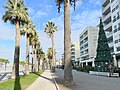 A typical street in Vlorë showing some palm trees and the Christmas tree
 -
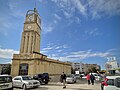 The old town of Vlorë
 -
 The panorama of Vlorë
 -
 The bay of Vlorë


See also
[edit]Notes
[edit]- ^ The municipality of Vlorë consists of the administrative units of Novoselë, Orikum, Qendër Vlorë, Shushicë and Vlorë.[2][7][8] The population of the municipality results from the sum of the listed administrative units in the former as of the 2011 Albanian census.[2][9]
- ^ Also known as Vlonë (pronounced [ˈvlonə]; Albanian definite form: Vlona) in Gheg Albanian;[13] formerly known in English as Avlona or Valona.
- ^ "town that is the second seaport of Albania. [...] It was strategically important during Roman times and in the 11th–12th-century wars between Normans and Byzantines" (Encyclopaedia Britannica, s.v. Vlore).
References
[edit]- ^ "Dorëheqja e Ermal Dredhës, Elis Halili komandohet për drejtimin e Bashkisë së Vlorë! Opozita: Shkelje, ju çojmë në prokurori". Shqiptarja.com (in Albanian). 22 September 2025. Retrieved 22 September 2025.
- ^ a b c d e f g h "Pasaporta e Bashkisë Vlorë" (in Albanian). Porta Vendore. Archived from the original on 23 September 2021. Retrieved 23 September 2021.
- ^ "Bashkia Vlorë" (in Albanian). Albanian Association of Municipalities (AAM). Archived from the original on 23 September 2021. Retrieved 23 September 2021.
- ^ "Rregullore e Planit të Përgjithshëm Vendor të Territorit të Bashkisë Vlorë" (PDF) (in Albanian). Bashkia Vlorë. p. 15. Archived (PDF) from the original on 23 September 2021. Retrieved 23 September 2021.
- ^ "The urban population of Vlorë – 2011 Census Data (Knoema)". Knoema. Retrieved 20 April 2025.
- ^ "The metro population of Vlorë". DB City. Retrieved 25 April 2025.
- ^ a b "A new Urban–Rural Classification of Albanian Population" (PDF). Instituti i Statistikës (INSTAT). May 2014. p. 15. Archived from the original (PDF) on 14 November 2019. Retrieved 23 September 2021.
- ^ a b "Law nr. 115/2014" (PDF) (in Albanian). p. 6376. Retrieved 25 February 2022.
- ^ a b Nurja, Ines. "Censusi i popullsisë dhe banesave/ Population and Housing Census–Vlorë (2011)" (PDF). Tirana: Institute of Statistics (INSTAT). p. 85. Archived (PDF) from the original on 13 June 2020. Retrieved 23 September 2021.
- ^ a b "Census of Population and Housing". Institute of Statistics Albania.
- ^ "Vlorë". Lexico UK English Dictionary. Oxford University Press. Archived from the original on 2020-07-07.
- ^ "Vlorë". The American Heritage Dictionary of the English Language (5th ed.). HarperCollins. Retrieved 5 July 2020.
- ^ The New Encyclopaedia Britannica. Encyclopædia Britannica. 1974. p. 479. ISBN 0-85229-290-2. Archived from the original on 7 November 2020. Retrieved 23 September 2021.
- ^ Babiniotis, Georgios (2019). Dictionary of the Modern Greek Language. Kéntro Lexikologías. p. 315. ISBN 978-9609582148.
ηκαν το αρχ. δίαυλος «πέρασμα, δίοδος» και το νεότ. πύραυλος. Η κοιλάδα που μοιάζει με αυλό λέγεται αυλών (αυλώνας). από όπου το συχνό τοπωνύμιο Αυλών | Αυλώνα, ... Αυλώνας (ο) πόλη και λιμάνι τής Ν. Αλβανίας
- ^ a b c d Demiraj, Shaban (2006). The origin of the Albanians: linguistically investigated. Academy of Sciences of Albania. pp. 144–145. ISBN 9789994381715. Archived from the original on 20 November 2020.
- ^ Katičić, Radoslav (1976). Ancient Languages of the Balkans. Mouton. p. 186. ISBN 978-9027933058.
- ^ Huld, Martin E. (1986). "Accentual Stratification of Ancient Greek Loanwords in Albanian". Zeitschrift für vergleichende Sprachforschung. 99 (2). Vandenhoeck & Ruprecht (GmbH & Co. KG): 248–249. JSTOR 40848841.
- ^ "Baynes, T. S., ed. (1875–1889). . Encyclopædia Britannica (9th ed.). New York: Charles Scribner's Sons." in the Encyclopædia Britannica, 9th ed. 1878.
- ^ a b c d e Chisholm 1911.
- ^ Gawrych, G. W. (2006). The crescent and the eagle: Ottoman rule, Islam and the Albanians, 1874-1913. I.B.Tauris. p. 23. ISBN 978-1-84511-287-5. Google Book Search. Retrieved on August 25, 2009.
- ^ "Arumunët Albania, nr. 40". Arumunët Albania (in Albanian and Aromanian). No. 40. 2014. p. 15.
- ^ Bereti 1993, p. 143.
- ^ Stocker, Sharon R. (2009). Illyrian Apollonia: Toward a New Ktisis and Developmental History of the Colony. p. 227.
Heroic origins that involved Euboeans were attributed toseveral other early settlements around the Bay of Vlora
- ^ Walker, Keith G. (9 January 2004). Archaic Eretria: A Political and Social History from the Earliest Times to 490 BC. Routledge. p. 151. ISBN 978-1-134-45098-5.
Eretrians settled around the bay of Avlona (Aulona).... There was also a place called Aulon in the Eretrias... and another .... Khalkis.
- ^ Papadopoulos, John (2016). "Komai, Colonies and Cities in Epirus and Southern Albania: The Failure of the Polis and the Rise of Urbanism on the Fringes of the Greek World". In Molloy, Barry P.C. (ed.). Of Odysseys and Oddities: Scales and Modes of Interaction Between Prehistoric Aegean Societies and their Neighbours. Oxbow Books. p. 440. ISBN 978-1-78570-232-7.
Then there was the establishment of a new type of site in the Illyrian hinterland, away from the coastal areas usually inhabited by Greeks, especially during the developed Iron Age...
- ^ Bereti 1993, p. 143; Fasolo 2005, p. 178; Volpe et al. 2014, p. 300.
- ^ Volpe et al. 2014, p. 300.
- ^ Fasolo 2005, p. 178.
- ^ Volpe et al. 2014, p. 300; Bereti 1993, p. 143.
- ^ Bereti, Quantin & Cabanes 2011, pp. 11, 13.
- ^ Bereti, Quantin & Cabanes 2011, p. 11.
- ^ a b Vailhé 1912.
- ^ "Apollonia and Aulon in Epirus Nova" (Bowden 2003, p. 14)
- ^ Annuario Pontificio 2013 (Libreria Editrice Vaticana 2013 ISBN 978-88-209-9070-1), p. 842
- ^ Vlora, Eqrem bej; Von Godin, Marie Amelie von Godin (2010) [1956]. Contributions to the history of Turkish rule in Albania: a Historical Outline v. I . Tirana: Publishing House "55". f. 47. ISBN 978-99943-56-83-6.
- ^ Nicol, Donald M. (1984). The Despotate of Epiros 1267-1479: A Contribution to the History of Greece in the Middle Ages. Cambridge University Press. p. 92. ISBN 978-0-521-26190-6.
Nicholas Orsini... He stepped up his invasion of Byzantine territory... The Venetians too seem to have decided that the moment was now ripe to help him. They sent a fleet led by Giovanni Michiel to attack Valona. Many of its Greek inhabitants were killed on the spot, including the son of its admiral Gantzas
- ^ Mandeville, John (2012). The Book of Marvels and Travels. United Kingdom: Oxford University Press. p. 153. ISBN 978-0-19-960060-1.
- ^ Van Antwerp Fine, John (1994). The Late Medieval Balkans - A Critical Survey from the Late Twelfth Century to the Ottoman Conquest. United States of America: University of Michigan Press. p. 357. ISBN 0-472-10079-3.
- ^ a b c d e f g h i Giakoumis, Konstantinos (2010). "The Orthodox Church in Albania Under the Ottoman Rule 15th-19th Century". In Schmitt, Oliver Jens (ed.). Religion und Kultur im albanischsprachigen Südosteuropa [Religion and culture in Albanian-speaking southeastern Europe]. Frankfurt am Main: Peter Lang. pp. 95–96. ISBN 9783631602959.
- ^ İnalcik, Halil (1954). Hicr ı835 tarihli sûret-i defter-i sancak-i Arvanid (in Turkish). Türk Tarih Kurumu Yayınlarından.
- ^ Stanford J. Shaw; Ezel Kural Shaw (29 October 1976). History of the Ottoman Empire and Modern Turkey: Volume 1, Empire of the Gazis: The Rise and Decline of the Ottoman Empire 1280-1808. Cambridge University Press. p. 69. ISBN 978-0-521-29163-7.
- ^ Ray, Jonathan Stewart (2013). After expulsion: 1492 and the making of Sephardic Jewry. New York: New York University Press. p. 60. ISBN 978-0-8147-2911-3.
- ^ Pollo, Stefanaq (1984). Historia e Shqipërisë: Vitet 30 të shek. XIX-1912 (in Albanian). Akademia e Shkencave e RPS të Shqipërisë, Instituti i Historisë. OCLC 165705732.
- ^ Tütüncü, Mehmet (2017). "Grebeneli Bekir Fikri Bey Albay Thomson'a Karşi 1914 Avlonya Olayı [Grebeneli Bekir Fikri Bey against Colonel Thomson: The Case of Vlorë 1914]". Düşünce ve Tarih. 3 (31): 40, 42.
- ^ Hoxha, Enver (1972). The Party of Labor of Albania in Battle with Modern Revisionism: Speeches and Articles. The Naim Frasheri Publishing House.
- ^ Glass, Emily (2017). "Once upon a Time in Ksamil: Communist and Post-Communist Biographies of Mushroom-Shaped Bunkers in Albania". In Bennett, Luke (ed.). In the Ruins of the Cold War Bunker: Affect, Materiality and Meaning Making. Rowman & Littlefield. pp. 147–150. ISBN 978-1-78348-735-6.
- ^ Vickers, Miranda; Pettifer, James (1997) [1997]. Albania: From Anarchy to a Balkan Identity. C. Hurst & Co. (published 1999). pp. 47–48. ISBN 978-1-85065-279-3.
Vlora ... was notorious as a recruiting ground for the Sigurimi.
- ^ a b "Shërbim Konsulence, për Hartimin e Planeve të Përgjithshme Vendore, për Katër Bashki, Vlorë, Sarandë, Himarë, Konispol" (PDF) (in Albanian). Bashkia Vlorë. 30 November 2016. Archived (PDF) from the original on 23 September 2021. Retrieved 23 September 2021.
- ^ a b c d "Climate: Vlorë". Climate-Data. Archived from the original on 21 September 2021. Retrieved 21 September 2021.
- ^ a b "Vlore Climate & Temperature". ClimaTemps. Archived from the original on 24 September 2021. Retrieved 24 September 2021.
- ^ a b c "Vlore climate Normals for 1961-1990(WMO Station Number: 13600)". ncei.noaa.gov. NOAA. Archived from the original on 4 November 2024. Retrieved 23 February 2024.
- ^ Polemio, M.; CNR-IRPI Pambuku, A.; Servizio Geologico di Albania Petrucci, O.; CNR-IRPI. The coastal karstic aquifer of Vlora (Albania). OCLC 697554091.
{{cite book}}: CS1 maint: multiple names: authors list (link) - ^ Begaj, Majlinda (10 March 2016). "Vlora guida".
{{cite journal}}: Cite journal requires|journal=(help) - ^ "What is the Climate, Average Temperature/ Weather in Vlore?". Climatetemp.info. Archived from the original on 21 August 2010. Retrieved 21 September 2021.
- ^ "Albania is creating three free economic zones". emerging-europe.com. 24 August 2015. Archived from the original on 29 January 2018. Retrieved 2 April 2017.
- ^ "Subnational Economy Rankings - South East Europe - Subnational Doing Business - World Bank Group". www.doingbusiness.org. Retrieved 15 March 2018.
- ^ "Five destinations to watch — from the Faroe Islands to Pakistan". Financial Times. 8 November 2019. Archived from the original on 2022-12-10. Retrieved 2020-08-31.
- ^ Bytyci, Fatos; Goga, Florion (2024-04-04). "Jared Kushner's planned Albania resort stokes fear and hope in coastal town". Reuters. Retrieved 2024-04-10.
- ^ "Bypass-i Vlorës" (in Albanian). Archived from the original on 22 February 2017. Retrieved 24 September 2021.
- ^ Gjonaj, Arlinda (15 June 2020). "Këtë javë nis asfaltimi i bypass-it të Vlorës/ Rama: Brenda muajit hapet gara ndërkombëtare për 'Korridorin Blu'" (in Albanian). Agjencia Telegrafike Shqiptare (ATA). Archived from the original on 22 June 2021. Retrieved 24 September 2021.
- ^ "History of Hekurudha Shqiptare (in Albanian)". Archived from the original on 2016-10-17. Retrieved 21 June 2020.
- ^ "Europe Trains Guide". Archived from the original on 22 April 2012. Retrieved 15 September 2017.
- ^ "Albania Railway Photographs". Retrieved 20 October 2017.
- ^ "About Albrail". Albrail. Retrieved 21 June 2020.
- ^ "Aeroporti i ri ndërkombëtar i Vlorës" (in Albanian). Kryeministria. Archived from the original on 2 May 2021. Retrieved 24 September 2021.
- ^ "Gati projekti për aeroportin ndërkombëtar të Vlorës" (in Albanian). Kryeministria. Archived from the original on 24 September 2021. Retrieved 24 September 2021.
- ^ "New airport near the Narta Lagoon, Albania". International Union for Conservation of Nature (IUCN). 7 March 2018. Archived from the original on 24 September 2021. Retrieved 24 September 2021.
- ^ "PM Rama announces start of works for Vlora Airport". Albanian Daily News.
- ^ "PM Rama inspects works at construction site of Vlora Airport". Albanian Daily News.
- ^ Ziaj, Jerola (26 July 2024). "Tymi i plehrave mbulon Vlorën në mes të sezonit turistik". Reporter.al (in Albanian).
- ^ "Tymi i zi mbulon Vlorën, ende aktiv zjarri në fushën e plehrave". Lapsi.al (in Albanian). 27 July 2024.
- ^ Musaraj, Arta (2019). "Academicus - In the name of Science" (PDF). Academicus International Scientific Journal. 20: 10–11. doi:10.7336/academicus.2019.20.01. ISSN 2079-3715.
- ^ "Official website of Academicus International Scientific Journal".
- ^ "Private Higher Education Institutions in Albania". Archived from the original on 2016-01-26. Retrieved 2013-02-04.
- ^ Hemming, Andreas; Kera, Gentiana; Pandelejmoni, Enriketa (2012). Albania: Family, Society and Culture in the 20th Century. LIT Verlag Münster. p. 37. ISBN 9783643501448. Archived from the original on 24 September 2021. Retrieved 24 September 2021.
- ^ "Cities of Albania".
- ^ a b "Constitution of the Republic of Albania". Organization for Security and Co-operation in Europe (OSCE). Archived from the original on 17 April 2021. Retrieved 14 September 2021.
- ^ "Albania 2016 International Religious Freedom Report" (PDF). state.gov. pp. 1–7. Archived from the original (PDF) on 2017-08-15.
- ^ Kokolakis, Mihalis (2003). Το ύστερο Γιαννιώτικο Πασαλίκι: χώρος, διοίκηση και πληθυσμός στην τουρκοκρατούμενη Ηπειρο (1820–1913) [The late Pashalik of Ioannina: Space, administration and population in Ottoman ruled Epirus (1820–1913)]. EIE-ΚΝΕ. p.52. "β. Ο διεσπαρμένος ελληνόφωνος πληθυσμός περιλάμβανε... και μικρό αριθμό οικογενειών στα αστικά κέντρα του Αργυροκάστρου και της Αυλώνας. [b. The scattered Greek-speaking population included ... and a small number of families in the cities of Gjirokastra and Vlora.]"; p. 53. "και την ακόμη ολιγομελέστερη ομάδα των Καθολικών της Αυλώνας [and even group of Catholics in Vlora]"; p. 54. "Η μουσουλμανική κοινότητα της Ηπείρου, με εξαίρεση τους μικρούς αστικούς πληθυσμούς των νότιων ελληνόφωνων περιοχών, τους οποίους προαναφέραμε, και τις δύο με τρεις χιλιάδες διεσπαρμένους «Τουρκόγυφτους», απαρτιζόταν ολοκληρωτικά από αλβανόφωνους, και στα τέλη της Τουρκοκρατίας κάλυπτε τα ¾ περίπου του πληθυσμού των αλβανόφωνων περιοχών και περισσότερο από το 40% του συνόλου. [The Muslim community in Epirus, with the exception of small urban populations of the southern Greek-speaking areas, which we mentioned, and 2-3000 dispersed "Muslim Romani", consisted entirely of Albanian speakers, and in the late Ottoman period covered approximately ¾ of population ethnic Albanian speaking areas and more than 40% of the total area."; pp. 370, 374.
- ^ Stein, Jonathan P.; EastWest Institute (New York, N.Y.) (2000). The Politics of National Minority Participation in Post-communist Europe: State-building, Democracy, and Ethnic Mobilization. M.E. Sharpe. p. 172. ISBN 978-0-7656-0528-3.
- ^ Braude, Benjamin; Lewis, Bernard (1982). Christians and Jews in the Ottoman Empire: The central lands. v. 2. The Arabic-speaking lands. Holmes & Meier Publishers. p. 246. ISBN 978-0-8419-0519-1.
- ^ Elsie, Robert. "Der Kanun" (in German). Elsie. Archived from the original on 18 October 2012. Retrieved 24 September 2021.
- ^ "Albanian folk iso-polyphony". United Nations Educational, Scientific and Cultural Organization (UNESCO). Archived from the original on 24 September 2021. Retrieved 24 September 2021.
- ^ Elsie, Robert. "Albanian Dialects: Introduction". Albanian Language. Archived from the original on 16 October 2021. Retrieved 28 October 2021.
- ^ a b c "Çfarë të vizitoni" (in Albanian). Bashkia Vlorë. Archived from the original on 3 March 2021. Retrieved 23 September 2021.
- ^ a b c d "Muzeumet e Vlorës" (in Albanian). Bashkia Vlorë. Archived from the original on 5 March 2021. Retrieved 23 September 2021.
- ^ Alla, Adela (9 August 2020). "Në zonën e rilindur të Vlorës së shpejti dhe Muzeu i Shpëtimit të Hebrenjve" (in Albanian). Agjencia Telegrafike Shqiptare (ATA). Archived from the original on 24 September 2021. Retrieved 24 September 2021.
- ^ "Historia e shpëtimit të hebrenjve me një muze në Vlorë". Telegrafi (in Albanian). 20 August 2020. Archived from the original on 23 August 2020. Retrieved 24 September 2021.
- ^ "Florida Sister Cities". Tampa Bay Protocol & Trade. Retrieved 2021-09-05.
- ^ "Delegacioni i qytetit Yangzhou vizitoi Vlorën" (in Albanian). Embassy of the People's Republic of China in the Republic of Albania. 2016-10-18. Retrieved 2021-09-05.
Bibliography
[edit]- Bereti, Vasil (1993). "Gjurmë të fortifikimeve në vendbanimin në Treport / Traces de fortifications dans l'habitat à Treport". Iliria (in Albanian). 23: 143–159. doi:10.3406/iliri.1993.1622.
- Bereti, Vasil; Quantin, François; Cabanes, Pierre (2011). "Histoire et épigraphie dans la région de Vlora (Albanie)". REA (in French). 113 (1).
- Bowden, William (2003). Epirus Vetus: The Archaeology of a Late Antique Province (Duckworth Archaeology). Bloomsbury Academic. p. 14. ISBN 0-7156-3116-0.
- Chisholm, Hugh, ed. (1911). . Encyclopædia Britannica (11th ed.). Cambridge University Press. pp. 65–66.
- Fasolo, Michele (2005) [2003]. La via Egnatia I. Da Apollonia e Dyrrachium ad Herakleia Lynkestidos. Viae Publicae Romanae (in Italian). Vol. 1. Rome: Istituto Grafico Editoriale Romano.
 This article incorporates text from a publication now in the public domain: Vailhé, Siméon (1912). "Valona". Catholic Encyclopedia. Vol. 15.
- Volpe, Giuliano; Disantarosa, Giacomo; Leone, Danilo; Turchiano, Maria (2014). "Porti, approdi e itinerari dell'Albania meridionale dall'Antichità al Medioevo. Il 'Progetto Liburna'". Ricerche Archeologiche in Albania. Aracne: 287–326. doi:10.4399/978885487245516 (inactive 1 July 2025). ISBN 978-88-548-7245-5.
{{cite journal}}: CS1 maint: DOI inactive as of July 2025 (link)

Further reading
[edit]- Nagle, Robert (2002). "East European Experiments—Tourism/Tourist Information about Vlore (Vlore) Albania". Imaginary Planet Home. Retrieved 24 April 2016.
- "Vlorë". The Columbia Encyclopedia. 2004.
- "Vlorë or Vlora, Ital. Valona, ancient Aulon". Crystal Reference Encyclopedia. 2001.
External links
[edit] Definitions from Wiktionary
 Media from Commons
 News from Wikinews
 Quotations from Wikiquote
 Texts from Wikisource
 Textbooks from Wikibooks
 Resources from Wikiversity
 Travel information from Wikivoyage


- vlora.gov.al – official website (in Albanian)


| International | |
|---|---|
| National | |
| Geographic | |
| Other | |

Vlorë
View on GrokipediaEtymology
Origins and variations
The name of the city derives from the Ancient Greek term Αὐλών (Aulṓn), applied to the settlement founded as a Greek colony on the Illyrian coast in antiquity.[7] This appellation, denoting a "channel," "glen," or "ravine," alludes to the topographic characteristics of the site's coastal inlet and surrounding valley terrain.[8] The earliest surviving reference appears in the works of the geographer Ptolemy in the 2nd century AD, listing Aulṓn among settlements of the Illyrian Taulantii tribe.[9] Linguistic adaptations emerged across empires and languages, preserving the core phonetic structure while incorporating local phonology. In Latin sources from the Roman era, it rendered as Aulona.[10] Byzantine and modern Greek usage shifted to Avlón or Avlóna. Italian variants, Valona, prevailed under Venetian maritime dominance from the 15th to 18th centuries and later Italian occupations. Ottoman Turkish records employed Avlonya from the 15th century onward, reflecting administrative integration into the empire.[11] [12] Within Albanian, the form evolved through indigenous phonetic laws, yielding Vlorë in the Tosk dialect predominant in the region and Vlonë in the Gheg dialect to the north.[13] The contemporary standard spelling Vlorë, featuring the diaeresis-marked "ë" to indicate schwa pronunciation, crystallized with the adoption of a unified Latin-based orthography for Albanian, ratified at the Congress of Manastir in 1908 and reinforced after independence in 1912 amid efforts to codify national linguistic norms.[14]History
Ancient and medieval periods
The region surrounding Vlorë exhibits evidence of early Illyrian habitation, with archaeological indications of pre-urban settlements dating to the late Bronze Age and continuing into the Iron Age around the 6th century BCE, reflecting indigenous tribal activities amid Hellenistic influences from nearby Greek colonies. The settlement developed into the port city of Aulon, established as a Greek colony in the 6th century BCE on the Illyrian coast, serving as one of several maritime outposts that facilitated trade and cultural exchange between Greek settlers and local Illyrian populations such as the Taulantii.[15][16] Under Roman administration from the 2nd century CE, Aulon functioned as a key port within the province of Epirus Nova, part of the broader Macedonian administrative region, supporting commerce along the Adriatic and contributing to the empire's supply lines via the Via Egnatia corridor.[17][18] The city transitioned into the Byzantine era, becoming an episcopal see by the 5th century CE and retaining strategic port significance, evidenced by its role in regional defenses and ecclesiastical networks.[17] In the medieval period, Byzantine fortifications bolstered the area's defenses, including Kaninë Castle, initially a 3rd-century BCE Illyrian site fortified into a Byzantine stronghold by the 4th–6th centuries CE under Emperor Justinian I, overlooking Vlorë Bay for control of maritime approaches.[19][20] The region experienced Norman incursions during the 11th–12th centuries, positioning Vlorë centrally in Byzantine-Norman conflicts over Adriatic dominance.[17] By the 14th century, it formed part of the Principality of Valona under Albanian lords, fostering Venetian trade interactions through commercial privileges and alliances that enhanced the port's role in Mediterranean exchange until the Ottoman conquest in 1464.[21]Ottoman era and national awakening
Following the Ottoman acquisition of Vlorë in 1417, the city was designated as the administrative center of the Sanjak of Avlonya, marking the empire's initial foothold on the Adriatic coast.[22] This sanjak became a vital naval outpost, with the establishment of a shipyard that supported Mediterranean fleet operations and bolstered trade links to western Europe.[22] The local economy centered on port-based commerce in goods like grain and olive oil, supplemented by agriculture in the fertile Labëria hinterland, where Albanian Muslim converts formed the bulk of the population by the 17th century.[22] Prominent Albanian families, such as the Vloras, amassed wealth through landownership and integration into Ottoman governance, exerting influence over southern Albanian territories and mirroring the semi-autonomous pashaliks that characterized regional power dynamics.[23] [24] Members like Ismail Bey Vlora mobilized local forces against external threats, including Greek insurgents, thereby preserving familial and communal authority amid fluctuating imperial oversight.[24] The 19th-century Tanzimat reforms, aimed at centralization, downgraded Avlonya to a kaza under the Yanya Vilayet, eliciting pushback from regional elites who resisted heightened taxation and administrative interference as threats to established autonomies.[22] This tension fed into the Albanian National Awakening, where Labëria's traditions of folklore and oral epic poetry sustained cultural distinctiveness and contributed to early efforts at Albanian linguistic unity, countering Ottoman homogenization.[25] Local awakening activities aligned with broader initiatives like the League of Prizren, advocating territorial integrity and ethnic self-preservation against post-1878 partition risks.[26]Independence, world wars, and interwar period
On 28 November 1912, Ismail Qemali, returning from exile with support from Austro-Hungarian interests, convened an assembly of Albanian leaders in Vlorë and proclaimed Albania's independence from the Ottoman Empire.[27] From the balcony of Xhemil Bey Vlora's house, delegates raised the red flag bearing the black double-headed eagle and established the Provisional Government of Albania, with Qemali as its head.[28] This assembly, comprising around 40 representatives from Albanian regions, marked Vlorë as the initial seat of the nascent state amid the Balkan Wars' chaos.[29] World War I brought foreign occupations to Albania, with Italy landing troops in Vlorë on 25 December 1914 under the pretext of protecting against Greek advances, securing the port and surrounding areas as part of broader Adriatic ambitions outlined in the 1915 Treaty of London.[30] Italian control persisted through the war's fragmentation, during which Albania lacked a centralized authority and suffered territorial partitions among occupying powers including Austria-Hungary, Serbia, and Greece.[31] Vlorë's strategic harbor facilitated Italian logistics, but local resistance simmered against the occupation's exploitative measures.[32] Post-war, Albanian nationalists launched the Vlora War in June 1920, coordinating guerrilla attacks on Italian garrisons in the Vlorë region to expel the occupiers.[32] Facing international pressure and domestic unrest, Italy withdrew its forces by 3 September 1920, evacuating Vlorë and ceding control except for the island of Sazan, which remained under Italian administration until 1947.[33] This victory bolstered Albanian unity, leading to the Congress of Lushnjë later that year, which relocated the government to Tirana but affirmed Vlorë's role in national liberation.[34] In the interwar period, Vlorë integrated into the centralizing state under Ahmet Zogu's presidency from 1925 and subsequent monarchy as King Zog I from 1928, benefiting from infrastructure investments like road improvements tied to its port economy.[35] However, the region endured instability from clan-based banditry and feuds exacerbated by unresolved border disputes with Greece over southern territories, though Vlorë itself avoided direct invasion.[36] Italian economic penetration intensified, with loans and concessions dominating Albania's foreign relations and positioning Vlorë as a conduit for fascist influence until the 1939 invasion.[37]Communist dictatorship and isolation
Following the establishment of communist rule in November 1944 under Enver Hoxha's leadership, Vlorë's economy underwent rapid nationalization, with the city's port and surrounding industries seized by the state as part of broader reforms that encompassed transportation, forests, pastures, and industrial assets by 1946. The port, previously a hub for limited pre-war trade, was repurposed under central planning for domestic and allied shipments, including a brief joint Albanian-Soviet submarine base until the 1961 Sino-Soviet split prompted Albania to expel Soviet personnel and seize the facilities.[38] However, Hoxha's successive breaks—with Yugoslavia in 1948, the Soviet Union in 1961, and China in 1978—enforced extreme isolationism, curtailing international maritime commerce and confining Vlorë's port to minimal state-directed operations, which exacerbated coastal economic stagnation amid Albania's pursuit of autarky.[39] Agricultural collectivization, initiated in the late 1940s and declared complete nationwide by February 1961, profoundly impacted Vlorë's hinterland in the Labëria region, where private landholdings were redistributed into cooperatives under rigid quotas and state oversight, prioritizing grain production over traditional crops like olives and tobacco.[40] This policy, enforced through coercive measures, led to inefficiencies such as reduced yields and farmer resistance, contributing to rural depopulation as inhabitants migrated to urban centers or state industries, shrinking Labëria's agrarian base by drawing labor toward Vlorë's limited manufacturing. Local industry emphasized self-sufficiency, with the reactivation of Selenica's bitumen mines—producing high-quality natural asphalt for roads and exports to allies—reaching operational status by 1945 under state control, alongside state-managed fisheries exploiting the Adriatic for domestic protein needs.[41] Hoxha's regime imposed severe cultural and religious suppression in Vlorë and Labëria, regions with historically strong Bektashi Sufi and Orthodox influences, culminating in the 1967 declaration of state atheism and the 1976 constitutional ban on all religious practice, which ordered the closure or demolition of mosques and churches.[42] Traditional Labëriot customs, including folk expressions tied to Islamic or pre-Islamic heritage, faced censorship as "feudal remnants," with the Sigurimi secret police—recruiting heavily from Vlorë—monitoring and punishing deviations, fostering an atmosphere of conformity that stifled local identity amid broader purges.[43] These measures, rationalized as essential for ideological purity, compounded economic isolation by alienating potential cultural exchanges and reinforcing Vlorë's role as a peripheral outpost in Hoxha's fortress state until his death in 1985.Post-communist transition and reforms
Following the collapse of the communist regime in Albania in 1991, Vlorë underwent initial democratization efforts amid national economic liberalization, with local state enterprises beginning privatization through auctions of small shops and services starting in 1991-1992.[44] These measures aimed to dismantle central planning but faced challenges from weak institutions and incomplete property restitution, leading to uneven market formation in port-dependent Vlorë.[45] The transition faltered severely in early 1997 when pyramid investment schemes, which had absorbed up to half of Albania's GDP, collapsed nationwide, triggering civil unrest that originated in Vlorë as protesters hurled rocks at police and established barricades against the government blamed for regulatory failures.[46] In Vlorë, the unrest escalated into armed rebellion, with local groups seizing weapons from depots, contributing to over 2,000 deaths and the near-collapse of state authority, as the schemes' failure exposed causal vulnerabilities in post-communist financial oversight and public trust.[47] This spillover from national crisis prompted international intervention, including EU and NATO stabilization aid, which conditioned further reforms on governance improvements.[48] Post-1997, Vlorë benefited from Albania's EU-oriented stabilization program, including fiscal austerity and banking reforms that rebuilt investor confidence by 1998, alongside privatization acceleration of remaining state assets to attract foreign direct investment in the port sector during the early 2000s.[49] Port modernization efforts in Vlorë focused on cargo handling capacity, handling about 15% of national volume by enhancing infrastructure for trade links, though efficiency gains were limited by corruption and incomplete regulatory frameworks.[50] Mass emigration from Vlorë, peaking after 1991 and intensifying post-1997, reduced local population by waves of labor migration to Italy and Greece via the port, with remittances emerging as a key economic buffer equivalent to 10-15% of Albania's GDP in the late 1990s and sustaining household consumption amid slow industrial recovery.[51] These inflows, often informal, mitigated poverty but reinforced dependency on external labor markets rather than domestic entrepreneurship, with Vlorë's diaspora ties facilitating some reinvestments in trade.[52]Geography
Location and topography
Vlorë is situated in southwestern Albania at the coordinates 40°28′N 19°29′E.[53] The city occupies the northern shore of the Bay of Vlorë, a prominent inlet along the Albanian coast.[54] This positioning places Vlorë at the approximate juncture where the Adriatic Sea gives way to the Ionian Sea through the Strait of Otranto, approximately 70 kilometers across from the Italian region of Apulia.[55] To the east and southeast, the rugged Llogara Mountains of the Ceraunian range ascend sharply, featuring karst formations with elevations reaching up to 2,045 meters at Çika Peak. These limestone-dominated highlands contribute to the dramatic topography of the Albanian Riviera, characterized by steep cliffs dropping to narrow coastal strips interspersed with pebble beaches and coves.[54] The range's orientation influences local landforms, creating a transition from coastal lowlands to elevated plateaus via passes like Llogara Pass at 1,027 meters. North of the city, the Narta Lagoon extends as a shallow coastal wetland covering 41.8 square kilometers, with a maximum depth of 1.5 meters, separated from the Adriatic by a thin barrier of dunes and littoral deposits.[56] This lagoon complex forms a distinct physiographic feature, encompassing salt pans and marshy fringes that contrast with the surrounding hilly terrain and marine bay.[57]