


Community hub
Recent from talks
Contribute something
Nothing was collected or created yet.
Subregion
View on Wikipedia
A subregion is a part of a larger geographical region or continent. Cardinal directions are commonly used to define subregions. There are many criteria for creating systems of subregions; this article is focusing on the United Nations geoscheme, which is a changing, constantly updated, UN tool based on specific political geography and demography considerations relevant in UN statistics.
United Nations subregions
[edit]The Statistics Division of the United Nations (UN) is in charge of the collection, processing, and dissemination of statistical information for the UN.[1] In 1999, it developed a system of macro-geographical (continental) regions, subregions, and other selected economic groups to report advances towards achieving numerous Millennium Development Goals worldwide. These statistical divisions were devised for statistical purposes and is used for carrying out statistical analysis.[2] The division's first publication was the book World's Women 2000: Trends and Statistics in 2000.
According to the UN, the assignment of countries or areas to specific groupings is for statistical convenience and does not imply any assumption regarding political or other affiliation of countries or territories.[3]
Subregions by landmass and continent
[edit]The following is a non-exhaustive list of subregions, arranged alphabetically by region (i.e., by continent); in the UN geoscheme, higher-level, macro-geographical regions are arranged to the extent possible according to continents.
Sequence used in the list (not all criteria are applied to each continent):
- by the UN Statistics Division's geoscheme
- by geography
- by physiography
- by geopolitics
- by human geography
- by economics
- by culture
- by language
- by religion
- by biogeography
- by historical division
- by geology
Afro-Eurasia is a continental landmass comprising the continents of Africa, Asia, and Europe.
- by the United Nations Statistics Division's geoscheme (see also: UN geoscheme for Africa):
- by geography:
- North Africa (Also known as Saharan Africa)
- Maghreb (AKA Northwest Africa, also including Mauritania, which most geographers consider as a part of West Africa; some geographers consider Libya as a part of Northeast Africa and Western Sahara as a part of West Africa)
- Northeast Africa (including Egypt, the Horn of Africa, and the Sudans; some geographers consider Egypt, Libya, and the Sudan as Northeast Africa instead)
- Sub-Saharan Africa (AKA Tropical Africa)
- Central Africa (AKA Congo, Equatorial Africa or Middle Africa)
- East Africa (AKA Nile)
- Northeast Africa (including Egypt, the Horn of Africa, and the Sudans; some geographers consider Egypt, Libya, and the Sudan as Northeast Africa instead)
- Southeast Africa (also including Botswana, Eswatini and Lesotho, which most geographers consider as part of Southern Africa)
- Southern Africa (AKA Kalahari)
- West Africa (AKA Niger)
- North Africa (Also known as Saharan Africa)
- by physiography:
- by economics:
- African Monetary Union (AMU)
- Arab League (including some West Asian countries)
- Common Market for Eastern and Southern Africa (COMESA)
- Common Monetary Area (CMA)
- Community of Sahel–Saharan States (CEN-SAD)
- Council of Arab Economic Unity (GAFTA) – including some West Asian countries
- Economic Community of Central African States (ECCAS)
- Economic Community of West African States (ECOWAS)
- EMEA (including Europe and the Middle East)
- Southern African Customs Union (SACU)
- Southern African Development Community (SADC)
- Union for the Mediterranean (including most Southern European countries and some West Asian countries)
- by biogeography:
- by historical division:
- by geology:
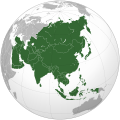
Eurasia is a continental mainland comprising the continents of Asia and Europe.
- by the United Nations Statistics Division's geoscheme (see also: UN geoscheme for Asia):
- Central Asia
- Eastern Asia
- Southeast Asia
- Southern Asia – the UN geoscheme includes Afghanistan and Iran in this subregion
- Western Asia – the UN geoscheme includes Cyprus, the South Caucasus (Armenia, Azerbaijan, and Georgia), and Turkey in this subregion
- by geography:
- Central Asia
- East Asia
- Greater China
- China
- Hong Kong (some geographers consider it as a part of Northeast Asia)
- Macau (some geographers consider it as a part of Northeast Asia)
- Mainland China (some geographers consider it as a part of Northeast Asia)
- North China (Eastern Inner Mongolia is also a part of Northeast China)
- Northeast China (AKA Manchuria) – also a part of Northeast Asia
- Southeast China (excluding Central China)
- East China (some geographers include Taiwan Island, Penghu, Kinmen, the Matsu Islands, Socotra Rock, Parangcho, and the Senkaku Islands in this subregion)
- South Central China
- Central China
- South China (including Hainan Island and the South China Sea Islands, some geographers also include Hong Kong and Macau in this subregion)
- Western China
- Northwest China (some geographers consider Qinghai and Xinjiang as part of Central Asia)
- Southwest China (some geographers consider Tibet as a part of Central Asia)
- South China Sea Islands (some geographers consider them as part of Northeast Asia)
- Taiwan (some geographers consider it as a part of Northeast Asia)
- China
- Mongolia (some geographers consider it as a part of Central Asia or Northeast Asia)
- Northeast Asia
- China
- Eastern Inner Mongolia
- Northeast China (AKA Manchuria)
- Japan
- Korea
- Russian Far East (also a part of North Asia, but not a part of East Asia)
- China
- Greater China
- North Asia (AKA Siberia)
- Russian Far East (also a part of Northeast Asia)
- South Asia
- Southeast Asia
- West Asia (AKA Southwest Asia)
- Anatolia (AKA Asia Minor)
- Arabia
- Eastern Arabia
- Hejaz (AKA Western Arabia)
- Najd (AKA Central Arabia)
- South Arabia
- Levant
- Mesopotamia
- South Caucasus (AKA Transcaucasia)
- by physiography:
- Anatolian Peninsula
- Arabian Peninsula
- Bahrain Island
- Caucasus Mountains
- Daitō Islands
- Eurasian Steppe
- Fertile Crescent
- Hainan Island
- Himalayas
- Indian subcontinent
- Indochinese Peninsula
- Indo-Gangetic Plain
- Indus Valley
- Iranian Plateau
- Japanese Archipelago
- Jeju Island
- Junggar Basin
- Kolyma
- Korean Peninsula
- Leizhou Peninsula
- Liaodong Peninsula
- Malay Archipelago (including New Guinea)
- Mongolian Plateau
- Nanpō Islands
- Qinghai Lake
- Shandong Peninsula
- Sichuan Basin
- Sri Lanka Island
- Taiwan Island
- Tarim Basin
- by geopolitics:
- Asia-Pacific (APAC) – including Oceania
- Greater Middle East – including some African countries
- Middle East and North Africa (AKA MENA) – including North African countries
- Middle East (AKA the Near East) – including Egypt
- Arab League (AKA the Arab states) – including some African countries
- Mashriq – including Egypt and the Sudan
- Arabian Peninsula
- Levant – including Ash-Shām and Cyprus
- Mesopotamia (modern-day Iraq)
- Mashriq – including Egypt and the Sudan
- Asia Minor
- South Caucasus (AKA Transcaucasia)
- Arab League (AKA the Arab states) – including some African countries
- Middle East (AKA the Near East) – including Egypt
- The 'stans
- Middle East and North Africa (AKA MENA) – including North African countries
- Indian subcontinent
- Himalayan states – including China
- Kashmir
- by economics:
- Arab League – including some African countries
- ASEAN Free Trade Area
- Asia Cooperation Dialogue (ACD) – including Russia
- Asian Clearing Union (ACU)
- Asia-Pacific Economic Cooperation (APEC) – including Oceania
- Association of Southeast Asian Nations (ASEAN)
- Bamboo network
- Bangladesh, Bhutan, India, Nepal Initiative (BBIN)
- Bay of Bengal Initiative for Multi-Sectoral Technical and Economic Cooperation (BIMSTEC)
- Council of Arab Economic Unity (GAFTA) – including some African countries
- EMEA (including Africa and Europe)
- Eurasian Customs Union (ECU) – including Belarus
- Eurasian Economic Union (EEU) – including Belarus
- Greater Mekong Subregion
- Gulf Cooperation Council (GCC)
- South Asian Association for Regional Cooperation (SAARC)
- South Asian Free Trade Area (SAFTA)
- South Asia Subregional Economic Cooperation (SASEC)
- Union for the Mediterranean (including most Southern European countries and North African countries)
- by culture:
- Eastern world
- Muslim world (AKA the Islamic world)
- Arab world
- Malay world
- Turkic world
- Azerbaijan
- Soviet Central Asia (excluding Tajikistan)
- Turkey
- Xinjiang
- Dzungaria (northern half of Xinjiang)
- Southern Xinjiang
- Greater Iran
- by religion:
- by biogeography:
- by historical division:
- East Indies (AKA the Indies)
- by geology:
- by the United Nations Statistics Division's geoscheme (see also: UN geoscheme for Europe):
- Eastern Europe – the UN geoscheme includes parts of Central Europe (Czechia, Hungary, Poland, and Slovakia), parts of South-eastern Europe (Bulgaria and Romania), and Northern Asia (Siberia) in this subregion
- Northern Europe – the UN geoscheme includes the Baltic states, the British Isles, and the Channel Islands in this subregion
- Southern Europe – the UN geoscheme includes Slovenia in this subregion
- Western Europe – the UN geoscheme includes parts of Central Europe (the DACH countries and Liechtenstein) in this subregion
- by geography:
- by physiography:
- by geopolitics:
- by economics:
- Central European Free Trade Agreement (CEFTA)
- Commonwealth of Independent States Free Trade Area (CISFTA) – including Armenia and most Central Asian countries
- Comprehensive Economic and Trade Agreement (CETA) – including Canada
- EMEA (including Africa and the Middle East)
- Eurasian Customs Union (EACU) – including Armenia and Kyrgyzstan
- Eurasian Economic Union (EAEU) – including Armenia and Kyrgyzstan
- European Economic Area (EEA) – including Cyprus
- European Free Trade Association (EFTA)
- European Single Market (including Cyprus)
- European Union Customs Union (EUCU) – including Cyprus and Turkey
- European Union–Turkey Customs Union (including Cyprus and Turkey)
- Eurozone (including Cyprus)
- North Sea Region (NSR)
- Union for the Mediterranean (UfM) – including some West Asian countries and most North African countries
- Union State
- by culture:
- by language:
- by religion:
- by biogeography:
- by historical division:
The Americas is a continental landmass comprising the continents of North America and South America.
- by the United Nations Statistics Division's geoscheme (see also: UN geoscheme for the Americas):
- Latin America and the Caribbean
- Caribbean[4] – the UN includes the Lucayan Archipelago in this subregion
- Central America[4] – the UN geoscheme includes Mexico in this subregion
- Middle America
- South America
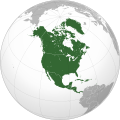
- Northern America[4]
- Latin America and the Caribbean
- by culture:
- by economics:
- by geography:
- Middle America
- Northern America
- Bermuda
- Canada
- Greenland
- Saint Pierre and Miquelon
- United States (excluding Hawaii)
- Alaska
- Contiguous United States
- Central United States
- Eastern United States
- Northern United States
- Great Lakes region (including Ontario, Canada)
- Southern United States
- Western United States (including Alaska and Hawaii)
- Northwestern United States
- Southwestern United States (some geographers include the Oklahoma Panhandle and West Texas in this subregion)
- by physiography:
- by geopolitics:
- by economics:
- by culture:
- by biogeography:
- by geography:
- Eastern South America: Federative Republic of Brazil
- Northern South America – the part of South America located in the Northern Hemisphere
- North-eastern South America: The Guianas
- North-western South America: Caribbean South America
- Southern South America: Southern Cone
- Western South America: Andean States
- by physiography:
- by economics:
- by geology:
- by the United Nations Statistics Division's geoscheme:
- by geography:
- Antarctic and Subantarctic islands
- Bouvet Island (some geographers consider it as a part of South America)
- French Southern Territories (excluding Adélie Land and the Scattered Islands)
- Crozet Islands (some geographers consider them as part of Africa)
- Kerguelen Islands (some geographers consider them as part of Africa)
- Saint Paul and Amsterdam Islands (some geographers consider them as part of Africa)
- Heard Island and McDonald Islands (some geographers consider them as part of Oceania)
- Macquarie Island (some geographers consider it as a part of Oceania)
- New Zealand Subantarctic Islands (some geographers consider them as part of Oceania)
- Peter I Island
- Prince Edward Islands (some geographers consider them as part of Africa)
- South Georgia and the South Sandwich Islands (some geographers consider them as part of South America)
- South Orkney Islands
- South Shetland Islands
- Mainland Antarctica
- Antarctic and Subantarctic islands
- by the United Nations Statistics Division's geoscheme (see also: UN geoscheme for Oceania):
- Australia and New Zealand – the UN geoscheme includes the Cato, Elizabeth, and Middleton reefs, the Lord Howe Island Group, and Norfolk Island in this subregion
- Melanesia – the UN geoscheme includes New Caledonia and New Guinea in this subregion
- Micronesia
- Polynesia – the UN excludes New Zealand from this subregion
- by geography:
- Australasia
- Australia–New Guinea
- Australia (excluding the Australian Indian Ocean Territories, Heard Island and McDonald Islands and Norfolk Island)
- Ashmore and Cartier Islands
- Coral Sea Islands Territory (excluding the Cato, Elizabeth, and Middleton reefs)
- Mainland Australia
- Tasmania (excluding Macquarie Island)
- New Guinea (some geographers consider it as a part of Melanesia)
- Papua New Guinea (excluding the New Guinea Islands Region)
- Western New Guinea
- Australia (excluding the Australian Indian Ocean Territories, Heard Island and McDonald Islands and Norfolk Island)
- Australian Indian Ocean Territories
- Heard Island and McDonald Islands
- Macquarie Island
- Zealandia
- Cato Reef
- Elizabeth Reef
- Lord Howe Island Group
- Middleton Reef
- New Caledonia (also a part of Melanesia)
- New Zealand (some geographers consider it as a part of Polynesia)
- Norfolk Island
- Australia–New Guinea
- Pacific Islands
- Melanesia (some geographers consider it as a part of Australasia)
- Island Melanesia
- Fiji (excluding Rotuma)
- New Caledonia (also a part of Zealandia)
- New Guinea Islands Region (excluding Bougainville)
- Santa Cruz Islands
- Solomon Islands (archipelago)
- Bougainville
- Solomon Islands (excluding the Santa Cruz Islands)
- Vanuatu
- New Guinea (also a part of Australia–New Guinea)
- Island Melanesia
- Micronesia (some geographers include the Bonin Islands and the Volcano Islands in this subregion)
- Polynesia (some geographers include Clipperton Island in this subregion)
- Melanesia (some geographers consider it as a part of Australasia)
- Australasia
- by human geography:
- by biogeography:
See also
[edit]- Autonomous administrative division
- Continent
- Continental fragment
- European Committee of the Regions
- Euroregion
- List of continents and continental subregions by population
- List of Latin names of regions
- Military district
- Polar regions of Earth
- Region
- Regional district
- Regional municipality
- Subcontinent
- Submerged continent
- Supercontinent
- United Nations geoscheme
References
[edit]External links
[edit]Continents of Earth | ||||||||
|---|---|---|---|---|---|---|---|---|
| ||||||||
| ||||||||






Subregion
View on GrokipediaDefinition and Conceptual Foundations
Core Definition and Etymology
A subregion constitutes a subdivision of a larger geographical, ecological, or statistical region, typically grouping territories that share proximate locations, environmental traits, or analytical utility.[3][4][5] This delineation facilitates organized classification beyond national boundaries but below continental scale, as seen in frameworks where cardinal directions or shared landmasses define boundaries, such as Northern Europe or Western Africa.[1] In international statistics, the United Nations employs subregions within its geoscheme to aggregate data across 249 countries and territories, subdividing five continental regions—Africa, Americas, Asia, Europe, and Oceania—into 22 subregions for purposes like demographic analysis and policy reporting, without implying political hierarchies.[1][2] These groupings prioritize geographical contiguity over cultural or economic uniformity, enabling consistent cross-national comparisons; for instance, the subregion of Eastern Asia encompasses China, Japan, and North Korea based on continental adjacency.[1] The term "subregion" derives from the English prefix "sub-" (from Latin sub, meaning under or beneath) combined with "region" (from Latin regio, denoting a boundary, district, or governed territory).[6][7] Its earliest documented usage appears in 1559, in Scottish poetry by David Lindsay, predating modern geographical applications but establishing the compound as a descriptor for delimited areas within broader domains.[6] Over time, the word evolved to specify hierarchical subdivisions in fields like zoogeography by the 19th century, reflecting empirical needs for finer-grained territorial analysis.[4]Principles of Subdivision
Subdivision of regions into subregions adheres to principles that prioritize internal homogeneity and functional coherence, enabling targeted spatial analysis while reflecting underlying causal factors like environmental constraints and human adaptations. These principles derive from the need to partition larger areas into subunits where key variables—such as climate, terrain, or socioeconomic patterns—vary less internally than between units, thus minimizing aggregation errors in empirical studies. Physical criteria often predominate, using natural delimiters like mountain chains, river systems, or climatic isohyets to define boundaries that align with ecological transitions and resource distributions. For example, arid zones separated by escarpments may form distinct subregions due to their influence on agriculture and settlement viability.[8] Human and cultural principles supplement physical ones by grouping territories based on shared ethnic, linguistic, or religious affiliations, which historically correlate with migration patterns and conflict lines. Economic homogeneity serves as another core tenet, particularly in applied contexts, where subregions are delineated by comparable levels of industrialization, trade dependencies, or GDP per capita to facilitate policy comparisons and forecasting. The United Nations Statistics Division employs this approach in its M49 standard, subdividing continental groupings into subregions to enhance uniformity in social, economic, and demographic data for global reporting, without regard to political alliances.[1] Such subdivisions avoid arbitrary lines, favoring contiguity and interaction gradients—e.g., nodal points around major ports or urban centers that drive regional flows.[9] These principles are not rigid but context-dependent, balancing uniformity with practicality; overly fine subdivisions risk fragmentation without analytical gain, while coarse ones obscure causal variances. Empirical validation often involves quantitative metrics, such as cluster analysis of variables like precipitation variability or linguistic divergence indices, to test boundary robustness. In practice, hybrid systems integrate multiple layers, as pure physical divisions may ignore economic interlinkages, such as transboundary supply chains that render adjacent subregions interdependent despite differing terrains.[10] This ensures subdivisions support causal inference, revealing how local conditions propagate effects across scales.Historical Evolution
Pre-Modern Classifications
Pre-modern classifications of subregions emphasized hierarchical nesting within broader continental or climatic frameworks, drawing from traveler accounts, administrative records, and astronomical observations rather than uniform statistical criteria. Ancient Greek geographers laid foundational divisions of the oikoumene, with Herodotus (c. 484–425 BC) partitioning the known world into three unequal landmasses—Europe, Asia, and Libya (encompassing North Africa)—demarcated by natural barriers like the Danube, Nile, and Tanais rivers, as well as the Mediterranean and Red Seas; he critiqued prior assumptions of symmetry, estimating Asia as twice the size of Europe and Libya combined based on Persian expedition data.[11][12] These tripartite divisions, rooted in empirical reports from Ionian explorers, treated subregions as ethnographic or physiographic subunits defined by peoples, rivers, and mountains, such as Scythian steppes within Europe or Ethiopian highlands in Libya. Claudius Ptolemy's Geographia (c. 150 AD) advanced subregional granularity by assigning coordinates to approximately 8,000 localities and organizing the inhabited world into 26 discrete maps as administrative and geographic subunits: 10 covering European areas (e.g., Britannia, Germania Magna), 4 for Libyan territories (e.g., Mauretania, interior Libya beyond the Nile), and 12 for Asian expanses (e.g., Serica, Taprobane). This system, derived from Roman itineraries, Marinus of Tyre's compilations, and eclipse-based longitudes, nested cities and tribes within provincial boundaries, prioritizing habitability and connectivity over climatic uniformity; it remained authoritative in Byzantine and Arabic manuscripts, shaping subregional conceptions until 15th-century revisions with New World data.[13][14] Medieval adaptations sustained these hierarchies amid limited exploration, integrating Ptolemaic coordinates with zonal theories. European scholars, via Isidore of Seville's Etymologiae (c. 636 AD) and mappae mundi, subdivided the tri-continental schema into subregions aligned with five parallel climatic zones—from torrid equatorial uninhabitability to northern frididity—focusing on Christian toponymy and imperial extents like Frankish Gaul or Visigothic Hispania. Concurrently, Islamic geographers expanded granularity; al-Idrisi's Nuzhat al-mushtāq (1154), commissioned by Roger II of Sicily, divided the accessible world into seven longitudinal climes (latitudinal bands from equator to 66°N), each further parsed into 10 east-west sections yielding 70 itinerary maps with ports, routes, and resources detailed from merchant logs and Abbasid surveys. Such pre-modern schemes, often cross-verified against astrolabes and periploi, reflected causal priorities like navigability and agrarian viability, with subregions as functional clusters rather than fixed geopolitical units.[15][16][17]20th-Century Standardization
In the aftermath of World War II, international organizations recognized the need for consistent geographical classifications to enable comparable statistical data across nations, particularly for economic planning, population studies, and resource allocation. The United Nations, established in 1945, initiated efforts through its Statistics Division to develop standardized groupings that transcended national or colonial boundaries, focusing instead on continental landmasses and proximity. This shift addressed inconsistencies in pre-war mappings, where subregions varied by academic or imperial context, often lacking uniformity for global aggregation.[1] By the mid-20th century, the UN Statistics Division formalized a coding system known as M49, assigning three-digit numerical codes to countries, regions, and subregions for statistical processing. This framework divided continents into macro-regions (e.g., Africa into Northern, Western, Eastern, Middle, and Southern Africa) and intermediary subregions, prioritizing empirical geographical criteria such as latitude, land continuity, and ocean basins over political ideologies.[1] The system accommodated post-colonial state formations, with updates reflecting independence movements; for instance, by the 1960s, sub-Saharan African subregions were delineated to track development indicators amid rapid decolonization, involving over 50 new nations between 1950 and 1975.[18] Parallel advancements occurred in continental boundary definitions, influencing subregional coherence. In Eurasia, Soviet geographers advocated for the Caucasus Mountains crest as the Europe-Asia divide in the 1920s, gaining international acceptance by the late 20th century through bodies like the International Geographical Union, which promoted evidence-based delimitations using topography and historical usage data. This standardization reduced ambiguities in subregional assignments, such as placing Turkey and the Caucasus states. In the Americas, subregions like the Caribbean and Central America were refined post-1940s to align with emerging economic blocs, supported by hemispheric data from the Pan American Union (predecessor to the Organization of American States, founded 1948). These efforts culminated in frameworks used for UN reports from the 1970s onward, emphasizing causal linkages like trade flows and migration patterns over subjective cultural narratives. However, source analyses reveal potential influences from dominant member states; for example, Cold War-era classifications occasionally reflected bloc alignments, though UNSD documentation stresses apolitical intent based on verifiable coordinates and population distributions.[1] Despite limitations in rigidity—e.g., grouping geographically diverse areas like Australia with Oceania subregions—20th-century standardization laid the empirical foundation for modern geospatial analysis, reducing errors in cross-national comparisons by up to 30% in early UN demographic datasets.[19]Primary Classification Frameworks
United Nations Geoscheme
The United Nations geoscheme, formally known as the M49 standard for country or area codes for statistical use, provides a hierarchical classification of world countries and territories into geographical regions and subregions for aggregating and comparing statistical data across international boundaries. Developed by the [United Nations Statistics Division](/page/United Nations_Statistics_Division), it emphasizes statistical convenience over political, cultural, or economic considerations, explicitly stating that groupings do not imply any assumption of affiliation or recognition of sovereignty.[1][20] The system assigns unique numerical codes to each country, region, and subregion to enable consistent data compilation in areas such as population demographics, economic indicators, and development metrics, without endorsing geopolitical divisions.[1] At its core, the geoscheme organizes 249 countries or areas—comprising 193 UN member states, two observer states, and various territories—into five continental macro-regions (Africa, Americas, Asia, Europe, Oceania) plus Antarctica, further subdivided into 22 geographical subregions and select intermediate regions where finer granularity is applied, such as in the Americas and Asia.[1] Subregions are delineated primarily by continental proximity and geographical continuity, though decisions reflect pragmatic statistical needs rather than strict topographical or historical criteria; for instance, Australia and New Zealand form a distinct subregion within Oceania despite oceanic separation from other Pacific islands.[1] This structure supports UN agencies in reporting global trends, as evidenced by its use in Sustainable Development Goals monitoring and World Bank data aggregation since the standard's formalization in the 1970s, with periodic updates to reflect territorial changes, such as the addition of codes for newly independent states.[1] Key subregions under each macro-region include:- Africa (code 002): Northern Africa (015, e.g., Algeria, Egypt), Western Africa (011, e.g., Nigeria, Ghana), Middle Africa (017, e.g., Democratic Republic of the Congo), Eastern Africa (014, e.g., Kenya, Ethiopia), Southern Africa (018, e.g., South Africa, Botswana).[1]
- Americas (019): Northern America (021, e.g., United States, Canada), Central America (013, e.g., Mexico, Guatemala), Caribbean (029, e.g., Cuba, Jamaica), South America (005, e.g., Brazil, Argentina).[1]
- Asia (142): Western Asia (145, e.g., Turkey, Saudi Arabia), Central Asia (143, e.g., Kazakhstan, Uzbekistan), Southern Asia (034, e.g., India, Pakistan), Eastern Asia (030, e.g., China, Japan), South-eastern Asia (035, e.g., Indonesia, Thailand).[1]
- Europe (150): Northern Europe (154, e.g., Sweden, United Kingdom), Western Europe (155, e.g., France, Germany), Eastern Europe (151, e.g., Russia, Ukraine), Southern Europe (039, e.g., Italy, Spain).[1]
- Oceania (009): Australia and New Zealand (053), Melanesia (054, e.g., Papua New Guinea, Fiji), Micronesia (057, e.g., Federated States of Micronesia), Polynesia (061, e.g., Samoa, Tonga).[1]
- Antarctica (010): No subregions defined, treated as a singular entity for polar research statistics.[1]
Continental Subregions by Landmass
Continental subregions by landmass delineate divisions within each major continental plate based on physiographic features, including tectonic structures, elevation profiles, and erosional landforms that create distinct topographic units. These classifications emphasize geological continuity and natural barriers over administrative boundaries, reflecting processes like plate tectonics and orogeny that have shaped landmasses over millions of years.[21] For instance, mountain chains and rift systems often serve as primary separators, influencing climate, hydrology, and biodiversity patterns.[22] In Africa, the continent's landmass of approximately 30.2 million km² is segmented by features such as the Sahara Desert, which isolates Northern Africa from sub-Saharan zones, the Congo Basin defining Central Africa's lowlands, and the East African Rift Valley carving Eastern Africa's highlands. Standard physical subregions include Northern Africa (Mediterranean coastal plains and Atlas Mountains), Western Africa (Guinean forests and Sahel savannas), Central Africa (equatorial rainforests and plateaus), Eastern Africa (rift highlands and Horn of Africa), and Southern Africa (Kalahari Basin and Drakensberg escarpment). These divisions align with tectonic stability in the craton core and peripheral rifting.[23][24] Asia's vast 44.6 million km² landmass features pronounced physiographic contrasts, with the Himalayan-Tibetan Plateau acting as a central divider between southern peninsulas and northern plains. Key subregions encompass mountain systems (Himalayas, Tien Shan), plateaus (Tibetan, Iranian), and arid plains/steppes/deserts (Gobi, Taklamakan), further grouped into Central Asia's steppes, East Asia's river basins (Yangtze, Yellow), South Asia's Indo-Gangetic Plain, Southeast Asia's archipelago margins, and Western Asia's Anatolian uplands. Tectonic collisions along the Eurasian plate boundary drive these elevations, reaching averages over 4,000 meters in the interior.[25][26] Europe's 10.2 million km² landmass, part of the Eurasian plate, is characterized by four primary physiographic zones: the Western Uplands (Scandinavian and Scottish highlands), the North European Plain (extending from France to Russia), the Central Uplands (Germanic massif and Bohemian plateau), and the Alpine Mountains (Pyrenees, Alps, Carpathians). These arise from Variscan and Alpine orogenies, with the plain facilitating low-relief connectivity across the north.[27] North America's 24.7 million km² includes physiographic provinces shaped by Laurentian Shield exposure and Cordilleran folding: Eastern regions feature Appalachian Highlands and Atlantic Coastal Plain; Central areas encompass Interior Plains and Lowlands; Western zones include Rocky Mountains, Basin and Range, and Pacific Border. The continent's cratonic core contrasts with active margins, with the Rockies spanning 4,800 km in length.[21][28] South America's 17.8 million km² landmass is dominated by the Andes cordillera paralleling the Pacific, separating it from the Amazon Basin lowlands and Brazilian Shield plateaus. Subregions include the Andean highlands (elevations up to 6,960 m at Aconcagua), Eastern lowlands (Amazon and Orinoco basins covering 7 million km²), Southern Cone pampas and Patagonia steppes, and Guiana Highlands. These reflect subduction-driven uplift and sedimentary basin formation.[29] Oceania's continental fragments total about 8.5 million km², with Australia-New Guinea as the primary landmass divided into Western Plateau (95% arid shield), Eastern Highlands (Great Dividing Range), and peripheral basins. Island subregions by landmass include Melanesia's larger volcanic islands (New Guinea at 785,753 km²), Micronesia's atolls, and Polynesia's dispersed shields, though oceanic separation limits continental cohesion.[30][31] Antarctica's 14.2 million km², nearly entirely ice-covered, divides physically along the Transantarctic Mountains into East Antarctica (vast cratonic plateau, 10 million km², stable since Gondwana), West Antarctica (marine-based ice sheets prone to instability), and the Antarctic Peninsula (Andean extension with peaks to 2,800 m). Bedrock elevations vary from subglacial valleys to domes exceeding 4,000 m.[32][33]Alternative and Specialized Systems
Economic and Development-Based Subregions
Economic and development-based subregions classify territories or countries into groupings predicated on metrics such as gross national income (GNI) per capita, GDP growth trajectories, or composite indices incorporating health, education, and income, diverging from purely geographical delineations. These systems prioritize empirical indicators of productivity, industrialization, and welfare to identify clusters with similar economic trajectories or developmental stages, facilitating targeted policy analysis, aid allocation, and investment strategies. Unlike static landmass-based subregions, these categories are dynamic, with annual recalibrations reflecting data updates; for instance, thresholds for income bands adjust via the Atlas method, which smooths exchange rate fluctuations using a three-year moving average of prices.[34][35] The World Bank's income classification, updated each July 1 based on prior fiscal year GNI per capita, divides economies into four tiers: low (≤ $1,145 in 2024-2025), lower-middle ($1,146–4,516–$14,005), and high (>$14,005). This framework groups approximately 216 economies, with high-income subregions predominantly encompassing Western Europe, North America, Japan, South Korea, Australia, and select city-states like Singapore and the UAE, while low-income clusters concentrate in sub-Saharan Africa and parts of South Asia. Transitions occur periodically; China, for example, advanced from lower-middle to upper-middle status in 2010, reflecting sustained manufacturing-led growth exceeding 8% annually in prior decades. These groupings underpin lending decisions and development reports, though critics note GNI's limitations in capturing inequality or environmental costs, as it aggregates national totals without adjusting for purchasing power disparities within borders.[36][34][35] The International Monetary Fund's (IMF) World Economic Outlook distinguishes advanced economies—characterized by high per capita income, diversified export bases, and mature financial systems—from emerging and developing economies, encompassing 39 advanced (e.g., G7 nations plus Hong Kong and Taiwan) and 155 others as of April 2025. Advanced subregions exhibit real GDP per capita above $12,000 (PPP-adjusted), low inflation volatility, and institutional stability, contrasting with emerging markets like Brazil and India, where rapid urbanization drives 4-6% growth but exposes vulnerabilities to commodity cycles. This binary aids macroeconomic forecasting; advanced economies contributed 40% of global GDP in 2024 despite comprising 15% of population, underscoring capital-intensive productivity advantages rooted in historical capital accumulation and technological adoption.[37] The United Nations Development Programme's Human Development Index (HDI), computed triennially from life expectancy, mean schooling years, and GNI per capita (PPP), segments countries into very high (≥0.800), high (0.700–0.799), medium (0.550–0.699), and low (<0.550) development bands, forming subregional patterns where very high HDI aligns with Europe (average 0.896 in 2022) and North America, while low HDI prevails in Central and South Asia (average 0.552). Unlike pure economic metrics, HDI integrates non-monetary factors, revealing discrepancies such as oil-rich Gulf states' high GNI yielding HDI scores trailing Nordic countries due to educational gaps. As of the 2023/2024 report, 74 countries qualified as very high HDI, but methodological reliance on household surveys introduces variability, with revisions occasionally shifting rankings by 5-10 positions based on data lags in low-capacity states. These classifications inform global compacts like the Sustainable Development Goals, though aggregation masks subnational variances, as urban enclaves in medium-HDI nations often rival high-HDI benchmarks.[38] Other frameworks, such as the Global Entrepreneurship Monitor's typology—drawing from World Economic Forum phases—categorize economies as factor-driven (resource-based, low-tech), efficiency-driven (manufacturing-oriented), or innovation-driven (knowledge-intensive), yielding subregional insights like Latin America's efficiency focus versus Africa's factor reliance. These economic overlays reveal causal linkages, such as institutional quality correlating with r=0.7 to HDI scores across datasets, emphasizing rule-of-law reforms over resource endowments for upward mobility. Limitations persist: classifications overlook informal economies comprising 30-60% of GDP in developing subregions and assume linear progression, ignoring reversals from conflicts or policy errors, as in Venezuela's post-2014 HDI decline amid hyperinflation exceeding 1 million percent.[39]Biogeographical and Ecological Subregions
Biogeographical subregions delineate areas of distinct biological assemblages shaped by evolutionary history, geological barriers, and climatic gradients, often nested within broader realms. Alfred Russel Wallace's 1876 classification identified six primary zoogeographical realms—Palearctic, Nearctic, Neotropical, Ethiopian, Oriental, and Australian—based on patterns of animal distributions reflecting isolation by oceans, mountains, and deserts.[40] These realms encompass subregions or provinces where endemic taxa predominate, such as the Madagascan subregion within the Ethiopian realm, characterized by unique mammalian radiations like lemurs due to tectonic separation from Africa around 88 million years ago.[41] Miklos Udvardy refined this framework in 1975, proposing eight realms (adding Oceanian and Antarctic) and 193 biogeographical provinces as subregional units defined by shared phylogenetic histories and biotic homogeneity.[42] Provinces serve as operational subregions for conservation, with boundaries drawn from discontinuities in species ranges; for instance, the Sino-Himalayan province in the Oriental realm features high endemism in alpine flora driven by orographic uplift of the Himalayas over the past 50 million years.[43] This system prioritizes causal factors like vicariance over dispersal, emphasizing empirical faunal breaks verifiable through fossil records and genetic data. Ecological subregions, by contrast, emphasize functional ecosystem dynamics, including vegetation structure, trophic interactions, and disturbance regimes, often aligning with but transcending biogeographical lines. The World Wildlife Fund's (WWF) delineation of 825 terrestrial ecoregions—grouped into 14 biomes across eight realms—functions as a global ecological subregional map, where units average 150,000 km² and capture recurrent patterns like fire-adapted savannas in the Afrotropical realm.[44] Ecoregions integrate abiotic drivers, such as soil types and hydrology, with biotic indicators; the Mediterranean Basin ecoregion, spanning parts of the Palearctic realm, exemplifies sclerophyllous woodlands shaped by summer drought and winter rainfall, supporting 10-20% global plant endemism.[44] These frameworks intersect in applications like biodiversity assessment, where biogeographical subregions highlight evolutionary uniqueness and ecological ones inform resilience to perturbations, such as climate shifts projected to alter 40-60% of ecoregion boundaries by 2100 under high-emission scenarios.[45] Limitations include scale dependency, with finer subregions revealing mosaics obscured at realm levels, necessitating hybrid models for policy.[44]Applications in Analysis
Statistical and Demographic Uses
Subregions serve as intermediate units of analysis between national and continental scales, enabling the aggregation of demographic data to reveal patterns in population dynamics, migration, and socioeconomic indicators that individual countries might not highlight due to variability in size or development levels. For instance, the United Nations Statistics Division employs its M49 geoscheme to classify countries into 17 subregions, such as Southern Asia or Latin America and the Caribbean, facilitating consistent statistical processing with three-digit codes for over 200 entities. This framework supports the compilation of indicators like total population, fertility rates, and life expectancy, allowing for cross-subregional comparisons without conflating disparate national contexts.[1] In practice, organizations like the United Nations Population Division use subregional groupings in the World Population Prospects series to estimate and project demographic trends. The 2024 edition, drawing on historical data from 1950 onward for 237 countries or areas, presents key metrics—such as median age and urbanization rates—aggregated by subregions to inform global policy analysis, revealing, for example, that sub-Saharan Africa's population exceeded 1.2 billion in 2023 with a youthful age structure driving high growth rates of around 2.5% annually. Similarly, the World Bank aggregates data for subregions like East Asia and Pacific, reporting population totals and density metrics that underpin development reports, such as noting over 2.3 billion people in that subregion as of 2023 with varying urbanization paces influenced by economic hubs like China. These uses enhance causal inference in demographic modeling by isolating geographic proximities and shared environmental factors from purely national variances.[46][47] Such statistical applications extend to targeted analyses, including health and migration studies, where subregions mitigate data sparsity in smaller nations. The UN's demographic annexes, for example, apply the geoscheme to track youth populations and HIV prevalence, grouping entities like Western Africa to average indicators across 16 countries, yielding more robust estimates than isolated national figures often limited by survey inconsistencies. This approach, while not without aggregation biases, prioritizes empirical comparability over political boundaries, as evidenced in World Bank indicators where subregional poverty headcounts, such as 46% at $3.00 PPP in sub-Saharan Africa for recent years, inform resource allocation without over-relying on potentially skewed national self-reports.[48]Geopolitical and Cultural Applications
Subregions serve as analytical units in geopolitical strategy, enabling assessments of territorial control, resource distribution, and alliance formations tied to geographic proximity. For example, gateway subregions—such as those bridging major landmasses—hold strategic value for trade routes and military positioning, influencing great-power competitions in the 21st century.[49] Peripheral subregions, including sub-Saharan Africa and South America, periodically assume heightened geopolitical importance when global demand for their natural resources intensifies, as seen in resource-driven rivalries among powers like China and the United States since the early 2000s.[50] The United Nations geoscheme, though designed for statistical aggregation, carries geopolitical weight by grouping states into subregions that inform policy decisions, such as targeted sanctions or development aid, often reflecting underlying power dynamics rather than purely neutral geography.[51] This framework facilitates multilateral engagements, as evidenced by regional voting blocs in UN General Assembly resolutions, where subregional alignments amplify influence for smaller states.[1] Geopolitical analyses of subregions also highlight shatterbelts—volatile areas like the Balkans or Middle East—where overlapping ethnic and resource claims have precipitated conflicts, such as the Yugoslav wars from 1991 to 2001, underscoring causal links between subregional fragmentation and instability.[52] Culturally, subregions delineate zones of shared traits, including language, religion, and customs, which underpin studies of identity formation and diffusion processes.[53] In Africa, for instance, subregions like West Africa exhibit cohesive cultural elements through widespread use of Niger-Congo languages and Islamic influences in the Sahel, shaping social practices and artistic traditions.[54] These delineations aid heritage preservation efforts, as administrative boundaries aligning with cultural subregions enhance policy efficacy in maintaining linguistic diversity, with over 2,000 languages documented in sub-Saharan African subregions alone.[55] Mapping subregions culturally reveals overlaps and transitions, such as in Europe where Eastern subregions blend Slavic traditions with Orthodox Christianity, informing anthropological research on resilience against globalization pressures since the post-Cold War era.[56]Criticisms and Limitations
Subjectivity and Arbitrariness
The definition of subregions within larger geographical areas inherently involves subjective judgments, as these divisions represent human-imposed categorizations rather than rigid natural phenomena. Boundaries are often drawn based on a mix of historical conventions, administrative practicality, and analytical convenience, lacking universally agreed-upon criteria like tectonic plates or climatic zones that could provide objective demarcation. For instance, the transition from North Africa to sub-Saharan Africa in many schemes approximates the Sahara Desert but ignores gradations in ecology, ethnicity, and trade flows that blur any precise line, rendering the split a compromise rather than a fact of terrain.[57][58] The United Nations geoscheme exemplifies this arbitrariness through its treatment of transcontinental entities for statistical uniformity. Russia, spanning both Europe and Asia with the Ural Mountains as a conventional divide, is wholly classified under Eastern Europe to avoid subdividing data across subregions, despite the majority of its territory—approximately 13 million square kilometers out of 17 million—lying east of this boundary. This approach prioritizes data aggregation over geographical fidelity, as acknowledged in the scheme's design for analytical purposes rather than representational accuracy.[1][59] Further anomalies arise with islands and peninsular states, such as Cyprus being placed in Western Asia despite its de facto European orientation via European Union membership since 2004 and inclusion in European athletic competitions. Armenia, Azerbaijan, and Georgia face similar discrepancies, grouped in Western Asia while aspiring to European institutional ties, including Council of Europe participation for Armenia and Georgia. These classifications stem from the geoscheme's origins in mid-20th-century Cold War-era groupings, which embedded historical biases without adaptation to post-1991 geopolitical shifts.[59][1] Alternative frameworks amplify subjectivity by overlaying non-geographical lenses, such as economic development or biogeography, leading to divergent subregions that challenge comparability. Continental landmass-based divisions, for example, may arbitrarily bisect the Americas at the Panama isthmus—elevated to canal status in 1914—ignoring indigenous cultural continuities or faunal distributions spanning the isthmus. Such variability ensures that subregional assignments serve specific utilitarian ends but often diverge from empirical spatial realities, prompting analysts to select schemes contextually while noting their constructed nature.[58]Conflicts with Empirical Realities
The United Nations geoscheme, while designed for statistical aggregation, diverges from physical geography by classifying Mexico within the Central America subregion rather than Northern America, despite Mexico occupying approximately 1.96 million square kilometers of the North American tectonic plate and landmass, which extends continuously from the Arctic to the Isthmus of Panama.[59] This separation ignores empirical geological continuity, as the North American Plate encompasses Mexico's territory without interruption, facilitating shared seismic and volcanic patterns observed in data from the United States Geological Survey spanning events like the 1985 Mexico City earthquake, which registered impacts northward into the United States.[51] Similarly, biogeographical evidence from mammalian distributions, such as the range of species like the Mexican gray wolf extending into the southwestern United States, underscores natural connectivity that subregional boundaries obscure.[60] Russia presents another misalignment, with 77% of its land area—over 13 million square kilometers—situated east of the Ural Mountains in Northern Asia, yet the UN geoscheme assigns the entire country to Eastern Europe for analytical convenience, disregarding the continental divide conventionally marked by the Ural Mountains and Ural River since the 18th century.[51] Empirical data on climate and ecology conflict with this, as Siberian taiga biomes and permafrost zones in Asian Russia differ markedly from European Russia's temperate forests and higher population densities, with temperature records showing Asian Russia's average January lows at -20°C compared to -5°C in European portions.[59] Hydrological realities further highlight the disconnect, as major Asian river systems like the Ob, Yenisei, and Lena drain eastward into the Arctic Ocean, independent of European subregional frameworks. Additional examples include South Sudan's placement in Northern Africa by the UN, contradicting its equatorial location and savanna ecosystems aligned with Eastern Africa, where Nile River tributaries and wildlife migrations, such as those of the white-eared kob, demonstrate empirical ties southward rather than to Saharan North Africa.[60] These classifications prioritize administrative uniformity over verifiable physical, climatic, and biotic data, leading to distortions in analyses of phenomena like migration patterns or resource distributions that cross imposed boundaries, as evidenced by transboundary aquifer studies in the Americas revealing shared groundwater flows unaccounted for in subregional silos.[51] In broader subregional systems, such as continental divisions, fuzzy ecological transitions—like Mediterranean shrublands spanning Southern Europe, Northern Africa, and Western Asia—clash with discrete boundaries, where pollen core data from Lake Van indicate millennia of cross-continental vegetation exchange predating modern delineations.[59]References
- https://en.wiktionary.org/wiki/subregion