


Community hub
Islamic geometric patterns
View on Wikipedia


| Part of a series on |
| Arabic culture |
|---|
,_Maqamat_al-Harari,_1237.jpg) |
Islamic geometric patterns are one of the major forms of Islamic ornament, which tends to avoid using figurative images, as it is forbidden to create a representation of an important Islamic figure according to many holy scriptures.
The geometric designs in Islamic art are often built on combinations of repeated squares and circles, which may be overlapped and interlaced, as can arabesques (with which they are often combined), to form intricate and complex patterns, including a wide variety of tessellations. These may constitute the entire decoration, may form a framework for floral or calligraphic embellishments, or may retreat into the background around other motifs. The complexity and variety of patterns used evolved from simple stars and lozenges in the ninth century, through a variety of 6- to 13-point patterns by the 13th century, and finally to include also 14- and 16-point stars in the sixteenth century.
Geometric patterns occur in a variety of forms in Islamic art and architecture. These include kilim carpets, Persian girih and Moroccan zellij tilework, muqarnas decorative vaulting, jali pierced stone screens, ceramics, leather, stained glass, woodwork, and metalwork.
Interest in Islamic geometric patterns is increasing in the West, both among craftsmen and artists like M. C. Escher in the twentieth century, and among mathematicians and physicists such as Peter J. Lu and Paul Steinhardt.
Background
[edit]Islamic decoration
[edit]Islamic geometric patterns are derived from simpler designs used in earlier cultures: Greek, Roman, and Sasanian. They are one of three forms of Islamic decoration, the others being the arabesque based on curving and branching plant forms, and Islamic calligraphy; all three are frequently used together.[1][2] From the 9th century onward, a range of sophisticated geometric patterns based on polygonal tessellation began to appear in Islamic art, eventually becoming dominant.[3]
Islamic art mostly avoids figurative images to avoid becoming objects of worship.[4][5] This aniconism in Islamic culture caused artists to explore non-figural art, and created a general aesthetic shift toward mathematically based decoration.[6]
Purpose
[edit]Authors such as Keith Critchlow[a] argue that Islamic patterns are created to lead the viewer to an understanding of the underlying reality, rather than being mere decoration, as writers interested only in pattern sometimes imply.[7][8] In Islamic culture, the patterns are believed to be the bridge to the spiritual realm, the instrument to purify the mind and the soul.[9] David Wade[b] states that "Much of the art of Islam, whether in architecture, ceramics, textiles or books, is the art of decoration – which is to say, of transformation."[10] Wade argues that the aim is to transfigure, turning mosques "into lightness and pattern", while "the decorated pages of a Qur’an can become windows onto the infinite."[10] Against this, Doris Behrens-Abouseif[c] states in her book Beauty in Arabic Culture that a "major difference" between the philosophical thinking of Medieval Europe and the Islamic world is exactly that the concepts of the good and the beautiful are separated in Arabic culture. She argues that beauty, whether in poetry or in the visual arts, was enjoyed "for its own sake, without commitment to religious or moral criteria".[11]
- Styles of Islamic geometric decoration
-
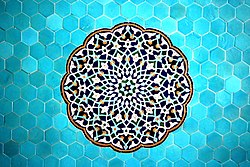 Tiles inside the Jame Mosque of Yazd, Persia, with geometric and vegetal patterns
 -

-
 A variety of vernacular decorative Islamic styles in Morocco: wooden panels, zellij tilework, stucco calligraphy, and floral door panels
 -
 Arch in the Alhambra with Muqarnas (Mocárabe) stalactite work
 -
 Ayyubid Raqqa ware stoneware glazed jar with overlapping circles grid pattern. Syria, 12th/13th century
 -
 An archway in the Ottoman Green Mosque, Bursa, Turkey (1424), with girih 10-point stars and pentagons


Pattern formation
[edit]
Many Islamic designs are built on squares and circles, typically repeated, overlapped and interlaced to form intricate and complex patterns.[1] A recurring motif is the 8-pointed star, often seen in Islamic tilework; it is made of two squares, one rotated 45 degrees with respect to the other. The fourth basic shape is the polygon, including pentagons and octagons. All of these can be combined and reworked to form complicated patterns with a variety of symmetries including reflections and rotations. Such patterns can be seen as mathematical tessellations, which can extend indefinitely and thus suggest infinity.[1][13] They are constructed on grids that require only ruler and compass to draw.[14] Artist and educator Roman Verostko argues that such constructions are in effect algorithms, making Islamic geometric patterns forerunners of modern algorithmic art.[15]
The circle symbolizes unity and diversity in nature, and many Islamic patterns are drawn starting with a circle.[16] For example, the decoration of the 15th-century mosque in Yazd, Persia is based on a circle, divided into six by six circles drawn around it, all touching at its centre and each touching its two neighbours' centres to form a regular hexagon. On this basis is constructed a six-pointed star surrounded by six smaller irregular hexagons to form a tessellating star pattern. This forms the basic design which is outlined in white on the wall of the mosque. That design, however, is overlaid with an intersecting tracery in blue around tiles of other colours, forming an elaborate pattern that partially conceals the original and underlying design.[16][17] A similar design forms the logo of the Mohammed Ali Research Center.[18]
One of the early Western students of Islamic patterns, Ernest Hanbury Hankin, defined a "geometrical arabesque" as a pattern formed "with the help of construction lines consisting of polygons in contact."[2] He observed that many different combinations of polygons can be used as long as the residual spaces between the polygons are reasonably symmetrical. For example, a grid of octagons in contact has squares (of the same side as the octagons) as the residual spaces. Every octagon is the basis for an 8-point star, as seen at Akbar's tomb, Sikandra (1605–1613). Hankin considered the "skill of the Arabian artists in discovering suitable combinations of polygons .. almost astounding."[2] He further records that if a star occurs in a corner, exactly one quarter of it should be shown; if along an edge, exactly one half of it.[2]
The Topkapı Scroll, made in Timurid dynasty Iran in the late-15th century or beginning of the 16th century, contains 114 patterns including coloured designs for girih tilings and muqarnas quarter or semidomes.[19][20][21]
The mathematical properties of the decorative tile and stucco patterns of the Alhambra palace in Granada, Spain have been extensively studied. Some authors have claimed on dubious grounds to have found most or all of the 17 wallpaper groups there.[22][23] Moroccan geometric woodwork from the 14th to 19th centuries makes use of only 5 wallpaper groups, mainly p4mm and c2mm, with p6mm and p2mm occasionally and p4gm rarely; it is claimed that the "Hasba" (measure) method of construction, which starts with n-fold rosettes, can however generate all 17 groups.[24]
- Methods of construction
-
 Two-dimensional designs for two quarter-dome muqarnas – as a seashell (top), as a fan (bottom). Topkapı Scroll, 15th century
 -

-
 Construction of girih pattern in Darb-e Imam spandrel (yellow line). Construction decagons blue, bowties red. The strapwork cuts across the construction tessellation.
 -
 Analysis of octagonal patterns in Mughal architecture by Ernest Hanbury Hankin, 1925. 8-pointed stars emerge (lower right) where heavy black lines cross.
 -
 Decoration in Tomb of I'timād-ud-Daulah, Agra, showing correct treatment of sides and corners. A quarter of each 6-point star is shown in each corner; half stars along the sides.
 -
 Architectural drawing for brick vaulting, Iran, probably Tehran, 1800–70


Evolution
[edit]
Early stage
[edit]The earliest geometrical forms in Islamic art were occasional isolated geometric shapes such as 8-pointed stars and lozenges containing squares. These date from 836 in the Great Mosque of Kairouan, Tunisia, and since then have spread all across the Islamic world.[25]
Middle stage
[edit]
The next development, marking the middle stage of Islamic geometric pattern usage, was of 6- and 8-point stars, which appear in 879 at the Ibn Tulun Mosque, Cairo, and then became widespread.[25]
A wider variety of patterns were used from the 11th century. Abstract 6- and 8-point shapes appear in the Tower of Kharaqan at Qazvin, Persia in 1067, and the Al-Juyushi Mosque, Egypt in 1085, again becoming widespread from there, though 6-point patterns are rare in Turkey.[25]
In 1086, 7- and 10-point girih patterns (with heptagons, 5- and 6-pointed stars, triangles and irregular hexagons) appear in the Jameh Mosque of Isfahan. 10-point girih became widespread in the Islamic world, except in the Spanish Al-Andalus.[25] Soon afterwards, sweeping 9-, 11-, and 13-point girih patterns were used in the Barsian Mosque, also in Persia, in 1098; these, like 7-point geometrical patterns, are rarely used outside Persia and central Asia.[25]
Finally, marking the end of the middle stage, 8- and 12-point girih rosette patterns appear in the Alâeddin Mosque at Konya, Turkey in 1220, and in the Abbasid palace in Baghdad in 1230, going on to become widespread across the Islamic world.[25]
Late stage
[edit]
The beginning of the late stage is marked by the use of simple 16-point patterns at the Hasan Sadaqah mausoleum in Cairo in 1321, and in the Alhambra in Spain in 1338–1390. These patterns are rarely found outside these two regions. More elaborate combined 16-point geometrical patterns are found in the Sultan Hassan complex in Cairo in 1363, but rarely elsewhere. Finally, 14-point patterns appear in the Jama Masjid at Fatehpur Sikri in India in 1571–1596, but in few other places.[25][d]
Artforms
[edit]Several artforms in different parts of the Islamic world make use of geometric patterns. These include ceramics,[27] girih strapwork,[28] jali pierced stone screens,[29] kilim rugs,[30] leather,[31] metalwork,[32] muqarnas vaulting,[33] shakaba stained glass,[34] woodwork,[28] and zellij tiling.[35]
Ceramics
[edit]Ceramics lend themselves to circular motifs, whether radial or tangential. Bowls or plates can be decorated inside or out with radial stripes; these may be partly figurative, representing stylised leaves or flower petals, while circular bands can run around a bowl or jug. Patterns of these types were employed on Islamic ceramics from the Ayyubid period, 13th century. Radially symmetric flowers with, say, 6 petals lend themselves to increasingly stylised geometric designs which can combine geometric simplicity with recognisably naturalistic motifs, brightly coloured glazes, and a radial composition that ideally suits circular crockery. Potters often chose patterns suited to the shape of the vessel they were making.[27] Thus an unglazed earthenware water flask[e] from Aleppo in the shape of a vertical circle (with handles and neck above) is decorated with a ring of moulded braiding around an Arabic inscription with a small 8-petalled flower at the centre.[36]
Girih tilings and woodwork
[edit]Girih are elaborate interlacing patterns formed of five standardized shapes. The style is used in Persian Islamic architecture and also in decorative woodwork.[28] Girih designs are traditionally made in different media including cut brickwork, stucco, and mosaic faience tilework. In woodwork, especially in the Safavid period, it could be applied either as lattice frames, left plain or inset with panels such as of coloured glass; or as mosaic panels used to decorate walls and ceilings, whether sacred or secular. In architecture, girih forms decorative interlaced strapwork surfaces from the 15th century to the 20th century. Most designs are based on a partially hidden geometric grid which provides a regular array of points; this is made into a pattern using 2-, 3-, 4-, and 6-fold rotational symmetries which can fill the plane. The visible pattern superimposed on the grid is also geometric, with 6-, 8-, 10- and 12-pointed stars and a variety of convex polygons, joined by straps which typically seem to weave over and under each other.[28][37] The visible pattern does not coincide with the underlying construction lines of the tiling.[28] The visible patterns and the underlying tiling represent a bridge linking the invisible to the visible, analogous to the "epistemological quest" in Islamic culture, the search for the nature of knowledge.[38]
Jali
[edit]
Jali are pierced stone screens with regularly repeating patterns. They are characteristic of Indo-Islamic architecture, for example in the Mughal dynasty buildings at Fatehpur Sikri and the Taj Mahal. The geometric designs combine polygons such as octagons and pentagons with other shapes such as 5- and 8-pointed stars. The patterns emphasized symmetries and suggested infinity by repetition. Jali functioned as windows or room dividers, providing privacy but allowing in air and light.[29] Jali forms a prominent element of the architecture of India.[39] The use of perforated walls has declined with modern building standards and the need for security. Modern, simplified jali walls, for example made with pre-moulded clay or cement blocks, have been popularised by the architect Laurie Baker.[40] Pierced windows in girih style are sometimes found elsewhere in the Islamic world, such as in windows of the Mosque of Ibn Tulun in Cairo.[41]
Kilim
[edit]
A kilim is an Islamic[30] flatwoven carpet (without a pile), whether for household use or a prayer mat. The pattern is made by winding the weft threads back over the warp threads when a colour boundary is reached. This technique leaves a gap or vertical slit, so kilims are sometimes called slit-woven textiles. Kilims are often decorated with geometric patterns with 2- or 4-fold mirror or rotational symmetries. Because weaving uses vertical and horizontal threads, curves are difficult to generate, and patterns are accordingly formed mainly with straight edges.[17][42] Kilim patterns are often characteristic of specific regions.[43] Kilim motifs are often symbolic as well as decorative. For example, the wolf's mouth or wolf's foot motif (Turkish: Kurt Aǧzi, Kurt İzi) expresses the tribal weavers' desires for protection of their families' flocks from wolves.[44]
Leather
[edit]Islamic leather is often embossed with patterns similar to those already described. Leather book covers, starting with the Quran where figurative artwork was excluded, were decorated with a combination of kufic script, medallions and geometric patterns, typically bordered by geometric braiding.[31]
Metalwork
[edit]Metal artefacts share the same geometric designs that are used in other forms of Islamic art. However, in the view of Hamilton Gibb, the emphasis differs: geometric patterns tend to be used for borders, and if they are in the main decorative area they are most often used in combination with other motifs such as floral designs, arabesques, animal motifs, or calligraphic script. Geometric designs in Islamic metalwork can form a grid decorated with these other motifs, or they can form the background pattern.[32]
Even where metal objects such as bowls and dishes do not seem to have geometric decoration, still the designs, such as arabesques, are often set in octagonal compartments or arranged in concentric bands around the object. Both closed designs (which do not repeat) and open or repetitive patterns are used. Patterns such as interlaced six-pointed stars were especially popular from the 12th century. Eva Baer notes that while this design was essentially simple, it was elaborated by metalworkers into intricate patterns interlaced with arabesques, sometimes organised around further basic Islamic patterns, such as the hexagonal pattern of six overlapping circles.[45]
Muqarnas
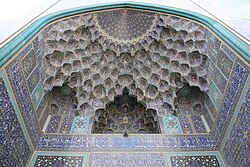
[edit]Muqarnas are elaborately carved ceilings to semi-domes, often used in mosques. They are typically made of stucco (and thus do not have a structural function), but can also be of wood, brick, and stone. They are characteristic of Islamic architecture of the Middle Ages from Spain and Morocco in the west to Persia in the east. Architecturally they form multiple tiers of squinches, diminishing in size as they rise. They are often elaborately decorated.[33]
Stained glass
[edit]Geometrically patterned stained glass is used in a variety of settings in Islamic architecture. It is found in the surviving summer residence of the Palace of Shaki Khans, Azerbaijan, constructed in 1797. Patterns in the "shabaka" windows include 6-, 8-, and 12-point stars. These wood-framed decorative windows are distinctive features of the palace's architecture. Shabaka are still constructed the traditional way in Sheki in the 21st century.[34][46] Traditions of stained glass set in wooden frames (not lead as in Europe) survive in workshops in Iran as well as Azerbaijan.[47] Glazed windows set in stucco arranged in girih-like patterns are found both in Turkey and the Arab lands; a late example, without the traditional balance of design elements, was made in Tunisia for the International Colonial Exhibition in Amsterdam in 1883.[48] The old city of Sana'a in Yemen has stained glass windows in its tall buildings.[49]
Zellij
[edit]Zellij (Arabic: الزَّلِيْج) is geometric tilework with glazed terracotta tiles set into plaster, forming colourful mosaic patterns including regular and semiregular tessellations. The tradition is characteristic of Morocco, but is also found in Moorish Spain. Zellij is used to decorate mosques, public buildings and wealthy private houses.[35]
Illustrations
[edit]- Media used for Islamic geometric patterns
-
 Safavid bowl with radial and circular motifs, Persia, 17th century
 -

-

-
 Side of a wooden Minbar (pulpit) with 12-point stars. 14th century. Turkish and Islamic Arts Museum
 -

-
 Woven wool Kilim from Turkey
 -
 Leather prayer book cover, Persia, 16th century
 -
 Iron gate with 10-point stars and kites at Al-Rifa'i Mosque, Cairo (1869–1912)
 -

-
-

-

-


.jpg)


.jpg)

Outside Islamic art
[edit]In Western culture
[edit]
It is sometimes supposed in Western society that mistakes in repetitive Islamic patterns such as those on carpets were intentionally introduced as a show of humility by artists who believed only Allah can produce perfection, but this theory is denied.[51][52][53]

Major Western collections hold many objects of widely varying materials with Islamic geometric patterns. The Victoria and Albert Museum in London holds at least 283 such objects, of materials including wallpaper, carved wood, inlaid wood, tin- or lead-glazed earthenware, brass, stucco, glass, woven silk, ivory, and pen or pencil drawings.[54] The Metropolitan Museum of Art in New York has among other relevant holdings 124 mediaeval (1000–1400 A.D.) objects bearing Islamic geometric patterns,[55] including a pair of Egyptian minbar (pulpit) doors almost 2 m. high in rosewood and mulberry inlaid with ivory and ebony;[56] and an entire mihrab (prayer niche) from Isfahan, decorated with polychrome mosaic, and weighing over 2,000 kg.[57]

Islamic decoration and craftsmanship had a significant influence on Western art when Venetian merchants brought goods of many types back to Italy from the 14th century onwards.[58]
The Dutch artist M. C. Escher was inspired by the Alhambra's intricate decorative designs to study the mathematics of tessellation, transforming his style and influencing the rest of his artistic career.[59][60] In his own words it was "the richest source of inspiration I have ever tapped."[61]
Influence on the sciences
[edit]Cultural organisations such as the Mathematical Sciences Research Institute and the Institute for Advanced Study run events on geometric patterns and related aspects of Islamic art.[62] In 2013 the Istanbul Center of Design and the Ensar Foundation ran what they claimed was the first ever symposium of Islamic Arts and Geometric Patterns, in Istanbul. The panel included the experts on Islamic geometric pattern Carol Bier,[f] Jay Bonner,[g][65] Eric Broug,[h] Hacali Necefoğlu[i] and Reza Sarhangi.[j][69] In Britain, The Prince's School of Traditional Arts runs a range of courses in Islamic art including geometry, calligraphy, and arabesque (vegetal forms), tile-making, and plaster carving.[70]

Computer graphics and computer-aided manufacturing make it possible to design and produce Islamic geometric patterns effectively and economically. Craig S. Kaplan explains and illustrates in his Ph.D. thesis how Islamic star patterns can be generated algorithmically.[71]
Two physicists, Peter J. Lu and Paul Steinhardt, stated in 2007[72] that girih designs such as that used on the Darb-e Imam shrine[k] in Isfahan were able to create quasi-periodic tilings resembling those discovered by Roger Penrose in 1973. They showed that rather than the traditional ruler and compass construction, it was possible to create girih designs using a set of five "girih tiles", all equilateral polygons, secondarily decorated with lines (for the strapwork).[73]
In 2016, Ahmad Rafsanjani described the use of Islamic geometric patterns from tomb towers in Iran to create auxetic materials from perforated rubber sheets. These are stable in either a contracted or an expanded state, and can switch between the two, which might be useful for surgical stents or for spacecraft components. When a conventional material is stretched along one axis, it contracts along other axes (at right angles to the stretch). But auxetic materials expand at right angles to the pull. The internal structure that enables this unusual behaviour is inspired by two of the 70 Islamic patterns that Rafsanjani noted on the tomb towers.[74]
Notes
[edit]- ^ Critchlow is a professor of architecture, and the author of a book on Islamic patterns.
- ^ Wade is the author of a series of books on pattern in various artforms.
- ^ Behrens-Abouseif is a professor of the history of art and architecture at SOAS.
- ^ One such place is the Mustansiriyya Madrasa in Baghdad, as illustrated by Broug.[26]
- ^ Leaving the flask porous allowed evaporation, keeping the water cool.[36]
- ^ Bier is a historian of Islamic art who studies pattern.[63]
- ^ Bonner is an architect specialising in Islamic ornament.[64]
- ^ Broug writes books and runs courses on Islamic geometric design.[66]
- ^ Necefoğlu is a professor of chemistry at Kafkas University interested in pattern and crystallography.[67]
- ^ Sarhangi is the founder of The Bridges Organization. He studies the mathematics of Persian architecture and mosaic design.[68]
- ^ Illustrated above.
References
[edit]- ^ a b c "Geometric Patterns in Islamic Art". Heilbrunn Timeline of Art History. Metropolitan Museum of Art. October 2001. Retrieved 1 December 2015.
- ^ a b c d Hankin, Ernest Hanbury (1925). The Drawing of Geometric Patterns in Saracenic Art. Memoirs of the Archaeological Survey of India No. 15. Government of India Central Publication Branch.
- ^ Bonner, Jay (2017-08-17). Islamic Geometric Patterns: Their Historical Development and Traditional Methods of Construction. Springer. p. 6. ISBN 978-1-4419-0217-7.
- ^ Bouaissa, Malikka (27 July 2013). "The crucial role of geometry in Islamic art". Al Arte Magazine. Archived from the original on 27 March 2019. Retrieved 1 December 2015.
- ^ Bonner, Jay (2017). Islamic geometric patterns : their historical development and traditional methods of construction. New York: Springer. p. 1. ISBN 978-1-4419-0216-0. OCLC 1001744138.
- ^ Bier, Carol (Sep 2008). "Art and Mithãl: Reading Geometry as Visual Commentary". Iranian Studies. 41 (4): 491–509. doi:10.1080/00210860802246176. JSTOR 25597484. S2CID 171003353.
- ^ Critchlow, Keith (1976). Islamic Patterns : an analytical and cosmological approach. Thames and Hudson. ISBN 0-500-27071-6.
- ^ Field, Robert (1998). Geometric Patterns from Islamic Art & Architecture. Tarquin Publications. ISBN 978-1-899618-22-4.
- ^ Ahuja, Mangho; Loeb, A. L. (1995). "Tessellations in Islamic Calligraphy". Leonardo. 28 (1): 41–45. doi:10.2307/1576154. JSTOR 1576154. S2CID 191368443.
- ^ a b Wade, David. "The Evolution of Style". Pattern in Islamic Art. Archived from the original on 19 May 2022. Retrieved 12 April 2016.
Much of the art of Islam, whether in architecture, ceramics, textiles or books, is the art of decoration – which is to say, of transformation. The aim, however, is never merely to ornament, but rather to transfigure. ... The vast edifices of mosques are transformed into lightness and pattern; the decorated pages of a Qur'an can become windows onto the infinite. Perhaps most importantly, the Word, expressed in endless calligraphic variations, always conveys the impression that it is more enduring than the objects on which it is inscribed.
- ^ Behrens-Abouseif, Doris (1999). Beauty in Arabic Culture. Markus Wiener. pp. 7–8. ISBN 978-1-558-76199-5.
- ^ Broug, Eric (2008). Islamic Geometric Patterns. Thames and Hudson. pp. 183–185, 193. ISBN 978-0-500-28721-7.
- ^ Hussain, Zarah (30 June 2009). "Introduction to Islamic art". BBC. Retrieved 1 December 2015.
- ^ Bellos, Alex; Broug (Illustrator), Eric (10 February 2015). "Muslim rule and compass: the magic of Islamic geometric design". The Guardian. Retrieved 1 December 2015.
- ^ Verostko, Roman (1999) [1994]. "Algorithmic Art".
- ^ a b Henry, Richard. "Geometry – The Language of Symmetry in Islamic Art". Art of Islamic Pattern. Retrieved 1 December 2015.
- ^ a b Lockerbie, John. "Islamic Design: Arabic / Islamic geometry 01". Catnaps.org. Archived from the original on 13 April 2019. Retrieved 2 December 2015.
- ^ "Islamic Art and Geometric Design". MOHA. 2014. Archived from the original on 3 December 2015. Retrieved 3 December 2015. The logo's construction is demonstrated in an animation on the MOHA website.
- ^ Gülru Necipoğlu (1992). Geometric Design in Timurid/Turkmen Architectural Practice: Thoughts on a Recently Discovered Scroll and Its Late Gothic Parallels (PDF). E.J. Brill. Archived from the original (PDF) on 2015-12-22. Retrieved 2015-12-02.
{{cite book}}:|work=ignored (help) - ^ Saliba, George (1999). "Artisans and Mathematicians in Medieval Islam. The Topkapi Scroll: Geometry and Ornament in Islamic Architecture by Gülru Necipoğlu (Review)". Journal of the American Oriental Society. 119 (4): 637–645. doi:10.2307/604839. JSTOR 604839. (subscription required)
- ^ van den Hoeven, Saskia, van der Veen, Maartje. "Muqarnas-Mathematics in Islamic Arts" (PDF). Archived from the original (PDF) on 27 September 2013. Retrieved 15 January 2016.
{{cite web}}: CS1 maint: multiple names: authors list (link) - ^ Perez-Gomez, R. (1987). "The Four Regular Mosaics Missing in the Alhambra" (PDF). Comput. Math. Applic. 14 (2): 133–137. doi:10.1016/0898-1221(87)90143-x.
- ^ Grünbaum, Branko (June 2006). "What Symmetry Groups Are Present in the Alhambra?" (PDF). Notices of the AMS. 53 (6): 670–673.
- ^ Aboufadil, Y.; Thalal, A.; Raghni, M. A. E. I. (2013). "Symmetry groups of Moroccan geometric woodwork patterns". Journal of Applied Crystallography. 46 (6): 1834–1841. doi:10.1107/S0021889813027726.
- ^ a b c d e f g Abdullahi, Yahya; Bin Embi, Mohamed Rashid (2013). "Evolution of Islamic geometric patterns". Frontiers of Architectural Research. 2 (2): 243–251. doi:10.1016/j.foar.2013.03.002.
- ^ Broug, Eric (2013). Islamic Geometric Design. Thames and Hudson. p. 173. ISBN 978-0-500-51695-9.
- ^ a b "Geometric Decoration and the Art of the Book. Ceramics". Museum with no Frontiers. Retrieved 7 December 2015.
- ^ a b c d e Gereh-Sāzī. Encyclopaedia Iranica. Retrieved 2 December 2015.
- ^ a b "For Educators: Geometric Design in Islamic Art: Image 15". Metropolitan Museum of Art. Retrieved 2 December 2015.
- ^ a b Thompson, Muhammad; Begum, Nasima. "Islamic Textile Art and how it is Misunderstood in the West – Our Personal Views". Salon du Tapis d'Orient. Retrieved 3 December 2015.
- ^ a b "Geometric Decoration and the Art of the Book. Leather". Museum with no Frontiers. Retrieved 7 December 2015.
- ^ a b Gibb, Sir Hamilton Alexander Rosskeen (1954). The Encyclopaedia of Islam. Brill Archive. pp. 990–992. GGKEY:N71HHP1UY5E.
- ^ a b Tabbaa, Yasser. "The Muqarnas Dome: Its Origin and Meaning" (PDF). Archnet. pp. 61–74. Archived from the original (PDF) on 8 December 2015. Retrieved 2 December 2015.
- ^ a b King, David C. King (2006). Azerbaijan. Marshall Cavendish. p. 99. ISBN 978-0-7614-2011-8.
- ^ a b Njoku, Raphael Chijioke (2006). Culture and Customs of Morocco. Greenwood Publishing Group. p. 58. ISBN 978-0-313-33289-0.
- ^ a b "Flask". Victoria and Albert Museum. Retrieved 7 December 2015.
- ^ "Gereh-Sazi". Tebyan. 20 August 2011. Retrieved 4 December 2015.
- ^ Hooman, Koliji (April 2016). "Gazing Geometries: Modes of Design Thinking in Pre-Modern Central Asia and Persian Architecture". Nexus Network Journal. 18: 105–132. doi:10.1007/s00004-016-0288-6.
- ^ "intypes. perforate". Cornell University. Retrieved 18 January 2016.
- ^ Varanashi, Satyaprakash (30 January 2011). "The multi-functional jaali". The Hindu. Retrieved 18 January 2016.
- ^ Mozzati, Luca (2010). Islamic Art. Prestel. p. 27. ISBN 978-3-7913-4455-3.
- ^ "CARPETS v. Flat-woven carpets: Techniques and structures". Encyclopaedia Iranica. Retrieved 3 December 2015.
- ^ "Turkish Kilim Rug". Through the Collector's Eye. Retrieved 3 December 2015.
- ^ Erbek, Güran (1998). Kilim Catalogue No. 1. May Selçuk A. S. Edition=1st.
- ^ Baer, Eva (1983). Metalwork in Medieval Islamic Art. SUNY Press. pp. 122–132. ISBN 978-0-87395-602-4.
- ^ Sharifov, Azad (1998). "Shaki Paradise in the Caucasus Foothills". Azerbaijan International. 6 (2): 28–35.
- ^ Alin, Marina (21 January 2014). "Wood, glass, geometry – stained glass in Iran and Azerbaijan". Islamic Arts & Architecture. Archived from the original on 26 January 2016. Retrieved 18 January 2016.
- ^ "Carved stucco and stained glass window". Islamic Arts & Architecture. 16 December 2011. Archived from the original on 26 January 2016. Retrieved 18 January 2016.
- ^ Hansen, Eri c (21 December 2011). "Sana'a Rising – "a Venice built on sand."". Islamic Arts & Architecture. Archived from the original on 26 January 2016. Retrieved 18 January 2016.
- ^ Locher, J. L. (1971). The World of M. C. Escher. Abrams. p. 17. ISBN 0-451-79961-5.
- ^ Thompson, Muhammad; Begum, Nasima. "Islamic Textile Art: Anomalies in Kilims". Salon du Tapis d'Orient. TurkoTek. Retrieved 25 August 2009.
- ^ Alexenberg, Melvin L. (2006). The future of art in a digital age: from Hellenistic to Hebraic consciousness. Intellect. p. 55. ISBN 1-84150-136-0.
- ^ Backhouse, Tim. "Only God is Perfect". Islamic and Geometric Art. Retrieved 25 August 2009.
- ^ "Search the Collections "Islamic geometric pattern"". Victoria and Albert Museum. Retrieved 2 December 2015.
- ^ "Islamic geometric pattern A.D. 1000–1400". Metropolitan Museum of Art. Retrieved 2 December 2015.
- ^ "Pair of Minbar Doors". Metropolitan Museum of Art. Retrieved 2 December 2015.
- ^ "Mihrab (Prayer Niche)". Metropolitan Museum of Art. Retrieved 2 December 2015.
- ^ Mack, Rosamond E. (2001). Bazaar to Piazza: Islamic Trade and Italian Art, 1300-1600. University of California Press. pp. Chapter 1. ISBN 0-520-22131-1.
- ^ Roza, Greg (2005). An Optical Artist: Exploring Patterns and Symmetry. Rosen Classroom. p. 20. ISBN 978-1-4042-5117-5.
- ^ Monroe, J. T. (2004). Hispano-Arabic Poetry: A Student Anthology. Gorgias Press LLC. p. 65. ISBN 978-1-59333-115-3.
- ^ O'Connor, J. J.; Robertson, E. F. (May 2000). "Maurits Cornelius Escher". Biographies. University of St Andrews. Retrieved 2 November 2015. which cites Strauss, S. (9 May 1996). "M C Escher". The Globe and Mail.
- ^ "Geometric Patterns in Islamic Art". National Math Festival. Archived from the original on 8 December 2015. Retrieved 3 December 2015.
- ^ "Selected Works of Carol Bier". SelectedWorks. Retrieved 3 December 2015.
- ^ Bonner, Jay. "About". Bonner Design. Archived from the original on 8 December 2015. Retrieved 3 December 2015.
- ^ Bonner, Jay (2017). Islamic geometric patterns : their historical development and traditional methods of construction. New York: Springer. ISBN 978-1-4419-0216-0. OCLC 1001744138.
- ^ "School of Islamic Geometric Design". Eric Broug. Archived from the original on 8 April 2019. Retrieved 1 December 2015.
- ^ "Prof.Dr. Hacali Necefoğlu (Fen Edebiyat Fakültesi)". Akademik Bilgi Sistemi (in Turkish). Archived from the original on 5 May 2018. Retrieved 3 December 2015.
- ^ "Reza Sarhangi". Towson University. Archived from the original on 27 November 2015. Retrieved 3 December 2015.
- ^ "Istanbul hosts first ever Islamic geometric arts symposium". World Bulletin. 25 September 2013. Archived from the original on December 8, 2015. Retrieved 3 December 2015.
- ^ "Introduction to Islamic Art". The Prince's School of Traditional Arts. Archived from the original on 3 December 2015. Retrieved 4 December 2015.
- ^ Kaplan, Craig S. (2002). "Computer Graphics and Geometric Ornamental Design: Chapter 3. Islamic Star Patterns". University of Waterloo (PhD thesis). Archived from the original on 30 December 2015. Retrieved 4 December 2015.
- ^ Lu, P. J.; Steinhardt, P. J. (2007). "Decagonal and Quasi-crystalline Tilings in Medieval Islamic Architecture". Science. 315 (5815): 1106–1110. Bibcode:2007Sci...315.1106L. doi:10.1126/science.1135491. PMID 17322056. S2CID 10374218. Archived from the original on 2015-12-08. Retrieved 2015-12-04.
- ^ Ball, Philip (22 February 2007). "Islamic tiles reveal sophisticated maths". Nature: news070219–9. doi:10.1038/news070219-9. S2CID 178905751. Retrieved 4 December 2015.
- ^ Webb, Jonathan (16 March 2016). "Islamic art inspires stretchy, switchable materials". British Broadcasting Corporation. Retrieved 16 March 2016.
External links
[edit]
- Museum with no Frontiers: Geometric Decoration
- Victoria and Albert Museum: Teachers' resource: Maths and Islamic art & design
| Styles |
| ||||||||||||||||||
|---|---|---|---|---|---|---|---|---|---|---|---|---|---|---|---|---|---|---|---|
| Elements |
| ||||||||||||||||||
| Types |
| ||||||||||||||||||
| Resources | |||||||||||||||||||
| Influences | |||||||||||||||||||


| Architecture |
| .jpeg) | |||||||||||
|---|---|---|---|---|---|---|---|---|---|---|---|---|---|
| Arts |
| ||||||||||||
| Arts of the book |
| ||||||||||||
| Decoration |
| ||||||||||||
| The garden | |||||||||||||
| Museums, collections |
| ||||||||||||
| Exhibitions | |||||||||||||
| Principles, influences | |||||||||||||
.jpg)
