


Community hub
Recent from talks
Contribute something
Nothing was collected or created yet.
Guam (/ˈɡwɑːm/ ⓘ GWAHM; Chamorro: Guåhan [ˈɡʷɑhɑn]) is an island that is an organized, unincorporated territory of the United States in the Micronesia subregion of the western Pacific Ocean.[4][5] Guam's capital is Hagåtña, and the most populous village is Dededo. It is the westernmost point and territory of the United States, as measured from the geographic center of the U.S. In Oceania, Guam is the largest and southernmost of the Mariana Islands and the largest island in Micronesia. In 2022, its population was 168,801. Chamorros are its largest ethnic group, but a minority on the multiethnic island. The territory spans 210 square miles (540 km2; 130,000 acres) and has a population density of 775 per square mile (299/km2).
Key Information


_(small_islands_magnified).svg)

Indigenous Guamanians are the Chamorro, who are related to the Austronesian peoples of the Malay Archipelago, the Philippines, Taiwan, and Polynesia. Unlike most of its neighbors, the Chamorro language is not classified as a Micronesian or Polynesian language. Like Palauan, it possibly constitutes an independent branch of the Malayo-Polynesian language family.[6][7] The Chamorro people settled Guam and the Mariana islands approximately 3,500 years ago. Portuguese explorer Ferdinand Magellan, while in the service of Spain, was the first European to visit and claim the island in March 1521. Guam was fully colonized by Spain in 1668. Between the 17th and 19th centuries, Guam was an important stopover for Spanish Manila galleons. During the Spanish–American War, the United States captured Guam in June 1898. Under the 1898 Treaty of Paris, Spain ceded Guam to the U.S. effective April 11, 1899.
Before World War II, Guam was one of five American jurisdictions in the Pacific Ocean, along with Wake Island in Micronesia, American Samoa and Hawaii in Polynesia, and the Philippines. On December 8, 1941, hours after the attack on Pearl Harbor, Guam was captured by the Japanese, who occupied the island for two and a half years before American forces recaptured it on July 21, 1944, which is commemorated there as Liberation Day.[8] Since the 1960s, Guam's economy has been supported primarily by tourism and the U.S. military, for which Guam is a major strategic asset.[9] Its future political status has been a matter of significant discussion, with public opinion polls indicating a strong preference for American statehood.[10][11]
Guam's de facto motto is "Where America's Day Begins", which refers to the island's proximity to the International Date Line.[12][13] Guam is among the 17 non-self-governing territories listed by the United Nations, and has been a member of the Pacific Community since 1983.[14]
Guam is called Guåhan by Chamorro speakers, from the word guaha, meaning 'to have'. Its English gloss 'we have' references the island's providing everything needed to live.[15][16]
History
[edit]Pre-Contact era
[edit]
Guam and the other Mariana Islands were the first islands settled by humans in Remote Oceania. It was the first and the longest of the ocean-crossing voyages of the Austronesian peoples, and is separate from the later Polynesian settlement of the rest of Remote Oceania. They were first settled around 1500 to 1400 BC, by migrants departing from the Philippines. This was followed by a second migration from the Caroline Islands in the first millennium AD. A third migration wave took place from Island Southeast Asia, likely the Philippines or eastern Indonesia, by 900 AD.[17][18]
These original settlers of Guam and the Northern Mariana Islands evolved into the Chamorro people, historically known as Chamorros after first contact with the Spaniards.[19]: 16 The ancient Chamorro society had four classes: chamorri (chiefs), matua (upper class), achaot (middle class), and mana'chang (lower class).[19]: 20–21 The matua were located in the coastal villages, which meant they had the best access to fishing grounds. The mana'chang were located in the island's interior. Matua and mana'chang rarely communicated with each other. The matua often used achaot as intermediaries.[19]: 21
There were also "makåhna" or "kakahna", shamans with magical powers and "'suruhånu" or "suruhåna", healers who used different kinds of plants and natural materials to make medicine. Belief in spirits of ancient Chamorros called "Taotao mo'na" still persists as a remnant of pre-European culture. It is believed that "suruhånu" or "suruhåna" are the only ones who can safely harvest plants and other natural materials from their homes or "hålomtåno" without incurring the wrath of the "Taotao mo'na." Their society was organized along matrilineal clans.[19]: 21
The Chamorro people raised colonnades of megalithic capped pillars called latte stones upon which they built their homes. Latte stones are stone pillars that are found only in the Mariana Islands. They are a recent development in Pre-Contact Chamorro society. The latte stone was used as a foundation on which thatched huts were built.[19]: 26 Latte stones consist of a base shaped from limestone called the haligi and with a capstone, or tåsa, made either from a large brain coral or limestone, placed on top.[19]: 27–28 A possible source for these stones, the Rota Latte Stone Quarry, was discovered in 1925 on Rota.[19]: 28
Spanish era
[edit]
The first European to travel to Guam was Portuguese navigator Ferdinand Magellan, sailing for the King of Spain, when he sighted the island on March 6, 1521, during his fleet's circumnavigation of the globe.[19]: 41–42 Despite Magellan's visit, Guam was not officially claimed by Spain until January 26, 1565, by Miguel López de Legazpi.[19]: 46 From 1565 to 1815, Guam and the Northern Mariana Islands, the only Spanish outposts in the Pacific Ocean east of the Philippines, were reprovisioning stops for the Manila galleons, a fleet that covered the Pacific trade route between Acapulco and Manila.[19]: 51
Spanish colonization commenced on June 15, 1668, with the arrival of a mission led by Diego Luis de San Vitores, who established the first Catholic church.[19]: 64 The islands were part of the Spanish East Indies, and part of the Viceroyalty of New Spain, based in Mexico City.[19]: 68 The Spanish-Chamorro Wars on Guam began in 1670 over growing tensions with the Jesuit mission, with the last large-scale uprising in 1683.[19]: 86

Intermittent warfare, plus the typhoons of 1671 and 1693, and in particular the smallpox epidemic of 1688, reduced the Chamorro population from 50,000 to 10,000, and finally to less than 5,000.[19]: 86 Up until the late 19th century, Guam was encountered by adventurers and pirates, including Thomas Cavendish, Olivier van Noort, John Eaton, William Dampier, Woodes Rogers, John Clipperton, George Shelvocke and William "Bully" Hayes.
The island became a rest stop for whalers starting in 1823.[19]: 145 A devastating typhoon struck the island on August 10, 1848, followed by a severe earthquake on January 25, 1849, which resulted in many refugees from the Caroline Islands, victims of a resultant tsunami.[19]: 151 This earthquake was much more powerful than the 8.2 one that occurred on August 8, 1993.[20] After a smallpox epidemic killed 3,644 Guamanians in 1856, Carolinians and Japanese were permitted to settle in the Marianas.[19]: 157
American era
[edit].jpg)
After almost four centuries as part of the Kingdom of Spain, the United States occupied the island following Spain's defeat in the 1898 Spanish–American War, as part of the Treaty of Paris of 1898. Guam was transferred to the United States Navy control on December 23, 1898, by Executive Order 108-A from 25th President William McKinley.[21]
The U.S. Navy assumed administrative control, with Captain Richard P. Leary appointed as the first naval governor in 1899. This era marked the introduction of American governance structures and cultural influences to the island.[22]
The naval administration prioritized the development of Guam's infrastructure to support its strategic military position in the Pacific. One notable project was the establishment of a coaling station to service naval vessels traveling between Hawaii and the Philippines. Additionally, efforts were made to improve the island's roads, sanitation systems, and public health facilities. Educational reforms were also introduced, including the establishment of public schools with English as the medium of instruction, aiming to assimilate the local Chamorro population into American culture.[23]
Despite these developments, the Chamorro people faced significant challenges under the naval administration. Civil liberties were limited, and the local population had minimal input in governmental decisions. Recognizing these constraints, Chamorro leaders petitioned for U.S. citizenship and greater political autonomy as early as 1901, though these efforts were largely unsuccessful during this period.[23]
These advocacy efforts continued over the years, with Chamorro representatives seeking citizenship and self-governance. For instance, in 1936, delegates Baltazar J. Bordallo and Francisco B. Leon Guerrero traveled to Washington, D.C., to personally petition for Chamorro citizenship. Despite these persistent efforts, substantial political reforms were not achieved during this period.[24]
World War I
[edit]On December 10, 1914, the SMS Cormoran, a German armed merchant raider, was forced to seek port at Apra Harbor after running short on coal after pursued by the Japanese.[25][26][27] The United States, which was neutral at the time refused to supply provisions sufficient for the Cormoran to reach a German port, so the ship and her crew were interned until 1917.[28]
On the morning of April 7, 1917, word reached Guam by telegraph cable that the U.S. Congress had declared war on Germany. The Naval Governor of Guam, Roy Campbell Smith, sent two officers to inform the Cormoran that a state of war existed between the two countries, that the crew were now prisoners of war, and that the ship must be surrendered. Meanwhile, the USS Supply blocked the entrance to Apra Harbor to prevent any attempt to flee. In a separate boat, the two officers were accompanied by a barge commanded by Lt. W.A. Hall, who was designated prize master, and had brought 18 sailors and 15 Marines from the barracks at Sumay.[29][30]
Seeing a launch from Cormoran hauling a barge of supplies back shore, Hall ordered shots fired across the bow of the launch until it hove to. Meanwhile, the two officers reached Cormoran and informed Captain Adalbert Zuckschwerdt of the situation. Zuckschwerdt agreed to surrender his crew but refused to turn over the ship. The U.S. officers informed Zuckschwerdt that the Cormoran would be treated as an enemy combatant and left to inform Governor Smith of the situation. Unbeknownst to the Americans, the Germans had secreted an explosive device in the ship's coal bunker.[31][32]
Minutes after the Americans left, an explosion aboard Cormoran hurled debris across the harbor and her crew began abandoning ship. The two American boats and USS Supply immediately began to recover German sailors from the water, saving all but seven of the roughly 370 Cormoran crew. This incident, including the warning shots against the launch, accounted for the first violent action of the United States in World War I, the first shots fired by the U.S. against Germany in World War I, the first German prisoners of war captured by the U.S., and the first Germans killed in action by the U.S. in World War I.[31][33]
World War II
[edit]
During World War II, the Empire of Japan invaded and occupied Guam in the 1941 Battle of Guam on December 8, at the same time as the attack on Pearl Harbor. The Japanese renamed Guam Ōmiya-jima (Great Shrine Island). The Japanese occupation of Guam lasted about 31 months. During this period, the indigenous people of Guam were subjected to beatings, forced labor, family separation, concentration camps, massacres, beheadings and rape.[34][35][36][37]
During the nearly three years of occupation approximately 1,100 Chamorros were killed, according to later US Congressional committee testimony in 2004. Some historians estimate that war violence killed 10% of Guam's 20,000 population.[37] The United States returned and recaptured the island in the 1944 Battle of Guam from July 21 to August 10. July 21 became a territorial holiday, Liberation Day.
Post-war
[edit]After World War II, the Guam Organic Act of 1950 established Guam as an unincorporated organized territory of the United States, provided for the structure of the island's civilian government, and granted the people U.S. citizenship. However, the grant of citizenship did not include full civil and political rights. The Organic Act excluded the right to trial by jury, leading to further mobilization until the first jury trial in the territory was held in 1956.[38] The Governor of Guam was federally appointed until 1968 when the Guam Elective Governor Act provided for the office's popular election.[39]: 242 Since Guam is not a U.S. state, U.S. citizens residing on Guam are not allowed to vote for president and their only representation in the U.S. Congress is a non-voting member in the House of Representatives.[9] They do, however, vote for party delegates in presidential primaries.[40]

In 1969, a referendum on unification with the Northern Mariana Islands was held and rejected.[41] In the 1970s, Maryly Van Leer Peck started an engineering program, expanded University of Guam, and founded Guam Community College.[42]: 17 In the same period, Alby Mangels, Australian adventurer and filmmaker of World Safari visited Guam during his six-year escapade on the Pacific leg of his voyage aboard the Klaraborg.
In 1963, the removal of Guam's security clearance by President John F. Kennedy allowed for the development of a tourism industry. In the early 1990s, when the United States closed U.S. Naval Base Subic Bay and Clark Air Base bases in the Philippines after the expiration of their leases, many of the forces stationed there were relocated to Guam.[citation needed]
The 1997 Asian financial crisis, which hit Japan particularly hard, severely affected Guam's tourism industry. Military cutbacks in the 1990s also disrupted the island's economy. Economic recovery was further hampered by devastation from super typhoons Paka in 1997 and Pongsona in 2002, as well as the effects of the September 11 terrorist attacks and the crash of Korean Air Flight 801 on tourism.[43]
Geography and environment
[edit]
Guam is 30.17 miles (48.55 kilometers) long and 4 to 12 miles (6 to 19 kilometers) wide. It has an area of 212 square miles (549 square kilometers). It is the 32nd largest island of the United States. It is the southernmost and largest island in the Mariana Islands, as well as the largest in Micronesia.[44] Guam's Point Udall is the westernmost point of the U.S., as measured from the geographic center of the United States.[45][46]
The Mariana chain, of which Guam is a part, was created by collision of the Pacific and Philippine Sea tectonic plates. Guam is located on the micro Mariana Plate between the two. Guam is the closest land mass to the Mariana Trench, the deep subduction zone that runs east of the Marianas. Volcanic eruptions established the base of the island in the Eocene, roughly 56 to 33.9 million years ago. The north of Guam is a result of this base being covered with layers of coral reef, turning into limestone, and then being thrust upward by tectonic activity to create a plateau.[47]
The rugged south of the island is a result of more recent volcanic activity. Cocos Island off the southern tip of Guam is the largest of the many small islets along the coastline. Guam's highest point is Mount Lamlam at 1,334 feet (407 meters) above sea level.[47] If its base is considered to be the nearby Challenger Deep, the deepest surveyed point in the Oceans, Mount Lamlam is the world's tallest mountain at 37,820 feet (11,530 m).[48][49]
Politically, Guam is divided into 19 villages. The majority of the population lives on the coralline limestone plateaus of the north, with political and economic activity concentrated in the central and northern regions. The rugged geography of the south largely limits settlement to rural coastal areas. The western coast is leeward of the trade winds and is the location of Apra Harbor, the capital Hagåtña, and the tourist center of Tumon. The U.S. Defense Department owns about 29% of the island,[50] under the management of Joint Region Marianas.
Climate
[edit]
Guam has a tropical rainforest climate on the Köppen scale (Köppen Af). Its driest month of March almost qualifies as a tropical monsoon climate (Köppen Am). The weather is generally hot and humid throughout the year, with little seasonal temperature variation. Guam is known to have equable temperatures year-round. Trade winds are fairly constant throughout the year. There is often a weak westerly monsoon influence in the summer months.
Guam has two distinct seasons: Wet and dry season. The dry season runs from January to May. June is the transitional period. The wet season runs from July to November. Guam's average annual rainfall was 98 inches or 2,490 millimeters between 1981 and 2010.
The wettest month on record at Guam Airport is August 1997, with 38.49 inches (977.6 mm). The driest was February 2015 with 0.15 inches (3.8 mm). The wettest calendar year was 1976 with 131.70 inches (3,345.2 mm). The driest year was in 1998 with 57.88 inches (1,470.2 mm). The most rainfall in a single day occurred on October 15, 1953, when 15.48 inches or 393.2 millimeters fell.
The mean high temperature is 86 °F or 30 °C. The mean low is 76 °F (24.4 °C). Temperatures rarely exceed 90 °F (32.2 °C) or fall below 70 °F (21.1 °C). The relative humidity commonly exceeds 84 percent at night throughout the year, but the average monthly humidity hovers near 66 percent.[51]
The highest temperature ever recorded in Guam was 96 °F (35.6 °C) on April 18, 1971, and April 1, 1990.[51] A record low of 69 °F (21 °C) was set on February 1, 2021.[52] The lowest recorded temperature was 65 °F (18.3 °C), set on February 8, 1973.
Guam lies in the path of typhoons[53] and it is common for the island to be threatened by tropical storms and possible typhoons in the wet season. The highest risk of typhoons is from August to November, where typhoons and tropical storms are most probable in the western Pacific. They can, however, occur year-round. Typhoons that have caused major damage on Guam in the American period include the Typhoon of 1900, Karen (1962), Pamela (1976), Paka (1997), Pongsona (2002), and Mawar (2023).
Since Typhoon Pamela in 1976, wooden structures have been largely replaced by concrete structures.[54][55] In the 1980s, wooden utility poles began to be replaced by typhoon-resistant concrete and steel poles. After the local Government enforced stricter construction codes, many home and business owners have built their structures out of reinforced concrete, with installed typhoon shutters.
| Climate data for Guam International Airport (1991–2020 normals, extremes 1945–present) | |||||||||||||
|---|---|---|---|---|---|---|---|---|---|---|---|---|---|
| Month | Jan | Feb | Mar | Apr | May | Jun | Jul | Aug | Sep | Oct | Nov | Dec | Year |
| Record high °F (°C) | 94 (34) |
93 (34) |
93 (34) |
96 (36) |
94 (34) |
95 (35) |
95 (35) |
94 (34) |
94 (34) |
93 (34) |
92 (33) |
91 (33) |
96 (36) |
| Mean maximum °F (°C) | 88.4 (31.3) |
88.5 (31.4) |
89.2 (31.8) |
90.2 (32.3) |
90.8 (32.7) |
91.1 (32.8) |
90.8 (32.7) |
90.6 (32.6) |
90.4 (32.4) |
90.4 (32.4) |
89.9 (32.2) |
88.8 (31.6) |
92.0 (33.3) |
| Mean daily maximum °F (°C) | 85.7 (29.8) |
85.7 (29.8) |
86.7 (30.4) |
87.9 (31.1) |
88.5 (31.4) |
88.5 (31.4) |
87.7 (30.9) |
87.0 (30.6) |
87.0 (30.6) |
87.2 (30.7) |
87.4 (30.8) |
86.6 (30.3) |
87.2 (30.7) |
| Daily mean °F (°C) | 80.3 (26.8) |
80.1 (26.7) |
81.0 (27.2) |
82.3 (27.9) |
83.0 (28.3) |
83.1 (28.4) |
82.2 (27.9) |
81.5 (27.5) |
81.5 (27.5) |
81.7 (27.6) |
82.2 (27.9) |
81.6 (27.6) |
81.7 (27.6) |
| Mean daily minimum °F (°C) | 75.0 (23.9) |
74.6 (23.7) |
75.4 (24.1) |
76.7 (24.8) |
77.5 (25.3) |
77.7 (25.4) |
76.8 (24.9) |
76.1 (24.5) |
76.0 (24.4) |
76.3 (24.6) |
77.0 (25.0) |
76.5 (24.7) |
76.3 (24.6) |
| Mean minimum °F (°C) | 71.6 (22.0) |
71.4 (21.9) |
71.9 (22.2) |
73.3 (22.9) |
74.1 (23.4) |
74.6 (23.7) |
73.8 (23.2) |
73.4 (23.0) |
73.3 (22.9) |
73.4 (23.0) |
73.9 (23.3) |
73.3 (22.9) |
70.2 (21.2) |
| Record low °F (°C) | 66 (19) |
65 (18) |
66 (19) |
68 (20) |
70 (21) |
70 (21) |
70 (21) |
70 (21) |
70 (21) |
67 (19) |
68 (20) |
68 (20) |
65 (18) |
| Average precipitation inches (mm) | 5.34 (136) |
4.15 (105) |
2.77 (70) |
3.50 (89) |
4.45 (113) |
6.51 (165) |
12.25 (311) |
17.66 (449) |
15.17 (385) |
12.73 (323) |
8.29 (211) |
5.30 (135) |
98.12 (2,492) |
| Average precipitation days (≥ 0.01 in) | 20.1 | 18.0 | 18.3 | 18.9 | 19.7 | 23.2 | 26.0 | 25.9 | 25.1 | 25.4 | 23.9 | 22.7 | 267.2 |
| Average relative humidity (%) | 83.7 | 81.9 | 83.1 | 82.0 | 82.7 | 82.7 | 87.3 | 88.7 | 88.8 | 88.3 | 86.6 | 83.0 | 84.9 |
| Mean monthly sunshine hours | 176.0 | 173.7 | 216.4 | 214.0 | 219.9 | 193.8 | 156.1 | 142.2 | 132.7 | 132.6 | 135.0 | 143.4 | 2,035.8 |
| Percentage possible sunshine | 50 | 53 | 58 | 57 | 56 | 50 | 39 | 37 | 36 | 36 | 39 | 41 | 46 |
| Source: NOAA (relative humidity and sun 1961–1990)[56][57][58] | |||||||||||||
Ecology
[edit]
Guam is home to a diverse array of ecosystems,[59][60] including coral reefs,[61] deep seas, sea grasses,[62] beach strand, mangroves,[63] a variety of different limestone forest types,[64][65] volcanic forests and grasslands,[66] riparian systems, and caves.[67] There are approximately 17 species of plant that are endemic only to the island of Guam, and many more that are endemic to the Mariana Islands. Numerous endemic insects have been described.[68][69][70] There are approximately 29 land snails listed as endemic to the island of Guam, although many are now endangered or presumed extinct.[71][72]
Guam once hosted 14 kinds of terrestrial birds, 7 of which were endemic to Guam on the species or subspecies level, although all but one of the 14 are now extinct, extirpated, or endangered.[73] Three locations on Guam (Guam National Wildlife Refuge, Cocos Island, and Mahlac Caves) have been identified as Important Bird Areas (IBA) by BirdLife International because they support populations of Micronesian starlings, Mariana swiftlets, Mariana crows, and Guam rails. The Guam rail became the second bird species to ever be downlisted from Extinct in the wild after a population was established on Cocos Island.[74] Guam was home to three native bat species: the little Mariana fruit bat (Pteropus tokudae), now extinct; the endangered Pacific sheath-tailed bat (Emballonura semicaudata rotensis); and the endangered Mariana fruit bat (Pteropus mariannus mariannus).
.jpg)
Guam has experienced severe effects of invasive species upon the natural biodiversity of the island. These include the local extinction of endemic bird species after the introduction of the brown tree snake, an infestation of the coconut rhinoceros beetle destroying coconut palms, and the effect of introduced feral mammals and amphibians.
Wildfires plague the forested areas of Guam every dry season despite the island's humid climate. Most fires are caused by humans with 80% resulting from arson.[75] Poachers often start fires to attract deer to the new growth. Invasive grass species that rely on fire as part of their natural life cycle grow in many regularly burned areas. Grasslands and "barrens" have replaced previously forested areas leading to greater soil erosion.[76]
During the rainy season, sediment is carried by the heavy rains into the Fena Lake Reservoir and Ugum River, leading to water quality problems for southern Guam. Eroded silt also destroys the marine life in reefs around the island. Soil stabilization efforts by volunteers and forestry workers planting trees have had little success in preserving natural habitats.[76]

Efforts have been made to protect Guam's coral reef habitats from pollution, eroded silt and overfishing, problems that have led to decreased fish populations. This has both ecological and economic value, as Guam is a significant vacation spot for scuba divers, and one study found that Guam's reefs are worth US$127 million per year.[77] In recent years, the Department of Agriculture, Division of Aquatic and Wildlife Resources has established several new marine preserves where fish populations are monitored by biologists.[78] These are located at Pati Point, Piti Bomb Holes, Sasa Bay, Achang Reef Flat, and Tumon Bay.[79]
Before adopting U.S. Environmental Protection Agency standards, portions of Tumon Bay were dredged by the hotel chains to provide a better experience for hotel guests.[80][81] Tumon Bay has since been made into a preserve. A federal Guam National Wildlife Refuge in northern Guam protects the decimated sea turtle population in addition to a small colony of Mariana fruit bats.[82]
Harvest of sea turtle eggs was a common occurrence on Guam before World War II. The green sea turtle (Chelonia mydas) was harvested legally on Guam before August 1978, when it was listed as threatened under the Endangered Species Act. The hawksbill sea turtle (Eretmochelys imbricata) has been on the endangered list since 1970. In an effort to ensure the protection of sea turtles on Guam, routine sightings are counted during aerial surveys and nest sites are recorded and monitored for hatchlings.
Demographics
[edit]| Census | Pop. | Note | %± |
|---|---|---|---|
| 1910 | 11,806 | — | |
| 1920 | 13,275 | 12.4% | |
| 1930 | 18,509 | 39.4% | |
| 1940 | 22,290 | 20.4% | |
| 1950 | 59,498 | 166.9% | |
| 1960 | 67,044 | 12.7% | |
| 1970 | 84,996 | 26.8% | |
| 1980 | 105,979 | 24.7% | |
| 1990 | 133,152 | 25.6% | |
| 2000 | 154,805 | 16.3% | |
| 2010 | 159,358 | 2.9% | |
| 2020 | 168,485 | 5.7% |
In the 2020 United States census, the largest ethnic group were the native Chamorros, accounting for 32.8% of the population. Asians, including Filipinos, Koreans, Chinese, and Japanese, accounted for 35.5% of the population. Other ethnic groups of Micronesia, including those of Chuukese, Palauan, and Pohnpeians, accounted for 13.2%. 10% of the population were multiracial, (two or more races). European Americans made up 6.8% of the population. 1% are African Americans. 3% are Hispanic; there are 1,740 Mexicans in Guam, and there are other Hispanic ethnicities on the island. The estimated interracial marriage rate is over 40%.[1]
The official languages of the island are English and Chamorro. Unlike most of its neighboring languages, Chamorro is not classified as Micronesian or Polynesian. Rather, like Palauan, it possibly constitutes an independent branch of the Malayo-Polynesian language family.[6][7] Filipino is also commonly spoken across the island. Other Pacific and Asian languages are spoken in Guam as well. Spanish, which was the language of administration for 300 years, is no longer widely spoken, but has had a deep influence on the Chamorro language.[83]
The predominant religion of Guam is Christianity. Three-quarters of the population adheres to Catholicism, while most of the remainder belong to Protestant churches. According to the Pew Research Center, the religious demography of Guam in 2010 was as follows:[84]
- Catholicism: 75%
- Protestantism: 17.7%
- Other religions: 1.6%
- Folk religions: 1.5%
- Other Christianity: 1.4%
- Buddhism: 1.1%
- Eastern Orthodoxy: <1%
- Hinduism: <1%
- Islam: <1%
- Judaism: <1%
In 2020, the Vatican claimed that 87.72% of the population was Catholic, with 54 priests and 64 nuns across 27 parishes.[85]
Culture
[edit].jpg)
The culture of Guam is a reflection of traditional Chamorro customs, in combination with American, Spanish and Mexican traditions.[86] Post-European-contact Chamorro Guamanian culture is a combination of American, Spanish, Filipino, other Micronesian Islander and Mexican traditions. Few indigenous pre-Hispanic customs remained following Spanish contact, but include plaiting and pottery. There has been a resurgence of interest among the Chamorro to preserve the language and culture.[87][88]
Hispanic influences are manifested in the local language, music, dance, sea navigation, cuisine, fishing, games (such as batu, chonka, estuleks, and bayogu), songs, and fashion.[87][88] The island's original community are Chamorro natives, who have inhabited Guam for almost 4000 years.[89] They had their own language related to the languages of Indonesia and southeast Asia. The Spanish later called them Chamorros. A derivative of the word, Chamorri, means "noble race". They began to grow rice on the island.[90]
_(cropped).jpg)
Historically, the native people of Guam venerated the bones of their ancestors. They kept the skulls in their houses in small baskets, and practiced incantations before them when it was desired to attain certain objects.[91] During Spanish rule (1668–1898) the majority of the population was converted to Catholicism and religious festivities such as Easter and Christmas became widespread. Many Chamorros have Spanish surnames, although few of the inhabitants are themselves descended from the Spaniards. Instead, Spanish names and surnames became commonplace after their conversion to Catholicism and the imposition of the Catálogo alfabético de apellidos in Guam.[92]
Historically, the diet of the native inhabitants of Guam consisted of fish, fowl, rice, breadfruit, taro, yams, bananas, and coconuts used in a variety of dishes.[93] Post-contact Chamorro cuisine is largely based on corn, and includes tortillas, tamales, atole, and chilaquiles, which are a clear influence from Mesoamerica, principally Mexico, from Spanish trade with Asia.[citation needed]
Due to foreign cultural influence from Spain, most aspects of the early indigenous culture have been lost, though there has been a resurgence in preserving any remaining pre-Hispanic culture in the last few decades. Some scholars have traveled throughout the Pacific Islands, conducting research to study what the original Chamorro cultural practices such as dance, language, and canoe building may have been like.[94]
Sports
[edit].jpg)
Guam's most popular sport is American football, followed by basketball and baseball respectively. Soccer, jiu-jitsu, and rugby are also somewhat popular.[95] Guam hosted the Pacific Games in 1975 and 1999. At the 2007 Games, Guam finished 7th of 22 countries in the medal count, and 14th at the 2011 Games.
Guam men's national basketball team and the women's team are traditionally strong competitors in the Oceania region, behind the Australia men's national basketball team and the New Zealand national basketball team. As of 2019[update], the men's team is the reigning champion of the Pacific Games Basketball Tournament. Guam is home to various basketball organizations, including the Guam Basketball Association.[96][97]
The Guam national football team was founded in 1975 and joined FIFA in 1996. It was once considered one of FIFA's weakest teams, and experienced their first victory over a FIFA-registered side in 2009. Guam hosted qualifying games on the island for the first time in 2015 and, in 2018, gained their first FIFA World Cup-qualifying win.[98] The Guam national rugby union team played its first match in 2005 and has never qualified for a Rugby World Cup.
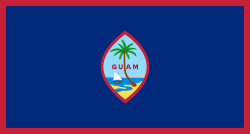
As an aspect of cultural revival, sling competitions are also being organized on Guam. As a national pastime of cultural import, the ovoid shape on Guamanian flag is that of a sling stone.[99][100]
Economy
[edit].jpg)
Guam's economy depends primarily on tourism, Department of Defense installations and locally owned businesses. Under the provisions of a special law by Congress, it is Guam's treasury rather than the U.S. treasury that receives the federal income taxes paid by local taxpayers, including military and civilian federal employees assigned to Guam.[101]
Tourism
[edit]
 |
Guam, situated in the western Pacific, has long been a favored destination for tourists, particularly from Japan and South Korea. The island's tourism hub, Tumon, boasts over 20 large hotels, the Duty Free Shoppers Galleria, the Pleasure Island district, an indoor aquarium, Sandcastle Las Vegas–styled shows, and various shopping and entertainment venues. Additionally, Guam offers seven public golf courses, catering to a diverse range of visitors.[103]
Historically, Japanese tourists comprised a significant portion of Guam's visitors. In 2019, approximately 685,000 Japanese travelers visited the island. This number declined to around 135,760 in 2023, reflecting broader shifts in travel patterns and external factors affecting global tourism.[103][104][105] In recent years, South Korean tourists have become increasingly prominent. For instance, in May and June 2024, South Korean visitors accounted for over 51% of Guam's total arrivals, while Japanese tourists comprised over 21%. Other significant visitor groups include travelers from the United States mainland, Hawaii, the Philippines, and Taiwan.[106]
The COVID-19 pandemic had a profound impact on Guam's tourism industry. In 2023, the island recorded approximately 656,000 visitor arrivals, a 50% decrease compared to 2013 figures. Despite these challenges, the industry has shown signs of recovery, with 775,000 passenger arrivals reported at the Guam International Airport during the 2024 fiscal year (October-July). While this indicated an upward trend, it remained below the pre-pandemic levels of 2019.[105]

The tourism industry remains a cornerstone of Guam's economy, providing over 21,000 jobs, which constitute about one-third of the island's workforce. Major attractions contributing to the island's appeal include duty-free designer shopping outlets and American-style malls such as Micronesia Mall, Guam Premier Outlets, Agana Shopping Center, and the world's largest (and notably 1 of 4 remaining) Kmart.[107]
Budget and unemployment
[edit]In 2003, Guam had a 14% unemployment rate, and the government suffered a $314 million budget shortfall.[108] As of 2019 the unemployment rate had dropped to 6.1%. By September 2020, the unemployment rate had risen again to 17.9%.[109] As of June 2023 the unemployment rate had fallen to 4.0%.[110] The unemployment rate in Guam for September 2023 was 4.1%, an increase of 0.1 percentage points from the June 2023 figure of 4.0%, and a reduction of 0.3 percentage points from the September 2022 figure one year earlier of 4.4%.[111]
Pacific migration to Guam
[edit]The Compacts of Free Association (COFA) between the United States, the Federated States of Micronesia, the Republic of the Marshall Islands, and the Republic of Palau accords the former entities of the Trust Territory of the Pacific Islands a political status of "free association" with the United States. The Compacts generally allow citizens of these island nations to reside in the 50 United States, and in US territories. Many people from other Pacific islands were attracted to Guam due to its proximity, environmental, and cultural familiarity.
Due to the impact of increased utilization of public assistance programs due to immigration, aid has been provided to the nations receiving immigrants. In 2003, the amended COFA was enacted, which provided 30 million dollars annually to Guam, Hawaii, American Samoa and the Northern Mariana Islands, as well as to forgive 157 million dollars of Guam's debt to the federal government to offset money already spent on public assistance programs.[112] In 2024, the COFA was amended again to renew aid the freely associated nations as well as Guam and other U.S. Pacific territories.[113]
Military bases
[edit].jpg)
Joint Region Marianas maintains jurisdiction over installations, which cover approximately 39,000 acres (16,000 ha), or 29% of the island's total land area. These include:
- U.S. Naval Base Guam, U.S. Navy (Santa Rita), comprising the Orote Peninsula, additional lands, and with jurisdiction of the majority of Apra Harbor
- Andersen Air Force Base, U.S. Air Force (Yigo), including Northwest Field
- Marine Corps Base Camp Blaz, U.S. Marine Corps (Dededo)
- Ordnance Annex, U.S. Navy – South Central Highlands (formerly known as Naval Magazine)
- Naval Computer and Telecommunications Station Guam, U.S. Navy (Dededo), sometimes referred to "NCTS Finegayan"
- Naval Radio Station Barrigada (Barrigada), often referred to as "Radio Barrigada"
- Joint Region Marianas Headquarters (Asan), at Nimitz Hill Annex
- Naval Hospital Guam (Agana Heights)
- South Finegayan (Dededo), a military housing complex
- Andersen South (Yigo), formerly Marine Barracks Guam until its closure in 1992
- Fort Juan Muña, Guam National Guard (Tamuning)
In 2010, the U.S. military proposed building a new aircraft carrier berth on Guam and moving 8,600 Marines, and 9,000 of their dependents, to Guam from Okinawa, Japan. Including the required construction workers, this buildup would increase Guam's population by a total of 79,000, a 49% increase over its 2010 population of 160,000.[114]
In a February 2010 letter, the United States Environmental Protection Agency sharply criticized these plans because of a water shortfall, sewage problems and the impact on coral reefs.[115] In 2022, the Marine Corps decided to place 5,000 Marines on the island within the first half of the 2020s, with 1,300 already stationed on the base.[116]
Government and politics
[edit]
Guam is governed by a popularly elected governor and a unicameral 15-member legislature, whose members are known as senators. Its judiciary is overseen by the Supreme Court of Guam.
The District Court of Guam is the court of United States federal jurisdiction in the territory. Guam elects one delegate to the United States House of Representatives, currently Republican James Moylan. The delegate does not have a vote on the final passage of legislation, but is accorded a vote in committee, and the privilege to speak to the House.[9]
U.S. citizens in Guam vote in a presidential straw poll for their choice in the U.S. presidential general election, but since Guam has no votes in the Electoral College, the poll has no real effect. However, in sending delegates to the Republican and Democratic national conventions, Guam does have influence in the national presidential race. These delegates are elected by local party conventions.[9]
Political status
[edit]
In the 1980s and early 1990s, there was a significant movement in favor of this U.S. territory becoming a commonwealth, which would give it a level of self-government similar to Puerto Rico and the Northern Mariana Islands.[101] In a 1982 plebiscite, voters indicated interest in seeking commonwealth status.[117] The federal government rejected the version of a commonwealth that the government of Guam proposed, because its clauses were incompatible with the Territorial Clause (Art. IV, Sec. 3, cl. 2) of the U.S. Constitution.[citation needed][when?] Other movements advocate U.S. statehood for Guam, union with the state of Hawaii, or union with the Northern Mariana Islands as a single territory, or independence.[118]
The first Guam Constitutional Convention was funded by the 10th Guam Legislature and met from June 1, 1969, to June 29, 1970, with 43 elected delegates. The second Guam Constitutional Convention was convened on July 1, 1977, to create a constitution for Guam that would redefine the island's relationship with the US rather than merely modifying the existing relationship. The convention met periodically to October 31, 1977. Although approved at the federal level, the people of Guam overwhelmingly rejected the Constitution in a referendum held in August 1979, with 82% opposed. No new convention has been held pursuant to US congressional authority since 1979.[119]
In 1997, a Commission on Decolonization was established to educate the people of Guam about the political status options in its relationship with the U.S.: statehood, free association, and independence. The island has been considering another non-binding plebiscite on decolonization since 1998. The group was dormant for some years. In 2013, the commission began seeking funding to start a public education campaign. There were few subsequent developments until late 2016.[120]
In early December 2016, the Commission scheduled a series of education sessions in various villages about the current status of Guam's relationship with the U.S. and the self-determination options that might be considered.[120] The commission's current executive director is Edward Alvarez and there are ten members. The group is expected to release position papers on independence and statehood but the contents have not yet been completed.[118]
The United Nations is in favor of greater self-determination for Guam and other such territories. The UN's Special Committee on Decolonization has agreed to endorse the Governor's education plan. The commission's May 2016 report states: "With academics from the University of Guam, [the Commission] was working to create and approve educational materials. The Office of the Governor was collaborating closely with the Commission" in developing educational materials for the public.[121]
The United States Department of the Interior approved a $300,000 grant for decolonization education, Edward Alvarez told the United Nations Pacific Regional Seminar in May 2016. "We are hopeful that this might indicate a shift in [United States] policy to its Non-Self-Governing Territories such as Guam, where they will be more willing to engage in discussions about our future and offer true support to help push us towards true self-governances and self-determination."[122]
In July 2020, the Government of Guam joined the Unrepresented Nations and Peoples Organization (UNPO).[123][124]
Its future political status has been a matter of significant discussion, with public opinion polls indicating a strong preference of becoming a U.S state.[10][11]
Villages
[edit]
Guam is divided into 19 municipal villages:
The entirety of Guam is treated as both a territory and a county equivalent by the US Census. The USGS counts the villages as county equivalents.[125]
Transportation and communications
[edit]
Most of the island has state-of-the-art mobile phone services and high-speed internet widely available through either cable or DSL. Guam was added to the North American Numbering Plan (NANP) in 1997. The country code 671 became NANP area code 671.[126] This removed the barrier of high-cost international long-distance calls to the continental U.S.
Guam is a major hub for submarine communications cables between the Western U.S., Hawaii, Australia and Asia. Guam currently serves twelve submarine cables, with most continuing to China. In 2012 Slate stated that the island has "tremendous bandwidth" and internet prices comparable to those of the U.S. Mainland due to being at the junction of undersea cables.[127]
In 1899, the local postage stamps were overprinted "Guam" as was done for the other former Spanish colonies, but this was discontinued shortly thereafter and regular U.S. postage stamps have been used ever since. Guam is part of the U.S. Postal System (postal abbreviation: GU, ZIP code range: 96910–96932). Mail to Guam from the U.S. mainland is considered domestic and no additional charges are required. Private shipping companies, such as FedEx, UPS, and DHL have no obligation to do so, and do not regard Guam as domestic.
The speed of mail traveling between Guam and the states varies depending on size and time of year. Light, first-class items generally take less than a week to or from the mainland. Larger first-class or Priority items can take a week or two. Fourth-class mail, such as magazines, are transported by sea after reaching Hawaii. Most residents use post office boxes or private mail boxes, although residential delivery is becoming increasingly available.
.jpg)
The Port of Guam is the island's lifeline, because most products must be shipped into Guam for consumers. It receives the weekly calls of the Hawaii-based shipping line Matson, Inc. whose container ships connect Guam with Honolulu, Hawaii; Los Angeles, California; Oakland, California; and Seattle, Washington. The port is also the regional transhipment hub for over 500,000 customers throughout the Micronesian region. The port is the shipping and receiving point for containers designated for the island's U.S. Department of Defense installations, Andersen Air Force Base and Commander, Naval Forces Marianas and eventually the Third Marine Expeditionary Force.
Guam is served by the Antonio B. Won Pat International Airport. The island is outside the United States customs zone,[128] so Guam is responsible for establishing and operating its own customs and quarantine agency and jurisdiction.[129][130][131][132] Therefore, the U.S. Customs and Border Protection only carries out immigration, but not customs functions. Since Guam is under federal immigration jurisdiction, passengers arriving directly from the United States skip immigration and proceed directly to Guam Customs and Quarantine.
Due to the Guam and CNMI visa waiver program for certain countries, an eligibility pre-clearance check is carried on Guam for flights to the States. For travel from the Northern Mariana Islands to Guam, a pre-flight passport and visa check is performed before boarding the flight to Guam. On flights from Guam to the Northern Mariana Islands, no immigration check is performed. Traveling between Guam and the States through a foreign point requires a passport.
Most residents travel within Guam using personally owned vehicles. The Guam Regional Transit Authority provides fixed route bus and paratransit services, and some commercial companies operate buses between tourist-frequented locations.
Education
[edit]
Guam Public Library System operates the Nieves M. Flores Memorial Library in Hagåtña and five branch libraries.[133]
The Guam Department of Education serves the entire island of Guam. In 2000, 32,000 students attended Guam's public schools, including 26 elementary schools, eight middle schools, and six high schools and alternative schools. Guam Public Schools have struggled with problems such as high dropout rates and poor test scores.[134][135]
Guam's educational system has always faced unique challenges as a small community located 6,000 miles (9,700 km) from the U.S. mainland with a very diverse student body including many students who come from backgrounds without traditional American education.[136] An economic downturn in Guam since the mid-1990s has compounded the problems in schools.[137]
Before September 1997, the U.S. Department of Defense partnered with the Guam Board of Education.[138] In September 1997, the Department of Defense Education Activity (DoDEA) opened its own schools for children of military personnel.[139] DoDEA schools, which also serve children of some federal civilian employees, had an attendance of 2,500 in 2000. DoDEA Guam operates three elementary/middle schools and one high school.[140]
The University of Guam (UOG) and Guam Community College, both fully accredited by the Western Association of Schools and Colleges, offer courses in higher education.[141] UOG is a member of the exclusive group of only 106 land-grant institutions in the entire United States. Pacific Islands University is a small Christian liberal arts institution, nationally accredited by the Transnational Association of Christian Colleges and Schools.
Health care
[edit]The Government of Guam maintains the island's main health care facility, Guam Memorial Hospital, in Tamuning.[142] U.S. board certified doctors and dentists practice in all specialties. The U.S. Naval Hospital in Agana Heights serves active-duty members and dependents of the military community.[143]
There is one subscriber-based air ambulance located on the island, CareJet, which provides emergency patient transportation across Guam and surrounding islands.[144] A private hospital, the Guam Regional Medical City, opened in early 2016.[145] Medicaid is accepted in Guam.[146]
See also
[edit]


Notes
[edit]References
[edit]- ^ a b c d e "Australia-Oceania :: Guam (Territory of the US)". The World Factbook. Central Intelligence Agency. Archived from the original on January 26, 2021. Retrieved August 26, 2015.
- ^ "Guam". Archived from the original on September 12, 2017. Retrieved September 12, 2017.
- ^ "Guam | Data". data.worldbank.org. Archived from the original on August 9, 2021. Retrieved August 9, 2021.
- ^ "U.S. Territories". DOI Office of Insular Affairs. Archived from the original on February 9, 2007. Retrieved February 9, 2007.
- ^ "Definitions of Insular Area Political Organizations". U.S. Department of the Interior. Archived from the original on July 21, 2011. Retrieved November 14, 2007. Office of Insular Affairs. Retrieved October 31, 2008.
- ^ a b Blust, Robert (2000). "Chamorro Historical Phonology". Oceanic Linguistics. 39 (1): 83–122. doi:10.1353/ol.2000.0002. ISSN 0029-8115. S2CID 170236058.
- ^ a b Smith, Alexander D. (2017). "The Western Malayo-Polynesian Problem". Oceanic Linguistics. 56 (2): 435–490. doi:10.1353/ol.2017.0021. S2CID 149377092.
- ^ "Guam police arrest suspect in memorial theft". Marine Corps Times. Associated Press. July 7, 2007. Archived from the original on May 15, 2011. Retrieved April 5, 2010.
- ^ a b c d Rogers, Robert F. (1995). Destiny's Landfall: A History of Guam. Honolulu: University of Hawaii Press. ISBN 978-0-8248-1678-0.
- ^ a b Staff (April 2016). "UOG poll: Guamanians prefer statehood". KUAM-TV. Retrieved December 12, 2023.
- ^ a b Freymann, Eyck (October 14, 2020). "Counter China by Making Guam a State". Foreign Policy. Retrieved December 12, 2023.
- ^ Mack, Doug (2017). The Not-Quite States of America: Dispatches From the Territories and Other Far-Flung Outposts of the USA. W.W. Norton. p. 114. ISBN 9780393247602.
- ^ Grabowski, John F. (1992). U.S. Territories and Possessions (State Report Series). Chelsea House. p. 39. ISBN 9780791010532.
- ^ "Non-Self-Governing Territories – Official U.N. Website". Archived from the original on February 27, 2014. Retrieved November 18, 2019.
- ^ Tamondong, Dionesis (February 16, 2010). "Camacho: Name Change Will Affirm Identity". Pacific Daily News. Retrieved February 18, 2010. [dead link]
- ^ Saco, José Antonio (1859). Colección de papeles científicos, históricos, políticos y de otros ramos sobre la isla de Cuba [Collection of scientific, historical, political and other papers on the island of Cuba] (in Spanish). Vol. 3. Paris: d'Aubusson y Kugelmann. Archived from the original on November 13, 2020. Retrieved October 16, 2020.
- ^ Hung, Hsiao-chun; Carson, Mike T.; Bellwood, Peter; Campos, Fredeliza Z.; Piper, Philip J.; Dizon, Eusebio; Bolunia, Mary Jane Louise A.; Oxenham, Marc; Chi, Zhang (2015). "The first settlement of Remote Oceania: the Philippines to the Marianas". Antiquity. 85 (329): 909–926. doi:10.1017/S0003598X00068393.
- ^ Zotomayor, Alexie Villegas (March 12, 2013). "Archaeologists say migration to Marianas longest ocean-crossing in human history". Marianas Variety News and Views: 2. Archived from the original on October 21, 2022. Retrieved October 25, 2020.
- ^ a b c d e f g h i j k l m n o p q Carano, Paul; Sanchez, Pedro C. (1964). A Complete History of Guam. Tokyo: Charles E. Tuttle Company. OCLC 414965.
- ^ Driver, Marjorie; Brunal-Perry, Omaira (November 19, 1996). Carolinians in the Mariana Islands in the 1800s: selected documents from the holdings of the Spanish Documents Collection at the Micronesian Area Research Center: English-Spanish Edition (English-Spanish ed.). Division of Historic Preservation, Department of Community and Cultural Affairs, Commonwealth of the Northern Mariana Islands. p. 12. ISBN 1878453211.
- ^ Rottman, G. (2004) Guam 1941 & 1944: Loss and Reconquest. Oxford: Osprey Publishing, ISBN
- ^ "Richard P. Leary (DD-684)". public1.nhhcaws.local. Retrieved March 29, 2025.
- ^ a b "War in the Pacific NHP: Administrative History (Chapter 3)". www.nps.gov. Retrieved March 29, 2025.
- ^ Magazine, Smithsonian; Herman, Doug. "A Brief, 500-Year History of Guam". Smithsonian Magazine. Retrieved March 29, 2025.
- ^ PacificWrecks.com. "Pacific Wrecks". pacificwrecks.com. Retrieved March 29, 2025.
- ^ "SMS Cormoran II" (PDF).
- ^ "Where the United States Entered World War I: The SMS Cormoran - NAUI Worldwide". www.naui.org. July 19, 2019. Retrieved March 29, 2025.
- ^ "Destruction of S.M.S. "Cormoran"". U.S. Naval Institute. August 1, 1931. Retrieved March 29, 2025.
- ^ Conrad, Dennis (March 28, 2017). "The War Begins: The United States Navy and the German Cruiser Cormoran". The Sextant. Histories and Archives Division, Naval History and Heritage Command. Archived from the original on March 19, 2021. Retrieved March 6, 2021.
- ^ Hoppe, Jon (October 1, 2015). "The Destruction of the S.M.S. Cormoran and the First U.S. Shot Fired in World War I". Naval History Blog. U.S. Naval Institute. Archived from the original on September 30, 2020. Retrieved March 6, 2021.
- ^ a b Robert F. Rogers (January 1995). Destiny's Landfall: A History of Guam. University of Hawaii Press. pp. 139–. ISBN 978-0-8248-1678-0.
- ^ Johnson, Tyler (October 17, 2020). "A Rock Springs man fired the first American shot of World War I". Wyo4News. Archived from the original on April 6, 2023. Retrieved March 6, 2021.
- ^ Johnson, Tyler (October 17, 2020). "A Rock Springs man fired the first American shot of World War I". Wyo4News. Archived from the original on April 6, 2023. Retrieved March 6, 2021.
- ^ War Restitution Act : hearing before the Subcommittee on Insular and International Affairs of the Co...|National Library of Australia Archived April 6, 2010, at the Wayback Machine. Catalogue.nla.gov.au (September 20, 1994). Retrieved June 13, 2012.
- ^ "Statement of David B. Cohen Deputy Assistant Secretary of the Interior for Insular Affairs Before the House Committee on Resources Regarding the Report of the Guam War Claims Review Commission|July 21, 2004 Archived January 20, 2013, at the Wayback Machine." Office of Insular Affairs. Retrieved September 19, 2012.
- ^ Higuchi, Wakako (2001). "The Japanisation Policy for the Chamorros of Guam, 1941–1944" (PDF). The Journal of Pacific History. 36 (1): 19–35. doi:10.1080/00223340120049424. Archived from the original (PDF) on January 20, 2013.
- ^ a b Werner Gruhl, Imperial Japan's World War Two, 1931–1945 Archived January 1, 2016, at the Wayback Machine, Transaction Publishers, 2007 ISBN 978-0-7658-0352-8
- ^ Unterman, Katherine (2020). "Trial without Jury in Guam, USA". Law and History Review. 38 (4): 811–841. doi:10.1017/S0738248018000627. ISSN 0738-2480.
- ^ Rogers, Robert F. (1995). Destiny's Landfall: A History of Guam. Honolulu: University of Hawaii Press.
- ^ Curry, Tom (May 28, 2008). "Nominating, but not voting for president: Clinton-Obama struggle spotlights Guam, American Samoa, Puerto Rico". NBC News. Archived from the original on August 15, 2016. Retrieved August 19, 2016.
- ^ Northern Mariana Islands, 9 November 1969: Status Archived April 15, 2021, at the Wayback Machine Direct Democracy (in German)
- ^ Rottman, G. (2004) Guam 1941 & 1944: Loss and Reconquest. Oxford: Osprey Publishing, ISBN 978-1-84176-811-3
- ^ Tourism, United States Congress Senate Committee on Commerce, Science, and Transportation Subcommittee on Consumer Affairs, Foreign Commerce, and (2004). Terrorism's Effect on U.S. Tourism: Hearing Before the Subcommittee on Consumer Affairs, Foreign Commerce, and Tourism of the Committee on Commerce, Science, and Transportation, United States Senate, One Hundred Seventh Congress, First Session, October 12, 2001. U.S. Government Printing Office. ISBN 978-0-16-071313-2. Archived from the original on April 6, 2023. Retrieved December 17, 2022.
{{cite book}}: CS1 maint: multiple names: authors list (link) - ^ "Education Resources: Regional Information, Guam| PacIOOS". Pacific Islands Ocean Observing System (PacIOOS). Archived from the original on March 1, 2021. Retrieved March 16, 2021.
- ^ "The Most Extreme Points of the United States". WorldAtlas. May 28, 2018. Archived from the original on February 25, 2021. Retrieved March 13, 2021.
- ^ "Congressional Record - Proceedings and Debates of the 106th Congress, First Session - House of Representatives (Vol. 145, No. 34)" (PDF). govinfo.gov. March 4, 1999. p. H982. Archived (PDF) from the original on May 8, 2021. Retrieved March 13, 2021.
- ^ a b "Geography of Guam". Official site of Guam, April 19, 2014. Retrieved April 19, 2014, from "Guam's Geography". Archived from the original on October 27, 1996. Retrieved May 2, 2016..
- ^ McMahon, Mary (January 23, 2021). "How do Scientists Determine the World's Tallest Mountain?". Info Bloom. Archived from the original on May 20, 2021. Retrieved March 13, 2021.
- ^ Fichtl, Marcus (August 31, 2017). "Guam's Mount Lamlam technically world's tallest mountain, though most of it is underwater". Stars and Stripes. Archived from the original on November 18, 2020. Retrieved March 13, 2021.
- ^ "Guam: Small But Important Piece of US Territory in Pacific". Voice of America. August 9, 2017. Archived from the original on March 10, 2021.
- ^ a b "Climatological Report". National Weather Service. February 26, 2014. Archived from the original on March 7, 2014. Retrieved February 26, 2014.
- ^ Lloyd, Bruce (February 1, 2021). "Guam sets a 71-year record for cold temperature on Saturday". Pacific Daily News. Retrieved March 18, 2021.
- ^ "National Weather Service Dedicated Forecast Office in Typhoon Alley". US NOAA NWS. April 27, 2000. Archived from the original on January 7, 2013. Retrieved August 19, 2012.
- ^ "Guam Catastrophe Model". Risk Management Solutions. Archived from the original on February 7, 2011. Retrieved June 16, 2007.
- ^ "Winds". PacificWorlds.com. Archived from the original on August 27, 2007. Retrieved June 16, 2007.
- ^ "NowData - NOAA Online Weather Data". National Oceanic and Atmospheric Administration. Archived from the original on September 6, 2021. Retrieved September 11, 2021.
- ^ "Station: Guam INTL AP, GU GQ". U.S. Climate Normals 2020: U.S. Monthly Climate Normals (1991-2020). National Oceanic and Atmospheric Administration. Archived from the original on September 11, 2021. Retrieved September 11, 2021.
- ^ "WMO Climate Normals for Guam/Marshall Islands, PI 1961–1990". National Oceanic and Atmospheric Administration. Archived from the original on September 11, 2021. Retrieved September 11, 2021.
- ^ "Natural Environment - Guampedia". www.guampedia.com. Retrieved January 2, 2025.
- ^ Murphy, Shannon (February 13, 2011). "Ancient Guam's Environment - Guampedia". www.guampedia.com. Retrieved January 2, 2025.
- ^ Pereda, Nathalie (October 10, 2019). "Coral Reefs: Essential Ecosystems on Guam - Guampedia". www.guampedia.com. Retrieved January 2, 2025.
- ^ Murphy, Shannon (October 1, 2009). "Seagrasses Overview - Guampedia". www.guampedia.com. Retrieved January 2, 2025.
- ^ Pereda, Nathalie (August 4, 2017). "Mangroves: The Forest Between Land and Sea - Guampedia". www.guampedia.com. Retrieved January 2, 2025.
- ^ Pereda, Nathalie (October 2, 2019). "Limestone Forests of Guam - Guampedia". www.guampedia.com. Retrieved January 2, 2025.
- ^ Fosberg, F. Raymond (1960). "The Vegetation of Micronesia. 1, General descriptions, the vegetation of the Marianas Islands, and a detailed consideration of the vegetation of Guam". Bulletin of the AMNH. 119 (1) – via American Museum of Natural History.
- ^ Pereda, Nathalie (August 4, 2017). "Badlands in Southern Guam - Guampedia". www.guampedia.com. Retrieved January 2, 2025.
- ^ Pereda, Nathalie (October 2, 2019). "Guam's Amazing Caves - Guampedia". www.guampedia.com. Retrieved January 2, 2025.
- ^ Insects of Guam-I, Bulletin 172 (PDF). Bernice P. Bishop Museum. 1942. Archived from the original (PDF) on October 9, 2024. Retrieved January 2, 2025.
- ^ Insects of Guam-II, Bulletin 189 (PDF). Bernice P. Bishop Museum. 1946. Archived from the original (PDF) on January 9, 2025. Retrieved January 2, 2025.
- ^ "Insects of Micronesia". hbs.bishopmuseum.org. Archived from the original on July 11, 2020. Retrieved January 2, 2025.
- ^ Murphy, Shannon (April 23, 2013). "Land Snails (Akaleha') of the Mariana Islands - Guampedia". www.guampedia.com. Retrieved January 2, 2025.
- ^ Kerr, Alexander M.; Bauman, Scott (2013). Annotated Checklist of the Land snails of the Mariana Islands, Micronesia (PDF). University of Guam (UOG).
- ^ Murphy, Shannon (September 30, 2009). "Native Forest Birds of Guam - Guampedia". www.guampedia.com. Retrieved January 2, 2025.
- ^ "Species recoveries bring hope amidst the biodiversity crisis - IUCN Red List | IUCN". iucn.org. December 10, 2019. Retrieved January 7, 2025.
- ^ "Territory of Guam Fire Assessment January 2004" (PDF). Archived from the original (PDF) on March 24, 2009. Retrieved March 24, 2009., pp. 6–7, guamforestry.org
- ^ a b National Park Service. "Fire and Guam". United States Department of the Interior. Archived from the original on December 13, 2007. Retrieved June 16, 2007.
- ^ Brown, Val (May 30, 2008). "Guam's Reefs are Important to Guam's Culture and Economy". Pacific Daily News. Agana Heights, Guam. p. 5. Archived from the original on October 1, 2021. Retrieved October 1, 2021.
The results indicated that Guam's reefs are worth $127 million per year
- ^ Brown, Valerie (2006). "Guam's Marine Preserves". Pacific Daily News. Archived from the original on January 3, 2013.
- ^ "Sea Life". Guam Visitors Bureau. Archived from the original on May 31, 2020. Retrieved May 20, 2020.
- ^ "Management of Contaminated Harbor Sediments in Guam" (PDF). EPA Guam Report. Archived (PDF) from the original on August 8, 2007.
- ^ Packbier, Paul E.R. "Tumon Bay – Engineering a Better Environment". Directions Magazine; June/July 1996. Archived from the original on July 26, 2011. Retrieved October 19, 2011.
- ^ Holmes III, Rolston (2001). "Environmental Ethics in Micronesia, Past and Present, Part II—Guam Today: Still "on the Edge." Colonial Legacy and American Presence". International Society for Environmental Ethics Newsletter. 12 (3). Archived from the original on June 9, 2007. Retrieved June 16, 2007.
- ^ "What Languages Are Spoken on Guam?". DeWitt Guam. November 2021. Archived from the original on December 24, 2022. Retrieved December 24, 2022.
- ^ "Guam - Religious Demography: Affiliation". Pew-Templeton Global Religious Futures Project. Archived from the original on July 1, 2020. Retrieved March 25, 2021.
- ^ "Guam | Catholics & Cultures". www.catholicsandcultures.org.
- ^ Wuerch & Ballendorf 1994, p. 44.
- ^ a b Montón-Subías, Sandra; Hernando Gonzalo, Almudena (August 28, 2021). "Modern Colonialism and Cultural Continuity Through Material Culture: An Example from Guam and CHamoru Plaiting". International Journal of Historical Archaeology. 26 (3): 823–847. doi:10.1007/s10761-021-00626-3. hdl:10230/53171. ISSN 1573-7748. S2CID 239658158.
- ^ a b "» Voices of Our Elders". www.guampedia.com. November 4, 2015. Archived from the original on April 21, 2022. Retrieved April 26, 2022.
- ^ Cunningham & Beaty 2001, p. 5-6.
- ^ Cunningham & Beaty 2001, p. 5.
- ^ Safford 1912, p. 11.
- ^ Boquet, Yves (2017). The Philippine Archipelago. Springer Geography. Springer. p. 75. doi:10.1007/978-3-319-51926-5. ISBN 978-3-319-51926-5. S2CID 132890899. Archived from the original on November 7, 2022. Retrieved November 19, 2022.
- ^ Safford 1912, pp. 13–14.
- ^ Marsh, Kelly G.; Taitano, Tyrone J. (2015). "Guam". The Contemporary Pacific. 27: 223–232. doi:10.1353/cp.2015.0021. S2CID 258106437.
- ^ Robert Balajadia (January 10, 2014). "GUAM'S FAVORITE PRO TEAMS". Guam Sports Network. Archived from the original on January 20, 2021. Retrieved January 21, 2021.
- ^ "GBA: Bombers hold off MVP for season 3 title". May 30, 2017. Archived from the original on July 17, 2017. Retrieved June 3, 2017.
- ^ Tomas, Jojo Santo (April 9, 2020). "Samoa Pacific Games: Guam basketball teams notch wins". Pacific Daily News. Retrieved January 10, 2021.[permanent dead link]
- ^ FIFA.com. "2018 FIFA World Cup Russia - Qualifiers - Asia". FIFA.com. Archived from the original on September 5, 2015. Retrieved September 12, 2015.
- ^ "Slinging.org Forum - Guam 2021". Guam Sports Network. December 10, 2020. Archived from the original on January 18, 2021. Retrieved January 21, 2021.
- ^ "Guam And It's [sic] Potential Impact On The Global Slinging Community". Fokai. Archived from the original on March 23, 2023. Retrieved April 7, 2023.
- ^ a b Lin, Tom C.W., Americans, Almost and Forgotten Archived September 21, 2020, at the Wayback Machine, 107 California Law Review (2019)
- ^ "UN Tourism Data Dashboard". www.unwto.org. Retrieved August 5, 2025.
- ^ a b "Guam Visitors Bureau Tourist Statistics". Archived from the original on August 27, 2007. Retrieved August 27, 2007.. visitguam.org
- ^ "Japan: traveler numbers to Guam 2023 | Statista". Statista. Archived from the original on August 9, 2024. Retrieved March 29, 2025.
- ^ a b "Tourism Recovery Plan for Guam" (PDF).
- ^ "Bad news and bright spots: Guam's tourism industry in 2024 | Marianas Business Journal". www.mbjguam.com. Retrieved March 29, 2025.
- ^ Jordan, Mary; Sullivan, Kevin (January 2, 1999). "KMART IS AN EASY SELL ON GUAM". Washington Post. Archived from the original on November 14, 2016. Retrieved August 9, 2017.
- ^ "2004 Guam Yearbook" (PDF). Archived from the original (PDF) on October 29, 2005. Retrieved July 19, 2007.
- ^ "Guam BLS". Archived from the original on February 13, 2015. Retrieved February 11, 2021.
- ^ "Unemployment Situation on Guam – Bureau of Labor Statistics". Retrieved November 22, 2023.
- ^ "Unemployment Situation on Guam – Bureau of Labor Statistics".
- ^ Compact of Free Associate Amendments Act of 2003 (PDF). 2003.
- ^ Consolidated Appropriations Act, 2024 (PDF). 2024.
- ^ McAvoy, Audrey (February 25, 2010). "EPA sharply criticizes military's Guam plan". The Boston Globe. Archived from the original on May 12, 2011. Retrieved December 28, 2010.
- ^ McAvoy, Audrey (February 25, 2010). "EPA sharply criticizes military's Guam plan". The Boston Globe. Archived from the original on May 12, 2011. Retrieved December 28, 2010.
- ^ "Marine Corps activates Camp Blaz in Guam". United States Marine Corps Flagship. Archived from the original on March 8, 2022. Retrieved March 8, 2022.
- ^ Natividad, Lisalinda (May 30, 2012). "Statement of the Non-Self Governing Territory of Guam to the Pacific Regional Seminar on the implementation of the third decade for the eradication of colonialism: current realities and prospects in Quito, Ecuador" (PDF). United Nations. Archived (PDF) from the original on April 12, 2019. Retrieved February 21, 2019.
- ^ a b "Commission on Decolonization 2014". Guampedia. December 3, 2016. Archived from the original on February 28, 2017. Retrieved February 27, 2017.
- ^ "Guam Constitutional Conventions (ConCon) - Guampedia". www.guampedia.com. August 27, 2013.
- ^ a b Raymundo, Shawn (December 8, 2016). "Commission to launch series of decolonization meetings". Pacific Daily News. Retrieved February 27, 2017.
- ^ "Secretary-General Urges Concrete Action to Advance Decolonization Agenda as Pacific Regional Seminar Convenes". United Nations. May 31, 2016. Archived from the original on February 28, 2017. Retrieved February 27, 2017.
"Let us seize this opportunity to identify concrete actions to advance the decolonization agenda," Mr. Ban said ... according to the United Nations Charter and relevant General Assembly resolutions, a full measure of self-government could be achieved through independence, integration or free association with another State. The choice should be the result of the freely expressed will and desire of the peoples of the Non-Self-Governing Territories.
- ^ "Secretary-General Urges Concrete Action to Advance Decolonization Agenda as Pacific Regional Seminar Convenes". United Nations. May 31, 2016. Archived from the original on February 28, 2017. Retrieved February 27, 2017.
- ^ "UNPO Welcomes 5 New Members!". unpo.org. August 3, 2020. Archived from the original on August 6, 2020. Retrieved August 7, 2020.
- ^ "Guam: Territory to be Inducted into UNPO". unpo.org. July 31, 2020. Archived from the original on August 9, 2020. Retrieved August 7, 2020.
- ^ "How many counties are there in the United States?". USGS.gov. Archived from the original on September 7, 2018. Retrieved July 7, 2018.
- ^ J. N. Deak (August 5, 1996). "PL-NANP-004" (PDF). North American Numbering Plan Administration. Archived (PDF) from the original on November 26, 2010. Retrieved October 12, 2010.
- ^ Calabrese, Michael; Daniel Calarco; Colin Richardson (May 24, 2012). "The Most Expensive Internet in America". Slate. Archived from the original on December 18, 2019. Retrieved January 6, 2020.
- ^ 19 U.S.C. § 1401(h) Archived July 31, 2018, at the Wayback Machine .
- ^ 19 C.F.R. § 7.2(b) (2018) Archived July 31, 2018, at the Wayback Machine .
- ^ "People of Territory of Guam v. Sugiyama, 846 F. 2d 570 – Court of Appeals, 9th Circuit 1988 – Google Scholar". Archived from the original on September 21, 2020. Retrieved November 18, 2019.
- ^ "People of Territory of Guam v. SUGIYAMA, 859 F. 2d 1428 – Court of Appeals, 9th Circuit 1988 – Google Scholar". Archived from the original on September 21, 2020. Retrieved November 18, 2019.
- ^ 5 Guam Code Ann. § 73126 (2005) Archived April 12, 2019, at the Wayback Machine .
- ^ "Guam Public Library System – A Report To Our Citizens" (PDF). Archived (PDF) from the original on September 18, 2017. Retrieved September 25, 2008.
- ^ "Merrow Report: First to Worst". PBS. Archived from the original on August 10, 2007. Retrieved November 8, 2007.
- ^ "State Comparisons". 1996. Archived from the original on July 13, 2007. Retrieved November 8, 2007.
- ^ Grace, Ted; Teresita Salos (1966). "Guam's Education Marches On". Peabody Journal of Education. 44 (1): 37–39. doi:10.1080/01619566609537383.
- ^ "An act to establish a guam parental school choice program". 1999. Archived from the original on December 14, 2007. Retrieved November 8, 2007.
- ^ "Rats, other problems face Guam schools Archived January 19, 2012, at the Wayback Machine." Pacific Stars and Stripes. October 3, 1993.
- ^ Guam School to Be Renamed in Honor of NASA Astronaut William McCool|SpaceRef – Your Space Reference. SpaceRef (August 21, 2003). Retrieved June 13, 2012.
- ^ "District and School Contact Information". pac.dodea.edu. Archived from the original on May 9, 2006. Retrieved May 10, 2006.
- ^ "Politics Trumps Performance in Guam School System". Pacific Islands Report. June 15, 2006. Archived from the original on October 6, 2007. Retrieved June 16, 2007.
- ^ Welcome to the official Guam Memorial Hospital Authority Website! – Tonyt Archived November 24, 2009, at the Wayback Machine. Gmha.org. Retrieved June 13, 2012.
- ^ U.S Naval Hospital Guam Archived June 17, 2012, at the Wayback Machine. United States Navy
- ^ "Guam's CareJet Program Resumes Service". Air Medical Net. September 10, 2012. Archived from the original on April 5, 2016. Retrieved April 21, 2016.
- ^ Sablan, Jerick (January 4, 2016). "No. 5: Guam Regional Medical City opens". Pacific Daily News. Archived from the original on February 10, 2020. Retrieved April 21, 2016.
- ^ "Guam | Medicaid". www.medicaid.gov. Archived from the original on October 9, 2021. Retrieved October 9, 2021.
Works cited
[edit]- Cunningham, Lawrence J.; Beaty, Janice J. (January 1, 2001). A History of Guam. Bess Press. ISBN 978-1-57306-068-4.
- Safford, William Edwin (1912). Guam, an Account of Its Discovery and Reduction, Physical Geography and Natural History: And the Social and Economic Conditions on the Island During the First Year of the American Occupation (Public domain ed.). General Books.
- Wuerch, William L.; Ballendorf, Dirk Anthony (January 1, 1994). Historical Dictionary of Guam and Micronesia. Scarecrow Press. ISBN 978-0-8108-2858-2.
Further reading
[edit]- Maga, Timothy P. (1988). Defending Paradise: The United States and Guam, 1898–1950. Garland.
- Rogers, Robert F. (1995). Destiny's Landfall: A History of Guam. University of Hawaii Press.
- Spear, Jane E. (2014). "Guamanian Americans". In Riggs, Thomas (ed.). Gale Encyclopedia of Multicultural America. Vol. 2 (3rd ed.). Gale. pp. 263–273.
External links
[edit] Definitions from Wiktionary
 Media from Commons
 News from Wikinews
 Texts from Wikisource
 Travel information from Wikivoyage
 Data from Wikidata


- Official website
- Guampedia – Guam's online Encyclopedia
- "Guam Society of America", fosters the Chamorro language, culture, and traditions
- The Insular Empire: America in the Mariana Islands, PBS documentary film website.
- Guam. The World Factbook. Central Intelligence Agency.
- U.S. Census Bureau: Island Areas Census 2000
- Geology and Hydrology of Guam
- Portals to the World: Guam from the U.S. Library of Congress. Archived August 14, 2010, at the Wayback Machine
 Wikimedia Atlas of Guam
 Geographic data related to Guam at OpenStreetMap
- Guam Census (Archived October 5, 2022, at the Wayback Machine)


| |||||||||||||||||||||||||||||||||||||||||||||||

| International | |
|---|---|
| National | |
| Geographic | |
| Artists | |
| People | |
| Other | |

Geography
Location and Physical Features
Guam is an island territory of the United States situated in the western Pacific Ocean within the Mariana Islands archipelago, of which it forms the largest and southernmost member. Its geographic coordinates are approximately 13°28' N latitude and 144°47' E longitude, placing it about 2,400 kilometers (1,500 miles) east of the Philippines and 6,100 kilometers (3,800 miles) west of Hawaii.[4][10] The island measures 48.6 kilometers (30.2 miles) in length and varies in width from 6.4 to 19.3 kilometers (4 to 12 miles), encompassing a total land area of 544 square kilometers (210 square miles) with no significant inland water bodies.[4] The coastline extends roughly 125.5 kilometers (78 miles), characterized by sandy beaches on the west, steep cliffs on the east, and coral reefs surrounding much of the perimeter.[10] Guam's terrain divides sharply into two contrasting regions: the northern third comprises a flat to undulating coralline limestone plateau averaging 150 meters (500 feet) in elevation, underlain by uplifted Pleistocene reef limestone and covered in karst features and savanna vegetation; the southern two-thirds consist of volcanic mountains formed from Oligocene to Miocene andesitic and basaltic rocks, featuring steep slopes, deep valleys, and the highest peak, Mount Lamlam, at 406 meters (1,332 feet) above sea level.[10][4] This geological dichotomy results from tectonic uplift along the Mariana Trench subduction zone, with the northern plateau representing ancient reef caps and the south preserving volcanic cores.[10]Climate and Weather Patterns
Guam features a tropical rainforest climate classified as Köppen Af, characterized by consistently high temperatures, elevated humidity, and substantial year-round precipitation without a pronounced dry season.[11] The mean annual temperature is approximately 81°F (27.2°C), with monthly averages ranging from 80°F (26.7°C) in January to 82°F (27.8°C) during the warmer months; daily highs typically reach 86°F (30°C) and lows around 75°F (24°C), varying little due to the island's equatorial proximity and maritime influences.[12] Relative humidity averages 80-85% throughout the year, contributing to a persistently muggy environment.[13] Precipitation totals average 80-90 inches (200-230 cm) annually along coastal areas, increasing to over 115 inches (290 cm) in the southern interior uplands, with rainfall distributed across two loosely defined seasons: a relatively drier period from December to May and a wetter period from June to November. The wet season sees peak monthly rainfall in August, averaging 9.2 inches (23 cm), often from convective showers and thunderstorms driven by the trade winds and intertropical convergence zone.[14] Annual rainfall has shown a slight increase since 1950, though projections remain uncertain amid variability from El Niño-Southern Oscillation (ENSO) events, which can suppress or enhance precipitation.[15][16] The island's position in the western Pacific typhoon belt exposes it to frequent tropical cyclones, with an average of three tropical storms and one typhoon passing within 80 nautical miles annually, primarily from July to November.[17] These systems can deliver extreme rainfall exceeding 10 inches (25 cm) in 24 hours, gusts over 100 mph (160 km/h), and storm surges, as evidenced by historical events like Typhoon Paka in 1997, which caused widespread damage.[18] Monitoring by the National Weather Service in Tiyan provides real-time data on these patterns, highlighting Guam's vulnerability to intensified storms potentially linked to warming sea surface temperatures.[19]Flora, Fauna, and Geological Aspects
Guam's geological structure derives from volcanic arc activity during the Eocene to Oligocene, with the Facpi Formation comprising mafic to intermediate lavas and the Alutom Formation featuring more felsic volcanics in the southern region.[20] Miocene limestone formations overlie these volcanic bases, forming elevated plateaus in the north and central areas, while southern terrains retain exposed volcanic ridges and valleys.[21] The island's four geophysical zones include southern volcanic remnants, central deformed Alutom beds, northern limestone plateaus, and coastal marine deposits, contributing to diverse terrains from steep cliffs to flat savannas.[22] The flora of Guam encompasses around 931 vascular plant species, blending native and introduced taxa across limestone forests, savannas, and wetlands.[23] Native species dominate limestone forests in the north, featuring trees like Intsia bijuga (ifit) and Ficus prolixa, alongside understory shrubs and orchids such as the endemic Dendrobium guamense.[24] Southern volcanic soils support grassland-savanna mixes with native grasses and scattered trees, though human activities and invasives like Leucaena leucocephala have reduced native cover to fragmented patches, estimated at less than 20% of original extent.[25] Terrestrial fauna has been decimated by the invasive brown tree snake (Boiga irregularis), accidentally introduced post-World War II via military cargo, which proliferated to densities of up to 50 snakes per acre and caused the extinction of 9 of 11 native forest bird species by the late 20th century through predation on eggs, nestlings, and adults.[26][27] Surviving natives include the endangered Mariana fruit bat (Pteropus mariannus), with populations under 3,000 individuals confined to remote cliffs, and the Guam rail (Gallirallus owstoni), now mostly in captive breeding due to snake predation.[28] Reptiles like the Mariana monitor lizard (Varanus tsukamotoi) persist in low numbers, while introduced species such as the cane toad (Rhinella marina) and carabao (Bubalus bubalis) dominate.[29] Marine ecosystems feature fringing coral reefs covering approximately 42 square miles of shallow waters, supporting over 300 coral species, 950 fish varieties, and diverse invertebrates including giant clams and sea turtles.[30][31] These reefs, concentrated around Tumon Bay and Pati Point, provide habitat for pelagic species like reef sharks and parrotfish, though bleaching events tied to elevated sea temperatures since the 1990s have reduced live coral cover in some areas by up to 50%.[32]Environment
Biodiversity and Ecosystems
Guam's terrestrial ecosystems primarily consist of limestone forests, which dominate the island's interior uplands, alongside secondary growth areas, ravine forests, and savanna grasslands shaped by historical fires and land use. Approximately 53 percent of Guam's 132,230 acres (535 km²) is forested, totaling 69,851 acres, with vegetation communities including intact primary limestone forests featuring diverse canopy species and disturbed areas reverted to secondary growth or non-native stands like mahogany. [33] [34] These ecosystems support a range of microhabitats, from humid ravines to drier slopes, but invasive species and habitat fragmentation have altered native compositions, reducing seed dispersal and tree recruitment by 61-92 percent in affected forests due to the absence of disperser birds. [35] Terrestrial biodiversity includes around a dozen endemic vascular plant species, such as Pogostemon guamensis and Rhaphidophora guamensis, alongside endangered trees like Serianthes nelsonii, which persists in remnant populations within refuges. Fauna historically featured high endemism, but the introduction of the brown tree snake (Boiga irregularis) post-World War II has extirpated 10 of 12 native forest bird species, including endemics like the Guam flycatcher (Myiagra freycineti) and reduced others such as the Mariana crow (Corvus kubaryi) to critically low numbers confined to predator-free zones. Surviving endemics include the flightless Guam rail (Hypotaenidia owstoni), bred in captivity and reintroduced to snake-controlled areas, and the Mariana fruit bat (Pteropus mariannus), endangered with small wild populations. The snake's predation has cascaded to affect arthropod abundances and plant regeneration, while invasives like the cycad scale threaten additional flora. [36] [37] [28] ![Ficus prolixa interwoven canopy. 1000 Steps hiking trail, Pagat, Guam.jpg][float-right] Marine ecosystems center on extensive coral reef systems, encompassing fringing reefs along 100 kilometers of coastline, patch reefs, and deeper offshore banks totaling about 42 square miles of shallow reefs and 43 square miles of deeper structures. These habitats host over 5,500 documented species, including diverse corals, fish, and invertebrates, with Guam's reefs ranking among the most species-rich in U.S. waters due to their varied geomorphology and tropical Pacific position. Key areas like Tumon Bay Marine Preserve feature vibrant assemblages of hard corals and reef fish, though localized bleaching and sedimentation influence community structure. Terrestrial runoff and fishing pressure have impacted reef health variably, with some sites showing resilient diversity despite regional stressors. [30] [38] [39] ![Fish and coral in Tumon Bay Marine Preserve, Guam.jpg][center]Conservation Efforts and Threats
The primary environmental threat to Guam's terrestrial biodiversity stems from invasive species, with the brown tree snake (Boiga irregularis), accidentally introduced after World War II, responsible for the extinction of nine of the island's eleven native forest bird species and significant population declines in native lizards, bats, and other vertebrates.[40][41] Other invasives, including little fire ants (Wasmannia auropunctata), giant African land snails, cycad scale insects, feral pigs, and deer, further degrade ecosystems by preying on or competing with native flora and fauna, altering forest structure, and facilitating secondary invasions.[42][43] Military expansion, including base relocations and infrastructure development, exacerbates habitat loss and fragmentation in limestone forests critical for endangered species like the Guam rail and Mariana fruit bat, while historical pollution from sites such as Andersen Air Force Base has contaminated soil and water with petroleum hydrocarbons and other toxins.[44][45] Guam's coral reefs, encompassing approximately 22,000 hectares, face compounded pressures from local stressors including overfishing, sedimentation from land runoff, anchor damage, and pollution, alongside global climate change effects such as elevated sea surface temperatures causing bleaching events, ocean acidification, and sea level rise projected to inundate low-lying coastal areas.[46][47] Typhoons, intensified by climate variability, have inflicted repeated damage, as seen in widespread reef degradation following Super Typhoon Dolphin in 2015 and other events, hindering recovery and reducing fish stocks essential for local fisheries.[48] Conservation initiatives include the Guam National Wildlife Refuge, established to safeguard endemic species and habitats across refuge units on the island.[49] The territory maintains five marine preserves—Achang Reef Flat, Sasa Bay, Piti Bomb Holes, Tumon Bay, and Pati Point—enforcing no-take zones and habitat protections to bolster reef resilience and fisheries sustainability.[50] The Guam Invasive Species Council coordinates eradication and control efforts under the 2017–2019 management plan (with ongoing updates), targeting priority invasives through biosecurity measures at ports and aerial toxic baiting for brown tree snakes.[51] The Guam Habitat Conservation Initiative, supported by federal partnerships, focuses on restoring limestone, ravine, and savanna forests, protecting 26% of remaining forested areas in reserves.[52][53] The Coral Reef Initiative addresses reef threats via pollution reduction, fisheries management, and restoration projects, while the Readiness and Environmental Protection Integration program mitigates military-related impacts through habitat acquisition and enhancement.[54][55] These efforts collectively aim to counter biodiversity loss, though challenges persist due to funding constraints and the scale of invasive proliferation.[56]History
Pre-Columbian Settlement and Early Contacts
The Mariana Islands, including Guam, represent one of the earliest documented settlements in Remote Oceania, with archaeological evidence from sites such as Tarague Lagoon indicating human occupation beginning approximately 3,500 years ago, around 1500 BCE.[57] These initial settlers were Austronesian-speaking peoples who voyaged from Southeast Asia, likely via the Philippines, using advanced outrigger canoe technology and navigational expertise based on winds, currents, and celestial observations.[58] Key artifacts include red-slipped pottery, shell tools, and fishhooks, confirming a maritime-oriented subsistence economy supplemented by early agriculture. By the first millennium BCE, these populations had evolved into the prehistoric Chamorro culture, characterized by village clusters along southern and western coasts of Guam, where larger islands offered fertile soils and protected reefs.[59] Settlement patterns prioritized proximity to marine resources, with inland expansion limited until later periods; archaeological surveys identify over 47 sites in southern Guam's interior, though coastal middens dominate early records.[60] Chamorro society featured hierarchical structures, evidenced by distinct house types and burial practices, and relied on domesticated crops like taro, Colocasia esculenta, alongside breadfruit and fishing.[61] Ancient DNA analysis from Guam burials supports continuity from these Austronesian migrants, with minimal later admixture until European arrival.[57] European contact commenced on March 6, 1521, when Ferdinand Magellan's expedition, seeking a western route to the Spice Islands under Spanish commission, anchored near what is now Guam's western shore.[62] The crew, suffering from scurvy and low provisions, interacted with Chamorro islanders who provided fresh water, fruits, and fish in exchange for iron tools, but opportunistic theft of a skiff and other items escalated tensions.[63] In response, Magellan's forces raided a village, killing one inhabitant and burning huts, leading to the archipelago's designation as Islas de los Ladrones (Islands of Thieves) in expedition logs.[62] This brief encounter, lasting about ten days, replenished supplies but introduced diseases and iron, subtly altering local dynamics without immediate settlement. Following Magellan's visit, Spanish Manila galleons sporadically stopped at the Ladrones for resupply during transpacific voyages from 1565 onward, fostering intermittent trade in foodstuffs for nails and cloth while reinforcing perceptions of native pilfering.[62] These early interactions, documented in logs like those of Miguel López de Legazpi's 1565 expedition, involved hundreds of annual contacts by the late 16th century, yet lacked sustained presence until formal colonization efforts in the 17th century.[64] Chamorro responses varied, from hospitality to defensive raiding, reflecting adaptations to unfamiliar maritime intruders amid a stable pre-contact population estimated in the thousands across Guam.[59]Spanish Colonial Era (1565–1898)
Spain formally claimed Guam for the Crown in 1565 during Miguel López de Legazpi's expedition, marking the initial assertion of sovereignty over the Mariana Islands, though no permanent settlement followed immediately.[63] The island served sporadically as a provisioning stop for Spanish vessels en route between Mexico and the Philippines, with interactions often involving Chamorro theft of supplies, leading to retaliatory violence such as the 1590 execution of Chamorro leaders by galleon crews.[65] Permanent colonization commenced in 1668 under Jesuit missionary Diego Luis de San Vitores, who arrived on June 15 with a small group of priests and lay assistants aboard the galleon San Diego, establishing the first Catholic mission and renaming the islands the Marianas in honor of Maria Anna of Austria.[66] San Vitores focused on evangelization, baptizing thousands of Chamorro and constructing churches, but his efforts provoked resistance from Chamorro leaders opposed to the imposition of Christianity and Spanish authority, culminating in his assassination on April 2, 1672, by Chamorro warriors.[67] The ensuing Spanish-Chamorro Wars (1671–1695) involved systematic military campaigns to subdue indigenous resistance, including fortified villages and guerrilla tactics by Chamorro fighters, resulting in significant casualties on both sides and the implementation of the reducción policy, which forcibly relocated Chamorro populations from dispersed latte-stone villages into centralized Spanish-controlled towns like Hagåtña to facilitate conversion and governance.[68] This period saw drastic depopulation, with Chamorro numbers plummeting from pre-contact estimates of 50,000–100,000 across the Marianas to around 5,000 by the early 1700s, primarily due to introduced European diseases like smallpox—spread via Spanish ships and epidemics in 1688 and 1693—compounded by warfare, famine, and forced labor, though direct combat accounted for fewer deaths than infectious outbreaks.[69] Survivors were concentrated on Guam, while other Marianas islands were largely depopulated and abandoned by Spain. Under Spanish governance, Guam functioned as a remote outpost administered from the Philippines, with governors appointed to oversee a subsistence economy centered on agriculture (coconut, taro, and rice cultivation), fishing, and provisioning Manila galleons, which relied on the island for fresh water, food, and repairs until the galleon trade's decline in the 1810s.[70] Society rigidified around Catholic institutions, with the Church exerting influence over education and morals, eroding traditional Chamorro matrilineal clans and animist practices in favor of Hispanic customs, including Spanish surnames imposed via baptismal records and intermarriage with Filipino and Spanish settlers, fostering a mestizo population.[71] By the 19th century, Guam experienced relative stability but economic stagnation and isolation, with a population recovering slowly to about 9,000 by 1898, sustained by small-scale trade in copra and beef hides, though vulnerability to typhoons and naval bombardments—such as British attacks in 1740 and French in 1799—highlighted its strategic but precarious position.[72] Spanish rule ended with the 1898 Spanish-American War, when U.S. forces captured the island on June 21 without resistance, leading to its cession under the Treaty of Paris.[70]American Acquisition and Pre-WWII Period
The United States seized Guam from Spanish control during the Spanish-American War. On June 20, 1898, Captain Henry Glass commanding the USS Charleston arrived off Apra Harbor and issued a formal demand for surrender after firing on Fort Santa Cruz. Spanish Governor Juan Marina, isolated from news of the war, capitulated peacefully the following day, allowing Glass to claim the island for the U.S. before proceeding to the Philippines.[73] The formal transfer occurred via the Treaty of Paris, signed December 10, 1898, in which Spain ceded Guam without compensation alongside Puerto Rico and the Philippines.[74] In January 1899, Commander Edward R. Taussig arrived to organize the initial American administration, hoisting the U.S. flag on February 1 and establishing military governance.[63] The entire island was designated a U.S. Naval Station on August 7, 1899, placing it under the Department of the Navy's direct control.[75] From 1899 to 1941, successive naval governors—typically senior officers—administered the territory, enforcing naval codes over civilian law and maintaining martial law without granting U.S. citizenship to the indigenous Chamorro population of approximately 10,000.[76] Policies emphasized assimilation, restricting local autonomy through an advisory council rather than representative government.[73] Under naval rule, infrastructure and public services advanced incrementally to support Guam's role as a coaling and communications hub in the Pacific. Governors implemented land surveys to clarify titles, redistributed unused Spanish-held properties, and introduced a property-based tax system replacing head taxes.[77] Public health initiatives eradicated diseases like leprosy through quarantine and vaccination programs, while sanitation improvements included piped water in Agana and road networks facilitating agriculture.[63] Education expanded with English-language schools modeled on U.S. systems, training a cadre of bilingual clerks, though enrollment remained limited and curricula prioritized vocational skills over higher learning.[76] Military development focused on strategic utility rather than expansion, with Apra Harbor dredged for larger vessels and a submarine cable station linking to Manila and Midway by 1903.[63] Economic activities centered on copra production and subsistence farming, bolstered by a revived farmers' market in Agana to encourage local trade.[77] Despite these efforts, the administration's paternalistic approach—viewing Chamorros as wards requiring upliftment—fostered resentment over discriminatory practices, such as segregated facilities and prohibitions on intermarriage with military personnel until reforms in the 1930s.[5] Guam's obscurity in U.S. policy persisted, serving primarily as a refueling stop until Japanese forces invaded on December 10, 1941.[78]World War II Occupation and Liberation
Japanese forces invaded Guam on December 10, 1941, two days after bombing the island on December 8 and shortly following the attack on Pearl Harbor, quickly overwhelming the small U.S. garrison of about 530 naval personnel and Chamorro police.[79] The occupation lasted 31 months, during which Imperial Japanese military authorities imposed harsh control over the approximately 20,000 Chamorro inhabitants, enforcing forced labor, property confiscation, and cultural suppression including bans on English language and Catholic practices.[80] [79] Chamorro civilians endured systematic atrocities, with an estimated 1,000 to 2,000 deaths from executions, starvation, and disease; specific incidents included massacres such as those at Tinta and Faha caves in Malesso where villagers were beheaded or shot, and widespread rapes and beatings.[81] [82] Approximately 14,721 Chamorro individuals suffered direct war atrocities like forced marches, internment, and labor, culminating in the relocation of nearly 18,000 to concentration camps such as Manenggon shortly before the American counteroffensive.[83] [84] Japanese troops, fearing defeat, intensified killings in July 1944, including bayoneting civilians in hiding.[83] The U.S. launched Operation Forager to retake Guam on July 21, 1944, with landings by the 3rd Marine Division at Asan Beach and the 1st Provisional Marine Brigade at Agat Beach, supported by naval bombardment and air superiority.[85] Fierce resistance from 18,000 Japanese defenders prolonged the battle until August 10, when organized opposition ended after U.S. forces captured key positions like Orote Peninsula and Mount Santa Rosa.[86] American casualties totaled 1,747 killed and 5,944 wounded, while Japanese losses exceeded 17,000 dead with few captured; Chamorro guerrilla aid and intelligence assisted the liberation, celebrated annually as Liberation Day on July 21.[85] [86] [87]Post-War Reconstruction and Territorial Development
Following the liberation of Guam on July 21, 1944, U.S. naval forces initiated immediate reconstruction efforts amid widespread devastation from the Japanese occupation and the ensuing battle, which destroyed approximately 90% of the island's structures, including villages, homes, and infrastructure.[88] U.S. Navy Seabees, arriving with the liberating forces, prioritized building temporary facilities, roads, and airstrips to support ongoing Pacific operations, constructing multilane highways and the Glass Breakwater at Apra Harbor to enable large-scale logistics staging.[89] [90] This military-focused rebuilding transformed Guam into a key forward base, with over 100 installations established by war's end, though it initially deferred civilian recovery, leading to temporary housing in Quonset huts and reliance on military aid for basic needs.[63] Naval administration resumed governance post-liberation, enforcing martial law and restricting Chamorro land rights while prioritizing military expansion, which included dredging Apra Harbor and expanding airfields like those used for B-29 bombers.[91] By 1946, as wartime demands waned, attention shifted to civilian rehabilitation, but challenges persisted, including population displacement—Guam's residents had dropped to about 20,000 during occupation—and economic dependence on naval payrolls, fostering a wage economy tied to base support services.[92] Reparations for war damages were limited; a 1946 claim process awarded minimal compensation, averaging $1,000 per family, insufficient for full rebuilding amid inflation.[93] The Guam Organic Act, signed by President Harry S. Truman on August 1, 1950, marked a pivotal shift in territorial development by establishing a civilian government with executive, legislative, and judicial branches, granting U.S. citizenship to Guam's inhabitants without full constitutional rights, and designating the island an unincorporated U.S. territory.[94] [95] This legislation abolished naval governorship, returned control of customs revenues to local use, and protected private property, enabling elected officials like the first civilian governor in 1950, though the U.S. retained ultimate authority via the Department of the Interior.[96] Infrastructure modernization accelerated in the 1950s–1960s under federal funding, including the construction of Route 1 (Marine Corps Drive) and expansion of utilities, while military bases like Naval Base Guam solidified, employing thousands and driving 80% of the economy by the 1970s.[63] Urban development focused on Hagåtña's reconstruction and Tumon Bay's transformation into a tourism hub, with high-rise hotels emerging by the late 1960s, boosting GDP through visitor arrivals that reached 100,000 annually by 1970.[88] These efforts, however, exacerbated land scarcity and environmental strain, as military leases covered one-third of the island, limiting agricultural and residential expansion.[92]Contemporary Era and Military Expansion (1990s–Present)
In the 1990s, Guam experienced a post-Cold War military drawdown, reducing U.S. forces and contributing to economic disruption alongside the Asian financial crisis of 1997, which curtailed Japanese tourism—a key revenue source comprising over 70% of visitors at the time.[97] Supertyphoon Pongsona struck in December 2002, causing $1.5 billion in damages, destroying infrastructure, and displacing thousands, exacerbating fiscal strains with reconstruction costs straining the local government.[71] By the mid-2000s, the U.S.-Japan Security Consultative Committee initiated the Guam Realignment Implementation Agreement in 2006, planning to relocate approximately 8,000 U.S. Marines and 9,000 dependents from Okinawa to Guam by 2014, alongside investments in infrastructure like a deep-draft harbor and airfield expansions at Andersen Air Force Base to enhance power projection in the Western Pacific.[98][99] Military expansion accelerated in the 2010s amid the U.S. strategic pivot to Asia, with the Department of Defense designating Guam as a critical hub for deterring regional threats, particularly from China, leading to deployments of B-52 bombers, nuclear submarines, and missile defense systems like the Terminal High Altitude Area Defense (THAAD) battery in 2013.[97] Projects included the $1.7 billion live-fire training range complex on northern Guam, approved in 2015 despite local environmental concerns over impacts to cultural sites and ecosystems, and expansions at Naval Base Guam to accommodate Virginia-class submarines.[100] Delays due to funding shortfalls and infrastructure challenges postponed full Marine relocation, with only partial movements realized by 2020.[99] From 2020 onward, the buildup intensified, with U.S. active-duty personnel projected to rise from 17,000 in fiscal year 2024 to nearly 24,000 by 2033, necessitating over 2,400 new military housing units and driving local housing costs up by 30-50% in some areas, straining affordability for indigenous Chamorro residents amid a population of approximately 170,000.[101][102] The Department of Defense allocated about $9 billion for Guam projects between 2024 and 2028, including $7.3 billion in military construction, while Typhoon Mawar in May 2023 inflicted $500 million in damages as a Category 4 storm, highlighting vulnerabilities in an economy still reliant on federal transfers and tourism recovery post-COVID-19.[103][104] Plans aim for an additional 10,000 troops by 2037, totaling around 34,000, with $6.2 billion earmarked for further enhancements to counterbalance China's military assertiveness in the Indo-Pacific.[105] Local leaders have pursued economic diversification through defense partnerships, though military dominance persists, shaping demographics and infrastructure.[106]Demographics
Population Dynamics and Statistics
The population of Guam was recorded at 153,836 in the 2020 United States Census, comprising 78,271 males and 75,565 females.[3] This marked a decline of 5,522 individuals, or 3.5%, from the 159,358 residents enumerated in the 2010 census.[3] With a land area of 544 square kilometers, the population density was approximately 283 persons per square kilometer as of 2020.[3] Vital statistics indicate a positive natural increase offset by net out-migration. The estimated crude birth rate stood at 18.76 births per 1,000 population in 2021, while the crude death rate was 5.99 deaths per 1,000, resulting in a natural growth rate of roughly 12.77 per 1,000.[107] Net migration remained negative at -10.98 migrants per 1,000 population during the same period, driven by economic factors including high living costs and limited job opportunities prompting local departures.[107] The overall annual population growth rate was 0.76% in 2024, per World Bank data, reflecting a partial rebound from negative rates averaging -0.5% annually between 2016 and 2019.[108] Historical population trends show rapid post-World War II expansion due to U.S. military influx and economic development, followed by fluctuations. The table below summarizes select decennial figures derived from United Nations estimates:| Year | Population |
|---|---|
| 1960 | 67,000 |
| 1980 | 110,000 |
| 2000 | 154,000 |
| 2010 | 159,358 |
| 2020 | 153,836 |
Ethnic Composition and Migration Patterns
The ethnic composition of Guam reflects a blend of indigenous Austronesian roots and subsequent waves of colonial and labor migration. According to estimates, Chamorro, the indigenous people, constitute 37.3% of the population, followed by Filipinos at 26.3%, Whites at 7.1%, Chuukese at 7%, Koreans at 2.2%, other Pacific Islanders at 2%, other Asians at 2%, Chinese at 1.6%, Palauans at 1.6%, Japanese at 1.5%, mixed groups at 4.8%, and others at 0.1%.[4] The 2020 U.S. Census reported a total population of 153,836, with 50,420 individuals identifying as Chamorro alone (32.8%), underscoring the prevalence of mixed ancestries in self-reported data.[113] Filipinos, primarily arriving as contract laborers post-World War II, form the largest non-indigenous group, while Pacific Islanders from nearby Federated States of Micronesia have grown due to visa-free migration under the Compact of Free Association.[114] Migration patterns have shaped this diversity over millennia. The Chamorro trace their origins to Austronesian voyagers from Southeast Asia, likely the Philippines or Indonesia, who settled the Mariana Islands around 1500–1000 BCE, establishing a latte stone-based society sustained by agriculture, fishing, and trade.[115] Spanish colonization from 1565 introduced limited European settlement but significant Filipino influence through Manila galleon stops, where crews intermingled with locals, though Filipinos remained under 3% until the 20th century.[116] U.S. acquisition in 1898 and naval administration brought American military personnel and dependents, increasing the White population to about 7% by mid-century, alongside infrastructure development attracting Asian laborers.[116] Post-World War II reconstruction spurred rapid demographic shifts, with Filipino migration surging for construction, domestic work, and services; by 1940, they were 2.6% of 22,290 residents, rising to over 25% today amid economic booms tied to U.S. bases.[116] The 1986 Compact of Free Association enabled free entry from Micronesian states, boosting Chuukese and other groups to 7–11% through family reunification and low-wage jobs, straining local resources.[114] Koreans and Japanese arrived in the 1980s–1990s for tourism and garment industries, while Chinese followed for business. Conversely, net migration turned negative at -10.96 per 1,000 population by 2022, driven by Chamorro out-migration to the U.S. mainland—rising from 49,345 in 1990 to 58,240 in 2000—for better education, healthcare, and opportunities, reducing indigenous retention amid high living costs and military land use.[117] Ongoing U.S. military expansions since the 2000s have drawn transient service members but limited permanent settlement, perpetuating reliance on imported labor.[4]| Ethnic Group | Percentage (est.) |
|---|---|
| Chamorro | 37.3% |
| Filipino | 26.3% |
| White | 7.1% |
| Chuukese | 7% |
| Korean | 2.2% |
| Other Pacific Islander | 2% |
| Other Asian | 2% |
| Chinese | 1.6% |
| Palauan | 1.6% |
| Japanese | 1.5% |
| Mixed | 4.8% |
| Other | 0.1% |
Languages, Religion, and Social Structure
English and Chamorro are the official languages of Guam.[118][115] According to 2010 estimates, English is spoken by 43.6% of the population, followed by Filipino languages at 21.2%, Chamorro at 17.8%, other Pacific Island languages at 10%, Asian languages at 6.3%, and others at 1.1%.[4] In the 2020 census, 65.9% of those aged 5 and older who spoke a language other than English at home reported speaking English "very well," with Philippine languages being the most common non-English tongue at 42.8% among that group.[119] Chamorro, an Austronesian language indigenous to the Mariana Islands, faces declining fluency due to historical suppression under U.S. naval administration, which prioritized English, though revitalization efforts persist through education and community programs.[120] Roman Catholicism predominates in Guam, reflecting Spanish colonial influence from the 16th to 19th centuries, with Christianity overall comprising 94.2% of the population as of 2020 estimates, predominantly Roman Catholic.[121][122] Folk religions account for 1.5%, Buddhism 1.1%, other faiths 1.6%, and unaffiliated individuals 1.7%.[4] Religious practices blend Catholic rituals with pre-colonial Chamorro elements, such as ancestral veneration, and the island hosts annual fiestas tied to patron saints, reinforcing community bonds.[4] Chamorro social structure centers on extended family clans known as familian, which trace descent matrilineally and emphasize reciprocity (chenchule') in obligations like weddings and funerals.[123][124] Traditional society divided into higher-status achagua' (nobles) and lower atcha'ng classes, organized into matrilineal lineages and districts led by chiefs, but colonial impacts and modernization have flattened hierarchies, yielding a more egalitarian structure while preserving clan identities for navigating kinship.[72][125] Clan names, inherited through female lines, facilitate social alliances amid common surnames, with contemporary Guam blending indigenous communalism and nuclear families influenced by U.S. individualism and military presence.[123]Government and Politics
Local Administrative Framework
The local administrative framework of Guam is defined by the Organic Act of 1950, a U.S. federal statute that established a tripartite government structure comprising executive, legislative, and judicial branches, while granting U.S. citizenship to residents and vesting legislative authority in a locally elected body.[1] This act replaced prior military governance with civilian institutions, though federal oversight persists in areas like defense and foreign affairs.[126] Subsequent amendments, including those enabling direct election of the governor in 1968 (effective 1970), expanded local autonomy without altering the unincorporated territorial status.[127] The executive branch is led by the Governor, elected island-wide for a four-year term alongside a Lieutenant Governor on a joint ticket, with a two-term limit; the Governor appoints agency heads and oversees administration, subject to legislative confirmation for key positions.[128] Current Governor Lou Leon Guerrero, serving since January 7, 2019, exemplifies this role, managing departments like public works and health. The Lieutenant Governor assists and assumes duties upon vacancy. Legislative power resides in the unicameral Legislature of Guam, consisting of 15 senators elected at-large by popular vote for staggered two-year terms, with sessions convening annually; it enacts local laws, approves budgets, and confirms appointments, though U.S. Congress retains veto power over certain measures.[128] The 38th Legislature, seated in January 2025, reflects partisan dynamics, with Democrats holding a majority as of the November 2024 elections.[128] The judicial branch operates through the independent Judiciary of Guam, featuring the Supreme Court (appellate) and Superior Court (trial-level), staffed by judges nominated by the Governor and confirmed by the Legislature for 12-year terms; it handles local civil, criminal, and family matters, while federal cases fall under the U.S. District Court for Guam.[129] This system, formalized by the Organic Act, ensures separation of powers, with the Supreme Court resolving disputes over local statutes. Subordinate to territorial institutions, local administration occurs via 19 autonomous villages (municipalities), each governed by a mayor and vice mayor elected every four years to manage sanitation, zoning, public safety coordination, and community events; village commissions advise on planning.[130] The November 2024 elections installed eight new mayors, including in Hagåtña and Dededo, highlighting turnover in bodies like the Municipal Planning Councils.[131] Mayors collectively form the Mayors' Council of Guam (MCOG), a non-binding advisory entity that lobbies the Legislature and coordinates inter-village initiatives, such as disaster response. This decentralized structure addresses the island's 212-square-mile area, fostering responsiveness despite fiscal dependence on territorial revenues.[132]Territorial Status under US Governance
Guam functions as an organized, unincorporated territory of the United States, a status formalized by the Organic Act of Guam enacted on August 1, 1950.[94] This legislation established a civil government with executive, legislative, and judicial branches, mirroring the U.S. federal structure while reserving ultimate authority to Congress under its plenary powers over territories.[127] The act designated Guam as unincorporated, meaning it lacks the full constitutional protections afforded to states and is not automatically destined for incorporation or statehood without congressional action.[133] The Organic Act conferred statutory U.S. citizenship upon Guam's inhabitants born on or after April 11, 1899, subject to certain residency qualifications, enabling them to claim citizenship rights equivalent to those of continental U.S. citizens, though with territorial limitations.[94] Residents of Guam are U.S. nationals and citizens but cannot vote in presidential elections or for congressional representation unless they establish residency in one of the 50 states; instead, they select a non-voting delegate to the U.S. House of Representatives, who participates in committees but lacks floor voting privileges.[133] This delegate, currently James Moylan, serves a two-year term and represents Guam's interests in federal legislation.[134] Guam has no U.S. senators and receives no electoral votes in presidential elections.[135] Local governance operates under the Organic Act's framework, with an elected governor—first popularly chosen in 1970 following amendments—and a unicameral Legislature of Guam consisting of 15 senators elected every two years.[94] The territorial judiciary includes the Superior Court of Guam for local matters and the U.S. District Court for Guam handling federal cases, with appeals escalating to the U.S. Court of Appeals for the Ninth Circuit.[127] Federal authority prevails in areas such as defense, foreign affairs, and immigration, while Guam exercises autonomy in internal affairs like taxation and education, subject to non-interference with federal priorities.[1] Fiscal relations emphasize local self-sufficiency with federal coordination: Guam maintains a "mirror" income tax system aligned with the U.S. Internal Revenue Code, administered by the Guam Department of Revenue and Taxation, allowing retention of most revenues generated locally, including from federal employees and military personnel via "cover-over" payments.[136] In fiscal year 2024, federal funds accounted for approximately 34.6% of budgets for 28 Guam government agencies, underscoring reliance on grants, military impact aid, and reimbursements for services like compact funding.[137] The U.S. Interior Department's Office of Insular Affairs oversees policy relations, providing technical assistance without direct administrative control.[1] Guam remains listed by the United Nations as a Non-Self-Governing Territory since 1946, prompting periodic reviews of its political evolution.[135]Self-Determination Debates and Viewpoints
Guam's political status as an unincorporated territory of the United States has prompted ongoing debates over self-determination, framed by the United Nations as a non-self-governing territory entitled to freely determine its future.[138] Local efforts, including the Commission on Self-Determination established in the 1970s and the Commission on Decolonization created by the 24th Guam Legislature in 1997, have aimed to educate residents on options such as independence, free association (modeled on compacts with Pacific nations like the Federated States of Micronesia), and statehood.[139][140] These commissions emphasize Chamoru indigenous rights under international law, including the UN Charter's provisions for self-determination, while acknowledging domestic constraints under U.S. sovereignty.[141] Attempts to hold a plebiscite on political status have faced significant hurdles, including a 1982 referendum where a commonwealth option received the plurality but failed to meet the required threshold for advancement, with statehood garnering 21% and independence only 5% of votes.[133] A 1997 local law authorizing a non-binding plebiscite restricted participation to "Native Inhabitants of Guam"—defined as those present in 1950 or their descendants—but this was ruled unconstitutional by the Ninth Circuit Court of Appeals in Davis v. Guam (2019), which found it violated the Fifteenth Amendment by discriminating on racial grounds; the U.S. Supreme Court declined review in 2020, effectively halting the process.[142][143] Recent town halls and legislative discussions, such as those in Tamuning in 2025, have exposed divisions over voter eligibility, with proponents of native-only voting arguing it preserves Chamoru self-determination against demographic shifts from military-related migration, while opponents contend it excludes U.S. citizens who contribute to Guam's economy and defense.[144][145] Advocates for independence, including groups like Independent Guåhan, argue it offers complete sovereignty, enabling control over land, resources, and foreign relations free from U.S. military dominance, which they claim perpetuates colonial dependencies and hinders cultural preservation.[146][147] In contrast, supporters of statehood, such as Senator William Parkinson in 2025 statements, view it as essential for long-term survival amid geopolitical tensions with China, citing enhanced federal protections, full congressional representation, and economic integration despite potential increases in taxation and regulatory oversight.[148][149] Free association appeals to some as a middle ground, granting sovereignty with U.S. defense guarantees, though critics note it could still limit fiscal autonomy given Guam's reliance on federal transfers exceeding $1 billion annually.[150] These positions reflect broader tensions: decolonization narratives often prioritize indigenous agency and UN resolutions, yet empirical assessments highlight risks of economic disruption from severing U.S. ties, with public sentiment in informal polls favoring continued territorial status or enhanced commonwealth arrangements over full independence.[151][133]Military and Strategic Role
Key US Installations and Capabilities
Joint Region Marianas provides unified installation management for U.S. Department of Defense components on Guam, encompassing Andersen Air Force Base, Naval Base Guam, and Marine Corps Base Camp Blaz, with a focus on supporting joint forces in the Indo-Pacific theater.[152] Andersen Air Force Base, situated in Yigo, functions as a primary staging hub for U.S. Pacific Air Forces, boasting the largest fuel storage and munitions capacity in the Air Force to enable sustained bomber and fighter operations. It routinely hosts rotational deployments of strategic assets, including B-52 Stratofortress, B-1 Lancer, and B-2 Spirit bombers, alongside fighter squadrons for rapid response and deterrence missions across Asia and the Pacific.[153] [154] Naval Base Guam, anchored at Apra Harbor, serves as the forward-operating hub for U.S. Pacific Fleet submarines and surface vessels, housing Commander, Submarine Squadron 15 with five Los Angeles-class nuclear-powered attack submarines capable of undersea strike, intelligence, and surveillance roles. The facility supports logistics, maintenance, and deployment for Seventh Fleet assets, including dry-dock repairs and tenant commands for special warfare units.[155] [156] Marine Corps Base Camp Blaz in Dededo supports the rotational presence of approximately 5,000 Marines from the III Marine Expeditionary Force, featuring training ranges, barracks, and infrastructure expansions completed in 2025 to enhance expeditionary ground capabilities, live-fire exercises, and integration with joint forces.[157] [158] The Guam Defense System bolsters base protection with integrated air and missile defense elements, including six deployed missile launchers and one radar array as of March 2025, designed to counter ballistic and cruise missile threats to installations and assets.[159]Geopolitical Significance in the Indo-Pacific
Guam's location in the western Pacific, approximately 3,300 miles west of Hawaii and 1,500 miles east of the Philippines, establishes it as a critical forward base for U.S. power projection in the Indo-Pacific.[155] This positioning allows the U.S. military to deploy air and naval assets rapidly toward East Asian hotspots, including the Taiwan Strait and South China Sea, where tensions with China have intensified.[8] The island anchors U.S. strategy through key installations such as Andersen Air Force Base, which hosts B-52, B-1, and B-2 bombers alongside fighter squadrons, and Naval Base Guam, supporting nuclear-powered submarines and amphibious forces.[8] These capabilities enable sustained operations, logistics, and missile defense, positioning Guam as a hub for deterring Chinese expansionism amid Beijing's military buildup.[160] As a U.S. territory since 1898, Guam provides Washington unilateral control over these assets without the political constraints faced in allied nations.[161] In U.S.-China rivalry, Guam's proximity to Beijing—roughly half the distance from Hawaii—facilitates quicker response times but also renders it a prime target for People's Liberation Army strikes, including DF-26 missiles designed to neutralize U.S. forces there.[8] [162] The Pentagon has allocated billions since the 2010s to harden defenses, including dispersal of assets and infrastructure upgrades, to maintain operational resilience against such threats as of 2025.[163] Guam's role extends to multinational frameworks, serving as a staging area for exercises with Japan, Australia, and others under the U.S. Indo-Pacific Command, which oversees operations vital to regional stability.[164] Its topography and harbors further enhance maritime dominance along key sea lanes, underscoring enduring strategic value despite vulnerabilities.[165]Positive Impacts on Security and Economy
The U.S. military presence on Guam bolsters regional security by serving as a key forward-operating location for power projection in the Indo-Pacific, enabling deterrence against threats from actors like China and North Korea.[8] Its position, roughly 1,800 miles east of the Chinese mainland, positions U.S. assets at a safer distance from initial missile salvos compared to bases in Japan or South Korea, which fall within range of shorter-range systems from the People's Republic of China or North Korea.[7] This strategic depth supports rapid deployment of air, naval, and ground forces, reinforcing U.S. alliances and operational flexibility without dependence on contested host-nation basing.[156] Militarily, installations such as Andersen Air Force Base and Naval Base Guam facilitate bomber rotations, submarine operations, and missile defense capabilities, enhancing collective defense in the region.[166] The buildup, including relocation of Marine units from Okinawa, strengthens combat readiness and signals commitment to stability amid rising tensions.[8] On the economic front, defense activities drive substantial growth, with federal spending comprising approximately 34% of Guam's gross domestic product.[167] In fiscal year 2023, the territory received $2.5 billion in Department of Defense expenditures, supporting payroll for over 6,000 active-duty personnel and funding operations that stimulate local procurement and services.[168] [169] Military construction projects, part of a $7.3 billion five-year plan starting in 2023, create direct construction employment and indirect jobs in logistics, housing, and retail, with each dollar of defense outlay generating about 75 cents in secondary local spending.[8] [167] For example, Andersen Air Force Base contributed $197.2 million to the economy in 2020 through jobs and contracts.[170] Ongoing investments, projected at $9 billion from 2024 to 2028, sustain this momentum by modernizing infrastructure and expanding capabilities like missile defense systems.[103]Criticisms and Local Grievances
Local residents and indigenous Chamorro communities have expressed significant opposition to the expansion of U.S. military installations, viewing it as a continuation of colonial dispossession that occupies approximately 28% of Guam's land surface.[171] This buildup, including plans to relocate 5,000 Marines from Okinawa and construct new facilities like missile defense systems, has sparked fears of further land seizures, with protesters likening the process to historical annexations without adequate local consent.[172][173] Chamorro activists argue that such developments infringe on indigenous rights to ancestral lands, including sacred sites and graves, as evidenced by lawsuits under the National Environmental Policy Act to halt construction on burial grounds.[174] Environmental degradation from military activities forms a core grievance, with historical pollution at Andersen Air Force Base involving leaks of gasoline, PCBs, and other toxins into groundwater and soil, contributing to ongoing Superfund site designations.[45] Open detonation of unexploded ordnance on beaches like Tarague has drawn criticism from the U.S. EPA and Guam EPA for failing to assess safer alternatives, potentially releasing heavy metals and explosives into marine ecosystems.[175] Live-fire training and base expansions have eradicated hundreds of acres of native limestone forests, exacerbating threats to endangered species and coral reefs already stressed by invasive species such as the brown tree snake.[176][177] Socio-economic strains from the military presence include rising housing costs and infrastructure overload, as the influx of personnel and construction outpaces local capacity, rendering homes unaffordable for many Guamanians.[102] Proposed projects like an $8 billion missile defense system could impose long-term effects on housing markets and public services, according to environmental assessments.[178] Indigenous groups contend that militarization undermines Chamorro self-determination, prioritizing U.S. strategic interests over decolonization efforts recognized in UN resolutions.[173][179] Protests have mobilized dozens to hundreds of participants, including rallies in Dededo against construction at sites like the Naval Computer and Telecommunications Station, where demonstrators highlighted perceived injustices in land use and environmental reviews.[180] Organizations such as Prutehi Guåhan and indigenous-led coalitions have filed human rights complaints and legal challenges, framing the buildup as a threat to cultural survival and climate resilience in a typhoon-prone region.[172][181] These actions reflect broader activism against perceived U.S. efforts to entrench territorial control, though military officials maintain that expansions enhance regional security without overriding local sovereignty.[173]Economy
Overall Structure and GDP Drivers
Guam's economy exhibits a service-dominated structure with minimal contributions from agriculture and manufacturing, reflecting its status as a small island territory heavily integrated into the U.S. fiscal system. Real gross domestic product (GDP) grew 5.1 percent in 2022, following a 2.1 percent increase in 2021, driven by expansions in construction and government spending; nominal GDP stood at approximately $6.91 billion that year.[182] [183] Per capita GDP reached $41,833 in 2022, underscoring a relatively high income level sustained by external transfers rather than broad-based private production.[184] The economy's openness manifests in chronic trade deficits, with imports far exceeding exports, as local output focuses on non-tradable services amid limited arable land and industrial capacity.[185] Key GDP drivers include federal expenditures, tourism revenues, and construction investment, which together account for the bulk of economic inflows. Services comprise the dominant sector at an estimated 58.4 percent of GDP (based on 2015 data, with persistence into recent years due to structural rigidities), encompassing public administration, retail trade, and hospitality.[185] Federal transfers, including military payroll and procurement, inject stability, while construction—often linked to infrastructure projects—spurred 28.7 percent growth in its component in 2022.[182] Tourism contributed $1.4 billion in direct, indirect, and induced impacts in 2024, though visitor arrivals in fiscal year 2025's first ten months lagged at 44 percent of pre-pandemic levels, highlighting vulnerability to external shocks like regional geopolitics and aviation disruptions.[186] [187] Projections for fiscal years 2025 and 2026 anticipate continued expansion from these drivers, with tourism recovery, sustained federal outlays, and capital projects offsetting fiscal constraints in the local government sector.[188] This reliance on exogenous factors perpetuates a boom-bust cycle, as evidenced by post-pandemic rebounds tempered by sluggish private investment in non-tourism areas.[189] Employment data reinforces the public sector's centrality, with government roles comprising over 20 percent of the workforce alongside construction and trade.[190]Military and Federal Spending Contributions
Military and federal spending form a cornerstone of Guam's economy, with Department of Defense (DOD) activities driving significant payroll, contracts, and construction investments. In fiscal year 2023, Guam received approximately $3.1 billion in total defense spending, encompassing contracts, grants, and payroll, which supported direct funding for DOD personnel and operations.[191] This figure aligns with earlier DOD reports indicating $2.5 billion in FY2023 defense expenditures specifically for personnel salaries, training, and base operations.[192] Federal government employment on Guam stood at around 4,000 personnel in recent years, contributing to stable public sector payrolls amid fluctuating local revenues.[193] The economic footprint extends through military construction projects at key installations like Andersen Air Force Base and Naval Base Guam, which generate multiplier effects in jobs and local procurement. For instance, Andersen Air Force Base alone generated a $197.2 million economic impact in 2020 via direct and indirect spending.[170] Ongoing buildup initiatives, including a five-year $7.3 billion DOD military construction plan issued in 2023 and an additional $1.7 billion in related funding, have elevated construction employment to about 9,700 workers, fueled by projects such as housing replacements and infrastructure upgrades.[8][190] Recent awards, like a $297 million contract in July 2025 for housing at Andersen AFB and a $181 million deal in September 2025 for missile defense facilities, underscore sustained federal inflows through 2029.[194][195] These contributions mitigate structural fiscal dependencies, with defense-related spending projected to total around $9 billion from 2024 to 2028, including $7.3 billion in construction that amplifies local economic activity per dollar invested.[103] Federal non-defense appropriations further bolster this, maintaining expenditures above pre-buildup levels despite tourism volatility.[188] Overall, such inputs account for a disproportionate share of Guam's GDP—estimated in the range of 40-50% when combining direct defense and federal effects—positioning military presence as a primary growth engine.[191]Tourism and Private Sector Activities
Tourism constitutes Guam's primary private sector industry, generating $1.4 billion in total economic impacts—including direct, indirect, and induced effects—in 2024 from 739,000 visitors, marking a 12.5% increase in arrivals from 2023 but only 44% of the 1.67 million recorded in 2019 prior to the COVID-19 pandemic.[186][196] Visitor spending reached over $1.1 billion in 2024, up 6.7% year-over-year yet approximately 40% below pre-pandemic levels, underscoring ongoing recovery challenges tied to reduced air connectivity and reliance on markets like Japan and South Korea.[197] Key attractions draw visitors primarily to Tumon Bay's beaches and resorts for water sports, snorkeling in marine preserves like Tumon Bay Marine Preserve, and cultural sites such as Two Lovers Point and the Valley of the Latte cultural park, which features traditional Chamorro river activities and latte stone replicas.[198][199] Private hospitality operators manage major resorts, including beachfront properties in Tumon, supporting dive shops, glass-bottom boat tours, and eco-adventures like hiking to Ritidian Beach in the Guam National Wildlife Refuge.[200] Beyond tourism, private sector activities encompass retail trade, exemplified by the Micronesia Mall as the island's largest shopping complex with over 100 stores catering to both locals and visitors; construction firms benefiting from non-military projects alongside infrastructure tied to federal funding; and limited agriculture and fishing operations producing local seafood and crops for domestic markets.[201] Service industries, including banking and real estate, support a workforce increasingly oriented toward transient economic drivers, though diversification remains constrained by the island's small scale and import dependency for goods.[202] In fiscal year 2025's first 10 months, arrivals hovered at 44% of pre-pandemic figures, highlighting tourism's vulnerability to external factors like regional geopolitics and aviation constraints, which indirectly pressure ancillary private enterprises.[187]Fiscal Challenges and Structural Dependencies
Guam's government faces substantial fiscal pressures, including a public debt totaling approximately $2.5 billion as of fiscal year 2024, which exposes the territory to risks from economic downturns or natural disasters despite recent revenue stability.[203] The Government of Guam issued bonds in fiscal years 2022 through 2024 primarily to refinance existing obligations, contributing to a 4 percent increase in debt from fiscal year 2021 levels.[203] Primary government expenses reached $1.9 billion in fiscal year 2023, reflecting a 9 percent decline from the prior year, yet projections indicated a $30 million shortfall for fiscal year 2024 amid audited revenue uncertainties and reliance on unaudited figures for budgeting.[203][204] Credit rating agency S&P Global affirmed Guam's ratings with a positive outlook in February 2025, citing improved fiscal performance, though persistent challenges like unfunded mandates on public authorities underscore ongoing vulnerabilities.[205] Structurally, Guam's economy exhibits heavy dependence on federal transfers and military-related spending, which constituted 34.6 percent of the budgets for 28 government agencies in fiscal year 2024, with sectors like public health relying on federal funds for up to 80.3 percent of operations.[137] Federal expenditures represent the largest inflow of funds, surpassing tourism and construction, fostering a narrow economic base vulnerable to fluctuations in U.S. defense priorities or visitor arrivals.[188] This reliance limits local revenue generation, as the territory's tax base—bolstered by business privilege taxes but constrained by high import costs and minimal domestic manufacturing—struggles to support autonomous fiscal policy, exacerbating exposure to external shocks such as reduced military construction or tourism dips.[206] Efforts toward diversification remain nascent, with military buildup providing short-term boosts but reinforcing dependency rather than building resilient private sectors.[9][207]Culture
Chamorro Heritage and Traditions
The Chamorro people, the indigenous inhabitants of Guam and the Mariana Islands, originated from Austronesian seafarers who migrated from Island Southeast Asia, likely the northern Philippines, arriving in the region around 3,500 years ago.[208] Archaeological findings, including ancient pottery shards and tools dated to approximately 1500 BCE, confirm early settlement patterns involving open-ocean voyages over 1,300 miles.[208] Genetic analyses reveal a unique Chamorro ancestry distinct from later Polynesian groups, supporting a mid-Holocene migration wave rather than direct descent from a single event, with admixtures from Southeast Asian populations.[209][57] Chamorro society traditionally emphasized extended family units, or familia, structured around clans with matriarchal elements where eldest daughters held significant authority alongside eldest sons in decision-making.[210][72] Core values included inafa'maolek, a principle of mutual cooperation and respect for elders, which governed social interactions and resource sharing in pre-colonial villages organized under maga'låhi (chiefs).[72] Housing featured distinctive latte stones—basalt pillars supporting structures—as markers of status and community, with evidence of such architecture dating to 500 CE.[208] Cultural practices encompassed oral traditions, dances, and spiritual beliefs intertwined with the natural environment. Ancient warrior training involved the Bailan Uritao, a rhythmic dance mimicking combat, while contemporary revivals like Bailan CHamoru incorporate folklore and language to preserve identity at events such as cultural festivals.[211][212] Mythology centers on creation narratives, such as the siblings Puntan and Fu'una, whose dismembered bodies formed the islands, sky, and sea, underscoring a cosmology of ancestral origins and harmony with Guåhan (Guam's indigenous name).[213][214] Folktales feature giants like Taga, credited with shaping coastal landscapes, and spirits known as taotaomona, guardians of forests and cliffs believed to influence human affairs.[215][216] Spanish colonization from 1668 introduced Catholicism, which fused with indigenous elements in traditions like fiestas—community celebrations honoring saints with processions, music, and feasts—while suppressing but not eradicating pre-Hispanic animistic reverence for ancestral spirits and natural forces.[217] The Chamorro language, an Austronesian isolate with Malayo-Polynesian roots, remains a vessel for transmitting these traditions, though endangered by English dominance.[125] Efforts to revitalize customs, including language immersion and cultural performances, continue amid modern influences.[218]Influences from Colonial and Modern Eras
Spanish colonization beginning in 1668 introduced Roman Catholicism to Guam, which rapidly became the dominant religion among the Chamorro people, integrating with indigenous spiritual practices through missionary efforts that emphasized conversion alongside imperial control.[219] By the late 17th century, Jesuit missionaries had established missions that reshaped social structures, promoting nuclear family units and hierarchical authority influenced by Spanish norms, while Chamorro matrilineal traditions persisted in modified forms.[68] This era also infused Chamorro cuisine and festivals with Spanish elements, such as the adaptation of religious fiestas honoring saints, which blend Catholic rituals with local feasting and communal gatherings still observed today.[220] Over two centuries of Spanish rule until 1898, these influences solidified Catholicism's role, with approximately 85% of Guamanians identifying as Catholic by the modern era, reflecting a syncretic faith where pre-colonial ancestor veneration subtly informs devotional practices.[221] Following the Spanish-American War in 1898, U.S. administration imposed English-language education policies starting in 1900, aiming to assimilate Chamorro youth into American civic culture and erode indigenous language use in public spheres.[222] Naval governance until 1950 prioritized American legal and democratic institutions, fostering bilingualism where English supplanted Chamorro as the primary medium of instruction, though recent revitalization efforts have sought to reclaim the latter in schools.[223] This period embedded U.S. popular culture, including baseball, Hollywood films, and consumer habits, into daily life, with military presence accelerating exposure to mainland customs; by the 1950s, post-World War II reconstruction amplified these trends through federal aid and infrastructure modeled on American standards.[224] The Japanese occupation from December 1941 to July 1944 inflicted severe hardships, including forced labor and cultural suppression, but left limited lasting influences due to its brevity and brutality, instead heightening Chamorro affinity for American governance upon liberation.[225] Approximately 10% of the population perished, and while some Japanese administrative practices were imposed, such as name changes and resource rationing, they reinforced resistance rather than integration, with oral histories emphasizing trauma over adoption.[226] In the modern era since 1945, U.S. military expansion has driven cultural hybridization through influxes of service members and contractors, introducing diverse ethnic influences from Asia and the mainland, evident in multicultural festivals and fusion foods like kelaguen with American barbecue styles.[227] Tourism, peaking at over 1.5 million visitors annually pre-COVID, primarily from Japan and Korea, has popularized hybrid entertainment such as Chamorro dance performances tailored for outsiders, while migration— including significant Filipino communities—adds layers to social norms, though Chamorro identity remains anchored in colonial-era Catholic traditions amid these global exchanges.[228] This blending manifests in contemporary arts, where traditional weaving incorporates modern materials, and music fuses Chamorro chants with rock influences, preserving core resilience against dilution.[217]Sports, Arts, and Community Life
Guam's sports culture emphasizes participation in regional competitions, particularly through national teams affiliated with international federations. The Guam men's national basketball team has secured gold medals at the Pacific Games in 2015 and 2019, establishing it as one of the region's top performers, with three total victories trailing only Tahiti.[229] The national football team achieved its peak FIFA ranking of 146th in 2015 following wins against Turkmenistan and India, while the women's team recorded its first Asian victory, 2-0 over Hong Kong, in 1999.[230] Recent successes include the national rugby teams' strong performances in underfunded but talent-driven campaigns, and Guam's recognition as the Pacific's jiu-jitsu hub via events like the 2025 Marianas Open International Championship.[231][232] Locally, basketball and baseball dominate through leagues covered by the Guam Sports Network, with youth baseball organized post-World War II by groups like the Guam Amateur Baseball Association, and university-level programs at the University of Guam Tritons in sports including baseball and basketball.[233][234] Chamorro arts preserve indigenous practices such as weaving, carving, pottery, and jewelry-making, often showcased in cultural exhibitions and fairs where master artisans demonstrate techniques.[235] Traditional music features instruments like the belembaotuyan and vocal forms including Kantan Chamorro singing, integrated into dances and chants that reflect pre-Hispanic roots blended with Spanish influences.[217] Modern expressions encompass painting, photography, and filmmaking, supported by venues like the Guam Museum and Chamorro Village, though the culture's oral tradition limits extensive written literature to a handful of Chamorro novels.[235][236] Community life revolves around family units, Catholic religious observances, and village fiestas that honor patron saints with feasts, processions, and cultural performances.[217] Annual events include Liberation Day commemorating the 1944 U.S. recapture, the Chamorro Lunar Calendar Festival, and localized celebrations like the Mangilao Donne Festival in September, featuring food vendors, competitions, and heritage displays.[237] Night markets and weekly gatherings at sites like Tumon provide spaces for arts, crafts, and social interaction, fostering communal ties amid diverse influences from American and Asian migrants.[238][239]Infrastructure and Public Services
Transportation and Connectivity
Guam's road network, managed by the Department of Public Works, spans approximately 885 kilometers of public roads, with 675 kilometers paved, supporting the island's primary mode of ground transportation amid high vehicle ownership and limited alternatives.[240] Public bus services, operated by the Guam Regional Transit Authority (GRTA), provide fixed-route coverage across nine routes connecting most villages, with fares at $1.50 per ride or $4.00 for a daily pass, though operations run only weekdays and Saturdays from 5:30 a.m. to 7:30 p.m., excluding Sundays and holidays.[241][242] This system serves demand-response and paratransit needs but remains underutilized due to irregular schedules and the prevalence of personal vehicles, rendering Guam largely car-dependent for daily mobility.[243] Air transportation centers on Antonio B. Won Pat International Airport (GUM), the territory's sole international gateway, which handled 1,342,793 passengers in a recent reporting period and functions as a key cargo hub in the western Pacific with facilities for scheduled and charter flights.[244] Military aviation at Andersen Air Force Base, located at the island's northern tip, supports strategic airlift and bomber operations, enhancing overall connectivity through U.S. Department of Defense logistics that integrate with civilian infrastructure.[245] Recent federal investments under the Bipartisan Infrastructure Law have allocated over $148 million for airport improvements, addressing capacity strains from tourism rebound and military transits.[246] Maritime connectivity relies on Apra Harbor, Guam's deep-water port managed commercially by the Port Authority of Guam and militarily by Naval Base Guam, processing around 1.9 million tons of cargo, 100,000 TEU containers, and over 2,000 vessel calls annually, including carrier strike group visits averaging two per year.[247][248] Port operations handle containerized, breakbulk, and specialized cargoes, with 24/7 capabilities for berthing, logistics, and spill response, though typhoon seasons from May to November can disrupt activities.[249] Limited inter-island ferry services exist, underscoring reliance on air and sea for external links. Telecommunications infrastructure positions Guam as a regional hub, with fiber-optic broadband from providers like GTA offering speeds up to 150 Mbps and Docomo Pacific delivering mobile and fixed services, supported by multiple carriers ensuring access to Wi-Fi, dial-up, and high-speed options across the island.[250][251] At least 12 broadband providers cover areas up to 10 Mbps minimum, though rural zones face variability, with military bases bolstering secure networks for defense-related connectivity.[252] Federal funding continues to target enhancements in ports, roads, and transit to mitigate geographic isolation and support economic dependencies on tourism and federal activities.[253]Education and Workforce Development
The Guam Department of Education (GDOE) oversees the territory's public K-12 system, serving approximately 24,322 students in school year 2023-2024, reflecting an 11% decline since 2020-2021 due to demographic shifts and out-migration.[254] [255] High school graduation rates have risen steadily to over 90% in recent years, attributed to targeted interventions like credit recovery programs, though proficiency in core subjects remains low, with only about 45% of students meeting literacy benchmarks in 2025 assessments—a 20-year high but still trailing national averages—and math scores described as "unacceptably low."[256] [257] Adult literacy stands at 99.6%, supported by historical federal investments, but systemic challenges persist, including a chronic teacher shortage of 54 vacancies as of August 2025, exacerbated by retirements, competitive salaries elsewhere, and difficulties in recruitment for an isolated location.[258] [259] [260] Higher education is anchored by the University of Guam (UOG), a land-grant institution offering bachelor's and master's programs in fields like business, education, and natural resources, with total enrollment of about 2,895 students in 2023-2024, including 2,617 undergraduates.[261] UOG's Academic Master Plan for 2025-2030 emphasizes student success through expanded STEM and vocational pathways to address local workforce gaps.[262] Complementing this, Guam Community College (GCC) focuses on associate degrees and certificates in technical trades, with initiatives like pre-apprenticeship bootcamps in ship repair and construction targeting high school graduates and out-of-school youth.[263] [264] GCC's YouthBuild program aids 18- to 24-year-olds in earning GEDs alongside vocational skills in areas like carpentry and healthcare.[265] Workforce development integrates with education via the Workforce Innovation and Opportunity Act (WIOA), administered through the Guam Department of Labor, which coordinates training in high-demand sectors such as hospitality, defense contracting, and emerging technologies.[266] The Guam Workforce Development Board prioritizes apprenticeships and upskilling, including a 2025 initiative for AI literacy to prepare workers for automation in government and private roles.[267] [268] Programs like the Guam Contractors Association's Trades Academy address construction labor shortages post-typhoons and military buildup, training locals for certified roles amid reliance on federal funding.[269] Despite these efforts, alignment between education outputs and employer needs remains uneven, with brain drain to the mainland contributing to persistent skill mismatches in a economy dependent on tourism and military spending.[270]Healthcare Access and Outcomes
Guam relies on a mix of public and private healthcare providers, with the Guam Memorial Hospital Authority (GMHA) operating the territory's sole public acute care facility, licensed for 158 beds as of recent assessments.[271] The Department of Public Health and Social Services (DPHSS) manages primary care clinics and public health programs, while private entities and military facilities serve subsets of the population, including Department of Defense affiliates.[272] Medicaid in Guam, distinct from state programs, finances services for low-income residents but receives limited federal matching funds compared to the mainland U.S., contributing to systemic underfunding.[273] Access remains constrained by physician shortages, particularly in primary care and specialties, mirroring rural U.S. challenges and exacerbated by Guam's isolation, which necessitates medical evacuations for complex cases.[274] GMHA has faced acute financial shortfalls, including a $40 million gap in 2025, leading to supply shortages, delayed payments, and risks of bed closures that prolong emergency waits.[275] [276] Northern and rural villages encounter additional barriers due to limited transportation and clinic availability, with hospital bed capacity per capita falling below the U.S. average of 2.7 per 1,000 people as reported in 2020 World Health Organization data.[277] Efforts to mitigate include plans for a new medical complex and DPHSS collaborations with the Department of Defense for no-cost services to residents.[278] [277] Health outcomes lag mainland benchmarks, with infant mortality at 10.7 per 1,000 live births in 2022—roughly double the U.S. rate—and an average of 11.1 from 2018 to 2022.[279] [280] Life expectancy at birth stood at approximately 77.5 years in 2022 estimates, though projections reach 81.1 by 2025 amid ongoing demographic shifts.[281] Chronic underinvestment in infrastructure, including aging facilities prone to water damage and equipment failures, hinders preventive care and elevates risks from infectious diseases and environmental exposures.[282] [283] DPHSS initiatives target reductions in morbidity through expanded vaccinations and community programs, yet territorial funding constraints perpetuate disparities in service delivery.[278]| Metric | Guam Value | U.S. Comparison | Year/Source |
|---|---|---|---|
| Infant Mortality Rate (per 1,000 live births) | 10.7 | ~5.4 (double) | 2022[279] |
| Licensed Acute Care Beds (GMHA) | 158 | Below national per capita average | Recent[271] [277] |
| Life Expectancy at Birth (years) | 77.5 (est.) | ~76.4 (2023 U.S.) | 2022[281] |