Hubbry Logo
BasbousaBasbousaMain
Open search
Basbousa
Community hub
Basbousa
logo
8 pages, 0 posts
0 subscribers
Be the first to start a discussion here.
Basbousa
Basbousa
from Wikipedia
Basbousa
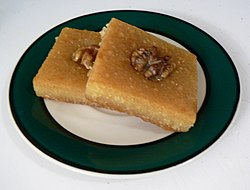
Basbousa topped with walnuts
Alternative namesHarisa
TypeDessert
Region or stateMiddle East, Balkans and North Africa
Serving temperatureCold or warm
Main ingredientsSemolina or farina, syrup
  •   Media: Basbousa

Basbousa (Arabic: بسبوسة, romanizedbasbūsah) is a sweet, syrup-soaked semolina dessert popular throughout the Middle East and North Africa.[1] The semolina batter is baked in a sheet pan,[2] then sweetened with sugar syrup and typically cut into diamond (lozenge) shapes or squares.

History

[edit]

The Oxford Companion to Food (3rd edition) suggests that basbousa might have developed from a dish called ma'mounia, which was created around the 10th century. Ma'mounia was made by cooking rice in fat and syrup. This recipe was later adapted to use semolina, with the batter being cooked first and then soaked in syrup.[3]

Another take on its origin suggests that basbousa was first made during the 16th century in the Ottoman Empire, likely in what is modern-day Turkey, to celebrate the conquest of Irevan.[4]

Names

[edit]
Basbousa in the Middle East, the Balkans, North Africa, East Africa topped with almonds

It is found in the cuisines of the Middle East, the Balkans and North Africa under a variety of names.[5]

Basbousa is the most common name for this dessert in the Middle East but it may be named differently depending on the region; it is often called "hareesa" in the Levant[6][9]. Note that "harissa" in North Africa is a spicy red sauce. It is a popular dessert offered in many sweets bakeries in the Middle East and especially popular during Ramadan.

vegan basbousa without eggs or milk uncle lous kitchen
Vegan basbousa (egg replaced by apple sauce)

Variations

[edit]

Many variations of syrup-soaked semolina paste can be found in the Middle East; common ingredients include coconut, rose water, citrus, among many others.[10]

Some common versions are:

  • Pastūsha (sometimes stylized as pastūçha) is a variant of basbousa that originated in Kuwait in the 2010s.[11] Like basbousa, it is made from semolina soaked in sweet syrup. It is characterized by the addition of finely ground pistachios and orange flower water.
  • Vegan basbousa: Basbusa is also available in vegan form using apple sauce to bind the base mix together instead of dairy and eggs.
  • Basbousa eem tapuzim: Israeli variation from the coastal region, it is flavored with orange juice.
  • Basbousa bil tamr: Libyan variant of basbousa where date spread is being added between two layers of the basbousa.

See also

[edit]

References

[edit]
Revisions and contributorsEdit on WikipediaRead on Wikipedia
from Grokipedia
Basbousa is a traditional Arab consisting of a -based cake soaked in a sweet , prized for its moist, crumbly texture and subtle nutty flavor, often garnished with blanched almonds or and cut into shapes. Scholarly literature describes basbousa as a traditional Arabian dessert placed within the broader framework of Arab cuisine, particularly in Egypt and the Levant, and classifies it as part of the medieval Arab halwa tradition of grain-based sweets developed in the Middle East, characterized by grains cooked with fat and sweetened with sugar or honey. In contemporary scholarship on Traditional Arabic food culture, basbousa is listed among well-known Arab sweets, reflecting its enduring cultural significance. With roots in the medieval , basbousa traces its origins to early semolina puddings documented in a 10th-century titled Kitab al-Tabikh, with the first references to it as a baked cake appearing in a 14th-century Egyptian under the name "foostukia Nabulseyeh," linked to in . The name "basbousa" derives from the root "bas," referring to the process of rubbing or kneading semolina with oil or to achieve its characteristic texture. Through Ottoman expansion and regional migrations from the onward, it spread across the , , and the Mediterranean, evolving into various local adaptations while retaining its core semolina foundation. The cake is typically prepared by mixing coarse with ingredients such as , , eggs, , desiccated , and , then baking it until golden before pouring a hot made from , water, and lemon juice—or sometimes flavored with or —over the warm cake to infuse it with sweetness. Common additions include (samneh) for richness or nuts like pistachios for decoration, resulting in a that balances a crunchy exterior with a soft, syrup-saturated interior. Basbousa holds significant cultural value as a symbol of and celebration in Arab societies, frequently served during religious holidays such as and Eid for , or post-fast periods like and Nativity for Coptic Christians in . It appears in diverse regional forms, including hareesa or namura in , , and (often more crumbly and almond-topped), revani or shamali in and the (incorporating or eggs), and North African versions like safra or gâteau de semoule with unique flavorings such as nigella seeds or for ritual occasions. In modern contexts, such as , it has been revitalized in contemporary settings like restaurants, sometimes paired with to blend tradition with innovation.

Overview

Description

Basbousa is a dense, moist semolina-based cake soaked in sugar syrup, resulting in a rich and indulgent popular in . It is traditionally cut into diamond or square shapes, often garnished with nuts like blanched almonds or pistachios placed in a grid pattern atop each piece. The texture of basbousa is rustic and grainy due to the , providing a distinctive flecked consistency that contrasts with the sticky sweetness achieved through absorption, creating a soft yet substantial . After baking, it develops a golden-brown appearance, enhancing its visual as a of neatly portioned, nut-topped slices. Its flavor profile is intensely sweet and nutty, with aromatic notes commonly infused from rosewater or water in the syrup, evoking a floral and citrusy essence that complements the semolina's subtle earthiness. Known regionally as namoura in , basbousa offers a harmonious balance of these elements, making it a cherished treat for its sensory depth.

Etymology

The term basbousa originates from the Arabic word basbūsah (بسبوسة), derived from the verb bas meaning "to blend" or "to mix," which alludes to the dessert's preparation by combining semolina flour with fat such as butter or margarine. An alternative folk interpretation links basbūsah to the Egyptian Arabic term basbosa, a diminutive form of būsa signifying a "little kiss" or light peck, evoking the cake's sweet, affectionate appeal and its semolina-based tenderness. Under influence, the dessert evolved linguistically and was renamed revani, possibly after the 16th-century Ottoman poet Mahmud Çelebi (known as Revani), a court favorite of who composed verses celebrating culinary delights, or from "Revan," the Ottoman name for in , reflecting the empire's conquests. The dessert's nomenclature varies regionally, reflecting cultural adaptations: basbousa predominates in and much of the ; namoura in and ; harisseh (or hareeseh) in and , sharing roots with the Arabic verb harasa meaning "to crush" or "pound," akin to the semolina's texture; revani in and ; and gâteau de semoule in , incorporating French colonial terminology for the Levantine-style cake.

History

Origins

The origins of basbousa trace back to the medieval Arab world, with the earliest documented references to similar semolina-based desserts appearing in the 10th-century Arabic cookbook Kitab al-Tabikh (The Book of Dishes), compiled in , which includes recipes for sweets made from soaked in syrup or fat. A baked cake akin to modern basbousa is explicitly mentioned in a 14th-century Egyptian cookbook under the name "foostukia Nabulseyeh," linked to in and decorated with pistachios, indicating its refinement during the medieval Islamic period. The name "basbousa" derives from the root "bas," referring to the process of rubbing or with oil or to achieve its characteristic texture. In the 15th and 16th centuries, the formalized basbousa as a , incorporating and in a manner influenced by the Turkish revani, a variant created to celebrate military conquests such as the taking of . This Ottoman adaptation drew from earlier traditions while elevating the dish's status in imperial kitchens, and through Ottoman expansion from the 16th century onward, it began spreading across the Middle East, North Africa, and the Mediterranean.

Spread and Evolution

During the 16th to 19th centuries, the Ottoman Empire's expansion facilitated the dissemination of basbousa, originally a semolina-based from earlier Arab culinary traditions, across vast regions through conquests, trade routes, and administrative integration. Known as revani in and the , including , the adapted to local tastes with variations like tishpishti in the , while in the it became hareesa or namura, reflecting crumbly textures or almond toppings influenced by regional ingredients. This spread extended to , where it integrated into local sweets via Ottoman governance and commerce. In , basbousa evolved significantly during the 19th and early 20th centuries, transitioning from home preparation to a staple in commercial bakeries amid and colonial influences under British occupation (1882–1956), which boosted the growth of urban patisseries and confectionery production. Post-World War II migrations carried the dessert to communities in and the , particularly among Egyptian Jews fleeing political instability, embedding it in expatriate cuisines. Key adaptations included the incorporation of in Levantine versions, enhancing tenderness and moisture in the semolina batter, a refinement drawn from longstanding regional traditions. In Egyptian recipes, coconut emerged as a common addition, providing subtle sweetness and texture amid increasing availability of tropical imports post-colonial era. The Arab-Israeli conflicts and subsequent migrations in the mid-20th century, displacing hundreds of thousands of from Arab countries, introduced basbousa to , where it fused with Ashkenazi elements in urban bakeries and home cooking, often rebranded as a versatile semolina cake in fusion desserts.

Ingredients

Core Ingredients

The core ingredient in traditional basbousa is , a durum wheat flour available in fine or coarse varieties, which serves as the base and imparts the dessert's signature grainy texture while enabling it to absorb syrup effectively. Traditional basbousa is typically eggless and flourless (without all-purpose flour), relying primarily on semolina, yogurt, and coconut for its dense, crumbly structure. Recipes often combine fine and coarse for a balance of tenderness and chewiness, with typical amounts around 2 to 3 cups total. Butter or ghee provides richness and helps bind the batter, contributing to a moist, tender crumb; it is usually incorporated in melted form at about 1/2 cup per 2 cups of semolina. Desiccated coconut is a common addition for subtle nutty flavor and enhanced texture, typically used at 1/4 to 1 cup. Sugar adds initial sweetness to the batter before syrup soaking, commonly used in ratios such as 1 cup sugar to 2 cups semolina, enhancing flavor without overpowering the final soaked result. Yogurt or milk supplies moisture and aids in leavening, with being more traditional in many recipes at around 1 cup to promote tenderness and a subtle tang that balances sweetness; is often included at 1/3 to 3/4 for additional . Eggs are optional and appear in some variations for added lift and structure, such as in Turkish revani, which typically includes eggs for a lighter, spongier texture and incorporates some wheat flour along with citrus flavors like lemon or orange zest in the batter. Baking powder or self-rising flour ensures a light rise, preventing density, typically at 1 to 1.5 teaspoons per batch. Nuts such as almonds or pistachios are used as a topping for crunch and visual appeal, placed whole or sliced on the batter before baking, with about 1/4 cup sufficient for decoration.

Syrup and Flavorings

The syrup used in basbousa is a simple prepared by combining granulated and , in ratios ranging from 1:1 to 2:1 to depending on the regional variation or desired sweetness, along with a small amount of lemon juice to prevent and add a subtle tartness. The mixture is brought to a over medium , stirring until the dissolves, then simmered for about 5 to 10 minutes until it thickens slightly into a syrupy consistency without becoming overly viscous. This process ensures the has the right balance of sweetness and body to infuse the cake evenly. A signature element of the syrup is the addition of floral essences, such as or water (known as ma'zhar in ), which impart a delicate, aromatic fragrance central to basbousa's flavor profile. In contrast, variations like Turkish revani emphasize citrus flavors, such as lemon or orange, in the syrup rather than floral waters or coconut. These are stirred in after cooking, typically at a rate of 1 to 2 teaspoons per cup of syrup, though amounts can vary slightly based on desired intensity. Optional additions like can introduce a deeper, more complex sweetness to the , while ground or whole cardamom pods provide a warm, spicy note that enhances the overall . These elements are incorporated during simmering for better integration. The soaking process involves pouring the warm or hot over the freshly baked, still-warm basbousa to promote even absorption throughout the semolina-based cake, resulting in a moist texture without excessive sogginess. This step allows the flavors to meld as the cake cools, often requiring the dessert to rest for at least an hour before serving.

Preparation

Basic Method

The traditional preparation of basbousa begins with mixing the batter. is combined with sugar, melted butter or , and (or a combination of and eggs in some versions) to form a thick, crumbly ; is often incorporated for leavening. This mixture is kneaded briefly by hand until cohesive but not overworked, to maintain the semolina's texture. The batter is then set aside to rest for 30 to 60 minutes, allowing the grains to fully and absorb the liquids, which ensures a tender crumb. For assembly, a baking pan—typically 9x13 inches or a 12-inch round—is greased with or a thin layer of to prevent sticking and enhance flavor. The rested batter is spread evenly in the pan to a thickness of about 1 inch (2.5 cm), then scored with a sharp knife into shapes for traditional . Half a blanched or other nut is placed in the center of each scored piece to decorate and add crunch. Baking follows in a preheated at 350°F (175°C) for 25 to 35 minutes, or until the top is golden brown and edges begin to crisp; the pan is placed on the middle rack initially and may be moved higher for even browning if needed. Immediately upon removal from the oven, the —either hot or cooled depending on the variant, as prepared in the Syrup and Flavorings section—is poured evenly over the surface to infuse with sweetness and moisture (common methods include hot over hot cake or cooled over hot cake to achieve optimal texture). Finally, the basbousa cools at for 1 to 2 hours (or longer, ideally overnight) in the pan, covered loosely to trap and promote absorption without becoming soggy; it is then cut along the scored lines for serving.

Serving and Storage

Basbousa is traditionally served at after cooling completely, though it may also be enjoyed chilled for a firmer texture. It is often garnished by dusting with or sprinkling shredded on top, enhancing its sweet, nutty profile. Once the syrup has been absorbed and the cake has cooled for at least 30 minutes, it is cut along pre-scored lines into bite-sized diamonds or squares. A standard 9x13-inch pan typically yields 15 to 30 pieces, depending on the desired size. For storage, basbousa should be kept covered in an airtight container at for up to 2-3 days to maintain moisture from the . It can be refrigerated for up to 1 week in an airtight container to prevent drying out, though allowing it to return to before serving is recommended. The batter or fully baked and syrup-soaked cake can be frozen for up to 3 months; wrap tightly to preserve quality. To reheat, individual pieces can be microwaved for a few seconds or warmed gently in a low , which helps restore the 's moisture without making the cake overly soft.

Variations

Regional Differences

In , basbousa is characterized by the use of in the batter, which contributes to its tender and moist texture, while shredded is frequently incorporated for added richness, resulting in a denser and notably sweeter final product compared to other versions. This preparation yields a cake that is soft and melt-in-the-mouth, often baked in large trays and cut into shapes after syrup absorption. Across the , particularly in , , and where it is commonly called namoura or hareesa, the features batter spread in trays, with a base layer that prevents sticking and imparts a subtle nutty flavor. These versions result in a soft and moist texture after syrup absorption. Palestinian hareesa is often more crumbly and topped with almonds. In and , the equivalent known as revani or shamali incorporates or into the semolina batter for added moisture, and is often flavored with mastic gum or zest to provide aromatic and notes. Traditional basbousa is typically eggless, relying primarily on semolina, yogurt, and coconut without all-purpose flour, yielding a denser, crumbly texture often topped with almonds and cut into diamonds. In contrast, Turkish revani includes eggs for a lighter, spongier, more cake-like consistency, often incorporates some wheat flour, and emphasizes citrus flavors such as lemon or orange zest in both the batter and syrup, while sometimes including ground nuts like hazelnuts. Revani is prominently associated with Turkish cuisine, with its name possibly deriving from the poet Fuzûlî's work or historical Ottoman naming conventions, reflecting a distinct cultural history. Ground nuts, such as almonds or walnuts, may also be mixed into the batter for enhanced nuttiness, distinguishing it from plainer regional forms and resulting in a more cake-like consistency. Balkan shamali typically includes or eggs. North African interpretations, such as gateau namoura or safra in countries like and , incorporate desiccated in some recipes alongside for a tropical-infused cake, typically baked in large pans. The syrup preparation often includes citrus elements like or , yielding a tangy soak that balances the cake's density; some versions feature unique flavorings such as seeds or for ritual occasions, or are known as gâteau de semoule. In the Gulf states, including , basbousa variations highlight pistachios as a primary topping, often crushed and sprinkled on top for crunch and visual appeal. Some luxury iterations incorporate into the syrup or batter, infusing it with a subtle golden hue and exotic floral aroma suitable for special occasions.

Modern Adaptations

In recent years, vegan adaptations of basbousa have gained traction, particularly in Western Middle Eastern restaurants and home cooking since the , substituting plant-based for traditional and or non-dairy for yogurt to maintain moisture and structure without animal products. These versions often incorporate or vegan for richness, ensuring the cake retains its signature syrup-soaked tenderness while appealing to plant-based diets. Health-conscious modifications have emerged to address nutritional concerns, such as using whole semolina blended with traditional fine for added or incorporating in the to reduce content significantly. These adaptations replace high- elements like full-fat with unsweetened or low-fat , lowering the overall profile while preserving the dessert's moist texture. Gluten-free alternatives frequently substitute almond for , creating a nutty, dense cake that mimics the original's chewiness and pairs well with the standard or rose-infused . Fusion innovations have introduced basbousa to global flavors, such as syrup-infused basbousa where crumbled cake pieces are mixed into hazelnut or bases, offered in U.S. bakeries for a textural contrast of chewy and creamy . In Israeli cafes since the early 2000s, layered basbousa has become popular, featuring batter enriched with cocoa and topped with or covered in -coconut coatings for a decadent twist on the classic. Commercial products have made basbousa more accessible, with pre-packaged versions available in Middle Eastern supermarkets across the U.S. and , often in flavors like or and ready to heat or serve directly.

Cultural Significance

Role in Cuisine

Basbousa serves as a staple in Egyptian and Levantine home cooking, valued for its simplicity and use of locally sourced derived from durum , making it an affordable option for everyday meals. In these regions, it is commonly prepared in large trays at home, blending with basic ingredients like or to create a dense, syrup-soaked cake that provides a comforting end to meals. Nutritionally, basbousa is high in carbohydrates from its base, offering a reliable energy source in traditional diets, while the addition of nuts like almonds or pistachios contributes moderate protein. A typical piece weighs around 80-100 grams and contains approximately 220-270 calories, aligning with its role as an indulgent yet accessible treat. In culinary pairings, basbousa complements savory Egyptian dishes like koshari, providing a sweet contrast to the and rice-based meal. Similarly, in —where it is known as revani—it serves as a syrupy . Commercially, basbousa is ubiquitous in patisseries, street vendors, and bakeries throughout the Arab world, from Egypt to the Levant and Gulf states.

Traditions and Occasions

Basbousa holds a prominent place in Islamic traditions, particularly during Ramadan, when it is prepared in large batches for iftar meals to break the daily fast, offering a sweet contrast to the month's austerity and fostering communal sharing among family and friends. In Egypt, it serves as an Eid staple, distributed during Eid al-Fitr celebrations to mark the end of fasting with joy and gratitude, often in home gatherings or community events that emphasize family bonds. Similarly, in Lebanon, namoura—a variant of basbousa—is a cherished family recipe passed down generations and featured prominently during Eid, symbolizing sweetness and renewal after Ramadan's spiritual discipline. The dessert also features in wedding and holiday customs across the region, where it embodies celebration and prosperity. In and , namoura and harisseh are served at communal feasts for weddings and religious holidays, presented on large trays to guests as a of abundance and shared during these joyous occasions. In , the Ottoman-influenced revani is a customary offering at name-day celebrations, which function as significant personal holidays honoring saints, often enjoyed at family lunches or gatherings to mark the occasion with traditional sweets. Among communities in the United States and , basbousa plays a key role in preserving through festivals and potlucks. For instance, at events like the Arabic Lunch Celebration at , it is served as part of observances, allowing Arab American students to share the dessert and connect with their roots amid broader cultural programming. Symbolically, basbousa represents in Ottoman-influenced cultures, where sweets like it were used to express goodwill and generosity, often gifted during home visits or engagements to welcome guests and strengthen social ties. This tradition underscores its role in rituals from births to funerals, highlighting themes of joy, community, and bittersweet life experiences across Arab and Mediterranean societies.

References

Add your contribution
Related Hubs
User Avatar
No comments yet.