Euclidean geometry
Euclidean geometry
Main page
2324669

Euclidean geometry

logo
Community Hub0 subscribers
Read side by side
from Wikipedia
Detail from Raphael's The School of Athens featuring a Greek mathematician – perhaps representing Euclid or Archimedes – using a compass to draw a geometric construction.

Euclidean geometry is a mathematical system attributed to Euclid, an ancient Greek mathematician, which he described in his textbook on geometry, Elements. Euclid's approach consists in assuming a small set of intuitively appealing axioms (postulates) and deducing many other propositions (theorems) from these. One of those is the parallel postulate which relates to parallel lines on a Euclidean plane. Although many of Euclid's results had been stated earlier,[1] Euclid was the first to organize these propositions into a logical system in which each result is proved from axioms and previously proved theorems.[2]

The Elements begins with plane geometry, still taught in secondary school (high school) as the first axiomatic system and the first examples of mathematical proofs. It goes on to the solid geometry of three dimensions. Much of the Elements states results of what are now called algebra and number theory, explained in geometrical language.[1]

For more than two thousand years, the adjective "Euclidean" was unnecessary because Euclid's axioms seemed so intuitively obvious (with the possible exception of the parallel postulate) that theorems proved from them were deemed absolutely true, and thus no other sorts of geometry were possible. Today, however, many other self-consistent non-Euclidean geometries are known, the first ones having been discovered in the early 19th century. An implication of Albert Einstein's theory of general relativity is that physical space itself is not Euclidean, and Euclidean space is a good approximation for it only over short distances (relative to the strength of the gravitational field).[3]

Euclidean geometry is an example of synthetic geometry, in that it proceeds logically from axioms describing basic properties of geometric objects such as points and lines, to propositions about those objects. This is in contrast to analytic geometry, introduced almost 2,000 years later by René Descartes, which uses coordinates to express geometric properties by means of algebraic formulas.

The Elements

[edit]

The Elements is mainly a systematization of earlier knowledge of geometry. Its improvement over earlier treatments was rapidly recognized, with the result that there was little interest in preserving the earlier ones, and they are now nearly all lost.

There are 13 books in the Elements:

Books I–IV and VI discuss plane geometry. Many results about plane figures are proved, for example, "In any triangle, two angles taken together in any manner are less than two right angles." (Book I proposition 17) and the Pythagorean theorem "In right-angled triangles the square on the side subtending the right angle is equal to the squares on the sides containing the right angle." (Book I, proposition 47)

Books V and VII–X deal with number theory, with numbers treated geometrically as lengths of line segments or areas of surface regions. Notions such as prime numbers and rational and irrational numbers are introduced. It is proved that there are infinitely many prime numbers.

Books XI–XIII concern solid geometry. A typical result is the 1:3 ratio between the volume of a cone and a cylinder with the same height and base. The platonic solids are constructed.

Axioms

[edit]
The parallel postulate (Postulate 5): If two lines intersect a third in such a way that the sum of the inner angles on one side is less than two right angles, then the two lines inevitably must intersect each other on that side if extended far enough.

Euclidean geometry is an axiomatic system, in which all theorems ("true statements") are derived from a small number of simple axioms. Until the advent of non-Euclidean geometry, these axioms were considered to be obviously true in the physical world, so that all the theorems would be equally true. However, Euclid's reasoning from assumptions to conclusions remains valid independently from the physical reality.[4]

Near the beginning of the first book of the Elements, Euclid gives five postulates (axioms) for plane geometry, stated in terms of constructions (as translated by Thomas Heath):[5]

Let the following be postulated:
  1. To draw a straight line from any point to any point.
  2. To produce (extend) a finite straight line continuously in a straight line.
  3. To describe a circle with any centre and distance (radius).
  4. That all right angles are equal to one another.
  5. [The parallel postulate]: That, if a straight line falling on two straight lines makes the interior angles on the same side less than two right angles, the two straight lines, if produced indefinitely, meet on that side on which the angles are less than two right angles.

Although Euclid explicitly only asserts the existence of the constructed objects, in his reasoning he also implicitly assumes them to be unique.

The Elements also include the following five "common notions":

  1. Things that are equal to the same thing are also equal to one another (the transitive property of a Euclidean relation).
  2. If equals are added to equals, then the wholes are equal (Addition property of equality).
  3. If equals are subtracted from equals, then the differences are equal (subtraction property of equality).
  4. Things that coincide with one another are equal to one another (reflexive property).
  5. The whole is greater than the part.

Modern scholars agree that Euclid's postulates do not provide the complete logical foundation that Euclid required for his presentation.[6] Modern treatments use more extensive and complete sets of axioms.

Parallel postulate

[edit]

To the ancients, the parallel postulate seemed less obvious than the others. They aspired to create a system of absolutely certain propositions, and to them, it seemed as if the parallel line postulate required proof from simpler statements. It is now known that such a proof is impossible since one can construct consistent systems of geometry (obeying the other axioms) in which the parallel postulate is true, and others in which it is false.[7] Euclid himself seems to have considered it as being qualitatively different from the others, as evidenced by the organization of the Elements: his first 28 propositions are those that can be proved without it.

Many alternative axioms can be formulated which are logically equivalent to the parallel postulate (in the context of the other axioms). For example, Playfair's axiom states:

In a plane, through a point not on a given straight line, at most one line can be drawn that never meets the given line.

The "at most" clause is all that is needed since it can be proved from the remaining axioms that at least one parallel line exists.

A proof from Euclid's Elements that, given a line segment, one may construct an equilateral triangle that includes the segment as one of its sides: an equilateral triangle ΑΒΓ is made by drawing circles Δ and Ε centered on the points Α and Β, and taking one intersection of the circles as the third vertex of the triangle.

Methods of proof

[edit]

Euclidean geometry is constructive. Postulates 1, 2, 3, and 5 assert the existence and uniqueness of certain geometric figures, and these assertions are of a constructive nature: that is, we are not only told that certain things exist, but are also given methods for creating them with no more than a compass and an unmarked straightedge.[8] In this sense, Euclidean geometry is more concrete than many modern axiomatic systems such as set theory, which often assert the existence of objects without saying how to construct them, or even assert the existence of objects that cannot be constructed within the theory.[9] Strictly speaking, the lines on paper are models of the objects defined within the formal system, rather than instances of those objects. For example, a Euclidean straight line has no width, but any real drawn line will have. Though nearly all modern mathematicians consider nonconstructive proofs just as sound as constructive ones, they are often considered less elegant, intuitive, or practically useful. Euclid's constructive proofs often supplanted fallacious nonconstructive ones, e.g. some Pythagorean proofs that assumed all numbers are rational, usually requiring a statement such as "Find the greatest common measure of ..."[10]

Euclid often used proof by contradiction.[11]

Notation and terminology

[edit]

Naming of points and figures

[edit]

Points are customarily named using capital letters of the alphabet. Other figures, such as lines, triangles, or circles, are named by listing a sufficient number of points to pick them out unambiguously from the relevant figure, e.g., triangle ABC would typically be a triangle with vertices at points A, B, and C.

Complementary and supplementary angles

[edit]

Angles whose sum is a right angle are called complementary. Complementary angles are formed when a ray shares the same vertex and is pointed in a direction that is in between the two original rays that form the right angle. The number of rays in between the two original rays is infinite.

Angles whose sum is a straight angle are supplementary. Supplementary angles are formed when a ray shares the same vertex and is pointed in a direction that is in between the two original rays that form the straight angle (180 degree angle). The number of rays in between the two original rays is infinite.

Modern versions of Euclid's notation

[edit]

In modern terminology, angles would normally be measured in degrees or radians.

Modern school textbooks often define separate figures called lines (infinite), rays (semi-infinite), and line segments (of finite length). Euclid, rather than discussing a ray as an object that extends to infinity in one direction, would normally use locutions such as "if the line is extended to a sufficient length", although he occasionally referred to "infinite lines". A "line" for Euclid could be either straight or curved, and he used the more specific term "straight line" when necessary.

Some important or well known results

[edit]

Pons asinorum

[edit]

The pons asinorum (bridge of asses) states that in isosceles triangles the angles at the base equal one another, and, if the equal straight lines are produced further, then the angles under the base equal one another.[12] Its name may be attributed to its frequent role as the first real test in the Elements of the intelligence of the reader and as a bridge to the harder propositions that followed. It might also be so named because of the geometrical figure's resemblance to a steep bridge that only a sure-footed donkey could cross.[13]

Congruence of triangles

[edit]
Congruence of triangles is determined by specifying two sides and the angle between them (SAS), two angles and the side between them (ASA) or two angles and a corresponding adjacent side (AAS). Specifying two sides and an adjacent angle (SSA), however, can yield two distinct possible triangles unless the angle specified is a right angle.

Triangles are congruent if they have all three sides equal (SSS), two sides and the angle between them equal (SAS), or two angles and a side equal (ASA) (Book I, propositions 4, 8, and 26). Triangles with three equal angles (AAA) are similar, but not necessarily congruent. Also, triangles with two equal sides and an adjacent angle are not necessarily equal or congruent.

Triangle angle sum

[edit]

The sum of the angles of a triangle is equal to a straight angle (180 degrees).[14] This causes an equilateral triangle to have three interior angles of 60 degrees. Also, it causes every triangle to have at least two acute angles and up to one obtuse or right angle.

Pythagorean theorem

[edit]

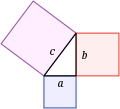
The celebrated Pythagorean theorem (book I, proposition 47) states that in any right triangle, the area of the square whose side is the hypotenuse (the side opposite the right angle) is equal to the sum of the areas of the squares whose sides are the two legs (the two sides that meet at a right angle).

Thales' theorem

[edit]
An example of congruence. The two figures on the left are congruent, while the third is similar to them. The last figure is neither. Congruences alter some properties, such as location and orientation, but leave others unchanged, like distance and angles. The latter sort of properties are called invariants and studying them is the essence of geometry.

Thales' theorem, named after Thales of Miletus states that if A, B, and C are points on a circle where the line AC is a diameter of the circle, then the angle ABC is a right angle. Cantor supposed that Thales proved his theorem by means of Euclid Book I, Prop. 32 after the manner of Euclid Book III, Prop. 31.[15][16]

Scaling of area and volume

[edit]

In modern terminology, the area of a plane figure is proportional to the square of any of its linear dimensions, , and the volume of a solid to the cube, . Euclid proved these results in various special cases such as the area of a circle[17] and the volume of a parallelepipedal solid.[18] Euclid determined some, but not all, of the relevant constants of proportionality. For instance, it was his successor Archimedes who proved that a sphere has 2/3 the volume of the circumscribing cylinder.[19]

System of measurement and arithmetic

[edit]

Euclidean geometry has two fundamental types of measurements: angle and distance. The angle scale is absolute, and Euclid uses the right angle as his basic unit, so that, for example, a 45-degree angle would be referred to as half of a right angle. The distance scale is relative; one arbitrarily picks a line segment with a certain nonzero length as the unit, and other distances are expressed in relation to it. Addition of distances is represented by a construction in which one line segment is copied onto the end of another line segment to extend its length, and similarly for subtraction.

Measurements of area and volume are derived from distances. For example, a rectangle with a width of 3 and a length of 4 has an area that represents the product, 12. Because this geometrical interpretation of multiplication was limited to three dimensions, there was no direct way of interpreting the product of four or more numbers, and Euclid avoided such products, although they are implied, for example in the proof of book IX, proposition 20.

Euclid refers to a pair of lines, or a pair of planar or solid figures, as "equal" (ἴσος) if their lengths, areas, or volumes are equal respectively, and similarly for angles. The stronger term "congruent" refers to the idea that an entire figure is the same size and shape as another figure. Alternatively, two figures are congruent if one can be moved on top of the other so that it matches up with it exactly. (Flipping it over is allowed.) Thus, for example, a 2x6 rectangle and a 3x4 rectangle are equal but not congruent, and the letter R is congruent to its mirror image. Figures that would be congruent except for their differing sizes are referred to as similar. Corresponding angles in a pair of similar shapes are equal and corresponding sides are in proportion to each other.

In engineering

[edit]

Design and analysis

[edit]
Mechanical Stress
Gear
U-Tube Shell and Tube Heat Exchanger
  • Lens design: Lens - In optical engineering, Euclidean geometry is critical in the design of lenses, where precise geometric shapes determine the focusing properties. Geometric optics analyzes the focusing of light by lenses and mirrors.
Types of lenses
Types of Lenses

Dynamics

[edit]
Vibration - oscillations
Airfoil nomenclature
Animation of orbit by eccentricity

CAD systems

[edit]
  • 3D modeling: In CAD (computer-aided design) systems, Euclidean geometry is fundamental for creating accurate 3D models of mechanical parts. These models are crucial for visualizing and testing designs before manufacturing.
  • Evolution of drafting practices: Historically, advanced Euclidean geometry, including theorems like Pascal's theorem and Brianchon's theorem, was integral to drafting practices. However, with the advent of modern CAD systems, such in-depth knowledge of these theorems is less necessary in contemporary design and manufacturing processes.
3D CAD model

Circuit design

[edit]
PCB of a DVD player

Electromagnetic and fluid flow fields

[edit]
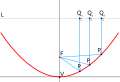
NASA Cassegrain, extremely high gain ~70 dBi.
Potential flow around a source without circulation

Controls

[edit]
Basic feedback loop.

Other general applications

[edit]

Because of Euclidean geometry's fundamental status in mathematics, it is impractical to give more than a representative sampling of applications here.

As suggested by the etymology of the word, one of the earliest reasons for interest in and also one of the most common current uses of geometry is surveying.[20] In addition it has been used in classical mechanics and the cognitive and computational approaches to visual perception of objects. Certain practical results from Euclidean geometry (such as the right-angle property of the 3-4-5 triangle) were used long before they were proved formally.[21] The fundamental types of measurements in Euclidean geometry are distances and angles, both of which can be measured directly by a surveyor. Historically, distances were often measured by chains, such as Gunter's chain, and angles using graduated circles and, later, the theodolite.

An application of Euclidean solid geometry is the determination of packing arrangements, such as the problem of finding the most efficient packing of spheres in n dimensions. This problem has applications in error detection and correction.

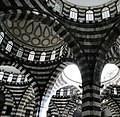
Geometry is used extensively in architecture.

Geometry can be used to design origami. Some classical construction problems of geometry are impossible using compass and straightedge, but can be solved using origami.[22]

Later history

[edit]

Archimedes and Apollonius

[edit]
A sphere has 2/3 the volume and surface area of its circumscribing cylinder. A sphere and cylinder were placed on the tomb of Archimedes at his request.

Archimedes (c. 287 BCE – c. 212 BCE), a colorful figure about whom many historical anecdotes are recorded, is remembered along with Euclid as one of the greatest of ancient mathematicians. Although the foundations of his work were put in place by Euclid, his work, unlike Euclid's, is believed to have been entirely original.[23] He proved equations for the volumes and areas of various figures in two and three dimensions, and enunciated the Archimedean property of finite numbers.

Apollonius of Perga (c. 240 BCE – c. 190 BCE) is mainly known for his investigation of conic sections.

René Descartes. Portrait after Frans Hals, 1648.

17th century: Descartes

[edit]

René Descartes (1596–1650) developed analytic geometry, an alternative method for formalizing geometry which focused on turning geometry into algebra.[24]

In this approach, a point on a plane is represented by its Cartesian (x, y) coordinates, a line is represented by its equation, and so on.

In Euclid's original approach, the Pythagorean theorem follows from Euclid's axioms. In the Cartesian approach, the axioms are the axioms of algebra, and the equation expressing the Pythagorean theorem is then a definition of one of the terms in Euclid's axioms, which are now considered theorems.

The equation

defining the distance between two points P = (px, py) and Q = (qx, qy) is then known as the Euclidean metric, and other metrics define non-Euclidean geometries.

In terms of analytic geometry, the restriction of classical geometry to compass and straightedge constructions means a restriction to first- and second-order equations, e.g., y = 2x + 1 (a line), or x2 + y2 = 7 (a circle).

Also in the 17th century, Girard Desargues, motivated by the theory of perspective, introduced the concept of idealized points, lines, and planes at infinity. The result can be considered as a type of generalized geometry, projective geometry, but it can also be used to produce proofs in ordinary Euclidean geometry in which the number of special cases is reduced.[25]

Squaring the circle: the areas of this square and this circle are equal. In 1882, it was proven that this figure cannot be constructed in a finite number of steps with an idealized compass and straightedge.

18th century

[edit]

Geometers of the 18th century struggled to define the boundaries of the Euclidean system. Many tried in vain to prove the fifth postulate from the first four. By 1763, at least 28 different proofs had been published, but all were found incorrect.[26]

Leading up to this period, geometers also tried to determine what constructions could be accomplished in Euclidean geometry. For example, the problem of trisecting an angle with a compass and straightedge is one that naturally occurs within the theory, since the axioms refer to constructive operations that can be carried out with those tools. However, centuries of efforts failed to find a solution to this problem, until Pierre Wantzel published a proof in 1837 that such a construction was impossible. Other constructions that were proved impossible include doubling the cube and squaring the circle. In the case of doubling the cube, the impossibility of the construction originates from the fact that the compass and straightedge method involve equations whose order is an integral power of two,[27] while doubling a cube requires the solution of a third-order equation.

Euler discussed a generalization of Euclidean geometry called affine geometry, which retains the fifth postulate unmodified while weakening postulates three and four in a way that eliminates the notions of angle (whence right triangles become meaningless) and of equality of length of line segments in general (whence circles become meaningless) while retaining the notions of parallelism as an equivalence relation between lines, and equality of length of parallel line segments (so line segments continue to have a midpoint).

19th century

[edit]
Comparison of elliptic, Euclidean and hyperbolic geometries in two dimensions

In the early 19th century, Carnot and Möbius systematically developed the use of signed angles and line segments as a way of simplifying and unifying results.[28]

Higher dimensions

[edit]

In the 1840s William Rowan Hamilton developed the quaternions, and John T. Graves and Arthur Cayley the octonions. These are normed algebras which extend the complex numbers. Later it was understood that the quaternions are also a Euclidean geometric system with four real Cartesian coordinates.[29] Cayley used quaternions to study rotations in 4-dimensional Euclidean space.[30]

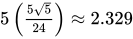
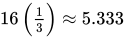
At mid-century Ludwig Schläfli developed the general concept of Euclidean space, extending Euclidean geometry to higher dimensions. He defined polyschemes, later called polytopes, which are the higher-dimensional analogues of polygons and polyhedra. He developed their theory and discovered all the regular polytopes, i.e. the -dimensional analogues of regular polygons and Platonic solids. He found there are six regular convex polytopes in dimension four, and three in all higher dimensions.

Regular convex 4-polytopes
Symmetry group A4 B4 F4 H4
Name 5-cell

Hyper-tetrahedron
5-point

16-cell

Hyper-octahedron
8-point

8-cell

Hyper-cube
16-point

24-cell


24-point

600-cell

Hyper-icosahedron
120-point

120-cell

Hyper-dodecahedron
600-point

Schläfli symbol {3, 3, 3} {3, 3, 4} {4, 3, 3} {3, 4, 3} {3, 3, 5} {5, 3, 3}
Coxeter mirrors
Mirror dihedrals 𝝅/3 𝝅/3 𝝅/3 𝝅/2 𝝅/2 𝝅/2 𝝅/3 𝝅/3 𝝅/4 𝝅/2 𝝅/2 𝝅/2 𝝅/4 𝝅/3 𝝅/3 𝝅/2 𝝅/2 𝝅/2 𝝅/3 𝝅/4 𝝅/3 𝝅/2 𝝅/2 𝝅/2 𝝅/3 𝝅/3 𝝅/5 𝝅/2 𝝅/2 𝝅/2 𝝅/5 𝝅/3 𝝅/3 𝝅/2 𝝅/2 𝝅/2
Graph
Vertices 5 tetrahedral 8 octahedral 16 tetrahedral 24 cubical 120 icosahedral 600 tetrahedral
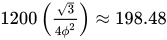
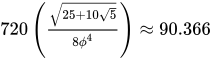
Edges 10 triangular 24 square 32 triangular 96 triangular 720 pentagonal 1200 triangular
Faces 10 triangles 32 triangles 24 squares 96 triangles 1200 triangles 720 pentagons
Cells 5 tetrahedra 16 tetrahedra 8 cubes 24 octahedra 600 tetrahedra 120 dodecahedra
Tori 1 5-tetrahedron 2 8-tetrahedron 2 4-cube 4 6-octahedron 20 30-tetrahedron 12 10-dodecahedron
Inscribed 120 in 120-cell 675 in 120-cell 2 16-cells 3 8-cells 25 24-cells 10 600-cells
Great polygons 2 squares x 3 4 rectangles x 4 4 hexagons x 4 12 decagons x 6 100 irregular hexagons x 4
Petrie polygons 1 pentagon x 2 1 octagon x 3 2 octagons x 4 2 dodecagons x 4 4 30-gons x 6 20 30-gons x 4
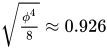
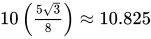
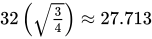
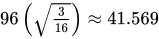
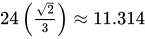
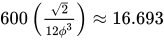
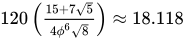
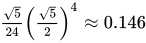
Long radius
Edge length
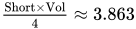
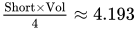
Short radius
Area
Volume
4-Content

Schläfli performed this work in relative obscurity and it was published in full only posthumously in 1901. It had little influence until it was rediscovered and fully documented in 1948 by H.S.M. Coxeter.

In 1878 William Kingdon Clifford introduced what is now termed geometric algebra, unifying Hamilton's quaternions with Hermann Grassmann's algebra and revealing the geometric nature of these systems, especially in four dimensions. The operations of geometric algebra have the effect of mirroring, rotating, translating, and mapping the geometric objects that are being modeled to new positions. The Clifford torus on the surface of the 3-sphere is the simplest and most symmetric flat embedding of the Cartesian product of two circles (in the same sense that the surface of a cylinder is "flat").

Non-Euclidean geometry

[edit]

The century's most influential development in geometry occurred when, around 1830, János Bolyai and Nikolai Ivanovich Lobachevsky separately published work on non-Euclidean geometry, in which the parallel postulate is not valid.[31] Since non-Euclidean geometry is provably relatively consistent with Euclidean geometry, the parallel postulate cannot be proved from the other postulates.

In the 19th century, it was also realized that Euclid's ten axioms and common notions do not suffice to prove all of the theorems stated in the Elements. For example, Euclid assumed implicitly that any line contains at least two points, but this assumption cannot be proved from the other axioms, and therefore must be an axiom itself. The very first geometric proof in the Elements, shown in the figure above, is that any line segment is part of a triangle; Euclid constructs this in the usual way, by drawing circles around both endpoints and taking their intersection as the third vertex. His axioms, however, do not guarantee that the circles actually intersect, because they do not assert the geometrical property of continuity, which in Cartesian terms is equivalent to the completeness property of the real numbers. Starting with Moritz Pasch in 1882, many improved axiomatic systems for geometry have been proposed, the best known being those of Hilbert,[32] George Birkhoff,[33] and Tarski.[34]

20th century and relativity

[edit]
A disproof of Euclidean geometry as a description of physical space. In a 1919 test of the general theory of relativity, stars (marked with short horizontal lines) were photographed during a solar eclipse. The rays of starlight were bent by the Sun's gravity on their way to Earth. This is interpreted as evidence in favor of Einstein's prediction that gravity would cause deviations from Euclidean geometry.

Einstein's theory of special relativity involves a four-dimensional space-time, the Minkowski space, which is non-Euclidean. This shows that non-Euclidean geometries, which had been introduced a few years earlier for showing that the parallel postulate cannot be proved, are also useful for describing the physical world.

However, the three-dimensional "space part" of the Minkowski space remains the space of Euclidean geometry. This is not the case with general relativity, for which the geometry of the space part of space-time is not Euclidean geometry.[35] For example, if a triangle is constructed out of three rays of light, then in general the interior angles do not add up to 180 degrees due to gravity. A relatively weak gravitational field, such as the Earth's or the Sun's, is represented by a metric that is approximately, but not exactly, Euclidean. Until the 20th century, there was no technology capable of detecting these deviations in rays of light from Euclidean geometry, but Einstein predicted that such deviations would exist. They were later verified by observations such as the slight bending of starlight by the Sun during a solar eclipse in 1919, and such considerations are now an integral part of the software that runs the GPS system.[36]

As a description of the structure of space

[edit]

Euclid believed that his axioms were self-evident statements about physical reality. Euclid's proofs depend upon assumptions perhaps not obvious in Euclid's fundamental axioms,[37] in particular that certain movements of figures do not change their geometrical properties such as the lengths of sides and interior angles, the so-called Euclidean motions, which include translations, reflections and rotations of figures.[38] Taken as a physical description of space, postulate 2 (extending a line) asserts that space does not have holes or boundaries; postulate 4 (equality of right angles) says that space is isotropic and figures may be moved to any location while maintaining congruence; and postulate 5 (the parallel postulate) that space is flat (has no intrinsic curvature).[39]

As discussed above, Albert Einstein's theory of relativity significantly modifies this view.

The ambiguous character of the axioms as originally formulated by Euclid makes it possible for different commentators to disagree about some of their other implications for the structure of space, such as whether or not it is infinite[40] (see below) and what its topology is. Modern, more rigorous reformulations of the system[41] typically aim for a cleaner separation of these issues. Interpreting Euclid's axioms in the spirit of this more modern approach, axioms 1–4 are consistent with either infinite or finite space (as in elliptic geometry), and all five axioms are consistent with a variety of topologies (e.g., a plane, a cylinder, or a torus for two-dimensional Euclidean geometry).

Treatment of infinity

[edit]

Infinite objects

[edit]

Euclid sometimes distinguished explicitly between "finite lines" (e.g., Postulate 2) and "infinite lines" (book I, proposition 12). However, he typically did not make such distinctions unless they were necessary. The postulates do not explicitly refer to infinite lines, although for example some commentators interpret postulate 3, existence of a circle with any radius, as implying that space is infinite.[40]

The notion of infinitesimal quantities had previously been discussed extensively by the Eleatic School, but nobody had been able to put them on a firm logical basis, with paradoxes such as Zeno's paradox occurring that had not been resolved to universal satisfaction. Euclid used the method of exhaustion rather than infinitesimals.[42]

Later ancient commentators, such as Proclus (410–485 CE), treated many questions about infinity as issues demanding proof and, e.g., Proclus claimed to prove the infinite divisibility of a line, based on a proof by contradiction in which he considered the cases of even and odd numbers of points constituting it.[43]

At the turn of the 20th century, Otto Stolz, Paul du Bois-Reymond, Giuseppe Veronese, and others produced controversial work on non-Archimedean models of Euclidean geometry, in which the distance between two points may be infinite or infinitesimal, in the NewtonLeibniz sense.[44] Fifty years later, Abraham Robinson provided a rigorous logical foundation for Veronese's work.[45]

Infinite processes

[edit]

Ancient geometers may have considered the parallel postulate – that two parallel lines do not ever intersect – less certain than the others because it makes a statement about infinitely remote regions of space, and so cannot be physically verified.[46]

The modern formulation of proof by induction was not developed until the 17th century, but some later commentators consider it implicit in some of Euclid's proofs, e.g., the proof of the infinitude of primes.[47]

Supposed paradoxes involving infinite series, such as Zeno's paradox, predated Euclid. Euclid avoided such discussions, giving, for example, the expression for the partial sums of the geometric series in IX.35 without commenting on the possibility of letting the number of terms become infinite.

Logical basis

[edit]

Classical logic

[edit]

Euclid frequently used the method of proof by contradiction, and therefore the traditional presentation of Euclidean geometry assumes classical logic, in which every proposition is either true or false, i.e., for any proposition P, the proposition "P or not P" is automatically true.[48] The proof by contradiction (or reductio ad absurdum method) rests on two cardinal principles of classical logic: the law of contradiction and the law of the excluded middle. In simple terms, the law of contradiction says that if S is any statement, then S and a contradiction (that is, the denial) of S cannot both hold. And the law of the excluded middle states, that either S or the denial of S must hold (that is, there is no third, or middle, possibility). This method therefore consists of assuming (by way of hypothesis) that a proposition that is to be established is false; if an absurdity follows, one concludes that the hypothesis is untenable and that the original proposition must then be true.[49]

Modern standards of rigor

[edit]

Placing Euclidean geometry on a solid axiomatic basis was a preoccupation of mathematicians for centuries.[50] The role of primitive notions, or undefined concepts, was clearly put forward by Alessandro Padoa of the Peano delegation at the 1900 Paris conference:[50][51]

...when we begin to formulate the theory, we can imagine that the undefined symbols are completely devoid of meaning and that the unproved propositions are simply conditions imposed upon the undefined symbols.

Then, the system of ideas that we have initially chosen is simply one interpretation of the undefined symbols; but..this interpretation can be ignored by the reader, who is free to replace it in his mind by another interpretation.. that satisfies the conditions...

Logical questions thus become completely independent of empirical or psychological questions...

The system of undefined symbols can then be regarded as the abstraction obtained from the specialized theories that result when...the system of undefined symbols is successively replaced by each of the interpretations...

— Padoa, Essai d'une théorie algébrique des nombre entiers, avec une Introduction logique à une théorie déductive quelconque

That is, mathematics is context-independent knowledge within a hierarchical framework. As said by Bertrand Russell:[52]

If our hypothesis is about anything, and not about some one or more particular things, then our deductions constitute mathematics. Thus, mathematics may be defined as the subject in which we never know what we are talking about, nor whether what we are saying is true.

— Bertrand Russell, Mathematics and the metaphysicians

Axiomatic formulations

[edit]

Geometry is the science of correct reasoning on incorrect figures.

— George Pólya, How to Solve It, p. 208

  • Euclid's axioms: In his dissertation to Trinity College, Cambridge, Bertrand Russell summarized the changing role of Euclid's geometry in the minds of philosophers up to that time.[53] It was a conflict between certain knowledge, independent of experiment, and empiricism, requiring experimental input. This issue became clear as it was discovered that the parallel postulate was not necessarily valid and its applicability was an empirical matter, deciding whether the applicable geometry was Euclidean or non-Euclidean.
  • Hilbert's axioms: Hilbert's axioms had the goal of identifying a simple and complete set of independent axioms from which the most important geometric theorems could be deduced. The outstanding objectives were to make Euclidean geometry rigorous (avoiding hidden assumptions) and to make clear the ramifications of the parallel postulate.
  • Birkhoff's axioms: Birkhoff proposed four postulates for Euclidean geometry that can be confirmed experimentally with scale and protractor. This system relies heavily on the properties of the real numbers.[54][55][56] The notions of angle and distance become primitive concepts.[57]
  • Tarski's axioms: Alfred Tarski (1902–1983) and his students defined elementary Euclidean geometry as the geometry that can be expressed in first-order logic and does not depend on set theory for its logical basis,[58] in contrast to Hilbert's axioms, which involve point sets.[59] Tarski proved that his axiomatic formulation of elementary Euclidean geometry is consistent and complete in a certain sense: there is an algorithm that, for every proposition, can be shown either true or false.[34] (This does not violate Gödel's theorem, because Euclidean geometry cannot describe a sufficient amount of arithmetic for the theorem to apply.[60]) This is equivalent to the decidability of real closed fields, of which elementary Euclidean geometry is a model.

See also

[edit]

Notes

[edit]

References

[edit]
[edit]
Revisions and contributorsEdit on WikipediaRead on Wikipedia
from Grokipedia
Euclidean geometry is a mathematical discipline that systematically studies the properties of points, lines, angles, surfaces, and solids in a flat, two- and three-dimensional space, founded on a set of definitions, axioms, and postulates developed by the ancient Greek mathematician Euclid in his seminal work Elements around 300 BCE.[1] This geometry assumes a Euclidean plane where parallel lines never intersect and the sum of angles in a triangle is 180 degrees, forming the basis for classical notions of space and measurement.[2] The Elements comprises 13 books with 465 propositions, beginning with foundational plane geometry and progressing to number theory, proportions, and solid figures, all derived deductively from 23 definitions, five postulates, and five common notions in Book I.[3] Euclid's five postulates include: (1) a straight line can be drawn between any two points; (2) a finite straight line can be extended indefinitely; (3) a circle can be described with any center and radius; (4) all right angles are equal; and (5) if a straight line falling on two straight lines makes the interior angles on the same side less than two right angles, the two straight lines will intersect on that side.[4] The common notions, such as "things equal to the same thing are equal to one another" and "the whole is greater than the part," provide general principles applicable across mathematics.[4] As the most widely circulated and influential mathematical text in history, with over 1,000 editions since the 15th century, Elements established the deductive method as a model for scientific inquiry, profoundly shaping fields from physics—such as Newton's Principia—to philosophy and education for more than two millennia.[3][1] It synthesized earlier Greek mathematical traditions, including those of the Pythagoreans and Theaetetus, and remains a cornerstone for understanding logical proof and geometric constructions using straightedge and compass.

Foundations

Axioms and Postulates

Euclidean geometry, as systematized in Euclid's Elements, relies on a set of foundational assumptions known as postulates, which serve as unprovable starting points for logical deduction. These postulates articulate basic truths about geometric constructions, enabling the derivation of theorems through rigorous proof. Unlike definitions, which clarify terms, or common notions, which provide general logical principles, the postulates are specific to spatial relations and constructions in the plane.[5] Euclid, active around 300 BCE, did not originate all elements of his system but compiled and organized material from earlier Greek mathematicians, including significant contributions from Hippocrates of Chios (c. 470–410 BCE), who is credited with the first known treatise on geometric elements. This compilation synthesized prior axiomatic efforts, such as Hippocrates' work on lunes and systematic geometry, into a cohesive framework that became the standard for over two millennia.[6][7] The postulates are accepted without proof, forming the axiomatic basis from which all subsequent propositions flow; they assume the existence and performability of fundamental operations using idealized tools like the straightedge and compass. Euclid presents five postulates in Book I of the Elements, with the first four directly enabling the construction of lines, extensions, and circles, while the fifth addresses parallel lines (detailed separately).[5][8] The first postulate states: "To draw a straight line from any point to any point." This guarantees that between any two distinct points, a unique straight line segment can be constructed, forming the basis for connecting points and defining linear figures in the plane.[5] The second postulate states: "To produce a finite straight line continuously in a straight line." It allows any finite line segment to be extended indefinitely in either direction while remaining straight, ensuring that lines have no inherent length limit and supporting constructions requiring arbitrary extensions, such as in proving triangle inequalities.[9] The third postulate states: "To describe a circle with any center and radius." This permits the construction of a circle given a center point and a radius (typically a line segment from another point), underpinning all circular constructions and enabling the transfer of distances via compass, as seen in early propositions like I.2 and I.3.[10] The fourth postulate states: "That all right angles equal one another." It asserts the congruence of all right angles, providing a universal unit for angle measurement and ensuring rotational invariance, which is crucial for constructing perpendiculars and comparing angular measures across figures.[11] Together, these first four postulates imply the feasibility of basic geometric constructions—drawing lines, extending them, creating circles, and establishing equal angles—without presupposing advanced theorems, thus allowing Euclid to build a deductive system from intuitive primitives.[12]

Parallel Postulate

The fifth postulate of Euclid's Elements, often called the parallel postulate, states: "That, if a straight line falling on two straight lines make the interior angles on the same side less than two right angles, the two straight lines, if produced indefinitely, meet on that side on which are the angles less than the two right angles."[13] This formulation addresses the behavior of lines intersected by a transversal, implying conditions under which lines converge rather than remaining parallel indefinitely.[13] Equivalent to Euclid's fifth postulate is Playfair's axiom, proposed by Scottish mathematician John Playfair in 1795, which states: "Given a line and a point not on that line, there exists exactly one line through that point parallel to the given line."[14] This version emphasizes the existence and uniqueness of parallels, simplifying the original while preserving its logical content; proofs of equivalence rely on the first four postulates and basic propositions like the existence of parallels from transversal constructions.[15] Another equivalent formulation appears in the theorem that the sum of the interior angles of a triangle equals 180 degrees, a direct consequence that ties the postulate to core properties of triangles in plane geometry.[16] Throughout history, mathematicians sought to prove the fifth postulate as a theorem derivable from Euclid's first four postulates and common notions, viewing it as less self-evident.[17] Ptolemy, in the 2nd century CE, attempted such a proof by assuming properties of circles and right angles that implicitly relied on the postulate itself, as later critiqued by Proclus in the 5th century.[17] In the 11th century, Persian mathematician Omar Khayyam pursued a proof using a reductio ad absurdum approach with intersecting lines and right triangles, but his method circularly assumed the uniqueness of parallels through additional geometric assumptions.[18] These efforts, spanning centuries, ultimately failed to derive the postulate independently, highlighting its foundational independence.[19] The parallel postulate distinguishes Euclidean geometry by ensuring the uniqueness of parallel lines in the plane, which underpins the consistency and exclusivity of its theorems, such as the angle sum in triangles and properties of similar figures.[16] Without it, alternative geometries emerge where parallels may converge or diverge, altering the structure of plane geometry entirely and demonstrating that Euclid's system relies on this axiom for its characteristic flatness and predictability.[20]

Common Notions

In Euclidean geometry, the common notions represent a set of five fundamental principles articulated by Euclid in the Elements to serve as universal axioms applicable across mathematical disciplines, distinct from the geometry-specific postulates. These notions provide the logical groundwork for handling equality, addition, subtraction, coincidence, and inequality, ensuring consistency in deductions without relying on geometric constructions.[21] Euclid's five common notions are as follows:
  1. Things which are equal to the same thing are also equal to one another.
  2. If equals are added to equals, the wholes are equal.
  3. If equals are subtracted from equals, the remainders are equal.
  4. Things which coincide with one another are equal to one another.
  5. The whole is greater than the part.[22]
The first three common notions establish transitivity and basic operations on equality, forming a theory of equivalence that underpins proofs involving magnitudes and figures throughout the Elements, such as those in Books I and II. The fourth notion justifies superposition for comparing shapes, while the fifth enables arguments about part-whole relations, though their explicit usage in the text is limited and sometimes supplemented by later commentators.[21] Unlike the postulates, which pertain exclusively to geometric actions like drawing lines or circles, the common notions are non-geometric and intended for broad application in quantitative sciences, including arithmetic. This separation highlights their role as shared logical tools rather than domain-specific assumptions.[21] These principles influenced subsequent developments in formal logic, particularly through their integration into Aristotle's common axioms, which shaped philosophical frameworks for scientific deduction in antiquity and beyond.[21]

Basic Elements

Points, Lines, and Planes

In Euclidean geometry, points, lines, and planes form the primitive, undefined elements that serve as the foundational building blocks for all geometric figures and constructions. These elements are introduced without prior definition, relying instead on intuitive understanding and axiomatic relations to establish their properties and interactions. This approach, originating in Euclid's Elements, allows the development of a consistent system where more complex notions are derived from these basics.[23] A point is conceptualized as that which has no part, embodying a dimensionless location with no extension in any direction.[24] The ends of lines are points, underscoring their role as boundary markers. A line is defined as breadthless length, representing a straight path connecting points without width or thickness. Specifically, a straight line is one that lies evenly with the points on itself, ensuring uniformity along its extent. Lines extend infinitely in both directions, as any finite segment can be prolonged continuously straight, per Euclid's second postulate. A plane is a flat surface possessing length and breadth but no depth, with its boundaries consisting of lines. A plane surface lies evenly with the straight lines drawn upon it, maintaining flatness without curvature. Planes contain lines and extend infinitely, serving as the ambient space for planar figures. Two distinct lines in the same plane intersect at most at one point unless they coincide entirely, a consequence of the uniqueness of lines through pairs of points.[24] The incidence axioms, formalized rigorously by Hilbert, govern how points, lines, and planes relate. For any two distinct points, there exists a unique line containing both, and any two distinct points on a line uniquely determine that line.[24] Every line contains at least two points, and there exist at least three points not all on the same line. For planes, any three non-collinear points determine a unique plane, and any three non-collinear points in a plane uniquely determine it. If two points of a line lie in a plane, the entire line lies in that plane. If two planes share a point, they share at least a second point, implying their intersection is a line. Every plane contains at least three non-collinear points, ensuring dimensional structure.[24] Basic relations among these elements include collinearity and coplanarity. Points are collinear if they all lie on the same line, as defined by the incidence relation where multiple points share a unique line.[24] Points are coplanar if they all lie on the same plane, extending the incidence to planar containment for sets of points not reducible to a line.[24] These relations form the basis for classifying configurations in Euclidean space.

Angles and Triangles

In Euclidean geometry, a plane angle is defined as the inclination to one another of two lines in a plane that meet at a point and do not lie straight. When these lines are straight, the angle is termed rectilineal. This configuration can be visualized as two rays emanating from a common vertex, forming the sides of the angle. Angles are typically measured using degrees, a unit tracing back to Babylonian sexagesimal systems where a full rotation comprises 360 degrees, or radians, a modern unit defined such that a full rotation equals 2π2\pi radians for compatibility with calculus. Angles are classified based on their measure relative to a right angle, which occurs when a straight line standing on another straight line creates two equal adjacent angles. A right angle measures exactly 90 degrees or π/2\pi/2 radians. An acute angle is less than a right angle, an obtuse angle greater than a right angle but less than a straight angle of 180 degrees or π\pi radians, and a straight angle equals 180 degrees. A reflex angle exceeds 180 degrees but is less than 360 degrees, though Euclidean constructions often focus on angles up to 180 degrees. A triangle is the simplest polygon in Euclidean geometry, consisting of three straight line segments connecting three non-collinear points, thereby enclosing a region with three sides and three angles. The parallel postulate plays a crucial role in establishing consistent angle properties within triangles, ensuring that alternate interior angles formed by a transversal are equal when lines are parallel. Triangles are classified by side lengths as scalene, with all sides of different lengths; isosceles, with exactly two sides equal; or equilateral, with all three sides equal. By interior angles, they are acute if all three angles are acute, right if one angle is a right angle, or obtuse if one angle is obtuse. A key property is that the sum of the interior angles equals two right angles, though proofs of this rely on foundational postulates. An important basic property is the exterior angle theorem: in any triangle, extending one side beyond a vertex creates an exterior angle that is greater than each of the two non-adjacent interior angles. This inequality sets the stage for further theorems on angle relations. Additionally, the pons asinorum, or "bridge of asses," asserts that in an isosceles triangle, the two base angles are equal to each other.

Circles and Polygons

In Euclidean geometry, a circle is defined as a plane figure contained by one line such that all straight lines drawn from one point within the figure to the containing line are equal in length.[25] This defining point is called the center of the circle, and the constant distance from the center to any point on the containing line, known as the circumference, is the radius.[25] The diameter is any straight line passing through the center and bounded at both ends by the circumference, which bisects the circle into two equal parts.[26] Additional elements of a circle include the arc, which is a portion of the circumference between two points; the chord, a straight line segment connecting two points on the circumference; and the tangent, a straight line that intersects the circle at exactly one point.[27] A fundamental property is that the radius drawn to the point of tangency is perpendicular to the tangent line.[28] This relationship holds because any other line from the center to the tangent would lead to a contradiction in the equality of distances defining the circle.[28] A polygon is a plane figure bounded by three or more straight line segments forming a closed chain.[29] Polygons are classified as regular if all sides and interior angles are equal, or irregular otherwise; they are convex if every interior angle is less than 180 degrees and no sides bend inward, or concave if at least one interior angle exceeds 180 degrees, creating a reflex angle. Common examples include quadrilaterals, which have four sides, and pentagons, which have five sides; these can be regular, such as a square or regular pentagon, or irregular with varying side lengths and angles.[29] Circles and polygons are interrelated through inscription and circumscription: a polygon is inscribed in a circle if all its vertices lie on the circumference, making it cyclic, while a polygon is circumscribed about a circle if the circle is tangent to all its sides, forming the incircle.[3] Conversely, a circle can be inscribed in a polygon or circumscribed around it, with Book IV of Euclid's Elements detailing constructions for regular polygons in these configurations.[3]

Constructions and Proofs

Geometric Constructions

Geometric constructions in Euclidean geometry involve creating geometric figures using only an unmarked straightedge and a compass, as specified in Euclid's postulates for drawing straight lines and circles. The straightedge allows the connection of any two points with a line, while the compass enables the drawing of circles with a given center and radius, or the transfer of distances between points. These tools embody Euclid's constructive approach, where all figures are built step-by-step from given elements without measurements or markings.[3] Basic constructions form the foundation of this system and are detailed in the early books of Euclid's Elements. To construct an equilateral triangle on a given finite straight line, one draws circles centered at each endpoint of the line with radius equal to the line's length; the circles intersect at two points, and connecting one to the endpoints yields the triangle.[3] Bisecting a given angle involves drawing an arc from the vertex intersecting the rays, then drawing equal arcs from those intersection points to find their intersection, and connecting it back to the vertex to form the bisector.[3] Constructing a perpendicular bisector of a finite straight line requires drawing circles centered at each endpoint with radius greater than half the line's length; their intersections define points equidistant from the endpoints, and the line through them is the bisector.[3] Additional perpendiculars, such as from a point not on a line or at a point on a line, follow similar intersection methods using circles to locate midpoints or symmetric points.[3] Despite their power, these constructions have inherent limitations, as not all geometric problems can be solved with straightedge and compass alone. For instance, it is impossible to trisect an arbitrary angle, such as a 60° angle into three 20° angles, using only these tools.[30] Similarly, duplicating a cube—constructing a cube with twice the volume of a given unit cube, which requires constructing the length 23\sqrt[3]{2}—cannot be achieved.[30] A third classical problem, squaring the circle—constructing a square with the same area as a given circle— is also impossible, as proven by Ferdinand von Lindemann in 1882 using the transcendence of π\pi.[31] These impossibilities were rigorously established by Pierre Wantzel in 1837 for trisection and duplication, who showed that such constructions would require solving irreducible cubic equations, leading to field extensions of degrees not powers of 2, which exceed the quadratic extensions possible with straightedge and compass operations.[30] This algebraic perspective, rooted in field theory, underscores the boundaries of Euclidean constructions while highlighting their role in foundational mathematics.[32]

Methods of Proof

Euclidean geometry, as systematized in Euclid's Elements, relies on a deductive method to establish the truth of its propositions. This approach begins with a foundational set of axioms, postulates, and common notions, from which all subsequent theorems are derived through logical inference, often in the form of syllogisms that connect premises to conclusions without gaps in reasoning.[33] Propositions are constructed sequentially, with each new statement building upon previously proven results, ensuring a hierarchical structure where complex geometric properties emerge from simpler ones via rigorous deduction.[34] This method emphasizes logical necessity, treating geometry as a deductive science where diagrams serve as intuitive aids but not as substitutes for formal proof steps.[35] The primary proof types in Euclidean geometry are direct proofs and indirect proofs, known as reductio ad absurdum. In a direct proof, one assumes the given premises—such as axioms or prior propositions—and derives the conclusion through a chain of logical steps, often involving constructions or applications of congruence.[33] For instance, to establish the congruence of two triangles sharing two sides and the included angle (side-angle-side criterion), the proof proceeds by superimposing one triangle onto the other, verifying equality of corresponding parts step by step using postulates on circles and lines, without invoking contradiction.[35] Direct proofs dominate Euclid's Elements, forming the backbone of its 465 propositions by accumulating evidence linearly from foundational elements.[34] Indirect proofs, by contrast, assume the negation of the desired conclusion and demonstrate that this leads to a logical contradiction with established axioms or prior results, thereby affirming the original statement.[33] This method, inherited from classical Greek logic, is used sparingly but effectively in cases requiring existence or uniqueness, such as proving that the base angles of an isosceles triangle are equal by assuming inequality and deriving an absurd overlap of lines.[35] Reductio ad absurdum ensures completeness in the deductive framework, particularly when direct construction alone cannot resolve ambiguities.[34] Central to these methods is synthetic geometry, which develops proofs without recourse to coordinate systems or algebraic manipulations, instead relying on qualitative relations like incidence, betweenness, and congruence visualized through diagrams.[33] Diagrams in Euclid's work encode coexact properties—such as points lying on lines or segments being between others—that remain valid under small perturbations, allowing general inferences while exact metrics (e.g., equality of lengths) are justified textually via axioms.[35] This synthetic approach preserves the purity of geometric intuition, distinguishing Euclidean proofs from later analytic methods and enabling a focus on spatial relationships derived solely from the axioms.[34]

Notation and Terminology

In Euclidean geometry, points are conventionally denoted by uppercase letters of the Latin alphabet, such as AA, BB, or CC, to identify specific locations in the plane or space.[36] This practice facilitates clear reference in diagrams and proofs, where a point's position is indicated without implying any size or dimension. Lines, line segments, and rays employ distinct symbols to convey their extent and direction. A line segment between two points AA and BB is denoted by AB\overline{AB}, emphasizing the finite portion connecting them.[37] Rays, which extend infinitely in one direction from an endpoint, are represented with an arrow symbol, as in AB\overrightarrow{AB}, where AA is the origin and BB lies along the ray.[38] Infinite lines, lacking endpoints, may use two arrows, AB\overleftrightarrow{AB}, though this is less common in basic treatments.[37] Angles are named using the angle symbol \angle followed by three points, with the middle point as the vertex; for example, ABC\angle ABC indicates the angle formed by rays BA\overrightarrow{BA} and BC\overrightarrow{BC}.[37] Complementary angles are a pair whose measures sum to 9090^\circ, often arising in right triangles where the non-right angles add to a right angle.[39] Supplementary angles, in contrast, sum to 180180^\circ, typically forming a straight line.[39] Modern adaptations in Euclidean geometry incorporate vector notation for directed quantities, where vectors are often boldfaced lowercase letters (e.g., v\mathbf{v}) or arrows over points (e.g., AB\overrightarrow{AB}) to represent displacement or direction in the plane.[40] For scholarly publication, LaTeX provides standardized symbols such as AB\overline{AB} for segments, AB\overrightarrow{AB} for rays, and ABC\angle ABC for angles, ensuring precise rendering in mathematical documents. These conventions support concise expression in proofs and extend classical notation to computational and analytical contexts.[41]

Key Theorems

Congruence and Similarity

In Euclidean geometry, congruence refers to the relation between two figures that have identical size and shape, such that one can be superimposed onto the other through rigid transformations including translations, rotations, and reflections. This concept is foundational for establishing equality of geometric properties without measurement. For triangles, which form the basic polygonal units as discussed in prior sections on angles and triangles, specific criteria determine congruence, allowing proofs of equality in sides, angles, and derived quantities. The primary congruence criteria for triangles are as follows. The side-side-side (SSS) criterion holds that two triangles are congruent if their corresponding sides are equal in length; this is demonstrated in Euclid's Elements, Book I, Proposition 8, where triangles with equal bases and equal sides enclosing the bases are shown to have equal angles. The side-angle-side (SAS) criterion states that congruence follows if two sides and the included angle of one triangle are equal to two sides and the included angle of another; Euclid proves this in Book I, Proposition 4. The angle-side-angle (ASA) criterion applies when two angles and the included side are equal, a result derivable from Euclid's propositions on isosceles triangles in Book I, Proposition 26. Additionally, the angle-angle-side (AAS) criterion establishes congruence if two angles and a non-included side are equal, following from the fact that equal angles determine the third angle by the angle sum property. For right triangles, the hypotenuse-leg (HL) criterion specifies congruence when the hypotenuse and one leg are equal, as outlined in standard geometric treatments building on Euclidean foundations. Similarity, in contrast, describes figures of the same shape but possibly different sizes, obtained by uniform scaling, translation, rotation, or reflection. For triangles, similarity implies equal corresponding angles and proportional corresponding sides. The angle-angle (AA) criterion states that two triangles are similar if two angles of one are equal to two angles of the other, since the third angles must then be equal; this is proven in Euclid's Elements, Book VI, Proposition 4. The side-side-side (SSS) similarity criterion requires that the ratios of corresponding sides are equal, as in Book VI, Proposition 5. The side-angle-side (SAS) similarity criterion holds if two sides are proportional and the included angles are equal, per Book VI, Proposition 6. The scaling factor kk quantifies the proportional relationship, where corresponding linear dimensions of similar figures are related by k>0k > 0, such that if one figure is scaled by kk, its sides become kk times longer while angles remain unchanged. Applications of congruence and similarity extend to verifying equalities in geometric configurations. Congruent triangles have corresponding parts that are equal, a principle known as corresponding parts of congruent triangles are congruent (CPCTC), which is used to prove equal lengths or angles in complex figures. For instance, congruence implies equal areas for the figures involved, as superposition preserves enclosed regions. Similarity enables proofs of proportional relationships, such as identifying corresponding parts in scaled diagrams for design or verification purposes.

Pythagorean Theorem

The Pythagorean theorem states that in a right-angled triangle, the square on the hypotenuse is equal to the sum of the squares on the other two sides.[3] If the legs adjacent to the right angle have lengths aa and bb, and the hypotenuse opposite the right angle has length cc, this relation is expressed as
a2+b2=c2. a^2 + b^2 = c^2.
[3]
Knowledge of this relation predates the Greek tradition, with evidence from ancient civilizations. Babylonian mathematicians around 1800 BCE documented Pythagorean triples—sets of integers satisfying the equation—on the Plimpton 322 clay tablet, demonstrating practical use in generating right triangles without an explicit proof.[42] In ancient China, the Zhoubi Suanjing (compiled around the 1st century CE but drawing on earlier Warring States period material) presents the theorem as the gougu rule and provides a proof through geometric rearrangement using a diagram that shows the sum of the areas of the squares on the legs equals the area of the square on the hypotenuse, as illustrated in the xuan tu for the 3-4-5 triangle.[43] Indian mathematician Bhāskara II (12th century CE) offered a concise dissection proof in his Lilavati, arranging four copies of the right triangle inside a large square of side a+ba + b; the four triangles and the inner square of side cc fill the area (a+b)2(a + b)^2, and rearranging the triangles reveals two squares of sides aa and bb, yielding a2+b2=c2a^2 + b^2 = c^2 with the terse annotation "Behold!".[44] Euclid's formal proof appears as Proposition 47 in Book I of the Elements (c. 300 BCE), building on earlier propositions about parallels, parallelograms, and congruence.[3] To prove it, construct squares outwardly on each side of the right triangle ABC with right angle at C; denote the squares on legs CA and CB as having areas a2a^2 and b2b^2, and on hypotenuse AB as c2c^2. Draw the altitude from C to AB, meeting at D, which divides the original triangle into two smaller right triangles ACD and BCD, each similar to ABC by angle correspondence (Proposition VI.8, though anticipated in Books I-II).[3] The similarities yield proportions: a/c=(segmentAD)/aa/c = (segment AD)/a and b/c=(segmentDB)/bb/c = (segment DB)/b, so a2=cADa^2 = c \cdot AD and b2=cDBb^2 = c \cdot DB; since AB=AD+DB=cAB = AD + DB = c, adding gives a2+b2=c(AD+DB)=c2a^2 + b^2 = c(AD + DB) = c^2. This area-based argument, supported by Book II's geometric algebra (e.g., Proposition II.4 on sums of squares and rectangles), avoids coordinate methods and emphasizes spatial equality.[3][45] A similarity-based proof, akin to but distinct from Euclid's, directly exploits the altitude construction without initial squares. In right triangle ABC with right angle at C and altitude CD to hypotenuse AB, triangles ACD, BCD, and ABC are similar, leading to the side ratios a/c=AD/aa/c = AD/a, b/c=DB/bb/c = DB/b, and thus a2=cADa^2 = c \cdot AD, b2=cDBb^2 = c \cdot DB; summing over AD+DB=cAD + DB = c confirms a2+b2=c2a^2 + b^2 = c^2.[45] Rearrangement proofs, such as that by Frans van Schooten (1657), dissect the squares on the legs into pieces that can be reassembled to form the square on the hypotenuse, preserving areas through congruent triangles and shears; for instance, two right triangles and associated rectangles are shifted to fill the hypotenuse square exactly, visually equating a2+b2a^2 + b^2 to c2c^2.[46] The Pythagorean theorem generalizes to the law of cosines for any triangle with sides aa, bb, cc and angle CC opposite cc: c2=a2+b22abcosCc^2 = a^2 + b^2 - 2ab \cos C. When C=90C = 90^\circ, cosC=0\cos C = 0, recovering the original relation; this extension applies to obtuse and acute triangles via vector projections or area formulas.[47]

Circle Theorems

Circle theorems form a cornerstone of Euclidean geometry, elucidating the relationships between angles, chords, and points within a circle. These results, systematically developed in Book III of Euclid's Elements, rely on the foundational axioms and prior propositions to demonstrate properties that distinguish circular figures from linear and triangular ones. They enable proofs of more complex configurations and underpin applications in constructions and measurements, such as determining right angles or equal segments without direct computation.[48] Thales' theorem, attributed to the ancient Greek mathematician Thales of Miletus (c. 624–546 BCE), asserts that a triangle inscribed in a semicircle with the hypotenuse as the diameter is a right-angled triangle. Formally, if ABAB is the diameter of a circle with center OO and CC is any point on the circumference, then ACB=90\angle ACB = 90^\circ. This result highlights the circle's role in generating perpendicularity and is proven using properties of isosceles triangles and circle symmetries in Euclid's Elements, Book III, Proposition 31. The theorem's significance lies in its simplicity and utility for verifying orthogonality in geometric figures.[49] The inscribed angle theorem establishes a proportional relationship between angles subtended by the same arc at the center and at the circumference. Specifically, the measure of an angle inscribed in a circle, formed by two chords sharing a common endpoint on the circumference and subtending an arc, is half the measure of the central angle subtending the same arc. For a circle with center OO and points AA, BB on the circumference, AOB=2ACB\angle AOB = 2 \angle ACB, where CC lies on the major arc ABAB. This doubling effect arises from the congruence of isosceles triangles formed by radii and is rigorously demonstrated in Euclid's Elements, Book III, Proposition 20, which extends to cases where the inscribed angle is in a segment of the circle. The theorem is essential for comparing angular measures and solving problems involving cyclic quadrilaterals. Properties of chords reveal symmetries relative to the circle's center. Equal chords are equidistant from the center, meaning the perpendicular distances from the center to the chords are equal; conversely, chords at equal distances from the center have equal lengths. If chords ABAB and CDCD are equal, then the perpendiculars from the center OO to ABAB and CDCD satisfy OA=OCOA' = OC', where AA' and CC' are the feet of the perpendiculars. This bidirectional equivalence follows from the Pythagorean theorem applied to right triangles formed by the radii and half-chords, as established in Euclid's Elements, Book III, Proposition 14. Such properties facilitate the classification of chords and aid in constructions like dividing circles into equal parts. The intersecting chords theorem, also known as the power of a point theorem for internal intersections, quantifies the products of chord segments at their intersection. If two chords ABAB and CDCD intersect at point EE inside the circle, then AE×EB=CE×EDAE \times EB = CE \times ED. This equality holds regardless of the specific positions, provided the intersection is internal, and reflects an invariant power associated with the point EE relative to the circle. The proof in Euclid's Elements, Book III, Proposition 35, employs similar triangles formed by the intersecting lines and vertical angles to equate the segment products via cross-multiplication. This theorem extends to other configurations like tangents and secants, underscoring the circle's multiplicative invariances in Euclidean space.

Area and Volume Scaling

In Euclidean geometry, the areas of similar plane figures are related by the square of their similarity ratio kk, meaning if one figure is scaled by kk relative to another, its area is multiplied by k2k^2. This fundamental property arises from the proportional correspondence of sides and the equality of angles in similar figures, as established for triangles and extended to other polygons. For instance, the area of a triangle is given by 12bh\frac{1}{2}bh, where bb is the base length and hh is the corresponding height; under scaling by kk, both bb and hh increase by kk, yielding a new area of 12(kb)(kh)=k2(12bh)\frac{1}{2}(kb)(kh) = k^2 \left( \frac{1}{2}bh \right). Similarly, the area of a parallelogram is bhbh, scaling by k2k^2 since it can be decomposed into two congruent triangles.[50] The area of a circle is πr2\pi r^2, where π\pi is the constant ratio of the circumference to the diameter, approximately 3.14159; scaling the radius by kk multiplies the area by k2k^2. Euclid demonstrated this proportionality using the method of exhaustion in Book XII, Proposition 2, by showing that circles are to one another as the squares on their diameters through limits of inscribed and circumscribed regular polygons. For regular polygons, which approximate circles as the number of sides increases, the area can be calculated by dividing the polygon into congruent isosceles triangles from the center, each with area 12r2sin(2πn)\frac{1}{2} r^2 \sin\left(\frac{2\pi}{n}\right) for nn sides and apothem rr, yielding a total area of 12nr2sin(2πn)\frac{1}{2} n r^2 \sin\left(\frac{2\pi}{n}\right); as nn grows, this converges to πr2\pi r^2. Extending to three dimensions, volumes of similar solids scale by the cube of the similarity ratio kk, so a scaled solid's volume is multiplied by k3k^3. For a pyramid, the volume is 13Bh\frac{1}{3} B h, where BB is the base area and hh is the height; scaling linear dimensions by kk affects BB by k2k^2 and hh by kk, resulting in k3(13Bh)k^3 \left( \frac{1}{3} B h \right). The volume of a sphere is 43πr3\frac{4}{3} \pi r^3; Euclid's exhaustion method in Book XII, Proposition 18, relates the sphere's volume to that of its circumscribed cylinder as 2:3, implying the cubic scaling for similar spheres without specifying the constant, which was later quantified. Euclid's exhaustion technique, credited to Eudoxus and refined in the Elements, approximates irregular areas and volumes by successive refinements of polygonal and polyhedral inscriptions, providing a rigorous foundation for these limits without invoking infinitesimals.[51][52][53]

Measurement Systems

Units of Length and Angle

In Euclidean geometry, early civilizations relied on anthropometric units for measuring lengths, derived from human body parts to facilitate practical constructions and surveys. The ancient Egyptian royal cubit, approximately 52.3 to 52.5 cm in length, served as a fundamental unit, subdivided into 7 palms each comprising 4 digits, and was employed in monumental architecture like the pyramids around 2700 BCE.[54] The cubit influenced subsequent systems, including the ancient foot, typically around 30 cm, which approximated the length of a human foot and was used across Mesopotamian and Mediterranean cultures for land measurement.[54] In ancient Greece, the digit (daktylos), about 1.85 cm or the breadth of a finger, formed the smallest common subunit, building up to larger measures like the plethron, equivalent to 100 Greek feet or roughly 30.8 meters, often applied in athletic tracks and agricultural plotting.[55] For angles, the degree system originated with Babylonian astronomers around the 2nd millennium BCE, who divided the circle into 360 parts based on their sexagesimal (base-60) numeral system, facilitating celestial observations and geometric calculations.[56] This convention persisted through Greek mathematicians like Hipparchus in the 2nd century BCE, who subdivided each degree into 60 arcminutes for precise arc measurements.[56] The radian, a dimensionless unit defined as the angle subtended by an arc equal in length to the radius, emerged in the 19th century; James Thomson coined the term around 1871 to simplify calculus involving circular motion, where one full circle measures 2π2\pi radians.[57] The modern metric system standardized length measurement during the French Revolution, with the meter defined in 1799 as one ten-millionth of the Earth's meridian quadrant from pole to equator, determined via surveys from Dunkirk to Barcelona.[58] This universal approach, adopted internationally by the late 19th century, replaced variable ancient units in scientific and engineering applications of Euclidean geometry. Despite such variations in measurement systems, Euclidean theorems maintain consistency across units, as their proofs rely on relational properties like congruence and proportionality rather than absolute scales, ensuring applicability to any sized figure.[12]

Arithmetic in Geometry

In Euclidean geometry, arithmetic operations underpin geometric calculations primarily through the theory of ratios and proportions applied to magnitudes, as articulated in Book V of Euclid's Elements. A ratio is defined as the measure of one magnitude relative to another of the same kind, while a proportion equates two such ratios, enabling inferences about equality or inequality among figures without recourse to numerical values. This system allows for the manipulation of lengths, angles, and areas via proportional scaling, such as in the division of segments or the comparison of similar triangles, where if four magnitudes are proportional (A:B = C:D), then their products satisfy A·D = B·C. These principles extend Euclid's common notions on equality to ensure consistent arithmetic relations in geometric contexts.[59] The arithmetic and geometric means of two line segments illustrate how basic arithmetic integrates with constructions using compass and straightedge. The arithmetic mean of segments of lengths aa and bb is constructed by placing them end-to-end to form a segment of length a+ba + b, then finding its midpoint, yielding a+b2\frac{a + b}{2}. The geometric mean, ab\sqrt{ab}, is obtained by constructing a semicircle with diameter a+ba + b and erecting a perpendicular at the junction of aa and bb, where the intersection with the semicircle gives the desired length; this relies on the theorem that the altitude to the hypotenuse in a right triangle is the geometric mean of the segments it creates. Such constructions support proportion-based problems, like duplicating the cube or finding means in harmonic divisions.[60] Euclidean methods further enable solving quadratic equations geometrically by interpreting them as intersections of curves. For the equation x2+px+q=0x^2 + px + q = 0, one constructs a circle with diameter related to the coefficients and intersects it with a line shifted by p/2-p/2, where the intersection points' distances from the center provide the roots p±p24q2\frac{-p \pm \sqrt{p^2 - 4q}}{2}, derived from the power of a point or similar triangles. This technique transforms algebraic problems into synthetic constructions, preserving the geometric purity of the approach.[61][62] Despite these capabilities, the original Elements imposes limitations by avoiding algebraic symbolism or manipulation, treating all operations through proportions and avoiding general solutions for higher-degree equations, with algebraic enhancements introduced in subsequent interpretations like those by Omar Khayyam.[63][64]

Coordinate Geometry Introduction

Coordinate geometry, also known as analytic geometry, represents a pivotal advancement in Euclidean geometry by integrating algebraic methods to describe geometric figures. René Descartes introduced this framework in his 1637 work La Géométrie, where he proposed representing points in the plane as ordered pairs of numbers (x,y)(x, y) relative to a fixed origin and perpendicular axes.[65] This innovation allows geometric entities to be expressed through algebraic equations, bridging the synthetic methods of classical Euclidean geometry with the precision of coordinate-based analysis.[66] In this system, straight lines are defined by linear equations of the form ax+by=cax + by = c, where aa, bb, and cc are constants, and the coefficients determine the line's slope and intercept.[67] Points satisfying the equation lie on the line, enabling the algebraic manipulation of geometric properties such as intersections and parallelism. The distance between two points (x1,y1)(x_1, y_1) and (x2,y2)(x_2, y_2) is given by the formula (x2x1)2+(y2y1)2\sqrt{(x_2 - x_1)^2 + (y_2 - y_1)^2}, which derives directly from the Pythagorean theorem applied to the horizontal and vertical segments forming the right triangle between the points.[68] Euclidean transformations, such as translations and rotations, maintain the structure of the coordinate system by preserving distances and angles. Translations shift all points by a fixed vector (h,k)(h, k), resulting in new coordinates (x+h,y+k)(x + h, y + k), while rotations about the origin by an angle θ\theta transform points via the equations x=xcosθysinθx' = x \cos \theta - y \sin \theta and y=xsinθ+ycosθy' = x \sin \theta + y \cos \theta.[69] These operations are isometries, ensuring that the fundamental Euclidean metric remains invariant.[70] One key advantage of coordinate geometry lies in its facilitation of algebraic proofs for classical theorems, allowing complex relationships to be verified through equation solving rather than purely diagrammatic arguments. For instance, properties of triangles, such as congruence or the location of centroids, can be demonstrated by assigning coordinates to vertices and applying distance and midpoint formulas.[71] This approach not only simplifies computations but also extends Euclidean principles to more intricate configurations, enhancing both theoretical insight and practical applicability.[72]

Applications

Engineering and Design

Euclidean geometry forms the foundational framework for engineering and design, enabling precise representation and analysis of structures through concepts like parallelism, perpendicularity, and congruence. In structural design, engineers rely on these principles to create accurate two-dimensional representations of three-dimensional objects, ensuring that manufactured components fit together seamlessly. This geometric rigor supports the development of robust systems in fields ranging from civil infrastructure to mechanical assemblies, where spatial relationships must be maintained under real-world constraints.[73] Orthographic projections, a core technique in engineering drawing, utilize Euclidean principles of parallel projection to depict three-dimensional objects on two-dimensional planes without distortion from perspective. These projections involve lines perpendicular to the projection plane, preserving lengths and angles in the plane of projection, which allows designers to visualize and dimension parts accurately for manufacturing. In mechanical design, tolerances are defined using congruence, ensuring that parts are interchangeable by specifying allowable variations that maintain geometric equivalence between mating components. The notion of congruence directly relates to engineering interchangeability, as it guarantees that parts with identical shapes and sizes can be substituted without affecting assembly function.[73][74][75] Computer-aided design (CAD) systems leverage Euclidean geometry for vector graphics, where shapes are constructed from points, lines, and curves defined in a Cartesian coordinate space, facilitating scalable and editable representations of engineering models. Boolean operations on polygons, such as union, intersection, and difference, are performed within this Euclidean framework to combine or subtract geometric primitives, enabling the creation of complex assemblies from simple components. These operations rely on algorithms that respect planar Euclidean properties to compute boundaries and overlaps accurately. CAD tools often incorporate coordinate systems to position and transform these elements, aligning with introductory coordinate geometry principles for precise spatial control.[76][77][78] In mechanical analysis, Euclidean geometry aids in evaluating stress vectors, which represent force distributions per unit area on surfaces defined by perpendicular planes in three-dimensional space. The stress state at a point is determined by resolving these vectors along mutually orthogonal axes, a process rooted in Euclidean vector addition and scalar multiplication. For beam deflection, similar triangles are employed to relate geometric deformations under load, allowing engineers to predict how elastic curves scale with applied moments through proportional relationships in the deflection diagram.[79][80][81] Practical examples illustrate these applications vividly. In bridge truss design, the Pythagorean theorem is used to resolve forces at joints, calculating horizontal and vertical components in right-angled members to ensure structural equilibrium under load. For instance, in a simple Warren truss, engineers apply the theorem to determine tension and compression in diagonal braces by decomposing external forces into perpendicular directions. Architectural scaling employs similarity transformations from Euclidean geometry to proportion models to full-scale buildings, preserving angles and ratios to verify that enlarged designs maintain proportional stability and aesthetics.[82][83]

Physics and Dynamics

In classical dynamics, Euclidean geometry plays a fundamental role in describing the motion of projectiles under gravity, where trajectories form parabolas. Galileo Galilei demonstrated that a projectile launched with an initial horizontal velocity and subject to uniform vertical acceleration traces a parabolic path, derived from the superposition of uniform rectilinear horizontal motion and accelerated vertical fall. This geometric insight allows for the prediction of range and height using properties of conic sections, with the parabola arising as the locus of points equidistant from a focus and directrix in Euclidean space. Vector resolutions using angles further enable the decomposition of forces or velocities into components aligned with coordinate axes, facilitating the application of Newton's laws in rectangular frameworks.[84] Kinematics employs similar triangles to analyze velocity components in two-dimensional motion, particularly for projectiles or objects moving at angles. By resolving the initial velocity vector into horizontal and vertical parts via the launch angle θ, the components satisfy $ v_x = v \cos \theta $ and $ v_y = v \sin \theta $, where the right triangle formed by these components mirrors the geometric proportions of similar triangles. This approach simplifies the independent treatment of horizontal (constant velocity) and vertical (accelerated) motions, with the magnitude of the resultant velocity recoverable via the Pythagorean theorem as $ v = \sqrt{v_x^2 + v_y^2} $. Such geometric decompositions are essential for calculating time of flight and impact points without coordinate transformations.[85] In the description of conservative fields, Euclidean geometry delineates equipotential lines as perpendicular to the direction of the field lines, ensuring no work is done along these contours. For gravitational or electrostatic fields, the potential V defines level curves where ∇V is orthogonal to the equipotential, a direct consequence of the field's alignment with the negative gradient in flat space. Flux calculations through surfaces rely on the geometric areas and orientations, with Gauss's theorem integrating field strength over closed Euclidean volumes to quantify total flow, as in the divergence theorem applied to vector fields.[86]/19:_Electric_Potential_and_Electric_Field/19.04:_Equipotential_Lines) Euclidean geometry approximates the spacetime structure in special relativity for low-speed regimes, where Lorentz transformations reduce to Galilean ones, preserving classical distances and angles.[87]

Other Fields

Euclidean geometry extends its principles beyond traditional mathematics into various interdisciplinary domains, providing foundational tools for modeling spatial relationships and symmetries in computer science, engineering, biology, and the arts. In these fields, concepts such as lines, planes, circles, and transformations enable precise representations and analyses that would otherwise be challenging to achieve. In computer graphics, Euclidean geometry underpins essential operations like geometric transformations and ray tracing. Transformations, including translations, rotations, and scalings, rely on Euclidean vector spaces to manipulate 3D models for rendering scenes realistically. For instance, these affine transformations preserve parallelism and ratios, allowing seamless integration of objects into virtual environments. Ray tracing further employs Euclidean primitives such as lines and planes to simulate light paths: rays are cast from the viewer through pixels, intersecting with scene geometry to compute shading and reflections based on intersection points and normals in 3D space. This method ensures accurate depiction of shadows and global illumination by solving linear equations derived from Euclidean distances. Circuit design leverages Euclidean geometry in the layout and routing phases of integrated circuits, where components are positioned using coordinate systems and signal paths are optimized as straight-line connections. Nodal analysis, while primarily graph-based, incorporates Euclidean coordinates to map node positions on a plane, facilitating the calculation of voltage potentials across the circuit. In very-large-scale integration (VLSI) design, routing algorithms compute Euclidean shortest paths between pins to minimize signal propagation delays, treating interconnects as line segments while adhering to geometric design rules like minimum spacing and layer alignments. This spatial optimization ensures efficient signal integrity, with paths often approximated as Manhattan distances but fundamentally evaluated against Euclidean metrics for performance. In biology, Euclidean geometry informs the study of phyllotaxis, the spiral arrangements of leaves, seeds, or florets in plants, which approximate circular patterns to maximize exposure to sunlight. These spirals, observed in sunflowers and pinecones, form parastichies that follow logarithmic approximations to circles, with divergence angles like the golden angle (approximately 137.5°) derived from Euclidean circle divisions to avoid overlap. Symmetry in organisms also draws on Euclidean principles, such as bilateral or radial configurations in animal bodies, where mirror reflections and rotational symmetries model developmental patterns and structural stability. For example, the bilateral symmetry in vertebrates aligns anatomical features along a central axis, quantifiable through Euclidean distances and angles that underpin evolutionary adaptations. Artistic practices, particularly in perspective drawing, apply Euclidean geometry to create illusions of depth on flat surfaces using vanishing points and similar triangles. Vanishing points represent the convergence of parallel lines in 3D space projected onto a 2D plane, governed by the Euclidean property that parallel lines meet at infinity. Artists construct these by drawing lines from a principal vanishing point to form similar triangles, where ratios of corresponding sides remain constant, allowing proportional scaling of objects receding into the distance. This technique, central to Renaissance works, ensures accurate representation of architecture and landscapes by solving projective relations rooted in Euclidean axioms.

Historical Development

Ancient Foundations

The foundations of Euclidean geometry trace back to practical applications in ancient civilizations, particularly Egyptian surveying techniques used for land measurement after Nile floods, which influenced early Greek mathematicians. Thales of Miletus (c. 624–546 BCE), often regarded as the first Greek geometer, traveled to Egypt and adapted these methods, introducing deductive reasoning to geometry; for instance, he reportedly measured pyramid heights by comparing shadows at midday using similar triangles, a technique that demonstrated proportional relationships in figures.[88] Egyptian geometry, however, remained empirical and rule-based, lacking the axiomatic structure that Thales began to develop.[88] Building on Thales' work, Pythagoras (c. 570–495 BCE) and his followers advanced geometric theory through philosophical inquiry, emphasizing numerical harmony and proofs. The Pythagorean school is credited with proving the theorem that in a right-angled triangle, the square of the hypotenuse equals the sum of the squares of the other two sides—a result known empirically to earlier Babylonians but rigorously demonstrated in Greece.[89] They also explored properties of similar figures, the sum of angles in a triangle (equal to two right angles), and constructions of regular polyhedra, laying groundwork for systematic geometry.[89] These contributions shifted geometry from mere measurement to abstract deduction, influencing subsequent developments. Euclid of Alexandria (fl. c. 300 BCE) synthesized these pre-Euclidean ideas into a comprehensive framework in his seminal work, Elements, comprising 13 books that organized plane and solid geometry, number theory, and irrationals. The text begins with definitions, common notions (axioms), and postulates, then proceeds deductively: Books I–VI cover triangles, circles, and proportions; Books VII–IX address arithmetic and perfect numbers; Book X treats irrationals; and Books XI–XIII explore three-dimensional figures, culminating in proofs for the five Platonic solids.[90] Written in Alexandria under Ptolemaic rule, Elements compiled results from predecessors like Eudoxus and Theaetetus, establishing geometry as a model of logical rigor that dominated mathematical education for over two millennia.[90] Post-Euclid, Hellenistic mathematicians extended these principles, with Archimedes (c. 287–212 BCE) advancing volume calculations and conic applications through works like On the Sphere and Cylinder, where he proved a sphere's volume is two-thirds that of its circumscribing cylinder, and Quadrature of the Parabola, employing the method of exhaustion for areas.[91] Apollonius of Perga (c. 262–190 BCE) further refined conic sections in his eight-book Conics, introducing terminology such as ellipse, parabola, and hyperbola, and deriving properties like tangents and asymptotes using Euclidean methods.[92] These innovations built directly on Euclid's system, enhancing its applicability to curves and solids. The Hellenistic period saw geometry's spread facilitated by the Library of Alexandria, established around 300 BCE under Ptolemy I and expanded to hold hundreds of thousands of scrolls, serving as a research hub within the Mouseion.[93] Scholars like Euclid, Eratosthenes, and Apollonius worked there, preserving and disseminating Greek texts while integrating influences from Egypt and beyond, ensuring Euclidean geometry's enduring influence across the Mediterranean world.[93]

Medieval to Renaissance Advances

During the Islamic Golden Age, scholars at the House of Wisdom in Baghdad played a pivotal role in preserving and advancing Euclidean geometry through translations and commentaries on ancient Greek texts. The first complete Arabic translation of Euclid's Elements was undertaken by al-Ḥajjāj ibn Yūsuf ibn Maṭar around 820 CE, providing a foundational resource that facilitated further mathematical inquiry and integration with Islamic scholarship.[94] Muhammad ibn Mūsā al-Khwārizmī, active in the early 9th century, contributed to geometry by incorporating Euclidean principles into his algebraic methods, particularly using geometric constructions from Book II of the Elements to justify solutions for quadratic equations in his treatise Kitāb al-jabr wa-l-muqābala. This approach bridged algebra and geometry, demonstrating how lengths and areas could represent unknown quantities, thus extending Euclidean techniques to practical computations.[95] In the 11th century, Omar Khayyam advanced discussions on the parallel postulate by attempting a proof based on the intersection of a circle and a hyperbola, as outlined in his Sharḥ mā ashkala min muṣādarāt Uqlīdis (Commentary on the Difficulties of the Postulates of Euclid). Although his proof assumed the postulate's validity and did not resolve its independence, it highlighted innovative uses of conic sections within Euclidean frameworks.[96] Nasīr al-Dīn al-Ṭūsī, in the 13th century, produced a comprehensive commentary on the Elements titled Taḥrīr al-uṣūl li-Uqlīdis (Revision of the Principles for Euclid), which clarified the parallel postulate through rigorous logical analysis and attempted a demonstration using limiting arguments on intersecting lines. His work synthesized earlier Islamic efforts and influenced subsequent European interpretations by emphasizing axiomatic precision.[97] In medieval Europe, the preservation of Euclidean geometry relied on limited Latin translations and educational texts amid the decline following the fall of Rome. Anicius Manlius Severinus Boethius, in the early 6th century, translated and adapted Greek geometrical works, including elements from Euclid, into Latin as part of his quadrivium treatises, ensuring basic geometric knowledge survived in monastic schools through works like his Geometria, which covered plane and solid figures.[98] The 13th century saw renewed interest through the introduction of Hindu-Arabic numerals, popularized by Leonardo of Pisa (Fibonacci) in his 1202 Liber Abaci, which demonstrated their utility for geometric calculations such as computing areas and solving Diophantine problems derived from Euclidean propositions. This numeral system facilitated more efficient arithmetic in geometry, bridging Islamic transmissions with European practice and enabling advancements in surveying and architecture.[99] The Renaissance marked a revival of Euclidean geometry in Europe, driven by access to Greek manuscripts and printing technology. Johannes Regiomontanus (Johann Müller) in the mid-15th century prepared a critical Latin edition of the Elements based on Byzantine Greek texts, correcting earlier medieval translations like that of Campanus of Novara and restoring propositions closer to Euclid's originals, which was instrumental in the 1482 Venice printed edition.[100] Artistic applications flourished as well, with Leon Battista Alberti applying Euclidean principles to develop linear perspective in his 1435 treatise Della pittura, where he described constructing visual depth using intersecting lines and vanishing points analogous to parallel lines in projective geometry, thereby integrating geometry into Renaissance painting for realistic spatial representation.[101]

17th to 19th Century Developments

In 1637, René Descartes published La Géométrie, an appendix to his Discours de la méthode, which introduced the method of assigning algebraic coordinates to geometric points, thereby founding analytic geometry and enabling the representation of curves and lines through equations.[102] This approach transformed Euclidean geometry by bridging algebra and geometry, allowing problems like finding intersections of conic sections to be solved via polynomial equations rather than purely synthetic methods.[103] During the 18th century, Leonhard Euler advanced the study of polyhedra within Euclidean geometry by deriving a fundamental relation among their vertices, edges, and faces. In his 1758 paper "Elementa doctrinae solidorum," Euler established that for any convex polyhedron, the number of vertices VV minus the number of edges EE plus the number of faces FF equals 2, expressed as VE+F=2V - E + F = 2.[104] This formula, initially conjectured in 1750, provided a topological invariant that unified properties of Platonic solids and other polyhedra, influencing later developments in combinatorial geometry.[105] John Playfair reformulated Euclid's parallel postulate in 1795 as a simpler equivalent statement in his Elements of Geometry: through a point not on a given line, exactly one line can be drawn parallel to the given line.[106] This version, known as Playfair's axiom, gained widespread adoption in textbooks for its clarity and intuitive appeal, facilitating proofs and pedagogical use in Euclidean plane geometry.[107] Joseph-Louis Lagrange contributed to Euclidean geometry by attempting a proof of the parallel postulate in 1806, using principles from mechanics and the infinity of space to argue for its necessity, though his approach relied on unstated assumptions about homogeneity.[108] In the 19th century, efforts to rigorously justify Euclid's parallel postulate intensified, with Adrien-Marie Legendre making multiple attempts across editions of his Éléments de géométrie (first published 1794). Legendre sought to derive the postulate from the other axioms using arguments based on the properties of triangles and the concept of equal angles, spanning over 30 years of revisions, but ultimately fell short due to circular reasoning involving infinite regions.[109] Carl Friedrich Gauss also investigated the parallel postulate in the early 1800s, exploring its implications through measurements on curved surfaces and attempting proofs via limiting arguments on triangles, which highlighted its independence without fully resolving it in the Euclidean context. These investigations underscored the postulate's foundational role, paving the way for axiomatic refinements. Toward the century's end, David Hilbert presented a complete, rigorous axiomatization of Euclidean geometry in his 1899 work Grundlagen der Geometrie, organizing 20 independent axioms into groups for incidence, order, congruence, parallels, and continuity.[24] Hilbert's system eliminated gaps in Euclid's treatment, such as the undefined notion of "betweenness," and demonstrated the consistency of Euclidean geometry relative to arithmetic, establishing a modern logical foundation.[110] The 19th century also saw the generalization of Euclidean geometry to higher dimensions, with precursors like August Ferdinand Möbius's introduction of barycentric coordinates in 1827, extending methods toward higher dimensions.[111] Hermann Grassmann further developed this in his 1844 Die Lineale Ausdehnungslehre, formalizing n-dimensional spaces through multilinear algebra, which allowed the definition of distances and angles in arbitrary dimensions using the Euclidean metric.[112] These advancements enabled the study of n-dimensional Euclidean spaces as abstract structures, influencing fields from linear algebra to physics.

20th Century and Beyond

In the early 20th century, efforts to modernize the axiomatic foundations of Euclidean geometry culminated in George David Birkhoff's 1932 system, which streamlined Euclid's approach by incorporating metric concepts directly into a minimal set of four postulates. These axioms define points and lines in the plane, establish a distance metric using the real numbers, specify angle measurement via a protractor function, and ensure congruence through a SAS (side-angle-side) criterion, effectively replacing the parallel postulate with analytic tools that embed geometry in the coordinate plane. This metric-based framework proved highly influential for pedagogy and computation, as it aligns Euclidean geometry with the rigor of real analysis while preserving classical theorems. The 19th-century discoveries of non-Euclidean geometries provided sharp contrasts that highlighted the distinctive role of Euclid's parallel postulate, spurring 20th-century reflections on its implications. Nikolai Lobachevsky independently developed hyperbolic geometry in 1829, where through a point not on a given line, infinitely many parallels exist, leading to properties like the angle sum of a triangle being less than 180 degrees. János Bolyai similarly formulated hyperbolic geometry in 1832, emphasizing absolute geometry independent of the parallel postulate. Bernhard Riemann extended this in 1854 by introducing elliptic geometry, in which no parallels exist and triangle angles sum to more than 180 degrees, thus framing Euclidean geometry as a special case amid a broader landscape of consistent alternatives. These developments underscored Euclidean geometry's reliance on the single-parallel assumption, influencing topology and differential geometry.[113] In physics, 20th-century relativity theory extended Euclidean concepts through Hermann Minkowski's 1908 formulation of spacetime as a four-dimensional manifold with a pseudo-Euclidean (Lorentzian) metric, where the interval ds² = c²dt² - dx² - dy² - dz² contrasts the positive-definite Euclidean metric by allowing timelike, spacelike, and lightlike separations. This Minkowski space underpins special relativity, resolving simultaneity issues in Einstein's framework by treating time as a geometric dimension, though it deviates from pure Euclidean flatness in higher dimensions. General relativity further generalized this to curved spacetimes, but Minkowski's model remains a foundational non-Euclidean extension rooted in Euclidean intuitions.[114] Contemporary applications sustain Euclidean geometry's relevance in computational fields, where algorithms process geometric primitives like points, lines, and polygons in 2D and 3D Euclidean spaces. Computational geometry, emerging in the 1970s, addresses problems such as convex hull computation (e.g., Graham's scan, O(n log n) time) and Voronoi diagrams for spatial partitioning, enabling applications in graphics, robotics, and GIS. Recent advances in AI-driven theorem proving have automated Euclidean proofs, with DeepMind's AlphaGeometry 2 (2025) achieving gold-medal proficiency on International Mathematical Olympiad-level geometry problems by synthesizing constructs and leveraging millions of synthetic theorems for training.[115][116] These tools, building on formal systems like Birkhoff's, demonstrate Euclidean geometry's enduring utility in verifying complex constructions algorithmically.

Advanced Topics

Treatment of Infinity

In Euclidean geometry, lines and planes are conceptualized as infinite objects that extend without bound. Euclid's second postulate asserts that any finite straight line segment can be continuously extended in a straight line, implying that lines lack endpoints and possess unbounded length.[12] This extension is not merely practical but axiomatic, allowing constructions and proofs to assume indefinite prolongation, as seen in demonstrations involving parallel lines that never intersect. Planes, similarly, are treated as unbounded surfaces, derivable from the postulates governing points and lines, ensuring the geometry encompasses all directions without limitation.[12] To address infinite processes, ancient geometers employed the method of exhaustion, a precursor to integration that avoids direct computation with infinity by using finite approximations. Attributed to Eudoxus and refined by Archimedes, this technique proves properties of areas and volumes—such as the area of a circle equaling that of a right triangle with base equal to the circumference and height equal to the radius—through inscribed and circumscribed polygons with increasing sides. By reductio ad absurdum, it demonstrates that the true measure lies between these approximations and cannot differ from it, effectively handling convergence without invoking completed infinities.[117] Zeno's paradoxes, including the dichotomy (requiring infinite halvings to traverse a finite distance) and Achilles and the tortoise (where the pursuer covers infinite intervals to catch up), highlight tensions in treating space as infinitely divisible. These are resolved through limits, where infinite geometric series sum to finite totals, permitting motion to complete in bounded time within a continuous line.[118] Aristotle's framework mitigated such issues by endorsing potential infinity—as an ongoing process of extension or division, applicable to geometric constructions like indefinitely prolonging a line—while rejecting actual infinity as a completed totality, which preserved coherence in Greek mathematics.[119] Modern treatments integrate the completeness axiom of the real numbers, stating that every nonempty subset bounded above has a least upper bound, which underpins the continuity of Euclidean space by ensuring no gaps in lines or planes.[120] In Hilbert's axiomatization, a dedicated completeness axiom declares the geometric system maximal, unable to add points, lines, or planes without contradicting prior axioms, thereby aligning the infinite extent of Euclidean figures with the uncountable density of the reals.[121]

Relation to Physical Space

Euclidean geometry provides an intuitive framework for modeling physical space on macroscopic scales, assuming it to be a three-dimensional, homogeneous continuum where properties are uniform at every point and isotropic, meaning directions are equivalent without preferred orientations. This model aligns with everyday experience and classical physics, where distances and angles conform to Euclidean axioms, such as the parallel postulate and Pythagorean theorem. In cosmology, the large-scale structure of the universe is often approximated as homogeneous and isotropic, leading to a flat, Euclidean spatial geometry for zero curvature cases in the Robertson-Walker metric.[122][12] Empirical validations of these assumptions include the near-straight-line propagation of light in the absence of significant gravitational fields, which serves as a practical test of Euclidean paths over vast distances, as proposed in historical debates on geometric empiricism. For instance, astronomical observations of light from distant stars generally follow Euclidean expectations in flat spacetime regions, confirming isotropy through experiments like the Michelson-Morley test, which supported uniform light speed in all directions. In practical applications, the Global Positioning System (GPS) employs Euclidean distance formulas in an Earth-centered inertial frame to compute signal propagation times from satellites to receivers, treating space as flat for positioning accuracy; relativistic corrections, such as gravitational time dilation, amount to only about 45 microseconds per day and are pre-applied to satellite clocks to maintain sub-meter precision.[12][123] However, Euclidean geometry encounters limitations in describing physical space under extreme conditions. In general relativity, the presence of mass and energy induces spacetime curvature, deviating from Euclidean flatness; for example, the sum of angles in a triangle exceeds 180 degrees near massive bodies, and light paths bend, as observed during solar eclipses. These effects are negligible on everyday scales but become pronounced in strong gravitational fields, such as black holes or the early universe. At quantum scales, near the Planck length of approximately 1.6×10351.6 \times 10^{-35} meters, quantum gravity theories predict that spacetime geometry loses its classical Euclidean structure, potentially becoming discrete, foamy, or relational, where notions of smooth manifolds and fixed distances break down due to quantum fluctuations.[124][125] Philosophically, the relation between Euclidean geometry and physical space has sparked debate between a priori and empirical interpretations. Immanuel Kant posited space as an a priori form of intuition, inherently Euclidean and necessary for synthetic a priori judgments in geometry, independent of empirical content and structuring all outer experience. This view contrasted with empiricist perspectives, which hold that geometric knowledge derives from sensory experience and can be tested or falsified, as evidenced by the viability of non-Euclidean geometries and their empirical realizations in relativity, rendering Euclidean structure a useful approximation rather than an absolute necessity.[126][12]

Axiomatic Modernizations

In the late 19th century, efforts to rigorize Euclidean geometry culminated in David Hilbert's axiomatic system, presented in his 1899 work Grundlagen der Geometrie. Hilbert proposed 20 axioms divided into five groups: eight incidence axioms relating points, lines, and planes; four order axioms defining betweenness; five congruence axioms for segments and angles; one parallel axiom; and two continuity axioms (the Archimedean property and a completeness condition). This system addressed gaps in Euclid's original postulates by explicitly stating assumptions about existence, uniqueness, and ordering, ensuring a complete foundation for plane and solid geometry.[24] Hilbert's axioms demonstrated independence, as no single axiom could be derived from the others, proven by constructing models satisfying all but one axiom at a time, such as non-Desarguesian planes or non-Archimedean fields. With the completeness axiom, the system achieves categoricity, meaning all models are isomorphic to the real Euclidean plane, providing a precise characterization up to isomorphism. The order axioms refined betweenness by introducing explicit conditions for collinearity and segment ordering (e.g., if B is between A and C, then C is not between A and B), resolving Euclid's implicit reliance on intuitive notions of position. Similarly, congruence axioms were refined to include side-angle-side and angle-side-angle criteria for triangles, with clear definitions of transferable segments and angles, eliminating undefined equalities in Euclid.[127] In the mid-20th century, Alfred Tarski developed a first-order axiomatization of Euclidean plane geometry using a single sort of points and two primitives: a ternary betweenness relation and a quaternary equidistance relation. His system consists of nine axioms plus a continuity axiom schema, capturing incidence, order, congruence, parallels, and continuity in a decidable theory—any first-order sentence can be algorithmically proven true or false via quantifier elimination over real closed fields. Unlike Euclid's synthetic approach, Tarski's explicitly incorporates order through betweenness axioms (e.g., transitivity and density) and continuity via an axiom schema ensuring the reals' order-completeness, making the theory complete and model-theoretically robust.[128] These modernizations differ markedly from Euclid's five postulates and common notions by introducing explicit axioms for betweenness to formalize linear order and continuity axioms to handle infinite divisibility and completeness, which Euclid assumed without proof. Hilbert's system remains influential for its synthetic rigor, while Tarski's offers computational advantages through decidability.[127]

References

User Avatar
No comments yet.